WO2015005295A1 - Agent antimicrobien, agent antimicrobien dans un sac et agent antimicrobien en forme de feuille - Google Patents
Agent antimicrobien, agent antimicrobien dans un sac et agent antimicrobien en forme de feuille Download PDFInfo
- Publication number
- WO2015005295A1 WO2015005295A1 PCT/JP2014/068093 JP2014068093W WO2015005295A1 WO 2015005295 A1 WO2015005295 A1 WO 2015005295A1 JP 2014068093 W JP2014068093 W JP 2014068093W WO 2015005295 A1 WO2015005295 A1 WO 2015005295A1
- Authority
- WO
- WIPO (PCT)
- Prior art keywords
- water
- chlorine dioxide
- antibacterial agent
- bag
- antimicrobial agent
- Prior art date
- Legal status (The legal status is an assumption and is not a legal conclusion. Google has not performed a legal analysis and makes no representation as to the accuracy of the status listed.)
- Ceased
Links
Images

Classifications
-
- A—HUMAN NECESSITIES
- A01—AGRICULTURE; FORESTRY; ANIMAL HUSBANDRY; HUNTING; TRAPPING; FISHING
- A01N—PRESERVATION OF BODIES OF HUMANS OR ANIMALS OR PLANTS OR PARTS THEREOF; BIOCIDES, e.g. AS DISINFECTANTS, AS PESTICIDES OR AS HERBICIDES; PEST REPELLANTS OR ATTRACTANTS; PLANT GROWTH REGULATORS
- A01N59/00—Biocides, pest repellants or attractants, or plant growth regulators containing elements or inorganic compounds
Definitions
- the present invention relates to antimicrobials. More particularly, the present invention relates to an antibacterial agent comprising particles of a water-absorbent resin which absorbs water generated or containing chlorine dioxide, and an antibacterial agent which is contained in a bag or formed into a sheet type.
- chlorine dioxide has attracted attention as a disinfectant to replace chlorine.
- mixed reaction of chlorite and acid has been the mainstream as a method of generating chlorine dioxide (eg, Patent Document 1).
- this method takes time for mixing and may cause side reactions, and there is a problem that it is difficult to control the generation of chlorine dioxide gas, and it can not be easily used by general users.
- chlorine dioxide is generated, for example, by the following reaction formula.
- a gel-like composition for example, Patent Document 2 consisting of stabilized chlorine dioxide and a water absorbing resin, pure chlorine containing dissolved chlorine dioxide gas, chlorite and a pH adjuster
- An antimicrobial agent consisting of a gel-like composition (for example, Patent Document 3) in which a chlorine dioxide solution contains a highly water-absorbent resin is placed indoors, or chlorine dioxide is adsorbed and held by a porous inorganic carrier.
- a first bag having fine pores smaller than the particle size of the carrier and containing the antibacterial agent, and a release hole for containing the first bag and releasing chlorine dioxide to the atmosphere
- a general user uses the bag-containing antibacterial agent (for example, Patent Document 4) consisting of a second bag and hanging from the neck.
- the gel-like composition described above generates chlorine dioxide gas only from the surface of the gel even when put in a bag, and has a small surface area of the gel, so that the release of chlorine dioxide is small and it is not suitable for bagged antibacterial agents. Because it is gel-like and difficult to put in bags, it is not suitable for use from the neck. Also, the latter antibacterial agent has a small absorption capacity or retention capacity of chlorine dioxide of the porous inorganic carrier or the water contained therein, and a large amount of porous inorganic carrier must be used to absorb much. There is a problem that it is not suitable for chlorine dioxide emission during the period, and the end point of chlorine dioxide volatilization is unknown.
- An object of the present invention is an antibacterial agent which has a large absorption capacity or retention capacity of water containing or generated chlorine dioxide, has a small antibacterial effect for a long time with a small amount, and can grasp the end point of chlorine dioxide volatilization to some extent, and a bag thereof Providing a packaged or sheet-type antimicrobial agent contained in the container.
- the inventor has found that the above object can be achieved by making the water absorbent resin impregnated with water containing or generated chlorine dioxide in the form of particles, and came to the present invention.
- the present invention is an antibacterial agent composed of a water absorbing resin which absorbs water containing or generated chlorine dioxide, and is an antibacterial agent (a) in which the water absorbing resin is in the form of particles. Furthermore, in the present invention, it is preferable that the average particle diameter of the particles of the water absorbent resin which has absorbed the water containing or generated chlorine dioxide is 0.1 to 3 mm. Furthermore, in the present invention, it is preferable that the water absorbing resin is treated with hydrophobic fine particles.
- the above-mentioned antibacterial agent (a) is enclosed in a bag (1) formed of an impermeable material provided with release holes for releasing chlorine dioxide and moisture to the atmosphere.
- B) is a bacterized antimicrobial agent (b).
- the present invention is directed to a bag (2) provided with micropores having a diameter smaller than the particle diameter of the water-absorbent resin in which the above-mentioned antibacterial agent (a) absorbs water containing or generated chlorine dioxide.
- the packaged antibacterial agent is contained in a bag (1) formed of an impermeable material provided with release holes for releasing chlorine dioxide and moisture to the atmosphere. (C).
- the discharge hole of the bag body (1) is preferably closed with a peelable seal.
- the present invention is also a sheet-type antibacterial agent (d) in which the above-mentioned antibacterial agent (a) is accommodated in a flat container having at least one surface formed of a semipermeable membrane film.
- the present invention is also a sheet-type antibacterial agent (e) in which the above-mentioned sheet-type antibacterial agent (d) is further enclosed in a container formed of a sealed impermeable material. Furthermore, in the present invention, it is preferable that the above-mentioned pouched or sheet-type antibacterial agent further contains cobalt chloride.
- the water-absorbent resin which absorbs water containing chlorine or is generated (hereinafter sometimes referred to as antibacterial water) is not in the gel state as in the prior art but in the particle state, the following effects can be obtained.
- the particle state refers to a state in which particles and particles are separated, individual particles can be clearly identified, and the whole has fluidity.
- the water-absorbent resin has a much larger water absorption capacity than conventional inorganic water-absorbent materials, a small amount of water-absorbent resin can hold a large amount of antibacterial water, and maintain the antibacterial effect for a long time Can.
- the surface area of the particles is large, and the absorption amount of antibacterial water does not vary, and water and chlorine dioxide are easily volatilized from the surface of the particles.
- the antibacterial water is absorbed by the particles of the water-absorbent resin, and the antibacterial water is less likely to be in direct contact with the surface of the container such as a bag as compared with a normal gel-like product. Therefore, the influence of the components in the antibacterial water on the container containing the antibacterial water is reduced. Therefore, chlorine dioxide in the antibacterial water is less likely to corrode the container.
- the water-absorbent resin is in the form of particles rather than gels, it has the effect of being easy to store in a container such as a bag.
- the average particle diameter of the particles of the water absorbent resin having absorbed the antibacterial water in the present invention is 0.1 to 3 mm, it does not become dust and it is easy to handle. In addition, the whole is easy to flow, and when the particles collide due to vibration at the time of use, the release of water and chlorine dioxide from the particles is further sustained.
- the water-absorbent resin is treated with hydrophobic fine particles, the surface of the water-absorbent resin is scratched, and particles of the water-absorbent resin that absorbs antibacterial water are less likely to adhere to each other.
- Cheap since the particles are sluggish, they are easy to handle and easy to put in containers, which is advantageous in production.
- the above-mentioned antibacterial agent (a) is enclosed in a bag (1) formed of an impermeable material provided with release holes for releasing chlorine dioxide and moisture to the atmosphere. Therefore, it is easy to handle as an antibacterial agent, and water and chlorine dioxide are emitted only from the release hole, so the antibacterial effect is exhibited for a long time.
- the above-mentioned antibacterial agent (a) is contained in a bag (2) in which micropores having a diameter smaller than the particle diameter of the water absorbent resin having absorbed the antibacterial water are provided on the entire surface.
- the water absorbent resin having absorbed the antibacterial water is a bag (2) because it is housed in a bag (1) formed of an impermeable material provided with release holes for releasing chlorine and moisture to the atmosphere. It does not leak from), the bag body (2) containing the antibacterial agent (a) may be put in the bag body (1), and the work becomes easy.
- chlorine dioxide is released into the atmosphere at one time even if strong vibration or impact is applied in order to release chlorine dioxide released outside the bag (2) into the atmosphere from the release hole of the bag (1). Can be suppressed.
- the release hole is sealed with a peelable seal, nothing is released from the bag when not in use, but chlorine dioxide and moisture are volatilized from inside when the seal is peeled off in use. And the antibacterial effect of the present invention.
- the present invention is a sheet-type antibacterial agent (d) in which the above-mentioned antibacterial agent (a) is housed in a flat container having at least one surface formed of a semipermeable membrane film, and this sheet-type antibacterial agent (d) Is a sheet type antimicrobial agent (e) which is further enclosed in a container formed of a sealed impermeable material, so that the release of water is suppressed at the time of use and the release of chlorine dioxide is made more uniform. It is stably released for a long time.
- the bag-form antimicrobial agent or sheet-type antimicrobial agent of the present invention contains cobalt chloride
- the pink color of cobalt chloride gradually fades to blue when the water in the water-absorbent resin is depleted.
- the amount of water in the water absorbent resin can be visually grasped, and the amount of water and chlorine dioxide can also be known to some extent.
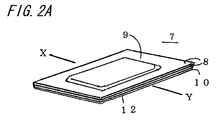
- FIG. 2 is a cross-sectional view cut along a plane perpendicular to the paper surface including the XY axis of FIG. 1A. It is a perspective view of sheet type antibacterial agent (d) which is one embodiment in the present invention.
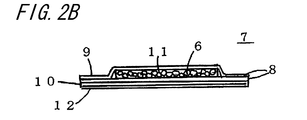
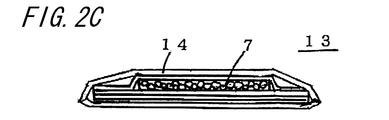
- FIG. 2B is an enlarged cross-sectional view of a sheet-type antibacterial agent (d) cut along a plane perpendicular to the paper surface including the XY axis described in FIG. 2A. It is sectional drawing of the sheet type antibacterial agent (e) enclosed by the airtight container formed with the impermeable material in the sheet type antibacterial agent (d) of FIG. 2B.
- the antimicrobial agent (a) is one which absorbs water containing (generates) chlorine dioxide (antibacterial water), and the water-absorbent resin which absorbs water containing (generates) chlorine dioxide (antibacterial water) is in a particulate state It is.
- the water-absorbent resin is not used as a gel containing a large amount of water as in the prior art, but is used in the form of particles by reducing the amount of water absorption and slightly swelling it. Naturally the particles are wet.
- the water-absorbent resin before absorbing the antibacterial water is not particularly limited in either a natural type or a synthetic type, but it is inexpensive, excellent in water absorption characteristics such as safety, durability, water absorption ratio, water retention capacity and the like. It is preferable that there is no worry.
- a synthetic water-absorbent resin is mentioned in particular, and it is not particularly limited as long as it absorbs water and holds water, for example, a partially cross-linked polyacrylic acid, starch-acrylic acid graft Neutralized polymer, hydrolyzate of starch-acrylonitrile graft polymer, saponified vinyl acetate-acrylic acid ester copolymer, isobutylene-maleic anhydride copolymer cross-linked product, acrylonitrile copolymer or acrylamide copolymer Hydrolysates of these or crosslinked products thereof, acrylate-acrylamide copolymer crosslinked products, polyvinyl alcohol crosslinked products, modified polyethylene oxide crosslinked products, acrylamido-2-methylpropane sulfonate copolymer crosslinked products, (meth) acryloyl alkanes Sulfonate copolymer cross-linked product, crosslinked carboxyl group Le cellulose salts, and the like crosslinked polymer of
- water-absorbent resin in the present invention those obtained by drying and pulverizing a water-containing gel-like polymer of water-absorbent resin obtained by polymerization and crosslinking can be used, but an absorbent obtained by adjusting the particle size as necessary It is more preferable to use a surface cross-linked water-absorbent resin which is surface-crosslinked with a cross-linking agent having at least two functional groups capable of reacting with acid groups such as carboxyl groups and / or bases thereof.
- Such a surface cross-linked water-absorbent resin is excellent in water absorbency and water retention not only under normal pressure but also under pressure, and also has high gel strength, so that water retention is further good and suitable for the present invention. .
- crosslinking agent used for said surface crosslinking the well-known crosslinking agent conventionally used can be applied.
- specific examples include polyglycidyl ether compounds having 2 to 10 epoxy groups in one molecule [ethylene glycol diglycidyl ether, glycerin-1,3-diglycidyl ether, glycerin triglycidyl ether, etc.]; 20-valent polyol compound [glycerin, ethylene glycol, polyethylene glycol (polymerization degree 2 to 100), etc.]; divalent to 20-valent polyamine compound (ethylenediamine, diethylenetriamine etc.); polyamine resin having a molecular weight of 200 to 500,000 (polyamide Polyamine epichlorohydrin resin, polyamine epichlorohydrin resin and the like), alkylene carbonate [ethylene carbonate and the like], aziridine compound, oxazoline compound, polyimine compound and the like.
- polyglycidyl ether compounds, polyamine resins and aziridine compounds are preferred in that surface crosslinking can be carried out at a relatively low temperature.
- the above-mentioned water-absorbent resins may be used alone or in combination of two or more.
- the water-absorbent resin is in the form of particles and may be granulated in a predetermined shape, and there is no limitation on the shape, such as irregularly crushed, spherical, scaly, fibrous, rod-like, massive, powdery, etc.
- the powder be in the form of powder.
- the average particle size of the particles is not particularly limited, but preferably 30 to 850 ⁇ m, more preferably 60 to 400 ⁇ m.
- the average particle diameter of the particles is 30 ⁇ m or more, the water absorption characteristic is good and it is easy to produce. It is hard to block even if it puts in a bag as the average particle diameter of particle
- grains is 850 micrometers or less.
- the particle size distribution of the particles is not particularly limited, but preferably such a particle size distribution that particles in the range of 30 to 850 ⁇ m are 95% by mass or more.
- the average particle size means a mass average particle size
- the mass average particle size is plotted on each particle size distribution of the crosslinked polymer on a logarithmic probability paper with the particle size on the horizontal axis and the mass vertical axis on the vertical axis. It measures by the method of calculating
- the water absorption capacity of the water absorbing resin is preferably 20 to 1,000 g / g, and more preferably 80 to 600 g / g.
- the water absorption capacity of the water absorbent resin is 20 g / g or more, the water absorbability and the water retentivity are good, and when it is 1,000 g / g or less, it tends to be in the form of powder even if absorbing antibacterial water.
- the amount of water absorption can be controlled by various manufacturing conditions of the above-mentioned water absorbent resin.
- the ratio of water holding capacity to water absorption capacity of the water absorbent resin is preferably 0.55 to 1.00, and more preferably 0.65 to 1.00. It is easy to hold chlorine dioxide water for a long period of time when the ratio of water holding amount / water absorption amount of the water absorbing resin is 0.55 or more.
- the ratio of water holding capacity to water absorption ratio can be controlled by the type of monomer, crosslinking conditions, and the like.
- the water absorption capacity and water retention amount of the water absorbent resin can be measured as follows. Water absorption ratio Prepare a tea bag of 250 mesh nylon net, size 10 x 20 cm, heat seal width within 5 mm and pure water. The water-absorbent resin is sieved with a JIS standard sieve, and those having a particle size of 30 to 100 mesh are collected to obtain a measurement sample.
- the above water-absorbent resin is in the form of particles even when it absorbs water (antibacterial water) containing or generated chlorine dioxide, and in the present invention, it is necessary to maintain the shape of the particles.
- water content in the water-absorbent resin is small, the shape of the particles can be easily maintained, and when the water content is large, the particles are broken into a gel state.
- a water-absorbent resin it is preferable to use a surface-crosslinked resin because it is easy to maintain its shape. If the surface of the particles is treated with hydrophobic fine particles to make the surface of the particles hydrophobic, it is more preferable because the surface is further exposed and the particle state can be more easily maintained. In this way, the water-absorbent resin that has absorbed the antibacterial water can be easily made into a particulate state.
- the hydrophobic fine particles used to hydrophobize the particle surface are hydrophobic and are not particularly limited as long as they are smaller than the particle diameter of the water-absorbent resin, but, for example, the inorganic fine particles are hydrophobized. Hydrophobicized inorganic fine particles are preferred.
- the average primary particle diameter of the inorganic fine particles is preferably 7 nm or more and 300 nm or less. If it is inorganic fine particles within this range, it can be attached to the surface of the particles of the water-absorbent resin to improve the hydrophobicity of the water-absorbent resin.
- the average primary particle size of the inorganic fine particles is more preferably 10 nm or more and 100 nm or less.
- silica for example, silica, alumina, titanium oxide, barium titanate, magnesium titanate, calcium titanate, strontium titanate, iron oxide, copper oxide, zinc oxide, tin oxide, silica sand, clay, mica, silica ash Stone, diatomaceous earth, chromium oxide, cerium oxide, bengala, antimony trioxide, magnesium oxide, zirconium oxide, barium sulfate, barium carbonate, calcium carbonate, silicon carbide, silicon nitride and the like, but in the present invention, silica Is preferred because of its versatility.
- hydrophobizing agent for hydrophobizing inorganic fine particles for example, trimethylchlorosilane, methyltrichlorosilane, bromomethyldimethylchlorosilane, 3-chloropropyltrimethoxysilane, vinylmethoxysilane, ⁇ -methacryloxypropyltrichloride Methoxysilane, dimethylvinylchlorosilane, octyltrichlorosilane, dipentyldichlorosilane, trihexylchlorosilane, tridecylchlorosilane, dioctylmethylchlorosilane, isobutyltrimethoxysilane, methyltrimethoxysilane, octyltrimethoxysilane, hexamethyldisilane
- Organic silane compounds such as silazane, diethyl tetratyldisilazane, dimethyl silicone oil,
- hydrophobic inorganic fine particles can be obtained by treating the above-mentioned inorganic fine particles with the above-mentioned hydrophobic treatment agent, among these, hydrophobicized fine silica particles are preferable.
- hydrophobicized fine silica particles examples include HDK H 2000, HDK H 2000/4, HDK H 2050 EP, HVK 21 (manufactured by Hoechst Co., Ltd.), R972, R974, RX200, RY200, R200, R202, R805, and R812 (Aerosil Company company), TS530, TS720 (above, made by Cabot company) etc., and these can be used.
- the water-absorbent resin with hydrophobic fine particles As a method of treating the water-absorbent resin with hydrophobic fine particles, it can be easily obtained by blending the hydrophobic fine particles with the water-absorbent resin and mixing them at preferably 0 to 50 ° C., more preferably 10 to 30 ° C. Preferably, 1 to 20 parts by weight, more preferably 2 to 7 parts by weight of the hydrophobic fine particles are mixed and mixed with 100 parts by weight of the water absorbing resin.
- the mixing method can be obtained by putting both in a container and stirring or mixing. Moreover, when putting in the bag body (1) or the bag body (2) demonstrated below, you may mix in this.
- the hydrophobic fine particles may be further added and mixed to be further removed.
- water containing or generated chlorine dioxide examples include, for example, chlorite aqueous solution, stabilized chlorine dioxide aqueous solution, aqueous solution in which chlorine dioxide is dissolved in water (for example, pure chlorine dioxide aqueous solution or pure neutral chlorine dioxide aqueous solution Etc.) but not limited thereto.
- chlorite aqueous solution and stabilized chlorine dioxide aqueous solution.
- hypochlorite may be contained.
- the chlorite aqueous solution refers to an aqueous solution containing chlorite.
- the chlorite is not particularly limited as long as it generates chlorine dioxide by reacting with an acid, and examples thereof include alkali metal chlorites such as sodium chlorite, potassium chlorite, and lithium chlorite. And salts thereof or alkaline earth metal chlorite such as calcium chlorite, magnesium chlorite, barium chlorite and the like. Among these, sodium chlorite is preferable because it is easily available and has no problems in use.
- the chlorite aqueous solution is chemically stable if the pH is 8.5 or more, and can be stored for about 0.5 to 1 year by storing it in a sealed container.
- an aqueous solution of sodium chlorite a 32% by mass product or a 25% by mass product of a commercial product can be used.
- Stabilized aqueous solution of chlorine dioxide refers to an aqueous solution in which chlorine dioxide is dissolved in an alkaline aqueous solution to stabilize it. It is a chemical substance identified by the same number as chlorine dioxide.
- sodium chlorite and sodium chlorite solutions have the existing chemical substances 1-238, CAS No. 1 and 2, respectively. It is a chemical substance specified in 775-18-2.
- the carboxyl group of the water absorbing resin reacts with chlorite to generate chlorine dioxide.
- the carboxyl groups in the water-absorbent resin are not completely neutralized, and usually 20 to 30 mol% of the carboxyl groups are not neutralized. Since the water-absorbent resin in the particles is a resin and can not move around in the water in the water-absorbent resin, the chlorite present in the water in the particles moves and contacts the carboxyl group of the water-absorbent resin To react.
- the antimicrobial agent (a) is used, chlorine dioxide can be continuously generated because the chlorite reacts with the carboxyl group by volatilization of water, vibration of particles, or collision.
- the absorption capacity of the water-absorbent resin has an excess capacity, and the generated chlorine dioxide can be retained to contribute to sustainability.
- the stabilized chlorine dioxide aqueous solution is not particularly limited as long as it is a solution in which dissolved chlorine dioxide is stabilized.
- sodium percarbonate is added while chlorine dioxide gas is blown into an aqueous sodium carbonate solution.
- a stabilizer may be added to stabilize chlorine dioxide dissolved in the solution.
- the content of chlorine dioxide contained in the stabilized aqueous solution of chlorine dioxide used in the present invention is not particularly limited, but from the viewpoint of stably maintaining chlorine dioxide in a concentration effective for deodorization, sterilization, antifungal treatment, preservation, etc. 0.05% by weight to 25% by weight is preferred.
- Anthium Dioxcide manufactured by International Dioxide INC is 5% by mass (50000 ppm) of chlorine dioxide, 3.65% by mass of sodium carbonate, and 91.35% by mass of water.
- EZ Flow 25% manufactured by Rio Linda Chemical Co., Ltd. contains 25% by weight of chlorine dioxide, 5% by weight of sodium chloride, 2% by weight of sodium carbonate and 68% by weight of water.
- Bio-Cide Chemical Co. Purogen from Inc. contains 2% by weight (20000 ppm) chlorine dioxide.
- the ratio of the water-absorbent resin before absorbing the antibacterial water (hereinafter sometimes referred to as a water-absorbent resin before water absorption) and the antibacterial water is preferably 1: 1 to 1:40 by weight.
- the antibacterial agent (a) can volatilize chlorine dioxide and water, and when it is 40 or less, the water absorbent resin after water absorption tends to be in the form of particles. More preferably, it is 1: 3 to 1:10.
- the amount of the antibacterial water is preferably 1/10 or less of the water absorption capacity of the water-absorbent resin, more preferably 1/30 or less, and particularly preferably 1/80 or less . If it is 1/10 or less, the water-absorbent resin tends to absorb antibacterial water and become particulate.
- the method of allowing the water-absorbent resin to absorb the antibacterial water can be carried out, for example, by spraying the water-absorbent resin powder with the antibacterial water at room temperature, or by blending the water-absorbent resin and the antibacterial water into a container such as a bag and closing and stirring or shaking.
- the shape of the particles after the water-absorbent resin has absorbed the antibacterial water is not particularly limited, but a powdery one is easy to handle and the volatilization of chlorine dioxide water is also preferable, which is preferable.
- the average particle diameter of the particles of the water-absorbent resin (hereinafter also referred to as the antimicrobial agent (a)) having absorbed the antibacterial water is preferably 0.1 to 3 mm.
- the water-absorbent resin having absorbed the antibacterial water naturally swells, but as described above, when the amount of the antibacterial water is suppressed to a certain extent or less, the gelation does not occur and the shape of the particles can be maintained.
- the particle diameter after water absorption is in the above range, the surface area is much larger than when gelation occurs, and chlorine dioxide and water are more easily volatilized.
- the average particle diameter of the particles of the antimicrobial agent (a) is 0.1 mm or more, it is easy to maintain the particle shape and easy to handle. It is hard to block even if it puts in a bag as the average particle diameter of the particle
- the average particle size of the particles of the antimicrobial agent (a) is preferably 0.3 mm or more and 2 mm or less.
- the particle size distribution of the particles of the antimicrobial agent (a) is not particularly limited, but preferably the particle size distribution is such that particles in the range of 0.1 to 3 mm become 80% by mass or more.
- the average particle size and the particle size distribution are the same as in the case of the above water-absorbent resin before water absorption.
- the antimicrobial agent (a) is in the form of particles, it can be formed into a sheet like the particles of a normal water-absorbent resin.
- Known methods can be applied to form a sheet.
- the position of the particles on the substrate is preferably dispersed continuously, whether it is the entire surface of the substrate or linear with a width.
- cotton-like materials such as wood pulp and various fibers such as water absorbent fibers are sheeted by an appropriate method such as papermaking, mechanical bonding, binder bonding, spun bond method, spun lace method A laminated body obtained by laminating these.
- Preferred are those obtained by immobilizing particles on one side or both sides of a substrate such as cloth (particularly preferably non-woven fabric) or paper using a pressure-sensitive adhesive or a binder resin, and particularly preferred is cotton-like wood pulp.
- Powder fixed on paper such as laminate or tissue, sandwiched between base materials by sandwiching, then integrated powder by embossing method, needle punch method, adhesive on one side or both sides of plastic film
- grains using the agent and binder resin For example, what spread
- the antimicrobial agent (a) may be made into a sheet as described above, or after the particles of the water-absorbent resin are made into a sheet, the amount of the antibacterial water to be particles after absorption of the antibacterial water is contained in the sheet. It may be dropped and absorbed onto the particles of the water absorbing resin. Preferably it is the former.
- the fixed amount of particles is preferably 1 to 100 g / m 2 , more preferably 10 to 60 g / m 2 , and particularly preferably 20 to 50 g / m 2 .
- the thickness of the sheet is preferably 0.001 to 5 mm, more preferably 0.01 to 3 mm.
- the antimicrobial agent (a) of the present invention can be used in the form of particles or in the form of a sheet, and can be used as it is in a place intended for antimicrobial, sprinkled on an object, or mixed. Preferably, it can be used as (1) bag-packed antimicrobial agent (b) contained in a bag, (2) sheet-type antimicrobial agent (d) formed into a sheet.
- the packaged bactericidal agent (b) of (1) is preferably flat for use, and the bactericidal agent (a) is particulate, so it is suitable for being contained in a bag.
- the other materials are combined and compressed Can be formed into a sheet by adhesion or the like.
- other materials need to be designed so that chlorine dioxide is released, and it is possible to seal the product so that it can not be released before use and to make it possible to use it by peeling off the seal at the time of use. I will not.
- a preferred configuration of the packaged antibacterial agent (b) is, for example, a bag formed of an impermeable material provided with release holes for releasing the chlorine dioxide and moisture into the atmosphere (the antibacterial agent (a) It is a bagged antimicrobial agent enclosed in 1).
- the antibacterial agent (a) is contained in a bag (2) provided with micropores having a diameter smaller than the particle diameter of the water absorbent resin having absorbed the antibacterial water
- the bag (2) It is preferable that it is a bag-containing antibacterial agent (c) accommodated in the said bag body (1).
- the shape of the bag body (1) is not particularly limited, but may be rectangular, circular or oval, but when it is put down from the neck or put in a pocket, a flat polygonal shape is preferable.
- the size of the bag body (1) is also not particularly limited, but for example, a rectangular one having a size of 40 to 60 mm ⁇ 60 to 90 mm is preferable.
- the material constituting the bag body (1) is not particularly limited as long as it is an impermeable material which does not transmit chlorine dioxide gas, but a light shielding material is preferable from the viewpoint of maintaining the stability of chlorine dioxide.
- a light shielding material is preferable from the viewpoint of maintaining the stability of chlorine dioxide.
- the laminated film of an aluminum layer and a plastic layer, an aluminum vapor deposition film etc. are mentioned, for example, it is not limited to these.
- the discharge hole may be provided anywhere in the bag body (1), but by providing the discharge holes at the edge portions of the polygonal side, the air flow path can be secured even at the time of standing still, efficiently Chlorine dioxide can be released.
- the size and number of the release holes can control the release of chlorine dioxide present in the bag (1) to the outside.
- a plurality of 2 to 20 discharge holes are provided at intervals on one side or both sides of the edge of the discharge holes provided in the bag body (1).
- the size of the release holes is preferably such that particles of the water absorbent resin do not come out from the release holes, but the following bag (2) contains particles of the water absorbent resin in the bag (1) If housed, the size of the discharge hole is arbitrary.
- the micropores as described in the following bag body (2) can also function as the release holes, it is not necessary to provide the holes specially.
- the fine pores are also release pores.
- the size of the bag (2) is preferably smaller than the bag (1) because it is used in the bag (1).
- the shape of the bag body (2) is preferably matched to the shape of the bag body (1), and is, for example, a flat polygonal shape.
- micropores having a diameter smaller than the diameter of the water absorbent resin having absorbed the antibacterial water are formed on the entire surface. The micropores do not permeate the particles of the water absorbent resin but permeate the chlorine dioxide molecules.
- a plastic film for example, a semipermeable membrane film which does not allow water to pass but allows water vapor to pass
- a cloth such as a plate or woven fabric or non-woven fabric It can be used.
- semipermeable membrane films and non-woven fabrics are preferable from the viewpoint of ease of use since there is no leakage of particles of the water-absorbent resin.
- the semipermeable membrane film is used, the volatilization rate of water is slowed, and the release of chlorine dioxide is also suppressed by that effect, and the release of chlorine dioxide as a whole is stabilized, which is preferable when used for a long time.
- the manufacturing method of a bag body (2) can be implemented by a conventionally well-known method, for example, what made one non-woven fabric in half and attached and manufactured the circumference
- the chlorine dioxide carried by the water-absorbent resin that constitutes the antibacterial agent (a) is the surface of the particle due to the flow of air generated by the vibration of the antibacterial agent in the bag, the collision of particles constituting the antibacterial agent (a), etc. It is released from the bag body (2) from the micropores formed on the entire surface of the bag body (2) made of non-woven fabric. It is then discharged from the discharge hole of the bag body (1).
- Another embodiment of the present invention is a sheet-type antimicrobial agent (d) in which the above-mentioned antimicrobial agent (a) is housed in a flat container having a semipermeable membrane film on at least one side. Further, the sheet-type antibacterial agent (d) is a sheet-type antibacterial agent (e) which is sealed in a container formed of a sealed impermeable material.
- the antibacterial agent (a) of the present invention is an antibacterial agent consisting of particles of a water absorbent resin which absorbs water (antibacterial water) containing or generated chlorine dioxide, and since the water absorbent resin is in the form of particles, Due to the fast volatilization rate, chlorine dioxide is also released accordingly. However, the slower the rate of volatilization of water, the slower the rate of release of chlorine dioxide. By controlling the rate of release of water, the overall rate of release of chlorine dioxide can be stably controlled.
- the volatilization rate of water can be controlled by the size and the number of the release holes in the above-mentioned bag (1), that is, the area of the opening in the bag (1).
- the optimized release rate of chlorine dioxide can be controlled by optimizing the ratio of the opening area to the surface area of the bag (1).
- the micropores of the bag (2) can be controlled to cope with all types of antibacterial agents. If the pore size of the micropores having a diameter smaller than the particle diameter of the water absorbent resin is further decreased, and the bag body (2) is formed of a semipermeable membrane film allowing water vapor to pass through at least one surface but not liquid water. The rate of volatilization of water can be considerably reduced. However, if the diameter of the micropores is too small, the release rate of chlorine dioxide may be slow, and it is preferable to determine the volatilization rate of water depending on the application.
- the antibacterial agent (a) since the amount of antibacterial water contained in a thin sheet such as a sheet or a small area such as a patch is not large, it is necessary to slow the rate of water volatilization. In that case, since the above-mentioned release holes are difficult to control, it is preferable to package the antibacterial agent (a) with a semipermeable membrane film which allows water vapor to pass but does not allow liquid water to pass. That is, another embodiment of the present invention is a sheet-type antimicrobial agent (d) in which the above-mentioned antimicrobial agent (a) is housed in a flat container having at least one surface formed of a semipermeable membrane film. Further, the sheet-type antibacterial agent (d) is a sheet-type antibacterial agent (e) which is sealed in a container formed of a sealed impermeable material.
- the semipermeable membrane film is small in gas permeability and can suppress the volatilization of water gas (referred to as water or water vapor in the present invention). At the same time, the release of chlorine dioxide from the system can be suppressed, and the release rate can be made more uniform overall.
- the semipermeable membrane film is not particularly limited, and the semipermeable membrane film may be selected so as to obtain a more uniform release rate of target chlorine dioxide.
- a semipermeable membrane film for example, polyvinyl alcohol film (vinylon film), cellophane, low stretch nylon film, ethylene vinyl acetate copolymer film, ethylene-vinyl alcohol copolymer film, porous film (A film having fine pores) and the like, but it is not limited thereto.
- the porous film such as those micropores with a diameter of 0.01 ⁇ 100 [mu] m of the type opened 10 to 1,000 per 1 m 2, and a small scratches on the entire film countless attached (through a portion
- the water vapor transmission rate is controlled by the depth and number of flaws.
- a semipermeable membrane film which does not pass liquid water but allows water vapor is practical and preferred.
- the semipermeable membrane film does not pass liquid water even if an acidic aqueous solution such as soy sauce or vinegar is applied to the product container, and thus antibacterial water Therefore, the generation of chlorine dioxide is not promoted and the harmful effects are reduced.
- the method for producing the sheet-type antibacterial agent (d) is also not particularly limited.
- the water is volatilized, and if sealed in a container formed of an impermeable material, a sheet-type antibacterial agent (e) can be obtained.
- a pressure-sensitive adhesive or a pressure-sensitive adhesive tape can be attached to a thick impermeable substrate and attached to clothes at the time of use.
- the same one as used for the material constituting the bag body (1) can be applied.
- the size of the sheet-type antibacterial agent (d) is arbitrary, but may be large when pasted on a wall, but small when pasting on clothes such as patches or attached to a box of Japanese confectionery used.
- the shape is also arbitrary, and examples thereof include rectangular and circular shapes.
- the thickness is preferably about 0.5 mm to 10 mm.
- the amount of the antimicrobial agent (a) in the sheet-type antimicrobial agent (d) is optional, and may be used depending on the application and size.
- the antimicrobial water in the water-absorbent resin is volatilized, so that the volume of the particles of the water-absorbent resin shrinks.
- the volume or amount can be determined, which can provide an approximate amount of chlorine dioxide remaining.
- cobalt chloride is pink in the state of absorbing water, and gradually turns blue when the water is evaporated. The change in color makes it possible to visually grasp the amount of water. When it turns blue, the water is volatilized.
- the inside of the bag-form antimicrobial agent (b) or the sheet-type antimicrobial agent (d) is made to be visible with the naked eye, the color of cobalt chloride is visible, and the degree of water content is approximately the amount of water. You can understand the amount.
- Such cobalt chloride is preferably in the form of particles, and the smaller the average particle diameter, the better.
- the average particle size of cobalt chloride is preferably 100 ⁇ m or less.
- Cobalt chloride is preferably included with the antimicrobial agent (a) but not in contact. This is to prevent cobalt chloride from coming into contact with the antimicrobial agent (a) to affect the generation of chlorine dioxide.
- the absorption of water by the water-absorbent resin lowers the pH of the water, but the use of an acid (acidic substance) can further promote the generation of chlorine dioxide.
- acids include inorganic acids such as phosphoric acid, organic acids such as citric acid, malic acid, succinic acid and tartaric acid, bleached powders, isocyanuric acids and the like.
- hydrogen salts can be used in combination to further promote the generation of chlorine dioxide.
- a hydrogen salt is a salt obtained by substituting H + of a polyvalent acid with a cation and still leaving H + , for example, sodium hydrogen sulfate, potassium hydrogen sulfate, sodium dihydrogen phosphate, phosphorus Examples include disodium hydrogen phosphate, potassium dihydrogen phosphate, dipotassium hydrogen phosphate, sodium hydrogen carbonate, potassium hydrogen carbonate and the like.
- a gas generation regulator is a regulator for generating chlorine dioxide gas continuously, and when the generation amount of chlorine dioxide gas is large, at least a part of the chlorine dioxide gas is on the surface and / or inside A substance that has the function of causing chlorine dioxide gas to be generated continuously from the antibacterial agent (a) by holding and releasing the held chlorine dioxide gas when production of chlorine dioxide gas decreases or disappears. .
- the gas generation regulator is not particularly limited in its material and shape as long as it can efficiently disperse chlorine dioxide gas, but it may be, for example, sepiolite, montmorillonite, diatomaceous earth, talc, alumina gel, alumina-silica gel, silica gel Examples thereof include calcium acid, calcined aggregates such as shellfish and corals, calcined clay, and zeolites.
- sepiolite having a relatively large surface area, montmorillonite, diatomaceous earth, talc and zeolite are preferable from the viewpoint of being able to retain a large amount of chlorine dioxide gas.
- powdery, granular and / or porous materials are preferable.
- sepiolite chemical structural formulas a natural mineral of magnesium silicate salt is represented by (OH 2) 4 (OH 2 ) 4 (OH 2) 4 Mg 8 Si 12 O 30 ⁇ 6 ⁇ 8H 2 O
- the crystal structure is fibrous and has a large number of grooves on the surface, a large number of clearances of the cylindrical tunnel structure inside, and is a very large surface area material. These are preferably used together with the antimicrobial agent (a).
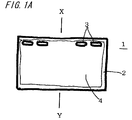
- FIGS. 1A and 1B show an example of a bagged antibacterial agent (c) comprising a bag body (1) containing a bag body (2) according to an embodiment of the present invention, but the present invention is not limited thereto.
- FIG. 1A is a front view thereof
- FIG. 1B is a cross-sectional view taken along a plane perpendicular to the paper surface including the XY axis of FIG. 1A.
- the bagged antibacterial agent (b) 1 described in FIG. 1A is constituted by a rectangular bag (1) 2. Two laterally long discharge holes 3 are formed at the edges of the upper ends of the bag body (1) 2, and the discharge holes 3 are closed by a seal 4.
- the bag body (2) 5 is accommodated in the bag body (1) 2, and the inside of the bag body (2) 5 is an antibacterial agent which is a particle of a water absorbent resin having absorbed antibacterial water.
- (A) It is shown that 6 is contained.
- FIGS. 2A and 2B The sheet-type antibacterial agent (d) is shown in FIGS. 2A and 2B, and the sheet-type antibacterial agent (e) is shown in FIG. 2C.
- FIG. 2A is a perspective view of a sheet-type antibacterial agent (d).
- FIG. 2B is an enlarged cross-sectional view of the sheet-type antibacterial agent (d) cut along a plane perpendicular to the paper surface including the XY axis described in FIG. 2A.
- FIG. 2C shows a sheet-type antibacterial agent (e) in which the sheet-type antibacterial agent (d) of FIG. 2B is enclosed in a sealed container formed of an impermeable material.
- the sheet-type antibacterial agent (d) 7 is rectangular, both surfaces of which are formed of a semipermeable membrane film 8 and heat sealed 9 on all sides.
- the double-sided pressure-sensitive adhesive tape 10 is attached to one side.
- a sheet 11 containing a particulate antibacterial agent (a) 6 is enclosed. Since the antimicrobial agent (a) 6 is in the form of particles, there are many gaps through which chlorine dioxide is released to the outside. Further, in the sheet type antibacterial agent (e) 13 shown in FIG. 2C, since the sheet type antibacterial agent (d) 7 is enclosed in the closed container formed of the impermeable material 14, water and chlorine dioxide are not released. .
- the sheet type antibacterial agent (d) 7 is taken out from the closed container, and the release paper 12 is removed from the double-sided pressure-sensitive adhesive tape 10 and can be stuck on clothes. Chlorine dioxide is released through the semipermeable membrane film 8 together with the water, and the surrounding area can be made an antibacterial atmosphere.
- Example 1 Preparation of antibacterial agent (a) -1 "Sun fresh ST-500D" (polyacrylic acid cross-linked water-absorbing resin, powder, water absorption ratio 400 times, particles) in double-layered polypropylene bag Add 6 g of 106-850 ⁇ m in diameter and 370 ⁇ m in average particle diameter; Sanyo Chemical Industries, Ltd. and 0.18 g of “R-972” (hydrophobic silica, manufactured by Nippon Aerosil; average particle diameter of 16 nm) and shake at room temperature for 10 minutes. A hydrophobization treatment of the water absorbent resin was performed. The average particle diameter of the particles was 0.8 mm, and the particles in the range of 0.1 to 3 mm were about 85% by mass.
- aqueous solution 3000 ppm as chlorine dioxide, pH 10.3; hereinafter sometimes simply referred to as a chlorine dioxide aqueous solution
- a chlorine dioxide aqueous solution obtained by diluting a commercially available stabilized aqueous solution of chlorine dioxide (60,000 ppm as chlorine dioxide) with purified water
- the mixture was shaken at room temperature for 20 minutes to produce an antibacterial agent (a) -1 of the present invention which absorbed a chlorine dioxide aqueous solution. Although it swelled a little, it maintained its particulate form and was free flowing.
- This product absorbed 6 g of chlorine dioxide water into 1 g of a hydrophobized water-absorbent resin, and the amount of absorption was 6 times, which was 1/67 of the water absorption capacity (400 times).
- Example 2 Preparation of antibacterial agent (a) -2 Using 6 g of "Sun Fresh ST-500D” used in Example 1 and 1.0 g of "R-972", water absorption was carried out in the same manner as Example 1. Treatment of the hydrophobic resin.
- Comparative antibacterial agent (a) -3 Comparative antibacterial agent (a) -3
- an aqueous solution (pH 10.1) obtained by diluting the above-mentioned stabilized aqueous solution of chlorine dioxide to 1000 ppm is added to 6 g of the hydrophobized "Sun Fresh ST-500 D" produced in the same manner as in Example 2
- the whole became gel-like, and a comparative antibacterial agent (a) -3 was produced.
- the amount of absorbed chlorine dioxide water of the water-absorbent resin was 100 times, which was about 1 ⁇ 4 of the water absorption capacity.
- Comparative antibacterial agent (a) -4 100 g of an aqueous solution (pH 10.1) obtained by diluting the above-mentioned stabilized chlorine dioxide aqueous solution with 1000 ppm was added to 10 g of zeolite powder, left for 30 minutes, and filtered through filter paper to produce a comparative antibacterial agent (a) -4. 1 g of zeolite absorbed 0.25 g of chlorine dioxide water.
- Examples 3 and 4 Comparative Examples 3 and 4
- a non-woven fabric with a size of 90 mm ⁇ 130 mm (weight per unit area of 50 g / m 2 ) was vertically folded in two, and three sides of the circumference were pasted with a width of 5 mm, leaving one side.
- an antibacterial agent contained in a 45 mm ⁇ 65 mm rectangular bag (2) was produced.
- a card-shaped case of 65 mm long and 95 mm long was made of an aluminum-deposited polyester film.
- one side is attached and the three sides of the periphery are bonded by 5 mm width, and two 5 mm ⁇ 10 mm horizontal-sized discharge holes are provided at both ends of the top of the front side (1 cm from the top) , The entire front side is sealed with polyester film.
- Each of the above-mentioned bags (2) was put in from the remaining one opening of the case, closed, adhered and sealed with a width of 5 mm.
- the bagged antibacterial agents A, B of the present invention and the comparative bagged antibacterial agents C, D were produced.
- the amount of the aqueous solution of chlorine dioxide contained in one bagged antibacterial agent is as follows.
- the packaged antibacterial agents A to C absorb a large amount of chlorine dioxide water, but the amount of chlorine dioxide water in the packaged antibacterial agent D whose carrier is zeolite is small .
- the weight loss amount of the bagged antibacterial agents C and D of the comparative example was small, the weight loss amount of the bagged antibacterial agents A and B as the example was large. This is because the bactericidal agent C is in the form of gel and therefore the amount of volatilization from the surface is small, and it is considered that the bactericidal agent D was originally low in content of chlorine dioxide water and therefore the amount of release was small. Since the bagged antibacterial agents A and B in the example are in the form of particles, it is considered that the surface area is larger than that of the bagged antibacterial agent C, and the release amount of the chlorine dioxide aqueous solution is larger.
- the packaged antibacterial agent when touched with the hand from the outside, the packaged antibacterial agents C and D did not change much from the initial content, but the packaged antibacterial agent A felt that the content was considerably small. By confirming that the internal capacity is reduced, the amount of the remaining chlorine dioxide aqueous solution could be confirmed.
- the amount of released chlorine dioxide after four weeks of the packaged antibacterial agents A and B was larger than that of the packaged antibacterial agents C and D.
- the packaged antibacterial agents A and B made of a particulate water absorbent resin having absorbed a chlorine dioxide aqueous solution according to the present invention are more preferable than the packaged antibacterial agents C and D absorbed in a gel absorbent water absorbent resin or an inorganic material. It turns out that it is what plays an antimicrobial effect for a long time.
- Example 5 In Example 1, the commercially available stabilized chlorine dioxide (60,000 ppm) is replaced with an aqueous solution (3,000 ppm as chlorine dioxide) diluted with purified water, which is a commercially available stabilized chlorine dioxide aqueous solution (60,000 ppm as chlorine dioxide).
- a bagged antibacterial agent E was prepared in the same manner as in Example 1 and Example 3 except that 4500 to 7000 seconds were required to pass through. The sealed bag-type antibacterial agent E was removed, placed on the wall, and the weight of the sealed bag-type antibacterial agent after 1 to 4 weeks was measured to confirm how much chlorine dioxide volatilized with the water. The results are shown in Table 2.
Landscapes
- Life Sciences & Earth Sciences (AREA)
- Chemical & Material Sciences (AREA)
- Agronomy & Crop Science (AREA)
- Inorganic Chemistry (AREA)
- Pest Control & Pesticides (AREA)
- Plant Pathology (AREA)
- Health & Medical Sciences (AREA)
- Engineering & Computer Science (AREA)
- Dentistry (AREA)
- General Health & Medical Sciences (AREA)
- Wood Science & Technology (AREA)
- Zoology (AREA)
- Environmental Sciences (AREA)
- Agricultural Chemicals And Associated Chemicals (AREA)
Abstract
L'invention concerne un agent antimicrobien qui contient du dioxyde de chlore et qui a une grande capacité à absorber ou retenir de l'eau produite, qui libère du dioxyde de chlore pendant une longue période, et pour lequel il est possible d'évaluer dans une certaine mesure le point de fin de vaporisation du dioxyde de chlore. L'invention concerne aussi l'agent antimicrobien logé dans un sac, ou l'agent antimicrobien sous forme de feuille. Cet agent antimicrobien est constitué d'une résine absorbant l'eau qui contient du dioxyde de chlore et qui a absorbé de l'eau produite. Ladite résine absorbant l'eau est traitée avec des microparticules hydrophobes pour obtenir un agent antimicrobien (a) avec un diamètre de particule moyen entre 0,1 et 3 mm. Un autre mode de réalisation est un agent antimicrobien dans un sac (1), contenant l'agent antimicrobien (a) et constitué d'un matériau imperméable et doté de trous d'évacuation permettant d'évacuer du dioxyde de chlore et de l'humidité dans l'atmosphère. Un autre mode de réalisation est un agent antimicrobien sous forme de feuille obtenu en logeant l'agent antimicrobien dans un réceptacle plat formé de façon à avoir une membrane semi-perméable sur au moins un côté de celui-ci.
Priority Applications (1)
| Application Number | Priority Date | Filing Date | Title |
|---|---|---|---|
| JP2015526331A JP6748431B2 (ja) | 2013-07-12 | 2014-07-07 | 抗菌剤、袋入り抗菌剤およびシート型抗菌剤 |
Applications Claiming Priority (4)
| Application Number | Priority Date | Filing Date | Title |
|---|---|---|---|
| JP2013-146044 | 2013-07-12 | ||
| JP2013146044 | 2013-07-12 | ||
| JP2013242811 | 2013-11-25 | ||
| JP2013-242811 | 2013-11-25 |
Publications (1)
| Publication Number | Publication Date |
|---|---|
| WO2015005295A1 true WO2015005295A1 (fr) | 2015-01-15 |
Family
ID=52279975
Family Applications (1)
| Application Number | Title | Priority Date | Filing Date |
|---|---|---|---|
| PCT/JP2014/068093 Ceased WO2015005295A1 (fr) | 2013-07-12 | 2014-07-07 | Agent antimicrobien, agent antimicrobien dans un sac et agent antimicrobien en forme de feuille |
Country Status (2)
| Country | Link |
|---|---|
| JP (1) | JP6748431B2 (fr) |
| WO (1) | WO2015005295A1 (fr) |
Cited By (13)
| Publication number | Priority date | Publication date | Assignee | Title |
|---|---|---|---|---|
| US10738035B2 (en) | 2015-05-13 | 2020-08-11 | Enanta Pharmaceuticals, Inc. | Hepatitis B antiviral agents |
| US10934306B2 (en) | 2016-03-07 | 2021-03-02 | Enanta Pharmaceuticals, Inc. | Hepatitis B antiviral agents |
| US10952978B2 (en) | 2017-08-28 | 2021-03-23 | Enanta Pharmaceuticals, Inc. | Hepatitis B antiviral agents |
| US11058678B2 (en) | 2018-01-22 | 2021-07-13 | Enanta Pharmaceuticals, Inc. | Substituted heterocycles as antiviral agents |
| CN113331209A (zh) * | 2021-05-28 | 2021-09-03 | 北京联飞翔科技股份有限公司 | 一种纳米氧化锌-贝壳粉-粘土复合无机硅酸盐抗菌材料及其制备方法 |
| US11236111B2 (en) | 2019-06-03 | 2022-02-01 | Enanta Pharmaceuticals, Inc. | Hepatitis B antiviral agents |
| US11236108B2 (en) | 2019-09-17 | 2022-02-01 | Enanta Pharmaceuticals, Inc. | Functionalized heterocycles as antiviral agents |
| US11377450B2 (en) | 2018-09-21 | 2022-07-05 | Enanta Pharmaceuticals, Inc. | Functionalized heterocycles as antiviral agents |
| US11472808B2 (en) | 2019-06-04 | 2022-10-18 | Enanta Pharmaceuticals, Inc. | Substituted pyrrolo[1,2-c]pyrimidines as hepatitis B antiviral agents |
| US11738019B2 (en) | 2019-07-11 | 2023-08-29 | Enanta Pharmaceuticals, Inc. | Substituted heterocycles as antiviral agents |
| US11760755B2 (en) | 2019-06-04 | 2023-09-19 | Enanta Pharmaceuticals, Inc. | Hepatitis B antiviral agents |
| US11802125B2 (en) | 2020-03-16 | 2023-10-31 | Enanta Pharmaceuticals, Inc. | Functionalized heterocyclic compounds as antiviral agents |
| US11891393B2 (en) | 2018-11-21 | 2024-02-06 | Enanta Pharmaceuticals, Inc. | Functionalized heterocycles as antiviral agents |
Citations (5)
| Publication number | Priority date | Publication date | Assignee | Title |
|---|---|---|---|---|
| JPS57153736A (en) * | 1981-03-16 | 1982-09-22 | Enkuraa Bijinesu:Kk | Moisture absorbing sheet having deodorizing capacity |
| JPS57156768A (en) * | 1981-03-23 | 1982-09-28 | Encler Business Kk | Deodorant composition |
| JPS57198775A (en) * | 1981-06-01 | 1982-12-06 | Nasa:Kk | Molding material having deodorizing function, etc. |
| JP2011201721A (ja) * | 2010-03-25 | 2011-10-13 | Pasteurize Kk | 二酸化塩素ガス放出ゲル状物 |
| WO2013035838A1 (fr) * | 2011-09-08 | 2013-03-14 | Wake Kiyohiro | Agent antibactérien ensaché |
Family Cites Families (5)
| Publication number | Priority date | Publication date | Assignee | Title |
|---|---|---|---|---|
| JPS60161307A (ja) * | 1984-01-27 | 1985-08-23 | Japan Carlit Co Ltd:The | 二酸化塩素ガス発生組成物 |
| JPS6117542A (ja) * | 1984-07-03 | 1986-01-25 | Takeda Chem Ind Ltd | スペルミン誘導体 |
| JPS61181532A (ja) * | 1985-02-07 | 1986-08-14 | Miura Kagaku Sochi Kk | 安定化二酸化塩素を含有するゲル状組成物 |
| JPH07124461A (ja) * | 1993-10-29 | 1995-05-16 | Niitaka Kagaku Kogyo Kk | 冷却媒材の成形体及びその製造方法 |
| JP3110724B2 (ja) * | 1997-11-28 | 2000-11-20 | ビジネスプラン株式会社 | 純粋二酸化塩素液剤、これを含有するゲル状組成物及び発泡性組成物、並びに、これらを入れるための容器 |
-
2014
- 2014-07-07 WO PCT/JP2014/068093 patent/WO2015005295A1/fr not_active Ceased
- 2014-07-07 JP JP2015526331A patent/JP6748431B2/ja active Active
Patent Citations (5)
| Publication number | Priority date | Publication date | Assignee | Title |
|---|---|---|---|---|
| JPS57153736A (en) * | 1981-03-16 | 1982-09-22 | Enkuraa Bijinesu:Kk | Moisture absorbing sheet having deodorizing capacity |
| JPS57156768A (en) * | 1981-03-23 | 1982-09-28 | Encler Business Kk | Deodorant composition |
| JPS57198775A (en) * | 1981-06-01 | 1982-12-06 | Nasa:Kk | Molding material having deodorizing function, etc. |
| JP2011201721A (ja) * | 2010-03-25 | 2011-10-13 | Pasteurize Kk | 二酸化塩素ガス放出ゲル状物 |
| WO2013035838A1 (fr) * | 2011-09-08 | 2013-03-14 | Wake Kiyohiro | Agent antibactérien ensaché |
Cited By (18)
| Publication number | Priority date | Publication date | Assignee | Title |
|---|---|---|---|---|
| US10738035B2 (en) | 2015-05-13 | 2020-08-11 | Enanta Pharmaceuticals, Inc. | Hepatitis B antiviral agents |
| US10934306B2 (en) | 2016-03-07 | 2021-03-02 | Enanta Pharmaceuticals, Inc. | Hepatitis B antiviral agents |
| US12054493B2 (en) | 2016-03-07 | 2024-08-06 | Enanta Pharmaceuticals, Inc. | Hepatitis B antiviral agents |
| US12496282B2 (en) | 2017-08-28 | 2025-12-16 | Enanta Pharmaceuticals, Inc. | Hepatitis B antiviral agents |
| US11596611B2 (en) | 2017-08-28 | 2023-03-07 | Enanta Pharmaceuticals, Inc. | Hepatitis B antiviral agents |
| US12011425B2 (en) | 2017-08-28 | 2024-06-18 | Enanta Pharmaceuticals, Inc. | Hepatitis B antiviral agents |
| US10952978B2 (en) | 2017-08-28 | 2021-03-23 | Enanta Pharmaceuticals, Inc. | Hepatitis B antiviral agents |
| US11058678B2 (en) | 2018-01-22 | 2021-07-13 | Enanta Pharmaceuticals, Inc. | Substituted heterocycles as antiviral agents |
| US11377450B2 (en) | 2018-09-21 | 2022-07-05 | Enanta Pharmaceuticals, Inc. | Functionalized heterocycles as antiviral agents |
| US12264159B2 (en) | 2018-11-21 | 2025-04-01 | Enanta Pharmaceuticals, Inc. | Functionalized heterocycles as antiviral agents |
| US11891393B2 (en) | 2018-11-21 | 2024-02-06 | Enanta Pharmaceuticals, Inc. | Functionalized heterocycles as antiviral agents |
| US11236111B2 (en) | 2019-06-03 | 2022-02-01 | Enanta Pharmaceuticals, Inc. | Hepatitis B antiviral agents |
| US11472808B2 (en) | 2019-06-04 | 2022-10-18 | Enanta Pharmaceuticals, Inc. | Substituted pyrrolo[1,2-c]pyrimidines as hepatitis B antiviral agents |
| US11760755B2 (en) | 2019-06-04 | 2023-09-19 | Enanta Pharmaceuticals, Inc. | Hepatitis B antiviral agents |
| US11738019B2 (en) | 2019-07-11 | 2023-08-29 | Enanta Pharmaceuticals, Inc. | Substituted heterocycles as antiviral agents |
| US11236108B2 (en) | 2019-09-17 | 2022-02-01 | Enanta Pharmaceuticals, Inc. | Functionalized heterocycles as antiviral agents |
| US11802125B2 (en) | 2020-03-16 | 2023-10-31 | Enanta Pharmaceuticals, Inc. | Functionalized heterocyclic compounds as antiviral agents |
| CN113331209A (zh) * | 2021-05-28 | 2021-09-03 | 北京联飞翔科技股份有限公司 | 一种纳米氧化锌-贝壳粉-粘土复合无机硅酸盐抗菌材料及其制备方法 |
Also Published As
| Publication number | Publication date |
|---|---|
| JP6748431B2 (ja) | 2020-09-02 |
| JPWO2015005295A1 (ja) | 2017-03-02 |
Similar Documents
| Publication | Publication Date | Title |
|---|---|---|
| WO2015005295A1 (fr) | Agent antimicrobien, agent antimicrobien dans un sac et agent antimicrobien en forme de feuille | |
| CN101437917B (zh) | 湿度控制装置 | |
| JP2015101507A (ja) | 二酸化塩素を放出する方法 | |
| JP6385577B2 (ja) | 二酸化塩素発生具およびその製造方法 | |
| JP7459595B2 (ja) | 脱酸素剤組成物 | |
| KR0130460B1 (ko) | 산소 흡수제 및 그의 제조방법 | |
| CN114557364B (zh) | 一种二氧化氯缓释空气清新剂 | |
| JP3252866B2 (ja) | 酸素吸収剤 | |
| JP2022181386A (ja) | 除湿剤、並びにこれを用いた除湿部材及び除湿器 | |
| KR101474514B1 (ko) | 습기 탈취제 | |
| JP2015073773A (ja) | 消臭除菌ペンダント | |
| JP2014000155A (ja) | フィルタ | |
| JP6968374B2 (ja) | 収納袋 | |
| KR20240089012A (ko) | 탈산소제 조성물 및 그의 제조 방법, 및 해당 탈산소제 조성물을 구비하는 탈산소제 포장체 및 그의 제조 방법 | |
| JP2021160964A (ja) | ゲル状二酸化塩素発生具およびその製造方法 | |
| JPS61216715A (ja) | 乾燥用組成物および乾燥用包装物 | |
| JP7623555B2 (ja) | 二酸化塩素発生剤 | |
| CN111186626A (zh) | 一种调控二氧化氯释放速率的包装结构 | |
| WO2014042897A1 (fr) | Paquet de produit humectant | |
| JP2007029131A (ja) | 化学カイロ | |
| JP5430696B2 (ja) | 吸水処理材及びその保存方法 | |
| CN211810864U (zh) | 一种调控杀菌剂释放速率的包装结构 | |
| JPH05220327A (ja) | 除湿剤 | |
| JPH06285141A (ja) | 脱臭剤とこれを利用した脱臭材及び脱臭装置 | |
| JP2548886Y2 (ja) | 除湿器 |
Legal Events
| Date | Code | Title | Description |
|---|---|---|---|
| 121 | Ep: the epo has been informed by wipo that ep was designated in this application |
Ref document number: 14823379 Country of ref document: EP Kind code of ref document: A1 |
|
| ENP | Entry into the national phase |
Ref document number: 2015526331 Country of ref document: JP Kind code of ref document: A |
|
| NENP | Non-entry into the national phase |
Ref country code: DE |
|
| 122 | Ep: pct application non-entry in european phase |
Ref document number: 14823379 Country of ref document: EP Kind code of ref document: A1 |