WO2015067450A1 - Katalytische hydrierung zur herstellung von aminen aus carbonsäureamiden, carbonsäurediamiden, di-, tri- oder polypeptiden oder peptidamiden - Google Patents

Katalytische hydrierung zur herstellung von aminen aus carbonsäureamiden, carbonsäurediamiden, di-, tri- oder polypeptiden oder peptidamiden Download PDF

Info

Publication number
WO2015067450A1
WO2015067450A1 PCT/EP2014/072184 EP2014072184W WO2015067450A1 WO 2015067450 A1 WO2015067450 A1 WO 2015067450A1 EP 2014072184 W EP2014072184 W EP 2014072184W WO 2015067450 A1 WO2015067450 A1 WO 2015067450A1
Authority
WO
WIPO (PCT)
Prior art keywords
carboxylic acid
group
alkyl
butyl
acid
Prior art date
Legal status (The legal status is an assumption and is not a legal conclusion. Google has not performed a legal analysis and makes no representation as to the accuracy of the status listed.)
Ceased
Application number
PCT/EP2014/072184
Other languages
English (en)
French (fr)
Inventor
Renat Kadyrov
Current Assignee (The listed assignees may be inaccurate. Google has not performed a legal analysis and makes no representation or warranty as to the accuracy of the list.)
Evonik Industries AG
Original Assignee
Evonik Industries AG
Priority date (The priority date is an assumption and is not a legal conclusion. Google has not performed a legal analysis and makes no representation as to the accuracy of the date listed.)
Filing date
Publication date
Application filed by Evonik Industries AG filed Critical Evonik Industries AG
Priority to CN201480072289.6A priority Critical patent/CN105873884B/zh
Priority to PL14787135T priority patent/PL3066065T3/pl
Priority to SI201431329T priority patent/SI3066065T1/sl
Priority to ES14787135T priority patent/ES2744849T3/es
Priority to HRP20191598 priority patent/HRP20191598T1/hr
Priority to EP14787135.4A priority patent/EP3066065B1/de
Priority to JP2016550970A priority patent/JP6645974B2/ja
Priority to US15/034,120 priority patent/US9878975B2/en
Publication of WO2015067450A1 publication Critical patent/WO2015067450A1/de
Anticipated expiration legal-status Critical
Ceased legal-status Critical Current

Links

Classifications

    • CCHEMISTRY; METALLURGY
    • C07ORGANIC CHEMISTRY
    • C07CACYCLIC OR CARBOCYCLIC COMPOUNDS
    • C07C209/00Preparation of compounds containing amino groups bound to a carbon skeleton
    • C07C209/44Preparation of compounds containing amino groups bound to a carbon skeleton by reduction of carboxylic acids or esters thereof in presence of ammonia or amines, or by reduction of nitriles, carboxylic acid amides, imines or imino-ethers
    • C07C209/50Preparation of compounds containing amino groups bound to a carbon skeleton by reduction of carboxylic acids or esters thereof in presence of ammonia or amines, or by reduction of nitriles, carboxylic acid amides, imines or imino-ethers by reduction of carboxylic acid amides
    • CCHEMISTRY; METALLURGY
    • C07ORGANIC CHEMISTRY
    • C07BGENERAL METHODS OF ORGANIC CHEMISTRY; APPARATUS THEREFOR
    • C07B43/00Formation or introduction of functional groups containing nitrogen
    • C07B43/04Formation or introduction of functional groups containing nitrogen of amino groups
    • CCHEMISTRY; METALLURGY
    • C07ORGANIC CHEMISTRY
    • C07CACYCLIC OR CARBOCYCLIC COMPOUNDS
    • C07C227/00Preparation of compounds containing amino and carboxyl groups bound to the same carbon skeleton
    • C07C227/14Preparation of compounds containing amino and carboxyl groups bound to the same carbon skeleton from compounds containing already amino and carboxyl groups or derivatives thereof
    • C07C227/16Preparation of compounds containing amino and carboxyl groups bound to the same carbon skeleton from compounds containing already amino and carboxyl groups or derivatives thereof by reactions not involving the amino or carboxyl groups
    • CCHEMISTRY; METALLURGY
    • C07ORGANIC CHEMISTRY
    • C07DHETEROCYCLIC COMPOUNDS
    • C07D207/00Heterocyclic compounds containing five-membered rings not condensed with other rings, with one nitrogen atom as the only ring hetero atom
    • C07D207/02Heterocyclic compounds containing five-membered rings not condensed with other rings, with one nitrogen atom as the only ring hetero atom with only hydrogen or carbon atoms directly attached to the ring nitrogen atom
    • C07D207/04Heterocyclic compounds containing five-membered rings not condensed with other rings, with one nitrogen atom as the only ring hetero atom with only hydrogen or carbon atoms directly attached to the ring nitrogen atom having no double bonds between ring members or between ring members and non-ring members
    • C07D207/10Heterocyclic compounds containing five-membered rings not condensed with other rings, with one nitrogen atom as the only ring hetero atom with only hydrogen or carbon atoms directly attached to the ring nitrogen atom having no double bonds between ring members or between ring members and non-ring members with hetero atoms or with carbon atoms having three bonds to hetero atoms with at the most one bond to halogen, e.g. ester or nitrile radicals, directly attached to ring carbon atoms
    • C07D207/16Carbon atoms having three bonds to hetero atoms with at the most one bond to halogen, e.g. ester or nitrile radicals
    • CCHEMISTRY; METALLURGY
    • C07ORGANIC CHEMISTRY
    • C07DHETEROCYCLIC COMPOUNDS
    • C07D265/00Heterocyclic compounds containing six-membered rings having one nitrogen atom and one oxygen atom as the only ring hetero atoms
    • C07D265/281,4-Oxazines; Hydrogenated 1,4-oxazines
    • C07D265/301,4-Oxazines; Hydrogenated 1,4-oxazines not condensed with other rings
    • C07D265/321,4-Oxazines; Hydrogenated 1,4-oxazines not condensed with other rings with oxygen atoms directly attached to ring carbon atoms
    • CCHEMISTRY; METALLURGY
    • C07ORGANIC CHEMISTRY
    • C07DHETEROCYCLIC COMPOUNDS
    • C07D295/00Heterocyclic compounds containing polymethylene-imine rings with at least five ring members, 3-azabicyclo [3.2.2] nonane, piperazine, morpholine or thiomorpholine rings, having only hydrogen atoms directly attached to the ring carbon atoms
    • C07D295/02Heterocyclic compounds containing polymethylene-imine rings with at least five ring members, 3-azabicyclo [3.2.2] nonane, piperazine, morpholine or thiomorpholine rings, having only hydrogen atoms directly attached to the ring carbon atoms containing only hydrogen and carbon atoms in addition to the ring hetero elements
    • C07D295/027Heterocyclic compounds containing polymethylene-imine rings with at least five ring members, 3-azabicyclo [3.2.2] nonane, piperazine, morpholine or thiomorpholine rings, having only hydrogen atoms directly attached to the ring carbon atoms containing only hydrogen and carbon atoms in addition to the ring hetero elements containing only one hetero ring
    • CCHEMISTRY; METALLURGY
    • C07ORGANIC CHEMISTRY
    • C07DHETEROCYCLIC COMPOUNDS
    • C07D295/00Heterocyclic compounds containing polymethylene-imine rings with at least five ring members, 3-azabicyclo [3.2.2] nonane, piperazine, morpholine or thiomorpholine rings, having only hydrogen atoms directly attached to the ring carbon atoms
    • C07D295/02Heterocyclic compounds containing polymethylene-imine rings with at least five ring members, 3-azabicyclo [3.2.2] nonane, piperazine, morpholine or thiomorpholine rings, having only hydrogen atoms directly attached to the ring carbon atoms containing only hydrogen and carbon atoms in addition to the ring hetero elements
    • C07D295/027Heterocyclic compounds containing polymethylene-imine rings with at least five ring members, 3-azabicyclo [3.2.2] nonane, piperazine, morpholine or thiomorpholine rings, having only hydrogen atoms directly attached to the ring carbon atoms containing only hydrogen and carbon atoms in addition to the ring hetero elements containing only one hetero ring
    • C07D295/03Heterocyclic compounds containing polymethylene-imine rings with at least five ring members, 3-azabicyclo [3.2.2] nonane, piperazine, morpholine or thiomorpholine rings, having only hydrogen atoms directly attached to the ring carbon atoms containing only hydrogen and carbon atoms in addition to the ring hetero elements containing only one hetero ring with the ring nitrogen atoms directly attached to acyclic carbon atoms
    • CCHEMISTRY; METALLURGY
    • C07ORGANIC CHEMISTRY
    • C07DHETEROCYCLIC COMPOUNDS
    • C07D295/00Heterocyclic compounds containing polymethylene-imine rings with at least five ring members, 3-azabicyclo [3.2.2] nonane, piperazine, morpholine or thiomorpholine rings, having only hydrogen atoms directly attached to the ring carbon atoms
    • C07D295/04Heterocyclic compounds containing polymethylene-imine rings with at least five ring members, 3-azabicyclo [3.2.2] nonane, piperazine, morpholine or thiomorpholine rings, having only hydrogen atoms directly attached to the ring carbon atoms with substituted hydrocarbon radicals attached to ring nitrogen atoms
    • C07D295/14Heterocyclic compounds containing polymethylene-imine rings with at least five ring members, 3-azabicyclo [3.2.2] nonane, piperazine, morpholine or thiomorpholine rings, having only hydrogen atoms directly attached to the ring carbon atoms with substituted hydrocarbon radicals attached to ring nitrogen atoms substituted by carbon atoms having three bonds to hetero atoms with at the most one bond to halogen, e.g. ester or nitrile radicals
    • C07D295/145Heterocyclic compounds containing polymethylene-imine rings with at least five ring members, 3-azabicyclo [3.2.2] nonane, piperazine, morpholine or thiomorpholine rings, having only hydrogen atoms directly attached to the ring carbon atoms with substituted hydrocarbon radicals attached to ring nitrogen atoms substituted by carbon atoms having three bonds to hetero atoms with at the most one bond to halogen, e.g. ester or nitrile radicals with the ring nitrogen atoms and the carbon atoms with three bonds to hetero atoms attached to the same carbon chain, which is not interrupted by carbocyclic rings
    • C07D295/15Heterocyclic compounds containing polymethylene-imine rings with at least five ring members, 3-azabicyclo [3.2.2] nonane, piperazine, morpholine or thiomorpholine rings, having only hydrogen atoms directly attached to the ring carbon atoms with substituted hydrocarbon radicals attached to ring nitrogen atoms substituted by carbon atoms having three bonds to hetero atoms with at the most one bond to halogen, e.g. ester or nitrile radicals with the ring nitrogen atoms and the carbon atoms with three bonds to hetero atoms attached to the same carbon chain, which is not interrupted by carbocyclic rings to an acyclic saturated chain
    • CCHEMISTRY; METALLURGY
    • C07ORGANIC CHEMISTRY
    • C07FACYCLIC, CARBOCYCLIC OR HETEROCYCLIC COMPOUNDS CONTAINING ELEMENTS OTHER THAN CARBON, HYDROGEN, HALOGEN, OXYGEN, NITROGEN, SULFUR, SELENIUM OR TELLURIUM
    • C07F9/00Compounds containing elements of Groups 5 or 15 of the Periodic Table
    • C07F9/02Phosphorus compounds
    • C07F9/28Phosphorus compounds with one or more P—C bonds
    • C07F9/38Phosphonic acids [RP(=O)(OH)2]; Thiophosphonic acids ; [RP(=X1)(X2H)2(X1, X2 are each independently O, S or Se)]
    • C07F9/40Esters thereof
    • C07F9/4003Esters thereof the acid moiety containing a substituent or a structure which is considered as characteristic
    • C07F9/4006Esters of acyclic acids which can have further substituents on alkyl
    • CCHEMISTRY; METALLURGY
    • C07ORGANIC CHEMISTRY
    • C07FACYCLIC, CARBOCYCLIC OR HETEROCYCLIC COMPOUNDS CONTAINING ELEMENTS OTHER THAN CARBON, HYDROGEN, HALOGEN, OXYGEN, NITROGEN, SULFUR, SELENIUM OR TELLURIUM
    • C07F9/00Compounds containing elements of Groups 5 or 15 of the Periodic Table
    • C07F9/02Phosphorus compounds
    • C07F9/28Phosphorus compounds with one or more P—C bonds
    • C07F9/38Phosphonic acids [RP(=O)(OH)2]; Thiophosphonic acids ; [RP(=X1)(X2H)2(X1, X2 are each independently O, S or Se)]
    • C07F9/40Esters thereof
    • C07F9/4003Esters thereof the acid moiety containing a substituent or a structure which is considered as characteristic
    • C07F9/4062Esters of acids containing the structure -C(=X)-P(=X)(XR)2 or NC-P(=X)(XR)2, (X = O, S, Se)
    • CCHEMISTRY; METALLURGY
    • C07ORGANIC CHEMISTRY
    • C07KPEPTIDES
    • C07K5/00Peptides containing up to four amino acids in a fully defined sequence; Derivatives thereof
    • C07K5/04Peptides containing up to four amino acids in a fully defined sequence; Derivatives thereof containing only normal peptide links
    • C07K5/06Dipeptides
    • C07K5/06008Dipeptides with the first amino acid being neutral
    • C07K5/06017Dipeptides with the first amino acid being neutral and aliphatic
    • C07K5/06026Dipeptides with the first amino acid being neutral and aliphatic the side chain containing 0 or 1 carbon atom, i.e. Gly or Ala
    • CCHEMISTRY; METALLURGY
    • C07ORGANIC CHEMISTRY
    • C07KPEPTIDES
    • C07K5/00Peptides containing up to four amino acids in a fully defined sequence; Derivatives thereof
    • C07K5/04Peptides containing up to four amino acids in a fully defined sequence; Derivatives thereof containing only normal peptide links
    • C07K5/06Dipeptides
    • C07K5/06008Dipeptides with the first amino acid being neutral
    • C07K5/06078Dipeptides with the first amino acid being neutral and aromatic or cycloaliphatic

Definitions

  • Catalytic hydrogenation for the preparation of amines from carboxylic acid amides, carboxylic acid diamides, di-, tri- or polypeptides or peptide amides The present invention relates to a process for
  • Preparation of amines comprising the following steps: a. Reacting a (i) carboxamide of the general formula (I), or (ii) carboxylic acid diamide of the general formula (II), or (iii) di-, tri- or polypeptide, or (iv) carboxamide-terminated amide-function peptide amide with an alkylating agent, b , Adding one
  • Hydrogen pressure of 0.1 bar to 200 bar is set and wherein a temperature in a range of 0 ° C to 250 ° C is set.
  • O-alkylated carboxamides can be hydrogenated under very mild conditions in the presence of conventional hydrogenation catalysts to give amines.
  • the carboxylic acid amides can be readily and selectively "in situ" alkylated with an alkylating agent under very mild conditions, thus ultimately hydrogenating amides selectively to amines, thereby tolerating a wide variety of functional groups, including nitriles, carboxyl and phosphonates.
  • the technical problem is solved by a process for the preparation of amines comprising the following steps: a) conversion of a i.
  • R is selected from the group consisting of H, (C 1 -C 24 ) -alkyl, (C 3 -C 20 ) -cycloalkyl, (C 2 -C 13 ) -heterocycloalkyl, (C 6 -C 14 ) -aryl, (C 3 -C13) heteroaryl and the acid residue of an amino acid selected from alanine, arginine, asparagine, aspartic acid, cysteine,
  • Glutamine glutamic acid, glycine, histidine, isoleucine, leucine, lysine, methionine,
  • R 1 and R 2 are independently selected from the group consisting of H, (C] _ C 24 ) alkyl, (C 3 -C 8 ) cycloalkyl, (C 2 -C 7 ) heterocycloalkyl, (C 6 -Ci 4 ) -aryl or (C 3 -C 13 ) - heteroaryl, where both the radicals R with R 1 , R with R 2 and R 1 with R 2 independently of one another a saturated or mono- or polyunsaturated (C2-C18 ) -Alkenylene or (C2-C18) heteroalkylene bridge to form an aliphatic or aromatic ring having a total of 3-20 ring atoms, or
  • R x and R xx are independently selected from the group consisting of H, (C 1 -C 24 ) -alkyl, (C 1 -C 24) -heteroalkyl, (C 3 -C 8 ) -cycloalkyl, (C 2 -C 7 ) - heterocycloalkyl, (C6 ⁇ Ci 4) -aryl or (C3-C13) -heteroaryl, where the radicals R x together with R xx is a saturated or mono- or polyunsaturated (C 2 - C 8) alkylene or (C 2 - Cis) -Heteroalkylen- bridge to form an aliphatic or aromatic ring having a total of 3-20 ring atoms, or ii. Di-, tri- or polypeptides, or iv. Peptide amides with carboxy-terminal
  • a hydrogen pressure of 0.1 bar to 200 bar is set and wherein a temperature is set in a range of 0 ° C to 250 ° C.
  • amines denotes all compounds which have the following structural unit it does not matter which other functional groups the compound has.
  • amines are to be understood as meaning the reaction products which are formed by the hydrogenation of amide functions:
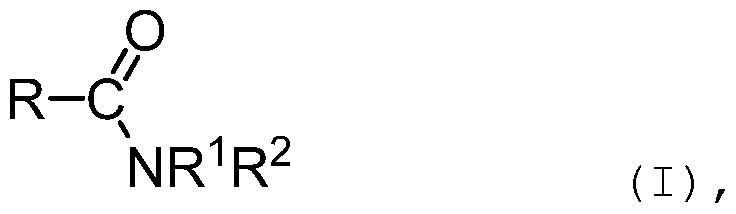
  • carboxamide denotes compounds of the general formula (I)
  • R is selected from the group consisting of H, (C 1 -C 24) - alkyl, (C3-C20) -cycloalkyl, (C 2 -C 3) heterocycloalkyl, (C 6 - C 4) -aryl, (C 3 -C 13 ) heteroaryl and the acid radical of an amino acid selected from alanine, arginine, asparagine,
  • Aspartic acid cysteine, glutamine, glutamic acid, glycine, Histidine, isoleucine, leucine, lysine, methionine, phenylalanine, proline, serine, threonine, tryptophan, tyrosine, valine;
  • R 1 and R 2 are independently selected from the group consisting of H, (C1-C2 4) alkyl, (C3-C8) cycloalkyl, (C2-C7) heterocycloalkyl, (C 6 -C 4) -aryl or (C 3 -C 13) -heteroaryl, where both the radicals R with R 1 , R with R 2 and R 1 with R 2 independently of one another denote a saturated or mono- or polyunsaturated (C 2 -C 18) -alkylene or (C 2 -C18) heteroalkylene bridge form, leaving a
  • R is preferably selected from the group consisting of H, (C 1 -C 2 ) -alkyl, phenyl, and the acid radical of an amino acid selected from alanine, arginine, asparagine, aspartic acid, cysteine, glutamine, glutamic acid, glycine, histidine,
  • N-Bocaminomethyl N-Boc-1-aminoethyl, N-Boc-1-amino-2-methylpropyl, N-Boc-1-amino-3-methylbutyl, N-Boc-1-amino-3-methylthiopropyl, N-Boc-1-amino-2-phenylethyl and N-Bocpyrrolidinyl.
  • R 1 and R 2 are preferably selected from the group
  • a ring is preferably formed between the radicals R and R or R 1 and R 2 , wherein the ring is preferably aliphatic and the alkylene groups propanedi-1, 3-yl, butanedi-1, 4-yl, pentanedi-1, 5-yl , or hexanedi-1, 6-yl, so that the ring contains a total of 4, 5, 6, 7 or 8 ring atoms.
  • Preferred rings are pyrrolidine, piperidine,
  • Table 1 Preferred carboxylic acid amides.
  • carbonic acid diamide denotes compounds of the general formula (II)
  • R xxx is selected from the group consisting of
  • R x and R xx are independently selected from the group consisting of H, (C 1 -C 24) -alkyl, (C 1 -C 24) -heteroalkyl, (C 3 -C 8 ) -cycloalkyl, (C 2 -C 7 ) - Heterocycloalkyl, (C 6 -C 4 ) -aryl or (C 3 -C 13 ) -heteroaryl, where the radicals R x where R xx are each a saturated or mono- or polyunsaturated (C 2 -C 18) -alkylene or ( C2-C 1 8) -Heteroalkylen- bridge can form, so that an aliphatic or aromatic ring with a total of 3-20 ring atoms is formed.
  • R xxx is preferably selected from divalent (C 1 -C 24 ) -alkyl radicals, where the group consisting of methylene,
  • Ethylene, n-propylene, n-butylene, n-pentylene, and n-hexylene is preferred.
  • R x and R xx are preferably independently selected from the group consisting of hydrogen, methyl, ethyl, n-propyl, iso-propyl, n-butyl, iso-butyl, n-pentyl, n-hexyl, n-heptyl, n Octyl, butanedi-1, 4-yl, pentanedi-1, 5-yl,
  • a ring between the radicals R ' and R xx is preferably aliphatic and has a total of 5, 6 or 7 ring atoms.
  • Preferred rings are pyrrolidine,
  • Preferred carboxylic acid diamides are N, ⁇ , ⁇ -Tetramethylbernstein Textrediamid, N, N, N ⁇ , ⁇ N -Tetramethyl- adipamide, N, N, N ⁇ , ⁇ N-tetramethyl-korkklarediamid, N, N, N ⁇ , ⁇ N - Tetramethyl terephthalic diamide and sarcosine anhydride.
  • di-, tri- or polypeptide refers to compounds which have a
  • a dipeptide denotes the connection between two amino acids AS 1 -AS 2
  • a tripeptide denotes the
  • Compound between three amino acids AS 1 -AS 2 -AS 3 and a polypeptide denotes the compound between four to more than 100 amino acids.
  • the amino acids AS 1 , AS 2 and AS 3 can each independently of one another from the group consisting of alanine, arginine, asparagine, aspartic acid, cysteine,
  • Glutamine glutamic acid, glycine, histidine, isoleucine, leucine, lysine, methionine, phenylalanine, proline, serine, threonine, tryptophan, tyrosine, valine, wherein the D and L enantiomers are included.
  • Carbon of the carbonyl group and the nitrogen atom is called peptide bond.
  • the free amino group at one end of the peptide is called the N-terminus, and the free carboxyl group at the other end is called the C-terminus or carboxy-terminus.
  • the carboxy terminus is preferably alkylated or silylated, preferably with methyl or ethyl, MeOCH 2 -,
  • Tetrahydropyranyl (THP), PhCOCH 2 -, t -Bu, allyl, benzyl (Bn), Ph 2 is CH- alkylated or is silylated with Me 3 Si or t -BuMe 2 Si (TBDMS); the N-terminus is preferred with a
  • Table 2 Preferred dipeptides AS-AS, where the amino acid AS in the first column is given in the 3-letter code and the amino acid AS 2 in the first line is indicated in the 3-letter code, and wherein in each case the D and L enantiomers are.
  • peptide amide with carboxyl-terminal amide function denotes a di-, trimer polypeptide which has an amide function -NR X R 2 at the carboxy terminus, where R 1 and R 2 are independently of one another
  • a (Ci-C n ) -alkyl radical is to be understood as meaning both linear and branched alkyl radicals having 1 to n C atoms.
  • Preferred (C 1 -C n ) -alkyl radicals are methyl, ethyl, n-propyl, isopropyl, n-butyl, isobutyl, sec-butyl, n-pentyl, isopentyl, n-hexyl, n-heptyl, n-octyl, n-nonyl, n-decyl, n-dodecyl and n-octadecyl.
  • the (Ci-C n ) -alkyl radical may be substituted or unsubstituted, preferably it is unsubstituted.
  • a (Ci-C n ) -Heteroalkylrest are to be understood as meaning both linear and branched alkyl radicals having 1 to n C atoms, where 1 or 2 C atoms are replaced by heteroatoms selected from the group N, O, P.
  • the branching can occur at any carbon atom.
  • the (Ci-C n ) -Heteroalkylrest can be substituted or
  • a (C 3 -C n ) -cycloalkyl radical denotes a mono-, bi- or tricyclic aliphatic system of a total of 3 to n C atoms, where each ring can be three, four, five, six or seven members. Preference is given to (C 6 -C 12 ) -cycloalkyl radicals. Particularly preferred (C 3 -C n ) -cycloalkyl radicals Cyclopropyl, cyclobutyl, cyclopentyl, cyclohexyl, cycloheptyl and 1-adamantyl are 9-fluorenyl.
  • the (C3-C n) cycloalkyl may be substituted or
  • a (C 2 _ C n) heterocycloalkyl denotes a mono-, bi- or tricyclic aliphatic system of a total of 2 to n C atoms, wherein each ring three-, four-, five-, six- or seven-membered may be, and where the number of
  • Heteroatoms selected from the group N, 0, and S is 1 or 2 and the heteroatoms are the same or different.
  • Preferred heterocycloalkyl radicals are 2-, 3-tetrahydrofuryl, 1-, 2-, 3-pyrrolidinyl, 1-, 2-, 3-, 4-piperidinyl, 1-, 2-piperazinyl, 1-, 2-, 3-morpholinyl, Tetrahydropyranyl-2 or 3 and 2, 3-dihydro-benzothiophenyl-2 or -3.
  • the (C 2 _ C n) heterocycloalkyl may be substituted or
  • a (C6 _ C n) aryl refers to a mono-, bi-, and
  • each ring may be each five, six or seven membered.
  • Preferred (C6 _ C n) -aryl radicals are phenyl, naphthyl, anthryl, phenanthryl, biphenyl.
  • the (C6 _ C n) aryl may be substituted or unsubstituted, preferably it is unsubstituted.
  • a (C3-C n) -heteroaryl radical denotes a mono-, bi- or tricyclic aromatic system from a total of 3 to n carbon atoms, where each of each ring five-, six- or
  • Heteroatoms selected from the group N, 0, and S is 1 or 2 and the heteroatoms are the same or different.
  • Preferred (C 2 _ C n) -heteroaryl radicals are 2-, 3-furyl, 2-, 3- pyrrolyl, 2-, 4-, 5-imidazolyl, 2-, 3-thienyl, 2-, 3-, 4- Pyridyl, 2-, 3-, 4-, 5-, 6-, 7-indolyl, 3-, 4-, 5-pyrazolyl, 2-, 4-, 5-, 6-pyrimidinyl, acridinyl, quinolinyl,
  • the (C3-C n) heteroaryl group may be substituted or
  • Substituents are selected from the group consisting of halogens such as F, Cl, Br, I, and heteroatom-containing halogens such as F, Cl, Br, I, and heteroatom-containing halogens such as F, Cl, Br, I, and heteroatom-containing halogens such as F, Cl, Br, I, and heteroatom-containing halogens such as F, Cl, Br, I, and heteroatom-containing halogens such as F, Cl, Br, I, and heteroatom-containing
  • heteroatom-containing functional groups containing one or more atoms selected from the group consisting of N, O, P, S, or Si, with single and multiple substitution possible.
  • heteroatom-containing functional groups are carbonyl, carboxyl, sulfonate, phosphonate, hydroxyl, amino,
  • (d ⁇ d) -alkyloxy is defined as a linear or branched (dC n ) -alkyl group having 1 to n carbon atoms, with the proviso that they have a
  • (C6 _ C n ) -Aralkyl denotes a group which contains both an alkyl and an aryl group and has a total of 6 to n carbon atoms.
  • the aralkyl group may be bonded via any of its carbon atoms to the molecule bearing this group.
  • a (C6 _ C n) - aralkyl group may be substituted with at least one substituent, wherein the substituents are independently
  • halogen are selected from the group consisting of halogen, (C 1 -C 8 ) -alkyl, (C 1 -C 8 ) -alkyloxy, -NH 2 , -NO, -NO 2 , NH (C 1 -C 8 ) -alkyl, N ((C 1 -C 8 ) -alkyl) 2 , -OH, -CF 3 , -C n F 2n + 1 (where n is an integer from 2 to 5), NH (C 1 -C 8 ) -acyl, -N ((C 1 -C 8 ) -acyl) 2 , (Ci-C 8) acyl, (Ci-C 8) acyloxy, -S0 2 - (Ci-C 8) -alkyl, -S0 2 - (C 6 -C 4) - aryl, -SO- (C -C 8 ) alkyl, -SO- (C
  • Alkylating agents which can be used are all compounds which are suitable for this purpose and are suitable for the purpose, alkylating agents which are selected from the group consisting of alkyl halides, esters of
  • Trifluoromethanesulfonic acid esters of chloroformic acid
  • Alkylating agents selected from the group consisting of (Me 3 O) BF 4 , (Et 3 O) BF 4 , (MeO) 2 SO 2 , (EtO) 2 SO 2 , CICO-Et, Mel and Etl are particularly preferred ,
  • the amount of alkylating agent can be freely chosen by the person skilled in the art. However, the alkylating agent is preferably used in a molar ratio in a range of 1: 1 to 2: 1 relative to the carbonyl group (s) to be reduced.
  • the active metal is one of Group VII B and / or VIII B of the Periodic Table of the Elements, with noble metals and Ni being preferred, in particular, Ru, Rh, Pd, Pt, Re and Ni are preferred.
  • the metals may be present in the hydrogenation catalyst either (a) as such or in the form of oxides or (b) as
  • the metal or metal oxide can either be supported or used as particles.
  • the support material is not limited, usually ordinary supports such as alumina, silica,
  • the content of metal or metal oxide on the support is in a range of 1 wt .-% to 25 wt .-% based on the total weight of
  • Catalyst selected.
  • a content of 1 to 5 wt .-% metal or metal oxide is selected on the support.
  • hydrogenation catalysts examples include Pt / C, Pd / C, Ru / C, Rh / C, Pd / CaCO 3 , Pd / Al 2 O 3 , Ru / Al 2 O 3 , Rh / Al 2 O 3 , Pd / Re / C, Pt / Re / C, Ru0 2 .
  • the metals can also be used in the form of metal complexes as hydrogenation catalysts.
  • metal complexes of the metals Rh, Ir or Ru such as the Wilkinson catalyst ClRh (PPh 3 ) 3 or
  • the hydrogenation catalyst is selected from the
  • the hydrogenation catalyst is particularly preferably selected from the group consisting of Pd / C, Pd / Al 2 0 3, Pd / CaC0 3, Pt / C, Ru / Al 2 0 3, Pd / Re / C, Pt / Re / C and [(dppb) Rh (cod) ] BF 4 .
  • the hydrogenation catalyst is particularly preferably selected from the group
  • the amount of hydrogenation catalyst can be chosen freely by the skilled person, wherein the molar ratio of
  • polar and non-polar solvents in particular u.a. Hydrocarbons, chlorinated hydrocarbons, ethers, esters and alcohols into consideration. Alkanes, haloalkanes, monohydric and polyhydric alcohols, cyclic and acyclic ethers, and esters are preferred.
  • Preferred solvents are those selected from the group consisting of hexane, heptane, octane, dimethyl glycol ether
  • DMGE 1,4-dioxane
  • MTBE methyl tert-butyl ether
  • Isopropanol, butanol, ethylene glycol, dichloromethane, and 1,2-dichloroethane are particularly preferred.
  • methanol and ethanol are particularly preferred.
  • the hydrogen pressure of the reaction is in a range of 0.1 to 200 bar, preferably from 0.1 to 100 bar, and
  • the temperature to be set during the reaction can be determined by those skilled in the art and is usually in a range of 0 ° C to 250 ° C. It should be so high that the envisaged reaction takes place in a sufficiently fast time, but should be as low as possible that the by-product spectrum be kept as low as possible in the hydrogenation.
  • a temperature in the range of 0 ° C to 120 ° C is set. Particularly preferred is a temperature from the range of 10 ° C to 100 ° C is set, most preferably a temperature in the range of 20 ° C to 50 ° C is set.
  • [b] hydrogenation catalyst having at least one active metal of group VII B and / or VIII B of the Periodic Table of the Elements
  • [c] Pd / C, Pd / Al 2 0 3, Pd / CaC0 3, Pt / C, Ru / Al 2 0 3, Pd / Re / C, Pt / Re / C or [(dppb) Rh (cod )] BF 4
  • [d] 5% Pd / C, 5% Pd / Al 2 O 3 , 5% Pd / CaCO 3 , 5% Pt / C, 5% Ru / Al 2 O 3 or [(dppb) Rh (cod)] BF 4
  • [e] alkyl halides, esters of sulfonic acid, esters of fluorosulfonic acid, esters of
  • Trifluoromethanesulfonic acid esters of chloroformic acid, oxonium salts, dialkyl sulfates or
  • [f] (Me 3 O) BF 4 , (Et 3 O) BF 4 , (MeO) 2 SO 2 , (EtO) 2 SO 2 , CICO-Et, Mel or EtI
  • [g] carboxamide of the general formula (I), carboxamide of the general formula (II), di-, tri- or polypeptide, peptidamide with carboxy-terminal amide function,
  • a particular embodiment of the invention is a process for preparing amines, wherein the alkylating agent is selected from the group consisting of alkyl halides, esters of sulfonic acid, esters of fluorosulfonic acid, esters of trifluoromethanesulfonic acid, esters of chloroformic acid, oxonium salts, dialkyl sulfates and diazomethane.
  • the alkylating agent is selected from the group consisting of alkyl halides, esters of sulfonic acid, esters of fluorosulfonic acid, esters of trifluoromethanesulfonic acid, esters of chloroformic acid, oxonium salts, dialkyl sulfates and diazomethane.
  • Another particular embodiment of the invention is a process for the preparation of amines, wherein the
  • Hydrogenation catalyst contains at least one active metal.
  • Another particular embodiment of the invention is a process for the preparation of amines, wherein the active metal is a metal of group VII B and / or VIII B of the
  • Periodic table of the elements is.
  • Another particular embodiment of the invention is a process for preparing amines wherein after step a, a base is added to the reaction mixture and wherein a molar ratio of base to alkylating agent of 1: 1 to 1: 3 is selected.
  • the base can be selected from the group (1) consisting of carbonates, bicarbonates, phosphates, mono- or dihydrogen phosphates or alkoxides of the alkali or
  • nitrogen-containing organic molecules such.
  • B those selected from the group consisting of triethylamine, tri-n- butylamine, 1,4-diazabicyclo [2,2,2] octane, 1,8-diazabicyclo [5,4,0] undec-7-ene, N, -dirnethylglycine ethyl ester, pyridine, tetramethylguanidine, N,, ', N' Tetramethylethane-1,2-diamine, hexamethylenetetramine; and
  • oligomers and polymers supported amines and their derivatives.
  • Phase transfer catalyst used.
  • phase transfer catalysts are the following compounds dimethyl (di (C14-C18) alkyl) ammonium chloride,
  • Group (2) consisting of K 3 P0 4 , K 2 HP0 4 , Ca 2 C0 3 , K 2 C0 3 , Na 2 C0 3 , NaOEt, NaOMe, NEt 3 and pyridine, these bases are preferably used in the presence of a phase transfer catalyst ,
  • the amount of base used can be chosen freely by the skilled person, wherein a molar ratio of base to
  • Alkylating agent of 1: 1 to 1: 3 is preferred. Particularly preferred is a molar ratio of 1: 1.
  • a particular embodiment of the invention is a process for the preparation of amines, wherein the reaction in one
  • a particular embodiment of the invention is a process for the preparation of amines, wherein the solvent is selected from the group consisting of hydrocarbons,
  • Chlorinated hydrocarbons Chlorinated hydrocarbons, ethers, esters and alcohols.
  • Another particular embodiment of the invention is a process for the preparation of amines, wherein the reaction is carried out without a solvent.
  • the invention therefore provides a process wherein anhydrous carboxylic acid amide or carboxylic acid diamide or di-, tri- or polypeptide or peptide amide and anhydrous Alkylating agent and optionally anhydrous
  • a further subject of the invention is an amine obtainable by a process comprising the following steps:
  • R is selected from the group consisting of H, (C 1 -C 24 ) -alkyl, (C 3 -C 20) -cycloalkyl, (C 2 -C 13 ) -
  • Heterocycloalkyl (C 6 -C 4 ) -aryl, (C 3 -C 13) -heteroaryl and the acid radical of an amino acid selected from alanine, arginine, asparagine, aspartic acid, cysteine, glutamine,
  • Glutamic acid glycine, histidine, isoleucine
  • Leucine Leucine, lysine, methionine, phenylalanine, proline, serine, threonine, tryptophan, tyrosine, valine;
  • R 1 and R 2 are independently selected from the group consisting of H, (C 1 -C 24) -
  • Xxx R is selected from the group consisting of divalent (C 1 -C 24) alkyl, (C 3 -C 2 o) _ cycloalkyl, (C 2 -C 3) -
  • Heterocycloalkyl radicals (C 6 -C 4 ) -aryl radicals, (C 3 -C 13) -heteroaryl radicals;
  • R x and R xx are independently selected from the group consisting of H, (C 1 -C 24 ) -alkyl, (C 1 -C 24 ) -heteroalkyl, (C 3 -C 8 ) -cycloalkyl,
  • Carboxylic acid diamide, di-, tri- or polypeptide or peptidamide
  • a particularly preferred embodiment is a method comprising the following steps:
  • R is selected from the group consisting of H, (C 1 -C 24 ) -alkyl, (C 3 -C 20) -cycloalkyl, (C 2 -C 3 ) -heterocycloalkyl, (C 6 -C 4 ) -aryl, (C 3 -C 4 ) -cycloalkyl, C13) - heteroaryl and the acid residue of an amino acid selected from alanine, arginine, asparagine, aspartic acid, cysteine, glutamine,
  • Glutamic acid glycine, histidine, isoleucine, leucine, lysine, methionine, phenylalanine, proline, serine, threonine, tryptophan, tyrosine, valine; and
  • R and R are independently selected from the group consisting of H, (C 1 -C 24) -alkyl, (C 3 -C 8 ) -cycloalkyl, (C 2 -C 7 ) -heterocycloalkyl, (C 6 -C 14) -aryl or (C 3 -C 13 ) - heteroaryl, where both the radicals R with R 1 , R with R 2 and R 1 with R 2 independently of one another a saturated or mono- or polyunsaturated (C 2 -C 8 ) alkylene or (C 2 -C 8 ) - form heteroalkylene bridge, so that an aliphatic or aromatic ring is formed with a total of 3-20 ring atoms,
  • Reaction mixture in a molar ratio of 1:10 to 1: 100,000 based on the carboxylic acid amide, c. Reaction of the reaction mixture with hydrogen, whereby a hydrogen pressure of 0.1 bar to 200 bar is set and wherein a temperature in one
  • Range from 0 ° C to 250 ° C is set.
  • the process according to the invention is generally carried out in such a way that in an autoclave, the carboxamide or Carbonklarediamid or di-, tri- or polypeptide or
  • Peptide amide and the alkylating agent react with each other. Subsequently, the catalyst is mixed in a certain molar ratio with a suitable amount of solvent. Subsequently, the autoclave with several times
  • Alkylating agent react with each other. Connect with a suitable amount of solvent and base
  • the catalyst is in a
  • Piperidone-2 (5 g, 50 mmol) is treated with ethyl chloroformate (6 ml, 60 mmol) and stirred for 4 hours at 50 ° C under argon. It is then concentrated in vacuo and the residue is taken up in absolute ethanol. An autoclave is filled with 5% Pt / C (0.98 g, 0.5 mol%), purged with argon and filled with reaction solution in ethanol. 40 bar of hydrogen are pressed in, and it is stirred at 25 ° C. and constant pressure until no more hydrogen is detected (5 h).
  • Piperidone-2 (5 g, 50 mmol) is treated with dimethyl sulfate (5 ml, 50 mmol) and stirred for 3 hours at 80 ° C under argon, then taken up in 10 ml of absolute methanol.
  • An autoclave is charged with 5% Pt / C (0.98 g, 0.5 mol%), purged with argon and filled with the reaction solution in methanol. It 40 bar hydrogen are pressed on, and it is stirred at 25 ° C and constant pressure until no more hydrogen absorption is visible (5 h). After separation from the catalyst, the filtrate is concentrated on a rotary evaporator, the
  • Residue is dissolved in 20 ml of water and washed with diethyl ether, the aqueous phase is basified with 2N NaOH solution and etherified. The organic phase is dried over K 2 CO 3 , after evaporation of the ether gives almost clean piperidine.
  • Piperidone-2 (5 g, 50 mmol) is added with exclusion of moisture and cooling on a water bath with triethyloxonium tetrafluoroborate (10.45 g, 55 mmol). Then the
  • Reaction mixture filled in ethanol It will be 40 bar
  • Piperidone-2 (5 g, 50 mmol) is added with exclusion of moisture and cooling on a triethyloxonium-water bath. tetrafluoroborate (10.45 g, 55 mmol). Then, the water bath temperature is gradually heated to 40 ° C, and it is stirred at this temperature for 1 hr. The ether is then stripped off in vacuo and the residue is taken up in absolute ethanol. An autoclave is charged with 5% Pt / C (0.98 g, 0.5 mol%) and K 2 CO 3 (6.9 g, 50 mmol), purged with argon and filled with the reaction mixture in ethanol. It is pressed 40 bar of hydrogen, and it is at 25 ° C and
  • Pyrrolidone-2 (4.25 g, 50 mmol) is treated with ethyl chloroformate (6 ml, 60 mmol) and stirred for 4 hours at 50 ° C under argon. It is then concentrated in vacuo and the residue is taken up in absolute ethanol. An autoclave is charged with 5% Pt / C (0.98 g, 0.5 mol%), purged with argon and filled with the reaction solution in ethanol. 40 bar of hydrogen are pressed on, and it is stirred at 25 ° C and constant pressure for 24 hours.
  • the filtrate is concentrated on a rotary evaporator, the residue is dissolved in 20 ml of water and washed with diethyl ether, the aqueous phase is basified with 2N NaOH solution and etherified. The organic phase is dried over K 2 CO 3 , after evaporation of the ether gives almost clean pyrrolidine. Yield 1.85 g (52%).
  • a carboxylic acid amide (10 mmol) is treated with dimethyl sulfate (1 ml, 10 mmol) and stirred at 80 ° C under argon for 3 hours, then added to 5 ml of absolute methanol.
  • An autoclave is charged with catalyst (1 mol%) and 5 ml of 2M
  • the aqueous phase is basified with 14 ml of 2N NaOH solution, the amine is extracted with diethyl ether, and the combined organic phases are dried over K 2 CO 3 . After removal of the solvents in vacuo to obtain practically clean amine.
  • Reaction mixture filled in ethanol It will be 40 bar
  • N- (2-cyanoethyl) -pyrrolidone-2 (6.9 g, 50 mmol) is treated with triethyloxonium tetrafluoroborate (10.45 g, 55 mmol) and stirred overnight at room temperature under argon.
  • the ether phase is decanted off and any remaining ether is in vacuo
  • Washed diethyl ether Washed diethyl ether, the aqueous phase is under
  • Ice cooling is basified with 42 ml of 2N NaOH solution, the product is extracted with diethyl ether (6 x 20 ml), and the combined organic phases are dried over K 2 CO 3 . After removal of the solvents in vacuo, 2.6 g (44%) of practically clean 3- (1-pyrrolidino) -propionitrile.

Landscapes

  • Chemical & Material Sciences (AREA)
  • Organic Chemistry (AREA)
  • Health & Medical Sciences (AREA)
  • Life Sciences & Earth Sciences (AREA)
  • Biochemistry (AREA)
  • Molecular Biology (AREA)
  • General Health & Medical Sciences (AREA)
  • Medicinal Chemistry (AREA)
  • Genetics & Genomics (AREA)
  • Biophysics (AREA)
  • Proteomics, Peptides & Aminoacids (AREA)
  • Chemical Kinetics & Catalysis (AREA)
  • Crystallography & Structural Chemistry (AREA)
  • Organic Low-Molecular-Weight Compounds And Preparation Thereof (AREA)
  • Heterocyclic Carbon Compounds Containing A Hetero Ring Having Nitrogen And Oxygen As The Only Ring Hetero Atoms (AREA)
  • Pyrrole Compounds (AREA)
  • Low-Molecular Organic Synthesis Reactions Using Catalysts (AREA)

Abstract

Die vorliegende Erfindung betrifft ein Verfahren zur Herstellung von Aminen, umfassend die folgenden Schritte: a. Umsetzung eines (i) Carbonsäureamids der allgemeinen Formel (I), oder (ii) Carbonsäurediamids der allgemeinen Formel (II), oder (iii) Di-, Tri- oder Polypeptids, oder (iv) Peptidamids mit carboxyterminaler Amidfunktion mit einem Alkylierungsmittel, b. Zugabe eines Hydrierkatalysators zum Reaktionsgemisch in einem Mol-Verhältnis von 1:10 bis 1:100.000 bezogen auf Carbonsäureamid, Carbonsäurediamid, Di-, Tri- oder Polypeptid oder Peptidamid, c. Umsetzung des Reaktionsgemisches mit Wasserstoff, wobei ein Wasserstoffdruck von 0,1 bar bis 200 bar eingestellt wird und wobei eine Temperatur in einem Bereich von 0°C bis 250°C eingestellt wird.

Description

Katalytische Hydrierung zur Herstellung von Aminen aus Carbonsäureamiden, Carbonsäurediamiden, Di-, Tri- oder Polypeptiden oder Peptidamiden Die vorliegende Erfindung betrifft ein Verfahren zur
Herstellung von Aminen, umfassend die folgenden Schritte: a. Umsetzung eines (i) Carbonsäureamids der allgemeinen Formel (I), oder (ii) Carbonsäurediamids der allgemeinen Formel (II), oder (iii) Di-, Tri- oder Polypeptids, oder (iv) Peptidamids mit carboxyterminaler Amidfunktion mit einem Alkylierungsmittel , b. Zugabe eines
Hydrierkatalysators zum Reaktionsgemisch in einem Mol- Verhältnis von 1:10 bis 1:100.000 bezogen auf
Carbonsäureamid, Carbonsäurediamid, Di-, Tri- oder
Polypeptid oder Peptidamid, c. Umsetzung des
Reaktionsgemisches mit Wasserstoff, wobei ein
Wasserstoffdruck von 0,1 bar bis 200 bar eingestellt wird und wobei eine Temperatur in einem Bereich von 0°C bis 250°C eingestellt wird.
Die Reduktion von Carbonsäureamiden gehört mit zu den wichtigsten Methoden für die Herstellung von Aminen. Das klassische Verfahren basiert auf der Reduktion durch komplexe Hydride, wobei jedoch stöchiometrische Mengen an Hydrid erforderlich sind und die Selektivität relativ gering ist. Die Entwicklung der katalytischen Reduktion mit Wasserstoff bleibt bis heute eine der größten Herausforderungen. In der Literatur sind derartige Hydrierungen bekannt, jedoch sind große Mengen (15 mol% und mehr) an Katalysator, sehr hohe Drücke und Temperaturen über 200 °C notwendig, um brauchbare Ausbeuten zu erzielen (S. Nishimura, Handbook of
Heterogeneous Catalytic Hydrogenation for Organic Synthesis 2001, pp. 406-411, Wiley, N.Y.). Kürzlich wurde über die Hydrierung von tertiären und sekundären Carbonsäureamiden zu Aminen bei 120-160°C über einen bimetallischen Pd-Re- Katalysator berichten (M. Stein , B. Breit, Angew. Chem. 2013, 125, 2287-2290). Trotz etwas milderer Bedingungen wird jedoch kaum eine funktionelle Gruppe toleriert, sogar olefinische Doppelbindungen und aromatische Ringe werden durchhydriert . Die Aufgabe der vorliegenden Erfindung ist es daher, ein verbessertes Verfahren für die katalytische Hydrierung von Carbonsäureamiden mittels Wasserstoff zur Verfügung zu stellen, das nicht die Nachteile der bisher verwendeten direkten Hydrierung aufweist. Vielmehr sollte das Augenmerk auf die Milde der Reaktionsbedingungen und große Toleranz gegenüber verschiedensten funktionellen Gruppen gerichtet sein .
Überraschenderweise wurde nun gefunden, dass O-alkylierte Carbonsäureamide unter sehr milden Bedingungen in Gegenwart von üblichen Hydrierkatalysatoren zu Aminen hydriert werden können. Die Carbonsäureamide lassen sich dabei unter sehr milden Bedingungen einfach und selektiv „in situ" mit einem Alkylierungsmittel O-alkylieren, somit kann man letztendlich Säureamide selektiv zu Aminen hydrieren. Dabei werden unterschiedlichste funktionelle Gruppen toleriert, unter anderem bleiben Nitrile, Carboxyl- und Phosphon-Gruppen erhalten . Die technische Aufgabe wird gelöst durch ein Verfahren zur Herstellung von Aminen umfassend die folgenden Schritte: a) Umsetzung eines i. Carbonsäureamids der allgemeinen Formel (I)
NR1R2 , wobei
R ausgewählt wird aus der Gruppe bestehend aus H, (Ci-C24) -Alkyl, (C3-C20 ) -Cycloalkyl , (C2-C13) -Heterocycloalkyl, (C6-C14 ) -Aryl , (C3- C13 ) -Heteroaryl und dem Säurerest einer Aminosäure ausgewählt aus Alanin, Arginin, Asparagin, Asparaginsäure, Cystein,
Glutamin, Glutaminsäure, Glycin, Histidin, Isoleucin, Leucin, Lysin, Methionin,
Phenylalanin, Prolin, Serin, Threonin,
Tryptophan, Tyrosin, Valin; und
R1 und R2 unabhängig voneinander ausgewählt werden aus der Gruppe bestehend aus H, (C]_- C24) -Alkyl, (C3-C8) -Cycloalkyl, (C2-C7)- Heterocycloalkyl , (C6-Ci4 ) -Aryl oder (C3-C13)- Heteroaryl, wobei sowohl die Reste R mit R1, R mit R2 als auch R1 mit R2 unabhängig voneinander eine gesättigte oder einfach oder mehrfach ungesättigte (C2-C18 ) -Alkylen- oder (C2-C18 ) -Heteroalkylen-Brücke bilden, so dass ein aliphatischer oder aromatischer Ring mit insgesamt 3-20 Ringatomen entsteht, oder
Carbonsäurediamids der allgemeinen Formel
(II)
Figure imgf000004_0001
wobei Rx x x ausgewählt wird aus der Gruppe
bestehend aus divalenten (Ci-C24)- Alkylresten, (C3-C2o ) -Cycloalkylresten, (C2- C13) -Heterocycloalkylresten, (C6-Ci4) - Arylresten, (C3-C13) -Heteroarylresten; und
Rx und Rx x unabhängig voneinander ausgewählt werden aus der Gruppe bestehend aus H, (Ci- C24)-Alkyl, (C1-C24) -Heteroalkyl, (C3-C8)- Cycloalkyl, (C2-C7) -Heterocycloalkyl , (C6~ Ci4)-Aryl oder (C3-C13 ) -Heteroaryl , wobei die Reste Rx mit Rx x miteinander eine gesättigte oder einfach oder mehrfach ungesättigte (C2- Ci8 ) -Alkylen- oder (C2-Cis ) -Heteroalkylen- Brücke bilden können, so dass ein aliphatischer oder aromatischer Ring mit insgesamt 3-20 Ringatomen entsteht, oder ii. Di-, Tri- oder Polypeptids, oder iv. Peptidamids mit carboxyterminaler
Amidfunktion mit einem Alkylierungsmittel , b) Zugabe eines Hydrierkatalysators zum Reaktionsgemisch, wobei das Mol-Verhältnis von Hydrierkatalysator zu Carbonsäureamid oder Carbonsäurediamid oder Di-, Tri¬ oder Polypeptid oder Peptidamid in einem Bereich von 1:10 bis 1:100.000 liegt, c) Umsetzung des Reaktionsgemisches mit Wasserstoff,
wobei ein Wasserstoffdruck von 0,1 bar bis 200 bar eingestellt wird und wobei eine Temperatur in einem Bereich von 0°C bis 250°C eingestellt wird.
Im Sinne der vorliegenden Erfindung bezeichnet der Begriff Amine alle Verbindungen, die die folgende Struktureinheit
Figure imgf000006_0001
aufweisen, wobei es unerheblich ist, welche weiteren funktionellen Gruppen die Verbindung aufweist. Insbesondere sind unter Aminen die Reaktionsprodukte zu verstehen, die durch die Hydrierung von Amidfunktionen entstehen :
Figure imgf000006_0002
Im Sinne der vorliegenden Erfindung bezeichnet der Begriff Carbonsäureamid Verbindungen der allgemeinen Formel (I)
Figure imgf000006_0003
wobei
R ausgewählt wird aus der Gruppe bestehend aus H, (C1-C24)- Alkyl, (C3-C20) -Cycloalkyl, (C2-Ci3 ) -Heterocycloalkyl , (C6- Ci4)-Aryl, (C3-C13 ) -Heteroaryl und dem Säurerest einer Aminosäure ausgewählt aus Alanin, Arginin, Asparagin,
Asparaginsäure, Cystein, Glutamin, Glutaminsäure, Glycin, Histidin, Isoleucin, Leucin, Lysin, Methionin, Phenylalanin, Prolin, Serin, Threonin, Tryptophan, Tyrosin, Valin; und
R1 und R2 unabhängig voneinander ausgewählt werden aus der Gruppe bestehend aus H, (C1-C24 ) -Alkyl , (C3-C8) -Cycloalkyl, (C2-C7) -Heterocycloalkyl, (C6-Ci4 ) -Aryl oder (C3-C13)- Heteroaryl, wobei sowohl die Reste R mit R1, R mit R2 als auch R1 mit R2 unabhängig voneinander eine gesättigte oder einfach oder mehrfach ungesättigte (C2-C18 ) -Alkylen- oder (C2-C18 ) -Heteroalkylen-Brücke bilden, so dass ein
aliphatischer oder aromatischer Ring mit insgesamt 3-20 Ringatomen entsteht.
R ist bevorzugt ausgewählt aus der Gruppe bestehend aus H, (C1-C24 ) -Alkyl , Phenyl, und dem Säurerest einer Aminosäure ausgewählt aus Alanin, Arginin, Asparagin, Asparaginsäure, Cystein, Glutamin, Glutaminsäure, Glycin, Histidin,
Isoleucin, Leucin, Lysin, Methionin, Phenylalanin, Prolin, Serin, Threonin, Tryptophan, Tyrosin, Valin; R wird
besonders bevorzugt ausgewählt aus H, Methyl, Ethyl, n- Propyl, n-Butyl, iso-Butyl, n-Pentyl, n-Hexyl, Cyclohexyl, n-Heptyl, n-Octyl, Phenyl, Pyridyl, Naphthyl, -C2H4PO (OEt ) 2, -C8H16-CH=CH2, -COOEt,
N-Boc-aminomethyl , N-Boc-l-aminoethyl, N-Boc-l-amino-2- methylpropyl , N-Boc-l-amino-3-methylbutyl, N-Boc-l-amino-3- methylthiopropyl , N-Boc-l-amino-2-phenylethyl und N-Boc- pyrrolidinyl .
R1 und R2 sind bevorzugt ausgewählt aus der Gruppe
bestehend aus Wasserstoff, Methyl, Ethyl, n-Propyl, iso-
Propyl, n-Butyl, iso-Butyl, n-Pentyl, n-Hexyl, n-Heptyl, n- Octyl, und Phenyl. Ein Ring wird bevorzugt zwischen den Resten R und R oder R1 und R2 gebildet, wobei der Ring bevorzugt aliphatisch ist und die Alkylengruppen Propandi-1, 3-yl, Butandi-1, 4-yl, Pentandi-1, 5-yl, oder Hexandi-1 , 6-yl aufweist, so dass der Ring insgesamt 4, 5, 6, 7 oder 8 Ringatome enthält.
Bevorzugt gebildete Ringe sind Pyrrolidin, Piperidin,
Morpholin, Piperazin, Homopiperidin und Homopiperazin sowie deren Derivate. Bevorzugte Carbonsäureamide können Tabelle 1 entnommen werden .
Tabelle 1: Bevorzugte Carbonsäureamide.
Verbindung R R R
1 H Methyl Methyl
2 H Ethyl Ethyl
3 H n-Propyl n-Propyl
4 H iso-Propyl iso-Propyl
5 H n-Butyl n-Butyl
6 H iso-Butyl iso-Butyl
7 H n-Pentyl n-Pentyl
8 H n-Hexyl n-Hexyl
9 H n-Heptyl n-Heptyl
10 H n-Octyl n-Octyl
11 H Phenyl Phenyl
12 Methyl Methyl Methyl
13 Methyl Ethyl Ethyl
14 Methyl n-Propyl n-Propyl
15 Methyl iso-Propyl iso-Propyl
16 Methyl n-Butyl n-Butyl
17 Methyl iso-Butyl iso-Butyl
18 Methyl n-Pentyl n-Pentyl Methyl n-Hexyl n-Hexyl
Methyl n-Heptyl n-Heptyl
Methyl n-Octyl n-Octyl
Methyl Phenyl Phenyl
Ethyl Methyl Methyl
Ethyl Ethyl Ethyl
Ethyl n-Propyl n-Propyl
Ethyl iso-Propyl iso-Propyl
Ethyl n-Butyl n-Butyl
Ethyl iso-Butyl iso-Butyl
Ethyl n-Pentyl n-Pentyl
Ethyl n-Hexyl n-Hexyl
Ethyl n-Heptyl n-Heptyl
Ethyl n-Octyl n-Octyl
Ethyl Phenyl Phenyl n-Propyl Methyl Methyl n-Propyl Ethyl Ethyl n-Propyl n-Propyl n-Propyl n-Propyl iso-Propyl iso-Propyl n-Propyl n-Butyl n-Butyl n-Propyl iso-Butyl iso-Butyl n-Propyl n-Pentyl n-Pentyl n-Propyl n-Hexyl n-Hexyl n-Propyl n-Heptyl n-Heptyl n-Propyl n-Octyl n-Octyl n-Propyl Phenyl Phenyl n-Butyl Methyl Methyl n-Butyl Ethyl Ethyl n-Butyl n-Propyl n-Propyl n-Butyl iso-Propyl iso-Propyl n-Butyl n-Butyl n-Butyl n-Butyl iso-Butyl iso-Butyl n-Butyl n-Pentyl n-Pentyl n-Butyl n-Hexyl n-Hexyl n-Butyl n-Heptyl n-Heptyl n-Butyl n-Octyl n-Octyl n-Butyl Phenyl Phenyl iso-Butyl Methyl Methyl iso-Butyl Ethyl Ethyl iso-Butyl n-Propyl n-Propyl iso-Butyl iso-Propyl iso-Propyl iso-Butyl n-Butyl n-Butyl iso-Butyl iso-Butyl iso-Butyl iso-Butyl n-Pentyl n-Pentyl iso-Butyl n-Hexyl n-Hexyl iso-Butyl n-Heptyl n-Heptyl iso-Butyl n-Octyl n-Octyl iso-Butyl Phenyl Phenyl n-Pentyl Methyl Methyl n-Pentyl Ethyl Ethyl n-Pentyl n-Propyl n-Propyl n-Pentyl iso-Propyl iso-Propyl n-Pentyl n-Butyl n-Butyl n-Pentyl iso-Butyl iso-Butyl n-Pentyl n-Pentyl n-Pentyl n-Pentyl n-Hexyl n-Hexyl n-Pentyl n-Heptyl n-Heptyl n-Pentyl n-Octyl n-Octyl n-Pentyl Phenyl Phenyl n-Hexyl Methyl Methyl n-Hexyl Ethyl Ethyl n-Hexyl n-Propyl n-Propyl n-Hexyl iso-Propyl iso-Propyl n-Hexyl n-Butyl n-Butyl n-Hexyl iso-Butyl iso-Butyl n-Hexyl n-Pentyl n-Pentyl n-Hexyl n-Hexyl n-Hexyl n-Hexyl n-Heptyl n-Heptyl n-Hexyl n-Octyl n-Octyl n-Hexyl Phenyl Phenyl
Cyclohexyl Methyl Methyl
Cyclohexyl Ethyl Ethyl
Cyclohexyl n-Propyl n-Propyl
Cyclohexyl iso-Propyl iso-Propyl
Cyclohexyl n-Butyl n-Butyl
Cyclohexyl iso-Butyl iso-Butyl
Cyclohexyl n-Pentyl n-Pentyl
Cyclohexyl n-Hexyl n-Hexyl
Cyclohexyl n-Heptyl n-Heptyl
Cyclohexyl n-Octyl n-Octyl
Cyclohexyl Phenyl Phenyl n-Heptyl Methyl Methyl n-Heptyl Ethyl Ethyl n-Heptyl n-Propyl n-Propyl n-Heptyl iso-Propyl iso-Propyl n-Heptyl n-Butyl n-Butyl n-Heptyl iso-Butyl iso-Butyl n-Heptyl n-Pentyl n-Pentyl n-Heptyl n-Hexyl n-Hexyl n-Heptyl n-Heptyl n-Heptyl n-Heptyl n-Octyl n-Octyl n-Heptyl Phenyl Phenyl n-Octyl Methyl Methyl n-Octyl Ethyl Ethyl n-Octyl n-Propyl n-Propyl n-Octyl iso-Propyl iso-Propyl n-Octyl n-Butyl n-Butyl n-Octyl iso-Butyl iso-Butyl n-Octyl n-Pentyl n-Pentyl n-Octyl n-Hexyl n-Hexyl n-Octyl n-Heptyl n-Heptyl n-Octyl n-Octyl n-Octyl n-Octyl Phenyl Phenyl
Phenyl Methyl Methyl
Phenyl Ethyl Ethyl
Phenyl n-Propyl n-Propyl
Phenyl iso-Propyl iso-Propyl
Phenyl n-Butyl n-Butyl
Phenyl iso-Butyl iso-Butyl
Phenyl n-Pentyl n-Pentyl
Phenyl n-Hexyl n-Hexyl
Phenyl n-Heptyl n-Heptyl
Phenyl n-Octyl n-Octyl
Phenyl Phenyl Phenyl
Pyridyl Methyl Methyl
Pyridyl Ethyl Ethyl
Pyridyl n-Propyl n-Propyl
Pyridyl iso-Propyl iso-Propyl
Pyridyl n-Butyl n-Butyl
Pyridyl iso-Butyl iso-Butyl
Pyridyl n-Pentyl n-Pentyl
Pyridyl n-Hexyl n-Hexyl
Pyridyl n-Heptyl n-Heptyl
Pyridyl n-Octyl n-Octyl
Pyridyl Phenyl Phenyl
Naphthyl Methyl Methyl
Naphthyl Ethyl Ethyl
Naphthyl n-Propyl n-Propyl Naphthyl iso-Propyl iso-Propyl
Naphthyl n-Butyl n-Butyl
Naphthyl iso-Butyl iso-Butyl
Naphthyl n-Pentyl n-Pentyl
Naphthyl n-Hexyl n-Hexyl
Naphthyl n-Heptyl n-Heptyl
Naphthyl n-Octyl n-Octyl
Naphthyl Phenyl Phenyl
-C2H4PO(OEt)2 Methyl Methyl
-CgHi6-CH=CH2 (1- Methyl Methyl
Decenyl ? )
-C (=0) OEt Methyl Methyl
- (CH2)2- Methyl Methyl C (=0)NMe2
H - (CH2)3-
Methyl - (CH2)3-
Ethyl - (CH2)3-
Propyl - (CH2)3-
Butyl - (CH2)3- n-Pentyl - (CH2)3- n-Hexyl - (CH2)3-
Cyclohexyl - (CH2)3- n-Heptyl - (CH2)3- n-Octyl - (CH2)3-
Pyridyl - (CH2)3-
Naphthyl - (CH2)3-
Phenyl - (CH2)3-
H - (CH2)4- Methyl - (CH2) 4~
Ethyl - (CH2) 4~
Propyl - (CH2) 4~
Butyl - (CH2) 4- n-Pentyl - (CH2) 4- n-Hexyl - (CH2) 4-
Cyclohexyl - (CH2) 4- n-Heptyl - (CH2) 4- n-Octyl - (CH2) 4-
Pyridyl - (CH2) 4-
Naphthyl - (CH2) 4-
Phenyl - (CH2) 4-
H - (CH2)5-
Methyl ~ (CH2) 5~
Ethyl - (CH2)5-
Propyl - (CH2)5-
Butyl ~ (CH2) 5- n-Pentyl - (CH2)5- n-Hexyl - (CH2)5-
Cyclohexyl ~ (CH2) 5- n-Heptyl - (CH2)5- n-Octyl - (CH2)5-
Pyridyl ~ (CH2) 5-
Naphthyl - (CH2)5-
Phenyl - (CH2)5- H - (CH2) 6-
Methyl - (CH2) 6-
Ethyl - (CH2) 6-
Butyl - (CH2) 6-
Butyl - (CH2) 6- n-Pentyl - (CH2) 6- n-Hexyl - (CH2) 6-
Cyclohexyl - (CH2) 6- n-Heptyl - (CH2) 6- n-Octyl - (CH2) 6-
Pyridyl - (CH2) 6-
Naphthyl - (CH2) 6-
Phenyl - (CH2) 6-
- (CH2)3- - (CH2)2-CN
- (CH2)3- H
- (CH2)3- Methyl
- (CH2)4- H
- (CH2)4- Methyl
- (CH2)5- H
- (CH2)5- Methyl
-C(=0)0- (CH2)2- H
-C(=0)0- (CH2)2- Methyl
- (CH2)2-NH- (CH2)2- H
- (CH2)2-NH- (CH2)2- Methyl
- (CH2)3-NH- (CH2)2- H
- (CH2)3-NH- (CH2)2- Methyl Im Sinne der vorliegenden Erfindung bezeichnet der Begriff Carbonsäurediamid Verbindungen der allgemeinen Formel (II)
Figure imgf000016_0001
wobei
Rx x x ausgewählt wird aus der Gruppe bestehend aus
divalenten (C1-C24 ) -Alkylresten, (C3-C20 ) -Cycloalkylresten, (C2-C13 ) -Heterocycloalkylresten, (C6-C14 ) -Arylresten, (C3- C13) -Heteroarylresten; und
Rx und Rx x unabhängig voneinander ausgewählt werden aus der Gruppe bestehend aus H, (C1-C24 ) -Alkyl , (C1-C24 ) -Heteroalkyl , (C3-C8) -Cycloalkyl, (C2-C7) -Heterocycloalkyl , (C6-Ci4 ) -Aryl oder (C3-C13 ) -Heteroaryl , wobei die Reste Rx mit Rx x miteinander eine gesättigte oder einfach oder mehrfach ungesättigte (C2-C18 ) -Alkylen- oder (C2-C18 ) -Heteroalkylen- Brücke bilden können, so dass ein aliphatischer oder aromatischer Ring mit insgesamt 3-20 Ringatomen entsteht.
Rx x x ist bevorzugt ausgewählt aus divalenten (C1-C24)- Alkylresten, wobei die Gruppe bestehend aus Methylen,
Ethylen, n-Propylen, n-Butylen, n-Pentylen, und n-Hexylen bevorzugt ist.
Rx und Rx x sind bevorzugt unabhängig voneinander ausgewählt aus der Gruppe bestehend aus Wasserstoff, Methyl, Ethyl, n- Propyl, iso-Propyl, n-Butyl, iso-Butyl, n-Pentyl, n-Hexyl, n-Heptyl, n-Octyl, Butandi-1, 4-yl, Pentandi-1, 5-yl,
Hexandi-1 , 6-yl und Phenyl . Ein Ring zwischen den Resten R' und Rxx ist bevorzugt aliphatisch und weist insgesamt 5, 6 oder 7 Ringatome aufweist. Bevorzugt gebildete Ringe sind Pyrrolidin,
Piperidin, Morpholin, Piperazin, Homopiperidin und
Homopiperazin sowie deren Derivate.
Bevorzugte Carbonsäurediamide sind N, , λ , λ -Tetramethylbernsteinsäurediamid, N, N, N λ , N λ -Tetramethyl- adipinsäurediamid, N, N, N λ , N λ -Tetramethyl-korksäurediamid, N, N, N λ , N λ -Tetramethyl-terephthalsäurediamid und Sarcosin- anhydrid .
Im Sinne der vorliegenden Erfindung bezeichnet der Begriff Di-, Tri- oder Polypeptid Verbindungen, die eine
Peptidbindung zwischen Aminosäuren enthalten.
Ein Dipeptid bezeichnet dabei die Verbindung zwischen zwei Aminosäuren AS1-AS2, ein Tripeptid bezeichnet die
Verbindung zwischen drei Aminosäuren AS1-AS2-AS3 und ein Polypeptid bezeichnet die Verbindung zwischen vier bis über 100 Aminosäuren. Die Aminosäuren AS1, AS2 und AS3 können jeweils unabhängig voneinander aus der Gruppe bestehend aus Alanin, Arginin, Asparagin, Asparaginsäure, Cystein,
Glutamin, Glutaminsäure, Glycin, Histidin, Isoleucin, Leucin, Lysin, Methionin, Phenylalanin, Prolin, Serin, Threonin, Tryptophan, Tyrosin, Valin ausgewählt werden, wobei die D- und L-Enantiomere umfasst sind. Bei der
Kondensation von Aminosäuren reagiert die Carboxylgruppe der einen Aminosäure formal unter Wasserabspaltung mit der Aminogruppe der anderen Aminosäure zur Säureamidgruppierung -C (=0) -NH, die neu geknüpfte Amidbindung zwischen dem
Kohlenstoff der Carbonylgruppe und dem Stickstoffatom wird Peptidbindung genannt. Die freie Aminogruppe an einem Ende des Peptids nennt man N-Terminus, die freie Carboxylgruppe am anderen Ende wird C-Terminus oder Carboxy-Terminus genannt. Der Carboxy- Terminus ist bevorzugt alkyliert oder silyliert, wobei bevorzugt mit Methyl oder Ethyl, MeOCH2-,
Tetrahydropyranyl (THP) , PhCOCH2-, t-Bu, Allyl, Benzyl (Bn) , Ph2CH- alkyliert ist oder mit Me3Si- oder t-BuMe2Si- (TBDMS) silyliert ist; der N-Terminus ist bevorzugt mit einer
Schutzgruppe versehen, wobei die Schutzgruppe bevorzugt aus der folgenden Gruppe bestehend aus Boc, Cbz, Fmoc und Alloc ausgewählt wird, wobei Boc=tert-Butyloxycarbonyl ,
Cbz=Benzyloxycarbonyl , Fmoc=Fluorenylmethylenoxycarbonyl , Alloc=Allyloxycarbonyl bedeutet. Beispiele für Dipeptide können Tabelle 2 entnommen werden.
Tabelle 2: Bevorzugte Dipeptide AS -AS , wobei die Aminosäure AS in der ersten Spalte im 3- Buchstabencode angegeben ist und die Aminosäure AS2 in der ersten Zeile im 3-Buchstabencode angegeben ist, und wobei jeweils die D- und L-Enantiomere umfasst sind.
Ala Arg Asn Asp Cys Gin Glu His Ile Leu Lys Met Phe Pro Ser Thr Trp Tyr Va
Ala X X X X X X X X X X X X X X X X X X X
Arg X X X X X X X X X X X X X X X X X X X
Asn X X X X X X X X X X X X X X X X X X X
Asp X X X X X X X X X X X X X X X X X X X
Cys X X X X X X X X X X X X X X X X X X X
Gin X X X X X X X X X X X X X X X X X X X
Glu X X X X X X X X X X X X X X X X X X X
Gly X X X X X X X X X X X X X X X X X X X
His X X X X X X X X X X X X X X X X X X X
Ile X X X X X X X X X X X X X X X X X X X
Leu X X X X X X X X X X X X X X X X X X X
Lys X X X X X X X X X X X X X X X X X X X
Met X X X X X X X X X X X X X X X X X X X
Phe X X X X X X X X X X X X X X X X X X X
Pro X X X X X X X X X X X X X X X X X X X
Ser X X X X X X X X X X X X X X X X X X X
Thr X X X X X X X X X X X X X X X X X X X
Trp X X X X X X X X X X X X X X X X X X X
Tyr X X X X X X X X X X X X X X X X X X X
Val X X X X X X X X X X X X X X X X X X X
Im Sinne der vorliegenden Erfindung bezeichnet der Begriff Peptidamid mit carboxyterminaler Amidfunktion ein Di-, Trioder Polypeptid, das am Carboxy-Terminus eine Amidfunktion -NRXR2 aufweist, wobei R1 und R2 unabhängig voneinander
ausgewählt werden aus H, (C1-C24 ) -Alkyl , (C3-C8) -Cycloalkyl,
(C2-C7) -Heterocycloalkyl , (C6-C14 ) -Aryl oder (C3-C13 ) -Heteroaryl .
Unter einem (Ci-Cn) -Alkylrest sind sowohl lineare als auch verzweigte Alkylreste mit 1 bis n C-Atomen zu verstehen. Bei verzweigten Alkylresten kann die Verzweigung an einem
beliebigen Kohlenstoff-Atom auftreten.
Bevorzugte (Ci-Cn) -Alkylreste sind Methyl, Ethyl, n-Propyl, iso-Propyl, n-Butyl, iso-Butyl, sec-Butyl, n-Pentyl, iso- Pentyl, n-Hexyl, n-Heptyl, n-Octyl, n-Nonyl, n-Decyl, n- Dodecyl und n-Octadecyl .
Der (Ci-Cn) -Alkylrest kann substituiert oder unsubstituiert sein, bevorzugt ist er unsubstituiert.
Unter einem (Ci-Cn) -Heteroalkylrest sind sowohl lineare als auch verzweigte Alkylreste mit 1 bis n C-Atomen zu verstehen, wobei 1 oder 2 C-Atome durch Heteroatome ausgewählt aus der Gruppe N, 0, P ersetzt sind. Bei verzweigten Heteroalkylresten kann die Verzweigung an einem beliebigen Kohlenstoff-Atom auftreten .
Der (Ci-Cn) -Heteroalkylrest kann substituiert oder
unsubstituiert sein, bevorzugt ist er unsubstituiert.
Ein (C3-Cn) -Cycloalkylrest bezeichnet ein mono-, bi- oder tricyclisches , aliphatisches System aus insgesamt 3 bis n C- Atomen, wobei jeder Ring drei-, vier-, fünf-, sechs- oder siebengliedrig sein kann. Bevorzugt sind (C6-C12)- Cycloalkylreste . Besonders bevorzugte (C3-Cn) -Cycloalkylreste sind Cyclopropyl, Cyclobutyl, Cyclopentyl, Cyclohexyl, Cycloheptyl und 1-Adamantyl, 9-Fluorenyl.
Der (C3-Cn) -Cycloalkylrest kann substituiert oder
unsubstituiert sein, bevorzugt ist er unsubstituiert.
Ein (C2 _Cn) -Heterocycloalkylrest bezeichnet ein mono-, bi- oder tricyclisches , aliphatisches System aus insgesamt 2 bis n C- Atomen, wobei jeder Ring drei-, vier-, fünf-, sechs- oder siebengliedrig sein kann, und wobei die Anzahl der
Heteroatome, ausgewählt aus der Gruppe N, 0, und S 1 oder 2 beträgt und die Heteroatome gleich oder verschieden sind.
Bevorzugte Heterocycloalkylreste sind 2-, 3-Tetrahydrofuryl , 1-, 2-, 3-Pyrrolidinyl , 1-, 2-, 3-, 4-Piperidinyl, 1-, 2- Piperazinyl, 1-, 2-, 3-Morpholinyl , Tetrahydropyranyl-2 oder - 3 und 2 , 3-Dihydro-benzothiophenyl-2 oder -3.
Der (C2 _Cn) -Heterocycloalkylrest kann substituiert oder
unsubstituiert sein, bevorzugt ist er unsubstituiert.
Ein (C6_Cn) -Arylrest bezeichnet ein mono-, bi- und
tricyclisches, aromatisches System mit 6 bis n C-Atomen, wobei jeder Ring jeweils fünf-, sechs- oder siebengliedrig sein kann. Bevorzugte (C6_Cn) -Arylreste sind Phenyl, Naphthyl, Anthryl, Phenantryl, Biphenyl.
Der (C6_Cn) -Arylrest kann substituiert oder unsubstituiert sein, bevorzugt ist er unsubstituiert.
Ein (C3-Cn) -Heteroarylrest bezeichnet ein mono-, bi- oder tricyclisches, aromatisches System aus insgesamt 3 bis n C- Atomen, wobei jeder Ring jeweils fünf-, sechs- oder
siebengliedrig sein kann, und wobei die Anzahl der
Heteroatome, ausgewählt aus der Gruppe N, 0, und S 1 oder 2 beträgt und die Heteroatome gleich oder verschieden sind.
Bevorzugte (C2 _Cn) -Heteroarylreste sind 2-, 3-Furyl, 2-, 3- Pyrrolyl, 2-, 4-, 5-Imidazolyl, 2-, 3-Thienyl, 2-, 3-, 4- Pyridyl, 2-, 3-, 4-, 5-, 6-, 7-Indolyl, 3-, 4-, 5-Pyrazolyl, 2-, 4-, 5-, 6-Pyrimidinyl , Acridinyl, Chinolinyl,
Phenantridinyl , Benzothienyl .
Der (C3-Cn) -Heteroarylrest kann substituiert oder
unsubstituiert sein, bevorzugt ist er unsubstituiert .
Substituenten werden ausgewählt aus der Gruppe bestehend aus Halogenen wie F, Cl, Br, I, und heteroatomhaltigen
funktionellen Gruppen, die ein oder mehrere Atome ausgewählt aus der Gruppe bestehend aus N, 0, P, S, oder Si enthalten, wobei Einfach- und Mehrfachsubstitution möglich ist. Beispiele für heteroatomhaltige funktionelle Gruppen sind Carbonyl-, Carboxyl-, Sulphonat-, Phosphonat-, Hydroxyl-, Amino-,
Ammoniumgruppen wie
-OH,
- (Ci-C8) -Alkyloxy
-COOH,
Figure imgf000022_0001
-NH ( {d-Cgj-Acyloxy)
-N( (Ci-C20) -Alkyl) ({d-Cgj-Acyl) ,
-N({C6-C14}-Aryl) ( { d-C8 } -Acyl ) ,
-N({C6-C14}-Aralkyl) ( { d-C8 } -Acyl ) ,
Figure imgf000022_0002
-NH3 +,
-NH({d-C2o}-Alkyl)2 +,
-NH({C6-C14}-Aryl)2 +,
-NH({C6-C14}-Aralkyl)2 +,
-NH ( {C1-C20 } -Alkyl) ( {C6-C14 } -Aryl) +,
-N ( {C6-C14 } -Aryl) ( {d-C20 } -Alkyl) 2 +,
-N ( {C6-C14 } -Aryl) 2 ( {d-C20 } -Alkyl) +,
-O-C (=0) -O-{d-C20}-Alkyl,
-O-C (=0) -0-{C6-Ci4}-Aryl,
-O-C (=0) -0-{C6-Ci4}-Aralkyl,
-NH-C (=0) -O-{Ci-C20}-Alkyl, -NH-C (=0) -0-{C6-Ci4}-Aryl,
-NH-C (=0) -0-{C6-Ci4}-Aralkyl,
-0-C (=0) -NH-{Ci-C20}-Alkyl,
-0-C (=0) -NH-{C6-Ci4}-Aryl,
-0-C (=0) -NH-{C6-Ci4}-Aralkyl,
-CN,
-S02-0-{Ci-C2o}-Alkyl,
-S02-0-{C6-Ci4}-Aryl,
-SO2-O- { C -Ci4 } -Aralkyl,
-S02-{Ci-C2o}-Alkyl,
Figure imgf000023_0001
-S02-{C6-Ci4} -Aralkyl,
-SO-id-Czol-Alkyl,
Figure imgf000023_0002
-SO-{C6-Ci4}-Aralkyl,
-Si ({d-Czol-Alkyl) 3,
Figure imgf000023_0003
-Si ({C6-C14}-Aryl) ( { d-C20 } -Alkyl ) 2 ,
-Si ({C6-C14}-Aryl) 2 ({ d-C2& } -Alkyl ) ,
-{d-dol-Perfluoroalkyl,
-PO(O-{d-C20}-Alkyl)2,
-PO(0-{C6-C14}-Aryl) 2,
-PO (O-{d-C20} -Alkyl) (0- { C6-C14 } -Aryl ) ,
-PO({d-C20}-Alkyl)2,
-PO({C6-d4}-Aryl)2,
-PO({d-C2o}-Alkyl) ( { C6-C14 } -Aryl ) .
Im Sinne der vorliegenden Erfindung ist (d~d) -Alkyloxy definiert als lineare oder verzweigte (d-Cn) -Alkylgruppe mit 1 bis n C-Atomen mit der Maßgabe, dass diese über ein
Sauerstoffatom an das diese Gruppe tragende Molekül gebunden ist . Im Sinne der vorliegenden Erfindung ist (Ci-Cn) -Acyl definiert als eine Gruppe mit der allgemeinen Struktur R- (C=0) - mit insgesamt 1 bis n Kohlenstoffatomen, wobei R ausgewählt wird aus der Gruppe bestehend aus H, (Ci-Cn-i ) -Alkyl , (Ci-Cn-i)- Alkenyl, (C6-Cn-i ) -Aryl , (C6-Cn-i ) -Heteroaryl und (C2-Cn-i)- Alkinyl .
Im Sinne der vorliegenden Erfindung ist (Ci-Cn) -Acyloxy eine Gruppe mit der allgemeinen Struktur R'-(C=0)0- mit insgesamt 1 bis n Kohlenstoffatomen, wobei R' ausgewählt wird aus der
Gruppe bestehend aus H, (Ci-Cn-i ) -Alkyl , (Ci-Cn-i ) -Alkenyl , (C6~ Cn-i)-Aryl, (C6-Cn-i ) -Heteroaryl und (C2-Cn-i ) -Alkinyl .
Im Sinne der vorliegenden Erfindung ist (C2-Cn) -Alkenyl
definiert als lineare oder verzweigte (C2-Cn) -Alkylgruppe mit 2 bis n Kohlenstoffatomen mit der Maßgabe, dass diese eine C-C- Doppelbindung aufweist.
Im Sinne der vorliegenden Erfindung ist (C2-Cn) -Alkinyl
definiert als lineare oder verzweigte (C2-Cn) -Alkylgruppe mit 2 bis n Kohlenstoffatomen mit der Maßgabe, dass diese eine C-C- Dreifachbindung aufweist.
Im Sinne der vorliegenden Erfindung bezeichnet (C6_Cn) -Aralkyl eine Gruppe, die sowohl eine Alkyl- als auch eine Arylgruppe enthält und in Summe 6 bis n Kohlenstoffatome aufweist. Die Aralkylgruppe kann über jedes ihrer Kohlenstoffatome an das diese Gruppe tragende Molekül gebunden sein. Eine (C6_Cn) - Aralkylgruppe kann auch mit wenigstens einem Substituenten substitutiert sein, wobei die Substituenten unabhängig
voneinander ausgewählt werden aus der Gruppe bestehend aus Halogen, (Ci-C8) -Alkyl, (Ci-C8) -Alkyloxy, -NH2, -NO, -N02, NH(Ci- C8) -Alkyl, -N ( (Ci-C8) -Alkyl) 2, -OH, -CF3, -CnF2n+1 (wobei n eine ganze Zahl von 2 bis 5 ist), NH (Ci-C8) -Acyl, -N ( (Ci-C8) -Acyl) 2, (Ci-C8) -Acyl, (Ci-C8) -Acyloxy, -S02- (Ci-C8) -Alkyl, -S02- (C6-Ci4) - Aryl, -SO- (Ci-C8) -Alkyl, -SO- (C6-Ci4) -Aryl, -PO (0- { Ci-C20 } - Alkyl) 2, -PO(0-{C6-C14}-Aryl)2, -PO (0- {C1-C20 } -Alkyl) (0-{C6-C14}- Aryl), -PO({C1-C2o}-Alkyl)2, -PO ( { C6-C14 } -Aryl ) 2 , -PO ( {C1-C20 } - Alkyl) ( {C6-Ci4}-Aryl) .
Als Alkylierungsmittel können alle dem Fachmann für diesen Zweck in Frage kommenden Verbindungen ausgewählt werden, bevorzugt sind Alkylierungsmittel, die ausgewählt werden aus der Gruppe bestehend aus Alkylhalogeniden, Estern der
Sulfonsäure, Estern der Fluorsulfonsäure, Estern der
Trifluormethansulfonsäure, Estern der Chlorameisensäure,
Oxonium-Salzen, Dialkylsulfaten und Diazomethan einzusetzen. Alkylierungsmittel, die ausgewählt werden aus der Gruppe bestehen aus (Me30)BF4, (Et30)BF4, (MeO)2S02, (EtO)2S02, CICOOEt, Mel und Etl, sind dabei besonders bevorzugt.
Die Menge des Alkylierungsmittels kann vom Fachmann frei gewählt werden. Das Alkylierungsmittel wird jedoch bevorzugt in einem Mol-Verhältnis in einem Bereich von 1:1 bis 2:1 bezogen auf die zu reduzierende (n) Carbonyl-Gruppe (n)
eingesetzt .
Als Hydrierkatalysator können alle dem Fachmann für diesen Zweck in Frage kommenden Hydrierkatalysatoren ausgewählt werden. Bevorzugt werden solche Hydrierkatalysatoren
eingesetzt, die mindestens ein aktives Metall enthalten.
Bevorzug ist das aktive Metall eines der Gruppe VII B und/oder VIII B des Periodensystems der Elemente, wobei Edelmetalle und Ni bevorzugt sind, insbesondere sind Ru, Rh, Pd, Pt, Re und Ni bevorzugt. Die Metalle können im Hydrierkatalysator entweder (a) als solche oder in Form von Oxiden oder (b) als
Metallkomplexe vorliegen. In Fall (a) kann das Metall oder Metalloxid entweder auf einem Träger aufgebracht oder als Partikel eingesetzt werden. Das Trägermaterial ist nicht beschränkt, üblicherweise werden gewöhnliche Träger wie Aluminiumoxid, Siliciumdioxid,
Aluminiumoxid, Eisenoxid, Magnesiumoxid, Zirkoniumdioxid, Kohlenstoff oder ähnliche dem Fachmann auf dem Gebiet der Hydrierung bekannte Träger eingesetzt. Der Gehalt an Metall oder Metalloxid auf dem Träger wird in einem Bereich von 1 Gew.-% bis 25 Gew.-% bezogen auf das Gesamtgewicht des
Katalysators gewählt. Bevorzugt wird ein Gehalt von 1 bis 5 Gew.-% Metall oder Metalloxid auf dem Träger gewählt.
Beispiele für derartige Hydrierkatalysatoren sind Pt/C, Pd/C, Ru/C, Rh/C, Pd/CaC03, Pd/Al203, Ru/Al203, Rh/Al203, Pd/Re/C, Pt/Re/C, Ru02.
In Fall (b) können die Metalle auch in Form von Metall- Komplexen als Hydrierkatalysatoren eingesetzt werden.
Beispiele hierfür sind Metall-Komplexe der Metalle Rh, Ir oder Ru, wie z.B. der Wilkinson-Katalysator ClRh(PPh3)3 oder
[ (dppb)Rh(cod) ]BF4, [ Ir (PCy3 (C5H5N) (cod) ] PF6, [ Cl2Ru ( PPh3 ) 3 ] und [ (dppb) Ru (metallyl) 2] .
Bevorzugt wird der Hydrierkatalysator ausgewählt aus der
Gruppe bestehend aus Pd/C, Pd/Al203, Pd/CaC03, Pt/C, Ru/Al203, Pd/Re/C, Pt/Re/C und [ (dppb) Rh (cod) ] BF4. Besonders bevorzugt wird der Hydrierkatalysator ausgewählt aus der Gruppe
bestehend aus 5%Pd/C, 5%Pd/Al203, 5%Pd/CaC03, 5%Pt/C, 5%Ru/Al203 und [ (dppb) Rh (cod) ] BF4.
Die Menge des Hydrierkatalysators kann vom Fachmann frei gewählt werden, wobei das Mol-Verhältnis von
Hydrierkatalysator zu Carbonsäureamid oder Carbonsäurediamid oder Di-, Tri- oder Polypeptid oder Peptidamid in einem
Bereich von 1:10 bis 1:100.000 liegt. Weiter bevorzugt ist ein Bereich von 1:20 bis 1:10.000, besonders bevorzugt ist ein Bereich von 1:50 bis 1:2.000. Prinzipiell ist der Fachmann frei in der Wahl des
Lösungsmittels, das er in dem erfindungsgemäßen Verfahren einsetzen möchte. Aufgrund der Tatsache, dass die
Ausgangsstoffe häufig in flüssiger Form vorliegen, kann insofern auf den Einsatz eines Lösungsmittels auch verzichtet werden. Wenn jedoch der Einsatz von Lösungsmitteln in dem erfindungsgemäßen Verfahren gewünscht ist, ist es vorteilhaft, solche Lösungsmittel heranzuziehen, die die eingesetzten
Komponenten der Reaktion entsprechend gut lösen und sich im Übrigen gegenüber der erfindungsgemäßen Reaktion als inert erweisen. Als solche kommen polare und unpolare Lösungsmittel, insbesondere u.a. Kohlenwasserstoffe, Chlorkohlenwasserstoffe, Ether, Ester und Alkohole in Betracht. Bevorzugt sind dabei Alkane, Halogenalkane, einwertige und mehrwertige Alkohole, cyclische und acyclische Ether, und Ester.
Bevorzugte Lösungsmittel sind solche ausgewählt aus der Gruppe bestehend aus Hexan, Heptan, Octan, Dimethylglykolether
(DMGE) , 1,4-Dioxan, Methyl-tert-butylether (MTBE) ,
Tetradydrofuran (THF) , Essigsäureethylester,
Essigsäureisopropyl-ester, Dibutylether, Dimethylcarbonat , Diethylcarbonat , Dipropylcarbonat , Methanol, Ethanol,
Isopropanol, Butanol, Ethylenglycol , Dichlormethan, und 1,2- Dichlorethan . Besonders bevorzugt sind Methanol und Ethanol.
Der Wasserstoffdruck der Reaktion wird in einem Bereich von 0,1 bis 200 bar, vorzugsweise von 0,1 bis 100 bar, und
besonders bevorzugt von 0,1 bis 60 bar eingestellt. Die Temperatur, die während der Reaktion einzustellen ist, kann vom Fachmann bestimmt werden und liegt üblicherweise in einem Bereich von 0°C bis 250°C. Sie sollte so hoch sein, dass die anvisierte Reaktion in ausreichend schneller Zeit abläuft, doch möglichst so niedrig sein, dass das Nebenproduktspektrum bei der Hydrierung so gering wie möglich gehalten werden kann. Bevorzugt wird eine Temperatur aus dem Bereich von 0°C bis 120°C eingestellt. Besonders bevorzugt wird eine Temperatur aus dem Bereich von 10°C bis 100°C eingestellt, ganz besonders bevorzugt wird eine Temperatur aus dem Bereich von 20 °C bis 50°C eingestellt.
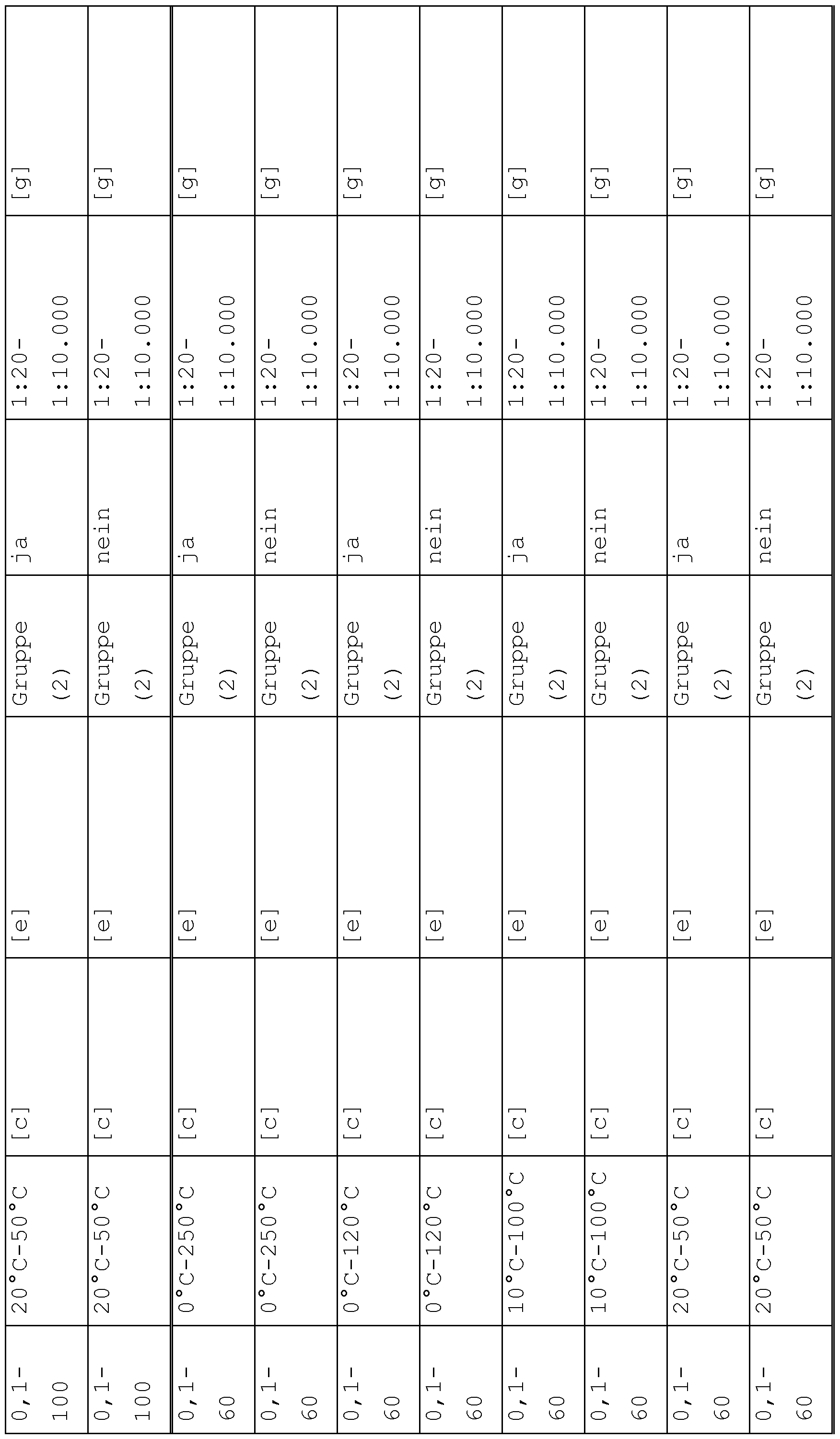
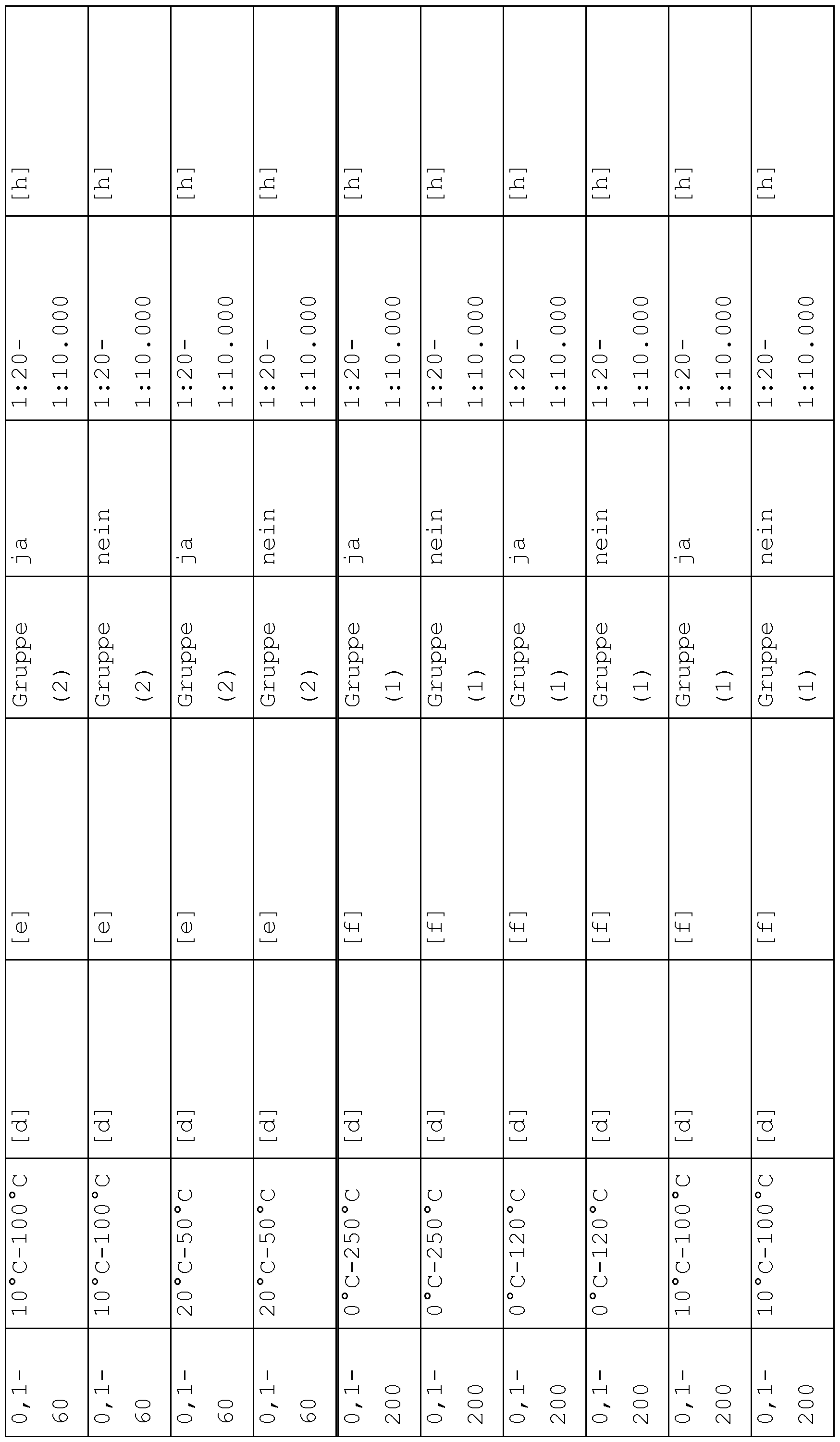
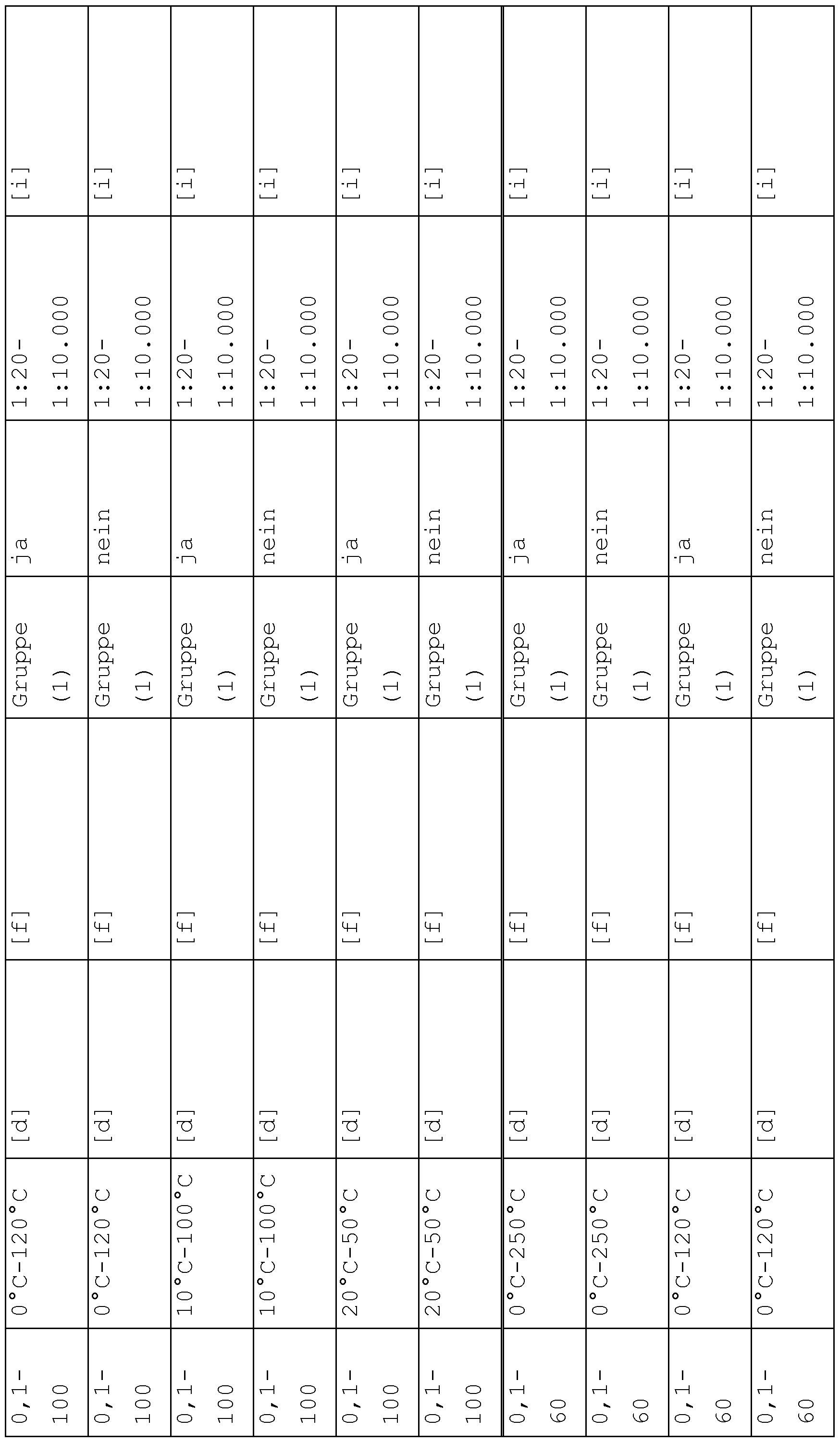
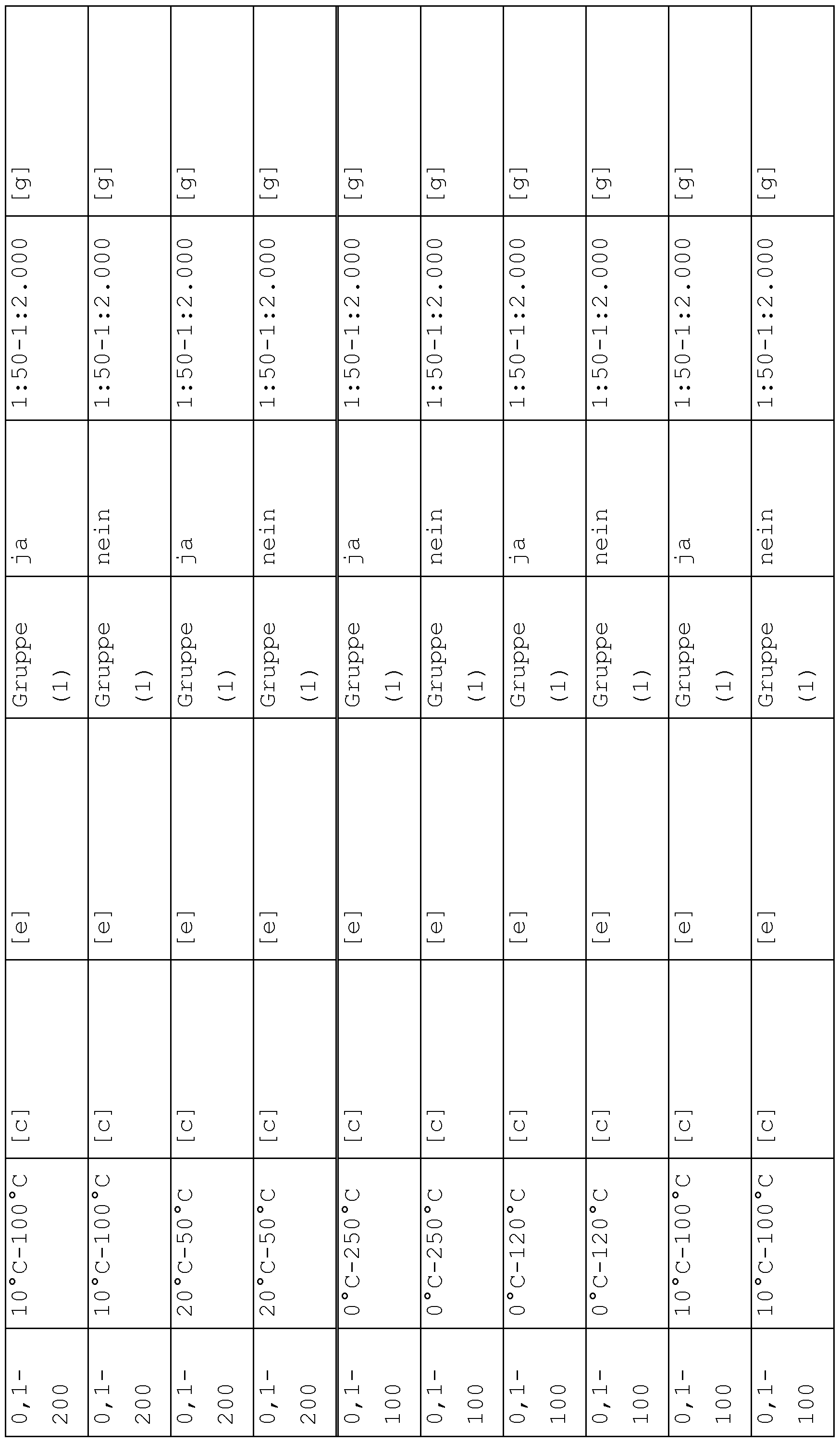
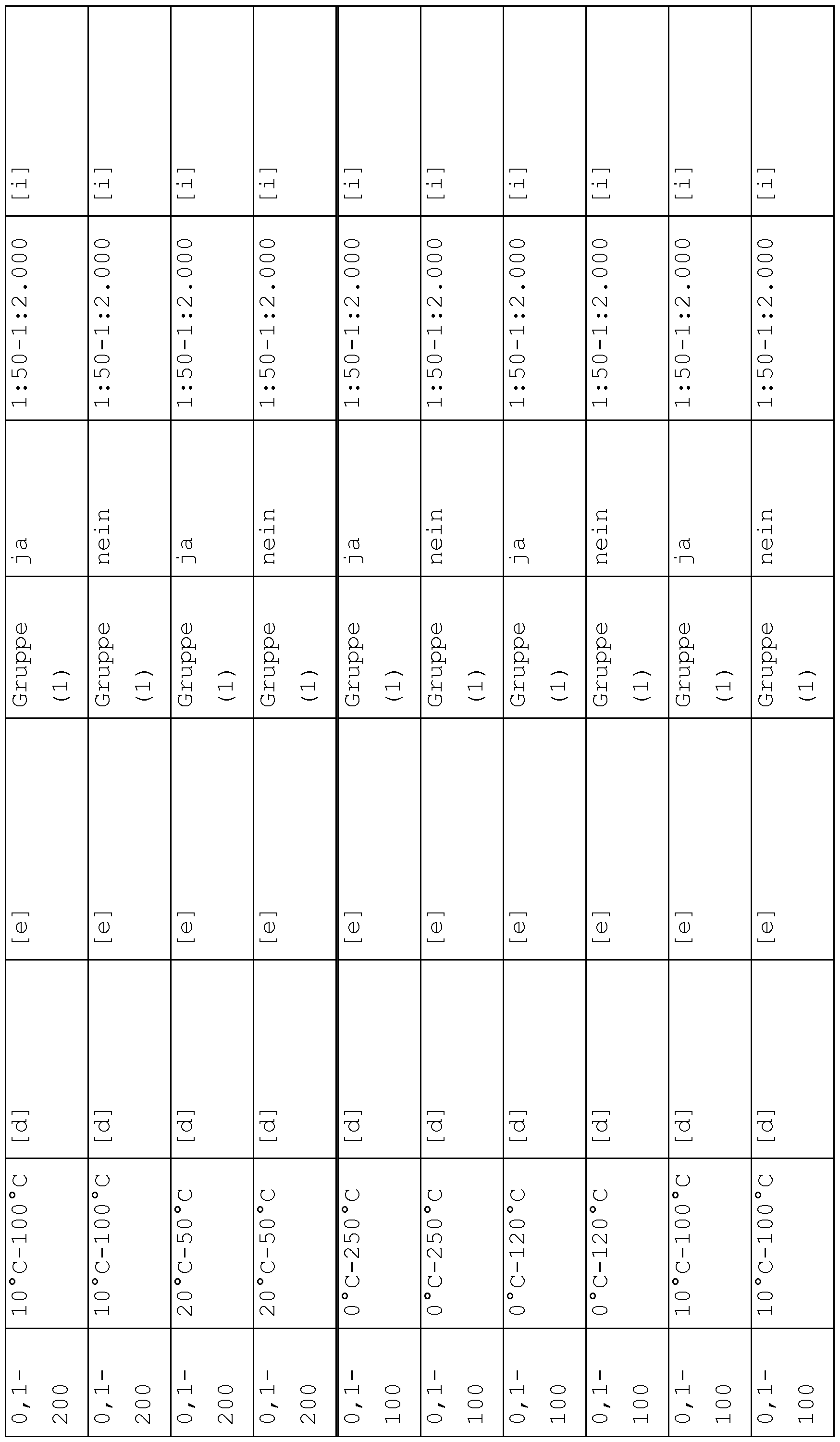
Bevorzugte Reaktionsbedingungen der Hydrierung können Tabelle 3 entnommen werden.
Tabelle 3: Bevorzugte Reaktionsbedingungen bei der Hydrierung.
Figure imgf000029_0001
Figure imgf000030_0001
Figure imgf000031_0001
Figure imgf000032_0001
Figure imgf000033_0001
Figure imgf000034_0001
Figure imgf000035_0001
Figure imgf000036_0001
Figure imgf000037_0001
Figure imgf000038_0001
Figure imgf000039_0001
Figure imgf000040_0001
Figure imgf000041_0001
Figure imgf000042_0001
Figure imgf000043_0001
Figure imgf000044_0001
Figure imgf000045_0001
Figure imgf000046_0001
Figure imgf000047_0001
Figure imgf000048_0001
Figure imgf000049_0001
Figure imgf000050_0001
Figure imgf000051_0001
Figure imgf000052_0001
Figure imgf000053_0001
Figure imgf000054_0001
Figure imgf000055_0001
Figure imgf000057_0001
Figure imgf000058_0001
Figure imgf000059_0001
Figure imgf000060_0001
Figure imgf000061_0001
Figure imgf000062_0001
Figure imgf000063_0001
Figure imgf000064_0001
Figure imgf000065_0001
Figure imgf000066_0001
Figure imgf000067_0001
Figure imgf000068_0001
Figure imgf000069_0001
Figure imgf000070_0001
Figure imgf000071_0001
Figure imgf000072_0001
Figure imgf000073_0001
Figure imgf000074_0001
Figure imgf000075_0001
Figure imgf000076_0001
Figure imgf000077_0001
Figure imgf000078_0001
Figure imgf000079_0001
Figure imgf000080_0001
Figure imgf000081_0001
Figure imgf000082_0001
Figure imgf000083_0001
Figure imgf000084_0001
Figure imgf000085_0001
Figure imgf000086_0001
Figure imgf000087_0001
Figure imgf000088_0001
Figure imgf000089_0001
Figure imgf000090_0001
Figure imgf000091_0001
Figure imgf000092_0001
Figure imgf000093_0001
Figure imgf000094_0001
Figure imgf000095_0001
Figure imgf000096_0001
Figure imgf000097_0001
Figure imgf000098_0001
Figure imgf000099_0001
Figure imgf000100_0001
Figure imgf000101_0001
Figure imgf000103_0001
Figure imgf000104_0001
Figure imgf000105_0001
Figure imgf000106_0001
[a] = Zusatz eines Phasentransferkatalysators
[b] = Hydrierkatalysator mit mindestens einem aktivem Metall der Gruppe VII B und/oder VIII B des Periodensystems der Elemente
[c] = Pd/C, Pd/Al203, Pd/CaC03, Pt/C, Ru/Al203, Pd/Re/C, Pt/Re/C oder [ (dppb) Rh (cod) ] BF4
[d] = 5%Pd/C, 5%Pd/Al203, 5%Pd/CaC03, 5%Pt/C, 5%Ru/Al203 oder [ (dppb) Rh (cod) ] BF4
[e] = Alkylhalogenide, Ester der Sulfonsäure, Ester der Fluorsulfonsäure, Ester der
Trifluormethansulfonsäure, Ester der Chlorameisensäure, Oxonium-Salze, Dialkylsulfate oder
Diazomethan,
[f] = (Me30)BF4, (Et30)BF4, (MeO)2S02, (EtO)2S02, CICOOEt, Mel oder Etl
[g] = Carbonsäureamid der allgemeinen Formel (I), Carbonsäurediamid der allgemeinen Formel (II), Di-, Tri- oder Polypeptid, Peptidamid mit carboxyerminaler Amidfunktion,
[h] = Carbonsäureamid der allgemeinen Formel (I)
[i] = Carbonsäureamide aus Tabelle 1
Eine besondere Ausführungsform der Erfindung ist ein Verfahren zur Herstellung von Aminen, wobei das Alkylierungsmittel ausgewählt wird aus der Gruppe bestehend aus Alkylhalogeniden, Estern der Sulfonsäure, Estern der Fluorsulfonsäure, Estern der Trifluormethansulfonsäure, Estern der Chlorameisensäure, Oxonium-Salzen, Dialkylsulfaten und Diazomethan.
Eine weitere besondere Ausführungsform der Erfindung ist ein Verfahren zur Herstellung von Aminen, wobei der
Hydrierkatalysator mindestens ein aktives Metall enthält.
Eine weitere besondere Ausführungsform der Erfindung ist ein Verfahren zur Herstellung von Aminen, wobei das aktive Metall ein Metall der Gruppe VII B und/oder VIII B des
Periodensystems der Elemente ist.
Eine weitere besondere Ausführungsform der Erfindung ist ein Verfahren zur Herstellung von Aminen, wobei nach Schritt a eine Base zum Reaktionsgemisch zugegeben wird und wobei ein Mol-Verhältnis von Base zu Alkylierungsmittel von 1:1 bis 1:3 gewählt wird.
Prinzipiell ist der Fachmann frei in der Wahl einer geeigneten basischen Verbindung. Vorzugsweise werden jedoch
kostengünstige anorganische beziehungsweise organische Basen eingesetzt .
Die Base kann ausgewählt werden aus der Gruppe (1) bestehend aus Carbonaten, Hydrogencarbonaten, Phosphaten, Mono- oder Dihydrogenphosphaten oder Alkoxiden der Alkali- oder
Erdalkalimetalle;
stickstoffhaltigen organischen Molekülen wie z. B. solche ausgewählt aus der Gruppe bestehend aus Triethylamin, Tri-n- butylamin, 1 , 4-Diazabicyclo [ 2 , 2 , 2 ] octan, 1,8- Diazabicyclo [5, 4, 0] undec-7-en, N, -Dirnethylglycinethylester, Pyridin, Tetramethylguanidin, N, , ' , N' -Tetramethylethan-1 , 2- diamin, Hexamethylentetramin; und
auf Oligomeren und Polymeren geträgerte Amine sowie deren Derivate .
Feste Basen werden bevorzugt in Gegenwart von einem
Phasentransferkatalysator (PTC) eingesetzt. Beispiele für Phasentransferkatalysatoren sind die folgenden Verbindungen Dimethyl (di- (C14-C18) -alkyl) ammoniumchlorid,
Methyl-tri- (Cs-Cio) -alkyl-ammoniumchlorid,
Benzyl-dimethyl-stearylammoniumchlorid,
Dimethyl- (C12-C16) -alkyl-benzylammonium-chlorid,
Distearyl-dimethylammonium-chlorid
(Coconut oil alkyl)bis(2- hydroxyethyl , ethoxylated) methylammonium-chlorid (= PEG-2- cocomonium-chlorid) ,
Hexadecyl- (2-hydroxyethyl) -dimethylammonium
dihydrogenphosphat ,
Trihexyl-tetradecylphosphonium chlorid,
Trihexyl-tetradecylphosphonium bis (2,4,4- trimethylpentyl ) phosphinat,
N, -Di (2-Tallowamidoethyl) -N- (2-hydroxyethyl) -N- methylammonium-methylsulfat,
Di- (Oleyl-Carboxyethyl ) -hydroxyethyl-methylammonium- methylsulfat ,
Di- ( Palm-Carboxyethyl ) -hydroxyethyl-methylammonium- methylsulfat ,
Bis ( Soybean-amidoethyl ) -polyethoxy-methylammonium- methylsulfat ,
l-Methyl-2-nortallow-3-tallow-amidoethyl-imidazolinium- methylsulfat ,
1-Ethyl-3-heptadecenyl-imidazolinium-methylsulfat, l-Methyl-2-noroleyl-3-oleylalkyl-amidoethyl-imidazolinium- methylsulfat .
Bevorzugt sind solche Basen, die ausgewählt sind aus der
Gruppe (2) bestehend aus K3P04, K2HP04, Ca2C03, K2C03, Na2C03, NaOEt, NaOMe, NEt3 und Pyridin, wobei diese Basen bevorzugt in Gegenwart eines Phasentransferkatalysators eingesetzt werden.
Die Menge der eingesetzten Base kann vom Fachmann frei gewählt werden, wobei ein Mol-Verhältnis von Base zu
Alkylierungsmittel von 1:1 bis 1:3 bevorzugt ist. Besonders bevorzugt ist ein Mol-Verhältnis von 1:1.
Eine besondere Ausführungsform der Erfindung ist ein Verfahren zur Herstellung von Aminen, wobei die Umsetzung in einem
Lösungsmittel durchgeführt wird.
Eine besondere Ausführungsform der Erfindung ist ein Verfahren zur Herstellung von Aminen, wobei das Lösungsmittel ausgewählt wird aus der Gruppe bestehend aus Kohlenwasserstoffen,
Chlorkohlenwasserstoffen, Ethern, Estern und Alkoholen.
Eine weitere besondere Ausführungsform der Erfindung ist ein Verfahren zur Herstellung von Aminen, wobei die Umsetzung ohne Lösungsmittel durchgeführt wird.
Eine weitere besondere Ausführungsform der Erfindung ist ein
Verfahren zur Herstellung von Aminen, wobei die Umsetzung ohne Lösungsmittel durchgeführt wird.
Es ist vorteilhaft wasserfrei zu arbeiten. Ein weiterer
Gegenstand der Erfindung ist daher ein Verfahren, wobei wasserfreies Carbonsäureamid oder Carbonsäurediamid oder Di-, Tri- oder Polypeptid oder Peptidamid und wasserfreies Alkylierungsmittel und gegebenenfalls wasserfreies
Lösungsmittel eingesetzt werden.
Ein weiterer Gegenstand der Erfindung ist ein Amin erhältlich durch ein Verfahren umfassend die folgenden Schritte:
a. Umsetzung eines
i. Carbonsäureamids der allgemeinen Formel (I)
Figure imgf000111_0001
R1R2 wobei
R ausgewählt wird aus der Gruppe bestehend aus H, (Ci-C24) -Alkyl, (C3-C20) -Cycloalkyl, (C2-C13)-
Heterocycloalkyl, (C6-Ci4 ) -Aryl , (C3-C13)- Heteroaryl und dem Säurerest einer Aminosäure ausgewählt aus Alanin, Arginin, Asparagin, Asparaginsäure, Cystein, Glutamin,
Glutaminsäure, Glycin, Histidin, Isoleucin,
Leucin, Lysin, Methionin, Phenylalanin, Prolin, Serin, Threonin, Tryptophan, Tyrosin, Valin; und
R1 und R2 unabhängig voneinander ausgewählt werden aus der Gruppe bestehend aus H, (C1-C24) -
Alkyl, (C3-C8) -Cycloalkyl, (C2-C7) - Heterocycloalkyl , (C6-Ci4) -Aryl oder (C3-C13) - Heteroaryl, wobei sowohl die Reste R mit R1, R mit R2 als auch R1 mit R2 unabhängig voneinander eine gesättigte oder einfach oder mehrfach ungesättigte (C2-Ci8) -Alkylen- oder (C2-Ci8) - Heteroalkylen-Brücke bilden, so dass ein aliphatischer oder aromatischer Ring mit insgesamt 3-20 Ringatomen entsteht;
oder ii. Carbonsäurediamids der allgemeinen Formel (II)
Figure imgf000112_0001
wobei
Rx x x ausgewählt wird aus der Gruppe bestehend aus divalenten (C1-C24 ) -Alkylresten, (C3-C2o)_ Cycloalkylresten, (C2-Ci3)-
Heterocycloalkylresten, (C6-Ci4 ) -Arylresten, (C3- C13) -Heteroarylresten; und
Rx und Rx x unabhängig voneinander ausgewählt werden aus der Gruppe bestehend aus H, (C1-C24) - Alkyl, (C1-C24) -Heteroalkyl, (C3-C8) -Cycloalkyl,
(C2-C7) -Heterocycloalkyl, (C6-Ci4) -Aryl oder (C3- C13) -Heteroaryl, wobei die Reste Rx mit Rx x miteinander eine gesättigte oder einfach oder mehrfach ungesättigte (C2-C18) -Alkylen- oder (C2- C18) -Heteroalkylen-Brücke bilden können, so dass ein aliphatischer oder aromatischer Ring mit insgesamt 3-20 Ringatomen entsteht;
oder iii. Di-, Tri- oder Polypeptids, oder
iv. Peptidamids mit carboxyerminaler Amidfunktion mit einem Alkylierungsmittel ,
Zugabe eines Hydrierkatalysators zum
Reaktionsgemisch in einem Mol-Verhältnis von 1:10 bis 1:100.000 bezogen auf Carbonsäureamid,
Carbonsäurediamid, Di-, Tri- oder Polypeptid oder Peptidamid,
Umsetzung des Reaktionsgemisches mit Wasserstoff, wobei ein Wasserstoffdruck von 0,1 bar bis 200 bar eingestellt wird und wobei eine Temperatur in einem Bereich von 0°C bis 250°C eingestellt wird. Eine besonders bevorzugte Ausführungsform ist ein Verfahren umfassend die folgenden Schritte:
a. Umsetzung eines
1. Carbonsäureamids der allgemeinen Formel (I)
Figure imgf000113_0001
R1R2 wobei
R ausgewählt wird aus der Gruppe bestehend aus H, (Ci-C24) -Alkyl, (C3-C20) -Cycloalkyl, (C2-Ci3)- Heterocycloalkyl, (C6-Ci4 ) -Aryl , (C3-C13)- Heteroaryl und dem Säurerest einer Aminosäure ausgewählt aus Alanin, Arginin, Asparagin, Asparaginsäure, Cystein, Glutamin,
Glutaminsäure, Glycin, Histidin, Isoleucin, Leucin, Lysin, Methionin, Phenylalanin, Prolin, Serin, Threonin, Tryptophan, Tyrosin, Valin; und
R und R unabhängig voneinander ausgewählt werden aus der Gruppe bestehend aus H, (C1-C24) - Alkyl, (C3-C8) -Cycloalkyl, (C2-C7) - Heterocycloalkyl , (C6-C14) -Aryl oder (C3-C13) - Heteroaryl, wobei sowohl die Reste R mit R1, R mit R2 als auch R1 mit R2 unabhängig voneinander eine gesättigte oder einfach oder mehrfach ungesättigte (C2-Ci8) -Alkylen- oder (C2-Ci8) - Heteroalkylen-Brücke bilden, so dass ein aliphatischer oder aromatischer Ring mit insgesamt 3-20 Ringatomen entsteht,
mit einem Alkylierungsmittel , b. Zugabe eines Hydrierkatalysators zum
Reaktionsgemisch in einem Mol-Verhältnis von 1:10 bis 1:100.000 bezogen auf das Carbonsäureamid, c . Umsetzung des Reaktionsgemisches mit Wasserstoff, wobei ein Wasserstoffdruck von 0,1 bar bis 200 bar eingeste 11t wird und wobei eine Temperatur in einem
Bereich von 0°C bis 250°C eingestellt wird.
Bei dem erfindungsgemäßen Verfahren geht man im Allgemeinen so vor, dass man in einem Autoklaven das Carbonsäureamid oder Carbonsäurediamid oder Di-, Tri- oder Polypeptid oder
Peptidamid und das Alkylierungsmittel miteinander reagieren lässt. Anschließen wird der Katalysator in einem bestimmten Mol-Verhältnis mit einer geeigneten Menge Lösungsmittel vermischt. Anschließend wird der Autoklav mehrmals mit
Wasserstoff gespült und die Mischung bei geeignetem Druck hydriert. Nachdem der Wasserstoffdruck abgelassen wurde, wird die Reaktionsmischung abfiltriert und das Filtrat nach dem Fachmann bekannten Verfahren aufgearbeitet.
Bei einer bevorzugten Ausführungsform des erfindungsgemäßen Verfahrens geht man im Allgemeinen so vor, dass man in einem Autoklaven das Carbonsäureamid oder Carbonsäurediamid oder Di- , Tri- oder Polypeptid oder Peptidamid und das
Alkylierungsmittel miteinander reagieren lässt. Anschließen wird mit einer geeigneten Menge Lösungsmittel und Base
vermischt. Anschließend wird der Katalysator in einem
bestimmten Mol-Verhältnis zugesetzt, der Autoklav wird
mehrmals mit Wasserstoff gespült, und die Mischung wird bei geeignetem Druck hydriert. Nachdem der Wasserstoffdruck abgelassen wurde, wird die Reaktionsmischung abfiltriert und das Filtrat nach dem Fachmann bekannten Verfahren
aufgearbeitet . Ausführungsbeispiele
Die nachstehenden Beispiele dienen zur Erläuterung der
Erfindung, ohne sie darauf zu beschränken.
BEISPIELE 1-4
Figure imgf000115_0001
Beispiel 1 :
Piperidon-2 (5 g, 50 mmol) wird mit Chlorameisensäure- ethylester (6 ml, 60 mmol) versetzt und 4 Stunden bei 50°C unter Argon gerührt. Anschließend wird im Vakuum eingeengt, und der Rückstandwird in absolutem Ethanol aufgenommen. Ein Autoklav wird mit 5% Pt/C (0.98 g, 0.5mol%) befüllt, mit Argon gespült und mit Reaktionslösung in Ethanol gefüllt. Es werden 40 bar Wasserstoff aufgepresst, und es wird bei 25°C und konstantem Druck gerührt, bis keine Wasserstoffaufnähme mehr zu erkennen ist (5 h) . Nach Abtrennen vom Katalysator wird das Filtrat am Rotationsverdampfer eingeengt, der Rückstand wird in 20 ml Wasser gelöst und mit Diethylether gewaschen, die wässrige Phase wird mit 2N NaOH-Lösung basisch gestellt und ausgeethert. Die organische Phase wird über K2CO3 getrocknet, nach Abdampfen des Ethers erhält man fast sauberes Piperidin. Die Ausbeute kann Tabelle 4 entnommen werden.
Beispiel 2 :
Piperidon-2 (5 g, 50 mmol) wird mit Dimethylsulfat (5 ml, 50 mmol) versetzt und 3 Stunden bei 80°C unter Argon gerührt, anschließend wird in 10 ml absolutem Methanol aufgenommen. Ein Autoklav wird mit 5% Pt/C (0.98 g, 0.5mol%) befüllt, mit Argon gespült und mit der Reaktionslösung in Methanol gefüllt. Es werden 40 bar Wasserstoff aufgepresst, und es wird bei 25°C und konstantem Druck gerührt, bis keine Wasserstoffaufnähme mehr zu erkennen ist (5 h) . Nach Abtrennen vom Katalysator wird das Filtrat am Rotationsverdampfer eingeengt, der
Rückstand wird in 20 ml Wasser gelöst und mit Diethylether gewaschen, die wässrige wird Phase mit 2N NaOH-Lösung basisch gestellt und ausgeethert. Die organische Phase wird über K2CO3 getrocknet, nach Abdampfen des Ethers erhält man fast sauberes Piperidin .
Die Ausbeute kann Tabelle 4 entnommen werden.
Beispiel 3:
Piperidon-2 (5 g, 50 mmol) wird unter Feuchtigkeitausschluss und Kühlen auf einem Wasserbad mit Triethyloxonium- tetrafluoroborat (10.45 g, 55 mmol ) versetzt . Dann wird die
Wasserbadtemperatur allmählich auf 40 °C erwärmt, und es wird bei dieser Temperatur 1 Std. gerührt. Anschließend wird der Ether im Vakuum abgezogen, und der Rückstandwird in absolutem Ethanol aufgenommen. Ein Autoklav wird mit 5% Pt/C (0.98 g, 0.5mol%) befüllt, mit Argon gespült und mit der
Reaktionsmischung in Ethanol gefüllt. Es werden 40 bar
Wasserstoff aufgepresst, und es wird bei 25°C und konstantem Druck gerührt, bis keine Wasserstoffaufnähme mehr zu erkennen ist (5 h) . Nach Abtrennen vom Katalysator wird das Filtrat am Rotationsverdampfer eingeengt, der Rückstand wird in 20 ml Wasser gelöst und mit Diethylether gewaschen, die wässrige Phase wird mit 2N NaOH-Lösung basisch gestellt und
ausgeethert. Die organische Phase wird über K2CO3 getrocknet, nach Abdampfen des Ethers erhält man fast sauberes Piperidin. Die Ausbeute kann Tabelle 4 entnommen werden.
Beispiel 4 :
Piperidon-2 (5 g, 50 mmol) wird unter Feuchtigkeitausschluss und Kühlen auf einem Wasserbad mit Triethyloxonium- tetrafluoroborat (10.45 g, 55 mmol ) ersetzt . Dann wird die Wasserbadtemperatur allmählich auf 40 °C erwärmt, und es wird bei dieser Temperatur 1 Std. gerührt. Anschließend wird der Ether im Vakuum abgezogen, und der Rückstandwird in absolutem Ethanol aufgenommen. Ein Autoklav wird mit 5% Pt/C (0.98 g, 0.5mol%)und K2CO3 (6.9 g, 50 mmol) befüllt, mit Argon gespült und mit der Reaktionsmischung in Ethanol gefüllt. Es werden 40 bar Wasserstoff aufgepresst, und es wird bei 25°C und
konstantem Druck gerührt, bis keine Wasserstoffaufnähme mehr zu erkennen ist (5 h) . Nach Filtrieren über Celite wird das Filtrat in 25 ml 2N Salzsäure gelöst und mit Diethylether gewaschen, die wässrige Phase wird mit 2N NaOH-Lösung basisch gestellt und ausgeethert, die organische Phase wird über K2CO3 getrocknet. Nach Abdampfen des Ethers erhält man fast sauberes Piperidin.
Die Ausbeute kann Tabelle 4 entnommen werden.
Tabelle 4: Umsetung von Piperidon-2 zu Piperidin.
Figure imgf000117_0001
Beispiel 5:
Pyrrolidon-2 (4,25 g, 50 mmol) wird mit Chlorameisensäure- ethylester (6 ml, 60 mmol) versetzt und 4 Stunden bei 50°C unter Argon gerührt. Anschließend wird im Vakuum eingeengt, und der Rückstandwird in absolutem Ethanol aufgenommen. Ein Autoklav wird mit 5% Pt/C (0.98 g, 0.5 mol%) befüllt, mit Argon gespült und mit der Reaktionslösung in Ethanol gefüllt. Es werden 40 bar Wasserstoff aufgepresst, und es wird bei 25°C und konstantem Druck 24 Stunden gerührt. Nach Abtrennen vom Katalysator wird das Filtrat am Rotationsverdampfer eingeengt, der Rückstand wird in 20 ml Wasser gelöst und mit Diethylether gewaschen, die wässrige Phase wird mit 2N NaOH-Lösung basisch gestellt und ausgeethert. Die organische Phase wird über K2CO3 getrocknet, nach Abdampfen des Ethers erhält man fast sauberes Pyrrolidin. Ausbeute 1.85 g (52%) .
Beispiele 6-9:
Ein Carbonsäureamid (10 mmol) wird mit Dimethylsulfat (1 ml, 10 mmol) versetzt und 3 Stunden bei 80°C unter Argon gerührt, anschließend wird in 5 ml absolutem Methanol aufgenommen. Ein Autoklav wird mit Katalysator ( 1 mol%) und 5 ml 2M
Natriummethylat-Lösung in Methanol befüllt, mit Argon gespült und mit der Reaktionslösung in Methanol gefüllt. Es werden 40 bar Wasserstoff aufgepresst, und es wird bei 25°C und
konstantem Druck gerührt, bis keine Wasserstoffaufnähme mehr zu erkennen ist (1-2 h) . Nach Filtrieren über Celite wird das Filtrat in 10 ml 2N Salzsäure gelöst und mit Diethylether gewaschen, die wässrige Phase wird mit 12 ml 2N NaOH-Lösung basisch gestellt und ausgeethert. Die kombinierten organischen Phasen werden über K2CO3 getrocknet und mit 10 ml IM HCl-Lösung in Diethylether versetzt. Das feste Aminhydrochlorid wird abfiltriert, mit Diethylether gewaschen und im Vakuum
getrocknet .
Die eingesetzten Katalysatoren und Ausbeuten können Tabelle 5 entnommen werden.
Tabelle 5.
Figure imgf000118_0001
Figure imgf000119_0001
Beispiele 10-28:
Eine Lösung von Carbonsäureamid (20 mmol) in Dichlormethan (10 ml) wird mit Triethyloxonium-tetrafluoroborat (4.18 g, 22 mmol) versetzt und entweder (A) über Nacht bei Raumtemperatur oder (B) 3 Stunden auf dem Wasserbad bei 40 °C unter Argon gerührt. Anschließend wird im Vakuum eingeengt, und der
Rückstand wird in 20 ml absolutem Ethanol aufgenommen. Ein im Eisbadgekühlter Autoklav wird mit Katalysator ( 1 mol%) und 10 ml 2M Natriumethylat-Lösung in Ethanol befüllt, mit Argon gespült und mit der Reaktionslösung in Ethanol gefüllt. Es werden 40 bar Wasserstoff aufgepresst, und es wird bei 25°C und konstantem Druck gerührt, bis keine Wasserstoffaufnähme mehr zu erkennen ist (1-12 h) . Nach Filtrieren über Celite wird das Filtrat in 11 ml 2N Salzsäure gelöst und mit
Diethylether gewaschen, die wässrige Phase wird mit 14 ml 2N NaOH-Lösung basisch gestellt, das Amin wird mit Diethylether extrahiert, und die kombinierten organischen Phasen werden über K2CO3 getrocknet. Nach Abziehen der Lösungsmittel im Vakuum erhält man praktisch sauberes Amin.
Die eingesetzten Katalysatoren und Ausbeuten können Tabelle 6 entnommen werden. Tabelle 6.
Figure imgf000119_0002
Figure imgf000120_0001
Figure imgf000121_0001
Be ngungen: A er Nac t e Raumtemperatur ger rt, B h bei 40°C gerührt.
Beispiele 29-32:
Figure imgf000121_0002
Eine Lösung von N, N λ -Tetramethyl-bernsteinsäurediamid (20 mmol) in Dichlormethan (20 ml) wird mit Triethyloxonium- tetrafluoroborat (8.36 g, 44 mmol) versetzt und 3 Stunden auf dem Wasserbad bei 40 °C unter Argon gerührt. Anschließend wird im Vakuum eingeengt, und der Rückstandwird in 50 ml absolutem Ethanol aufgenommen. Ein im Eisbadgekühlter Autoklav wird mit Katalysator ( 1 mol%) und 20 ml 2M Natriumethylat-Lösung in Ethanol befüllt, mit Argon gespült und mit der
Reaktionsmischung in Ethanol gefüllt. Es werden 40 bar
Wasserstoff aufgepresst, und es wird bei 25°C und konstantem Druck gerührt, bis keine Wasserstoffaufnähme mehr zu erkennen ist (1-12 h) . Nach Filtrieren über Celite wird das Filtrat wie in den Beispielen 10-28 aufgearbeitet.
Die eingesetzten Katalysatoren und Ausbeuten an Ν,Νλ- Tetramethyl-1 , 4-butandiamin können Tabelle 7 entnommen werden. Tabelle 7: Umsetzung von N, N λ -Tetramethyl-bernsteinsäurediamid zu N N λ -Tetramethyl-1 , 4-butandiamin
Figure imgf000122_0001
Beispiel 33
Figure imgf000122_0002
Eine Lösung von N-Boc-Ala-Pro-OMe (3.0 g, 10 mmol) in
Dichlormethan (10 ml) wird mit Triethyloxonium- tetrafluoroborat (3.80 g, 20 mmol) versetzt und über Nacht bei Raumtemperaturunter Argon gerührt. Anschließend wird im Vakuum eingeengt, und der Rückstand wird in 20 ml absolutem Ethanol aufgenommen. Ein Autoklav wird mit 5%Pt/C(0.78 g, 2mol%) , Trioctylmethylammonium-chlorid (Aliquat 336, 40 mg, 0.1 mmol) und K2CO3 (2.76 g, 20 mmol) befühlt, mit Argon gespült und mit der Reaktionsmischung in Ethanol gefüllt. Es werden 40 bar Wasserstoff aufgepresst, und es wird bei 25°C und konstantem Druck 16 Stunden gerührt. Nach Filtrieren über Celite wird das Filtrat im Vakuum eingeengt, und der Rückstand wird durch Säulenchromatographie (Essigsäure-ethylester/Hexan
1 : 1) gereinigt . Es werden 1.42 g (55%) (2' 5, 25) -1- (2- Ethoxycarbonylamino-propyl ) -pyrrolidin-2-carbonsäure- methylester (Rf 0.25) erhalten.
^ NMR (CDCI3) 55.19 (br. s, 1H) , 3.99-4.07 (m, 2H) , 3.63 (s, 3H) , 3.60 (q, J=6.4, 1H) , 3.23 (dd, J = 8.6, J = 5.1, 1H) , 3.09 (ddd, J = 8.3, J = 8.2, J = 3.9, 1H) , 2.60 (dd, J = 12.4, J = 6.0, 1H) , 2.50 (dd, J = 11.7, J = 5.9, 1H) , 2.47 (dt, J = 8.9, J = 7.5, 1H) , 2.00-2.05 (m, 1H) , 1.81-1.86 (m, 2H) , 1. 1.78 (m,lH), 1.17 (t, J = 7.1, 3H) , 1.13 (d, J = 6.6, 3H) ; δ 174.80, 156.28, 66.50, 60.38, 60.20, 54.44, 51.69, 46.41, 29.39, 23.83, 19.48, 14.64.
Beispiel 34 :
Figure imgf000123_0001
Eine Lösung von N-Boc-Phe-Pro-OMe (3.87 g, 10 mmol) in
Dichlormethan (10 ml) wird mit Triethyloxonium- tetrafluoroborat (3.80 g, 20 mmol) versetzt und über Nacht bei Raumtemperatur unter Argon gerührt. Anschließend wird im
Vakuum eingeengt, und der Rückstand wird in 20 ml absoluten Ethanol aufgenommen. Ein Autoklav wird mit 5%Pt/C(0.78 g, 2 mol%) , Trioctylmethylammonium-chlorid (Aliquat 336, 40 mg, 0.1 mmol) und K2CO3 (2.76 g, 20 mmol) befüllt, mit Argon gespült und mit der Reaktionsmischung in Ethanol gefüllt. Es werden40 bar Wasserstoff aufgepresst, und es wird bei 25°C und
konstantem Druck 16 Stunden gerührt. Nach Filtrieren über
Celite wird das Filtrat im Vakuum eingeengt, und der Rückstand wird durch Säulenchromatographie (Essigsäure-ethylester/Hexan 1:1) gereinigt. Es werden 1.18 g (34%) (2' S, 2S) -1- (2- Ethoxycarbonylamino-3-phenyl-propyl ) -pyrrolidin-2-carbonsäure- methylester (Rf 0.40) erhalten.
XH NMR (CDCI3) 57.20 (t, J = 7.6, 2H) , 7.12 (t, J = 7.8, 3H) , 5.46 (br. s, 1H) , 4.07 (dq, J = 10.6, J = 7.2, 1H) , 4.02 (dq, J = 10.6, J = 7.1, 1H) , 3.75 (br. m, 1H) , 3.61 (s, 3H) , 3.18 (br. m, 1H) , 3.07 (br. m, 1H) , 3.03 (td, J = 7.9, J = 3.4, 1H),2.58 (dd, J = 13.5, J = 7.8, 1H) , 2.52 (t, J = 11.3, 1H) , 2.40 (dd, J = 12.1, J = 3.85, 1H) , 2.21 (br. m, 1H) , 1.98-2.04 (m, 1H) , 1.98-2.04 (m, 1H) , 1.66-1.72 (m, 2H) , 1.18 (t, J = 7.2, 3H) ; iJC δ 174.71, 156.84, 138.20, 129.48, 128.29, 126. 65.51, 60.54, 56.79, 53.04, 51.81, 51.44, 39.48 , 29.21, 23.43, 14.69.
Beispiel 35:
Figure imgf000124_0001
In einem im Eisbad gekühlten Schlenk-Gefäß wird N- (2- Cyanoethyl ) -pyrrolidon-2 (6.9 g, 50 mmol) mit Triethyloxonium- tetrafluoroborat (10.45 g, 55 mmol) versetzt und über Nacht bei Raumtemperatur unter Argon gerührt. Die Ether-Phase wird abdekantiert und noch enthaltener Ether wird im Vakuum
entfernt. Der Rückstand wird in trockenem Dichlormethan (40 ml) gelöst und zu einer Suspension von Natrium-ethoxid
(ethanolfrei ) in 10 ml trockenem Diethylether bei -20°C zugetropft. Anschließend lässt man über Nacht auf
Raumtemperatur unter kräftigem Rühren aufwärmen und filtriert unter Argon vom NaBF4 ab. Das Filtrat wird eingeengt und in 10 ml trockenem Dichlormethan gelöst. Ein Autoklav wird mit 5%
Pt/C (390 mg, 0.2mol%) befüllt, mit Argon gespült und mit der Reaktionslösung in Dichlormethan gefüllt. Es werden 40 bar Wasserstoff aufgepresst, und es wird bei 25°C und konstantem Druck 24 Stunden gerührt. Nach Filtrieren über Celite wird das Filtrat in 40 ml eiskalter 2N Salzsäure gelöst und mit
Diethylether gewaschen, die wässrige Phase wird unter
Eiskühlung mit 42 ml 2N NaOH-Lösung basisch gestellt, das Produkt wird mit Diethylether extrahiert (6 x 20 ml), und die kombinierten organischen Phasen werden über K2CO3 getrocknet. Nach Abziehen der Lösungsmittel im Vakuum erhält man 2.6 g (44%) praktisch sauberen 3- ( 1-Pyrrolidino) -propionitril .

Claims

Patentansprüche
Verfahren zur Herstellung von Aminen umfassend die folgenden Schritte:
a. Umsetzung eines
i. Carbonsäureamids der allgemeinen Formel
NR1R2 , wobei
R ausgewählt wird aus der Gruppe bestehend aus H, (Ci-C24) -Alkyl, (C3-C20) -Cycloalkyl, (C2-Ci3)- Heterocycloalkyl, (C6-Ci4 ) -Aryl , (C3-C13)- Heteroaryl und dem Säurerest einer Aminosäure ausgewählt aus Alanin, Arginin, Asparagin, Asparaginsäure, Cystein, Glutamin,
Glutaminsäure, Glycin, Histidin, Isoleucin, Leucin, Lysin, Methionin, Phenylalanin, Prolin, Serin, Threonin, Tryptophan, Tyrosin, Valin; und
R1 und R2 unabhängig voneinander ausgewählt werden aus der Gruppe bestehend aus H, (C1-C24) - Alkyl, (C3-C8) -Cycloalkyl, (C2-C7) - Heterocycloalkyl , (C6-C14) -Aryl oder (C3-C13) - Heteroaryl, wobei sowohl die Reste R mit R1, R mit R2 als auch R1 mit R2 unabhängig voneinander eine gesättigte oder einfach oder mehrfach ungesättigte (C2-Ci8) -Alkylen- oder (C2-Ci8) - Heteroalkylen-Brücke bilden, so dass ein aliphatischer oder aromatischer Ring mit insgesamt 3-20 Ringatomen entsteht,
oder ii. Carbonsäurediamids der allgemeinen Formel (II)
Figure imgf000126_0001
Rx x x ausgewählt wird aus der Gruppe bestehend aus divalenten (C1-C24 ) -Alkylresten, (C3-C2o)_ Cycloalkylresten, (C2-Ci3)- Heterocycloalkylresten, (C6-Ci4 ) -Arylresten, (C3-
C13) -Heteroarylresten; und
Rx und Rx x unabhängig voneinander ausgewählt werden aus der Gruppe bestehend aus H, (Ci-C24)- Alkyl, (C1-C24) -Heteroalkyl, (C3-C8) -Cycloalkyl, (C2-C7) -Heterocycloalkyl, (C6-Ci4 ) -Aryl oder (C3-
C13 ) -Heteroaryl , wobei die Reste Rx mit Rx x miteinander eine gesättigte oder einfach oder mehrfach ungesättigte (C2-C18 ) -Alkylen- oder (C2- Ci8 ) -Heteroalkylen-Brücke bilden können, so dass ein aliphatischer oder aromatischer Ring mit insgesamt 3-20 Ringatomen entsteht,
oder
iii. Di-, Tri- oder Polypeptids, oder
iv. Peptidamids mit carboxyterminaler Amidfunktion mit einem Alkylierungsmittel ,
b. Zugabe eines Hydrierkatalysators zum
Reaktionsgemisch, wobei das Mol-Verhältnis von
Hydrierkatalysator zu Carbonsäureamid oder
Carbonsäurediamid oder Di-, Tri- oder Polypeptid oder Peptidamid in einem Bereich von 1:10 bis
1:100.000 liegt,
c. Umsetzung des Reaktionsgemisches mit Wasserstoff, wobei ein Wasserstoffdruck von 0,1 bar bis 200 bar eingestellt wird und wobei eine Temperatur im
Bereich von 0°C bis 250°C eingestellt wird.
2. Verfahren gemäß Anspruch 1, wobei das Alkylierungsmittel ausgewählt wird aus der Gruppe bestehend aus
Alkylhalogeniden, Estern der Sulfonsäure, Estern der Fluorsulfonsäure, Estern der Trifluormethansulfonsäure, Estern der Chlorameisensäure, Oxonium-Salzen,
Dialkylsulfaten und Diazomethan.
3. Verfahren gemäß einem der Ansprüche 1 oder 2, wobei der Hydrierkatalysator mindestens ein aktives Metall enthält
Verfahren gemäß Anspruch 3, wobei das aktive Metall ein Metall der Gruppe VII B und/oder VIII B des
Periodensystems der Elemente ist.
Verfahren gemäß einem der Ansprüche 1-4, wobei nach Schritt a eine Base zum Reaktionsgemisch zugegeben wird und wobei ein Mol-Verhältnis von Base zu
Alkylierungsmittel von 1:1 bis 1:3 gewählt wird.
Verfahren gemäß einem der Ansprüche 1-5, wobei die
Umsetzung in einem Lösungsmittel durchgeführt wird.
Verfahren gemäß Anspruch 6, wobei das Lösungsmittel ausgewählt wird aus der Gruppe bestehend aus
Kohlenwasserstoffen, Chlorkohlenwasserstoffen, Ethern, Estern und Alkoholen.
. Verfahren gemäß einem der Ansprüche 1-5, wobei die
Umsetzung ohne Lösungsmittel durchgeführt wird.
9. Verfahren gemäß Anspruch 6 oder 7, wobei wasserfreies Carbonsäureamid oder Carbonsäurediamid oder Di-, Tri¬ oder Polypeptid oder Peptidamid, wasserfreies Alkylierungsmittel und wasserfreies Lösungsmittel eingesetzt werden.
Verfahren gemäß Anspruch 8, wobei wasserfreies Carbonsäureamid oder Carbonsäurediamid oder Di- Polypeptid oder Peptidamid und wasserfreies
Alkylierungsmittel eingesetzt werden.
PCT/EP2014/072184 2013-11-05 2014-10-16 Katalytische hydrierung zur herstellung von aminen aus carbonsäureamiden, carbonsäurediamiden, di-, tri- oder polypeptiden oder peptidamiden Ceased WO2015067450A1 (de)

Priority Applications (8)

Application Number Priority Date Filing Date Title
CN201480072289.6A CN105873884B (zh) 2013-11-05 2014-10-16 由羧酸酰胺、羧酸二酰胺、二肽、三肽、多肽或肽酰胺制备胺的催化加氢
PL14787135T PL3066065T3 (pl) 2013-11-05 2014-10-16 Katalityczne uwodornienie do otrzymywania amin z amidów kwasów karboksylowych, diamidów kwasów karboksylowych, di-, tri- lub polipeptydów lub amidów peptydowych
SI201431329T SI3066065T1 (sl) 2013-11-05 2014-10-16 Katalitsko hidrogeniranje za pripravo aminov iz amidov karboksilne kisline, amidi karboksilne kisline, di-, tri- ali polipeptidi ali peptidni amidi
ES14787135T ES2744849T3 (es) 2013-11-05 2014-10-16 Hidrogenación catalítica para la preparación de aminas a partir de amidas de ácido carboxílico, diamidas de ácido carboxílico, di-, tri- o polipéptidos o amidas de péptido
HRP20191598 HRP20191598T1 (hr) 2013-11-05 2014-10-16 Katalitička hidrogenacija za pripremu amina iz amida karboksilne kiseline, di-amida karboksilne kiseline, di-, tri ili polipeptida ili peptidnih amida
EP14787135.4A EP3066065B1 (de) 2013-11-05 2014-10-16 Katalytische hydrierung zur herstellung von aminen aus carbonsäureamiden, carbonsäurediamiden, di-, tri- oder polypeptiden oder peptidamiden
JP2016550970A JP6645974B2 (ja) 2013-11-05 2014-10-16 カルボン酸アミド、カルボン酸ジアミド、ジペプチド、トリペプチド、若しくはポリペプチド、又はペプチドアミドからアミンを製造するための接触水素化
US15/034,120 US9878975B2 (en) 2013-11-05 2014-10-16 Catalytic hydrogenation for producing amines from carboxylic acid amides, carboxylic acid diamides, di-, tri-, or polypeptides, or peptide amides

Applications Claiming Priority (2)

Application Number Priority Date Filing Date Title
EP13191503.5 2013-11-05
EP20130191503 EP2868643A1 (de) 2013-11-05 2013-11-05 Katalytische Hydrierung zur Herstellung von Aminen aus Carbonsäureamiden, Carbonsäurediamiden, Di-, Tri- oder Polypeptiden oder Peptidamiden

Publications (1)

Publication Number Publication Date
WO2015067450A1 true WO2015067450A1 (de) 2015-05-14

Family

ID=49554033

Family Applications (1)

Application Number Title Priority Date Filing Date
PCT/EP2014/072184 Ceased WO2015067450A1 (de) 2013-11-05 2014-10-16 Katalytische hydrierung zur herstellung von aminen aus carbonsäureamiden, carbonsäurediamiden, di-, tri- oder polypeptiden oder peptidamiden

Country Status (11)

Country Link
US (1) US9878975B2 (de)
EP (2) EP2868643A1 (de)
JP (1) JP6645974B2 (de)
CN (1) CN105873884B (de)
ES (1) ES2744849T3 (de)
HR (1) HRP20191598T1 (de)
HU (1) HUE045105T2 (de)
PL (1) PL3066065T3 (de)
PT (1) PT3066065T (de)
SI (1) SI3066065T1 (de)
WO (1) WO2015067450A1 (de)

Cited By (1)

* Cited by examiner, † Cited by third party
Publication number Priority date Publication date Assignee Title
EP3202758A1 (de) 2016-02-03 2017-08-09 Evonik Degussa GmbH Reduktive alkylierung von aminen mit orthocarbonsäureestern

Families Citing this family (1)

* Cited by examiner, † Cited by third party
Publication number Priority date Publication date Assignee Title
EP2868652A1 (de) 2013-11-05 2015-05-06 Evonik Industries AG Katalytische Hydrierung zur Herstellung von Aminen aus Amidacetalen, Keten-N,O-acetalen oder Esterimiden

Citations (1)

* Cited by examiner, † Cited by third party
Publication number Priority date Publication date Assignee Title
US20120253042A1 (en) * 2007-10-30 2012-10-04 Yeda Research And Development Co. Ltd. Use of ruthenium complexes for formation and/or hydrogenation of amides and related carboxylic acid derivatives

Family Cites Families (10)

* Cited by examiner, † Cited by third party
Publication number Priority date Publication date Assignee Title
DE604277C (de) 1933-03-17 1934-10-18 Kohlentechnik M B H Ges Verfahren zur Herstellung der Hydrochloride von Aminen oder Aminosaeureestern
JPS5132602B2 (de) * 1972-04-03 1976-09-14
DE2453055C3 (de) 1974-11-08 1979-03-08 Hoechst Ag, 6000 Frankfurt Verfahren zur Herstellung von 1,2,4-Triaminobenzolen
FR2633927B1 (fr) * 1988-07-08 1991-06-07 Ceca Sa Procede perfectionne pour l'obtention de n,n-dimethyl-alkylamines par hydrogenation catalytique de n,n-dimethyl-alkylamides
JPH08245524A (ja) * 1995-03-10 1996-09-24 Sagami Chem Res Center アミン類の製造方法
WO2007102568A1 (ja) * 2006-03-08 2007-09-13 Kao Corporation 含窒素化合物の製造方法
TW200837045A (en) * 2006-09-22 2008-09-16 Lucite Int Uk Ltd Production of amines
JP5196922B2 (ja) * 2007-09-07 2013-05-15 花王株式会社 含窒素化合物の製造方法
JP5720256B2 (ja) * 2011-01-13 2015-05-20 宇部興産株式会社 アミド基還元用触媒および該触媒を用いたアミノメチル化合物の製造方法
EP2868652A1 (de) 2013-11-05 2015-05-06 Evonik Industries AG Katalytische Hydrierung zur Herstellung von Aminen aus Amidacetalen, Keten-N,O-acetalen oder Esterimiden

Patent Citations (1)

* Cited by examiner, † Cited by third party
Publication number Priority date Publication date Assignee Title
US20120253042A1 (en) * 2007-10-30 2012-10-04 Yeda Research And Development Co. Ltd. Use of ruthenium complexes for formation and/or hydrogenation of amides and related carboxylic acid derivatives

Non-Patent Citations (2)

* Cited by examiner, † Cited by third party
Title
EKAMBARAM BALARAMAN ET AL: "Direct Hydrogenation of Amides to Alcohols and Amines under Mild Conditions", JOURNAL OF THE AMERICAN CHEMICAL SOCIETY, vol. 132, no. 47, 1 December 2010 (2010-12-01), pages 16756 - 16758, XP055016966, ISSN: 0002-7863, DOI: 10.1021/ja1080019 *
MARIO STEIN ET AL: "Catalytic Hydrogenation of Amides to Amines under Mild Conditions", ANGEWANDTE CHEMIE INTERNATIONAL EDITION, vol. 52, no. 8, 18 February 2013 (2013-02-18), pages 2231 - 2234, XP055107456, ISSN: 1433-7851, DOI: 10.1002/anie.201207803 *

Cited By (2)

* Cited by examiner, † Cited by third party
Publication number Priority date Publication date Assignee Title
EP3202758A1 (de) 2016-02-03 2017-08-09 Evonik Degussa GmbH Reduktive alkylierung von aminen mit orthocarbonsäureestern
WO2017133913A1 (en) 2016-02-03 2017-08-10 Evonik Degussa Gmbh Reductive alkylation of amines with orthocarboxylic acid esters

Also Published As

Publication number Publication date
US20160272571A1 (en) 2016-09-22
ES2744849T3 (es) 2020-02-26
EP3066065A1 (de) 2016-09-14
JP2016536359A (ja) 2016-11-24
SI3066065T1 (sl) 2019-10-30
PL3066065T3 (pl) 2019-11-29
EP3066065B1 (de) 2019-06-19
CN105873884B (zh) 2017-09-26
HRP20191598T1 (hr) 2019-11-29
CN105873884A (zh) 2016-08-17
HUE045105T2 (hu) 2019-12-30
US9878975B2 (en) 2018-01-30
JP6645974B2 (ja) 2020-02-14
PT3066065T (pt) 2019-09-20
EP2868643A1 (de) 2015-05-06

Similar Documents

Publication Publication Date Title
JP6162795B2 (ja) リシン−グルタミン酸ジペプチド誘導体
WO2012076560A1 (de) Verfahren zur homogen-katalysierten, hochselektiven direkten aminierung von primären alkoholen mit ammoniak zu primären aminen bei hohem volumenverhältnis von flüssig- zu gasphase und/oder hohen drücken
DE4123248C2 (de) Verfahren zur Herstellung von N-substituierten alpha-Aminosäuren und alpha-Aminosäure-Derivaten
Milbeo et al. N-Pyrrolidine-based α/β-peptides incorporating ABOC, a constrained bicyclic β-amino acid, for asymmetric aldol reaction catalysis
KR20210090657A (ko) 치환된 아미노 알콜을 제조하는 방법
Debache et al. Belokon's Ni (II) complex as a chiral masked glycine for the diastereoselective synthesis of 2-substituted 1-aminocyclopropane carboxylic acids
EP3066065B1 (de) Katalytische hydrierung zur herstellung von aminen aus carbonsäureamiden, carbonsäurediamiden, di-, tri- oder polypeptiden oder peptidamiden
Alonso et al. Improved preparation of β-hydroxy-α-amino acids: direct formation of sulfates by sulfuryl chloride
JP6861714B2 (ja) オルトカルボン酸エステルを用いたアミンの還元的アルキル化
EP3066070B1 (de) Katalytische hydrierung zur herstellung von aminen aus amidacetalen, keten-n, o-acetalen oder esterimiden
Kazmaier Diastereoselective Synthesis of Amino Acids Containing b-Quaternary Carbon Centers via Ester Enolate Claisen Rearrangement
JPH08319278A (ja) 光学活性ピペラジン−2−カルボン酸誘導体の製造方法
EP3411385A1 (de) Verfahren zur synthese von dipyrrolidinpeptidverbindungen
DE602004007265T2 (de) Verfahren zur herstellung von perindopril unter verwendung von tetramethyluroniumsalzen als kopplungsreagenzien
KR20220066645A (ko) 3차 아민 함유 아릴 화합물
AT401931B (de) Verfahren zur herstellung von (s,s)-(n-(1- ethoxycarbonyl-3-oxo-3-phenylpropyl)-alanin)- (phenylmethyl)ester
WO1997044328A1 (de) 1-(halogenalkanoyl)-2-carboxamido-1,4,5,6-tetrahydropyrazine
KR20120048868A (ko) 아미노산 유도체를 포함하는 태닝제의 제조방법
JPH0469399A (ja) ロイシン‐エンケファリン誘導体

Legal Events

Date Code Title Description
121 Ep: the epo has been informed by wipo that ep was designated in this application

Ref document number: 14787135

Country of ref document: EP

Kind code of ref document: A1

REEP Request for entry into the european phase

Ref document number: 2014787135

Country of ref document: EP

WWE Wipo information: entry into national phase

Ref document number: 2014787135

Country of ref document: EP

ENP Entry into the national phase

Ref document number: 2016550970

Country of ref document: JP

Kind code of ref document: A

WWE Wipo information: entry into national phase

Ref document number: 15034120

Country of ref document: US

NENP Non-entry into the national phase

Ref country code: DE