WO2015129682A1 - ポリイミド樹脂、これを用いた樹脂組成物および積層フィルム - Google Patents
ポリイミド樹脂、これを用いた樹脂組成物および積層フィルム Download PDFInfo
- Publication number
- WO2015129682A1 WO2015129682A1 PCT/JP2015/055222 JP2015055222W WO2015129682A1 WO 2015129682 A1 WO2015129682 A1 WO 2015129682A1 JP 2015055222 W JP2015055222 W JP 2015055222W WO 2015129682 A1 WO2015129682 A1 WO 2015129682A1
- Authority
- WO
- WIPO (PCT)
- Prior art keywords
- resin
- laminated
- resin composition
- substrate
- film
- Prior art date
- Legal status (The legal status is an assumption and is not a legal conclusion. Google has not performed a legal analysis and makes no representation as to the accuracy of the status listed.)
- Ceased
Links
Classifications
-
- C—CHEMISTRY; METALLURGY
- C08—ORGANIC MACROMOLECULAR COMPOUNDS; THEIR PREPARATION OR CHEMICAL WORKING-UP; COMPOSITIONS BASED THEREON
- C08G—MACROMOLECULAR COMPOUNDS OBTAINED OTHERWISE THAN BY REACTIONS ONLY INVOLVING UNSATURATED CARBON-TO-CARBON BONDS
- C08G73/00—Macromolecular compounds obtained by reactions forming a linkage containing nitrogen with or without oxygen or carbon in the main chain of the macromolecule, not provided for in groups C08G12/00 - C08G71/00
- C08G73/06—Polycondensates having nitrogen-containing heterocyclic rings in the main chain of the macromolecule
- C08G73/10—Polyimides; Polyester-imides; Polyamide-imides; Polyamide acids or similar polyimide precursors
- C08G73/1057—Polyimides containing other atoms than carbon, hydrogen, nitrogen or oxygen in the main chain
- C08G73/106—Polyimides containing other atoms than carbon, hydrogen, nitrogen or oxygen in the main chain containing silicon
-
- B—PERFORMING OPERATIONS; TRANSPORTING
- B32—LAYERED PRODUCTS
- B32B—LAYERED PRODUCTS, i.e. PRODUCTS BUILT-UP OF STRATA OF FLAT OR NON-FLAT, e.g. CELLULAR OR HONEYCOMB, FORM
- B32B27/00—Layered products comprising a layer of synthetic resin
-
- B—PERFORMING OPERATIONS; TRANSPORTING
- B32—LAYERED PRODUCTS
- B32B—LAYERED PRODUCTS, i.e. PRODUCTS BUILT-UP OF STRATA OF FLAT OR NON-FLAT, e.g. CELLULAR OR HONEYCOMB, FORM
- B32B27/00—Layered products comprising a layer of synthetic resin
- B32B27/28—Layered products comprising a layer of synthetic resin comprising synthetic resins not wholly covered by any one of the sub-groups B32B27/30 - B32B27/42
- B32B27/281—Layered products comprising a layer of synthetic resin comprising synthetic resins not wholly covered by any one of the sub-groups B32B27/30 - B32B27/42 comprising polyimides
-
- B—PERFORMING OPERATIONS; TRANSPORTING
- B32—LAYERED PRODUCTS
- B32B—LAYERED PRODUCTS, i.e. PRODUCTS BUILT-UP OF STRATA OF FLAT OR NON-FLAT, e.g. CELLULAR OR HONEYCOMB, FORM
- B32B7/00—Layered products characterised by the relation between layers; Layered products characterised by the relative orientation of features between layers, or by the relative values of a measurable parameter between layers, i.e. products comprising layers having different physical, chemical or physicochemical properties; Layered products characterised by the interconnection of layers
- B32B7/04—Interconnection of layers
- B32B7/06—Interconnection of layers permitting easy separation
-
- B—PERFORMING OPERATIONS; TRANSPORTING
- B32—LAYERED PRODUCTS
- B32B—LAYERED PRODUCTS, i.e. PRODUCTS BUILT-UP OF STRATA OF FLAT OR NON-FLAT, e.g. CELLULAR OR HONEYCOMB, FORM
- B32B7/00—Layered products characterised by the relation between layers; Layered products characterised by the relative orientation of features between layers, or by the relative values of a measurable parameter between layers, i.e. products comprising layers having different physical, chemical or physicochemical properties; Layered products characterised by the interconnection of layers
- B32B7/04—Interconnection of layers
- B32B7/12—Interconnection of layers using interposed adhesives or interposed materials with bonding properties
-
- C—CHEMISTRY; METALLURGY
- C08—ORGANIC MACROMOLECULAR COMPOUNDS; THEIR PREPARATION OR CHEMICAL WORKING-UP; COMPOSITIONS BASED THEREON
- C08G—MACROMOLECULAR COMPOUNDS OBTAINED OTHERWISE THAN BY REACTIONS ONLY INVOLVING UNSATURATED CARBON-TO-CARBON BONDS
- C08G73/00—Macromolecular compounds obtained by reactions forming a linkage containing nitrogen with or without oxygen or carbon in the main chain of the macromolecule, not provided for in groups C08G12/00 - C08G71/00
- C08G73/06—Polycondensates having nitrogen-containing heterocyclic rings in the main chain of the macromolecule
- C08G73/10—Polyimides; Polyester-imides; Polyamide-imides; Polyamide acids or similar polyimide precursors
- C08G73/1039—Polyimides; Polyester-imides; Polyamide-imides; Polyamide acids or similar polyimide precursors comprising halogen-containing substituents
-
- C—CHEMISTRY; METALLURGY
- C08—ORGANIC MACROMOLECULAR COMPOUNDS; THEIR PREPARATION OR CHEMICAL WORKING-UP; COMPOSITIONS BASED THEREON
- C08G—MACROMOLECULAR COMPOUNDS OBTAINED OTHERWISE THAN BY REACTIONS ONLY INVOLVING UNSATURATED CARBON-TO-CARBON BONDS
- C08G73/00—Macromolecular compounds obtained by reactions forming a linkage containing nitrogen with or without oxygen or carbon in the main chain of the macromolecule, not provided for in groups C08G12/00 - C08G71/00
- C08G73/06—Polycondensates having nitrogen-containing heterocyclic rings in the main chain of the macromolecule
- C08G73/10—Polyimides; Polyester-imides; Polyamide-imides; Polyamide acids or similar polyimide precursors
- C08G73/1046—Polyimides containing oxygen in the form of ether bonds in the main chain
-
- C—CHEMISTRY; METALLURGY
- C08—ORGANIC MACROMOLECULAR COMPOUNDS; THEIR PREPARATION OR CHEMICAL WORKING-UP; COMPOSITIONS BASED THEREON
- C08G—MACROMOLECULAR COMPOUNDS OBTAINED OTHERWISE THAN BY REACTIONS ONLY INVOLVING UNSATURATED CARBON-TO-CARBON BONDS
- C08G73/00—Macromolecular compounds obtained by reactions forming a linkage containing nitrogen with or without oxygen or carbon in the main chain of the macromolecule, not provided for in groups C08G12/00 - C08G71/00
- C08G73/06—Polycondensates having nitrogen-containing heterocyclic rings in the main chain of the macromolecule
- C08G73/10—Polyimides; Polyester-imides; Polyamide-imides; Polyamide acids or similar polyimide precursors
- C08G73/1075—Partially aromatic polyimides
- C08G73/1082—Partially aromatic polyimides wholly aromatic in the tetracarboxylic moiety
-
- C—CHEMISTRY; METALLURGY
- C08—ORGANIC MACROMOLECULAR COMPOUNDS; THEIR PREPARATION OR CHEMICAL WORKING-UP; COMPOSITIONS BASED THEREON
- C08G—MACROMOLECULAR COMPOUNDS OBTAINED OTHERWISE THAN BY REACTIONS ONLY INVOLVING UNSATURATED CARBON-TO-CARBON BONDS
- C08G77/00—Macromolecular compounds obtained by reactions forming a linkage containing silicon with or without sulfur, nitrogen, oxygen or carbon in the main chain of the macromolecule
- C08G77/42—Block-or graft-polymers containing polysiloxane sequences
- C08G77/452—Block-or graft-polymers containing polysiloxane sequences containing nitrogen-containing sequences
- C08G77/455—Block-or graft-polymers containing polysiloxane sequences containing nitrogen-containing sequences containing polyamide, polyesteramide or polyimide sequences
-
- C—CHEMISTRY; METALLURGY
- C08—ORGANIC MACROMOLECULAR COMPOUNDS; THEIR PREPARATION OR CHEMICAL WORKING-UP; COMPOSITIONS BASED THEREON
- C08J—WORKING-UP; GENERAL PROCESSES OF COMPOUNDING; AFTER-TREATMENT NOT COVERED BY SUBCLASSES C08B, C08C, C08F, C08G or C08H
- C08J5/00—Manufacture of articles or shaped materials containing macromolecular substances
- C08J5/18—Manufacture of films or sheets
-
- C—CHEMISTRY; METALLURGY
- C08—ORGANIC MACROMOLECULAR COMPOUNDS; THEIR PREPARATION OR CHEMICAL WORKING-UP; COMPOSITIONS BASED THEREON
- C08J—WORKING-UP; GENERAL PROCESSES OF COMPOUNDING; AFTER-TREATMENT NOT COVERED BY SUBCLASSES C08B, C08C, C08F, C08G or C08H
- C08J7/00—Chemical treatment or coating of shaped articles made of macromolecular substances
-
- C—CHEMISTRY; METALLURGY
- C08—ORGANIC MACROMOLECULAR COMPOUNDS; THEIR PREPARATION OR CHEMICAL WORKING-UP; COMPOSITIONS BASED THEREON
- C08K—Use of inorganic or non-macromolecular organic substances as compounding ingredients
- C08K5/00—Use of organic ingredients
- C08K5/04—Oxygen-containing compounds
- C08K5/06—Ethers; Acetals; Ketals; Ortho-esters
-
- C—CHEMISTRY; METALLURGY
- C08—ORGANIC MACROMOLECULAR COMPOUNDS; THEIR PREPARATION OR CHEMICAL WORKING-UP; COMPOSITIONS BASED THEREON
- C08L—COMPOSITIONS OF MACROMOLECULAR COMPOUNDS
- C08L61/00—Compositions of condensation polymers of aldehydes or ketones; Compositions of derivatives of such polymers
- C08L61/20—Condensation polymers of aldehydes or ketones with only compounds containing hydrogen attached to nitrogen
- C08L61/26—Condensation polymers of aldehydes or ketones with only compounds containing hydrogen attached to nitrogen of aldehydes with heterocyclic compounds
- C08L61/28—Condensation polymers of aldehydes or ketones with only compounds containing hydrogen attached to nitrogen of aldehydes with heterocyclic compounds with melamine
-
- C—CHEMISTRY; METALLURGY
- C09—DYES; PAINTS; POLISHES; NATURAL RESINS; ADHESIVES; COMPOSITIONS NOT OTHERWISE PROVIDED FOR; APPLICATIONS OF MATERIALS NOT OTHERWISE PROVIDED FOR
- C09J—ADHESIVES; NON-MECHANICAL ASPECTS OF ADHESIVE PROCESSES IN GENERAL; ADHESIVE PROCESSES NOT PROVIDED FOR ELSEWHERE; USE OF MATERIALS AS ADHESIVES
- C09J179/00—Adhesives based on macromolecular compounds obtained by reactions forming in the main chain of the macromolecule a linkage containing nitrogen, with or without oxygen, or carbon only, not provided for in groups C09J161/00 - C09J177/00
- C09J179/04—Polycondensates having nitrogen-containing heterocyclic rings in the main chain; Polyhydrazides; Polyamide acids or similar polyimide precursors
- C09J179/08—Polyimides; Polyester-imides; Polyamide-imides; Polyamide acids or similar polyimide precursors
-
- C—CHEMISTRY; METALLURGY
- C09—DYES; PAINTS; POLISHES; NATURAL RESINS; ADHESIVES; COMPOSITIONS NOT OTHERWISE PROVIDED FOR; APPLICATIONS OF MATERIALS NOT OTHERWISE PROVIDED FOR
- C09J—ADHESIVES; NON-MECHANICAL ASPECTS OF ADHESIVE PROCESSES IN GENERAL; ADHESIVE PROCESSES NOT PROVIDED FOR ELSEWHERE; USE OF MATERIALS AS ADHESIVES
- C09J7/00—Adhesives in the form of films or foils
- C09J7/20—Adhesives in the form of films or foils characterised by their carriers
- C09J7/29—Laminated material
-
- H—ELECTRICITY
- H10—SEMICONDUCTOR DEVICES; ELECTRIC SOLID-STATE DEVICES NOT OTHERWISE PROVIDED FOR
- H10P—GENERIC PROCESSES OR APPARATUS FOR THE MANUFACTURE OR TREATMENT OF DEVICES COVERED BY CLASS H10
- H10P52/00—Grinding, lapping or polishing of wafers, substrates or parts of devices
-
- H—ELECTRICITY
- H10—SEMICONDUCTOR DEVICES; ELECTRIC SOLID-STATE DEVICES NOT OTHERWISE PROVIDED FOR
- H10P—GENERIC PROCESSES OR APPARATUS FOR THE MANUFACTURE OR TREATMENT OF DEVICES COVERED BY CLASS H10
- H10P72/00—Handling or holding of wafers, substrates or devices during manufacture or treatment thereof
- H10P72/70—Handling or holding of wafers, substrates or devices during manufacture or treatment thereof for supporting or gripping
- H10P72/74—Handling or holding of wafers, substrates or devices during manufacture or treatment thereof for supporting or gripping using temporarily an auxiliary support
- H10P72/7402—Wafer tapes, e.g. grinding or dicing support tapes
-
- H—ELECTRICITY
- H10—SEMICONDUCTOR DEVICES; ELECTRIC SOLID-STATE DEVICES NOT OTHERWISE PROVIDED FOR
- H10W—GENERIC PACKAGES, INTERCONNECTIONS, CONNECTORS OR OTHER CONSTRUCTIONAL DETAILS OF DEVICES COVERED BY CLASS H10
- H10W74/00—Encapsulations, e.g. protective coatings
- H10W74/40—Encapsulations, e.g. protective coatings characterised by their materials
- H10W74/47—Encapsulations, e.g. protective coatings characterised by their materials comprising organic materials, e.g. plastics or resins
-
- B—PERFORMING OPERATIONS; TRANSPORTING
- B32—LAYERED PRODUCTS
- B32B—LAYERED PRODUCTS, i.e. PRODUCTS BUILT-UP OF STRATA OF FLAT OR NON-FLAT, e.g. CELLULAR OR HONEYCOMB, FORM
- B32B2307/00—Properties of the layers or laminate
- B32B2307/30—Properties of the layers or laminate having particular thermal properties
- B32B2307/304—Insulating
-
- B—PERFORMING OPERATIONS; TRANSPORTING
- B32—LAYERED PRODUCTS
- B32B—LAYERED PRODUCTS, i.e. PRODUCTS BUILT-UP OF STRATA OF FLAT OR NON-FLAT, e.g. CELLULAR OR HONEYCOMB, FORM
- B32B2307/00—Properties of the layers or laminate
- B32B2307/30—Properties of the layers or laminate having particular thermal properties
- B32B2307/306—Resistant to heat
-
- B—PERFORMING OPERATIONS; TRANSPORTING
- B32—LAYERED PRODUCTS
- B32B—LAYERED PRODUCTS, i.e. PRODUCTS BUILT-UP OF STRATA OF FLAT OR NON-FLAT, e.g. CELLULAR OR HONEYCOMB, FORM
- B32B2457/00—Electrical equipment
-
- B—PERFORMING OPERATIONS; TRANSPORTING
- B32—LAYERED PRODUCTS
- B32B—LAYERED PRODUCTS, i.e. PRODUCTS BUILT-UP OF STRATA OF FLAT OR NON-FLAT, e.g. CELLULAR OR HONEYCOMB, FORM
- B32B2457/00—Electrical equipment
- B32B2457/14—Semiconductor wafers
-
- C—CHEMISTRY; METALLURGY
- C08—ORGANIC MACROMOLECULAR COMPOUNDS; THEIR PREPARATION OR CHEMICAL WORKING-UP; COMPOSITIONS BASED THEREON
- C08G—MACROMOLECULAR COMPOUNDS OBTAINED OTHERWISE THAN BY REACTIONS ONLY INVOLVING UNSATURATED CARBON-TO-CARBON BONDS
- C08G2170/00—Compositions for adhesives
-
- C—CHEMISTRY; METALLURGY
- C09—DYES; PAINTS; POLISHES; NATURAL RESINS; ADHESIVES; COMPOSITIONS NOT OTHERWISE PROVIDED FOR; APPLICATIONS OF MATERIALS NOT OTHERWISE PROVIDED FOR
- C09J—ADHESIVES; NON-MECHANICAL ASPECTS OF ADHESIVE PROCESSES IN GENERAL; ADHESIVE PROCESSES NOT PROVIDED FOR ELSEWHERE; USE OF MATERIALS AS ADHESIVES
- C09J2203/00—Applications of adhesives in processes or use of adhesives in the form of films or foils
- C09J2203/326—Applications of adhesives in processes or use of adhesives in the form of films or foils for bonding electronic components such as wafers, chips or semiconductors
Definitions
- the present invention relates to a heat-resistant adhesive. More specifically, the present invention relates to a heat-resistant pressure-sensitive adhesive that does not generate volatile matter due to decomposition of the pressure-sensitive adhesive even in a high-temperature environment, has excellent pressure-sensitive adhesive properties, and can be used as a process material when manufacturing electronic devices.
- Rubber adhesives such as natural rubber and styrene-butadiene rubber have generally been used as adhesives, but high heat resistance is required for process materials when manufacturing electronic devices.
- Acrylic resins and silicone resins have been used.
- Acrylic resins also have high transparency, so they are often used as optical materials for flat displays such as liquid crystal displays.
- the acrylic resin when left for a long time at temperatures of 200 ° C or higher, or 250 ° C or higher, the acrylic resin itself Decomposes to generate volatile components, which is insufficient as heat resistance.
- Silicone resin has a wide operating temperature range from low temperature to high temperature, and shows higher heat resistance than acrylic resin, but if it is left at a temperature of 250 ° C or higher, or 300 ° C or higher for a long time, it may be decomposed. Volatile components are generated.
- the silicone-based pressure-sensitive adhesive contains a low molecular weight silicone component, there is a problem that these adversely affect electronic components.
- Examples of the resin having heat resistance of 250 ° C. or higher include polyimide resin.
- the polyimide resin has a high processing temperature and is difficult to handle, but a siloxane-based polyimide resin copolymerized with a siloxane-based diamine has been proposed for application to an adhesive or a pressure-sensitive adhesive (for example, Patent Document 1, 2).
- these siloxane-based diamines can be used as adhesives because of the low molecular weight or low content of copolymerized siloxane-based diamines, but pressure-sensitive adhesives that require pressure bonding at room temperature. It was insufficient for use. Therefore, a polysiloxane polyimide resin obtained by copolymerizing a relatively high molecular weight polysiloxane diamine with a high content has been proposed (see, for example, Patent Documents 3 and 4).
- an object of the present invention is to use a polyimide resin that has a sufficiently high adhesive force even when bonded at room temperature or uniformly even in a large area even when heated at a temperature of 250 ° C. or higher.
- the present invention provides a resin composition and a laminated film.
- the present invention is a polyimide resin having at least an acid anhydride residue and a diamine residue, and contains 60 mol% or more of the polysiloxane diamine residue represented by the general formula (1) in all diamine residues.
- This is a polyimide resin.
- R 1 and R 2 may be the same or different and have 1 to 30 carbon atoms.
- R 3 to R 6 may be the same or different and each represents an alkyl group having 1 to 30 carbon atoms, a phenyl group, or a phenoxy group.
- the term “residue” means a chemical structure derived from a raw material that exists in a chemical substance such as a polymer.
- the name of the raw material or its abbreviation is used.
- the present invention even when bonding is performed at room temperature, it can be bonded uniformly in a large area, and further exhibits good tackiness. Moreover, the polyimide resin excellent in heat resistance which does not generate
- the polyimide resin of the present invention can be used as an adhesive layer laminated film or an adhesive layer laminated substrate by being laminated on a heat resistant insulating film, a glass substrate, a silicon wafer or the like.
- the polyimide resin of the present invention has at least an acid dianhydride residue and a diamine residue, and the diamine residue contains a polysiloxane diamine residue represented by the general formula (1). .
- n is a natural number, and the average value calculated from the average molecular weight of the polysiloxane diamine is 45 or more and 200 or less.
- R 1 and R 2 may be the same or different and each represents an alkylene group having 1 to 30 carbon atoms or a phenylene group.
- Preferred examples of the alkyl group having 1 to 30 carbon atoms include a methyl group, an ethyl group, a propyl group, and a butyl group.
- the average molecular weight of the polysiloxane diamine can be determined by calculating the amino group equivalent by neutralizing titration of the amino group of the polysiloxane diamine and doubling the amino group equivalent. For example, a predetermined amount of polysiloxane diamine as a sample is collected and placed in a beaker, and this is dissolved in a predetermined amount of a 1: 1 mixed solution of isopropyl alcohol (hereinafter referred to as IPA) and toluene, and this solution is stirred. The 0.1N hydrochloric acid aqueous solution was dropped while the amino group equivalent was calculated from the amount of the 0.1N hydrochloric acid aqueous solution dropped when the neutralization point was reached. A value obtained by doubling this amino group equivalent is the average molecular weight.
- IPA isopropyl alcohol
- the molecular weight is calculated from the chemical structural formula, and the relation between the numerical value of n and the molecular weight is obtained as a relational expression of a linear function. Can do.
- the average molecular weight can be obtained by applying the average molecular weight to this relational expression.
- n in the present invention represents an average value.
- n is 45 or more and 200 or less, preferably 50 or more and 100 or less.
- n is 45 or more and 200 or less, a substrate to be an adherend can be uniformly bonded in a large area, and good adhesiveness is exhibited.
- polysiloxane diamine represented by the general formula (1) examples include ⁇ , ⁇ -bis (3-aminopropyl) polydimethylsiloxane, ⁇ , ⁇ -bis (3-aminopropyl) polydiethylsiloxane, ⁇ , ⁇ , ⁇ -bis (3-aminopropyl) polydipropylsiloxane, ⁇ , ⁇ -bis (3-aminopropyl) polydibutylsiloxane, ⁇ , ⁇ -bis (3-aminopropyl) polydiphenoxysiloxane, ⁇ , ⁇ -bis (2 -Aminoethyl) polydimethylsiloxane, ⁇ , ⁇ -bis (2-aminoethyl) polydiphenoxysiloxane, ⁇ , ⁇ -bis (4-aminobutyl) polydimethylsiloxane, ⁇ , ⁇ -bis (4-aminobutyl) polydi
- the polyimide resin of the present invention contains 60 mol% or more of the polysiloxane diamine residue represented by the general formula (1) in all diamine residues.
- the residue of the polysiloxane type diamine shown by General formula (1) in all the diamine residues 70 mol% or more and 99 mol% or less are more preferable. More preferably, it is 80 mol% or more and 95 mol% or less.
- the glass transition temperature of the polyimide resin is 30 ° C. or less, and the substrate that becomes an adherend even at room temperature has a large area. It can be bonded evenly and exhibits good tackiness.
- the polyimide resin of the present invention preferably has a diamine residue having a hydroxyl group in the diamine residue. More preferred is an aromatic diamine having a hydroxyl group.
- the diamine residue having a hydroxyl group is 0.1 mol% or more and 40 mol% or less, preferably 0.5 mol% or more and 30 mol% or less in the total diamine residues.
- diamine having a hydroxyl group examples include 2,5-diaminophenol, 3,5-diaminophenol, 3,3′-dihydroxybenzidine, 4,4′-dihydroxy-3,3′-diaminodiphenylpropane, 4, 4'-dihydroxy-3,3'-diaminodiphenylhexafluoropropane, 4,4'-dihydroxy-3,3'-diaminodiphenylsulfone, 4,4'-dihydroxy-3,3'-diaminodiphenyl ether, 3,3 '-Dihydroxy-4,4'-diaminodiphenyl ether, 4,4'-dihydroxy-3,3'-diaminodiphenylpropanemethane, 4,4'-dihydroxy-3,3'-diaminobenzophenone, 1,3-bis ( 4-Amino-3-hydroxyphenoxy) benzene, 1,3-bis (3-amino-4-)
- an aromatic diamine residue or an alicyclic diamine residue may be present in addition to the polysiloxane diamine residue and the hydroxyl group-containing diamine residue.
- Specific examples of the aromatic diamine or alicyclic diamine include p-phenylenediamine, m-phenylenediamine, 2,5-diaminotoluene, 2,4-diaminotoluene, 3,5-diaminobenzoic acid, 2,6- Diaminobenzoic acid, 2-methoxy-1,4-phenylenediamine, 4,4′-diaminobenzanilide, 3,4′-diaminobenzanilide, 3,3′-diaminobenzanilide, 3,3′-dimethyl-4 , 4′-Diaminobenzanilide, 9,9-bis (4-aminophenyl) fluorene, 9,9-bis (3-aminophenyl) fluorene, 9,9-bis (3-methyl-4-a
- aromatic diamines or alicyclic diamines aromatic diamines having a highly flexible structure are preferable. Specifically, 1,3-bis (3-aminophenoxy) benzene and 3,3′-diaminodiphenyl are preferred. Sulfone, 4,4′-diaminodiphenyl ether, 3,3′-diaminodiphenyl ether, and 3,3′-diaminobenzophenone are particularly preferred.
- the polyimide resin of the present invention preferably contains an aromatic tetracarboxylic dianhydride residue as an acid dianhydride residue.
- aromatic tetracarboxylic dianhydride include pyromellitic dianhydride, 3,3 ′, 4,4′-biphenyltetracarboxylic dianhydride, 2,2′dimethyl-3,3 ′, 4,4′-biphenyltetracarboxylic dianhydride, 5,5′dimethyl-3,3 ′, 4,4′-biphenyltetracarboxylic dianhydride, 2,3,3 ′, 4′-biphenyltetracarboxylic Acid dianhydride, 2,2 ′, 3,3′-biphenyltetracarboxylic dianhydride, 3,3 ′, 4,4′-diphenyl ether tetracarboxylic dianhydride, 2,3,3 ′, 4 ′ -Diphenyl
- a tetracarboxylic dianhydride having an aliphatic ring can be contained to such an extent that the heat resistance of the polyimide resin is not impaired.
- Specific examples of the tetracarboxylic dianhydride having an aliphatic ring include 2,3,5-tricarboxycyclopentylacetic acid dianhydride, 1,2,3,4-cyclobutanetetracarboxylic dianhydride, 1,2 1,3,4-cyclopentanetetracarboxylic dianhydride, 1,2,3,5-cyclopentanetetracarboxylic dianhydride, 1,2,4,5-bicyclohexene tetracarboxylic dianhydride, 2,4,5-cyclohexanetetracarboxylic dianhydride, 1,3,3a, 4,5,9b-hexahydro-5- (tetrahydro-2,5-dioxo-3-furanyl) -naphtho [1,2- C] furan
- the molecular weight of the polyimide resin of the present invention can be adjusted by making the tetracarboxylic acid component and the diamine component used in the synthesis equimolar, or by making either excessive. Either the tetracarboxylic acid component or the diamine component can be excessive, and the polymer chain terminal can be sealed with a terminal blocking agent such as an acid component or an amine component.
- a dicarboxylic acid or an anhydride thereof is preferably used as the terminal blocking agent for the acid component, and a monoamine is preferably used as the terminal blocking agent for the amine component.
- the acid equivalent of the tetracarboxylic acid component including the end-capping agent of the acid component or the amine component and the amine equivalent of the diamine component are equimolar.
- dicarboxylic acid such as benzoic acid, phthalic anhydride, tetrachlorophthalic anhydride, aniline or its anhydride, monoamine is terminated. You may add as a sealing agent.
- the molar ratio of the tetracarboxylic acid component / diamine component of the polyimide resin can be appropriately adjusted so that the viscosity of the resin solution is in a range that can be easily used for coating or the like.
- the molar ratio of the tetracarboxylic acid component / diamine component is adjusted within the range of 95, or 100/100 to 95/100.
- the molar ratio should be adjusted within the range where the adhesive strength does not decrease. Is preferred.
- the method for synthesizing the polyimide resin of the present invention is not particularly limited.
- polyamic acid which is a precursor of the polyimide resin of the present invention
- tetracarboxylic dianhydride and diamine are stirred in an organic solvent at 0 to 100 ° C. for 1 to 100 hours to form a polyamic acid resin solution.
- the polyimide resin becomes soluble in an organic solvent, after the polyamic acid is polymerized, the temperature is raised as it is to 120 to 300 ° C. and stirred for 1 to 100 hours to convert it into polyimide to obtain a polyimide resin solution.
- toluene, o-xylene, m-xylene, p-xylene, or the like may be added to the reaction solution, and water generated in the imidization reaction may be removed by azeotropy with these solvents.
- Solvents used for synthesizing polyimide or polyamic acid which is a polyimide precursor include, for example, amide polar solvents such as N-methyl-2-pyrrolidone, N, N-dimethylacetamide, N, N-dimethylformamide, Also, lactone polar solvents such as ⁇ -propiolactone, ⁇ -butyrolactone, ⁇ -valerolactone, ⁇ -valerolactone, ⁇ -caprolactone, and ⁇ -caprolactone, in addition to methyl cellosolve, methyl cellosolve acetate, ethyl cellosolve, Examples thereof include ethyl cellosolve acetate, methyl carbitol, ethyl carbitol, diethylene glycol dimethyl ether (diglyme), and ethyl lactate. These may be used alone or in combination of two or more.
- the concentration of the polyimide resin solution or the polyamic acid resin solution is usually preferably 10
- polyamic acid resin solution In the case of a polyamic acid resin solution, it is applied to a substrate such as a film or glass and dried to form a coating film, which is then heat-treated and converted to polyimide.
- a substrate such as a film or glass
- the conversion from polyimide precursor to polyimide requires a temperature of 240 ° C. or higher, but by including an imidization catalyst in the polyamic acid resin composition, imidization at a lower temperature and in a shorter time becomes possible. .
- the imidization catalyst include pyridine, trimethylpyridine, ⁇ -picoline, quinoline, isoquinoline, imidazole, 2-methylimidazole, 1,2-dimethylimidazole, 2-phenylimidazole, 2,6-lutidine, triethylamine, m -Hydroxybenzoic acid, 2,4-dihydroxybenzoic acid, p-hydroxyphenylacetic acid, 4-hydroxyphenylpropionic acid, p-phenolsulfonic acid, p-aminophenol, p-aminobenzoic acid, and the like. It is not limited.
- the content of the imidization catalyst is preferably 3 parts by mass or more, more preferably 5 parts by mass or more with respect to 100 parts by mass of the polyamic acid solid content.
- the content of the imidization catalyst is preferably 3 parts by mass or more, more preferably 5 parts by mass or more with respect to 100 parts by mass of the polyamic acid solid content.
- it is 10 mass parts or less, More preferably, it is 8 mass parts or less.
- the polyimide resin of the present invention has a glass transition temperature of 30 ° C. or lower, preferably 20 ° C. or lower.
- the glass transition temperature is 30 ° C. or lower, good adhesiveness is exhibited when a substrate serving as an adherend is bonded to the cured film of the polyimide resin of the present invention.
- the lower limit of the glass transition temperature is not particularly limited, but is preferably ⁇ 30 ° C. or higher, more preferably ⁇ 20 ° C. or higher.
- the glass transition temperature is ⁇ 30 ° C. or higher, it has an appropriate tackiness and, for example, can be easily peeled off after a protective film that has been subjected to a mold release treatment is laminated.
- the polyimide resin of the present invention exhibits high heat resistance.
- the heat resistance in the present invention is defined by the decomposition start temperature at which volatile matter is generated by decomposition or the like.
- the preferable decomposition start temperature is 250 ° C. or higher, more preferably 300 ° C. or higher.
- the decomposition start temperature of the present invention can be measured using a thermal mass spectrometer (TGA). The measurement method will be specifically described. A predetermined amount of polyimide resin is charged into TGA and held at 60 ° C. for 30 minutes to remove moisture absorbed by the polyimide resin. Next, the temperature is raised to 500 ° C. at 5 ° C./min. The temperature at which mass decrease starts from the obtained mass decrease curve was defined as the decomposition start temperature.
- the resin composition of the present invention contains the polyimide resin or a polyamic acid resin that is a precursor of the polyimide resin.
- the glass transition temperature of the film obtained by curing the resin composition of the present invention is 30 ° C. or lower, preferably 20 ° C. or lower.
- the lower limit of the glass transition temperature is not particularly limited, but is preferably ⁇ 30 ° C. or higher, more preferably ⁇ 20 ° C. or higher.
- a film obtained by curing the resin composition of the present invention exhibits high heat resistance.
- the heat resistance in the present invention is defined by the decomposition start temperature at which volatile matter is generated by decomposition or the like.
- the preferable decomposition start temperature is 250 ° C. or higher, more preferably 300 ° C. or higher.
- the resin composition of the present invention further contains a methylol compound.
- the methylol compound is a compound that acts as a cross-linking agent, crosslinks the polyimide resin at the time of thermosetting, and is taken into the polyimide resin.
- the compound used as the crosslinking agent include compounds having two or more crosslinkable functional groups selected from the group represented by the general formula (2), epoxy group, maleimide group, oxetane group, isocyanate group, and acryloyl group.
- a compound having two or more groups represented by the general formula (2) is preferable.
- R 7 When a plurality of R 7 are present in the compound, they may be the same or different and each represents hydrogen or an alkyl group having 1 to 10 carbon atoms. Specific examples of the alkyl group include methyl group, ethyl group, propyl group, isopropyl group, butyl group, hexyl group, and decyl group.
- methylol compound having two or more groups represented by the general formula (2) include the following melamine derivatives and urea derivatives.
- the resin composition further contains a methylol compound in the polyimide resin having the residue of the polysiloxane diamine represented by the general formula (1) and the residue of the diamine having a hydroxyl group. Since the fluidity of the cured resin composition film at the time can be strongly suppressed and an increase in adhesive force can be suppressed, it can be more easily peeled off at room temperature when the base material to be adhered is peeled off.
- the content of the methylol compound in the resin composition of the present invention is preferably 0.1 parts by mass or more and 20 parts by mass or less with respect to 100 parts by mass of the polyamic acid resin which is a polyimide resin or a precursor of the polyimide resin. Preferably they are 1 mass part or more and 15 mass parts or less.
- the methylol compound By including 0.1 parts by mass or more and 20 parts by mass or less of the methylol compound, it has good tackiness and can greatly suppress an increase in adhesive strength after passing through the heat treatment step. Can be easily peeled off at room temperature.
- resins and fillers can be added to the resin composition of the present invention as long as the effects of the present invention are not impaired.
- Other resins include heat-resistant polymer resins such as acrylic resins, acrylonitrile resins, butadiene resins, urethane resins, polyester resins, polyamide resins, polyamideimide resins, epoxy resins, and phenol resins.
- the filler include organic or inorganic fine particles and filler. Specific examples of the fine particles and filler include silica, alumina, titanium oxide, quartz powder, magnesium carbonate, potassium carbonate, barium sulfate, mica and talc.
- a surfactant, a silane coupling agent, or the like may be added for the purpose of improving properties such as adhesiveness, heat resistance, coating property, and storage stability.
- the laminated film of the present invention can be used mainly as an adhesive laminated film, and can be obtained by laminating the resin composition of the present invention on one side or both sides of a heat-resistant insulating film.
- the laminated film of the present invention can also be used as an adhesive film as it is. Moreover, after pressure-bonding the adhesive layer of the laminated film to a glass substrate, silicon substrate, etc., only the heat-resistant insulating film is peeled off, and the adhesive layer is transferred to the glass substrate, silicon substrate, etc., and used as an adhesive transfer film. You can also.
- Examples of the heat-resistant insulating film of the present invention include films made of aromatic polyimide resins, polyphenylene sulfide resins, aromatic polyamide resins, polyamideimide resins, aromatic polyester resins, etc., and aromatic polyimide resins
- a polyimide film consisting of Specific products of polyimide film include “Kapton” (registered trademark) manufactured by Toray DuPont Co., Ltd., “Upilex” (registered trademark) manufactured by Ube Industries, Ltd., and “Apical” (registered trademark) manufactured by Kaneka Corporation. ) And the like.
- the thickness of the heat-resistant insulating film is not particularly limited, but is preferably 3 ⁇ m or more, more preferably 5 ⁇ m or more, and further preferably 10 ⁇ m or more from the viewpoint of strength as a support. Further, from the viewpoint of flexibility, it is preferably 150 ⁇ m or less, more preferably 75 ⁇ m or less, and further preferably 50 ⁇ m or less.
- the resin composition coating method examples include a bar coater, a roll coater, a knife coater, a comma coater, a reverse coater, a doctor blade float coater, a gravure coater, and a slit die coater.
- the organic solvent in the resin composition is removed by heat treatment to perform imidization.
- the heat treatment temperature is 100 to 300 ° C, preferably 150 to 250 ° C.
- the heat treatment time is usually appropriately selected from 20 seconds to 30 minutes, and may be continuous or intermittent.
- the resin composition may be applied and dried on each side, or may be applied and dried on both sides simultaneously. If necessary, a release-treated film may be laminated on the coated resin composition surface.
- the thickness of the resin composition to be laminated can be appropriately selected, but is 0.1 ⁇ m to 500 ⁇ m, preferably 1 ⁇ m to 100 ⁇ m, and more preferably 2 ⁇ m to 70 ⁇ m.
- one or both surfaces of the heat-resistant insulating film may be subjected to an adhesive improvement treatment depending on the purpose.
- an adhesive improvement treatment a discharge treatment such as a normal pressure plasma treatment, a corona discharge treatment, a low temperature plasma treatment or the like is preferable.
- a press, a roll laminator, etc. can be used to pressure-bond the adhesive tape to another substrate.
- the pressure may be applied by applying a temperature, but it is 200 ° C. or lower, preferably 120 ° C. or lower.
- the pressure bonding is most preferably performed at a room temperature of 20 to 30 ° C.
- the pressure bonding may be performed in air or in nitrogen. Preferably in vacuum.
- a release treatment may be applied to one side or both sides of the heat-resistant insulating film depending on the purpose.
- the mold release treatment those treated by applying a silicone resin, a fluorine resin or the like are preferable.
- the resin composition layer of the laminated film is laminated and pressure-bonded to a base material such as a glass substrate.
- a press, a roll laminator, or the like can be used for the pressure bonding.
- the temperature at this time is 20 ° C. or higher and 200 ° C. or lower, preferably 180 ° C. or lower.
- the pressure bonding may be performed in air or in nitrogen. Preferably in vacuum.
- the heat-resistant insulating film is peeled off and then pressure-bonded using a press, a roll laminator or the like.
- the pressure may be increased at a temperature, but it is 200 ° C. or lower, preferably 120 ° C. or lower.
- the pressure bonding is most preferably performed at a room temperature of 20 to 30 ° C.
- the pressure bonding may be performed in air or in nitrogen. Preferably in vacuum.
- the resin composition may be directly applied and dried on a glass substrate, a silicon substrate or the like.
- the coating method include spin coater, screen printing, gravure coater, slit die coater, and bar coater.
- the resin composition of the present invention can also be used for manufacturing semiconductor devices. Specifically, in order to achieve high integration and high density of semiconductor elements, this is a technique in which semiconductor chips are stacked while being connected by through silicon vias (TSVs). This technique needs to make the package thinner, and includes a step of reducing the thickness of the semiconductor circuit formation substrate to 100 ⁇ m or less. Generally, a silicon wafer is used as a semiconductor circuit forming substrate.
- a semiconductor circuit forming substrate is bonded to a supporting substrate such as a silicon wafer using an adhesive or the like, and the non-circuit forming surface of the semiconductor circuit forming substrate ( The back surface is polished to reduce the thickness, a back electrode is formed on the back surface, and then the semiconductor circuit forming substrate is peeled off.
- the resin composition of this invention can be conveniently used as an adhesive in manufacture of the semiconductor device containing the said process.
- Examples of the method of applying the resin composition to the support substrate include a spin coater, a roll coater, screen printing, and a slit die coater. Drying after coating can be performed by heat treatment at 100 to 300 ° C., usually for 20 seconds to 1 hour, continuously or intermittently.
- a coating film of the resin composition may be transferred and laminated on a silicon wafer, which is a support substrate, using a laminated film obtained by applying a resin composition to a base film subjected to a release treatment and drying and laminating. After laminating the resin composition, it may be further heat-treated at 180 to 350 ° C. for 30 seconds to 1 hour.
- the resin composition is coated and laminated on the support substrate, but the resin composition may be coated and laminated on the semiconductor circuit forming substrate. May be used to transfer and laminate the coating film of the resin composition.
- the layer which consists of another resin composition may exist in the support substrate side or the semiconductor circuit formation board
- Examples of the method for peeling the semiconductor circuit forming substrate include, but are not limited to, a thermal slide peeling method, a laser irradiation peeling method, and a mechanical peeling method at room temperature.
- the thermal slide peeling method is a method for peeling a semiconductor circuit forming substrate while applying heat of 100 to 200 ° C.
- the laser irradiation peeling method a glass substrate is used as a support substrate.
- the entire surface of the glass substrate is irradiated with a laser and peeled off.
- the mechanical peeling method at room temperature is a method in which the semiconductor circuit forming substrate is gradually mechanically peeled off from the edge of the substrate at room temperature.
- an adhesive or adhesive residue remains on the semiconductor circuit forming substrate, it may be washed and removed with an organic solvent, an alkaline aqueous solution or the like.
- the temperature at which weight loss starts was read from the obtained weight loss curve, and this temperature was taken as the thermal decomposition start temperature.
- the adhesive strength after heat treatment at 300 ° C. is the same as described above after the polyimide film laminated silicon substrate obtained in each Example and Comparative Example is heat-treated at 300 ° C. for 30 minutes using a hot air oven to return to room temperature. It measured by the method of.
- the glass substrate laminated silicon substrate obtained in each example was observed with the naked eye from the glass side, and the presence or absence of voids was evaluated.
- the evaluation criteria are as follows. A: No void. B: There is a void having a size of 100 ⁇ m or less. C: There is a void having a size of 100 ⁇ m or more.
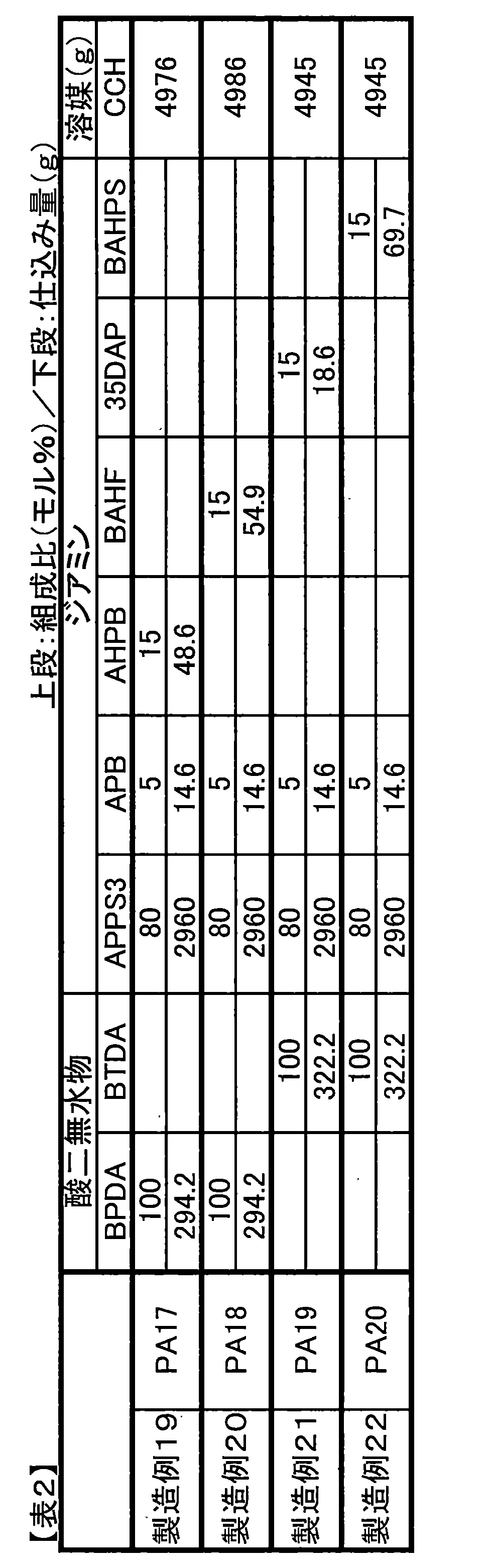
- Production Examples 2 to 22 Polymerization of polyamic acid solution
- the same operations as in Production Example 1 were carried out except that the types and amounts of acid dianhydride and diamine were changed as shown in Tables 1 and 2 to obtain 40 mass% polyamic acid resin solutions (PA2 to PA22). .
- Production Example 23 (Preparation of adhesive resin solution)
- 100 g of the polyamic acid solution (PA15) obtained in Production Example 15 and 0.08 g of 100LM, which is a methylol compound, were charged together with 0.12 g of CCH, and stirred at room temperature for 2 hours to obtain 40 masses.
- % Adhesive resin solution (AH1) was obtained.
- Production Examples 24 to 29 (Preparation of adhesive resin solution) The same operation as in Production Example 23 was carried out except that the type and amount of the methylol compound were changed as shown in Table 3 to obtain 40% by mass of an adhesive resin solution (AH2 to 7).
- Example 1 A polyamic acid resin solution (PA3) obtained in Production Example 3 is dried on an 8-inch silicon wafer (manufactured by Shin-Etsu Chemical Co., Ltd.) having a thickness of 0.75 mm so that the thickness after imidization becomes 20 ⁇ m.
- a spin coater was used to adjust the number of revolutions, and the mixture was applied, heat-treated at 120 ° C. for 10 minutes, dried, and then heat-treated at 250 ° C. for 10 minutes for complete imidization to obtain a pressure-sensitive adhesive resin laminated silicon substrate.
- a polyimide film (“Kapton” 150EN manufactured by Saitoray DuPont Co., Ltd.) is superimposed on the adhesive resin laminated silicon substrate created by the above method, and the polyimide film is pressure-bonded using a hand roll at 25 ° C.
- a substrate was obtained.
- the obtained polyimide film laminated silicon substrate was heat-treated in a hot air oven set at 300 ° C. for 30 minutes.
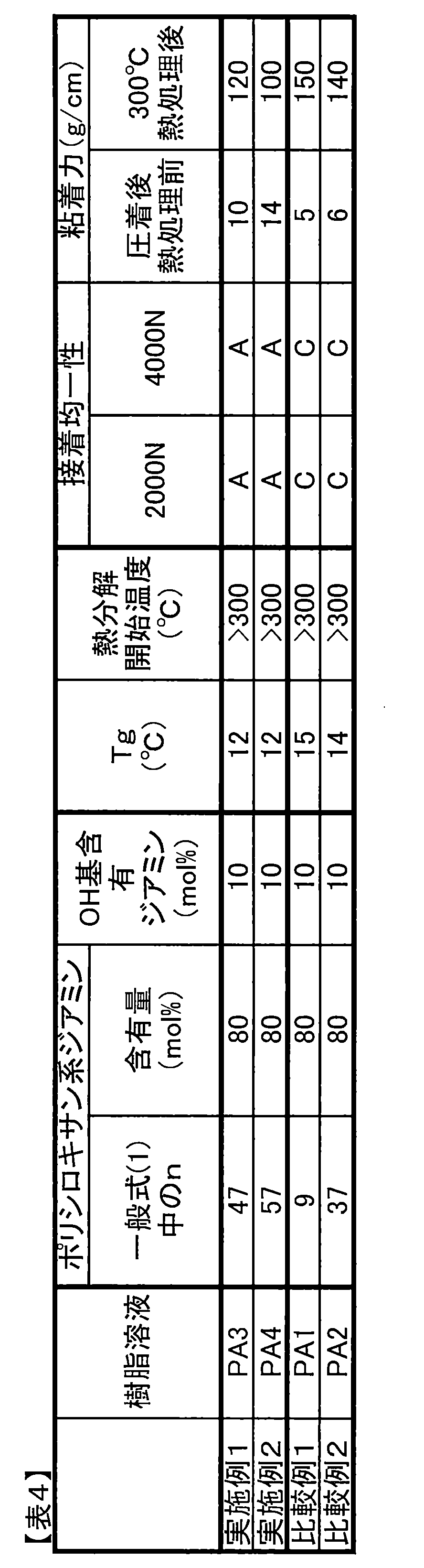
- Table 4 shows the adhesive strength before heat treatment after pressure bonding of the obtained polyimide film laminated silicon substrate, the adhesive strength after heat treatment, the glass transition temperature of the adhesive resin, and the thermal decomposition start temperature.
- Example 2 Except that the polyamic acid resin solution was changed as shown in Table 4, the same operation as in Example 1 was performed to obtain a polyimide film laminated glass substrate and a glass substrate laminated silicon substrate.
- Comparative Examples 1 and 2 Except that the polyamic acid resin solution was changed as shown in Table 4, the same operation as in Example 1 was performed to obtain a polyimide film laminated glass substrate and a glass substrate laminated silicon substrate.
- the pressure-sensitive adhesive composition containing polyimide having a residue of polysiloxane diamine in which n is 45 or more in the general formula (1) showed good adhesion and adhesion uniformity in a large area.
- a large void of 100 ⁇ m or more was present and did not show uniform adhesiveness.
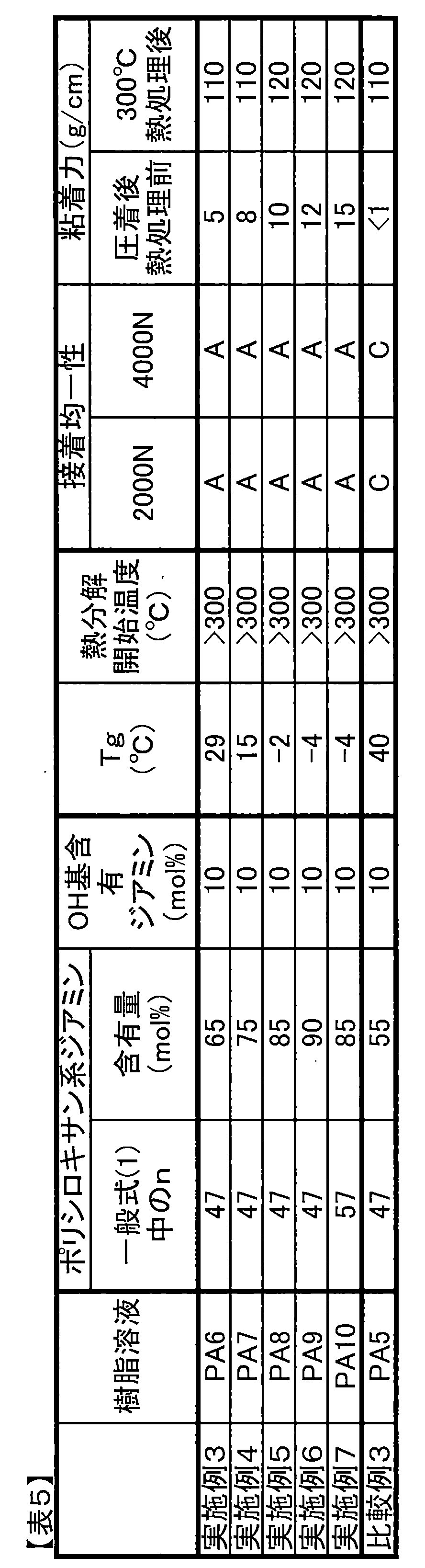
- Example 3-7 Except for changing the polyamic acid resin solution as shown in Table 5, the same operations as in Example 1 were performed to obtain a polyimide film laminated silicon substrate and a glass substrate laminated silicon substrate.
- Comparative Example 3 Except for changing the polyamic acid resin solution as shown in Table 5, the same operations as in Example 1 were performed to obtain a polyimide film laminated silicon substrate and a glass substrate laminated silicon substrate.
- the pressure-sensitive adhesive composition made of polyimide having a polysiloxane diamine residue represented by the general formula (1) of 60% by mass or more good adhesiveness and adhesion in a large area It showed uniformity.
- a large void of 100 ⁇ m or more was present and did not show uniform adhesiveness.
- the adhesive force before 300 degreeC heat processing was also very low.
- Example 8-14 Except for changing the polyamic acid resin solution as shown in Table 6, the same operation as in Example 1 was performed to obtain a polyimide film laminated silicon substrate and a glass substrate laminated silicon substrate.
- Comparative Example 4 Except for changing the polyamic acid resin solution as shown in Table 6, the same operation as in Example 1 was performed to obtain a polyimide film laminated silicon substrate and a glass substrate laminated silicon substrate.
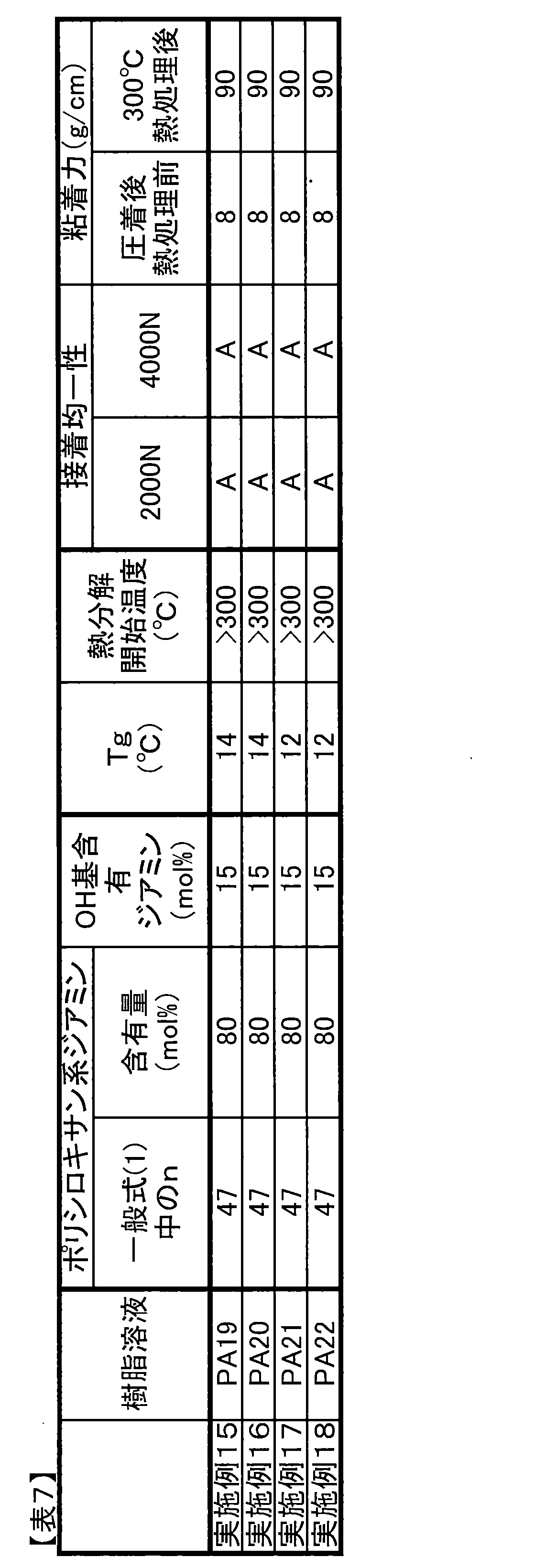
- Example 15-18 Except that the polyamic acid resin solution was changed as shown in Table 7, the same operation as in Example 1 was performed to obtain a polyimide film laminated silicon substrate and a glass substrate laminated silicon substrate.
- Examples 19-25 Except having changed the adhesive acid resin solution as shown in Table 8, the same operation as Example 1 was performed, and the polyimide film laminated silicon substrate and the glass substrate laminated silicon substrate were obtained.
- Example 26 The pressure-sensitive adhesive resin solution (AH4) obtained in Production Example 26 is dried and imidized on a polyimide film (“Kapton” 300H manufactured by Toray DuPont Co., Ltd.) having a thickness of 100 ⁇ m and a width of 250 mm that has been subjected to mold release treatment with a silicone resin. After coating with a comma coater so that the subsequent film thickness was 20 ⁇ m, heat treatment was performed at 120 ° C. for 1 minute and then at 250 ° C. for 1 minute to obtain an adhesive resin laminated film having an adhesive resin layer on one side.
- a polyimide film (“Kapton” 300H manufactured by Toray DuPont Co., Ltd.) having a thickness of 100 ⁇ m and a width of 250 mm that has been subjected to mold release treatment with a silicone resin. After coating with a comma coater so that the subsequent film thickness was 20 ⁇ m, heat treatment was performed at 120 ° C. for 1 minute and then at 250 ° C. for 1
- the pressure-sensitive adhesive resin laminated film with protective film obtained above was cut into a predetermined size, and then the PET film as the protective film was peeled off, and the thickness of the hot plate surface temperature set to 120 ° C. was 0 mm.
- a 7 mm alkali-free glass substrate manufactured by Corning
- the polyimide film was peeled off to obtain an adhesive resin laminated glass substrate. When the peeled surface of the removed polyimide film was observed, there was no adhesive resin residue on the surface.
- a polyimide film (“Kapton” 150EN manufactured by Saitoray DuPont Co., Ltd.) is superimposed on the pressure-sensitive adhesive resin laminated glass substrate prepared by the above method, and the polyimide film is pressure-bonded using a hand roll at 160 ° C. to obtain a polyimide film laminated glass.
- a substrate was obtained.
- the adhesive force of the obtained polyimide film laminated glass substrate was 12 g / cm.
- the polyimide film laminated glass substrate was heat-treated at 300 ° C. for 15 minutes using a hot air oven.
- the adhesive strength after heat treatment was 47 g / cm, and the polyimide film could be easily peeled off at room temperature.
- Example 27 The pressure-sensitive adhesive resin solution (AH4) obtained in Production Example 26 is dried on a 0.75 mm thick 8-inch silicon wafer (manufactured by Shin-Etsu Chemical Co., Ltd.), and the film thickness after drying and imidization is 20 ⁇ m. Thus, after apply
- An 8-inch silicon wafer having a thickness of 0.75 mm is laminated on the pressure-sensitive adhesive resin laminated support substrate on the pressure-sensitive adhesive resin and pressure-bonded at 180 ° C. and 4000 N for 5 minutes. A laminate of the support substrate was obtained.
- the laminated semiconductor circuit forming substrate was set on a grinder DAG810 (manufactured by DISCO), and the semiconductor circuit forming substrate was polished to a thickness of 100 ⁇ m.
- the laminated body after polishing the semiconductor circuit forming substrate was heat-treated at 300 ° C. for 1 hour.
- the substrate for forming a semiconductor circuit of the laminated body was observed with the naked eye, and there was no swelling, cracking or cracking.
- a dicing tape was applied to the semiconductor circuit forming substrate using a dicing frame, and the surface of the dicing tape was set on the suction plate by vacuum suction, and then the support substrate was peeled off by lifting one point of the support substrate with tweezers at room temperature. . There were no cracks or cracks in the semiconductor circuit forming substrate.
- Example 28 After peeling off the PET film, which is a protective film of the adhesive resin laminated film with a protective film prepared in Example 26, an 8-inch silicon wafer having a thickness of 0.75 mm on a hot plate having a hot plate surface temperature set to 120 ° C. (Manufactured by Shin-Etsu Chemical Co., Ltd.) was placed, and the pressure-sensitive adhesive resin laminated film was crimped with a hand roll. Next, the polyimide film was peeled off and heat-treated at 250 ° C. for 30 minutes to obtain an adhesive resin laminated support substrate.
- an 8-inch silicon wafer having a thickness of 0.75 mm on a hot plate having a hot plate surface temperature set to 120 ° C. Manufactured by Shin-Etsu Chemical Co., Ltd.
- Example 27 Thereafter, the same operation as in Example 27 was performed. After peeling off the support substrate, there was no crack or crack in the semiconductor circuit forming substrate.
Landscapes
- Chemical & Material Sciences (AREA)
- Organic Chemistry (AREA)
- Chemical Kinetics & Catalysis (AREA)
- Health & Medical Sciences (AREA)
- Medicinal Chemistry (AREA)
- Polymers & Plastics (AREA)
- Engineering & Computer Science (AREA)
- Manufacturing & Machinery (AREA)
- Materials Engineering (AREA)
- Adhesives Or Adhesive Processes (AREA)
- Laminated Bodies (AREA)
- Macromolecular Compounds Obtained By Forming Nitrogen-Containing Linkages In General (AREA)
- Adhesive Tapes (AREA)
- Compositions Of Macromolecular Compounds (AREA)
Abstract
Description

なお、ここで残基とは、ポリマーなどの化学物質中に存在し、原料由来の化学構造を意味し、ここでは原料の名称またはその略称を付して表現される。


左上:ニカラックMW-30HM、ニカラックMW-100LM
右上:ニカラックMX-270
左下:ニカラックMX-280
右下:ニカラックMX-290
本発明においては、樹脂組成物に一般式(1)で表されるポリシロキサン系ジアミンの残基および水酸基を有するジアミンの残基を有するポリイミド樹脂に、さらにメチロール化合物を含有することで、熱処理工程時の樹脂組成物硬化膜の流動性を強く抑制し、接着力の上昇を抑えることができるため、被着体となる基材の剥離時に室温でより容易に剥離することができる。
下記製造例1~22に記載のポリアミド酸樹脂溶液(PA-1~22)、製造例23~29の粘着剤樹脂溶液を厚さ18μmの電解銅箔の光沢面に厚さ20μmになるようにバーコーターで塗布後、80℃で10分、150℃で10分乾燥し、さらに窒素雰囲気下250℃で10分加熱処理を行って、ポリイミドに変換し、粘着剤樹脂積層銅箔を得た。次に得られた粘着剤樹脂積層銅箔の銅箔を塩化第2鉄溶液で全面エッチングし、粘着剤樹脂の単膜を得た。
上記で得られた粘着剤樹脂の単膜約15mgをアルミ製標準容器に詰め、熱重量分析装置 TGA-50(島津製作所(株)製)を用いて測定した。測定条件は、60℃で30分保持した後、昇温速度5℃/分で500℃まで昇温した。
各実施例および比較例で得られたポリイミドフィルム積層シリコン基板上のポリイミドフィルムを10mm幅に切り目を入れ、10mm幅のポリイミドフィルムをTOYO BOLDWIN社製”テンシロン”UTM-4-100にて引っ張り速度50mm/分、90゜剥離で測定した。
各実施例で得られたガラス基板積層シリコン基板をガラス側から肉眼で観察し、ボイドの有無を評価した。評価基準は下記のとおりである。
A:ボイド無し。
B:100μm以下のサイズのボイド有り。
C:100μm以上のサイズのボイド有り。
試料となるポリシロキサン系ジアミン5gをビーカーに採取し、ここに、IPA:トルエンが1:1の混合溶液を50mL入れ溶解した。次に、京都電子工業(株)製の電位差自動測定装置AT-610を用い、0.1N塩酸水溶液を撹拌しながら滴下し、中和点となる滴下量を求めた。得られた0.1N塩酸水溶液の滴下量から下式(7)を用いて平均分子量を算出した。
2×〔10×36.5×(滴下量(g))〕/5=平均分子量 (7)
次に、用いたポリシロキサン系ジアミンがn=1であった場合およびn=10であった場合の分子量を化学構造式から計算し、nの数値と分子量の関係を一次関数の関係式として求めた。この関係式に上記平均分子量をあてはめ、nの平均値を求めた。
BPDA:3,3’,4,4’-ビフェニルテトラカルボン酸二無水物
ODPA:3,3’,4,4’-ジフェニルエーテルテトラカルボン酸二無水物
BTDA:3,3’,4,4’-ベンゾフェノンテトラカルボン酸二無水物
APPS1:α,ω-ビス(3-アミノプロピル)ポリジメチルシロキサン(平均分子量:860、式(1)においてn=9)
APPS2:α,ω-ビス(3-アミノプロピル)ポリジメチルシロキサン(平均分子量:3000、式(1)においてn=37)
APPS3:α,ω-ビス(3-アミノプロピル)ポリジメチルシロキサン(平均分子量:3700、式(1)においてn=47)
APPS4:α,ω-ビス(3-アミノプロピル)ポリジメチルシロキサン(平均分子量:4400、式(1)においてn=57)
44DAE:4,4’-ジアミノジフェニルエーテル
APB:1,3-ビス(3-アミノフェノキシ)ベンゼン
35DAP:3,5-ジアミノフェノール
BAP:4,4’-ジヒドロキシ―3,3’―ジアミノフェニルプロパン
DABS:4,4’-ジヒドロキシ―3,3’―ジアミノフェニルスルホン
AHPB:1,3-ビス(4-アミノ-3-ヒドロキシフェニル)ベンゼン
BAHF:4,4’-ジヒドロキシ―3,3’―ジアミノフェニルヘキサフルオロプロパン
BAHPS:ビス(4-(3-アミノ-4-ヒドロキシフェノキシ)ベンゼン)スルホン
100LM:ニカラック(登録商標)MW-100LM(三和ケミカル(株)製)
MX270:ニカラック(登録商標)MX-270(三和ケミカル(株)製)
CCH:シクロヘキサノン 。
温度計、乾燥窒素導入口、温水・冷却水による加熱・冷却装置、および、撹拌装置を付した反応釜に、APPS1 688g(0.8mol)、44DAE 20g(0.1mol)、BAP 25.8g(0.1mol)をCCH 1566gと共に仕込み、溶解させた後、ODPA 310.2g(1mol)を添加し、室温で1時間、続いて60℃で5時間反応させて、40質量%のポリアミド酸樹脂溶液(PA1)を得た。
酸二無水物、ジアミンの種類と仕込量を表1、表2のように変えた以外は製造例1と同様の操作を行い、40質量%のポリアミド酸樹脂溶液(PA2~PA22)を得た。

撹拌装置を付した反応釜に、製造例15で得たポリアミド酸溶液(PA15) 100g、メチロール系化合物である100LM 0.08gをCCH 0.12gと共に仕込み、室温で2時間撹拌して、40質量%の粘着剤樹脂溶液(AH1)を得た。
メチロール系化合物の種類と仕込量を表3のように変えた以外は製造例23と同様の操作を行い、40質量%の粘着剤樹脂溶液(AH2~7)を得た。

厚さ0.75mmの8インチシリコンウエハ(信越化学工業(株)社製)上に、製造例3で得られたポリアミド酸樹脂溶液(PA3)を乾燥、イミド化後の厚みが20μmになるようにスピンコーターで回転数を調製して塗布し、120℃で10分熱処理して乾燥した後、250℃で10分熱処理して完全にイミド化を行い、粘着剤樹脂積層シリコン基板を得た。
ポリアミド酸樹脂溶液を表4のごとく変えた以外は、実施例1と同様の操作を行い、ポリイミドフィルム積層ガラス基板、および、ガラス基板積層シリコン基板を得た。
ポリアミド酸樹脂溶液を表4のごとく変えた以外は、実施例1と同様の操作を行い、ポリイミドフィルム積層ガラス基板、および、ガラス基板積層シリコン基板を得た。
ポリアミド酸樹脂溶液を表5のごとく変えた以外は、実施例1と同様の操作を行い、ポリイミドフィルム積層シリコン基板、および、ガラス基板積層シリコン基板を得た。
ポリアミド酸樹脂溶液を表5のごとく変えた以外は、実施例1と同様の操作を行い、ポリイミドフィルム積層シリコン基板、および、ガラス基板積層シリコン基板を得た。
ポリアミド酸樹脂溶液を表6のごとく変えた以外は、実施例1と同様の操作を行い、ポリイミドフィルム積層シリコン基板、および、ガラス基板積層シリコン基板を得た。
ポリアミド酸樹脂溶液を表6のごとく変えた以外は、実施例1と同様の操作を行い、ポリイミドフィルム積層シリコン基板、および、ガラス基板積層シリコン基板を得た。

ポリアミド酸樹脂溶液を表7のごとく変えた以外は、実施例1と同様の操作を行い、ポリイミドフィルム積層シリコン基板、および、ガラス基板積層シリコン基板を得た。
粘着剤酸樹脂溶液を表8のごとく変えた以外は、実施例1と同様の操作を行い、ポリイミドフィルム積層シリコン基板、および、ガラス基板積層シリコン基板を得た。

シリコーン樹脂で離型処理した厚み100μm、幅250mmのポリイミドフィルム(“カプトン”300H 東レ・デュポン(株)製)に、製造例26で得られた粘着剤樹脂溶液(AH4)を、乾燥、イミド化後の膜厚が20μmになるようにコンマコーターで塗工後、120℃で1分、続いて250℃で1分熱処理し、片面に粘着剤樹脂層を有する粘着剤樹脂積層フィルムを得た。次に、粘着剤樹脂層上にシリコーン樹脂で離型処理した厚み38μm、幅250mmのPETフィルムを25℃でラミネートし、保護フィルム付き粘着剤樹脂積層フィルムを得た。
厚さ0.75mmの8インチシリコンウエハ(信越化学工業(株)社製)に、製造例26で得られた粘着剤樹脂溶液(AH4)を、乾燥、イミド化後の膜厚が20μmになるようにスピンコーターで塗布後、140℃で10分、続いて250℃で30分熱処理し、粘着剤樹脂積層支持基板を得た。
実施例26で作製した保護フィルム付き粘着剤樹脂積層フィルムの保護フィルムであるPETフィルムを剥がした後、ホットプレート表面温度を120℃に設定したホットプレート上に厚さ0.75mmの8インチシリコンウエハ(信越化学工業(株)社製)を置き、ハンドロールで粘着剤樹脂積層フィルムを圧着した。次に、ポリイミドフィルムを剥がし、250℃で30分熱処理し、粘着剤樹脂積層支持基板を得た。
Claims (16)
- 少なくとも酸無水物残基とジアミン残基を有するポリイミド樹脂であり、全ジアミン残基中、一般式(1)で表されるポリシロキサン系ジアミンの残基を60モル%以上含むことを特徴とするポリイミド樹脂。

- ジアミン残基に、水酸基を有するジアミンの残基を含む請求項1記載のポリイミド樹脂。
- 全ジアミン残基中、水酸基を有するジアミンの残基を0.1~40モル%含む請求項2記載のポリイミド樹脂。
- ガラス転移温度が30℃以下である請求項1記載のポリイミド樹脂。
- 請求項1~4のいずれかに記載のポリイミド樹脂、又は該ポリイミド樹脂の前駆体であるポリアミド酸樹脂を含む樹脂組成物。
- メチロール化合物を含む請求項5記載の樹脂組成物。
- メチロール化合物が一般式(2)で表される基を2個以上有する化合物である請求項6記載の樹脂組成物。

- メチロール化合物の含有量がポリイミド樹脂、又は、該ポリイミド樹脂の前駆体であるポリアミド酸樹脂に対して0.1~20質量%である請求項6または7記載の樹脂組成物。
- 請求項5~8いずれかに記載の樹脂組成物を硬化した硬化膜。
- 耐熱性絶縁フィルムの少なくとも片面に、請求項5~8いずれかに記載の樹脂組成物を積層した積層フィルム。
- 樹脂組成物を積層する耐熱性絶縁フィルムの表面が離型処理されている請求項10記載の積層フィルム。
- 前記耐熱性絶縁フィルム上に積層された樹脂組成物の表面に、さらに離型処理されたフィルムを積層した請求項10または11記載の積層フィルム。
- 請求項5~8いずれかに記載の樹脂組成物を用いる半導体装置の製造方法。
- 半導体回路形成用基板と支持基板とが少なくとも1層の粘着剤樹脂層を介して接合され、該粘着剤樹脂層が前記樹脂組成物を用いたものであり、少なくとも、半導体回路形成用基板を薄く加工する工程、半導体回路形成用基板をデバイス加工する工程、および半導体回路形成基板を支持基板から剥離する工程を含む請求項13に記載の半導体装置の製造方法。
- 請求項10~12いずれかに記載の積層フィルムを用いた半導体装置の製造方法。
- 半導体回路形成用基板と支持基板とが少なくとも1層の粘着剤樹脂層を介して接合され、該粘着剤樹脂層が前記積層フィルムを用いたものであり、少なくとも、半導体回路形成用基板を薄く加工する工程、半導体回路形成用基板をデバイス加工する工程、および半導体回路形成基板を支持基板から剥離する工程を含む請求項15に記載の半導体装置の製造方法。
Priority Applications (6)
| Application Number | Priority Date | Filing Date | Title |
|---|---|---|---|
| EP15754960.1A EP3112394A4 (en) | 2014-02-26 | 2015-02-24 | Polyimide resin, resin composition using same, and laminated film |
| US15/121,446 US10026637B2 (en) | 2014-02-26 | 2015-02-24 | Polyimide resin, resin composition using same, and laminated film |
| KR1020167025224A KR102122278B1 (ko) | 2014-02-26 | 2015-02-24 | 폴리이미드 수지, 이것을 이용한 수지 조성물 및 적층 필름 |
| SG11201606994XA SG11201606994XA (en) | 2014-02-26 | 2015-02-24 | Polyimide resin, resin composition using same, and laminated film |
| JP2015524565A JP6555126B2 (ja) | 2014-02-26 | 2015-02-24 | ポリイミド樹脂、これを用いた樹脂組成物および積層フィルム |
| CN201580010593.2A CN106029744B (zh) | 2014-02-26 | 2015-02-24 | 聚酰亚胺树脂、使用其的树脂组合物及层叠膜 |
Applications Claiming Priority (2)
| Application Number | Priority Date | Filing Date | Title |
|---|---|---|---|
| JP2014034900 | 2014-02-26 | ||
| JP2014-034900 | 2014-02-26 |
Publications (2)
| Publication Number | Publication Date |
|---|---|
| WO2015129682A1 true WO2015129682A1 (ja) | 2015-09-03 |
| WO2015129682A9 WO2015129682A9 (ja) | 2016-10-20 |
Family
ID=54009000
Family Applications (1)
| Application Number | Title | Priority Date | Filing Date |
|---|---|---|---|
| PCT/JP2015/055222 Ceased WO2015129682A1 (ja) | 2014-02-26 | 2015-02-24 | ポリイミド樹脂、これを用いた樹脂組成物および積層フィルム |
Country Status (8)
| Country | Link |
|---|---|
| US (1) | US10026637B2 (ja) |
| EP (1) | EP3112394A4 (ja) |
| JP (1) | JP6555126B2 (ja) |
| KR (1) | KR102122278B1 (ja) |
| CN (1) | CN106029744B (ja) |
| SG (1) | SG11201606994XA (ja) |
| TW (1) | TWI652286B (ja) |
| WO (1) | WO2015129682A1 (ja) |
Cited By (7)
| Publication number | Priority date | Publication date | Assignee | Title |
|---|---|---|---|---|
| JPWO2017051827A1 (ja) * | 2015-09-24 | 2018-03-22 | 旭化成株式会社 | ポリイミド前駆体、樹脂組成物および樹脂フィルムの製造方法 |
| CN108138013A (zh) * | 2015-10-29 | 2018-06-08 | 东丽株式会社 | 临时粘合用层叠体膜、使用临时粘合用层叠体膜的基板加工体及层叠基板加工体的制造方法、以及使用它们的半导体器件的制造方法 |
| KR20180104311A (ko) * | 2016-02-08 | 2018-09-20 | 도레이 카부시키가이샤 | 수지 조성물, 수지층, 영구 접착제, 임시 점착 접착제, 적층 필름, 웨이퍼 가공체 및 전자 부품 또는 반도체 장치의 제조 방법 |
| WO2018230495A1 (ja) * | 2017-06-16 | 2018-12-20 | 大日本印刷株式会社 | 積層体、ディスプレイ用表面材、タッチパネル部材、液晶表示装置、及び有機エレクトロルミネッセンス表示装置 |
| JP2019189868A (ja) * | 2018-04-25 | 2019-10-31 | 達興材料股▲ふん▼有限公司Daxin Materials Corporation | 被加工物の仮接着方法及び接着剤 |
| JP2021191630A (ja) * | 2020-06-03 | 2021-12-16 | 積水化学工業株式会社 | 半導体加工用積層体、及び、被処理部材の処理方法 |
| US12043770B2 (en) | 2019-08-08 | 2024-07-23 | Daxin Materials Corporation | Temporary bonding composition, temporary bonding film, composite film, temporary bonding method and semiconductor wafer package |
Families Citing this family (9)
| Publication number | Priority date | Publication date | Assignee | Title |
|---|---|---|---|---|
| JP7092114B2 (ja) * | 2017-03-30 | 2022-06-28 | 日産化学株式会社 | 剥離層形成用組成物及び剥離層 |
| JP7281887B2 (ja) * | 2017-10-19 | 2023-05-26 | 日鉄ケミカル&マテリアル株式会社 | ポリイミド前駆体及びポリイミド |
| GB2570510A (en) * | 2018-01-30 | 2019-07-31 | Pragmatic Printing Ltd | System and method for manufacturing plurality of integrated circuits |
| KR102279081B1 (ko) * | 2018-08-20 | 2021-07-19 | 주식회사 엘지화학 | 폴리이미드 필름 및 이를 이용하는 플렉서블 디바이스 |
| WO2022102778A1 (ja) * | 2020-11-16 | 2022-05-19 | 三菱ケミカル株式会社 | 積層体 |
| CN116600998A (zh) * | 2020-12-24 | 2023-08-15 | 东丽株式会社 | 树脂组合物、片状组合物、片固化物、叠层体、叠层构件、晶片保持体及半导体制造装置 |
| CN114957660B (zh) * | 2021-02-26 | 2024-12-03 | 新应材股份有限公司 | 聚酰亚胺树脂组合物、聚酰亚胺树脂黏着层、积层体、以及电子组件的制造方法 |
| TWI739715B (zh) | 2021-02-26 | 2021-09-11 | 新應材股份有限公司 | 聚醯亞胺樹脂組成物、聚醯亞胺樹脂黏著層、積層體、以及電子元件的製造方法 |
| JP7763038B2 (ja) * | 2021-03-31 | 2025-10-31 | Tdk株式会社 | 樹脂複合積層体、樹脂複合積層体の製造方法および伸縮性デバイス |
Citations (11)
| Publication number | Priority date | Publication date | Assignee | Title |
|---|---|---|---|---|
| JPS6335626A (ja) * | 1986-07-30 | 1988-02-16 | Sumitomo Bakelite Co Ltd | 耐熱性樹脂の製造方法 |
| JPH03195730A (ja) * | 1989-12-25 | 1991-08-27 | Hitachi Chem Co Ltd | シロキサン変性ポリイミド及びその前駆体 |
| JPH11126855A (ja) * | 1997-10-22 | 1999-05-11 | Shin Etsu Chem Co Ltd | 半導体装置およびその製造方法 |
| JP2007031647A (ja) * | 2005-07-29 | 2007-02-08 | Japan Health Science Foundation | 固相合成を利用した超短半減期核種を含む化合物の製造方法およびそれに用いる化合物 |
| JP2007063331A (ja) * | 2005-08-29 | 2007-03-15 | Hitachi Chem Co Ltd | 樹脂組成物 |
| JP2007211204A (ja) * | 2006-02-13 | 2007-08-23 | Hitachi Chem Co Ltd | 耐熱性樹脂ワニス、耐熱性樹脂ワニスを添加した耐熱性コーティング剤及び耐熱性コーティング剤を用いた絶縁膜又は半導体装置 |
| JP2009292979A (ja) * | 2008-06-06 | 2009-12-17 | Nippon Shokubai Co Ltd | シロキサン化合物、及び、これを含有する硬化性組成物 |
| JP2012019079A (ja) * | 2010-07-08 | 2012-01-26 | Kyocera Chemical Corp | マスキング用樹脂組成物 |
| WO2013047451A1 (ja) * | 2011-09-29 | 2013-04-04 | Jsr株式会社 | 樹脂組成物およびそれを用いた膜形成方法 |
| WO2014050878A1 (ja) * | 2012-09-25 | 2014-04-03 | 東レ株式会社 | 樹脂組成物、硬化膜、積層フィルム、および半導体装置の製造方法 |
| JP2014118532A (ja) * | 2012-12-19 | 2014-06-30 | Jnc Corp | ポリアミド酸組成物 |
Family Cites Families (25)
| Publication number | Priority date | Publication date | Assignee | Title |
|---|---|---|---|---|
| US3325450A (en) * | 1965-05-12 | 1967-06-13 | Gen Electric | Polysiloxaneimides and their production |
| US4558110A (en) * | 1985-02-01 | 1985-12-10 | General Electric Company | Crystalline silicone-imide copolymers |
| JP3057872B2 (ja) | 1992-01-24 | 2000-07-04 | 東レ株式会社 | 耐熱性接着材料 |
| JP3227217B2 (ja) * | 1992-08-18 | 2001-11-12 | 新日鐵化学株式会社 | 耐熱性複合材料及びその製造方法 |
| JP3550913B2 (ja) | 1995-10-31 | 2004-08-04 | 宇部興産株式会社 | ポリイミドシロキサンおよびその製法 |
| JPH09328546A (ja) * | 1996-06-11 | 1997-12-22 | Mitsui Petrochem Ind Ltd | 樹脂組成物 |
| JP3721768B2 (ja) * | 1997-01-24 | 2005-11-30 | 宇部興産株式会社 | 感光性ポリイミドシロキサン組成物および絶縁膜 |
| JP3968885B2 (ja) | 1998-05-14 | 2007-08-29 | 日本メクトロン株式会社 | 感光性組成物 |
| WO2001057112A1 (en) | 2000-02-01 | 2001-08-09 | Nippon Steel Chemical Co., Ltd. | Adhesive polyimide resin and adhesive laminate |
| JP3865046B2 (ja) * | 2001-05-08 | 2007-01-10 | 信越化学工業株式会社 | 無溶剤型ポリイミドシリコーン系樹脂組成物 |
| US6872457B2 (en) * | 2001-07-31 | 2005-03-29 | Ube Industries, Ltd. | Atomic oxygen-resistant film |
| JP2004277619A (ja) | 2003-03-18 | 2004-10-07 | Sumitomo Bakelite Co Ltd | ポリイミド樹脂及び半導体接着テープ |
| JPWO2005113645A1 (ja) * | 2004-05-20 | 2008-03-27 | 東レ株式会社 | ポリイミド樹脂、積層フィルム、金属層付き積層フィルム、および半導体装置 |
| JP4997690B2 (ja) * | 2004-08-10 | 2012-08-08 | 日立化成工業株式会社 | 樹脂組成物、樹脂付き基材及び導体層張り積層板 |
| JP4577895B2 (ja) * | 2005-06-10 | 2010-11-10 | 信越化学工業株式会社 | 接着剤組成物及び接着性フィルム |
| JP2007314647A (ja) | 2006-05-25 | 2007-12-06 | Toray Ind Inc | インクジェット用熱硬化性樹脂組成物、耐熱性樹脂膜の形成方法およびそれを用いた電子部品 |
| JP2008281597A (ja) * | 2007-05-08 | 2008-11-20 | Toray Ind Inc | 感光性樹脂組成物シート |
| JP2008292799A (ja) * | 2007-05-25 | 2008-12-04 | Toray Ind Inc | 感光性ポリイミド用現像液およびこれを用いたパターン形成方法 |
| JP4771100B2 (ja) * | 2008-08-27 | 2011-09-14 | 信越化学工業株式会社 | 無溶剤型ポリイミドシリコーン系樹脂組成物及びその硬化物 |
| JP5648275B2 (ja) | 2009-04-14 | 2015-01-07 | 住友ベークライト株式会社 | 天然繊維成形品の抄造素材およびその製造方法 |
| KR20110040302A (ko) | 2009-10-14 | 2011-04-20 | 주식회사 멕트론 | 열경화성 폴리이미드 조성물 |
| CN101914357A (zh) * | 2010-08-06 | 2010-12-15 | 东华大学 | 环氧-有机硅聚酰亚胺粘合剂及其制备方法 |
| JP5649219B2 (ja) * | 2011-01-24 | 2015-01-07 | Nttエレクトロニクス株式会社 | 半導体装置 |
| CN103748141B (zh) | 2011-09-12 | 2016-04-20 | 东丽株式会社 | 聚酰亚胺树脂、使用其的树脂组合物以及层合膜 |
| JP5948545B2 (ja) * | 2012-12-21 | 2016-07-06 | 旭化成株式会社 | ポリイミド前駆体及びそれを含有する樹脂組成物 |
-
2015
- 2015-02-24 JP JP2015524565A patent/JP6555126B2/ja not_active Expired - Fee Related
- 2015-02-24 US US15/121,446 patent/US10026637B2/en active Active
- 2015-02-24 EP EP15754960.1A patent/EP3112394A4/en not_active Withdrawn
- 2015-02-24 SG SG11201606994XA patent/SG11201606994XA/en unknown
- 2015-02-24 CN CN201580010593.2A patent/CN106029744B/zh not_active Expired - Fee Related
- 2015-02-24 KR KR1020167025224A patent/KR102122278B1/ko not_active Expired - Fee Related
- 2015-02-24 WO PCT/JP2015/055222 patent/WO2015129682A1/ja not_active Ceased
- 2015-02-26 TW TW104106192A patent/TWI652286B/zh not_active IP Right Cessation
Patent Citations (11)
| Publication number | Priority date | Publication date | Assignee | Title |
|---|---|---|---|---|
| JPS6335626A (ja) * | 1986-07-30 | 1988-02-16 | Sumitomo Bakelite Co Ltd | 耐熱性樹脂の製造方法 |
| JPH03195730A (ja) * | 1989-12-25 | 1991-08-27 | Hitachi Chem Co Ltd | シロキサン変性ポリイミド及びその前駆体 |
| JPH11126855A (ja) * | 1997-10-22 | 1999-05-11 | Shin Etsu Chem Co Ltd | 半導体装置およびその製造方法 |
| JP2007031647A (ja) * | 2005-07-29 | 2007-02-08 | Japan Health Science Foundation | 固相合成を利用した超短半減期核種を含む化合物の製造方法およびそれに用いる化合物 |
| JP2007063331A (ja) * | 2005-08-29 | 2007-03-15 | Hitachi Chem Co Ltd | 樹脂組成物 |
| JP2007211204A (ja) * | 2006-02-13 | 2007-08-23 | Hitachi Chem Co Ltd | 耐熱性樹脂ワニス、耐熱性樹脂ワニスを添加した耐熱性コーティング剤及び耐熱性コーティング剤を用いた絶縁膜又は半導体装置 |
| JP2009292979A (ja) * | 2008-06-06 | 2009-12-17 | Nippon Shokubai Co Ltd | シロキサン化合物、及び、これを含有する硬化性組成物 |
| JP2012019079A (ja) * | 2010-07-08 | 2012-01-26 | Kyocera Chemical Corp | マスキング用樹脂組成物 |
| WO2013047451A1 (ja) * | 2011-09-29 | 2013-04-04 | Jsr株式会社 | 樹脂組成物およびそれを用いた膜形成方法 |
| WO2014050878A1 (ja) * | 2012-09-25 | 2014-04-03 | 東レ株式会社 | 樹脂組成物、硬化膜、積層フィルム、および半導体装置の製造方法 |
| JP2014118532A (ja) * | 2012-12-19 | 2014-06-30 | Jnc Corp | ポリアミド酸組成物 |
Non-Patent Citations (1)
| Title |
|---|
| See also references of EP3112394A4 * |
Cited By (15)
| Publication number | Priority date | Publication date | Assignee | Title |
|---|---|---|---|---|
| JPWO2017051827A1 (ja) * | 2015-09-24 | 2018-03-22 | 旭化成株式会社 | ポリイミド前駆体、樹脂組成物および樹脂フィルムの製造方法 |
| CN108138013B (zh) * | 2015-10-29 | 2021-02-19 | 东丽株式会社 | 临时粘合用层叠体膜、使用临时粘合用层叠体膜的基板加工体及层叠基板加工体的制造方法、以及使用它们的半导体器件的制造方法 |
| CN108138013A (zh) * | 2015-10-29 | 2018-06-08 | 东丽株式会社 | 临时粘合用层叠体膜、使用临时粘合用层叠体膜的基板加工体及层叠基板加工体的制造方法、以及使用它们的半导体器件的制造方法 |
| JPWO2017073507A1 (ja) * | 2015-10-29 | 2018-08-16 | 東レ株式会社 | 仮貼り用積層体フィルム、仮貼り用積層体フィルムを用いた基板加工体および積層基板加工体の製造方法、ならびにこれらを用いた半導体装置の製造方法 |
| CN108603028B (zh) * | 2016-02-08 | 2021-05-07 | 东丽株式会社 | 树脂组合物、树脂层、临时粘贴粘接剂、层叠膜、晶片加工体及其应用 |
| CN108603028A (zh) * | 2016-02-08 | 2018-09-28 | 东丽株式会社 | 树脂组合物、树脂层、永久粘接剂、临时粘贴粘接剂、层叠膜、晶片加工体以及电子部件或半导体器件的制造方法 |
| KR20180104311A (ko) * | 2016-02-08 | 2018-09-20 | 도레이 카부시키가이샤 | 수지 조성물, 수지층, 영구 접착제, 임시 점착 접착제, 적층 필름, 웨이퍼 가공체 및 전자 부품 또는 반도체 장치의 제조 방법 |
| KR102717412B1 (ko) * | 2016-02-08 | 2024-10-16 | 도레이 카부시키가이샤 | 수지 조성물, 수지층, 영구 접착제, 임시 점착 접착제, 적층 필름, 웨이퍼 가공체 및 전자 부품 또는 반도체 장치의 제조 방법 |
| WO2018230495A1 (ja) * | 2017-06-16 | 2018-12-20 | 大日本印刷株式会社 | 積層体、ディスプレイ用表面材、タッチパネル部材、液晶表示装置、及び有機エレクトロルミネッセンス表示装置 |
| JPWO2018230495A1 (ja) * | 2017-06-16 | 2020-04-16 | 大日本印刷株式会社 | 積層体、ディスプレイ用表面材、タッチパネル部材、液晶表示装置、及び有機エレクトロルミネッセンス表示装置 |
| JP7107311B2 (ja) | 2017-06-16 | 2022-07-27 | 大日本印刷株式会社 | 積層体、ディスプレイ用表面材、タッチパネル部材、液晶表示装置、及び有機エレクトロルミネッセンス表示装置 |
| JP2019189868A (ja) * | 2018-04-25 | 2019-10-31 | 達興材料股▲ふん▼有限公司Daxin Materials Corporation | 被加工物の仮接着方法及び接着剤 |
| US12043770B2 (en) | 2019-08-08 | 2024-07-23 | Daxin Materials Corporation | Temporary bonding composition, temporary bonding film, composite film, temporary bonding method and semiconductor wafer package |
| JP2021191630A (ja) * | 2020-06-03 | 2021-12-16 | 積水化学工業株式会社 | 半導体加工用積層体、及び、被処理部材の処理方法 |
| JP7716236B2 (ja) | 2020-06-03 | 2025-07-31 | 積水化学工業株式会社 | 半導体加工用積層体、及び、被処理部材の処理方法 |
Also Published As
| Publication number | Publication date |
|---|---|
| KR102122278B1 (ko) | 2020-06-15 |
| EP3112394A1 (en) | 2017-01-04 |
| US10026637B2 (en) | 2018-07-17 |
| WO2015129682A9 (ja) | 2016-10-20 |
| JP6555126B2 (ja) | 2019-08-07 |
| TW201542625A (zh) | 2015-11-16 |
| CN106029744B (zh) | 2018-08-28 |
| KR20160127032A (ko) | 2016-11-02 |
| EP3112394A4 (en) | 2017-08-16 |
| TWI652286B (zh) | 2019-03-01 |
| JPWO2015129682A1 (ja) | 2017-03-30 |
| CN106029744A (zh) | 2016-10-12 |
| SG11201606994XA (en) | 2016-09-29 |
| US20160372357A1 (en) | 2016-12-22 |
Similar Documents
| Publication | Publication Date | Title |
|---|---|---|
| JP6555126B2 (ja) | ポリイミド樹脂、これを用いた樹脂組成物および積層フィルム | |
| JP6303503B2 (ja) | 樹脂組成物、硬化膜、積層フィルム、および半導体装置の製造方法 | |
| JP6613894B2 (ja) | 仮貼り用接着剤、接着剤層、ウエハ加工体およびこれを用いた半導体装置の製造方法、リワーク溶剤、ポリイミド共重合体、ポリイミド混合樹脂、ならびに樹脂組成物 | |
| JP6090161B2 (ja) | 積層フィルム | |
| TWI797066B (zh) | 使用暫時貼合用積層體薄膜之暫時貼合方法、以及使用其之半導體裝置之製造方法 | |
| JP6834941B2 (ja) | 樹脂組成物、樹脂層、永久接着剤、仮貼り接着剤、積層フィルム、ウエハ加工体および電子部品または半導体装置の製造方法 | |
| JP6221252B2 (ja) | ポリイミド樹脂、これを含有する樹脂組成物、これを用いた積層フィルムおよび積層体 | |
| JP2017141317A (ja) | 仮貼り樹脂組成物、樹脂層、永久接着剤、仮貼り接着剤、ウエハ加工体およびこれらを用いた半導体装置の製造方法 |
Legal Events
| Date | Code | Title | Description |
|---|---|---|---|
| ENP | Entry into the national phase |
Ref document number: 2015524565 Country of ref document: JP Kind code of ref document: A |
|
| 121 | Ep: the epo has been informed by wipo that ep was designated in this application |
Ref document number: 15754960 Country of ref document: EP Kind code of ref document: A1 |
|
| REEP | Request for entry into the european phase |
Ref document number: 2015754960 Country of ref document: EP |
|
| WWE | Wipo information: entry into national phase |
Ref document number: 2015754960 Country of ref document: EP |
|
| WWE | Wipo information: entry into national phase |
Ref document number: 15121446 Country of ref document: US |
|
| NENP | Non-entry into the national phase |
Ref country code: DE |
|
| ENP | Entry into the national phase |
Ref document number: 20167025224 Country of ref document: KR Kind code of ref document: A |