WO2015129863A1 - 尿試料分析方法、尿試料分析用試薬及び尿試料分析用試薬キット - Google Patents
尿試料分析方法、尿試料分析用試薬及び尿試料分析用試薬キット Download PDFInfo
- Publication number
- WO2015129863A1 WO2015129863A1 PCT/JP2015/055883 JP2015055883W WO2015129863A1 WO 2015129863 A1 WO2015129863 A1 WO 2015129863A1 JP 2015055883 W JP2015055883 W JP 2015055883W WO 2015129863 A1 WO2015129863 A1 WO 2015129863A1
- Authority
- WO
- WIPO (PCT)
- Prior art keywords
- surfactant
- urine sample
- reagent
- urine
- sample analysis
- Prior art date
- Legal status (The legal status is an assumption and is not a legal conclusion. Google has not performed a legal analysis and makes no representation as to the accuracy of the status listed.)
- Ceased
Links
Images


Classifications
-
- G—PHYSICS
- G01—MEASURING; TESTING
- G01N—INVESTIGATING OR ANALYSING MATERIALS BY DETERMINING THEIR CHEMICAL OR PHYSICAL PROPERTIES
- G01N15/00—Investigating characteristics of particles; Investigating permeability, pore-volume or surface-area of porous materials
- G01N15/06—Investigating concentration of particle suspensions
-
- G—PHYSICS
- G01—MEASURING; TESTING
- G01N—INVESTIGATING OR ANALYSING MATERIALS BY DETERMINING THEIR CHEMICAL OR PHYSICAL PROPERTIES
- G01N33/00—Investigating or analysing materials by specific methods not covered by groups G01N1/00 - G01N31/00
- G01N33/48—Biological material, e.g. blood, urine; Haemocytometers
- G01N33/483—Physical analysis of biological material
- G01N33/487—Physical analysis of biological material of liquid biological material
- G01N33/493—Physical analysis of biological material of liquid biological material urine
-
- G—PHYSICS
- G01—MEASURING; TESTING
- G01N—INVESTIGATING OR ANALYSING MATERIALS BY DETERMINING THEIR CHEMICAL OR PHYSICAL PROPERTIES
- G01N1/00—Sampling; Preparing specimens for investigation
- G01N1/28—Preparing specimens for investigation including physical details of (bio-)chemical methods covered elsewhere, e.g. G01N33/50, C12Q
- G01N1/30—Staining; Impregnating ; Fixation; Dehydration; Multistep processes for preparing samples of tissue, cell or nucleic acid material and the like for analysis
-
- G—PHYSICS
- G01—MEASURING; TESTING
- G01N—INVESTIGATING OR ANALYSING MATERIALS BY DETERMINING THEIR CHEMICAL OR PHYSICAL PROPERTIES
- G01N15/00—Investigating characteristics of particles; Investigating permeability, pore-volume or surface-area of porous materials
- G01N15/10—Investigating individual particles
- G01N15/14—Optical investigation techniques, e.g. flow cytometry
- G01N15/1456—Optical investigation techniques, e.g. flow cytometry without spatial resolution of the texture or inner structure of the particle, e.g. processing of pulse signals
-
- G—PHYSICS
- G01—MEASURING; TESTING
- G01N—INVESTIGATING OR ANALYSING MATERIALS BY DETERMINING THEIR CHEMICAL OR PHYSICAL PROPERTIES
- G01N21/00—Investigating or analysing materials by the use of optical means, i.e. using sub-millimetre waves, infrared, visible or ultraviolet light
- G01N21/62—Systems in which the material investigated is excited whereby it emits light or causes a change in wavelength of the incident light
- G01N21/63—Systems in which the material investigated is excited whereby it emits light or causes a change in wavelength of the incident light optically excited
- G01N21/64—Fluorescence; Phosphorescence
- G01N21/6428—Measuring fluorescence of fluorescent products of reactions or of fluorochrome labelled reactive substances, e.g. measuring quenching effects, using measuring "optrodes"
-
- G—PHYSICS
- G01—MEASURING; TESTING
- G01N—INVESTIGATING OR ANALYSING MATERIALS BY DETERMINING THEIR CHEMICAL OR PHYSICAL PROPERTIES
- G01N21/00—Investigating or analysing materials by the use of optical means, i.e. using sub-millimetre waves, infrared, visible or ultraviolet light
- G01N21/62—Systems in which the material investigated is excited whereby it emits light or causes a change in wavelength of the incident light
- G01N21/63—Systems in which the material investigated is excited whereby it emits light or causes a change in wavelength of the incident light optically excited
- G01N21/64—Fluorescence; Phosphorescence
- G01N21/645—Specially adapted constructive features of fluorimeters
- G01N21/6456—Spatial resolved fluorescence measurements; Imaging
- G01N21/6458—Fluorescence microscopy
-
- G—PHYSICS
- G01—MEASURING; TESTING
- G01N—INVESTIGATING OR ANALYSING MATERIALS BY DETERMINING THEIR CHEMICAL OR PHYSICAL PROPERTIES
- G01N33/00—Investigating or analysing materials by specific methods not covered by groups G01N1/00 - G01N31/00
- G01N33/48—Biological material, e.g. blood, urine; Haemocytometers
- G01N33/50—Chemical analysis of biological material, e.g. blood, urine; Testing involving biospecific ligand binding methods; Immunological testing
- G01N33/52—Use of compounds or compositions for colorimetric, spectrophotometric or fluorometric investigation, e.g. use of reagent paper and including single- and multilayer analytical elements
-
- G—PHYSICS
- G01—MEASURING; TESTING
- G01N—INVESTIGATING OR ANALYSING MATERIALS BY DETERMINING THEIR CHEMICAL OR PHYSICAL PROPERTIES
- G01N33/00—Investigating or analysing materials by specific methods not covered by groups G01N1/00 - G01N31/00
- G01N33/48—Biological material, e.g. blood, urine; Haemocytometers
- G01N33/50—Chemical analysis of biological material, e.g. blood, urine; Testing involving biospecific ligand binding methods; Immunological testing
- G01N33/80—Chemical analysis of biological material, e.g. blood, urine; Testing involving biospecific ligand binding methods; Immunological testing involving blood groups or blood types or red blood cells
-
- G—PHYSICS
- G01—MEASURING; TESTING
- G01N—INVESTIGATING OR ANALYSING MATERIALS BY DETERMINING THEIR CHEMICAL OR PHYSICAL PROPERTIES
- G01N15/00—Investigating characteristics of particles; Investigating permeability, pore-volume or surface-area of porous materials
- G01N15/01—Investigating characteristics of particles; Investigating permeability, pore-volume or surface-area of porous materials specially adapted for biological cells, e.g. blood cells
-
- G—PHYSICS
- G01—MEASURING; TESTING
- G01N—INVESTIGATING OR ANALYSING MATERIALS BY DETERMINING THEIR CHEMICAL OR PHYSICAL PROPERTIES
- G01N15/00—Investigating characteristics of particles; Investigating permeability, pore-volume or surface-area of porous materials
- G01N15/06—Investigating concentration of particle suspensions
- G01N15/075—Investigating concentration of particle suspensions by optical means
-
- G—PHYSICS
- G01—MEASURING; TESTING
- G01N—INVESTIGATING OR ANALYSING MATERIALS BY DETERMINING THEIR CHEMICAL OR PHYSICAL PROPERTIES
- G01N21/00—Investigating or analysing materials by the use of optical means, i.e. using sub-millimetre waves, infrared, visible or ultraviolet light
- G01N21/62—Systems in which the material investigated is excited whereby it emits light or causes a change in wavelength of the incident light
- G01N21/63—Systems in which the material investigated is excited whereby it emits light or causes a change in wavelength of the incident light optically excited
- G01N21/64—Fluorescence; Phosphorescence
- G01N21/6428—Measuring fluorescence of fluorescent products of reactions or of fluorochrome labelled reactive substances, e.g. measuring quenching effects, using measuring "optrodes"
- G01N2021/6439—Measuring fluorescence of fluorescent products of reactions or of fluorochrome labelled reactive substances, e.g. measuring quenching effects, using measuring "optrodes" with indicators, stains, dyes, tags, labels, marks
-
- G—PHYSICS
- G01—MEASURING; TESTING
- G01N—INVESTIGATING OR ANALYSING MATERIALS BY DETERMINING THEIR CHEMICAL OR PHYSICAL PROPERTIES
- G01N2201/00—Features of devices classified in G01N21/00
- G01N2201/06—Illumination; Optics
- G01N2201/061—Sources
- G01N2201/06113—Coherent sources; lasers
- G01N2201/0612—Laser diodes
Definitions
- the present invention relates to a urine sample analysis method, a urine sample analysis reagent, and a urine sample analysis reagent kit for detecting at least cylinders and red blood cells as urine components.
- red blood cells are urinary components useful for determining the presence or absence of bleeding in the pathway from the glomeruli of the kidney to the urethra.
- the cylinder is a solid component using a coagulated precipitate of Tamm-Horsfall mucoprotein and urinary plasma protein (mainly albumin) as a substrate, and is mainly formed by distal tubules and collecting tubes.
- a cylinder made of only this substrate is called a glass cylinder, but depending on the state of the kidneys or tubules, various components such as cells may be enclosed in the glass cylinder, and a denatured cylinder may be generated. Therefore, the cylinder is a urinary component useful for grasping the pathological condition and degree of damage of the kidneys and tubules.
- Patent Document 1 describes a method of analyzing urine formed components by measuring a urine sample treated with a staining reagent and a dilution reagent with a flow cytometer.
- mucus thread which is a component very similar in shape to a cylinder, and aggregates such as bacteria and salts. Since the number of cylinders in the urine sample is clinically important information, it is important to discriminate between the cylinder and components similar to the cylinder such as a mucus thread when detecting the cylinder.
- Patent Document 1 a surfactant as a cell membrane damaging agent is added to a urine sample at a concentration of about 50 to 5000 mg / L, and the white blood cells are damaged and stained strongly, so that white blood cells, small epithelial cells and Is described. Further, Patent Document 1 discriminates red blood cells from crystal components and yeast-like fungi by comparing the measurement results of a sample in which red blood cells are hemolyzed with a cell membrane damaging agent and the measurement results of a sample in which red blood cells are not hemolyzed. It describes what you can do.
- red blood cells in urine can be detected from one urine sample.
- discrimination from a mucus thread becomes important. Therefore, in order to accurately detect urinary cylinders and red blood cells from one urine sample, both detection without lysing red blood cells and detection of the cylinders separately from foreign substances such as mucus thread are possible. Desired.
- an object of the present invention is to provide a urine sample analysis method that makes it possible to accurately detect cylinders and red blood cells from one urine sample.
- Another object of the present invention is to provide a reagent for urine sample analysis and a reagent kit for urine sample analysis that are preferably used in the method.
- the present inventors have surprisingly detected the erythrocytes without substantially damaging them by making the concentration of the surfactant in the measurement sample as extremely low as 2 mg / L or more and 30 mg / L or less, and The present invention has been completed by discovering that a cylinder can be detected separately from impurities.
- the present invention provides a step of preparing a measurement sample by mixing a urine sample and a reagent containing a surfactant, and at least a column and red blood cells as urine components contained in the measurement sample obtained in the preparation step.
- concentration of the surfactant in the measurement sample obtained in the preparation step is 2 mg / L or more and 30 mg / L or less, A method for analyzing urine samples is provided.
- the present invention also provides a urine sample analysis reagent for detecting at least a column and erythrocytes as a urinary component containing a surfactant of 4 mg / L to 50 mg / L.
- the present invention provides a urine formed component comprising a first reagent containing a surfactant of 4 mg / L or more and 50 mg / L or less and a second reagent containing a column and a fluorescent dye for staining red blood cells.
- a reagent kit for analyzing a urine sample for detecting at least a column and erythrocytes is provided.
- red blood cells can be detected with high accuracy without substantially damaging red blood cells.
- the urine sample analysis method of the present embodiment (hereinafter also simply referred to as “method”) is intended for analysis of erythrocytes, cylinders, crystal components, and mucus threads in urine formed components, and is particularly suitable for analysis of cylinders and erythrocytes. is there.
- cylinders there are various types of cylinders, including glass cylinders made of only the above-mentioned substrates, epithelial cylinders encapsulating tubular epithelial cells, erythrocyte cylinders encapsulating red blood cells, leukocyte cylinders encapsulating leukocytes, and fat granules.
- a fat cylinder, a granule cylinder in which granule components (mainly degenerated epithelial cells) are encapsulated, and a wax-like cylinder in which the whole or a part of the cylinder is homogeneous and modified like a wax are known.
- the type of cylinder is not particularly limited.
- the type of red blood cells is not particularly limited, and may be normal red blood cells or abnormal red blood cells.
- a step of preparing a measurement sample by mixing a urine sample and a reagent containing a surfactant (hereinafter also referred to as “first reagent”) is performed.
- the urine sample and the first reagent are mixed so that the concentration (final concentration) of the surfactant in the obtained measurement sample is 2 mg / L or more and 30 kg / L or less.
- mixing is performed so that the concentration of the surfactant in the measurement sample is 4 mg / L or more and 22 mg / L or less.
- the urine sample is not particularly limited as long as it is a liquid sample containing a urine formed component, but is preferably urine collected from a subject.
- urine collected from a subject is used as a sample, the urine formed component may be deteriorated over time. Therefore, a urine sample is collected within 24 hours after collection, particularly within 3 to 12 hours. It is desirable to use it.
- the concentration of the surfactant in the measurement sample is extremely low, 2 mg / L or more and 30 mg / L or less, but bacteria and salts that inhibit the accurate detection of the cylinder by the action of the surfactant. It is possible to disperse and remove agglomerates of impurities such as.
- the first reagent can be obtained by dissolving the surfactant in an appropriate solvent.
- a solvent will not be specifically limited if surfactant can be dissolved,
- water, a water-soluble organic solvent, and these mixtures are mentioned.
- the water-soluble organic solvent include lower alcohols having 1 to 3 carbon atoms, ethylene glycol, dimethyl sulfoxide (DMSO) and the like. In the present embodiment, water is particularly preferable.
- the type of the surfactant used for the first reagent is not particularly limited, and can be appropriately selected from a cationic surfactant, a nonionic surfactant, an anionic surfactant, and an amphoteric surfactant.
- the surfactant used in the first reagent is preferably selected from a cationic surfactant and a nonionic surfactant, and a cationic surfactant is particularly preferable.
- the surfactant contained in the first reagent may be one type or two or more types. When two or more surfactants are included, the combination can be arbitrarily selected.
- At least one selected from a quaternary ammonium salt type surfactant and a pyridinium salt type surfactant can be used as the cationic surfactant.
- a quaternary ammonium salt type surfactant include surfactants having a total carbon number of 4 to 38 represented by the following formula (I).
- R 1 is an alkyl group or alkenyl group having 1 to 18 carbon atoms
- R 2 and R 3 are the same or different from each other, and are an alkyl group or alkenyl group having 1 to 4 carbon atoms.
- R 4 is an alkyl or alkenyl group having 1 to 12 carbon atoms, or a benzyl group;
- X ⁇ is a halogen ion or a hydroxy ion.
- R 1 is preferably an alkyl group or alkenyl group having 6, 8, 10, 12, or 14 carbon atoms, and particularly preferably a linear alkyl group. More specific R 1 includes an octyl group, a decyl group, and a dodecyl group.
- R 2 and R 3 are preferably a methyl group, an ethyl group and a propyl group.
- R 4 is preferably a methyl group, an ethyl group or a propyl group. More preferably, each of R 2 , R 3 and R 4 is a methyl group.
- X ⁇ is preferably a halogen ion, and examples thereof include bromide ion, chloride ion and iodide ion.
- pyridinium salt type surfactant examples include surfactants represented by the following formula (II).
- R 1 is an alkyl group or alkenyl group having 6 to 18 carbon atoms;
- X ⁇ is a halogen ion.
- R 1 is preferably an alkyl group or alkenyl group having 6, 8, 10, 12, and 14 carbon atoms, and particularly preferably a linear alkyl group. More specific R 1 includes an octyl group, a decyl group, and a dodecyl group.
- cationic surfactant examples include triethylmethylammonium chloride, didecyldimethylammonium bromide, didecyldimethylammonium chloride, didodecyldimethylammonium bromide, didodecyldimethylammonium chloride, ethylhexadecyldimethylammonium bromide, ethyl Trimethylammonium iodide, dodecyltrimethylammonium bromide, decyltrimethylammonium bromide, dodecyltrimethylammonium chloride, octyltrimethylammonium bromide, octyltrimethylammonium chloride, tetradecyltrimethylammonium chloride, trimethylheptadecylammonium bromide, hexadecyltrimethylammonium bromide Hexadecyltrimethylammonium chloride, hex
- DTAB dodecyltrimethylammonium bromide
- DTAC dodecyltrimethylammonium chloride
- OTAB octyltrimethylammonium bromide
- MTAB tetradecyltrimethylammonium bromide
- a polyoxyethylene nonionic surfactant represented by the following formula (III) is preferably used as the nonionic surfactant.
- R 1 is an alkyl group, alkenyl group or alkynyl group having 8 to 25 carbon atoms;
- R 2 is —O—, —COO— or
- N is an integer from 10 to 50.
- nonionic surfactant examples include polyoxyethylene alkyl ether, polyoxyethylene sterol, polyoxyethylene castor oil, polyoxyethylene sorbite fatty acid ester, polyoxyethylene alkylamine, polyoxyethylene polyoxypropylene alkyl Examples include ether.
- polyoxyethylene alkyl ether is preferable, and specifically, polyoxyethylene lauryl ether, polyoxyethylene cetyl ether, polyoxyethylene stearyl ether, polyoxyethylene oleyl ether, and polyoxyethylene behenyl ether are particularly preferable.
- the anionic surfactant at least one selected from a carboxylate surfactant, a sulfonate surfactant, and a sulfate ester surfactant can be used.
- a carboxylate type surfactant include surfactants represented by the following formula (IV).
- R 1 is an alkyl group, alkenyl group or alkynyl group having 8 to 25 carbon atoms;
- Y + is an alkali metal ion.
- R 1 is preferably a linear alkyl group having 12 to 18 carbon atoms.
- the above carboxylate type surfactant is known as soap in the art, and examples thereof include sodium laurate, sodium stearate, sodium oleate and the like.
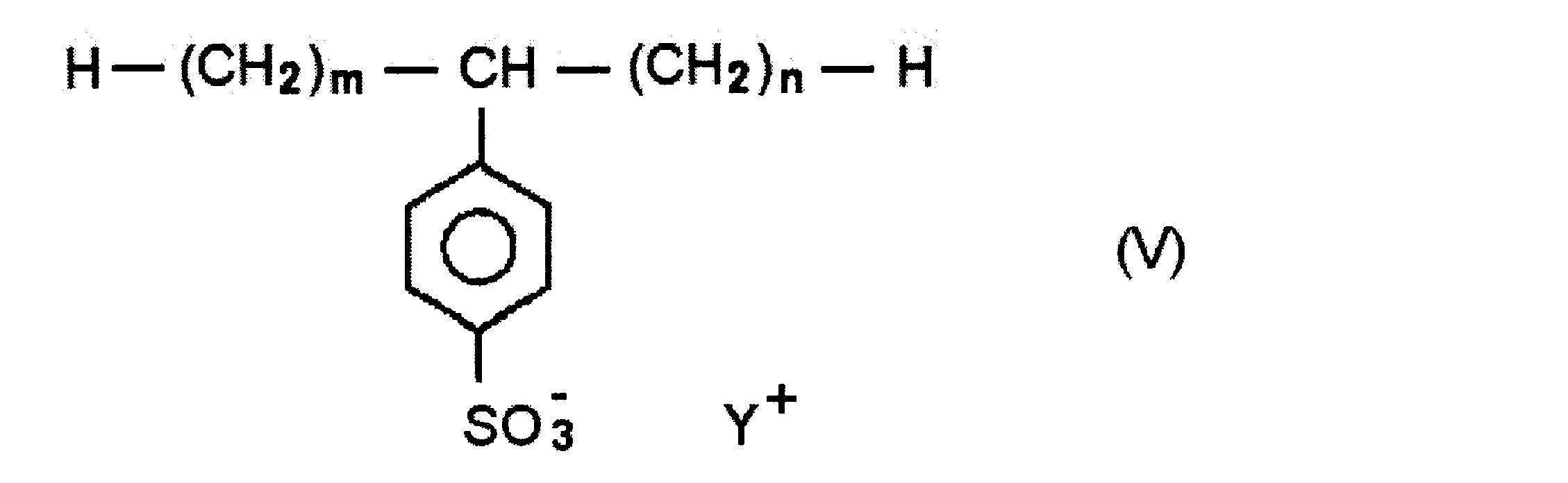
- sulfonate type surfactant examples include surfactants represented by the following formula (V).
- m and n are integers of 0 or more, and the sum of m and n is 8 to 25; Y + is an alkali metal ion.
- the sum of m and n is preferably 9-18.
- the sulfonate type surfactant represented by the above formula (V) is known in the art as an alkylbenzene sulfonate, and examples thereof include linear sodium decylbenzene sulfate, linear undecylbenzene sodium sulfate, linear Examples include sodium dodecylbenzene sulfate, linear sodium tridecylbenzene sulfate, and linear sodium tetradecylbenzene sulfate.
- sulfonate surfactant a mixture of surfactants represented by the following formulas (VI) and (VII) may be used.
- j and k are integers of 0 or more, and the sum of j and k is an integer of 10 to 25; Y + is an alkali metal ion.
- m and n are integers of 0 or more, and the sum of m and n is an integer of 10 to 25; Y + is an alkali metal ion.
- the sum of j and k is preferably an integer of 11 to 15, and in the above formula (VII), the sum of m and n is preferably an integer of 12 to 16.
- the surfactants represented by the above formulas (VI) and (VII) are known in the art as ⁇ -olefin sulfonates, such as sodium 1-tetradecenesulfonate, sodium hexadecenesulfonate, 3 -Sodium hydroxyhexadecyl-1-sulfonate, sodium octadecen-1-sulfonate, sodium 3-hydroxy-1-octadecanesulfonate and the like.
- sulfate ester type surfactant examples include surfactants represented by the following formula (VIII).
- R 1 is an alkyl group, alkenyl group or alkynyl group having 10 to 25 carbon atoms;
- Y + is an alkali metal ion.
- R 1 is preferably a linear alkyl group having 10 to 18 carbon atoms, and particularly preferably a linear alkyl group having 12 carbon atoms.
- the sulfate ester type surfactant represented by the above formula (VIII) is known in the art as a higher alcohol sulfate ester salt, such as sodium decyl sulfate, sodium undecyl sulfate, sodium dodecyl sulfate, sodium tridecyl sulfate and Examples include sodium tetradecyl sulfate.
- sulfate ester type surfactant a surfactant represented by the following formula (IX) may be used.
- R 1 is an alkyl group, alkenyl group or alkynyl group having 10 to 25 carbon atoms; n is an integer of 1 to 8; Y + is an alkali metal ion or an ammonium ion.
- R 1 is preferably a linear alkyl group having 12 to 18 carbon atoms, particularly preferably a linear alkyl group having 12 carbon atoms.
- the sulfate ester type surfactant represented by the above formula (IX) is known in the art as a polyoxyethylene alkyl sulfate ester salt, and examples thereof include sodium dodecyl ether sulfate ester.
- sulfate ester type surfactant a surfactant represented by the following formula (X) may be used.
- R 1 is an alkyl group, alkenyl group or alkynyl group having 8 to 25 carbon atoms;
- Y + is an alkali metal ion.
- R 1 is preferably a linear alkyl group having 10 to 18 carbon atoms, particularly preferably a linear alkyl group having 12 carbon atoms.
- the sulfate ester type surfactant represented by the above formula (X) is known in the art as ⁇ -sulfo fatty acid ester.
- 2-sulfotetradecanoic acid-1-methyl ester sodium salt and 2-sulfo fatty acid ester are known.
- hexadecanoic acid-1-methyl ester sodium salt is known in the art as ⁇ -sulfo fatty acid ester.
- amphoteric surfactant at least one selected from amino acid type amphoteric surfactants and betaine type amphoteric surfactants can be used.
- amino acid type amphoteric surfactant include surfactants represented by the following formula (XI).
- R 1 is an alkyl group, alkenyl group or alkynyl group having 8 to 25 carbon atoms.
- R 1 is preferably a linear alkyl group having 12 to 18 carbon atoms.
- the amino acid type amphoteric surfactant include 3- (dodecylamino) propanoic acid and 3- (tetradec-1-ylamino) propanoic acid.
- betaine amphoteric surfactants examples include surfactants represented by the following formula (XII).
- R 1 is an alkyl or alkenyl group having 6 to 18 carbon atoms
- R 2 is an alkyl or alkenyl group having 1 to 4 carbon atoms
- R 3 is 1 to 4 carbon atoms
- n is 1 or 2;
- betaine-type amphoteric surfactant examples include dodecyldimethylaminoacetic acid betaine and stearyldimethylaminoacetic acid betaine.
- the concentration of the surfactant in the first reagent should be 2 mg / L to 30 mg / L, preferably 4 mg / L to 22 mg / L in the prepared measurement sample. There is no particular limitation as long as it is a possible concentration.
- the pH of the first reagent in order to prevent hemolysis of erythrocytes due to pH change, can be in the range of 5 to 9, preferably 6.5 to 8.6, more preferably 7.0 to 7.8. . Therefore, the first reagent may contain a buffering agent in order to keep the pH constant.
- a buffer is not particularly limited as long as it has a buffering action in the above pH range, for example, Tris, MES, Bis-Tris, ADA, PIPES, ACES, MOPS, MOPSO, BES, Good buffer agents such as TES, HEPES, DIPSO, TAPSO, POPSO, HEPPSO, EPPS, Tricine, Bicine, TAPS, and the like can be mentioned.
- Urine samples may contain amorphous salts such as ammonium phosphate, magnesium phosphate, calcium carbonate.
- the first reagent may contain a chelating agent in order to reduce the influence of these amorphous salts.
- the chelating agent is not particularly limited as long as it is a chelating agent capable of removing amorphous salts, and can be appropriately selected from decalcification agents, demagnesium agents, and the like known in the art. Specific examples include ethylenediaminetetraacetate (EDTA salt), CyDTA, DHEG, DPTA-OH, EDDA, EDDP, GEDTA, HDTA, HIDA, Methyl-EDTA, NTA, NTP, NTPO, EDDPO, etc. Of these, EDTA salts are particularly preferred.
- the concentration of the chelating agent in the first reagent is preferably set so that the chelating agent is contained at a final concentration that can reduce the influence of amorphous salts in the measurement sample prepared as described above. .
- the final concentration in the measurement sample is appropriately set according to the type of the chelating agent. For example, when EDTA 2 potassium (EDTA-2K) is used as a chelating agent, the final concentration in the measurement sample is 0.1 to 500 ⁇ m, preferably 1 to 100 ⁇ m.
- the first reagent may contain a substance that damages the cell membrane of the yeast-like fungus.
- examples of such substances include 2-phenoxyethanol, benzyl alcohol, phenethyl alcohol, 1-phenoxy-2-propanol, phenol, phenyl acetate, benzothiazole, and among them, 2-phenoxyethanol is particularly preferable.
- the osmotic pressure of urine is distributed in a wide range of 50 to 1300 mOsm / kg. However, if the osmotic pressure is too low or too high in the measurement sample, the erythrocytes may be damaged.
- An appropriate osmotic pressure in the measurement sample is 100 to 600 mOsm / kg, preferably 150 to 500 mOsm / kg.
- the osmotic pressure of urine is too high, the osmotic pressure can be appropriately adjusted by diluting with water or the first reagent.
- the first reagent may contain an osmotic pressure compensating agent.
- Examples of such osmotic pressure compensating agents include inorganic salts, organic salts, and saccharides.
- inorganic salts include sodium chloride and sodium bromide.
- organic salts include sodium propionate, potassium propionate, and ammonium propionate oxalate.
- saccharide examples include sorbitol, glucose, mannitol and the like.
- a reagent (hereinafter, also referred to as “second reagent”) containing a fluorescent dye for staining the column and red blood cells in the preparation step.
- the fluorescent dye contained in the second reagent is preferably a fluorescent dye capable of staining at least cell membranes, preferably protein and red blood cell membranes.
- Examples of the fluorescent dye that can be used for the second reagent include condensed benzene derivatives, and among these derivatives, cyanine fluorescent dyes are particularly preferable.
- Examples of the cyanine fluorescent dye include 3,3′-diethyloxacarbocyanine iodide (DiOC2 (3)), 3,3-dipropyloxacarbocyanine iodide (DiOC3 (3)), 3,3′- Examples include dibutyl oxacyanine iodide (DiOC4 (3)) and 3,3-dipentyloxacarbocyanine iodide (DiOC5 (3)).
- the fluorescent dye in the second reagent may be one type or two or more types. It is desirable that the concentration of the fluorescent dye in the second reagent is set so that the fluorescent dye is contained at a final concentration capable of appropriately staining at least the column and the red blood cells in the prepared measurement sample.
- the final concentration in the measurement sample is appropriately set according to the type of the fluorescent dye. For example, when DiOC3 (3) is used as the fluorescent dye, the final concentration in the measurement sample is 0.1 ⁇ g / mL or more and 200 ⁇ g / mL or less, preferably 1 ⁇ g / mL or more and 20 ⁇ g / mL or less.
- the second reagent can be obtained by dissolving the fluorescent dye in an appropriate solvent.
- the solvent is not particularly limited as long as it is an aqueous solvent capable of dissolving the fluorescent dye, and examples thereof include water, a water-soluble organic solvent, and a mixture thereof. Among these, a water-soluble organic solvent is particularly preferable. Examples of the water-soluble organic solvent include lower alcohols having 1 to 3 carbon atoms, ethylene glycol, DMSO and the like.
- the order of mixing the urine sample, the first reagent, and the second reagent is not particularly limited, and these can be mixed simultaneously.
- the urine sample and the second reagent are mixed first, and the first reagent is further mixed there.
- the first reagent and the second reagent may be mixed first, and the urine sample may be further mixed there.
- the mixing ratio of the urine sample, the first reagent, and the second reagent is not particularly limited, and may be appropriately determined according to the component concentration contained in each reagent.
- the mixing ratio of the urine sample and the first reagent can be determined from a range of 1: 0.5 to 10 by volume ratio.
- the mixing ratio of the urine sample and the second reagent can be determined from the range of 1: 0.01 to 1 by volume ratio.
- the amount of the urine sample may be appropriately determined according to the first reagent and the second reagent.
- the amount of the urine sample is preferably 1000 ⁇ L or less from the viewpoint of preventing the measurement time from becoming too long.
- the amount of urine sample is about 10 to 1000 ⁇ L, which is sufficient for measurement.
- the temperature condition in the preparation process is 10 to 60 ° C, preferably 35 to 45 ° C.
- Each reagent may be preheated so as to reach these temperatures. Further, after mixing the urine sample with the first reagent and / or the second reagent, the sample may be incubated for 1 second to 5 minutes, preferably 5 to 60 seconds.
- a step of detecting at least a column and red blood cells as urine formed components contained in the measurement sample obtained in the above preparation step is performed.
- the second reagent When the second reagent is not used in the preparation process, it is possible to detect a formed component including a column and red blood cells by observing the shape and internal structure of each component in the measurement sample using an optical microscope. it can. In addition, when the formed component in the urine sample is stained with the second reagent, the formed component is observed by observing the shape of each formed component in the measurement sample and the degree of staining using a fluorescence microscope. Can be detected.
- a step of irradiating the urine formed component contained in the measurement sample with light to acquire optical information is further performed.
- This optical information acquisition step is preferably performed by a flow cytometer.
- optical information can be obtained as a signal emitted from the formed component by irradiating the formed component with light when the stained formed component in urine passes through the flow cell.
- the acquired optical information preferably includes at least scattered light information.
- the scattered light information is not particularly limited as long as it is information on scattered light that can be generally measured with a commercially available flow cytometer.
- forward scattered light for example, around a light receiving angle of 0 to 20 degrees
- side scattered light light received light
- the intensity of scattered light such as an angle of about 90 degrees and waveform information.
- the scattered light information includes scattered light intensity, scattered light pulse width, scattered light integrated value, and the like.
- side scattered light is known to reflect internal information such as cell nuclei and granules
- forward scattered light is known to reflect cell size information. In the embodiment, it is preferable to use information of forward scattered light.
- the fluorescence information is not particularly limited as long as it is information obtained by irradiating the formed component in urine stained with excitation light of an appropriate wavelength and measuring the excited fluorescence.
- the fluorescence intensity and waveform Information More specifically, the fluorescence information includes fluorescence intensity, fluorescence pulse width, fluorescence integral value, and the like.
- fluorescence is emitted from the nucleic acid in the formed component stained with the fluorescent dye contained in the second reagent.
- the light receiving wavelength can be appropriately selected depending on the fluorescent dye contained in the second reagent.
- the light source of the flow cytometer is not particularly limited, and a light source having a wavelength suitable for excitation of the fluorescent dye can be appropriately selected.
- a red semiconductor laser, a blue semiconductor laser, an argon laser, a He—Ne laser, a mercury arc lamp, or the like is used.
- a semiconductor laser is preferable because it is much cheaper than a gas laser.
- the detection step at least a column and red blood cells are detected as urine components based on the optical information obtained in the acquisition step. “Detection” includes not only finding the presence of urinary components in the measurement sample but also classifying and counting urinary components.
- the urinary component is detected by creating a scattergram having two axes of scattered light information and fluorescence information and analyzing the obtained scattergram using appropriate analysis software.
- appropriate analysis software For example, when a scattergram is drawn with the X axis as the fluorescence intensity and the Y axis as the forward scattered light intensity, each group (cluster) is selected according to the particle size and stainability (nucleic acid content) of each urine component. ) Appears on the scattergram.
- at least a column and red blood cells can be detected as two types of groups that appear in different regions.
- the analysis software can provide a window surrounding each group on the scattergram, and the number of particles in each window can be counted.
- the reagent for analyzing a urine sample (hereinafter also simply referred to as “reagent”) of the present embodiment is a reagent for detecting at least a column and red blood cells as a formed component in the urine sample.
- the reagent of this embodiment contains a surfactant at a concentration of 4 mg / L or more and 50 mg / L or less.
- the concentration (final concentration) of the surfactant in the measurement sample prepared by mixing the urine sample and the reagent is 2 mg / L or more and 30 mg / L or less, preferably 4 mg / L or more.
- the reagent of this embodiment is the same as that described for the first reagent used in the urine sample analysis method of this embodiment.
- FIG. 6 shows an example of the reagent 11 of this embodiment.
- the scope of the present invention includes the use of a reagent containing 4 mg / L or more and 50 mg / L or less of a surfactant for detecting at least cylinders and red blood cells as formed components in a urine sample.
- the reagent kit for urine sample analysis of the present embodiment is a reagent kit for detecting at least a column and red blood cells as a formed component in a urine sample.
- the reagent kit of the present embodiment includes a first reagent containing a surfactant of 4 mg / L or more and 50 mg / L or less, and a second reagent containing a column and a fluorescent dye for staining red blood cells.
- the concentration (final concentration) of the surfactant in the measurement sample prepared by mixing the urine sample, the first reagent, and the second reagent is 2 mg / L to 30 mg / L
- the reagent kit is preferably mixed with a urine sample so as to be 4 mg / L or more and 22 mg / L or less.
- the first reagent and the second reagent included in the reagent kit of the present embodiment are the same as those described for the first reagent and the second reagent used in the urine sample analysis method of the present embodiment.
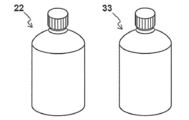
- the first reagent and the second reagent are housed in separate containers and a two-reagent type reagent kit including these is provided.
- FIG. 7 shows an example of the reagent kit of this embodiment including the first reagent 22 accommodated in the container and the second reagent 33 accommodated in the container.
- the scope of the present invention includes a first reagent containing a surfactant of 4 mg / L or more and 50 mg / L or less for detecting at least cylinders and erythrocytes as a formed component in a urine sample, and staining the cylinders and erythrocytes. Also included is the use of a reagent kit comprising a second reagent containing a fluorescent dye.
- Example 1 In Example 1, the relationship between the concentration of the surfactant in the measurement sample prepared from the urine sample and the effect on the urine red blood cells was examined.
- Urine sample As a urine sample, a clinical specimen in which red blood cells were observed in a urine sediment residue test was used.
- Reagent / Dilution Reagent Diluents 1 and 2 having the following composition were prepared as dilution reagents.
- water filtered through a reverse osmosis membrane was used as a solvent.
- Diluent 1 HEPES-OH (100 mM, pH 7) (Dojindo Laboratories Co., Ltd.), EDTA-2K (25 mM) (Chubu Crest Co., Ltd.) and DTAB (50 mg / L) (Tokyo Chemical Industry Co., Ltd.)
- Diluent 2 HEPES-OH (100 mM, pH 7), EDTA-2K (25 mM) and DTAB (10 mg / L)
- the sample was measured using a flow cytometer UF-1000i (manufactured by Sysmex Corporation).
- the specific steps of measurement with this flow cytometer are as follows. First, a urine sample (200 ⁇ L), a dilution reagent (580 ⁇ L), and a staining reagent (20 ⁇ L) were mixed and reacted at 40 ° C. for 10 seconds to prepare a measurement sample.
- the concentration of DTAB (DTAB final concentration) in the measurement sample was 36.25 mg / L when diluent 1 was used, and 7.25 mg / L when diluent 2 was used.
- the measurement sample was irradiated with light, and the forward scattered light intensity and the fluorescence intensity were acquired.
- a semiconductor laser having an excitation wavelength of 488 nm was used as a light source for the flow cytometer. Based on these measured values, the number of red blood cells in the measurement sample was counted. The results are shown in FIG. 1 as a ratio (%) of the number of red blood cells in the measurement sample to the number of red blood cells contained in the urine sample not treated with the reagent.
- Example 2 the discrimination performance between a mucus thread, which is a urine formed component similar to a cylinder, and a cylinder by the urine sample analysis method of the present embodiment using a flow cytometer was examined.
- Urine sample As urine sample, urine containing mucus thread (clinical specimen in which mucus thread was observed in urine sediment residue test. Also referred to as “false positive specimen” hereinafter) and urine containing cylinder and mucus thread (urinary sediment) A clinical specimen in which a cylinder and mucus thread were found in the residue test (hereinafter also referred to as “column specimen”) was used.
- Reagent / Dilution Reagent Diluents 3 and 4 having the following compositions were prepared as dilution reagents.
- water filtered through a reverse osmosis membrane was used as a solvent.
- Diluent 3 HEPES-OH (100 mM, pH 7) and EDTA-2K (25 mM)
- Diluent 4 HEPES-OH (100 mM, pH 7), EDTA-2K (25 mM) and DTAB (10 mg / L) -Dyeing reagent
- the same dyeing reagent as Example 1 was used as a dyeing reagent.
- a urine sample (200 ⁇ L), a dilution reagent (580 ⁇ L), and a staining reagent (20 ⁇ L) were mixed and reacted at 40 ° C. for 10 seconds to prepare a measurement sample.
- the obtained measurement sample was visually observed with a fluorescence microscope BX51 (Olympus Corporation) to count the cylinders.
- a measurement sample was prepared, and the obtained measurement sample was measured with a flow cytometer UF-1000i (manufactured by Sysmex Corporation). Specifically, the measurement sample was irradiated with light, and the forward scattered light intensity, the side scattered light intensity, and the fluorescence intensity were obtained.
- a semiconductor laser having an excitation wavelength of 488 nm was used as a light source for the flow cytometer. Based on these measured values, the number of cylinders in the measurement sample was calculated. The results are shown in Table 1. In addition, the result by visual observation with a fluorescence microscope is the number of cylinders of the sample processed with the diluent 3.
- Example 3 the clinical performance of the urine sample analysis method of the present embodiment using a flow cytometer was evaluated in comparison with the result of visual inspection.
- Urine sample As urine samples, negative urine specimens (42 specimens) that were judged to have no column appeared by microscopic observation were used.
- the sample was measured using a flow cytometer UF-1000i (manufactured by Sysmex Corporation).
- the specific steps of measurement with this flow cytometer are as follows. First, a sample (200 ⁇ L), a dilution reagent (580 ⁇ L), and each staining solution (20 ⁇ L) were mixed and reacted at 40 ° C. for 10 seconds to prepare a measurement sample. Then, the obtained measurement sample was irradiated with light, and the forward scattered light intensity, the side scattered light intensity, and the fluorescence intensity were obtained.
- a semiconductor laser having an excitation wavelength of 488 nm was used as a light source for the flow cytometer.
- Example 4 In Example 4, the relationship between the concentration of the surfactant in the measurement sample prepared from the urine sample and the effect on the urine red blood cells was examined.
- Urine sample As a urine sample, a clinical specimen in which red blood cells were observed in a urine sediment residue test was used.
- Reagents / dilution reagents Dilution solutions containing various surfactants at various concentrations were prepared as dilution reagents.
- the composition is as follows. In each dilution, water filtered through a reverse osmosis membrane was used as a solvent.
- the measurement sample was irradiated with light, and the forward scattered light intensity and the fluorescence intensity were acquired.
- a semiconductor laser having an excitation wavelength of 488 nm was used as a light source for the flow cytometer. Based on these measured values, the number of red blood cells in the measurement sample was counted. The results are shown in FIG.
- (3-2) Dilution Solution Containing One Nonionic Surfactant A measurement sample was prepared in the same manner as above except that a series of dilution solution containing BC-7 was used as a dilution reagent. The concentration (final concentration) of the surfactant in the measurement sample was 0, 3.6, 7.3, 10.9, 14.5, and 21.8 mg / L. These samples were measured as described above. For comparison, a measurement sample was similarly measured using a series of diluents containing DTAB. And based on the measured value obtained, the number of red blood cells in the measurement sample was counted. The results are shown in FIG.
- Example 5 In Example 5, the relationship between the concentration of the surfactant in the measurement sample prepared from the urine sample and the effect of reducing impurities similar to a cylinder was examined.
- Urine sample As a urine sample, a normal specimen which did not contain a cylinder but contained impurities similar to the cylinder was used.
- Reagents / dilution reagents Dilution solutions containing various surfactants at various concentrations were prepared as dilution reagents.
- the composition is as follows. In each dilution, water filtered through a reverse osmosis membrane was used as a solvent.
- the measurement sample was irradiated with light, and the forward scattered light intensity and the fluorescence intensity were acquired.
- a semiconductor laser having an excitation wavelength of 488 nm was used as a light source for the flow cytometer. Based on these measured values, the number of cylindrically similar contaminants in the measurement sample was counted. The results are shown in FIG.
- (3-2) Dilution Solution Containing One Nonionic Surfactant A measurement sample was prepared in the same manner as above except that a series of dilution solution containing BC-7 was used as a dilution reagent. The concentration (final concentration) of the surfactant in the measurement sample was 0, 0.7, 2.2, 3.6, 5.8, 7.3, 14.5, and 36.3 mg / L. These samples were measured as described above. For comparison, a measurement sample was similarly measured using a series of diluents containing DTAB. And based on the obtained measured value, the number of the column-like impurities in a measurement sample was counted. The results are shown in FIG.
Landscapes
- Health & Medical Sciences (AREA)
- Life Sciences & Earth Sciences (AREA)
- Chemical & Material Sciences (AREA)
- Engineering & Computer Science (AREA)
- Immunology (AREA)
- Physics & Mathematics (AREA)
- Biomedical Technology (AREA)
- General Health & Medical Sciences (AREA)
- Biochemistry (AREA)
- Pathology (AREA)
- General Physics & Mathematics (AREA)
- Analytical Chemistry (AREA)
- Hematology (AREA)
- Urology & Nephrology (AREA)
- Molecular Biology (AREA)
- Food Science & Technology (AREA)
- Medicinal Chemistry (AREA)
- Nuclear Medicine, Radiotherapy & Molecular Imaging (AREA)
- Biotechnology (AREA)
- Cell Biology (AREA)
- Microbiology (AREA)
- Biophysics (AREA)
- Dispersion Chemistry (AREA)
- Chemical Kinetics & Catalysis (AREA)
- Optics & Photonics (AREA)
- Investigating Or Analysing Biological Materials (AREA)
- Investigating, Analyzing Materials By Fluorescence Or Luminescence (AREA)
- Investigating Or Analysing Materials By Optical Means (AREA)
Abstract
Description
尿試料分析方法を提供する。
本実施形態の尿試料分析方法(以下、単に「方法」ともいう)は、尿中有形成分のうち赤血球、円柱、結晶成分及び粘液糸を分析対象とし、特に円柱及び赤血球の分析に好適である。




本実施形態の尿試料分析用試薬(以下、単に「試薬」ともいう)は、尿試料中の有形成分として少なくとも円柱及び赤血球を検出するための試薬である。本実施形態の試薬は、4mg/L以上50 mg/L以下の濃度で界面活性剤を含む。本実施形態の試薬は、尿試料と当該試薬とを混合して調製された測定試料中の界面活性剤の濃度(終濃度)が2mg/L以上30 mg/L以下、好ましくは4mg/L以上22 mg/L以下となるように、尿試料との混合が行われる試薬である。なお、本実施形態の試薬については、本実施形態の尿試料分析方法に用いた第1試薬について述べたことと同じである。図6に、本実施形態の試薬11の一例を示した。
本実施形態の尿試料分析用試薬キット(以下、単に「試薬キット」ともいう)は、尿試料中の有形成分として少なくとも円柱及び赤血球を検出するための試薬キットである。本実施形態の試薬キットは、4mg/L以上50 mg/L以下の界面活性剤を含む第1試薬と、円柱及び赤血球を染色するための蛍光色素を含む第2試薬とを含む。本実施形態の試薬キットは、尿試料、第1試薬、及び第2試薬を混合して調製された測定試料中の界面活性剤の濃度(終濃度)が2mg/L以上30 mg/L以下、好ましくは4mg/L以上22 mg/L以下となるように、尿試料との混合が行われる試薬キットである。
実施例1では、尿試料から調製した測定試料中の界面活性剤の濃度と、尿中赤血球に及ぼす影響との関係を検討した。
尿試料として、尿沈残渣検査で赤血球を認めた臨床検体を用いた。
・希釈用試薬
希釈用試薬として、下記の組成の希釈液1及び2を調製した。なお、希釈液1及び2には、逆浸透膜で濾過した水を溶媒として用いた。
希釈液1:HEPES-OH(100 mM、pH7)(株式会社同仁化学研究所)、EDTA-2K(25 mM)(中部キレスト株式会社)及びDTAB(50 mg/L)(東京化成工業株式会社)
希釈液2:HEPES-OH(100 mM、pH7)、EDTA-2K(25 mM)及びDTAB(10 mg/L)
シアニン系蛍光色素のDioC3(3)(株式会社林原生物化学研究所)を、1mg/mLの濃度となるようにエチレングリコール(ナカライテスク株式会社)に溶解して、染色用試薬を調製した。
試料の測定はフローサイトメータUF-1000i(シスメックス株式会社製)を用いて行った。このフローサイトメータによる測定の具体的な工程は、次のとおりである。まず、尿試料(200μL)と、希釈用試薬(580μL)と、染色用試薬(20μL)とを混合し、40℃にて10秒間反応させて測定試料を調製した。測定試料中のDTABの濃度(DTAB終濃度)は、希釈液1を用いた場合は36.25 mg/Lであり、希釈液2を用いた場合は7.25 mg/Lであった。そして、測定試料に光を照射して、前方散乱光強度及び蛍光強度を取得した。なお、フローサイトメータの光源として、励起波長488 nmの半導体レーザを用いた。これらの測定値に基づいて、測定試料中の赤血球数をカウントした。結果を、試薬による処理をしていない尿試料に含まれる赤血球数に対する測定試料中の赤血球数の割合(%)として、図1に示す。
実施例2では、フローサイトメータを用いる本実施形態の尿試料分析方法による、円柱に類似する尿中有形成分である粘液糸と、円柱との弁別性能を検討した。
尿試料として、粘液糸を含む尿(尿沈残渣検査で粘液糸を認めた臨床検体。以下、「偽陽性検体」とも呼ぶ)と、円柱及び粘液糸を含む尿(尿沈残渣検査で円柱及び粘液糸を認めた臨床検体。以下、「円柱検体」とも呼ぶ)とを用いた。
・希釈用試薬
希釈用試薬として、下記の組成の希釈液3及び4を調製した。なお、希釈液3及び4には、逆浸透膜で濾過した水を溶媒として用いた。
希釈液3:HEPES-OH(100 mM、pH7)及びEDTA-2K(25 mM)
希釈液4:HEPES-OH(100 mM、pH7)、EDTA-2K(25 mM)及びDTAB(10 mg/L)
・染色用試薬
染色用試薬として、実施例1と同じ染色用試薬を用いた。
尿試料(200μL)と、希釈用試薬(580μL)と、染色用試薬(20μL)とを混合し、40℃にて10秒間反応させ測定試料を調製した。そして、得られた測定試料を蛍光顕微鏡BX51(オリンパス株式会社)で目視観察して円柱を計数した。また、同様にして測定試料を調製し、得られた測定試料をフローサイトメータUF-1000i(シスメックス株式会社製)でも測定した。具体的には、測定試料に光を照射して、前方散乱光強度、側方散乱光強度及び蛍光強度を取得した。なお、フローサイトメータの光源として、励起波長488 nmの半導体レーザを用いた。これらの測定値に基づいて、測定試料中の円柱の数を算出した。結果を表1に示す。なお、蛍光顕微鏡での目視による結果は、希釈液3で処理した試料の円柱の数である。

実施例3では、フローサイトメータを用いる本実施形態の尿試料分析方法の臨床性能を、目視検査の結果と比較して評価した。
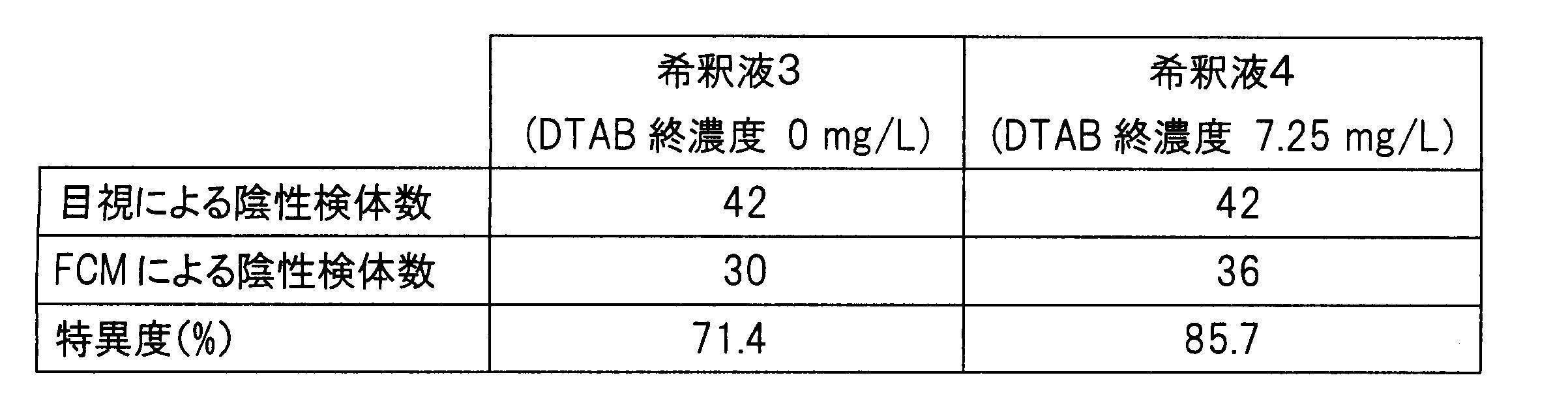
尿試料として、顕微鏡観察により円柱が出現していないと判断された陰性尿検体(42検体)を用いた。
希釈用試薬として、実施例2と同じ希釈液3及び4を用いた。染色用試薬として、実施例1と同じ染色用試薬を用いた。
試料の測定は、フローサイトメータUF-1000i(シスメックス株式会社製)を用いて行った。このフローサイトメータによる測定の具体的な工程は、次のとおりである。まず、試料(200μL)と、希釈用試薬(580μL)と、各染色液(20μL)とを混合し、40℃にて10秒間反応させて測定試料を調製した。そして、得られた測定試料に光を照射して、前方散乱光強度、側方散乱光強度及び蛍光強度を取得した。なお、フローサイトメータの光源として、励起波長488 nmの半導体レーザを用いた。これらの測定値に基づいて測定試料中の円柱の数を算出し、フローサイトメータ(FCM)により陰性と判断された検体数を求めた。また、目視(顕微鏡観察)による陰性検体数をリファレンスとして、FCMによる円柱の分析の特異度を求めた。結果を表2に示す。
実施例4では、尿試料から調製した測定試料中の界面活性剤の濃度と、尿中赤血球に及ぼす影響との関係を検討した。
尿試料として、尿沈残渣検査で赤血球を認めた臨床検体を用いた。
・希釈用試薬
希釈用試薬として、各種の界面活性剤を様々な濃度で含む希釈液のシリーズを調製した。組成は以下のとおりである。なお、各希釈液には、逆浸透膜で濾過した水を溶媒として用いた。
*カチオン性界面活性剤
オクチルトリメチルアンモニウムブロミド(OTAB)(東京化成工業)
ドデシルトリメチルアンモニウムブロミド(DTAB)(東京化成工業)
テトラデシルトリメチルアンモニウムブロミド(MTAB)(東京化成工業)
ドデシルトリメチルアンモニウムクロライド(DTAC)(東京化成工業)
(ii)下記のノニオン性界面活性剤を1種含む希釈液のシリーズ:HEPES-OH(50 mM、pH7)、EDTA-2K(25 mM)、及びノニオン性界面活性剤(0、5、10、15、20又は30 mg/L)
*ノニオン性界面活性剤
ポリオキシエチレンセチルエーテル(BC-7(日光ケミカルズ))
シアニン系蛍光色素のDiOC3(3)(株式会社林原生物化学研究所)を、1mg/mLの濃度となるようにエチレングリコール(ナカライテスク株式会社)に溶解して、染色用試薬を調製した。
(3-1)カチオン性界面活性剤を1種含む希釈液について
試料の測定はフローサイトメータUF-1000i(シスメックス株式会社製)を用いて行った。このフローサイトメータによる測定の具体的な工程は、次のとおりである。まず、尿試料(200μL)と、希釈用試薬(580μL)と、染色用試薬(20μL)とを混合し、40℃にて10秒間反応させて測定試料を調製した。測定試料中の界面活性剤の濃度(終濃度)は、0、3.6、7.3、10.9、14.5及び21.8 mg/Lであった。そして、測定試料に光を照射して、前方散乱光強度及び蛍光強度を取得した。なお、フローサイトメータの光源として、励起波長488 nmの半導体レーザを用いた。これらの測定値に基づいて、測定試料中の赤血球数をカウントした。結果を図2に示す。
希釈用試薬として、BC-7を含む希釈液のシリーズを用いたこと以外は上記と同様にして、測定試料を調製した。測定試料中の界面活性剤の濃度(終濃度)は、0、3.6、7.3、10.9、14.5及び21.8 mg/Lであった。これらの試料を上記と同様にして測定した。また、比較のため、DTABを含む希釈液のシリーズを用いて、同様に測定試料を測定した。そして、得られた測定値に基づいて、測定試料中の赤血球数をカウントした。結果を図3に示す。
実施例5では、尿試料から調製した測定試料中の界面活性剤の濃度と、円柱に類似した夾雑物を低減する効果との関係を検討した。
尿試料として、円柱を含まないが円柱に類似した夾雑物を含む正常検体を用いた。
・希釈用試薬
希釈用試薬として、各種の界面活性剤を様々な濃度で含む希釈液のシリーズを調製した。組成は以下のとおりである。なお、各希釈液には、逆浸透膜で濾過した水を溶媒として用いた。
*カチオン性界面活性剤
オクチルトリメチルアンモニウムブロミド(OTAB)(東京化成工業)
ドデシルトリメチルアンモニウムブロミド(DTAB)(東京化成工業)
テトラデシルトリメチルアンモニウムブロミド(MTAB)(東京化成工業)
ドデシルトリメチルアンモニウムクロライド(DTAC)(東京化成工業)
(iv)下記のノニオン性界面活性剤を1種含む希釈液のシリーズ:HEPES-OH(50 mM、pH7)、EDTA-2K(25 mM)、及びノニオン性界面活性剤(0、1、3、5、8、10、20又は50 mg/L)
*ノニオン性界面活性剤
ポリオキシエチレンセチルエーテル(BC-7(日光ケミカルズ))
染色用試薬として、実施例4と同じ染色用試薬を用いた。
(3-1)カチオン性界面活性剤を1種含む希釈液について
試料の測定はフローサイトメータUF-1000i(シスメックス株式会社製)を用いて行った。このフローサイトメータによる測定の具体的な工程は、次のとおりである。まず、尿試料(200μL)と、希釈用試薬(580μL)と、染色用試薬(20μL)とを混合し、40℃にて10秒間反応させて測定試料を調製した。測定試料中の界面活性剤の濃度(終濃度)は、0、0.7、2.2、3.6、5.8、7.3、14.5及び36.3 mg/Lであった。そして、測定試料に光を照射して、前方散乱光強度及び蛍光強度を取得した。なお、フローサイトメータの光源として、励起波長488 nmの半導体レーザを用いた。これらの測定値に基づいて、測定試料中の円柱類似夾雑物の数をカウントした。結果を図4に示す。
希釈用試薬として、BC-7を含む希釈液のシリーズを用いたこと以外は上記と同様にして、測定試料を調製した。測定試料中の界面活性剤の濃度(終濃度)は、0、0.7、2.2、3.6、5.8、7.3、14.5及び36.3 mg/Lであった。これらの試料を上記と同様にして測定した。また、比較のため、DTABを含む希釈液のシリーズを用いて、同様に測定試料を測定した。そして、得られた測定値に基づいて、測定試料中の円柱類似夾雑物の数をカウントした。結果を図5に示す。
22 第1試薬
33 第2試薬
Claims (18)
- 尿試料と、界面活性剤を含む試薬とを混合して測定試料を調製する工程と、
調製工程で得られた測定試料に含まれる尿中有形成分として少なくとも円柱及び赤血球を検出する工程と
を含み、調製工程で得られた測定試料中の界面活性剤の濃度が2mg/L以上30 mg/L以下である、
尿試料分析方法。 - 調製工程で得られた測定試料中の界面活性剤の濃度が4mg/L以上22 mg/L以下である、請求項1に記載の尿試料分析方法。
- 界面活性剤が、カチオン性界面活性剤、アニオン性界面活性剤、両性界面活性剤及びノニオン性界面活性剤から選択される少なくとも1つである請求項1又は2に記載の尿試料分析方法。
- カチオン性界面活性剤が、4級アンモニウム塩型界面活性剤及びピリジニウム塩型界面活性剤から選択される少なくとも1つであり、アニオン性界面活性剤が、カルボン酸塩型界面活性剤、スルホン酸塩型界面活性剤及び硫酸エステル塩型界面活性剤から選択される少なくとも1つであり、両性界面活性剤が、アミノ酸型両性界面活性剤及びベタイン型両性界面活性剤から選択される少なくとも1つであり、ノニオン性界面活性剤が、ポリオキシエチレン系ノニオン性界面活性剤である請求項3に記載の尿試料分析方法。
- カチオン性界面活性剤が、4級アンモニウム塩型界面活性剤である請求項4に記載の尿試料分析方法。
- 4級アンモニウム塩型界面活性剤が、以下の式(I):
(式中、R1は炭素数1~18のアルキル基又はアルケニル基であり;R2及びR3は互いに同一又は異なって、炭素数1~4のアルキル基又はアルケニル基であり;R4は炭素数1~12のアルキル基若しくはアルケニル基、又はベンジル基であり;X-はハロゲンイオン又はヒドロキシイオンである。)
で表される、全炭素数が4~38の界面活性剤である請求項5に記載の尿試料分析方法。 - 前記式(I)において、R2、R3及びR4のそれぞれがメチル基である請求項6に記載の尿試料分析方法。
- 前記式(I)において、X-がハロゲンイオンであり、臭化物イオン、塩化物イオン及びヨウ化物イオンから選択される少なくとも1つである請求項6又は7に記載の尿試料分析方法。
- 4級アンモニウム塩型界面活性剤が、ドデシルトリメチルアンモニウムブロミド、オクチルトリメチルアンモニウムブロミド、テトラデシルトリメチルアンモニウムブロミド、ドデシルトリメチルアンモニウムクロライド、オクチルトリメチルアンモニウムクロライド、及びテトラデシルトリメチルアンモニウムクロライドから選択される少なくとも1つである請求項5~8のいずれか1項に記載の尿試料分析方法。
- ポリオキシエチレン系ノニオン性界面活性剤が、ポリオキシエチレンアルキルエーテルである請求項4に記載の尿試料分析方法。
- 調製工程において、円柱及び赤血球を染色するための蛍光色素を含む試薬をさらに混合する請求項1~10のいずれか1項に記載の尿試料分析方法。
- 円柱及び赤血球を染色するための蛍光色素が、シアニン系蛍光色素である請求項11に記載の尿試料分析方法。
- 調製工程で得られた測定試料に含まれる尿中有形成分に光を照射して光学的情報を取得する工程をさらに含み、
検出工程が、取得した光学的情報に基づいて、尿中有形成分として少なくとも円柱及び赤血球を検出する工程である請求項1~12のいずれか1項に記載の尿試料分析方法。 - 前記光学的情報が、少なくとも散乱光情報を含む請求項13に記載の尿試料分析方法。
- 界面活性剤を含む試薬が、キレート剤をさらに含む請求項1~14のいずれか1項に記載の尿試料分析方法。
- キレート剤が、エチレンジアミン四酢酸塩(EDTA塩)である請求項15に記載の尿試料分析方法。
- 4mg/L以上50 mg/L以下の界面活性剤を含む、尿中有形成分として少なくとも円柱及び赤血球を検出するための尿試料分析用試薬。
- 4mg/L以上50 mg/L以下の界面活性剤を含む第1試薬と、
円柱及び赤血球を染色するための蛍光色素を含む第2試薬と、
を含む、尿中有形成分として少なくとも円柱及び赤血球を検出するための尿試料分析用試薬キット。
Priority Applications (7)
| Application Number | Priority Date | Filing Date | Title |
|---|---|---|---|
| JP2016505326A JP6316933B2 (ja) | 2014-02-28 | 2015-02-27 | 尿試料分析方法、尿試料分析用試薬及び尿試料分析用試薬キット |
| KR1020187005496A KR20180023061A (ko) | 2014-02-28 | 2015-02-27 | 소변 시료 분석 방법, 소변 시료 분석용 시약 및 소변 시료 분석용 시약 키트 |
| US15/121,411 US10794809B2 (en) | 2014-02-28 | 2015-02-27 | Method for urine sample analysis, reagent for urine sample analysis, and reagent kit for urine sample analysis |
| KR1020167026679A KR101993965B1 (ko) | 2014-02-28 | 2015-02-27 | 소변 시료 분석 방법, 소변 시료 분석용 시약 및 소변 시료 분석용 시약 키트 |
| SG11201607145VA SG11201607145VA (en) | 2014-02-28 | 2015-02-27 | Method for urine sample analysis, reagent for urine sample analysis, and reagent kit for urine sample analysis |
| CN201580010651.1A CN106104270B (zh) | 2014-02-28 | 2015-02-27 | 尿样品分析方法、尿样品分析用试剂及尿样品分析用试剂盒 |
| EP15755480.9A EP3112863B1 (en) | 2014-02-28 | 2015-02-27 | Method for detecting casts and erythrocytes in urine samples |
Applications Claiming Priority (2)
| Application Number | Priority Date | Filing Date | Title |
|---|---|---|---|
| JP2014-039282 | 2014-02-28 | ||
| JP2014039282 | 2014-02-28 |
Publications (1)
| Publication Number | Publication Date |
|---|---|
| WO2015129863A1 true WO2015129863A1 (ja) | 2015-09-03 |
Family
ID=54009176
Family Applications (1)
| Application Number | Title | Priority Date | Filing Date |
|---|---|---|---|
| PCT/JP2015/055883 Ceased WO2015129863A1 (ja) | 2014-02-28 | 2015-02-27 | 尿試料分析方法、尿試料分析用試薬及び尿試料分析用試薬キット |
Country Status (7)
| Country | Link |
|---|---|
| US (1) | US10794809B2 (ja) |
| EP (1) | EP3112863B1 (ja) |
| JP (1) | JP6316933B2 (ja) |
| KR (2) | KR20180023061A (ja) |
| CN (1) | CN106104270B (ja) |
| SG (1) | SG11201607145VA (ja) |
| WO (1) | WO2015129863A1 (ja) |
Cited By (2)
| Publication number | Priority date | Publication date | Assignee | Title |
|---|---|---|---|---|
| CN107367552A (zh) * | 2017-07-20 | 2017-11-21 | 厦门大学 | 时变温度影响下基于fcm算法的损伤扩展实时监测方法 |
| JP2018205044A (ja) * | 2017-05-31 | 2018-12-27 | シスメックス株式会社 | 尿分析装置および尿分析方法 |
Families Citing this family (1)
| Publication number | Priority date | Publication date | Assignee | Title |
|---|---|---|---|---|
| JP6874888B1 (ja) * | 2020-05-26 | 2021-05-19 | 東洋紡株式会社 | 尿沈渣用染色液 |
Citations (7)
| Publication number | Priority date | Publication date | Assignee | Title |
|---|---|---|---|---|
| JPH04278460A (ja) * | 1991-03-06 | 1992-10-05 | Shima Kenkyusho:Kk | 尿沈渣検査成績管理方法 |
| JPH04337459A (ja) * | 1991-05-14 | 1992-11-25 | Toa Medical Electronics Co Ltd | 尿中の細胞分析用試薬及び方法 |
| JPH05322883A (ja) * | 1991-05-14 | 1993-12-07 | Toa Medical Electronics Co Ltd | 尿中の細胞分析装置 |
| JPH085543A (ja) * | 1994-04-21 | 1996-01-12 | Hitachi Ltd | 粒子分析用染色液のモニタ方法及び粒子分析用校正方法 |
| JP2006098233A (ja) * | 2004-09-29 | 2006-04-13 | Sysmex Corp | 測定結果補正方法、尿分析システム、尿分析装置、及びコンピュータプログラム |
| JP2006105625A (ja) * | 2004-09-30 | 2006-04-20 | Sysmex Corp | 検体中粒子分析方法、分析装置及び分析用試薬 |
| JP2007309765A (ja) * | 2006-05-18 | 2007-11-29 | Sysmex Corp | 尿中有形成分分析装置 |
Family Cites Families (25)
| Publication number | Priority date | Publication date | Assignee | Title |
|---|---|---|---|---|
| US5284771A (en) * | 1991-12-05 | 1994-02-08 | Miles Inc. | Reagent compositions and their use in sphering cells |
| EP0598663B1 (en) | 1992-11-19 | 2000-02-02 | Sysmex Corporation | A pretreatment method for blood analysis |
| JP3345135B2 (ja) | 1992-11-19 | 2002-11-18 | シスメックス株式会社 | 血液分析方法 |
| US5516700A (en) * | 1993-05-28 | 1996-05-14 | Chimera Research And Chemical, Inc. | Automated urinalysis method |
| DE69527465T2 (de) | 1994-04-21 | 2003-05-08 | Hitachi, Ltd. | Überwachungsverfahren einer Färbelösung für Partikelanalysen und Kalibrierungsverfahren von Partikelanalysen |
| JP3355038B2 (ja) * | 1994-08-03 | 2002-12-09 | シスメックス株式会社 | 白血球分類方法 |
| JP3580615B2 (ja) | 1994-10-20 | 2004-10-27 | シスメックス株式会社 | 尿中有形成分分析用試薬及びその試薬を用いた有形成分分析方法 |
| ES2156927T3 (es) * | 1994-10-20 | 2001-08-01 | Sysmex Corp | Reactivo y metodo para analizar componentes solidos en orina. |
| JP3739482B2 (ja) | 1996-05-23 | 2006-01-25 | シスメックス株式会社 | 尿中の有形成分分析方法および試薬 |
| JP2002090365A (ja) | 2000-02-08 | 2002-03-27 | Internatl Reagents Corp | 腎障害の検査手段 |
| US7309581B2 (en) * | 2000-11-01 | 2007-12-18 | Sysmex Corporation | Method of staining, detection and counting bacteria, and a diluent for bacterial stain |
| JP4212827B2 (ja) | 2002-05-16 | 2009-01-21 | シスメックス株式会社 | 骨髄液有核細胞自動分析方法 |
| CA2428740A1 (en) * | 2002-05-20 | 2003-11-20 | Bayer Corporation | Automated method and reagent therefor for assaying body fluid samples such as cerebrospinal fluid (csf) |
| JP4953710B2 (ja) | 2005-07-12 | 2012-06-13 | シスメックス株式会社 | 尿中有形成分分析装置用標準物質 |
| ES2547643T3 (es) | 2005-07-12 | 2015-10-07 | Sysmex Corporation | Material de referencia para un analizador de partículas |
| JP4896534B2 (ja) * | 2006-01-31 | 2012-03-14 | シスメックス株式会社 | 粒子分析装置用シース液 |
| JP4794334B2 (ja) * | 2006-03-22 | 2011-10-19 | シスメックス株式会社 | 尿試料分析用試薬及び尿試料の分析方法 |
| JP4805709B2 (ja) * | 2006-03-30 | 2011-11-02 | シスメックス株式会社 | 尿分析装置 |
| JP4759438B2 (ja) * | 2006-05-17 | 2011-08-31 | シスメックス株式会社 | 尿中有形成分分析装置 |
| JP4796443B2 (ja) * | 2006-06-08 | 2011-10-19 | シスメックス株式会社 | 試料分析用試薬、試料分析用試薬キット及び試料分析方法 |
| WO2008007725A1 (en) * | 2006-07-12 | 2008-01-17 | Toyo Boseki Kabushiki Kaisha | Analyzer and use thereof |
| CN101196513A (zh) * | 2007-12-28 | 2008-06-11 | 姜傥 | 尿液综合检测方法 |
| JP2010127807A (ja) * | 2008-11-28 | 2010-06-10 | Toyobo Co Ltd | 有形成分の検出力向上方法 |
| CN105026928B (zh) | 2013-02-28 | 2018-11-06 | 希森美康株式会社 | 尿样本分析装置及尿样本分析方法 |
| ES2696836T3 (es) * | 2014-02-28 | 2019-01-18 | Sysmex Corp | Método para el análisis de muestras de orina, la utilización de un reactivo para el análisis de muestras de orina y la utilización de un kit de reactivos para el análisis de muestras de orina |
-
2015
- 2015-02-27 CN CN201580010651.1A patent/CN106104270B/zh active Active
- 2015-02-27 KR KR1020187005496A patent/KR20180023061A/ko not_active Withdrawn
- 2015-02-27 WO PCT/JP2015/055883 patent/WO2015129863A1/ja not_active Ceased
- 2015-02-27 EP EP15755480.9A patent/EP3112863B1/en active Active
- 2015-02-27 SG SG11201607145VA patent/SG11201607145VA/en unknown
- 2015-02-27 JP JP2016505326A patent/JP6316933B2/ja active Active
- 2015-02-27 KR KR1020167026679A patent/KR101993965B1/ko active Active
- 2015-02-27 US US15/121,411 patent/US10794809B2/en active Active
Patent Citations (7)
| Publication number | Priority date | Publication date | Assignee | Title |
|---|---|---|---|---|
| JPH04278460A (ja) * | 1991-03-06 | 1992-10-05 | Shima Kenkyusho:Kk | 尿沈渣検査成績管理方法 |
| JPH04337459A (ja) * | 1991-05-14 | 1992-11-25 | Toa Medical Electronics Co Ltd | 尿中の細胞分析用試薬及び方法 |
| JPH05322883A (ja) * | 1991-05-14 | 1993-12-07 | Toa Medical Electronics Co Ltd | 尿中の細胞分析装置 |
| JPH085543A (ja) * | 1994-04-21 | 1996-01-12 | Hitachi Ltd | 粒子分析用染色液のモニタ方法及び粒子分析用校正方法 |
| JP2006098233A (ja) * | 2004-09-29 | 2006-04-13 | Sysmex Corp | 測定結果補正方法、尿分析システム、尿分析装置、及びコンピュータプログラム |
| JP2006105625A (ja) * | 2004-09-30 | 2006-04-20 | Sysmex Corp | 検体中粒子分析方法、分析装置及び分析用試薬 |
| JP2007309765A (ja) * | 2006-05-18 | 2007-11-29 | Sysmex Corp | 尿中有形成分分析装置 |
Cited By (3)
| Publication number | Priority date | Publication date | Assignee | Title |
|---|---|---|---|---|
| JP2018205044A (ja) * | 2017-05-31 | 2018-12-27 | シスメックス株式会社 | 尿分析装置および尿分析方法 |
| CN107367552A (zh) * | 2017-07-20 | 2017-11-21 | 厦门大学 | 时变温度影响下基于fcm算法的损伤扩展实时监测方法 |
| CN107367552B (zh) * | 2017-07-20 | 2019-07-23 | 厦门大学 | 时变温度影响下基于fcm算法的损伤扩展实时监测方法 |
Also Published As
| Publication number | Publication date |
|---|---|
| US10794809B2 (en) | 2020-10-06 |
| SG11201607145VA (en) | 2016-10-28 |
| JP6316933B2 (ja) | 2018-04-25 |
| EP3112863A4 (en) | 2017-09-27 |
| JPWO2015129863A1 (ja) | 2017-03-30 |
| CN106104270A (zh) | 2016-11-09 |
| EP3112863B1 (en) | 2019-07-17 |
| KR20160126065A (ko) | 2016-11-01 |
| KR20180023061A (ko) | 2018-03-06 |
| US20160363521A1 (en) | 2016-12-15 |
| KR101993965B1 (ko) | 2019-06-27 |
| EP3112863A1 (en) | 2017-01-04 |
| CN106104270B (zh) | 2019-08-02 |
Similar Documents
| Publication | Publication Date | Title |
|---|---|---|
| JP3886271B2 (ja) | 赤芽球の分類計数用試薬及び分類計数方法 | |
| RU2461004C2 (ru) | Набор реагентов для анализа образца и способ анализа образца | |
| CN101042397B (zh) | 尿液分析用试剂及尿液分析方法 | |
| EP1643247B1 (en) | Method, apparatus, reagent kit and reagent for distinguishing erythrocytes in a biological specimen | |
| JP6874888B1 (ja) | 尿沈渣用染色液 | |
| JP6316933B2 (ja) | 尿試料分析方法、尿試料分析用試薬及び尿試料分析用試薬キット | |
| JP2007205732A (ja) | 粒子分析装置用シース液 | |
| JP6316934B2 (ja) | 尿試料分析方法、尿試料分析用試薬及び尿試料分析用試薬キット | |
| JP6316935B2 (ja) | 尿試料分析方法及び尿試料分析用試薬キット | |
| JP3580615B2 (ja) | 尿中有形成分分析用試薬及びその試薬を用いた有形成分分析方法 | |
| JP3673137B2 (ja) | 精子計数方法及び試薬 | |
| JPH1183849A (ja) | 尿中有形成分の分析方法及びその分析試薬 | |
| JP3888876B2 (ja) | 細菌の染色方法、細菌の分類・計数方法及び細菌染色用希釈液 | |
| US20250305931A1 (en) | Method for analyzing a urine sample, and a reagent for analyzing a urine sample | |
| BR112016019721B1 (pt) | Método para a análise de amostra de urina | |
| BR112016019579B1 (pt) | Método para análise de amostra de urina |
Legal Events
| Date | Code | Title | Description |
|---|---|---|---|
| 121 | Ep: the epo has been informed by wipo that ep was designated in this application |
Ref document number: 15755480 Country of ref document: EP Kind code of ref document: A1 |
|
| ENP | Entry into the national phase |
Ref document number: 2016505326 Country of ref document: JP Kind code of ref document: A |
|
| WWE | Wipo information: entry into national phase |
Ref document number: 15121411 Country of ref document: US |
|
| NENP | Non-entry into the national phase |
Ref country code: DE |
|
| REEP | Request for entry into the european phase |
Ref document number: 2015755480 Country of ref document: EP |
|
| WWE | Wipo information: entry into national phase |
Ref document number: 2015755480 Country of ref document: EP |
|
| ENP | Entry into the national phase |
Ref document number: 20167026679 Country of ref document: KR Kind code of ref document: A |
|
| REG | Reference to national code |
Ref country code: BR Ref legal event code: B01A Ref document number: 112016019721 Country of ref document: BR |
|
| ENP | Entry into the national phase |
Ref document number: 112016019721 Country of ref document: BR Kind code of ref document: A2 Effective date: 20160825 |