WO2015178258A1 - プリント配線板及びプリント配線板の製造方法 - Google Patents
プリント配線板及びプリント配線板の製造方法 Download PDFInfo
- Publication number
- WO2015178258A1 WO2015178258A1 PCT/JP2015/063679 JP2015063679W WO2015178258A1 WO 2015178258 A1 WO2015178258 A1 WO 2015178258A1 JP 2015063679 W JP2015063679 W JP 2015063679W WO 2015178258 A1 WO2015178258 A1 WO 2015178258A1
- Authority
- WO
- WIPO (PCT)
- Prior art keywords
- layer
- conductive layer
- base material
- wiring board
- printed wiring
- Prior art date
- Legal status (The legal status is an assumption and is not a legal conclusion. Google has not performed a legal analysis and makes no representation as to the accuracy of the status listed.)
- Ceased
Links
Images








Classifications
-
- H—ELECTRICITY
- H05—ELECTRIC TECHNIQUES NOT OTHERWISE PROVIDED FOR
- H05K—PRINTED CIRCUITS; CASINGS OR CONSTRUCTIONAL DETAILS OF ELECTRIC APPARATUS; MANUFACTURE OF ASSEMBLAGES OF ELECTRICAL COMPONENTS
- H05K1/00—Printed circuits
- H05K1/02—Details
- H05K1/11—Printed elements for providing electric connections to or between printed circuits
- H05K1/115—Via connections; Lands around holes or via connections
-
- H—ELECTRICITY
- H05—ELECTRIC TECHNIQUES NOT OTHERWISE PROVIDED FOR
- H05K—PRINTED CIRCUITS; CASINGS OR CONSTRUCTIONAL DETAILS OF ELECTRIC APPARATUS; MANUFACTURE OF ASSEMBLAGES OF ELECTRICAL COMPONENTS
- H05K1/00—Printed circuits
- H05K1/02—Details
- H05K1/03—Use of materials for the substrate
- H05K1/0313—Organic insulating material
-
- H—ELECTRICITY
- H05—ELECTRIC TECHNIQUES NOT OTHERWISE PROVIDED FOR
- H05K—PRINTED CIRCUITS; CASINGS OR CONSTRUCTIONAL DETAILS OF ELECTRIC APPARATUS; MANUFACTURE OF ASSEMBLAGES OF ELECTRICAL COMPONENTS
- H05K1/00—Printed circuits
- H05K1/02—Details
- H05K1/03—Use of materials for the substrate
- H05K1/0313—Organic insulating material
- H05K1/032—Organic insulating material consisting of one material
- H05K1/034—Organic insulating material consisting of one material containing halogen
-
- H—ELECTRICITY
- H05—ELECTRIC TECHNIQUES NOT OTHERWISE PROVIDED FOR
- H05K—PRINTED CIRCUITS; CASINGS OR CONSTRUCTIONAL DETAILS OF ELECTRIC APPARATUS; MANUFACTURE OF ASSEMBLAGES OF ELECTRICAL COMPONENTS
- H05K1/00—Printed circuits
- H05K1/02—Details
- H05K1/09—Use of materials for the conductive, e.g. metallic pattern
-
- H—ELECTRICITY
- H05—ELECTRIC TECHNIQUES NOT OTHERWISE PROVIDED FOR
- H05K—PRINTED CIRCUITS; CASINGS OR CONSTRUCTIONAL DETAILS OF ELECTRIC APPARATUS; MANUFACTURE OF ASSEMBLAGES OF ELECTRICAL COMPONENTS
- H05K3/00—Apparatus or processes for manufacturing printed circuits
- H05K3/38—Improvement of the adhesion between the insulating substrate and the metal
- H05K3/381—Improvement of the adhesion between the insulating substrate and the metal by special treatment of the substrate
-
- H—ELECTRICITY
- H05—ELECTRIC TECHNIQUES NOT OTHERWISE PROVIDED FOR
- H05K—PRINTED CIRCUITS; CASINGS OR CONSTRUCTIONAL DETAILS OF ELECTRIC APPARATUS; MANUFACTURE OF ASSEMBLAGES OF ELECTRICAL COMPONENTS
- H05K3/00—Apparatus or processes for manufacturing printed circuits
- H05K3/40—Forming printed elements for providing electric connections to or between printed circuits
- H05K3/4038—Through-connections; Vertical interconnect access [VIA] connections
- H05K3/4084—Through-connections; Vertical interconnect access [VIA] connections by deforming at least one of the conductive layers
-
- H—ELECTRICITY
- H05—ELECTRIC TECHNIQUES NOT OTHERWISE PROVIDED FOR
- H05K—PRINTED CIRCUITS; CASINGS OR CONSTRUCTIONAL DETAILS OF ELECTRIC APPARATUS; MANUFACTURE OF ASSEMBLAGES OF ELECTRICAL COMPONENTS
- H05K3/00—Apparatus or processes for manufacturing printed circuits
- H05K3/46—Manufacturing multilayer circuits
- H05K3/4611—Manufacturing multilayer circuits by laminating two or more circuit boards
-
- H—ELECTRICITY
- H05—ELECTRIC TECHNIQUES NOT OTHERWISE PROVIDED FOR
- H05K—PRINTED CIRCUITS; CASINGS OR CONSTRUCTIONAL DETAILS OF ELECTRIC APPARATUS; MANUFACTURE OF ASSEMBLAGES OF ELECTRICAL COMPONENTS
- H05K3/00—Apparatus or processes for manufacturing printed circuits
- H05K3/46—Manufacturing multilayer circuits
- H05K3/4644—Manufacturing multilayer circuits by building the multilayer layer by layer, i.e. build-up multilayer circuits
- H05K3/4661—Adding a circuit layer by direct wet plating, e.g. electroless plating; insulating materials adapted therefor
-
- H—ELECTRICITY
- H05—ELECTRIC TECHNIQUES NOT OTHERWISE PROVIDED FOR
- H05K—PRINTED CIRCUITS; CASINGS OR CONSTRUCTIONAL DETAILS OF ELECTRIC APPARATUS; MANUFACTURE OF ASSEMBLAGES OF ELECTRICAL COMPONENTS
- H05K2201/00—Indexing scheme relating to printed circuits covered by H05K1/00
- H05K2201/09—Shape and layout
- H05K2201/09209—Shape and layout details of conductors
- H05K2201/095—Conductive through-holes or vias
- H05K2201/09509—Blind vias, i.e. vias having one side closed
-
- H—ELECTRICITY
- H05—ELECTRIC TECHNIQUES NOT OTHERWISE PROVIDED FOR
- H05K—PRINTED CIRCUITS; CASINGS OR CONSTRUCTIONAL DETAILS OF ELECTRIC APPARATUS; MANUFACTURE OF ASSEMBLAGES OF ELECTRICAL COMPONENTS
- H05K2203/00—Indexing scheme relating to apparatus or processes for manufacturing printed circuits covered by H05K3/00
- H05K2203/07—Treatments involving liquids, e.g. plating, rinsing
- H05K2203/0703—Plating
- H05K2203/072—Electroless plating, e.g. finish plating or initial plating
-
- H—ELECTRICITY
- H05—ELECTRIC TECHNIQUES NOT OTHERWISE PROVIDED FOR
- H05K—PRINTED CIRCUITS; CASINGS OR CONSTRUCTIONAL DETAILS OF ELECTRIC APPARATUS; MANUFACTURE OF ASSEMBLAGES OF ELECTRICAL COMPONENTS
- H05K3/00—Apparatus or processes for manufacturing printed circuits
- H05K3/40—Forming printed elements for providing electric connections to or between printed circuits
- H05K3/42—Plated through-holes or plated via connections
- H05K3/423—Plated through-holes or plated via connections characterised by electroplating method
-
- H—ELECTRICITY
- H05—ELECTRIC TECHNIQUES NOT OTHERWISE PROVIDED FOR
- H05K—PRINTED CIRCUITS; CASINGS OR CONSTRUCTIONAL DETAILS OF ELECTRIC APPARATUS; MANUFACTURE OF ASSEMBLAGES OF ELECTRICAL COMPONENTS
- H05K3/00—Apparatus or processes for manufacturing printed circuits
- H05K3/40—Forming printed elements for providing electric connections to or between printed circuits
- H05K3/42—Plated through-holes or plated via connections
- H05K3/429—Plated through-holes specially for multilayer circuits, e.g. having connections to inner circuit layers
Definitions
- the present invention relates to a printed wiring board and a method for manufacturing the printed wiring board.
- a main component of a base material for forming a conductive layer is a fluororesin having a small dielectric constant and dielectric loss tangent (see JP 2013-165171 A).
- a multilayer printed wiring board in which a plurality of conductive layers are formed is used.
- via holes (cylindrical conductors) connecting different conductive layers are formed.
- a method for forming such a via hole a method is used in which a hole is formed in a printed wiring board, an electroless plating is applied to the inner peripheral surface of the hole, and then a metal layer that connects two or more conductive layers is formed by electroplating. It has been known.
- a technique has been proposed in which a layer of conductive fine particles is formed on the inner peripheral surface of a hole in a printed wiring board and then electroless plating and electroplating are performed (see JP 2013-214785 A).
- the present invention has been made in view of the above inconveniences, and a printed wiring board in which conductive layers formed on both surfaces of a base material layer mainly composed of a fluororesin are reliably connected by via holes, and such printed wiring. It aims at providing the manufacturing method of a board.
- a printed wiring board which has been made to solve the above problems, includes a base material layer mainly composed of a fluororesin, and a first conductive layer laminated on one surface of the base material layer.
- it has a pretreated surface with a nitrogen atom content of 0.2 atomic% or more.
- formed in order to solve the said subject is the 1st laminated
- a method for manufacturing a printed wiring board comprising: a conductive layer; a second conductive layer laminated on the other surface of the base material layer; and a via hole that electrically connects the first conductive layer and the second conductive layer.
- the conductive layers formed on both surfaces of the base material layer mainly composed of fluororesin are reliably connected by via holes.
- the manufacturing method of the printed wiring board of this invention can connect the conductive layer formed in both surfaces of the base material layer which has a fluororesin as a main component by a via hole reliably.
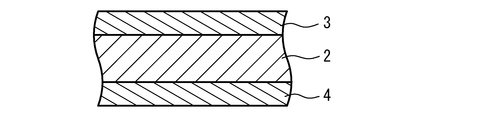
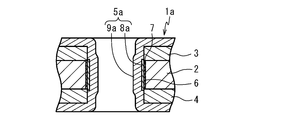
- FIG. 1 is a schematic partial cross-sectional view showing a printed wiring board according to an embodiment of the present invention.
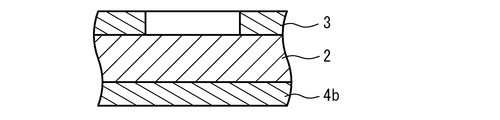
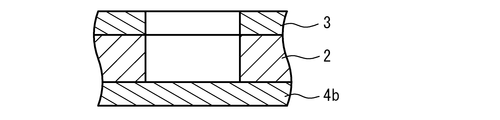
- 2A is a schematic partial cross-sectional view showing a manufacturing process of the printed wiring board of FIG. 2B is a schematic partial cross-sectional view showing the next manufacturing step of FIG. 2A for the printed wiring board of FIG. 1.
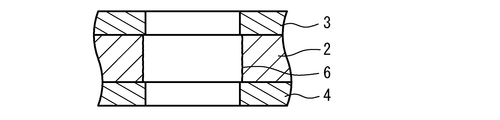
- 2C is a schematic partial cross-sectional view showing the next manufacturing step of FIG. 2B for the printed wiring board of FIG. 1.
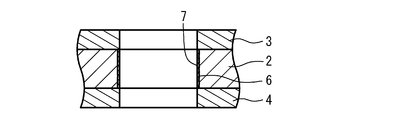
- 2D is a schematic partial cross-sectional view showing the next manufacturing step of FIG. 2C for the printed wiring board of FIG. 1.
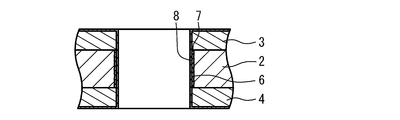
- FIG. 2E is a schematic partial cross-sectional view showing the next manufacturing step of FIG. 2D for the printed wiring board of FIG. 1.
- FIG. 1 is a schematic partial cross-sectional view showing a printed wiring board according to an embodiment of the present invention.
- 2A is a schematic partial cross-sectional view showing a manufacturing process of the printed wiring board of FIG. 2B is a schematic partial cross-section
- FIG. 3 is a schematic partial cross-sectional view showing a printed wiring board according to an embodiment different from FIG.
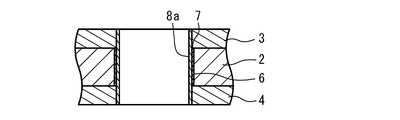
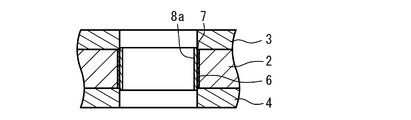
- FIG. 4A is a schematic partial cross-sectional view illustrating a manufacturing process of the printed wiring board of FIG. 4B is a schematic partial cross-sectional view showing the next manufacturing step of FIG. 4A for the printed wiring board of FIG. 3.
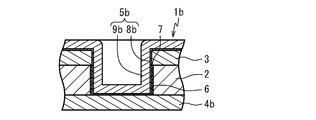
- FIG. 5 is a schematic partial cross-sectional view showing a printed wiring board according to an embodiment different from those in FIGS. 1 and 3.
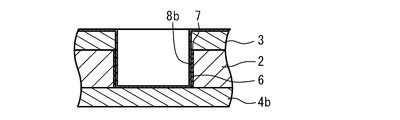
- FIG. 6A is a schematic partial cross-sectional view illustrating a manufacturing process of the printed wiring board of FIG.
- FIG. 6B is a schematic partial cross-sectional view showing the next manufacturing step of FIG. 6A for the printed wiring board of FIG. 5.
- 6C is a schematic partial cross-sectional view showing the next manufacturing step of FIG. 6B for the printed wiring board of FIG. 5.
- 6D is a schematic partial cross-sectional view showing the next manufacturing step of FIG. 6C for the printed wiring board of FIG. 5.
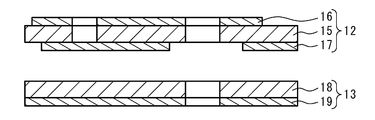
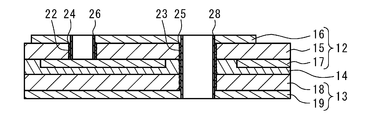
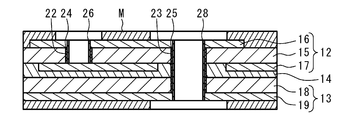
- FIG. 6E is a schematic partial cross-sectional view showing the next manufacturing step of FIG. 6D for the printed wiring board of FIG. 5.
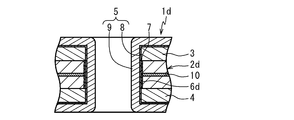
- FIG. 7 is a schematic partial cross-sectional view showing a printed wiring board according to an embodiment different from those in FIGS. 1, 3, and 5.
- FIG. 8 is a schematic partial cross-sectional view showing a printed wiring board according to an embodiment different from those shown in FIGS. 1, 3, 5, and 7.
- FIG. 9 is a schematic partial cross-sectional view showing a printed wiring board according to an embodiment different from those in FIGS. 1, 3, 5, 7, and 8.
- 10A is a schematic partial cross-sectional view showing a manufacturing process of the printed wiring board of FIG.
- FIG. 10B is a schematic partial cross-sectional view showing the next manufacturing step of FIG. 10A for the printed wiring board of FIG. 9.
- FIG. 10C is a schematic partial cross-sectional view showing the next manufacturing step of FIG. 10B for the printed wiring board of FIG. 9.
- FIG. 10D is a schematic partial cross-sectional view showing the next manufacturing step of FIG. 10C for the printed wiring board of FIG. 9.
- 10E is a schematic partial cross-sectional view showing the next manufacturing step of FIG. 10D for the printed wiring board of FIG. 9.
- FIG. 10F is a schematic partial cross-sectional view showing the next manufacturing step of FIG. 10E for the printed wiring board of FIG. 9.
- the printed wiring board according to one aspect of the present invention includes a base material layer mainly composed of a fluororesin, a first conductive layer laminated on one surface of the base material layer, and the other surface of the base material layer. Formed along a connection hole penetrating in the thickness direction through the second conductive layer, the base material layer, and at least one of the first conductive layer and the second conductive layer, and the first conductive layer and A printed wiring board including a via hole for electrically connecting the second conductive layer, wherein at least a part of the inner peripheral surface of the base material layer in the connection hole has an oxygen atom or nitrogen atom content of 0. It has a pretreatment surface of 2 atomic% or more.
- the printed wiring board is a pretreated surface that compensates for the low adhesion of a fluororesin having an oxygen atom or nitrogen atom content of 0.2 atomic% or more on at least a part of the inner peripheral surface of the base material layer in the connection hole Therefore, the pretreated surface exhibits high adhesion to the via hole.
- the printed wiring board can reliably connect the first conductive layer and the second conductive layer on both sides of the base material layer by via holes, and the pretreatment surface prevents the via holes from peeling off. Is expensive.
- the printed wiring board has a pre-processed surface, via holes can be easily stacked, and thus can be easily manufactured and provided at low cost.
- a modified layer having a hydrophilic organic functional group at least in the formation region of the pretreatment surface of the inner peripheral surface of the base material layer in the connection hole, adhesion between the base material layer and the via hole is achieved. This can further increase the manufacturing efficiency and reliability.
- the via hole may have a base conductor layer in contact with the inner peripheral surface of the connection hole and a main conductor layer in contact with the inner peripheral surface of the base conductor layer.
- the contact angle of the pretreated surface with pure water is preferably 90 ° or less.
- the peel strength between the via hole and the base material layer is preferably 1.0 N / cm or more.
- the via hole is peeled from the inner peripheral surface of the base material layer in the connection hole and the first conductive layer of the via hole resulting therefrom.
- peeling from the second conductive layer is prevented. Thereby, the connection between the first conductive layer and the second conductive layer becomes more reliable.
- a method for manufacturing a printed wiring board according to another aspect of the present invention includes a base material layer containing a fluororesin as a main component, a first conductive layer laminated on one surface of the base material layer, and the above-described base material.
- a method of manufacturing a printed wiring board comprising: a second conductive layer laminated on the other surface of the material layer; and a via hole that electrically connects the first conductive layer and the second conductive layer, the base layer And a step of forming a connection hole penetrating through at least one of the first conductive layer and the second conductive layer, and at least part of the inner peripheral surface of the base material layer in the connection hole, oxygen atoms or nitrogen atoms
- the method for producing the printed wiring board includes forming a pretreated surface having a content of oxygen atoms or nitrogen atoms of 0.2 atomic% or more on at least a part of the inner peripheral surface of the base material layer in the connection hole. Since the adhesion between the material layer and the via hole is improved, it is easy to form a via hole by laminating the base conductor layer and the main conductor layer, and the first conductive layer and the second conductive layer can be easily and reliably connected. . For this reason, the manufacturing method of the said printed wiring board enables provision of a cheap and reliable printed wiring board.
- the base conductor layer may be formed by adhesion of a conductive material or electroless plating of copper. In this way, by forming the base conductor layer by attaching a conductive material or by electroless plating of copper, the base conductor layer can be easily stacked and the main conductor layer can be reliably stacked. .
- “content ratio of oxygen atom or nitrogen atom” is, for example, X-ray photoelectron spectroscopy (ESCA: Electron Spectroscopy for Chemical Analysis or XPS: X-ray Photoelectron Spectroscopy), energy dispersive X-ray spectroscopy (EDXE) Dispersive X-ray Spectroscopy or EDS: Energy Dispersive X-ray Spectroscopy, Electron Probe Microanalysis Method (EPMA: Electron Probe Micro-Sm)pectrometry), secondary ion mass spectrometry (SIMS: Secondary Ion Mass Spectrometry), Auger electron spectroscopy (AES: Auger Electron Spectroscopy), can be measured by an electron microscope.
- EMA Electron Probe Micro-Sm
- SIMS Secondary Ion Mass Spectrometry
- Auger electron spectroscopy AES: Auger Electron Spectroscopy
- measurement is performed by scanning the surface with the X-ray source being an aluminum metal K alpha ray, a beam diameter of 50 ⁇ m, and an X-ray incident angle of 45 ° with respect to the analysis surface.
- the X-ray source being an aluminum metal K alpha ray, a beam diameter of 50 ⁇ m, and an X-ray incident angle of 45 ° with respect to the analysis surface.
- the measurement surface (such as a pretreatment surface) at the time of the measurement can be exposed by removing a conductor layer (metal or the like) covering the measurement surface by, for example, etching.
- the composition ratio of atoms at any depth position can be measured by the above method by sequentially removing the material in the direction perpendicular to the measurement surface by sputtering.
- the thickness of the surface treatment layer is measured with an electron microscope while analyzing the impurity concentration in the depth direction by SIMS etc. while removing by sputtering in a direction substantially parallel to the measurement surface.
- the content of oxygen atoms or nitrogen atoms on the surface can be measured by evaluating various combinations of the above methods.
- the “contact angle with pure water” is a value of a contact angle measured by the sessile drop method of JIS-R-3257 (1999).
- the “peel strength” is a value measured in accordance with JIS-K-6854-2 (1999) “Adhesive—Peeling peel strength test method—Part 2: 180 degree peel”.
- a printed wiring board 1 in FIG. 1 includes a base material layer 2 mainly composed of a fluororesin, a first conductive layer 3 laminated on one surface of the base material layer 2, and the other base material layer 2.
- a second conductive layer 4 laminated on the surface, and a connection hole penetrating the base material layer 2, the first conductive layer 3 and the second conductive layer 4 in the thickness direction, and the first conductive layer 3 and A via hole 5 that electrically connects the second conductive layer 4 is mainly provided.
- the said base material layer 2 has the pre-processing surface 6 whose content rate of an oxygen atom or a nitrogen atom is 0.2 atomic% or more in the internal peripheral surface of the base material layer 2 in the said connection hole.
- the printed wiring board 1 further includes a modified layer 7 having a hydrophilic organic functional group in at least a region where the pretreatment surface 6 is formed on the inner peripheral surface of the base material layer.
- the base material layer 2 contains a fluororesin as a main component.
- the fluororesin is an organic group in which at least one hydrogen atom bonded to the carbon atom constituting the repeating unit of the polymer chain has a fluorine atom or a fluorine atom (hereinafter also referred to as “fluorine atom-containing group”). Refers to the substituted one.
- the fluorine atom-containing group is a group in which at least one hydrogen atom in a linear or branched organic group is substituted with a fluorine atom, and examples thereof include a fluoroalkyl group, a fluoroalkoxy group, and a fluoropolyether group. Can do.
- Fluoroalkyl group means an alkyl group in which at least one hydrogen atom is substituted with a fluorine atom, and includes a “perfluoroalkyl group”. Specifically, a “fluoroalkyl group” is a group in which all hydrogen atoms of an alkyl group are substituted with fluorine atoms, and all hydrogen atoms other than one hydrogen atom at the end of the alkyl group are substituted with fluorine atoms. Group.
- Fluoroalkoxy group means an alkoxy group in which at least one hydrogen atom is substituted with a fluorine atom, and includes a “perfluoroalkoxy group”. Specifically, a “fluoroalkoxy group” is a group in which all hydrogen atoms of an alkoxy group are substituted with fluorine atoms, and all hydrogen atoms other than one hydrogen atom at the end of the alkoxy group are substituted with fluorine atoms. Group.
- the “fluoropolyether group” is a monovalent group having an oxyalkylene unit as a repeating unit and having an alkyl group or a hydrogen atom at the terminal, and at least one hydrogen of the alkylene oxide chain or the terminal alkyl group A monovalent group in which an atom is substituted with a fluorine atom.
- the “fluoropolyether group” includes a “perfluoropolyether group” having a plurality of perfluoroalkylene oxide chains as repeating units.
- fluororesin constituting the base layer 2 examples include polytetrafluoroethylene (PTFE), polytetrafluoroethylene / perfluoroalkyl vinyl ether copolymer (PFA), and tetrafluoroethylene / hexafluoropropylene copolymer (FEP).
- PTFE polytetrafluoroethylene
- PFA polytetrafluoroethylene / perfluoroalkyl vinyl ether copolymer
- FEP tetrafluoroethylene / hexafluoropropylene copolymer
- Tetrafluoroethylene / ethylene copolymer ETFE
- PVDF polyvinylidene fluoride
- PCTFE polychlorotrifluoroethylene
- ECTFE chlorotrifluoroethylene / ethylene copolymer
- PVF polyvinyl fluoride
- a thermoplastic fluororesin (THV) and a fluoroelastomer composed of three types of monomers such as tetrafluoroethylene, hexafluoropropylene, and vinylidene fluoride can be exemplified.
- a mixture or copolymer containing these compounds can also be used as a material constituting the base layer 2.
- the fluororesin constituting the substrate layer 2 tetrafluoroethylene / hexapropylene copolymer (FEP), polytetrafluoroethylene / perfluoroalkyl vinyl ether copolymer (PFA), or polytetrafluoroethylene (PTFE) is preferred.
- FEP tetrafluoroethylene / hexapropylene copolymer
- PFA polytetrafluoroethylene / perfluoroalkyl vinyl ether copolymer
- PTFE polytetrafluoroethylene
- the base material layer 2 includes, as optional components, for example, engineering plastics, flame retardants, flame retardant aids, pigments, antioxidants, reflection imparting agents, masking agents, lubricants, processing stabilizers, plasticizers, foaming agents, and the like. May be included.
- the engineering plastic can be selected from known materials such as polyacetal, polyamide, polycarbonate, modified polyphenylene ether, polybutylene terephthalate, and liquid crystal polymer according to the characteristics required for the base material layer 2, and typically Aromatic polyetherketone resins can be used.
- This aromatic polyetherketone has a structure in which the benzene rings are bonded to the para position and the benzene rings are connected by a rigid ketone bond (—C ( ⁇ O) —) or a flexible ether bond (—O—). It is a thermoplastic resin.
- aromatic polyether ketone for example, ether ether, benzene ring, ether bond, benzene ring, ketone bond, and polyether ether ketone (PEEK) having a structural unit in which the benzene ring is arranged in this order, ether bond, benzene ring And polyether ketone (PEK) having a structural unit in which a ketone bond and a benzene ring are arranged in this order.
- PEEK is preferable as the aromatic polyether ketone.
- Such an aromatic polyether ketone is excellent in wear resistance, heat resistance, insulation, workability and the like.
- aromatic polyether ketones such as PEEK.
- aromatic polyether ketones those of various grades are commercially available, and a single grade of aromatic polyether ketone that is commercially available may be used alone, or multiple grades of aromatic polyether ketone.
- a ketone may be used in combination, or a modified aromatic polyether ketone may be used.
- the lower limit of the ratio of the total content of engineering plastics in the base material layer 2 to the fluororesin is not particularly limited, but is preferably 10% by mass, more preferably 20% by mass, and even more preferably 35% by mass.
- the upper limit of the ratio of the total content of engineering plastics to the fluororesin is not particularly limited, but is preferably 50% by mass and more preferably 45% by mass.
- the flame retardant various known ones can be used, and examples thereof include halogen flame retardants such as bromine flame retardants and chlorine flame retardants.
- flame retardant aid various known ones can be used, and examples thereof include antimony trioxide.
- pigment various known pigments can be used, and examples thereof include titanium oxide.
- antioxidant various known ones can be used, and examples thereof include a phenolic antioxidant.
- reflection imparting agent various known ones can be used, and examples thereof include titanium oxide.
- the base material layer 2 may be provided with a hollow structure.
- the lower limit of the average thickness of the base material layer 2 is preferably 3 ⁇ m, and more preferably 6 ⁇ m.
- an upper limit of the average thickness of the base material layer 2 100 micrometers is preferable and 55 micrometers is more preferable.
- the average thickness of the base material layer 2 is less than the said minimum, there exists a possibility that the intensity
- the average thickness of the base material layer 2 exceeds the said upper limit, there exists a possibility that the flexibility of the base material layer 2 and the said printed wiring board 1 may become inadequate.
- the pretreatment surface 6 is formed by surface treatment on the surface of the base material layer 2 (inner peripheral surface of the connection hole), and contains oxygen atoms or nitrogen atoms.
- the pretreatment surface 6 is a surface having an atomic composition different from the inside of the base material layer 2.
- the pretreatment surface 6 is formed on the entire inner peripheral surface of the base material layer in the connection hole.
- the lower limit of the oxygen atom or nitrogen atom content of the pretreated surface 6 is 0.2 atomic%, preferably 1 atomic%, and more preferably 5 atomic%.
- the upper limit of the content of oxygen atoms or nitrogen atoms on the pretreated surface 6 is preferably 30 atomic%, and more preferably 20 atomic%.
- the adhesion of the pretreatment surface 6 to the via hole 5 is not limited to the case where the via hole 5 is directly laminated on the pretreatment surface 6 but the via hole 5 is laminated on the pretreatment surface 6 via the modified layer 7. Also in this case, it means that the via hole 5 is difficult to peel off.
- the upper limit of the contact angle of the pretreated surface 6 with respect to pure water is preferably 90 °, more preferably 80 °.
- the lower limit of the contact angle of the pretreated surface 6 with respect to pure water is not particularly limited.
- the contact angle with respect to pure water can be measured using a contact angle measuring instrument “GI-1000” manufactured by ERMA.
- the lower limit of the wetting tension of the pretreated surface 6 is preferably 50 mN / m, more preferably 60 mN / m. When the wetting tension of the pretreated surface 6 is less than the lower limit, the adhesion between the pretreated surface 6 and the via hole 5 is insufficient, and the via hole 5 may be peeled off.
- the lower limit of the wetting tension is larger than that of pure polytetrafluoroethylene (PTFE). That is, the surface of the base material layer 2 has higher surface adhesion than the ordinary fluororesin by forming the pretreatment surface 6.
- the first conductive layer 3 and the second conductive layer 4 are layers formed of a conductor such as a metal, and each have a planar shape including a wiring for an electric circuit, a land for mounting an electric component, and the like.
- the planar shapes of the first conductive layer 3 and the second conductive layer 4 are formed, for example, by etching a conductor laminated on the base material layer 2.
- the material for forming the first conductive layer 3 and the second conductive layer 4 may be any material as long as it has conductivity.
- the material is copper, stainless steel, aluminum, nickel or the like, typically copper. It is formed.
- the lower limit of the average thickness of the first conductive layer 3 and the second conductive layer 4 is preferably 0.01 ⁇ m, and more preferably 0.1 ⁇ m.
- the upper limit of the average thickness of the first conductive layer 3 and the second conductive layer 4 is preferably 100 ⁇ m, and more preferably 20 ⁇ m.
- the via hole 5 includes an inner peripheral surface of the connection hole in which the modified layer 7 is formed (an inner peripheral surface of the modified layer 7), an end surface in the connection hole of the first conductive layer 3 and the second conductive layer 4 (connection hole). Inner peripheral surface), the connection hole vicinity region of the outer surface of the first conductive layer 3 (surface opposite to the base material layer 2), and the outer surface of the second conductive layer 4 (surface opposite to the base material layer 2). ) And the base conductor layer 8 stacked so as to be in contact with the region near the connection hole, and the main conductor layer stacked so as to be in contact with the inner peripheral surface and the outer surface (surface far from the base material layer 2) of the base conductor layer 8. 9.
- the lower limit of the peel strength between the via hole 5 and the base material layer 2 is preferably 1.0 N / cm, more preferably 1.5 N / cm, and further preferably 2.0 N / cm.
- the upper limit of the peel strength between the via hole 5 and the base material layer 2 is not particularly limited. When the peel strength between the via hole 5 and the base material layer 2 is less than the above lower limit, the via hole 5 is peeled from the base material layer 2 to peel off the connecting portion with the first conductive layer 3 or the second conductive layer 4. May cause tearing.
- the base conductor layer 8 is a thin layer having conductivity, and is used as an adherend when the main conductor layer 9 is formed by electroplating.
- the underlying conductor layer 8 is formed of a metal laminated by electroless plating. Examples of the metal that forms the underlying conductor layer 8 include metals such as copper, silver, nickel, and palladium. Among them, flexibility, thickness, adhesion with electrolytic copper plating are good, and low electrical resistance is achieved. Copper is preferred.
- the lower limit of the average thickness of the base conductor layer 8 is preferably 0.01 ⁇ m, and more preferably 0.2 ⁇ m.
- the upper limit of the average thickness of the underlying conductor layer 8 is preferably 1 ⁇ m, and more preferably 0.5 ⁇ m. If the average thickness of the underlying conductor layer 8 is less than the lower limit, the continuity of the underlying conductor layer 8 cannot be ensured, and the main conductor layer 9 may not be formed uniformly. Further, when the average thickness of the underlying conductor layer 8 exceeds the above upper limit, there is a possibility that the cost may be unnecessarily increased.
- the main conductor layer 9 is formed of a metal such as copper or nickel laminated on the base conductor layer 8 by electroplating. By providing the main conductor layer 9 on the inner peripheral surface after forming the base conductor layer 8 in this manner, the via hole 5 having excellent conductivity can be easily and reliably formed.
- the lower limit of the average thickness of the main conductor layer 9 is preferably 1 ⁇ m and more preferably 5 ⁇ m.
- the upper limit of the average thickness of the main conductor layer 9 is preferably 50 ⁇ m and more preferably 30 ⁇ m.
- the modified layer 7 has a hydrophilic organic functional group that easily binds to a metal or the like in at least a region where the pretreatment surface 6 is formed in the inner peripheral surface of the substrate layer 2 in the connection hole.
- the adhesion between the base conductor layer 8 and the base conductor layer 8 is further improved.
- the modified layer 7 preferably contains a siloxane bond (Si—O—Si). That is, the modifying layer 7 is formed by bonding a modifying agent (silane coupling agent) having a hydrophilic organic functional group and generating a siloxane bond to the fluororesin that is the main component of the base material layer 2. It is preferable.
- the hydrophilic organic functional group is bonded to Si atoms constituting the siloxane bond. This hydrophilic organic functional group imparts wettability to the surface side of the base material layer 2.
- the chemical bond between the fluororesin and the modifier may be composed of only a covalent bond or may include a covalent bond and a hydrogen bond.
- the modified layer 7 is a region that is considered to have a different microstructure, molecular structure, and abundance of elements from the region excluding the modified layer 7 in the vicinity of the surface of the base material layer 2.
- the modified layer 7 has a hydrophilic organic functional group
- the base material layer 2 becomes hydrophilic and the wettability of the surface is improved.
- the processing speed and the uniformity of the surface treatment can be improved. .
- Si atoms constituting the siloxane bond include at least one of N atom, C atom, O atom, and S atom. And covalently bonded to the C atom of the base material layer 2.
- the Si atom of the siloxane bond includes —O—, —S—, —SS—, — (CH 2 ) n—, —NH—, — (CH 2 ) n—NH—, — (CH 2 ). It is bonded to the C atom of the fluororesin through an atomic group such as n—O— (CH 2 ) m— (n and m are integers of 1 or more).
- hydrophilic organic functional group a hydroxyl group, carboxy group, carbonyl group, amino group, amide group, sulfide group, sulfonyl group, sulfo group, sulfonyldioxy group, epoxy group, methacryl group and mercapto group are preferable. Among these, those containing N atoms or S atoms are more preferable.
- These hydrophilic organic functional groups further improve the adhesion of the surface of the base material layer 2.
- the modified layer 7 may contain two or more of these hydrophilic organic functional groups. Thus, by imparting hydrophilic organic functional groups having different properties to the modified layer 7, the surface reactivity of the base material layer 2 can be varied.
- These hydrophilic organic functional groups are bonded to Si atoms, which are constituents of siloxane bonds, directly or via one or more C atoms (for example, a methylene group or a phenylene group).
- a silane coupling agent having a hydrophilic organic functional group in the molecule is suitable, and among them, a hydrolyzable silicon containing Si atom is contained. Those having a functional group are more preferred.
- Such a silane coupling agent is chemically bonded to the fluororesin constituting the base material layer 2.
- the chemical bond between the silane coupling agent and the fluororesin of the base material layer 2 may be composed of only a covalent bond or may include a covalent bond and a hydrogen bond.
- the “hydrolyzable silicon-containing functional group” refers to a group capable of forming a silanol group (Si—OH) by hydrolysis.
- the upper limit of the contact angle with the pure water on the surface of the modified layer 7 is 90 °, preferably 80 °, and more preferably 70 °.
- the adhesive strength with an adhesive such as a conductive pattern may be insufficient.
- the lower limit of the contact angle with the pure water on the surface of the modified layer 7 is not particularly limited.
- the modified layer 7 has the following etching resistance, that is, an etching solution containing iron chloride, having a specific gravity of 1.33 g / cm 3 and a free hydrochloric acid concentration of 0.2 mol / L. It is preferable that the modified layer 7 is not removed with respect to the etching treatment that is used for immersion at 45 ° C. for 2 minutes.
- “the modified layer 7 is not removed” means that hydrophilicity is not lost, and that the contact angle with pure water does not exceed 90 ° in the portion where the modified layer 7 is provided.
- the etching treatment may cause a minute portion having hydrophobicity in the region where the modified layer 7 is formed to be patchy. However, if the entire region has hydrophilicity, such a state may be hydrophilic. It is assumed that sex is maintained.
- the modified layer 7 has etching resistance to an etching solution containing copper chloride.
- the modified layer 7 has the etching resistance with respect to the iron chloride-containing etching solution, it is confirmed that the modified layer 7 has the etching resistance with respect to the copper chloride-containing etching solution. ing.
- the lower limit of the adhesion energy between the surface of the modified layer 7 and water is preferably 50 dyne / cm.
- the adhesion energy between the surface of the modified layer 7 and water is less than the lower limit, the adhesion of the surface of the base material layer 2 may be insufficient in comparison with pure polytetrafluoroethylene (PTFE). .
- the lower limit of the wetting tension on the surface of the modified layer 7 is preferably 50 mN / m, more preferably 60 mN / m. If the wetting tension is less than the above lower limit, the adhesion is insufficient, and the adhesive may be peeled off from the modified layer 7. Since the lower limit of the wetting tension is larger than the wetting tension of pure polytetrafluoroethylene (PTFE), the surface of the modified layer 7 has improved adhesion. On the other hand, when the wetting tension on the surface of the modified layer 7 is less than the lower limit, the adhesion of the surface of the modified layer 7 may be insufficient.
- the “wetting tension” is a value measured according to JIS-K-6768 (1999).
- the lower limit of the peel strength of the epoxy resin adhesive having an average thickness of 25 ⁇ m with respect to the surface of the modified layer 7 measured using a polyimide sheet having an average thickness of 12.5 ⁇ m as the flexible adherend is preferably 1.0 N / cm. 3.0 N / cm is more preferable, and 5.0 N / cm is more preferable.
- the peel strength of the epoxy resin adhesive with respect to the surface of the modified layer 7 is less than the lower limit, the adhesion of the via hole 5 to the modified layer 7 may not be sufficiently improved.
- the lower limit of the average thickness of the modified layer 7 is not particularly limited, but is preferably 10 nm, and more preferably 50 nm.
- the upper limit of the average thickness of the modified layer 7 is preferably 400 nm, and more preferably 200 nm.
- the transmission loss may be increased because the dielectric constant ( ⁇ ) and the dielectric loss tangent (tan ⁇ ) of the modified layer 7 are larger than those of the fluororesin. .
- the average thickness of the modified layer 7 can be measured using an optical interference type film thickness measuring machine, an X-ray photoelectron spectroscopy (X-ray photoelectron spectroscopy) analyzer, an electron microscope, or the like.
- the upper limit of the average surface roughness Ra of the inner peripheral surface of the modified layer 7 is preferably 4 ⁇ m, more preferably 2 ⁇ m, and even more preferably 1 ⁇ m.
- the “average surface roughness Ra” means an arithmetic average roughness measured in accordance with JIS-B-0601 (2013).
- the modified layer 7 is preferably formed after the pretreatment surface 6 is formed at least on the inner peripheral surface of the connection hole formed in the base material layer 2. Since the base layer 2 is formed with the pretreatment surface 6 so that the adhesion of the end face is improved, the formation of the modified layer 7 is facilitated, and the adhesion of the via hole 5 is further improved.
- the method for manufacturing the printed wiring board 1 includes a step of preparing a laminate having a base material layer 2, a first conductive layer 3, and a second conductive layer 4 (a laminate preparation step), and forming connection holes in the laminate.
- a step of forming a pretreatment surface 6 having a content of oxygen atoms or nitrogen atoms of 0.2 atomic% or more on the inner peripheral surface of the base material layer 2 in the formed connection hole Treatment surface formation step
- a step of forming a modified layer 7 having a hydrophilic organic functional group in a formation region of at least the pretreatment surface 6 in the inner peripheral surface of the connection hole (a modification layer formation step)
- the first conductive layer 3 and the second conductive layer 4 are etched to form a conductive pattern. And a degree.
- ⁇ Laminated body preparation process> a laminate having the base material layer 2, the first conductive layer 3, and the second conductive layer 4 as shown in FIG. 2A is prepared.
- a method of laminating the conductor for forming the first conductive layer 3 and the second conductive layer 4 on the base material layer 2 for example, a method of attaching a metal foil with an adhesive or the like, A method of vapor deposition is applied.
- connection hole forming process As shown in FIG. 2B, a connection hole penetrating the base material layer 2, the first conductive layer 3, and the second conductive layer 4 is formed in the laminate.
- connection hole As a method for forming such a connection hole, a known method such as punching, laser processing, or drilling can be applied.
- Pretreatment surface formation process At least the end surface of the base material layer 2 (the inner peripheral surface of the connection hole) is surface-treated, so that oxygen atoms or nitrogen atoms are formed on the end surface of the base material layer 2 as shown in FIG.
- the pretreatment surface 6 containing is formed.
- Examples of the surface treatment include Na etching, alkali treatment, plasma treatment, and radiation irradiation.
- the molecules on the end face of the base material layer 2 are finely cut or removed (etched), whereby oxygen atoms and nitrogen atoms can be added.
- the Na etching is a process of etching the surface layer of the fluororesin on the end face of the base material layer 2 by immersing the base material layer 2 in an etching solution containing metal Na such as “Tetra Etch” manufactured by Junko Co., Ltd.
- the alkali treatment is a treatment for etching the surface layer of the fluororesin on the end face of the base material layer 2 by immersing the base material layer 2 in a strong alkali solution such as potassium hydroxide.
- the plasma treatment is a treatment of etching the surface layer of the fluororesin on the end face of the base material layer 2 by bringing the base material layer 2 into contact with plasma.
- plasma gas such as oxygen, nitrogen, hydrogen, argon, ammonia
- the plasma treatment may be performed using plasma of an inert gas containing a compound having a hydrophilic group.
- the radiation irradiation is performed by irradiating the end surface of the base material layer 2 with high-energy radiation to extract fluorine atoms of the fluororesin on the end surface of the base material layer 2, so that oxygen atoms or nitrogen atoms are substituted for the fluorine atoms. It is a process to add.
- the radiation applied to the base material layer 2 include an electron beam and an electromagnetic wave.
- a coupling agent having a hydrophilic organic functional group and capable of binding to the fluororesin is applied to at least the formation region of the pretreatment surface 6 on the end surface of the base material layer 2, so that FIG.
- a modified layer 7 in contact with the pretreatment surface 6 is formed.
- the modified layer 7 is formed by bonding a coupling agent to the fluororesin of the base material layer 2.
- the chemical bond between the fluororesin of the base material layer 2 and the coupling agent may be constituted only by a covalent bond or may contain a covalent bond and a hydrogen bond.
- the coupling agent having such a hydrophilic organic functional group and bonded to the fluororesin examples include a silane coupling agent and a titanium coupling agent, and particularly forms a siloxane bond (Si—O—Si).
- Silane coupling agents are preferred, and silane coupling agents having hydrolyzable functional groups containing Si atoms are more preferred. That is, the preferable modified layer 7 includes a siloxane bond.
- the hydrophilic organic functional group is directly on the Si atom which is a constituent element of the siloxane bond, or one or a plurality of C atoms (for example, a methylene group or a phenylene group). Join through.
- Si atoms constituting the siloxane bond include at least one of N, C, O, and S atoms. And covalently bonded to the C atom of the base material layer 2.
- the Si atom of the siloxane bond includes —O—, —S—, —SS—, — (CH 2 ) n—, —NH—, — (CH 2 ) n—NH—, — (CH 2 ). It is bonded to the C atom of the fluororesin through an atomic group such as n—O— (CH 2 ) m— (n and m are integers of 1 or more).
- the hydrolyzable functional group containing the Si atom is specifically a group in which an alkoxy group is bonded to the Si atom.
- alkoxy group include methoxy group, ethoxy group, propoxy group, t-butoxy group, pentyloxy group and the like.
- hydrophilic organic functional group containing an N atom examples include an amino group and a ureido group.
- silane coupling agent having a hydrophilic organic functional group containing an N atom examples include aminoalkoxysilane, ureidoalkoxysilane, and derivatives thereof.
- aminoalkoxysilane examples include 3-aminopropyltrimethoxysilane, 3-aminopropyltriethoxysilane, N- (2-aminoethyl) -3-aminopropylmethyldimethoxysilane, and N- (2-aminoethyl) -3.
- aminoalkoxysilane derivatives include ketimines such as 3-triethoxysilyl-N- (1,3-dimethyl-butylidene) propylamine, and N-vinylbenzyl-2-aminoethyl-3-aminopropyltrimethoxysilane acetic acid.
- ketimines such as 3-triethoxysilyl-N- (1,3-dimethyl-butylidene) propylamine
- N-vinylbenzyl-2-aminoethyl-3-aminopropyltrimethoxysilane acetic acid examples include salts of silane coupling agents such as salts.
- ureidoalkoxysilane examples include 3-ureidopropyltriethoxysilane, 3-ureidopropyltrimethoxysilane, N- (2-ureidoethyl) -3-aminopropyltrimethoxysilane, and the like.
- hydrophilic organic functional group containing an S atom examples include a mercapto group and a sulfide group.
- silane coupling agent having a hydrophilic organic functional group containing an S atom examples include mercaptoalkoxysilane, sulfide alkoxysilane, and derivatives thereof.
- Examples of the mercaptoalkoxysilane include 3-mercaptopropyltrimethoxysilane, 3-mercaptopropyltriethoxysilane, 3-mercaptopropyl (dimethoxy) methylsilane, and the like.
- sulfide alkoxysilane examples include bis (3-triethoxysilylpropyl) tetrasulfide and bis (3-triethoxysilylpropyl) disulfide.
- the silane coupling agent may be one introduced with a modifying group.
- a modifying group a phenyl group is preferable.
- silane coupling agents include 3-aminopropyltriethoxysilane, N-phenyl-3-aminopropyltrimethoxysilane, 3-ureidopropyltriethoxysilane, 3-mercaptopropyltrimethoxysilane, or bis (among others).
- 3-Triethoxysilylpropyl) tetrasulfide is preferred.
- titanium coupling agent for forming the modified layer 7 examples include isopropyl triisostearoyl titanate, isopropyl tristearoyl titanate, isopropyl trioctanoyl titanate, isopropyl dimethacrylisostearoyl titanate, isopropyl tridodecylbenzenesulfonyl titanate, Isopropyl isostearoyl diacryl titanate, isopropyl tri (dioctyl phosphate) titanate, isopropyl tricumyl phenyl titanate, isopropyl tris (dioctyl pyrophosphate) titanate, isopropyl tri (N-aminoethyl-aminoethyl) titanate, tetraisopropyl bis (dioctyl phosphite) ) Titanate, tetraoctylbis (ditridecylpho
- the via hole forming step includes a step of laminating the base conductor layer 8 so as to be in contact with the inner peripheral surface of the connection hole in which the modified layer 7 is formed (base conductor layer laminating step), and a main conductor so as to be in contact with the surface of the base conductor layer 8.
- a step of forming the layer 9 main conductor layer forming step).
- the inner peripheral surface of the modified layer 7, the end surface and the outer surface of the first conductive layer 3, and the end surface and the outer surface of the second conductive layer 4 are formed by electroless plating.
- a base conductor layer 8 in contact with is formed.
- Electroless plating is a treatment for depositing a metal having catalytic activity by the reducing action of the catalyst, and various commercially available electroless plating solutions can be used.
- the main conductor layer 9 in contact with the inner peripheral surface of the base conductor layer 8 is formed by laminating a metal by electroplating using the base conductor layer 8 as an adherend, thereby forming the main conductor layer 9 shown in FIG. A via hole 5 of the printed wiring board 1 is formed.
- the conductive pattern is formed by etching the first conductive layer 3 and the second conductive layer 4 by a known etching method for forming a resist pattern by photolithography, for example.
- the printed wiring board 1 becomes hydrophilic because it has a pretreated surface 6 containing 0.2 atomic% or more of oxygen atoms or nitrogen atoms on the end surface where the base material layer 2 is formed by the connection holes, and wettability with liquid. Therefore, the surface chemical reaction in the liquid processing step such as plating for forming the base conductor layer 8 is promoted. For this reason, the adhesiveness of the base conductor layer 8 and the via hole 5 to the end face of the base material layer 2 is high. Adhesion is further improved by laminating a modified layer 7 having a hydrophilic organic functional group on the pretreated surface 6. Thereby, the printed wiring board 1 has high reliability of electrical connection between the first conductive layer 3 and the second conductive layer 4.
- the via hole 5 can be easily and reliably formed by laminating the main conductor layer 9 having a low electric resistance by electroplating. For this reason, the printed wiring board 1 can be provided at a relatively low cost.
- the printed wiring board 1 is formed by forming a modified layer 7 using a silane coupling agent, so that a hydrophilic organic functional group that improves the adhesion of the via hole 5 and a fluororesin of the base material layer 2 are mixed with silicon. It can be efficiently bonded through a siloxane bond as a skeleton. Thereby, the printed wiring board 1 is excellent in productivity and reliability.
- the coupling agent has a high binding property to the end surface of the base material layer 2. For this reason, it is easy to form the modified layer 7 on the end face of the base material layer 2, and the formation efficiency of the via hole 5 and the reliability of the printed wiring board can be further improved.
- the printed wiring board 1a of FIG. 3 includes a base material layer 2 mainly composed of a fluororesin, a first conductive layer 3 laminated on one surface of the base material layer 2, and the other of the base material layer 2.
- the said base material layer 2 has the pre-processing surface 6 whose content rate of an oxygen atom or a nitrogen atom is 0.2 atomic% or more in the internal peripheral surface of the base material layer 2 in the said connection hole.
- the printed wiring board 1a has a modified layer 7 laminated on the inner peripheral surface of the connection hole so as to be in contact with the pretreatment surface 6 and having a hydrophilic organic functional group.
- the via hole 5a of the printed wiring board 1a includes a base conductor layer 8a laminated so as to be in contact with the inner peripheral surface of the connection hole in which the modified layer 7 is formed (the inner peripheral surface of the modified layer 7), and the base conductor layer 8a.
- the base conductor layer 8a of the printed wiring board 1a of FIG. 3 is a thin layer formed by attaching a conductive material, and is used as an adherend when forming the main conductor layer 9a.
- Such a base conductor layer 8a can be formed by various commercially available processing agents.
- Examples of the conductive material for forming the underlying conductor layer 8a include conductive fine particles such as carbon and metal, and among these, carbon fine particles and palladium fine particles are preferable. Such adhesion of the conductive material can be performed, for example, by applying a fine particle dispersion in which conductive fine particles are dispersed in a liquid.
- the lower limit of the average thickness of the base conductor layer 8a is preferably 0.01 ⁇ m, more preferably 0.1 ⁇ m.
- the upper limit of the average thickness of the underlying conductor layer 8a is preferably 0.5 ⁇ m, and more preferably 0.2 ⁇ m. If the average thickness of the underlying conductor layer 8a is less than the lower limit, the continuity of the underlying conductor layer 8a cannot be ensured, and the main conductor layer 9a may not be formed uniformly. Further, when the average thickness of the underlying conductor layer 8a exceeds the above upper limit, the diameter of the via hole 5a increases, so that the degree of integration of the printed wiring board may be reduced.
- the main conductor layer 9a of the printed wiring board 1a in FIG. 3 is formed on the inner peripheral surface of the base conductor layer 8a, the end surface in the connection hole of the first conductive layer 3 and the second conductive layer 4, and the outer surface of the first conductive layer 3. It is formed of a metal laminated by electroplating in the region near the connection hole and in the region near the connection hole on the outer surface of the second conductive layer 4. About the metal which forms the main conductor layer 9a of the printed wiring board 1a of FIG. 3, and the thickness of the main conductor layer 9a, it is the same as that of the main conductor layer 9 of the printed wiring board 1 of FIG.
- the method of manufacturing the printed wiring board 1a includes a step of preparing a laminate having the base material layer 2, the first conductive layer 3, and the second conductive layer 4 (laminated body preparation step), and forming a connection hole in the laminate.
- a step of forming a pretreatment surface 6 having a content of oxygen atoms or nitrogen atoms of 0.2 atomic% or more on the inner peripheral surface of the base material layer in the formed connection hole (previous step) A treatment surface forming step), a step of forming a modified layer 7 having a hydrophilic organic functional group on the inner peripheral surface of the connection hole in which the pretreated surface 6 is formed (modified layer forming step), and a modified layer 7
- the laminate preparation step, the connection hole forming step, the pretreatment surface forming step, and the modified layer forming step in the method for manufacturing the printed wiring board 1a are the laminate preparation step, connection in the method for manufacturing the printed wiring board 1 in FIG. Since it is the same as the hole forming step, the pretreatment surface forming step, and the modified layer forming step, a duplicate description is omitted.
- the via hole forming step includes a step of laminating the underlying conductor layer 8a in contact with the inner peripheral surface of the modified layer 7 (underlying conductor layer laminating step), an inner peripheral surface of the underlying conductor layer 8a, and a connection hole of the first conductive layer 3 A step of forming the main conductor layer 9a in contact with the inner end face and the outer surface near the connection hole, and the end face within the connection hole of the second conductive layer 4 and the outer surface near the connection hole (main conductor layer forming step);
- the base conductor layer lamination step First, as shown in FIG. 4A, the surface potential of the inner peripheral surface of the connection hole formed in the laminate of the base material layer 2, the first conductive layer 3, and the second conductive layer 4 is determined by a conditioner. By applying and adsorbing the adjusted and colloidal conductive fine particles on the inner peripheral surface of the connection hole, the base conductor layer 8a is formed.
- the formation of the underlying conductor layer 8a by application of such conductive fine particles can be performed by using, for example, “Black Hole System” manufactured by Nihon McDermitt.
- both end portions in the thickness direction of the base layer 2 of the base conductor layer 8a so as to expose the end surfaces (inner peripheral surfaces of the connection holes) of the first conductive layer 3 and the second conductive layer 4.
- the main conductor layer 9a is formed by laminating metal by electroplating using the base conductor layer 8a and the first conductive layer 3 and the second conductive layer 4 in the vicinity of the base conductor layer 8a as adherends. Then, the via hole 5a of the printed wiring board 1a shown in FIG. 3 is formed.
- the conductive pattern is formed by etching the first conductive layer 3 and the second conductive layer 4 by a known etching method for forming a resist pattern by photolithography, for example.
- the main conductor layer 9a is the first conductive layer. 3 and the second conductive layer 4 are laminated directly on the end faces. Since the base conductor layer 8a is inferior in conductivity compared to the first conductive layer 3 and the second conductive layer 4 and the main conductor layer 9a formed of metal, the main conductor layer 9a is thus formed of the first conductive layer 3 and the second conductor layer 9a. The electrical resistance between the first conductive layer 3 and the second conductive layer 4 can be reduced by being directly laminated on the end face of the two conductive layers 4.
- the printed wiring board 1b of FIG. 5 includes a base material layer 2 mainly composed of a fluororesin, a first conductive layer 3 laminated on one surface of the base material layer 2, and the other of the base material layer 2.
- the base material layer 2 has the pre-processing surface 6 in which the content rate of an oxygen atom or a nitrogen atom is 0.2 atomic% or more on the inner peripheral surface of the base material layer 2 in the connection hole.
- the printed wiring board 1b has a modified layer 7 formed on the pretreated surface 6 on the inner peripheral surface of the base material layer 2 in the connection hole and having a hydrophilic organic functional group.
- the substrate layer 2, the first conductive layer 3, the pretreatment surface 6 and the modified layer 7 of the printed wiring board 1b of FIG. 5 are the substrate layer 2, the first conductive layer 3 and the front of the printed wiring board 1 of FIG. Since it is the same as that of the processing surface 6 and the modified layer 7, it attaches
- connection hole does not penetrate the second conductive layer 4b and exposes the inner side surface (the surface on the side laminated on the base material layer 2) of the second conductive layer 4b. Except for this point, the configuration of the second conductive layer 4b of the printed wiring board 1b of FIG. 5 is the same as the configuration of the second conductive layer 4 of the printed wiring board 1 of FIG. .
- the via hole 5b of the printed wiring board 1b in FIG. 5 includes the inner peripheral surface of the modified layer 7, the end surface in the connection hole of the first conductive layer 3, the region near the connection hole on the outer surface, and the connection hole of the second conductive layer 4b. It has the base conductor layer 8b laminated
- the method for manufacturing the printed wiring board 1b includes a step of preparing a laminate having the base material layer 2, the first conductive layer 3 and the second conductive layer 4b (a laminate preparation step), and forming a connection hole in the laminate.
- a step of forming a pretreatment surface 6 having a content of oxygen atoms or nitrogen atoms of 0.2 atomic% or more on the inner peripheral surface of the base material layer in the formed connection hole (previous step)
- a treatment surface forming step) a step of forming a modified layer 7 having a hydrophilic organic functional group on the inner peripheral surface of the connection hole in which the pretreated surface 6 is formed (modified layer forming step), and a modified layer 7
- connection hole forming process In the connection hole forming step, first, an opening is formed in the first conductive layer 3 as shown in FIG. 6A.
- the opening of the first conductive layer 3 can be formed, for example, by laminating a resist pattern on the first conductive layer 3 and performing etching.
- the material of the base layer 2 below the opening formed in the first conductive layer 3 is removed to form a connection hole.
- the material of the base material layer 2 can be removed by, for example, laser processing.
- the pretreatment surface 6 is formed at least on the end surface of the base material layer 2 (inner peripheral surface of the connection hole).
- the method for forming the pretreatment surface 6 is the same as the method for forming the pretreatment surface 6 in the pretreatment surface formation step of FIG.
- the modified layer forming step As shown in FIG. 6D, the end surface of the base material layer 2 is coated with a coupling agent having a hydrophilic organic functional group and capable of binding to the fluororesin. A reforming layer 7 in contact therewith is formed.
- the overlapping description is abbreviate
- ⁇ Via hole formation process> a step of laminating the underlying conductor layer 8b so as to be in contact with the inner peripheral surface of the modified layer 7 (underlying conductor layer laminating step) and a main conductor layer 9b are formed so as to be in contact with the surface of the underlying conductor layer 8b.
- a process main conductor layer forming process).
- the inner peripheral surface of the modified layer 7, the end surface in the connection hole of the first conductive layer 3, the region near the connection hole on the outer surface, and the second conductive layer 4b A base conductor layer 8b is formed on the inner surface of the connection hole by electroless plating.
- the electroless plating for forming the base conductor layer 8b can be the same as the electroless plating for forming the base conductor layer 8 in FIG. 2E.
- the via hole 5b of the printed wiring board 1b shown in FIG. 5 is formed by forming the main conductor layer 9b by laminating metals by electroplating using the base conductor layer 8b as the adherend. .
- the electroplating in this main conductor layer forming step can be the same as the electroplating for forming the main conductor layer 9 of the printed wiring board 1 of FIG.
- the conductive pattern is formed by etching the first conductive layer 3 and the second conductive layer 4b by a known etching method for forming a resist pattern by photolithography, for example.
- the printed wiring board 1b is not laminated with the end portion of the via hole 5b on the outer surface of the second conductive layer 4b, it can be easily laminated with other printed wiring boards, and is suitable for forming a multilayer substrate.
- the printed wiring board 1c of FIG. 7 includes a base material layer 2 mainly composed of a fluororesin, a first conductive layer 3 laminated on one surface of the base material layer 2, and the other of the base material layer 2.
- the second conductive layer 4b stacked on the surface is formed along a connection hole penetrating the base material layer 2 and the first conductive layer 3, and electrically connects the first conductive layer 3 and the second conductive layer 4b. And a via hole 5c.
- the said base material layer 2 has the pre-processing surface 6 whose content rate of an oxygen atom or a nitrogen atom is 0.2 atomic% or more in the internal peripheral surface of the base material layer 2 in the said connection hole.
- the printed wiring board 1c has a modified layer 7 formed on the pretreatment surface 6, that is, the inner peripheral surface of the connection hole, and having a hydrophilic organic functional group.
- the substrate layer 2, the first conductive layer 3, the second conductive layer 4b, the pretreatment surface 6 and the modified layer 7 of the printed wiring board 1c of FIG. 7 are the same as the substrate layer 2 of the printed wiring board 1b of FIG. Since it is the same as the 1 conductive layer 3, the 2nd conductive layer 4b, the pretreatment surface 6, and the modified layer 7, the same code
- the via hole 5c of the printed wiring board 1c in FIG. 7 includes a base conductor layer 8c laminated so as to be in contact with the inner peripheral surface of the modified layer 7, the inner peripheral surface of the base conductor layer 8c, and the connection hole of the first conductive layer 3. And the main conductor layer 9c laminated so as to be in contact with the inner surface in the connection hole of the second conductive layer 4b.
- the base conductor layer 8c of the printed wiring board 1c of FIG. 7 is a thin layer formed by solidifying conductive fine particles with a binder, and is used as an adherend when forming the main conductor layer 9c.
- the underlying conductor layer 8c is formed in a range connected to the first conductive layer 3 or the second conductive layer 4b.
- the material, thickness, and the like of the base conductor layer 8c can be the same as those of the base conductor layer 8a in the via hole 5a of the printed wiring board 1a shown in FIG.
- the main conductor layer 9c of the printed wiring board 1c of FIG. 7 includes the inner peripheral surface of the base conductor layer 8c, the end surface in the connection hole of the first conductive layer 3, the region near the connection hole on the outer surface, and the second conductive layer 4b. It is formed of a metal laminated by electroplating on the inner surface in the connection hole.
- the metal forming the main conductor layer 9c and the thickness of the main conductor layer 9c are the same as those of the main conductor layer 9 of the printed wiring board 1 in FIG.
- the method for manufacturing the printed wiring board 1c includes a step of preparing a laminate having the base material layer 2, the first conductive layer 3, and the second conductive layer 4b (laminate preparation step), and forming connection holes in the laminate.
- a step of forming a pretreatment surface 6 having a content of oxygen atoms or nitrogen atoms of 0.2 atomic% or more on the inner peripheral surface of the base material layer in the formed connection hole (previous step) A treatment surface forming step), a step of forming a modified layer 7 having a hydrophilic organic functional group on the inner peripheral surface of the connection hole in which the pretreated surface 6 is formed (modified layer forming step), and a modified layer 7 A step of forming the via hole 5c by laminating the base conductor layer 8c and the main conductor layer 9c so as to contact the inner peripheral surface of the formed connection hole (via hole forming step).
- the laminate preparation step, connection hole formation step, pretreatment surface formation step, and modified layer formation step in the method for manufacturing the printed wiring board 1c are the same as the laminate preparation step, connection in the method for manufacturing the printed wiring board 1b in FIG. Since it is the same as the hole forming step, the pretreatment surface forming step, and the modified layer forming step, a duplicate description is omitted.
- the via hole forming step includes a step of laminating the underlying conductor layer 8c so as to be in contact with the inner peripheral surface of the modified layer 7 (underlying conductor layer laminating step), and the connection of the inner peripheral surface of the underlying conductor layer 8c and the first conductive layer 3
- the surface potential of the inner peripheral surface of the connection hole formed in the laminate of the base material layer 2, the first conductive layer 3 and the second conductive layer 4b is adjusted by a conditioner to be colloidal.
- the conductive fine particles are adsorbed on the inner peripheral surface of the connection hole.
- the end surface of the first conductive layer 3 (inner peripheral surface of the connection hole) and the inner side surface of the second conductive layer 4b are exposed.
- the surface layer of the first conductive layer 3 and the second conductive layer 4b is removed by etching, so that the portion of the underlying conductor layer 8c attached to the surface of the first conductive layer 3 and the second conductive layer 4 is removed. To peel off.
- the main conductor layer 9c is formed by laminating a metal by electroplating with the base conductor layer 8c, the first conductive layer 3 and the second conductive layer 4b in the vicinity of the base conductor layer 8c as the adherend.
- the via hole 5c of the printed wiring board 1c shown in FIG. 7 is formed.
- the conductive pattern is formed by etching the first conductive layer 3 and the second conductive layer 4b by a known etching method for forming a resist pattern by photolithography, for example.
- a printed wiring board 1d of FIG. 8 includes a base material layer 2d having a reinforcing material 10 as a main component, a first conductive layer 3 laminated on one surface of the base material layer 2d, and the base material.
- the base material layer 2d has a pretreatment surface 6d having a content rate of oxygen atoms or nitrogen atoms of 0.2 atomic% or more on the inner peripheral surface of the base material layer 2d in the connection hole. Furthermore, the printed wiring board 1 further includes a modified layer 7 formed on the pretreatment surface 6d of the inner peripheral surface of the connection hole and having a hydrophilic organic functional group.
- the first conductive layer 3, the second conductive layer 4, the via hole 5 and the modified layer 7 of the printed wiring board 1d of FIG. 8 are the first conductive layer 3, the second conductive layer 4 and the via hole of the printed wiring board 1 of FIG. 5 and the modified layer 7, the same reference numerals are given and redundant description is omitted.
- the base material layer 2d of the printed wiring board 1d in FIG. 8 is formed from a resin composition containing a fluororesin as a main component, and the reinforcing material 10 is disposed inside.
- the base material layer 2d has the same configuration as the base material layer 2 of the printed wiring board 1 of FIG. 1 except that the reinforcing material 10 is provided. For this reason, the overlapping description is omitted.
- the reinforcing material 10 may be entirely dispersed inside the base material layer 2d, but is preferably arranged so as not to be exposed on the joint surface with the first conductive layer 3 or the second conductive layer 4, for example,
- the base material layer 2d is disposed in the center in the thickness direction.
- the reinforcing material 10 is not particularly limited as long as the coefficient of linear expansion is smaller than that of the base material layer 2d.
- the insulating material and the heat resistance that does not melt and flow at the melting point of the fluororesin are equivalent to the fluororesin. It is desirable to have the above tensile strength and corrosion resistance.
- the reinforcing material 10 include fibrous materials such as carbon fiber, glass fiber, aramid fiber, and alumina fiber. Moreover, as the reinforcing material 10 other than the fibrous material, a film-like material can also be used.
- the reinforcing material 10 made of a fibrous material may be disposed in the base material layer 2d in a state in which, for example, a fabric is formed, and in a state in which a filamentous body such as a separated state or a twisted yarn is formed, You may arrange
- the fibrous material fabric used as the reinforcing material 10 examples include a glass cloth in which glass is formed in a cloth shape, a fluororesin-containing glass cloth in which such a glass cloth is impregnated with a fluororesin, metal, ceramics, alumina, poly Examples thereof include resin cloth in which heat-resistant fibers such as tetrafluoroethylene (PTFE), polyether ether ketone (PEEK), polyimide (PI), and aramid are formed in a cloth shape or a nonwoven fabric.
- PTFE tetrafluoroethylene
- PEEK polyether ether ketone
- PI polyimide
- aramid a plain weave is preferable for thinning the base material layer 2d
- a twill weave or a satin weave is preferable for making the base material layer 2d bendable.
- a known weaving method can be applied.
- the film-like material used as the reinforcing material 10 examples include polytetrafluoroethylene (PTFE), liquid crystal polymer (LCP (type I)), polyimide, polyamideimide (PAI), polybenzimidazole (PBI), poly Examples thereof include heat-resistant films mainly composed of ether ether ketone, polytetrafluoroethylene, tetrafluoroethylene / perfluoroalkyl vinyl ether copolymer (PFA), thermosetting resin, cross-linked resin, and the like. Moreover, you may include the said fibrous material in these film-form materials.
- the pretreatment surface 6d is formed by surface treatment on the surface of the base material layer 2d (inner peripheral surface of the connection hole), and contains oxygen atoms or nitrogen atoms in the resin composition forming the base material layer 2d.
- the composition may be the same as the reinforcement material 10 inside the base material layer 2d, and the oxygen atom or the nitrogen atom may be increased.
- the pretreatment surface 6d of the printed wiring board 1d of FIG. 8 includes the oxygen atom or nitrogen atom content, the contact angle with respect to pure water, and the wetting tension in the portion excluding the reinforcing material 10; This is the same as the oxygen atom or nitrogen atom content of 6, the contact angle with pure water, and the wetting tension.
- the printed wiring board 1d is excellent in strength because the base material layer 2d has the reinforcing material 10.
- the reinforcing material 10 when the connection hole is formed in the base material layer 2d by, for example, drilling, the reinforcing material 10 generates cutting powder, and this cutting powder is the inner peripheral surface of the connection hole of the base material layer 2d.
- the surface is roughened by scratching. For this reason, the surface area of the connection hole of the base material layer 2d increases, and the formation of the pretreatment surface 6d is promoted. That is, the roughening of the connection hole by the reinforcing material 10 contributes to the increase in the content of oxygen atoms or nitrogen atoms, the contact angle with pure water, and the wetting tension of the pretreated surface 6d.
- the electrical connection between 3 and the second conductive layer 4 is made more reliable.
- the printed wiring board 11 of FIG. 9 includes a first substrate 12 and a second substrate 13 stacked on the other surface side of the first substrate 12.
- the first substrate 12 and the second substrate 13 are laminated via an adhesive 14.
- the first substrate 12 includes a first base material layer 15 mainly composed of a fluororesin, a first conductive layer 16 laminated on one surface of the first base material layer 15, and the first base material layer 15. And the second conductive layer 17 stacked on the other surface.
- the second substrate 13 includes a second base material layer 18 mainly composed of a fluororesin, and a third conductive layer 19 laminated on the other surface of the second base material layer 18.
- the adhesive agent 14 Although it does not specifically limit as the adhesive agent 14, The thing excellent in the softness
- the resin as the main component of the adhesive 14 include epoxy resin, polyimide, unsaturated polyester, saturated polyester, butadiene resin, acrylic resin, polyamide, polyolefin, silicone, fluorine resin, urethane resin, styrene resin, and butyral resin. , Modified polyphenylene ether, polyetheretherketone, polyamideimide, polyethersulfone, syndiotactic polystyrene, or a resin containing one or more of these. Moreover, you may use as a material of adhesive agent resin obtained by bridge
- thermosetting resin As a main component of the adhesive 14, a thermosetting resin is preferable.
- the lower limit of the curing temperature of the thermosetting resin that is the main component of the adhesive 14 is preferably 120 ° C., more preferably 150 ° C.
- the upper limit of the curing temperature of the thermosetting resin that is the main component of the adhesive 14 is preferably 230 ° C, more preferably 200 ° C.
- the curing temperature of the thermosetting resin that is the main component of the adhesive 14 is less than the lower limit, it may be difficult to handle the adhesive that is the raw material of the adhesive 14.
- the curing temperature of the thermosetting resin that is the main component of the adhesive 14 exceeds the above upper limit, the first base material layer 15 and the second base layer 15 are formed when the adhesive is cured to form the adhesive 14. If the base material layer 18 is deformed by heat, the dimensional accuracy of the printed wiring board may be impaired.
- the printed wiring board 11 is formed along a connection hole penetrating the first conductive layer 16 and the first base material layer 15 in the thickness direction, and the first conductive layer 16 and the second conductive layer 17 are electrically connected.
- a second via hole 21 formed and electrically connecting the first conductive layer 16 and the third conductive layer 19.
- the printed wiring board 11 has a first pretreated surface having a content ratio of oxygen atoms or nitrogen atoms of 0.2 atomic% or more on the inner peripheral surface of the connection hole of the first via hole 20 of the first base material layer 15. 22. Further, the content rate of oxygen atoms or nitrogen atoms is 0.2 atomic% or more on the inner peripheral surface of the connection hole of the second via hole 21 of the first base material layer 15, the adhesive 14, and the second base material layer 18. A second pretreatment surface 23 is formed.
- the printed wiring board 11 is formed in the formation region of the first pretreatment surface 22 and is formed in the formation region of the first modified layer 24 having the hydrophilic organic functional group and the second pretreatment surface 23.
- a second modified layer 25 formed and having a hydrophilic organic functional group.
- the first base material layer 15 and the second base material layer 18 of the printed wiring board 11 of FIG. 9 are the same as the base material layer 2 of the printed wiring board 1 of FIG. Moreover, the 1st conductive layer 16, the 2nd conductive layer 17, and the 3rd conductive layer 19 of the printed wiring board 11 of FIG. 9 are the same as the 1st conductive layer 3 and the 2nd conductive layer 4 of the printed wiring board 1 of FIG. It is said. Furthermore, the first pretreatment surface 22 and the first and modified layer 24 of the printed wiring board 11 of FIG. 9 are the same as the pretreatment surface 6 and the modified layer 7 of the printed wiring board 1 of FIG. The second pretreatment surface 23 and the second modified layer 25 of the printed wiring board 11 of FIG.
- the first via hole 20 includes a first base conductor layer 26 laminated so as to be in contact with the inner peripheral surface of the first modified layer 24 and the end surface in the connection hole of the first conductive layer 16 (inner peripheral surface of the connection hole). Of the inner peripheral surface of the first base conductor layer 26, one surface of the second conductive layer 17 exposed in the connection hole, and one of the surfaces of the first conductive layer 16 adjacent to the connection hole And a first main conductor layer 27 stacked over the two.
- the configuration of the first base conductor layer 26 and the first main conductor layer 27 of the printed wiring board 11 of FIG. 9 is the same as that of the base conductor layer 8 and the main conductor layer 9 of the printed wiring board 1 of FIG. And can be similar. Therefore, a duplicate description of these configurations is omitted.
- the via hole 21 includes an inner peripheral surface of the second modified layer 25, an end surface in the connection hole of the first conductive layer 16 (an inner peripheral surface of the connection hole), and an end surface in the connection hole of the third conductive layer 19.
- the second main conductor layer 29 stacked over the region adjacent to the connection hole in the other surface.
- the configurations of the second base conductor layer 28 and the first second main conductor layer 29 of the printed wiring board 11 of FIG. 9 are the same as those of the base conductor layer 8 and the main conductor of the printed wiring board 1 of FIG. It can be similar to layer 9. For this reason, the overlapping description about these structures is abbreviate
- the method for manufacturing the printed wiring board 11 includes a step of preparing the first substrate 12 and the second substrate 13 (substrate preparation step), and a step of forming connection holes in the first substrate 12 and the second substrate 13 (connection hole formation). Step), a step of laminating the first substrate 12 and the second substrate 13 with the adhesive 14 (substrate laminating step), and a step of forming the first pretreatment surface 22 and the second pretreatment surface 23 (pretreatment surface formation).
- Step 1) a step of forming a first modified layer and a second modified layer having a hydrophilic organic functional group so as to be in contact with the inner peripheral surface of the connection hole (modified layer forming step), A step of laminating the first base conductor layer 26 and the second base conductor layer 28 so as to be in contact with the peripheral surface (base conductor layer stacking step), a surface on one side of the first substrate 12, and a surface on the other side of the second substrate 13; Forming a plating mask M in which a region adjacent to the connection hole is opened (mass Forming step) and the first main conductor layer on the first base conductor layer 26, the second base conductor layer 28, the first conductive layer 16, the second conductive layer 17 and the third conductive layer 19 in the opening of the plating mask M. 27 or the second main conductor layer 29 is selectively laminated (main conductor layer lamination step), and the plating mask M is removed (mask removal step).
- the substrate preparation step the first substrate 12 patterned with the first conductive layer 16 and the second conductive layer 17 and the second substrate 13 patterned with the third conductive layer 19 are prepared. Since the first substrate 12 and the second substrate 13 are publicly known, the description of the formation method is omitted.
- connection hole forming process connection holes are formed in the first substrate 12 and the second substrate 13 as shown in FIG. 10A.
- the method for forming the connection hole can be the same as the method for forming the connection hole in FIG. 2B.
- the first substrate 12 and the second substrate 13 are stacked with an adhesive 14 as shown in FIG. 10B.
- the adhesive 14 is laminated so as not to block the connection hole of the second substrate 13.
- the adhesive 14 is laminated on the other surface of the first substrate 12 or the one surface of the second substrate 13, and the first substrate 12 or the adhesive 14 is laminated.
- a connection hole that penetrates the layer of the adhesive 14 may be formed in the second substrate.
- the first pretreatment surface 22 is formed on the inner peripheral surface of the connection hole of the first base material layer 15, and the first base material layer 15, the adhesive 14, and A second pretreatment surface 23 is formed on the inner peripheral surface of the connection hole of the second base material layer 18.
- the formation method of the first pretreatment surface 22 and the second pretreatment surface 23 can be the same as the formation method of the pretreatment surface 6 in FIG. 2C.
- the first modified layer 24 and the second modified layer 25 are formed so as to be in contact with the first pretreated surface 22 and the second pretreated surface 23.
- the method for forming the first modified layer 24 and the second modified layer 25 can be the same as the method for forming the modified layer 7 in FIG. 2D.
- ⁇ Mask formation process> In the mask formation step, as shown in FIG. 10F, a region adjacent to the connection hole is opened on one surface of the first substrate 12 and the other surface of the second substrate 13, and the first conductive layer 16 and the third conductive layer 16 are formed. A plating mask M that partially exposes the conductive layer 19 is formed.
- the plating mask M for example, a known resist film that can be patterned by a photolithography technique can be used. Since a method for forming the plating mask M using such a photolithography technique is known, a detailed description thereof will be omitted.
- the first conductive layer 16 and the second conductive layer 28 exposed from the plating mask M and the first conductive layer 16 and the third conductive layer 19 are used as adherends, and metal is deposited by electroplating.
- metal is deposited by electroplating.
- the electroplating in this main conductor layer laminating step can be the same as the electroplating for laminating the main conductor layer 9 of the printed wiring board 1 of FIG.
- the printed wiring board 11 is brought into the state shown in FIG. 9 by removing the plating mask M.
- the method for removing the plating mask M include a method using a stripping solution that is appropriately selected according to the material of the plating mask M.
- a stripping solution that can be used for removing the plating mask M a commercially available one can be used, and a detailed description thereof will be omitted.
- the modified wiring layer can be omitted in the printed wiring board of the present invention.
- the modified layer forming step can be omitted.
- the printed wiring board of the present invention does not require that the pretreatment surface be formed on the entire inner peripheral surface of the base material layer in the connection hole. That is, the pretreatment surface may be partially formed on a part of the inner peripheral surface of the base material layer in the connection hole.
- the via hole may have a single layer structure formed of silver paste, solder paste, or the like without forming the underlying conductor layer.
- the first, second, and third numbers given to the names of the constituent elements of the printed wiring board of the present invention are given for convenience in order to distinguish the constituent elements. Therefore, the numbers given to the components in each embodiment can be read as appropriate.
- a conductive layer in which a main conductor layer is laminated after forming a via hole as in the first to fifth embodiments, regardless of the configuration of the printed wiring board to be manufactured.
- a circuit pattern may be formed by patterning, and a via hole connecting conductive layers may be formed by selectively laminating a main conductive layer on a patterned conductive layer as in the sixth embodiment. Good.
- the same laminated structure as the via hole of the printed wiring board of the present invention was prototyped and the effect of forming the pretreatment surface and the modified layer was evaluated.
- a sample is obtained in which a surface of a base film mainly composed of tetrafluoroethylene / hexafluoropropylene copolymer (FEP) is surface-treated with a plurality of plasma gases to form different pretreated surfaces. It was. Further, a sample in which a modified layer was laminated by applying (modifying treatment) a coupling agent on the surface of the base film on which the pretreated surface was formed and the surface of the base film not subjected to the surface treatment was obtained.
- FEP tetrafluoroethylene / hexafluoropropylene copolymer
- samples in which an underlying conductor layer was formed on the surfaces of these samples by electroless copper plating were obtained.
- a base conductor layer is formed by electroless copper plating on the pretreated surface without modifying the base film on which the pretreated surface is formed, and the surface of the base conductor layer is further thickened by electrolytic copper plating.
- a sample in which a main conductor layer of 15 ⁇ m was formed was obtained.
- the base film used what does not contain an oxygen atom or a nitrogen atom substantially.
- the plasma gas oxygen, water vapor, argon, ammonia or nitrogen was used. Further, 3-aminopropyltrimethoxysilane (silane coupling agent) was used as a coupling agent for forming the modified layer.
- silane coupling agent silane coupling agent
- Table 1 shows the oxygen content and nitrogen content of the pretreated surface, the evaluation result of the pure water contact angle reduction effect in the surface treatment, the evaluation result of the surface resistance reduction effect in the surface treatment, and the modified layer The evaluation result of the surface resistance reduction effect by formation and the evaluation result of peeling strength are shown.
- Oxygen content and “nitrogen content” are values measured by X-ray photoelectron spectroscopy, assuming that the X-ray source is an aluminum metal K alpha ray, the beam diameter is 50 ⁇ m, and the X-ray incident angle to the analysis surface is 45 °. It is. Note that “ ⁇ 0.05%” in the table means that the content rate was lower than 0.05%, which is the detection limit of the measuring device, and measurement was not possible.
- the effect of reducing the contact angle with pure water in the surface treatment means that the reduction rate of the contact angle with pure water on the pretreated surface relative to the contact angle with pure water on the surface of the untreated base film is less than 1%.
- the reduction rate is 1% or more and less than 10%, “C”, the reduction rate is 10% or more and less than 20%, “B”, and the reduction rate is 20% or more, “A”.
- the pure water surface contact angle when not treated was 100 °.
- the “surface resistance reduction effect in surface treatment” means that the reduction ratio of the surface resistance of the base conductor layer formed on the pretreated surface relative to the base conductor layer formed on the untreated base film surface is less than 1% “D”
- the reduction rate was 1% or more and less than 10%, “C”, the reduction rate was 10% or more and less than 20%, “B”, and the reduction rate was 20% or more, “A”.
- the resistance value was measured as a resistance value between two points 10 mm away from the electroless copper plating surface.
- “Surface resistance reduction effect by modification treatment” means “B” when the reduction ratio of the surface resistance of the underlying conductor layer formed on the modified layer relative to the underlying conductor layer formed on the pretreated surface is less than 10%. A rate of 10% or more was defined as “A”.
- “Peel strength of the conductive layer” refers to the sample in which the main conductor layer is formed in accordance with JIS-K-6854-2 (1999) “Adhesive—Peeling adhesive strength test method—Part 2: 180 degree peeling”. A glass epoxy resin reinforcing plate is adhered to the back surface of the base film with an adhesive, and the laminate of the base conductor layer and the main conductor layer is measured as a flexible adherend, and less than 0.1 N / cm is “D”. 0.1 N / cm or more and less than 1.0 N / cm was designated as “C”, 1.0 N / cm or more and less than 3.0 N / cm as “B”, and 3.0 N / cm or more as “A”. In Table 1, “-” means that the sample was not measured.
- the contact resistance with pure water is sufficiently reduced by forming a pretreated surface having an oxygen atom or nitrogen atom content of 0.2 atomic% or more, and the surface resistance of the conductive layer formed thereon It was confirmed that the thickness of the conductive layer can be sufficiently reduced and the peel strength of the conductive layer can be improved.
- the surface resistance reduction effect in the modification treatment was good regardless of the type and degree of the surface treatment.
- the surface resistance reduction rate was less than 10% when only the modification treatment was performed without performing the surface treatment.
- the effect of improving the adhesion is improved by combining the reforming treatment with the pretreatment surface.
- the printed wiring board according to the present invention is particularly preferably used as a highly integrated wiring board that transmits high-frequency signals.
Landscapes
- Engineering & Computer Science (AREA)
- Microelectronics & Electronic Packaging (AREA)
- Manufacturing & Machinery (AREA)
- Printing Elements For Providing Electric Connections Between Printed Circuits (AREA)
- Manufacturing Of Printed Wiring (AREA)
- Laminated Bodies (AREA)
Priority Applications (3)
| Application Number | Priority Date | Filing Date | Title |
|---|---|---|---|
| US15/311,601 US9894765B2 (en) | 2014-05-21 | 2015-05-12 | Printed wiring board and method for producing printed wiring board |
| CN201580026987.7A CN106465550B (zh) | 2014-05-21 | 2015-05-12 | 印刷线路板以及印刷线路板的制造方法 |
| EP15795735.8A EP3148301B1 (de) | 2014-05-21 | 2015-05-12 | Leiterplatte und verfahren zur herstellung einer leiterplatte |
Applications Claiming Priority (4)
| Application Number | Priority Date | Filing Date | Title |
|---|---|---|---|
| JP2014-105713 | 2014-05-21 | ||
| JP2014105713 | 2014-05-21 | ||
| JP2015091450A JP6601814B2 (ja) | 2014-05-21 | 2015-04-28 | プリント配線板及びプリント配線板の製造方法 |
| JP2015-091450 | 2015-04-28 |
Publications (1)
| Publication Number | Publication Date |
|---|---|
| WO2015178258A1 true WO2015178258A1 (ja) | 2015-11-26 |
Family
ID=54553931
Family Applications (1)
| Application Number | Title | Priority Date | Filing Date |
|---|---|---|---|
| PCT/JP2015/063679 Ceased WO2015178258A1 (ja) | 2014-05-21 | 2015-05-12 | プリント配線板及びプリント配線板の製造方法 |
Country Status (5)
| Country | Link |
|---|---|
| US (1) | US9894765B2 (de) |
| EP (1) | EP3148301B1 (de) |
| JP (1) | JP6601814B2 (de) |
| CN (1) | CN106465550B (de) |
| WO (1) | WO2015178258A1 (de) |
Cited By (2)
| Publication number | Priority date | Publication date | Assignee | Title |
|---|---|---|---|---|
| CN109892022A (zh) * | 2016-09-01 | 2019-06-14 | Agc株式会社 | 布线基板及其制造方法 |
| JPWO2020071287A1 (ja) * | 2018-10-05 | 2021-09-02 | パナソニックIpマネジメント株式会社 | 銅張積層板、配線板、及び樹脂付き銅箔 |
Families Citing this family (13)
| Publication number | Priority date | Publication date | Assignee | Title |
|---|---|---|---|---|
| CN108369832B (zh) * | 2015-07-15 | 2020-02-21 | 印刷电路板公司 | 制造印刷电路板的方法 |
| CN108738241A (zh) * | 2017-04-20 | 2018-11-02 | 鹏鼎控股(深圳)股份有限公司 | 电路板的制作方法及其制得的电路板 |
| US10420208B2 (en) * | 2017-09-06 | 2019-09-17 | Microsoft Technology Licensing, Llc | Metal layering construction in flex/rigid-flex printed circuits |
| US20220153945A1 (en) * | 2017-09-29 | 2022-05-19 | Iteq Corporation | Polymer matrix composite, prepreg and printed circuit board for eliminating skew and fiber weave effect |
| CN109673111B (zh) * | 2017-10-13 | 2021-08-20 | 宏启胜精密电子(秦皇岛)有限公司 | 电路板的制作方法 |
| JP2019153661A (ja) * | 2018-03-02 | 2019-09-12 | ローム株式会社 | 接着構造体、及び半導体モジュール |
| JP7057689B2 (ja) * | 2018-03-16 | 2022-04-20 | 日本ピラー工業株式会社 | 積層板 |
| JP2022048105A (ja) * | 2020-09-13 | 2022-03-25 | 豊光社テクノロジーズ株式会社 | 樹脂基材の表面処理方法、導体被覆樹脂基材の製造方法、導波管の製造方法、及び回路基板又はアンテナの製造方法 |
| JP7514157B2 (ja) * | 2020-10-12 | 2024-07-10 | 日本メクトロン株式会社 | スルーホール形成方法およびフレキシブルプリント配線板用基板 |
| CN116530222A (zh) * | 2021-04-22 | 2023-08-01 | 住友电气工业株式会社 | 柔性印刷电路基板及柔性印刷电路基板的制造方法 |
| TWI840797B (zh) * | 2022-04-29 | 2024-05-01 | 陳冠宇 | 電路板 |
| US20250063661A1 (en) * | 2022-01-04 | 2025-02-20 | Sumitomo Electric Industries, Ltd. | Printed wiring board |
| JP2023145402A (ja) * | 2022-03-28 | 2023-10-11 | 国立大学法人岩手大学 | 積層体の製造方法、積層体、プリント回路、デバイス回路、および電気電子機器 |
Citations (3)
| Publication number | Priority date | Publication date | Assignee | Title |
|---|---|---|---|---|
| JPH0430594A (ja) * | 1990-05-28 | 1992-02-03 | Fujitsu Ltd | プリント配線板の親水化処理方法 |
| JP2000068642A (ja) * | 1998-08-25 | 2000-03-03 | Fujitsu Ltd | 多層回路基板の製造方法 |
| JP2000313963A (ja) * | 1999-04-28 | 2000-11-14 | Sumitomo Metal Ind Ltd | 樹脂のめっき方法 |
Family Cites Families (14)
| Publication number | Priority date | Publication date | Assignee | Title |
|---|---|---|---|---|
| US2897409A (en) * | 1954-10-06 | 1959-07-28 | Sprague Electric Co | Plating process |
| US4731156A (en) * | 1987-02-25 | 1988-03-15 | Itt Avionics, A Division Of Itt Corporation | Plasma processes for surface modification of fluoropolymers using ammonia |
| JPH1174651A (ja) * | 1997-03-13 | 1999-03-16 | Ibiden Co Ltd | プリント配線板及びその製造方法 |
| MY139405A (en) * | 1998-09-28 | 2009-09-30 | Ibiden Co Ltd | Printed circuit board and method for its production |
| WO2001011932A1 (en) * | 1999-08-06 | 2001-02-15 | Ibiden Co., Ltd. | Electroplating solution, method for fabricating multilayer printed wiring board using the solution, and multilayer printed wiring board |
| JP4075379B2 (ja) * | 2002-01-08 | 2008-04-16 | 株式会社デンソー | フッ素樹脂の表面処理方法およびフッ素樹脂を用いたプリント配線基板の製造方法 |
| US7485812B2 (en) * | 2002-06-27 | 2009-02-03 | Ppg Industries Ohio, Inc. | Single or multi-layer printed circuit board with improved via design |
| US6776827B2 (en) * | 2002-09-23 | 2004-08-17 | Syed M. Hasan | Method and solution for treating fluorocarbon surfaces |
| US7743494B2 (en) * | 2008-01-11 | 2010-06-29 | Ppg Industries Ohio, Inc. | Process of fabricating a circuit board |
| CN101747490B (zh) * | 2008-12-19 | 2012-07-04 | 比亚迪股份有限公司 | 含氟树脂及其制备方法以及保形涂料和印刷线路板 |
| JP5587116B2 (ja) * | 2009-09-30 | 2014-09-10 | 京セラ株式会社 | 配線基板及び実装構造体 |
| JP5849308B2 (ja) | 2011-08-31 | 2016-01-27 | 住友ゴム工業株式会社 | 表面改質フッ素樹脂フィルムの製造方法及び表面改質フッ素樹脂フィルム |
| JP5895573B2 (ja) | 2012-02-10 | 2016-03-30 | 住友電気工業株式会社 | プリント配線板用基材およびプリント配線板用基材の製造方法 |
| JP5711788B2 (ja) | 2013-07-25 | 2015-05-07 | 住友電気工業株式会社 | プリント配線板 |
-
2015
- 2015-04-28 JP JP2015091450A patent/JP6601814B2/ja active Active
- 2015-05-12 WO PCT/JP2015/063679 patent/WO2015178258A1/ja not_active Ceased
- 2015-05-12 EP EP15795735.8A patent/EP3148301B1/de active Active
- 2015-05-12 CN CN201580026987.7A patent/CN106465550B/zh active Active
- 2015-05-12 US US15/311,601 patent/US9894765B2/en active Active
Patent Citations (3)
| Publication number | Priority date | Publication date | Assignee | Title |
|---|---|---|---|---|
| JPH0430594A (ja) * | 1990-05-28 | 1992-02-03 | Fujitsu Ltd | プリント配線板の親水化処理方法 |
| JP2000068642A (ja) * | 1998-08-25 | 2000-03-03 | Fujitsu Ltd | 多層回路基板の製造方法 |
| JP2000313963A (ja) * | 1999-04-28 | 2000-11-14 | Sumitomo Metal Ind Ltd | 樹脂のめっき方法 |
Cited By (3)
| Publication number | Priority date | Publication date | Assignee | Title |
|---|---|---|---|---|
| CN109892022A (zh) * | 2016-09-01 | 2019-06-14 | Agc株式会社 | 布线基板及其制造方法 |
| JPWO2020071287A1 (ja) * | 2018-10-05 | 2021-09-02 | パナソニックIpマネジメント株式会社 | 銅張積層板、配線板、及び樹脂付き銅箔 |
| JP7445830B2 (ja) | 2018-10-05 | 2024-03-08 | パナソニックIpマネジメント株式会社 | 銅張積層板、配線板、及び樹脂付き銅箔 |
Also Published As
| Publication number | Publication date |
|---|---|
| EP3148301A4 (de) | 2017-09-27 |
| CN106465550A (zh) | 2017-02-22 |
| US20170118837A1 (en) | 2017-04-27 |
| EP3148301B1 (de) | 2020-11-25 |
| CN106465550B (zh) | 2019-05-14 |
| EP3148301A1 (de) | 2017-03-29 |
| US9894765B2 (en) | 2018-02-13 |
| JP2016001728A (ja) | 2016-01-07 |
| JP6601814B2 (ja) | 2019-11-06 |
Similar Documents
| Publication | Publication Date | Title |
|---|---|---|
| JP6601814B2 (ja) | プリント配線板及びプリント配線板の製造方法 | |
| US11364714B2 (en) | Fluororesin base material, printed wiring board, and circuit module | |
| JP6461532B2 (ja) | フッ素樹脂基材の製造方法及びプリント配線板の製造方法 | |
| JP6639775B2 (ja) | 樹脂フィルム、プリント配線板用カバーレイ、プリント配線板用基板及びプリント配線板 | |
| JP6809771B2 (ja) | フッ素樹脂基材、プリント配線板、及び回路モジュール | |
| KR102548004B1 (ko) | 수지 조성물 | |
| KR101920976B1 (ko) | 구리박, 캐리어박 부착 구리박, 및 구리 피복 적층판 | |
| CN105102678B (zh) | 表面处理铜箔及用表面处理铜箔得到的覆铜层压板 | |
| CN106103082A (zh) | 带有载体箔的铜箔、覆铜层压板及印刷线路板 | |
| JP6332787B2 (ja) | カバーレイ及びプリント配線板 | |
| JP2019104171A (ja) | 金属−樹脂積層体 | |
| JP6717835B2 (ja) | プリント配線板用基板、プリント配線板及びプリント配線板用基板の製造方法 | |
| WO2015053309A1 (ja) | フッ素樹脂基材、プリント配線板、及び回路モジュール | |
| JP6281762B2 (ja) | プリント配線板 | |
| JP6569936B2 (ja) | プリント配線板用基板 | |
| KR20110111497A (ko) | 내열 에이징 특성이 우수한 금속 피복 폴리이미드 수지 기판 | |
| KR20230087692A (ko) | 저유전율 고분자 기판 및 이의 제조방법 |
Legal Events
| Date | Code | Title | Description |
|---|---|---|---|
| 121 | Ep: the epo has been informed by wipo that ep was designated in this application |
Ref document number: 15795735 Country of ref document: EP Kind code of ref document: A1 |
|
| WWE | Wipo information: entry into national phase |
Ref document number: 15311601 Country of ref document: US |
|
| NENP | Non-entry into the national phase |
Ref country code: DE |
|
| REEP | Request for entry into the european phase |
Ref document number: 2015795735 Country of ref document: EP |
|
| WWE | Wipo information: entry into national phase |
Ref document number: 2015795735 Country of ref document: EP |