WO2016121978A1 - Article absorbant et procédé de production associé - Google Patents
Article absorbant et procédé de production associé Download PDFInfo
- Publication number
- WO2016121978A1 WO2016121978A1 PCT/JP2016/052808 JP2016052808W WO2016121978A1 WO 2016121978 A1 WO2016121978 A1 WO 2016121978A1 JP 2016052808 W JP2016052808 W JP 2016052808W WO 2016121978 A1 WO2016121978 A1 WO 2016121978A1
- Authority
- WO
- WIPO (PCT)
- Prior art keywords
- stretchable
- sheet layer
- sheet
- elastic film
- absorbent article
- Prior art date
- Legal status (The legal status is an assumption and is not a legal conclusion. Google has not performed a legal analysis and makes no representation as to the accuracy of the status listed.)
- Ceased
Links
Images
















Classifications
-
- B—PERFORMING OPERATIONS; TRANSPORTING
- B29—WORKING OF PLASTICS; WORKING OF SUBSTANCES IN A PLASTIC STATE IN GENERAL
- B29C—SHAPING OR JOINING OF PLASTICS; SHAPING OF MATERIAL IN A PLASTIC STATE, NOT OTHERWISE PROVIDED FOR; AFTER-TREATMENT OF THE SHAPED PRODUCTS, e.g. REPAIRING
- B29C65/00—Joining or sealing of preformed parts, e.g. welding of plastics materials; Apparatus therefor
- B29C65/02—Joining or sealing of preformed parts, e.g. welding of plastics materials; Apparatus therefor by heating, with or without pressure
- B29C65/08—Joining or sealing of preformed parts, e.g. welding of plastics materials; Apparatus therefor by heating, with or without pressure using ultrasonic vibrations
- B29C65/083—Joining or sealing of preformed parts, e.g. welding of plastics materials; Apparatus therefor by heating, with or without pressure using ultrasonic vibrations using a rotary sonotrode or a rotary anvil
- B29C65/086—Joining or sealing of preformed parts, e.g. welding of plastics materials; Apparatus therefor by heating, with or without pressure using ultrasonic vibrations using a rotary sonotrode or a rotary anvil using a rotary anvil
-
- A—HUMAN NECESSITIES
- A61—MEDICAL OR VETERINARY SCIENCE; HYGIENE
- A61F—FILTERS IMPLANTABLE INTO BLOOD VESSELS; PROSTHESES; DEVICES PROVIDING PATENCY TO, OR PREVENTING COLLAPSING OF, TUBULAR STRUCTURES OF THE BODY, e.g. STENTS; ORTHOPAEDIC, NURSING OR CONTRACEPTIVE DEVICES; FOMENTATION; TREATMENT OR PROTECTION OF EYES OR EARS; BANDAGES, DRESSINGS OR ABSORBENT PADS; FIRST-AID KITS
- A61F13/00—Bandages or dressings; Absorbent pads
- A61F13/15—Absorbent pads, e.g. sanitary towels, swabs or tampons for external or internal application to the body; Supporting or fastening means therefor; Tampon applicators
-
- A—HUMAN NECESSITIES
- A61—MEDICAL OR VETERINARY SCIENCE; HYGIENE
- A61F—FILTERS IMPLANTABLE INTO BLOOD VESSELS; PROSTHESES; DEVICES PROVIDING PATENCY TO, OR PREVENTING COLLAPSING OF, TUBULAR STRUCTURES OF THE BODY, e.g. STENTS; ORTHOPAEDIC, NURSING OR CONTRACEPTIVE DEVICES; FOMENTATION; TREATMENT OR PROTECTION OF EYES OR EARS; BANDAGES, DRESSINGS OR ABSORBENT PADS; FIRST-AID KITS
- A61F13/00—Bandages or dressings; Absorbent pads
- A61F13/15—Absorbent pads, e.g. sanitary towels, swabs or tampons for external or internal application to the body; Supporting or fastening means therefor; Tampon applicators
- A61F13/45—Absorbent pads, e.g. sanitary towels, swabs or tampons for external or internal application to the body; Supporting or fastening means therefor; Tampon applicators characterised by the shape
- A61F13/49—Absorbent pads, e.g. sanitary towels, swabs or tampons for external or internal application to the body; Supporting or fastening means therefor; Tampon applicators characterised by the shape specially adapted to be worn around the waist, e.g. diapers, nappies
- A61F13/496—Absorbent pads, e.g. sanitary towels, swabs or tampons for external or internal application to the body; Supporting or fastening means therefor; Tampon applicators characterised by the shape specially adapted to be worn around the waist, e.g. diapers, nappies in the form of pants or briefs
-
- B—PERFORMING OPERATIONS; TRANSPORTING
- B29—WORKING OF PLASTICS; WORKING OF SUBSTANCES IN A PLASTIC STATE IN GENERAL
- B29C—SHAPING OR JOINING OF PLASTICS; SHAPING OF MATERIAL IN A PLASTIC STATE, NOT OTHERWISE PROVIDED FOR; AFTER-TREATMENT OF THE SHAPED PRODUCTS, e.g. REPAIRING
- B29C65/00—Joining or sealing of preformed parts, e.g. welding of plastics materials; Apparatus therefor
- B29C65/82—Testing the joint
- B29C65/8253—Testing the joint by the use of waves or particle radiation, e.g. visual examination, scanning electron microscopy, or X-rays
-
- B—PERFORMING OPERATIONS; TRANSPORTING
- B29—WORKING OF PLASTICS; WORKING OF SUBSTANCES IN A PLASTIC STATE IN GENERAL
- B29C—SHAPING OR JOINING OF PLASTICS; SHAPING OF MATERIAL IN A PLASTIC STATE, NOT OTHERWISE PROVIDED FOR; AFTER-TREATMENT OF THE SHAPED PRODUCTS, e.g. REPAIRING
- B29C66/00—General aspects of processes or apparatus for joining preformed parts
- B29C66/01—General aspects dealing with the joint area or with the area to be joined
- B29C66/05—Particular design of joint configurations
- B29C66/10—Particular design of joint configurations particular design of the joint cross-sections
- B29C66/11—Joint cross-sections comprising a single joint-segment, i.e. one of the parts to be joined comprising a single joint-segment in the joint cross-section
- B29C66/112—Single lapped joints
- B29C66/1122—Single lap to lap joints, i.e. overlap joints
-
- B—PERFORMING OPERATIONS; TRANSPORTING
- B29—WORKING OF PLASTICS; WORKING OF SUBSTANCES IN A PLASTIC STATE IN GENERAL
- B29C—SHAPING OR JOINING OF PLASTICS; SHAPING OF MATERIAL IN A PLASTIC STATE, NOT OTHERWISE PROVIDED FOR; AFTER-TREATMENT OF THE SHAPED PRODUCTS, e.g. REPAIRING
- B29C66/00—General aspects of processes or apparatus for joining preformed parts
- B29C66/01—General aspects dealing with the joint area or with the area to be joined
- B29C66/05—Particular design of joint configurations
- B29C66/20—Particular design of joint configurations particular design of the joint lines, e.g. of the weld lines
- B29C66/21—Particular design of joint configurations particular design of the joint lines, e.g. of the weld lines said joint lines being formed by a single dot or dash or by several dots or dashes, i.e. spot joining or spot welding
-
- B—PERFORMING OPERATIONS; TRANSPORTING
- B29—WORKING OF PLASTICS; WORKING OF SUBSTANCES IN A PLASTIC STATE IN GENERAL
- B29C—SHAPING OR JOINING OF PLASTICS; SHAPING OF MATERIAL IN A PLASTIC STATE, NOT OTHERWISE PROVIDED FOR; AFTER-TREATMENT OF THE SHAPED PRODUCTS, e.g. REPAIRING
- B29C66/00—General aspects of processes or apparatus for joining preformed parts
- B29C66/40—General aspects of joining substantially flat articles, e.g. plates, sheets or web-like materials; Making flat seams in tubular or hollow articles; Joining single elements to substantially flat surfaces
- B29C66/41—Joining substantially flat articles ; Making flat seams in tubular or hollow articles
-
- B—PERFORMING OPERATIONS; TRANSPORTING
- B29—WORKING OF PLASTICS; WORKING OF SUBSTANCES IN A PLASTIC STATE IN GENERAL
- B29C—SHAPING OR JOINING OF PLASTICS; SHAPING OF MATERIAL IN A PLASTIC STATE, NOT OTHERWISE PROVIDED FOR; AFTER-TREATMENT OF THE SHAPED PRODUCTS, e.g. REPAIRING
- B29C66/00—General aspects of processes or apparatus for joining preformed parts
- B29C66/40—General aspects of joining substantially flat articles, e.g. plates, sheets or web-like materials; Making flat seams in tubular or hollow articles; Joining single elements to substantially flat surfaces
- B29C66/41—Joining substantially flat articles ; Making flat seams in tubular or hollow articles
- B29C66/43—Joining a relatively small portion of the surface of said articles
- B29C66/433—Casing-in, i.e. enclosing an element between two sheets by an outlined seam
-
- B—PERFORMING OPERATIONS; TRANSPORTING
- B29—WORKING OF PLASTICS; WORKING OF SUBSTANCES IN A PLASTIC STATE IN GENERAL
- B29C—SHAPING OR JOINING OF PLASTICS; SHAPING OF MATERIAL IN A PLASTIC STATE, NOT OTHERWISE PROVIDED FOR; AFTER-TREATMENT OF THE SHAPED PRODUCTS, e.g. REPAIRING
- B29C66/00—General aspects of processes or apparatus for joining preformed parts
- B29C66/70—General aspects of processes or apparatus for joining preformed parts characterised by the composition, physical properties or the structure of the material of the parts to be joined; Joining with non-plastics material
- B29C66/72—General aspects of processes or apparatus for joining preformed parts characterised by the composition, physical properties or the structure of the material of the parts to be joined; Joining with non-plastics material characterised by the structure of the material of the parts to be joined
- B29C66/729—Textile or other fibrous material made from plastics
- B29C66/7294—Non woven mats, e.g. felt
-
- B—PERFORMING OPERATIONS; TRANSPORTING
- B29—WORKING OF PLASTICS; WORKING OF SUBSTANCES IN A PLASTIC STATE IN GENERAL
- B29C—SHAPING OR JOINING OF PLASTICS; SHAPING OF MATERIAL IN A PLASTIC STATE, NOT OTHERWISE PROVIDED FOR; AFTER-TREATMENT OF THE SHAPED PRODUCTS, e.g. REPAIRING
- B29C66/00—General aspects of processes or apparatus for joining preformed parts
- B29C66/80—General aspects of machine operations or constructions and parts thereof
- B29C66/81—General aspects of the pressing elements, i.e. the elements applying pressure on the parts to be joined in the area to be joined, e.g. the welding jaws or clamps
- B29C66/814—General aspects of the pressing elements, i.e. the elements applying pressure on the parts to be joined in the area to be joined, e.g. the welding jaws or clamps characterised by the design of the pressing elements, e.g. of the welding jaws or clamps
- B29C66/8141—General aspects of the pressing elements, i.e. the elements applying pressure on the parts to be joined in the area to be joined, e.g. the welding jaws or clamps characterised by the design of the pressing elements, e.g. of the welding jaws or clamps characterised by the surface geometry of the part of the pressing elements, e.g. welding jaws or clamps, coming into contact with the parts to be joined
- B29C66/81427—General aspects of the pressing elements, i.e. the elements applying pressure on the parts to be joined in the area to be joined, e.g. the welding jaws or clamps characterised by the design of the pressing elements, e.g. of the welding jaws or clamps characterised by the surface geometry of the part of the pressing elements, e.g. welding jaws or clamps, coming into contact with the parts to be joined comprising a single ridge, e.g. for making a weakening line; comprising a single tooth
- B29C66/81429—General aspects of the pressing elements, i.e. the elements applying pressure on the parts to be joined in the area to be joined, e.g. the welding jaws or clamps characterised by the design of the pressing elements, e.g. of the welding jaws or clamps characterised by the surface geometry of the part of the pressing elements, e.g. welding jaws or clamps, coming into contact with the parts to be joined comprising a single ridge, e.g. for making a weakening line; comprising a single tooth comprising a single tooth
-
- B—PERFORMING OPERATIONS; TRANSPORTING
- B29—WORKING OF PLASTICS; WORKING OF SUBSTANCES IN A PLASTIC STATE IN GENERAL
- B29C—SHAPING OR JOINING OF PLASTICS; SHAPING OF MATERIAL IN A PLASTIC STATE, NOT OTHERWISE PROVIDED FOR; AFTER-TREATMENT OF THE SHAPED PRODUCTS, e.g. REPAIRING
- B29C66/00—General aspects of processes or apparatus for joining preformed parts
- B29C66/80—General aspects of machine operations or constructions and parts thereof
- B29C66/81—General aspects of the pressing elements, i.e. the elements applying pressure on the parts to be joined in the area to be joined, e.g. the welding jaws or clamps
- B29C66/814—General aspects of the pressing elements, i.e. the elements applying pressure on the parts to be joined in the area to be joined, e.g. the welding jaws or clamps characterised by the design of the pressing elements, e.g. of the welding jaws or clamps
- B29C66/8141—General aspects of the pressing elements, i.e. the elements applying pressure on the parts to be joined in the area to be joined, e.g. the welding jaws or clamps characterised by the design of the pressing elements, e.g. of the welding jaws or clamps characterised by the surface geometry of the part of the pressing elements, e.g. welding jaws or clamps, coming into contact with the parts to be joined
- B29C66/81433—General aspects of the pressing elements, i.e. the elements applying pressure on the parts to be joined in the area to be joined, e.g. the welding jaws or clamps characterised by the design of the pressing elements, e.g. of the welding jaws or clamps characterised by the surface geometry of the part of the pressing elements, e.g. welding jaws or clamps, coming into contact with the parts to be joined being toothed, i.e. comprising several teeth or pins, or being patterned
-
- B—PERFORMING OPERATIONS; TRANSPORTING
- B29—WORKING OF PLASTICS; WORKING OF SUBSTANCES IN A PLASTIC STATE IN GENERAL
- B29C—SHAPING OR JOINING OF PLASTICS; SHAPING OF MATERIAL IN A PLASTIC STATE, NOT OTHERWISE PROVIDED FOR; AFTER-TREATMENT OF THE SHAPED PRODUCTS, e.g. REPAIRING
- B29C66/00—General aspects of processes or apparatus for joining preformed parts
- B29C66/80—General aspects of machine operations or constructions and parts thereof
- B29C66/83—General aspects of machine operations or constructions and parts thereof characterised by the movement of the joining or pressing tools
- B29C66/834—General aspects of machine operations or constructions and parts thereof characterised by the movement of the joining or pressing tools moving with the parts to be joined
- B29C66/8341—Roller, cylinder or drum types; Band or belt types; Ball types
- B29C66/83411—Roller, cylinder or drum types
- B29C66/83413—Roller, cylinder or drum types cooperating rollers, cylinders or drums
-
- B—PERFORMING OPERATIONS; TRANSPORTING
- B29—WORKING OF PLASTICS; WORKING OF SUBSTANCES IN A PLASTIC STATE IN GENERAL
- B29C—SHAPING OR JOINING OF PLASTICS; SHAPING OF MATERIAL IN A PLASTIC STATE, NOT OTHERWISE PROVIDED FOR; AFTER-TREATMENT OF THE SHAPED PRODUCTS, e.g. REPAIRING
- B29C66/00—General aspects of processes or apparatus for joining preformed parts
- B29C66/80—General aspects of machine operations or constructions and parts thereof
- B29C66/83—General aspects of machine operations or constructions and parts thereof characterised by the movement of the joining or pressing tools
- B29C66/834—General aspects of machine operations or constructions and parts thereof characterised by the movement of the joining or pressing tools moving with the parts to be joined
- B29C66/8341—Roller, cylinder or drum types; Band or belt types; Ball types
- B29C66/83411—Roller, cylinder or drum types
- B29C66/83415—Roller, cylinder or drum types the contact angle between said rollers, cylinders or drums and said parts to be joined being a non-zero angle
-
- B—PERFORMING OPERATIONS; TRANSPORTING
- B29—WORKING OF PLASTICS; WORKING OF SUBSTANCES IN A PLASTIC STATE IN GENERAL
- B29C—SHAPING OR JOINING OF PLASTICS; SHAPING OF MATERIAL IN A PLASTIC STATE, NOT OTHERWISE PROVIDED FOR; AFTER-TREATMENT OF THE SHAPED PRODUCTS, e.g. REPAIRING
- B29C66/00—General aspects of processes or apparatus for joining preformed parts
- B29C66/80—General aspects of machine operations or constructions and parts thereof
- B29C66/83—General aspects of machine operations or constructions and parts thereof characterised by the movement of the joining or pressing tools
- B29C66/834—General aspects of machine operations or constructions and parts thereof characterised by the movement of the joining or pressing tools moving with the parts to be joined
- B29C66/8351—Jaws mounted on rollers, cylinders, drums, bands, belts or chains; Flying jaws
- B29C66/83511—Jaws mounted on rollers, cylinders, drums, bands, belts or chains; Flying jaws jaws mounted on rollers, cylinders or drums
-
- B—PERFORMING OPERATIONS; TRANSPORTING
- B29—WORKING OF PLASTICS; WORKING OF SUBSTANCES IN A PLASTIC STATE IN GENERAL
- B29L—INDEXING SCHEME ASSOCIATED WITH SUBCLASS B29C, RELATING TO PARTICULAR ARTICLES
- B29L2031/00—Other particular articles
- B29L2031/48—Wearing apparel
- B29L2031/4871—Underwear
- B29L2031/4878—Diapers, napkins
Definitions
- the present invention relates to an absorbent article provided with an elastic sheet in which a first sheet layer and a second sheet layer sandwich an elastic film, and a method for manufacturing the same.
- an absorbent article for example, a disposable diaper
- stretchability in order to improve fit to the body surface, it is common to impart stretchability to appropriate places such as around the legs and around the trunk.
- a method for imparting stretchability conventionally, a method of fixing an elongated elastic stretchable member such as rubber thread in a stretched state in the longitudinal direction has been widely adopted, but it is desired to impart stretchability to a certain width. In such a case, a mode is adopted in which the rubber thread is fixed in a state of being arranged side by side with an interval in width.
- a non-woven fabric / elastomer film / non-woven fabric is also used as a material that gives a stretch property by pressing in a planar shape and considering the touch.
- a non-woven fabric / elastomer film / non-woven fabric is also used as a material that gives a stretch property by pressing in a planar shape and considering the touch.
- the thing of patent document 1 supplies the elastic film which expands-contracts in the continuous MD direction (machine direction) where melting
- the stretchable sheet according to Patent Document 1 is intended for continuous production, the pattern of the raised portions in the heat bonding roller forming the joint is uniform in the width direction and the circumferential direction. Even if the position in the width direction is different, the stretching stress is uniform. Therefore, it is difficult to say that this stretchable sheet is widely used.
- a main problem of the present invention is to provide an absorbent article including an elastic sheet having an elastic part having different elastic stress depending on the position in the region of the elastic sheet.
- the present invention that has solved the above problems is as follows.
- the absorptive article of the present invention is provided with the elastic sheet which has the elastic part which can be expanded and contracted at least in one direction.
- an elastic film stretchable in one direction is laminated between a first sheet layer made of non-woven fabric that does not have stretchability and a second sheet layer made of non-woven fabric that does not have stretchability.
- the first sheet layer and the second sheet layer are joined at a large number of joints that are spaced apart, either directly or via an elastic film.
- the expansion / contraction part contracts by the contraction force of the elastic film, and can expand when an external force is applied in the one direction.
- the stretchable stress is different because the joint area ratio occupied by the total area of the joints included in the unit area is different in the one direction.
- the direction of the difference in the stretching stress can be appropriately selected depending on the arrangement form of the stretchable part. For example, when applied to the waist or waist of a disposable diaper, it is applied as a stretchable one in the direction, that is, the one direction. Is applied as a waist circumference or waist circumference direction, and the stretching stress in one direction is made different.
- the one direction is applied as the front-rear direction, and the stretching stress in the direction orthogonal to the one direction (orthogonal direction) is different. There is a mode to make it.
- the arrangement pattern of the joint is not limited.
- One example is a staggered arrangement that exhibits a good appearance.
- An elastic film that can be expanded and contracted in the one direction and the orthogonal direction can be used.
- an elastic film stretchable in the one direction and the orthogonal direction is laminated between the first sheet layer not having stretchability and the second sheet layer not having stretchability, and The first sheet layer and the second sheet layer are joined at a large number of joints at intervals, directly or via an elastic film,
- the stretchable part contracts due to the contraction force of the elastic film, and is extensible when an external force is applied in the one direction and the orthogonal direction,
- an absorbent article having different stretch stresses by having a joint area ratio occupied by a total area of the joints included in a unit area at least in the one direction. Is done.
- the difference in elastic film strength occurs between the joined part and the non-joined part. Therefore, after the stretched state of the stretch sheet holding the extension is once released and contracted to make a product; or after the stretch sheet holding the stretch is combined with another member, the stretched state is once released and contracted When the product is stretched mechanically or manually in the expansion / contraction direction, breakage occurs at the boundary between the joined portion and the non-joined portion. As a result, a through hole is formed.
- the absorbent article includes an elastic sheet having an elastic part that can expand and contract in at least one direction, and in the elastic part, the first sheet layer that does not have elasticity and the second that does not have elasticity.
- the elastic film which can be expanded and contracted in at least one direction is laminated between the sheet layer, and the first sheet layer and the second sheet layer are a large number of spaced joints, and the elastic film It becomes the aspect formed by joining through the through-hole formed in the film.
- the through hole there is an advantage that air permeability is ensured.
- the through holes do not need to be formed in all the joints, and exhibit air permeability even if formed in some of the joints.
- the through hole When the elastic film can expand and contract in only one direction, the through hole has a shape extending in one direction from the edge of the joint.
- the through hole When the elastic film can be expanded and contracted in both the one direction and the orthogonal direction, the through hole has a shape extending in both directions from the edge of the joint portion, and in some cases, may have an annular shape around the joint portion.
- the elastic film of the present invention can be stretched in one direction and can be stretched in one direction and an orthogonal direction.
- An absorbent article comprising a stretchable sheet having a stretchable part that is stretchable in at least one direction, In the stretchable part, an elastic film stretchable in the one direction and the orthogonal direction is laminated between a first sheet layer that does not have stretchability and a second sheet layer that does not have stretchability, and The first sheet layer and the second sheet layer are joined and formed through a through-hole formed in the elastic film at a number of joining portions spaced apart in the one direction and the orthogonal direction, respectively.
- the stretchable part contracts due to the contraction force of the elastic film, and can be extended by applying an external force in the one direction and the orthogonal direction,
- the joint area ratio occupied by the total area of the joints included in a unit area is different in the one direction, so that the stretch stress in the one direction is different
- the absorbent article is characterized in that the expansion and contraction stress in the orthogonal direction is different due to the fact that the joint area ratio is different in the orthogonal direction.
- the joint is provided with a configuration in which the length in the orthogonal direction is longer than the length in the one direction.
- a disposable diaper having the stretchable region extending and contracting at least in the waistline direction in the waistline region, and the contact pressure of the stretchable region measured by a contact pressure measurement test is 0.3 over the entire range of a circumferential length of 60 to 95 cm.
- a form is also provided that is ⁇ 1.2 kPa.
- thread rubber a large number of thread rubbers are placed at intervals in the direction perpendicular to the stretch direction, ensuring a surface fit.
- the contact pressure is increased to the same level as the underwear, tightening may be felt tightly or the rubber band may be marked on the skin. Therefore, conventionally, the contact pressure is lower than that of underwear, and it has been a problem that a slippage due to movement is likely to occur.
- the expansion / contraction part contracts due to the contraction force of the elastic film, and can expand when an external force is applied in the front-rear direction.
- the joint area ratio occupied by the total area of the joints included in the unit area is different in the width direction, so that the stretch stress in the front-rear direction is different between the width directions.
- the stretchable part formed on both sides of the absorbent article is formed in the middle in the front-rear direction, and it can be a region that does not exhibit stretchability or has low stretchability up to the end in the front-rear direction.
- the stretchable part formed on both sides of the absorbent article may be linear or curved.
- a disposable diaper may draw a constricted curve toward the center in the width direction in the crotch area.
- the said expansion-contraction part formed in the both sides of the absorbent article it can be set as the structure from which the junction part area ratio differs in the front-back direction.
- the joint area ratio is different in the front-rear direction, and the joint area ratio increases toward the edge at least in the front-rear direction edge side of the stretchable part. It can be adopted.
- the central part of the stretchable part strengthens the stretch force and weakens the stretch force from there toward the end, thereby preventing the diaper end from becoming easily rounded, and also has the advantage of improving wearability to the wearer. .
- the structure may be such that the joint area ratio is different in the width direction.
- the width direction side edge of the stretchable part has a high bonding area ratio of the wrinkles and the width direction center has a low bonding area ratio of the wrinkles.
- the outer shape of the diaper is easily rounded in the cross section and the fitting property is improved.
- the second aspect is a configuration in which the widthwise side edge of the stretchable portion has a low bonding area ratio of the folds and the width direction center has a high bonding area ratio of the folds. In this case, there is an advantage that the tightening force at the crotch portion is high for a person with thick legs.
- the stretchable sheet of the present invention holes penetrating the first sheet layer and the second sheet layer are not formed. This point is different from the stretchable sheet shown in FIG. 5 or 7 of Japanese Patent No. 4562391.
- the first sheet layer and the second sheet layer may be joined through through holes formed in the elastic film at a large number of joints spaced apart. That is, a through hole may be formed in the elastic film.
- An absorptive article provided with an elastic sheet which has an elastic part which can expand and contract at least in one direction can be manufactured by the following method.
- the elastic film is interposed between the first sheet layer and the second sheet layer, and is spaced from the outside of the first sheet layer and the second sheet layer by a heat melting device.
- the elastic film is provided with heat melting energy by a large number of heat melting portions opened to melt the elastic film, and the first sheet layer and the second sheet layer can be directly connected to the elastic film through the elastic film.
- Joining process of joining with, Including the stretchable part is formed in which no hole is formed in the entire joint area and the first sheet layer and the second sheet layer remain.
- the elastic film is passed through a nip roll step in which a pair of opposing nips are arranged in the front-rear direction, and the elastic speed is increased by increasing the peripheral speed of the front nip roll step relative to the peripheral speed of the rear nip roll step between the front and rear nip roll steps.
- a method is provided for feeding a film to the feeding step in a stretched state.
- the heat melting apparatus has an anvil roll and an ultrasonic horn, and the anvil roll has a plurality of protrusions formed on the outer surface thereof spaced apart in the roll length direction and the outer peripheral direction.
- the aspect which comprises the said thermal fusion part with an ultrasonic horn is provided.
- the ultrasonic heat melting apparatus other heat melting means may be used.
- the melting point of the elastic film is lower than the melting point of the first sheet layer made of nonwoven fabric and the melting point of the second sheet layer made of nonwoven fabric, higher than this melting point, and lower than the melting points of the first sheet layer and the second sheet layer.
- the melting energy corresponding to the temperature is applied, the elastic film is melted by heat, while the first sheet layer and the second sheet layer are not melted at all or are partially melted. As a result, holes are formed in the entire joint region. The first sheet layer and the second sheet layer remain. However, the line speed at the time of manufacturing the elastic sheet is high.
- the elastic film preferably has a melting point of about 80 to 145 ° C.
- the first sheet layer and the second sheet layer preferably have a melting point of about 85 to 190 ° C., particularly about 130 to 190 ° C.
- the difference between the melting points of the first sheet layer and the second sheet layer and the melting point of the elastic film 30 having a lower melting point is preferably about 50 to 80 ° C.
- the melting point of the elastic film is 95 to 125 ° C.
- the melting point of the first sheet layer is more than 125 ° C. to 160 ° C., more preferably 130 to 160 ° C.
- the melting point of the second sheet layer is 125. More than 160 ° C. to 160 ° C., more preferably 130 to 160 ° C.
- the area of the joint portion in the stretchable region is 0.14 to 3.5 mm 2
- the area of the opening of the through hole in the natural length state is 1 to 1 of the area of the joint portion.
- the area ratio of the joint in the stretchable region is 1.8 to 22.5%.
- the “area ratio” means the ratio of the target portion to the unit area, and the total area of the target portion (for example, joints and openings of through holes) in the target region (for example, the stretchable region) is the area of the target region.
- the “joint area ratio” means the area ratio in a state of being stretched to the elastic limit in the stretching direction.
- the area of the opening of the through hole means a value in a state in which the stretchable structure is in a natural length, and the area of the opening of the through hole is not uniform in the thickness direction, such as different between the front and back of the elastic film. Means the minimum value.
- the joint area ratio in the present specification can be selected by selecting the size, shape, separation interval, arrangement pattern in the roll length direction and roll circumferential direction, etc. of the protrusions of the anvil roll described later.
- “Elongation stress” is measured by a tensile test according to JIS K7127: 1999 “Plastics—Test method for tensile properties—” with an initial chuck interval (distance between marked lines) of 50 mm and a tensile speed of 300 mm / min. It means “stress when stretched to 50% of elastic limit (N / 35 mm)”.
- the test piece is created with a width that can be cut out, and the measured value is set to a value converted into a width of 35 mm. If the target area is small and sufficient specimens cannot be collected, a comparatively small specimen can be compared at least if it is a comparison of stretching stress.
- an absorbent article including an elastic sheet having an elastic part having different elastic stress depending on the position in the region of the elastic sheet.
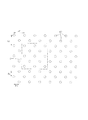
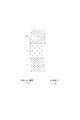
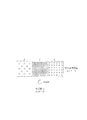
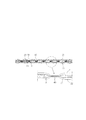
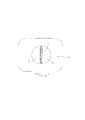
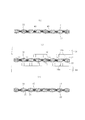
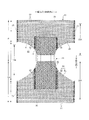
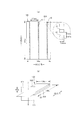
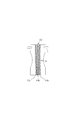
- FIG. 3 is a plan view of a main part of the exterior body.
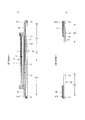
- FIG. 1 is a CC cross-sectional view of FIG. 1, and (b) is an EE cross-sectional view of FIG.
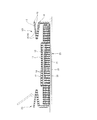
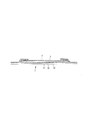
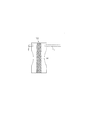
- FIG. 2 is a cross-sectional view taken along the line AA in FIG.
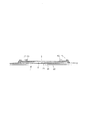
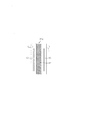
- FIG. 3 is a cross-sectional view taken along the line BB in FIG.
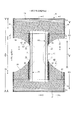
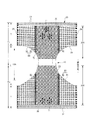
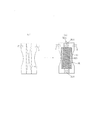
- It is a top view which shows only the principal part of the underpants type disposable diaper of a full expansion
- the absorbent article of the present invention means a product that absorbs and retains body fluids such as disposable diapers, sanitary napkins, and absorbent pads.
- the absorbent article has a stretchable part that can be stretched in at least one direction. As this one direction, in a disposable diaper, it is typically a waist direction (width direction in a product). In addition to the one direction, it is also possible to extend and contract in a direction perpendicular to this (the front-rear direction in a disposable diaper).
- the stretchable portion is formed between a first sheet layer 21 made of, for example, a non-woven fabric that does not have stretchability, and a second sheet layer 22 made of, for example, a non-woven fabric that does not have stretchability.
- the elastic film 30 that can be expanded and contracted in the one direction is laminated, and the first sheet layer 21 and the second sheet layer 22 are directly or via the elastic film 30 with a large number of intervals. 40 is joined.
- “the first sheet layer 21 and the second sheet layer 22 are not stretchable” does not mean that the first sheet layer 21 and the second sheet layer 22 are not stretched at all. It means not.
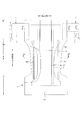
- the first sheet layer 21, the elastic film 30, and the second sheet are disposed between the anvil roll 60 having the protrusions 60 a formed in a predetermined pattern on the outer surface and the ultrasonic horn 61.
- the layer 22 is supplied, and ultrasonic melting energy is applied by the ultrasonic horn 61.
- the elastic film 30 is mainly melted to join the first sheet layer 21 and the second sheet layer 22. The joining form will be described in detail later.
- the elongation rate in the manufacturing process of the elastic film 30 (based on the length of the natural state being 100%) is, for example, that the peripheral speed of the driving anvil roll 60 is faster than the peripheral speed of the rear driving roll 62. It can be set by selecting the speed difference between the rolls.
- 63 is a guide roller.
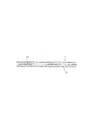
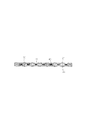
- FIG. 8 schematically shows a cross section of the stretchable sheet after joining in the stretched state.
- the stretchable sheet contracts due to the contraction force of the elastic film 30 and can be stretched when an external force is applied in one direction (left-right direction in FIG. 9). Therefore, when this stretchable sheet is used, for example, in the waist circumference direction of a disposable diaper, the waist or waist is contracted.
- an elastic sheet can be manufactured with a predetermined area, when it is desired to apply a contracting force to the entire desired area, the elastic sheet may be applied.
- it is common to fix a plurality of thread rubbers in parallel on a sheet, but this is due to deterioration of hot rubber adhesive for fixing to thread rubbers and sheets. It is inferior in terms of quality deterioration and stable productivity during production.
- the first sheet layer 21 and the second sheet layer 22 are joined by melting the elastic film 30.
- the bonding mode between the layers is not limited to these examples.
- the first sheet layer 21 and the second sheet layer 22 are joined directly, that is, without interposing an elastic film.
- the above aspects (1) to (3) are cases where the melting point of the elastic film 30 is lower than the melting points of the first sheet layer 21 and the second sheet layer 22, but the melting point of the elastic film 30 is the first sheet layer. 21 and / or higher than the melting point of the second sheet layer 22.
- the elastic film 30 side surface portion of the first sheet layer 21 and / or the second sheet layer 22 is activated or melted and joined to the elastic film 30.
- the elastic film 30 may be partly melted, and the first sheet layer 21 and / or the second sheet layer 22 may be joined by melting.
- the 1st sheet layer 21 and / or the 2nd sheet layer 22 are nonwoven fabrics, and the fiber may have a core-sheath structure. In this case, for example, only the sheath component of the fiber can be melted and contribute to the joining.
- the main feature of the present invention is that, in the region of the stretchable sheet, the joint area ratio occupied by the total area of the joints included in the unit area is different in at least one direction, so that the stretching stress is reduced. It is a difference.
- the junction area ratio is a percentage of the total area of the junctions 40, 40... Included in the unit area S in the unit area S, as shown in FIG. .
- the unit area S in this case is desirably set to a size that includes 10 or more joints (it is difficult to compare the stretching stress with a small number).
- 13 joint portions are included.
- the external shape which defines unit area S may be other shapes, such as a rectangle and a circle, besides a square.
- An example of the joint 40 is a circle shown in FIG. Of course, the shape may be an ellipse or a rectangle. In FIG.
- Lm is the arrangement interval length in the machine direction (MD direction)
- Lc is the arrangement interval length in the orthogonal direction (cross direction) orthogonal to the machine direction
- Pm is the pitch length in the machine direction
- Pc is the orthogonal direction (cross direction: CD) pitch length.
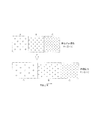
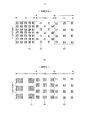
- FIG. 2 shows that the area A, B, and C have a joint area ratio of A ⁇ B ⁇ C so that the stretching stress is in the relationship of A>B> C.
- A when the pitch length Pm and the pitch length Pc are long and A is compared with the case C when the pitch length Pm and the pitch length Pc are short, a case where the pitch length Pm ⁇ Pc is long is A (when the joint area ratio is low).
- the pitch length Pm ⁇ Pc is short, the elongation ratio is larger than in C (when the joint area ratio is high).
- the stretching stress has a relationship of A>B> C.
- B is the case of the middle case.
- the extensional stress in the lateral direction of FIG. 2 is different for each region. Therefore, when the absorbent article is worn, the contraction force is different for each region, which is useful.
- FIG. 3 shows an example in which the stretching stress in the intermediate region B in the horizontal direction is made smaller than those in the regions A and A on both sides.
- This example can be used as a seat around the waist of a disposable diaper, and the intermediate region B where the absorbent body is present reduces the stretching stress, and gives sufficient stretching stress in both side regions A and A to wear the disposable diaper. This is effective for comfortably fitting a person.
- the horizontal direction on the drawing is the width direction (CD direction) of the absorbent article
- the vertical direction on the drawing is the front-rear direction (MD direction) of the absorbent article. It is an example made different in the width direction (CD direction).
- the horizontal direction on the drawing is the width direction (CD direction) of the absorbent article
- the vertical direction on the drawing is the front-back direction (MD direction) of the absorbent article. It is the example which made the up-down direction differ in the front-back direction (MD direction) of an absorbent article.
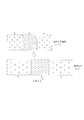
- the difference in the joint area ratio can be achieved by changing the joint area in addition to the density of the arrangement pattern.
- FIG. 6 shows an example in which a large number of small junctions are arranged in the region E and the junction area ratio is the same as that of the region D.
- the elastic film in the present invention may be stretchable in only one direction, but a two-way stretchable film that stretches in a direction perpendicular to the direction is also suitable.
- the thickness, material, strain / stress characteristics, and melting point of the elastic film can be selected as appropriate.
- the ultrasonic melting energy applied thereto, and the elongation rate of the elastic film during the production of the elastic sheet as shown in FIG.
- Through-holes 31 can be formed around the periphery.
- the nonwoven fabric exhibits air permeability. Therefore, for example, when it is used as a member around the waist of a disposable diaper, it becomes a waist sheet with good breathability.
- the reason why the ventilation through hole 31 is formed is not necessarily clear, but the elastic film 30 is melted by the ultrasonic melting energy, and the coupling portion 40 is thinned by the pressing by the projection 60 a of the anvil roll 60. . At this time, the elastic film 30 is also thinned, the peripheral portion of the joint portion 40 reaches the breaking strength, the breakage is started by the stretching stress acting on the stretched elastic film 3, shrinks to the balance point, and opens. it is conceivable that.
- FIG. 12 schematically shows an example of forming the through hole 31 in the case of a circular through hole.
- the crescent-shaped through holes 31 are formed on both sides of the connecting portion 40 in the machine direction (extension direction).
- the connecting part can be formed in a long shape in a direction (cross direction: CD direction) orthogonal to the machine direction (extension direction).
- cross direction CD direction
- extension direction the machine direction
- the through holes 31 are formed in all the coupling portions. If it is required to reliably form the through hole 31 or make a large opening, the method shown in FIG. 14 can be adopted. That is, as shown in FIG. 14B, the stretchable sheet in which the coupling portion 40 is formed is passed between a pair of rolls 64 having protrusions or protrusions 64a, and between the adjacent protrusions 64a and 64a of one roll 64.
- the through-hole 31 can be formed by biting the protrusion 64a of the other roll 64 and applying a deformation force to the stretchable sheet.
- This pants-type disposable diaper (hereinafter also simply referred to as a diaper) has an exterior body 20 that forms a front body Fr and a back body Ba, and an interior body 10 that is fixed to and integrated with the inner surface of the exterior body 20.
- the interior body 10 is formed by interposing an absorbent body 13 between a liquid-permeable top sheet 11 and a liquid-impermeable back sheet 12.
- a joining means such as a hot melt adhesive (shaded portion 10B in FIG. 21), the interior body 10 and the exterior body 20 are joined.
- a pants-type disposable diaper having a waist opening and a pair of left and right leg openings is formed.
- the interior body 10 has an absorbent body 13 interposed between a liquid-permeable top sheet 11 made of nonwoven fabric or the like and a liquid-impermeable back side sheet 12 made of polyethylene or the like.
- the excretory fluid that has permeated through the top sheet 11 is absorbed and retained.
- the planar shape of the interior body 10 is not particularly limited, but is generally rectangular as illustrated.
- a porous or non-porous nonwoven fabric or a porous plastic sheet is preferably used as the liquid-permeable surface sheet 11 covering the surface side (skin contact surface side) of the absorbent body 13.
- the material fibers constituting the nonwoven fabric can be made of synthetic fibers such as polyethylene or polypropylene, synthetic fibers such as polyester or polyamide, recycled fibers such as rayon or cupra, natural fibers such as cotton, and the spunlace method.
- a nonwoven fabric obtained by an appropriate processing method such as a spun bond method, a thermal bond method, a melt blown method, or a needle punch method can be used. Among these processing methods, the spunlace method is excellent in terms of flexibility and drapeability, and the thermal bond method is excellent in terms of being bulky and soft.
- liquid permeable surface sheet 11 When a large number of through holes are formed in the liquid permeable surface sheet 11, urine and the like are quickly absorbed, and the dry touch property is excellent.
- the liquid permeable top sheet 11 is wound around the side edge of the absorber 13 and extends to the back side of the absorber 13.
- liquid-impermeable back sheet 12 that covers the back surface side (non-skin contact surface side) of the absorbent body 13 a liquid-impermeable plastic sheet such as polyethylene or polypropylene is used. Those having wettability are preferably used.
- This water-impervious and moisture-permeable sheet is a microporous sheet obtained by, for example, melt-kneading an inorganic filler in an olefin resin such as polyethylene or polypropylene to form a sheet, and then stretching in a uniaxial or biaxial direction. is there.
- Absorbent body 13 is a known one, for example, a pulp fiber stack, a filament aggregate such as cellulose acetate, or a non-woven fabric, mixed with a superabsorbent polymer as necessary, fixed, etc. Can be used.
- the absorbent body 13 can be packaged with a wrapping sheet 14 having liquid permeability and liquid retention, such as crepe paper, if necessary, for holding the shape and polymer.
- the shape of the absorber 13 is formed in a substantially hourglass shape having a narrowed portion 13N having a narrower width than the front and rear sides in the crotch portion, but may be an appropriate shape such as a rectangular shape.
- the size of the constricted portion 13N can be determined as appropriate, but the length in the front-rear direction of the constricted portion 13N can be about 20 to 50% of the total length of the diaper, and the width of the narrowest portion is 40% of the total width of the absorber 13. It can be about 60%.
- the planar shape of the interior body 10 is substantially rectangular, the remainder of the interior body 10 that does not have the absorber 13 in the portion corresponding to the constricted portion 13N of the absorber 13 A part is formed.
- the three-dimensional gather BS that fits around the legs is formed on both sides of the interior body 10.
- the three-dimensional gather BS includes a fixed portion fixed to a side portion on the back surface of the interior body, and a side portion on the surface of the interior body from the fixed portion to the side of the interior body.
- the body part that extends to the front, the front and rear ends of the body part in a lying state, and the lying part that is fixed to the side of the surface of the interior body, and the freedom part that is formed with this lying part being unfixed
- the part is formed of a gathered nonwoven fabric 15 that is turned into a double sheet by folding.
- an elongated gather elastic member 16 is disposed at the free end of the free portion.
- the gather elastic member 16 is for forming a three-dimensional gather BS by raising a free part by elastic expansion and contraction force as shown by a two-dot chain line in FIG. 19 in the product state.
- the liquid-impermeable back sheet 12 is folded back on the both sides in the width direction of the absorber 13 together with the liquid-permeable surface sheet 11.
- the liquid-impermeable back side sheet 12 it is desirable to use an opaque sheet so that brown such as defecation and urine does not appear.
- a plastic film and a pigment and filler such as calcium carbonate, titanium oxide, zinc oxide, white carbon, clay, talc and barium sulfate are preferably used.
- the gather elastic member 16 materials such as styrene rubber, olefin rubber, urethane rubber, ester rubber, polyurethane, polyethylene, polystyrene, styrene butadiene, silicon, polyester and the like that are usually used can be used. In order to make it difficult to see from the outside, it is preferable that the thickness is 925 dtex or less, the tension is 150 to 350%, and the interval is 7.0 mm or less.
- the gathered elastic member 16 may be a tape-like member having a certain width in addition to the thread-like shape shown in the figure.
- the material fiber constituting the gathered nonwoven fabric 15 is made of synthetic fibers such as polyethylene or polypropylene, synthetic fibers such as polyester or amide, recycled fibers such as rayon or cupra, and cotton.
- Non-woven fabric obtained by an appropriate processing method such as a spunbond method, a thermal bond method, a melt blown method, a needle punch method, etc. can be used. It is preferable to use a nonwoven fabric that suppresses the basis weight and has excellent air permeability.
- the gathered nonwoven fabric 15 in order to prevent the transmission of urine and the like, to prevent fogging, and to enhance the touch to the skin (dry feeling), silicon-based, paraffin metal-based, alkylchromic croid-based water repellent, etc. It is desirable to use a water-repellent non-woven fabric coated with.
- the exterior body 20 is provided with an elastic film 30 and an elongated elastic member 24 along the width direction between the first sheet layer 21 and the second sheet layer 22, Elasticity in the width direction is given.
- the planar shape of the exterior body 20 has a pseudo hourglass shape as a whole due to concave leg-around lines 29 formed to form leg openings on both sides of the middle.
- the exterior body 20 may be divided into two parts in the front-rear direction so that both are separated in the front-rear direction at the crotch part.
- the waist part is elastic to the waist part 23 in the waist area defined as the longitudinal range of the side seal part 26 where the front body Fr and the back body Ba are joined.
- a member 24 is provided.
- the waist elastic member 24 in the illustrated form is an elongated elastic member such as a plurality of rubber bands arranged at intervals in the vertical direction, and gives a stretching force so as to tighten around the body torso.
- the waist elastic members 24 are not arranged substantially as a single bundle with a close spacing, but with a spacing of about 3 to 8 mm so as to form a predetermined stretch zone, preferably three or more, preferably Five or more are arranged.
- the elongation rate at the time of fixing the waist elastic member 24 can be determined as appropriate, but can be about 230 to 320% for a normal adult.
- the waist elastic member 24 one or a plurality of belt-like elastic members can be used.
- the rubber elastic member 24 is made of rubber thread. However, for example, a tape-like elastic member may be used. Alternatively, an elastic film described later may be extended to the waist 23. .
- the waist elastic member 24 in the illustrated form is sandwiched between folded portions 20C formed by folding the constituent material of the second sheet layer 22 to the inner surface side at the waist opening edge. You may pinch
- the constituent material of the 1st sheet layer 21 and the 2nd sheet layer 22 can be used without a limitation especially if it is a sheet form, it is preferable to use a nonwoven fabric from a viewpoint of air permeability and a softness
- the nonwoven fabric is not particularly limited as to what the raw fiber is.
- synthetic fibers such as olefins such as polyethylene and polypropylene, polyesters and polyamides, recycled fibers such as rayon and cupra, natural fibers such as cotton, and mixed fibers and composite fibers using two or more of them. Etc. can be illustrated.
- the nonwoven fabric may be manufactured by any processing.
- the processing method examples include known methods such as a spunlace method, a spunbond method, a thermal bond method, a melt blown method, a needle punch method, an air through method, and a point bond method.
- the basis weight is preferably about 10 to 25 g / m 2 .
- the first sheet layer 21 and the second sheet layer 22 may be a pair of layers in which a part or all of the first sheet layer 21 is folded and faced.
- the waist area T of the front body Fr, the waist area T of the back body Ba, and the intermediate area L between them in the exterior body 20 are made of the stretchable sheet described above.
- a laminated stretchable structure 20X is formed. That is, in the stretchable structure 20X of the exterior body 20, in the width direction intermediate portion including the portion overlapping the absorber 13 (a part or all of the overlapping portion may be included, and it is desirable to include substantially the entire interior body fixing portion 10B).
- a non-stretchable region 70 is provided, and portions up to the side seal portion 26 on both sides in the width direction are the stretchable regions 80. Then, as shown in FIG.
- the elastic film 30 is laminated between the first sheet layer 21 and the second sheet layer 22 over the entire stretchable region 80 and non-stretchable region 70, and the elastic film.
- the first sheet layer 21 and the second sheet layer 22 are formed by a large number of joints 40 arranged at intervals in the expansion / contraction direction and the direction orthogonal thereto (elasticity). Bonded through a through-hole 31 formed in the film 30.
- such a laminated stretchable structure 20X basically, the higher the area ratio of the joint portion 40, the smaller the portion where the first sheet layer 21 and the second sheet layer 22 are contracted by the elastic film 30, so that the elastic limit elongation is increased.
- the area ratio of the opening of the through hole 31 in the elastic film 30 also increases, and the proportion of the stretchable direction continuous portion of the elastic film 30 occupying in the direction orthogonal to the stretchable direction decreases. There is a tendency that the elastic film 30 is easily torn as the contraction force generated is reduced.
- the area ratio of the joint portion 40 is higher than that of the stretchable region 80, so that the elastic limit elongation in the stretch direction is 130% or less (preferably 120% or less, more preferably
- the elastic limit elongation in the stretchable direction is 200% or more (preferably 265 to 295%).
- “elastic limit elongation” means the elongation at the elastic limit (in other words, the state where the first sheet layer and the second sheet layer are completely expanded), and the natural length of the length at the elastic limit is 100. The percentage is expressed as%.
- the first sheet layer 21 and the second sheet layer 22 between the joints swell in a direction away from each other and intersect the stretchable direction.
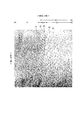
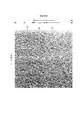
- a shrinking ridge 25 that bulges in the direction is formed. Even in a mounted state that extends to some extent in the width direction, the degree of bulge of the shrinking ridge 25 is small but remains. Note that the state of the shrinkage wrinkle 25 in the mounted state and the natural length state also appears in the sample photographs in FIGS.
- non-stretchable region 70 As can be seen from the sample photographs of FIGS. 25 to 27, a streaky portion or extremely small wrinkles are formed between the joint portions 40, but the area ratio of the joint portion 40 is extremely high. Therefore, the elasticity is substantially killed.
- FIG.16 and FIG.22 (a) shows, the edge part by the side of the non-expanding-contraction area
- region 80 is joined part 40 rather than the main expansion-contraction part 81 except the said edge part.
- the buffer stretchable part 82 has a low area ratio.
- the buffer expansion / contraction part 82 may not be provided.
- the shapes of the individual joints 40 and the through holes 31 in the natural length state are arbitrary shapes such as polygons (including linear and rounded ones) such as true circles, ellipses, and rectangles, stars, and clouds. It can be.
- the size of each joint 40 may be determined as appropriate, but if it is too large, the effect of the hardness of the joint 40 on the feel will increase, and if it is too small, the joint area will be small and the materials will not be sufficiently bonded together. Therefore, in general, the area of each joint 40 is preferably about 0.14 to 3.5 mm 2 .
- the opening area of each through-hole 31 may be equal to or greater than the joint because the joint is formed through the through-hole 31, but is preferably about 1 to 1.5 times the area of the joint.
- each joint 40 in each region are as follows in a normal case.
- Non-stretchable region 70 Area of the joint 40: 0.14 to 3.5 mm 2 (particularly 0.25 to 1.0 mm 2 ) Area ratio of the joint 40: 16 to 45% (especially 25 to 45%)
- Mainn stretchable part 81 Area of the joint 40: 0.14 to 3.5 mm 2 (particularly 0.14 to 1.0 mm 2 ) Area ratio of the joint 40: 1.8 to 19.1% (particularly 1.8 to 10.6%)
- Buffer expansion / contraction part 82 Area of the joint 40: 0.14 to 3.5 mm 2 (particularly 0.25 to 1.0 mm 2 ) Area ratio of the joint 40: 8 to 22.5% (especially 12.5 to 22.5%)
- the area of the joint portion 40 can be the same in two or more of the non-stretchable region 70, the main stretchable portion 81 and the buffer stretchable portion 82, and can be different in all locations.
- the number of the joint portions 40 per unit area may be the same at two or more of the non-stretchable region 70, the main stretchable portion 81, and the buffer stretchable portion 82, and may be different at all locations.
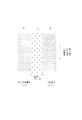
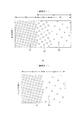
- the plane arrangement of the joints 40 and the through holes 31 can be determined as appropriate, but a plane arrangement that repeats regularly is preferable, and an oblique lattice shape as shown in FIG. 28 (a) or as shown in FIG. 28 (b).
- Hexagonal lattice shape (these are also called staggered shapes), a square lattice shape as shown in FIG. 28 (c), a rectangular lattice shape as shown in FIG. 28 (d), and a parallel shape as shown in FIG. 28 (e).
- Body lattice in the form shown in the figure, two groups are provided so that a large number of groups of parallel diagonal rows intersect each other), etc.
- the group of joints 40 (in which these are inclined at an angle of less than 90 degrees with respect to the expansion / contraction direction)
- group of joints 40 (group unit arrangement may be regular or irregular, and may be a pattern, a character shape, etc.) shall be regularly repeated. You can also.
- the arrangement form of the joint portion 40 and the through hole 31 may be the same or different in the main stretchable portion 81, the buffer stretchable portion 82, and the non-stretchable region 70.
- a non-stretchable region 70 in which the joint portion 40 is arranged in a display 71 shape or the like can be provided.
- a buffer expansion-contraction part can be provided in the expansion / contraction area
- the display 71 may be a display known in the field of absorbent articles, for example, a decorative pattern (including a one-point picture or character), a function display such as a method of use or assistance, and a size, or a manufacturer or It can be a mark display of product name, characteristic function, etc.
- a flower pattern display 71 which is a plant pattern is added, but it is needless to say that various patterns such as an abstract pattern, an animal pattern, and a natural phenomenon pattern can be used.
- the elastic film 30 is not particularly limited, and can be used without particular limitation as long as it is a resin film having its own elasticity.
- a styrene-based elastomer, an olefin-based elastomer, a polyester-based elastomer, a polyamide-based elastomer, and a polyurethane-based film can be used.
- a product obtained by processing one or two or more blends of thermoplastic elastomers such as elastomers into a film by extrusion molding such as a T-die method or an inflation method can be used.
- the elastic film 30 the thing in which many holes and slits were formed for ventilation other than a non-porous thing can also be used.
- the tensile strength in the stretching direction is 8 to 25 N / 35 mm
- the tensile strength in the direction perpendicular to the stretching direction is 5 to 20 N / 35 mm
- the tensile elongation in the stretching direction is 450 to 1050%
- the direction perpendicular to the stretching direction is preferable.
- the tensile strength and tensile elongation were determined according to JIS K7127 except that a tensile tester (for example, AOUTGRAPHAGS-G100N manufactured by SHIMADZU) was used and the test piece was a rectangular shape having a width of 35 mm and a length of 80 mm.
- a tensile tester for example, AOUTGRAPHAGS-G100N manufactured by SHIMADZU
- the thickness of the elastic film 30 is not particularly limited, but is preferably about 20 to 40 ⁇ m.
- the basis weight of the elastic film 30 is not particularly limited, but is preferably about 30 to 45 g / m 2 , particularly preferably about 30 to 35 g / m 2 .
- the melting point of each constituent member of the stretchable sheet according to the present invention can be appropriately selected.
- the elastic film has a melting point of 95 to 125 ° C., more preferably 100 to 120 ° C.
- the melting point of the sheet layer is more than 125 ° C. to 160 ° C., more preferably 130 to 160 ° C.
- the melting point of the second sheet layer is more than 125 ° C. to 160 ° C., more preferably 130 to 160 ° C.
- the ultrasonic welding temperature can be changed by selecting ultrasonic energy from the horn.
- the ultrasonic energy from this horn cannot be directly converted into temperature, but when measured with a non-contact type thermometer, the temperature on the horn side is 40 ° C.
- an optimal nonwoven fabric is a spunbond nonwoven fabric.
- the illustrated example is an example in which the laminated stretchable structure 20X is applied to a stretchable structure other than the waist portion 23 of the exterior body 20.
- the laminated stretchable structure 20X may be applied including the waist portion 23, or the waist region T and the back body Ba of the front body Fr.
- Appropriate changes are possible, such as a configuration in which the laminated stretchable structure 20 ⁇ / b> X is not provided in the intermediate region L with respect to the waistline region T.
- the stretchable structure 20X described above is not limited to pants-type disposable diapers, but also to other stretchable parts such as three-dimensional gathers, flat gathers, etc. that are widely used around the waist of a tape-type disposable diaper, fastening tape, and absorbent articles in general.
- this embodiment has a non-stretchable region, it is also possible to use a configuration in which the entire laminated stretchable structure is a stretchable region and does not have a non-stretchable region.
- the expansion / contraction direction is the width direction, but it is also possible to use the front-rear direction or both the width direction and the front-rear direction.
- the front presser sheet 50 extends over the entire width direction from the inner surface of the folded portion 20C of the waist side end portion to the position overlapping the front end portion of the interior body 10 in the inner surface of the front body Fr.
- the rear pressing sheet 60 extends across the entire width direction from the inner surface of the folded portion 20C at the waist side end portion to the position overlapping the rear end portion of the interior body 10 in the rear body Ba inner surface.
- the folded portion 20C formed by folding the exterior body 20 on the inner surface of the diaper can be extended to a portion overlapping the interior body 10 to form a portion equivalent to the above-described pressing sheets 50 and 60.
- a spunbond nonwoven fabric having a basis weight of 17 g / m 2 made of PE / PP composite fiber (core: polypropylene (melting point: 165 ° C.), sheath: polyethylene (melting point: 130 ° C.)), An elastic film having a basis weight of 35 g / m 2 , a thickness of 35 ⁇ m, and a melting point of 110 to 120 ° C. was used.
- the elastic film is sandwiched between the first sheet layer and the second sheet layer so that the MD direction is aligned in a natural length state (regardless of whether it is a natural length or a stretched state in relative comparison of peel strength),
- a sonic seal device (“Haru SUH-30" manufactured by Suzuki)
- a rectangular joint 40 having a long side along the MD direction (short side 1.0 mm, long side) 1.5 mm) is formed in a rectangular lattice shape with a 1 mm interval in the CD direction perpendicular to the MD direction and a 17 mm interval in the MD direction, and a sample with an elastic film having a CD direction length of 100y80 mm and a MD direction length of 100x is 50 mm.
- the ultrasonic seal was pressed for about 3 seconds and was bonded so that the same person had the same pressure.
- the MD direction of the nonwoven fabric is the direction of fiber orientation of the nonwoven fabric (the direction along which the nonwoven fabric fibers are aligned).
- a measurement method according to the fiber orientation test method based on zero distance tensile strength of the TAPPI standard method T481 It can be discriminated by a simple measuring method for determining the fiber orientation direction from the tensile strength ratio in the direction and the width direction.
- a sample without an elastic film was produced in the same manner as in the example except that the elastic film was removed and a two-layer structure was used (comparative example).
- Pants type disposable diapers shown in FIGS. 15 to 21 Examples having an exterior body using an elastic film
- three types of commercially available pants type disposable diapers using thread rubber for the exterior body Comparative Examples 1 to 3
- Two types of underwear were prepared, and the fitting property in the wearing state was confirmed by measuring the contact pressure of the exterior body.
- the specifications of each diaper are as follows.
- First and second sheet layers PE / PP composite fiber (core: polypropylene (melting point 165 ° C.), sheath: polyethylene (melting point 130 ° C.)) as a raw material, a spunbonded nonwoven fabric having a basis weight of 17 g / m 2 .
- Elastic film basis weight 35 g / m 2 , thickness: 35 ⁇ m, melting point: 110 to 120 ° C.
- Non-stretchable area 70 Area of joint 40: 0.19 mm 2 Area ratio of the joint 40: 7.0% Elastic elongation limit: 110%
- Comparative Example 1 a rubber thread having a thickness of 310 dtex is attached in the front-rear direction at an interval of 6 mm in the waistline region, and the elastic limit elongation in the width direction of the stretchable region having the rubber thread is 220%. Is.
- Comparative Example 2 In Comparative Example 2, a thread rubber having a thickness of 620 dtex is attached to the waistline region with an interval of 9 mm in the front-rear direction, and the elastic limit elongation in the width direction of the stretchable region having the rubber thread is 200%. Is.
- Comparative Example 3 (Comparative Example 3)
- thread rubber (not measurable because the thickness is thin and weak) is attached to the waist area with a space of 1 mm in the front-rear direction, and the elastic limit in the width direction of the stretchable area having this rubber thread The elongation is 160%.
- a cylindrical body (having a height higher than the region around the trunk to be tested) is prepared using a foamed PVC sheet having a thickness of 2 mm. (2) The cylindrical body is inserted and installed in the waist portion from the waist opening so that the circumferential direction of the cylindrical body and the waist direction coincide with each other. (3) Using a contact pressure measuring instrument (AMI3037-2) manufactured by AIM Techno Co., Ltd. and an air pack (pressure sensor) with a diameter of 20 mm, the air pack is placed between the region around the body to be measured and the outer peripheral surface of the cylindrical body. The sandwich was measured and the pressure (kPa) was measured.
- AMI3037-2 manufactured by AIM Techno Co., Ltd.
- an air pack pressure sensor
- the measurement site of the pants-type disposable diaper is the region around the side edge of the interior body and below the waist portion in the region around the waist of the front body, and in the embodiment, the air pack is positioned at the main stretchable portion 81.
- the air pack is positioned at the main stretchable portion 81.
- three or more rubber threads overlap the air pack.
- the measurement site of the underwear was the same as the measurement position of the pants-type disposable diaper. (4) Assuming an adult's waist, the circumference of the cylinder was changed from 60 cm to 95 cm in increments of 5 cm, and the above measurements (1) to (3) were repeated.
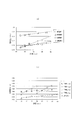
- FIG. 51 (a) shows the measurement results of the contact pressure in Examples and Comparative Examples 1 to 3.
- the measurement results of contact pressure of underwear 1 (M), underwear 1 (L), underwear 2 (M), underwear 2 (L), and Comparative Example 1 are shown in FIG.
- the pants type disposable diapers of Comparative Examples 1 to 3 are different from the underwear, whereas the pants type disposable diapers of the examples are different. The fit was found to be close to that of underwear.
- the contact pressure in the entire range of the circumferential length of 60 to 95 cm is preferably 0.3 to 1.2 kPa, and particularly preferably 0.4 to 0.8 kPa. It was also found out.
- the contact pressure can be adjusted by changing the type of elastic film 30, elastic limit elongation, joint area ratio, and the like.
- the stretchable elastic sheet can be applied to a tape-type disposable diaper, and can be used particularly as a means for fitting around a leg of a wearer.
- the tape-type disposable diaper TD1 having tapes on both sides on the back side extends in the front-rear direction around the crotch area on both sides of the product, and expands and contracts in the front-rear direction.
- the elastic part 83 to be formed can be formed. That is, the stretchable sheet 83 is manufactured, and the stretchable portion 83 is formed by partially making the joint area ratio smaller than the joint area ratio of other portions.
- the expansion / contraction stress in the front-rear direction is different between the width directions by making the joint area ratio different between the joint area ratio of the expansion / contraction part 83 along the front-rear direction and the width direction both side areas.
- the configuration is different.
- the expansion-contraction part 83 expands-contracts in the front-back direction, since the whole expansion-contraction part 83 contact
- the area ratio of the joint portion can be increased so that it does not substantially stretch.
- a certain degree of stretchability can be exhibited without excessively increasing the joint area ratio.
- the stretchable part 83 can be stretched in the front-rear direction and can be stretched in the width direction to improve the fit.
- FIGS. 31 to 34 examples of FIGS. 31 to 34 can be given.
- an absorbent body 3 is interposed between the inner surface of the laminated back sheet 1 forming the back surface and the liquid-permeable top sheet 2.
- the liquid-impermeable laminated back sheet 1 extends outward from the periphery of the absorbent body 3 and blocks movement of excrement absorbed by the absorbent body 3 to the back surface side.
- a sheet having moisture permeability can be used without impairing water shielding from the viewpoint of preventing stuffiness.
- the entire back surface of the laminated back sheet 1 is covered with a nonwoven fabric layer (the first sheet layer 21 or the second sheet layer 22 described above), and both sheets 1 and 2 are covered.
- the outer peripheral edge of the diaper extends to the outer peripheral edge of the diaper.
- a spunbonded nonwoven fabric is suitable as the nonwoven fabric layer.
- top sheet As the top sheet 2, a perforated or non-porous nonwoven fabric or a perforated plastic sheet is used.
- material fiber constituting the nonwoven fabric synthetic fibers such as polyethylene or polypropylene, synthetic fibers such as polyester and amide, recycled fibers such as rayon and cupra, and natural fibers such as cotton can be used.
- processing method of a nonwoven fabric well-known methods, such as the spunlace method, the spun bond method, the SMS method, the thermal bond method, the melt blown method, the needle punch method, the air through method, the point bond method, can be used.
- the fiber basis weight of the nonwoven fabric used for the liquid-permeable top sheet 2 is preferably 15 to 30 g / m 2 , and the thickness is preferably 0.05 to 1 mm.
- the top sheet 2 extends outward from the periphery of the absorber 3, and a portion extending outward from the side edge of the absorber 3 is fixed to the laminated back sheet 1 with, for example, a hot melt adhesive.
- the dot pattern in a figure represents the adhering part.
- the leg gathering three-dimensional gather sheets 4 and 4 can use various non-woven fabrics (preferably spunbond non-woven fabrics), plastic films similar to those used for back sheets, or these stretchable sheets. From the viewpoint of the touch, a nonwoven fabric subjected to a water repellent treatment is preferable.
- the projecting portion on the center side in the width direction of the three-dimensional gather sheet around the legs is fixed to the inner surface of the article (in the illustrated form, the top sheet 2 surface) by means such as hot melt adhesive at the both ends in the front-rear direction, and is used as a lying portion.
- the intermediate part in the front-rear direction between them is a non-fixed free part, and the end part of this free part (end part on the center side in the width direction in the unfolded state) is elongated such as rubber thread.
- the elastic elastic member 4G is fixed with a hot-melt adhesive or the like in a state of extending along the front-rear direction.
- a plurality of the elongated elastic elastic members 4G are provided with a predetermined interval, but one may be used. As shown in FIG.
- this free portion is formed by a three-dimensional gathering around the legs that stands on the use surface of the diaper (the surface of the top sheet 2 in the illustrated embodiment). Constitute.
- Fastening tapes T that protrude from the side edges are attached to the side flaps of the back part B, and a front target tape 6 is attached to the waist part surface of the abdomen part F along the width direction.
- the fastening tape T on both sides is turned from each side of the waist to the abdomen outer surface and fastened to the front target tape 6 via the hook material 5.
- the front target tape 6 can be omitted.
- the fastening tape T is directly hooked and fixed to the nonwoven fabric on the outer surface of the diaper.
- Reference numeral 7 denotes a dividing perforation.
- the constituent material of the first sheet layer 21 and the second sheet layer 22 can be used without particular limitation as long as it is a sheet, but it is preferable to use a nonwoven fabric from the viewpoint of air permeability and flexibility.
- the nonwoven fabric is not particularly limited as to what the raw fiber is.
- synthetic fibers such as olefins such as polyethylene and polypropylene, polyesters and polyamides, recycled fibers such as rayon and cupra, natural fibers such as cotton, and mixed fibers and composite fibers using two or more of them. Etc. can be illustrated.
- the nonwoven fabric may be manufactured by any processing.
- the processing method examples include known methods such as a spunlace method, a spunbond method, a thermal bond method, a melt blown method, a needle punch method, an air through method, and a point bond method.
- the basis weight is preferably about 10 to 25 g / m 2 .
- each joint part 40 and the through-hole 31 is arbitrary, such as a perfect circle, an ellipse, polygons, such as a rectangle (including a linear or rounded thing), a star shape, a cloud shape, etc. It can be made into the shape.
- the size of each joint 40 may be determined as appropriate, but if it is too large, the effect of the hardness of the joint 40 on the feel will increase, and if it is too small, the joint area will be small and the materials will not be sufficiently bonded together. Therefore, in general, the area of each joint 40 is preferably about 0.14 to 3.5 mm 2 .
- the opening area of each through-hole 31 may be equal to or greater than the joint because the joint is formed through the through-hole 31, but is preferably about 1 to 1.5 times the area of the joint.
- tape-type disposable diaper a type in which the front body is wrapped with one long tape Ta as shown in FIG.
- tape-type disposable diaper As the tape-type disposable diaper, as shown in FIG. 36, a so-called “straight type” having straight edges on both sides may be used.
- a pad-type disposable diaper PD that does not include a tape and is arranged as it is inside the underwear or inside the tape-type disposable diaper may be used.
- the stretchable part may be formed along the leg-cut part.
- the crotch region may be constricted toward the center, and may have an expansion / contraction portion 83A that extends in the front-rear direction along the constriction and expands and contracts in the front-rear direction.
- the formation of the expansion / contraction portion of the present invention is easy to appropriately select the pattern of the projection portion of the anvil roll. Easy. If the pattern part of the stretchable part formed wider is cut around the leg, the stretchable part 83A can be formed up to the edge around the leg, without forming a flap necessary for manufacturing when using conventional rubber thread. Good.
- the expansion and contraction stress can be made different between the front and rear in the leg elastic part 83B. That is, it is preferable to increase the stretching stress at the middle part in the front-rear direction of the leg-surrounding stretchable part 83B and to reduce the stretching stress at the front and back. With this configuration, it is possible to prevent the disposable diaper from being easily rounded before and after.
- the stretching stress can be varied in the width direction in the leg-surrounding stretchable part 83C.
- This brings about an advantage that fitting according to the wearer's body shape is possible. That is, when the expansion / contraction stress in the width direction outward of the leg-hole expansion / contraction part 83C is increased and the expansion / contraction stress in the width direction is decreased, the outer shape of the diaper becomes an arc shape along the body shape. Rise. On the other hand, if the expansion / contraction stress in the width direction outward of the leg elastic part 83C is decreased and the expansion / contraction stress in the width direction is increased, the tightening force in the crotch part is increased for a wearer with a thick thigh. Increases fit.
- an absorbent article for example, a tape-type disposable diaper, which can be stretched at least in the front-rear direction and includes an exterior sheet having a stretchable portion at least in the center region in the width direction.
- seat which has the expansion-contraction part 84 in the width direction center area
- the expansion / contraction ratio differs between the front / rear part 84A and the intermediate part 84B, that is, the front / rear part 84A is difficult to expand (for example, the expansion ratio is The intermediate portion 84B can be easily stretched. In this case, the wearer or the caregiver has good wearability because the front and rear regions do not extend excessively and there is resistance to elongation.
- the stretchable portions 84A and the intermediate portions 84B have different stretch rates, and the widthwise lengths of the stretchable front and back portions 84A are easily stretched. It can be larger than the width of 84B.
- the expansion / contraction rate can be made different between the width direction outer portion 84a and the center portion 84b among the expansion / contraction portions 84 in the width direction central region.
- the area ratio of the joint portion is such that the central portion 84b> the outer portion 84a> both side portions, a cross-sectional bay shape along the wearer's surface is obtained, and the fitting property is high.
- the disposable diaper TD2 may be of a so-called “fundoshi” type. Also, as shown in FIG. 47, a so-called “straight type” may be used.
- a tape-type disposable diaper TD3 which includes an exterior sheet and an absorbent body that can be stretched at least in the front-rear direction and has an stretchable portion at least in the center region in the width direction.
- the central region in the width direction indicated by reference numeral 85 in FIG. 48 (a) is a region extending before and after a portion to which body pressure is applied at the time of wearer. Further, the absorber 13 is provided in the central region in the width direction.
- the front and back of the diaper mainly floats (separates) from the body surface, or may shift in the front-rear direction, but there is no such problem in the form in which the central region in the width direction expands and contracts, Leakage can also be prevented.
- the wrinkle along the width direction orthogonal to the front / rear direction is generated on the outer surface of the diaper due to the contraction of the expansion / contraction part 85, so that the wearer gets up from the supine state. Sometimes it also has an anti-slip effect on the buttocks.
- the absorbent body 13 when the absorbent body 13 is provided in the central region in the width direction, there is a risk of leakage if the absorbent body 13 approaches, so that the outer sheet that defines the outer shape of the product is small in the area where the absorbent body 13 is disposed. Is desirable. Therefore, as shown in FIG. 48 (b), in the stretchable portion 85 in the central region in the width direction, the stretch rate is different between the front and rear portions 85A and the intermediate portion 85B, that is, the intermediate portion 85B is difficult to stretch (for example, The elongation ratio is 200% or less), and the front and rear portions 85A can be easily elongated.
- the lateral width of the front and rear portions 85A may be short as shown in the figure or the same as the lateral width of the intermediate portion 85B. Furthermore, as shown in FIG. 49, the lateral width of the front and rear portions 85A may extend over the entire width direction.
- the expansion / contraction ratio can be made different between the width direction outer portion 85a and the center portion 85b in the expansion / contraction portion 85 in the central region in the width direction.
- the area ratio of the joint portion is such that the central portion 85b> the outer portion 85a> the both side portions, a cross-sectional bay shape along the wearer's surface is obtained, and the fitting property is high.
- the absorbent body in the tape-type disposable diaper shown in FIGS. 48 to 50 is a part that absorbs and retains body fluid, and refers to, for example, cotton-like pulp or a polymer-absorbing polymer, and has a thickness of 2 mm or more. Means part.
- Elongation rate means a value when the natural length is 100%.
- Weight is measured as follows. After the sample or test piece has been pre-dried, it is left in a test room or apparatus in a standard state (test location is temperature 20 ⁇ 5 ° C., relative humidity 65% or less) to obtain a constant weight. Pre-drying refers to making a sample or test piece constant in an environment where the relative humidity is 10 to 25% and the temperature does not exceed 50 ° C. In addition, it is not necessary to perform preliminary drying about the fiber whose official moisture content is 0.0%.
- a sample with a size of 200 mm ⁇ 250 mm ( ⁇ 2 mm) is cut out from the test piece in a constant weight state using a rice-basis plate (200 mm ⁇ 250 mm, ⁇ 2 mm). Measure the weight of the sample, multiply it by 20, calculate the weight per square meter, and use it as the basis weight. “Thickness” is automatically measured using an automatic thickness measuring instrument (KES-G5 handy compression measurement program) under the conditions of load: 10 gf / cm 2 and pressure area: 2 cm 2 . ⁇ If there is no description about the environmental conditions in the test and measurement, the test and measurement shall be performed in a test room or equipment in a standard state (test location is temperature 20 ⁇ 5 ° C, relative humidity 65% or less). .
- the present invention can be used for a wide variety of absorbent articles having an elastic structure, such as a pants-type disposable diaper as in the above example, various disposable diapers such as a tape type and a pad type, and sanitary napkins.
- the stretchable sheet of the present invention can also be applied to auxiliary materials such as tape-type disposable diaper tape.
Landscapes
- Engineering & Computer Science (AREA)
- Mechanical Engineering (AREA)
- Health & Medical Sciences (AREA)
- Biomedical Technology (AREA)
- Epidemiology (AREA)
- Textile Engineering (AREA)
- Heart & Thoracic Surgery (AREA)
- Vascular Medicine (AREA)
- Life Sciences & Earth Sciences (AREA)
- Animal Behavior & Ethology (AREA)
- General Health & Medical Sciences (AREA)
- Public Health (AREA)
- Veterinary Medicine (AREA)
- Toxicology (AREA)
- Absorbent Articles And Supports Therefor (AREA)
Abstract
L'invention concerne un article absorbant comprenant une feuille élastique ayant des sections élastiques, la contrainte d'étirage différant selon l'emplacement sur la feuille élastique. L'article absorbant est pourvu d'une feuille élastique, la feuille élastique ayant un film élastique (30), qui est capable de s'étirer au moins dans la direction longitudinale, stratifié entre une première couche de feuille (21) qui ne s'étire pas et une seconde couche de feuille (22), et la première couche de feuille (21) et la seconde couche de feuille (22) sont reliées directement ou avec le film élastique (30) entre elles par l'intermédiaire d'un certain nombre de jointures (40) qui sont espacées à des intervalles ; la feuille élastique se contracte en raison de la force de contraction du film élastique (30), et peut être étirée par application d'une force externe dans la direction longitudinale ; et la contrainte d'étirage diffère dans les régions de la feuille élastique en résultat de différences, dans une direction, des rapports d'aire de jointure qui représentent la zone totale occupée par les jointures (40) contenues dans une aire unitaire.
Applications Claiming Priority (20)
| Application Number | Priority Date | Filing Date | Title |
|---|---|---|---|
| JP2015017498A JP5980355B2 (ja) | 2015-01-30 | 2015-01-30 | 吸収性物品の伸縮構造、及びこれを用いたパンツタイプ使い捨ておむつ |
| JP2015-017498 | 2015-01-30 | ||
| JP2015067324A JP5964477B1 (ja) | 2015-03-27 | 2015-03-27 | 吸収性物品 |
| JP2015-067324 | 2015-03-27 | ||
| JP2015070294A JP5918876B1 (ja) | 2015-03-30 | 2015-03-30 | パンツタイプ使い捨ておむつ |
| JP2015-068068 | 2015-03-30 | ||
| JP2015070295A JP6709550B2 (ja) | 2015-03-30 | 2015-03-30 | 吸収性物品及びその製造方法 |
| JP2015068068A JP5967735B1 (ja) | 2015-03-30 | 2015-03-30 | パンツタイプ使い捨ておむつ |
| JP2015-070295 | 2015-03-30 | ||
| JP2015-070294 | 2015-03-30 | ||
| JP2015-071785 | 2015-03-31 | ||
| JP2015071785A JP5967736B1 (ja) | 2015-03-31 | 2015-03-31 | 吸収性物品 |
| JP2015195464A JP6044810B1 (ja) | 2015-09-30 | 2015-09-30 | 伸縮部を有する吸収性物品 |
| JP2015-195463 | 2015-09-30 | ||
| JP2015195463 | 2015-09-30 | ||
| JP2015-195464 | 2015-09-30 | ||
| JP2015-220312 | 2015-11-10 | ||
| JP2015220312A JP6288564B2 (ja) | 2015-11-10 | 2015-11-10 | 吸収性物品及びその製造方法 |
| JP2015-229999 | 2015-11-25 | ||
| JP2015229999A JP6099164B1 (ja) | 2015-09-30 | 2015-11-25 | 使い捨ておむつ及び吸収性物品 |
Publications (1)
| Publication Number | Publication Date |
|---|---|
| WO2016121978A1 true WO2016121978A1 (fr) | 2016-08-04 |
Family
ID=56543580
Family Applications (1)
| Application Number | Title | Priority Date | Filing Date |
|---|---|---|---|
| PCT/JP2016/052808 Ceased WO2016121978A1 (fr) | 2015-01-30 | 2016-01-29 | Article absorbant et procédé de production associé |
Country Status (1)
| Country | Link |
|---|---|
| WO (1) | WO2016121978A1 (fr) |
Cited By (4)
| Publication number | Priority date | Publication date | Assignee | Title |
|---|---|---|---|---|
| CN110831557A (zh) * | 2017-09-27 | 2020-02-21 | 大王制纸株式会社 | 一次性穿着物品 |
| CN113692266A (zh) * | 2019-04-15 | 2021-11-23 | 株式会社瑞光 | 穿着物品的制造方法、穿着物品以及穿着物品的制造装置 |
| CN115802994A (zh) * | 2020-08-11 | 2023-03-14 | 大王制纸株式会社 | 一次性穿着物品 |
| EP3689311B1 (fr) | 2017-09-27 | 2023-11-08 | Daio Paper Corporation | Élément élastique, article vestimentaire jetable utilisant cet élément élastique, et procédé de production d'élément élastique |
Citations (7)
| Publication number | Priority date | Publication date | Assignee | Title |
|---|---|---|---|---|
| JPH05228177A (ja) * | 1992-02-24 | 1993-09-07 | Nippon Kiyuushiyuutai Gijutsu Kenkyusho:Kk | 新規な弾性複合体を伸縮部に備えたパンツ状生理用品 |
| JP2004000465A (ja) * | 2002-03-22 | 2004-01-08 | Kao Corp | 吸収性物品 |
| JP2004532758A (ja) * | 2001-06-21 | 2004-10-28 | ザ プロクター アンド ギャンブル カンパニー | 弾性のある積層ウェブ |
| WO2008081662A1 (fr) * | 2006-12-28 | 2008-07-10 | Kao Corporation | Feuille étirable et procédé de production de feuille étirable |
| JP4508885B2 (ja) * | 2005-01-20 | 2010-07-21 | 花王株式会社 | 吸収性物品 |
| JP4934835B2 (ja) * | 2007-04-10 | 2012-05-23 | 株式会社瑞光 | 積層伸縮シートの製造方法 |
| JP2014520589A (ja) * | 2011-06-30 | 2014-08-25 | エスセーアー・ハイジーン・プロダクツ・アーベー | 弾性積層体を形成する方法 |
-
2016
- 2016-01-29 WO PCT/JP2016/052808 patent/WO2016121978A1/fr not_active Ceased
Patent Citations (7)
| Publication number | Priority date | Publication date | Assignee | Title |
|---|---|---|---|---|
| JPH05228177A (ja) * | 1992-02-24 | 1993-09-07 | Nippon Kiyuushiyuutai Gijutsu Kenkyusho:Kk | 新規な弾性複合体を伸縮部に備えたパンツ状生理用品 |
| JP2004532758A (ja) * | 2001-06-21 | 2004-10-28 | ザ プロクター アンド ギャンブル カンパニー | 弾性のある積層ウェブ |
| JP2004000465A (ja) * | 2002-03-22 | 2004-01-08 | Kao Corp | 吸収性物品 |
| JP4508885B2 (ja) * | 2005-01-20 | 2010-07-21 | 花王株式会社 | 吸収性物品 |
| WO2008081662A1 (fr) * | 2006-12-28 | 2008-07-10 | Kao Corporation | Feuille étirable et procédé de production de feuille étirable |
| JP4934835B2 (ja) * | 2007-04-10 | 2012-05-23 | 株式会社瑞光 | 積層伸縮シートの製造方法 |
| JP2014520589A (ja) * | 2011-06-30 | 2014-08-25 | エスセーアー・ハイジーン・プロダクツ・アーベー | 弾性積層体を形成する方法 |
Cited By (7)
| Publication number | Priority date | Publication date | Assignee | Title |
|---|---|---|---|---|
| CN110831557A (zh) * | 2017-09-27 | 2020-02-21 | 大王制纸株式会社 | 一次性穿着物品 |
| EP3643279A4 (fr) * | 2017-09-27 | 2021-03-10 | Daio Paper Corporation | Article vestimentaire jetable |
| CN110831557B (zh) * | 2017-09-27 | 2021-09-28 | 大王制纸株式会社 | 一次性穿着物品 |
| EP3689311B1 (fr) | 2017-09-27 | 2023-11-08 | Daio Paper Corporation | Élément élastique, article vestimentaire jetable utilisant cet élément élastique, et procédé de production d'élément élastique |
| CN113692266A (zh) * | 2019-04-15 | 2021-11-23 | 株式会社瑞光 | 穿着物品的制造方法、穿着物品以及穿着物品的制造装置 |
| CN113692266B (zh) * | 2019-04-15 | 2023-12-29 | 株式会社瑞光 | 穿着物品的制造方法、穿着物品以及穿着物品的制造装置 |
| CN115802994A (zh) * | 2020-08-11 | 2023-03-14 | 大王制纸株式会社 | 一次性穿着物品 |
Similar Documents
| Publication | Publication Date | Title |
|---|---|---|
| JP5980355B2 (ja) | 吸収性物品の伸縮構造、及びこれを用いたパンツタイプ使い捨ておむつ | |
| JP6429757B2 (ja) | 伸縮部を有する吸収性物品 | |
| WO2016121980A1 (fr) | Couche jetable | |
| JP5967736B1 (ja) | 吸収性物品 | |
| JP6049222B2 (ja) | 吸収性物品及びその製造方法 | |
| WO2016121976A1 (fr) | Article absorbant et procédé de production associé | |
| JP6052746B1 (ja) | 使い捨ておむつ | |
| JP6331199B2 (ja) | 吸収性物品 | |
| JP5980367B1 (ja) | 吸収性物品の製造方法 | |
| JP2016193199A5 (fr) | ||
| JP2016193199A (ja) | 吸収性物品 | |
| JP6049228B1 (ja) | 吸収性物品 | |
| JP2017064235A5 (fr) | ||
| JP5999790B1 (ja) | パンツタイプ使い捨ておむつ | |
| WO2016121979A1 (fr) | Article absorbant | |
| JP6447924B2 (ja) | 使い捨ておむつ | |
| WO2016121978A1 (fr) | Article absorbant et procédé de production associé | |
| JP2016189826A (ja) | 吸収性物品及びその製造方法 | |
| WO2016158751A1 (fr) | Couche-culotte d'apprentissage jetable | |
| JP2016189826A5 (fr) | ||
| JP2017064230A5 (fr) | ||
| JP2016190031A (ja) | パンツタイプ使い捨ておむつ | |
| JP6052747B1 (ja) | 伸縮領域を有する吸収性物品 | |
| JP5967735B1 (ja) | パンツタイプ使い捨ておむつ | |
| JP2016187387A (ja) | パンツタイプ使い捨ておむつ |
Legal Events
| Date | Code | Title | Description |
|---|---|---|---|
| 121 | Ep: the epo has been informed by wipo that ep was designated in this application |
Ref document number: 16743581 Country of ref document: EP Kind code of ref document: A1 |
|
| NENP | Non-entry into the national phase |
Ref country code: DE |
|
| 122 | Ep: pct application non-entry in european phase |
Ref document number: 16743581 Country of ref document: EP Kind code of ref document: A1 |