WO2017010311A1 - Élément d'imagerie à semi-conducteurs, procédé de fabrication et dispositif électronique - Google Patents
Élément d'imagerie à semi-conducteurs, procédé de fabrication et dispositif électronique Download PDFInfo
- Publication number
- WO2017010311A1 WO2017010311A1 PCT/JP2016/069592 JP2016069592W WO2017010311A1 WO 2017010311 A1 WO2017010311 A1 WO 2017010311A1 JP 2016069592 W JP2016069592 W JP 2016069592W WO 2017010311 A1 WO2017010311 A1 WO 2017010311A1
- Authority
- WO
- WIPO (PCT)
- Prior art keywords
- trench structure
- semiconductor substrate
- electrode
- solid
- state imaging
- Prior art date
- Legal status (The legal status is an assumption and is not a legal conclusion. Google has not performed a legal analysis and makes no representation as to the accuracy of the status listed.)
- Ceased
Links
Images











Classifications
-
- H—ELECTRICITY
- H10—SEMICONDUCTOR DEVICES; ELECTRIC SOLID-STATE DEVICES NOT OTHERWISE PROVIDED FOR
- H10W—GENERIC PACKAGES, INTERCONNECTIONS, CONNECTORS OR OTHER CONSTRUCTIONAL DETAILS OF DEVICES COVERED BY CLASS H10
- H10W90/00—Package configurations
-
- H—ELECTRICITY
- H04—ELECTRIC COMMUNICATION TECHNIQUE
- H04N—PICTORIAL COMMUNICATION, e.g. TELEVISION
- H04N25/00—Circuitry of solid-state image sensors [SSIS]; Control thereof
- H04N25/70—SSIS architectures; Circuits associated therewith
-
- H—ELECTRICITY
- H04—ELECTRIC COMMUNICATION TECHNIQUE
- H04N—PICTORIAL COMMUNICATION, e.g. TELEVISION
- H04N25/00—Circuitry of solid-state image sensors [SSIS]; Control thereof
- H04N25/70—SSIS architectures; Circuits associated therewith
- H04N25/76—Addressed sensors, e.g. MOS or CMOS sensors
-
- H—ELECTRICITY
- H10—SEMICONDUCTOR DEVICES; ELECTRIC SOLID-STATE DEVICES NOT OTHERWISE PROVIDED FOR
- H10F—INORGANIC SEMICONDUCTOR DEVICES SENSITIVE TO INFRARED RADIATION, LIGHT, ELECTROMAGNETIC RADIATION OF SHORTER WAVELENGTH OR CORPUSCULAR RADIATION
- H10F39/00—Integrated devices, or assemblies of multiple devices, comprising at least one element covered by group H10F30/00, e.g. radiation detectors comprising photodiode arrays
- H10F39/011—Manufacture or treatment of image sensors covered by group H10F39/12
- H10F39/014—Manufacture or treatment of image sensors covered by group H10F39/12 of CMOS image sensors
-
- H—ELECTRICITY
- H10—SEMICONDUCTOR DEVICES; ELECTRIC SOLID-STATE DEVICES NOT OTHERWISE PROVIDED FOR
- H10F—INORGANIC SEMICONDUCTOR DEVICES SENSITIVE TO INFRARED RADIATION, LIGHT, ELECTROMAGNETIC RADIATION OF SHORTER WAVELENGTH OR CORPUSCULAR RADIATION
- H10F39/00—Integrated devices, or assemblies of multiple devices, comprising at least one element covered by group H10F30/00, e.g. radiation detectors comprising photodiode arrays
- H10F39/10—Integrated devices
- H10F39/12—Image sensors
- H10F39/18—Complementary metal-oxide-semiconductor [CMOS] image sensors; Photodiode array image sensors
- H10F39/182—Colour image sensors
- H10F39/1825—Multicolour image sensors having stacked structure, e.g. NPN, NPNPN or multiple quantum well [MQW] structures
-
- H—ELECTRICITY
- H10—SEMICONDUCTOR DEVICES; ELECTRIC SOLID-STATE DEVICES NOT OTHERWISE PROVIDED FOR
- H10F—INORGANIC SEMICONDUCTOR DEVICES SENSITIVE TO INFRARED RADIATION, LIGHT, ELECTROMAGNETIC RADIATION OF SHORTER WAVELENGTH OR CORPUSCULAR RADIATION
- H10F39/00—Integrated devices, or assemblies of multiple devices, comprising at least one element covered by group H10F30/00, e.g. radiation detectors comprising photodiode arrays
- H10F39/10—Integrated devices
- H10F39/12—Image sensors
- H10F39/191—Photoconductor image sensors
-
- H—ELECTRICITY
- H10—SEMICONDUCTOR DEVICES; ELECTRIC SOLID-STATE DEVICES NOT OTHERWISE PROVIDED FOR
- H10F—INORGANIC SEMICONDUCTOR DEVICES SENSITIVE TO INFRARED RADIATION, LIGHT, ELECTROMAGNETIC RADIATION OF SHORTER WAVELENGTH OR CORPUSCULAR RADIATION
- H10F39/00—Integrated devices, or assemblies of multiple devices, comprising at least one element covered by group H10F30/00, e.g. radiation detectors comprising photodiode arrays
- H10F39/10—Integrated devices
- H10F39/12—Image sensors
- H10F39/199—Back-illuminated image sensors
-
- H—ELECTRICITY
- H10—SEMICONDUCTOR DEVICES; ELECTRIC SOLID-STATE DEVICES NOT OTHERWISE PROVIDED FOR
- H10F—INORGANIC SEMICONDUCTOR DEVICES SENSITIVE TO INFRARED RADIATION, LIGHT, ELECTROMAGNETIC RADIATION OF SHORTER WAVELENGTH OR CORPUSCULAR RADIATION
- H10F39/00—Integrated devices, or assemblies of multiple devices, comprising at least one element covered by group H10F30/00, e.g. radiation detectors comprising photodiode arrays
- H10F39/80—Constructional details of image sensors
- H10F39/803—Pixels having integrated switching, control, storage or amplification elements
- H10F39/8037—Pixels having integrated switching, control, storage or amplification elements the integrated elements comprising a transistor
-
- H—ELECTRICITY
- H10—SEMICONDUCTOR DEVICES; ELECTRIC SOLID-STATE DEVICES NOT OTHERWISE PROVIDED FOR
- H10F—INORGANIC SEMICONDUCTOR DEVICES SENSITIVE TO INFRARED RADIATION, LIGHT, ELECTROMAGNETIC RADIATION OF SHORTER WAVELENGTH OR CORPUSCULAR RADIATION
- H10F39/00—Integrated devices, or assemblies of multiple devices, comprising at least one element covered by group H10F30/00, e.g. radiation detectors comprising photodiode arrays
- H10F39/80—Constructional details of image sensors
- H10F39/807—Pixel isolation structures
-
- H—ELECTRICITY
- H10—SEMICONDUCTOR DEVICES; ELECTRIC SOLID-STATE DEVICES NOT OTHERWISE PROVIDED FOR
- H10F—INORGANIC SEMICONDUCTOR DEVICES SENSITIVE TO INFRARED RADIATION, LIGHT, ELECTROMAGNETIC RADIATION OF SHORTER WAVELENGTH OR CORPUSCULAR RADIATION
- H10F39/00—Integrated devices, or assemblies of multiple devices, comprising at least one element covered by group H10F30/00, e.g. radiation detectors comprising photodiode arrays
- H10F39/80—Constructional details of image sensors
- H10F39/812—Arrangements for transferring the charges in the image sensor perpendicular to the imaging plane, e.g. buried regions used to transfer generated charges to circuitry under the photosensitive region
-
- H—ELECTRICITY
- H10—SEMICONDUCTOR DEVICES; ELECTRIC SOLID-STATE DEVICES NOT OTHERWISE PROVIDED FOR
- H10K—ORGANIC ELECTRIC SOLID-STATE DEVICES
- H10K39/00—Integrated devices, or assemblies of multiple devices, comprising at least one organic radiation-sensitive element covered by group H10K30/00
- H10K39/30—Devices controlled by radiation
- H10K39/32—Organic image sensors
Definitions
- the present disclosure relates to a solid-state imaging device, a manufacturing method, and an electronic device, and more particularly, to a solid-state imaging device, a manufacturing method, and an electronic device that are suitable for use when a through electrode is provided for each pixel.
- each pixel is covered with a color filter of any color of R (red), G (green), and B (blue), for example, in a red pixel, Since green and blue light do not pass through the color filter and are not used for photoelectric conversion, a loss occurs in terms of sensitivity. Further, since each pixel can obtain only one of R, G, and B color signals, interpolation processing between the pixels is performed, but a false color may occur at that time.
- an image sensor structure in which three layers of photoelectric conversion units are stacked in the vertical direction for each pixel, and photoelectric conversion signals of three colors can be obtained in each pixel.
- a structure is proposed in which an organic photoelectric conversion film corresponding to G light is provided above a Si substrate, and PDs (photodiodes) corresponding to B and R are stacked in the Si substrate (for example, , See Patent Document 1 or 2).
- a method of providing a groove hereinafter also referred to as a trench structure or an RDTI structure
- a trench structure hereinafter also referred to as a trench structure or an RDTI structure
- an insulator at the boundary of each pixel in order to suppress color mixture between adjacent pixels.
- the present disclosure has been made in view of such a situation, and enables a through electrode and a trench structure to be efficiently provided side by side.
- a solid-state imaging device includes a photoelectric conversion unit formed for each pixel section of a semiconductor substrate and a wall surface of an insulating film formed in the depth direction of the semiconductor substrate.
- a trench structure that surrounds the partition; and a through electrode that is formed at a position that penetrates the semiconductor substrate and overlaps the trench structure.
- the through electrode can connect the photoelectric conversion portion formed on one surface of the semiconductor substrate and the FD formed on the other surface of the semiconductor substrate.
- the photoelectric conversion part may include a photoelectric conversion film formed on one surface of the semiconductor substrate.
- the through electrode may be formed by embedding a conductive film in a hole opened in an insulating film forming the trench structure.
- a manufacturing method is a manufacturing method of a solid-state imaging device, wherein each pixel section of a semiconductor substrate is surrounded, a groove is formed in a depth direction of the semiconductor substrate, and an insulating film is formed in the groove A trench structure is formed by embedding, a hole is formed in the insulating film of the trench structure, and a through electrode is formed by embedding a conductive film in the hole.
- the electronic device is an electronic device in which a solid-state image sensor is mounted.
- the solid-state image sensor includes a photoelectric conversion unit formed for each pixel section of a semiconductor substrate, and the semiconductor substrate.
- a trench structure is formed of a wall surface of an insulating film formed in the depth direction and surrounds each pixel section, and a through electrode formed through the semiconductor substrate at a position overlapping with the trench structure.
- a solid-state imaging device includes a photoelectric conversion unit formed for each pixel section of a semiconductor substrate and a wall surface of an insulating film formed in the depth direction of the semiconductor substrate.
- a trench structure that surrounds the partition; and a through electrode that penetrates the semiconductor substrate and is formed at a position that overlaps the trench structure.
- the trench structure includes a cross portion where the straight portion intersects the straight portion, The through electrode is formed at a position overlapping the straight portion of the trench structure.
- the layout dimensions of the front part and the cross part of the trench structure and the through electrode may have the following relationship.
- the immediately preceding portion and the cross portion of the trench structure, and the depth of the through electrode can have the following relationship.
- a manufacturing method includes a photoelectric conversion unit formed for each pixel section of a semiconductor substrate and a wall surface of an insulating film formed in the depth direction of the semiconductor substrate.
- the layout dimension of the straight line portion and the cross portion of the trench structure and the through electrode is as follows: Have a relationship Penetration electrode> cross portion of trench structure> straight portion of trench structure The immediately preceding portion and the cross portion of the trench structure, and the depth of the penetration electrode have the following relationship. Penetration electrode> cross portion of trench structure> trench structure Straight section.
- the electronic device is an electronic device in which a solid-state image sensor is mounted.
- the solid-state image sensor includes a photoelectric conversion unit formed for each pixel section of the semiconductor substrate, and the semiconductor substrate.
- the trench structure includes a wall surface of an insulating film formed in the depth direction and surrounds each pixel section, and a through electrode formed through the semiconductor substrate and at a position overlapping with the trench structure. The straight portion and the cross portion intersect each other, and the through electrode is formed at a position overlapping the straight portion of the trench structure.
- a fixed imaging device includes a photoelectric conversion unit formed for each pixel section of a semiconductor substrate and a wall surface of an insulating film formed in the depth direction of the semiconductor substrate.
- a trench structure that surrounds the partition; and a through electrode that penetrates the semiconductor substrate and is formed at a position overlapping the trench structure, wherein the through electrode is formed from a first surface of the semiconductor substrate.
- a second conductive portion formed from the other surface of the semiconductor substrate.
- the through electrode can connect the photoelectric conversion portion formed on one surface of the semiconductor substrate and the FD formed on the other surface of the semiconductor substrate.
- the photoelectric conversion part may include a photoelectric conversion film formed on one surface of the semiconductor substrate.
- a manufacturing method includes a photoelectric conversion unit formed for each pixel section of a semiconductor substrate and a wall surface of an insulating film formed in the depth direction of the semiconductor substrate.
- a method for manufacturing a solid-state imaging device comprising: a trench structure that surrounds the semiconductor substrate; and a penetrating electrode that penetrates the semiconductor substrate and is formed at a position that overlaps with the trench structure.
- a trench structure is formed, a hole is formed on the insulating film of the trench structure from the other surface of the semiconductor substrate, and a second conductive portion is formed by embedding a conductive film in the hole.
- Forming the through electrode by connecting the first conductive portion.
- An electronic apparatus is an electronic apparatus in which a solid-state image sensor is mounted.
- the solid-state image sensor includes a photoelectric conversion unit formed for each pixel section of a semiconductor substrate, and the semiconductor substrate.
- a trench structure comprising a wall surface of an insulating film formed in the depth direction and surrounding each pixel section, and a through electrode formed through the semiconductor substrate and at a position overlapping with the trench structure,
- the first conductive portion formed from one surface of the semiconductor substrate is connected to the second conductive portion formed from the other surface of the semiconductor substrate.
- the solid-state imaging device can be miniaturized, the area of the photoelectric conversion unit can be increased, and the light receiving sensitivity can be improved.
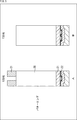
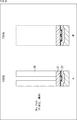
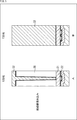
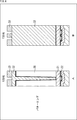
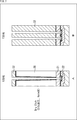
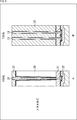
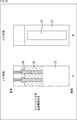
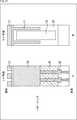
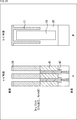
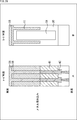
- FIG. 1 It is a top view of the solid-state image sensor which provided the penetration electrode and the trench structure side by side. It is sectional drawing corresponding to FIG. It is a figure which shows the formation method of a trench structure and a penetration electrode. It is a figure which shows the formation method of a trench structure and a penetration electrode. It is a figure which shows the formation method of a trench structure and a penetration electrode. It is a figure which shows the formation method of a trench structure and a penetration electrode. It is a figure which shows the formation method of a trench structure and a penetration electrode. It is a figure which shows the formation method of a trench structure and a penetration electrode. It is a figure which shows the formation method of a trench structure and a penetration electrode. It is a figure which shows the formation method of a trench structure and a penetration electrode. It is a figure which shows the formation method of a trench structure and a penetration electrode.
- FIG. 1 is a plan view of a solid-state imaging device according to an embodiment of the present disclosure.
- 2 is a cross-sectional view corresponding to FIG. 1, in which A in FIG. 2 corresponds to the X direction in the through electrode in FIG. 1, and B in FIG. 2 corresponds to the Y direction in the through electrode in FIG.
- This solid-state imaging device 10 is a so-called back-illuminated CMOS image sensor, and three photoelectric conversion portions (photoelectric conversion films, PDs, etc.) are stacked in the vertical direction for each pixel so as to surround each pixel section 14.
- the trench structure 11 is formed in a lattice shape.
- the trench structure 11 is for preventing color mixture that may occur due to leakage of charges to adjacent pixels.
- a wall made of an insulator (insulating film) such as SiO 2 or SiN extends to the inside of the Si substrate. Is formed.
- an intersection at which straight portions arranged in the vertical and horizontal directions intersect is particularly referred to as a trench structure cross portion 12.
- a through electrode 13 penetrating the Si substrate 20 is formed at a position overlapping the trench structure 11.
- the through electrode 13 is made of a conductive metal such as W, TiN, or Ti, and an insulator made of the same material as that of the trench structure is formed around the through electrode 13.
- FIGS. 3 to 9 show a method for forming the trench structure 11 and the through electrode 13 in the solid-state imaging device 10.
- Each figure A and each figure B correspond to A in FIG. 2 and B in FIG. 2, respectively.
- the through electrode 13 is formed on the rear side (upper side in the figure, light incident side). To do.
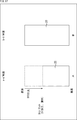
- patterning is performed in which a portion other than the position where the trench structure 11 is formed is covered with a resist 31 by lithography.
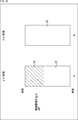
- a portion of the Si substrate 20 not covered with the resist 31 is processed into a groove shape for the trench structure 11 by dry etching or the like.
- the dry etching at this time is stopped up to the oxide film of STI (Shallow Trench Isolation) 21.
- the oxide film of STI 21 may be processed into a groove shape and dry etching up to the Poly electrode 22 may be performed.
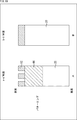
- an insulating film 32 such as SiO 2 or SiN is embedded in the groove formed in the Si substrate 20 in FIG. 4 by a method such as plasma CVD.
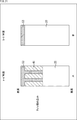
- patterning is performed by covering the trench structure 11 with a resist 33 by lithography except for the position where the through electrode 13 is provided.
- the portion of the insulating film 32 and the STI 21 not covered with the resist 33 are processed into a hole shape by dry etching or the like and penetrated to the poly electrode 22.
- the metal 34 having conductivity such as W, TiN, Ti or the like is buried in the holes formed in the insulating film 32 and the STI 21 in FIG.
- the through electrode 13 is formed by removing unnecessary portions of the buried metal 34.
- the through electrode 13 can be simultaneously formed in the trench structure 11 and the overlapping position.
- the color mixture between adjacent pixels can be suppressed by having the trench structure 11.
- the trench structure 11 and the through electrode 13 are overlapped, it is not necessary to provide a dedicated region for the through electrode 13, so that the solid-state imaging device 10 can be miniaturized and the area of the PD in each pixel can be reduced. It is possible to enlarge, and Qs and light receiving sensitivity can be improved.
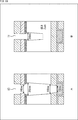
- FIG. 10 to FIG. 12 show another forming method (second forming method) of the trench structure 11 and the through electrode 13 in the solid-state imaging device 10.
- the layout dimension (width of a line not covered by the register 31) when forming the trench structure 11, the trench structure cross portion 12, and the through electrode 13 is the widest for the through electrode 13, and the next is the trench structure cross.
- the portion 12 is wide, and the trench structure (straight portion) 11 is formed to be the narrowest.
- the through electrode 13 has the deepest depth when the Si substrate 20 is processed into a groove shape or a hole shape.
- the trench structure cross portion 12 is formed deep, and the trench structure (straight portion) 11 is formed shallowest. Depth during processing Through-electrode 13> trench structure cross section 12> trench structure (straight section) 11
- FIG. 13 shows an example of layout dimensions and depths during processing of the trench structure 11, the trench structure cross portion 12, and the through electrode 13. Note that the specific numerical values of the layout dimensions and depths shown in the drawing are merely examples, and vary depending on the overall size of the solid-state imaging device 10 and the aperture ratio of the holes.
- the layout dimensions of the trench structure 11, the trench structure cross portion 12, and the through electrode 13 and the depth during processing are formed according to the above-described magnitude relationship, these can be arranged efficiently or simultaneously. it can.
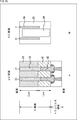
- FIGS. 14A and 14B are diagrams for explaining the third forming method.
- FIG. 14A is a plan view of the solid-state imaging device 10 and
- FIG. 14B is a surface of the Si substrate 20 of the solid-state imaging device 10 (light incident surface).
- FIG. 5B shows the configuration of the back surface (light incident surface) of the Si substrate 20 of the solid-state imaging device 10.
- a DTI (Deep Trench Isolation) 41 is formed on the surface side of the Si substrate 20 as shown in FIG. A Poly electrode 42 is formed.
- a trench structure 11 made of an insulating film 44 and a through electrode 13 made of a metal 43 are formed on the back side of the Si substrate 20, as shown in FIG. C.
- FIG. 15 is a cross-sectional view corresponding to FIG. 14A.
- FIG. 15A corresponds to a portion where the trench structure 11 and the through electrode 13 overlap each other in the line segment aa ′ of FIG. 15B corresponds to a portion where the trench structure 11 is formed in the line segment bb ′ of FIG. 14A.
- the upper side of the drawing is the back surface (light incident surface) of the solid-state imaging device 10
- the lower side of the drawing is the surface of the solid-state imaging device 10.
- the trench structure 11 is formed of an insulating film 44 formed from the back surface side.
- the through electrode 13 is formed by connecting a poly electrode 42 formed from the front surface side and a metal 43 embedded in the insulating film 44 from the back surface side.
- FIG. 16 to FIG. 30 specifically show the third forming method.
- Each figure A and each figure B correspond to A in FIG. 15 and B in FIG. 15, respectively.
- the upper side of the drawing is the surface of the solid-state imaging device 10
- the lower side of the drawing is the back surface of the solid-state imaging device 10.
- the upper side of the drawing is the back surface of the solid-state image sensor 10
- the lower side of the drawing is the surface of the solid-state image sensor 10.
- DTI 41 is formed on the surface side of the Si substrate 20. Specifically, as shown in FIG. 16, a resist 51 covering the surface side of the Si substrate 20 except for the groove for forming the DTI 41 is patterned by lithography. Subsequently, as shown in FIG. 17, a groove of about 1 ⁇ m is formed from the surface side of the Si substrate 20 by dry etching or the like. Subsequently, as shown in FIG. 18, an insulating film 44 such as an oxide film is buried in the formed trench by CVD (chemical vapor deposition) or the like, and an insulating film 44 whose surface is not required by CMP (chemical mechanical polishing) or the like. The DTI 41 is formed by polishing.
- CVD chemical vapor deposition
- CMP chemical mechanical polishing
- a Poly electrode 42 is formed on the formed DTI 41.
- a resist 52 that covers other than the hole for forming the Poly electrode 42 is patterned by lithography.
- the DTI 41 (insulating film 44) is processed into a hole shape by dry etching or the like.
- a conductive film 53 such as doped poly-Si or metal film is formed by CVD or the like from the surface side of the Si substrate 20, thereby forming the formed holes with the conductive film 53.
- a poly electrode 42 is formed by forming a necessary structure in the transistor region on the surface side of the Si substrate 20.
- a photoelectric conversion unit 54 such as a PD is formed in the Si substrate 20 surrounded by the trench structure 11 as shown in FIG.
- a through electrode 13 is formed by embedding metal from the back side of the Si substrate 20 and connecting it to the poly electrode 42.
- the position (through electrode 13 is formed) The resist 55 is covered by lithography so as to cover the portions other than the portion including the formation position.
- the Si substrate 20 is processed by dry etching or the like to form lattice-shaped grooves. This dry etching is stopped at the previously formed insulating film 44 of the DTI 41. Further, the through electrode groove and the inter-pixel light shielding RDTI groove are formed simultaneously.
- the formed trench is filled with an insulating film 56 such as an oxide film by plasma CVD or the like.
- an insulating film 56 such as an oxide film by plasma CVD or the like.
- the trench structure 11 is formed.
- a resist 57 covering other than the position where the through electrode 13 is formed is patterned by lithography.
- the insulating film 56 (also the trench structure 11) is processed by dry etching or the like, and holes for the through electrode 13 are formed until the poly electrode 42 is reached.
- a hole formed of a metal 58 such as W, TiN, or Ti is buried by sputtering or the like.
- unnecessary metal 58 on the back surface of the Si substrate 20 is removed by CMP or the like, and the through electrode 13 penetrating the Si substrate 20 is completed.
- the color mixture between adjacent pixels can be suppressed by having the trench structure 11.
- the trench structure 11 and the through electrode 13 are overlapped, it is not necessary to provide a dedicated region for the through electrode 13, so that the solid-state imaging device 10 can be miniaturized and the area of the PD in each pixel can be reduced. It is possible to enlarge, and Qs and light receiving sensitivity can be improved.
- FIG. 31 shows an extension example of the trench structure 11.
- the trench structure 11 may be formed to extend deeper. Specifically, when the DTI 41 is formed from the surface side of the Si substrate 20, patterning is performed also on a portion extending the trench structure 11 to form a groove, and the groove is filled with the same insulating film 44 as the DTI 41. Then, it is connected to the trench structure 11 to be formed later. Thereby, it is possible to further suppress color mixing between adjacent pixels.
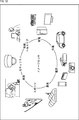
- FIG. 32 is a diagram illustrating a usage example in which the solid-state imaging device 10 according to the embodiment of the present disclosure is used.
- the solid-state imaging device 10 can be used in various cases for sensing light such as visible light, infrared light, ultraviolet light, and X-ray as follows.
- Devices for taking images for viewing such as digital cameras and mobile devices with camera functions
- Devices used for traffic such as in-vehicle sensors that capture the back, surroundings, and interiors of vehicles, surveillance cameras that monitor traveling vehicles and roads, and ranging sensors that measure distances between vehicles, etc.
- Equipment used for home appliances such as TVs, refrigerators, air conditioners, etc. to take pictures and operate the equipment according to the gestures ⁇ Endoscopes, equipment that performs blood vessel photography by receiving infrared light, etc.
- Equipment used for medical and health care ⁇ Security equipment such as security surveillance cameras and personal authentication cameras ⁇ Skin measuring instrument for photographing skin and scalp photography Such as a microscope to do beauty Equipment used for sports such as action cameras and wearable cameras for sports applications etc.
- Equipment used for agriculture such as cameras for monitoring the condition of fields and crops
- This indication can also take the following composition.
- a trench structure comprising a wall surface of an insulating film formed in the depth direction of the semiconductor substrate and surrounding each pixel section;
- a solid-state imaging device comprising: a penetrating electrode that penetrates the semiconductor substrate and is formed at a position overlapping the trench structure.
- the through electrode connects the photoelectric conversion unit formed on one surface of the semiconductor substrate and an FD formed on the other surface of the semiconductor substrate.
- the photoelectric conversion unit includes a photoelectric conversion film formed on one surface of the semiconductor substrate.
- the solid-state imaging device is A photoelectric conversion unit formed for each pixel section of the semiconductor substrate; A trench structure comprising a wall surface of an insulating film formed in the depth direction of the semiconductor substrate and surrounding each pixel section; An electronic device comprising: a penetrating electrode that penetrates the semiconductor substrate and is formed at a position overlapping the trench structure.
- the layout dimensions of the immediately preceding portion and the cross portion of the trench structure and the through electrode have the following relationship: Through electrode> cross portion of the trench structure> straight portion of the trench structure.
- the immediately preceding portion and the cross portion of the trench structure, and the depth of the through electrode have the following relationship: through electrode> cross portion of the trench structure> straight portion of the trench structure
- a photoelectric conversion unit formed for each pixel section of the semiconductor substrate A trench structure comprising a wall surface of an insulating film formed in the depth direction of the semiconductor substrate and surrounding each pixel section; A through-electrode formed through the semiconductor substrate at a position overlapping with the trench structure;
- the trench structure is composed of a cross portion where the straight portion and the straight portion intersect, In the method of manufacturing a solid-state imaging device, the through electrode is formed at a position overlapping with the linear portion of the trench structure.
- the linear dimension and the cross part of the trench structure, and the layout dimension of the through electrode have the following relationship: Penetration electrode> cross portion of trench structure> straight portion of trench structure.
- the immediately preceding portion and the cross portion of the trench structure, and the depth of the penetration electrode have the following relationship.
- the solid-state imaging device is A photoelectric conversion unit formed for each pixel section of the semiconductor substrate; A trench structure comprising a wall surface of an insulating film formed in the depth direction of the semiconductor substrate and surrounding each pixel section; A through-electrode formed through the semiconductor substrate at a position overlapping with the trench structure; The trench structure is composed of a cross portion where the straight portion and the straight portion intersect, The penetrating electrode is formed at a position overlapping the straight portion of the trench structure.
- a photoelectric conversion unit formed for each pixel section of the semiconductor substrate A trench structure comprising a wall surface of an insulating film formed in the depth direction of the semiconductor substrate and surrounding each pixel section; A through-electrode formed through the semiconductor substrate at a position overlapping with the trench structure; The through electrode is formed by connecting a first conductive portion formed from one surface of the semiconductor substrate and a second conductive portion formed from the other surface of the semiconductor substrate.
- the solid-state imaging device according to (12) or (13), wherein the photoelectric conversion unit includes a photoelectric conversion film formed on one surface of the semiconductor substrate.
- a manufacturing method of a solid-state imaging device comprising a through electrode formed at a position that penetrates the semiconductor substrate and overlaps with the trench structure, Forming a second conductive portion at a position where the through electrode is provided from one surface of the semiconductor substrate;
- the solid-state imaging device is A photoelectric conversion unit formed for each pixel section of the semiconductor substrate; A trench structure comprising a wall surface of an insulating film formed in the depth direction of the semiconductor substrate and surrounding each pixel section; A through-electrode formed through the semiconductor substrate at a position overlapping with the trench structure;
- the penetrating electrode is an electronic device in which a first conductive portion formed from one surface of the semiconductor substrate and a second conductive portion formed from the other surface of the semiconductor substrate are connected.
Landscapes
- Engineering & Computer Science (AREA)
- Multimedia (AREA)
- Signal Processing (AREA)
- Solid State Image Pick-Up Elements (AREA)
- Transforming Light Signals Into Electric Signals (AREA)
Abstract
La présente invention se rapporte à : un élément d'imagerie à semi-conducteurs, qui permet d'installer efficacement en parallèle une structure de tranchée entourant chaque région de pixel de l'élément d'imagerie à semi-conducteurs et une électrode traversante ; un procédé de fabrication ; et un dispositif électronique. Un élément d'imagerie à semi-conducteurs selon un premier aspect de la présente invention est pourvu des éléments suivants : une unité de conversion photoélectrique formée pour chaque région de pixel dans un substrat semi-conducteur ; une structure de tranchée comprenant des surfaces de paroi d'un film isolant qui sont formées dans la direction de la profondeur du substrat semi-conducteur, et entourant chaque région de pixel ; et une électrode traversante passant à travers le substrat semi-conducteur et formée au niveau d'une position chevauchant la structure de tranchée. La présente invention peut être appliquée, par exemple, à un capteur d'image CMOS rétroéclairé.
Priority Applications (3)
| Application Number | Priority Date | Filing Date | Title |
|---|---|---|---|
| JP2017528383A JP6800851B2 (ja) | 2015-07-16 | 2016-07-01 | 固体撮像素子、および電子機器 |
| CN201680040629.6A CN107851648B (zh) | 2015-07-16 | 2016-07-01 | 固态摄像元件、制造方法和电子装置 |
| US15/742,987 US10529767B2 (en) | 2015-07-16 | 2016-07-01 | Solid state image sensor, fabrication method, and electronic apparatus |
Applications Claiming Priority (2)
| Application Number | Priority Date | Filing Date | Title |
|---|---|---|---|
| JP2015-141883 | 2015-07-16 | ||
| JP2015141883 | 2015-07-16 |
Publications (1)
| Publication Number | Publication Date |
|---|---|
| WO2017010311A1 true WO2017010311A1 (fr) | 2017-01-19 |
Family
ID=57757830
Family Applications (1)
| Application Number | Title | Priority Date | Filing Date |
|---|---|---|---|
| PCT/JP2016/069592 Ceased WO2017010311A1 (fr) | 2015-07-16 | 2016-07-01 | Élément d'imagerie à semi-conducteurs, procédé de fabrication et dispositif électronique |
Country Status (4)
| Country | Link |
|---|---|
| US (1) | US10529767B2 (fr) |
| JP (1) | JP6800851B2 (fr) |
| CN (1) | CN107851648B (fr) |
| WO (1) | WO2017010311A1 (fr) |
Cited By (3)
| Publication number | Priority date | Publication date | Assignee | Title |
|---|---|---|---|---|
| JP2020038934A (ja) * | 2018-09-05 | 2020-03-12 | 住友電気工業株式会社 | 半導体受光デバイス |
| JPWO2020158515A1 (ja) * | 2019-01-28 | 2021-12-02 | ソニーグループ株式会社 | 固体撮像素子、電子機器、および固体撮像素子の製造方法 |
| US11257857B2 (en) | 2019-01-09 | 2022-02-22 | Samsung Electronics Co., Ltd. | Image sensors including photoelectric conversion devices, trench, supporter, and isolation layer |
Families Citing this family (2)
| Publication number | Priority date | Publication date | Assignee | Title |
|---|---|---|---|---|
| JP2019176089A (ja) * | 2018-03-29 | 2019-10-10 | ソニーセミコンダクタソリューションズ株式会社 | 固体撮像装置、および電子機器 |
| KR102901404B1 (ko) | 2021-01-22 | 2025-12-18 | 삼성전자주식회사 | 이미지 센서 및 이의 제조 방법 |
Citations (3)
| Publication number | Priority date | Publication date | Assignee | Title |
|---|---|---|---|---|
| JP2003086827A (ja) * | 2001-09-12 | 2003-03-20 | Hamamatsu Photonics Kk | ホトダイオードアレイ、固体撮像装置、及び、放射線検出器 |
| JP2012129551A (ja) * | 2004-08-20 | 2012-07-05 | Zycube:Kk | 三次元積層構造を持つ半導体装置の製造方法 |
| JP2015038931A (ja) * | 2013-08-19 | 2015-02-26 | ソニー株式会社 | 固体撮像素子および電子機器 |
Family Cites Families (20)
| Publication number | Priority date | Publication date | Assignee | Title |
|---|---|---|---|---|
| JPH07245385A (ja) * | 1994-03-08 | 1995-09-19 | Fujitsu Ltd | 受光素子の画素分離方法と受光素子 |
| JP4220808B2 (ja) * | 2003-03-10 | 2009-02-04 | 浜松ホトニクス株式会社 | ホトダイオードアレイおよびその製造方法並びに放射線検出器 |
| JP2006041148A (ja) * | 2004-07-27 | 2006-02-09 | Seiko Epson Corp | 半導体装置の製造方法、半導体装置、及び電子機器 |
| US8120077B2 (en) * | 2004-12-16 | 2012-02-21 | Panasonic Corporation | Solid-state imaging device comprising doped channel stop at isolation regions to suppress noise |
| JP5297135B2 (ja) * | 2008-10-01 | 2013-09-25 | キヤノン株式会社 | 光電変換装置、撮像システム、及び光電変換装置の製造方法 |
| KR101033353B1 (ko) * | 2008-10-14 | 2011-05-09 | 주식회사 동부하이텍 | 이미지센서 및 그 제조방법 |
| JP5564847B2 (ja) * | 2009-07-23 | 2014-08-06 | ソニー株式会社 | 固体撮像装置とその製造方法、及び電子機器 |
| JP2011082253A (ja) * | 2009-10-05 | 2011-04-21 | Sony Corp | 固体撮像装置、および、その製造方法、電子機器 |
| JP5533046B2 (ja) * | 2010-03-05 | 2014-06-25 | ソニー株式会社 | 固体撮像装置、固体撮像装置の製造方法、固体撮像装置の駆動方法、及び電子機器 |
| JP5534927B2 (ja) * | 2010-05-06 | 2014-07-02 | 株式会社東芝 | 固体撮像装置 |
| JP2013125831A (ja) * | 2011-12-14 | 2013-06-24 | Elpida Memory Inc | 半導体装置の製造方法及び半導体装置 |
| JP2013128036A (ja) * | 2011-12-19 | 2013-06-27 | Sony Corp | 撮像素子、撮像装置、並びに、製造装置および方法 |
| JP2013143532A (ja) * | 2012-01-12 | 2013-07-22 | Toshiba Corp | 半導体装置 |
| US20150024369A1 (en) * | 2013-05-07 | 2015-01-22 | Damon Gabriel Brown | Portable message board |
| JP2015153962A (ja) * | 2014-02-18 | 2015-08-24 | ソニー株式会社 | 固体撮像素子および製造方法、並びに電子機器 |
| TWI709340B (zh) * | 2014-11-27 | 2020-11-01 | 日商索尼半導體解決方案公司 | 固體攝像元件及電子機器 |
| US20180240847A1 (en) * | 2015-03-09 | 2018-08-23 | Sony Semiconductor Solutions Corporation | Imaging element and method of manufacturing the same, and electronic apparatus |
| JP6957112B2 (ja) * | 2015-07-30 | 2021-11-02 | ソニーセミコンダクタソリューションズ株式会社 | 固体撮像装置及び電子機器 |
| JP6725231B2 (ja) * | 2015-10-06 | 2020-07-15 | ソニーセミコンダクタソリューションズ株式会社 | 固体撮像素子、および電子装置 |
| JP2018037611A (ja) * | 2016-09-02 | 2018-03-08 | ソニーセミコンダクタソリューションズ株式会社 | 受光素子、受光素子の製造方法、撮像素子および電子機器 |
-
2016
- 2016-07-01 WO PCT/JP2016/069592 patent/WO2017010311A1/fr not_active Ceased
- 2016-07-01 CN CN201680040629.6A patent/CN107851648B/zh active Active
- 2016-07-01 US US15/742,987 patent/US10529767B2/en active Active
- 2016-07-01 JP JP2017528383A patent/JP6800851B2/ja active Active
Patent Citations (3)
| Publication number | Priority date | Publication date | Assignee | Title |
|---|---|---|---|---|
| JP2003086827A (ja) * | 2001-09-12 | 2003-03-20 | Hamamatsu Photonics Kk | ホトダイオードアレイ、固体撮像装置、及び、放射線検出器 |
| JP2012129551A (ja) * | 2004-08-20 | 2012-07-05 | Zycube:Kk | 三次元積層構造を持つ半導体装置の製造方法 |
| JP2015038931A (ja) * | 2013-08-19 | 2015-02-26 | ソニー株式会社 | 固体撮像素子および電子機器 |
Cited By (6)
| Publication number | Priority date | Publication date | Assignee | Title |
|---|---|---|---|---|
| JP2020038934A (ja) * | 2018-09-05 | 2020-03-12 | 住友電気工業株式会社 | 半導体受光デバイス |
| US11257857B2 (en) | 2019-01-09 | 2022-02-22 | Samsung Electronics Co., Ltd. | Image sensors including photoelectric conversion devices, trench, supporter, and isolation layer |
| JPWO2020158515A1 (ja) * | 2019-01-28 | 2021-12-02 | ソニーグループ株式会社 | 固体撮像素子、電子機器、および固体撮像素子の製造方法 |
| US20220085110A1 (en) * | 2019-01-28 | 2022-03-17 | Sony Group Corporation | Solid-state imaging element, electronic device, and manufacturing method of solid-state imaging element |
| JP7530835B2 (ja) | 2019-01-28 | 2024-08-08 | ソニーグループ株式会社 | 固体撮像素子、電子機器、および固体撮像素子の製造方法 |
| US12120897B2 (en) * | 2019-01-28 | 2024-10-15 | Sony Group Corporation | Solid-state imaging element, electronic device, and manufacturing method of solid-state imaging element |
Also Published As
| Publication number | Publication date |
|---|---|
| CN107851648A (zh) | 2018-03-27 |
| US10529767B2 (en) | 2020-01-07 |
| JPWO2017010311A1 (ja) | 2018-04-26 |
| JP6800851B2 (ja) | 2020-12-16 |
| CN107851648B (zh) | 2022-08-16 |
| US20190088696A1 (en) | 2019-03-21 |
Similar Documents
| Publication | Publication Date | Title |
|---|---|---|
| TWI735428B (zh) | 攝像元件及其製造方法、以及電子機器 | |
| JP6725231B2 (ja) | 固体撮像素子、および電子装置 | |
| CN109863600B (zh) | 成像器件、成像装置以及电子设备 | |
| JP6800851B2 (ja) | 固体撮像素子、および電子機器 | |
| WO2018198814A1 (fr) | Dispositif à semi-conducteurs, procédé de fabrication, élément d'imagerie, et équipement électronique | |
| WO2016152577A1 (fr) | Dispositif d'imagerie à semi-conducteurs et appareil électronique | |
| JP7479801B2 (ja) | 撮像素子、製造方法、および電子機器 | |
| KR20180127327A (ko) | 고체 촬상 소자, 및 전자 장치 | |
| TWI888385B (zh) | 攝像裝置 | |
| WO2016098696A1 (fr) | Élément d'imagerie à semi-conducteurs et dispositif électronique | |
| WO2017086180A1 (fr) | Élément de prise de vues à semi-conducteurs, procédé de fabrication, et dispositif électronique | |
| US20240297192A1 (en) | Solid-state image capturing device and manufacturing method, as well as electronic device | |
| US9215361B2 (en) | Array cameras with light barriers | |
| WO2017018216A1 (fr) | Dispositif d'imagerie à semi-conducteur, son procédé de fabrication, et dispositif électronique | |
| CN107431078B (zh) | 固体摄像元件和电子设备 | |
| WO2017119317A1 (fr) | Élément imageur à semi-conducteurs, procédé de production, et appareil électronique | |
| JP7022174B2 (ja) | 固体撮像素子、および電子装置 | |
| JP2016131203A (ja) | 固体撮像素子、製造方法、および電子装置 |
Legal Events
| Date | Code | Title | Description |
|---|---|---|---|
| 121 | Ep: the epo has been informed by wipo that ep was designated in this application |
Ref document number: 16824291 Country of ref document: EP Kind code of ref document: A1 |
|
| ENP | Entry into the national phase |
Ref document number: 2017528383 Country of ref document: JP Kind code of ref document: A |
|
| NENP | Non-entry into the national phase |
Ref country code: DE |
|
| 122 | Ep: pct application non-entry in european phase |
Ref document number: 16824291 Country of ref document: EP Kind code of ref document: A1 |