WO2017014255A1 - 金属含有セルロース繊維、それを用いた衛生薄葉紙及び吸収性物品 - Google Patents
金属含有セルロース繊維、それを用いた衛生薄葉紙及び吸収性物品 Download PDFInfo
- Publication number
- WO2017014255A1 WO2017014255A1 PCT/JP2016/071352 JP2016071352W WO2017014255A1 WO 2017014255 A1 WO2017014255 A1 WO 2017014255A1 JP 2016071352 W JP2016071352 W JP 2016071352W WO 2017014255 A1 WO2017014255 A1 WO 2017014255A1
- Authority
- WO
- WIPO (PCT)
- Prior art keywords
- cellulose fiber
- metal
- containing cellulose
- metal ion
- fiber
- Prior art date
- Legal status (The legal status is an assumption and is not a legal conclusion. Google has not performed a legal analysis and makes no representation as to the accuracy of the status listed.)
- Ceased
Links
Images


Classifications
-
- D—TEXTILES; PAPER
- D06—TREATMENT OF TEXTILES OR THE LIKE; LAUNDERING; FLEXIBLE MATERIALS NOT OTHERWISE PROVIDED FOR
- D06M—TREATMENT, NOT PROVIDED FOR ELSEWHERE IN CLASS D06, OF FIBRES, THREADS, YARNS, FABRICS, FEATHERS OR FIBROUS GOODS MADE FROM SUCH MATERIALS
- D06M11/00—Treating fibres, threads, yarns, fabrics or fibrous goods made from such materials, with inorganic substances or complexes thereof; Such treatment combined with mechanical treatment, e.g. mercerising
- D06M11/83—Treating fibres, threads, yarns, fabrics or fibrous goods made from such materials, with inorganic substances or complexes thereof; Such treatment combined with mechanical treatment, e.g. mercerising with metals; with metal-generating compounds, e.g. metal carbonyls; Reduction of metal compounds on textiles
-
- A—HUMAN NECESSITIES
- A47—FURNITURE; DOMESTIC ARTICLES OR APPLIANCES; COFFEE MILLS; SPICE MILLS; SUCTION CLEANERS IN GENERAL
- A47K—SANITARY EQUIPMENT; ACCESSORIES THEREFOR, e.g. TOILET ACCESSORIES
- A47K10/00—Body-drying implements; Toilet paper; Holders therefor
- A47K10/16—Paper towels; Toilet paper; Holders therefor
-
- D—TEXTILES; PAPER
- D21—PAPER-MAKING; PRODUCTION OF CELLULOSE
- D21H—PULP COMPOSITIONS; PREPARATION THEREOF NOT COVERED BY SUBCLASSES D21C OR D21D; IMPREGNATING OR COATING OF PAPER; TREATMENT OF FINISHED PAPER NOT COVERED BY CLASS B31 OR SUBCLASS D21G; PAPER NOT OTHERWISE PROVIDED FOR
- D21H11/00—Pulp or paper, comprising cellulose or lignocellulose fibres of natural origin only
- D21H11/16—Pulp or paper, comprising cellulose or lignocellulose fibres of natural origin only modified by a particular after-treatment
- D21H11/20—Chemically or biochemically modified fibres
-
- D—TEXTILES; PAPER
- D21—PAPER-MAKING; PRODUCTION OF CELLULOSE
- D21H—PULP COMPOSITIONS; PREPARATION THEREOF NOT COVERED BY SUBCLASSES D21C OR D21D; IMPREGNATING OR COATING OF PAPER; TREATMENT OF FINISHED PAPER NOT COVERED BY CLASS B31 OR SUBCLASS D21G; PAPER NOT OTHERWISE PROVIDED FOR
- D21H27/00—Special paper not otherwise provided for, e.g. made by multi-step processes
Definitions
- the present invention relates to a metal-containing cellulose fiber, a sanitary thin paper using the same, and an absorbent article.
- Patent Documents 1 and 2 Coexistence of cellulosic material (cellulosic fiber) with 2,2,6,6-tetramethyl-1-piperidine-N-oxy radical (hereinafter referred to as TEMPO) and an inexpensive oxidizing agent sodium hypochlorite
- TEMPO 2,2,6,6-tetramethyl-1-piperidine-N-oxy radical
- an inexpensive oxidizing agent sodium hypochlorite When the treatment is performed under the condition, carboxyl groups can be efficiently introduced on the surface of the cellulosic raw material, and oxidized cellulose fibers can be obtained (Patent Documents 1 and 2).
- the oxidized cellulose fiber has a carboxyl group or a carboxylate group localized on the surface, and is expected to be developed for various uses.
- Patent Document 1 discloses use of TEMPO oxidized pulp as a deodorant
- Patent Document 2 discloses use as a reinforcing material.
- Patent Documents 1 to 2 Although the deodorizing effect and the reinforcing effect are improved, further improvement is required.
- an object of the present invention is to provide a metal-containing cellulose fiber excellent in deodorizing effect and reinforcing effect, a sanitary thin paper and an absorbent article using the same.
- the metal ion-containing cellulose fiber of the present invention has a carboxyl group or carboxylate group content of 0.1 to 2.0 mmol / g with respect to the absolutely dry mass of the oxidized cellulose fiber.
- Canadian standard freeness of the metal ion-containing cellulose fiber containing ions of one or more metal elements selected from the group consisting of Ag, Au, Pt, Pd, Ni, Mn, Fe, Ti, Al, Zn and Cu Is 30 to 400 ml.
- the Canadian standard freeness of the metal ion-containing cellulose fibers is preferably 50 to 200 ml.
- the metal ion-containing cellulose fibers preferably have an average fiber length of 0.5 to 2.5 mm and an average fiber diameter of 10 to 40 ⁇ m.
- the content of the metal element ions with respect to the absolute dry mass of the metal-containing cellulose fiber is preferably 10 to 60 mg / g.
- the sanitary thin paper of the present invention contains the metal-containing cellulose fiber.
- the sanitary thin paper of the present invention preferably contains 2 to 30% by mass of the metal-containing cellulose fiber.
- the absorbent article of the present invention includes an absorbent core, a core wrap sheet that covers or is laminated on the absorbent core, and a liquid-permeable outer layer sheet that covers at least one surface of the core wrap sheet.
- the core wrap sheet is the sanitary thin paper.
- the present invention it is possible to provide a metal-containing cellulose fiber excellent in deodorizing effect and reinforcing effect, and a sanitary thin paper and an absorbent article using the same.
- FIG. 2 is a cross-sectional view taken along line AA in FIG. 2 is an electron microscopic image of the oxidized cellulose fiber of Example 1.
- FIG. 2 is a cross-sectional view taken along line AA in FIG. 2 is an electron microscopic image of the oxidized cellulose fiber of Example 1.
- the method for producing oxidized cellulose fibers is not limited, and the cellulose raw material (cellulose fibers) such as wood pulp is selected from the group consisting of N-oxyl compounds and bromides, iodides or mixtures thereof.
- the manufacturing method which oxidizes in water using an oxidizing agent in presence of the compound which oxidizes, or the manufacturing method etc. which oxidize by making the gas containing ozone and a cellulose raw material contact are illustrated.
- the cellulose raw material is produced by oxidizing in water using an oxidizing agent in the presence of an N-oxyl compound and a compound selected from the group consisting of bromide, iodide or a mixture thereof.
- the primary hydroxyl group at the C6 position of the glucopyranose ring is selectively oxidized, and an oxidized cellulose fiber having a carboxyl group (—COOH) or a carboxylate group (—COO—) on the surface can be obtained.
- the concentration of cellulose during the reaction is not particularly limited, but is preferably 5% by mass or less.
- the carboxyl group or carboxylate group is also referred to as an “acid group”.
- the content of acid groups can be measured by the method disclosed in paragraph 0021 of JP-A-2008-001728. That is, 60 mL of a 0.5 to 1 mass% slurry is prepared using a precisely weighed dry cellulose sample, and the pH is adjusted to about 2.5 with a 0.1 mol / L hydrochloric acid aqueous solution. Then, 0.05 mol / L sodium hydroxide aqueous solution is dripped and electrical conductivity measurement is performed. The measurement is continued until the pH is about 11.
- N-oxyl compound refers to a compound capable of generating a nitroxy radical.
- any compound can be used as long as it promotes the target oxidation reaction.
- TEMPO 2,2,6,6-tetramethylpiperidine-1-oxy radical
- its derivatives for example, 4-hydroxy TEMPO
- the amount of N-oxyl compound used is not particularly limited as long as it is a catalytic amount capable of oxidizing cellulose as a raw material.
- 0.01 to 10 mmol is preferable, 0.01 to 1 mmol is more preferable, and 0.05 to 0.5 mmol is more preferable with respect to 1 g of absolutely dry cellulose. Further, it is preferably about 0.1 to 4 mmol / L with respect to the reaction system.
- Bromide is a compound containing bromine, and examples thereof include alkali metal bromide that can be dissociated and ionized in water.
- an iodide is a compound containing iodine, and examples thereof include alkali metal iodide.
- the amount of bromide or iodide used can be selected as long as the oxidation reaction can be promoted.
- the total amount of bromide and iodide is, for example, preferably 0.1 to 100 mmol, more preferably 0.1 to 10 mmol, and further preferably 0.5 to 5 mmol with respect to 1 g of absolutely dry cellulose.
- oxidizing agent known ones can be used, and for example, halogen, hypohalous acid, halous acid, perhalogen acid or salts thereof, halogen oxide, peroxide and the like can be used.
- sodium hypochlorite is preferable because it is inexpensive and has a low environmental impact.
- the appropriate amount of the oxidizing agent used is, for example, preferably 0.5 to 500 mmol, more preferably 0.5 to 50 mmol, still more preferably 1 to 25 mmol, and most preferably 3 to 10 mmol with respect to 1 g of absolutely dry cellulose. . Further, for example, 1 to 40 mol is preferable with respect to 1 mol of the N-oxyl compound.
- the reaction temperature is preferably 4 to 40 ° C., and may be room temperature of about 15 to 30 ° C.
- a carboxyl group is generated in the cellulose, so that the pH of the reaction solution is reduced.
- an alkaline solution such as an aqueous sodium hydroxide solution is added to maintain the pH of the reaction solution at about 8 to 12, preferably about 10 to 11.
- the reaction medium is preferably water because it is easy to handle and hardly causes side reactions.
- the reaction time in the oxidation reaction can be appropriately set according to the progress of oxidation, and is usually 0.5 to 6 hours, for example, about 0.5 to 4 hours.
- the oxidation reaction may be carried out in two stages. For example, by oxidizing the oxidized cellulose obtained by filtration after the completion of the first-stage reaction again under the same or different reaction conditions, the efficiency is not affected by the reaction inhibition by the salt generated as a by-product in the first-stage reaction. Can be oxidized well.
- a cellulose chain will decompose
- the ozone concentration in the gas containing ozone is preferably 50 to 250 g / m 3, and more preferably 50 to 220 g / m 3.
- the amount of ozone added to the cellulose raw material is preferably 0.1 to 30 parts by mass, and more preferably 5 to 30 parts by mass, when the solid content of the cellulose raw material is 100 parts by mass.
- the ozone treatment temperature is preferably 0 to 50 ° C., and more preferably 20 to 50 ° C.
- the ozone treatment time is not particularly limited, but is about 1 to 360 minutes, and preferably about 30 to 360 minutes. When the conditions for the ozone treatment are within these ranges, the cellulose can be prevented from being excessively oxidized and decomposed, and the yield of oxidized cellulose is improved.
- an additional oxidation treatment may be performed using an oxidizing agent.
- the oxidizing agent used for the additional oxidation treatment is not particularly limited, and examples thereof include chlorine compounds such as chlorine dioxide and sodium chlorite, oxygen, hydrogen peroxide, persulfuric acid, and peracetic acid. For example, these oxidizing agents can be dissolved in a polar organic solvent such as water or alcohol to prepare an oxidizing agent solution, and a cellulose raw material can be immersed in the solution for additional oxidation treatment.
- the amount of carboxyl groups in the oxidized cellulose can be adjusted by controlling the reaction conditions such as the amount of the oxidant added and the reaction time.
- the fiber length and the fiber diameter can be determined from an electron microscope image or an atomic force microscope image of the cellulose fiber.
- Canadian standard freeness can be measured based on the Canadian standard freeness measurement method (JIS P 8121: 2012).
- the amount of carboxyl groups or carboxylate groups relative to the absolutely dry mass of the oxidized cellulose fiber is 0.1 to 2.0 mmol / g.
- the amount of acid groups is less than 0.1 mmol / g, the amount of metal ions described below existing on the surface of the cellulose fiber is not sufficient, and the deodorizing function is poor.
- the amount of acid groups exceeds 2.0 mmol / g, the drainage during paper making using oxidized cellulose fibers deteriorates and the dehydration load increases.
- the metal ion-containing cellulose fiber of the present invention is composed of one or more metal elements selected from the group consisting of Ag, Au, Pt, Pd, Ni, Mn, Fe, Ti, Al, Zn and Cu with respect to the oxidized cellulose fiber.
- the Canadian standard freeness (CSF) of the metal ion-containing cellulose fiber is 30 to 400 ml.
- the lower limit of the total content of ions of the above metal elements relative to the metal-containing cellulose fiber is preferably 10 mg / g.
- the total content of ions of the above metal elements relative to the metal-containing cellulose fiber is preferably 10 to 60 mg / g.
- the total content of ions of the metal elements is less than 10 mg / g, the amount of metal ions described below existing on the surface of the cellulose fiber is not sufficient, and the deodorizing function may be inferior. If the total content of metal element ions exceeds 60 mg / g, the cost may increase.
- the freeness (CSF) of the metal ion-containing cellulose fiber is 30 to 400 ml.
- CSF freeness
- the surface area is increased at the nanofiber portion, and the deodorizing effect and the antibacterial effect can be enhanced.
- the deodorizing effect in a wet state is improved.
- the fiber is completely made into nanofibers, the fiber is completely disaggregated, and the yield decreases when paper is made by blending with pulp. Deodorizing effect is reduced.
- nanofibration refers to making a fiber obtained by defibrating metal ion-containing cellulose fibers to a fiber diameter of 100 nm or less.
- the degree of nanofiber formation is reflected in the freeness (CSF). That is, when the freeness (CSF) of the metal ion-containing cellulose fiber is less than 30 ml, the nano-fiber is too much, the deodorizing effect is reduced due to the decrease in yield to the sheet, and the freeness (CSF) exceeds 400 ml. In addition, the deodorizing effect is reduced due to insufficient nanofiber formation. Thus, by setting the freeness (CSF) of the metal ion-containing cellulose fiber to 30 to 400 ml, the deodorizing effect and the antibacterial effect are improved, and in particular, the deodorizing effect in a wet state is improved.
- the freeness (CSF) of the metal ion-containing cellulose fiber is 50 to 200 ml, the deodorizing effect and the antibacterial effect are improved, and in particular, the deodorizing effect in a wet state is improved.
- the freeness of the metal ion-containing cellulose fibers can be adjusted by adding metal ions to the oxidized cellulose fibers subjected to the beating treatment, or by applying beating treatment to the cellulose fibers containing the metal ions.
- the average fiber length of the metal ion-containing cellulose fiber is 0.5 to 2.5 mm and the average fiber diameter is 10 to 40 ⁇ m, it can be neatly dispersed when mixed with other components (general pulp, etc.) and cellulose It is preferable because properties such as a high specific surface area derived from fibers can be obtained.
- the average fiber length and the average fiber diameter are obtained by separating 0.1 g of metal ion-containing cellulose fibers and calculating the length weighted average fiber length and the length weighted average fiber diameter using a fiber tester manufactured by L & W.
- the metal ion-containing cellulose fiber can be obtained by bringing a metal compound aqueous solution into contact with oxidized cellulose fiber having a carboxyl group or a carboxylate group on the surface.
- the metal ions derived from the metal compound form an ionic bond or coordinate with the carboxylate group by bringing the aqueous solution containing the oxidized metal fiber and the above metal compound into contact.
- the metal compound aqueous solution is an aqueous solution of a metal salt.
- metal salts include complexes (complex ions), halides, nitrates, sulfates, and acetates.
- the concentration of the aqueous metal compound solution is not particularly limited, but is preferably 10 to 80 parts by mass, more preferably 30 to 60 parts by mass with respect to 100 parts by mass of the cellulose fibers.
- the time for contacting the metal compound may be appropriately adjusted.
- the temperature at the time of contact is not particularly limited, but 20 to 40 ° C. is preferable.
- the pH of the liquid at the time of contacting is not particularly limited. However, when the pH is low, it is difficult for metal ions to bind to the carboxyl group, so 7 to 13 is preferable, and pH 8 to 12 is particularly preferable.
- a method for producing a metal ion-containing cellulose fiber is exemplified below.
- Canadian standard freeness, average fiber diameter, average fiber of cellulose fibers containing metal ions after adding metal ions to oxidized cellulose fibers having a carboxyl group or carboxylate group content of 0.1 to 2.0 mmol / g Adjust the length to the above range.
- Metal ions are added to oxidized cellulose fibers having a carboxyl group or carboxylate group amount of 0.1 to 2.0 mmol / g, adjusted for Canadian standard freeness, average fiber diameter, and average fiber length.
- the residual amount of metal ions can be kept low, and in the manufacturing method of 2), metal ions can be added efficiently.
- the oxidized cellulose fiber contains metal ions can be confirmed by a scanning electron microscope image and ICP emission analysis of the extract with a strong acid. That is, the presence of metal ions cannot be confirmed in the scanning electron microscope image, while it can be confirmed that the metal ions are contained in the ICP emission analysis.
- the metal particles can be confirmed by a scanning electron microscope image, so the presence or absence of metal ions can be determined.
- the presence or absence of metal ions can also be determined by scanning electron microscope images and element mapping. That is, metal ions cannot be confirmed in a scanning electron microscope image, but the presence of metal ions can be confirmed by elemental mapping.
- the sanitary thin paper of the present invention contains the metal-containing cellulose fibers described above.
- the sanitary thin paper of the present invention preferably contains 2 to 30% by mass of the above metal-containing cellulose fiber.
- CSF freeness
- the proportion of the metal ion-containing cellulose fibers in the sanitary thin paper is less than 2% by mass, the deodorizing function may be lowered. If the ratio of the metal ion-containing cellulose fiber exceeds 30% by mass, the cost may increase.
- the sanitary thin paper according to the embodiment of the present invention can be manufactured by making a papermaking raw material containing cellulose fibers.
- a papermaking raw material other than the cellulose fiber for example, virgin pulp such as softwood pulp (NBKP) or hardwood pulp (LBKP), or used paper pulp regenerated from used paper can be used. These pulps are appropriately blended in predetermined types and blending ratios according to the required quality of sanitary paper.
- Various chemicals may be added (internally added) to the papermaking raw material for the required quality and stable operation. These chemicals include softeners, bulking agents, dyes, dispersants, wet paper strength enhancers, and drying agents. Examples thereof include paper strength agents, drainage improvers, pitch control agents, yield improvers, and the like.
- the basis weight of the obtained sanitary thin paper can be set to 7 to 40 g / m 2 , for example. Further, as the strength of the sanitary thin paper, the GMT value ⁇ (DMD ⁇ DCD) 1/2 ⁇ can be set to 60 to 420 (N / m). DMD and DCD are the tensile strengths in the MD direction and CD direction when drying sanitary thin paper, respectively, and are measured according to JIS P8113. However, the sample width at the time of measurement is 25 mm, and the unit of DMD and DCD is “N / m”.
- the sanitary paper according to the embodiment of the present invention can be manufactured by a known papermaking method.
- the metal ion-containing cellulose fiber is defibrated (beaten) to a freeness (CSF) of 30 to 400 ml.
- CSF freeness
- the metal ions may be supported.
- the freeness tends to increase, so the freeness of oxidized cellulose fibers before containing metal ions is lower than 30 to 400 ml. What is necessary is just to set so that the freeness may fall in the range of 30-400 ml by adjusting to a predetermined value and containing a metal ion.
- a papermaking raw material obtained by appropriately mixing the beaten metal ion-containing cellulose fibers and pulp is supplied from a raw material tank, and further diluted with white water to prepare a paper stock.
- This debris is degassed for screening and sent to the stock inlet with a fan pump.
- the stock inlet supplies paper with a proper concentration, speed, and angle over the entire wire width of the paper machine, with a uniform, floc-free (small lump), and well-dispersed fiber so as not to cause flow streaks.
- As the stock inlet there are a head box, a pressurization type, a hydraulic type, etc. which are installed in a high place with the atmosphere open, and any of them may be adopted.
- a stock is jetted from the stock inlet between the wire and the felt to form a sheet (web, wet paper) on the felt.
- the web formed between the wire and the felt is closely transferred to the Yankee dryer with a pressure roll.
- the web is dried by a Yankee dryer and a Yankee dryer hood, peeled off from the Yankee dryer while being creped by a creping doctor, and wound on a reel via a reel drum.
- a Yankee dryer is a drum made of cast iron or cast steel for drying a web, and its outer diameter is generally 2.4 to 6 m.
- creping is a method in which a paper is mechanically compressed in the longitudinal direction (machine traveling direction) to form a wavy wrinkle called crepe, and the bulk (feeling of bulk), softness, water absorption on sanitary paper. Properties, surface smoothness, aesthetics (crepe shape) and the like. Then, a crepe is formed by the creping doctor due to the speed difference between the Yankee dryer and the reel (reel speed ⁇ yankee dryer speed). Although the crepe characteristics depend on the speed difference, if the basis weight of the base paper on the Yankee dryer is 7 to 40 g / m 2 , the basis weight on the reel is approximately 9 to 50 g / m 2 . It becomes larger than the above basis weight.
- the quality of the crepe and the operability of the creping are substantially determined by the crepe rate.
- the crepe rate is preferably in the range of 10 to 50%.
- FIG. 1 is an external view of an absorbent article (pants-type paper diaper) 200 according to the first embodiment of the present invention.
- the absorbent article 200 includes a water absorbent article main body 20 having water absorption, and an exterior body 100 that holds the water absorbent article main body 20 inside and forms a pants shape.
- the exterior body 100 can be made of a nonwoven fabric made of a thermoplastic resin such as polypropylene, polyester, or polyethylene and manufactured by a spunbond or air-through manufacturing method.
- the exterior body 100 is preferably configured by laminating two or more sheets having at least an exterior sheet and an interior sheet.
- the water-absorbent article main body 20 is elongated, the width near the center in the longitudinal direction is slightly narrower, and is disposed between the crotch of the absorbent article 200.
- FIG. 2 is a cross-sectional view of the water absorbent article main body 20 taken along the line AA in FIG.
- the water absorbent article main body 20 includes a liquid-permeable hydrophilic surface sheet (top sheet, outer layer sheet) 2 that forms a body contact side surface (upper surface in FIG. 2), a liquid-impermeable back sheet 6, and a hydrophilic It arrange
- the absorbent cores 4a and 4b are covered with core wrap sheets 10a and 10b, respectively.
- both side portions of the water absorbent article main body portion 20 stand up as a three-dimensional gather 30 composed of a water-repellent side sheet to prevent side leakage of urine and the like.
- the absorbent cores 4a and 4b respectively covered with the core wrap sheets 10a and 10b are laminated so that the absorbent core 4a faces the hydrophilic surface sheet 2 side, and the width of the absorbent core 4a.
- the width of the absorbent core 4b is about 1 ⁇ 2 compared to FIG.
- One absorbent core and one core wrap sheet for wrapping the absorbent core may be provided for each water absorbent article main body 20.
- the hydrophilic surface sheet 2 is made of a non-woven fabric and is in contact with the wearer's skin, so it is preferable that the hydrophilic surface sheet 2 be formed of a material that is soft to the touch and does not irritate the skin.
- an air-through nonwoven fabric, a point bond nonwoven fabric, a spunbond nonwoven fabric, a spunlace nonwoven fabric, or the like made of a synthetic fiber such as polypropylene, polyethylene, or polyester can be used.
- an air-through nonwoven fabric with a small liquid return amount is suitable.
- the back sheet 6 only needs to be formed from a liquid-impermeable material having a waterproof property so that liquid or the like held in the water-absorbent article main body 20 does not leak into the underwear, such as a breathable polyethylene film.
- a liquid-impermeable material having a waterproof property so that liquid or the like held in the water-absorbent article main body 20 does not leak into the underwear, such as a breathable polyethylene film.
- a thin plastic film such as a breathable polyethylene film.
- a moisture-permeable film may be used as the back sheet 6 to reduce stuffiness.
- the absorbent cores 4a and 4b can be formed by mixing hydrophilic fibers (fluff) such as wood fluff pulp and particles of super absorbent polymer (SAP). Moreover, you may use what is called a SAP sheet which made SAP a sheet form. As the hydrophilic fiber, synthetic fiber, polymer fiber, or the like may be used instead of the wood pulp fluff. Moreover, you may mix
- the present invention is not limited to the above-described embodiments, and extends to various modifications and equivalents included in the spirit and scope of the present invention.
- the metal ion-containing cellulose fibers are made on sanitary thin paper, but other various papers (such as cardboard, copy paper, printing paper, etc.) may be made, and the type of paper is not limited.
- an absorptive article is not restricted to the above-mentioned underpants type paper diaper, for example, it is a long and slender piece like a sanitary napkin, and the type which hits a local part may be sufficient.
- the liquid-permeable outer layer sheet 2 covers only one surface (body contact side surface) of the absorbent core 4a. However, both surfaces of the absorbent core are covered with the liquid-permeable outer layer sheet, and the absorbent article. It may be possible to absorb urine and the like from both the front and back surfaces.
- the core wrap sheet is not limited to the one covering the absorbent core, and may be used by being laminated on the surface of the absorbent core. When a plurality of absorbent cores are stacked, a core wrap sheet may be interposed between the absorbent cores.
- Example 1 500 g of cellulose raw material (bleached unbeaten kraft pulp derived from coniferous tree) (absolutely dried) was added to 500 ml of an aqueous solution in which 780 mg of TEMPO (Sigma Aldrich) and 75.5 g of sodium bromide were dissolved, and stirred until the pulp was uniformly dispersed. .
- An aqueous sodium hypochlorite solution was added to the reaction system to 6.0 mmol / g to initiate the oxidation reaction. During the reaction, the pH in the system was lowered, but a 3M sodium hydroxide aqueous solution was sequentially added to adjust the pH to 10.
- the reaction was terminated when sodium hypochlorite was consumed and the pH in the system no longer changed.
- the mixture after the reaction was filtered through a glass filter, and the pulp was separated and washed with water to obtain an oxidized cellulose fiber having an acid value of 1.6 mmol / g.
- the oxidized cellulose fiber obtained above was beaten using a Niagara beater until the Canadian standard freeness (CSF) reached 230 ml.
- the fiber length / fiber diameter of the oxidized cellulose fiber after the beating treatment was 0.80 mm / 20 ⁇ m.
- FIG. 3 when the oxidized cellulose fiber after beating of Example 1 was observed with a transmission electron microscope, a part of the cellulose fiber was converted to a nanofiber, and the fine nanofiber was in the region indicated by the arrow. It was confirmed that the surface area was increased by spreading (spreading).
- ⁇ Measuring method of average fiber length and average fiber diameter The metal ion containing cellulose fiber 0.1g was disaggregated, and length weighted average fiber length and length weighted average fiber diameter were computed using Fiber Tester by L & W.
- the carboxyl group content of the obtained oxidized pulp was 1.64 mmol / g.
- the reaction was terminated when sodium hypochlorite was consumed and the pH in the system no longer changed.
- the mixture after the reaction was filtered through a glass filter, and the pulp was separated and washed with water to obtain an oxidized cellulose fiber having an acid value of 1.6 mmol / g.
- the oxidized cellulose fiber obtained above was beaten using a Niagara beater until the Canadian standard freeness (CSF) reached 230 ml.
- the fiber length / fiber diameter of the oxidized cellulose fiber after the beating treatment was 0.8 mm / 20 ⁇ m.
- Example 2 The oxidized cellulose fiber (freezing degree 230 ml) after the beating treatment of Reference Example 1 is adjusted to pH 9, 1.6 mmol of metal salt (CuCl2) aqueous solution per 1 g of oxidized cellulose fiber is added and stirred, and Cu ions are contained in the oxidized cellulose fiber. Thereafter, washing was performed to remove unreacted metal salts.
- the metal ion content of the obtained metal ion-containing cellulose fiber was 32 mg per 1 g of the metal ion-containing cellulose fiber.
- Example 3 Metal ion-containing cellulose fibers were obtained in the same manner as in Example 2 except that CuCl2 was changed to an AgNO3 aqueous solution, pH 7, as the metal salt aqueous solution.
- the metal ion content of the obtained metal ion-containing cellulose fiber was 20 mg per 1 g of the metal ion-containing cellulose fiber.
- Example 4 The oxidized cellulose fiber (before beating treatment) obtained in Reference Example 1 was beaten using a Niagara beater until the Canadian standard freeness (CSF) reached 35 ml.
- the fiber length / fiber diameter of the oxidized cellulose fiber after the beating treatment was 0.6 mm / 18 ⁇ m.
- the oxidized cellulose fiber is adjusted to pH 9, 1.6 mmol of metal salt (CuCl2) aqueous solution per 1 g of oxidized cellulose fiber is added and stirred to contain Cu ions in the oxidized cellulose fiber, and then washed to remove unreacted metal salt. Removed.
- the metal ion content of the obtained metal ion-containing cellulose fiber was 33 mg per 1 g of the metal ion-containing cellulose fiber.
- Example 5 The oxidized cellulose fiber (before beating treatment) obtained in Reference Example 1 was beaten using a Niagara beater until the Canadian standard freeness (CSF) reached 380 ml. The fiber length / fiber diameter of the oxidized cellulose fiber after the beating treatment was 2.2 mm / 25 ⁇ m.
- the oxidized cellulose fiber obtained above was adjusted to pH 9, 1.6 mmol of metal salt (CuCl2) aqueous solution per gram of oxidized cellulose fiber was added and stirred to contain Cu ions in the oxidized cellulose fiber, washed and unreacted. The metal salt was removed.
- the metal ion content of the obtained metal ion-containing cellulose fiber was 30 mg per 1 g of the metal ion-containing cellulose fiber.
- Example 6 The oxidized cellulose fiber (freezing degree 230 ml) after the beating treatment of Reference Example 1 is adjusted to pH 9, 1.6 mmol of metal salt (CuCl2) aqueous solution per 1 g of oxidized cellulose fiber is added and stirred, and Cu ions are contained in the oxidized cellulose fiber. Thereafter, washing was performed to remove unreacted metal salts.
- the metal ion content of the obtained metal ion-containing cellulose fiber was 50 mg per 1 g of the metal ion-containing cellulose fiber.
- Example 7 The oxidized cellulose fiber (freeness 230 ml) after the beating treatment of Reference Example 1 is adjusted to pH 9, and 0.5 mmol of a metal salt (CuCl2) aqueous solution is added per 1 g of oxidized cellulose fiber and stirred to contain Cu ions in the oxidized cellulose fiber. Thereafter, washing was performed to remove unreacted metal salts.
- the metal ion content of the obtained metal ion-containing cellulose fiber was 15 mg per 1 g of the metal ion-containing cellulose fiber.
- Example 2 The oxidized cellulose fiber (before beating treatment) obtained in Reference Example 1 was beaten using a Niagara beater until the Canadian standard freeness (CSF) reached 50 ml. The fiber length / fiber diameter of the oxidized cellulose fiber after the beating treatment was 0.7 mm / 18 ⁇ m.
- the oxidized cellulose fiber obtained above was adjusted to pH 9, 1.6 mmol of metal salt (CuCl2) aqueous solution per gram of oxidized cellulose fiber was added and stirred to contain Cu ions in the oxidized cellulose fiber, washed and unreacted. The metal salt was removed.
- the metal ion content of the obtained metal ion-containing cellulose fiber was 30 mg per 1 g of the metal ion-containing cellulose fiber.
- Example 3 The oxidized cellulose fiber (before beating treatment) obtained in Reference Example 1 was beaten using a Niagara beater until the Canadian standard freeness (CSF) reached 180 ml.
- the fiber length / fiber diameter of the oxidized cellulose fiber after the beating treatment was 0.8 mm / 20 ⁇ m.
- the oxidized cellulose fiber obtained above was adjusted to pH 9, 1.6 mmol of metal salt (CuCl2) aqueous solution per gram of oxidized cellulose fiber was added and stirred to contain Cu ions in the oxidized cellulose fiber, washed and unreacted. The metal salt was removed.
- the metal ion content of the obtained metal ion-containing cellulose fiber was 30 mg per 1 g of the metal ion-containing cellulose fiber.
- the reaction was terminated when sodium hypochlorite was consumed and the pH in the system no longer changed.
- the mixture after the reaction was filtered through a glass filter, and the pulp was separated and washed with water to obtain an oxidized cellulose fiber having an acid value of 1.6 mmol / g.
- the oxidized cellulose fiber obtained above was beaten using a Niagara beater until the Canadian standard freeness (CSF) reached 230 ml.
- the fiber length / fiber diameter of the oxidized cellulose fiber after the beating treatment was 0.8 mm / 20 ⁇ m.
- the oxidized cellulose fiber obtained above was adjusted to pH 9, 1.6 mmol of metal salt (CuCl2) aqueous solution per gram of oxidized cellulose fiber was added and stirred to contain Cu ions, and then boron hydride was added. A sodium aqueous solution was added and reduced to produce particles.
- the unreacted metal salt was removed by washing to obtain a metal particle-supporting cellulose fiber having a metal particle content of 30 mg / g.
- the presence of metal particles was confirmed with a scanning electron microscope image.
- the metal particle carrying amount is a value obtained by the same measurement as the above-mentioned metal ion content.
- Oxidized cellulose fiber, metal ion-containing cellulose fiber, metal particle-supporting cellulose fiber, and kraft pulp are each inserted into 10g (absolutely dry) cocked gas bag with saturated aqueous ammonia solution (2mL ammonia water: 2mL water) with a 1.2mL syringe. Furthermore, 1.5 L of air was filled with an air pump. The saturated gas was collected from the gas phase in a sealed container containing an aqueous ammonia solution. The ammonia gas concentration in the gas bag after filling with saturated gas and air was 80 to 90 ppm. Next, the suction tube and the rubber tube were connected to the detection tube, and the rubber tube was connected to the gas bag. And the ammonia gas concentration in the gas bag 50 minutes after filling with air was measured.
- Deodorizing effect is very good ⁇ : Deodorizing effect is good ⁇ : Deodorizing effect is slightly ⁇ : Deodorizing effect is scarce
- Example A Production of metal ion-containing cellulose fiber> After dispersing 5.00 g dry softwood bleached kraft pulp, 39 mg 2,2,6,6-tetramethylpiperidine-1-oxyl (TEMPO) and 514 mg sodium bromide in 500 ml water, The reaction was started by adding 15 mass% sodium hypochlorite aqueous solution so that the amount of sodium hypochlorite was 5.5 mmol with respect to 1 g of pulp (absolutely dry). During the reaction, a 3M NaOH aqueous solution was added dropwise to maintain the pH at 10.0.
- TEMPO 2,2,6,6-tetramethylpiperidine-1-oxyl
- the reaction product is filtered through a glass filter, washed with a sufficient amount of water and filtered twice to impregnate water with a solid content of 15% by mass.
- TEMPO oxidized cellulose fibers were obtained. This TEMPO oxidized cellulose fiber has a carboxyl group or a carboxylate group on its surface. Table 1 shows the acid group amount (per gram of oxidized cellulose fiber) of the TEMPO oxidized cellulose fiber before containing metal ions.
- the obtained TEMPO oxidized cellulose fibers (which do not contain metal ions at this time) are defibrated (beaten), and the pH and concentration shown in Table 1 are obtained with respect to the obtained TEMPO oxidized cellulose fibers.
- An aqueous metal salt solution (per gram of TEMPO-oxidized cellulose fiber) was added and stirred. As a result, metal ions were supported on the TEMPO oxidized cellulose fiber.
- Table 1 shows the content of metal ions with respect to the TEMPO oxidized cellulose fiber.
- Example B Production of core wrap sheet> Next, the metal ion-containing cellulose fiber after beating and pulp (NBKP and LBKP) are blended at the blending ratio shown in Table 2 to prepare a pulp slurry, papermaking, and core wrap of each example and comparative example A sheet was produced.
- a commercially available metal (Cu and Ag) ion-carrying zeolite high-density crystallized pulp (trade name Sergaia (registered trademark)) was blended and paper-made to produce a core wrap sheet.
- the core wrap sheet of each Example was observed with a scanning electron microscope, only paper fibers were confirmed. Further, the core wrap sheet of each example was subjected to ICP ((high frequency inductively coupled plasma) emission analysis of the extract after dissolving with strong acid, and it was confirmed that all contained metal. It turns out that the core wrap sheet
- ICP (high frequency inductively coupled plasma) emission analysis of the extract after dissolving with strong acid
- the obtained core wrap sheet was evaluated as follows. ⁇ Basis weight> The basis weight of the obtained core wrap sheet was measured according to JIS P 8124. ⁇ Strength> When the obtained core wrap sheet was inserted into an absorbent article processing machine to produce an absorbent article, the core wrap sheet was inspected for paper breakage and evaluated for strength. If the evaluation is ⁇ or ⁇ , there is no practical problem. A: Very good (no paper breaks during 12 hours production) ⁇ : Good (12 hours or less during 12 hours production) X: Bad (3 times or more during 12 hours production)
- a saturated gas of an aqueous ammonia solution (2 mL of ammonia water: 2 mL of water) was inserted into a gas bag with a cock containing four test pieces of 5 cm ⁇ 5 cm with a 1.2 mL syringe, and 1.5 L of air was filled with an air pump.
- the saturated gas was collected from the gas phase in a sealed container containing an aqueous ammonia solution.
- the ammonia gas concentration in the gas bag after filling with saturated gas and air was 80 to 90 ppm.
- the suction tube and the rubber tube were connected to the detection tube, and the rubber tube was connected to the gas bag. And the ammonia gas concentration in the gas bag 50 minutes after filling with air was measured.
- ⁇ Very good residual concentration is 1/5 or less of the initial value
- ⁇ Good Residual concentration exceeds 1/5 of the initial value and 1/4 or less
- ⁇ Normal Residual concentration exceeds 1/4 of the initial value and 1/3 or less
- Poor residual concentration exceeded 1/3 of the initial value.
- Purified water was added dropwise at a rate of 5 g to 1 g of the test piece, and then evaluated in the same manner to evaluate the deodorizing effect in a wet state. If the evaluation is ⁇ or ⁇ , there is no practical problem.
- Comparative Examples 12 and 14 in which the freeness of the metal ion-containing cellulose fibers exceeded 200 ml, the deodorization in a wet state was coupled with the small proportion (10% by mass) of the metal ion-containing cellulose fibers. The function was significantly inferior to each example.
- Comparative Example 14 the metal ion-containing cellulose fiber was used without beating.
- Comparative Example 13 in which paper was made by blending metal-supported zeolite high-density crystallized pulp (trade name Sergaia (registered trademark)), the fall of fine powder such as paper powder was remarkable, and the strength was lowered. Further, the zeolite adsorbed moisture in a wet state, and the deodorizing function was significantly inferior to each example.
Landscapes
- Engineering & Computer Science (AREA)
- Textile Engineering (AREA)
- Health & Medical Sciences (AREA)
- Public Health (AREA)
- Life Sciences & Earth Sciences (AREA)
- Chemical & Material Sciences (AREA)
- Biochemistry (AREA)
- Paper (AREA)
Abstract
Description
この酸化セルロース繊維は表面にカルボキシル基又はカルボキシレート基が局在化しており、様々な用途への展開が期待されている。具体的な利用については、特許文献1にはTEMPO酸化パルプの消臭剤への利用、特許文献2には補強材としての利用が開示されている。
前記金属イオン含有セルロース繊維の平均繊維長が0.5~2.5mm、平均繊維径が10~40μmであることが好ましい。
前記金属含有セルロース繊維の絶乾質量に対する前記金属元素イオンの含有量が10~60mg/gであることが好ましい。
本発明の衛生薄葉紙は、前記金属含有セルロース繊維を2~30質量%含有することが好ましい。
本発明において、酸化セルロース繊維の製造方法は限定されるものではなく、木材パルプなどのセルロース原料(セルロース繊維)を、N-オキシル化合物と、臭化物、ヨウ化物若しくはこれらの混合物からなる群から選択される化合物との存在下で酸化剤を用いて水中で酸化する製造方法、又はオゾンを含む気体とセルロース原料とを接触させることにより酸化する製造方法などを例示することができる。
酸基の含有量は、特開2008-001728号公報の段落0021に開示されている方法によって測定できる。すなわち、精秤した乾燥セルロース試料を用いて0.5~1質量%のスラリー60mLを調製し、0.1mol/Lの塩酸水溶液によってpHを約2.5とする。その後、0.05mol/Lの水酸化ナトリウム水溶液を滴下して電気伝導度測定を行う。測定はpHが約11になるまで続ける。電気伝導度の変化が緩やかな弱酸の中和段階を示すまでに消費された水酸化ナトリウム量(V)から、下式を用いて酸基量X1を求める。
X1(mmol/g)=V(mL)×0.05/セルロースの質量(g)
オゾン処理を施した後に、酸化剤を用いて、追酸化処理を行ってもよい。追酸化処理に用いる酸化剤は、特に限定されないが、二酸化塩素、亜塩素酸ナトリウム等の塩素系化合物や、酸素、過酸化水素、過硫酸、過酢酸などが挙げられる。例えば、これらの酸化剤を水またはアルコール等の極性有機溶媒中に溶解して酸化剤溶液を作成し、溶液中にセルロース原料を浸漬させることにより追酸化処理を行うことができる。
本発明において、酸化セルロース繊維の絶乾質量に対するカルボキシル基又はカルボキシレート基量が0.1~2.0mmol/gである。
酸基の量が0.1mmol/g未満であると、セルロース繊維表面に存在する後述の金属イオンの量が十分でなく、消臭機能に劣る。酸基の量が2.0mmol/gを超えると、酸化セルロース繊維を用いた抄紙の際のろ水性が悪化し、脱水負荷が大きくなる。
本発明の金属イオン含有セルロース繊維は、上記酸化セルロース繊維に対し、Ag、Au、Pt、Pd、Ni、Mn、Fe、Ti、Al、Zn及びCuの群から選ばれる1種以上の金属元素のイオンを含有し、該金属イオン含有セルロース繊維のカナダ標準濾水度(CSF)が30 ~400mlである。
上述の金属イオンを用いることにより、抗菌機能が付与される。一方、酸化セルロース繊維の酸基のすべてに金属イオンが結合しなくても良く、残存した酸基も臭い成分であるアンモニア等を中和することができ、消臭機能が発揮される。
金属含有セルロース繊維に対する上記金属元素のイオンの含有量の合計が10~60mg/gであることが好ましい。金属元素のイオンの含有量の合計が10mg/g未満であると、セルロース繊維表面に存在する後述の金属イオンの量が十分でなく、消臭機能に劣ることがある。金属元素のイオンの含有量の合計が60mg/gを超えると、コストアップになることがある。
このように、金属イオン含有セルロース繊維のろ水度(CSF)を30~400mlとすることで、消臭効果や抗菌効果が向上し、特に、湿潤状態での消臭効果が向上する。
金属イオン含有セルロース繊維のろ水度(CSF)を50~200mlとすると、消臭効果や抗菌効果が向上し、特に、湿潤状態での消臭効果が向上するので特に好ましい。
金属イオン含有セルロース繊維のろ水度は、叩解処理を施した酸化セルロース繊維に金属イオンを含有させるか、又は金属イオンを含有させたセルロース繊維に叩解処理を施すことによって調整することができる。
平均繊維長、平均繊維径は、金属イオン含有セルロース繊維0.1gを離解し、L&W社製Fiber Testerを用いて長さ加重平均繊維長と、長さ加重平均繊維径を算出して求める。
本発明の衛生薄葉紙は、上記した金属含有セルロース繊維を含有する。本発明の衛生薄葉紙が上記した金属含有セルロース繊維を2~30質量%含有することが好ましい。
上記したように、金属イオン含有セルロース繊維のろ水度(CSF)を30~400mlとすることで、消臭効果や抗菌効果が向上する。このため、衛生薄葉紙中の金属イオン含有セルロース繊維の含有割合を少なくしても、消臭機能が低下しないので、高価な金属イオン含有セルロース繊維を低減してコストダウンを図ることができる。
衛生薄葉紙中の金属イオン含有セルロース繊維の割合が2質量%未満であると、消臭機能が低下する場合がある。金属イオン含有セルロース繊維の割合が30質量%を超えるとコストアップとなる場合がある。
DMD及びDCDは、それぞれ衛生薄葉紙の乾燥時のMD方向及びCD方向の引張り強さであり、JIS P8113に従って測定する。但し、測定時の試料幅は25mmとし、DMD及びDCDの単位は「N/m」とする。
ヤンキードライヤーとリールの速度差に基づくクレープ率は次式により定義される。
クレープ率(%)=100×(ヤンキードライヤー速度(m/分)-リール速度(m/分))÷リール速度(m/分)
クレープの品質やクレーピングの操業性は、クレープ率によってほぼ決まり、本発明において、クレープ率は10~50%の範囲が好適である。
次に、本発明の実施形態に係る吸収性物品について説明する。
図1は、本発明の第1の実施形態に係る吸収性物品(パンツ型紙おむつ)200の外観図である。吸収性物品200は、吸水性を有する吸水性物品本体部20と、吸水性物品本体部20を内部に保持してパンツ形状をなす外装体100とを備えている。
外装体100には、ポリプロピレン、ポリエステル、ポリエチレン等の熱可塑性樹脂からなり、スパンボンドやエアースルー製法で製造された不織布を用いることができる。又、外装体100は、少なくとも外装シートと内装シートとを有する2枚以上のシートを積層して構成することが好ましい。
吸水性物品本体部20は細長く、長手方向中央部付近がやや幅狭になっていて、吸収性物品200の股間に配置されている。
1つの吸水性物品本体部20につき、吸収コアとそれを包むコアラップシートは1つでもよく、複数でもよい。
バックシート6は、吸水性物品本体部20内において保持している液体などが下着に漏れないような防水性を有する液不透過性の材料から形成されていればよく、通気性のポリエチレンフィルムなどの薄いプラスチックフィルムとすることができる。また、バックシート6として透湿性のフィルムを用い、ムレを低減してもよい。
上記した実施形態では、金属イオン含有セルロース繊維を衛生薄葉紙に抄紙したが、他の各種紙(段ボール、コピー用紙、印刷用紙等)を抄紙してもよく、紙の種類は限定されない。
又、上記コアラップシートは、吸収コアを被覆するものにかぎらず、吸収コアの表面に積層して使用してもよい。又、吸収コアを複数積層する場合には、各吸収コアの間にコアラップシートを介装してもよい。
[実施例1]
セルロース原料(針葉樹由来の漂白済み未叩解クラフトパルプ)500g(絶乾)をTEMPO(Sigma Aldrich社)780mgと臭化ナトリウム75.5gを溶解した水溶液500mlに加え、パルプが均一に分散するまで撹拌した。反応系に次亜塩素酸ナトリウム水溶液を6.0mmol/gになるように添加し、酸化反応を開始した。反応中は系内のpHが低下するが、3M水酸化ナトリウム水溶液を逐次添加し、pH10に調整した。次亜塩素酸ナトリウムを消費し、系内のpHが変化しなくなった時点で反応を終了した。反応後の混合物をガラスフィルターで濾過してパルプを分離・水洗することで酸価1.6mmol/gの酸化セルロース繊維を得た。
なお、図3に示すように、実施例1の叩解後の酸化セルロース繊維を透過型電子顕微鏡で観察したところ、セルロース繊維の一部がナノファイバー化され、この微細なナノファイバーが矢印の領域で分散して(広がって)、表面積が増大していることが確認された。
金属イオン含有セルロース繊維0.1gを離解し、L&W社製Fiber Testerを用いて長さ加重平均繊維長と、長さ加重平均繊維径を算出した。
酸化パルプのカルボキシル基量は、次の方法で測定した:
酸化パルプの0.5質量%スラリーを60ml調製し、0.1M塩酸水溶液を加えてpH2.5とした後、0.05Nの水酸化ナトリウム水溶液を滴下してpHが11になるまで電気伝導度を測定し、電気伝導度の変化が緩やかな弱酸の中和段階において消費された水酸化ナトリウム量(a)から、下式を用いて算出した:カルボキシル基量〔mmol/g酸化パルプ〕= a〔ml〕× 0.05/酸化パルプ質量〔g〕。
セルロース原料(針葉樹由来の漂白済み未叩解クラフトパルプ)500g(絶乾)をTEMPO(Sigma Aldrich社)780mgと臭化ナトリウム75.5gを溶解した水溶液500mlに加え、パルプが均一に分散するまで撹拌した。反応系に次亜塩素酸ナトリウム水溶液を6.0mmol/gになるように添加し、酸化反応を開始した。反応中は系内のpHが低下するが、3M水酸化ナトリウム水溶液を逐次添加し、pH10に調整した。次亜塩素酸ナトリウムを消費し、系内のpHが変化しなくなった時点で反応を終了した。反応後の混合物をガラスフィルターで濾過してパルプを分離・水洗することで酸価1.6mmol/gの酸化セルロース繊維を得た。
次に上記で得られた酸化セルロース繊維を、ナイアガラビーターを用いて、カナダ標準濾水度(CSF)が230mlになるまで叩解処理を行った。叩解処理を施した後の酸化セルロース繊維の繊維長/繊維径は、0.8mm/20μmであった。
参考例1の叩解処理後の酸化セルロース繊維(濾水度230ml)を、pH9にし、酸化セルロース繊維1g当たり1.6mmolの金属塩(CuCl2)水溶液を加えて撹拌し酸化セルロース繊維にCuイオンを含有させ後に、洗浄して未反応の金属塩を除去した。得られた金属イオン含有セルロース繊維の金属イオン含有量は金属イオン含有セルロース繊維1g当たり、32mgであった。
金属イオン酸化セルロース繊維を、60℃にて絶乾とした。その後、乾燥させたこの試料0.04gを採取し、濃硝酸を10mL加えた。この抽出液を10倍希釈し、誘導結合プラズマ発行分光分析法(ICP-OES、島津製作所製:ICPE-9000)を用いて金属イオン含有量を測定した。
金属塩水溶液としてCuCl2をAgNO3水溶液、pH7に変更した以外は実施例2と同様にして金属イオン含有セルロース繊維を得た。得られた金属イオン含有セルロース繊維の金属イオン含有量は金属イオン含有セルロース繊維1g当たり、20mgであった。
参考例1で得られた酸化セルロース繊維(叩解処理前)を、ナイアガラビーターを用いて、カナダ標準濾水度(CSF)が35mlになるまで叩解処理を行った。叩解処理を施した後の酸化セルロース繊維の繊維長/繊維径は、0.6mm/18μmであった。
この酸化セルロース繊維を、pH9にし、酸化セルロース繊維1g当たり1.6mmolの金属塩(CuCl2)水溶液を加えて撹拌し酸化セルロース繊維にCuイオンを含有させた後に、洗浄して未反応の金属塩を除去した。得られた金属イオン含有セルロース繊維の金属イオン含有量は金属イオン含有セルロース繊維1g当たり、33mgであった。
参考例1で得られた酸化セルロース繊維(叩解処理前)を、ナイアガラビーターを用いて、カナダ標準濾水度(CSF)が380mlになるまで叩解処理を行った。叩解処理を施した後の酸化セルロース繊維の繊維長/繊維径は、2.2mm/25μmであった。
上記で得られた酸化セルロース繊維を、pH9にし、酸化セルロース繊維1g当たり1.6mmolの金属塩(CuCl2)水溶液を加えて撹拌し酸化セルロース繊維にCuイオンを含有させ後に、洗浄して未反応の金属塩を除去した。得られた金属イオン含有セルロース繊維の金属イオン含有量は金属イオン含有セルロース繊維1g当たり、30mgであった。
参考例1の叩解処理後の酸化セルロース繊維(濾水度230ml)を、pH9にし、酸化セルロース繊維1g当たり1.6mmolの金属塩(CuCl2)水溶液を加えて撹拌し酸化セルロース繊維にCuイオンを含有させ後に、洗浄して未反応の金属塩を除去した。得られた金属イオン含有セルロース繊維の金属イオン含有量は金属イオン含有セルロース繊維1g当たり、50mgであった。
参考例1の叩解処理後の酸化セルロース繊維(濾水度230ml)を、pH9にし、酸化セルロース繊維1g当たり0.5mmolの金属塩(CuCl2)水溶液を加えて撹拌し酸化セルロース繊維にCuイオンを含有させ後に、洗浄して未反応の金属塩を除去した。得られた金属イオン含有セルロース繊維の金属イオン含有量は金属イオン含有セルロース繊維1g当たり、15mgであった。
参考例1で得られた酸化セルロース繊維(叩解処理前)を、ナイアガラビーターを用いて、カナダ標準濾水度(CSF)が50mlになるまで叩解処理を行った。叩解処理を施した後の酸化セルロース繊維の繊維長/繊維径は、0.7mm/18μmであった。
上記で得られた酸化セルロース繊維を、pH9にし、酸化セルロース繊維1g当たり1.6mmolの金属塩(CuCl2)水溶液を加えて撹拌し酸化セルロース繊維にCuイオンを含有させ後に、洗浄して未反応の金属塩を除去した。得られた金属イオン含有セルロース繊維の金属イオン含有量は金属イオン含有セルロース繊維1g当たり、30mgであった。
参考例1で得られた酸化セルロース繊維(叩解処理前)を、ナイアガラビーターを用いて、カナダ標準濾水度(CSF)が180mlになるまで叩解処理を行った。叩解処理を施した後の酸化セルロース繊維の繊維長/繊維径は、0.8mm/20μmであった。
上記で得られた酸化セルロース繊維を、pH9にし、酸化セルロース繊維1g当たり1.6mmolの金属塩(CuCl2)水溶液を加えて撹拌し酸化セルロース繊維にCuイオンを含有させ後に、洗浄して未反応の金属塩を除去した。得られた金属イオン含有セルロース繊維の金属イオン含有量は金属イオン含有セルロース繊維1g当たり、30mgであった。
針葉樹由来の漂白済み未叩解クラフトパルプを用いた。金属イオンは含有させなかった。
参考例1で得られた酸化セルロース繊維(叩解処理前)を、ナイアガラビーターを用いて、カナダ標準濾水度(CSF)が550mlになるまで叩解処理を行った。叩解処理を施した後の酸化セルロース繊維の繊維長/繊維径は、3.0mm/29μmであった。
この酸化セルロース繊維を、pH9にし、酸化セルロース繊維1g当たり1.6mmolの金属塩(CuCl2)水溶液を加えて撹拌し酸化セルロース繊維にCuイオンを含有させ後に、洗浄して未反応の金属塩を除去した。得られた金属イオン含有セルロース繊維の金属イオン含有量は金属イオン含有セルロース繊維1g当たり、31mgであった。
セルロース原料(針葉樹由来の漂白済み未叩解クラフトパルプ)500g(絶乾)をTEMPO(Sigma Aldrich社)780mgと臭化ナトリウム75.5gを溶解した水溶液500mlに加え、パルプが均一に分散するまで撹拌した。反応系に次亜塩素酸ナトリウム水溶液を6.0mmol/gになるように添加し、酸化反応を開始した。反応中は系内のpHが低下するが、3M水酸化ナトリウム水溶液を逐次添加し、pH10に調整した。次亜塩素酸ナトリウムを消費し、系内のpHが変化しなくなった時点で反応を終了した。反応後の混合物をガラスフィルターで濾過してパルプを分離・水洗することで酸価1.6mmol/gの酸化セルロース繊維を得た。
さらに、上記で得られた酸化セルロース繊維を、pH9にし、酸化セルロース繊維1g当たり1.6mmolの金属塩(CuCl2)水溶液を加えて撹拌し酸化セルロース繊維にCuイオンを含有させた後に、水素化ホウ素ナトリウム水溶液を加えて還元して粒子を生成させた。洗浄して未反応の金属塩を除去し、金属粒子が30mg/gの金属粒子担持セルロース繊維を得た。
なお、金属粒子の存在は走査型電子顕微鏡像で確認した。また、金属粒子担持量は上述の金属イオン含有量と同様の測定で得られた値である。
酸化セルロース繊維、金属イオン含有セルロース繊維、金属粒子担持セルロース繊維、クラフトパルプをそれぞれ10g(絶乾)コック付きガスバッグに、アンモニア水溶液(アンモニア水2mL:水2mL)の飽和ガスを1.2mL注射器で挿入し、さらにエアーポンプにて空気を1.5L充填した。上記飽和ガスは、アンモニア水溶液が入っている密閉容器の気相から採取した。飽和ガス及び空気を充填後のガスバッグ中のアンモニアガス濃度は80~90ppmであった。次に、検知管に吸引器とゴムチューブを繋ぎ、ゴムチューブをガスバッグに繋いだ。そして、空気を充填してから50分経過後のガスバッグ内のアンモニアガス濃度を測定した。
○:消臭効果が良い
△:消臭効果がわずかにある
×:消臭効果がほとんどない

一方、酸化セルロース繊維を用いず、金属元素のイオンも含有しない比較例1の場合、消臭効果がほとんど無かった。
カナダ標準濾水度が400mlを超えた比較例2、及び金属元素のイオンの代わりに金属粒子を含有した比較例3の場合、消臭効果が十分ではなかった。
なお、金属元素のイオンを含有しないが、カルボキシル基を有し、濾水度が30~400mlである酸化セルロース繊維を用いた参考例の場合、消臭効果がわずかに見られた。これは、酸化セルロース繊維の一部が叩解でナノファイバー化され、ナノファイバー化した部位では表面積が増大し、消臭効果を生じたためと考えられる。
乾燥重量で5.00gの未乾燥の針葉樹漂白クラフトパルプ、39mgの2,2,6,6-テトラメチルピペリジン-1-オキシル(TEMPO)及び514mgの臭化ナトリウムを水500mlに分散させた後、15質量%次亜塩素酸ナトリウム水溶液を、1gのパルプ(絶乾)に対して次亜塩素酸ナトリウムの量が5.5mmolとなるように加えて反応を開始した。反応中は3MのNaOH水溶液を滴下してpHを10.0に保った。pHに変化が見られなくなった時点で反応終了と見なし、反応物をガラスフィルターにてろ過した後、十分な量の水による水洗、ろ過を2回繰り返し、固形分量15質量%の水を含浸させたTEMPO酸化セルロース繊維を得た。
このTEMPO酸化セルロース繊維はその表面にカルボキシル基またはカルボキシレート基を有する。金属イオンを含有する前のTEMPO酸化セルロース繊維の酸基量(酸化セルロース繊維1g当たり)を表1に示す。
なお、図3、図4に示すように、実施例14の叩解後の金属イオン含有セルロース繊維を透過型電子顕微鏡で観察したところ、セルロース繊維の一部がナノファイバー化され、この微細なナノファイバーが矢印の領域で分散して(広がって)、表面積が増大していることが確認された。
次に、叩解後の金属イオン含有セルロース繊維と、パルプ(NBKP及びLBKP)とを、表2に示す配合比で配合してパルプスラリーを調製し、抄紙して各実施例及び比較例のコアラップシートを製造した。
比較例13として、市販の金属(Cu及びAg)イオン担持ゼオライト高密度結晶化パルプ(商品名セルガイア(登録商標))を配合し、抄紙してコアラップシートを製造した。
<坪量>
得られたコアラップシートの坪量を、JIS P 8124に従って測定した。
<強度>
得られたコアラップシートを、吸収性物品加工機に装入して吸収性物品を製造する際、コアラップシートの紙切れの有無を検査し、強度を評価した。評価が◎か○であれば、実用上問題はない。
◎:非常に良い(12時間製造の間、紙切れ発生なし)
〇:良い(12時間製造の間、紙切れ2回以下)
×:悪い(12時間製造の間、紙切れ3回以上)
5cm×5cmの試験片が4枚入ったコック付きガスバッグに、アンモニア水溶液(アンモニア水2mL:水2mL)の飽和ガスを1.2mL注射器で挿入し、さらにエアーポンプにて空気を1.5L充填した。上記飽和ガスは、アンモニア水溶液が入っている密閉容器の気相から採取した。飽和ガス及び空気を充填後のガスバッグ中のアンモニアガス濃度は80~90ppmであった。次に、検知管に吸引器とゴムチューブを繋ぎ、ゴムチューブをガスバッグに繋いだ。そして、空気を充填してから50分経過後のガスバッグ内のアンモニアガス濃度を測定した。
◎:非常に良い 残存濃度が初期の1/5以下
○:良い 残存濃度が初期の1/5を超え1/4以下
△:普通 残存濃度が初期の1/4を超え1/3以下
×:悪い 残存濃度が初期の1/3超え
また、試験片1gに対して5gの割合で精製水を滴下した後、同様に評価して湿潤状態の消臭効果を評価した。
評価が◎か○であれば、実用上問題はない。
JIS B9923(タンブリング法)に準じてコアラップシートの発塵試験を行い、パーティクルカウンター(リオン製、製品名「KC-01D1」)にて測定を行った。次の基準で評価した。評価が良いほど紙粉やゼオライト等の微粉の落下が少ない。評価が◎か○であれば、実用上問題はない。
◎:非常に良い
○:普通
×:悪い

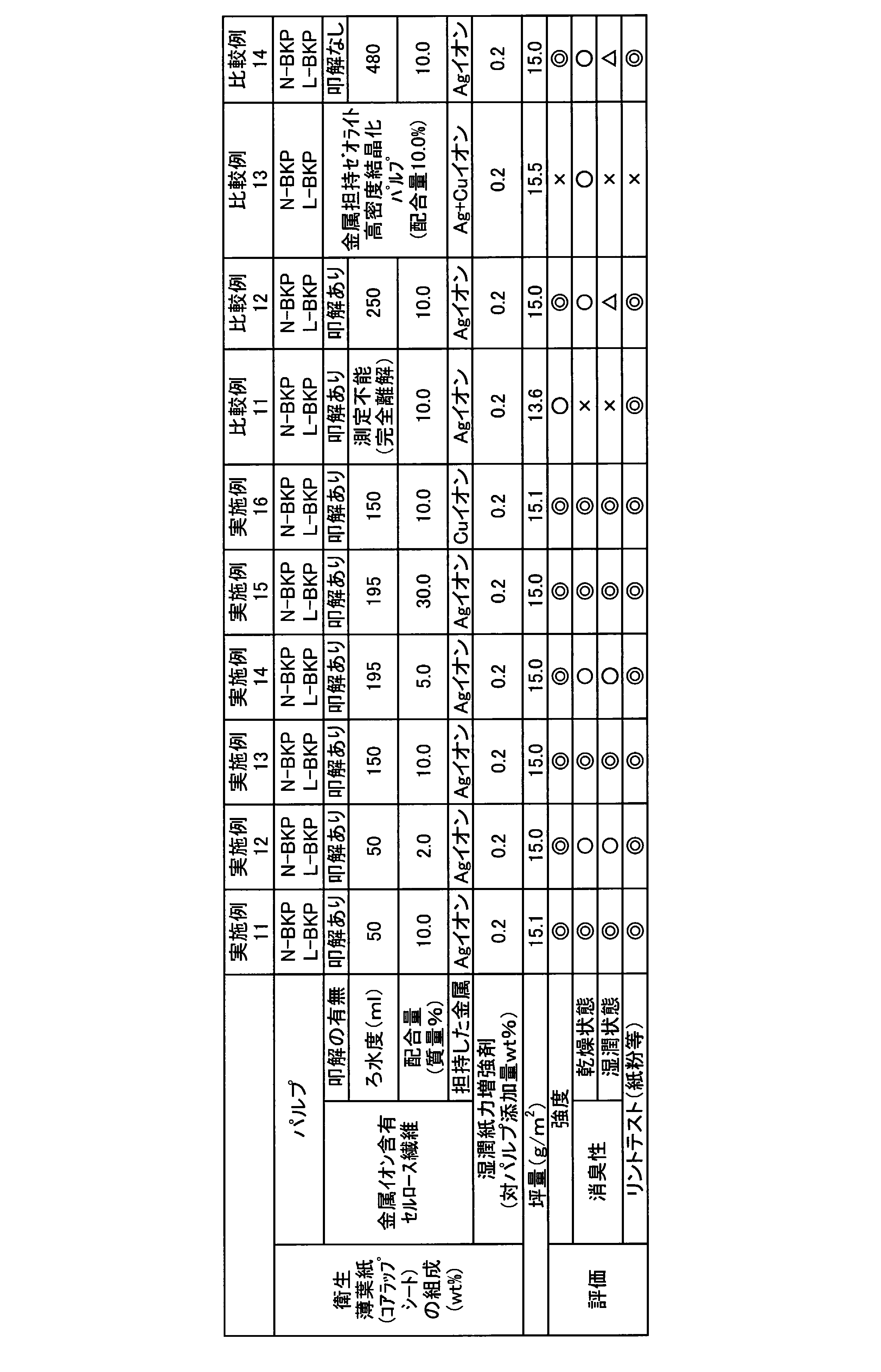
一方、金属イオン含有セルロース繊維のろ水度が50ml未満である比較例11の場合、金属イオン含有セルロース繊維が完全にナノファイバー化(完全離解)して紙中に残る割合が少なく、消臭機能が各実施例よりも大幅に劣った。
金属イオン含有セルロース繊維のろ水度が200mlを超えた比較例12,14の場合も、金属イオン含有セルロース繊維の割合が少ない(10質量%)ことと相俟って、湿潤状態での消臭機能が各実施例よりも大幅に劣った。なお、比較例14は、金属イオン含有セルロース繊維を叩解せずに用いた。
金属担持ゼオライト高密度結晶化パルプ(商品名セルガイア(登録商標))を配合して抄紙した比較例13の場合、紙粉等の微粉の落下が顕著であり、強度が低下した。又、湿潤状態でゼオライトが水分を吸着してしまい、消臭機能が各実施例よりも大幅に劣った。
4a、4b 吸収コア
20 吸水性物品本体部
10a、10b コアラップシート
200 吸水性物品
Claims (7)
- 酸化セルロース繊維の絶乾質量に対するカルボキシル基又はカルボキシレート基量が0.1~2.0mmol/gである酸化セルロース繊維に対し、Ag、Au、Pt、Pd、Ni、Mn、Fe、Ti、Al、Zn及びCuの群から選ばれる1種以上の金属元素のイオンを含有し、
前記金属イオン含有セルロース繊維のカナダ標準濾水度が30~400mlである金属イオン含有セルロース繊維。 - 前記金属イオン含有セルロース繊維のカナダ標準濾水度が50~200mlである請求項1記載の金属イオン含有セルロース繊維。
- 前記金属イオン含有セルロース繊維の平均繊維長が0.5~2.5mm、平均繊維径が10~40μmである請求項1又は2に記載の金属イオン含有セルロース繊維。
- 前記金属含有セルロース繊維の絶乾質量に対する前記金属元素イオンの含有量が10~60mg/gである請求項1又は2記載の金属イオン含有セルロース繊維。
- 請求項1~4のいずれか一項記載の金属含有セルロース繊維を含有する衛生薄葉紙。
- 前記金属含有セルロース繊維を2~30質量%含有する請求項5記載の衛生薄葉紙。
- 吸収コアと、前記吸収コアを被覆し、又は前記吸収コアに積層されるコアラップシートと、前記コアラップシートの少なくとも一方の面を覆う液透過性の外層シートと、を有する吸収性物品であって、
前記コアラップシートは、請求項5又は6に記載の衛生薄葉紙である、吸収性物品。
Priority Applications (3)
| Application Number | Priority Date | Filing Date | Title |
|---|---|---|---|
| CN201680041257.9A CN107849800B (zh) | 2015-07-22 | 2016-07-21 | 含有金属离子的纤维素纤维、使用了该纤维的卫生薄页纸和吸收性物品 |
| KR1020187001833A KR102116907B1 (ko) | 2015-07-22 | 2016-07-21 | 금속이온 함유 셀룰로오스 섬유, 이를 이용한 위생 박엽지 및 흡수성 물품 |
| JP2017529917A JP6767977B2 (ja) | 2015-07-22 | 2016-07-21 | 金属イオン含有セルロース繊維、それを用いた衛生薄葉紙及び吸収性物品 |
Applications Claiming Priority (4)
| Application Number | Priority Date | Filing Date | Title |
|---|---|---|---|
| JP2015144512A JP2018178263A (ja) | 2015-07-22 | 2015-07-22 | 酸化セルロース繊維、及び金属含有セルロース繊維 |
| JP2015-144512 | 2015-07-22 | ||
| JP2015144841 | 2015-07-22 | ||
| JP2015-144841 | 2015-07-22 |
Publications (1)
| Publication Number | Publication Date |
|---|---|
| WO2017014255A1 true WO2017014255A1 (ja) | 2017-01-26 |
Family
ID=57834411
Family Applications (1)
| Application Number | Title | Priority Date | Filing Date |
|---|---|---|---|
| PCT/JP2016/071352 Ceased WO2017014255A1 (ja) | 2015-07-22 | 2016-07-21 | 金属含有セルロース繊維、それを用いた衛生薄葉紙及び吸収性物品 |
Country Status (3)
| Country | Link |
|---|---|
| KR (1) | KR102116907B1 (ja) |
| CN (1) | CN107849800B (ja) |
| WO (1) | WO2017014255A1 (ja) |
Cited By (12)
| Publication number | Priority date | Publication date | Assignee | Title |
|---|---|---|---|---|
| JP2017133135A (ja) * | 2016-01-29 | 2017-08-03 | 日本製紙クレシア株式会社 | 消臭抗菌板紙、及び紙容器 |
| JP2019081988A (ja) * | 2017-10-31 | 2019-05-30 | 日本製紙株式会社 | 機能性材料及びその利用 |
| JP2019112756A (ja) * | 2017-12-25 | 2019-07-11 | エレテン株式会社 | 殺菌性高分子ナノファイバー集合体及びこれを用いた乾式衛生用紙 |
| WO2019189611A1 (ja) * | 2018-03-30 | 2019-10-03 | 日本製紙株式会社 | ミクロフィブリルセルロース繊維を含有する紙 |
| WO2019189588A1 (ja) * | 2018-03-30 | 2019-10-03 | 日本製紙株式会社 | 酸化ミクロフィブリルセルロース繊維およびその組成物 |
| WO2019189595A1 (ja) * | 2018-03-30 | 2019-10-03 | 日本製紙株式会社 | カルボキシメチル化ミクロフィブリルセルロース繊維およびその組成物 |
| JP2019170546A (ja) * | 2018-03-27 | 2019-10-10 | 王子ホールディングス株式会社 | 吸収性物品 |
| JP2019172849A (ja) * | 2018-03-29 | 2019-10-10 | 日本製紙株式会社 | 変性パルプの製造方法 |
| CN110546322A (zh) * | 2017-04-27 | 2019-12-06 | 日本制纸株式会社 | 无机粒子复合纤维的制造方法 |
| WO2020195671A1 (ja) * | 2019-03-28 | 2020-10-01 | 日本製紙株式会社 | フィブリル化された化学変性セルロース繊維 |
| WO2021054274A1 (ja) * | 2019-09-17 | 2021-03-25 | 日本製紙株式会社 | 化学変性ミクロフィブリルセルロース繊維の製造方法 |
| EP3777800A4 (en) * | 2018-03-29 | 2022-02-23 | Daio Paper Corporation | ABSORBENT ARTICLE |
Citations (6)
| Publication number | Priority date | Publication date | Assignee | Title |
|---|---|---|---|---|
| JPH0252660A (ja) * | 1988-08-13 | 1990-02-22 | Kohjin Co Ltd | 酸化セルロース系消臭材料 |
| JPH07204148A (ja) * | 1994-01-21 | 1995-08-08 | New Oji Paper Co Ltd | 抗菌性拭き紙 |
| JPH11315499A (ja) * | 1998-04-27 | 1999-11-16 | Toyobo Co Ltd | 消臭シート及びそれを用いた消臭製品 |
| JP2002537503A (ja) * | 1999-02-24 | 2002-11-05 | エスシーエー ハイジーン プロダクツ ゲゼルシャフト ミト ベシュレンクテル ハフツング | 酸化されたセルロース含有繊維材料及びそれから作られた製品 |
| JP2011055884A (ja) * | 2009-09-07 | 2011-03-24 | Dai Ichi Kogyo Seiyaku Co Ltd | ゲル状芳香・消臭剤組成物およびそれを用いたゲル状芳香・消臭剤 |
| JP2015045113A (ja) * | 2013-08-29 | 2015-03-12 | 日本製紙株式会社 | 衛生薄葉紙 |
Family Cites Families (7)
| Publication number | Priority date | Publication date | Assignee | Title |
|---|---|---|---|---|
| JPH111895A (ja) * | 1997-04-17 | 1999-01-06 | Rengo Co Ltd | 衛生用品 |
| JP2004098322A (ja) * | 2002-09-05 | 2004-04-02 | Toppan Printing Co Ltd | 電気泳動表示パネル搭載型ブックカバー及び電気泳動表示パネル搭載型ファイル |
| JP2006077367A (ja) * | 2004-09-10 | 2006-03-23 | Kyodo Printing Co Ltd | 消臭塗工剤及び消臭化粧紙 |
| US20090047363A1 (en) * | 2005-03-30 | 2009-02-19 | Kao Corporation | Deodorant Antibacterial Fibrous Product |
| JP6257526B2 (ja) | 2012-12-19 | 2018-01-10 | 日本製紙株式会社 | 紙基材 |
| JP6442730B2 (ja) * | 2013-05-16 | 2018-12-26 | 日本製紙株式会社 | 金属ナノ粒子とセルロース系ファイバーとの複合体の製造方法 |
| JP6095497B2 (ja) | 2013-06-14 | 2017-03-15 | 花王株式会社 | セルロースナノファイバーを含む樹脂組成物の製造方法 |
-
2016
- 2016-07-21 WO PCT/JP2016/071352 patent/WO2017014255A1/ja not_active Ceased
- 2016-07-21 CN CN201680041257.9A patent/CN107849800B/zh active Active
- 2016-07-21 KR KR1020187001833A patent/KR102116907B1/ko active Active
Patent Citations (6)
| Publication number | Priority date | Publication date | Assignee | Title |
|---|---|---|---|---|
| JPH0252660A (ja) * | 1988-08-13 | 1990-02-22 | Kohjin Co Ltd | 酸化セルロース系消臭材料 |
| JPH07204148A (ja) * | 1994-01-21 | 1995-08-08 | New Oji Paper Co Ltd | 抗菌性拭き紙 |
| JPH11315499A (ja) * | 1998-04-27 | 1999-11-16 | Toyobo Co Ltd | 消臭シート及びそれを用いた消臭製品 |
| JP2002537503A (ja) * | 1999-02-24 | 2002-11-05 | エスシーエー ハイジーン プロダクツ ゲゼルシャフト ミト ベシュレンクテル ハフツング | 酸化されたセルロース含有繊維材料及びそれから作られた製品 |
| JP2011055884A (ja) * | 2009-09-07 | 2011-03-24 | Dai Ichi Kogyo Seiyaku Co Ltd | ゲル状芳香・消臭剤組成物およびそれを用いたゲル状芳香・消臭剤 |
| JP2015045113A (ja) * | 2013-08-29 | 2015-03-12 | 日本製紙株式会社 | 衛生薄葉紙 |
Cited By (40)
| Publication number | Priority date | Publication date | Assignee | Title |
|---|---|---|---|---|
| JP2017133135A (ja) * | 2016-01-29 | 2017-08-03 | 日本製紙クレシア株式会社 | 消臭抗菌板紙、及び紙容器 |
| CN110546322B (zh) * | 2017-04-27 | 2022-06-03 | 日本制纸株式会社 | 无机粒子复合纤维的制造方法 |
| CN110546322A (zh) * | 2017-04-27 | 2019-12-06 | 日本制纸株式会社 | 无机粒子复合纤维的制造方法 |
| JP2019081988A (ja) * | 2017-10-31 | 2019-05-30 | 日本製紙株式会社 | 機能性材料及びその利用 |
| JP7068802B2 (ja) | 2017-10-31 | 2022-05-17 | 日本製紙株式会社 | 機能性材料及びその利用 |
| JP2019112756A (ja) * | 2017-12-25 | 2019-07-11 | エレテン株式会社 | 殺菌性高分子ナノファイバー集合体及びこれを用いた乾式衛生用紙 |
| JP2019170546A (ja) * | 2018-03-27 | 2019-10-10 | 王子ホールディングス株式会社 | 吸収性物品 |
| US11963857B2 (en) | 2018-03-29 | 2024-04-23 | Daio Paper Corporation | Absorbent article |
| JP7068884B2 (ja) | 2018-03-29 | 2022-05-17 | 日本製紙株式会社 | 変性パルプの製造方法 |
| EP3777800A4 (en) * | 2018-03-29 | 2022-02-23 | Daio Paper Corporation | ABSORBENT ARTICLE |
| JP2019172849A (ja) * | 2018-03-29 | 2019-10-10 | 日本製紙株式会社 | 変性パルプの製造方法 |
| JPWO2019189595A1 (ja) * | 2018-03-30 | 2021-04-08 | 日本製紙株式会社 | カルボキシメチル化ミクロフィブリルセルロース繊維およびその組成物 |
| WO2019189595A1 (ja) * | 2018-03-30 | 2019-10-03 | 日本製紙株式会社 | カルボキシメチル化ミクロフィブリルセルロース繊維およびその組成物 |
| CN111918999A (zh) * | 2018-03-30 | 2020-11-10 | 日本制纸株式会社 | 羧甲基化微原纤化纤维素纤维和其组合物 |
| CN112105776A (zh) * | 2018-03-30 | 2020-12-18 | 日本制纸株式会社 | 一种含有微原纤化纤维素纤维的纸 |
| JPWO2019189593A1 (ja) * | 2018-03-30 | 2021-02-12 | 日本製紙株式会社 | 酸化ミクロフィブリルセルロース繊維およびその組成物 |
| JPWO2019189588A1 (ja) * | 2018-03-30 | 2021-02-18 | 日本製紙株式会社 | 酸化ミクロフィブリルセルロース繊維およびその組成物 |
| WO2019189611A1 (ja) * | 2018-03-30 | 2019-10-03 | 日本製紙株式会社 | ミクロフィブリルセルロース繊維を含有する紙 |
| JPWO2019189611A1 (ja) * | 2018-03-30 | 2021-04-01 | 日本製紙株式会社 | ミクロフィブリルセルロース繊維を含有する紙 |
| JPWO2019189590A1 (ja) * | 2018-03-30 | 2021-04-08 | 日本製紙株式会社 | カルボキシメチル化ミクロフィブリルセルロース繊維およびその組成物 |
| JP7239561B2 (ja) | 2018-03-30 | 2023-03-14 | 日本製紙株式会社 | ミクロフィブリルセルロース繊維を含有する紙 |
| JP7233414B2 (ja) | 2018-03-30 | 2023-03-06 | 日本製紙株式会社 | カルボキシメチル化ミクロフィブリルセルロース繊維およびその組成物 |
| JP7233413B2 (ja) | 2018-03-30 | 2023-03-06 | 日本製紙株式会社 | カルボキシメチル化ミクロフィブリルセルロース繊維およびその組成物 |
| EP3779038A4 (en) * | 2018-03-30 | 2022-01-05 | Nippon Paper Industries Co., Ltd. | Oxidized microfibrillar cellulose fibers and composition thereof |
| WO2019189593A1 (ja) * | 2018-03-30 | 2019-10-03 | 日本製紙株式会社 | 酸化ミクロフィブリルセルロース繊維およびその組成物 |
| WO2019189590A1 (ja) * | 2018-03-30 | 2019-10-03 | 日本製紙株式会社 | カルボキシメチル化ミクロフィブリルセルロース繊維およびその組成物 |
| US11525015B2 (en) | 2018-03-30 | 2022-12-13 | Nippon Paper Industries Co., Ltd. | Oxidized microfibrillated cellulose fibers and composition thereof |
| WO2019189588A1 (ja) * | 2018-03-30 | 2019-10-03 | 日本製紙株式会社 | 酸化ミクロフィブリルセルロース繊維およびその組成物 |
| US11453728B2 (en) | 2018-03-30 | 2022-09-27 | Nippon Paper Industries Co., Ltd. | Carboxymethylated microfibrillated cellulose fibers and composition thereof |
| US11466405B2 (en) | 2018-03-30 | 2022-10-11 | Nippon Paper Industries Co., Ltd. | Carboxymethylated microfibrillated cellulose fibers and composition thereof |
| US11512432B2 (en) | 2018-03-30 | 2022-11-29 | Nippon Paper Industries Co., Ltd. | Oxidized microfibrillated cellulose fibers and composition thereof |
| JPWO2020195671A1 (ja) * | 2019-03-28 | 2020-10-01 | ||
| WO2020195671A1 (ja) * | 2019-03-28 | 2020-10-01 | 日本製紙株式会社 | フィブリル化された化学変性セルロース繊維 |
| JP2024028706A (ja) * | 2019-03-28 | 2024-03-05 | 日本製紙株式会社 | フィブリル化された化学変性セルロース繊維 |
| JP7605945B2 (ja) | 2019-03-28 | 2024-12-24 | 日本製紙株式会社 | フィブリル化された化学変性セルロース繊維 |
| US12221496B2 (en) | 2019-03-28 | 2025-02-11 | Nippon Paper Industries Co., Ltd. | Fibrillated chemically modified cellulose fiber |
| CN113728138B (zh) * | 2019-09-17 | 2022-12-27 | 日本制纸株式会社 | 化学改性微原纤纤维素纤维的制造方法 |
| CN113728138A (zh) * | 2019-09-17 | 2021-11-30 | 日本制纸株式会社 | 化学改性微原纤纤维素纤维的制造方法 |
| JP6857289B1 (ja) * | 2019-09-17 | 2021-04-14 | 日本製紙株式会社 | 化学変性ミクロフィブリルセルロース繊維の製造方法 |
| WO2021054274A1 (ja) * | 2019-09-17 | 2021-03-25 | 日本製紙株式会社 | 化学変性ミクロフィブリルセルロース繊維の製造方法 |
Also Published As
| Publication number | Publication date |
|---|---|
| KR20180030544A (ko) | 2018-03-23 |
| CN107849800A (zh) | 2018-03-27 |
| KR102116907B1 (ko) | 2020-05-29 |
| CN107849800B (zh) | 2020-09-22 |
Similar Documents
| Publication | Publication Date | Title |
|---|---|---|
| WO2017014255A1 (ja) | 金属含有セルロース繊維、それを用いた衛生薄葉紙及び吸収性物品 | |
| CN104995353B (zh) | 微原纤化材料成分的湿铺片材 | |
| JP2015043940A (ja) | 吸収性物品 | |
| JP6721350B2 (ja) | 巻芯紙管、及びそれを備えたシートロール | |
| JP6640606B2 (ja) | 不織布 | |
| JP2015045113A (ja) | 衛生薄葉紙 | |
| JPWO2016031749A1 (ja) | 衛生薄葉紙、及びそれを用いた吸収性物品 | |
| JP7705369B2 (ja) | セルロース繊維を含有する抗ウイルス性シート | |
| JP7113785B2 (ja) | 針葉樹由来の紙用パルプ繊維の製造方法及び針葉樹由来の紙用パルプ繊維 | |
| JP6596331B2 (ja) | 水解紙ワイパー | |
| JP6767977B2 (ja) | 金属イオン含有セルロース繊維、それを用いた衛生薄葉紙及び吸収性物品 | |
| JP4619110B2 (ja) | 水解紙の製造方法及び水解性清拭物品の製造方法 | |
| JP6629638B2 (ja) | 不織布シート | |
| JP6469421B2 (ja) | 吸収性物品 | |
| CA2904503C (en) | Modified cellulose from chemical kraft fiber and methods of making and using the same | |
| EP4056597B1 (en) | Cellulose nanofiber manufacturing method and cellulose nanofiber | |
| JP2022019633A (ja) | 抗ウイルス性シート | |
| JP2021195629A (ja) | マスク用基材及びマスク | |
| JP2018123448A (ja) | 水解性シート及び当該水解性シートの製造方法 | |
| JP6255215B2 (ja) | 吸収性物品 | |
| JP6684590B2 (ja) | 積層ウェットシート | |
| JPH10314284A (ja) | セルロース系消臭材料およびその製造方法 | |
| JP2023084324A (ja) | セルロース繊維を含有する抗ウイルス性シート | |
| CN113677851A (zh) | 纤维片及使用该纤维片的吸收性物品 |
Legal Events
| Date | Code | Title | Description |
|---|---|---|---|
| 121 | Ep: the epo has been informed by wipo that ep was designated in this application |
Ref document number: 16827815 Country of ref document: EP Kind code of ref document: A1 |
|
| ENP | Entry into the national phase |
Ref document number: 2017529917 Country of ref document: JP Kind code of ref document: A |
|
| ENP | Entry into the national phase |
Ref document number: 20187001833 Country of ref document: KR Kind code of ref document: A |
|
| NENP | Non-entry into the national phase |
Ref country code: DE |
|
| 122 | Ep: pct application non-entry in european phase |
Ref document number: 16827815 Country of ref document: EP Kind code of ref document: A1 |