WO2017145668A1 - オルガノポリシロキサン及びその製造方法並びに硬化性組成物 - Google Patents
オルガノポリシロキサン及びその製造方法並びに硬化性組成物 Download PDFInfo
- Publication number
- WO2017145668A1 WO2017145668A1 PCT/JP2017/003405 JP2017003405W WO2017145668A1 WO 2017145668 A1 WO2017145668 A1 WO 2017145668A1 JP 2017003405 W JP2017003405 W JP 2017003405W WO 2017145668 A1 WO2017145668 A1 WO 2017145668A1
- Authority
- WO
- WIPO (PCT)
- Prior art keywords
- integer
- group
- organopolysiloxane
- component
- carbon atoms
- Prior art date
- Legal status (The legal status is an assumption and is not a legal conclusion. Google has not performed a legal analysis and makes no representation as to the accuracy of the status listed.)
- Ceased
Links
- 0 *C(*)(C(*)(*)NCCC(O1)=O)C1=O Chemical compound *C(*)(C(*)(*)NCCC(O1)=O)C1=O 0.000 description 4
- RBJGPXHWGJDEGK-UHFFFAOYSA-N CC(C)(O[Si+](C)(C)C(C)(C)O[Si+](C)(C)CCCN)[SiH-](C)(C)CCCN Chemical compound CC(C)(O[Si+](C)(C)C(C)(C)O[Si+](C)(C)CCCN)[SiH-](C)(C)CCCN RBJGPXHWGJDEGK-UHFFFAOYSA-N 0.000 description 1
- UVKZVBDYEYZDIE-UHFFFAOYSA-N CC(C)(O[Si+](C)(C)C(C)(C)O[Si](C)(C)CCCN(C(CC1)=O)C1=O)[Si](C)(C)CCCN(C(CC1)=O)C1=O Chemical compound CC(C)(O[Si+](C)(C)C(C)(C)O[Si](C)(C)CCCN(C(CC1)=O)C1=O)[Si](C)(C)CCCN(C(CC1)=O)C1=O UVKZVBDYEYZDIE-UHFFFAOYSA-N 0.000 description 1
Classifications
-
- C—CHEMISTRY; METALLURGY
- C08—ORGANIC MACROMOLECULAR COMPOUNDS; THEIR PREPARATION OR CHEMICAL WORKING-UP; COMPOSITIONS BASED THEREON
- C08L—COMPOSITIONS OF MACROMOLECULAR COMPOUNDS
- C08L83/00—Compositions of macromolecular compounds obtained by reactions forming in the main chain of the macromolecule a linkage containing silicon with or without sulfur, nitrogen, oxygen or carbon only; Compositions of derivatives of such polymers
- C08L83/04—Polysiloxanes
- C08L83/08—Polysiloxanes containing silicon bound to organic groups containing atoms other than carbon, hydrogen and oxygen
-
- C—CHEMISTRY; METALLURGY
- C07—ORGANIC CHEMISTRY
- C07F—ACYCLIC, CARBOCYCLIC OR HETEROCYCLIC COMPOUNDS CONTAINING ELEMENTS OTHER THAN CARBON, HYDROGEN, HALOGEN, OXYGEN, NITROGEN, SULFUR, SELENIUM OR TELLURIUM
- C07F7/00—Compounds containing elements of Groups 4 or 14 of the Periodic Table
- C07F7/02—Silicon compounds
- C07F7/08—Compounds having one or more C—Si linkages
- C07F7/10—Compounds having one or more C—Si linkages containing nitrogen having a Si-N linkage
-
- C—CHEMISTRY; METALLURGY
- C08—ORGANIC MACROMOLECULAR COMPOUNDS; THEIR PREPARATION OR CHEMICAL WORKING-UP; COMPOSITIONS BASED THEREON
- C08G—MACROMOLECULAR COMPOUNDS OBTAINED OTHERWISE THAN BY REACTIONS ONLY INVOLVING UNSATURATED CARBON-TO-CARBON BONDS
- C08G77/00—Macromolecular compounds obtained by reactions forming a linkage containing silicon with or without sulfur, nitrogen, oxygen or carbon in the main chain of the macromolecule
- C08G77/04—Polysiloxanes
- C08G77/38—Polysiloxanes modified by chemical after-treatment
- C08G77/382—Polysiloxanes modified by chemical after-treatment containing atoms other than carbon, hydrogen, oxygen or silicon
- C08G77/388—Polysiloxanes modified by chemical after-treatment containing atoms other than carbon, hydrogen, oxygen or silicon containing nitrogen
-
- C—CHEMISTRY; METALLURGY
- C07—ORGANIC CHEMISTRY
- C07F—ACYCLIC, CARBOCYCLIC OR HETEROCYCLIC COMPOUNDS CONTAINING ELEMENTS OTHER THAN CARBON, HYDROGEN, HALOGEN, OXYGEN, NITROGEN, SULFUR, SELENIUM OR TELLURIUM
- C07F7/00—Compounds containing elements of Groups 4 or 14 of the Periodic Table
- C07F7/02—Silicon compounds
- C07F7/08—Compounds having one or more C—Si linkages
- C07F7/0834—Compounds having one or more O-Si linkage
- C07F7/0838—Compounds with one or more Si-O-Si sequences
-
- C—CHEMISTRY; METALLURGY
- C07—ORGANIC CHEMISTRY
- C07F—ACYCLIC, CARBOCYCLIC OR HETEROCYCLIC COMPOUNDS CONTAINING ELEMENTS OTHER THAN CARBON, HYDROGEN, HALOGEN, OXYGEN, NITROGEN, SULFUR, SELENIUM OR TELLURIUM
- C07F7/00—Compounds containing elements of Groups 4 or 14 of the Periodic Table
- C07F7/02—Silicon compounds
- C07F7/08—Compounds having one or more C—Si linkages
- C07F7/0834—Compounds having one or more O-Si linkage
- C07F7/0838—Compounds with one or more Si-O-Si sequences
- C07F7/0872—Preparation and treatment thereof
- C07F7/0889—Reactions not involving the Si atom of the Si-O-Si sequence
-
- C—CHEMISTRY; METALLURGY
- C08—ORGANIC MACROMOLECULAR COMPOUNDS; THEIR PREPARATION OR CHEMICAL WORKING-UP; COMPOSITIONS BASED THEREON
- C08F—MACROMOLECULAR COMPOUNDS OBTAINED BY REACTIONS ONLY INVOLVING CARBON-TO-CARBON UNSATURATED BONDS
- C08F299/00—Macromolecular compounds obtained by interreacting polymers involving only carbon-to-carbon unsaturated bond reactions, in the absence of non-macromolecular monomers
- C08F299/02—Macromolecular compounds obtained by interreacting polymers involving only carbon-to-carbon unsaturated bond reactions, in the absence of non-macromolecular monomers from unsaturated polycondensates
- C08F299/08—Macromolecular compounds obtained by interreacting polymers involving only carbon-to-carbon unsaturated bond reactions, in the absence of non-macromolecular monomers from unsaturated polycondensates from polysiloxanes
-
- C—CHEMISTRY; METALLURGY
- C08—ORGANIC MACROMOLECULAR COMPOUNDS; THEIR PREPARATION OR CHEMICAL WORKING-UP; COMPOSITIONS BASED THEREON
- C08F—MACROMOLECULAR COMPOUNDS OBTAINED BY REACTIONS ONLY INVOLVING CARBON-TO-CARBON UNSATURATED BONDS
- C08F30/00—Homopolymers or copolymers of compounds having one or more unsaturated aliphatic radicals, each having only one carbon-to-carbon double bond, and containing phosphorus, selenium, tellurium or a metal
- C08F30/04—Homopolymers or copolymers of compounds having one or more unsaturated aliphatic radicals, each having only one carbon-to-carbon double bond, and containing phosphorus, selenium, tellurium or a metal containing a metal
- C08F30/08—Homopolymers or copolymers of compounds having one or more unsaturated aliphatic radicals, each having only one carbon-to-carbon double bond, and containing phosphorus, selenium, tellurium or a metal containing a metal containing silicon
-
- C—CHEMISTRY; METALLURGY
- C08—ORGANIC MACROMOLECULAR COMPOUNDS; THEIR PREPARATION OR CHEMICAL WORKING-UP; COMPOSITIONS BASED THEREON
- C08G—MACROMOLECULAR COMPOUNDS OBTAINED OTHERWISE THAN BY REACTIONS ONLY INVOLVING UNSATURATED CARBON-TO-CARBON BONDS
- C08G77/00—Macromolecular compounds obtained by reactions forming a linkage containing silicon with or without sulfur, nitrogen, oxygen or carbon in the main chain of the macromolecule
- C08G77/04—Polysiloxanes
- C08G77/06—Preparatory processes
- C08G77/08—Preparatory processes characterised by the catalysts used
-
- C—CHEMISTRY; METALLURGY
- C08—ORGANIC MACROMOLECULAR COMPOUNDS; THEIR PREPARATION OR CHEMICAL WORKING-UP; COMPOSITIONS BASED THEREON
- C08G—MACROMOLECULAR COMPOUNDS OBTAINED OTHERWISE THAN BY REACTIONS ONLY INVOLVING UNSATURATED CARBON-TO-CARBON BONDS
- C08G77/00—Macromolecular compounds obtained by reactions forming a linkage containing silicon with or without sulfur, nitrogen, oxygen or carbon in the main chain of the macromolecule
- C08G77/04—Polysiloxanes
- C08G77/38—Polysiloxanes modified by chemical after-treatment
-
- C—CHEMISTRY; METALLURGY
- C08—ORGANIC MACROMOLECULAR COMPOUNDS; THEIR PREPARATION OR CHEMICAL WORKING-UP; COMPOSITIONS BASED THEREON
- C08G—MACROMOLECULAR COMPOUNDS OBTAINED OTHERWISE THAN BY REACTIONS ONLY INVOLVING UNSATURATED CARBON-TO-CARBON BONDS
- C08G77/00—Macromolecular compounds obtained by reactions forming a linkage containing silicon with or without sulfur, nitrogen, oxygen or carbon in the main chain of the macromolecule
- C08G77/42—Block-or graft-polymers containing polysiloxane sequences
- C08G77/452—Block-or graft-polymers containing polysiloxane sequences containing nitrogen-containing sequences
- C08G77/455—Block-or graft-polymers containing polysiloxane sequences containing nitrogen-containing sequences containing polyamide, polyesteramide or polyimide sequences
-
- C—CHEMISTRY; METALLURGY
- C08—ORGANIC MACROMOLECULAR COMPOUNDS; THEIR PREPARATION OR CHEMICAL WORKING-UP; COMPOSITIONS BASED THEREON
- C08G—MACROMOLECULAR COMPOUNDS OBTAINED OTHERWISE THAN BY REACTIONS ONLY INVOLVING UNSATURATED CARBON-TO-CARBON BONDS
- C08G77/00—Macromolecular compounds obtained by reactions forming a linkage containing silicon with or without sulfur, nitrogen, oxygen or carbon in the main chain of the macromolecule
- C08G77/04—Polysiloxanes
- C08G77/22—Polysiloxanes containing silicon bound to organic groups containing atoms other than carbon, hydrogen and oxygen
- C08G77/26—Polysiloxanes containing silicon bound to organic groups containing atoms other than carbon, hydrogen and oxygen nitrogen-containing groups
-
- C—CHEMISTRY; METALLURGY
- C08—ORGANIC MACROMOLECULAR COMPOUNDS; THEIR PREPARATION OR CHEMICAL WORKING-UP; COMPOSITIONS BASED THEREON
- C08G—MACROMOLECULAR COMPOUNDS OBTAINED OTHERWISE THAN BY REACTIONS ONLY INVOLVING UNSATURATED CARBON-TO-CARBON BONDS
- C08G77/00—Macromolecular compounds obtained by reactions forming a linkage containing silicon with or without sulfur, nitrogen, oxygen or carbon in the main chain of the macromolecule
- C08G77/70—Siloxanes defined by use of the MDTQ nomenclature
Definitions
- the present invention relates to a novel organopolysiloxane, particularly an organopolysiloxane having excellent heat resistance and a method for producing the same, and further to a curable composition using the novel organopolysiloxane, particularly a photoreactive functional group.
- the present invention relates to a curable composition that can be suitably used for UV curable materials.
- Organopolysiloxane is an organic-inorganic composite polymer having a main chain having a siloxane bond and an organic group in a side chain. It is a material with excellent characteristics such as heat resistance, weather resistance, slidability, chemical resistance and electrical insulation, and there are forms such as oil, rubber and resin. Organopolysiloxane oils are also called silicone oils, and are characterized by higher heat resistance and weather resistance than other organic oils, and also have a smooth and unique feel. Because of its excellent heat resistance, it is used as an industrial heating medium.
- Non-reactive organic groups include alkyl groups, phenyl groups, polyether groups, fluoroalkyl groups, perfluoropolyether groups, and reactive organic groups include vinyl groups, epoxy groups, amino groups, hydroxyl groups. Groups, mercapto groups, carboxyl groups and the like. Use different silicone oils depending on the application.
- an imide is obtained by reacting a primary amine with an anhydride of a carboxylic acid, such as R a —CO—NR b —CO—R c (where R a , R b , R c represents an organic group).
- R a —CO—NR b —CO—R c where R a , R b , R c represents an organic group.
- R a , R b , R c represents an organic group.
- R a —CO—NR b —CO—R c where R a , R b , R c represents an organic group.
- Patent Documents 1 to 4 Japanese Patent Application Laid-Open No. 2004-263058, Japanese Patent No. 5314856, and Japanese Patent No. 4204435
- siloxane-polyimide copolymers using diaminopolysiloxane as a raw material. It has been described and shown to be an industrially important material with various features.
- the product becomes a solid, and there is a drawback that it is difficult to handle depending on the application.
- resins obtained by curing liquid resin compositions are widely used in various fields. Curing proceeds when a crosslinked structure is formed by chemical bonding in the composition, and heat and light are used as an energy source for the formation.
- thermosetting resins include various types such as urea resins, melamine resins, epoxy resins, phenol resins, urethane resins, and unsaturated polyester resins. Some of these components have a functional group that forms a chemical bond by heat, and are cured by heating.
- the photocurable resin is a resin having a functional group that forms a cross-linked structure by light
- typical functional groups include (meth) acrylic groups, mercapto groups, and epoxy groups.
- the (meth) acryl group forms a crosslink by a polymerization reaction with a radical, and the mercapto group undergoes an ene-thiol reaction with the radical in the presence of an alkenyl group.
- Epoxy groups are cationically polymerized with an acid generated by light.
- Photo-curing resin is used in every scene of industry and has an advantage that it can be used even in an environment where it is difficult to apply heat.
- One of the resins having the photoreactive functional group as described above is silicone.
- Silicone is a general term for organopolysiloxanes having a continuous siloxane bond as the main chain and an organic group such as a methyl group in the side chain as described above.
- Photo-curable silicone is a raw material for cured products such as silicone rubber, release paper silicone, and hard coat silicone.
- Silicones having the aforementioned (meth) acrylic group, mercapto group, and epoxy group are known (Japanese Patent Laid-Open No. 7-26146, Japanese Patent Publication No. 6-49764, Japanese Patent Publication No. 6-17447: Patent Documents 5 to 7). Etc.) have been put into practical use. In these, it is necessary to mix a radical polymerization initiator and a photoacid generator before light irradiation.
- the maleimide group is a functional group having a carbon-carbon double bond conjugated with two carbonyl groups of the imide, and has a unique property that the double bond site is dimerized by light at the same time it has radical polymerizability. There is. Due to the two mechanisms of radical polymerization and photodimerization, the reaction proceeds without using an initiator by light irradiation. By utilizing this, if there is a silicone having a maleimide group, a one-pack type new resin that does not require an initiator can be produced, but it has hardly been studied so far.
- Japanese Patent No. 4218282 JP 2004-263058 A Japanese Patent No. 5314856 Japanese Patent No. 4204435 Japanese Patent Laid-Open No. 7-26146 Japanese Patent Publication No. 6-49764 Japanese Patent Publication No. 6-17447
- the present invention has been made in view of the above circumstances, and is a liquid novel imide-modified organopolysiloxane having excellent heat resistance, a method for producing the same, and the above-described method that can be cured without using an initiator by light irradiation.
- An object is to provide a curable composition containing a novel imide-modified organopolysiloxane.
- the present inventor is represented by an organopolysiloxane having an amino group-containing organic group represented by the following formula (4) and a formula (5) or (6). Is reacted with a silylating agent in the presence of a Lewis acid catalyst to obtain a novel imide-modified organopolysiloxane represented by the formula (1). It was found that it was liquid and had excellent heat resistance. Furthermore, it discovered that a hardened
- the present invention provides the following organopolysiloxane, a method for producing the same, and a curable composition.
- R 1 is the same or different, unsubstituted or substituted monovalent hydrocarbon group having 1 to 10 carbon atoms, or an organic group having a structure represented by the following general formula (2) or (3); At least one of 1 includes an organic group having a structure represented by the following general formula (2) or (3): a is an integer of 2 or more, b is an integer of 0 or more, c is an integer of 0 or more, d Is an integer of 0 or more, and 2 ⁇ a + b + c + d ⁇ 1,000.)
- R 2 to R 7 are the same or different hydrogen atoms or unsubstituted or substituted monovalent hydrocarbon groups having 1 to 10 carbon atoms; R 2 or R 3 and R 4 or R 5 , R 5 , 6 and R 7 may combine to form a ring, m and n are integers of 0 to 3, and X and Y may be an unsubstituted or substituted hetero atom having 1 to 10 carbon atoms.
- a is an integer of 2 to 12
- b is an integer of 5 to 500
- c is an integer of 0 to 10
- d is an integer of 0 to 5
- a + b + c + d is 7
- the organopolysiloxane of [1] which is ⁇ 527.
- (A) Organopolysiloxane represented by the following average composition formula (4) and having at least one amino group-containing organic group having 1 to 10 carbon atoms in one molecule: 100 parts by mass (Wherein R 8 is the same or different unsubstituted or substituted monovalent hydrocarbon group having 1 to 10 carbon atoms or amino group-containing organic group having 1 to 10 carbon atoms, and at least one of R 8 is Including an amino group-containing organic group having 1 to 10 carbon atoms, e is an integer of 2 or more, f is an integer of 0 or more, g is an integer of 0 or more, h is an integer of 0 or more, and 2 ⁇ e + f + g + h ⁇ 1,000 .) (B) an organic compound represented by the following general formula (5) or (6): an amount which is 1 to 3 times in molar ratio to the amino group in the component (A); Wherein R 9 to R 14 are the same or different hydrogen atoms or unsubstituted or
- the reaction is carried out to form an organopolysiloxane (F) represented by the following average composition formula (7), and then the (C) component and the (D) component are mixed together to form an amide group in the (F) component.
- R 15 is the same or different, unsubstituted or substituted monovalent hydrocarbon group having 1 to 10 carbon atoms, or an organic group having a structure represented by the following general formula (8) or (9); At least one of 15 includes an organic group having a structure represented by the following general formula (8) or (9): i is an integer of 2 or more, j is an integer of 0 or more, k is an integer of 0 or more, l Is an integer greater than or equal to 0 and 2 ⁇ i + j + k + l ⁇ 1,000.) (Wherein R 16 to R 21 are the same or different hydrogen atoms or unsubstituted or substituted monovalent hydrocarbon groups having 1 to 10 carbon atoms, R 16 or R 17 and R 18 or R 19 , R 20 and R 21 may combine to form a ring, x and y are integers of 0 to 3, and Z and W may be unsubstituted or substituted with a heteroatom having 1 to 10 carbon atoms.
- a is an integer of 2 to 12
- b is an integer of 5 to 500
- c is an integer of 0 to 10
- d is an integer of 0 to 5
- a + b + c + d is 7 to 527.
- [5] The method for producing an organopolysiloxane according to [3] or [4], wherein the amine equivalent of component (A) is 200 to 5,000 g / mol.
- [6] The method for producing an organopolysiloxane according to any one of [3] to [5], wherein the component (B) is succinic anhydride, maleic anhydride, glutaric anhydride, adipic anhydride, pimelic anhydride or phthalic anhydride .
- (C) The method for producing an organopolysiloxane according to any one of [3] to [6], wherein the component is a metal compound.
- [8] (C) The method for producing an organopolysiloxane according to [7], wherein the component is a zinc compound.
- (D) The method for producing an organopolysiloxane according to any one of [3] to [8], wherein the component is a disilazane compound.
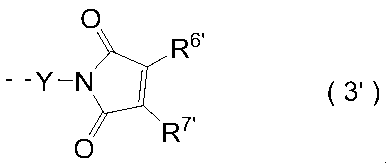
- a curable composition that is cured by irradiation with radiation which is represented by the following average composition formula (1 ′) and has at least one organic group having a structure represented by the following general formula (3 ′) in one molecule.
- a curable composition comprising an organopolysiloxane.
- R 1 ′ is the same or different, unsubstituted or substituted monovalent hydrocarbon group having 1 to 10 carbon atoms, or an organic group having a structure represented by the following general formula (3 ′) ; At least one of them includes an organic group having a structure represented by the following general formula (3 ′): a is an integer of 2 or more, b is an integer of 0 or more, c is an integer of 0 or more, and d is 0 or more.
- a is an integer of 2 to 12
- b is an integer of 5 to 500
- c is an integer of 0 to 10
- d is an integer of 0 to 5
- a + b + c + d is The curable composition according to [10] or [11], which is 7 to 527.
- the novel organopolysiloxane of the present invention is a liquid having an imide structure and can be used as a highly heat-resistant material.
- the curable composition of the present invention can be cured without using an initiator by light irradiation, particularly radiation irradiation, and can be used as a coating material or a rubber material.
- the organopolysiloxane of the present invention has a modified organic group containing an imide structure, and is represented by the following average composition formula (1).
- R 1 is the same or different, unsubstituted or substituted monovalent hydrocarbon group having 1 to 10 carbon atoms, or an organic group having a structure represented by the following general formula (2) or (3); At least one of 1 includes an organic group having a structure represented by the following general formula (2) or (3): a is an integer of 2 or more, b is an integer of 0 or more, c is an integer of 0 or more, d Is an integer of 0 or more, and 2 ⁇ a + b + c + d ⁇ 1,000.)
- R 2 to R 7 are the same or different hydrogen atoms or unsubstituted or substituted monovalent hydrocarbon groups having 1 to 10 carbon atoms; R 2 or R 3 and R 4 or R 5 , R 5 , 6 and R 7 may combine to form
- R 1 is the same or different unsubstituted or substituted monovalent hydrocarbon group having 1 to 10 carbon atoms or an organic group having a structure represented by the above general formula (2) or (3). And at least one of R 1 includes an organic group having a structure represented by the general formula (2) or (3).
- the monovalent hydrocarbon group include an alkyl group such as a methyl group, an ethyl group, a propyl group, and a butyl group, a cycloalkyl group such as a cyclohexyl group, an aryl group such as a phenyl group, and the like.
- a part or all of the hydrogen atoms bonded to the carbon atom may be substituted with a halogen atom or other group.
- substituents include a trifluoromethyl group, a 3,3,3-trifluoropropyl group, and the like. Illustrated. Among them, a saturated aliphatic group or an aromatic group is preferable, and a methyl group or a phenyl group is preferable.
- At least one of R 1 , preferably 2 to 200, more preferably 2 to 150 contains an organic group having a structure represented by the general formula (2) or (3).
- R 2 to R 7 are the same or different hydrogen atoms or unsubstituted or substituted monovalent hydrocarbon groups having 1 to 10 carbon atoms.
- the monovalent hydrocarbon group include an alkyl group such as a methyl group, an ethyl group, a propyl group, and a butyl group, a cycloalkyl group such as a cyclohexyl group, an aryl group such as a phenyl group, and the like.
- a part or all of the hydrogen atoms bonded to the carbon atom may be substituted with a halogen atom or other group.
- R 2 or R 3 and R 4 or R 5 , R 6 and R 7 may combine to form a ring, such as a cyclopropane ring, a cyclobutane ring, a cyclopentane ring, a cyclohexane ring, A benzene ring etc. are illustrated and a benzene ring is preferable.
- M and n are integers of 0 to 3, preferably 0 to 2, and more preferably 0 or 1.
- X and Y are each an unsubstituted or substituted divalent hydrocarbon group that may intervene with a heteroatom having 1 to 10 carbon atoms, such as CH 2 , C 2 H 4 , C 3 H 6 , C 4 H 8 , Examples include alkylene groups such as C 5 H 10 and C 6 H 12 , and ether groups or thioether groups may be interposed. Moreover, you may form cyclic structures, such as a phenylene group and a cyclohexylene group, and one part or all part of the hydrogen atom couple
- a is an integer of 2 or more, preferably 2 to 12
- b is 0 or more, preferably 1 to 998, more preferably 5 to 998, still more preferably 5 to 500
- c is 0.
- d is an integer of 0 or more, preferably 0 to 5, 2 ⁇ a + b + c + d ⁇ 1,000, and 7 ⁇ a + b + c + d ⁇ 527 is preferable. If a + b + c + d is greater than 1,000, the viscosity may increase and workability may deteriorate.
- the structure of the organopolysiloxane represented by the formula (1) include, but are not limited to, those represented by the following formula.
- Me, Ph, and I represent a methyl group and a phenyl group, respectively.
- I represents an N-succinimidopropyl group or an N-maleimidopropyl group, but in the formulas (2) and (3), Any organic group having the structure shown may be used.
- a broken line indicates a bond.
- the organopolysiloxane of the present invention is represented by (A) the following average composition formula (4), an organopolysiloxane having at least one amino group-containing organic group in one molecule, and (B) the following general formula (5).
- the organic compound represented by (6) is subjected to an addition reaction in the presence of (E) an organic solvent, if necessary, and (C) a Lewis acid catalyst and (D) a silylating agent are mixed to perform a condensation reaction ( (Imidation reaction).
- E an organic solvent
- C a Lewis acid catalyst and (D) a silylating agent are mixed to perform a condensation reaction ( (Imidation reaction).
- the component (A) is an organopolysiloxane represented by the following average composition formula (4) and having at least one amino group-containing organic group in one molecule.
- R 8 is the same or different unsubstituted or substituted monovalent hydrocarbon group having 1 to 10 carbon atoms or amino group-containing organic group having 1 to 10 carbon atoms, and at least one of R 8 is Including an amino group-containing organic group having 1 to 10 carbon atoms, e is an integer of 2 or more, f is an integer of 0 or more, g is an integer of 0 or more, h is an integer of 0 or more, and 2 ⁇ e + f + g + h ⁇ 1,000 .
- R 8 is an unsubstituted or substituted monovalent hydrocarbon group or an amino group-containing organic group having 1 to 10 carbon atoms the same or different 1 to 10 carbon atoms, at least one of R 8 One, preferably 2 to 200, contains an amino group-containing organic group.
- the monovalent hydrocarbon group include an alkyl group such as a methyl group, an ethyl group, a propyl group, and a butyl group, a cycloalkyl group such as a cyclohexyl group, an aryl group such as a phenyl group, and the like.
- a part or all of the hydrogen atoms bonded to the carbon atom may be substituted with a halogen atom or other group.
- substituents include a trifluoromethyl group, a 3,3,3-trifluoropropyl group, and the like. Illustrated. Among them, a saturated aliphatic group or an aromatic group is preferable, and a methyl group or a phenyl group is preferable.
- the amino group in the amino group-containing organic group is preferably a primary amine.
- an aminoalkyl group having 1 to 10 carbon atoms which may intervene with an ether group or a thioether group is preferable, and an aminopropyl group is particularly preferable.
- Specific structures of the amino group-containing organic group are shown below, but are not limited thereto. (In the formula, a broken line indicates a bond.)
- the amine equivalent of component (A) is preferably 200 to 5,000 g / mol, more preferably 300 to 4,800 g / mol, and still more preferably 400 to 4,500 g / mol. If it is less than 200 g / mol, the heat resistance may be lowered due to the molecular weight of the product being reduced, and if it is more than 5,000 g / mol, the heat resistance is lowered due to the reduced amount of functional groups to be introduced. There is a case.
- e is an integer of 2 or more, preferably 2 to 12
- f is 0 or more, preferably 1 to 998, more preferably 5 to 998, still more preferably 5 to 500
- g is 0.
- h is an integer of 0 or more, preferably 0 to 5, 2 ⁇ e + f + g + h ⁇ 1,000, and preferably 7 ⁇ e + f + g + h ⁇ 527.
- Specific structures of the component (A) include, but are not limited to, those represented by the following formula.
- Me and Ph are a methyl group and a phenyl group, respectively, and A represents an aminopropyl group, but any amino group-containing organic group having 1 to 10 carbon atoms may be used. .
- a broken line indicates a bond.
- the component (B) is an organic compound represented by the following general formula (5) or (6).
- R 9 to R 14 are the same or different hydrogen atoms or unsubstituted or substituted monovalent hydrocarbon groups having 1 to 10 carbon atoms, and R 9 or R 10 and R 11 or R 12 , R 12 13 and R 14 may combine to form a ring, and M and N are integers of 0 to 3.
- R 9 to R 14 are the same or different hydrogen atoms or unsubstituted or substituted monovalent hydrocarbon groups having 1 to 10 carbon atoms.
- the monovalent hydrocarbon group include an alkyl group such as a methyl group, an ethyl group, a propyl group, and a butyl group, a cycloalkyl group such as a cyclohexyl group, an aryl group such as a phenyl group, and the like.
- a part or all of the hydrogen atoms bonded to the carbon atom may be substituted with a halogen atom or other group.
- Examples of the substituent include a trifluoromethyl group, a 3,3,3-trifluoropropyl group, and the like. Examples thereof include a hydrogen atom and a methyl group.
- R 9 or R 10 and R 11 or R 12 , R 13 and R 14 may be combined to form a ring, and examples of the ring include a cyclopropane ring, a cyclobutane ring, a cyclopentane ring, a cyclohexane ring, A benzene ring etc. are illustrated and a benzene ring is preferable.
- M and N are integers of 0 to 3, preferably 0 to 2, and more preferably 0 or 1.
- succinic anhydride As the component (B), succinic anhydride, maleic anhydride, glutaric anhydride, adipic anhydride, pimelic anhydride, and phthalic anhydride are preferable, and succinic anhydride and maleic anhydride are particularly preferable.
- the component (B) is used in an amount of 1 to 3 times the molar ratio with respect to the amino group in the component (A), preferably 1 to 2.5 times, more preferably 1 to 2 times. When it is less than 1 time, unreacted amino groups remain, and thus heat resistance may be deteriorated, and curing failure may occur when a composition described later is used. If the amount is more than 3 times, the efficiency may deteriorate due to removal of the unreacted component (B) during purification.
- Component (C) is a Lewis acid catalyst, and various examples of Lewis acids include boron compounds, aluminum compounds, scandium compounds, titanium compounds, vanadium compounds, iron compounds, cobalt compounds, nickel compounds, copper compounds, and zinc. There are compounds, lanthanum compounds, cerium compounds and the like, metal compounds are preferable, and zinc compounds are particularly preferable.
- inorganic zinc compounds such as zinc halide compounds such as zinc chloride, zinc bromide and zinc iodide and zinc salts such as zinc nitrate, zinc sulfate, zinc carbonate and zinc trifluoromethanesulfonate are preferably used.
- Zinc chloride and zinc bromide are preferred.
- Component (C) is used in an amount of 0.1 to 2 times the molar ratio of the amino group in component (A), preferably 0.2 to 1.8 times, more preferably 0.5 to 1.5 times. If it is less than 0.1 times, the reaction may be slow and take a long time, and if it is more than 2 times, it may be inefficient because it is removed from the reaction system.
- Component (D) is a silylating agent, and examples of the silylating agent include chlorosilane compounds and disilazane compounds, but disilazan compounds are preferred.
- examples of the disilazane compound include hexamethyldisilazane, 1,1,3,3-tetramethyldisilazane, 1,3-divinyl-1,1,3,3-tetramethyldisilazane, 1,3-diphenyl-1, Examples include 1,3,3-tetramethyldisilazane, and hexamethyldisilazane is preferable.
- Component (D) is used in an amount of 1 to 3 times the molar ratio of the amino group in component (A), preferably 1.1 to 2.8 times, more preferably 1.2 to 2. 5 times. If it is less than 1 time, the reaction may not proceed sufficiently, and if it is more than 3 times, it may be inefficient because it is removed from the reaction system.
- the component (E) is an organic solvent and is a reaction solvent for dissolving the substrate (components (A) and (B)).
- Component includes aromatic hydrocarbon solvents such as toluene and xylene, aliphatic hydrocarbon solvents such as hexane, heptane, octane, isooctane, decane, cyclohexane, methylcyclohexane and isoparaffin, industrial gasoline, petroleum benzine , Hydrocarbon solvents such as solvent naphtha, ketones such as acetone, methyl ethyl ketone, 2-pentanone, 3-pentanone, 2-hexanone, 2-heptanone, 4-heptanone, methyl isobutyl ketone, diisobutyl ketone, acetonyl acetone, cyclohexanone Solvent, ester solvents such as ethyl acetate, propyl
- the component (E) is preferably a solvent that dissolves the components (A) and (D) but does not dissolve the component (C). This is because the component (C) can be easily removed after completion of the reaction. When the component (C) does not dissolve, it can be removed by filtration, whereas when the component (C) dissolves. This is because a washing operation is necessary, and the efficiency and yield are deteriorated.
- the component (B) may or may not be dissolved in the component (E), but it is preferable that the component is dissolved because the reaction proceeds faster.
- Component (E) is blended in an amount of 0 to 5,000 parts by weight, preferably 0 to 4,000 parts by weight, and 0 to 3,000 parts by weight when component (A) is 100 parts by weight. More preferred. When it is more than 5,000 parts by mass, the progress of the reaction may be slow. In addition, when mix
- the organopolysiloxane of the above average composition formula (1) is produced by using the components (A) to (E).
- the component (A) and the component (B) are reaction substrates. More specifically, the component (A) is the main agent and the component (B) is the reactant.
- the reaction occurs while generating heat even at room temperature (25 ° C.), and the organopolysiloxane represented by the following average composition formula (7) (F) is formed.
- R 15 is the same or different, unsubstituted or substituted monovalent hydrocarbon group having 1 to 10 carbon atoms, or an organic group having a structure represented by the following general formula (8) or (9); At least one of 15 includes an organic group having a structure represented by the following general formula (8) or (9): i is an integer of 2 or more, j is an integer of 0 or more, k is an integer of 0 or more, l Is an integer greater than or equal to 0 and 2 ⁇ i + j + k + l ⁇ 1,000.) (Wherein R 16 to R 21 are the same or different hydrogen atoms or unsubstituted or substituted monovalent hydrocarbon groups having 1 to 10 carbon atoms, R 16 or R 17 and R 18 or R 19 , R 20 and R 21 may combine to form a ring, x and y are integers of 0 to 3, and Z and W may be unsubstituted or substituted with a heteroatom having 1 to 10 carbon atoms. (The
- R 15 is the same or different unsubstituted or substituted monovalent hydrocarbon group having 1 to 10 carbon atoms or an organic group having a structure represented by the above general formula (8) or (9). And at least one of R 15 includes an organic group having a structure represented by the general formula (8) or (9).
- the monovalent hydrocarbon group include an alkyl group such as a methyl group, an ethyl group, a propyl group, and a butyl group, a cycloalkyl group such as a cyclohexyl group, an aryl group such as a phenyl group, and the like.
- a part or all of the hydrogen atoms bonded to the carbon atom may be substituted with a halogen atom or other group.
- substituents include a trifluoromethyl group, a 3,3,3-trifluoropropyl group, and the like. Illustrated. Among them, a saturated aliphatic group or an aromatic group is preferable, and a methyl group or a phenyl group is preferable.
- At least one of R 15 preferably 2 to 200, more preferably 2 to 150 contains an organic group having a structure represented by the general formula (8) or (9).
- R 16 to R 21 are the same or different hydrogen atoms or unsubstituted or substituted monovalent hydrocarbon groups having 1 to 10 carbon atoms.
- the monovalent hydrocarbon group include an alkyl group such as a methyl group, an ethyl group, a propyl group, and a butyl group, a cycloalkyl group such as a cyclohexyl group, an aryl group such as a phenyl group, and the like.
- a part or all of the hydrogen atoms bonded to the carbon atom may be substituted with a halogen atom or other group.
- substituents examples include a trifluoromethyl group, a 3,3,3-trifluoropropyl group, and the like. Examples thereof include a hydrogen atom and a methyl group.
- R 16 or R 17 and R 18 or R 19 , R 20 and R 21 may be combined to form a ring, such as a cyclopropane ring, a cyclobutane ring, a cyclopentane ring, a cyclohexane ring, A benzene ring etc. are illustrated and a benzene ring is preferable.
- x and y are integers of 0 to 3, preferably integers of 0 to 2, and more preferably 0 or 1.
- Z and W are each an unsubstituted or substituted divalent hydrocarbon group that may intervene with a heteroatom having 1 to 10 carbon atoms, such as CH 2 , C 2 H 4 , C 3 H 6 , C 4 H 8 ,
- Examples include alkylene groups such as C 5 H 10 and C 6 H 12 , and ether groups or thioether groups may be interposed.
- you may form cyclic structures, such as a phenylene group and a cyclohexylene group, and one part or all part of the hydrogen atom couple
- i is an integer of 2 or more, preferably 2 to 12
- j is 0 or more, preferably 1 to 998, more preferably 5 to 998, still more preferably 5 to 500
- k is 0.
- l is an integer of 0 or more, preferably 0 to 5, 2 ⁇ i + j + k + l ⁇ 1,000, and 7 ⁇ i + j + k + l ⁇ 527 is preferable. If i + j + k + l is greater than 1,000, the viscosity may increase and workability may deteriorate.
- Specific structures of the component (F) include, but are not limited to, those represented by the following formula.
- Me and Ph represent a methyl group and a phenyl group, respectively
- B represents the structure shown below, but may be an organic group having a structure represented by the formula (8) or (9). Any of them may be used.
- the broken line indicates a bond.
- the organopolysiloxane of the average composition formula (1) In order to obtain the organopolysiloxane of the average composition formula (1) from the component (F), it is necessary to cyclize and imidize by a condensation reaction, and therefore the components (C) and (D) are used.
- the component (C) is a catalyst
- the component (D) is a reaction reagent for silyl-capping the carboxyl group in the component (F).
- component (F) and component (C) are mixed and component (D) is added thereto, the carboxyl group in component (F) is silylated and the silylated carboxyl group and amide group are condensed by heating. By doing so, the organopolysiloxane of the formula (1) can be obtained.
- the component (C) plays the two roles of reacting with the component (D) to generate active species for silylation and catalyzing the condensation reaction, although the detailed mechanism is not certain. Presumed to be.
- ammonia generated from the component (D) is present in the system, and thus needs to be removed.
- the acidic substance include hydrochloric acid, sulfuric acid, nitric acid, phosphoric acid, boric acid, formic acid, acetic acid, citric acid, lactic acid, and butyric acid. From the viewpoint of reactivity, the acidic substance is preferably a liquid, and acetic acid and phosphoric acid are preferred.
- component (C) If the component (C) is insoluble in the component (E), it can be removed by filtration. If dissolved in the component (E), it must be washed by liquid-liquid extraction and discharged out of the system. Unreacted components (B) and (D) and (E) can be removed by distillation under reduced pressure.
- the target organopolysiloxane of the present invention can be produced.
- the organopolysiloxane of the present invention has excellent heat resistance, and is suitable for applications such as industrial heat transfer oils and lubricants, heat resistant coating materials, heat resistant rubber materials, additives to resins, etc. Can be used for
- the curable composition of the present invention comprises an organopolysiloxane represented by the above average composition formula (1), and in particular, R 1 in the formula (1) is the same or different and has 1 to 10 carbon atoms. It is a substituted or substituted monovalent hydrocarbon group or an organic group having a structure represented by the following general formula (3 ′), and at least one of R 1 is an organic having a structure represented by the following general formula (3 ′). It preferably contains a group.
- R 6 ′ and R 7 ′ are the same or different hydrogen atoms or unsubstituted or substituted monovalent hydrocarbon groups having 1 to 5 carbon atoms, Y is the same as above. Showing hand.
- R 6 ′ and R 7 ′ are the same or different hydrogen atoms or unsubstituted or substituted monovalent hydrocarbon groups having 1 to 5 carbon atoms.
- the monovalent hydrocarbon group include an alkyl group such as a methyl group, an ethyl group, a propyl group, and a butyl group.
- some or all of the hydrogen atoms bonded to the carbon atoms of these groups are halogenated.
- the substituent may be substituted with an atom or other group, and examples of the substituent include a trifluoromethyl group, 3,3,3-trifluoropropyl group, and the like, and R 6 ′ and R 7 ′ may be a hydrogen atom.
- a methyl group is preferable, and a hydrogen atom is particularly preferable.
- specific structures of the organopolysiloxane containing (3 ′) as R 1 include, but are not limited to, those represented by the following formula.
- Me and Ph represent a methyl group and a phenyl group, respectively
- I represents an N-maleimidopropyl group, but any organic group having a structure represented by the formula (3 ′) It may be.
- the broken line indicates a bond.
- a broken line indicates a bond.
- the organic group (functional group) having the structure represented by the above formula (3 ') is considered to cause two kinds of reactions by light irradiation. That is, radical polymerization and dimerization of the carbon-carbon double bond site.
- a cured product of the composition of the present invention can be formed by these reactions, and a photopolymerization initiator is unnecessary for both reactions.
- the curable composition of this invention contains the organopolysiloxane of said Formula (1).
- the curable composition may be only the organopolysiloxane of the above formula (1), but may contain other additives as long as the object of the present invention is not impaired. Specific examples include a photopolymerization initiator, an antioxidant, a reactive diluent, a leveling agent, a filler, an antistatic agent, an antifoaming agent, and a pigment.
- the organopolysiloxane of said Formula (1) can be hardened
- the curable composition of the present invention can be cured by light irradiation, particularly irradiation.
- the radiation is preferably high-pressure or ultrahigh-pressure mercury lamp, metal halide lamp, xenon lamp, carbon arc lamp, fluorescent lamp, semiconductor solid-state laser, argon laser, He—Cd laser, KrF excimer laser, ArF excimer laser.
- Energy rays in the ultraviolet to visible light region (about 100 to about 800 nm) obtained from an F 2 laser or the like are used.
- a radiation light source having a high light hardness of 200 to 400 nm is preferable.
- radiation having high energy such as electron beam and X-ray can be used.
- the irradiation temperature and time of radiation energy are usually about 0.1 to 10 seconds at room temperature (25 ° C.). However, when the energy ray transmission is low or the film thickness of the curable composition is large. It may be preferable to spend more time. If necessary, after the irradiation with energy rays, after-curing by heating at room temperature (25 ° C.) to 150 ° C. for several seconds to several hours is also possible.
- the curable composition of the present invention is suitably used as a coating material, a rubber material, and the like.
- a release film, an adhesive film, an adhesive, a sealant, a rubber roll examples thereof include a heat radiation sheet and a sealing agent.
- Example 1 In a 300 mL three-necked flask equipped with a stirrer, thermometer, dropping funnel and reflux condenser, 3.20 g (0.032 mol) of succinic anhydride as component (B) and 81. of toluene as component (E). In a place where 74 g (70% by mass) was charged and mixed and stirred at room temperature (25 ° C.), 13.76 g (amino group) of the organopolysiloxane of the following formula (A-1) charged into the dropping funnel as component (A) As 0.032 mol).
- the mixture was stirred at room temperature (25 ° C.) for 4 hours, and 7.20 g (0.032 mol) of zinc bromide as a component (C) was charged into the flask and heated to 50 ° C. To this, 7.76 g (0.048 mol) of hexamethyldisilazane charged in the dropping funnel as component (D) was dropped, and after completion of dropping, the mixture was aged at 80 ° C. for 1 hour, allowed to cool to 40 ° C. or less. Then, 3.17 g (0.053 mol) of acetic acid was added dropwise, followed by further aging for 30 minutes.
- Example 2 A yellow transparent liquid was obtained in the same manner as in Example 1 except that 3.14 g (0.032 mol) of maleic anhydride was used as the component (B) instead of succinic anhydride. As a result of analysis, it was confirmed that it was an organopolysiloxane of the following formula (II).
- Example 3 A black liquid was obtained in the same manner as in Example 1 except that 3.65 g (0.032 mol) of glutaric anhydride was used as the component (B) instead of succinic anhydride. As a result of analysis, it was confirmed that it was an organopolysiloxane of the following formula (III).
- Example 4 A yellow transparent liquid was obtained in the same manner as in Example 1 except that 4.74 g (0.032 mol) of phthalic anhydride was used as the component (B) instead of succinic anhydride. As a result of analysis, it was confirmed that it was an organopolysiloxane of the following formula (IV).
- Example 5 In the same manner as in Example 2, except that 13.33 g (0.032 mol) of the organopolysiloxane of the following formula (A-2) was used as the component (A) instead of the organopolysiloxane of the formula (A-1). And a yellow transparent liquid was obtained. As a result of analysis, it was confirmed that it was an organopolysiloxane of the following formula (V).
- the heat resistance of the organopolysiloxanes of Examples 1 to 4 obtained above was evaluated by thermal mass spectrometry. Specifically, after 10 mg of a sample is placed in the apparatus, it is heated from room temperature (25 ° C.) to 400 ° C. at a rate of temperature increase of 10 ° C./min in air, and the temperature at which the mass loss rate becomes 5% is measured. did. Thermo plus TG8120 (manufactured by Rigaku) was used as a measuring device. As Comparative Example 1, the heat resistance of the organopolysiloxane of the above formula (A-1) was evaluated. These results are shown in Table 1.
- Example 6 The coating film obtained by applying the organopolysiloxane produced in Example 2 to polyethylene (PE) laminated paper in an amount of about 0.6 g / m 2 was irradiated with ultraviolet light using two 80 W / cm 2 high-pressure mercury lamps. The following method evaluated whether the coating film was hardened.
- the curability of the organopolysiloxane was evaluated using an ultraviolet irradiation device. That is, on the coating film obtained by applying organopolysiloxane to PE laminated paper in an amount of about 0.6 g / m 2 , ultraviolet rays were heated at 25 ° C. using two 80 W / cm 2 high pressure mercury lamps at a temperature of 200 ° C. Irradiation was performed at a dose of ⁇ 500 mJ / cm 2 . The state of the coating film after irradiation was evaluated as follows. The results are shown in Table 2. ⁇ : Hardened and does not stick to the touched area even when touched with a finger ⁇ : Uncured resin sticks when touched with a finger
- Example 7 This was carried out in the same manner as in Example 6 except that the organopolysiloxane produced in Example 5 was used.
- the organopolysiloxane of the present invention was able to cure the coating film by ultraviolet irradiation without adding a photoinitiator. Therefore, application as a one-component photocurable composition that does not require a photoinitiator can be expected.
Landscapes
- Chemical & Material Sciences (AREA)
- Organic Chemistry (AREA)
- Chemical Kinetics & Catalysis (AREA)
- Health & Medical Sciences (AREA)
- Medicinal Chemistry (AREA)
- Polymers & Plastics (AREA)
- General Chemical & Material Sciences (AREA)
- Silicon Polymers (AREA)
Abstract
優れた耐熱性を有する液状の新規なイミド変性オルガノポリシロキサン、その製造方法、及び光照射により開始剤を使用せずに硬化し得る上記オルガノポリシロキサンを含む硬化性組成物を提供する。 下式(1)で表されるオルガノポリシロキサン。(R1は炭素数1~10の非置換もしくは置換1価炭化水素基又は下式(2)もしくは(3)で表される構造の有機基で、R1のうち下式(2)又は(3)で表される構造の有機基を1個以上含む。aは2以上の整数、b、c、dは0以上の整数で、2≦a+b+c+d≦1,000である。)(R2~R7は水素原子又は炭素数1~10の非置換もしくは置換1価炭化水素基で、R2又はR3とR4又はR5、R6とR7が結合して環を形成してもよく、m,nは0~3の整数であり、X,Yは炭素数1~10のヘテロ原子を介在してもよい非置換もしくは置換の2価炭化水素基である。破線は結合手を示す。)
Description
本発明は、新規なオルガノポリシロキサン、特に優れた耐熱性を有するオルガノポリシロキサン及びその製造方法に関するものであり、さらにこの新規なオルガノポリシロキサンを用いた硬化性組成物、特に光反応性官能基を有することからUV硬化材料などに好適に使用できる硬化性組成物に関するものである。
オルガノポリシロキサンは、主鎖がシロキサン結合で側鎖に有機基を有する、有機-無機複合高分子である。耐熱性、耐候性、摺動性、耐薬品性、電気絶縁性などの優れた特徴をもつ材料であり、オイル状、ゴム状、レジン状などの形態がある。オルガノポリシロキサンのオイルはシリコーンオイルとも呼ばれ、他の有機系のオイルよりも耐熱性や耐候性が高く、またさらさらとした独特の感触を有するという特徴がある。耐熱性に優れることから、工業用の熱媒などに使用される。
シリコーンオイルの有機基には様々なものが使用される。非反応性の有機基としては、アルキル基、フェニル基、ポリエーテル基、フルオロアルキル基、パーフルオロポリエーテル基などがあり、反応性の有機基としては、ビニル基、エポキシ基、アミノ基、ヒドロキシル基、メルカプト基、カルボキシル基などがある。用途によってそれぞれのシリコーンオイルを使い分ける。
一方、イミドは、一級アミンとカルボン酸の無水物を反応させて得られ、Ra-CO-NRb-CO-Rc(Ra,Rb,Rcは有機基を示す)のような一般式で表される窒素と2つのC=O結合を有する化合物の総称である。この構造は化学的に重要であり、医薬や農薬の中間体、塗料、有機樹脂など産業のあらゆる分野に利用されるものである。一般によく知られているものとして、イミド構造が連続している高分子であるポリイミド樹脂があり、耐熱性、電気絶縁性、耐薬品性、機械的強度などが優れており、スーパーエンジニアリングプラスチックの1つとして知られている。特に耐熱性については、あらゆる樹脂の中でも最高水準の耐熱性を示す材料である。
イミドとオルガノポリシロキサンを組み合わせることで、それぞれの特長を併せ持つ優れた材料を作製することが可能になる。例えば、特許文献1~4(特許第4218282号公報、特開2004-263058号公報、特許第5314856号公報、特許第4204435号公報)では、ジアミノポリシロキサンを原料としたシロキサン-ポリイミド共重合体について記述されており、様々な特長を有することで工業的に重要な材料であることが示されている。しかし、イミドの繰り返し構造が存在することで生成物は固体となり、用途によってはハンドリングが困難であるという欠点がある。
イミドとオルガノポリシロキサンの複合材料で、溶剤希釈をしないで液状であるものはほとんどないが、これは高分子の主鎖に剛直なイミドが存在するためである。主鎖をオルガノポリシロキサンだけにして、側鎖にイミド構造を有する有機基を変性したイミド変性オルガノポリシロキサンを合成することで、2つの材料の特長を兼ね備える液状材料ができるものと考えられるが、現在までにそのような材料はない。
また、液状樹脂組成物を硬化させて得られる樹脂は、様々な分野に幅広く利用されている。硬化は組成物中で化学結合により架橋構造が形成されることで進行し、形成のためのエネルギー源には熱や光がある。
熱硬化性樹脂の例としては、ユリア樹脂、メラミン樹脂、エポキシ樹脂、フェノール樹脂、ウレタン樹脂、不飽和ポリエステル樹脂など様々な種類がある。これらの成分の中には、熱により化学結合を形成する官能基を有し、加熱することで硬化する。
光硬化性樹脂は、光により架橋構造を形成する官能基を有する樹脂であり、代表的な官能基としては、(メタ)アクリル基、メルカプト基、エポキシ基などが挙げられる。(メタ)アクリル基はラジカルによる重合反応で架橋を形成し、メルカプト基はアルケニル基との共存下でラジカルによりエン-チオール反応が生じる。エポキシ基は光により生じる酸でカチオン重合する。
光硬化性樹脂は、産業のあらゆる場面で用いられており、熱をかけることが困難な環境においても使用できるというメリットがある。上記のような光反応性官能基を有する樹脂の1つにシリコーンがある。シリコーンは、上述したように連続したシロキサン結合を主鎖とし、側鎖にメチル基などの有機基を有するオルガノポリシロキサンの総称である。
光硬化性のシリコーンは、シリコーンゴム、剥離紙用シリコーン、ハードコート用シリコーンなどの硬化物の原料である。前述の(メタ)アクリル基、メルカプト基、エポキシ基を有するシリコーンは公知であり(特開平7-26146号公報、特公平6-49764号公報、特公平6-17447号公報:特許文献5~7など)、以前から実用化されている。これらはラジカル重合開始剤や光酸発生剤を光照射前に混合する必要がある。
近年注目されている光反応性官能基の1つにマレイミド基がある。マレイミド基はイミドの2つのカルボニル基と共役する炭素-炭素二重結合を有する官能基であり、ラジカル重合性を有するのと同時に、光により当該の二重結合部位が二量化するという特異な性質がある。ラジカル重合と光二量化の2つの機構により、光照射により開始剤を使用しなくても反応が進行する。これを利用し、マレイミド基を有するシリコーンがあれば開始剤不要の1液型の新しい樹脂ができるが、これまでほとんど検討されていない。
本発明は、上記事情に鑑みなされたもので、優れた耐熱性を有する液状の新規なイミド変性オルガノポリシロキサン及びその製造方法、並びに光照射により開始剤を使用せずに硬化させることができる上記新規なイミド変性オルガノポリシロキサンを含む硬化性組成物を提供することを目的とする。
本発明者は、上記目的を達成するため鋭意検討を重ねた結果、後述する式(4)で表されるアミノ基含有有機基を有するオルガノポリシロキサンと式(5)又は(6)で表される有機化合物とを反応させた後、さらにルイス酸触媒存在下でシリル化剤と反応させることにより、式(1)で表される新規なイミド変性オルガノポリシロキサンが得られ、該オルガノポリシロキサンは液状であり、優れた耐熱性を有することを知見した。
さらに、上記新規なイミド変性オルガノポリシロキサンを含む硬化性組成物に光照射することで開始剤を使用せずに硬化物を形成することができることを見出し、本発明をなすに至った。
さらに、上記新規なイミド変性オルガノポリシロキサンを含む硬化性組成物に光照射することで開始剤を使用せずに硬化物を形成することができることを見出し、本発明をなすに至った。
従って、本発明は、下記のオルガノポリシロキサン及びその製造方法並びに硬化性組成物を提供する。
[1]
下記平均組成式(1)で表され、1分子中に下記一般式(2)又は(3)で表される構造の有機基を少なくとも1個含むオルガノポリシロキサン。

(式中、R1は同一又は異種の炭素数1~10の非置換もしくは置換の1価炭化水素基又は下記一般式(2)もしくは(3)で表される構造の有機基であり、R1のうち少なくとも1個は下記一般式(2)又は(3)で表される構造の有機基を含む。aは2以上の整数、bは0以上の整数、cは0以上の整数、dは0以上の整数で、2≦a+b+c+d≦1,000である。)

(式中、R2~R7は互いに同一又は異種の水素原子又は炭素数1~10の非置換もしくは置換の1価炭化水素基であり、R2又はR3とR4又はR5、R6とR7が結合して環を形成してもよく、m,nは0~3の整数であり、X,Yは炭素数1~10のヘテロ原子を介在してもよい非置換もしくは置換の2価炭化水素基である。破線は結合手を示す。)
[2]
上記式(1)において、aが2~12の整数であり、bが5~500の整数であり、cが0~10の整数であり、dが0~5の整数であり、a+b+c+dが7~527である[1]記載のオルガノポリシロキサン。
[3]
(A)下記平均組成式(4)で表され、1分子中に炭素数1~10のアミノ基含有有機基を少なくとも1個有するオルガノポリシロキサン:100質量部、

(式中、R8は同一又は異種の炭素数1~10の非置換もしくは置換の1価炭化水素基又は炭素数1~10のアミノ基含有有機基であり、R8のうち少なくとも1個は炭素数1~10のアミノ基含有有機基を含む。eは2以上の整数、fは0以上の整数、gは0以上の整数、hは0以上の整数で、2≦e+f+g+h≦1,000である。)
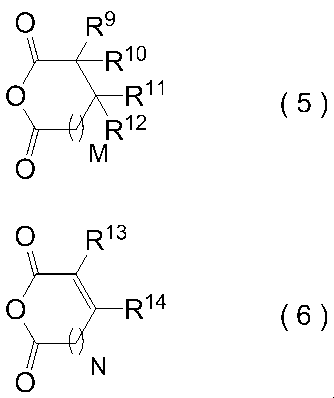
(B)下記一般式(5)又は(6)で表される有機化合物:(A)成分中のアミノ基に対しモル比で1~3倍となる量、
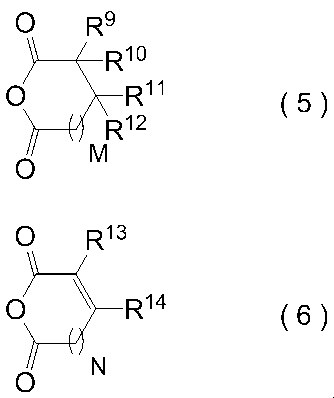
(式中、R9~R14は互いに同一又は異種の水素原子又は炭素数1~10の非置換もしくは置換の1価炭化水素基であり、R9又はR10とR11又はR12、R13とR14が結合して環を形成してもよく、M,Nは0~3の整数である。)
(C)ルイス酸触媒:(A)成分中のアミノ基に対しモル比で0.1~2倍となる量、
(D)シリル化剤:(A)成分中のアミノ基に対しモル比で1~3倍となる量、
(E)有機溶剤:(A)成分を100質量部としたときに0~5,000質量部
を用いて、上記(A)成分と(B)成分とを、必要により(E)成分の存在下で反応させ、下記平均組成式(7)で表されるオルガノポリシロキサン(F)を形成し、次いで、(C)成分、(D)成分を混合して、(F)成分中のアミド基とカルボキシル基とを縮合反応させることを特徴とする[1]に記載の式(1)で表されるオルガノポリシロキサンの製造方法。

(式中、R15は同一又は異種の炭素数1~10の非置換もしくは置換の1価炭化水素基又は下記一般式(8)もしくは(9)で表される構造の有機基であり、R15のうち少なくとも1個は下記一般式(8)又は(9)で表される構造の有機基を含む。iは2以上の整数、jは0以上の整数、kは0以上の整数、lは0以上の整数で、2≦i+j+k+l≦1,000である。)

(式中、R16~R21は互いに同一又は異種の水素原子又は炭素数1~10の非置換もしくは置換の1価炭化水素基であり、R16又はR17とR18又はR19、R20とR21が結合して環を形成してもよく、x,yは0~3の整数であり、Z,Wは炭素数1~10のヘテロ原子を介在してもよい非置換もしくは置換の2価炭化水素基である。破線は結合手を示す。)
[4]
式(1)において、aが2~12の整数であり、bが5~500の整数であり、cが0~10の整数であり、dが0~5の整数であり、a+b+c+dが7~527である[3]記載のオルガノポリシロキサンの製造方法。
[5]
(A)成分のアミン当量が200~5,000g/molである[3]又は[4]に記載のオルガノポリシロキサンの製造方法。
[6]
(B)成分が、無水コハク酸、無水マレイン酸、無水グルタル酸、無水アジピン酸、無水ピメリン酸又は無水フタル酸である[3]~[5]のいずれかに記載のオルガノポリシロキサンの製造方法。
[7]
(C)成分が金属化合物である[3]~[6]のいずれかに記載のオルガノポリシロキサンの製造方法。
[8]
(C)成分が亜鉛化合物である[7]に記載のオルガノポリシロキサンの製造方法。
[9]
(D)成分がジシラザン化合物である[3]~[8]のいずれかに記載のオルガノポリシロキサンの製造方法。
[10]
放射線を照射することによって硬化する硬化性組成物であって、下記平均組成式(1’)で表され、1分子中に下記一般式(3’)で表される構造の有機基を少なくとも1個有するオルガノポリシロキサンを含むことを特徴とする硬化性組成物。

(式中、R1’は同一又は異種の炭素数1~10の非置換もしくは置換の1価炭化水素基又は下記一般式(3’)で表される構造の有機基であり、R1’のうち少なくとも1個は下記一般式(3’)で表される構造の有機基を含む。aは2以上の整数、bは0以上の整数、cは0以上の整数、dは0以上の整数で、2≦a+b+c+d≦1,000である。)
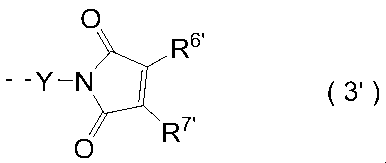
(式中、R6’とR7’は互いに同一又は異種の水素原子又は炭素数1~5の非置換もしくは置換の1価炭化水素基であり、Yは上記と同じである。破線は結合手を示す。)
[11]
上記式(1’)で表されるオルガノポリシロキサンからなる[10]記載の硬化性組成物。
[12]
上記式(1’)において、aが2~12の整数であり、bが5~500の整数であり、cが0~10の整数であり、dが0~5の整数であり、a+b+c+dが7~527である[10]又は[11]記載の硬化性組成物。
[13]
上記式(3’)のR6’とR7’が水素原子である[10]~[12]のいずれかに記載の硬化性組成物。
[14]
光重合開始剤を含まないことを特徴とする[10]~[13]のいずれかに記載の硬化性組成物。
[1]
下記平均組成式(1)で表され、1分子中に下記一般式(2)又は(3)で表される構造の有機基を少なくとも1個含むオルガノポリシロキサン。
[2]
上記式(1)において、aが2~12の整数であり、bが5~500の整数であり、cが0~10の整数であり、dが0~5の整数であり、a+b+c+dが7~527である[1]記載のオルガノポリシロキサン。
[3]
(A)下記平均組成式(4)で表され、1分子中に炭素数1~10のアミノ基含有有機基を少なくとも1個有するオルガノポリシロキサン:100質量部、
(B)下記一般式(5)又は(6)で表される有機化合物:(A)成分中のアミノ基に対しモル比で1~3倍となる量、
(C)ルイス酸触媒:(A)成分中のアミノ基に対しモル比で0.1~2倍となる量、
(D)シリル化剤:(A)成分中のアミノ基に対しモル比で1~3倍となる量、
(E)有機溶剤:(A)成分を100質量部としたときに0~5,000質量部
を用いて、上記(A)成分と(B)成分とを、必要により(E)成分の存在下で反応させ、下記平均組成式(7)で表されるオルガノポリシロキサン(F)を形成し、次いで、(C)成分、(D)成分を混合して、(F)成分中のアミド基とカルボキシル基とを縮合反応させることを特徴とする[1]に記載の式(1)で表されるオルガノポリシロキサンの製造方法。
[4]
式(1)において、aが2~12の整数であり、bが5~500の整数であり、cが0~10の整数であり、dが0~5の整数であり、a+b+c+dが7~527である[3]記載のオルガノポリシロキサンの製造方法。
[5]
(A)成分のアミン当量が200~5,000g/molである[3]又は[4]に記載のオルガノポリシロキサンの製造方法。
[6]
(B)成分が、無水コハク酸、無水マレイン酸、無水グルタル酸、無水アジピン酸、無水ピメリン酸又は無水フタル酸である[3]~[5]のいずれかに記載のオルガノポリシロキサンの製造方法。
[7]
(C)成分が金属化合物である[3]~[6]のいずれかに記載のオルガノポリシロキサンの製造方法。
[8]
(C)成分が亜鉛化合物である[7]に記載のオルガノポリシロキサンの製造方法。
[9]
(D)成分がジシラザン化合物である[3]~[8]のいずれかに記載のオルガノポリシロキサンの製造方法。
[10]
放射線を照射することによって硬化する硬化性組成物であって、下記平均組成式(1’)で表され、1分子中に下記一般式(3’)で表される構造の有機基を少なくとも1個有するオルガノポリシロキサンを含むことを特徴とする硬化性組成物。
[11]
上記式(1’)で表されるオルガノポリシロキサンからなる[10]記載の硬化性組成物。
[12]
上記式(1’)において、aが2~12の整数であり、bが5~500の整数であり、cが0~10の整数であり、dが0~5の整数であり、a+b+c+dが7~527である[10]又は[11]記載の硬化性組成物。
[13]
上記式(3’)のR6’とR7’が水素原子である[10]~[12]のいずれかに記載の硬化性組成物。
[14]
光重合開始剤を含まないことを特徴とする[10]~[13]のいずれかに記載の硬化性組成物。
本発明の新規なオルガノポリシロキサンは、イミド構造を有する液体であり、高耐熱の材料として使用できる。また、本発明の硬化性組成物は、光照射、特に放射線照射により開始剤不要で硬化でき、コーティング材料やゴム材料などに使用できる。
以下、本発明についての詳細を記す。
[オルガノポリシロキサン]
本発明のオルガノポリシロキサンは、イミド構造が含まれる有機基が変性されているものであり、下記平均組成式(1)で示される。

(式中、R1は同一又は異種の炭素数1~10の非置換もしくは置換の1価炭化水素基又は下記一般式(2)もしくは(3)で表される構造の有機基であり、R1のうち少なくとも1個は下記一般式(2)又は(3)で表される構造の有機基を含む。aは2以上の整数、bは0以上の整数、cは0以上の整数、dは0以上の整数で、2≦a+b+c+d≦1,000である。)
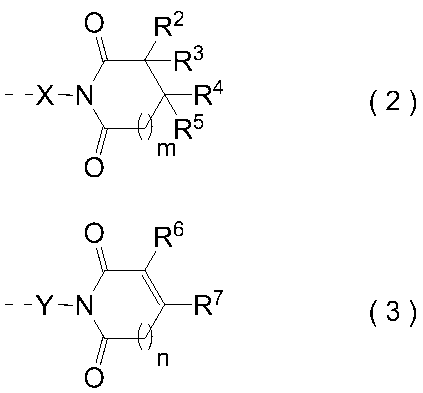
(式中、R2~R7は互いに同一又は異種の水素原子又は炭素数1~10の非置換もしくは置換の1価炭化水素基であり、R2又はR3とR4又はR5、R6とR7が結合して環を形成してもよく、m,nは0~3の整数であり、X,Yは炭素数1~10のヘテロ原子を介在してもよい非置換もしくは置換の2価炭化水素基である。破線は結合手を示す。)
本発明のオルガノポリシロキサンは、イミド構造が含まれる有機基が変性されているものであり、下記平均組成式(1)で示される。
上記式(1)中、R1は同一又は異種の炭素数1~10の非置換もしくは置換の1価炭化水素基又は上記一般式(2)もしくは(3)で表される構造の有機基であり、R1のうち少なくとも1個は上記一般式(2)又は(3)で表される構造の有機基を含む。1価炭化水素基としては、例えば、メチル基、エチル基、プロピル基、ブチル基等のアルキル基、シクロヘキシル基等のシクロアルキル基、フェニル基等のアリール基などが挙げられ、さらに、これらの基の炭素原子に結合した水素原子の一部又は全部がハロゲン原子又はその他の基で置換されていてもよく、置換基としては、トリフルオロメチル基、3,3,3-トリフルオロプロピル基等が例示される。中でも、飽和の脂肪族基又は芳香族基が好ましく、メチル基、フェニル基が好ましい。
本発明においては、R1のうち少なくとも1個、好ましくは2~200個、より好ましくは2~150個は一般式(2)又は(3)で表される構造の有機基を含むものである。
上記式(2)、(3)中、R2~R7は互いに同一又は異種の水素原子又は炭素数1~10の非置換もしくは置換の1価炭化水素基である。1価炭化水素基としては、例えば、メチル基、エチル基、プロピル基、ブチル基等のアルキル基、シクロヘキシル基等のシクロアルキル基、フェニル基等のアリール基などが挙げられ、さらに、これらの基の炭素原子に結合した水素原子の一部又は全部がハロゲン原子又はその他の基で置換されていてもよく、置換基としては、トリフルオロメチル基、3,3,3-トリフルオロプロピル基等が例示され、水素原子、メチル基が好ましい。また、R2又はR3とR4又はR5、R6とR7が結合して環を形成してもよく、該環としては、シクロプロパン環、シクロブタン環、シクロペンタン環、シクロヘキサン環、ベンゼン環等が例示され、ベンゼン環が好ましい。
m,nは0~3の整数であり、好ましくは0~2の整数であり、より好ましくは0又は1である。
X,Yはそれぞれ炭素数1~10のヘテロ原子を介在してもよい非置換もしくは置換の2価炭化水素基であり、CH2、C2H4、C3H6、C4H8、C5H10、C6H12などのアルキレン基が挙げられ、エーテル基やチオエーテル基などを介在していてもよい。また、フェニレン基、シクロヘキシレン基等の環状構造を形成してもよく、炭素原子に結合した水素原子の一部又は全部がハロゲン原子又はその他の基で置換されていてもよい。
一般式(2)、(3)の具体的な構造を以下に示すが、これらに限定されるものではない。
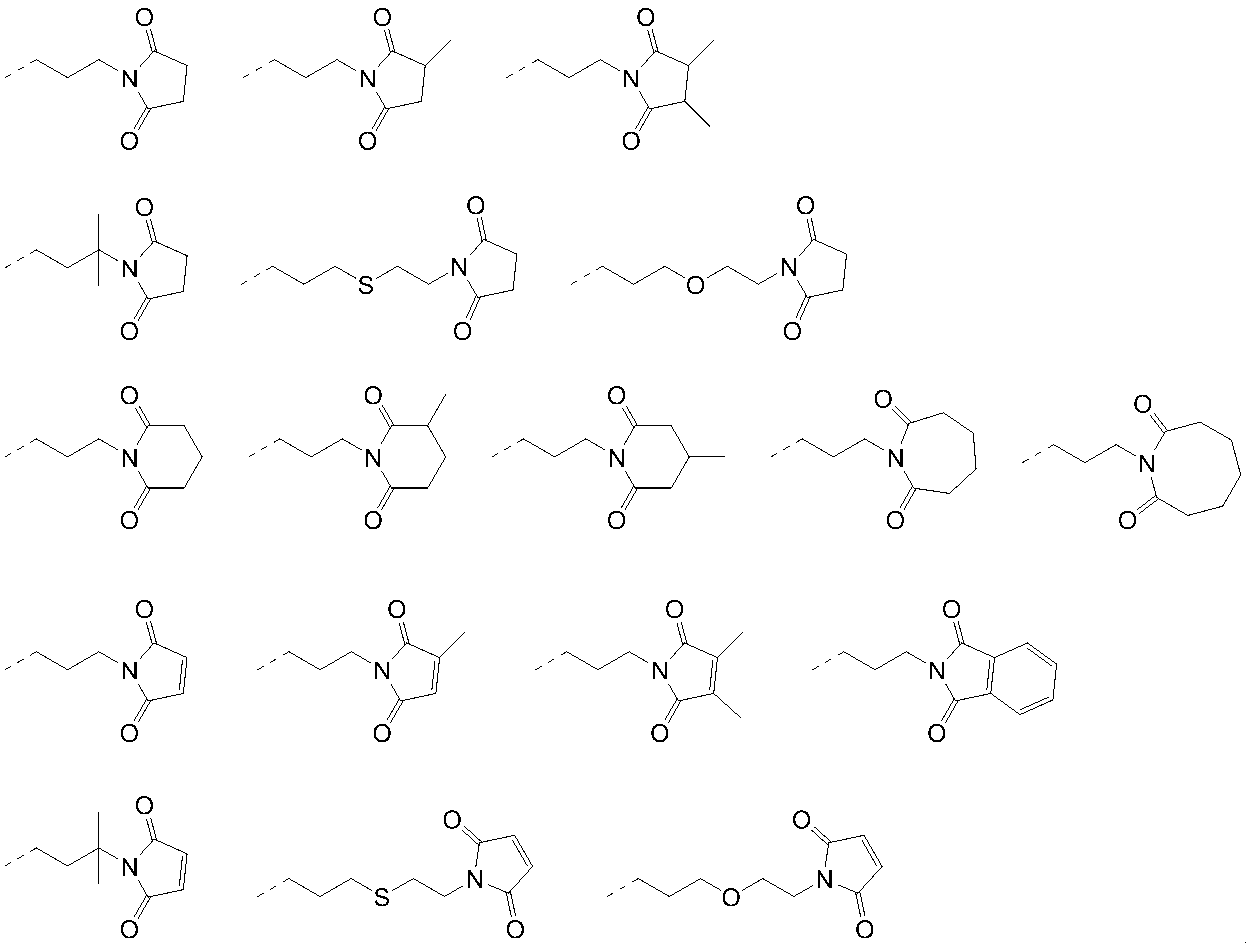
(式中、破線は結合手を示す。)
上記式(1)中、aは2以上、好ましくは2~12の整数、bは0以上、好ましくは1~998、より好ましくは5~998、さらに好ましくは5~500の整数、cは0以上、好ましくは0~10の整数、dは0以上、好ましくは0~5の整数で、2≦a+b+c+d≦1,000であり、7≦a+b+c+d≦527が好ましい。a+b+c+dが1,000より大きいと、粘度が高くなり、作業性が悪くなる場合がある。
式(1)で表されるオルガノポリシロキサンの具体的な構造としては、下記式で表されるものが挙げられるが、これらに限定されない。なお、下記式中のMe,Ph,Iはそれぞれメチル基、フェニル基を示し、IはN-スクシンイミドプロピル基又はN-マレイミドプロピル基を代表して示すが、式(2)、(3)で表される構造の有機基であればいずれのものでもよい。
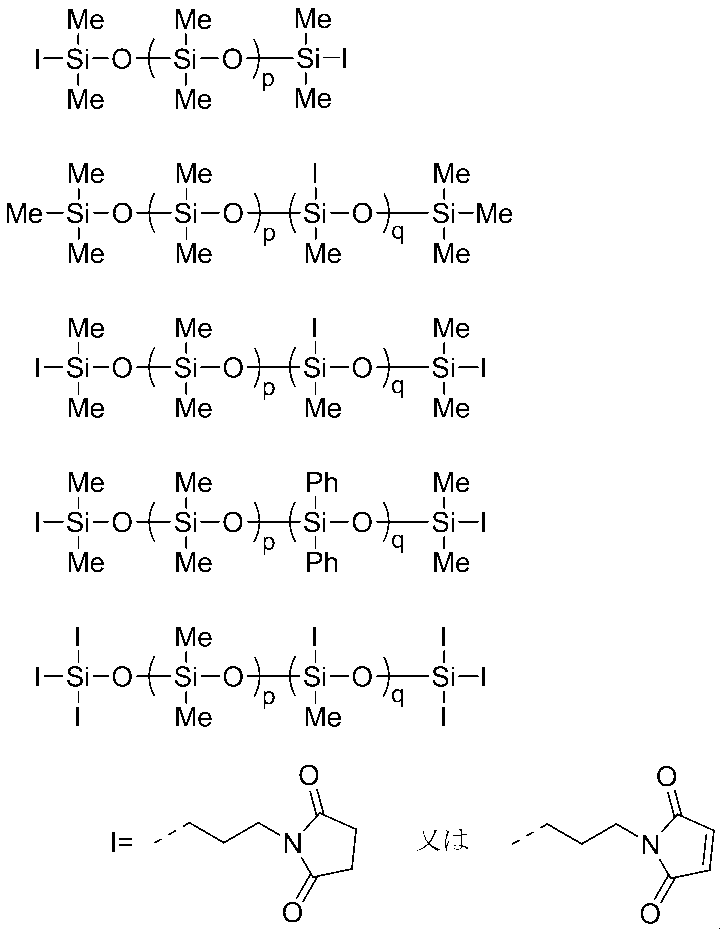
(p≧0,q≧1。破線は結合手を示す。)
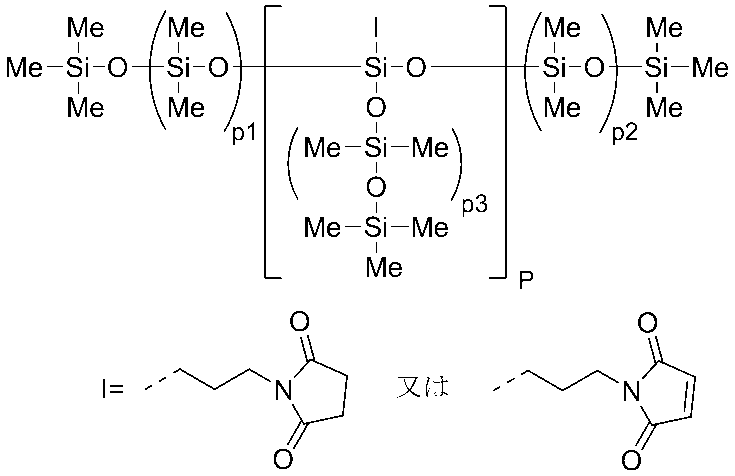
(p1≧0,p2≧0,p3≧0,P≧1。破線は結合手を示す。)
[オルガノポリシロキサンの製造方法]
本発明のオルガノポリシロキサンは、(A)下記平均組成式(4)で表され、1分子中にアミノ基含有有機基を少なくとも1個有するオルガノポリシロキサンと、(B)下記一般式(5)又は(6)で表される有機化合物とを、必要により(E)有機溶剤の存在下で付加反応させ、さらに、(C)ルイス酸触媒、(D)シリル化剤を混合して縮合反応(イミド化反応)させることにより得ることができる。
以下、本発明のオルガノポリシロキサンの原料となる成分及び製造方法について詳細を記す。
本発明のオルガノポリシロキサンは、(A)下記平均組成式(4)で表され、1分子中にアミノ基含有有機基を少なくとも1個有するオルガノポリシロキサンと、(B)下記一般式(5)又は(6)で表される有機化合物とを、必要により(E)有機溶剤の存在下で付加反応させ、さらに、(C)ルイス酸触媒、(D)シリル化剤を混合して縮合反応(イミド化反応)させることにより得ることができる。
以下、本発明のオルガノポリシロキサンの原料となる成分及び製造方法について詳細を記す。
[(A)成分]
(A)成分は、下記平均組成式(4)で表され、1分子中にアミノ基含有有機基を少なくとも1個有するオルガノポリシロキサンである。

(式中、R8は同一又は異種の炭素数1~10の非置換もしくは置換の1価炭化水素基又は炭素数1~10のアミノ基含有有機基であり、R8のうち少なくとも1個は炭素数1~10のアミノ基含有有機基を含む。eは2以上の整数、fは0以上の整数、gは0以上の整数、hは0以上の整数で、2≦e+f+g+h≦1,000である。)
(A)成分は、下記平均組成式(4)で表され、1分子中にアミノ基含有有機基を少なくとも1個有するオルガノポリシロキサンである。
上記式(4)中、R8は同一又は異種の炭素数1~10の非置換もしくは置換の1価炭化水素基又は炭素数1~10のアミノ基含有有機基であり、R8のうち少なくとも1個、好ましくは2~200個はアミノ基含有有機基を含む。1価炭化水素基としては、例えば、メチル基、エチル基、プロピル基、ブチル基等のアルキル基、シクロヘキシル基等のシクロアルキル基、フェニル基等のアリール基などが挙げられ、さらに、これらの基の炭素原子に結合した水素原子の一部又は全部がハロゲン原子又はその他の基で置換されていてもよく、置換基としては、トリフルオロメチル基、3,3,3-トリフルオロプロピル基等が例示される。中でも、飽和の脂肪族基又は芳香族基が好ましく、メチル基、フェニル基が好ましい。
アミノ基含有有機基中のアミノ基は、一級アミンであることが好ましい。アミノ基含有有機基としては、例えば、エーテル基やチオエーテル基などを介在していてもよい炭素数1~10のアミノアルキル基が好ましく、特にアミノプロピル基が好ましい。アミノ基含有有機基の具体的な構造を以下に示すが、これらに限定されるものではない。

(式中、破線は結合手を示す。)
(A)成分のアミン当量は、200~5,000g/molが好ましく、300~4,800g/molがより好ましく、400~4,500g/molがさらに好ましい。200g/molよりも少ないと、生成物の分子量が小さくなることにより耐熱性が低くなる場合があり、5,000g/molよりも多いと、導入する官能基量が少なくなることにより耐熱性が低くなる場合がある。
上記式(4)中、eは2以上、好ましくは2~12の整数、fは0以上、好ましくは1~998、より好ましくは5~998、さらに好ましくは5~500の整数、gは0以上、好ましくは0~10の整数、hは0以上、好ましくは0~5の整数で、2≦e+f+g+h≦1,000であり、7≦e+f+g+h≦527が好ましい。e+f+g+hが1,000より大きいと、粘度が高くなり、作業性が悪くなる場合がある。
(A)成分の具体的な構造としては、下記式で表されるものが挙げられるが、これらに限定されない。なお、下記式中のMe,Phはそれぞれメチル基、フェニル基であり、Aはアミノプロピル基を代表して示すが、炭素数1~10のアミノ基含有有機基であればいずれのものでもよい。
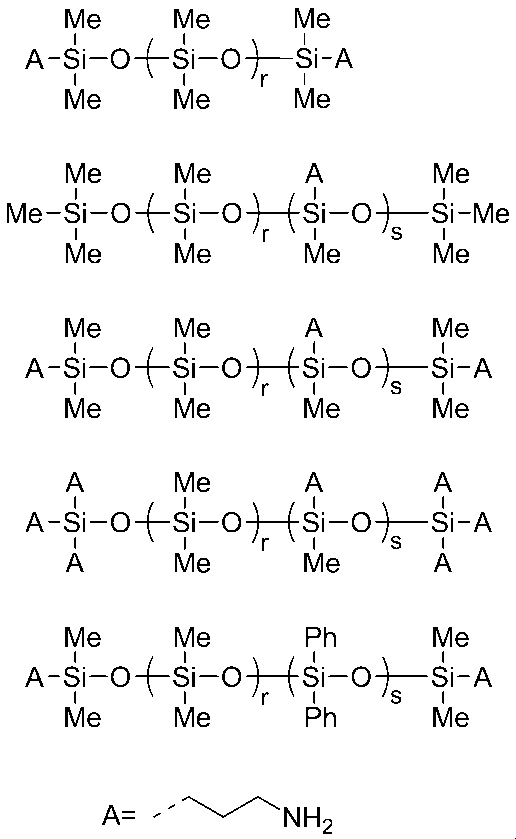
(r≧0,s≧1。破線は結合手を示す。)
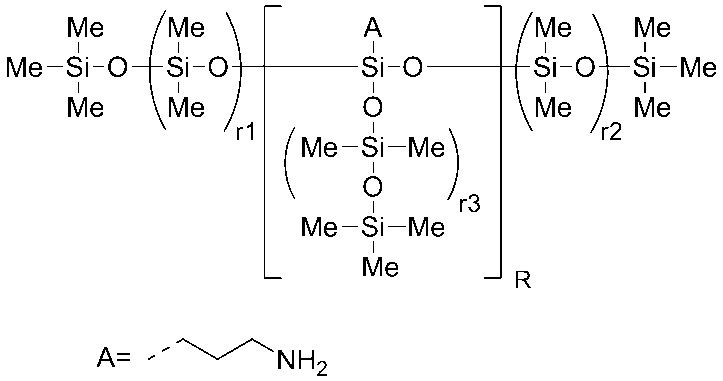
(r1≧0,r2≧0,r3≧0,R≧1。破線は結合手を示す。)
[(B)成分]
(B)成分は、下記一般式(5)又は(6)で表される有機化合物である。

(式中、R9~R14は互いに同一又は異種の水素原子又は炭素数1~10の非置換もしくは置換の1価炭化水素基であり、R9又はR10とR11又はR12、R13とR14が結合して環を形成してもよく、M,Nは0~3の整数である。)
(B)成分は、下記一般式(5)又は(6)で表される有機化合物である。
上記式(5)、(6)中、R9~R14は互いに同一又は異種の水素原子又は炭素数1~10の非置換もしくは置換の1価炭化水素基である。1価炭化水素基としては、例えば、メチル基、エチル基、プロピル基、ブチル基等のアルキル基、シクロヘキシル基等のシクロアルキル基、フェニル基等のアリール基などが挙げられ、さらに、これらの基の炭素原子に結合した水素原子の一部又は全部がハロゲン原子又はその他の基で置換されていてもよく、置換基としては、トリフルオロメチル基、3,3,3-トリフルオロプロピル基等が例示され、水素原子、メチル基が好ましい。
また、R9又はR10とR11又はR12、R13とR14が結合して環を形成してもよく、該環としては、シクロプロパン環、シクロブタン環、シクロペンタン環、シクロヘキサン環、ベンゼン環等が例示され、ベンゼン環が好ましい。
M,Nは0~3の整数であり、好ましくは0~2の整数であり、より好ましくは0又は1である。
また、R9又はR10とR11又はR12、R13とR14が結合して環を形成してもよく、該環としては、シクロプロパン環、シクロブタン環、シクロペンタン環、シクロヘキサン環、ベンゼン環等が例示され、ベンゼン環が好ましい。
M,Nは0~3の整数であり、好ましくは0~2の整数であり、より好ましくは0又は1である。
(B)成分の具体的な構造を以下に示すが、これらに限定されるものではない。
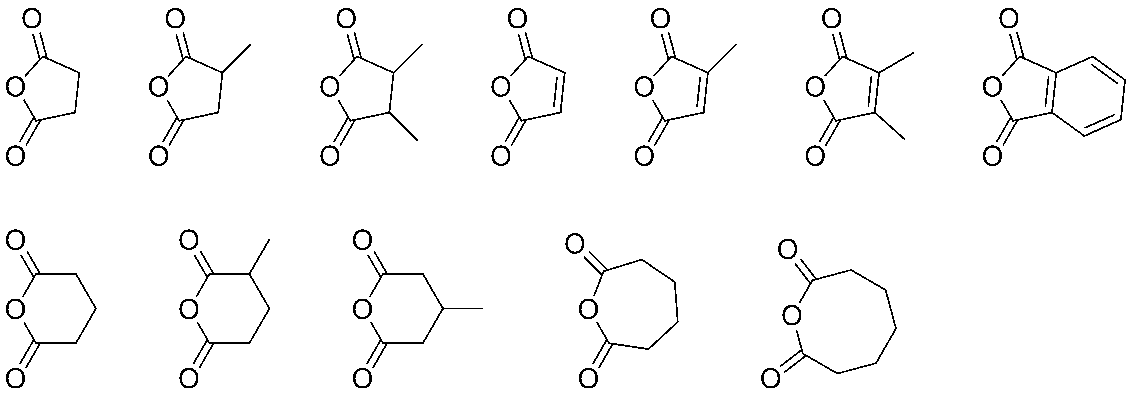
(B)成分としては、無水コハク酸、無水マレイン酸、無水グルタル酸、無水アジピン酸、無水ピメリン酸、無水フタル酸であることが好ましく、無水コハク酸、無水マレイン酸が特に好ましい。
(B)成分は、(A)成分中のアミノ基に対しモル比で1~3倍となる量を使用するが、好ましくは1~2.5倍、より好ましくは1~2倍である。1倍より少ないと未反応のアミノ基が残存するため耐熱性が悪くなる場合があり、また後述する組成物としたときに硬化不良を起こす場合がある。3倍より多くなると、精製時に未反応の(B)成分を除去するために効率が悪くなる場合がある。
[(C)成分]
(C)成分はルイス酸触媒であり、ルイス酸としては様々のものが挙げられ、ホウ素化合物、アルミニウム化合物、スカンジウム化合物、チタン化合物、バナジウム化合物、鉄化合物、コバルト化合物、ニッケル化合物、銅化合物、亜鉛化合物、ランタン化合物、セリウム化合物などがあり、金属化合物が好ましく、特に亜鉛化合物が好ましい。
(C)成分はルイス酸触媒であり、ルイス酸としては様々のものが挙げられ、ホウ素化合物、アルミニウム化合物、スカンジウム化合物、チタン化合物、バナジウム化合物、鉄化合物、コバルト化合物、ニッケル化合物、銅化合物、亜鉛化合物、ランタン化合物、セリウム化合物などがあり、金属化合物が好ましく、特に亜鉛化合物が好ましい。
亜鉛化合物としては、塩化亜鉛、臭化亜鉛、ヨウ化亜鉛などのハロゲン化亜鉛化合物や、硝酸亜鉛、硫酸亜鉛、炭酸亜鉛、トリフルオロメタンスルホン酸亜鉛などの亜鉛塩といった無機亜鉛化合物が好適に用いられ、塩化亜鉛、臭化亜鉛が好ましい。
(C)成分は、(A)成分中のアミノ基に対しモル比で0.1~2倍となる量を使用し、好ましくは0.2~1.8倍、より好ましくは0.5~1.5倍である。0.1倍よりも少ないと反応が遅く長時間要する場合があり、2倍よりも多いと反応系から除去するために効率が悪くなる場合がある。
[(D)成分]
(D)成分はシリル化剤であり、シリル化剤としては、クロロシラン化合物やジシラザン化合物などが挙げられるが、ジシラザン化合物が好ましい。
ジシラザン化合物としては、ヘキサメチルジシラザン、1,1,3,3-テトラメチルジシラザン、1,3-ジビニル-1,1,3,3-テトラメチルジシラザン、1,3-ジフェニル-1,1,3,3-テトラメチルジシラザンなどが挙げられるが、ヘキサメチルジシラザンが好ましい。
(D)成分はシリル化剤であり、シリル化剤としては、クロロシラン化合物やジシラザン化合物などが挙げられるが、ジシラザン化合物が好ましい。
ジシラザン化合物としては、ヘキサメチルジシラザン、1,1,3,3-テトラメチルジシラザン、1,3-ジビニル-1,1,3,3-テトラメチルジシラザン、1,3-ジフェニル-1,1,3,3-テトラメチルジシラザンなどが挙げられるが、ヘキサメチルジシラザンが好ましい。
(D)成分は、(A)成分中のアミノ基に対しモル比で1~3倍となる量を使用し、好ましくは1.1~2.8倍、より好ましくは1.2~2.5倍である。1倍より少ないと反応が十分に進行しない場合があり、3倍よりも多いと反応系から除去するために効率が悪くなる場合がある。
[(E)成分]
(E)成分は有機溶剤であり、基質((A)、(B)成分)を溶解させるための反応溶剤である。(E)成分としては、トルエン、キシレン等の芳香族炭化水素系溶剤、ヘキサン、ヘプタン、オクタン、イソオクタン、デカン、シクロヘキサン、メチルシクロヘキサン、イソパラフィン等の脂肪族炭化水素系溶剤、工業用ガソリン、石油ベンジン、ソルベントナフサ等の炭化水素系溶剤、アセトン、メチルエチルケトン、2-ペンタノン、3-ペンタノン、2-ヘキサノン、2-ヘプタノン、4-ヘプタノン、メチルイソブチルケトン、ジイソブチルケトン、アセトニルアセトン、シクロヘキサノン等のケトン系溶剤、酢酸エチル、酢酸プロピル、酢酸イソプロピル、酢酸ブチル、酢酸イソブチル等のエステル系溶剤、ジエチルエーテル、ジプロピルエーテル、ジイソプロピルエーテル、ジブチルエーテル、1,2-ジメトキシエタン、1,4-ジオキサン等のエーテル系溶剤、2-メトキシエチルアセタート、2-エトキシエチルアセタート、プロピレングリコールモノメチルエーテルアセタート、2-ブトキシエチルアセタート等のエステルとエーテル部分を有する溶剤、又はこれらの混合溶剤などが挙げられる。これらは1種単独で又は2種以上を適宜組み合わせて用いることができる。
(E)成分は有機溶剤であり、基質((A)、(B)成分)を溶解させるための反応溶剤である。(E)成分としては、トルエン、キシレン等の芳香族炭化水素系溶剤、ヘキサン、ヘプタン、オクタン、イソオクタン、デカン、シクロヘキサン、メチルシクロヘキサン、イソパラフィン等の脂肪族炭化水素系溶剤、工業用ガソリン、石油ベンジン、ソルベントナフサ等の炭化水素系溶剤、アセトン、メチルエチルケトン、2-ペンタノン、3-ペンタノン、2-ヘキサノン、2-ヘプタノン、4-ヘプタノン、メチルイソブチルケトン、ジイソブチルケトン、アセトニルアセトン、シクロヘキサノン等のケトン系溶剤、酢酸エチル、酢酸プロピル、酢酸イソプロピル、酢酸ブチル、酢酸イソブチル等のエステル系溶剤、ジエチルエーテル、ジプロピルエーテル、ジイソプロピルエーテル、ジブチルエーテル、1,2-ジメトキシエタン、1,4-ジオキサン等のエーテル系溶剤、2-メトキシエチルアセタート、2-エトキシエチルアセタート、プロピレングリコールモノメチルエーテルアセタート、2-ブトキシエチルアセタート等のエステルとエーテル部分を有する溶剤、又はこれらの混合溶剤などが挙げられる。これらは1種単独で又は2種以上を適宜組み合わせて用いることができる。
(E)成分は、(A)成分と(D)成分を溶解し、(C)成分を溶解しない溶剤であることが好ましい。これは、反応終了後に(C)成分を容易に除去することが可能となるためであり、(C)成分が溶解しない場合はろ過により除去できるのに対し、(C)成分が溶解する場合は洗浄操作が必要であり効率と収率が悪くなるからである。(B)成分は(E)成分に溶解してもしなくてもよいが、溶解する方が反応の進行が速いため、溶解する方が好ましい。
(E)成分の配合量としては、(A)成分を100質量部としたときに0~5,000質量部であり、0~4,000質量部が好ましく、0~3,000質量部がより好ましい。5,000質量部よりも多いと、反応の進行が遅くなる場合がある。なお、配合する場合は、200質量部以上、特に500質量部以上とすることが好ましい。
上記平均組成式(1)のオルガノポリシロキサンは、前記(A)~(E)成分を使用することにより製造される。
[(A)成分と(B)成分の付加反応]
(A)成分及び(B)成分は反応基質であり、より詳しく説明すると(A)成分が主剤で(B)成分が反応剤である。(A)成分と(B)成分を、必要により(E)成分の存在下で混合すると、室温(25℃)でも発熱しながら反応し、下記平均組成式(7)で表されるオルガノポリシロキサン(F)を形成する。

(式中、R15は同一又は異種の炭素数1~10の非置換もしくは置換の1価炭化水素基又は下記一般式(8)もしくは(9)で表される構造の有機基であり、R15のうち少なくとも1個は下記一般式(8)又は(9)で表される構造の有機基を含む。iは2以上の整数、jは0以上の整数、kは0以上の整数、lは0以上の整数で、2≦i+j+k+l≦1,000である。)
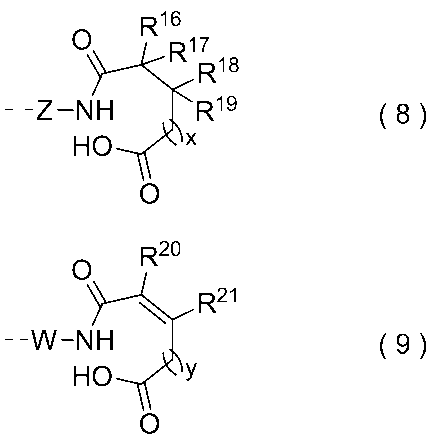
(式中、R16~R21は互いに同一又は異種の水素原子又は炭素数1~10の非置換もしくは置換の1価炭化水素基であり、R16又はR17とR18又はR19、R20とR21が結合して環を形成してもよく、x,yは0~3の整数であり、Z,Wは炭素数1~10のヘテロ原子を介在してもよい非置換もしくは置換の2価炭化水素基である。破線は結合手を示す。)
(A)成分及び(B)成分は反応基質であり、より詳しく説明すると(A)成分が主剤で(B)成分が反応剤である。(A)成分と(B)成分を、必要により(E)成分の存在下で混合すると、室温(25℃)でも発熱しながら反応し、下記平均組成式(7)で表されるオルガノポリシロキサン(F)を形成する。
上記式(7)中、R15は同一又は異種の炭素数1~10の非置換もしくは置換の1価炭化水素基又は上記一般式(8)もしくは(9)で表される構造の有機基であり、R15のうち少なくとも1個は上記一般式(8)又は(9)で表される構造の有機基を含む。1価炭化水素基としては、例えば、メチル基、エチル基、プロピル基、ブチル基等のアルキル基、シクロヘキシル基等のシクロアルキル基、フェニル基等のアリール基などが挙げられ、さらに、これらの基の炭素原子に結合した水素原子の一部又は全部がハロゲン原子又はその他の基で置換されていてもよく、置換基としては、トリフルオロメチル基、3,3,3-トリフルオロプロピル基等が例示される。中でも、飽和の脂肪族基又は芳香族基が好ましく、メチル基、フェニル基が好ましい。
R15のうち少なくとも1個、好ましくは2~200個、より好ましくは2~150個は一般式(8)又は(9)で表される構造の有機基を含む。
R15のうち少なくとも1個、好ましくは2~200個、より好ましくは2~150個は一般式(8)又は(9)で表される構造の有機基を含む。
上記式(8)、(9)中、R16~R21は互いに同一又は異種の水素原子又は炭素数1~10の非置換もしくは置換の1価炭化水素基である。1価炭化水素基としては、例えば、メチル基、エチル基、プロピル基、ブチル基等のアルキル基、シクロヘキシル基等のシクロアルキル基、フェニル基等のアリール基などが挙げられ、さらに、これらの基の炭素原子に結合した水素原子の一部又は全部がハロゲン原子又はその他の基で置換されていてもよく、置換基としては、トリフルオロメチル基、3,3,3-トリフルオロプロピル基等が例示され、水素原子、メチル基が好ましい。
また、R16又はR17とR18又はR19、R20とR21が結合して環を形成してもよく、該環としては、シクロプロパン環、シクロブタン環、シクロペンタン環、シクロヘキサン環、ベンゼン環等が例示され、ベンゼン環が好ましい。
x,yは0~3の整数であり、好ましくは0~2の整数であり、より好ましくは0又は1である。
また、R16又はR17とR18又はR19、R20とR21が結合して環を形成してもよく、該環としては、シクロプロパン環、シクロブタン環、シクロペンタン環、シクロヘキサン環、ベンゼン環等が例示され、ベンゼン環が好ましい。
x,yは0~3の整数であり、好ましくは0~2の整数であり、より好ましくは0又は1である。
Z,Wはそれぞれ炭素数1~10のヘテロ原子を介在してもよい非置換もしくは置換の2価炭化水素基であり、CH2、C2H4、C3H6、C4H8、C5H10、C6H12などのアルキレン基が挙げられ、エーテル基やチオエーテル基などを介在していてもよい。また、フェニレン基、シクロヘキシレン基等の環状構造を形成してもよく、炭素原子に結合した水素原子の一部又は全部がハロゲン原子又はその他の基で置換されていてもよい。
一般式(8)、(9)の具体的な構造を以下に示すが、これらに限定されるものではない。

(式中、破線は結合手を示す。)
上記式(7)中、iは2以上、好ましくは2~12の整数、jは0以上、好ましくは1~998、より好ましくは5~998、さらに好ましくは5~500の整数、kは0以上、好ましくは0~10の整数、lは0以上、好ましくは0~5の整数で、2≦i+j+k+l≦1,000であり、7≦i+j+k+l≦527が好ましい。i+j+k+lが1,000より大きいと、粘度が高くなり、作業性が悪くなる場合がある。
(F)成分の具体的な構造としては、下記式で表されるものが挙げられるが、これらに限定されない。なお、下記式中のMe,Phはそれぞれメチル基、フェニル基を示し、Bは下記に示す構造を代表して示すが、式(8)又は(9)で表される構造の有機基であればいずれのものでもよい。
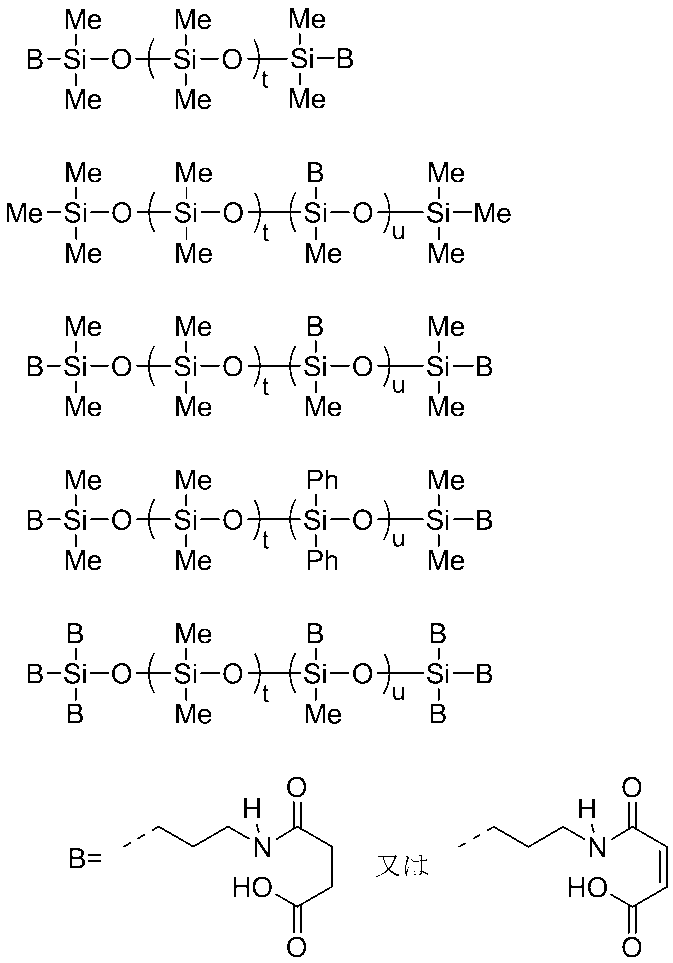
(t≧0,u≧1。破線は結合手を示す。)

(t1≧0,t2≧0,t3≧0,T≧1。破線は結合手を示す。)
[触媒的イミド化反応]
(F)成分中のアミド基とカルボキシル基の間で縮合反応が起こると、目的となる平均組成式(1)のオルガノポリシロキサンを得ることができる。しかし、加熱のみで反応を進行させることは難しく、反応温度も200℃前後あるいはそれ以上を必要とするためエネルギー的に不利である。そのため、上述した(C)成分と(D)成分が必要である。
(F)成分中のアミド基とカルボキシル基の間で縮合反応が起こると、目的となる平均組成式(1)のオルガノポリシロキサンを得ることができる。しかし、加熱のみで反応を進行させることは難しく、反応温度も200℃前後あるいはそれ以上を必要とするためエネルギー的に不利である。そのため、上述した(C)成分と(D)成分が必要である。
(F)成分から平均組成式(1)のオルガノポリシロキサンを得るためには、縮合反応により閉環してイミド化する必要があり、そのために(C)成分と(D)成分を使用する。
(C)成分は触媒であり、(D)成分は(F)成分中のカルボキシル基をシリルキャップするための反応試剤である。(F)成分と(C)成分を混合し、そこへ(D)成分を加えると(F)成分中のカルボキシル基がシリル化され、加熱することによりシリル化されたカルボキシル基とアミド基が縮合することで式(1)のオルガノポリシロキサンを得ることができる。カルボキシル基では縮合が起こりにくいが、シリル化することにより縮合が進行しやすくなる。このとき、(C)成分は(D)成分と反応することでシリル化のための活性種を生成する、また詳細な機構については確かではないが縮合反応を触媒するという2つの役割を担っているものと推測される。
(C)成分は触媒であり、(D)成分は(F)成分中のカルボキシル基をシリルキャップするための反応試剤である。(F)成分と(C)成分を混合し、そこへ(D)成分を加えると(F)成分中のカルボキシル基がシリル化され、加熱することによりシリル化されたカルボキシル基とアミド基が縮合することで式(1)のオルガノポリシロキサンを得ることができる。カルボキシル基では縮合が起こりにくいが、シリル化することにより縮合が進行しやすくなる。このとき、(C)成分は(D)成分と反応することでシリル化のための活性種を生成する、また詳細な機構については確かではないが縮合反応を触媒するという2つの役割を担っているものと推測される。
[生成物の精製]
イミド化終了後は、(D)成分から発生したアンモニアが系中に存在するため、これを除去する必要がある。アンモニアの除去方法について特に制限はないが、酸性物質と反応させて中和してから生成した塩をろ別する方法などが挙げられる。酸性物質としては塩酸、硫酸、硝酸、リン酸、ホウ酸、ギ酸、酢酸、クエン酸、乳酸、酪酸等が挙げられる。反応性の観点から酸性物質は液体が好ましく、酢酸やリン酸が好ましい。
イミド化終了後は、(D)成分から発生したアンモニアが系中に存在するため、これを除去する必要がある。アンモニアの除去方法について特に制限はないが、酸性物質と反応させて中和してから生成した塩をろ別する方法などが挙げられる。酸性物質としては塩酸、硫酸、硝酸、リン酸、ホウ酸、ギ酸、酢酸、クエン酸、乳酸、酪酸等が挙げられる。反応性の観点から酸性物質は液体が好ましく、酢酸やリン酸が好ましい。
(C)成分は、(E)成分に不溶であればろ過により取り除くことができる。(E)成分に溶解している場合には、液-液抽出により洗浄して系外に排出する必要がある。
未反応の(B)成分及び(D)成分と(E)成分は、減圧留去により取り除くことができる。
未反応の(B)成分及び(D)成分と(E)成分は、減圧留去により取り除くことができる。
以上の工程を経て、目的とする本発明のオルガノポリシロキサンを製造することができる。
本発明のオルガノポリシロキサンは、優れた耐熱性を有するものであり、工業用の熱媒や潤滑剤などのオイル、耐熱性コーティング材料、耐熱性ゴム材料、樹脂への添加剤等の用途に好適に使用し得る。
[オルガノポリシロキサンを用いた硬化性組成物]
本発明の硬化性組成物は、上記平均組成式(1)で表されるオルガノポリシロキサンを含むことを特徴とし、特に式(1)におけるR1が同一又は異種の炭素数1~10の非置換もしくは置換の1価炭化水素基又は下記一般式(3’)で表される構造の有機基であり、R1のうち少なくとも1個は下記一般式(3’)で表される構造の有機基を含むものであることが好ましい。

(式中、R6’とR7’は互いに同一又は異種の水素原子又は炭素数1~5の非置換もしくは置換の1価炭化水素基であり、Yは上記と同じである。破線は結合手を示す。)
本発明の硬化性組成物は、上記平均組成式(1)で表されるオルガノポリシロキサンを含むことを特徴とし、特に式(1)におけるR1が同一又は異種の炭素数1~10の非置換もしくは置換の1価炭化水素基又は下記一般式(3’)で表される構造の有機基であり、R1のうち少なくとも1個は下記一般式(3’)で表される構造の有機基を含むものであることが好ましい。
(式中、R6’とR7’は互いに同一又は異種の水素原子又は炭素数1~5の非置換もしくは置換の1価炭化水素基であり、Yは上記と同じである。破線は結合手を示す。)
上記式(3’)中、R6’とR7’は互いに同一又は異種の水素原子又は炭素数1~5の非置換もしくは置換の1価炭化水素基である。1価炭化水素基としては、例えば、メチル基、エチル基、プロピル基、ブチル基等のアルキル基などが挙げられ、さらに、これらの基の炭素原子に結合した水素原子の一部又は全部がハロゲン原子又はその他の基で置換されていてもよく、置換基としては、トリフルオロメチル基、3,3,3-トリフルオロプロピル基等が例示され、R6’、R7’としては、水素原子、メチル基が好ましく、特に水素原子が好ましい。
一般式(3’)の具体的な構造を以下に示すが、これらに限定されるものではない。

(式中、破線は結合手を示す。)
式(1)において、R1として(3’)を含むオルガノポリシロキサンの具体的な構造としては、下記式で表されるものが挙げられるが、これらに限定されない。なお、下記式中のMe,Phはそれぞれメチル基、フェニル基を示し、IはN-マレイミドプロピル基を代表して示すが、式(3’)で表される構造の有機基であればいずれのものでもよい。
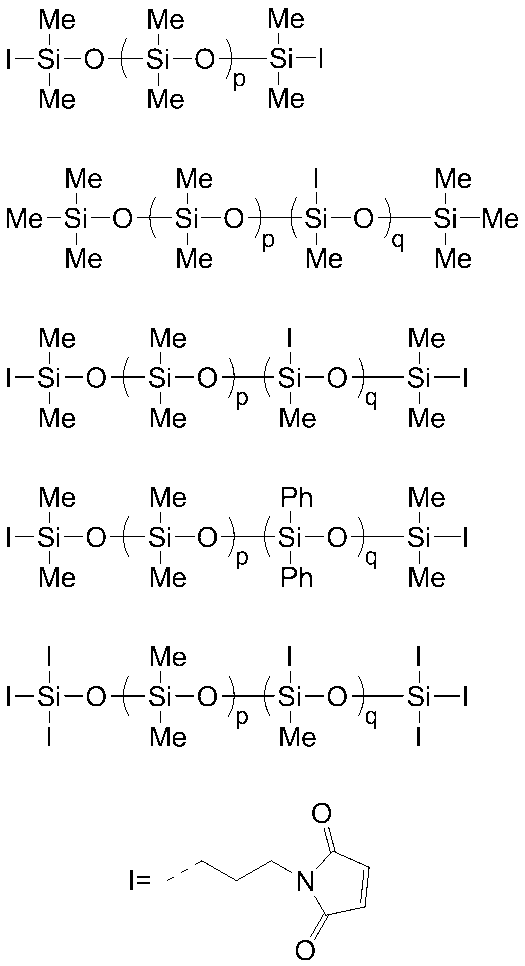
(p≧0,q≧1。破線は結合手を示す。)
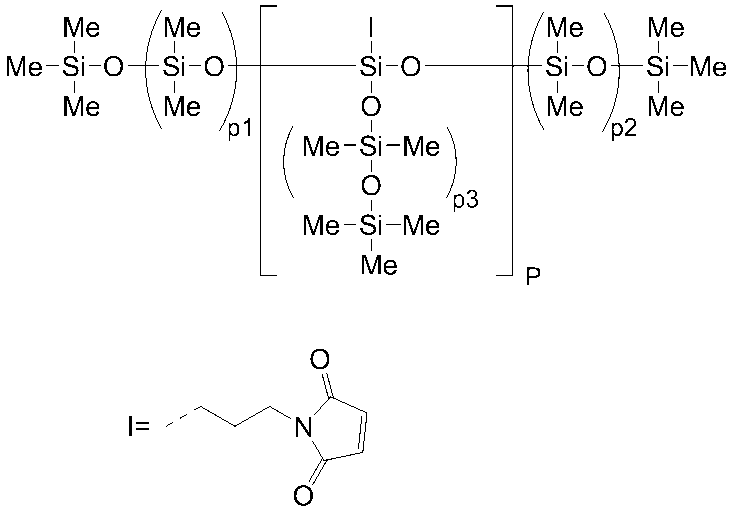
(p1≧0,p2≧0,p3≧0,P≧1。破線は結合手を示す。)
上記式(3’)で表される構造の有機基(官能基)は、光照射により2種類の反応を起こすものと考えられている。すなわち、炭素-炭素二重結合部位のラジカル重合と二量化である。これらの反応によって本発明組成物の硬化物を形成することが可能であり、また両反応ともに光重合開始剤が不要である。
本発明の硬化性組成物は、上記式(1)のオルガノポリシロキサンを含むものである。該硬化性組成物は、上記式(1)のオルガノポリシロキサンのみでも構わないが、本発明の目的を損なわない範囲でその他の添加剤を配合してもよい。具体的には、光重合開始剤、酸化防止剤、反応性希釈剤、レベリング剤、充填剤、帯電防止剤、消泡剤、顔料等が挙げられる。
なお、本発明の硬化性組成物は、上記式(1)のオルガノポリシロキサンが光照射により硬化できることから、光開始剤を配合することなく使用することができる。
なお、本発明の硬化性組成物は、上記式(1)のオルガノポリシロキサンが光照射により硬化できることから、光開始剤を配合することなく使用することができる。
本発明の硬化性組成物は、光照射、特には放射線を照射することにより硬化させることができる。放射線としては、放射線エネルギー線として、好ましくは高圧又は超高圧の水銀灯、メタルハライドランプ、キセノンランプ、カーボンアークランプ、蛍光灯、半導体固体レーザ、アルゴンレーザ、He-Cdレーザ、KrFエキシマレーザ、ArFエキシマレーザ、F2レーザなどから得られる紫外~可視光領域(約100~約800nm)のエネルギー線が用いられる。好ましくは200~400nmに光硬度が強い放射線光源が好ましい。さらに電子線、X線などの高エネルギーを有する放射線を用いることもできる。放射線エネルギーの照射温度及び時間は、通常は常温(25℃)で0.1~10秒程度で十分であるが、エネルギー線の透過性が低い場合や硬化性組成物の膜厚が厚い場合には、それ以上の時間をかけるのが好ましいことがある。必要であればエネルギー線の照射後、室温(25℃)~150℃で数秒~数時間加熱し、アフターキュアーすることも可能である。
本発明の硬化性組成物は、コーティング材料、ゴム材料などとして好適に用いられ、該組成物を硬化させた硬化物を有する物品としては、剥離フィルム、粘着フィルム、接着剤、封止剤、ゴムロール、放熱シート、シーリング剤等が例示できる。
以下、実施例及び比較例を示し、本発明を具体的に説明するが、本発明は下記の実施例に制限されるものではない。また、下記例において、Meはメチル基を表す。
[実施例1]
撹拌装置、温度計、滴下ロート、還流冷却管を取り付けた300mLの3つ口フラスコに、(B)成分として無水コハク酸を3.20g(0.032mol)、(E)成分としてトルエンを81.74g(70質量%)仕込み、室温(25℃)にて混合撹拌しているところに、(A)成分として滴下ロートに仕込んだ下記式(A-1)のオルガノポリシロキサン13.76g(アミノ基として0.032mol)を滴下した。滴下終了後、室温(25℃)にて4時間撹拌し、フラスコに(C)成分として臭化亜鉛を7.20g(0.032mol)投入し、50℃まで加熱した。そこへ、(D)成分として滴下ロートに仕込んだヘキサメチルジシラザン7.76g(0.048mol)を滴下し、滴下終了後80℃で1時間熟成し、放冷して40℃以下にしたところで、酢酸3.17g(0.053mol)を滴下してさらに30分熟成した。反応溶液中の固体をろ過により取り除き、70℃/1時間減圧留去した後、120℃/1時間さらに減圧留去することで黄色透明の液体を得た。分析の結果、下記式(I)のオルガノポリシロキサンであることを確認した。

撹拌装置、温度計、滴下ロート、還流冷却管を取り付けた300mLの3つ口フラスコに、(B)成分として無水コハク酸を3.20g(0.032mol)、(E)成分としてトルエンを81.74g(70質量%)仕込み、室温(25℃)にて混合撹拌しているところに、(A)成分として滴下ロートに仕込んだ下記式(A-1)のオルガノポリシロキサン13.76g(アミノ基として0.032mol)を滴下した。滴下終了後、室温(25℃)にて4時間撹拌し、フラスコに(C)成分として臭化亜鉛を7.20g(0.032mol)投入し、50℃まで加熱した。そこへ、(D)成分として滴下ロートに仕込んだヘキサメチルジシラザン7.76g(0.048mol)を滴下し、滴下終了後80℃で1時間熟成し、放冷して40℃以下にしたところで、酢酸3.17g(0.053mol)を滴下してさらに30分熟成した。反応溶液中の固体をろ過により取り除き、70℃/1時間減圧留去した後、120℃/1時間さらに減圧留去することで黄色透明の液体を得た。分析の結果、下記式(I)のオルガノポリシロキサンであることを確認した。
[実施例2]
(B)成分として無水コハク酸の代わりに無水マレイン酸を3.14g(0.032mol)使用した以外は実施例1と同様にして製造し、黄色透明の液体を得た。分析の結果、下記式(II)のオルガノポリシロキサンであることを確認した。

(B)成分として無水コハク酸の代わりに無水マレイン酸を3.14g(0.032mol)使用した以外は実施例1と同様にして製造し、黄色透明の液体を得た。分析の結果、下記式(II)のオルガノポリシロキサンであることを確認した。
[実施例3]
(B)成分として無水コハク酸の代わりに無水グルタル酸を3.65g(0.032mol)使用した以外は実施例1と同様にして製造し、黒色の液体を得た。分析の結果、下記式(III)のオルガノポリシロキサンであることを確認した。

(B)成分として無水コハク酸の代わりに無水グルタル酸を3.65g(0.032mol)使用した以外は実施例1と同様にして製造し、黒色の液体を得た。分析の結果、下記式(III)のオルガノポリシロキサンであることを確認した。
[実施例4]
(B)成分として無水コハク酸の代わりに無水フタル酸を4.74g(0.032mol)使用した以外は実施例1と同様にして製造し、黄色透明の液体を得た。分析の結果、下記式(IV)のオルガノポリシロキサンであることを確認した。

(B)成分として無水コハク酸の代わりに無水フタル酸を4.74g(0.032mol)使用した以外は実施例1と同様にして製造し、黄色透明の液体を得た。分析の結果、下記式(IV)のオルガノポリシロキサンであることを確認した。
[実施例5]
(A)成分として式(A-1)のオルガノポリシロキサンの代わりに、下記式(A-2)のオルガノポリシロキサンを13.33g(0.032mol)使用した以外は実施例2と同様にして製造し、黄色透明の液体を得た。分析の結果、下記式(V)のオルガノポリシロキサンであることを確認した。

(A)成分として式(A-1)のオルガノポリシロキサンの代わりに、下記式(A-2)のオルガノポリシロキサンを13.33g(0.032mol)使用した以外は実施例2と同様にして製造し、黄色透明の液体を得た。分析の結果、下記式(V)のオルガノポリシロキサンであることを確認した。
<耐熱性>
上記で得られた実施例1~4のオルガノポリシロキサンの耐熱性を熱質量分析で評価した。具体的には、試料10mgを装置に入れた後、空気中で室温(25℃)から10℃/分の昇温速度で400℃まで加熱し、質量損失率が5%となった温度を測定した。測定装置にはThermo plus TG8120(リガク製)を用いた。なお、比較例1として、上記式(A-1)のオルガノポリシロキサンの耐熱性を評価した。これらの結果を表1に示す。
上記で得られた実施例1~4のオルガノポリシロキサンの耐熱性を熱質量分析で評価した。具体的には、試料10mgを装置に入れた後、空気中で室温(25℃)から10℃/分の昇温速度で400℃まで加熱し、質量損失率が5%となった温度を測定した。測定装置にはThermo plus TG8120(リガク製)を用いた。なお、比較例1として、上記式(A-1)のオルガノポリシロキサンの耐熱性を評価した。これらの結果を表1に示す。
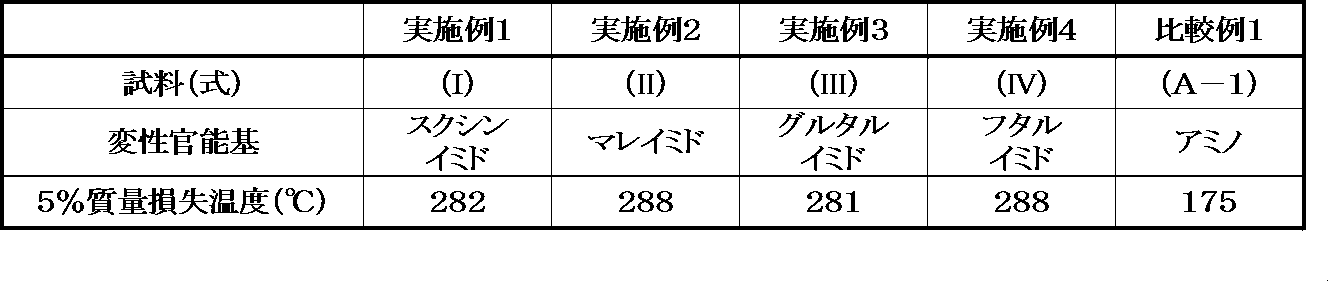
表1の結果より、本発明のオルガノポリシロキサンは、原料となるアミノ変性ポリシロキサンよりも、同じ質量を損失するときの温度が高いことから、耐熱性に優れていることがわかる。
[実施例6]
実施例2で製造したオルガノポリシロキサンをポリエチレン(PE)ラミネート紙に約0.6g/m2の量で塗布して得られた塗膜に、80W/cm2の高圧水銀灯を2灯用いて紫外線を照射し、塗膜が硬化したかどうかを下記の方法により評価した。
実施例2で製造したオルガノポリシロキサンをポリエチレン(PE)ラミネート紙に約0.6g/m2の量で塗布して得られた塗膜に、80W/cm2の高圧水銀灯を2灯用いて紫外線を照射し、塗膜が硬化したかどうかを下記の方法により評価した。
<硬化性>
オルガノポリシロキサンの硬化性を、紫外線照射装置を用いて評価した。すなわち、オルガノポリシロキサンをPEラミネート紙に約0.6g/m2の量で塗布して得られた塗膜に、80W/cm2の高圧水銀灯を2灯用いて紫外線を温度25℃において、200~500mJ/cm2の照射量で照射した。照射後の塗膜の状態で以下のように評価した。結果を表2に示す。
○:硬化しており指で触っても樹脂が触れたところに付かない
×:指で触ると未硬化の樹脂が付く
オルガノポリシロキサンの硬化性を、紫外線照射装置を用いて評価した。すなわち、オルガノポリシロキサンをPEラミネート紙に約0.6g/m2の量で塗布して得られた塗膜に、80W/cm2の高圧水銀灯を2灯用いて紫外線を温度25℃において、200~500mJ/cm2の照射量で照射した。照射後の塗膜の状態で以下のように評価した。結果を表2に示す。
○:硬化しており指で触っても樹脂が触れたところに付かない
×:指で触ると未硬化の樹脂が付く
[実施例7]
実施例5で製造したオルガノポリシロキサンを用いた以外は実施例6と同様にして行った。
実施例5で製造したオルガノポリシロキサンを用いた以外は実施例6と同様にして行った。
[比較例2]
下記式(VI)のオルガノポリシロキサンを用いた以外は実施例6と同様にして行った。
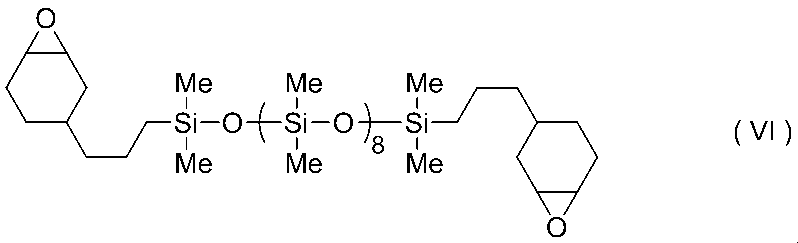
下記式(VI)のオルガノポリシロキサンを用いた以外は実施例6と同様にして行った。
[比較例3]
下記式(VII)のオルガノポリシロキサンを用いた以外は実施例6と同様にして行った。
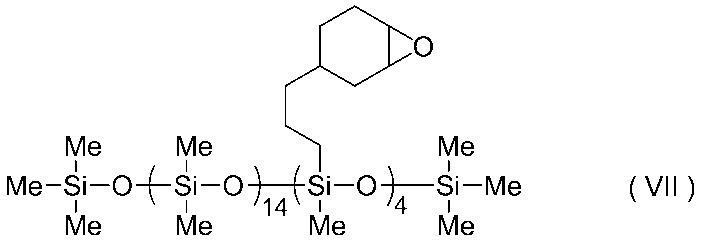
下記式(VII)のオルガノポリシロキサンを用いた以外は実施例6と同様にして行った。
[比較例4]
下記式(VIII)のオルガノポリシロキサンを用いた以外は実施例6と同様にして行った。

下記式(VIII)のオルガノポリシロキサンを用いた以外は実施例6と同様にして行った。
[比較例5]
下記式(IX)のオルガノポリシロキサンを用いた以外は実施例6と同様にして行った。
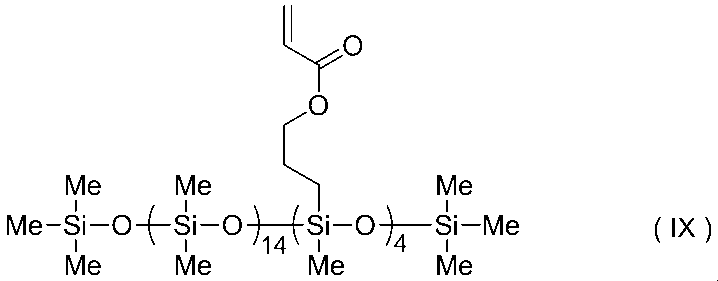
下記式(IX)のオルガノポリシロキサンを用いた以外は実施例6と同様にして行った。
[比較例6]
下記式(X)のオルガノポリシロキサンと下記式(XI)のオルガノポリシロキサンを質量比で(X)/(XI)=59.2/40.8((XI)に含まれるメルカプト基は(X)に含まれるビニル基に対しモル比で2.0倍)に混合したものを用いた以外は実施例6と同様にして行った。
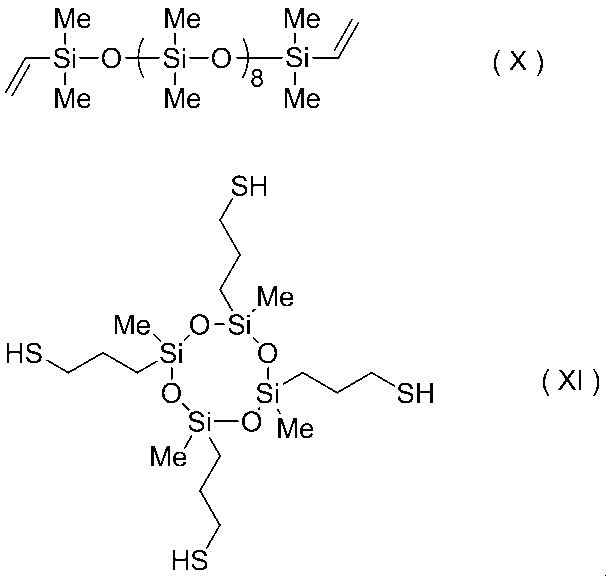
下記式(X)のオルガノポリシロキサンと下記式(XI)のオルガノポリシロキサンを質量比で(X)/(XI)=59.2/40.8((XI)に含まれるメルカプト基は(X)に含まれるビニル基に対しモル比で2.0倍)に混合したものを用いた以外は実施例6と同様にして行った。
[比較例7]
下記式(XII)のオルガノポリシロキサンと上記式(XI)のオルガノポリシロキサンを質量比で(XII)/(XI)=59.0/41.0((XI)に含まれるメルカプト基は(XII)に含まれるビニル基に対しモル比で2.0倍)に混合したものを用いた以外は実施例6と同様にして行った。

下記式(XII)のオルガノポリシロキサンと上記式(XI)のオルガノポリシロキサンを質量比で(XII)/(XI)=59.0/41.0((XI)に含まれるメルカプト基は(XII)に含まれるビニル基に対しモル比で2.0倍)に混合したものを用いた以外は実施例6と同様にして行った。
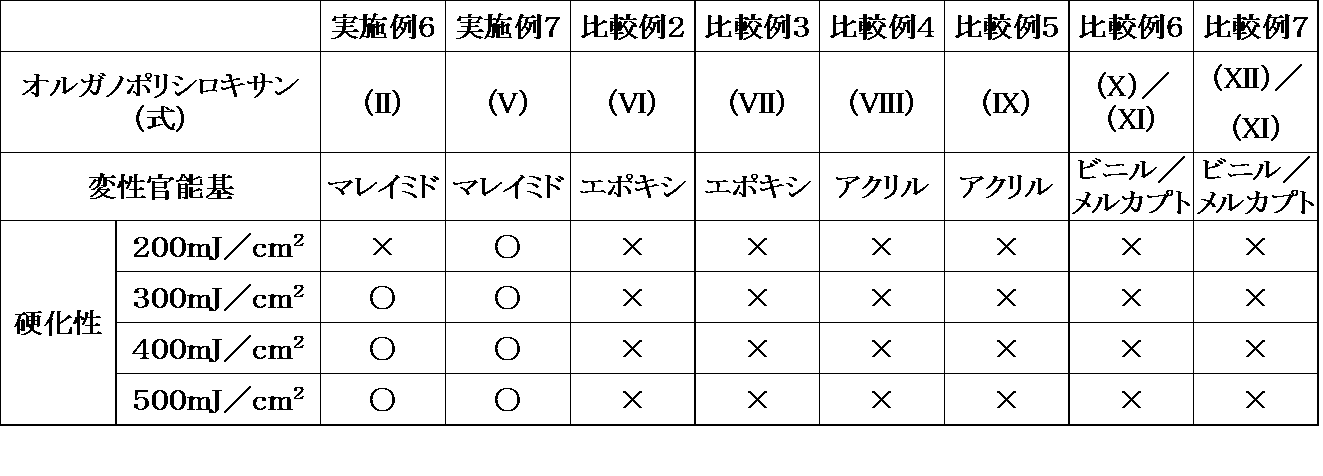
表2の結果より、本発明のオルガノポリシロキサンは、光開始剤を添加しなくても紫外線照射により塗膜を硬化させることができた。よって、光開始剤を必要としない1液型の光硬化性組成物としての応用が期待できる。
Claims (14)
- 下記平均組成式(1)で表され、1分子中に下記一般式(2)又は(3)で表される構造の有機基を少なくとも1個含むオルガノポリシロキサン。


- 上記式(1)において、aが2~12の整数であり、bが5~500の整数であり、cが0~10の整数であり、dが0~5の整数であり、a+b+c+dが7~527である請求項1記載のオルガノポリシロキサン。
- (A)下記平均組成式(4)で表され、1分子中に炭素数1~10のアミノ基含有有機基を少なくとも1個有するオルガノポリシロキサン:100質量部、

(B)下記一般式(5)又は(6)で表される有機化合物:(A)成分中のアミノ基に対しモル比で1~3倍となる量、
(C)ルイス酸触媒:(A)成分中のアミノ基に対しモル比で0.1~2倍となる量、
(D)シリル化剤:(A)成分中のアミノ基に対しモル比で1~3倍となる量、
(E)有機溶剤:(A)成分を100質量部としたときに0~5,000質量部
を用いて、上記(A)成分と(B)成分とを、必要により(E)成分の存在下で反応させ、下記平均組成式(7)で表されるオルガノポリシロキサン(F)を形成し、次いで、(C)成分、(D)成分を混合して、(F)成分中のアミド基とカルボキシル基とを縮合反応させることを特徴とする請求項1に記載の式(1)で表されるオルガノポリシロキサンの製造方法。


- 式(1)において、aが2~12の整数であり、bが5~500の整数であり、cが0~10の整数であり、dが0~5の整数であり、a+b+c+dが7~527である請求項3記載のオルガノポリシロキサンの製造方法。
- (A)成分のアミン当量が200~5,000g/molである請求項3又は4に記載のオルガノポリシロキサンの製造方法。
- (B)成分が、無水コハク酸、無水マレイン酸、無水グルタル酸、無水アジピン酸、無水ピメリン酸又は無水フタル酸である請求項3~5のいずれか1項に記載のオルガノポリシロキサンの製造方法。
- (C)成分が金属化合物である請求項3~6のいずれか1項に記載のオルガノポリシロキサンの製造方法。
- (C)成分が亜鉛化合物である請求項7に記載のオルガノポリシロキサンの製造方法。
- (D)成分がジシラザン化合物である請求項3~8のいずれか1項に記載のオルガノポリシロキサンの製造方法。
- 放射線を照射することによって硬化する硬化性組成物であって、下記平均組成式(1’)で表され、1分子中に下記一般式(3’)で表される構造の有機基を少なくとも1個有するオルガノポリシロキサンを含むことを特徴とする硬化性組成物。

- 上記式(1’)で表されるオルガノポリシロキサンからなる請求項10記載の硬化性組成物。
- 上記式(1’)において、aが2~12の整数であり、bが5~500の整数であり、cが0~10の整数であり、dが0~5の整数であり、a+b+c+dが7~527である請求項10又は11記載の硬化性組成物。
- 上記式(3’)のR6’とR7’が水素原子である請求項10~12のいずれか1項に記載の硬化性組成物。
- 光重合開始剤を含まないことを特徴とする請求項10~13のいずれか1項に記載の硬化性組成物。
Priority Applications (2)
| Application Number | Priority Date | Filing Date | Title |
|---|---|---|---|
| EP17756110.7A EP3421477B1 (en) | 2016-02-25 | 2017-01-31 | Organopolysiloxane and production method therefor, and curable composition |
| US16/079,765 US20190062507A1 (en) | 2016-02-25 | 2017-01-31 | Organopolysiloxane and production method therefor, and curable composition |
Applications Claiming Priority (4)
| Application Number | Priority Date | Filing Date | Title |
|---|---|---|---|
| JP2016-034504 | 2016-02-25 | ||
| JP2016034504A JP6583049B2 (ja) | 2016-02-25 | 2016-02-25 | オルガノポリシロキサン、硬化性組成物及び硬化物の製造方法 |
| JP2016-034535 | 2016-02-25 | ||
| JP2016034535A JP6583050B2 (ja) | 2016-02-25 | 2016-02-25 | オルガノポリシロキサンの製造方法 |
Publications (1)
| Publication Number | Publication Date |
|---|---|
| WO2017145668A1 true WO2017145668A1 (ja) | 2017-08-31 |
Family
ID=59685101
Family Applications (1)
| Application Number | Title | Priority Date | Filing Date |
|---|---|---|---|
| PCT/JP2017/003405 Ceased WO2017145668A1 (ja) | 2016-02-25 | 2017-01-31 | オルガノポリシロキサン及びその製造方法並びに硬化性組成物 |
Country Status (3)
| Country | Link |
|---|---|
| US (1) | US20190062507A1 (ja) |
| EP (1) | EP3421477B1 (ja) |
| WO (1) | WO2017145668A1 (ja) |
Cited By (2)
| Publication number | Priority date | Publication date | Assignee | Title |
|---|---|---|---|---|
| WO2023079959A1 (ja) * | 2021-11-02 | 2023-05-11 | 信越化学工業株式会社 | 樹脂改質用シリコーン添加剤及びそれを含む硬化性樹脂組成物 |
| WO2025169878A1 (ja) * | 2024-02-09 | 2025-08-14 | 信越化学工業株式会社 | 樹脂改質用シリコーン添加剤及びそれを含む硬化性樹脂組成物 |
Citations (7)
| Publication number | Priority date | Publication date | Assignee | Title |
|---|---|---|---|---|
| JPS51125277A (en) * | 1974-12-28 | 1976-11-01 | Shin Etsu Chem Co Ltd | Aprocess for preparing organosilane compounds |
| JPS5869229A (ja) * | 1981-10-01 | 1983-04-25 | チバ−ガイギ−・アクチエンゲゼルシヤフト | 光架橋性ポリシロキサン |
| JPH09309876A (ja) * | 1996-05-20 | 1997-12-02 | Nissan Chem Ind Ltd | イミド化合物の製造法 |
| JPH1171347A (ja) * | 1997-08-29 | 1999-03-16 | Aisin Seiki Co Ltd | マレアミド酸の製造方法,及びマレイミド化合物の製造方法 |
| JP2007031321A (ja) * | 2005-07-25 | 2007-02-08 | Shin Etsu Chem Co Ltd | オルガノシロキサンが結合したイミドの製造方法、及びオルガノシロキサンが結合したアミド酸トリオルガノシリルエステルとその製造方法 |
| JP2013046003A (ja) * | 2011-08-26 | 2013-03-04 | Fujifilm Corp | インプリント用硬化性組成物、パターン形成方法およびパターン |
| JP2013166908A (ja) * | 2011-05-02 | 2013-08-29 | Ricoh Co Ltd | シリコーン化合物、該シリコーン化合物を用いた光硬化型液体インク及びその製造方法 |
Family Cites Families (1)
| Publication number | Priority date | Publication date | Assignee | Title |
|---|---|---|---|---|
| JPS51120804A (en) * | 1975-04-14 | 1976-10-22 | Dainippon Printing Co Ltd | Plate for lithographic printing |
-
2017
- 2017-01-31 WO PCT/JP2017/003405 patent/WO2017145668A1/ja not_active Ceased
- 2017-01-31 US US16/079,765 patent/US20190062507A1/en not_active Abandoned
- 2017-01-31 EP EP17756110.7A patent/EP3421477B1/en active Active
Patent Citations (7)
| Publication number | Priority date | Publication date | Assignee | Title |
|---|---|---|---|---|
| JPS51125277A (en) * | 1974-12-28 | 1976-11-01 | Shin Etsu Chem Co Ltd | Aprocess for preparing organosilane compounds |
| JPS5869229A (ja) * | 1981-10-01 | 1983-04-25 | チバ−ガイギ−・アクチエンゲゼルシヤフト | 光架橋性ポリシロキサン |
| JPH09309876A (ja) * | 1996-05-20 | 1997-12-02 | Nissan Chem Ind Ltd | イミド化合物の製造法 |
| JPH1171347A (ja) * | 1997-08-29 | 1999-03-16 | Aisin Seiki Co Ltd | マレアミド酸の製造方法,及びマレイミド化合物の製造方法 |
| JP2007031321A (ja) * | 2005-07-25 | 2007-02-08 | Shin Etsu Chem Co Ltd | オルガノシロキサンが結合したイミドの製造方法、及びオルガノシロキサンが結合したアミド酸トリオルガノシリルエステルとその製造方法 |
| JP2013166908A (ja) * | 2011-05-02 | 2013-08-29 | Ricoh Co Ltd | シリコーン化合物、該シリコーン化合物を用いた光硬化型液体インク及びその製造方法 |
| JP2013046003A (ja) * | 2011-08-26 | 2013-03-04 | Fujifilm Corp | インプリント用硬化性組成物、パターン形成方法およびパターン |
Cited By (2)
| Publication number | Priority date | Publication date | Assignee | Title |
|---|---|---|---|---|
| WO2023079959A1 (ja) * | 2021-11-02 | 2023-05-11 | 信越化学工業株式会社 | 樹脂改質用シリコーン添加剤及びそれを含む硬化性樹脂組成物 |
| WO2025169878A1 (ja) * | 2024-02-09 | 2025-08-14 | 信越化学工業株式会社 | 樹脂改質用シリコーン添加剤及びそれを含む硬化性樹脂組成物 |
Also Published As
| Publication number | Publication date |
|---|---|
| US20190062507A1 (en) | 2019-02-28 |
| EP3421477A4 (en) | 2019-10-30 |
| EP3421477A1 (en) | 2019-01-02 |
| EP3421477B1 (en) | 2020-12-23 |
Similar Documents
| Publication | Publication Date | Title |
|---|---|---|
| JP7397157B2 (ja) | チオール化合物、その合成方法および該チオール化合物の利用 | |
| TWI425028B (zh) | A compound containing silicon, a hardened composition and a hardened product | |
| CN105934459B (zh) | 固化后柔软性优异的固化性树脂、(甲基)丙烯酰化固化性树脂和液晶密封剂组合物 | |
| TWI378975B (ja) | ||
| JP5900253B2 (ja) | (メタ)アクリル変性オルガノポリシロキサン、放射線硬化性シリコーン組成物及びシリコーン剥離紙並びにそれらの製造方法 | |
| WO2008001637A1 (fr) | Composé imide d'amine destiné à être activé par irradiation par un rayonnement d'énergie active, composition utilisant celui-ci et procédé servant à faire durcir celui-ci | |
| JP6763139B2 (ja) | 無溶剤型シリコーン変性ポリイミド樹脂組成物 | |
| CN101068879A (zh) | 混合热固性组合物 | |
| WO2005080459A1 (ja) | ポリシルセスキオキサングラフト重合体の製造方法、粘着剤および粘着シート | |
| TW201900711A (zh) | (甲基)丙烯酸酯樹脂及含有其之硬化性樹脂組成物 | |
| JP6734571B2 (ja) | 重合性シラン化合物 | |
| JP6070589B2 (ja) | シランカップリング剤及びその製造方法、プライマー組成物並びに塗料組成物 | |
| EP3421477B1 (en) | Organopolysiloxane and production method therefor, and curable composition | |
| CN1252177C (zh) | 环氧树脂组合物 | |
| JP2012197338A (ja) | イソシアヌル基含有シロキサン変性シルセスキオキサンを含む硬化性樹脂組成物、光半導体封止組成物及び光半導体素子接着剤 | |
| JP6583049B2 (ja) | オルガノポリシロキサン、硬化性組成物及び硬化物の製造方法 | |
| TW201239009A (en) | Process for producing solvent-soluble reactive polysiloxanes | |
| JP2014201534A (ja) | ケイ素化合物 | |
| TW201902680A (zh) | 改質樹脂及含有其之硬化性樹脂組成物 | |
| KR101775931B1 (ko) | 에폭시아크릴레이트, 아크릴계 조성물, 경화물 및 그 제조법 | |
| JP2017149871A (ja) | 放射線硬化型剥離シート用軽剥離添加剤及び剥離シート用放射線硬化型オルガノポリシロキサン組成物並びに剥離シート | |
| WO2023054288A1 (ja) | 光塩基発生剤、化合物、光反応性組成物及び反応生成物 | |
| JP6583050B2 (ja) | オルガノポリシロキサンの製造方法 | |
| JP2008303267A (ja) | 含フッ素組成物の硬化方法 | |
| JP6555499B2 (ja) | 高屈折率重合性化合物の低粘度化剤及びそれを含む重合性組成物 |
Legal Events
| Date | Code | Title | Description |
|---|---|---|---|
| NENP | Non-entry into the national phase |
Ref country code: DE |
|
| WWE | Wipo information: entry into national phase |
Ref document number: 2017756110 Country of ref document: EP |
|
| ENP | Entry into the national phase |
Ref document number: 2017756110 Country of ref document: EP Effective date: 20180925 |
|
| 121 | Ep: the epo has been informed by wipo that ep was designated in this application |
Ref document number: 17756110 Country of ref document: EP Kind code of ref document: A1 |