WO2017154403A1 - Composé éther fluoré, lubrifiant pour support d'enregistrement magnétique, et support d'enregistrement magnétique - Google Patents
Composé éther fluoré, lubrifiant pour support d'enregistrement magnétique, et support d'enregistrement magnétique Download PDFInfo
- Publication number
- WO2017154403A1 WO2017154403A1 PCT/JP2017/003165 JP2017003165W WO2017154403A1 WO 2017154403 A1 WO2017154403 A1 WO 2017154403A1 JP 2017003165 W JP2017003165 W JP 2017003165W WO 2017154403 A1 WO2017154403 A1 WO 2017154403A1
- Authority
- WO
- WIPO (PCT)
- Prior art keywords
- formula
- group
- fluorine
- layer
- compound
- Prior art date
- Legal status (The legal status is an assumption and is not a legal conclusion. Google has not performed a legal analysis and makes no representation as to the accuracy of the status listed.)
- Ceased
Links
- 0 CC(C)(N*)NC(C)(C)NON*(*)NOC Chemical compound CC(C)(N*)NC(C)(C)NON*(*)NOC 0.000 description 4
- LQNHRNOPWKZUSN-UHFFFAOYSA-N NCC1CCC1 Chemical compound NCC1CCC1 LQNHRNOPWKZUSN-UHFFFAOYSA-N 0.000 description 2
Images
Classifications
-
- C—CHEMISTRY; METALLURGY
- C07—ORGANIC CHEMISTRY
- C07C—ACYCLIC OR CARBOCYCLIC COMPOUNDS
- C07C43/00—Ethers; Compounds having groups, groups or groups
- C07C43/02—Ethers
- C07C43/20—Ethers having an ether-oxygen atom bound to a carbon atom of a six-membered aromatic ring
- C07C43/23—Ethers having an ether-oxygen atom bound to a carbon atom of a six-membered aromatic ring containing hydroxy or O-metal groups
-
- C—CHEMISTRY; METALLURGY
- C07—ORGANIC CHEMISTRY
- C07C—ACYCLIC OR CARBOCYCLIC COMPOUNDS
- C07C43/00—Ethers; Compounds having groups, groups or groups
- C07C43/02—Ethers
- C07C43/03—Ethers having all ether-oxygen atoms bound to acyclic carbon atoms
- C07C43/14—Unsaturated ethers
- C07C43/178—Unsaturated ethers containing hydroxy or O-metal groups
- C07C43/1786—Unsaturated ethers containing hydroxy or O-metal groups containing halogen
-
- C—CHEMISTRY; METALLURGY
- C07—ORGANIC CHEMISTRY
- C07D—HETEROCYCLIC COMPOUNDS
- C07D277/00—Heterocyclic compounds containing 1,3-thiazole or hydrogenated 1,3-thiazole rings
- C07D277/02—Heterocyclic compounds containing 1,3-thiazole or hydrogenated 1,3-thiazole rings not condensed with other rings
- C07D277/20—Heterocyclic compounds containing 1,3-thiazole or hydrogenated 1,3-thiazole rings not condensed with other rings having two or three double bonds between ring members or between ring members and non-ring members
- C07D277/22—Heterocyclic compounds containing 1,3-thiazole or hydrogenated 1,3-thiazole rings not condensed with other rings having two or three double bonds between ring members or between ring members and non-ring members with only hydrogen atoms, hydrocarbon or substituted hydrocarbon radicals, directly attached to ring carbon atoms
- C07D277/24—Radicals substituted by oxygen atoms
-
- C—CHEMISTRY; METALLURGY
- C07—ORGANIC CHEMISTRY
- C07D—HETEROCYCLIC COMPOUNDS
- C07D303/00—Compounds containing three-membered rings having one oxygen atom as the only ring hetero atom
- C07D303/02—Compounds containing oxirane rings
- C07D303/12—Compounds containing oxirane rings with hydrocarbon radicals, substituted by singly or doubly bound oxygen atoms
- C07D303/18—Compounds containing oxirane rings with hydrocarbon radicals, substituted by singly or doubly bound oxygen atoms by etherified hydroxyl radicals
- C07D303/20—Ethers with hydroxy compounds containing no oxirane rings
- C07D303/24—Ethers with hydroxy compounds containing no oxirane rings with polyhydroxy compounds
- C07D303/26—Ethers with hydroxy compounds containing no oxirane rings with polyhydroxy compounds having one or more free hydroxyl radicals
-
- C—CHEMISTRY; METALLURGY
- C07—ORGANIC CHEMISTRY
- C07D—HETEROCYCLIC COMPOUNDS
- C07D333/00—Heterocyclic compounds containing five-membered rings having one sulfur atom as the only ring hetero atom
- C07D333/02—Heterocyclic compounds containing five-membered rings having one sulfur atom as the only ring hetero atom not condensed with other rings
- C07D333/04—Heterocyclic compounds containing five-membered rings having one sulfur atom as the only ring hetero atom not condensed with other rings not substituted on the ring sulphur atom
- C07D333/06—Heterocyclic compounds containing five-membered rings having one sulfur atom as the only ring hetero atom not condensed with other rings not substituted on the ring sulphur atom with only hydrogen atoms, hydrocarbon or substituted hydrocarbon radicals, directly attached to the ring carbon atoms
- C07D333/14—Radicals substituted by singly bound hetero atoms other than halogen
- C07D333/16—Radicals substituted by singly bound hetero atoms other than halogen by oxygen atoms
-
- C—CHEMISTRY; METALLURGY
- C07—ORGANIC CHEMISTRY
- C07D—HETEROCYCLIC COMPOUNDS
- C07D409/00—Heterocyclic compounds containing two or more hetero rings, at least one ring having sulfur atoms as the only ring hetero atoms
- C07D409/02—Heterocyclic compounds containing two or more hetero rings, at least one ring having sulfur atoms as the only ring hetero atoms containing two hetero rings
- C07D409/12—Heterocyclic compounds containing two or more hetero rings, at least one ring having sulfur atoms as the only ring hetero atoms containing two hetero rings linked by a chain containing hetero atoms as chain links
-
- C—CHEMISTRY; METALLURGY
- C10—PETROLEUM, GAS OR COKE INDUSTRIES; TECHNICAL GASES CONTAINING CARBON MONOXIDE; FUELS; LUBRICANTS; PEAT
- C10M—LUBRICATING COMPOSITIONS; USE OF CHEMICAL SUBSTANCES EITHER ALONE OR AS LUBRICATING INGREDIENTS IN A LUBRICATING COMPOSITION
- C10M105/00—Lubricating compositions characterised by the base-material being a non-macromolecular organic compound
- C10M105/50—Lubricating compositions characterised by the base-material being a non-macromolecular organic compound containing halogen
- C10M105/54—Lubricating compositions characterised by the base-material being a non-macromolecular organic compound containing halogen containing carbon, hydrogen, halogen and oxygen
-
- C—CHEMISTRY; METALLURGY
- C10—PETROLEUM, GAS OR COKE INDUSTRIES; TECHNICAL GASES CONTAINING CARBON MONOXIDE; FUELS; LUBRICANTS; PEAT
- C10M—LUBRICATING COMPOSITIONS; USE OF CHEMICAL SUBSTANCES EITHER ALONE OR AS LUBRICATING INGREDIENTS IN A LUBRICATING COMPOSITION
- C10M107/00—Lubricating compositions characterised by the base-material being a macromolecular compound
- C10M107/38—Lubricating compositions characterised by the base-material being a macromolecular compound containing halogen
-
- G—PHYSICS
- G11—INFORMATION STORAGE
- G11B—INFORMATION STORAGE BASED ON RELATIVE MOVEMENT BETWEEN RECORD CARRIER AND TRANSDUCER
- G11B5/00—Recording by magnetisation or demagnetisation of a record carrier; Reproducing by magnetic means; Record carriers therefor
- G11B5/62—Record carriers characterised by the selection of the material
- G11B5/72—Protective coatings, e.g. anti-static or antifriction
- G11B5/725—Protective coatings, e.g. anti-static or antifriction containing a lubricant, e.g. organic compounds
- G11B5/7253—Fluorocarbon lubricant
- G11B5/7257—Perfluoropolyether lubricant
-
- G—PHYSICS
- G11—INFORMATION STORAGE
- G11B—INFORMATION STORAGE BASED ON RELATIVE MOVEMENT BETWEEN RECORD CARRIER AND TRANSDUCER
- G11B5/00—Recording by magnetisation or demagnetisation of a record carrier; Reproducing by magnetic means; Record carriers therefor
- G11B5/62—Record carriers characterised by the selection of the material
- G11B5/73—Base layers, i.e. all non-magnetic layers lying under a lowermost magnetic recording layer, e.g. including any non-magnetic layer in between a first magnetic recording layer and either an underlying substrate or a soft magnetic underlayer
- G11B5/733—Base layers, i.e. all non-magnetic layers lying under a lowermost magnetic recording layer, e.g. including any non-magnetic layer in between a first magnetic recording layer and either an underlying substrate or a soft magnetic underlayer characterised by the addition of non-magnetic particles
-
- C—CHEMISTRY; METALLURGY
- C10—PETROLEUM, GAS OR COKE INDUSTRIES; TECHNICAL GASES CONTAINING CARBON MONOXIDE; FUELS; LUBRICANTS; PEAT
- C10M—LUBRICATING COMPOSITIONS; USE OF CHEMICAL SUBSTANCES EITHER ALONE OR AS LUBRICATING INGREDIENTS IN A LUBRICATING COMPOSITION
- C10M2211/00—Organic non-macromolecular compounds containing halogen as ingredients in lubricant compositions
- C10M2211/04—Organic non-macromolecular compounds containing halogen as ingredients in lubricant compositions containing carbon, hydrogen, halogen, and oxygen
-
- C—CHEMISTRY; METALLURGY
- C10—PETROLEUM, GAS OR COKE INDUSTRIES; TECHNICAL GASES CONTAINING CARBON MONOXIDE; FUELS; LUBRICANTS; PEAT
- C10M—LUBRICATING COMPOSITIONS; USE OF CHEMICAL SUBSTANCES EITHER ALONE OR AS LUBRICATING INGREDIENTS IN A LUBRICATING COMPOSITION
- C10M2211/00—Organic non-macromolecular compounds containing halogen as ingredients in lubricant compositions
- C10M2211/04—Organic non-macromolecular compounds containing halogen as ingredients in lubricant compositions containing carbon, hydrogen, halogen, and oxygen
- C10M2211/042—Alcohols; Ethers; Aldehydes; Ketones
- C10M2211/0425—Alcohols; Ethers; Aldehydes; Ketones used as base material
-
- C—CHEMISTRY; METALLURGY
- C10—PETROLEUM, GAS OR COKE INDUSTRIES; TECHNICAL GASES CONTAINING CARBON MONOXIDE; FUELS; LUBRICANTS; PEAT
- C10M—LUBRICATING COMPOSITIONS; USE OF CHEMICAL SUBSTANCES EITHER ALONE OR AS LUBRICATING INGREDIENTS IN A LUBRICATING COMPOSITION
- C10M2213/00—Organic macromolecular compounds containing halogen as ingredients in lubricant compositions
- C10M2213/04—Organic macromolecular compounds containing halogen as ingredients in lubricant compositions obtained from monomers containing carbon, hydrogen, halogen and oxygen
-
- C—CHEMISTRY; METALLURGY
- C10—PETROLEUM, GAS OR COKE INDUSTRIES; TECHNICAL GASES CONTAINING CARBON MONOXIDE; FUELS; LUBRICANTS; PEAT
- C10M—LUBRICATING COMPOSITIONS; USE OF CHEMICAL SUBSTANCES EITHER ALONE OR AS LUBRICATING INGREDIENTS IN A LUBRICATING COMPOSITION
- C10M2213/00—Organic macromolecular compounds containing halogen as ingredients in lubricant compositions
- C10M2213/04—Organic macromolecular compounds containing halogen as ingredients in lubricant compositions obtained from monomers containing carbon, hydrogen, halogen and oxygen
- C10M2213/043—Organic macromolecular compounds containing halogen as ingredients in lubricant compositions obtained from monomers containing carbon, hydrogen, halogen and oxygen used as base material
-
- C—CHEMISTRY; METALLURGY
- C10—PETROLEUM, GAS OR COKE INDUSTRIES; TECHNICAL GASES CONTAINING CARBON MONOXIDE; FUELS; LUBRICANTS; PEAT
- C10N—INDEXING SCHEME ASSOCIATED WITH SUBCLASS C10M RELATING TO LUBRICATING COMPOSITIONS
- C10N2030/00—Specified physical or chemical properties which is improved by the additive characterising the lubricating composition, e.g. multifunctional additives
- C10N2030/06—Oiliness; Film-strength; Anti-wear; Resistance to extreme pressure
-
- C—CHEMISTRY; METALLURGY
- C10—PETROLEUM, GAS OR COKE INDUSTRIES; TECHNICAL GASES CONTAINING CARBON MONOXIDE; FUELS; LUBRICANTS; PEAT
- C10N—INDEXING SCHEME ASSOCIATED WITH SUBCLASS C10M RELATING TO LUBRICATING COMPOSITIONS
- C10N2040/00—Specified use or application for which the lubricating composition is intended
- C10N2040/14—Electric or magnetic purposes
- C10N2040/18—Electric or magnetic purposes in connection with recordings on magnetic tape or disc
-
- C—CHEMISTRY; METALLURGY
- C10—PETROLEUM, GAS OR COKE INDUSTRIES; TECHNICAL GASES CONTAINING CARBON MONOXIDE; FUELS; LUBRICANTS; PEAT
- C10N—INDEXING SCHEME ASSOCIATED WITH SUBCLASS C10M RELATING TO LUBRICATING COMPOSITIONS
- C10N2050/00—Form in which the lubricant is applied to the material being lubricated
- C10N2050/023—Multi-layer lubricant coatings
- C10N2050/025—Multi-layer lubricant coatings in the form of films or sheets
Definitions
- the present invention relates to a fluorine-containing ether compound suitable for use as a lubricant for magnetic recording media.
- a magnetic recording medium suitable for a high recording density In order to improve the recording density of a magnetic recording / reproducing apparatus, development of a magnetic recording medium suitable for a high recording density is underway.
- a magnetic recording medium in which a recording layer is formed on a substrate and a protective layer such as carbon is formed on the recording layer.
- the protective layer protects information recorded on the recording layer and improves the slidability of the magnetic head.
- the durability of the magnetic recording medium cannot be sufficiently obtained only by providing the protective layer on the recording layer. For this reason, generally, a lubricant is applied to the surface of the protective layer to form a lubricant layer.
- Patent Document 1 discloses a compound in which substituents having a plurality of hydroxyl groups at both terminal portions and having a shortest distance between the hydroxyl groups of 3 atoms or more are arranged.
- Patent Document 2 discloses a fluoropolyether compound having an aromatic group at one end and a hydroxyl group at the other end.
- Patent Document 3 discloses a compound having a perfluoropolyether main chain, an aromatic group and a hydroxyl group at the end of the molecule, and the aromatic group and the hydroxyl group bonded to different carbon atoms. It is disclosed.
- the magnetic recording / reproducing apparatus it is required to further reduce the flying height of the magnetic head. For this reason, it is required to further reduce the thickness of the lubricating layer in the magnetic recording medium.
- the thickness of the lubricating layer is reduced, the coverage of the lubricating layer is lowered, and the chemical substance resistance and wear resistance of the magnetic recording medium tend to be lowered.
- the present invention has been made in view of the above circumstances, and is suitable for use as a material for a lubricant for magnetic recording media capable of forming a lubricating layer capable of obtaining excellent chemical substance resistance and wear resistance even when the thickness is small. It is an object to provide a fluorine ether compound. Another object of the present invention is to provide a lubricant for magnetic recording media containing the fluorine-containing ether compound of the present invention. Another object of the present invention is to provide a magnetic recording medium having excellent reliability and durability having a lubricating layer containing the fluorine-containing ether compound of the present invention.
- an end group containing an organic group having at least one double bond or triple bond is disposed at one end of the perfluoropolyether chain via a divalent linking group bonded by etheric oxygen,
- the other end of the polyether chain contains two or three polar groups, each polar group is bonded to a different carbon atom, and the carbon groups to which the polar group is bonded are not bonded to each other.
- the inventors have found that a fluorine-containing ether compound having a terminal group bonded via a linking group containing a carbon atom may be used, and have conceived the present invention. That is, the present invention relates to the following matters.
- R 1 is a terminal group containing an organic group having at least one double bond or triple bond
- R 2 is a divalent linking group bonded to R 1 by etheric oxygen
- R 3 is a perfluoropolyether chain
- R 4 contains two or three polar groups, each polar group is bonded to a different carbon atom, and the carbon atoms to which the polar group is bonded are polar This is a terminal group bonded through a linking group containing a carbon atom to which the group is not bonded.
- R 1 in the formula (1) is any one of a terminal group including an aromatic ring, a terminal group including a heterocyclic ring, a terminal group including an alkenyl group, or a terminal group including an alkynyl group.
- the fluorine-containing ether compound according to any one of [1] to [5].
- a lubricant for magnetic recording media comprising the fluorine-containing ether compound according to any one of [1] to [9].
- a magnetic recording medium in which at least a magnetic layer, a protective layer, and a lubrication layer are sequentially provided on a substrate, wherein the lubrication layer includes the lubrication layer according to any one of [1] to [9].
- a magnetic recording medium comprising a fluorine ether compound.
- the fluorine-containing ether compound of the present invention is a compound represented by the above formula (1) and is suitable as a material for a lubricant for magnetic recording media. Since the lubricant for magnetic recording media of the present invention contains the fluorine-containing ether compound of the present invention, it can form a lubricating layer that provides excellent chemical resistance and wear resistance even when the thickness is small. Since the magnetic recording medium of the present invention is provided with a lubricating layer having excellent chemical substance resistance and wear resistance, it has excellent reliability and durability.
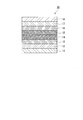
- FIG. 1 is a schematic cross-sectional view showing an embodiment of a magnetic recording medium of the present invention.
- the fluorine-containing ether compound of this embodiment is represented by the following formula (1).
- R 1 is a terminal group containing an organic group having at least one double bond or triple bond
- R 2 is a divalent linking group bonded to R 1 by etheric oxygen
- R 3 is a perfluoropolyether chain
- R 4 contains two or three polar groups, each polar group is bonded to a different carbon atom, and the carbon atoms to which the polar group is bonded are polar This is a terminal group bonded through a linking group containing a carbon atom to which the group is not bonded.
- the lubricant layer was formed on the protective layer of the magnetic recording medium using the lubricant for the magnetic recording medium containing the fluorine-containing ether compound of the present embodiment (hereinafter sometimes abbreviated as “lubricant”). The reason why excellent chemical substance resistance and wear resistance can be obtained even when the thickness is small will be described.
- the fluorine-containing ether compound of the present embodiment has R 2 at one end of a perfluoropolyether chain represented by R 3 (hereinafter sometimes abbreviated as “PFPE chain”).
- PFPE chain A terminal group containing an organic group having at least one double bond or triple bond represented by R 1 is arranged through a divalent linking group bonded to R 1 by etheric oxygen represented by .
- the PFPE chain covers the surface of the protective layer and reduces the frictional force between the magnetic head and the protective layer in the lubricating layer containing the fluorine-containing ether compound of this embodiment.
- the terminal group containing an organic group having at least one double bond or triple bond represented by R 1 is an intermolecular interaction of an organic group having at least one double bond or triple bond, and / or Due to the interaction between the organic group and the protective layer, the wear resistance in the lubricating layer containing the fluorine-containing ether compound of this embodiment is improved. Therefore, the lubricating layer containing the fluorine-containing ether compound of the present embodiment is superior to, for example, a lubricating layer containing a fluorine-containing ether compound in which a hydroxyl group is arranged instead of the terminal group represented by R 1 . Abrasion resistance is obtained.
- the terminal group represented by R 4 includes two or three polar groups. Two or three polar groups contained in the terminal group represented by R 4 are bonded to the fluorine-containing ether compound and the protective layer in the lubricating layer containing the fluorine-containing ether compound of the present embodiment, and are resistant to chemical substances. In addition, it improves wear resistance and suppresses pickup.
- two or three polar groups contained in the end group represented by R 4 are bonded to different carbon atoms, and the carbon atoms bonded to the polar groups are polar. They are bonded through a linking group containing an unbonded carbon atom.
- the fluorine-containing ether compound having an end group represented by R 4 for example, two polar groups contained in the end group are bonded to different carbon atoms, and the carbon atoms to which the polar groups are bonded are bonded to each other. Compared with the fluorine ether compound, it is hard to aggregate.
- the fluorinated ether compound present without adhering (adsorbing) to the protective layer aggregates and adheres to the magnetic head as foreign matter (smear). Can be prevented and pickup is suppressed. Further, since the fluorinated ether compounds are less likely to aggregate, the fluorinated ether compound in the lubricating layer is likely to be disposed in a state of extending and extending in the surface direction on the protective layer.
- the lubricant containing the above-mentioned fluorine-containing ether compound can cover the surface of the protective layer with a high coverage even if the thickness is reduced, and can form a lubricating layer having excellent chemical substance resistance.
- R 4 contains two or three polar groups, each polar group is bonded to a different carbon atom, and the polar group is bonded. Carbon atoms that are bonded to each other through a linking group containing a carbon atom to which no polar group is bonded.
- the terminal group represented by R 4 contributes to the adhesion between the protective layer to which the lubricant containing the fluorine-containing ether compound of this embodiment is applied and the lubricant layer formed by applying the lubricant.
- R 4 in the formula (1) can be appropriately selected according to the performance required for the lubricant containing the fluorine-containing ether compound.
- the fluorinated ether compound of the present embodiment represented by the formula (1) is an asymmetric compound in which different terminal groups (R 1 , R 4 ) are bonded to both ends of the PFPE chain (R 3 ).
- R 1 , R 4 the same end groups are bonded to both ends due to the synergistic effect of different end groups (R 1 , R 4 ) bonded to the molecular ends. Excellent chemical resistance and wear resistance are obtained compared to the compounds.
- Examples of the polar group for R 4 include a hydroxyl group, an amino group, a carboxyl group, and a thiol group.
- the ether bond (—O—) is not included in the polar group in R 4 .
- the polar group in the terminal group containing two or three polar groups of R 4 is preferably a hydroxyl group because a lubricating layer containing a fluorinated ether compound having good adhesion to the protective layer is obtained.
- R 4 in the formula (1) is preferably any terminal group of the following formulas (2-1) to (2-4). Such R 4 contributes to high adhesion and coverage between the protective layer to which the lubricant containing the fluorine-containing ether compound of the present embodiment is applied and the lubricant layer formed by applying the lubricant.
- p1 is 1 to 2.
- p2 is 1 to 5
- the distance between the hydroxyl groups in the terminal group represented by the formula (2-1) is appropriate, the adhesiveness with the protective layer is excellent, and the coverage is High lubricating layer can be formed.
- p2 is preferably 1 to 2, and most preferably 1.
- s when s is 2 to 5, the distance between the hydroxyl group on the R 3 side and the terminal hydroxyl group is appropriate, and the lubricating layer has excellent adhesion with the protective layer and high coverage. Can be formed. s is preferably 2 to 3, and most preferably 2.
- t when t is 1 to 5, the distance between the hydroxyl group on the R 3 side and the terminal hydroxyl group is appropriate, and the lubricating layer has excellent adhesion with the protective layer and high coverage. Can be formed.
- t is preferably 1 to 2, and most preferably 1.
- R 3 is a perfluoropolyether chain (PFPE chain).
- PFPE chain perfluoropolyether chain
- the PFPE chain covers the surface of the protective layer and provides lubricity to the lubricating layer to protect the magnetic head. Reduce friction with the layer.
- R 3 is not particularly limited, and can be appropriately selected according to the performance required for the lubricant containing the fluorine-containing ether compound.
- R 3 is preferably a PFPE chain represented by the following formula (3) because the synthesis of the fluorine-containing ether compound is easy.
- the arrangement order of the repeating units (CF 2 —CF 2 —O) and (CF 2 —O) is not particularly limited.
- the number m of (CF 2 —CF 2 —O) and the number n of (CF 2 —O) may be the same or different.
- Formula (3) includes one of a random copolymer, a block copolymer, and an alternating copolymer composed of monomer units (CF 2 —CF 2 —O) and (CF 2 —O). Also good.
- R 3 in Formula (1) is Formula (3)
- m is 1 to 30, preferably 1 to 20, and more preferably 1 to 15.
- n is 0 to 30, preferably 0 to 20, and more preferably 0 to 15.
- n is 0, m is preferably 1-17.
- R 3 may be the following formula (4) or the following formula (5).
- u when u is 1 to 30, the number average molecular weight of the fluorinated ether compound of the present embodiment tends to be in a preferred range.
- u is preferably from 3 to 20, and more preferably from 4 to 10.
- v is 1 to 30, the number average molecular weight of the fluorinated ether compound of this embodiment tends to be in a preferred range.
- v is preferably from 3 to 20, and more preferably from 4 to 10.
- R 3 in the formula (1) is any one of the formulas (3) to (5), it is preferable because the synthesis of the fluorine-containing ether compound is easy. Further, when R 3 in the formula (1) is any one of the formulas (3) to (5), the number of oxygen atoms relative to the number of carbon atoms in the perfluoropolyether chain (the number of ether bonds (—O—)) ) Is appropriate. For this reason, it becomes a fluorine-containing ether compound which has moderate hardness. Therefore, the fluorine-containing ether compound applied on the protective layer is less likely to aggregate on the protective layer, and a thinner lubricating layer can be formed with a sufficient coverage. Further, if R 3 in the formula (1) is an expression (3), since the raw material is easily available, and more preferred.
- R 1 in the formula (1) is a terminal group including an organic group having at least one double bond or triple bond.
- R 1 is preferably any one of a terminal group containing an aromatic ring, a terminal group containing a heterocyclic ring, a terminal group containing an alkenyl group, or a terminal group containing an alkynyl group.
- Specific examples of the terminal group containing an organic group having at least one double bond or triple bond used as R 1 include a phenyl group, a methoxyphenyl group, a naphthyl group, a benzyl group, a methoxybenzyl group, and a naphthylmethyl.
- the terminal group containing an organic group having at least one double bond or triple bond may have a substituent such as an alkyl group, an alkoxy group, a hydroxyl group, a thiol group, a carboxyl group, a carbonyl group, or an amino group.
- R 1 is in particular a phenyl group, p-methoxyphenyl group, naphthyl group, p-methoxybenzyl group, thienylethyl group, methylpyrazolylmethyl group, methylthiazolylethyl group, furfuryl group, butenyl group, allyl group, propargyl group , A benzyl group or a naphthylmethyl group is preferable.
- R 1 is a preferred example of these, a fluorine-containing ether compound capable of forming a lubricating layer having superior wear resistance is obtained.
- R 2 in the formula (1) is a divalent linking group bonded to R 1 by etheric oxygen.
- the divalent linking group represented by R 2 is not particularly limited as long as it is bonded to R 1 by etheric oxygen, depending on the performance required for the lubricant containing the fluorine-containing ether compound. It can be selected appropriately.
- the divalent linking group represented by R 2 is 1 in order to improve the adhesion between the protective layer to which the lubricant containing the fluorine-containing ether compound is applied and the lubricating layer formed by applying the lubricant. It is preferable to have two or more polar groups. Examples of the polar group contained in the linking group include a hydroxyl group, a carboxyl group, an amino group, and an aminocarboxyl group, and a hydroxyl group is preferable. When the divalent linking group represented by R 2 contains at least one hydroxyl group, particularly when the protective layer to which the lubricant is applied is formed of carbon or carbon containing nitrogen, Adhesion with the lubricating layer containing the fluorine-containing ether compound is further improved.
- the number of polar groups that the linking group has is not particularly limited, and may be one or plural. It may be.
- the number of polar groups possessed by the linking group is preferably 4 or less in order to prevent the number average molecular weight of the fluorinated ether compound from becoming too large.
- the divalent linking group represented by R 2 preferably has 1 to 20 carbon atoms. It can prevent that the number average molecular weight of a fluorine-containing ether compound becomes large too much that a carbon atom number is 20 or less. More preferably, the linking group has 3 to 12 carbon atoms.
- R 2 in the formula (1) specifically, it is preferably represented by the following formula (6).
- the divalent linking group represented by R 2 contains one or more hydroxyl groups, whereby the adhesion between the protective layer and the lubricating layer becomes better.
- w is 4 or less, it can prevent that the number average molecular weight of a fluorine-containing ether compound becomes large too much, and is preferable. More preferably, w is 1 to 2.
- R 2 in the formula (1) may be —O— because the synthesis of the fluorine-containing ether compound is easy.
- the fluorine-containing ether compound of this embodiment is preferably any compound represented by the following formulas (A) to (AC). Note that the number of repetitions such as m and n in the formulas (A) to (AC) is a value indicating an average value, and thus is not necessarily an integer.
- the compound represented by the formula (1) is any one of the compounds represented by the above formulas (A) to (AC), the raw material is easily available and excellent chemical resistance and wear resistance even when the thickness is small. Is preferable because a lubricating layer can be formed.
- the number average molecular weight of the fluorinated ether compound of the present embodiment is preferably in the range of 500 to 10,000.
- the lubricant containing the fluorine-containing ether compound of the present embodiment is difficult to evaporate, and the lubricant can be prevented from evaporating and transferring to the magnetic head.
- the number average molecular weight of the fluorinated ether compound is more preferably 1000 or more. Further, when the number average molecular weight is 10,000 or less, the viscosity of the fluorine-containing ether compound becomes appropriate, and a thin lubricating layer can be easily formed by applying a lubricant containing this.
- the number average molecular weight of the fluorinated ether compound is preferably 3000 or less because the viscosity becomes easy to handle when applied to a lubricant.
- the number average molecular weight is a value measured by 1 H-NMR and 19 F-NMR by AVANCE III400 manufactured by Bruker BioSpin.
- NMR nuclear magnetic resonance
- the sample was diluted in a hexafluorobenzene / d-acetone (4/1 v / v) solvent and used for the measurement.
- the standard of 19 F-NMR chemical shift was set to 164.7 ppm for the hexafluorobenzene peak, and the standard of 1 H-NMR chemical shift was set to 2.2 ppm for the acetone peak.
- the manufacturing method of the fluorine-containing ether compound of this embodiment is not specifically limited, It can manufacture using a conventionally well-known manufacturing method.
- the fluorine-containing ether compound of this embodiment can be manufactured using the manufacturing method shown below, for example.
- the hydroxyl group of the hydroxymethyl group arranged at one terminal of the fluorine-based compound is substituted with the terminal group composed of R 1 —R 2 — in the formula (1) (first reaction).
- the hydroxyl group of the hydroxymethyl group located at the other end is substituted with the end group consisting of —R 4 in the formula (1) (second reaction).
- the first reaction and the second reaction can be performed using a conventionally known method, and can be appropriately determined according to the types of R 1 , R 2 , and R 4 in formula (1).
- either of the first reaction and the second reaction may be performed first.
- the compound represented by Formula (1) is obtained.
- the fluorine-containing ether compound whose R ⁇ 2 > is represented by Formula (6)
- an epoxy compound can be synthesized using an alcohol having a structure corresponding to the terminal group represented by R 1 of the fluorine-containing ether compound to be produced, and epichlorohydrin or epibromohydrin.
- an epoxy compound represented by the formula (12) described later it can be obtained by reacting thiophene ethanol and epichlorohydrin in the presence of a base.
- the fluorine-containing ether compound of the present embodiment is a compound represented by the above formula (1). Therefore, when the lubricant layer is formed on the protective layer using the lubricant containing the lubricant, the surface of the protective layer is covered with the PFPE chain represented by R 3 in the formula (1), and the magnetic head and the protective layer. And the frictional force is reduced. Further, in the lubricating layer formed using the lubricant containing the fluorine-containing ether compound of the present embodiment, due to the intermolecular interaction in the terminal group represented by R 1 and / or the interaction between the terminal group and the protective layer, Excellent wear resistance is obtained.
- the PFPE chain is brought into close contact with the protective layer by the bond between the two or three polar groups of R 4 connected to the PFPE chain and the protective layer. Therefore, according to the fluorine-containing ether compound of the present embodiment, the lubricating layer and the protective layer are firmly bonded, and a lubricating layer having excellent chemical substance resistance and wear resistance can be obtained.
- the lubricant for magnetic recording media of this embodiment contains a fluorine-containing ether compound represented by the formula (1).
- the lubricant of the present embodiment requires a known material used as a lubricant material as long as it does not impair the characteristics due to the inclusion of the fluorine-containing ether compound represented by the formula (1). It can be mixed and used accordingly. Specific examples of known materials include FOMBLIN (registered trademark) ZDIAC, FOMBLIN ZDEAL, FOMBLIN AM-2001 (manufactured by Solvey Solexis), Moresco A20H (manufactured by Moresco), and the like.
- the known material used in combination with the lubricant of this embodiment preferably has a number average molecular weight of 1000 to 10,000.
- the lubricant of this embodiment contains other materials of the fluorine-containing ether compound represented by formula (1), the inclusion of the fluorine-containing ether compound represented by formula (1) in the lubricant of this embodiment
- the amount is preferably 50% by mass or more, and more preferably 70% by mass or more.
- the lubricant of this embodiment contains the fluorine-containing ether compound represented by the formula (1), the surface of the protective layer can be coated with a high coverage even when the thickness is reduced, and the adhesiveness to the protective layer is improved. An excellent lubricating layer can be formed. Therefore, according to the lubricant of the present embodiment, a lubricating layer having excellent chemical substance resistance and wear resistance can be obtained even if the thickness is small. Moreover, since the lubricant of this embodiment contains the fluorine-containing ether compound represented by the formula (1), the fluorine-containing ether compound in the lubricant layer that is present without adhering (adsorbing) to the protective layer is present. , Hard to agglomerate.
- the lubricants of this embodiment since it contains a fluorine-containing ether compound represented by the formula (1), in the organic group having at least one double or triple bond in the terminal group represented by R 1 Due to the intermolecular interaction and / or the interaction between the organic group and the protective layer, a lubricating layer having excellent wear resistance can be obtained.
- FIG. 1 is a schematic sectional view showing an embodiment of the magnetic recording medium of the present invention.
- the magnetic recording medium 10 of this embodiment includes an adhesion layer 12, a soft magnetic layer 13, a first underlayer 14, a second underlayer 15, a magnetic layer 16, a protective layer 17 on a substrate 11.
- the lubricating layer 18 is sequentially provided.
- substrate for example, a nonmagnetic substrate in which a film made of NiP or NiP alloy is formed on a base made of a metal such as Al or an Al alloy or an alloy material can be used.
- the substrate 11 may be a nonmagnetic substrate made of a nonmetallic material such as glass, ceramics, silicon, silicon carbide, carbon, or resin, or NiP or NiP alloy on a base made of these nonmetallic materials.
- a nonmagnetic substrate on which the above film is formed may be used.
- the adhesion layer 12 prevents the corrosion of the substrate 11 when the substrate 11 and the soft magnetic layer 13 provided on the adhesion layer 12 are in contact with each other.
- the material of the adhesion layer 12 can be appropriately selected from, for example, Cr, Cr alloy, Ti, Ti alloy and the like.
- the adhesion layer 12 can be formed by, for example, a sputtering method.
- the soft magnetic layer 13 preferably has a structure in which a first soft magnetic film, an intermediate layer made of a Ru film, and a second soft magnetic film are sequentially laminated. That is, the soft magnetic layer 13 has a structure in which the soft magnetic films above and below the intermediate layer are anti-ferro-coupled (AFC) coupled by sandwiching an intermediate layer made of a Ru film between the two soft magnetic films. It is preferable to have.
- AFC anti-ferro-coupled
- the soft magnetic layer 13 has resistance to an external magnetic field and resistance to a WATE (Wide Area Tack Erasure) phenomenon that is a problem peculiar to perpendicular magnetic recording. Can be increased.
- the first soft magnetic film and the second soft magnetic film are preferably films made of a CoFe alloy.
- a high saturation magnetic flux density Bs 1.4 (T) or more
- Zr, Ta, and Nb it is preferable to add any one of Zr, Ta, and Nb to the CoFe alloy used for the first soft magnetic film and the second soft magnetic film. This promotes the amorphization of the first soft magnetic film and the second soft magnetic film, thereby improving the orientation of the first underlayer (seed layer) and reducing the flying height of the magnetic head. It becomes possible to reduce.
- the soft magnetic layer 13 can be formed by, for example, a sputtering method.
- the first underlayer 14 is a layer for controlling the orientation and crystal size of the second underlayer 15 and the magnetic layer 16 provided thereon.
- the first underlayer 14 is provided to increase the vertical component of the magnetic flux generated from the magnetic head with respect to the substrate surface and to more firmly fix the magnetization direction of the magnetic layer 16 in the direction perpendicular to the substrate 11. Yes.
- the first underlayer 14 is preferably a layer made of a NiW alloy.
- other elements such as B, Mn, Ru, Pt, Mo, and Ta may be added to the NiW alloy as necessary.
- the first underlayer 14 can be formed by, for example, a sputtering method.
- the second underlayer 15 is a layer that is controlled so that the orientation of the magnetic layer 16 is good.
- the second underlayer 15 is preferably a layer made of Ru or a Ru alloy.
- the second underlayer 15 may be a single layer or a plurality of layers. When the second underlayer 15 is composed of a plurality of layers, all the layers may be composed of the same material, or at least one layer may be composed of different materials.
- the second underlayer 15 can be formed by, for example, a sputtering method.
- the magnetic layer 16 is made of a magnetic film whose easy axis is oriented perpendicularly or horizontally to the substrate surface.
- the magnetic layer 16 is a layer containing Co and Pt, and may be a layer containing an oxide, Cr, B, Cu, Ta, Zr or the like in order to further improve the SNR characteristics.
- the magnetic layer 16 may be composed of one layer, or may be composed of a plurality of magnetic layers made of materials having different compositions.
- the first magnetic layer is made of a material containing Co, Cr, and Pt and further containing an oxide.
- a granular structure is preferable.
- an oxide such as Cr, Si, Ta, Al, Ti, Mg, and Co is preferably used. Among them, in particular, it can be suitably used TiO 2, Cr 2 O 3, SiO 2 or the like.
- the first magnetic layer is preferably made of a composite oxide to which two or more types of oxides are added. Among these, Cr 2 O 3 —SiO 2 , Cr 2 O 3 —TiO 2 , SiO 2 —TiO 2 and the like can be preferably used.
- the first magnetic layer contains at least one element selected from B, Ta, Mo, Cu, Nd, W, Nb, Sm, Tb, Ru, and Re in addition to Co, Cr, Pt, and oxide. Can be included. By including one or more of the above elements, it is possible to promote miniaturization of magnetic particles or improve crystallinity and orientation, and to obtain recording / reproducing characteristics and thermal fluctuation characteristics suitable for higher density recording. .
- the same material as the first magnetic layer can be used for the second magnetic layer.
- the second magnetic layer preferably has a granular structure.
- the third magnetic layer preferably has a non-granular structure made of a material containing Co, Cr, Pt and no oxide.
- the third magnetic layer contains one or more elements selected from B, Ta, Mo, Cu, Nd, W, Nb, Sm, Tb, Ru, Re, and Mn in addition to Co, Cr, and Pt. be able to.
- the third magnetic layer contains the above elements in addition to Co, Cr, and Pt, it is possible to promote miniaturization of magnetic particles or improve crystallinity and orientation, and recording and reproduction suitable for higher density recording Characteristics and thermal fluctuation characteristics are obtained.
- the magnetic layer 16 When the magnetic layer 16 is formed of a plurality of magnetic layers, it is preferable to provide a nonmagnetic layer between adjacent magnetic layers.
- the magnetic layer 16 When the magnetic layer 16 is composed of three layers of the first magnetic layer, the second magnetic layer, and the third magnetic layer, between the first magnetic layer and the second magnetic layer, and between the second magnetic layer and the third magnetic layer, It is preferable to provide a nonmagnetic layer between them.
- Nonmagnetic layers provided between adjacent magnetic layers of the magnetic layer 16 are, for example, Ru, Ru alloy, CoCr alloy, CoCrX1 alloy (X1 is Pt, Ta, Zr, Re, Ru, Cu, Nb, Ni, Mn, Ge, Si, O, N, W, Mo, Ti, V, Zr, or B represents one or more elements.) Etc. can be preferably used.
- the nonmagnetic layer provided between the adjacent magnetic layers of the magnetic layer 16 it is preferable to use an alloy material containing an oxide, a metal nitride, or a metal carbide.
- the oxide for example, it can be used SiO 2, Al 2 O 3, Ta 2 O 5, Cr 2 O 3, MgO, Y 2 O 3, TiO 2 or the like.
- the metal nitride for example, AlN, Si 3 N 4 , TaN, CrN or the like can be used.
- TaC, BC, SiC, or the like can be used as the metal carbide.
- the nonmagnetic layer can be formed by, for example, a sputtering method.
- the magnetic layer 16 is preferably a magnetic layer for perpendicular magnetic recording in which the easy magnetization axis is perpendicular to the substrate surface.
- the magnetic layer 16 may be formed by any conventionally known method such as vapor deposition, ion beam sputtering, or magnetron sputtering, but is usually formed by sputtering.
- the protective layer 17 is a layer for protecting the magnetic layer 16.
- the protective layer 17 may be composed of one layer or may be composed of a plurality of layers. Examples of the material of the protective layer 17 include carbon, carbon containing nitrogen, and silicon carbide.
- a sputtering method using a target material containing carbon a sputtering method using a target material containing carbon, a CVD (chemical vapor deposition) method using a hydrocarbon raw material such as ethylene or toluene, an IBD (ion beam evaporation) method, or the like is used. Can do.
- the lubricating layer 18 prevents the magnetic recording medium 10 from being contaminated. Further, the lubricating layer 18 reduces the frictional force of the magnetic head of the magnetic recording / reproducing apparatus that slides on the magnetic recording medium 10 and improves the durability of the magnetic recording medium 10. As shown in FIG. 1, the lubricating layer 18 is formed on and in contact with the protective layer 17. The lubricating layer 18 is formed by applying the magnetic recording medium lubricant of the above-described embodiment on the protective layer 17. Therefore, the lubricating layer 18 contains the above-described fluorine-containing ether compound (of the present invention).
- the lubricating layer 18 is a fluorine-containing ether (of the present invention) included in the protective layer 17. Bonds with compounds with high binding strength. As a result, even when the lubricating layer 18 is thin, it is easy to obtain the magnetic recording medium 10 having the surface of the protective layer 17 coated with a high coverage, and contamination of the surface of the magnetic recording medium 10 can be effectively prevented. .
- the average film thickness of the lubricating layer 18 is preferably 0.5 nm (5 ⁇ ) to 3 nm (30 ⁇ ), more preferably 0.5 nm (5 ⁇ ) to 2 nm (20 ⁇ ).
- the average film thickness of the lubricating layer 18 is 0.5 nm or more, the lubricating layer 18 is formed with a uniform film thickness without forming an island shape or a mesh shape. For this reason, the surface of the protective layer 17 can be covered with the lubricating layer 18 at a high coverage. Further, by setting the average film thickness of the lubricating layer 18 to 3 nm or less, the flying height of the magnetic head can be made sufficiently small, and the recording density of the magnetic recording medium 10 can be increased.
- the environmental substance adsorbed on the surface of the magnetic recording medium 10 passes through the gaps in the lubricating layer 18 and is below the lubricating layer 18. invade.
- the environmental material that has entered the lower layer of the lubricating layer 18 is adsorbed and combined with the protective layer 17 to generate a pollutant.
- this contaminant adheres (transfers) to the magnetic head as a smear, which may damage the magnetic head or deteriorate the magnetic recording / reproducing characteristics of the magnetic recording / reproducing apparatus. .
- Examples of environmental substances that generate pollutants include siloxane compounds (cyclic siloxane, linear siloxane), ionic compounds, relatively high molecular weight hydrocarbons such as octacosan, and plasticizers such as dioctyl phthalate.
- Examples of metal ions contained in the ionic impurities include sodium ions and potassium ions.
- Examples of inorganic ions contained in the ionic impurities include chlorine ions, bromine ions, nitrate ions, sulfate ions, ammonium ions, and the like.
- Examples of organic ions contained in the ionic impurities include oxalate ions and formate ions.
- Formation method of lubricating layer In order to form the lubricating layer 18, for example, a method of preparing a magnetic recording medium in the process of forming each layer up to the protective layer 17 on the substrate 11 and applying a lubricating layer forming solution on the protective layer 17 is used. Can be mentioned.
- the lubricating layer forming solution can be obtained by diluting the magnetic recording medium lubricant of the above-described embodiment with a solvent as necessary to obtain a viscosity and concentration suitable for the coating method.
- a solvent as necessary to obtain a viscosity and concentration suitable for the coating method.
- the solvent used in the lubricating layer forming solution include fluorine-based solvents such as Vertrel (registered trademark) XF (trade name, manufactured by Mitsui DuPont Fluorochemical Co., Ltd.).
- the method for applying the lubricating layer forming solution is not particularly limited, and examples thereof include a spin coating method and a dip method.
- the dip method for example, the following method can be used. First, the substrate 11 on which the layers up to the protective layer 17 are formed is immersed in the lubricating layer forming solution placed in the immersion tank of the dip coater. Next, the substrate 11 is pulled up from the immersion tank at a predetermined speed. Thus, the lubricating layer forming solution is applied to the surface of the substrate 11 on the protective layer 17.
- the dip method the lubricating layer forming solution can be uniformly applied to the surface of the protective layer 17, and the lubricating layer 18 can be formed on the protective layer 17 with a uniform film thickness.
- the magnetic recording medium 10 of the present embodiment is obtained by sequentially providing at least a magnetic layer 16, a protective layer 17, and a lubricating layer 18 on a substrate 11.
- the lubricating layer 18 containing the above-mentioned fluorine-containing ether compound is formed on and in contact with the protective layer 17. Even if the lubricating layer 18 is thin, the lubricating layer 18 covers the surface of the protective layer 17 with a high coverage. Therefore, in the magnetic recording medium 10 of the present embodiment, environmental substances that generate contaminants such as ionic impurities are prevented from entering through the gaps in the lubricating layer 18. Therefore, the magnetic recording medium 10 of the present embodiment has few contaminants present on the surface.
- the lubricating layer 18 in the magnetic recording medium 10 of the present embodiment is less likely to cause foreign matter (smear) and can suppress pickup. Further, the lubricating layer 18 in the magnetic recording medium 10 of the present embodiment has excellent chemical substance resistance and wear resistance. For this reason, the magnetic recording medium 10 of the present embodiment has excellent reliability and durability.
- the obtained reaction product was cooled to 25 ° C., neutralized with 0.5 mol / L hydrochloric acid, extracted with Miter DuPont Fluorochemicals Bertrell XF (hereinafter Bertrell XF), the organic layer was washed with water, and anhydrous Dehydrated with sodium sulfate. The desiccant was filtered off, the filtrate was concentrated, and the residue was purified by silica gel column chromatography to obtain 7.25 g of a compound represented by the following formula (8).
- Example 2 The same operation as in Example 1 was carried out except that 1.80 g of the compound represented by the following formula (10) was used instead of the compound represented by the formula (7) to obtain 4.85 g of the compound (B). .
- Example 3 The same operation as in Example 1 was carried out except that 2.00 g of the compound represented by the following formula (11) was used instead of the compound represented by the formula (7) to obtain 4.80 g of the compound (C). .
- the compound represented by the following formula (11) was synthesized from naphthol and epichlorohydrin.
- Example 4 The same operation as in Example 1 was carried out except that 1.85 g of the compound represented by the following formula (12) was used instead of the compound represented by the formula (7) to obtain 4.95 g of the compound (D). .
- the compound shown by following formula (12) was synthesize
- Example 5 The same operation as in Example 1 was carried out except that 1.69 g of the compound represented by the following formula (13) was used instead of the compound represented by the formula (7) to obtain 4.55 g of the compound (E). .
- the compound represented by the following (13) was synthesized from N-methylpyrazole methanol and epichlorohydrin.
- Example 6 The same operation as in Example 1 was carried out except that 2.00 g of the compound represented by the following formula (14) was used instead of the compound represented by the formula (7) to obtain 4.40 g of the compound (F). .
- the compound shown by following (14) was synthesize
- Example 7 The same operation as in Example 1 was carried out except that 1.55 g of the compound represented by the following formula (15) was used instead of the compound represented by the formula (7) to obtain 4.77 g of the compound (G). .
- the compound shown by following (15) was synthesize
- Example 8 The same operation as in Example 1 was carried out except that 1.15 g of the compound represented by the following formula (16) was used instead of the compound represented by the formula (7) to obtain 4.69 g of the compound (H). .
- Example 9 The compound represented by the above formula (I) was produced by the method shown below. In a 300 mL eggplant flask under a nitrogen gas atmosphere, HOCH 2 CF 2 O (CF 2 CF 2 O) q (CF 2 O) r CF 2 CH 2 OH (wherein q is 4.5 and r is 4.5 20.0 (number average molecular weight 997, molecular weight distribution 1.1) 20.0, 3.42 g of the compound represented by the following formula (17), 8.29 g of potassium carbonate, 60 mL of acetone, Was stirred and reacted under reflux for 24 hours. The obtained reaction product was cooled to 25 ° C., and acetone was distilled off.
- Bartrel XF was added to the residue, washed with water, and dehydrated with anhydrous sodium sulfate. After the desiccant was filtered off, the filtrate was concentrated, and the residue was purified by silica gel column chromatography to obtain 7.52 g of a compound represented by the following formula (18).
- Vertrel XF 8 mL
- water (0.75 mL) 0.8 mL
- trifluoroacetic acid 7.5 mL
- Bartrel XF, water, and trifluoroacetic acid were distilled off at 35 ° C. or lower, 30 mL of 5% sodium bicarbonate water was added to the resulting residue, extracted with Vertrel XF, and the organic layer was washed with water and concentrated.
- 5 mL of methanol and 14 mL of 1 mol / L sodium hydroxide aqueous solution were added and stirred at room temperature for 1 hour.
- Example 10 The same operation as in Example 9 was carried out except that 4.42 g of the compound represented by the following formula (22) was used instead of the compound represented by the formula (17) to obtain 3.40 g of the compound (J). .
- Example 11 The same operation as in Example 9 was carried out except that 2.42 g of the compound represented by the following formula (23) was used instead of the compound represented by the formula (17) to obtain 3.02 g of the compound (K). .
- Example 13 The same operation as in Example 12 was performed except that 5.00 g of the compound represented by the following formula (25), which was a synthetic intermediate of Example 2, was used instead of the compound represented by the formula (8). 2.34 g of compound (M) was obtained.
- Example 14 The same operation as in Example 12 was performed except that 5.02 g of the compound represented by the following formula (26), which was a synthetic intermediate of Example 4, was used instead of the compound represented by the formula (8). 2.26 g of compound (N) was obtained.
- Example 15 The same operation as in Example 12 was performed except that 4.77 g of the compound represented by the following formula (27), which was a synthetic intermediate of Example 8, was used instead of the compound represented by the formula (8). 2.33 g of compound (O) was obtained.
- Example 16 In a 100 mL eggplant flask under a nitrogen gas atmosphere, 3.19 g of the compound represented by the formula (24) obtained above, 28 mL of t-BuOH, 2,2,3,3-tetrafluorobutane-1,4-diol 4.00 g was charged and stirred until uniform. To this homogeneous solution, 0.112 g of t-BuOK was added and stirred at 70 ° C. for 6 hours for reaction. The obtained reaction product was cooled to 25 ° C., neutralized with 0.1 mol / L hydrochloric acid, extracted with Vertrel XF, the organic layer was washed with water, and dehydrated with anhydrous sodium sulfate. The desiccant was filtered off, the filtrate was concentrated, and the residue was purified by silica gel column chromatography to obtain 2.32 g of compound (P).
- Example 17 The same procedure as in Example 16 was performed, except that 3.26 g of the compound represented by the following formula (28), which was a synthetic intermediate of Example 13, was used instead of the compound represented by the formula (24). 2.38 g of compound (Q) was obtained.
- Example 18 The same procedure as in Example 16 was performed, except that 3.26 g of the compound represented by the following formula (29), which was a synthetic intermediate of Example 14, was used instead of the compound represented by the formula (24). 2.21 g of compound (R) was obtained.
- Example 19 The same operation as in Example 16 was performed except that 3.12 g of the compound represented by the following formula (30), which was a synthetic intermediate of Example 15, was used instead of the compound represented by the formula (24). 2.28 g of compound (S) was obtained.
- Example 20 A 500 mL eggplant flask was charged with 3-butenyl acetate (12.0 g) and 100 mL of dichloromethane and stirred at room temperature to obtain a uniform solution. To this solution, 31.0 g of m-chloroperbenzoic acid was added under ice cooling, followed by stirring at the same temperature for 1 hour and further stirring at room temperature for 10 hours. Thereafter, 20 mL of a saturated aqueous sodium hydrogen carbonate solution and 20 mL of a saturated aqueous sodium sulfite solution were added under ice cooling, and the mixture was stirred at the same temperature for 30 minutes.
- Example 21 The same operation as in Example 20 was carried out except that 7.25 g of the compound represented by the formula (25) was used instead of the compound represented by the formula (8) to obtain 5.02 g of the compound (U). .
- Example 22 The same procedure as in Example 20 was conducted, except that 7.35 g of the compound represented by the following formula (32), which was an intermediate of Example 10, was used instead of the compound represented by the formula (8). 4.89 g of (V) was obtained.
- Example 23 The same operation as in Example 20 was carried out except that 7.27 g of the compound represented by formula (26) was used instead of the compound represented by formula (8) to obtain 4.55 g of compound (W). .
- Example 24 The same procedure as in Example 20 was performed, except that 7.35 g of the compound represented by the following formula (33), which was an intermediate of Example 6, was used instead of the compound represented by the formula (8). 4.24 g of (X) was obtained.
- Example 25 The same operation as in Example 20 was carried out except that 6.92 g of the compound represented by formula (27) was used instead of the compound represented by formula (8) to obtain 4.66 g of compound (Y). .
- Example 26 In a 200 mL eggplant flask under a nitrogen gas atmosphere, a compound represented by HOCH 2 CF 2 O (CF 2 CF 2 O) x CF 2 CH 2 OH (x in the formula is 8) (number average molecular weight 1106, Molecular weight distribution 1.1) 22.1 g, compound (7) 1.50 g, and t-BuOH 10 mL were charged and stirred at room temperature until uniform. To this homogeneous solution, 0.900 g of t-BuOK was added and stirred at 70 ° C. for 8 hours for reaction.
- reaction product was cooled to 25 ° C., neutralized with 0.5 mol / L hydrochloric acid, extracted with Vertrel XF, the organic layer was washed with water, and dehydrated with anhydrous sodium sulfate. The desiccant was filtered off, the filtrate was concentrated, and the residue was purified by silica gel column chromatography to obtain 6.29 g of compound (34).
- Example 27 The same operation as in Example 1 was carried out except that 1.12 g of the compound represented by the following formula (35) was used instead of the compound represented by the formula (7) to obtain 4.05 g of the compound (AB). It was.
- Example 28 The same operation as in Example 1 was carried out except that 1.88 g of the compound represented by the following formula (36) was used instead of the compound represented by the formula (7) to obtain 3.85 g of the compound (AC). It was.
- the compound represented by the following formula (36) was synthesized by oxidizing glyceryl diallyl ether only on one side.
- Tables 1 to 4 show the structures of R 1 to R 4 when the compounds of Examples 1 to 28 and Comparative Examples 1 to 3 thus obtained were applied to the formula (1). Further, the number average molecular weights of the compounds of Examples 1 to 26 and Comparative Examples 1 to 3 were determined by the above-described 1 H-NMR and 19 F-NMR measurements. The results are shown in Tables 1 to 4.
- a lubricating layer forming solution was prepared by using the compounds obtained in Examples 1 to 28 and Comparative Examples 1 to 3 by the method described below. Then, using the obtained lubricating layer forming solution, a lubricating layer of a magnetic recording medium was formed by the following method, and magnetic recording media of Examples 1 to 28 and Comparative Examples 1 to 3 were obtained.
- “Lubricating layer forming solution” The compounds obtained in Examples 1 to 28 and Comparative Examples 1 to 3 were each dissolved in Vertrel (registered trademark) XF (trade name, manufactured by Mitsui DuPont Fluoro Chemical Co., Ltd.), which is a fluorine-based solvent, and applied onto the protective layer The solution was diluted with a bartrel so that the film thickness would be 9 to 11 mm, to obtain a lubricating layer forming solution having a compound concentration of 0.0005 mass% to 0.001 mass%.
- Vertrel registered trademark
- XF trade name, manufactured by Mitsui DuPont Fluoro Chemical Co., Ltd.
- Magnetic recording media A magnetic recording medium was prepared in which an adhesion layer, a soft magnetic layer, a first underlayer, a second underlayer, a magnetic layer, and a protective layer were sequentially provided on a substrate having a diameter of 65 mm.
- the protective layer was made of carbon.
- the lubricating layer forming solutions of Examples 1 to 28 and Comparative Examples 1 to 3 were each applied by a dipping method on the protective layer of the magnetic recording medium on which the layers up to the protective layer were formed. The dipping method was performed under conditions of an immersion speed of 10 mm / sec, an immersion time of 30 sec, and a pulling speed of 1.2 mm / sec.
- the magnetic recording medium coated with the lubricating layer forming solution is placed in a constant temperature bath at 120 ° C. and heated for 10 minutes to remove the solvent in the lubricating layer forming solution, thereby forming a lubricating layer on the protective layer.
- a magnetic recording medium was obtained.
- the film thicknesses of the lubricating layers of the magnetic recording media of Examples 1 to 28 and Comparative Examples 1 to 3 thus obtained were measured using FT-IR (trade name: Nicolet iS50, manufactured by Thermo Fisher Scientific). It was measured. The results are shown in Table 5.
- This evaluation method is an evaluation method for examining contamination of a magnetic recording medium by an environmental substance that generates a pollutant in a high temperature environment.
- Si ions were used as environmental substances, and the amount of adsorbed Si was measured as the quantity of contaminants that contaminate the magnetic recording medium produced by the environmental substances.
- the magnetic recording medium to be evaluated was held for 240 hours in the presence of a siloxane-based Si rubber in a high-temperature environment at a temperature of 85 ° C. and a humidity of 0%.
- the amount of Si adsorption existing on the surface of the magnetic recording medium was analyzed and measured using secondary ion mass spectrometry (SIMS), and the degree of contamination by Si ions was evaluated as the amount of Si adsorption.
- SIMS secondary ion mass spectrometry
- the Si adsorption amount was evaluated using numerical values when the result of Comparative Example 2 was set to 1.00. The results are shown in Table 5.
- Table 5 shows that the magnetic recording media of Examples 1 to 28 have a smaller amount of Si adsorption and a high temperature environment compared with the magnetic recording media of Comparative Examples 1 to 3, although the lubricating layer is thin. It became clear that it was not easily polluted by environmental substances. Further, in Example 2, the carbon atom bonded to the hydroxyl group in R 4 in the compound represented by the formula (1) forming the lubricating layer contains a carbon atom to which a hydroxyl group is not bonded. This is the case when they are bonded via a group. On the other hand, the comparative example 2 is a case where the carbon atoms to which the hydroxyl group in R 4 in the compound represented by the formula (1) forming the lubricating layer is bonded are bonded.
- abrasion resistance test was performed on the magnetic recording media of Examples 1 to 28 and Comparative Examples 1 to 3.
- Abrasion resistance test Using a pin-on-disk type friction and wear tester, a 2 mm diameter alumina ball as a contact is slid on the lubricating layer of the magnetic recording medium at a load of 40 gf and a sliding speed of 0.25 m / sec. The surface friction coefficient was measured. And the sliding time until the friction coefficient of the surface of a lubrication layer increased rapidly was measured. The sliding time until the coefficient of friction suddenly increased was measured four times for the lubricating layer of each magnetic recording medium, and the average value (time) was used as an index of the wear resistance of the lubricant coating.
- Table 5 shows the results of the magnetic recording media using the compounds of Examples 1 to 28 and the compounds of Comparative Examples 1 to 3.
- the evaluation of the friction coefficient increasing time was as follows. ⁇ : 650 sec or more ⁇ : 550 sec or more, less than 650 sec ⁇ : 450 sec or more, less than 550 sec x: less than 450 sec
- the time until the friction coefficient increases rapidly can be used as an index of the wear resistance of the lubricating layer for the following reason.
- the lubrication layer of the magnetic recording medium is worn out by using the magnetic recording medium, and when the lubrication layer disappears due to wear, the contactor and the protective layer are in direct contact with each other, and the friction coefficient increases rapidly. is there. It is considered that the time until the friction coefficient suddenly increases has a correlation with the friction test.
- the lubricant for magnetic recording media containing the fluorine-containing ether compound of the present invention it is possible to form a lubricating layer capable of realizing excellent chemical substance resistance and wear resistance even when the thickness is small.
- SYMBOLS 10 Magnetic recording medium, 11 ... Substrate, 12 ... Adhesion layer, 13 ... Soft magnetic layer, 14 ... 1st base layer, 15 ... 2nd base layer, 16 ... -Magnetic layer, 17 ... protective layer, 18 ... lubricating layer.
Landscapes
- Chemical & Material Sciences (AREA)
- Organic Chemistry (AREA)
- General Chemical & Material Sciences (AREA)
- Oil, Petroleum & Natural Gas (AREA)
- Chemical Kinetics & Catalysis (AREA)
- Emergency Medicine (AREA)
- Health & Medical Sciences (AREA)
- Lubricants (AREA)
- Magnetic Record Carriers (AREA)
- Polyethers (AREA)
- Thiazole And Isothizaole Compounds (AREA)
- Furan Compounds (AREA)
- Organic Low-Molecular-Weight Compounds And Preparation Thereof (AREA)
- Heterocyclic Compounds Containing Sulfur Atoms (AREA)
Abstract
L'invention concerne un composé éther fluoré représenté par la formule (1) suivante. R1-R2-CH2-R3-CH2-R4 (1) (Dans la formule (1), R1 représente un groupe terminal qui contient un groupe organique possédant au moins une double ou une triple liaison, R2は représente un groupe de liaison divalent lié à R1 par un oxygène d'éther, R3 représente une chaîne perfluoropolyéther, et R4 représente un groupe terminal qui contient 2 ou 3 groupes polaires, chaque groupe polaire étant lié à un atome de carbone différent, et ces atomes de carbone liés auxdits groupes polaires étant liés entre eux par l'intermédiaire d'un groupe de liaison contenant un atome de carbone non lié au groupe polaire.
Priority Applications (3)
| Application Number | Priority Date | Filing Date | Title |
|---|---|---|---|
| US16/082,349 US11279664B2 (en) | 2016-03-10 | 2017-01-30 | Fluorine-containing ether compound, lubricant for magnetic recording medium, and magnetic recording medium |
| JP2018504048A JP6763014B2 (ja) | 2016-03-10 | 2017-01-30 | 含フッ素エーテル化合物、磁気記録媒体用潤滑剤および磁気記録媒体 |
| CN201780012469.9A CN108698968B (zh) | 2016-03-10 | 2017-01-30 | 含氟醚化合物、磁记录介质用润滑剂及磁记录介质 |
Applications Claiming Priority (2)
| Application Number | Priority Date | Filing Date | Title |
|---|---|---|---|
| JP2016-047359 | 2016-03-10 | ||
| JP2016047359 | 2016-03-10 |
Publications (1)
| Publication Number | Publication Date |
|---|---|
| WO2017154403A1 true WO2017154403A1 (fr) | 2017-09-14 |
Family
ID=59790376
Family Applications (1)
| Application Number | Title | Priority Date | Filing Date |
|---|---|---|---|
| PCT/JP2017/003165 Ceased WO2017154403A1 (fr) | 2016-03-10 | 2017-01-30 | Composé éther fluoré, lubrifiant pour support d'enregistrement magnétique, et support d'enregistrement magnétique |
Country Status (4)
| Country | Link |
|---|---|
| US (1) | US11279664B2 (fr) |
| JP (2) | JP6763014B2 (fr) |
| CN (1) | CN108698968B (fr) |
| WO (1) | WO2017154403A1 (fr) |
Cited By (18)
| Publication number | Priority date | Publication date | Assignee | Title |
|---|---|---|---|---|
| WO2019087548A1 (fr) * | 2017-10-31 | 2019-05-09 | 昭和電工株式会社 | Composé éther contenant du fluor, lubrifiant pour supports d'enregistrement magnétique et support d'enregistrement magnétique |
| WO2020054419A1 (fr) * | 2018-09-12 | 2020-03-19 | 昭和電工株式会社 | Composé éther contenant du fluor, lubrifiant pour support d'enregistrement magnétique et support d'enregistrement magnétique |
| WO2020054420A1 (fr) * | 2018-09-12 | 2020-03-19 | 昭和電工株式会社 | Composé éther contenant du fluor, lubrifiant pour support d'enregistrement magnétique et support d'enregistrement magnétique |
| WO2020184653A1 (fr) * | 2019-03-12 | 2020-09-17 | 昭和電工株式会社 | Composé éther contenant du fluor, lubrifiant pour support d'enregistrement magnétique et support d'enregistrement magnétique |
| JPWO2020250627A1 (fr) * | 2019-06-10 | 2020-12-17 | ||
| JPWO2021054202A1 (fr) * | 2019-09-18 | 2021-03-25 | ||
| JPWO2021065380A1 (fr) * | 2019-10-01 | 2021-04-08 | ||
| JPWO2021131993A1 (fr) * | 2019-12-23 | 2021-07-01 | ||
| JPWO2021251335A1 (fr) * | 2020-06-11 | 2021-12-16 | ||
| JPWO2022131202A1 (fr) * | 2020-12-18 | 2022-06-23 | ||
| JPWO2023033044A1 (fr) * | 2021-09-02 | 2023-03-09 | ||
| US11820862B2 (en) | 2017-06-30 | 2023-11-21 | Resonac Corporation | Organic fluorine compound, lubricant, and processing method of magnetic recording medium |
| WO2023224095A1 (fr) * | 2022-05-20 | 2023-11-23 | 株式会社レゾナック | Composé éther contenant du fluor, lubrifiant pour support d'enregistrement magnétique et support d'enregistrement magnétique |
| US11905365B2 (en) | 2019-12-26 | 2024-02-20 | Resonac Corporation | Fluorine-containing ether compound, lubricant for magnetic recording medium, and magnetic recording medium |
| US20240158711A1 (en) * | 2022-10-07 | 2024-05-16 | Western Digital Technologies, Inc. | Aromatic and aromatic-like containing media lubricants for data storage devices |
| US12100434B2 (en) | 2020-02-07 | 2024-09-24 | Resonac Corporation | Fluorine-containing ether compound, lubricant for magnetic recording medium, and magnetic recording medium |
| US12338407B2 (en) | 2019-11-07 | 2025-06-24 | Resonac Corporation | Fluorine-containing ether compound, lubricant for magnetic recording medium, and magnetic recording medium |
| US12531088B2 (en) | 2021-09-02 | 2026-01-20 | Resonac Corporation | Fluorine-containing ether compound, lubricant for magnetic recording medium, and magnetic recording medium |
Families Citing this family (5)
| Publication number | Priority date | Publication date | Assignee | Title |
|---|---|---|---|---|
| CN111278797B (zh) * | 2017-09-13 | 2023-06-16 | 株式会社力森诺科 | 含氟醚化合物、磁记录介质用润滑剂及磁记录介质 |
| WO2020116620A1 (fr) * | 2018-12-06 | 2020-06-11 | 株式会社Moresco | Composé de fluoropolyéther, lubrifiant et disque magnétique |
| CN114174251B (zh) * | 2019-07-31 | 2023-10-27 | 株式会社力森诺科 | 含氟醚化合物、磁记录介质用润滑剂及磁记录介质 |
| JP7619269B2 (ja) * | 2019-09-30 | 2025-01-22 | 株式会社レゾナック | 含フッ素エーテル化合物、磁気記録媒体用潤滑剤および磁気記録媒体 |
| US12180432B2 (en) * | 2020-08-20 | 2024-12-31 | Resonac Corporation | Fluorine-containing ether compound, lubricant for magnetic recording medium, and magnetic recording medium |
Citations (6)
| Publication number | Priority date | Publication date | Assignee | Title |
|---|---|---|---|---|
| JP2004346318A (ja) * | 2003-05-20 | 2004-12-09 | Solvay Solexis Spa | ペルフルオロポリエーテル添加剤 |
| WO2006011387A1 (fr) * | 2004-07-27 | 2006-02-02 | Asahi Glass Company, Limited | Solution lubrifiante pour un support d’enregistrement magnétique contenant un composé de polyéther contenant du fluor comme lubrifiant |
| WO2009123043A1 (fr) * | 2008-03-30 | 2009-10-08 | Hoya株式会社 | Disque magnétique et procédé de fabrication du disque magnétique |
| JP2012009090A (ja) * | 2010-06-22 | 2012-01-12 | Wd Media (Singapore) Pte. Ltd | 磁気ディスクの製造方法 |
| JP2013163667A (ja) * | 2012-02-13 | 2013-08-22 | Moresco Corp | フルオロポリエーテル化合物、これを含有する潤滑剤ならびに磁気ディスク |
| WO2015087615A1 (fr) * | 2013-12-09 | 2015-06-18 | 株式会社Moresco | Composé fluoropolyéther, et lubrifiant et disque magnétique le comprenant |
Family Cites Families (5)
| Publication number | Priority date | Publication date | Assignee | Title |
|---|---|---|---|---|
| JP5250937B2 (ja) | 2006-02-28 | 2013-07-31 | 富士通株式会社 | 潤滑剤、磁気記録媒体およびヘッドスライダ |
| US10068603B2 (en) | 2007-09-14 | 2018-09-04 | Fuji Electric Co., Ltd. | Magnetic recording medium |
| JP5613916B2 (ja) | 2008-12-18 | 2014-10-29 | 株式会社Moresco | パーフルオロポリエーテル化合物、その製造方法、該化合物を含有する潤滑剤、および磁気ディスク |
| JP6838874B2 (ja) * | 2016-07-05 | 2021-03-03 | 昭和電工株式会社 | 含フッ素エーテル化合物、磁気記録媒体用潤滑剤および磁気記録媒体 |
| JP6804893B2 (ja) * | 2016-08-10 | 2020-12-23 | 昭和電工株式会社 | 含フッ素エーテル化合物、磁気記録媒体用潤滑剤および磁気記録媒体 |
-
2017
- 2017-01-30 WO PCT/JP2017/003165 patent/WO2017154403A1/fr not_active Ceased
- 2017-01-30 JP JP2018504048A patent/JP6763014B2/ja active Active
- 2017-01-30 US US16/082,349 patent/US11279664B2/en active Active
- 2017-01-30 CN CN201780012469.9A patent/CN108698968B/zh active Active
-
2020
- 2020-07-30 JP JP2020129365A patent/JP7016923B2/ja active Active
Patent Citations (6)
| Publication number | Priority date | Publication date | Assignee | Title |
|---|---|---|---|---|
| JP2004346318A (ja) * | 2003-05-20 | 2004-12-09 | Solvay Solexis Spa | ペルフルオロポリエーテル添加剤 |
| WO2006011387A1 (fr) * | 2004-07-27 | 2006-02-02 | Asahi Glass Company, Limited | Solution lubrifiante pour un support d’enregistrement magnétique contenant un composé de polyéther contenant du fluor comme lubrifiant |
| WO2009123043A1 (fr) * | 2008-03-30 | 2009-10-08 | Hoya株式会社 | Disque magnétique et procédé de fabrication du disque magnétique |
| JP2012009090A (ja) * | 2010-06-22 | 2012-01-12 | Wd Media (Singapore) Pte. Ltd | 磁気ディスクの製造方法 |
| JP2013163667A (ja) * | 2012-02-13 | 2013-08-22 | Moresco Corp | フルオロポリエーテル化合物、これを含有する潤滑剤ならびに磁気ディスク |
| WO2015087615A1 (fr) * | 2013-12-09 | 2015-06-18 | 株式会社Moresco | Composé fluoropolyéther, et lubrifiant et disque magnétique le comprenant |
Cited By (49)
| Publication number | Priority date | Publication date | Assignee | Title |
|---|---|---|---|---|
| US11820862B2 (en) | 2017-06-30 | 2023-11-21 | Resonac Corporation | Organic fluorine compound, lubricant, and processing method of magnetic recording medium |
| JPWO2019087548A1 (ja) * | 2017-10-31 | 2020-09-24 | 昭和電工株式会社 | 含フッ素エーテル化合物、磁気記録媒体用潤滑剤および磁気記録媒体 |
| WO2019087548A1 (fr) * | 2017-10-31 | 2019-05-09 | 昭和電工株式会社 | Composé éther contenant du fluor, lubrifiant pour supports d'enregistrement magnétique et support d'enregistrement magnétique |
| JP7177782B2 (ja) | 2017-10-31 | 2022-11-24 | 昭和電工株式会社 | 含フッ素エーテル化合物、磁気記録媒体用潤滑剤および磁気記録媒体 |
| US11180457B2 (en) | 2017-10-31 | 2021-11-23 | Showa Denko K. K. | Fluorine-containing ether compound, lubricant for magnetic recording medium, and magnetic recording medium |
| CN112673048B (zh) * | 2018-09-12 | 2023-06-13 | 株式会社力森诺科 | 含氟醚化合物、磁记录介质用润滑剂及磁记录介质 |
| JPWO2020054419A1 (ja) * | 2018-09-12 | 2021-09-24 | 昭和電工株式会社 | 含フッ素エーテル化合物、磁気記録媒体用潤滑剤および磁気記録媒体 |
| US11661408B2 (en) | 2018-09-12 | 2023-05-30 | Showa Denko K.K. | Fluorine-containing ether compound, lubricant for magnetic recording medium, and magnetic recording medium |
| CN112672999B (zh) * | 2018-09-12 | 2024-01-12 | 株式会社力森诺科 | 含氟醚化合物、磁记录介质用润滑剂及磁记录介质 |
| WO2020054420A1 (fr) * | 2018-09-12 | 2020-03-19 | 昭和電工株式会社 | Composé éther contenant du fluor, lubrifiant pour support d'enregistrement magnétique et support d'enregistrement magnétique |
| WO2020054419A1 (fr) * | 2018-09-12 | 2020-03-19 | 昭和電工株式会社 | Composé éther contenant du fluor, lubrifiant pour support d'enregistrement magnétique et support d'enregistrement magnétique |
| JP7338631B2 (ja) | 2018-09-12 | 2023-09-05 | 株式会社レゾナック | 含フッ素エーテル化合物、磁気記録媒体用潤滑剤および磁気記録媒体 |
| CN112673048A (zh) * | 2018-09-12 | 2021-04-16 | 昭和电工株式会社 | 含氟醚化合物、磁记录介质用润滑剂及磁记录介质 |
| CN112672999A (zh) * | 2018-09-12 | 2021-04-16 | 昭和电工株式会社 | 含氟醚化合物、磁记录介质用润滑剂及磁记录介质 |
| US11767483B2 (en) | 2018-09-12 | 2023-09-26 | Resonac Corporation | Fluorine-containing ether compound, lubricant for magnetic recording medium, and magnetic recording medium |
| WO2020184653A1 (fr) * | 2019-03-12 | 2020-09-17 | 昭和電工株式会社 | Composé éther contenant du fluor, lubrifiant pour support d'enregistrement magnétique et support d'enregistrement magnétique |
| JPWO2020184653A1 (fr) * | 2019-03-12 | 2020-09-17 | ||
| US11820953B2 (en) | 2019-03-12 | 2023-11-21 | Resonac Corporation | Fluorine-containing ether compound, lubricant for magnetic recording medium and magnetic recording medium |
| JP7435589B2 (ja) | 2019-03-12 | 2024-02-21 | 株式会社レゾナック | 含フッ素エーテル化合物、磁気記録媒体用潤滑剤および磁気記録媒体 |
| JPWO2020250627A1 (fr) * | 2019-06-10 | 2020-12-17 | ||
| US11873275B2 (en) | 2019-06-10 | 2024-01-16 | Moresco Corporation | Perfluoropolyether compound, lubricant, and magnetic disk |
| JP7177930B2 (ja) | 2019-06-10 | 2022-11-24 | 株式会社Moresco | パーフルオロポリエーテル化合物、潤滑剤および磁気ディスク |
| WO2020250627A1 (fr) * | 2019-06-10 | 2020-12-17 | 株式会社Moresco | Composé perfluoropolyéther, lubrifiant et disque magnétique |
| JP7619268B2 (ja) | 2019-09-18 | 2025-01-22 | 株式会社レゾナック | 含フッ素エーテル化合物、磁気記録媒体用潤滑剤および磁気記録媒体 |
| US11879109B2 (en) | 2019-09-18 | 2024-01-23 | Resonac Corporation | Fluorine-containing ether compound, lubricant for magnetic recording medium, and magnetic recording medium |
| WO2021054202A1 (fr) * | 2019-09-18 | 2021-03-25 | 昭和電工株式会社 | Composé éther contenant du fluor, lubrifiant pour support d'enregistrement magnétique et support d'enregistrement magnétique |
| JPWO2021054202A1 (fr) * | 2019-09-18 | 2021-03-25 | ||
| WO2021065380A1 (fr) * | 2019-10-01 | 2021-04-08 | 昭和電工株式会社 | Composé éther contenant du fluor, lubrifiant pour support d'enregistrement magnétique et support d'enregistrement magnétique |
| JPWO2021065380A1 (fr) * | 2019-10-01 | 2021-04-08 | ||
| JP7567801B2 (ja) | 2019-10-01 | 2024-10-16 | 株式会社レゾナック | 含フッ素エーテル化合物、磁気記録媒体用潤滑剤および磁気記録媒体 |
| US11845906B2 (en) | 2019-10-01 | 2023-12-19 | Resonac Corporation | Fluorine-containing ether compound, lubricant for magnetic recording medium and magnetic recording medium |
| US12338407B2 (en) | 2019-11-07 | 2025-06-24 | Resonac Corporation | Fluorine-containing ether compound, lubricant for magnetic recording medium, and magnetic recording medium |
| JPWO2021131993A1 (fr) * | 2019-12-23 | 2021-07-01 | ||
| JP7643346B2 (ja) | 2019-12-23 | 2025-03-11 | 株式会社レゾナック | 含フッ素エーテル化合物、磁気記録媒体用潤滑剤および磁気記録媒体 |
| US11905365B2 (en) | 2019-12-26 | 2024-02-20 | Resonac Corporation | Fluorine-containing ether compound, lubricant for magnetic recording medium, and magnetic recording medium |
| US12100434B2 (en) | 2020-02-07 | 2024-09-24 | Resonac Corporation | Fluorine-containing ether compound, lubricant for magnetic recording medium, and magnetic recording medium |
| US12264290B2 (en) * | 2020-06-11 | 2025-04-01 | Resonac Corporation | Fluorine-containing ether compound, lubricant for magnetic recording medium, and magnetic recording medium |
| JPWO2021251335A1 (fr) * | 2020-06-11 | 2021-12-16 | ||
| JP7732454B2 (ja) | 2020-06-11 | 2025-09-02 | 株式会社レゾナック | 含フッ素エーテル化合物、磁気記録媒体用潤滑剤および磁気記録媒体 |
| US20230242829A1 (en) * | 2020-06-11 | 2023-08-03 | Showa Denko K.K. | Fluorine-containing ether compound, lubricant for magnetic recording medium, and magnetic recording medium |
| JP7779267B2 (ja) | 2020-12-18 | 2025-12-03 | 株式会社レゾナック | 含フッ素エーテル化合物、磁気記録媒体用潤滑剤および磁気記録媒体 |
| JPWO2022131202A1 (fr) * | 2020-12-18 | 2022-06-23 | ||
| JPWO2023033044A1 (fr) * | 2021-09-02 | 2023-03-09 | ||
| WO2023033044A1 (fr) * | 2021-09-02 | 2023-03-09 | 株式会社レゾナック | Composé éther contenant du fluor, lubrifiant pour support d'enregistrement magnétique et support d'enregistrement magnétique |
| US12531088B2 (en) | 2021-09-02 | 2026-01-20 | Resonac Corporation | Fluorine-containing ether compound, lubricant for magnetic recording medium, and magnetic recording medium |
| WO2023224095A1 (fr) * | 2022-05-20 | 2023-11-23 | 株式会社レゾナック | Composé éther contenant du fluor, lubrifiant pour support d'enregistrement magnétique et support d'enregistrement magnétique |
| JPWO2023224095A1 (fr) * | 2022-05-20 | 2023-11-23 | ||
| JP7835281B2 (ja) | 2022-05-20 | 2026-03-25 | 株式会社レゾナック | 含フッ素エーテル化合物、磁気記録媒体用潤滑剤および磁気記録媒体 |
| US20240158711A1 (en) * | 2022-10-07 | 2024-05-16 | Western Digital Technologies, Inc. | Aromatic and aromatic-like containing media lubricants for data storage devices |
Also Published As
| Publication number | Publication date |
|---|---|
| JP7016923B2 (ja) | 2022-02-07 |
| JP6763014B2 (ja) | 2020-09-30 |
| CN108698968B (zh) | 2021-10-26 |
| US11279664B2 (en) | 2022-03-22 |
| JP2020193204A (ja) | 2020-12-03 |
| CN108698968A (zh) | 2018-10-23 |
| US20190084911A1 (en) | 2019-03-21 |
| JPWO2017154403A1 (ja) | 2019-01-10 |
Similar Documents
| Publication | Publication Date | Title |
|---|---|---|
| JP7016923B2 (ja) | 含フッ素エーテル化合物、磁気記録媒体用潤滑剤および磁気記録媒体 | |
| JP7213813B2 (ja) | 含フッ素エーテル化合物、磁気記録媒体用潤滑剤および磁気記録媒体 | |
| JP7177782B2 (ja) | 含フッ素エーテル化合物、磁気記録媒体用潤滑剤および磁気記録媒体 | |
| JP7138646B2 (ja) | 含フッ素エーテル化合物、磁気記録媒体用潤滑剤および磁気記録媒体 | |
| JP7138644B2 (ja) | 含フッ素エーテル化合物、磁気記録媒体用潤滑剤および磁気記録媒体 | |
| JP6967015B2 (ja) | 含フッ素エーテル化合物、磁気記録媒体用潤滑剤および磁気記録媒体 | |
| JP7619268B2 (ja) | 含フッ素エーテル化合物、磁気記録媒体用潤滑剤および磁気記録媒体 | |
| JPWO2017145995A1 (ja) | 含フッ素エーテル化合物、磁気記録媒体用潤滑剤および磁気記録媒体 | |
| JP7632308B2 (ja) | 含フッ素エーテル化合物、磁気記録媒体用潤滑剤および磁気記録媒体 | |
| JP2018024614A (ja) | 含フッ素エーテル化合物、磁気記録媒体用潤滑剤および磁気記録媒体 | |
| JPWO2018139174A1 (ja) | 含フッ素エーテル化合物、磁気記録媒体用潤滑剤および磁気記録媒体 | |
| JP7065072B2 (ja) | 含フッ素エーテル化合物、磁気記録媒体用潤滑剤および磁気記録媒体 | |
| WO2020184653A1 (fr) | Composé éther contenant du fluor, lubrifiant pour support d'enregistrement magnétique et support d'enregistrement magnétique | |
| JP7447903B2 (ja) | 含フッ素エーテル化合物、磁気記録媒体用潤滑剤および磁気記録媒体 | |
| JP7750239B2 (ja) | 含フッ素エーテル化合物、磁気記録媒体用潤滑剤および磁気記録媒体 | |
| JP7338631B2 (ja) | 含フッ素エーテル化合物、磁気記録媒体用潤滑剤および磁気記録媒体 | |
| JP7342875B2 (ja) | 含フッ素エーテル化合物、磁気記録媒体用潤滑剤および磁気記録媒体 | |
| WO2022163708A1 (fr) | Composé éther contenant du fluor, lubrifiant pour support d'enregistrement magnétique et support d'enregistrement magnétique | |
| WO2022138478A1 (fr) | Composé éther contenant du fluor, lubrifiant pour support d'enregistrement magnétique et support d'enregistrement magnétique |
Legal Events
| Date | Code | Title | Description |
|---|---|---|---|
| ENP | Entry into the national phase |
Ref document number: 2018504048 Country of ref document: JP Kind code of ref document: A |
|
| NENP | Non-entry into the national phase |
Ref country code: DE |
|
| 121 | Ep: the epo has been informed by wipo that ep was designated in this application |
Ref document number: 17762749 Country of ref document: EP Kind code of ref document: A1 |
|
| 122 | Ep: pct application non-entry in european phase |
Ref document number: 17762749 Country of ref document: EP Kind code of ref document: A1 |