WO2017171069A1 - 不水溶性金属加工油組成物 - Google Patents
不水溶性金属加工油組成物 Download PDFInfo
- Publication number
- WO2017171069A1 WO2017171069A1 PCT/JP2017/013783 JP2017013783W WO2017171069A1 WO 2017171069 A1 WO2017171069 A1 WO 2017171069A1 JP 2017013783 W JP2017013783 W JP 2017013783W WO 2017171069 A1 WO2017171069 A1 WO 2017171069A1
- Authority
- WO
- WIPO (PCT)
- Prior art keywords
- carboxylic acid
- water
- acid
- metal
- mass
- Prior art date
- Legal status (The legal status is an assumption and is not a legal conclusion. Google has not performed a legal analysis and makes no representation as to the accuracy of the status listed.)
- Ceased
Links
Images

Classifications
-
- C—CHEMISTRY; METALLURGY
- C10—PETROLEUM, GAS OR COKE INDUSTRIES; TECHNICAL GASES CONTAINING CARBON MONOXIDE; FUELS; LUBRICANTS; PEAT
- C10M—LUBRICATING COMPOSITIONS; USE OF CHEMICAL SUBSTANCES EITHER ALONE OR AS LUBRICATING INGREDIENTS IN A LUBRICATING COMPOSITION
- C10M129/00—Lubricating compositions characterised by the additive being an organic non-macromolecular compound containing oxygen
- C10M129/02—Lubricating compositions characterised by the additive being an organic non-macromolecular compound containing oxygen having a carbon chain of less than 30 atoms
- C10M129/26—Carboxylic acids; Salts thereof
- C10M129/28—Carboxylic acids; Salts thereof having carboxyl groups bound to acyclic or cycloaliphatic carbon atoms
- C10M129/38—Carboxylic acids; Salts thereof having carboxyl groups bound to acyclic or cycloaliphatic carbon atoms having 8 or more carbon atoms
- C10M129/40—Carboxylic acids; Salts thereof having carboxyl groups bound to acyclic or cycloaliphatic carbon atoms having 8 or more carbon atoms monocarboxylic
-
- C—CHEMISTRY; METALLURGY
- C10—PETROLEUM, GAS OR COKE INDUSTRIES; TECHNICAL GASES CONTAINING CARBON MONOXIDE; FUELS; LUBRICANTS; PEAT
- C10M—LUBRICATING COMPOSITIONS; USE OF CHEMICAL SUBSTANCES EITHER ALONE OR AS LUBRICATING INGREDIENTS IN A LUBRICATING COMPOSITION
- C10M169/00—Lubricating compositions characterised by containing as components a mixture of at least two types of ingredient selected from base-materials, thickeners or additives, covered by the preceding groups, each of these compounds being essential
- C10M169/04—Mixtures of base-materials and additives
-
- C—CHEMISTRY; METALLURGY
- C10—PETROLEUM, GAS OR COKE INDUSTRIES; TECHNICAL GASES CONTAINING CARBON MONOXIDE; FUELS; LUBRICANTS; PEAT
- C10N—INDEXING SCHEME ASSOCIATED WITH SUBCLASS C10M RELATING TO LUBRICATING COMPOSITIONS
- C10N2040/00—Specified use or application for which the lubricating composition is intended
- C10N2040/20—Metal working
Definitions
- the present invention relates to a water-insoluble metal working oil composition used for metal working for cutting and / or grinding a metal, and a metal working method.
- the present invention relates to a water-insoluble metal working oil composition and a metal working method, and relates to a water-insoluble metal working oil composition and a metal working method used for cutting and / or grinding of difficult-to-work materials such as stainless steel. .
- Patent Document 1 discloses a metal grinding oil composition containing alkali metal borate hydrate having an average particle size of 1 ⁇ m or less in addition to elemental sulfur
- Patent Document 2 discloses an average particle size of 0 in addition to elemental sulfur
- a metal grinding oil composition containing ultrafine sodium carbonate of 1 ⁇ m or less is disclosed.
- Patent Document 3 discloses a metal grinding oil containing a surfactant together with elemental sulfur.
- the present invention has been made in view of the above circumstances. That is, the problem of the present invention is to reduce the odor in the working environment by suppressing the use of sulfur-based compounds as much as possible, and at the same time, is excellent in metal workability such as cutting workability and grinding workability, and is excellent in water separability. It is to provide a water-insoluble metalworking oil composition and a metalworking method using the composition.
- the present inventors have found that the water-insoluble metalworking oil composition can solve the above-described problems by including specific amounts of specific components (A) and (B) as essential components. Completed the invention. That is, the present invention provides the following [1] and [2]. [1] 92 to 99.9 parts by mass of base oil (A) having a kinematic viscosity at 40 ° C.
- the water-insoluble metalworking oil composition which is excellent in metal workability, such as cutting workability and grinding workability, and is excellent in water separability while reducing the odor in a work environment, and this composition
- the metal processing method using can be provided.
- the water-insoluble metalworking oil composition according to the present embodiment contains the following component (A) and component (B) at a specific ratio.
- the sum total of a component (A) and (B) is 100 mass parts.
- kinematic viscosity in this specification means kinematic viscosity measured based on JISK2283: 2000.
- the base oil (A) contained in the water-insoluble metalworking oil composition of this embodiment is required to have a kinematic viscosity at 40 ° C. of 5 to 20 mm 2 / s.
- the kinematic viscosity of the base oil at 40 ° C. is less than 5 mm 2 / s, the flash point is low, which is not preferable in terms of safety.
- the kinematic viscosity at 40 ° C. exceeds 20 mm 2 / s, the working environment is deteriorated such as adhesion to the machine tool, which is not preferable. Further, for example, there is a possibility of clogging of a grindstone used during grinding, which is not preferable.
- the kinematic viscosity at 40 ° C. of the base oil (A) is preferably 6 to 15 mm 2 / s, more preferably 8 to 12 mm 2 / s.
- the base oil (A) is not particularly limited as long as the kinematic viscosity at 40 ° C. is 5 to 20 mm 2 / s, and those normally contained in metal working oils for cutting and / or grinding can be appropriately selected and used. .
- Specific examples include at least one selected from mineral oil and synthetic oil.
- mineral oil for example, distillate obtained by subjecting paraffinic crude oil, mixed crude oil or naphthenic crude oil to atmospheric distillation, or distilling the residual oil of atmospheric distillation under reduced pressure, or purifying this according to a conventional method
- the refined oil obtained by doing this for example, solvent refined oil, hydrogenated refined oil, dewaxed oil, clay-treated oil, etc. can be mentioned.
- Synthetic oils include, for example, polybutene, polypropylene, ⁇ -olefin oligomers having 8 to 14 carbon atoms and their hydrides, as well as polyol esters (trimethylolpropane fatty acid ester, pentaerythritol fatty acid ester, etc.) and dibasic acid esters. And ester compounds such as aromatic polycarboxylic acid esters and phosphoric acid esters, alkyl aromatic compounds such as alkylbenzene and alkylnaphthalene, polyglycol oils such as polyalkylene glycol, and silicone oils. One type of these base oils may be used, or two or more types may be used in appropriate combination.
- the water-insoluble metalworking oil composition of the present embodiment contains 92 to 99.9 parts by mass of the base oil (A).
- the content of the substrate (A) is less than 92 parts by mass, it is disadvantageous in terms of cost.
- content of a base material (A) exceeds 99.9 mass parts, the following active ingredient (B) is not fully contained, but it is unpreferable since it is inferior to processing performance, for example, grindability and machinability.
- the content of the base oil (A) is preferably 93 to 99.5 parts by mass, more preferably 95 to 99 parts by mass.
- the water-insoluble metalworking oil composition of the present embodiment includes a dehydration condensate of an aliphatic carboxylic acid (b1) having 10 to 24 carbon atoms and an aliphatic carboxylic acid (b1) having 10 to 24 carbon atoms. And at least one carboxylic acid dehydration condensate (B) selected from dehydration condensates of aliphatic carboxylic acid (b1) and different carboxylic acid (b2).
- aliphatic carboxylic acid (b1) having 10 to 24 carbon atoms for example, a naturally derived carboxylic acid can be used.
- Naturally occurring carboxylic acids having 10 to 24 carbon atoms include naturally occurring saturated aliphatic carboxylic acids such as castor oil and tall oil fatty acids, and unsaturated aliphatic carboxylic acids having a carboxyl group and a double bond. Can be listed.
- saturated aliphatic carboxylic acids include capric acid, neodecanoic acid, lauric acid, myristic acid, palmitic acid, stearic acid, arachidic acid, behenic acid and lignoceric acid.
- unsaturated aliphatic carboxylic acids include undecylenic acid, oleic acid, elaidic acid, erucic acid, nervonic acid, linoleic acid, ricinoleic acid, ⁇ -linolenic acid, arachidonic acid, ⁇ -linolenic acid, stearidonic acid, eicosapentaenoic acid, And docosahexaenoic acid.
- the aliphatic carboxylic acid (b1) is preferably ricinoleic acid having one alcoholic hydroxyl group, one carboxyl group, and one double bond.
- the carboxylic acid (b2) different from the aliphatic carboxylic acid (b1) having 10 to 24 carbon atoms may be a mono- or higher valent saturated aliphatic carboxylic acid or an unsaturated aliphatic carboxylic acid.
- an aliphatic carboxylic acid having 4 or more carbon atoms is preferable because it may cause an unpleasant odor or metal corrosion.
- the upper limit of the carbon number of the aliphatic carboxylic acid is not particularly limited, but is usually 30.
- saturated aliphatic carboxylic acids include caproic acid, enanthic acid, caprylic acid, 2-ethylhexanoic acid, pelargonic acid, isononanoic acid, capric acid, neodecanoic acid, lauric acid, myristic acid, palmitic acid, stearic acid, arachidic acid, Examples include behenic acid and lignoceric acid.
- Examples of unsaturated aliphatic carboxylic acids include undecylenic acid, oleic acid, elaidic acid, erucic acid, nervonic acid, linoleic acid, ⁇ -linolenic acid, arachidonic acid, ⁇ -linolenic acid, stearidonic acid, eicosapentaenoic acid, and docosahexaenoic acid Etc.
- the carboxylic acid (b2) different from the aliphatic carboxylic acid (b1) may be different from the carboxylic acid selected as the aliphatic carboxylic acid (b1), and the carbon number thereof overlaps with the aliphatic carboxylic acid (b1). May be.
- aliphatic carboxylic acids having 10 to 24 carbon atoms are preferable, and aliphatic carboxylic acids having 12 to 20 carbon atoms are more preferable.
- a dehydration condensation product of an aliphatic carboxylic acid (b1) having 10 to 24 carbon atoms can be obtained by dehydration condensation of an aliphatic carboxylic acid (b1) such as ricinoleic acid.
- dehydration condensation starts by heating to about 200 ° C. in an inert atmosphere, and a dehydration condensate can be obtained.
- a dehydration condensate of an aliphatic carboxylic acid (b1) having 10 to 24 carbon atoms and a carboxylic acid (b2) different from the (b1) is added to the aliphatic carboxylic acid (b1) and the carboxylic acid (b2). Can be obtained by adding dehydration condensation.
- the aliphatic carboxylic acid (b1) is ricinoleic acid and the carboxylic acid (b2) is oleic acid can be mentioned.
- the degree of polymerization of the dehydration condensate is adjusted by the reaction time of the dehydration condensation. If the reaction time is long, a condensate having a high degree of polymerization can be obtained.
- the degree of polymerization of the carboxylic acid dehydration condensate (B) can be represented by an acid value.
- the acid value of the carboxylic acid dehydration condensate (B) is preferably 5 to 100 mgKOH / g, more preferably 7 to 95 mgKOH / g, and still more preferably 10 to 90 mgKOH / g.
- excellent processing performance for example, a high grinding amount can be achieved.
- the carboxylic acid dehydration condensate (B) in the present embodiment preferably has a hydroxyl value of 5 to 50 mgKOH / g, more preferably 10 to 40 mgKOH / g, still more preferably 13 to 35 mgKOH / g.
- excellent processing performance for example, a high grinding amount can be achieved.
- the carboxylic acid dehydration condensate (B) in the present embodiment preferably has a saponification value of 150 to 250 mgKOH / g, more preferably 180 to 210 mgKOH / g, and still more preferably 190 to 200 mgKOH / g.
- the saponification value of the carboxylic acid dehydration condensate (B) is in the above range, excellent processing performance, for example, a high grinding amount can be achieved.
- the acid value is a value measured based on JIS K 2501: 2003 (indicator method)
- the hydroxyl value is a value measured based on JIS K 0070: 1992
- the saponification value is JIS K 2501: 2003.
- the free hydroxyl group that the obtained carboxylic acid dehydration condensate (B) may have may be capped with any carboxylic acid.
- the carboxylic acid used for capping is not particularly limited.
- the water-insoluble metalworking oil composition in the present embodiment includes a dehydration condensate of an aliphatic carboxylic acid (b1) having 10 to 24 carbon atoms and an aliphatic carboxylic acid (b1) having 10 to 24 carbon atoms. And 0.1 to 8 parts by mass of at least one carboxylic acid dehydration condensate (B) selected from dehydration condensates of aliphatic carboxylic acid (b1) and different carboxylic acid (b2).
- the total amount shall fall in the said range.
- the processing performance for example, the grinding amount is inferior.
- the content of the carboxylic acid dehydration condensate (B) in the water-insoluble metalworking oil composition is preferably 0.5 to 7 parts by mass, more preferably 1 to 6 parts by mass.
- the water-insoluble metalworking oil composition of the present embodiment can further contain other components within a range that does not impair the purpose of the present embodiment.
- other additives at least one selected from the group consisting of oiliness agents, extreme pressure agents, antiwear agents, antioxidants, metal deactivators, rust inhibitors, dispersants, antifoaming agents, and mist inhibitors. Mention may be made of seed additives (C).
- oily agent examples include maleic acid, alkyl or alkenyl maleic acid, oxalic acid, succinic acid, dibasic acid and esters represented by alkyl or alkenyl succinic acid, tribasic acid and esters thereof, rapeseed oil, soybean white extract
- fatty acids such as oil, fatty acid esters, and fats.
- extreme pressure agents simple sulfur such as bulk, powder and molten liquid, sulfur-based extreme pressure agents such as sulfurized fat and polysulfide, and chlorinated paraffin, chlorinated fat, chlorinated fatty acid ester, chlorinated fatty acid, etc.
- Chlorine extreme pressure agent phosphate ester, thiophosphate ester, dithiophosphate ester, phosphate ester amine salt, thiophosphate ester amine salt, dithiophosphate ester amine salt, phosphite ester, thiophosphite ester, dithiophosphite
- Examples thereof include phosphorus extreme pressure agents such as acid esters.
- Examples of the antiwear agent include zinc dithiophosphate (ZnDTP), zinc dithiocarbamate (ZnDTC), molybdenum sulfide oxydithiophosphate (MoDTP), and molybdenum sulfide oxydithiocarbamate (MoDTC).
- antioxidant examples include amine-based antioxidants such as diphenylamine, alkyldiphenylamine, phenyl- ⁇ -naphthylamine, and alkylphenyl- ⁇ -naphthylamine, and 4,4′-methylene-bis-2,6-di-t-butylphenol. And phenol-based antioxidants such as 2,6-di-t-butyl-p-cresol (DBPC), sulfur-based antioxidants, and molybdenum amine complex-based antioxidants.
- metal deactivator examples include benzotriazole, triazole derivatives, benzotriazole derivatives, thiadiazole derivatives, and the like.
- rust inhibitor examples include fatty acid esters of polyhydric alcohols such as sorbitan fatty acid esters.
- examples of the dispersant include ashless dispersants such as alkyl or alkenyl succinimides, alkyl or alkenyl succinates, and acid amides.
- examples of the antifoaming agent include silicone-based antifoaming agents such as dimethylpolysiloxane and fluoroethers.
- mist inhibitor hydrocarbon polymer compounds such as polyisobutylene and ethylene-propylene copolymer can be used. The number average molecular weight of the polymer compound is preferably 100,000 to 3,000,000, more preferably 200,000 to 2,000,000.
- the water-insoluble metalworking oil composition of the present embodiment comprises an oily agent, extreme pressure agent, antiwear agent, antioxidant, metal deactivator, rust inhibitor, dispersant, antifoaming agent and mist inhibitor.
- the amount of component (C) added is independently more preferably 0.2 to 2.5 parts by mass, still more preferably 0.4 to 2 parts by mass.
- the total content of the base oil (A) and the carboxylic acid dehydration condensate (B) is preferably from 80 to 80, based on the total amount (100% by mass) of the water-insoluble metalworking oil composition. 100% by mass, more preferably 95 to 100% by mass.
- the total content of the base oil (A), the carboxylic acid dehydration condensate (B) and the component (C) is based on the total amount (100% by mass) of the water-insoluble metalworking oil composition. It is preferably 90 to 100% by mass, more preferably 95 to 100% by mass.
- the water-insoluble metal working oil composition of the present embodiment can be suitably used for metal working, for example, metal cutting and / or grinding, and is preferably used as a grinding oil used for metal grinding.
- the metal to be processed is not particularly limited, but preferably, iron-based materials such as stainless steel, alloy steel, and carbon steel, aluminum alloys, copper alloys, and the like are mentioned, but iron-based materials, among which stainless steel is preferable. .
- the metal processing method in this embodiment processes a metal using the water-insoluble metal processing oil composition mentioned above.
- Examples of metal processing performed using the water-insoluble metal processing oil composition of the present embodiment include various metal processing such as cutting, grinding, punching, polishing, drawing, drawing, and rolling. Among them, grinding is preferable.
- the method of grinding a metal with a grinding belt can be mentioned, for example.
- a grinding belt is an abrasive tool consisting of an endless belt in which an abrasive (abrasive grain) is bonded to the surface of a substrate made of cloth, paper, plastic, rubber, etc., and is usually used in grinding. It is possible to select and use one appropriately.
- abrasive grains for example, alumina can be used.
- the metal to be processed by this method is as described above.
- the water-insoluble metalworking oil composition of this embodiment has favorable grindability and can increase the amount of grinding, it can be used suitably for so-called rough grinding. In the grinding process using the grinding belt, for example, as shown in FIG.
- the workpiece 5 conveyed by the conveyor belt 4 or the like rotates and travels between two or more rollers such as the idle roll 1 and the contact roll 2. This is performed by pressing the surface of the grinding belt 3.
- the water-insoluble metalworking oil composition 6 of this embodiment is supplied to the part (grinding part) of the work material 5 to which the belt is pressed.
- the water-insoluble metalworking oil composition 6 of the present embodiment is supplied to the grinding unit from an oil tank 7 provided below the conveying belt 4, and the material that has fallen from the grinding unit is returned to the tank 7. In this way, it is supplied to the grinding part while circulating.
- use in the said metal processing method of the water-insoluble metal processing oil composition of this embodiment is also provided.
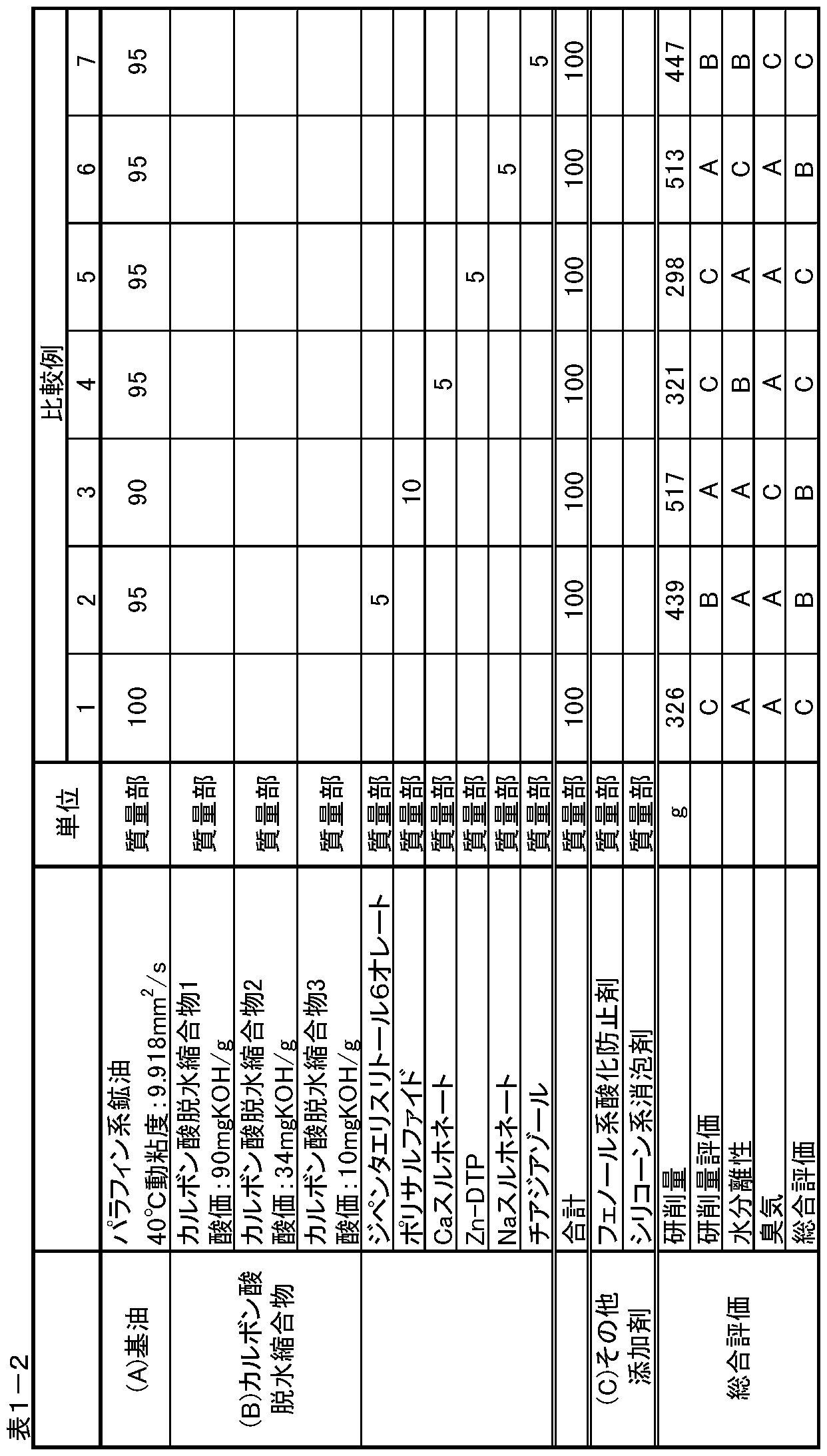
- Examples 1 to 5 and Comparative Examples 1 to 7 Water-insoluble metalworking oil compositions were prepared using the materials shown in Table 1-1 and Table 1-2 in the proportions shown in the same table. As described above, various performances (grindability, water separability and odor) were evaluated, and comprehensive evaluations (A to C) were performed based on each performance. The results are also shown in Tables 1-1 and 1-2. The unit of the amount of each composition is “parts by mass”.
- the compounding materials are as follows. ⁇ Material> (1) Base oil (A) Paraffinic base oil (40 ° C. kinematic viscosity: 9.918 mm 2 / s, 100 ° C. kinematic viscosity: 2.714 mm 2 / s: measured according to JIS K 2283: 2000) (2) Carboxylic acid dehydration condensate (B) Carboxylic acid dehydration condensate 1: Condensation product obtained by heat dehydration condensation of ricinoleic acid at 200 ° C.
- Carboxylic acid dehydration condensate 2 Condensation product obtained by heat dehydration condensation of ricinoleic acid at 200 ° C.
- Carboxylic acid dehydration condensate 3 Condensation product obtained by heat dehydration condensation of ricinoleic acid at 200 ° C. in a nitrogen stream, followed by heat dehydration condensation by adding oleic acid, acid value: 10 mgKOH / g, hydroxyl value: 33 mgKOH / g, saponification value 192 mg KOH / g (3) (components used in comparative examples) Polysulfide: 40 ° C.
- Each of the water-insoluble metalworking oil compositions of Examples 1 to 5 is excellent in grinding processing, with excellent evaluation A and overall evaluation A in all of the grinding amount, water separability, and odor evaluation, indicating that it is excellent in grinding processing.
- Comparative Example 1 containing only the base oil (A) containing no additive the grinding amount is small, and it can be seen that the base oil alone is insufficient as a metal working oil.
- Comparative Examples 2 to 7 in which the respective components were added instead of the component (B) of the present embodiment the grindability, water separability, and odor were inferior, and none of the comprehensive evaluation was A.
- a water-insoluble metalworking oil composition that is excellent in metal workability such as cutting workability and grinding workability and excellent in water separability can be obtained while reducing odor in the work environment.
- the water-insoluble metal working oil composition of the present embodiment can be suitably used for cutting or grinding, particularly grinding using a grinding belt.
Landscapes
- Chemical & Material Sciences (AREA)
- Chemical Kinetics & Catalysis (AREA)
- General Chemical & Material Sciences (AREA)
- Oil, Petroleum & Natural Gas (AREA)
- Organic Chemistry (AREA)
- Lubricants (AREA)
Abstract
Description
硫黄系化合物として単体硫黄を添加する場合の問題点として、以下が挙げられる。例えば、潤滑油に対する単体硫黄の溶解性が低いため、配合量が少量となる。また、低温環境下(例えば冬場)において、硫黄が析出及び/または沈積し、溶解する硫黄量がさらに減少して加工性能が低下する。
上記の問題点を改善するために、特許文献1~3には、単体硫黄に加えて、他の添加剤を使用して切削加工性や研削加工性を向上させている。例えば、特許文献1には、単体硫黄に加えて、平均粒度1μm以下のアルカリ金属硼酸塩水和物を含有する金属研削油組成物が、特許文献2には、単体硫黄に加えて、平均粒度0.1μm以下の超微粒子炭酸ナトリウムを含有する金属研削油組成物が開示されている。また、特許文献3には、単体硫黄と共に界面活性剤を含有する金属研削油を開示している。
加えて、切削加工及び/又は研削加工ライン等の生産現場では、種々の要因で水が混入することがある。そのため、水混入時の水分離性に優れる必要がある。
すなわち、本発明は、以下の[1]及び[2]を提供する。
[1]40℃における動粘度が5~20mm2/sの基油(A)を92~99.9質量部、及び
炭素数が10~24である脂肪族カルボン酸(b1)の脱水縮合物、及び炭素数が10~24である脂肪族カルボン酸(b1)と、脂肪族カルボン酸(b1)と異なるカルボン酸(b2)との脱水縮合物から選ばれる少なくとも1種のカルボン酸脱水縮合物(B)を0.1~8質量部
を含有し、基油(A)とカルボン酸脱水縮合物(B)との合計が100質量部である、不水溶性金属加工油組成物。
[2]上記[1]に記載の不水溶性金属加工油組成物を用いて金属を加工する、金属加工方法。
[不水溶性金属加工油組成物]
本実施形態に係る不水溶性金属加工油組成物は、以下の成分(A)及び成分(B)を特定割合で含有する。なお、成分(A)と(B)との合計は100質量部である。
また、本明細書において動粘度とは、JIS K 2283:2000に準拠して測定した動粘度を意味する。
本実施形態の不水溶性金属加工油組成物に含まれる基油(A)は、40℃における動粘度が5~20mm2/sであることを要する。40℃における基油の動粘度が5mm2/s未満であると、引火点が低いため安全性の面で好ましくない。40℃における動粘度が20mm2/sを超えると、工作機械に付着する等、作業環境の悪化をもたらすため好ましくない。また、例えば研削加工時に用いられる砥石の目詰まりを起こす可能性があるため好ましくない。40℃における動粘度が5~20mm2/sであれば、切削及び/または研削時の冷却性を良好なものにすることができる。
上記基油(A)の40℃における動粘度は、好ましくは6~15mm2/sであり、より好ましくは8~12mm2/sである。
鉱油としては、例えば、パラフィン系原油、混合系原油あるいはナフテン系原油を常圧蒸留するか、あるいは常圧蒸留の残渣油を減圧蒸留して得られる留出油、またはこれを常法にしたがって精製することによって得られる精製油、例えば、溶剤精製油、水添精製油、脱ロウ処理油、白土処理油等を挙げることができる。
合成油としては、例えばポリブテン、ポリプロピレン、炭素数8~14のα-オレフィンオリゴマー及びこれらの水素化物、さらにはポリオールエステル(トリメチロールプロパンの脂肪酸エステル、ペンタエリスリトールの脂肪酸エステルなど)や二塩基酸エステル、芳香族ポリカルボン酸エステル、リン酸エステルなどのエステル系化合物、アルキルベンゼン、アルキルナフタレンなどのアルキル芳香族化合物、ポリアルキレングリコールなどのポリグリコール油、シリコーン油などが挙げられる。
これらの基油は、一種を用いてもよく、二種以上を適宜組み合せて用いてもよい。
上記基油(A)の含有量は、好ましくは93~99.5質量部、より好ましくは95~99質量部である。
本実施形態の不水溶性金属加工油組成物は、炭素数が10~24である脂肪族カルボン酸(b1)の脱水縮合物、及び炭素数が10~24である脂肪族カルボン酸(b1)と、脂肪族カルボン酸(b1)と異なるカルボン酸(b2)との脱水縮合物から選ばれる少なくとも1種のカルボン酸脱水縮合物(B)を含む。
上記炭素数が10~24である脂肪族カルボン酸(b1)としては、例えば天然由来のカルボン酸を使用することができる。天然由来の炭素数が10~24のカルボン酸としては、ひまし油やトール油脂肪酸等の天然由来の、飽和脂肪族カルボン酸及びカルボキシル基と二重結合とを有する不飽和脂肪族カルボン酸を具体的に挙げることができる。
飽和脂肪族カルボン酸としては、カプリン酸、ネオデカン酸、ラウリン酸、ミリスチン酸、パルミチン酸、ステアリン酸、アラキジン酸、ベヘン酸及びリグノセリン酸などが挙げられる。不飽和脂肪族カルボン酸としては、ウンデシレン酸、オレイン酸、エライジン酸、エルカ酸、ネルボン酸、リノール酸、リシノール酸、γ-リノレン酸、アラキドン酸、α-リノレン酸、ステアリドン酸、エイコサペンタエン酸、及びドコサヘキサエン酸などが挙げられる。中でも、脂肪族カルボン酸(b1)が、アルコール性水酸基とカルボキシル基と二重結合とを1つずつ有するリシノール酸であることが好ましい。
飽和脂肪族カルボン酸としては、カプロン酸、エナント酸、カプリル酸、2-エチルヘキサン酸、ペラルゴン酸、イソノナン酸、カプリン酸、ネオデカン酸、ラウリン酸、ミリスチン酸、パルミチン酸、ステアリン酸、アラキジン酸、ベヘン酸及びリグノセリン酸などが挙げられる。不飽和脂肪族カルボン酸としては、ウンデシレン酸、オレイン酸、エライジン酸、エルカ酸、ネルボン酸、リノール酸、γ-リノレン酸、アラキドン酸、α-リノレン酸、ステアリドン酸、エイコサペンタエン酸、及びドコサヘキサエン酸などが挙げられる。
なお、脂肪族カルボン酸(b1)と異なるカルボン酸(b2)は、脂肪族カルボン酸(b1)として選択したカルボン酸と異なればよく、その炭素数は脂肪族カルボン酸(b1)と重複していてもよい。中でも、炭素数10~24の脂肪族カルボン酸が好ましく、炭素数12~20の脂肪族カルボン酸がより好ましい。
炭素数が10~24である脂肪族カルボン酸(b1)と、該(b1)と異なるカルボン酸(b2)との脱水縮合物は、上記脂肪族カルボン酸(b1)にさらにカルボン酸(b2)を加えて脱水縮合を行うことにより得ることができる。一例として、脂肪族カルボン酸(b1)がリシノール酸であり、カルボン酸(b2)がオレイン酸である組み合わせを挙げることができる。
脱水縮合物の重合度は、上記脱水縮合の反応時間によって調整される。反応時間が長くなれば、重合度の高い縮合物が得られる。
本実施形態におけるカルボン酸脱水縮合物(B)は、好ましくは5~50mgKOH/g、より好ましくは10~40mgKOH/g、さらに好ましくは13~35mgKOH/gの水酸基価を有する。カルボン酸脱水縮合物(B)の水酸基価が上記範囲にあると、優れた加工性能、例えば高い研削量を達成することができる。
また、本実施形態におけるカルボン酸脱水縮合物(B)は、好ましくは150~250mgKOH/g、より好ましくは180~210mgKOH/g、さらに好ましくは190~200mgKOH/gのけん化価を有する。カルボン酸脱水縮合物(B)のけん化価が上記範囲にあると、優れた加工性能、例えば高い研削量を達成することができる。
ここで、酸価は、JIS K 2501:2003(指示薬法)に基づいて測定される値であり、水酸基価は、JIS K 0070:1992に基づいて測定される値であり、けん化価は、JIS K 2503:2010に基づいて測定される値である。
得られたカルボン酸脱水縮合物(B)が有し得る遊離水酸基は、任意のカルボン酸でキャッピングされていてもよい。キャッピングに用いられるカルボン酸は特に限定されない。
成分(B)の含有量が0.1質量部未満であると、加工性能、例えば研削量に劣る。また上記含有量が8質量部を超えると、不水溶性金属加工油組成物の粘度が高くなり、研削加工で生じる切りくずを洗浄する洗浄作用に劣る傾向がある。また、ハンドリング性にも劣る。
不水溶性金属加工油組成物におけるカルボン酸脱水縮合物(B)の含有量は、好ましくは0.5~7質量部、より好ましくは1~6質量部である。
本実施形態の不水溶性金属加工油組成物には、本実施形態の目的を阻害しない範囲でさらに他の成分を配合することができる。その他添加剤としては、油性剤、極圧剤、耐摩耗剤、酸化防止剤、金属不活性化剤、防錆剤、分散剤、消泡剤及びミスト防止剤からなる群から選択される少なくとも1種の添加剤(C)を挙げることができる。
油性剤としては、例えばマレイン酸、アルキル若しくはアルケニルマレイン酸、シュウ酸、コハク酸、アルキル若しくはアルケニルコハク酸で代表される二塩基酸及びそのエステル、三塩基酸及びそのエステル、ナタネ油、大豆白絞油などの脂肪酸、脂肪酸エステル及び油脂などが挙げられる。
極圧剤としては、塊状、粉末状及び溶融液体状等の単体硫黄、硫化油脂及びポリサルファイド等の硫黄系極圧剤、並びに塩素化パラフィン、塩素化油脂、塩素化脂肪酸エステル、塩素化脂肪酸などの塩素系極圧剤、リン酸エステル、チオリン酸エステル、ジチオリン酸エステル、リン酸エステルアミン塩、チオリン酸エステルアミン塩、ジチオリン酸エステルアミン塩、亜リン酸エステル、チオ亜リン酸エステル、ジチオ亜リン酸エステルなどのリン系極圧剤などが挙げられる。
耐摩耗剤としては、例えばジチオリン酸亜鉛(ZnDTP)、ジチオカルバミン酸亜鉛(ZnDTC)、硫化オキシジチオリン酸モリブデン(MoDTP)及び硫化オキシジチオカルバミン酸モリブデン(MoDTC)などが挙げられる。
酸化防止剤としては、例えばジフェニルアミン、アルキルジフェニルアミン、フェニル-α-ナフチルアミン、アルキルフェニル-α-ナフチルアミンなどのアミン系酸化防止剤、4,4’-メチレン-ビス-2,6-ジ-t-ブチルフェノール、2,6-ジ-t-ブチル-p-クレゾール(DBPC)などのフェノール系酸化防止剤、硫黄系酸化防止剤及びモリブデンアミン錯体系酸化防止剤等を挙げることができる。
金属不活性化剤としては、例えばベンゾトリアゾール、トリアゾール誘導体、ベンゾトリアゾール誘導体、チアジアゾール誘導体等を挙げることができる。
防錆剤としては、例えばソルビタン脂肪酸エステル等の多価アルコールの脂肪酸エステルを挙げることができる。
分散剤としては、例えばアルキル若しくはアルケニルコハク酸イミド、アルキル若しくはアルケニルコハク酸エステル、酸アミドなどの無灰系分散剤等を挙げることができる。
消泡剤としては、例えばジメチルポリシロキサン等のシリコーン系消泡剤、フルオロエーテル等を挙げることができる。
ミスト防止剤としては、ポリイソブチレン、エチレン-プロピレンコポリマー等の炭化水素系高分子化合物を用いることができる。上記高分子化合物の数平均分子量は100,000~3,000,000が好ましく、200,000~2,000,000がより好ましい。
成分(C)の添加量がそれぞれ独立して上記範囲内にあれば、各成分の効果が十分に発揮される。上記成分(C)の添加量はそれぞれ独立して、より好ましくは0.2~2.5質量部、さらに好ましくは0.4~2質量部である。
本発明の一態様において、基油(A)とカルボン酸脱水縮合物(B)との合計含有量は、不水溶性金属加工油組成物の全量(100質量%)基準で、好ましくは80~100質量%、より好ましくは95~100質量%である。
本発明の他の態様において、基油(A)、カルボン酸脱水縮合物(B)及び成分(C)の合計含有量は、不水溶性金属加工油組成物の全量(100質量%)基準で、好ましくは90~100質量%、より好ましくは95~100質量%である。
<金属加工方法>
本実施形態における金属加工方法は、上述した不水溶性金属加工油組成物を用いて金属を加工する。本実施形態の不水溶性金属加工油組成物を用いて行う金属加工の種類としては、切削加工、研削加工、打抜き加工、研磨加工、絞り加工、抽伸加工、圧延加工等の各種金属加工を挙げることができ、中でも研削加工が好ましい。研削加工としては、例えば、研削ベルトにより金属を研削加工する方法を挙げることができる。なお、研削ベルトとは、布、紙、プラスチック、ゴム等で形成された基体表面に、研磨材(砥粒)が接着されたエンドレス状のベルトからなる研磨工具であり、研削加工において通常使用されるものを適宜選択して使用可能である。砥粒としては、例えばアルミナを用いることができる。本方法で被加工材料となる金属は、上記したとおりである。
なお、本実施形態の不水溶性金属加工油組成物は、研削性が良好で研削量を多くすることが可能であることから、いわゆる粗研削に好適に使用できる。
研削ベルトを用いた研削加工は、例えば図1に示すように、搬送ベルト4等で搬送される被削材5に、アイドルロール1及びコンタクトロール2のような2以上のローラ間で回転走行する研削ベルト3表面を押し付けて行う。この際、ベルトが押し付けられる被削材5の部分(研削部)に、本実施形態の不水溶性金属加工油組成物6が供給される。本実施形態の不水溶性金属加工油組成物6は、例えば、搬送ベルト4の下方に設けられた油タンク7から研削部に供給されるとともに、研削部から落下したものがタンク7に戻されることで循環しながら研削部に供給される。
また、本実施形態の不水溶性金属加工油組成物の上記金属加工方法における使用も提供する。
(1)研削性能
各不水溶性金属加工油組成物を用いて、以下の金属加工を行った。図1に概略図で示す研削試験用装置を用いて研削性評価を行った。図1に示すように、アイドルロール1とコンタクトロール2との間で回転走行する研削ベルト3に、搬送ベルト4上に載置された被削材5を押し付け、一方で、研削部に上記不水溶性金属加工油組成物6を油タンク7から循環供給しながら研削を行う。1試験につき5枚の被削材板を使用し、間隔を空けずに連続して通板する。評価項目及び試験条件は、以下の通りである。
(評価項目)
前記試験を、合計100パス行い、研削量(g)を測定した。研削量が500g以上の場合はA評価とし、A評価の研削性を合格とする。一方で、400~500g未満の場合はB評価、400g未満の場合はC評価とし、いずれも不合格とする。
(試験条件)
・研削ベルト:アルミナ80番
・被研削材:SUS304、幅90mm×長さ1,000mm×厚さ約3mm、1試験毎に5枚通板
・速度:ベルト速度;1400m/min、板送り速度;10m/min
・研磨方法:ダウンカット
・タンク油温度:40℃
・負荷:1.5hp/inch(ベルト押付け力を一定で評価)
50mlシリンダーに各金属加工油組成物20gと水20gを量りとり、30秒間激しく振とうした。3時間後の溶液状態を観察し、以下の評価基準で評価した。
A:乳化層無し、B:乳化層が1mm未満、C:乳化層が1mm以上。
(3)臭気評価
各金属加工油組成物を100℃のホットスターラ―に垂らし、その臭気を以下の評価基準で評価した。
A:僅かな臭気、C:強い臭気
(4)総合評価
上記(1)~(3)の評価に基づき、3段階(A:優れる,B:やや劣る,C:劣る)で評価した。
表1-1及び表1-2に示す各材料を同表に示す割合で用いて不水溶性金属加工油組成物を調製した。上述の通り、各種性能(研削性、水分離性及び臭気)評価を行い、各性能をもとに総合評価(A~C)を行った。結果を同じく表1-1及び1-2に示す。各組成物配合量の単位は「質量部」である。

<材料>
(1)基油(A)
・パラフィン系基油(40℃動粘度:9.918mm2/s、100℃動粘度:2.714mm2/s:JIS K 2283:2000に準拠して測定)
(2)カルボン酸脱水縮合物(B)
・カルボン酸脱水縮合物1:リシノール酸を窒素気流下200℃で加熱脱水縮合し、さらにオレイン酸を加え加熱脱水縮合した縮合物、酸価:90mgKOH/g、水酸基価:15mgKOH/g、けん化価:195mgKOH/g
・カルボン酸脱水縮合物2:リシノール酸を窒素気流下200℃で加熱脱水縮合し、さらにオレイン酸を加え加熱脱水縮合した縮合物、酸価:34mgKOH/g、水酸基価:28mgKOH/g、けん化価:198mgKOH/g
・カルボン酸脱水縮合物3:リシノール酸を窒素気流下200℃で加熱脱水縮合し、さらにオレイン酸を加え加熱脱水縮合した縮合物、酸価:10mgKOH/g、水酸基価:33mgKOH/g、けん化価:192mgKOH/g
(3)(比較例で用いる成分)
・ポリサルファイド:40℃動粘度:48.65mm2/s,S分:39.5質量%
・Caスルホネート:塩基価495mgKOH/g,Ca分:18.5質量%
・ZnDTP:S分:15.0質量%,P分:7.5質量%,Zn分:8.5質量%
・Naスルホネート:塩基価450mgKOH/g,Na分:19.5質量%
・チアジアゾール誘導体:S分:36質量%,N分:49質量%
(4)その他添加剤(C)
・フェノール系酸化防止剤:2,6-ジ-tert-ブチルパラクレゾール
・シリコーン系消泡剤:ジメチルポリシロキサン
Claims (8)
- 40℃における動粘度が5~20mm2/sの基油(A)を92~99.9質量部、及び
炭素数が10~24である脂肪族カルボン酸(b1)の脱水縮合物、及び炭素数が10~24である脂肪族カルボン酸(b1)と、脂肪族カルボン酸(b1)と異なるカルボン酸(b2)との脱水縮合物から選ばれる少なくとも1種のカルボン酸脱水縮合物(B)を0.1~8質量部
を含有し、基油(A)とカルボン酸脱水縮合物(B)との合計が100質量部である、不水溶性金属加工油組成物。 - 炭素数が10~24である脂肪族カルボン酸(b1)が、リシノール酸である、請求項1に記載の不水溶性金属加工油組成物。
- カルボン酸脱水縮合物(B)の酸価が5~100mgKOH/gである、請求項1または2に記載の不水溶性金属加工油組成物。
- さらに、油性剤、極圧剤、耐摩耗剤、酸化防止剤、金属不活性化剤、防錆剤、分散剤、消泡剤及びミスト防止剤からなる群から選択される少なくとも1種の添加剤(C)を、基油(A)及びカルボン酸脱水縮合物(B)の合計100質量部に対して、それぞれ独立して0.2~3質量部含有する、請求項1~3のいずれか一項に記載の不水溶性金属加工油組成物。
- 金属の研削加工に用いる、請求項1~4のいずれか一項に記載の不水溶性金属加工油組成物。
- 前記金属が鉄系材料である、請求項5に記載の不水溶性金属加工油組成物。
- 請求項1~6のいずれか一項に記載の不水溶性金属加工油組成物を用いて金属を加工する、金属加工方法。
- 研削ベルトにより金属を研削加工する、請求項7に記載の金属加工方法。
Priority Applications (3)
| Application Number | Priority Date | Filing Date | Title |
|---|---|---|---|
| KR1020187027398A KR102346237B1 (ko) | 2016-03-31 | 2017-03-31 | 불수용성 금속 가공유 조성물 |
| CN201780020492.2A CN108884404A (zh) | 2016-03-31 | 2017-03-31 | 水不溶性金属加工油组合物 |
| JP2018509697A JPWO2017171069A1 (ja) | 2016-03-31 | 2017-03-31 | 不水溶性金属加工油組成物 |
Applications Claiming Priority (2)
| Application Number | Priority Date | Filing Date | Title |
|---|---|---|---|
| JP2016-073050 | 2016-03-31 | ||
| JP2016073050 | 2016-03-31 |
Publications (1)
| Publication Number | Publication Date |
|---|---|
| WO2017171069A1 true WO2017171069A1 (ja) | 2017-10-05 |
Family
ID=59964880
Family Applications (1)
| Application Number | Title | Priority Date | Filing Date |
|---|---|---|---|
| PCT/JP2017/013783 Ceased WO2017171069A1 (ja) | 2016-03-31 | 2017-03-31 | 不水溶性金属加工油組成物 |
Country Status (4)
| Country | Link |
|---|---|
| JP (2) | JPWO2017171069A1 (ja) |
| KR (1) | KR102346237B1 (ja) |
| CN (1) | CN108884404A (ja) |
| WO (1) | WO2017171069A1 (ja) |
Families Citing this family (2)
| Publication number | Priority date | Publication date | Assignee | Title |
|---|---|---|---|---|
| JP7430492B2 (ja) * | 2019-03-26 | 2024-02-13 | 出光興産株式会社 | 水溶性金属加工油組成物、水溶性金属加工油組成物の製造方法、金属加工液及び金属加工方法 |
| JP7431233B2 (ja) * | 2019-06-28 | 2024-02-14 | 出光興産株式会社 | 金属加工油 |
Citations (5)
| Publication number | Priority date | Publication date | Assignee | Title |
|---|---|---|---|---|
| JPS62153394A (ja) * | 1985-12-27 | 1987-07-08 | Miyoshi Oil & Fat Co Ltd | 金属加工油 |
| JPH07112368A (ja) * | 1993-10-18 | 1995-05-02 | Kawasaki Steel Corp | 金属帯研削用長尺研削ベルトのドレッシング方法 |
| JPH08209160A (ja) * | 1995-01-31 | 1996-08-13 | Ito Seiyu Kk | 潤滑性組成物 |
| JPH108077A (ja) * | 1996-06-20 | 1998-01-13 | Daido Kagaku Kogyo Kk | 金属塑性加工用潤滑油剤 |
| JP2002294264A (ja) * | 2001-03-30 | 2002-10-09 | Kyodo Yushi Co Ltd | オンラインロール研削特性に優れる熱間圧延油組成物及び熱間圧延方法 |
Family Cites Families (6)
| Publication number | Priority date | Publication date | Assignee | Title |
|---|---|---|---|---|
| JP2872445B2 (ja) | 1991-05-13 | 1999-03-17 | 株式会社ジャパンエナジー | 金属研削油 |
| JP2941530B2 (ja) | 1991-11-12 | 1999-08-25 | 株式会社ジャパンエナジー | 金属研削油組成物 |
| JP2941529B2 (ja) | 1991-11-12 | 1999-08-25 | 株式会社ジャパンエナジー | 金属研削油組成物 |
| JP2002146380A (ja) * | 2000-11-17 | 2002-05-22 | Daido Chem Ind Co Ltd | アルミニウムdi缶用成形加工潤滑剤組成物および該潤滑剤組成物を用いたアルミニウムdi缶成形加工方法 |
| KR20110111308A (ko) * | 2009-01-20 | 2011-10-10 | 더루우브리졸코오포레이션 | 마모 성질이 개량된 유압 조성물 |
| JP6051026B2 (ja) * | 2012-11-20 | 2016-12-21 | 出光興産株式会社 | 水溶性金属加工油剤、金属加工液、及び金属加工方法 |
-
2017
- 2017-03-31 WO PCT/JP2017/013783 patent/WO2017171069A1/ja not_active Ceased
- 2017-03-31 JP JP2018509697A patent/JPWO2017171069A1/ja not_active Withdrawn
- 2017-03-31 KR KR1020187027398A patent/KR102346237B1/ko active Active
- 2017-03-31 CN CN201780020492.2A patent/CN108884404A/zh active Pending
-
2021
- 2021-10-13 JP JP2021168332A patent/JP7342085B2/ja active Active
Patent Citations (5)
| Publication number | Priority date | Publication date | Assignee | Title |
|---|---|---|---|---|
| JPS62153394A (ja) * | 1985-12-27 | 1987-07-08 | Miyoshi Oil & Fat Co Ltd | 金属加工油 |
| JPH07112368A (ja) * | 1993-10-18 | 1995-05-02 | Kawasaki Steel Corp | 金属帯研削用長尺研削ベルトのドレッシング方法 |
| JPH08209160A (ja) * | 1995-01-31 | 1996-08-13 | Ito Seiyu Kk | 潤滑性組成物 |
| JPH108077A (ja) * | 1996-06-20 | 1998-01-13 | Daido Kagaku Kogyo Kk | 金属塑性加工用潤滑油剤 |
| JP2002294264A (ja) * | 2001-03-30 | 2002-10-09 | Kyodo Yushi Co Ltd | オンラインロール研削特性に優れる熱間圧延油組成物及び熱間圧延方法 |
Also Published As
| Publication number | Publication date |
|---|---|
| CN108884404A (zh) | 2018-11-23 |
| KR102346237B1 (ko) | 2021-12-31 |
| KR20180127988A (ko) | 2018-11-30 |
| JP2022001655A (ja) | 2022-01-06 |
| JP7342085B2 (ja) | 2023-09-11 |
| JPWO2017171069A1 (ja) | 2019-02-14 |
Similar Documents
| Publication | Publication Date | Title |
|---|---|---|
| CN101679895B (zh) | 润滑剂共混物组合物 | |
| JP5646859B2 (ja) | 無段変速機用潤滑油組成物 | |
| JP2022103390A (ja) | 潤滑組成物のためのフッ素化ポリアクリレート消泡成分 | |
| EP3746529B1 (en) | Lubricant composition | |
| JP7342085B2 (ja) | 不水溶性金属加工油組成物 | |
| WO2017171054A1 (ja) | 金属加工油組成物 | |
| TW200946672A (en) | Lubricant composition for fine blanking | |
| JP2017517610A (ja) | 改善された適合性を有する合成工業用潤滑剤 | |
| KR102728895B1 (ko) | 수용성 금속 가공유 조성물, 금속 가공액 및 금속 가공 방법 | |
| CN120752323A (zh) | 包含至少一种基础油和至少一种脂肪醇的润滑剂组合物的用途 | |
| CN115803418A (zh) | 水溶性金属加工油剂 | |
| WO2023190158A1 (ja) | 潤滑油組成物 | |
| JP2008274190A (ja) | ギヤ油組成物 | |
| KR101906433B1 (ko) | 비수용성 절삭유 | |
| TWI687513B (zh) | 切削及/或磨削加工油組成物 | |
| JP5171317B2 (ja) | 塑性加工用潤滑油組成物 | |
| CN115244158B (zh) | 金属加工油组合物 | |
| JP6849213B2 (ja) | 摺動面用潤滑油組成物 | |
| CN118355096A (zh) | 水溶性金属加工油剂 | |
| CN114058424A (zh) | 非蔓延性润滑脂组合物 | |
| JP6892784B2 (ja) | 金属加工用潤滑油組成物 | |
| TWI853944B (zh) | 水溶性金屬加工油組成物、水溶性金屬加工油組成物之製造方法、金屬加工液及金屬加工方法 | |
| JP4829549B2 (ja) | 塑性加工用潤滑油 | |
| WO2026048883A1 (ja) | 潤滑油組成物 | |
| CN118956468A (zh) | 一种高性能导轨油复合剂及制备方法 |
Legal Events
| Date | Code | Title | Description |
|---|---|---|---|
| ENP | Entry into the national phase |
Ref document number: 2018509697 Country of ref document: JP Kind code of ref document: A |
|
| ENP | Entry into the national phase |
Ref document number: 20187027398 Country of ref document: KR Kind code of ref document: A |
|
| NENP | Non-entry into the national phase |
Ref country code: DE |
|
| 121 | Ep: the epo has been informed by wipo that ep was designated in this application |
Ref document number: 17775600 Country of ref document: EP Kind code of ref document: A1 |
|
| 122 | Ep: pct application non-entry in european phase |
Ref document number: 17775600 Country of ref document: EP Kind code of ref document: A1 |