WO2017195902A1 - Composition de résine, préimprégné, feuille métallique dotée d'une résine, stratifié, panneau de circuit imprimé, et procédé de production d'une composition de résine - Google Patents
Composition de résine, préimprégné, feuille métallique dotée d'une résine, stratifié, panneau de circuit imprimé, et procédé de production d'une composition de résine Download PDFInfo
- Publication number
- WO2017195902A1 WO2017195902A1 PCT/JP2017/018157 JP2017018157W WO2017195902A1 WO 2017195902 A1 WO2017195902 A1 WO 2017195902A1 JP 2017018157 W JP2017018157 W JP 2017018157W WO 2017195902 A1 WO2017195902 A1 WO 2017195902A1
- Authority
- WO
- WIPO (PCT)
- Prior art keywords
- resin
- acrylic polymer
- resin composition
- phase
- value
- Prior art date
- Legal status (The legal status is an assumption and is not a legal conclusion. Google has not performed a legal analysis and makes no representation as to the accuracy of the status listed.)
- Ceased
Links
Images





Classifications
-
- B—PERFORMING OPERATIONS; TRANSPORTING
- B32—LAYERED PRODUCTS
- B32B—LAYERED PRODUCTS, i.e. PRODUCTS BUILT-UP OF STRATA OF FLAT OR NON-FLAT, e.g. CELLULAR OR HONEYCOMB, FORM
- B32B15/00—Layered products comprising a layer of metal
- B32B15/20—Layered products comprising a layer of metal comprising aluminium or copper
-
- B—PERFORMING OPERATIONS; TRANSPORTING
- B29—WORKING OF PLASTICS; WORKING OF SUBSTANCES IN A PLASTIC STATE IN GENERAL
- B29C—SHAPING OR JOINING OF PLASTICS; SHAPING OF MATERIAL IN A PLASTIC STATE, NOT OTHERWISE PROVIDED FOR; AFTER-TREATMENT OF THE SHAPED PRODUCTS, e.g. REPAIRING
- B29C43/00—Compression moulding, i.e. applying external pressure to flow the moulding material; Apparatus therefor
- B29C43/02—Compression moulding, i.e. applying external pressure to flow the moulding material; Apparatus therefor of articles of definite length, i.e. discrete articles
- B29C43/18—Compression moulding, i.e. applying external pressure to flow the moulding material; Apparatus therefor of articles of definite length, i.e. discrete articles incorporating preformed parts or layers, e.g. compression moulding around inserts or for coating articles
-
- B—PERFORMING OPERATIONS; TRANSPORTING
- B32—LAYERED PRODUCTS
- B32B—LAYERED PRODUCTS, i.e. PRODUCTS BUILT-UP OF STRATA OF FLAT OR NON-FLAT, e.g. CELLULAR OR HONEYCOMB, FORM
- B32B15/00—Layered products comprising a layer of metal
- B32B15/04—Layered products comprising a layer of metal comprising metal as the main or only constituent of a layer, which is next to another layer of the same or of a different material
- B32B15/08—Layered products comprising a layer of metal comprising metal as the main or only constituent of a layer, which is next to another layer of the same or of a different material of synthetic resin
-
- B—PERFORMING OPERATIONS; TRANSPORTING
- B32—LAYERED PRODUCTS
- B32B—LAYERED PRODUCTS, i.e. PRODUCTS BUILT-UP OF STRATA OF FLAT OR NON-FLAT, e.g. CELLULAR OR HONEYCOMB, FORM
- B32B15/00—Layered products comprising a layer of metal
- B32B15/14—Layered products comprising a layer of metal next to a fibrous or filamentary layer
-
- B—PERFORMING OPERATIONS; TRANSPORTING
- B32—LAYERED PRODUCTS
- B32B—LAYERED PRODUCTS, i.e. PRODUCTS BUILT-UP OF STRATA OF FLAT OR NON-FLAT, e.g. CELLULAR OR HONEYCOMB, FORM
- B32B5/00—Layered products characterised by the non- homogeneity or physical structure, i.e. comprising a fibrous, filamentary, particulate or foam layer; Layered products characterised by having a layer differing constitutionally or physically in different parts
- B32B5/02—Layered products characterised by the non- homogeneity or physical structure, i.e. comprising a fibrous, filamentary, particulate or foam layer; Layered products characterised by having a layer differing constitutionally or physically in different parts characterised by structural features of a fibrous or filamentary layer
- B32B5/022—Non-woven fabric
-
- B—PERFORMING OPERATIONS; TRANSPORTING
- B32—LAYERED PRODUCTS
- B32B—LAYERED PRODUCTS, i.e. PRODUCTS BUILT-UP OF STRATA OF FLAT OR NON-FLAT, e.g. CELLULAR OR HONEYCOMB, FORM
- B32B5/00—Layered products characterised by the non- homogeneity or physical structure, i.e. comprising a fibrous, filamentary, particulate or foam layer; Layered products characterised by having a layer differing constitutionally or physically in different parts
- B32B5/02—Layered products characterised by the non- homogeneity or physical structure, i.e. comprising a fibrous, filamentary, particulate or foam layer; Layered products characterised by having a layer differing constitutionally or physically in different parts characterised by structural features of a fibrous or filamentary layer
- B32B5/024—Woven fabric
-
- B—PERFORMING OPERATIONS; TRANSPORTING
- B32—LAYERED PRODUCTS
- B32B—LAYERED PRODUCTS, i.e. PRODUCTS BUILT-UP OF STRATA OF FLAT OR NON-FLAT, e.g. CELLULAR OR HONEYCOMB, FORM
- B32B5/00—Layered products characterised by the non- homogeneity or physical structure, i.e. comprising a fibrous, filamentary, particulate or foam layer; Layered products characterised by having a layer differing constitutionally or physically in different parts
- B32B5/02—Layered products characterised by the non- homogeneity or physical structure, i.e. comprising a fibrous, filamentary, particulate or foam layer; Layered products characterised by having a layer differing constitutionally or physically in different parts characterised by structural features of a fibrous or filamentary layer
- B32B5/08—Layered products characterised by the non- homogeneity or physical structure, i.e. comprising a fibrous, filamentary, particulate or foam layer; Layered products characterised by having a layer differing constitutionally or physically in different parts characterised by structural features of a fibrous or filamentary layer the fibres or filaments of a layer being of different substances, e.g. conjugate fibres, mixture of different fibres
-
- B—PERFORMING OPERATIONS; TRANSPORTING
- B32—LAYERED PRODUCTS
- B32B—LAYERED PRODUCTS, i.e. PRODUCTS BUILT-UP OF STRATA OF FLAT OR NON-FLAT, e.g. CELLULAR OR HONEYCOMB, FORM
- B32B5/00—Layered products characterised by the non- homogeneity or physical structure, i.e. comprising a fibrous, filamentary, particulate or foam layer; Layered products characterised by having a layer differing constitutionally or physically in different parts
- B32B5/22—Layered products characterised by the non- homogeneity or physical structure, i.e. comprising a fibrous, filamentary, particulate or foam layer; Layered products characterised by having a layer differing constitutionally or physically in different parts characterised by the presence of two or more layers which are next to each other and are fibrous, filamentary, formed of particles or foamed
- B32B5/24—Layered products characterised by the non- homogeneity or physical structure, i.e. comprising a fibrous, filamentary, particulate or foam layer; Layered products characterised by having a layer differing constitutionally or physically in different parts characterised by the presence of two or more layers which are next to each other and are fibrous, filamentary, formed of particles or foamed one layer being a fibrous or filamentary layer
- B32B5/26—Layered products characterised by the non- homogeneity or physical structure, i.e. comprising a fibrous, filamentary, particulate or foam layer; Layered products characterised by having a layer differing constitutionally or physically in different parts characterised by the presence of two or more layers which are next to each other and are fibrous, filamentary, formed of particles or foamed one layer being a fibrous or filamentary layer another layer next to it also being fibrous or filamentary
-
- C—CHEMISTRY; METALLURGY
- C08—ORGANIC MACROMOLECULAR COMPOUNDS; THEIR PREPARATION OR CHEMICAL WORKING-UP; COMPOSITIONS BASED THEREON
- C08F—MACROMOLECULAR COMPOUNDS OBTAINED BY REACTIONS ONLY INVOLVING CARBON-TO-CARBON UNSATURATED BONDS
- C08F20/00—Homopolymers and copolymers of compounds having one or more unsaturated aliphatic radicals, each having only one carbon-to-carbon double bond, and only one being terminated by only one carboxyl radical or a salt, anhydride, ester, amide, imide or nitrile thereof
- C08F20/02—Monocarboxylic acids having less than ten carbon atoms, Derivatives thereof
- C08F20/10—Esters
- C08F20/12—Esters of monohydric alcohols or phenols
-
- C—CHEMISTRY; METALLURGY
- C08—ORGANIC MACROMOLECULAR COMPOUNDS; THEIR PREPARATION OR CHEMICAL WORKING-UP; COMPOSITIONS BASED THEREON
- C08F—MACROMOLECULAR COMPOUNDS OBTAINED BY REACTIONS ONLY INVOLVING CARBON-TO-CARBON UNSATURATED BONDS
- C08F220/00—Copolymers of compounds having one or more unsaturated aliphatic radicals, each having only one carbon-to-carbon double bond, and only one being terminated by only one carboxyl radical or a salt, anhydride ester, amide, imide or nitrile thereof
- C08F220/02—Monocarboxylic acids having less than ten carbon atoms; Derivatives thereof
- C08F220/10—Esters
- C08F220/12—Esters of monohydric alcohols or phenols
- C08F220/16—Esters of monohydric alcohols or phenols of phenols or of alcohols containing two or more carbon atoms
- C08F220/18—Esters of monohydric alcohols or phenols of phenols or of alcohols containing two or more carbon atoms with acrylic or methacrylic acids
- C08F220/1802—C2-(meth)acrylate, e.g. ethyl (meth)acrylate
-
- C—CHEMISTRY; METALLURGY
- C08—ORGANIC MACROMOLECULAR COMPOUNDS; THEIR PREPARATION OR CHEMICAL WORKING-UP; COMPOSITIONS BASED THEREON
- C08F—MACROMOLECULAR COMPOUNDS OBTAINED BY REACTIONS ONLY INVOLVING CARBON-TO-CARBON UNSATURATED BONDS
- C08F220/00—Copolymers of compounds having one or more unsaturated aliphatic radicals, each having only one carbon-to-carbon double bond, and only one being terminated by only one carboxyl radical or a salt, anhydride ester, amide, imide or nitrile thereof
- C08F220/02—Monocarboxylic acids having less than ten carbon atoms; Derivatives thereof
- C08F220/10—Esters
- C08F220/12—Esters of monohydric alcohols or phenols
- C08F220/16—Esters of monohydric alcohols or phenols of phenols or of alcohols containing two or more carbon atoms
- C08F220/18—Esters of monohydric alcohols or phenols of phenols or of alcohols containing two or more carbon atoms with acrylic or methacrylic acids
- C08F220/1804—C4-(meth)acrylate, e.g. butyl (meth)acrylate, isobutyl (meth)acrylate or tert-butyl (meth)acrylate
-
- C—CHEMISTRY; METALLURGY
- C08—ORGANIC MACROMOLECULAR COMPOUNDS; THEIR PREPARATION OR CHEMICAL WORKING-UP; COMPOSITIONS BASED THEREON
- C08J—WORKING-UP; GENERAL PROCESSES OF COMPOUNDING; AFTER-TREATMENT NOT COVERED BY SUBCLASSES C08B, C08C, C08F, C08G or C08H
- C08J3/00—Processes of treating or compounding macromolecular substances
- C08J3/02—Making solutions, dispersions, lattices or gels by other methods than by solution, emulsion or suspension polymerisation techniques
- C08J3/09—Making solutions, dispersions, lattices or gels by other methods than by solution, emulsion or suspension polymerisation techniques in organic liquids
- C08J3/11—Making solutions, dispersions, lattices or gels by other methods than by solution, emulsion or suspension polymerisation techniques in organic liquids from solid polymers
-
- C—CHEMISTRY; METALLURGY
- C08—ORGANIC MACROMOLECULAR COMPOUNDS; THEIR PREPARATION OR CHEMICAL WORKING-UP; COMPOSITIONS BASED THEREON
- C08J—WORKING-UP; GENERAL PROCESSES OF COMPOUNDING; AFTER-TREATMENT NOT COVERED BY SUBCLASSES C08B, C08C, C08F, C08G or C08H
- C08J3/00—Processes of treating or compounding macromolecular substances
- C08J3/20—Compounding polymers with additives, e.g. colouring
-
- C—CHEMISTRY; METALLURGY
- C08—ORGANIC MACROMOLECULAR COMPOUNDS; THEIR PREPARATION OR CHEMICAL WORKING-UP; COMPOSITIONS BASED THEREON
- C08J—WORKING-UP; GENERAL PROCESSES OF COMPOUNDING; AFTER-TREATMENT NOT COVERED BY SUBCLASSES C08B, C08C, C08F, C08G or C08H
- C08J5/00—Manufacture of articles or shaped materials containing macromolecular substances
- C08J5/24—Impregnating materials with prepolymers which can be polymerised in situ, e.g. manufacture of prepregs
-
- C—CHEMISTRY; METALLURGY
- C08—ORGANIC MACROMOLECULAR COMPOUNDS; THEIR PREPARATION OR CHEMICAL WORKING-UP; COMPOSITIONS BASED THEREON
- C08J—WORKING-UP; GENERAL PROCESSES OF COMPOUNDING; AFTER-TREATMENT NOT COVERED BY SUBCLASSES C08B, C08C, C08F, C08G or C08H
- C08J5/00—Manufacture of articles or shaped materials containing macromolecular substances
- C08J5/24—Impregnating materials with prepolymers which can be polymerised in situ, e.g. manufacture of prepregs
- C08J5/241—Impregnating materials with prepolymers which can be polymerised in situ, e.g. manufacture of prepregs using inorganic fibres
- C08J5/244—Impregnating materials with prepolymers which can be polymerised in situ, e.g. manufacture of prepregs using inorganic fibres using glass fibres
-
- C—CHEMISTRY; METALLURGY
- C08—ORGANIC MACROMOLECULAR COMPOUNDS; THEIR PREPARATION OR CHEMICAL WORKING-UP; COMPOSITIONS BASED THEREON
- C08K—Use of inorganic or non-macromolecular organic substances as compounding ingredients
- C08K3/00—Use of inorganic substances as compounding ingredients
- C08K3/01—Use of inorganic substances as compounding ingredients characterized by their specific function
- C08K3/013—Fillers, pigments or reinforcing additives
-
- C—CHEMISTRY; METALLURGY
- C08—ORGANIC MACROMOLECULAR COMPOUNDS; THEIR PREPARATION OR CHEMICAL WORKING-UP; COMPOSITIONS BASED THEREON
- C08L—COMPOSITIONS OF MACROMOLECULAR COMPOUNDS
- C08L101/00—Compositions of unspecified macromolecular compounds
-
- C—CHEMISTRY; METALLURGY
- C08—ORGANIC MACROMOLECULAR COMPOUNDS; THEIR PREPARATION OR CHEMICAL WORKING-UP; COMPOSITIONS BASED THEREON
- C08L—COMPOSITIONS OF MACROMOLECULAR COMPOUNDS
- C08L33/00—Compositions of homopolymers or copolymers of compounds having one or more unsaturated aliphatic radicals, each having only one carbon-to-carbon double bond, and only one being terminated by only one carboxyl radical, or of salts, anhydrides, esters, amides, imides or nitriles thereof; Compositions of derivatives of such polymers
- C08L33/04—Homopolymers or copolymers of esters
- C08L33/06—Homopolymers or copolymers of esters of esters containing only carbon, hydrogen and oxygen, which oxygen atoms are present only as part of the carboxyl radical
-
- C—CHEMISTRY; METALLURGY
- C08—ORGANIC MACROMOLECULAR COMPOUNDS; THEIR PREPARATION OR CHEMICAL WORKING-UP; COMPOSITIONS BASED THEREON
- C08L—COMPOSITIONS OF MACROMOLECULAR COMPOUNDS
- C08L33/00—Compositions of homopolymers or copolymers of compounds having one or more unsaturated aliphatic radicals, each having only one carbon-to-carbon double bond, and only one being terminated by only one carboxyl radical, or of salts, anhydrides, esters, amides, imides or nitriles thereof; Compositions of derivatives of such polymers
- C08L33/04—Homopolymers or copolymers of esters
- C08L33/06—Homopolymers or copolymers of esters of esters containing only carbon, hydrogen and oxygen, which oxygen atoms are present only as part of the carboxyl radical
- C08L33/08—Homopolymers or copolymers of acrylic acid esters
-
- H—ELECTRICITY
- H05—ELECTRIC TECHNIQUES NOT OTHERWISE PROVIDED FOR
- H05K—PRINTED CIRCUITS; CASINGS OR CONSTRUCTIONAL DETAILS OF ELECTRIC APPARATUS; MANUFACTURE OF ASSEMBLAGES OF ELECTRICAL COMPONENTS
- H05K1/00—Printed circuits
- H05K1/02—Details
- H05K1/03—Use of materials for the substrate
- H05K1/0313—Organic insulating material
- H05K1/032—Organic insulating material consisting of one material
- H05K1/0326—Organic insulating material consisting of one material containing O
-
- H—ELECTRICITY
- H05—ELECTRIC TECHNIQUES NOT OTHERWISE PROVIDED FOR
- H05K—PRINTED CIRCUITS; CASINGS OR CONSTRUCTIONAL DETAILS OF ELECTRIC APPARATUS; MANUFACTURE OF ASSEMBLAGES OF ELECTRICAL COMPONENTS
- H05K1/00—Printed circuits
- H05K1/02—Details
- H05K1/03—Use of materials for the substrate
- H05K1/0313—Organic insulating material
- H05K1/0353—Organic insulating material consisting of two or more materials, e.g. two or more polymers, polymer + filler, + reinforcement
-
- H—ELECTRICITY
- H05—ELECTRIC TECHNIQUES NOT OTHERWISE PROVIDED FOR
- H05K—PRINTED CIRCUITS; CASINGS OR CONSTRUCTIONAL DETAILS OF ELECTRIC APPARATUS; MANUFACTURE OF ASSEMBLAGES OF ELECTRICAL COMPONENTS
- H05K1/00—Printed circuits
- H05K1/02—Details
- H05K1/03—Use of materials for the substrate
- H05K1/0313—Organic insulating material
- H05K1/0353—Organic insulating material consisting of two or more materials, e.g. two or more polymers, polymer + filler, + reinforcement
- H05K1/0366—Organic insulating material consisting of two or more materials, e.g. two or more polymers, polymer + filler, + reinforcement reinforced, e.g. by fibres, fabrics
-
- H—ELECTRICITY
- H05—ELECTRIC TECHNIQUES NOT OTHERWISE PROVIDED FOR
- H05K—PRINTED CIRCUITS; CASINGS OR CONSTRUCTIONAL DETAILS OF ELECTRIC APPARATUS; MANUFACTURE OF ASSEMBLAGES OF ELECTRICAL COMPONENTS
- H05K1/00—Printed circuits
- H05K1/02—Details
- H05K1/03—Use of materials for the substrate
- H05K1/0313—Organic insulating material
- H05K1/0353—Organic insulating material consisting of two or more materials, e.g. two or more polymers, polymer + filler, + reinforcement
- H05K1/0373—Organic insulating material consisting of two or more materials, e.g. two or more polymers, polymer + filler, + reinforcement containing additives, e.g. fillers
-
- B—PERFORMING OPERATIONS; TRANSPORTING
- B32—LAYERED PRODUCTS
- B32B—LAYERED PRODUCTS, i.e. PRODUCTS BUILT-UP OF STRATA OF FLAT OR NON-FLAT, e.g. CELLULAR OR HONEYCOMB, FORM
- B32B2255/00—Coating on the layer surface
- B32B2255/06—Coating on the layer surface on metal layer
-
- B—PERFORMING OPERATIONS; TRANSPORTING
- B32—LAYERED PRODUCTS
- B32B—LAYERED PRODUCTS, i.e. PRODUCTS BUILT-UP OF STRATA OF FLAT OR NON-FLAT, e.g. CELLULAR OR HONEYCOMB, FORM
- B32B2255/00—Coating on the layer surface
- B32B2255/26—Polymeric coating
-
- B—PERFORMING OPERATIONS; TRANSPORTING
- B32—LAYERED PRODUCTS
- B32B—LAYERED PRODUCTS, i.e. PRODUCTS BUILT-UP OF STRATA OF FLAT OR NON-FLAT, e.g. CELLULAR OR HONEYCOMB, FORM
- B32B2260/00—Layered product comprising an impregnated, embedded, or bonded layer wherein the layer comprises an impregnation, embedding, or binder material
- B32B2260/02—Composition of the impregnated, bonded or embedded layer
- B32B2260/021—Fibrous or filamentary layer
-
- B—PERFORMING OPERATIONS; TRANSPORTING
- B32—LAYERED PRODUCTS
- B32B—LAYERED PRODUCTS, i.e. PRODUCTS BUILT-UP OF STRATA OF FLAT OR NON-FLAT, e.g. CELLULAR OR HONEYCOMB, FORM
- B32B2260/00—Layered product comprising an impregnated, embedded, or bonded layer wherein the layer comprises an impregnation, embedding, or binder material
- B32B2260/04—Impregnation, embedding, or binder material
- B32B2260/046—Synthetic resin
-
- B—PERFORMING OPERATIONS; TRANSPORTING
- B32—LAYERED PRODUCTS
- B32B—LAYERED PRODUCTS, i.e. PRODUCTS BUILT-UP OF STRATA OF FLAT OR NON-FLAT, e.g. CELLULAR OR HONEYCOMB, FORM
- B32B2262/00—Composition or structural features of fibres which form a fibrous or filamentary layer or are present as additives
- B32B2262/02—Synthetic macromolecular fibres
-
- B—PERFORMING OPERATIONS; TRANSPORTING
- B32—LAYERED PRODUCTS
- B32B—LAYERED PRODUCTS, i.e. PRODUCTS BUILT-UP OF STRATA OF FLAT OR NON-FLAT, e.g. CELLULAR OR HONEYCOMB, FORM
- B32B2262/00—Composition or structural features of fibres which form a fibrous or filamentary layer or are present as additives
- B32B2262/02—Synthetic macromolecular fibres
- B32B2262/0261—Polyamide fibres
- B32B2262/0269—Aromatic polyamide fibres
-
- B—PERFORMING OPERATIONS; TRANSPORTING
- B32—LAYERED PRODUCTS
- B32B—LAYERED PRODUCTS, i.e. PRODUCTS BUILT-UP OF STRATA OF FLAT OR NON-FLAT, e.g. CELLULAR OR HONEYCOMB, FORM
- B32B2262/00—Composition or structural features of fibres which form a fibrous or filamentary layer or are present as additives
- B32B2262/06—Vegetal fibres
- B32B2262/062—Cellulose fibres, e.g. cotton
-
- B—PERFORMING OPERATIONS; TRANSPORTING
- B32—LAYERED PRODUCTS
- B32B—LAYERED PRODUCTS, i.e. PRODUCTS BUILT-UP OF STRATA OF FLAT OR NON-FLAT, e.g. CELLULAR OR HONEYCOMB, FORM
- B32B2262/00—Composition or structural features of fibres which form a fibrous or filamentary layer or are present as additives
- B32B2262/10—Inorganic fibres
-
- B—PERFORMING OPERATIONS; TRANSPORTING
- B32—LAYERED PRODUCTS
- B32B—LAYERED PRODUCTS, i.e. PRODUCTS BUILT-UP OF STRATA OF FLAT OR NON-FLAT, e.g. CELLULAR OR HONEYCOMB, FORM
- B32B2262/00—Composition or structural features of fibres which form a fibrous or filamentary layer or are present as additives
- B32B2262/10—Inorganic fibres
- B32B2262/101—Glass fibres
-
- B—PERFORMING OPERATIONS; TRANSPORTING
- B32—LAYERED PRODUCTS
- B32B—LAYERED PRODUCTS, i.e. PRODUCTS BUILT-UP OF STRATA OF FLAT OR NON-FLAT, e.g. CELLULAR OR HONEYCOMB, FORM
- B32B2262/00—Composition or structural features of fibres which form a fibrous or filamentary layer or are present as additives
- B32B2262/10—Inorganic fibres
- B32B2262/105—Ceramic fibres
-
- B—PERFORMING OPERATIONS; TRANSPORTING
- B32—LAYERED PRODUCTS
- B32B—LAYERED PRODUCTS, i.e. PRODUCTS BUILT-UP OF STRATA OF FLAT OR NON-FLAT, e.g. CELLULAR OR HONEYCOMB, FORM
- B32B2262/00—Composition or structural features of fibres which form a fibrous or filamentary layer or are present as additives
- B32B2262/10—Inorganic fibres
- B32B2262/106—Carbon fibres, e.g. graphite fibres
-
- B—PERFORMING OPERATIONS; TRANSPORTING
- B32—LAYERED PRODUCTS
- B32B—LAYERED PRODUCTS, i.e. PRODUCTS BUILT-UP OF STRATA OF FLAT OR NON-FLAT, e.g. CELLULAR OR HONEYCOMB, FORM
- B32B2262/00—Composition or structural features of fibres which form a fibrous or filamentary layer or are present as additives
- B32B2262/14—Mixture of at least two fibres made of different materials
-
- B—PERFORMING OPERATIONS; TRANSPORTING
- B32—LAYERED PRODUCTS
- B32B—LAYERED PRODUCTS, i.e. PRODUCTS BUILT-UP OF STRATA OF FLAT OR NON-FLAT, e.g. CELLULAR OR HONEYCOMB, FORM
- B32B2264/00—Composition or properties of particles which form a particulate layer or are present as additives
- B32B2264/10—Inorganic particles
- B32B2264/102—Oxide or hydroxide
-
- B—PERFORMING OPERATIONS; TRANSPORTING
- B32—LAYERED PRODUCTS
- B32B—LAYERED PRODUCTS, i.e. PRODUCTS BUILT-UP OF STRATA OF FLAT OR NON-FLAT, e.g. CELLULAR OR HONEYCOMB, FORM
- B32B2264/00—Composition or properties of particles which form a particulate layer or are present as additives
- B32B2264/10—Inorganic particles
- B32B2264/104—Oxysalt, e.g. carbonate, sulfate, phosphate or nitrate particles
-
- B—PERFORMING OPERATIONS; TRANSPORTING
- B32—LAYERED PRODUCTS
- B32B—LAYERED PRODUCTS, i.e. PRODUCTS BUILT-UP OF STRATA OF FLAT OR NON-FLAT, e.g. CELLULAR OR HONEYCOMB, FORM
- B32B2264/00—Composition or properties of particles which form a particulate layer or are present as additives
- B32B2264/10—Inorganic particles
- B32B2264/107—Ceramic
-
- B—PERFORMING OPERATIONS; TRANSPORTING
- B32—LAYERED PRODUCTS
- B32B—LAYERED PRODUCTS, i.e. PRODUCTS BUILT-UP OF STRATA OF FLAT OR NON-FLAT, e.g. CELLULAR OR HONEYCOMB, FORM
- B32B2307/00—Properties of the layers or laminate
- B32B2307/20—Properties of the layers or laminate having particular electrical or magnetic properties, e.g. piezoelectric
- B32B2307/206—Insulating
-
- B—PERFORMING OPERATIONS; TRANSPORTING
- B32—LAYERED PRODUCTS
- B32B—LAYERED PRODUCTS, i.e. PRODUCTS BUILT-UP OF STRATA OF FLAT OR NON-FLAT, e.g. CELLULAR OR HONEYCOMB, FORM
- B32B2307/00—Properties of the layers or laminate
- B32B2307/30—Properties of the layers or laminate having particular thermal properties
- B32B2307/306—Resistant to heat
-
- B—PERFORMING OPERATIONS; TRANSPORTING
- B32—LAYERED PRODUCTS
- B32B—LAYERED PRODUCTS, i.e. PRODUCTS BUILT-UP OF STRATA OF FLAT OR NON-FLAT, e.g. CELLULAR OR HONEYCOMB, FORM
- B32B2307/00—Properties of the layers or laminate
- B32B2307/50—Properties of the layers or laminate having particular mechanical properties
- B32B2307/54—Yield strength; Tensile strength
-
- B—PERFORMING OPERATIONS; TRANSPORTING
- B32—LAYERED PRODUCTS
- B32B—LAYERED PRODUCTS, i.e. PRODUCTS BUILT-UP OF STRATA OF FLAT OR NON-FLAT, e.g. CELLULAR OR HONEYCOMB, FORM
- B32B2307/00—Properties of the layers or laminate
- B32B2307/70—Other properties
- B32B2307/732—Dimensional properties
-
- B—PERFORMING OPERATIONS; TRANSPORTING
- B32—LAYERED PRODUCTS
- B32B—LAYERED PRODUCTS, i.e. PRODUCTS BUILT-UP OF STRATA OF FLAT OR NON-FLAT, e.g. CELLULAR OR HONEYCOMB, FORM
- B32B2457/00—Electrical equipment
- B32B2457/08—PCBs, i.e. printed circuit boards
-
- C—CHEMISTRY; METALLURGY
- C08—ORGANIC MACROMOLECULAR COMPOUNDS; THEIR PREPARATION OR CHEMICAL WORKING-UP; COMPOSITIONS BASED THEREON
- C08J—WORKING-UP; GENERAL PROCESSES OF COMPOUNDING; AFTER-TREATMENT NOT COVERED BY SUBCLASSES C08B, C08C, C08F, C08G or C08H
- C08J2300/00—Characterised by the use of unspecified polymers
- C08J2300/24—Thermosetting resins
-
- C—CHEMISTRY; METALLURGY
- C08—ORGANIC MACROMOLECULAR COMPOUNDS; THEIR PREPARATION OR CHEMICAL WORKING-UP; COMPOSITIONS BASED THEREON
- C08J—WORKING-UP; GENERAL PROCESSES OF COMPOUNDING; AFTER-TREATMENT NOT COVERED BY SUBCLASSES C08B, C08C, C08F, C08G or C08H
- C08J2333/00—Characterised by the use of homopolymers or copolymers of compounds having one or more unsaturated aliphatic radicals, each having only one carbon-to-carbon double bond, and only one being terminated by only one carboxyl radical, or of salts, anhydrides, esters, amides, imides, or nitriles thereof; Derivatives of such polymers
- C08J2333/04—Characterised by the use of homopolymers or copolymers of compounds having one or more unsaturated aliphatic radicals, each having only one carbon-to-carbon double bond, and only one being terminated by only one carboxyl radical, or of salts, anhydrides, esters, amides, imides, or nitriles thereof; Derivatives of such polymers esters
- C08J2333/06—Characterised by the use of homopolymers or copolymers of compounds having one or more unsaturated aliphatic radicals, each having only one carbon-to-carbon double bond, and only one being terminated by only one carboxyl radical, or of salts, anhydrides, esters, amides, imides, or nitriles thereof; Derivatives of such polymers esters of esters containing only carbon, hydrogen, and oxygen, the oxygen atom being present only as part of the carboxyl radical
-
- C—CHEMISTRY; METALLURGY
- C08—ORGANIC MACROMOLECULAR COMPOUNDS; THEIR PREPARATION OR CHEMICAL WORKING-UP; COMPOSITIONS BASED THEREON
- C08J—WORKING-UP; GENERAL PROCESSES OF COMPOUNDING; AFTER-TREATMENT NOT COVERED BY SUBCLASSES C08B, C08C, C08F, C08G or C08H
- C08J2333/00—Characterised by the use of homopolymers or copolymers of compounds having one or more unsaturated aliphatic radicals, each having only one carbon-to-carbon double bond, and only one being terminated by only one carboxyl radical, or of salts, anhydrides, esters, amides, imides, or nitriles thereof; Derivatives of such polymers
- C08J2333/04—Characterised by the use of homopolymers or copolymers of compounds having one or more unsaturated aliphatic radicals, each having only one carbon-to-carbon double bond, and only one being terminated by only one carboxyl radical, or of salts, anhydrides, esters, amides, imides, or nitriles thereof; Derivatives of such polymers esters
- C08J2333/06—Characterised by the use of homopolymers or copolymers of compounds having one or more unsaturated aliphatic radicals, each having only one carbon-to-carbon double bond, and only one being terminated by only one carboxyl radical, or of salts, anhydrides, esters, amides, imides, or nitriles thereof; Derivatives of such polymers esters of esters containing only carbon, hydrogen, and oxygen, the oxygen atom being present only as part of the carboxyl radical
- C08J2333/08—Homopolymers or copolymers of acrylic acid esters
-
- C—CHEMISTRY; METALLURGY
- C08—ORGANIC MACROMOLECULAR COMPOUNDS; THEIR PREPARATION OR CHEMICAL WORKING-UP; COMPOSITIONS BASED THEREON
- C08J—WORKING-UP; GENERAL PROCESSES OF COMPOUNDING; AFTER-TREATMENT NOT COVERED BY SUBCLASSES C08B, C08C, C08F, C08G or C08H
- C08J2333/00—Characterised by the use of homopolymers or copolymers of compounds having one or more unsaturated aliphatic radicals, each having only one carbon-to-carbon double bond, and only one being terminated by only one carboxyl radical, or of salts, anhydrides, esters, amides, imides, or nitriles thereof; Derivatives of such polymers
- C08J2333/04—Characterised by the use of homopolymers or copolymers of compounds having one or more unsaturated aliphatic radicals, each having only one carbon-to-carbon double bond, and only one being terminated by only one carboxyl radical, or of salts, anhydrides, esters, amides, imides, or nitriles thereof; Derivatives of such polymers esters
- C08J2333/06—Characterised by the use of homopolymers or copolymers of compounds having one or more unsaturated aliphatic radicals, each having only one carbon-to-carbon double bond, and only one being terminated by only one carboxyl radical, or of salts, anhydrides, esters, amides, imides, or nitriles thereof; Derivatives of such polymers esters of esters containing only carbon, hydrogen, and oxygen, the oxygen atom being present only as part of the carboxyl radical
- C08J2333/10—Homopolymers or copolymers of methacrylic acid esters
-
- C—CHEMISTRY; METALLURGY
- C08—ORGANIC MACROMOLECULAR COMPOUNDS; THEIR PREPARATION OR CHEMICAL WORKING-UP; COMPOSITIONS BASED THEREON
- C08J—WORKING-UP; GENERAL PROCESSES OF COMPOUNDING; AFTER-TREATMENT NOT COVERED BY SUBCLASSES C08B, C08C, C08F, C08G or C08H
- C08J2400/00—Characterised by the use of unspecified polymers
- C08J2400/24—Thermosetting resins
-
- C—CHEMISTRY; METALLURGY
- C08—ORGANIC MACROMOLECULAR COMPOUNDS; THEIR PREPARATION OR CHEMICAL WORKING-UP; COMPOSITIONS BASED THEREON
- C08J—WORKING-UP; GENERAL PROCESSES OF COMPOUNDING; AFTER-TREATMENT NOT COVERED BY SUBCLASSES C08B, C08C, C08F, C08G or C08H
- C08J2463/00—Characterised by the use of epoxy resins; Derivatives of epoxy resins
-
- C—CHEMISTRY; METALLURGY
- C08—ORGANIC MACROMOLECULAR COMPOUNDS; THEIR PREPARATION OR CHEMICAL WORKING-UP; COMPOSITIONS BASED THEREON
- C08L—COMPOSITIONS OF MACROMOLECULAR COMPOUNDS
- C08L2201/00—Properties
- C08L2201/56—Non-aqueous solutions or dispersions
Definitions
- the present invention relates to a resin composition, a prepreg, a metal foil with a resin, a laminate, a printed wiring board, and a method for producing a resin composition.
- Densification of printed wiring boards can be achieved more suitably by reducing the thickness of the glass cloth serving as a base material, for example, by making the thickness to 30 ⁇ m or less. Therefore, a prepreg having such a glass cloth is used. However, it has been developed and marketed recently. As a result, the density of printed wiring boards is increasing, but with this, sufficient heat resistance, insulation reliability, and adhesion between wiring layers and insulating layers should be secured. Has become difficult.
- the wiring board material used for such a high-performance printed wiring board is required to have heat resistance, electrical insulation, long-term reliability, adhesiveness, and the like.
- flexible wiring board materials listed as one of these high-function printed wiring boards are required to have properties such as flexibility and low elasticity.
- wiring board materials that satisfy these requirements include resin compositions in which thermosetting resins are blended with acrylic rubber polymers such as acrylonitrile butadiene resins and carboxy-containing acrylonitrile butadiene resins, and terminal-modified polyethersulfones.
- a resin composition in which a thermosetting resin is blended with a thermoplastic resin such as the above has been proposed (see, for example, Patent Documents 1 to 3).
- Acrylic polymer is a polymer that has a particularly good balance of low elasticity, elongation, flexibility (flexibility), electrical insulation, etc., and it is required that these excellent characteristics be fully exhibited in the resulting wiring board. It has been.
- a resin composition formed by mixing an acrylic polymer having a functional group and a thermosetting resin has a structure in a state where they are connected to each other and regularly dispersed, and a sea phase whose main component is an acrylic polymer, A phase separation structure with an island phase whose main component is a thermosetting resin (for example, epoxy resin) can be formed.
- a resin composition is desired to have both excellent characteristics of both the acrylic polymer and the thermosetting resin, but none of them has both excellent characteristics sufficiently.
- the characteristics of the acrylic polymer having a functional group include low elasticity, high elongation, and easy introduction of functional groups.
- the characteristics of the thermosetting resin are high insulation reliability, high heat resistance, and high glass transition temperature. (Tg) etc. are mentioned. However, it has been difficult to control and develop each feature according to the usage environment and application.
- An object of the present invention is a resin composition, prepreg, metal foil with resin, laminated board, printed wiring board, and resin composition, which are excellent in low elasticity, high elongation, insulation reliability, heat resistance and adhesion to metal foil. It is to provide a manufacturing method.
- the present invention relates to the following [1] to [15].
- a resin composition containing (A) an acrylic polymer and (B) a thermosetting resin, wherein (A) a first phase containing an acrylic polymer and (B) a second phase containing a thermosetting resin And a phase separation structure, and an average domain size of the second phase is 20 ⁇ m or less.
- the (A) acrylic polymer is an acrylic polymer containing a structural unit derived from a (meth) acrylic acid ester represented by the following general formula (A1).
- R 2 represents an alkyl group, a cycloalkyl group, a cycloalkylalkyl group, an aryl group or an aralkyl group.
- R 1 represents a hydrogen atom or a methyl group.
- thermosetting resin is an epoxy resin, cyanate resin, bismaleimide, addition polymer of bismaleimide and diamine, phenol resin, resol resin, isocyanate resin, triallyl isocyanurate, triallylcia
- phase separation structure according to any one of [1] to [6], wherein the phase separation structure is a sea-island structure, a sea phase is composed of the first phase, and an island phase is composed of the second phase.
- Resin composition [8] The resin composition according to any one of [1] to [7] above, wherein the solubility parameter (SP value) of (B) thermosetting resin is 9.0 to 15.0.
- the absolute value of the difference between the solubility parameter (SP value) of (A) acrylic polymer and the solubility parameter (SP value) of (B) thermosetting resin is 0.1 to 5.0, [1] The resin composition according to any one of [8].
- a method for producing a resin composition comprising (A) an acrylic polymer and (B) a thermosetting resin, comprising the following steps 1 to 4.
- Step 1 Step of determining storage elastic modulus of cured product of desired resin composition
- Step 2 (A) Acrylic polymer solubility parameter (SP value) and (B) Thermosetting resin solubility parameter (SP value) Step of specifying the absolute value X based on the correlation between the absolute value X of the difference between the storage modulus and the storage elastic modulus of the cured product
- Step 3 The absolute value X specified in Step 2 (A) acrylic polymer and (B) Step of selecting thermosetting resin
- Step 4 Step of mixing (A) acrylic polymer and (B) thermosetting resin selected in step 3 [15]
- A) Acrylic polymer and (B) thermosetting resin A method for producing a resin composition comprising the following steps 1 to 4.
- Step 1 Step of determining the heat resistance of a cured product of a desired resin composition
- Step 2 (A) A solubility parameter (SP value) of an acrylic polymer and (B) a solubility parameter (SP value) of a thermosetting resin Step of specifying the absolute value X based on the correlation between the absolute value X of the difference and the heat resistance of the cured product
- Step 3 The (A) acrylic polymer and the (B) thermosetting that have the absolute value X specified in Step 2 Step of selecting a functional resin
- Step 4 A step of mixing (A) an acrylic polymer and (B) a thermosetting resin selected in Step 3
- a method can be provided.
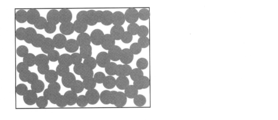
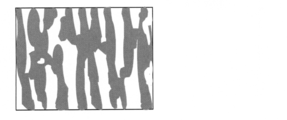
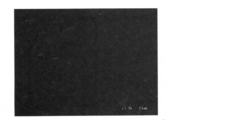
- phase-separation structure of a resin composition is a continuous spherical structure. It is a model figure showing the case where the phase-separation structure of a resin composition is a sea-island structure. It is a model figure showing the case where the phase-separation structure of a resin composition is a composite dispersed phase structure. It is a model figure showing the case where the phase-separation structure of a resin composition is a bicontinuous phase structure. It is an electron micrograph showing the cross-sectional structure as an example of the hardened
- D sea-island structure obtained by the compounding system except (D) component from Example 6.
- the resin composition which concerns on embodiment of this invention is a resin composition containing (A) acrylic polymer and (B) thermosetting resin, Comprising: (A) The 1st phase containing acrylic polymer, (B ) A resin composition which forms a phase separation structure with a second phase containing a thermosetting resin and has an average domain size of the second phase of 20 ⁇ m or less.
- the first phase is a phase containing (A) an acrylic polymer
- the second phase is a phase containing (B) a thermosetting resin
- the average domain size of the two phases is 20 ⁇ m or less.
- the first phase is a phase containing (A) an acrylic polymer as a main component of a resin component
- the second phase is a phase containing (B) a thermosetting resin as a main component of a resin component.
- the main component of the resin component means a resin having the highest content among the resin components, and is estimated based on the content relative to the total amount of the resin composition.
- phase structure of the cured resin is determined by a competitive reaction between the phase separation rate and the curing reaction rate. For example, by reducing the difference between (A) the solubility parameter of the acrylic polymer (hereinafter also referred to as “SP value”) and (B) the SP value of the thermosetting resin, the phase separation rate is reduced.
- SP value the solubility parameter of the acrylic polymer
- B the SP value of the thermosetting resin
- SP value of (A) acrylic polymer and (B) thermosetting resin can be calculated
- ⁇ i represents an SP value
- ⁇ Ei represents a total molar cohesive energy
- ⁇ Vi represents a total molar molecular capacity
- the SP value is calculated by the above method as follows.
- Number of members: CH 3 2 C O 1
- Total molar cohesive energy ( ⁇ Ei): (1125 ⁇ 2) + (4150 ⁇ 1) 6400
- Total molar molecular capacity ( ⁇ Vi): (33.5 ⁇ 2) + (10.8 ⁇ 1) 77.8
- solubility parameter (SP value) is calculated.
- a phenol resin, an amine compound, etc. may be used together as a hardening
- curing agents are not a main component and there are few quantities, the influence with respect to SP value of (B) thermosetting resin is small. Therefore, as a method for calculating the SP value when using the epoxy resin and the curing agent in combination, the SP value calculated only from the epoxy resin is used without considering the curing agent. This treatment is the same for thermosetting resins other than epoxy resins. In addition, since a phenol resin etc.
- the SP value is a value close
- the SP value of the acrylic polymer is preferably from 9.0 to 12.0, more preferably from 9.2 to 11.8, even more preferably from 9.4 to 11.6, from the viewpoint of low hygroscopicity. From the viewpoint of properties, 9.5 to 11.0 is particularly preferable.
- the SP value of the thermosetting resin is preferably 9.0 to 15.0, more preferably 10.5 to 14.5, and still more preferably 12.0 to 14.3.
- the absolute value of the difference between the SP value of the (A) acrylic polymer and the SP value of the (B) thermosetting resin is preferably 0.1 to 5.0, more preferably 0.11 to 4.9, 0 12 to 4.8 is more preferable, and 0.13 to 4.7 is particularly preferable.
- the absolute value of the SP value difference within the above range, the average domain size of the second phase can be controlled to a relatively small range of 20 ⁇ m or less.
- the resin composition of this invention adjusts the physical property of the hardened
- the absolute value of the difference between the SP value of (A) the acrylic polymer and the (B) SP value of the thermosetting resin is 3.0 to 5.0
- the absolute value of the difference in the SP value is 0.1 to 3.0
- (A) the acrylic polymer has a low strength while maintaining the characteristics such as (B) the high strength of the thermosetting resin.
- the characteristics such as elasticity, flexibility, and high elongation tend to be remarkably exhibited.
- the absolute value of the SP value difference is 0.45 or less
- the average domain size of the second phase is about 0.001 to 1.0 ⁇ m and tends to form nano-sized domains.
- the (A) acrylic polymer is usually a polymer having a (meth) acrylic acid ester as a monomer.
- An acrylic polymer may be used individually by 1 type, and may use 2 or more types together.
- an acrylic polymer is an acrylic polymer containing the structural unit derived from the (meth) acrylic acid ester represented by the following general formula (A1).
- (meth) acrylic acid indicates both “acrylic acid” and “methacrylic acid”, and the same applies to other similar terms.
- R 2 represents an alkyl group, a cycloalkyl group, a cycloalkylalkyl group, an aryl group or an aralkyl group.
- R 1 represents a hydrogen atom or a methyl group.
- the alkyl group represented by R 2 preferably has 1 to 20 carbon atoms, more preferably 1 to 15 carbon atoms, and still more preferably 2 to 10 carbon atoms.
- Examples of the alkyl group include a methyl group, an ethyl group, a propyl group, a butyl group, and a 2-ethylhexyl group. These alkyl groups may have a substituent.
- Examples of the substituent for the alkyl group include an alicyclic hydrocarbon group, a hydroxyl group, a halogen, an oxygen-containing hydrocarbon group, and a nitrogen-containing cyclic group.
- the carbon number of the cycloalkyl group represented by R 2 is preferably 6 to 13, and more preferably 7 to 10.
- Examples of the cycloalkyl group include a cyclohexyl group, a norbornyl group, a tricyclodecanyl group, an isobornyl group, an adamantyl group, and the like. Among these, a norbornyl group, a tricyclodecanyl group, and an isobornyl group are preferable.
- the carbon number of the cycloalkylalkyl group represented by R 2 is preferably 6 to 13, more preferably 7 to 10.
- Examples of the cycloalkylalkyl group include a norbornylmethyl group and a tricyclodecylethyl group.
- the number of carbon atoms of the aryl group represented by R 2 is preferably 6 to 13, and more preferably 6 to 10.
- Examples of the aryl group include a phenyl group and a nonylphenyl group.
- the number of carbon atoms in the aralkyl group represented by R 2 is preferably 7 to 15, and more preferably 7 to 11.
- Examples of the aralkyl group include a benzyl group and a 4-methylbenzyl group.
- (Meth) acrylic acid esters include methyl (meth) acrylate, ethyl (meth) acrylate, propyl (meth) acrylate, butyl (meth) acrylate, hexyl (meth) acrylate, (meth) acrylic acid 2 -Ethylhexyl, isobutyl (meth) acrylate, ethylene glycol methyl ether (meth) acrylate, cyclohexyl (meth) acrylate, 2-hydroxyethyl (meth) acrylate, 2-hydroxypropyl (meth) acrylate, (meth) Isobornyl acrylate, tricyclo [5.2.1,0 (2,6)] dec-8yl (meth) acrylate, isodecyl (meth) acrylate, octadecyl (meth) acrylate, lauryl (meth) acrylate, Allyl (meth) acrylate, norbornylmethyl (
- the acrylic polymer is preferably an acrylic polymer provided with a crosslinkable functional group.
- Such an acrylic polymer can be obtained as a copolymer of (meth) acrylic acid ester and a copolymerizable monomer having a crosslinkable functional group (hereinafter also simply referred to as “crosslinkable copolymerizable monomer”).
- the crosslinkable copolymer monomer include monomers having a crosslinkable functional group such as a carboxy group, a hydroxyl group, an amino group, a vinyl group, a glycidyl group, and an epoxy group.
- a crosslinkable copolymer monomer having an epoxy group is preferable from the viewpoint of low hygroscopicity and heat resistance. These monomers are preferably compounds having a double bond.
- crosslinkable copolymer monomers include monomers having a carboxy group such as acrylic acid and methacrylic acid; monomers having an epoxy group such as glycidyl acrylate and glycidyl methacrylate; hydroxyethyl acrylate, hydroxypropyl acrylate, and methacrylic acid.
- Monomers having a hydroxyl group such as hydroxyethyl, hydroxypropyl methacrylate; monomers having an amino group such as dimethylaminoethyl acrylate, dimethylaminoethyl methacrylate, acrylamide, methacrylamide, dimethylacrylamide, dimethylmethacrylamide; cyano such as acrylonitrile And monomers having a group.
- a monomer having a carboxy group a monomer having an epoxy group, a monomer having a hydroxyl group, and a monomer having an amino group are preferable.
- an epoxy group is preferably used. More preferred are monomers having glycidyl acrylate and glycidyl methacrylate.
- a polymerizable monomer such as a substituted maleimide can be used together with a (meth) acrylic acid ester to obtain an (A) acrylic polymer.
- the amount of (meth) acrylic acid ester used is the same as that of (meth) acrylic acid ester and crosslinkable copolymer. It is preferably 70 to 99.5 parts by mass, more preferably 80 to 98 parts by mass, and still more preferably 90 to 97 parts by mass with respect to 100 parts by mass as a total with the polymerization monomer.
- the amount of the crosslinkable copolymer monomer used is preferably 0.5 to 30 parts by mass and more preferably 2 to 25 parts by mass with respect to 100 parts by mass of the total amount of the (meth) acrylic acid ester and the crosslinkable copolymer monomer. Preferably, 3 to 20 parts by mass is more preferable.
- a crosslinked structure is suitably formed between the (A) 1st phase containing an acrylic polymer and the (B) 2nd phase containing a thermosetting resin, heat resistance, metal foil The adhesive strength, insulation reliability, etc. tend to be further improved.
- the total content of the (meth) acrylic acid ester and the crosslinkable copolymer monomer is preferably 80% by mass or more, more preferably 90% by mass or more, and 95% by mass or more. More preferably, it may be 100% by mass.
- the epoxy equivalent is preferably 2,000 to 18,000 g / eq, more preferably 2,000 to 8,000 g / eq.
- the epoxy equivalent is 2,000 g / eq or more, a decrease in the glass transition temperature of the cured product is suppressed and the heat resistance of the substrate is sufficiently maintained, and when it is 18,000 g / eq or less, the storage elastic modulus is large. The dimensional stability of the substrate tends to be maintained without becoming too much.
- the epoxy equivalent of an acrylic polymer can be adjusted by appropriately adjusting the copolymerization ratio when copolymerizing glycidyl (meth) acrylate and another monomer copolymerizable therewith.
- acrylic polymers having an epoxy group examples include “HTR-860” (manufactured by Nagase ChemteX Corporation, trade name, epoxy equivalent 2,900 g / eq), “KH-CT-865” ( Hitachi Chemical Co., Ltd., trade name, epoxy equivalent 3,300 g / eq) and the like are available.
- the weight average molecular weight of the acrylic polymer is preferably 100,000 to 1,500,000, more preferably 300,000 to 1,500,000, from the viewpoint of improving low elasticity and elongation. More preferably, ⁇ 1,100,000.
- the weight average molecular weight of the (A) acrylic polymer is 100,000 or more, the phase-separated structure tends to be easily formed without the (A) acrylic polymer and the (B) thermosetting resin being completely compatible. If it is 1,500,000 or less, it tends to be dissolved in a solvent and tends to be excellent in handleability and dispersibility.
- (A) acrylic polymer may combine 2 or more types from which a weight average molecular weight differs.
- the SP value of the acrylic polymer (A) is calculated by dividing the SP value of each acrylic polymer by the blending amount.
- the weight average molecular weight is a value measured by gel permeation chromatography (GPC) analysis and means a standard polystyrene equivalent value.
- GPC analysis can be performed using tetrahydrofuran (THF) as a solution.
- the content of the (A) acrylic polymer in the resin composition of the present invention is preferably 10 to 50 parts by mass with respect to 100 parts by mass of the total solid content of the resin composition.
- the content of (A) acrylic polymer is 10 parts by mass or more, low elasticity and flexibility, which are excellent characteristics of (A) acrylic polymer, tend to be sufficiently obtained, and it is 50 parts by mass or less. And sufficient adhesive strength with metal foil is obtained.
- the content of the (A) acrylic polymer is more preferably 20 to 50 parts by weight, and more preferably 30 to 50 parts by weight with respect to 100 parts by weight of the total solid content of the resin composition. Is more preferable.
- the content of the (A) acrylic polymer is more preferably 10 to 40 parts by mass with respect to 100 parts by mass of the total solid content of the resin composition. More preferably, it is 30 parts by mass.
- the “solid content” in the present invention is a non-volatile content excluding a volatile component such as an organic solvent, and indicates a component that remains without volatilization when the resin composition is dried. Also includes liquid, syrupy and waxy.
- the acrylic polymer preferably has an alkali metal ion concentration of 500 ppm or less on a mass basis from the viewpoint of obtaining sufficient characteristics in an accelerated test of insulation reliability such as a pressure cooker bias test (PCBT). More preferably, it is 200 ppm or less, and further preferably 100 ppm or less.
- PCBT pressure cooker bias test
- the acrylic polymer is generally obtained by radical polymerization using a radical polymerization initiator.
- Radical polymerization initiators include persulfates such as azobisisobutyronitrile (AIBN), tert-butyl perbenzoate, benzoyl peroxide, lauroyl peroxide, potassium persulfate, cumene hydroperoxide, t-butyl hydroperoxide , Dicumyl peroxide, t-butyl peroxide, 2,2'-azobis-2,4-dimethylvaleronitrile, t-butyl perisobutyrate, t-butyl perpivalate, hydrogen peroxide / ferrous salt Examples thereof include sulfate / sodium acid sulfite, cumene hydroperoxide / ferrous salt, benzoyl peroxide / dimethylaniline, and the like. These may be used individually by 1 type and may combine 2 or more types.
- the (A) acrylic polymer may be powdery or liquid at room temperature (25 ° C.), but is excellent in solubility in a solvent and dispersibility of the (A) acrylic polymer in the resin composition. From this viewpoint, it is preferably liquid. From the viewpoint of enhancing the dispersibility of the (A) acrylic polymer in the resin composition, the (A) acrylic polymer is preferably used in a state where the above-described compound is dispersed in a solvent.
- thermosetting resin (B) Although it does not specifically limit as a thermosetting resin, An epoxy resin, cyanate resin, bismaleimides, the addition polymerization product of bismaleimides and diamine, phenol resin, resole resin, isocyanate resin, triallyl isocyanurate resin , Triallyl cyanurate resin, vinyl group-containing polyolefin compound and the like. Among these, epoxy resins (hereinafter also referred to as “(B-1) epoxy resins”) and cyanate resins are preferable from the viewpoint of excellent balance of performance such as heat resistance, insulation, and high glass transition temperature.
- a thermosetting resin may be used individually by 1 type, and may use 2 or more types together.
- the epoxy resin is preferably an epoxy resin having two or more epoxy groups in one molecule.
- the epoxy resin known ones can be used. For example, bisphenol A type epoxy resin, bisphenol F type epoxy resin, bisphenol S type epoxy resin, biphenyl type epoxy resin, phenol novolac type epoxy resin, Cresol novolak type epoxy resin, bisphenol A novolak type epoxy resin, phosphorus containing epoxy resin, naphthalene skeleton containing epoxy resin, aralkylene skeleton containing epoxy resin, phenol biphenyl aralkyl type epoxy resin, phenol salicylaldehyde novolak type epoxy resin, lower alkyl group substituted phenol Salicylaldehyde novolac type epoxy resin, epoxy resin containing dicyclopentadiene skeleton, polyfunctional glycidylamine type epoxy resin, polyfunctional alicyclic epoxy Fat, tetrabromobisphenol A type epoxy resins. These may be used individually by 1 type and may use 2 or
- the epoxy resin may be a commercially available product, such as “N770” (trade name, manufactured by DIC Corporation), which is a phenol novolac type epoxy resin, and a tetrabromobisphenol A type epoxy resin.
- “EPICLON 153” (trade name, manufactured by DIC Corporation), “NC-3000-H” (trade name, manufactured by Nippon Kayaku Co., Ltd.) which is a biphenyl aralkyl type epoxy resin, and “bisphenol A type epoxy resin” “Epicoat 1001” (trade name, manufactured by Mitsubishi Chemical Corporation), “ZX-1548” (trade name, manufactured by Tohto Kasei Co., Ltd.) which is a phosphorus-containing epoxy resin, “EPICLON N-660” which is a cresol novolac type epoxy resin ( DIC Corporation, trade name) and the like.
- the weight average molecular weight of the epoxy resin is preferably 200 to 1,000, and more preferably 300 to 900.
- the weight average molecular weight of the component (B-1) is 200 or more, a phase separation structure tends to be formed favorably, and when it is 1,000 or less, the second domain has a relatively small average domain size. There is a tendency that a separation structure is easily formed, and low elasticity and flexibility tend to be easily exhibited.
- the epoxy equivalent of the epoxy resin is preferably 150 to 500 g / eq, more preferably 150 to 450 g / eq, and more preferably 150 to 300 g / eq from the viewpoint of compatibility.
- the SP value of the epoxy resin is preferably 9.0 to 15.0, more preferably 9.0 to 14.0 from the viewpoint of low hygroscopicity, and 9.5 to 1 from the viewpoint of heat resistance. 14.0 is more preferable.
- the SP value of the component (B-1) is 15.0 or less, it tends to be difficult to separate the components at the time of solution, and when it is 9.0 or more, the heat resistance tends to be improved.
- the SP value at this time is a value obtained only from the epoxy resin (B-1) regardless of the type of the curing agent as described above.
- cyanate resin used as a thermosetting resin a well-known thing can be used, and a novolak type cyanate resin, bisphenol A type cyanate resin, bisphenol E type cyanate resin, bisphenol F type cyanate resin, tetramethyl Examples thereof include bisphenol F type cyanate resin and dicyclopentadiene type cyanate resin. These may be used individually by 1 type and may use 2 or more types together. Among these, it is preferable that 1 or more types of bisphenol A type cyanate resin are included from a compatible viewpoint with the (A) acrylic polymer at the time of making into a solution.
- a catalyst When a cyanate resin is used as the thermosetting resin, a catalyst, a promoter or the like may be used in combination.
- the catalyst include 2-phenyl-4-methylimidazole, 2-phenyl-4 -methyl-5-hydroxymethylimidazole, 2-phenyl-4,5-dihydroxymethylimidazole, 2,4-diamino-6- (2 ′ Imidazole curing agents such as -undecylimidazolyl) -ethyl-s-triazine, 2,4-diamino-6- [2'-ethyl-4-methylimidazolyl- (1 ')]-ethyl-s-triazine; cobalt , Zinc, copper, iron, nickel, manganese, tin, and other metal salts or metal complexes.
- the catalyst include phenolic compounds such as alkylphenols, bisphenol compounds, and phenol novolacs.
- thermosetting resin may use a hardening
- a well-known thing can be used as a hardening
- the curing agent may be a phenol novolak resin, a cresol novolac resin, a bisphenol A novolak resin, a phenol resin such as a biphenyl novolac type phenol resin; dicyandiamide, Examples include amine-based curing agents such as diaminodiphenylmethane and diaminodiphenylsulfone; acid anhydride curing agents such as pyromellitic anhydride, trimellitic anhydride, and benzophenonetetracarboxylic acid; and mixtures thereof.
- the resin composition of the present invention includes (B-1) an epoxy resin as the (B) thermosetting resin, and (B-2) a phenol resin as a curing agent from the viewpoint of securing adhesion strength with
- B-2 A commercially available phenol resin may be used.
- examples of the commercially available products include “KA-1165” (trade name, manufactured by DIC Corporation), which is a cresol novolac type phenol resin, and a biphenyl novolac type phenol resin.
- “MEH-7851” (trade name, manufactured by Meiwa Kasei Co., Ltd.) and the like.
- the (B-2) phenolic resin can be used in any proportion depending on the combination with the (B-1) epoxy resin, and the compounding ratio can usually be determined so that the glass transition temperature becomes high. it can.
- the content of (B-2) phenolic resin is preferably 0.5 to 1.5 equivalents relative to (B-1) epoxy resin, and preferably 0.6 to 1.3 equivalents. More preferably, it is 0.7 to 1.2 equivalents. It exists in the tendency for it to be excellent in adhesiveness with an outer layer copper, glass transition temperature, and insulation as it is in the said range.
- the content of the thermosetting resin (B) in the resin composition of the present invention is preferably 15 to 80 parts by mass, more preferably 30 to 75 parts by mass with respect to 100 parts by mass of the total solid content of the resin composition. 35 to 70 parts by mass is more preferable.
- the content of the (B) thermosetting resin also includes (B-2) the content of a curing agent such as a phenol resin.
- the mass ratio of (A) acrylic polymer to (B) thermosetting resin ((A) acrylic polymer: (B) thermosetting resin) is 10:90 to 90. : 10 is preferable, 20:80 to 80:20 is more preferable, 30:70 to 70:30 is more preferable, and 40:60 to 60:40 is particularly preferable.
- the mass ratio ((A) acrylic polymer: (B) thermosetting resin) is within the above range, the phase separation in which the characteristics of both (A) acrylic polymer and (B) thermosetting resin are sufficiently expressed. The structure tends to be obtained.
- the resin composition of this invention may contain the (C) hardening accelerator according to the kind of (B) thermosetting resin.
- the thermosetting resin is (B-1) an epoxy resin
- the (C) curing accelerator is not particularly limited, but amines or imidazoles are preferred. Examples of amines include dicyandiamide, diaminodiphenylethane, guanylurea and the like.
- Examples of imidazoles include 2-phenylimidazole, 1-cyanoethyl-2-methylimidazole, 1-cyanoethyl-2-undecylimidazole, 1-cyanoethyl-2-phenylimidazole, 1-cyanoethyl-2-phenylimidazolium trimellitate. , Benzimidazole and the like.
- the content of the (C) curing accelerator in the resin composition of the present invention is preferably 0.01 to 10 parts by mass, and 0.05 to 2 parts by mass with respect to 100 parts by mass of the total solid content of the resin composition. Is more preferable, and 0.07 to 0.5 parts by mass is even more preferable.
- the (B) thermosetting resin is (B-1) an epoxy resin
- the content of the (C) curing accelerator can be determined according to the total amount of oxirane rings in the resin composition.
- the resin composition of the present invention may contain (D) a filler.
- a filler (D) Although it does not specifically limit as a filler, From a viewpoint of ensuring the reduction of a thermal expansion coefficient and a flame retardance, an inorganic filler is preferable.
- inorganic fillers include silica, alumina, titanium oxide, aluminum hydroxide, magnesium hydroxide, calcium carbonate, magnesium carbonate, calcium silicate, calcium oxide, magnesium oxide, aluminum nitride, aluminum borate whisker, boron nitride, and silicon carbide. Can be mentioned. These may be used individually by 1 type and may use 2 or more types together. Among these, silica is preferable because of its low dielectric constant and low linear expansion coefficient. Examples of silica include synthetic silica synthesized by a wet method or a dry method, crushed silica, fused silica, and the like.
- the average particle size of the filler is preferably from 0.1 to 4.0 ⁇ m, more preferably from 0.2 to 3.5 ⁇ m, still more preferably from 0.3 to 3.2 ⁇ m.
- the (D) filler tends to disperse, the viscosity of the varnish decreases, and the handling becomes easy because the handling becomes easy.
- (D) sedimentation of the filler tends to hardly occur during varnishing.
- the average particle diameter in the present invention is a particle diameter at a point corresponding to a volume of 50% when a cumulative frequency distribution curve based on the particle diameter is obtained with the total volume of the particles being 100%, and laser diffraction scattering. It can be measured by a particle size distribution measuring apparatus using a method.
- the filler may be (D-1) a filler subjected to a coupling treatment (hereinafter, also referred to as “component (D-1)”).
- a silane coupling agent is preferable.
- an aminosilane coupling agent, an epoxysilane coupling agent, a phenylsilane coupling agent, and an alkylsilane coupling cup are used. Examples thereof include a ring agent, an alkenyl silane coupling agent, and an alkynyl silane coupling agent. These may be used individually by 1 type and may use 2 or more types together.
- both (D-1) component and (D-2) filler not subjected to coupling treatment (hereinafter referred to as “(D-2) component”) It is more preferable that both are included.
- the average particle diameter of the component (D-1) is preferably from 0.1 to 1.5 ⁇ m, more preferably from 0.2 to 1.2 ⁇ m, still more preferably from 0.3 to 1.0 ⁇ m.
- the average particle size of the component (D-2) is preferably 1.0 to 3.5 ⁇ m, more preferably 1.2 to 3.2 ⁇ m, and further preferably 1.4 to 3.0 ⁇ m.
- the filler tends to disperse and tends not to agglomerate, and when it is 3.5 ⁇ m or less, the filler is precipitated during varnishing. It tends not to occur.
- the mass ratio [(D-1) :( D-2)] is preferably 10:90 to 90:10, and 20:80 to 80:20 is more preferable, and 30:70 to 70:30 is more preferable.
- the blending ratio is within the above range, the characteristics of both (A) acrylic polymer and (B) thermosetting resin tend to be sufficiently expressed.
- the (D) filler is present in any phase without being unevenly distributed in one phase of the first phase or the second phase from the viewpoint of enhancing dispersibility and expressing the filler addition effect uniformly. It is preferable.
- a phase separation structure in which (D) filler is present in either the first phase or the second phase is obtained.
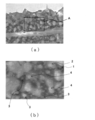
- cured material containing the filler obtained from FIG. 13 (a) and (b) from the resin composition of this invention is shown. Note that FIG. 13B is an enlarged view of region A in FIG.
- (D) filler 3 is present in the sea phase ((A) acrylic polymer) 1, and (D) is present in the island phase ((B) thermosetting resin) 2. It can be seen that the phase separation structure in which the filler 4 is present and the (D) filler is present in either the first phase or the second phase is obtained.
- the content of the (D) filler in the resin composition of the present invention is preferably 5 to 40 parts by weight, more preferably 10 to 35 parts by weight, more preferably 15 to 15 parts by weight based on 100 parts by weight of the total solid content of the resin composition. 30 parts by mass is more preferable.
- the filler content is 5 parts by mass or more, the coefficient of linear expansion tends to be low, and sufficient heat resistance tends to be obtained.
- crosslinking agents such as isocyanate resins and melamine resins
- flame retardants such as phosphorus compounds
- rubber elastomers conductive particles, coupling agents, flow regulators, antioxidants Agents, pigments, leveling agents, antifoaming agents, ion trapping agents and the like.
- the resin composition of the present invention may be a varnish-like resin composition (hereinafter also simply referred to as “varnish”) dissolved and / or dispersed in an organic solvent.
- Organic solvents used in the varnish include ketone solvents such as acetone, methyl ethyl ketone, methyl isobutyl ketone, and cyclohexanone; aromatic hydrocarbon solvents such as toluene and xylene; methoxyethyl acetate, ethoxyethyl acetate, butoxyethyl acetate, ethyl acetate Ester solvents such as N-methylpyrrolidone, formamide, N-methylformamide, N, N-dimethylacetamide and the like amide solvents; methanol, ethanol, ethylene glycol, ethylene glycol monomethyl ether, ethylene glycol monoethyl ether, diethylene glycol, Triethylene glycol monomethyl ether, triethylene glycol monoethyl
- the resin composition of the present invention forms a phase separation structure of (A) a first phase containing an acrylic polymer and (B) a second phase containing a thermosetting resin.
- the phase separation structure in the present invention is a sea-island structure, a continuous spherical structure, a composite dispersed phase structure, or a co-continuous phase structure.
- Regarding these phase-separated structures for example, “Polymer Alloy”, page 325 (1993), Tokyo Chemical Dojin, and for continuous spherical structures, see, for example, Keizo Yamanaka and Takashi Inue, POLYMER, Vol. 30, pp. 662 (1989).
- 1 to 4 show model diagrams representing a continuous spherical structure, a sea-island structure, a composite dispersed phase structure, and a co-continuous phase structure, respectively.
- the resin composition of the present invention can form any structure of a continuous spherical structure, a sea-island structure, a composite dispersed phase structure, or a co-continuous phase structure. Among these, it is preferable to form a sea-island structure from the viewpoint of enhancing stress relaxation properties.
- the sea-island structure is formed from the resin composition of the present invention, (A) the acrylic polymer forms the sea phase, and (B) the thermosetting resin forms the island phase.
- the resin composition of the present invention is a resin composition that forms the phase separation structure in which the average domain size of the second phase containing the thermosetting resin (B) is 20 ⁇ m or less.
- the average domain size of the second phase is 20 ⁇ m or less.
- the (A) acrylic polymer and the (B) thermosetting resin have an apparently close-compatible structure, and the entangled (A) acrylic polymer network (B) Since the thermosetting resin is dispersed in nano-size, (A) the acrylic polymer can exhibit more remarkable properties such as low elasticity, flexibility, and high elongation, and the phase separation structure is complicated. As a result, the adhesive strength with the metal foil tends to increase. Further, when the average domain size of the second phase is 10 to 20 ⁇ m, (B) the thermosetting resin can exhibit the characteristics such as high elasticity and high strength, and (A) the low elasticity of the acrylic polymer.
- the average domain size of the second phase can be adjusted according to the desired characteristics, but balances the characteristics derived from (A) the acrylic polymer and (B) the characteristics derived from the thermosetting resin. From the viewpoint of well expressing, the average domain size of the second phase may be 0.001 to 20 ⁇ m, 0.1 to 15 ⁇ m, or 1 to 10 ⁇ m.
- the average domain size of the second phase is the cross-sectional structure of the cured product obtained from the resin composition of the present invention using a scanning electron microscope. It can be measured by observing with (SEM), measuring the maximum width of each of the 100 domains of the second phase, and calculating the average value.
- SEM scanning electron microscope
- the phase separation structure is a co-continuous structure, arbitrary 100 points are specified in the second phase domain, and the vertical domain size and the horizontal domain size on the SEM photograph are measured at each point. The value obtained by calculating the average value of the smaller domain sizes is defined as the average domain size. More specifically, the average domain size of the second phase can be measured by the method described in Examples.
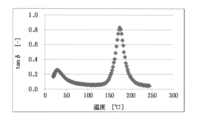
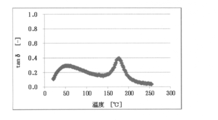
- Whether the resin composition of the present invention forms a phase-separated structure can also be confirmed by a method of measuring the loss coefficient tan ⁇ for the cured product obtained from the resin composition of the present invention. Specifically, dynamic viscoelasticity measurement is performed on the cured product obtained from the resin composition of the present invention, and in the obtained loss coefficient tan ⁇ curve, (A) a peak derived from an acrylic polymer, and (B) heat When two peaks derived from the curable resin appear, it can be determined that a phase separation structure is formed. 10 to 12 show loss coefficient tan ⁇ curves of the resin compositions obtained in Examples 2, 7 and 12. FIG. 10 to 12, a peak around 30 to 70 ° C.
- tan ⁇ curve is a peak derived from (A) an acrylic polymer, and a peak around 150 to 200 ° C. is a peak derived from (B) a thermosetting resin. It can be seen that the presence of these peaks forms a phase separation structure in the resin composition. Since domains having an average domain size exceeding 20 ⁇ m can be confirmed by SEM observation, if the phase separation structure is not confirmed by the SEM observation and two peaks are confirmed by the loss factor tan ⁇ curve as described above, the average domain It can be determined that a second phase having a size of 20 ⁇ m or less is formed. The tan ⁇ curve can be measured in more detail by the method described in the examples.
- Such a fine phase separation structure can be obtained by controlling the catalyst species of the resin composition, the curing conditions such as the reaction temperature, or the compatibility between the components of the resin composition.
- the curing conditions such as the reaction temperature, or the compatibility between the components of the resin composition.
- the compatibility with (A) acrylic polymer is lowered, or in the case of the same composition system, the curing temperature is increased.
- it can be achieved by slowing the curing rate by selecting the catalyst type.
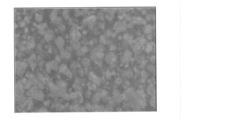
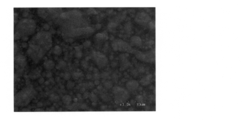
- FIGS. 7, 8 and 9 show electron micrographs showing the cross-sectional structure of an example of the resin composition having the sea-island structure thus obtained (corresponding to Examples 2, 7 and 12, respectively).
- the resin composition has a sea-island structure consisting of (A) a sea phase containing an acrylic polymer and (B-1) an island phase containing an epoxy resin by controlling the SP value of each component.
- the average domain size of the island phase is controlled to 20 ⁇ m or less.
- the resin composition of the present invention does not contain (D) filler, a sea-island structure or continuous spherical structure is formed, but when (D) filler is contained, a fine co-continuous phase structure or composite dispersed phase structure is formed. Can be done.
- the storage elastic modulus of the cured product obtained from the resin composition of the present invention is preferably 2.0 ⁇ 10 9 Pa or less, more preferably 1.9 ⁇ 10 9 Pa or less, from the viewpoint of expressing a stress relaxation effect. More preferably, it is 8 ⁇ 10 9 Pa or less.
- the storage elastic modulus can be set, for example, within the above range by adjusting the content of the (D) filler, and from this viewpoint, the content of the (D) filler is within the above range. Is preferred.
- cured material can be measured by the method as described in an Example.
- the resin composition of the present invention can be produced, for example, by a production method having the following steps 1 to 4.
- Step 1 Step of determining physical properties of a cured product of a desired resin composition
- Step 2 Difference between (A) solubility parameter (SP value) of acrylic polymer and (B) solubility parameter (SP value) of thermosetting resin Step of specifying the absolute value X based on the correlation between the absolute value X of the cured product and the physical properties of the cured product
- Step 3 The (A) acrylic polymer and the (B) thermosetting resin that have the absolute value X specified in Step 2
- Step 4 Step of mixing (A) acrylic polymer and (B) thermosetting resin selected in Step 3
- the physical properties of the cured product in step 1 are, for example, storage elastic modulus, thermal expansion characteristics, flexibility, high elongation, heat resistance, mechanical strength, adhesion to metal foil, insulation reliability, etc. It is preferable to determine in step 1 the value of elastic modulus (low elasticity), which is a typical characteristic of acrylic polymer, or the value of heat resistance, which is a typical characteristic of (B) thermosetting resin.
- the absolute value X is specified based on the correlation with the rate, heat resistance, and the like.
- the correlation between the absolute value X and the physical property of the cured product can be determined by acquiring the absolute value X and the physical property of the cured product in advance for a plurality of compositions.
- step 3 (A) an acrylic polymer and (B) a thermosetting resin having the absolute value X specified in step 2 are selected. Since the SP value of (A) acrylic polymer and (B) thermosetting resin can be calculated from the above-mentioned Fedors method or the like, (A) acrylic polymer and (B) thermosetting resin so as to obtain the absolute value X to be obtained. What is necessary is just to determine the structure.
- step 4 (A) the acrylic polymer selected in step 3 and (B) the thermosetting resin are mixed. As a mixing method, a conventionally known stirrer or the like can be applied.
- the prepreg of the present invention is obtained by impregnating a base material with the resin composition of the present invention and drying.
- the prepreg can be produced, for example, by impregnating a substrate with the varnish-shaped resin composition of the present invention and drying it.
- a fiber substrate such as a woven fabric or a nonwoven fabric is usually used.
- the material of the fiber substrate examples include inorganic fibers such as glass, alumina, asbestos, boron, silica alumina glass, silica glass, tyrano, silicon carbide, silicon nitride, zirconia; aramid, polyether ether ketone, polyether imide, Organic fibers such as polyethersulfone, carbon, and cellulose; and mixed papers thereof.
- the thickness of the substrate is preferably 10 to 100 ⁇ m, more preferably 20 to 50 ⁇ m.
- the production conditions of the prepreg are not particularly limited, but it is preferable that 80% by mass or more of the organic solvent used for the varnish is volatilized in the obtained prepreg.
- the drying temperature is, for example, 80 to 180 ° C., and the drying time is appropriately set in consideration of the varnish gelation time.
- the amount of impregnation of the varnish is preferably such that the solid content of the resin composition of the present invention in the obtained prepreg is 30 to 80% by mass.
- the metal foil with resin of the present invention is formed by laminating the resin composition of the present invention and a metal foil.
- the metal foil with resin can be produced, for example, by applying the resin composition of the present invention to a metal foil and drying it. Drying conditions can be produced, for example, by drying at 80 to 180 ° C.
- the laminated board of this invention is a laminated board formed by laminating
- positioned metal foil may be called a "metal tension laminated board.”
- the metal-clad laminate is laminated, for example, so that the adhesive surfaces on both sides of the laminate obtained by laminating a plurality of the prepregs of the present invention and the metal foil are aligned, and usually 130 to 250 ° C., preferably 150, under vacuum press conditions. It can be produced by hot pressing at a temperature of 230 ° C. and a pressure of 0.5-10 MPa, preferably 1-5 MPa.
- the metal-clad laminate with resin of the present invention can be produced by stacking two sheets so that the resin surfaces face each other and pressing with a vacuum press.
- a vacuum press for heating and pressing, for example, a multistage press, a multistage vacuum press, continuous molding, an autoclave molding machine, or the like can be used.
- metal foil used for the metal-clad laminate for example, copper foil and aluminum foil are generally used.
- the thickness of the metal foil is, for example, 1 to 200 ⁇ m that is generally used for laminated sheets.
- nickel, nickel-phosphorus, nickel-tin alloy, nickel-iron alloy, lead, lead-tin alloy, etc. are used as intermediate layers, and 0.5 to 15 ⁇ m copper layer and 10 to 300 ⁇ m on both sides.
- a three-layer composite foil provided with a copper layer, a two-layer composite foil obtained by combining aluminum and copper foil, or the like can be used.
- the printed wiring board of the present invention is obtained by subjecting the laminated board of the present invention to circuit processing.
- the printed wiring board of the present invention can be produced, for example, by applying a circuit (wiring) process to the metal foil of the laminate (metal-clad laminate) of the present invention in which the metal foil is provided on one side or both sides.
- a semiconductor package can be manufactured by mounting a semiconductor on the printed wiring board of the present invention.
- the semiconductor package can be manufactured by mounting a semiconductor chip, a memory, or the like at a predetermined position of the printed wiring board of the present invention.
- Production Example 2 (Synthesis of acrylic polymers B to G) A solution of acrylic polymers B to G was obtained in the same manner as in Production Example 1 except that the monomer composition ratio in Production Example 1 was changed to the “monomer composition ratio” in Tables 2 to 4. The SP values of the acrylic polymers B to G are shown in Tables 2 to 4.
- Example 1 Among the components shown in Table 2, the components other than the component (C) are blended in the amounts shown in Table 2 (the values in the table are parts by mass of the solid content, and in the case of a solution or dispersion, the solid content equivalent amount) And 2-phenylimidazole as a component (C) was added in the amount shown in Table 2 to obtain a varnish having a nonvolatile content (solid content concentration) of 40% by mass. .
- the copper foil YGP-18 (trade name, manufactured by Nihon Electrolytic Co., Ltd.) with a thickness of 18 ⁇ m is stacked on both sides of the four prepregs so that the adhesive surface is aligned with the prepreg, and a 4MPa vacuum press at 200 ° C for 60 minutes.
- a double-sided copper-clad laminate was produced under the conditions.
- Two copper foils with resin were stacked so that the resin surfaces face each other, and a double-sided copper-clad laminate was produced at 200 ° C. for 60 minutes under a 4 MPa vacuum press condition.
- Tackiness of prepreg (presence / absence of adhesion) Evaluation of the tackiness of the prepreg is made by processing the prepared prepreg into 250 mm x 250 mm size, stacking 10 sheets, and putting them in a hermetically sealed bag into a constant temperature and humidity environment at a temperature of 25 ° C and a humidity of 70%. The presence or absence of adhesion between the prepregs was observed. After 48 hours, when the prepreg placed at the bottom and the prepreg in contact with it were peeled off and each maintained the surface before being put in, it was judged that there was no adhesion, and it was judged that there was no problem with tackiness . The results are shown in Tables 2-6.
- Storage elastic modulus at 25 ° C. Evaluation of storage elastic modulus was performed by measuring a dynamic viscoelasticity of a laminate obtained by etching a double-sided copper-clad laminate prepared from a resin-coated copper foil into a width of 5 mm and a length of 30 mm. The storage elastic modulus was calculated using an apparatus (manufactured by UBM). When the storage elastic modulus at 25 ° C. was 2.0 ⁇ 10 9 Pa or less, it was judged that the stress relaxation effect could be exhibited. Further, in order to calculate the loss coefficient tan ⁇ , the loss elastic modulus was calculated in the same manner as the storage elastic modulus. The results are shown in Tables 2-6. The loss coefficient tan ⁇ is the ratio of the loss elastic modulus (Pa) to the storage elastic modulus (Pa) (that is, loss coefficient tan ⁇ loss elastic modulus / storage elastic modulus).
- Tensile elongation rate The tensile elongation rate was evaluated by cutting a laminated plate obtained by etching a double-sided copper-clad laminate produced from a resin-coated copper foil into a width of 10 mm and a length of 100 mm to obtain an autograph (Shimadzu Corporation). Tensile elongation was calculated using If the tensile elongation at 25 ° C. was 2.4% or more, it was judged that the stress relaxation effect could be exhibited. The results are shown in Tables 2-6.
- the heat resistance was evaluated by cutting a double-sided copper-clad laminate produced from a prepreg into a 50 mm square to obtain a test piece.
- the test piece was floated in a solder bath at 260 ° C., and the time elapsed from that point until the point at which swelling of the test piece was visually observed was measured. The elapsed time was measured up to 300 seconds, and it was judged that the heat resistance was sufficient for 250 seconds or more.
- Tables 2-6 The results are shown in Tables 2-6.
- Phase structure observation test Phase structure observation was performed by smoothing the cross section of the resin insulation layer of a double-sided copper-clad laminate prepared from a resin-coated copper foil with a microtome, then lightly etching with a persulfate solution, and SEM observation The maximum width was measured for 100 island phase domains having a fine phase separation structure, and the average value was calculated. The results are shown in Tables 2-6.
- Examples 1 to 37 of the present invention are excellent in all of low elasticity, flexibility, strength, heat resistance, adhesion to metal foil, insulation reliability, and SP value. By controlling, characteristics such as low elasticity and high strength can be controlled and expressed according to the use environment and use application. On the other hand, Comparative Examples 1 to 10 are not excellent in all of low elasticity, flexibility, strength, heat resistance, adhesion to metal foil, and insulation reliability.
- the acrylic polymer was constant (acrylic polymer G, SP value 12.30), and the epoxy resin was EPICLON153 (SP value 14.15), NC-3000H (SP value 10.99), N770 ( SP value 10.55) and HP 7200 (SP value 9.69), respectively.
- the acrylic polymer was acrylic polymer C (SP value 9.83) and acrylic polymer D (SP value 10.05), respectively, and epoxy resin was FX-305 (SP value 15.1). It is what. According to this result, it turns out that it is inferior to varnish property and tack property.
- FIG. 7 is an SEM photograph showing a cross-sectional structure of a cured product obtained from the resin composition of Example 2, and it was confirmed that a sea-island structure was formed.
- FIG. 10 is a curve of the loss factor tan ⁇ of the resin composition of Example 2, and two peaks were observed. The peak on the low temperature side is a peak derived from the acrylic polymer, and the peak on the high temperature side is a peak derived from (B) the thermosetting resin. Thereby, it turns out that the sea-island structure is formed in the resin composition of Example 2.
- FIGS. 11 and 12 are curves of the loss coefficient tan ⁇ of the resin compositions in Examples 7 and 12, and two peaks are observed, indicating that a phase separation structure is formed.
- FIG. 11 and 12 are curves of the loss coefficient tan ⁇ of the resin compositions in Examples 7 and 12, and two peaks are observed, indicating that a phase separation structure is formed.
- Example 9 is a cross-sectional SEM photograph of the cured product obtained in Example 12. Although it is difficult to confirm the sea-island structure, two peaks are confirmed in the curve of the loss factor tan ⁇ , so that a phase separation structure is formed. Can be judged. Similarly to Example 12 described above, in Examples 8 and 13, it was difficult to observe the second phase domain by SEM observation, but two peaks were confirmed in the curve of the loss factor tan ⁇ . Since it can be judged that a structure is formed and the domain is not confirmed by SEM observation, it is understood that the island phase domain is formed with a nano size of less than 1 ⁇ m that is difficult to observe with SEM.
Landscapes
- Chemical & Material Sciences (AREA)
- Chemical Kinetics & Catalysis (AREA)
- Medicinal Chemistry (AREA)
- Polymers & Plastics (AREA)
- Organic Chemistry (AREA)
- Health & Medical Sciences (AREA)
- Engineering & Computer Science (AREA)
- Microelectronics & Electronic Packaging (AREA)
- Materials Engineering (AREA)
- Manufacturing & Machinery (AREA)
- Textile Engineering (AREA)
- Inorganic Chemistry (AREA)
- Dispersion Chemistry (AREA)
- Mechanical Engineering (AREA)
- Compositions Of Macromolecular Compounds (AREA)
- Laminated Bodies (AREA)
- Reinforced Plastic Materials (AREA)
Abstract
Priority Applications (7)
| Application Number | Priority Date | Filing Date | Title |
|---|---|---|---|
| KR1020187031995A KR102317288B1 (ko) | 2016-05-13 | 2017-05-15 | 수지 조성물, 프리프레그, 수지 부착 금속박, 적층판, 프린트 배선판 및 수지 조성물의 제조 방법 |
| US16/300,692 US20190161586A1 (en) | 2016-05-13 | 2017-05-15 | Resin composition, prepreg, metal foil with resin, laminate, printed wiring board, and method for producing resin composition |
| EP17796260.2A EP3456779B1 (fr) | 2016-05-13 | 2017-05-15 | Préimprégné, feuille métallique dotée d'une résine, stratifié et panneau de circuit imprimé |
| IL262895A IL262895B2 (en) | 2016-05-13 | 2017-05-15 | Resin composition, substitute, sheet metal with resin, lamination, printed wire panel, and method for producing a resin composition |
| CN201780028107.9A CN109153837B (zh) | 2016-05-13 | 2017-05-15 | 树脂组合物、预浸渍体、带树脂的金属箔、层叠板、印刷配线板以及树脂组合物的制造方法 |
| JP2018517101A JP6969545B2 (ja) | 2016-05-13 | 2017-05-15 | 樹脂組成物、プリプレグ、樹脂付き金属箔、積層板、プリント配線板及び樹脂組成物の製造方法 |
| US17/109,323 US11691389B2 (en) | 2016-05-13 | 2020-12-02 | Resin composition, prepreg, metal foil with resin, laminate, printed wiring board, and method for producing resin composition |
Applications Claiming Priority (4)
| Application Number | Priority Date | Filing Date | Title |
|---|---|---|---|
| JP2016097483 | 2016-05-13 | ||
| JP2016-097484 | 2016-05-13 | ||
| JP2016-097483 | 2016-05-13 | ||
| JP2016097484 | 2016-05-13 |
Related Child Applications (2)
| Application Number | Title | Priority Date | Filing Date |
|---|---|---|---|
| US16/300,692 A-371-Of-International US20190161586A1 (en) | 2016-05-13 | 2017-05-15 | Resin composition, prepreg, metal foil with resin, laminate, printed wiring board, and method for producing resin composition |
| US17/109,323 Division US11691389B2 (en) | 2016-05-13 | 2020-12-02 | Resin composition, prepreg, metal foil with resin, laminate, printed wiring board, and method for producing resin composition |
Publications (1)
| Publication Number | Publication Date |
|---|---|
| WO2017195902A1 true WO2017195902A1 (fr) | 2017-11-16 |
Family
ID=60267271
Family Applications (1)
| Application Number | Title | Priority Date | Filing Date |
|---|---|---|---|
| PCT/JP2017/018157 Ceased WO2017195902A1 (fr) | 2016-05-13 | 2017-05-15 | Composition de résine, préimprégné, feuille métallique dotée d'une résine, stratifié, panneau de circuit imprimé, et procédé de production d'une composition de résine |
Country Status (8)
| Country | Link |
|---|---|
| US (2) | US20190161586A1 (fr) |
| EP (1) | EP3456779B1 (fr) |
| JP (2) | JP6969545B2 (fr) |
| KR (1) | KR102317288B1 (fr) |
| CN (1) | CN109153837B (fr) |
| IL (1) | IL262895B2 (fr) |
| TW (2) | TWI812589B (fr) |
| WO (1) | WO2017195902A1 (fr) |
Cited By (9)
| Publication number | Priority date | Publication date | Assignee | Title |
|---|---|---|---|---|
| WO2020157805A1 (fr) * | 2019-01-28 | 2020-08-06 | 日立化成株式会社 | Composition adhésive, adhésif de type film, feuille adhésive, et procédé de production d'un dispositif à semi-conducteur |
| WO2022054874A1 (fr) * | 2020-09-11 | 2022-03-17 | 富士フイルム株式会社 | Composition de résine durcissable, matériau thermoconducteur, feuille thermoconductrice, et dispositif à couche thermoconductrice |
| KR20220123259A (ko) | 2020-02-05 | 2022-09-06 | 소켄 케미칼 앤드 엔지니어링 캄파니, 리미티드 | 에폭시 수지 조성물 및 수지 경화물 |
| JP2023010635A (ja) * | 2021-07-09 | 2023-01-20 | 三洋化成工業株式会社 | エポキシ樹脂用粘度調整剤、エポキシ樹脂組成物、硬化性組成物、プリプレグ及び繊維強化複合材料 |
| WO2024004526A1 (fr) * | 2022-06-30 | 2024-01-04 | パナソニックIpマネジメント株式会社 | Matériau de nitrure de bore et son application |
| JP2024024907A (ja) * | 2022-08-10 | 2024-02-26 | デンカ株式会社 | 硬化性組成物、硬化物および接合体 |
| KR20240095198A (ko) | 2021-11-01 | 2024-06-25 | 가부시끼가이샤 레조낙 | 수지 조성물, 프리프레그, 적층판, 금속 접착 적층판, 프린트 배선판 및 반도체 패키지 |
| WO2024241821A1 (fr) | 2023-05-22 | 2024-11-28 | 株式会社レゾナック | Composition de résine, préimprégné, plaque stratifiée, carte de circuit imprimé et boîtier de semi-conducteurs |
| WO2025028469A1 (fr) * | 2023-08-02 | 2025-02-06 | 株式会社レゾナック | Composition de résine, préimprégné, plaque stratifiée, plaque stratifiée revêtue de métal, carte de circuit imprimé, et boîtier de semi-conducteur |
Families Citing this family (1)
| Publication number | Priority date | Publication date | Assignee | Title |
|---|---|---|---|---|
| KR102609888B1 (ko) * | 2018-01-04 | 2023-12-05 | 엘지이노텍 주식회사 | 방열 기판 |
Citations (3)
| Publication number | Priority date | Publication date | Assignee | Title |
|---|---|---|---|---|
| JPH115887A (ja) * | 1997-04-21 | 1999-01-12 | Toray Ind Inc | 繊維強化複合材料用樹脂組成物、プリプレグおよび繊維強化複合材料 |
| JP2001323131A (ja) * | 2000-05-17 | 2001-11-20 | Daicel Chem Ind Ltd | 可逆性感熱記録表示媒体、有機低分子/高分子複合型記録表示層及びその製法、並びにそれに用いられるエポキシ含有樹脂 |
| JP2014156557A (ja) * | 2013-02-18 | 2014-08-28 | Sumitomo Bakelite Co Ltd | フェノール樹脂組成物、硬化物、フェノール樹脂成形材料及び成形物 |
Family Cites Families (20)
| Publication number | Priority date | Publication date | Assignee | Title |
|---|---|---|---|---|
| JPH08283535A (ja) | 1995-04-14 | 1996-10-29 | Toshiba Chem Corp | フレキシブル印刷回路板用接着剤組成物 |
| DE69828406T2 (de) | 1997-07-08 | 2005-10-06 | Mitsui Chemicals, Inc. | Hitzehärtbare pulverlack-zusammensetzung |
| JP2002371190A (ja) * | 2001-06-13 | 2002-12-26 | Toppan Printing Co Ltd | 多層プリント配線板用絶縁性樹脂組成物、これを用いた多層プリント配線板、及びこれを用いた製造方法 |
| JP2002134907A (ja) | 2000-10-30 | 2002-05-10 | Toray Ind Inc | フレキシブルプリント配線板用銅張積層板およびフレキシブルプリント配線板 |
| JP2006307196A (ja) * | 2005-04-01 | 2006-11-09 | Kansai Paint Co Ltd | 断面が海島構造の塗膜を形成するカチオン電着塗料組成物 |
| WO2009101961A1 (fr) | 2008-02-15 | 2009-08-20 | Kuraray Co., Ltd. | Composition de résine durcissable et résine durcie |
| TWI435887B (zh) * | 2008-02-26 | 2014-05-01 | Toray Industries | 環氧樹脂組成物、預浸透物及纖維強化複合材料 |
| WO2010005710A1 (fr) | 2008-06-16 | 2010-01-14 | 3M Innovative Properties Company | Compositions durcissables trempées |
| JP2010100761A (ja) | 2008-10-24 | 2010-05-06 | Fujifilm Corp | 樹脂複合体、積層体 |
| CN102300909B (zh) | 2009-01-28 | 2014-06-18 | 日立化成工业株式会社 | 预浸料坯、带有树脂的膜、带有树脂的金属箔、覆金属箔层叠板及印制电路板 |
| JP4730484B2 (ja) | 2009-09-30 | 2011-07-20 | 住友ベークライト株式会社 | 導電接続材料、端子間の接続方法及び接続端子の製造方法 |
| JP5716339B2 (ja) * | 2010-01-08 | 2015-05-13 | 大日本印刷株式会社 | 粘接着シートおよびそれを用いた接着方法 |
| JP5560746B2 (ja) * | 2010-02-04 | 2014-07-30 | 大日本印刷株式会社 | 粘接着シート |
| JP5691244B2 (ja) * | 2010-05-26 | 2015-04-01 | 日立化成株式会社 | フィルム状接着剤、接着シート及び半導体装置 |
| JP2013136712A (ja) | 2011-01-31 | 2013-07-11 | Toray Ind Inc | ポリマーアロイの製造方法およびポリマーアロイ |
| CN105008456B (zh) * | 2013-03-11 | 2017-12-01 | 东丽株式会社 | 环氧树脂组合物、预浸料坯及纤维增强复合材料 |
| JP6398096B2 (ja) * | 2014-03-05 | 2018-10-03 | 三菱瓦斯化学株式会社 | 樹脂構造体、並びにそれを用いたプリプレグ、樹脂シート、金属箔張積層板、及びプリント配線板 |
| WO2016031205A1 (fr) | 2014-08-27 | 2016-03-03 | パナソニックIpマネジメント株式会社 | Pré-imprégné, carte stratifiée à revêtement métallique et carte de circuit imprimé |
| JP2017002134A (ja) | 2015-06-05 | 2017-01-05 | ナガセケムテックス株式会社 | 低誘電性樹脂組成物及び低誘電性硬化物 |
| JP6710955B2 (ja) | 2015-12-16 | 2020-06-17 | 味の素株式会社 | プリプレグ |
-
2017
- 2017-05-15 US US16/300,692 patent/US20190161586A1/en not_active Abandoned
- 2017-05-15 EP EP17796260.2A patent/EP3456779B1/fr active Active
- 2017-05-15 IL IL262895A patent/IL262895B2/en unknown
- 2017-05-15 WO PCT/JP2017/018157 patent/WO2017195902A1/fr not_active Ceased
- 2017-05-15 TW TW106115991A patent/TWI812589B/zh active
- 2017-05-15 KR KR1020187031995A patent/KR102317288B1/ko active Active
- 2017-05-15 CN CN201780028107.9A patent/CN109153837B/zh active Active
- 2017-05-15 TW TW111100207A patent/TW202216888A/zh unknown
- 2017-05-15 JP JP2018517101A patent/JP6969545B2/ja active Active
-
2020
- 2020-12-02 US US17/109,323 patent/US11691389B2/en active Active
-
2021
- 2021-10-06 JP JP2021164894A patent/JP7287432B2/ja active Active
Patent Citations (3)
| Publication number | Priority date | Publication date | Assignee | Title |
|---|---|---|---|---|
| JPH115887A (ja) * | 1997-04-21 | 1999-01-12 | Toray Ind Inc | 繊維強化複合材料用樹脂組成物、プリプレグおよび繊維強化複合材料 |
| JP2001323131A (ja) * | 2000-05-17 | 2001-11-20 | Daicel Chem Ind Ltd | 可逆性感熱記録表示媒体、有機低分子/高分子複合型記録表示層及びその製法、並びにそれに用いられるエポキシ含有樹脂 |
| JP2014156557A (ja) * | 2013-02-18 | 2014-08-28 | Sumitomo Bakelite Co Ltd | フェノール樹脂組成物、硬化物、フェノール樹脂成形材料及び成形物 |
Non-Patent Citations (2)
| Title |
|---|
| ISAO ICHIKAWA ET AL.: "Quantitative analysis of the phase-separated structure and mechanical properties of acrylic copolymer/epoxy thermosetting resin composites", POLYMER JOURNAL, vol. 47, no. 12, 28 October 2015 (2015-10-28), pages 779 - 788, XP055552538 * |
| TEIICHI INADA ET AL.: "Reaction-Induced Phase Separation of Epoxy Resin/ Acrylic Polymer Alloy and Its Application to Die-Bonding Film", HITACHI KASEI TECHNICAL REPORT, vol. 25, no. 1, July 2006 (2006-07-01), XP055552535 * |
Cited By (15)
| Publication number | Priority date | Publication date | Assignee | Title |
|---|---|---|---|---|
| JPWO2020157805A1 (ja) * | 2019-01-28 | 2021-11-25 | 昭和電工マテリアルズ株式会社 | 接着剤組成物、フィルム状接着剤、接着シート、及び半導体装置の製造方法 |
| JP7327416B2 (ja) | 2019-01-28 | 2023-08-16 | 株式会社レゾナック | 接着剤組成物、フィルム状接着剤、接着シート、及び半導体装置の製造方法 |
| WO2020157805A1 (fr) * | 2019-01-28 | 2020-08-06 | 日立化成株式会社 | Composition adhésive, adhésif de type film, feuille adhésive, et procédé de production d'un dispositif à semi-conducteur |
| KR20220123259A (ko) | 2020-02-05 | 2022-09-06 | 소켄 케미칼 앤드 엔지니어링 캄파니, 리미티드 | 에폭시 수지 조성물 및 수지 경화물 |
| JPWO2022054874A1 (fr) * | 2020-09-11 | 2022-03-17 | ||
| WO2022054874A1 (fr) * | 2020-09-11 | 2022-03-17 | 富士フイルム株式会社 | Composition de résine durcissable, matériau thermoconducteur, feuille thermoconductrice, et dispositif à couche thermoconductrice |
| JP2023010635A (ja) * | 2021-07-09 | 2023-01-20 | 三洋化成工業株式会社 | エポキシ樹脂用粘度調整剤、エポキシ樹脂組成物、硬化性組成物、プリプレグ及び繊維強化複合材料 |
| JP7826867B2 (ja) | 2021-07-09 | 2026-03-10 | 三洋化成工業株式会社 | エポキシ樹脂用粘度調整剤、エポキシ樹脂組成物、硬化性組成物、プリプレグ及び繊維強化複合材料 |
| KR20240095198A (ko) | 2021-11-01 | 2024-06-25 | 가부시끼가이샤 레조낙 | 수지 조성물, 프리프레그, 적층판, 금속 접착 적층판, 프린트 배선판 및 반도체 패키지 |
| WO2024004526A1 (fr) * | 2022-06-30 | 2024-01-04 | パナソニックIpマネジメント株式会社 | Matériau de nitrure de bore et son application |
| JP2024024907A (ja) * | 2022-08-10 | 2024-02-26 | デンカ株式会社 | 硬化性組成物、硬化物および接合体 |
| WO2024241821A1 (fr) | 2023-05-22 | 2024-11-28 | 株式会社レゾナック | Composition de résine, préimprégné, plaque stratifiée, carte de circuit imprimé et boîtier de semi-conducteurs |
| KR20250171372A (ko) | 2023-05-22 | 2025-12-08 | 가부시끼가이샤 레조낙 | 수지 조성물, 프리프레그, 적층판, 프린트 배선판 및 반도체 패키지 |
| EP4717734A1 (fr) | 2023-05-22 | 2026-04-01 | Resonac Corporation | Composition de résine, préimprégné, plaque stratifiée, carte de circuit imprimé et boîtier de semi-conducteurs |
| WO2025028469A1 (fr) * | 2023-08-02 | 2025-02-06 | 株式会社レゾナック | Composition de résine, préimprégné, plaque stratifiée, plaque stratifiée revêtue de métal, carte de circuit imprimé, et boîtier de semi-conducteur |
Also Published As
| Publication number | Publication date |
|---|---|
| JP2022003144A (ja) | 2022-01-11 |
| US20210079172A1 (en) | 2021-03-18 |
| US20190161586A1 (en) | 2019-05-30 |
| EP3456779A4 (fr) | 2020-01-15 |
| TW201817797A (zh) | 2018-05-16 |
| IL262895A (en) | 2018-12-31 |
| CN109153837A (zh) | 2019-01-04 |
| US11691389B2 (en) | 2023-07-04 |
| JPWO2017195902A1 (ja) | 2019-03-14 |
| JP7287432B2 (ja) | 2023-06-06 |
| EP3456779B1 (fr) | 2023-03-01 |
| JP6969545B2 (ja) | 2021-11-24 |
| CN109153837B (zh) | 2022-08-05 |
| TWI812589B (zh) | 2023-08-21 |
| KR20190008526A (ko) | 2019-01-24 |
| IL262895B1 (en) | 2023-07-01 |
| IL262895B2 (en) | 2023-11-01 |
| TW202216888A (zh) | 2022-05-01 |
| EP3456779A1 (fr) | 2019-03-20 |
| KR102317288B1 (ko) | 2021-10-25 |
Similar Documents
| Publication | Publication Date | Title |
|---|---|---|
| JP7287432B2 (ja) | 樹脂組成物、プリプレグ、樹脂付き金属箔、積層板、プリント配線板及び樹脂組成物の製造方法 | |
| JP2011162615A (ja) | プリプレグおよび金属張り積層板 | |
| JP7769955B2 (ja) | 樹脂組成物、並びに、それを用いた樹脂フィルム、樹脂付金属箔、金属張積層板、及び配線基板 | |
| JP2010209140A (ja) | プリプレグ、金属張り積層板及びプリント配線板 | |
| JP2009185170A (ja) | プリプレグ、金属張り積層板およびプリント配線板 | |
| JP6996500B2 (ja) | プリプレグ、金属箔付きプリプレグ、積層板、金属張積層板及びプリント回路基板 | |
| KR20110110257A (ko) | 프리프레그, 수지 부착 필름, 수지 부착 금속박, 금속박장 적층판 및 인쇄 배선판 | |
| JP5082373B2 (ja) | プリント配線板用樹脂組成物、プリプレグ、基板、金属箔張積層板、樹脂付金属箔及びプリント配線板 | |
| JP6972651B2 (ja) | 樹脂組成物、プリプレグ、樹脂付き金属箔、積層板及びプリント配線板 | |
| JP6451204B2 (ja) | 樹脂組成物、プリプレグ、樹脂付き金属箔、及びこれらを用いた積層板及びプリント配線板 | |
| TW201802170A (zh) | 印刷佈線板用樹脂組合物及使用其之印刷佈線板用樹脂片 | |
| JP7735666B2 (ja) | 樹脂組成物、プリプレグ、樹脂付き金属箔、積層板、プリント配線板及び半導体パッケージ | |
| JP5056099B2 (ja) | 硬化性樹脂組成物、樹脂含浸基材、プリプレグ、基板、接着層付金属箔及びプリント配線板 | |
| JP7070074B2 (ja) | 樹脂組成物、プリプレグ、樹脂付き金属箔、積層板及びプリント配線板 | |
| JP2020193270A (ja) | 熱硬化性樹脂組成物、プリプレグ、樹脂付き金属箔、積層体、プリント配線板及び半導体パッケージ | |
| JP2008266513A (ja) | 硬化性樹脂組成物、プリプレグ、積層板、接着層付金属箔、フィルムシート及びこれらを使用したプリント配線板 | |
| JP4839934B2 (ja) | 硬化性樹脂組成物、プリプレグ、基板、金属箔張積層板、樹脂付金属箔及びプリント配線板 | |
| TWI777919B (zh) | 預浸體、附有金屬箔之預浸體、積層板、覆金屬積層板及印刷電路基板 | |
| TWI778410B (zh) | 預浸體、附有金屬箔之預浸體、積層板、覆金屬積層板及印刷電路基板 | |
| HK40001090B (en) | Resin composition, prepreg, metal foil with resin, laminate, printed wiring board, and method for producing resin composition | |
| HK40001090A (en) | Resin composition, prepreg, metal foil with resin, laminate, printed wiring board, and method for producing resin composition | |
| JP2006219664A (ja) | 硬化性樹脂組成物、プリプレグ、基板、金属箔張積層板、樹脂付金属箔及びプリント配線板 | |
| JP2006219669A (ja) | 硬化性樹脂組成物、プリプレグ、基板、金属箔張積層板、樹脂付金属箔及びプリント配線板 | |
| JP2012025161A (ja) | 樹脂付金属箔 |
Legal Events
| Date | Code | Title | Description |
|---|---|---|---|
| WWE | Wipo information: entry into national phase |
Ref document number: 2018517101 Country of ref document: JP |
|
| ENP | Entry into the national phase |
Ref document number: 20187031995 Country of ref document: KR Kind code of ref document: A |
|
| NENP | Non-entry into the national phase |
Ref country code: DE |
|
| 121 | Ep: the epo has been informed by wipo that ep was designated in this application |
Ref document number: 17796260 Country of ref document: EP Kind code of ref document: A1 |
|
| ENP | Entry into the national phase |
Ref document number: 2017796260 Country of ref document: EP Effective date: 20181213 |