WO2017199818A1 - Installation de génération d'énergie à gazéification de carburant solide contenant du carbone, et procédé pour réguler un gaz pour sécher un carburant solide contenant du carbone - Google Patents
Installation de génération d'énergie à gazéification de carburant solide contenant du carbone, et procédé pour réguler un gaz pour sécher un carburant solide contenant du carbone Download PDFInfo
- Publication number
- WO2017199818A1 WO2017199818A1 PCT/JP2017/017738 JP2017017738W WO2017199818A1 WO 2017199818 A1 WO2017199818 A1 WO 2017199818A1 JP 2017017738 W JP2017017738 W JP 2017017738W WO 2017199818 A1 WO2017199818 A1 WO 2017199818A1
- Authority
- WO
- WIPO (PCT)
- Prior art keywords
- exhaust gas
- temperature
- gas
- furnace
- drying
- Prior art date
- Legal status (The legal status is an assumption and is not a legal conclusion. Google has not performed a legal analysis and makes no representation as to the accuracy of the status listed.)
- Ceased
Links
Images



Classifications
-
- C—CHEMISTRY; METALLURGY
- C10—PETROLEUM, GAS OR COKE INDUSTRIES; TECHNICAL GASES CONTAINING CARBON MONOXIDE; FUELS; LUBRICANTS; PEAT
- C10J—PRODUCTION OF PRODUCER GAS, WATER-GAS, SYNTHESIS GAS FROM SOLID CARBONACEOUS MATERIAL, OR MIXTURES CONTAINING THESE GASES; CARBURETTING AIR OR OTHER GASES
- C10J3/00—Production of combustible gases containing carbon monoxide from solid carbonaceous fuels
- C10J3/46—Gasification of granular or pulverulent flues in suspension
- C10J3/48—Apparatus; Plants
- C10J3/485—Entrained flow gasifiers
-
- B—PERFORMING OPERATIONS; TRANSPORTING
- B01—PHYSICAL OR CHEMICAL PROCESSES OR APPARATUS IN GENERAL
- B01D—SEPARATION
- B01D53/00—Separation of gases or vapours; Recovering vapours of volatile solvents from gases; Chemical or biological purification of waste gases, e.g. engine exhaust gases, smoke, fumes, flue gases, aerosols
- B01D53/34—Chemical or biological purification of waste gases
- B01D53/46—Removing components of defined structure
- B01D53/54—Nitrogen compounds
- B01D53/56—Nitrogen oxides
-
- C—CHEMISTRY; METALLURGY
- C10—PETROLEUM, GAS OR COKE INDUSTRIES; TECHNICAL GASES CONTAINING CARBON MONOXIDE; FUELS; LUBRICANTS; PEAT
- C10J—PRODUCTION OF PRODUCER GAS, WATER-GAS, SYNTHESIS GAS FROM SOLID CARBONACEOUS MATERIAL, OR MIXTURES CONTAINING THESE GASES; CARBURETTING AIR OR OTHER GASES
- C10J3/00—Production of combustible gases containing carbon monoxide from solid carbonaceous fuels
- C10J3/46—Gasification of granular or pulverulent flues in suspension
-
- C—CHEMISTRY; METALLURGY
- C10—PETROLEUM, GAS OR COKE INDUSTRIES; TECHNICAL GASES CONTAINING CARBON MONOXIDE; FUELS; LUBRICANTS; PEAT
- C10J—PRODUCTION OF PRODUCER GAS, WATER-GAS, SYNTHESIS GAS FROM SOLID CARBONACEOUS MATERIAL, OR MIXTURES CONTAINING THESE GASES; CARBURETTING AIR OR OTHER GASES
- C10J3/00—Production of combustible gases containing carbon monoxide from solid carbonaceous fuels
- C10J3/46—Gasification of granular or pulverulent flues in suspension
- C10J3/48—Apparatus; Plants
- C10J3/50—Fuel charging devices
- C10J3/506—Fuel charging devices for entrained flow gasifiers
-
- C—CHEMISTRY; METALLURGY
- C10—PETROLEUM, GAS OR COKE INDUSTRIES; TECHNICAL GASES CONTAINING CARBON MONOXIDE; FUELS; LUBRICANTS; PEAT
- C10J—PRODUCTION OF PRODUCER GAS, WATER-GAS, SYNTHESIS GAS FROM SOLID CARBONACEOUS MATERIAL, OR MIXTURES CONTAINING THESE GASES; CARBURETTING AIR OR OTHER GASES
- C10J3/00—Production of combustible gases containing carbon monoxide from solid carbonaceous fuels
- C10J3/72—Other features
- C10J3/86—Other features combined with waste-heat boilers
-
- F—MECHANICAL ENGINEERING; LIGHTING; HEATING; WEAPONS; BLASTING
- F02—COMBUSTION ENGINES; HOT-GAS OR COMBUSTION-PRODUCT ENGINE PLANTS
- F02C—GAS-TURBINE PLANTS; AIR INTAKES FOR JET-PROPULSION PLANTS; CONTROLLING FUEL SUPPLY IN AIR-BREATHING JET-PROPULSION PLANTS
- F02C3/00—Gas-turbine plants characterised by the use of combustion products as the working fluid
- F02C3/20—Gas-turbine plants characterised by the use of combustion products as the working fluid using a special fuel, oxidant, or dilution fluid to generate the combustion products
- F02C3/26—Gas-turbine plants characterised by the use of combustion products as the working fluid using a special fuel, oxidant, or dilution fluid to generate the combustion products the fuel or oxidant being solid or pulverulent, e.g. in slurry or suspension
- F02C3/28—Gas-turbine plants characterised by the use of combustion products as the working fluid using a special fuel, oxidant, or dilution fluid to generate the combustion products the fuel or oxidant being solid or pulverulent, e.g. in slurry or suspension using a separate gas producer for gasifying the fuel before combustion
-
- F—MECHANICAL ENGINEERING; LIGHTING; HEATING; WEAPONS; BLASTING
- F02—COMBUSTION ENGINES; HOT-GAS OR COMBUSTION-PRODUCT ENGINE PLANTS
- F02C—GAS-TURBINE PLANTS; AIR INTAKES FOR JET-PROPULSION PLANTS; CONTROLLING FUEL SUPPLY IN AIR-BREATHING JET-PROPULSION PLANTS
- F02C6/00—Plural gas-turbine plants; Combinations of gas-turbine plants with other apparatus; Adaptations of gas-turbine plants for special use
- F02C6/18—Plural gas-turbine plants; Combinations of gas-turbine plants with other apparatus; Adaptations of gas-turbine plants for special use using the waste heat of gas-turbine plants outside the plants themselves, e.g. gas-turbine power heat plants
-
- F—MECHANICAL ENGINEERING; LIGHTING; HEATING; WEAPONS; BLASTING
- F02—COMBUSTION ENGINES; HOT-GAS OR COMBUSTION-PRODUCT ENGINE PLANTS
- F02C—GAS-TURBINE PLANTS; AIR INTAKES FOR JET-PROPULSION PLANTS; CONTROLLING FUEL SUPPLY IN AIR-BREATHING JET-PROPULSION PLANTS
- F02C9/00—Controlling gas-turbine plants; Controlling fuel supply in air- breathing jet-propulsion plants
- F02C9/26—Control of fuel supply
- F02C9/28—Regulating systems responsive to plant or ambient parameters, e.g. temperature, pressure, rotor speed
-
- F—MECHANICAL ENGINEERING; LIGHTING; HEATING; WEAPONS; BLASTING
- F23—COMBUSTION APPARATUS; COMBUSTION PROCESSES
- F23B—METHODS OR APPARATUS FOR COMBUSTION USING ONLY SOLID FUEL
- F23B90/00—Combustion methods not related to a particular type of apparatus
- F23B90/04—Combustion methods not related to a particular type of apparatus including secondary combustion
- F23B90/06—Combustion methods not related to a particular type of apparatus including secondary combustion the primary combustion being a gasification or pyrolysis in a reductive atmosphere
-
- F—MECHANICAL ENGINEERING; LIGHTING; HEATING; WEAPONS; BLASTING
- F23—COMBUSTION APPARATUS; COMBUSTION PROCESSES
- F23G—CREMATION FURNACES; CONSUMING WASTE PRODUCTS BY COMBUSTION
- F23G5/00—Incineration of waste; Incinerator constructions; Details, accessories or control therefor
- F23G5/02—Incineration of waste; Incinerator constructions; Details, accessories or control therefor with pretreatment
- F23G5/027—Incineration of waste; Incinerator constructions; Details, accessories or control therefor with pretreatment pyrolising or gasifying stage
-
- F—MECHANICAL ENGINEERING; LIGHTING; HEATING; WEAPONS; BLASTING
- F23—COMBUSTION APPARATUS; COMBUSTION PROCESSES
- F23K—FEEDING FUEL TO COMBUSTION APPARATUS
- F23K1/00—Preparation of lump or pulverulent fuel in readiness for delivery to combustion apparatus
- F23K1/04—Heating fuel prior to delivery to combustion apparatus
-
- B—PERFORMING OPERATIONS; TRANSPORTING
- B01—PHYSICAL OR CHEMICAL PROCESSES OR APPARATUS IN GENERAL
- B01D—SEPARATION
- B01D2251/00—Reactants
- B01D2251/20—Reductants
- B01D2251/206—Ammonium compounds
-
- B—PERFORMING OPERATIONS; TRANSPORTING
- B01—PHYSICAL OR CHEMICAL PROCESSES OR APPARATUS IN GENERAL
- B01D—SEPARATION
- B01D2257/00—Components to be removed
- B01D2257/40—Nitrogen compounds
- B01D2257/402—Dinitrogen oxide
-
- B—PERFORMING OPERATIONS; TRANSPORTING
- B01—PHYSICAL OR CHEMICAL PROCESSES OR APPARATUS IN GENERAL
- B01D—SEPARATION
- B01D2257/00—Components to be removed
- B01D2257/40—Nitrogen compounds
- B01D2257/404—Nitrogen oxides other than dinitrogen oxide
-
- B—PERFORMING OPERATIONS; TRANSPORTING
- B01—PHYSICAL OR CHEMICAL PROCESSES OR APPARATUS IN GENERAL
- B01D—SEPARATION
- B01D53/00—Separation of gases or vapours; Recovering vapours of volatile solvents from gases; Chemical or biological purification of waste gases, e.g. engine exhaust gases, smoke, fumes, flue gases, aerosols
- B01D53/34—Chemical or biological purification of waste gases
- B01D53/74—General processes for purification of waste gases; Apparatus or devices specially adapted therefor
- B01D53/86—Catalytic processes
- B01D53/8621—Removing nitrogen compounds
- B01D53/8625—Nitrogen oxides
-
- C—CHEMISTRY; METALLURGY
- C10—PETROLEUM, GAS OR COKE INDUSTRIES; TECHNICAL GASES CONTAINING CARBON MONOXIDE; FUELS; LUBRICANTS; PEAT
- C10J—PRODUCTION OF PRODUCER GAS, WATER-GAS, SYNTHESIS GAS FROM SOLID CARBONACEOUS MATERIAL, OR MIXTURES CONTAINING THESE GASES; CARBURETTING AIR OR OTHER GASES
- C10J2200/00—Details of gasification apparatus
- C10J2200/15—Details of feeding means
- C10J2200/156—Sluices, e.g. mechanical sluices for preventing escape of gas through the feed inlet
-
- C—CHEMISTRY; METALLURGY
- C10—PETROLEUM, GAS OR COKE INDUSTRIES; TECHNICAL GASES CONTAINING CARBON MONOXIDE; FUELS; LUBRICANTS; PEAT
- C10J—PRODUCTION OF PRODUCER GAS, WATER-GAS, SYNTHESIS GAS FROM SOLID CARBONACEOUS MATERIAL, OR MIXTURES CONTAINING THESE GASES; CARBURETTING AIR OR OTHER GASES
- C10J2300/00—Details of gasification processes
- C10J2300/09—Details of the feed, e.g. feeding of spent catalyst, inert gas or halogens
- C10J2300/0903—Feed preparation
- C10J2300/0906—Physical processes, e.g. shredding, comminuting, chopping, sorting
-
- C—CHEMISTRY; METALLURGY
- C10—PETROLEUM, GAS OR COKE INDUSTRIES; TECHNICAL GASES CONTAINING CARBON MONOXIDE; FUELS; LUBRICANTS; PEAT
- C10J—PRODUCTION OF PRODUCER GAS, WATER-GAS, SYNTHESIS GAS FROM SOLID CARBONACEOUS MATERIAL, OR MIXTURES CONTAINING THESE GASES; CARBURETTING AIR OR OTHER GASES
- C10J2300/00—Details of gasification processes
- C10J2300/09—Details of the feed, e.g. feeding of spent catalyst, inert gas or halogens
- C10J2300/0903—Feed preparation
- C10J2300/0909—Drying
-
- C—CHEMISTRY; METALLURGY
- C10—PETROLEUM, GAS OR COKE INDUSTRIES; TECHNICAL GASES CONTAINING CARBON MONOXIDE; FUELS; LUBRICANTS; PEAT
- C10J—PRODUCTION OF PRODUCER GAS, WATER-GAS, SYNTHESIS GAS FROM SOLID CARBONACEOUS MATERIAL, OR MIXTURES CONTAINING THESE GASES; CARBURETTING AIR OR OTHER GASES
- C10J2300/00—Details of gasification processes
- C10J2300/09—Details of the feed, e.g. feeding of spent catalyst, inert gas or halogens
- C10J2300/0913—Carbonaceous raw material
- C10J2300/093—Coal
-
- C—CHEMISTRY; METALLURGY
- C10—PETROLEUM, GAS OR COKE INDUSTRIES; TECHNICAL GASES CONTAINING CARBON MONOXIDE; FUELS; LUBRICANTS; PEAT
- C10J—PRODUCTION OF PRODUCER GAS, WATER-GAS, SYNTHESIS GAS FROM SOLID CARBONACEOUS MATERIAL, OR MIXTURES CONTAINING THESE GASES; CARBURETTING AIR OR OTHER GASES
- C10J2300/00—Details of gasification processes
- C10J2300/09—Details of the feed, e.g. feeding of spent catalyst, inert gas or halogens
- C10J2300/0953—Gasifying agents
- C10J2300/0959—Oxygen
-
- C—CHEMISTRY; METALLURGY
- C10—PETROLEUM, GAS OR COKE INDUSTRIES; TECHNICAL GASES CONTAINING CARBON MONOXIDE; FUELS; LUBRICANTS; PEAT
- C10J—PRODUCTION OF PRODUCER GAS, WATER-GAS, SYNTHESIS GAS FROM SOLID CARBONACEOUS MATERIAL, OR MIXTURES CONTAINING THESE GASES; CARBURETTING AIR OR OTHER GASES
- C10J2300/00—Details of gasification processes
- C10J2300/16—Integration of gasification processes with another plant or parts within the plant
- C10J2300/1603—Integration of gasification processes with another plant or parts within the plant with gas treatment
- C10J2300/1609—Post-reduction, e.g. on a red-white-hot coke or coal bed
-
- C—CHEMISTRY; METALLURGY
- C10—PETROLEUM, GAS OR COKE INDUSTRIES; TECHNICAL GASES CONTAINING CARBON MONOXIDE; FUELS; LUBRICANTS; PEAT
- C10J—PRODUCTION OF PRODUCER GAS, WATER-GAS, SYNTHESIS GAS FROM SOLID CARBONACEOUS MATERIAL, OR MIXTURES CONTAINING THESE GASES; CARBURETTING AIR OR OTHER GASES
- C10J2300/00—Details of gasification processes
- C10J2300/16—Integration of gasification processes with another plant or parts within the plant
- C10J2300/164—Integration of gasification processes with another plant or parts within the plant with conversion of synthesis gas
- C10J2300/1643—Conversion of synthesis gas to energy
- C10J2300/165—Conversion of synthesis gas to energy integrated with a gas turbine or gas motor
-
- C—CHEMISTRY; METALLURGY
- C10—PETROLEUM, GAS OR COKE INDUSTRIES; TECHNICAL GASES CONTAINING CARBON MONOXIDE; FUELS; LUBRICANTS; PEAT
- C10J—PRODUCTION OF PRODUCER GAS, WATER-GAS, SYNTHESIS GAS FROM SOLID CARBONACEOUS MATERIAL, OR MIXTURES CONTAINING THESE GASES; CARBURETTING AIR OR OTHER GASES
- C10J2300/00—Details of gasification processes
- C10J2300/16—Integration of gasification processes with another plant or parts within the plant
- C10J2300/164—Integration of gasification processes with another plant or parts within the plant with conversion of synthesis gas
- C10J2300/1643—Conversion of synthesis gas to energy
- C10J2300/1653—Conversion of synthesis gas to energy integrated in a gasification combined cycle [IGCC]
-
- C—CHEMISTRY; METALLURGY
- C10—PETROLEUM, GAS OR COKE INDUSTRIES; TECHNICAL GASES CONTAINING CARBON MONOXIDE; FUELS; LUBRICANTS; PEAT
- C10J—PRODUCTION OF PRODUCER GAS, WATER-GAS, SYNTHESIS GAS FROM SOLID CARBONACEOUS MATERIAL, OR MIXTURES CONTAINING THESE GASES; CARBURETTING AIR OR OTHER GASES
- C10J2300/00—Details of gasification processes
- C10J2300/16—Integration of gasification processes with another plant or parts within the plant
- C10J2300/1671—Integration of gasification processes with another plant or parts within the plant with the production of electricity
- C10J2300/1675—Integration of gasification processes with another plant or parts within the plant with the production of electricity making use of a steam turbine
-
- C—CHEMISTRY; METALLURGY
- C10—PETROLEUM, GAS OR COKE INDUSTRIES; TECHNICAL GASES CONTAINING CARBON MONOXIDE; FUELS; LUBRICANTS; PEAT
- C10J—PRODUCTION OF PRODUCER GAS, WATER-GAS, SYNTHESIS GAS FROM SOLID CARBONACEOUS MATERIAL, OR MIXTURES CONTAINING THESE GASES; CARBURETTING AIR OR OTHER GASES
- C10J2300/00—Details of gasification processes
- C10J2300/16—Integration of gasification processes with another plant or parts within the plant
- C10J2300/1678—Integration of gasification processes with another plant or parts within the plant with air separation
-
- C—CHEMISTRY; METALLURGY
- C10—PETROLEUM, GAS OR COKE INDUSTRIES; TECHNICAL GASES CONTAINING CARBON MONOXIDE; FUELS; LUBRICANTS; PEAT
- C10J—PRODUCTION OF PRODUCER GAS, WATER-GAS, SYNTHESIS GAS FROM SOLID CARBONACEOUS MATERIAL, OR MIXTURES CONTAINING THESE GASES; CARBURETTING AIR OR OTHER GASES
- C10J2300/00—Details of gasification processes
- C10J2300/16—Integration of gasification processes with another plant or parts within the plant
- C10J2300/1687—Integration of gasification processes with another plant or parts within the plant with steam generation
-
- C—CHEMISTRY; METALLURGY
- C10—PETROLEUM, GAS OR COKE INDUSTRIES; TECHNICAL GASES CONTAINING CARBON MONOXIDE; FUELS; LUBRICANTS; PEAT
- C10J—PRODUCTION OF PRODUCER GAS, WATER-GAS, SYNTHESIS GAS FROM SOLID CARBONACEOUS MATERIAL, OR MIXTURES CONTAINING THESE GASES; CARBURETTING AIR OR OTHER GASES
- C10J2300/00—Details of gasification processes
- C10J2300/18—Details of the gasification process, e.g. loops, autothermal operation
- C10J2300/1861—Heat exchange between at least two process streams
- C10J2300/1884—Heat exchange between at least two process streams with one stream being synthesis gas
-
- C—CHEMISTRY; METALLURGY
- C10—PETROLEUM, GAS OR COKE INDUSTRIES; TECHNICAL GASES CONTAINING CARBON MONOXIDE; FUELS; LUBRICANTS; PEAT
- C10J—PRODUCTION OF PRODUCER GAS, WATER-GAS, SYNTHESIS GAS FROM SOLID CARBONACEOUS MATERIAL, OR MIXTURES CONTAINING THESE GASES; CARBURETTING AIR OR OTHER GASES
- C10J2300/00—Details of gasification processes
- C10J2300/18—Details of the gasification process, e.g. loops, autothermal operation
- C10J2300/1861—Heat exchange between at least two process streams
- C10J2300/1892—Heat exchange between at least two process streams with one stream being water/steam
-
- F—MECHANICAL ENGINEERING; LIGHTING; HEATING; WEAPONS; BLASTING
- F23—COMBUSTION APPARATUS; COMBUSTION PROCESSES
- F23G—CREMATION FURNACES; CONSUMING WASTE PRODUCTS BY COMBUSTION
- F23G2206/00—Waste heat recuperation
- F23G2206/10—Waste heat recuperation reintroducing the heat in the same process, e.g. for predrying
-
- Y—GENERAL TAGGING OF NEW TECHNOLOGICAL DEVELOPMENTS; GENERAL TAGGING OF CROSS-SECTIONAL TECHNOLOGIES SPANNING OVER SEVERAL SECTIONS OF THE IPC; TECHNICAL SUBJECTS COVERED BY FORMER USPC CROSS-REFERENCE ART COLLECTIONS [XRACs] AND DIGESTS
- Y02—TECHNOLOGIES OR APPLICATIONS FOR MITIGATION OR ADAPTATION AGAINST CLIMATE CHANGE
- Y02C—CAPTURE, STORAGE, SEQUESTRATION OR DISPOSAL OF GREENHOUSE GASES [GHG]
- Y02C20/00—Capture or disposal of greenhouse gases
- Y02C20/10—Capture or disposal of greenhouse gases of nitrous oxide (N2O)
-
- Y—GENERAL TAGGING OF NEW TECHNOLOGICAL DEVELOPMENTS; GENERAL TAGGING OF CROSS-SECTIONAL TECHNOLOGIES SPANNING OVER SEVERAL SECTIONS OF THE IPC; TECHNICAL SUBJECTS COVERED BY FORMER USPC CROSS-REFERENCE ART COLLECTIONS [XRACs] AND DIGESTS
- Y02—TECHNOLOGIES OR APPLICATIONS FOR MITIGATION OR ADAPTATION AGAINST CLIMATE CHANGE
- Y02E—REDUCTION OF GREENHOUSE GAS [GHG] EMISSIONS, RELATED TO ENERGY GENERATION, TRANSMISSION OR DISTRIBUTION
- Y02E20/00—Combustion technologies with mitigation potential
- Y02E20/12—Heat utilisation in combustion or incineration of waste
-
- Y—GENERAL TAGGING OF NEW TECHNOLOGICAL DEVELOPMENTS; GENERAL TAGGING OF CROSS-SECTIONAL TECHNOLOGIES SPANNING OVER SEVERAL SECTIONS OF THE IPC; TECHNICAL SUBJECTS COVERED BY FORMER USPC CROSS-REFERENCE ART COLLECTIONS [XRACs] AND DIGESTS
- Y02—TECHNOLOGIES OR APPLICATIONS FOR MITIGATION OR ADAPTATION AGAINST CLIMATE CHANGE
- Y02E—REDUCTION OF GREENHOUSE GAS [GHG] EMISSIONS, RELATED TO ENERGY GENERATION, TRANSMISSION OR DISTRIBUTION
- Y02E20/00—Combustion technologies with mitigation potential
- Y02E20/16—Combined cycle power plant [CCPP], or combined cycle gas turbine [CCGT]
- Y02E20/18—Integrated gasification combined cycle [IGCC], e.g. combined with carbon capture and storage [CCS]
-
- Y—GENERAL TAGGING OF NEW TECHNOLOGICAL DEVELOPMENTS; GENERAL TAGGING OF CROSS-SECTIONAL TECHNOLOGIES SPANNING OVER SEVERAL SECTIONS OF THE IPC; TECHNICAL SUBJECTS COVERED BY FORMER USPC CROSS-REFERENCE ART COLLECTIONS [XRACs] AND DIGESTS
- Y02—TECHNOLOGIES OR APPLICATIONS FOR MITIGATION OR ADAPTATION AGAINST CLIMATE CHANGE
- Y02P—CLIMATE CHANGE MITIGATION TECHNOLOGIES IN THE PRODUCTION OR PROCESSING OF GOODS
- Y02P20/00—Technologies relating to chemical industry
- Y02P20/10—Process efficiency
- Y02P20/129—Energy recovery, e.g. by cogeneration, H2recovery or pressure recovery turbines
Definitions
- the present invention extracts a flue gas from an exhaust heat recovery boiler, uses the extracted flue gas as a drying gas to dry a carbon-containing solid fuel, and adjusts the drying gas for the carbon-containing solid fuel. Regarding the method.
- IGCC system Integrated Coal Gasification Combined Cycle
- IGCC Integrated Coal Gasification Combined Cycle
- power is generated by operating a gas turbine using the generated gas generated by gasifying coal as fuel, and the steam turbine is driven using steam generated using the exhaust heat of the gas turbine.
- the pulverized coal is dried and pulverized to produce pulverized coal, and the pulverized coal is supplied to a gasifier and gasified.
- the gas turbine is operated using the generated gas generated by gasification as fuel, and the generator connected to the gas turbine is driven by this gas turbine to generate electric power.
- the exhaust gas discharged from the gas turbine is introduced into an exhaust heat recovery boiler to generate steam, and the steam is driven by the steam turbine and thus the generator connected to the steam turbine to generate power.
- Patent Document 1 states that “a part of the combustion exhaust gas is taken out from the upstream side and the downstream side of the exhaust gas boiler (29) and mixed. "Technology in which the mixed combustion exhaust gas is supplied to the pulverized coal machine (12) as a heat source for pulverized coal drying" is disclosed.
- a denitration device in-furnace denitration device
- the exhaust gas at the exit of the denitration device in the exhaust heat recovery boiler and the exit of the exhaust heat recovery boiler A part of the exhaust gas is extracted, and the extracted exhaust gas is mixed and supplied to the pulverized coal machine as a coal drying gas, and the drying gas discharged from the pulverized coal machine is discharged to the atmosphere.
- the drying gas is adjusted to a desired temperature, Both the exhaust gas at the outlet of the apparatus and the exhaust gas at the outlet of the exhaust heat recovery boiler are processed by the denitration apparatus, so that the NOx concentration of the drying gas released to the atmosphere is below the regulation value.
- the denitration efficiency of the denitration apparatus becomes maximum when the operating temperature is a predetermined temperature (for example, about 350 ° C.) (hereinafter, this predetermined temperature is referred to as “maximum efficiency temperature”). It is operated so that the operating temperature becomes the maximum efficiency temperature (or near the maximum efficiency temperature). For this reason, in the above technique, the temperature of each exhaust gas at the outlet of the denitration device and the outlet of the exhaust gas boiler, and thus the temperature of the drying gas formed by mixing them, has an upper limit according to the maximum efficiency temperature of the denitration device. It becomes.
- Insufficient drying of coal may cause dew condensation and agglomeration in the piping that transports the coal, thereby deteriorating the coal transport characteristics.
- the amount of heat used is used for the evaporation of moisture, reducing the gasification efficiency.
- the maximum efficiency temperature of the denitration device is added to the temperature of the drying gas as described above. Therefore, there is a possibility that drying will be insufficient with high moisture coal. For this reason, there exists a subject that the charcoal type which can be used will be restricted.
- Such a problem is not limited to a coal gasification combined power generation facility, but is a problem common to a carbon-containing solid fuel gasification power generation facility that generates power by gasifying a carbon-containing solid fuel (for example, biomass) containing a large amount of moisture.
- a carbon-containing solid fuel for example, biomass
- An object of the present invention is to provide a method for adjusting the drying gas.
- the carbon-containing solid fuel gasification power generation facility of the present invention includes a pulverization apparatus that pulverizes a carbon-containing solid fuel into a pulverized fuel, and a gas produced by gasifying the pulverized fuel.
- a gasification furnace that generates gas, a gas turbine that is driven by a combustion gas obtained by burning the generated gas, a generator that is connected to the gas turbine and driven by the gas turbine, and is discharged from the gas turbine
- An exhaust gas is introduced, and an upstream heat exchange section composed of one or more heat exchangers, an in-furnace denitration device, and a downstream heat exchange section composed of one or more heat exchangers are arranged in this order from the exhaust gas upstream side in this order.
- An exhaust heat recovery boiler that generates steam by recovering heat from the exhaust gas at the upstream heat exchange unit and the downstream heat exchange unit, and is positioned downstream of the exhaust gas from the in-furnace denitration device.
- the low temperature exhaust gas is extracted from the furnace at a low temperature extraction position that is set and positioned so as to sandwich at least a part of the downstream heat exchange section between the high temperature exhaust gas position and the high temperature exhaust gas position.
- a low temperature exhaust gas line that can be supplied to the line or the pulverizing device, and between the exhaust gas outlet of the gas turbine and the in-furnace denitration device, the exhaust gas upstream side of the high temperature extraction position, and the high temperature extraction
- a high-temperature exhaust gas line that can be supplied to at least one of the high-temperature exhaust gas line and the low-temperature exhaust gas line, and the high-temperature exhaust gas line, and the gas temperature of the at least one exhaust gas line is set to a predetermined temperature.
- a temperature adjusting means for adjusting a flow rate of the high-temperature exhaust gas supplied to the at least one exhaust gas line.
- a drying gas discharge line for discharging the drying gas used for drying the carbon-containing solid fuel from the pulverizer, and a nitrogen oxide concentration of the drying gas in the drying gas discharge line Nitrogen oxide concentration detecting means for detecting, and reducing agent supply amount adjusting means for adjusting the supply amount of the reducing agent supplied to the in-furnace denitration device in accordance with a detection signal of the nitrogen oxide concentration detecting means. Is preferred.
- a drying gas discharge line for discharging the drying gas used for drying the carbon-containing solid fuel from the pulverization apparatus is provided, and the drying gas discharge line is more than the denitration apparatus in the furnace. It is preferable that the furnace is connected in a communicating state on the upstream side of the exhaust gas.
- the drying gas discharge line is provided with a temperature detection means, and the temperature of the drying gas detected by the temperature detection means is higher than a reference temperature set based on the maximum efficiency temperature of the in-furnace denitration device. If it is too low, it is preferable to reduce the opening of at least one of the water supply valve that controls the amount of water supplied to the exhaust heat recovery boiler and the steam valve that controls the amount of steam from the exhaust heat recovery boiler.
- a method for adjusting a carbon-containing solid fuel drying gas includes a gasification furnace that gasifies a carbon-containing solid fuel to generate a product gas, and the product gas includes Steam is generated by recovering heat from a gas turbine driven by the burned combustion gas, a generator connected to the gas turbine and driven by the gas turbine, and exhaust gas discharged from the gas turbine
- a method for adjusting a drying gas used for drying the carbon-containing solid fuel wherein the exhaust heat recovery boiler includes at least one An upstream heat exchange section comprising a heat exchanger, a furnace denitration device, and a downstream heat exchange section comprising one or more heat exchangers are provided in the furnace in this order from the upstream side in the flow direction of the exhaust gas.
- a high-temperature exhaust gas extraction step for extracting a high-temperature exhaust gas from the inside of the furnace at a high-temperature extraction position positioned downstream in the flow direction from the in-furnace denitration device, the in-furnace denitration device, and the high-temperature extraction In the furnace at a low temperature extraction position that is positioned downstream of the position in the flow direction and is set so as to sandwich at least a part of the downstream heat exchange section between the high temperature extraction position and the position.
- a low-temperature exhaust gas extraction step for extracting low-temperature exhaust gas from the exhaust gas outlet of the gas turbine and the in-furnace denitration device, the exhaust gas upstream from the high-temperature extraction position, and the high temperature High and high temperature exhaust gas for extracting high temperature and high temperature exhaust gas from the furnace at a high temperature and high temperature extraction position that is set so that at least a part of the upstream heat exchange section is sandwiched between the extraction position and the extraction position.
- a mixing step of mixing the low-temperature exhaust gas and the high-temperature exhaust gas into the high-temperature exhaust gas and in the mixing step, the gas temperature of at least one of the high-temperature exhaust gas and the low-temperature exhaust gas is The flow rate of the high-temperature exhaust gas supplied to the at least one exhaust gas is adjusted so as to be a predetermined temperature.
- drying gas recirculation step in which the drying gas used for drying the carbon-containing solid fuel is returned to the furnace on the exhaust gas upstream side of the in-furnace denitration device.
- the exhaust heat recovery It is preferable to restrict at least one of the amount of water supplied to the boiler and the amount of steam in the exhaust heat recovery boiler.
- the high-temperature exhaust gas extracted from the upstream side of the in-furnace denitration device is used in the grinding device.
- the temperature of the drying gas can be increased.
- the carbon-containing solid fuel with a high water content can be sufficiently dried, and the range of types of carbon-containing solid fuel that can be used as fuel for the carbon-containing solid fuel gasification power generation facility can be expanded.
- FIG. 1 is a mimetic diagram showing the whole coal gasification power generation equipment composition concerning each embodiment of the present invention.
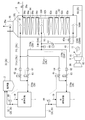
- FIG. 2 is a schematic diagram showing a coal (pulverized coal) drying gas system according to the first embodiment of the present invention.
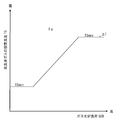
- FIG. 3 is a schematic diagram showing a setting function of the high-temperature exhaust gas temperature (temperature of the high-temperature exhaust gas after temperature adjustment by the high-temperature exhaust gas) in the first embodiment of the present invention.
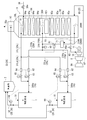
- FIG. 4 is a schematic diagram showing a coal (pulverized coal) drying gas system according to a second embodiment of the present invention.
- FIG. 5 is a schematic diagram showing a coal (pulverized coal) drying gas system according to a third embodiment of the present invention.
- FIG. 6 is a schematic view showing a coal (pulverized coal) drying gas system according to a fourth embodiment of the present invention.
- the overall configuration of the coal gasification power generation facility according to the first embodiment of the present invention will be described with reference to FIG.
- the coal gasification combined cycle power generation facility (carbon-containing solid fuel gasification power generation facility, hereinafter also referred to as “IGCC system”) 100 according to the first embodiment of the present invention shown in FIG. 1 is gasified mainly using air as an oxidant.
- An air combustion method for generating the product gas 21 in the furnace 4 is adopted, and the product gas 24 after purification by the gas purification device 7 is supplied to the gas turbine 8 as a gas turbine fuel.
- the IGCC system 100 shown in FIG. 1 is an air combustion type (air-blown) coal gasification combined power generation facility.
- the IGCC system 100 includes a pulverized coal machine (pulverizer) 1,1, a dust collector 2, a hopper 3, a gasifier 4, a gas cooler 5, a char recovery device 6, A gas purification device 7, a gas turbine 8, an exhaust heat recovery boiler (hereinafter also referred to as “HRSG”) 9, a steam turbine 10, a generator 11, a hopper 12, and an air separation device 13 are configured.
- a part of the exhaust gas supplied from the gas turbine 8 to the HRSG 9 is extracted and supplied to the pulverized coal machine 1 as the drying gas 26 (the drying gas system will be described in detail later).
- coal (carbon-containing solid fuel) 19 that is a raw material of the generated gas 24 is pulverized into fine particles while being heated and dried with a drying gas 26 to produce pulverized coal (pulverized fuel) 20.
- the pulverized coal 20 thus produced is conveyed to the dust collector 2 by the drying gas 26.
- the drying gas 26 and the pulverized coal 20 are separated, and the drying gas 26 is sent to the chimney 95 of the HRSG 9 and mixed with the exhaust gas heat-recovered by the HRSG 9 to form a chimney as an exhaust gas 25e. 95 to the atmosphere.
- the pulverized coal 20 separated from the drying gas 26 falls by gravity and is collected in the hopper 3.
- the pulverized coal 20 collected in the hopper 3 is conveyed into the gasification furnace 4 by nitrogen gas (conveying gas) 52 introduced for pressurized conveyance from the air separation device 13 described later.
- the gasifier 4 is supplied with pulverized coal 20 and a char 22 which will be described later as raw materials for the product gas 24.
- the pulverized coal 20 and the char 22 are generated by gasification using the compressed air 50 supplied from the compressor 8 ⁇ / b> A driven by the gas turbine 8 and the oxygen 53 supplied from the air separator 13 as an oxidant.
- Gas 21 is produced.
- the product gas 21 generated in the gasification furnace 4 is cooled by a gas cooler 5 installed in the gasification furnace 4 and then supplied from the upper part of the gasification furnace 4 to the char recovery device 6.
- the product gas 21 contains char 22, and the char recovery apparatus 6 separates the char 22 from the product gas 21.
- the product gas 23 from which the char 22 has been separated is supplied from the upper part of the char recovery device 6 to the gas purification device 7, purified by the gas purification device 7, and then supplied to the gas turbine 8 as a gaseous product gas 24.
- the char 22 recovered by the char recovery device 6 falls to the hopper 12 due to gravity and is recovered.
- the char 22 in the hopper 12 is returned to the gasification furnace 4 by the nitrogen gas 52 supplied from the air separation device 13, and used as a raw material for the product gas 21 together with the pulverized coal 20.
- the product gas 24 supplied to the gas turbine 8 is supplied to a combustor (not shown) of the gas turbine 8 and burned to generate combustion exhaust gas.
- the combustion exhaust gas is discharged as exhaust gas 25 from the exhaust gas outlet 82 after driving the gas turbine 8. Since the main shaft 81 of the gas turbine 8 driven in this way is connected to the generator 11, the generator 11 can be driven to generate power.
- the exhaust gas 25 discharged from the gas turbine 8 is supplied to the HRSG 9.
- a heat exchanging unit hereinafter, also referred to as “upstream heat exchanging unit” 92 including a plurality of heat exchangers, an in-furnace denitration device 93, and a heat exchanging unit including a plurality of heat exchangers are provided.
- Part hereinafter also referred to as “downstream heat exchanging part”) 94 is provided in this order from the upstream side.
- These heat exchange parts 92 and 94 are connected by a connecting pipe 92b.
- the heat exchange section 94 is supplied with water supply 39 whose flow rate is controlled by opening control of the water supply valve 39a.
- This water supply is heated and becomes steam 40 by exchanging heat with the exhaust gas 25 in the process of circulating through the heat exchanging units 92 and 94.
- the steam 40 is supplied to the steam turbine 10 after the flow rate is controlled by the opening degree control of the steam valve 40a.
- the steam turbine 10 is coaxially connected to the gas turbine 8 and the generator 11, and drives the generator 11 together with the gas turbine 8 to generate power.
- the in-furnace denitration device 93 is a device for reducing NOx (nitrogen oxides) in the exhaust gas 25 in the furnace 91, and detoxifies NOx contained in the exhaust gas 25 by decomposing it with a catalyst using ammonia as a reducing agent. To do.
- the exhaust gas 25 purified by the in-furnace denitration device 93 is discharged from the chimney 95 together with the drying gas 26 to the atmosphere as described above.
- the HRSG 9 includes an upstream heat exchanger 92 located upstream of the in-furnace denitration device 93 and a downstream side located downstream of the in-furnace denitration device 93.
- a heat exchanging portion 94 is provided.
- the upstream heat exchange unit 92 is configured as a heat exchanger group including four heat exchangers 92a
- the downstream heat exchange unit 94 is configured as a heat exchanger group including four heat exchangers 94a. ing.
- upstream heat exchanger group 92 or “heat exchanger group 92”
- downstream heat exchange section 94 is referred to as “downstream heat exchanger group 94” or “heat This is referred to as “exchanger group 94”.
- the upstream heat exchanger 92a is, for example, an evaporator, a reheater, or a superheater.
- the downstream heat exchanger 94a is, for example, a economizer or an evaporator.
- the drying gas 26 is adjusted by mixing exhaust gases 25L, 25H, and 25HH.
- the exhaust gas 25H is extracted from an extraction position (high temperature extraction position) 30H that is set downstream of the heat exchanger group 92 and the in-furnace denitration device 93.
- the extraction position 30 ⁇ / b> H is set on the upstream side of the heat exchanger group 94. Accordingly, the exhaust gas 25H extracted from the extraction position 30H is denitrated by the in-furnace denitration device 93 and is recovered by the heat exchanger group 92 but before being recovered by the heat exchanger group 94. It is a high temperature exhaust gas.
- the exhaust gas 25H is also referred to as “high temperature exhaust gas 25H”.
- the exhaust gas 25L is extracted from an extraction position (low temperature extraction position) 30L positioned downstream from the heat exchanger group 92 and the in-furnace denitration device 93.
- the extraction position 30L is set on the downstream side of the heat exchanger group 94. Therefore, the exhaust gas 25L extracted from the extraction position 30L is a low-temperature exhaust gas after being denitrated by the in-furnace denitration device 93 and heat recovered by the heat exchanger groups 92 and 94.
- the exhaust gas 25L is also referred to as “low temperature exhaust gas 25L”.
- Exhaust gas 25HH is extracted from an extraction position (high temperature extraction position) 30HH that is set upstream of the in-furnace denitration device 93.
- the extraction position 30HH is set on the upstream side of the heat exchanger group 92. Accordingly, the exhaust gas 25HH extracted from the extraction position 30HH is before the denitration treatment by the in-furnace denitration device 93 and before the heat recovery by the heat exchanger groups 92 and 94, and is higher than the high temperature exhaust gas 25H.
- the exhaust gas 25HH is also referred to as “high-temperature exhaust gas 25HH”.
- the in-furnace 91 is connected in communication with a high-temperature exhaust gas duct (high-temperature exhaust gas line) 31H provided outside the furnace at the extraction position 30H.
- This high temperature exhaust gas duct 31H branches into high temperature exhaust gas ducts (high temperature exhaust gas lines) 31Ha, 31Ha, and each high temperature exhaust gas duct 31Ha is connected to the pulverized coal machine 1 respectively.
- pulverized coal is used as a drying gas 26 for the coal 19 (pulverized coal 20). Supplied to the machine 1,1.
- the inside 91 of the furnace is connected to a low temperature exhaust gas duct (low temperature exhaust gas line) 31L provided outside the furnace at the extraction position 30L.
- This low temperature exhaust gas duct 31L branches into low temperature exhaust gas ducts (low temperature exhaust gas lines) 31La, 31La, and each low temperature exhaust gas duct 31La is connected to a high temperature exhaust gas duct 31Ha.
- the low temperature exhaust gas 25L is supplied to the high temperature exhaust gas ducts 31Ha and 31Ha as a temperature adjusting gas for lowering the temperature of the high temperature exhaust gas 25H.
- the furnace interior 91 is connected to a high-temperature exhaust gas duct (high-high exhaust gas line) 31HH provided outside the furnace at the extraction position 30HH.
- the high temperature exhaust gas duct 31HH is connected to the high temperature exhaust gas duct 31H.
- the high-temperature exhaust gas 25HH is supplied to the high-temperature exhaust gas duct 31H as a temperature-regulating gas for raising the temperature of the high-temperature exhaust gas 25H, and the heated high-temperature exhaust gas 25H ′ is adjusted.
- the high temperature exhaust gas duct 31H is provided with a temperature sensor 60 for detecting the temperature of the high temperature exhaust gas 25H ′ on the downstream side of the connecting portion with the high temperature exhaust gas duct 31HH.
- a temperature adjustment damper (temperature adjustment means) 61 is interposed in the high-temperature exhaust gas duct 31HH. The detection signal of the temperature sensor 60 is output to the temperature adjustment damper 61, and the temperature adjustment damper 61 changes the damper opening based on the detection signal of the temperature sensor 60. Thereby, the flow rate of the high-temperature exhaust gas 25HH mixed with the high-temperature exhaust gas 25H is adjusted by the temperature adjustment damper 61 so that the high-temperature exhaust gas 25H ′ is heated to a predetermined set temperature.
- the set temperature adjusted by the temperature control damper 61 is set based on the setting function shown in FIG. 3 according to the load (hereinafter referred to as “gasifier load”) GID of the gasifier 4, for example.
- This setting function is stored in the temperature control damper 61 in advance.
- the set temperature TS of the high temperature exhaust gas 25H ′ is set to a higher temperature as the gasifier negative addition GID increases within the range between the minimum temperature TSmin and the maximum temperature TSmax. This is because the higher the gasifier negative GID is, the more the coal 19 (pulverized coal 20) is consumed, and the amount of heat required for drying the coal 19 (pulverized coal 20) (hereinafter referred to as “necessary drying calorie”).
- the minimum temperature TS_min is such that the moisture contained in the pulverized coal 20 can be dried to a predetermined amount at a partial load, and the exhaust gas flow rates flowing through the ducts 31H, 31Ha, 31HH are used for various control devices (dampers and valves). It is set within the possible range.
- the flow rate of the high-temperature exhaust gas 25H ′ is controlled to be substantially constant regardless of the gasifier negative addition GID by the control of the flow control damper 63 described later. That is, the change in the required amount of drying heat (according to the change in the amount of pulverized coal) due to the change in the gasifier negative addition GID is handled by changing the temperature of the high-temperature exhaust gas 25H ′ (and thus the drying gas 26). .
- the temperature of the high temperature exhaust gas 25H ′ (and thus the drying gas 26) is controlled to be substantially constant regardless of the gasification furnace negative GID, and the flow rate of the high temperature exhaust gas 25H ′ (and thus the drying gas 26) is gasified. It is also possible to change it according to the furnace negative GID. That is, it can be considered that the change in the required amount of drying heat accompanying the change in the gasification furnace negative addition GID can be dealt with by changing the flow rate of the high-temperature exhaust gas 25H ′ (and thus the drying gas 26).
- the flow rate of the drying gas 26 is reduced when the gasification furnace negative GID becomes low in load, but at this time, the flow rate of the low temperature exhaust gas 25L is also reduced, so that the tempering function of the low temperature exhaust gas 25L is not effective. It may be enough. Therefore, with respect to the change in the required amount of drying heat accompanying the change in the gasification furnace negative addition GID, the temperature of the high-temperature exhaust gas 25H ′ is set to the gasification furnace negative addition GID while the flow rate of the drying gas 26 is substantially constant as described above. It is preferable to respond by changing according to the above.
- each pulverized coal machine 1 and the dust collector 2 are connected, and each duct 32 through which the pulverized coal 20 and the drying gas 26 circulate is provided with a temperature sensor 66.
- the detection signals of these temperature sensors 66 are output to the temperature adjustment dampers 65 provided in the respective low temperature exhaust gas ducts 31La, and the temperature adjustment dampers 65 are opened based on the detection signals. Change the degree.
- the temperature of the dry gas 26 high-temperature exhaust gas 25H ′
- the flow rate of the low-temperature exhaust gas 25 ⁇ / b> L is adjusted by the temperature adjustment damper 65.
- each high temperature exhaust gas duct 31Ha is provided with a flow sensor 62 and a flow control damper 63 in this order from the upstream side, and each low temperature exhaust gas duct 31La is provided upstream of the temperature control damper 65, respectively.
- a flow sensor 64 is provided. The detection signal of the flow sensor 62 and the detection signal of the flow sensor 64 are each output to the flow adjustment damper 63, and each flow adjustment damper 63 changes the damper opening degree according to these detection signals.
- the total flow rate of the high temperature exhaust gas 25H ′ flowing through the high temperature exhaust gas duct 31Ha and the low temperature exhaust gas 25L flowing through the low temperature exhaust gas duct 31La is adjusted to each flow condition damper.
- 63 is adjusted to a predetermined flow rate.
- the temperature sensors 60 and 66, the temperature control dampers 61 and 65, the flow rate sensors 62 and 64, and the flow control damper 63 are omitted.
- the drying gas 26 is transported to the dust collector 2 together with the pulverized coal 20, and separated from the pulverized coal 20, and then the duct 33 is passed through. To the chimney 95 of the HRSG 9.
- the NOx concentration is denitrated by the in-furnace denitration device 93 from the extraction position 30H downstream of the in-furnace denitration device 93 and upstream of the downstream heat exchanger group 94.
- the high-temperature exhaust gas (high-temperature exhaust gas) 25H having a low (nitrogen oxide concentration) and before being heat-recovered by the downstream heat exchanger group 94 is extracted (high-temperature exhaust gas extraction step).
- the NOx concentration is reduced by the in-furnace denitration device 93 from the extraction position 30L downstream of the in-furnace denitration device 93 and the downstream heat exchanger group 94, and the heat recovery is performed by the downstream heat exchanger group 94.
- the low-temperature exhaust gas (low-temperature exhaust gas) 25L after it has been extracted is extracted (low-temperature exhaust gas extraction step).
- the exhaust gas having a higher temperature than the exhaust gas 25H ( High-temperature exhaust gas) 25HH is extracted (high-temperature exhaust gas extraction step).
- the flow rate of the high-temperature exhaust gas 25HH supplied to the high-temperature exhaust gas 25H is controlled by the temperature control damper 61, and the high-temperature exhaust gas 25H is temperature-controlled to a predetermined temperature on the high temperature side (the high-temperature exhaust gas 25H having a higher temperature than the high-temperature exhaust gas 25H). ′).
- the flow rate of the low temperature exhaust gas 25L supplied to the high temperature exhaust gas 25H ′ is controlled by the temperature control damper 65, the temperature of the high temperature exhaust gas 25H ′ is adjusted to the low temperature side, and the coal 19 (pulverized coal 20) does not ignite during drying.
- the drying gas 26 is finally adjusted to such a temperature (mixing step). Then, the drying gas 26 is supplied to the pulverized coal machine 1 to dry the coal 19 (pulverized coal 20).
- the denitration efficiency of the in-furnace denitration device 93 becomes maximum at a predetermined temperature (for example, about 350 ° C., hereinafter referred to as the maximum efficiency temperature).
- the HRSG 9 uses the in-furnace denitration device 93 so that the temperature of the exhaust gas 25 flowing into the in-furnace denitration device 93 becomes the maximum efficiency temperature (including the temperature near the maximum efficiency temperature; hereinafter the same) Tef.
- the arrangement and the heat transfer area of the heat exchanger groups 92 and 94 are planned, and operation conditions such as the evaporation amount are set.
- the exhaust gases 25H and 25L having the maximum efficiency temperature Tef or less can be extracted from the extraction positions 30H and 30L on the downstream side of the in-furnace denitration device 93.
- the extraction position 30HH is upstream of the in-furnace denitration device 93 and the heat exchanger groups 92 and 94, the exhaust gas 25HH having a temperature higher than the maximum efficiency temperature Tef can be extracted from the extraction position 30HH.
- the temperature of the exhaust gas 25HH is, for example, about 550 ° C. at the rated load, but differs depending on the operation conditions and the plant. In the case of partial load, the temperature is lower than this temperature, and the temperature of the exhaust gas 25HH is limited to about 550 ° C. It is not something.
- the high temperature exhaust gas 25HH extracted from the upstream side of the in-furnace denitration device 93 is used to dry the gas 26.
- the drying gas 26 can be heated to a higher temperature.
- the drying gas 26 is used for drying the coal 19 (pulverized coal 20), and then mixed with the exhaust gas of the HRSG 9 as described above, and discharged to the atmosphere as the exhaust gas 25e. For this reason, it is necessary to reduce the NOx concentration of the drying gas 26 so that the NOx concentration of the exhaust gas 25e becomes a target value (for example, a regulation value) or less.
- the high temperature exhaust gas 25H denitrated by the in-furnace denitration device 93 is used, and the high temperature exhaust gas 25H is controlled by the in-furnace denitration device 93 as a temperature control exhaust gas for controlling the temperature of the high temperature exhaust gas 25H to the low temperature side. 25 L of low-temperature exhaust gas that has been denitrated is used.
- the drying gas 26 adjusted by these exhaust gases 25H, 25L, and 25HH By suppressing the NOx concentration, the NOx concentration of the exhaust gas 25e can be kept within the target value. That is, in the drying gas 26, most of the exhaust gas after the denitration treatment (the high temperature exhaust gas 25H and the low temperature exhaust gas 25L) occupies a part of the high temperature exhaust gas 25HH that has not been denitrated. However, the NOx concentration of the drying gas 26 can be suppressed and the exhaust gas 25e can be kept within the target value.
- the exhaust gas 25H, 25L, and so on so that the NOx concentration of the drying gas 26 becomes a target value (for example, a regulation value) or less.
- the mixing ratio of 25HH is adjusted.
- FIG. 4 A drying gas system that is a main part of the coal gasification power generation facility according to the second embodiment of the present invention will be described with reference to FIG.
- the overall configuration of the coal gasification power generation facility is the same as that of the first embodiment (see FIG. 1), and the same components as those of the first embodiment are denoted by the same reference numerals and description thereof is omitted.
- a NOx sensor (nitrogen oxide concentration detecting means) 67 is provided in a drying gas discharge duct (drying gas discharge line) 33 between the dust collector 2 and the HRSG 9. It has been.
- the NOx sensor 67 detects the NOx concentration of the drying gas 26 that flows through the duct 33.
- a flow control valve (reducing agent supply amount adjusting means) 70 is interposed in a supply pipe 69 for supplying ammonia (reducing agent) 68 to the in-furnace denitration device 93.
- a detection signal (a signal indicating NOx concentration) of the NOx sensor 67 is output to the flow control valve 70.
- the flow control valve 70 increases the opening degree as the NOx concentration indicated by the detection signal of the NOx sensor 67 increases. Thereby, the amount of ammonia supplied from the supply pipe 69 to the in-furnace denitration device 93 increases as the NOx concentration of the drying gas 26 flowing through the duct 33 increases. Since other configurations are the same as those of the first embodiment, description thereof is omitted.
- the drying gas 26 is used to dry the coal 19 (pulverized coal 20) in the pulverized coal machine 1, and then mixed with the HRSG exhaust gas and discharged to the atmosphere as the exhaust gas 25e. It is desirable to reduce the concentration to as low a concentration as possible. Therefore, in the present embodiment, the amount of ammonia supplied to the in-furnace denitration device 93 is adjusted according to the NOx concentration of the drying gas 26 (reducing agent supply amount adjustment step).
- the denitration performance of the in-furnace denitration device 93 is improved, the NOx concentration of the high temperature exhaust gas 25H and the low temperature exhaust gas 25L is reduced, and the NOx concentration of the drying gas 26 is further reduced to a NOx concentration lower than that of the first embodiment. It becomes possible to reduce.
- the NOx sensor 67 is replaced with the duct 33 in the chimney 95. It may be provided. Further, the NOx concentration in the duct 33 or the chimney 95 can be confirmed in the central control room (not shown) based on the detection signal of the NOx sensor 67, and the operator who has confirmed the NOx concentration can control the flow control in the central control room. You may make it operate the operation part manually and control the opening degree of the flow control valve 70.
- the flow regulating valve operating unit together with the flow regulating valve 70 constitutes the reducing agent supply amount adjusting means of the present invention.
- a drying gas discharge duct (drying gas discharge line) 33 is connected to the in-furnace 91 of the HRSG 9 on the upstream side of the in-furnace denitration device 93. is doing.
- the duct 33 is connected to the in-furnace 91 immediately upstream of the in-furnace denitration device 93 (in other words, between the in-furnace denitration device 93 and the upstream heat exchanger group 92).
- the connection position of the duct 33 is not limited as long as it is upstream of the in-furnace denitration device 93. Therefore, the duct 33 may be connected to the furnace 91 either between the upstream heat exchangers 92 a or upstream of the upstream heat exchanger group 92. Since other configurations are the same as those of the first embodiment, description thereof is omitted.
- the NOx concentration of the drying gas 26 may be increased depending on the operating conditions and the like. Specifically, when the coal 19 contains a large amount of N, the NOx concentration of the high-temperature exhaust gas 25HH extracted from the upstream side of the in-furnace denitration device 93, and hence the NOx concentration of the drying gas 26 containing the high-temperature exhaust gas 25HH. Becomes higher. Moreover, when the coal 19 contains a lot of moisture, or when the gasifier load GID is high and the amount of coal used is large, the amount of heat required to dry the coal 19 also increases.
- the proportion of the high-temperature exhaust gas 25HH (that is, the exhaust gas that has not been denitrated by the in-furnace denitration device 93) in the drying gas 26 increases, The NOx concentration of the gas 26 is increased.
- the drying gas 26 is returned to the upstream side of the in-furnace denitration device 93 via the duct 33 (drying gas recirculation step). Therefore, the drying gas 26 is denitrated by the in-furnace denitration device 93. As a result, the NOx concentration of the exhaust gas 25e including the drying gas 26 and discharged to the atmosphere can be reduced to a target value or less.
- the drying gas 26 returned to the upstream side of the in-furnace denitration device 93 through the duct 33 is at a low temperature because it is after the coal 19 (pulverized coal 20) is dried.
- the temperature of the drying gas 26 is expected to be significantly lower than the maximum efficiency temperature Tef of the in-furnace denitration device 93, the amount of heat exchanged in the upstream heat exchanger group 92 is reduced by reducing the amount of steam in the HRSG 9.
- the exhaust gas temperature at the outlet of the upstream heat exchanger group 92 that is, the inlet of the in-furnace denitration device 93
- Tef the maximum efficiency temperature
- a temperature sensor 33a is provided in the duct 33, and the temperature sensor 33a detects the temperature Tg of the drying gas 26 after drying the coal 19 (pulverized coal 20), and this temperature Tg is the maximum efficiency.
- Tb Tef + ⁇ , ⁇ : marginal temperature, ⁇ > 0
- Tef Tef + ⁇ , ⁇ : marginal temperature, ⁇ > 0
- the water supply valve 39a at the inlet of the HRSG 9 and the steam at the outlet of the HRSG 9 The amount of steam of the HRSG 9 may be reduced by reducing the opening of at least one of the valves 40a.
- the drying gas 26 is returned to the upstream side of the in-furnace denitration device 93, the amount of heat collected from the upstream heat exchanger group 92 in advance so that the exhaust gas temperature at the inlet of the in-furnace denitration device 93 becomes the maximum efficiency temperature Tef.
- You can also respond by planning. Thereby, the denitration performance of the in-furnace denitration apparatus 93 can be maintained in an optimal state.
- the denitration performance of the in-furnace denitration device 93 is suppressed by returning the drying gas 26 to the inside of the furnace 91 upstream of the position shown in FIG.
- the drying gas 26 does not flow into the in-furnace denitration device 93 at a low temperature but mixes with the surrounding high-temperature exhaust gas and After being heated by the high-temperature exhaust gas and heated up, it flows into the in-furnace denitration device 93.
- a high temperature exhaust gas duct 31 ⁇ / b> HH is provided with an out-of-furnace denitration device 71.
- the in-furnace denitration device 71 has higher heat resistance and higher denitration efficiency on the high temperature side than the in-furnace denitration device 93 so that it has heat resistance against the high-temperature exhaust gas 25HH and can perform denitration processing with high efficiency (maximum).
- a high-temperature denitration system is used (efficiency temperature Tef is on the high temperature side). Since other configurations are the same as those of the first embodiment, description thereof is omitted.
- the drying gas 26 is mixed with the exhaust gas of the HRSG 9 and discharged to the atmosphere as the exhaust gas 25e. For this reason, it is necessary to suppress the NOx concentration of the drying gas 26 so that the NOx concentration of the exhaust gas 25e becomes a target value (for example, a regulation value) or less.
- the non-denitration-treated high-temperature exhaust gas 25HH extracted from the upstream side of the in-furnace denitration device 93 is denitrated by the out-of-furnace denitration device 71 (high-temperature exhaust gas denitration step).
- the NOx concentration of the drying gas 26 adjusted using the high-temperature exhaust gas 25HH can be suppressed, and the NOx concentration of the exhaust gas 25e can be made equal to or less than the target value.
- the out-of-furnace denitration apparatus 71 has a smaller amount of processing gas and a smaller capacity than the in-furnace denitration apparatus 93, thereby suppressing an increase in cost. Can do. Therefore, the NOx concentration of the exhaust gas 25e can be reduced below the target value while suppressing an increase in cost.
- the temperature of the high-temperature exhaust gas 25HH is high. Is used.
- the high-temperature exhaust gas 25HH is extracted from between the two heat exchangers 92a on the downstream side of the upstream heat exchanger group 92.
- the high-temperature exhaust gas 25HH has a temperature lower than that of the above embodiment, a denitration device having the same specifications as the in-furnace denitration device 93 (which can treat exhaust gas at the same temperature) is used for the out-of-furnace denitration device 71 It becomes possible. Thereby, the cost increase by providing the in-furnace denitration apparatus 71 can further be suppressed.
- the temperature of the high-temperature exhaust gas 25HH is higher than the maximum efficiency temperature Tef of the out-of-furnace denitration device 71 and the denitration efficiency may be lower than the maximum efficiency, the temperature of the high-temperature exhaust gas 25HH is outside the furnace denitration.
- the temperature does not exceed the heat resistance temperature of the device 71, depending on the NOx concentration of the high-temperature exhaust gas 25HH, it can be operated without any trouble by increasing the amount of ammonia injected into the outside denitration device 71 (released to the atmosphere).
- the NOx concentration of the exhaust gas 25e can be made equal to or less than the target value).
- the extraction position 30HH of the high-temperature exhaust gas 25HH is set on the upstream side of the upstream heat exchanger group 92 in the furnace 91, but the extraction position 30HH of the high-temperature exhaust gas 25HH is It is not limited.
- the extraction position 30HH of the high-temperature exhaust gas 25HH is set between (a) the exhaust gas outlet 82 of the gas turbine 8 and the in-furnace denitration device 93, (b) upstream of the high-temperature extraction position 30H, The position may be set so that at least a part of the upstream heat exchanger group 92 is sandwiched between the extraction position 30H.
- the extraction position 30HH may be provided between the upstream heat exchangers 92a and 92a, and the high-temperature exhaust gas 25HH may be extracted from the extraction position.
- an extraction position 30HH may be provided in the duct 85 between the exhaust gas outlet 82 of the gas turbine 8 and the HRSG 9, and high-temperature exhaust gas may be extracted from the duct 85.
- an extraction position 30HH may be provided in a mutual gap (hereinafter referred to as an internal gap) between the tubes constituting the upstream heat exchanger 92a, and the high-temperature exhaust gas 25HH may be extracted from the internal gap.
- the internal gap is too narrow to provide the extraction position 30HH (to attach the high-temperature and high-temperature exhaust duct 31HH in communication), but a part of the internal clearance is provided so that the extraction position 30HH can be provided. It is possible to provide the extraction position 30HH by intentionally expanding it.
- the extraction position 30H of the high-temperature exhaust gas 25H and the extraction position 30L of the low-temperature exhaust gas 25L are not limited to the positions in the above-described embodiment, but between the downstream heat exchangers 94a and 94a or between the downstream heat exchanger 94a. You may provide in an internal clearance.
- the high temperature exhaust gas 25H is first mixed with the high temperature exhaust gas 25HH, and then the low temperature exhaust gas 25L is mixed.
- the high temperature exhaust gas 25H is first mixed with the low temperature exhaust gas 25L, and then Alternatively, the high-temperature exhaust gas 25HH may be mixed.
- the high temperature exhaust gas 25HH is mixed with the low temperature exhaust gas 25L while controlling the flow rate by the temperature control damper 61, and the exhaust gas obtained by mixing the high temperature exhaust gas 25HH and the low temperature exhaust gas 25L is mixed with the high temperature exhaust gas 25H. May be.
- the high-temperature exhaust gas 25HH is mixed with both the low-temperature exhaust gas 25L and the high-temperature exhaust gas 25H while controlling the flow rate by the temperature control damper 61, and mixed with the high-temperature exhaust gas 25HH and the low-temperature exhaust gas 25L.
- a mixed gas of the high temperature exhaust gas 25HH and the high temperature exhaust gas 25H may be mixed.
- the single generator 11 is driven by the gas turbine 8 and the steam turbine 10, but a generator may be provided for each of the gas turbine 8 and the steam turbine 10. .
- pulverized coal machines 1 are provided, and the pulverized coal supply system of the gasification furnace 4 and the drying gas system incidental thereto are two systems.
- the number of charcoal supply systems and drying gas systems is not limited to this.
- the carbon-containing solid fuel gasification power generation facility of the present invention has been described as an air-blown coal gasification combined power generation facility, but the carbon-containing solid fuel gasification power generation facility of the present invention is It can also be applied to oxygen-blown coal gasification combined power generation facilities.
- the steam generated by the HRSG 9 is supplied to the steam turbine 10 and used for power generation, and a part of the steam generated by the HRSG 9 is used for other uses such as process steam in a factory. You can also Alternatively, the steam generated by the HRSG 9 can be used for other purposes such as factory process steam without being used for power generation. In this case, the steam turbine 10 becomes unnecessary.
- biomass woody biomass such as waste wood and thinned wood can be exemplified, but use other than woody biomass is not excluded.
- Biomass also includes wood pellets processed into pellets. In short, biomass is not limited by the form of processing.
- the low-temperature exhaust gas duct 31L is connected to the high-temperature exhaust gas duct 31Ha
- the high-temperature exhaust gas duct 31Ha and the low-temperature exhaust gas duct 31L may be directly connected to the pulverized coal machine 1, respectively. good.
- the low temperature exhaust gas duct is brought into contact with the coal 19 and the pulverized coal 20 in the pulverized coal machine 1. It is preferable that the connection positions of 31L and the high-temperature exhaust gas duct 31Ha to the pulverized coal machine 1 are close to each other.
Landscapes
- Engineering & Computer Science (AREA)
- Chemical & Material Sciences (AREA)
- Combustion & Propulsion (AREA)
- Mechanical Engineering (AREA)
- General Engineering & Computer Science (AREA)
- Oil, Petroleum & Natural Gas (AREA)
- Organic Chemistry (AREA)
- Thermal Sciences (AREA)
- Physics & Mathematics (AREA)
- Health & Medical Sciences (AREA)
- Biomedical Technology (AREA)
- Environmental & Geological Engineering (AREA)
- Analytical Chemistry (AREA)
- General Chemical & Material Sciences (AREA)
- Chemical Kinetics & Catalysis (AREA)
- Engine Equipment That Uses Special Cycles (AREA)
- Chimneys And Flues (AREA)
- Drying Of Solid Materials (AREA)
Abstract
L'invention concerne une installation de génération d'énergie à gazéification de combustible solide contenant du carbone, et un procédé pour réguler un gaz pour sécher ce combustible solide contenant du carbone, avec lesquels il est possible d'étendre la gamme des types de combustibles solides contenant du carbone qui peuvent être utilisés. Un gaz d'échappement à haute température (25H) est prélevé à partir d'un four (91) dans une position de purge à haute température (30H). Un gaz d'échappement à basse température (25L) est prélevé à partir du four (91) dans une position de purge à basse température (30L), qui est en aval de la position de purge à haute température (30H), et entre la position de purge à haute température (30H) et celle dans laquelle au moins une partie d'une unité d'échangeur de chaleur (94) est prise en sandwich. En outre, un gaz d'échappement à très haute température (25HH) est prélevé à partir du four (91) dans une position de purge à très haute température (30HH), qui se trouve entre une turbine à gaz (8) et un dispositif de dénitration (93), et entre la position de purge à haute température (30H) et celle dans laquelle au moins une partie d'une unité d'échange de chaleur (92) est prise en sandwich. Quand ces gaz d'échappement (25H, 25HH, 25L) sont mélangés, le volume d'écoulement du gaz d'échappement à très haute température (25HH) communiqué à au moins l'un des gaz d'échappement, à savoir le gaz d'échappement à haute température (25H) ou le gaz d'échappement à basse température (25L), est régulé de telle sorte que la température d'au moins l'un de ces gaz d'échappement, à savoir le gaz d'échappement à haute température ou le gaz d'échappement à basse température, atteint une température prescrite.
Priority Applications (2)
| Application Number | Priority Date | Filing Date | Title |
|---|---|---|---|
| US16/097,903 US11084995B2 (en) | 2016-05-20 | 2017-05-10 | Carbonaceous feedstock gasification power generation facility, and method for regulating drying gas carbonaceous feedstock |
| CN201780028340.7A CN109072780B (zh) | 2016-05-20 | 2017-05-10 | 含碳固体燃料气化发电设备及其含碳固体燃料的干燥用气体的调整方法 |
Applications Claiming Priority (2)
| Application Number | Priority Date | Filing Date | Title |
|---|---|---|---|
| JP2016-101746 | 2016-05-20 | ||
| JP2016101746A JP6763520B2 (ja) | 2016-05-20 | 2016-05-20 | 炭素含有固体燃料ガス化発電設備及びその炭素含有固体燃料の乾燥用ガスの調整方法 |
Publications (1)
| Publication Number | Publication Date |
|---|---|
| WO2017199818A1 true WO2017199818A1 (fr) | 2017-11-23 |
Family
ID=60325824
Family Applications (1)
| Application Number | Title | Priority Date | Filing Date |
|---|---|---|---|
| PCT/JP2017/017738 Ceased WO2017199818A1 (fr) | 2016-05-20 | 2017-05-10 | Installation de génération d'énergie à gazéification de carburant solide contenant du carbone, et procédé pour réguler un gaz pour sécher un carburant solide contenant du carbone |
Country Status (4)
| Country | Link |
|---|---|
| US (1) | US11084995B2 (fr) |
| JP (1) | JP6763520B2 (fr) |
| CN (1) | CN109072780B (fr) |
| WO (1) | WO2017199818A1 (fr) |
Cited By (2)
| Publication number | Priority date | Publication date | Assignee | Title |
|---|---|---|---|---|
| US20210407835A1 (en) * | 2020-06-30 | 2021-12-30 | Tokyo Electron Limited | Abnormality detecting apparatus, semiconductor manufacturing apparatus, and abnormality detecting method |
| TWI818615B (zh) * | 2021-07-21 | 2023-10-11 | 日商三菱重工業股份有限公司 | 氨燃料供應單元、發電廠、以及鍋爐之運轉方法 |
Families Citing this family (6)
| Publication number | Priority date | Publication date | Assignee | Title |
|---|---|---|---|---|
| PL3728959T3 (pl) * | 2017-12-22 | 2022-06-13 | Giovanni D'ARIENZO | Układ kogeneracyjny dla kotła |
| CN112044268B (zh) * | 2019-06-05 | 2022-08-16 | 中冶长天国际工程有限责任公司 | 一种烟气处理中热能利用方法及系统 |
| CN111647439A (zh) * | 2020-06-12 | 2020-09-11 | 宁夏神耀科技有限责任公司 | 一种回收干煤粉余热的废锅气化装置及方法 |
| CN112984542A (zh) * | 2021-04-09 | 2021-06-18 | 西安热工研究院有限公司 | 一种风扇磨煤机制粉系统抽炉烟防爆的改造系统 |
| CN113391023A (zh) * | 2021-07-12 | 2021-09-14 | 中国特种设备检测研究院 | 一种NOx排放测试平台 |
| CN114774178B (zh) * | 2022-05-25 | 2024-05-31 | 陕西延长石油(集团)有限责任公司 | 一种烟气循环用于低阶煤干燥制粉和输送的装置及方法 |
Citations (4)
| Publication number | Priority date | Publication date | Assignee | Title |
|---|---|---|---|---|
| JPH0141815B2 (fr) * | 1985-01-30 | 1989-09-07 | Mitsubishi Heavy Ind Ltd | |
| JP2010106722A (ja) * | 2008-10-29 | 2010-05-13 | Mitsubishi Heavy Ind Ltd | 石炭ガス化複合発電設備 |
| WO2012115054A1 (fr) * | 2011-02-25 | 2012-08-30 | 三菱重工業株式会社 | Système d'alimentation en fine poudre de charbon pour un four de gazéification du charbon |
| JP2013170463A (ja) * | 2012-02-17 | 2013-09-02 | Mitsubishi Heavy Ind Ltd | 湿潤燃料を用いて複合発電を行うプラント及びその燃料乾燥方法 |
Family Cites Families (6)
| Publication number | Priority date | Publication date | Assignee | Title |
|---|---|---|---|---|
| JP2554836B2 (ja) * | 1993-12-24 | 1996-11-20 | 株式会社東芝 | 脱硝制御装置 |
| JP2003106514A (ja) * | 2001-09-28 | 2003-04-09 | Mitsubishi Heavy Ind Ltd | 石炭ガス化複合発電プラント |
| JP2004337781A (ja) * | 2003-05-16 | 2004-12-02 | Mitsubishi Heavy Ind Ltd | 排ガス処理方法、排ガス処理システム及び触媒酸化装置 |
| ITBO20050591A1 (it) * | 2005-09-30 | 2007-04-01 | G I & E S P A | Metodo per la generazione di energia elettrica a partire da biomassa come combustibile ed impianto che attua tale metodo |
| JP4981771B2 (ja) * | 2008-09-08 | 2012-07-25 | 三菱重工業株式会社 | 石炭ガス化複合発電設備 |
| JP2014205806A (ja) * | 2013-04-15 | 2014-10-30 | 株式会社Ihi | ガス化ガス生成システム |
-
2016
- 2016-05-20 JP JP2016101746A patent/JP6763520B2/ja active Active
-
2017
- 2017-05-10 US US16/097,903 patent/US11084995B2/en active Active
- 2017-05-10 WO PCT/JP2017/017738 patent/WO2017199818A1/fr not_active Ceased
- 2017-05-10 CN CN201780028340.7A patent/CN109072780B/zh active Active
Patent Citations (4)
| Publication number | Priority date | Publication date | Assignee | Title |
|---|---|---|---|---|
| JPH0141815B2 (fr) * | 1985-01-30 | 1989-09-07 | Mitsubishi Heavy Ind Ltd | |
| JP2010106722A (ja) * | 2008-10-29 | 2010-05-13 | Mitsubishi Heavy Ind Ltd | 石炭ガス化複合発電設備 |
| WO2012115054A1 (fr) * | 2011-02-25 | 2012-08-30 | 三菱重工業株式会社 | Système d'alimentation en fine poudre de charbon pour un four de gazéification du charbon |
| JP2013170463A (ja) * | 2012-02-17 | 2013-09-02 | Mitsubishi Heavy Ind Ltd | 湿潤燃料を用いて複合発電を行うプラント及びその燃料乾燥方法 |
Cited By (3)
| Publication number | Priority date | Publication date | Assignee | Title |
|---|---|---|---|---|
| US20210407835A1 (en) * | 2020-06-30 | 2021-12-30 | Tokyo Electron Limited | Abnormality detecting apparatus, semiconductor manufacturing apparatus, and abnormality detecting method |
| US12334374B2 (en) * | 2020-06-30 | 2025-06-17 | Tokyo Electron Limited | Abnormality detecting apparatus, semiconductor manufacturing apparatus, and abnormality detecting method |
| TWI818615B (zh) * | 2021-07-21 | 2023-10-11 | 日商三菱重工業股份有限公司 | 氨燃料供應單元、發電廠、以及鍋爐之運轉方法 |
Also Published As
| Publication number | Publication date |
|---|---|
| CN109072780B (zh) | 2021-02-19 |
| JP6763520B2 (ja) | 2020-09-30 |
| JP2017206661A (ja) | 2017-11-24 |
| US20190144769A1 (en) | 2019-05-16 |
| CN109072780A (zh) | 2018-12-21 |
| US11084995B2 (en) | 2021-08-10 |
Similar Documents
| Publication | Publication Date | Title |
|---|---|---|
| JP6763520B2 (ja) | 炭素含有固体燃料ガス化発電設備及びその炭素含有固体燃料の乾燥用ガスの調整方法 | |
| CN102596363B (zh) | 用于co2捕获的动力设备 | |
| JP5840024B2 (ja) | 湿潤燃料を用いて複合発電を行うプラント及びその燃料乾燥方法 | |
| US20140065559A1 (en) | Pressurized oxy-combustion power boiler and power plant and method of operating the same | |
| EP2132425B1 (fr) | Procédé et appareil pour préparer du charbon pulvérisé utilisé pour produire du gaz synthétique | |
| US20120285176A1 (en) | Integration of coal fired steam plants with integrated gasification combined cycle power plants | |
| JP5789146B2 (ja) | 微粉炭焚きボイラ設備の運転方法および微粉炭焚きボイラ設備 | |
| JP2017206643A (ja) | ガス化複合発電プラント及びその運転方法 | |
| US20230151766A1 (en) | Integrated gasification combined cycle and operation method thereof | |
| US20170023244A1 (en) | Booster air heater for high moisture fuels | |
| JP5412205B2 (ja) | ガスタービンプラント及びこれを備えたガス化燃料発電設備 | |
| WO2020066459A1 (fr) | Dispositif de turbine à gaz, installation de turbine à gaz et procédé de fonctionnement d'une installation de gazéification et d'un dispositif de turbine à gaz | |
| CN118310008A (zh) | 一种抽锅炉烟气输送生物质与燃煤锅炉耦合发电系统 | |
| AU2013206063B2 (en) | Method and apparatus for preparing pulverized coal used to produce synthesis gas | |
| JP2013253611A (ja) | ガスタービンプラント、その運転方法、及びガスタービンプラントを備えたガス化燃料発電設備 | |
| JP2023098047A (ja) | 複合プラント並びに複合プラントの製造方法 | |
| JP2026046637A (ja) | 処理システム及びボイラ | |
| Foster-Pegg et al. | A Coal Fired air Turbine Cogeneration System | |
| JP2667399B2 (ja) | 流動層燃焼式ボイラ | |
| CN114270101A (zh) | 混合式锅炉干燥器和方法 | |
| JPS61141925A (ja) | 原料粉末予熱装置の排熱利用方法 | |
| JPH0253094B2 (fr) |
Legal Events
| Date | Code | Title | Description |
|---|---|---|---|
| NENP | Non-entry into the national phase |
Ref country code: DE |
|
| 121 | Ep: the epo has been informed by wipo that ep was designated in this application |
Ref document number: 17799243 Country of ref document: EP Kind code of ref document: A1 |
|
| 122 | Ep: pct application non-entry in european phase |
Ref document number: 17799243 Country of ref document: EP Kind code of ref document: A1 |