WO2017217510A1 - 硬化性ポリオルガノシロキサン組成物及びその使用 - Google Patents
硬化性ポリオルガノシロキサン組成物及びその使用 Download PDFInfo
- Publication number
- WO2017217510A1 WO2017217510A1 PCT/JP2017/022201 JP2017022201W WO2017217510A1 WO 2017217510 A1 WO2017217510 A1 WO 2017217510A1 JP 2017022201 W JP2017022201 W JP 2017022201W WO 2017217510 A1 WO2017217510 A1 WO 2017217510A1
- Authority
- WO
- WIPO (PCT)
- Prior art keywords
- composition
- mpa
- group
- weight
- parts
- Prior art date
- Legal status (The legal status is an assumption and is not a legal conclusion. Google has not performed a legal analysis and makes no representation as to the accuracy of the status listed.)
- Ceased
Links
- 0 CC*N(C*)C(C)(C)OC Chemical compound CC*N(C*)C(C)(C)OC 0.000 description 6
- PBLVLXGAPMEPKW-UHFFFAOYSA-N CC(C)(NC)OC Chemical compound CC(C)(NC)OC PBLVLXGAPMEPKW-UHFFFAOYSA-N 0.000 description 1
Classifications
-
- C—CHEMISTRY; METALLURGY
- C08—ORGANIC MACROMOLECULAR COMPOUNDS; THEIR PREPARATION OR CHEMICAL WORKING-UP; COMPOSITIONS BASED THEREON
- C08L—COMPOSITIONS OF MACROMOLECULAR COMPOUNDS
- C08L83/00—Compositions of macromolecular compounds obtained by reactions forming in the main chain of the macromolecule a linkage containing silicon with or without sulfur, nitrogen, oxygen or carbon only; Compositions of derivatives of such polymers
- C08L83/04—Polysiloxanes
-
- C—CHEMISTRY; METALLURGY
- C08—ORGANIC MACROMOLECULAR COMPOUNDS; THEIR PREPARATION OR CHEMICAL WORKING-UP; COMPOSITIONS BASED THEREON
- C08G—MACROMOLECULAR COMPOUNDS OBTAINED OTHERWISE THAN BY REACTIONS ONLY INVOLVING UNSATURATED CARBON-TO-CARBON BONDS
- C08G77/00—Macromolecular compounds obtained by reactions forming a linkage containing silicon with or without sulfur, nitrogen, oxygen or carbon in the main chain of the macromolecule
- C08G77/04—Polysiloxanes
- C08G77/045—Polysiloxanes containing less than 25 silicon atoms
-
- C—CHEMISTRY; METALLURGY
- C08—ORGANIC MACROMOLECULAR COMPOUNDS; THEIR PREPARATION OR CHEMICAL WORKING-UP; COMPOSITIONS BASED THEREON
- C08G—MACROMOLECULAR COMPOUNDS OBTAINED OTHERWISE THAN BY REACTIONS ONLY INVOLVING UNSATURATED CARBON-TO-CARBON BONDS
- C08G77/00—Macromolecular compounds obtained by reactions forming a linkage containing silicon with or without sulfur, nitrogen, oxygen or carbon in the main chain of the macromolecule
- C08G77/04—Polysiloxanes
- C08G77/06—Preparatory processes
- C08G77/08—Preparatory processes characterised by the catalysts used
-
- C—CHEMISTRY; METALLURGY
- C09—DYES; PAINTS; POLISHES; NATURAL RESINS; ADHESIVES; COMPOSITIONS NOT OTHERWISE PROVIDED FOR; APPLICATIONS OF MATERIALS NOT OTHERWISE PROVIDED FOR
- C09J—ADHESIVES; NON-MECHANICAL ASPECTS OF ADHESIVE PROCESSES IN GENERAL; ADHESIVE PROCESSES NOT PROVIDED FOR ELSEWHERE; USE OF MATERIALS AS ADHESIVES
- C09J183/00—Adhesives based on macromolecular compounds obtained by reactions forming in the main chain of the macromolecule a linkage containing silicon, with or without sulfur, nitrogen, oxygen, or carbon only; Adhesives based on derivatives of such polymers
- C09J183/04—Polysiloxanes
-
- G—PHYSICS
- G02—OPTICS
- G02F—OPTICAL DEVICES OR ARRANGEMENTS FOR THE CONTROL OF LIGHT BY MODIFICATION OF THE OPTICAL PROPERTIES OF THE MEDIA OF THE ELEMENTS INVOLVED THEREIN; NON-LINEAR OPTICS; FREQUENCY-CHANGING OF LIGHT; OPTICAL LOGIC ELEMENTS; OPTICAL ANALOGUE/DIGITAL CONVERTERS
- G02F1/00—Devices or arrangements for the control of the intensity, colour, phase, polarisation or direction of light arriving from an independent light source, e.g. switching, gating or modulating; Non-linear optics
- G02F1/01—Devices or arrangements for the control of the intensity, colour, phase, polarisation or direction of light arriving from an independent light source, e.g. switching, gating or modulating; Non-linear optics for the control of the intensity, phase, polarisation or colour
- G02F1/13—Devices or arrangements for the control of the intensity, colour, phase, polarisation or direction of light arriving from an independent light source, e.g. switching, gating or modulating; Non-linear optics for the control of the intensity, phase, polarisation or colour based on liquid crystals, e.g. single liquid crystal display cells
- G02F1/133—Constructional arrangements; Operation of liquid crystal cells; Circuit arrangements
- G02F1/1333—Constructional arrangements; Manufacturing methods
- G02F1/133308—Support structures for LCD panels, e.g. frames or bezels
-
- G—PHYSICS
- G09—EDUCATION; CRYPTOGRAPHY; DISPLAY; ADVERTISING; SEALS
- G09F—DISPLAYING; ADVERTISING; SIGNS; LABELS OR NAME-PLATES; SEALS
- G09F9/00—Indicating arrangements for variable information in which the information is built-up on a support by selection or combination of individual elements
-
- C—CHEMISTRY; METALLURGY
- C08—ORGANIC MACROMOLECULAR COMPOUNDS; THEIR PREPARATION OR CHEMICAL WORKING-UP; COMPOSITIONS BASED THEREON
- C08G—MACROMOLECULAR COMPOUNDS OBTAINED OTHERWISE THAN BY REACTIONS ONLY INVOLVING UNSATURATED CARBON-TO-CARBON BONDS
- C08G77/00—Macromolecular compounds obtained by reactions forming a linkage containing silicon with or without sulfur, nitrogen, oxygen or carbon in the main chain of the macromolecule
- C08G77/04—Polysiloxanes
- C08G77/12—Polysiloxanes containing silicon bound to hydrogen
-
- C—CHEMISTRY; METALLURGY
- C08—ORGANIC MACROMOLECULAR COMPOUNDS; THEIR PREPARATION OR CHEMICAL WORKING-UP; COMPOSITIONS BASED THEREON
- C08G—MACROMOLECULAR COMPOUNDS OBTAINED OTHERWISE THAN BY REACTIONS ONLY INVOLVING UNSATURATED CARBON-TO-CARBON BONDS
- C08G77/00—Macromolecular compounds obtained by reactions forming a linkage containing silicon with or without sulfur, nitrogen, oxygen or carbon in the main chain of the macromolecule
- C08G77/04—Polysiloxanes
- C08G77/20—Polysiloxanes containing silicon bound to unsaturated aliphatic groups
-
- C—CHEMISTRY; METALLURGY
- C08—ORGANIC MACROMOLECULAR COMPOUNDS; THEIR PREPARATION OR CHEMICAL WORKING-UP; COMPOSITIONS BASED THEREON
- C08L—COMPOSITIONS OF MACROMOLECULAR COMPOUNDS
- C08L2203/00—Applications
- C08L2203/20—Applications use in electrical or conductive gadgets
-
- C—CHEMISTRY; METALLURGY
- C08—ORGANIC MACROMOLECULAR COMPOUNDS; THEIR PREPARATION OR CHEMICAL WORKING-UP; COMPOSITIONS BASED THEREON
- C08L—COMPOSITIONS OF MACROMOLECULAR COMPOUNDS
- C08L2312/00—Crosslinking
- C08L2312/08—Crosslinking by silane
-
- G—PHYSICS
- G02—OPTICS
- G02F—OPTICAL DEVICES OR ARRANGEMENTS FOR THE CONTROL OF LIGHT BY MODIFICATION OF THE OPTICAL PROPERTIES OF THE MEDIA OF THE ELEMENTS INVOLVED THEREIN; NON-LINEAR OPTICS; FREQUENCY-CHANGING OF LIGHT; OPTICAL LOGIC ELEMENTS; OPTICAL ANALOGUE/DIGITAL CONVERTERS
- G02F1/00—Devices or arrangements for the control of the intensity, colour, phase, polarisation or direction of light arriving from an independent light source, e.g. switching, gating or modulating; Non-linear optics
- G02F1/01—Devices or arrangements for the control of the intensity, colour, phase, polarisation or direction of light arriving from an independent light source, e.g. switching, gating or modulating; Non-linear optics for the control of the intensity, phase, polarisation or colour
- G02F1/13—Devices or arrangements for the control of the intensity, colour, phase, polarisation or direction of light arriving from an independent light source, e.g. switching, gating or modulating; Non-linear optics for the control of the intensity, phase, polarisation or colour based on liquid crystals, e.g. single liquid crystal display cells
- G02F1/133—Constructional arrangements; Operation of liquid crystal cells; Circuit arrangements
- G02F1/1333—Constructional arrangements; Manufacturing methods
- G02F1/133308—Support structures for LCD panels, e.g. frames or bezels
- G02F1/133325—Assembling processes
Definitions
- the present invention relates to a curable polyorganosiloxane composition, and more particularly to a curable polyorganosiloxane composition used for adhesion between a base portion having an image display portion of an image display device and a translucent protective portion.
- Image display devices such as cathode ray tubes, liquid crystals, plasma, organic EL, etc. are generally formed as polarization separation elements by diffracting and splitting an incident light beam, and diffracting and splitting the light of each wavelength band formed on the polarization modulation element.
- a polarization separation type diffractive optical element for selectively condensing light to a position corresponding to each color pixel of R (red), G (green), and B (blue) is configured.
- a panel-type image display device usually includes a large number of pixels composed of a semiconductor layer, a phosphor layer, or a light emitting layer that constitute an active element between a pair of substrates having light transmissivity, such as glass. It has a display area (image display part) arranged in a matrix, and the gap between this display area (image display part) and a protective part made of optical plastic such as glass or acrylic resin is hermetically sealed with an adhesive. It is configured to be sealed.
- the adhesive used there is not an ultraviolet curable resin composition using an acrylic resin because of the structural reason that a light-shielding paint is applied to the outer frame portion of the protective portion of the image display device, A thermosetting resin composition is generally used.
- the sealing resin and the lead of the electronic component are connected with respect to an electronic component such as a transistor, a diode, a capacitor, a coil, an LSI, and an IC that is sealed with a sealing resin such as an epoxy resin or a polyphenylene sulfide resin.
- a sealing resin such as an epoxy resin or a polyphenylene sulfide resin.
- thermosetting silicone resin composition disclosed in Patent Document 1 uses a linear polyorganohydrogensiloxane in which hydrogen atoms bonded to three or more silicon atoms are present in the molecular chain side chain in one molecule. ing.
- thermosetting silicone resin composition disclosed in Patent Document 1 has low reactivity, there is a problem that curing at a low temperature is slow or does not cure within a predetermined time.
- the adhesive using the silicone resin composition after the substrates are bonded together, there is a problem that air bubbles are generated under high temperature and high humidity, and the visibility tends to be lowered. Furthermore, when the cured product of the composition is inferior in flexibility, the cured product of the composition bonded to the PMMA (polymethyl methacrylate) panel and the LCD (liquid crystal display) panel, which is a member used in the image display device, is PMMA. The stress of warping cannot be relieved. Therefore, there existed a problem that the crack of the cured
- PMMA polymethyl methacrylate
- the present invention is an addition-reaction type polyorganosiloxane composition that is fast-curing at room temperature, and the cured product of the composition has high elongation, excellent stress relaxation properties, and reliability characteristics under high temperature and high humidity. It is an object of the present invention to provide an addition reaction type polyorganosiloxane composition that is excellent in reliability and excellent in reliability of cooling and heating cycles.
- the present invention has the following configuration.
- Vi A1 is the number of moles of the alkenyl group of (A1)
- Vi A2 is the number of moles of the alkenyl group of (A2)
- H B1 is a hydrogen atom bonded to the silicon atom of (B1).
- the curable polyorganosiloxane composition wherein H B2 is the number of moles of hydrogen atoms bonded to the silicon atom of (B2), and H B3 is the number of moles of hydrogen atoms of (B3) .
- 3 to 5 SiO 4/2 units form a cyclic siloxane skeleton, and two R b3 2 R c2 SiO 1/2 units are bonded to each SiO 4/2 unit.
- (A2) is 5 to 37 parts by weight with respect to a total of 100 parts by weight of (A1) and (A2), and (H B1 + H B2 ) / (Vi A1 + Vi A2 ) is 0.6 to 0
- an addition reaction type polyorganosiloxane composition that is fast-curing at room temperature, and the cured product of the composition has high elongation, excellent stress relaxation, and high temperature and high humidity.
- an addition reaction type polyorganosiloxane composition having good reliability characteristics and excellent reliability of a cooling and heating cycle.
- composition The curable polyorganosiloxane composition (hereinafter also simply referred to as “composition”) is selected from the group consisting of (A1) ;; (B1) ;; (B2); and (A2) and (B3).
- the composition includes “a combination of (A2) and (B3)”, “(A2)” or “(B3)”.
- “(H B1 + H B2 + H B3 ) / (Vi A1 + Vi A2 )” is “(H B1 + H B2 ) / (Vi A1 + Vi A2 ) ".
- composition contains (B3) and does not contain (A2)
- “(H B1 + H B2 + H B3 ) / (Vi A1 + Vi A2 )” is “(H B1 + H B2 + H B3 ) / Vi A1 ”
- the content of (A2) with respect to a total of 100 parts by weight of (A1) and (A2) is 0 part by weight.
- (B2) is also referred to as “crosslinkable polyorganohydrogensiloxane”.
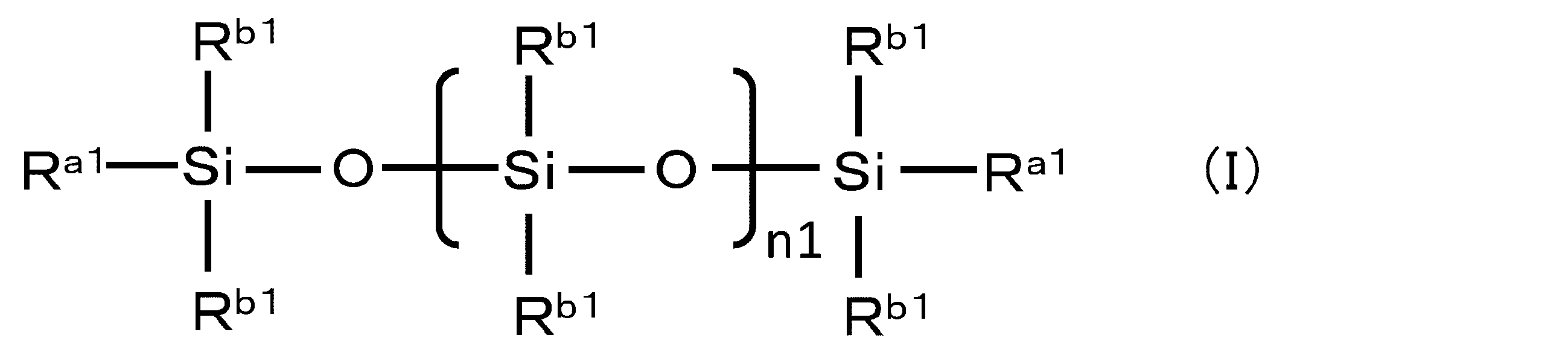
- A1 An alkenyl group-containing polyorganosiloxane (A1) represented by the formula (I) is represented by the formula (I): (Where R a1 is independently a C 2 -C 6 alkenyl group, R b1 is independently a C 1 -C 6 alkyl group or a C 6 -C 20 aryl group, n1 is a number that makes the viscosity of (A1) at 23 ° C. 10 mPa ⁇ s to 1,000,000 mPa ⁇ s). (A1) is a linear polyorganosiloxane containing alkenyl groups at both ends and having alkenyl groups at both ends of the siloxane chain.
- composition contains (A1), it is possible to ensure a stable three-dimensional structure due to a crosslinking reaction during curing, to control the elongation of the cured product, and to ensure good visibility.
- Examples of the C 2 -C 6 alkenyl group include a vinyl group, an allyl group, a 3-butenyl group, and a 5-hexenyl group.
- Examples of the C 1 -C 6 alkyl group include a methyl group, an ethyl group, a propyl group, a butyl group, a pentyl group, and a hexyl group.
- Examples of the C 6 -C 20 aryl group include a phenyl group, a naphthyl group, and an anthracenyl group.
- R a1 is preferably a vinyl group because it is easy to synthesize and does not impair the fluidity of the composition before curing and the heat resistance of the cured product.
- R b1 is preferably a C 1 -C 6 alkyl group, and particularly preferably a methyl group, from the viewpoint that synthesis is easy and the balance of fluidity of the composition and mechanical strength after curing is excellent. Therefore, (A1) is preferably polymethylvinylsiloxane in which both ends are blocked with dimethylvinylsiloxane units and the intermediate unit is composed of dimethylsiloxane units.
- the viscosity of (A1) is 10 mPa ⁇ s to 1,000,000 mPa ⁇ s at 23 ° C., preferably 50 mPa ⁇ s to 1,000,000 mPa ⁇ s, from the viewpoint of ensuring stable liquidity of the composition. More preferably, it is 100 mPa ⁇ s to 500,000 mPa ⁇ s. It is preferable to adjust the weight average molecular weight of (A1), that is, n1 so as to be in these viscosity ranges.
- the viscosity is a value measured under conditions of 60 rpm and 23 ° C. using a rotational viscometer in accordance with JIS K 6249.
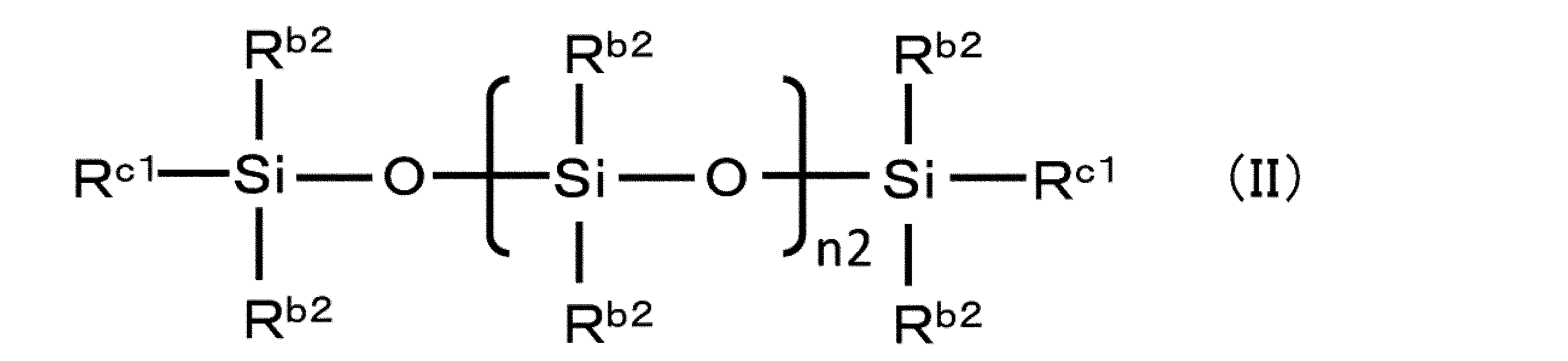
- the polyorganohydrogensiloxane (B1) represented by the formula (II) has the formula (II): (Where R c1 is a hydrogen atom, R b2 is independently a C 1 -C 6 alkyl group or a C 6 -C 20 aryl group, n2 is a polyorganohydrogen siloxane represented by (B1) having a viscosity at 23 ° C. of 0.1 to 300 mPa ⁇ s). (B1) is a linear polyorganosiloxane containing SiH groups at both ends, having hydrogen atoms bonded to silicon atoms at both ends of the siloxane chain.
- (B1) is a component that extends the molecular chain between the crosslinking points and improves the elongation and stress relaxation properties of the cured product.
- R b2 is preferably a C 1 -C 6 alkyl group, and particularly preferably a methyl group, from the viewpoint of easy synthesis and excellent balance of properties such as mechanical strength and fluidity before curing. Therefore, (B1) is preferably polymethylhydrogensiloxane in which both ends are blocked with dimethylhydrogensiloxane units and the intermediate unit is composed of dimethylsiloxane units.
- the viscosity of (B1) is 0.1 to 300 mPa ⁇ s at 23 ° C., preferably 1 to 200 mPa ⁇ s, more preferably 0.1 to 50 mPa ⁇ s, and particularly preferably 1 to 30 mPa ⁇ s. It is preferable to adjust the weight average molecular weight of (B1), that is, n2 so as to be in these viscosity ranges.
- Crosslinkable polyorganohydrogensiloxane (B2) is R b3 2 R c2 SiO 1/2 unit (wherein R b3 is independently a C 1 -C 6 alkyl group or C 6 -C 20 aryl group, R c2 is a hydrogen atom) and a SiO 4/2 unit, and a polyorganohydrogensiloxane having 3 or more hydrogen atoms bonded to a silicon atom in one molecule is there.
- (B2) is a component that contributes to adjusting the hardness by reticulating the cured product.
- (B2) may be branched or cyclic.
- R c2 which is a hydrogen atom bonded to a silicon atom is preferably 3 to 100, more preferably 3 to 50, in one molecule.
- R b3 is, for ease of synthesis, preferably C 1 -C 6 alkyl group, with methyl being particularly preferred.
- (B2) is like [R b3 2 R c2 SiO 1/2 ] 8 [SiO 4/2 ] 4 or [R b3 2 R c2 SiO 1/2 ] 10 [SiO 4/2 ] 5 , It is preferable that 3 to 5 SiO 4/2 units form a cyclic siloxane skeleton, and two R b3 2 R c2 SiO 1/2 units are bonded to each SiO 4/2 unit.
- the viscosity of (B2) is preferably 1 to 100 mPa ⁇ s, more preferably 1 to 50 mPa ⁇ s.
- (B3) is represented by the formula (IV): (Where R c3 is a hydrogen atom, R b5 is independently a C 1 -C 6 alkyl group or a C 6 -C 20 aryl group, n4 is a number that makes the viscosity of (B3) at 23 ° C. 0.1 to 300 mPa ⁇ s).
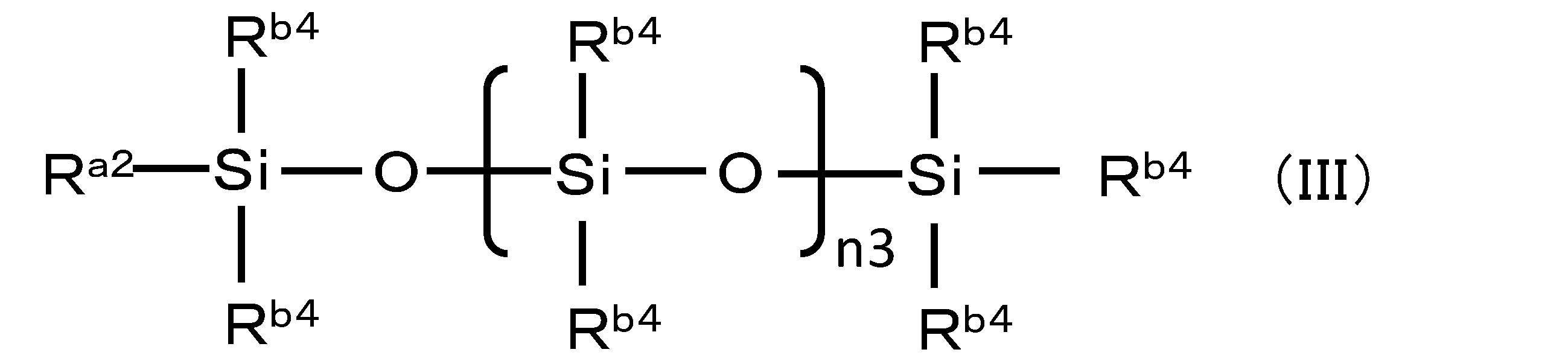
- (A2) is a one-terminal alkenyl group-containing linear polyorganosiloxane having an alkenyl group only at one end of the siloxane chain
- (B3) is hydrogen bonded to silicon only at one end of the siloxane chain. It is a linear polyorganosiloxane having a single-terminal SiH group and having atoms. That is, (A2) and (B3) have a reactive group (that is, an alkenyl group in (A2) or a hydrosilyl group (SiH) in (B3)) only at one end of the siloxane chain.
- the composition contains (A2) and / or (B3), the density of the three-dimensional structure due to the crosslinking reaction can be moderately reduced during curing. Thereby, the stress relaxation property of the hardened
- R a2 includes a preferable one and has the same meaning as R a1 .
- R b4 includes a preferable one and has the same meaning as R b1 . Therefore, as (A2), polymethylvinylsiloxane having one end blocked with a dimethylvinylsiloxane unit, the other end blocked with a trimethylsiloxane unit, and an intermediate unit consisting of a dimethylsiloxane unit is preferable.
- the viscosity of (A2) is 10 mPa ⁇ s to 1,000,000 mPa ⁇ s at 23 ° C., preferably 50 mPa ⁇ s to 1,000,000 mPa ⁇ s, from the viewpoint of ensuring stable liquidity of the composition. More preferably, it is 100 mPa ⁇ s to 500,000 mPa ⁇ s. It is preferable to adjust the weight average molecular weight of (A2), that is, n3 so as to be in these viscosity ranges.
- R b5 is preferably a C 1 -C 6 alkyl group, and is preferably a methyl group from the viewpoint of easy synthesis and excellent balance of properties such as mechanical strength and fluidity before curing. Particularly preferred. Therefore, (B3) is preferably polymethylhydrogensiloxane in which one end is blocked with a dimethylhydrogensiloxane unit, the other end is blocked with a trimethylsiloxane unit, and an intermediate unit is composed of a dimethylsiloxane unit.
- the viscosity of (B3) is 0.1 mPa ⁇ s to 300 mPa ⁇ s at 23 ° C., preferably 1 mPa ⁇ s to 200 mPa ⁇ s, more preferably 1 mPa ⁇ s to 50 mPa ⁇ s, and 1 mPa ⁇ s to 30 mPa ⁇ s. Is particularly preferred. It is preferable to adjust the weight average molecular weight of (B3), that is, n4 so as to be in these viscosity ranges.
- Platinum-based catalyst (C) performs an addition reaction between the alkenyl group of (A1) and (A2) and the hydrosilyl group (SiH) of (B1), (B2) and (B3). It is a catalyst for promoting. From the viewpoint of good catalytic activity, compounds of platinum group metal atoms such as platinum, rhodium and palladium are preferably used.
- a platinum-vinylsiloxane complex is particularly preferred.
- the composition includes one or more additives selected from the group consisting of (D) a diluent, (E) an adhesion-imparting agent, and (F) a platinum-based catalyst inhibitor as long as the effects of the present invention are not impaired. be able to.
- D) The diluent, (E) the adhesion-imparting agent, and (F) the platinum catalyst inhibitor may be used alone or in combination of two or more.
- the viscosity of a composition is adjusted because a composition contains (D) diluent.
- D is a silicone oil that does not contain an alkenyl group involved in the curing reaction, and is preferably a polymethylsiloxane in which both ends are blocked with trimethylsiloxane units and an intermediate unit is composed of dimethylsiloxane units.
- D) preferably has a viscosity at 23 ° C. of 1 to 5,000 mPa ⁇ s, more preferably 5 to 1,000 mPa ⁇ s.
- the composition includes the (E) adhesion-imparting agent, whereby the adhesive force between the composition and the substrate is further improved.
- E As an adhesion-imparting agent, tetramethoxysilane, tetraethoxysilane, tetrapropoxysilane, tetrabutoxysilane, methyltrimethoxysilane, dimethyldimethoxysilane, methyltriethoxysilane, dimethyldiethoxysilane, di, tri, tetra Alkoxysilanes such as 3-glycidoxypropyltrimethoxysilane, 3-glycidoxypropyltriethoxysilane, 3-glycidoxypropyl (methyl) dimethoxysilane, 3-glycidoxypropyl (methyl) diethoxysilane 3-glycidoxypropyl group-containing alkoxysilanes; 2- (3,4-epoxycyclohexyl) ethyltrimethoxy
- organosilicon compound for example, specifically, the following formula: Wherein Q 1 and Q 2 independently of one another represent an alkylene group, preferably a C 1 -C 4 alkylene group, and R 3 represents a C 1 -C 4 alkyl group.
- organosilicon compound As such an organosilicon compound, the following compounds are preferable.
- the cure rate of a composition is adjusted because a composition contains the inhibitor of a platinum-type catalyst (F).
- the platinum-based catalyst inhibitor comprises an acetylenic silane, an olefinic siloxane having a 3-hydroxy-1-propenyl (OH—C (CH 3 ) 2 —CH ⁇ CH—) group, and a vinylorganosiloxane. 1 or more types selected more are mentioned.
- Such platinum catalyst inhibitors are described in JP-A-52-47053.
- the content of (A2) is 0 part by weight or more and 60 parts by weight or less with respect to a total of 100 parts by weight of (A1) and (A2).
- the quick curability at room temperature of the composition is inferior.
- the content of (A2) is preferably 1 to 60 parts by weight, more preferably 5 to 52 parts by weight, still more preferably 5 to 37 parts by weight, based on 100 parts by weight of the total of (A1) and (A2). 17 to 37 parts by weight are particularly preferred.
- (H B1 + H B2 + H B3 ) / (Vi A1 + Vi A2 ) is 0.6 to 2.2.
- (H B1 + H B2 + H B3 ) / (Vi A1 + Vi A2 ) is less than 0.6, the composition cures slowly or does not cure.
- (H B1 + H B2 + H B3 ) / (Vi A1 + Vi A2 ) is more than 2.2, the reliability of the cured product under high temperature and high humidity is poor.
- Preferred ranges of (H B1 + H B2 + H B3 ) / (Vi A1 + Vi A2 ) are 0.6 to 1.4, 0.6 to 1.00, 0.6 to 0.99, 0.6 to 0.99 It may be 0.8 or 0.7 to 0.8. If (H B1 + H B2 + H B3 ) / (Vi A1 + Vi A2 ) is within the above preferred range, it is flexible even when the cured product is heated at a high temperature (for example, when heated at 100 to 180 ° C.). Gender change rate tends to be small. That is, even when the composition is cured and then heated at a higher temperature, there is a tendency to obtain a cured product that can moderately reduce external stress and ensure deformation resistance.
- Such a cured product is more excellent in the reliability of the cooling and heating cycle. Further, if (H B1 + H B2 + H B3 ) / (Vi A1 + Vi A2 ) is 0.8 or less, the cured product of the composition tends to have higher elongation.
- composition preferably satisfies the following.
- “when the composition contains (A2)” means “when the composition contains (A2) and (B3)”, preferably “the composition contains (A2), (B3) Is not included “.
- “when the composition contains (B3)” means “when the composition contains (A2) and (B3)”, preferably “the composition contains (B3), and (A2) contains If not included ".
- (H B1 + H B2 ) / (Vi A1 + Vi A2 ) is preferably 0.6 to 2.2.
- (H B1 + H B2 ) / (Vi A1 + Vi A2 ) is 0.6 or more, the quick curability of the composition is improved.
- (H B1 + H B2 ) / (Vi A1 + Vi A2 ) is 2.2 or less, the reliability of the cured product under high temperature and high humidity is improved.
- (H B1 + H B2 ) / (Vi A1 + Vi A2 ) is more preferably 0.6 to 1.00, still more preferably 0.6 to 0.99, and still more preferably 0.6 to 0.
- composition contains (A2), (A1) and (A2) have a high viscosity (for example, 5,000 mPa ⁇ s to 20,000 mPas) from the viewpoint of easy density control of a three-dimensional structure by a crosslinking reaction during curing. It is preferable to include a combination of (A1) of s) and (A2) of low viscosity (for example, 50 mPa ⁇ s to 1,000 mPa ⁇ s).
- H B1 / (H B1 + H B2 ) is preferably 0.2 to 0.9, more preferably 0.2 to 0.8, and particularly preferably 0.3 to 0.8.
- the composition when the composition contains (A2), the composition has (A2) in the range of 5 to 37 parts by weight with respect to the total of 100 parts by weight of (A1) and (A2), and (H B1 + H B2 ) / (Vi A1 + Vi A2 ) is preferably 0.6 to 0.99, and H B1 / (H B1 + H B2 ) is preferably 0.3 to 0.8.
- (H B1 + H B2 + H B3 ) / Vi A1 in the composition is preferably 0.6 to 2.5.
- (H B1 + H B2 + H B3 ) / Vi A1 is 0.6 or more, the quick curability of the composition is improved.
- (H B1 + H B2 + H B3 ) / Vi A1 is 2.5 or less, foaming of the cured product under high temperature and high humidity can be sufficiently suppressed.
- (H B1 + H B2 + H B3 ) / Vi A1 is more preferably 0.6 to 2.2, further preferably 0.6 to 2.0, and still more preferably 0.6 to 1.4. Still more preferably, it is 0.6 to 0.99, and particularly preferably 0.8 to 0.99.
- Vi A1 is preferably 0.6 to 1.4, more preferably 0.6 to 0.99, even when the cured product is heated at a high temperature, There is a tendency for the rate of change in flexibility to be small.
- H B3 / (H B1 + H B2 + H B3 ) is preferably 0.1 to 0.9, more preferably 0.15 to 0.5. It is particularly preferably 0.2 to 0.4.
- H B3 / (H B1 + H B2 + H B3 ) is 0.1 or more, the density of the three-dimensional structure due to the crosslinking reaction during curing can be lowered moderately, and the stress relaxation property of the cured product of the composition is further improved. When it is 0.9 or less, the quick curability of the composition is improved.
- H B2 / (H B1 + H B2 + H B3 ) is preferably 0.1 to 0.9, more preferably 0.1 to 0.7. And particularly preferably from 0.15 to 0.55.
- H B2 / (H B1 + H B2 + H B3 ) is 0.1 or more, the quick curability of the composition is improved, and when it is 0.9 or less, the flexibility of the cured product after heating at a high temperature is improved. improves.
- the composition preferably includes a combination of (A2) and (B3) because it tends to have excellent stress relaxation properties.
- the composition preferably comprises an alkenyl group-containing polyorganosiloxane consisting only of (A1) and (A2), in which case the composition comprises (A1) and (A2) Except for alkenyl group-containing polyorganosiloxane.
- the composition does not contain (A2), the composition preferably contains an alkenyl group-containing polyorganosiloxane consisting only of (A1). In this case, the composition contains an alkenyl group-containing polyorgano other than (A1). Does not contain siloxane.
- the composition preferably comprises a polyorganohydrogensiloxane consisting only of (B1), (B2) and (B3), in which case the composition comprises (B1), It does not contain any polyorganohydrogen siloxane other than (B2) and (B3).
- the composition does not contain (B3), the composition preferably comprises a polyorganohydrogensiloxane consisting only of (B1) and (B2), in which case the composition comprises (B1) and (B2 No polyorganohydrogensiloxane other than).
- the composition contains (A2) and (B3), the composition contains an alkenyl group-containing polyorganosiloxane composed only of (A1) and (A2), and (B1), (B2) and (B3). It is preferable to contain a polyorganohydrogensiloxane consisting of only. In this case, the composition does not contain an alkenyl group-containing polyorganosiloxane other than (A1) and (A2) and a polyorganohydrogensiloxane other than (B1) and (B2).
- the content of (C) in the composition is preferably 0.1 to 1000 weights in terms of platinum group metal atoms with respect to the total weight of (A1) and (A2), from the viewpoint of securing an appropriate curing rate. ppm, more preferably 0.5 to 200 ppm by weight.
- the content of (D) in the composition is preferably 50 parts by weight or less, more preferably 30 parts by weight or less, with respect to 100 parts by weight in total of (A1) and (A2) in the composition. More preferably, it is 20 parts by weight or less.
- the total content of additives in the composition is a total of 100 weights of (A1), (B1), (B2), and one or more selected from the group consisting of (A2) and (B3) in the composition.
- the amount is preferably 100 parts by weight or less, more preferably 30 parts by weight or less, and still more preferably 20 parts by weight or less.
- the composition comprises (A1), (B1), (B2), one or more selected from the group consisting of (A2) and (B3), (C), and an optional component.
- the composition can be expressed as “a combination of (A1), (A2) and (C)” or “(A1) and (C ) In combination, and includes (A1), (B1), (B2), (A2), and (B3), a first portion that does not include (B1), (B2), and (B3) It is preferably a two-part composition comprising one or more selected from the group and a second part not containing (C). And it is preferable that a 1st part and a 2nd part are mixed and it is set as a uniform composition.
- Optional components can be added as appropriate.
- the composition preferably has a viscosity at 23 ° C. of 100,000 mPa ⁇ s or less, more preferably 50 to 50,000 mPa ⁇ s, from the viewpoint of spreadability at the time of application.
- the viscosity of the first part and the second part is preferably 10 to 100,000 mPa ⁇ s, more preferably 50 to 50,000 mPa ⁇ s, particularly preferably 100 to 20,000 mPa ⁇ s.
- the composition may be a room temperature curable composition that can be cured at room temperature (eg, 5 to 40 ° C.).
- the composition may be a thermosetting resin composition that is cured by heating.
- the heating temperature can be, for example, more than 40 and 80 ° C., and preferably 60 to 70 ° C.
- the heating time can be, for example, 0.5 to 10 hours, preferably 0.5 to 2 hours, more preferably 0.5 minutes to 60 minutes, and more preferably 1 minute to less than 30 minutes. Particularly preferred.
- the composition can be used as a sealant for an image display device comprising the composition.
- a sealant for an image display device can be interposed between the image display portion and the protection portion, and cured by heating to seal the image display portion and the protection portion.
- the composition is preferably used for bonding the base portion having the image display portion of the image display device and the translucent protective portion.
- the composition can be suitably used in an image display device, and is particularly preferable as a resin interposed between a protective portion and an image display portion of a flat panel type image display device. Therefore, the present invention relates to an image display device using a composition, specifically, an image display device in which a base portion having an image display portion of an image display device and a translucent protective portion are bonded using the composition. About. Specifically, it includes a step of applying and heating the image display panel constituting the image display section after applying the composition on the protection panel constituting the transparent protection section formed of optical plastic or the like. The present invention relates to an image display device manufactured by a method for manufacturing an image display device.
- MIX means an amount relative to the sum of “(A)” and “(B)”.
- A1-1 both ends are closed by M V unit, polymethyl vinyl siloxane intermediate units consist of D units (viscosity 12,200mPa ⁇ s at 23 ° C.)
- a2 A mixture of the following (1) to (3). In this mixture, A1-2 is 25% by weight, A2 is 50% by weight, and D1 is 25% by weight.
- A1-2 both ends are closed by M V unit, polymethyl vinyl siloxane intermediate units consist of D units (viscosity 600 mPa ⁇ s at 23 ° C.)
- A2 one end is closed by M V unit, the other end is closed by M unit, polymethyl vinyl siloxane intermediate units consist of D units (viscosity 600 mPa ⁇ s at 23 ° C.)
- D1 Polydimethylsiloxane in which both ends are blocked with M units and the intermediate unit is D units (viscosity at 23 ° C.
- B1 Linear polymethylhydrogensiloxane represented by MH D 20 MH (viscosity at 23 ° C., 20 mPa ⁇ s)
- B2 Crosslinkable polymethylhydrogensiloxane having an average unit formula of [H (CH 3 ) 2 SiO 1/2 ] 8 [SiO 4/2 ] 4 (effective hydrogen content 1%)
- b3 A mixture of the following (4) to (6). In this mixture, B1-2 is 25% by weight, B3 is 50% by weight, and D2 is 25% by weight.
- B1-2 linear polymethylhydrogensiloxane represented by MH D 20 MH (viscosity at 23 ° C., 20 mPa ⁇ s) (5)
- B3 linear polymethylhydrogensiloxane represented by MH D 20 M (viscosity at 23 ° C., 20 mPa ⁇ s) (6)
- D2 linear polydimethylsiloxane represented by MD 20 M (viscosity at 23 ° C., 20 mPa ⁇ s)
- B4 Linear polymethylhydrogensiloxane represented by MD H 17 D 83 M (viscosity at 23 ° C.
- Viscosity Using a rotational viscometer (Bismetron VDA-L) (manufactured by Shibaura System Co., Ltd.), the viscosity (mPa ⁇ s) at 23 ° C. was measured. The others were measured according to JIS K 6249.
- the penetration rate change rate by the heat treatment was obtained by the following mathematical formula (1).
- a large penetration means that the cured product has high flexibility and excellent stress relaxation properties.
- a small penetration rate change rate means that the change rate of the flexibility of the cured product after the heat treatment is small.
- Rate of penetration change (Penetration before heat treatment (1) ⁇ Penetration after heat treatment (2)) ⁇ Penetration before heat treatment (1) (1)
- Haze A sample was prepared in the same manner as “(4) Yellow index”. About the produced sample, based on JISK7105, haze was measured using haze meter NDH5000 (made by Nippon Denshoku Industries Co., Ltd.).
- the bonded body was held for 100 cycles in a 1-cycle ( ⁇ 40 ° C., 30 minutes and 85 ° C., 30 minutes) thermal cycle machine, removed, visually peeled (separation of the substrate), and the presence or absence of resin cracks was visually confirmed. .
- the absence of peeling and resin cracking is excellent in reliability under high temperature and high humidity.
- “2/5” indicates that peeling or resin cracking was confirmed in two samples out of five samples.
- H B2 in Comparative Example 7 is a value of a hydrogen atom bonded to a silicon atom in B4.
- compositions of Examples 1 to 9 contain (A2) and do not contain (B3).
- the compositions of Examples 10 to 16 contain (B3) and do not contain (A2).
- the compositions of Examples 17-18 include both (A2) and (B3).
- composition of the examples is excellent in rapid curability at room temperature, the composition after curing has high elongation, excellent stress relaxation properties, good reliability characteristics under high temperature and high humidity, and Excellent reliability of cooling cycle.
- Example 3 when Example 3 is compared with Examples 4 to 5, (H B1 + H B2 + H B3 ) / (Vi A1 + Vi A2 ) (that is, (H B1 + H B2 ) / (Vi A1 + Vi A2 )) is 0.
- Example 3 Comparing Example 3 and Examples 6 to 7, the weight of (A2) with respect to a total of 100 parts by weight of (A1) and (A2) is almost the same, and (H B1 + H B2 + H B3 ) / ( The cured product of Example 3 in which H B1 / (H B1 + H B2 ) is a particularly preferred range when Vi A1 + Vi A2 ) (ie (H B1 + H B2 ) / (Vi A1 + Vi A2 )) is approximately the same. Improved the adhesion.
- compositions of Examples 6 and 7 (H B1 + H B2 + H B3 ) / (Vi A1 + Vi A2 ) (that is, (H B1 + H B2 ) / (Vi A1 + Vi A2 )) It is surmised that the compositions obtained in Examples 4 and 5 can give a cured product having a further improved adhesion, compared to the compositions that are almost the same.
- Comparative Example 1 since (H B1 + H B2 + H B3 ) / (Vi A1 + Vi A2 ) was less than 0.6, curing at room temperature was slow. In Comparative Example 2, since (H B1 + H B2 + H B3 ) / (Vi A1 + Vi A2 ) is greater than 2.2, bubbles are confirmed in the cured product, and peeling is observed in all test pieces after the thermal cycle test. In addition, the occurrence of resin cracks was observed, and the reliability under high temperature and high humidity was poor. Since Comparative Example 3 did not contain (B1), a cured product having poor stress relaxation properties and low elongation was obtained. Since Comparative Example 4 did not contain (B2), curing at room temperature was slow.
- Comparative Example 5 did not contain both (A2) and (B3), a cured product having a low stress relaxation property and a small elongation was obtained.
- Comparative Example 6 since (A2) was more than 60 parts by weight relative to the total of 100 parts by weight of (A1) and (A2), curing at room temperature was slow.
- Comparative Example 7 instead of (B2), a linear polyorganohydrogen siloxane having a hydrogen atom bonded to a silicon atom as an intermediate unit was used, so that curing at room temperature was slow. In addition, in Comparative Example 7, bubbles were confirmed in the cured product.
- Example 10 When Examples 10 to 15 are compared with Example 16, (H B1 + H B2 + H B3 ) / (Vi A1 + Vi A2 ) (that is, (H B1 + H B2 + H B3 ) / Vi A1 ) is 0.6 to 1 .4, the stress relaxation property is further improved, peeling and resin cracking after the thermal cycle test are not generated, and reliability characteristics after the thermal cycle test are further improved. In Example 7, no peeling or resin cracking occurred in the four test pieces after the thermal cycle test. In Example 16, peeling occurred only slightly at the corner of the test piece in one test piece after the thermal cycle test, but many bubbles and cracks were not observed in the test piece.
- Comparative Example 8 since (H B1 + H B2 + H B3 ) / (Vi A1 + Vi A2 ) was less than 0.6, curing at room temperature was slow. Comparative Example 9, since (H B1 + H B2 + H B3) / (Vi A1 + Vi A2) is 2.2 greater, in the cured product after treatment at a high temperature and high humidity, bubbles are confirmed, thermal cycling test In all subsequent test pieces, peeling and resin cracking were observed, and the reliability under high temperature and high humidity was poor. Since Comparative Example 10 does not contain both (A2) and (B3), the stress relaxation characteristics are inferior, and in all the test pieces after the thermal cycle test, peeling and resin cracking were observed, and the high temperature and high temperature were high.
- Comparative Example 11 instead of (B2), a linear polyorganohydrogen siloxane having a hydrogen atom bonded to a silicon atom as an intermediate unit was used, so that curing at room temperature was slow. In addition, Comparative Example 11 is inferior in stress relaxation properties, bubbles are confirmed in the cured product after the treatment at high temperature and high humidity, and occurrence of peeling and resin cracking is confirmed in two of the test pieces after the thermal cycle test. It was inferior in reliability under high temperature and high humidity.
- Example 17 with Example 3 and Example 18 with Example 8 Comparing Example 17 with Example 3 and Example 18 with Example 8, the weight of (A2) with respect to a total of 100 parts by weight of (A1) and (A2) is almost the same, and ( When H B1 + H B2 + H B3 ) / (Vi A1 + Vi A2 ) are substantially the same, Examples 17 and 18 including (B3) have a smaller penetration change rate, and even after heat treatment It was excellent in stress relaxation.
- the curable polyorganosiloxane composition is useful in bonding a base having an image display part of an image display device such as a cathode ray tube, liquid crystal, plasma, organic EL, and the light-transmitting protective part.
- an image display device such as a cathode ray tube, liquid crystal, plasma, organic EL, and the light-transmitting protective part.
Landscapes
- Chemical & Material Sciences (AREA)
- Physics & Mathematics (AREA)
- Organic Chemistry (AREA)
- Chemical Kinetics & Catalysis (AREA)
- Medicinal Chemistry (AREA)
- Polymers & Plastics (AREA)
- Health & Medical Sciences (AREA)
- General Physics & Mathematics (AREA)
- Engineering & Computer Science (AREA)
- Theoretical Computer Science (AREA)
- Nonlinear Science (AREA)
- Mathematical Physics (AREA)
- Optics & Photonics (AREA)
- Crystallography & Structural Chemistry (AREA)
- Compositions Of Macromolecular Compounds (AREA)
- Devices For Indicating Variable Information By Combining Individual Elements (AREA)
Abstract
本発明は、室温で速硬化性がある付加反応型ポリオルガノシロキサン組成物であって、組成物の硬化物が、高い伸びを有し、応力緩和性に優れ、高温高湿下での信頼特性が良好であり、かつ、冷熱サイクルの信頼性に優れ、組成物が、(A1)両末端アルケニル基含有直鎖状ポリシロキサンと;(B1)両末端SiH基含有直鎖状ポリシロキサンと;(B2)架橋性ポリオルガノハイドロジェンシロキサンと;(A2)片末端アルケニル基含有直鎖状ポリシロキサン及び(B3)片末端SiH基含有直鎖状ポリシロキサンからなる群より選択される1以上と;(C)白金系触媒とを含み、A1及びA2の合計100重量部に対して、A2は0重量部以上60重量部以下であり、(HB1+HB2+HB3)/(ViA1+ViA2)(式中、ViA1、ViA2、HB1、HB2及びHB3は、明細書に記載のとおりである)が0.6~2.2である、硬化性ポリオルガノシロキサン組成物に関する。
Description
本発明は、硬化性ポリオルガノシロキサン組成物に関し、特に画像表示装置の画像表示部を有する基部と透光性の保護部との接着に使用する硬化性ポリオルガノシロキサン組成物に関する。
ブラウン管、液晶、プラズマ、有機EL等の画像表示装置は、一般に、偏光分離素子として、入射光束を回折及び分光し、その回折、分光させた各波長帯域の光を偏光変調素子上に形成されたR(赤色),G(緑色),B(青色)各色画素に対応した位置へ選択的に集光させる偏光分離型回折光学素子(ホログラフィックカラーフィルタ)を用いて構成されている。中でも、パネル型の画像表示装置は、通常、少なくとも一方がガラス等の光透過性をもつ一対の基板の間にアクティブ素子を構成する半導体層や蛍光体層、あるいは発光層からなる多数の画素をマトリクス状に配置した表示領域(画像表示部)を有し、この表示領域(画像表示部)とガラスやアクリル樹脂のような光学用プラスチックで形成される保護部との間隙を接着剤で気密に封止して構成されている。
そこで使用される接着剤としては、画像表示装置の保護部の外枠部分に遮光性のペイントが施されているといった構造上の理由から、アクリル樹脂を用いた紫外線硬化型樹脂組成物でなく、熱硬化型樹脂組成物が一般に使用されている。
特許文献1には、エポキシ樹脂、ポリフェニレンサルファイド樹脂等の封止樹脂により封止されてなる、トランジスタ、ダイオード、コンデンサ、コイル、LSI、IC等の電子部品について封止樹脂と電子部品のリードとの界面にしばしば生じた隙間や、電子部品自体が構造的に有する隙間に、液状の特定の熱硬化型シリコーン樹脂組成物を含浸して熱硬化させ封止状態を回復させる技術が開示されている。
特許文献1に開示されている熱硬化型シリコーン樹脂組成物は、一分子中に3個以上のケイ素原子に結合する水素原子が分子鎖側鎖に存在する鎖状ポリオルガノハイドロジェンシロキサンが使用されている。しかし、特許文献1に開示されている熱硬化型シリコーン樹脂組成物は、反応性が低いため、低温での硬化が遅かったり、所定時間内に硬化しないという問題があった。
また、シリコーン樹脂組成物を用いた接着剤において、基材同士を貼り合わせた後に、高温高湿下で気泡が発生し、視認性が低下しやすい問題もあった。さらに、組成物の硬化物が柔軟性に劣る場合、画像表示装置に用いられる部材である、PMMA(ポリメチルメタクリレート)パネル及びLCD(液晶ディスプレイ)パネルに貼り合せた組成物の硬化物が、PMMAの反りの応力を緩和できない。そのため、組成物の硬化物の割れ、及び組成物の硬化物のパネルからの剥離が発生するという問題があった。
本発明は、室温で速硬化性がある付加反応型ポリオルガノシロキサン組成物であって、組成物の硬化物が、高い伸びを有し、応力緩和性に優れ、高温高湿下での信頼特性が良好であり、かつ、冷熱サイクルの信頼性に優れる、付加反応型ポリオルガノシロキサン組成物を提供することを目的とする。
本発明は、以下の構成を有する。
[1](A1)式(I):
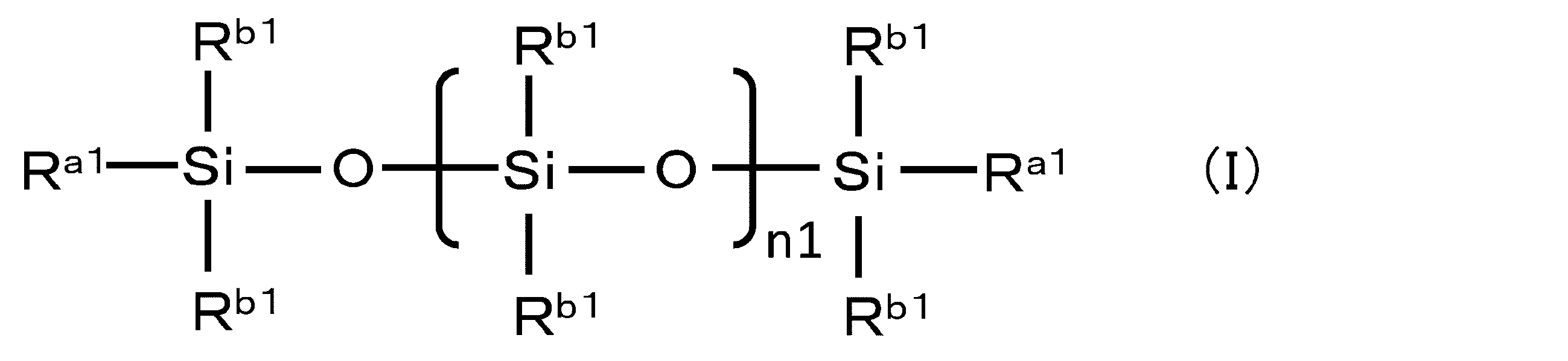
(式中、
Ra1は、独立して、C2-C6アルケニル基であり、
Rb1は、独立して、C1-C6アルキル基又はC6-C20アリール基であり、
n1は、(A1)の23℃における粘度を10mPa・s~1,000,000mPa・sにする数である)で示されるアルケニル基含有ポリオルガノシロキサンと;
(B1)式(II):
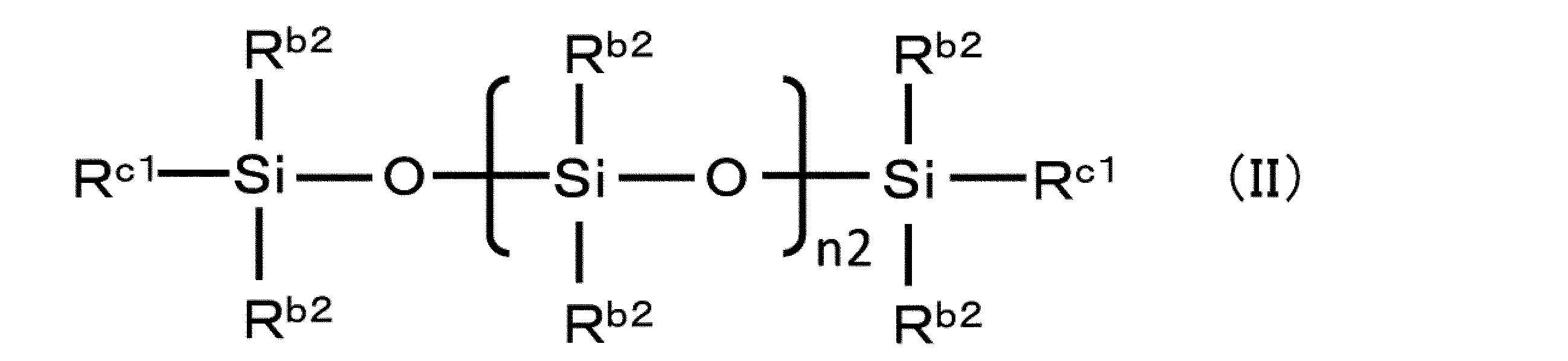
(式中、
Rc1は、水素原子であり、
Rb2は、独立して、C1-C6アルキル基又はC6-C20アリール基であり、
n2は、(B1)の23℃における粘度を0.1~300mPa・sとする数である)で示されるポリオルガノハイロドジェンシロキサンと;
(B2)Rb3 2Rc2SiO1/2単位(式中、Rb3は、独立して、C1-C6アルキル基又はC6-C20アリール基であり、Rc2は、水素原子である)及びSiO4/2単位からなり、一分子中に、ケイ素原子に結合した水素原子を3個以上有する、ポリオルガノハイドロジェンシロキサンと;
(A2)式(III):
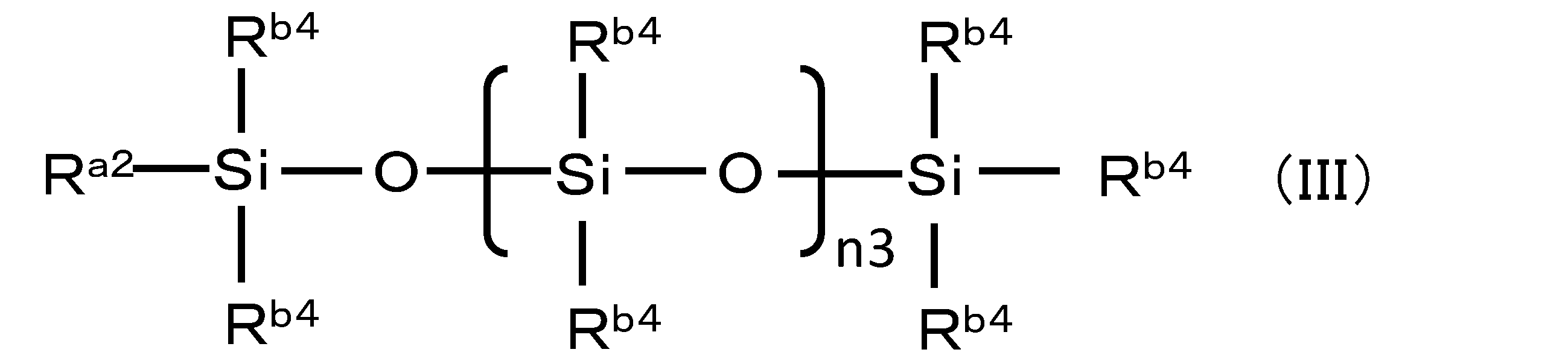
(式中、
Ra2は、独立して、C2-C6アルケニル基であり、
Rb4は、独立して、C1-C6アルキル基又はC6-C20アリール基であり、
n3は、(A2)の23℃における粘度を10mPa・s~1,000,000mPa・sにする数である)で示されるアルケニル基含有ポリオルガノシロキサン、及び
(B3)式(IV):

(式中、
Rc3は、水素原子であり、
Rb5は、独立して、C1-C6アルキル基又はC6-C20アリール基であり、
n4は、(B3)の23℃における粘度を0.1mPa・s~300mPa・sとする数である)で示される直鎖状ポリオルガノハイロドジェンシロキサン
からなる群より選択される1以上と;
(C)白金系触媒と;
を含み、
(A1)及び(A2)の合計100重量部に対して、(A2)は0重量部以上60重量部以下であり、(HB1+HB2+HB3)/(ViA1+ViA2)が0.6~2.2であり、
ここで、ViA1は、(A1)のアルケニル基のモル数であり、ViA2は、(A2)のアルケニル基のモル数であり、HB1は、(B1)のケイ素原子に結合した水素原子のモル数であり、HB2は、(B2)のケイ素原子に結合した水素原子のモル数であり、HB3は、(B3)の水素原子のモル数である、硬化性ポリオルガノシロキサン組成物。
[2](B2)が、3~5個のSiO4/2単位が環状シロキサン骨格を形成し、各SiO4/2単位に2個のRb3 2Rc2SiO1/2単位が結合している、環状ポリオルガノハイドロジェンシロキサンである、[1]の硬化性ポリオルガノシロキサン組成物。
[3]組成物が(A2)を含み、(HB1+HB2)/(ViA1+ViA2)が0.6~2.2である、[1]又は[2]の硬化性ポリオルガノシロキサン組成物。
[4](A1)及び(A2)の合計100重量部に対して、(A2)が5~37重量部であり、(HB1+HB2)/(ViA1+ViA2)が0.6~0.99であり、かつ、HB1/(HB1+HB2)が、0.3~0.8である、[3]の硬化性ポリオルガノシロキサン組成物。
[5]組成物が(B3)を含み、(HB1+HB2+HB3)/ViA1が0.6~2.5である、[1]~[4]のいずれかの硬化性ポリオルガノシロキサン組成物。
[6](HB1+HB2+HB3)/ViA1が0.6~0.99である、[5]の硬化性ポリオルガノシロキサン組成物。
[7]画像表示装置の画像表示部を有する基部と透光性の保護部との接着用である、[1]~[6]のいずれかの硬化性ポリオルガノシロキサン組成物。
[8][1]~[7]のいずれかの硬化性ポリオルガノシロキサン組成物を用いて、画像表示装置の画像表示部を有する基部と透光性の保護部とを接着した画像表示装置。
[1](A1)式(I):
(式中、
Ra1は、独立して、C2-C6アルケニル基であり、
Rb1は、独立して、C1-C6アルキル基又はC6-C20アリール基であり、
n1は、(A1)の23℃における粘度を10mPa・s~1,000,000mPa・sにする数である)で示されるアルケニル基含有ポリオルガノシロキサンと;
(B1)式(II):
(式中、
Rc1は、水素原子であり、
Rb2は、独立して、C1-C6アルキル基又はC6-C20アリール基であり、
n2は、(B1)の23℃における粘度を0.1~300mPa・sとする数である)で示されるポリオルガノハイロドジェンシロキサンと;
(B2)Rb3 2Rc2SiO1/2単位(式中、Rb3は、独立して、C1-C6アルキル基又はC6-C20アリール基であり、Rc2は、水素原子である)及びSiO4/2単位からなり、一分子中に、ケイ素原子に結合した水素原子を3個以上有する、ポリオルガノハイドロジェンシロキサンと;
(A2)式(III):
(式中、
Ra2は、独立して、C2-C6アルケニル基であり、
Rb4は、独立して、C1-C6アルキル基又はC6-C20アリール基であり、
n3は、(A2)の23℃における粘度を10mPa・s~1,000,000mPa・sにする数である)で示されるアルケニル基含有ポリオルガノシロキサン、及び
(B3)式(IV):
(式中、
Rc3は、水素原子であり、
Rb5は、独立して、C1-C6アルキル基又はC6-C20アリール基であり、
n4は、(B3)の23℃における粘度を0.1mPa・s~300mPa・sとする数である)で示される直鎖状ポリオルガノハイロドジェンシロキサン
からなる群より選択される1以上と;
(C)白金系触媒と;
を含み、
(A1)及び(A2)の合計100重量部に対して、(A2)は0重量部以上60重量部以下であり、(HB1+HB2+HB3)/(ViA1+ViA2)が0.6~2.2であり、
ここで、ViA1は、(A1)のアルケニル基のモル数であり、ViA2は、(A2)のアルケニル基のモル数であり、HB1は、(B1)のケイ素原子に結合した水素原子のモル数であり、HB2は、(B2)のケイ素原子に結合した水素原子のモル数であり、HB3は、(B3)の水素原子のモル数である、硬化性ポリオルガノシロキサン組成物。
[2](B2)が、3~5個のSiO4/2単位が環状シロキサン骨格を形成し、各SiO4/2単位に2個のRb3 2Rc2SiO1/2単位が結合している、環状ポリオルガノハイドロジェンシロキサンである、[1]の硬化性ポリオルガノシロキサン組成物。
[3]組成物が(A2)を含み、(HB1+HB2)/(ViA1+ViA2)が0.6~2.2である、[1]又は[2]の硬化性ポリオルガノシロキサン組成物。
[4](A1)及び(A2)の合計100重量部に対して、(A2)が5~37重量部であり、(HB1+HB2)/(ViA1+ViA2)が0.6~0.99であり、かつ、HB1/(HB1+HB2)が、0.3~0.8である、[3]の硬化性ポリオルガノシロキサン組成物。
[5]組成物が(B3)を含み、(HB1+HB2+HB3)/ViA1が0.6~2.5である、[1]~[4]のいずれかの硬化性ポリオルガノシロキサン組成物。
[6](HB1+HB2+HB3)/ViA1が0.6~0.99である、[5]の硬化性ポリオルガノシロキサン組成物。
[7]画像表示装置の画像表示部を有する基部と透光性の保護部との接着用である、[1]~[6]のいずれかの硬化性ポリオルガノシロキサン組成物。
[8][1]~[7]のいずれかの硬化性ポリオルガノシロキサン組成物を用いて、画像表示装置の画像表示部を有する基部と透光性の保護部とを接着した画像表示装置。
本発明によれば、室温で速硬化性がある付加反応型ポリオルガノシロキサン組成物であって、組成物の硬化物が、高い伸びを有し、応力緩和性に優れ、高温高湿下での信頼特性が良好であり、かつ、冷熱サイクルの信頼性に優れる、付加反応型ポリオルガノシロキサン組成物が提供される。
[硬化性ポリオルガノシロキサン組成物]
硬化性ポリオルガノシロキサン組成物(以下、単に「組成物」ともいう。)は、(A1)と;(B1)と;(B2)と;(A2)及び(B3)からなる群より選択される1以上と;(C)白金系触媒と;を含み、(A1)及び(A2)の合計100重量部に対して、(A2)は0重量部以上60重量部以下であり、(HB1+HB2+HB3)/(ViA1+ViA2)が0.6~2.2であり、ViA1は、(A1)のアルケニル基のモル数であり、ViA2は、(A2)のアルケニル基のモル数であり、HB1は、(B1)のケイ素原子に結合した水素原子のモル数であり、HB2は、(B2)のケイ素原子に結合した水素原子のモル数であり、HB3は、(B3)のケイ素原子に結合した水素原子のモル数である。
硬化性ポリオルガノシロキサン組成物(以下、単に「組成物」ともいう。)は、(A1)と;(B1)と;(B2)と;(A2)及び(B3)からなる群より選択される1以上と;(C)白金系触媒と;を含み、(A1)及び(A2)の合計100重量部に対して、(A2)は0重量部以上60重量部以下であり、(HB1+HB2+HB3)/(ViA1+ViA2)が0.6~2.2であり、ViA1は、(A1)のアルケニル基のモル数であり、ViA2は、(A2)のアルケニル基のモル数であり、HB1は、(B1)のケイ素原子に結合した水素原子のモル数であり、HB2は、(B2)のケイ素原子に結合した水素原子のモル数であり、HB3は、(B3)のケイ素原子に結合した水素原子のモル数である。
組成物は、「(A2)と(B3)との組み合わせ」、「(A2)」又は「(B3)」を含む。なお、組成物が(A2)を含み、(B3)を含まない場合は、「(HB1+HB2+HB3)/(ViA1+ViA2)」は、「(HB1+HB2)/(ViA1+ViA2)」となる。また、組成物が(B3)を含み、(A2)を含まない場合は、「(HB1+HB2+HB3)/(ViA1+ViA2)」は、「(HB1+HB2+HB3)/ViA1」となり、そして、(A1)及び(A2)の合計100重量部に対する(A2)の含有量は、0重量部となる。
なお、(B2)を、「架橋性ポリオルガノハイドロジェンシロキサン」ともいう。
なお、(B2)を、「架橋性ポリオルガノハイドロジェンシロキサン」ともいう。
(1)(A1)式(I)で示されるアルケニル基含有ポリオルガノシロキサン
(A1)は、式(I):
(式中、
Ra1は、独立して、C2-C6アルケニル基であり、
Rb1は、独立して、C1-C6アルキル基又はC6-C20アリール基であり、
n1は、(A1)の23℃における粘度を10mPa・s~1,000,000mPa・sにする数である)で示される。(A1)は、シロキサン鎖の両方の末端にアルケニル基を有する、両末端アルケニル基含有直鎖状ポリオルガノシロキサンである。
(A1)は、式(I):
(式中、
Ra1は、独立して、C2-C6アルケニル基であり、
Rb1は、独立して、C1-C6アルキル基又はC6-C20アリール基であり、
n1は、(A1)の23℃における粘度を10mPa・s~1,000,000mPa・sにする数である)で示される。(A1)は、シロキサン鎖の両方の末端にアルケニル基を有する、両末端アルケニル基含有直鎖状ポリオルガノシロキサンである。
組成物が(A1)を含むことで、硬化時に架橋反応による安定した3次元構造を確保し、硬化物の伸びを制御し、良好な視認性を確保することができる。
C2-C6アルケニル基は、例えば、ビニル基、アリル基、3-ブテニル基、及び5-ヘキセニル基等が挙げられる。C1-C6アルキル基は、例えば、メチル基、エチル基、プロピル基、ブチル基、ペンチル基、ヘキシル基等が挙げられる。C6-C20アリール基は、例えば、フェニル基、ナフチル基、及びアントラセニル基等が挙げられる。
Ra1は、合成が容易で、また硬化前の組成物の流動性や、硬化物の耐熱性を損ねないという点から、ビニル基が好ましい。Rb1は、合成が容易で、組成物の流動性や硬化後の機械的強度等のバランスが優れているという点から、C1-C6アルキル基が好ましく、メチル基が特に好ましい。よって、(A1)は、両末端がジメチルビニルシロキサン単位で閉塞され、中間単位がジメチルシロキサン単位からなるポリメチルビニルシロキサンが好ましい。
(A1)の粘度は、組成物の安定した液状性を確保する観点から、23℃において10mPa・s~1,000,000mPa・sであり、好ましくは50mPa・s~1,000,000mPa・sであり、より好ましくは100mPa・s~500,000mPa・sである。これらの粘度範囲になるように、(A1)の重量平均分子量、即ち、n1を調整することが好ましい。
本明細書において、粘度は、JIS K 6249に準拠して、回転粘度計を用いて、60rpm、23℃の条件で測定した値である。
(2)(B1)式(II)で示されるポリオルガノハイドロジェンシロキサン
(B1)は、式(II):

(式中、
Rc1は、水素原子であり、
Rb2は、独立して、C1-C6アルキル基又はC6-C20アリール基であり、
n2は、(B1)の23℃における粘度を0.1~300mPa・sとする数である)で示されるポリオルガノハイロドジェンシロキサン)で示される。(B1)は、シロキサン鎖の両方の末端に、ケイ素原子に結合した水素原子を有する、両末端SiH基含有直鎖状ポリオルガノシロキサンである。
(B1)は、式(II):
(式中、
Rc1は、水素原子であり、
Rb2は、独立して、C1-C6アルキル基又はC6-C20アリール基であり、
n2は、(B1)の23℃における粘度を0.1~300mPa・sとする数である)で示されるポリオルガノハイロドジェンシロキサン)で示される。(B1)は、シロキサン鎖の両方の末端に、ケイ素原子に結合した水素原子を有する、両末端SiH基含有直鎖状ポリオルガノシロキサンである。
(B1)は、架橋点間の分子鎖を延長させ、組成物の硬化物の伸び及び応力緩和性を向上させる成分である。
Rb2は、合成が容易で、機械的強度及び硬化前の流動性などの特性のバランスが優れているという点から、C1-C6アルキル基が好ましく、メチル基が特に好ましい。よって、(B1)は、両末端がジメチルハイドロジェンシロキサン単位で閉塞され、中間単位がジメチルシロキサン単位からなるポリメチルハイドロジェンシロキサンが好ましい。
(B1)の粘度は、23℃において0.1~300mPa・sであり、1~200mPa・sが好ましく、0.1~50mPa・sがより好ましい、1~30mPa・sが特に好ましい。これらの粘度範囲になるように、(B1)の重量平均分子量、即ち、n2を調整することが好ましい。
(3)(B2)架橋性ポリオルガノハイドロジェンシロキサン
(B2)は、Rb3 2Rc2SiO1/2単位(式中、Rb3は、独立して、C1-C6アルキル基又はC6-C20アリール基であり、Rc2は、水素原子である)及びSiO4/2単位からなり、一分子中に、ケイ素原子に結合した水素原子を3個以上有する、ポリオルガノハイドロジェンシロキサンである。
(B2)は、Rb3 2Rc2SiO1/2単位(式中、Rb3は、独立して、C1-C6アルキル基又はC6-C20アリール基であり、Rc2は、水素原子である)及びSiO4/2単位からなり、一分子中に、ケイ素原子に結合した水素原子を3個以上有する、ポリオルガノハイドロジェンシロキサンである。
(B2)は、硬化物を網状化して、硬度を調整するのに寄与する成分である。(B2)は、分岐状であっても環状であってもよい。ケイ素原子に結合した水素原子であるRc2は、一分子中、3~100個であることが好ましく、より好ましくは、3~50個である。Rb3は、合成の容易さ等の点から、C1-C6アルキル基が好ましく、メチルが特に好ましい。よって、(B2)は、[Rb3
2Rc2SiO1/2]8[SiO4/2]4又は[Rb3
2Rc2SiO1/2]10[SiO4/2]5のように、3~5個のSiO4/2単位が環状シロキサン骨格を形成し、各SiO4/2単位に2個のRb3
2Rc2SiO1/2単位が結合しているものが好ましい。
(B2)の粘度は、1~100mPa・sが好ましく、1~50mPa・sがより好ましい。
(4)(A2)式(III)で示されるアルケニル基含有ポリオルガノシロキサン、及び(B3)式(IV)で示される直鎖状ポリオルガノハイドロジェンシロキサンからなる群より選択される1以上
(A2)は、式(III):
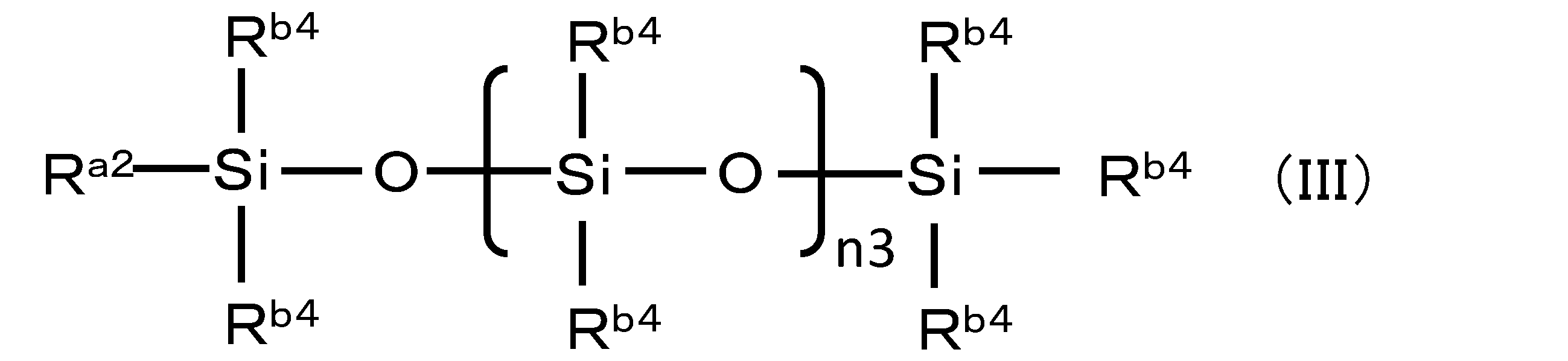
(式中、
Ra2は、独立して、C2-C6アルケニル基であり、
Rb4は、独立して、C1-C6アルキル基又はC6-C20アリール基であり、
n3は、(A2)の23℃における粘度を10mPa・s~1,000,000mPa・sにする数である)で示され、(B3)は、式(IV):

(式中、
Rc3は、水素原子であり、
Rb5は、独立して、C1-C6アルキル基又はC6-C20アリール基であり、
n4は、(B3)の23℃における粘度を0.1~300mPa・sとする数である)で示される。
(A2)は、式(III):
(式中、
Ra2は、独立して、C2-C6アルケニル基であり、
Rb4は、独立して、C1-C6アルキル基又はC6-C20アリール基であり、
n3は、(A2)の23℃における粘度を10mPa・s~1,000,000mPa・sにする数である)で示され、(B3)は、式(IV):
(式中、
Rc3は、水素原子であり、
Rb5は、独立して、C1-C6アルキル基又はC6-C20アリール基であり、
n4は、(B3)の23℃における粘度を0.1~300mPa・sとする数である)で示される。
(A2)は、シロキサン鎖の一方の末端にのみアルケニル基を有する、片末端アルケニル基含有直鎖状ポリオルガノシロキサンであり、(B3)は、シロキサン鎖の一方の末端にのみケイ素に結合する水素原子を有する、片末端SiH基含有直鎖状ポリオルガノシロキサンである。即ち、(A2)及び(B3)は、シロキサン鎖の一方の末端にのみ反応性基(即ち、(A2)におけるアルケニル基、又は、(B3)におけるヒドロシリル基(SiH))を有する。組成物が(A2)及び/又は(B3)を含むことで、硬化時に架橋反応による3次元構造の密度を程よく低下させることができる。これにより、組成物の硬化物の応力緩和性を向上させることができる。
式(III)において、Ra2は、好ましいものを含み、Ra1と同義である。Rb4は、好ましいものを含み、Rb1と同義である。よって、(A2)としては、一方の末端がジメチルビニルシロキサン単位で閉塞され、もう一方の末端がトリメチルシロキサン単位で閉塞され、中間単位がジメチルシロキサン単位からなるポリメチルビニルシロキサンが好ましい。
(A2)の粘度は、組成物の安定した液状性を確保する観点から、23℃において10mPa・s~1,000,000mPa・sであり、好ましくは50mPa・s~1,000,000mPa・sであり、より好ましくは100mPa・s~500,000mPa・sである。これらの粘度範囲になるように、(A2)の重量平均分子量、即ち、n3を調整することが好ましい。
式(IV)において、Rb5は、合成が容易で、機械的強度および硬化前の流動性などの特性のバランスが優れているという点から、C1-C6アルキル基が好ましく、メチル基が特に好ましい。よって、(B3)は、一方の末端がジメチルハイドロジェンシロキサン単位で閉塞され、もう一方の末端がトリメチルシロキサン単位で閉塞され、中間単位がジメチルシロキサン単位からなるポリメチルハイドロジェンシロキサンが好ましい。
(B3)の粘度は、23℃において0.1mPa・s~300mPa・sであり、1mPa・s~200mPa・sが好ましく、1mPa・s~50mPa・sがより好ましく、1mPa・s~30mPa・sが特に好ましい。これらの粘度範囲になるように、(B3)の重量平均分子量、即ち、n4を調整することが好ましい。
(5)(C)白金系触媒
(C)は、(A1)及び(A2)のアルケニル基と、(B1)、(B2)及び(B3)のヒドロシリル基(SiH)との間の付加反応を促進するための触媒である。触媒活性が良好な観点から、白金、ロジウム、パラジウムのような白金族金属原子の化合物が好適に用いられ、塩化白金酸、塩化白金酸とアルコールの反応生成物、白金-オレフィン錯体、白金-ビニルシロキサン錯体、白金-ケトン錯体、白金-ホスフィン錯体のような白金化合物、ロジウム-ホスフィン錯体、ロジウム-スルフィド錯体のようなロジウム化合物、パラジウム-ホスフィン錯体のようなパラジウム化合物が好ましく、白金化合物がより好ましく、白金-ビニルシロキサン錯体が特に好ましい。
(C)は、(A1)及び(A2)のアルケニル基と、(B1)、(B2)及び(B3)のヒドロシリル基(SiH)との間の付加反応を促進するための触媒である。触媒活性が良好な観点から、白金、ロジウム、パラジウムのような白金族金属原子の化合物が好適に用いられ、塩化白金酸、塩化白金酸とアルコールの反応生成物、白金-オレフィン錯体、白金-ビニルシロキサン錯体、白金-ケトン錯体、白金-ホスフィン錯体のような白金化合物、ロジウム-ホスフィン錯体、ロジウム-スルフィド錯体のようなロジウム化合物、パラジウム-ホスフィン錯体のようなパラジウム化合物が好ましく、白金化合物がより好ましく、白金-ビニルシロキサン錯体が特に好ましい。
(添加剤)
組成物は、本発明の効果を損なわない範囲で、(D)希釈剤、(E)接着付与剤及び(F)白金系触媒の抑制剤からなる群より選択される1以上の添加剤を含むことができる。(D)希釈剤、(E)接着付与剤及び(F)白金触媒の抑制剤は、それぞれ単独でも、2種以上の組合せであってもよい。
組成物は、本発明の効果を損なわない範囲で、(D)希釈剤、(E)接着付与剤及び(F)白金系触媒の抑制剤からなる群より選択される1以上の添加剤を含むことができる。(D)希釈剤、(E)接着付与剤及び(F)白金触媒の抑制剤は、それぞれ単独でも、2種以上の組合せであってもよい。
組成物が(D)希釈剤を含むことで、組成物の粘度が調整される。(D)は、硬化反応に関与するアルケニル基を含有しないシリコーンオイルであり、両末端がトリメチルシロキサン単位で閉塞され、中間単位がジメチルシロキサン単位からなるポリメチルシロキサンが好ましい。(D)は、23℃における粘度が、1~5,000mPa・sであるのが好ましく、5~1,000mPa・sであるのがより好ましい。
組成物が(E)接着付与剤を含むことで、組成物と基材との接着力がより向上する。(E)接着付与剤として、テトラメトキシシラン、テトラエトキシシラン、テトラプロポキシシラン、テトラブトキシシラン、メチルトリメトキシシラン、ジメチルジメトキシシラン、メチルトリエトキシシラン、ジメチルジエトキシシランのようなジ、トリ、テトラアルコキシシラン類;3-グリシドキシプロピルトリメトキシシラン、3-グリシドキシプロピルトリエトキシシラン、3-グリシドキシプロピル(メチル)ジメトキシシラン、3-グリシドキシプロピル(メチル)ジエトキシシランのような3-グリシドキシプロピル基含有アルコキシシラン類;2-(3,4-エポキシシクロヘキシル)エチルトリメトキシシラン、2-(3,4-エポキシシクロヘキシル)エチルトリエトキシシラン、2-(3,4-エポキシシクロヘキシル)エチル(メチル)ジメトキシシランのような2-(3,4-エポキシシクロヘキシル)エチル基含有アルコキシシラン類;ビニルトリメトキシシラン、ビニルトリエトキシシラン、ビニルトリス(2-メトキシエトキシ)シラン、メチルビニルジメトキシシラン、アリルトリメトキシシラン、アリルトリエトキシシラン、メチルアリルジメトキシシランのようなアルケニルアルコキシシラン類;3-アクリロキシプロピルトリメトキシシラン、3-アクリロキシプロピルトリエトキシシラン、3-アクリロキシプロピル(メチル)ジメトキシシラン、3-メタクリロキシプロピルトリメトキシシラン、3-メタクリロキシプロピルトリエトキシシラン、3-メタクリロキシプロピル(メチル)ジメトキシシランのような(メタ)アクリロキシプロピルアルコキシシラン類;1,1,3,5,7-ペンタメチルシクロテトラシロキサンと3-メタクリロキシプロピルトリメトキシシランとの反応生成物などの有機ケイ素化合物が挙げられる。
有機ケイ素化合物として、例えば、具体的には、下記式:

(式中、Q1及びQ2は、互いに独立して、アルキレン基、好ましくはC1-C4アルキレン基を表し、R3は、C1-C4アルキル基を表す)で示される側鎖を有する有機ケイ素化合物が挙げられる。
(式中、Q1及びQ2は、互いに独立して、アルキレン基、好ましくはC1-C4アルキレン基を表し、R3は、C1-C4アルキル基を表す)で示される側鎖を有する有機ケイ素化合物が挙げられる。
このような有機ケイ素化合物としては、下記の化合物が好ましい。
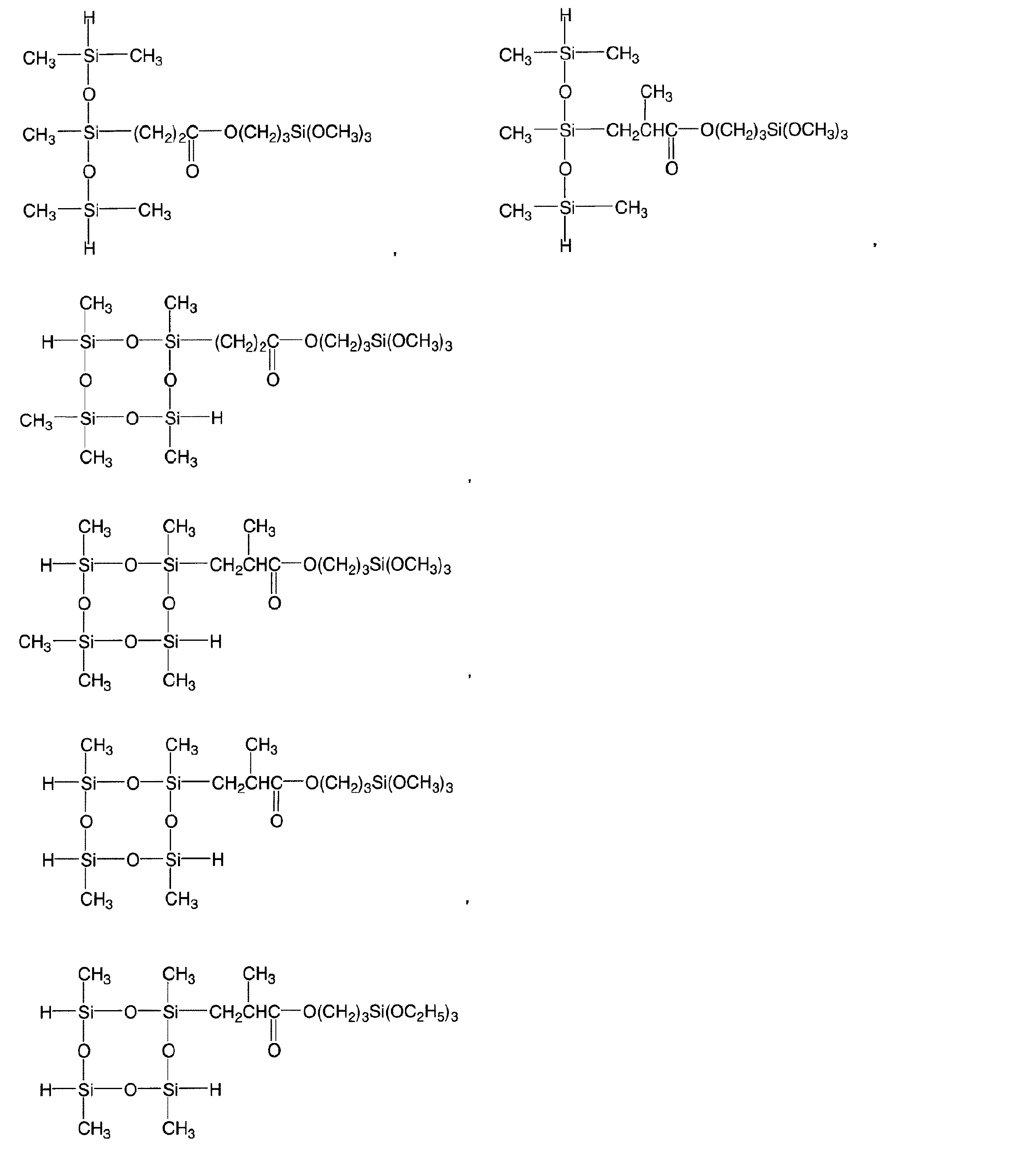
組成物が(F)白金系触媒の抑制剤を含むことで、組成物の硬化速度が調整される。(F)白金系触媒の抑制剤は、アセチレン性シラン、3-ヒドロキシ-1-プロペニル(OH-C(CH3)2-CH=CH-)基を有するオレフィン性シロキサン及びビニルオルガノシロキサンからなる群より選択される1種以上が挙げられる。このような白金系触媒の抑制剤は、特開昭52-47053号公報に記載されている。
(組成等)
組成物において、(A2)の含有量は、(A1)及び(A2)の合計100重量部に対して、0重量部以上60重量部以下である。(A2)の含有量が、(A1)及び(A2)の合計100重量部に対して、60重量部超であると、組成物の室温での速硬化性が劣る。(A2)の含有量は、(A1)及び(A2)の合計100重量部に対して、1~60重量部が好ましく、5~52重量部がより好ましく、5~37重量部が更に好ましく、17~37重量部が特に好ましい。(A2)の含有量が、(A1)及び(A2)の合計100重量部に対して、5~37重量部であると、接着力がより向上する傾向があり、17~37重量部であると、接着力に加えて、硬化物の伸びがより向上し、応力緩和性がより向上する傾向がある。
組成物において、(A2)の含有量は、(A1)及び(A2)の合計100重量部に対して、0重量部以上60重量部以下である。(A2)の含有量が、(A1)及び(A2)の合計100重量部に対して、60重量部超であると、組成物の室温での速硬化性が劣る。(A2)の含有量は、(A1)及び(A2)の合計100重量部に対して、1~60重量部が好ましく、5~52重量部がより好ましく、5~37重量部が更に好ましく、17~37重量部が特に好ましい。(A2)の含有量が、(A1)及び(A2)の合計100重量部に対して、5~37重量部であると、接着力がより向上する傾向があり、17~37重量部であると、接着力に加えて、硬化物の伸びがより向上し、応力緩和性がより向上する傾向がある。
組成物において、(HB1+HB2+HB3)/(ViA1+ViA2)は0.6~2.2である。(HB1+HB2+HB3)/(ViA1+ViA2)が、0.6未満であると、組成物の硬化が遅いか、硬化しない。(HB1+HB2+HB3)/(ViA1+ViA2)が、2.2超であると、硬化物の高温高湿下での信頼特性が劣る。
(HB1+HB2+HB3)/(ViA1+ViA2)の好ましい範囲は、0.6~1.4、0.6~1.00、0.6~0.99であり、0.6~0.8、0.7~0.8であってもよい。(HB1+HB2+HB3)/(ViA1+ViA2)が、前記好ましい範囲であれば、硬化物を高温で加熱した場合(例えば、100~180℃で加熱した場合)であっても、柔軟性の変化率が小さい傾向がある。即ち、組成物を硬化させた後、更に高温で加熱した場合であっても、外部からの応力を適度に緩和して対変形性を確保できる硬化物が得られる傾向がある。このような硬化物は、冷熱サイクルの信頼性により優れる。また、(HB1+HB2+HB3)/(ViA1+ViA2)が、0.8以下であれば、組成物の硬化物が、より高い伸びを有する傾向がある。
(好ましい組成等)
組成物は、以下を満足するのが好ましい。以下において、「組成物が(A2)を含む場合」とは、「組成物が(A2)及び(B3)を含む場合」であり、好ましくは「組成物が(A2)を含み、(B3)を含まない場合」である。また、「組成物が(B3)を含む場合」とは、「組成物が(A2)及び(B3)を含む場合」であり、好ましくは「組成物が(B3)を含み、(A2)を含まない場合」である。
組成物は、以下を満足するのが好ましい。以下において、「組成物が(A2)を含む場合」とは、「組成物が(A2)及び(B3)を含む場合」であり、好ましくは「組成物が(A2)を含み、(B3)を含まない場合」である。また、「組成物が(B3)を含む場合」とは、「組成物が(A2)及び(B3)を含む場合」であり、好ましくは「組成物が(B3)を含み、(A2)を含まない場合」である。
組成物が(A2)を含む場合、組成物において、(HB1+HB2)/(ViA1+ViA2)は0.6~2.2であることが好ましい。(HB1+HB2)/(ViA1+ViA2)が、0.6以上であると、組成物の速硬化性が向上する。(HB1+HB2)/(ViA1+ViA2)が、2.2以下であると、硬化物の高温高湿下での信頼特性が向上する。(HB1+HB2)/(ViA1+ViA2)は、より好ましくは0.6~1.00であり、更に好ましくは0.6~0.99であり、より更に好ましくは0.6~0.8であり、特に好ましくは0.7~0.8である。(HB1+HB2)/(ViA1+ViA2)が、前記好ましい範囲であれば、硬化物を高温で加熱した場合であっても、柔軟性の変化率が小さい傾向がある。また、(HB1+HB2)/(ViA1+ViA2)が、0.8以下であれば、組成物の硬化物が、より高い伸びを有する傾向がある。
組成物が(A2)を含む場合、(A1)及び(A2)は、硬化時に架橋反応による3次元構造の密度制御がしやすい観点から、高粘度(例えば、5,000mPa・s~20,000mPa・s)の(A1)と低粘度の(A2)(例えば、50mPa・s~1,000mPa・s)の組合せを含むのが好ましい。
組成物が(A2)を含む場合、組成物において、接着力がより向上し、透明性に優れ、黄変が小さい硬化物が得られる傾向があることから、HB1/(HB1+HB2)が、好ましくは0.2~0.9であり、より好ましくは0.2~0.8であり、特に好ましくは0.3~0.8である。
以上より、組成物が(A2)を含む場合、組成物は、(A1)及び(A2)の合計100重量部に対して、(A2)が5~37重量部であり、(HB1+HB2)/(ViA1+ViA2)が0.6~0.99であり、かつ、HB1/(HB1+HB2)が、0.3~0.8であるのが好ましい。
組成物が(B3)を含む場合、組成物において、(HB1+HB2+HB3)/ViA1は、0.6~2.5であることが好ましい。(HB1+HB2+HB3)/ViA1が、0.6以上であると、組成物の速硬化性が向上する。(HB1+HB2+HB3)/ViA1が、2.5以下であると、硬化物の高温高湿下での発泡が十分に抑制できる。(HB1+HB2+HB3)/ViA1は、より好ましくは0.6~2.2であり、更に好ましくは0.6~2.0であり、より更に好ましくは0.6~1.4であり、なお更に好ましくは0.6~0.99であり、特に好ましくは0.8~0.99である。(HB1+HB2+HB3)/ViA1が、好ましくは0.6~1.4、より好ましくは0.6~0.99であると、硬化物を高温で加熱した場合であっても、柔軟性の変化率が小さい傾向がある。
組成物が(B3)を含む場合、組成物において、HB3/(HB1+HB2+HB3)が、好ましくは0.1~0.9であり、より好ましくは0.15~0.5であり、特に好ましくは0.2~0.4である。HB3/(HB1+HB2+HB3)が、0.1以上であると、硬化時に架橋反応による3次元構造の密度を程よく低下でき、組成物の硬化物の応力緩和性がより向上し、0.9以下であると、組成物の速硬化性が向上する。
組成物が(B3)を含む場合、組成物において、HB2/(HB1+HB2+HB3)が、好ましくは0.1~0.9であり、より好ましくは0.1~0.7であり、特に好ましくは0.15~0.55である。HB2/(HB1+HB2+HB3)が、0.1以上であると組成物の速硬化性が向上し、0.9以下であると、高温で加熱した後の硬化物の柔軟性が向上する。
硬化物を高温で加熱した後であっても、応力緩和性に優れる傾向があることから、組成物は、(A2)と(B3)との組み合わせを含むのが好ましい。
組成物が(A2)を含む場合、組成物は、(A1)及び(A2)のみからなるアルケニル基含有ポリオルガノシロキサンを含むのが好ましく、この場合、組成物は、(A1)及び(A2)以外のアルケニル基含有ポリオルガノシロキサンを含まない。組成物が(A2)を含まない場合、組成物は、(A1)のみからなるアルケニル基含有ポリオルガノシロキサンを含むのが好ましく、この場合、組成物は、(A1)以外のアルケニル基含有ポリオルガノシロキサンを含まない。
組成物が(B3)を含む場合、組成物は、(B1)、(B2)及び(B3)のみからなるポリオルガノハイドロジェンシロキサンを含むのが好ましく、この場合、組成物は、(B1)、(B2)及び(B3)以外のポリオルガノハイロドジェンシロキサンを含まない。組成物が、(B3)を含まない場合、組成物は、(B1)及び(B2)のみからなるポリオルガノハイドロジェンシロキサンを含むのが好ましく、この場合、組成物は、(B1)及び(B2)以外のポリオルガノハイドロジェンシロキサンを含まない。
よって、組成物が(A2)及び(B3)を含む場合、組成物は、(A1)及び(A2)のみからなるアルケニル基含有ポリオルガノシロキサン、及び、(B1)、(B2)及び(B3)のみからなるポリオルガノハイドロジェンシロキサンを含むのが好ましい。この場合、組成物は、(A1)及び(A2)以外のアルケニル基含有ポリオルガノシロキサン、並びに、(B1)及び(B2)以外のポリオルガノハイドロジェンシロキサンを含まない。
組成物における(C)の含有量は、適切な硬化速度の確保の観点から、(A1)及び(A2)の総重量に対して、白金族金属原子換算で、好ましくは0.1~1000重量ppm、より好ましくは0.5~200重量ppmである。
組成物における(D)の含有量は、組成物における(A1)及び(A2)の合計100重量部に対して、50重量部以下であるのが好ましく、30重量部以下であるのがより好ましく、20重量部以下であるのがさらに好ましい。
組成物における添加剤の総含有量は、組成物における(A1)と、(B1)と、(B2)と、(A2)及び(B3)からなる群より選択される1以上との合計100重量部に対して、100重量部以下であるのが好ましく、30重量部以下であるのがより好ましく、20重量部以下であるのがさらに好ましい。
組成物は、(A1)と、(B1)と、(B2)と、(A2)及び(B3)からなる群より選択される1以上と、(C)と、任意成分とを配合することにより得ることができる。容易に、組成物を均一な状態にし、透明な硬化物を得ることができる点から、組成物は、「(A1)、(A2)及び(C)の組合せ」又は「(A1)及び(C)の組合せ」を含み、(B1)、(B2)及び(B3)を含まない第1部分と、(A1)と、(B1)と、(B2)と、(A2)及び(B3)からなる群より選択される1以上とを含み、(C)を含まない第2部分とからなる、2液型の組成物であるのが好ましい。そして、第1部分と第2部分とを混合し、均一な組成物とすることが好ましい。任意成分は適宜添加することができる。
組成物は、23℃における粘度が、塗布時の展延性の点から、100,000mPa・s以下であることが好ましく、より好ましくは、50~50,000mPa・sである。組成物が、第1部分及び第2部分からなる2液型の組成物である場合、第1部分及び第2部分の粘度は、好ましくは、10~100,000mPa・sであり、より好ましくは、50~50,000mPa・sであり、特に好ましくは、100~20,000mPa・sである。
組成物は、室温(例えば、5~40℃)で硬化させることができる、室温硬化性組成物であってもよい。また、組成物は、加熱することによって、硬化させる、熱硬化性樹脂組成物であってもよい。加熱温度は、例えば、40超80℃以下とすることができ、60~70℃が好ましい。また、加熱時間は、例えば、0.5~10時間とすることができ、0.5~2時間が好ましく、0.5分~60分とすることがより好ましく、1分以上30分未満が特に好ましい。
組成物は、組成物からなる画像表示装置用シール剤として利用することができる。画像表示装置用シール剤を画像表示部と保護部の間に介在させ、加熱により硬化させて、画像表示部と保護部とを封止することができる。組成物は、画像表示装置の画像表示部を有する基部と透光性の保護部との接着用であるのが好ましい。
組成物は、画像表示装置において好適に使用することができ、特に、フラットパネル型の画像表示装置の保護部と画像表示部との間に介在させる樹脂として好ましい。よって、本発明は、組成物を用いた画像表示装置、具体的には、組成物を用いて、画像表示装置の画像表示部を有する基部と透光性の保護部とを接着した画像表示装置に関する。具体的には、光学用プラスチック等で形成される透明な保護部を構成する保護パネル上に、組成物を塗布した後、画像表示部を構成する画像表示パネルを貼り合わせ、加熱する工程を含む、画像表示装置の製造方法により製造される画像表示装置に関する。
次に、実施例及び比較例を挙げて、本発明を更に詳細に説明する。ただし、本発明は、これらの実施例によって限定されるものではない。表示は、特に断りがない限り、重量部、重量%である。
表1~表9に示す組成で、各成分を、混合することにより、実施例及び比較例の(A)及び(B)からなる2液型の組成物を調製した。表1~表9において、「MIX」は「(A)」及び「(B)」の合計に対する量を意味する。
使用した各成分は、以下のとおりである。ここで、記号は以下を意味する。
M:(CH3)3SiO1/2
MH:H(CH3)2SiO1/2
MV:CH2=CH2(CH3)2SiO1/2
D:(CH3)2SiO2/2
DH:H(CH3)SiO2/2
Q:SiO4/2(四官能性)
M:(CH3)3SiO1/2
MH:H(CH3)2SiO1/2
MV:CH2=CH2(CH3)2SiO1/2
D:(CH3)2SiO2/2
DH:H(CH3)SiO2/2
Q:SiO4/2(四官能性)
A1-1:両末端がMV単位で閉塞され、中間単位がD単位からなるポリメチルビニルシロキサン(23℃での粘度12,200mPa・s)
a2:下記(1)~(3)の混合物。この混合物中、A1-2が25重量%であり、A2が50重量%であり、D1が25重量%である。
(1)A1-2:両末端がMV単位で閉塞され、中間単位がD単位からなるポリメチルビニルシロキサン(23℃での粘度600mPa・s)
(2)A2:一方の末端がMV単位で閉塞され、もう一方の末端がM単位で閉塞され、中間単位がD単位からなるポリメチルビニルシロキサン(23℃での粘度600mPa・s)
(3)D1:両末端がM単位で閉塞され、中間単位がD単位からなるポリジメチルシロキサン(23℃での粘度600mPa・s)
B1:MHD20MHで示される直鎖状ポリメチルハイドロジェンシロキサン(23℃での粘度20mPa・s)
B2:平均単位式が[H(CH3)2SiO1/2]8[SiO4/2]4で示される架橋性ポリメチルハイドロジェンシロキサン(有効水素量1%)
b3:下記(4)~(6)の混合物。この混合物中、B1-2が25重量%であり、B3が50重量%であり、D2が25重量%である。
(4)B1-2:MHD20MHで示される直鎖状ポリメチルハイドロジェンシロキサン(23℃での粘度20mPa・s)
(5)B3:MHD20Mで示される直鎖状ポリメチルハイドロジェンシロキサン(23℃での粘度20mPa・s)
(6)D2:MD20Mで示される直鎖状ポリジメチルシロキサン(23℃での粘度20mPa・s)
B4:MDH 17D83Mで示される直鎖状ポリメチルハイドロジェンシロキサン(23℃での粘度120mPa・s)
C1:塩化白金酸を1,3-ジビニル-1,1,3,3-テトラメチルジシロキサンとモル比1:4で加熱することによって得られ、白金含有量が4.9重量%である錯体
a2:下記(1)~(3)の混合物。この混合物中、A1-2が25重量%であり、A2が50重量%であり、D1が25重量%である。
(1)A1-2:両末端がMV単位で閉塞され、中間単位がD単位からなるポリメチルビニルシロキサン(23℃での粘度600mPa・s)
(2)A2:一方の末端がMV単位で閉塞され、もう一方の末端がM単位で閉塞され、中間単位がD単位からなるポリメチルビニルシロキサン(23℃での粘度600mPa・s)
(3)D1:両末端がM単位で閉塞され、中間単位がD単位からなるポリジメチルシロキサン(23℃での粘度600mPa・s)
B1:MHD20MHで示される直鎖状ポリメチルハイドロジェンシロキサン(23℃での粘度20mPa・s)
B2:平均単位式が[H(CH3)2SiO1/2]8[SiO4/2]4で示される架橋性ポリメチルハイドロジェンシロキサン(有効水素量1%)
b3:下記(4)~(6)の混合物。この混合物中、B1-2が25重量%であり、B3が50重量%であり、D2が25重量%である。
(4)B1-2:MHD20MHで示される直鎖状ポリメチルハイドロジェンシロキサン(23℃での粘度20mPa・s)
(5)B3:MHD20Mで示される直鎖状ポリメチルハイドロジェンシロキサン(23℃での粘度20mPa・s)
(6)D2:MD20Mで示される直鎖状ポリジメチルシロキサン(23℃での粘度20mPa・s)
B4:MDH 17D83Mで示される直鎖状ポリメチルハイドロジェンシロキサン(23℃での粘度120mPa・s)
C1:塩化白金酸を1,3-ジビニル-1,1,3,3-テトラメチルジシロキサンとモル比1:4で加熱することによって得られ、白金含有量が4.9重量%である錯体
物性の評価は、下記のようにして行った。結果を、表1~表9に示す。
(1)粘度
回転粘度計(ビスメトロン VDA-L)(芝浦システム株式会社製)を用いて、23℃における粘度(mPa・s)を測定した。その他は、JIS K 6249に準拠して測定を行った。
(1)粘度
回転粘度計(ビスメトロン VDA-L)(芝浦システム株式会社製)を用いて、23℃における粘度(mPa・s)を測定した。その他は、JIS K 6249に準拠して測定を行った。
(2)タックフリータイム
(A)の組成物及び(B)の組成物を体積比1:1で押し出し、その先にミキシングノズルで混合しながら、5gを平板上に取り出し、2つの液が接触した時間を0とし、エチルアルコールで清浄にした指先で表面に軽く触れ、試料が指先に付着しなくなるまでの時間をタックフリータイムとした。
(A)の組成物及び(B)の組成物を体積比1:1で押し出し、その先にミキシングノズルで混合しながら、5gを平板上に取り出し、2つの液が接触した時間を0とし、エチルアルコールで清浄にした指先で表面に軽く触れ、試料が指先に付着しなくなるまでの時間をタックフリータイムとした。
(3)針入度
未硬化のシリコーンゲル組成物40mlを、容量50mlの耐熱ガラスビーカーにとり、60℃で30分加熱して硬化させることにより、シリコーンゲルを得た。室温に冷却した後、JIS K 6249により、1/4コーンを用いて、加熱処理前の針入度(1)を測定した。また、未硬化のシリコーンゲル組成物40mlを、容量50mlの耐熱ガラスビーカーにとり、60℃で30分加熱して硬化させて、加熱処理前のシリコーンゲルを得た。次いで、150℃で1時間、加熱処理することにより、加熱処理後のシリコーンゲルを得た。室温に冷却した後、JIS K 6249により、1/4コーンを用いて、加熱処理後の針入度(2)を測定した。加熱処理による針入度変化率は、以下の数式(1)により求めた。針入度が大きいことは、硬化物の柔軟性が高く、応力緩和性に優れることを意味する。針入度変化率が小さいことは、加熱処理後の硬化物の柔軟性の変化率が小さいことを意味する。
針入度変化率=(加熱処理前の針入度(1)-加熱処理後の針入度(2))÷加熱処理前の針入度(1)・・・数式(1)
未硬化のシリコーンゲル組成物40mlを、容量50mlの耐熱ガラスビーカーにとり、60℃で30分加熱して硬化させることにより、シリコーンゲルを得た。室温に冷却した後、JIS K 6249により、1/4コーンを用いて、加熱処理前の針入度(1)を測定した。また、未硬化のシリコーンゲル組成物40mlを、容量50mlの耐熱ガラスビーカーにとり、60℃で30分加熱して硬化させて、加熱処理前のシリコーンゲルを得た。次いで、150℃で1時間、加熱処理することにより、加熱処理後のシリコーンゲルを得た。室温に冷却した後、JIS K 6249により、1/4コーンを用いて、加熱処理後の針入度(2)を測定した。加熱処理による針入度変化率は、以下の数式(1)により求めた。針入度が大きいことは、硬化物の柔軟性が高く、応力緩和性に優れることを意味する。針入度変化率が小さいことは、加熱処理後の硬化物の柔軟性の変化率が小さいことを意味する。
針入度変化率=(加熱処理前の針入度(1)-加熱処理後の針入度(2))÷加熱処理前の針入度(1)・・・数式(1)
(4)イエローインデックス(YI)
基材として、ガラス板(5cm×5cm×1mm厚)2枚を使用した。予め基材に配置したスペーサーによって、組成物の厚みが200μmになるようにした。組成物を介して2枚のガラス板を、組成物の寸法が50mm×50mm、厚さが200μmになるように貼り合わせて、貼り合せ体を得た。貼り合せ体を、25℃において30分、70℃において30分熱処理して、組成物の硬化物を介して、2枚の基材が接着されている接着体を得た。接着体を25℃の状態に戻した後に、変色の度合いの指標であるイエローインデックスを測定した。イエローインデックスの測定は、分光測式計((株)ミノルタ製CM-3500d)を用いて行なった。
基材として、ガラス板(5cm×5cm×1mm厚)2枚を使用した。予め基材に配置したスペーサーによって、組成物の厚みが200μmになるようにした。組成物を介して2枚のガラス板を、組成物の寸法が50mm×50mm、厚さが200μmになるように貼り合わせて、貼り合せ体を得た。貼り合せ体を、25℃において30分、70℃において30分熱処理して、組成物の硬化物を介して、2枚の基材が接着されている接着体を得た。接着体を25℃の状態に戻した後に、変色の度合いの指標であるイエローインデックスを測定した。イエローインデックスの測定は、分光測式計((株)ミノルタ製CM-3500d)を用いて行なった。
(5)ヘーズ(Haze)
「(4)イエローインデックス」と同様にして、試料を作製した。作製した試料について、JIS K 7105に準拠し、ヘーズメータNDH5000(日本電色工業株式会社製)を用いて、ヘーズを測定した。
「(4)イエローインデックス」と同様にして、試料を作製した。作製した試料について、JIS K 7105に準拠し、ヘーズメータNDH5000(日本電色工業株式会社製)を用いて、ヘーズを測定した。
(6)b*(D65)
「(4)イエローインデックス」と同様にして、試料を作製した。作製した試料について、b*(D65)を測定した。
「(4)イエローインデックス」と同様にして、試料を作製した。作製した試料について、b*(D65)を測定した。
(7)発泡
(7-1)試料(1)の作製
「(4)イエローインデックス」と同様にして、試料を作製した。
(7-2)試料(2)の作製
基材として、ガラス板(5cm×5cm×1mm厚)2枚を使用した。予め基材に配置したスペーサーによって、組成物の厚みが200μmになるようにした。組成物を介して2枚のガラス板を、組成物の寸法が50mm×50mm、厚さが200μmになるように貼り合わせて、貼り合せ体を得た。貼り合せ体を、60℃において30分熱処理して、組成物の硬化物を介して、2枚の基材が接着されている接着体を得た。この接着体を試料とした。
(7-3)発泡試験
作製した各試料を85℃、85%RHの恒温恒湿機に500時間入れ、目視により樹脂の気泡の有無を確認した。表において、「1/3発泡」とは、3つの試料のうち、1つの試料に気泡が確認されたことを示す。
(7-1)試料(1)の作製
「(4)イエローインデックス」と同様にして、試料を作製した。
(7-2)試料(2)の作製
基材として、ガラス板(5cm×5cm×1mm厚)2枚を使用した。予め基材に配置したスペーサーによって、組成物の厚みが200μmになるようにした。組成物を介して2枚のガラス板を、組成物の寸法が50mm×50mm、厚さが200μmになるように貼り合わせて、貼り合せ体を得た。貼り合せ体を、60℃において30分熱処理して、組成物の硬化物を介して、2枚の基材が接着されている接着体を得た。この接着体を試料とした。
(7-3)発泡試験
作製した各試料を85℃、85%RHの恒温恒湿機に500時間入れ、目視により樹脂の気泡の有無を確認した。表において、「1/3発泡」とは、3つの試料のうち、1つの試料に気泡が確認されたことを示す。
(8)ガラス/ガラスせん断接着力(MPa)及び伸び(%)
平行に並べた2枚のガラス板(長さ80mm、幅25mm、厚さ2mm)の間に、組成物を縦25mm、横10mm、厚さ150μmとなるように貼り合せ、これを60℃で30分間加熱して硬化させて、せん接着力測定用の試験体を作製した。得られた試験体を接着面に対して垂直方向に10mm/分の速度で引っ張り、接着力及び伸びを測定した。
平行に並べた2枚のガラス板(長さ80mm、幅25mm、厚さ2mm)の間に、組成物を縦25mm、横10mm、厚さ150μmとなるように貼り合せ、これを60℃で30分間加熱して硬化させて、せん接着力測定用の試験体を作製した。得られた試験体を接着面に対して垂直方向に10mm/分の速度で引っ張り、接着力及び伸びを測定した。
(9)冷熱サイクル試験
基材として、ガラス板(14cm×10cm×1mm厚)およびPMMA(株式会社クラレ製)(16cm×11cm×1mm厚)を使用した。予め基材に配置したスペーサーによって、組成物の厚みが400μmになるように貼り合わせて、貼り合せ体を得た。貼り合せ体を、60℃において30分熱処理して、組成物の硬化物を介して、2枚の基材が接着されている接着体を得た。接着体を1サイクル(-40℃、30分と85℃、30分)の冷熱サイクル機に100サイクル保持し、取り出し、目視により剥離(基材の分離)、樹脂割れの有無を目視により確認した。冷熱試験で、剥離及び樹脂割れが無いことは、高温高湿下での信頼性に優れる。表において、「2/5」とは、5つの試料のうち、2つの試料に剥離又は樹脂割れが確認されたことを示す。
基材として、ガラス板(14cm×10cm×1mm厚)およびPMMA(株式会社クラレ製)(16cm×11cm×1mm厚)を使用した。予め基材に配置したスペーサーによって、組成物の厚みが400μmになるように貼り合わせて、貼り合せ体を得た。貼り合せ体を、60℃において30分熱処理して、組成物の硬化物を介して、2枚の基材が接着されている接着体を得た。接着体を1サイクル(-40℃、30分と85℃、30分)の冷熱サイクル機に100サイクル保持し、取り出し、目視により剥離(基材の分離)、樹脂割れの有無を目視により確認した。冷熱試験で、剥離及び樹脂割れが無いことは、高温高湿下での信頼性に優れる。表において、「2/5」とは、5つの試料のうち、2つの試料に剥離又は樹脂割れが確認されたことを示す。
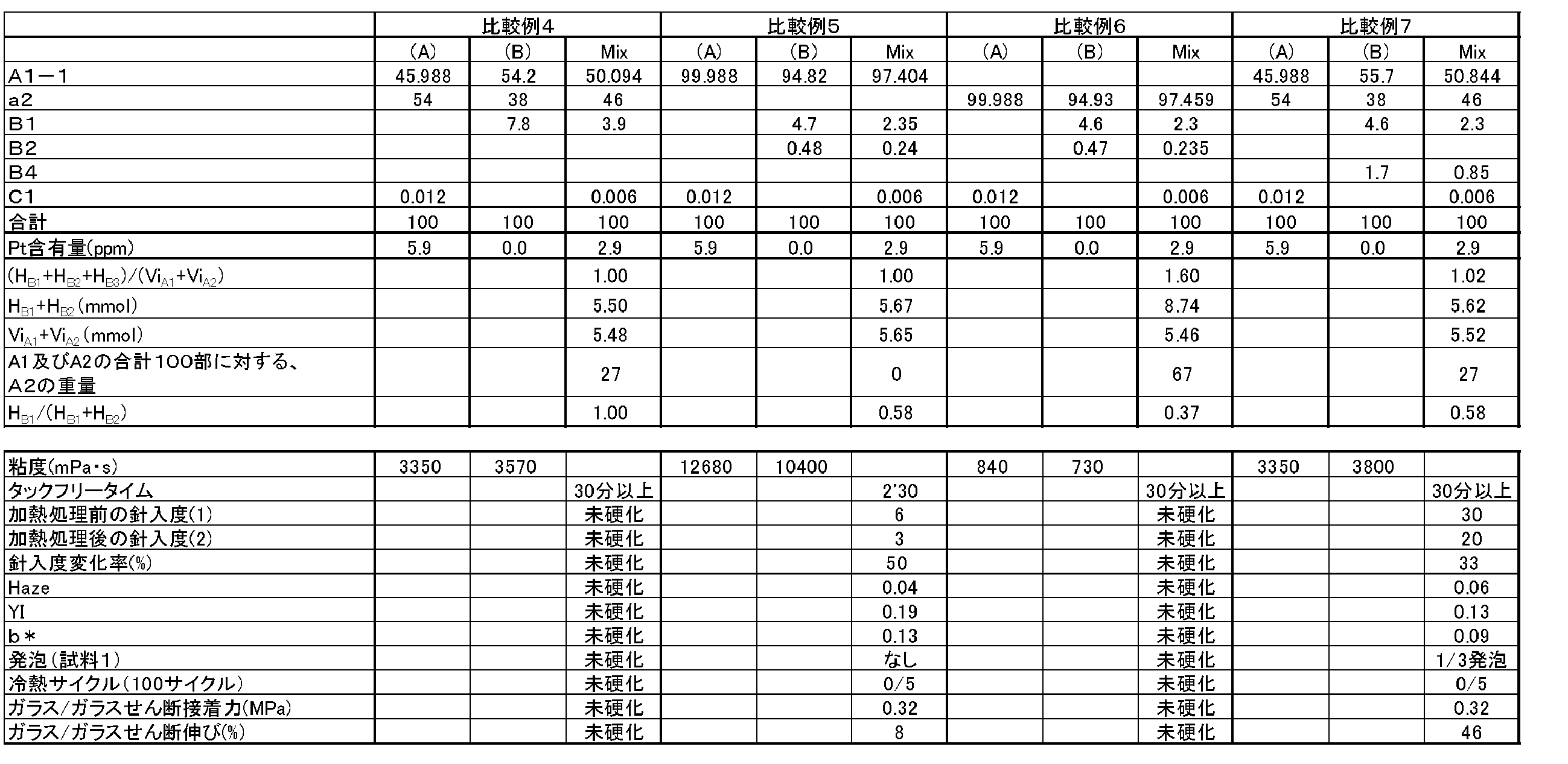
結果をまとめる。比較例7におけるHB2は、B4におけるケイ素原子に結合した水素原子の値である。


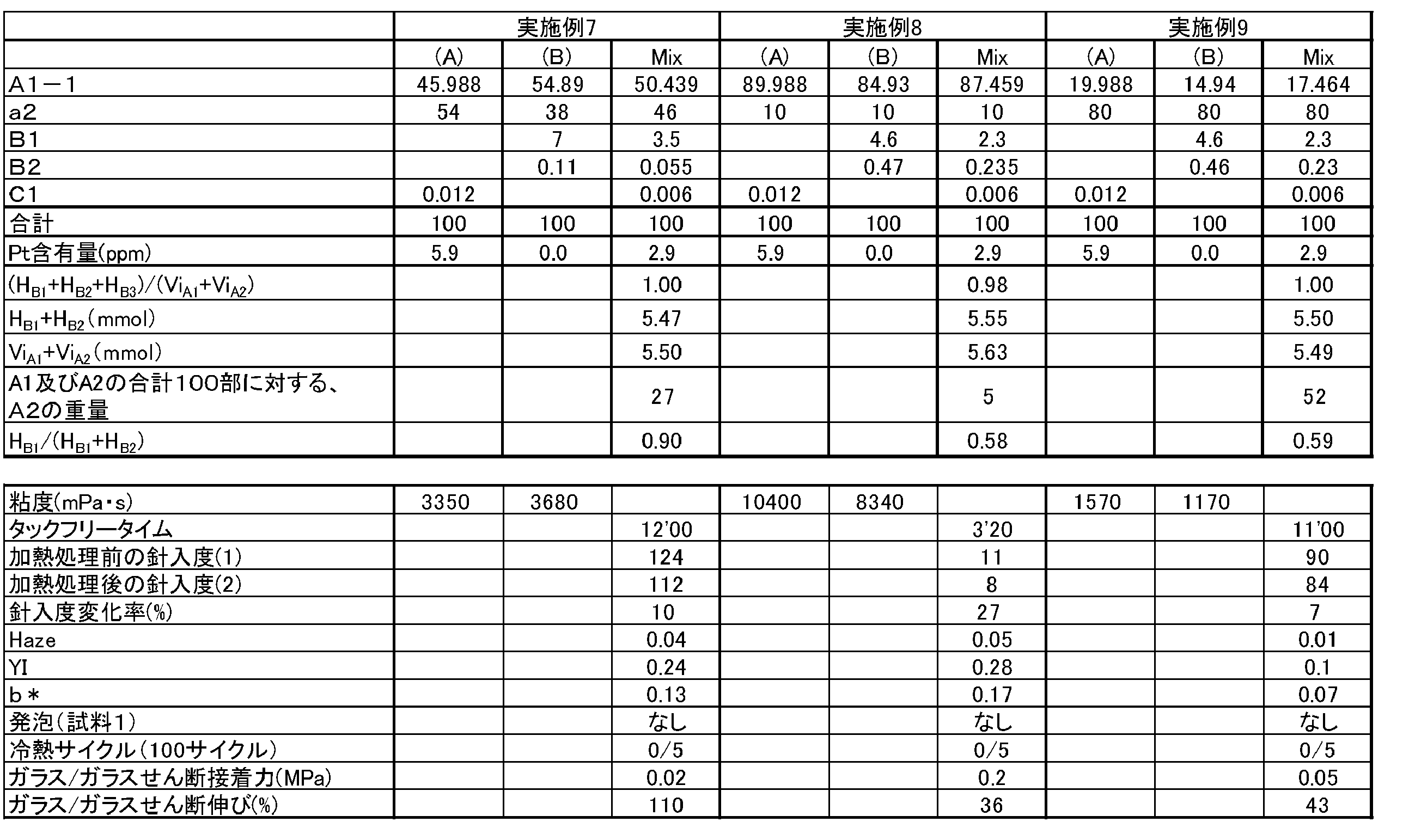


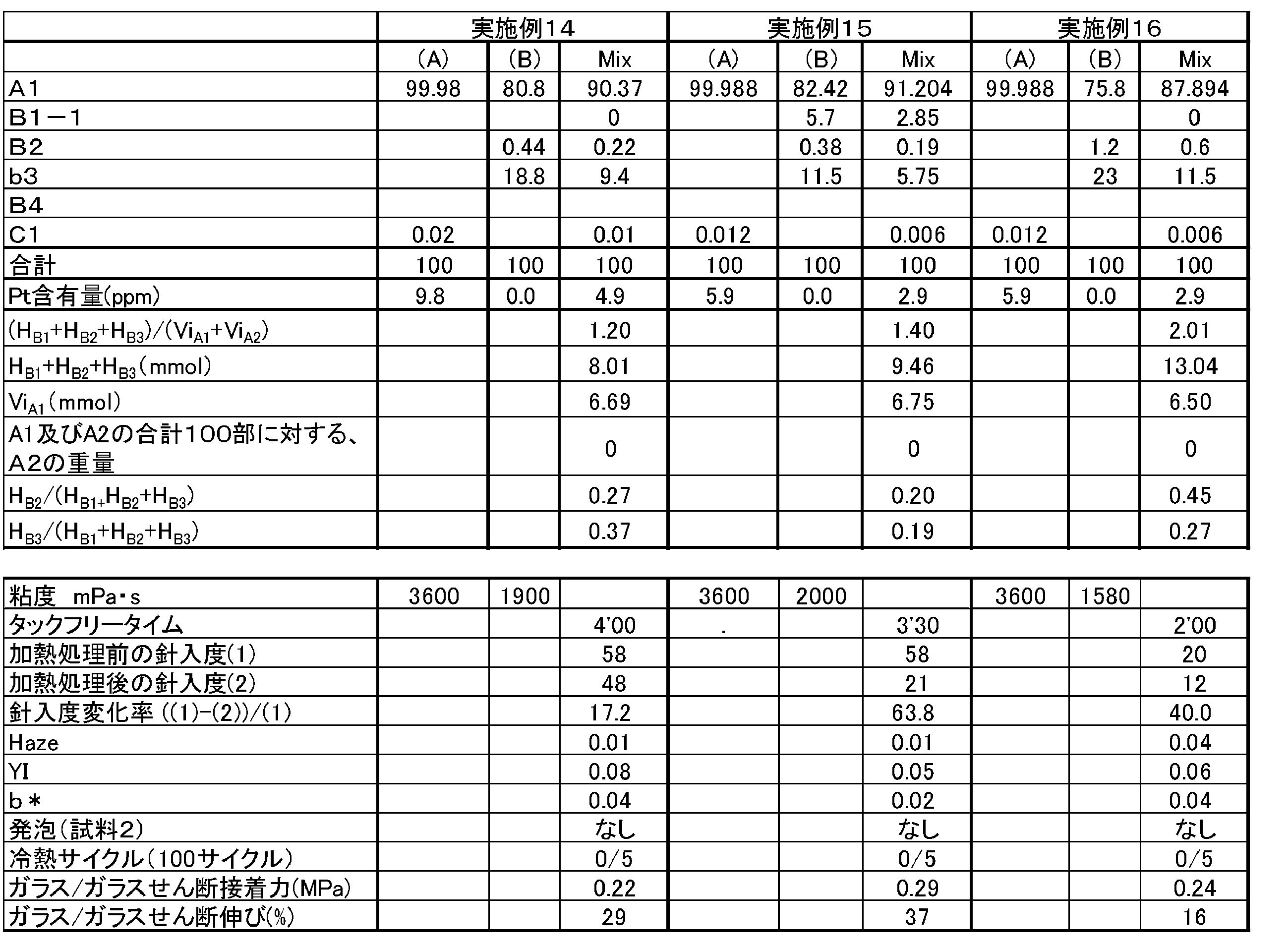

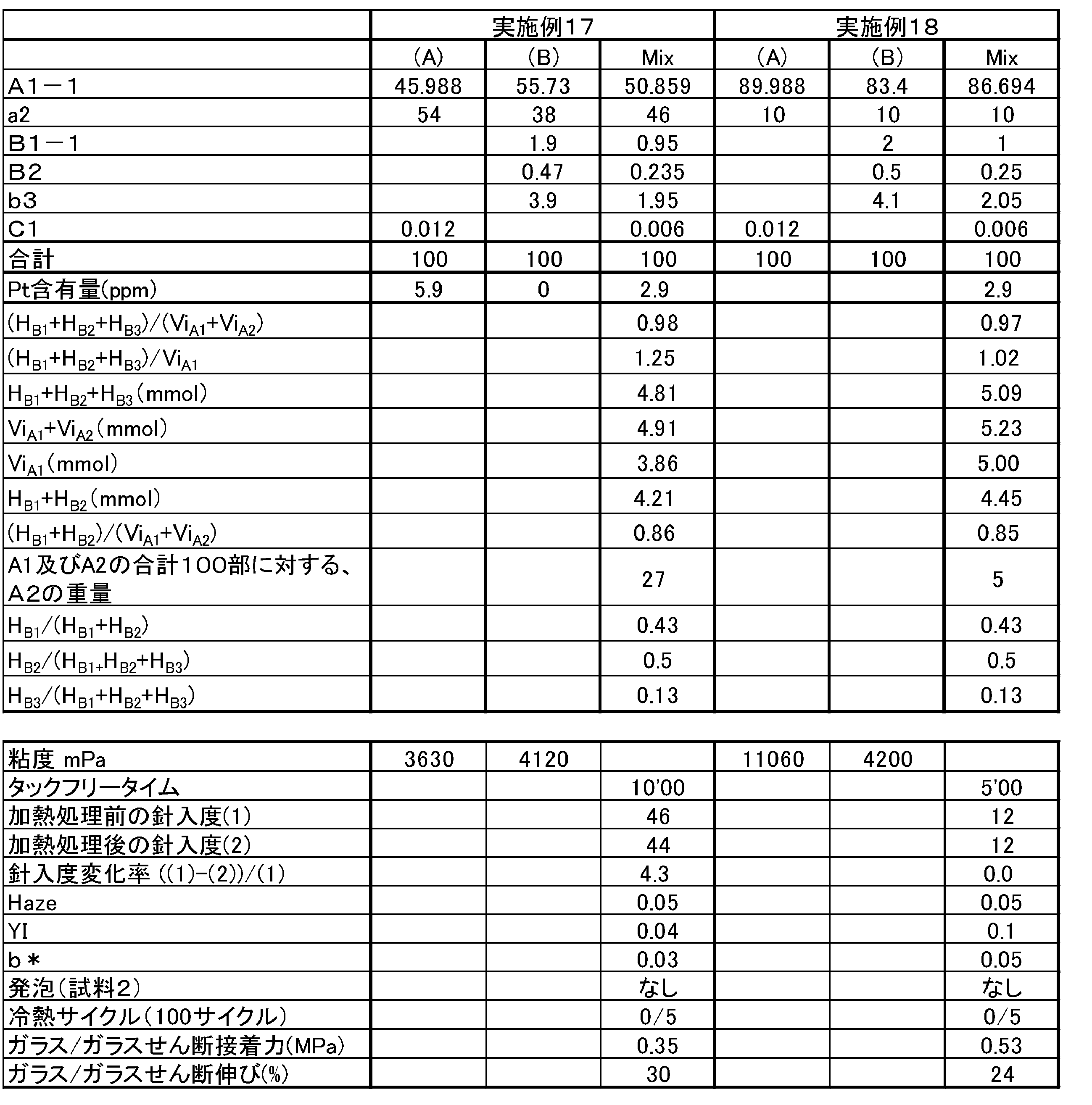
実施例1~9の組成物は、(A2)を含み、(B3)を含まない。実施例10~16の組成物は、(B3)を含み、(A2)を含まない。実施例17~18の組成物は、(A2)及び(B3)の両方を含む。
実施例の各組成物は、室温での速硬化性に優れ、硬化後の組成物は、高い伸びを有し、応力緩和性に優れ、高温高湿下における信頼特性が良好であり、かつ、冷熱サイクルの信頼性に優れていた。
実施例1~2と実施例3~5とを比較すると、(A1)及び(A2)の合計100重量部に対する(A2)の重量がほぼ同じであり、かつ、HB1/(HB1+HB2)がほぼ同じである場合、(HB1+HB2+HB3)/(ViA1+ViA2)(即ち、(HB1+HB2)/(ViA1+ViA2))が0.99以下である実施例3~5の硬化物は、針入度変化率が小さく、加熱処理後であっても、応力緩和性に優れていた。更に、実施例3と実施例4~5とを比較すると、(HB1+HB2+HB3)/(ViA1+ViA2)(即ち、(HB1+HB2)/(ViA1+ViA2))が0.8以下である実施例4~5の硬化物は、より高い伸びを有していた。
実施例3と実施例6~7とを比較すると、(A1)及び(A2)の合計100重量部に対する(A2)の重量がほぼ同じであり、かつ、(HB1+HB2+HB3)/(ViA1+ViA2)(即ち、(HB1+HB2)/(ViA1+ViA2))がほぼ同じである場合、HB1/(HB1+HB2)が特に好ましい範囲である実施例3の硬化物は、接着力がより向上した。また、実施例6及び7の組成物において(HB1+HB2+HB3)/(ViA1+ViA2)(即ち、(HB1+HB2)/(ViA1+ViA2))が実施例4及び5とほぼ同じに代えた組成物に対して、実施例4及び5の組成物は、接着力がより向上した硬化物が得られると推測される。
実施例3~8と実施例9とを比較すると、HB1/(HB1+HB2)がほぼ同じであり、かつ、(HB1+HB2+HB3)/(ViA1+ViA2)(即ち、(HB1+HB2)/(ViA1+ViA2))がほぼ同じである場合、(A1)及び(A2)の合計100重量部に対して、(A2)の重量が更に好ましい範囲であると、接着力がより向上し、(A2)の重量が特に好ましい範囲であると、接着力がより向上することに加えて、伸びがより向上した。
実施例3と実施例6~7とを比較すると、(A1)及び(A2)の合計100重量部に対する(A2)の重量がほぼ同じであり、かつ、(HB1+HB2+HB3)/(ViA1+ViA2)(即ち、(HB1+HB2)/(ViA1+ViA2))がほぼ同じである場合、HB1/(HB1+HB2)が特に好ましい範囲である実施例3の硬化物は、接着力がより向上した。また、実施例6及び7の組成物において(HB1+HB2+HB3)/(ViA1+ViA2)(即ち、(HB1+HB2)/(ViA1+ViA2))が実施例4及び5とほぼ同じに代えた組成物に対して、実施例4及び5の組成物は、接着力がより向上した硬化物が得られると推測される。
実施例3~8と実施例9とを比較すると、HB1/(HB1+HB2)がほぼ同じであり、かつ、(HB1+HB2+HB3)/(ViA1+ViA2)(即ち、(HB1+HB2)/(ViA1+ViA2))がほぼ同じである場合、(A1)及び(A2)の合計100重量部に対して、(A2)の重量が更に好ましい範囲であると、接着力がより向上し、(A2)の重量が特に好ましい範囲であると、接着力がより向上することに加えて、伸びがより向上した。
比較例1は、(HB1+HB2+HB3)/(ViA1+ViA2)が0.6未満であるため、室温での硬化が遅かった。
比較例2は、(HB1+HB2+HB3)/(ViA1+ViA2)が2.2超であるため、硬化物中に気泡が確認され、冷熱サイクル試験後の全ての試験片において、剥離及び樹脂割れの発生が見られ、高温高湿下での信頼性に劣っていた。
比較例3は、(B1)を含まないため、応力緩和性が劣り、かつ、伸びが小さい硬化物が得られた。
比較例4は、(B2)を含まないため、室温での硬化が遅かった。
比較例5は、(A2)及び(B3)の両方を含まないため、応力緩和性が劣り、かつ、伸びが小さい硬化物が得られた。
比較例6は、(A1)及び(A2)の合計100重量部に対して、(A2)が60重量部超であるため、室温での硬化が遅かった。
比較例7は、(B2)の代わりに、中間単位にケイ素原子に結合する水素原子を有する直鎖状ポリオルガノハイロドジェンシロキサンを用いているため、室温での硬化が遅かった。加えて、比較例7は、硬化物に中に気泡が確認された。
比較例2は、(HB1+HB2+HB3)/(ViA1+ViA2)が2.2超であるため、硬化物中に気泡が確認され、冷熱サイクル試験後の全ての試験片において、剥離及び樹脂割れの発生が見られ、高温高湿下での信頼性に劣っていた。
比較例3は、(B1)を含まないため、応力緩和性が劣り、かつ、伸びが小さい硬化物が得られた。
比較例4は、(B2)を含まないため、室温での硬化が遅かった。
比較例5は、(A2)及び(B3)の両方を含まないため、応力緩和性が劣り、かつ、伸びが小さい硬化物が得られた。
比較例6は、(A1)及び(A2)の合計100重量部に対して、(A2)が60重量部超であるため、室温での硬化が遅かった。
比較例7は、(B2)の代わりに、中間単位にケイ素原子に結合する水素原子を有する直鎖状ポリオルガノハイロドジェンシロキサンを用いているため、室温での硬化が遅かった。加えて、比較例7は、硬化物に中に気泡が確認された。
実施例10~15と実施例16とを比較すると、(HB1+HB2+HB3)/(ViA1+ViA2)(即ち、(HB1+HB2+HB3)/ViA1)が0.6~1.4である場合、応力緩和性がより向上し、冷熱サイクル試験後の剥離及び樹脂割れの発生が全く無く、冷熱サイクル試験後の信頼特性がより向上する。なお、実施例7は、冷熱サイクル試験後の4つの試験片において、剥離及び樹脂割れの発生は無かった。そして、実施例16は、冷熱サイクル試験後の1つの試験片において、試験片の角にほんの少しだけ剥離が発生していたが、試験片に多数の気泡、亀裂は観察されなかった。一方、比較例において、全ての試験片において多数の気泡、亀裂が観察された。
実施例10~13と実施例14~16とを比較すると、(HB1+HB2+HB3)/(ViA1+ViA2)(即ち、(HB1+HB2+HB3)/ViA1)が0.6~0.99である場合、加熱処理後の硬化物の柔軟性の低下が小さくなり、加熱処理後であっても、応力緩和性に優れていた。
実施例10~13と実施例14~16とを比較すると、(HB1+HB2+HB3)/(ViA1+ViA2)(即ち、(HB1+HB2+HB3)/ViA1)が0.6~0.99である場合、加熱処理後の硬化物の柔軟性の低下が小さくなり、加熱処理後であっても、応力緩和性に優れていた。
比較例8は、(HB1+HB2+HB3)/(ViA1+ViA2)が0.6未満であるため、室温での硬化が遅かった。
比較例9は、(HB1+HB2+HB3)/(ViA1+ViA2)が2.2超であるため、高温高湿での処理後の硬化物中に、気泡が確認され、冷熱サイクル試験後の全ての試験片において、剥離及び樹脂割れの発生が見られ、高温高湿下での信頼性に劣っていた。
比較例10は、(A2)及び(B3)の両方を含まないため、応力緩和特性が劣り、かつ、冷熱サイクル試験後の全ての試験片において、剥離及び樹脂割れの発生が見られ、高温高湿下での信頼性に劣っていた。
比較例11は、(B2)の代わりに、中間単位にケイ素原子に結合する水素原子を有する直鎖状ポリオルガノハイロドジェンシロキサンを用いているため、室温での硬化が遅かった。加えて、比較例11は、応力緩和特性が劣り、高温高湿での処理後の硬化物中に泡が確認され、冷熱サイクル試験後の試験片の2つにおいて剥離及び樹脂割れの発生が確認され、高温高湿下での信頼性に劣っていた。
比較例9は、(HB1+HB2+HB3)/(ViA1+ViA2)が2.2超であるため、高温高湿での処理後の硬化物中に、気泡が確認され、冷熱サイクル試験後の全ての試験片において、剥離及び樹脂割れの発生が見られ、高温高湿下での信頼性に劣っていた。
比較例10は、(A2)及び(B3)の両方を含まないため、応力緩和特性が劣り、かつ、冷熱サイクル試験後の全ての試験片において、剥離及び樹脂割れの発生が見られ、高温高湿下での信頼性に劣っていた。
比較例11は、(B2)の代わりに、中間単位にケイ素原子に結合する水素原子を有する直鎖状ポリオルガノハイロドジェンシロキサンを用いているため、室温での硬化が遅かった。加えて、比較例11は、応力緩和特性が劣り、高温高湿での処理後の硬化物中に泡が確認され、冷熱サイクル試験後の試験片の2つにおいて剥離及び樹脂割れの発生が確認され、高温高湿下での信頼性に劣っていた。
実施例17と実施例3と、及び、実施例18と実施例8とを比較すると、(A1)及び(A2)の合計100重量部に対する(A2)の重量がほぼ同じであり、かつ、(HB1+HB2+HB3)/(ViA1+ViA2)がほぼ同じである場合、(B3)を含む実施例17及び18は、針入度変化率がより小さくなり、加熱処理後であっても、応力緩和性に優れていた。
硬化性ポリオルガノシロキサン組成物は、ブラウン管、液晶、プラズマ、有機EL等の画像表示装置の画像表示部を有する基部と透光性の保護部との接着において有用である。
Claims (8)
- (A1)式(I):

(式中、
Ra1は、独立して、C2-C6アルケニル基であり、
Rb1は、独立して、C1-C6アルキル基又はC6-C20アリール基であり、
n1は、(A1)の23℃における粘度を10mPa・s~1,000,000mPa・sにする数である)で示されるアルケニル基含有ポリオルガノシロキサンと;
(B1)式(II):
(式中、
Rc1は、水素原子であり、
Rb2は、独立して、C1-C6アルキル基又はC6-C20アリール基であり、
n2は、(B1)の23℃における粘度を0.1~300mPa・sとする数である)で示されるポリオルガノハイロドジェンシロキサンと;
(B2)Rb3 2Rc2SiO1/2単位(式中、Rb3は、独立して、C1-C6アルキル基又はC6-C20アリール基であり、Rc2は、水素原子である)及びSiO4/2単位からなり、一分子中に、ケイ素原子に結合した水素原子を3個以上有する、ポリオルガノハイドロジェンシロキサンと;
(A2)式(III):
(式中、
Ra2は、独立して、C2-C6アルケニル基であり、
Rb4は、独立して、C1-C6アルキル基又はC6-C20アリール基であり、
n3は、(A2)の23℃における粘度を10mPa・s~1,000,000mPa・sにする数である)で示されるアルケニル基含有ポリオルガノシロキサン、及び
(B3)式(IV):
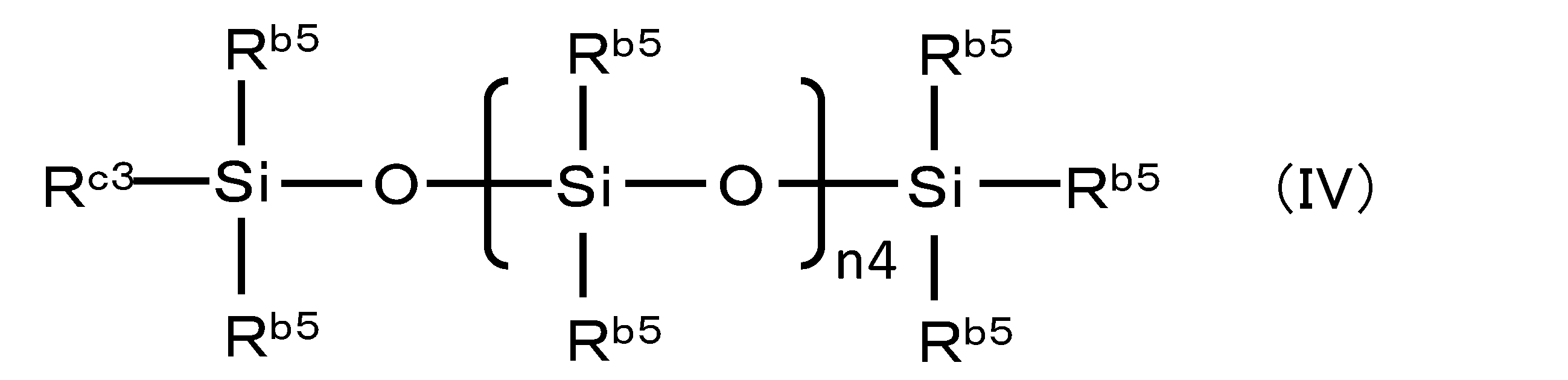
(式中、
Rc3は、水素原子であり、
Rb5は、独立して、C1-C6アルキル基又はC6-C20アリール基であり、
n4は、(B3)の23℃における粘度を0.1mPa・s~300mPa・sとする数である)で示される直鎖状ポリオルガノハイロドジェンシロキサン
からなる群より選択される1以上と;
(C)白金系触媒と;
を含み、
(A1)及び(A2)の合計100重量部に対して、(A2)が0重量部以上60重量部以下であり、(HB1+HB2+HB3)/(ViA1+ViA2)が0.6~2.2であり、ここで、ViA1は、(A1)のアルケニル基のモル数であり、ViA2は、(A2)のアルケニル基のモル数であり、HB1は、(B1)のケイ素原子に結合した水素原子のモル数であり、HB2は、(B2)のケイ素原子に結合した水素原子のモル数であり、HB3は、(B3)の水素原子のモル数である、硬化性ポリオルガノシロキサン組成物。 - (B2)が、3~5個のSiO4/2単位が環状シロキサン骨格を形成し、各SiO4/2単位に2個のRb3 2Rc2SiO1/2単位が結合している、環状ポリオルガノハイドロジェンシロキサンである、請求項1記載の硬化性ポリオルガノシロキサン組成物。
- 組成物が(A2)を含み、(HB1+HB2)/(ViA1+ViA2)が0.6~2.2である、請求項1又は2記載の硬化性ポリオルガノシロキサン組成物。
- (A1)及び(A2)の合計100重量部に対して、(A2)が5~37重量部であり、(HB1+HB2)/(ViA1+ViA2)が0.6~0.99であり、かつ、HB1/(HB1+HB2)が、0.3~0.8である、請求項3記載の硬化性ポリオルガノシロキサン組成物。
- 組成物が(B3)を含み、(HB1+HB2+HB3)/ViA1が0.6~2.5である、請求項1~4のいずれか1項記載の硬化性ポリオルガノシロキサン組成物。
- (HB1+HB2+HB3)/ViA1が0.6~0.99である、請求項5記載の硬化性ポリオルガノシロキサン組成物。
- 画像表示装置の画像表示部を有する基部と透光性の保護部との接着用である、請求項1~6のいずれか1項記載の硬化性ポリオルガノシロキサン組成物。
- 請求項1~7のいずれか1項記載の硬化性ポリオルガノシロキサン組成物を用いて、画像表示装置の画像表示部を有する基部と透光性の保護部とを接着した画像表示装置。
Priority Applications (4)
| Application Number | Priority Date | Filing Date | Title |
|---|---|---|---|
| KR1020197001353A KR102257952B1 (ko) | 2016-06-15 | 2017-06-15 | 경화성 폴리오가노실록산 조성물 및 그 사용 |
| EP17813404.5A EP3473677B1 (en) | 2016-06-15 | 2017-06-15 | Curable polyorganosiloxane composition and use thereof |
| CN201780036507.4A CN109415565B (zh) | 2016-06-15 | 2017-06-15 | 固化性聚有机硅氧烷组合物及其用途 |
| US16/310,371 US10894883B2 (en) | 2016-06-15 | 2017-06-15 | Curable polyorganosiloxane composition and use thereof |
Applications Claiming Priority (6)
| Application Number | Priority Date | Filing Date | Title |
|---|---|---|---|
| JP2016-118838 | 2016-06-15 | ||
| JP2016118839 | 2016-06-15 | ||
| JP2016118838 | 2016-06-15 | ||
| JP2016-118839 | 2016-06-15 | ||
| JP2017117745A JP6243567B1 (ja) | 2016-06-15 | 2017-06-15 | 硬化性ポリオルガノシロキサン組成物及びその使用 |
| JP2017-117745 | 2017-06-15 |
Publications (1)
| Publication Number | Publication Date |
|---|---|
| WO2017217510A1 true WO2017217510A1 (ja) | 2017-12-21 |
Family
ID=60570351
Family Applications (1)
| Application Number | Title | Priority Date | Filing Date |
|---|---|---|---|
| PCT/JP2017/022201 Ceased WO2017217510A1 (ja) | 2016-06-15 | 2017-06-15 | 硬化性ポリオルガノシロキサン組成物及びその使用 |
Country Status (8)
| Country | Link |
|---|---|
| US (1) | US10894883B2 (ja) |
| EP (1) | EP3473677B1 (ja) |
| JP (1) | JP6243567B1 (ja) |
| KR (1) | KR102257952B1 (ja) |
| CN (1) | CN109415565B (ja) |
| PT (1) | PT3473677T (ja) |
| TW (1) | TWI722207B (ja) |
| WO (1) | WO2017217510A1 (ja) |
Cited By (1)
| Publication number | Priority date | Publication date | Assignee | Title |
|---|---|---|---|---|
| JP2019014800A (ja) * | 2017-07-05 | 2019-01-31 | モメンティブ・パフォーマンス・マテリアルズ・ジャパン合同会社 | 硬化性ポリオルガノシロキサン組成物 |
Families Citing this family (7)
| Publication number | Priority date | Publication date | Assignee | Title |
|---|---|---|---|---|
| WO2020111141A1 (ja) | 2018-11-28 | 2020-06-04 | モメンティブ・パフォーマンス・マテリアルズ・ジャパン合同会社 | 硬化性ポリオルガノシロキサン組成物、およびポリオルガノシロキサン硬化物 |
| US20230140786A1 (en) | 2019-10-15 | 2023-05-04 | Sekisui Chemical Co., Ltd. | Gap material, adhesive, and display device |
| AU2020397828A1 (en) * | 2019-12-02 | 2022-06-30 | Commscope Technologies Llc | Rapid recovery silicone gels |
| CN111154451B (zh) * | 2020-01-16 | 2022-03-22 | 东莞市派乐玛新材料技术开发有限公司 | 一种热固性液态光学胶组合物及其应用 |
| TWI904506B (zh) * | 2022-12-02 | 2025-11-11 | 美商蓋列斯特股份有限公司 | 柔性皮膚黏著劑組成物 |
| KR20260049322A (ko) * | 2023-08-23 | 2026-04-13 | 다우 실리콘즈 코포레이션 | 고온 안정성 열전도성 재료 |
| WO2025105104A1 (ja) * | 2023-11-16 | 2025-05-22 | 信越化学工業株式会社 | 紫外線硬化性シリコーンゲル組成物、該組成物を硬化してなるシリコーンゲル硬化物 |
Citations (2)
| Publication number | Priority date | Publication date | Assignee | Title |
|---|---|---|---|---|
| JPS63256773A (ja) * | 1987-04-07 | 1988-10-24 | 東レ・ダウコーニング・シリコーン株式会社 | シリコ−ン被覆布用表面コ−ト材組成物 |
| WO2014104080A1 (ja) * | 2012-12-26 | 2014-07-03 | モメンティブ・パフォーマンス・マテリアルズ・ジャパン合同会社 | 硬化性ポリオルガノシロキサン組成物 |
Family Cites Families (39)
| Publication number | Priority date | Publication date | Assignee | Title |
|---|---|---|---|---|
| US4511620A (en) * | 1984-06-29 | 1985-04-16 | Dow Corning Corporation | Method for prevention of bubble formation in polyorganosiloxane gels |
| US4709001A (en) * | 1987-01-02 | 1987-11-24 | Dow Corning Corporation | In situ low temperature siloxane gel |
| JPS6433156A (en) * | 1987-07-29 | 1989-02-03 | Shinetsu Chemical Co | Silicone composition for mold release |
| JPH01217068A (ja) * | 1988-02-26 | 1989-08-30 | Shin Etsu Chem Co Ltd | 離型性組成物 |
| JPH0689255B2 (ja) * | 1988-09-07 | 1994-11-09 | 信越化学工業株式会社 | オルガノポリシロキサン組成物 |
| US4988779A (en) * | 1989-04-17 | 1991-01-29 | General Electric Company | Addition cured silicone pressure sensitive adhesive |
| JPH0660284B2 (ja) * | 1989-07-21 | 1994-08-10 | 信越化学工業株式会社 | 硬化性シリコーンゴム組成物 |
| JPH0645222B2 (ja) * | 1989-12-07 | 1994-06-15 | 信越化学工業株式会社 | シリコーン一体成形物及びその製造法 |
| JP2522721B2 (ja) * | 1990-08-01 | 1996-08-07 | 信越化学工業株式会社 | オルガノポリシロキサン組成物及びそのゲル硬化物 |
| JP2632606B2 (ja) * | 1991-04-09 | 1997-07-23 | 信越化学工業株式会社 | 硬化性オルガノポリシロキサン組成物 |
| US5281656A (en) * | 1992-12-30 | 1994-01-25 | Dow Corning Corporation | Composition to increase the release force of silicone paper release coatings |
| JP2739407B2 (ja) * | 1993-02-09 | 1998-04-15 | 信越化学工業株式会社 | 低弾性率シリコーンゲル組成物及びそのゲル状硬化物 |
| FR2732976B1 (fr) * | 1995-04-14 | 1997-07-04 | Rhone Poulenc Chimie | Composition silicone reticulable en gel adhesif |
| JP3574227B2 (ja) * | 1995-06-21 | 2004-10-06 | 東レ・ダウコーニング・シリコーン株式会社 | シリコーンゴム組成物 |
| JP3618446B2 (ja) | 1995-10-18 | 2005-02-09 | 東レ・ダウコーニング・シリコーン株式会社 | 電子部品含浸用オルガノポリシロキサン組成物および電子部品 |
| US5683527A (en) * | 1996-12-30 | 1997-11-04 | Dow Corning Corporation | Foamable organosiloxane compositions curable to silicone foams having improved adhesion |
| US5929162A (en) * | 1997-12-12 | 1999-07-27 | General Electric Company | Elastomer dispersion having a unique particle size distribution |
| US6355724B1 (en) * | 2000-12-06 | 2002-03-12 | Clariant Lsm (Florida), Inc. | Cosmetic compositions containing silicone gel |
| US7271233B2 (en) * | 2001-05-30 | 2007-09-18 | Dow Corning Toray Silicone Co., Ltd. | Room-temperature-curable silicone rubber composition |
| JP2004323764A (ja) * | 2003-04-28 | 2004-11-18 | Ge Toshiba Silicones Co Ltd | 接着性ポリオルガノシロキサン組成物 |
| TWI373150B (en) * | 2003-07-09 | 2012-09-21 | Shinetsu Chemical Co | Silicone rubber composition, light-emitting semiconductor embedding/protecting material and light-emitting semiconductor device |
| CN100422264C (zh) * | 2004-05-07 | 2008-10-01 | 信越化学工业株式会社 | 硅氧烷凝胶组合物 |
| JP4406323B2 (ja) * | 2004-06-08 | 2010-01-27 | 信越化学工業株式会社 | 硬化性オルガノポリシロキサン組成物 |
| KR100758604B1 (ko) * | 2005-12-30 | 2007-09-13 | 주식회사 케이씨씨 | 음극선관의 점착테이프용 이형 필름 조성물 |
| WO2007086443A1 (ja) * | 2006-01-26 | 2007-08-02 | Momentive Performance Materials Japan Llc | 放熱材及びそれを用いた半導体装置 |
| US8017246B2 (en) * | 2007-11-08 | 2011-09-13 | Philips Lumileds Lighting Company, Llc | Silicone resin for protecting a light transmitting surface of an optoelectronic device |
| JP5628474B2 (ja) * | 2008-03-31 | 2014-11-19 | 東レ・ダウコーニング株式会社 | オルガノポリシロキサン、その製造方法、硬化性シリコーン組成物、およびその硬化物 |
| JP2009256400A (ja) * | 2008-04-11 | 2009-11-05 | Shin Etsu Chem Co Ltd | 半導体素子用シリコーン接着剤 |
| CN101768363A (zh) * | 2010-01-28 | 2010-07-07 | 同济大学 | 一类加成型高导热室温固化硅橡胶的制备方法 |
| JP5505991B2 (ja) * | 2010-04-30 | 2014-05-28 | 信越化学工業株式会社 | 高接着性シリコーン樹脂組成物及び当該組成物を使用した光半導体装置 |
| JP5002075B2 (ja) * | 2010-10-14 | 2012-08-15 | モメンティブ・パフォーマンス・マテリアルズ・ジャパン合同会社 | 硬化性ポリオルガノシロキサン組成物 |
| US9540551B2 (en) * | 2010-12-22 | 2017-01-10 | Momentive Performance Materials Japan Llc | Heat-curable polyorganosiloxane composition and use thereof |
| JP5748512B2 (ja) * | 2011-03-07 | 2015-07-15 | 信越化学工業株式会社 | 付加硬化型自己接着性シリコーンゴム組成物 |
| US9556336B2 (en) * | 2011-06-20 | 2017-01-31 | CommScope Connectivity Belgium BVBA | Dry silicone gels and their methods of making |
| US20150337188A1 (en) | 2012-06-22 | 2015-11-26 | Momentive Performance Materials Japan Llc | Two-pack curable polyorganosiloxane composition and use thereof |
| JP5799915B2 (ja) * | 2012-08-20 | 2015-10-28 | 信越化学工業株式会社 | 付加硬化型自己接着性シリコーンゴム組成物 |
| CN103122149B (zh) * | 2013-03-18 | 2016-06-15 | 株洲时代新材料科技股份有限公司 | 光学封装用高折射率高透明硅橡胶及其制备方法 |
| WO2015118992A1 (ja) * | 2014-02-07 | 2015-08-13 | モメンティブ・パフォーマンス・マテリアルズ・ジャパン合同会社 | 付加硬化型シリコーン組成物 |
| JP6245136B2 (ja) * | 2014-10-20 | 2017-12-13 | 信越化学工業株式会社 | 光半導体素子封止用シリコーン樹脂組成物及び光半導体装置 |
-
2017
- 2017-06-15 WO PCT/JP2017/022201 patent/WO2017217510A1/ja not_active Ceased
- 2017-06-15 KR KR1020197001353A patent/KR102257952B1/ko active Active
- 2017-06-15 PT PT178134045T patent/PT3473677T/pt unknown
- 2017-06-15 CN CN201780036507.4A patent/CN109415565B/zh active Active
- 2017-06-15 JP JP2017117745A patent/JP6243567B1/ja active Active
- 2017-06-15 EP EP17813404.5A patent/EP3473677B1/en active Active
- 2017-06-15 TW TW106120285A patent/TWI722207B/zh active
- 2017-06-15 US US16/310,371 patent/US10894883B2/en active Active
Patent Citations (2)
| Publication number | Priority date | Publication date | Assignee | Title |
|---|---|---|---|---|
| JPS63256773A (ja) * | 1987-04-07 | 1988-10-24 | 東レ・ダウコーニング・シリコーン株式会社 | シリコ−ン被覆布用表面コ−ト材組成物 |
| WO2014104080A1 (ja) * | 2012-12-26 | 2014-07-03 | モメンティブ・パフォーマンス・マテリアルズ・ジャパン合同会社 | 硬化性ポリオルガノシロキサン組成物 |
Non-Patent Citations (1)
| Title |
|---|
| See also references of EP3473677A4 * |
Cited By (2)
| Publication number | Priority date | Publication date | Assignee | Title |
|---|---|---|---|---|
| JP2019014800A (ja) * | 2017-07-05 | 2019-01-31 | モメンティブ・パフォーマンス・マテリアルズ・ジャパン合同会社 | 硬化性ポリオルガノシロキサン組成物 |
| JP7130316B2 (ja) | 2017-07-05 | 2022-09-05 | モメンティブ・パフォーマンス・マテリアルズ・ジャパン合同会社 | 硬化性ポリオルガノシロキサン組成物 |
Also Published As
| Publication number | Publication date |
|---|---|
| KR102257952B1 (ko) | 2021-06-01 |
| EP3473677B1 (en) | 2021-08-04 |
| JP2017226832A (ja) | 2017-12-28 |
| TWI722207B (zh) | 2021-03-21 |
| EP3473677A4 (en) | 2020-01-01 |
| KR20190018703A (ko) | 2019-02-25 |
| EP3473677A1 (en) | 2019-04-24 |
| US20190153227A1 (en) | 2019-05-23 |
| CN109415565A (zh) | 2019-03-01 |
| US10894883B2 (en) | 2021-01-19 |
| TW201815971A (zh) | 2018-05-01 |
| JP6243567B1 (ja) | 2017-12-06 |
| PT3473677T (pt) | 2021-08-19 |
| CN109415565B (zh) | 2021-11-09 |
Similar Documents
| Publication | Publication Date | Title |
|---|---|---|
| JP6243567B1 (ja) | 硬化性ポリオルガノシロキサン組成物及びその使用 | |
| JP5920766B2 (ja) | 熱硬化型ポリオルガノシロキサン組成物及びその使用 | |
| JP4870176B2 (ja) | プライマー組成物およびそれを用いた光半導体装置 | |
| CN112752822B (zh) | 紫外线固化型有机硅粘接剂组合物和层叠体的制造方法 | |
| CN103582679B (zh) | 可交联有机硅组合物及其交联产物 | |
| WO2013191279A1 (ja) | 二剤型の硬化性ポリオルガノシロキサン組成物及びその使用 | |
| JPWO2009044763A1 (ja) | 表示素子用シール剤 | |
| CN113330072B (zh) | 紫外线固化型有机硅粘接剂组合物和层叠体的制造方法 | |
| JP2015214703A (ja) | 硬化性ポリオルガノシロキサン組成物の硬化物、硬化性ポリオルガノシロキサン組成物を用いた接着体、硬化性ポリオルガノシロキサン組成物を用いた接着体の製造方法、並びにその使用 | |
| JP5824130B2 (ja) | 硬化性ポリオルガノシロキサン組成物の硬化物、硬化性ポリオルガノシロキサン組成物を用いた接着体、硬化性ポリオルガノシロキサン組成物を用いた接着体の製造方法、並びにその使用 | |
| WO2020195443A1 (ja) | 積層体の製造方法 | |
| JP7130316B2 (ja) | 硬化性ポリオルガノシロキサン組成物 | |
| JP6645823B2 (ja) | 付加硬化性ポリフルオロオルガノシロキサン組成物 | |
| JP2022190749A (ja) | 付加硬化性シリコーン樹脂組成物及び半導体装置用ダイアタッチ材 | |
| JP5968691B2 (ja) | 熱硬化型ポリオルガノシロキサン組成物及びその使用 | |
| JP2023100224A (ja) | 付加硬化性シリコーン樹脂組成物及び半導体装置用ダイアタッチ材 | |
| JP2015074664A (ja) | 二剤型の硬化性ポリオルガノシロキサン組成物及びその使用 |
Legal Events
| Date | Code | Title | Description |
|---|---|---|---|
| 121 | Ep: the epo has been informed by wipo that ep was designated in this application |
Ref document number: 17813404 Country of ref document: EP Kind code of ref document: A1 |
|
| NENP | Non-entry into the national phase |
Ref country code: DE |
|
| ENP | Entry into the national phase |
Ref document number: 20197001353 Country of ref document: KR Kind code of ref document: A |
|
| ENP | Entry into the national phase |
Ref document number: 2017813404 Country of ref document: EP Effective date: 20190115 |