WO2017221525A1 - Dispositif de traitement d'informations, procédé de traitement d'informations et programme informatique - Google Patents
Dispositif de traitement d'informations, procédé de traitement d'informations et programme informatique Download PDFInfo
- Publication number
- WO2017221525A1 WO2017221525A1 PCT/JP2017/014979 JP2017014979W WO2017221525A1 WO 2017221525 A1 WO2017221525 A1 WO 2017221525A1 JP 2017014979 W JP2017014979 W JP 2017014979W WO 2017221525 A1 WO2017221525 A1 WO 2017221525A1
- Authority
- WO
- WIPO (PCT)
- Prior art keywords
- user
- information
- stimulus
- processing apparatus
- content
- Prior art date
- Legal status (The legal status is an assumption and is not a legal conclusion. Google has not performed a legal analysis and makes no representation as to the accuracy of the status listed.)
- Ceased
Links
Images






Classifications
-
- G—PHYSICS
- G09—EDUCATION; CRYPTOGRAPHY; DISPLAY; ADVERTISING; SEALS
- G09B—EDUCATIONAL OR DEMONSTRATION APPLIANCES; APPLIANCES FOR TEACHING, OR COMMUNICATING WITH, THE BLIND, DEAF OR MUTE; MODELS; PLANETARIA; GLOBES; MAPS; DIAGRAMS
- G09B19/00—Teaching not covered by other main groups of this subclass
-
- G—PHYSICS
- G09—EDUCATION; CRYPTOGRAPHY; DISPLAY; ADVERTISING; SEALS
- G09B—EDUCATIONAL OR DEMONSTRATION APPLIANCES; APPLIANCES FOR TEACHING, OR COMMUNICATING WITH, THE BLIND, DEAF OR MUTE; MODELS; PLANETARIA; GLOBES; MAPS; DIAGRAMS
- G09B5/00—Electrically-operated educational appliances
- G09B5/06—Electrically-operated educational appliances with both visual and audible presentation of the material to be studied
-
- A—HUMAN NECESSITIES
- A61—MEDICAL OR VETERINARY SCIENCE; HYGIENE
- A61B—DIAGNOSIS; SURGERY; IDENTIFICATION
- A61B5/00—Measuring for diagnostic purposes; Identification of persons
-
- A—HUMAN NECESSITIES
- A61—MEDICAL OR VETERINARY SCIENCE; HYGIENE
- A61B—DIAGNOSIS; SURGERY; IDENTIFICATION
- A61B5/00—Measuring for diagnostic purposes; Identification of persons
- A61B5/02—Detecting, measuring or recording for evaluating the cardiovascular system, e.g. pulse, heart rate, blood pressure or blood flow
- A61B5/021—Measuring pressure in heart or blood vessels
-
- A—HUMAN NECESSITIES
- A61—MEDICAL OR VETERINARY SCIENCE; HYGIENE
- A61B—DIAGNOSIS; SURGERY; IDENTIFICATION
- A61B5/00—Measuring for diagnostic purposes; Identification of persons
- A61B5/02—Detecting, measuring or recording for evaluating the cardiovascular system, e.g. pulse, heart rate, blood pressure or blood flow
- A61B5/024—Measuring pulse rate or heart rate
-
- A—HUMAN NECESSITIES
- A61—MEDICAL OR VETERINARY SCIENCE; HYGIENE
- A61B—DIAGNOSIS; SURGERY; IDENTIFICATION
- A61B5/00—Measuring for diagnostic purposes; Identification of persons
- A61B5/08—Measuring devices for evaluating the respiratory organs
- A61B5/0816—Measuring devices for examining respiratory frequency
-
- A—HUMAN NECESSITIES
- A61—MEDICAL OR VETERINARY SCIENCE; HYGIENE
- A61B—DIAGNOSIS; SURGERY; IDENTIFICATION
- A61B5/00—Measuring for diagnostic purposes; Identification of persons
- A61B5/103—Measuring devices for testing the shape, pattern, colour, size or movement of the body or parts thereof, for diagnostic purposes
- A61B5/11—Measuring movement of the entire body or parts thereof, e.g. head or hand tremor or mobility of a limb
- A61B5/1104—Measuring movement of the entire body or parts thereof, e.g. head or hand tremor or mobility of a limb induced by stimuli or drugs
-
- A—HUMAN NECESSITIES
- A61—MEDICAL OR VETERINARY SCIENCE; HYGIENE
- A61B—DIAGNOSIS; SURGERY; IDENTIFICATION
- A61B5/00—Measuring for diagnostic purposes; Identification of persons
- A61B5/16—Devices for psychotechnics; Testing reaction times ; Devices for evaluating the psychological state
- A61B5/163—Devices for psychotechnics; Testing reaction times ; Devices for evaluating the psychological state by tracking eye movement, gaze, or pupil change
-
- A—HUMAN NECESSITIES
- A61—MEDICAL OR VETERINARY SCIENCE; HYGIENE
- A61B—DIAGNOSIS; SURGERY; IDENTIFICATION
- A61B5/00—Measuring for diagnostic purposes; Identification of persons
- A61B5/42—Detecting, measuring or recording for evaluating the gastrointestinal, the endocrine or the exocrine systems
- A61B5/4261—Evaluating exocrine secretion production
- A61B5/4266—Evaluating exocrine secretion production sweat secretion
-
- A—HUMAN NECESSITIES
- A61—MEDICAL OR VETERINARY SCIENCE; HYGIENE
- A61B—DIAGNOSIS; SURGERY; IDENTIFICATION
- A61B5/00—Measuring for diagnostic purposes; Identification of persons
- A61B5/48—Other medical applications
- A61B5/4803—Speech analysis specially adapted for diagnostic purposes
-
- A—HUMAN NECESSITIES
- A63—SPORTS; GAMES; AMUSEMENTS
- A63H—TOYS, e.g. TOPS, DOLLS, HOOPS OR BUILDING BLOCKS
- A63H33/00—Other toys
- A63H33/38—Picture books with additional toy effects, e.g. pop-up or slide displays
-
- G—PHYSICS
- G06—COMPUTING OR CALCULATING; COUNTING
- G06F—ELECTRIC DIGITAL DATA PROCESSING
- G06F3/00—Input arrangements for transferring data to be processed into a form capable of being handled by the computer; Output arrangements for transferring data from processing unit to output unit, e.g. interface arrangements
- G06F3/01—Input arrangements or combined input and output arrangements for interaction between user and computer
-
- G—PHYSICS
- G09—EDUCATION; CRYPTOGRAPHY; DISPLAY; ADVERTISING; SEALS
- G09B—EDUCATIONAL OR DEMONSTRATION APPLIANCES; APPLIANCES FOR TEACHING, OR COMMUNICATING WITH, THE BLIND, DEAF OR MUTE; MODELS; PLANETARIA; GLOBES; MAPS; DIAGRAMS
- G09B7/00—Electrically-operated teaching apparatus or devices working with questions and answers
- G09B7/02—Electrically-operated teaching apparatus or devices working with questions and answers of the type wherein the student is expected to construct an answer to the question which is presented or wherein the machine gives an answer to the question presented by a student
-
- G—PHYSICS
- G09—EDUCATION; CRYPTOGRAPHY; DISPLAY; ADVERTISING; SEALS
- G09B—EDUCATIONAL OR DEMONSTRATION APPLIANCES; APPLIANCES FOR TEACHING, OR COMMUNICATING WITH, THE BLIND, DEAF OR MUTE; MODELS; PLANETARIA; GLOBES; MAPS; DIAGRAMS
- G09B21/00—Teaching, or communicating with, the blind, deaf or mute
- G09B21/001—Teaching or communicating with blind persons
- G09B21/007—Teaching or communicating with blind persons using both tactile and audible presentation of the information
Definitions
- the present disclosure relates to an information processing apparatus, an information processing method, and a computer program.
- humans sense the outside world using the five senses, that is, vision, hearing, touch, taste, and smell. About these five senses, it is said that human beings have superior sensations.
- a method of presenting information that is easy to understand varies from person to person, such as being easier to understand when presented visually and presented on a screen than when presented acoustically by sound. These differences are considered to be related to the difference in the degree of superiority of the five senses.
- the present disclosure proposes a new and improved information processing apparatus, information processing method, and computer program capable of presenting information by a presentation method that facilitates receiving information for each user.
- an information processing apparatus including a processing unit that presents content to a user based on sensor information acquired by a sensor that detects a user's reaction to a stimulus given to the user is provided.
- the computer functions as an information processing apparatus including a processing unit that presents content to the user based on sensor information acquired by a sensor that detects a user's response to a stimulus given to the user.
- a computer program is provided.
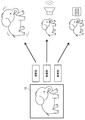
- FIG. 5 is an explanatory diagram illustrating an outline of content presentation using an information processing apparatus according to an embodiment of the present disclosure.
- FIG. It is explanatory drawing which shows an example of the content presentation for every user using the information processing apparatus which concerns on the embodiment.
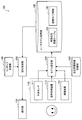
- It is a functional block diagram showing an example of 1 composition of an information presentation system concerning the embodiment.
- FIG. It is explanatory drawing which shows the example of presentation of the guide information according to a user's sense type as use case 2.
- FIG. It is explanatory drawing which shows the example of word presentation to a visual type user as use case 3.
- FIG. It is explanatory drawing which shows the example of word presentation to a tactile-type user.
- It is a flowchart which shows an example of a process in the case of changing the method of presentation of content by a user's reaction change.
- It is a hardware block diagram which shows the hardware constitutions of the one function part which comprises the information presentation system which concerns on the embodiment.
- FIG. 1 is an explanatory diagram showing an outline of content presentation using the information processing apparatus according to the present embodiment.
- FIG. 2 is an explanatory diagram illustrating an example of content presentation for each user using the information processing apparatus according to the present embodiment.
- the information processing apparatus presents information by a presentation method that facilitates receiving information for each user.
- a presentation method that facilitates receiving information for each user.
- Each user's sense of superiority can be estimated based on the user's biological information.
- the information when presenting information to the user, the information is presented so as to stimulate a certain sense (for example, vision, hearing, touch, etc.) (P1).
- a certain sense for example, vision, hearing, touch, etc.
- the biometric information of the user who has received the stimulus is acquired (P2).
- the acquired biological information of the user is analyzed to estimate the response of the user who has received the stimulus, and it is evaluated whether or not the stimulus given based on the response of the user is effective for the user (P3).
- the evaluation of the process P3 is used as information for estimating the user's superiority from the response to the user's stimulus while being fed back to the function unit that presents the information for consideration when the information is next presented to the user. (P4).
- process P4 the user's sense of superiority is estimated based on responses to various stimuli presented to the user in processes P1 to P3.
- the estimated user sense of superiority is fed back to the function unit that presents information, so that information is presented to the user so as to stimulate the sense of superiority.
- impression object 10 there is an object (hereinafter also referred to as an “impression object”) 10 that the viewer wants to make an impression among objects included in the video content.
- the video content is set only to add stimulus information when the impression object 10 is presented.
- the information processing apparatus sets stimulus information for the impression object 10 based on the sense of superiority of the viewer of the video content and reproduces the video content.
- the way of recognizing information is different for each user depending on the user's sense of superiority.
- the difference in information recognition depending on the user's superior sense is classified into sense types.
- three types are set as a sense type: a visual type that predominates in sight, an auditory type that predominates in hearing, and a tactile type that predominates in tactile sense.
- a sense type a visual type that predominates in sight
- an auditory type that predominates in hearing
- a tactile type that predominates in tactile sense.
- how to receive information, how to communicate, how to memorize, etc. are different, for example, the difference appears in the movement of the body.
- the visual user tends to move up or scramble.
- auditory users tend to move according to the contents of information and look slightly downward, while tactile users tend to swim their eyes in the horizontal direction or downward.
- visual users tend to move their hands upwards, and auditory users move according to the meaning of the story.
- Tactile users tend to move their arms up and down with overaction.
- Tactile users tend to have many onomatopoeia or mimetic words and have many voice inflections. Tactile users tend to store information individually as points.
- the user's superior sense is estimated and information is presented to the user so as to stimulate the superior sense.
- FIG. 2 it is assumed that an elephant included in the video content is impressed on the user as an impression object 10.
- the information processing apparatus enlarges / reduces, moves, or blinks the elephant that is the impression object 10 so as to stimulate the sense of superiority. May be.
- the information processing apparatus may output a cry or sound effect so as to stimulate the dominant sense of hearing, along with the display of the elephant that is the impression object 10. .
- the information processing apparatus displays the elephant that is the impression object 10 and the device that the user touches by holding or wearing so as to stimulate the tactile sense that is the dominant sense. It may be vibrated.
- the device to be vibrated may be a device itself including a display device such as a tablet terminal, a smartphone, or a wearable terminal that reproduces video content, or may be a device other than a device that reproduces video content.
- the device to be vibrated can be vibrated in response to an instruction from the device playing the video content, and may be controlled by a control server or the like that controls these devices via the network. .
- FIG. 3 is a functional block diagram illustrating a configuration example of the information presentation system 100 according to the embodiment of the present disclosure.
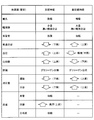
- FIG. 4 is an explanatory diagram showing a relationship between biometric information and a user's reaction as an example of information held by the reaction evaluation information storage unit 130.
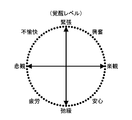
- FIG. 5 is an explanatory diagram showing one index for evaluating the user's response to the stimulus.
- FIG. 6 is an explanatory diagram showing an index when the user's response to the stimulus is evaluated from the facial expression.
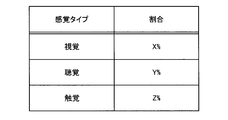
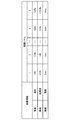
- FIG. 7 is an explanatory diagram illustrating an example of sensory type information 141 stored in the user model storage unit 140.
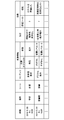
- FIG. 8 is an explanatory diagram showing an example of the stimulus response history table 143 stored in the user model storage unit 140.
- the information presentation system 100 includes sensors 110, a model setting unit 120, a reaction evaluation information storage unit 130, a user model storage unit 140, a presentation processing unit 150, A content storage unit 160 and a presentation unit 170 are included.
- Sensors 110 acquire information about the user for analyzing the reaction of the user whose information is presented.
- the sensors 110 include a biological sensor 111 that acquires user's biological information, a voice acquisition device 113 that acquires voice, and an imaging device 115 that images the user.
- the biological sensor 111 for example, a sensor that detects a change in an organ (effector) that reacts when a user receives a stimulus from the outside world as biological information may be used.
- Humans receive stimuli such as sound and light from the outside world through receptors such as ears and eyes. The senses are established by transmitting the stimulus received by the receptor to the sensory center of the cerebrum via the nervous system.
- the movement center of the cerebrum determines the movement of the body with respect to this sense, it transmits a command based on the determination to the effector and activates the effector. Changes in the effector due to this stimulus appear in response to the stimulus.
- the biosensor 111 detects a change in the effector with respect to such a stimulus.
- Figure 4 shows an example of effector.
- the effector include a pupil, a salivary gland, a bronchus, an airway secretion, a blood pressure, a heart rate, a liver, a digestive organ, and skin.
- Each effector may be in a tension state and the sympathetic nerve will work preferentially, and may be in a relaxed state and the parasympathetic nerve will work predominately depending on how the user feels the stimulus.
- the pupil dilates when he / she feels uncomfortable with the stimulus received by the user, and reduces his / her pupil when he / she feels security with respect to the stimulus received by the user.
- the effector changes depending on how the user feels the stimulus from the outside world. Therefore, it is possible to estimate a response to the stimulus given to the user based on the detection value of the biosensor 111.
- the biological sensor 111 include a pulse wave sensor, a sweat sensor, and a sphygmomanometer.
- a voice acquisition device 113 or an imaging device 115 may be provided.
- a voice acquisition device 113 by acquiring the user's voice when receiving a stimulus by the voice acquisition device 113, it is possible to grasp the inflection and loudness of the voice, the speed of the talk, and the like.
- the imaging device 115 by capturing the user's facial expression or body movement when a stimulus is received by the imaging device 115, it is possible to grasp how the user feels the stimulus based on the captured still image or moving image.
- the imaging device 115 can also be used as a biological sensor. For example, a heart rate can be obtained from an image captured by the imaging device 115 using facial heartbeat analysis technology, and respiration is recognized from minute changes in the body. It is also possible to do.
- the sensors 110 need only have at least one of the biosensor 111 and the imaging device 115, but the more information that is acquired, the more accurately the user's reaction can be recognized. It becomes.
- the biosensor 111, the sound acquisition device 113, and the imaging device 115 for example, an IoT (Internet of Things) sensor or the like can be used as the sensors 110.
- the detection value acquired by the sensors 110 is output to the model setting unit 120 as sensor information.
- the model setting unit 120 sets, for each user, a user model representing the user's response to the stimulus based on the sensor information.
- the model setting unit 120 analyzes sensor information and estimates a user's reaction to a stimulus presented to the user.
- the model setting unit 120 may estimate a user's reaction with reference to a reaction evaluation information storage unit 130 described later.
- a reaction evaluation information storage unit 130 for example, the relationship between the biological information and the user's reaction shown in FIG. 4, biaxial mapping representing the user's internal state (FIG. 5), the relationship between the user's facial expression and emotion ( FIG. 6) and the like are stored.
- the model setting unit 120 may estimate the user's reaction from the change in the effector shown in FIG. 4 based on the biological information acquired by the biological sensor 111. For example, when the user's pupil is acquired as an image as biometric information, the model setting unit 120 detects a change in the size of the pupil, and when the pupil becomes larger, the user is in a tension state and the pupil becomes smaller. The user is determined to be in a relaxed state. When there is a plurality of acquired sensor information, the user's reaction may be estimated for each sensor information. Then, the model setting unit 120 records the content of the stimulus presented to the user and the estimated user response in the user model storage unit 140 as stimulus response history information.
- the model setting unit 120 sets the user model by evaluating the estimated user reaction.
- the user model represents the user's superior sense, and is represented, for example, by the user's sense type. By presenting information based on the user model set for each user, it is possible to appropriately stimulate a different sense of superiority for each user and make it easier for each user to receive information.
- the model setting unit 120 stores the set user model in a user model storage unit 140 described later.
- the model setting unit 120 may update the user model based on a response to the stimulus given to the user.
- the reaction evaluation information storage unit 130 is a storage unit that stores information for estimating the user's response to the stimulus presented to the user by the model setting unit 120.
- the reaction evaluation information storage unit 130 holds, for example, an annular model representing the internal state of the user as shown in FIG. Good.
- the ring model shown in FIG. 5 represents the user's response to the stimulus, with positive / negative emotions on one axis and the degree of emotion excitement (also referred to as “wakefulness level” in this disclosure) on the other axis.
- the arousal level in FIG. 5 can correspond to the change of the effector with respect to the stimulus from the outside shown in FIG.
- the model setting unit 120 can quantitatively represent the user's response tendency to the stimulus by mapping the emotion specified based on the sensor information acquired by the sensors 110 to the annular model in FIG.
- the reaction evaluation information storage unit 130 may hold a relationship between facial expressions and emotions as shown in FIG. 6, for example. Emotions at that time, such as disgust or anger, surprise, contempt, fear, sadness, etc., appear in facial expressions that change due to the rising and falling of the corners of the mouth and the corner of the eye or the wrinkles between the eyebrows. Therefore, by holding the facial feature part that forms facial expressions for various emotions in the reaction evaluation information storage unit 130, the model setting unit 120 analyzes the image captured by the imaging device 115, for example, and extracts the characteristic part. Thus, it is possible to specify the emotion in which the extracted feature portion appears.
- reaction evaluation information storage unit 130 examples of information stored in the reaction evaluation information storage unit 130, and the information presentation system according to the present disclosure may not include all of the information. May be included. Moreover, the information memorize
- the user model storage unit 140 is a storage unit that stores a user model representing a user's response to a stimulus.
- the user model storage unit 140 includes user sense type information 141 and a stimulus response history table 143.
- the sensory type information 141 stores the sensory type of each user estimated by the model setting unit 120 as a user model.
- the sensory type information 141 includes a ratio of visual type, auditory type, and tactile type for each user. In some people, one sensation works predominately, and in others, several sensations function to the same extent. Therefore, as shown in FIG. 7, it is possible to set a stimulus more suitable for each user by expressing the degree to which each sensory type works preferentially as a ratio.
- the sensory type information 141 is a sensory type estimated based on information stored in the stimulus response history table 143.
- the stimulus response history table 143 stores the content presented by the information presentation system 100 and the set stimulus information, the user's response to the information, the effect on the user, and the like.
- One structural example of the stimulus response history table 143 is shown in FIG.
- the stimulus response history table 143 shown in FIG. 8 can store time, place, scene, content, stimulus information, user response, and user effect. Information other than that shown in FIG. 8 can be stored in the stimulus response history table 143. There may also be information that cannot be acquired depending on the scene. In this case, it may be recorded that acquisition is impossible or not acquired.
- the effect on the user by giving the stimulus stored in the stimulus response history table 143 may be updated later. For example, it is assumed that a stimulus that causes the user to learn English words when using the content of English word teaching materials is added. The stimulus seemed to be effective because the user seemed to respond to the presented stimulus at first glance, but when a small test was conducted afterwards, it was found that the stimulus was not understood at all. Is a case where it is renewed that there was no actual effect.
- the information stored in the user model storage unit 140 is appropriately updated by the model setting unit 120. For example, it may be updated in real time whenever there is a response to a certain stimulus, or may be updated in a batch process after a certain period of time has elapsed.
- the user model storage unit 140 is referred to a presentation processing unit 150 described later, and the presentation processing unit 150 sets a stimulus to an impression object included in the content.
- the presentation processing unit 150 presents various contents stored in the content storage unit 160 to the user via the presentation unit 170.
- the presentation processing unit 150 sets a stimulus based on information stored in the user model storage unit 140 for the impression object included in the content stored in the content storage unit 160 and outputs the stimulus to the presentation unit 170.
- the presentation processing unit 150 may determine stimulation information to be set based on the sense type information 141.
- the presentation processing unit 150 refers to, for example, the stimulus response history table 143, extracts history information related to the current stimulus from the past stimulus content and the history of the response, and the response to the stimulus from the extracted information and its response
- the stimulus information to be set this time may be determined after confirming the effect.
- the presentation processing unit 150 may set stimulation information based on user characteristics such as user preference and user information set by the user.
- the content storage unit 160 is a storage unit that stores content to be presented to the user.
- the content storage unit 160 may be provided in the same device or server as the presentation processing unit 150, or may be content held on the cloud.
- the content is not particularly limited, but may be content that can add a stimulus to the user when presenting the content.
- the content also includes digital content.
- the present invention can be applied to educational content such as a learning drill, book content such as a digital picture book, and AR content that synthesizes and displays an image in real time.
- the presentation unit 170 presents content to the user together with the stimulus set in the impression object.
- the presentation unit 170 includes, for example, a display unit that displays information, an audio output unit that outputs audio, a vibration generation unit that vibrates the device, and the like.
- the stimulus set in the content and the impression object does not necessarily have to be presented from the same device. For example, when vibration is applied with the presentation of an impression object, content including the impression object is displayed on the tablet terminal, but vibration is caused by vibrating other devices such as a wristband type terminal and a smartphone in synchronization with the display of the impression object. Also good.
- FIG. 9 shows a basic information presentation method by the information presentation system 100 shown in FIG.
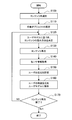
- FIG. 9 is a flowchart illustrating an example of an information presentation method by the information presentation system 100 according to the present embodiment.
- Steps S100 and S110 are content creation stages before content is provided to the user.
- the content creator does not need to set a specific movement or sound for the impression object, but only sets the impression object to be impressed by the user.
- the presentation processing unit 150 of the information presentation system 100 refers to the user model storage unit 140 and determines a content presentation method (S120).
- the presentation processing unit 150 refers to the sensory type information 141 in the user model storage unit 140 and sets stimulation information corresponding to the sensory type of the user who uses the content.
- the user is a visual sense type
- the impression object is enlarged / reduced or displayed blinking.
- the content presentation method is determined in step S120, the content is reproduced (S130), and the content is presented to the user.
- the set stimulus information is also presented.
- the user's biological information, facial expression, voice, etc. are acquired by the sensors 110 (S140).
- the sensor information acquired by the sensors 110 is output to the model setting unit 120.
- the model setting unit 120 refers to the reaction evaluation information storage unit 130, evaluates a user's reaction when a stimulus is given, and estimates a sense type (S150).
- the model setting unit 120 records the presented content, the impression object, the set stimulus information, the user's response to the stimulus, the effect of the stimulus on the user, and the like in the stimulus response history table 143, and the sensory type information 141 is estimated this time. It is updated with the sense type (S160).
- the processing from step S120 to SS160 is performed, for example, until the reproduction of the content is finished (S170).
- the basic information presentation method by the information presentation system 100 has been described above. According to such an information presentation method, information can be presented for each user by a method that is most easily received. In addition, since an appropriate stimulation method according to the user can be automatically performed, the content creator does not need to set a detailed stimulation presentation method when giving an expected stimulus to an impression object.
- a preset fixed user model or a general user model may be set as the initial user model in the user model storage unit 140.
- the fixed user model is not particularly limited, and an arbitrary initial value may be set, for example, the sensory type is set to “visual type” only.
- the general user model may be, for example, an average value of sensory type information of other users acquired in the past.
- an initial user model may be set by presenting test content for specifying a rough sense type before presenting actual content to the user. At this time, the user's reaction is evaluated based on the sensor information acquired when the test content is presented, and the user's sense type is estimated. As described above, by performing the test process for setting the user model of the user, stimulation information suitable for the user's sense is presented immediately after the start of content reproduction.
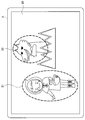
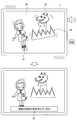
- FIG. 10 is an explanatory diagram showing an image of a digital picture book presented as content.
- FIG. 11 is an explanatory diagram illustrating an example of the size of stimulus information set in an impression object.
- FIG. 12 is an explanatory diagram showing the content of stimulus information set for an impression object.
- FIG. 13 is an explanatory diagram showing that a content creator is alerted when stimulation information is set excessively.
- the contents of a digital picture book are used by displaying a still image or a moving image on the display 20 of the terminal 2 such as a tablet terminal as shown in FIG.
- the content creator sets an awakening level representing the magnitude of the stimulus for each impression object. The greater the arousal level, the greater the stimulus. For example, in the example shown in FIG. 11, the waking level of the wolf is set to 4, and the waking level of the red riding hood is set to 2.
- the presentation processing unit 150 of the information presentation system 100 refers to the sensory type information 141 of the user model storage unit 140, and sets a stimulus to be given together with the content based on the user's sensory type and the set awakening level of the impression object. .
- FIG. 12 shows a setting example of stimulus information and arousal level. Such information may be stored in the user model storage unit 140.
- the stimulus for the visual user the magnitude of the movement of the impression object, the magnitude of the sound effect as the stimulus for the auditory user, and the vibration time of the terminal 2 as the stimulus for the tactile user. Is set.
- the user who uses the digital picture book has all the types of features of visual type, auditory type, and tactile type, but since the visual type is more dominant, the movement of the impression object is different from other stimuli.
- the content is presented so as to be more emphasized.
- the presentation processing unit 150 moves the wolves 23 of the arousal level 4 by 20% larger than the normal movement and 10% larger than normal.
- the sound effect is output at the volume, and the terminal 2 is vibrated for 3 seconds.
- the set stimulus is smaller than the wolf 23, moves 10% larger than the normal movement, and outputs a sound effect at a volume 5% larger than normal.
- the terminal 2 is vibrated for 1 second.
- the content creator automatically sets the specific movement of the impression object only by setting the impression object and the size of the stimulus.
- the content creator since the content creator can set the arousal level for the impression object, it may set even an unintended stimulus, which may distract the user's attention to the impression object.
- stimulation information is set for the leaf 25, and the movement and sound effect of each object and the vibration of the terminal 2 have a predetermined level.
- the determination as to whether or not excessive stimulation is set is, for example, that the number of objects for which stimulus information is set among impression objects displayed at the same time is a predetermined number or more, and each awakening level is 4 or more. This may be done depending on the case.
- a message 27 indicating that the excessive stimulus is set is displayed on the display 20 as shown in the lower side of FIG. You may notify a user by making it display or outputting an audio
- FIG. 14 is an explanatory diagram illustrating an example of presentation of guide information according to a user's sense type.
- guide information using AR displayed superimposed on a real image is appropriately presented according to the user's sense type.
- Guide information corresponds to the impression object.
- a head mounted display, an eyewear terminal, or the like can be used in addition to a smartphone or a tablet terminal.
- guide information for guiding the user to the annex is presented.
- the content creator sets only the impression object as the place the user has set as the destination.
- the presentation processing unit 150 of the information presentation system 100 refers to the user model storage unit 140 and acquires the user's sense type.
- guide information is shown according to a user's sense type. For example, for the visual user, the guide object 31 that visually indicates the position of the annex displayed on the display 30 is highlighted. For example, for the auditory type user, the guide object 31 is displayed on the display 30 smaller than the case where the guide object 31 is presented to the visual type user.
- the guide object 31 is displayed small on the display 30 as in the case of an auditory user, but the terminal 3 is vibrated when an annex is displayed in the display 30.
- the location of the annex may be notified.
- the processing for stopping the guide information presentation three operations are set: winking after confirming the guide, “OK” after confirming the guide, and pointing the finger after confirming the guide.
- the guide information presentation is similarly stopped, but it can be estimated that the operation selected by the user is naturally selected by the sense of superiority.
- the visual type is used when the user winks after confirming the guide, the auditory type when the user says “OK” after confirming the guide, and the tactile type when the user points a finger after confirming the guide. You may judge.
- the user model storage unit 140 it can be used for estimation of a user's sense type.
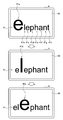
- FIG. 15 is an explanatory diagram illustrating an example of word presentation to a visual user.
- FIG. 16 is an explanatory diagram illustrating an example of word presentation to a tactile-type user. This use case presents English words so that the user can easily learn English words when using the English language teaching materials.
- the English word is the impression object, and in FIGS. 15 and 16, the English word “elephant” is the impression object 41.
- the presentation processing unit 150 refers to the user model storage unit 140 and acquires the user's sense type. And the English word which is the impression object 41 is shown according to a user's sense type. For example, for a visual user, an English word “elephant” is displayed on the display 40, and the alphabets 41a to 41h constituting the word are displayed one by one so that the display is different from the other alphabets. . For example, in the example of FIG. 15, “e”, “l”, “e”,... When the character is enlarged, the color of the character may be changed.
- an English word “elephant” is displayed on the display 40, and “ELP” is spoken as “Elephant”. You may replay it.
- ELP spoken as “Elephant”.
- “elephant” and the English word are displayed lightly on the display 40. This is a draft object 43. Then, the user causes the draft object 43 displayed on the display 40 to be traced with an operating body such as the touch pen 6 or a finger to write English words.
- information presentation system 100 can be presented in a presentation method that is easy for the user to remember by changing the presentation of English words according to the sense type of the user. .
- FIG. 17 shows an example of processing in the case of changing the way of presenting content according to a change in user reaction.
- the presentation processing unit 150 of the information presentation system 100 refers to the user model storage unit 140 and determines a content presentation method (S200).
- the presentation processing unit 150 refers to the sensory type information 141 in the user model storage unit 140 and sets stimulation information corresponding to the sensory type of the user who uses the content.
- the content presentation method is determined in step S200, the content is reproduced (S210), and the content is presented to the user.
- the impression object is presented, the set stimulus information is also presented.
- the user's biological information, facial expression, voice, etc. are acquired by the sensors 110 (S220).
- the sensor information acquired by the sensors 110 is output to the model setting unit 120.
- the model setting unit 120 refers to the reaction evaluation information storage unit 130, evaluates a user's reaction when a stimulus is given, and estimates a sense type (S230).
- the model setting unit 120 determines whether the user's reaction has decreased below a predetermined rate or increased above a predetermined rate from the level at which learning has been continued so far (S240). For example, when the user's concentration is lost, mental sweating disappears.
- the determination in step S240 can be performed using such a change that the degree of change in biological information becomes weak.
- step S240 If the condition of step S240 is not satisfied and the user's reaction is not much different from before, the process returns to step S210 and the learning is continued.
- the presentation processing unit 150 determines whether there is stimulation information that has not been set so far (S250). ). If there is unset stimulus information, the presentation processing unit 150 changes the stimulus information when presenting the impression object in the hope of improving the user's response (S260), returns to step S210, and continues learning. Let it continue. On the other hand, when there is no unset stimulus information in step S250, the presentation processing unit 150 proposes a break or deep breath to the user in order to give the sharpness of learning itself (S270).
- the degree of stimulation information may be changed according to the proficiency level of the user.
- the stimulus information of the part with high proficiency is weak and the stimulus information of the part with low proficiency is set strong, so that it is possible to make a more impressed part that is not fixed in the user's memory.
- the user's proficiency level can be determined by, for example, evaluation based on the result of a small test, the number of times content is reproduced, and the like.
- a user model such as a user's sense type can be specified. Therefore, by organizing the same type of students into the same class and the same team based on the identified user model of the user, the teacher can conduct a lesson according to the type of the student. Since it is possible to take classes that match the student's senses, the level of understanding of the learning content increases, and it is possible to conduct classes efficiently. Also, in selecting a teacher, by selecting a teacher of a type that matches the type of student, it is expected that the teacher and the student can communicate with each other in an unconscious part, and communication can be performed satisfactorily.
- Theme parks / art museums / exhibitions Further, by using the fact that the user model can be specified by the information presentation system 100 according to the present embodiment, selection of stimuli that are easy for the user to receive at the theme parks, museums, exhibitions, etc. Adjustments can also be made. For example, at a theme park, stimulus information that is easy to be interesting according to each user's sensory type, such as entering sound from an auditory person and entering light from a visual person, as an attraction for an attraction. You may make it set.
- FIG. 18 is a hardware configuration diagram illustrating a hardware configuration of one functional unit constituting the information presentation system 100 according to the present embodiment. 18 illustrates an example of a hardware configuration of the information processing apparatus 900 including each functional unit illustrated in FIG. 3, but similar hardware is also applied to an apparatus including only a part of the functional unit illustrated in FIG. 3. It may be a configuration.
- the information processing apparatus 900 can be realized by a processing apparatus such as a computer as described above.
- the information processing apparatus 900 includes a CPU (Central Processing Unit) 901, a ROM (Read Only Memory) 902, a RAM (Random Access Memory) 903, and a host bus 904a.
- the information processing apparatus 900 includes a bridge 904, an external bus 904b, an interface 905, an input device 906, an output device 907, a storage device 908, a drive 909, a connection port 911, and a communication device 913. Prepare.
- the CPU 901 functions as an arithmetic processing unit and a control unit, and controls the overall operation in the information processing apparatus 900 according to various programs. Further, the CPU 901 may be a microprocessor.
- the ROM 902 stores programs used by the CPU 901, calculation parameters, and the like.
- the RAM 903 temporarily stores programs used in the execution of the CPU 901, parameters that change as appropriate during the execution, and the like. These are connected to each other by a host bus 904a including a CPU bus.
- the host bus 904a is connected to an external bus 904b such as a PCI (Peripheral Component Interconnect / Interface) bus via a bridge 904.
- an external bus 904b such as a PCI (Peripheral Component Interconnect / Interface) bus
- PCI Peripheral Component Interconnect / Interface
- the host bus 904a, the bridge 904, and the external bus 904b do not necessarily have to be configured separately, and these functions may be mounted on one bus.
- the input device 906 includes an input means for inputting information by the user such as a mouse, keyboard, touch panel, button, microphone, switch, and lever, and an input control circuit that generates an input signal based on the input by the user and outputs the input signal to the CPU 901. Etc.
- the output device 907 includes, for example, a liquid crystal display (LCD) device, an OLED (Organic Light Emitting Diode) device and a display device such as a lamp, and an audio output device such as a speaker.
- LCD liquid crystal display
- OLED Organic Light Emitting Diode
- the storage device 908 is an example of a storage unit of the information processing device 900 and is a device for storing data.
- the storage device 908 may include a storage medium, a recording device that records data on the storage medium, a reading device that reads data from the storage medium, a deletion device that deletes data recorded on the storage medium, and the like.
- the storage device 908 drives a hard disk and stores programs executed by the CPU 901 and various data.
- the drive 909 is a storage medium reader / writer, and is built in or externally attached to the information processing apparatus 900.
- the drive 909 reads information recorded on a mounted removable recording medium such as a magnetic disk, an optical disk, a magneto-optical disk, or a semiconductor memory, and outputs the information to the RAM 903.
- the connection port 911 is an interface connected to an external device, and is a connection port with an external device capable of transmitting data by USB (Universal Serial Bus), for example.
- the communication device 913 is a communication interface configured by a communication device or the like for connecting to the communication network 5, for example.
- the communication device 913 may be a wireless LAN (Local Area Network) compatible communication device, a wireless USB compatible communication device, or a wire communication device that performs wired communication.
- An information processing apparatus comprising: a processing unit that presents content to the user based on sensor information acquired by a sensor that detects a reaction of the user to a stimulus given to the user.
- the processor is Based on the sensor information, a model setting unit that sets, for each user, a user model that represents a user's response to a stimulus, A presentation processing unit that executes a presentation process for presenting the content to the user based on the user model;
- the information processing apparatus according to (1) including: (3) Multiple sensory types are set according to the user's response to the stimulus,
- the information processing apparatus includes at least a visual type, an auditory type, and a tactile type.
- the model setting unit when there are a plurality of the sensory types to which the user's reaction corresponds, weights the corresponding sensory types, and sets the sensory type and the weights as the user model. Or the information processing apparatus as described in (4).
- (6) The information processing apparatus according to any one of (2) to (5), wherein an initial user model set in advance is initially set as the user model.
- the presentation processing unit executes a test process for presenting test content to the user
- the model setting unit evaluates a reaction of the user based on the sensor information when the test content is presented, and performs an initial setting of the user model of the user based on an evaluation result.
- the information processing apparatus according to any one of (5) to (5).
- the model setting unit evaluates the reaction of the user based on the sensor information when the content is presented by the presentation processing unit, and updates the user model of the user based on an evaluation result.
- the information processing apparatus according to any one of 2) to (7).
- the stimulus information based on the user model is set for the impression object that gives an impression to the user,
- the stimulus information is information that causes the impression object to blink.
- the information processing apparatus according to any one of (9) to (12), wherein the stimulus information is information that vibrates a predetermined device along with the presentation of the impression object.
- the presentation processing unit changes the stimulus information to be set based on the importance of the impression object.
- the processing unit further presents content to the user based on user characteristics.
- the sensor includes at least one of a biological sensor that acquires biological information of the user and an imaging apparatus that images the user. .
Landscapes
- Health & Medical Sciences (AREA)
- Life Sciences & Earth Sciences (AREA)
- Engineering & Computer Science (AREA)
- Physics & Mathematics (AREA)
- Animal Behavior & Ethology (AREA)
- Surgery (AREA)
- Veterinary Medicine (AREA)
- Public Health (AREA)
- General Health & Medical Sciences (AREA)
- Molecular Biology (AREA)
- Medical Informatics (AREA)
- Biophysics (AREA)
- Pathology (AREA)
- Biomedical Technology (AREA)
- Heart & Thoracic Surgery (AREA)
- Theoretical Computer Science (AREA)
- Physiology (AREA)
- Educational Technology (AREA)
- Business, Economics & Management (AREA)
- General Physics & Mathematics (AREA)
- Cardiology (AREA)
- Educational Administration (AREA)
- Pulmonology (AREA)
- General Engineering & Computer Science (AREA)
- Endocrinology (AREA)
- Medicinal Chemistry (AREA)
- Developmental Disabilities (AREA)
- Hospice & Palliative Care (AREA)
- Psychiatry (AREA)
- Psychology (AREA)
- Social Psychology (AREA)
- Gastroenterology & Hepatology (AREA)
- Audiology, Speech & Language Pathology (AREA)
- Vascular Medicine (AREA)
- Entrepreneurship & Innovation (AREA)
- Chemical & Material Sciences (AREA)
- Bioinformatics & Cheminformatics (AREA)
- Child & Adolescent Psychology (AREA)
- Dentistry (AREA)
- Oral & Maxillofacial Surgery (AREA)
Abstract
L'invention aborde le problème de la réalisation d'un dispositif de traitement d'informations capable de présenter des informations en utilisant un procédé de présentation par lequel des informations destinées à chaque utilisateur sont facilement reçues. L'invention réalise à cet effet un dispositif de traitement d'informations comprenant une unité de traitement qui présente un contenu à des utilisateurs en se basant sur des informations de capteur obtenues par un capteur qui détecte des réactions d'utilisateur à des stimulis donnés à l'utilisateur.
Priority Applications (3)
| Application Number | Priority Date | Filing Date | Title |
|---|---|---|---|
| US16/308,502 US11145219B2 (en) | 2016-06-23 | 2017-04-12 | System and method for changing content based on user reaction |
| EP17814996.9A EP3477433A4 (fr) | 2016-06-23 | 2017-04-12 | Dispositif de traitement d'informations, procédé de traitement d'informations et programme informatique |
| US17/490,678 US20220028296A1 (en) | 2016-06-23 | 2021-09-30 | Information processing apparatus, information processing method, and computer program |
Applications Claiming Priority (2)
| Application Number | Priority Date | Filing Date | Title |
|---|---|---|---|
| JP2016-124091 | 2016-06-23 | ||
| JP2016124091A JP2017227780A (ja) | 2016-06-23 | 2016-06-23 | 情報処理装置、情報処理方法及びコンピュータプログラム |
Related Child Applications (2)
| Application Number | Title | Priority Date | Filing Date |
|---|---|---|---|
| US16/308,502 A-371-Of-International US11145219B2 (en) | 2016-06-23 | 2017-04-12 | System and method for changing content based on user reaction |
| US17/490,678 Continuation US20220028296A1 (en) | 2016-06-23 | 2021-09-30 | Information processing apparatus, information processing method, and computer program |
Publications (1)
| Publication Number | Publication Date |
|---|---|
| WO2017221525A1 true WO2017221525A1 (fr) | 2017-12-28 |
Family
ID=60784793
Family Applications (1)
| Application Number | Title | Priority Date | Filing Date |
|---|---|---|---|
| PCT/JP2017/014979 Ceased WO2017221525A1 (fr) | 2016-06-23 | 2017-04-12 | Dispositif de traitement d'informations, procédé de traitement d'informations et programme informatique |
Country Status (4)
| Country | Link |
|---|---|
| US (2) | US11145219B2 (fr) |
| EP (1) | EP3477433A4 (fr) |
| JP (1) | JP2017227780A (fr) |
| WO (1) | WO2017221525A1 (fr) |
Cited By (2)
| Publication number | Priority date | Publication date | Assignee | Title |
|---|---|---|---|---|
| WO2019106975A1 (fr) * | 2017-11-30 | 2019-06-06 | 国立研究開発法人産業技術総合研究所 | Procédé de création de contenu |
| WO2019155564A1 (fr) * | 2018-02-08 | 2019-08-15 | 株式会社日立製作所 | Système et procédé fournissant des informations |
Families Citing this family (10)
| Publication number | Priority date | Publication date | Assignee | Title |
|---|---|---|---|---|
| JP2017227780A (ja) * | 2016-06-23 | 2017-12-28 | ソニー株式会社 | 情報処理装置、情報処理方法及びコンピュータプログラム |
| US10798451B2 (en) * | 2017-02-24 | 2020-10-06 | Rovi Guides, Inc. | Systems and methods for detecting a reaction by a user to a media asset to which the user previously reacted at an earlier time, and recommending a second media asset to the user consumed during a range of times adjacent to the earlier time |
| JP2021170148A (ja) | 2018-07-02 | 2021-10-28 | ソニーグループ株式会社 | 情報処理装置、情報処理方法、および記録媒体 |
| JP7508097B2 (ja) * | 2019-12-02 | 2024-07-01 | フォレストデジタル株式会社 | 映像システム、プログラム、およびコンピュータ読み取り可能な記憶媒体 |
| JP7618482B2 (ja) * | 2021-03-31 | 2025-01-21 | 株式会社ベネッセコーポレーション | 情報処理装置、プログラム、および情報処理方法 |
| JP7701192B2 (ja) * | 2021-05-27 | 2025-07-01 | 株式会社日立製作所 | コミュニケーション支援装置、プログラムおよび記憶媒体 |
| KR20230021924A (ko) | 2021-08-06 | 2023-02-14 | 삼성전자주식회사 | 전자 장치 및 전자 장치에서 복수의 상태들의 우선 순위에 기반한 캐릭터 오브젝트 표시 방법 |
| JP7613616B2 (ja) * | 2022-02-10 | 2025-01-15 | 日本電信電話株式会社 | フィードバック装置、プログラム |
| US20250258992A1 (en) * | 2024-02-12 | 2025-08-14 | Motorola Mobility Llc | Electronic Devices and Corresponding Methods for Utilizing User Sensory Preference Reaction Scores to Enhance User Interface Interactions |
| US20250258536A1 (en) * | 2024-02-12 | 2025-08-14 | Motorola Mobility Llc | Electronic Devices, Systems, and Corresponding Methods for Utilizing User Sensory Preference Reaction Scores to Enhance User Interface Interactions |
Citations (7)
| Publication number | Priority date | Publication date | Assignee | Title |
|---|---|---|---|---|
| JP2001252265A (ja) * | 2000-03-08 | 2001-09-18 | Sharp Corp | バイオフィードバック装置 |
| JP2007512086A (ja) * | 2003-11-21 | 2007-05-17 | ファースト プリンシプルズ インコーポレイテッド | 睡眠誘導システムおよび関連する方法 |
| JP2009502363A (ja) * | 2005-07-29 | 2009-01-29 | ジョン ウィリアム シュタイナート | 刺激的な運動のための方法及び装置 |
| JP2010244334A (ja) | 2009-04-07 | 2010-10-28 | Nec Corp | 発想支援装置、発想支援方法および発想支援用プログラム |
| JP2012203288A (ja) * | 2011-03-28 | 2012-10-22 | Keisuke Tomono | 香りを発する誘惑性物質の嫌忌嗜好性教育システム |
| WO2013018267A1 (fr) * | 2011-07-29 | 2013-02-07 | パナソニック株式会社 | Dispositif de contrôle de présentation et procédé de contrôle de présentation |
| JP2016513319A (ja) * | 2013-03-15 | 2016-05-12 | インテル コーポレイション | 収集された生物物理的信号の時間的パターンおよび空間的パターンに基づく脳‐コンピューターインターフェース(bci)システム |
Family Cites Families (8)
| Publication number | Priority date | Publication date | Assignee | Title |
|---|---|---|---|---|
| AU734018B2 (en) * | 1995-10-09 | 2001-05-31 | Nintendo Co., Ltd. | Three-dimension image processing system |
| US7207804B2 (en) * | 1996-03-27 | 2007-04-24 | Michael Hersh | Application of multi-media technology to computer administered vocational personnel assessment |
| JP2001190840A (ja) * | 2000-01-06 | 2001-07-17 | Konami Co Ltd | ゲームシステムおよびコンピュータ読取可能な記憶媒体 |
| CN101232860A (zh) | 2005-07-29 | 2008-07-30 | 约翰·威廉·斯坦纳特 | 用于刺激训练的方法及装置 |
| JP2009508553A (ja) * | 2005-09-16 | 2009-03-05 | アイモーションズ−エモーション テクノロジー エー/エス | 眼球性質を解析することで、人間の感情を決定するシステムおよび方法 |
| WO2013100888A2 (fr) * | 2011-12-26 | 2013-07-04 | Empire Technology Development Llc | Techniques de fourniture de contenu |
| KR102491130B1 (ko) * | 2016-06-20 | 2023-01-19 | 매직 립, 인코포레이티드 | 시각적 프로세싱 및 지각 상태들을 포함하는 신경학적 상태들의 평가 및 수정을 위한 증강 현실 디스플레이 시스템 |
| JP2017227780A (ja) * | 2016-06-23 | 2017-12-28 | ソニー株式会社 | 情報処理装置、情報処理方法及びコンピュータプログラム |
-
2016
- 2016-06-23 JP JP2016124091A patent/JP2017227780A/ja active Pending
-
2017
- 2017-04-12 WO PCT/JP2017/014979 patent/WO2017221525A1/fr not_active Ceased
- 2017-04-12 US US16/308,502 patent/US11145219B2/en not_active Expired - Fee Related
- 2017-04-12 EP EP17814996.9A patent/EP3477433A4/fr not_active Withdrawn
-
2021
- 2021-09-30 US US17/490,678 patent/US20220028296A1/en not_active Abandoned
Patent Citations (7)
| Publication number | Priority date | Publication date | Assignee | Title |
|---|---|---|---|---|
| JP2001252265A (ja) * | 2000-03-08 | 2001-09-18 | Sharp Corp | バイオフィードバック装置 |
| JP2007512086A (ja) * | 2003-11-21 | 2007-05-17 | ファースト プリンシプルズ インコーポレイテッド | 睡眠誘導システムおよび関連する方法 |
| JP2009502363A (ja) * | 2005-07-29 | 2009-01-29 | ジョン ウィリアム シュタイナート | 刺激的な運動のための方法及び装置 |
| JP2010244334A (ja) | 2009-04-07 | 2010-10-28 | Nec Corp | 発想支援装置、発想支援方法および発想支援用プログラム |
| JP2012203288A (ja) * | 2011-03-28 | 2012-10-22 | Keisuke Tomono | 香りを発する誘惑性物質の嫌忌嗜好性教育システム |
| WO2013018267A1 (fr) * | 2011-07-29 | 2013-02-07 | パナソニック株式会社 | Dispositif de contrôle de présentation et procédé de contrôle de présentation |
| JP2016513319A (ja) * | 2013-03-15 | 2016-05-12 | インテル コーポレイション | 収集された生物物理的信号の時間的パターンおよび空間的パターンに基づく脳‐コンピューターインターフェース(bci)システム |
Non-Patent Citations (1)
| Title |
|---|
| See also references of EP3477433A4 |
Cited By (3)
| Publication number | Priority date | Publication date | Assignee | Title |
|---|---|---|---|---|
| WO2019106975A1 (fr) * | 2017-11-30 | 2019-06-06 | 国立研究開発法人産業技術総合研究所 | Procédé de création de contenu |
| JPWO2019106975A1 (ja) * | 2017-11-30 | 2020-10-22 | 国立研究開発法人産業技術総合研究所 | コンテンツ作成方法 |
| WO2019155564A1 (fr) * | 2018-02-08 | 2019-08-15 | 株式会社日立製作所 | Système et procédé fournissant des informations |
Also Published As
| Publication number | Publication date |
|---|---|
| US20200184843A1 (en) | 2020-06-11 |
| EP3477433A4 (fr) | 2019-05-22 |
| JP2017227780A (ja) | 2017-12-28 |
| US20220028296A1 (en) | 2022-01-27 |
| EP3477433A1 (fr) | 2019-05-01 |
| US11145219B2 (en) | 2021-10-12 |
Similar Documents
| Publication | Publication Date | Title |
|---|---|---|
| US20220028296A1 (en) | Information processing apparatus, information processing method, and computer program | |
| US12253882B2 (en) | System and method for enhanced training using a virtual reality environment and bio-signal data | |
| CA2673644C (fr) | Simulation situee pour un entrainement, un apprentissage et une therapie | |
| US20190130788A1 (en) | Virtual Reality Microsimulation Platform | |
| CN109298779B (zh) | 基于虚拟代理交互的虚拟训练系统与方法 | |
| US20230360772A1 (en) | Virtual reality based cognitive therapy (vrct) | |
| JP7364099B2 (ja) | 出力制御装置、出力制御方法およびプログラム | |
| JP7288064B2 (ja) | 視覚型仮想エージェント | |
| JP2013097311A (ja) | 学習支援装置、学習支援方法および学習支援プログラム | |
| EP3111349A1 (fr) | Systèmes, environnement et procédés pour évaluer et prendre en charge un trouble global du développement au moyen d'un dispositif de collecte de données portable | |
| JP7066115B2 (ja) | パブリックスピーキング支援装置、及びプログラム | |
| JPWO2018034113A1 (ja) | コンテンツ提供システム、コンテンツ提供方法、及びコンテンツ提供システム用のプログラム | |
| Rega et al. | Liar (language interface for autistic’s rehabilitation): technological aids for specialists supporting the acquisition of verbal behavior in persons with autism | |
| JP7263475B1 (ja) | 授業支援システム、授業支援方法、授業支援プログラム | |
| CN108563322B (zh) | Vr/ar设备的控制方法和装置 | |
| Holroyd | Improving personal and organisational performance in social work | |
| DiMeglio | Fear feedback loop: creative and dynamic fear experiences driven by user emotion | |
| Klasen | Touching Each Other: Video Analysis of Mother–Infant Interaction After the Birth | |
| Gogoţ et al. | Nonverbal Communication–Present and Future |
Legal Events
| Date | Code | Title | Description |
|---|---|---|---|
| 121 | Ep: the epo has been informed by wipo that ep was designated in this application |
Ref document number: 17814996 Country of ref document: EP Kind code of ref document: A1 |
|
| NENP | Non-entry into the national phase |
Ref country code: DE |
|
| ENP | Entry into the national phase |
Ref document number: 2017814996 Country of ref document: EP Effective date: 20190123 |
|
| WWW | Wipo information: withdrawn in national office |
Ref document number: 2017814996 Country of ref document: EP |