WO2018043360A1 - 積層体および繊維強化樹脂複合体の製造方法 - Google Patents
積層体および繊維強化樹脂複合体の製造方法 Download PDFInfo
- Publication number
- WO2018043360A1 WO2018043360A1 PCT/JP2017/030612 JP2017030612W WO2018043360A1 WO 2018043360 A1 WO2018043360 A1 WO 2018043360A1 JP 2017030612 W JP2017030612 W JP 2017030612W WO 2018043360 A1 WO2018043360 A1 WO 2018043360A1
- Authority
- WO
- WIPO (PCT)
- Prior art keywords
- fiber
- thermoplastic resin
- bis
- weight
- fibers
- Prior art date
- Legal status (The legal status is an assumption and is not a legal conclusion. Google has not performed a legal analysis and makes no representation as to the accuracy of the status listed.)
- Ceased
Links
Images


Classifications
-
- B—PERFORMING OPERATIONS; TRANSPORTING
- B32—LAYERED PRODUCTS
- B32B—LAYERED PRODUCTS, i.e. PRODUCTS BUILT-UP OF STRATA OF FLAT OR NON-FLAT, e.g. CELLULAR OR HONEYCOMB, FORM
- B32B27/00—Layered products comprising a layer of synthetic resin
- B32B27/12—Layered products comprising a layer of synthetic resin next to a fibrous or filamentary layer
-
- B—PERFORMING OPERATIONS; TRANSPORTING
- B29—WORKING OF PLASTICS; WORKING OF SUBSTANCES IN A PLASTIC STATE IN GENERAL
- B29C—SHAPING OR JOINING OF PLASTICS; SHAPING OF MATERIAL IN A PLASTIC STATE, NOT OTHERWISE PROVIDED FOR; AFTER-TREATMENT OF THE SHAPED PRODUCTS, e.g. REPAIRING
- B29C70/00—Shaping composites, i.e. plastics material comprising reinforcements, fillers or preformed parts, e.g. inserts
- B29C70/04—Shaping composites, i.e. plastics material comprising reinforcements, fillers or preformed parts, e.g. inserts comprising reinforcements only, e.g. self-reinforcing plastics
-
- B—PERFORMING OPERATIONS; TRANSPORTING
- B32—LAYERED PRODUCTS
- B32B—LAYERED PRODUCTS, i.e. PRODUCTS BUILT-UP OF STRATA OF FLAT OR NON-FLAT, e.g. CELLULAR OR HONEYCOMB, FORM
- B32B27/00—Layered products comprising a layer of synthetic resin
- B32B27/28—Layered products comprising a layer of synthetic resin comprising synthetic resins not wholly covered by any one of the sub-groups B32B27/30 - B32B27/42
- B32B27/286—Layered products comprising a layer of synthetic resin comprising synthetic resins not wholly covered by any one of the sub-groups B32B27/30 - B32B27/42 comprising polysulphones; polysulfides
-
- B—PERFORMING OPERATIONS; TRANSPORTING
- B32—LAYERED PRODUCTS
- B32B—LAYERED PRODUCTS, i.e. PRODUCTS BUILT-UP OF STRATA OF FLAT OR NON-FLAT, e.g. CELLULAR OR HONEYCOMB, FORM
- B32B27/00—Layered products comprising a layer of synthetic resin
- B32B27/32—Layered products comprising a layer of synthetic resin comprising polyolefins
-
- B—PERFORMING OPERATIONS; TRANSPORTING
- B32—LAYERED PRODUCTS
- B32B—LAYERED PRODUCTS, i.e. PRODUCTS BUILT-UP OF STRATA OF FLAT OR NON-FLAT, e.g. CELLULAR OR HONEYCOMB, FORM
- B32B27/00—Layered products comprising a layer of synthetic resin
- B32B27/34—Layered products comprising a layer of synthetic resin comprising polyamides
-
- B—PERFORMING OPERATIONS; TRANSPORTING
- B32—LAYERED PRODUCTS
- B32B—LAYERED PRODUCTS, i.e. PRODUCTS BUILT-UP OF STRATA OF FLAT OR NON-FLAT, e.g. CELLULAR OR HONEYCOMB, FORM
- B32B27/00—Layered products comprising a layer of synthetic resin
- B32B27/36—Layered products comprising a layer of synthetic resin comprising polyesters
-
- B—PERFORMING OPERATIONS; TRANSPORTING
- B32—LAYERED PRODUCTS
- B32B—LAYERED PRODUCTS, i.e. PRODUCTS BUILT-UP OF STRATA OF FLAT OR NON-FLAT, e.g. CELLULAR OR HONEYCOMB, FORM
- B32B27/00—Layered products comprising a layer of synthetic resin
- B32B27/36—Layered products comprising a layer of synthetic resin comprising polyesters
- B32B27/365—Layered products comprising a layer of synthetic resin comprising polyesters comprising polycarbonates
-
- B—PERFORMING OPERATIONS; TRANSPORTING
- B32—LAYERED PRODUCTS
- B32B—LAYERED PRODUCTS, i.e. PRODUCTS BUILT-UP OF STRATA OF FLAT OR NON-FLAT, e.g. CELLULAR OR HONEYCOMB, FORM
- B32B5/00—Layered products characterised by the non- homogeneity or physical structure, i.e. comprising a fibrous, filamentary, particulate or foam layer; Layered products characterised by having a layer differing constitutionally or physically in different parts
- B32B5/02—Layered products characterised by the non- homogeneity or physical structure, i.e. comprising a fibrous, filamentary, particulate or foam layer; Layered products characterised by having a layer differing constitutionally or physically in different parts characterised by structural features of a fibrous or filamentary layer
- B32B5/022—Non-woven fabric
-
- B—PERFORMING OPERATIONS; TRANSPORTING
- B32—LAYERED PRODUCTS
- B32B—LAYERED PRODUCTS, i.e. PRODUCTS BUILT-UP OF STRATA OF FLAT OR NON-FLAT, e.g. CELLULAR OR HONEYCOMB, FORM
- B32B5/00—Layered products characterised by the non- homogeneity or physical structure, i.e. comprising a fibrous, filamentary, particulate or foam layer; Layered products characterised by having a layer differing constitutionally or physically in different parts
- B32B5/02—Layered products characterised by the non- homogeneity or physical structure, i.e. comprising a fibrous, filamentary, particulate or foam layer; Layered products characterised by having a layer differing constitutionally or physically in different parts characterised by structural features of a fibrous or filamentary layer
- B32B5/024—Woven fabric
-
- B—PERFORMING OPERATIONS; TRANSPORTING
- B32—LAYERED PRODUCTS
- B32B—LAYERED PRODUCTS, i.e. PRODUCTS BUILT-UP OF STRATA OF FLAT OR NON-FLAT, e.g. CELLULAR OR HONEYCOMB, FORM
- B32B5/00—Layered products characterised by the non- homogeneity or physical structure, i.e. comprising a fibrous, filamentary, particulate or foam layer; Layered products characterised by having a layer differing constitutionally or physically in different parts
- B32B5/02—Layered products characterised by the non- homogeneity or physical structure, i.e. comprising a fibrous, filamentary, particulate or foam layer; Layered products characterised by having a layer differing constitutionally or physically in different parts characterised by structural features of a fibrous or filamentary layer
- B32B5/026—Knitted fabric
-
- B—PERFORMING OPERATIONS; TRANSPORTING
- B32—LAYERED PRODUCTS
- B32B—LAYERED PRODUCTS, i.e. PRODUCTS BUILT-UP OF STRATA OF FLAT OR NON-FLAT, e.g. CELLULAR OR HONEYCOMB, FORM
- B32B5/00—Layered products characterised by the non- homogeneity or physical structure, i.e. comprising a fibrous, filamentary, particulate or foam layer; Layered products characterised by having a layer differing constitutionally or physically in different parts
- B32B5/22—Layered products characterised by the non- homogeneity or physical structure, i.e. comprising a fibrous, filamentary, particulate or foam layer; Layered products characterised by having a layer differing constitutionally or physically in different parts characterised by the presence of two or more layers which are next to each other and are fibrous, filamentary, formed of particles or foamed
- B32B5/24—Layered products characterised by the non- homogeneity or physical structure, i.e. comprising a fibrous, filamentary, particulate or foam layer; Layered products characterised by having a layer differing constitutionally or physically in different parts characterised by the presence of two or more layers which are next to each other and are fibrous, filamentary, formed of particles or foamed one layer being a fibrous or filamentary layer
- B32B5/26—Layered products characterised by the non- homogeneity or physical structure, i.e. comprising a fibrous, filamentary, particulate or foam layer; Layered products characterised by having a layer differing constitutionally or physically in different parts characterised by the presence of two or more layers which are next to each other and are fibrous, filamentary, formed of particles or foamed one layer being a fibrous or filamentary layer another layer next to it also being fibrous or filamentary
-
- B—PERFORMING OPERATIONS; TRANSPORTING
- B32—LAYERED PRODUCTS
- B32B—LAYERED PRODUCTS, i.e. PRODUCTS BUILT-UP OF STRATA OF FLAT OR NON-FLAT, e.g. CELLULAR OR HONEYCOMB, FORM
- B32B7/00—Layered products characterised by the relation between layers; Layered products characterised by the relative orientation of features between layers, or by the relative values of a measurable parameter between layers, i.e. products comprising layers having different physical, chemical or physicochemical properties; Layered products characterised by the interconnection of layers
- B32B7/02—Physical, chemical or physicochemical properties
-
- C—CHEMISTRY; METALLURGY
- C08—ORGANIC MACROMOLECULAR COMPOUNDS; THEIR PREPARATION OR CHEMICAL WORKING-UP; COMPOSITIONS BASED THEREON
- C08J—WORKING-UP; GENERAL PROCESSES OF COMPOUNDING; AFTER-TREATMENT NOT COVERED BY SUBCLASSES C08B, C08C, C08F, C08G or C08H
- C08J5/00—Manufacture of articles or shaped materials containing macromolecular substances
- C08J5/04—Reinforcing macromolecular compounds with loose or coherent fibrous material
-
- B—PERFORMING OPERATIONS; TRANSPORTING
- B29—WORKING OF PLASTICS; WORKING OF SUBSTANCES IN A PLASTIC STATE IN GENERAL
- B29K—INDEXING SCHEME ASSOCIATED WITH SUBCLASSES B29B, B29C OR B29D, RELATING TO MOULDING MATERIALS OR TO MATERIALS FOR MOULDS, REINFORCEMENTS, FILLERS OR PREFORMED PARTS, e.g. INSERTS
- B29K2701/00—Use of unspecified macromolecular compounds for preformed parts, e.g. for inserts
- B29K2701/12—Thermoplastic materials
-
- B—PERFORMING OPERATIONS; TRANSPORTING
- B32—LAYERED PRODUCTS
- B32B—LAYERED PRODUCTS, i.e. PRODUCTS BUILT-UP OF STRATA OF FLAT OR NON-FLAT, e.g. CELLULAR OR HONEYCOMB, FORM
- B32B2262/00—Composition or structural features of fibres which form a fibrous or filamentary layer or are present as additives
- B32B2262/02—Synthetic macromolecular fibres
- B32B2262/0261—Polyamide fibres
- B32B2262/0269—Aromatic polyamide fibres
-
- B—PERFORMING OPERATIONS; TRANSPORTING
- B32—LAYERED PRODUCTS
- B32B—LAYERED PRODUCTS, i.e. PRODUCTS BUILT-UP OF STRATA OF FLAT OR NON-FLAT, e.g. CELLULAR OR HONEYCOMB, FORM
- B32B2262/00—Composition or structural features of fibres which form a fibrous or filamentary layer or are present as additives
- B32B2262/10—Inorganic fibres
- B32B2262/101—Glass fibres
-
- B—PERFORMING OPERATIONS; TRANSPORTING
- B32—LAYERED PRODUCTS
- B32B—LAYERED PRODUCTS, i.e. PRODUCTS BUILT-UP OF STRATA OF FLAT OR NON-FLAT, e.g. CELLULAR OR HONEYCOMB, FORM
- B32B2262/00—Composition or structural features of fibres which form a fibrous or filamentary layer or are present as additives
- B32B2262/10—Inorganic fibres
- B32B2262/103—Metal fibres
-
- B—PERFORMING OPERATIONS; TRANSPORTING
- B32—LAYERED PRODUCTS
- B32B—LAYERED PRODUCTS, i.e. PRODUCTS BUILT-UP OF STRATA OF FLAT OR NON-FLAT, e.g. CELLULAR OR HONEYCOMB, FORM
- B32B2262/00—Composition or structural features of fibres which form a fibrous or filamentary layer or are present as additives
- B32B2262/10—Inorganic fibres
- B32B2262/106—Carbon fibres, e.g. graphite fibres
-
- B—PERFORMING OPERATIONS; TRANSPORTING
- B32—LAYERED PRODUCTS
- B32B—LAYERED PRODUCTS, i.e. PRODUCTS BUILT-UP OF STRATA OF FLAT OR NON-FLAT, e.g. CELLULAR OR HONEYCOMB, FORM
- B32B2307/00—Properties of the layers or laminate
- B32B2307/30—Properties of the layers or laminate having particular thermal properties
-
- B—PERFORMING OPERATIONS; TRANSPORTING
- B32—LAYERED PRODUCTS
- B32B—LAYERED PRODUCTS, i.e. PRODUCTS BUILT-UP OF STRATA OF FLAT OR NON-FLAT, e.g. CELLULAR OR HONEYCOMB, FORM
- B32B2605/00—Vehicles
Definitions
- the present invention relates to a laminate, and more particularly to a laminate and a fiber reinforced resin composite excellent in heat moldability.
- Fiber reinforced resin composites are used in a wide range of fields such as automobiles, aircraft members, general industrial materials, and the like because of their light weight and high physical properties.
- Various proposals have been made as fiber-reinforced resin composites composed of a matrix resin and reinforcing fibers.
- Patent Document 1 discloses a prepreg including carbon fiber coated with a sizing agent and a thermoplastic resin.
- Patent Document 2 discloses a carbon fiber reinforced composite molded body composed of a carbon fiber base material and a polycarbonate resin as a matrix resin.
- Patent Document 3 discloses a fiber-reinforced composite material made of a matrix resin and reinforcing fibers.
- Patent Document 5 discloses a prepreg composed of reinforcing fibers and a thermoplastic resin and laminated on a continuous reinforcing fiber bundle made of a continuous breathable thermoplastic resin. Since these fiber reinforced resin composites are required to have surface appearance quality and the like in addition to mechanical properties, it is necessary to sufficiently impregnate the reinforced fibers with the resin to reduce voids and the like.
- Patent Document 6 discloses a composite sheet composed of a web including a reinforcing fiber bundle and a single-fiber thermoplastic polymer fiber, and the thermoplastic polymer fiber enters the long fiber constituting the web. An entangled fiber reinforced material composite sheet is disclosed.
- thermoplastic polymer fiber used here is a normal solid fiber, and there is a problem that many unimpregnated portions are likely to remain in the final molding stage.
- Patent Document 7 discloses a nonwoven fabric structure containing deformed fibers having bubbles inside.
- Patent Document 8 discloses a flame retardant nonwoven fabric obtained by laminating one layer or two or more layers of a fibrous material in which a non-halogen flame retardant is kneaded into a mixture such as polyphenylene sulfide resin.
- An object of the present invention is to obtain a laminate that is easy to process and hardly generates an unimpregnated portion during molding, and a method for producing a fiber-reinforced resin composite using the laminate.
- the present invention includes a reinforcing fiber sheet (b) and a thermoplastic resin sheet (a),
- the reinforcing fiber sheet (b) includes reinforcing fibers (B) having a melting temperature of 350 ° C. or higher
- the thermoplastic resin sheet (a) is a nonwoven fabric including hollow fibers, and the hollow fibers include a thermoplastic resin (A) having a melting temperature of less than 350 ° C. It is a laminate.
- the thermoplastic resin sheet (a) is a non-woven fabric including hollow fibers arranged in a network, the end face angle of the hollow fibers is less than 60 degrees, and the hollow ratio of the hollow fibers is It is preferably 5% or more.
- thermoplastic resin (A) is mainly composed of an amorphous resin, the thermoplastic resin (A) contains an incompatible component, a reinforcing fiber sheet (b ) Is preferably a woven or knitted fabric, a nonwoven fabric or a unidirectional sheet, and the content of the reinforcing fiber (B) is preferably 10% by weight or more.
- the fiber reinforced resin composite of the present invention includes (i) a step of preparing the laminate, and (ii) melting the reinforcing fiber (B) at a temperature equal to or higher than the melting temperature of the thermoplastic resin (A). Pressurizing at a temperature lower than the temperature, Can be manufactured.
- the laminate of the present invention has the advantage that it is easy to process and non-impregnated portions are unlikely to occur when a fiber reinforced resin composite is molded using the laminate. Further, the fiber reinforced resin composite of the present invention has few unimpregnated portions of the thermoplastic resin, and is excellent in mechanical strength such as bending elastic modulus and bending strength and flame retardancy. Further, according to the method for producing a fiber-reinforced resin composite of the present invention, the thermoplastic resin is easily impregnated into the reinforcing fiber, there are few unimpregnated portions, and mechanical strength such as bending elastic modulus and bending strength and flame retardancy are improved. An excellent fiber reinforced resin composite is obtained.
- the laminate of the present invention includes a reinforcing fiber sheet (b) and a thermoplastic resin sheet (a), (I) The reinforcing fiber sheet (b) includes reinforcing fibers (B) having a melting temperature of 350 ° C. or higher, (Ii) The thermoplastic resin sheet (a) is a non-woven fabric containing hollow fibers, and the hollow fibers contain a thermoplastic resin (A) having a melting temperature of less than 350 ° C.
- the laminate of the present invention can be easily formed into fiber reinforced resin composites having various shapes by molding such as a press press.
- the reinforcing fiber sheet (b) used in the laminate of the present invention includes reinforcing fibers (B).
- the melting temperature of the reinforcing fiber (B) is 350 ° C. or higher.
- inorganic fibers such as carbon fibers, glass fibers, and metal fibers, and organic synthetic fibers such as aromatic polyamide fibers can be used. Furthermore, you may use these individually or in combination of 2 or more types.
- metal fibers include stainless steel fibers, which are preferable in terms of conductivity and mechanical properties.
- a metal or the like may be coated on the surface of the reinforcing fiber or evaporated. For example, nickel-coated carbon fiber is preferable in terms of conductivity.
- carbon fibers and glass fibers having high strength and high elastic modulus are preferable.
- carbon fibers such as polyacrylonitrile (PAN), petroleum / coal pitch, rayon, and lignin are preferred.
- PAN-based carbon fiber using PAN as a raw material is preferable because it is excellent in productivity and mechanical characteristics on an industrial scale.
- the reinforcing fiber (B) used in the present invention may be in the form of a long fiber in one direction, and includes not only general fibers and filaments but also so-called whiskers.
- whiskers As the reinforcing fiber (B) preferably used, glass fiber, flat cross-section glass fiber, carbon fiber, metal fiber, asbestos, rock wool, ceramic fiber, slag fiber, potassium titanate whisker, boron whisker, aluminum borate whisker, Examples thereof include fibrous materials composed of inorganic fillers such as calcium carbonate whiskers, titanium oxide whiskers, wollastonite, zonotlite, palygorskite (attapulgite), and sepiolite.
- the heat-resistant organic fiber represented by the aramid fiber, the polyimide fiber, the PBO (polyparaphenylene benzoxazole) fiber, the polybenzthiazole fiber, etc. is mentioned.
- the fiber etc. which surface-coated different materials, such as a metal and a metal oxide, to these fibers are illustrated.
- a fibrous form is sufficient, and examples thereof include metal-coated glass fiber, metal-coated glass flake, titanium oxide-coated glass flake, and metal-coated carbon fiber.
- the surface coating method of different materials is not particularly limited.
- various known plating methods for example, electrolytic plating, electroless plating, hot dipping, etc.
- vacuum deposition methods for example, thermal CVD, MOCVD, plasma CVD, etc.
- PVD method for example, PVD method, sputtering method, etc.
- these reinforcing fibers one selected from glass fiber, carbon fiber and aramid fiber is particularly preferable.
- these reinforcing fiber for reinforcement may use only 1 type, and may use multiple types.
- the proportion of the reinforcing fiber (B) in the laminate of the present invention is preferably 10 to 300 parts by weight with respect to 100 parts by weight of the laminate of the present invention or the finally obtained fiber reinforced resin composite, More preferred is 50 to 200 parts by weight, still more preferred is 80 to 150 parts by weight, and most preferred is 80 to 120 parts by weight.
- the reinforcing fiber for reinforcement is less than 10 parts by weight, the strength is not sufficiently developed, and when it exceeds 300 parts by weight, the reinforcing fiber is not sufficiently impregnated with the thermoplastic resin and the strength is not sufficiently developed.
- the thickness (so-called fineness) of the reinforcing fibers (B) those having an average diameter of 3 to 20 ⁇ m are preferably used, and more preferably 5 to 15 ⁇ m. In such a range, not only the physical properties of the fibers are high, but also the dispersibility in the thermoplastic resin (A) that finally becomes the matrix is excellent. Further, from the viewpoint of productivity, the reinforcing fiber is preferably a fiber bundle of 1000 to 50000 single fibers.
- the reinforcing fiber (B) used in the laminate of the present invention preferably has a high strength in order to finally reinforce the resin.
- the tensile strength of the fiber is 3500 MPa to 7000 MPa, Is preferably 220 GPa to 900 GPa.
- the reinforcing fiber (B) is particularly preferably a carbon fiber, and more preferably a PAN-based carbon fiber. These reinforcing fibers (B) can be used in any form of long fibers and short fibers as a form of presence in the laminate.
- the structure is mainly composed of short fibers.
- the short fiber means a discontinuous fiber that is not a long fiber.
- the reinforcing fiber sheet (b) is a fiber assembly or a nonwoven fabric in which the fiber orientation is randomized in advance.
- the length is preferably 300 ⁇ m or more, more preferably 3 mm or more, and further preferably 6 mm or more. Preferably, it is most preferably 20 mm or more.
- the length is preferably 100 mm or less, more preferably 80 mm or less, and particularly preferably 60 mm or less.
- anisotropy with respect to strength and dimensions is improved.
- the reinforcing fiber (B) is used as a long fiber, it can be used in various forms such as a unidirectional sheet, a woven fabric, a knitted fabric, and a braid.
- the unidirectional sheet (so-called UD sheet) or part or all of the reinforcing fibers (B) may be unidirectional fiber sheet or unidirectional. It is a tape and it is preferable to use them partially. As a particularly preferable form when used as a long fiber, a biaxial or triaxial woven fabric is also preferable. Furthermore, as these fiber forms, it is also possible to partially use one or a combination of two or more forms.
- thermoplastic resin sheet (a) The laminate of the present invention is obtained by laminating a thermoplastic resin sheet (a) together with a reinforcing fiber sheet (b) made of the reinforcing fiber (B) as described above.
- the thermoplastic resin sheet (a) is a non-woven fabric including hollow fibers, and the hollow fibers include a thermoplastic resin (A) having a melting temperature of less than 350 ° C.
- the melting temperature of the thermoplastic resin (A) may be any thermoplastic resin that melts to such an extent that it can be molded, even when the melting point is in the temperature range and when the melting point does not exist. Furthermore, it is preferable to melt in the range of 200 ° C.
- thermoplastic resin (A) examples include polycarbonate resins, polyester resins, polystyrene resins, polyamide resins, polyphenylene sulfide resins, polyolefin resins, and polyvinyl alcohol resins. Of these, polycarbonate resins are preferable, and the polycarbonate resins are excellent in dimensional stability.
- the polyolefin resin can be arbitrarily selected from homopolymers such as polyethylene, polypropylene and polymethylpentene, or olefin copolymer.
- polyester resin examples include polyethylene terephthalate, polytrimethylene terephthalate, polybutylene terephthalate, polyethylene naphthalate, polylactic acid, and their intercopolymerized polyesters.
- Other examples include homopolymers or two or more types of copolymers starting from styrene, acrylic acid esters, vinyl acetate, acrylonitrile, vinyl chloride, and the like.
- polyamides such as nylon 6 and nylon 66 or their intercopolymers, polycarbonate, polyacetal, polyphenylene sulfide, various polyurethanes and the like can be mentioned.
- the thing which consists of bio raw materials may be sufficient.
- polypropylene, polyethylene terephthalate, polybutylene terephthalate, polycarbonate, styrene resin, polyamide, and polyphenylene sulfide are preferable. More preferred are polypropylene, polyethylene terephthalate, styrene resin, polybutylene terephthalate, polycarbonate, polyamide, and polyphenylene sulfide. Even more preferred are polypropylene, polycarbonate, polyamide, and polyphenylene sulfide. Particularly preferred is a polycarbonate resin. By using such a high melting point resin, when a fiber reinforced resin composite is finally molded, a high heat setting temperature can be adopted, and the moldability is remarkably improved.
- thermoplastic resin (A) is preferably mainly composed of an amorphous resin.
- the amorphous resin include polycarbonate resin and polypropylene resin, and among them, polycarbonate resin is excellent.
- the resin constituting the thermoplastic resin sheet (a) a non-twisted amorphous resin is preferable, and a flame-retardant polycarbonate resin is particularly preferable.
- the thermoplastic resin (A) is a homopolymer such as polyethylene, polypropylene, polymethylpentene, or an olefin copolymer, the chemical resistance is excellent. When nylon resin is used, the toughness is excellent.
- polyphenylene sulfide resin is used, it is excellent in heat resistance and chemical resistance.
- polyethylene terephthalate resin, polybutylene terephthalate resin, polyethylene naphthalate resin, liquid crystal polymer, or the like an effect of excellent chemical resistance is exhibited.
- thermoplastic resin (A) When a polycarbonate resin is used as the thermoplastic resin (A), a copolymer polycarbonate resin obtained by copolymerizing a polydiorganosiloxane component can be preferably used. By using these copolymer resins, the finally obtained fiber-reinforced resin composite has excellent low-temperature impact resistance.
- the content of the siloxane component is preferably in the range of 0.5 to 12% by weight, more preferably in the range of 2 to 10% by weight, and still more preferably in the range of 3 to 8% by weight. . By being in such a range, it becomes possible to further improve low-temperature impact resistance.
- Melt volume flow rate of the thermoplastic resin (A) (hereinafter, referred MVR) is, 300 ° C., as measured by 1.2kg load, is preferably in the range of 2 ⁇ 200cm 3 / 10min, 3 ⁇ 100cm 3 / 10min more preferably, particularly preferably 5 ⁇ 70cm 3 / 10min. If the MVR is too small, the fluidity is inferior and the impregnation property is lowered. Conversely, if it is too high, it tends to be difficult to form into a fiber shape.
- thermoplastic resin (A) The polycarbonate resin optimal as the thermoplastic resin (A) will be described in more detail.
- Polycarbonate resins that can be optimally used as the thermoplastic resin (A) include those obtained by reacting a dihydroxy compound and a carbonate precursor by an interfacial polycondensation method or a melt transesterification method, as well as a carbonate prepolymer. Those obtained by polymerization by a solid phase transesterification method or obtained by polymerization by a ring-opening polymerization method of a cyclic carbonate compound.
- the dihydroxy component used here may be any component that is usually used as a dihydroxy component of polycarbonate, and may be a bisphenol or an aliphatic diol.
- bisphenols examples include 4,4′-dihydroxybiphenyl, bis (4-hydroxyphenyl) methane, 1,1-bis (4-hydroxyphenyl) ethane, and 1,1-bis (4-hydroxyphenyl) -1- Phenylethane, 2,2-bis (4-hydroxyphenyl) propane, 2,2-bis (4-hydroxy-3-methylphenyl) propane, 1,1-bis (4-hydroxyphenyl) -3,3,5 -Trimethylcyclohexane, 2,2-bis (4-hydroxy-3,3'-biphenyl) propane, 2,2-bis (4-hydroxy-3-isopropylphenyl) propane, 2,2-bis (3-t- Butyl-4-hydroxyphenyl) propane, 2,2-bis (4-hydroxyphenyl) butane, 2,2-bis (4-hydroxyphenyl) Nyl) octane, 2,2-bis (3-bromo-4-hydroxyphenyl) propane, 2,2-bis (3,5-dimethyl-4-hydroxyphenyl) propane, 2,2-bis (3-
- R 1 , R 2 , R 3 , R 4 , R 5 and R 6 are each independently a hydrogen atom, an alkyl group having 1 to 12 carbon atoms or a group having 6 to 12 carbon atoms.
- a substituted or unsubstituted aryl group, and R 7 and R 8 are each independently a hydrogen atom, a halogen atom, an alkyl group having 1 to 10 carbon atoms, or an alkoxy group having 1 to 10 carbon atoms;
- b are each independently a natural number of 1 to 4, c is a natural number, d is 0 or a natural number, c + d is a natural number of 150 or less, and W is a divalent aliphatic group having 2 to 8 carbon atoms. .)
- aliphatic diols examples include 2,2-bis- (4-hydroxycyclohexyl) -propane, 1,14-tetradecanediol, octaethylene glycol, 1,16-hexadecanediol, 4,4′-bis (2- Hydroxyethoxy) biphenyl, bis ⁇ (2-hydroxyethoxy) phenyl ⁇ methane, 1,1-bis ⁇ (2-hydroxyethoxy) phenyl ⁇ ethane, 1,1-bis ⁇ (2-hydroxyethoxy) phenyl ⁇ -1- Phenylethane, 2,2-bis ⁇ (2-hydroxyethoxy) phenyl ⁇ propane, 2,2-bis ⁇ (2-hydroxyethoxy) -3-methylphenyl ⁇ propane, 1,1-bis ⁇ (2-hydroxyethoxy) ) Phenyl ⁇ -3,3,5-trimethylcyclohexane, 2,2-bis ⁇ 4- (2-hydro) Ciethoxy) -3,3′-(
- aromatic bisphenols are preferred, and among them, 1,1-bis (4-hydroxyphenyl) -1-phenylethane, 2,2-bis (4-hydroxyphenyl) propane, 2,2-bis (4 -Hydroxy-3-methylphenyl) propane, 1,1-bis (4-hydroxyphenyl) cyclohexane, 1,1-bis (4-hydroxyphenyl) -3,3,5-trimethylcyclohexane, 4,4'-sulfonyl Diphenol, 2,2'-dimethyl-4,4'-sulfonyldiphenol, 9,9-bis (4-hydroxy-3-methylphenyl) fluorene, 1,3-bis ⁇ 2- (4-hydroxyphenyl) Propyl ⁇ benzene and 1,4-bis ⁇ 2- (4-hydroxyphenyl) propyl ⁇ benzene are preferred.
- 2,2-bis (4-hydroxyphenyl) propane, 1,1-bis (4-hydroxyphenyl) cyclohexane, 4,4′-sulfonyldiphenol, 9,9-bis (4-hydroxy-3-methyl) Phenyl) fluorene and bisphenols containing a polyorganosiloxane block represented by the above general formula [1] are preferred.
- 2,2-bis (4-hydroxyphenyl) propane having the excellent strength and good durability is most preferable.
- the thermoplastic resin sheet (a) preferably used in the present invention contains other incompatible components in addition to the thermoplastic resin (A).
- the presence of various functional components in the resin sheet in an incompatible state makes it possible to manifest various effects in the laminate of the present invention.
- a flame retardant such as resorcinol bis (dixylenyl phosphate), cyclic phenoxyphosphazene, perfluorobutanesulfonic acid potassium salt to the thermoplastic resin (A).
- a flame retardant polycarbonate resin and those flame retardants.
- thermoplastic resin (A) for example, it is preferable to add polytetrafluoroethylene.
- This polytetrafluoroethylene is also useful as a flame retardant aid.
- a core-shell graft copolymer is preferred.
- a compatibilizer for the thermoplastic resin a styrene-ethylene-propylene-styrene block copolymer is particularly preferred.
- polytetrafluoroethylene resin In order to improve the releasability from the mold after the pressing step, it is also a preferable technique to use a polyolefin-based release agent or a saturated fatty acid ester-based release agent.
- an ultraviolet absorber such as benzotriazole or various stabilizers.
- Stabilizers such as stearyl 3- (3,5-di-tert-butyl-4-hydroxyphenyl) propionate known as “Irganox”, tris (2,4-di-tert-butylphenyl) phosphite, etc.
- TMP trimethyl phosphate
- pigments such as white titanium dioxide and black carbon black as the colorant.
- the resin used for the thermoplastic resin sheet (a) may be a mixture of two or more thermoplastic resins (A) as long as it has fiber-forming properties.
- the thermoplastic resin (A) is preferably a copolymer resin mainly composed of a polycarbonate resin.
- the laminate of the present invention contains various additives as described above in addition to the thermoplastic resin (A) and reinforcing fiber (B), and further contains the additives described below. It is preferable to contain.
- thermoplastic resin sheet (a) various additives used for these improvements are used for improving thermal stability, light stability (ultraviolet light stability), flame retardancy, and designability. It is possible. In the following, although partially overlapping with the above description, these additives will be described more specifically.
- thermoplastic resin sheet (a) thermoplastic resin sheet
- examples of the stabilizer include (i) a phosphorus stabilizer, (ii) a hindered phenol antioxidant, and the like.
- a phosphorus stabilizer is blended with the thermoplastic resin sheet (a) to the extent that hydrolyzability is not promoted.
- phosphorus stabilizers improve thermal stability during production or molding, and improve mechanical properties, hue, and molding stability.
- examples of the phosphorus stabilizer include phosphorous acid, phosphoric acid, phosphonous acid, phosphonic acid and esters thereof, and tertiary phosphine.
- phosphite compounds include triphenyl phosphite, tris (nonylphenyl) phosphite, tridecyl phosphite, trioctyl phosphite, trioctadecyl phosphite, didecyl monophenyl phosphite, dioctyl monophenyl phosphite.
- Still other phosphite compounds that react with dihydric phenols and have a cyclic structure can be used.
- 2,2′-methylenebis (4,6-di-tert-butylphenyl) (2,4-di-tert-butylphenyl) phosphite 2,2′-methylenebis (4,6-di-tert-Butylphenyl) (2-tert-butyl-4-methylphenyl) phosphite
- 2,2′-ethylidenebis (4-methyl-6-tert-butylphenyl) (2-tert-butyl-4-methylphenyl) phosphite and the like.
- phosphate compound examples include tributyl phosphate, trimethyl phosphate, tricresyl phosphate, triphenyl phosphate, trichlorophenyl phosphate, triethyl phosphate, diphenyl cresyl phosphate, diphenyl monoorxenyl phosphate, tributoxyethyl phosphate, dibutyl phosphate, dioctyl phosphate, Examples include diisopropyl phosphate.
- triphenyl phosphate and trimethyl phosphate are used.
- Examples of the phosphonite compound include tetrakis (2,4-di-tert-butylphenyl) -4,4′-biphenylenediphosphonite, tetrakis (2,4-di-tert-butylphenyl) -4,3′-biphenylenedi.
- Tetrakis (di-tert-butylphenyl) -biphenylenediphosphonite and bis (di-tert-butylphenyl) -phenyl-phenylphosphonite are preferred. Tetrakis (2,4-di-tert-butylphenyl) -biphenylenediphosphonite and bis (2,4-di-tert-butylphenyl) -phenyl-phenylphosphonite are more preferred.
- Such a phosphonite compound is preferable because it can be used in combination with a phosphite compound having an aryl group in which two or more alkyl groups are substituted. Examples of the phosphonate compound include dimethyl benzenephosphonate, diethyl benzenephosphonate, and dipropyl benzenephosphonate.
- the tertiary phosphine includes triethylphosphine, tripropylphosphine, tributylphosphine, trioctylphosphine, triamylphosphine, dimethylphenylphosphine, dibutylphenylphosphine, diphenylmethylphosphine, diphenyloctylphosphine, triphenylphosphine, tri-p-tolyl. Examples include phosphine, trinaphthylphosphine, and diphenylbenzylphosphine. A particularly preferred tertiary phosphine is triphenylphosphine.
- the phosphorus stabilizers can be used alone or in combination of two or more.
- an alkyl phosphate compound typified by trimethyl phosphate is preferably blended.
- a combination of such an alkyl phosphate compound and a phosphite compound and / or phosphonite compound is also a preferred embodiment.
- Hindered phenol stabilizer A hindered phenol stabilizer can be further blended in the thermoplastic resin sheet (a). Such blending exhibits, for example, an effect of suppressing hue deterioration during molding processing, hue deterioration during long-term use, and the like.
- hindered phenol stabilizers include ⁇ -tocopherol, butylhydroxytoluene, sinapyr alcohol, vitamin E, n-octadecyl- ⁇ - (4′-hydroxy-3 ′, 5′-di-tert-butylfel) propionate, 2-tert-butyl-6- (3′-tert-butyl-5′-methyl-2′-hydroxybenzyl) -4-methylphenyl acrylate, 2,6-di-tert-butyl-4- (N, N -Dimethylaminomethyl) phenol, 3,5-di-tert-butyl-4-hydroxybenzylphosphonate diethyl ester, 2,2'-methylenebis (4-methyl-6-tert-butylphenol), 2,2'-methylenebis ( 4-ethyl-6-tert-butylphenol), 4,4′-methylenebis (2 , 6-di-tert-butylphenol), 2,2′-methylenebis (4-methyl-6-cyclo
- the above hindered phenol stabilizers can be used alone or in combination of two or more.
- the blending amount of the phosphorus stabilizer and the hindered phenol stabilizer is preferably 0.0001 to 1 part by weight, more preferably 0.001 to 0.5 part by weight per 100 parts by weight of the thermoplastic resin (A). Part, more preferably 0.005 to 0.3 part by weight.
- thermoplastic resin sheet (a) can be blended with a thermal stabilizer other than the phosphorus stabilizer and the hindered phenol stabilizer.
- a thermal stabilizer other than the phosphorus stabilizer and the hindered phenol stabilizer As such other heat stabilizer, a lactone stabilizer represented by a reaction product of 3-hydroxy-5,7-di-tert-butyl-furan-2-one and o-xylene is preferably exemplified. The Details of such stabilizers are described in, for example, JP-A-7-233160. Such a compound is commercially available as Irganox HP-136 (trademark, manufactured by CIBA SPECIALTY CHEMICALS) and can be used.
- a stabilizer obtained by mixing the compound with various phosphite compounds and hindered phenol compounds is commercially available.
- Irganox HP-2921 manufactured by the above company is suitable.
- the blending amount of the lactone stabilizer is preferably 0.0005 to 0.05 parts by weight, more preferably 0.001 to 0.03 parts by weight with respect to 100 parts by weight of the thermoplastic resin (A).
- Other stabilizers include sulfur-containing stabilizers such as pentaerythritol tetrakis (3-mercaptopropionate), pentaerythritol tetrakis (3-laurylthiopropionate), and glycerol-3-stearylthiopropionate. Illustrated.
- the amount of the sulfur-containing stabilizer is preferably 0.001 to 0.1 parts by weight, more preferably 0.01 to 0.08 parts by weight, with respect to 100 parts by weight of the thermoplastic resin (A).
- An epoxy compound can be mix
- Such an epoxy compound is blended for the purpose of suppressing mold corrosion, and basically any compound having an epoxy functional group can be applied.
- preferred epoxy compounds include 3,4-epoxycyclohexylmethyl-3 ′, 4′-epoxycyclohexylcarboxylate, 1,2-epoxy-4-butane of 2,2-bis (hydroxymethyl) -1-butanol. (2-oxiranyl) cyclosexane adduct, a copolymer of methyl methacrylate and glycidyl methacrylate, a copolymer of styrene and glycidyl methacrylate, and the like.
- the content of the epoxy compound is preferably 0.003 to 0.2 parts by weight, more preferably 0.004 to 0.15 parts by weight, with respect to 100 parts by weight of the thermoplastic resin (A).
- the amount is preferably 0.005 to 0.1 parts by
- thermoplastic resin sheet (a) can be blended with an ultraviolet absorber for the purpose of imparting light resistance.
- an ultraviolet absorber 2,4-dihydroxybenzophenone, 2-hydroxy-4-methoxybenzophenone, 2-hydroxy-4-octoxybenzophenone, 2-hydroxy-4-benzyloxybenzophenone, 2-hydroxy- in the benzophenone series 4-methoxy-5-sulfoxybenzophenone, 2,2'-dihydroxy-4-methoxybenzophenone, 2,2 ', 4,4'-tetrahydroxybenzophenone, 2,2'-dihydroxy-4,4'-dimethoxybenzophenone 2,2′-dihydroxy-4,4′-dimethoxy-5-sodiumsulfoxybenzophenone, bis (5-benzoyl-4-hydroxy-2-methoxyphenyl) methane, 2-hydroxy-4-n-dodecyloxy Bensophenone and 2-hydroxy-4-me Toxic-2′-car
- UV absorber in the benzotriazole series, 2- (2-hydroxy-5-methylphenyl) benzotriazole, 2- (2-hydroxy-5-tert-octylphenyl) benzotriazole, 2- (2- Hydroxy-3,5-dicumylphenyl) phenylbenzotriazole, 2- (2-hydroxy-3-tert-butyl-5-methylphenyl) -5-chlorobenzotriazole, 2,2′-methylenebis [4- (1 , 1,3,3-tetramethylbutyl) -6- (2H-benzotriazol-2-yl) phenol], 2- (2-hydroxy-3,5-di-tert-butylphenyl) benzotriazole, -(2-hydroxy-3,5-di-tert-butylphenyl) -5-chlorobenzotriazole, 2- (2-hydroxy Roxy-3,5-di-tert-amylphenyl) benzotriazol, 2- (2-hydroxy-5-tert-
- examples thereof include polymers having a 2-hydroxyphenyl-2H-benzotriazole skeleton, such as a copolymer of (roxyethylphenyl) -2H-benzotriazole and a vinyl monomer copolymerizable with the monomer.
- the ultraviolet absorber is 2- (4,6-diphenyl-1,3,5-triazin-2-yl) -5-hexyloxyphenol, 2- (4,6-diphenyl-1, 3,5-triazin-2-yl) -5-methyloxyphenol, 2- (4,6-diphenyl-1,3,5-triazin-2-yl) -5-ethyloxyphenol, 2- (4 6-diphenyl-1,3,5-triazin-2-yl) -5-propyloxyphenol, and 2- (4,6-diphenyl-1,3,5-triazin-2-yl) -5-butyloxy Phenol and the like are exemplified.
- the phenyl group of the above exemplified compounds such as 2- (4,6-bis (2,4-dimethylphenyl) -1,3,5-triazin-2-yl) -5-hexyloxyphenol is 2,4-dimethyl
- UV absorbers include 2,2′-p-phenylenebis (3,1-benzoxazin-4-one) and 2,2′-m-phenylenebis (3,1-benzoxazine-) in the cyclic imino ester system. 4-one), 2,2′-p, p′-diphenylenebis (3,1-benzoxazin-4-one) and the like.
- UV absorber 1,3-bis-[(2′-cyano-3 ′, 3′-diphenylacryloyl) oxy] -2,2-bis [(2-cyano-3, Examples include 3-diphenylacryloyl) oxy] methyl) propane and 1,3-bis-[(2-cyano-3,3-diphenylacryloyl) oxy] benzene.
- the ultraviolet absorber has a structure of a monomer compound capable of radical polymerization, so that the ultraviolet absorbing monomer and / or the light-stable monomer and a single amount of alkyl (meth) acrylate, etc. It may be a polymer type ultraviolet absorber copolymerized with a body.
- Preferred examples of the ultraviolet absorbing monomer include compounds containing a benzotriazole skeleton, a benzophenone skeleton, a triazine skeleton, a cyclic imino ester skeleton, and a cyanoacrylate skeleton in the ester substituent of (meth) acrylic acid ester.
- benzotriazole and hydroxyphenyltriazine are preferable in terms of ultraviolet absorption ability.
- cyclic imino ester and cyanoacrylate are preferable.
- Specific examples include Chemipro Kasei Co., Ltd. “Chemisorb 79”.
- the blending amount of the ultraviolet absorber is preferably 0.01 to 2 parts by weight, more preferably 0.02 to 2 parts by weight, still more preferably 0.03 to 1 part per 100 parts by weight of the thermoplastic resin (A). Part by weight, particularly preferably 0.05 to 0.5 part by weight.
- thermoplastic resin sheet (a) flame retardant
- Various compounds known as flame retardants may be blended in the thermoplastic resin sheet (a). The blending of such compounds brings about an improvement in flame retardancy, but other than that, based on the properties of each compound, for example, an improvement in antistatic properties, fluidity, rigidity, thermal stability and the like are brought about.
- flame retardants examples include (i) organic metal salt flame retardants (for example, organic sulfonate alkali (earth) metal salts, organic borate metal salt flame retardants, organic stannate metal salt flame retardants, etc.), ( ii) organophosphorous flame retardants (for example, organic group-containing monophosphate compounds, phosphate oligomer compounds, phosphonate oligomer compounds, phosphonitrile oligomer compounds, phosphonic acid amide compounds, etc.), (iii) silicone flame retardants comprising silicone compounds (Iv) fibrillated PTFE, among which organometallic salt flame retardants and organic phosphorus flame retardants are preferred. These may be used alone or in combination.
- organic metal salt flame retardants for example, organic sulfonate alkali (earth) metal salts, organic borate metal salt flame retardants, organic stannate metal salt flame retardants, etc.
- organophosphorous flame retardants for example, organic group-containing monophosphate compounds, phosphate
- Organometallic salt flame retardant The organometallic salt compound is an alkali (earth) metal salt of an organic acid having 1 to 50 carbon atoms, preferably 1 to 40, preferably an alkali (earth) metal sulfonate.
- a salt is preferred.
- the organic sulfonate alkali (earth) metal salt includes a fluorine-substituted alkyl sulfone such as a metal salt of a perfluoroalkyl sulfonic acid having 1 to 10 carbon atoms, preferably 2 to 8 carbon atoms and an alkali metal or an alkaline earth metal.
- Metal salts of acids and metal salts of aromatic sulfonic acids having 7 to 50 carbon atoms, preferably 7 to 40 carbon atoms, and alkali metals or alkaline earth metals are included.
- alkali metal constituting the metal salt include lithium, sodium, potassium, rubidium and cesium
- examples of the alkaline earth metal include beryllium, magnesium, calcium, strontium and barium. More preferred is an alkali metal.
- rubidium and cesium having larger ionic radii are suitable when the requirement for transparency is higher, but these are not versatile and difficult to purify, resulting in cost reduction. May be disadvantageous.
- metals with smaller ionic radii such as lithium and sodium may be disadvantageous in terms of flame retardancy.
- the alkali metal in the sulfonic acid alkali metal salt can be properly used.
- the sulfonic acid potassium salt having an excellent balance of properties is most preferable.
- Such potassium salts and sulfonic acid alkali metal salts comprising other alkali metals can be used in combination.
- alkali metal perfluoroalkyl sulfonates include potassium trifluoromethane sulfonate, potassium perfluorobutane sulfonate, potassium perfluorohexane sulfonate, potassium perfluorooctane sulfonate, sodium pentafluoroethane sulfonate, and perfluorobutane sulfonate.
- the carbon number of the perfluoroalkyl group is preferably in the range of 1 to 18, more preferably in the range of 1 to 10, and still more preferably in the range of 1 to 8.
- the alkali (earth) metal salt of perfluoroalkylsulfonic acid composed of an alkali metal usually contains not less than fluoride ions (F ⁇ ).
- fluoride ions F ⁇
- the presence of such fluoride ions can be a factor that lowers the flame retardancy, so it is preferably reduced as much as possible.
- the ratio of such fluoride ions can be measured by ion chromatography.
- the content of fluoride ions is preferably 100 ppm or less, more preferably 40 ppm or less, and particularly preferably 10 ppm or less. Moreover, it is suitable that it is 0.2 ppm or more in terms of production efficiency.
- Such an alkali (earth) metal salt of perfluoroalkylsulfonic acid having a reduced amount of fluoride ion can be produced by a known method. And a method for reducing the amount of fluoride ions contained in the raw material when producing the fluorine-containing organometallic salt, a method for removing hydrogen fluoride obtained by the reaction by gas generated during the reaction or heating, Alternatively, when the fluorine-containing organometallic salt is produced, the amount of fluoride ions can be reduced by using a purification method such as recrystallization and reprecipitation.
- organic metal salt flame retardants are relatively soluble in water, and therefore ion-exchanged water, especially water that has an electric resistance of 18 M ⁇ ⁇ cm or more, that is, an electric conductivity of about 0.55 ⁇ S / cm or less is used.
- Alkali sulfonic acid alkali (earth) metal salts include diphenyl sulfide-4,4′-disulfonic acid disodium, diphenyl sulfide-4,4′-disulfonic acid dipotassium, potassium 5-sulfoisophthalate, 5-sulfoisophthalate.
- aromatic sulfonate alkali (earth) metal salts potassium salts are particularly preferable.
- aromatic sulfonate alkali (earth) metal salts potassium diphenylsulfone-3-sulfonate and dipotassium diphenylsulfone-3,3′-disulfonate are preferred, and particularly mixtures thereof (the former and the latter). Is preferably 15/85 to 30/70).
- the organic metal salt other than the alkali (earth) metal sulfonate include an alkali (earth) metal salt of a sulfate ester and an alkali (earth) metal salt of an aromatic sulfonamide.
- alkali (earth) metal salt of sulfate ester examples include alkali (earth) metal salt of sulfate ester of monovalent and / or polyhydric alcohol.
- alkali (earth) metal salt of sulfate ester of monovalent and / or polyhydric alcohol examples include methyl sulfate, ethyl sulfate, lauryl sulfate, hexadecyl sulfate, polyoxyethylene alkylphenyl ether sulfate, pentaerythritol mono, di, and tri , Tetrasulfate ester, sulfate ester of lauric acid monoglyceride, sulfate ester of palmitic acid monoglyceride, sulfate ester of stearic acid monoglyceride, and the like.
- the alkali (earth) metal salts of these sulfates are preferably alkali (earth)
- Alkali (earth) metal salts of aromatic sulfonamides include saccharin, N- (p-tolylsulfonyl) -p-toluenesulfonimide, N- (N′-benzylaminocarbonyl) sulfanilimide, and N- (phenyl And an alkali (earth) metal salt of carboxyl) sulfanilimide.
- the content of the organometallic salt flame retardant is preferably 0.001 to 1 part by weight, more preferably 0.005 to 100 parts by weight with respect to 100 parts by weight of the total of the thermoplastic resin (A) and the reinforcing fiber (B).
- the amount is 0.5 parts by weight, more preferably 0.01 to 0.3 parts by weight, particularly preferably 0.03 to 0.15 parts by weight.
- Organophosphorus Flame Retardant As the organophosphorus flame retardant, an aryl phosphate compound or a phosphazene compound is preferably used. Since these organophosphorous flame retardants have a plasticizing effect, they are advantageous in that molding processability can be improved. Conventionally, various phosphate compounds known as flame retardants can be used as the aryl phosphate compound. More preferably, one or more phosphate compounds represented by the following general formula [2] can be mentioned.
- X in the above formula represents a divalent organic group derived from a dihydric phenol
- R 1 , R 2 , R 3 and R 4 are each a monovalent organic group derived from a monohydric phenol.
- J, k, l and m are each independently 0 or 1
- n is an integer of 0 to 5, and in the case of a mixture of phosphate esters having different degrees of polymerization, n is an average value thereof. And a value between 0 and 5.
- the phosphate compound of the above formula may be a mixture of compounds having different n numbers, in which case the average n number is preferably 0.5 to 1.5, more preferably 0.8 to 1. 2, more preferably 0.95 to 1.15, and particularly preferably 1 to 1.14.
- the dihydric phenol for deriving X include hydroquinone, resorcinol, bis (4-hydroxydiphenyl) methane, bisphenol A, dihydroxydiphenyl, dihydroxynaphthalene, bis (4-hydroxyphenyl) sulfone, bis (4 -Hydroxyphenyl) ketone, and bis (4-hydroxyphenyl) sulfide are exemplified.
- resorcinol, bisphenol A, and dihydroxydiphenyl are preferable.
- the monohydric phenol for deriving R 1 , R 2 , R 3 , and R 4 include phenol, cresol, xylenol, isopropylphenol, butylphenol, and p-cumylphenol. Of these, phenol and 2,6-dimethylphenol are preferred. Such monohydric phenol may be substituted with a halogen atom.
- phosphate compound having a group derived from the monohydric phenol examples include tris (2,4,6-tribromophenyl) phosphate, tris (2,4-dibromophenyl) phosphate, and tris (4-bromophenyl). ) Phosphate and the like are exemplified.
- the phosphate compounds not substituted with halogen atoms are mainly monophosphate compounds such as triphenyl phosphate and tri (2,6-xylyl) phosphate, and resorcinol bisdi (2,6-xylyl) phosphate).
- Preferable examples include phosphate oligomers, phosphate oligomers mainly composed of 4,4-dihydroxydiphenylbis (diphenyl phosphate), and phosphate ester oligomers mainly composed of bisphenol A bis (diphenyl phosphate).
- Conventionally known various phosphazene compounds as flame retardants can be used as the phosphazene compound, but phosphazene compounds represented by the following general formulas [3] and [4] are preferable.
- X 1 , X 2 , X 3 and X 4 each independently represents a hydrogen, a hydroxyl group, an amino group or an organic group containing no halogen atom.
- R represents an integer of 3 to 10.
- examples of the organic group containing no halogen atom represented by X 1 , X 2 , X 3 , and X 4 include an alkoxy group, a phenyl group, an amino group, and an allyl group. Is mentioned. Among them, a cyclic phosphazene compound represented by the above formula [3] is preferable, and a cyclic phenoxyphosphazene in which X 1 and X 2 in the above formula [3] are phenoxy groups is particularly preferable.
- the content of the organophosphorus flame retardant is preferably 1 to 50 parts by weight, more preferably 2 to 30 parts by weight with respect to 100 parts by weight as the total of the thermoplastic resin (A) and the reinforcing fiber (B). More preferably, it is 5 to 20 parts by weight.
- the content of the organic phosphorus flame retardant is less than 1 part by weight, it is difficult to obtain the effect of flame retardancy, and when it exceeds 50 parts by weight, strand breakage or surging occurs at the time of kneading extrusion, and productivity is lowered. Will occur.
- Silicone Flame Retardant A silicone compound used as a silicone flame retardant improves flame retardancy by a chemical reaction during combustion.
- various compounds conventionally proposed as a flame retardant for aromatic polycarbonate resin can be used. Silicone compounds are difficult to bond, especially when polycarbonate resins are used, either by bonding to themselves during combustion or by bonding with components derived from the resin to form a structure, or by a reduction reaction during the formation of the structure. It is thought to impart a flammable effect. Therefore, it preferably contains a group having high activity in such a reaction, and more specifically, contains a predetermined amount of at least one group selected from an alkoxy group and a hydrogen (ie, Si—H group). It is preferable.
- the content ratio of such groups is preferably in the range of 0.1 to 1.2 mol / 100 g, more preferably in the range of 0.12 to 1 mol / 100 g, and 0.15 to 0.001.
- the range of 6 mol / 100 g is more preferable.
- Such a ratio can be determined by measuring the amount of hydrogen or alcohol generated per unit weight of the silicone compound by the alkali decomposition method.
- the alkoxy group is preferably an alkoxy group having 1 to 4 carbon atoms, and particularly preferably a methoxy group.
- silicone compound used in the silicone-based flame retardant examples include Dn, Tp, MmDn, MmTp, MmQq, MmDnTp, MmDnQq, MmTpQq, MmDnTpQq, DnTp, DnQq, and DnTpQq.
- preferred structures of the silicone compound are MmDn, MmTp, MmDnTp, and MmDnQq, and a more preferred structure is MmDn or MmDnTp.
- the coefficients m, n, p, and q in the above formula are integers of 1 or more that indicate the degree of polymerization of each siloxane unit, and the sum of the coefficients in each formula is the average degree of polymerization of the silicone compound.
- This average degree of polymerization is preferably in the range of 3 to 150, more preferably in the range of 3 to 80, still more preferably in the range of 3 to 60, and particularly preferably in the range of 4 to 40. The better the range, the better the flame retardancy.
- a silicone compound containing a predetermined amount of an aromatic group is excellent in transparency and hue. As a result, good reflected light can be obtained.
- the siloxane unit with the coefficient can be two or more types of siloxane units having different hydrogen atoms or organic residues to be bonded.
- the silicone compound may be linear or have a branched structure.
- the organic residue bonded to the silicon atom is preferably an organic residue having 1 to 30 carbon atoms, more preferably 1 to 20 carbon atoms.
- organic residues include alkyl groups such as a methyl group, an ethyl group, a propyl group, a butyl group, a hexyl group, and a decyl group, a cycloalkyl group such as a cyclohexyl group, an aryl group such as a phenyl group, And aralkyl groups such as tolyl groups. More preferred is an alkyl group, alkenyl group or aryl group having 1 to 8 carbon atoms. As the alkyl group, an alkyl group having 1 to 4 carbon atoms such as a methyl group, an ethyl group, and a propyl group is particularly preferable.
- the silicone compound used as the silicone flame retardant preferably contains an aryl group.
- silane compounds and siloxane compounds as organic surface treatment agents for titanium dioxide pigments are clearly distinguished from silicone flame retardants in their preferred embodiments in that a preferable effect is obtained when no aryl group is contained.
- the silicone compound used as the silicone-based flame retardant may contain a reactive group in addition to the Si—H group and the alkoxy group. Examples of the reactive group include an amino group, a carboxyl group, an epoxy group, and a vinyl group. Examples thereof include a group, a mercapto group, and a methacryloxy group.
- the content of the silicone-based flame retardant is preferably 0.01 to 20 parts by weight, more preferably 0.5 to 10 parts by weight with respect to 100 parts by weight of the total of the thermoplastic resin (A) and the reinforcing fiber (B). Parts, more preferably 1 to 5 parts by weight.
- Fibrillated PTFE Polytetrafluoroethylene (fibrillated PTFE) having fibril-forming ability
- the fibrillated PTFE may be fibrillated PTFE alone or a mixed form of fibrillated PTFE, that is, a polytetrafluoroethylene-based mixture composed of fibrillated PTFE particles and an organic polymer.
- Fibrilized PTFE has an extremely high molecular weight and tends to be bonded to each other by an external action such as shearing force to form a fiber. Its number average molecular weight is in the range of 1.5 million to tens of millions. The lower limit is more preferably 3 million.
- Such a number average molecular weight is calculated based on the melt viscosity of polytetrafluoroethylene at 380 ° C. as disclosed in, for example, JP-A-6-145520. That is, the fibrillated PTFE of component B has a melt viscosity at 380 ° C. measured by the method described in this publication in the range of 10 7 to 10 13 poise, preferably in the range of 10 8 to 10 12 poise. .
- Such PTFE can be used in solid form or in the form of an aqueous dispersion.
- Such fibrillated PTFE can also be used in a mixed form with other resins in order to improve dispersibility in the resin and to obtain better flame retardancy and mechanical properties.
- those having a structure having such a fibrillated PTFE as a core and a low molecular weight polytetrafluoroethylene as a shell are also preferably used.
- Examples of commercially available fibrillated PTFE include Teflon (registered trademark) 6J from Mitsui DuPont Fluorochemical Co., Ltd., Polyflon MPA FA500, F-201L from Daikin Industries, Ltd., and the like.
- fibrillated PTFE Commercially available products of these mixed forms of fibrillated PTFE include methabrene represented by Mitsubishi Rayon Co., Ltd.'s "methabrene A3000” (trade name), "methabrene A3700” (trade name), and “methabrene A3800” (trade name). Examples include A series, SN3300B7 (trade name) manufactured by Shine Polymer, and “BLENDEX B449” (trade name) manufactured by GE Specialty Chemicals.
- the proportion of fibrillated PTFE in the mixed form is preferably 1% to 95% by weight of fibrillated PTFE in 100% by weight of the mixture, more preferably 10% to 90% by weight, Most preferred is from 80% to 80% by weight.
- the content of fibrillated PTFE is preferably 0.001 to 0.5 parts by weight and 0.01 to 0 with respect to 100 parts by weight in total of the thermoplastic resin (A) and the reinforcing fibers (B). More preferably, 5 parts by weight, and even more preferably 0.1 to 0.5 parts by weight.
- the laminate of the present invention further contains various dyes or pigments, and can provide molded articles that exhibit various design properties.
- the dye / pigment used in the present invention include perylene dyes, coumarin dyes, thioindigo dyes, anthraquinone dyes, and thioxanthone dyes.
- ferrocyanides such as bitumen, perinone dyes, quinoline dyes, quinacridone dyes, dioxazine dyes, isoindolinone dyes and phthalocyanine dyes can be used.
- a polycarbonate resin is used as the thermoplastic resin (A)
- a metallic pigment can be blended particularly to obtain a better metallic color.
- aluminum powder is suitable.
- a fluorescent brightening agent or other fluorescent dyes that emit light a better design effect utilizing the luminescent color can be imparted.
- the fluorescent whitening agent is not particularly limited as long as it is used for improving the color tone of resin or the like to white or bluish white.
- stilbene-based, benzimidazole Benzoxazole, naphthalimide, rhodamine, coumarin, and oxazine compounds include CI Fluorescent Brightener 219: 1, Eastman Chemical OB-1 manufactured by Eastman Chemical Co., and “Hackol PSR” manufactured by Hakkor Chemical Co., Ltd.
- the fluorescent whitening agent has an action of absorbing energy in the ultraviolet part of the light and radiating this energy to the visible part.
- the content of the optical brightener is preferably 0.001 to 0.1 parts by weight, more preferably 0.001 with respect to 100 parts by weight in total of the thermoplastic resin (A) and the reinforcing fiber (B). ⁇ 0.05 parts by weight. Even if it exceeds 0.1 parts by weight, the effect of improving the color tone of the composition is small.
- the laminate of the present invention may contain a compound having heat ray absorbing ability.
- Such compounds include phthalocyanine-based near-infrared absorbers, metal oxide-based near-infrared absorbers such as ATO, ITO, iridium oxide, ruthenium oxide, and immonium oxide, and metal borides such as lanthanum boride, cerium boride, and tungsten boride.
- metal oxide-based near-infrared absorbers such as ATO, ITO, iridium oxide, ruthenium oxide, and immonium oxide
- metal borides such as lanthanum boride, cerium boride, and tungsten boride.
- Preferable examples include various metal compounds having excellent near-infrared absorptivity such as a system and tungsten oxide near-infrared absorber, and carbon fillers.
- a phthalocyanine-based near-infrared absorber for example, MIR-362 manufactured by Mitsui Chemicals, Inc. is commercially available and easily available.
- the carbon filler include carbon black, graphite (including both natural and artificial) and fullerene, and carbon black and graphite are preferable. These can be used alone or in combination of two or more.
- the content of the phthalocyanine-based near-infrared absorber is preferably 0.0005 to 0.2 parts by weight, based on 100 parts by weight of the total of the thermoplastic resin (A) and the reinforcing fibers (B). 0.1 part by weight is more preferable, and 0.001 to 0.07 part by weight is further preferable.
- the content of the metal oxide near-infrared absorber, metal boride-based near infrared absorber, and carbon filler is preferably in the range of 0.1 to 200 ppm (weight ratio) in the laminate of the present invention, 0.5 to A range of 100 ppm is more preferred.
- the fiber reinforced resin composite finally obtained from the laminate of the present invention can be provided with a light diffusing effect by blending a light diffusing agent.
- light diffusing agents include polymer fine particles, inorganic fine particles having a low refractive index such as calcium carbonate, and composites thereof.
- Such polymer fine particles are fine particles that are already known as light diffusing agents for polycarbonate resins. More preferably, acrylic crosslinked particles having a particle size of several ⁇ m, silicone crosslinked particles represented by polyorganosilsesquioxane, and the like are exemplified.
- the shape of the light diffusing agent include a spherical shape, a disk shape, a column shape, and an indefinite shape.
- Such spheres need not be perfect spheres, but include deformed ones, and such columnar shapes include cubes.
- a preferred light diffusing agent is spherical, and the more uniform the particle size is.
- the content of the light diffusing agent is preferably 0.005 to 20 parts by weight, more preferably 0.01 to 10 parts by weight, based on the total of 100 parts by weight of the thermoplastic resin (A) and the reinforcing fiber (B). Parts, more preferably 0.01 to 3 parts by weight. Two or more light diffusing agents can be used in combination.
- the laminated body of the present invention can be provided with a light reflection effect to the fiber reinforced resin composite finally obtained by blending the white pigment for high light reflection.
- a white pigment a titanium dioxide (particularly titanium dioxide treated with an organic surface treatment agent such as silicone) pigment is particularly preferred.
- the content of the white pigment for high light reflection is preferably 1 to 40 parts by weight, more preferably 3 to 30 parts by weight based on 100 parts by weight of the total of the thermoplastic resin (A) and the reinforcing fiber (B). Preferably, 8 to 25 parts by weight are even more preferred. Two or more kinds of white pigments for high light reflection can be used in combination.
- the fiber reinforced resin composite finally obtained from the laminate of the present invention may require antistatic performance, and in such a case, it is preferable to include an antistatic agent.
- the antistatic agent include (1) organic sulfonic acid phosphonium salts such as aryl sulfonic acid phosphonium salts typified by dodecylbenzene sulfonic acid phosphonium salts, and alkyl sulfonic acid phosphonium salts, and tetrafluoroboric acid phosphonium salts. Examples thereof include phosphonium borate salts.
- the content of the phosphonium salt is suitably 5 parts by weight or less, preferably 0.05 to 5 parts by weight, based on a total of 100 parts by weight of the thermoplastic resin (A) and the reinforcing fiber (B).
- the range is more preferably 1 to 3.5 parts by weight, still more preferably 1.5 to 3 parts by weight.
- the antistatic agent include: (2) lithium organic sulfonate, organic sodium sulfonate, organic potassium sulfonate, cesium organic sulfonate, rubidium organic sulfonate, calcium organic sulfonate, magnesium organic sulfonate, and barium organic sulfonate.
- organic sulfonic acid alkali (earth) metal salts Such metal salts are also used as flame retardants as described above. Examples of such metal salts include metal salts of dodecylbenzene sulfonic acid and metal salts of perfluoroalkane sulfonic acid.
- the content of the organic sulfonate alkali (earth) metal salt is suitably 0.5 parts by weight or less based on the total of 100 parts by weight of the thermoplastic resin (A) and the reinforcing fiber (B), preferably Is 0.001 to 0.3 parts by weight, more preferably 0.005 to 0.2 parts by weight.
- alkali metal salts such as potassium, cesium, and rubidium are preferable.
- the antistatic agent include (3) ammonium organic sulfonates such as alkyl sulfonate ammonium salts and aryl sulfonate ammonium salts.
- the content of the ammonium salt is suitably 0.05 parts by weight or less based on 100 parts by weight of the total of the thermoplastic resin (A) and the reinforcing fiber (B).
- the antistatic agent include (4) a polymer containing a poly (oxyalkylene) glycol component such as polyether ester amide as a constituent component.
- the content of the polymer is suitably 5 parts by weight or less based on a total of 100 parts by weight of the thermoplastic resin (A) and the reinforcing fiber (B).
- the laminate of the present invention may contain other flow modifiers, antibacterial agents, dispersants such as liquid paraffin, photocatalytic antifouling agents, photochromic agents and the like. Moreover, in order to improve the physical property of the fiber reinforced resin composite finally obtained from the laminated body of this invention, it is also preferable to add an impact modifier to the thermoplastic resin (A) of a laminated body.
- the laminate of the present invention is composed of a reinforcing fiber sheet (b) and a thermoplastic resin sheet (a), and the thermoplastic resin sheet (a) is formed into a thermoplastic resin (A) according to various requirements. What contains the above additives is preferable.
- the thermoplastic resin sheet (a) is a nonwoven fabric containing hollow fibers.
- the thermoplastic resin sheet (a) is preferably a nonwoven fabric containing hollow fibers arranged in a mesh shape.
- the thermoplastic resin sheet (a) is melted and arranged without voids around the reinforcing fibers (B), and finally becomes a fiber-reinforced resin composite.
- thermoplastic resin sheet (a) is a nonwoven fabric containing hollow fibers in the present invention, it becomes a flexible laminate. Therefore, when the laminate is heated and pressurized to produce a fiber reinforced resin composite, the thermoplastic resin (A) can easily be along the mold and reinforcing fiber (B), and the fiber reinforced resin composite obtained by molding High physical properties can be secured for the body.
- the term “hollow” means not only those having a clear void as in known hollow fibers, but also those having bubbles inside the fibers.
- the thermoplastic resin sheet (a) is a non-woven fabric containing hollow fibers, so that it has higher adhesion to the reinforcing fibers (B) than a normal non-woven fabric containing no hollow fibers. Obtainable. Furthermore, in order to obtain high adhesion to the reinforcing fiber (B), it is preferable that the hollow fiber is an irregular fiber having a non-circular cross section.
- the hollow fiber has bubbles inside the fiber.
- the hollow fiber has non-continuous bubbles inside, and an irregular non-circular cross-section fibrous material. It is preferable that More specifically, it is preferably a flat fibrous substance having a plurality of bubbles of different shapes inside.
- the air bubbles inside the irregular shaped fibers refer to closed spaces (voids) existing inside the fibers.
- the void inside the synthetic fiber is a void having the same cross-sectional shape continuous in the fiber axis direction as seen in hollow fibers and the like.
- the voids of the present invention are in the form of discontinuous bubbles. In the present invention, it is preferable to have such discontinuous bubbles having different cross-sectional shapes in the fiber length direction inside the hollow fiber.
- the hollow fiber has bubbles inside the fiber, but the hollow ratio in the cross section of the single fiber is preferably in the range of 0.5 to 40%.
- the hollow ratio refers to the ratio of the total area of the bubbles to the fiber cross section.
- the hollow ratio of the fiber is preferably in the range of 1 to 30%, more preferably 2 to 5%.
- the impregnation property at the time of compounding with the reinforcing fiber may be insufficient.
- the fiber manufacturing process such as the above, particularly when the fiber is a deformed fiber, a lot of fiber cutting occurs and the manufacturing efficiency tends to decrease.
- this hollow ratio is obtained from the fiber cross-sectional photograph of the image obtained at a magnification of 100 times with a scanning electron microscope (SEM), and the area of the hollow part with respect to the entire cross-sectional area including the hollow part of the fiber is obtained as the hollow ratio. is there.
- SEM scanning electron microscope
- the presence of such a hollow portion makes the wall section of the fiber cross-section thinner and more easily meltable, thereby improving the formability of particularly fine portions.
- the hollow ratio of the fiber is too large, the thermal conductivity of the entire hollow fiber is reduced, and the molding efficiency tends to be reduced.
- the size of each bubble is preferably in the range of 0.1 to 100 ⁇ m. In particular, it is preferably in the range of 0.5 to 50 ⁇ m.
- the impregnation property at the time of compounding with the reinforcing fiber (B) may be insufficient, and when the size is larger than 100 ⁇ m, the composite with the reinforcing fiber (B) may be obtained. This is not preferable because not only uniformization does not occur, but also defects (bubbles) may remain inside the fiber-reinforced resin composite.
- the irregular noncircular cross section in the outer circumferential cross section of the irregularly shaped fiber is a shape in which the cross-sectional shape is more distorted than a regular cross section such as an ellipse or a regular polygon. It is preferable.
- the cross-sectional shape depends on the shape of the spinneret, it is generally a regular cross-section. This is because an irregular die shape increases the rate of yarn breakage during melt spinning.
- the irregular shape of the cross section is regular, when forming the nonwoven fabric, another fiber may be accommodated in the irregular shape portion of the fiber to be closely packed, and the voids may be reduced.
- the mesh-like fiber of the present invention is preferably a fiber having a cross-sectional shape that is different from the above and does not depend on the die shape.
- the hollow fiber is preferably a deformed fiber obtained by slit spinning using a foaming agent. And by having such an irregular outer cross section and a mesh-like form, not only does an air gap occur in the overlapping part of each deformed fiber, but an inter-fiber air gap also takes various shapes. The gaps between the fibers are not uniform and the overlapping of the fibers is reduced. Also, the irregular rigidity makes the bending stiffness and the material density random. And by becoming random in this way, it can have a uniform mechanical characteristic as a result in the composite_body
- the end face angle of the hollow fiber is preferably less than 60 degrees, more preferably in the range of 1 to 55 degrees, and more preferably in the range of 3 to 45 degrees.
- This end face angle is obtained from a fiber cross-sectional photograph of an image obtained with a scanning electron microscope (SEM) at a magnification of 100, similarly to the measurement of the hollow ratio, and is a straight line (long) connecting both ends of the fiber cross-section.
- SEM scanning electron microscope
- a long axis of a triangle that defines a straight line (short axis) in the thickest part in a direction perpendicular to the axis) and connects the short axis and the three points of the long axis end closer to the short axis.
- the angle of the end was determined and used as the end face angle.
- the deformed fiber preferably used in the present invention preferably has a degree of profile greater than 1 and 20 or less in the cross section of the single fiber. Furthermore, it is preferable that the degree of profile is 2 to 10.
- the atypical degree of the cross-sectional shape of the fiber is a numerical value defined by a ratio D1 / D2 between the circumscribed circle diameter D1 and the inscribed circle diameter D2 of the single fiber cross section. When this degree of variation is in the above preferred range, excellent impregnation properties can be exhibited when combined with reinforcing fibers. More specifically, the degree of profile is obtained from a fiber cross-sectional photograph of an image obtained with a scanning electron microscope (SEM) at a magnification of 100, as in the measurement of the hollow ratio and the like.
- SEM scanning electron microscope
- the diameter D1 of the circumscribed circle and the diameter D2 of the inscribed circle were measured, and the ratio (D1 / D2) was calculated as the degree of variation. Contrary to the end face angle, since the value of the degree of variation is large, the hollow fibers made of the thermoplastic resin (A) can easily enter between the reinforcing fibers (B), and it is possible to ensure a higher impregnation property. It becomes.
- the thermoplastic resin sheet (a) is a nonwoven fabric containing hollow fibers, and the hollow fibers themselves preferably have an irregular cross section. Therefore, it is preferable that the synthetic fiber is easy to control such a shape. Furthermore, as the thermoplastic resin (A) constituting such a synthetic fiber, the components described above can be used. Further, a thermoplastic resin composition comprising at least one thermoplastic resin (A) having a melting point in the range of 70 to 350 ° C. and a stabilizer is preferable. Such a nonwoven fabric containing hollow fibers is obtained by, for example, forming a hollow fiber into which high pressure gas such as air or nitrogen is blown when spinning the melt blown fiber, and further collecting the melt blown fiber on a mesh screen to obtain a nonwoven fabric. Can do.
- thermoplastic resin sheet (a) is accumulated on a collection surface such as a mesh screen in a flat and uniform manner at a high density.
- a nonwoven fabric made of such melt blown fibers is a network-like long-fiber nonwoven fabric arranged two-dimensionally, unlike short-fiber nonwoven fabrics that are three-dimensionally entangled as in a general needle punching method. And although a confounding density is low, intensity
- a melt blown nonwoven fabric made of such long fibers is preferably used in the present invention, and has an advantage that it tends to be a high-density nonwoven fabric because of its small arrangement in the thickness direction.
- the melt blown fiber made into a network-like hollow fiber by such a high-pressure air flow is composed of unstretched fibers that are hardly stretched, the thermoplastic resin sheet (a) having excellent processability
- a laminate obtained by laminating it is also excellent in workability.
- Such a network-like hollow fiber includes many unoriented portions and softens even at a relatively low temperature. Therefore, by applying heat and pressure processing (molding) at a temperature below the melting temperature of the reinforcing fiber (B), the unoriented portion of the network-like hollow fiber is softened even though it does not contain a binder component. It can be bonded and exhibit excellent moldability.
- the fiber diameter of the hollow fiber is preferably 10 ⁇ m or more, and the average value is preferably in the range of 10 to 25 ⁇ m, particularly preferably in the range of 12 to 15 ⁇ m.
- Such a fiber diameter can be easily measured from an image obtained by a microscope.
- melt blown fibers having finer fineness are often used.
- the range is in such a range in order to obtain a laminate excellent in mold followability and moldability during heat processing. It is preferable.
- the fiber diameter of such melt blown fibers can be adjusted by the nozzle diameter of the die and the discharge amount.
- the melt blown fiber is a fiber obtained by, for example, melt spinning the thermoplastic resin (A) and injecting a high-speed heated air stream directly under the nozzle nozzle to make the fiber finer.
- the thermoplastic resin (A) constituting the meltblown fiber the thermoplastic resin (A) described above can be used, and more specifically, polyester, polyamide, polyvinyl alcohol, polycarbonate, polyphenylene sulfide, polypropylene Various polymers can be used.
- a mixture of two or more thermoplastic resins may be used.
- thermoplastic resin (A) which comprises a thermoplastic resin sheet (a) contains the functional incompatible component mentioned above.
- the thermoplastic resin sheet (a) which is a nonwoven fabric containing a hollow fiber is used, By using the nonwoven fabric comprised from the melt blown fiber, it will become the thing of the outstanding process tone.
- the nonwoven fabric composed of melt blown fibers preferably used in the present invention can be obtained by collecting, for example, melt blow fibers made of the thermoplastic resin (A) as described above on a mesh screen. Since this melt blown nonwoven fabric is uniformly and densely accumulated on a collecting surface such as a mesh screen in a flat shape, it is suitable for the thermoplastic resin sheet (a) for a laminate. Unlike short fiber nonwoven fabrics that are three-dimensionally entangled, such as a general needle punching method, melt-blown nonwoven fabrics are long-fiber nonwoven fabrics that are highly aligned in the two-dimensional direction. Also, the required strength can be obtained with respect to the surface direction. In addition, the melt blown nonwoven fabric composed of such long fibers is likely to be a high density nonwoven fabric due to the small number of fibers arranged in the thickness direction, and is essentially excellent in resin impregnation.
- the melt blown fiber preferably used in the present invention is preferably composed of unstretched fibers that are made into a nonwoven fabric by high-pressure air flow and are hardly stretched. Therefore, it contains many unoriented parts and softens even at a relatively low temperature.
- a non-binder type non-woven fabric in which unoriented parts are softened and bonded without containing a binder component is easily obtained.
- the laminate of the present invention is produced by superposing and pressing the thermoplastic resin sheet (a) and the reinforcing fiber sheet (b), which are non-woven fabrics containing hollow fibers as described above, and integrating the two together. can do. Pressurization is performed to such an extent that the hollow ratio of the hollow fibers does not change.
- the pressurizing pressure is preferably 1 to 30 MPa, more preferably 1 to 20 MPa, and further preferably 5 to 20 MPa.
- the pressurization time is preferably 0.1 to 120 seconds, more preferably 0.1 to 60 seconds, and further preferably 0.1 to 30 seconds.
- the temperature at the time of pressurization is preferably 10 to 100 ° C, more preferably 10 to 80 ° C, and further preferably 10 to 60 ° C.
- the weight ratio of the thermoplastic resin sheet (a) and the reinforcing fiber sheet (b) is preferably in the range of 90:10 to 30:70, more preferably in the range of 70:30 to 40:60. preferable.
- the thermoplastic resin sheet (a) a peacock having a measuring point of 8 mm in diameter was used, and when the thickness was measured under a load of 1.25 N / cm 2 , the thickness was 0.05-0. 5 mm is preferable, 0.1 to 0.3 mm is more preferable, and the basis weight is preferably in the range of 2 to 100 g / m 2 .
- the reinforcing fiber sheet (b) preferably has a thickness of 0.05 to 1.0 mm and a basis weight of 100 to 2000 g / m 2 .
- the laminate of the present invention is a laminate of a plurality of such thin thermoplastic resin sheets (a) and reinforcing fiber sheets (b), and the laminate may be alternately arranged. Furthermore, it is preferable to arrange the thermoplastic resin sheet (a) on the outermost surfaces of the front and back sides.
- the laminate of the present invention is highly flexible and becomes a material excellent in followability to a mold or the like.
- the fiber reinforced resin composite of the present invention can be produced by pressurizing the laminate at a temperature not lower than the melting temperature of the thermoplastic resin (A) and lower than the melting temperature of the reinforcing fiber (B). By heating and pressurizing, the thermoplastic resin (A) melts and surrounds the reinforcing fiber (B). In order to improve the physical properties of the fiber reinforced resin composite, it is preferable that there are no voids.
- the pressurizing temperature is preferably 200 to 340 ° C., more preferably 240 to 330 ° C., although it depends on the thermoplastic resin (A) used.
- the treatment time is preferably about 1 to 30 minutes, more preferably about 1 to 10 minutes, and particularly preferably in the range of 3 to 10 minutes.
- the pressing pressure during processing is preferably in the range of 2 to 30 MPa, more preferably 5 to 20 MPa.
- the fiber-reinforced resin composite of the present invention is a composite in which the thermoplastic resin (A) serving as the matrix resin is arranged without voids around the reinforcing fiber (B) while increasing the abundance ratio of the reinforcing fiber (B). Is the body. Since the thermoplastic resin (A) is initially a non-woven fabric containing hollow fibers, the mutual arrangement with the reinforcing fibers (B) becomes appropriate.
- the end face angle was expressed as an average value of end face angles for 20 fibers (FIG. 1).
- the degree of profile was expressed as the average value of the end face angles for 20 fibers (FIG. 2).
- (I-4) Hollow ratio The digitized photograph obtained by the measurement of the end face angle was subjected to fiber cross-sectional area (including hollow part) using an image analysis system, Pierce-2 (Pierce Co., Ltd.). The hollow area was measured, and the hollow ratio (%) was calculated from the area ratio. In addition, the hollow rate was represented by the average value of the hollow rate for 20 fibers.
- A-6 ABS resin, Nippon A & L Co., Ltd.
- A-12 Liquid crystal polymer, melting point: 275-285 ° C.
- B-1 Carbon fiber unidirectional tape, “F-22” manufactured by Toho Tenax Co., Ltd., fiber diameter: 7 ⁇ m, melting temperature: 350 ° C. or higher (not melted at 350 ° C.).
- B-3 Nickel-coated carbon fiber, “HTS40 MC” manufactured by Toho Tenax Co., Ltd. Fiber diameter: 7.5 ⁇ m, melting temperature: 350 ° C.
- C-1 Resorcinol bis (dixylenyl phosphate), “PX-200” manufactured by Daihachi Chemical Industry Co., Ltd.
- C-2 Cyclic phenoxyphosphazene, “FP-110T” manufactured by Fushimi Pharmaceutical Co., Ltd.
- C-3 Perfluorobutanesulfonic acid potassium salt, “Megafac F-114P” manufactured by Dainippon Ink & Chemicals, Inc.
- D-1 Polytetrafluoroethylene having fibril forming ability, “Polyflon MPA FA500” manufactured by Daikin Industries, Ltd.
- D-2 Core-shell graft copolymer, “Metablene W-450” manufactured by Mitsubishi Rayon Co., Ltd.
- D-3 "Septon 2104", a styrene / ethylene / propylene-styrene block copolymer, manufactured by Kuraray Co., Ltd.
- D-4 Polytetrafluoroethylene resin, “Lublon L-5” manufactured by Daikin Industries, Ltd.
- D-5 Titanium dioxide, “White DCF-T-17007” manufactured by Resino Color Industry Co., Ltd.
- D-6 Carbon black, “RB-961S” manufactured by Koshigaya Chemical Co., Ltd.
- D-7 Polyolefin release agent, “High Wax 405MP” manufactured by Mitsui Chemicals.
- D-8 Saturated fatty acid ester release agent, “Rikemar SL900” manufactured by Riken Vitamin Co., Ltd.
- D-9 Bisphenol A type phenoxy resin, “jER1256” manufactured by Mitsubishi Chemical Corporation.
- D-10 Acid-modified olefin wax which is a copolymer of maleic anhydride and ⁇ -olefin, “Diacarna DC30M” manufactured by Mitsubishi Chemical Corporation.
- D-11 Benzotriazole UV absorber, “TINUVIN 234” manufactured by BASF Japan Ltd.
- D-12 Stearyl 3- (3,5-di-tert-butyl-4-hydroxyphenyl) propionate, “Irganox 1076” manufactured by BASF Japan Ltd.
- D-13 Trimethyl phosphate, “TMP” manufactured by Daihachi Chemical Industry Co., Ltd.
- D-14 Tris (2,4-di-tert-butylphenyl) phosphite, “Irgafos168” manufactured by BASF Japan Ltd.
- thermoplastic resin described in Table 7 The composition containing the thermoplastic resin described in Table 7 was dried in a hot air circulation dryer at 80 ° C. for 5 hours, and then from a twin-screw extruder without using nitrogen gas as a foaming agent. The sheet was extruded at the extrusion temperature described in 1 and taken up at the take-up speed shown in Table 7 while rapidly cooling at the exit of the slit die, and the nonwoven fabric sheet was wound up. This sheet is a non-woven sheet containing solid fibers that are not hollow fibers. The evaluation is shown in Table 7.
- thermoplastic resin sheet (a) and the reinforcing fiber sheet (b) obtained in Production Example 1 were laminated so as to have the fiber content (Vf, wt%) shown in Table 9, and at room temperature and 15 MPa for 10 seconds.
- the laminates of Examples 1 to 4 were obtained. At the time of lamination, consideration was given so that the reinforcing fiber sheet (b) was not biased.
- Fiber reinforced resin composite The obtained laminate was inserted into a preheated hot press, and a fiber reinforced resin composite (FRTP composite) was formed at a temperature of 300 ° C., a press time of 5 minutes, and a press pressure of 15 MPa as shown in Table 9. Obtained. The amount of the thermoplastic resin sheet (a) and the reinforcing fiber sheet (b) was adjusted in advance so that the thickness of the fiber reinforced resin composite was the target thickness after heating and pressing. The evaluation of the fiber reinforced resin composite finally obtained is shown together in Table 9.
- FRTP composite fiber reinforced resin composite
- thermoplastic fiber sheet (a) obtained in Production Example 1 and the reinforcing fiber sheet (b) shown in Table 10 were laminated so that the fiber content (Vf, wt%) shown in Table 10 was obtained. Then, pressure was applied at 15 MPa for 10 seconds to obtain laminates of Examples 5 to 10. At the time of lamination, consideration was given so that the reinforcing fiber sheet (b) was not biased.
- Fiber reinforced resin composite The obtained laminate was inserted into a preheated hot press, and a fiber reinforced resin composite (FRTP composite) was formed at a temperature of 300 ° C., a press time of 5 minutes, and a press pressure of 15 MPa as shown in Table 10. Obtained. The thickness of the fiber reinforced resin composite was adjusted in advance so that the thermoplastic fiber sheet (a) and the reinforcing fiber sheet (b) had the desired thickness after heating and pressing. The evaluation of the fiber reinforced resin composite finally obtained is shown together in Table 10. Example 1 is also shown.
- thermoplastic fiber sheets (a) obtained in Production Examples 2 to 36 and the reinforcing fiber sheets (b) shown in Tables 11 to 17 have fiber contents (Vf,% by weight) shown in Tables 11 to 17.
- the laminates of Examples 11 to 36 and Comparative Examples 1 to 7 were obtained by pressurizing at 15 MPa for 10 seconds at room temperature. At the time of lamination, consideration was given so that the reinforcing fiber sheet (b) was not biased.
- Fiber reinforced resin composite The obtained laminate was inserted into a preheated hot press, and a fiber reinforced resin composite (FRTP composite) was obtained under the conditions of temperature (° C.) and press time and press pressure of 15 MPa as shown in the table. .
- the thickness of the fiber reinforced resin composite was adjusted in advance so that the thermoplastic fiber sheet (a) and the reinforcing fiber sheet (b) had the desired thickness after heating and pressing.
- the evaluation of the fiber reinforced resin composite finally obtained is shown together in Tables 11 to 17.
- Example 5 is also shown in Table 11.
Landscapes
- Engineering & Computer Science (AREA)
- Chemical & Material Sciences (AREA)
- Textile Engineering (AREA)
- Chemical Kinetics & Catalysis (AREA)
- Materials Engineering (AREA)
- Health & Medical Sciences (AREA)
- Manufacturing & Machinery (AREA)
- Medicinal Chemistry (AREA)
- Polymers & Plastics (AREA)
- Organic Chemistry (AREA)
- Composite Materials (AREA)
- Mechanical Engineering (AREA)
- Laminated Bodies (AREA)
- Reinforced Plastic Materials (AREA)
- Nonwoven Fabrics (AREA)
Abstract
本発明の目的は、成形時に、加工しやすくかつ未含浸部が発生しにくい積層体、およびその積層体を用いた繊維強化樹脂複合体の製造方法を提供すること。 本発明は、補強用繊維シート(b)と熱可塑性樹脂シート(a)とを含み、 (i)補強用繊維シート(b)は、溶融温度が350℃以上の補強用繊維(B)を含み、 (ii)熱可塑性樹脂シート(a)は、中空繊維を含む不織布であり、該中空繊維は、溶融温度が350℃未満の熱可塑性樹脂(A)を含む、 積層体である。
Description
本発明は、積層体に関し、さらに詳しくは加熱成形性に優れた積層体および繊維強化樹脂複合体に関する。
繊維強化樹脂複合体は、その軽量性や高い物性から、自動車、航空機部材や一般工業用材料その他の幅広い分野に用いられている。マトリックス樹脂と強化繊維からなる繊維強化樹脂複合体として種々の提案がされている。
特許文献1には、サイジング剤を塗布した炭素繊維と熱可塑性樹脂とを含むプリプレグが開示されている。特許文献2には、炭素繊維基材とマトリックス樹脂としてのポリカーボネート樹脂からなる炭素繊維強化複合成形体が開示されている。特許文献3には、マトリックス樹脂と強化繊維からなる繊維強化複合材料が開示されている。特許文献4には、繊維材料と、熱可塑性樹脂およびホスファゼンを含む熱可塑性マトリックスを含む、繊維-マトリックス半製品が記載されている。特許文献5には、強化繊維と熱可塑性樹脂から構成され、通気性を有する熱可塑性樹脂からなる層が連続した強化繊維束上に積層されたプリプレグが開示されている。
そしてこれらの繊維強化樹脂複合体は、力学特性に加え表面外観品位等が要求されるため、強化繊維に十分に樹脂を含浸させ、ボイド等も低減する必要がある。
特許文献1には、サイジング剤を塗布した炭素繊維と熱可塑性樹脂とを含むプリプレグが開示されている。特許文献2には、炭素繊維基材とマトリックス樹脂としてのポリカーボネート樹脂からなる炭素繊維強化複合成形体が開示されている。特許文献3には、マトリックス樹脂と強化繊維からなる繊維強化複合材料が開示されている。特許文献4には、繊維材料と、熱可塑性樹脂およびホスファゼンを含む熱可塑性マトリックスを含む、繊維-マトリックス半製品が記載されている。特許文献5には、強化繊維と熱可塑性樹脂から構成され、通気性を有する熱可塑性樹脂からなる層が連続した強化繊維束上に積層されたプリプレグが開示されている。
そしてこれらの繊維強化樹脂複合体は、力学特性に加え表面外観品位等が要求されるため、強化繊維に十分に樹脂を含浸させ、ボイド等も低減する必要がある。
しかし一方、最終的に繊維強化樹脂複合体となる前段階の成形加工前の積層体においては、複雑な型に賦形することが求められているが、特に樹脂が熱可塑性樹脂である場合には常温では硬くなりやすく、成形性に劣るという問題があった。ことに含浸性を重視し、樹脂を溶液状態にて含浸させた場合に、硬くなって成形性に劣るという問題があった。
そこで特許文献6には、強化用長繊維束を含んでなるウェブと単繊維状の熱可塑性重合体繊維からなる複合シートであって、熱可塑性重合体繊維がウェブを構成する長繊維に入り込んで交絡一体化した繊維強化材料複合シートが開示されている。しかしここで用いられている熱可塑性重合体繊維は、通常の中実繊維であって、最終的な成形段階において、未含浸部が多く残存しやすいという問題がある。
特許文献7には、内部に気泡を有する異形繊維を含有する不織布構造体が開示されている。特許文献8には、ポリフェニレンスルフィド樹脂等の混合物に非ハロゲン系難燃剤を練り込んだ繊維状物を1層または2層以上積層した難燃性不織布が開示されている。
そこで特許文献6には、強化用長繊維束を含んでなるウェブと単繊維状の熱可塑性重合体繊維からなる複合シートであって、熱可塑性重合体繊維がウェブを構成する長繊維に入り込んで交絡一体化した繊維強化材料複合シートが開示されている。しかしここで用いられている熱可塑性重合体繊維は、通常の中実繊維であって、最終的な成形段階において、未含浸部が多く残存しやすいという問題がある。
特許文献7には、内部に気泡を有する異形繊維を含有する不織布構造体が開示されている。特許文献8には、ポリフェニレンスルフィド樹脂等の混合物に非ハロゲン系難燃剤を練り込んだ繊維状物を1層または2層以上積層した難燃性不織布が開示されている。
本発明の目的は、成形時に、加工しやすくかつ未含浸部が発生しにくい積層体、およびその積層体を用いた繊維強化樹脂複合体の製造方法を得ることにある。
本発明は、補強用繊維シート(b)と熱可塑性樹脂シート(a)とを含み、
(i)補強用繊維シート(b)は、溶融温度が350℃以上の補強用繊維(B)を含み、
(ii)熱可塑性樹脂シート(a)は、中空繊維を含む不織布であり、該中空繊維は、溶融温度が350℃未満の熱可塑性樹脂(A)を含む、
積層体である。
本発明の積層体は、熱可塑性樹脂シート(a)が、網目状に配置された中空繊維を含む不織布であること、中空繊維の端面角度が60度未満であること、中空繊維の中空率が5%以上であることが好ましい。また、熱可塑性樹脂(A)が、非晶性樹脂を主とするものであることや、熱可塑性樹脂(A)が、非相溶性成分を含有するものであること、補強用繊維シート(b)が、織編物、不織布または一方向性シートであること、補強用繊維(B)の含有率が10重量%以上であることが好ましい。
(i)補強用繊維シート(b)は、溶融温度が350℃以上の補強用繊維(B)を含み、
(ii)熱可塑性樹脂シート(a)は、中空繊維を含む不織布であり、該中空繊維は、溶融温度が350℃未満の熱可塑性樹脂(A)を含む、
積層体である。
本発明の積層体は、熱可塑性樹脂シート(a)が、網目状に配置された中空繊維を含む不織布であること、中空繊維の端面角度が60度未満であること、中空繊維の中空率が5%以上であることが好ましい。また、熱可塑性樹脂(A)が、非晶性樹脂を主とするものであることや、熱可塑性樹脂(A)が、非相溶性成分を含有するものであること、補強用繊維シート(b)が、織編物、不織布または一方向性シートであること、補強用繊維(B)の含有率が10重量%以上であることが好ましい。
もう一つの本発明である繊維強化樹脂複合体は、上記のいずれかの本発明の積層体を加熱下で加圧成形してなるものである。
そして本発明の繊維強化樹脂複合体は、(i)前記積層体を用意する工程、および
(ii)前記積層体を、熱可塑性樹脂(A)の溶融温度以上、補強用繊維(B)の溶融温度未満の温度で加圧する工程、
により製造することができる。
そして本発明の繊維強化樹脂複合体は、(i)前記積層体を用意する工程、および
(ii)前記積層体を、熱可塑性樹脂(A)の溶融温度以上、補強用繊維(B)の溶融温度未満の温度で加圧する工程、
により製造することができる。
本発明の積層体は、該積層体を用いて繊維強化樹脂複合体を成形するとき、加工し易くかつ未含浸部が発生しにくいという利点を有する。また本発明の繊維強化樹脂複合体は、熱可塑性樹脂の未含浸部分が少なく、曲げ弾性率、曲げ強度等の機械的強度および難燃性に優れる。また本発明の繊維強化樹脂複合体の製造方法によれば、熱可塑性樹脂が補強用繊維に含浸し易く、未含浸部分が少なく、曲げ弾性率、曲げ強度等の機械的強度および難燃性に優れる繊維強化樹脂複合体が得られる。
<積層体>
本発明の積層体は、補強用繊維シート(b)と熱可塑性樹脂シート(a)とを含み、
(i)補強用繊維シート(b)は、溶融温度が350℃以上の補強用繊維(B)を含み、
(ii)熱可塑性樹脂シート(a)は、中空繊維を含む不織布であり、該中空繊維は、溶融温度が350℃未満の熱可塑性樹脂(A)を含む。
本発明の積層体は、加圧プレス等の成形加工により、容易に様々な形状の繊維強化樹脂複合体とすることができる。
本発明の積層体は、補強用繊維シート(b)と熱可塑性樹脂シート(a)とを含み、
(i)補強用繊維シート(b)は、溶融温度が350℃以上の補強用繊維(B)を含み、
(ii)熱可塑性樹脂シート(a)は、中空繊維を含む不織布であり、該中空繊維は、溶融温度が350℃未満の熱可塑性樹脂(A)を含む。
本発明の積層体は、加圧プレス等の成形加工により、容易に様々な形状の繊維強化樹脂複合体とすることができる。
(補強用繊維シート(b))
本発明の積層体に用いられる補強用繊維シート(b)は、補強用繊維(B)を含む。
補強用繊維(B)の溶融温度は350℃以上である。具体的には、炭素繊維、ガラス繊維、金属繊維等の無機繊維や、芳香族ポリアミド繊維等の有機合成繊維を用いることができる。さらにはこれらを単独または2種以上を併用しても良い。
金属繊維としては、例えばステンレス繊維を挙げることができ、導電性・機械的特性において好ましい。また、強化繊維の表面に金属等を被覆したり蒸着させたりしてもよい。例えば、ニッケルコート炭素繊維は導電性において好ましい。特には高強度、高弾性率である炭素繊維やガラス繊維が好ましい。高剛性の積層体を得るためには、ポリアクリロニトリル(PAN)系、石油・石炭ピッチ系、レーヨン系、リグニン系等の炭素繊維が好ましい。特には、PANを原料としたPAN系炭素繊維が、工業規模における生産性および機械的特性に優れており好ましい。
本発明の積層体に用いられる補強用繊維シート(b)は、補強用繊維(B)を含む。
補強用繊維(B)の溶融温度は350℃以上である。具体的には、炭素繊維、ガラス繊維、金属繊維等の無機繊維や、芳香族ポリアミド繊維等の有機合成繊維を用いることができる。さらにはこれらを単独または2種以上を併用しても良い。
金属繊維としては、例えばステンレス繊維を挙げることができ、導電性・機械的特性において好ましい。また、強化繊維の表面に金属等を被覆したり蒸着させたりしてもよい。例えば、ニッケルコート炭素繊維は導電性において好ましい。特には高強度、高弾性率である炭素繊維やガラス繊維が好ましい。高剛性の積層体を得るためには、ポリアクリロニトリル(PAN)系、石油・石炭ピッチ系、レーヨン系、リグニン系等の炭素繊維が好ましい。特には、PANを原料としたPAN系炭素繊維が、工業規模における生産性および機械的特性に優れており好ましい。
また本発明で用いる補強用繊維(B)としては、一方向に長い繊維形状であれば良く、一般的なファイバーやフィラメントのみでなく、いわゆるウィスカー等も含む。
好適に用いられる補強用繊維(B)として、ガラスファイバー、扁平断面ガラスファイバー、カーボンファイバー、メタルファイバー、アスベスト、ロックウール、セラミックファイバー、スラグファイバー、チタン酸カリウムウィスカー、ボロンウィスカー、ホウ酸アルミニウムウィスカー、炭酸カルシウムウィスカー、酸化チタンウィスカー、ワラストナイト、ゾノトライト、パリゴルスカイト(アタパルジャイト)、およびセピオライト等の無機充填材からなる繊維状物が挙げられる。また、アラミド繊維、ポリイミド繊維、PBO(ポリパラフェニレンベンズオキサゾール)繊維およびポリベンズチアゾール繊維等に代表される耐熱有機繊維が挙げられる。
またこれらの繊維に、金属や金属酸化物等の異種材料を表面被覆した繊維等が例示される。異種材料を表面被覆した繊維としては、繊維状の形態であれば足り、例えば金属コートガラスファイバー、金属コートガラスフレーク、酸化チタンコートガラスフレークおよび金属コートカーボンファイバー等が例示される。異種材料の表面被覆の方法としては特に限定されるものではなく、例えば公知の各種メッキ法(例えば、電解メッキ、無電解メッキ、溶融メッキ等)、真空蒸着法、イオンプレーティング法、CVD法(例えば熱CVD、MOCVD、プラズマCVD等)、PVD法、およびスパッタリング法等を挙げることができる。これらの補強用繊維の中でも、特にはガラスファイバー、カーボンファイバーおよびアラミド繊維から選ばれる一種であることが好ましい。またこれらの補強用の強化繊維は、一種のみを使用してもよく、複数種を使用してもよい。
好適に用いられる補強用繊維(B)として、ガラスファイバー、扁平断面ガラスファイバー、カーボンファイバー、メタルファイバー、アスベスト、ロックウール、セラミックファイバー、スラグファイバー、チタン酸カリウムウィスカー、ボロンウィスカー、ホウ酸アルミニウムウィスカー、炭酸カルシウムウィスカー、酸化チタンウィスカー、ワラストナイト、ゾノトライト、パリゴルスカイト(アタパルジャイト)、およびセピオライト等の無機充填材からなる繊維状物が挙げられる。また、アラミド繊維、ポリイミド繊維、PBO(ポリパラフェニレンベンズオキサゾール)繊維およびポリベンズチアゾール繊維等に代表される耐熱有機繊維が挙げられる。
またこれらの繊維に、金属や金属酸化物等の異種材料を表面被覆した繊維等が例示される。異種材料を表面被覆した繊維としては、繊維状の形態であれば足り、例えば金属コートガラスファイバー、金属コートガラスフレーク、酸化チタンコートガラスフレークおよび金属コートカーボンファイバー等が例示される。異種材料の表面被覆の方法としては特に限定されるものではなく、例えば公知の各種メッキ法(例えば、電解メッキ、無電解メッキ、溶融メッキ等)、真空蒸着法、イオンプレーティング法、CVD法(例えば熱CVD、MOCVD、プラズマCVD等)、PVD法、およびスパッタリング法等を挙げることができる。これらの補強用繊維の中でも、特にはガラスファイバー、カーボンファイバーおよびアラミド繊維から選ばれる一種であることが好ましい。またこれらの補強用の強化繊維は、一種のみを使用してもよく、複数種を使用してもよい。
また本発明の積層体に占める補強用繊維(B)の割合は、本発明の積層体、または最終的に得られる繊維強化樹脂複合体100重量部に対して、10~300重量部が好ましく、50~200重量部がより好ましく、80~150重量部がさらにより好ましく、80~120重量部が最も好ましい。補強用の強化繊維が10重量部より少ないと、強度が充分に発現されず、300重量部を越えると強化繊維が熱可塑性樹脂に充分含浸せず、強度が充分に発現しない傾向にある。
補強用繊維(B)の太さ、いわゆる繊度としては、平均直径として3~20μmのものを使用することが好ましく、さらには5~15μmであることが好ましい。このような範囲では繊維の物性が高いだけではなく、最終的にマトリックスとなる熱可塑性樹脂(A)中での分散性にも優れる。また、生産性の面から、この補強用繊維は、1000~50000本の単繊維が繊維束となったものであることも好ましい。
補強用繊維(B)の太さ、いわゆる繊度としては、平均直径として3~20μmのものを使用することが好ましく、さらには5~15μmであることが好ましい。このような範囲では繊維の物性が高いだけではなく、最終的にマトリックスとなる熱可塑性樹脂(A)中での分散性にも優れる。また、生産性の面から、この補強用繊維は、1000~50000本の単繊維が繊維束となったものであることも好ましい。
また本発明の積層体に用いる補強用繊維(B)としては、最終的に樹脂を補強するためにも強度は高い方が好ましく、繊維の引張強度としては、3500MPa~7000MPaであることや、モジュラスとしては220GPa~900GPaであることが好ましい。最終的に高強度の成形品が得られる観点からも、補強用繊維(B)としては特には、炭素繊維が好ましく、PAN系炭素繊維であることがより好ましい。
これらの補強用繊維(B)の積層体中での存在形態としては、長繊維や短繊維のいずれの形態でも用いることが可能である。しかし、樹脂の補強の観点からは長繊維形状であることが好ましく、逆に得られる複合体の物性を等方性とする観点からは、短繊維を主とする構成であることが好ましい。ここで短繊維とは、長繊維ではない不連続繊維であることをいう。短繊維として用いる場合には、補強用繊維シート(b)が、あらかじめ繊維の配向をランダムにした繊維集合体や不織布であることが好ましい。
これらの補強用繊維(B)の積層体中での存在形態としては、長繊維や短繊維のいずれの形態でも用いることが可能である。しかし、樹脂の補強の観点からは長繊維形状であることが好ましく、逆に得られる複合体の物性を等方性とする観点からは、短繊維を主とする構成であることが好ましい。ここで短繊維とは、長繊維ではない不連続繊維であることをいう。短繊維として用いる場合には、補強用繊維シート(b)が、あらかじめ繊維の配向をランダムにした繊維集合体や不織布であることが好ましい。
また、補強用繊維(B)を短繊維(不連続繊維)として用いる場合には、その長さは300μm以上であることが好ましく、3mm以上であることがより好ましく、6mm以上であることが更に好ましく、20mm以上であることが最も好ましい。また短繊維として用いる場合は100mm以下であることが好ましく、さらには80mm以下であることが、特には60mm以下であることが好ましい。このような繊維を不織布形状として用いた場合には、強度や寸法に対する異方性が改善される。
一方、補強用繊維(B)を長繊維として用いる場合には、一方向性シートや、織物、編物、組紐等のさまざまな形態で用いることができる。ただし最終的に得られる複合体の強度補強の面からは、一方向性シート(いわゆるUDシート)として、あるいは補強用繊維(B)の一部または全部が、一方向性繊維シートや一方向性テープであって、それらを部分的に用いることが好ましい。長繊維として用いる場合の特に好ましい形態としては、2軸や3軸等の織物であることも好ましい。さらにはこれらの繊維形態としては、部分的に1種または2種以上の形態を組み合わせて使用することも可能である。
一方、補強用繊維(B)を長繊維として用いる場合には、一方向性シートや、織物、編物、組紐等のさまざまな形態で用いることができる。ただし最終的に得られる複合体の強度補強の面からは、一方向性シート(いわゆるUDシート)として、あるいは補強用繊維(B)の一部または全部が、一方向性繊維シートや一方向性テープであって、それらを部分的に用いることが好ましい。長繊維として用いる場合の特に好ましい形態としては、2軸や3軸等の織物であることも好ましい。さらにはこれらの繊維形態としては、部分的に1種または2種以上の形態を組み合わせて使用することも可能である。
(熱可塑性樹脂シート(a))
本発明の積層体は、上記のような補強用繊維(B)からなる補強用繊維シート(b)と共に、熱可塑性樹脂シート(a)を積層したものである。熱可塑性樹脂シート(a)は、中空繊維を含む不織布であり、該中空繊維は、溶融温度が350℃未満の熱可塑性樹脂(A)を含む。
熱可塑性樹脂(A)の溶融温度とは、融点がその温度範囲である場合はもちろん、融点が存在しない場合であっても、成形加工ができる程度に溶融する熱可塑性樹脂であれば良い。さらには200℃~340℃の範囲で溶融することが好ましく、特にはその熱可塑性樹脂(A)の溶融温度または融点が220~320℃の範囲であることが好ましい。
熱可塑性樹脂(A)としては、ポリカーボネート系樹脂、ポリエステル系樹脂、ポリスチレン系樹脂、ポリアミド系樹脂、ポリフェニレンサルファイド系樹脂、ポリオレフィン系樹脂、ポリビニルアルコール系樹脂等が挙げられる。中でもポリカーボネート系樹脂が好ましく、ポリカーボネート系樹脂は、寸法安定性において優れる。
さらに具体的に熱可塑性樹脂(A)を述べると、ポリオレフィン系樹脂としては、ポリエチレン、ポリプロピレン、ポリメチルペンテン等のホモポリマー、もしくはオレフィン系のコーポリマーの中から任意に選択できる。
本発明の積層体は、上記のような補強用繊維(B)からなる補強用繊維シート(b)と共に、熱可塑性樹脂シート(a)を積層したものである。熱可塑性樹脂シート(a)は、中空繊維を含む不織布であり、該中空繊維は、溶融温度が350℃未満の熱可塑性樹脂(A)を含む。
熱可塑性樹脂(A)の溶融温度とは、融点がその温度範囲である場合はもちろん、融点が存在しない場合であっても、成形加工ができる程度に溶融する熱可塑性樹脂であれば良い。さらには200℃~340℃の範囲で溶融することが好ましく、特にはその熱可塑性樹脂(A)の溶融温度または融点が220~320℃の範囲であることが好ましい。
熱可塑性樹脂(A)としては、ポリカーボネート系樹脂、ポリエステル系樹脂、ポリスチレン系樹脂、ポリアミド系樹脂、ポリフェニレンサルファイド系樹脂、ポリオレフィン系樹脂、ポリビニルアルコール系樹脂等が挙げられる。中でもポリカーボネート系樹脂が好ましく、ポリカーボネート系樹脂は、寸法安定性において優れる。
さらに具体的に熱可塑性樹脂(A)を述べると、ポリオレフィン系樹脂としては、ポリエチレン、ポリプロピレン、ポリメチルペンテン等のホモポリマー、もしくはオレフィン系のコーポリマーの中から任意に選択できる。
ポリエステル系樹脂としては、ポリエチレンテレフタレート、ポリトリメチレンテレフタレート、ポリブチレンテレフタレート、ポリエチレンナフタレート、ポリ乳酸等、もしくはこれらの相互共重合ポリエステル等が例示される。
その他、スチレン、アクリル酸エステル、酢酸ビニル、アクリロニトリル、塩化ビニル等を出発原料とする単独重合体または2種以上の共重合体等が例示される。また、ナイロン6、ナイロン66等のポリアミドまたはこれらの相互共重合体、ポリカーボネート、ポリアセタール、ポリフェニレンサルファイド、各種ポリウレタン等が挙げられる。なお、これらは、バイオ原料よりなる物でも良い。
中でも、ポリプロピレン、ポリエチレンテレフタレート、ポリブチレンテレフタレート、ポリカーボネート、スチレン系樹脂、ポリアミド、ポリフェニレンサルファイドが好ましい。より好ましくは、ポリプロピレン、ポリエチレンテレフタレート、スチレン系樹脂、ポリブチレンテレフタレート、ポリカーボネート、ポリアミド、ポリフェニレンサルファイドである。更により好ましくは、ポリプロピレン、ポリカーボネート、ポリアミド、ポリフェニレンサルファイドである。特に好ましくはポリカーボネート樹脂が挙げらる。このような高融点樹脂を用いることにより、最終的に繊維強化樹脂複合体を成形する際に、高い熱セット温度を採用することができ、成型性が著しく向上する。
その他、スチレン、アクリル酸エステル、酢酸ビニル、アクリロニトリル、塩化ビニル等を出発原料とする単独重合体または2種以上の共重合体等が例示される。また、ナイロン6、ナイロン66等のポリアミドまたはこれらの相互共重合体、ポリカーボネート、ポリアセタール、ポリフェニレンサルファイド、各種ポリウレタン等が挙げられる。なお、これらは、バイオ原料よりなる物でも良い。
中でも、ポリプロピレン、ポリエチレンテレフタレート、ポリブチレンテレフタレート、ポリカーボネート、スチレン系樹脂、ポリアミド、ポリフェニレンサルファイドが好ましい。より好ましくは、ポリプロピレン、ポリエチレンテレフタレート、スチレン系樹脂、ポリブチレンテレフタレート、ポリカーボネート、ポリアミド、ポリフェニレンサルファイドである。更により好ましくは、ポリプロピレン、ポリカーボネート、ポリアミド、ポリフェニレンサルファイドである。特に好ましくはポリカーボネート樹脂が挙げらる。このような高融点樹脂を用いることにより、最終的に繊維強化樹脂複合体を成形する際に、高い熱セット温度を採用することができ、成型性が著しく向上する。
また熱可塑性樹脂(A)としては、非晶性樹脂を主とするものであることが好ましい。非晶性樹脂としては、ポリカーボネート樹脂やポリプロピレン樹脂等を挙げることができ、中でもポリカーボネート樹脂が優れている。例えば、熱可塑性樹脂シート(a)を構成する樹脂としては、難撚性の非晶性樹脂が好ましく、特には難燃性のポリカーボネート樹脂が好ましい。
熱可塑性樹脂(A)として、ポリエチレン、ポリプロピレン、ポリメチルペンテン等のホモポリマー、もしくはオレフィン系のコ-ポリマーを用いた場合には、耐薬品性に優れるものとなる。またナイロン系樹脂を用いた場合には靱性に優れる。ポリフェニレンスルフィド樹脂を用いた場合には、耐熱性・耐薬品性に優れる。ポリエチレンテレフタレート樹脂、ポリブチレンテレフタレート樹脂、ポリエチレンナフタレート樹脂、液晶ポリマー等を用いた場合には、耐薬品性に優れるという効果が発揮される。
熱可塑性樹脂(A)として、ポリエチレン、ポリプロピレン、ポリメチルペンテン等のホモポリマー、もしくはオレフィン系のコ-ポリマーを用いた場合には、耐薬品性に優れるものとなる。またナイロン系樹脂を用いた場合には靱性に優れる。ポリフェニレンスルフィド樹脂を用いた場合には、耐熱性・耐薬品性に優れる。ポリエチレンテレフタレート樹脂、ポリブチレンテレフタレート樹脂、ポリエチレンナフタレート樹脂、液晶ポリマー等を用いた場合には、耐薬品性に優れるという効果が発揮される。
熱可塑性樹脂(A)として、ポリカーボネート樹脂を用いる場合には、特にはポリジオルガノシロキサン成分を共重合させた共重合ポリカーボネート樹脂を好適に用いることができる。これらの共重合樹脂を用いることにより、最終的に得られる繊維強化樹脂複合体は、低温耐衝撃性に優れるものとなる。シロキサン成分の含有量としては0.5~12重量%の範囲にあることが好ましく、2~10重量%の範囲にあることがより好ましく、3~8重量%の範囲にあることが更により好ましい。このような範囲に有ることにより、さらに低温耐衝撃性を高めることが可能となる。
熱可塑性樹脂(A)のメルトボリュームフローレイト(以下、MVRという)は、300℃、1.2kg荷重で測定した時に、2~200cm3/10minの範囲であることが好ましく、3~100cm3/10minがさらに好ましく、5~70cm3/10minが特に好ましい。MVRが小さすぎると流動性に劣り含浸性が低下する。逆に高すぎると繊維形状に成形することが困難となる傾向にある。
熱可塑性樹脂(A)のメルトボリュームフローレイト(以下、MVRという)は、300℃、1.2kg荷重で測定した時に、2~200cm3/10minの範囲であることが好ましく、3~100cm3/10minがさらに好ましく、5~70cm3/10minが特に好ましい。MVRが小さすぎると流動性に劣り含浸性が低下する。逆に高すぎると繊維形状に成形することが困難となる傾向にある。
熱可塑性樹脂(A)として最適なポリカーボネート系樹脂について、さらに詳細に述べる。熱可塑性樹脂(A)として最適に使用することのできるポリカーボネート系樹脂は、ジヒドロキシ化合物とカーボネート前駆体とを界面重縮合法、溶融エステル交換法で反応させて得られたものの他、カーボネートプレポリマーを固相エステル交換法により重合させたもの、または環状カーボネート化合物の開環重合法により重合させて得られるものである。
ここで使用されるジヒドロキシ成分としては、通常、ポリカーボネートのジヒドロキシ成分として使用されているものであればよく、ビスフェノール類でも脂肪族ジオール類でも良い。
ここで使用されるジヒドロキシ成分としては、通常、ポリカーボネートのジヒドロキシ成分として使用されているものであればよく、ビスフェノール類でも脂肪族ジオール類でも良い。
ビスフェノール類としては、例えば4,4’-ジヒドロキシビフェニル、ビス(4-ヒドロキシフェニル)メタン、1,1-ビス(4-ヒドロキシフェニル)エタン、1,1-ビス(4-ヒドロキシフェニル)-1-フェニルエタン、2,2-ビス(4-ヒドロキシフェニル)プロパン、2,2-ビス(4-ヒドロキシ-3-メチルフェニル)プロパン、1,1-ビス(4-ヒドロキシフェニル)-3,3,5-トリメチルシクロヘキサン、2,2-ビス(4-ヒドロキシ-3,3’-ビフェニル)プロパン、2,2-ビス(4-ヒドロキシ-3-イソプロピルフェニル)プロパン、2,2-ビス(3-t-ブチル-4-ヒドロキシフェニル)プロパン、2,2-ビス(4-ヒドロキシフェニル)ブタン、2,2-ビス(4-ヒドロキシフェニル)オクタン、2,2-ビス(3-ブロモ-4-ヒドロキシフェニル)プロパン、2,2-ビス(3,5-ジメチル-4-ヒドロキシフェニル)プロパン、2,2-ビス(3-シクロヘキシル-4-ヒドロキシフェニル)プロパン、1,1-ビス(3-シクロヘキシル-4-ヒドロキシフェニル)シクロヘキサン、ビス(4-ヒドロキシフェニル)ジフェニルメタン、9,9-ビス(4-ヒドロキシフェニル)フルオレン、9,9-ビス(4-ヒドロキシ-3-メチルフェニル)フルオレン、1,1-ビス(4-ヒドロキシフェニル)シクロヘキサン、1,1-ビス(4-ヒドロキシフェニル)シクロペンタン、4,4’-ジヒドロキシジフェニルエ-テル、4,4’-ジヒドロキシ-3,3’-ジメチルジフェニルエ-テル、4,4’-スルホニルジフェノール、4,4’-ジヒドロキシジフェニルスルホキシド、4,4’-ジヒドロキシジフェニルスルフィド、2,2’-ジメチル-4,4’-スルホニルジフェノール、4,4’-ジヒドロキシ-3,3’-ジメチルジフェニルスルホキシド、4,4’-ジヒドロキシ-3,3’-ジメチルジフェニルスルフィド、2,2’-ジフェニル-4,4’-スルホニルジフェノール、4,4’-ジヒドロキシ-3,3’-ジフェニルジフェニルスルホキシド、4,4’-ジヒドロキシ-3,3’-ジフェニルジフェニルスルフィド、1,3-ビス{2-(4-ヒドロキシフェニル)プロピル}ベンゼン、1,4-ビス{2-(4-ヒドロキシフェニル)プロピル}ベンゼン、1,4-ビス(4-ヒドロキシフェニル)シクロヘキサン、1,3-ビス(4-ヒドロキシフェニル)シクロヘキサン、4,8-ビス(4-ヒドロキシフェニル)トリシクロ[5.2.1.02,6]デカン、4,4’-(1,3-アダマンタンジイル)ジフェノール、1,3-ビス(4-ヒドロキシフェニル)-5,7-ジメチルアダマンタン等が挙げられる。
また下記一般式〔1〕で表されるポリオルガノシロキサンブロックを含むビスフェノール類等が挙げられる。

(上記一般式〔1〕において、R1、R2、R3、R4、R5およびR6は、各々独立に、水素原子、炭素数1~12のアルキル基または炭素数6~12の置換若しくは無置換のアリール基であり、R7およびR8は夫々独立して、水素原子、ハロゲン原子、炭素原子数1~10のアルキル基または炭素原子数1~10のアルコキシ基であり、aおよびbは夫々独立に1~4の自然数であり、cは自然数であり、dは0または自然数であり、c+dは150以下の自然数である。Wは炭素数2~8の二価脂肪族基である。)
脂肪族ジオール類としては例えば、2,2-ビス-(4-ヒドロキシシクロヘキシル)-プロパン、1,14-テトラデカンジオール、オクタエチレングリコール、1,16-ヘキサデカンジオール、4,4’-ビス(2-ヒドロキシエトキシ)ビフェニル、ビス{(2-ヒドロキシエトキシ)フェニル}メタン、1,1-ビス{(2-ヒドロキシエトキシ)フェニル}エタン、1,1-ビス{(2-ヒドロキシエトキシ)フェニル}-1-フェニルエタン、2,2-ビス{(2-ヒドロキシエトキシ)フェニル}プロパン、2,2-ビス{(2-ヒドロキシエトキシ)-3-メチルフェニル}プロパン、1,1-ビス{(2-ヒドロキシエトキシ)フェニル}-3,3,5-トリメチルシクロヘキサン、2,2-ビス{4-(2-ヒドロキシエトキシ)-3,3’-ビフェニル}プロパン、2,2-ビス{(2-ヒドロキシエトキシ)-3-イソプロピルフェニル}プロパン、2,2-ビス{3-t-ブチル-4-(2-ヒドロキシエトキシ)フェニル}プロパン、2,2-ビス{(2-ヒドロキシエトキシ)フェニル}ブタン、2,2-ビス{(2-ヒドロキシエトキシ)フェニル}-4-メチルペンタン、2,2-ビス{(2-ヒドロキシエトキシ)フェニル}オクタン、1,1-ビス{(2-ヒドロキシエトキシ)フェニル}デカン、2,2-ビス{3-ブロモ-4-(2-ヒドロキシエトキシ)フェニル}プロパン、2,2-ビス{3,5-ジメチル-4-(2-ヒドロキシエトキシ)フェニル}プロパン、2,2-ビス{3-シクロヘキシル-4-(2-ヒドロキシエトキシ)フェニル}プロパン、1,1-ビス{3-シクロヘキシル-4-(2-ヒドロキシエトキシ)フェニル}シクロヘキサン、ビス{(2-ヒドロキシエトキシ)フェニル}ジフェニルメタン、9,9-ビス{(2-ヒドロキシエトキシ)フェニル}フルオレン、9,9-ビス{4-(2-ヒドロキシエトキシ)-3-メチルフェニル}フルオレン、1,1-ビス{(2-ヒドロキシエトキシ)フェニル}シクロヘキサン、1,1-ビス{(2-ヒドロキシエトキシ)フェニル}シクロペンタン、4,4’-ビス(2-ヒドロキシエトキシ)ジフェニルエ-テル、4,4’-ビス(2-ヒドロキシエトキシ)-3,3’-ジメチルジフェニルエ-テル、1,3-ビス[2-{(2-ヒドロキシエトキシ)フェニル}プロピル]ベンゼン、1,4-ビス[2-{(2-ヒドロキシエトキシ)フェニル}プロピル]ベンゼン、1,4-ビス{(2-ヒドロキシエトキシ)フェニル}シクロヘキサン、1,3-ビス{(2-ヒドロキシエトキシ)フェニル}シクロヘキサン、4,8-ビス{(2-ヒドロキシエトキシ)フェニル}トリシクロ[5.2.1.02,6]デカン、1,3-ビス{(2-ヒドロキシエトキシ)フェニル}-5,7-ジメチルアダマンタン、3,9-ビス(2-ヒドロキシ-1,1-ジメチルエチル)-2,4,8,10-テトラオキサスピロ(5,5)ウンデカン、1,4:3,6-ジアンヒドロ-D-ソルビトール(イソソルビド)、1,4:3,6-ジアンヒドロ-D-マンニトール(イソマンニド)、1,4:3,6-ジアンヒドロ-L-イジトール(イソイディッド)等が挙げられる。
これらの中で芳香族ビスフェノール類が好ましく、なかでも1,1-ビス(4-ヒドロキシフェニル)-1-フェニルエタン、2,2-ビス(4-ヒドロキシフェニル)プロパン、2,2-ビス(4-ヒドロキシ-3-メチルフェニル)プロパン、1,1-ビス(4-ヒドロキシフェニル)シクロヘキサン、1,1-ビス(4-ヒドロキシフェニル)-3,3,5-トリメチルシクロヘキサン、4,4’-スルホニルジフェノール、2,2’-ジメチル-4,4’-スルホニルジフェノール、9,9-ビス(4-ヒドロキシ-3-メチルフェニル)フルオレン、1,3-ビス{2-(4-ヒドロキシフェニル)プロピル}ベンゼン、および1,4-ビス{2-(4-ヒドロキシフェニル)プロピル}ベンゼンが好ましい。
殊に2,2-ビス(4-ヒドロキシフェニル)プロパン、1,1-ビス(4-ヒドロキシフェニル)シクロヘキサン、4,4’-スルホニルジフェノール、9,9-ビス(4-ヒドロキシ-3-メチルフェニル)フルオレン、および上記一般式〔1〕で表されるポリオルガノシロキサンブロックを含むビスフェノール類等が好ましい。中でも強度に優れ、良好な耐久性を有する2,2-ビス(4-ヒドロキシフェニル)プロパンが最も好適である。また、これらは単独または二種以上組み合わせて用いてもよい。
殊に2,2-ビス(4-ヒドロキシフェニル)プロパン、1,1-ビス(4-ヒドロキシフェニル)シクロヘキサン、4,4’-スルホニルジフェノール、9,9-ビス(4-ヒドロキシ-3-メチルフェニル)フルオレン、および上記一般式〔1〕で表されるポリオルガノシロキサンブロックを含むビスフェノール類等が好ましい。中でも強度に優れ、良好な耐久性を有する2,2-ビス(4-ヒドロキシフェニル)プロパンが最も好適である。また、これらは単独または二種以上組み合わせて用いてもよい。
さらに本発明に好ましく用いられる熱可塑性樹脂シート(a)としては、上記の熱可塑性樹脂(A)に加えて、その他の非相溶成分を含有するものであることが好ましい。各種の機能性成分が非相溶の状態にて樹脂シート中に存在することによって、本発明の積層体に各種の効果を顕在化させることが可能となった。
例えば熱可塑性樹脂(A)に、さらにレゾルシノールビス(ジキシレニルホスフェート)、環状フェノキシホスファゼン、パーフルオロブタンスルホン酸カリウム塩、等の難燃剤を添加することが好ましい。さらには難燃性のポリカーボネート樹脂とそれらの難燃剤を組み合わせることが特に好ましい。また熱可塑性樹脂(A)中に、フィブリル形成能を有する成分を助剤として添加することが好ましく、例えばポリテトラフルオロエチレンを添加することが好ましい。このポリテトラフルオロエチレンは、難燃助剤としても有用である。
例えば熱可塑性樹脂(A)に、さらにレゾルシノールビス(ジキシレニルホスフェート)、環状フェノキシホスファゼン、パーフルオロブタンスルホン酸カリウム塩、等の難燃剤を添加することが好ましい。さらには難燃性のポリカーボネート樹脂とそれらの難燃剤を組み合わせることが特に好ましい。また熱可塑性樹脂(A)中に、フィブリル形成能を有する成分を助剤として添加することが好ましく、例えばポリテトラフルオロエチレンを添加することが好ましい。このポリテトラフルオロエチレンは、難燃助剤としても有用である。
さらに、好ましい添加剤を以下に列挙する。衝撃改質材としては、コア-シェルグラフト共重合体が好ましい。熱可塑性樹脂の相溶化剤として、スチレン-エチレン-プロピレン-スチレンブロック共重合体が特に好ましい。最終的な部材の摺動性を向上させるためには、ポリテトラフルオロエチレン樹脂を用いることが好ましい。プレス工程後の金型との離形性を向上させるためには、ポリオレフィン系離型剤や飽和脂肪酸エステル系離型剤を用いるのも好ましい手法である。
逆に補強用の炭素繊維等とマトリックスとなる熱可塑性樹脂の密着性の改善を図るためには、ビスフェノールA型フェノキシ樹脂や、無水マレイン酸とα-オレフィンとの共重合体である酸変性オレフィンワックスを用いることが好ましい。
逆に補強用の炭素繊維等とマトリックスとなる熱可塑性樹脂の密着性の改善を図るためには、ビスフェノールA型フェノキシ樹脂や、無水マレイン酸とα-オレフィンとの共重合体である酸変性オレフィンワックスを用いることが好ましい。
また最終的に得られる製品の耐候性を向上させるためには、ベンゾトリアゾール系等の紫外線吸収剤や、各種安定剤を用いることも好ましい。安定剤としては「イルガノックス」として知られる3-(3,5-ジ-tert-ブチル-4-ヒドロキシフェニル)プロピオン酸ステアリル、トリス(2,4-ジ-tert-ブチルフェニル)ホスファイト等や、トリメチルホスフェート(TMP)等を用いることが好ましい。また着色剤として、白色の二酸化チタンや黒色のカーボンブラック等、各種の顔料を用いることも好ましい態様である。
熱可塑性樹脂シート(a)に用いる樹脂としては、繊維形成性があれば2種以上の熱可塑性樹脂(A)を混合したものであってもよい。中でも熱可塑性樹脂(A)としてはポリカーボネート系樹脂を主とするものである共重合樹脂であることが好ましい。本発明の積層体は、熱可塑性樹脂(A)や補強用繊維(B)に加えて、その内部に上記のような様々な添加剤を含有するのであるが、さらには下記に述べる添加剤を含有することが好ましい。
(その他の添加剤)
熱可塑性樹脂シート(a)には、熱安定性、光安定性(紫外線安定性)、難燃性、意匠性の改良のために、これらの改良に使用されている各種の添加剤を使用することが可能である。以下に、上記の記載と一部重複するが、これらの添加剤についてさらに具体的に説明する。
熱可塑性樹脂シート(a)には、熱安定性、光安定性(紫外線安定性)、難燃性、意匠性の改良のために、これらの改良に使用されている各種の添加剤を使用することが可能である。以下に、上記の記載と一部重複するが、これらの添加剤についてさらに具体的に説明する。
(I)熱安定剤
熱可塑性樹脂シート(a)には、公知の各種安定剤を配合することができる。安定剤としては、(i)リン系安定剤、(ii)ヒンダードフェノール系酸化防止剤等が挙げられる。
熱可塑性樹脂シート(a)には、公知の各種安定剤を配合することができる。安定剤としては、(i)リン系安定剤、(ii)ヒンダードフェノール系酸化防止剤等が挙げられる。
(i)リン系安定剤
熱可塑性樹脂シート(a)には、加水分解性を促進させない程度において、リン系安定剤が配合されることが好ましい。かかるリン系安定剤は製造時または成形加工時の熱安定性を向上させ、機械的特性、色相、および成形安定性を向上させる。
リン系安定剤としては、亜リン酸、リン酸、亜ホスホン酸、ホスホン酸およびこれらのエステル、並びに第3級ホスフィン等が例示される。
熱可塑性樹脂シート(a)には、加水分解性を促進させない程度において、リン系安定剤が配合されることが好ましい。かかるリン系安定剤は製造時または成形加工時の熱安定性を向上させ、機械的特性、色相、および成形安定性を向上させる。
リン系安定剤としては、亜リン酸、リン酸、亜ホスホン酸、ホスホン酸およびこれらのエステル、並びに第3級ホスフィン等が例示される。
具体的にはホスファイト化合物としては、トリフェニルホスファイト、トリス(ノニルフェニル)ホスファイト、トリデシルホスファイト、トリオクチルホスファイト、トリオクタデシルホスファイト、ジデシルモノフェニルホスファイト、ジオクチルモノフェニルホスファイト、ジイソプロピルモノフェニルホスファイト、モノブチルジフェニルホスファイト、モノデシルジフェニルホスファイト、モノオクチルジフェニルホスファイト、2,2-メチレンビス(4,6-ジ-tert-ブチルフェニル)オクチルホスファイト、トリス(ジエチルフェニル)ホスファイト、トリス(ジ-iso-プロピルフェニル)ホスファイト、トリス(ジ-n-ブチルフェニル)ホスファイト、トリス(2,4-ジ-tert-ブチルフェニル)ホスファイト、トリス(2,6-ジ-tert-ブチルフェニル)ホスファイト、ジステアリルペンタエリスリトールジホスファイト、ビス(2,4-ジ-tert-ブチルフェニル)ペンタエリスリトールジホスファイト、ビス(2,6-ジ-tert-ブチル-4-メチルフェニル)ペンタエリスリトールジホスファイト、ビス(2,6-ジ-tert-ブチル-4-エチルフェニル)ペンタエリスリトールジホスファイト、フェニルビスフェノールAペンタエリスリトールジホスファイト、ビス(ノニルフェニル)ペンタエリスリトールジホスファイト、ジシクロヘキシルペンタエリスリトールジホスファイト等が挙げられる。
更に他のホスファイト化合物としては二価フェノール類と反応し環状構造を有するものも使用できる。例えば、2,2’-メチレンビス(4,6-ジ-tert-ブチルフェニル)(2,4-ジ-tert-ブチルフェニル)ホスファイト、2,2’-メチレンビス(4,6-ジ-tert-ブチルフェニル)(2-tert-ブチル-4-メチルフェニル)ホスファイト、2,2’-メチレンビス(4-メチル-6-tert-ブチルフェニル)(2-tert-ブチル-4-メチルフェニル)ホスファイト、2,2’-エチリデンビス(4-メチル-6-tert-ブチルフェニル)(2-tert-ブチル-4-メチルフェニル)ホスファイト等を挙げることができる。
ホスフェート化合物としては、トリブチルホスフェート、トリメチルホスフェート、トリクレジルホスフェート、トリフェニルホスフェート、トリクロルフェニルホスフェート、トリエチルホスフェート、ジフェニルクレジルホスフェート、ジフェニルモノオルソキセニルホスフェート、トリブトキシエチルホスフェート、ジブチルホスフェート、ジオクチルホスフェート、ジイソプロピルホスフェート等を挙げられる。好ましくはトリフェニルホスフェート、トリメチルホスフェートが挙げられる。
ホスホナイト化合物としては、テトラキス(2,4-ジ-tert-ブチルフェニル)-4,4’-ビフェニレンジホスホナイト、テトラキス(2,4-ジ-tert-ブチルフェニル)-4,3’-ビフェニレンジホスホナイト、テトラキス(2,4-ジ-tert-ブチルフェニル)-3,3’-ビフェニレンジホスホナイト、テトラキス(2,6-ジ-tert-ブチルフェニル)-4,4’-ビフェニレンジホスホナイト、テトラキス(2,6-ジ-tert-ブチルフェニル)-4,3’-ビフェニレンジホスホナイト、テトラキス(2,6-ジ-tert-ブチルフェニル)-3,3’-ビフェニレンジホスホナイト、ビス(2,4-ジ-tert-ブチルフェニル)-4-フェニル-フェニルホスホナイト、ビス(2,4-ジ-tert-ブチルフェニル)-3-フェニル-フェニルホスホナイト、ビス(2,6-ジ-n-ブチルフェニル)-3-フェニル-フェニルホスホナイト、ビス(2,6-ジ-tert-ブチルフェニル)-4-フェニル-フェニルホスホナイト、ビス(2,6-ジ-tert-ブチルフェニル)-3-フェニル-フェニルホスホナイト等が挙げられる。
テトラキス(ジ-tert-ブチルフェニル)-ビフェニレンジホスホナイト、ビス(ジ-tert-ブチルフェニル)-フェニル-フェニルホスホナイトが好ましい。テトラキス(2,4-ジ-tert-ブチルフェニル)-ビフェニレンジホスホナイト、ビス(2,4-ジ-tert-ブチルフェニル)-フェニル-フェニルホスホナイトがより好ましい。かかるホスホナイト化合物は上記アルキル基が2以上置換したアリール基を有するホスファイト化合物との併用可能であり好ましい。
ホスホネイト化合物としては、ベンゼンホスホン酸ジメチル、ベンゼンホスホン酸ジエチル、およびベンゼンホスホン酸ジプロピル等が挙げられる。
ホスホネイト化合物としては、ベンゼンホスホン酸ジメチル、ベンゼンホスホン酸ジエチル、およびベンゼンホスホン酸ジプロピル等が挙げられる。
第3級ホスフィンとしては、トリエチルホスフィン、トリプロピルホスフィン、トリブチルホスフィン、トリオクチルホスフィン、トリアミルホスフィン、ジメチルフェニルホスフィン、ジブチルフェニルホスフィン、ジフェニルメチルホスフィン、ジフェニルオクチルホスフィン、トリフェニルホスフィン、トリ-p-トリルホスフィン、トリナフチルホスフィン、およびジフェニルベンジルホスフィン等が例示される。特に好ましい第3級ホスフィンは、トリフェニルホスフィンである。
上記リン系安定剤は、1種のみならず2種以上を混合して用いることができる。上記リン系安定剤の中でもトリメチルホスフェートに代表されるアルキルホスフェート化合物が配合されることが好ましい。またかかるアルキルホスフェート化合物と、ホスファイト化合物および/またはホスホナイト化合物との併用も好ましい態様である。
上記リン系安定剤は、1種のみならず2種以上を混合して用いることができる。上記リン系安定剤の中でもトリメチルホスフェートに代表されるアルキルホスフェート化合物が配合されることが好ましい。またかかるアルキルホスフェート化合物と、ホスファイト化合物および/またはホスホナイト化合物との併用も好ましい態様である。
(ii)ヒンダードフェノール系安定剤
熱可塑性樹脂シート(a)には、更にヒンダードフェノール系安定剤を配合することができる。かかる配合は例えば成形加工時の色相悪化や長期間の使用における色相の悪化等を抑制する効果が発揮される。
熱可塑性樹脂シート(a)には、更にヒンダードフェノール系安定剤を配合することができる。かかる配合は例えば成形加工時の色相悪化や長期間の使用における色相の悪化等を抑制する効果が発揮される。
ヒンダードフェノール系安定剤としては、α-トコフェロール、ブチルヒドロキシトルエン、シナピルアルコール、ビタミンE、n-オクタデシル-β-(4’-ヒドロキシ-3’,5’-ジ-tert-ブチルフェル)プロピオネート、2-tert-ブチル-6-(3’-tert-ブチル-5’-メチル-2’-ヒドロキシベンジル)-4-メチルフェニルアクリレート、2,6-ジ-tert-ブチル-4-(N,N-ジメチルアミノメチル)フェノール、3,5-ジ-tert-ブチル-4-ヒドロキシベンジルホスホネートジエチルエステル、2,2’-メチレンビス(4-メチル-6-tert-ブチルフェノール)、2,2’-メチレンビス(4-エチル-6-tert-ブチルフェノール)、4,4’-メチレンビス(2,6-ジ-tert-ブチルフェノール)、2,2’-メチレンビス(4-メチル-6-シクロヘキシルフェノール)、2,2’-ジメチレン-ビス(6-α-メチル-ベンジル-p-クレゾール)2,2’-エチリデン-ビス(4,6-ジ-tert-ブチルフェノール)、2,2’-ブチリデン-ビス(4-メチル-6-tert-ブチルフェノール)、4,4’-ブチリデンビス(3-メチル-6-tert-ブチルフェノール)、トリエチレングリコール-N-ビス-3-(3-tert-ブチル-4-ヒドロキシ-5-メチルフェニル)プロピオネート、1,6-へキサンジオールビス[3-(3,5-ジ-tert-ブチル-4-ヒドロキシフェニル)プロピオネート]、ビス[2-tert-ブチル-4-メチル6-(3-tert-ブチル-5-メチル-2-ヒドロキシベンジル)フェニル]テレフタレート、3,9-ビス{2-[3-(3-tert-ブチル-4-ヒドロキシ-5-メチルフェニル)プロピオニルオキシ]-1,1,-ジメチルエチル}-2,4,8,10-テトラオキサスピロ[5,5]ウンデカン、4,4’-チオビス(6-tert-ブチル-m-クレゾール)、4,4’-チオビス(3-メチル-6-tert-ブチルフェノール)、2,2’-チオビス(4-メチル-6-tert-ブチルフェノール)、ビス(3,5-ジ-tert-ブチル-4-ヒドロキシベンジル)スルフィド、4,4’-ジ-チオビス(2,6-ジ-tert-ブチルフェノール)、4,4’-トリ-チオビス(2,6-ジ-tert-ブチルフェノール)、2,2-チオジエチレンビス-[3-(3,5-ジ-tert-ブチル-4-ヒドロキシフェニル)プロピオネート]、2,4-ビス(n-オクチルチオ)-6-(4-ヒドロキシ-3’,5’-ジ-tert-ブチルアニリノ)-1,3,5-トリアジン、N,N’-ヘキサメチレンビス-(3,5-ジ-tert-ブチル-4-ヒドロキシヒドロシンナミド)、N,N’-ビス[3-(3,5-ジ-tert-ブチル-4-ヒドロキシフェニル)プロピオニル]ヒドラジン、1,1,3-トリス(2-メチル-4-ヒドロキシ-5-tert-ブチルフェニル)ブタン、1,3,5-トリメチル-2,4,6-トリス(3,5-ジ-tert-ブチル-4-ヒドロキシベンジル)ベンゼン、トリス(3,5-ジ-tert-ブチル-4-ヒドロキシフェニル)イソシアヌレート、トリス(3,5-ジ-tert-ブチル-4-ヒドロキシベンジル)イソシアヌレート、1,3,5-トリス(4-tert-ブチル-3-ヒドロキシ-2,6-ジメチルベンジル)イソシアヌレート、1,3,5-トリス2[3(3,5-ジ-tert-ブチル-4-ヒドロキシフェニル)プロピオニルオキシ]エチルイソシアヌレート、およびテトラキス[メチレン-3-(3’,5’-ジ-tert-ブチル-4-ヒドロキシフェニル)プロピオネート]メタン等が例示される。これらはいずれも入手容易である。
上記ヒンダードフェノール系安定剤は、単独でまたは2種以上を組合せて使用することができる。リン系安定剤およびヒンダードフェノール系安定剤の配合量は、それぞれ熱可塑性樹脂(A)100重量部に対し、好ましくは0.0001~1重量部、より好ましくは0.001~0.5重量部、さらに好ましくは0.005~0.3重量部である。
(iii)前記以外の熱安定剤
熱可塑性樹脂シート(a)には、前記リン系安定剤およびヒンダードフェノール系安定剤以外の他の熱安定剤を配合することもできる。かかる他の熱安定剤としては、3-ヒドロキシ-5,7-ジ-tert-ブチル-フラン-2-オンとo-キシレンとの反応生成物に代表されるラクトン系安定剤が好適に例示される。
かかる安定剤の詳細は例えば特開平7-233160号公報に記載されている。かかる化合物はIrganox HP-136(商標、CIBA SPECIALTY CHEMICALS社製)として市販され、該化合物を利用できる。更に該化合物と各種のホスファイト化合物およびヒンダードフェノール化合物を混合した安定剤が市販されている。例えば、前記社製のIrganoxHP-2921が好適である。ラクトン系安定剤の配合量は、熱可塑性樹脂(A)100重量部に対して好ましくは0.0005~0.05重量部、より好ましくは0.001~0.03重量部である。
またその他の安定剤としては、ペンタエリスリトールテトラキス(3-メルカプトプロピオネート)、ペンタエリスリトールテトラキス(3-ラウリルチオプロピオネート)、およびグリセロール-3-ステアリルチオプロピオネート等のイオウ含有安定剤が例示される。かかるイオウ含有安定剤の配合量は、熱可塑性樹脂(A)100重量部に対して、好ましくは0.001~0.1重量部、より好ましくは0.01~0.08重量部である。
熱可塑性樹脂シート(a)には、前記リン系安定剤およびヒンダードフェノール系安定剤以外の他の熱安定剤を配合することもできる。かかる他の熱安定剤としては、3-ヒドロキシ-5,7-ジ-tert-ブチル-フラン-2-オンとo-キシレンとの反応生成物に代表されるラクトン系安定剤が好適に例示される。
かかる安定剤の詳細は例えば特開平7-233160号公報に記載されている。かかる化合物はIrganox HP-136(商標、CIBA SPECIALTY CHEMICALS社製)として市販され、該化合物を利用できる。更に該化合物と各種のホスファイト化合物およびヒンダードフェノール化合物を混合した安定剤が市販されている。例えば、前記社製のIrganoxHP-2921が好適である。ラクトン系安定剤の配合量は、熱可塑性樹脂(A)100重量部に対して好ましくは0.0005~0.05重量部、より好ましくは0.001~0.03重量部である。
またその他の安定剤としては、ペンタエリスリトールテトラキス(3-メルカプトプロピオネート)、ペンタエリスリトールテトラキス(3-ラウリルチオプロピオネート)、およびグリセロール-3-ステアリルチオプロピオネート等のイオウ含有安定剤が例示される。かかるイオウ含有安定剤の配合量は、熱可塑性樹脂(A)100重量部に対して、好ましくは0.001~0.1重量部、より好ましくは0.01~0.08重量部である。
熱可塑性樹脂シート(a)には、必要に応じてエポキシ化合物を配合することができる。かかるエポキシ化合物は、金型腐食を抑制するという目的で配合されるものであり、基本的にエポキシ官能基を有するもの全てが適用できる。
好ましいエポキシ化合物の具体例としては、3,4ーエポキシシクロヘキシルメチルー3’,4’-エポキシシクロヘキシルカルボキシレート、2,2-ビス(ヒドロキシメチル)-1-ブタノールの1,2-エポキシ-4-(2-オキシラニル)シクロセキサン付加物、メチルメタクリレートとグリシジルメタクリレートの共重合体、スチレンとグリシジルメタクリレートの共重合体等が挙げられる。
かかるエポキシ化合物の含有量としては、熱可塑性樹脂(A)100重量部に対して、0.003~0.2重量部が好ましく、より好ましくは0.004~0.15重量部であり、さらに好ましくは0.005~0.1重量部である。
好ましいエポキシ化合物の具体例としては、3,4ーエポキシシクロヘキシルメチルー3’,4’-エポキシシクロヘキシルカルボキシレート、2,2-ビス(ヒドロキシメチル)-1-ブタノールの1,2-エポキシ-4-(2-オキシラニル)シクロセキサン付加物、メチルメタクリレートとグリシジルメタクリレートの共重合体、スチレンとグリシジルメタクリレートの共重合体等が挙げられる。
かかるエポキシ化合物の含有量としては、熱可塑性樹脂(A)100重量部に対して、0.003~0.2重量部が好ましく、より好ましくは0.004~0.15重量部であり、さらに好ましくは0.005~0.1重量部である。
(II)紫外線吸収剤
熱可塑性樹脂シート(a)には、耐光性を付与することを目的として紫外線吸収剤の配合も可能である。
紫外線吸収剤としては、ベンゾフェノン系では、2,4-ジヒドロキシベンゾフェノン、2-ヒドロキシ-4-メトキシベンゾフェノン、2-ヒドロキシ-4-オクトキシベンゾフェノン、2-ヒドロキシ-4-ベンジロキシベンゾフェノン、2-ヒドロキシ-4-メトキシ-5-スルホキシベンゾフェノン、2,2’-ジヒドロキシ-4-メトキシベンゾフェノン、2,2’,4,4’-テトラヒドロキシベンゾフェノン、2,2’-ジヒドロキシ-4,4’-ジメトキシベンゾフェノン、2,2’-ジヒドロキシ-4,4’-ジメトキシ-5-ソジウムスルホキシベンゾフェノン、ビス(5-ベンゾイル-4-ヒドロキシ-2-メトキシフェニル)メタン、2-ヒドロキシ-4-n-ドデシルオキシベンソフェノン、および2-ヒドロキシ-4-メトキシ-2’-カルボキシベンゾフェノン等が例示される。
熱可塑性樹脂シート(a)には、耐光性を付与することを目的として紫外線吸収剤の配合も可能である。
紫外線吸収剤としては、ベンゾフェノン系では、2,4-ジヒドロキシベンゾフェノン、2-ヒドロキシ-4-メトキシベンゾフェノン、2-ヒドロキシ-4-オクトキシベンゾフェノン、2-ヒドロキシ-4-ベンジロキシベンゾフェノン、2-ヒドロキシ-4-メトキシ-5-スルホキシベンゾフェノン、2,2’-ジヒドロキシ-4-メトキシベンゾフェノン、2,2’,4,4’-テトラヒドロキシベンゾフェノン、2,2’-ジヒドロキシ-4,4’-ジメトキシベンゾフェノン、2,2’-ジヒドロキシ-4,4’-ジメトキシ-5-ソジウムスルホキシベンゾフェノン、ビス(5-ベンゾイル-4-ヒドロキシ-2-メトキシフェニル)メタン、2-ヒドロキシ-4-n-ドデシルオキシベンソフェノン、および2-ヒドロキシ-4-メトキシ-2’-カルボキシベンゾフェノン等が例示される。
紫外線吸収剤としては、ベンゾトリアゾール系では、2-(2-ヒドロキシ-5-メチルフェニル)ベンゾトリアゾ-ル、2-(2-ヒドロキシ-5-tert-オクチルフェニル)ベンゾトリアゾ-ル、2-(2-ヒドロキシ-3,5-ジクミルフェニル)フェニルベンゾトリアゾール、2-(2-ヒドロキシ-3-tert-ブチル-5-メチルフェニル)-5-クロロベンゾトリアゾール、2,2’-メチレンビス[4-(1,1,3,3-テトラメチルブチル)-6-(2H-ベンゾトリアゾール-2-イル)フェノール]、2-(2-ヒドロキシ-3,5-ジ-tert-ブチルフェニル)ベンゾトリアゾ-ル、2-(2-ヒドロキシ-3,5-ジ-tert-ブチルフェニル)-5-クロロベンゾトリアゾール、2-(2-ヒドロキシ-3,5-ジ-tert-アミルフェニル)ベンゾトリアゾ-ル、2-(2-ヒドロキシ-5-tert-オクチルフェニル)ベンゾトリアゾ-ル、2-(2-ヒドロキシ-5-tert-ブチルフェニル)ベンゾトリアゾ-ル、2-(2-ヒドロキシ-4-オクトキシフェニル)ベンゾトリアゾ-ル、2,2’-メチレンビス(4-クミル-6-ベンゾトリアゾールフェニル)、2,2’-p-フェニレンビス(1,3-ベンゾオキサジン-4-オン)、および2-[2-ヒドロキシ-3-(3,4,5,6-テトラヒドロフタルイミドメチル)-5-メチルフェニル]ベンゾトリアゾ-ル等が挙げられる。
また2-(2’-ヒドロキシ-5-メタクリロキシエチルフェニル)-2H-ベンゾトリアゾールと該モノマーと共重合可能なビニル系モノマーとの共重合体や、2-(2’―ヒドロキシ-5-アクリロキシエチルフェニル)―2H―ベンゾトリアゾールと該モノマーと共重合可能なビニル系モノマーとの共重合体等の2-ヒドロキシフェニル-2H-ベンゾトリアゾール骨格を有する重合体等が例示される。
紫外線吸収剤は、ヒドロキシフェニルトリアジン系では、2-(4,6-ジフェニル-1,3,5-トリアジン-2-イル)-5-ヘキシルオキシフェノール、2-(4,6-ジフェニル-1,3,5-トリアジン-2-イル)-5-メチルオキシフェノール、2-(4,6-ジフェニル-1,3,5-トリアジン-2-イル)-5-エチルオキシフェノール、2-(4,6-ジフェニル-1,3,5-トリアジン-2-イル)-5-プロピルオキシフェノール、および2-(4,6-ジフェニル-1,3,5-トリアジン-2-イル)-5-ブチルオキシフェノール等が例示される。さらに2-(4,6-ビス(2,4-ジメチルフェニル)-1,3,5-トリアジン-2-イル)-5-ヘキシルオキシフェノール等、上記例示化合物のフェニル基が2,4-ジメチルフェニル基となった化合物が例示される。
紫外線吸収剤は、環状イミノエステル系では、2,2’-p-フェニレンビス(3,1-ベンゾオキサジン-4-オン)、2,2’-m-フェニレンビス(3,1-ベンゾオキサジン-4-オン)、および2,2’-p,p’-ジフェニレンビス(3,1-ベンゾオキサジン-4-オン)等が例示される。
また紫外線吸収剤としては、シアノアクリレート系では、1,3-ビス-[(2’-シアノ-3’,3’-ジフェニルアクリロイル)オキシ]-2,2-ビス[(2-シアノ-3,3-ジフェニルアクリロイル)オキシ]メチル)プロパン、および1,3-ビス-[(2-シアノ-3,3-ジフェニルアクリロイル)オキシ]ベンゼン等が例示される。
紫外線吸収剤は、環状イミノエステル系では、2,2’-p-フェニレンビス(3,1-ベンゾオキサジン-4-オン)、2,2’-m-フェニレンビス(3,1-ベンゾオキサジン-4-オン)、および2,2’-p,p’-ジフェニレンビス(3,1-ベンゾオキサジン-4-オン)等が例示される。
また紫外線吸収剤としては、シアノアクリレート系では、1,3-ビス-[(2’-シアノ-3’,3’-ジフェニルアクリロイル)オキシ]-2,2-ビス[(2-シアノ-3,3-ジフェニルアクリロイル)オキシ]メチル)プロパン、および1,3-ビス-[(2-シアノ-3,3-ジフェニルアクリロイル)オキシ]ベンゼン等が例示される。
さらに上記紫外線吸収剤は、ラジカル重合が可能な単量体化合物の構造をとることにより、かかる紫外線吸収性単量体および/または光安定性単量体と、アルキル(メタ)アクリレート等の単量体とを共重合したポリマー型の紫外線吸収剤であってもよい。前記紫外線吸収性単量体としては、(メタ)アクリル酸エステルのエステル置換基中にベンゾトリアゾール骨格、ベンゾフェノン骨格、トリアジン骨格、環状イミノエステル骨格、およびシアノアクリレート骨格を含有する化合物が好適に例示される。前記の中でも紫外線吸収能の点においてはベンゾトリアゾール系およびヒドロキシフェニルトリアジン系が好ましい。耐熱性や色相の点では、環状イミノエステル系およびシアノアクリレート系が好ましい。具体的には例えばケミプロ化成(株)「ケミソーブ79」等が挙げられる。前記紫外線吸収剤は単独であるいは2種以上の混合物で用いてもよい。
紫外線吸収剤の配合量は、熱可塑性樹脂(A)100重量部に対して、好ましくは0.01~2重量部、より好ましくは0.02~2重量部、さらに好ましくは0.03~1重量部、特に好ましくは0.05~0.5重量部である。
紫外線吸収剤の配合量は、熱可塑性樹脂(A)100重量部に対して、好ましくは0.01~2重量部、より好ましくは0.02~2重量部、さらに好ましくは0.03~1重量部、特に好ましくは0.05~0.5重量部である。
(III)難燃剤
熱可塑性樹脂シート(a)には、難燃剤として知られる各種の化合物が配合されてよい。かかる化合物の配合は難燃性の向上をもたらすが、それ以外にも各化合物の性質に基づき、例えば、帯電防止性、流動性、剛性、熱安定性の向上等がもたらされる。
かかる難燃剤としては、(i)有機金属塩系難燃剤(例えば有機スルホン酸アルカリ(土類)金属塩、有機ホウ酸金属塩系難燃剤、および有機錫酸金属塩系難燃剤等)、(ii)有機リン系難燃剤(例えば、有機基含有のモノホスフェート化合物、ホスフェートオリゴマー化合物、ホスホネートオリゴマー化合物、ホスホニトリルオリゴマー化合物、およびホスホン酸アミド化合物等)、(iii)シリコーン化合物からなるシリコーン系難燃剤、(iv)フィブリル化PTFEが挙げられ、その中でも有機金属塩系難燃剤、有機リン系難燃剤が好ましい。これらは一種または二種複合して使用しても良い。
熱可塑性樹脂シート(a)には、難燃剤として知られる各種の化合物が配合されてよい。かかる化合物の配合は難燃性の向上をもたらすが、それ以外にも各化合物の性質に基づき、例えば、帯電防止性、流動性、剛性、熱安定性の向上等がもたらされる。
かかる難燃剤としては、(i)有機金属塩系難燃剤(例えば有機スルホン酸アルカリ(土類)金属塩、有機ホウ酸金属塩系難燃剤、および有機錫酸金属塩系難燃剤等)、(ii)有機リン系難燃剤(例えば、有機基含有のモノホスフェート化合物、ホスフェートオリゴマー化合物、ホスホネートオリゴマー化合物、ホスホニトリルオリゴマー化合物、およびホスホン酸アミド化合物等)、(iii)シリコーン化合物からなるシリコーン系難燃剤、(iv)フィブリル化PTFEが挙げられ、その中でも有機金属塩系難燃剤、有機リン系難燃剤が好ましい。これらは一種または二種複合して使用しても良い。
(i)有機金属塩系難燃剤
有機金属塩化合物は、炭素原子数1~50、好ましくは1~40の有機酸のアルカリ(土類)金属塩、好ましくは有機スルホン酸アルカリ(土類)金属塩であることが好ましい。この有機スルホン酸アルカリ(土類)金属塩には、炭素原子数1~10、好ましくは2~8のパーフルオロアルキルスルホン酸とアルカリ金属またはアルカリ土類金属との金属塩の如きフッ素置換アルキルスルホン酸の金属塩、並びに炭素原子数7~50、好ましくは7~40の芳香族スルホン酸とアルカリ金属またはアルカリ土類金属との金属塩が含まれる。金属塩を構成するアルカリ金属としてはリチウム、ナトリウム、カリウム、ルビジウムおよびセシウムが挙げられ、アルカリ土類金属としては、ベリリウム、マグネシウム、カルシウム、ストロンチウムおよびバリウムが挙げられる。
より好適にはアルカリ金属である。かかるアルカリ金属の中でも、透明性の要求がより高い場合にはイオン半径のより大きいルビジウムおよびセシウムが好適である一方、これらは汎用的でなく、また精製し難いことから、結果的にコストの点で不利となる場合がある。
有機金属塩化合物は、炭素原子数1~50、好ましくは1~40の有機酸のアルカリ(土類)金属塩、好ましくは有機スルホン酸アルカリ(土類)金属塩であることが好ましい。この有機スルホン酸アルカリ(土類)金属塩には、炭素原子数1~10、好ましくは2~8のパーフルオロアルキルスルホン酸とアルカリ金属またはアルカリ土類金属との金属塩の如きフッ素置換アルキルスルホン酸の金属塩、並びに炭素原子数7~50、好ましくは7~40の芳香族スルホン酸とアルカリ金属またはアルカリ土類金属との金属塩が含まれる。金属塩を構成するアルカリ金属としてはリチウム、ナトリウム、カリウム、ルビジウムおよびセシウムが挙げられ、アルカリ土類金属としては、ベリリウム、マグネシウム、カルシウム、ストロンチウムおよびバリウムが挙げられる。
より好適にはアルカリ金属である。かかるアルカリ金属の中でも、透明性の要求がより高い場合にはイオン半径のより大きいルビジウムおよびセシウムが好適である一方、これらは汎用的でなく、また精製し難いことから、結果的にコストの点で不利となる場合がある。
一方、リチウムおよびナトリウム等のより小さいイオン半径の金属は逆に難燃性の点で不利な場合がある。これらを勘案してスルホン酸アルカリ金属塩中のアルカリ金属を使い分けることができるが、いずれの点においても特性のバランスに優れたスルホン酸カリウム塩が最も好適である。かかるカリウム塩と他のアルカリ金属からなるスルホン酸アルカリ金属塩とを併用することもできる。
パーフルオロアルキルスルホン酸アルカリ金属塩としては、トリフルオロメタンスルホン酸カリウム、パーフルオロブタンスルホン酸カリウム、パーフルオロヘキサンスルホン酸カリウム、パーフルオロオクタンスルホン酸カリウム、ペンタフルオロエタンスルホン酸ナトリウム、パーフルオロブタンスルホン酸ナトリウム、パーフルオロオクタンスルホン酸ナトリウム、トリフルオロメタンスルホン酸リチウム、パーフルオロブタンスルホン酸リチウム、パーフルオロヘプタンスルホン酸リチウム、トリフルオロメタンスルホン酸セシウム、パーフルオロブタンスルホン酸セシウム、パーフルオロオクタンスルホン酸セシウム、パーフルオロヘキサンスルホン酸セシウム、パーフルオロブタンスルホン酸ルビジウム、およびパーフルオロヘキサンスルホン酸ルビジウム等が挙げられる。これらは1種もしくは2種以上を併用して使用することができる。ここでパーフルオロアルキル基の炭素数は、1~18の範囲が好ましく、1~10の範囲がより好ましく、更に好ましくは1~8の範囲である。
パーフルオロアルキルスルホン酸アルカリ金属塩としては、トリフルオロメタンスルホン酸カリウム、パーフルオロブタンスルホン酸カリウム、パーフルオロヘキサンスルホン酸カリウム、パーフルオロオクタンスルホン酸カリウム、ペンタフルオロエタンスルホン酸ナトリウム、パーフルオロブタンスルホン酸ナトリウム、パーフルオロオクタンスルホン酸ナトリウム、トリフルオロメタンスルホン酸リチウム、パーフルオロブタンスルホン酸リチウム、パーフルオロヘプタンスルホン酸リチウム、トリフルオロメタンスルホン酸セシウム、パーフルオロブタンスルホン酸セシウム、パーフルオロオクタンスルホン酸セシウム、パーフルオロヘキサンスルホン酸セシウム、パーフルオロブタンスルホン酸ルビジウム、およびパーフルオロヘキサンスルホン酸ルビジウム等が挙げられる。これらは1種もしくは2種以上を併用して使用することができる。ここでパーフルオロアルキル基の炭素数は、1~18の範囲が好ましく、1~10の範囲がより好ましく、更に好ましくは1~8の範囲である。
これらの中で特にパーフルオロブタンスルホン酸カリウムが好ましい。アルカリ金属からなるパーフルオロアルキルスルホン酸アルカリ(土類)金属塩中には、通常、少なからず弗化物イオン(F-)が混入する。かかる弗化物イオンの存在は難燃性を低下させる要因となり得るので、できる限り低減されることが好ましい。かかる弗化物イオンの割合はイオンクロマトグラフィー法により測定できる。弗化物イオンの含有量は、100ppm以下が好ましく、40ppm以下が更に好ましく、10ppm以下が特に好ましい。また製造効率的に0.2ppm以上であることが好適である。
かかる弗化物イオン量の低減されたパーフルオロアルキルスルホン酸アルカリ(土類)金属塩は、公知の方法で製造することができる。そして、含フッ素有機金属塩を製造する際の原料中に含有される弗化物イオンの量を低減する方法、反応により得られた弗化水素等を反応時に発生するガスや加熱によって除去する方法、または含フッ素有機金属塩を製造する際に、再結晶および再沈殿等の精製方法を用いて弗化物イオンの量を低減することができる。
特に有機金属塩系難燃剤は比較的水に溶けやすいこことから、イオン交換水、特に電気抵抗値が18MΩ・cm以上、すなわち電気伝導度が約0.55μS/cm以下を満足する水を用い、かつ常温よりも高い温度で溶解させて洗浄を行い、その後冷却させて再結晶化させる工程により製造することが好ましい。
特に有機金属塩系難燃剤は比較的水に溶けやすいこことから、イオン交換水、特に電気抵抗値が18MΩ・cm以上、すなわち電気伝導度が約0.55μS/cm以下を満足する水を用い、かつ常温よりも高い温度で溶解させて洗浄を行い、その後冷却させて再結晶化させる工程により製造することが好ましい。
芳香族スルホン酸アルカリ(土類)金属塩としては、ジフェニルサルファイド-4,4’-ジスルホン酸ジナトリウム、ジフェニルサルファイド-4,4’-ジスルホン酸ジカリウム、5-スルホイソフタル酸カリウム、5-スルホイソフタル酸ナトリウム、ポリエチレンテレフタル酸ポリスルホン酸ポリナトリウム、1-メトキシナフタレン-4-スルホン酸カルシウム、4-ドデシルフェニルエーテルジスルホン酸ジナトリウム、ポリ(2,6-ジメチルフェニレンオキシド)ポリスルホン酸ポリナトリウム、ポリ(1,3-フェニレンオキシド)ポリスルホン酸ポリナトリウム、ポリ(1,4-フェニレンオキシド)ポリスルホン酸ポリナトリウム、ポリ(2,6-ジフェニルフェニレンオキシド)ポリスルホン酸ポリカリウム、ポリ(2-フルオロ-6-ブチルフェニレンオキシド)ポリスルホン酸リチウム、ベンゼンスルホネートのスルホン酸カリウム、ベンゼンスルホン酸ナトリウム、ベンゼンスルホン酸ストロンチウム、ベンゼンスルホン酸マグネシウム、p-ベンゼンジスルホン酸ジカリウム、ナフタレン-2,6-ジスルホン酸ジカリウム、ビフェニル-3,3’-ジスルホン酸カルシウム、ジフェニルスルホン-3-スルホン酸ナトリウム、ジフェニルスルホン-3-スルホン酸カリウム、ジフェニルスルホン-3,3’-ジスルホン酸ジカリウム、ジフェニルスルホン-3,4’-ジスルホン酸ジカリウム、α,α,α-トリフルオロアセトフェノン-4-スルホン酸ナトリウム、ベンゾフェノン-3,3’-ジスルホン酸ジカリウム、チオフェン-2,5-ジスルホン酸ジナトリウム、チオフェン-2,5-ジスルホン酸ジカリウム、チオフェン-2,5-ジスルホン酸カルシウム、ベンゾチオフェンスルホン酸ナトリウム、ジフェニルスルホキサイド-4-スルホン酸カリウム、ナフタレンスルホン酸ナトリウムのホルマリン縮合物、およびアントラセンスルホン酸ナトリウムのホルマリン縮合物等を挙げることができる。
これら芳香族スルホン酸アルカリ(土類)金属塩では、特にカリウム塩が好適である。これらの芳香族スルホン酸アルカリ(土類)金属塩の中でも、ジフェニルスルホン-3-スルホン酸カリウム、およびジフェニルスルホン-3,3’-ジスルホン酸ジカリウムが好適であり、特にこれらの混合物(前者と後者の重量比が15/85~30/70)が好適である。
スルホン酸アルカリ(土類)金属塩以外の有機金属塩としては、硫酸エステルのアルカリ(土類)金属塩および芳香族スルホンアミドのアルカリ(土類)金属塩等が好適に例示される。
スルホン酸アルカリ(土類)金属塩以外の有機金属塩としては、硫酸エステルのアルカリ(土類)金属塩および芳香族スルホンアミドのアルカリ(土類)金属塩等が好適に例示される。
硫酸エステルのアルカリ(土類)金属塩としては、特に一価および/または多価アルコール類の硫酸エステルのアルカリ(土類)金属塩を挙げることができる。かかる一価および/または多価アルコール類の硫酸エステルとしては、メチル硫酸エステル、エチル硫酸エステル、ラウリル硫酸エステル、ヘキサデシル硫酸エステル、ポリオキシエチレンアルキルフェニルエーテルの硫酸エステル、ペンタエリスリトールのモノ、ジ、トリ、テトラ硫酸エステル、ラウリン酸モノグリセライドの硫酸エステル、パルミチン酸モノグリセライドの硫酸エステル、およびステアリン酸モノグリセライドの硫酸エステル等を挙げることができる。これらの硫酸エステルのアルカリ(土類)金属塩として好ましくはラウリル硫酸エステルのアルカリ(土類)金属塩が挙げられる。
芳香族スルホンアミドのアルカリ(土類)金属塩としては、サッカリン、N-(p-トリルスルホニル)-p-トルエンスルホイミド、N-(N’-ベンジルアミノカルボニル)スルファニルイミド、およびN-(フェニルカルボキシル)スルファニルイミドのアルカリ(土類)金属塩等が挙げられる。
有機金属塩系難燃剤の含有量は、熱可塑性樹脂(A)と補強用繊維(B)との合計100重量部に対し、好ましくは0.001~1重量部、より好ましくは0.005~0.5重量部、さらに好ましくは0.01~0.3重量部、特に好ましくは0.03~0.15重量部である。
有機金属塩系難燃剤の含有量は、熱可塑性樹脂(A)と補強用繊維(B)との合計100重量部に対し、好ましくは0.001~1重量部、より好ましくは0.005~0.5重量部、さらに好ましくは0.01~0.3重量部、特に好ましくは0.03~0.15重量部である。
(ii)有機リン系難燃剤
有機リン系難燃剤としては、アリールホスフェート化合物、ホスファゼン化合物が好適に用いられる。これらの有機リン系難燃剤は可塑化効果があるため、成形加工性を高められる点で有利である。アリールホスフェート化合物は、従来、難燃剤として公知の各種ホスフェート化合物が使用できるが、より好適には特に下記一般式〔2〕で表される1種または2種以上のホスフェート化合物を挙げることができる。
有機リン系難燃剤としては、アリールホスフェート化合物、ホスファゼン化合物が好適に用いられる。これらの有機リン系難燃剤は可塑化効果があるため、成形加工性を高められる点で有利である。アリールホスフェート化合物は、従来、難燃剤として公知の各種ホスフェート化合物が使用できるが、より好適には特に下記一般式〔2〕で表される1種または2種以上のホスフェート化合物を挙げることができる。

(但し上記式中のXは、二価フェノールから誘導される二価の有機基を表し、R1、R2、R3、およびR4はそれぞれ一価フェノールから誘導される一価の有機基を表す。j、k、lおよびmはそれぞれ独立して0または1であり、nは0~5の整数であり、重合度nの異なるリン酸エステルの混合物の場合はnはその平均値を表し、0~5の値である。)
前記式のホスフェート化合物は、異なるn数を有する化合物の混合物であってもよく、かかる混合物の場合、平均のn数は好ましくは0.5~1.5、より好ましくは0.8~1.2、更に好ましくは0.95~1.15、特に好ましくは1~1.14の範囲である。
上記Xを誘導する二価フェノールの好適な具体例としては、ハイドロキノン、レゾルシノール、ビス(4-ヒドロキシジフェニル)メタン、ビスフェノールA、ジヒドロキシジフェニル、ジヒドロキシナフタレン、ビス(4-ヒドロキシフェニル)スルホン、ビス(4-ヒドロキシフェニル)ケトン、およびビス(4-ヒドロキシフェニル)サルファイドが例示される。中でも好ましくはレゾルシノール、ビスフェノールA、およびジヒドロキシジフェニルである。
上記R1、R2、R3、およびR4を誘導する一価フェノールの好適な具体例としては、フェノール、クレゾール、キシレノール、イソプロピルフェノール、ブチルフェノール、およびp-クミルフェノールが例示される。中でも好ましくはフェノール、および2,6-ジメチルフェノールである。尚、かかる一価フェノールはハロゲン原子で置換されてもよい。該一価フェノールから誘導される基を有するホスフェート化合物の具体例としては、トリス(2,4,6-トリブロモフェニル)ホスフェートおよびトリス(2,4-ジブロモフェニル)ホスフェート、トリス(4-ブロモフェニル)ホスフェート等が例示される。
上記Xを誘導する二価フェノールの好適な具体例としては、ハイドロキノン、レゾルシノール、ビス(4-ヒドロキシジフェニル)メタン、ビスフェノールA、ジヒドロキシジフェニル、ジヒドロキシナフタレン、ビス(4-ヒドロキシフェニル)スルホン、ビス(4-ヒドロキシフェニル)ケトン、およびビス(4-ヒドロキシフェニル)サルファイドが例示される。中でも好ましくはレゾルシノール、ビスフェノールA、およびジヒドロキシジフェニルである。
上記R1、R2、R3、およびR4を誘導する一価フェノールの好適な具体例としては、フェノール、クレゾール、キシレノール、イソプロピルフェノール、ブチルフェノール、およびp-クミルフェノールが例示される。中でも好ましくはフェノール、および2,6-ジメチルフェノールである。尚、かかる一価フェノールはハロゲン原子で置換されてもよい。該一価フェノールから誘導される基を有するホスフェート化合物の具体例としては、トリス(2,4,6-トリブロモフェニル)ホスフェートおよびトリス(2,4-ジブロモフェニル)ホスフェート、トリス(4-ブロモフェニル)ホスフェート等が例示される。
一方、ハロゲン原子で置換されていないホスフェート化合物としては、トリフェニルホスフェートおよびトリ(2,6-キシリル)ホスフェート等のモノホスフェート化合物、並びにレゾルシノールビスジ(2,6-キシリル)ホスフェート)を主体とするホスフェートオリゴマー、4,4-ジヒドロキシジフェニルビス(ジフェニルホスフェート)を主体とするホスフェートオリゴマー、およびビスフェノールAビス(ジフェニルホスフェート)を主体とするリン酸エステルオリゴマーが好適が挙げられる(ここで主体とするとは、重合度の異なる他の成分を少量含んでよいことを示し、より好適には前記式(1)におけるn=1の成分が80重量%以上、より好ましくは85重量%以上、更に好ましくは90重量%以上含有されることを示す)。
ホスファゼン化合物は、従来、難燃剤として公知の各種ホスファゼン化合物が使用できるが、下記一般式〔3〕、〔4〕で表されるホスファゼン化合物が好ましい。
ホスファゼン化合物は、従来、難燃剤として公知の各種ホスファゼン化合物が使用できるが、下記一般式〔3〕、〔4〕で表されるホスファゼン化合物が好ましい。
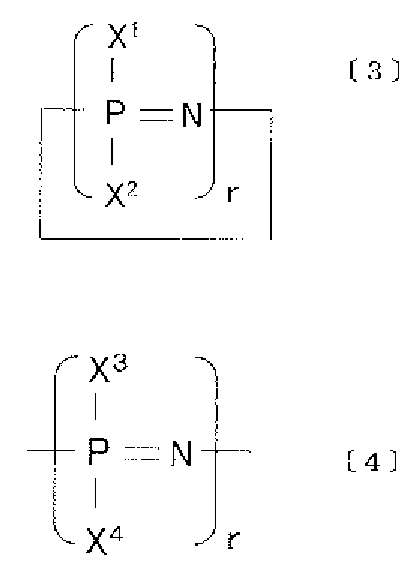
(式中、X1、X2、X3、X4は、それぞれ独立に、水素、水酸基、アミノ基、またはハロゲン原子を含まない有機基を表す。また、rは3~10の整数を表す。)
上記式〔3〕、〔4〕中、X1、X2、X3、X4で表されるハロゲン原子を含まない有機基としては、例えば、アルコキシ基、フェニル基、アミノ基、アリル基等が挙げられる。中でも上記式〔3〕で表される環状ホスファゼン化合物が好ましく、さらに、上記式〔3〕中のX1、X2がフェノキシ基である環状フェノキシホスファゼンが特に好ましい。
有機リン系難燃剤の含有量は、熱可塑性樹脂(A)と補強用繊維(B)との合計100重量部に対し、好ましくは1~50重量部であり、より好ましくは2~30重量部であり、さらに好ましくは5~20重量部である。有機リン系難燃剤の含有量が1重量部未満であると難燃化の効果が得がたく、50重量部を超えると混練押出時にストランド切れやサージング等が起こり、生産性が低下するという問題が生ずる。
有機リン系難燃剤の含有量は、熱可塑性樹脂(A)と補強用繊維(B)との合計100重量部に対し、好ましくは1~50重量部であり、より好ましくは2~30重量部であり、さらに好ましくは5~20重量部である。有機リン系難燃剤の含有量が1重量部未満であると難燃化の効果が得がたく、50重量部を超えると混練押出時にストランド切れやサージング等が起こり、生産性が低下するという問題が生ずる。
(iii)シリコーン系難燃剤
シリコーン系難燃剤として使用されるシリコーン化合物は、燃焼時の化学反応によって難燃性を向上させるものである。該化合物としては、従来、芳香族ポリカーボート樹脂の難燃剤として提案された各種の化合物を使用することができる。シリコーン化合物は、その燃焼時にそれ自体が結合してまたは樹脂に由来する成分と結合してストラクチャーを形成することにより、または該ストラクチャー形成時の還元反応により、特にポリカーボネート樹脂を用いた場合に高い難燃効果を付与するものと考えられている。
したがって、かかる反応における活性の高い基を含んでいることが好ましく、より具体的には、アルコキシ基およびハイドロジェン(即ちSi-H基)から選択された少なくとも1種の基を所定量含んでいることが好ましい。かかる基(アルコキシ基、Si-H基)の含有割合としては、0.1~1.2mol/100gの範囲が好ましく、0.12~1mol/100gの範囲がより好ましく、0.15~0.6mol/100gの範囲が更に好ましい。かかる割合はアルカリ分解法より、シリコーン化合物の単位重量当たりに発生した水素またはアルコールの量を測定することにより求められる。尚、アルコキシ基は炭素数1~4のアルコキシ基が好ましく、特にメトキシ基が好適である。
シリコーン系難燃剤として使用されるシリコーン化合物は、燃焼時の化学反応によって難燃性を向上させるものである。該化合物としては、従来、芳香族ポリカーボート樹脂の難燃剤として提案された各種の化合物を使用することができる。シリコーン化合物は、その燃焼時にそれ自体が結合してまたは樹脂に由来する成分と結合してストラクチャーを形成することにより、または該ストラクチャー形成時の還元反応により、特にポリカーボネート樹脂を用いた場合に高い難燃効果を付与するものと考えられている。
したがって、かかる反応における活性の高い基を含んでいることが好ましく、より具体的には、アルコキシ基およびハイドロジェン(即ちSi-H基)から選択された少なくとも1種の基を所定量含んでいることが好ましい。かかる基(アルコキシ基、Si-H基)の含有割合としては、0.1~1.2mol/100gの範囲が好ましく、0.12~1mol/100gの範囲がより好ましく、0.15~0.6mol/100gの範囲が更に好ましい。かかる割合はアルカリ分解法より、シリコーン化合物の単位重量当たりに発生した水素またはアルコールの量を測定することにより求められる。尚、アルコキシ基は炭素数1~4のアルコキシ基が好ましく、特にメトキシ基が好適である。
一般的にシリコーン化合物の構造は、以下に示す4種類のシロキサン単位を任意に組み合わせることによって構成される。すなわち、M単位:(CH3)3SiO1/2、H(CH3)2SiO1/2、H2(CH3)SiO1/2、(CH3)2(CH2=CH)SiO1/2、(CH3)2(C6H5)SiO1/2、(CH3)(C6H5)(CH2=CH)SiO1/2等の1官能性シロキサン単位、D単位:(CH3)2SiO、H(CH3)SiO、H2SiO、H(C6H5)SiO、(CH3)(CH2=CH)SiO、(C6H5)2SiO等の2官能性シロキサン単位、T単位:(CH3)SiO3/2、(C3H7)SiO3/2、HSiO3/2、(CH2=CH)SiO3/2、(C6H5)SiO3/2等の3官能性シロキサン単位、Q単位:SiO2で示される4官能性シロキサン単位である。
シリコーン系難燃剤に使用されるシリコーン化合物の構造は、具体的には、示性式としてDn、Tp、MmDn、MmTp、MmQq、MmDnTp、MmDnQq、MmTpQq、MmDnTpQq、DnTp、DnQq、DnTpQqが挙げられる。この中で好ましいシリコーン化合物の構造は、MmDn、MmTp、MmDnTp、MmDnQqであり、さらに好ましい構造は、MmDnまたはMmDnTpである。
シリコーン系難燃剤に使用されるシリコーン化合物の構造は、具体的には、示性式としてDn、Tp、MmDn、MmTp、MmQq、MmDnTp、MmDnQq、MmTpQq、MmDnTpQq、DnTp、DnQq、DnTpQqが挙げられる。この中で好ましいシリコーン化合物の構造は、MmDn、MmTp、MmDnTp、MmDnQqであり、さらに好ましい構造は、MmDnまたはMmDnTpである。
ここで、前記示性式中の係数m、n、p、qは各シロキサン単位の重合度を表す1以上の整数であり、各示性式における係数の合計がシリコーン化合物の平均重合度となる。この平均重合度は好ましくは3~150の範囲、より好ましくは3~80の範囲、更に好ましくは3~60の範囲、特に好ましくは4~40の範囲である。かかる好適な範囲であるほど難燃性において優れるようになる。更に後述するように芳香族基を所定量含むシリコーン化合物においては透明性や色相にも優れる。その結果良好な反射光が得られる。またm、n、p、qのいずれかが2以上の数値である場合、その係数の付いたシロキサン単位は、結合する水素原子や有機残基が異なる2種以上のシロキサン単位とすることができる。
シリコーン化合物は、直鎖状であっても分岐構造を持つものであってもよい。またシリコン原子に結合する有機残基は、好ましくは炭素数1~30、より好ましくは炭素数1~20の有機残基である。かかる有機残基としては、具体的には、メチル基、エチル基、プロピル基、ブチル基、ヘキシル基、およびデシル基等のアルキル基、シクロヘキシル基の如きシクロアルキル基、フェニル基の如きアリール基、並びにトリル基の如きアラルキル基を挙げることがでる。さらに好ましくは炭素数1~8のアルキル基、アルケニル基またはアリール基である。アルキル基としては、特にはメチル基、エチル基、およびプロピル基等の炭素数1~4のアルキル基が好ましい。
シリコーン化合物は、直鎖状であっても分岐構造を持つものであってもよい。またシリコン原子に結合する有機残基は、好ましくは炭素数1~30、より好ましくは炭素数1~20の有機残基である。かかる有機残基としては、具体的には、メチル基、エチル基、プロピル基、ブチル基、ヘキシル基、およびデシル基等のアルキル基、シクロヘキシル基の如きシクロアルキル基、フェニル基の如きアリール基、並びにトリル基の如きアラルキル基を挙げることがでる。さらに好ましくは炭素数1~8のアルキル基、アルケニル基またはアリール基である。アルキル基としては、特にはメチル基、エチル基、およびプロピル基等の炭素数1~4のアルキル基が好ましい。
さらにシリコーン系難燃剤として使用されるシリコーン化合物はアリール基を含有することが好ましい。一方、二酸化チタン顔料の有機表面処理剤としてのシラン化合物およびシロキサン化合物は、アリール基を含有しない方が、好ましい効果が得られる点で、シリコーン系難燃剤とはその好適な態様において明確に区別される。シリコーン系難燃剤として使用されるシリコーン化合物は、前記Si-H基およびアルコキシ基以外にも反応基を含有していてもよく、かかる反応基としては例えば、アミノ基、カルボキシル基、エポキシ基、ビニル基、メルカプト基、およびメタクリロキシ基等が例示される。
シリコーン系難燃剤の含有量は、熱可塑性樹脂(A)と補強用繊維(B)との合計100重量部に対し、好ましくは0.01~20重量部、より好ましくは0.5~10重量部、さらに好ましくは1~5重量部である。
シリコーン系難燃剤の含有量は、熱可塑性樹脂(A)と補強用繊維(B)との合計100重量部に対し、好ましくは0.01~20重量部、より好ましくは0.5~10重量部、さらに好ましくは1~5重量部である。
(iv)フィブリル形成能を有するポリテトラフルオロエチレン(フィブリル化PTFE)
フィブリル化PTFEは、フィブリル化PTFE単独であっても、混合形態のフィブリル化PTFE、すなわちフィブリル化PTFE粒子と有機系重合体からなるポリテトラフルオロエチレン系混合体であってもよい。フィブリル化PTFEは極めて高い分子量を有し、せん断力等の外的作用によりPTFE同士を結合して繊維状になる傾向を示すものである。その数平均分子量は、150万~数千万の範囲である。かかる下限はより好ましくは300万である。かかる数平均分子量は、例えば特開平6-145520号公報に開示されているとおり、380℃でのポリテトラフルオロエチレンの溶融粘度に基づき算出される。即ち、B成分のフィブリル化PTFEは、かかる公報に記載された方法で測定される380℃における溶融粘度が107~1013poiseの範囲であり、好ましくは108~1012poiseの範囲である。
フィブリル化PTFEは、フィブリル化PTFE単独であっても、混合形態のフィブリル化PTFE、すなわちフィブリル化PTFE粒子と有機系重合体からなるポリテトラフルオロエチレン系混合体であってもよい。フィブリル化PTFEは極めて高い分子量を有し、せん断力等の外的作用によりPTFE同士を結合して繊維状になる傾向を示すものである。その数平均分子量は、150万~数千万の範囲である。かかる下限はより好ましくは300万である。かかる数平均分子量は、例えば特開平6-145520号公報に開示されているとおり、380℃でのポリテトラフルオロエチレンの溶融粘度に基づき算出される。即ち、B成分のフィブリル化PTFEは、かかる公報に記載された方法で測定される380℃における溶融粘度が107~1013poiseの範囲であり、好ましくは108~1012poiseの範囲である。
かかるPTFEは、固体形状の他、水性分散液形態のものも使用可能である。またかかるフィブリル化PTFEは樹脂中での分散性を向上させ、さらに良好な難燃性および機械的特性を得るために他の樹脂との混合形態のPTFE混合物を使用することも可能である。
また、特開平6-145520号公報に開示されているとおり、かかるフィブリル化PTFEを芯とし、低分子量のポリテトラフルオロエチレンを殻とした構造を有するものも好ましく利用される。
かかるフィブリル化PTFEの市販品としては、三井・デュポンフロロケミカル(株)のテフロン(登録商標)6J、ダイキン工業(株)のポリフロンMPA FA500、F-201L等を挙げることができる。
また、特開平6-145520号公報に開示されているとおり、かかるフィブリル化PTFEを芯とし、低分子量のポリテトラフルオロエチレンを殻とした構造を有するものも好ましく利用される。
かかるフィブリル化PTFEの市販品としては、三井・デュポンフロロケミカル(株)のテフロン(登録商標)6J、ダイキン工業(株)のポリフロンMPA FA500、F-201L等を挙げることができる。
混合形態のフィブリル化PTFEとしては、(1)フィブリル化PTFEの水性分散液と有機重合体の水性分散液または溶液とを混合し共沈殿を行い、共凝集混合物を得る方法(特開昭60-258263号公報、特開昭63-154744号公報等に記載された方法)、(2)フィブリル化PTFEの水性分散液と乾燥した有機重合体粒子とを混合する方法(特開平4-272957号公報に記載された方法)、(3)フィブリル化PTFEの水性分散液と有機重合体粒子溶液を均一に混合し、かかる混合物からそれぞれの媒体を同時に除去する方法(特開平06-220210号公報、特開平08-188653号公報等に記載された方法)、(4)フィブリル化PTFEの水性分散液中で有機重合体を形成する単量体を重合する方法(特開平9-95583号公報に記載された方法)、および(5)PTFEの水性分散液と有機重合体分散液を均一に混合後、更に該混合分散液中でビニル系単量体を重合し、その後混合物を得る方法(特開平11-29679号公報等に記載された方法)により得られたものが使用できる。
これらの混合形態のフィブリル化PTFEの市販品としては、三菱レイヨン(株)の「メタブレンA3000」(商品名)「メタブレンA3700」(商品名)、「メタブレンA3800」(商品名)で代表されるメタブレンAシリーズ、Shine Polymer社のSN3300B7(商品名)、およびGEスペシャリティーケミカルズ社製 「BLENDEX B449」(商品名)等が例示される。
混合形態におけるフィブリル化PTFEの割合としては、かかる混合物100重量%中、フィブリル化PTFEが1重量%~95重量%であることが好ましく、10重量%~90重量%であるのがより好ましく、20重量%~80重量%が最も好ましい。混合形態におけるフィブリル化PTFEの割合がかかる範囲にある場合は、フィブリル化PTFEの良好な分散性を達成することができる。フィブリル化PTFEの含有量は、熱可塑性樹脂(A)と補強用繊維(B)との合計100重量部に対して、好ましくは0.001~0.5重量部であり、0.01~0.5重量部がより好ましく、0.1~0.5重量部がさらに好ましい。
混合形態におけるフィブリル化PTFEの割合としては、かかる混合物100重量%中、フィブリル化PTFEが1重量%~95重量%であることが好ましく、10重量%~90重量%であるのがより好ましく、20重量%~80重量%が最も好ましい。混合形態におけるフィブリル化PTFEの割合がかかる範囲にある場合は、フィブリル化PTFEの良好な分散性を達成することができる。フィブリル化PTFEの含有量は、熱可塑性樹脂(A)と補強用繊維(B)との合計100重量部に対して、好ましくは0.001~0.5重量部であり、0.01~0.5重量部がより好ましく、0.1~0.5重量部がさらに好ましい。
(IV)染顔料
本発明の積層体はさらに各種の染料または顔料を含有し、多様な意匠性を発現する成形品を提供できる。本発明で使用する染顔料としては、ペリレン系染料、クマリン系染料、チオインジゴ系染料、アンスラキノン系染料、チオキサントン系染料等を挙げることができる。また紺青等のフェロシアン化物、ペリノン系染料、キノリン系染料、キナクリドン系染料、ジオキサジン系染料、イソインドリノン系染料およびフタロシアニン系染料等を挙げることができる。さらに本発明において熱可塑性樹脂(A)としてポリカーボネート樹脂を用いた場合には、特にメタリック顔料を配合してより良好なメタリック色彩を得ることもできる。メタリック顔料としては、アルミ粉が好適である。また、蛍光増白剤やそれ以外の発光をする蛍光染料を配合することにより、発光色を生かした更に良好な意匠効果を付与することができる。
本発明の積層体はさらに各種の染料または顔料を含有し、多様な意匠性を発現する成形品を提供できる。本発明で使用する染顔料としては、ペリレン系染料、クマリン系染料、チオインジゴ系染料、アンスラキノン系染料、チオキサントン系染料等を挙げることができる。また紺青等のフェロシアン化物、ペリノン系染料、キノリン系染料、キナクリドン系染料、ジオキサジン系染料、イソインドリノン系染料およびフタロシアニン系染料等を挙げることができる。さらに本発明において熱可塑性樹脂(A)としてポリカーボネート樹脂を用いた場合には、特にメタリック顔料を配合してより良好なメタリック色彩を得ることもできる。メタリック顔料としては、アルミ粉が好適である。また、蛍光増白剤やそれ以外の発光をする蛍光染料を配合することにより、発光色を生かした更に良好な意匠効果を付与することができる。
(V)蛍光増白剤
本発明の積層体において蛍光増白剤は、樹脂等の色調を白色あるいは青白色に改善するために用いられるものであれば特に制限はなく、例えばスチルベン系、ベンズイミダゾール系、ベンズオキサゾール系、ナフタルイミド系、ローダミン系、クマリン系、オキサジン系化合物等が挙げられる。具体的には例えばCI Fluorescent Brightener 219:1や、イーストマンケミカル社製EASTOBRITE OB-1やハッコールケミカル(株)製「ハッコールPSR」、等を挙げることができる。ここで蛍光増白剤は、光線の紫外部のエネルギーを吸収し、このエネルギーを可視部に放射する作用を有するものである。蛍光増白剤の含有量は、熱可塑性樹脂(A)と補強用繊維(B)との合計100重量部に対して、0.001~0.1重量部が好ましく、より好ましくは0.001~0.05重量部である。0.1重量部を超えても該組成物の色調の改良効果は小さい。
本発明の積層体において蛍光増白剤は、樹脂等の色調を白色あるいは青白色に改善するために用いられるものであれば特に制限はなく、例えばスチルベン系、ベンズイミダゾール系、ベンズオキサゾール系、ナフタルイミド系、ローダミン系、クマリン系、オキサジン系化合物等が挙げられる。具体的には例えばCI Fluorescent Brightener 219:1や、イーストマンケミカル社製EASTOBRITE OB-1やハッコールケミカル(株)製「ハッコールPSR」、等を挙げることができる。ここで蛍光増白剤は、光線の紫外部のエネルギーを吸収し、このエネルギーを可視部に放射する作用を有するものである。蛍光増白剤の含有量は、熱可塑性樹脂(A)と補強用繊維(B)との合計100重量部に対して、0.001~0.1重量部が好ましく、より好ましくは0.001~0.05重量部である。0.1重量部を超えても該組成物の色調の改良効果は小さい。
(VI)熱線吸収能を有する化合物
本発明の積層体は、熱線吸収能を有する化合物を含有することができる。かかる化合物としてはフタロシアニン系近赤外線吸収剤、ATO、ITO、酸化イリジウムおよび酸化ルテニウム、酸化イモニウム等の金属酸化物系近赤外線吸収剤、ホウ化ランタン、ホウ化セリウムおよびホウ化タングステン等の金属ホウ化物系や酸化タングステン系近赤外線吸収剤等の近赤外吸収能に優れた各種の金属化合物、ならびに炭素フィラーが好適に例示される。かかるフタロシアニン系近赤外線吸収剤としてはたとえば三井化学(株)製MIR-362が市販され容易に入手可能である。炭素フィラーとしてはカーボンブラック、グラファイト(天然、および人工のいずれも含む)およびフラーレン等が例示され、好ましくはカーボンブラックおよびグラファイトである。これらは単体または2種以上を併用して使用することができる。
本発明の積層体は、熱線吸収能を有する化合物を含有することができる。かかる化合物としてはフタロシアニン系近赤外線吸収剤、ATO、ITO、酸化イリジウムおよび酸化ルテニウム、酸化イモニウム等の金属酸化物系近赤外線吸収剤、ホウ化ランタン、ホウ化セリウムおよびホウ化タングステン等の金属ホウ化物系や酸化タングステン系近赤外線吸収剤等の近赤外吸収能に優れた各種の金属化合物、ならびに炭素フィラーが好適に例示される。かかるフタロシアニン系近赤外線吸収剤としてはたとえば三井化学(株)製MIR-362が市販され容易に入手可能である。炭素フィラーとしてはカーボンブラック、グラファイト(天然、および人工のいずれも含む)およびフラーレン等が例示され、好ましくはカーボンブラックおよびグラファイトである。これらは単体または2種以上を併用して使用することができる。
フタロシアニン系近赤外線吸収剤の含有量は、熱可塑性樹脂(A)と補強用繊維(B)との合計100重量部を基準として、0.0005~0.2重量部が好ましく、0.0008~0.1重量部がより好ましく、0.001~0.07重量部がさらに好ましい。金属酸化物系近赤外線吸収剤、金属ホウ化物系近赤外線吸収剤および炭素フィラーの含有量は、本発明の積層体中、0.1~200ppm(重量割合)の範囲が好ましく、0.5~100ppmの範囲がより好ましい。
(VII)光拡散剤
本発明の積層体から最終的に得られる繊維強化樹脂複合体には、光拡散剤を配合して光拡散効果を付与することができる。かかる光拡散剤としては高分子微粒子、炭酸カルシウムの如き低屈折率の無機微粒子、およびこれらの複合物等が例示される。かかる高分子微粒子は、既にポリカーボネート樹脂の光拡散剤として公知の微粒子である。より好適には粒径数μmのアクリル架橋粒子およびポリオルガノシルセスキオキサンに代表されるシリコーン架橋粒子等が例示される。光拡散剤の形状は球形、円盤形、柱形、および不定形等が例示される。かかる球形は、完全球である必要はなく変形しているものを含み、かかる柱形は立方体を含む。好ましい光拡散剤は球形であり、その粒径は均一であるほど好ましい。
光拡散剤の含有量は、熱可塑性樹脂(A)と補強用繊維(B)との合計100重量部を基準として、好ましくは0.005~20重量部、より好ましくは0.01~10重量部、更に好ましくは0.01~3重量部である。尚、光拡散剤は2種以上を併用することができる。
本発明の積層体から最終的に得られる繊維強化樹脂複合体には、光拡散剤を配合して光拡散効果を付与することができる。かかる光拡散剤としては高分子微粒子、炭酸カルシウムの如き低屈折率の無機微粒子、およびこれらの複合物等が例示される。かかる高分子微粒子は、既にポリカーボネート樹脂の光拡散剤として公知の微粒子である。より好適には粒径数μmのアクリル架橋粒子およびポリオルガノシルセスキオキサンに代表されるシリコーン架橋粒子等が例示される。光拡散剤の形状は球形、円盤形、柱形、および不定形等が例示される。かかる球形は、完全球である必要はなく変形しているものを含み、かかる柱形は立方体を含む。好ましい光拡散剤は球形であり、その粒径は均一であるほど好ましい。
光拡散剤の含有量は、熱可塑性樹脂(A)と補強用繊維(B)との合計100重量部を基準として、好ましくは0.005~20重量部、より好ましくは0.01~10重量部、更に好ましくは0.01~3重量部である。尚、光拡散剤は2種以上を併用することができる。
(VIII)光高反射用白色顔料
本発明の積層体には、光高反射用白色顔料を配合して最終的に得られる繊維強化樹脂複合体に光反射効果を付与することができる。かかる白色顔料としては二酸化チタン(特にシリコーン等有機表面処理剤により処理された二酸化チタン)顔料が特に好ましい。
かかる光高反射用白色顔料の含有量は、熱可塑性樹脂(A)と補強用繊維(B)との合計100重量部を基準として、1~40重量部が好ましく、3~30重量部がより好ましく、8~25重量部が更により好ましい。尚、光高反射用白色顔料は2種以上を併用することができる。
本発明の積層体には、光高反射用白色顔料を配合して最終的に得られる繊維強化樹脂複合体に光反射効果を付与することができる。かかる白色顔料としては二酸化チタン(特にシリコーン等有機表面処理剤により処理された二酸化チタン)顔料が特に好ましい。
かかる光高反射用白色顔料の含有量は、熱可塑性樹脂(A)と補強用繊維(B)との合計100重量部を基準として、1~40重量部が好ましく、3~30重量部がより好ましく、8~25重量部が更により好ましい。尚、光高反射用白色顔料は2種以上を併用することができる。
(IX)帯電防止剤
本発明の積層体から最終的に得られる繊維強化樹脂複合体には、帯電防止性能が求められる場合があり、かかる場合、帯電防止剤を含むことが好ましい。
かかる帯電防止剤としては、例えば(1)ドデシルベンゼンスルホン酸ホスホニウム塩に代表されるアリールスルホン酸ホスホニウム塩、およびアルキルスルホン酸ホスホニウム塩等の有機スルホン酸ホスホニウム塩、並びにテトラフルオロホウ酸ホスホニウム塩の如きホウ酸ホスホニウム塩が挙げられる。
該ホスホニウム塩の含有量は、熱可塑性樹脂(A)と補強用繊維(B)との合計100重量部を基準として、5重量部以下が適切であり、好ましくは0.05~5重量部、より好ましくは1~3.5重量部、さらに好ましくは1.5~3重量部の範囲である。
帯電防止剤としては例えば、(2)有機スルホン酸リチウム、有機スルホン酸ナトリウム、有機スルホン酸カリウム、有機スルホン酸セシウム、有機スルホン酸ルビジウム、有機スルホン酸カルシウム、有機スルホン酸マグネシウム、および有機スルホン酸バリウム等の有機スルホン酸アルカリ(土類)金属塩が挙げられる。
かかる金属塩は前述のとおり、難燃剤としても使用される。かかる金属塩として、ドデシルベンゼンスルホン酸の金属塩やパーフルオロアルカンスルホン酸の金属塩等が例示される。
本発明の積層体から最終的に得られる繊維強化樹脂複合体には、帯電防止性能が求められる場合があり、かかる場合、帯電防止剤を含むことが好ましい。
かかる帯電防止剤としては、例えば(1)ドデシルベンゼンスルホン酸ホスホニウム塩に代表されるアリールスルホン酸ホスホニウム塩、およびアルキルスルホン酸ホスホニウム塩等の有機スルホン酸ホスホニウム塩、並びにテトラフルオロホウ酸ホスホニウム塩の如きホウ酸ホスホニウム塩が挙げられる。
該ホスホニウム塩の含有量は、熱可塑性樹脂(A)と補強用繊維(B)との合計100重量部を基準として、5重量部以下が適切であり、好ましくは0.05~5重量部、より好ましくは1~3.5重量部、さらに好ましくは1.5~3重量部の範囲である。
帯電防止剤としては例えば、(2)有機スルホン酸リチウム、有機スルホン酸ナトリウム、有機スルホン酸カリウム、有機スルホン酸セシウム、有機スルホン酸ルビジウム、有機スルホン酸カルシウム、有機スルホン酸マグネシウム、および有機スルホン酸バリウム等の有機スルホン酸アルカリ(土類)金属塩が挙げられる。
かかる金属塩は前述のとおり、難燃剤としても使用される。かかる金属塩として、ドデシルベンゼンスルホン酸の金属塩やパーフルオロアルカンスルホン酸の金属塩等が例示される。
有機スルホン酸アルカリ(土類)金属塩の含有量は、熱可塑性樹脂(A)と補強用繊維(B)との合計100重量部を基準として、0.5重量部以下が適切であり、好ましくは0.001~0.3重量部、より好ましくは0.005~0.2重量部である。特にカリウム、セシウム、およびルビジウム等のアルカリ金属塩が好適である。
帯電防止剤としては、例えば(3)アルキルスルホン酸アンモニウム塩、およびアリールスルホン酸アンモニウム塩等の有機スルホン酸アンモニウム塩が挙げられる。該アンモニウム塩の含有量は、熱可塑性樹脂(A)と補強用繊維(B)との合計100重量部を基準として、0.05重量部以下が適切である。
帯電防止剤としては、例えば(4)ポリエーテルエステルアミドの如きポリ(オキシアルキレン)グリコール成分をその構成成分として含有するポリマーが挙げられる。該ポリマーの含有量は、熱可塑性樹脂(A)と補強用繊維(B)との合計100重量部を基準として、5重量部以下が適切である。
帯電防止剤としては、例えば(3)アルキルスルホン酸アンモニウム塩、およびアリールスルホン酸アンモニウム塩等の有機スルホン酸アンモニウム塩が挙げられる。該アンモニウム塩の含有量は、熱可塑性樹脂(A)と補強用繊維(B)との合計100重量部を基準として、0.05重量部以下が適切である。
帯電防止剤としては、例えば(4)ポリエーテルエステルアミドの如きポリ(オキシアルキレン)グリコール成分をその構成成分として含有するポリマーが挙げられる。該ポリマーの含有量は、熱可塑性樹脂(A)と補強用繊維(B)との合計100重量部を基準として、5重量部以下が適切である。
(X)その他
本発明の積層体には、その他の流動改質剤、抗菌剤、流動パラフィンの如き分散剤、光触媒系防汚剤およびフォトクロミック剤等を配合することができる。また本発明の積層体から最終的に得られる繊維強化樹脂複合体の物性を向上させるためには、積層体の熱可塑性樹脂(A)に衝撃改質材の添加を行うことも好ましい。
本発明の積層体には、その他の流動改質剤、抗菌剤、流動パラフィンの如き分散剤、光触媒系防汚剤およびフォトクロミック剤等を配合することができる。また本発明の積層体から最終的に得られる繊維強化樹脂複合体の物性を向上させるためには、積層体の熱可塑性樹脂(A)に衝撃改質材の添加を行うことも好ましい。
(中空繊維)
さて本発明の積層体は、補強用繊維シート(b)と熱可塑性樹脂シート(a)からなるものであり、熱可塑性樹脂シート(a)は、各種の要求により、熱可塑性樹脂(A)に上記のような添加剤を含むものが好ましい。熱可塑性樹脂シート(a)は、中空繊維を含む不織布である。熱可塑性樹脂シート(a)は、網目状に配置された中空繊維を含む不織布であることが好ましい。
熱可塑性樹脂シート(a)は、溶融して補強用繊維(B)の周囲に空隙なく配置され、最終的には繊維強化樹脂複合体となる。この時、熱可塑性樹脂シート(a)が本発明では中空繊維を含む不織布であることから、柔軟な積層体となる。そのため、積層体を加熱し、加圧し、繊維強化樹脂複合体を製造する際に、型や補強用繊維(B)に熱可塑性樹脂(A)が沿いやすくなり、成形により得られる繊維強化樹脂複合体について高い物性を確保できる。なおここで中空とは、公知の中空繊維のように明らかな空隙が有るものばかりでは無く、繊維内部に気泡が有る程度のものであっても構わない。
さて本発明の積層体は、補強用繊維シート(b)と熱可塑性樹脂シート(a)からなるものであり、熱可塑性樹脂シート(a)は、各種の要求により、熱可塑性樹脂(A)に上記のような添加剤を含むものが好ましい。熱可塑性樹脂シート(a)は、中空繊維を含む不織布である。熱可塑性樹脂シート(a)は、網目状に配置された中空繊維を含む不織布であることが好ましい。
熱可塑性樹脂シート(a)は、溶融して補強用繊維(B)の周囲に空隙なく配置され、最終的には繊維強化樹脂複合体となる。この時、熱可塑性樹脂シート(a)が本発明では中空繊維を含む不織布であることから、柔軟な積層体となる。そのため、積層体を加熱し、加圧し、繊維強化樹脂複合体を製造する際に、型や補強用繊維(B)に熱可塑性樹脂(A)が沿いやすくなり、成形により得られる繊維強化樹脂複合体について高い物性を確保できる。なおここで中空とは、公知の中空繊維のように明らかな空隙が有るものばかりでは無く、繊維内部に気泡が有る程度のものであっても構わない。
本発明においては、熱可塑性樹脂シート(a)を、中空繊維を含む不織布とすることで、中空繊維を含まない通常の不織布と比較して、補強用繊維(B)とのより高い密着性を得ることができる。
さらに補強用繊維(B)との高い密着性を得る上では、中空繊維の断面形状が不規則な非円形断面である、異形繊維であることが好ましい。中空繊維は、その繊維内部に気泡を有するのであるが、例えば図1および図2に模式的に示すように、内部に非連続の気泡を有し、かつ不規則な非円形断面の繊維状物であることが好ましい。さらに具体的には、内部に複数のそれも形状の異なる気泡を有し、かつ扁平形状の繊維状物であることが好ましい。
なお、ここで異形繊維内部の気泡とは、繊維内部に存在する閉鎖した空間(空隙)のことを指す。通常、合成繊維内部の空隙は、中空繊維等にみられるように、繊維軸方向に連続した同じ断面形状を有する空隙である。これと異なり本発明の空隙は、非連続の気泡状の形態をとっている。本発明においては、このような非連続の、しかも繊維の長さ方向において断面形状の異なる気泡を、中空繊維の内部に有していることが好ましい。
さらに補強用繊維(B)との高い密着性を得る上では、中空繊維の断面形状が不規則な非円形断面である、異形繊維であることが好ましい。中空繊維は、その繊維内部に気泡を有するのであるが、例えば図1および図2に模式的に示すように、内部に非連続の気泡を有し、かつ不規則な非円形断面の繊維状物であることが好ましい。さらに具体的には、内部に複数のそれも形状の異なる気泡を有し、かつ扁平形状の繊維状物であることが好ましい。
なお、ここで異形繊維内部の気泡とは、繊維内部に存在する閉鎖した空間(空隙)のことを指す。通常、合成繊維内部の空隙は、中空繊維等にみられるように、繊維軸方向に連続した同じ断面形状を有する空隙である。これと異なり本発明の空隙は、非連続の気泡状の形態をとっている。本発明においては、このような非連続の、しかも繊維の長さ方向において断面形状の異なる気泡を、中空繊維の内部に有していることが好ましい。
本発明において好ましい形状である非連続の気泡状の空隙が存在する場合、通常の連続した空隙の場合と異なり、均一に熱可塑性樹脂の流動性を向上させることが可能になる。その結果として連続した空隙に比べ、強化繊維との複合化において、特に優れた含浸性を発現することができる。
中空繊維は、上記のようにその繊維内部に気泡を有するものであるが、単繊維横断面における中空率としては0.5~40%の範囲であることが好ましい。ここで中空率とは繊維断面において複数の気泡が含まれている場合、その気泡の面積を合計した面積が、繊維断面中に占める割合をいう。さらには繊維の中空率は好ましくは1~30%、より好ましくは2~5%の範囲である。繊維の中空率が1%未満の場合、強化繊維との複合化の際の含浸性が不十分となる場合があり、30%を超える場合には、不織布の強度が低下することに加え、紡糸等の繊維の製造工程において、特に異形繊維である場合に、繊維切断が多く発生し、製造効率が低下する傾向にある。
中空繊維は、上記のようにその繊維内部に気泡を有するものであるが、単繊維横断面における中空率としては0.5~40%の範囲であることが好ましい。ここで中空率とは繊維断面において複数の気泡が含まれている場合、その気泡の面積を合計した面積が、繊維断面中に占める割合をいう。さらには繊維の中空率は好ましくは1~30%、より好ましくは2~5%の範囲である。繊維の中空率が1%未満の場合、強化繊維との複合化の際の含浸性が不十分となる場合があり、30%を超える場合には、不織布の強度が低下することに加え、紡糸等の繊維の製造工程において、特に異形繊維である場合に、繊維切断が多く発生し、製造効率が低下する傾向にある。
なおこの中空率は、走査電子顕微鏡(SEM)にて倍率100倍で得られた画像の繊維断面写真から、繊維の中空部を含む全断面積に対する中空部の面積を中空率として求めたものである。本発明ではこのような中空部が存在することにより、繊維断面の壁部分が薄くなり溶解しやすく特に細かい部分に対する成形性が向上する。しかし繊維の中空率が大きすぎると中空繊維全体の熱伝導率が小さくなり、成形効率が低下する傾向にある。
また個々の気泡の大きさとしては0.1~100μmの範囲にあることが好ましい。特には0.5~50μmの範囲内であることが好ましい。気泡の大きさが0.1μmより小さくなると、補強用繊維(B)との複合化の際の含浸性が不十分となる場合があり、100μmより大きくなると、補強用繊維(B)との複合化が均一に起こらないばかりでなく、繊維強化樹脂複合体の内部に欠点(気泡)が残ってしまう場合があり好ましくない。
また個々の気泡の大きさとしては0.1~100μmの範囲にあることが好ましい。特には0.5~50μmの範囲内であることが好ましい。気泡の大きさが0.1μmより小さくなると、補強用繊維(B)との複合化の際の含浸性が不十分となる場合があり、100μmより大きくなると、補強用繊維(B)との複合化が均一に起こらないばかりでなく、繊維強化樹脂複合体の内部に欠点(気泡)が残ってしまう場合があり好ましくない。
本発明では、異形繊維が好ましく用いられるが、その異形繊維の外周断面における不規則な非円形断面は、楕円や正多角形等の規則的な断面よりも、断面形状に乱れがある形状であることが好ましい。通常の合成繊維においては、その断面形状は紡糸口金の形状に依存するため、規則的な断面であることが一般的である。不規則な口金形状では溶融紡糸の際の断糸の発生率が高くなるからである。しかし断面の異形状態が規則的なものの場合、不織布を構成する際に、繊維の異形部分に別の繊維が収まって最密充填化され、かえって空隙が減少することがある。本発明の網目状の繊維は、上記と異なり異形であって、口金形状に依存しない断面形状の繊維であることが好ましい。中空繊維は、発泡剤を用いたスリット紡糸にて得られる異形繊維であることが好ましい。
そしてこのように不規則な外側断面や網目状の形態を有することにより、各異形繊維の重なり部分において必ず空隙が発生するばかりではなく、繊維間空隙もまた様々な形状を取ることになる。繊維間の空隙が一様とならず、繊維の重なりも少なくなるのである。また、不規則な形状により曲げ剛性や物質の密度がランダムになる。そしてこのようにランダムとなることにより、強化繊維との複合化において、結果的には均一な機械特性を有することができるのである。
そしてこのように不規則な外側断面や網目状の形態を有することにより、各異形繊維の重なり部分において必ず空隙が発生するばかりではなく、繊維間空隙もまた様々な形状を取ることになる。繊維間の空隙が一様とならず、繊維の重なりも少なくなるのである。また、不規則な形状により曲げ剛性や物質の密度がランダムになる。そしてこのようにランダムとなることにより、強化繊維との複合化において、結果的には均一な機械特性を有することができるのである。
中空繊維の端面角度は、60度未満であることが好ましく、さらには1~55度の範囲であることが好ましく、3~45度であることがより好ましい。この端面角度は、上記の中空率の測定と同じく、走査電子顕微鏡(SEM)にて倍率100倍で得られた画像の繊維断面写真から求めるものであり、繊維断面の両端部を結ぶ直線(長軸)に対して直交する方向に最も厚みのある部分に直線(短軸)を定め、該短軸の両端と、短軸から近い側の長軸端部の三点を結んだ三角形の長軸端部の角度を求めて、端面角度とした。この端面角度が小さいことにより補強用繊維間に熱可塑性樹脂からなる中空繊維が侵入しやすくなり、より高い含浸性を確保することが可能となる。
本発明で好ましく用いられる異形繊維としては、単繊維の横断面において、異型度が1より大きく20以下であることが好ましい。さらには異型度が2~10であることが好ましい。ここで、繊維の断面形状の異型度とは、単繊維横断面の外接円直径D1と内接円直径D2との比D1/D2で定義される数値である。この異型度が上記好ましい範囲にある場合に、強化繊維との複合化の際に優れた含浸性を発現することができる。より具体的にはこの異型度は、上記の中空率等の測定と同じく、走査電子顕微鏡(SEM)にて倍率100倍で得られた画像の繊維断面写真から求めるものであり、維横断面における外接円の直径D1と、内接円の直径D2を測定し、その比(D1/D2)異型度として算出した。端面角度とは逆に、この異型度の値は大きいことにより補強用繊維(B)間に熱可塑性樹脂(A)からなる中空繊維が侵入しやすくなり、より高い含浸性を確保することが可能となる。
熱可塑性樹脂シート(a)は、中空繊維を含む不織布であり、さらには中空繊維自体が異形断面を有する場合が好ましい。そのためこのような形状がコントロールしやすい合成繊維であることが好ましい。さらにこのような合成繊維を構成する熱可塑性樹脂(A)としては、上記に述べたような成分を利用することができる。また融点が70~350℃の範囲にある少なくとも一種以上の熱可塑性樹脂(A)および安定剤からなる熱可塑性樹脂組成物であることが好ましい。
このような中空繊維を含む不織布は、例えばメルトブロー繊維の紡糸時に、空気や窒素等の高圧ガスを吹き込むこみ中空繊維とし、さらにそのメルトブロー繊維をメッシュスクリーン上に捕集することにより不織布化して得ることができる。また、溶融した熱可塑性樹脂(A)をダイから押し出す際に高圧ガスを吹き込み、内部に気泡を有する中空繊維を捕集して不織布を得ることができる。ダイの形状は、円形状、角形状、スリット状等を採用することができる。
ここでメルトブロー繊維は、前述のような熱可塑性樹脂(A)からなるものであるが、このようなメルトブロー繊維は、メッシュスクリーン上に捕集することにより不織布化することができる。メッシュスクリーン上等の捕集面上に平面状に均一にそして高密度で集積されて、熱可塑性樹脂シート(a)となるのである。
このような中空繊維を含む不織布は、例えばメルトブロー繊維の紡糸時に、空気や窒素等の高圧ガスを吹き込むこみ中空繊維とし、さらにそのメルトブロー繊維をメッシュスクリーン上に捕集することにより不織布化して得ることができる。また、溶融した熱可塑性樹脂(A)をダイから押し出す際に高圧ガスを吹き込み、内部に気泡を有する中空繊維を捕集して不織布を得ることができる。ダイの形状は、円形状、角形状、スリット状等を採用することができる。
ここでメルトブロー繊維は、前述のような熱可塑性樹脂(A)からなるものであるが、このようなメルトブロー繊維は、メッシュスクリーン上に捕集することにより不織布化することができる。メッシュスクリーン上等の捕集面上に平面状に均一にそして高密度で集積されて、熱可塑性樹脂シート(a)となるのである。
このようなメルトブロー繊維からなる不織布は、一般的なニードルパンチング法等のように3次元交絡した短繊維不織布とは異なり、二次元的に配列した網目状の長繊維不織布となる。そして交絡密度が低いにも関らず強度が強く、積層体とした場合に型への追随性に優れたシートとなる。このような長繊維からなるメルトブロー不織布は本発明にて好ましく用いられ、厚さ方向の配列が少ないために高密度不織布となりやすいとの利点もある。
そしてこのような高圧の空気流により網目状の中空繊維としたメルトブロー繊維は、ほとんど延伸を施されていない未延伸状態の繊維から構成されるため、加工性に優れた熱可塑性樹脂シート(a)となり、それを積層した積層体もまた加工性に優れたものとなる。このような網目状の中空繊維は、多くの未配向部分を含み、比較的低温でも軟化する。そのため補強用繊維(B)の溶融温度以下の温度での加熱加圧加工(成形加工)を施すことにより、特にバインダー成分を含まないにも関わらず、網目状の中空繊維の未配向部分が軟化、接着し、優れた成形性を発揮し得る。
そしてこのような高圧の空気流により網目状の中空繊維としたメルトブロー繊維は、ほとんど延伸を施されていない未延伸状態の繊維から構成されるため、加工性に優れた熱可塑性樹脂シート(a)となり、それを積層した積層体もまた加工性に優れたものとなる。このような網目状の中空繊維は、多くの未配向部分を含み、比較的低温でも軟化する。そのため補強用繊維(B)の溶融温度以下の温度での加熱加圧加工(成形加工)を施すことにより、特にバインダー成分を含まないにも関わらず、網目状の中空繊維の未配向部分が軟化、接着し、優れた成形性を発揮し得る。
中空繊維の繊維径としては10μm以上が好ましく、平均値として10~25μmの範囲であることが、特には12~15μmの範囲であることが好ましい。このような繊維径は、顕微鏡による画像から容易に計測することができる。メルトブロー繊維は、一般にはもっと細繊度のものが用いられることが多いが、本発明においては型への追随性や加熱加工時の成形性に優れた積層体とするためにこのような範囲であることが好ましい。ちなみにこのようなメルトブロー繊維の繊維径は、口金のノズル径や吐出量によって調整することが可能である。
さらに本発明で用いられる中空繊維として最適な、メルトブロー繊維の作り方を詳細に述べる。ここでメルトブロー繊維とは、例えば熱可塑性樹脂(A)を溶融紡糸しながら、口金ノズルの直下にて高速加熱気流を噴射させて繊維を細化して得られる繊維である。
メルトブロー繊維を構成する熱可塑性樹脂(A)としては、先に述べたような熱可塑性樹脂(A)を用いることができ、より具体的にはポリエステル、ポリアミド、ポリビニルアルコール、ポリカーボネート、ポリフェニレンサルファイド、ポリプロピレン等各種の重合体を用いることができる。さらには、繊維形成性があれば2種以上の熱可塑性樹脂を混合したものであってもよい。中でも熱可塑性樹脂(A)としてはポリカーボネート樹脂が好ましい。
また、熱可塑性樹脂シート(a)を構成する熱可塑性樹脂(A)が、上述した機能性の非相溶性成分を含有するものであることが好ましい。このような非相溶成分を用いることにより、様々な特性を本発明の積層体およびそれを成形した繊維強化樹脂複合体に付与することが可能となる。通常の紡糸工程ではこのような非相溶成分を多量に添加すると、断糸等の工程不良が起きやすいという問題があった。本発明では、中空繊維を含む不織布である熱可塑性樹脂シート(a)を用いており、メルトブロー繊維から構成された不織布を用いることによって、工程調子の優れたものとなる。
メルトブロー繊維を構成する熱可塑性樹脂(A)としては、先に述べたような熱可塑性樹脂(A)を用いることができ、より具体的にはポリエステル、ポリアミド、ポリビニルアルコール、ポリカーボネート、ポリフェニレンサルファイド、ポリプロピレン等各種の重合体を用いることができる。さらには、繊維形成性があれば2種以上の熱可塑性樹脂を混合したものであってもよい。中でも熱可塑性樹脂(A)としてはポリカーボネート樹脂が好ましい。
また、熱可塑性樹脂シート(a)を構成する熱可塑性樹脂(A)が、上述した機能性の非相溶性成分を含有するものであることが好ましい。このような非相溶成分を用いることにより、様々な特性を本発明の積層体およびそれを成形した繊維強化樹脂複合体に付与することが可能となる。通常の紡糸工程ではこのような非相溶成分を多量に添加すると、断糸等の工程不良が起きやすいという問題があった。本発明では、中空繊維を含む不織布である熱可塑性樹脂シート(a)を用いており、メルトブロー繊維から構成された不織布を用いることによって、工程調子の優れたものとなる。
本発明で好ましく用いられるメルトブロー繊維から構成される不織布とは、例えば前述のような熱可塑性樹脂(A)からなるメルトブロー繊維を、メッシュスクリーン上に捕集することにより得ることができるものである。このメルトブロー不織布は、メッシュスクリーン上等の捕集面上に平面状に均一にそして高密度で集積されるため、積層体用の熱可塑性樹脂シート(a)に適したものとなる。
メルトブロー繊維からなる不織布は一般的なニードルパンチング法等のように3次元交絡した短繊維不織布とは異なり、二次元方向への配列性高い長繊維不織布であるために、比較的交絡密度は低くても面方向に対し、必要な強度を得ることができる。またこのような長繊維からなるメルトブロー不織布は、厚さ方向への繊維の配列が少ないために高密度不織布となりやすく、本質的に樹脂含浸性に優れたものとなる。
メルトブロー繊維からなる不織布は一般的なニードルパンチング法等のように3次元交絡した短繊維不織布とは異なり、二次元方向への配列性高い長繊維不織布であるために、比較的交絡密度は低くても面方向に対し、必要な強度を得ることができる。またこのような長繊維からなるメルトブロー不織布は、厚さ方向への繊維の配列が少ないために高密度不織布となりやすく、本質的に樹脂含浸性に優れたものとなる。
そして本発明で好ましく用いられるメルトブロー繊維は、高圧の空気流により不織布状となり、ほとんど延伸を施されていない未延伸状態の繊維から構成されるものであることが好ましい。したがって多くの未配向部分を含み、比較的低温でも軟化することから、ガラス転移点温度以上でエンボス処理することにより、バインダー成分を含まなくとも、未配向部分が軟化、接着したノーバインダータイプの不織布が容易に得られる。
(積層方法)
本発明の積層体は、上記のような中空繊維を含む不織布である熱可塑性樹脂シート(a)と補強用繊維シート(b)とを重ね合わせ、加圧して、両者を一体化することにより製造することができる。加圧は、中空繊維の中空率が変化しない程度に行う。加圧の圧力は、好ましくは1~30MPa、より好ましくは1~20MPa、さらに好ましくは5~20MPaである。加圧の時間は、好ましくは0.1~120秒、より好ましくは0.1~60秒、さらに好ましくは0.1~30秒である。加圧時の温度は、好ましくは10~100℃、より好ましくは10~80℃、さらに好ましくは10~60℃である。
熱可塑性樹脂シート(a)と補強用繊維シート(b)との重量比率としては90:10~30:70の範囲であることが好ましく、70:30~40:60の範囲であることがより好ましい。
また熱可塑性樹脂シート(a)としては、直径8mmの測定子のピーコックを使用して、荷重1.25N/cm2の条件下の厚さを測定した時の厚さは0.05~0.5mmが好ましく、0.1~0.3mmがより好ましく、目付は2~100g/m2の範囲内であることが好ましい。補強用繊維シート(b)としては、厚さは0.05~1.0mm、目付は100~2000g/m2の範囲内であることが好ましい。
本発明の積層体は、上記のような中空繊維を含む不織布である熱可塑性樹脂シート(a)と補強用繊維シート(b)とを重ね合わせ、加圧して、両者を一体化することにより製造することができる。加圧は、中空繊維の中空率が変化しない程度に行う。加圧の圧力は、好ましくは1~30MPa、より好ましくは1~20MPa、さらに好ましくは5~20MPaである。加圧の時間は、好ましくは0.1~120秒、より好ましくは0.1~60秒、さらに好ましくは0.1~30秒である。加圧時の温度は、好ましくは10~100℃、より好ましくは10~80℃、さらに好ましくは10~60℃である。
熱可塑性樹脂シート(a)と補強用繊維シート(b)との重量比率としては90:10~30:70の範囲であることが好ましく、70:30~40:60の範囲であることがより好ましい。
また熱可塑性樹脂シート(a)としては、直径8mmの測定子のピーコックを使用して、荷重1.25N/cm2の条件下の厚さを測定した時の厚さは0.05~0.5mmが好ましく、0.1~0.3mmがより好ましく、目付は2~100g/m2の範囲内であることが好ましい。補強用繊維シート(b)としては、厚さは0.05~1.0mm、目付は100~2000g/m2の範囲内であることが好ましい。
本発明の積層体は、このような薄い熱可塑性樹脂シート(a)と補強用繊維シート(b)とを複数枚重ねたものであって、重ね方としては交互に配列したものであることが、さらには表裏の最表面には熱可塑性樹脂シート(a)を配置することが好ましい。
本発明の積層体は、柔軟性が高く、金型等への追随性に優れた材料となる。
本発明の積層体は、柔軟性が高く、金型等への追随性に優れた材料となる。
<繊維強化樹脂複合体(FRTP複合体)>
本発明の繊維強化樹脂複合体は、前記積層体を、熱可塑性樹脂(A)の溶融温度以上、補強用繊維(B)の溶融温度未満の温度で加圧することにより製造することができる。加熱し、加圧することにより、熱可塑性樹脂(A)が溶融し、補強用繊維(B)の周囲を包囲する。繊維強化樹脂複合体の物性を向上させるためにも空隙が存在しないことが好ましい。
加圧の温度としては、使用する熱可塑性樹脂(A)にもよるが、好ましくは200~340℃、さらに好ましくは240~330℃の範囲である。処理時間としては1~30分程度が好ましく、1~10分程度がより好ましく、特には3~10分の範囲であることが好ましい。加工時のプレス圧力としては2~30MPa、さらには5~20MPaの範囲内であることが好ましい。
本発明の繊維強化樹脂複合体は、前記積層体を、熱可塑性樹脂(A)の溶融温度以上、補強用繊維(B)の溶融温度未満の温度で加圧することにより製造することができる。加熱し、加圧することにより、熱可塑性樹脂(A)が溶融し、補強用繊維(B)の周囲を包囲する。繊維強化樹脂複合体の物性を向上させるためにも空隙が存在しないことが好ましい。
加圧の温度としては、使用する熱可塑性樹脂(A)にもよるが、好ましくは200~340℃、さらに好ましくは240~330℃の範囲である。処理時間としては1~30分程度が好ましく、1~10分程度がより好ましく、特には3~10分の範囲であることが好ましい。加工時のプレス圧力としては2~30MPa、さらには5~20MPaの範囲内であることが好ましい。
本発明の繊維強化樹脂複合体は、補強用繊維(B)の存在比を高めながらも、マトリックス樹脂となる熱可塑性樹脂(A)が補強用繊維(B)の周囲を空隙なく配置された複合体である。熱可塑性樹脂(A)が当初、中空繊維を含む不織布であるために補強用繊維(B)との相互配置が適切となる。
次に本発明の実施例および比較例を詳述するが、本発明はこれらによって限定されるものではない。なお、実施例中の各測定項目は下記の方法で測定した。
(I)熱可塑性樹脂シート(a)の評価
(I-1)目付
JIS L 1913に準じて測定した。
(I-2)端面角度
走査電子顕微鏡(SEM、JEOL社製、JSM-6100)にて、倍率100倍で繊維の横断面を観察し、得られた写真をデジタル化した。繊維断面の両端部を結ぶ直線(長軸)に対して直交する方向に最も厚みのある部分に直線(短軸)を定め、該短軸の両端と、短軸から近い側の長軸端部の三点を結んだ三角形の長軸端部の角度を端面角度とした。なお端面角度は繊維20本分の端面角度の平均値で表した(図1)。
(I-3)異型度
前記の端面角度の測定で得られたデジタル化した写真において、維横断面における外接円5の直径D1と、内接円5の直径D2の比(D1/D2)を算出し、異型度とした。なお異型度は繊維20本分の端面角度の平均値で表した(図2)。
(I-4)中空率
前記の端面角度の測定で得られたデジタル化した写真を、画像解析システム、ピアス-2(ピアス(株)製)を用い、繊維の断面積(中空部を含む)と中空部面積を測定し、その面積比から中空率(%)を算出した。なお中空率は、繊維20本分の中空率の平均値で表した。
(I-1)目付
JIS L 1913に準じて測定した。
(I-2)端面角度
走査電子顕微鏡(SEM、JEOL社製、JSM-6100)にて、倍率100倍で繊維の横断面を観察し、得られた写真をデジタル化した。繊維断面の両端部を結ぶ直線(長軸)に対して直交する方向に最も厚みのある部分に直線(短軸)を定め、該短軸の両端と、短軸から近い側の長軸端部の三点を結んだ三角形の長軸端部の角度を端面角度とした。なお端面角度は繊維20本分の端面角度の平均値で表した(図1)。
(I-3)異型度
前記の端面角度の測定で得られたデジタル化した写真において、維横断面における外接円5の直径D1と、内接円5の直径D2の比(D1/D2)を算出し、異型度とした。なお異型度は繊維20本分の端面角度の平均値で表した(図2)。
(I-4)中空率
前記の端面角度の測定で得られたデジタル化した写真を、画像解析システム、ピアス-2(ピアス(株)製)を用い、繊維の断面積(中空部を含む)と中空部面積を測定し、その面積比から中空率(%)を算出した。なお中空率は、繊維20本分の中空率の平均値で表した。
(II)繊維強化樹脂複合体(FRTP複合体)の評価
(II-1)空隙数
実施例および比較例で得られたFRTP複合体の断面を走査電子顕微鏡(SEM、JEOL社製、JSM-6100)にて、倍率100倍で観察し、空隙数は断面中の気泡の数で評価した。気泡の大きさは強化繊維径より大きなものをカウントし、数は3個以下であれば補強用繊維(B)への熱可塑性樹脂(A)の含浸性は良好であるとする。
(II-2)曲げ弾性率
実施例および比較例で得られたFRTP複合体から、長さ80mm、幅10mmのサイズを切り出し、ISO178に準拠して測定した(測定条件:試験速度2mm/min、試験温度23℃)。
(II-3)曲げ強度
実施例および比較例で得られたFRTP複合体から、長さ80mm、幅10mmのサイズを切り出し、ISO178に準拠して測定した(測定条件:試験速度2mm/min、試験温度23℃)。
(II-4)難燃性
実施例および比較例で得られたFRTP複合体から、UL規格94に従い難燃性評価用の試験片を切り出し、評価した。なお、判定がV-0、V-1、V-2のいずれの基準も満たすことが出来なかった場合「notV」と示した。
(II-1)空隙数
実施例および比較例で得られたFRTP複合体の断面を走査電子顕微鏡(SEM、JEOL社製、JSM-6100)にて、倍率100倍で観察し、空隙数は断面中の気泡の数で評価した。気泡の大きさは強化繊維径より大きなものをカウントし、数は3個以下であれば補強用繊維(B)への熱可塑性樹脂(A)の含浸性は良好であるとする。
(II-2)曲げ弾性率
実施例および比較例で得られたFRTP複合体から、長さ80mm、幅10mmのサイズを切り出し、ISO178に準拠して測定した(測定条件:試験速度2mm/min、試験温度23℃)。
(II-3)曲げ強度
実施例および比較例で得られたFRTP複合体から、長さ80mm、幅10mmのサイズを切り出し、ISO178に準拠して測定した(測定条件:試験速度2mm/min、試験温度23℃)。
(II-4)難燃性
実施例および比較例で得られたFRTP複合体から、UL規格94に従い難燃性評価用の試験片を切り出し、評価した。なお、判定がV-0、V-1、V-2のいずれの基準も満たすことが出来なかった場合「notV」と示した。
[使用成分]
実施例では、下記の成分を使用した。
実施例では、下記の成分を使用した。
(熱可塑性樹脂(A))
A-1:
モノマー成分として2,2-ビス(4-ヒドロキシフェニル)プロパンからなるポリカーボネート樹脂、MVR(300℃、1.2kg荷重)=19cm3/10min、溶融温度:250℃。
A-2:
モノマー成分として2,2-ビス(4-ヒドロキシフェニル)プロパンからなるポリカーボネート樹脂、MVR(300℃、1.2kg荷重)=8.5cm3/10min、溶融温度:250℃。
A-3:
モノマー成分として2,2-ビス(4-ヒドロキシフェニル)プロパンおよび下記式〔5〕で表されるポリジオルガノシロキサン化合物(式中の平均繰り返し数 p=約37))からなる共重合ポリカーボネート樹脂、MVR(300℃、1.2kg荷重)=5.5cm3/10min、ポリジオルガノシロキサン成分含有量8.2%、溶融温度:240℃。
A-1:
モノマー成分として2,2-ビス(4-ヒドロキシフェニル)プロパンからなるポリカーボネート樹脂、MVR(300℃、1.2kg荷重)=19cm3/10min、溶融温度:250℃。
A-2:
モノマー成分として2,2-ビス(4-ヒドロキシフェニル)プロパンからなるポリカーボネート樹脂、MVR(300℃、1.2kg荷重)=8.5cm3/10min、溶融温度:250℃。
A-3:
モノマー成分として2,2-ビス(4-ヒドロキシフェニル)プロパンおよび下記式〔5〕で表されるポリジオルガノシロキサン化合物(式中の平均繰り返し数 p=約37))からなる共重合ポリカーボネート樹脂、MVR(300℃、1.2kg荷重)=5.5cm3/10min、ポリジオルガノシロキサン成分含有量8.2%、溶融温度:240℃。

A-4:
モノマー成分として2,2-ビス(4-ヒドロキシフェニル)プロパンおよび三官能のフェノールとして1,1,1-トリス(4-ヒドロキシフェニル)エタンからなる分岐構造を有するポリカーボネート樹脂、MVR(300℃、1.2kg荷重)=6cm3/10min、三官能フェノール量=1mol%、溶融温度:250℃。
A-5:
ホモポリプロピレン樹脂、(株)プライムポリマー製「プライムポリプロJ105G」、MFR(230℃、2.16kg荷重)=9.5g/10min、融点:160℃。
A-6:
ABS樹脂、日本エイアンドエル(株)製「サンタックUT61」、MVR(220℃、10kg荷重)=35cm3/10min、溶融温度:150℃。
A-7:
ナイロン樹脂、DMS社製「ノバミド1020」、融点:220℃。
A-8:
ポリフェニレンスルフィド樹脂、融点:290℃。
A-9:
ポリエチレンテレフタレート樹脂、帝人(株)製「TRN-MTJ」、融点:256℃。
A-10:
ポリブチレンテレフタレート樹脂、ポリプラスチック(株)製「デュラネックス202FX」、融点:223℃。
A-11:
ポリエチレンナフタレート樹脂、帝人(株)製「テオネックスTN-8065S」、MVR(300℃、1.2kg荷重)=5cm3/10min、融点:262℃。
A-12:
液晶ポリマー、融点:275~285℃。
モノマー成分として2,2-ビス(4-ヒドロキシフェニル)プロパンおよび三官能のフェノールとして1,1,1-トリス(4-ヒドロキシフェニル)エタンからなる分岐構造を有するポリカーボネート樹脂、MVR(300℃、1.2kg荷重)=6cm3/10min、三官能フェノール量=1mol%、溶融温度:250℃。
A-5:
ホモポリプロピレン樹脂、(株)プライムポリマー製「プライムポリプロJ105G」、MFR(230℃、2.16kg荷重)=9.5g/10min、融点:160℃。
A-6:
ABS樹脂、日本エイアンドエル(株)製「サンタックUT61」、MVR(220℃、10kg荷重)=35cm3/10min、溶融温度:150℃。
A-7:
ナイロン樹脂、DMS社製「ノバミド1020」、融点:220℃。
A-8:
ポリフェニレンスルフィド樹脂、融点:290℃。
A-9:
ポリエチレンテレフタレート樹脂、帝人(株)製「TRN-MTJ」、融点:256℃。
A-10:
ポリブチレンテレフタレート樹脂、ポリプラスチック(株)製「デュラネックス202FX」、融点:223℃。
A-11:
ポリエチレンナフタレート樹脂、帝人(株)製「テオネックスTN-8065S」、MVR(300℃、1.2kg荷重)=5cm3/10min、融点:262℃。
A-12:
液晶ポリマー、融点:275~285℃。
(補強用繊維(B))
B-1:
炭素繊維一方向テープ、東邦テナックス(株)製「F-22」、繊維径:7μm、溶融温度:350℃以上(350℃で溶融しない)。
B-2:
炭素繊維織布、東邦テナックス(株)製「W3101」、目付=200g/m2、厚さ0.25mm、繊維径=7μm、溶融温度:350℃以上(350℃で溶融しない)。
B-3:
ニッケルコート炭素繊維、東邦テナックス(株)製「HTS40 MC」繊維径:7.5μm、溶融温度:350℃以上(350℃で溶融しない)。
B-4:
ガラス繊維織布、日東紡績株式会社製「WF150」、目付=144g/m2、厚さ0.22mm、繊維径=13μm、溶融温度:350℃以上(350℃で溶融しない)。
B-5:
アラミド繊維不織布、帝人株式会社製「テクノーラ EF200」、目付=200g/m2、繊維径=12μm、溶融温度:350℃以上(350℃で溶融しない)。
B-6:
グラスウール、マグイゾベール社製「WR1000」、目付=1000g/m2、繊維径=3μm、溶融温度:350℃以上(350℃で溶融しない)。
B-7:
ステンレス繊維織布、日本精線株式会社製「ナスロン Aタイプ」、目付=715g/m2、厚さ0.39mm、溶融温度:350℃以上(350℃で溶融しない)。
B-1:
炭素繊維一方向テープ、東邦テナックス(株)製「F-22」、繊維径:7μm、溶融温度:350℃以上(350℃で溶融しない)。
B-2:
炭素繊維織布、東邦テナックス(株)製「W3101」、目付=200g/m2、厚さ0.25mm、繊維径=7μm、溶融温度:350℃以上(350℃で溶融しない)。
B-3:
ニッケルコート炭素繊維、東邦テナックス(株)製「HTS40 MC」繊維径:7.5μm、溶融温度:350℃以上(350℃で溶融しない)。
B-4:
ガラス繊維織布、日東紡績株式会社製「WF150」、目付=144g/m2、厚さ0.22mm、繊維径=13μm、溶融温度:350℃以上(350℃で溶融しない)。
B-5:
アラミド繊維不織布、帝人株式会社製「テクノーラ EF200」、目付=200g/m2、繊維径=12μm、溶融温度:350℃以上(350℃で溶融しない)。
B-6:
グラスウール、マグイゾベール社製「WR1000」、目付=1000g/m2、繊維径=3μm、溶融温度:350℃以上(350℃で溶融しない)。
B-7:
ステンレス繊維織布、日本精線株式会社製「ナスロン Aタイプ」、目付=715g/m2、厚さ0.39mm、溶融温度:350℃以上(350℃で溶融しない)。
(難燃剤(C))
C-1:
レゾルシノールビス(ジキシレニルホスフェート)、大八化学工業株式会社製「PX-200」。
C-2:
環状フェノキシホスファゼン、株式会社伏見製薬所製「FP-110T」。
C-3:
パーフルオロブタンスルホン酸カリウム塩、大日本インキ化学株式会社製「メガファックF-114P」。
C-1:
レゾルシノールビス(ジキシレニルホスフェート)、大八化学工業株式会社製「PX-200」。
C-2:
環状フェノキシホスファゼン、株式会社伏見製薬所製「FP-110T」。
C-3:
パーフルオロブタンスルホン酸カリウム塩、大日本インキ化学株式会社製「メガファックF-114P」。
(その他成分)(非相溶性成分)
D-1:
フィブリル形成能を有するポリテトラフルオロエチレン、ダイキン工業株式会社製「ポリフロンMPA FA500」。
D-2:
コア-シェルグラフト共重合体、三菱レイヨン株式会社製「メタブレンW-450」。
D-3:
スチレン・エチレン・プロピレン-スチレンブロック共重合体、株式会社クラレ製「セプトン2104」。
D-4:
ポリテトラフルオロエチレン樹脂、ダイキン工業(株)製「ルブロンL-5」。
D-5:
二酸化チタン、レジノカラー工業株式会社製「ホワイトDCF-T-17007」。
D-6:
カーボンブラック、越谷化成工業株式会社製「RB-961S」。
D-7:
ポリオレフィン系離型剤、三井化学株式会社製「ハイワックス405MP」。
D-8:
飽和脂肪酸エステル系離型剤、理研ビタミン株式会社製「リケマールSL900」。
D-9:
ビスフェノールA型フェノキシ樹脂、三菱化学株式会社製「jER1256」。
D-10:
無水マレイン酸とα-オレフィンとの共重合体である酸変性オレフィンワックス、三菱化学株式会社製「ダイヤカルナDC30M」。
D-11:
ベンゾトリアゾール系紫外線吸収剤、BASFジャパン株式会社製「チヌビン234」。
D-12:
3-(3,5-ジ-tert-ブチル-4-ヒドロキシフェニル)プロピオン酸ステアリル、BASFジャパン株式会社製「Irganox1076」。
D-13:
トリメチルホスフェート、大八化学工業株式会社製「TMP」。
D-14:
トリス(2,4-ジ-tert-ブチルフェニル)フォスファイト、BASFジャパン株式会社製「Irgafos168」。
D-1:
フィブリル形成能を有するポリテトラフルオロエチレン、ダイキン工業株式会社製「ポリフロンMPA FA500」。
D-2:
コア-シェルグラフト共重合体、三菱レイヨン株式会社製「メタブレンW-450」。
D-3:
スチレン・エチレン・プロピレン-スチレンブロック共重合体、株式会社クラレ製「セプトン2104」。
D-4:
ポリテトラフルオロエチレン樹脂、ダイキン工業(株)製「ルブロンL-5」。
D-5:
二酸化チタン、レジノカラー工業株式会社製「ホワイトDCF-T-17007」。
D-6:
カーボンブラック、越谷化成工業株式会社製「RB-961S」。
D-7:
ポリオレフィン系離型剤、三井化学株式会社製「ハイワックス405MP」。
D-8:
飽和脂肪酸エステル系離型剤、理研ビタミン株式会社製「リケマールSL900」。
D-9:
ビスフェノールA型フェノキシ樹脂、三菱化学株式会社製「jER1256」。
D-10:
無水マレイン酸とα-オレフィンとの共重合体である酸変性オレフィンワックス、三菱化学株式会社製「ダイヤカルナDC30M」。
D-11:
ベンゾトリアゾール系紫外線吸収剤、BASFジャパン株式会社製「チヌビン234」。
D-12:
3-(3,5-ジ-tert-ブチル-4-ヒドロキシフェニル)プロピオン酸ステアリル、BASFジャパン株式会社製「Irganox1076」。
D-13:
トリメチルホスフェート、大八化学工業株式会社製「TMP」。
D-14:
トリス(2,4-ジ-tert-ブチルフェニル)フォスファイト、BASFジャパン株式会社製「Irgafos168」。
製造例1~27(中空繊維を含む不織布)
表1~表6に記載の熱可塑性樹脂を含有する組成物を、80℃で5時間、熱風循環式乾燥機にて乾燥した後、発泡剤として窒素ガスを溶融混合し(窒素封入圧=3MPa)、二軸押出機から表1~表6に記載の押出温度で押出し、スリットダイ出口で急冷しながら表1~表6に記載の紡糸速度で引取り、中空繊維を含む不織布である熱可塑性樹脂シート(a)を巻き取った。このシートの評価を表1~表6に示す。
表1~表6に記載の熱可塑性樹脂を含有する組成物を、80℃で5時間、熱風循環式乾燥機にて乾燥した後、発泡剤として窒素ガスを溶融混合し(窒素封入圧=3MPa)、二軸押出機から表1~表6に記載の押出温度で押出し、スリットダイ出口で急冷しながら表1~表6に記載の紡糸速度で引取り、中空繊維を含む不織布である熱可塑性樹脂シート(a)を巻き取った。このシートの評価を表1~表6に示す。
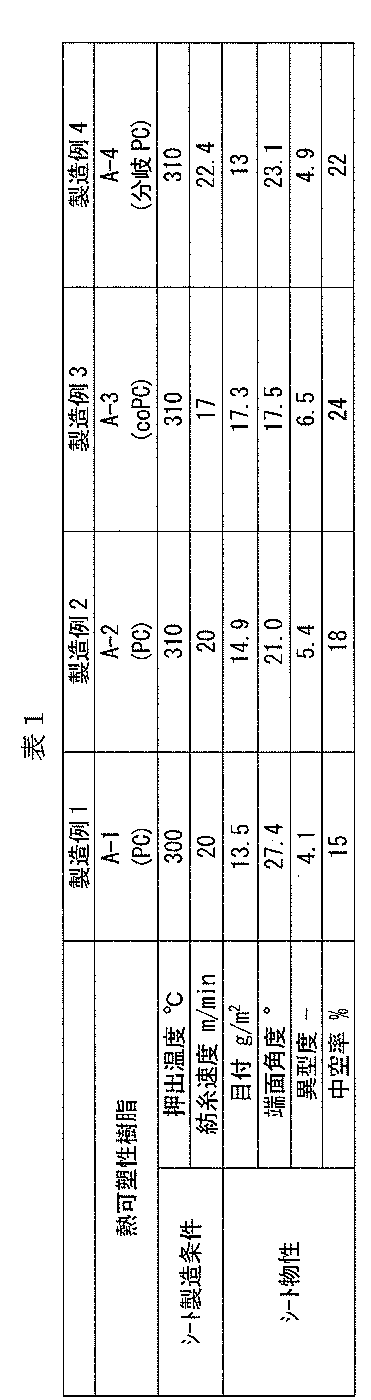
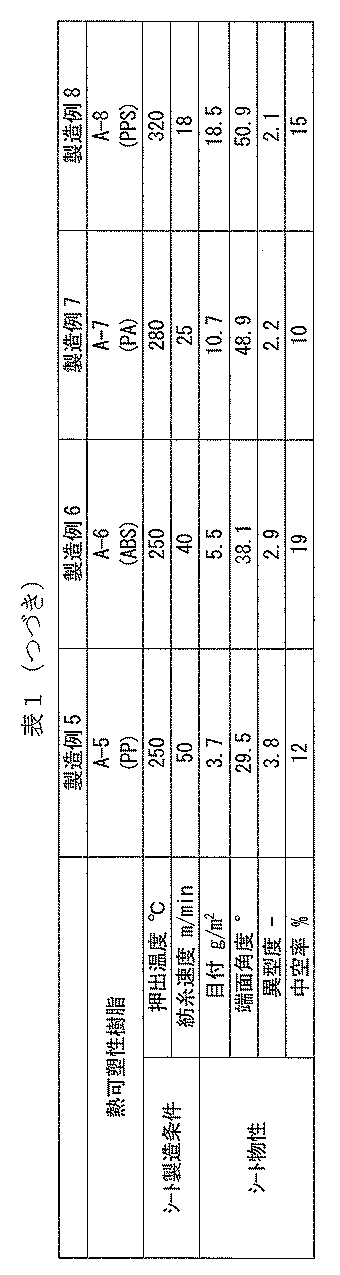
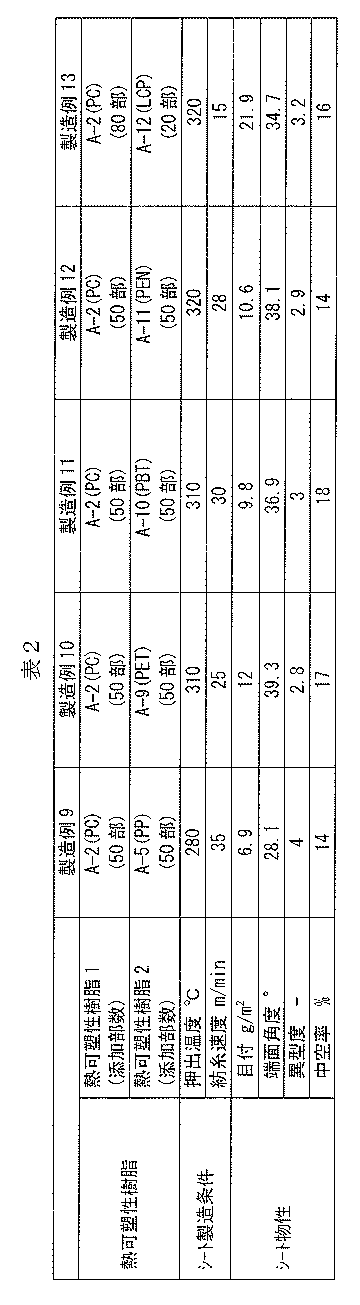
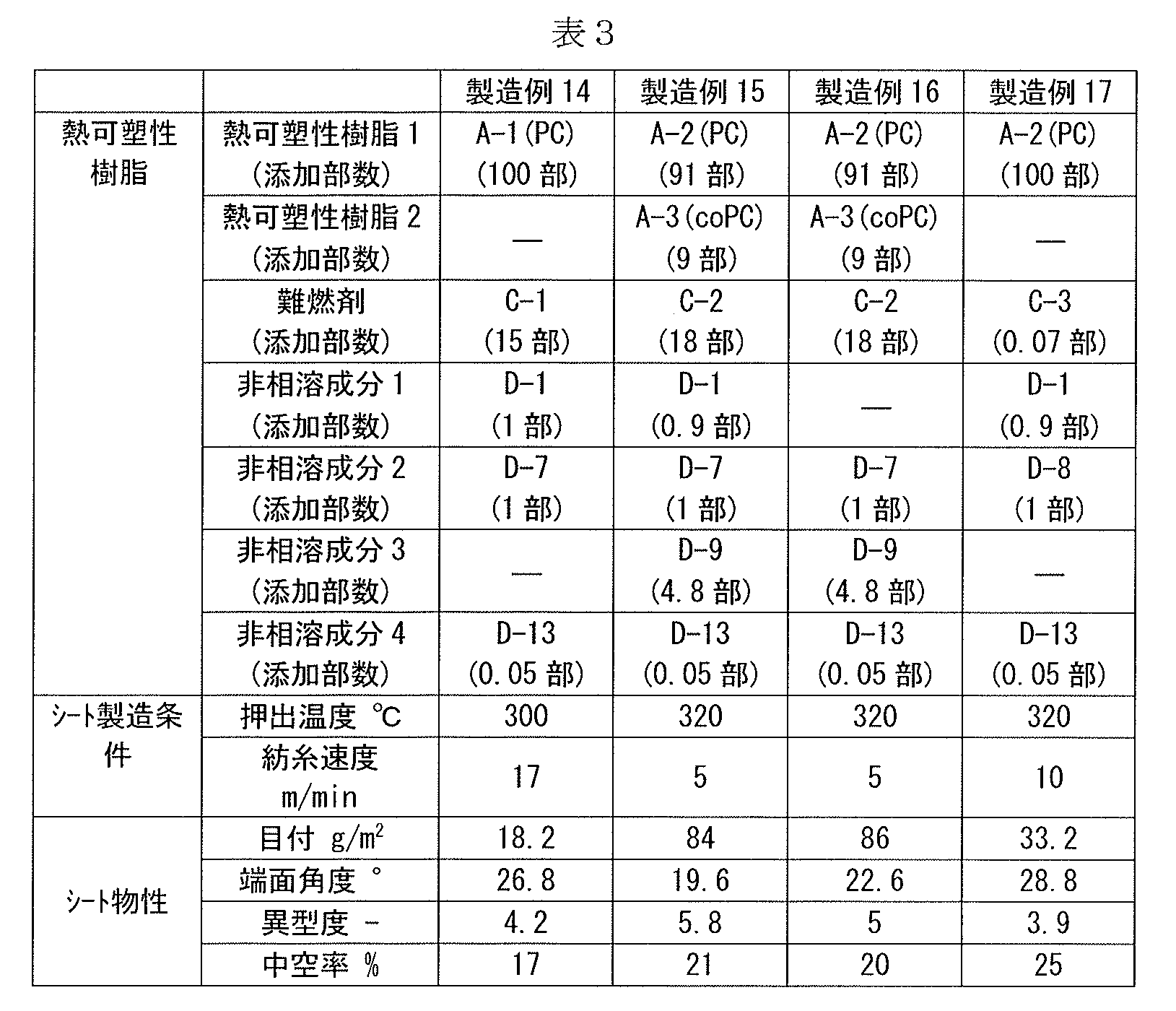
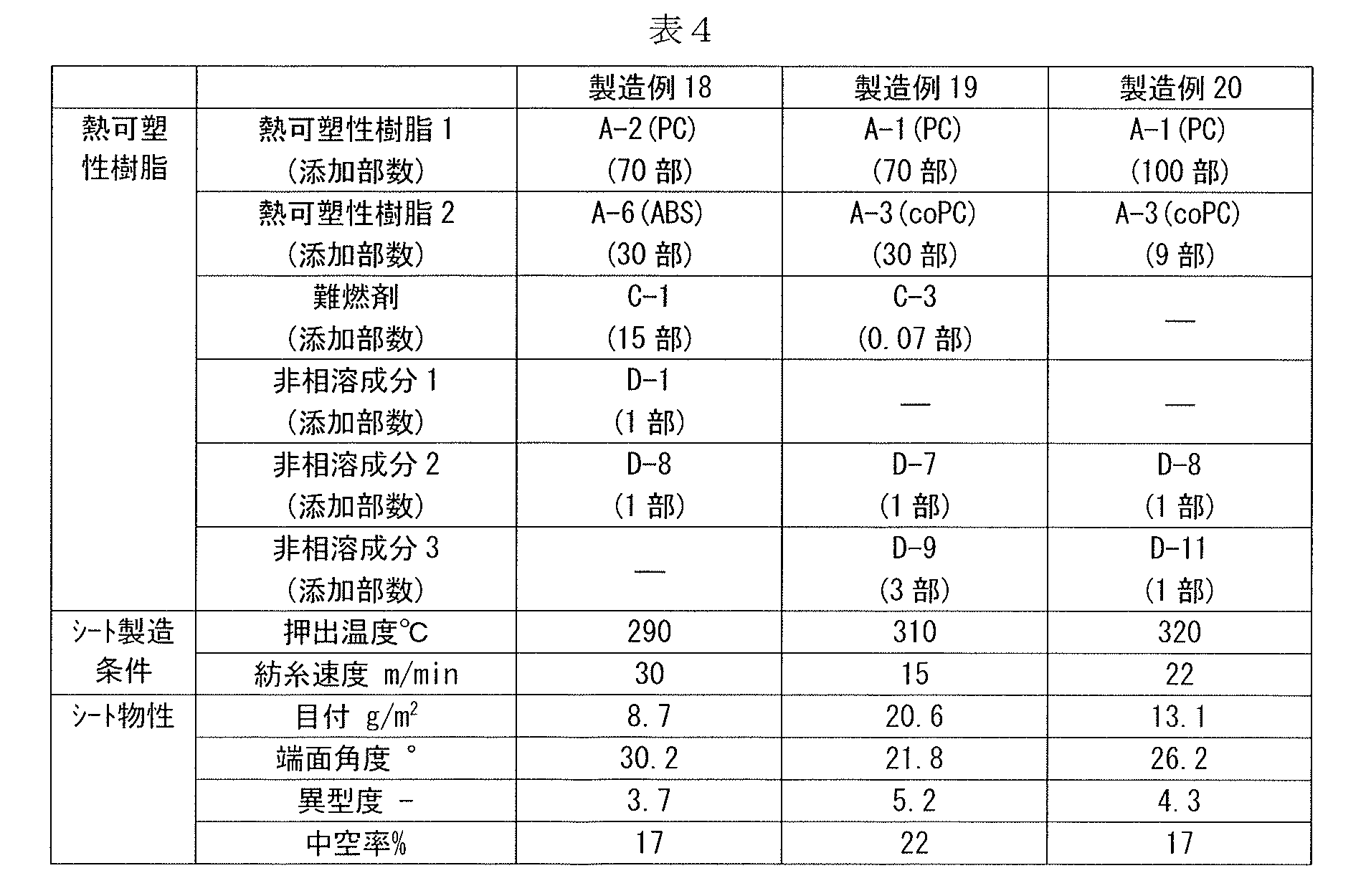

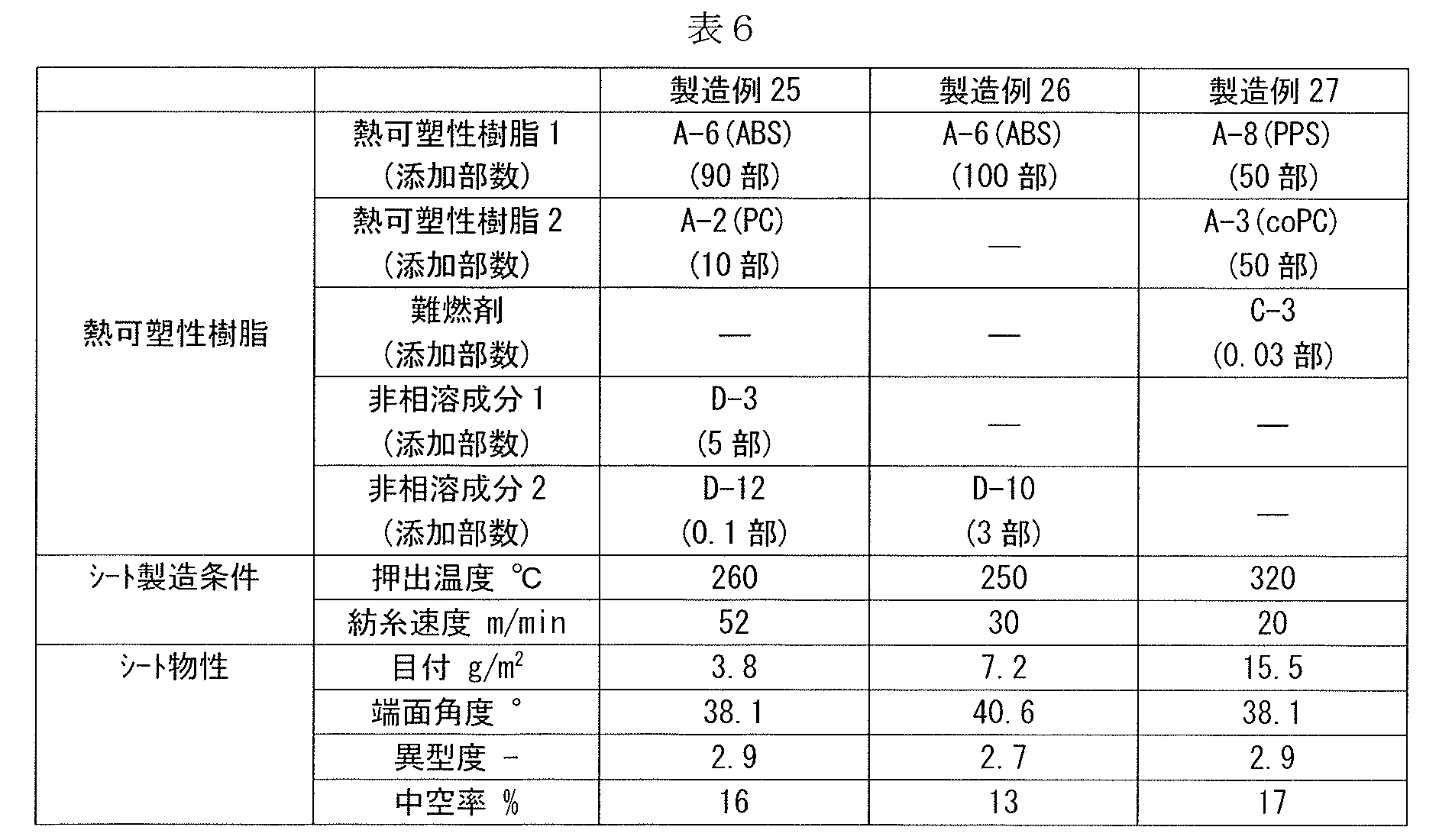
製造例28~32(非中空繊維を含む不織布)
表7に記載の熱可塑性樹脂を含有する組成物を、80℃で5時間、熱風循環式乾燥機にて乾燥した後、発泡剤としての窒素ガスを用いずに、二軸押出機から表7に記載の押出温度で押出し、スリットダイ出口で急冷しながら表7に記載の引取速度で引取り、不織布シートを巻き取った。このシートは、中空繊維ではない中実繊維を含む不織布シートである。評価を表7に示す。
表7に記載の熱可塑性樹脂を含有する組成物を、80℃で5時間、熱風循環式乾燥機にて乾燥した後、発泡剤としての窒素ガスを用いずに、二軸押出機から表7に記載の押出温度で押出し、スリットダイ出口で急冷しながら表7に記載の引取速度で引取り、不織布シートを巻き取った。このシートは、中空繊維ではない中実繊維を含む不織布シートである。評価を表7に示す。

製造例33~36(短繊維を含む不織布)
表8に記載の熱可塑性樹脂を含有する組成物を、80℃で5時間、熱風循環式乾燥機にて乾燥した後、二軸押出機から表8に記載の押出温度で押出し、直径30μmのフィラメントとし、これを捲縮51mmにカットした繊維60重量%を開繊機にて混合し、カード工程を通過させることにより、一方向に繊維が引き揃えられた繊維ウェブを作成した。これをクロスレイヤー法により交差角が45°となるように積層し、不織布を得た。評価を表8に示す。
表8に記載の熱可塑性樹脂を含有する組成物を、80℃で5時間、熱風循環式乾燥機にて乾燥した後、二軸押出機から表8に記載の押出温度で押出し、直径30μmのフィラメントとし、これを捲縮51mmにカットした繊維60重量%を開繊機にて混合し、カード工程を通過させることにより、一方向に繊維が引き揃えられた繊維ウェブを作成した。これをクロスレイヤー法により交差角が45°となるように積層し、不織布を得た。評価を表8に示す。
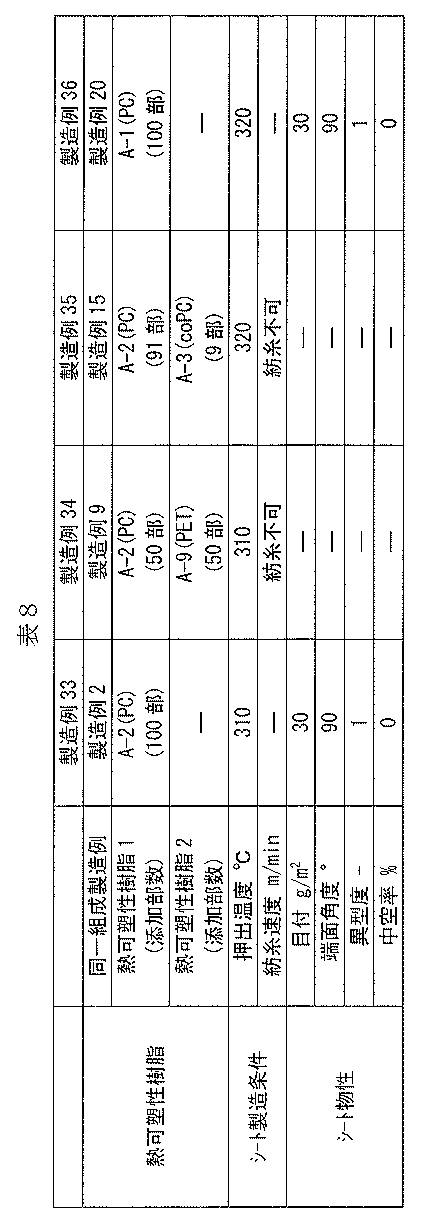
実施例1~4
(積層体)
製造例1で得られた熱可塑性樹脂シート(a)および補強用繊維シート(b)を表9に示す繊維含有量(Vf、重量%)となるように積層し、常温で、15MPaで10秒間、加圧し、実施例1~4の積層体を得た。積層の際に、補強用繊維シート(b)が偏らないように配慮した。
(積層体)
製造例1で得られた熱可塑性樹脂シート(a)および補強用繊維シート(b)を表9に示す繊維含有量(Vf、重量%)となるように積層し、常温で、15MPaで10秒間、加圧し、実施例1~4の積層体を得た。積層の際に、補強用繊維シート(b)が偏らないように配慮した。
(繊維強化樹脂複合体)
得られた積層体を予熱したホットプレスに挿入して、表9に示すように温度300℃およびプレス時間5分の条件、15MPaのプレス圧にて、繊維強化樹脂複合体(FRTP複合体)を得た。繊維強化樹脂複合体の厚みは、予め加熱加圧後に目的の厚みになるように、熱可塑性樹脂シート(a)および補強用繊維シート(b)の量を調整した。最終的に得られた繊維強化樹脂複合体の評価を表9に併せて示す。
得られた積層体を予熱したホットプレスに挿入して、表9に示すように温度300℃およびプレス時間5分の条件、15MPaのプレス圧にて、繊維強化樹脂複合体(FRTP複合体)を得た。繊維強化樹脂複合体の厚みは、予め加熱加圧後に目的の厚みになるように、熱可塑性樹脂シート(a)および補強用繊維シート(b)の量を調整した。最終的に得られた繊維強化樹脂複合体の評価を表9に併せて示す。
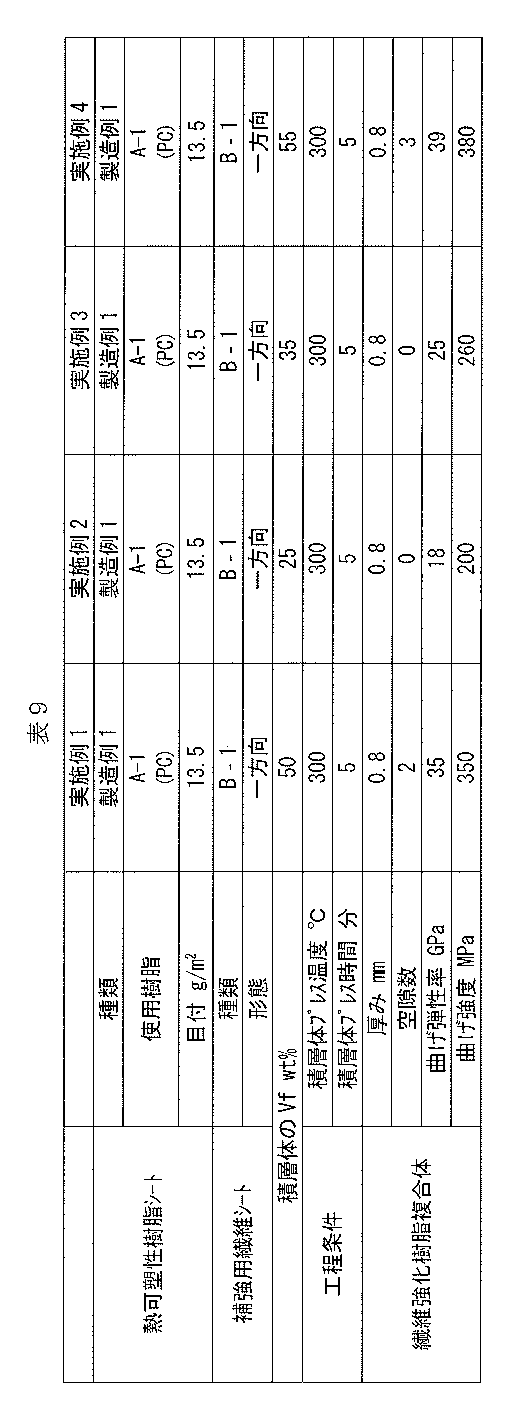
実施例5~10
(積層体)
製造例1で得られた熱可塑性繊維シート(a)および、表10に示す補強用繊維シート(b)を、表10に示す繊維含有量(Vf、重量%)となるように積層し、常温で、15MPaで10秒間、加圧し、実施例5~10の積層体とした。積層の際に、補強用繊維シート(b)が偏らないように配慮した。
(積層体)
製造例1で得られた熱可塑性繊維シート(a)および、表10に示す補強用繊維シート(b)を、表10に示す繊維含有量(Vf、重量%)となるように積層し、常温で、15MPaで10秒間、加圧し、実施例5~10の積層体とした。積層の際に、補強用繊維シート(b)が偏らないように配慮した。
(繊維強化樹脂複合体)
得られた積層体を予熱したホットプレスに挿入して、表10に示すように温度300℃およびプレス時間5分の条件、15MPaのプレス圧にて、繊維強化樹脂複合体(FRTP複合体)を得た。繊維強化樹脂複合体の厚みは、予め加熱加圧後に目的の厚みになるように、熱可塑性繊維シート(a)および補強用繊維シート(b)の量を調整した。最終的に得られた繊維強化樹脂複合体の評価を表10に併せて示す。なお、実施例1も併せて示した。
得られた積層体を予熱したホットプレスに挿入して、表10に示すように温度300℃およびプレス時間5分の条件、15MPaのプレス圧にて、繊維強化樹脂複合体(FRTP複合体)を得た。繊維強化樹脂複合体の厚みは、予め加熱加圧後に目的の厚みになるように、熱可塑性繊維シート(a)および補強用繊維シート(b)の量を調整した。最終的に得られた繊維強化樹脂複合体の評価を表10に併せて示す。なお、実施例1も併せて示した。
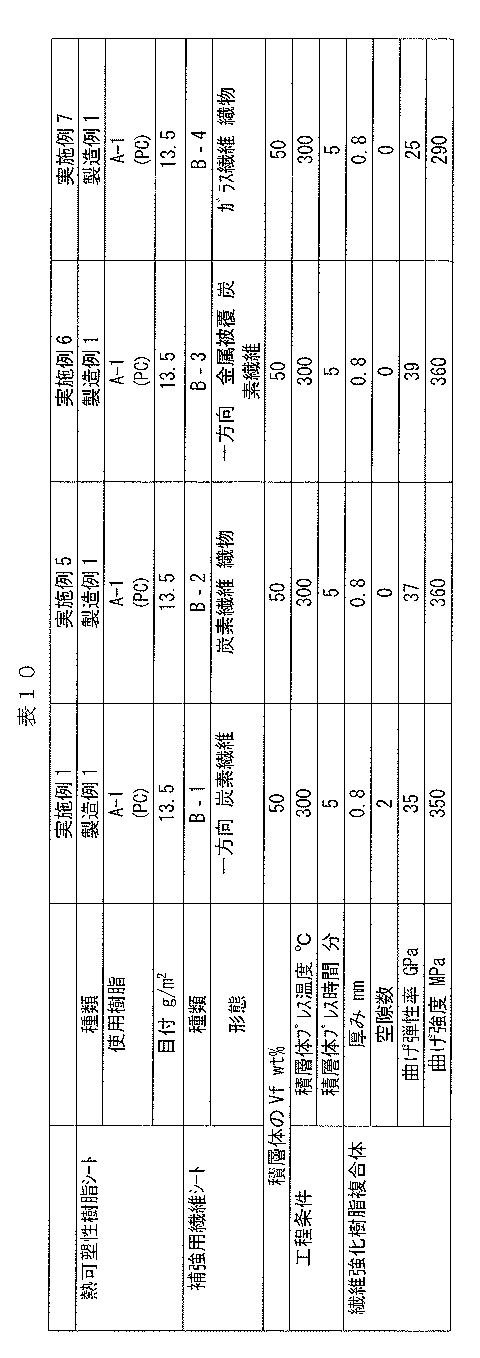

実施例11~36、比較例1~7
(積層体)
製造例2~36で得られた熱可塑性繊維シート(a)および、表11~17に示す補強用繊維シート(b)を、表11~17に示す繊維含有量(Vf、重量%)となるように積層し、常温で、15MPaで10秒間、加圧し、実施例11~36、比較例1~7の積層体とした。積層の際に、補強用繊維シート(b)が偏らないように配慮した。
(積層体)
製造例2~36で得られた熱可塑性繊維シート(a)および、表11~17に示す補強用繊維シート(b)を、表11~17に示す繊維含有量(Vf、重量%)となるように積層し、常温で、15MPaで10秒間、加圧し、実施例11~36、比較例1~7の積層体とした。積層の際に、補強用繊維シート(b)が偏らないように配慮した。
(繊維強化樹脂複合体)
得られた積層体を予熱したホットプレスに挿入して、表に示すように温度(℃)およびプレス時間の条件、15MPaのプレス圧にて、繊維強化樹脂複合体(FRTP複合体)を得た。繊維強化樹脂複合体の厚みは、予め加熱加圧後に目的の厚みになるように、熱可塑性繊維シート(a)および補強用繊維シート(b)の量を調整した。最終的に得られた繊維強化樹脂複合体の評価を表11~17に併せて示す。なお、実施例5も表11に併せて示した。
得られた積層体を予熱したホットプレスに挿入して、表に示すように温度(℃)およびプレス時間の条件、15MPaのプレス圧にて、繊維強化樹脂複合体(FRTP複合体)を得た。繊維強化樹脂複合体の厚みは、予め加熱加圧後に目的の厚みになるように、熱可塑性繊維シート(a)および補強用繊維シート(b)の量を調整した。最終的に得られた繊維強化樹脂複合体の評価を表11~17に併せて示す。なお、実施例5も表11に併せて示した。
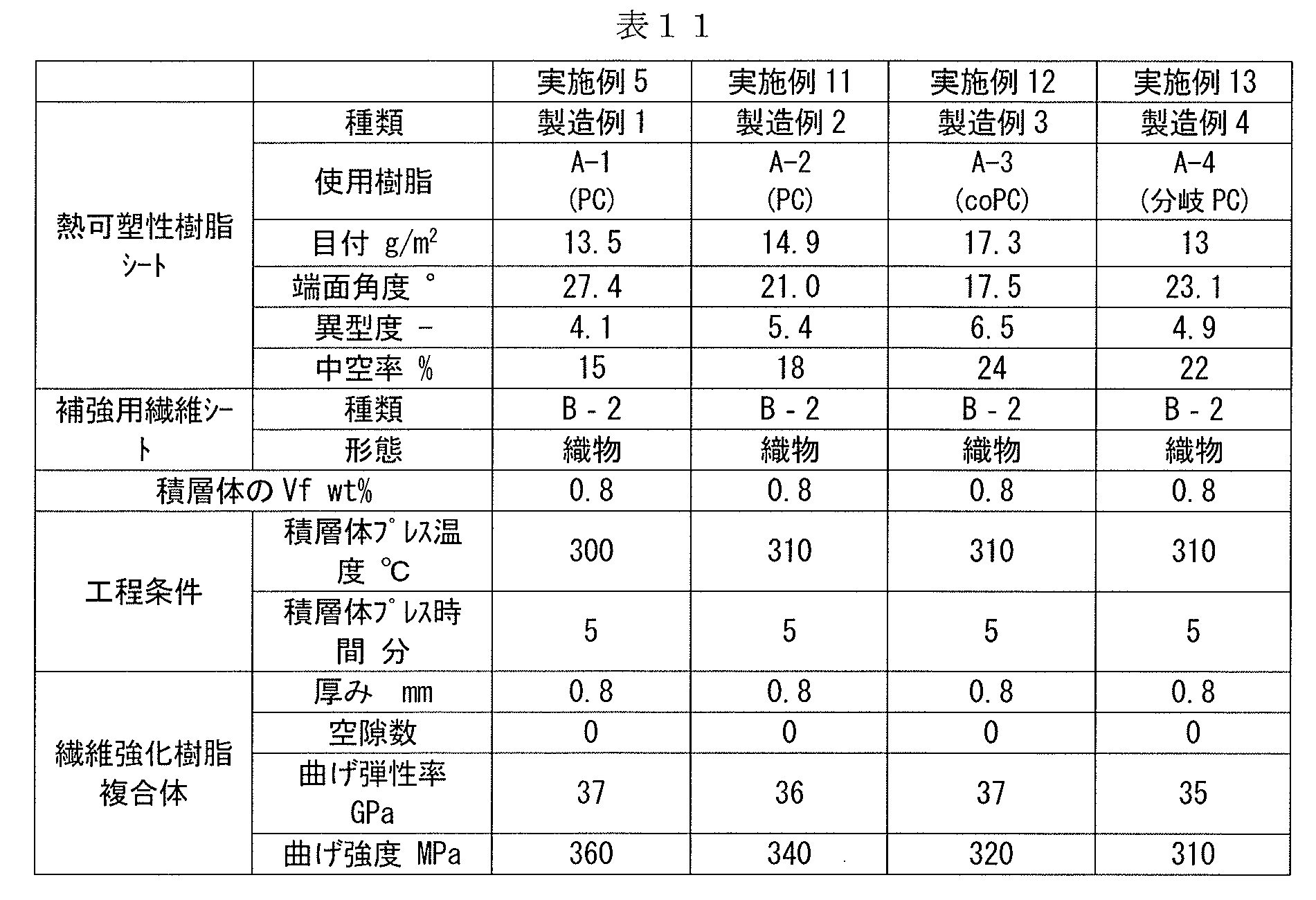
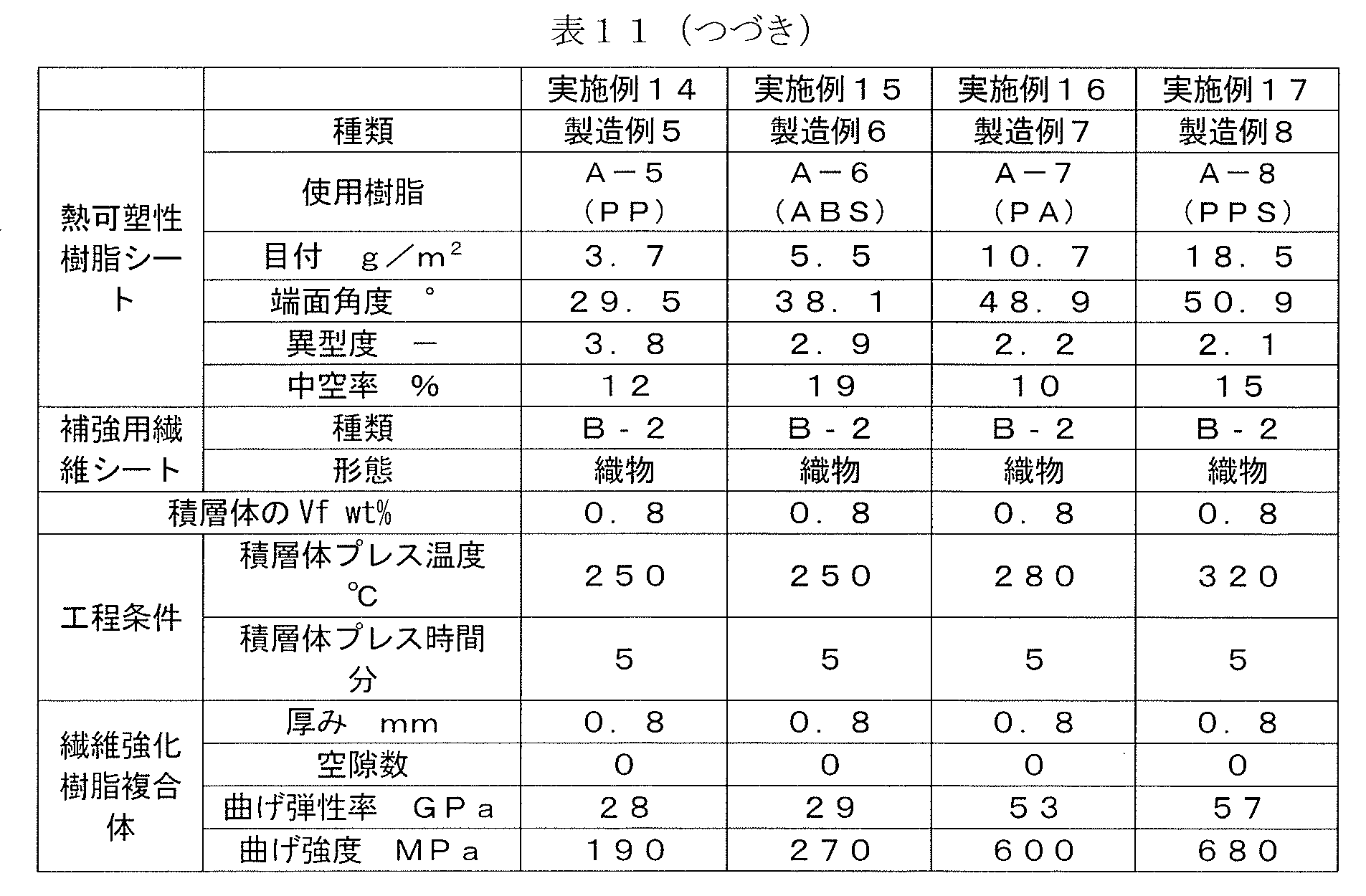
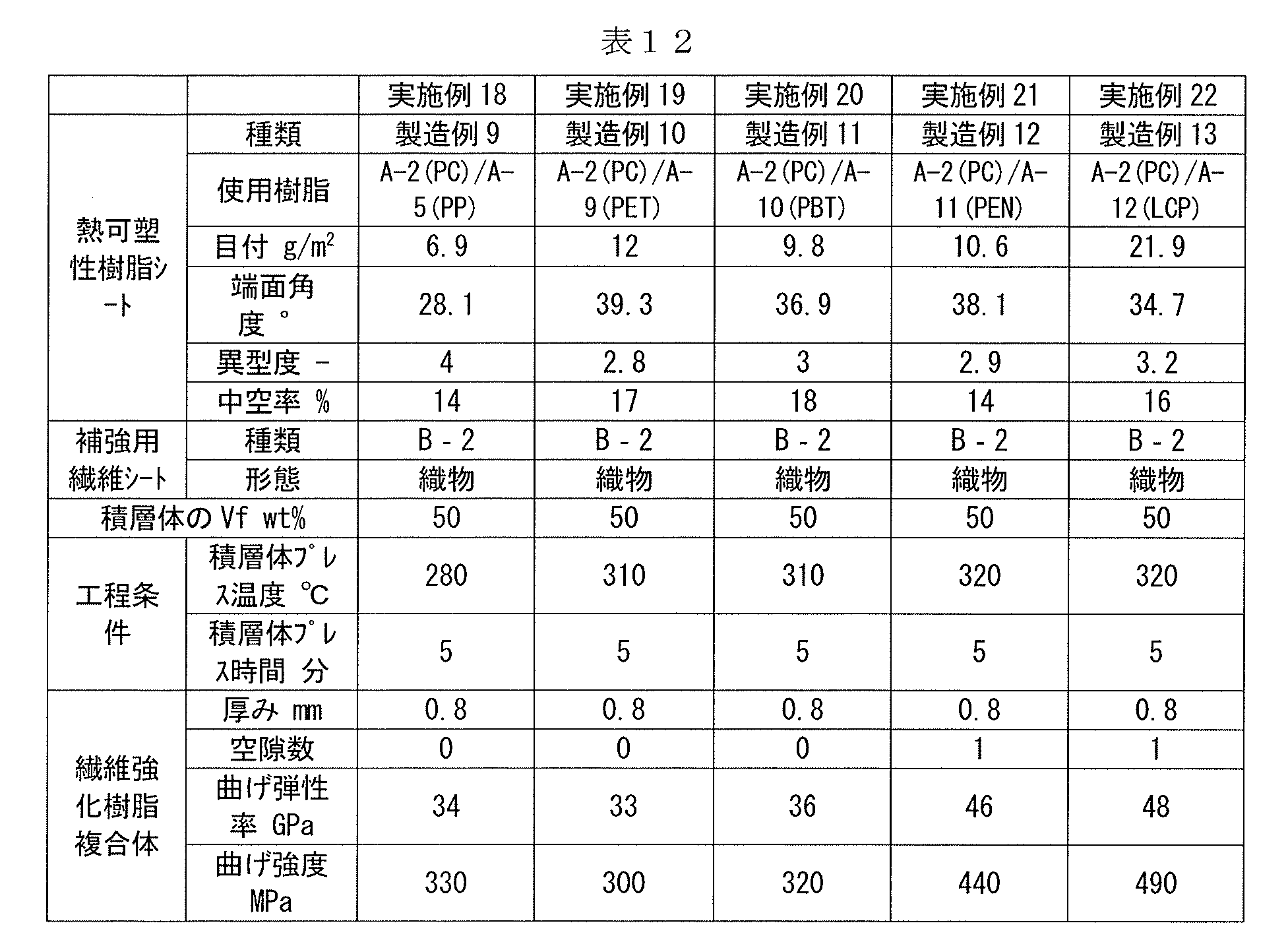


1.異形繊維断面
2.気泡
3.長軸
4.短軸(最厚部分)
5.外接円
6.内接円
a.端面角度
2.気泡
3.長軸
4.短軸(最厚部分)
5.外接円
6.内接円
a.端面角度
Claims (10)
- 補強用繊維シート(b)と熱可塑性樹脂シート(a)とを含み、
(i)補強用繊維シート(b)は、溶融温度が350℃以上の補強用繊維(B)を含み、
(ii)熱可塑性樹脂シート(a)は、中空繊維を含む不織布であり、該中空繊維は、溶融温度が350℃未満の熱可塑性樹脂(A)を含む、
積層体。 - 熱可塑性樹脂シート(a)が、網目状に配置された中空繊維を含む不織布である請求項1に記載の積層体。
- 中空繊維の端面角度が60度未満である請求項1または2に記載の積層体。
- 中空繊維の中空率が5%以上である請求項1~3のいずれか一項に記載の積層体。
- 熱可塑性樹脂(A)が、非晶性樹脂を主とするものである請求項1~4のいずれか一項に記載の積層体。
- 熱可塑性樹脂(A)が、非相溶性成分を含有するものである請求項1~5のいずれか一項に記載の積層体。
- 補強用繊維シート(b)が、織編物、不織布または一方向性シートである請求項1記載の積層体。
- 補強用繊維(B)の含有率が10重量%以上である請求項1~7のいずれか一項に記載の積層体。
- 請求項1に記載の積層体を加熱下で加圧成形してなる繊維強化樹脂複合体。
- (i)請求項1に記載の積層体を用意する工程、および
(ii)該積層体を、熱可塑性樹脂(A)の溶融温度以上、補強用繊維(B)の溶融温度未満の温度で加圧する工程、
を含む繊維強化樹脂複合体の製造方法。
Priority Applications (4)
| Application Number | Priority Date | Filing Date | Title |
|---|---|---|---|
| US16/316,397 US20190291398A1 (en) | 2016-08-31 | 2017-08-25 | Laminate and process for producing a fiber-reinforced resin composite |
| CN201780031208.1A CN109153793B (zh) | 2016-08-31 | 2017-08-25 | 层叠体和纤维强化树脂复合体的制造方法 |
| JP2018537234A JP6744414B2 (ja) | 2016-08-31 | 2017-08-25 | 積層体および繊維強化樹脂複合体の製造方法 |
| EP17846365.9A EP3508518B1 (en) | 2016-08-31 | 2017-08-25 | Laminate and method for producing fiber-reinforced resin composite |
Applications Claiming Priority (2)
| Application Number | Priority Date | Filing Date | Title |
|---|---|---|---|
| JP2016-169303 | 2016-08-31 | ||
| JP2016169303 | 2016-08-31 |
Publications (1)
| Publication Number | Publication Date |
|---|---|
| WO2018043360A1 true WO2018043360A1 (ja) | 2018-03-08 |
Family
ID=61300831
Family Applications (1)
| Application Number | Title | Priority Date | Filing Date |
|---|---|---|---|
| PCT/JP2017/030612 Ceased WO2018043360A1 (ja) | 2016-08-31 | 2017-08-25 | 積層体および繊維強化樹脂複合体の製造方法 |
Country Status (6)
| Country | Link |
|---|---|
| US (1) | US20190291398A1 (ja) |
| EP (1) | EP3508518B1 (ja) |
| JP (1) | JP6744414B2 (ja) |
| CN (1) | CN109153793B (ja) |
| TW (1) | TWI731152B (ja) |
| WO (1) | WO2018043360A1 (ja) |
Cited By (8)
| Publication number | Priority date | Publication date | Assignee | Title |
|---|---|---|---|---|
| WO2018163799A1 (ja) * | 2017-03-09 | 2018-09-13 | 帝人株式会社 | 積層体およびそれからなる繊維強化樹脂複合体 |
| WO2020100067A1 (en) * | 2018-11-14 | 2020-05-22 | 3M Innovative Properties Company | Flame-resistant nonwoven fiber assembly |
| WO2020158293A1 (ja) * | 2019-01-30 | 2020-08-06 | 帝人株式会社 | 炭素繊維強化ポリカーボネート樹脂組成物からなる成形用材料 |
| WO2020235490A1 (ja) * | 2019-05-23 | 2020-11-26 | 東レ株式会社 | 繊維強化樹脂基材、一体化成形品および繊維強化樹脂基材の製造方法 |
| JP2020192809A (ja) * | 2019-05-23 | 2020-12-03 | 東レ株式会社 | 繊維強化樹脂基材、一体化成形品および繊維強化樹脂基材の製造方法 |
| KR102206914B1 (ko) * | 2019-08-19 | 2021-01-26 | 한국생산기술연구원 | 저전압 열선용 탄소섬유 제조 방법 및 저전압 열선용 탄소섬유 |
| JPWO2021200796A1 (ja) * | 2020-03-31 | 2021-10-07 | ||
| KR20220075303A (ko) * | 2019-10-10 | 2022-06-08 | 도레이 카부시키가이샤 | 내염성 적층 성형체 |
Families Citing this family (3)
| Publication number | Priority date | Publication date | Assignee | Title |
|---|---|---|---|---|
| WO2020235488A1 (ja) * | 2019-05-23 | 2020-11-26 | 東レ株式会社 | 繊維強化樹脂基材の製造方法、繊維強化樹脂基材、およびその一体化成形品 |
| WO2024040096A2 (en) * | 2022-08-18 | 2024-02-22 | Heartland Industries, Inc. | System and methods for producing functionalized natural fibers |
| WO2025186409A1 (en) * | 2024-03-08 | 2025-09-12 | Trinseo Europe Gmbh | Fireproof composite as fire activating heat insulating layer for battery enclosure or fire proof layer in battery pack |
Citations (22)
| Publication number | Priority date | Publication date | Assignee | Title |
|---|---|---|---|---|
| JPS60258263A (ja) | 1984-05-29 | 1985-12-20 | バイエル・アクチエンゲゼルシヤフト | テトラフルオロエチレン重合体を含む重合体粉末混合物の製造方法 |
| JPS63154744A (ja) | 1986-12-02 | 1988-06-28 | モベイ・コーポレーシヨン | ポリカーボネートにフルオロポリマーを混入する方法 |
| JPH0347713A (ja) | 1988-12-15 | 1991-02-28 | Asahi Chem Ind Co Ltd | 繊維強化材料用複合シート及びその製造方法 |
| JPH04272957A (ja) | 1990-10-31 | 1992-09-29 | General Electric Co <Ge> | 改良された外観及び改良された難燃性をもつポリカーボネート |
| JPH0516253A (ja) * | 1991-04-04 | 1993-01-26 | Teijin Ltd | 繊維補強樹脂成形物とその製造方法 |
| JPH06145520A (ja) | 1992-11-05 | 1994-05-24 | Daikin Ind Ltd | ポリフェニレンサルファイド樹脂組成物およびその製法 |
| JPH06220210A (ja) | 1992-11-17 | 1994-08-09 | General Electric Co <Ge> | 固体の添加剤をポリマー性樹脂に分散させる方法 |
| JPH07233160A (ja) | 1993-09-17 | 1995-09-05 | Ciba Geigy Ag | 安定剤としての3−アリールベンゾフラノン |
| JPH08188653A (ja) | 1995-01-10 | 1996-07-23 | General Electric Co <Ge> | 固体の添加剤をポリマー中に分散させる方法およびそれによって得られる製品 |
| JPH0995583A (ja) | 1995-04-28 | 1997-04-08 | General Electric Co <Ge> | テトラフルオロエチレン誘導体の群を含んでなる重合物を基体とする新規ポリマーブレンド、該ブレンドの製造法と該ブレンドから得られる製品並びに該ブレンドのポリマー組成物における使用 |
| JPH1129679A (ja) | 1996-07-31 | 1999-02-02 | Mitsubishi Rayon Co Ltd | ポリテトラフルオロエチレン含有混合粉体、その製造方法、それを含む熱可塑性樹脂組成物およびその成形体 |
| WO2003091015A1 (en) | 2002-04-23 | 2003-11-06 | Toray Industries, Inc. | Prepreg, process for producing the same, and molded article |
| JP2005239939A (ja) | 2004-02-27 | 2005-09-08 | Toray Ind Inc | 繊維強化樹脂複合材料 |
| WO2006073097A1 (ja) * | 2005-01-07 | 2006-07-13 | Nagoya Oilchemical Co., Ltd. | 難燃性繊維シートおよびその成形物 |
| JP2007107108A (ja) | 2005-10-11 | 2007-04-26 | Yuniseru Kk | 難燃性不織布 |
| JP2008045010A (ja) * | 2006-08-12 | 2008-02-28 | Toho Tenax Co Ltd | 耐衝撃性プリプレグ及びその製造方法 |
| JP2013203786A (ja) * | 2012-03-27 | 2013-10-07 | Mitsubishi Rayon Co Ltd | 熱可塑性樹脂含浸繊維プリプレグ及び繊維強化熱可塑性樹脂シートの製造方法 |
| WO2014038722A1 (ja) | 2012-09-07 | 2014-03-13 | 帝人株式会社 | 不織布構造体およびその製造方法 |
| JP2014145038A (ja) | 2013-01-29 | 2014-08-14 | Toray Ind Inc | プリプレグ、プリプレグの製造方法および炭素繊維強化複合材料 |
| JP2016008295A (ja) | 2014-06-26 | 2016-01-18 | 三菱エンジニアリングプラスチックス株式会社 | 炭素繊維強化複合成形体及びその製造方法 |
| JP2016071376A (ja) * | 2014-09-29 | 2016-05-09 | 王子ホールディングス株式会社 | 難燃性吸音材 |
| JP2016098376A (ja) | 2014-11-17 | 2016-05-30 | ランクセス・ドイチュランド・ゲーエムベーハー | 難燃性繊維−マトリックス半製品 |
Family Cites Families (2)
| Publication number | Priority date | Publication date | Assignee | Title |
|---|---|---|---|---|
| EP1125728B1 (en) * | 1999-03-23 | 2011-10-05 | Toray Industries, Inc. | Composite reinforcing fiber base material, preform and production method for fiber reinforced plastic |
| CN104508018B (zh) * | 2012-07-30 | 2017-10-20 | 可乐丽股份有限公司 | 耐热性树脂复合体及其制造方法、以及耐热性树脂复合体用无纺布 |
-
2017
- 2017-08-25 EP EP17846365.9A patent/EP3508518B1/en active Active
- 2017-08-25 JP JP2018537234A patent/JP6744414B2/ja active Active
- 2017-08-25 US US16/316,397 patent/US20190291398A1/en not_active Abandoned
- 2017-08-25 WO PCT/JP2017/030612 patent/WO2018043360A1/ja not_active Ceased
- 2017-08-25 CN CN201780031208.1A patent/CN109153793B/zh active Active
- 2017-08-28 TW TW106129102A patent/TWI731152B/zh active
Patent Citations (22)
| Publication number | Priority date | Publication date | Assignee | Title |
|---|---|---|---|---|
| JPS60258263A (ja) | 1984-05-29 | 1985-12-20 | バイエル・アクチエンゲゼルシヤフト | テトラフルオロエチレン重合体を含む重合体粉末混合物の製造方法 |
| JPS63154744A (ja) | 1986-12-02 | 1988-06-28 | モベイ・コーポレーシヨン | ポリカーボネートにフルオロポリマーを混入する方法 |
| JPH0347713A (ja) | 1988-12-15 | 1991-02-28 | Asahi Chem Ind Co Ltd | 繊維強化材料用複合シート及びその製造方法 |
| JPH04272957A (ja) | 1990-10-31 | 1992-09-29 | General Electric Co <Ge> | 改良された外観及び改良された難燃性をもつポリカーボネート |
| JPH0516253A (ja) * | 1991-04-04 | 1993-01-26 | Teijin Ltd | 繊維補強樹脂成形物とその製造方法 |
| JPH06145520A (ja) | 1992-11-05 | 1994-05-24 | Daikin Ind Ltd | ポリフェニレンサルファイド樹脂組成物およびその製法 |
| JPH06220210A (ja) | 1992-11-17 | 1994-08-09 | General Electric Co <Ge> | 固体の添加剤をポリマー性樹脂に分散させる方法 |
| JPH07233160A (ja) | 1993-09-17 | 1995-09-05 | Ciba Geigy Ag | 安定剤としての3−アリールベンゾフラノン |
| JPH08188653A (ja) | 1995-01-10 | 1996-07-23 | General Electric Co <Ge> | 固体の添加剤をポリマー中に分散させる方法およびそれによって得られる製品 |
| JPH0995583A (ja) | 1995-04-28 | 1997-04-08 | General Electric Co <Ge> | テトラフルオロエチレン誘導体の群を含んでなる重合物を基体とする新規ポリマーブレンド、該ブレンドの製造法と該ブレンドから得られる製品並びに該ブレンドのポリマー組成物における使用 |
| JPH1129679A (ja) | 1996-07-31 | 1999-02-02 | Mitsubishi Rayon Co Ltd | ポリテトラフルオロエチレン含有混合粉体、その製造方法、それを含む熱可塑性樹脂組成物およびその成形体 |
| WO2003091015A1 (en) | 2002-04-23 | 2003-11-06 | Toray Industries, Inc. | Prepreg, process for producing the same, and molded article |
| JP2005239939A (ja) | 2004-02-27 | 2005-09-08 | Toray Ind Inc | 繊維強化樹脂複合材料 |
| WO2006073097A1 (ja) * | 2005-01-07 | 2006-07-13 | Nagoya Oilchemical Co., Ltd. | 難燃性繊維シートおよびその成形物 |
| JP2007107108A (ja) | 2005-10-11 | 2007-04-26 | Yuniseru Kk | 難燃性不織布 |
| JP2008045010A (ja) * | 2006-08-12 | 2008-02-28 | Toho Tenax Co Ltd | 耐衝撃性プリプレグ及びその製造方法 |
| JP2013203786A (ja) * | 2012-03-27 | 2013-10-07 | Mitsubishi Rayon Co Ltd | 熱可塑性樹脂含浸繊維プリプレグ及び繊維強化熱可塑性樹脂シートの製造方法 |
| WO2014038722A1 (ja) | 2012-09-07 | 2014-03-13 | 帝人株式会社 | 不織布構造体およびその製造方法 |
| JP2014145038A (ja) | 2013-01-29 | 2014-08-14 | Toray Ind Inc | プリプレグ、プリプレグの製造方法および炭素繊維強化複合材料 |
| JP2016008295A (ja) | 2014-06-26 | 2016-01-18 | 三菱エンジニアリングプラスチックス株式会社 | 炭素繊維強化複合成形体及びその製造方法 |
| JP2016071376A (ja) * | 2014-09-29 | 2016-05-09 | 王子ホールディングス株式会社 | 難燃性吸音材 |
| JP2016098376A (ja) | 2014-11-17 | 2016-05-30 | ランクセス・ドイチュランド・ゲーエムベーハー | 難燃性繊維−マトリックス半製品 |
Non-Patent Citations (1)
| Title |
|---|
| AKIRA OKAMOTO: "Specialized Rayon Fibres and a Case of Modification", JOURNAL OF THE TEXTILE MACHINERY SOCIETY OF JAPAN, vol. 47, no. 4, 1994, pages 147 - 151, XP055561252 * |
Cited By (16)
| Publication number | Priority date | Publication date | Assignee | Title |
|---|---|---|---|---|
| WO2018163799A1 (ja) * | 2017-03-09 | 2018-09-13 | 帝人株式会社 | 積層体およびそれからなる繊維強化樹脂複合体 |
| JPWO2018163799A1 (ja) * | 2017-03-09 | 2019-11-07 | 帝人株式会社 | 積層体およびそれからなる繊維強化樹脂複合体 |
| WO2020100067A1 (en) * | 2018-11-14 | 2020-05-22 | 3M Innovative Properties Company | Flame-resistant nonwoven fiber assembly |
| JPWO2020158293A1 (ja) * | 2019-01-30 | 2021-10-14 | 帝人株式会社 | 炭素繊維強化ポリカーボネート樹脂組成物からなる成形用材料 |
| WO2020158293A1 (ja) * | 2019-01-30 | 2020-08-06 | 帝人株式会社 | 炭素繊維強化ポリカーボネート樹脂組成物からなる成形用材料 |
| JP7116198B2 (ja) | 2019-01-30 | 2022-08-09 | 帝人株式会社 | 炭素繊維強化ポリカーボネート樹脂組成物からなる成形用材料 |
| WO2020235490A1 (ja) * | 2019-05-23 | 2020-11-26 | 東レ株式会社 | 繊維強化樹脂基材、一体化成形品および繊維強化樹脂基材の製造方法 |
| JP2020192809A (ja) * | 2019-05-23 | 2020-12-03 | 東レ株式会社 | 繊維強化樹脂基材、一体化成形品および繊維強化樹脂基材の製造方法 |
| JP7577931B2 (ja) | 2019-05-23 | 2024-11-06 | 東レ株式会社 | 繊維強化樹脂基材、一体化成形品および繊維強化樹脂基材の製造方法 |
| US12269225B2 (en) | 2019-05-23 | 2025-04-08 | Toray Industries, Inc. | Fiber-reinforced resin substrate, integrated molded article, and method for manufacturing fiber-reinforced resin substrate |
| KR102206914B1 (ko) * | 2019-08-19 | 2021-01-26 | 한국생산기술연구원 | 저전압 열선용 탄소섬유 제조 방법 및 저전압 열선용 탄소섬유 |
| KR102921170B1 (ko) * | 2019-10-10 | 2026-02-02 | 도레이 카부시키가이샤 | 내염성 적층 성형체 |
| KR20220075303A (ko) * | 2019-10-10 | 2022-06-08 | 도레이 카부시키가이샤 | 내염성 적층 성형체 |
| WO2021200796A1 (ja) * | 2020-03-31 | 2021-10-07 | 三井化学株式会社 | 薄膜状の繊維強化樹脂、ならびに樹脂成形体およびその製造方法 |
| JP7461461B2 (ja) | 2020-03-31 | 2024-04-03 | 三井化学株式会社 | 薄膜状の繊維強化樹脂、ならびに樹脂成形体およびその製造方法 |
| JPWO2021200796A1 (ja) * | 2020-03-31 | 2021-10-07 |
Also Published As
| Publication number | Publication date |
|---|---|
| US20190291398A1 (en) | 2019-09-26 |
| CN109153793B (zh) | 2021-07-20 |
| JPWO2018043360A1 (ja) | 2019-06-24 |
| TWI731152B (zh) | 2021-06-21 |
| TW201819188A (zh) | 2018-06-01 |
| EP3508518A1 (en) | 2019-07-10 |
| EP3508518B1 (en) | 2022-07-20 |
| CN109153793A (zh) | 2019-01-04 |
| JP6744414B2 (ja) | 2020-08-19 |
| EP3508518A4 (en) | 2019-08-28 |
Similar Documents
| Publication | Publication Date | Title |
|---|---|---|
| JP6744414B2 (ja) | 積層体および繊維強化樹脂複合体の製造方法 | |
| TWI557152B (zh) | Polycarbonate resin composition | |
| CN110799593B (zh) | 树脂组合物和成型品 | |
| JP5431758B2 (ja) | ポリカーボネート樹脂組成物 | |
| CN101676331A (zh) | 玻璃纤维增强芳香族聚碳酸酯树脂组合物 | |
| JP6808016B2 (ja) | 積層体およびそれからなる繊維強化樹脂複合体 | |
| CN101665620A (zh) | 由玻璃纤维增强阻燃性树脂组合物制成的镜筒 | |
| JP2018095669A (ja) | ポリカーボネート樹脂組成物およびそれからなる樹脂金属複合成形体 | |
| JP6224331B2 (ja) | 熱可塑性樹脂組成物およびその成形品 | |
| JP2010275413A (ja) | ガラス強化樹脂組成物 | |
| JP2014177571A (ja) | 熱可塑性樹脂組成物およびその成形品 | |
| JP2011140545A (ja) | 繊維強化樹脂組成物およびこれを成形してなる樹脂成形体 | |
| JP7111579B2 (ja) | ポリカーボネート樹脂組成物およびそれからなる樹脂金属複合成形体 | |
| JP2019126964A (ja) | 積層体およびそれからなる繊維強化樹脂複合体 | |
| CN110691820B (zh) | 增强聚碳酸酯树脂组合物 | |
| JP2018154025A (ja) | 熱カシメ結合体 | |
| JP7560574B2 (ja) | 積層体およびそれからなる繊維強化樹脂複合体ならびに繊維強化樹脂複合体の製造方法 | |
| JP2018080300A (ja) | 難燃性ポリカーボネート樹脂組成物 | |
| JP7740972B2 (ja) | 熱可塑性樹脂組成物および金属成形体と樹脂成形体が接合された複合成形体 | |
| JP2019006954A (ja) | 強化ポリカーボネート樹脂組成物 | |
| JP2023128656A (ja) | 繊維強化複合成形体用樹脂組成物 | |
| JP2023128655A (ja) | 繊維強化複合成形体 | |
| JP2024034738A (ja) | ポリカーボネート樹脂組成物およびそれからなる成形品 | |
| WO2023167054A1 (ja) | 繊維強化複合成形体用樹脂組成物および繊維強化複合成形体 | |
| JP2019006953A (ja) | 強化ポリカーボネート樹脂組成物 |
Legal Events
| Date | Code | Title | Description |
|---|---|---|---|
| 121 | Ep: the epo has been informed by wipo that ep was designated in this application |
Ref document number: 17846365 Country of ref document: EP Kind code of ref document: A1 |
|
| ENP | Entry into the national phase |
Ref document number: 2018537234 Country of ref document: JP Kind code of ref document: A |
|
| NENP | Non-entry into the national phase |
Ref country code: DE |
|
| ENP | Entry into the national phase |
Ref document number: 2017846365 Country of ref document: EP Effective date: 20190401 |