WO2018092414A1 - Procédé de production d'un film thermoplastique à base de polyester, film thermoplastique à base de polyester, et procédé d'inspection d'un film thermoplastique à base de polyester ou matériau résineux associé - Google Patents
Procédé de production d'un film thermoplastique à base de polyester, film thermoplastique à base de polyester, et procédé d'inspection d'un film thermoplastique à base de polyester ou matériau résineux associé Download PDFInfo
- Publication number
- WO2018092414A1 WO2018092414A1 PCT/JP2017/034254 JP2017034254W WO2018092414A1 WO 2018092414 A1 WO2018092414 A1 WO 2018092414A1 JP 2017034254 W JP2017034254 W JP 2017034254W WO 2018092414 A1 WO2018092414 A1 WO 2018092414A1
- Authority
- WO
- WIPO (PCT)
- Prior art keywords
- polyester
- resin
- terephthalate
- terephthalic acid
- hydroxyethyl
- Prior art date
- Legal status (The legal status is an assumption and is not a legal conclusion. Google has not performed a legal analysis and makes no representation as to the accuracy of the status listed.)
- Ceased
Links
Images



Classifications
-
- B—PERFORMING OPERATIONS; TRANSPORTING
- B29—WORKING OF PLASTICS; WORKING OF SUBSTANCES IN A PLASTIC STATE IN GENERAL
- B29C—SHAPING OR JOINING OF PLASTICS; SHAPING OF MATERIAL IN A PLASTIC STATE, NOT OTHERWISE PROVIDED FOR; AFTER-TREATMENT OF THE SHAPED PRODUCTS, e.g. REPAIRING
- B29C48/00—Extrusion moulding, i.e. expressing the moulding material through a die or nozzle which imparts the desired form; Apparatus therefor
- B29C48/022—Extrusion moulding, i.e. expressing the moulding material through a die or nozzle which imparts the desired form; Apparatus therefor characterised by the choice of material
-
- B—PERFORMING OPERATIONS; TRANSPORTING
- B29—WORKING OF PLASTICS; WORKING OF SUBSTANCES IN A PLASTIC STATE IN GENERAL
- B29C—SHAPING OR JOINING OF PLASTICS; SHAPING OF MATERIAL IN A PLASTIC STATE, NOT OTHERWISE PROVIDED FOR; AFTER-TREATMENT OF THE SHAPED PRODUCTS, e.g. REPAIRING
- B29C48/00—Extrusion moulding, i.e. expressing the moulding material through a die or nozzle which imparts the desired form; Apparatus therefor
- B29C48/03—Extrusion moulding, i.e. expressing the moulding material through a die or nozzle which imparts the desired form; Apparatus therefor characterised by the shape of the extruded material at extrusion
- B29C48/07—Flat, e.g. panels
- B29C48/08—Flat, e.g. panels flexible, e.g. films
-
- B—PERFORMING OPERATIONS; TRANSPORTING
- B29—WORKING OF PLASTICS; WORKING OF SUBSTANCES IN A PLASTIC STATE IN GENERAL
- B29C—SHAPING OR JOINING OF PLASTICS; SHAPING OF MATERIAL IN A PLASTIC STATE, NOT OTHERWISE PROVIDED FOR; AFTER-TREATMENT OF THE SHAPED PRODUCTS, e.g. REPAIRING
- B29C48/00—Extrusion moulding, i.e. expressing the moulding material through a die or nozzle which imparts the desired form; Apparatus therefor
- B29C48/25—Component parts, details or accessories; Auxiliary operations
- B29C48/30—Extrusion nozzles or dies
- B29C48/305—Extrusion nozzles or dies having a wide opening, e.g. for forming sheets
-
- B—PERFORMING OPERATIONS; TRANSPORTING
- B29—WORKING OF PLASTICS; WORKING OF SUBSTANCES IN A PLASTIC STATE IN GENERAL
- B29C—SHAPING OR JOINING OF PLASTICS; SHAPING OF MATERIAL IN A PLASTIC STATE, NOT OTHERWISE PROVIDED FOR; AFTER-TREATMENT OF THE SHAPED PRODUCTS, e.g. REPAIRING
- B29C48/00—Extrusion moulding, i.e. expressing the moulding material through a die or nozzle which imparts the desired form; Apparatus therefor
- B29C48/25—Component parts, details or accessories; Auxiliary operations
- B29C48/88—Thermal treatment of the stream of extruded material, e.g. cooling
-
- B—PERFORMING OPERATIONS; TRANSPORTING
- B29—WORKING OF PLASTICS; WORKING OF SUBSTANCES IN A PLASTIC STATE IN GENERAL
- B29C—SHAPING OR JOINING OF PLASTICS; SHAPING OF MATERIAL IN A PLASTIC STATE, NOT OTHERWISE PROVIDED FOR; AFTER-TREATMENT OF THE SHAPED PRODUCTS, e.g. REPAIRING
- B29C48/00—Extrusion moulding, i.e. expressing the moulding material through a die or nozzle which imparts the desired form; Apparatus therefor
- B29C48/25—Component parts, details or accessories; Auxiliary operations
- B29C48/88—Thermal treatment of the stream of extruded material, e.g. cooling
- B29C48/885—External treatment, e.g. by using air rings for cooling tubular films
-
- B—PERFORMING OPERATIONS; TRANSPORTING
- B29—WORKING OF PLASTICS; WORKING OF SUBSTANCES IN A PLASTIC STATE IN GENERAL
- B29C—SHAPING OR JOINING OF PLASTICS; SHAPING OF MATERIAL IN A PLASTIC STATE, NOT OTHERWISE PROVIDED FOR; AFTER-TREATMENT OF THE SHAPED PRODUCTS, e.g. REPAIRING
- B29C48/00—Extrusion moulding, i.e. expressing the moulding material through a die or nozzle which imparts the desired form; Apparatus therefor
- B29C48/25—Component parts, details or accessories; Auxiliary operations
- B29C48/92—Measuring, controlling or regulating
-
- C—CHEMISTRY; METALLURGY
- C08—ORGANIC MACROMOLECULAR COMPOUNDS; THEIR PREPARATION OR CHEMICAL WORKING-UP; COMPOSITIONS BASED THEREON
- C08G—MACROMOLECULAR COMPOUNDS OBTAINED OTHERWISE THAN BY REACTIONS ONLY INVOLVING UNSATURATED CARBON-TO-CARBON BONDS
- C08G63/00—Macromolecular compounds obtained by reactions forming a carboxylic ester link in the main chain of the macromolecule
- C08G63/02—Polyesters derived from hydroxycarboxylic acids or from polycarboxylic acids and polyhydroxy compounds
- C08G63/60—Polyesters derived from hydroxycarboxylic acids or from polycarboxylic acids and polyhydroxy compounds derived from the reaction of a mixture of hydroxy carboxylic acids, polycarboxylic acids and polyhydroxy compounds
-
- C—CHEMISTRY; METALLURGY
- C08—ORGANIC MACROMOLECULAR COMPOUNDS; THEIR PREPARATION OR CHEMICAL WORKING-UP; COMPOSITIONS BASED THEREON
- C08G—MACROMOLECULAR COMPOUNDS OBTAINED OTHERWISE THAN BY REACTIONS ONLY INVOLVING UNSATURATED CARBON-TO-CARBON BONDS
- C08G63/00—Macromolecular compounds obtained by reactions forming a carboxylic ester link in the main chain of the macromolecule
- C08G63/78—Preparation processes
- C08G63/82—Preparation processes characterised by the catalyst used
- C08G63/85—Germanium, tin, lead, arsenic, antimony, bismuth, titanium, zirconium, hafnium, vanadium, niobium, tantalum, or compounds thereof
-
- C—CHEMISTRY; METALLURGY
- C08—ORGANIC MACROMOLECULAR COMPOUNDS; THEIR PREPARATION OR CHEMICAL WORKING-UP; COMPOSITIONS BASED THEREON
- C08J—WORKING-UP; GENERAL PROCESSES OF COMPOUNDING; AFTER-TREATMENT NOT COVERED BY SUBCLASSES C08B, C08C, C08F, C08G or C08H
- C08J5/00—Manufacture of articles or shaped materials containing macromolecular substances
- C08J5/18—Manufacture of films or sheets
-
- B—PERFORMING OPERATIONS; TRANSPORTING
- B29—WORKING OF PLASTICS; WORKING OF SUBSTANCES IN A PLASTIC STATE IN GENERAL
- B29C—SHAPING OR JOINING OF PLASTICS; SHAPING OF MATERIAL IN A PLASTIC STATE, NOT OTHERWISE PROVIDED FOR; AFTER-TREATMENT OF THE SHAPED PRODUCTS, e.g. REPAIRING
- B29C2948/00—Indexing scheme relating to extrusion moulding
- B29C2948/92—Measuring, controlling or regulating
- B29C2948/92009—Measured parameter
- B29C2948/92228—Content, e.g. percentage of humidity, volatiles, contaminants or degassing
-
- C—CHEMISTRY; METALLURGY
- C08—ORGANIC MACROMOLECULAR COMPOUNDS; THEIR PREPARATION OR CHEMICAL WORKING-UP; COMPOSITIONS BASED THEREON
- C08J—WORKING-UP; GENERAL PROCESSES OF COMPOUNDING; AFTER-TREATMENT NOT COVERED BY SUBCLASSES C08B, C08C, C08F, C08G or C08H
- C08J2367/00—Characterised by the use of polyesters obtained by reactions forming a carboxylic ester link in the main chain; Derivatives of such polymers
- C08J2367/02—Polyesters derived from dicarboxylic acids and dihydroxy compounds
Definitions
- the present invention relates to a method for producing a polyester-based thermoplastic film. More specifically, the present invention relates to a method for producing a polyester thermoplastic film excellent in smoothness by a melt extrusion method. Furthermore, this invention relates to the inspection method of a polyester-type thermoplastic film, a polyester-type thermoplastic film, or its resin material.
- Patent Document 5 proposes a method of removing a sublimate generated in a die lip portion with respect to a polyester-based thermoplastic resin by a suction nozzle.
- Patent Documents 6 to 8 propose a method of suppressing mold contamination during molding by defining the amount of monomer / oligomer in the polyester-based thermoplastic resin pellet. All of these patent documents suppress the occurrence of die lines by removing or restricting the sublimates that cause die lines and the monomers / oligomers in the resin pellets during resin film molding.
- Japanese Patent No. 4292912 Japanese Patent No. 4320985 JP 2009-107180 A Japanese Patent No. 3552821 JP 2001-71370 A Japanese Patent No. 3938647 JP 2000-319373 A JP 2001-172372 A
- the increase in the die line on the surface of the resin film can be somewhat delayed.
- the resin film cannot be manufactured at the time of cleaning the dice and the productivity is deteriorated.
- the die line is generated on the surface of the resin film after several days if the production is resumed.
- the cleaning of the dies is an emergency measure, and is not a fundamental solution for the generation of die lines.
- a polyester thermoplastic film manufacturing method includes (1) a polyester thermoplastic film in which a molten resin is discharged from a die and then solidified by cooling to form a film.
- the ratio of the total amount of free terephthalic acid contained in the sublimate generated from the heat-melted resin and the total amount of free bis (2-hydroxyethyl) terephthalate is expressed by the following formula [1]. It is characterized by satisfying. 0 ⁇ terephthalic acid / bis (2-hydroxyethyl) terephthalate ⁇ 1.02 ... [1]
- any one of an antimony compound, a titanium compound, a germanium compound, or a combination thereof is used as a catalyst for the polymerization reaction of the heat-melted resin. It is preferable.
- the manufacturing method of the polyester-type thermoplastic film as described in said (2) is (3) It is preferable that at least one part of the said catalyst is deactivated.
- the manufacturing method of the polyester-type thermoplastic film concerning one Embodiment of this invention is the polyester-type heat
- the ratio of the total amount of free terephthalic acid remaining in the film and the total amount of free bis (2-hydroxyethyl) terephthalate satisfies the relationship of the following formula [3]: . 0 ⁇ terephthalic acid / bis (2-hydroxyethyl) terephthalate ⁇ 0.33 ... [3]
- the method for producing a polyester-based thermoplastic film according to any one of the above (1) to (4) preferably includes (5) 0 to 20% of isophthalic acid as a dicarboxylic acid component other than the terephthalic acid. .
- a polyester-based thermoplastic film according to an embodiment of the present invention is a ratio of the total amount of free terephthalic acid remaining in the film and the total amount of free bis (2-hydroxyethyl) terephthalate. Satisfies the relationship of the following equation [3]. 0 ⁇ terephthalic acid / bis (2-hydroxyethyl) terephthalate ⁇ 0.33 ... [3]
- the inspection method of the resin material of the polyester-type thermoplastic film concerning one Embodiment of this invention heat-melts resin, and the free terephthalic acid contained in the sublimate generated from the said resin is obtained. It is characterized by checking whether the ratio of the total amount to the total amount of free bis (2-hydroxyethyl) terephthalate (terephthalic acid / bis (2-hydroxyethyl) terephthalate) satisfies the relationship of the following formula [1] And 0 ⁇ terephthalic acid / bis (2-hydroxyethyl) terephthalate ⁇ 1.02 ... [1]
- the method for inspecting a resin material of a polyester-based thermoplastic film includes a total amount of free terephthalic acid remaining in a molded polyester-based thermoplastic resin film, It is characterized by examining whether the ratio of the total amount of bis (2-hydroxyethyl) terephthalate (terephthalic acid / bis (2-hydroxyethyl) terephthalate) satisfies the relationship of the following formula [3]. 0 ⁇ terephthalic acid / bis (2-hydroxyethyl) terephthalate ⁇ 0.33 ... [3]
- the present invention since it is possible to estimate in advance whether or not a die line is generated, it is possible to select in advance a resin pellet that is less likely to generate a die line. And mass production of a resin film can be started using this selected resin pellet. Moreover, since generation
- the method for producing a polyester-based thermoplastic film of the present embodiment is a method for producing a polyester-based thermoplastic film in which a heated molten resin is discharged from a die and then cooled and solidified to form a film. Sublimation generated from the heated molten resin The ratio of the total amount of free terephthalic acid contained in the product to the total amount of free bis (2-hydroxyethyl) terephthalate satisfies the following formula [1]. 0 ⁇ terephthalic acid / bis (2-hydroxyethyl) terephthalate ⁇ 1.02 ... [1]
- the polyester thermoplastic film refers to a film manufactured using a polyester thermoplastic resin.
- the polyester thermoplastic resin refers to an aromatic polyester resin such as polyethylene terephthalate and a copolymer polyester resin having polyethylene terephthalate as a main skeleton.
- an aromatic polyester resin containing terephthalic acid or an ester-forming derivative thereof as the dicarboxylic acid component is preferable, but is not limited thereto.
- the ratio of the terephthalic acid which occupies for all dicarboxylic acid components or its ester-forming derivative shall be 80 mol% or more.
- examples of the ester-forming derivative of terephthalic acid include esters having an alkyl group having about 1 to 4 carbon atoms.
- dicarboxylic acid components other than terephthalic acid examples include phthalic acid, isophthalic acid, phenylenedioxydicarboxylic acid, 4,4′-diphenyldicarboxylic acid, 4,4′-diphenyletherdicarboxylic acid, and 4,4′-diphenylketone.
- Aromatic dicarboxylic acids such as dicarboxylic acid, 4,4′-diphenoxyethanedicarboxylic acid, and 2,6-naphthalenedicarboxylic acid. Of these, isophthalic acid is particularly preferred from the viewpoint of mechanical properties of the resulting resin film.
- the production method of the polyester-based thermoplastic film in the present embodiment is preferably a so-called melt extrusion film-forming method in which a heated molten resin is discharged from a die and then cooled and solidified, but is not particularly limited thereto.
- a solution casting method and a calendar method are also applicable.
- a method using a die In the case of producing a resin film by a melt extrusion film forming method, a method using a die, an inflation method and the like can be mentioned. Among them, the method using a die is preferable in terms of excellent productivity and thickness accuracy. As a method using a die, generally, a resin film is manufactured through the following steps.
- the heat-melted resin material is extruded from a die installed at the tip of the extruder.
- the resin material discharged flatly from the lip gap of the die is cooled by being brought into close contact with a mirror-treated cooling roller (chilled roll).
- a resin film is continuously manufactured by the melt extrusion film-forming method using a die.
- the die used in the above method is not particularly limited, and examples thereof include known dies such as a T die and a coat hanger die.
- Examples of the material of the die include SCM steel and stainless steel such as SUS, but are not limited thereto.
- the inventors of the present invention have worked to identify the above-described die line generation mechanism when a resin film is produced by melt-extruding a polyester-based thermoplastic resin. As a result, it was found that the cause of the die line was not a monomer or oligomer contained in the conventionally proposed resin material but a low molecular weight substance produced during the production of the resin film was deposited at the tip of the die.
- a low molecular weight product (hereinafter also referred to as “low molecular weight component”) generated by thermal decomposition of the resin is a cause of die line generation at the tip of the die. This is thought to be due to deposition and sticking. That is, this low molecular weight body is gradually deposited on the tip of the die during the production of the resin film.
- deposition of a certain amount or more occurs, the surface of the resin film is affected and die lines are generated.
- the deposit itself is altered by heat, it does not dissolve in the molten resin material and the organic solvent, and does not melt at the film manufacturing temperature, so that it is difficult to analyze. Therefore, in the present embodiment, attention has been paid to TA and BHET generated together with the low molecular weight substance at the time of thermal decomposition of the resin.
- the structural formulas of TA and BHET are shown below.
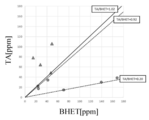
- the amount of the TA and BHET is measured to estimate the ease of occurrence of the die line after the mass production of the resin film is started. be able to. Furthermore, by measuring the amount of TA and BHET in the sublimate that is generated when the resin material is heated under certain conditions without producing a resin film, it is easy to generate a die line during the production of the resin film. Can also be estimated.
- production of the die line on the surface of a resin film can be suppressed, and the resin film without the die line excellent in smoothness for a long period can be manufactured.
- the ratio of the total amount of free terephthalic acid contained in the sublimate and the total amount of free bis (2-hydroxyethyl) terephthalate satisfies the relationship of the following formula [2]. preferable. 0.20 ⁇ terephthalic acid / bis (2-hydroxyethyl) terephthalate ⁇ 0.92 (2)
- the polyester-based thermoplastic resin when the polyester-based thermoplastic resin is heated under the same conditions as in the production of the resin film, it is necessary to heat the polyester-based thermoplastic resin at a temperature equal to or higher than the melting point of the resin in an inert gas atmosphere.
- the temperature above the melting point of the resin varies depending on the composition of the polyester-based thermoplastic resin.
- a heating temperature of about 215 ° C. or higher, which is the melting point is preferable.
- the content of isophthalic acid is 0 mol%
- a heating temperature of about 255 ° C. or higher, which is the melting point is preferable.
- the inert gas a known gas such as nitrogen or argon can be used.
- the heating time is preferably 1 to 10 hours.
- this embodiment is characterized by focusing on the sublimate in the thermal decomposition behavior of the molten resin, and is simply different from simply comparing the amounts of TA and BHET contained in the resin pellet. is doing.
- the method for deactivating the catalyst varies depending on the type of catalyst.
- the catalyst can be deactivated by adding a deactivator, or the catalyst can be deactivated by hot water treatment (treatment of adding a liquid heated to a desired temperature to the catalyst).
- the catalyst is preferably one of an antimony (Sb) compound, a titanium (Ti) compound, and a germanium (Ge) compound.
- Sb antimony
- Ti titanium
- Ge germanium
- the catalyst deactivator those generally used for polyester resins are used.
- known deactivating agents such as phosphoric acid deactivating agents such as phosphoric esters such as trimethyl phosphoric acid and triethyl phosphoric acid and salts thereof as disclosed in JP-A-2007-204515 can be mentioned.
- the addition amount of the deactivator may be a normal addition amount, for example, about 0.1 to 1.0 part by mass can be added.
- thermoplastic polyester resin varies depending on the physical properties of the target resin film and the production facility of the resin film.
- die line suppression can be achieved by satisfying the above equation [1].
- the general method used for the measurement of the amount of substances in the sublimate can be used.
- the resin is heated in a nitrogen (inert gas) atmosphere, and the supplemented sublimate is collected.
- the collected sublimate is dissolved in an organic solvent such as chloroform.
- a measurement sample can be prepared using an organic solvent containing the substance to be measured, and various substances can be quantified using high performance liquid chromatography or the like.
- the total amount of free terephthalic acid contained (residual) and the total amount of free bis (2-hydroxyethyl) terephthalate contained in the resin film after manufacture is specified.
- a method of suppressing the die line will be described.
- the ratio of the total amount of free terephthalic acid contained in the polyester-based thermoplastic resin film to the total amount of free bis (2-hydroxyethyl) terephthalate satisfies the relationship of the following formula [3]. It is characterized by. 0 ⁇ terephthalic acid / bis (2-hydroxyethyl) terephthalate ⁇ 0.33 ... [3]
- the ratio of the total amount of free terephthalic acid contained in the resin film and the total amount of free bis (2-hydroxyethyl) terephthalate satisfies the relationship of the following formula [4]. preferable. 0.02 ⁇ terephthalic acid / bis (2-hydroxyethyl) terephthalate ⁇ 0.09 [4]
- a measuring method of terephthalic acid and bis (2-hydroxyethyl) terephthalate in the resin film a general method can be used.
- a measurement sample can be prepared by dissolving a resin film, and various substances can be quantified using high performance liquid chromatography or the like.
- the polyester-based thermoplastic film of this embodiment is such that the ratio of the total amount of free terephthalic acid remaining in the film and the total amount of free bis (2-hydroxyethyl) terephthalate satisfies the relationship of the following formula [3].
- the polyester-based thermoplastic film of the present embodiment when the above formula [3] is satisfied, it is more preferable to satisfy the following formula [4]. 0.02 ⁇ terephthalic acid / bis (2-hydroxyethyl) terephthalate ⁇ 0.09 [4]
- the polyester-based thermoplastic film of the present embodiment can suppress the occurrence of die lines on the surface thereof.
- the method for inspecting a resin material includes a total amount of liberated terephthalic acid contained in a sublimate generated from the resin when the resin is heated and melted before the resin film is produced.
- the main feature is to measure the ratio of the total amount of bis (2-hydroxyethyl) terephthalate (terephthalic acid / bis (2-hydroxyethyl) terephthalate). And when the ratio of the said total amount satisfy
- the ratio of the total amount of free terephthalic acid remaining in the polyester-based thermoplastic resin film to the total amount of free bis (2-hydroxyethyl) terephthalate (terephthalic acid / bis (2-hydroxyethyl) ) Terephthalate).
- the ratio of the said total quantity satisfy
- TA terephthalic acid
- IA isophthalic acid
- MHET monohydroxyethyl terephthalate
- BHET bis (2-hydroxyethyl) terephthalate
- cyclic dimer cyclic trimer
- the resin film manufacturing method of the present invention it is possible to manufacture a resin film having no die line on the surface.
- a die line was generated on the surface of the resin film.
- the method for producing a polyester-based thermoplastic film of the present invention it is possible to estimate in advance whether or not a die line is generated.
- the present invention is not limited to a single-layer resin film, and can be applied to a wide range of industries such as a multilayer resin film, a PET bottle, and a resin-coated laminate plate.
Landscapes
- Engineering & Computer Science (AREA)
- Mechanical Engineering (AREA)
- Chemical & Material Sciences (AREA)
- Manufacturing & Machinery (AREA)
- Chemical Kinetics & Catalysis (AREA)
- Health & Medical Sciences (AREA)
- Medicinal Chemistry (AREA)
- Polymers & Plastics (AREA)
- Organic Chemistry (AREA)
- Physics & Mathematics (AREA)
- Thermal Sciences (AREA)
- Materials Engineering (AREA)
- Extrusion Moulding Of Plastics Or The Like (AREA)
- Manufacture Of Macromolecular Shaped Articles (AREA)
Abstract
Priority Applications (2)
| Application Number | Priority Date | Filing Date | Title |
|---|---|---|---|
| KR1020197017005A KR102468123B1 (ko) | 2016-11-15 | 2017-09-22 | 폴리에스테르계 열가소성 필름의 제조방법, 폴리에스테르계 열가소성 필름 |
| JP2018551052A JP6991994B2 (ja) | 2016-11-15 | 2017-09-22 | ポリエステル系熱可塑性フィルムの製造方法、ポリエステル系熱可塑性フィルム、ポリエステル系熱可塑性フィルム又はその樹脂材料の検査方法 |
Applications Claiming Priority (2)
| Application Number | Priority Date | Filing Date | Title |
|---|---|---|---|
| JP2016-222809 | 2016-11-15 | ||
| JP2016222809 | 2016-11-15 |
Publications (1)
| Publication Number | Publication Date |
|---|---|
| WO2018092414A1 true WO2018092414A1 (fr) | 2018-05-24 |
Family
ID=62146429
Family Applications (1)
| Application Number | Title | Priority Date | Filing Date |
|---|---|---|---|
| PCT/JP2017/034254 Ceased WO2018092414A1 (fr) | 2016-11-15 | 2017-09-22 | Procédé de production d'un film thermoplastique à base de polyester, film thermoplastique à base de polyester, et procédé d'inspection d'un film thermoplastique à base de polyester ou matériau résineux associé |
Country Status (3)
| Country | Link |
|---|---|
| JP (1) | JP6991994B2 (fr) |
| KR (1) | KR102468123B1 (fr) |
| WO (1) | WO2018092414A1 (fr) |
Citations (6)
| Publication number | Priority date | Publication date | Assignee | Title |
|---|---|---|---|---|
| JPH07207002A (ja) * | 1994-01-18 | 1995-08-08 | Kanebo Ltd | 熱可塑性ポリエステル樹脂 |
| WO1997045483A1 (fr) * | 1996-05-31 | 1997-12-04 | Kanebo, Limited | Composition de resine polyester, film obtenu a partir de cette composition, film composite polyester, laminat metallique obtenu a partir de ce film et procede permettant de diminuer le contenu d'un polyester en composes de faible poids moleculaire |
| JP2003306536A (ja) * | 2002-02-12 | 2003-10-31 | Toyobo Co Ltd | ポリエステル組成物並びにそれからなる中空成形体、シ−ト状物及び延伸フイルム |
| JP2003313413A (ja) * | 2002-02-21 | 2003-11-06 | Toyobo Co Ltd | ポリエステル組成物並びにそれからなる中空成形体、シ−ト状物及び延伸フイルム |
| JP2005187763A (ja) * | 2003-12-26 | 2005-07-14 | Toyobo Co Ltd | ポリエステル未延伸フイルム |
| JP2006111872A (ja) * | 2004-09-14 | 2006-04-27 | Toyobo Co Ltd | ポリエステル組成物、それからなるポリエステル成形体およびその製造方法 |
Family Cites Families (12)
| Publication number | Priority date | Publication date | Assignee | Title |
|---|---|---|---|---|
| JPS5228610A (en) | 1975-08-29 | 1977-03-03 | Nippon Denso Co Ltd | Generator |
| JPH10180844A (ja) * | 1996-11-05 | 1998-07-07 | Toray Ind Inc | ポリエステルフィルムおよびその製造方法 |
| DE19824615A1 (de) | 1998-06-02 | 1999-12-09 | Dyneon Gmbh | Verfahren zur Rückgewinnung von fluorierten Alkansäuren aus Abwässern |
| JP3938647B2 (ja) | 1999-03-05 | 2007-06-27 | カネボウ・トリニティ・ホールディングス株式会社 | ポリエステル樹脂 |
| JP2000319373A (ja) | 1999-05-12 | 2000-11-21 | Toyobo Co Ltd | ポリエステル、それからなる中空成形体、シート状物及び延伸フイルム |
| JP2001172372A (ja) | 1999-12-15 | 2001-06-26 | Nippon Ester Co Ltd | 成形品用ポリエステル樹脂とその製造方法、並びにその成形品 |
| JP4320985B2 (ja) | 2001-08-03 | 2009-08-26 | 住友ベークライト株式会社 | 熱可塑性樹脂の押出方法および熱可塑性樹脂フィルムの製造方法 |
| JP4292912B2 (ja) | 2003-08-01 | 2009-07-08 | 日本ゼオン株式会社 | 光学用フィルム |
| KR100700180B1 (ko) * | 2004-12-31 | 2007-03-27 | 엘지.필립스 엘시디 주식회사 | 예비토출부를 구비한 슬릿코터 및 이를 이용한 코팅방법 |
| WO2009044673A1 (fr) * | 2007-10-05 | 2009-04-09 | Konica Minolta Opto, Inc. | Film optique, procédé pour produire le film optique, plaque de polarisation et dispositif d'affichage |
| KR100983006B1 (ko) | 2008-04-08 | 2010-09-17 | (주)이플러스텍 | 증기 기상 식각방식을 이용하여 수직으로 배열된 다량의웨이퍼를 가공하는 반도체 또는 전자소자용 증기 식각 장치 |
| WO2012077559A1 (fr) * | 2010-12-08 | 2012-06-14 | 富士フイルム株式会社 | Film de polyester, son procédé de fabrication, feuille arrière de cellule solaire et module de cellule solaire |
-
2017
- 2017-09-22 WO PCT/JP2017/034254 patent/WO2018092414A1/fr not_active Ceased
- 2017-09-22 JP JP2018551052A patent/JP6991994B2/ja active Active
- 2017-09-22 KR KR1020197017005A patent/KR102468123B1/ko active Active
Patent Citations (6)
| Publication number | Priority date | Publication date | Assignee | Title |
|---|---|---|---|---|
| JPH07207002A (ja) * | 1994-01-18 | 1995-08-08 | Kanebo Ltd | 熱可塑性ポリエステル樹脂 |
| WO1997045483A1 (fr) * | 1996-05-31 | 1997-12-04 | Kanebo, Limited | Composition de resine polyester, film obtenu a partir de cette composition, film composite polyester, laminat metallique obtenu a partir de ce film et procede permettant de diminuer le contenu d'un polyester en composes de faible poids moleculaire |
| JP2003306536A (ja) * | 2002-02-12 | 2003-10-31 | Toyobo Co Ltd | ポリエステル組成物並びにそれからなる中空成形体、シ−ト状物及び延伸フイルム |
| JP2003313413A (ja) * | 2002-02-21 | 2003-11-06 | Toyobo Co Ltd | ポリエステル組成物並びにそれからなる中空成形体、シ−ト状物及び延伸フイルム |
| JP2005187763A (ja) * | 2003-12-26 | 2005-07-14 | Toyobo Co Ltd | ポリエステル未延伸フイルム |
| JP2006111872A (ja) * | 2004-09-14 | 2006-04-27 | Toyobo Co Ltd | ポリエステル組成物、それからなるポリエステル成形体およびその製造方法 |
Also Published As
| Publication number | Publication date |
|---|---|
| JPWO2018092414A1 (ja) | 2019-10-17 |
| JP6991994B2 (ja) | 2022-02-03 |
| KR102468123B1 (ko) | 2022-11-24 |
| KR20190086495A (ko) | 2019-07-22 |
Similar Documents
| Publication | Publication Date | Title |
|---|---|---|
| JP6036099B2 (ja) | Petボトル再生原料を使用した二軸配向ポリエステルフィルム | |
| CN102482437B (zh) | 容器体的卷绕标签用双轴取向聚酯膜以及用于卷绕在容器体上的标签 | |
| JP2011202156A (ja) | 二軸延伸ポリエステルフィルム | |
| JP6049648B2 (ja) | 二軸押出装置及びフィルム製造方法 | |
| CN110945059A (zh) | 熔融成形材料 | |
| WO2011065347A1 (fr) | Résine de polyamide copolymérisée, son procédé de fabrication, composition de résine et article moulé formé à partir de la résine de polyamide copolymérisée ou de la composition de résine | |
| JP7209828B2 (ja) | ポリグリコール酸製品を生産するための統合製造方法 | |
| JP4269675B2 (ja) | 芳香族液晶ポリエステルおよびそのフィルム | |
| JP5428467B2 (ja) | 太陽電池用積層ポリエステルフィルム | |
| JP5200335B2 (ja) | ポリアミド樹脂組成物 | |
| CN100365441C (zh) | 聚对苯二甲酸丁二醇酯制成的光反射器及其制造方法 | |
| JP6991994B2 (ja) | ポリエステル系熱可塑性フィルムの製造方法、ポリエステル系熱可塑性フィルム、ポリエステル系熱可塑性フィルム又はその樹脂材料の検査方法 | |
| JP5130620B2 (ja) | ディスプレイ用ポリエステルフィルム | |
| JP6939970B2 (ja) | ポリエチレンテレフタレート樹脂組成物 | |
| JP6776516B2 (ja) | ポリエチレンテレフタレート樹脂組成物及びその製造方法 | |
| JP2011235452A (ja) | 溶液製膜用コーティングダイおよび溶液製膜方法 | |
| JPH10180844A (ja) | ポリエステルフィルムおよびその製造方法 | |
| KR101145948B1 (ko) | 폴리에스테르 수지 조성물, 그의 제조 방법 및 폴리에스테르 필름 | |
| TW201900766A (zh) | 液晶聚酯組成物 | |
| JP6772747B2 (ja) | ポリエチレンテレフタレート樹脂組成物およびそれからなるフィルム | |
| JP2015178552A (ja) | ポリエチレンテレフタレート樹脂組成物及びその製造方法 | |
| JP2004175912A (ja) | ポリエステルフィルム及びその製造方法 | |
| JP7100407B2 (ja) | ポリエステル樹脂組成物、並びにポリエステル樹脂成形体及びその製造方法 | |
| JP4361652B2 (ja) | 耐熱性の優れた押出し成形用液晶性ポリエステル樹脂、押出し成形用材料及び押出し成形物 | |
| JP2005272657A (ja) | ポリエステル樹脂の製造方法ならびにそれよりなる成形品 |
Legal Events
| Date | Code | Title | Description |
|---|---|---|---|
| 121 | Ep: the epo has been informed by wipo that ep was designated in this application |
Ref document number: 17872208 Country of ref document: EP Kind code of ref document: A1 |
|
| ENP | Entry into the national phase |
Ref document number: 2018551052 Country of ref document: JP Kind code of ref document: A |
|
| NENP | Non-entry into the national phase |
Ref country code: DE |
|
| ENP | Entry into the national phase |
Ref document number: 20197017005 Country of ref document: KR Kind code of ref document: A |
|
| 122 | Ep: pct application non-entry in european phase |
Ref document number: 17872208 Country of ref document: EP Kind code of ref document: A1 |