WO2018101191A1 - Article absorbant - Google Patents
Article absorbant Download PDFInfo
- Publication number
- WO2018101191A1 WO2018101191A1 PCT/JP2017/042346 JP2017042346W WO2018101191A1 WO 2018101191 A1 WO2018101191 A1 WO 2018101191A1 JP 2017042346 W JP2017042346 W JP 2017042346W WO 2018101191 A1 WO2018101191 A1 WO 2018101191A1
- Authority
- WO
- WIPO (PCT)
- Prior art keywords
- sheet
- polymer
- region
- disposed
- superabsorbent polymer
- Prior art date
- Legal status (The legal status is an assumption and is not a legal conclusion. Google has not performed a legal analysis and makes no representation as to the accuracy of the status listed.)
- Ceased
Links
Images





Classifications
-
- A—HUMAN NECESSITIES
- A61—MEDICAL OR VETERINARY SCIENCE; HYGIENE
- A61F—FILTERS IMPLANTABLE INTO BLOOD VESSELS; PROSTHESES; DEVICES PROVIDING PATENCY TO, OR PREVENTING COLLAPSING OF, TUBULAR STRUCTURES OF THE BODY, e.g. STENTS; ORTHOPAEDIC, NURSING OR CONTRACEPTIVE DEVICES; FOMENTATION; TREATMENT OR PROTECTION OF EYES OR EARS; BANDAGES, DRESSINGS OR ABSORBENT PADS; FIRST-AID KITS
- A61F13/00—Bandages or dressings; Absorbent pads
- A61F13/15—Absorbent pads, e.g. sanitary towels, swabs or tampons for external or internal application to the body; Supporting or fastening means therefor; Tampon applicators
- A61F13/53—Absorbent pads, e.g. sanitary towels, swabs or tampons for external or internal application to the body; Supporting or fastening means therefor; Tampon applicators characterised by the absorbing medium
- A61F13/534—Absorbent pads, e.g. sanitary towels, swabs or tampons for external or internal application to the body; Supporting or fastening means therefor; Tampon applicators characterised by the absorbing medium having an inhomogeneous composition through the thickness of the pad
- A61F13/537—Absorbent pads, e.g. sanitary towels, swabs or tampons for external or internal application to the body; Supporting or fastening means therefor; Tampon applicators characterised by the absorbing medium having an inhomogeneous composition through the thickness of the pad characterised by a layer facilitating or inhibiting flow in one direction or plane, e.g. a wicking layer
- A61F13/53743—Absorbent pads, e.g. sanitary towels, swabs or tampons for external or internal application to the body; Supporting or fastening means therefor; Tampon applicators characterised by the absorbing medium having an inhomogeneous composition through the thickness of the pad characterised by a layer facilitating or inhibiting flow in one direction or plane, e.g. a wicking layer characterised by the position of the layer relative to the other layers
- A61F13/53752—Absorbent pads, e.g. sanitary towels, swabs or tampons for external or internal application to the body; Supporting or fastening means therefor; Tampon applicators characterised by the absorbing medium having an inhomogeneous composition through the thickness of the pad characterised by a layer facilitating or inhibiting flow in one direction or plane, e.g. a wicking layer characterised by the position of the layer relative to the other layers the layer is embedded in the absorbent core
-
- A—HUMAN NECESSITIES
- A61—MEDICAL OR VETERINARY SCIENCE; HYGIENE
- A61F—FILTERS IMPLANTABLE INTO BLOOD VESSELS; PROSTHESES; DEVICES PROVIDING PATENCY TO, OR PREVENTING COLLAPSING OF, TUBULAR STRUCTURES OF THE BODY, e.g. STENTS; ORTHOPAEDIC, NURSING OR CONTRACEPTIVE DEVICES; FOMENTATION; TREATMENT OR PROTECTION OF EYES OR EARS; BANDAGES, DRESSINGS OR ABSORBENT PADS; FIRST-AID KITS
- A61F13/00—Bandages or dressings; Absorbent pads
- A61F13/15—Absorbent pads, e.g. sanitary towels, swabs or tampons for external or internal application to the body; Supporting or fastening means therefor; Tampon applicators
- A61F13/53—Absorbent pads, e.g. sanitary towels, swabs or tampons for external or internal application to the body; Supporting or fastening means therefor; Tampon applicators characterised by the absorbing medium
-
- A—HUMAN NECESSITIES
- A61—MEDICAL OR VETERINARY SCIENCE; HYGIENE
- A61F—FILTERS IMPLANTABLE INTO BLOOD VESSELS; PROSTHESES; DEVICES PROVIDING PATENCY TO, OR PREVENTING COLLAPSING OF, TUBULAR STRUCTURES OF THE BODY, e.g. STENTS; ORTHOPAEDIC, NURSING OR CONTRACEPTIVE DEVICES; FOMENTATION; TREATMENT OR PROTECTION OF EYES OR EARS; BANDAGES, DRESSINGS OR ABSORBENT PADS; FIRST-AID KITS
- A61F13/00—Bandages or dressings; Absorbent pads
- A61F13/15—Absorbent pads, e.g. sanitary towels, swabs or tampons for external or internal application to the body; Supporting or fastening means therefor; Tampon applicators
- A61F13/53—Absorbent pads, e.g. sanitary towels, swabs or tampons for external or internal application to the body; Supporting or fastening means therefor; Tampon applicators characterised by the absorbing medium
- A61F13/531—Absorbent pads, e.g. sanitary towels, swabs or tampons for external or internal application to the body; Supporting or fastening means therefor; Tampon applicators characterised by the absorbing medium having a homogeneous composition through the thickness of the pad
- A61F13/532—Absorbent pads, e.g. sanitary towels, swabs or tampons for external or internal application to the body; Supporting or fastening means therefor; Tampon applicators characterised by the absorbing medium having a homogeneous composition through the thickness of the pad inhomogeneous in the plane of the pad
- A61F13/5323—Absorbent pads, e.g. sanitary towels, swabs or tampons for external or internal application to the body; Supporting or fastening means therefor; Tampon applicators characterised by the absorbing medium having a homogeneous composition through the thickness of the pad inhomogeneous in the plane of the pad having absorbent material located in discrete regions, e.g. pockets
-
- A—HUMAN NECESSITIES
- A61—MEDICAL OR VETERINARY SCIENCE; HYGIENE
- A61F—FILTERS IMPLANTABLE INTO BLOOD VESSELS; PROSTHESES; DEVICES PROVIDING PATENCY TO, OR PREVENTING COLLAPSING OF, TUBULAR STRUCTURES OF THE BODY, e.g. STENTS; ORTHOPAEDIC, NURSING OR CONTRACEPTIVE DEVICES; FOMENTATION; TREATMENT OR PROTECTION OF EYES OR EARS; BANDAGES, DRESSINGS OR ABSORBENT PADS; FIRST-AID KITS
- A61F13/00—Bandages or dressings; Absorbent pads
- A61F13/15—Absorbent pads, e.g. sanitary towels, swabs or tampons for external or internal application to the body; Supporting or fastening means therefor; Tampon applicators
- A61F13/53—Absorbent pads, e.g. sanitary towels, swabs or tampons for external or internal application to the body; Supporting or fastening means therefor; Tampon applicators characterised by the absorbing medium
- A61F13/534—Absorbent pads, e.g. sanitary towels, swabs or tampons for external or internal application to the body; Supporting or fastening means therefor; Tampon applicators characterised by the absorbing medium having an inhomogeneous composition through the thickness of the pad
-
- A—HUMAN NECESSITIES
- A61—MEDICAL OR VETERINARY SCIENCE; HYGIENE
- A61F—FILTERS IMPLANTABLE INTO BLOOD VESSELS; PROSTHESES; DEVICES PROVIDING PATENCY TO, OR PREVENTING COLLAPSING OF, TUBULAR STRUCTURES OF THE BODY, e.g. STENTS; ORTHOPAEDIC, NURSING OR CONTRACEPTIVE DEVICES; FOMENTATION; TREATMENT OR PROTECTION OF EYES OR EARS; BANDAGES, DRESSINGS OR ABSORBENT PADS; FIRST-AID KITS
- A61F5/00—Orthopaedic methods or devices for non-surgical treatment of bones or joints; Nursing devices ; Anti-rape devices
- A61F5/44—Devices worn by the patient for reception of urine, faeces, catamenial or other discharge; Colostomy devices
-
- A—HUMAN NECESSITIES
- A61—MEDICAL OR VETERINARY SCIENCE; HYGIENE
- A61F—FILTERS IMPLANTABLE INTO BLOOD VESSELS; PROSTHESES; DEVICES PROVIDING PATENCY TO, OR PREVENTING COLLAPSING OF, TUBULAR STRUCTURES OF THE BODY, e.g. STENTS; ORTHOPAEDIC, NURSING OR CONTRACEPTIVE DEVICES; FOMENTATION; TREATMENT OR PROTECTION OF EYES OR EARS; BANDAGES, DRESSINGS OR ABSORBENT PADS; FIRST-AID KITS
- A61F13/00—Bandages or dressings; Absorbent pads
- A61F13/15—Absorbent pads, e.g. sanitary towels, swabs or tampons for external or internal application to the body; Supporting or fastening means therefor; Tampon applicators
- A61F13/53—Absorbent pads, e.g. sanitary towels, swabs or tampons for external or internal application to the body; Supporting or fastening means therefor; Tampon applicators characterised by the absorbing medium
- A61F2013/530007—Absorbent pads, e.g. sanitary towels, swabs or tampons for external or internal application to the body; Supporting or fastening means therefor; Tampon applicators characterised by the absorbing medium being made from pulp
-
- A—HUMAN NECESSITIES
- A61—MEDICAL OR VETERINARY SCIENCE; HYGIENE
- A61F—FILTERS IMPLANTABLE INTO BLOOD VESSELS; PROSTHESES; DEVICES PROVIDING PATENCY TO, OR PREVENTING COLLAPSING OF, TUBULAR STRUCTURES OF THE BODY, e.g. STENTS; ORTHOPAEDIC, NURSING OR CONTRACEPTIVE DEVICES; FOMENTATION; TREATMENT OR PROTECTION OF EYES OR EARS; BANDAGES, DRESSINGS OR ABSORBENT PADS; FIRST-AID KITS
- A61F13/00—Bandages or dressings; Absorbent pads
- A61F13/15—Absorbent pads, e.g. sanitary towels, swabs or tampons for external or internal application to the body; Supporting or fastening means therefor; Tampon applicators
- A61F13/53—Absorbent pads, e.g. sanitary towels, swabs or tampons for external or internal application to the body; Supporting or fastening means therefor; Tampon applicators characterised by the absorbing medium
- A61F2013/530131—Absorbent pads, e.g. sanitary towels, swabs or tampons for external or internal application to the body; Supporting or fastening means therefor; Tampon applicators characterised by the absorbing medium being made in fibre but being not pulp
- A61F2013/530379—Absorbent pads, e.g. sanitary towels, swabs or tampons for external or internal application to the body; Supporting or fastening means therefor; Tampon applicators characterised by the absorbing medium being made in fibre but being not pulp comprising mixtures of fibres
- A61F2013/530386—Absorbent pads, e.g. sanitary towels, swabs or tampons for external or internal application to the body; Supporting or fastening means therefor; Tampon applicators characterised by the absorbing medium being made in fibre but being not pulp comprising mixtures of fibres with pulp and polymeric
-
- A—HUMAN NECESSITIES
- A61—MEDICAL OR VETERINARY SCIENCE; HYGIENE
- A61F—FILTERS IMPLANTABLE INTO BLOOD VESSELS; PROSTHESES; DEVICES PROVIDING PATENCY TO, OR PREVENTING COLLAPSING OF, TUBULAR STRUCTURES OF THE BODY, e.g. STENTS; ORTHOPAEDIC, NURSING OR CONTRACEPTIVE DEVICES; FOMENTATION; TREATMENT OR PROTECTION OF EYES OR EARS; BANDAGES, DRESSINGS OR ABSORBENT PADS; FIRST-AID KITS
- A61F13/00—Bandages or dressings; Absorbent pads
- A61F13/15—Absorbent pads, e.g. sanitary towels, swabs or tampons for external or internal application to the body; Supporting or fastening means therefor; Tampon applicators
- A61F13/53—Absorbent pads, e.g. sanitary towels, swabs or tampons for external or internal application to the body; Supporting or fastening means therefor; Tampon applicators characterised by the absorbing medium
- A61F2013/530481—Absorbent pads, e.g. sanitary towels, swabs or tampons for external or internal application to the body; Supporting or fastening means therefor; Tampon applicators characterised by the absorbing medium having superabsorbent materials, i.e. highly absorbent polymer gel materials
-
- A—HUMAN NECESSITIES
- A61—MEDICAL OR VETERINARY SCIENCE; HYGIENE
- A61F—FILTERS IMPLANTABLE INTO BLOOD VESSELS; PROSTHESES; DEVICES PROVIDING PATENCY TO, OR PREVENTING COLLAPSING OF, TUBULAR STRUCTURES OF THE BODY, e.g. STENTS; ORTHOPAEDIC, NURSING OR CONTRACEPTIVE DEVICES; FOMENTATION; TREATMENT OR PROTECTION OF EYES OR EARS; BANDAGES, DRESSINGS OR ABSORBENT PADS; FIRST-AID KITS
- A61F13/00—Bandages or dressings; Absorbent pads
- A61F13/15—Absorbent pads, e.g. sanitary towels, swabs or tampons for external or internal application to the body; Supporting or fastening means therefor; Tampon applicators
- A61F13/53—Absorbent pads, e.g. sanitary towels, swabs or tampons for external or internal application to the body; Supporting or fastening means therefor; Tampon applicators characterised by the absorbing medium
- A61F2013/530481—Absorbent pads, e.g. sanitary towels, swabs or tampons for external or internal application to the body; Supporting or fastening means therefor; Tampon applicators characterised by the absorbing medium having superabsorbent materials, i.e. highly absorbent polymer gel materials
- A61F2013/53051—Absorbent pads, e.g. sanitary towels, swabs or tampons for external or internal application to the body; Supporting or fastening means therefor; Tampon applicators characterised by the absorbing medium having superabsorbent materials, i.e. highly absorbent polymer gel materials being only in particular parts or specially arranged
Definitions
- the present invention relates to an absorbent article such as a sanitary napkin, a panty liner, an incontinence pad, and more particularly to an absorbent article provided with a polymer sheet in which a superabsorbent polymer is disposed between an upper layer sheet and a lower layer sheet.
- a body fluid is absorbed and retained between a liquid-impermeable back sheet such as a polyethylene sheet or a polyethylene sheet-laminated nonwoven fabric and a liquid-permeable surface sheet such as a nonwoven fabric or a liquid-permeable plastic sheet.
- a liquid-impermeable back sheet such as a polyethylene sheet or a polyethylene sheet-laminated nonwoven fabric
- a liquid-permeable surface sheet such as a nonwoven fabric or a liquid-permeable plastic sheet.
- the absorbent body is also called a polymer sheet (SAP sheet or Palpress absorbent body) in which a superabsorbent polymer (SAP) is disposed between two sheets.
- SAP sheet a polymer sheet
- Adopting the polymer sheet as an absorbent body is excellent in that it can absorb and retain a large amount of body fluid while reducing the thickness of the absorbent article, but it is a collection of powdery superabsorbent polymers inside. Since the body is provided, it is difficult for body fluids to enter the inside of the polymer assembly, and the so-called “gel blocking” in which the superabsorbent polymers in the vicinity of the surface flow and flows near the surface of the polymer assembly is likely to occur. There is a problem in that the desired water absorbing power may not be expressed.
- the absorbent structure includes an upper layer absorbent part and a lower layer absorbent part, and the upper layer absorbent part is configured to include fluffy pulp,
- a groove portion extending in the longitudinal direction of the absorbent article is formed on the skin contact surface of the upper layer absorbent portion, and the lower layer absorbent portion is interposed between two opposing sheet materials and both sheet materials.
- a plurality of joint portions that are configured to include a resin and are joined to each other without interposing a water-absorbing resin, and the plurality of joint portions extend in the longitudinal direction and are predetermined in the width direction.
- the groove portion and the joint portion overlap each other when viewed in plan in the crotch portion located in the crotch of the wearer when worn, and the top sheet, the upper layer absorbent portion, and the lower layer absorbent portion overlap each other.
- the upper sheet-shaped absorbent layer, the fiber assembly layer, and the lower sheet-shaped absorbent layer are provided in this order from the top sheet side, and the upper sheet-shaped absorbent layer and the lower sheet-shaped absorbent layer are provided.
- Each of the layers has a water absorbent resin between the nonwoven fabric sheets and has no pulp fiber, and a plurality of water absorbent resin existing regions in which the water absorbent resin is arranged between the nonwoven fabric sheets, and the water absorbent resin existing region
- an absorbent article having a water-absorbing resin non-existing region adjacent thereto, in which nonwoven fabric sheets are joined to form a sealing portion.
- the pulp fiber absorbent layer functions as a temporary stock region of body fluid and a diffusion region of body fluid, Absorption speed and reversal amount are improved.
- the absorbent body is configured by laminating a polymer sheet and a pulp fiber absorbent body, it has not always been possible to reduce the thickness sufficiently.
- the water absorbent resin region of the lower layer absorbent portion (polymer sheet) is present on the lower layer side of the region overlapping the upper layer absorbent portion (fibrous absorbent body) containing fluffy pulp. For this reason, upon repeated water absorption, the liquid transfer speed from the upper layer absorption part to the lower layer absorption part swelled by water absorption so far may be reduced, and a sufficiently satisfactory absorption speed may not be obtained.
- a polymer sheet is disposed on the uppermost layer of the absorbent structure, and this polymer sheet is particularly located on the uppermost layer even at a site corresponding to the body fluid discharge portion of the wearer. For this reason, the absorption speed immediately after the body fluid is discharged is inferior, and when the water is repeatedly absorbed, the absorption speed is remarkably reduced, and there is a possibility that leakage occurs due to the liquid flowing on the surface.
- a conventional absorbent article configured by laminating a polymer sheet and a fibrous absorbent body, when the middle and high portions are formed in a region including a body fluid discharge site by the fibrous absorbent body, If the same amount of superabsorbent polymer is placed in the overlapping part as the part other than the mid-high part, the mid-high part is lifted to the skin by the superabsorbent polymer swollen at the time of liquid absorption. There is a possibility of biting and wearing comfort.
- the main problem of the present invention is to provide an absorbent article that is surely thinned, does not decrease the water absorption rate even if it absorbs water repeatedly, prevents leakage, and does not deteriorate the wearing feeling.
- a polymer sheet in which a superabsorbent polymer is interposed between an upper layer sheet disposed on the skin side and a lower layer sheet disposed on the non-skin side is provided as the present invention according to claim 1.
- the absorbent article is characterized in that the superabsorbent polymer is not disposed in a region overlapping with the fibrous absorbent body but is disposed in a region other than that.
- a fibrous absorbent body containing pulp fibers is disposed adjacent to the skin side surface of the region corresponding to the body fluid discharge site of the wearer in the polymer sheet, and the other region. Since the fibrous absorbent body is not disposed in, the absorbent article can be surely made thinner by using the polymer sheet.
- the present absorbent article is characterized in that the superabsorbent polymer of the polymer sheet is not disposed in a region overlapping with the fibrous absorbent body but is disposed in other regions.
- the body fluid discharged from the body fluid discharge site is absorbed by the fibrous absorbent body, and then penetrates into a region where the superabsorbent polymer of the polymer sheet is not disposed (polymer non-arranged region), and the upper layer of the polymer sheet It diffuses to the area
- the polymer sheet is diffused between the upper sheet and the lower sheet of the polymer sheet or permeating the upper sheet or the lower sheet to diffuse the polymer sheet in the surface direction. Since water is absorbed by the highly water-absorbing polymer, gel blocking or the like does not occur, and even when water is repeatedly absorbed, leakage of body fluid can be prevented without causing a significant decrease in water absorption rate. Further, since the superabsorbent polymer is not disposed in the region overlapping the fibrous absorber in the polymer sheet, the skin side due to swelling of the superabsorbent polymer during liquid absorption in the region overlapping the fibrous absorber in the polymer sheet. Therefore, it is possible to prevent the feeling of wearing from deteriorating due to the body becoming unnecessarily hard by raising the fibrous absorbent to the skin side.
- the absorbent article according to claim 1 wherein the fibrous absorbent body is made of only pulp fibers, or made of pulp fibers and a superabsorbent polymer.
- the fibrous absorbent body may be composed of only pulp fibers so that the body fluid discharged from the body fluid discharge site can be quickly transferred to the polymer sheet, or the fibrous absorbent body.
- a high water absorption polymer may be contained.
- the skin side surface of the fibrous absorbent body is located at a height substantially equal to or higher than the skin side surface of the region where the superabsorbent polymer of the polymer sheet is disposed.
- the skin side surface of the fibrous absorbent body in a state where the fibrous absorbent body is disposed on the skin side surface of the polymer sheet the skin side surface of the region where the surrounding superabsorbent polymer is disposed. It is located at almost the same height as it, or on the skin side.
- the skin side surface of the fibrous absorbent body and the skin side surface of the surrounding polymer sheet are formed at substantially the same height, the thickness can be more reliably reduced.
- the fibrous absorbent body functions as a middle-high part, improving the adhesion with the body fluid discharge site of the wearer it can.
- an absorbent article according to any one of claims 1 to 3, wherein the fibrous absorbent body is formed with one or a plurality of apertures penetrating the front and back.
- body fluid can be quickly transferred from the fibrous absorbent body to the polymer sheet through the aperture. I have to.
- an absorbent article according to any one of claims 1 to 4, wherein a concave portion that is recessed toward the polymer sheet is formed on a skin side surface of the fibrous absorbent body.
- the body fluid that has entered the recess can be quickly transferred to the polymer sheet.
- the region where the superabsorbent polymer is disposed is partitioned into a plurality of defined regions by a joint that joins the upper layer sheet and the lower layer sheet.
- the superabsorbent polymer is arranged in the defined region, or the region in which the superabsorbent polymer is arranged is not partitioned by a joint that joins the upper sheet and the lower sheet,
- two forms are defined for the arrangement form of the superabsorbent polymer in the region where the superabsorbent polymer is arranged.
- a 1st form while the area
- the high water-absorbing polymer is disposed on the surface.
- the defined region portion where the superabsorbent polymer is disposed is raised, but the portion where the joint portion around the defined region is disposed does not rise, so this relatively depressed joint is formed. Liquid diffusion tends to occur even when water is repeatedly absorbed by using the portion as a flow path.
- the region where the superabsorbent polymer is disposed is not defined by the joint portion joining the upper layer sheet and the lower layer sheet, and the superabsorbent polymer is disposed on the entire surface. is there.
- the fluidity of the superabsorbent polymer is increased in the region where the superabsorbent polymer is disposed, and the absorption performance is less likely to deteriorate due to gel blocking.
- the thickness can be surely reduced, and even if water is absorbed repeatedly, the water absorption speed is not significantly reduced, leakage can be prevented, and the wearing feeling is not deteriorated.
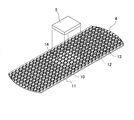
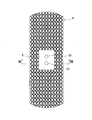
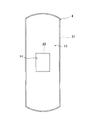
- FIG. 3 is a partially broken development view of a polymer sheet 4.
- the fibrous absorbent body 5 is shown, (A) is a plan view, and (B) is a view taken along the line BB of (A).
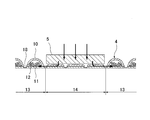
- FIG. 8 is a view taken along line VIII-VIII in FIG. 7.
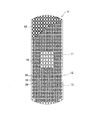
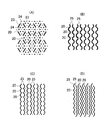
- FIG. (A)-(D) are the enlarged plan views of the junction part concerning a modification. It is a top view of the polymer sheet 4 which concerns on a modification. 4 is a plan view of a polymer non-arranged region 14 of the polymer sheet 4.
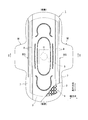
- the sanitary napkin 1 As shown in FIGS. 1 and 2, the sanitary napkin 1 according to the present invention has a liquid-impervious back sheet 2 made of a polyethylene sheet, a polypropylene sheet, or the like, and a permeate that quickly permeates menstrual blood or a cage.
- Second comprising a fibrous absorbent body 5 comprising pulp fibers disposed in the form of a hydrophilic nonwoven fabric disposed adjacent to the non-skin side of the liquid-permeable surface sheet 3 as necessary. It is comprised from the sheet
- the outer edge of the liquid-impervious back sheet 2 and liquid-permeable surface sheet 3 is an adhesive such as hot melt, heat seal, etc.
- the liquid-impermeable back sheet 2 and the side nonwoven fabric 7 that are joined by the adhesive means and extend laterally from the side edges of the polymer sheet 4 at both side edges thereof are adhesives such as hot melt, Joined by adhesive means such as heat sealing, an outer peripheral flap portion where the polymer sheet 4 does not exist is formed on the outer periphery.
- the structure of the sanitary napkin 1 will be described in detail.
- a sheet material having at least water shielding properties such as an olefin resin sheet such as polyethylene or polypropylene is used.
- a laminated nonwoven fabric obtained by laminating a nonwoven fabric on a polyethylene sheet or the like, or A nonwoven fabric sheet (in this case, the waterproof film and the nonwoven fabric constitute a liquid-impervious back sheet) can be used after substantially impervious to liquid imperviousness by interposing a waterproof film.
- those having moisture permeability tend to be used from the viewpoint of preventing stuffiness.
- This water- and moisture-permeable sheet material is a microporous sheet obtained by forming a sheet by melting and kneading an inorganic filler in an olefin resin such as polyethylene or polypropylene, and then stretching in a uniaxial or biaxial direction. It is.
- the liquid-permeable surface sheet 3 is preferably a porous or non-porous nonwoven fabric or a porous plastic sheet.
- the material fibers constituting the nonwoven fabric include synthetic fibers such as polyethylene or polypropylene, synthetic fibers such as polyester and polyamide, recycled fibers such as rayon and cupra, and natural fibers such as cotton.
- a nonwoven fabric obtained by an appropriate processing method such as a lace method, a spun bond method, a thermal bond method, a melt blown method, or a needle punch method can be used.
- the spunlace method is excellent in terms of flexibility and the spunbond method is excellent in drapeability
- the thermal bond method and the air-through method are excellent in terms of being bulky and having high compression recovery properties.
- the non-woven fiber may be either a long fiber or a short fiber, but preferably a short fiber is used in order to give a towel texture.
- an olefin fiber such as polyethylene or polypropylene having a relatively low melting point.
- a composite fiber such as a core-sheath fiber, a side-by-side fiber, or a split fiber having a fiber having a high melting point as a core and a fiber having a low melting point as a sheath can be suitably used.
- the liquid-permeable surface sheet 3 may not be provided when the upper layer sheet 10 of the polymer sheet 4 described in detail later forms a skin contact surface layer.
- the second sheet 6 only needs to be hydrophilic to body fluids. Specifically, by using recycled fibers such as rayon and cupra, natural fibers such as cotton, the material itself has hydrophilicity, or synthesis of olefins such as polyethylene or polypropylene, polyesters, polyamides, etc. The fiber which surface-treated with the hydrophilizing agent and provided the hydrophilic property can be used. Further, the second sheet 6 may have a porous film layer on the back side (non-skin side) in order to give a firmness, or may use a material containing pulp. It is preferable that the second sheet 6 is formed to have a size that covers at least the polymer sheet 4 and substantially the same shape as the liquid-permeable surface sheet 3.
- side nonwoven fabrics 7 and 7 are provided on both side portions on the surface side of the sanitary napkin 1 along the longitudinal direction and over almost the entire length of the napkin 1, respectively.
- Wing-like flaps W and W are formed by a part of the liquid-impervious back sheet 2 that extends laterally and also laterally.
- a water-repellent treated nonwoven fabric or a hydrophilic treated nonwoven fabric can be used from the viewpoint of important functions. For example, if importance is placed on functions such as preventing permeation of menstrual blood or vaginal discharge, or enhancing the touch feeling, water repellent treatment coated with silicone, paraffin, alkylchromic chloride water repellent, etc. It is desirable to use a nonwoven fabric.
- a method of polymerizing a compound having a hydrophilic group for example, an oxidation product of polyethylene glycol, in the process of producing a synthetic fiber, ,
- a metal salt such as stannic chloride
- partially dissolving the surface to make it porous and depositing metal hydroxides to swell or make the synthetic fiber porous, applying capillary action to make it hydrophilic
- capillary action to make it hydrophilic It is desirable to use a hydrophilic treated non-woven fabric provided with.
- the inner side of the side nonwoven fabric 7 folds the side nonwoven fabric 7 almost double, and inside the double sheet, in the middle in the height direction, as appropriate at both ends or in the longitudinal direction.
- One or a plurality of, in the illustrated example, two thread-like elastic elastic members 8 and 8 are disposed, and the double sheet portion is raised on the skin side by the contraction force. , BS is formed.
- the polymer sheet 4 interposed between the liquid-impermeable back sheet 2 and the liquid-permeable surface sheet 3 has an upper layer sheet 10 disposed on the skin side (the liquid-permeable surface sheet 3 side) and the non-skin side ( A superabsorbent polymer 12 is arranged between the lower sheet 11 arranged on the liquid-impermeable back sheet 2 side). Between the upper layer sheet 10 and the lower layer sheet 11, a fibrous absorbent material such as pulp is not disposed, and only the powdery superabsorbent polymer 12 is disposed. For this reason, the thickness of the polymer sheet 4 can be reduced and the thickness can be surely reduced.
- a porous or non-porous nonwoven fabric or a porous plastic sheet is used as the raw material fibers constituting the nonwoven fabric.
- synthetic fibers such as olefins such as polyethylene or polypropylene, polyesters, and polyamides, recycled fibers such as rayon and cupra, cotton Natural fibers such as
- the processing method of the said nonwoven fabric is not ask
- the pore diameter of the porous plastic sheet is preferably smaller than the outer shape of the superabsorbent polymer 12 in order to prevent the superabsorbent polymer 12 from falling off.
- the lower layer sheet 11 in addition to a porous or non-porous nonwoven fabric or a porous plastic sheet, a sheet material having a water shielding property can be used.
- the processing method of the nonwoven fabric is not limited, but in order to prevent the superabsorbent polymer 12 from falling off, the fiber density of the obtained product such as the spunbond method, the melt blown method, and the needle punch method is increased. A processing method is preferred.
- the pore diameter of the porous plastic sheet is preferably smaller than the outer shape of the superabsorbent polymer 12 in order to prevent the superabsorbent polymer 12 from falling off.
- the water-impervious sheet material the same material as the liquid-impermeable back sheet 2 can be used.
- the superabsorbent polymer 12 examples include a cross-linked polyacrylate, a self-crosslinked polyacrylate, a saponified acrylate-vinyl acetate copolymer cross-linked product, and a cross-linked isobutylene / maleic anhydride copolymer.
- a crosslinked polysulfonate, and a partially crosslinked water-swellable polymer such as polyethylene oxide and polyacrylamide.
- those based on acrylic acid or acrylate that are excellent in water absorption and water absorption speed are preferred.
- the water-absorbing force and the water-absorbing speed can be adjusted by adjusting the crosslinking density and the crosslinking density gradient.
- the fibrous absorbent body 5 including pulp fibers is disposed adjacent to the skin side surface of the region corresponding to the body fluid discharge site H of the wearer in the polymer sheet 4.
- the region corresponding to the body fluid discharge site H of the wearer is a region where the wearer's body fluid discharge site H abuts when the sanitary napkin 1 is worn, and the wing-shaped flap in the longitudinal intermediate portion of the sanitary napkin 1 It is a napkin longitudinal direction range substantially equal to the range where W is formed, and is a central region in the width direction of the sanitary napkin 1.
- a groove may be formed.
- the superabsorbent polymer 12 in the polymer sheet 4 is not disposed in a region overlapping the fibrous absorbent body 5 but is disposed in other regions. That is, as shown in FIGS. 3 and 4, the polymer sheet 4 has a superabsorbent polymer 12 interposed between the upper layer sheet 10 and the lower layer sheet 11 in a region that does not overlap the fibrous absorbent body 5.
- the polymer arrangement region 13 and the polymer non-arrangement region 14 in which the superabsorbent polymer 12 is not interposed between the upper layer sheet 10 and the lower layer sheet in the region overlapping the fibrous absorber 5 are configured.
- the polymer arrangement region 13 is a region in which the superabsorbent polymer 12 is sealed between the upper layer sheet 10 and the lower layer sheet 11 with a predetermined basis weight.
- the basis weight of the superabsorbent polymer 12 in the polymer arrangement region 13 is 60 to 300 g / m 2 on average in the polymer arrangement region 13, preferably 110 to 150 g / m 2 .
- the polymer non-arranged region 14 is a region where the upper layer sheet 10 and the lower layer sheet 11 are laminated, and the superabsorbent polymer 12 does not exist at all between these sheets 10, 11, or the polymer disposed region 13 is high. Although the superabsorbent polymer 12 is present in a slight amount due to spilling when the superabsorbent polymer 12 is sprayed, the amount of the superabsorbent polymer 12 is an extremely small region as compared with the polymer arrangement region 13.
- the polymer non-arrangement region 14 is formed in a region corresponding to the body fluid discharge site H of the wearer and having a size equal to or larger than the planar shape of the fibrous absorbent body 5. Since the polymer non-arranged region 14 is simply a region where the upper layer sheet 10 and the lower layer sheet 11 are laminated, the skin side surface is compared with the surrounding polymer arranged region 13 by the amount not including the superabsorbent polymer 12. A slightly depressed area is formed. In a state where the fibrous absorbent body 5 is disposed on the skin side of the polymer sheet 4, the fibrous absorbent body 5 is disposed so as to be fitted into the relatively recessed polymer non-arranged region 14.
- the fibrous absorbent body 5 is made of, for example, pulp fibers such as fluffy pulp, or is composed of pulp fibers and a superabsorbent polymer.
- the superabsorbent polymer is, for example, granular powder, and is dispersed and mixed in the pulp constituting the absorber 4.
- Examples of the pulp include chemical fibers obtained from wood, cellulose fibers such as dissolving pulp, and artificial cellulose fibers such as rayon and acetate. It is preferably used in terms of price.
- the basis weight of the pulp is 40 to 400 g / m 2 , preferably 100 to 300 g / m 2 .
- the basis weight of the superabsorbent polymer in the fibrous absorbent body 5 is preferably smaller than the basis weight of the superabsorbent polymer 12 in the polymer arrangement region 13 in the polymer sheet 4, and is 0 to 30 g / m 2 , preferably 0 to preferably set to 15 g / m 2.
- the ratio of the basis weight of the superabsorbent polymer in the fibrous absorbent body 5 to the basis weight of the superabsorbent polymer 12 in the polymer arrangement region 13 of the polymer sheet 4 is such that the polymer basis weight of the fibrous absorbent body 5 is that of the polymer sheet 4. It may be 0 to 10%, preferably 0 to 5%, based on the polymer basis weight.
- synthetic fibers may be mixed in the fibrous absorbent body 5.
- synthetic fiber for example, polyolefins such as polyethylene or polypropylene, polyesters such as polyethylene terephthalate and polybutylene terephthalate, polyamides such as nylon, and copolymers thereof can be used. It may be a mixture.
- a composite fiber such as a core-sheath fiber, a side-by-side fiber, or a split fiber having a fiber having a high melting point as a core and a fiber having a low melting point as a sheath can be used.
- hydrophobic fiber it is desirable to use a synthetic fiber that has been surface-treated with a hydrophilizing agent so as to have an affinity for body fluids.
- the planar shape of the fibrous absorbent body 5 is a substantially rectangular shape that is long in the longitudinal direction of the pad in the illustrated example, but it may be formed in various shapes such as an ellipse or an oval. Can do.
- the length in the napkin longitudinal direction is 10 to 200 mm, preferably 30 to 70 mm, and the length in the napkin width direction is 10 to 60 mm, preferably 30 to 50 mm.
- the fibrous absorbent body 5 finely pulverized pulp fibers and a superabsorbent polymer 12 mixed as necessary are supplied to a rotating drum for stacking fibers in which a concave portion for forming an absorbent body is formed on the outer peripheral surface. Then, the pile absorbent obtained by carrying out the fiber pile is used, or the pulp fiber and the superabsorbent polymer mixed as necessary are accumulated and molded while being defibrated and mixed by the air lay method. It is preferable to use an airlaid absorber obtained by reducing the thickness.
- the fibrous absorbent body 5 can be surrounded by an encapsulating sheet 9 made of crepe paper or non-woven fabric to prevent the fibers and the superabsorbent polymer from detaching.
- the encapsulating sheet 9 is interposed between the liquid-permeable surface sheet 3 and the fibrous absorbent body 5, and the body fluid is quickly diffused by the encapsulating sheet 9 having excellent absorbability. In addition, the body fluid is prevented from returning.
- the absorption structure for holding body fluid is disposed adjacent to the polymer sheet 4 and the skin side surface of the region corresponding to the body fluid discharge site H of the polymer sheet 4.
- a sanitary napkin using the polymer sheet 4 because the fibrous absorbent body 5 is not laminated except for the region corresponding to the body fluid discharge site H of the wearer. 1 can be surely made thinner.
- the superabsorbent polymer 12 of the polymer sheet 4 is not disposed in the region overlapping the fibrous absorbent body 5, and is disposed in other regions. The speed does not decrease, and body fluid leakage can be prevented. More specifically, as shown in FIG. 6, the bodily fluid discharged from the bodily fluid discharge site H was absorbed by the fibrous absorbent body 5 disposed in the region corresponding to the wearer's bodily fluid discharge site H. Then, it penetrates into the polymer non-arranged region 14 of the polymer sheet 4 adjacent to the lower layer side.
- the body fluid that has permeated the polymer sheet 4 diffuses in the surface direction through the gap between the upper layer sheet 10 and the lower layer sheet 11, and diffuses the upper layer sheet 10 and the lower layer sheet 11 in the surface direction by the capillary action of the fibers.
- the superabsorbent polymer 12 of the polymer sheet 4 is sequentially absorbed and held. That is, when the body fluid moves from the fibrous absorbent body 5 to the polymer sheet 4, the body fluid does not pass in the thickness direction of the sanitary napkin 1 through the region where the superabsorbent polymer 12 is disposed.
- the problem of impossibility does not occur, and the leakage of body fluid can be prevented without causing a significant decrease in the water absorption rate even when water is repeatedly absorbed.
- the superabsorbent polymer is not disposed in the region overlapping the fibrous absorbent body 5, and therefore, in the region overlapping the fibrous absorbent body 5 of the polymer sheet 4, when the polymer sheet 4 absorbs liquid, Since the water-soluble polymer does not swell and bulge to the skin side, and approximately the same height can be maintained before and after liquid absorption, the fibrous absorbent body 5 is lifted to the skin side, which makes the body harder than necessary and makes the wearing feeling worse. Can be prevented.
- the fibrous absorbent body 5 functions as a temporary storage layer for body fluid, and diffusion in which the body fluid is transferred to the polymer sheet 4 after being diffused in a plane direction to some extent. It plays a role as a layer, enables a smooth transfer of body fluid to the polymer sheet 4, and improves the absorbability of the body fluid.
- the fibrous absorbent body 5 when the fibrous absorbent body 5 is composed only of pulp fibers, the body fluid temporarily absorbed by the pulp fibers can be quickly transferred to the polymer sheet 4.
- the fibrous absorbent body 5 when the fibrous absorbent body 5 is composed of pulp fibers and the superabsorbent polymer 12, the fibrous absorbent body 5 has a certain level of water absorption capability.
- the superabsorbent polymer 12 contained in the fibrous absorbent body 5 is not more than a certain amount as described above. Is preferred.
- the skin side surface of the fibrous absorbent body 5 is It is preferable that it is located at a height substantially equal to the skin side surface of the polymer placement region 13 or located on the skin side from the skin side surface of the polymer placement region 13.
- the sanitary napkin 1 can be further thinned. .
- the fibrous absorbent body 5 it is preferable to use a thin air-laid absorbent body.
- the fibrous absorbent body 5 when the height of the skin side surface of the fibrous absorbent body 5 is made higher on the skin side than the height of the skin side surface of the polymer arrangement region 13, the fibrous absorbent body 5 functions as a middle-high portion, and the wearer The adhesion with the body fluid discharge site H can be improved.
- the difference in height between the skin side surface of the fibrous absorbent body 5 and the skin side surface of the polymer arrangement region 13 is preferably about 0 to 5 mm.
- the fibrous absorbent body 5 may be formed with one or a plurality of apertures 15 penetrating the front and back as shown in FIGS.
- the opening 15 is an opening that linearly penetrates the front and back of the fibrous absorbent body 5 that is formed by pin piercing, a mold at the time of stacking, or the like.
- the aperture 15 is formed at two locations in the center of the fibrous absorbent body 5 in the napkin width direction, spaced apart in the napkin longitudinal direction, but formed at one location or three or more locations. Alternatively, a plurality may be formed apart from each other in the napkin width direction.
- the planar shape of the aperture 15 is circular in the illustrated example, but is arbitrary such as an ellipse or an elongated shape.
- the fibrous absorbent body 5 may be formed with recesses 16 and 17 that are recessed toward the polymer sheet 4 on the skin side surface.
- the body fluid that has entered the recesses 16 and 17 can be quickly transferred to the polymer sheet 4.
- the fibrous absorbent body 5 is disposed on the skin side surface of the polymer sheet 4, and the fibrous absorbent body 5 and the polymer sheet 4 are integrally formed from the skin side of the fibrous absorbent body 5.
- seat 6 are arrange
- the fibrous absorbent body 5 is disposed on the skin side surface of the polymer sheet 4, and the second sheet 6 and the liquid permeable surface sheet 3 are disposed on the skin side surface.
- the concave portion 17 is formed by squeezing the liquid-permeable surface sheet 3, the second sheet 6, the fibrous absorbent body 5, and the polymer sheet 4 together by squeezing the conductive surface sheet 3 from the skin side.
- the planar shape of the recesses 16 and 17 may be formed in a groove shape extending over the entire length in the napkin longitudinal direction at the center in the width direction of the fibrous absorbent body 5, or a plurality of patterns such as a circle may be formed at one or a plurality of locations. You may arrange.
- the polymer sheet 4 is provided in a predetermined form with a bonding portion for bonding the upper layer sheet 10 and the lower layer sheet 11 for enclosing the superabsorbent polymer 12 in a predetermined region between the upper layer sheet 10 and the lower layer sheet 11. It has been.
- the polymer arrangement region 13 includes a plurality of images by joint portions 18 and 19 that join the upper layer sheet 10 and the lower layer sheet 11.
- the superabsorbent polymer 12 is disposed in the definition region 20.
- the polymer arrangement region 13 is partitioned into a plurality of defined regions 20...
- the superabsorbent polymer 12 enclosed in each defined region 20 swells and absorbs each defined region 20 at the time of water absorption.
- the joints 18 and 19 around it do not rise, so that the body fluid is easily diffused even during repeated water absorption using the joints 18 and 19 as flow paths.
- the definition region 20 is a first view that joins the upper layer sheet 10 to the lower layer sheet 11 in the top, bottom, left and right positions in plan view. While being surrounded by the joint 18, the oblique intermediate position connecting the first joints 18, 18 is surrounded by the second joint 19 that joins the upper sheet 10 to the lower sheet 11, and the longitudinal direction and width of the sanitary napkin 1 It is arranged in a regular lattice pattern along the direction.
- the polymer sheet 4 includes an upper layer sheet 10 and a lower layer sheet 11 joined together by a first joint 18 provided in a staggered arrangement.
- a first joint 18 provided in a staggered arrangement.
- a second joint 19 provided at an oblique intermediate position connecting the four first joints 18, 18...
- the staggered arrangement is an arrangement in which adjacent rows or columns having the same pitch are shifted by half a pitch every other row or every other column, and up and down and left and right every other row or every other column. Are arranged so that they are aligned with each other.
- the vertical position is a position in the direction matching the longitudinal direction (front-rear direction) of the sanitary napkin 1
- the left-right position is a position in the direction matching the width direction of the sanitary napkin 1. .
- the first joints 18 disposed at the upper and lower ends of the defining region 20 are preferably formed in a groove shape that is long in the left-right direction (napkin width direction). It is preferable to form the 1st junction part 18 arrange
- the first joint 18 is preferably formed in a continuous groove shape, but may be formed in an intermittent dot shape.
- the second joint portion 19 is spaced apart from the first joint portion 18 and is formed in a plurality of dots that are intermittent in the direction connecting the adjacent first joint portions 18, 18. Is preferred.
- the second joint portion 19 is formed in an intermittent dot shape in which the joint strength is weaker than that of the first joint portion 18 so as to peel preferentially when the superabsorbent polymer 12 absorbs liquid and swells. Alternatively, it may be formed in a continuous groove shape.
- the joints 18 and 19 are not formed continuously around the defined area 20 but are formed intermittently with non-joined parts, so that the body fluid that has flowed into the defined area 20 is not formed. It is easy to diffuse to the adjacent defined area 20 through the joint.
- the joints 18 and 19 may be applied to the polymer non-arranged region 14 in the same pattern, or may be applied in a pattern different from the polymer arranged region 13 as will be described later.
- the planar pattern of the joint can be formed in various forms as shown in FIG. In FIG. 12 (A), it is joined by joints 23, 23... Provided at four positions in the oblique direction of the definition area 20, and a predetermined position in the definition area 20 is joined by the joints 24, 24. ing. 12 (B) to 12 (D), the regions are joined by joints 25 provided continuously or intermittently in the napkin longitudinal direction, and both sides in the napkin width direction are sandwiched by the joints 25.
- the defined region 20 is formed intermittently or continuously in the longitudinal direction of the napkin.
- the polymer arrangement region 13 is not partitioned by the joining portion that joins the upper layer sheet 10 and the lower layer sheet 11.
- the water-absorbing polymer 12 is arranged. That is, the upper layer sheet 10 and the lower layer sheet 11 are provided along the outer peripheral joint 21 provided so as to surround the polymer arrangement region 13 and the boundary between the polymer arrangement region 13 and the polymer non-arrangement region 14.
- the superabsorbent polymer 12 is joined only by the peripheral joint 22, and the superabsorbent polymer 12 is disposed on almost the entire surface in the region surrounded by the outer joint 21 and the inner joint 22.
- the superabsorbent polymer 12 since the superabsorbent polymer 12 is enclosed in a relatively wide region, even if the superabsorbent polymer 12 absorbs water and swells, the fluidity in the polymer arrangement region 13 is high, and the absorption performance due to gel blocking. Is less likely to occur.
- the joint portion between the upper layer sheet 10 and the lower layer sheet 11 may be a joining method using heat welding or ultrasonic welding by pressing from the outer surface side of the upper layer sheet 10, or a joining method using a hot melt adhesive.
- a hot melt adhesive it is preferable to apply the adhesive in a streak shape or a surface shape by any one of slot, summit, and spiral, and then spray the powdery superabsorbent polymer 12 thereon.
- the joint portion may be applied to both the polymer arrangement region 13 and the polymer non-arrangement region 14 (that is, the entire surface of the polymer sheet 4) in the same pattern. However, as shown in FIG. Then, in order to promote the diffusion of the body fluid to the surrounding polymer arrangement region 13, it is preferably applied in a pattern different from that of the polymer arrangement region 13. 14A, joints 26 are provided radially from the central portion of the polymer non-arranged region 14, and in FIG. 14B, the polymer non-arranged region 14 extends along the napkin longitudinal direction and is spaced in the napkin width direction. A joint portion 27 is provided in a streak shape. As a result, the body fluid that has penetrated into the central portion of the polymer non-arranged region 14 is likely to diffuse along the joints 26 and 27 toward the surrounding polymer disposed region 13.
Landscapes
- Health & Medical Sciences (AREA)
- Epidemiology (AREA)
- Engineering & Computer Science (AREA)
- Biomedical Technology (AREA)
- Heart & Thoracic Surgery (AREA)
- Vascular Medicine (AREA)
- Life Sciences & Earth Sciences (AREA)
- Animal Behavior & Ethology (AREA)
- General Health & Medical Sciences (AREA)
- Public Health (AREA)
- Veterinary Medicine (AREA)
- Nursing (AREA)
- Orthopedic Medicine & Surgery (AREA)
- Absorbent Articles And Supports Therefor (AREA)
- Orthopedics, Nursing, And Contraception (AREA)
Abstract
[Problème] Le problème décrit par la présente invention est d'assurer une réduction de l'épaisseur, d'empêcher une diminution du taux d'absorption d'eau même après absorption répétée de l'eau, d'empêcher une fuite, et d'empêcher une détérioration du confort de port. [Solution] La solution selon l'invention porte sur une feuille de polymère (4) dans laquelle un polymère superabsorbant (12) est interposé, est disposée entre une feuille de couche supérieure (10) disposée sur le côté peau et une feuille de couche inférieure (11) disposée sur le côté non peau. Un corps absorbant fibreux (5) contenant des fibres de pâte est disposé adjacent à une surface côté peau d'une zone dans la feuille de polymère (4) correspondant à une section d'excrétion de fluide corporel (H) de l'utilisateur. Le polymère superabsorbant (12) n'est pas disposé dans la zone chevauchant le corps absorbant fibreux (5) mais est disposé dans l'autre zone.
Priority Applications (3)
| Application Number | Priority Date | Filing Date | Title |
|---|---|---|---|
| CN201780073536.8A CN110022824B (zh) | 2016-11-29 | 2017-11-27 | 吸收性物品 |
| US16/463,614 US11344455B2 (en) | 2016-11-29 | 2017-11-27 | Absorbent article |
| EP17876417.1A EP3549567B1 (fr) | 2016-11-29 | 2017-11-27 | Article absorbant |
Applications Claiming Priority (2)
| Application Number | Priority Date | Filing Date | Title |
|---|---|---|---|
| JP2016-231448 | 2016-11-29 | ||
| JP2016231448A JP6360540B2 (ja) | 2016-11-29 | 2016-11-29 | 吸収性物品 |
Publications (1)
| Publication Number | Publication Date |
|---|---|
| WO2018101191A1 true WO2018101191A1 (fr) | 2018-06-07 |
Family
ID=62242660
Family Applications (1)
| Application Number | Title | Priority Date | Filing Date |
|---|---|---|---|
| PCT/JP2017/042346 Ceased WO2018101191A1 (fr) | 2016-11-29 | 2017-11-27 | Article absorbant |
Country Status (5)
| Country | Link |
|---|---|
| US (1) | US11344455B2 (fr) |
| EP (1) | EP3549567B1 (fr) |
| JP (1) | JP6360540B2 (fr) |
| CN (1) | CN110022824B (fr) |
| WO (1) | WO2018101191A1 (fr) |
Families Citing this family (12)
| Publication number | Priority date | Publication date | Assignee | Title |
|---|---|---|---|---|
| US11160696B2 (en) * | 2017-02-21 | 2021-11-02 | Clarence Wheeler | Liquid and solid porous-absorbent article |
| JP7236802B2 (ja) * | 2017-11-29 | 2023-03-10 | 大王製紙株式会社 | 吸収性物品 |
| EP3569208B1 (fr) * | 2018-05-14 | 2025-02-12 | Drylock Technologies NV | Article absorbant comportant un élément d'espacement |
| USD919084S1 (en) * | 2019-03-19 | 2021-05-11 | Johnson & Johnson Consumer Inc. | Absorbent article |
| USD917692S1 (en) | 2019-03-19 | 2021-04-27 | Johnson & Johnson Consumer Inc. | Absorbent article |
| USD978342S1 (en) * | 2019-09-06 | 2023-02-14 | Kimberly-Clark Worldwide, Inc. | Feminine pad |
| JP7153002B2 (ja) * | 2019-09-27 | 2022-10-13 | 大王製紙株式会社 | 吸収性物品 |
| JP7333264B2 (ja) * | 2019-12-25 | 2023-08-24 | 日本製紙クレシア株式会社 | 吸収性物品 |
| WO2021242320A1 (fr) * | 2020-05-29 | 2021-12-02 | Kimberly-Clark Worldwide, Inc. | Composant comprenant un revêtement hydrophobe volatil et procédés comprenant celui-ci |
| JP7424928B2 (ja) * | 2020-06-26 | 2024-01-30 | 日本製紙クレシア株式会社 | 吸収性物品 |
| JP7436326B2 (ja) | 2020-08-25 | 2024-02-21 | 花王株式会社 | 吸収性物品 |
| WO2025134968A1 (fr) * | 2023-12-20 | 2025-06-26 | ユニ・チャーム株式会社 | Article absorbant |
Citations (10)
| Publication number | Priority date | Publication date | Assignee | Title |
|---|---|---|---|---|
| JPS5318747B2 (fr) | 1974-05-27 | 1978-06-16 | ||
| JP2006006741A (ja) * | 2004-06-28 | 2006-01-12 | Daio Paper Corp | 吸収体の製造設備および吸収体 |
| JP2006110329A (ja) * | 2004-08-20 | 2006-04-27 | Kao Corp | 吸収性物品 |
| JP2008237382A (ja) * | 2007-03-26 | 2008-10-09 | Uni Charm Corp | 吸収性物品、及び、吸収性物品の製造方法 |
| JP2012152472A (ja) * | 2011-01-27 | 2012-08-16 | Unicharm Corp | パッド形態を有する吸水性物品 |
| JP5175147B2 (ja) | 2008-08-29 | 2013-04-03 | 花王株式会社 | 吸収性物品 |
| JP2014113273A (ja) * | 2012-12-07 | 2014-06-26 | Kao Corp | 吸収性物品 |
| JP2015536230A (ja) * | 2012-12-10 | 2015-12-21 | ザ プロクター アンド ギャンブルカンパニー | 高い吸収性材料含量を有する吸収性物品 |
| US20160175169A1 (en) * | 2014-12-23 | 2016-06-23 | The Procter & Gamble Company | Absorbent core comprising a high loft central layer and channels |
| JP2016168300A (ja) * | 2015-03-16 | 2016-09-23 | 大王製紙株式会社 | 吸収性物品 |
Family Cites Families (14)
| Publication number | Priority date | Publication date | Assignee | Title |
|---|---|---|---|---|
| US4333463A (en) * | 1980-11-17 | 1982-06-08 | Johnson & Johnson Baby Products Company | Absorbent structure containing superabsorbent |
| US6673982B1 (en) * | 1998-10-02 | 2004-01-06 | Kimberly-Clark Worldwide, Inc. | Absorbent article with center fill performance |
| US6660903B1 (en) * | 1999-10-01 | 2003-12-09 | Kimberly-Clark Worldwide, Inc. | Center-fill absorbent article with a central rising member |
| CN101849876B (zh) * | 2004-06-28 | 2014-09-03 | 大王制纸株式会社 | 吸收性物品及吸收体的制造方法 |
| TWI358283B (en) * | 2004-08-20 | 2012-02-21 | Kao Corp | Process of producing an absorbent article |
| JP5097423B2 (ja) * | 2007-03-26 | 2012-12-12 | ユニ・チャーム株式会社 | 吸収性物品、及び、吸収性物品の製造方法 |
| US20090112175A1 (en) * | 2007-10-30 | 2009-04-30 | Kofi Ayensu Bissah | Absorbent article including an absorbent layer having a plurality of spaced beam elements |
| AU2009252423A1 (en) * | 2008-05-28 | 2009-12-03 | Unicharm Corporation | Absorbent article and sanitary napkin |
| US8764719B2 (en) * | 2009-09-04 | 2014-07-01 | Johnson & Johnson Ind. E Com. Ltda | Absorbent article including an absorbent core layer having a material free zone and a transfer layer arranged below the absorbent core layer |
| JP5318747B2 (ja) | 2009-12-28 | 2013-10-16 | 株式会社リブドゥコーポレーション | 吸収性物品 |
| JP5848069B2 (ja) * | 2011-09-07 | 2016-01-27 | ユニ・チャーム株式会社 | 使い捨て着用物品 |
| JP5604500B2 (ja) * | 2012-11-27 | 2014-10-08 | 花王株式会社 | 吸収性物品 |
| WO2014208729A1 (fr) * | 2013-06-28 | 2014-12-31 | 大王製紙株式会社 | Produit absorbant |
| ES3014835T3 (en) * | 2014-01-31 | 2025-04-25 | Ontex Bv | Multi-layer absorbent material |
-
2016
- 2016-11-29 JP JP2016231448A patent/JP6360540B2/ja active Active
-
2017
- 2017-11-27 CN CN201780073536.8A patent/CN110022824B/zh active Active
- 2017-11-27 EP EP17876417.1A patent/EP3549567B1/fr active Active
- 2017-11-27 US US16/463,614 patent/US11344455B2/en active Active
- 2017-11-27 WO PCT/JP2017/042346 patent/WO2018101191A1/fr not_active Ceased
Patent Citations (10)
| Publication number | Priority date | Publication date | Assignee | Title |
|---|---|---|---|---|
| JPS5318747B2 (fr) | 1974-05-27 | 1978-06-16 | ||
| JP2006006741A (ja) * | 2004-06-28 | 2006-01-12 | Daio Paper Corp | 吸収体の製造設備および吸収体 |
| JP2006110329A (ja) * | 2004-08-20 | 2006-04-27 | Kao Corp | 吸収性物品 |
| JP2008237382A (ja) * | 2007-03-26 | 2008-10-09 | Uni Charm Corp | 吸収性物品、及び、吸収性物品の製造方法 |
| JP5175147B2 (ja) | 2008-08-29 | 2013-04-03 | 花王株式会社 | 吸収性物品 |
| JP2012152472A (ja) * | 2011-01-27 | 2012-08-16 | Unicharm Corp | パッド形態を有する吸水性物品 |
| JP2014113273A (ja) * | 2012-12-07 | 2014-06-26 | Kao Corp | 吸収性物品 |
| JP2015536230A (ja) * | 2012-12-10 | 2015-12-21 | ザ プロクター アンド ギャンブルカンパニー | 高い吸収性材料含量を有する吸収性物品 |
| US20160175169A1 (en) * | 2014-12-23 | 2016-06-23 | The Procter & Gamble Company | Absorbent core comprising a high loft central layer and channels |
| JP2016168300A (ja) * | 2015-03-16 | 2016-09-23 | 大王製紙株式会社 | 吸収性物品 |
Non-Patent Citations (1)
| Title |
|---|
| See also references of EP3549567A4 |
Also Published As
| Publication number | Publication date |
|---|---|
| JP2018086169A (ja) | 2018-06-07 |
| CN110022824B (zh) | 2021-12-03 |
| US11344455B2 (en) | 2022-05-31 |
| CN110022824A (zh) | 2019-07-16 |
| EP3549567A1 (fr) | 2019-10-09 |
| JP6360540B2 (ja) | 2018-07-18 |
| US20200179187A1 (en) | 2020-06-11 |
| EP3549567A4 (fr) | 2020-07-29 |
| EP3549567B1 (fr) | 2021-11-17 |
Similar Documents
| Publication | Publication Date | Title |
|---|---|---|
| JP6360540B2 (ja) | 吸収性物品 | |
| JP6366565B2 (ja) | 吸収性物品 | |
| CN107405239B (zh) | 吸收性物品 | |
| JP2017104263A5 (fr) | ||
| JP6371814B2 (ja) | 吸収性物品 | |
| JP6189399B2 (ja) | 吸収性物品 | |
| WO2015099121A1 (fr) | Procédé de fabrication d'un article absorbant | |
| WO2018180600A1 (fr) | Article absorbant | |
| JP2018050987A5 (fr) | ||
| KR102593672B1 (ko) | 흡수성 물품 | |
| JP2017093828A5 (fr) | ||
| KR101720481B1 (ko) | 흡수성 물품 | |
| WO2018180602A1 (fr) | Article absorbant | |
| JP7157532B2 (ja) | 吸収性物品 | |
| JP2017153649A (ja) | 吸収性物品 | |
| JP6158872B2 (ja) | 吸収性物品 | |
| JP2016067613A (ja) | 吸収性物品 | |
| JP5957329B2 (ja) | 吸収性物品 | |
| JP6057280B2 (ja) | 吸収体及びこれを用いた吸収性物品 | |
| JP6599116B2 (ja) | 吸収性物品 | |
| JP6417437B2 (ja) | 男性用吸収性物品 | |
| JP2018149046A (ja) | 吸収性物品 |
Legal Events
| Date | Code | Title | Description |
|---|---|---|---|
| 121 | Ep: the epo has been informed by wipo that ep was designated in this application |
Ref document number: 17876417 Country of ref document: EP Kind code of ref document: A1 |
|
| NENP | Non-entry into the national phase |
Ref country code: DE |
|
| ENP | Entry into the national phase |
Ref document number: 2017876417 Country of ref document: EP Effective date: 20190701 |