WO2019059106A1 - Procédé de production d'un instrument médical - Google Patents
Procédé de production d'un instrument médical Download PDFInfo
- Publication number
- WO2019059106A1 WO2019059106A1 PCT/JP2018/034070 JP2018034070W WO2019059106A1 WO 2019059106 A1 WO2019059106 A1 WO 2019059106A1 JP 2018034070 W JP2018034070 W JP 2018034070W WO 2019059106 A1 WO2019059106 A1 WO 2019059106A1
- Authority
- WO
- WIPO (PCT)
- Prior art keywords
- ammonium salt
- block copolymer
- layer
- medical device
- solution
- Prior art date
- Legal status (The legal status is an assumption and is not a legal conclusion. Google has not performed a legal analysis and makes no representation as to the accuracy of the status listed.)
- Ceased
Links
Images

Classifications
-
- A—HUMAN NECESSITIES
- A61—MEDICAL OR VETERINARY SCIENCE; HYGIENE
- A61L—METHODS OR APPARATUS FOR STERILISING MATERIALS OR OBJECTS IN GENERAL; DISINFECTION, STERILISATION OR DEODORISATION OF AIR; CHEMICAL ASPECTS OF BANDAGES, DRESSINGS, ABSORBENT PADS OR SURGICAL ARTICLES; MATERIALS FOR BANDAGES, DRESSINGS, ABSORBENT PADS OR SURGICAL ARTICLES
- A61L29/00—Materials for catheters, medical tubing, cannulae, or endoscopes or for coating catheters
- A61L29/08—Materials for coatings
- A61L29/085—Macromolecular materials
-
- A—HUMAN NECESSITIES
- A61—MEDICAL OR VETERINARY SCIENCE; HYGIENE
- A61L—METHODS OR APPARATUS FOR STERILISING MATERIALS OR OBJECTS IN GENERAL; DISINFECTION, STERILISATION OR DEODORISATION OF AIR; CHEMICAL ASPECTS OF BANDAGES, DRESSINGS, ABSORBENT PADS OR SURGICAL ARTICLES; MATERIALS FOR BANDAGES, DRESSINGS, ABSORBENT PADS OR SURGICAL ARTICLES
- A61L29/00—Materials for catheters, medical tubing, cannulae, or endoscopes or for coating catheters
- A61L29/12—Composite materials, i.e. containing one material dispersed in a matrix of the same or different material
- A61L29/126—Composite materials, i.e. containing one material dispersed in a matrix of the same or different material having a macromolecular matrix
-
- A—HUMAN NECESSITIES
- A61—MEDICAL OR VETERINARY SCIENCE; HYGIENE
- A61L—METHODS OR APPARATUS FOR STERILISING MATERIALS OR OBJECTS IN GENERAL; DISINFECTION, STERILISATION OR DEODORISATION OF AIR; CHEMICAL ASPECTS OF BANDAGES, DRESSINGS, ABSORBENT PADS OR SURGICAL ARTICLES; MATERIALS FOR BANDAGES, DRESSINGS, ABSORBENT PADS OR SURGICAL ARTICLES
- A61L29/00—Materials for catheters, medical tubing, cannulae, or endoscopes or for coating catheters
- A61L29/14—Materials characterised by their function or physical properties, e.g. lubricating compositions
-
- A—HUMAN NECESSITIES
- A61—MEDICAL OR VETERINARY SCIENCE; HYGIENE
- A61L—METHODS OR APPARATUS FOR STERILISING MATERIALS OR OBJECTS IN GENERAL; DISINFECTION, STERILISATION OR DEODORISATION OF AIR; CHEMICAL ASPECTS OF BANDAGES, DRESSINGS, ABSORBENT PADS OR SURGICAL ARTICLES; MATERIALS FOR BANDAGES, DRESSINGS, ABSORBENT PADS OR SURGICAL ARTICLES
- A61L31/00—Materials for other surgical articles, e.g. stents, stent-grafts, shunts, surgical drapes, guide wires, materials for adhesion prevention, occluding devices, surgical gloves, tissue fixation devices
- A61L31/08—Materials for coatings
- A61L31/10—Macromolecular materials
-
- A—HUMAN NECESSITIES
- A61—MEDICAL OR VETERINARY SCIENCE; HYGIENE
- A61L—METHODS OR APPARATUS FOR STERILISING MATERIALS OR OBJECTS IN GENERAL; DISINFECTION, STERILISATION OR DEODORISATION OF AIR; CHEMICAL ASPECTS OF BANDAGES, DRESSINGS, ABSORBENT PADS OR SURGICAL ARTICLES; MATERIALS FOR BANDAGES, DRESSINGS, ABSORBENT PADS OR SURGICAL ARTICLES
- A61L31/00—Materials for other surgical articles, e.g. stents, stent-grafts, shunts, surgical drapes, guide wires, materials for adhesion prevention, occluding devices, surgical gloves, tissue fixation devices
- A61L31/12—Composite materials, i.e. containing one material dispersed in a matrix of the same or different material
- A61L31/125—Composite materials, i.e. containing one material dispersed in a matrix of the same or different material having a macromolecular matrix
-
- A—HUMAN NECESSITIES
- A61—MEDICAL OR VETERINARY SCIENCE; HYGIENE
- A61L—METHODS OR APPARATUS FOR STERILISING MATERIALS OR OBJECTS IN GENERAL; DISINFECTION, STERILISATION OR DEODORISATION OF AIR; CHEMICAL ASPECTS OF BANDAGES, DRESSINGS, ABSORBENT PADS OR SURGICAL ARTICLES; MATERIALS FOR BANDAGES, DRESSINGS, ABSORBENT PADS OR SURGICAL ARTICLES
- A61L31/00—Materials for other surgical articles, e.g. stents, stent-grafts, shunts, surgical drapes, guide wires, materials for adhesion prevention, occluding devices, surgical gloves, tissue fixation devices
- A61L31/14—Materials characterised by their function or physical properties, e.g. injectable or lubricating compositions, shape-memory materials, surface modified materials
-
- A—HUMAN NECESSITIES
- A61—MEDICAL OR VETERINARY SCIENCE; HYGIENE
- A61M—DEVICES FOR INTRODUCING MEDIA INTO, OR ONTO, THE BODY; DEVICES FOR TRANSDUCING BODY MEDIA OR FOR TAKING MEDIA FROM THE BODY; DEVICES FOR PRODUCING OR ENDING SLEEP OR STUPOR
- A61M25/00—Catheters; Hollow probes
- A61M25/0009—Making of catheters or other medical or surgical tubes
-
- A—HUMAN NECESSITIES
- A61—MEDICAL OR VETERINARY SCIENCE; HYGIENE
- A61M—DEVICES FOR INTRODUCING MEDIA INTO, OR ONTO, THE BODY; DEVICES FOR TRANSDUCING BODY MEDIA OR FOR TAKING MEDIA FROM THE BODY; DEVICES FOR PRODUCING OR ENDING SLEEP OR STUPOR
- A61M25/00—Catheters; Hollow probes
- A61M25/01—Introducing, guiding, advancing, emplacing or holding catheters
- A61M25/09—Guide wires
-
- A—HUMAN NECESSITIES
- A61—MEDICAL OR VETERINARY SCIENCE; HYGIENE
- A61L—METHODS OR APPARATUS FOR STERILISING MATERIALS OR OBJECTS IN GENERAL; DISINFECTION, STERILISATION OR DEODORISATION OF AIR; CHEMICAL ASPECTS OF BANDAGES, DRESSINGS, ABSORBENT PADS OR SURGICAL ARTICLES; MATERIALS FOR BANDAGES, DRESSINGS, ABSORBENT PADS OR SURGICAL ARTICLES
- A61L2400/00—Materials characterised by their function or physical properties
- A61L2400/10—Materials for lubricating medical devices
-
- A—HUMAN NECESSITIES
- A61—MEDICAL OR VETERINARY SCIENCE; HYGIENE
- A61L—METHODS OR APPARATUS FOR STERILISING MATERIALS OR OBJECTS IN GENERAL; DISINFECTION, STERILISATION OR DEODORISATION OF AIR; CHEMICAL ASPECTS OF BANDAGES, DRESSINGS, ABSORBENT PADS OR SURGICAL ARTICLES; MATERIALS FOR BANDAGES, DRESSINGS, ABSORBENT PADS OR SURGICAL ARTICLES
- A61L2420/00—Materials or methods for coatings medical devices
- A61L2420/02—Methods for coating medical devices
-
- A—HUMAN NECESSITIES
- A61—MEDICAL OR VETERINARY SCIENCE; HYGIENE
- A61L—METHODS OR APPARATUS FOR STERILISING MATERIALS OR OBJECTS IN GENERAL; DISINFECTION, STERILISATION OR DEODORISATION OF AIR; CHEMICAL ASPECTS OF BANDAGES, DRESSINGS, ABSORBENT PADS OR SURGICAL ARTICLES; MATERIALS FOR BANDAGES, DRESSINGS, ABSORBENT PADS OR SURGICAL ARTICLES
- A61L2420/00—Materials or methods for coatings medical devices
- A61L2420/06—Coatings containing a mixture of two or more compounds
-
- A—HUMAN NECESSITIES
- A61—MEDICAL OR VETERINARY SCIENCE; HYGIENE
- A61M—DEVICES FOR INTRODUCING MEDIA INTO, OR ONTO, THE BODY; DEVICES FOR TRANSDUCING BODY MEDIA OR FOR TAKING MEDIA FROM THE BODY; DEVICES FOR PRODUCING OR ENDING SLEEP OR STUPOR
- A61M25/00—Catheters; Hollow probes
- A61M25/01—Introducing, guiding, advancing, emplacing or holding catheters
- A61M25/09—Guide wires
- A61M2025/09108—Methods for making a guide wire
Definitions
- the present invention relates to a method of manufacturing a medical device.
- Medical devices inserted in the living body such as catheters and guide wires are required to exhibit excellent lubricity in order to reduce tissue damage such as blood vessels and to improve the operability of the operator. For this reason, a method of coating a hydrophilic polymer having lubricity on the surface of the base material layer of a medical device has been developed and put to practical use.
- a hydrophilic polymer having lubricity on the surface of the base material layer of a medical device it is also important that such a medical device can maintain a hydrophilic polymer having lubricity on the surface of the base layer at the time of use of the operator in order to maintain the operability of the operator. For this reason, the coating with a hydrophilic polymer is required not only to have excellent lubricity but also to be resistant to wear and abrasion and other loads.
- JP-A-8-33704 a water-soluble or water-swellable polymer is dissolved in a solvent in which a substrate of a medical device swells to prepare a polymer solution, and this polymer solution is prepared.
- a medical device in which a surface lubricating layer is formed on the surface of a base layer by immersing and swelling the base of the medical device and then crosslinking or polymerizing the polymer on the surface of the base layer. .
- a surface lubricating layer exhibiting relatively good lubricity can be fixed to a substrate.
- JP-A-8-33704 discloses that it is preferable to use, as a water-soluble or water-swellable polymer, a block copolymer comprising a hydrophilic portion exhibiting lubricity and a portion having an epoxy group. There is. And when using such a block copolymer, the epoxy group of a block copolymer can be bridge
- there is a trade-off between good lubricity and excellent durability and there is a need for a technology that achieves both good lubricity and excellent durability.
- the present invention has been made in view of the above circumstances, and it is an object of the present invention to provide a method for producing a medical device having a lubricating layer (coating layer) exhibiting excellent durability (particularly, sliding durability). Do.
- the above object is a method of manufacturing a medical device provided with a base material layer and a lubricating layer carried on at least a part of the base material layer, and a configuration derived from a reactive monomer having an epoxy group A solution containing a block copolymer having a unit (A) and a structural unit (B) derived from a hydrophilic monomer, an alkyl ammonium salt having 8 to 24 carbon atoms, and a solvent on the base layer
- the invention is achieved by a method of manufacturing a medical device, which comprises applying to and cleaning the skin.
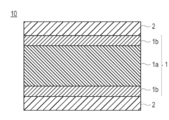
- FIG. 1 It is the fragmentary sectional view which represented typically the lamination composition of the surface of the typical embodiment of the medical device manufactured by the method concerning the present invention.
- 10 indicates a medical device; 1 indicates a substrate layer; and 2 indicates a lubricant layer, respectively.
- FIG. 1 It is the fragmentary sectional view which represented typically the structural example from which the lamination
- 10 indicates a medical device, 1a indicates a base layer core, 1b indicates a base surface layer, 1 indicates a base layer, and 2 indicates a lubricating layer, respectively.
- a method of manufacturing a medical device is a method of manufacturing a medical device including a base material layer and a lubricating layer carried on at least a part of the base material layer, and having an epoxy group.
- a block copolymer having a structural unit (A) derived from a reactive monomer and a structural unit (B) derived from a hydrophilic monomer, an alkyl ammonium salt having 8 to 24 carbon atoms, and a solvent Applying and washing a solution containing the above on the substrate layer.
- ADVANTAGE OF THE INVENTION According to this invention, the manufacturing method which has a lubricating layer (coating layer) which exhibits the outstanding durability (especially sliding durability) can be manufactured.
- the structural unit (A) derived from the reactive monomer which has an epoxy group is also only called “the structural unit derived from a reactive monomer” or a “structural unit (A).”
- a structural unit (B) derived from a hydrophilic monomer is also simply referred to as a “structural unit derived from a hydrophilic monomer” or a “structural unit (B)”.
- a block copolymer having a structural unit derived from a reactive monomer and a structural unit derived from a hydrophilic monomer is simply referred to as a “block copolymer” and an alkyl ammonium salt having 8 or more and 24 or less carbon atoms. Also simply referred to as "alkyl ammonium salts”.
- the method for producing a medical device according to the present invention includes a block copolymer having a structural unit derived from a reactive monomer and a structural unit derived from a hydrophilic monomer, an alkyl ammonium salt having a specific carbon number, and a solvent.
- the solution is applied onto the substrate layer and washed.
- the medical device manufactured by the method of this invention can exhibit outstanding durability (surface lubrication maintenance property, sliding durability).
- the mechanism by which the medical device obtained by the manufacturing method according to the present invention can exhibit excellent durability is considered as follows.
- the present invention is not limited to the following estimation.
- a block copolymer having a structural unit (A) derived from a reactive monomer having an epoxy group and a structural unit (B) derived from a hydrophilic monomer is coated on a substrate layer.
- a lubricating layer is formed on a base material layer.
- the block copolymer that forms the lubricating layer exhibits swelling properties when in contact with body fluids or aqueous solvents, thus providing the medical device with lubricity (surface lubricity) and friction with lumen walls such as blood vessel walls.
- the block copolymer forming the lubricating layer forms a network structure (network) by crosslinking or polymerizing the epoxy group contained in the structural unit (A) as a crosslinking point. Conceivable.
- the block copolymer is plasticized by the addition of an alkyl ammonium salt having 8 to 24 carbon atoms, and the blocks having similar properties are aggregated to form a network-like structure by polymerizing. It is thought that it will be crosslinked by subsequent heat treatment to form a network structure (network).
- the alkyl ammonium salt having 8 to 24 carbon atoms contained in the block copolymer solution is crosslinked or polymerized (the formation of a network by a plurality of crosslinks or a network by aggregation) To promote the formation).
- the network structure (network) in the lubricating layer can be formed at a higher density, a strong covering layer (lubricating layer) is formed, and the strong covering layer can be maintained well even after sliding, resulting in high lubrication. It is presumed that the property (surface lubricity) can be maintained for a longer period of time (that is, excellent surface lubricity can be maintained, and sliding durability can be improved).
- crosslinking or polymerization of a block copolymer is also simply referred to as "crosslinking or polymerization of a block copolymer".
- the functional group present on the surface of the base material layer may react with the epoxy group contained in the structural unit (A) to be bonded.
- such reaction is also promoted by the alkyl ammonium salt having 8 or more and 24 or less carbon atoms, and the epoxy group is also bonded (immobilized) to the substrate layer to suppress peeling from the substrate layer. It can be prevented.
- a medical device having excellent durability can be obtained.
- X to Y indicating a range includes X and Y, and means “X or more and Y or less”. Unless otherwise specified, measurements of operations and physical properties etc. are conducted under the conditions of room temperature (20 to 25 ° C.) / Relative humidity 40 to 50% RH.
- the method for producing a medical device comprises a block copolymer having a structural unit (A) derived from a reactive monomer having an epoxy group and a structural unit (B) derived from a hydrophilic monomer, and 8 or more Applying a solution containing an alkyl ammonium salt having 24 or less carbon atoms and a solvent on a substrate layer ((I) solution application step, coating layer forming step), and washing ((II) washing step )including.
- drying and / or heat treatment may be further performed between the steps (I) and (II) ((I ') drying and / or heat treatment step).
- a solution containing a specific alkyl ammonium salt together with the block copolymer, a medical device having a lubricating layer (coating layer) exhibiting excellent durability can be obtained.
- (I) Solution application process (application layer formation process)
- a solution containing the above block copolymer, the above alkyl ammonium salt and a solvent (herein, also simply referred to as “block copolymer solution” or “coating solution”) Is applied onto the substrate layer ((I) solution application step, application layer formation step).
- the solution application step is performed for the purpose of supporting (or coating) a lubricating layer containing a block copolymer on at least a part of the surface of the base layer.
- “Supported” means a state in which the lubricating layer is immobilized so as not to be easily released from the surface of the base layer, and it is only in a form in which the entire surface of the base layer is completely covered by the lubricating layer. In addition, it also includes a form in which only a part of the substrate surface is covered by the lubricating layer, that is, a form in which the lubricating layer adheres to only a part of the substrate surface. Therefore, the method of applying the solution is not particularly limited except that a solution containing the block copolymer having the above-mentioned structural unit (A) and the structural unit (B), the above alkyl ammonium salt, and a solvent is used. It can be applied in the same manner as in the known method or by modifying it appropriately.
- the block copolymer and the alkyl ammonium salt are dissolved in a solvent to prepare a solution (coating solution), and the solution (coating solution) is coated on a substrate and coated. Form a layer.
- the block copolymer forms a lubricating layer supported on at least a part of the base layer. That is, in the medical device obtained by the method according to the present invention, the lubricating layer contains a block copolymer.
- the block copolymer in the present invention has a structural unit (A) derived from a reactive monomer having an epoxy group and a structural unit (B) derived from a hydrophilic monomer.
- the reactive monomer having an epoxy group constituting the block copolymer has an epoxy group as a reactive group.
- the block copolymers are crosslinked or polymerized via an epoxy group to form a network structure.
- the addition of the alkyl ammonium salt according to the present invention promotes crosslinking or polymerization of the block copolymer, thereby improving the strength of the lubricating layer.
- the alkyl ammonium salt according to the present invention not only promotes crosslinking of the epoxy group, but also plasticizes the block copolymer to promote aggregation of blocks having similar properties to each other.
- the medical device obtained by the method according to the present invention is excellent in sliding durability and can maintain its shape well even after sliding.
- the lubricating layer can be strongly bonded (fixed) to the base material layer via an epoxy group, and peeling from the base material layer can be suppressed or prevented. Therefore, also from such a viewpoint, the medical device obtained by the method according to the present invention further improves the sliding durability.
- the structural unit (A) which comprises a block copolymer can be confirmed by a well-known method, in this specification, the loss
- the specific ATR-IR measurement conditions can be those described in the examples.
- the reactive monomer constituting the block copolymer is not particularly limited as long as it has an epoxy group, and known compounds can be used.
- reactive monomers having an epoxy group are glycidyl acrylate, glycidyl methacrylate (GMA), 3,4-epoxycyclohexyl methyl acrylate, since the cross-linking or polymerization of the block copolymer can be easily controlled. It is preferable to include at least one selected from the group consisting of 3,4-epoxycyclohexylmethyl methacrylate, ⁇ -methyl glycidyl methacrylate, and allyl glycidyl ether.
- glycidyl (meth) acrylate is preferable in consideration of the improvement in the ease of formation of the network structure, the ease of production, and the like.
- (meth) acrylate includes both acrylate and methacrylate.
- the above reactive monomers may be used alone or in combination of two or more. That is, the reactive site derived from the reactive monomer may be a homopolymer type composed of one type of reactive monomer alone, or a copolymer composed of two or more types of the above-mentioned reactive monomers It may be a type.
- part in the case of using 2 or more types may be a block copolymer, and a random copolymer may be sufficient as it.
- the hydrophilic monomer constituting the block copolymer has a swelling property when in contact with a body fluid or an aqueous solvent, and thus imparts lubricity (surface lubricity) to the medical device. Therefore, by introducing the structural unit (B) derived from such a hydrophilic monomer into the block copolymer, the lubricity (surface lubricity) of the medical device is improved, and the medical device is a blood vessel wall or the like. Friction on contact with the lumen wall can be reduced.
- the hydrophilic monomer constituting the block copolymer is not particularly limited as long as it has the above-mentioned characteristics, and known compounds can be used.
- acrylamide and derivatives thereof, vinyl pyrrolidone, acrylic acid and methacrylic acid and derivatives thereof, polyethylene glycol acrylate and derivatives thereof, monomers having a sugar or phospholipid in the side chain, and water-soluble unit amounts such as maleic anhydride The body etc. can be illustrated.
- acrylic acid methacrylic acid, N-methyl acrylamide, N, N-dimethyl acrylamide (DMAA), acrylamide, acryloyl morpholine, N, N-dimethylaminoethyl acrylate, N-vinyl pyrrolidone, 2-methacryloyloxy Ethyl phosphoryl choline, 2-methacryloyloxyethyl-D-glycoside, 2-methacryloyloxyethyl-D-mannoside, vinyl methyl ether, 2-hydroxyethyl (meth) acrylate, 4-hydroxybutyl (meth) acrylate, 2-hydroxypropyl (2-hydroxypropyl (meth) acrylate Meta) acrylate, 2-hydroxybutyl (meth) acrylate, 6-hydroxyhexyl (meth) acrylate, 1,4-cyclohexanedimethanol mono (meth) acrylate, 1-chloro 2-hydroxypropyl (meth) acryl
- the hydrophilic monomer is selected from the group consisting of N, N-dimethyl acrylamide, acrylamide, 2-hydroxyethyl methacrylate, and N-vinyl pyrrolidone. It is preferable to include at least one of Among these, from the viewpoint of excellent lubricity, the hydrophilic monomer is preferably N, N-dimethyl acrylamide.
- the hydrophilic monomers may be used alone or in combination of two or more. That is, the hydrophilic moiety derived from the hydrophilic monomer may be a homopolymer type composed of one hydrophilic monomer alone, or a copolymer composed of two or more of the above hydrophilic monomers It may be a type.
- the form of the hydrophilic moiety in the case of using two or more kinds may be a block copolymer or a random copolymer.
- the block copolymer has the structural unit (A) and the structural unit (B).
- the ratio of the structural unit (A) to the structural unit (B) is not particularly limited as long as the above effects are exhibited.
- the ratio of the structural unit (A) to the structural unit (B) (structural unit (A): structural unit (structural unit (A)) in consideration of good lubricity, lubricity maintenance, strength of the coating layer, bondability with the base layer, etc.
- the molar ratio of B) is preferably 1: 2 to 100, more preferably 1: 2 to 50, still more preferably 1: 5 to 50, 1:10 to 1:30. Is particularly preferred.
- the lubricating layer can exhibit sufficient lubricity by the structural unit (B), and by the structural unit (A), sufficient coating layer strength, bondability with the base layer and durability can be obtained. It can be demonstrated.
- the molar ratio of said structural unit (A): structural unit (B) can be controlled by adjusting the preparation ratio (molar ratio) of each monomer in the manufacturing step of a block copolymer.
- the preparation ratio (molar ratio) of the reactive monomer having an epoxy group to the hydrophilic monomer in the production step of the block copolymer is preferably 1: 2 to 100, 1: 2 More preferably, it is ⁇ 50, further preferably 1: 5 to 50, and particularly preferably 1:10 to 1:30.
- the molar ratio of the structural unit (A) to the structural unit (B) can be confirmed, for example, by performing NMR measurement ( 1 H-NMR measurement, 13 C-NMR measurement, etc.) on the copolymer. .
- the weight average molecular weight of the block copolymer is preferably 10,000 to 10,000,000 from the viewpoint of solubility.
- the weight average molecular weight of the block copolymer is more preferably 100,000 to 10,000,000 in view of the easiness of preparation of the block copolymer solution (coating solution).
- “weight average molecular weight” is a value measured by gel permeation chromatography (GPC) using polystyrene as a standard substance.
- the method for producing the block copolymer is not particularly limited, and for example, it can be produced by applying conventionally known polymerization methods such as living radical polymerization, polymerization using a macro initiator, and polycondensation. .
- the living radical polymerization method or the method of easily controlling the molecular weight and molecular weight distribution of the constituent unit (part) derived from the reactive monomer and the constituent unit (part) derived from the hydrophilic monomer A polymerization method using a macro initiator is preferably used.
- the living radical polymerization method is not particularly limited, and methods described in, for example, JP-A-11-263819, JP-A-2002-145971, JP-A-2006-316169, etc., and atom transfer radical polymerization (ATRP) ) Can be applied similarly or appropriately modified.
- ATRP atom transfer radical polymerization
- the macro initiator for example, after preparing a macro initiator having a reactive site having a reactive functional group and a radical polymerizable group such as a peroxide group, the macro initiator and By polymerizing a monomer for forming a hydrophilic site, a block copolymer having a hydrophilic site and a reactive site can be produced.
- the polymerization of the block copolymer known methods such as bulk polymerization, suspension polymerization, emulsion polymerization, solution polymerization and the like may be used.
- a method in which a reactive monomer and a hydrophilic monomer are copolymerized by stirring and heating together with a polymerization initiator in a polymerization solvent can be used.
- the polymerization initiator is not particularly limited, and known ones may be used.
- the polymerization solvent is not particularly limited, and examples thereof include aliphatic organic solvents such as n-hexane, n-heptane, n-octane, n-decane, cyclohexane, methylcyclohexane and liquid paraffin, tetrahydrofuran, dioxane, etc.
- Ether solvents aromatic organic solvents such as benzene, toluene and xylene, halogen organic solvents such as 1,2-dichloroethane and chlorobenzene, and polar aprotic organic solvents such as N, N-dimethylformamide and dimethyl sulfoxide. It can be used.
- the said solvent can also be used individually or in mixture of 2 or more types.
- the concentration of the monomer in the polymerization solvent is preferably 5 to 90% by mass, more preferably 8 to 80% by mass, and 10 to Particularly preferred is 50% by mass.
- the polymerization conditions are also not particularly limited as long as the above copolymerization proceeds.
- the polymerization temperature is preferably 30 to 150 ° C., more preferably 40 to 100 ° C.
- the polymerization time is preferably 30 minutes to 30 hours, more preferably 3 to 24 hours.
- a chain transfer agent if necessary, a chain transfer agent, a polymerization rate regulator, a surfactant, a water soluble polymer, a water soluble inorganic compound (alkali metal salt, alkali metal hydroxide, polyvalent metal salt And non-reducible alkali metal salt pH buffers etc.), inorganic acids, inorganic acid salts, organic acids and organic acid salts and other additives may be used as appropriate.
- the block copolymer after copolymerization is preferably purified by a general purification method such as reprecipitation method, dialysis method, ultrafiltration method and extraction method.
- alkyl ammonium salt promotes the crosslinking or polymerization of the block copolymer.
- a strong lubricating layer can be formed, and excellent durability (sliding durability) can be obtained.
- the promotion of the crosslinking or polymerization of the block copolymer as described above can also be caused by the addition of a strong acid, but the inventor added that when the strong acid is added, the above crosslinking in the block copolymer solution (coating solution) Moreover, as a result of rapid progress of the polymerization, it was found that the viscosity of the coating solution becomes high, and it becomes difficult to apply uniformly. On the other hand, since the alkyl ammonium salt according to the present invention moderately promotes the crosslinking or polymerization of the block copolymer, the coating by crosslinking or polymerization of the block copolymer in the coating solution as described above It is possible to suppress the increase in viscosity of the liquid.
- the coating solution can be uniformly applied by using the alkyl ammonium salt.
- a strong acid it is necessary to separately prepare a solution of the block copolymer and a solution of the strong acid for the above reasons, and apply these in order, but according to the present invention, the lubricating layer At the time of formation of the (coating layer), it is sufficient to apply a liquid containing both of the block copolymer and the alkyl ammonium salt, and there is also an advantage that it is possible to form a lubricating layer (coating layer) by one solution.
- the alkyl ammonium salt in the present invention has 8 or more and 24 or less carbon atoms.
- the number of carbon atoms indicates the total number of carbon atoms contained in the alkyl ammonium cation. If the carbon number of the alkyl ammonium salt is less than 8, the alkyl ammonium salt can not be uniformly dissolved in the block copolymer solution (coating solution), and the solution is uniformly coated on the substrate layer It is difficult. Therefore, sufficient lubricity can not be obtained.
- the alkyl ammonium salt When the carbon number of the alkyl ammonium salt exceeds 24, a uniform solution can be prepared, but the affinity between the alkyl ammonium salt and the lubricating layer (block copolymer) is high, and when the lubricating layer is washed, It is difficult to remove the alkyl ammonium salt. Therefore, the alkyl ammonium salt remains on the lubricating layer, and sufficient lubricity (surface lubricity) can not be obtained. From the viewpoint of forming a lubricating layer having more excellent durability (sliding durability), the alkyl ammonium salt preferably has 12 to 24 carbon atoms, and more preferably 16 to 20 carbon atoms. preferable.
- the alkyl ammonium salt used in the present invention is not particularly limited as long as its cationic moiety has 8 to 24 carbon atoms and at least one alkyl group, and primary to quaternary. It may be any of ammonium salts.
- the alkyl ammonium salt is preferably a quaternary ammonium salt from the viewpoint of easy availability and control of crosslinking or polymerization of the block copolymer.
- the cation moiety of the alkyl ammonium salt may have another substituent other than the alkyl group as long as the carbon number satisfies the above range.
- the other substituent is not particularly limited, and includes, for example, an alkenyl group, an alkynyl group, an aryl group, an acyl group, an alkoxycarbonyl group, an alkoxy group, an aryloxy group, an aryloxy carbonyl group, an acyloxy group and the like. It is also good.
- the cation moiety of the alkyl ammonium salt has no substituent other than the alkyl group, from the viewpoint of easy availability and control of crosslinking or polymerization of the block copolymer. That is, the alkyl ammonium salt is preferably a tetraalkyl ammonium salt.
- the alkyl group contained in the ammonium salt is not particularly limited as long as it satisfies the above carbon number.
- the alkyl ammonium salt has two or more alkyl groups, the alkyl groups may be the same or different.
- the alkyl groups contained in the alkyl ammonium salt each independently have 2 carbon atoms, in view of excellent solubility in the block copolymer solution and easy promotion of crosslinking or polymerization of the block copolymer. It is preferable that it is a linear or branched chain of ⁇ 6, or a cyclic alkyl group having 3 to 6 carbon atoms, and more preferably a linear or branched alkyl group having 2 to 6 carbon atoms, and 2 to 6 carbon atoms It is more preferable that it is a linear alkyl group of the above, and most preferable that it is a linear alkyl group of 4 to 5 carbon atoms.
- alkyl group examples include, for example, ethyl group, n-propyl group, isopropyl group, n-butyl group, isobutyl group, sec-butyl group, tert-butyl group, n-pentyl group, isopentyl group, neopentyl group, n- Examples thereof include linear, branched or cyclic alkyl groups such as hexyl group and cyclohexyl group.
- the alkyl groups in the alkyl ammonium salt are each independently from the viewpoint of excellent solubility in the block copolymer solution and easier control of crosslinking or polymerization of the block copolymer.
- It is preferably selected from the group consisting of ethyl, n-propyl, n-butyl, n-pentyl and n-hexyl, and more preferably n-butyl or n-pentyl.
- the two or more alkyl groups contained in the alkyl ammonium salt are preferably the same, from the viewpoint of easy availability of the alkyl ammonium salt and easier control of crosslinking or polymerization of the block copolymer.
- the alkyl ammonium salt comprises tetraethyl ammonium salt, tetra n-propyl ammonium salt, tetra n-butyl ammonium salt, tetra n-pentyl ammonium salt, and tetra n-hexyl ammonium salt It is preferred to be selected from the group, and more preferred is tetra n-butyl ammonium salt or tetra n-pentyl ammonium salt.
- the anion (counter anion) which forms the alkyl ammonium salt used in the present invention is not particularly limited as long as it can form a salt with the alkyl ammonium cation.
- anions for example, halide ions such as fluoride ion, chloride ion, bromide ion and iodide ion; hydrogen sulfate ion (HSO 4 ⁇ ); sulfate ion (SO 4 2 ⁇ ); nitrate ion NO 3 -); dihydrogen phosphate ion (H 2 PO 4 -), hydrogen phosphate ions (HPO 4 2-), phosphate ion (PO 4 3-); perchlorate ion (ClO 4 -); water oxide ion (OH -); citrate ion, acetic acid ion, malic acid ion, fumarate ion, lactate ion, and a carboxylic acid anion such as glutaric
- the anion of the alkyl ammonium salt is preferably selected from the group consisting of a halide ion, a hydrogen sulfate ion, a perchlorate ion, and a hydroxide ion, since the solubility in the block copolymer solution is excellent.
- the anion of the alkyl ammonium salt is more preferably a halide ion.
- an alkyl ammonium salt having such an anion has relatively weak basicity or is neutral.
- the structural unit (A) contains an epoxy group or a glycidyl ester group
- a block copolymer Hydrolysis of the cross-linked portion of the epoxy group or glycidyl ester group contained therein is less likely to occur. Accordingly, the formed lubricating layer is less susceptible to such hydrolysis, and as a result, the strength of the lubricating layer is improved, and a lubricating layer excellent in durability (sliding durability) can be formed. .
- the anion of the alkyl ammonium salt is preferably selected from the group consisting of chloride ion, bromide ion and iodide ion, and is chloride ion or bromide ion. And particularly preferred.
- An alkyl ammonium salt having a chloride ion or a bromide ion as an anion is particularly weak in basicity, and therefore does not cause hydrolysis of the block copolymer, and aggregation of blocks having epoxy groups or similar properties. Can promote the formation of a more durable lubricating layer.
- alkyl ammonium salt As mentioned above, as an alkyl ammonium salt suitably used in this invention, it is preferable in it being following formula (1):
- R 1 to R 4 each independently represent an ethyl group, an n-propyl group, an n-butyl group, an n-pentyl group or an n-hexyl group, and X - represents a halide ion Hydrogen sulfate ion, perchlorate ion or hydroxide ion.
- R 1 to R 4 in the formula (1) represent an ethyl group, an n-propyl group, an n-butyl group, an n-pentyl group from the viewpoint of forming a lubricating layer having more excellent durability (sliding durability) Or n-hexyl group (wherein a plurality of R 1 to R 4 are the same substituent), and X - is a halide ion, a hydrogen sulfate ion, a perchlorate ion or a hydroxide ion More preferable.
- R 1 to R 4 are n-butyl group or n-pentyl group (however, plural R 1 to R 4 are the same substituent), X - it is still more preferable to be halide ions, wherein (1), R 1 ⁇ R 4 is n- butyl or n- pentyl group (provided that a plurality of R 1 ⁇ R 4 are the same is a substituent), X - is particularly preferable to be chloride, bromide or iodide, in the formula (1), R 1 ⁇ R 4 is an n- butyl or n- pentyl group (However, a plurality of R 1 to R 4 are the same substituent), X 2 ⁇ is most preferably a chloride ion or a bromide ion.
- the said alkyl ammonium salt may be used individually by 1 type, and may use 2 or more types together.
- a homogeneous solution containing the block copolymer and the alkyl ammonium salt is prepared, and the solution (coating solution) is used as a substrate layer. Apply on top.
- the solvent used to dissolve the block copolymer and the alkyl ammonium salt according to the present invention is not particularly limited as long as it can dissolve the block copolymer and the alkyl ammonium salt according to the present invention.
- water alcohols such as methanol, ethanol, isopropanol and ethylene glycol, ketones such as acetone, methyl ethyl ketone and cyclohexanone, esters such as ethyl acetate, halides such as chloroform, olefins such as hexane, and the like (THF), ethers such as butyl ether, aromatics such as benzene and toluene, amides such as N, N-dimethylformamide (DMF), sulfoxides such as dimethyl sulfoxide, etc.
- alcohols such as methanol, ethanol, isopropanol and ethylene glycol
- ketones such as acetone, methyl ethyl
- the solvent of the solution is ketones such as acetone and amides such as DMF.
- acetone and DMF are particularly preferred.
- the block copolymer solution (coating solution) for forming the lubricating layer may contain other components in addition to the block copolymer, the alkyl ammonium salt, and the solvent.
- the other components are not particularly limited, and for example, when the medical device is intended for insertion into a body cavity or lumen such as a catheter, anticancer agents, immunosuppressants, antibiotics, antirheumatic drugs, antithrombotic agents, etc.
- Drug HMG-CoA reductase inhibitor, ACE inhibitor, calcium antagonist, antihyperlipidemic drug, integrin inhibitor, antiallergic drug, antioxidant, GPIIb / IIIa antagonist, retinoid, flavonoid, carotenoid, lipid Improvement agents, DNA synthesis inhibitors, tyrosine kinase inhibitors, antiplatelet agents, vascular smooth muscle growth inhibitors, antiinflammatory agents, biomaterials, interferons, and drugs such as NO production promoters (physiologically active substances) etc.
- the addition amount of the other components is not particularly limited, and the amount usually used is applied in the same manner. Ultimately, the addition amounts of the other components are appropriately selected in consideration of the severity of the disease to be applied, the weight of the patient, and the like.
- a block copolymer solution (coating solution) is prepared using the block copolymer, the alkyl ammonium salt and a solvent.
- the above components may be added collectively or separately, stepwise or continuously.
- the mixing method is not particularly limited, and known methods can be used.
- a preferred method of preparing a block copolymer solution (coating solution) involves sequentially adding a block copolymer and an alkyl ammonium salt to a solvent and stirring in the solvent.
- the concentration of the block copolymer in the block copolymer solution (coating solution) is not particularly limited. From the viewpoint of further improving the coatability and the lubricity and durability of the lubricating layer, the concentration of the block copolymer in the solution (coating solution) is preferably 0.01 to 20% by mass, and 0. The content is more preferably 05 to 15% by mass, and particularly preferably 1 to 10% by mass. If the concentration of the block copolymer is in the above range, the lubricity and durability of the resulting lubricating layer can be sufficiently exhibited.
- the solution contains 0.01 to 20% by mass (more preferably 0.05 to 15% by mass, particularly preferably) of the block copolymer. 1 to 10% by mass).
- a uniform lubricating layer of a desired thickness can be easily obtained by one coating, and the viscosity of the solution falls within an appropriate range, and operability (e.g. ease of coating), production efficiency It is preferable in point. However, if it is a range which does not affect the effect of the present invention even if it deviates from the above-mentioned range, it is fully usable.
- the concentration of the alkyl ammonium salt in the block copolymer solution (coating solution) is also not particularly limited. Alkyl in the solution (coating solution) from the viewpoint that the crosslinking or polymerization of the block copolymer is sufficiently progressed while the progress is not excessively progressed (the crosslinking or polymerization can be appropriately promoted)
- the concentration of the ammonium salt is preferably 0.01 to 20% by mass, more preferably 0.05 to 15% by mass, and particularly preferably 1 to 10% by mass. If the concentration of the alkyl ammonium salt is in the above range, the lubricity and durability of the resulting lubricating layer can be sufficiently exhibited. However, if it is a range which does not affect the effect of the present invention even if it deviates from the above-mentioned range, it is fully usable.
- the mixing ratio of the block copolymer and the alkyl ammonium salt in the block copolymer solution (coating solution) is not particularly limited.
- the solution (coating solution) contains the block copolymer and the alkyl ammonium salt in a ratio of 1: 0.01 to 10 (mass ratio) It is preferable if it is contained, more preferably in a ratio of 1: 0.05 to 5 (mass ratio), particularly preferably in a ratio of 1: 0.05 to 2 (mass ratio), 1: 0.1 to It is most preferable to include at 2 (mass ratio).
- the mass ratio of the block copolymer and the alkyl ammonium salt is in the above range, the lubricity and durability of the resulting lubricating layer can be sufficiently exhibited. Since the alkyl ammonium salt can be sufficiently removed in the washing step described later, the lubricity of the lubricating layer is also improved.
- the base material layer may be made of any material, and examples thereof include metal materials, polymer materials (resin materials), and ceramics.
- the metal material is not particularly limited, and metal materials generally used for medical devices such as catheters, guide wires, and indwelling needles are used.
- various stainless steels such as SUS304, SUS314, SUS316, SUS316L, SUS420J2 and SUS630, gold, platinum, silver, copper, nickel, cobalt, titanium, iron, aluminum, tin or nickel-titanium alloy, nickel-cobalt
- Various alloys such as alloys, cobalt-chromium alloys, zinc-tungsten alloys and the like can be mentioned. These may be used alone or in combination of two or more.
- a metal material most suitable as a base material layer of a catheter, a guide wire, an indwelling needle, etc., which is used, may be appropriately selected.
- the polymer material (resin material or elastomer material) is not particularly limited, and is generally used for medical devices such as catheters, introducers, guide wires, indwelling needles, etc. Used polymeric materials are used.
- polyamide resin polyamide resin
- polyolefin resin such as polyethylene resin and polypropylene resin
- modified polyolefin resin such as polyethylene resin and polypropylene resin
- cyclic polyolefin resin epoxy resin, polyurethane resin, diallyl phthalate resin (allyl resin), polycarbonate resin, fluorocarbon resin, amino resin (urea Resin, melamine resin, benzoguanamine resin)
- polyester resin such as polyethylene terephthalate resin, polybutylene terephthalate resin, styrene resin, acrylic resin, polyacetal resin, vinyl acetate resin, phenol resin, vinyl chloride resin, silicone resin (silicon resin), poly Ether resin, polyimide resin, etc. are mentioned.
- thermoplastic elastomers such as polyurethane elastomers, polyester elastomers and polyamide elastomers can also be used as the material of the base layer.
- polymer materials may be used alone or as a mixture of two or more or a copolymer of two or more monomers constituting any of the above resins or elastomers.
- polymer material polyethylene resin, polyurethane resin, polyethylene terephthalate resin, polyamide resin, and polyamide elastomer are preferable, and polyamide resin and polyamide elastomer are more preferable.
- the carboxy group or amino group as an end group contained in the polyamide resin or the polyamide elastomer can crosslink with the epoxy group in the block copolymer.
- these polymer materials are relatively soft and the block copolymer constituting the lubricating layer is easily impregnated. Therefore, the bondability between the polymer material (in particular, the polyamide resin and the polyamide elastomer) and the block copolymer can be enhanced, and a lubricant layer having more excellent durability can be formed.
- a polymer material most suitable as a base material layer of a catheter, a guide wire, an indwelling needle, etc., which is used, may be appropriately selected.
- the method for producing a medical device according to the present invention is, as described later, the application of a block copolymer solution (coating solution) and, even when maintained at a relatively low temperature, crosslinking of the block copolymer or As the polymerization progresses, a lubricating layer having excellent durability can be formed. In other words, the effect that the temperature at which the lubricating layer is fixed on the base layer can be lowered is also exhibited. Therefore, in the method for producing a medical device according to the present invention, a polymer material (resin material or elastomer material) is suitably used as a constituent material of the base material layer.
- the lubricating layer can be fixed at a low temperature, deformation and plasticization of the base material layer are suppressed even if the base material layer contains a polymer material which is easily deformed or plasticized by heat, and dimensional stability Improve.
- the shape of the said base material layer is not restrict
- the method for applying (coating) the block copolymer solution (coating solution) on the surface of the substrate layer is not particularly limited, and application, printing method, immersion method (dipping method, dip coating method), spraying method (spray method) Methods known in the art, such as spin coating method, mixed solution impregnation sponge coating method, bar coating method, die coating method, reverse coating method, comma coating method, gravure coating method, doctor knife method, etc., can be applied. Among these, it is preferable to use a dipping method (dipping method, dip coating method).
- the base material layer When the lubricating layer is formed on a thin and narrow inner surface such as a catheter, a guide wire, an injection needle or the like, the base material layer may be immersed in a coating solution to decompress the inside of the system to cause degassing. By degassing under reduced pressure, the solution can rapidly penetrate the narrow and narrow inner surface to promote the formation of the lubricating layer.
- a lubricating layer when forming a lubricating layer in a part of base material layer, only a part of base material layer is immersed in a coating liquid, and a coating liquid is coated on a part of base material layer, A lubricating layer can be formed on the desired surface area of the base layer.
- an appropriate member or material capable of attaching / detaching (loading / unloading) the surface part of the substrate layer which does not need to form a lubricating layer beforehand The substrate layer is dipped in a coating solution, and the coating solution is coated on the substrate layer, and then a protective member for the surface portion of the substrate layer that does not need to form a lubricating layer.
- a lubricating layer can be formed on a desired surface portion of the substrate layer.
- a lubricating layer can be formed by appropriately using a conventionally known method.
- another coating method eg, a predetermined surface portion of the medical device, or the like
- a coating method using a coating apparatus such as a spray apparatus, a bar coater, a die coater, a reverse coater, a comma coater, a gravure coater, a spray coater, a doctor knife or the like may be applied.
- a coating apparatus such as a spray apparatus, a bar coater, a die coater, a reverse coater, a comma coater, a gravure coater, a spray coater, a doctor knife or the like may be applied.
- both the outer surface and the inner surface of the cylindrical device need to have a lubricating layer due to the structure of the medical device, both the outer surface and the inner surface can be coated at one time In terms of point, the dipping method is preferably used.
- the coating amount of the block copolymer solution (coating solution) is preferably such that the thickness of the obtained film (lubricating layer) becomes 0.1 to 10 ⁇ m, and the amount such that 0.5 to 5 ⁇ m Is more preferable, and the amount is more preferably 1 to 3 ⁇ m. If the coating amount (the lubricating layer) is such that the thickness is 0.1 ⁇ m or more, the durability of the resulting film (the lubricating layer) can be sufficiently achieved. Further, if the coating amount (the lubricating layer) is 10 ⁇ m or less, the surface of the coating (the lubricating layer) is less likely to stick, and the handling at the time of manufacture becomes easier.
- a block copolymer solution (coating solution) is applied on a base material layer to form a coating layer, and then the solvent is removed. It is preferable to carry out a drying and / or heat treatment step for the purpose of forming a strong lubricating layer.
- drying processing and “heat processing” are not strictly distinguished, but for convenience of explanation, “drying processing” refers to the temperature around the room temperature of the substrate layer to which the coating solution is applied. Holding at (20 to 30 ° C.) or lower is called “drying treatment”, and “heating treatment” is called holding at a temperature near room temperature (20 to 30 ° C.).
- the conditions at the time of drying or heat treatment are not particularly limited as long as the lubricating layer containing the block copolymer can be formed on the base material layer.
- the temperature of the drying or heat treatment is not particularly limited, but preferably 10 to 200 ° C. That is, it is more preferable to maintain the coating layer at 10 to 200 ° C. after the block copolymer solution is applied onto the base layer (after forming the coating layer).
- a strong coating layer lubricant layer
- high lubricity surface lubricity
- the coating layer after applying the block copolymer solution on the base material layer (after forming the coating layer), it is more preferable to maintain the coating layer at 110 ° C. or less, and more preferably 50 to 100 ° C. Most preferably, it is maintained at ° C. By maintaining at such temperature, it is possible to exhibit excellent lubricity and to form a lubricating layer having high durability.
- the temperature by setting the temperature to 110 ° C. or less, excessive crosslinking or polymerization of the block copolymer can be suppressed even when heat treatment is performed for a long time. Therefore, it is possible to suppress a decrease in the swelling property due to the lubricating layer becoming too hard, and it becomes possible to control the lubricity more easily.
- the above temperature may be changed during the drying or heat treatment.
- the temperature is maintained at a relatively low temperature of, for example, 80 ° C. or less, further 25 to 80 ° C.
- the lubricating layer having high durability can be formed. This has the advantage that even polymeric materials that are easily deformed or plasticized by heat can be used as the substrate layer. Therefore, according to the present invention, material selectivity is higher, and medical devices for various applications can be manufactured.
- the time for drying or heat treatment is also not particularly limited, but is preferably 30 minutes to 30 hours, more preferably 1 to 25 hours, and particularly preferably 1 to 10 hours.
- a strong covering layer lubricant layer
- high lubricity surface lubricity
- the alkyl ammonium salt is further subjected to the heat treatment in a state in which the solvent is distilled off (that is, in a state in which the block copolymer and the alkyl ammonium salt are easily in contact) through drying and heat treatment.
- the heat treatment can be performed for a shorter time, and therefore, even a polymer material that is easily deformed or plasticized by heat can be used as the base material layer.
- the conditions (temperature, time, etc.) of drying and heat treatment at this time are not particularly limited either, but from the viewpoint of efficiently producing a medical device, after performing drying treatment maintained at 10 to 30 ° C. for 30 minutes to 5 hours
- heat treatment is performed at 40 to 200 ° C. for 1 to 10 hours.
- the heat treatment is not necessary, and only the drying treatment may be performed. Good.
- the conditions (temperature, time, etc.) of the drying treatment are not particularly limited, but the treatment temperature is preferably 10 to 30 ° C. from the viewpoint of forming a lubricating layer having excellent lubricity and high durability.
- the temperature is more preferably 20 to 25 ° C.
- the treatment time is preferably 5 to 30 hours, more preferably 10 to 25 hours.
- the heat treatment maintained at 50 to 100 ° C. for 2 to 6 hours, or It is preferable to carry out a drying treatment maintained at 20 to 25 ° C. for 10 to 25 hours.
- a strong lubricating layer (coating layer) can be supported on the surface of the base material layer.
- a crosslinking reaction occurs via the epoxy group in the block copolymer in the lubricating layer to form a high-strength lubricating layer that is not easily peeled off from the base material layer. be able to. Therefore, peeling of the lubricating layer from the base material layer can be effectively suppressed / prevented by the drying and / or heat treatment step.
- the pressure condition at the time of drying is not limited at all, and it can be carried out under normal pressure (atmospheric pressure), and may be carried out under pressure or reduced pressure.
- drying or heating means for example, an oven, a vacuum dryer or the like can be used, but in the case of natural drying, a drying means (apparatus) is not particularly required.
- washing step In the method for producing a medical device according to the present invention, the method is provided on the substrate layer after the above (I) solution application step or optionally (I ') drying and / or heat treatment step.
- the lubricating layer is washed ((II) washing step).
- the washing step is performed for the purpose of removing the alkyl ammonium salt contained in the block copolymer solution (coating solution) and imparting excellent lubricity (low friction) to the lubricating layer.
- the washing method is not particularly limited, but may be a method of immersing the coating (lubricant layer) of the block copolymer in a washing solvent, a method of pouring a washing solvent, or a combination thereof.
- the washing solvent used at this time is not particularly limited as long as it does not dissolve the coating (lubricating layer) of the block copolymer and can remove the impurities including the alkyl ammonium salt, but water or hot water can be used. Is preferably used.
- the temperature of the washing water is not particularly limited, but is preferably 20 ° C. to 100 ° C., more preferably 25 to 80 ° C.
- the washing time (the time for bringing the washing solvent into contact with the film) is not particularly limited, but preferably 1 to 60 minutes, more preferably 5 to 30 minutes. According to the above conditions, the alkyl ammonium salt can be sufficiently removed. As a result, the lubricating layer formed on the base material layer can exhibit excellent lubricity.
- a drying step may be further performed.
- the drying method and the drying conditions are not particularly limited, and conventionally known methods can be used.
- the lubricating layer is a base layer by applying a solution (coating liquid) containing a block copolymer and an alkyl ammonium salt forming the lubricating layer on the base layer. It has the configuration carried on it. At this time, in order to improve the lubricity, the smaller the amount of the alkyl ammonium salt contained in the lubricating layer, the better, but it can not be completely removed and may remain. In such a case, it is determined that the medical device was manufactured by the method according to the present invention. Specifically, it is confirmed by detecting the alkyl ammonium salt by the following analysis method.
- the alkyl ammonium salt contained in the lubricating layer after the washing step is preferably 50 ⁇ g / cm 2 or less per unit area, and is 5 ⁇ g / cm 2 or less And more preferred.
- the concentration is preferably 50 ⁇ g / cm 2 or less, the lubricating layer can exhibit excellent lubricity.
- the lower limit thereof is not particularly limited and is preferably as low as possible, but it is 1 ⁇ g / cm 2 or more in consideration of the substantial removal efficiency of the alkyl ammonium salt and the practical lubricity of the lubricating layer.
- the content of the above-mentioned alkyl ammonium salt “per unit area” means the alkyl ammonium salt contained per unit area (1 cm 2 ) of the lubricating layer, and the mass of the alkyl ammonium salt measured by the following method Let ( ⁇ g) be the value obtained by dividing the area of the lubricating layer (cm 2 ).
- the lubricating layer (medical device provided with the lubricating layer) is immersed in water and kept at 70 ° C. for 24 hours. Then, LC-MS measurement is performed on the obtained extract (water) under the following conditions.
- LC / MS measurement conditions >> LC / MS Equipment: Waters 2695 / Quattro micro API (LC) LC model: Waters 2695 Column: Waters X Bridge Amide 2.1 mm ⁇ 150 mm, 3.5 ⁇ m Mobile phase: 20 mmol / L ammonium formate solution (pH 3.2) / acetonitrile (1: 9 (volume ratio)) Flow rate: 0.2mL / min Column temperature: 40 ° C (MS) MS model: Waters Quattro micro API Ionization method: ESI-Positive.
- ⁇ Medical device> Excellent durability can be obtained by passing through the (I) solution application step (coating layer formation step), (II) washing step and optionally (I ') drying and / or heat treatment step described above.
- a medical device having a lubricating layer (coating layer) to be exerted can be manufactured.
- the epoxy group is easily crosslinked by crosslinking the epoxy group. No, it is possible to form a strong lubricating layer.
- the medical device obtained by the method according to the present invention can exhibit excellent lubricity and lubricity maintenance since a lubricant layer of a block copolymer is formed on the surface.
- FIG. 1 is a partial cross-sectional view schematically showing the laminated structure of the surface of a representative embodiment of a medical device (also abbreviated as “medical device” in the present specification) manufactured by the method according to the present invention. is there.
- FIG. 2 is the fragmentary sectional view which represented typically the structural example from which the laminated structure of the surface differs as an application example of this embodiment.
- symbol in FIG. 1 and FIG. 2 represents the following, respectively.
- 1 is a substrate layer; 1a is a substrate layer core portion; 1b is a substrate surface layer; 2 is a lubricant layer; and 10 is a method according to the present invention
- the base material layer 1 and at least a part of the base material layer 1 are provided (in FIG. And a lubricating layer 2 containing a block copolymer (shown in the example shown on the entire surface (entire surface)).
- a lubricating layer 2 containing a block copolymer shown in the example shown on the entire surface (entire surface)
- the present invention is not limited to the above embodiment, and an embodiment formed on one side of the base material layer 1; It may be any form such as a form formed on a part of one side or both sides of the material layer 1.
- the base material layer used in the present embodiment may be composed of any material, and the material is not particularly limited.
- examples of the material constituting the base material layer 1 include metal materials, polymer materials, and ceramics.
- the specific example of the material which comprises the said base material layer 1 is as having described in ⁇ application
- the entire base layer 1 may be made of any of the above-described materials.
- the base material layer 1 may be a multilayer structure formed by laminating different materials in multiple layers, or a structure in which members formed of different materials are joined to each other for each part of the medical device.
- the surface of the base layer core portion 1 a made of any of the above materials is coated with any of the other above materials by an appropriate method to form the base surface layer 1 b. It may have a constructed structure.
- a metal material is coated on the surface of the base layer core portion 1a formed of a resin material or the like by a suitable method (a conventionally known method such as plating, metal deposition, sputtering).
- the surface layer 1b is formed; on the surface of the base layer core portion 1a formed of a hard reinforcing material such as a metal material or a ceramic material, a polymeric material that is softer than the reinforcing material such as a metal material
- the reinforcing material and the polymer material are composited by an appropriate method (dipping, dipping, spraying, coating, printing, etc.).
- the substrate surface layer 1b is formed.
- the base layer core portion 1a may be a multilayer structure in which different materials are laminated in multiple layers, or a structure in which members formed of different materials are joined together for each part of the medical device.
- another middle layer (not shown) may be formed between the base layer core portion 1a and the base surface layer 1b.
- a multilayer structure in which different materials are laminated in multiple layers with respect to the base material surface layer 1b, or a structure in which members formed of different materials are connected to each other for each part of the medical device may be used.
- the lubricating layer is supported on at least a part of the base layer 1.
- the lubricating layer 2 is carried on at least a part of the surface of the base layer 1 in medical devices such as catheters, guide wires, indwelling needles, etc., which are intended to be used. It is not necessary for all surfaces (entire surface) to have lubricity when wet, but only a surface portion (some or all) that is required to have lubricity when wet. Is only required to be carried. For this reason, as described above, the lubricating layer is formed so as to cover the entire both sides of the base layer as shown in FIGS.
- Form to be formed Form to be formed to cover a part of both sides of the substrate layer in the same or different form; Form to be formed to cover a part of one side of the substrate layer and the like.
- the medical device manufactured by the method of the present invention is a device used in contact with body fluid, blood and the like, and the surface has lubricity in aqueous fluid such as body fluid and physiological saline to improve operability. And tissue mucosal damage can be reduced.
- aqueous fluid such as body fluid and physiological saline
- tissue mucosal damage can be reduced.
- catheters used in blood vessels, guide wires, indwelling needles and the like can be mentioned, but the following medical devices are also shown.
- C Catheters inserted or indwelled in the urethra or urinary tract, such as catheters and balloons for urethral catheters, urinary catheters, and urethral balloon catheters.
- E Catheters inserted or indwelled in blood vessels such as indwelling needles, IVH catheters, thermodilution catheters, catheters for angiography, catheters for blood vessel dilatation and dilators or introducers, or catheters for these catheters Guide wire, stylet etc.
- Synthesis Example 1 Synthesis of Block Copolymer (1) The following reaction was carried out to produce a block copolymer (1).
- the block copolymer (1) thus obtained was analyzed by NMR and ATR-IR to confirm that an epoxy group was present in the molecule. Moreover, the weight average molecular weight (Mw) of the block copolymer (1) measured by gel permeation chromatography (GPC, in terms of polystyrene) was about 1.5 million.
- Example 1 The block copolymer (1) obtained in the above Synthesis Example 1 was dissolved in N, N-dimethylformamide (DMF) to a concentration of 6% by mass, and tetraethylammonium bromide (Tokyo Chemical Industry Co., Ltd.) was added thereto. An amount (mass ratio) of 0.5 times that of the block copolymer (1) was added and dissolved to prepare a mixed solution.
- DMF N, N-dimethylformamide
- tetraethylammonium bromide Tokyo Chemical Industry Co., Ltd.
- the surface of the coated tube (1) was analyzed by ATR-IR. As a result, the peak of the epoxy group became smaller, and the reaction of the epoxy group was confirmed. Moreover, the peak of tetraethyl ammonium bromide was not confirmed.
- ATR-IR analysis conditions >> Device: PerkinElmer Fourier Transform Infrared Spectrophotometer Spectrum 100 Measurement mode: ATR method Detector: ZnSe Resolution: 4 cm -1 Measurement range: 4000 to 650 cm -1 Integration count: 4 times.
- Example 2 A coated tube (2) was produced in the same manner as in Example 1 except that tetrapropylammonium bromide (Tokyo Kasei Kogyo Co., Ltd.) was used instead of tetraethylammonium bromide.
- tetrapropylammonium bromide Tokyo Kasei Kogyo Co., Ltd.
- the surface of the coated tube (2) was analyzed by ATR-IR. As a result, the peak of the epoxy group became smaller, and the reaction of the epoxy group was confirmed. Moreover, the peak of tetrapropyl ammonium bromide was not confirmed.
- Example 3 A coated tube (3) was produced in the same manner as in Example 1 except that tetrabutylammonium bromide (Tokyo Kasei Kogyo Co., Ltd.) was used instead of tetraethylammonium bromide.
- tetrabutylammonium bromide Tokyo Kasei Kogyo Co., Ltd.
- the surface of the coated tube (3) was analyzed by ATR-IR. As a result, the peak of the epoxy group became smaller, and the reaction of the epoxy group was confirmed. Moreover, the peak of tetrabutylammonium bromide was not confirmed.
- Example 4 A coated tube (4) was produced in the same manner as in Example 1 except that tetrapentylammonium bromide (Tokyo Kasei Kogyo Co., Ltd.) was used instead of tetraethylammonium bromide.
- tetrapentylammonium bromide Tokyo Kasei Kogyo Co., Ltd.
- the surface of the coated tube (4) was analyzed by ATR-IR, and as a result, the peak of the epoxy group became smaller, and the reaction of the epoxy group was confirmed. Moreover, the peak of tetrapentyl ammonium bromide was not confirmed.
- Example 5 A coated tube (5) was produced in the same manner as in Example 1 except that tetrahexylammonium bromide (Tokyo Kasei Kogyo Co., Ltd.) was used instead of tetraethylammonium bromide.
- tetrahexylammonium bromide Tokyo Kasei Kogyo Co., Ltd.
- the surface of the coated tube (5) was analyzed by ATR-IR. As a result, the peak of the epoxy group became smaller, and the reaction of the epoxy group was confirmed. Moreover, the peak of tetrahexyl ammonium bromide was not confirmed.
- Example 6 Example 1 except that a tube made of tetrabutylammonium fluoride (Aldrich, tetrahydrofuran solution) instead of tetraethylammonium bromide, and polyethylene (Novatec (registered trademark) HB 530 manufactured by Japan Polyethylene Corporation) instead of polyamide elastomer was used. A coated tube (6) was produced in the same manner as in.
- the surface of the coated tube (6) was analyzed by ATR-IR. As a result, the peak of the epoxy group became smaller, and the reaction of the epoxy group was confirmed. Moreover, the peak of tetrabutyl ammonium fluoride was not confirmed.
- Example 7 A coated tube (7) was produced in the same manner as in Example 6, except that tetrabutylammonium chloride (Tokyo Chemical Industry Co., Ltd.) was used instead of tetrabutylammonium fluoride.
- tetrabutylammonium chloride Tokyo Chemical Industry Co., Ltd.
- the surface of the coated tube (7) was analyzed by ATR-IR. As a result, the peak of the epoxy group became smaller, and the reaction of the epoxy group was confirmed. Moreover, the peak of tetrabutyl ammonium chloride was not confirmed.
- Example 8 A coated tube (8) was produced in the same manner as in Example 6, except that tetrabutylammonium bromide (Tokyo Kasei Kogyo Co., Ltd.) was used instead of tetrabutylammonium fluoride.
- tetrabutylammonium bromide Tokyo Kasei Kogyo Co., Ltd.
- the surface of the coated tube (8) was analyzed by ATR-IR. As a result, the peak of the epoxy group became smaller, and the reaction of the epoxy group was confirmed. Moreover, the peak of tetrabutylammonium bromide was not confirmed.
- tetrabutylammonium bromide remaining in the coated tube (8) was a small amount of 5 ⁇ g / cm 2 per unit area.
- the conditions for the LC-MS measurement are as described in the section "(II) Washing step" above.
- Example 9 A coated tube (9) was produced in the same manner as in Example 6, except that tetrabutylammonium iodide (Tokyo Chemical Industry Co., Ltd.) was used instead of tetrabutylammonium fluoride.
- tetrabutylammonium iodide Tokyo Chemical Industry Co., Ltd.
- the surface of the coated tube (9) was analyzed by ATR-IR, and as a result, the peak of the epoxy group became smaller, and the reaction of the epoxy group was confirmed. Moreover, the peak of tetrabutyl ammonium iodide was not confirmed.
- Example 10 A coated tube (10) was produced in the same manner as in Example 6, except that tetrabutylammonium hydrogen sulfate (Tokyo Chemical Industry Co., Ltd.) was used instead of tetrabutylammonium fluoride.
- tetrabutylammonium hydrogen sulfate Tokyo Chemical Industry Co., Ltd.
- the surface of the coated tube (10) was analyzed by ATR-IR, and as a result, the peak of the epoxy group became smaller, and the reaction of the epoxy group was confirmed. Moreover, the peak of tetrabutyl ammonium hydrogen sulfate was not confirmed.
- Example 11 A coated tube (11) was produced in the same manner as in Example 6, except that tetrabutylammonium perchlorate (Tokyo Chemical Industry Co., Ltd.) was used instead of tetrabutylammonium fluoride.
- tetrabutylammonium perchlorate Tokyo Chemical Industry Co., Ltd.
- the surface of the coated tube (11) was analyzed by ATR-IR. As a result, the peak of the epoxy group became smaller, and the reaction of the epoxy group was confirmed. In addition, no peak of tetrabutylammonium perchlorate was confirmed.
- this coated tube (11) was immersed in physiological saline at 25 ° C. and rubbed with a finger, it was confirmed to be a slippery low-friction surface as compared with an untreated tube.
- Example 12 Using tetrabutylammonium hydroxide (10% isopropyl alcohol solution, Tokyo Chemical Industry Co., Ltd.) instead of tetrabutylammonium fluoride, the amount added is 0.05 times the amount (mass) of the block copolymer (1) A coated tube (12) was produced in the same manner as in Example 6, except that the ratio was changed to (ratio).
- the surface of the coated tube (12) was analyzed by ATR-IR. As a result, the peak of the epoxy group became smaller, and the reaction of the epoxy group was confirmed. Moreover, the peak of tetrabutyl ammonium hydroxide was not confirmed.
- Example 13 The block copolymer (1) obtained in the above Synthesis Example 1 is dissolved in acetone so as to have a concentration of 6% by mass, and tetrabutylammonium bromide (Tokyo Chemical Industry Co., Ltd.) is dissolved in the block copolymer (1). ) was added and dissolved to prepare a mixed solution. Immerse the above-mentioned mixed solution in a tube made of polyamide elastomer (Vestamide (registered trademark) E62-S1 manufactured by Daicel Evonik Co., Ltd.) with an outer diameter of 5 Fr (1.65 mm diameter), and dry it at room temperature (25 ° C) for 1 hour Formed.
- Vestamide registered trademark
- E62-S1 manufactured by Daicel Evonik Co., Ltd.
- tetrabutyl ammonium bromide was eluted and removed from the coating by immersing in water at room temperature for 10 minutes.
- the tube was dried at room temperature to prepare a coated tube (13) having a coating layer (lubricant layer) containing a cross-linked copolymer derived from the block copolymer (1) on the surface.
- the surface of the coated tube (13) was analyzed by ATR-IR. As a result, the peak of the epoxy group became smaller, and the reaction of the epoxy group was confirmed. Moreover, the peak of tetrabutylammonium bromide was not confirmed.
- Example 14 A mixed solution containing a block copolymer (1) and the like is applied and dried, and then the tube is stored in an oven at 50 ° C. for 3 hours to heat treat the coating film as in Example 13.
- the coated tube (14) was produced by the method.
- the surface of the coated tube was analyzed by ATR-IR. As a result, the peak of the epoxy group became smaller, and the reaction of the epoxy group was confirmed. Moreover, the peak of tetrabutylammonium bromide was not confirmed.
- Example 15 A mixed solution containing block copolymer (1) and the like was prepared in the same manner as in Example 3, and the object to which the mixed solution was applied was changed to a SUS314 wire with an outer diameter of 5 Fr (1.65 mm diameter).
- the coated wire (1) was produced by the method similar to Example 3.
- the surface analysis of the coated wire (1) was carried out by ATR-IR. As a result, the peak of the epoxy group became smaller, and the reaction of the epoxy group was confirmed. Moreover, the peak of tetrabutylammonium bromide was not confirmed.
- this coated wire (1) was immersed in physiological saline at 25 ° C. and rubbed with a finger, it was confirmed to be a slippery low-friction surface as compared to the untreated wire.
- Example 16 A mixed solution containing a block copolymer (1) and the like is applied and dried, and then the wire is stored in an oven at 130 ° C. for 1 hour to heat treat the coating film as in Example 15.
- the coated wire (2) was produced by the method.
- This coated wire (2) was carried out by ATR-IR, and as a result, the peak of the epoxy group became smaller, and the reaction of the epoxy group was confirmed. Moreover, the peak of tetrabutylammonium bromide was not confirmed.
- this coated wire (2) was immersed in physiological saline at 25 ° C. and rubbed with a finger, it was confirmed to be a slippery low-friction surface as compared to an untreated wire.
- Comparative Example 2 A comparative coated tube (1) was produced in the same manner as in Example 1 except that tetraoctyl ammonium bromide (Wako Pure Chemical Industries, Ltd.) was used instead of tetraethyl ammonium bromide.
- the surface of the comparative coated tube (1) was analyzed by ATR-IR. As a result, the peak of the epoxy group became smaller, and the reaction of the epoxy group was confirmed. In addition, a peak of tetraoctyl ammonium bromide was observed, and it was confirmed that the ammonium salt could not be removed.
- this comparative coated tube (1) was immersed in physiological saline at 25 ° C. and rubbed with a finger, it did not have a slippery low-friction surface as compared to an untreated tube.
- Comparative Example 3 Comparative coated tube (2) was prepared in the same manner as in Example 6, except that the alkyl ammonium salt was not added when preparing the mixed solution containing the block copolymer (1) obtained in the above Synthesis Example 1. Made.
- this comparative coated tube (2) was immersed in physiological saline at 25 ° C. and rubbed with a finger, it was confirmed to be a slippery low-friction surface as compared with an untreated tube.
- Comparative Example 4 Comparative coated wire (1) was prepared in the same manner as Example 16, except that the alkyl ammonium salt was not added at the time of preparation of the mixed solution containing the block copolymer (1) obtained in Synthesis Example 1 above. Made.
- Comparative Example 5 A mixed solution prepared using pyridine (Tokyo Chemical Industry Co., Ltd.) instead of tetrabutylammonium fluoride is applied and dried, and then the tube is stored in an oven at 80 ° C. for 18 hours to heat treat the coating film.
- a comparative coated tube (3) was produced in the same manner as in Example 6 except for the above.
- this comparative coated tube (3) was immersed in physiological saline at 25 ° C. and rubbed with a finger, it was confirmed to be a slippery low-friction surface as compared with an untreated tube.
Landscapes
- Health & Medical Sciences (AREA)
- Life Sciences & Earth Sciences (AREA)
- Animal Behavior & Ethology (AREA)
- General Health & Medical Sciences (AREA)
- Public Health (AREA)
- Veterinary Medicine (AREA)
- Epidemiology (AREA)
- Heart & Thoracic Surgery (AREA)
- Surgery (AREA)
- Vascular Medicine (AREA)
- Engineering & Computer Science (AREA)
- Pulmonology (AREA)
- Biophysics (AREA)
- Anesthesiology (AREA)
- Biomedical Technology (AREA)
- Hematology (AREA)
- Composite Materials (AREA)
- Materials Engineering (AREA)
- Chemical & Material Sciences (AREA)
- Graft Or Block Polymers (AREA)
- Materials For Medical Uses (AREA)
- Media Introduction/Drainage Providing Device (AREA)
Abstract
La présente invention concerne un procédé de production d'un instrument médical qui a une couche lubrifiante (couche de revêtement) qui présente une excellente durabilité (en particulier, une durabilité de glissement). Un procédé de production d'un instrument médical selon la présente invention est un procédé de production d'un instrument médical qui est pourvu d'une couche de matériau de base et d'une couche lubrifiante qui est disposée sur au moins une partie de la couche de matériau de base. Ce procédé de production d'un instrument médical comprend une étape dans laquelle une solution, qui contient un copolymère séquencé qui a une unité constitutive (A) dérivée d'un monomère réactif ayant un groupe époxy et une unité constitutive (B) dérivée d'un monomère hydrophile, un sel d'ammonium d'alkyle ayant de 8 à 24 atomes de carbone (inclus), et un solvant, est appliquée sur la couche de matériau de base et nettoyée.
Priority Applications (4)
| Application Number | Priority Date | Filing Date | Title |
|---|---|---|---|
| JP2019543605A JP7140769B2 (ja) | 2017-09-20 | 2018-09-13 | 医療用具の製造方法 |
| EP18858334.8A EP3669901B1 (fr) | 2017-09-20 | 2018-09-13 | Procédé de production d'un instrument médical |
| CN201880055951.5A CN111050817B (zh) | 2017-09-20 | 2018-09-13 | 医疗用具的制造方法 |
| US16/808,777 US11969525B2 (en) | 2017-09-20 | 2020-03-04 | Method for producing medical instrument |
Applications Claiming Priority (4)
| Application Number | Priority Date | Filing Date | Title |
|---|---|---|---|
| JP2017180692 | 2017-09-20 | ||
| JP2017-180692 | 2017-09-20 | ||
| JP2018-111807 | 2018-06-12 | ||
| JP2018111807 | 2018-06-12 |
Related Child Applications (1)
| Application Number | Title | Priority Date | Filing Date |
|---|---|---|---|
| US16/808,777 Continuation US11969525B2 (en) | 2017-09-20 | 2020-03-04 | Method for producing medical instrument |
Publications (1)
| Publication Number | Publication Date |
|---|---|
| WO2019059106A1 true WO2019059106A1 (fr) | 2019-03-28 |
Family
ID=65809801
Family Applications (1)
| Application Number | Title | Priority Date | Filing Date |
|---|---|---|---|
| PCT/JP2018/034070 Ceased WO2019059106A1 (fr) | 2017-09-20 | 2018-09-13 | Procédé de production d'un instrument médical |
Country Status (5)
| Country | Link |
|---|---|
| US (1) | US11969525B2 (fr) |
| EP (1) | EP3669901B1 (fr) |
| JP (1) | JP7140769B2 (fr) |
| CN (1) | CN111050817B (fr) |
| WO (1) | WO2019059106A1 (fr) |
Cited By (4)
| Publication number | Priority date | Publication date | Assignee | Title |
|---|---|---|---|---|
| JP2023118366A (ja) * | 2022-02-15 | 2023-08-25 | 三菱ケミカル株式会社 | 触媒およびポリマーの製造方法 |
| WO2024190656A1 (fr) * | 2023-03-10 | 2024-09-19 | テルモ株式会社 | Outil médical et procédé de fabrication d'outil médical |
| WO2025204207A1 (fr) * | 2024-03-29 | 2025-10-02 | テルモ株式会社 | Cathéter |
| WO2025204208A1 (fr) * | 2024-03-29 | 2025-10-02 | テルモ株式会社 | Dispositif médical |
Families Citing this family (1)
| Publication number | Priority date | Publication date | Assignee | Title |
|---|---|---|---|---|
| CN115920141B (zh) * | 2022-12-12 | 2024-03-19 | 广东省人民医院 | 一种抗菌抗微生物黏附引流管及其制备方法 |
Citations (10)
| Publication number | Priority date | Publication date | Assignee | Title |
|---|---|---|---|---|
| JPH01292025A (ja) * | 1988-05-18 | 1989-11-24 | Toshiba Corp | エポキシ樹脂組成物 |
| JPH0263819A (ja) | 1988-08-31 | 1990-03-05 | Mitsubishi Plastics Ind Ltd | 両面エンボス加工方法 |
| JPH0415278A (ja) * | 1990-05-10 | 1992-01-20 | Kansai Paint Co Ltd | 熱硬化形水性塗料組成物 |
| JPH07233233A (ja) * | 1994-02-23 | 1995-09-05 | Sanyo Chem Ind Ltd | 樹脂硬化用触媒およびその製造法 |
| JPH0833704A (ja) | 1994-07-22 | 1996-02-06 | Terumo Corp | 湿潤時に表面が潤滑性を有する医療用具及びその製造方法 |
| JP2002145971A (ja) | 2000-11-13 | 2002-05-22 | Japan Science & Technology Corp | ナノ構造機能体 |
| JP2006316169A (ja) | 2005-05-12 | 2006-11-24 | Chisso Corp | 固形潤滑材 |
| JP2012161372A (ja) * | 2011-02-03 | 2012-08-30 | Terumo Corp | 医療用具およびその製造方法 |
| JP2017180692A (ja) | 2016-03-30 | 2017-10-05 | 株式会社ショーワ | 油圧緩衝器 |
| JP2018111807A (ja) | 2016-12-23 | 2018-07-19 | 奇美實業股▲分▼有限公司 | 熱可塑性樹脂組成物およびそれから形成された成形品 |
Family Cites Families (11)
| Publication number | Priority date | Publication date | Assignee | Title |
|---|---|---|---|---|
| CA2033382A1 (fr) * | 1989-12-29 | 1991-06-30 | Akira Tominaga | Composition de revetement thermodurcissable et formation de pellicule pigmentee |
| US5218018A (en) | 1989-12-29 | 1993-06-08 | Kansai Paint Co., Ltd. | Hydroxyl and carboxyl groups-containing resin with alicyclic polyepoxide |
| US5670558A (en) * | 1994-07-07 | 1997-09-23 | Terumo Kabushiki Kaisha | Medical instruments that exhibit surface lubricity when wetted |
| US5939208A (en) * | 1997-11-07 | 1999-08-17 | Biomimetics, Inc. | Method for creation of biomimetic surfaces |
| US20040198882A1 (en) * | 2003-03-31 | 2004-10-07 | Fuji Photo Film Co., Ltd. | Silica-containing coating composition for forming films and method for forming silica-containing films |
| US9051501B2 (en) * | 2006-11-22 | 2015-06-09 | Kaneka Corporation | Curable composition and catalyst composition |
| JPWO2010087286A1 (ja) * | 2009-01-28 | 2012-08-02 | テルモ株式会社 | 湿潤時に表面が潤滑性を有する医療用具 |
| JP2015057081A (ja) * | 2012-01-13 | 2015-03-26 | テルモ株式会社 | 潤滑コート剤および当該潤滑コート剤で被覆されてなる医療デバイス |
| CN105073155B (zh) * | 2013-04-01 | 2018-10-19 | 泰尔茂株式会社 | 医疗器械及医疗器械的制造方法 |
| WO2015029641A1 (fr) * | 2013-09-02 | 2015-03-05 | テルモ株式会社 | Dispositif médical et procédé de production de celui-ci |
| CN106999636B (zh) | 2014-11-26 | 2020-08-04 | 泰尔茂株式会社 | 医疗用具及其制造方法 |
-
2018
- 2018-09-13 JP JP2019543605A patent/JP7140769B2/ja active Active
- 2018-09-13 EP EP18858334.8A patent/EP3669901B1/fr active Active
- 2018-09-13 WO PCT/JP2018/034070 patent/WO2019059106A1/fr not_active Ceased
- 2018-09-13 CN CN201880055951.5A patent/CN111050817B/zh active Active
-
2020
- 2020-03-04 US US16/808,777 patent/US11969525B2/en active Active
Patent Citations (10)
| Publication number | Priority date | Publication date | Assignee | Title |
|---|---|---|---|---|
| JPH01292025A (ja) * | 1988-05-18 | 1989-11-24 | Toshiba Corp | エポキシ樹脂組成物 |
| JPH0263819A (ja) | 1988-08-31 | 1990-03-05 | Mitsubishi Plastics Ind Ltd | 両面エンボス加工方法 |
| JPH0415278A (ja) * | 1990-05-10 | 1992-01-20 | Kansai Paint Co Ltd | 熱硬化形水性塗料組成物 |
| JPH07233233A (ja) * | 1994-02-23 | 1995-09-05 | Sanyo Chem Ind Ltd | 樹脂硬化用触媒およびその製造法 |
| JPH0833704A (ja) | 1994-07-22 | 1996-02-06 | Terumo Corp | 湿潤時に表面が潤滑性を有する医療用具及びその製造方法 |
| JP2002145971A (ja) | 2000-11-13 | 2002-05-22 | Japan Science & Technology Corp | ナノ構造機能体 |
| JP2006316169A (ja) | 2005-05-12 | 2006-11-24 | Chisso Corp | 固形潤滑材 |
| JP2012161372A (ja) * | 2011-02-03 | 2012-08-30 | Terumo Corp | 医療用具およびその製造方法 |
| JP2017180692A (ja) | 2016-03-30 | 2017-10-05 | 株式会社ショーワ | 油圧緩衝器 |
| JP2018111807A (ja) | 2016-12-23 | 2018-07-19 | 奇美實業股▲分▼有限公司 | 熱可塑性樹脂組成物およびそれから形成された成形品 |
Non-Patent Citations (3)
| Title |
|---|
| KUBO, T ET AL.: "Antibacterial activities effectuated by co-continuous epoxy-based polymer materials", COLLOIDS AND SURFACES B: BIOINTERFACES, vol. 107, 2013, pages 53 - 58, XP055584251, ISSN: 0927-7765, DOI: 10.1016/j.colsurfb.2013.01.043 * |
| See also references of EP3669901A4 |
| TANAKA RYOHEI: "Characteristics of epoxy resin", SHIKIZAI KYOKAISHI - COLOUR MATERIAL, vol. 64, no. 10, 1991, JAPAN, pages 655 - 665, XP009519604 * |
Cited By (4)
| Publication number | Priority date | Publication date | Assignee | Title |
|---|---|---|---|---|
| JP2023118366A (ja) * | 2022-02-15 | 2023-08-25 | 三菱ケミカル株式会社 | 触媒およびポリマーの製造方法 |
| WO2024190656A1 (fr) * | 2023-03-10 | 2024-09-19 | テルモ株式会社 | Outil médical et procédé de fabrication d'outil médical |
| WO2025204207A1 (fr) * | 2024-03-29 | 2025-10-02 | テルモ株式会社 | Cathéter |
| WO2025204208A1 (fr) * | 2024-03-29 | 2025-10-02 | テルモ株式会社 | Dispositif médical |
Also Published As
| Publication number | Publication date |
|---|---|
| EP3669901A4 (fr) | 2020-11-25 |
| JP7140769B2 (ja) | 2022-09-21 |
| EP3669901A1 (fr) | 2020-06-24 |
| JPWO2019059106A1 (ja) | 2020-11-05 |
| EP3669901B1 (fr) | 2021-11-24 |
| CN111050817A (zh) | 2020-04-21 |
| CN111050817B (zh) | 2022-03-25 |
| US11969525B2 (en) | 2024-04-30 |
| US20200197576A1 (en) | 2020-06-25 |
Similar Documents
| Publication | Publication Date | Title |
|---|---|---|
| JP6619360B2 (ja) | 医療用具およびその製造方法 | |
| AU2014247580B2 (en) | Medical device and method for producing medical device | |
| JP7389102B2 (ja) | 医療用具の製造方法および医療用具 | |
| US11969525B2 (en) | Method for producing medical instrument | |
| US20260000858A1 (en) | Medical device and method for manufacturing medical device | |
| JP2020028639A (ja) | 医療用具の製造方法および医療用具 | |
| JP2016150163A (ja) | 医療用具の製造方法 | |
| CN112368309B (zh) | 亲水性共聚物及医疗器械 | |
| JP2020028640A (ja) | 医療用具の製造方法および医療用具 | |
| JP2025126449A (ja) | 医療用具 | |
| JP2024010351A (ja) | 医療用具 | |
| WO2025204725A1 (fr) | Instrument médical | |
| WO2026034322A1 (fr) | Instrument médical et procédé de mesure de distribution irrégulière | |
| WO2025206311A1 (fr) | Instrument médical et son procédé de fabrication | |
| JP2020039826A (ja) | 医療用具の製造方法および医療用具 |
Legal Events
| Date | Code | Title | Description |
|---|---|---|---|
| 121 | Ep: the epo has been informed by wipo that ep was designated in this application |
Ref document number: 18858334 Country of ref document: EP Kind code of ref document: A1 |
|
| ENP | Entry into the national phase |
Ref document number: 2019543605 Country of ref document: JP Kind code of ref document: A |
|
| NENP | Non-entry into the national phase |
Ref country code: DE |
|
| ENP | Entry into the national phase |
Ref document number: 2018858334 Country of ref document: EP Effective date: 20200318 |