WO2019131957A1 - 塗料組成物、塗装物品及び複層塗膜形成方法 - Google Patents
塗料組成物、塗装物品及び複層塗膜形成方法 Download PDFInfo
- Publication number
- WO2019131957A1 WO2019131957A1 PCT/JP2018/048348 JP2018048348W WO2019131957A1 WO 2019131957 A1 WO2019131957 A1 WO 2019131957A1 JP 2018048348 W JP2018048348 W JP 2018048348W WO 2019131957 A1 WO2019131957 A1 WO 2019131957A1
- Authority
- WO
- WIPO (PCT)
- Prior art keywords
- pigment
- parts
- acid
- meth
- scaly
- Prior art date
- Legal status (The legal status is an assumption and is not a legal conclusion. Google has not performed a legal analysis and makes no representation as to the accuracy of the status listed.)
- Ceased
Links
Classifications
-
- C—CHEMISTRY; METALLURGY
- C09—DYES; PAINTS; POLISHES; NATURAL RESINS; ADHESIVES; COMPOSITIONS NOT OTHERWISE PROVIDED FOR; APPLICATIONS OF MATERIALS NOT OTHERWISE PROVIDED FOR
- C09C—TREATMENT OF INORGANIC MATERIALS, OTHER THAN FIBROUS FILLERS, TO ENHANCE THEIR PIGMENTING OR FILLING PROPERTIES ; PREPARATION OF CARBON BLACK ; PREPARATION OF INORGANIC MATERIALS WHICH ARE NO SINGLE CHEMICAL COMPOUNDS AND WHICH ARE MAINLY USED AS PIGMENTS OR FILLERS
- C09C1/00—Treatment of specific inorganic materials other than fibrous fillers; Preparation of carbon black
- C09C1/0081—Composite particulate pigments or fillers, i.e. containing at least two solid phases, except those consisting of coated particles of one compound
-
- C—CHEMISTRY; METALLURGY
- C09—DYES; PAINTS; POLISHES; NATURAL RESINS; ADHESIVES; COMPOSITIONS NOT OTHERWISE PROVIDED FOR; APPLICATIONS OF MATERIALS NOT OTHERWISE PROVIDED FOR
- C09D—COATING COMPOSITIONS, e.g. PAINTS, VARNISHES OR LACQUERS; FILLING PASTES; CHEMICAL PAINT OR INK REMOVERS; INKS; CORRECTING FLUIDS; WOODSTAINS; PASTES OR SOLIDS FOR COLOURING OR PRINTING; USE OF MATERIALS THEREFOR
- C09D7/00—Features of coating compositions, not provided for in group C09D5/00; Processes for incorporating ingredients in coating compositions
- C09D7/40—Additives
- C09D7/60—Additives non-macromolecular
- C09D7/61—Additives non-macromolecular inorganic
- C09D7/62—Additives non-macromolecular inorganic modified by treatment with other compounds
-
- B—PERFORMING OPERATIONS; TRANSPORTING
- B05—SPRAYING OR ATOMISING IN GENERAL; APPLYING FLUENT MATERIALS TO SURFACES, IN GENERAL
- B05D—PROCESSES FOR APPLYING FLUENT MATERIALS TO SURFACES, IN GENERAL
- B05D1/00—Processes for applying liquids or other fluent materials
- B05D1/36—Successively applying liquids or other fluent materials, e.g. without intermediate treatment
-
- B—PERFORMING OPERATIONS; TRANSPORTING
- B05—SPRAYING OR ATOMISING IN GENERAL; APPLYING FLUENT MATERIALS TO SURFACES, IN GENERAL
- B05D—PROCESSES FOR APPLYING FLUENT MATERIALS TO SURFACES, IN GENERAL
- B05D5/00—Processes for applying liquids or other fluent materials to surfaces to obtain special surface effects, finishes or structures
- B05D5/06—Processes for applying liquids or other fluent materials to surfaces to obtain special surface effects, finishes or structures to obtain multicolour or other optical effects
- B05D5/065—Processes for applying liquids or other fluent materials to surfaces to obtain special surface effects, finishes or structures to obtain multicolour or other optical effects having colour interferences or colour shifts or opalescent looking, flip-flop, two tones
-
- B—PERFORMING OPERATIONS; TRANSPORTING
- B05—SPRAYING OR ATOMISING IN GENERAL; APPLYING FLUENT MATERIALS TO SURFACES, IN GENERAL
- B05D—PROCESSES FOR APPLYING FLUENT MATERIALS TO SURFACES, IN GENERAL
- B05D5/00—Processes for applying liquids or other fluent materials to surfaces to obtain special surface effects, finishes or structures
- B05D5/06—Processes for applying liquids or other fluent materials to surfaces to obtain special surface effects, finishes or structures to obtain multicolour or other optical effects
- B05D5/067—Metallic effect
-
- B—PERFORMING OPERATIONS; TRANSPORTING
- B05—SPRAYING OR ATOMISING IN GENERAL; APPLYING FLUENT MATERIALS TO SURFACES, IN GENERAL
- B05D—PROCESSES FOR APPLYING FLUENT MATERIALS TO SURFACES, IN GENERAL
- B05D7/00—Processes, other than flocking, specially adapted for applying liquids or other fluent materials to particular surfaces or for applying particular liquids or other fluent materials
- B05D7/14—Processes, other than flocking, specially adapted for applying liquids or other fluent materials to particular surfaces or for applying particular liquids or other fluent materials to metal, e.g. car bodies
-
- B—PERFORMING OPERATIONS; TRANSPORTING
- B05—SPRAYING OR ATOMISING IN GENERAL; APPLYING FLUENT MATERIALS TO SURFACES, IN GENERAL
- B05D—PROCESSES FOR APPLYING FLUENT MATERIALS TO SURFACES, IN GENERAL
- B05D7/00—Processes, other than flocking, specially adapted for applying liquids or other fluent materials to particular surfaces or for applying particular liquids or other fluent materials
- B05D7/50—Multilayers
- B05D7/52—Two layers
- B05D7/53—Base coat plus clear coat type
- B05D7/532—Base coat plus clear coat type the two layers being cured or baked together, i.e. wet on wet
-
- C—CHEMISTRY; METALLURGY
- C08—ORGANIC MACROMOLECULAR COMPOUNDS; THEIR PREPARATION OR CHEMICAL WORKING-UP; COMPOSITIONS BASED THEREON
- C08K—Use of inorganic or non-macromolecular organic substances as compounding ingredients
- C08K3/00—Use of inorganic substances as compounding ingredients
- C08K3/01—Use of inorganic substances as compounding ingredients characterized by their specific function
- C08K3/013—Fillers, pigments or reinforcing additives
-
- C—CHEMISTRY; METALLURGY
- C08—ORGANIC MACROMOLECULAR COMPOUNDS; THEIR PREPARATION OR CHEMICAL WORKING-UP; COMPOSITIONS BASED THEREON
- C08K—Use of inorganic or non-macromolecular organic substances as compounding ingredients
- C08K9/00—Use of pretreated ingredients
- C08K9/02—Ingredients treated with inorganic substances
-
- C—CHEMISTRY; METALLURGY
- C09—DYES; PAINTS; POLISHES; NATURAL RESINS; ADHESIVES; COMPOSITIONS NOT OTHERWISE PROVIDED FOR; APPLICATIONS OF MATERIALS NOT OTHERWISE PROVIDED FOR
- C09C—TREATMENT OF INORGANIC MATERIALS, OTHER THAN FIBROUS FILLERS, TO ENHANCE THEIR PIGMENTING OR FILLING PROPERTIES ; PREPARATION OF CARBON BLACK ; PREPARATION OF INORGANIC MATERIALS WHICH ARE NO SINGLE CHEMICAL COMPOUNDS AND WHICH ARE MAINLY USED AS PIGMENTS OR FILLERS
- C09C1/00—Treatment of specific inorganic materials other than fibrous fillers; Preparation of carbon black
- C09C1/0015—Pigments exhibiting interference colours, e.g. transparent platelets of appropriate thinness or flaky substrates, e.g. mica, bearing appropriate thin transparent coatings
- C09C1/0021—Pigments exhibiting interference colours, e.g. transparent platelets of appropriate thinness or flaky substrates, e.g. mica, bearing appropriate thin transparent coatings comprising a core coated with only one layer having a high or low refractive index
-
- C—CHEMISTRY; METALLURGY
- C09—DYES; PAINTS; POLISHES; NATURAL RESINS; ADHESIVES; COMPOSITIONS NOT OTHERWISE PROVIDED FOR; APPLICATIONS OF MATERIALS NOT OTHERWISE PROVIDED FOR
- C09C—TREATMENT OF INORGANIC MATERIALS, OTHER THAN FIBROUS FILLERS, TO ENHANCE THEIR PIGMENTING OR FILLING PROPERTIES ; PREPARATION OF CARBON BLACK ; PREPARATION OF INORGANIC MATERIALS WHICH ARE NO SINGLE CHEMICAL COMPOUNDS AND WHICH ARE MAINLY USED AS PIGMENTS OR FILLERS
- C09C1/00—Treatment of specific inorganic materials other than fibrous fillers; Preparation of carbon black
- C09C1/0015—Pigments exhibiting interference colours, e.g. transparent platelets of appropriate thinness or flaky substrates, e.g. mica, bearing appropriate thin transparent coatings
- C09C1/0024—Pigments exhibiting interference colours, e.g. transparent platelets of appropriate thinness or flaky substrates, e.g. mica, bearing appropriate thin transparent coatings comprising a stack of coating layers with alternating high and low refractive indices, wherein the first coating layer on the core surface has the high refractive index
- C09C1/003—Pigments exhibiting interference colours, e.g. transparent platelets of appropriate thinness or flaky substrates, e.g. mica, bearing appropriate thin transparent coatings comprising a stack of coating layers with alternating high and low refractive indices, wherein the first coating layer on the core surface has the high refractive index comprising at least one light-absorbing layer
- C09C1/0039—Pigments exhibiting interference colours, e.g. transparent platelets of appropriate thinness or flaky substrates, e.g. mica, bearing appropriate thin transparent coatings comprising a stack of coating layers with alternating high and low refractive indices, wherein the first coating layer on the core surface has the high refractive index comprising at least one light-absorbing layer consisting of at least one coloured inorganic material
-
- C—CHEMISTRY; METALLURGY
- C09—DYES; PAINTS; POLISHES; NATURAL RESINS; ADHESIVES; COMPOSITIONS NOT OTHERWISE PROVIDED FOR; APPLICATIONS OF MATERIALS NOT OTHERWISE PROVIDED FOR
- C09C—TREATMENT OF INORGANIC MATERIALS, OTHER THAN FIBROUS FILLERS, TO ENHANCE THEIR PIGMENTING OR FILLING PROPERTIES ; PREPARATION OF CARBON BLACK ; PREPARATION OF INORGANIC MATERIALS WHICH ARE NO SINGLE CHEMICAL COMPOUNDS AND WHICH ARE MAINLY USED AS PIGMENTS OR FILLERS
- C09C1/00—Treatment of specific inorganic materials other than fibrous fillers; Preparation of carbon black
- C09C1/40—Compounds of aluminium
- C09C1/407—Aluminium oxides or hydroxides
-
- C—CHEMISTRY; METALLURGY
- C09—DYES; PAINTS; POLISHES; NATURAL RESINS; ADHESIVES; COMPOSITIONS NOT OTHERWISE PROVIDED FOR; APPLICATIONS OF MATERIALS NOT OTHERWISE PROVIDED FOR
- C09C—TREATMENT OF INORGANIC MATERIALS, OTHER THAN FIBROUS FILLERS, TO ENHANCE THEIR PIGMENTING OR FILLING PROPERTIES ; PREPARATION OF CARBON BLACK ; PREPARATION OF INORGANIC MATERIALS WHICH ARE NO SINGLE CHEMICAL COMPOUNDS AND WHICH ARE MAINLY USED AS PIGMENTS OR FILLERS
- C09C1/00—Treatment of specific inorganic materials other than fibrous fillers; Preparation of carbon black
- C09C1/62—Metallic pigments or fillers
- C09C1/64—Aluminium
-
- C—CHEMISTRY; METALLURGY
- C09—DYES; PAINTS; POLISHES; NATURAL RESINS; ADHESIVES; COMPOSITIONS NOT OTHERWISE PROVIDED FOR; APPLICATIONS OF MATERIALS NOT OTHERWISE PROVIDED FOR
- C09C—TREATMENT OF INORGANIC MATERIALS, OTHER THAN FIBROUS FILLERS, TO ENHANCE THEIR PIGMENTING OR FILLING PROPERTIES ; PREPARATION OF CARBON BLACK ; PREPARATION OF INORGANIC MATERIALS WHICH ARE NO SINGLE CHEMICAL COMPOUNDS AND WHICH ARE MAINLY USED AS PIGMENTS OR FILLERS
- C09C1/00—Treatment of specific inorganic materials other than fibrous fillers; Preparation of carbon black
- C09C1/62—Metallic pigments or fillers
- C09C1/64—Aluminium
- C09C1/642—Aluminium treated with inorganic compounds
-
- C—CHEMISTRY; METALLURGY
- C09—DYES; PAINTS; POLISHES; NATURAL RESINS; ADHESIVES; COMPOSITIONS NOT OTHERWISE PROVIDED FOR; APPLICATIONS OF MATERIALS NOT OTHERWISE PROVIDED FOR
- C09C—TREATMENT OF INORGANIC MATERIALS, OTHER THAN FIBROUS FILLERS, TO ENHANCE THEIR PIGMENTING OR FILLING PROPERTIES ; PREPARATION OF CARBON BLACK ; PREPARATION OF INORGANIC MATERIALS WHICH ARE NO SINGLE CHEMICAL COMPOUNDS AND WHICH ARE MAINLY USED AS PIGMENTS OR FILLERS
- C09C3/00—Treatment in general of inorganic materials, other than fibrous fillers, to enhance their pigmenting or filling properties
- C09C3/06—Treatment with inorganic compounds
- C09C3/063—Coating
-
- C—CHEMISTRY; METALLURGY
- C09—DYES; PAINTS; POLISHES; NATURAL RESINS; ADHESIVES; COMPOSITIONS NOT OTHERWISE PROVIDED FOR; APPLICATIONS OF MATERIALS NOT OTHERWISE PROVIDED FOR
- C09D—COATING COMPOSITIONS, e.g. PAINTS, VARNISHES OR LACQUERS; FILLING PASTES; CHEMICAL PAINT OR INK REMOVERS; INKS; CORRECTING FLUIDS; WOODSTAINS; PASTES OR SOLIDS FOR COLOURING OR PRINTING; USE OF MATERIALS THEREFOR
- C09D133/00—Coating compositions based on homopolymers or copolymers of compounds having one or more unsaturated aliphatic radicals, each having only one carbon-to-carbon double bond, and at least one being terminated by only one carboxyl radical, or of salts, anhydrides, esters, amides, imides, or nitriles thereof; Coating compositions based on derivatives of such polymers
- C09D133/04—Homopolymers or copolymers of esters
- C09D133/06—Homopolymers or copolymers of esters of esters containing only carbon, hydrogen and oxygen, the oxygen atom being present only as part of the carboxyl radical
-
- C—CHEMISTRY; METALLURGY
- C09—DYES; PAINTS; POLISHES; NATURAL RESINS; ADHESIVES; COMPOSITIONS NOT OTHERWISE PROVIDED FOR; APPLICATIONS OF MATERIALS NOT OTHERWISE PROVIDED FOR
- C09D—COATING COMPOSITIONS, e.g. PAINTS, VARNISHES OR LACQUERS; FILLING PASTES; CHEMICAL PAINT OR INK REMOVERS; INKS; CORRECTING FLUIDS; WOODSTAINS; PASTES OR SOLIDS FOR COLOURING OR PRINTING; USE OF MATERIALS THEREFOR
- C09D133/00—Coating compositions based on homopolymers or copolymers of compounds having one or more unsaturated aliphatic radicals, each having only one carbon-to-carbon double bond, and at least one being terminated by only one carboxyl radical, or of salts, anhydrides, esters, amides, imides, or nitriles thereof; Coating compositions based on derivatives of such polymers
- C09D133/04—Homopolymers or copolymers of esters
- C09D133/06—Homopolymers or copolymers of esters of esters containing only carbon, hydrogen and oxygen, the oxygen atom being present only as part of the carboxyl radical
- C09D133/08—Homopolymers or copolymers of acrylic acid esters
-
- C—CHEMISTRY; METALLURGY
- C09—DYES; PAINTS; POLISHES; NATURAL RESINS; ADHESIVES; COMPOSITIONS NOT OTHERWISE PROVIDED FOR; APPLICATIONS OF MATERIALS NOT OTHERWISE PROVIDED FOR
- C09D—COATING COMPOSITIONS, e.g. PAINTS, VARNISHES OR LACQUERS; FILLING PASTES; CHEMICAL PAINT OR INK REMOVERS; INKS; CORRECTING FLUIDS; WOODSTAINS; PASTES OR SOLIDS FOR COLOURING OR PRINTING; USE OF MATERIALS THEREFOR
- C09D5/00—Coating compositions, e.g. paints, varnishes or lacquers, characterised by their physical nature or the effects produced; Filling pastes
- C09D5/29—Coating compositions, e.g. paints, varnishes or lacquers, characterised by their physical nature or the effects produced; Filling pastes for multicolour effects
-
- C—CHEMISTRY; METALLURGY
- C09—DYES; PAINTS; POLISHES; NATURAL RESINS; ADHESIVES; COMPOSITIONS NOT OTHERWISE PROVIDED FOR; APPLICATIONS OF MATERIALS NOT OTHERWISE PROVIDED FOR
- C09D—COATING COMPOSITIONS, e.g. PAINTS, VARNISHES OR LACQUERS; FILLING PASTES; CHEMICAL PAINT OR INK REMOVERS; INKS; CORRECTING FLUIDS; WOODSTAINS; PASTES OR SOLIDS FOR COLOURING OR PRINTING; USE OF MATERIALS THEREFOR
- C09D5/00—Coating compositions, e.g. paints, varnishes or lacquers, characterised by their physical nature or the effects produced; Filling pastes
- C09D5/36—Pearl essence, e.g. coatings containing platelet-like pigments for pearl lustre
-
- C—CHEMISTRY; METALLURGY
- C09—DYES; PAINTS; POLISHES; NATURAL RESINS; ADHESIVES; COMPOSITIONS NOT OTHERWISE PROVIDED FOR; APPLICATIONS OF MATERIALS NOT OTHERWISE PROVIDED FOR
- C09D—COATING COMPOSITIONS, e.g. PAINTS, VARNISHES OR LACQUERS; FILLING PASTES; CHEMICAL PAINT OR INK REMOVERS; INKS; CORRECTING FLUIDS; WOODSTAINS; PASTES OR SOLIDS FOR COLOURING OR PRINTING; USE OF MATERIALS THEREFOR
- C09D7/00—Features of coating compositions, not provided for in group C09D5/00; Processes for incorporating ingredients in coating compositions
- C09D7/40—Additives
- C09D7/60—Additives non-macromolecular
- C09D7/61—Additives non-macromolecular inorganic
-
- C—CHEMISTRY; METALLURGY
- C09—DYES; PAINTS; POLISHES; NATURAL RESINS; ADHESIVES; COMPOSITIONS NOT OTHERWISE PROVIDED FOR; APPLICATIONS OF MATERIALS NOT OTHERWISE PROVIDED FOR
- C09D—COATING COMPOSITIONS, e.g. PAINTS, VARNISHES OR LACQUERS; FILLING PASTES; CHEMICAL PAINT OR INK REMOVERS; INKS; CORRECTING FLUIDS; WOODSTAINS; PASTES OR SOLIDS FOR COLOURING OR PRINTING; USE OF MATERIALS THEREFOR
- C09D7/00—Features of coating compositions, not provided for in group C09D5/00; Processes for incorporating ingredients in coating compositions
- C09D7/40—Additives
- C09D7/66—Additives characterised by particle size
- C09D7/69—Particle size larger than 1000 nm
-
- C—CHEMISTRY; METALLURGY
- C09—DYES; PAINTS; POLISHES; NATURAL RESINS; ADHESIVES; COMPOSITIONS NOT OTHERWISE PROVIDED FOR; APPLICATIONS OF MATERIALS NOT OTHERWISE PROVIDED FOR
- C09D—COATING COMPOSITIONS, e.g. PAINTS, VARNISHES OR LACQUERS; FILLING PASTES; CHEMICAL PAINT OR INK REMOVERS; INKS; CORRECTING FLUIDS; WOODSTAINS; PASTES OR SOLIDS FOR COLOURING OR PRINTING; USE OF MATERIALS THEREFOR
- C09D7/00—Features of coating compositions, not provided for in group C09D5/00; Processes for incorporating ingredients in coating compositions
- C09D7/40—Additives
- C09D7/70—Additives characterised by shape, e.g. fibres, flakes or microspheres
-
- B—PERFORMING OPERATIONS; TRANSPORTING
- B05—SPRAYING OR ATOMISING IN GENERAL; APPLYING FLUENT MATERIALS TO SURFACES, IN GENERAL
- B05D—PROCESSES FOR APPLYING FLUENT MATERIALS TO SURFACES, IN GENERAL
- B05D2202/00—Metallic substrate
- B05D2202/10—Metallic substrate based on Fe
-
- B—PERFORMING OPERATIONS; TRANSPORTING
- B05—SPRAYING OR ATOMISING IN GENERAL; APPLYING FLUENT MATERIALS TO SURFACES, IN GENERAL
- B05D—PROCESSES FOR APPLYING FLUENT MATERIALS TO SURFACES, IN GENERAL
- B05D2425/00—Indexing scheme corresponding to the position of each layer within a multilayer coating relative to the surface
- B05D2425/02—Indexing scheme corresponding to the position of each layer within a multilayer coating relative to the surface second layer from the top surface
-
- B—PERFORMING OPERATIONS; TRANSPORTING
- B05—SPRAYING OR ATOMISING IN GENERAL; APPLYING FLUENT MATERIALS TO SURFACES, IN GENERAL
- B05D—PROCESSES FOR APPLYING FLUENT MATERIALS TO SURFACES, IN GENERAL
- B05D2430/00—Component used as a filler in the composition
-
- B—PERFORMING OPERATIONS; TRANSPORTING
- B05—SPRAYING OR ATOMISING IN GENERAL; APPLYING FLUENT MATERIALS TO SURFACES, IN GENERAL
- B05D—PROCESSES FOR APPLYING FLUENT MATERIALS TO SURFACES, IN GENERAL
- B05D2502/00—Acrylic polymers
-
- B—PERFORMING OPERATIONS; TRANSPORTING
- B05—SPRAYING OR ATOMISING IN GENERAL; APPLYING FLUENT MATERIALS TO SURFACES, IN GENERAL
- B05D—PROCESSES FOR APPLYING FLUENT MATERIALS TO SURFACES, IN GENERAL
- B05D7/00—Processes, other than flocking, specially adapted for applying liquids or other fluent materials to particular surfaces or for applying particular liquids or other fluent materials
- B05D7/50—Multilayers
- B05D7/52—Two layers
- B05D7/53—Base coat plus clear coat type
- B05D7/534—Base coat plus clear coat type the first layer being let to dry at least partially before applying the second layer
-
- C—CHEMISTRY; METALLURGY
- C01—INORGANIC CHEMISTRY
- C01P—INDEXING SCHEME RELATING TO STRUCTURAL AND PHYSICAL ASPECTS OF SOLID INORGANIC COMPOUNDS
- C01P2004/00—Particle morphology
- C01P2004/60—Particles characterised by their size
- C01P2004/61—Micrometer sized, i.e. from 1-100 micrometer
-
- C—CHEMISTRY; METALLURGY
- C01—INORGANIC CHEMISTRY
- C01P—INDEXING SCHEME RELATING TO STRUCTURAL AND PHYSICAL ASPECTS OF SOLID INORGANIC COMPOUNDS
- C01P2006/00—Physical properties of inorganic compounds
- C01P2006/60—Optical properties, e.g. expressed in CIELAB-values
- C01P2006/62—L* (lightness axis)
-
- C—CHEMISTRY; METALLURGY
- C08—ORGANIC MACROMOLECULAR COMPOUNDS; THEIR PREPARATION OR CHEMICAL WORKING-UP; COMPOSITIONS BASED THEREON
- C08K—Use of inorganic or non-macromolecular organic substances as compounding ingredients
- C08K2201/00—Specific properties of additives
- C08K2201/002—Physical properties
- C08K2201/003—Additives being defined by their diameter
-
- C—CHEMISTRY; METALLURGY
- C08—ORGANIC MACROMOLECULAR COMPOUNDS; THEIR PREPARATION OR CHEMICAL WORKING-UP; COMPOSITIONS BASED THEREON
- C08K—Use of inorganic or non-macromolecular organic substances as compounding ingredients
- C08K2201/00—Specific properties of additives
- C08K2201/016—Additives defined by their aspect ratio
-
- C—CHEMISTRY; METALLURGY
- C08—ORGANIC MACROMOLECULAR COMPOUNDS; THEIR PREPARATION OR CHEMICAL WORKING-UP; COMPOSITIONS BASED THEREON
- C08L—COMPOSITIONS OF MACROMOLECULAR COMPOUNDS
- C08L33/00—Compositions of homopolymers or copolymers of compounds having one or more unsaturated aliphatic radicals, each having only one carbon-to-carbon double bond, and only one being terminated by only one carboxyl radical, or of salts, anhydrides, esters, amides, imides or nitriles thereof; Compositions of derivatives of such polymers
- C08L33/04—Homopolymers or copolymers of esters
- C08L33/06—Homopolymers or copolymers of esters of esters containing only carbon, hydrogen and oxygen, which oxygen atoms are present only as part of the carboxyl radical
-
- C—CHEMISTRY; METALLURGY
- C09—DYES; PAINTS; POLISHES; NATURAL RESINS; ADHESIVES; COMPOSITIONS NOT OTHERWISE PROVIDED FOR; APPLICATIONS OF MATERIALS NOT OTHERWISE PROVIDED FOR
- C09C—TREATMENT OF INORGANIC MATERIALS, OTHER THAN FIBROUS FILLERS, TO ENHANCE THEIR PIGMENTING OR FILLING PROPERTIES ; PREPARATION OF CARBON BLACK ; PREPARATION OF INORGANIC MATERIALS WHICH ARE NO SINGLE CHEMICAL COMPOUNDS AND WHICH ARE MAINLY USED AS PIGMENTS OR FILLERS
- C09C1/00—Treatment of specific inorganic materials other than fibrous fillers; Preparation of carbon black
- C09C1/0015—Pigments exhibiting interference colours, e.g. transparent platelets of appropriate thinness or flaky substrates, e.g. mica, bearing appropriate thin transparent coatings
- C09C1/0024—Pigments exhibiting interference colours, e.g. transparent platelets of appropriate thinness or flaky substrates, e.g. mica, bearing appropriate thin transparent coatings comprising a stack of coating layers with alternating high and low refractive indices, wherein the first coating layer on the core surface has the high refractive index
-
- C—CHEMISTRY; METALLURGY
- C09—DYES; PAINTS; POLISHES; NATURAL RESINS; ADHESIVES; COMPOSITIONS NOT OTHERWISE PROVIDED FOR; APPLICATIONS OF MATERIALS NOT OTHERWISE PROVIDED FOR
- C09C—TREATMENT OF INORGANIC MATERIALS, OTHER THAN FIBROUS FILLERS, TO ENHANCE THEIR PIGMENTING OR FILLING PROPERTIES ; PREPARATION OF CARBON BLACK ; PREPARATION OF INORGANIC MATERIALS WHICH ARE NO SINGLE CHEMICAL COMPOUNDS AND WHICH ARE MAINLY USED AS PIGMENTS OR FILLERS
- C09C2200/00—Compositional and structural details of pigments exhibiting interference colours
- C09C2200/10—Interference pigments characterized by the core material
- C09C2200/1004—Interference pigments characterized by the core material the core comprising at least one inorganic oxide, e.g. Al2O3, TiO2 or SiO2
-
- C—CHEMISTRY; METALLURGY
- C09—DYES; PAINTS; POLISHES; NATURAL RESINS; ADHESIVES; COMPOSITIONS NOT OTHERWISE PROVIDED FOR; APPLICATIONS OF MATERIALS NOT OTHERWISE PROVIDED FOR
- C09C—TREATMENT OF INORGANIC MATERIALS, OTHER THAN FIBROUS FILLERS, TO ENHANCE THEIR PIGMENTING OR FILLING PROPERTIES ; PREPARATION OF CARBON BLACK ; PREPARATION OF INORGANIC MATERIALS WHICH ARE NO SINGLE CHEMICAL COMPOUNDS AND WHICH ARE MAINLY USED AS PIGMENTS OR FILLERS
- C09C2200/00—Compositional and structural details of pigments exhibiting interference colours
- C09C2200/10—Interference pigments characterized by the core material
- C09C2200/102—Interference pigments characterized by the core material the core consisting of glass or silicate material like mica or clays, e.g. kaolin
-
- C—CHEMISTRY; METALLURGY
- C09—DYES; PAINTS; POLISHES; NATURAL RESINS; ADHESIVES; COMPOSITIONS NOT OTHERWISE PROVIDED FOR; APPLICATIONS OF MATERIALS NOT OTHERWISE PROVIDED FOR
- C09C—TREATMENT OF INORGANIC MATERIALS, OTHER THAN FIBROUS FILLERS, TO ENHANCE THEIR PIGMENTING OR FILLING PROPERTIES ; PREPARATION OF CARBON BLACK ; PREPARATION OF INORGANIC MATERIALS WHICH ARE NO SINGLE CHEMICAL COMPOUNDS AND WHICH ARE MAINLY USED AS PIGMENTS OR FILLERS
- C09C2200/00—Compositional and structural details of pigments exhibiting interference colours
- C09C2200/30—Interference pigments characterised by the thickness of the core or layers thereon or by the total thickness of the final pigment particle
- C09C2200/308—Total thickness of the pigment particle
Definitions
- the present invention relates to a coating composition, a coated article and a method of forming a multilayer coating film.
- the purpose of applying a paint on a to-be-coated-article is mainly giving of an aesthetics and protection of a raw material, and the coating film which has a metallic color may be used from an aesthetics viewpoint in the field
- the scaly aluminum pigment is oriented so as to be parallel to the surface of the object to be coated, and the color tone changes depending on the viewing direction, and exhibits a unique design having a sparkling brilliance.
- the characteristic that the color tone changes depending on the viewing direction is called flip flop property, and the larger the change in color tone, the higher the flip flop property, and the brightness as a coating film containing scaly aluminum pigment It is considered excellent.
- the characteristic of having a glittery brilliance is called a particle feeling, and development of a metallic color having a high particle feeling, in which each particle of a scaly aluminum pigment is noticeable, has been performed.
- Patent Document 1 aluminum flake pigment having an average particle diameter d50 of 13 ⁇ m or more and 40 ⁇ m or less and an average thickness of 0.4 ⁇ m or more and 2.5 ⁇ m or less, and (B) an average particle diameter d50 of 4 ⁇ m or more And an aluminum flake pigment having an average thickness of 0.1 ⁇ m or more and less than 0.4 ⁇ m and having a solid content mass ratio of the pigment (A) to the pigment (B) ((A) / (B)) 90/10 to 10/90, and the total value of the solid content mass of the pigment (A) and the pigment (B) with respect to 100 parts by mass of the solid content of the metallic paint resin ((A) + (B))
- a metallic paint composition is disclosed, which is characterized in that 5 to 50 parts by mass.
- the metallic paint composition can form a metallic coating film excellent in graininess, brightness, flip flop property and hiding property.
- the present invention has been made in view of the above-described conventional circumstances, and has solved the problem of providing a coating composition capable of forming a coating film having high particle sensation and in which the occurrence of metallic unevenness is suppressed. It should be an issue to be done.
- It is a coating composition containing scale-like pigment (C) other than a pigment
- the content of the scaly aluminum pigment (B) is in the range of 10 to 50 parts by mass based on 100 parts by mass of the binder component (A), and the scaly pigment (C) other than the scaly aluminum pigment
- the content ratio is in the range of 0.5 to 10 parts by mass, and the content ratio (B) / (C) of the scaly aluminum pigment (B) and the scaly pigment other than the scaly aluminum pigment (C) is A paint composition having a solid content mass ratio within the range of 2/1 to 50/1.
- the coating composition as described in ⁇ 1> whose average thickness of ⁇ 2> said scale-like aluminum pigment (B) exists in the range of 0.10-0.80 micrometer.
- ⁇ 3> The coating composition according to ⁇ 1> or ⁇ 2>, wherein the average thickness of the scale-like pigment (C) other than the scale-like aluminum pigment is in the range of 0.20 to 0.60 ⁇ m.
- the scaly pigment (C) other than the scaly aluminum pigment comprises a titanium oxide coated mica pigment, a titanium oxide and iron oxide coated mica pigment, a titanium oxide coated aluminum oxide pigment, and a titanium oxide and an iron oxide coated aluminum pigment
- a method for forming a multilayer coating film comprising the step of heating an uncured clear coating film to simultaneously cure both coating films, The method for forming a multilayer coating film, wherein the base coat paint composition (X) is a paint composition according to any one of ⁇ 1> to ⁇ 6>.
- the present invention it is possible to provide a coating composition capable of forming a coating film having a high particle sensation and in which the occurrence of metallic unevenness is suppressed. Further, according to the present invention, it is possible to provide a coating composition capable of forming a coating film having excellent flip-flop properties and sharpness.
- the coating composition of the present invention comprises a binder component (A), a scaly aluminum pigment (B) having an average particle size (d50) in the range of 18 to 25 ⁇ m and an average particle size (d50) in the range of 8 to 30 ⁇ m. And a scale-like pigment (C) other than the scale-like aluminum pigment.
- Binder component (A) As the binder component (A) used in the present invention, a binder component known per se, which is conventionally used in the paint field and comprises a base resin and optionally a curing agent, can be used.
- the type of the base resin include acrylic resin, polyester resin, alkyd resin, polyurethane resin and the like, and it is preferable to have a crosslinkable functional group such as hydroxyl group, carboxyl group and epoxy group.
- the binder component (A) one containing a hydroxyl group-containing resin (A1) as a base resin in combination with a curing agent (A3) is particularly preferable.
- the hydroxyl group-containing resin (A1) is a resin having at least one hydroxyl group in one molecule.
- the hydroxyl group-containing resin (A1) generally has a hydroxyl value within the range of 1 to 300 mg KOH / g, particularly 5 to 250 mg KOH / g, and more particularly 10 to 180 mg KOH / g from the viewpoint of water resistance and the like of the obtained coating. Is preferred.
- the hydroxyl group-containing resin (A1) can also have an acid group in the molecule. Examples of the acid group include a carboxyl group, a sulfonic acid group, a phosphoric acid group and the like, and a carboxyl group is particularly preferable.
- the paint composition of the present invention is preferably an aqueous paint from the viewpoint of reducing the environmental load etc.
- hydroxyl groups are contained by neutralizing an acid group, preferably a carboxyl group, with a basic compound. It is preferable to make the resin (A1) water-soluble or water-dispersible.
- Examples of the basic compound include hydroxides of alkali metals or alkaline earth metals such as sodium hydroxide, potassium hydroxide, lithium hydroxide, calcium hydroxide and barium hydroxide; ammonia; ethylamine, propylamine, butylamine , Primary monoamines such as benzylamine, monoethanolamine, neopentanolamine, 2-aminopropanol, 2-amino-2-methyl-1-propanol, 3-aminopropanol, etc .; diethylamine, diethanolamine, di-n-propanol Secondary monoamines such as amines, di-iso-propanolamine, N-methylethanolamine, N-ethylethanolamine, etc .; Dimethylethanolamine, trimethylamine, triethylamine, triisopropylamine, methyldietano Amine, 2- (dimethylamino) tertiary monoamines such as ethanol; diethylenetriamine, hydroxy
- water-based paint is a term in contrast to organic solvent-based paint, and generally a film-forming resin component, a pigment, in a water or a medium containing water as a main component (aqueous medium) It means a paint in which etc. is dispersed and / or dissolved.
- the paint composition of the present invention is a water-based paint
- the water content in the composition is usually in the range of 10 to 90% by weight, in particular 20 to 80% by weight, and more particularly 30 to 70% by weight. Is preferred.
- the hydroxyl group-containing resin (A1) is generally 1 to 200 mg KOH / g, particularly 2 to 150 mg KOH / g, and especially 3 to 90 mg KOH / g, from the viewpoint of storage stability of the coating composition, water resistance of the coating film obtained, etc. It is preferred to have an acid value within the range.
- a hydroxyl group-containing resin having an acid value of 10 mg KOH / g or less is used as the hydroxyl group-containing resin (A1)
- the hydroxyl group-containing resin and an emulsifying agent are used instead of neutralizing with the basic compound. It can also be used as an aqueous paint by mixing it and applying mechanical shear force and stirring to forcibly disperse the hydroxyl group-containing resin in water.
- the hydroxyl group-containing resin (A1) examples include polyester resins, acrylic resins, polyether resins, polycarbonate resins, polyurethane resins, epoxy resins, alkyd resins, etc. These may be used alone or in combination of two or more. Can. Among them, the hydroxyl group-containing resin (A1) preferably contains at least one selected from the group consisting of a hydroxyl group-containing acrylic resin (A1-1) and a hydroxyl group-containing polyester resin (A1-2). It is more preferable to include A1-1).
- the hydroxyl group-containing acrylic resin (A1-1) is usually a hydroxyl group-containing polymerizable unsaturated monomer (a) and another polymerizable unsaturated monomer (b) copolymerizable with the hydroxyl group-containing polymerizable unsaturated monomer (a) Can be produced by copolymerization according to a method known per se, such as, for example, a solution polymerization method in an organic solvent, an emulsion polymerization method in an aqueous medium, and the like.
- the hydroxyl group-containing polymerizable unsaturated monomer (a) is a compound having at least one hydroxyl group and at least one polymerizable unsaturated group in one molecule, and examples thereof include 2-hydroxyethyl (meth) acrylate and 2-hydroxypropyl.
- Monoesters of (meth) acrylic acid such as (meth) acrylate, 3-hydroxypropyl (meth) acrylate, 4-hydroxybutyl (meth) acrylate and a dihydric alcohol having 2 to 8 carbon atoms; monoesters of these N-hydroxymethyl (meth) acrylamide; allyl alcohol; (meth) acrylate having a hydroxyl group at the molecular terminal, and the like.
- a monomer corresponding to a polymerizable unsaturated monomer having a UV-absorbing functional group described later (xvii) has another polymerizable property copolymerizable with the above-mentioned hydroxyl group-containing polymerizable unsaturated monomer (a) It is to be defined as unsaturated monomer (b) and is excluded from the hydroxyl group-containing polymerizable unsaturated monomer (a).
- the above hydroxyl group-containing polymerizable unsaturated monomers (a) can be used alone or in combination of two or more.
- the polymerizable unsaturated group means an unsaturated group capable of radical polymerization.
- examples of such a polymerizable unsaturated group include a vinyl group, (meth) acryloyl group, (meth) acrylamide group, vinyl ether group, allyl group, propenyl group, isopropenyl group, maleimide group and the like.
- (meth) acrylate means acrylate or methacrylate
- (meth) acrylic acid means acrylic acid or methacrylic acid
- (meth) acryloyl means acryloyl or methacryloyl
- (meth) acrylamide means acrylamide or methacrylamide.
- the other polymerizable unsaturated monomer (b) copolymerizable with the hydroxyl group-containing polymerizable unsaturated monomer (a) is appropriately selected and used according to the characteristics desired for the hydroxyl group-containing acrylic resin (A1-1) be able to.
- Specific examples of the monomer (b) include those described in the following (i) to (xix). These can be used alone or in combination of two or more.
- alkyl or cycloalkyl (meth) acrylate for example, methyl (meth) acrylate, ethyl (meth) acrylate, n-propyl (meth) acrylate, isopropyl (meth) acrylate, n-butyl (meth) acrylate, isobutyl ( Meta) acrylate, tert-butyl (meth) acrylate, n-hexyl (meth) acrylate, n-octyl (meth) acrylate, 2-ethylhexyl (meth) acrylate, nonyl (meth) acrylate, dodecyl (meth) acrylate, tridecyl (tridecyl (meth) acrylate Meta) acrylate, stearyl (meth) acrylate, isostearyl (meth) acrylate, cyclohexyl (meth) acrylate, methylcyclo
- (V) Aromatic ring-containing polymerizable unsaturated monomer: for example, benzyl (meth) acrylate, styrene, ⁇ -methylstyrene, vinyl toluene and the like.
- (Vi) Polymerizable unsaturated monomers having an alkoxysilyl group: for example, vinyltrimethoxysilane, vinyltriethoxysilane, vinyltris (2-methoxyethoxy) silane, ⁇ - (meth) acryloyloxypropyltrimethoxysilane, ⁇ - ( Meta) acryloyloxypropyl triethoxysilane etc.
- (Vii) Polymerizable unsaturated monomers having a fluorinated alkyl group: for example, perfluoroalkyl (meth) acrylates such as perfluorobutylethyl (meth) acrylate and perfluorooctylethyl (meth) acrylate; fluoroolefins and the like.
- (Viii) A polymerizable unsaturated monomer having a photopolymerizable functional group such as a maleimide group.
- (Ix) Vinyl compounds: For example, N-vinylpyrrolidone, ethylene, butadiene, chloroprene, vinyl propionate, vinyl acetate and the like.
- Nitrogen-containing polymerizable unsaturated monomers for example, (meth) acrylonitrile, (meth) acrylamide, N, N-dimethylaminoethyl (meth) acrylate, N, N-diethylaminoethyl (meth) acrylate, N, N- Dimethylaminopropyl (meth) acrylamide, methylene bis (meth) acrylamide, ethylene bis (meth) acrylamide, 2- (methacryloyloxy) ethyl trimethyl ammonium chloride, adducts of glycidyl (meth) acrylate with amines and the like.
- (meth) acrylonitrile for example, (meth) acrylamide, N, N-dimethylaminoethyl (meth) acrylate, N, N-diethylaminoethyl (meth) acrylate, N, N- Dimethylaminopropyl (meth)
- Epoxy group-containing polymerizable unsaturated monomer for example, glycidyl (meth) acrylate, ⁇ -methyl glycidyl (meth) acrylate, 3,4-epoxycyclohexylmethyl (meth) acrylate, 3,4-epoxycyclohexylethyl (meth) ) Acrylate, 3,4-epoxycyclohexylpropyl (meth) acrylate, allyl glycidyl ether and the like.
- polymerizable unsaturated monomer having a phosphoric acid group acid phosphooxyethyl (meth) acrylate, acid phosphooxypropyl (meth) acrylate, acid phosphooxypoly (oxyethylene) glycol (meth) acrylate, acid phosphooxypoly (Oxypropylene) glycol (meth) acrylate and the like.
- (Xvii) a polymerizable unsaturated monomer having a UV absorbing functional group for example, 2-hydroxy-4- (3-methacryloyloxy-2-hydroxypropoxy) benzophenone, 2-hydroxy-4- (3-acryloyloxy-2 -Hydroxypropoxy) benzophenone, 2,2'-dihydroxy-4- (3-methacryloyloxy-2-hydroxypropoxy) benzophenone, 2,2'-dihydroxy-4- (3-acryloyloxy-2-hydroxypropoxy) benzophenone, 2- (2'-hydroxy-5'-methacryloyloxyethylphenyl) -2H-benzotriazole and the like.
- Photostable polymerizable unsaturated monomers for example, 4- (meth) acryloyloxy-1,2,2,6,6-pentamethylpiperidine, 4- (meth) acryloyloxy-2,2,6, 6-Tetramethylpiperidine, 4-cyano-4- (meth) acryloylamino-2,2,6,6-tetramethylpiperidine, 1- (meth) acryloyl-4- (meth) acryloylamino-2,2,6 , 6-Tetramethylpiperidine, 1- (meth) acryloyl-4-cyano-4- (meth) acryloylamino-2,2,6,6-tetramethylpiperidine, 4-crotonoyloxy-2,2,6, 6-Tetramethylpiperidine, 4-crotonoylamino-2,2,6,6-tetramethylpiperidine, 1-crotonoyl-4-crotonoyloxy-2, , 6,6-tetramethylpiperidine and the
- (Xix) polymerizable unsaturated monomers having a carbonyl group for example, acrolein, diacetone acrylamide, diacetone methacrylamide, acetoacetoxyethyl methacrylate, formyl styrene, vinyl alkyl ketone having 4 to 7 carbon atoms (for example, vinyl Methyl ketone, vinyl ethyl ketone, vinyl butyl ketone) etc.
- the hydroxyl group-containing acrylic resin (A1-1) can also be used in combination with a so-called urethane-modified acrylic resin, which is extended by causing the polyisocyanate compound to undergo a urethanization reaction to a part of the hydroxyl groups in the resin.
- the hydroxyl group-containing polymerizable unsaturated monomer (a) is generally 1 to 50% by mass, preferably 2 to 40% by mass, more preferably 3 to 30%, based on the total amount of the monomer (a) and the monomer (b). It can be used in the range of mass%.
- the hydroxyl group-containing acrylic resin (A1-1) generally has a range of 1 to 200 mg KOH / g, particularly 2 to 150 mg KOH / g, and more particularly 5 to 100 mg KOH / g, from the viewpoint of storage stability and water resistance of the obtained coating film. It is preferable to have an internal hydroxyl value.
- the hydroxyl group-containing acrylic resin (A1-1) is also generally in the range of 1 to 200 mg KOH / g, particularly 2 to 150 mg KOH / g, and more particularly 5 to 80 mg KOH / g from the viewpoint of water resistance and the like of the obtained coating. It is preferred to have an acid value.
- the hydroxyl group-containing acrylic resin (A1-1) is generally from 2,000 to 5,000,000, particularly from 4,000 to 1,000,000, from the viewpoint of the appearance of the resulting coating film, water resistance and the like. In particular, it is preferable to have a weight average molecular weight within the range of 8,000 to 500,000.
- the number average molecular weight and the weight average molecular weight refer to the retention time of standard polystyrene of known molecular weight whose retention time (retention capacity) was measured using gel permeation chromatography (GPC) under the same conditions. It is a value obtained by converting into the molecular weight of polystyrene based on (holding capacity).
- GPC gel permeation chromatography
- G2000HXL trade names, all manufactured by Tosoh Corporation
- a differential refractometer is used as a detector
- mobile phase tetrahydrofuran
- measurement temperature 40 ° C.
- flow rate 1 mL / min. It can be measured below.
- the hydroxyl group-containing acrylic resin (A1-1) has a polymerizable unsaturated group of 1 from the viewpoint of suppressing metallic unevenness and improving the flip-flop property of the formed coating film.
- shell Preferably includes a core / shell type multilayer structure water-dispersible hydroxy-containing acrylic resin having a (A1-1 ') to formed components.
- Examples of the polymerizable unsaturated monomer (c) having at least two polymerizable unsaturated groups constituting one core in one molecule include, for example, allyl (meth) acrylate, ethylene glycol di (meth) acrylate, Triethylene glycol di (meth) acrylate, tetraethylene glycol di (meth) acrylate, 1,3-butylene glycol di (meth) acrylate, trimethylolpropane tri (meth) acrylate, 1 , 4-butanediol di (meth) acrylate, neopentyl glyco di (meth) acrylate, 1, 6-hexanediol di (meth) acrylate, pentaerythritol di (meth) acrylate , Pentaerythritol tetra (meth) acrylate, glycero-di (meth) acrylate, 1,1,1-trishydroxy ester Luethane di (me
- the polymerizable unsaturated monomer (c) having at least two polymerizable unsaturated groups in one molecule is generally 0.1 to 30% by mass, preferably, based on the total mass of the monomer (c) and the monomer (d). Can be used in the range of 0.5 to 10% by mass, more preferably 1 to 5% by mass.
- the polymerizable unsaturated monomer (d) having one polymerizable unsaturated group constituting the core in one molecule is a polymerizable unsaturated monomer (c having at least two polymerizable unsaturated groups in one molecule) And a compound containing one polymerizable unsaturated group such as a vinyl group, a (meth) acryloyl group, an allyl group and the like in one molecule.
- polymerizable unsaturated monomer (d) having one polymerizable unsaturated group in one molecule include, for example, methyl (meth) acrylate, ethyl (meth) acrylate, n-propyl (meth) acrylate, isopropyl (Meth) acrylate, n-butyl (meth) acrylate, isobutyl (meth) acrylate, tert-butyl (meth) acrylate, n-hexyl (meth) acrylate, n-octyl (meth) acrylate, 2-ethylhexyl (meth) acrylate
- hydroxyl group-containing polymerizable unsaturated monomer (a) constituting the shell for example, 2-hydroxyethyl (meth) acrylate, 2-hydroxypropyl (meth) acrylate, 3- Monoesters of (meth) acrylic acid such as hydroxypropyl (meth) acrylate and 4-hydroxybutyl (meth) acrylate with a dihydric alcohol having 2 to 8 carbon atoms; (meth) acrylic acid and 2 to 8 carbon atoms ⁇ -caprolactone modified products of monoesters with dihydric alcohols; allyl alcohol; (meth) acrylates having a polyoxyethylene chain whose molecular terminal is a hydroxyl group, and the like, which may be used alone or in combination The above can be used in combination.
- the hydroxyl group-containing polymerizable unsaturated monomer (a) is generally 1 to 35% by mass, preferably 5 to 25% by mass, and more preferably, based on the total mass of the monomers (a), (e) and (f). Can be used in the range of 8 to 20% by mass.
- the hydrophobic polymerizable unsaturated monomer (e) constituting the shell is a polymerizable unsaturated monomer containing a linear, branched or cyclic saturated or unsaturated hydrocarbon group having 6 or more carbon atoms.
- the hydrophobic polymerizable unsaturated monomer (e) used for the water-dispersible hydroxyl group-containing acrylic resin (A1-1 ′) vinyl aromatic compounds are preferable among them, from the viewpoint of smoothness, sharpness and the like of the formed coating film. Is preferred, and styrene is particularly preferred.
- the hydrophobic polymerizable unsaturated monomer (e) is generally 5 to 60% by mass, in particular 8 to 40% by mass, more particularly 11 based on the total amount of the monomer (a), the monomer (e) and the monomer (f). It is preferable to use in the range of ⁇ 25% by mass.
- examples of the polymerizable unsaturated monomer (f) other than the hydroxyl group-containing polymerizable unsaturated monomer (a) and the hydrophobic polymerizable unsaturated monomer (e) constituting the shell include, for example, methyl (meth) acrylate, ethyl ( Alkyl (meth) acrylates such as meta) acrylate, n-propyl (meth) acrylate, isopropyl (meth) acrylate, n-butyl (meth) acrylate, isobutyl (meth) acrylate, tert-butyl (meth) acrylate; (meth) Examples thereof include carboxyl group-containing polymerizable unsaturated monomers such as acrylic acid, maleic acid, crotonic acid and ⁇ -carboxyethyl acrylate, and these can be used alone or in combination of two or more.
- the polymerizable unsaturated monomer (f) other than the hydroxyl group-containing polymerizable unsaturated monomer (a) and the hydrophobic polymerizable unsaturated monomer (e) is at least one of the components from the viewpoint of ensuring the smoothness of the formed coating film. As a part, it is preferable to contain a carboxyl group-containing polymerizable unsaturated monomer (g).
- Examples of the carboxyl group-containing polymerizable unsaturated monomer (g) include (meth) acrylic acid, maleic acid, crotonic acid, ⁇ -carboxyethyl acrylate and the like, among which (meth) acrylic acid is preferred. It is.
- the carboxyl group-containing polymerizable unsaturated monomer (g) is a monomer (from the viewpoint of the stability of the water-dispersible hydroxyl group-containing acrylic resin (A1-1 ′) in the aqueous medium and the smoothness and water resistance of the formed coating film. Based on the total mass of a), monomer (e) and monomer (f), it is generally preferred to use in the range of 1 to 40% by weight, in particular 6 to 25% by weight, more particularly 11 to 19% by weight.
- the water dispersible hydroxyl group-containing acrylic resin (A1-1 ′) is generally in the range of 1 to 70 mg KOH / g, particularly 2 to 60 mg KOH / g, and more particularly 5 to 45 mg KOH / g from the viewpoint of water resistance and the like of the formed coating film. It is preferable to have a hydroxyl value of
- the water dispersible hydroxyl group-containing acrylic resin (A1-1 ′) is generally 5 to 90 mg KOH / g, particularly 10 to 70 mg KOH / g, and more particularly 15 to 50, from the viewpoint of storage stability and water resistance of the formed coating film. It is preferred to have an acid number in the range of 50 mg KOH / g.
- only one polymerizable unsaturated group is contained as one monomer (a), monomer (e) and monomer (f). It is preferable to use the polymerizable unsaturated monomer which has and make the shell of the water-dispersible hydroxyl group-containing acrylic resin (A1-1 ′) uncrosslinked.
- the water-dispersible hydroxyl group-containing acrylic resin (A1-1 ′) is, for example, 0.1 to 30 mass% of a polymerizable unsaturated monomer (c) having at least two polymerizable unsaturated groups in one molecule and a polymerizable non-polymerizable monomer.
- a monomer mixture (I) containing 70 to 99.9% by mass of a polymerizable unsaturated monomer (d) having one saturated group in one molecule hydroxyl group-containing polymerizable unsaturated Monomer (a) 1 to 35% by mass, hydrophobic polymerizable unsaturated monomer (e) 5 to 60% by mass and the above-mentioned monomer (a) and monomer (d) other than polymerizable unsaturated monomer (f) 5 to 94% It can be obtained by adding the monomer mixture (II) containing% and further polymerizing.
- the emulsion polymerization of the above monomer mixture can be carried out in a manner known per se, for example using a polymerization initiator in the presence of an emulsifier.
- an anionic emulsifier or a nonionic emulsifier is suitable.
- the anionic emulsifier include sodium salts and ammonium salts of organic acids such as alkyl sulfonic acid, alkyl benzene sulfonic acid and alkyl phosphoric acid
- examples of the nonionic emulsifier include polyoxyethylene oleyl ether.
- Polyoxyethylene stearyl ether Polyoxyethylene lauryl ether, polyoxyethylene tridecyl ether, polyoxyethylene phenyl ether, polyoxyethylene nonyl phenyl ether, polyoxyethylene octyl phenyl ether, polyoxyethylene monolaurate, polyoxyethylene Monostearate, polyoxyethylene monooleate, sorbitan monolaurate, sorbitan monostearate, sorbitan monostearate, sorbitan triole DOO, polyoxyethylene sorbitan monolaurate, and the like.
- Polyoxyalkylene group-containing anionic emulsifier having an anionic group and a polyoxyalkylene group such as a polyoxyethylene group or a polyoxypropylene group in one molecule, or the anionic group and a radically polymerizable unsaturated group in one molecule
- the reactive anionic emulsifier may be used, and it is preferable to use the reactive anionic emulsifier.
- Examples of the reactive anionic emulsifier include sodium salts and ammonium salts of sulfonic acid compounds having radically polymerizable unsaturated groups such as (meth) allyl, (meth) acryloyl, propenyl and butenyl. .
- an ammonium salt of a sulfonic acid compound having a radically polymerizable unsaturated group is preferable because the water resistance of the formed coating film is excellent.
- Examples of the ammonium salt of the sulfonic acid compound include commercially available products such as "Latemul S-180A" (trade name, manufactured by Kao Corporation).
- ammonium salts of sulfonic acid compounds having a radically polymerizable unsaturated group ammonium salts of sulfonic acid compounds having a radically polymerizable unsaturated group and a polyoxyalkylene group are more preferable.
- ammonium salt of the sulfonic acid compound having a radically polymerizable unsaturated group and a polyoxyalkylene group include, for example, “Aqualon KH-10” (trade name, manufactured by Dai-ichi Kogyo Seiyaku Co., Ltd.), “SR-1025A” (merchandise) And commercial products such as Asahi Denka Kogyo Co., Ltd.).
- the above emulsifier is used usually in the range of 0.1 to 15% by mass, preferably 0.5 to 10% by mass, more preferably 1 to 5% by mass, based on the total amount of all the monomers used. be able to.
- the polymerization initiator may be any of oil-soluble and water-soluble types, and examples thereof include benzoyl peroxide, octanoyl peroxide, lauroyl peroxide, stearoyl peroxide, cumene hydroperoxide, tert- Organic peroxides such as butyl peroxide, tert-butyl peroxy laurate, tert-butyl peroxy isopropyl carbonate, tert-butyl peroxy acetate, diisopropyl benzene hydroperoxide; azobisisobutyronitrile, azobis (2,2, 4-Dimethylvaleronitrile), azobis (2-methylpropiononitrile), azobis (2-methylbutyronitrile), 4,4'-azobis (4-cyanobutanoic acid), dimethylazobis (2-methylpropane) Azo compounds such as pyeonate), azobis [2-methyl-N- (2-hydroxyethyl) -pro
- a reducing agent such as, for example, a sugar, sodium formaldehyde sulfoxylate, or an iron complex may be used in combination with the above-mentioned polymerization initiator to form a redox polymerization system.
- the polymerization initiator is preferably used in a range of usually 0.1 to 5% by mass, particularly 0.2 to 3% by mass, based on the total mass of all the monomers used.
- the method of adding the polymerization initiator is not particularly limited, and can be appropriately selected according to the type, amount, and the like.
- the polymerization initiator may be previously contained in the monomer mixture or the aqueous medium, or may be added all at once at the time of polymerization, or may be dropped.
- the water dispersible hydroxyl group-containing acrylic resin (A1-1 ′) can be prepared by adding the hydroxyl group-containing polymerizable unsaturated monomer (a), the hydrophobic polymerizable unsaturated monomer (e) and the monomer It can be obtained by adding and further polymerizing a monomer mixture (II) containing a) and a polymerizable unsaturated monomer (f) other than the monomer (e).
- the monomer mixture (II) can appropriately contain components such as a polymerization initiator, a chain transfer agent, a reducing agent, and an emulsifying agent as listed above, as necessary.
- the monomer mixture (II) can be dropped as it is, it is desirable to disperse the monomer mixture (II) in an aqueous medium and to drop it as a monomer emulsion.
- the particle size of the monomer emulsion in this case is not particularly limited.
- the polymerization of the monomer mixture (II) can be carried out, for example, by adding the monomer mixture (II) which may be emulsified at once or dropwise to the above emulsion, and heating to an appropriate temperature while stirring.
- the water-dispersible hydroxyl group-containing acrylic resin (A1-1 ′) obtained as described above comprises a polymerizable unsaturated monomer (c) having at least two polymerizable unsaturated groups in one molecule and a polymerizable unsaturated group.
- a copolymer (I) formed from a monomer mixture (I) containing a polymerizable unsaturated monomer (d) having one molecule in one molecule as a core, and a hydroxyl group-containing polymerizable unsaturated monomer (a), hydrophobic Copolymer (II) formed from the monomer mixture (II) containing the polymerizable polymerizable unsaturated monomer (e) and the polymerizable unsaturated monomer (f) other than the above monomers (a) and (e) as a shell Can have a core / shell type multi-layered structure.
- the water dispersible hydroxyl group-containing acrylic resin (A1-1 ′) is a polymerizable resin that forms another resin layer between the step of obtaining the copolymer (I) and the step of obtaining the copolymer (II).
- a step of supplying a saturated monomer (one or a mixture of two or more) and performing an emulsion polymerization resin particles having three or more layers may be obtained.
- the "shell" of the water-dispersible hydroxyl group-containing acrylic resin (A1-1 ') means a polymer layer present in the outermost layer of resin particles
- the "core” is a resin particle excluding the above-mentioned shell part It means a polymer layer of the inner layer
- core / shell type structure means a structure having the above-mentioned core and shell.
- the core / shell structure generally has a layer structure in which the core is completely covered with the shell, but depending on the mass ratio of the core and the shell, the amount of monomers in the shell forms the layer structure. It may be insufficient.
- the unsaturated monomer may have a graft polymerization structure.
- the concept of the multilayer structure in the core / shell structure is also applicable to the case where a multilayer structure is formed in the core of the water-dispersible hydroxyl group-containing acrylic resin (A1-1 ′).
- the proportions of the copolymer (I) and the copolymer (II) in the water-dispersible hydroxyl group-containing acrylic resin (A1-1 ′) having a core / shell type double-layered structure can suppress the occurrence of metallic unevenness of the formed coating film and From the viewpoint of improving the flip-flop property etc., the solid content mass ratio of the copolymer (I) / copolymer (II) is generally 10/90 to 90/10, particularly 50/50 to 85/15, more particularly 65 It is preferably in the range of / 35 to 80/20.
- the water-dispersible hydroxyl group-containing acrylic resin (A1-1 ′) obtained as described above can generally have an average particle diameter in the range of 10 to 1,000 nm, particularly 20 to 500 nm.
- the average particle diameter of the said hydroxyl-containing acrylic resin is the value measured by the Coulter-counter method at the measurement temperature of 20 degreeC. This measurement can be performed, for example, using “COULTER N4” (trade name, manufactured by Beckman Coulter, Inc.).
- the neutralizing agent is not particularly limited as long as it can neutralize an acidic group, and examples thereof include sodium hydroxide, potassium hydroxide, trimethylamine, 2- (dimethylamino) ethanol, Examples thereof include 2-amino-2-methyl-1-propanol, triethylamine, ammonia water, etc.
- These neutralizing agents are obtained by using an aqueous dispersion of a water-dispersible hydroxyl group-containing acrylic resin (A1-1 ′) after neutralization. It is desirable to use the amount such that the pH is about 6.5 to about 9.0.
- the hydroxyl group-containing acrylic resin (A1-1) is an acrylic resin having a hydroxyl group and a phosphoric acid group (from the viewpoint of suppression of metallic unevenness of formed coating film and improvement of flip flop property). It is preferable to include A1-1 ′ ′).
- the acrylic resin (A1-1 ′ ′) having a hydroxyl group and a phosphoric acid group includes the hydroxyl group-containing polymerizable unsaturated monomer (a) and the polymerizable unsaturated monomer (xvi) having a phosphoric acid group, and, if necessary, Manufactured by copolymerizing monomer components comprising other polymerizable unsaturated monomers to be compounded by a method known per se, for example, a method of solution polymerization in an organic solvent, an emulsion polymerization in water, etc. can do. Among them, the solution polymerization method is preferable.
- the hydroxyl group-containing polymerizable unsaturated monomer (a), the polymerizable unsaturated monomer having a phosphoric acid group (xvi), and other polymerizable unsaturated acids can be in the following range based on the total amount of these monomers.
- the acrylic resin (A1-1 ′ ′) having a hydroxyl group and a phosphoric acid group generally has a hydroxyl value within the range of 15 to 200 mg KOH / g, particularly 20 to 140 mg KOH / g, more particularly 30 to 100 mg KOH / g It is suitable.
- the acrylic resin (A1-1 ′ ′) having a hydroxyl group and a phosphoric acid group generally has an acid value within the range of 10 to 200 mg KOH / g, particularly 40 to 170 mg KOH / g, and more particularly 60 to 150 mg KOH / g. Is preferred.
- the acrylic resin (A1-1 ′ ′) having a hydroxyl group and a phosphate group is generally in the range of 2,000 to 100,000, particularly 4,000 to 50,000, and more particularly 8,000 to 30,000. It is preferred to have the number average molecular weight within.
- the smoothness of the resulting coating film can be improved by using the hydroxyl group-containing polyester resin (A1-2) as the base resin of the binder component (A).
- the hydroxyl group-containing polyester resin (A1-2) can be usually produced by an esterification reaction or a transesterification reaction of an acid component and an alcohol component.
- an acid component a compound usually used as an acid component can be used in the production of a polyester resin.
- an acid component for example, aliphatic polybasic acids, alicyclic polybasic acids, aromatic polybasic acids and the like can be mentioned.
- the above aliphatic polybasic acids are generally aliphatic compounds having two or more carboxyl groups in one molecule, acid anhydrides of the aliphatic compounds and esterified compounds of the aliphatic compounds.
- aliphatic polybasic acids for example, succinic acid, glutaric acid, adipic acid, pimelic acid, suberic acid, azelaic acid, sebacic acid, undecanedioic acid, dodecanedioic acid, brassic acid, octadecanedioic acid, citric acid, butane Aliphatic polyvalent carboxylic acids such as tetracarboxylic acids; anhydrides of the aliphatic polyvalent carboxylic acids; lower alkyl esters of the aliphatic polyvalent carboxylic acids having 1 to 6, preferably 1 to 4 carbon atoms Be
- the above aliphatic polybasic acids can be used alone or in combination of two or more.
- the alicyclic polybasic acid is generally a compound having one or more alicyclic structures and two or more carboxyl groups in one molecule, an acid anhydride of the compound and an esterified product of the compound.
- Alicyclic structures can be predominantly 4- to 6-membered ring structures.
- 1,2-cyclohexanedicarboxylic acid 1,3-cyclohexanedicarboxylic acid, 1,4-cyclohexanedicarboxylic acid, 4-cyclohexene-1,2-dicarboxylic acid, 3-methyl- Alicyclic polyvalent carboxylic acids such as 1,2-cyclohexanedicarboxylic acid, 4-methyl-1,2-cyclohexanedicarboxylic acid, 1,2,4-cyclohexanetricarboxylic acid, 1,3,5-cyclohexanetricarboxylic acid; Anhydrides of alicyclic polyvalent carboxylic acids; lower alkyl esterified compounds having 1 to 6 carbon atoms, preferably 1 to 4 carbon atoms of the alicyclic polyvalent carboxylic acids, and the like can be mentioned.
- the above-mentioned alicyclic polybasic acids can be used alone or in combination of two or more.
- 1,2-cyclohexanedicarboxylic acid, 1,2-cyclohexanedicarboxylic acid anhydride, 1,3-cyclohexanedicarboxylic acid, 1,4 -Cyclohexanedicarboxylic acid, 4-cyclohexene-1,2-dicarboxylic acid, 4-cyclohexene-1,2-dicarboxylic acid anhydride is preferably used, among which 1,2-cyclohexanedicarboxylic acid and / or 1, 2 It is more preferred to use cyclohexanedicarboxylic acid anhydride.
- the aromatic polybasic acid is generally an aromatic compound having two or more carboxyl groups in one molecule, an acid anhydride of the aromatic compound and an esterified product of the aromatic compound.
- aromatic polybasic acids for example, aromatic polyvalent carboxylic acids such as phthalic acid, isophthalic acid, terephthalic acid, naphthalenedicarboxylic acid, 4,4'-biphenyldicarboxylic acid, trimellitic acid, pyromellitic acid; And polyvalent carboxylic acid anhydrides; lower alkyl esterified products of the aromatic polyvalent carboxylic acids having 1 to 6 carbon atoms, preferably 1 to 4 carbon atoms, and the like.
- the above aromatic polybasic acids can be used alone or in combination of two or more.
- phthalic acid, phthalic anhydride, isophthalic acid, trimellitic acid and trimellitic anhydride are preferably used.
- acid components other than the above-mentioned aliphatic polybasic acids, alicyclic polybasic acids and aromatic polybasic acids can also be used.
- Such an acid component is not particularly limited.
- lauric acid myristic acid, palmitic acid, stearic acid, stearic acid, oleic acid, linoleic acid, linolenic acid, benzoic acid, p-tert-butylbenzoic acid, cyclohexane
- acids, monocarboxylic acids such as 10-phenyloctadecan
- polyhydric alcohols having two or more hydroxyl groups in one molecule can be suitably used.
- the polyhydric alcohol include ethylene glycol, propylene glycol, diethylene glycol, trimethylene glycol, tetraethylene glycol, triethylene glycol, dipropylene glycol, 1,4-butanediol, 1,3-butanediol, 2, 3 -Butanediol, 1,2-butanediol, 2-methyl-1,3-propanediol, 3-methyl-1,2-butanediol, 2-butyl-2-ethyl-1,3-propanediol, 1, 2-pentanediol, 1,5-pentanediol, 1,4-pentanediol, 2,4-pentanediol, 2,3-dimethyltrimethylene glycol, tetramethylene glycol, 3-methyl-4,3-pentanediol, 3-Meth
- Terdiol compounds glycerin, trimethylolethane, trimethylolpropane, diglycerin, triglycerin, 1,2,6-hexanetriol, pentaerythritol, dipentaerythritol, tris (2-hydroxyethyl) isocyanuric acid, sorbitol, mannitol etc.
- trivalent or higher alcohols polylactone polyol compounds obtained by adding a lactone compound such as ⁇ -caprolactone to these trivalent or higher alcohols; fatty acid esters of glycerin and the like.
- alcohol components other than the said polyhydric alcohol can also be used.
- the alcohol component is not particularly limited, and, for example, monoalcohols such as methanol, ethanol, propyl alcohol, butyl alcohol, stearyl alcohol, 2-phenoxyethanol, etc .; propylene oxide, butylene oxide, "Cardura E10" (trade name, Momentive Specialty) Alcohol compounds etc. which are made to react an acid with monoepoxy compounds, such as the glycidyl ester of synthetic highly branched saturated fatty acids, made by Chemicals company, etc. are mentioned.
- the method for producing the hydroxyl group-containing polyester resin (A1-2) is not particularly limited, and can be carried out according to a usual method.
- the acid component and the alcohol component are heated in a nitrogen stream at about 150 to 250 ° C. for about 5 to 10 hours to perform an esterification reaction or a transesterification reaction of the acid component and the alcohol component.
- the polyester resin (A1-2) can be produced.
- the above-mentioned acid component and alcohol component are subjected to esterification reaction or transesterification reaction, these components may be added at once into the reaction vessel, or even one or both of them may be added in several times.
- the obtained hydroxyl group-containing polyester resin may be reacted with an acid anhydride to be half-esterified to form a carboxyl group and a hydroxyl group-containing polyester resin.
- the alcohol component may be added to produce a hydroxyl group-containing polyester resin.
- Catalysts known per se, such as titanates can be used.
- the hydroxyl group-containing polyester resin (A1-2) can be modified with a fatty acid, a monoepoxy compound, a polyisocyanate compound or the like during or after the production of the resin.
- fatty acid examples include coconut oil fatty acid, cottonseed oil fatty acid, hempseed oil fatty acid, rice bran oil fatty acid, fish oil fatty acid, tall oil fatty acid, soybean oil fatty acid, linseed oil fatty acid, soy sauce fatty acid, rapeseed fatty acid, castor oil fatty acid, dehydrated castor oil Oil fatty acid, safflower oil fatty acid, etc. may be mentioned, and as the monoepoxy compound, for example, “Cardura E10P” (trade name, glycidyl ester of synthetic hyper-branched saturated fatty acid manufactured by Momentive Specialty Chemicals) may be suitably used it can.
- Cardura E10P trade name, glycidyl ester of synthetic hyper-branched saturated fatty acid manufactured by Momentive Specialty Chemicals
- polyisocyanate compound for example, aliphatic diisocyanate compounds such as lysine diisocyanate, hexamethylene diisocyanate, trimethylhexane diisocyanate and the like; hydrogenated xylylene diisocyanate, isophorone diisocyanate, methylcyclohexane-2,4-diisocyanate, methylcyclohexane-2 Alicyclic diisocyanate compounds such as 1,6-diisocyanate, 4,4'-methylenebis (cyclohexylisocyanate), 1,3- (isocyanatomethyl) cyclohexane, etc .; and aromatic diisocyanate compounds such as tolylene diisocyanate, xylylene diisocyanate, diphenylmethane diisocyanate and the like
- Organic polyisocyanates such as trivalent or higher polyisocyanates such as lysine triisocyanates
- the content of the alicyclic polybasic acid in the acid component of the raw material is the total amount of the acid component from the viewpoint of excellent smoothness and water resistance of the resulting coating film.
- the content is preferably 20 to 100 mol%, more preferably 25 to 95 mol%, still more preferably 30 to 90 mol%, based on the following.
- the alicyclic polybasic acid is preferably 1,2-cyclohexanedicarboxylic acid and / or 1,2-cyclohexanedicarboxylic acid anhydride from the viewpoint of the smoothness of the resulting coating film.
- the hydroxyl group-containing polyester resin (A1-2) generally has a hydroxyl value within the range of 1 to 200 mg KOH / g, particularly 2 to 180 mg KOH / g, and more particularly 5 to 170 mg KOH / g from the viewpoint of water resistance and the like of the resulting coating film. It is preferable to have
- the hydroxyl group-containing polyester resin (A1-2) is generally 500 to 50,000, particularly 1,000 to 30,000, and more particularly 1,200, from the viewpoint of the smoothness, water resistance, etc. of the resulting coating film. It is preferred to have a number average molecular weight in the range of ⁇ 10,000.
- the hydroxyl group-containing polyester resin (A1-2) preferably has a carboxyl group, and in this case, the hydroxyl group-containing polyester resin (A1-2) generally It is preferred to have an acid number in the range of 150 mg KOH / g, in particular 10 to 100 mg KOH / g, more in particular 15 to 80 mg KOH / g.
- Hydroxyl group-containing polyurethane resin (A1-3) In the coating composition of the present invention, by using the hydroxyl group-containing polyurethane resin (A1-3) as the base resin of the binder component (A), the chipping resistance of the resulting coating film can be improved.
- hydroxyl group-containing polyurethane resin (A1-3) for example, aliphatic and / or alicyclic diisocyanates; at least one diol selected from the group consisting of polyether diols, polyester diols and polycarbonate diols; low molecular weight polyhydroxy compounds And dimethylolalkanoic acid to produce a urethane prepolymer, which is neutralized with a tertiary amine, emulsified and dispersed in water, and if necessary, a chain extender such as a polyamine, a crosslinking agent, and / or Alternatively, it may be mixed with an aqueous medium containing a terminator and reacted until the isocyanate group is substantially eliminated.
- a water-dispersible hydroxyl group-containing polyurethane resin having an average particle diameter of about 0.001 to about 3 ⁇ m can usually be mentioned.
- hydroxyl-free resin a resin substantially containing no hydroxyl group (hereinafter referred to as "hydroxyl-free resin") other than the hydroxyl group-containing resin (A1) as the base resin in the binder component (A).
- A2 a resin substantially containing no hydroxyl group
- hydroxyl group-free resin (A2) examples include polyurethane resin, polyester resin, acrylic resin, alkyd resin, silicone resin, fluorine resin, epoxy resin and the like, and the coating film obtained has chipping resistance, water resistance, etc.
- polyurethane resins are preferable from the viewpoint. These resins may have, for example, functional groups such as a carboxyl group and an epoxy group, and in particular, it is preferable to have a carboxyl group.
- Each of these resins can be used alone or in combination of two or more, but in general, it is preferable to use in combination with the hydroxyl group-containing resin (A1).
- the curing agent (A3) can be reacted with a hydroxyl group present in the hydroxyl group-containing resin (A1) and a crosslinkable functional group such as an optionally present carboxyl group or epoxy group to cure the coating composition of the present invention It is a functional group containing compound.
- a crosslinkable functional group such as an optionally present carboxyl group or epoxy group
- the curing agent (A3) include amino resins, polyisocyanate compounds, blocked polyisocyanate compounds, epoxy group-containing compounds, carboxyl group-containing compounds, carbodiimide group-containing compounds, etc. These may be used alone or in combination. The above can be used in combination.
- amino resins amino resins, polyisocyanate compounds, and blocked polyisocyanate compounds that can react with hydroxyl groups from the viewpoints of suppression of metallic unevenness of the obtained coating film, particle feeling, improvement of flip flop properties, water resistance and chipping resistance, etc.
- An amino resin is particularly preferable from the viewpoint of the storage stability of the resulting paint.
- the partial methylolated amino resin obtained by reaction of an amino component and an aldehyde component, or a completely methylolated amino resin can be used.
- the amino component include melamine, urea, benzoguanamine, acetoguanamine, steroguanamine, spiloganamine, dicyandiamide and the like.
- the aldehyde component include formaldehyde, paraformaldehyde, acetaldehyde, benzaldehyde and the like.
- Partial or complete etherification of the methylol group of the above methylolated amino resin with an appropriate alcohol can also be used.
- alcohols that can be used for etherification include methyl alcohol, ethyl alcohol, n-propyl alcohol, isopropyl alcohol, n-butyl alcohol, isobutyl alcohol, 2-ethyl-1-butanol, 2-ethyl-1-hexanol and the like. It can be mentioned.
- a melamine resin As an amino resin, a melamine resin is preferable.
- methyletherified melamine resin in which methylol group of partially or completely methylolated melamine resin is partially or completely etherified with methyl alcohol methylol group of partially or completely methylated melamine resin is partially or completely with butyl alcohol
- Preferred are etherified butyl etherified melamine resins, methyl-butyl mixed etherified melamine resins in which methylol groups of partially or completely methylolated melamine resins are partially or completely etherified with methyl alcohol and butyl alcohol, and methyl-butyl mixed Etherified melamine resins are more preferred.
- the total content of the aliphatic polybasic acid and the alicyclic polybasic acid in the acid component of the raw material as the hydroxyl group-containing resin (A1) is A hydroxyl group-containing polyester resin produced using an acid component in the range of 30 to 97 mol% and the content of aromatic polybasic acid in the range of 3 to 70 mol% based on the total amount of the acid component
- a coating composition comprising at least one alkyl etherified melamine resin selected from the above methyl etherified melamine resin, butyl etherified melamine resin and methyl-butyl mixed etherified melamine resin as the curing agent (A3). Particularly preferred.
- the above-mentioned melamine resin generally has a weight average molecular weight within the range of 400 to 6,000, particularly 700 to 4,000, and more particularly 1,000 to 3,000.
- melamine resin a commercially available product can be used. Specifically, for example, “Cymel 202”, “Cymel 203”, “Cymel 204”, “Cymel 211”, “Cymel 238”, “Cymel 250”, “Cymel 251” , “Cymel 303", “Cymel 323", “Cymel 324", “Cymel 327”, “Cymel 350”, “Cymel 385", “Cymel 1156", “Cymel 1158", "Cymel 1116” , “Cymel 1130” (trade name, manufactured by Ornex Japan Co., Ltd.), "Yuvan 120", “Yuvan 20HS”, “Yuvan 20SE60", “Yuvan 2021,” “Yuvan 2028”, “Yuvan 28-60” (As mentioned above, Mitsui Chemical Co., Ltd. make, brand name) etc. are mentioned.
- sulfonic acids such as p-toluenesulfonic acid, dodecylbenzenesulfonic acid, dinonylnaphthalenesulfonic acid, etc .
- monobutyl phosphoric acid, dibutyl phosphoric acid, mono 2-ethylhexyl phosphoric acid, di-2 Alkyl phosphate esters such as ethyl hexyl phosphate; salts of these acids with amines, etc. can be used as catalysts.
- the polyisocyanate compound is a compound having at least two isocyanate groups in one molecule, and examples thereof include aliphatic polyisocyanates, alicyclic polyisocyanates, araliphatic polyisocyanates, aromatic polyisocyanates, and the polyisocyanates. Derivatives and the like are included.
- aliphatic polyisocyanate examples include trimethylene diisocyanate, tetramethylene diisocyanate, hexamethylene diisocyanate, pentamethylene diisocyanate, 1,2-propylene diisocyanate, 1,2-butylene diisocyanate, 2,3-butylene diisocyanate, and the like.
- Aliphatic diisocyanates such as -butylene diisocyanate, 2,4,4- or 2,2,4-trimethylhexamethylene diisocyanate, dimer acid diisocyanate, methyl 2,6-diisocyanatohexanoate (conventional name: lysine diisocyanate); 2 2,6-diisocyanatohexanoate 2-isocyanatoethyl, 1,6-diisocyanato-3-isocyanatomethylhexane, 1,4,8-triisocyanatooctane, 1,6 11-triisocyanatoundecane, 1,8-diisocyanato-4-isocyanatomethyloctane, 1,3,6-triisocyanatohexane, 2,5,7-trimethyl-1,8-diisocyanato-5-isocyanatomethyl Aliphatic triisocyanates such as octane can be mentioned.
- alicyclic polyisocyanate examples include, for example, 1,3-cyclopentene diisocyanate, 1,4-cyclohexane diisocyanate, 1,3-cyclohexane diisocyanate, 3-isocyanatomethyl-3,5,5-trimethylcyclohexyl isocyanate (common name) : Isophorone diisocyanate), methyl-2,4-cyclohexane diisocyanate, methyl-2,6-cyclohexane diisocyanate, 1,3- or 1,4-bis (isocyanatomethyl) cyclohexane (conventional name: hydrogenated xylylene diisocyanate) or Mixtures thereof, cycloaliphatic diisocyanates such as norbornane diisocyanate; 1,3,5-triisocyanatocyclohexane, 1,3,5-trimethylisocyanatocyclohexane, 2- (3-isocyanate Natopropyl
- aromatic aliphatic polyisocyanate examples include, for example, 1,3- or 1,4-xylylene diisocyanate or a mixture thereof, ⁇ , ⁇ ′-diisocyanato-1,4-diethylbenzene, 1,3- or 1,4-bis Aromatic aliphatic diisocyanates such as (1-isocyanato-1-methylethyl) benzene (common name: tetramethyl xylylene diisocyanate) or mixtures thereof; Araliphatic triisocyanates such as 1,3,5-triisocyanatomethylbenzene etc. Can be mentioned.
- aromatic polyisocyanate examples include m-phenylene diisocyanate, p-phenylene diisocyanate, 4,4′-diphenyl diisocyanate, 1,5-naphthalene diisocyanate, 2,4′- or 4,4′-diphenylmethane diisocyanate or the like Mixtures, aromatic diisocyanates such as 2,4- or 2,6-tolylene diisocyanate or mixtures thereof, 4,4'-toluidine diisocyanate, 4,4'-diphenyl ether diisocyanate, etc .; triphenylmethane-4,4 ', 4' Aromatic triisocyanates such as '-triisocyanate, 1,3,5-triisocyanatobenzene, 2,4,6-triisocyanatotoluene; 4,4'-diphenylmethane-2,2', 5,5'- Tetraisocyanate It can be mentioned aromatic tetracarboxylic isocyanate
- Examples of the derivatives of the polyisocyanate include dimers, trimers, biurets, allophanates, uretimines, isocyanurates, oxadiazinetriones, polymethylene polyphenyl polyisocyanates (crude MDI and polymeric MDI) of the polyisocyanate compounds described above. Crude TDI etc. can be mentioned.
- polyisocyanates and their derivatives may be used alone or in combination of two or more.
- aliphatic diisocyanates, alicyclic diisocyanates and derivatives thereof are preferably used alone or in combination of two or more.
- polyisocyanate compound it is also possible to use a prepolymer obtained by subjecting the above-mentioned polyisocyanate and its derivative to a polyhydric alcohol, a low molecular weight polyester resin or water under the condition of excess isocyanate group.
- the polyisocyanate compound has an equivalent ratio (NCO / OH) of the isocyanate group in the polyisocyanate compound to the hydroxyl group in the hydroxyl group-containing resin (A1) of usually 0.5 to 5 from the viewpoint of water resistance of the obtained coating film. It is preferable to use at a ratio of 2.0, particularly 0.8 to 1.5.
- the blocked polyisocyanate compound is a compound obtained by blocking the isocyanate group of the polyisocyanate compound with a blocking agent.
- the blocking agent examples include phenols such as phenol, cresol, xylenol, nitrophenol, ethylphenol, hydroxydiphenyl, butylphenol, isopropylphenol, nonylphenol, octylphenol, methyl hydroxybenzoate and the like; ⁇ -caprolactam, ⁇ -valerolactam, lactams such as ⁇ -butyrolactam and ⁇ -propiolactam; aliphatic alcohols such as methanol, ethanol, propyl alcohol, butyl alcohol, amyl alcohol and lauryl alcohol; ethylene glycol monomethyl ether, ethylene glycol monoethyl ether, ethylene glycol mono Butyl ether, diethylene glycol monomethyl ether, diethylene glycol monoethyl ether, propy Ethers such as glycol monomethyl ether and methoxymethanol; benzyl alcohol, glycolic acid, methyl glycolate, ethyl glycolate, butyl glyco
- Dimethyl malonate, diethyl malonate Active methylene series such as ethyl acetoacetate, methyl acetoacetate, acetylacetone; butyl mercaptan, tert-butyl Mercaptans such as captan, hexylmercaptan, tert-dodecylmercaptan, 2-mercaptobenzothiazole, thiophenol, methylthiophenol and ethylthiophenol; acetanilide, acetanisidide, acetotolide, acrylamide, methacrylamide, acetic acid amide, stearic acid amide, benzamide etc.
- Active methylene series such as ethyl acetoacetate, methyl acetoacetate, acetylacetone; butyl mercaptan, tert-butyl Mercaptans such as captan, hexylmercaptan, tert-
- Acid amides such as succinimides, phthalates and maleimides; diphenylamines, phenylnaphthylamines, xylidines, N-phenyl xylidines, carbazoles, anilines, naphthylamines, butylamines, butylamines, dibutylamines, butylphenylamines, etc.
- imidazoles such as imidazole and 2-ethylimidazole
- urea, thiourea ethylene urea, ethylene thiourea
- Urea type such as phenyl urea
- Carbamate type such as phenyl N-phenyl carbamate
- Imimine type such as ethylene imine and propylene imine
- Sulfite type such as sodium bisulfite and potassium bisulfite
- Compound of azole type Be The above azole compounds include pyrazole, 3,5-dimethylpyrazole, 3-methylpyrazole, 4-benzyl-3,5-dimethylpyrazole, 4-nitro-3,5-dimethylpyrazole, 4-bromo-3, Pyrazole or pyrazole derivatives such as 5-dimethylpyrazole, 3-methyl-5-phenylpyrazole; imidazoles or imidazole derivatives such as imidazole, benzimidazole, 2-methylimidazole, 2-eth
- hydroxycarboxylic acids having one or more hydroxyl groups and one or more carboxyl groups, such as hydroxypivalic acid, dimethylol propionic acid and the like can also be used.
- the paint composition of the present invention is an aqueous paint
- a blocked polyisocyanate compound to which water dispersibility is imparted by neutralizing the carboxyl group of the hydroxycarboxylic acid It can be used suitably.
- the hydroxyl group-containing resin (A1) and / or the hydroxyl group-free resin (A2) has a crosslinkable functional group such as a carboxyl group or an epoxy group, as a curing agent (A3), crosslinking which can react with the functional group It is possible to use curing agents having sexual functional groups.
- a curing agent for example, epoxy group-containing compounds, carboxyl group-containing compounds, carbodiimide group-containing compounds, etc. which can react with the above-mentioned crosslinkable functional groups, among others, polycarbodiimides which can react with carboxyl groups Compounds are preferred.
- the polycarbodiimide compound is a compound having at least two carbodiimide groups in one molecule, and for example, a compound obtained by decarbonizing the isocyanate groups of an isocyanate group-containing compound can be used.
- the paint composition of the present invention is a water-based paint
- a water-soluble or water-dispersible polycarbodiimide compound as the above-mentioned polycarbodiimide compound from the viewpoint of smoothness and the like of the obtained coating.
- the water-soluble or water-dispersible polycarbodiimide compound any polycarbodiimide compound that can be stably dissolved or dispersed in an aqueous medium can be used without particular limitation.
- water-soluble polycarbodiimide compound examples include, for example, “Carbodilite SV-02”, “Carbodilite V-02”, “Carbodilite V-02-L2” and “Carbodilite V-04” (trade names, all of which are commercially available) Commercially available products such as Nisshinbo Co., Ltd.) can be used. Further, as the water-dispersible polycarbodiimide compound, for example, commercially available products such as "Carbodilite E-01” and “Carbodilite E-02” (trade names, all manufactured by Nisshinbo Co., Ltd.) can be used. The above polycarbodiimide compounds can be used alone or in combination of two or more.
- the proportions of the hydroxyl group-containing resin (A1) and the curing agent (A3) in the coating composition of the present invention are hydroxyl group-containing based on the total amount of the two from the viewpoint of improving the adhesion of the coating and chipping resistance.
- the resin (A1) is generally in the range of 30 to 95% by weight, in particular 50 to 90% by weight, more particularly 60 to 80% by weight
- the curing agent (A3) is generally 5 to 70% by weight, in particular 10 to 50% by weight More preferably, it is in the range of 20 to 40% by mass.
- the content of the hydroxyl group-containing acrylic resin (A1-1) in the coating composition of the present invention is Based on the total amount of A1) and the curing agent (A3), it is generally preferred to be in the range of 2 to 80% by weight, in particular 10 to 60% by weight, and more particularly 20 to 50% by weight.
- the content of the hydroxyl group-containing polyester resin (A1-2) in the coating composition of the present invention is Based on the total amount of A1) and the curing agent (A3), it is generally preferred to be in the range of 2 to 80% by weight, in particular 5 to 60% by weight, more particularly 10 to 50% by weight.
- the content of the hydroxyl group-containing polyurethane resin (A1-3) in the coating composition of the present invention is Based on the total amount of A1) and the curing agent (A3), it is generally preferable to be in the range of 1 to 80% by mass, in particular 3 to 60% by mass, and more particularly 5 to 40% by mass.
- the scaly aluminum pigment (B) used in the present invention is a scaly aluminum pigment having an average particle diameter (d50) in the range of 18 to 25 ⁇ m.
- d50 average particle diameter
- the average particle diameter (d50) is 18 ⁇ m or more, a coating film having a high particle sensitivity is formed, and when the average particle diameter (d50) is 25 ⁇ m or less, the occurrence of metallic unevenness is suppressed and the image sharpness is excellent. It is because a coating film is formed.
- the average particle size (d50) of the scaly aluminum pigment (B) is preferably 18 to 23 ⁇ m, more preferably 19 from the viewpoints of the graininess of the formed coating film, suppression of metallic unevenness generation and sharpness. Within the range of ⁇ 21 ⁇ m.
- the average particle diameter (d50) means the median diameter of the volume-based particle size distribution measured by a laser diffraction scattering method using a Microtrac particle size distribution measuring apparatus MT3300 (trade name, manufactured by Nikkiso Co., Ltd.).
- W1, W2, ... Wn are mass fractions of each scaly aluminum pigment (B)
- d1, d2 ... dn are the average particle diameter (d50) of each scaly aluminum pigment (B) It is.
- the scaly aluminum pigment (B) used in the present invention is, for example, a milling type produced by grinding and grinding aluminum in a ball mill or attritor mill in the presence of a grinding fluid and using a grinding aid. There are scaly aluminum pigments (B).
- aliphatic amines As a grinding aid in the production process of the milling type scaly aluminum pigment (B), aliphatic amines, aliphatic as well as higher fatty acids such as oleic acid, stearic acid, isostearic acid, lauric acid, palmitic acid and myristic acid Amides and fatty alcohols are used.
- aliphatic hydrocarbons such as mineral spirits are used.
- the flaky aluminum pigment (B) of the milling type can be roughly classified into leafing type and non-leafing type according to the type of grinding aid.
- the leafing type is arranged (leafing) on the surface of a coating film obtained by coating when it is blended in a coating composition, a finish with a strong metallic feeling is obtained, it has a heat reflection action, and exhibits anticorrosion ability Therefore, it is often used for tanks, ducts, pipes, factory equipment such as roof roofing, and various building materials.
- a leafing-type flake-like aluminum pigment (B) can be used, but in that case, depending on the compounding amount, in the coating film forming process, Due to the effect of the surface tension of the grinding aid, in order to orientate on the coating film surface, it is necessary to pay attention to the adhesion with the upper clear coating film. From this point of view, it is preferable to use a non-leafing scaly aluminum pigment (B).
- non-leafing type scaly aluminum pigment (B) although those whose surface is not particularly treated can be used, those coated with a resin, those treated with silica, those with phosphoric acid, molybdic acid and tungsten What was processed in the surface with an acid, a silane coupling agent, etc. can be used.
- those treated with one kind of treatment can be used, but those treated with plural kinds of treatments may be used.
- scaly aluminum pigment (B) a scaly colored aluminum pigment may be used.
- the scaly colored aluminum pigment is, for example, a scaly aluminum pigment (B) surface coated with a coloring pigment and further resin coated, or a scaly aluminum pigment (B) surface such as iron oxide or the like And the like.
- the scale-like aluminum pigment (B) it is preferable to contain an uncolored scale-like aluminum pigment (B1) from the viewpoint of improving the flip-flop property and the particle feeling of the formed coating.
- the content ratio of the uncolored scaly aluminum pigment (B1) is the scaly aluminum in the present coating composition. It is suitably in the range of 60 to 100% by weight, preferably 80 to 100% by weight, more preferably 90 to 100% by weight, based on the pigment (B).
- the average thickness of the scaly aluminum pigment (B) is preferably in the range of 0.10 to 0.80 ⁇ m, more preferably 0.20 to 0.75 ⁇ m, and still more preferably 0.30 to 0.70 ⁇ m. It is in the range.
- the average thickness of the scaly aluminum pigment (B) is 0.10 ⁇ m or more, deformation and breakage of the scaly aluminum pigment (B) hardly occur during the stirring of the paint, and the average thickness is 0.80 ⁇ m or less It is preferable because a coating having excellent flip-flop properties is formed.
- the average thickness of the scaly aluminum pigment (B) is a value calculated by the following equation is there.
- Average thickness W1 ⁇ t1 + W2 ⁇ t2 +... Wn ⁇ tn
- W1, W2, ... Wn are mass fractions of the scaly aluminum pigments (B)
- t1, t2 ... tn are the average thicknesses of the scaly aluminum pigments (B).
- the content of the scaly aluminum pigment (B) is in the range of 10 to 50 parts by mass based on 100 parts by mass of the binder component (A).
- the content is 10 parts by mass or more, occurrence of metallic unevenness is suppressed, a coating film excellent in flip-flop property is formed, and when the content is 50 parts by mass or less, generation of metallic unevenness is suppressed, It is because a coating film excellent in sharpness is formed.
- the content of the scaly aluminum pigment (B) is 100 parts by mass of the binder component (A) from the viewpoints of graininess of the formed coating, flip flop property, generation suppression of metallic unevenness and sharpness.
- it is preferably in the range of 12 to 40 parts by mass, more preferably 15 to 30 parts by mass.
- the scaly pigment (C) other than the scaly aluminum pigment used in the present invention is a scaly pigment other than the scaly aluminum pigment having an average particle diameter (d50) in the range of 8 to 30 ⁇ m.
- d50 average particle diameter
- the average particle diameter (d50) is 8 ⁇ m or more, a coating film in which the occurrence of metallic unevenness is suppressed is formed, and when the average particle diameter (d50) is 30 ⁇ m or less, the generation of metallic unevenness is suppressed, It is because the coating film excellent in nature is formed.
- the average particle diameter (d50) of the scaly pigment (C) other than scaly aluminum pigment is preferably 10 to 27 ⁇ m, more preferably Preferably, it is in the range of 12 to 24 ⁇ m.
- the average particle diameter (d50) means the median diameter of the volume-based particle size distribution measured by a laser diffraction scattering method using a Microtrac particle size distribution measuring apparatus MT3300 (trade name, manufactured by Nikkiso Co., Ltd.).
- scale-like pigments (C) other than 2 or more types of scale-like aluminum pigments as scale-like pigments (C) other than the said scale-like aluminum pigment, scale-like pigments other than this scale-like aluminum pigment (C)
- the average particle diameter (d50) can be calculated according to the method of calculating the average particle diameter (d50) when using two or more types of scaly aluminum pigments (B) described above.
- the scaly pigment (C) other than the scaly aluminum pigment is, for example, on the surface of a transparent or translucent scaly substrate such as natural mica, synthetic mica, glass, iron oxide, aluminum oxide and various metal oxides.
- a transparent or translucent scaly substrate such as natural mica, synthetic mica, glass, iron oxide, aluminum oxide and various metal oxides.
- a scale-like pigment coated with a metal oxide having a refractive index different from that of the substrate can be used.
- the metal oxide include titanium oxide and iron oxide.
- scaly pigment (C) other than the scaly aluminum pigment include metal oxide-coated mica pigments, metal oxide-coated aluminum oxide pigments, metal oxide-coated silica flake pigments, etc. it can.
- the metal oxide-coated mica pigment is a pigment based on natural mica or synthetic mica, the surface of which is coated with a metal oxide.
- Natural mica is a scaly substrate obtained by grinding ore mica.
- Synthetic mica is synthesized by heating industrial materials such as SiO 2 , MgO, Al 2 O 3 , K 2 SiF 6 , Na 2 SiF 6 etc., melting them at a high temperature of about 1500 ° C., cooling and crystallizing Compared with natural mica, it is less in impurities, uniform in size and thickness, and has high whiteness.
- fluorine phlogopite KMg 3 AlSi 3 O 10 F 2
- potassium tetrasilicon mica KMg 2.5 AlSi 4 O 10 F 2
- sodium tetrasilicon mica NaMg 2) .5 AlSi 4 O 10 F 2
- Na taeniolite NaMg 2 LiSi 4 O 10 F
- LiNa taeniolite LiMg 2 LiSi 4 O 10 F 2
- the metal oxide-coated mica pigment it is preferable to use a metal oxide-coated synthetic mica pigment using synthetic mica as a substrate.
- metal oxide coated mica pigments examples include titanium oxide coated mica pigments, iron oxide coated mica pigments, titanium oxide and iron oxide coated mica pigments, low-order titanium oxide coated mica pigments and the like.
- a commercial item can be used as said metal oxide coating mica pigment.
- commercially available products of the titanium oxide-coated mica pigment include, for example, “TWINCLE PEARL SXA”, “TWINCLE PEARL SXB”, “TWINCLE PEARL SXD”, and “TWINCLE PEARL SXC-SO” "TWINCLE PEARL SXB-SO", “TWINCLE PEARL SXD-SO” (above, made by Nippon Koken Kogyo Co., Ltd.), "Lumina Exterior Pearl Radiance 1303D”, “Lumina Pearl Radiance 1303D MND”, “Magnapearl Exterior CFS 1103" (Manufactured by BASF), “IRIODIN 111 WNT” (manufactured by MERCK), and the like.
- the metal oxide-coated aluminum oxide pigment is a pigment based on aluminum oxide and having the surface of the substrate coated with a metal oxide.
- Aluminum oxide may contain oxides of other metals.
- metal oxide-coated aluminum oxide pigments examples include titanium oxide-coated aluminum oxide pigments, iron oxide-coated aluminum oxide pigments, titanium oxide and iron oxide-coated aluminum pigments.
- a commercial item can be used as said metal oxide coating aluminum pigment.
- Examples of commercially available products of the titanium oxide-coated aluminum pigment among the metal oxide-coated aluminum pigments include “Xirallic T60-10 SW Crystal Silver” (manufactured by MERCK).
- Xirallic NXT M260-60 WNT Panthera Silver manufactured by MERCK
- MERCK Xirallic NXT M260-60 WNT Panthera Silver
- the metal oxide-coated silica flake pigment is a pigment in which scaly silica is coated with a metal oxide.
- the metal oxide coated silica flake pigment include titanium oxide coated silica flake pigment, iron oxide coated silica flake pigment and the like.
- titanium oxide coated mica pigment, titanium oxide and iron oxide coated mica pigment, titanium oxide coated aluminum oxide pigment, titanium oxide and iron oxide coated aluminum pigment are preferable, and titanium oxide coated Mica pigments and titanium oxide coated aluminum oxide pigments are more preferred, and titanium oxide coated mica pigments are particularly preferred.
- the scaly pigment (C) other than the scaly aluminum pigment a scaly pigment other than scaly aluminum pigment having a silver interference color from the viewpoint of suppressing the occurrence of metallic unevenness of a coating film formed It is preferable to contain (C1).
- the scaly pigment (C1) other than the scaly aluminum pigment having the silver interference color is, for example, coated on the surface of the scaly substrate, the thickness of the metal oxide having a refractive index different from that of the substrate Can be obtained by adjusting the
- the uncolored scaly aluminum pigment (B1) is used as the scaly aluminum pigment (B) from the viewpoint of the improvement of the flip flop property and the particle feeling of the formed coating film and the generation suppression of the metallic unevenness. It is preferable to use a scaly pigment (C1) other than the scaly aluminum pigment having an interference color of silver color as the scaly pigment (C) other than the scaly aluminum pigment.
- a commercial item can be used as scale-like pigment (C1) other than the scale-like aluminum pigment which has the said silver interference color.
- Examples of the commercially available product include “TWINCLE PEARL SXA”, “TWINCLE PEARL SXB”, “TWINCLE PEARL SXD”, “TWINCLE PEARL SXC-SO”, “TWINCLE PEARL SXB-SO”, and “TWINCLE PEARL SXD-SO” Above, manufactured by Nipponkoken Kogyo Co., Ltd., “Lumina Exterior Pearl Radiance 1303D”, “Lumina Pearl Radiance 1303D MND”, “Magnapearl Exterior CFS 1103" (manufactured by BASF Corporation), “IRIODIN 111 WNT” (manufactured by MERCK), etc. Titanium oxide coated mica pigment; “Xirallic T60-10 SW Crys al Silver "(MERCK Co.) titanium-coated aluminum oxide pigments such like.
- the scaly aluminum pigment having the silver interference color is used as the scaly pigment other than the scaly aluminum pigment.
- the content ratio of the scaly pigment (C1) is 60 to 100% by mass, preferably 80 to 100% by mass, more preferably, based on the scaly pigment (C) other than scaly aluminum pigment in the present coating composition Is preferably in the range of 90 to 100% by mass.
- the scaly pigment (C) other than the scaly aluminum pigment may be subjected to a surface treatment for improving the dispersibility, water resistance, chemical resistance, weather resistance and the like.
- the average thickness of scale-like pigments (C) other than scale-like aluminum pigments is preferably in the range of 0.20 to 0.60 ⁇ m, more preferably 0.25 to 0.50 ⁇ m, still more preferably It is in the range of 0.27 to 0.45 ⁇ m.
- the average thickness of the scaly pigment (C) other than the scaly aluminum pigment is 0.20 ⁇ m or more, deformation and breakage of the scaly pigment (C) hardly occur during the stirring of the paint, and the average thickness is 0. It is preferable that the thickness is 60 ⁇ m or less because occurrence of metallic unevenness of the formed coating film is suppressed.
- average thickness observes the coating-film cross section containing scale-like pigment (C) other than this scale-like aluminum pigment with a microscope, measures thickness using image processing software, and measures 100 or more. It shall be defined as the average value.
- scale-like pigments (C) other than 2 or more types of scale-like aluminum pigments as scale-like pigments (C) other than the said scale-like aluminum pigment, scale-like pigments other than this scale-like aluminum pigment (C)
- the average thickness of (a) can be calculated according to the method of calculating the average thickness when using two or more types of scaly aluminum pigments (B) described above.
- the content of the scaly pigment (C) other than the scaly aluminum pigment is in the range of 0.5 to 10 parts by mass based on 100 parts by mass of the binder component (A).
- the content is 0.5 parts by mass or more, occurrence of metallic unevenness is suppressed, and when the content is 10 parts by mass or less, the coating film having excellent flip-flop property and sharpness. Is formed.
- the content of the scale-like pigment (C) other than the scale-like aluminum pigment is the content of the binder component (A) 100 from the viewpoint of suppression of occurrence of metallic unevenness of the formed coating film and improvement of flip-flop property and sharpness.
- the amount is preferably in the range of 1.0 to 8.0 parts by mass, more preferably 1.5 to 6.0 parts by mass based on parts by mass.
- the content ratio (B) / (C) of the scaly aluminum pigment (B) and the scaly pigment (C) other than the scaly aluminum pigment is 2.0 / 1 to 50.0 / 1 in solid content mass ratio.
- the solid content mass ratio is 2.0 / 1 or more, the flip-flop property of the formed coating film becomes high, and when the solid content mass ratio is 50.0 / 1 or less, the formed coating film The occurrence of metallic unevenness is suppressed.
- the mass ratio is preferably 3.0 / 1 to 20.0 / 1, more preferably 4.0 / 1 to 15.1, from the viewpoint of improving the flip-flop property of the formed coating and suppressing the occurrence of metallic unevenness. It is 0/1, more preferably 5.1 / 1 to 10.0 / 1.
- the coating composition of the present invention preferably further contains a hydrophobic solvent from the viewpoint of improving the smoothness of the resulting coating film.
- organic solvent having a dissolution mass of 10 g or less, preferably 5 g or less, more preferably 1 g or less at 100 ° C. water at 20 ° C.
- organic solvents include, for example, hydrocarbon volatile solvents such as rubber volatile oil, mineral spirits, toluene, xylene, solvent naphtha; 1-hexanol, 1-octanol, 2-octanol, 2-ethyl-1-hexanol, 1- Decanol, benzyl alcohol, ethylene glycol mono 2-ethylhexyl ether, propylene glycol mono n-butyl ether, dipropylene glycol mono n-butyl ether, tripropylene glycol mono n-butyl ether, propylene glycol mono 2-ethylhexyl ether, propylene glycol monophenyl ether, etc.
- hydrocarbon volatile solvents such as rubber volatile oil, mineral spirits, toluene, xy
- Alcohol solvents such as n-butyl acetate, isobutyl acetate, isoamyl acetate, methyl amyl acetate, ethylene glycol monobutyl ether acetate Methyl isobutyl ketone, cyclohexanone, ethyl n- amyl ketone solvents such as diisobutyl ketone. These can be used alone or in combination of two or more.
- hydrophobic solvent it is preferable to use an alcohol-based hydrophobic solvent from the viewpoint of the smoothness of the obtained coating film.
- alcohol-based hydrophobic solvents having 7 to 14 carbon atoms are preferable, and 1-octanol, 2-octanol, 2-ethyl-1-hexanol, ethylene glycol mono 2-ethyl hexyl ether, propylene glycol mono n-butyl ether, dipropylene
- the content of the hydrophobic solvent is usually 10 to 100 parts by mass, particularly 20 to 80 parts by mass, based on 100 parts by mass of the binder component (A). More preferably, it is in the range of 30 to 60 parts by mass.
- the coating composition of the present invention may further contain, if necessary, a color pigment, an extender, a thickener, a curing catalyst, an ultraviolet light absorber, a light stabilizer, an antifoamer, a plasticizer, an organic solvent, a surface conditioner, and sedimentation.
- Conventional paint additives such as inhibitors can be contained singly or in combination of two or more.
- color pigments include titanium oxide, zinc flower, carbon black, molybdenum red, Prussian blue, cobalt blue, azo pigments, phthalocyanine pigments, quinacridone pigments, isoindoline pigments, graphene pigments, perylene pigments, Examples include dioxazine pigments and diketopyrrolopyrrole pigments.
- extender pigment include talc, clay, kaolin, barium sulfate, barium carbonate, calcium carbonate and the like.
- inorganic thickeners such as silicates, metal silicates, montmorillonites, colloidal alumina, etc .; copolymers of (meth) acrylic acid and (meth) acrylic acid esters, polyacrylics
- a polyacrylic acid-based thickener such as sodium acid acid; having a hydrophilic portion and a hydrophobic portion in one molecule, and in an aqueous medium, the hydrophobic portion adsorbs to the surface of a pigment in a paint or an emulsion particle,
- An association-type thickener which exhibits a thickening action effectively by association of the hydrophobic parts with each other; thickening of cellulose derivatives such as carboxymethyl cellulose, methyl cellulose, hydroxyethyl cellulose, cellulose nanofibers, cellulose nanocrystals, etc.
- protein based thickeners such as casein, sodium caseinate, ammonium caseinate; alginic acid such as sodium alginate Thickeners; polyvinyl thickeners such as polyvinyl alcohol, polyvinyl pyrrolidone, polyvinyl benzyl ether copolymer, etc .; polyether thickeners such as pluronic polyethers, polyether dialkyl esters, polyether dialkyl ethers, polyether epoxy modified products, etc. Agents; maleic anhydride copolymer-based thickeners such as partial esters of vinyl methyl ether-maleic anhydride copolymer; and polyamide based thickeners such as polyamide amine salts. These thickeners can be used alone or in combination of two or more. In particular, polyacrylic acid-based thickeners and / or associative thickeners are suitable as the thickener.
- Examples of the curing catalyst include organic metal compounds, acid compounds, base compounds and the like.
- Examples of the organic metal compound include tetraisopropyl titanate, tetrabutyl titanate, lithium acetate, iron (III) acetylacetonate, zinc 2-ethylhexanoate, copper acetate, vanadium trichloride, tin octylate, tin dibutyltin diacetate, and dibutyl Tin dioctoate, dibutyltin dilaurate, dibutyltin dimaleate, tetrabutyltin, dibutyltin oxide, tetra-n-butyl-1,3-diacetyloxydistannoxane, tetra-n-propyl-1,3-diacetyloxydistannoxane, Mention may be made of metal catalysts such as tetra-n-butyl-1,3-dilau
- Examples of the acid compound include p-toluenesulfonic acid, dodecylbenzenesulfonic acid, dinonylnaphthalenesulfonic acid, dinonylnaphthalenedisulfonic acid, butyl phosphoric acid, octyl phosphoric acid and the like, and amine neutralization of these acids A thing etc. are used suitably.
- Examples of the base compound include trimethylamine, triethylamine, dimethylcyclohexylamine, N-tetramethylhexane-1,6-diamine, N-pentamethyldiethylenetriamine, 2-methyl-1,4-diazabicyclo [2,2,2]. Compounds such as octane can be mentioned.
- a ultraviolet absorber As a ultraviolet absorber, a benzotriazole type absorber, a triazine type absorber, a salicylic acid derivative type absorber, a benzophenone series absorber etc. can be mentioned, for example.
- a light stabilizer a hindered amine light stabilizer can be mentioned, for example.
- the coating composition of the present invention generally has a solid content in the range of 1 to 50% by mass, preferably 5 to 40% by mass, more preferably 15 to 35% by mass, still more preferably 20 to 30% by mass. It is preferable to have.
- the coating composition of the present invention can be prepared by mixing the various components described above into a solvent by conventional coating methods.
- a solvent for example, an organic solvent, water and the like can be used.
- the organic solvent include hydrocarbon solvents such as heptane, toluene, xylene, octane and mineral spirit; ester solvents such as ethyl acetate, n-butyl acetate, isobutyl acetate, ethylene glycol monomethyl ether acetate and diethylene glycol monobutyl ether acetate Ketone solvents such as methyl ethyl ketone, methyl isobutyl ketone, diisobutyl ketone and cyclohexanone; alcohol solvents such as methanol, ethanol, isopropanol, n-butanol, sec-butanol and isobutanol; n-butyl ether, dioxane,
- the coated article of the present invention is characterized by having on the substrate a cured coating obtained by curing the coating composition of the present invention.
- the cured coating film can be obtained by forming a wet coating film (uncured coating film) by coating the coating composition of the present invention on a substrate, and then curing the wet coating film.
- the object to be coated is not particularly limited.
- the outer plate of an automobile body such as a passenger car, a truck, a motorcycle, or a bus; automobile parts; the outer plate of a household electrical product such as a mobile phone or an audio device Can be mentioned.
- the outer panel part of a car body and a car part are preferable.
- to-be-coated-articles For example, iron, aluminum, brass, copper, tinplate, stainless steel, galvanized steel, alloyed zinc (Zn-Al, Zn-Ni, Zn) -Fe etc.) Metal materials such as plated steel; Polyethylene resins, polypropylene resins, acrylonitrile-butadiene-styrene (ABS) resins, polyamide resins, acrylic resins, vinylidene chloride resins, polycarbonate resins, polyurethane resins, epoxy resins, etc. Examples include various plastic materials such as FRP; inorganic materials such as glass, cement and concrete; wood; and fiber materials such as paper and cloth. Of these, metal materials and plastic materials are preferred.
- the above-mentioned to-be-coated-article may be what surface treatment of a phosphate treatment, a chromate process, complex oxide treatment etc. was given to metal surfaces, such as the said metal material and a vehicle body shape
- the substrate may be a metal surface on which a primer coating and / or an intermediate coating such as various electrodeposition paints are formed.
- the coating method of the coating composition of the present invention is not particularly limited, and examples thereof include air spray coating, airless spray coating, rotary atomization coating, curtain coating and the like, and a wet coating film is formed by these coating methods. can do. Among these, methods such as air spray coating and rotary atomization coating are preferable. At the time of painting, electrostatic application may be performed as needed.
- the coating amount of the coating composition of the present invention is usually about 0.5 to 50 ⁇ m, preferably about 2 to 40 ⁇ m, more preferably about 5 to 30 ⁇ m, and particularly preferably about 8 to 18 ⁇ m as a cured film thickness. Preferably it is an amount.
- Curing of the wet coating film can be carried out by applying a coating composition of the present invention to a substrate followed by heating.
- Heating can be performed by a known heating means.
- drying furnaces such as a hot blast stove, an electric furnace, and an infrared induction heating furnace, can be used.
- the heating temperature is preferably about 60 to 180 ° C., more preferably about 90 to 170 ° C., and still more preferably about 110 to 160 ° C.
- the heating time is not particularly limited, but generally, about 10 to 60 minutes is preferable, and about 20 to 40 minutes is more preferable.
- preheating, air blowing, etc. are performed under heating conditions where the coating does not substantially cure, from the viewpoint of preventing the occurrence of coating film defects such as wax, before performing the above-mentioned heat curing.
- the temperature of the preheating is preferably about 40 to 100 ° C., more preferably about 50 to 90 ° C., and still more preferably about 60 to 80 ° C.
- the preheating time is preferably about 30 seconds to 15 minutes, more preferably about 1 to 10 minutes, and still more preferably about 2 to 5 minutes.
- the air blowing can be usually performed by spraying air heated to a normal temperature or a temperature of about 25 ° C. to 80 ° C. for about 30 seconds to about 15 minutes onto the coated surface of the object to be coated.
- the coating composition of the present invention contains 10 to 50 parts by mass of the scaly aluminum pigment (B) based on 100 parts by mass of the binder component (A). That is, since the coating composition of the present invention contains the scaly aluminum pigment (B) in a relatively large amount and contains the scaly aluminum pigment (B) as a main pigment component, it has a high flip-flop property and a bright feeling. Can form an excellent coating film.
- the flip flop value at a film thickness of 15 ⁇ m of the cured coating film formed by the coating composition of the present invention is preferably in the range of 2.0 to 30.0.
- the flip-flop value is preferably 2.5 or more, more preferably 3.5 or more, and particularly preferably 4.0 or more.
- the flip-flop value is more preferably 15.0 or less, still more preferably 11.0 or less, and particularly preferably 6.0 or less.
- the flip-flop value (hereinafter sometimes referred to as an FF value) means the change degree of the reflected light intensity when the observation angle (light receiving angle) changes.
- the FF value is an L * value (L * 15 value) of a light receiving angle of 15 degrees and an L value of a light receiving angle of 75 degrees using a multi-angle spectrophotometer (trade name "MA-68II", manufactured by x-Rite). * Measure the value (L * 75 value) and calculate by the following formula. Specifically, the L * value (L * 15 value) of the light reception angle of 15 degrees is measured light from a regular reflection angle by irradiating the measurement light from an angle of 45 degrees with respect to an axis perpendicular to the surface to be measured.
- the graininess value (G value) (measured by BYK Gardner, manufactured by BYK-mac) at a film thickness of 15 ⁇ m of the cured coating film is preferably 5.0 or more, more preferably 5.0 to It is 10.0, more preferably 6.0 to 10.0, and even more preferably 7.0 to 10.0.
- the graininess is high when the graininess value (G value) is 5.0 or more, and the occurrence of metallic unevenness is suppressed when the graininess value (G value) is 10.0 or less, and the sharpness is excellent, which is preferable. .
- the coating composition of the present invention is used for forming a base coat film, when a multilayer coating film consisting of a base coat film and a clear coat film is formed on the above-mentioned to-be-coated article by a two coat 1 bake method. Can.
- the coating film formation method in this case can be performed according to the following method I.
- Method I> A step of applying the coating composition of the present invention to a substrate to form an uncured base coat film, (2) a step of applying the clear coat coating composition (Y) onto the uncured base coat film to form an uncured clear coat film, and (3) the uncured base coat film and the above A method for forming a multilayer coating film comprising the step of heating an uncured clear coating film to simultaneously cure both coatings.
- the substrate in the above method I is preferably an automobile body or the like on which a primer coating and / or an intermediate coating is formed.
- the uncured coating film includes a coating film in a dry state in a dry state and a coating film in a semi-cured drying state.
- the applied film thickness is about 0.5 to 50 ⁇ m, preferably about 2 to 40 ⁇ m, and more preferably 5 as a cured film thickness. It is about -30 ⁇ m, and particularly preferably about 8-18 ⁇ m.
- the said unhardened basecoat coating film is formed using one type of basecoat coating composition normally, it can also be formed using two or more types of basecoat coating compositions.
- the paint composition of the present invention can be used as a base coat paint composition that forms a base coat film of at least the top layer. When two or more base coat paint compositions are used, it is preferable to use two base coat paint compositions.
- first base coat paint which may use the paint composition of the present invention is applied to a substrate to form a first base coat film
- the present invention is formed on the first base coat film.
- a second basecoat paint can be applied to form a second basecoat coating using the paint composition of
- the first base coat film preferably has a cured film thickness of 5 to 15 ⁇ m, preferably 7 to 13 ⁇ m.
- the 2 base coat film preferably has a cured film thickness in the range of 0.5 to 8 ⁇ m, preferably 1 to 8 ⁇ m, more preferably 2 to 6 ⁇ m.
- the coated film thickness of the clear coat paint composition (Y) is preferably about 10 to 80 ⁇ m, and more preferably about 15 to 60 ⁇ m as a cured film thickness.
- preheating, air blowing, etc. may be performed under heating conditions where the coating does not substantially cure, from the viewpoint of preventing the occurrence of coating film defects such as wax.
- the temperature of the preheating is preferably about 40 to 100 ° C., more preferably about 50 to 90 ° C., and still more preferably about 60 to 80 ° C.
- the preheating time is preferably about 30 seconds to 15 minutes, more preferably about 1 to 10 minutes, and still more preferably about 2 to 5 minutes.
- the air blowing can be usually performed by spraying air heated to a normal temperature or a temperature of about 25 ° C. to 80 ° C.
- Curing of the coating can be carried out by the above-mentioned known heating means.
- the heating temperature is preferably about 60 to 180 ° C., more preferably about 90 to 170 ° C., and still more preferably about 110 to 160 ° C.
- the heating time is preferably about 10 to 60 minutes, and more preferably about 20 to 40 minutes. This heating makes it possible to simultaneously cure both the base coat film and the clear coat film.
- the coating composition of the present invention when a multilayer coating film consisting of a middle coat film, a base coat film and a clear coat film, is formed on a substrate such as a car body by a 3-coat 1-bak method. It can be suitably used for the formation of the base coat.
- the coating film formation method in this case can be performed according to the following method II.
- a step of applying an intermediate coating composition to an object to form an uncured intermediate coating film (2) A step of applying the coating composition of the present invention onto the uncured intermediate coat film to form an uncured base coat film, (3) a step of applying a clear coat coating composition (Y) onto the uncured base coat film to form an uncured clear coat film, and (4) the uncured middle coat film
- a method for forming a multilayer coating film comprising the steps of heating an uncured base coat film and an uncured clear coat film simultaneously to cure them.
- the method II is to carry out the method of forming a coating film of the method I on an uncured intermediate coating film.
- the vehicle body etc. which formed the undercoat film are preferable.
- the undercoating film is preferably formed of an electrodeposition paint, and more preferably formed of a cationic electrodeposition paint.
- the coating thickness of the intermediate coating composition is generally preferably about 10 to 60 ⁇ m, and more preferably about 20 to 40 ⁇ m, in terms of cured film thickness.
- the coating film thickness of the coating composition of the present invention is about 0.5 to 50 ⁇ m, preferably about 2 to 40 ⁇ m, more preferably about 5 to 30 ⁇ m, still more preferably about 8 to 18 ⁇ m as a cured film thickness. More preferable.
- the coated film thickness of the clear coat coating composition (Y) is usually preferably about 10 to 80 ⁇ m, and more preferably about 15 to 60 ⁇ m in terms of a cured film thickness.
- preheating is preferably performed after the paint application.
- the temperature for preheating is preferably about room temperature to 100 ° C., more preferably about 40 to 90 ° C., and still more preferably about 60 to 80 ° C.
- the preheating time is preferably about 30 seconds to 15 minutes, more preferably about 1 to 10 minutes, and still more preferably about 2 to 5 minutes.
- the temperature for preheating is preferably about room temperature to 100 ° C., more preferably about 40 to 90 ° C., and still more preferably about 60 to 80 ° C.
- the preheating time is preferably about 30 seconds to 15 minutes, more preferably about 1 to 10 minutes, and still more preferably about 2 to 5 minutes.
- the uncured base coat film is usually formed using one base coat paint composition, but can also be formed using two or more base coat paint compositions.
- the paint composition of the present invention can be used as a base coat paint composition that forms a base coat film of at least the top layer.
- two or more base coat paint compositions it is preferable to use two base coat paint compositions.
- Curing of the three-layer coating film of the uncured middle coat film, the uncured base coat film and the uncured clear coat film can be carried out by the above-mentioned known heating means.
- the heating temperature is preferably about 60 to 180 ° C., more preferably about 90 to 170 ° C., and still more preferably about 110 to 160 ° C.
- the heating time is preferably about 10 to 60 minutes, and more preferably about 20 to 40 minutes. This heating makes it possible to simultaneously cure the three-layer coating of the middle coat, base coat and clear coat.
- thermosetting clear coat paint composition used in the above methods I and II
- any thermosetting clear coat paint composition known for coating car bodies and the like can be used.
- a base resin having a crosslinkable functional group an organic solvent-type thermosetting coating composition containing a crosslinking agent, an aqueous thermosetting coating composition, a powder thermosetting coating composition, and the like can be mentioned.
- a crosslinkable functional group which the said base resin has a carboxyl group, a hydroxyl group, an epoxy group, a silanol group etc.
- a kind of base resin an acrylic resin, a polyester resin, an alkyd resin, a urethane resin, an epoxy resin, a fluorine resin etc.
- the crosslinking agent include polyisocyanate compounds, blocked polyisocyanate compounds, melamine resins, urea resins, carboxyl group-containing compounds, carboxyl group-containing resins, epoxy group-containing resins, epoxy group-containing compounds and the like.
- the clear coat paint may be a one-pack paint or a multi-pack paint such as a two-pack urethane resin paint.
- the clear coat paint composition (Y) may contain, if necessary, a color pigment, a glitter pigment, a dye and the like to the extent that the transparency is not impaired, and further, an extender pigment and an ultraviolet absorber A light stabilizer, an antifoamer, a thickener, an antirust agent, a surface control agent, etc. can be contained suitably.
- base resin / crosslinking agent of clear coat paint composition (Y) carboxyl group-containing resin / epoxy group-containing resin, hydroxyl group-containing resin / polyisocyanate compound, hydroxyl group-containing resin / blocked polyisocyanate compound, hydroxyl group-containing resin / Melamine resin is preferable.
- a combination of a hydroxyl group-containing resin / polyisocyanate compound is preferable from the viewpoint of the particle appearance of the formed coating film.
- thermosetting middle coat paint compositions used by the above-mentioned method II, all publicly known thermosetting middle coat paint compositions can be used.
- a thermosetting coating composition containing a base resin having a crosslinkable functional group, a crosslinking agent, a color pigment and an extender pigment can be suitably used.
- a crosslinkable functional group which the said base resin has a carboxyl group, a hydroxyl group, an epoxy group etc.
- a kind of base resin an acrylic resin, a polyester resin, an alkyd resin, a urethane resin etc. can be mentioned, for example.
- a crosslinking agent a melamine resin, a polyisocyanate compound, the blocked polyisocyanate compound etc.
- the intermediate coating composition any of an organic solvent type coating composition, an aqueous coating composition and a powder coating composition may be used. Among these, it is preferable to use an aqueous paint composition.
- the coating can be applied by a known method such as air spray coating, airless spray coating, rotary atomization coating and the like.
- the dispersion was discharged while filtering through a 100 mesh nylon cloth to obtain a water dispersible hydroxyl group-containing acrylic resin (A1-1-1) dispersion having an average particle diameter of 100 nm and a solid content of 30%.
- the obtained water-dispersible hydroxyl group-containing acrylic resin (A1-1-1) had an acid value of 33 mg KOH / g and a hydroxyl value of 25 mg KOH / g.
- Monomer emulsion for core part 40.0 parts of deionized water, 2.8 parts of "ADECARIASOAP SR-1025", 2.1 parts of methylene bis acrylamide, 2.8 parts of styrene, 16.1 parts of methyl methacrylate, ethyl
- a monomer emulsion for core portion was obtained.
- Monomer emulsion for shell part 17.0 parts of deionized water, 1.2 parts of "ADEKAREASOAP SR-1025", 0.03 parts of ammonium persulfate, 3.0 parts of styrene, 5.1 parts of 2-hydroxyethyl acrylate
- a monomer emulsion for a shell part was obtained.
- Production Example 2 Charge 35.0 parts of propylene glycol monopropyl ether into a reaction vessel equipped with a thermometer, a thermostat, a stirrer, a reflux condenser, a nitrogen introducing pipe, and a dropping device, raise the temperature to 85 ° C, and then 30.0 parts of methyl methacrylate, 2 20.0 parts of ethylhexyl acrylate, 29.0 parts of n-butyl acrylate, 15.0 parts of 2-hydroxyethyl acrylate, 6.0 parts of acrylic acid, 15.0 parts of propylene glycol monopropyl ether and 2,2'-azobis A mixture of 2.3 parts of (2,4-dimethylvaleronitrile) was dropped over 4 hours into a reaction vessel maintained at the same temperature, and after completion of the dropping, it was aged for 1 hour.
- a mixture of 10.0 parts of propylene glycol monopropyl ether and 1.0 part of 2,2'-azobis (2,4-dimethylvaleronitrile) was further dropped into a reaction vessel maintained at the same temperature for 1 hour. After aging, it was aged for 1 hour. Furthermore, 7.4 parts of diethanolamine and 13.0 parts of propylene glycol monopropyl ether were added to obtain a hydroxyl group-containing acrylic resin (A1-1-2) solution having a solid content of 55%.
- the obtained hydroxyl group-containing acrylic resin (A1-1-2) had an acid value of 47 mg KOH / g, a hydroxyl value of 72 mg KOH / g, and a weight average molecular weight of 58,000.
- a mixed solvent of 27.5 parts of methoxypropanol and 27.5 parts of isobutanol is placed in a reaction vessel equipped with a thermometer, a thermostat, a stirrer, a reflux condenser, a nitrogen introducing pipe, and a dropping device, heated to 110 ° C., styrene 25.0 parts, 27.5 parts of n-butyl methacrylate, 20.0 parts of “isostearyl acrylate” (trade name, manufactured by Osaka Organic Chemical Industry Ltd., branched higher alkyl acrylate), 7.5 parts of 4-hydroxybutyl acrylate, A mixture 121.5 consisting of 15.0 parts of the following phosphoric acid group-containing polymerizable monomer, 12.5 parts of 2-methacryloyloxyethyl acid phosphate, 10.0 parts of isobutanol and 4.0 parts of t-butylperoxyoctanoate Is added to the above mixed solvent over 4 hours, and further 0.5 part of
- the obtained acrylic resin (A1-1-3) having a hydroxyl group and a phosphoric acid group had an acid value of 83 mg KOH / g, a hydroxyl value of 29 mg KOH / g, and a weight average molecular weight of 10,000.
- Phosphoric acid group-containing polymerizable monomer 57.5 parts of monobutyl phosphoric acid and 41.0 parts of isobutanol are charged into a reaction vessel equipped with a thermometer, a thermostat, a stirrer, a reflux condenser, a nitrogen inlet tube and a dropping device, and 90 ° C. After the temperature was raised to 42.5 parts of glycidyl methacrylate was dropped over 2 hours, and the mixture was stirred for 1 hour for aging. Thereafter, 59.0 parts of isopropanol was added to obtain a phosphoric acid group-containing polymerizable monomer solution having a solid concentration of 50%. The acid value of the obtained monomer was 285 mg KOH / g.
- Pigment dispersions (P-2) to (P-28) were obtained in the same manner as in Production Example 5 except that the blending composition is as shown in Table 1 below.
- Al paste MG-2020 trade name, manufactured by Toyo Aluminum Co., Ltd., aluminum pigment paste, average particle diameter (d50) 29 ⁇ m, average thickness 0.47 ⁇ m, aluminum content 67%
- Al paste 7 675 NS trade name, manufactured by Toyo Aluminum Co., Ltd., aluminum pigment paste, average particle diameter (d50) 16 ⁇ m, average thickness 0.21 ⁇ m, aluminum content 65%
- the obtained mixed solution is placed in a wide-mouthed glass bottle having a volume of 225 mL, glass beads of about 1.3 mm in diameter are added as a dispersion medium, sealed, and dispersed for 4 hours with a paint shaker to obtain pigment dispersion (D1) I got
- Example 1 In a stirring and mixing vessel, 100.0 parts (solid content: 30.0 parts) of the water-dispersible hydroxyl-containing acrylic resin (A1-1-1) obtained in Production Example 1 and the aqueous dispersion obtained in Production Example 2; Resin (A1-1-2) solution 17.7 parts (solid content 9.7 parts), hydroxyl group-containing polyester resin solution (A1-2-1) obtained in Production Example 4 35.7 parts (solid content 25.0) Part), melamine resin (trade name “Cymel 325”, manufactured by Ornex Japan, solid content 80%) 37.5 parts (solid content 30.0 parts), pigment dispersion liquid obtained in Production Example 5 (P-1) ) 75.7 parts and 0.3 part of the pigment dispersion (D1) obtained in Production Example 33 are uniformly mixed, and further, a polyacrylic acid-based thickener (trade name "Primal ASE-60", Rohm and Haas Co., Ltd.) Solution), 2- (dimethylamino) ethanol and deionized water are added to pH 8.0, Fee 25% solids
- thermosetting epoxy resin-based cationic electrodeposition coating composition (trade name "Elekron GT-10", manufactured by Kansai Paint Co., Ltd.) is electrodeposited on a cold-rolled steel sheet treated with zinc phosphate so as to have a film thickness of 20 ⁇ m. It was cured by heating at 170 ° C. for 30 minutes. Then, on this electrodeposition coating film, the thickness of the intermediate coating composition (trade name “TP-65-2”, manufactured by Kansai Paint Co., Ltd., polyester resin / amino resin organic solvent type coating composition) to a film thickness of 35 ⁇ m And cured by heating at 140.degree. C. for 30 minutes. Thus, a test coated article (1) formed by forming an electrodeposition coating film and an intermediate coating film on a steel plate was produced.
- the paint composition (X1) is used as a paint for forming a base coat in the 2-coat 1-bake system of the film formation method I, and comprises a base coat and a clear coat on the test article (1) obtained above. A multilayer coating was formed.
- the coating composition (X1) was electrostatically coated on the test coated article (1) obtained above using a rotary atomization type electrostatic coating machine to a film thickness of 7.5 ⁇ m. , The first base coat film was formed. After standing for 1 minute, the paint composition (X1) is electrostatically coated on the first base coat film to a film thickness of 7.5 ⁇ m using a rotary atomization type electrostatic coater, and the second A base coat film was formed.
- acrylic resin organic solvent type top coat clear coating composition (Y1) (trade name “Magycron KINO-1210”, Kansai Paint Co., Ltd.) on the second base coat film
- Base resin / crosslinking agent is a combination of a carboxyl group-containing resin / epoxy group-containing resin) using a rotary atomization type electrostatic coating machine so that the cured film thickness becomes 35 ⁇ m, clear coat A coating was formed.
- the base coat film and the clear coat film were simultaneously cured by heating at 140 ° C. for 30 minutes to prepare a test coated plate. The following evaluation test was done using the obtained test coated plate. The results are shown in Table 4.
- Example 2 to 7, Examples 10 to 20, Comparative Examples 1 to 3, Comparative Examples 5 to 9 Coating composition (X2) to (X7), (X10) to (X20), (X21) to (X23), (X2) to (X7), (X10) to (X20), (X21) to (X23), (Example 1)
- a coated plate for test was prepared in the same manner as in X25) to (X29), and the following evaluation test was performed. The results are shown in Tables 4 to 6.
- Example 8 The coating composition (X30) obtained in the following Production Example 34 is applied to the test coated article (1) obtained in Example 1 using a rotary atomization type electrostatic coating machine to give a film thickness of 10 ⁇ m. It was electrostatically coated to form a first base coat film. After standing for 1 minute, the coating composition (X8) prepared according to the composition shown in Table 4 on the first base coat film was made static to a film thickness of 5 ⁇ m using a rotary atomization type electrostatic coater. It was electropainted to form a second base coat film.
- acrylic resin organic solvent type top coat clear coating composition (Y1) (trade name “Magycron KINO-1210”, Kansai Paint Co., Ltd.) on the second base coat film ) was electrostatically applied using a rotary atomization type electrostatic coating machine to a cured film thickness of 35 ⁇ m to form a clear coat film.
- the base coat film and the clear coat film were simultaneously cured by heating at 140 ° C. for 30 minutes to prepare a test coated plate. The following evaluation test was done using the obtained test coated plate. The results are shown in Table 4.
- Production Example 34 12.8 parts of “Alpaste TCR 2020” (trade name, manufactured by Toyo Aluminum Co., Ltd., aluminum pigment paste, average particle diameter (d50) 22 ⁇ m, average thickness 0.67 ⁇ m, aluminum content 78%) in a stirring and mixing vessel Solid content 10.0 parts), 35.0 parts 2-ethyl-1-hexanol and 5.0 parts acrylic resin (A1-1-3) solution having a hydroxyl group and phosphoric acid group obtained in Production Example 3 (solid content 2.5 parts were uniformly mixed to obtain an aluminum pigment dispersion (P-29).
- Example 9 A coated plate for test was prepared in the same manner as in Example 8 except that the paint composition (X8) was changed to the paint composition (X9) prepared according to the composition shown in Table 4, and the following evaluation test was performed. The results are shown in Table 4.
- Comparative Example 4 A coated plate for test was prepared in the same manner as in Example 8 except that the paint composition (X8) was changed to the paint composition (X24) prepared according to the composition shown in Table 6, and the following evaluation test was performed. The results are shown in Table 6. In addition, Ford cup No. 1 at 20 ° C. of paint compositions (X2) to (X29). The viscosity measured by 4 was 40 seconds.
- Example 21 A painted plate for test was prepared in the same manner as in Example 1 except that the paint composition (X1) was changed to the paint composition (X31) obtained in the following Production Example 35, and the following evaluation test was performed. The results are shown in Table 7.
- Examples 22 to 23 A painted plate for test was prepared in the same manner as in Example 21 except that paint composition (X31) was changed to paint compositions (X32) to (X33) prepared according to the composition shown in Table 7, and the following evaluation tests were conducted. The The results are shown in Table 7.
- Example 24 In Example 10, the clear coating composition (Y1) is used as the clear coating composition (Y2) obtained in Production Example 37 below, and the heating temperature of the clear coat film after leaving for 7 minutes is 120 ° C. A test coated plate was prepared and the following evaluation test was conducted. The results are shown in Table 7.
- Production Example 37 In a reaction vessel equipped with a thermometer, a thermostat, a stirrer, a reflux condenser, a nitrogen introducing pipe and a dropping device, 27 parts of "Swazol 1000" (trade name, manufactured by Cosmo Oil Co., Ltd., aromatic organic solvent) and propylene glycol monomethyl Charge 5 parts of ether acetate and stir at 150 ° C. while blowing in nitrogen gas, into which 20 parts of styrene, 32.5 parts of 2-hydroxypropyl acrylate, 46.8 parts of isobutyl methacrylate, 0.7 parts of acrylic acid and A monomer mixture consisting of 6.0 parts of sharia mill peroxide (polymerization initiator) was dropped at a uniform speed over 4 hours.
- "Swazol 1000" trade name, manufactured by Cosmo Oil Co., Ltd., aromatic organic solvent
- propylene glycol monomethyl Charge 5 parts of ether acetate and stir at 150 ° C. while blowing in nitrogen gas, into which 20 parts of
- hydroxyl group-containing acrylic resin (y-1) had a hydroxyl value of 139 mg KOH / g, an acid value of 5.5 mg KOH / g, a weight average molecular weight of 5,500, and a glass transition temperature of 38 ° C.
- Examples 25 to 27 A painted plate for test was prepared in the same manner as in Example 24 except that the paint composition (X10) was changed to the paint compositions (X31) to (X33) prepared according to the composition shown in Table 7, and the following evaluation tests were conducted. The The results are shown in Table 7.
- Production Example 38 Charge 15 parts of ethyl-3-ethoxypropionate and 15 parts of n-butyl propionate into a reaction vessel equipped with a thermometer, a thermostat, a stirrer, a reflux condenser, a nitrogen inlet tube and a dropping device, and raise the temperature to 155 ° C.
- Manufacture example 39 Production Example 38 26.6 parts of a hydroxyl group-containing acrylic resin (A1-1-4) solution (solid content: 20 parts), 40 parts of “JR-806” (trade name, manufactured by Tayca Corporation, rutile titanium dioxide) And, 15 parts of xylene was placed in a wide-mouthed glass bottle, glass beads were added and sealed, and dispersed by a paint shaker for 30 minutes, and then the glass beads were removed to obtain a pigment dispersion (D3).
- A1-1-4 hydroxyl group-containing acrylic resin
- JR-806 trade name, manufactured by Tayca Corporation, rutile titanium dioxide
- a pigment dispersion (D4) was obtained by uniformly mixing 1 part of "ACEMATT OK 607" (trade name, manufactured by Evonic, silica) and 9 parts of toluene.
- Example 28 the paint composition (X10) was used as the paint composition (X35) obtained in Production Example 41 below, and the standing time after forming the second base coat film was 5 minutes, except that preheating was not performed. Similarly, a painted plate for test was prepared, and the following evaluation test was performed. The results are shown in Table 8.
- Production Example 41 93.3 parts (70 parts of resin solid content) of a hydroxyl group-containing acrylic resin solution (A1-1-4) obtained in Production Example 38, "Cymel 325" (melamine resin, manufactured by Ornex Japan, 80% of solid content) 37 .5 parts (solid content 30 parts), "Al paste MG600” (trade name, manufactured by Toyo Aluminum Co., Ltd., aluminum pigment paste, average particle diameter (d50) 25 ⁇ m, average thickness 0.40 ⁇ m, aluminum content 65%) 26 .2 parts (solid content 17.0 parts), “TWINCLE PEARL SXB-SO” (trade name, manufactured by Nippon Koken Kogyo Co., Ltd., titanium oxide coated synthetic mica pigment, average particle size (d50): 13 ⁇ m, interference color: silver color ) 4.0 parts of the pigment dispersion liquid (D3) obtained in Production Example 39 and 10.0 parts (1 part of solid content) of the pigment dispersion liquid (D4) obtained in Production Example 40 were uniformly mixed.
- Example 29 A coated plate for test was prepared in the same manner as in Example 28 except that the paint composition (X35) was changed to the paint composition (X36) obtained in the following Production Example 42, and the following evaluation test was performed. The results are shown in Table 8.
- Production Example 42 93.3 parts (70 parts of resin solid content) of a hydroxyl group-containing acrylic resin solution (A1-1-4) obtained in Production Example 38, "Cymel 325" (melamine resin, manufactured by Ornex Japan, 80% of solid content) 37 .5 parts (solid content 30 parts), "Al paste TCR 2060" (trade name, manufactured by Toyo Aluminum Co., Ltd., aluminum pigment paste, average particle diameter (d50) 18 ⁇ m, average thickness 0.40 ⁇ m, aluminum content 75%) .7 parts (solid content 17.0 parts), "TWINCLE PEARL SXB-SO” (trade name, manufactured by Nippon Koken Kogyo Co., Ltd., titanium oxide coated synthetic mica pigment, average particle size (d50): 13 ⁇ m, interference color: silver color ) 4.0 parts of the pigment dispersion liquid (D3) obtained in Production Example 39 and 10.0 parts (1 part of solid content) of the pigment dispersion liquid (D4) obtained in Production Example 40 were uniformly mixed.
- Example 30 A coated plate for test was produced in the same manner as in Example 28 except that the paint composition (X35) was changed to the paint composition (X37) obtained in the following Production Example 43, and the following evaluation test was performed. The results are shown in Table 8.
- Production Example 43 93.3 parts (70 parts of resin solid content) of a hydroxyl group-containing acrylic resin solution (A1-1-4) obtained in Production Example 38, "Cymel 325" (melamine resin, manufactured by Ornex Japan, 80% of solid content) 37 .5 parts (solid content 30 parts), "Al paste TCR 2020” (trade name, manufactured by Toyo Aluminum Co., Ltd., aluminum pigment paste, average particle diameter (d50) 22 ⁇ m, average thickness 0.67 ⁇ m, aluminum content 78%) 15 .4 parts (solid content 12.0 parts), “Al paste TCR 2060” (trade name, manufactured by Toyo Aluminum Co., Ltd., aluminum pigment paste, average particle diameter (d50) 18 ⁇ m, average thickness 0.40 ⁇ m, aluminum content 75% 6.7 parts (solid content: 5.0 parts), “TWINCLE PEARL SXC-SO” (trade name, manufactured by Nipponkoken Kogyo Co., Ltd., titanium oxide coated composite Mica pigment, average particle size (d50): 22
- Examples 31 to 33 In Examples 28 to 30, the clear coating composition (Y2) was changed to the clear coating composition (Y1), and the test coated plate was similarly prepared except that the heating temperature after leaving the clear coat film for 7 minutes was 140 ° C. It produced and performed the following evaluation tests. The results are shown in Table 8.
- Examples 34 to 36 In Examples 31 to 33, coated boards for test were similarly prepared except that the clear paint composition (Y1) was changed to the clear paint composition (Y3) obtained in the following Production Example 44, and the following evaluation tests were conducted. The The results are shown in Table 8.
- Production Example 44 100 parts (65 parts of solid content) of a hydroxyl group-containing acrylic resin (y-1) solution obtained in Production Example 37, 58 parts of "Yuban 20SE60” (trade name, manufactured by Mitsui Chemicals, Inc., melamine resin, solid content 60%) (Solids 35 parts) and “BYK-300” 0.4 parts (solids 0.2 parts) are uniformly mixed, and then butyl acetate is added, and Ford cup No. 1 at 20 ° C. is mixed. The viscosity was adjusted to 30 seconds according to No. 4 to obtain a clear coating composition (Y3).
- Comparative Example 10 In Comparative Example 5, the clear coating composition (Y1) was used as the clear coating composition (Y2) obtained in Production Example 37, and the heating temperature after leaving the clear coat film for 7 minutes was 120 ° C. The test coating plate was produced and the following evaluation test was done. The results are shown in Table 9.
- Comparative Example 11 A coated plate for test was produced in the same manner as in Example 28 except that the paint composition (X35) was changed to the paint composition (X38) obtained in the following Production Example 45, and the following evaluation test was performed. The results are shown in Table 9.
- Production Example 45 93.3 parts (70 parts of resin solid content) of a hydroxyl group-containing acrylic resin solution (A1-1-4) obtained in Production Example 38, "Cymel 325" (melamine resin, manufactured by Ornex Japan, 80% of solid content) 37 .5 parts (solid content 30 parts), "Al paste TCR 2020” (trade name, manufactured by Toyo Aluminum Co., Ltd., aluminum pigment paste, average particle diameter (d50) 22 ⁇ m, average thickness 0.67 ⁇ m, aluminum content 78%) 15 .4 parts (solid content 12.0 parts), "Al paste TCR 2060” (trade name, manufactured by Toyo Aluminum Co., Ltd., aluminum pigment paste, average particle diameter (d50) 18 ⁇ m, average thickness 0.40 ⁇ m, aluminum content 75% 10.) 6.7 parts (solid content 5.0 parts), 0.3 parts of the pigment dispersion (D3) obtained in Production Example 39 and the pigment dispersion (D4) obtained in Production Example 40.
- Comparative Example 12 In Comparative Example 11, a clear coating composition (Y2) was used as the clear coating composition (Y1), and a test coated plate was similarly prepared except that the heating temperature after leaving the clear coat film for 7 minutes was 140 ° C. The following evaluation tests were conducted. The results are shown in Table 9.
- Comparative Example 13 In Comparative Example 12, a coated plate for test was prepared similarly except that the clear paint composition (Y1) was changed to the clear paint composition (Y3), and the following evaluation test was performed. The results are shown in Table 9.
- Example 37 A coating composition (X1) was obtained in the same manner as in Example 1.
- thermosetting epoxy resin-based cationic electrodeposition coating composition (trade name "Elekron GT-10", manufactured by Kansai Paint Co., Ltd.) is electrodeposited on a cold-rolled steel sheet treated with zinc phosphate so as to have a film thickness of 20 ⁇ m. It was cured by heating at 170 ° C. for 30 minutes. Subsequently, the aqueous middle coat paint composition ⁇ obtained in the following Production Example 46 was coated on the electrodeposited film so as to have a film thickness of 20 ⁇ m, left to stand for 2 minutes, and preheated at 80 ° C. for 3 minutes. Thus, a test coated article (2) formed by forming a cured electrodeposition coating film and an uncured intermediate coating film on a steel plate was produced.
- the paint composition (X1) is used as a paint for forming a base coat in the 3-coat 1-bake system of the film formation method II, and comprises a base coat and a clear coat on the test article (2) obtained above. A multilayer coating was formed.
- the coating composition (X1) was electrostatically coated on the test coated article (2) obtained above using a rotary atomization type electrostatic coating machine to a film thickness of 7.5 ⁇ m. , The first base coat film was formed. After standing for 1 minute, the paint composition (X1) is electrostatically coated on the first base coat film to a film thickness of 7.5 ⁇ m using a rotary atomization type electrostatic coater, and the second A base coat film was formed.
- acrylic resin organic solvent type top coat clear coating composition (Y1) (trade name “Magycron KINO-1210”, Kansai Paint Co., Ltd.) on the second base coat film ) was electrostatically applied using a rotary atomization type electrostatic coating machine to a cured film thickness of 35 ⁇ m to form a clear coat film.
- the base coat film and the clear coat film were simultaneously cured by heating at 140 ° C. for 30 minutes to prepare a test coated plate. The following evaluation test was done using the obtained test coated plate. The results are shown in Table 10.
- Examples 38 to 43, 46 to 59, Comparative Example 14 A coated plate for test was produced in the same manner as in Example 37 except that the paint composition (X1) was changed to the paint compositions described in Tables 10 to 12 and 14, and the following evaluation tests were conducted. The results are shown in Tables 10-12 and 14.
- Example 44 The paint composition (X30) obtained in Production Example 34 was applied to the test coated article (2) obtained in Example 37 in a film thickness of 10 ⁇ m using a rotary atomization type electrostatic coating machine Were electrostatically coated to form a first base coat film. After standing for 1 minute, the coating composition (X8) prepared according to the composition shown in Table 4 on the first base coat film was made static to a film thickness of 5 ⁇ m using a rotary atomization type electrostatic coater. It was electropainted to form a second base coat film.
- acrylic resin organic solvent type top coat clear coating composition (Y1) (trade name “Magycron KINO-1210”, Kansai Paint Co., Ltd.) on the second base coat film ) was electrostatically applied using a rotary atomization type electrostatic coating machine to a cured film thickness of 35 ⁇ m to form a clear coat film.
- the base coat film and the clear coat film were simultaneously cured by heating at 140 ° C. for 30 minutes to prepare a test coated plate. The following evaluation test was done using the obtained test coated plate. The results are shown in Table 11.
- Example 45 A coated plate for test was prepared in the same manner as in Example 44 except that the paint composition (X8) was changed to the paint composition described in Table 11, and the following evaluation test was performed. The results are shown in Table 11.
- Example 37 [Examples 60 to 61, 65 to 68, Comparative Example 15]
- the paint composition (X1) was used as the paint composition described in Tables 13 and 14, and the clear paint composition (Y1) was used as the clear paint composition (Y2) obtained in Production Example 37, clear coat
- the coated plate for a test was similarly produced except having set the heating temperature after leaving the coating film to stand for 7 minutes 120 degreeC, and the following evaluation test was done. The results are shown in Tables 13 and 14.
- Example 62 the paint composition (X8) was used as the paint composition (X34) obtained in Production Example 47 below, and the clear paint composition (Y1) was obtained in Production Example 37.
- the clear paint composition (Y2) Then, a coated plate for test was prepared similarly except that the heating temperature after leaving the clear coat film for 7 minutes was 120 ° C., and the following evaluation test was performed. The results are shown in Table 13.
- Production Example 47 25.6 parts of “Al paste TCR 2020” (trade name, manufactured by Toyo Aluminum Co., Ltd., aluminum pigment paste, average particle diameter (d50) 22 ⁇ m, average thickness 0.67 ⁇ m, aluminum content 78%) Solid content: 20.0 parts), “TWINCLE PEARL SXB-SO” (trade name, manufactured by Nippon Koken Kogyo Co., Ltd., titanium oxide coated synthetic mica pigment, average particle diameter (d50): 13 ⁇ m, interference color: silver) 4.0 Parts, 40.0 parts of 2-ethyl-1-hexanol, and 12.0 parts (solid content: 6.0 parts) of an acrylic resin (A1-1-3) solution having a hydroxyl group and a phosphoric acid group obtained in Production Example 3 The mixture was homogeneously mixed to obtain a pigment dispersion (P-200).
- Al paste TCR 2020 trade name, manufactured by Toyo Aluminum Co., Ltd., aluminum pigment paste, average particle diameter (d50) 22 ⁇ m, average thickness 0.67
- Example 63 to 64 the clear coating composition (Y1) was used as the clear coating composition (Y2) obtained in Production Example 37, and the heating temperature after leaving the clear coat film for 7 minutes was 120 ° C. Similarly, a painted plate for test was prepared, and the following evaluation test was performed. The results are shown in Table 13.
- the graininess value (G value) of each of the obtained test coated plates was measured using “BYK-mac” (trade name, manufactured by BYK Gardner). The larger the graininess value (G value), the higher the graininess.
- the graininess value (G value) is preferably 5.0 or more.
- the obtained test coated plates were visually observed and evaluated according to the following criteria. The evaluation was conducted by a total of 5 people, 2 designers and 3 engineers, who engaged in color development for more than 3 years. A and B are pass levels. A: Almost no metallic unevenness was observed, and it had an extremely excellent coating film appearance. B: Metallic nonuniformity was slightly recognized, but had an excellent coating film appearance. C: Metallic unevenness was recognized, and the coating film appearance was somewhat inferior. D: Many metallic unevenness were recognized, and the coating film appearance was inferior.
- FF value L * value (L * 15 value) and light reception angle of light reception angle 15 degrees in each coated test board obtained using multi-angle spectrophotometer (trade name "MA-68II", manufactured by x-Rite)
- the L * value (L * 75 value) at an angle of 75 degrees was measured, and the FF value of the coating on each test coated plate was calculated by the following formula, and evaluated according to the following criteria.
- A, B and C are pass levels.
- FF value L * 15 value / L * 75 value
- C FF value was 2.0 or more and less than 2.5.
- SW short wave
- A, B and C are pass levels.
- the coating composition of the present invention can form a coating film having a high graininess and suppressing the occurrence of metallic unevenness.
Landscapes
- Chemical & Material Sciences (AREA)
- Organic Chemistry (AREA)
- Engineering & Computer Science (AREA)
- Life Sciences & Earth Sciences (AREA)
- Wood Science & Technology (AREA)
- Materials Engineering (AREA)
- Inorganic Chemistry (AREA)
- Chemical Kinetics & Catalysis (AREA)
- Health & Medical Sciences (AREA)
- Medicinal Chemistry (AREA)
- Polymers & Plastics (AREA)
- Nanotechnology (AREA)
- Composite Materials (AREA)
- Paints Or Removers (AREA)
- Application Of Or Painting With Fluid Materials (AREA)
- Pigments, Carbon Blacks, Or Wood Stains (AREA)
Abstract
Description
また、キラキラとした輝きを有するという特徴は粒子感と呼ばれ、鱗片状アルミニウム顔料のそれぞれの粒子が目立つ、粒子感が高いメタリック色の開発が行われている。
また、該メタリック塗料組成物は、粒子感、光輝感、フリップフロップ性及び隠蔽性に優れたメタリック塗膜を形成できることが記載されている。
しかしながら、特許文献1に記載の技術は、粒子感、光輝感、フリップフロップ性及び隠蔽性に関しては検討されているものの、メタリックムラの発生を抑制することについては検討されていない。
<1>バインダー成分(A)、平均粒子径(d50)が18~25μmの範囲内である鱗片状アルミニウム顔料(B)及び平均粒子径(d50)が8~30μmの範囲内である鱗片状アルミニウム顔料以外の鱗片状顔料(C)を含有する塗料組成物であって、
前記バインダー成分(A)100質量部を基準として、前記鱗片状アルミニウム顔料(B)の含有量が10~50質量部の範囲内であり、前記鱗片状アルミニウム顔料以外の鱗片状顔料(C)の含有量が0.5~10質量部の範囲内であり、かつ前記鱗片状アルミニウム顔料(B)及び前記鱗片状アルミニウム顔料以外の鱗片状顔料(C)の含有割合(B)/(C)が固形分質量比で2/1~50/1の範囲内である、塗料組成物。
<2>前記鱗片状アルミニウム顔料(B)の平均厚さが0.10~0.80μmの範囲内である、<1>に記載の塗料組成物。
<3>前記鱗片状アルミニウム顔料以外の鱗片状顔料(C)の平均厚さが0.20~0.60μmの範囲内である、<1>又は<2>に記載の塗料組成物。
<4>前記鱗片状アルミニウム顔料以外の鱗片状顔料(C)が酸化チタン被覆雲母顔料、酸化チタン及び酸化鉄被覆雲母顔料、酸化チタン被覆酸化アルミニウム顔料、並びに酸化チタン及び酸化鉄被覆アルミニウム顔料から成る群から選択される少なくとも1種を含有する、<1>~<3>のいずれか1つに記載の塗料組成物。
<5>前記塗料組成物を硬化させた硬化塗膜の、膜厚15μmにおける下記式により求められるフリップフロップ値が2.0~30.0の範囲内である、<1>~<4>のいずれか1つに記載の塗料組成物。
フリップフロップ値=L*15値/L*75値
(式中、L*15値は受光角15度のL*値を、L*75値は受光角75度のL*値を示す。)
<6>前記塗料組成物を硬化させた硬化塗膜の、膜厚15μmにおける粒状性値(G値)が5.0~10.0の範囲内である、<1>~<5>のいずれか1つに記載の塗料組成物。
<7>被塗物上に、<1>~<6>のいずれか1つに記載の塗料組成物を硬化させた硬化塗膜を有する塗装物品。
<8>(1)被塗物に、ベースコート塗料組成物(X)を塗装して未硬化のベースコート塗膜を形成する工程、
(2)前記未硬化のベースコート塗膜上に、クリヤーコート塗料組成物(Y)を塗装して未硬化のクリヤーコート塗膜を形成する工程、並びに
(3)前記未硬化のベースコート塗膜及び前記未硬化のクリヤーコート塗膜を加熱して、両塗膜を同時に硬化させる工程を含む複層塗膜形成方法であって、
前記ベースコート塗料組成物(X)が<1>~<6>のいずれか1つに記載の塗料組成物である複層塗膜形成方法。
また、本発明によれば、フリップフロップ性及び鮮映性に優れた塗膜を形成することができる塗料組成物を提供することができる。
本発明の塗料組成物は、バインダー成分(A)、平均粒子径(d50)が18~25μmの範囲内である鱗片状アルミニウム顔料(B)及び平均粒子径(d50)が8~30μmの範囲内である鱗片状アルミニウム顔料以外の鱗片状顔料(C)を含有する。
本発明で用いるバインダー成分(A)としては、従来から塗料分野において使用されている、基体樹脂及び場合によりさらに硬化剤を含んでなる、それ自体既知のバインダー成分を使用することができる。該基体樹脂の種類としては、例えば、アクリル樹脂、ポリエステル樹脂、アルキド樹脂、ポリウレタン樹脂等が挙げられ、水酸基、カルボキシル基、エポキシ基等の架橋性官能基を有していることが好ましい。
バインダー成分(A)としては、特に、基体樹脂としての水酸基含有樹脂(A1)を硬化剤(A3)と組み合わせて含んでなるものが好適である。
水酸基含有樹脂(A1)は、1分子中に少なくとも1個の水酸基を有する樹脂である。
水酸基含有樹脂(A1)は、得られる塗膜の耐水性等の観点から、一般に1~300mgKOH/g、特に5~250mgKOH/g、さらに特に10~180mgKOH/gの範囲内の水酸基価を有することが好ましい。
水酸基含有樹脂(A1)は、分子内に酸基を有することもできる。該酸基としては、例えば、カルボキシル基、スルホン酸基、燐酸基等が挙げられ、特に、カルボキシル基が好適である。
水酸基含有アクリル樹脂(A1-1)は、通常、水酸基含有重合性不飽和モノマー(a)及び該水酸基含有重合性不飽和モノマー(a)と共重合可能な他の重合性不飽和モノマー(b)を、例えば、有機溶媒中での溶液重合法、水性媒体中でのエマルション重合法等のそれ自体既知の方法によって共重合させることにより製造することができる。
(iii)アダマンチル基を有する重合性不飽和モノマー:例えば、アダマンチル(メタ)アクリレート等。
(iv)トリシクロデセニル基を有する重合性不飽和モノマー:例えば、トリシクロデセニル(メタ)アクリレート等。
(v)芳香環含有重合性不飽和モノマー:例えば、ベンジル(メタ)アクリレート、スチレン、α-メチルスチレン、ビニルトルエン等。
(vi)アルコキシシリル基を有する重合性不飽和モノマー:例えば、ビニルトリメトキシシラン、ビニルトリエトキシシラン、ビニルトリス(2-メトキシエトキシ)シラン、γ-(メタ)アクリロイルオキシプロピルトリメトキシシラン、γ-(メタ)アクリロイルオキシプロピルトリエトキシシラン等。
(viii)マレイミド基等の光重合性官能基を有する重合性不飽和モノマー。
(ix)ビニル化合物:例えば、N-ビニルピロリドン、エチレン、ブタジエン、クロロプレン、プロピオン酸ビニル、酢酸ビニル等。
(x)カルボキシル基含有重合性不飽和モノマー:例えば、(メタ)アクリル酸、マレイン酸、クロトン酸、β-カルボキシエチルアクリレート等。
(xiii)エポキシ基含有重合性不飽和モノマー:例えば、グリシジル(メタ)アクリレート、β-メチルグリシジル(メタ)アクリレート、3,4-エポキシシクロヘキシルメチル(メタ)アクリレート、3,4-エポキシシクロヘキシルエチル(メタ)アクリレート、3,4-エポキシシクロヘキシルプロピル(メタ)アクリレート、アリルグリシジルエーテル等。
(xv)スルホン酸基を有する重合性不飽和モノマー:例えば、2-アクリルアミド-2-メチルプロパンスルホン酸、2-スルホエチル(メタ)アクリレート、アリルスルホン酸、4-スチレンスルホン酸等;これらスルホン酸のナトリウム塩、アンモニウム塩等。
(xvi)リン酸基を有する重合性不飽和モノマー:アシッドホスホオキシエチル(メタ)アクリレート、アシッドホスホオキシプロピル(メタ)アクリレート、アシッドホスホオキシポリ(オキシエチレン)グリコール(メタ)アクリレート、アシッドホスホオキシポリ(オキシプロピレン)グリコール(メタ)アクリレート等。
モノマー混合物(II)は、必要に応じて、前記で列記したような重合開始剤、連鎖移動剤、還元剤、乳化剤等の成分を適宜含有することができる。
リン酸基含有重合性不飽和モノマー(xvi):1~70質量%、好ましくは10~55質量%、さらに好ましくは20~45質量%、
その他の重合性不飽和モノマー:0~98質量%、好ましくは5~85質量%、さらに好ましくは25~70質量%。
本発明の塗料組成物において、バインダー成分(A)の基体樹脂として、水酸基含有ポリエステル樹脂(A1-2)を使用することによって、得られる塗膜の平滑性を向上させることができる。
上記酸成分としては、ポリエステル樹脂の製造に際して、酸成分として通常使用される化合物を使用することができる。かかる酸成分としては、例えば、脂肪族多塩基酸、脂環族多塩基酸、芳香族多塩基酸等を挙げることができる。
本発明の塗料組成物において、バインダー成分(A)の基体樹脂として、水酸基含有ポリウレタン樹脂(A1-3)を使用することによって、得られる塗膜の耐チッピング性を向上させることができる。
上記方法により、通常、平均粒径が約0.001~約3μmの水分散性水酸基含有ポリウレタン樹脂等を挙げることができる。
水酸基不含樹脂(A2)としては、例えば、ポリウレタン樹脂、ポリエステル樹脂、アクリル樹脂、アルキド樹脂、シリコン樹脂、フッ素樹脂、エポキシ樹脂等が挙げられ、得られる塗膜の耐チッピング性、耐水性等の観点から、なかでも、ポリウレタン樹脂が好適である。これらの樹脂は、例えば、カルボキシル基、エポキシ基等の官能基を有していることができ、特に、カルボキシル基を有していることが好ましい。これらの樹脂はそれぞれ単独でもしくは2種以上組み合わせて使用することができるが、通常、水酸基含有樹脂(A1)と組み合わせて使用することが好ましい。
硬化剤(A3)は、水酸基含有樹脂(A1)中に存在する水酸基及び場合により存在しうるカルボキシル基、エポキシ基等の架橋性官能基と反応して、本発明の塗料組成物を硬化させ得る官能基含有化合物である。硬化剤(A3)としては、例えば、アミノ樹脂、ポリイソシアネート化合物、ブロック化ポリイソシアネート化合物、エポキシ基含有化合物、カルボキシル基含有化合物、カルボジイミド基含有化合物等が挙げられ、これらはそれぞれ単独でもしくは2種以上組み合わせて使用することができる。なかでも、得られる塗膜のメタリックムラの発生抑制、粒子感、フリップフロップ性向上、耐水性及び耐チッピング性等の観点から、水酸基と反応し得るアミノ樹脂、ポリイソシアネート化合物及びブロック化ポリイソシアネート化合物が好ましく、さらに、得られる塗料の貯蔵安定性の観点から、アミノ樹脂が特に好ましい。
ブロック剤としては、なかでも、オキシム系のブロック剤、活性メチレン系のブロック剤、ピラゾール又はピラゾール誘導体が好適である。
上記ポリカルボジイミド化合物は、それぞれ単独でもしくは2種以上組み合わせて使用することができる。
本発明で用いる鱗片状アルミニウム顔料(B)は、平均粒子径(d50)が18~25μmの範囲内の鱗片状アルミニウム顔料である。平均粒子径(d50)が18μm以上であると、粒子感が高い塗膜が形成され、平均粒子径(d50)が25μm以下であると、メタリックムラの発生が抑制され、鮮映性に優れた塗膜が形成されるからである。
d50=W1×d1+W2×d2+・・・Wn×dn
式中、W1、W2、・・・Wnは各鱗片状アルミニウム顔料(B)の質量分率であり、d1、d2・・・dnは各鱗片状アルミニウム顔料(B)の平均粒子径(d50)である。
リーフィングタイプは、塗料組成物に配合すると塗装して得られた塗膜の表面に配列(リーフィング)し、金属感の強い仕上がりが得られ、熱反射作用を有し、防錆力を発揮するものであるため、タンク・ダクト・配管類、屋上ルーフィング等の工場設備、各種建築材料などに利用されることが多い。
この点から、ノンリーフィングタイプの鱗片状アルミニウム顔料(B)を使用することが好ましい。
鱗片状アルミニウム顔料(B)の平均厚さが0.10μm以上であると、塗料撹拌時に該鱗片状アルミニウム顔料(B)の変形及び破損が生じにくく、当該平均厚さが0.80μm以下であると、フリップフロップ性に優れた塗膜が形成されるため好ましい。
平均厚さ=W1×t1+W2×t2+・・・Wn×tn
式中、W1、W2、・・・Wnは各鱗片状アルミニウム顔料(B)の質量分率であり、t1、t2・・・tnは各鱗片状アルミニウム顔料(B)の平均厚さである。
本発明で用いる鱗片状アルミニウム顔料以外の鱗片状顔料(C)は、平均粒子径(d50)が8~30μmの範囲内である、鱗片状アルミニウム顔料以外の鱗片状顔料である。平均粒子径(d50)が8μm以上であると、メタリックムラの発生が抑制された塗膜が形成され、平均粒子径(d50)が30μm以下であると、メタリックムラの発生が抑制され、鮮映性に優れた塗膜が形成されるからである。
なお、平均粒子径(d50)は、マイクロトラック粒度分布測定装置 MT3300(商品名、日機装社製)を用いてレーザー回折散乱法によって測定した体積基準粒度分布のメジアン径を意味する。
金属酸化物被覆シリカフレーク顔料としては、例えば、酸化チタン被覆シリカフレーク顔料、酸化鉄被覆シリカフレーク顔料等が挙げられる。
鱗片状アルミニウム顔料以外の鱗片状顔料(C)の平均厚さが0.20μm以上であると、塗料撹拌時に該鱗片状顔料(C)の変形及び破損が生じにくく、当該平均厚さが0.60μm以下であると、形成される塗膜のメタリックムラの発生が抑制されるため好ましい。
該固形分質量比が2.0/1以上であると、形成される塗膜のフリップフロップ性が高くなり、該固形分質量比が50.0/1以下であると、形成される塗膜のメタリックムラの発生が抑制されるからである。
本発明の塗料組成物は、得られる塗膜の平滑性向上の観点から、さらに、疎水性溶媒を含有することが好ましい。
体質顔料としては、例えば、タルク、クレー、カオリン、硫酸バリウム、炭酸バリウム、炭酸カルシウム、等が挙げられる。
これらの増粘剤はそれぞれ単独で又は2種以上組み合わせて使用することができる。
上記増粘剤としては、特にポリアクリル酸系増粘剤及び/又は会合型増粘剤が好適である。
該有機金属化合物としては、例えば、テトライソプロピルチタネート、テトラブチルチタネート、酢酸リチウム、アセチルアセトン鉄(III)、2-エチルヘキサン酸亜鉛、酢酸銅、三塩化バナジウム、オクチル酸錫、ジブチル錫ジアセテート、ジブチル錫ジオクトエート、ジブチル錫ジラウレート、ジブチル錫ジマレート、テトラブチル錫、ジブチル錫オキシド、テトラ-n-ブチル-1,3-ジアセチルオキシジスタノキサン、テトラ-n-プロピル-1,3-ジアセチルオキシジスタノキサン、テトラ-n-ブチル-1,3-ジラウリルオキシジスタノキサン等の金属触媒を挙げることができ、特に、オクチル酸錫、ジブチル錫ジアセテート、ジブチル錫ジラウレート、ジスタノキサン類等の有機錫系化合物が好ましい。さらに、低温焼き付けが要求される場合には、ジブチル錫ジアセテートが好適に用いられる。
該塩基化合物としては、例えば、トリメチルアミン、トリエチルアミン、ジメチルシクロヘキシルアミン、N-テトラメチルヘキサン-1,6-ジアミン、N-ペンタメチルジエチレントリアミン、2-メチル-1,4-ジアザビシクロ〔2,2,2〕オクタン等の化合物を挙げることができる。
光安定剤としては、例えば、ヒンダードアミン系光安定剤を挙げることができる。
本発明の塗料組成物は、以上に述べた各種成分を、通常の塗料化手段により、溶媒中に混合することにより調製することができる。上記溶媒としては、例えば、有機溶剤、水等を使用することができる。
有機溶剤としては、例えば、ヘプタン、トルエン、キシレン、オクタン、ミネラルスピリット等の炭化水素系溶剤;酢酸エチル、酢酸n-ブチル、酢酸イソブチル、エチレングリコールモノメチルエーテルアセテート、ジエチレングリコールモノブチルエーテルアセテート等のエステル系溶剤;メチルエチルケトン、メチルイソブチルケトン、ジイソブチルケトン、シクロヘキサノン等のケトン系溶剤;メタノール、エタノール、イソプロパノール、n-ブタノール、sec-ブタノール、イソブタノール等のアルコール系溶剤;n-ブチルエーテル、ジオキサン、エチレングリコールモノメチルエーテル、エチレングリコールモノエチルエーテル等のエーテル系溶剤;コスモ石油社製のスワゾール310、スワゾール1000、スワゾール1500等の芳香族石油系溶剤等を挙げることができる。
本発明の塗装物品は、本発明の塗料組成物を硬化させた硬化塗膜を被塗物上に有することを特徴とする。
該硬化塗膜は、本発明の塗料組成物を被塗物に塗装することによりウェット塗膜(未硬化の塗膜)を形成した後、該ウェット塗膜を硬化させることにより得ることができる。
すなわち、本発明の塗料組成物は、前記鱗片状アルミニウム顔料(B)を比較的多量に含有し、かつ該鱗片状アルミニウム顔料(B)を主たる顔料成分とするため、フリップフロップ性が高く光輝感に優れた塗膜を形成することができる。
当該フリップフロップ値は、2.5以上がより好ましく、3.5以上がさらに好ましく、4.0以上が特に好ましい。また、当該フリップフロップ値は、15.0以下がより好ましく、11.0以下がさらに好ましく、6.0以下が特に好ましい。
FF値=L*15値/L*75値
FF値が大きいほど、観察角度(受光角)によるL*値(明度)の変化が大きく、フリップフロップ性に優れていることを示す。
粒状性値(G値)が5.0以上であると粒子感が高く、粒状性値(G値)が10.0以下であるとメタリックムラの発生が抑制され、鮮映性に優れるため好ましい。
本発明の塗料組成物は、ベースコート塗膜及びクリヤーコート塗膜からなる複層塗膜を、2コート1ベーク方式で前述の被塗物に形成する場合に、該ベースコート塗膜形成用として用いることができる。この場合の塗膜形成方法は、下記方法Iに従って、行うことができる。
(1)被塗物に、本発明の塗料組成物を塗装して未硬化のベースコート塗膜を形成する工程、
(2)前記未硬化のベースコート塗膜上に、クリヤーコート塗料組成物(Y)を塗装して未硬化のクリヤーコート塗膜を形成する工程、並びに
(3)前記未硬化のベースコート塗膜及び前記未硬化のクリヤーコート塗膜を加熱して、両塗膜を同時に硬化させる工程
を含む複層塗膜形成方法。
なお、2種以上のベースコート塗料組成物を使用する場合は、2種のベースコート塗料組成物を使用することが好ましい。
(1)被塗物に、中塗り塗料組成物を塗装して未硬化の中塗り塗膜を形成する工程、
(2)前記未硬化の中塗り塗膜上に、本発明の塗料組成物を塗装して未硬化のベースコート塗膜を形成する工程、
(3)前記未硬化のベースコート塗膜上に、クリヤーコート塗料組成物(Y)を塗装して未硬化のクリヤーコート塗膜を形成する工程、並びに
(4)前記未硬化の中塗り塗膜、未硬化のベースコート塗膜及び未硬化のクリヤーコート塗膜を加熱して、同時に硬化させる工程
を含む複層塗膜形成方法。
なお、2種以上のベースコート塗料組成物を使用する場合は、2種のベースコート塗料組成物を使用することが好ましい。
中塗り塗料組成物としては、有機溶剤型塗料組成物、水性塗料組成物、粉体塗料組成物のいずれを用いてもよい。これらのうち、水性塗料組成物を用いるのが好ましい。
なお、例中、「部」、「%」とあるのは、特に断りのない限り、質量基準を意味する。
<水酸基含有樹脂(A1)>
(水酸基含有アクリル樹脂(A1-1)の製造)
製造例1
温度計、サーモスタット、撹拌装置、還流冷却器、窒素導入管及び滴下装置を備えた反応容器に脱イオン水128.0部、「アデカリアソープSR-1025」(商品名、ADEKA製、乳化剤、有効成分25%)2.0部を仕込み、窒素気流中で撹拌混合し、80℃に昇温させた。
温度計、サーモスタット、撹拌装置、還流冷却器、窒素導入管及び滴下装置を備えた反応容器にプロピレングリコールモノプロピルエーテル35.0部を仕込み85℃に昇温後、メチルメタクリレート30.0部、2-エチルヘキシルアクリレート20.0部、n-ブチルアクリレート29.0部、2-ヒドロキシエチルアクリレート15.0部、アクリル酸6.0部、プロピレングリコールモノプロピルエーテル15.0部及び2,2'-アゾビス(2,4-ジメチルバレロニトリル)2.3部の混合物を4時間かけて、同温度に保持した反応容器内に滴下し、滴下終了後1時間熟成した。その後さらにプロピレングリコールモノプロピルエーテル10.0部及び2,2'-アゾビス(2,4-ジメチルバレロニトリル)1.0部の混合物を1時間かけて、同温度に保持した反応容器内に滴下し、滴下終了後1時間熟成した。さらにジエタノールアミン7.4部及びプロピレングリコールモノプロピルエーテル13.0部を加え、固形分55%の水酸基含有アクリル樹脂(A1-1-2)溶液を得た。得られた水酸基含有アクリル樹脂(A1-1-2)は酸価が47mgKOH/g、水酸基価が72mgKOH/g、重量平均分子量が58,000であった。
温度計、サーモスタット、撹拌装置、還流冷却器、窒素導入管及び滴下装置を備えた反応容器にメトキシプロパノール27.5部、イソブタノール27.5部の混合溶剤を入れ、110℃に加熱し、スチレン25.0部、n-ブチルメタクリレート27.5部、「イソステアリルアクリレート」(商品名、大阪有機化学工業社製、分岐高級アルキルアクリレート)20.0部、4-ヒドロキシブチルアクリレート7.5部、下記リン酸基含有重合性モノマー15.0部、2-メタクリロイルオキシエチルアシッドホスフェート12.5部、イソブタノール10.0部、t-ブチルパーオキシオクタノエート4.0部からなる混合物121.5部を4時間かけて上記混合溶剤に加え、さらにt-ブチルパーオキシオクタノエート0.5部とイソプロパノール20.0部からなる混合物を1時間滴下した。その後、1時間撹拌熟成して固形分50%の水酸基及びリン酸基を有するアクリル樹脂(A1-1-3)溶液を得た。得られた水酸基及びリン酸基を有するアクリル樹脂(A1-1-3)は酸価が83mgKOH/g、水酸基価が29mgKOH/g、重量平均分子量が10,000であった。
製造例4
温度計、サーモスタット、撹拌装置、還流冷却器及び水分離器を備えた反応容器に、トリメチロールプロパン109.0部、1,6-ヘキサンジオール141.0部、1,2-シクロヘキサンジカルボン酸無水物126.0部及びアジピン酸120.0部を仕込み、160℃から230℃まで3時間かけて昇温させた後、生成した縮合水を水分離器により留去させながら230℃で4時間縮合反応させた。次いで、得られた縮合反応生成物にカルボキシル基を付加するために、さらに無水トリメリット酸38.3部を加え、170℃で30分間反応させた後、2-エチル-1-ヘキサノールで希釈し、固形分70%である水酸基含有ポリエステル樹脂(A1-2-1)溶液を得た。得られたポリエステル樹脂は、酸価が46mgKOH/g、水酸基価が150mgKOH/g、数平均分子量が1,400であった。
メラミン樹脂:「サイメル325」(オルネクスジャパン社製、固形分80%)
〔平均粒子径(d50)が8~30μmの範囲内である鱗片状アルミニウム顔料以外の鱗片状顔料(C)〕
(鱗片状アルミニウム顔料(B)及び鱗片状顔料(C)を含有する顔料分散液の製造)
製造例5
撹拌混合容器内において、「アルペースト MG600」(商品名、東洋アルミニウム社製、アルミニウム顔料ペースト、平均粒子径(d50)25μm、平均厚さ0.40μm、アルミニウム含有量65%)26.2部(固形分17.0部)、「TWINCLE PEARL SXB-SO」(商品名、日本光研工業社製、酸化チタン被覆合成雲母顔料、平均粒子径(d50):13μm、干渉色:銀色)4.0部、2-エチル-1-ヘキサノール35.0部並びに製造例3で得た水酸基及びリン酸基を有するアクリル樹脂(A1-1-3)溶液10.5部(固形分5.3部)を均一に混合して、顔料分散液(P-1)を得た。
製造例5において、配合組成を後記の表1に示すものとする以外は、製造例5と同様にして、顔料分散液(P-2)~(P-28)を得た。

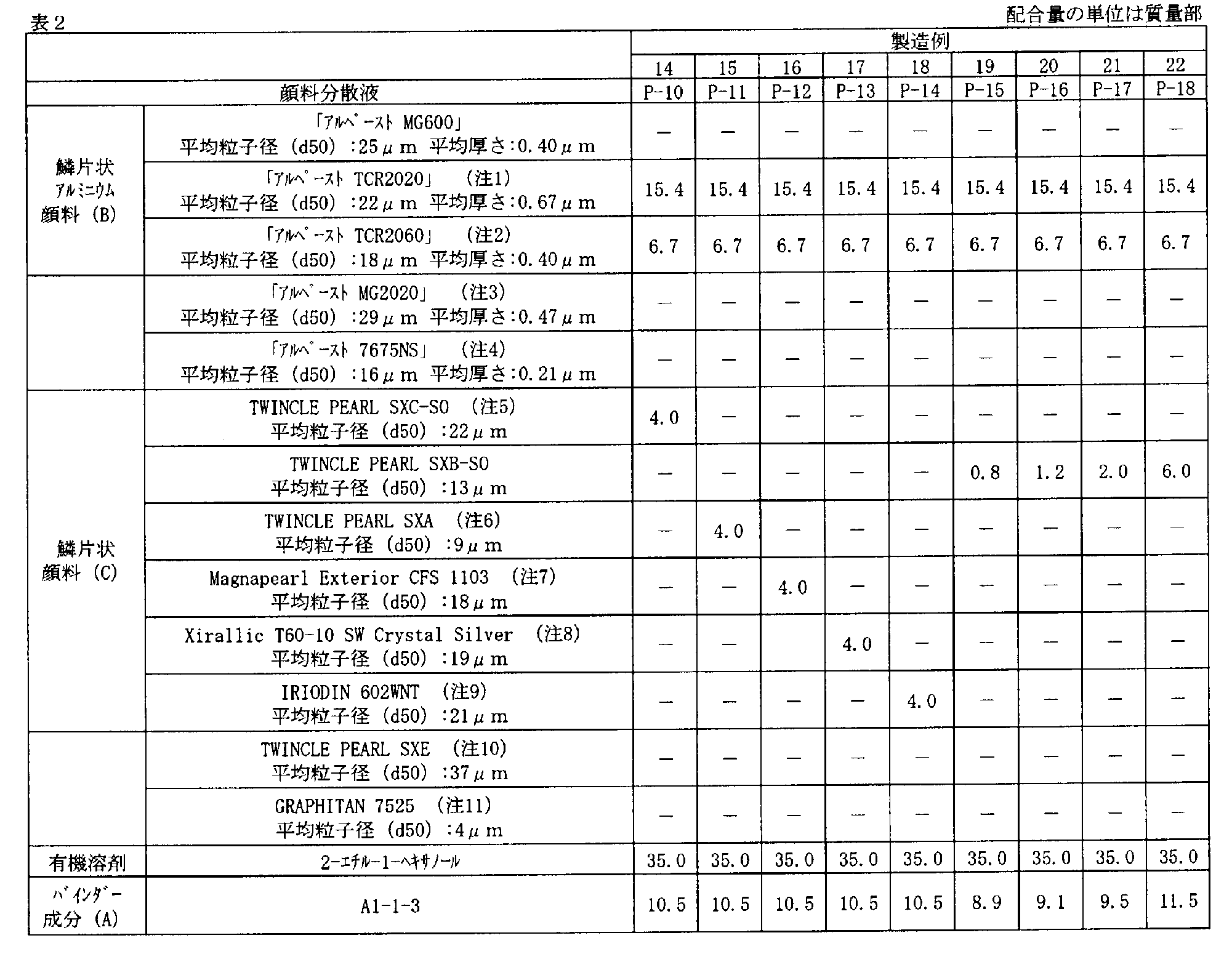

(注1)「アルペースト TCR2020」:商品名、東洋アルミニウム社製、アルミニウム顔料ペースト、平均粒子径(d50)22μm、平均厚さ0.67μm、アルミニウム含有量78%
(注2)「アルペースト TCR2060」:商品名、東洋アルミニウム社製、アルミニウム顔料ペースト、平均粒子径(d50)18μm、平均厚さ0.40μm、アルミニウム含有量75%
(注4)「アルペースト 7675NS」:商品名、東洋アルミニウム社製、アルミニウム顔料ペースト、平均粒子径(d50)16μm、平均厚さ0.21μm、アルミニウム含有量65%
(注6)「TWINCLE PEARL SXA」:商品名、日本光研工業社製、酸化チタン被覆合成雲母顔料、平均粒子径(d50):9μm、干渉色:銀色
(注7)「Magnapearl Exterior CFS 1103」:商品名、BASF製、酸化チタン被覆天然雲母顔料、平均粒子径(d50):18μm、干渉色:銀色
(注8)「Xirallic T60-10 SW Crystal Silver」:商品名、メルク社製、酸化チタン被覆酸化アルミニウム顔料、平均粒子径(d50):19μm、干渉色:銀色
(注9)「IRIODIN 602WNT」:商品名、メルク社製、酸化チタン及び酸化鉄被覆雲母顔料、平均粒子径(d50):21μm、干渉色:グレー
(注11)「GRAPHITAN 7525」:商品名、BASF社製、グラファイトフレーク顔料、平均粒子径(d50):4μm
(顔料分散液の製造)
製造例33
撹拌混合容器に、製造例2で得た水酸基含有アクリル樹脂(A1-1-2)溶液18.2部(固形分10.0部)、「JR-806」(商品名、テイカ社製、ルチル型二酸化チタン)50.0部及び脱イオン水30.0部を入れ、均一に混合し、更に、2-(ジメチルアミノ)エタノールを添加して、pH8.0に調整した。次いで、得られた混合液を容量225mLの広口ガラスビン中に入れ、分散メジアとして直径約1.3mmφのガラスビーズを加えて密封し、ペイントシェイカーにて4時間分散して、顔料分散液(D1)を得た。
撹拌混合容器に、製造例1で得た水分散性水酸基含有アクリル樹脂(A1-1-1)水分散液100.0部(固形分30.0部)、製造例2で得た水酸基含有アクリル樹脂(A1-1-2)溶液17.7部(固形分9.7部)、製造例4で得た水酸基含有ポリエステル樹脂溶液(A1-2-1)35.7部(固形分25.0部)、メラミン樹脂(商品名「サイメル325」、オルネクスジャパン社製、固形分80%)37.5部(固形分30.0部)、製造例5で得た顔料分散液(P-1)75.7部及び製造例33で得た顔料分散液(D1)0.3部を均一に混合し、更に、ポリアクリル酸系増粘剤(商品名「プライマルASE-60」ロームアンドハース社製)、2-(ジメチルアミノ)エタノール及び脱イオン水を加えてpH8.0、塗料固形分25%、20℃におけるフォードカップNo.4によって測定される粘度が40秒の塗料組成物(X1)を得た。
(試験用被塗物の作製)
リン酸亜鉛処理された冷延鋼板に、熱硬化性エポキシ樹脂系カチオン電着塗料組成物(商品名「エレクロンGT-10」、関西ペイント社製)を膜厚20μmになるように電着塗装し、170℃で30分加熱して硬化させた。次いで、この電着塗膜上に中塗り塗料組成物(商品名「TP-65-2」、関西ペイント社製、ポリエステル樹脂・アミノ樹脂系有機溶剤型塗料組成物)を膜厚35μmになるように塗装し、140℃で30分間加熱して硬化させた。かくして、鋼板上に電着塗膜及び中塗り塗膜を形成してなる試験用被塗物(1)を作製した。
塗料組成物(X1)を、前記塗膜形成方法Iの2コート1ベーク方式におけるベースコート形成用塗料として使用して、上記で得た試験用被塗物(1)上にベースコート及びクリヤーコートからなる複層塗膜を形成した。
1分間放置後、該第1ベースコート塗膜上に塗料組成物(X1)を、回転霧化型の静電塗装機を用いて、膜厚7.5μmとなるように静電塗装し、第2ベースコート塗膜を形成した。
得られた試験用塗装板を用いて、下記の評価試験を行った。結果を表4に示す。
実施例1において、塗料組成物(X1)を表4~6の配合組成によって作製した塗料組成物(X2)~(X7)、(X10)~(X20)、(X21)~(X23)、(X25)~(X29)とした以外は同様に試験用塗装板を作製し、下記の評価試験を行った。結果を表4~6に示す。
実施例1で得た試験用被塗物(1)に、下記製造例34で得られた塗料組成物(X30)を、回転霧化型の静電塗装機を用いて、膜厚10μmとなるように静電塗装し、第1ベースコート塗膜を形成した。
1分間放置後、該第1ベースコート塗膜上に表4の配合組成によって作製した塗料組成物(X8)を、回転霧化型の静電塗装機を用いて、膜厚5μmとなるように静電塗装し、第2ベースコート塗膜を形成した。
得られた試験用塗装板を用いて、下記の評価試験を行った。結果を表4に示す。
撹拌混合容器内において、「アルペースト TCR2020」(商品名、東洋アルミニウム社製、アルミニウム顔料ペースト、平均粒子径(d50)22μm、平均厚さ0.67μm、アルミニウム含有量78%)12.8部(固形分10.0部)、2-エチル-1-ヘキサノール35.0部並びに製造例3で得た水酸基及びリン酸基を有するアクリル樹脂(A1-1-3)溶液5.0部(固形分2.5部)を均一に混合して、アルミニウム顔料分散液(P-29)を得た。
実施例8において、塗料組成物(X8)を表4の配合組成によって作製した塗料組成物(X9)とした以外は同様に試験用塗装板を作製し、下記の評価試験を行った。結果を表4に示す。
実施例8において、塗料組成物(X8)を表6の配合組成によって作製した塗料組成物(X24)とした以外は同様に試験用塗装板を作製し、下記の評価試験を行った。結果を表6に示す。
なお、塗料組成物(X2)~(X29)の、20℃におけるフォードカップNo.4によって測定される粘度は40秒であった。
実施例1において、塗料組成物(X1)を下記製造例35で得られた塗料組成物(X31)とした以外は同様に試験用塗装板を作製し、下記の評価試験を行った。結果を表7に示す。
撹拌混合容器に、製造例1で得た水分散性水酸基含有アクリル樹脂(A1-1-1)水分散液100.0部(固形分30.0部)、製造例2で得た水酸基含有アクリル樹脂(A1-1-2)溶液17.7部(固形分9.7部)、製造例4で得た水酸基含有ポリエステル樹脂溶液(A1-2-1)35.7部(固形分25.0部)、メラミン樹脂(商品名「サイメル325」、オルネクスジャパン社製、固形分80%)37.5部(固形分30.0部)、製造例5で得た顔料分散液(P-1)75.7部、製造例33で得た顔料分散液(D1)0.3部及び下記製造例36で得られた顔料分散液(D2)10.0部(固形分1部)を均一に混合し、更に、ポリアクリル酸系増粘剤(商品名「プライマルASE-60」ロームアンドハース社製)、2-(ジメチルアミノ)エタノール及び脱イオン水を加えてpH8.0、塗料固形分25%、20℃におけるフォードカップNo.4によって測定される粘度が40秒の塗料組成物(X31)を得た。
「ACEMATT OK607」(商品名、Evonic社製、シリカ)1部及び脱イオン水9部を均一に混合して、顔料分散液(D2)を得た。
実施例21において、塗料組成物(X31)を表7の配合組成によって作製した塗料組成物(X32)~(X33)とした以外は同様に試験用塗装板を作製し、下記の評価試験を行った。結果を表7に示す。
実施例10において、クリヤー塗料組成物(Y1)を下記製造例37で得られたクリヤー塗料組成物(Y2)とし、クリヤーコート塗膜の7分間放置後の加熱温度を120℃とした以外は同様に試験用塗装板を作製し、下記の評価試験を行った。結果を表7に示す。
温度計、サーモスタット、撹拌装置、還流冷却器、窒素導入管及び滴下装置を備えた反応容器に、「スワゾール1000」(商品名、コスモ石油社製、芳香族系有機溶剤)27部及びプロピレングリコールモノメチルエーテルアセテート5部を仕込み、窒素ガスを吹き込みながら150℃で撹拌し、この中にスチレン20部、2-ヒドロキシプロピルアクリレート32.5部、イソブチルメタクリレート46.8部、アクリル酸0.7部及びジターシャリアミルパーオキサイド(重合開始剤)6.0部からなるモノマー混合物を4時間かけて均一速度で滴下した。その後、150℃で1時間熟成させた後冷却し、さらに酢酸イソブチルを21部加えて希釈し、固形分濃度65質量%の水酸基含有アクリル樹脂(y-1)溶液を得た。得られた水酸基含有アクリル樹脂(y-1)の水酸基価は139mgKOH/g、酸価は5.5mgKOH/g、重量平均分子量は5,500、ガラス転移温度38℃であった。
実施例24において、塗料組成物(X10)を表7の配合組成によって作製した塗料組成物(X31)~(X33)とした以外は同様に試験用塗装板を作製し、下記の評価試験を行った。結果を表7に示す。
温度計、サーモスタット、撹拌装置、還流冷却器、窒素導入管及び滴下装置を備えた反応容器にエチル-3-エトキシプロピオネート15部及びn-ブチルプロピオネート15部を仕込み、155℃に昇温後、スチレン10部、メチルメタクリレート20部、イソボルニルアクリレート30部、2-エチルヘキシルアクリレート20部、2-ヒドロキシエチルアクリレート20部及び2,2-ジ(t-アミルパーオキシ)ブタン(重合開始剤)4.5部からなるモノマー混合物を5時間かけて滴下し、滴下終了後2時間熟成し、固形分75%の水酸基含有アクリル樹脂(A1-1-4)溶液を得た。得られた水酸基含有アクリル樹脂は水酸基価が97mgKOH/g、重量平均分子量が5,500であった。
製造例38で得た水酸基含有アクリル樹脂(A1-1-4)溶液26.6部(樹脂固形分20部)、「JR-806」(商品名、テイカ社製、ルチル型二酸化チタン)40部及びキシレン15部を広口ガラスビン中に入れ、ガラスビーズを加えて密封し、ペイントシェーカーで30分間分散した後、ガラスビーズを除去して、顔料分散液(D3)を得た。
「ACEMATT OK607」(商品名、Evonic社製、シリカ)1部及びトルエン9部を均一に混合して、顔料分散液(D4)を得た。
実施例24において、塗料組成物(X10)を下記製造例41で得られた塗料組成物(X35)とし、第2ベースコート塗膜形成後の放置時間を5分間とし、プレヒートを行わなかった以外は同様に試験用塗装板を作製し、下記の評価試験を行った。結果を表8に示す。
製造例38で得た水酸基含有アクリル樹脂溶液(A1-1-4)93.3部(樹脂固形分70部)、「サイメル325」(メラミン樹脂、オルネクスジャパン社製、固形分80%)37.5部(固形分30部)、「アルペースト MG600」(商品名、東洋アルミニウム社製、アルミニウム顔料ペースト、平均粒子径(d50)25μm、平均厚さ0.40μm、アルミニウム含有量65%)26.2部(固形分17.0部)、「TWINCLE PEARL SXB-SO」(商品名、日本光研工業社製、酸化チタン被覆合成雲母顔料、平均粒子径(d50):13μm、干渉色:銀色)4.0部、製造例39で得た顔料分散液(D3)0.3部及び製造例40で得た顔料分散液(D4)10.0部(固形分1部)を均一に混合した。次いで、キシレン/スワゾール1000(商品名、コスモ石油社製、石油系芳香族炭化水素系溶剤)=50/50(質量比)の混合溶剤を添加することにより、20℃におけるフォードカップNo.3による粘度が17秒の塗料組成物(X35)を得た。
実施例28において、塗料組成物(X35)を下記製造例42で得られた塗料組成物(X36)とした以外は同様に試験用塗装板を作製し、下記の評価試験を行った。結果を表8に示す。
製造例38で得た水酸基含有アクリル樹脂溶液(A1-1-4)93.3部(樹脂固形分70部)、「サイメル325」(メラミン樹脂、オルネクスジャパン社製、固形分80%)37.5部(固形分30部)、「アルペースト TCR2060」(商品名、東洋アルミニウム社製、アルミニウム顔料ペースト、平均粒子径(d50)18μm、平均厚さ0.40μm、アルミニウム含有量75%)22.7部(固形分17.0部)、「TWINCLE PEARL SXB-SO」(商品名、日本光研工業社製、酸化チタン被覆合成雲母顔料、平均粒子径(d50):13μm、干渉色:銀色)4.0部、製造例39で得た顔料分散液(D3)0.3部及び製造例40で得た顔料分散液(D4)10.0部(固形分1部)を均一に混合した。次いで、キシレン/スワゾール1000(商品名、コスモ石油社製、石油系芳香族炭化水素系溶剤)=50/50(質量比)の混合溶剤を添加することにより、20℃におけるフォードカップNo.3による粘度が17秒の塗料組成物(X36)を得た。
実施例28において、塗料組成物(X35)を下記製造例43で得られた塗料組成物(X37)とした以外は同様に試験用塗装板を作製し、下記の評価試験を行った。結果を表8に示す。
製造例38で得た水酸基含有アクリル樹脂溶液(A1-1-4)93.3部(樹脂固形分70部)、「サイメル325」(メラミン樹脂、オルネクスジャパン社製、固形分80%)37.5部(固形分30部)、「アルペースト TCR2020」(商品名、東洋アルミニウム社製、アルミニウム顔料ペースト、平均粒子径(d50)22μm、平均厚さ0.67μm、アルミニウム含有量78%)15.4部(固形分12.0部)、「アルペースト TCR2060」(商品名、東洋アルミニウム社製、アルミニウム顔料ペースト、平均粒子径(d50)18μm、平均厚さ0.40μm、アルミニウム含有量75%)6.7部(固形分5.0部)、「TWINCLE PEARL SXC-SO」(商品名、日本光研工業社製、酸化チタン被覆合成雲母顔料、平均粒子径(d50):22μm、干渉色:銀色)4.0部、製造例39で得た顔料分散液(D3)0.3部及び製造例40で得た顔料分散液(D4)10.0部(固形分1部)を均一に混合した。次いで、キシレン/スワゾール1000(商品名、コスモ石油社製、石油系芳香族炭化水素系溶剤)=50/50(質量比)の混合溶剤を添加することにより、20℃におけるフォードカップNo.3による粘度が17秒の塗料組成物(X37)を得た。
実施例28~30において、クリヤー塗料組成物(Y2)をクリヤー塗料組成物(Y1)とし、クリヤーコート塗膜の7分間放置後の加熱温度を140℃とした以外は同様に試験用塗装板を作製し、下記の評価試験を行った。結果を表8に示す。
実施例31~33において、クリヤー塗料組成物(Y1)を下記製造例44で得られたクリヤー塗料組成物(Y3)とした以外は同様に試験用塗装板を作製し、下記の評価試験を行った。結果を表8に示す。
製造例37で得た水酸基含有アクリル樹脂(y-1)溶液100部(固形分65部)、「ユーバン20SE60」(商品名、三井化学社製、メラミン樹脂、固形分含有率60%)58部(固形分35部)及び「BYK-300」0.4部(固形分0.2部)を均一に混合し、さらに、酢酸ブチルを加えて、20℃におけるフォードカップNo.4による粘度が30秒となるように調整してクリヤー塗料組成物(Y3)を得た。
比較例5において、クリヤー塗料組成物(Y1)を製造例37で得られたクリヤー塗料組成物(Y2)とし、クリヤーコート塗膜の7分間放置後の加熱温度を120℃とした以外は同様に試験用塗装板を作製し、下記の評価試験を行った。結果を表9に示す。
実施例28において、塗料組成物(X35)を下記製造例45で得られた塗料組成物(X38)とした以外は同様に試験用塗装板を作製し、下記の評価試験を行った。結果を表9に示す。
製造例38で得た水酸基含有アクリル樹脂溶液(A1-1-4)93.3部(樹脂固形分70部)、「サイメル325」(メラミン樹脂、オルネクスジャパン社製、固形分80%)37.5部(固形分30部)、「アルペースト TCR2020」(商品名、東洋アルミニウム社製、アルミニウム顔料ペースト、平均粒子径(d50)22μm、平均厚さ0.67μm、アルミニウム含有量78%)15.4部(固形分12.0部)、「アルペースト TCR2060」(商品名、東洋アルミニウム社製、アルミニウム顔料ペースト、平均粒子径(d50)18μm、平均厚さ0.40μm、アルミニウム含有量75%)6.7部(固形分5.0部)、製造例39で得た顔料分散液(D3)0.3部及び製造例40で得た顔料分散液(D4)10.0部(固形分1部)を均一に混合した。次いで、キシレン/スワゾール1000(商品名、コスモ石油社製、石油系芳香族炭化水素系溶剤)=50/50(質量比)の混合溶剤を添加することにより、20℃におけるフォードカップNo.3による粘度が17秒の塗料組成物(X38)を得た。
比較例11において、クリヤー塗料組成物(Y2)をクリヤー塗料組成物(Y1)とし、クリヤーコート塗膜の7分間放置後の加熱温度を140℃とした以外は同様に試験用塗装板を作製し、下記の評価試験を行った。結果を表9に示す。
比較例12において、クリヤー塗料組成物(Y1)をクリヤー塗料組成物(Y3)とした以外は同様に試験用塗装板を作製し、下記の評価試験を行った。結果を表9に示す。
実施例1と同様にして塗料組成物(X1)を得た。
(試験用被塗物の作製)
リン酸亜鉛処理された冷延鋼板に、熱硬化性エポキシ樹脂系カチオン電着塗料組成物(商品名「エレクロンGT-10」、関西ペイント社製)を膜厚20μmになるように電着塗装し、170℃で30分加熱して硬化させた。次いで、この電着塗膜上に下記製造例46で得た水性中塗り塗料組成物αを膜厚20μmになるように塗装し、2分間放置後、80℃で3分間プレヒートを行なった。かくして、鋼板上に硬化した電着塗膜及び未硬化の中塗り塗膜を形成してなる試験用被塗物(2)を作製した。
塗料組成物(X1)を、前記塗膜形成方法IIの3コート1ベーク方式におけるベースコート形成用塗料として使用して、上記で得た試験用被塗物(2)上にベースコート及びクリヤーコートからなる複層塗膜を形成した。
1分間放置後、該第1ベースコート塗膜上に塗料組成物(X1)を、回転霧化型の静電塗装機を用いて、膜厚7.5μmとなるように静電塗装し、第2ベースコート塗膜を形成した。
得られた試験用塗装板を用いて、下記の評価試験を行った。結果を表10に示す。
温度計、サーモスタット、撹拌装置、還流冷却器及び水分離器を備えた反応容器に、トリメチロールプロパン174部、ネオペンチルグリコール327部、アジピン酸352部、イソフタル酸109部及び1,2-シクロヘキサンジカルボン酸無水物101部を仕込み、160℃から230℃まで3時間かけて昇温させた後、生成した縮合水を水分離器により留去させながら230℃で保持し、酸価が3mgKOH/g以下となるまで反応させた。この反応生成物に、無水トリメリット酸59部を添加し、170℃で30分間付加反応を行った後、50℃以下に冷却し、2-(ジメチルアミノ)エタノールを酸基に対して当量添加し中和してから、脱イオン水を徐々に添加することにより、固形分濃度45%、pH7.2の水酸基含有ポリエステル樹脂溶液(A1-2-2)を得た。得られた水酸基含有ポリエステル樹脂は、酸価が35mgKOH/g、水酸基価が128mgKOH/g、重量平均分子量が13000であった。
実施例37において、塗料組成物(X1)を表10~12、14に記載の塗料組成物とした以外は同様に試験用塗装板を作製し、下記の評価試験を行った。結果を表10~12、14に示す。
実施例37で得た試験用被塗物(2)に、製造例34で得られた塗料組成物(X30)を、回転霧化型の静電塗装機を用いて、膜厚10μmとなるように静電塗装し、第1ベースコート塗膜を形成した。
1分間放置後、該第1ベースコート塗膜上に表4の配合組成によって作製した塗料組成物(X8)を、回転霧化型の静電塗装機を用いて、膜厚5μmとなるように静電塗装し、第2ベースコート塗膜を形成した。
得られた試験用塗装板を用いて、下記の評価試験を行った。結果を表11に示す。
実施例44において、塗料組成物(X8)を表11に記載の塗料組成物とした以外は同様に試験用塗装板を作製し、下記の評価試験を行った。結果を表11に示す。
実施例37において、塗料組成物(X1)を表13、14に記載の塗料組成物とし、クリヤー塗料組成物(Y1)を製造例37で得られたクリヤー塗料組成物(Y2)とし、クリヤーコート塗膜の7分間放置後の加熱温度を120℃とした以外は同様に試験用塗装板を作製し、下記の評価試験を行った。結果を表13、14に示す。
実施例44において、塗料組成物(X8)を下記製造例47で得られた塗料組成物(X34)とし、クリヤー塗料組成物(Y1)を製造例37で得られたクリヤー塗料組成物(Y2)とし、クリヤーコート塗膜の7分間放置後の加熱温度を120℃とした以外は同様に試験用塗装板を作製し、下記の評価試験を行った。結果を表13に示す。
撹拌混合容器内において、「アルペースト TCR2020」(商品名、東洋アルミニウム社製、アルミニウム顔料ペースト、平均粒子径(d50)22μm、平均厚さ0.67μm、アルミニウム含有量78%)25.6部(固形分20.0部)、「TWINCLE PEARL SXB-SO」(商品名、日本光研工業社製、酸化チタン被覆合成雲母顔料、平均粒子径(d50):13μm、干渉色:銀色)4.0部、2-エチル-1-ヘキサノール40.0部並びに製造例3で得た水酸基及びリン酸基を有するアクリル樹脂(A1-1-3)溶液12.0部(固形分6.0部)を均一に混合して、顔料分散液(P-200)を得た。
実施例44~45において、クリヤー塗料組成物(Y1)を製造例37で得られたクリヤー塗料組成物(Y2)とし、クリヤーコート塗膜の7分間放置後の加熱温度を120℃とした以外は同様に試験用塗装板を作製し、下記の評価試験を行った。結果を表13に示す。
(粒子感(目視))
得られた各試験用塗装板を目視にて観察し、下記基準にて評価した。評価は、色彩開発に3年以上従事するデザイナー2名と技術者3名の計5名が協議することによって行なった。A及びBが合格レベルである。
A:粒子感が極めて高かった。
B:粒子感が高かった。
C:粒子感がやや低かった。
D:粒子感が低かった。
得られた各試験用塗装板について、「BYK-mac」(商品名、BYKガードナー社製)を用いて粒状性値(G値)を測定した。なお、粒状性値(G値)が大きいほど、粒子感が高いことを示す。例えば、粒子感が高い塗膜を得る場合、粒状性値(G値)は5.0以上が好ましい。
得られた各試験用塗装板を目視にて観察し、下記基準にて評価した。評価は、色彩開発に3年以上従事するデザイナー2名と技術者3名の計5名が協議することによって行なった。A及びBが合格レベルである。
A:メタリックムラがほとんど認められず、極めて優れた塗膜外観を有していた。
B:メタリックムラがわずかに認められるが、優れた塗膜外観を有していた。
C:メタリックムラが認められ、塗膜外観がやや劣っていた。
D:メタリックムラが多く認められ、塗膜外観が劣っていた。
多角度分光光度計(商品名「MA-68II」、x-Rite社製)を使用して、得られた各試験用塗装板において受光角15度のL*値(L*15値)及び受光角75度のL*値(L*75値)を測定し、各試験用塗装板上の塗膜のFF値を下記式によって算出し、下記基準にて評価した。A、B及びCが合格レベルである。
FF値=L*15値/L*75値
A:FF値が4.0以上であった。
B:FF値が2.5以上4.0未満であった。
C:FF値が2.0以上2.5未満であった。
D:FF値が1.5以上2.0未満であった。
E:FF値が1.5 未満であった。
得られた各試験用塗装板について、「Wave Scan」(商品名、BYK Gardner社製)を用いてShort Wave(SW)値を測定し、下記基準にて評価した。SW値が小さいほど塗面の鮮映性が高いことを示す。A、B及びCが合格レベルである。
A:SW値が5.0未満であった。
B:SW値が5.0以上7.0未満であった。
C:SW値が7.0以上9.0未満であった。
D:SW値が9.0以上10.0未満であった。
E:SW値が10.0以上であった。

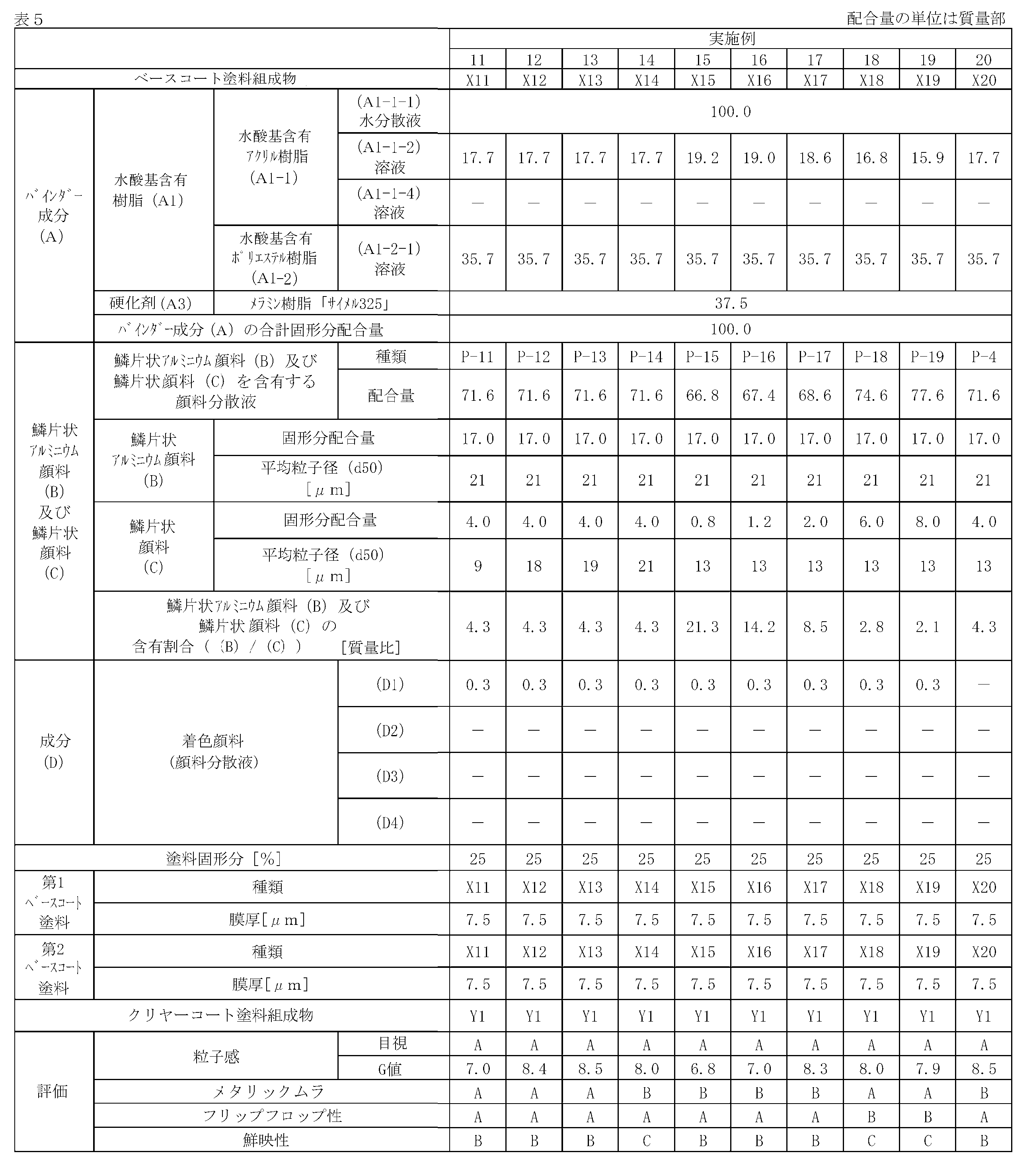
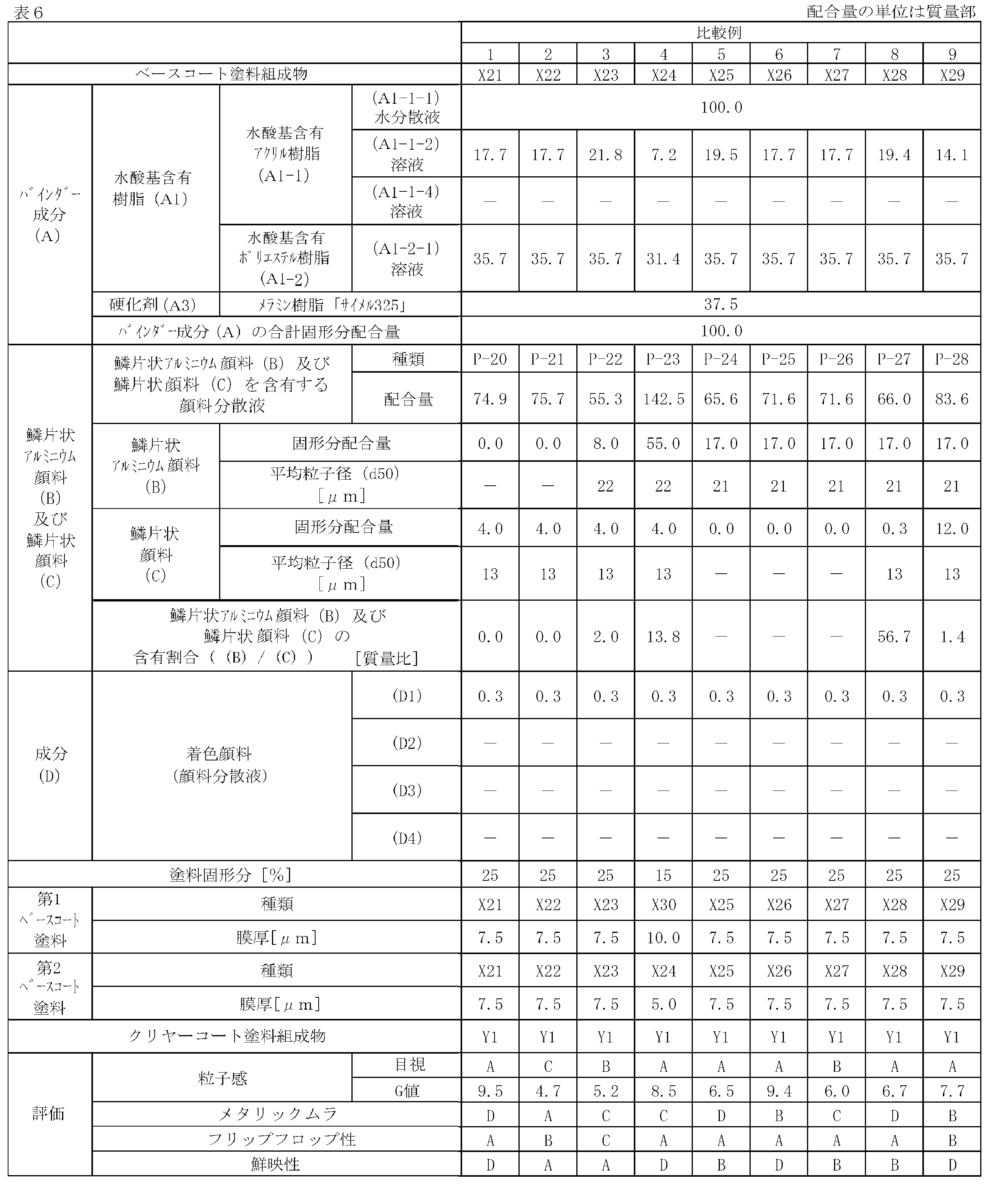

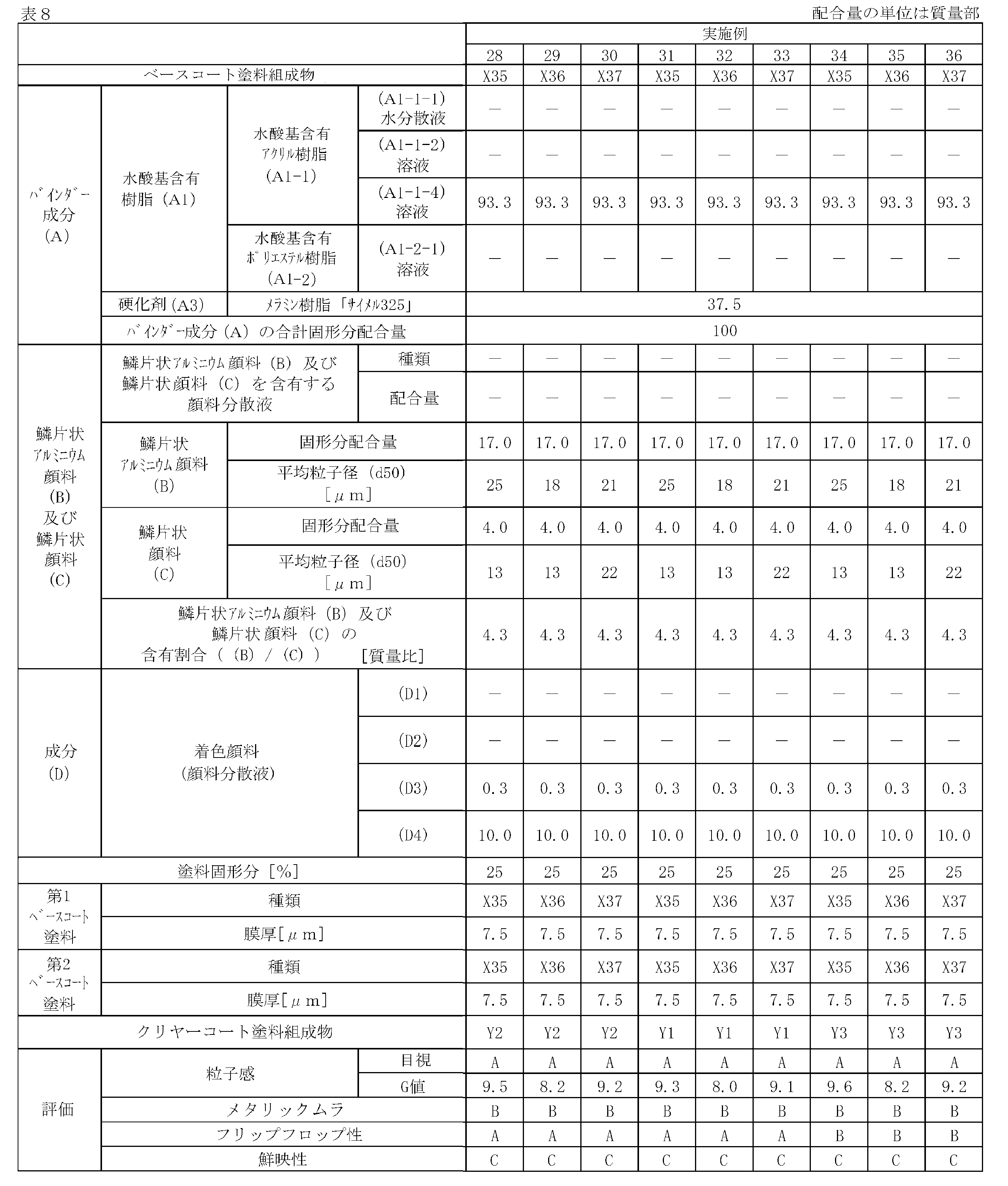


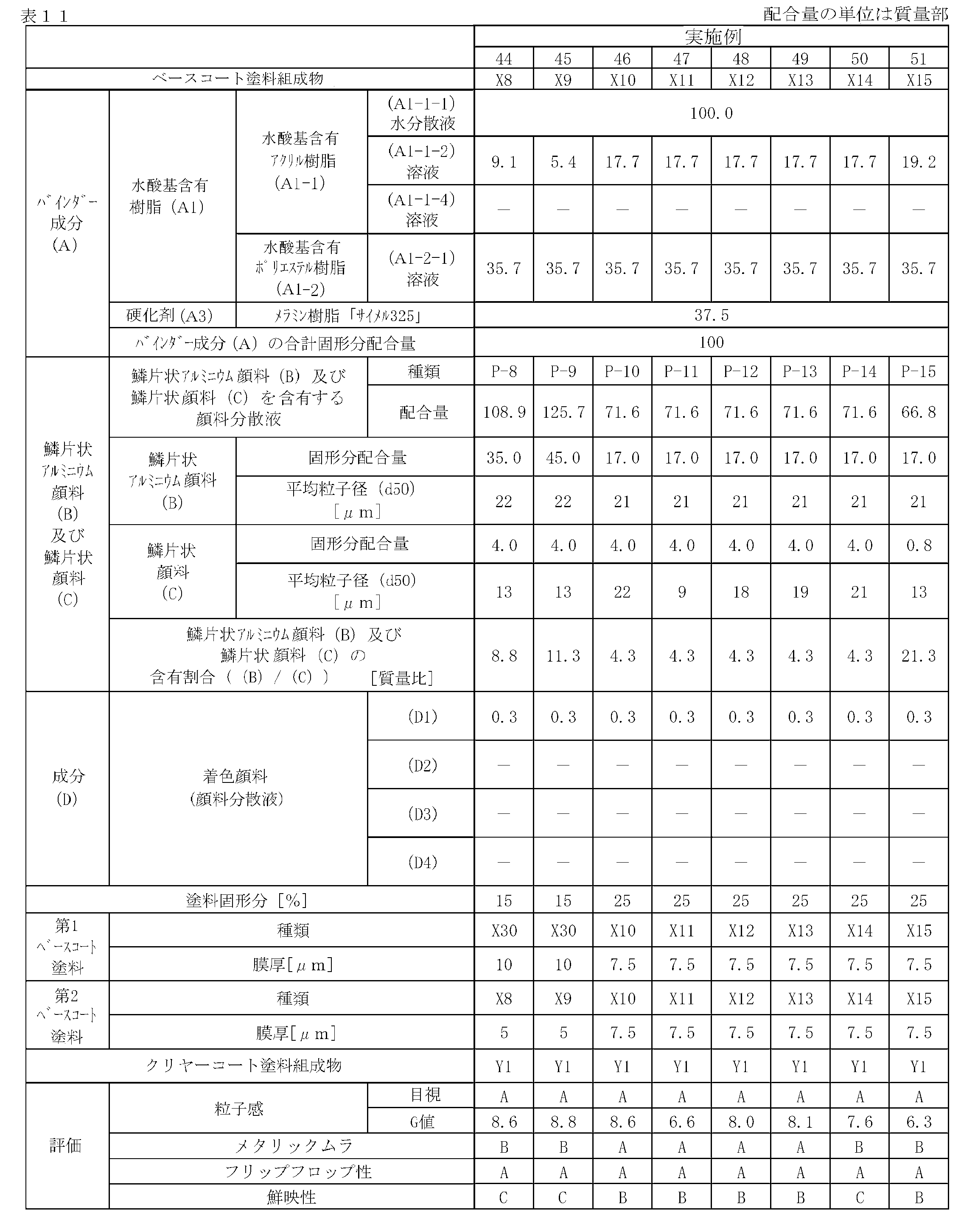
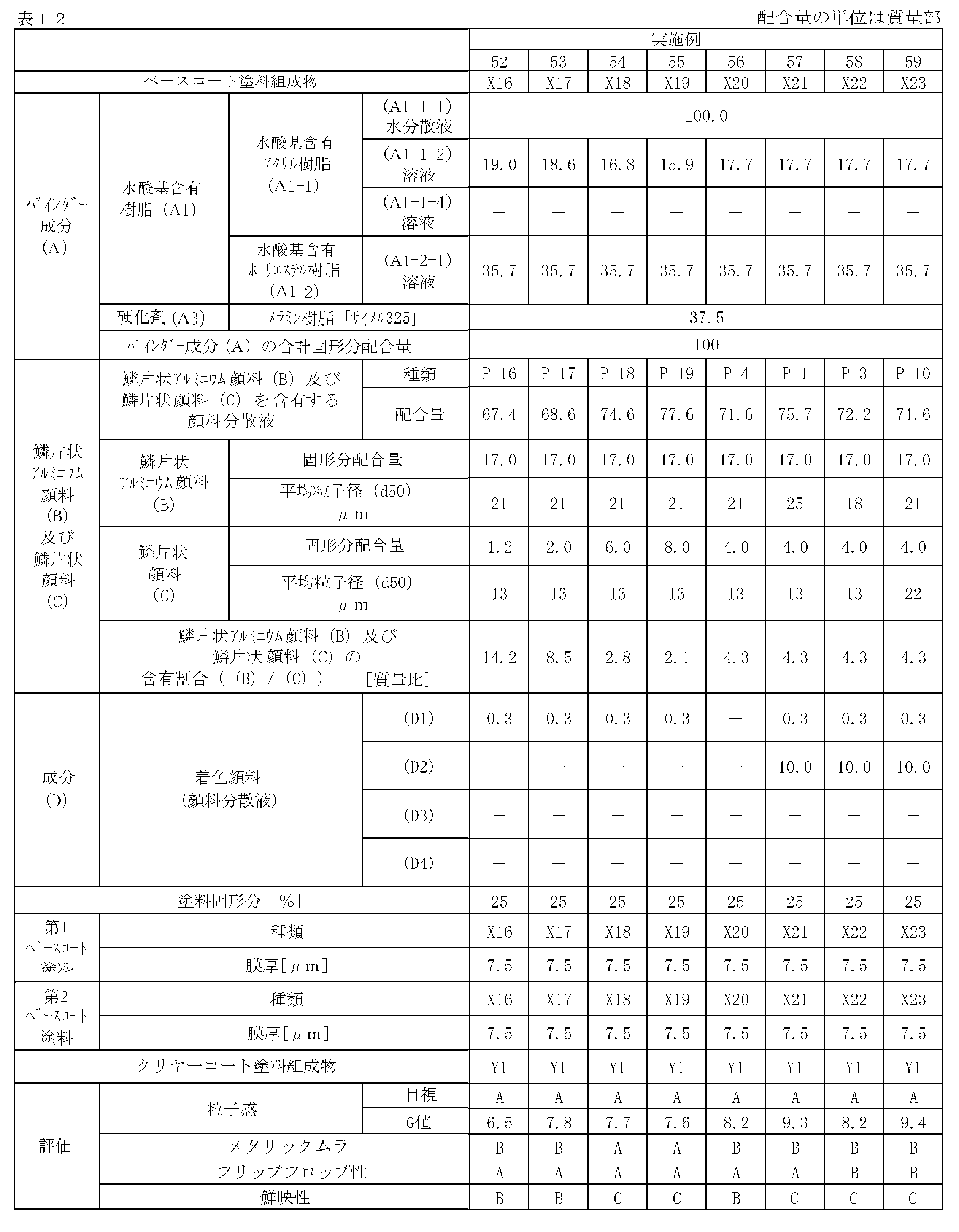
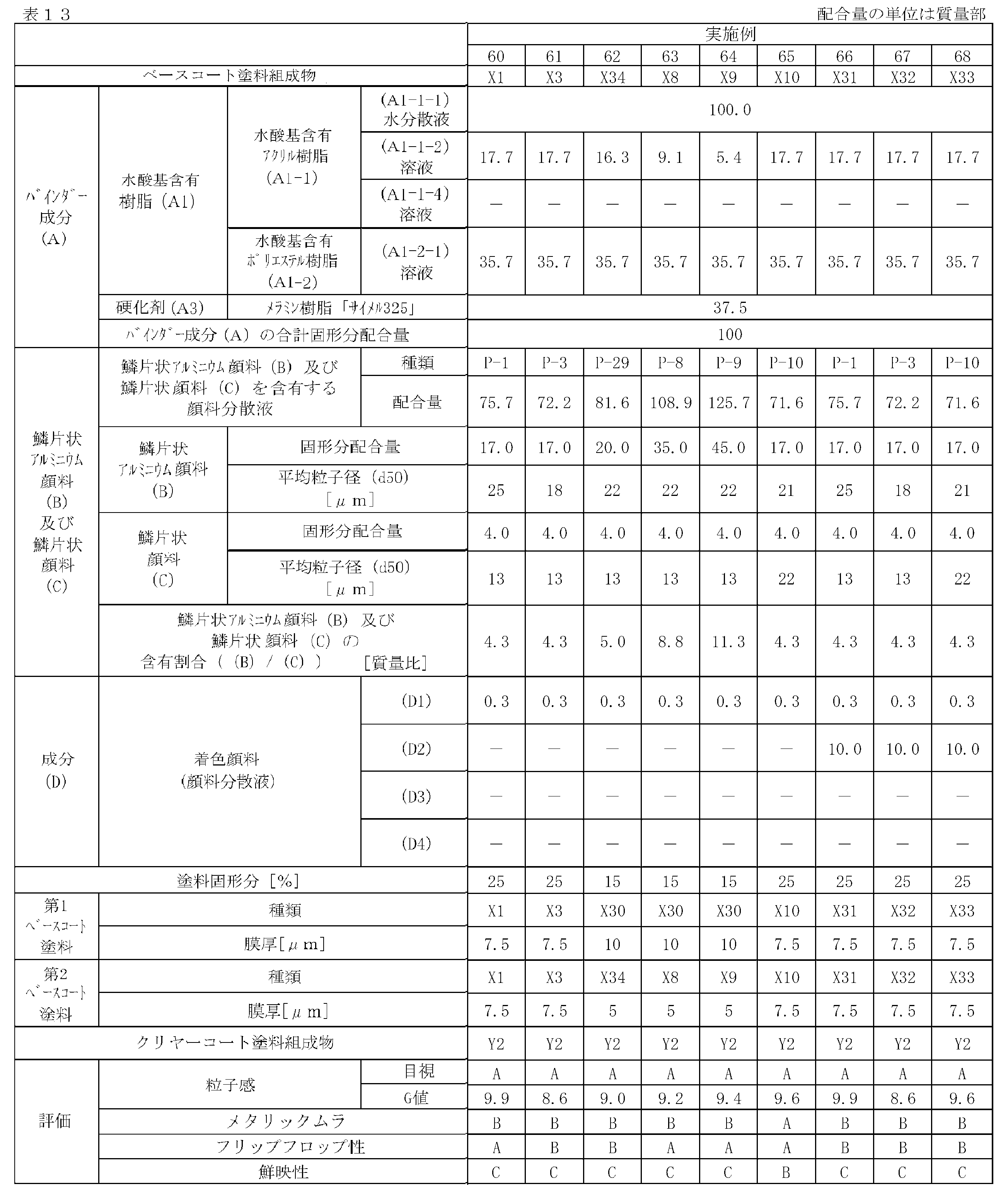
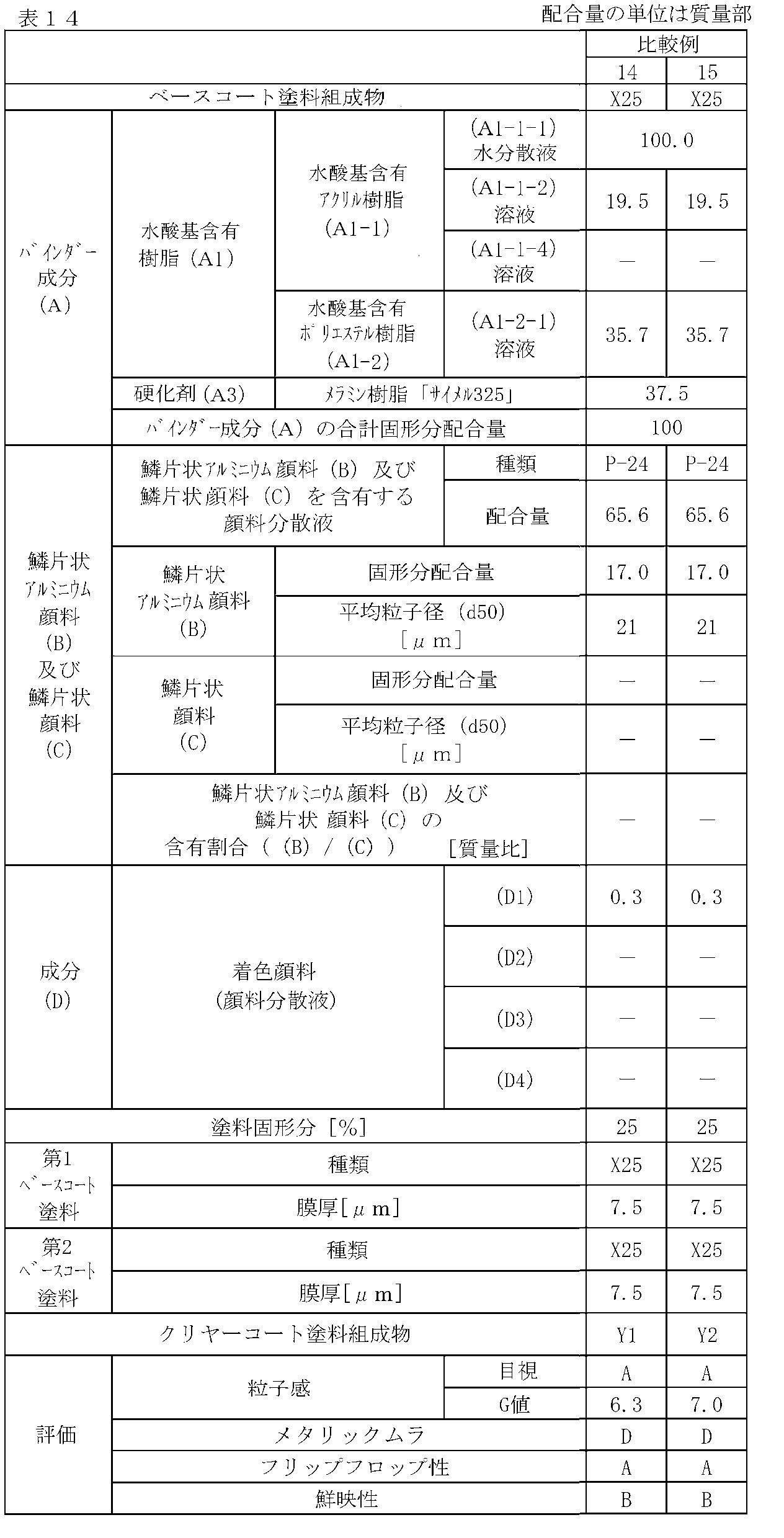
Claims (8)
- バインダー成分(A)、平均粒子径(d50)が18~25μmの範囲内である鱗片状アルミニウム顔料(B)及び平均粒子径(d50)が8~30μmの範囲内である鱗片状アルミニウム顔料以外の鱗片状顔料(C)を含有する塗料組成物であって、
前記バインダー成分(A)100質量部を基準として、前記鱗片状アルミニウム顔料(B)の含有量が10~50質量部の範囲内であり、前記鱗片状アルミニウム顔料以外の鱗片状顔料(C)の含有量が0.5~10質量部の範囲内であり、
かつ前記鱗片状アルミニウム顔料(B)及び前記鱗片状アルミニウム顔料以外の鱗片状顔料(C)の含有割合(B)/(C)が固形分質量比で2/1~50/1の範囲内である、塗料組成物。 - 前記鱗片状アルミニウム顔料(B)の平均厚さが0.10~0.80μmの範囲内である、請求項1に記載の塗料組成物。
- 前記鱗片状アルミニウム顔料以外の鱗片状顔料(C)の平均厚さが0.20~0.60μmの範囲内である、請求項1又は2に記載の塗料組成物。
- 前記鱗片状アルミニウム顔料以外の鱗片状顔料(C)が酸化チタン被覆雲母顔料、酸化チタン及び酸化鉄被覆雲母顔料、酸化チタン被覆酸化アルミニウム顔料、並びに酸化チタン及び酸化鉄被覆アルミニウム顔料から成る群から選択される少なくとも1種を含有する、請求項1~3のいずれか1項に記載の塗料組成物。
- 前記塗料組成物を硬化させた硬化塗膜の、膜厚15μmにおける下記式により求められるフリップフロップ値が2.0~30.0の範囲内である、請求項1~4のいずれか1項に記載の塗料組成物。
フリップフロップ値=L*15値/L*75値
(式中、L*15値は受光角15度のL*値を、L*75値は受光角75度のL*値を示す。) - 前記塗料組成物を硬化させた硬化塗膜の、膜厚15μmにおける粒状性値(G値)が5.0~10.0の範囲内である、請求項1~5のいずれか1項に記載の塗料組成物。
- 被塗物上に、請求項1~6のいずれか1項に記載の塗料組成物を硬化させた硬化塗膜を有する塗装物品。
- (1)被塗物に、ベースコート塗料組成物(X)を塗装して未硬化のベースコート塗膜を形成する工程、
(2)前記未硬化のベースコート塗膜上に、クリヤーコート塗料組成物(Y)を塗装して未硬化のクリヤーコート塗膜を形成する工程、並びに
(3)前記未硬化のベースコート塗膜及び前記未硬化のクリヤーコート塗膜を加熱して、両塗膜を同時に硬化させる工程を含む複層塗膜形成方法であって、
前記ベースコート塗料組成物(X)が請求項1~6のいずれか1項に記載の塗料組成物である複層塗膜形成方法。
Priority Applications (4)
| Application Number | Priority Date | Filing Date | Title |
|---|---|---|---|
| CN201880083341.6A CN111511855B (zh) | 2017-12-28 | 2018-12-27 | 涂料组合物、被涂覆的制品和形成多层涂膜的方法 |
| EP18896561.0A EP3733802B1 (en) | 2017-12-28 | 2018-12-27 | Coating composition, coated article and method for forming multilayer coating film |
| CA3087167A CA3087167C (en) | 2017-12-28 | 2018-12-27 | Coating composition, coated article and method for forming multilayer coating film |
| US16/958,007 US12297373B2 (en) | 2017-12-28 | 2018-12-27 | Coating composition, coated article and method for forming multilayer coating film |
Applications Claiming Priority (2)
| Application Number | Priority Date | Filing Date | Title |
|---|---|---|---|
| JP2017-254157 | 2017-12-28 | ||
| JP2017254157 | 2017-12-28 |
Publications (1)
| Publication Number | Publication Date |
|---|---|
| WO2019131957A1 true WO2019131957A1 (ja) | 2019-07-04 |
Family
ID=66934363
Family Applications (1)
| Application Number | Title | Priority Date | Filing Date |
|---|---|---|---|
| PCT/JP2018/048348 Ceased WO2019131957A1 (ja) | 2017-12-28 | 2018-12-27 | 塗料組成物、塗装物品及び複層塗膜形成方法 |
Country Status (6)
| Country | Link |
|---|---|
| US (1) | US12297373B2 (ja) |
| EP (1) | EP3733802B1 (ja) |
| JP (1) | JP6533863B1 (ja) |
| CN (1) | CN111511855B (ja) |
| CA (1) | CA3087167C (ja) |
| WO (1) | WO2019131957A1 (ja) |
Cited By (8)
| Publication number | Priority date | Publication date | Assignee | Title |
|---|---|---|---|---|
| WO2021108699A1 (en) | 2019-11-29 | 2021-06-03 | Viavi Solutions Inc. | A composition including a color shifting pigment having a different particle size |
| CN113355002A (zh) * | 2020-03-04 | 2021-09-07 | 关西涂料株式会社 | 涂料组合物和多层涂膜形成方法 |
| CN113388272A (zh) * | 2021-06-24 | 2021-09-14 | 上海戎科特种装备有限公司 | 一种包覆铝粉及其制备方法和包含包覆铝粉的涂料 |
| WO2022004469A1 (ja) | 2020-07-03 | 2022-01-06 | 日本ペイント・オートモーティブコーティングス株式会社 | 塗料組成物および塗料組成物の製造方法 |
| WO2022004470A1 (ja) | 2020-07-03 | 2022-01-06 | 日本ペイント・オートモーティブコーティングス株式会社 | 塗料組成物および塗料組成物の製造方法 |
| JPWO2023007697A1 (ja) * | 2021-07-30 | 2023-02-02 | ||
| JP2024033974A (ja) * | 2022-08-31 | 2024-03-13 | 日本ペイント・オートモーティブコーティングス株式会社 | 複層塗膜および塗装物品の製造方法 |
| EP4263217A4 (en) * | 2020-12-18 | 2024-11-20 | 3M Innovative Properties Company | DECORATIVE LAMINATE COMPRISING METAL LAYER AND METHOD FOR PRODUCING SAME, AND METAL COATING COMPOSITION |
Families Citing this family (12)
| Publication number | Priority date | Publication date | Assignee | Title |
|---|---|---|---|---|
| KR102706797B1 (ko) * | 2018-02-23 | 2024-09-19 | 닛신보 케미칼 가부시키가이샤 | 수지 조성물, 수지 재료 및 수지 가교체 |
| KR102605853B1 (ko) | 2019-04-12 | 2023-11-24 | 엑카르트 게엠베하 | 레이더 주파수 투과성 효과 안료 혼합물, 그의 배합물 및 코팅 |
| US20210040329A1 (en) | 2019-08-09 | 2021-02-11 | Ppg Industries Ohio, Inc. | Coating system for radar transmission and methods for making and using the same |
| WO2021198120A1 (en) * | 2020-03-30 | 2021-10-07 | Basf Coatings Gmbh | Paints having enhanced reflectivity |
| JP6887704B1 (ja) * | 2020-08-26 | 2021-06-16 | ナトコ株式会社 | 着色樹脂組成物及びその製造方法、並びに着色成形体 |
| JP2022066178A (ja) * | 2020-10-16 | 2022-04-28 | 関西ペイント株式会社 | 光輝性塗料組成物 |
| JP6904529B1 (ja) * | 2020-11-26 | 2021-07-21 | ハニー化成株式会社 | アルミニウム顔料を含有する水性樹脂組成物、水性電着樹脂液、水性電着塗料、塗膜、及び電着塗膜の形成方法 |
| CN113563809B (zh) * | 2021-08-17 | 2022-03-08 | 深圳市高仁电子新材料有限公司 | 一种具有紫外线阻隔功能的丙烯酸光学胶及其制备方法 |
| US20250026942A1 (en) * | 2021-11-18 | 2025-01-23 | Kansai Paint Co., Ltd. | Coating composition |
| JP2023108786A (ja) * | 2022-01-26 | 2023-08-07 | 京セラドキュメントソリューションズ株式会社 | インクジェット用インク |
| KR102783327B1 (ko) * | 2022-03-25 | 2025-03-19 | 주식회사 케이씨씨 | 도료 조성물 |
| EP4458912A1 (en) * | 2023-05-01 | 2024-11-06 | Ink Invent IP B.V. | Retroreflective powder coating composition |
Citations (4)
| Publication number | Priority date | Publication date | Assignee | Title |
|---|---|---|---|---|
| JP2005239801A (ja) | 2004-02-25 | 2005-09-08 | Basf Coatings Japan Ltd | メタリック塗料組成物、塗膜形成方法および塗装物品 |
| JP2008521585A (ja) * | 2004-11-29 | 2008-06-26 | Basfコーティングスジャパン株式会社 | 金属調光輝性塗膜形成方法および塗装物品 |
| JP2012017364A (ja) * | 2010-07-06 | 2012-01-26 | Kansai Paint Co Ltd | メタリック塗料組成物及び塗膜形成方法 |
| WO2016042824A1 (ja) * | 2014-09-19 | 2016-03-24 | 東洋アルミニウム株式会社 | 塗料組成物および該塗料組成物により形成された塗膜を有する塗布物 |
Family Cites Families (18)
| Publication number | Priority date | Publication date | Assignee | Title |
|---|---|---|---|---|
| JP2609513B2 (ja) * | 1994-12-14 | 1997-05-14 | 本田技研工業株式会社 | 複層塗膜形成法 |
| JPH11116861A (ja) * | 1997-10-13 | 1999-04-27 | Nippon Paint Co Ltd | 光輝性塗料組成物、光輝性塗膜形成方法及び光輝性塗装物 |
| JP4290837B2 (ja) | 1999-11-30 | 2009-07-08 | 日本ペイント株式会社 | メタリック塗膜の形成方法 |
| JP2001164191A (ja) * | 1999-12-07 | 2001-06-19 | Nippon Paint Co Ltd | 光輝性塗料組成物、塗膜形成方法および塗装物 |
| JP2002121492A (ja) | 2000-10-19 | 2002-04-23 | Nippon Paint Co Ltd | 光輝性塗料組成物、塗膜形成方法および塗装物 |
| JP2002155242A (ja) * | 2000-11-22 | 2002-05-28 | Nippon Paint Co Ltd | 光輝性塗料組成物、塗膜形成方法及び複層塗膜 |
| JP2003201445A (ja) | 2002-01-07 | 2003-07-18 | Kansai Paint Co Ltd | ホログラム性メタリック塗料 |
| CN1331969C (zh) * | 2003-04-03 | 2007-08-15 | 上海东株珠光颜料有限公司 | 一种低导热金属光泽涂料及其制备方法 |
| US7968151B2 (en) * | 2004-07-12 | 2011-06-28 | E. I. Du Pont De Nemours And Company | Process for the production of multi-layer coatings |
| JP4756443B2 (ja) * | 2004-11-26 | 2011-08-24 | Basfコーティングスジャパン株式会社 | 金属調光輝性塗膜形成方法および塗装物品 |
| JP2011162732A (ja) * | 2010-02-15 | 2011-08-25 | Kansai Paint Co Ltd | メタリック塗料組成物及び塗膜形成方法 |
| JP6132453B2 (ja) * | 2010-04-27 | 2017-05-24 | 関西ペイント株式会社 | 塗料組成物及び塗膜形成方法 |
| US9732237B2 (en) * | 2013-07-04 | 2017-08-15 | Kansai Paint Co., Ltd. | Coating composition, and method for forming coating film |
| EP2832801A1 (de) * | 2013-08-02 | 2015-02-04 | Schlenk Metallic Pigments GmbH | Metallische Glanzpigmente basierend auf Substratplättchen mit einer Dicke von 1-50 nm |
| JP6543448B2 (ja) | 2013-09-27 | 2019-07-10 | 東洋アルミニウム株式会社 | 塗料組成物および該塗料組成物により形成された塗膜を有する塗布物 |
| DE112015004592B4 (de) * | 2014-12-03 | 2022-09-01 | Mazda Motor Corporation | Mehrschichtiger Beschichtungsfilm und beschichteter Gegenstand |
| CN107207667B (zh) * | 2015-01-21 | 2019-12-27 | 巴斯夫涂料有限公司 | 包含多阶段制备的聚合物的水分散体和包含它的涂覆剂组合物 |
| JP6938466B2 (ja) * | 2016-04-04 | 2021-09-22 | 関西ペイント株式会社 | 光輝性顔料分散体及び複層塗膜形成方法 |
-
2018
- 2018-12-27 US US16/958,007 patent/US12297373B2/en active Active
- 2018-12-27 JP JP2018246182A patent/JP6533863B1/ja active Active
- 2018-12-27 CA CA3087167A patent/CA3087167C/en active Active
- 2018-12-27 CN CN201880083341.6A patent/CN111511855B/zh active Active
- 2018-12-27 EP EP18896561.0A patent/EP3733802B1/en active Active
- 2018-12-27 WO PCT/JP2018/048348 patent/WO2019131957A1/ja not_active Ceased
Patent Citations (4)
| Publication number | Priority date | Publication date | Assignee | Title |
|---|---|---|---|---|
| JP2005239801A (ja) | 2004-02-25 | 2005-09-08 | Basf Coatings Japan Ltd | メタリック塗料組成物、塗膜形成方法および塗装物品 |
| JP2008521585A (ja) * | 2004-11-29 | 2008-06-26 | Basfコーティングスジャパン株式会社 | 金属調光輝性塗膜形成方法および塗装物品 |
| JP2012017364A (ja) * | 2010-07-06 | 2012-01-26 | Kansai Paint Co Ltd | メタリック塗料組成物及び塗膜形成方法 |
| WO2016042824A1 (ja) * | 2014-09-19 | 2016-03-24 | 東洋アルミニウム株式会社 | 塗料組成物および該塗料組成物により形成された塗膜を有する塗布物 |
Non-Patent Citations (1)
| Title |
|---|
| See also references of EP3733802A4 |
Cited By (24)
| Publication number | Priority date | Publication date | Assignee | Title |
|---|---|---|---|---|
| EP4065647A4 (en) * | 2019-11-29 | 2023-12-27 | Viavi Solutions Inc. | COMPOSITION COMPRISING A COLOR-CHANGING PIGMENT WITH A DIFFERENT PARTICLE SIZE |
| US12365802B2 (en) | 2019-11-29 | 2025-07-22 | Viavi Solutions Inc. | Composition including a color shifting pigment having a different particle size |
| WO2021108699A1 (en) | 2019-11-29 | 2021-06-03 | Viavi Solutions Inc. | A composition including a color shifting pigment having a different particle size |
| CN113355002A (zh) * | 2020-03-04 | 2021-09-07 | 关西涂料株式会社 | 涂料组合物和多层涂膜形成方法 |
| US20210277273A1 (en) * | 2020-03-04 | 2021-09-09 | Kansai Paint Co., Ltd. | Paint composition and multilayer coating film formation method |
| US12031050B2 (en) * | 2020-03-04 | 2024-07-09 | Kansai Paint Co., Ltd. | Paint composition and multilayer coating film formation method |
| CN113355002B (zh) * | 2020-03-04 | 2024-01-30 | 关西涂料株式会社 | 涂料组合物和多层涂膜形成方法 |
| WO2022004469A1 (ja) | 2020-07-03 | 2022-01-06 | 日本ペイント・オートモーティブコーティングス株式会社 | 塗料組成物および塗料組成物の製造方法 |
| KR20230021101A (ko) | 2020-07-03 | 2023-02-13 | 니폰 페인트 오토모티브 코팅스 가부시키가이샤 | 도료 조성물 및 도료 조성물의 제조 방법 |
| KR20230021093A (ko) | 2020-07-03 | 2023-02-13 | 니폰 페인트 오토모티브 코팅스 가부시키가이샤 | 도료 조성물 및 도료 조성물의 제조 방법 |
| WO2022004470A1 (ja) | 2020-07-03 | 2022-01-06 | 日本ペイント・オートモーティブコーティングス株式会社 | 塗料組成物および塗料組成物の製造方法 |
| KR102815898B1 (ko) | 2020-07-03 | 2025-06-04 | 니폰 페인트 오토모티브 코팅스 가부시키가이샤 | 도료 조성물 및 도료 조성물의 제조 방법 |
| KR102831780B1 (ko) | 2020-07-03 | 2025-07-10 | 니폰 페인트 오토모티브 코팅스 가부시키가이샤 | 도료 조성물 및 도료 조성물의 제조 방법 |
| EP4177316A4 (en) * | 2020-07-03 | 2024-05-29 | Nippon Paint Automotive Coatings Co., Ltd. | COATING COMPOSITION AND METHOD FOR PREPARING THE COATING COMPOSITION |
| EP4177315A4 (en) * | 2020-07-03 | 2025-11-19 | Nippon Paint Automotive Coatings Co Ltd | Composition of the coating material, and method of manufacturing it |
| US12410325B2 (en) | 2020-12-18 | 2025-09-09 | 3M Innovative Properties Company | Decorative laminate including metallic layer and method for producing the same, and metallic coating composition |
| EP4263217A4 (en) * | 2020-12-18 | 2024-11-20 | 3M Innovative Properties Company | DECORATIVE LAMINATE COMPRISING METAL LAYER AND METHOD FOR PRODUCING SAME, AND METAL COATING COMPOSITION |
| CN113388272B (zh) * | 2021-06-24 | 2022-04-12 | 上海戎科特种装备有限公司 | 一种包覆铝粉及其制备方法和包含包覆铝粉的涂料 |
| CN113388272A (zh) * | 2021-06-24 | 2021-09-14 | 上海戎科特种装备有限公司 | 一种包覆铝粉及其制备方法和包含包覆铝粉的涂料 |
| CN117715756A (zh) * | 2021-07-30 | 2024-03-15 | 日产自动车株式会社 | 涂膜及涂装物 |
| JP7708189B2 (ja) | 2021-07-30 | 2025-07-15 | 日産自動車株式会社 | 塗膜および塗装物 |
| JPWO2023007697A1 (ja) * | 2021-07-30 | 2023-02-02 | ||
| JP2024033974A (ja) * | 2022-08-31 | 2024-03-13 | 日本ペイント・オートモーティブコーティングス株式会社 | 複層塗膜および塗装物品の製造方法 |
| JP7733624B2 (ja) | 2022-08-31 | 2025-09-03 | 日本ペイント・オートモーティブコーティングス株式会社 | 複層塗膜および塗装物品の製造方法 |
Also Published As
| Publication number | Publication date |
|---|---|
| CN111511855A (zh) | 2020-08-07 |
| JP2019119884A (ja) | 2019-07-22 |
| US20210371681A1 (en) | 2021-12-02 |
| EP3733802B1 (en) | 2025-07-09 |
| CA3087167A1 (en) | 2019-07-04 |
| CN111511855B (zh) | 2022-09-09 |
| CA3087167C (en) | 2022-06-28 |
| EP3733802A4 (en) | 2021-11-03 |
| JP6533863B1 (ja) | 2019-06-19 |
| EP3733802A1 (en) | 2020-11-04 |
| US12297373B2 (en) | 2025-05-13 |
Similar Documents
| Publication | Publication Date | Title |
|---|---|---|
| JP6533863B1 (ja) | 塗料組成物、塗装物品及び複層塗膜形成方法 | |
| JP7615045B2 (ja) | 水性塗料組成物、塗装物品及び複層塗膜形成方法 | |
| JP6180497B2 (ja) | 共重合体、該共重合体を含有する水性塗料組成物及び複層塗膜形成方法 | |
| JP5653224B2 (ja) | 複層塗膜形成方法 | |
| JP5751614B2 (ja) | 水性塗料組成物 | |
| JP5506672B2 (ja) | 水性塗料組成物 | |
| JP5877829B2 (ja) | 複層塗膜形成方法 | |
| JP7613837B2 (ja) | 塗料組成物及び複層塗膜形成方法 | |
| CN102575116A (zh) | 水性涂料组合物 | |
| JP5603177B2 (ja) | 共重合体、該共重合体を含有する水性塗料組成物及び複層塗膜形成方法 | |
| JP5476260B2 (ja) | 樹脂組成物、該樹脂組成物を含有する水性塗料組成物及び複層塗膜形成方法 | |
| JP7352766B1 (ja) | 複層塗膜形成方法 | |
| TWI890004B (zh) | 塗料組成物及複層塗膜形成方法 | |
| JP7851957B2 (ja) | 塗料組成物 | |
| WO2026053542A1 (ja) | 塗料組成物及び複層塗膜形成方法 | |
| WO2024018708A1 (ja) | 水性塗料組成物、塗膜形成方法及び複層塗膜形成方法 |
Legal Events
| Date | Code | Title | Description |
|---|---|---|---|
| 121 | Ep: the epo has been informed by wipo that ep was designated in this application |
Ref document number: 18896561 Country of ref document: EP Kind code of ref document: A1 |
|
| ENP | Entry into the national phase |
Ref document number: 3087167 Country of ref document: CA |
|
| NENP | Non-entry into the national phase |
Ref country code: DE |
|
| ENP | Entry into the national phase |
Ref document number: 2018896561 Country of ref document: EP Effective date: 20200728 |
|
| WWG | Wipo information: grant in national office |
Ref document number: 16958007 Country of ref document: US |
|
| WWG | Wipo information: grant in national office |
Ref document number: 2018896561 Country of ref document: EP |