WO2019181538A1 - Pile alcaline - Google Patents
Pile alcaline Download PDFInfo
- Publication number
- WO2019181538A1 WO2019181538A1 PCT/JP2019/009118 JP2019009118W WO2019181538A1 WO 2019181538 A1 WO2019181538 A1 WO 2019181538A1 JP 2019009118 W JP2019009118 W JP 2019009118W WO 2019181538 A1 WO2019181538 A1 WO 2019181538A1
- Authority
- WO
- WIPO (PCT)
- Prior art keywords
- negative electrode
- active material
- indium
- mass
- electrode active
- Prior art date
- Legal status (The legal status is an assumption and is not a legal conclusion. Google has not performed a legal analysis and makes no representation as to the accuracy of the status listed.)
- Ceased
Links
Images


Classifications
-
- C—CHEMISTRY; METALLURGY
- C22—METALLURGY; FERROUS OR NON-FERROUS ALLOYS; TREATMENT OF ALLOYS OR NON-FERROUS METALS
- C22C—ALLOYS
- C22C18/00—Alloys based on zinc
-
- H—ELECTRICITY
- H01—ELECTRIC ELEMENTS
- H01M—PROCESSES OR MEANS, e.g. BATTERIES, FOR THE DIRECT CONVERSION OF CHEMICAL ENERGY INTO ELECTRICAL ENERGY
- H01M4/00—Electrodes
- H01M4/02—Electrodes composed of, or comprising, active material
- H01M4/06—Electrodes for primary cells
-
- H—ELECTRICITY
- H01—ELECTRIC ELEMENTS
- H01M—PROCESSES OR MEANS, e.g. BATTERIES, FOR THE DIRECT CONVERSION OF CHEMICAL ENERGY INTO ELECTRICAL ENERGY
- H01M4/00—Electrodes
- H01M4/02—Electrodes composed of, or comprising, active material
- H01M4/24—Electrodes for alkaline accumulators
-
- H—ELECTRICITY
- H01—ELECTRIC ELEMENTS
- H01M—PROCESSES OR MEANS, e.g. BATTERIES, FOR THE DIRECT CONVERSION OF CHEMICAL ENERGY INTO ELECTRICAL ENERGY
- H01M4/00—Electrodes
- H01M4/02—Electrodes composed of, or comprising, active material
- H01M4/24—Electrodes for alkaline accumulators
- H01M4/244—Zinc electrodes
-
- H—ELECTRICITY
- H01—ELECTRIC ELEMENTS
- H01M—PROCESSES OR MEANS, e.g. BATTERIES, FOR THE DIRECT CONVERSION OF CHEMICAL ENERGY INTO ELECTRICAL ENERGY
- H01M4/00—Electrodes
- H01M4/02—Electrodes composed of, or comprising, active material
- H01M4/36—Selection of substances as active materials, active masses, active liquids
- H01M4/38—Selection of substances as active materials, active masses, active liquids of elements or alloys
- H01M4/42—Alloys based on zinc
-
- H—ELECTRICITY
- H01—ELECTRIC ELEMENTS
- H01M—PROCESSES OR MEANS, e.g. BATTERIES, FOR THE DIRECT CONVERSION OF CHEMICAL ENERGY INTO ELECTRICAL ENERGY
- H01M50/00—Constructional details or processes of manufacture of the non-active parts of electrochemical cells other than fuel cells, e.g. hybrid cells
- H01M50/10—Primary casings; Jackets or wrappings
- H01M50/102—Primary casings; Jackets or wrappings characterised by their shape or physical structure
- H01M50/109—Primary casings; Jackets or wrappings characterised by their shape or physical structure of button or coin shape
-
- H—ELECTRICITY
- H01—ELECTRIC ELEMENTS
- H01M—PROCESSES OR MEANS, e.g. BATTERIES, FOR THE DIRECT CONVERSION OF CHEMICAL ENERGY INTO ELECTRICAL ENERGY
- H01M50/00—Constructional details or processes of manufacture of the non-active parts of electrochemical cells other than fuel cells, e.g. hybrid cells
- H01M50/40—Separators; Membranes; Diaphragms; Spacing elements inside cells
- H01M50/409—Separators, membranes or diaphragms characterised by the material
- H01M50/411—Organic material
- H01M50/429—Natural polymers
- H01M50/4295—Natural cotton, cellulose or wood
-
- H—ELECTRICITY
- H01—ELECTRIC ELEMENTS
- H01M—PROCESSES OR MEANS, e.g. BATTERIES, FOR THE DIRECT CONVERSION OF CHEMICAL ENERGY INTO ELECTRICAL ENERGY
- H01M50/00—Constructional details or processes of manufacture of the non-active parts of electrochemical cells other than fuel cells, e.g. hybrid cells
- H01M50/40—Separators; Membranes; Diaphragms; Spacing elements inside cells
- H01M50/409—Separators, membranes or diaphragms characterised by the material
- H01M50/449—Separators, membranes or diaphragms characterised by the material having a layered structure
- H01M50/457—Separators, membranes or diaphragms characterised by the material having a layered structure comprising three or more layers
-
- H—ELECTRICITY
- H01—ELECTRIC ELEMENTS
- H01M—PROCESSES OR MEANS, e.g. BATTERIES, FOR THE DIRECT CONVERSION OF CHEMICAL ENERGY INTO ELECTRICAL ENERGY
- H01M6/00—Primary cells; Manufacture thereof
- H01M6/04—Cells with aqueous electrolyte
- H01M6/06—Dry cells, i.e. cells wherein the electrolyte is rendered non-fluid
- H01M6/08—Dry cells, i.e. cells wherein the electrolyte is rendered non-fluid with cup-shaped electrodes
-
- H—ELECTRICITY
- H01—ELECTRIC ELEMENTS
- H01M—PROCESSES OR MEANS, e.g. BATTERIES, FOR THE DIRECT CONVERSION OF CHEMICAL ENERGY INTO ELECTRICAL ENERGY
- H01M4/00—Electrodes
- H01M4/02—Electrodes composed of, or comprising, active material
- H01M2004/026—Electrodes composed of, or comprising, active material characterised by the polarity
- H01M2004/027—Negative electrodes
-
- Y—GENERAL TAGGING OF NEW TECHNOLOGICAL DEVELOPMENTS; GENERAL TAGGING OF CROSS-SECTIONAL TECHNOLOGIES SPANNING OVER SEVERAL SECTIONS OF THE IPC; TECHNICAL SUBJECTS COVERED BY FORMER USPC CROSS-REFERENCE ART COLLECTIONS [XRACs] AND DIGESTS
- Y02—TECHNOLOGIES OR APPLICATIONS FOR MITIGATION OR ADAPTATION AGAINST CLIMATE CHANGE
- Y02E—REDUCTION OF GREENHOUSE GAS [GHG] EMISSIONS, RELATED TO ENERGY GENERATION, TRANSMISSION OR DISTRIBUTION
- Y02E60/00—Enabling technologies; Technologies with a potential or indirect contribution to GHG emissions mitigation
- Y02E60/10—Energy storage using batteries
Definitions
- the present invention relates to an alkaline battery.
- Patent Document 1 by dissolving an indium compound in an electrolytic solution at a concentration of 100 ppm or more, generation of hydrogen gas inside the battery during storage of the alkaline battery is highly suppressed, and an alkaline battery with excellent storability is obtained. It is described that it can be provided.
- Patent Document 2 describes that the storage characteristics can be greatly improved by forming a zinc alloy coating containing 0.1 to 30% by mass of indium and / or bismuth on the surface of the negative electrode terminal plate in contact with the negative electrode agent. ing.
- An object of the present invention is to provide an alkaline battery capable of improving storage characteristics.
- a negative electrode mixture containing a powder of negative electrode active material particles containing zinc or a zinc alloy Indium is present on the surface of the negative electrode active material particles,
- the average value of the ratio (A / B) of the indium content A [mass%] on the surface of the negative electrode active material particles and the zinc content B [mass%] on the surface of the negative electrode active material particles is 1.2.
- the alkaline battery is 12.2 or less.
- indium is present on the surface of the negative electrode active material particles, the indium content A [mass%] on the surface of the negative electrode active material particles, and the zinc content B [mass on the surface of the negative electrode active material particles].
- %] Ratio (A / B) is 1.2 or more and 12.2 or less, so that the capacity storage characteristics of the battery can be improved. Moreover, hydrogen gas generation can be suppressed. Accordingly, the storage characteristics can be improved.
- the alkaline battery includes a negative electrode cup containing a negative electrode mixture, a coating layer is provided on the inner surface of the negative electrode cup, and the coating layer has a hydrogen overvoltage higher than that of the metal contained on the inner surface of the negative electrode cup.
- the coating layer has a hydrogen overvoltage higher than that of the metal contained on the inner surface of the negative electrode cup.
- it contains a high metal.
- the average value of the ratio (A / B) is preferably 3.0 or more and 12.2 or less, more preferably 9.3 or more and 12.2 or less, from the viewpoint of further improving storage characteristics.
- the storage characteristics can be improved.
- the effect described here is not necessarily limited, and may be any effect described in the present specification or an effect different from them.
- FIG. 1 is a cross-sectional view illustrating an example of a configuration of a battery according to an embodiment of the present disclosure.
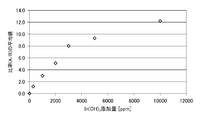
- FIG. 2 shows the relationship between the amount of indium hydroxide added and the average value of the ratio (A / B) of the indium content A on the surface of the zinc alloy particles to the zinc content B on the surface of the zinc alloy particles. It is a graph to show.
- FIG. 3 shows the average value of the ratio (A / B) of the indium content A on the surface of the zinc alloy particles to the zinc content B on the surface of the zinc alloy particles, and the improvement rate of the capacity preservation ratio with respect to Comparative Example 1. It is a graph which shows the relationship.
- the battery according to an embodiment of the present invention is a so-called button-type alkaline battery (sometimes referred to as a coin-type alkaline battery or the like), and includes a disk-shaped positive electrode mixture 11 and a disk-shaped negative electrode mixture 12. And a separator 13, an alkaline electrolyte (not shown), and a button-shaped container 14 for storing them.
- a button-type alkaline battery sometimes referred to as a coin-type alkaline battery or the like
- the battery according to an embodiment of the present invention is a so-called button-type alkaline battery (sometimes referred to as a coin-type alkaline battery or the like), and includes a disk-shaped positive electrode mixture 11 and a disk-shaped negative electrode mixture 12. And a separator 13, an alkaline electrolyte (not shown), and a button-shaped container 14 for storing them.
- the container 14 includes a positive electrode can 14A and a negative electrode cup 14B.
- the positive electrode mixture 11, the negative electrode mixture 12, the separator 13, and an alkaline electrolyte are accommodated by combining the positive electrode can 14A and the negative electrode cup 14B.
- a space is formed.
- the positive electrode can 14A has a circular bottom portion and a side wall portion standing upward from the periphery of the bottom portion.
- the negative electrode cup 14B has a circular top portion and a side wall portion standing downward from the peripheral edge of the top portion, and the front end portion of the side wall portion is folded outward so that the cross section is U-shaped. Yes.
- the positive electrode mixture 11 is accommodated in the positive electrode can 14A, and the negative electrode mixture 12 is accommodated in the negative electrode cup 14B.
- the positive electrode mixture 11 accommodated in the positive electrode can 14 ⁇ / b> A and the negative electrode mixture 12 accommodated in the negative electrode cup 14 ⁇ / b> B are opposed to each other through the separator 13.
- the container 14 is sealed by caulking the open end of the positive electrode can 14A.
- the inside of the sealed container 14 is filled with an alkaline electrolyte.
- the positive electrode mixture 11 is a coin-shaped pellet and includes a powder of positive electrode active material particles and a binder.
- the positive electrode active material particles include, for example, at least one of silver oxide and manganese dioxide.
- the binder includes, for example, a fluorine resin such as tetrafluoropolyethylene.
- the positive electrode mixture 11 preferably further contains a silver-nickel composite oxide (nickelite).
- a silver-nickel composite oxide nickelite
- the content of the silver-nickel composite oxide in the positive electrode mixture 11 is preferably 1% by mass or more and 60% by mass or less, more preferably 5% by mass or more and 40% by mass or less.
- the content of the silver-nickel composite oxide is 1% by mass or more, the effect of suppressing an increase in internal pressure in the battery can be particularly improved.
- the content of the silver-nickel composite oxide is 40% by mass or less, a decrease in the content of the negative electrode active material in the positive electrode mixture 11 can be suppressed, and a decrease in battery capacity can be suppressed.
- the positive electrode mixture 11 may contain a conductive auxiliary agent in order to improve electrical conductivity.
- the conductive auxiliary agent includes, for example, at least one carbon material of carbon black, graphite, graphite and the like.
- the negative electrode mixture 12 has a gel shape and includes a powder of negative electrode active material particles, an alkaline electrolyte, and a thickener.
- the negative electrode active material particles include anhydrous silver zinc or anhydrous silver zinc alloy.
- a zinc alloy is an alloy containing, for example, at least one of bismuth, indium, and aluminum and zinc. Specific examples of the zinc alloy include an alloy containing bismuth and zinc, an alloy containing bismuth, indium, and zinc, or an alloy containing bismuth, indium, aluminum, and zinc, but are not limited to these alloys. It is not something.
- the aluminum content in the zinc alloy is, for example, 5 ppm or more and 100 ppm or less.
- the content of bismuth in the zinc alloy is, for example, 5 ppm or more and 200 ppm.
- Indium in the zinc alloy is, for example, 300 ppm or more and 500 ppm.
- Indium is present on the surface of the negative electrode active material particles.
- the consumption mode of the negative electrode active material during discharge or long-term storage or the like does not proceed from the inside of the particles, but proceeds from the particle surface.
- Deterioration (collapse) of the active material particles can be suppressed. Therefore, the capacity storage characteristics of the battery can be improved.
- hydrogen gas generation can be suppressed by the presence of indium on the surface of the negative electrode active material particles. Therefore, storage characteristics can be improved.
- Indium may be present alone on the surface of the negative electrode active material particle, or may be present on the surface of the negative electrode active material particle in the form of an indium compound such as indium hydroxide or an indium alloy. Indium may be present on a part of the surface of the negative electrode active material particles, or may be present on the entire surface of the negative electrode active material particles, but from the viewpoint of improving the storage characteristics of the battery, the negative electrode It is preferable to exist on the entire surface of the active material particles. Indium may be present so as to cover the surface of the negative electrode active material particles, or may be scattered in spots on the surface of the negative electrode active material particles.
- the coating When indium is present so as to cover the surface of the negative electrode active material particles, the coating may be a part of the surface of the negative electrode active material particles or the entire surface of the negative electrode active material particles. However, from the viewpoint of improving the storage characteristics of the battery, the entire surface of the negative electrode active material particles is preferable.
- the average value of the ratio (A / B) of the indium content A [mass%] on the surface of the negative electrode active material particles and the zinc content B [mass%] on the surface of the negative electrode active material particles is 1.2. 12.2 or less, preferably 3.0 or more, 12.2 or less, more preferably 5.1 or more, 12.2 or less, still more preferably 8.0 or more, 12.2 or less, particularly preferably 9.3 or more, 12 Within 2 or less.
- the average value of the ratio (A / B) is less than 1.2, the indium content A is too small, and the effect of improving the storage characteristics of the battery (specifically, the effect of improving the capacity storage characteristics, And the effect of suppressing the generation of hydrogen gas) may not be exhibited.
- the average value of the ratio (A / B) exceeds 12.2, the content of indium, which is a rare metal, becomes too large, and the cost required for manufacturing one battery may increase.
- the thickener is a so-called gelling agent, and includes, for example, at least one of carboxymethyl cellulose and polyacrylic acid.
- the alkaline electrolyte is, for example, an alkaline aqueous solution in which an alkali metal hydroxide is dissolved in water.
- an alkaline aqueous solution in which an alkali metal hydroxide is dissolved in water.
- Specific examples of the alkaline aqueous solution include a sodium hydroxide aqueous solution and a potassium hydroxide aqueous solution, but the type of the alkaline aqueous solution is not limited thereto.
- the separator 13 has, for example, a three-layer structure of a nonwoven fabric, cellophane, and a microporous film obtained by graft polymerization of polyethylene.
- the separator 13 is impregnated with an alkaline electrolyte.
- the gasket 15 has a ring shape with a J-shaped cross section.
- the gasket 15 includes, for example, a polymer resin such as polyethylene, polypropylene, or nylon.
- the positive electrode can 14 ⁇ / b> A also serves as a positive electrode terminal and a positive electrode current collector, in addition to a container for containing the positive electrode mixture 11.
- the positive electrode can 14A has a configuration in which, for example, a stainless steel plate such as SUS430 is plated with nickel.
- the negative electrode cup 14 ⁇ / b> B also serves as a negative electrode terminal and a negative electrode current collector, in addition to a container that stores the negative electrode mixture 12.
- the negative electrode cup 14B is made of a three-layer clad material.
- the three-layer clad material includes a nickel layer, a stainless steel layer provided on the nickel layer, and a copper layer as a current collecting layer provided on the stainless steel layer.
- the copper layer side is the inside of the negative electrode cup 14B, and the nickel layer side is the outside of the negative electrode cup 14B.
- a coating layer 14C containing a metal whose hydrogen overvoltage is higher than copper is provided on the inner surface of the negative electrode cup 14B.
- the metal having a higher hydrogen overvoltage than copper includes, for example, at least one of tin, indium, bismuth, and gallium.
- a negative electrode active material an alkaline electrolyte, a thickener, and an indium compound are mixed to obtain a gel-like negative electrode mixture 12.
- the addition amount of an indium compound is 0.03 mass% or more and 1 mass% or less, Preferably it is 0.1 mass% or more and 1 mass% or less.
- indium compound for example, indium hydroxide can be used.
- the average particle diameter of the indium compound in this step is 0.005 ⁇ m or more and 5000 ⁇ m or less, preferably 0.01 ⁇ m or more and 1000 ⁇ m or less, more preferably 0.50 ⁇ m or more in order to deposit indium as much as possible on the surface of the negative electrode active material particles. It is 500 ⁇ m or less, particularly preferably in the range of 1.0 ⁇ m or more and 200 ⁇ m or less. When the diameter is smaller than the above range, the size of indium to be deposited becomes small, and the effect of suppressing the deterioration of the negative electrode active material is reduced.
- the average particle diameter means a particle diameter at a point of 50% in a cumulative volume distribution curve with a total volume of 100% of a particle size distribution obtained on a volume basis, that is, a volume-based cumulative 50% diameter.
- the particle size distribution is obtained from a frequency distribution and a cumulative volume distribution curve measured with a laser diffraction / scattering particle size distribution measuring apparatus.
- the average particle size is measured by sufficiently dispersing an indium compound powder in a solvent (ion exchange water) by ultrasonic treatment or the like and measuring the particle size distribution.
- a laser diffraction / scattering particle size distribution measuring device LA-920 manufactured by Horiba, Ltd. can be used.
- the binding of the thickener dissolved together with the indium compound in the alkaline electrolyte is maintained by maintaining the temperature during mixing of the negative electrode active material, the alkaline electrolyte, the thickener, and the indium compound within an appropriate range.
- Property can be increased, and the viscosity of the negative electrode mixture 12 is increased.
- the temperature at this time is preferably 30 ° C. or more and 80 ° C. or less, more preferably 35 ° C. or more and 80 ° C. or less, and further preferably 40 ° C. or more and 80 ° C. or less.
- the positive electrode mixture 11 is formed into a coin shape.
- the positive electrode can 14A is prepared, and the positive electrode mixture 11 is arranged in the positive electrode can 14A.
- the alkaline electrolyte is absorbed into the positive electrode mixture 11 by injecting the alkaline electrolyte into the positive electrode can 14A.
- a separator 13 is placed on the positive electrode mixture 11, and an alkaline electrolyte is dropped into the separator 13 and impregnated.
- a gel-like negative electrode mixture 12 is placed on the separator 13.
- a negative electrode cup 14B is prepared, and a tin coating layer 14C having a hydrogen overvoltage higher than that of copper is formed on the inner surface of the negative electrode cup 14B.
- the open end of the positive electrode can 14A is caulked, and the button-shaped container 14 composed of the positive electrode can 14A and the negative electrode cup 14B is obtained. Seal.
- the intended alkaline battery was obtained.
- An alkaline battery includes a negative electrode mixture 12 including a powder of negative electrode active material particles including zinc or a zinc alloy.
- Indium exists on the surface of the negative electrode active material particles.
- the average value of the ratio (A / B) of the indium content A [mass%] on the surface of the negative electrode active material particles and the zinc content B [mass%] on the surface of the negative electrode active material particles is 1.2. It is 12.2 or less.
- the indium is present on the surface of the negative electrode active material particles so that the average value of the ratio (A / B) is in the range of 1.2 or more, thereby improving the capacity storage characteristics of the battery and generating hydrogen gas. It can also be suppressed. Accordingly, the storage characteristics can be improved.
- the indium is present on the surface of the negative electrode active material particles so that the average value of the ratio (A / B) is 12.2 or less, the cost required for manufacturing one battery is increased. Suppressing and obtaining a suitable battery for consumers.
- Example 1 First, an anhydrous silver zinc alloy powder containing 30 ppm of aluminum, 30 ppm of bismuth, and 300 ppm of indium was prepared as a negative electrode active material. Next, 65% by mass of zinc alloy powder, 25% by mass of a 28% by mass sodium hydroxide aqueous solution as an alkaline electrolyte, 9.97% by mass of carboxymethylcellulose as a thickener, and 0.02% of indium hydroxide as an indium compound. 03% by mass (added 300 ppm) was mixed to obtain a gel-like negative electrode mixture.
- a circular separator having a three-layer structure of a nonwoven fabric, cellophane, and a microporous film obtained by graft polymerization of polyethylene was prepared as a separator, and this separator was placed on a positive electrode pellet. And after dripping and impregnating a 28 mass% sodium hydroxide aqueous solution to a separator, the gel-like negative mix was mounted on the separator.
- a negative electrode cup made of a three-layer clad material consisting of a nickel layer, a stainless steel layer, and a copper layer, and a tin coating layer having a higher hydrogen overvoltage than copper on the copper layer side surface of the negative electrode cup Formed.
- the opening end of the positive electrode can was crimped, and the button-shaped container composed of the positive electrode can and the negative electrode cup was sealed. .
- the intended button-type alkaline battery was obtained.
- Example 2 A button was prepared in the same manner as in Example 1 except that the amount of indium hydroxide added was 0.1% by mass (1000 ppm) and the other components were reduced so as not to change the composition ratio in the production process of the negative electrode mixture. An alkaline battery was obtained.
- Example 3 The button was prepared in the same manner as in Example 1 except that the amount of indium hydroxide added was 0.2% by mass (2000 ppm) and the other components were reduced so as not to change the composition ratio in the production process of the negative electrode mixture. An alkaline battery was obtained.
- Example 4 The button was prepared in the same manner as in Example 1 except that the amount of indium hydroxide added was 0.3% by mass (3000 ppm) and the other components were reduced so as not to change the composition ratio in the production process of the negative electrode mixture. An alkaline battery was obtained.
- Example 5 The button was prepared in the same manner as in Example 1 except that the amount of indium hydroxide added was 0.5 mass% (5000 ppm) and the other components were reduced so that the composition ratio did not change in the negative electrode mixture preparation process. An alkaline battery was obtained.
- Example 6 In the production process of the negative electrode mixture, the amount of indium hydroxide added was 1% by mass (10000 ppm), and other components were reduced so that the composition ratio did not change. A battery was obtained.
- Example 1 A button-type alkaline battery was obtained in the same manner as in Example 1 except that the amount of indium hydroxide was not added in the production step of the negative electrode mixture.
- the indium content A [mass%] and zinc content B [mass%] on the surface of each zinc alloy particle were specifically determined as follows. First, an EDX spectrum of the surface of the zinc alloy particles was obtained, and a peak intensity I Unk (In) specific to indium and a peak intensity I Unk (Zn) specific to zinc were determined. Next, by correcting the ratio I Unk (In) / I std (In) between the peak intensity I Unk (In) and the peak intensity I std (In) of the standard sample, the surface of the zinc alloy particle is corrected. The indium content A [% by mass] was determined.
- the surface of the zinc alloy particle is corrected.
- the zinc content B [mass%] was determined.
- Capacity storage rate before and after storage test [%] ((average discharge capacity after storage test) / (average discharge capacity before storage test)) ⁇ 100
- the improvement rate of the capacity storage rate of the batteries of Examples 1 to 6 was determined. The results are shown in Table 1.
- FIG. 2 shows the addition amount of indium hydroxide and the average value of the ratio (A / B) of the indium content A on the surface of the zinc alloy particles to the zinc content B on the surface of the zinc alloy particles. Show the relationship.
- FIG. 3 shows an average value of the ratio (A / B) of the indium content A on the surface of the zinc alloy particles to the zinc content B on the surface of the zinc alloy particles, and the improvement rate of the capacity preservation ratio with respect to Comparative Example 1. Shows the relationship.
- Table 1 shows the configurations and evaluation results of the batteries of Examples 1 to 6 and Comparative Example 1.
- Table 1 and FIG. 2 show that the average value of the ratio (A / B) increases as the amount of indium hydroxide added increases. Further, when the addition amount of indium hydroxide is 300 ppm (0.03% by mass) or more, the average value of the ratio (A / B) can be 1.2 or more, whereas the addition amount of indium hydroxide is It turns out that the average value of a ratio (A / B) can be 12.2 or less as it is 10,000 ppm (1 mass%) or less.
- the shape of the battery is not limited to this, and may be a shape other than the flat shape.
- the coating layer 14C is provided on the inner surface of the negative electrode cup 14B
- the coating layer 14C may not be provided.
- the coating layer 14C is provided as in the above-described embodiment.
Landscapes
- Chemical & Material Sciences (AREA)
- General Chemical & Material Sciences (AREA)
- Chemical Kinetics & Catalysis (AREA)
- Electrochemistry (AREA)
- Engineering & Computer Science (AREA)
- Manufacturing & Machinery (AREA)
- Materials Engineering (AREA)
- Mechanical Engineering (AREA)
- Metallurgy (AREA)
- Organic Chemistry (AREA)
- Wood Science & Technology (AREA)
- Life Sciences & Earth Sciences (AREA)
- Battery Electrode And Active Subsutance (AREA)
- Primary Cells (AREA)
Abstract
La présente invention concerne une pile alcaline qui est pourvue d'un mélange d'électrode négative comportant une poudre de particules de matériau actif d'électrode négative contenant du zinc ou un alliage de zinc. De l'indium est présent à la surface des particules de matériau actif d'électrode négative. La valeur moyenne du rapport (A/B) entre la teneur en indium A [% en masse] à la surface des particules de matériau actif d'électrode négative et la teneur en zinc B [% en masse] à la surface des particules de matériau actif d'électrode négative est de 1,2 à 12,2.
Priority Applications (3)
| Application Number | Priority Date | Filing Date | Title |
|---|---|---|---|
| JP2020508185A JPWO2019181538A1 (ja) | 2018-03-23 | 2019-03-07 | アルカリ電池 |
| CN201980014740.1A CN111742429A (zh) | 2018-03-23 | 2019-03-07 | 碱性电池 |
| US16/999,791 US20200388838A1 (en) | 2018-03-23 | 2020-08-21 | Alkaline battery |
Applications Claiming Priority (2)
| Application Number | Priority Date | Filing Date | Title |
|---|---|---|---|
| JP2018-056440 | 2018-03-23 | ||
| JP2018056440 | 2018-03-23 |
Related Child Applications (1)
| Application Number | Title | Priority Date | Filing Date |
|---|---|---|---|
| US16/999,791 Continuation US20200388838A1 (en) | 2018-03-23 | 2020-08-21 | Alkaline battery |
Publications (1)
| Publication Number | Publication Date |
|---|---|
| WO2019181538A1 true WO2019181538A1 (fr) | 2019-09-26 |
Family
ID=67987076
Family Applications (1)
| Application Number | Title | Priority Date | Filing Date |
|---|---|---|---|
| PCT/JP2019/009118 Ceased WO2019181538A1 (fr) | 2018-03-23 | 2019-03-07 | Pile alcaline |
Country Status (4)
| Country | Link |
|---|---|
| US (1) | US20200388838A1 (fr) |
| JP (1) | JPWO2019181538A1 (fr) |
| CN (1) | CN111742429A (fr) |
| WO (1) | WO2019181538A1 (fr) |
Cited By (1)
| Publication number | Priority date | Publication date | Assignee | Title |
|---|---|---|---|---|
| DE112021004100T5 (de) | 2020-10-30 | 2023-05-17 | Murata Manufacturing Co., Ltd. | Alkaline-batterie und verfahren zur herstellung einer alkaline-batterie |
Families Citing this family (1)
| Publication number | Priority date | Publication date | Assignee | Title |
|---|---|---|---|---|
| JP7684100B2 (ja) * | 2021-05-28 | 2025-05-27 | Fdk株式会社 | ニッケル水素二次電池 |
Citations (5)
| Publication number | Priority date | Publication date | Assignee | Title |
|---|---|---|---|---|
| JPS4877332A (fr) * | 1972-01-19 | 1973-10-17 | ||
| JPH04206266A (ja) * | 1990-11-29 | 1992-07-28 | Matsushita Electric Ind Co Ltd | 亜鉛アルカリ電池用亜鉛合金の製造法ならびにそれを用いた亜鉛アルカリ電池 |
| JPH065284A (ja) * | 1992-06-19 | 1994-01-14 | Toshiba Battery Co Ltd | 亜鉛アルカリ電池 |
| JP2002373651A (ja) * | 2002-05-13 | 2002-12-26 | Hitachi Maxell Ltd | アルカリ電池 |
| JP2005197230A (ja) * | 2003-12-10 | 2005-07-21 | Hitachi Maxell Ltd | ボタン形アルカリ電池およびその製造方法 |
Family Cites Families (13)
| Publication number | Priority date | Publication date | Assignee | Title |
|---|---|---|---|---|
| JP3553104B2 (ja) * | 1992-08-04 | 2004-08-11 | 株式会社エスアイアイ・マイクロパーツ | アルカリ電池 |
| JP3522303B2 (ja) * | 1993-05-27 | 2004-04-26 | 東芝電池株式会社 | ボタン形アルカリ電池 |
| JPH0785877A (ja) * | 1993-09-10 | 1995-03-31 | Toshiba Battery Co Ltd | ボタン形アルカリ電池 |
| JPH08213031A (ja) * | 1995-02-03 | 1996-08-20 | Toshiba Battery Co Ltd | ボタン形アルカリ電池 |
| JPH08222233A (ja) * | 1995-02-15 | 1996-08-30 | Toshiba Battery Co Ltd | ボタン形アルカリ電池 |
| JP4158326B2 (ja) * | 2000-09-08 | 2008-10-01 | ソニー株式会社 | アルカリ電池 |
| JP2005235595A (ja) * | 2004-02-20 | 2005-09-02 | Hitachi Maxell Ltd | ボタン形アルカリ電池およびその製造方法 |
| JP2005332716A (ja) * | 2004-05-20 | 2005-12-02 | Hitachi Maxell Ltd | アルカリ電池およびその製造方法 |
| JP2006228503A (ja) * | 2005-02-16 | 2006-08-31 | Sony Corp | アルカリ電池 |
| JP4222488B2 (ja) * | 2005-11-02 | 2009-02-12 | 日立マクセル株式会社 | アルカリ電池 |
| JP5348717B2 (ja) * | 2009-03-18 | 2013-11-20 | 日立マクセル株式会社 | アルカリ電池 |
| JP2011138642A (ja) * | 2009-12-28 | 2011-07-14 | Hitachi Maxell Ltd | 扁平形アルカリ電池 |
| JP6734155B2 (ja) * | 2016-09-01 | 2020-08-05 | マクセルホールディングス株式会社 | アルカリ電池 |
-
2019
- 2019-03-07 JP JP2020508185A patent/JPWO2019181538A1/ja active Pending
- 2019-03-07 WO PCT/JP2019/009118 patent/WO2019181538A1/fr not_active Ceased
- 2019-03-07 CN CN201980014740.1A patent/CN111742429A/zh not_active Withdrawn
-
2020
- 2020-08-21 US US16/999,791 patent/US20200388838A1/en not_active Abandoned
Patent Citations (5)
| Publication number | Priority date | Publication date | Assignee | Title |
|---|---|---|---|---|
| JPS4877332A (fr) * | 1972-01-19 | 1973-10-17 | ||
| JPH04206266A (ja) * | 1990-11-29 | 1992-07-28 | Matsushita Electric Ind Co Ltd | 亜鉛アルカリ電池用亜鉛合金の製造法ならびにそれを用いた亜鉛アルカリ電池 |
| JPH065284A (ja) * | 1992-06-19 | 1994-01-14 | Toshiba Battery Co Ltd | 亜鉛アルカリ電池 |
| JP2002373651A (ja) * | 2002-05-13 | 2002-12-26 | Hitachi Maxell Ltd | アルカリ電池 |
| JP2005197230A (ja) * | 2003-12-10 | 2005-07-21 | Hitachi Maxell Ltd | ボタン形アルカリ電池およびその製造方法 |
Cited By (2)
| Publication number | Priority date | Publication date | Assignee | Title |
|---|---|---|---|---|
| DE112021004100T5 (de) | 2020-10-30 | 2023-05-17 | Murata Manufacturing Co., Ltd. | Alkaline-batterie und verfahren zur herstellung einer alkaline-batterie |
| US20230170465A1 (en) * | 2020-10-30 | 2023-06-01 | Murata Manufacturing Co., Ltd. | Alkaline battery and method of manufacturing alkaline battery |
Also Published As
| Publication number | Publication date |
|---|---|
| CN111742429A (zh) | 2020-10-02 |
| US20200388838A1 (en) | 2020-12-10 |
| JPWO2019181538A1 (ja) | 2020-12-17 |
Similar Documents
| Publication | Publication Date | Title |
|---|---|---|
| JP7728302B2 (ja) | 増加酸化亜鉛レベルを含むアルカリ電気化学電池 | |
| JP5743780B2 (ja) | 円筒型ニッケル−水素蓄電池 | |
| US20240014448A1 (en) | Additives for improving battery performance via cation adsorption | |
| WO2005057695A1 (fr) | Pile type bouton alcaline et son procede de production | |
| JP6706823B2 (ja) | アルカリ乾電池 | |
| WO2019181538A1 (fr) | Pile alcaline | |
| JP2003017077A (ja) | 密閉型アルカリ亜鉛一次電池 | |
| JP5348717B2 (ja) | アルカリ電池 | |
| US11705584B2 (en) | Additives for improving battery performance via second electron discharge of manganese dioxide | |
| US9337485B2 (en) | Alkaline battery | |
| JP5455182B2 (ja) | アルカリ電池 | |
| JP5278332B2 (ja) | リチウム一次電池用電解二酸化マンガンとその製造方法およびそれを用いたリチウム一次電池 | |
| JP6734155B2 (ja) | アルカリ電池 | |
| US11876253B2 (en) | Alkali dry battery comprising electrolyte including sulfonyl group-containing anion | |
| JP2013246958A (ja) | アルカリ乾電池 | |
| JP5019634B2 (ja) | アルカリ電池 | |
| JP7429856B2 (ja) | アルカリ電池およびその製造方法 | |
| WO2020158124A1 (fr) | Batterie sèche alcaline | |
| WO2025226686A2 (fr) | Cellules électrochimiques alcalines ayant des niveaux accrus d'oxyde de zinc | |
| JP5895937B2 (ja) | アルカリ蓄電池用負極、アルカリ蓄電池用外装缶及びアルカリ蓄電池 | |
| JP2003229135A (ja) | アルミニウム電池 | |
| JP2011138642A (ja) | 扁平形アルカリ電池 | |
| US20140186711A1 (en) | Alkaline secondary battery | |
| JPH09259887A (ja) | アルカリ蓄電池用導電剤及びそれを用いたアルカリ蓄電池用非焼結式ニッケル極 | |
| JPS58137962A (ja) | 密封型乾電池 |
Legal Events
| Date | Code | Title | Description |
|---|---|---|---|
| 121 | Ep: the epo has been informed by wipo that ep was designated in this application |
Ref document number: 19770641 Country of ref document: EP Kind code of ref document: A1 |
|
| ENP | Entry into the national phase |
Ref document number: 2020508185 Country of ref document: JP Kind code of ref document: A |
|
| NENP | Non-entry into the national phase |
Ref country code: DE |
|
| 122 | Ep: pct application non-entry in european phase |
Ref document number: 19770641 Country of ref document: EP Kind code of ref document: A1 |