WO2019181966A1 - コロイド状シリカ粒子とシアヌル酸亜鉛粒子とを含む分散液 - Google Patents
コロイド状シリカ粒子とシアヌル酸亜鉛粒子とを含む分散液 Download PDFInfo
- Publication number
- WO2019181966A1 WO2019181966A1 PCT/JP2019/011550 JP2019011550W WO2019181966A1 WO 2019181966 A1 WO2019181966 A1 WO 2019181966A1 JP 2019011550 W JP2019011550 W JP 2019011550W WO 2019181966 A1 WO2019181966 A1 WO 2019181966A1
- Authority
- WO
- WIPO (PCT)
- Prior art keywords
- resin
- particles
- mass
- dispersion
- colloidal silica
- Prior art date
- Legal status (The legal status is an assumption and is not a legal conclusion. Google has not performed a legal analysis and makes no representation as to the accuracy of the status listed.)
- Ceased
Links
Images
Classifications
-
- C—CHEMISTRY; METALLURGY
- C09—DYES; PAINTS; POLISHES; NATURAL RESINS; ADHESIVES; COMPOSITIONS NOT OTHERWISE PROVIDED FOR; APPLICATIONS OF MATERIALS NOT OTHERWISE PROVIDED FOR
- C09D—COATING COMPOSITIONS, e.g. PAINTS, VARNISHES OR LACQUERS; FILLING PASTES; CHEMICAL PAINT OR INK REMOVERS; INKS; CORRECTING FLUIDS; WOODSTAINS; PASTES OR SOLIDS FOR COLOURING OR PRINTING; USE OF MATERIALS THEREFOR
- C09D7/00—Features of coating compositions, not provided for in group C09D5/00; Processes for incorporating ingredients in coating compositions
- C09D7/40—Additives
- C09D7/60—Additives non-macromolecular
- C09D7/61—Additives non-macromolecular inorganic
- C09D7/62—Additives non-macromolecular inorganic modified by treatment with other compounds
-
- C—CHEMISTRY; METALLURGY
- C09—DYES; PAINTS; POLISHES; NATURAL RESINS; ADHESIVES; COMPOSITIONS NOT OTHERWISE PROVIDED FOR; APPLICATIONS OF MATERIALS NOT OTHERWISE PROVIDED FOR
- C09D—COATING COMPOSITIONS, e.g. PAINTS, VARNISHES OR LACQUERS; FILLING PASTES; CHEMICAL PAINT OR INK REMOVERS; INKS; CORRECTING FLUIDS; WOODSTAINS; PASTES OR SOLIDS FOR COLOURING OR PRINTING; USE OF MATERIALS THEREFOR
- C09D5/00—Coating compositions, e.g. paints, varnishes or lacquers, characterised by their physical nature or the effects produced; Filling pastes
- C09D5/08—Anti-corrosive paints
- C09D5/082—Anti-corrosive paints characterised by the anti-corrosive pigment
- C09D5/084—Inorganic compounds
-
- B—PERFORMING OPERATIONS; TRANSPORTING
- B23—MACHINE TOOLS; METAL-WORKING NOT OTHERWISE PROVIDED FOR
- B23C—MILLING
- B23C3/00—Milling particular work; Special milling operations; Machines therefor
-
- C—CHEMISTRY; METALLURGY
- C01—INORGANIC CHEMISTRY
- C01B—NON-METALLIC ELEMENTS; COMPOUNDS THEREOF; METALLOIDS OR COMPOUNDS THEREOF NOT COVERED BY SUBCLASS C01C
- C01B33/00—Silicon; Compounds thereof
- C01B33/113—Silicon oxides; Hydrates thereof
- C01B33/12—Silica; Hydrates thereof, e.g. lepidoic silicic acid
- C01B33/14—Colloidal silica, e.g. dispersions, gels, sols
-
- C—CHEMISTRY; METALLURGY
- C01—INORGANIC CHEMISTRY
- C01B—NON-METALLIC ELEMENTS; COMPOUNDS THEREOF; METALLOIDS OR COMPOUNDS THEREOF NOT COVERED BY SUBCLASS C01C
- C01B33/00—Silicon; Compounds thereof
- C01B33/113—Silicon oxides; Hydrates thereof
- C01B33/12—Silica; Hydrates thereof, e.g. lepidoic silicic acid
- C01B33/14—Colloidal silica, e.g. dispersions, gels, sols
- C01B33/145—Preparation of hydroorganosols, organosols or dispersions in an organic medium
-
- C—CHEMISTRY; METALLURGY
- C08—ORGANIC MACROMOLECULAR COMPOUNDS; THEIR PREPARATION OR CHEMICAL WORKING-UP; COMPOSITIONS BASED THEREON
- C08K—Use of inorganic or non-macromolecular organic substances as compounding ingredients
- C08K5/00—Use of organic ingredients
- C08K5/16—Nitrogen-containing compounds
- C08K5/34—Heterocyclic compounds having nitrogen in the ring
- C08K5/3467—Heterocyclic compounds having nitrogen in the ring having more than two nitrogen atoms in the ring
- C08K5/3477—Six-membered rings
- C08K5/3492—Triazines
- C08K5/34924—Triazines containing cyanurate groups; Tautomers thereof
-
- C—CHEMISTRY; METALLURGY
- C09—DYES; PAINTS; POLISHES; NATURAL RESINS; ADHESIVES; COMPOSITIONS NOT OTHERWISE PROVIDED FOR; APPLICATIONS OF MATERIALS NOT OTHERWISE PROVIDED FOR
- C09D—COATING COMPOSITIONS, e.g. PAINTS, VARNISHES OR LACQUERS; FILLING PASTES; CHEMICAL PAINT OR INK REMOVERS; INKS; CORRECTING FLUIDS; WOODSTAINS; PASTES OR SOLIDS FOR COLOURING OR PRINTING; USE OF MATERIALS THEREFOR
- C09D123/00—Coating compositions based on homopolymers or copolymers of unsaturated aliphatic hydrocarbons having only one carbon-to-carbon double bond; Coating compositions based on derivatives of such polymers
- C09D123/02—Coating compositions based on homopolymers or copolymers of unsaturated aliphatic hydrocarbons having only one carbon-to-carbon double bond; Coating compositions based on derivatives of such polymers not modified by chemical after-treatment
- C09D123/04—Homopolymers or copolymers of ethene
- C09D123/08—Copolymers of ethene
- C09D123/0846—Copolymers of ethene with unsaturated hydrocarbons containing other atoms than carbon or hydrogen atoms
- C09D123/0853—Vinylacetate
-
- C—CHEMISTRY; METALLURGY
- C09—DYES; PAINTS; POLISHES; NATURAL RESINS; ADHESIVES; COMPOSITIONS NOT OTHERWISE PROVIDED FOR; APPLICATIONS OF MATERIALS NOT OTHERWISE PROVIDED FOR
- C09D—COATING COMPOSITIONS, e.g. PAINTS, VARNISHES OR LACQUERS; FILLING PASTES; CHEMICAL PAINT OR INK REMOVERS; INKS; CORRECTING FLUIDS; WOODSTAINS; PASTES OR SOLIDS FOR COLOURING OR PRINTING; USE OF MATERIALS THEREFOR
- C09D125/00—Coating compositions based on homopolymers or copolymers of compounds having one or more unsaturated aliphatic radicals, each having only one carbon-to-carbon double bond, and at least one being terminated by an aromatic carbocyclic ring; Coating compositions based on derivatives of such polymers
- C09D125/02—Homopolymers or copolymers of hydrocarbons
- C09D125/04—Homopolymers or copolymers of styrene
- C09D125/08—Copolymers of styrene
- C09D125/14—Copolymers of styrene with unsaturated esters
-
- C—CHEMISTRY; METALLURGY
- C09—DYES; PAINTS; POLISHES; NATURAL RESINS; ADHESIVES; COMPOSITIONS NOT OTHERWISE PROVIDED FOR; APPLICATIONS OF MATERIALS NOT OTHERWISE PROVIDED FOR
- C09D—COATING COMPOSITIONS, e.g. PAINTS, VARNISHES OR LACQUERS; FILLING PASTES; CHEMICAL PAINT OR INK REMOVERS; INKS; CORRECTING FLUIDS; WOODSTAINS; PASTES OR SOLIDS FOR COLOURING OR PRINTING; USE OF MATERIALS THEREFOR
- C09D163/00—Coating compositions based on epoxy resins; Coating compositions based on derivatives of epoxy resins
-
- C—CHEMISTRY; METALLURGY
- C09—DYES; PAINTS; POLISHES; NATURAL RESINS; ADHESIVES; COMPOSITIONS NOT OTHERWISE PROVIDED FOR; APPLICATIONS OF MATERIALS NOT OTHERWISE PROVIDED FOR
- C09D—COATING COMPOSITIONS, e.g. PAINTS, VARNISHES OR LACQUERS; FILLING PASTES; CHEMICAL PAINT OR INK REMOVERS; INKS; CORRECTING FLUIDS; WOODSTAINS; PASTES OR SOLIDS FOR COLOURING OR PRINTING; USE OF MATERIALS THEREFOR
- C09D201/00—Coating compositions based on unspecified macromolecular compounds
-
- C—CHEMISTRY; METALLURGY
- C09—DYES; PAINTS; POLISHES; NATURAL RESINS; ADHESIVES; COMPOSITIONS NOT OTHERWISE PROVIDED FOR; APPLICATIONS OF MATERIALS NOT OTHERWISE PROVIDED FOR
- C09D—COATING COMPOSITIONS, e.g. PAINTS, VARNISHES OR LACQUERS; FILLING PASTES; CHEMICAL PAINT OR INK REMOVERS; INKS; CORRECTING FLUIDS; WOODSTAINS; PASTES OR SOLIDS FOR COLOURING OR PRINTING; USE OF MATERIALS THEREFOR
- C09D5/00—Coating compositions, e.g. paints, varnishes or lacquers, characterised by their physical nature or the effects produced; Filling pastes
- C09D5/02—Emulsion paints including aerosols
-
- C—CHEMISTRY; METALLURGY
- C09—DYES; PAINTS; POLISHES; NATURAL RESINS; ADHESIVES; COMPOSITIONS NOT OTHERWISE PROVIDED FOR; APPLICATIONS OF MATERIALS NOT OTHERWISE PROVIDED FOR
- C09D—COATING COMPOSITIONS, e.g. PAINTS, VARNISHES OR LACQUERS; FILLING PASTES; CHEMICAL PAINT OR INK REMOVERS; INKS; CORRECTING FLUIDS; WOODSTAINS; PASTES OR SOLIDS FOR COLOURING OR PRINTING; USE OF MATERIALS THEREFOR
- C09D5/00—Coating compositions, e.g. paints, varnishes or lacquers, characterised by their physical nature or the effects produced; Filling pastes
- C09D5/02—Emulsion paints including aerosols
- C09D5/022—Emulsions, e.g. oil in water
-
- C—CHEMISTRY; METALLURGY
- C09—DYES; PAINTS; POLISHES; NATURAL RESINS; ADHESIVES; COMPOSITIONS NOT OTHERWISE PROVIDED FOR; APPLICATIONS OF MATERIALS NOT OTHERWISE PROVIDED FOR
- C09D—COATING COMPOSITIONS, e.g. PAINTS, VARNISHES OR LACQUERS; FILLING PASTES; CHEMICAL PAINT OR INK REMOVERS; INKS; CORRECTING FLUIDS; WOODSTAINS; PASTES OR SOLIDS FOR COLOURING OR PRINTING; USE OF MATERIALS THEREFOR
- C09D5/00—Coating compositions, e.g. paints, varnishes or lacquers, characterised by their physical nature or the effects produced; Filling pastes
- C09D5/08—Anti-corrosive paints
-
- C—CHEMISTRY; METALLURGY
- C09—DYES; PAINTS; POLISHES; NATURAL RESINS; ADHESIVES; COMPOSITIONS NOT OTHERWISE PROVIDED FOR; APPLICATIONS OF MATERIALS NOT OTHERWISE PROVIDED FOR
- C09D—COATING COMPOSITIONS, e.g. PAINTS, VARNISHES OR LACQUERS; FILLING PASTES; CHEMICAL PAINT OR INK REMOVERS; INKS; CORRECTING FLUIDS; WOODSTAINS; PASTES OR SOLIDS FOR COLOURING OR PRINTING; USE OF MATERIALS THEREFOR
- C09D7/00—Features of coating compositions, not provided for in group C09D5/00; Processes for incorporating ingredients in coating compositions
- C09D7/20—Diluents or solvents
-
- C—CHEMISTRY; METALLURGY
- C09—DYES; PAINTS; POLISHES; NATURAL RESINS; ADHESIVES; COMPOSITIONS NOT OTHERWISE PROVIDED FOR; APPLICATIONS OF MATERIALS NOT OTHERWISE PROVIDED FOR
- C09D—COATING COMPOSITIONS, e.g. PAINTS, VARNISHES OR LACQUERS; FILLING PASTES; CHEMICAL PAINT OR INK REMOVERS; INKS; CORRECTING FLUIDS; WOODSTAINS; PASTES OR SOLIDS FOR COLOURING OR PRINTING; USE OF MATERIALS THEREFOR
- C09D7/00—Features of coating compositions, not provided for in group C09D5/00; Processes for incorporating ingredients in coating compositions
- C09D7/40—Additives
- C09D7/60—Additives non-macromolecular
- C09D7/61—Additives non-macromolecular inorganic
-
- C—CHEMISTRY; METALLURGY
- C23—COATING METALLIC MATERIAL; COATING MATERIAL WITH METALLIC MATERIAL; CHEMICAL SURFACE TREATMENT; DIFFUSION TREATMENT OF METALLIC MATERIAL; COATING BY VACUUM EVAPORATION, BY SPUTTERING, BY ION IMPLANTATION OR BY CHEMICAL VAPOUR DEPOSITION, IN GENERAL; INHIBITING CORROSION OF METALLIC MATERIAL OR INCRUSTATION IN GENERAL
- C23F—NON-MECHANICAL REMOVAL OF METALLIC MATERIAL FROM SURFACE; INHIBITING CORROSION OF METALLIC MATERIAL OR INCRUSTATION IN GENERAL; MULTI-STEP PROCESSES FOR SURFACE TREATMENT OF METALLIC MATERIAL INVOLVING AT LEAST ONE PROCESS PROVIDED FOR IN CLASS C23 AND AT LEAST ONE PROCESS COVERED BY SUBCLASS C21D OR C22F OR CLASS C25
- C23F11/00—Inhibiting corrosion of metallic material by applying inhibitors to the surface in danger of corrosion or adding them to the corrosive agent
- C23F11/08—Inhibiting corrosion of metallic material by applying inhibitors to the surface in danger of corrosion or adding them to the corrosive agent in other liquids
- C23F11/10—Inhibiting corrosion of metallic material by applying inhibitors to the surface in danger of corrosion or adding them to the corrosive agent in other liquids using organic inhibitors
- C23F11/14—Nitrogen-containing compounds
- C23F11/149—Heterocyclic compounds containing nitrogen as hetero atom
-
- C—CHEMISTRY; METALLURGY
- C08—ORGANIC MACROMOLECULAR COMPOUNDS; THEIR PREPARATION OR CHEMICAL WORKING-UP; COMPOSITIONS BASED THEREON
- C08K—Use of inorganic or non-macromolecular organic substances as compounding ingredients
- C08K3/00—Use of inorganic substances as compounding ingredients
- C08K3/28—Nitrogen-containing compounds
-
- C—CHEMISTRY; METALLURGY
- C08—ORGANIC MACROMOLECULAR COMPOUNDS; THEIR PREPARATION OR CHEMICAL WORKING-UP; COMPOSITIONS BASED THEREON
- C08K—Use of inorganic or non-macromolecular organic substances as compounding ingredients
- C08K3/00—Use of inorganic substances as compounding ingredients
- C08K3/34—Silicon-containing compounds
- C08K3/36—Silica
Definitions
- the present invention relates to a dispersion containing colloidal silica particles and zinc cyanurate particles, a method for producing the same, and a coating composition using the same.
- Zinc cyanurate is known as a corrosion inhibitor for metal surfaces of ferrous metals.
- PbO or ZnO and cyanuric acid are mixed in a paste form at 100 ° C. to 180 ° C., and a method for producing lead cyanurate or zinc cyanurate is disclosed in which a shearing action is applied to the obtained paste at 50 ° C. to 250 ° C. (See Patent Document 1).
- a composition using a zinc salt and / or a lead salt of an organic compound such as barbituric acid and cyanuric acid in a corrosion protection coating on a metal surface based on the zinc salt and / or lead salt of an organic compound is disclosed. (See Patent Document 2).
- cyanuric acid concentration 0.1% by mass to 10.0% by mass with respect to water.
- Manufactured by performing wet dispersion using a dispersion medium in a temperature range of from 50 ° C. to 55 ° C. the average particle diameter D 50 measured by laser diffraction method is from 80 nm to 900 nm, and the specific surface area is from 20 m 2 / g to 100 m 2 /
- needle-like or plate-like basic zinc cyanurate fine particles characterized by being g (see Patent Document 4).
- the major axis of primary particles is 50 nm to 2000 nm with a transmission electron microscope having a sieve residue of less than 1% by mass with a sieve opening of 1000 ⁇ m, which is heat-treated in the range of 30 ° C. to 300 ° C. in a sealed or open state
- or 300 nm is disclosed (refer patent document 5).
- the present invention has been made in view of the above circumstances, a dispersion containing colloidal silica particles and zinc cyanurate particles, which can sufficiently exhibit functions such as corrosion protection of the metal surface of zinc cyanurate,
- the object is to provide a coating composition comprising the same.
- the present inventors have obtained a stable dispersion having good dispersibility when dispersed in a liquid medium using colloidal silica particles and zinc cyanurate particles as a dispersoid. As a result, the present invention was completed.
- the present invention relates to a dispersion in which dispersoid particles containing colloidal silica particles and zinc cyanurate particles are dispersed in a liquid medium.
- the colloidal silica particles have an average particle diameter of 5 nm to 500 nm, and the colloidal silica particles are contained in an SiO 2 concentration of 0.1% by mass to 40% by mass. Concerning the dispersion.
- the zinc cyanurate particles have a primary particle length of 50 nm to 1000 nm as observed by a transmission electron microscope, a short axis length of 10 nm to 300 nm, a long axis and a short axis The length ratio is 2 to 25, and the dispersion liquid according to the first aspect includes the zinc cyanurate particles as a solid content at 0.1% by mass to 50% by mass.
- the average particle diameter of laser dispersive particles including colloidal silica particles and zinc cyanurate particles is 80 nm to 2000 nm, and the total solid content of both colloidal silica particles and zinc cyanurate particles is 0.8.
- the dispersion liquid according to any one of the first to third aspects which is contained at 1% by mass to 50% by mass.
- the dispersoid particles are colloidal silica particles and zinc cyanurate particles in a mass ratio of colloidal silica: zincyanurate of 1: 0.01 to 100, and the colloidal silica particles and cyanuric acid It is related with the dispersion liquid as described in any one of the 1st viewpoint thru
- the present invention relates to the dispersion according to any one of the first to fifth aspects, in which the liquid medium is water or an organic solvent.
- the present invention relates to a coating composition
- a coating composition comprising the dispersion according to any one of the first to sixth aspects and a resin emulsion.
- the resin emulsion is an acrylic resin, styrene-acrylic resin, acrylic-silicone resin, vinyl acetate resin, styrene resin, ethylene resin, ethylene-vinyl acetate resin, propyl resin, ester.
- the coating composition according to the seventh aspect which is an oil-in-water emulsion of one or more resins selected from the group consisting of:
- the solid content in the dispersion and the resin content in the resin emulsion are in a ratio of 1: 0.1 to 10 in a mass ratio of (solid content in the dispersion) :( resin content in the resin emulsion).
- the total solid content in the coating composition is 1% by mass to 70% by mass.
- the coating composition according to any one of the seventh to ninth aspects is applied to a film thickness of 0.1 ⁇ m to 100 ⁇ m by spin coating, bar coating, roll coating, or dip coating.
- the present invention relates to a coating film.
- or the 6th viewpoint including the process of mixing a silica sol and zinc cyanurate particle or its slurry using a disperser in a liquid. Regarding the method.
- the present invention relates to the manufacturing method according to the eleventh aspect, in which the liquid disperser is a sand grinder, a bead mill, an attritor, or a pearl mill.
- the liquid disperser is a sand grinder, a bead mill, an attritor, or a pearl mill.
- any one of the seventh to ninth aspects including a step of mixing the dispersion according to any one of the first to sixth aspects and the resin emulsion using a submerged dispersion machine.
- the present invention relates to a method for producing the coating composition according to any one of the above.
- the method according to any one of the seventh aspect to the ninth aspect including a step of mixing silica sol, zinc cyanurate particles or a slurry thereof, and a resin emulsion using a liquid disperser.
- the present invention relates to a method for producing a coating composition.
- the liquid disperser is a stirrer, a rotary shear stirrer, a colloid mill, a roll mill, a high-pressure jet disperser, an ultrasonic disperser, a container driven mill, a medium agitation mill, or a kneader.
- the manufacturing method of the coating composition as described in a 14th viewpoint.
- colloidal silica particles are stably dispersed in the liquid, colloidal silica particles and zinc cyanurate particles synergistically bring about a dispersion stability effect, colloidal silica particles contribute to the dispersion stability effect, and cyanuric acid.
- the zinc particles are also stably dispersed.
- colloidal silica particles and zinc cyanurate particles have high dispersion stability as dispersoid particles, dispersions in which they are dispersed in a liquid medium have good stability even when mixed with a resin emulsion. Even when a coating composition or the like is produced, there is an effect that handling properties are high.
- zinc cyanurate particles are also stably dispersed, and the zinc cyanurate particles are uniformly present in the coating film, so that the functions such as corrosion protection inherent to zinc cyanurate are sufficiently exhibited. Expected.
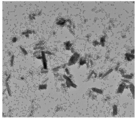
- FIG. 1 is a transmission electron microscope (TEM) photograph (magnification 40,000 times) of a dispersion of colloidal silica particles and zinc cyanurate particles obtained in Example 1.
- FIG. 1 is a transmission electron microscope (TEM) photograph (magnification 40,000 times) of a dispersion of colloidal silica particles and zinc cyanurate particles obtained in Example 1.
- FIG. 1 is a transmission electron microscope (TEM) photograph (magnification 40,000 times) of a dispersion of colloidal silica particles and zinc cyanurate particles obtained in Example 1.
- the present invention is a dispersion in which dispersoid particles containing colloidal silica particles and zinc cyanurate particles are dispersed in a liquid medium.
- the average particle diameter of the colloidal silica can be measured by a nitrogen gas adsorption method (BET method).
- a silica sol in which the silica is dispersed in a liquid medium can be used.
- This silica sol can be used in the range of 0.1% to 40% by mass, or 0.1% to 20% by mass, or 0.1% to 10% by mass as the SiO 2 concentration,
- the medium include an aqueous medium and an organic medium (organic solvent).
- these silica sols for example, the product name Snowtex manufactured by Nissan Chemical Co., Ltd. can be used.
- Zinc cyanurate can be used at a molar ratio in terms of (zinc oxide) / (cyanuric acid) of 1.0 to 5.0.
- the zinc source include zinc oxide and basic zinc carbonate, which can be used in the above molar ratio when converted to zinc oxide.
- As the zinc oxide for example, two types of zinc oxide manufactured by Sakai Chemical Co., Ltd. can be used.
- Cyanuric acid is a tribasic acid, and acid salts, neutral salts, and basic salts can be produced by the reaction of divalent zinc.
- molar ratio in terms of (zinc oxide) / (cyanuric acid) is 1.0
- an acidic salt corresponding to Zn (C 3 N 3 O 3 H) is formed.
- molar ratio in terms of (zinc oxide) / (cyanuric acid) is 1.5
- a neutral salt corresponding to Zn 3 (C 3 N 3 O 3 ) 2 is formed.
- the molar ratio in terms of (zinc oxide) / (cyanuric acid) is 2.5
- a basic salt corresponding to Zn 3 (C 3 N 3 O 3 ) 2 ⁇ 2ZnO is formed.
- These salts can include crystal water, for example, monohydrate, dihydrate, and trihydrate can be formed.
- a basic salt for example, Zn 3 (C 3 N 3 O 3 ) 2 ⁇ 2ZnO ⁇ 3H 2 O can be used.
- the zinc cyanurate particles are not spherical, but are needle-like or plate-like elongated particles.
- the primary particles have a major axis length of 50 nm to 1000 nm and a minor axis length of 10 nm to 300 nm as observed by a transmission electron microscope.
- the ratio of the major axis / minor axis length is 2 to 25.
- the specific surface area of the zinc cyanurate particles is 10 m 2 / g to 100 m 2 / g.
- the average particle size measurement of the cyanuric acid zinc particles by laser diffraction method is performed by dispersing a cyanuric acid zinc particle or a dispersion containing zinc cyanuric acid particles in pure water, and using a laser diffraction particle size distribution measuring device, for example, Shimadzu Corporation
- the average particle size in the liquid can be measured by using the trade name SALD-7500 nano.
- SALD-7500 nano When the cyanuric acid zinc particles are dispersed in water, the average particle diameter of the laser diffraction method is 80 nm to 20000 nm.
- a manufacturing method in which a raw material is subjected to a liquid phase reaction in a slurry state in which water is dispersed includes zinc oxide or basic zinc carbonate, cyanuric acid, and water at a cyanuric acid concentration of 0.1% by mass to 10.0% by mass.
- the mixture and the mixed slurry are wet-dispersed at a temperature of 5 ° C. to 55 ° C. using a submerged dispersion machine, whereby the reaction and the product are dispersed to obtain a slurry of zinc cyanurate particles.
- Cyanuric acid dissolves in water, and the dissolved cyanuric acid reacts quickly with zinc oxide or basic zinc carbonate to promote particle growth, and thus tends to become large particles.
- the obtained slurry is subjected to wet dispersion using a submerged dispersion machine (dispersion medium) at 5 ° C. to 55 ° C., whereby the reaction and dispersion are carried out to obtain a zinc cyanurate dispersion.
- a submerged dispersion machine dispensersion medium
- wet dispersion is performed using dispersion media.
- mechanochemical reaction between cyanuric acid and at least one selected from zinc oxide and basic zinc carbonate can be performed by mechanical energy generated by collision of the dispersion medium. it can.
- the mechanochemical reaction is a chemical reaction in which mechanical energy is applied from various directions to zinc oxide, basic zinc carbonate, and cyanuric acid by collision of dispersion media.
- the dispersion medium examples include stabilized zirconia beads, quartz glass beads, soda lime glass beads, alumina beads, and mixtures thereof. In consideration of the contamination caused by the dispersion media colliding with each other and the dispersion media being crushed, it is preferable to use stabilized zirconia beads as the dispersion media.
- the size of the dispersion medium is, for example, 0.1 mm to 10 mm in diameter, and preferably 0.5 mm to 2.0 mm in diameter. When the diameter of the dispersion medium is less than 0.1 mm, the collision energy between the pulverization media is small, and the mechanochemical reactivity tends to be weak. Further, if the diameter of the dispersion medium is larger than 10 mm, the collision energy between the dispersion media is too large, and the dispersion medium is crushed to increase contamination, which is not preferable.
- the wet dispersion using a dispersion medium adds the mixed slurry to the container containing the dispersion medium, and then agitates to collide the dispersion medium with zinc oxide, basic zinc carbonate or cyanuric acid.
- a mechanochemical reaction of zinc oxide or basic zinc carbonate, and cyanuric acid by making it
- a sand grinder made by Imex Co., Ltd.
- Apex mill ((Co., Ltd.) ) Hiroshima Metal & Machinery (manufactured by Kotobuki Kogyo Co., Ltd.), Attritor (manufactured by Nippon Coke Co., Ltd.), Pearl Mill (manufactured by Ashizawa Finetech Co., Ltd.) and the like.
- the rotation speed of the apparatus for stirring the dispersion medium, the reaction time, and the like can be appropriately adjusted in accordance with a desired particle diameter and the like.
- the zinc cyanurate particles are 0.10 wt% to 50 wt%, or 0.1 wt% to 20 wt%, or 0.1 wt% to 10 wt%, or 0.1 wt% as solid content in the dispersion. % To 5% by mass.
- Zinc cyanurate particles obtained by this production method have a primary particle major axis length of 100 nm to 800 nm and a minor axis length of 10 nm to 60 nm observed by a transmission electron microscope, and a major axis / minor axis.
- the length ratio is 5 to 25, and the average particle diameter of the laser diffraction method is 80 nm to 900 nm.
- the specific surface area of the zinc cyanurate powder obtained by drying the aqueous dispersion slurry of zinc cyanurate at 110 ° C. is 10 m 2 / g to 100 m 2 / g.
- a manufacturing method in which the raw material is subjected to a solid phase reaction in a powder state is, for example, a mixed powder composed of zinc oxide, cyanuric acid, and water with a sieve residue having an opening of 1000 ⁇ m that is less than 1% by mass. It can be produced by heat-treating a mixed powder having a molar ratio with respect to an acid of 2 to 3 and a moisture content of the mixed powder of 9% by mass to 18% by mass at 30 ° C. to 300 ° C. in a sealed or open state.
- the obtained zinc cyanurate powder contains about 10% by mass of moisture, zinc cyanurate with a moisture content of less than 1.0% by mass, in which heat treatment is performed in an open state to remove moisture, for example, The product name Star Fine manufactured by Nissan Chemical Co., Ltd. can be used.
- the heat treatment here is preferably performed using a powder mixer having a mixing means and a heating means.
- a heated reaction tank capable of stirring and mixing in an open type or a closed type such as a vibration dryer, a Henschel mixer, a Ladige mixer, a Nauta mixer, and a rotary kiln.
- the sieve residue with an opening of 400 ⁇ m is less than 10% by mass
- the major axis length of the primary particles by a transmission electron microscope is 50 nm to 1000 nm
- the minor axis The length is 10 nm to 300 nm
- the ratio of the major axis / minor axis length is 2 to 10
- the average particle diameter of the laser diffraction method is 0.5 ⁇ m to 20 ⁇ m.
- the specific surface area of the obtained zinc cyanurate powder is 10 m 2 / g to 100 m 2 / g.
- the surface charge of the obtained zinc cyanurate powder has a negative charge in the range of pH 3 to pH 10 in an aqueous system.
- examples of the method for mixing colloidal silica and zinc cyanurate include a method of mixing silica sol and zinc cyanurate slurry, and a method of mixing zinc cyanurate powder in silica sol.
- Examples of the method for dispersing the mixed liquid of colloidal silica and zinc cyanurate include, for example, sand grinder (manufactured by Imex Co., Ltd.), apex mill (manufactured by Hiroshima Metal & Machinery Co., Ltd. (manufactured by Kotobuki Kogyo Co., Ltd.)),
- Examples of the apparatus are the same as those for wet dispersion of zinc cyanurate such as a lighter (manufactured by Nippon Coke Co., Ltd.) and pearl mill (manufactured by Ashizawa Finetech Co., Ltd.).
- a lighter manufactured by Nippon Coke Co., Ltd.
- pearl mill manufactured by Ashizawa Finetech Co., Ltd.
- what is necessary is just to adjust suitably the rotation speed of the apparatus for stirring a dispersion medium, reaction time, etc.
- the dispersion obtained by dispersing dispersoid particles containing colloidal silica particles and zinc cyanurate particles in a liquid medium has an average particle diameter of 80 nm to 2000 nm, or 80 nm to 1000 nm, or 10 nm to 500 nm.
- the total solid content of both the silica gel particles and the zinc cyanurate particles is contained in an amount of 0.1% by mass to 50% by mass.
- the colloidal silica particles and the zinc cyanurate particles have a mass ratio of colloidal silica: zinc cyanurate of 1: 0.01 to 100, or 1: 0.1 to 10, and the colloidal silica particles
- the total solid content of the zinc cyanurate particles is preferably 0.1% by mass to 50% by mass, or 0.1% by mass to 30% by mass, or 0.1% by mass to 20% by mass.
- the obtained dispersion liquid in which the dispersoid particles containing colloidal silica particles and zinc cyanurate particles are dispersed in a liquid medium is an aqueous medium or an organic solvent, and the aqueous medium is obtained by evaporation using a rotary evaporator or the like. It can be replaced with an organic solvent.
- organic solvent examples include methanol, ethanol, propanol, ethylene glycol, propylene glycol, glycerin, ethylene glycol monomethyl ether, propylene glycol monomethyl ether, propylene glycol monomethyl ether acetate, propylene glycol monoethyl ether, propylene glycol monoethyl ether acetate, Examples include organic solvents such as acetone, methyl ethyl ketone, dimethylformamide, N-methyl-2-pyrrolidone, toluene, xylene and dimethylethane. Further, polyethylene glycol, silicone oil, a reactive diluent solvent containing a radical polymerizable vinyl group or epoxy group, or the like can also be used.
- the surface of the silica particles is tetraethoxysilane, methyltrimethoxysilane, methyltriethoxysilane, dimethyldimethoxysilane, dimethyldiethoxysilane, phenyltrimethoxysilane, phenyltriethoxysilane, dimethoxydiphenylsilane, n-propyltrimethoxysilane, n-propyltriethoxysilane, hexyltrimethoxysilane, hexyltriethoxysilane, decyltrimethoxysilane, octyltriethoxysilane, trimethylmonoethoxysilane, 2- (3,4-epoxycyclohexyl) ethyltrimethoxysilane, 3-glycidoxypropylmethyldimethoxysilane, 3-glycidoxypropyltrimethoxysilane, 3-glycidoxypropy
- the dispersion can be mixed with a resin emulsion to produce a coating composition.
- resin emulsions include acrylic resins, styrene-acrylic resins, acrylic-silicone resins, vinyl acetate resins, styrene resins, ethylene resins, ethylene-vinyl acetate resins, propyl resins, ester resins, Group consisting of epoxy resin, olefin resin, phenol resin, amide resin, vinyl alcohol resin, fluorine resin, urethane resin, melamine resin, phthalic acid resin, silicone resin, and vinyl chloride resin
- An oil-in-water emulsion of one or more resins selected from These resin emulsions are aqueous resin emulsions having a pH of 7 to 10, or 3 to 6.5, a resin solid content of 30% to 65% by mass, and a viscosity in the range of about 20 mPa ⁇ s to 20000 mPa ⁇ s.
- acrylic emulsions are those manufactured by Japan Coating Resin Co., Ltd., trade names Movinyl DM772, Movinyl 6520, Mobile 6530, anionic resin emulsions, and DIC Corporation, trade names Boncoat 40-418EF
- examples of the styrene-acrylic emulsion include those manufactured by Japan Coating Resin Co., Ltd., trade names Movinyl DM60, Movinyl 749E, LDM6740, anionic resin emulsion
- acrylic-silicone emulsions are those manufactured by Japan Coating Resin Co., Ltd., trade name Movinyl LMD7523, anionic resin emulsions, and those manufactured by DIC Corporation, trade name Boncoat SA-6360.
- Examples of vinyl acetate emulsion include Japan Coating Resin Co., Ltd., trade name Movinyl 206, nonionic resin emulsion
- Examples of the ethylene-vinyl acetate emulsion include those manufactured by Japan Coating Resin Co., Ltd., trade name Movinyl 109E, nonionic resin emulsion
- Examples of the epoxy emulsion include a product name EPICLON H-502-42W manufactured by DIC Corporation.
- the resin emulsion is preferably a styrene-acrylic emulsion or an acrylic-silicone emulsion.
- the solid content in the dispersion and the resin content in the resin emulsion are 1: 0.1 to 10 in a mass ratio of (solid content in the dispersion) :( resin content in the resin emulsion).
- the total solid content in the coating composition can be adjusted to 1% by mass to 70% by mass, or 1% by mass to 50% by mass, or 1% by mass to 30% by mass.
- the above colloidal silica particles and zinc cyanurate particles dispersion and the above resin emulsion can be dispersed using a submerged disperser to form a coating composition. Further, a mixed liquid of silica sol, zinc cyanurate particles or a slurry thereof, and a resin emulsion can be dispersed using a submerged disperser.
- liquid disperser examples include a stirrer, a rotary shear stirrer, a colloid mill, a roll mill, a high-pressure jet disperser, an ultrasonic disperser, a container driven mill, a medium stirrer mill, and a kneader.
- the stirrer is the simplest dispersing device, and can be dispersed by speed fluctuation near the stirring blade or collision with the stirring blade.
- a rotary shear type agitator is a device that disperses by passing through a narrow gap between a high-speed rotor blade and an outer cylinder, and can disperse by shear flow in the gap and speed fluctuation.
- a colloid mill can be dispersed by shear flow in a narrow gap between a high-speed rotating disk and a fixed disk.
- the roll mill can be dispersed by a shearing force and a compressive force using a gap between two or three rotating rolls.
- the high-pressure jet disperser can disperse the processing liquid by high-pressure jetting and colliding with the fixed plate or the processing liquid.
- the ultrasonic disperser can disperse by ultrasonic vibration.
- Examples of the container-driven mill include a rotating mill, a vibration mill, and a planetary mill that are dispersed by collision and friction of a medium (ball) inserted in a fixed container.
- the medium agitation mill uses balls and beads as media, and is dispersed by the impact force and shear force of the medium, and examples include an attritor and a bead mill.
- a coating composition obtained by mixing the above aqueous dispersion and resin emulsion can be produced in the range of pH 7 to 10. Then, aqueous ammonia can be added at a ratio of 100 ppm to 10000 ppm as an alkali component to adjust the pH to a range of 10 to 11.
- the coating composition can be coated with an iron-based metal to form a coating film.
- the film thickness of the coating film varies depending on the viscosity, but can be set in the range of, for example, 0.1 ⁇ m to 100 ⁇ m.
- Application methods include spin coating, bar coating, roll coating, dip coating, and the like.
- Aqueous silica sol A (manufactured by Nissan Chemical Co., Ltd., trade name Snowtex-N40, BET method average particle size 21.4 nm, pH 9.4, solid content 40.4% by mass)
- Aqueous silica sol B (manufactured by Nissan Chemical Co., Ltd., trade name Snowtex-OL40, BET method average particle size 45.6 nm, pH 2.3, solid content 40.5% by mass)
- Zinc cyanurate was prepared.
- Resin emulsion A (acrylic-silicone emulsion, manufactured by Japan Coating Resin Co., Ltd., trade name Mobile LMD7523, resin concentration 47.0% by mass, anionic resin emulsion)
- Resin emulsion B styrene-acrylic emulsion, manufactured by Japan Coating Resin Co., Ltd., trade name Mobile 749E, resin concentration 47.0% by mass, anionic resin emulsion)
- Resin emulsion C (acrylic emulsion, manufactured by DIC Corporation, trade name Boncoat 40-418EF, resin concentration 55.0 mass%, anionic resin emulsion)
- Resin emulsion D (epoxy emulsion, manufactured by DIC Corporation, trade name EPICLON H-502-42W, resin concentration 39.0% by mass) (4)
- the average particle size of the dispersoid particles was measured by a laser diffraction method.
- the average particle size of the dispersoid was measured using, for example, Shimadzu Corporation, trade name SALD-7500 nano.
- the colloidal silica particles and zinc cyanurate particles contained in the dispersion were observed with an electron microscope. Observation was performed at an acceleration voltage of 100 kV using a transmission electron microscope (JEM-1010, manufactured by JEOL Ltd.).
- Example 1 In a 500 ml polypropylene container, 125 g of aqueous silica sol A and 325 g of pure water were added, 50 g of zinc cyanurate was added while stirring with a stirrer equipped with a turbine blade, and a mixed slurry (SiO 2 concentration 10.1% by mass, zinc cyanurate) The concentration was 10.0% by mass). Next, 150 g of the mixed slurry and 180 g of glass beads having a diameter of 0.7 to 1.0 mm are placed in a 250 ml polypropylene container, and the container is placed on a ball mill rotary table set at a rotation speed of 165 rpm, wet-ground for 30 hours, and laser diffraction.
- a mixed slurry SiO 2 concentration 10.1% by mass, zinc cyanurate
- a dispersion having a method average particle size of 153 nm was obtained.
- 141.8 g of pure water, 0.2 g of 28% NH 3 , 5.9 g of the above dispersion and 58.3 g of resin emulsion A were added, and the mixture was stirred for 2 hours with a stirrer equipped with turbine blades.
- a coating composition 1 having a content of 14% by mass and a pH of 8.8 was obtained.
- Example 2 In a 250 ml polypropylene container, 141.8 g of pure water, 0.2 g of 28% NH 3 , 5.9 g of the dispersion obtained in Example 1 and 58.3 g of resin emulsion B were added, and a stirrer equipped with a turbine blade. The mixture was stirred for 2 hours to obtain a coating composition 2 having a solid content of 14% by mass and a pH of 9.3.
- Example 3 In a 250 ml polypropylene container, add 150.3 g of pure water, 0.2 g of 28% NH 3 , 5.9 g of the dispersion obtained in Example 1, and 49.8 g of resin emulsion C, and stir with a turbine blade. The mixture was stirred for 2 hours to obtain a coating composition 3 having a solid content of 14% by mass and a pH of 9.4.
- Example 4 A 500 ml polypropylene container was charged with 125 g of aqueous silica sol B and 325 g of pure water, and 50 g of zinc cyanurate was added while stirring with a stirrer equipped with a turbine blade, and a mixed slurry (SiO 2 concentration 10.1% by mass, zinc cyanurate) was added. The concentration was 10.0% by mass). Next, 150 g of the mixed slurry and 180 g of glass beads having a diameter of 0.7 to 1.0 mm are placed in a 250 ml polypropylene container, and the container is placed on a ball mill rotary table set at a rotation speed of 165 rpm, wet-ground for 30 hours, and laser diffraction.
- a dispersion having a method average particle diameter of 216 nm was obtained.
- 141.8 g of pure water, 0.2 g of 28% NH 3 , 5.9 g of the above dispersion, and 58.3 g of resin emulsion B were added and stirred for 2 hours with a stirrer equipped with turbine blades.
- a coating composition 4 having a content of 14% by mass and a pH of 8.9 was obtained.
- Example 5 In a 250 ml polypropylene container, add 150.3 g of pure water, 0.2 g of 28% NH 3 , 5.9 g of the dispersion obtained in Example 4, and 49.8 g of resin emulsion C, and stir with a turbine blade. The mixture was stirred for 2 hours to obtain a coating composition 5 having a solid content of 14% by mass and a pH of 9.4.
- Example 6 In a 250 ml polypropylene container, 128.0 g of pure water, 5.9 g of the dispersion obtained in Example 4 and 70.2 g of resin emulsion D were added, and the mixture was stirred for 2 hours with a stirrer equipped with turbine blades. A coating composition 6 having a mass% and a pH of 9.7 was obtained.
- Comparative Example 1 Add 126.8 g of pure water, 0.2 g of 28% NH 3 , 5.1 g of aqueous silica sol A, and 49.8 g of resin emulsion A to a 250 ml polypropylene container, and stir for 2 hours with a stirrer equipped with turbine blades. A comparative coating composition 1 having a mass of 14% by mass and a pH of 9.0 was obtained.
- Test plate to be coated and coated steel plate Plate thickness 0.5 mm, dimensions: width 100 mm ⁇ length 150 mm, mild steel plate [SPCC, bright finish] was used as a test material.
- SPCC mild steel plate
- As a method for preparing the test plate first, in order to remove oil and dirt on the surface of the test material, impregnated with a 10% NaOH solution for 12 hours, and after confirming that the entire test plate was wet with water, Further, pure water was poured, and the paper was sufficiently wiped with a hard type paper having a trade name of JK Wiper 150-S manufactured by Nippon Paper Crecia Co., Ltd. until there was no moisture.
- the coating composition 1 to the coating composition 6 and the comparative coating composition 1 to the comparative coating composition 3 were applied to the test plate surface by bar coating, dried at 110 ° C. for 5 minutes, and then heated to 250 ° C. Firing was performed for 10 minutes in the set electric furnace to obtain a coated steel sheet.
- the specific method of bar coating is as follows. Bar coat coating: The coating composition was dropped onto a test plate and coated with a wet coating film thickness of 11.4 ⁇ m using a # 5 bar coater.
- A The average particle diameter (nm) by the dynamic light scattering method was less than the initial value + 10%.
- delta) The average particle diameter (nm) by a dynamic light scattering method was initial value + 10% or more and less than 20%.
- X The average particle diameter (nm) by the dynamic light scattering method was an initial value + 20% or more.
- Example 1 a transmission electron microscope (TEM) photograph (magnification 40,000 times) of the dispersion liquid of the colloidal silica particles and the zinc cyanurate particles obtained in Example 1 is shown in FIG.
- TEM transmission electron microscope
- a dispersion containing colloidal silica particles and zinc cyanurate particles and a coating composition containing the same can be used for corrosion protection of metal surfaces.
Landscapes
- Chemical & Material Sciences (AREA)
- Organic Chemistry (AREA)
- Engineering & Computer Science (AREA)
- Materials Engineering (AREA)
- Life Sciences & Earth Sciences (AREA)
- Wood Science & Technology (AREA)
- Inorganic Chemistry (AREA)
- Dispersion Chemistry (AREA)
- Polymers & Plastics (AREA)
- Medicinal Chemistry (AREA)
- Chemical Kinetics & Catalysis (AREA)
- Mechanical Engineering (AREA)
- Health & Medical Sciences (AREA)
- Metallurgy (AREA)
- Oil, Petroleum & Natural Gas (AREA)
- Paints Or Removers (AREA)
- Pigments, Carbon Blacks, Or Wood Stains (AREA)
- Other Surface Treatments For Metallic Materials (AREA)
- Colloid Chemistry (AREA)
- Catalysts (AREA)
Abstract
Description
第2観点として、前記コロイド状シリカ粒子の平均粒子径が5nm乃至500nmであって、該コロイド状シリカ粒子をSiO2濃度で0.1質量%乃至40質量%で含有する第1観点に記載の分散液に関する。
第3観点として、前記シアヌル酸亜鉛粒子の、透過型電子顕微鏡観察による一次粒子の長軸の長さが50nm乃至1000nmであり、且つ短軸の長さが10nm乃至300nm、長軸と短軸の長さの比が2乃至25であり、前記シアヌル酸亜鉛粒子を、その固形分として0.1質量%乃至50質量%で含有する第1観点に記載の分散液に関する。
第4観点として、コロイド状シリカ粒子とシアヌル酸亜鉛粒子を含む分散質粒子のレーザー回折法平均粒子径が80nm乃至2000nmであり、コロイド状シリカ粒子とシアヌル酸亜鉛粒子両者の合計固形分として0.1質量%乃至50質量%で含有する第1観点乃至第3観点の何れか一つに記載の分散液に関する。
第5観点として、分散質粒子はコロイド状シリカ粒子とシアヌル酸亜鉛粒子が、コロイド状シリカ:シアヌル酸亜鉛の質量比で1:0.01乃至100の割合であり、コロイド状シリカ粒子とシアヌル酸亜鉛粒子との合計固形分が0.1質量%乃至50質量%である第1観点乃至第4観点の何れか一つに記載の分散液に関する。
第6観点として、液状媒体が、水又は有機溶媒である第1観点乃至第5観点の何れか一つに記載の分散液に関する。
第7観点として、第1観点乃至第6観点の何れか一つに記載の分散液と樹脂エマルジョンとを含む被覆用組成物に関する。
第8観点として、樹脂エマルジョンが、アクリル系樹脂、スチレン-アクリル系樹脂、アクリル-シリコーン系樹脂、酢酸ビニル系樹脂、スチレン系樹脂、エチレン系樹脂、エチレン-酢酸ビニル系樹脂、プロピル系樹脂、エステル系樹脂、エポキシ系樹脂、オレフィン系樹脂、フェノール系樹脂、アミド系樹脂、ビニルアルコール系樹脂、フッ素系樹脂、ウレタン系樹脂、メラミン系樹脂、フタル酸系樹脂、シリコーン系樹脂、及び塩化ビニル系樹脂よりなる群から選ばれる1種または2種以上の樹脂の水中油滴型エマルジョンである第7観点に記載の被覆用組成物に関する。
第9観点として、分散液中の固形分と樹脂エマルジョン中の樹脂分が、(分散体中の固形分):(樹脂エマルジョン中の樹脂分)の質量比で1:0.1乃至10の割合であり、被覆用組成物中の全固形分が1質量%乃至70質量%である第7観点又は第8観点に記載の被覆用組成物に関する。
第10観点として、第7観点乃至第9観点の何れか一つに記載の被覆用組成物が、スピンコート、バーコート、ロールコート、又はディップコートにより膜厚0.1μm乃至100μmに塗布された被覆膜に関する。
第11観点として、シリカゾルと、シアヌル酸亜鉛粒子又はそのスラリーとを、液中分散機を用いて混合する工程を含む、第1観点乃至第6観点の何れか一つに記載の分散液の製造方法に関する。
第12観点として、液中分散機が、サンドグラインダー、ビーズミル、アトライター、又はパールミルである第11観点に記載の製造方法に関する。
第13観点として、第1観点乃至第6観点の何れか一つに記載の分散液と、上記樹脂エマルジョンとを液中分散機を用いて混合する工程を含む第7観点乃至第9観点の何れか一つに記載の被覆用組成物の製造方法に関する。
第14観点として、シリカゾルと、シアヌル酸亜鉛粒子又はそのスラリーと、樹脂エマルジョンとを、液中分散機を用いて混合する工程を含む、第7観点乃至第9観点の何れか一つに記載の被覆用組成物の製造方法に関する。
第15観点として、液中分散機が、攪拌機、回転せん断型攪拌機、コロイドミル、ロールミル、高圧噴射式分散機、超音波分散機、容器駆動型ミル、媒体攪拌ミル、又はニーダーである第13観点又は第14観点に記載の被覆用組成物の製造方法に関する。
本発明では塩基性塩を用いる事が好ましく、例えばZn3(C3N3O3)2・2ZnO・3H2Oを用いる事ができる。
得られたスラリーは5℃乃至55℃で液中分散機(分散メディア)を用いて、湿式分散を行う事により、反応と分散が行われ、シアヌル酸亜鉛の分散液が得られる。
2-(3,4-エポキシシクロヘキシル)エチルトリメトキシシラン、3-グリシドキシプロピルメチルジメトキシシラン、3-グリシドキシプロピルトリメトキシシラン、3-グリシドキシプロピルメチルジエトキシシラン、3-グリシドキシプロピルトリエトキシシラン、3-メタクリロキシプロピルメチルジメトキシシラン、3-メタクリロキシプロピルトリメトキシシラン、3-メタクリロキシプロピルメチルジエトキシシラン、3-メタクリロキシプロピルトリエトキシシラン、3-メルカプトプロピルメチルジメトキシシラン、3-メルカプトプロピルトリメトキシシラン、N-2-(アミノエチル)-3-アミノプロピルメチルジメトキシシラン、N-2-(アミノエチル)-3-アミノプロピルトリメトキシシラン、3-アミノプロピルトリメトキシシラン、3-アミノプロピルトリエトキシシラン、N-フェニル-3-アミノプロピルトリメトキシシラン、3-アクリロキシプロピルトリメトキシシラン、ビニルトリメトキシシラン、ビニルトリエトキシシラン、3-イソシアネートプロピルトリエトキシシラン、ヘキサメチルジシラザン等のシランカップリング剤で処理する事ができる。
樹脂エマルジョンとしては例えば、アクリル系樹脂、スチレン-アクリル系樹脂、アクリル-シリコーン系樹脂、酢酸ビニル系樹脂、スチレン系樹脂、エチレン系樹脂、エチレン-酢酸ビニル系樹脂、プロピル系樹脂、エステル系樹脂、エポキシ系樹脂、オレフィン系樹脂、フェノール系樹脂、アミド系樹脂、ビニルアルコール系樹脂、フッ素系樹脂、ウレタン系樹脂、メラミン系樹脂、フタル酸系樹脂、シリコーン系樹脂、及び塩化ビニル系樹脂からなる群から選ばれる1種または2種以上の樹脂の水中油滴型エマルジョンを挙げることができる。これら樹脂エマルジョンは水性樹脂エマルジョンであり、pHは7乃至10、又は3乃至6.5で、樹脂固形分が30質量%乃至65質量%で、粘度が20mPa・s乃至20000mPa・s程度の範囲のものを例示する事ができる。
スチレン-アクリル系エマルジョンとしては、例えばジャパンコーティングレジン(株)製、商品名モビニールDM60、モビニール749E、LDM6740、アニオン系樹脂エマルジョン、
アクリル-シリコーン系エマルジョンとして、例えばジャパンコーティングレジン(株)製、商品名モビニールLMD7523、アニオン系樹脂エマルジョン、またDIC(株)製、商品名ボンコートSA-6360、
酢酸ビニル系エマルジョンとしては、例えばジャパンコーティングレジン(株)製、商品名モビニール206、ノニオン系樹脂エマルジョン、
エチレン-酢酸ビニル系エマルジョンとしては、例えばジャパンコーティングレジン(株)製、商品名モビニール109E、ノニオン系樹脂エマルジョン、
エポキシ系エマルジョンとしては、例えばDIC(株)製、商品名EPICLON H-502-42W等が挙げられる。
攪拌機は最も簡単な分散装置であり、攪拌翼近傍での速度変動や攪拌翼への衝突により分散する事ができる。
回転せん断型攪拌機は、高速の回転翼と外筒との狭い間隙を通すことにより分散する装置で、間隙でのせん断流れと速度変動により分散する事ができる。
コロイドミルは高速回転ディスク、固定ディスク間の狭い間隙でのせん断流れにより分散する事ができる。
ロールミルは2本又は3本の回転するロール間の間隙を利用したせん断力と圧縮力により分散する事ができる。
高圧噴射式分散機は処理液を高圧噴射し、固定板や処理液同士に衝突させることにより分散する事ができる。
超音波分散機は超音波振動により分散する事ができる。
容器駆動型ミルは固定容器内に挿入された媒体(ボール)の衝突、摩擦により分散する回転ミル、振動ミル、遊星ミルが挙げられる。
媒体攪拌ミルは媒体であるボールやビーズを使用し、媒体の衝突力とせん断力により分散し、アトライターやビーズミルが挙げられる。
・水性シリカゾルA(日産化学(株)製、商品名スノーテックス-N40、BET法平均粒子径21.4nm、pH9.4、固形分40.4質量%)
・水性シリカゾルB(日産化学(株)製、商品名スノーテックス-OL40、BET法平均粒子径45.6nm、pH2.3、固形分40.5質量%)
(2)シアヌル酸亜鉛を準備した。
・日産化学(株)製、商品名スターファイン(レーザー回折法平均粒子径1.7μm、透過型電子顕微鏡観察による一次粒子の長軸の長さ:400nm乃至600nm、短軸の長さ:50nm乃至70nm、長軸/短軸の長さの比2乃至10、比表面積15m2/g、(酸化亜鉛)/(シアヌル酸)換算モル比2.5)
(3)樹脂エマルジョンを準備した。
・樹脂エマルジョンA(アクリル-シリコーン系エマルジョン、ジャパンコーティングレジン(株)製、商品名モビニールLMD7523、樹脂濃度47.0質量%、アニオン系樹脂エマルジョン)
・樹脂エマルジョンB(スチレン-アクリル系エマルジョン、ジャパンコーティングレジン(株)製、商品名モビニール749E、樹脂濃度47.0質量%、アニオン系樹脂エマルジョン)
・樹脂エマルジョンC(アクリル系エマルジョン、DIC(株)製、商品名ボンコート40-418EF、樹脂濃度55.0質量%、アニオン系樹脂エマルジョン)
・樹脂エマルジョンD(エポキシ系エマルジョン、DIC(株)製、商品名EPICLON H-502-42W、樹脂濃度39.0質量%)
(4)レーザー回折法により分散質粒子の平均粒子径を測定した。
コロイダル状シリカ粒子とシアヌル酸亜鉛粒子を含む分散液を純水で希釈した後、例えば、(株)島津製作所、商品名SALD-7500nanoを用いて分散質の平均粒子径を測定した。
(5)電子顕微鏡により分散液に含まれるコロイダル状シリカ粒子とシアヌル酸亜鉛粒子を観察した。
透過型電子顕微鏡(日本電子社製 JEM-1010)を用いて加速電圧100kVにて観察した。
500mlのポリプロピレン製容器に水性シリカゾルA125gと純水325gを入れ、タービン翼を装備した攪拌機で攪拌しながらシアヌル酸亜鉛50gを添加し、混合スラリー(SiO2濃度10.1質量%、シアヌル酸亜鉛の濃度10.0質量%)を調整した。次いで、250mlのポリプロピレン製容器に混合スラリー150gと直径0.7-1.0mmのガラスビーズ180gを入れ、同容器を回転数165rpmに設定したボールミル回転台に載せ、30時間湿式粉砕し、レーザー回折法平均粒子径153nmの分散液を得た。
250mlのポリプロピレン製容器に純水141.8g、28%NH30.2g、上記分散液5.9g、及び樹脂エマルジョンA58.3gを添加し、タービン翼を装備した攪拌機で2時間攪拌し、固形分14質量%、pH=8.8の被覆用組成物1を得た。
250mlのポリプロピレン製容器に純水141.8g、28%NH30.2g、実施例1で得られた分散液5.9g、及び樹脂エマルジョンB58.3gを添加し、タービン翼を装備した攪拌機で2時間攪拌し、固形分14質量%、pH=9.3の被覆用組成物2を得た。
250mlのポリプロピレン製容器に純水150.3g、28%NH30.2g、実施例1で得られた分散液5.9g、及び樹脂エマルジョンC49.8gを添加し、タービン翼を装備した攪拌機で2時間攪拌し、固形分14質量%、pH=9.4の被覆用組成物3を得た。
500mlのポリプロピレン製容器に水性シリカゾルB125gと純水325gを入れ、タービン翼を装備した攪拌機で攪拌しながらシアヌル酸亜鉛50gを添加し、混合スラリー(SiO2濃度10.1質量%、シアヌル酸亜鉛の濃度10.0質量%)を調整した。次いで、250mlのポリプロピレン製容器に混合スラリー150gと直径0.7-1.0mmのガラスビーズ180gを入れ、同容器を回転数165rpmに設定したボールミル回転台に載せ、30時間湿式粉砕し、レーザー回折法平均粒子径216nmの分散液を得た。
250mlのポリプロピレン製容器に純水141.8g、28%NH30.2g、上記分散液5.9g、及び樹脂エマルジョンB58.3gを添加し、タービン翼を装備した攪拌機で2時間攪拌し、固形分14質量%、pH=8.9の被覆用組成物4を得た。
250mlのポリプロピレン製容器に純水150.3g、28%NH30.2g、実施例4で得られた分散液5.9g、及び樹脂エマルジョンC49.8gを添加し、タービン翼を装備した攪拌機で2時間攪拌し、固形分14質量%、pH=9.4の被覆用組成物5を得た。
250mlのポリプロピレン製容器に純水128.0g、実施例4で得られた分散液5.9g、及び樹脂エマルジョンD70.2gを添加し、タービン翼を装備した攪拌機で2時間攪拌し、固形分14質量%、pH=9.7の被覆用組成物6を得た。
250mlのポリプロピレン製容器に純水126.8g、28%NH30.2g、水性シリカゾルA5.1g、及び樹脂エマルジョンA49.8gを添加し、タービン翼を装備した攪拌機で2時間攪拌し、固形分14質量%、pH=9.0の比較被覆用組成物1を得た。
250mlのポリプロピレン製容器に純水154.9g、28%NH30.2g、水性シリカゾルA5.1g、及び樹脂エマルジョンC49.8gを添加し、タービン翼を装備した攪拌機で2時間攪拌し、固形分14質量%、pH=9.5の比較被覆用組成物2を得た。
500mlのポリプロピレン製容器に純水180gを入れ、タービン翼を装備した攪拌機で攪拌しながらシアヌル酸亜鉛45gを添加し、混合スラリー(シアヌル酸亜鉛の濃度20.0質量%)を調整した。次いで、250mlのポリプロピレン製容器に混合スラリー150gと直径0.7-1.0mmのガラスビーズ180gを入れ、同容器を回転数165rpmに設定したボールミル回転台に載せ、30時間湿式粉砕し、レーザー回折法平均粒子径858nmの分散液を得た。
250mlのポリプロピレン製容器に純水146.9g、28%NH30.2g、上記分散液2.9g、及び樹脂エマルジョンC49.8gを添加し、タービン翼を装備した攪拌機で2時間攪拌し、固形分14質量%、pH=9.5の比較被覆用組成物3を得た。
板厚:0.5mm、寸法:幅100mm×長さ150mmの軟鋼板〔SPCC, ブライト仕上げ〕を供試材として使用した。
試験板の作製方法としては、まず上記の供試材の表面上の油分や汚れを取り除くため、10%NaOH溶液に12時間含浸させ、目視により試験板全面が水で濡れることを確認した後、更に純水を流しかけ、日本製紙クレシア(株)製商品名JKワイパー150-Sのハードタイプペーパーで水気がなくなるまで十分に拭き上げた。
(塗工方法)
バーコート塗装にて被覆用組成物1乃至被覆用組成物6、及び比較被覆用組成物1乃至比較被覆用組成物3を試験板表面に塗装し、110℃で5分間乾燥し、250℃に設定した電気炉で10分間焼成を行い、被覆鋼板を得た。バーコート塗装の具体的な方法は、以下のとおりである。
バーコート塗装:被覆組成物を試験板に滴下して、#5バーコーターを用い、ウェット塗布膜厚11.4μmで塗装した。
それぞれの被覆鋼板は、スガ試験機(株)製の塩水噴霧試験機STP-90V-5を用い、JIS-Z-2371に準じて、5質量%NaCl水溶液の噴霧雰囲気下、35℃で24時間の塩水噴霧試験により防錆効果を調べた。結果を表1に示す。
◎:変化なし。
〇:目視で赤錆面積が10%以下。
△:目視で赤錆面積が10~50%。
×:目視で赤錆面積が50~90%。
××:目視で赤錆面積が90%以上。

実施例1乃至実施例6で得られた被覆用組成物1乃至被覆用組成物6と、比較例1乃至比較例3で得られた比較被覆用組成物1乃至比較被覆用組成物3を、それぞれ50℃で28日間の保管を行い、試験開始前の動的光散乱法による平均粒子径(nm)と、28日後の動的光散乱法による平均粒子径(nm)の変化を調べた。動的光散乱法による平均粒子径測定は、被膜組成物を純水で希釈し、動的光散乱法粒子径測定装置、例えば、Malvern Instruments LTD製、ZETASIZER Nano seriesを用いて液中での平均粒子径を測定した。結果を表2に示す。
〇:動的光散乱法による平均粒子径(nm)が初期値+10%未満であったもの。
△:動的光散乱法による平均粒子径(nm)が初期値+10%以上20%未満であったもの。
×:動的光散乱法による平均粒子径(nm)が初期値+20%以上であったもの。

Claims (15)
- コロイド状シリカ粒子とシアヌル酸亜鉛粒子とを含む分散質粒子が、液状媒体に分散した分散液。
- 前記コロイド状シリカ粒子の平均粒子径が5nm乃至500nmであって、該コロイド状シリカ粒子をSiO2濃度で0.1質量%乃至40質量%で含有する請求項1に記載の分散液。
- 前記シアヌル酸亜鉛粒子の、透過型電子顕微鏡観察による一次粒子の長軸の長さが50nm乃至1000nmであり、且つ短軸の長さが10nm乃至300nm、長軸と短軸の長さの比が2乃至25であり、前記シアヌル酸亜鉛粒子を、その固形分として0.1質量%乃至50質量%で含有する請求項1に記載の分散液。
- コロイド状シリカ粒子とシアヌル酸亜鉛粒子を含む分散質粒子のレーザー回折法平均粒子径が80nm乃至2000nmであり、コロイド状シリカ粒子とシアヌル酸亜鉛粒子両者の合計固形分として0.1質量%乃至50質量%で含有する請求項1乃至請求項3の何れか1項に記載の分散液。
- 分散質粒子はコロイド状シリカ粒子とシアヌル酸亜鉛粒子が、コロイド状シリカ:シアヌル酸亜鉛の質量比で1:0.01乃至100の割合であり、コロイド状シリカ粒子とシアヌル酸亜鉛粒子との合計固形分が0.1質量%乃至50質量%である請求項1乃至請求項4の何れか1項に記載の分散液。
- 液状媒体が、水又は有機溶媒である請求項1乃至請求項5の何れか1項に記載の分散液。
- 請求項1乃至請求項6の何れか1項に記載の分散液と樹脂エマルジョンとを含む被覆用組成物。
- 樹脂エマルジョンが、アクリル系樹脂、スチレン-アクリル系樹脂、アクリル-シリコーン系樹脂、酢酸ビニル系樹脂、スチレン系樹脂、エチレン系樹脂、エチレン-酢酸ビニル系樹脂、プロピル系樹脂、エステル系樹脂、エポキシ系樹脂、オレフィン系樹脂、フェノール系樹脂、アミド系樹脂、ビニルアルコール系樹脂、フッ素系樹脂、ウレタン系樹脂、メラミン系樹脂、フタル酸系樹脂、シリコーン系樹脂、及び塩化ビニル系樹脂よりなる群から選ばれる1種または2種以上の樹脂の水中油滴型エマルジョンである請求項7に記載の被覆用組成物。
- 分散液中の固形分と樹脂エマルジョン中の樹脂分が、(分散体中の固形分):(樹脂エマルジョン中の樹脂分)の質量比で1:0.1乃至10の割合であり、被覆用組成物中の全固形分が1質量%乃至70質量%である請求項7又は請求項8に記載の被覆用組成物。
- 請求項7乃至請求項9の何れか1項に記載の被覆用組成物が、スピンコート、バーコート、ロールコート、又はディップコートにより膜厚0.1μm乃至100μmに塗布された被覆膜。
- シリカゾルと、シアヌル酸亜鉛粒子又はそのスラリーとを、液中分散機を用いて混合する工程を含む、請求項1乃至請求項6の何れか1項に記載の分散液の製造方法。
- 液中分散機が、サンドグラインダー、ビーズミル、アトライター、又はパールミルである請求項11に記載の製造方法。
- 請求項1乃至請求項6の何れか1項に記載の分散液と、上記樹脂エマルジョンとを液中分散機を用いて混合する工程を含む、請求項7乃至請求項9の何れか1項に記載の被覆用組成物の製造方法。
- シリカゾルと、シアヌル酸亜鉛粒子又はそのスラリーと、樹脂エマルジョンとを、液中分散機を用いて混合する工程を含む、請求項7乃至請求項9の何れか1項に記載の被覆用組成物の製造方法。
- 液中分散機が、攪拌機、回転せん断型攪拌機、コロイドミル、ロールミル、高圧噴射式分散機、超音波分散機、容器駆動型ミル、媒体攪拌ミル、又はニーダーである請求項13又は請求項14に記載の被覆用組成物の製造方法。
Priority Applications (6)
| Application Number | Priority Date | Filing Date | Title |
|---|---|---|---|
| US17/040,912 US11999873B2 (en) | 2018-03-23 | 2019-03-19 | Dispersion comprising colloidal silica particles and zinc cyanurate particles |
| CN201980020099.2A CN111868304A (zh) | 2018-03-23 | 2019-03-19 | 包含胶体状二氧化硅粒子和氰脲酸锌粒子的分散液 |
| KR1020207028066A KR102776033B1 (ko) | 2018-03-23 | 2019-03-19 | 콜로이드상 실리카입자와 시아눌산아연입자를 포함하는 분산액 |
| EP19772229.1A EP3770300A4 (en) | 2018-03-23 | 2019-03-19 | DISPERSION CONTAINING COLLOIDAL SILICA PARTICLES AND ZINC CYANURATE PARTICLES |
| JP2020507848A JP7235208B2 (ja) | 2018-03-23 | 2019-03-19 | コロイド状シリカ粒子とシアヌル酸亜鉛粒子とを含む分散液 |
| JP2022170169A JP7453623B2 (ja) | 2018-03-23 | 2022-10-24 | コロイド状シリカ粒子とシアヌル酸亜鉛粒子とを含む分散液 |
Applications Claiming Priority (2)
| Application Number | Priority Date | Filing Date | Title |
|---|---|---|---|
| JP2018-056709 | 2018-03-23 | ||
| JP2018056709 | 2018-03-23 |
Publications (1)
| Publication Number | Publication Date |
|---|---|
| WO2019181966A1 true WO2019181966A1 (ja) | 2019-09-26 |
Family
ID=67986479
Family Applications (1)
| Application Number | Title | Priority Date | Filing Date |
|---|---|---|---|
| PCT/JP2019/011550 Ceased WO2019181966A1 (ja) | 2018-03-23 | 2019-03-19 | コロイド状シリカ粒子とシアヌル酸亜鉛粒子とを含む分散液 |
Country Status (7)
| Country | Link |
|---|---|
| US (1) | US11999873B2 (ja) |
| EP (1) | EP3770300A4 (ja) |
| JP (2) | JP7235208B2 (ja) |
| KR (1) | KR102776033B1 (ja) |
| CN (1) | CN111868304A (ja) |
| TW (1) | TWI814795B (ja) |
| WO (1) | WO2019181966A1 (ja) |
Cited By (2)
| Publication number | Priority date | Publication date | Assignee | Title |
|---|---|---|---|---|
| WO2021054471A1 (ja) * | 2019-09-20 | 2021-03-25 | 日産化学株式会社 | 無機酸化物粒子とシアヌル酸亜鉛粒子とを含む分散液、及び塗料組成物 |
| WO2022210051A1 (ja) * | 2021-04-01 | 2022-10-06 | 日産化学株式会社 | コロイド状シリカ粒子とシアヌル酸亜鉛粒子とを含む有機溶媒分散液及びその製造方法 |
Families Citing this family (1)
| Publication number | Priority date | Publication date | Assignee | Title |
|---|---|---|---|---|
| SE545195C2 (en) * | 2021-09-29 | 2023-05-09 | Tribonex Ab | Induced formation of solid lubricant |
Citations (6)
| Publication number | Priority date | Publication date | Assignee | Title |
|---|---|---|---|---|
| JPS54123145A (en) | 1978-02-23 | 1979-09-25 | Henkel Kgaa | Corrosion preventive coating material on metal surface |
| JPS5931779A (ja) | 1982-07-02 | 1984-02-20 | ヘンケル・コマンデイツトゲゼルシヤフト・アウフ・アクチエン | シアヌル酸鉛および亜鉛の製法 |
| WO2011162353A1 (ja) | 2010-06-24 | 2011-12-29 | 日産化学工業株式会社 | 塩基性シアヌル酸亜鉛微粒子及びその製造方法 |
| CN104004450A (zh) * | 2014-04-25 | 2014-08-27 | 安徽祈艾特电子科技有限公司 | 一种开关柜喷涂底漆及其制备方法 |
| WO2016006585A1 (ja) | 2014-07-09 | 2016-01-14 | 日産化学工業株式会社 | 塩基性シアヌル酸亜鉛粉末の製造方法及び防錆顔料組成物の製造方法 |
| CN106085124A (zh) * | 2016-07-18 | 2016-11-09 | 天长市巨龙车船涂料有限公司 | 一种高防腐性能环氧铁红底漆 |
Family Cites Families (12)
| Publication number | Priority date | Publication date | Assignee | Title |
|---|---|---|---|---|
| JP2515207B2 (ja) | 1992-06-05 | 1996-07-10 | 三洋化成工業株式会社 | 水系防錆塗料組成物及びその製造法 |
| JPH06145602A (ja) * | 1992-09-02 | 1994-05-27 | Nippon Paint Co Ltd | 熱硬化性塗料組成物 |
| JP3068976B2 (ja) * | 1993-01-29 | 2000-07-24 | 新日本製鐵株式会社 | 耐食性・カチオン電着性に優れた有機複合鋼板 |
| JP2000204310A (ja) | 1999-01-12 | 2000-07-25 | Kansai Paint Co Ltd | 金属表面被膜形成性組成物 |
| JP2014055319A (ja) * | 2012-09-12 | 2014-03-27 | Kansai Paint Co Ltd | 水性金属表面処理剤 |
| JP6015364B2 (ja) | 2012-11-06 | 2016-10-26 | 日油株式会社 | 水性インキ組成物 |
| CN103525243A (zh) | 2013-09-28 | 2014-01-22 | 芜湖中集瑞江汽车有限公司 | 一种环氧氟碳富锌长效防锈漆及其制备方法 |
| CN103695916B (zh) | 2013-11-29 | 2016-06-29 | 明光市留香泵业有限公司 | 一种水溶性防污防锈液及其制备方法 |
| EP3392036B1 (en) * | 2015-12-24 | 2022-03-30 | Kaneka Corporation | Method for producing laminate, and laminate |
| CN106189584A (zh) * | 2016-07-18 | 2016-12-07 | 天长市巨龙车船涂料有限公司 | 一种高硬高亮防盗门专用金属漆 |
| CN106221301A (zh) * | 2016-07-27 | 2016-12-14 | 合肥旭阳铝颜料有限公司 | 一种氰尿酸镧改性纳米二氧化硅包覆改性薄片铝粉颜料及其制备方法 |
| CN106700811A (zh) * | 2016-12-20 | 2017-05-24 | 铜陵市经纬流体科技有限公司 | 一种气凝胶杂化微球接枝硅复合涂料及其制备方法 |
-
2019
- 2019-03-19 US US17/040,912 patent/US11999873B2/en active Active
- 2019-03-19 CN CN201980020099.2A patent/CN111868304A/zh active Pending
- 2019-03-19 KR KR1020207028066A patent/KR102776033B1/ko active Active
- 2019-03-19 EP EP19772229.1A patent/EP3770300A4/en not_active Withdrawn
- 2019-03-19 WO PCT/JP2019/011550 patent/WO2019181966A1/ja not_active Ceased
- 2019-03-19 JP JP2020507848A patent/JP7235208B2/ja active Active
- 2019-03-22 TW TW108109945A patent/TWI814795B/zh active
-
2022
- 2022-10-24 JP JP2022170169A patent/JP7453623B2/ja active Active
Patent Citations (7)
| Publication number | Priority date | Publication date | Assignee | Title |
|---|---|---|---|---|
| JPS54123145A (en) | 1978-02-23 | 1979-09-25 | Henkel Kgaa | Corrosion preventive coating material on metal surface |
| JPS5931779A (ja) | 1982-07-02 | 1984-02-20 | ヘンケル・コマンデイツトゲゼルシヤフト・アウフ・アクチエン | シアヌル酸鉛および亜鉛の製法 |
| WO2011162353A1 (ja) | 2010-06-24 | 2011-12-29 | 日産化学工業株式会社 | 塩基性シアヌル酸亜鉛微粒子及びその製造方法 |
| JP2015117245A (ja) | 2010-06-24 | 2015-06-25 | 日産化学工業株式会社 | 塩基性シアヌル酸亜鉛微粒子 |
| CN104004450A (zh) * | 2014-04-25 | 2014-08-27 | 安徽祈艾特电子科技有限公司 | 一种开关柜喷涂底漆及其制备方法 |
| WO2016006585A1 (ja) | 2014-07-09 | 2016-01-14 | 日産化学工業株式会社 | 塩基性シアヌル酸亜鉛粉末の製造方法及び防錆顔料組成物の製造方法 |
| CN106085124A (zh) * | 2016-07-18 | 2016-11-09 | 天长市巨龙车船涂料有限公司 | 一种高防腐性能环氧铁红底漆 |
Cited By (5)
| Publication number | Priority date | Publication date | Assignee | Title |
|---|---|---|---|---|
| WO2021054471A1 (ja) * | 2019-09-20 | 2021-03-25 | 日産化学株式会社 | 無機酸化物粒子とシアヌル酸亜鉛粒子とを含む分散液、及び塗料組成物 |
| WO2022210051A1 (ja) * | 2021-04-01 | 2022-10-06 | 日産化学株式会社 | コロイド状シリカ粒子とシアヌル酸亜鉛粒子とを含む有機溶媒分散液及びその製造方法 |
| JPWO2022210051A1 (ja) * | 2021-04-01 | 2022-10-06 | ||
| KR20230164107A (ko) | 2021-04-01 | 2023-12-01 | 닛산 가가쿠 가부시키가이샤 | 콜로이드상 실리카입자와 시아누르산아연입자를 포함하는 유기용매 분산액 및 그의 제조방법 |
| JP7849663B2 (ja) | 2021-04-01 | 2026-04-22 | 日産化学株式会社 | コロイド状シリカ粒子とシアヌル酸亜鉛粒子とを含む有機溶媒分散液及びその製造方法 |
Also Published As
| Publication number | Publication date |
|---|---|
| JP7453623B2 (ja) | 2024-03-21 |
| US11999873B2 (en) | 2024-06-04 |
| TW202003384A (zh) | 2020-01-16 |
| JP7235208B2 (ja) | 2023-03-08 |
| TWI814795B (zh) | 2023-09-11 |
| KR102776033B1 (ko) | 2025-03-07 |
| KR20200135376A (ko) | 2020-12-02 |
| US20210009820A1 (en) | 2021-01-14 |
| CN111868304A (zh) | 2020-10-30 |
| JP2023002735A (ja) | 2023-01-10 |
| JPWO2019181966A1 (ja) | 2021-03-18 |
| EP3770300A4 (en) | 2021-12-22 |
| EP3770300A1 (en) | 2021-01-27 |
Similar Documents
| Publication | Publication Date | Title |
|---|---|---|
| JP7453623B2 (ja) | コロイド状シリカ粒子とシアヌル酸亜鉛粒子とを含む分散液 | |
| TWI399412B (zh) | 光亮性顏料水性媒體分散液及光亮性塗料 | |
| KR102282812B1 (ko) | 염기성 시아누르산 아연 분말의 제조 방법 및 방청 안료 조성물의 제조 방법 | |
| KR102764853B1 (ko) | 복합 금속 안료 조성물 및 그 제조 방법 | |
| KR20200052644A (ko) | 실란 커플링 반응을 이용한 친수성 아연 플레이크의 제조방법 | |
| JP7518483B2 (ja) | 無機酸化物粒子とシアヌル酸亜鉛粒子とを含む分散液、及び塗料組成物 | |
| EP4257642A1 (en) | Rust preventive coating composition, rust preventive film, and article, and zinc-based composite particles and composition containing zinc-based composite particles | |
| JP7849663B2 (ja) | コロイド状シリカ粒子とシアヌル酸亜鉛粒子とを含む有機溶媒分散液及びその製造方法 | |
| JP5219335B2 (ja) | 被覆組成物用原液 | |
| KR20080036109A (ko) | 복합 티탄산 도막 및 복합 티탄산막 코팅 수지 기판 | |
| JP7680286B2 (ja) | 金属顔料組成物の梱包体 | |
| TWI918608B (zh) | 包含無機氧化物粒子與三聚氰酸鋅粒子之分散液,及塗料組成物 | |
| JP4723370B2 (ja) | 被覆組成物用原液 | |
| JP4699830B2 (ja) | 貯蔵安定性に優れたシリカの水性スラリー | |
| KR102702522B1 (ko) | 금속 안료 조성물의 곤포체 | |
| JP2024081131A (ja) | 複合金属顔料組成物及びその製造方法 | |
| JP7142498B2 (ja) | 金属材料用表面処理剤並びに、表面処理被膜付金属材料及びその製造方法 | |
| WO2023127687A1 (ja) | 金属顔料組成物 |
Legal Events
| Date | Code | Title | Description |
|---|---|---|---|
| 121 | Ep: the epo has been informed by wipo that ep was designated in this application |
Ref document number: 19772229 Country of ref document: EP Kind code of ref document: A1 |
|
| ENP | Entry into the national phase |
Ref document number: 2020507848 Country of ref document: JP Kind code of ref document: A |
|
| NENP | Non-entry into the national phase |
Ref country code: DE |
|
| ENP | Entry into the national phase |
Ref document number: 20207028066 Country of ref document: KR Kind code of ref document: A |
|
| WWE | Wipo information: entry into national phase |
Ref document number: 2019772229 Country of ref document: EP |