WO2020003979A1 - Main de robot équipée d'un élément de coussinet - Google Patents
Main de robot équipée d'un élément de coussinet Download PDFInfo
- Publication number
- WO2020003979A1 WO2020003979A1 PCT/JP2019/022813 JP2019022813W WO2020003979A1 WO 2020003979 A1 WO2020003979 A1 WO 2020003979A1 JP 2019022813 W JP2019022813 W JP 2019022813W WO 2020003979 A1 WO2020003979 A1 WO 2020003979A1
- Authority
- WO
- WIPO (PCT)
- Prior art keywords
- pad
- main body
- robot hand
- hand
- flange
- Prior art date
- Legal status (The legal status is an assumption and is not a legal conclusion. Google has not performed a legal analysis and makes no representation as to the accuracy of the status listed.)
- Ceased
Links
Images



Classifications
-
- B—PERFORMING OPERATIONS; TRANSPORTING
- B25—HAND TOOLS; PORTABLE POWER-DRIVEN TOOLS; MANIPULATORS
- B25J—MANIPULATORS; CHAMBERS PROVIDED WITH MANIPULATION DEVICES
- B25J15/00—Gripping heads and other end effectors
- B25J15/06—Gripping heads and other end effectors with vacuum or magnetic holding means
-
- H—ELECTRICITY
- H10—SEMICONDUCTOR DEVICES; ELECTRIC SOLID-STATE DEVICES NOT OTHERWISE PROVIDED FOR
- H10P—GENERIC PROCESSES OR APPARATUS FOR THE MANUFACTURE OR TREATMENT OF DEVICES COVERED BY CLASS H10
- H10P72/00—Handling or holding of wafers, substrates or devices during manufacture or treatment thereof
- H10P72/30—Handling or holding of wafers, substrates or devices during manufacture or treatment thereof for conveying, e.g. between different workstations
Definitions
- the present invention relates to a robot hand including a pad member for holding a substrate.
- a transfer robot that holds and transfers a wafer has been used.
- This transfer robot has a hand connected to the tip of an arm.
- the hand holds the back surface of the wafer on its upper surface, and transfers the wafer to a cassette or the like that stores the wafer.
- the hands of these transfer robots have a holding unit for holding a wafer.
- the holding portion may be formed by directly shaving a member constituting the hand, or may be mounted on the hand with a pad formed of an elastic material such as natural rubber or synthetic rubber.
- Patent Document 1 discloses a mounting portion connected to an end of a robot arm through an opening, a root portion following the mounting portion, and integrally connected from the root portion. And a suction pad having a skirt portion.
- the root has a substantially circular cross section, and its outer periphery gradually increases in diameter and continues to the skirt.
- the skirt has a substantially circular cross section larger than the root, and the skirt from the starting point to the end of the skirt gradually becomes thinner from the starting point to the end of the skirt and is integrally formed.
- a through hole extending from the bottom surface of the skirt portion to the opening is provided substantially at the center of a surface of the skirt portion that contacts the workpiece on the inner bottom surface.
- Patent Document 2 discloses a vacuum suction pad attached to a first mounting hole formed in a transfer arm of a substrate transfer device, connected to a vacuum suction path of the transfer arm, and vacuum-sucking a substrate to the transfer arm. I have.
- Patent Document 1 reduces the contact portion with the workpiece by increasing the thickness of the skirt portion.
- the contact area between the suction pad and the work tends to be smaller and smaller, and a response is required.
- the vacuum suction pad of Patent Document 2 is attached to the mounting hole of the transfer arm via a seal member, and the seal member ensures airtightness. Therefore, when the vacuum suction pad is replaced, the seal member also needs to be replaced, and the replacement of the vacuum suction pad becomes complicated.
- the present invention has been made in view of the above points, and when a wafer is placed and held on a robot hand, stable holding is enabled, and replacement work such as attachment and removal of a pad member is facilitated. Provide a robot hand that can do it.
- the robot hand of the present invention A robot hand attached to a robot arm for transferring a substrate and holding the substrate, A hand body, A pad member attached to an opening provided in the hand main body and holding the substrate, The pad member, A pad body attached to the opening and having a through hole in the center thereof, A first ring portion provided on the tip side of the pad member and abutting on the substrate; A first flange portion provided integrally with the first ring portion and the pad body portion and extending toward the outside of the pad body portion.
- the pad can be inserted into the opening of the hand main body, which is the pad mounting hole, while the pad is deformed so as to be crushed, so that the work of attaching and removing the pad from the opening becomes easy.
- the pad member A second ring portion provided on the rear end side of the pad member and formed in the same shape as the first ring portion; A second flange portion provided integrally with the second ring portion and the pad body portion and seated on the hand body portion may be further provided.
- first ring portion and the second ring portion have a symmetrical structure, either the first ring portion or the second ring portion may be the side that comes into contact with the substrate. Furthermore, erroneous installation when attaching the pad to the robot hand can be prevented, and the ease of attaching the pad can be enhanced.
- the pad member may further include a third flange provided integrally with the pad body at a rear end side thereof and extending toward the outside of the pad body.
- the pad can be easily attached to the opening of the robot hand.
- the hand main body may have a passage therein, one end of which is communicated with the opening, and the other end of which is connected to a suction / exhaust unit.
- the suction / exhaust unit when the cycle time is insufficient without suction, for example, the suction / exhaust unit is separately provided, and the vacuum transfer is performed through the vacuum suction path, so that the transfer can be reliably performed while holding the substrate. Becomes possible.
- the pad body is a cylindrical member
- the first flange portion may have a tapered portion that increases in diameter from the first ring portion side to the pad body portion side.
- the second flange portion may have a tapered portion that increases in diameter from the second ring portion side to the pad body portion side.
- the pad can be easily attached to the opening of the robot hand.
- the pad member may be attached to the hand main body by holding the hand main body between the first flange and the second flange.
- the pad member may be attached to the hand main body by holding the hand main body between the first flange and the third flange.
- the pad member may be made of a conductive resin obtained by dispersing conductive particles in a resin composition.
- An outer diameter of the first ring portion may be formed to be smaller than an outer diameter of the pad body.
- the contact area between the substrate and the contact surface (the first ring portion) of the pad can be reduced, so that adhesion of particles to the substrate due to contact of the pad with the substrate is suppressed. be able to.
- a robot hand which can stably hold a wafer when the wafer is placed and held on the robot hand, and which can easily perform replacement work such as mounting and removing a pad member. it can.
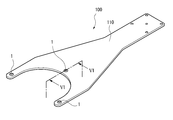
- FIG. 4 is a sectional view taken along line IV-IV of FIG. 3. It is a perspective view showing an example of the robot hand concerning the present invention.
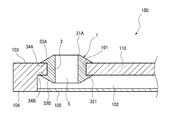
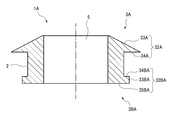
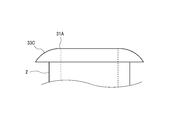
- FIG. 6 is a sectional view taken along line VI-VI of FIG. 5. It is sectional drawing which shows the modification of the pad which concerns on this invention. It is a partial enlarged front view showing a modification of the pad concerning the present invention. It is a partial enlarged front view showing a modification of the pad concerning the present invention. It is a partial enlarged front view showing a modification of the pad concerning the present invention. It is a partial enlarged front view showing a modification of the pad concerning the present invention.
- a pad 1 (an example of a pad member) according to the embodiment will be described with reference to FIGS.
- the pad 1 is used, for example, as a component that holds a wafer (an example of a substrate) that is a material for manufacturing a semiconductor device.
- the pad 1 is used by being attached to a hand (hereinafter, referred to as a robot hand) connected to the tip of an arm (an example of a robot arm) of an industrial robot, for example, a wafer transfer robot for transferring wafers between facilities. Can be done. Details of the robot hand will be described later.
- the pad 1 is provided at a main body (pad main body) 2 provided at a central portion and at both ends in a height direction (a vertical direction in FIG. 2) of the main body 2.
- the holding portion 3 in the present embodiment includes a first holding portion 3A provided at one end portion (for example, an upper end portion in FIGS. 2 and 4) of the main body portion 2 and an end portion opposite to the first holding portion 3A. (For example, a lower end portion in FIGS. 2 and 4).
- the main body 2 and the holding parts 3A, 3B are formed integrally.
- the main body 2 is a cylindrical member.
- the height of the main body 2 is set, for example, to be substantially the same as the thickness (the vertical height in FIG. 6) of the hand main body 110 at an opening 101 (see FIG. 6) described later.
- the height of the main body 2 is, for example, about 1 to 2 mm.
- the outer diameter R1 of the main body 2 is formed to be the same as or slightly larger than the inner diameter of an opening 101 (see FIG. 6) described later.
- the outer diameter R1 of the main body 2 is formed slightly larger than the same diameter as the inner diameter of the opening 101.
- a through hole 5 is formed at the center of the main body 2 and at the center of the holder 3 (3A, 3B) so as to communicate the main body 2 with the holder 3 (3A, 3B).
- the through hole 5 in this embodiment has a circular cross section and a uniform diameter in the height direction of the pad 1.
- the holding unit 3 (3A, 3B) has a ring 31 (31A, 31B) that comes into contact with the wafer or the like when the wafer or the like as the target member is held (placed).
- the ring portion 31 (31A, 31B) is formed in an annular shape at the edge of the through hole 5.
- the ring 31A and the ring 31B may have substantially the same shape.
- the ring portion 31A and the ring portion 31B are formed in an annular shape having the same diameter.
- the outer diameter R2 of the ring 31 (31A, 31B) is formed to be smaller than the outer diameter R1 of the main body 2.
- the outer diameter R2 of the ring portion 31 (31A, 31B) is formed slightly larger than the diameter R4 of the through hole 5 (see FIG. 4).
- the ring portion 31 (31A, 31B) is formed to be substantially flat so as to be orthogonal to the height direction of the main body 2. The wafer is held in a state of being in contact with one of the ring portion 31A (an example of a first ring portion) of the first holding portion 3A and the ring portion 31B (an example of the second ring portion) of the second holding portion 3B. Is done.
- the holding portion 3 (3A, 3B) is provided between the ring portion 31 (31A, 31B) and the main body portion 2 with a flange portion 32 (1) provided integrally with the main body portion 2 and the ring portion 31 (31A, 31B). 32A, 32B).
- the flange 32 (32A, 32B) includes a tapered portion 33 (33A, 33B) and a seating surface 34 (34A, 34B).
- the tapered portion 33 (33A, 33B) is formed so as to increase in diameter from the ring portion 31 (31A, 31B) side toward the main body portion 2 side.
- the seating surface 34 is formed in a portion of the flange 32 (32A, 32B) in contact with the main body 2, and is formed in parallel with a plane orthogonal to the height direction of the main body 2. That is, the outer diameter R3 of the flange 32 (32A, 32B) is formed to be larger than the outer diameter R1 of the main body 2.
- the seating surface 34 (34A, 34B) is a surface that contacts a part of the robot hand 100 when the pad 1 is attached to the robot hand 100.
- the holding portions 3 are formed in a truncated cone shape.
- the first holding portion 3A provided at the upper end of the main body 2 is formed so that the diameter decreases toward the ring portion 31A.
- the second holding portion 3B provided at the lower end of the main body 2 is formed such that the diameter decreases toward the ring portion 31B.
- the first holding portion 3A and the second holding portion 3B are formed so as to have a symmetrical structure with the main body 2 therebetween.
- the bottom view of the pad 1 is the same as the plan view shown in FIG.
- the rear view and the left and right side views of the pad 1 are the same as the front view shown in FIG.
- the area of the ring portion 31 (31A, 31B) is formed to be, for example, 0.1 to 1 square millimeter (mm 2 ) or less. If the area of the ring portion 31 (31A, 31B) is less than 0.1 mm 2 , there is a possibility that poor contact with the wafer may occur. On the other hand, if the area of the ring portion 31 (31A, 31B) is larger than 1 mm 2, there is a possibility that particles adhere to the wafer. For example, when the diameter R4 of the through hole 5 is 4 mm, the radial width W of the ring portion 31 (31A, 31B) is formed to be 0.01 mm to 0.065 mm.
- the area of the ring 31 (31A, 31B) varies depending on the total allowable contact area S between all the pads 1 attached to the robot hand 100 and the wafer, that is, the number of the pads 1. Assuming that the total allowable contact area S between all the pads 1 and the wafer is constant, as the number of the pads 1 increases to one, two, three,... 31A, 31B) are reduced to S, S / 2, S / 3,... In other words, when the allowable total contact area S between all the pads 1 and the wafer is determined and the number of all the pads 1 attached to the robot hand 100 is determined, the ring portion 31 (31A, 31B) Is uniquely determined.
- the total contact area S is 3 mm 2 or less
- the total number of pads 1 is three
- the diameter R4 of the through hole 5 is 4 mm
- the outer diameter R2 of the ring 31 (31A, 31B) is 4.13 mm.
- the radial width W of the ring portion 31 (31A, 31B) is 0.065 mm.
- the area of the ring portions 31 (31A, 31B) is 0.83 mm 2
- the total area of the ring portion 31 satisfies 2.49 2
- the total contact area S a (3 mm 2 or less).
- the total contact area S is 0.5 mm 2 or less
- the total number of pads 1 is 3
- the diameter R4 of the through hole 5 is 4 mm
- the outer diameter R2 of the ring portions 31 (31A, 31B) is 4.02 mm.
- the radial width W of the ring portion 31 (31A, 31B) is 0.01 mm. In this case, satisfying the ring portion 31 (31A, 31B) area of 0.13 mm 2, the total area of 0.39 mm 2 next to the ring portion 31, the contact total area S (0.5 mm 2 or less).
- the main body 2 and the holding parts 3 (3A, 3B) constituting the pad 1 are made of a conductive resin obtained by dispersing conductive particles in a resin composition.
- the main body 2 and the holding parts 3 (3A, 3B) can be made of, for example, a fluororesin such as polytetrafluoroethylene, perfluoroalkoxyalkane, ethylene tetrafluoroethylene copolymer, or the like.
- a fluororesin such as polytetrafluoroethylene, perfluoroalkoxyalkane, ethylene tetrafluoroethylene copolymer, or the like.
- As the resin composition all other resins commonly used for pads of robot hands for handling semiconductor wafers can be applied.
- FIG. 5 is a perspective view showing the robot hand 100 including the pad 1.
- FIG. 6 is a sectional view of the robot hand 100 taken along the line VI-VI.
- the robot hand 100 is provided with a plurality (three in this embodiment) of pads 1 for holding a wafer at its tip. Further, the robot hand 100 includes a suction / exhaust unit (not shown), and each pad 1 is connected to the suction / exhaust unit via a passage 102 described later.
- the pad 1 attached to the robot hand 100 holds the wafer and the like so that the wafer and the like do not shift with respect to the robot hand 100 or drop from the robot hand 100 by vacuum-sucking the wafer.
- the robot hand 100 is made of, for example, a ceramic material such as alumina.
- the robot hand 100 has a hand main body 110, an opening 101 for attaching the pad 1, and a passage 102 (a part of the intake / exhaust unit) communicating with the opening 101.
- the opening 101 is a hole formed in a holding surface 103 (upper surface in FIG. 6) which is a surface of the hand main body 110 on which a wafer or the like is held, and is communicated with the passage 102.
- the opening 101 in the present embodiment has a circular cross section and a uniform diameter in the thickness direction of the hand main body 110 at the opening 101.
- the diameter of the opening 101 is formed to be substantially the same as or slightly smaller than the outer diameter R1 of the main body 2.
- the passage portion 102 is formed by sealing a groove formed on a surface (back surface) 104 of the hand main body 110 opposite to the holding surface 103 with a lid member (seal member) 105.
- An end (the right end in FIG. 6) of the passage 102 is connected to a suction / exhaust unit (not shown).
- One of the holding portions 3 (3A or 3B) of the pad 1 is inserted into the opening 101 from the holding surface 103 side of the hand main body 110 while being elastically deformed.
- the flange portion 32 (32A, 32B) includes the tapered portion 33 (33A, 33B)
- the holding portion 3 (3A or 3B) is guided into the opening portion 101 while being self-aligned.
- the largest diameter portion 321 (see FIG. 6) of the flange portion 32 (32A, 32B) is elastically deformed while being folded toward the main body portion 2 and elastically deformed to the original shape after completely passing through the opening 101.
- the holding portion 3 (3A or 3B) comes into close contact with the lower edge of the opening 101.
- the flange 32B (tapered portion 33B) of the second holding portion 3B enters the opening 101, and the second holding portion 3B (the ring portion 31B and the flange 32B). ) are arranged in the passage portion 102.
- the seating surface 34B of the second holding portion 3B arranged in the passage portion 102 abuts (sits) on the inner wall surface of the passage portion 102 (the upper surface of the passage portion 102 in FIG. 6).
- the main body 2 of the pad 1 is in contact with the inner peripheral surface of the opening 101, and both are in close contact with each other.
- the first holding portion 3A is not inserted into the opening 101, but is arranged outside the opening 101 (above the holding surface 103 in FIG. 6), and the seating surface 34A of the first holding portion 3A is It is attached in a state where it abuts on 103. That is, the pad 1 is securely attached to the hand main body 110 by holding the hand main body 110 between the flange 32A of the first holding part 3A and the flange 32B of the second holding part 3B.
- the mounting position of the pad 1 attached to the robot hand 100 is defined by the flange portion 32A of the first holding portion 3A and the flange portion 32B of the second holding portion 3B at an appropriate position.
- the through hole 5 of the pad 1 and the passage 102 of the robot hand 100 are communicated.
- the air in the through-hole 5 and the passage portion 102 is evacuated by the operation of the suction / exhaust unit, so that the wafer placed on the robot hand 100 is vacuum-sucked on the ring portion 31A of the pad 1. .
- the robot hand 100 includes the hand main body 110 and the pad 1 attached to the opening 101 provided in the hand main body 110 and holding a wafer.
- the pad 1 is attached to the opening 101 and has a through-hole 5 at the center thereof, a main body 2 (an example of a pad main body), rings 31 provided at both ends of the pad 1, a ring 31 and a main body.
- a flange portion 32 provided integrally with the portion 2 and extending toward the outside of the main body portion 2.
- the outer diameter R2 of the ring portion 31 is formed to be smaller than the outer diameter R1 of the main body portion 2.
- the pad 1 can be attached to the robot hand 100 simply by inserting the pad 1 into the opening 101 of the hand main body 110, which is a pad attachment hole, while deforming the pad 1 so as to crush it. For this reason, a special instrument or member is not required when attaching and detaching the pad 1 to and from the opening 101. Therefore, the attachment / detachment operation is easy, and the cost of members associated with the attachment / detachment is zero.
- the pad 1 is made of a resin composition containing conductive particles, the pad 1 is brought into contact with the wafer to ground the static electricity charged on the wafer. As a result, there is no possibility that a spark will occur between the pad 1 and the wafer. As a result, there is no risk of damage to the wafer, and the yield of the wafer is improved.
- the ring 31 is provided with a ring 31A (an example of a first ring) provided on the front end side of the pad 1 and a ring provided on the rear end side of the pad 1.
- the flange portion 32 includes a ring portion 31B (an example of a second ring portion) formed in the same shape as the portion 31A, and the flange portion 32 is provided integrally with the ring portion 31A and the main body portion 32 (first flange portion 32A).
- a flange portion) and a flange portion 32B (an example of a second flange portion) provided integrally with the ring portion 31B and the main body portion 2.
- the ring portion 31A and the ring portion 31B have a symmetric structure, either the ring portion 31A or the ring portion 31B may be on the side that comes into contact with the wafer. Furthermore, since the flange 32A and the flange 32B also have a symmetrical structure, erroneous installation when mounting the pad 1 on the robot hand 100 can be prevented, and the mounting of the pad 1 is easy.
- the hand main body 110 has a passage portion 102 in which one end is communicated with the opening 101 and the other end is connected to the intake / exhaust unit. . Accordingly, if the wafer is transferred without being sucked to the pad and the cycle time of the wafer transfer is insufficient or the suction force is insufficient, the suction and exhaust unit is separately provided and the passage unit 102 is provided. By evacuating the wafer, it is possible to transfer the wafer while securely holding the wafer.
- the hand main body 110 when the pad 1 is attached to the hand main body 110, the hand main body 110 is sandwiched between the flange 32A and the flange 32B, and the pad 1 is securely attached to the hand main body 110. It is held in close contact. Thereby, it is possible to prevent the pad 1 from dropping from the robot hand 100.
- the pad 1 when the pad 1 is worn by use, it is not necessary to replace the robot hand 100 itself, and only the pad 1 needs to be attached and replaced. In addition, no special tools or members are required for the replacement, and it can be easily removed and attached by hand. Further, the pad 1 is free from the front and back when the pad is first attached. After the pad 1 is first attached and the front side is used, the pad 1 is once removed and the opposite back side (the side located in the passage portion 102) is removed. Can be reused. Therefore, the time required for the replacement work can be significantly reduced, and there is no cost for the members required for replacement, and one pad 1 can be used twice.
- the pad 1 when the pad 1 is attached to the robot hand 100, it is not necessary to attach a sealing member or the like such as a vacuum suction pad disclosed in Patent Document 2, for example. 1 can be easily replaced.
- the holding portion 3 including the ring portion 31 and the flange portion 32 is provided at both ends of the main body portion 2.
- the holding portion 3 may be configured to be provided at at least one end of the main body 2.
- a holding portion having a different shape from the holding portion 3 of the above-described embodiment is attached to the end of the main body 2 on the side to be inserted into the hand main body 110 (FIG. (Lower end).
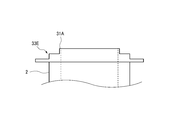
- the holding portion 3BA on the side inserted into the hand main body 110 has a flange 32BA (an example of a third flange) extending toward the outside of the main body 2.
- the flange portion 32BA is formed at the edge of the through-hole 5 in parallel with a surface orthogonal to the height direction of the main body 2, and is formed vertically from the outer end of the surface 35BA toward the main body 2.
- Surface 33BA, and a surface (seating surface) 34BA formed at a portion of the flange portion 32BA in contact with the main body 2 and formed in parallel with a surface orthogonal to the height direction of the main body 2.
- the pad 1A can be attached in a state in which the pad 1A is securely adhered to the robot hand 100 by sandwiching the hand main body 110 between the flanges 32A and 32BA at both ends of the main body 2. Therefore, it is possible to prevent the pad 1A from falling off from the robot hand 100.
- the shape of the main body 2 is cylindrical, but is not limited to this.
- the main body 2 is appropriately selected according to the shape of the opening 101, and may be, for example, a prism such as a quadrangular prism or a polygonal prism.
- the shape of the holding portion 3 (3A, 3B) is a truncated cone, but the shape is not limited to this.
- the holding unit 3 is also appropriately selected according to the shape of the opening 101, and may be, for example, a truncated pyramid.
- the ring portion 31 (31A, 31B) has a substantially flat shape orthogonal to the axial direction of the main body 2, but is not limited thereto.
- the annular portion 31 (31A, 31B) has, for example, an inclined surface that is gradually inclined toward the inner side (as it approaches the through hole 5) toward the flange portion 32 (32A, 32B) or an outer surface (the through hole 5). May be formed as an inclined surface that is gradually inclined toward the flange portion 32 (32A, 32B) side (as the distance from the flange portion increases).
- the outer peripheral edge of the ring 31 (31A, 31B) is in contact with the wafer
- the inner peripheral edge of the ring 31 (31A, 31B) is in contact with the wafer.
- the tapered portions 33 are formed so that the ridge shape in a front view is straight, but the present invention is not limited to this.
- the ridgeline shape in a front view may be an upwardly convex arched tapered portion 33C (see FIG. 8) or a downwardly concave arched tapered portion 33D (see FIG. 9).
- the tapered portion may not be continuous, and may be a tapered portion 33 ⁇ / b> E (see FIG. 10) having a stepped ridge shape in a front view.
- the present invention is not limited to the above-described embodiment, and may be appropriately modified and improved.
- the material, shape, dimension, numerical value, form, number, arrangement location, and the like of each component in the above-described embodiment are arbitrary and are not limited as long as the present invention can be achieved.
Landscapes
- Engineering & Computer Science (AREA)
- Robotics (AREA)
- Mechanical Engineering (AREA)
- Container, Conveyance, Adherence, Positioning, Of Wafer (AREA)
- Manipulator (AREA)
Abstract
L'invention concerne une main de robot (100), qui est fixée à un bras de robot pour transférer un substrat et maintient le substrat, est équipée d'une partie de corps de main (110) et d'un élément de coussinet (1) qui est fixé à une section d'ouverture (101) disposée dans la partie de corps de main (110) et maintient le substrat. L'élément de coussinet (1) est équipé : d'une partie de corps de coussinet (2) qui est fixée à la section d'ouverture (101) de la main de robot (100) et a, dans sa section centrale, un trou traversant (5) ; une première partie annulaire (31A) qui est disposée sur le côté de pointe de l'élément de coussinet (1) et qui est amenée en contact avec le substrat ; et une première partie de bride (32A) qui est disposée d'un seul tenant avec la première partie annulaire (31A) et la partie de corps de coussinet (2) et s'étend vers l'extérieur de la partie de corps de coussinet (2).
Applications Claiming Priority (2)
| Application Number | Priority Date | Filing Date | Title |
|---|---|---|---|
| JP2018-122932 | 2018-06-28 | ||
| JP2018122932A JP2021153076A (ja) | 2018-06-28 | 2018-06-28 | パッド部材を備えたロボットハンド |
Publications (1)
| Publication Number | Publication Date |
|---|---|
| WO2020003979A1 true WO2020003979A1 (fr) | 2020-01-02 |
Family
ID=68986294
Family Applications (1)
| Application Number | Title | Priority Date | Filing Date |
|---|---|---|---|
| PCT/JP2019/022813 Ceased WO2020003979A1 (fr) | 2018-06-28 | 2019-06-07 | Main de robot équipée d'un élément de coussinet |
Country Status (3)
| Country | Link |
|---|---|
| JP (1) | JP2021153076A (fr) |
| TW (1) | TW202000403A (fr) |
| WO (1) | WO2020003979A1 (fr) |
Cited By (1)
| Publication number | Priority date | Publication date | Assignee | Title |
|---|---|---|---|---|
| KR20220094020A (ko) * | 2020-12-28 | 2022-07-05 | 세메스 주식회사 | 반송 유닛 및 이를 가지는 기판 처리 장치 |
Citations (8)
| Publication number | Priority date | Publication date | Assignee | Title |
|---|---|---|---|---|
| JPS6094487U (ja) * | 1983-11-30 | 1985-06-27 | 東芝機械株式会社 | ウエハ吸着装置 |
| JPH08107136A (ja) * | 1994-10-03 | 1996-04-23 | Dainippon Screen Mfg Co Ltd | 基板搬送装置 |
| JPH08112793A (ja) * | 1994-10-13 | 1996-05-07 | Toshiba Corp | 吸着保持装置及び実装装置 |
| JPH10156778A (ja) * | 1996-12-04 | 1998-06-16 | Smc Corp | 吸着用パッド |
| JP2002066972A (ja) * | 2000-09-01 | 2002-03-05 | Koganei Corp | 吸着装置 |
| JP2004059229A (ja) * | 2002-07-29 | 2004-02-26 | Espec Corp | 薄層基板製造方法、薄層基板移載装置及び薄層基板移載用吸着パッド |
| JP2008282870A (ja) * | 2007-05-08 | 2008-11-20 | Mitsubishi Cable Ind Ltd | 搬送アーム用パッド |
| JP2014072262A (ja) * | 2012-09-28 | 2014-04-21 | Hitachi High-Technologies Corp | 真空処理装置及び搬送装置 |
-
2018
- 2018-06-28 JP JP2018122932A patent/JP2021153076A/ja active Pending
-
2019
- 2019-06-07 WO PCT/JP2019/022813 patent/WO2020003979A1/fr not_active Ceased
- 2019-06-18 TW TW108121018A patent/TW202000403A/zh unknown
Patent Citations (8)
| Publication number | Priority date | Publication date | Assignee | Title |
|---|---|---|---|---|
| JPS6094487U (ja) * | 1983-11-30 | 1985-06-27 | 東芝機械株式会社 | ウエハ吸着装置 |
| JPH08107136A (ja) * | 1994-10-03 | 1996-04-23 | Dainippon Screen Mfg Co Ltd | 基板搬送装置 |
| JPH08112793A (ja) * | 1994-10-13 | 1996-05-07 | Toshiba Corp | 吸着保持装置及び実装装置 |
| JPH10156778A (ja) * | 1996-12-04 | 1998-06-16 | Smc Corp | 吸着用パッド |
| JP2002066972A (ja) * | 2000-09-01 | 2002-03-05 | Koganei Corp | 吸着装置 |
| JP2004059229A (ja) * | 2002-07-29 | 2004-02-26 | Espec Corp | 薄層基板製造方法、薄層基板移載装置及び薄層基板移載用吸着パッド |
| JP2008282870A (ja) * | 2007-05-08 | 2008-11-20 | Mitsubishi Cable Ind Ltd | 搬送アーム用パッド |
| JP2014072262A (ja) * | 2012-09-28 | 2014-04-21 | Hitachi High-Technologies Corp | 真空処理装置及び搬送装置 |
Cited By (2)
| Publication number | Priority date | Publication date | Assignee | Title |
|---|---|---|---|---|
| KR20220094020A (ko) * | 2020-12-28 | 2022-07-05 | 세메스 주식회사 | 반송 유닛 및 이를 가지는 기판 처리 장치 |
| KR102701437B1 (ko) * | 2020-12-28 | 2024-09-03 | 세메스 주식회사 | 반송 유닛 및 이를 가지는 기판 처리 장치 |
Also Published As
| Publication number | Publication date |
|---|---|
| JP2021153076A (ja) | 2021-09-30 |
| TW202000403A (zh) | 2020-01-01 |
Similar Documents
| Publication | Publication Date | Title |
|---|---|---|
| US8172288B2 (en) | Gripper, in particular a Bernoulli gripper | |
| US7669903B2 (en) | Ultra low contact area end effector | |
| US20060181095A1 (en) | Ultra low contact area end effector | |
| US7661183B2 (en) | Blade changing tool | |
| EP1715514B1 (fr) | Dispositif de support sans contact | |
| JP2020004846A (ja) | アライメント装置、半導体ウエハ処理装置、およびアライメント方法 | |
| US9061423B2 (en) | Wafer handling apparatus | |
| JP2018157221A (ja) | ウェーハ‐ハンドリング・エンドエフェクタ | |
| KR20190017953A (ko) | 시료 유지구 | |
| JP7364692B2 (ja) | 基板吸引保持構造及び基板搬送ロボット | |
| JPH07136885A (ja) | 真空チャック | |
| WO2020003979A1 (fr) | Main de robot équipée d'un élément de coussinet | |
| KR20250112150A (ko) | 웨이퍼 또는 웨이퍼 어셈블리를 이송하기 위한 엔드 이펙터 | |
| US20100144147A1 (en) | Sample holding tool, sample suction device using the same and sample processing method using the same | |
| TW201740493A (zh) | 用於基板容器之緩衝保持器 | |
| WO2021257488A1 (fr) | Effecteur terminal robotique équipé de plots de contact de tranche remplaçables | |
| WO2020013013A1 (fr) | Main de transport | |
| JP4480296B2 (ja) | 電子部材用収納容器 | |
| JPH10156778A (ja) | 吸着用パッド | |
| JP2005011748A (ja) | ボタン型電池の製造装置 | |
| US20250065509A1 (en) | Robot blade and wafer breakage prevention system | |
| TW201909325A (zh) | 非接觸式處置器及使用非接觸式處置器處置工件之方法 | |
| CN109023287A (zh) | 沉积环及卡盘组件 | |
| JP3082347U (ja) | ウェーハ支持具 | |
| JPH05326Y2 (fr) |
Legal Events
| Date | Code | Title | Description |
|---|---|---|---|
| 121 | Ep: the epo has been informed by wipo that ep was designated in this application |
Ref document number: 19824696 Country of ref document: EP Kind code of ref document: A1 |
|
| NENP | Non-entry into the national phase |
Ref country code: DE |
|
| 122 | Ep: pct application non-entry in european phase |
Ref document number: 19824696 Country of ref document: EP Kind code of ref document: A1 |
|
| NENP | Non-entry into the national phase |
Ref country code: JP |