WO2020004245A1 - 水性組成物 - Google Patents
水性組成物 Download PDFInfo
- Publication number
- WO2020004245A1 WO2020004245A1 PCT/JP2019/024636 JP2019024636W WO2020004245A1 WO 2020004245 A1 WO2020004245 A1 WO 2020004245A1 JP 2019024636 W JP2019024636 W JP 2019024636W WO 2020004245 A1 WO2020004245 A1 WO 2020004245A1
- Authority
- WO
- WIPO (PCT)
- Prior art keywords
- aqueous composition
- acid
- carboxylic acid
- anhydride
- group
- Prior art date
- Legal status (The legal status is an assumption and is not a legal conclusion. Google has not performed a legal analysis and makes no representation as to the accuracy of the status listed.)
- Ceased
Links
Classifications
-
- B—PERFORMING OPERATIONS; TRANSPORTING
- B22—CASTING; POWDER METALLURGY
- B22C—FOUNDRY MOULDING
- B22C3/00—Selection of compositions for coating the surfaces of moulds, cores, or patterns
-
- C—CHEMISTRY; METALLURGY
- C10—PETROLEUM, GAS OR COKE INDUSTRIES; TECHNICAL GASES CONTAINING CARBON MONOXIDE; FUELS; LUBRICANTS; PEAT
- C10M—LUBRICATING COMPOSITIONS; USE OF CHEMICAL SUBSTANCES EITHER ALONE OR AS LUBRICATING INGREDIENTS IN A LUBRICATING COMPOSITION
- C10M105/00—Lubricating compositions characterised by the base-material being a non-macromolecular organic compound
- C10M105/08—Lubricating compositions characterised by the base-material being a non-macromolecular organic compound containing oxygen
- C10M105/22—Carboxylic acids or their salts
- C10M105/26—Carboxylic acids or their salts having more than one carboxyl group bound to an acyclic carbon atom or cycloaliphatic carbon atom
-
- C—CHEMISTRY; METALLURGY
- C10—PETROLEUM, GAS OR COKE INDUSTRIES; TECHNICAL GASES CONTAINING CARBON MONOXIDE; FUELS; LUBRICANTS; PEAT
- C10M—LUBRICATING COMPOSITIONS; USE OF CHEMICAL SUBSTANCES EITHER ALONE OR AS LUBRICATING INGREDIENTS IN A LUBRICATING COMPOSITION
- C10M105/00—Lubricating compositions characterised by the base-material being a non-macromolecular organic compound
- C10M105/08—Lubricating compositions characterised by the base-material being a non-macromolecular organic compound containing oxygen
- C10M105/22—Carboxylic acids or their salts
- C10M105/30—Carboxylic acids or their salts having more than one carboxyl group bound to a carbon atom of a six-membered aromatic ring
-
- C—CHEMISTRY; METALLURGY
- C10—PETROLEUM, GAS OR COKE INDUSTRIES; TECHNICAL GASES CONTAINING CARBON MONOXIDE; FUELS; LUBRICANTS; PEAT
- C10M—LUBRICATING COMPOSITIONS; USE OF CHEMICAL SUBSTANCES EITHER ALONE OR AS LUBRICATING INGREDIENTS IN A LUBRICATING COMPOSITION
- C10M169/00—Lubricating compositions characterised by containing as components a mixture of at least two types of ingredient selected from base-materials, thickeners or additives, covered by the preceding groups, each of these compounds being essential
-
- C—CHEMISTRY; METALLURGY
- C10—PETROLEUM, GAS OR COKE INDUSTRIES; TECHNICAL GASES CONTAINING CARBON MONOXIDE; FUELS; LUBRICANTS; PEAT
- C10M—LUBRICATING COMPOSITIONS; USE OF CHEMICAL SUBSTANCES EITHER ALONE OR AS LUBRICATING INGREDIENTS IN A LUBRICATING COMPOSITION
- C10M173/00—Lubricating compositions containing more than 10% water
-
- C—CHEMISTRY; METALLURGY
- C10—PETROLEUM, GAS OR COKE INDUSTRIES; TECHNICAL GASES CONTAINING CARBON MONOXIDE; FUELS; LUBRICANTS; PEAT
- C10M—LUBRICATING COMPOSITIONS; USE OF CHEMICAL SUBSTANCES EITHER ALONE OR AS LUBRICATING INGREDIENTS IN A LUBRICATING COMPOSITION
- C10M173/00—Lubricating compositions containing more than 10% water
- C10M173/02—Lubricating compositions containing more than 10% water not containing mineral or fatty oils
-
- B—PERFORMING OPERATIONS; TRANSPORTING
- B22—CASTING; POWDER METALLURGY
- B22D—CASTING OF METALS; CASTING OF OTHER SUBSTANCES BY THE SAME PROCESSES OR DEVICES
- B22D17/00—Pressure die casting or injection die casting, i.e. casting in which the metal is forced into a mould under high pressure
- B22D17/20—Accessories: Details
-
- C—CHEMISTRY; METALLURGY
- C10—PETROLEUM, GAS OR COKE INDUSTRIES; TECHNICAL GASES CONTAINING CARBON MONOXIDE; FUELS; LUBRICANTS; PEAT
- C10N—INDEXING SCHEME ASSOCIATED WITH SUBCLASS C10M RELATING TO LUBRICATING COMPOSITIONS
- C10N2040/00—Specified use or application for which the lubricating composition is intended
- C10N2040/20—Metal working
Definitions
- the present invention relates to an aqueous composition.
- a method of forming a metal using a mold a casting method, a die forging method, and the like can be given.
- the casting method include a low pressure casting method and a die casting method.
- an aqueous composition is used in advance as a release agent in the mold before molding. Products, oily compositions, powder compositions, granule compositions and the like may be applied.
- the purpose is to suppress the welding between the mold and the molten metal (molten metal) and to assist the mold release of the molded product.
- an aqueous composition, an oily composition, a powder composition, a granule composition, or the like is applied to a mold in advance.
- a molten metal is filled in the mold before molding by the mold.
- the plunger is slid into the sleeve, so that the molten metal in the sleeve is poured into the mold.
- the plunger and the sleeve are used.
- an aqueous composition, an oily composition, a powder composition, a granule composition, or the like may be applied as a lubricant.
- examples of the aqueous composition used for the release agent and the lubricant include an aqueous composition containing silicone oil as a main component. It is considered that the aqueous composition containing the silicone oil as a main component has improved releasability and lubricity due to the high heat resistance of the silicone oil. In order to further enhance the releasability and lubricity of the aqueous composition containing silicone as a main component, development of a modified silicone and an additive to silicone oil has been promoted.
- Patent Document 1 discloses that a high-concentration aqueous die-casting release agent having a content of a release component such as a silicone compound (in terms of solid content) of 5 to 60% by mass is sprayed on a mold so as to satisfy predetermined conditions.
- a die casting method comprising the steps of: According to Patent Document 1, a high-concentration aqueous release agent for aqueous die-casting can be used in a very small amount without being diluted with water, so that the drying efficiency of the mold is improved, and compared with the conventional die-casting method. It is disclosed that since the waste liquid of the release agent can be greatly reduced, it is possible to improve the problem of environmental pollution such as water pollution.
- examples of the aqueous composition used in a metal molding method using a mold other than the aqueous composition containing silicone oil as a main component include a release agent described in Patent Document 2.
- Patent Literature 2 discloses a water-soluble release agent applied to a molding surface of a mold, which contains an organic acid or an organic acid salt having a reducing property in a concentration of 0.01 wt% or more at the time of use and a stock solution. It describes a release agent contained as a concentration at a ratio equal to or lower than a predetermined concentration which is the stability limit of the release agent emulsion. According to Patent Literature 2, it is disclosed that the condition of a mold forming surface can be improved by a repeated casting cycle, and the life of the mold can be prolonged positively.
- An object of the present invention is to provide an aqueous composition having excellent mold release properties, lubricity, adhesiveness, and heat resistance and low odor.
- One aspect of the present invention includes at least one selected from the group consisting of a carboxylic acid compound represented by the following formula (1), a carboxylic anhydride represented by the following formula (2), and trimellitic anhydride:
- An aqueous composition comprising a basic compound and water.
- R represents an alkanediyl group having 2 to 4 carbon atoms, a vinylene group or a benzene ring, and a represents 2 or 3.
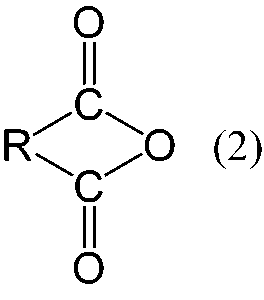
- R represents an alkanediyl group having 2 to 4 carbon atoms, a vinylene group, or a benzene ring.
- a release agent is diluted about 100 times, and the diluted release agent is applied to the mold in a relatively large amount such as several hundred mL or several L. By doing so, the mold is cooled, and a release film is formed on the mold surface.
- a metal product molded product
- an aqueous composition containing silicone as a main component such as a release agent described in Patent Document 1
- a release agent for a metal molding method using a mold.
- the mold release agent is deposited in the cavity of the mold, and the mold is contaminated, which may make cleaning difficult.
- a molded product obtained by using a mold having insufficient cleaning may be difficult to adapt to an electronic component or the like.
- the heat resistance of the aqueous composition is low, particularly when the mold temperature is high, the release agent in contact with the mold is gasified, and an internal defect due to the generated gas, for example, a void is generated. There was also.
- the aqueous composition was used as a release agent, the release component sometimes did not sufficiently adhere to the mold.
- aqueous composition other than the aqueous composition containing silicone as a main component, for example, a release agent described in Patent Document 2 as the release agent.
- the release agent described in Patent Document 2 does not have excellent mold release, lubricity, adhesiveness, and heat resistance, and often has a large odor. there were. That is, the release agent described in Patent Document 2 is not a release agent excellent in all of the releasability, lubricity, adhesion, and heat resistance, and having little odor.
- the present invention has been made in view of the above circumstances, and has as its object to provide an aqueous composition having excellent release properties, lubricity, adhesiveness, and heat resistance and low odor.
- the aqueous composition according to the embodiment of the present invention is selected from the group consisting of a carboxylic acid compound represented by the following formula (1), a carboxylic anhydride represented by the following formula (2), and trimellitic anhydride.
- An aqueous composition comprising at least one kind, a basic compound, and water.
- R represents an alkanediyl group having 2 to 4 carbon atoms, a vinylene group or a benzene ring, and a represents 2 or 3.
- R represents an alkanediyl group having 2 to 4 carbon atoms, a vinylene group, or a benzene ring.
- the aqueous composition is an aqueous composition having excellent release properties, lubricity, adhesiveness, and heat resistance and low odor. Specifically, by including the carboxylic acid compound and the basic compound, the aqueous composition can exhibit sufficiently high releasability and lubricity. For this reason, it can be used as a release agent and a lubricant in a metal molding method using a mold, for example, a die casting method. Specifically, it can be used as a release agent to be applied to a mold in advance, for example, a release agent for die casting.
- a lubricant for enhancing lubricity between a sleeve for pouring the molten metal into the mold and a plunger for pouring the molten metal, for example, a die-casting plunger lubricant or a die-casting sleeve lubricant.
- a lubricant for enhancing lubricity between a sleeve for pouring the molten metal into the mold and a plunger for pouring the molten metal
- a die-casting plunger lubricant or a die-casting sleeve lubricant for example, a die-casting plunger lubricant or a die-casting sleeve lubricant.
- the aqueous composition is also excellent in adhesiveness and heat resistance, when the aqueous composition is used as a release agent or lubricant as described above, more suitable release properties and lubricity Can be demonstrated. Further, even when the aqueous composition is used as
- the carboxylic acid compound is represented by the formula (1), wherein R is an alkanediyl group having 2 to 4 carbon atoms, a vinylene group, or a benzene ring, and the degree of substitution of the carboxyl group (—COOH) (carboxyl group A) is 2 or 3. That is, the carboxylic acid compound is a carboxylic acid compound in which an alkanediyl group having 2 to 4 carbon atoms, a vinylene group, or a benzene ring is substituted with two or three carboxyl groups.
- the carboxylic acid compound examples include succinic acid, adipic acid, maleic acid, fumaric acid, phthalic acid, isophthalic acid, terephthalic acid, and trimellitic acid.
- the aqueous composition has excellent releasability, lubricity, adhesiveness, and heat resistance, and has less odor.
- the carboxylic acid compound, adipic acid, terephthalic acid, and trimellitic acid are more preferable among the carboxylic acid compounds exemplified above.
- the obtained molded article may be colored.
- adipic acid By including at least one selected from the group consisting of adipic acid, terephthalic acid, and trimellitic acid as the carboxylic acid compound, the occurrence of such coloring can be suppressed. That is, an aqueous composition having excellent release properties, lubricity, adhesiveness, and heat resistance, and having not only a low odor but also excellent coloring properties can be obtained.
- the carboxylic acid compounds may be used alone or in combination of two or more.
- the carboxylic acid anhydride is represented by the formula (1), wherein R is an alkanediyl group and a vinylene group having 2 to 4 carbon atoms, and an aliphatic carboxylic acid compound represented by the formula (1), An aromatic carboxylic acid compound in which R is a benzene ring is exemplified.
- R is an alkanediyl group having 2 to 4 carbon atoms
- R is a benzene ring and an aromatic carboxylic acid compound.
- an aqueous composition having excellent releasability, lubricity, adhesion, and heat resistance and less odor can be obtained. More preferably, the aliphatic carboxylic acid is adipic acid, and the aromatic carboxylic acid is terephthalic acid.
- an aqueous composition having excellent release properties, lubricity, adhesion, and heat resistance, not only less odor, but also excellent coloring properties can be obtained.
- the carboxylic anhydride and trimellitic anhydride are anhydrides of the carboxylic acid compound.
- the carboxylic anhydride is represented by the formula (2), wherein R is an alkanediyl group having 2 to 4 carbon atoms, a vinylene group, or a benzene ring. That is, as the carboxylic acid anhydride, an aliphatic carboxylic acid anhydride represented by the formula (2), wherein R is an alkanediyl group and a vinylene group having 2 to 4 carbon atoms, and a compound represented by the formula (2) And an aromatic carboxylic anhydride wherein R is a benzene ring.
- carboxylic anhydride examples include succinic anhydride, adipic anhydride, maleic anhydride, fumaric anhydride, and phthalic anhydride.
- succinic anhydride examples include succinic anhydride, adipic anhydride, maleic anhydride, fumaric anhydride, and phthalic anhydride.
- the carboxylic anhydrides may be used alone or in combination of two or more.
- the aqueous composition contains at least one selected from the group consisting of the carboxylic acid compound, the carboxylic anhydride, and trimellitic anhydride. That is, the carboxylic acid compound, the carboxylic anhydride, and trimellitic anhydride may be used alone or in combination of two or more in the aqueous composition.
- the basic compound is not particularly limited as long as it is a compound capable of neutralizing the carboxylic acid compound, the carboxylic acid anhydride, and trimellitic anhydride. It may be an inorganic compound.
- the basic organic compound include amine compounds such as triethylamine, monoethylamine, diethylamine, trimethylamine, monomethylamine, dimethylamine, ethylenediamine, triethanolamine, and tetramethylethylenediamine, pyrrolidine, piperidine, and pyridine.
- the basic inorganic compound examples include, for example, sodium hydroxide, potassium hydroxide, calcium hydroxide, magnesium hydroxide, sodium carbonate, sodium hydrogen carbonate, potassium carbonate, potassium hydrogen carbonate, calcium carbonate, and magnesium carbonate.
- the basic compound is preferably a basic inorganic compound, and more preferably sodium hydroxide and potassium hydroxide from the viewpoint of low odor.
- sodium hydroxide is preferred from the viewpoint of availability and the like.
- the basic compounds may be used alone or in combination of two or more.
- the water is not particularly limited, and examples thereof include water that can be used for an aqueous composition such as an aqueous release agent and an aqueous lubricant.
- an aqueous composition such as an aqueous release agent and an aqueous lubricant.
- industrial water, ion-exchanged water, and pure water can be used. No.
- the total content of the carboxylic acid compound, the carboxylic anhydride, and trimellitic anhydride is preferably 3 to 30% by mass, and more preferably 3 to 20% by mass based on the total amount of the aqueous composition. Is more preferably 3 to 15% by mass. If the carboxylic acid compound, the carboxylic anhydride, and the trimellitic anhydride are too small, the lubricity and the releasability tend to decrease.
- the carboxylic acid compound, the carboxylic acid anhydride, and trimellitic anhydride are too large, the carboxylic acid compound, the carboxylic acid anhydride, and trimellitic anhydride precipitate from the aqueous composition, and the aqueous composition It tends to be difficult to apply. Therefore, if the total content of the carboxylic acid compound, the carboxylic anhydride, and trimellitic anhydride is within the above range, the releasability, lubricity, adhesion, and heat resistance are excellent, and the odor is less. An aqueous composition is obtained.
- the content of the basic compound is not particularly limited, but is preferably, for example, a content at which the pH of the water-soluble compound is 7 to 13, and a content at which the pH of the water-soluble compound is 7 to 10.
- the content is more preferably such that the pH of the water-soluble compound becomes 8. If the amount of the basic compound is too small, the mold and peripheral equipment tend to be corroded. If the amount of the basic compound is too large, irritation to the eyes and skin of the worker is increased, and the safety tends to be poor. Therefore, when the content of the basic compound is within the above range, an aqueous composition having excellent releasability, lubricity, adhesion, and heat resistance and less odor can be obtained.
- the remainder is the water.
- the aqueous composition includes: Water other than the carboxylic acid compound, the carboxylic anhydride, the trimellitic anhydride, and the basic compound is water.
- the aqueous composition contains the carboxylic acid compound, the carboxylic anhydride, the trimellitic anhydride, the basic compound, and components other than the water
- the carboxylic acid compound, the carboxylic acid Water other than the anhydride, trimellitic anhydride, the basic compound, and the other components is water.
- the aqueous composition may contain components other than the carboxylic acid compound, the carboxylic anhydride, the trimellitic anhydride, the basic compound, and the water, if necessary, as long as the effects of the present invention are not impaired.
- Component examples of the other components include a water-soluble polymer.
- the aqueous composition may be used by adding to a conventional aqueous release agent or aqueous lubricant, for example, an emulsion-type release agent or lubricant, or may be used as a conventional aqueous release agent or aqueous lubricant.
- an emulsion-type release agent or lubricant may be added to the aqueous composition.
- other components include components contained in conventional release agents and lubricants.
- the water-soluble polymer is not particularly limited, and examples thereof include a water-soluble polymer that can be used in an aqueous composition such as an aqueous release agent or an aqueous lubricant.
- a water-soluble polymer include cellulose derivatives such as carboxymethyl cellulose (CMC) and hydroxyethyl cellulose (HEC), polyethylene glycol, isobutylene / maleic acid copolymer, diisobutylene / maleic acid copolymer, and styrene.
- CMC carboxymethyl cellulose
- HEC hydroxyethyl cellulose
- PVP polyvinylpyrrolidone
- a cellulose derivative is preferred, and carboxymethyl cellulose (CMC) and hydroxyethyl cellulose (HEC) are more preferred.
- the water-soluble polymer may or may not be contained in the aqueous composition, but by containing it, lubricity and releasability are further enhanced.
- its content is preferably from 0.1 to 10% by mass, and more preferably from 0.1 to 5% by mass, based on the total amount of the aqueous composition. preferable. If the amount of the water-soluble polymer is too small, the effect of adding the water-soluble polymer tends to be insufficient. On the other hand, if the amount of the water-soluble polymer is too large, the viscosity of the aqueous composition tends to be high, and the aqueous composition tends to be difficult to apply.
- the aqueous composition preferably has a viscosity at 30 ° C of 100 mPa ⁇ s or less, more preferably 50 mPa ⁇ s or less. If the viscosity of the aqueous composition is too high, it tends to be difficult to apply the aqueous composition.
- the method for producing the aqueous composition is not particularly limited as long as the aqueous composition can be produced. Specifically, by adding the carboxylic acid compound, the carboxylic anhydride, the trimellitic anhydride, the basic compound, and other components to water in a predetermined amount, and mixing. And the aqueous composition can be produced.
- the aqueous composition contains at least one selected from the group consisting of the carboxylic acid compound, the carboxylic anhydride, and trimellitic anhydride and the basic compound, thereby forming a mold.
- a molding method of the used metal for example, a die casting method, sufficiently high releasability and lubricity can be exhibited.
- the aqueous composition can be used as a release agent to be applied to a mold in advance, for example, a release agent for die casting.
- the aqueous composition is a lubricant for improving lubricity between a sleeve for pouring a molten metal into a mold and a plunger for pouring the molten metal, for example, a plunger lubricant for die casting and a sleeve for die casting. It can also be used as a lubricant or the like. Further, since the aqueous composition is also excellent in adhesiveness and heat resistance, when the aqueous composition is used as a release agent or lubricant as described above, more suitable release properties and lubricity Can be demonstrated. Further, even when the aqueous composition is used as a release agent or a lubricant as described above, generation of odor is small and deterioration of the working environment can be prevented.
- One aspect of the present invention includes at least one selected from the group consisting of a carboxylic acid compound represented by the following formula (1), a carboxylic anhydride represented by the following formula (2), and trimellitic anhydride:
- An aqueous composition comprising a basic compound and water.
- R represents an alkanediyl group having 2 to 4 carbon atoms, a vinylene group or a benzene ring, and a represents 2 or 3.
- R represents an alkanediyl group having 2 to 4 carbon atoms, a vinylene group, or a benzene ring.
- aqueous composition having excellent release properties, lubricity, adhesion, and heat resistance and low odor.
- the carboxylic acid compound is at least one selected from the group consisting of succinic acid, adipic acid, maleic acid, fumaric acid, phthalic acid, isophthalic acid, terephthalic acid, and trimellitic acid. Is preferred.
- the carboxylic anhydride is preferably at least one selected from the group consisting of succinic anhydride, adipic anhydride, maleic anhydride, and phthalic anhydride.
- an aqueous composition having excellent releasability, lubricity, adhesion, and heat resistance and less odor can be obtained.
- the carboxylic acid compound is more preferably at least one selected from the group consisting of adipic acid, terephthalic acid, and trimellitic acid.
- this aqueous composition is used to mold a metal using a mold, for example, in a die casting method, and when used as a mold release agent, the obtained molded article is sufficiently suppressed from being colored. be able to. Therefore, an aqueous composition which is excellent in releasability, lubricity, adhesiveness, and heat resistance, not only has little odor, but also has excellent coloring properties can be obtained.
- the carboxylic acid compound is represented by the formula (1), wherein R is an alkanediyl group having 2 to 4 carbon atoms, and an aliphatic carboxylic acid compound represented by the formula (1). And R is preferably an aromatic carboxylic acid compound having a benzene ring.
- an aqueous composition having excellent releasability, lubricity, adhesion, and heat resistance and less odor can be obtained.
- the aliphatic carboxylic acid is adipic acid and the aromatic carboxylic acid is terephthalic acid.
- an aqueous composition having excellent releasability, lubricity, adhesion, and heat resistance, and having not only less odor but also excellent coloring properties can be obtained.
- the total content of the carboxylic acid compound, the carboxylic anhydride, and trimellitic anhydride is preferably 3 to 30% by mass based on the total amount of the aqueous composition.
- an aqueous composition having excellent releasability, lubricity, adhesion, and heat resistance and less odor can be obtained.
- an aqueous composition having excellent release properties, lubricity, adhesion, and heat resistance and low odor.
- Adipic anhydride adipic anhydride manufactured by Fujifilm Wako Pure Chemical Industries, Ltd. [Carboxyl represented by the above formula (2), wherein R is a vinylene group] Acid anhydride] Maleic anhydride: MA manufactured by EXCEL Chemical Corporation [Aromatic carboxylic acid compound represented by the formula (2) and wherein R is a benzene ring] Phthalic anhydride: phthalic anhydride manufactured by Kawasaki Chemical Industry Co., Ltd.) [Trimellitic anhydride] Trimellitic anhydride: trimellitic anhydride manufactured by Mitsubishi Gas Chemical Co., Ltd.
- CMC Carboxymethylcellulose (SG Cellogen PR manufactured by Daiichi Kogyo Seiyaku Co., Ltd.)
- HEC hydroxyethyl cellulose (HEC Daicel SP200 manufactured by Daicel Finechem Co., Ltd.)
- Water ion-exchanged water
- Silicone alkyl aralkyl-modified silicone (RELEASE AGENT TN manufactured by Asahi Kasei Wacker Silicone Co., Ltd.)
- Higher alcohol alkylene oxide adduct polyoxyalkylene lauryl ether (DKS NL-Dash410 manufactured by Daiichi Kogyo Seiyaku Co., Ltd.)
- DKS NL-Dash410 manufactured by Daiichi Kogyo Seiyaku Co., Ltd.
- the content of the basic compound is such that the pH of the obtained aqueous composition becomes the pH shown in Tables 1 to 4.
- the pH of the aqueous composition was measured using a pH meter (pH METER F-72 manufactured by Horiba, Ltd.).
- a 200 mm ⁇ 200 mm ⁇ 30 mm steel plate (SDK-61 manufactured by Mec International Co., Ltd.) was heated to 350 ° C.
- Spray time is 0.5 second, spraying is performed once, liquid pressure is 0.1 MPa, and spray pressure is 0, using an Atmax nozzle (two-fluid nozzle) (AM45B-0ST) manufactured by Atmax Co., Ltd.
- the aqueous composition was applied under the conditions of 0.4 MPa, a spray distance of 200 mm, and a coating amount of 2.5 g.
- a cylindrical member (ring made of S45C material manufactured by MEC International Co., Ltd.) having an inner diameter of 80 mm, an outer diameter of 100 mm, and a height of 50 mm was placed. At this time, the cylindrical member was placed such that the lower surface orthogonal to the peripheral surface was in contact with the steel plate.
- the aluminum material (ADC-12 manufactured by Asahi Seiren Co., Ltd.) was heated and melted. At that time, heating was performed until the temperature of the obtained molten metal reached 670 ⁇ 10 ° C.
- the molten metal was manually supplied into the cylindrical member brought into contact with the steel plate. By doing so, the molten metal was poured into the cylindrical member while being in contact with the steel plate.
- the melt was solidified by allowing it to cool naturally.
- a weight of 9.0 kg was placed on the solidified aluminum material.
- the cylindrical member was moved in a direction parallel to the plate surface direction of the steel plate.
- the tensile load from the start of movement of the cylindrical member was measured with a load cell attached to the cylindrical member.
- ⁇ Releaseability was evaluated using the tensile load at the start of movement. Specifically, when the tensile load at the start of the movement was 5 kgf or less, the evaluation was " ⁇ ". If the tensile load at the start of the movement was more than 5 kgf and 10 kgf or less, it was evaluated as “ ⁇ ”. If the tensile load at the start of the movement was more than 10 kgf and not more than 20 kgf, it was evaluated as “ ⁇ ”. If the tensile load at the start of movement was larger than 20 kgf, it was evaluated as "x”.
- the average value of the tensile load for 3 seconds from the start of the movement was calculated.
- lubricity was evaluated. Specifically, when the average value was 5 kgf or less, it was evaluated as “ ⁇ ”. When the average value was more than 5 kgf and 10 kgf or less, it was evaluated as “ ⁇ ”. When the average value was more than 10 kgf and 20 kgf or less, it was evaluated as “ ⁇ ”. If the average value was larger than 20 kgf, it was evaluated as "x”.
- a 100 mm ⁇ 100 mm ⁇ 2.5 mm steel plate (SUS304 manufactured by Kobe Stainless Steel Co., Ltd.) was heated to 350 ° C. The heated steel plate was placed so that the plate surface direction was horizontal. A spray time of 0.25 seconds, an application amount of 1.5 cc, a spray distance of 200 mm, a spray pressure of 0.4 MPa, and a spray time of 0.25 seconds were applied to this steel sheet using an Atmax nozzle (two-fluid nozzle) (AM45B-0ST) manufactured by Atmax Corporation. The aqueous composition was applied under the condition of a liquid pressure of 0.1 MPa.
- the weight change of the steel sheet before and after the application was measured.
- the adhesion was evaluated using the change in weight. Specifically, when the weight change was 8 mg or more, it was evaluated as “ ⁇ ”. When the weight change was 5 mg or more and less than 8 mg, it was evaluated as “ ⁇ ”. When the change in weight was 2 mg or more and less than 5 mg, it was evaluated as “ ⁇ ”. When the weight change was less than 2 mg, it was evaluated as “x”.
- carboxylic acids represented by the above formula (1) wherein R is an alkanediyl group, a vinylene group or a benzene ring having 2 to 4 carbon atoms, and a is 2 or 3
- the aqueous compositions containing the compound, the basic compound, and water were excellent in release properties, lubricity, adhesion, and heat resistance, and had low odor.
- an aqueous composition having excellent release properties, lubricity, adhesiveness, and heat resistance and low odor.
Landscapes
- Chemical & Material Sciences (AREA)
- Chemical Kinetics & Catalysis (AREA)
- General Chemical & Material Sciences (AREA)
- Oil, Petroleum & Natural Gas (AREA)
- Organic Chemistry (AREA)
- Health & Medical Sciences (AREA)
- Emergency Medicine (AREA)
- Engineering & Computer Science (AREA)
- Mechanical Engineering (AREA)
- Lubricants (AREA)
- Mold Materials And Core Materials (AREA)
Abstract
本発明の一局面は、下記式(1)で表されるカルボン酸化合物、下記式(2)で表されるカルボン酸無水物、及び無水トリメリット酸からなる群から選ばれる少なくとも1種と、塩基性化合物と、水とを含むことを特徴とする水性組成物である。 式(1)中、Rは、炭素数2~4のアルカンジイル基、ビニレン基、又は、ベンゼン環を示し、aは、2又は3を示す。 式(2)中、Rは、炭素数2~4のアルカンジイル基、ビニレン基、又は、ベンゼン環を示す。
Description
本発明は、水性組成物に関する。
金型を用いた金属の成形法としては、鋳造法及び型鍛造法等が挙げられる。また、鋳造法としては、例えば、低圧鋳造法及びダイカスト法等が挙げられる。このような金型を用いた金属の成形法には、成形後の金属製品(成形品)を金型から取り出しやすくする等のため、成形前に、金型に予め離型剤として、水性組成物、油性組成物、粉体組成物、及び顆粒組成物等を塗布することがある。具体的には、鋳造法では、金型への溶融金属の充填前に、金型と溶融金属(溶湯)との溶着を抑制するとともに、成形品の型離れを補助することを目的として、金型に水性組成物、油性組成物、粉体組成物、及び顆粒組成物等を予め塗布することがある。
金型を用いた金属の成形法は、金型による成形を行う前に、金型内に溶湯を充填する。例えば、ダイカスト法等においては、金型内に連結されたスリーブ内に溶湯を流し込んだ後に、スリーブ内にプランジャーを摺動させることによって、スリーブ内の溶湯を金型に溶湯を流し込む。このとき、前記プランジャーと前記スリーブとの摺動面における前記プランジャー及び前記スリーブの摩耗を低減するとともに、前記プランジャーの射出速度を安定化させること等を目的として、前記プランジャーと前記スリーブとの間に、潤滑剤として、水性組成物、油性組成物、粉体組成物、及び顆粒組成物等を塗布することがある。
金型を用いた金属の成形法において、離型剤及び潤滑剤等に用いられる水性組成物としては、シリコーンオイルを主成分として含む水性組成物が挙げられる。このシリコーンオイルを主成分として含む水性組成物は、シリコーンオイルの高い耐熱性により、離型性や潤滑性が向上すると考えられる。そして、このシリコーンを主成分として含む水性組成物の離型性や潤滑性をより高めるために、シリコーンの変性やシリコーンオイルへの添加剤についての開発が進められている。
シリコーンオイルを含む水性組成物を離型剤として用いたダイカスト方法としては、例えば、特許文献1に記載の方法等が挙げられる。
特許文献1には、シリコーン化合物等の離型成分の含有量(固形分換算)が5~60質量%である高濃度水性ダイカスト用離型剤を、所定の条件を満たすように金型に噴霧する工程を含むダイカスト方法が記載されている。特許文献1によれば、高濃度の水性ダイカスト用離型剤を水で希釈することなく極少量で使用することができるから、金型の乾燥効率が向上し、しかも従来のダイカスト方法と比較して離型剤の廃液を大幅に減少させられることから水質汚染等の環境汚染の問題を改善することが可能となることが開示されている。
また、金型を用いた金属の成形法に用いる水性組成物で、シリコーンオイルを主成分として含む水性組成物以外の水性組成物としては、特許文献2に記載の離型剤等が挙げられる。
特許文献2には、金型の成形面に塗布される水溶性の離型剤であって、還元性を有する有機酸又は有機酸塩を、使用時濃度として0.01wt%以上、かつ、原液濃度として離型剤エマルションの安定限界である所定濃度以下の割合で含有する離型剤が記載されている。特許文献2によれば、繰り返し行われる鋳造サイクルによって金型成形面の状況を向上させて、金型の寿命を積極的に延長させることができる旨が開示されている。
本発明は、離型性、潤滑性、付着性、及び耐熱性に優れ、臭気の少ない水性組成物を提供することを目的とする。
本発明の一局面は、下記式(1)で表されるカルボン酸化合物、下記式(2)で表されるカルボン酸無水物、及び無水トリメリット酸からなる群から選ばれる少なくとも1種と、塩基性化合物と、水とを含むことを特徴とする水性組成物である。
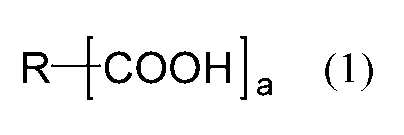
式(1)中、Rは、炭素数2~4のアルカンジイル基、ビニレン基、又は、ベンゼン環を示し、aは、2又は3を示す。
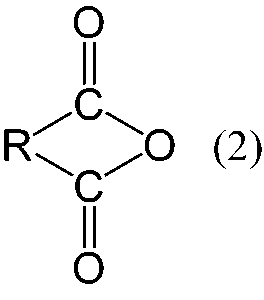
式(2)中、Rは、炭素数2~4のアルカンジイル基、ビニレン基、又は、ベンゼン環を示す。
上記並びにその他の本発明の目的、特徴及び利点は、以下の詳細な記載から明らかになるであろう。
金型を用いた金属の成形法、例えば、ダイカスト法においては、離型剤を約100倍に希釈し、その希釈した離型剤を数百mLや数Lといった比較的多量に金型へ塗布することによって、金型を冷却し、離型被膜を金型表面に形成させる。このことにより、金属製品(成形品)を、金型内に形成させ、金型から離型させることができる。
しかしながら、本発明者等の検討によれば、金型を用いた金属の成形法に用いる離型剤として、シリコーンを主成分として含む水性組成物、例えば、特許文献1に記載の離型剤等を用いた場合、金型のキャビティ内に離型剤が堆積して金型が汚染され、それにより洗浄を困難にすることがあった。さらに、洗浄が不充分な金型を用いて得られた成形品は、電子部品等へ適応が困難な場合があった。また、前記水性組成物の耐熱性が低く、特に金型温度が高い場合等に、金型に接触した離型剤がガス化し、発生したガスによる内部欠陥、例えば、鋳巣等が発生することもあった。また、水性組成物を離型剤として用いた場合、離型成分が金型に充分に付着しない場合もあった。
そこで、離型剤として、シリコーンを主成分として含む水性組成物以外の水性組成物、例えば、特許文献2に記載の離型剤等を用いることが考えられる。
しかしながら、本発明者等の検討によれば、特許文献2に記載の離型剤は、離型性、潤滑性、付着性、及び耐熱性のいずれかが優れておらず、臭気が多い場合があった。すなわち、特許文献2に記載の離型剤は、離型性、潤滑性、付着性、及び耐熱性の全てに優れ、臭気の少ない離型剤というわけではなかった。
本発明は、かかる事情に鑑みてなされたものであって、離型性、潤滑性、付着性、及び耐熱性に優れ、臭気の少ない水性組成物を提供することを目的とする。
以下、本発明に係る実施形態について説明するが、本発明は、これらに限定されるものではない。
本発明の実施形態に係る水性組成物は、下記式(1)で表されるカルボン酸化合物、下記式(2)で表されるカルボン酸無水物、及び無水トリメリット酸からなる群から選ばれる少なくとも1種と、塩基性化合物と、水とを含むことを特徴とする水性組成物である。

式(1)中、Rは、炭素数2~4のアルカンジイル基、ビニレン基、又は、ベンゼン環を示し、aは、2又は3を示す。
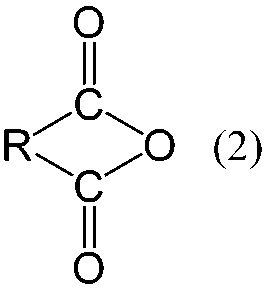
式(2)中、Rは、炭素数2~4のアルカンジイル基、ビニレン基、又は、ベンゼン環を示す。
前記水性組成物は、離型性、潤滑性、付着性、及び耐熱性に優れ、臭気の少ない水性組成物である。具体的には、前記水性組成物は、前記カルボン酸化合物と前記塩基性化合物とを含むことによって、充分に高い離型性及び潤滑性を発揮することができる。このことから、金型を用いた金属の成形法、例えば、ダイカスト法において、離型剤及び潤滑剤として用いることができる。具体的には、金型に予め塗布する離型剤、例えば、ダイカスト用離型剤として用いることができる。また、金型内に溶湯を流し込むためのスリーブと、溶湯を流し込むためのプランジャーとの潤滑性を高めるための潤滑剤、例えば、ダイカスト用プランジャー潤滑剤やダイカスト用スリーブ潤滑剤等としても用いることができる。さらに、前記水性組成物は、付着性及び耐熱性にも優れているので、前記水性組成物を上記のような離型剤や潤滑剤として用いた場合に、より好適な離型性及び潤滑性を発揮することができる。また、前記水性組成物を上記のような離型剤や潤滑剤として用いても、臭気の発生が少なく、作業環境の悪化等を防止することもできる。
前記カルボン酸化合物は、前記式(1)で表され、前記Rが炭素数2~4のアルカンジイル基、ビニレン基、又は、ベンゼン環であり、カルボキシル基(-COOH)の置換度(カルボキシル基の数)であるaが2又は3である。すなわち、前記カルボン酸化合物は、炭素数2~4のアルカンジイル基、ビニレン基、又は、ベンゼン環に、2つ又は3つのカルボキシル基が置換したカルボン酸化合物である。
前記カルボン酸化合物としては、例えば、コハク酸、アジピン酸、マレイン酸、フマル酸、フタル酸、イソフタル酸、テレフタル酸、及びトリメリット酸等が挙げられる。このようなカルボン酸化合物を用いることによって、前記水性組成物は、離型性、潤滑性、付着性、及び耐熱性により優れ、臭気のより少なくなる。また、前記カルボン酸化合物としては、上記例示のカルボン酸化合物の中でも、アジピン酸、テレフタル酸、及びトリメリット酸がより好ましい。例えば、ダイカスト法等の、金型を用いた金属の成形法において、水性組成物を離型剤として用いた場合等に、得られた成形品が着色してしまうことがある。前記カルボン酸化合物として、アジピン酸、テレフタル酸、及びトリメリット酸からなる群から選ばれる少なくとも1種を含むことによって、このような着色の発生も抑制できる。すなわち、離型性、潤滑性、付着性、及び耐熱性に優れ、臭気の少ないだけではなく、着色性にも優れた水性組成物が得られる。
前記カルボン酸化合物は、単独で用いてもよいし、2種以上を組み合わせて用いてもよい。前記カルボン酸無水物としては、前記式(1)で表され、前記Rが炭素数2~4のアルカンジイル基及びビニレン基である脂肪族カルボン酸化合物、及び前記式(1)で表され、前記Rがベンゼン環である芳香族カルボン酸化合物が挙げられる。前記カルボン酸化合物を2種以上組み合わせて用いる場合、例えば、前記式(1)で表され、前記Rが炭素数2~4のアルカンジイル基である脂肪族カルボン酸化合物と、前記式(1)で表され、前記Rがベンゼン環である芳香族カルボン酸化合物とからなることが好ましい。このようなカルボン酸化合物の組み合わせで用いることによって、離型性、潤滑性、付着性、及び耐熱性により優れ、臭気のより少ない水性組成物が得られる。また、前記脂肪族カルボン酸が、アジピン酸であり、前記芳香族カルボン酸が、テレフタル酸であることがより好ましい。このようなカルボン酸化合物の組み合わせで用いると、離型性、潤滑性、付着性、及び耐熱性により優れ、臭気のより少ないだけではなく、着色性にも優れた水性組成物が得られる。
前記カルボン酸無水物、及び無水トリメリット酸は、前記カルボン酸化合物の無水物である。前記カルボン酸無水物は、前記式(2)で表され、前記Rが炭素数2~4のアルカンジイル基、ビニレン基、又は、ベンゼン環である。すなわち、前記カルボン酸無水物としては、前記式(2)で表され、前記Rが炭素数2~4のアルカンジイル基及びビニレン基である脂肪族カルボン酸無水物、及び前記式(2)で表され、前記Rがベンゼン環である芳香族カルボン酸無水物が挙げられる。
前記カルボン酸無水物としては、例えば、無水コハク酸、無水アジピン酸、無水マレイン酸、無水フマル酸、及び無水フタル酸等が挙げられる。このようなカルボン酸無水物を用いることによって、前記水性組成物は、離型性、潤滑性、付着性、及び耐熱性により優れ、臭気のより少なくなる。
前記カルボン酸無水物は、単独で用いてもよいし、2種以上を組み合わせて用いてもよい。
以上のことから、前記水性組成物には、前記カルボン酸化合物、前記カルボン酸無水物、及び無水トリメリット酸からなる群から選ばれる少なくとも1種を含む。すなわち、前記水性組成物には、前記カルボン酸化合物、前記カルボン酸無水物、及び無水トリメリット酸を単独で用いてもよいし、2種以上を組み合わせて用いてもよい。
前記塩基性化合物は、前記カルボン酸化合物、前記カルボン酸無水物、及び無水トリメリット酸を中和することができる化合物であれば、特に限定されず、塩基性有機化合物であっても、塩基性無機化合物であってもよい。前記塩基性有機化合物としては、例えば、トリエチルアミン、モノエチルアミン、ジエチルアミン、トリメチルアミン、モノメチルアミン、ジメチルアミン、エチレンジアミン、トリエタノールアミン、及びテトラメチルエチレンジアミン等のアミン化合物、ピロリジン、ピペリジン、及びピリジン等が挙げられる。また、前記塩基性無機化合物としては、例えば、水酸化ナトリウム、水酸化カリウム、水酸化カルシウム、水酸化マグネシウム、炭酸ナトリウム、炭酸水素ナトリウム、炭酸カリウム、炭酸水素カリウム、炭酸カルシウム、及び炭酸マグネシウム等が挙げられる。前記塩基性化合物は、これらの中でも、臭気が少ない点等から、塩基性無機化合物が好ましく、水酸化ナトリウム、及び水酸化カリウムがより好ましい。さらに、入手容易性等から、水酸化ナトリウムが好ましい。また、前記塩基性化合物は、単独で用いてもよいし、2種以上を組み合わせて用いてもよい。
前記水は、特に限定されず、水性離型剤や水性潤滑剤等の水性組成物に用いることができる水等が挙げられ、具体的には、工業用水、イオン交換水、及び純水等が挙げられる。
前記カルボン酸化合物、前記カルボン酸無水物、及び無水トリメリット酸の合計含有率は、前記水性組成物全量に対して、3~30質量%であることが好ましく、3~20質量%であることがより好ましく、3~15質量%であることがさらに好ましい。前記カルボン酸化合物、前記カルボン酸無水物、及び無水トリメリット酸が少なすぎると、潤滑性及び離型性が低下する傾向がある。また、前記カルボン酸化合物、前記カルボン酸無水物、及び無水トリメリット酸が多すぎると、カルボン酸化合物、前記カルボン酸無水物、及び無水トリメリット酸が水性組成物から析出し、水性組成物を塗布しにくくなる傾向がある。よって、前記カルボン酸化合物、前記カルボン酸無水物、及び無水トリメリット酸の合計含有率が上記範囲内であれば、離型性、潤滑性、付着性、及び耐熱性により優れ、臭気のより少ない水性組成物が得られる。
前記塩基性化合物の含有率は、特に限定されないが、例えば、前記水溶性化合物のpHが7~13となる含有率であることが好ましく、前記水溶性化合物のpHが7~10となる含有率であることがより好ましく、前記水溶性化合物のpHが8となる含有率であることがさらに好ましい。前記塩基性化合物が少なすぎると、金型や周辺設備を腐食する傾向がある。前記塩基性化合物が多すぎると、作業者の目や皮膚への刺激が高くなり、安全性が劣る傾向がある。よって、前記塩基性化合物の含有率が上記範囲内であれば、離型性、潤滑性、付着性、及び耐熱性により優れ、臭気のより少ない水性組成物が得られる。
前記水性組成物において、残部は、前記水である。例えば、前記カルボン酸化合物、前記カルボン酸無水物、及び無水トリメリット酸からなる群から選ばれる少なくとも1種、前記塩基性化合物、及び前記水からなる水性組成物の場合、前記水性組成物は、前記カルボン酸化合物、前記カルボン酸無水物、無水トリメリット酸、及び前記塩基性化合物以外が、水である。また、前記水性組成物が、前記カルボン酸化合物、前記カルボン酸無水物、無水トリメリット酸、前記塩基性化合物、及び前記水以外の他の成分を含む場合は、前記カルボン酸化合物、前記カルボン酸無水物、無水トリメリット酸、前記塩基性化合物、及び前記他の成分以外が、水である。
前記水性組成物は、本発明の効果を損なわない範囲で、必要に応じて、前記カルボン酸化合物、前記カルボン酸無水物、無水トリメリット酸、前記塩基性化合物、及び前記水以外の成分(他の成分)を含有してもよい。前記他の成分としては、水溶性高分子等が挙げられる。また、前記水性組成物は、従来の水性離型剤や水性潤滑剤、例えば、エマルジョンタイプの離型剤や潤滑剤に添加して用いてもよいし、従来の水性離型剤や水性潤滑剤、例えば、エマルジョンタイプの離型剤や潤滑剤を、前記水性組成物に添加して用いてもよい。このようにして得られた水性組成物の場合、他の成分として、従来の離型剤や潤滑剤に含まれている成分等が挙げられる。
前記水溶性高分子は、特に限定されず、水性離型剤や水性潤滑剤等の水性組成物に用いることができる水溶性高分子等が挙げられる。前記水溶性高分子としては、具体的には、カルボキシメチルセルロース(CMC)及びヒドロキシエチルセルロース(HEC)等のセルロース誘導体、ポリエチレングリコール、イソブチレン・マレイン酸共重合体、ジイソブチレン・マレイン酸共重合体、スチレン・マレイン酸共重合体、及びポリビニルピロリドン(PVP)等が挙げられる。この中でも、セルロース誘導体が好ましく、カルボキシメチルセルロース(CMC)及びヒドロキシエチルセルロース(HEC)がより好ましい。
前記水溶性高分子は、前記水性組成物に含有されていても、含有されていなくてもよいが、含有することによって、潤滑性及び離型性がより高まる。前記水溶性高分子が含有されている場合は、その含有率は、前記水性組成物全量に対して、0.1~10質量%であること好ましく、0.1~5質量%であることが好ましい。前記水溶性高分子が少なすぎると、前記水溶性高分子を添加した効果を充分に奏することができない傾向がある。また、前記水溶性高分子が多すぎると、水性組成物の粘度が高くなり、水性組成物を塗布しにくくなる傾向がある。
前記水性組成物は、30℃における粘度が100mPa・s以下であることが好ましく、50mPa・s以下であることがより好ましい。前記水性組成物の粘度が高すぎると、前記水性組成物を塗布しにくくなる傾向がある。
前記水性組成物の製造方法は、前記水性組成物を製造することができれば、特に限定されない。具体的には、水に対して、所定量となるように、前記カルボン酸化合物、前記カルボン酸無水物、無水トリメリット酸、前記塩基性化合物、及び他の成分を投入し、混合することによって、前記水性組成物を製造することができる。
前記水性組成物は、上述したように、前記カルボン酸化合物、前記カルボン酸無水物、及び無水トリメリット酸からなる群から選ばれる少なくとも1種と前記塩基性化合物とを含むことによって、金型を用いた金属の成形法、例えば、ダイカスト法において、充分に高い離型性及び潤滑性を発揮することができる。このことから、前記水性組成物は、金型に予め塗布する離型剤、例えば、ダイカスト用離型剤として用いることができる。また、前記水性組成物は、金型内に溶湯を流し込むためのスリーブと、溶湯を流し込むためのプランジャーとの潤滑性を高めるための潤滑剤、例えば、ダイカスト用プランジャー潤滑剤やダイカスト用スリーブ潤滑剤等としても用いることができる。さらに、前記水性組成物は、付着性及び耐熱性にも優れているので、前記水性組成物を上記のような離型剤や潤滑剤として用いた場合に、より好適な離型性及び潤滑性を発揮することができる。また、前記水性組成物を上記のような離型剤や潤滑剤として用いても、臭気の発生が少なく、作業環境の悪化等を防止することもできる。
本明細書は、上述したように、様々な態様の技術を開示しているが、そのうち主な技術を以下に纏める。
本発明の一局面は、下記式(1)で表されるカルボン酸化合物、下記式(2)で表されるカルボン酸無水物、及び無水トリメリット酸からなる群から選ばれる少なくとも1種と、塩基性化合物と、水とを含むことを特徴とする水性組成物である。

式(1)中、Rは、炭素数2~4のアルカンジイル基、ビニレン基、又は、ベンゼン環を示し、aは、2又は3を示す。
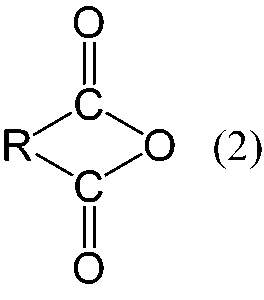
式(2)中、Rは、炭素数2~4のアルカンジイル基、ビニレン基、又は、ベンゼン環を示す。
このような構成によれば、離型性、潤滑性、付着性、及び耐熱性に優れ、臭気の少ない水性組成物を提供することができる。
また、前記水性組成物において、前記カルボン酸化合物は、コハク酸、アジピン酸、マレイン酸、フマル酸、フタル酸、イソフタル酸、テレフタル酸、及びトリメリット酸からなる群から選ばれる少なくとも1種であることが好ましい。また、前記カルボン酸無水物は、無水コハク酸、無水アジピン酸、無水マレイン酸、及び無水フタル酸からなる群から選ばれる少なくとも1種であることが好ましい。
このような構成によれば、離型性、潤滑性、付着性、及び耐熱性により優れ、臭気のより少ない水性組成物が得られる。
また、前記水性組成物において、前記カルボン酸化合物は、アジピン酸、テレフタル酸、及びトリメリット酸からなる群から選ばれる少なくとも1種であることがより好ましい。
このような構成によれば、着色性にも優れる。すなわち、この水性組成物を、金型を用いた金属の成形法、例えば、ダイカスト法において、離型剤として用いた場合等に、得られた成形品が着色してしまうことを充分に抑制することができる。よって、離型性、潤滑性、付着性、及び耐熱性に優れ、臭気の少ないだけではなく、着色性にも優れた水性組成物が得られる。
また、前記水性組成物において、前記カルボン酸化合物は、前記式(1)で表され、前記Rが炭素数2~4のアルカンジイル基である脂肪族カルボン酸化合物と、前記式(1)で表され、前記Rがベンゼン環である芳香族カルボン酸化合物とからなることが好ましい。
このような構成によれば、離型性、潤滑性、付着性、及び耐熱性により優れ、臭気のより少ない水性組成物が得られる。
また、前記水性組成物において、前記脂肪族カルボン酸が、アジピン酸であり、前記芳香族カルボン酸が、テレフタル酸であることがより好ましい。
このような構成によれば、離型性、潤滑性、付着性、及び耐熱性により優れ、臭気のより少ないだけではなく、着色性にも優れた水性組成物が得られる。
また、前記水性組成物において、前記カルボン酸化合物、前記カルボン酸無水物、及び無水トリメリット酸の合計含有率が、前記水性組成物全量に対して、3~30質量%であることが好ましい。
このような構成によれば、離型性、潤滑性、付着性、及び耐熱性により優れ、臭気のより少ない水性組成物が得られる。
本発明によれば、離型性、潤滑性、付着性、及び耐熱性に優れ、臭気の少ない水性組成物を提供することができる。
以下に、実施例により本発明をさらに具体的に説明するが、本発明の範囲はこれらに限定されるものではない。
実施例1~18、比較例1~14
本実施例において、水性組成物を調製する際に用いる各成分について説明する。
本実施例において、水性組成物を調製する際に用いる各成分について説明する。
[前記式(1)で表され、前記Rがビニレン基であり、置換度aが2であるカルボン酸化合物]
マレイン酸:HOOC-CHCH-COOH(シス体)(東京化成工業株式会社製のマレイン酸)
フマル酸:HOOC-CHCH-COOH(トランス体)(扶桑化学工業株式会社製のフマル酸)
[前記式(1)で表され、前記Rが炭素数2~4のアルカンジイル基であり、置換度aが2である脂肪族カルボン酸化合物]
コハク酸:HOOC-(CH2)2-COOH(株式会社日本触媒製のコハク酸SA)
アジピン酸:HOOC-(CH2)4-COOH(BASFジャパン株式会社製のAdipic Acid)
[前記式(1)で表され、前記Rがベンゼン環であり、置換度aが2である芳香族カルボン酸カルボン酸化合物]
フタル酸:HOOC-C6H4-COOH(オルト体)(東京化成工業株式会社製のフタル酸)
イソフタル酸:HOOC-C6H4-COOH(メタ体)(LOTTE CHEMICAL Corporation製のイソフタル酸)
テレフタル酸:HOOC-C6H4-COOH(パラ体)(東レ株式会社製のテレフタル酸)
[前記式(1)で表され、前記Rがベンゼン環であり、置換度aが3である芳香族カルボン酸カルボン酸化合物]
トリメリット酸:C6H3-(COOH)3(東京化成工業株式会社製のトリメリット酸)
[前記式(2)で表され、前記Rが炭素数2~4のアルカンジイル基である脂肪族カルボン酸無水物]
無水コハク酸:東京化成工業株式会社製のこはく酸無水物
無水アジピン酸:富士フイルム和光純薬株式会社製のアジピン酸無水物
[前記式(2)で表され、前記Rがビニレン基であるカルボン酸無水物]
無水マレイン酸:EXCEL Chemical Corporation製のMA
[前記式(2)で表され、前記Rがベンゼン環である芳香族カルボン酸カルボン酸化合物]
無水フタル酸:川崎化成工業株式会社製の無水フタル酸)
[無水トリメリット酸]
無水トリメリット酸:三菱ガス化学株式会社製の無水トリメリット酸
[上記以外のカルボン酸化合物]
ギ酸:HCOOH(富士フイルム和光純薬株式会社製のギ酸)
ペラルゴン酸:CH3(CH2)7COOH(Matrica SPA製のMatrilox- IP001M)
オレイン酸:CH3(CH2)7CH=CH(CH2)7COOH(花王株式会社製のルナックO-V)
dl-リンゴ酸:HOOC-CH(OH)-CH2-COOH(扶桑化学工業株式会社製のdl-リンゴ酸)
クエン酸:C(OH)(CH2COOH)2COOH(小松屋株式会社製のクエン酸)
L-酒石酸:(CH(OH)COOH)2(DSP五協フード&ケミカル株式会社製のL-酒石酸)
シュウ酸:HOOC-COOH(宇部興産株式会社製のシュウ酸(2水和物))
アゼライン酸:HOOC-(CH2)7-COOH(クローダジャパン株式会社製のCRODACID DC1195-FL-(SI))
セバシン酸:HOOC-(CH2)8-COOH(伊藤製油株式会社製のセバシン酸SR)
ドデカン二酸:HOOC-(CH2)10-COOH(インビスタジャパン合同会社製のドデカン二酸)
安息香酸:C6H5COOH(株式会社伏見製薬所製の安息香酸)
サリチル酸:C6H4(OH)COOH(ソルベイジャパン株式会社製のサリチル酸)
没食子酸:C6H2(OH)3COOH(DSP五協フード&ケミカル株式会社製の没食子酸)
[塩基性化合物]
30質量%の水酸化ナトリウム水溶液:新日本テクノ株式会社製の30%苛性ソーダ
[水溶性高分子]
CMC:カルボキシメチルセルロース(第一工業製薬株式会社製のSGセロゲンPR)
HEC:ヒドロキシエチルセルロース(ダイセルファインケム株式会社製のHECダイセルSP200)
[水]
水:イオン交換水
シリコーン:アルキルアラルキル変性シリコーン(旭化成ワッカーシリコーン株式会社製のRELEASE AGENT TN)
高級アルコールアルキレンオキサイド付加物:ポリオキシアルキレンラウリルエーテル(第一工業製薬株式会社製のDKS NL-Dash410)
[調製方法]
上記各成分を表1~4に記載の組成(質量部)となるように混合させた。そうすることによって、水性組成物が得られた。なお、塩基性化合物の含有量は、得られた水性組成物のpHが、表1~4に示すpHとなるような量である。水性組成物のpHは、pHメータ(株式会社堀場製作所製のpH METER F-72)を用いて測定した。
マレイン酸:HOOC-CHCH-COOH(シス体)(東京化成工業株式会社製のマレイン酸)
フマル酸:HOOC-CHCH-COOH(トランス体)(扶桑化学工業株式会社製のフマル酸)
[前記式(1)で表され、前記Rが炭素数2~4のアルカンジイル基であり、置換度aが2である脂肪族カルボン酸化合物]
コハク酸:HOOC-(CH2)2-COOH(株式会社日本触媒製のコハク酸SA)
アジピン酸:HOOC-(CH2)4-COOH(BASFジャパン株式会社製のAdipic Acid)
[前記式(1)で表され、前記Rがベンゼン環であり、置換度aが2である芳香族カルボン酸カルボン酸化合物]
フタル酸:HOOC-C6H4-COOH(オルト体)(東京化成工業株式会社製のフタル酸)
イソフタル酸:HOOC-C6H4-COOH(メタ体)(LOTTE CHEMICAL Corporation製のイソフタル酸)
テレフタル酸:HOOC-C6H4-COOH(パラ体)(東レ株式会社製のテレフタル酸)
[前記式(1)で表され、前記Rがベンゼン環であり、置換度aが3である芳香族カルボン酸カルボン酸化合物]
トリメリット酸:C6H3-(COOH)3(東京化成工業株式会社製のトリメリット酸)
[前記式(2)で表され、前記Rが炭素数2~4のアルカンジイル基である脂肪族カルボン酸無水物]
無水コハク酸:東京化成工業株式会社製のこはく酸無水物
無水アジピン酸:富士フイルム和光純薬株式会社製のアジピン酸無水物
[前記式(2)で表され、前記Rがビニレン基であるカルボン酸無水物]
無水マレイン酸:EXCEL Chemical Corporation製のMA
[前記式(2)で表され、前記Rがベンゼン環である芳香族カルボン酸カルボン酸化合物]
無水フタル酸:川崎化成工業株式会社製の無水フタル酸)
[無水トリメリット酸]
無水トリメリット酸:三菱ガス化学株式会社製の無水トリメリット酸
[上記以外のカルボン酸化合物]
ギ酸:HCOOH(富士フイルム和光純薬株式会社製のギ酸)
ペラルゴン酸:CH3(CH2)7COOH(Matrica SPA製のMatrilox- IP001M)
オレイン酸:CH3(CH2)7CH=CH(CH2)7COOH(花王株式会社製のルナックO-V)
dl-リンゴ酸:HOOC-CH(OH)-CH2-COOH(扶桑化学工業株式会社製のdl-リンゴ酸)
クエン酸:C(OH)(CH2COOH)2COOH(小松屋株式会社製のクエン酸)
L-酒石酸:(CH(OH)COOH)2(DSP五協フード&ケミカル株式会社製のL-酒石酸)
シュウ酸:HOOC-COOH(宇部興産株式会社製のシュウ酸(2水和物))
アゼライン酸:HOOC-(CH2)7-COOH(クローダジャパン株式会社製のCRODACID DC1195-FL-(SI))
セバシン酸:HOOC-(CH2)8-COOH(伊藤製油株式会社製のセバシン酸SR)
ドデカン二酸:HOOC-(CH2)10-COOH(インビスタジャパン合同会社製のドデカン二酸)
安息香酸:C6H5COOH(株式会社伏見製薬所製の安息香酸)
サリチル酸:C6H4(OH)COOH(ソルベイジャパン株式会社製のサリチル酸)
没食子酸:C6H2(OH)3COOH(DSP五協フード&ケミカル株式会社製の没食子酸)
[塩基性化合物]
30質量%の水酸化ナトリウム水溶液:新日本テクノ株式会社製の30%苛性ソーダ
[水溶性高分子]
CMC:カルボキシメチルセルロース(第一工業製薬株式会社製のSGセロゲンPR)
HEC:ヒドロキシエチルセルロース(ダイセルファインケム株式会社製のHECダイセルSP200)
[水]
水:イオン交換水
シリコーン:アルキルアラルキル変性シリコーン(旭化成ワッカーシリコーン株式会社製のRELEASE AGENT TN)
高級アルコールアルキレンオキサイド付加物:ポリオキシアルキレンラウリルエーテル(第一工業製薬株式会社製のDKS NL-Dash410)
[調製方法]
上記各成分を表1~4に記載の組成(質量部)となるように混合させた。そうすることによって、水性組成物が得られた。なお、塩基性化合物の含有量は、得られた水性組成物のpHが、表1~4に示すpHとなるような量である。水性組成物のpHは、pHメータ(株式会社堀場製作所製のpH METER F-72)を用いて測定した。
[評価]
上記のように製造された水性組成物を、以下に示す方法により評価した。
上記のように製造された水性組成物を、以下に示す方法により評価した。
(離型性及び潤滑性)
水性組成物の離型性及び潤滑性は、株式会社メックインターナショナル製のLubテスターを用いて測定した。
水性組成物の離型性及び潤滑性は、株式会社メックインターナショナル製のLubテスターを用いて測定した。
具体的には、まず、200mm×200mm×30mmの鋼板(株式会社メックインターナショナル製のSDK-61材)を350℃に加熱した。この加熱した鋼板に、株式会社アトマックス製のアトマックスノズル(2流体ノズル)(AM45B-0ST)を用いて、スプレー時間0.5秒間、スプレー回数1回、液圧0.1MPa、スプレー圧力0.4MPa、スプレー距離200mm、塗布量2.5gの条件で、水性組成物を塗布した。水性組成物を塗布した鋼板上に、内径80mm、外径100mm、高さ50mmの円筒状部材(株式会社メックインターナショナル製のS45C材からなるリング)を載置した。その際、円筒状部材の周面に直交する下面が、前記鋼板と接触するように載置した。
次に、アルミニウム材(アサヒセイレン株式会社製のADC-12)を加熱し、溶融させた。その際、得られた溶湯の温度が670±10℃となるまで加熱した。この溶湯を、前記鋼板に接触させた円筒状部材内に、手動で給湯した。そうすることによって、この円筒状部材内に、前記鋼板に接触した状態で、前記溶湯が注ぎ込まれた。
その後、前記溶湯を自然冷却させることによって、凝固させた。凝固後のアルミニウム材の上に、重量9.0kgのおもりを置いた。その状態で、前記円筒状部材を、前記鋼板の板面方向に平行な方向に移動させた。移動させる際、前記円筒状部材に取り付けたロードセルで、前記円筒状部材の移動開始からの引張荷重を測定した。
移動開始時の引張荷重を用いて、離型性を評価した。具体的には、移動開始時の引張荷重が5kgf以下であれば、「◎」と評価した。移動開始時の引張荷重が5kgfより大きく10kgf以下であれば、「○」と評価した。移動開始時の引張荷重が10kgfより大きく20kgf以下であれば、「△」と評価した。移動開始時の引張荷重が20kgfより大きければ、「×」と評価した。
また、移動開始時から3秒間の引張荷重の平均値を算出した。この平均値を用いて、潤滑性を評価した。具体的には、平均値が5kgf以下であれば、「◎」と評価した。平均値が5kgfより大きく10kgf以下であれば、「○」と評価した。平均値が10kgfより大きく20kgf以下であれば、「△」と評価した。平均値が20kgfより大きければ、「×」と評価した。
(付着性)
100mm×100mm×2.5mmの鋼板(神戸ステンレス株式会社製のSUS304)を350℃に加熱した。この加熱した鋼板を、板面方向が水平になるように置いた。この鋼板に、株式会社アトマックス製のアトマックスノズル(2流体ノズル)(AM45B-0ST)を用いて、スプレー時間0.25秒間、塗布量1.5cc、スプレー距離200mm、スプレー圧力0.4MPa、液圧0.1MPaの条件で、水性組成物を塗布した。
100mm×100mm×2.5mmの鋼板(神戸ステンレス株式会社製のSUS304)を350℃に加熱した。この加熱した鋼板を、板面方向が水平になるように置いた。この鋼板に、株式会社アトマックス製のアトマックスノズル(2流体ノズル)(AM45B-0ST)を用いて、スプレー時間0.25秒間、塗布量1.5cc、スプレー距離200mm、スプレー圧力0.4MPa、液圧0.1MPaの条件で、水性組成物を塗布した。
この塗布前後の鋼板の重量変化を測定した。この重量変化を用いて、付着性を評価した。具体的には、重量変化が、8mg以上であれば、「◎」と評価した。また、重量変化が、5mg以上8mg未満であれば、「○」と評価した。また、重量変化が、2mg以上5mg未満であれば、「△」と評価した。また、重量変化が、2mg未満であれば、「×」と評価した。
(耐熱性)
まず、水性組成物20gを60℃で24時間乾燥させた。そうすることによって、水分が蒸発して、残った固体を5mg秤量した。秤量した固体(5mg)を、熱重量・熱量同時測定装置(TG-DTA/DSC)(パーキンエルマー社製のSTA 6000)を用いて、ガス(空気)流量100ml/分の条件下で、昇温速度10℃/分で500℃まで加熱した。そして、加熱後に残存した固体の重量(加熱後の残渣量)を測定した。そして、加熱前の固体の重量に対する、加熱による固体の重量の減少分の比率[加熱後の固体の重量/加熱前の固体の重量×100](%)を算出した。
まず、水性組成物20gを60℃で24時間乾燥させた。そうすることによって、水分が蒸発して、残った固体を5mg秤量した。秤量した固体(5mg)を、熱重量・熱量同時測定装置(TG-DTA/DSC)(パーキンエルマー社製のSTA 6000)を用いて、ガス(空気)流量100ml/分の条件下で、昇温速度10℃/分で500℃まで加熱した。そして、加熱後に残存した固体の重量(加熱後の残渣量)を測定した。そして、加熱前の固体の重量に対する、加熱による固体の重量の減少分の比率[加熱後の固体の重量/加熱前の固体の重量×100](%)を算出した。
前記比率が、80%以上であれば、「◎」と評価した。また、前記比率が、50%以上80%未満であれば、「○」と評価した。また、前記比率が、20%以上50%未満であれば、「△」と評価した。また、前記比率が20%未満であれば、「×」と評価した。
(臭気)
前記離型性及び潤滑性の評価の際、前記溶湯を、前記鋼板に接触させた円筒状部材内に給湯させた際に、試験者2名による官能評価で行った。具体的には、2名の試験者がともに臭気を感じなければ、「○」と評価した。また、どちらか1名の試験者のみが臭気を感じた、又は、2名の試験者が、わずかに臭気を感じた場合は、「△」と評価した。2名の試験者がともに臭気を感じた場合、「×」と評価した。
前記離型性及び潤滑性の評価の際、前記溶湯を、前記鋼板に接触させた円筒状部材内に給湯させた際に、試験者2名による官能評価で行った。具体的には、2名の試験者がともに臭気を感じなければ、「○」と評価した。また、どちらか1名の試験者のみが臭気を感じた、又は、2名の試験者が、わずかに臭気を感じた場合は、「△」と評価した。2名の試験者がともに臭気を感じた場合、「×」と評価した。
これらの評価結果を、組成とともに、表1~4に示す。


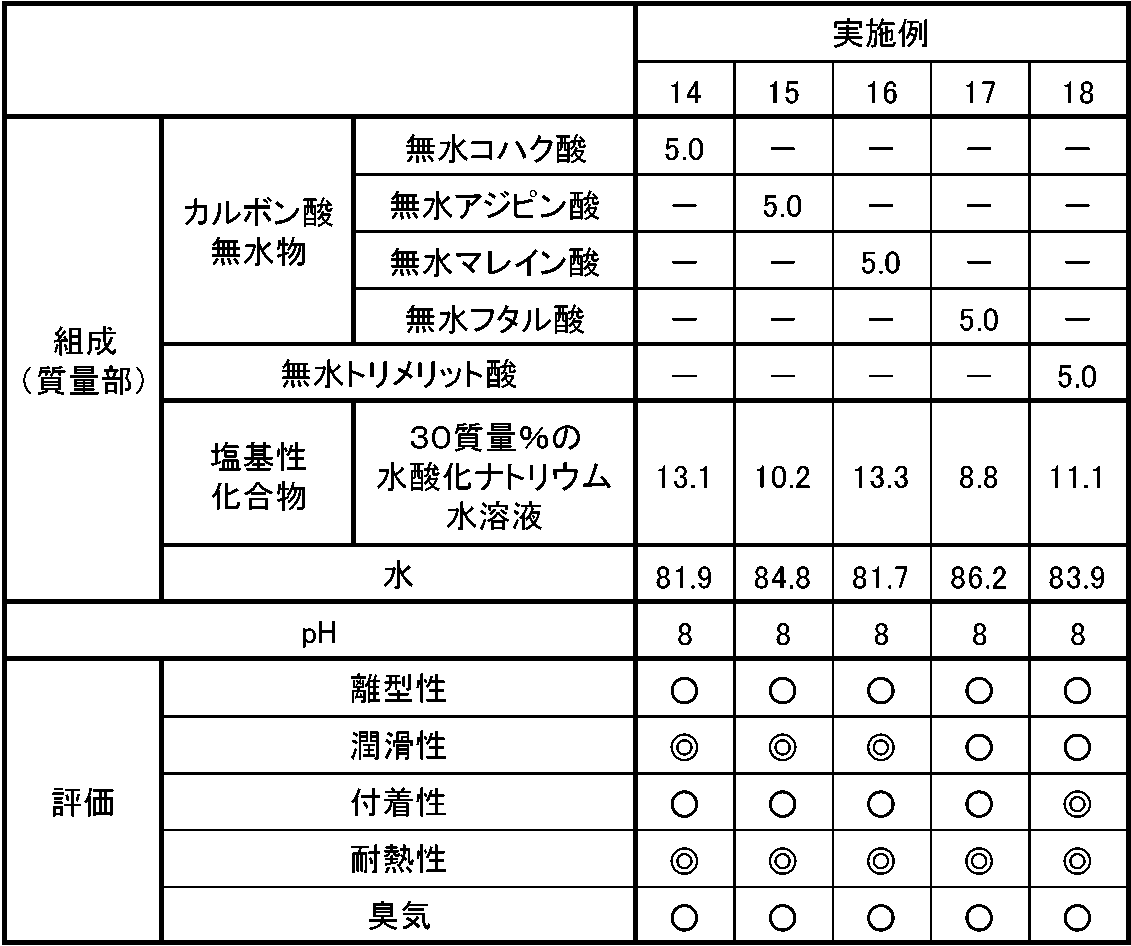
表1~3からわかるように、上記式(1)で表され、Rが、炭素数2~4のアルカンジイル基、ビニレン基、又は、ベンゼン環であり、aが2又は3であるカルボン酸化合物と、塩基性化合物と、水とを含む水性組成物(実施例1~13)は、離型性、潤滑性、付着性、及び耐熱性に優れ、臭気が少なかった。表4からわかるように、上記式(2)で表され、Rが、炭素数2~4のアルカンジイル基、ビニレン基、又は、ベンゼン環であるカルボン酸無水物又は無水トリメリット酸と、塩基性化合物と、水とを含む水性組成物(実施例14~18)は、離型性、潤滑性、付着性、及び耐熱性に優れ、臭気が少なかった。
これに対して、前記カルボン酸化合物、前記カルボン酸無水物、及び前記無水トリメリット酸以外のカルボン酸化合物を含む場合(比較例1~10、及び比較例12~14)は、実施例1~18と比較して、離型性、潤滑性、付着性、及び耐熱性のいずれかが劣るか、臭気が強かった。また、シリコーン及び高級アルコールアルキレンオキサイド付加物を含む場合(比較例11)も、離型性、潤滑性、付着性、及び耐熱性に劣り、臭気がわずかにあった。
さらに、着色性について評価した。
(着色性)
前記離型性及び潤滑性の評価をした後の、凝固後のアルミニウム材の、前記鋼板と接触していた面を目視で確認した。その結果、着色が確認されなければ、「○」と評価し、着色が確認されれば、「×」と評価した。
前記離型性及び潤滑性の評価をした後の、凝固後のアルミニウム材の、前記鋼板と接触していた面を目視で確認した。その結果、着色が確認されなければ、「○」と評価し、着色が確認されれば、「×」と評価した。
その結果を、用いたカルボン酸化合物とともに、表5に示す。

表5からわかるように、カルボン酸化合物として、アジピン酸、テレフタル酸、トリメリット酸、及びこれらの混合物を用いると、離型性、潤滑性、付着性、及び耐熱性に優れ、臭気が少ないだけではなく、着色されていない成形品が得られることがわかった。
この出願は、2018年6月26日に出願された日本国特許出願特願2018-120685を基礎とするものであり、その内容は、本願に含まれるものである。
本発明を表現するために、上述において実施形態を通して本発明を適切且つ十分に説明したが、当業者であれば上述の実施形態を変更および/または改良することは容易に為し得ることであると認識すべきである。したがって、当業者が実施する変更形態または改良形態が、請求の範囲に記載された請求項の権利範囲を離脱するレベルのものでない限り、当該変更形態または当該改良形態は、当該請求項の権利範囲に包括されると解釈される。
本発明によれば、離型性、潤滑性、付着性、及び耐熱性に優れ、臭気の少ない水性組成物が提供される。
Claims (7)
- 下記式(1)で表されるカルボン酸化合物、下記式(2)で表されるカルボン酸無水物、及び無水トリメリット酸からなる群から選ばれる少なくとも1種と、塩基性化合物と、水とを含むことを特徴とする水性組成物。

- 前記カルボン酸化合物は、コハク酸、アジピン酸、マレイン酸、フマル酸、フタル酸、イソフタル酸、テレフタル酸、及びトリメリット酸からなる群から選ばれる少なくとも1種である請求項1に記載の水性組成物。
- 前記カルボン酸化合物は、アジピン酸、テレフタル酸、及びトリメリット酸からなる群から選ばれる少なくとも1種である請求項2に記載の水性組成物。
- 前記カルボン酸無水物は、無水コハク酸、無水アジピン酸、無水マレイン酸、及び無水フタル酸からなる群から選ばれる少なくとも1種である請求項1に記載の水性組成物。
- 前記カルボン酸化合物は、前記式(1)で表され、前記Rが炭素数2~4のアルカンジイル基である脂肪族カルボン酸化合物と、前記式(1)で表され、前記Rがベンゼン環である芳香族カルボン酸化合物とからなる請求項1に記載の水性組成物。
- 前記脂肪族カルボン酸が、アジピン酸であり、
前記芳香族カルボン酸が、テレフタル酸である請求項5に記載の水性組成物。 - 前記カルボン酸化合物、前記カルボン酸無水物、及び無水トリメリット酸の合計含有率が、前記水性組成物全量に対して、3~30質量%である請求項1~6のいずれか1項に記載の水性組成物。
Priority Applications (4)
| Application Number | Priority Date | Filing Date | Title |
|---|---|---|---|
| US17/255,633 US11571737B2 (en) | 2018-06-26 | 2019-06-21 | Aqueous composition |
| JP2020527471A JP7113081B2 (ja) | 2018-06-26 | 2019-06-21 | ダイカスト離型剤用水性組成物 |
| CN201980041064.7A CN112334247B (zh) | 2018-06-26 | 2019-06-21 | 水性组合物 |
| JP2022097937A JP7300543B2 (ja) | 2018-06-26 | 2022-06-17 | ダイカスト離型剤用水性組成物 |
Applications Claiming Priority (2)
| Application Number | Priority Date | Filing Date | Title |
|---|---|---|---|
| JP2018120685 | 2018-06-26 | ||
| JP2018-120685 | 2018-06-26 |
Publications (1)
| Publication Number | Publication Date |
|---|---|
| WO2020004245A1 true WO2020004245A1 (ja) | 2020-01-02 |
Family
ID=68986877
Family Applications (1)
| Application Number | Title | Priority Date | Filing Date |
|---|---|---|---|
| PCT/JP2019/024636 Ceased WO2020004245A1 (ja) | 2018-06-26 | 2019-06-21 | 水性組成物 |
Country Status (4)
| Country | Link |
|---|---|
| US (1) | US11571737B2 (ja) |
| JP (2) | JP7113081B2 (ja) |
| CN (1) | CN112334247B (ja) |
| WO (1) | WO2020004245A1 (ja) |
Cited By (1)
| Publication number | Priority date | Publication date | Assignee | Title |
|---|---|---|---|---|
| CN113201383A (zh) * | 2021-05-14 | 2021-08-03 | 深高蓝德环保科技集团股份有限公司 | 一种生物降解润滑脂及制备方法 |
Families Citing this family (3)
| Publication number | Priority date | Publication date | Assignee | Title |
|---|---|---|---|---|
| CN113372987B (zh) * | 2021-06-10 | 2023-06-23 | 西安思凯石化科技有限公司 | 铝合金锻造脱模剂 |
| CN114989882A (zh) * | 2022-05-27 | 2022-09-02 | 希玛石油制品(镇江)有限公司 | 一种水性锻造润滑脱模剂及其制备方法 |
| WO2026083777A1 (ja) * | 2024-10-15 | 2026-04-23 | 株式会社Moresco | ダイカスト離型剤用水性組成物 |
Citations (7)
| Publication number | Priority date | Publication date | Assignee | Title |
|---|---|---|---|---|
| JPS55139498A (en) * | 1979-04-10 | 1980-10-31 | Pennwalt Corp | Lubricant agent and method for thermal casting based on water |
| US4454050A (en) * | 1983-03-21 | 1984-06-12 | Pennwalt Corporation | Aqueous release agent and lubricant |
| JPS6389592A (ja) * | 1986-10-01 | 1988-04-20 | 日本アチソン株式会社 | 水をベースとする潤滑剤組成物 |
| JPH01299896A (ja) * | 1988-05-30 | 1989-12-04 | Nikka Chem Co Ltd | 塑性加工用水溶性潤滑剤 |
| JPH04238643A (ja) * | 1990-12-28 | 1992-08-26 | Yushiro Chem Ind Co Ltd | 水溶性ダイカスト用離型剤組成物 |
| JP2001259788A (ja) * | 2000-03-17 | 2001-09-25 | Nicca Chemical Co Ltd | 低速射出金型鋳造用の水性離型剤 |
| JP2002205139A (ja) * | 2000-12-28 | 2002-07-23 | Nicca Chemical Co Ltd | ダイカスト用離型剤及びその製造方法 |
Family Cites Families (5)
| Publication number | Priority date | Publication date | Assignee | Title |
|---|---|---|---|---|
| US4419253A (en) * | 1981-11-06 | 1983-12-06 | Nalco Chemical Company | Synthetic post-pickle fluid |
| JP4638802B2 (ja) | 2005-10-27 | 2011-02-23 | トヨタ自動車株式会社 | 離型剤又は鋳造方法 |
| JP2010084076A (ja) * | 2008-10-01 | 2010-04-15 | Kyodo Yushi Co Ltd | 温間熱間塑性加工用水溶性潤滑剤 |
| JP5121661B2 (ja) | 2008-10-09 | 2013-01-16 | 日華化学株式会社 | ダイカスト方法 |
| JP2011042709A (ja) * | 2009-08-19 | 2011-03-03 | Nicca Chemical Co Ltd | 塑性加工用水性潤滑剤 |
-
2019
- 2019-06-21 WO PCT/JP2019/024636 patent/WO2020004245A1/ja not_active Ceased
- 2019-06-21 US US17/255,633 patent/US11571737B2/en active Active
- 2019-06-21 CN CN201980041064.7A patent/CN112334247B/zh active Active
- 2019-06-21 JP JP2020527471A patent/JP7113081B2/ja active Active
-
2022
- 2022-06-17 JP JP2022097937A patent/JP7300543B2/ja active Active
Patent Citations (7)
| Publication number | Priority date | Publication date | Assignee | Title |
|---|---|---|---|---|
| JPS55139498A (en) * | 1979-04-10 | 1980-10-31 | Pennwalt Corp | Lubricant agent and method for thermal casting based on water |
| US4454050A (en) * | 1983-03-21 | 1984-06-12 | Pennwalt Corporation | Aqueous release agent and lubricant |
| JPS6389592A (ja) * | 1986-10-01 | 1988-04-20 | 日本アチソン株式会社 | 水をベースとする潤滑剤組成物 |
| JPH01299896A (ja) * | 1988-05-30 | 1989-12-04 | Nikka Chem Co Ltd | 塑性加工用水溶性潤滑剤 |
| JPH04238643A (ja) * | 1990-12-28 | 1992-08-26 | Yushiro Chem Ind Co Ltd | 水溶性ダイカスト用離型剤組成物 |
| JP2001259788A (ja) * | 2000-03-17 | 2001-09-25 | Nicca Chemical Co Ltd | 低速射出金型鋳造用の水性離型剤 |
| JP2002205139A (ja) * | 2000-12-28 | 2002-07-23 | Nicca Chemical Co Ltd | ダイカスト用離型剤及びその製造方法 |
Cited By (1)
| Publication number | Priority date | Publication date | Assignee | Title |
|---|---|---|---|---|
| CN113201383A (zh) * | 2021-05-14 | 2021-08-03 | 深高蓝德环保科技集团股份有限公司 | 一种生物降解润滑脂及制备方法 |
Also Published As
| Publication number | Publication date |
|---|---|
| CN112334247B (zh) | 2022-11-01 |
| JPWO2020004245A1 (ja) | 2021-03-18 |
| JP7300543B2 (ja) | 2023-06-29 |
| US11571737B2 (en) | 2023-02-07 |
| US20210276075A1 (en) | 2021-09-09 |
| JP2022120172A (ja) | 2022-08-17 |
| JP7113081B2 (ja) | 2022-08-04 |
| CN112334247A (zh) | 2021-02-05 |
Similar Documents
| Publication | Publication Date | Title |
|---|---|---|
| JP7300543B2 (ja) | ダイカスト離型剤用水性組成物 | |
| US4454050A (en) | Aqueous release agent and lubricant | |
| CN106141501B (zh) | 一种水基环保型金属焊接母材保护剂及其制备方法 | |
| JPH0729215B2 (ja) | 残留物の少ないハンダ付け用フラックス、該フラックスを用いて金属表面を熱ハンダ付けする方法、並びに該熱ハンダ付け方法によって得られるハンダ付けされた物品 | |
| JPH04236300A (ja) | プランジャー装置用粉末潤滑剤 | |
| JP5400606B2 (ja) | ソルダペーストおよびフラックス | |
| CN107999692A (zh) | 压铸铝合金水性脱模剂及其制备方法 | |
| CN107614150B (zh) | 铸造用脱模剂组合物 | |
| JP6293514B2 (ja) | はんだ組成物およびプリント配線基板の製造方法 | |
| JP2022027958A (ja) | 塑性加工用潤滑剤組成物 | |
| CN102513736A (zh) | 一种膏状焊接组合物及其制备方法和应用 | |
| JP4820098B2 (ja) | ダイキャスト用水性離型剤組成物及びその使用方法並びにそれを用いたダイキャスト方法及び成形品の製造方法 | |
| JPS6213400B2 (ja) | ||
| JP2011161464A (ja) | 油性離型剤組成物 | |
| JP2015142938A (ja) | ダイカスト方法、ダイカスト製品の製造方法、及びダイカスト用水性離型剤 | |
| JP6541994B2 (ja) | ダイカスト方法、ダイカスト製品の製造方法、及びダイカスト用水性離型剤 | |
| WO2023053790A1 (ja) | 主材ペースト、及び歯科用アルギン酸塩印象材 | |
| JP3722980B2 (ja) | エマルション型水溶性プランジャーチップ用潤滑剤組成物 | |
| JP2601788B2 (ja) | 防錆剤 | |
| JP7410604B1 (ja) | 固形燃料 | |
| JPS63230797A (ja) | 速硬化型耐熱潤滑剤 | |
| JP4501534B2 (ja) | 固形洗浄剤組成物 | |
| JPH10316990A (ja) | 金属塑性加工用の水性潤滑剤 | |
| SU1107993A1 (ru) | Флюс дл пайки алюмини и его сплавов | |
| JPH0577719B2 (ja) |
Legal Events
| Date | Code | Title | Description |
|---|---|---|---|
| 121 | Ep: the epo has been informed by wipo that ep was designated in this application |
Ref document number: 19826578 Country of ref document: EP Kind code of ref document: A1 |
|
| ENP | Entry into the national phase |
Ref document number: 2020527471 Country of ref document: JP Kind code of ref document: A |
|
| NENP | Non-entry into the national phase |
Ref country code: DE |
|
| 122 | Ep: pct application non-entry in european phase |
Ref document number: 19826578 Country of ref document: EP Kind code of ref document: A1 |