WO2020031702A1 - Fe基焼結体、Fe基焼結体の製造方法、および熱間プレス用金型 - Google Patents
Fe基焼結体、Fe基焼結体の製造方法、および熱間プレス用金型 Download PDFInfo
- Publication number
- WO2020031702A1 WO2020031702A1 PCT/JP2019/029057 JP2019029057W WO2020031702A1 WO 2020031702 A1 WO2020031702 A1 WO 2020031702A1 JP 2019029057 W JP2019029057 W JP 2019029057W WO 2020031702 A1 WO2020031702 A1 WO 2020031702A1
- Authority
- WO
- WIPO (PCT)
- Prior art keywords
- sintered body
- based sintered
- sintering
- matrix
- phase
- Prior art date
- Legal status (The legal status is an assumption and is not a legal conclusion. Google has not performed a legal analysis and makes no representation as to the accuracy of the status listed.)
- Ceased
Links
Images

Classifications
-
- C—CHEMISTRY; METALLURGY
- C22—METALLURGY; FERROUS OR NON-FERROUS ALLOYS; TREATMENT OF ALLOYS OR NON-FERROUS METALS
- C22C—ALLOYS
- C22C33/00—Making ferrous alloys
- C22C33/02—Making ferrous alloys by powder metallurgy
- C22C33/0257—Making ferrous alloys by powder metallurgy characterised by the range of the alloying elements
- C22C33/0278—Making ferrous alloys by powder metallurgy characterised by the range of the alloying elements with at least one alloying element having a minimum content above 5%
- C22C33/0292—Making ferrous alloys by powder metallurgy characterised by the range of the alloying elements with at least one alloying element having a minimum content above 5% with more than 5% preformed carbides, nitrides or borides
-
- B—PERFORMING OPERATIONS; TRANSPORTING
- B22—CASTING; POWDER METALLURGY
- B22F—WORKING METALLIC POWDER; MANUFACTURE OF ARTICLES FROM METALLIC POWDER; MAKING METALLIC POWDER; APPARATUS OR DEVICES SPECIALLY ADAPTED FOR METALLIC POWDER
- B22F3/00—Manufacture of workpieces or articles from metallic powder characterised by the manner of compacting or sintering; Apparatus specially adapted therefor ; Presses and furnaces
- B22F3/10—Sintering only
- B22F3/105—Sintering only by using electric current other than for infrared radiant energy, laser radiation or plasma ; by ultrasonic bonding
-
- B—PERFORMING OPERATIONS; TRANSPORTING
- B22—CASTING; POWDER METALLURGY
- B22F—WORKING METALLIC POWDER; MANUFACTURE OF ARTICLES FROM METALLIC POWDER; MAKING METALLIC POWDER; APPARATUS OR DEVICES SPECIALLY ADAPTED FOR METALLIC POWDER
- B22F3/00—Manufacture of workpieces or articles from metallic powder characterised by the manner of compacting or sintering; Apparatus specially adapted therefor ; Presses and furnaces
- B22F3/004—Filling molds with powder
-
- B—PERFORMING OPERATIONS; TRANSPORTING
- B22—CASTING; POWDER METALLURGY
- B22F—WORKING METALLIC POWDER; MANUFACTURE OF ARTICLES FROM METALLIC POWDER; MAKING METALLIC POWDER; APPARATUS OR DEVICES SPECIALLY ADAPTED FOR METALLIC POWDER
- B22F3/00—Manufacture of workpieces or articles from metallic powder characterised by the manner of compacting or sintering; Apparatus specially adapted therefor ; Presses and furnaces
- B22F3/10—Sintering only
- B22F3/1039—Sintering only by reaction
-
- B—PERFORMING OPERATIONS; TRANSPORTING
- B22—CASTING; POWDER METALLURGY
- B22F—WORKING METALLIC POWDER; MANUFACTURE OF ARTICLES FROM METALLIC POWDER; MAKING METALLIC POWDER; APPARATUS OR DEVICES SPECIALLY ADAPTED FOR METALLIC POWDER
- B22F3/00—Manufacture of workpieces or articles from metallic powder characterised by the manner of compacting or sintering; Apparatus specially adapted therefor ; Presses and furnaces
- B22F3/12—Both compacting and sintering
- B22F3/14—Both compacting and sintering simultaneously
-
- B—PERFORMING OPERATIONS; TRANSPORTING
- B22—CASTING; POWDER METALLURGY
- B22F—WORKING METALLIC POWDER; MANUFACTURE OF ARTICLES FROM METALLIC POWDER; MAKING METALLIC POWDER; APPARATUS OR DEVICES SPECIALLY ADAPTED FOR METALLIC POWDER
- B22F5/00—Manufacture of workpieces or articles from metallic powder characterised by the special shape of the product
- B22F5/007—Manufacture of workpieces or articles from metallic powder characterised by the special shape of the product of moulds
-
- B—PERFORMING OPERATIONS; TRANSPORTING
- B22—CASTING; POWDER METALLURGY
- B22F—WORKING METALLIC POWDER; MANUFACTURE OF ARTICLES FROM METALLIC POWDER; MAKING METALLIC POWDER; APPARATUS OR DEVICES SPECIALLY ADAPTED FOR METALLIC POWDER
- B22F9/00—Making metallic powder or suspensions thereof
- B22F9/02—Making metallic powder or suspensions thereof using physical processes
- B22F9/04—Making metallic powder or suspensions thereof using physical processes starting from solid material, e.g. by crushing, grinding or milling
-
- C—CHEMISTRY; METALLURGY
- C22—METALLURGY; FERROUS OR NON-FERROUS ALLOYS; TREATMENT OF ALLOYS OR NON-FERROUS METALS
- C22C—ALLOYS
- C22C38/00—Ferrous alloys, e.g. steel alloys
-
- B—PERFORMING OPERATIONS; TRANSPORTING
- B22—CASTING; POWDER METALLURGY
- B22F—WORKING METALLIC POWDER; MANUFACTURE OF ARTICLES FROM METALLIC POWDER; MAKING METALLIC POWDER; APPARATUS OR DEVICES SPECIALLY ADAPTED FOR METALLIC POWDER
- B22F3/00—Manufacture of workpieces or articles from metallic powder characterised by the manner of compacting or sintering; Apparatus specially adapted therefor ; Presses and furnaces
- B22F3/10—Sintering only
- B22F3/105—Sintering only by using electric current other than for infrared radiant energy, laser radiation or plasma ; by ultrasonic bonding
- B22F2003/1051—Sintering only by using electric current other than for infrared radiant energy, laser radiation or plasma ; by ultrasonic bonding by electric discharge
-
- B—PERFORMING OPERATIONS; TRANSPORTING
- B22—CASTING; POWDER METALLURGY
- B22F—WORKING METALLIC POWDER; MANUFACTURE OF ARTICLES FROM METALLIC POWDER; MAKING METALLIC POWDER; APPARATUS OR DEVICES SPECIALLY ADAPTED FOR METALLIC POWDER
- B22F9/00—Making metallic powder or suspensions thereof
- B22F9/02—Making metallic powder or suspensions thereof using physical processes
- B22F9/04—Making metallic powder or suspensions thereof using physical processes starting from solid material, e.g. by crushing, grinding or milling
- B22F2009/043—Making metallic powder or suspensions thereof using physical processes starting from solid material, e.g. by crushing, grinding or milling by ball milling
-
- B—PERFORMING OPERATIONS; TRANSPORTING
- B22—CASTING; POWDER METALLURGY
- B22F—WORKING METALLIC POWDER; MANUFACTURE OF ARTICLES FROM METALLIC POWDER; MAKING METALLIC POWDER; APPARATUS OR DEVICES SPECIALLY ADAPTED FOR METALLIC POWDER
- B22F2301/00—Metallic composition of the powder or its coating
- B22F2301/35—Iron
-
- B—PERFORMING OPERATIONS; TRANSPORTING
- B22—CASTING; POWDER METALLURGY
- B22F—WORKING METALLIC POWDER; MANUFACTURE OF ARTICLES FROM METALLIC POWDER; MAKING METALLIC POWDER; APPARATUS OR DEVICES SPECIALLY ADAPTED FOR METALLIC POWDER
- B22F2302/00—Metal Compound, non-Metallic compound or non-metal composition of the powder or its coating
- B22F2302/05—Boride
-
- B—PERFORMING OPERATIONS; TRANSPORTING
- B22—CASTING; POWDER METALLURGY
- B22F—WORKING METALLIC POWDER; MANUFACTURE OF ARTICLES FROM METALLIC POWDER; MAKING METALLIC POWDER; APPARATUS OR DEVICES SPECIALLY ADAPTED FOR METALLIC POWDER
- B22F2998/00—Supplementary information concerning processes or compositions relating to powder metallurgy
- B22F2998/10—Processes characterised by the sequence of their steps
-
- B—PERFORMING OPERATIONS; TRANSPORTING
- B22—CASTING; POWDER METALLURGY
- B22F—WORKING METALLIC POWDER; MANUFACTURE OF ARTICLES FROM METALLIC POWDER; MAKING METALLIC POWDER; APPARATUS OR DEVICES SPECIALLY ADAPTED FOR METALLIC POWDER
- B22F2999/00—Aspects linked to processes or compositions used in powder metallurgy
Definitions
- the present invention relates to an Fe-based sintered body, a method for producing an Fe-based sintered body, and a mold for hot pressing.
- hot press technology has been used, for example, in the manufacture of automobile body parts.
- the steel sheet is heated (press forming) by pressing the steel sheet using a hot pressing mold in a heated state.
- the steel is hardened by quenching (quenching) during the press forming.
- Such a hot pressing technique has become an important technique for securing molding accuracy and strength after molding when manufacturing a product (part) using ultra-high tensile strength steel.
- the performance required of the hot press mold includes high durability (long life) and high cooling performance that can be used repeatedly.
- Patent Document 1 describes a technique for improving the thermal conductivity of tool steel at room temperature.
- SKD61 is known as a material for a hot press mold.
- This material has a hardness of about 50H R C in Rockwell hardness.
- the thermal conductivity of the material is about 24 W / (m ⁇ K), and further improvement of the thermal conductivity is required.
- Patent Document 1 describes a tool steel in which the internal structure of the steel is metallurgically defined to improve the thermal conductivity at room temperature. However, it is difficult to precisely control the internal structure of steel, and there is a problem that the tool steel is difficult to stably produce.
- the present invention has been made in view of the above situation, and has both high hardness and high thermal conductivity, and can be manufactured more stably. Material). Another object of the present invention is to provide a method for producing an Fe-based sintered body that can more stably produce an Fe-based sintered body having both high hardness and high thermal conductivity.
- an Fe-based sintered body is an Fe-based sintered body having a matrix containing Fe as a main component and a dispersed phase dispersed in the matrix.
- the matrix is formed in a network and contains ⁇ Fe, and the dispersed phase contains TiC.
- a method for manufacturing an Fe-based sintered body includes a step of forming a compact obtained by press-molding a mixed powder containing Fe powder and TiB 2 powder,
- the method includes a sintering step of heating and sintering while applying pressure using a graphite pressing member.
- the sintering step includes applying a pressure in a pressure range of 15 MPa or more and heating at a temperature of 1323 K or more.
- a network-like matrix containing Fe as a main component and Ti is formed, and the matrix contains ⁇ Fe, and Ti derived from TiB 2 and C derived from the pressing member. And sintering to produce TiC dispersed in the matrix.
- an Fe-based sintered body that has both high hardness and high thermal conductivity and can be manufactured more stably.
- a method for producing an Fe-based sintered body that can more stably produce an Fe-based sintered body having both high hardness and high thermal conductivity.
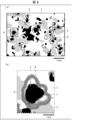
- FIG. 4 is a reflected electron image obtained by observing the material structure of the Fe-based sintered body according to one embodiment of the present invention using an electron microscope.
- (A) is a schematic diagram of the reflected electron image shown in FIG. 1, and (b) is an enlarged view of a part of the schematic diagram shown in (a).
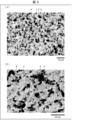
- FIG. 2 is a backscattered electron image obtained by observing a sample polished so that the material structure of the Fe-based sintered body in one embodiment of the present invention can be observed, (a) is a sample surface, and (b) is a sample. It is a reflected electron image which observed the sample cross section.
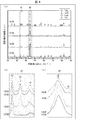
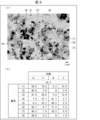
- FIG. 3C is an enlarged view showing a diffraction angle 2 ⁇ of around 45 ° in the X-ray diffraction pattern shown in FIG. (A) is a figure which shows the location which performed local WDX in the reflection electron image of the sample produced on the conditions of the sintering temperature of 1373K, (b) is the composition analysis result of 8 places which performed WDX. It is a table shown.
- FIG. 3C is an enlarged view showing a diffraction angle 2 ⁇ of about 35 ° in the X-ray diffraction pattern in the X-ray diffraction pattern shown in FIG. 9 is a table collectively showing test results of each sample in a second example.
- (A) is a reflection electron image obtained by observing the material structure of a sample prepared with a mass ratio of pure Fe: TiB 2 of 80:20 using an electron microscope, and (b) is a reflection electron image of the sample. It is a table
- alloy tool steel for example, SKD61
- SKD61 has a specific chemical composition and is subjected to various heat treatments, thereby achieving desired performance.
- various microstructures are formed in steel. Such a microstructure acts to improve the hardness of the steel, while acting to hinder heat conduction.
- the higher the hardness of a substance the lower the electron conductivity and the phonon conductivity, so that the substance is inferior in thermal conductivity.
- Patent Document 1 discloses a technique for reducing the content of carbon and chromium in a steel matrix and improving the thermal conductivity of tool steel at room temperature by increasing the phonon conductivity of carbides as a dispersed phase. Has been described. However, it is not easy to stably control the internal structure of steel to a desired state because the internal structure of steel can be variously affected by the composition of components, heat treatment, and various other conditions. Absent.
- the present inventors have attempted to create a material that has both high hardness and high thermal conductivity and that can increase the stability of production by a different approach from the conventional one.
- the Fe-based sintered body produced by sintering a mixed powder of pure iron (Fe) and titanium boride (TiB 2 ) exhibits the following properties by adjusting the sintering conditions. I found that.
- a hard material containing TiC in the Fe-based sintered body A phase forms.
- This hard phase can be obtained by suitably finely dispersing it in an Fe matrix.
- the Fe matrix has a network-like structure (a network-like structure) and contains ⁇ Fe, and can suitably function as a heat conduction path.
- the thermal conductivity may decrease.
- the Fe-based sintered body according to one embodiment of the present invention is manufactured using iron having a low carbon content as a raw material, and in the manufacturing process, when TiB 2 is decomposed, Fe and C are bonded. Ti and C bond more easily to form TiC than to generate cementite. Therefore, in the present Fe-based sintered body, the production of cementite can be suppressed during production, and the content of cementite can be reduced.
- FIG. 1 is a reflected electron image obtained by observing the internal structure (material structure) of the Fe-based sintered body of the present embodiment using an electron microscope.
- the Fe-based sintered body of the present embodiment contains a matrix (matrix) 1 containing Fe as a main component and a dispersed phase containing various phases.
- the Fe-based sintered body of the present embodiment is generally formed (manufactured) by sintering a mixed powder of Fe and TiB 2 under a condition where C is supplied as described above. Therefore, the dispersed phase includes a particulate phase (first subphase) 2 containing TiB 2 as a raw material, and a hard phase 4 containing fine TiC generated by a reaction between TiB 2 and C.
- the dispersed phase further includes a by-product phase (second sub-phase) 3 containing Fe 2 B generated by a reaction between Fe and B supplied from TiB 2 .
- FIG. 2A is a schematic view of the backscattered electron image shown in FIG.
- FIG. 2B is an enlarged view of a part of the schematic diagram.
- the matrix 1 is shown as a region with the lightest shade (white)
- the particulate phase 2 is shown as a region with the darkest shade (black).
- the by-product phase 3 is shown as a region where the density is slightly darker (light gray) than the matrix 1
- the hard phase 4 is shown as a region where the density is between the by-product phase 3 and the particulate phase 2 (dark gray). Is shown.
- the matrix 1 is a phase having the largest proportion of the Fe-based sintered body and is formed in a network.
- the matrix 1 preferably accounts for 75% by mass or more, more preferably 60% by mass or more and 80% by mass or less, based on 100 parts by weight of the entire Fe-based sintered body. .
- the matrix 1 is a phase containing Fe as a main component, and the concentration of Fe in the matrix 1 is 99 atomic percent (hereinafter, referred to as at%) or more, and preferably 99.9 at% or more.
- Matrix 1 contains ⁇ Fe.
- the matrix 1 preferably consists for the most part of ⁇ Fe. When C atoms are dissolved in ⁇ Fe, ⁇ Fe in which C atoms are dissolved is also expressed as a ferrite phase.
- the network shape means that, when the material structure is viewed in a plan view (when a cross section is observed), for example, as shown in FIG. 2A, a network-like continuous phase is formed.
- the particulate phase 2, the by-product phase 3, and the hard phase 4 are dispersed in the form of islands in the interstices of the network in the network structure of the matrix 1, forming an island-like composite structure of the Fe-based sintered body.
- the matrix 1 since the matrix 1 is polycrystalline, a crystal grain boundary exists in a network-like structure (a network-like structure). Since the Fe-based sintered body is formed by sintering, the matrix 1 may have some voids (voids).
- the matrix 1 may have a concentration distribution and may have a plurality of phases. Such a matrix 1 has excellent thermal conductivity.
- FIG. 2 is a schematic view of the material structure in plan view, but in practice, the matrix 1 has a network-like structure in a three-dimensional space.
- the matrix 1 can function as a continuous path (heat conduction path) effective for heat conduction.
- the matrix 1 may have a cementite content of 5% by mass or less, preferably 1% by mass or less.
- the matrix 1 may have a content of ⁇ Fe of 70% by mass or more, and may be 60% by mass or more and 80% by mass or less. Further, ⁇ Fe is a ferrite phase, and a two-phase structure of the ferrite phase and cementite may be a layered structure, and it is preferable that cementite, which easily inhibits heat conduction, is in a localized state.
- the matrix 1 may satisfy at least one of the conditions of a Cu content of 0.1% by mass or less and a Si content of 0.1% by mass or less, and contains other impurities. You may. However, such impurities can have an effect of reducing thermal conductivity or promoting generation of carbides. Therefore, the matrix 1 is preferably manufactured to have a low impurity content.
- the particulate phase 2 is a phase derived from the TiB 2 powder used when producing the Fe-based sintered body. Part of the TiB 2 powder remaining after the sintering reaction becomes the particulate phase 2. Therefore, the proportion of the particulate phase 2 in the Fe-based sintered body changes depending on the conditions of the sintering reaction. Therefore, the proportion of the particulate phase 2 is not particularly limited.
- the proportion of the particulate phase 2 in the Fe-based sintered body is 10% by mass or more. Preferably, it is 15% by mass or more and 20% by mass or less. Since the particulate phase 2 has higher hardness than the matrix 1, the hardness of the Fe-based sintered body is improved.
- the by-product phase 3 is a phase containing Fe 2 B generated by the reaction between Fe and B supplied from TiB 2 .
- the by-product phase 3 is a phase containing Fe 2 B generated as a by-product by the decomposition of TiB 2 accompanying the reaction of generating TiC during the sintering reaction. From FIG. 2A, it can be seen that the by-product phase 3 is formed in a place where the raw material TiB 2 powder originally existed. In addition, it can be seen from the figure that a hard phase 4 described later is formed near the by-product phase 3 and the particulate phase 2.
- Hard phase 4 The hard phase 4 will be described with reference to FIG. 2B showing a part of the backscattered electron image in an enlarged manner.
- the hard phase 4 in the present embodiment has a ring shape or a ring-like shape as a characteristic shape.
- the ring shape or the ring-like shape means not only a perfect circular shape but also a distorted circular shape (irregularly bent in the circumferential direction) as shown in the example shown in FIG. Shape).
- the hard phase 4 may be a continuous ring (closed circle) having no circumferential end as in the example shown in FIG. 2B, or may be a partially open ring. Good. That is, the hard phase 4 may have a shape extending from one end to the other end.
- the hard phase 4 has a width L in a direction perpendicular to the circumferential direction of 1.0 ⁇ m or less, preferably 0.4 ⁇ m or less, and more preferably 0.2 ⁇ m or more and 0.4 ⁇ m or less.
- the width L can be measured as follows. That is, first, as shown in FIG. 2B, for example, a region of the hard phase 4 (dark gray region) and a region of another phase (for example, the matrix 1 or the by-product phase 3) in the backscattered electron image, Identify the boundaries of In the direction perpendicular to the circumferential direction of the hard phase 4, the width L of the hard phase 4 can be measured based on the specified boundary.
- the width L of the hard phase 4 can be an average value obtained by measuring a plurality of locations for one hard phase 4.
- the hard phase 4 can also be said to be a finely dispersed phase finely dispersed in the matrix.
- the hard phase 4 may have various shapes as shown in FIG. 2A, or may have a string shape.
- the hard phase 4 may have a width L in a direction perpendicular to the longitudinal direction (a direction extending from one end to the other end) satisfying the above-described conditions.
- the hard phase 4 contains TiC which is known to be very excellent in hardness. Therefore, the Fe-based sintered body according to the present embodiment includes the hard phase 4, so that the hardness can be greatly improved. Then, as described above, the matrix 1 functions as a heat conduction path. As a result, the Fe-based sintered body according to the present embodiment can have both high hardness and high thermal conductivity.
- the hard phase 4 is formed by a non-equilibrium reaction between C supplied by diffusion from the periphery of the green compact to the inside and a TiB 2 powder in a minute region during a sintering reaction. Therefore, for example, the Fe-based sintered body of the present embodiment can be manufactured more stably than when alloy steel is manufactured by controlling the material structure of steel.
- the Fe-based sintered body in one embodiment of the present invention has a hardness of 300 HV (Vickers hardness) or more and a thermal conductivity of 30 W / (m ⁇ K) or more.
- the hardness of 300 HV or more can be roughly converted to Rockwell hardness and expressed as 30 HRC or more (the conversion formula will be described later).
- the hardness of the Fe-based sintered body may be different between the surface portion exposed to the outside and the inside located closer to the center than the surface portion.
- the hardness of the surface portion tends to be higher than that of the inside based on a reaction during sintering as described later.
- “hardness” means the hardness of the surface unless otherwise specified. What is important as the characteristics (material characteristics) of the Fe-based sintered body is the hardness of the surface portion.
- the Fe-based sintered body in one embodiment of the present invention may have a hardness of 400 HV (40 HRC) or more, and may have a hardness of 525 HV (50 HRC) or more.
- the Fe-based sintered body according to one embodiment of the present invention may have a thermal conductivity of 40 W / (m ⁇ K) or more, 45 W / (m ⁇ K) or more, and 50 W / (m ⁇ K). K) or more.
- thermal conductivity means the thermal conductivity at room temperature unless otherwise specified.
- the Fe-based sintered body in one embodiment of the present invention has a hardness of 525 HV (50 HRC) or more and a thermal conductivity of 40 W / (m ⁇ K) or more.
- a fine powder of Fe and a fine powder of TiB 2 are used as a raw material of the Fe-based sintered body.
- the shape of these fine powders is not particularly limited, but is preferably a fine powder in order to obtain a uniformly mixed powder in a powder mixing step described later.
- the fine powder of Fe may have an average particle size of 10 ⁇ m or less, and preferably 3 ⁇ m or more and 5 ⁇ m or less.
- the fine powder of TiB 2 may have an average particle size of 5 ⁇ m or less, and preferably 2 ⁇ m or more and 3 ⁇ m or less.
- the fine powder of Fe is preferably a fine powder of pure iron having a carbon concentration of 0.1% by mass or less.
- the TiB 2 fine powder may be commercially available standard purity TiB 2 fine powder.
- the fine powder of Fe and the fine powder of TiB 2 are uniformly mixed (mixing step).
- the specific method is not particularly limited.
- the powder may be mixed using a ball mill, and a planetary ball mill is preferably used.
- wet mixing may be performed by adding ethanol or the like, or dry mixing may be performed.
- a drying step for volatilizing the used ethanol and the like is performed.
- the specific drying method in the drying step is not particularly limited.
- a mixed powder obtained by mixing a fine powder of Fe and a fine powder of TiB 2 at a desired ratio (amount ratio) is formed (press-formed) to obtain a formed body.
- the density and the molding pressure of the obtained molded body are not particularly limited.
- sintering may be performed while forming the mixed powder (while performing the forming step).
- sintering process In the sintering step in the present embodiment, sintering is performed by heating while applying pressure. As a method for performing such sintering, a conventionally known solid phase sintering method may be appropriately selected and applied. However, the sintering conditions (temperature, pressure, atmosphere) need to be appropriately adjusted so as to obtain the above-described Fe-based sintered body.
- sintering step for example, pressurization is performed using a pressurizing member made of graphite.
- C derived from the pressing member enters the inside of the compact during sintering. Therefore, C is supplied to a reaction field where a sintering reaction occurs, and fine TiC is generated by the reaction between TiB 2 and C.
- the following reaction occurs in the sintering step. That is, first, at least a part of the raw TiB 2 fine powder is decomposed, and the fine Fe powders are combined with each other to form a network-like matrix containing Fe as a main component and Ti. Then, by the reaction between Ti derived from the fine powder of TiB 2 and C derived from the pressing member or the like (which may be originally present in Fe), TiC finely dispersed in the matrix 1 is generated. I do.
- the sintering temperature is a temperature at which ⁇ Fe is contained in the matrix and ⁇ Fe is hardly generated.
- the temperature at which ⁇ Fe is hardly generated means a temperature at which ⁇ Fe is hardly generated during the sintering process under various spark sintering conditions including local temperatures.
- C is mainly consumed for producing TiC. Thereby, production of cementite can be suppressed and an Fe-based sintered body can be manufactured.
- the method for producing an Fe-based sintered body in the present embodiment includes a sintering step in which such a reaction occurs.
- the sintering step is performed under conditions of a temperature of 1323 K or more and a pressure of 15 MPa or more.
- the above-mentioned temperature is a sintering temperature set in the sintering apparatus, in other words, the highest temperature reached in the sintering process.
- the temperature is preferably 1373K or higher, more preferably 1423K or higher. Further, it is preferable that the temperature be 1323K or more and 1447K or less. This is to avoid that Fe and Fe 2 B react to form a liquid phase.
- the pressure is preferably 15 MPa or more and 90 MPa or less.
- the rate of temperature rise is not particularly limited, but may be, for example, 100 K / min.
- the holding time at the highest temperature may be approximately 0 seconds, and may be more than 0 seconds and 600 seconds or less.
- the sintering step it is preferable to use a spark sintering method.
- an electric current is generated between a mold and a sintered material (powder) filled in the mold, and a sintering reaction is performed using heat (Joule heat) generated by the electric current. It is a way to make it happen.
- the electric discharge sintering machine used in the electric discharge sintering method employs a graphite cylinder and a graphite punch to cover the material to be sintered (compact or powder) with a punch and pressurize the material with a punch. Perform a knot.
- the discharge sintering machine may perform the discharge sintering by applying a pulse current or a continuous current.
- the current to be passed may be set to a condition at which a critical voltage or more is applied to the material to be sintered.
- a critical voltage or more is applied to the material to be sintered.
- a sintering reaction sufficiently proceeds at a temperature of about 1000K.
- the sintering temperature is about 1000 K
- the Fe-based sintered body of the present embodiment cannot be obtained because the TiC hard phase 4 is not generated.
- the present inventors have conducted intensive studies and found that the above-described sintering conditions (that is, a temperature of 1323 K or more and a pressure of 15 MPa or more) make it possible to obtain a hard phase containing TiC, although the mechanism is not completely clear. 4 was found to improve the hardness of the Fe-based sintered body, and the present invention was conceived based on the findings.
- the material such as the punch may not be made of graphite, and in that case, sintering may be performed after coating the surface of the molded body with graphite or impregnating with C. Good. Further, sintering may be performed in a state where carbon powder is adhered to the surface of the molded body.
- the above-described discharge sintering method is relatively easy to operate, and the temperature and pressure during sintering can be controlled relatively stably. Therefore, it is easy to stably produce the Fe-based sintered body.
- the method of manufacturing the Fe-based sintered body may include a step of polishing and cleaning the surface of the sintered body after the sintering step.
- FIG. 3 shows an example of a result of observing the surface and the cross section of the Fe-based sintered body according to one embodiment of the present invention manufactured by the above steps.
- FIG. 3 is a backscattered electron image obtained by observing a sample polished so that the material structure of the Fe-based sintered body according to one embodiment of the present invention can be observed.
- (B) is a backscattered electron image obtained by observing the cross section of the sample.
- the Fe-based sintered body has the above-described island-shaped composite structure (see FIG. 2). It can be seen that the hard phase 4 is also formed inside the Fe-based sintered body (sample cross section).
- the Fe-based sintered body of the present embodiment may be used for manufacturing a hot-pressing die, and the hot-pressing die manufactured using the Fe-based sintered body of the present embodiment may also be used. Included in the scope of the invention.
- a calcining step may be included between the forming step and a sintering step described below, and may not be included.
- fine carbon particles are added to the fine powder of Fe and the fine powder of TiB 2 and mixed, and the obtained mixed powder is molded to obtain a molded body.
- a calcination step is performed using the molded body.
- the Fe-based sintered body according to one embodiment of the present invention may be manufactured.
- Example preparation The fine powder of pure Fe having an average particle diameter of 3 to 5 ⁇ m and the fine powder of TiB 2 having an average particle diameter of 2 to 3 ⁇ m were dry-mixed at 100 rpm for 1 hour using a planetary ball mill.
- the ratio of pure Fe: TiB 2 was 80:20 by mass (70:30 by volume).
- ceramic balls (balls) were added at a ratio of 150 g to 15 g of the mixed powder to mix.
- the obtained mixed powder was filled in a graphite mold of a discharge sintering machine. Heating and energization were performed while applying pressure using a graphite punch, and electric discharge sintering was performed.
- the sintering temperature (maximum ultimate temperature) was 1273K to 1423K, and the pressure was 50 MPa.
- the heating rate was 100 k / min, and the holding time at the maximum attained temperature was approximately 0 seconds.
- the sample was taken out from the discharge sintering machine, polished, and then subjected to X-ray diffraction measurement, electron microscope observation, thermal conductivity measurement, density measurement, and hardness test.
- FIG. 4 shows the measurement results.
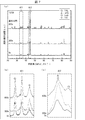
- FIG. 4A is a view showing an example of an X-ray diffraction pattern obtained by performing a powder X-ray diffraction measurement on a powder sample produced at a sintering temperature of 1273 K to 1423 K using an X-ray diffractometer.
- FIG. 1 is an enlarged view of a diffraction angle 2 ⁇ of about 35 ° in the X-ray diffraction pattern
- (c) is an enlarged view of a diffraction angle 2 ⁇ of about 45 ° in the X-ray diffraction pattern.
- a circle corresponds to the diffraction peak of TiB 2
- a triangle corresponds to ⁇ Fe
- a square corresponds to the diffraction peak of Fe 2 B
- a triangle corresponds to the diffraction peak of TiC.
- FIG. 4B in the sample at the sintering temperature of 1273 K, clear peaks of TiC and Fe 2 B were not observed, and no TiC was generated.
- the samples having sintering temperatures of 1323 K, 1373 K, and 1423 K clear diffraction peaks of TiC and Fe 2 B were observed.
- the fact that the diffraction peaks of Fe 2 B are observed in the samples at the sintering temperatures of 1323 K, 1373 K and 1423 K can also be seen from the diffraction pattern shown in FIG. 4C.
- the electron microscope observation of the sample surface and the sample cross section was performed about each sample.
- the sample surface is a surface obtained by polishing a portion in contact with a graphite punch during spark sintering.
- the sample cross section is an internal portion of the Fe-based sintered body, and is a surface obtained by cutting the sintered body after sintering and polishing the cross section.
- a backscattered electron image was taken of the sample surface and the sample cross section, and a composition analysis was performed by wavelength dispersive X-ray analysis (WDX). Further, the concentration of TiB 2 was measured on the sample surface and the sample cross section by WDX. As a result, on both the sample surface and the sample cross section, the concentration of TiB 2 decreased as the sintering temperature increased (see FIG. 6 described later).
- WDX wavelength dispersive X-ray analysis
- FIG. 5 shows the results.
- FIG. 5A is a diagram showing a portion where a local WDX is performed in a backscattered electron image of a sample.
- FIG. 5B is a diagram showing the results of composition analysis at eight locations where WDX was performed.
- TiC exists together with the matrix 1 containing Fe as a main component.
- TiB 2 is present in the places (4) and (5) where the dark and light (black) particulate phase 2 is observed.
- Fe 2 B is present in the places (6) and (7) where the by-product phase 3 is observed, and almost all is Fe in the place (8) where the matrix 1 is observed.
- Thermal conductivity measurement, density measurement, hardness test The measurement of the thermal conductivity was performed using a stationary method (a method of applying a constant temperature gradient to the sample to be measured and measuring the thermal conductivity). That is, one of the samples to be measured was set to a high temperature and the other was set to a low temperature, and the temperature at each point in the sample was measured to obtain the thermal conductivity.
- the density measurement was performed using the Archimedes method.
- the relative density was determined by dividing the density measured by the Archimedes method by the theoretical density.
- the hardness test was performed by a Vickers hardness test on the sample surface and inside the sample, respectively.
- the test force was 30 kg and the holding time was 10 seconds.
- the Vickers hardness (HV) can be converted to Rockwell hardness (HRC) using the following conversion formula.
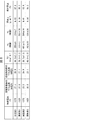
- Comparative Example 1 in which the sintering temperature is 1273 K, the thermal conductivity is about 44 W / (m ⁇ K) and the Vickers hardness is about 220 HV. In the sample of Comparative Example 1, no TiC was generated in the material structure, and the hard phase 4 for increasing the hardness was not present. Therefore, the sample of Comparative Example 1 shows high thermal conductivity due to heat conduction by the matrix 1, but has insufficient hardness.
- Examples 1 to 3 in which the sintering temperature was 1323 K to 1423 K, it was found that the higher the sintering temperature, the higher the hardness. Regarding thermal conductivity, Examples 1 and 2 are slightly inferior to Comparative Example 1. Although the reason for this is not clear, it is speculated that the solid solution of Ti and C in the matrix 1 may be one reason. The higher the sintering temperature, the more the diffusion of Ti and C is promoted, and the easier it is to form TiC.
- Examples 1 to 3 show that the higher the sintering temperature, the lower the TiB 2 concentration on the sample surface and inside the sample. It is considered that the greater the decrease in the TiB 2 concentration after sintering, the greater the amount of TiC generated. Also, the higher the sintering temperature, the higher the density and relative density.
- an Fe-based sintered body having both high hardness and high thermal conductivity can be manufactured more stably.
- the sample was manufactured by changing the sintering temperature from 1273K to 1423K while setting the holding time at the maximum attained temperature to approximately 0 seconds.
- the sample was manufactured by changing the sintering temperature to 1373 K and changing the holding time at the maximum attained temperature to approximately 0 seconds, 300 seconds, and 600 seconds.
- FIG. 7A shows an X-ray obtained by performing a powder X-ray diffraction measurement on a powder sample prepared under the conditions of a sintering temperature of 1373 K and a holding time of approximately 0 to 600 seconds using an X-ray diffractometer. It is a figure which shows an example of a diffraction pattern, (b) is a figure which expands and shows the diffraction angle 2 (theta) in the said X-ray diffraction pattern about 35 degrees, and (c) is a diffraction angle in the said X-ray diffraction pattern. It is a figure which expands and shows 2theta about 45 degrees.
- the Fe-based sintered body in one embodiment of the present invention can improve the thermal conductivity and the hardness by increasing the sintering temperature and increasing the holding time.
- the thermal conductivity and the hardness can be relatively easily controlled. Therefore, according to one embodiment of the present invention, it can be seen that an Fe-based sintered body having both high hardness and high thermal conductivity can be manufactured more stably.
- the samples were manufactured with the mass ratio of pure Fe: TiB 2 being 80:20.
- a sample was manufactured with the mass ratio of pure Fe: TiB 2 being 87:13 (Example 7).
- the sintering temperature was 1373 K, and the holding time at the maximum temperature was 600 seconds.
- a sample was manufactured under the same conditions as in the first embodiment described above.
- Various tests were performed in the same manner as in the first embodiment.
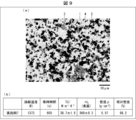
- FIG. 9A is a reflected electron image obtained by observing the material structure of the manufactured sample using an electron microscope.
- FIG. 9B is a table collectively showing the test results of the sample.
- the sample of this example has a matrix 1, a particulate phase 2, a by-product phase 3, and a hard phase 4, as in the first and second examples. ing. Then, as shown in FIG. 9B, even under the conditions of this embodiment, an Fe-based sintered body having both high hardness and high thermal conductivity can be obtained.
- the present embodiment is compared with the sixth embodiment (see FIG. 8) in the second embodiment, the following can be understood. That is, when the amount of TiB 2 charged is large, the hardness and the thermal conductivity are improved. Therefore, in the Fe-based sintered body according to one embodiment of the present invention, the thermal conductivity and the hardness can be relatively easily controlled by controlling the charged raw material ratio (the ratio of pure Fe: TiB 2 ). . Therefore, according to one embodiment of the present invention, it can be seen that an Fe-based sintered body having both high hardness and high thermal conductivity can be manufactured more stably.
- the present invention is not limited to the above-described embodiment, and various changes can be made within the scope shown in the claims.
- the present invention also relates to an embodiment obtained by appropriately combining the technical means disclosed in the above description. Included in the technical scope of the invention.
Landscapes
- Engineering & Computer Science (AREA)
- Mechanical Engineering (AREA)
- Chemical & Material Sciences (AREA)
- Manufacturing & Machinery (AREA)
- Materials Engineering (AREA)
- Metallurgy (AREA)
- Organic Chemistry (AREA)
- Physics & Mathematics (AREA)
- Optics & Photonics (AREA)
- Chemical Kinetics & Catalysis (AREA)
- Powder Metallurgy (AREA)
- Ceramic Products (AREA)
Abstract
高い硬度と高い熱伝導率とを兼備するとともに、より安定して製造可能なFe基焼結体を提供する。Fe基焼結体は、Feを主成分とするマトリックス(1)と、該マトリックス(1)中に分散した硬質相(4)とを有している。マトリックス(1)は、ネットワーク状に形成されているとともに、αFeを含んでいる。硬質相(4)は、TiCを含む。
Description
本発明は、Fe基焼結体、Fe基焼結体の製造方法、および熱間プレス用金型に関する。
従来、例えば自動車の車体部品等の製造に熱間プレス技術が用いられている。熱間プレス技術では、鋼板を加熱した状態にて、熱間プレス用金型を用いて当該鋼板をプレスすることにより成形(プレス成形)を行う。このプレス成形の際に急冷(焼入れ)することによって鋼を硬化させる。このような熱間プレス技術は、超高張力鋼を用いた製品(部品)を製造する場合に、成形精度および成形後の強度を確保するために重要な技術となってきている。
上記熱間プレス用金型に求められる性能としては、繰返し使用することができる高い耐久性(高寿命化)および高い冷却性能が挙げられる。冷却性能が高いほどプレス成形の1サイクルの時間を短くすることができる。つまり、熱間プレス用金型は、硬度が高く、かつ熱伝導率が高い材料により形成されていることが要望される。
特許文献1には、工具鋼の室温での熱伝導率を向上させる技術について記載されている。
一般に、熱間プレス用金型の材料として例えばSKD61が知られている。この材料は、ロックウェル硬さで50HRC程度の硬度を有する。一方で、該材料の熱伝導率は24W/(m・K)程度であり、熱伝導率の更なる向上が求められている。しかし、通常、材料の特性として、高い硬度を有することと高い熱伝導率を有することとは互いにトレードオフの関係にある。そのため、高い硬度と高い熱伝導率とを兼備する材料を得ることは困難である。
特許文献1には、鋼の内部組織を冶金学的に定義することにより、室温での熱伝導率を向上させた工具鋼について記載されている。しかし、鋼の内部組織を精密に制御することは難しく、上記工具鋼は安定して製造し難いという問題を有している。
本発明は、このような現状に鑑みなされたものであって、高い硬度と高い熱伝導率とを兼備するとともに、より安定して製造可能なFe基焼結体(熱間プレス用金型の材料)を提供することを目的とする。また、高い硬度と高い熱伝導率とを兼備するFe基焼結体を、より安定して製造できるFe基焼結体の製造方法を提供することを目的とする。
上記の課題を解決するために、本発明の一態様に係るFe基焼結体は、Feを主成分とするマトリックスと、該マトリックス中に分散した分散相とを有するFe基焼結体であって、前記マトリックスは、ネットワーク状に形成されているとともに、αFeを含んでおり、前記分散相は、TiCを含む。
また、上記の課題を解決するために、本発明の一態様に係るFe基焼結体の製造方法は、Fe粉末とTiB2粉末とを含む混合粉末を加圧成形してなる成形体を、グラファイト製の加圧部材を用いて加圧しつつ加熱して焼結する焼結工程を含み、前記焼結工程では、15MPa以上の圧力範囲で加圧し、1323K以上の温度で加熱することにより、前記TiB2の少なくとも一部を分解するとともに、Feを主成分としてTiを含むネットワーク状のマトリックスを形成し、前記マトリックスはαFeを含み、前記TiB2に由来するTiと前記加圧部材に由来するCとの反応により、前記マトリックス中に分散したTiCを生成させるように焼結する。
本発明の一態様によれば、高い硬度と高い熱伝導率とを兼備するとともに、より安定して製造可能なFe基焼結体を提供することができる。また、高い硬度と高い熱伝導率とを兼備するFe基焼結体を、より安定して製造できるFe基焼結体の製造方法を提供することができる。
以下、本発明の実施の形態について、図面を参照し詳細に説明する。なお、以下の記載は発明の趣旨をより良く理解させるためのものであり、特に指定のない限り、本発明を限定するものではない。また、本明細書において特記しない限り、数値範囲を表す「A~B」は、「A以上B以下」を意味する。
以下の説明においては、本発明の実施の形態におけるFe基焼結体およびその製造方法の詳細な説明に先立って、本発明の知見について概略的に説明する。
(発明の知見の概要)
一般に、合金工具鋼(例えば、SKD61)は、特定の化学成分を有するとともに各種の熱処理が施されることにより、所望の性能を実現させている。例えば、鋼中に多様な微細組織が形成される。そのような微細組織は、鋼の硬度を向上させるように作用する一方で、熱伝導を妨害する作用を有する。通常、物質は、硬度が高いほど、電子伝導性やフォノン伝導性が低いため熱伝導性に劣る。
一般に、合金工具鋼(例えば、SKD61)は、特定の化学成分を有するとともに各種の熱処理が施されることにより、所望の性能を実現させている。例えば、鋼中に多様な微細組織が形成される。そのような微細組織は、鋼の硬度を向上させるように作用する一方で、熱伝導を妨害する作用を有する。通常、物質は、硬度が高いほど、電子伝導性やフォノン伝導性が低いため熱伝導性に劣る。
特許文献1には、鋼のマトリックス中の炭素およびクロムの含有量を低減させるとともに、分散相である炭化物のフォノン伝導性を高めることによって、工具鋼の室温での熱伝導率を向上させる技術が記載されている。しかし、鋼の内部組織は、成分組成、熱処理、および他の種々の条件の影響を大きく受けて様々に変化し得るため、鋼の内部組織を所望の状態に安定して制御することは容易ではない。
本発明者らは、従来とは別のアプローチによって、高い硬度と高い熱伝導率とを兼備し、かつ製造の安定性を高めることができる材料を創製することを試みた。鋭意検討を行い、純鉄(Fe)とホウ化チタン(TiB2)との混合粉末を焼結させて製造したFe基焼結体は、焼結条件を調節することによって、以下の性質を示すことを見出した。
すなわち、炭素(C)を供給可能な条件かつ調節された条件下で焼結を行うことにより、微小領域での非平衡反応が生じ、その結果、Fe基焼結体中にTiCを含有する硬質相が生成する。この硬質相は、Feマトリックス中に好適に微細分散して得ることができる。
また、Feマトリックスは、ネットワーク状の構造(網目状構造)を有しているとともにαFeを含み、熱伝導パスとして好適に機能することができる。なお、一般に、材料組織中にセメンタイト(Fe3C)が生成すると熱伝導率が低下し得る。その点、本発明の一態様におけるFe基焼結体は、原料として炭素含有量の少ない鉄を用いて製造されるとともに、その製造過程において、TiB2が分解する際、FeとCが結合してセメンタイトを生成するよりも、TiとCが結合してTiCが生成しやすい。そのため、本Fe基焼結体は、製造の際にセメンタイトの生成を抑制することができ、セメンタイトの含有量を低減することができる。
これにより、高い硬度および高い熱伝導率を示すFe基焼結体を得ることができるという知見を得た。
<Fe基焼結体>
本発明の一実施形態におけるFe基焼結体について、図1~5を用いて説明すれば、以下のとおりである。なお、本実施形態におけるFe基焼結体の製造方法の詳細については後述する。図1は、本実施形態のFe基焼結体の内部組織(材料組織)について電子顕微鏡を用いて観察して得た反射電子像である。
本発明の一実施形態におけるFe基焼結体について、図1~5を用いて説明すれば、以下のとおりである。なお、本実施形態におけるFe基焼結体の製造方法の詳細については後述する。図1は、本実施形態のFe基焼結体の内部組織(材料組織)について電子顕微鏡を用いて観察して得た反射電子像である。
図1に示すように、本実施形態のFe基焼結体は、Feを主成分とするマトリックス(基地)1と、各種の相を含む分散相とを含有している。本実施形態のFe基焼結体は、概略的には、上述のようにFeとTiB2との混合粉末を、Cが供給される条件下で焼結することにより形成(製造)される。そのため、上記分散相は、原料であるTiB2を含む粒子状相(第1の副相)2と、TiB2とCとの反応により生成した微細なTiCを含有する硬質相4とを含む。また、上記分散相はさらに、Feと、TiB2から供給されたBとの反応によって生成したFe2Bを含有する副生成相(第2の副相)3を含む。
本実施形態のFe基焼結体の材料組織について、図2を用いてさらに詳細に説明する。図2の(a)は、図1に示す反射電子像の模式図である。図2の(b)は、上記模式図の一部を拡大して示す図である。なお、図2において、マトリックス1は濃淡が最も薄い(白色の)領域、粒子状相2は濃淡が最も濃い(黒色の)領域として示している。また、副生成相3はマトリックス1よりも少し濃淡が濃い(薄い灰色の)領域として示し、硬質相4は副生成相3と粒子状相2の間の濃淡である(濃い灰色の)領域として示している。
(マトリックス1)
図2の(a)に示すように、マトリックス1は、Fe基焼結体に占める割合が最も多い相であって、ネットワーク状に形成されている。マトリックス1は、例えばFe基焼結体全体を100重量部として、Fe基焼結体に占める割合が75質量%以上であることが好ましく、60質量%以上80質量%以下であることがより好ましい。また、マトリックス1は、Feを主成分とする相であって、マトリックス1におけるFeの濃度が99原子パーセント(以下、at%と記載する)以上であり、好ましくは99.9at%以上である。マトリックス1は、αFeを含む。マトリックス1は、好ましくは大部分がαFeからなる。αFeにC原子が固溶している場合、C原子を固溶したαFeは、フェライト相とも表現される。
図2の(a)に示すように、マトリックス1は、Fe基焼結体に占める割合が最も多い相であって、ネットワーク状に形成されている。マトリックス1は、例えばFe基焼結体全体を100重量部として、Fe基焼結体に占める割合が75質量%以上であることが好ましく、60質量%以上80質量%以下であることがより好ましい。また、マトリックス1は、Feを主成分とする相であって、マトリックス1におけるFeの濃度が99原子パーセント(以下、at%と記載する)以上であり、好ましくは99.9at%以上である。マトリックス1は、αFeを含む。マトリックス1は、好ましくは大部分がαFeからなる。αFeにC原子が固溶している場合、C原子を固溶したαFeは、フェライト相とも表現される。
ネットワーク状とは、例えば図2の(a)に示すように材料組織を平面視した場合(断面を観察した場合)、網目状に連続した相が形成されていることを意味する。マトリックス1の網目状構造における網の隙間に、粒子状相2、副生成相3、および硬質相4が島状に分散し、Fe基焼結体の島状複合組織を形成している。また、マトリックス1は多結晶であることから、ネットワーク状の構造(網目状構造)中に結晶粒界が存在する。Fe基焼結体は、焼結により形成されていることから、マトリックス1に多少の空隙(ボイド)が存在してもよい。マトリックス1は、濃度分布があってもよく、複数の相を有していてもよい。このようなマトリックス1は、熱伝導性に優れている。
なお、図2の(a)は材料組織を平面視した模式図であるが、実際上、マトリックス1は3次元空間においてネットワーク状構造を有している。本実施形態のFe基焼結体において、マトリックス1は、熱伝導に効果的な連続的なパス(熱伝導経路)として機能することができる。
また、マトリックス1は、セメンタイトの含有量が5質量%以下であってよく、好ましくは、1質量%以下である。マトリックス1は、αFeの含有量が70質量%以上であってよく、60質量%以上80質量%以下であってもよい。また、αFeがフェライト相であり、フェライト相とセメンタイトとの2相組織が層状組織となっていてもよく、熱伝導を阻害し易いセメンタイトが局在化した状態となっていることが好ましい。マトリックス1は、Cuの含有量が0.1質量%以下、およびSiの含有量が0.1質量%以下、の条件のうち少なくともいずれかを満たしていてもよく、その他の不純物が含まれていてもよい。ただし、このような不純物は、熱伝導率を低下させる、または炭化物の生成を促進する、といった作用を奏し得る。そのため、マトリックス1は、低い不純物含有量となるように製造されることが好ましい。
(粒子状相2)
粒子状相2は、Fe基焼結体を製造する際に用いたTiB2粉末に由来して存在する相である。焼結反応後に残存した一部のTiB2粉末が粒子状相2となる。そのため、Fe基焼結体における粒子状相2の存在割合は、焼結反応の条件によって変化する。それゆえ、粒子状相2の存在割合は特に限定されないが、例えば、粒子状相2は、Fe基焼結体に占める割合が10質量%以上である。好ましくは、15質量%以上20質量%以下である。粒子状相2は、マトリックス1よりも高い硬度を有していることから、Fe基焼結体の硬度を向上させる。
粒子状相2は、Fe基焼結体を製造する際に用いたTiB2粉末に由来して存在する相である。焼結反応後に残存した一部のTiB2粉末が粒子状相2となる。そのため、Fe基焼結体における粒子状相2の存在割合は、焼結反応の条件によって変化する。それゆえ、粒子状相2の存在割合は特に限定されないが、例えば、粒子状相2は、Fe基焼結体に占める割合が10質量%以上である。好ましくは、15質量%以上20質量%以下である。粒子状相2は、マトリックス1よりも高い硬度を有していることから、Fe基焼結体の硬度を向上させる。
(副生成相3)
副生成相3は、上述のように、Feと、TiB2から供給されたBとの反応によって生成したFe2Bを含有する相である。換言すれば、副生成相3は、焼結反応時に、TiCが生成する反応に伴ってTiB2が分解することにより、副生成物として生成したFe2Bを含有する相である。図2の(a)から、副生成相3は、原料のTiB2粉末が元々存在したであろう場所に形成されていることがわかる。また、同図から、副生成相3および粒子状相2の近傍に、後述する硬質相4が形成されていることがわかる。
副生成相3は、上述のように、Feと、TiB2から供給されたBとの反応によって生成したFe2Bを含有する相である。換言すれば、副生成相3は、焼結反応時に、TiCが生成する反応に伴ってTiB2が分解することにより、副生成物として生成したFe2Bを含有する相である。図2の(a)から、副生成相3は、原料のTiB2粉末が元々存在したであろう場所に形成されていることがわかる。また、同図から、副生成相3および粒子状相2の近傍に、後述する硬質相4が形成されていることがわかる。
副生成相3は、マトリックス1よりも高い硬度を有していることから、Fe基焼結体の硬度を向上させる。
(硬質相4)
反射電子像の一部を拡大して示す図2の(b)を用いて、硬質相4について説明する。
反射電子像の一部を拡大して示す図2の(b)を用いて、硬質相4について説明する。
図2の(b)に示すように、本実施形態における硬質相4は、特徴的な形状として、リング形状またはリング様形状を有している。本明細書において、リング形状またはリング様形状とは、完全な円形状のことだけでなく、図2の(b)に示す例のように歪んだ形の円形状(周方向に不規則に曲がった形状)をも含む意味で用いる。
また、硬質相4は、図2の(b)に示す例のように周方向の端部が無く連続した輪(閉じた円)であってもよく、一部が開放した輪であってもよい。つまり、硬質相4は一端から他端に向かって延びる形状であってもよい。
硬質相4は、周方向に垂直な方向の幅Lが1.0μm以下であり、好ましくは0.4μm以下であり、より好ましくは0.2μm以上0.4μm以下である。上記幅Lは、以下のようにして測定することができる。すなわち、先ず、図2の(b)に示すように、例えば反射電子像における硬質相4の領域(濃い灰色の領域)と、他の相(例えばマトリックス1または副生成相3)の領域と、の境界を特定する。硬質相4の周方向に垂直な方向において、特定した上記境界に基づいて、硬質相4の幅Lを測定することができる。例えば、或る1つの硬質相4について、複数箇所を測定した平均値を当該硬質相4の幅Lとすることができる。硬質相4は、マトリックス中に微細に分散した微細分散相ともいえる。
なお、硬質相4は、図2の(a)に示すように、様々な形状であってもよく、紐状形状を有していてもよい。紐状形状である場合、硬質相4は、長手方向(一端から他端に向かって延びる方向)に対して垂直な方向の幅Lが、上述の条件を満たしていればよい。
硬質相4は、硬度に非常に優れることが知られているTiCを含んでいる。そのため、本実施形態におけるFe基焼結体は、硬質相4を含むことにより、硬度を大きく向上させることができる。そして、上述のようにマトリックス1が熱伝導経路として機能する。その結果、本実施形態におけるFe基焼結体は、高い硬度と高い熱伝導率とを兼備することができる。
上記硬質相4は、焼結反応時に、圧粉体の周辺から内部へと拡散することにより供給されるCと、TiB2粉末とが微小領域にて非平衡反応することによって形成される。よって、例えば鋼の材料組織を制御して合金工具鋼を製造する場合よりも、本実施形態のFe基焼結体は安定的に製造可能である。
具体的には、本発明の一態様におけるFe基焼結体は、硬度が300HV(ビッカース硬さ)以上かつ熱伝導率が30W/(m・K)以上である。なお、300HV以上の硬度とは、ロックウェル硬さに概略的に換算して、30HRC以上と表現することもできる(換算式については後述)。
なお、Fe基焼結体は、外部に露出する表面部と、表面部よりも中心側に存在する内部との間で、硬度に差があってもよい。本発明の一態様におけるFe基焼結体は、後述するような焼結時の反応に基づいて、表面部の方が内部よりも硬度が高くなる傾向にある。本明細書において、格別の記載がない限り「硬度」とは表面部の硬度のことを意味する。Fe基焼結体の特性(材料特性)として重要となるのは、表面部の硬度である。
本発明の一態様におけるFe基焼結体は、硬度が400HV(40HRC)以上であってよく、525HV(50HRC)以上であってもよい。
また、本発明の一態様におけるFe基焼結体は、熱伝導率が40W/(m・K)以上であってよく、45W/(m・K)以上であってもよく、50W/(m・K)以上であってもよい。本明細書において、格別の記載がない限り「熱伝導率」とは室温での熱伝導率のことを意味する。
本発明の一態様におけるFe基焼結体は、硬度が525HV(50HRC)以上、かつ熱伝導率が40W/(m・K)以上である。
<Fe基焼結体の製造方法>
以下に、本実施形態のFe基焼結体の製造方法について詳細に説明する。
以下に、本実施形態のFe基焼結体の製造方法について詳細に説明する。
(原料)
Fe基焼結体の原料には、Feの微粉末とTiB2の微粉末とを用いる。これらの微粉末の形状は特に限定されないが、後述する粉末混合工程において均一に混合された混合粉末を得るために、微細な粉末であることが好ましい。例えば、Feの微粉末は、平均粒径が10μm以下であってよく、3μm以上5μm以下であることが好ましい。また、例えば、TiB2の微粉末は、平均粒径が5μm以下であってよく、2μm以上3μm以下であることが好ましい。
Fe基焼結体の原料には、Feの微粉末とTiB2の微粉末とを用いる。これらの微粉末の形状は特に限定されないが、後述する粉末混合工程において均一に混合された混合粉末を得るために、微細な粉末であることが好ましい。例えば、Feの微粉末は、平均粒径が10μm以下であってよく、3μm以上5μm以下であることが好ましい。また、例えば、TiB2の微粉末は、平均粒径が5μm以下であってよく、2μm以上3μm以下であることが好ましい。
Feの微粉末は、炭素濃度が0.1質量%以下の純鉄の微粉末であることが好ましい。TiB2の微粉末は、市販の標準的な純度のTiB2の微粉末であってよい。
(成形工程)
成形工程において、先ず、Feの微粉末とTiB2の微粉末とを均一に混合する(混合工程)。この混合工程では、粉末を均一に混合することができればよく、その具体的な方法は特に限定されない。例えば、ボールミルを用いて粉末を混合してよく、遊星型ボールミルを用いることが好ましい。また、混合工程では、エタノール等を添加して湿式混合を行ってよく、乾式混合を行ってもよい。湿式混合を行った場合、使用したエタノール等を揮発させる乾燥工程を行う。乾燥工程における具体的な乾燥方法は特に限定されない。
成形工程において、先ず、Feの微粉末とTiB2の微粉末とを均一に混合する(混合工程)。この混合工程では、粉末を均一に混合することができればよく、その具体的な方法は特に限定されない。例えば、ボールミルを用いて粉末を混合してよく、遊星型ボールミルを用いることが好ましい。また、混合工程では、エタノール等を添加して湿式混合を行ってよく、乾式混合を行ってもよい。湿式混合を行った場合、使用したエタノール等を揮発させる乾燥工程を行う。乾燥工程における具体的な乾燥方法は特に限定されない。
次いで、成形工程では、Feの微粉末とTiB2の微粉末とを所望の割合(量比)で混合した混合粉末を成形(加圧成形)して成形体を得る。得られる成形体の密度や成形圧力は特に限定されない。なお、後述する焼結工程において、混合粉末を成形しつつ(成形工程を行いつつ)焼結を行うようになっていてもよい。
(焼結工程)
本実施形態における焼結工程では、加圧しながら加熱することにより焼結を行う。このような焼結を行う方法としては、従来公知の固相焼結法を適宜選択して適用してよい。ただし、焼結条件(温度・圧力・雰囲気)については、上述のようなFe基焼結体が得られるように、適切に調整されることを要する。
本実施形態における焼結工程では、加圧しながら加熱することにより焼結を行う。このような焼結を行う方法としては、従来公知の固相焼結法を適宜選択して適用してよい。ただし、焼結条件(温度・圧力・雰囲気)については、上述のようなFe基焼結体が得られるように、適切に調整されることを要する。
焼結工程では、例えば、グラファイト製の加圧部材を用いて加圧を行う。これにより、焼結時に該加圧部材に由来するCが成形体内部に侵入する。そのため、焼結反応が生じる反応場にCが供給されて、TiB2とCとの反応により微小なTiCが生成する。
より詳しくは、焼結工程では、以下のような反応が生じる。すなわち、先ず、原料のTiB2微粉末の少なくとも一部を分解するとともに、Feの微粉末が互いに結合して、Feを主成分としてTiを含むネットワーク状のマトリックスを形成する。そして、TiB2微粉末に由来するTiと、上記加圧部材等に由来するC(Fe中に元々存在するCであってもよい)との反応により、マトリックス1中に微細分散したTiCが生成する。また、焼結温度は、マトリックスにαFeを含み、γFeが生成し難い温度とする。ここで、「γFeが生成し難い温度」とは、局所温度を含め各種の放電焼結条件管理下において、焼結工程中にγFeが生成し難いような温度を意味する。そして焼結工程において、CはTiCを生成することに主に消費される。これにより、セメンタイトの生成を抑制して、Fe基焼結体を製造することができる。本実施形態におけるFe基焼結体の製造方法は、このような反応が生じる焼結工程を含む。
このような反応を生じさせるために、焼結工程では、1323K以上の温度、および15MPa以上の圧力の条件とする。上記温度は、焼結装置に設定される焼結温度であって、換言すれば焼結工程における最高到達温度である。上記温度は、好ましくは、1373K以上であり、より好ましくは1423K以上である。また、上記温度は、1323K以上1447K以下であることが好ましい。これは、FeとFe2Bとが反応して液相となることを回避するためである。また、上記圧力は、15MPa以上90MPa以下であることが好ましい。
焼結工程において、昇温速度は特に限定されないが、例えば100K/minであってよい。最高到達温度において保持する時間(保持時間)は、略0秒であってよく、0秒より大きく600秒以下であってもよい。
また、焼結工程では、放電焼結法を用いることが好ましい。放電焼結法とは、型枠と該型枠の内部に充填された焼結材料(粉末)との間で通電を起こさせ、通電により発生する熱(ジュール熱)を用いて焼結反応を生じさせる方法である。放電焼結法に用いられる放電焼結機は、グラファイト製の円筒状の型およびグラファイト製のパンチにて焼結対象材料(成形体または粉末)を覆うようにして、パンチにより加圧しながら放電焼結を行う。放電焼結機は、パルス通電または連続通電することにより放電焼結を行ってよい。通電する電流は、焼結対象材料に臨界電圧以上が印加される条件とすればよい。このような放電焼結法を用いると、焼結対象材料の温度を均一に昇温することができ、均質かつ高品位なFe基焼結体を得ることができる。
ここで、一般に、Feのような金属をベースとする焼結体を作製するために放電焼結を行う場合、1000K程度の温度とすれば充分に焼結反応が進行すると考えられる。しかし、本実施形態のFe基焼結体は、焼結温度が1000K程度で有る場合、TiCの硬質相4が生成しないため得ることができない。本発明者らは、鋭意検討の結果、上述の焼結条件(すなわち、1323K以上の温度、および15MPa以上の圧力)とすることによって、機構は完全には明らかではないが、TiCを含む硬質相4が生成してFe基焼結体の硬度が向上することを見出し、その知見に基づいて本発明を想到した。
なお、焼結工程において、パンチ等の材質がグラファイト製でなくてもよく、その場合、成形体の表面にグラファイトをコーティングした後、またはCを含浸した後に焼結を行うようになっていてもよい。また、成形体の表面に炭素粉末を付着させた状態にて焼結を行ってもよい。
上記のような放電焼結法は、操作が比較的容易であり、焼結時の温度および圧力を比較的安定に制御することができる。そのため、Fe基焼結体を安定的に製造し易い。
(後工程)
Fe基焼結体の製造方法は、焼結工程の後、焼結体の表面を研磨および洗浄する工程を含んでいてもよい。
Fe基焼結体の製造方法は、焼結工程の後、焼結体の表面を研磨および洗浄する工程を含んでいてもよい。
以上のような工程により製造した本発明の一態様におけるFe基焼結体の、表面および断面を観察した結果の一例を図3に示す。図3は、本発明の一実施形態におけるFe基焼結体の、材料組織を観察可能となるように研磨した試料を観察することにより得た反射電子像であり、(a)は試料表面、(b)は試料断面を観察した反射電子像である。
図3の(a)および(b)に示すように、Fe基焼結体は、上述したような島状複合組織(図2参照)が形成されていることがわかる。Fe基焼結体の内部(試料断面)においても、硬質相4が形成していることがわかる。
(熱間プレス用金型)
なお、本実施形態のFe基焼結体は、熱間プレス用金型の製造に用いられてよく、本実施形態のFe基焼結体を用いて製造された熱間プレス用金型も本発明の範疇に含まれる。
なお、本実施形態のFe基焼結体は、熱間プレス用金型の製造に用いられてよく、本実施形態のFe基焼結体を用いて製造された熱間プレス用金型も本発明の範疇に含まれる。
(変形例)
本発明の一態様におけるFe基焼結体の製造方法では、成形工程と後述する焼結工程との間に仮焼工程が含まれてもよく、含まれていなくともよい。仮焼工程を含む場合、Feの微粉末とTiB2の微粉末とに、微細な炭素粒子を加えて混合し、得られた混合粉末を成形して成形体を得る。そして、該成形体を用いて仮焼工程を行う。これにより、本発明の一態様におけるFe基焼結体を製造してもよい。
本発明の一態様におけるFe基焼結体の製造方法では、成形工程と後述する焼結工程との間に仮焼工程が含まれてもよく、含まれていなくともよい。仮焼工程を含む場合、Feの微粉末とTiB2の微粉末とに、微細な炭素粒子を加えて混合し、得られた混合粉末を成形して成形体を得る。そして、該成形体を用いて仮焼工程を行う。これにより、本発明の一態様におけるFe基焼結体を製造してもよい。
以下、実施例および比較例により、本発明の一態様におけるFe基焼結体についてさらに詳しく説明するが、本発明はこれら実施例に限定されるものではない。
〔第1の実施例〕
(試料作製)
平均粒径3~5μmの純Feの微粉末と、平均粒径2~3μmのTiB2の微粉末とを、遊星型ボールミルを用いて、100rpmで1時間乾式混合した。純Fe:TiB2の比率は、質量比で80:20(体積比で70:30)とした。遊星型ボールミルの容器内には、混合粉末15gに対してセラミックス球(ボール)を150gの割合で投入して混合を行った。
(試料作製)
平均粒径3~5μmの純Feの微粉末と、平均粒径2~3μmのTiB2の微粉末とを、遊星型ボールミルを用いて、100rpmで1時間乾式混合した。純Fe:TiB2の比率は、質量比で80:20(体積比で70:30)とした。遊星型ボールミルの容器内には、混合粉末15gに対してセラミックス球(ボール)を150gの割合で投入して混合を行った。
上記乾式混合の後、遊星型ボールミルの容器内にエタノールを15~20ml添加して、3時間湿式混合を行った。湿式混合の後、得られたスラリーを自然乾燥させて、混合粉末を得た。
得られた混合粉末を放電焼結機のグラファイト製の型枠内に充填した。グラファイト製のパンチを用いて加圧しながら、加熱するとともに通電し、放電焼結を行った。焼結温度(最大到達温度)は1273K~1423Kとし、加圧圧力は50MPaとした。昇温速度は100k/minとし、最大到達温度での保持時間は略0秒とした。
焼結後、放電焼結機から試料を取り出して、研磨を行った後、X線回折測定、電子顕微鏡観察、熱伝導率測定、密度測定、および硬度試験を行った。
(X線回折測定)
試料を粉砕して粉末試料とし、該粉末試料を用いて粉末X線回折測定を行った。照射X線としては、CuのKα線を用いた。測定結果を図4に示す。図4の(a)は、焼結温度が1273K~1423Kの条件で作製した粉末試料を、X線回折装置を用いて粉末X線回折測定して得られるX線回折パターンの一例を示す図であり、(b)は、上記X線回折パターンにおける回折角2θが35°前後について拡大して示す図であり、(c)は、上記X線回折パターンにおける回折角2θが45°前後を拡大して示す図である。
試料を粉砕して粉末試料とし、該粉末試料を用いて粉末X線回折測定を行った。照射X線としては、CuのKα線を用いた。測定結果を図4に示す。図4の(a)は、焼結温度が1273K~1423Kの条件で作製した粉末試料を、X線回折装置を用いて粉末X線回折測定して得られるX線回折パターンの一例を示す図であり、(b)は、上記X線回折パターンにおける回折角2θが35°前後について拡大して示す図であり、(c)は、上記X線回折パターンにおける回折角2θが45°前後を拡大して示す図である。
図4において、○印はTiB2、△印はαFe、□印はFe2B、◇印はTiCの回折ピークにそれぞれ対応している。図4の(b)に示すように、焼結温度が1273Kの試料ではTiCおよびFe2Bの明瞭なピークが見られず、TiCが生成していない。一方で、焼結温度が1323K、1373K、1423Kの試料では、TiCおよびFe2Bの明瞭な回折ピークが観測された。また、焼結温度が1323K、1373K、1423Kの試料でFe2Bの回折ピークが観測されることは、図4の(c)に示す回折パターンからもわかる。
(電子顕微鏡観察)
各試料について、試料表面および試料断面の電子顕微鏡観察を行った。試料表面とは、放電焼結時にグラファイト製のパンチに接していた部分を研磨して表れた表面である。試料断面とは、Fe基焼結体の内部の部分であって、焼結後の焼結体を切断して、断面を研磨して表れた表面である。
各試料について、試料表面および試料断面の電子顕微鏡観察を行った。試料表面とは、放電焼結時にグラファイト製のパンチに接していた部分を研磨して表れた表面である。試料断面とは、Fe基焼結体の内部の部分であって、焼結後の焼結体を切断して、断面を研磨して表れた表面である。
試料表面および試料断面について、反射電子像を撮像するとともに、波長分散型X線分析(WDX)により組成分析を行った。また、WDXにより、試料表面および試料断面についてTiB2の濃度を測定した。その結果、試料表面および試料断面のいずれにおいても、焼結温度が高くなるほどTiB2の濃度が減少していた(後述の図6参照)。
また、焼結温度が1373Kの試料について、試料表面の局所的なWDXを行った。結果を図5に示す。図5の(a)は、試料の反射電子像における、局所的なWDXを行った箇所を示す図である。図5の(b)は、WDXを行った8箇所の組成分析結果を示す図である。
図5の(a)および(b)に示すように、リング状の硬質相4が観察される(1)~(3)の箇所では、Feを主成分とするマトリックス1とともにTiCが存在することがわかる。また、濃淡が濃い(黒色の)粒子状相2が観察される(4)および(5)の箇所では、TiB2が存在することがわかる。そして、副生成相3が観察される(6)および(7)の箇所ではFe2Bが存在し、マトリックス1が観察される(8)の箇所ではほぼ全てFeであることが分かる。
(熱伝導率測定、密度測定、硬度試験)
熱伝導率測定は、定常法(被測定試料に定常的な温度勾配を与え、熱伝導率を測定する方法)を用いて行った。つまり、被測定試料の片方を高温にし、もう一方を低温にし、試料内の各点の温度を測定して熱伝導率を求めた。
熱伝導率測定は、定常法(被測定試料に定常的な温度勾配を与え、熱伝導率を測定する方法)を用いて行った。つまり、被測定試料の片方を高温にし、もう一方を低温にし、試料内の各点の温度を測定して熱伝導率を求めた。
密度測定は、アルキメデス法を用いて行った。相対密度は、アルキメデス法で測定した密度を、理論密度にて除することにより求めた。
硬度試験は、試料表面および試料内部について、それぞれビッカース硬さ試験により行った。試験力を30kgとし、保持時間を10秒とした。
(結果)
上述した試験の結果をまとめ、図6に示す。なお、熱伝導率およびビッカース硬さは、複数の測定を行った誤差を含めて示している。該誤差は、標準偏差である。
上述した試験の結果をまとめ、図6に示す。なお、熱伝導率およびビッカース硬さは、複数の測定を行った誤差を含めて示している。該誤差は、標準偏差である。
なお、ビッカース硬さ(HV)は、以下の変換式を用いてロックウェル硬さ(HRC)に換算することができる。
(i)520HV以上の場合;
HRC=(100×HV-15100)/(HV+223)
(ii)200HV以上520HV未満の場合;
HRC=(100×HV-13700)/(HV+223)。
HRC=(100×HV-15100)/(HV+223)
(ii)200HV以上520HV未満の場合;
HRC=(100×HV-13700)/(HV+223)。
焼結温度が1273Kである比較例1では、熱伝導率が44W/(m・K)程度であり、ビッカース硬さが220HV程度である。比較例1の試料は、材料組織にTiCが生成しておらず、硬度を高める硬質相4が存在しない。そのため、比較例1の試料は、マトリックス1による熱伝導によって高い熱伝導率を示す一方で、硬度は不十分である。
これに対して、焼結温度が1323K~1423Kである実施例1~3では、焼結温度が高くなるほど、硬度が向上していることがわかる。熱伝導率については、実施例1および実施例2は比較例1よりも少し劣る。この理由については明らかでないが、マトリックス1中にTiおよびCが固溶することが一因であり得ると推察される。焼結温度が高いほど、TiおよびCの拡散が促進され、TiCを形成し易い。
また、実施例1~3の結果から、焼結温度が高くなるほど、試料表面および試料内部のTiB2濃度が低下することもわかる。焼結後のTiB2濃度の低下量が大きいほど、TiCの生成量は大きくなると考えられる。また、焼結温度が高くなるほど、密度および相対密度が増大した。
本実施例から、本発明の一態様によれば、高い硬度と高い熱伝導率とを兼備するFe基焼結体を、より安定して製造できることがわかる。
〔第2の実施例〕
前記第1の実施例では、最大到達温度での保持時間を略0秒として、焼結温度を1273K~1423Kに変化させて試料を作製していた。これに対し、本実施例では、焼結温度を1373Kとし、最大到達温度での保持時間を略0秒、300秒、600秒と変化させて試料を作製した。
前記第1の実施例では、最大到達温度での保持時間を略0秒として、焼結温度を1273K~1423Kに変化させて試料を作製していた。これに対し、本実施例では、焼結温度を1373Kとし、最大到達温度での保持時間を略0秒、300秒、600秒と変化させて試料を作製した。
焼結温度を1373Kとし、最大到達温度での保持時間を略0秒、300秒、600秒としたこと以外は、前述した第1の実施例と同様の条件により試料を作製した。また、前述した第1の実施例と同様の方法にて各種試験を行った。
X線回折測定を行った結果を図7に示す。図7の(a)は、焼結温度が1373K、保持時間が略0秒~600秒の条件で作製した粉末試料を、X線回折装置を用いて粉末X線回折測定して得られるX線回折パターンの一例を示す図であり、(b)は、上記X線回折パターンにおける回折角2θが35°前後について拡大して示す図であり、(c)は、上記X線回折パターンにおける回折角2θが45°前後を拡大して示す図である。
図7において、各種の印と物質との対応関係は図4にて前述したことと同様である。図7の(b)に示すように、保持時間が長くなるについて、TiCの回折ピークの強度が増大した。また、図7の(c)に示すように、保持時間が長くなるについて、Fe2Bの回折ピークの強度が増大した。
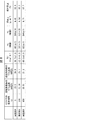
各種の試験の結果をまとめ、図8に示す。なお、熱伝導率およびビッカース硬さは、複数の測定を行った誤差を含めて示している。
保持時間がそれぞれ略0秒、300秒、600秒である実施例4~6の結果から、保持時間が長くなるほど、熱伝導率および硬度が有意に向上することがわかる。また、保持時間が長くなるほど、密度および相対密度も増大した。
以上のように、本発明の一態様におけるFe基焼結体は、焼結温度を高くすること、および保持時間を長くすることによって、熱伝導率および硬度を向上させることができる。換言すれば、焼結条件を制御することによって、比較的簡便に、熱伝導率および硬度を制御することができる。それゆえ、本発明の一態様によれば、高い硬度と高い熱伝導率とを兼備するFe基焼結体を、より安定して製造できることがわかる。
〔第3の実施例〕
前記第1および第2の実施例では、純Fe:TiB2の比率を質量比で80:20として試料を作製していた。これに対し、本実施例では、純Fe:TiB2の比率を質量比で87:13として試料を作製した(実施例7)。また、焼結温度を1373Kとし、最大到達温度での保持時間を600秒とした。それ以外は、前述した第1の実施例と同様の条件により試料を作製した。また、前述した第1の実施例と同様の方法にて各種試験を行った。
前記第1および第2の実施例では、純Fe:TiB2の比率を質量比で80:20として試料を作製していた。これに対し、本実施例では、純Fe:TiB2の比率を質量比で87:13として試料を作製した(実施例7)。また、焼結温度を1373Kとし、最大到達温度での保持時間を600秒とした。それ以外は、前述した第1の実施例と同様の条件により試料を作製した。また、前述した第1の実施例と同様の方法にて各種試験を行った。
得られた結果を図9に示す。図9の(a)は、作製した試料の材料組織について電子顕微鏡を用いて観察して得た反射電子像である。図9の(b)は、該試料の試験結果をまとめて示す表である。
図9の(a)に示すように、本実施例の試料は、前記第1および第2の実施例と同様に、マトリックス1、粒子状相2、副生成相3および硬質相4を有している。そして、図9の(b)に示すように、本実施例の条件においても、高い硬度と高い熱伝導率とを兼備するFe基焼結体を得られる。
なお、本実施例と、前記第2の実施例における実施例6(図8参照)とを比較すると、以下のことがわかる。すなわち、仕込みのTiB2の量が多いと、硬度および熱伝導率が向上する。そのため、本発明の一態様におけるFe基焼結体は、仕込みの原料比(純Fe:TiB2の比率)を制御することによって、比較的簡便に、熱伝導率および硬度を制御することができる。それゆえ、本発明の一態様によれば、高い硬度と高い熱伝導率とを兼備するFe基焼結体を、より安定して製造できることがわかる。
〔附記事項〕
本発明は上述した実施形態に限定されるものではなく、請求項に示した範囲で種々の変更が可能であり、上記説明において開示された技術的手段を適宜組み合わせて得られる実施形態についても本発明の技術的範囲に含まれる。
本発明は上述した実施形態に限定されるものではなく、請求項に示した範囲で種々の変更が可能であり、上記説明において開示された技術的手段を適宜組み合わせて得られる実施形態についても本発明の技術的範囲に含まれる。
1 マトリックス
2 粒子状相(第1の副相)
3 副生成相(第2の副相)
4 硬質相
2 粒子状相(第1の副相)
3 副生成相(第2の副相)
4 硬質相
Claims (9)
- Feを主成分とするマトリックスと、該マトリックス中に分散した分散相とを有するFe基焼結体であって、
前記マトリックスは、ネットワーク状に形成されているとともに、αFeを含んでおり、
前記分散相は、TiCを含むことを特徴とするFe基焼結体。 - 前記分散相は、前記TiCを含有する、リング形状若しくはリング様形状の硬質相を含むことを特徴とする請求項1に記載のFe基焼結体。
- 前記分散相は、周方向に対して垂直な方向の幅が1.0μm以下である前記硬質相を含むことを特徴とする請求項2に記載のFe基焼結体。
- 前記分散相は、前記TiCを含有する、長手方向に対して垂直な方向における幅が1.0μm以下の硬質相を含むことを特徴とする請求項1に記載のFe基焼結体。
- 前記分散相は、TiB2を含有する第1の副相およびFe2Bを含有する第2の副相をさらに含むことを特徴とする請求項1~4のいずれか一項に記載のFe基焼結体。
- 硬度が50HRC以上、かつ熱伝導率が40W/(m・K)以上であることを特徴とする請求項1~5のいずれか一項に記載のFe基焼結体。
- Fe粉末とTiB2粉末とを含む混合粉末を加圧成形してなる成形体を、グラファイト製の加圧部材を用いて加圧しつつ加熱して焼結する焼結工程を含み、
前記焼結工程では、
15MPa以上の圧力で加圧し、1323K以上の温度で加熱することにより、前記TiB2の少なくとも一部を分解するとともに、Feを主成分としてTiを含むネットワーク状のマトリックスを形成し、
前記マトリックスはαFeを含み、
前記TiB2に由来するTiと前記加圧部材に由来するCとの反応により、前記マトリックス中に分散したTiCを生成させるように焼結することを特徴とするFe基焼結体の製造方法。 - 前記焼結工程では、放電焼結法により焼結することを特徴とする請求項7に記載のFe基焼結体の製造方法。
- 請求項1~6のいずれか一項に記載のFe基焼結体を用いて製造された熱間プレス用金型。
Priority Applications (3)
| Application Number | Priority Date | Filing Date | Title |
|---|---|---|---|
| US17/266,375 US11858045B2 (en) | 2018-08-07 | 2019-07-24 | Fe-based sintered body, Fe-based sintered body production method, and hot-pressing die |
| EP19846080.0A EP3835443A4 (en) | 2018-08-07 | 2019-07-24 | FE-BASED SINTERED BODY, METHOD OF MANUFACTURING FE-BASED SINTERED BODY AND HOT-PRESSING PUNCH |
| CN201980052043.5A CN112567060B (zh) | 2018-08-07 | 2019-07-24 | Fe基烧结体、Fe基烧结体的制造方法以及热压用金属模 |
Applications Claiming Priority (2)
| Application Number | Priority Date | Filing Date | Title |
|---|---|---|---|
| JP2018-148885 | 2018-08-07 | ||
| JP2018148885A JP7100320B2 (ja) | 2018-08-07 | 2018-08-07 | Fe基焼結体、Fe基焼結体の製造方法、および熱間プレス用金型 |
Publications (1)
| Publication Number | Publication Date |
|---|---|
| WO2020031702A1 true WO2020031702A1 (ja) | 2020-02-13 |
Family
ID=69414805
Family Applications (1)
| Application Number | Title | Priority Date | Filing Date |
|---|---|---|---|
| PCT/JP2019/029057 Ceased WO2020031702A1 (ja) | 2018-08-07 | 2019-07-24 | Fe基焼結体、Fe基焼結体の製造方法、および熱間プレス用金型 |
Country Status (5)
| Country | Link |
|---|---|
| US (1) | US11858045B2 (ja) |
| EP (1) | EP3835443A4 (ja) |
| JP (1) | JP7100320B2 (ja) |
| CN (1) | CN112567060B (ja) |
| WO (1) | WO2020031702A1 (ja) |
Families Citing this family (1)
| Publication number | Priority date | Publication date | Assignee | Title |
|---|---|---|---|---|
| CN114974731B (zh) * | 2022-05-13 | 2025-09-30 | 合肥工业大学 | 一种纳米Fe3C颗粒复合碳基导电膜及其制备方法 |
Citations (9)
| Publication number | Priority date | Publication date | Assignee | Title |
|---|---|---|---|---|
| JPS4829965B1 (ja) * | 1970-12-28 | 1973-09-14 | ||
| JPS4998307A (ja) * | 1972-12-29 | 1974-09-18 | ||
| JPS62177159A (ja) * | 1986-01-30 | 1987-08-04 | Mazda Motor Corp | 耐摩耗性に優れた焼結合金部材 |
| JPH02263947A (ja) * | 1989-04-03 | 1990-10-26 | Tokushu Denkyoku Kk | 炭火物を分散した高強度鋼の製造方法 |
| JPH0317246A (ja) * | 1984-03-12 | 1991-01-25 | General Electric Co <Ge> | 炭化チタンを使用した耐固体粒子浸食性の製品 |
| JP2000273503A (ja) * | 1999-03-25 | 2000-10-03 | Kobe Steel Ltd | 硬質粒分散焼結鋼及びその製造方法 |
| US6652616B1 (en) * | 1999-09-16 | 2003-11-25 | Maschienfabrik Koppern Gmbh & Co. Kg | Powder metallurgical method for in-situ production of a wear-resistant composite material |
| JP2015221941A (ja) | 2006-08-09 | 2015-12-10 | ロバルマ, ソシエダッド アノニマRovalma, S.A. | 鋼、工具鋼、特に熱間加工鋼の熱伝導度の調整方法、並びに鋼製品 |
| JP2018053308A (ja) * | 2016-09-28 | 2018-04-05 | マツダ株式会社 | ダイカスト金型用銅含有鉄系焼結合金、その製造方法、及び当該ダイカスト金型用銅含有鉄系焼結合金を用いて製造されたダイカスト金型 |
Family Cites Families (9)
| Publication number | Priority date | Publication date | Assignee | Title |
|---|---|---|---|---|
| BE791741Q (ja) | 1970-01-05 | 1973-03-16 | Deutsche Edelstahlwerke Ag | |
| JPS5020947B1 (ja) | 1970-01-19 | 1975-07-18 | ||
| US3796111A (en) | 1971-08-18 | 1974-03-12 | Sundstrand Corp | Hydromechanical multi-range transmission |
| DE2244470C3 (de) * | 1972-09-11 | 1975-03-13 | Deutsche Edelstahlwerke Ag, 4150 Krefeld | Hochkorrosionsbeständige und -verschleißfeste Sinterstahllegierung |
| US3999952A (en) * | 1975-02-28 | 1976-12-28 | Toyo Kohan Co., Ltd. | Sintered hard alloy of multiple boride containing iron |
| US4704336A (en) * | 1984-03-12 | 1987-11-03 | General Electric Company | Solid particle erosion resistant coating utilizing titanium carbide |
| JP3032818B2 (ja) * | 1998-05-11 | 2000-04-17 | 工業技術院長 | チタン硼化物分散硬質材料 |
| CN100494443C (zh) | 2007-08-07 | 2009-06-03 | 广西大学 | 原位反应铸造法制备TiCp/Fe复合材料的低温加钛法 |
| CN101525716B (zh) * | 2009-04-21 | 2011-04-20 | 合肥工业大学 | 铁铝金属间化合物-二硼化钛复合材料及制备方法 |
-
2018
- 2018-08-07 JP JP2018148885A patent/JP7100320B2/ja active Active
-
2019
- 2019-07-24 WO PCT/JP2019/029057 patent/WO2020031702A1/ja not_active Ceased
- 2019-07-24 EP EP19846080.0A patent/EP3835443A4/en active Pending
- 2019-07-24 US US17/266,375 patent/US11858045B2/en active Active
- 2019-07-24 CN CN201980052043.5A patent/CN112567060B/zh active Active
Patent Citations (9)
| Publication number | Priority date | Publication date | Assignee | Title |
|---|---|---|---|---|
| JPS4829965B1 (ja) * | 1970-12-28 | 1973-09-14 | ||
| JPS4998307A (ja) * | 1972-12-29 | 1974-09-18 | ||
| JPH0317246A (ja) * | 1984-03-12 | 1991-01-25 | General Electric Co <Ge> | 炭化チタンを使用した耐固体粒子浸食性の製品 |
| JPS62177159A (ja) * | 1986-01-30 | 1987-08-04 | Mazda Motor Corp | 耐摩耗性に優れた焼結合金部材 |
| JPH02263947A (ja) * | 1989-04-03 | 1990-10-26 | Tokushu Denkyoku Kk | 炭火物を分散した高強度鋼の製造方法 |
| JP2000273503A (ja) * | 1999-03-25 | 2000-10-03 | Kobe Steel Ltd | 硬質粒分散焼結鋼及びその製造方法 |
| US6652616B1 (en) * | 1999-09-16 | 2003-11-25 | Maschienfabrik Koppern Gmbh & Co. Kg | Powder metallurgical method for in-situ production of a wear-resistant composite material |
| JP2015221941A (ja) | 2006-08-09 | 2015-12-10 | ロバルマ, ソシエダッド アノニマRovalma, S.A. | 鋼、工具鋼、特に熱間加工鋼の熱伝導度の調整方法、並びに鋼製品 |
| JP2018053308A (ja) * | 2016-09-28 | 2018-04-05 | マツダ株式会社 | ダイカスト金型用銅含有鉄系焼結合金、その製造方法、及び当該ダイカスト金型用銅含有鉄系焼結合金を用いて製造されたダイカスト金型 |
Also Published As
| Publication number | Publication date |
|---|---|
| CN112567060A (zh) | 2021-03-26 |
| JP7100320B2 (ja) | 2022-07-13 |
| US11858045B2 (en) | 2024-01-02 |
| JP2020023733A (ja) | 2020-02-13 |
| EP3835443A1 (en) | 2021-06-16 |
| EP3835443A4 (en) | 2022-07-20 |
| US20210308756A1 (en) | 2021-10-07 |
| CN112567060B (zh) | 2022-04-12 |
Similar Documents
| Publication | Publication Date | Title |
|---|---|---|
| Farvizi et al. | Fabrication of NiTi and NiTi-nano Al2O3 composites by powder metallurgy methods: Comparison of hot isostatic pressing and spark plasma sintering techniques | |
| Panov | Nanostructured sintered WC–Co hard metals | |
| US20140178139A1 (en) | Method of manufacturing super hard alloy containing carbon nanotubes, super hard alloy manufactured using same, and cutting tool comprising super hard alloy | |
| Wang et al. | Microstructure and preparation of an ultra-fine-grained W-Al2O3 composite via hydrothermal synthesis and spark plasma sintering | |
| CN110387496B (zh) | 一种表层无TiC相的WC-TiC-Co基梯度硬质合金及其制备方法 | |
| WO2013089177A1 (ja) | 耐熱合金およびその製造方法 | |
| Cramer et al. | In-situ metal binder-phase formation to make WC-FeNi Cermets with spark plasma sintering from WC, Fe, Ni, and carbon powders | |
| Zhang et al. | Spark plasma sintering of Al2O3–Ni nanocomposites using Ni nanoparticles produced by rotary chemical vapour deposition | |
| CN102596851B (zh) | 碳材料及其制造方法 | |
| KR101186456B1 (ko) | 금속 복합분말, 소결체 및 이의 제조 방법 | |
| JP6615108B2 (ja) | 高温耐酸化性のレアメタルフリー硬質焼結体およびその製造方法 | |
| Sethi et al. | The effect of milling time, and sintering temperature and time on the microstructure-property relationship of aluminium-matrix hybrid composites | |
| WO2020031702A1 (ja) | Fe基焼結体、Fe基焼結体の製造方法、および熱間プレス用金型 | |
| JP7157887B1 (ja) | 粉砕・撹拌・混合・混練機部材 | |
| JP2017186624A (ja) | 超硬合金及びその製造方法、並びに超硬工具 | |
| Jing et al. | Reaction synthesis of Fe–(Ti, V) C composites | |
| Santanach et al. | Spark plasma sintering as a reactive sintering tool for the preparation of surface-tailored Fe–FeAl2O4–Al2O3 nanocomposites | |
| JP2012087042A (ja) | 二硼化チタン系焼結体及びその製造方法 | |
| Jiang et al. | Parameters investigation during simultaneous synthesis and densification WC–Ni composites by field-activated combustion | |
| JP2004142993A (ja) | 六方晶複合炭化物およびその製造方法 | |
| Amiri-Moghaddam et al. | In-situ synthesis of WC–X% Co composite in the WO3–Co3O4–C system by carbothermal reduction method | |
| JP4809096B2 (ja) | TiB2基Ti−Si−C系複合セラミックス及びその焼結体製造方法 | |
| Zhang et al. | Bulk Mo2FeB2 based cermets fabricated by mechanical ball milling and reaction boronizing sintering | |
| KR20150043276A (ko) | 탄소나노튜브를 포함하는 초경합금의 제조방법, 이에 의해 제조된 초경합금 및 초경합금을 포함하여 이루어지는 초경 절삭공구 | |
| Yue et al. | Synthesis and comparison of Two cBN composites with starting ternary carbide binders |
Legal Events
| Date | Code | Title | Description |
|---|---|---|---|
| 121 | Ep: the epo has been informed by wipo that ep was designated in this application |
Ref document number: 19846080 Country of ref document: EP Kind code of ref document: A1 |
|
| NENP | Non-entry into the national phase |
Ref country code: DE |
|
| ENP | Entry into the national phase |
Ref document number: 2019846080 Country of ref document: EP Effective date: 20210309 |