WO2020036063A1 - 化粧料 - Google Patents
化粧料 Download PDFInfo
- Publication number
- WO2020036063A1 WO2020036063A1 PCT/JP2019/029937 JP2019029937W WO2020036063A1 WO 2020036063 A1 WO2020036063 A1 WO 2020036063A1 JP 2019029937 W JP2019029937 W JP 2019029937W WO 2020036063 A1 WO2020036063 A1 WO 2020036063A1
- Authority
- WO
- WIPO (PCT)
- Prior art keywords
- cosmetic
- oil
- group
- silicone
- mass
- Prior art date
- Legal status (The legal status is an assumption and is not a legal conclusion. Google has not performed a legal analysis and makes no representation as to the accuracy of the status listed.)
- Ceased
Links
Classifications
-
- A—HUMAN NECESSITIES
- A61—MEDICAL OR VETERINARY SCIENCE; HYGIENE
- A61K—PREPARATIONS FOR MEDICAL, DENTAL OR TOILETRY PURPOSES
- A61K8/00—Cosmetics or similar toiletry preparations
- A61K8/18—Cosmetics or similar toiletry preparations characterised by the composition
- A61K8/30—Cosmetics or similar toiletry preparations characterised by the composition containing organic compounds
- A61K8/58—Cosmetics or similar toiletry preparations characterised by the composition containing organic compounds containing atoms other than carbon, hydrogen, halogen, oxygen, nitrogen, sulfur or phosphorus
- A61K8/585—Organosilicon compounds
-
- A—HUMAN NECESSITIES
- A61—MEDICAL OR VETERINARY SCIENCE; HYGIENE
- A61K—PREPARATIONS FOR MEDICAL, DENTAL OR TOILETRY PURPOSES
- A61K8/00—Cosmetics or similar toiletry preparations
- A61K8/18—Cosmetics or similar toiletry preparations characterised by the composition
- A61K8/72—Cosmetics or similar toiletry preparations characterised by the composition containing organic macromolecular compounds
- A61K8/84—Cosmetics or similar toiletry preparations characterised by the composition containing organic macromolecular compounds obtained by reactions otherwise than those involving only carbon-carbon unsaturated bonds
- A61K8/89—Polysiloxanes
- A61K8/895—Polysiloxanes containing silicon bound to unsaturated aliphatic groups, e.g. vinyl dimethicone
-
- A—HUMAN NECESSITIES
- A61—MEDICAL OR VETERINARY SCIENCE; HYGIENE
- A61K—PREPARATIONS FOR MEDICAL, DENTAL OR TOILETRY PURPOSES
- A61K8/00—Cosmetics or similar toiletry preparations
- A61K8/02—Cosmetics or similar toiletry preparations characterised by special physical form
- A61K8/04—Dispersions; Emulsions
- A61K8/06—Emulsions
- A61K8/062—Oil-in-water emulsions
-
- A—HUMAN NECESSITIES
- A61—MEDICAL OR VETERINARY SCIENCE; HYGIENE
- A61K—PREPARATIONS FOR MEDICAL, DENTAL OR TOILETRY PURPOSES
- A61K8/00—Cosmetics or similar toiletry preparations
- A61K8/02—Cosmetics or similar toiletry preparations characterised by special physical form
- A61K8/04—Dispersions; Emulsions
- A61K8/06—Emulsions
- A61K8/064—Water-in-oil emulsions, e.g. Water-in-silicone emulsions
-
- A—HUMAN NECESSITIES
- A61—MEDICAL OR VETERINARY SCIENCE; HYGIENE
- A61K—PREPARATIONS FOR MEDICAL, DENTAL OR TOILETRY PURPOSES
- A61K8/00—Cosmetics or similar toiletry preparations
- A61K8/18—Cosmetics or similar toiletry preparations characterised by the composition
- A61K8/19—Cosmetics or similar toiletry preparations characterised by the composition containing inorganic ingredients
-
- A—HUMAN NECESSITIES
- A61—MEDICAL OR VETERINARY SCIENCE; HYGIENE
- A61K—PREPARATIONS FOR MEDICAL, DENTAL OR TOILETRY PURPOSES
- A61K8/00—Cosmetics or similar toiletry preparations
- A61K8/18—Cosmetics or similar toiletry preparations characterised by the composition
- A61K8/19—Cosmetics or similar toiletry preparations characterised by the composition containing inorganic ingredients
- A61K8/25—Silicon; Compounds thereof
-
- A—HUMAN NECESSITIES
- A61—MEDICAL OR VETERINARY SCIENCE; HYGIENE
- A61K—PREPARATIONS FOR MEDICAL, DENTAL OR TOILETRY PURPOSES
- A61K8/00—Cosmetics or similar toiletry preparations
- A61K8/18—Cosmetics or similar toiletry preparations characterised by the composition
- A61K8/19—Cosmetics or similar toiletry preparations characterised by the composition containing inorganic ingredients
- A61K8/27—Zinc; Compounds thereof
-
- A—HUMAN NECESSITIES
- A61—MEDICAL OR VETERINARY SCIENCE; HYGIENE
- A61K—PREPARATIONS FOR MEDICAL, DENTAL OR TOILETRY PURPOSES
- A61K8/00—Cosmetics or similar toiletry preparations
- A61K8/18—Cosmetics or similar toiletry preparations characterised by the composition
- A61K8/19—Cosmetics or similar toiletry preparations characterised by the composition containing inorganic ingredients
- A61K8/29—Titanium; Compounds thereof
-
- A—HUMAN NECESSITIES
- A61—MEDICAL OR VETERINARY SCIENCE; HYGIENE
- A61K—PREPARATIONS FOR MEDICAL, DENTAL OR TOILETRY PURPOSES
- A61K8/00—Cosmetics or similar toiletry preparations
- A61K8/18—Cosmetics or similar toiletry preparations characterised by the composition
- A61K8/30—Cosmetics or similar toiletry preparations characterised by the composition containing organic compounds
- A61K8/33—Cosmetics or similar toiletry preparations characterised by the composition containing organic compounds containing oxygen
- A61K8/34—Alcohols
- A61K8/345—Alcohols containing more than one hydroxy group
-
- A—HUMAN NECESSITIES
- A61—MEDICAL OR VETERINARY SCIENCE; HYGIENE
- A61K—PREPARATIONS FOR MEDICAL, DENTAL OR TOILETRY PURPOSES
- A61K8/00—Cosmetics or similar toiletry preparations
- A61K8/18—Cosmetics or similar toiletry preparations characterised by the composition
- A61K8/30—Cosmetics or similar toiletry preparations characterised by the composition containing organic compounds
- A61K8/33—Cosmetics or similar toiletry preparations characterised by the composition containing organic compounds containing oxygen
- A61K8/37—Esters of carboxylic acids
-
- A—HUMAN NECESSITIES
- A61—MEDICAL OR VETERINARY SCIENCE; HYGIENE
- A61K—PREPARATIONS FOR MEDICAL, DENTAL OR TOILETRY PURPOSES
- A61K8/00—Cosmetics or similar toiletry preparations
- A61K8/18—Cosmetics or similar toiletry preparations characterised by the composition
- A61K8/30—Cosmetics or similar toiletry preparations characterised by the composition containing organic compounds
- A61K8/33—Cosmetics or similar toiletry preparations characterised by the composition containing organic compounds containing oxygen
- A61K8/37—Esters of carboxylic acids
- A61K8/375—Esters of carboxylic acids the alcohol moiety containing more than one hydroxy group
-
- A—HUMAN NECESSITIES
- A61—MEDICAL OR VETERINARY SCIENCE; HYGIENE
- A61K—PREPARATIONS FOR MEDICAL, DENTAL OR TOILETRY PURPOSES
- A61K8/00—Cosmetics or similar toiletry preparations
- A61K8/18—Cosmetics or similar toiletry preparations characterised by the composition
- A61K8/30—Cosmetics or similar toiletry preparations characterised by the composition containing organic compounds
- A61K8/49—Cosmetics or similar toiletry preparations characterised by the composition containing organic compounds containing heterocyclic compounds
- A61K8/4993—Derivatives containing from 2 to 10 oxyalkylene groups
-
- A—HUMAN NECESSITIES
- A61—MEDICAL OR VETERINARY SCIENCE; HYGIENE
- A61K—PREPARATIONS FOR MEDICAL, DENTAL OR TOILETRY PURPOSES
- A61K8/00—Cosmetics or similar toiletry preparations
- A61K8/18—Cosmetics or similar toiletry preparations characterised by the composition
- A61K8/72—Cosmetics or similar toiletry preparations characterised by the composition containing organic macromolecular compounds
- A61K8/84—Cosmetics or similar toiletry preparations characterised by the composition containing organic macromolecular compounds obtained by reactions otherwise than those involving only carbon-carbon unsaturated bonds
- A61K8/89—Polysiloxanes
- A61K8/891—Polysiloxanes saturated, e.g. dimethicone, phenyl trimethicone, C24-C28 methicone or stearyl dimethicone
-
- A—HUMAN NECESSITIES
- A61—MEDICAL OR VETERINARY SCIENCE; HYGIENE
- A61K—PREPARATIONS FOR MEDICAL, DENTAL OR TOILETRY PURPOSES
- A61K8/00—Cosmetics or similar toiletry preparations
- A61K8/18—Cosmetics or similar toiletry preparations characterised by the composition
- A61K8/72—Cosmetics or similar toiletry preparations characterised by the composition containing organic macromolecular compounds
- A61K8/84—Cosmetics or similar toiletry preparations characterised by the composition containing organic macromolecular compounds obtained by reactions otherwise than those involving only carbon-carbon unsaturated bonds
- A61K8/89—Polysiloxanes
- A61K8/891—Polysiloxanes saturated, e.g. dimethicone, phenyl trimethicone, C24-C28 methicone or stearyl dimethicone
- A61K8/894—Polysiloxanes saturated, e.g. dimethicone, phenyl trimethicone, C24-C28 methicone or stearyl dimethicone modified by a polyoxyalkylene group, e.g. cetyl dimethicone copolyol
-
- A—HUMAN NECESSITIES
- A61—MEDICAL OR VETERINARY SCIENCE; HYGIENE
- A61Q—SPECIFIC USE OF COSMETICS OR SIMILAR TOILETRY PREPARATIONS
- A61Q1/00—Make-up preparations; Body powders; Preparations for removing make-up
-
- A—HUMAN NECESSITIES
- A61—MEDICAL OR VETERINARY SCIENCE; HYGIENE
- A61Q—SPECIFIC USE OF COSMETICS OR SIMILAR TOILETRY PREPARATIONS
- A61Q17/00—Barrier preparations; Preparations brought into direct contact with the skin for affording protection against external influences, e.g. sunlight, X-rays or other harmful rays, corrosive materials, bacteria or insect stings
- A61Q17/04—Topical preparations for affording protection against sunlight or other radiation; Topical sun tanning preparations
-
- A—HUMAN NECESSITIES
- A61—MEDICAL OR VETERINARY SCIENCE; HYGIENE
- A61K—PREPARATIONS FOR MEDICAL, DENTAL OR TOILETRY PURPOSES
- A61K2800/00—Properties of cosmetic compositions or active ingredients thereof or formulation aids used therein and process related aspects
- A61K2800/40—Chemical, physico-chemical or functional or structural properties of particular ingredients
- A61K2800/59—Mixtures
- A61K2800/596—Mixtures of surface active compounds
-
- A—HUMAN NECESSITIES
- A61—MEDICAL OR VETERINARY SCIENCE; HYGIENE
- A61Q—SPECIFIC USE OF COSMETICS OR SIMILAR TOILETRY PREPARATIONS
- A61Q1/00—Make-up preparations; Body powders; Preparations for removing make-up
- A61Q1/02—Preparations containing skin colorants, e.g. pigments
- A61Q1/04—Preparations containing skin colorants, e.g. pigments for lips
-
- A—HUMAN NECESSITIES
- A61—MEDICAL OR VETERINARY SCIENCE; HYGIENE
- A61Q—SPECIFIC USE OF COSMETICS OR SIMILAR TOILETRY PREPARATIONS
- A61Q1/00—Make-up preparations; Body powders; Preparations for removing make-up
- A61Q1/02—Preparations containing skin colorants, e.g. pigments
- A61Q1/04—Preparations containing skin colorants, e.g. pigments for lips
- A61Q1/06—Lipsticks
-
- A—HUMAN NECESSITIES
- A61—MEDICAL OR VETERINARY SCIENCE; HYGIENE
- A61Q—SPECIFIC USE OF COSMETICS OR SIMILAR TOILETRY PREPARATIONS
- A61Q1/00—Make-up preparations; Body powders; Preparations for removing make-up
- A61Q1/02—Preparations containing skin colorants, e.g. pigments
- A61Q1/10—Preparations containing skin colorants, e.g. pigments for eyes, e.g. eyeliner, mascara
Definitions
- the present invention relates to a cosmetic capable of providing a cosmetic film having high water resistance and easy cleaning.
- Cosmetics containing an oil agent are widely used as, for example, sunscreen agents or makeup cosmetics such as foundations and eye shadows since they can provide a cosmetic film having excellent water resistance.
- JP-A-2013-144655 describes a water-in-oil emulsified cosmetic containing carboxydecyltrisiloxane, but the purpose of using carboxydecyltrisiloxane is to suppress the squeaky feeling caused by the hydrophobic powder, Further, it is intended to enhance the conformability or non-stickiness to the skin, and does not disclose the use of carboxylic acid-modified silicone for improving the removability of a cosmetic film.
- Japanese Patent Application Laid-Open No. 2013-177370 describes a water-in-oil type emulsified cosmetic and an oily cosmetic containing a carboxylic acid-modified silicone having a specific structure.
- the purpose is to suppress the generation of dustiness due to the volatilization of volatile oil, and to remove carboxylic acid-modified silicone from the cosmetic film. It does not describe its use for enhancement.
- the object of the present invention is to provide a cosmetic film having excellent water resistance and to provide a cosmetic which can be easily removed with ordinary soap and water.
- the object of the present invention is the following components: (A) The following structural formula (1): (Where Rc is a general formula: -R 1- (OR 2 ) p- (O) wR 3 -COOH (R 1 represents a linear or branched alkylene group having 2 to 22 carbon atoms, and R 2 represents 2 carbon atoms.
- R 3 represents a bond (-) or a linear or branched alkylene group having 1 to 22 carbon atoms, p represents a number of 0 to 200, w represents a number of 0 or 1) represents a carboxyl group-containing organic group represented by R represents the same or different and represents an alkyl or alkoxy group having 1 to 22 carbon atoms or a phenyl group;
- R ′ is Rc or R; a is a number greater than or equal to 0, b is a positive number, and a + b is a number in the range of 2 to 30.
- a and b are both positive numbers, a + b is a number in the range of 2 to 20, and a / b is 0.3 to 3.0.
- the cosmetic of the present invention preferably contains the carboxylic acid-modified silicone (A) in an amount of 0.1 to 10% by mass.
- mass% is synonymous with “wt%”, and the standard is the total mass (total weight) of the cosmetic of the present invention unless otherwise specified.
- the oil agent (B) contains at least one ultraviolet absorber.
- the cosmetic of the present invention preferably contains the oil agent (B) in an amount of 5 to 99% by mass.
- the cosmetic of the present invention preferably further contains (C) an oil-soluble film-forming agent.
- the cosmetic of the present invention preferably further contains (D) a hydrophobic powder.
- the cosmetic of the present invention may further contain (E) water.
- the cosmetic of the present invention is preferably a water-in-oil emulsion cosmetic.
- a surfactant may be further contained.
- the amount of the surfactant (F) can be 0.5 to 15% by mass based on the total mass of the cosmetic.
- the cosmetic of the present invention can provide a cosmetic film having excellent water resistance since it contains an oil agent, and the cosmetic film can be easily removed with ordinary soap and water.
- the cosmetic of the present invention is stable.
- “stable” means that the material is uniform without phase separation over time.
- the present inventors have found that by using a carboxylic acid-modified silicone having a specific structure and being liquid at room temperature (25 ° C.), even if it contains an oil, it can be easily treated with ordinary soap and water.
- the inventors have found that a removable cosmetic can be provided, and have completed the present invention.
- the durability of the sunburn preventing effect is high.
- the cosmetic of the present invention contains an oil-soluble film-forming agent, the water resistance of the obtained decorative film can be further increased.
- the cosmetic of the present invention contains a hydrophobic powder, the water resistance of the obtained decorative film can be further increased.
- the cosmetic of the present invention can contain water.
- the cosmetic is a water-in-oil type in which water forms a discontinuous phase and the oil agent forms a continuous phase.
- the cosmetic of the present invention may be anhydrous, and in such a case, it is preferable that the oil agent forms a continuous phase.
- the cosmetic of the present invention contains (A) a carboxylic acid-modified silicone which is liquid at room temperature (25 ° C.) and has a specific chemical structure.
- the carboxylic acid-modified silicone (A) may be liquid at room temperature (25 ° C.) and 1 atm.
- the (A) carboxylic acid-modified silicone has the following structural formula (1): (Where Rc is a general formula: -R 1- (OR 2 ) p- (O) wR 3 -COOH (R 1 represents a linear or branched alkylene group having 2 to 22 carbon atoms, and R 2 represents 2 carbon atoms.
- R 3 represents a bond (-) or a linear or branched alkylene group having 1 to 22 carbon atoms
- p represents a number of 0 to 200
- w represents a number of 0 or 1
- R represents a carboxyl group-containing organic group represented by R represents the same or different and represents an alkyl or alkoxy group having 1 to 22 carbon atoms or a phenyl group
- R ′ is Rc or R
- a is a number of 0 or more
- b is a positive number
- a and b are preferably both positive numbers, more preferably a ⁇ 2, and more preferably b ⁇ 2
- a + b is a number in the range of 2 to 30, preferably 2 to 20, more preferably 2 to 15, still more preferably 2 to 10,
- a / b is preferably in the range of 0.3 to 3.0, more preferably 0.3 to 2.5, still more preferably 0.3 to 2.0, and 0.5 to 2.0.
- a and b are both positive numbers, a + b is a number in the range of 2 to 20, and a / b is 0.3 to 3.0. a / b is more preferably from 0.3 to 2.5, still more preferably from 0.3 to 2.0, and even more preferably from 0.5 to 2.0.
- R 1 is a straight-chain or branched chain having 2 to 22 carbon atoms, preferably a straight-chain alkylene group having 2 to 12 carbon atoms, and particularly preferably a straight-chain alkylene group having 2 to 10 carbon atoms.
- Examples of the linear or branched alkylene group having 2 to 4 carbon atoms for R 2 include ethylene, propylene, trimethylene, and butylene, and an ethylene group is particularly preferable.
- Examples of the linear or branched alkylene group having 1 to 22 carbon atoms for R 3 include methylene, ethylene, ethylethylene, propylene, trimethylene, tetramethylene, pentamethylene, hexamethylene, heptamethylene, octamethylene, nonamethylene, and decamethylene. And undecamethylene, dodecamethylene, tridecamethylene, tetradecamethylene, pentadecamethylene, hexadecamethylene and the like.
- the groups having 1 to 12 carbon atoms, especially the sum of the carbon atoms of R 1 and R 3 can be mentioned. Is preferably 2 to 22.
- p represents a number of 0 to 200, preferably a number of 0 to 20, and particularly preferably a number of 0 to 10.
- W represents a number of 0 or 1, and is preferably 0.
- the carboxyl group-containing organic group is represented by the structural formula-(C n H 2n ) -COOH, and one carboxyl group is a straight-chain having 3 to 44 carbon atoms.
- the compound preferably has a structure in which the compound is bonded to a silicon atom via a branched alkylene group.
- n is a number of 3 to 44, preferably a number of 3 to 20, and particularly preferably a number of 3 to 16.
- the (A) carboxylic acid-modified silicone is not particularly limited as long as it is an organosiloxane having at least one carboxyl group-containing organic group introduced into a side chain or a terminal.
- the organic group containing a carboxyl group is introduced into the side chain of the organosiloxane.
- examples of the carboxylic acid-modified silicone include, for example, those obtained by grafting a carboxyl group-containing organic group as a side chain to the silicone main chain, those obtained by adding a carboxyl group-containing organic group to one end of the silicone main chain, and those having both silicone main chain A carboxyl group-containing organic group added to the terminal, a carboxyl group-containing organic group added to both ends of the silicone main chain, and a carboxyl group-containing organic group grafted as a side chain; Those having the above-mentioned long-chain alkyl group are exemplified. Most preferably, those obtained by grafting a carboxyl group-containing organic group as a side chain to a silicone main chain can be used.
- the carboxylic acid-modified silicone has a long-chain alkyl group, the compounding stability with an organic oil such as a hydrocarbon oil or an organic cosmetic raw material (particularly, a UV absorber) may be improved.
- R ′ is R
- the above-mentioned general formula: —R 1 — (OR 2 ) p— (O) wR 3 —COOH is added to the silicone side chain.
- R is preferably a methyl group, an alkoxy group or a phenyl group, but is stable in combination with an organic oil such as a hydrocarbon oil or an organic cosmetic material (particularly, a UV absorber). From the viewpoint of properties, it may have a long-chain alkyl group having 6 to 22 carbon atoms in part.
- such a carboxylic acid-modified silicone is subjected to a known method, for example, an addition reaction of dimethylpolysiloxane having a Si—H group with an unsaturated carboxylic acid ester compound in the presence of a platinum catalyst, followed by saponification to form a carboxylic acid.
- particularly preferred carboxylic acid-modified silicones in the present invention include those marketed under the trade name ⁇ ES-5800 ⁇ Formulation Aid (manufactured by Dow Toray Industries, Inc.).
- the cosmetic of the present invention preferably contains the carboxylic acid-modified silicone (A) in the range of 0.1 to 10% by mass, preferably 0.5 to 5% by mass, based on the total mass of the cosmetic. Is more preferred, and it is even more preferred that the content be in the range of 1.0 to 3.0% by mass.
- the (A) carboxylic acid-modified silicone can be dissolved in (B) an oil agent described below. Therefore, when the cosmetic of the present invention contains an oil phase as a continuous phase such as an oily cosmetic or a water-in-oil type cosmetic, the (A) carboxylic acid-modified silicone is dissolved in the continuous phase (oil phase). Can exist. In this case, the carboxylic acid-modified group of the carboxylic acid-modified silicone (A) is preferably not neutralized.
- the removability of a cosmetic film obtained using the cosmetic is improved as compared with a case where the component (A) is not used. Notably improved.
- the (A) carboxylic acid-modified silicone imparting the removability has a carboxylic acid-modified group that can be neutralized by a basic substance in the molecule, the cosmetic, particularly an oil-based cosmetic or a water-in-oil type, is used.
- the cosmetic of the present invention contains at least one (B) oil agent.
- the oil agent preferably forms an oil phase in the cosmetic of the present invention, and more preferably forms a continuous phase.
- the "oil agent” in the present invention is generally used as a component of cosmetics, and is not particularly limited.
- the oil agent is usually liquid at room temperature, but may be a solid such as wax, or may be a high-viscosity and viscous gum or paste described later.
- the oil agent is preferably at least one liquid at 5 to 100 ° C. selected from the group consisting of silicone oils, non-polar organic compounds and low-polar organic compounds.
- Silicone oil is hydrophobic, and its molecular structure may be cyclic, linear, or branched. Viscosity at 25 ° C. of the silicone oil is generally in the range of 0.65 ⁇ 100,000mm 2 / s, preferably in the range of 0.65 ⁇ 10,000mm 2 / s.
- silicone oil examples include a linear organopolysiloxane, a cyclic organopolysiloxane, and a branched organopolysiloxane.
- volatile linear organopolysiloxanes, cyclic organopolysiloxanes, and branched organopolysiloxanes are preferred.
- a dimethylpolysiloxane having a trimethylsiloxy group at both ends of a molecular chain (a low-viscosity dimethylsilicone such as 2 mPa ⁇ s or 6 mPa ⁇ s to a high viscosity dimethyl silicone such as 1,000,000 mPa ⁇ s)
- cyclic organopolysiloxane examples include hexamethylcyclotrisiloxane (D3), octamethylcyclotetrasiloxane (D4), decamethylcyclopentasiloxane (D5), dodecamethylcyclohexasiloxane (D6), and 1,1-diethylhexamethyl.
- branched organopolysiloxane examples include methyltristrimethylsiloxysilane, ethyltristrimethylsiloxysilane, propyltristrimethylsiloxysilane, tetrakistrimethylsiloxysilane, and phenyltristrimethylsiloxysilane.
- non-polar organic compound and the low-polar organic compound a hydrocarbon oil and a fatty acid ester oil are preferable. These are components widely used especially as base materials for makeup cosmetics.
- hydrocarbon oil examples include liquid paraffin, light liquid isoparaffin, heavy liquid isoparaffin, petrolatum, n-paraffin, isoparaffin, isododecane, isohexadecane, polyisobutylene, hydrogenated polyisobutylene, polybutene, ozokerite, ceresin, microcrystalline wax , Paraffin wax, polyethylene wax, polyethylene / polypropylene wax, squalane, squalene, pristane, polyisoprene and the like.
- fatty acid ester oils include hexyldecyl octoate, cetyl octoate, isopropyl myristate, isopropyl palmitate, butyl stearate, hexyl laurate, myristyl myristate, oleyl oleate, decyl oleate, octyl dodecyl myristate, Hexyldecyl dimethyloctanoate, cetyl lactate, myristyl lactate, diethyl phthalate, dibutyl phthalate, lanolin acetate, propylene glycol dioleate, glyceryl tri-2-ethylhexanoate, trimethylolpropane tri-2-ethylhexanoate, ditritrihexanoate Methylolpropane, (isostearic acid / sebacic acid) ditrimethylolpropane,
- the low polarity organic compound for example, a higher alcohol having 10 to 30 carbon atoms can be used.
- a higher alcohol is used as the emulsion stabilizing component, the amount of the hydrophilic surfactant can be reduced, and the water resistance can be further improved.
- the higher alcohol is a saturated or unsaturated monohydric aliphatic alcohol, and its hydrocarbon group may be linear or branched, but is preferably linear. preferable.
- higher alcohols having 10 to 30 carbon atoms include lauryl alcohol, myristyl alcohol, palmityl alcohol, stearyl alcohol, behenyl alcohol, hexadecyl alcohol, oleyl alcohol, isostearyl alcohol, hexyldecanol, octyldodecanol, and setosteryl. Alcohol, 2-decyltetradecinol, cholesterol, sitosterol, phytosterol, lanosterol, lanolin alcohol, hydrogenated lanolin alcohol and the like. In the present invention, it is preferable to use a higher alcohol having a melting point of 40 to 80 ° C. alone, or to combine a plurality of higher alcohols so that the melting point becomes 40 to 70 ° C.
- the amount of the oil agent in the cosmetic of the present invention is not particularly limited, but is preferably 5 to 99% by mass, more preferably 7 to 90% by mass, and more preferably 10 to 90% by mass, based on the total mass of the cosmetic. 80% by weight is even more preferred.
- the compounding amount of the oil agent is preferably 5 to 50 based on the total mass of the cosmetic. %, More preferably 7 to 50% by mass, and even more preferably 10 to 50% by mass.
- the compounding amount of the oil agent is preferably 30 to 99% by mass, more preferably 40 to 90% by mass, and still more preferably 50 to 90% by mass, based on the total mass of the cosmetic. 90% by mass.
- the oil agent (B) may contain at least one ultraviolet absorber. That is, when the cosmetic of the present invention has an oil phase, the oil phase can contain an ultraviolet absorber.
- the ultraviolet absorber is preferably organic, more preferably lipophilic, and even more preferably oil-soluble.
- the oil-soluble ultraviolet absorber is not particularly limited as long as it is generally used in cosmetics and external preparations for the skin, and examples thereof include the following.
- the oil-soluble ultraviolet absorbers can be used alone or in combination of two or more. Cinnamic acid ultraviolet absorbers such as benzyl paramethoxycinnamate, 2-ethylhexyl paramethoxycinnamate, and glyceryl mono-2-ethylhexanoate diparamethoxycinnamate; Benzophenone-based ultraviolet absorbers such as hydroxymethoxybenzophenone, dihydroxymethoxybenzophenone, dihydroxybenzophenone, and tetrahydroxybenzophenone; Paraaminobenzoic acid, ethyl paraaminobenzoate, glyceryl paraaminobenzoate, amyl paradimethylaminobenzoate, octyl paradimethylaminobenzoate, ethyl 4- [N, N-di (2
- a UV absorber such as lybutyl-4'-methoxydibenzoylmethane or diethylaminohydroxybenzoyl hexyl benzoate
- the blending amount of the ultraviolet absorber in the cosmetic of the present invention is not particularly limited, but is preferably 0 to 30% by mass, more preferably 0.1 to 20% by mass based on the total mass of the cosmetic. preferable.
- the ultraviolet absorber is an optional component, and a non-blended formulation can be designed.
- the cosmetic of the present invention can contain (C) an oil-soluble film-forming agent.
- oil-soluble film-forming agent a hydrophobic organic polymer and / or a silicone-based film-forming agent are preferable.
- hydrophobic organic polymer examples include rosin acid resins such as pentaerythritol rosinate and glyceryl rosin, candelilla resins, polyvinyl acetate resins, polyvinyl isobutyl ether, and polyisobutylene.
- the candelilla resin is a resin obtained by separating and extracting candelilla wax with an organic solvent, and preferably has a resin content of 65% by mass or more, more preferably 85% by mass or more.
- a silicone resin containing M units and Q units, A silicone acrylate, a silicone resin containing T units, and At least one selected from the group consisting of silicone resin gums is even more preferred.
- silicone resin containing M units and Q units may be used as long as it is commonly used in cosmetics.
- examples of the silicone resin containing M units and Q units include triorganosiloxy units (M units) (for example, the organo group is only an alkyl group such as a methyl group, or an alkyl group such as a methyl group and a vinyl group).
- M units triorganosiloxy units
- Any silicone resin can be used as long as it has an aryl group such as an allyl group or a phenyl group) and a siloxy unit (Q unit).
- an MQ resin, an MDQ resin, an MDTQ resin (D is diorganosiloxy) Represents a unit, and examples of the organo group include only an alkyl group such as a methyl group, or an alkyl group such as a methyl group and an allyl group such as a vinyl group or an aryl group such as a phenyl group. More specifically, trimethylsiloxysilicic acid, polyalkylsiloxysilicic acid, trimethylsiloxysilicic acid containing a dimethylsiloxy unit, alkyl (perfluoroalkyl) siloxysilicic acid and the like can be mentioned. These silicone resins are oil-soluble and particularly preferably those which can be dissolved in tetracyclosiloxane (D4) or pentacyclosiloxane (D5).
- trimethylsiloxysilicic acid is preferred.
- examples of commercially available products include 749 Fluid (manufactured by Dow Corning Toray Co., Ltd.) in which trimethylsiloxysilicic acid is previously dissolved in a solvent, X-21-5595, KF-7312J, and KF-7312F (all manufactured by Shin-Etsu Chemical Co., Ltd.) No. These may be used alone or in combination as appropriate.
- silicone acrylate examples include cyclopentasiloxane (and) acrylate / dimethicone copolymer (KP-545, manufactured by Shin-Etsu Chemical Co., Ltd.) and methyltrimethicone (and) acrylate / dimethicone copolymer (KP-549, Shin-Etsu Chemical Co., Ltd.) And copolymers having a dimethicone polymer grafted to an alkyl ester side chain.
- a polyalkyl acrylate skeleton such as FA4001CM, FA4002ID, FA4103, FA4003DM, and FA4004ID (manufactured by Dow Corning Toray Co., Ltd.), which are (acrylates / polytrimethylsiloxy methacrylate) copolymers, and a siloxane dendron structure grafted to an alkyl ester side chain are used. Can also be mentioned. These may be used alone or in combination as appropriate.
- any silicone resin containing T units may be used as long as it is commonly used in cosmetics.
- Examples of the silicone resin containing a T unit include monoorganosiloxy units (T units) (for example, an organo group is an alkyl group such as a methyl group, or an aryl group such as an allyl group such as a vinyl group or an phenyl group).
- T units monoorganosiloxy units
- Any silicone resin can be used as long as the resin has the above condition, and examples thereof include an MTQ resin, an MDTQ resin, a TD resin, a TQ resin, and a TDQ resin.
- These silicone resins are oil-soluble, and those which can be dissolved in D4 and D5 are particularly preferable.
- silicone resin containing a T unit examples include 670 Fluid, a polypropylsilsesquioxane, and SW-8005 @ C30 resin wax, an alkyl (C30-45) dimethylsilylpolypropylsilsesquioxane (Dow Corning Toray) And the like). These may be used alone or in combination as appropriate.
- silicone resin gum examples include, for example, FC-5002IDD (manufactured by Dow Corning Toray), which is a (trimethylsiloxysilicic acid / dimethiconol) crosspolymer.
- the blending amount of the oil-soluble film-forming agent in the cosmetic of the present invention is not particularly limited, but is preferably 0.01 to 25% by mass, and 0.05 to 20% by mass based on the total mass of the cosmetic. %, More preferably 0.1 to 15% by weight.
- the cosmetic of the present invention can contain at least one kind of (D) hydrophobic powder.
- the “powder” in the present invention is generally used as a component of cosmetics, and includes fine particles (including so-called nanoparticles) such as white and colored pigments and ultraviolet scattering agents, and extenders.
- white and colored pigments are used for coloring cosmetics and the like, while extenders are used for improving the feel of cosmetics and the like.
- white and colored pigments commonly used in cosmetics and extenders can be used without any particular limitation. It is preferable to mix one or more powders.
- the shape of the powder (spherical, rod-like, needle-like, plate-like, irregular shape, spindle-like, etc.), particle size (fume-like, fine particles, pigment grade, etc.) and particle structure (porous, non-porous, etc.)
- the average primary particle diameter is in the range of 1 nm to 100 ⁇ m.
- the powder examples include an inorganic powder, an organic powder, a surfactant metal salt powder (metal soap), a colored pigment, a pearl pigment, and a metal powder pigment.
- an inorganic powder titanium oxide, zirconium oxide, zinc oxide, cerium oxide, magnesium oxide, barium sulfate, calcium sulfate, magnesium sulfate, calcium carbonate, magnesium carbonate, talc, mica, kaolin, sericite, Muscovite, synthetic mica, phlogopite, phlogopite, biotite, lithia mica, silicic acid, silicic anhydride, aluminum silicate, sodium silicate, sodium magnesium silicate, magnesium silicate, magnesium aluminum silicate, calcium silicate , Barium silicate, strontium silicate, metal tungstate, hydroxyapatite, vermiculite, heidilite, bentonite, montmorillonite, hectorite, zeolite, ceramic powder
- cellulose, silk powder nylon powder, 12 nylon, 6 nylon, silicone powder, polymethylsilsesquioxane spherical powder, styrene / acrylic acid copolymer, divinylbenzene / styrene copolymer, vinyl resin, urea resin , Phenolic resin, fluororesin, silicon resin, acrylic resin, melamine resin, epoxy resin, polycarbonate resin, microcrystalline fiber powder, starch Powder, lauroyl lysine, etc .; surfactant metal salt powders ⁇ include zinc stearate, aluminum stearate, calcium stearate, magnesium stearate, zinc myristate, magnesium myristate, zinc palmitate, zinc laurate, zinc cetyl phosphate , Calcium cetyl phosphate, sodium sodium cetyl phosphate, etc .; Examples of colored pigments include inorganic red pigments such as red iron oxide, iron oxide, iron hydroxide, and iron titanate; inorganic brown pigments such
- Yellow No. 5 Yellow No. 5, Yellow No. 202, Yellow No. 203, Yellow No. 204, Yellow No. 401, Blue No. 1, Blue No. 2, Blue No. 201, Blue No. 404, Green No. 3, Green No. 201, Green No. 204, Tar dyes such as Green No. 205, Orange No. 201, Orange No. 203, Orange No. 204, Orange No. 206, Orange No. 207 and the like and lakes thereof, and natural such as carminic acid, laccaic acid, calsamine, brassine, crocin, etc.
- Pearl pigments such as titanium oxide-coated mica, titanium mica, iron oxide-treated mica titanium, titanium oxide-coated mica, bismuth oxychloride, Titanium oxide-coated bismuth oxychloride, titanium oxide-coated talc, fish scale foil, titanium oxide-coated colored mica, and the like;
- metal powder pigments include metal powders of aluminum, gold, silver, copper, platinum, stainless steel, and the like.
- the hydrophobizing treatment is not particularly limited, and examples thereof include treating the powder with various hydrophobizing surface treating agents.
- a methylhydrogenpolysiloxane (methicone in Japanese cosmetics label) treatment (Dimethicone / methicone) copolymer (hydrogen dimethicone in Japanese cosmetic label), dimethylpolysiloxane (dimethicone in Japanese cosmetic label), silicone resin treatment, silicone gum treatment, acrylic silicone treatment, fluorinated silicone treatment, etc.
- Metal soap treatment such as zinc stearate treatment; silane treatment such as silane coupling agent treatment and alkyl silane treatment; fluorine compound treatment such as perfluoroalkyl silane, perfluoroalkyl phosphate ester salt, perfluoro polyether treatment; - amino processing such as lauroyl -L- lysine treatment; oil processing squalane processing like; include acrylic processing such as alkyl acrylate treatment, it is also possible to use a combination of two or more of these.
- the powder may have been subjected to a hydrophobic surface treatment with the component (A) or another carboxylic acid-modified silicone.
- a part or all of the powder may be subjected to a surface treatment using a part of the component (A), and may be blended with the cosmetic of the present invention.
- treatment with a silicone compound is preferred from the viewpoint of water resistance and easy dispersibility with a carboxylic acid-modified silicone.
- methyl hydrogen polysiloxane, (dimethicone / methicone) copolymer, dimethylpolysiloxane, alkyl Treatment with silane is particularly preferred.
- the surface treatment with the component (A) or another carboxylic acid-modified silicone also has benefits in terms of excellent water resistance and excellent dispersion stability.
- Silicone elastomer powder can also be used as the hydrophobic powder.
- the silicone elastomer powder is a crosslinked product of a linear diorganopolysiloxane mainly composed of diorganosiloxy units (D units), and is composed of an organohydrogenpolysiloxane having a silicon-bonded hydrogen atom at a side chain or a terminal and a side chain or A diorganopolysiloxane having an unsaturated hydrocarbon group such as an alkenyl group at a terminal can be suitably obtained by performing a cross-linking reaction under a hydrosilylation reaction catalyst.
- Silicone elastomer powder is softer and more elastic than silicone resin powder consisting of T and Q units, and has excellent oil absorbency, so it absorbs oils and fats on the skin and prevents makeup collapse. it can.
- the silicone elastomer powder can take various shapes such as a spherical shape, a flat shape, and an irregular shape.
- the silicone elastomer powder may be in the form of an oil dispersion.
- the cosmetic of the present invention is a silicone elastomer powder having a particle shape, and has a primary particle diameter of 0.1 and an average primary particle diameter measured by a laser diffraction / scattering method of 0.1 observed by an electron microscope. Silicone elastomer powder having a primary particle shape in a range of from 50 ⁇ m to 50 ⁇ m and having a spherical shape can be suitably compounded.
- the silicone elastomer constituting the silicone elastomer powder preferably has a hardness of 80 or less, more preferably 65 or less, as measured by a type A durometer of JIS K 6253 “Testing method for hardness of vulcanized rubber and thermoplastic rubber”. .
- the silicone elastomer powder may be arbitrarily subjected to a surface treatment with a silicone resin, silica, or the like.
- the surface treatment include JP-A-2-243612, JP-A-8-12545, JP-A-8-12546, JP-A-8-12524, JP-A-9-241511, and JP-A-9-241511. Examples thereof include those described in JP-A-10-36219, JP-A-11-193331, JP-A-2000-281523 and the like.
- a cross-linked silicone powder listed in “Composition type specifications by cosmetic type” corresponds.
- silicone elastomer powders include, for example, Toray Dow Corning Tolefill E-506S, Tolefill E-508, 9701 Cosmetic Powder, 9702 Powder. These silicone elastomer powders may be surface-treated. Examples of surface treatment agents include methyl hydrogen polysiloxane, silicone resin, metal soap, silane coupling agent, silica, and inorganic oxides such as titanium oxide. And fluorine compounds such as perfluoroalkylsilanes and perfluoroalkylphosphate salts.
- hydrophobic inorganic fine particles are preferably used from the viewpoint of the effect of preventing ultraviolet rays.
- hydrophobic fine titanium oxide and / or hydrophobic fine zinc oxide are preferable.
- the particle diameter of the hydrophobic fine particle titanium oxide and / or the hydrophobic fine particle zinc oxide is preferably 1 to 200 nm from the viewpoint of the ultraviolet ray preventing effect and the dispersibility, and more preferably 10 to 80 nm.
- a hydrophobicized inorganic pigment powder, a pearl pigment powder, or the like may be used as the hydrophobic inorganic particles, and the hydrophobicized fine particle inorganic powder and the hydrophobicized inorganic powder may be used. Pigment powders and the like may be used in combination.
- the amount of the hydrophobic powder in the cosmetic of the present invention is not particularly limited, but is preferably 1 to 80% by mass, more preferably 2 to 60% by mass, based on the total mass of the cosmetic. Is still more preferably 3 to 50% by mass, still more preferably 4 to 30% by mass, and still more preferably 5 to 25% by mass.
- the cosmetic of the present invention may be anhydrous or may contain (E) water. Water preferably forms an aqueous phase in the cosmetic of the present invention.
- the cosmetic of the present invention contains water, water constitutes a discontinuous phase, and the oil is preferably a water-in-oil type in which a continuous phase is constituted, and more preferably a water-in-oil type emulsified cosmetic. preferable.
- the amount of water in the cosmetic is not particularly limited, but is preferably 5 to 80% by mass, and preferably 10 to 80% by mass based on the total mass of the cosmetic. 75 mass% is more preferable, and 15-70 mass% is even more preferable.
- the cosmetic of the present invention can contain at least one surfactant (F).
- the blending purpose of the surfactant is not particularly limited, and may be any of a dispersant of a powder component, a cleaning component, and an emulsifier, but the cosmetic of the present invention contains the above oil agent as a main component.
- a surfactant capable of forming a water-in-oil type emulsion it is particularly preferable to use a surfactant capable of forming a water-in-oil type emulsion.
- surfactants preferable for forming the water-in-oil type cosmetic will be described.
- the surfactant is not particularly limited, but includes various surfactants such as anionic, cationic, nonionic, and amphoteric.
- a nonionic surfactant is preferable, and a silicone-based nonionic surfactant is more preferable.
- silicone-based nonionic surfactant examples include silicone surfactants such as polyether-modified silicone, alkyl / polyether co-modified silicone, glycerin-modified silicone, polyglycerin-modified silicone, sugar-modified silicone, and sugar alcohol-modified silicone. Can be used.
- a linear polyoxyalkylene-modified organopolysiloxane polyether-modified silicone having a polyoxyalkylene group bonded to a side chain and / or a terminal
- a block copolymer type polyoxyalkylene-dimethylpolysiloxane Siloxane copolymers linear polyoxyalkylene / alkyl co-modified organopolysiloxanes (alkyl / polyether co-modified silicones in which a polyoxyalkylene group and an alkyl group are bonded to a side chain and / or a terminal), and the like.
- specific elastomeric silicone polyethers described in Patent Nos. 4,080,597 (JP-A-11-49957), JP-A-2001-011281, and the like DC 9011 Silicone Elastomer Blend, Dow Corning, USA) Is also preferably exemplified.
- nonionic surfactants include non-silicone such as polyglycerin fatty acid ester, sucrose fatty acid ester, sorbitan fatty acid ester, polyoxyethylene / polyoxypropylene block polymer, and alkyl polyoxyethylene / polyoxypropylene block polymer ether.
- a nonionic surfactant may be used.
- the HLB of the surfactant is preferably from 2 to 7, more preferably from 3 to 6.
- the HLB (Hydrophilic-Lipophile Balance) value is a value obtained by the Griffin method.
- the amount of the surfactant in the cosmetic of the present invention is arbitrary, but when the cosmetic of the present invention is a water-in-oil cosmetic having an oil phase as a continuous phase, the amount of the above surfactant is included. Is preferably 0.5 to 15% by mass, more preferably 1 to 10% by mass, even more preferably 2 to 8% by mass, based on the total mass of the cosmetic.
- the cosmetic of the present invention can contain at least one (G) polyhydric alcohol.
- the moisturizing feeling and the feeling of use of the cosmetic of the present invention can be adjusted.
- the cosmetic of the present invention contains a hydrophobic powder, the component (A) and the hydrophobic
- the hydrophobic powder By mixing the powder with a polyhydric alcohol in advance and then mixing it with other components to prepare the cosmetic, the hydrophobic powder can be favorably dispersed in the aqueous phase.
- polyhydric alcohols examples include sorbitol, xylitol, propylene glycol, dipropylene glycol, 1,3-butylene glycol, glycerin, diglycerin, polyethylene glycol, and the like. These polyhydric alcohols can be used alone or And two or more kinds can be used in combination. When the component (A) and the hydrophobic powder are preliminarily mixed together with the polyhydric alcohol, it is preferable because the liquid polyhydric alcohol can be more uniformly dispersed in the aqueous phase. Among them, propylene glycol, dipropylene glycol, 1,3 -Butylene glycol, glycerin, diglycerin and combinations thereof are preferred.
- the blending amount of the polyhydric alcohol in the cosmetic of the present invention is not particularly limited, but is preferably 0.1 to 20% by mass, more preferably 0.5 to 15% by mass based on the total mass of the cosmetic. Is more preferable, and 1 to 10% by mass is still more preferable.
- the carboxylic acid moiety of the (A) carboxylic acid-modified silicone is neutralized and becomes hydrophilic, and thus water resistance may be reduced.
- “Substantially free” means that the basic compound exerts its effect as a base, sufficiently neutralizes (A) the carboxylic acid-modified silicone, and may impair the water resistance of the cosmetic film applied to the skin. It means that it is excluded from being contained in a certain amount. Specifically, when they are contained, the content is preferably 0.2% by mass or less, especially 0.1% by mass or less in the whole cosmetic. Alternatively, in the case of a monovalent base with respect to 1 mol of the carboxylic acid group contained in the carboxylic acid-modified silicone compounded, the ratio of the monovalent base / carboxylic acid group (molar ratio) is preferably 0.1 / 1 or less. .
- Optional component In the cosmetic of the present invention, other components used in normal cosmetics, such as hydrophilic powder, a humectant other than the component (G), and a water-soluble thickener, as long as the effects of the present invention are not impaired.
- Other components are not particularly limited.
- the production process of the cosmetic of the present invention is optional, and the above components are mixed, and the (A) carboxylic acid-modified silicone having the above specific chemical structure and being liquid at room temperature (25 ° C.); There is no particular limitation as long as a cosmetic containing an oil agent can be prepared.
- At least one selected from the group consisting of the components (C), (D), (E), (F) and (G) and / or a basic compound may be further mixed. Good.
- the cosmetic of the present invention may be in any form of a cream, a gel, an emulsion, a liquid, a paste, and a solid.
- the cosmetic of the present invention is, for example, a base for an emulsion, a cream, a serum, and the like.
- Can be used as makeup cosmetics such as cosmetics, foundation cosmetics, sunscreen agents, foundations, eye shadows, eyeliners, lipsticks, etc. Also used as sunscreen agents for hair and scalp, temporary hair dyes, etc. You can also.
- the cosmetic of the present invention can further be used as a precursor for cosmetics (premix or cosmetic raw material).
- the cosmetic of the present invention contains an oil agent, a cosmetic film having excellent water resistance can be formed.
- the cosmetic of the present invention is in the form of an anhydrous or water-in-oil emulsion composition and the oil phase constitutes a continuous phase, the oil comes into direct contact with the skin, so that the water resistance of the cosmetic film is further improved. I do.
- the cosmetic of the present invention is preferably a skin cosmetic, more preferably applied on weakly acidic skin, for example, even more preferably applied on skin having a pH of 5.1 to 7.0. .
- the pH of the application surface after 30 minutes is preferably 7.0 or less. Is more preferably 6.7 or less.
- the cosmetics of this invention can form the cosmetic film which is stable and excellent in water resistance on skin, it is hard to cause makeup collapse by sweat, rain, etc., and it is excellent in cosmetics lasting.
- Example 1 and Comparative Example 1 Using the components shown in Table 1, the compositions of Example 1 and Comparative Example 1 were produced by the following production method. The amount of each component in Table 1 represents "% by mass"("% by weight”) unless otherwise specified.
- Example 1 (Evaluation of water resistance) Each composition of Example 1 and Comparative Example 1 was uniformly applied on artificial leather at a coating amount of 2 mg / cm 2 , and after 30 minutes, water drops of pH 7.0 were gently dropped to form on the surface. The photographed water droplet was photographed, and the contact angle was measured based on the shape by the ⁇ / 2 method, and evaluated according to the following criteria.
- ⁇ The average value of the contact angle is 75 ° or more.
- ⁇ The average value of the contact angle is 70 ° or more and less than 75 °.
- ⁇ The average value of the contact angle is 60 ° or more and less than 70 °.
- X The average value of the contact angle is less than 60 °. Table 1 shows the results.
- Example 1 Evaluation of removability of emulsion
- a commercially available hand soap medical liquid hand soap: manufactured by Lion Corporation.
- the ease of washing of the decorative film was visually observed, and the removability was evaluated according to the following criteria.
- A: Almost completely removed. :: Almost removed, but a part of the composition remains.
- Example 1 As is evident from Example 1, when the carboxylic acid-modified silicone represented by the above structural formula (1) and liquid at room temperature (25 ° C.) is used, it is excellent in water resistance and a normal soap. And an emulsion easily removable with water. On the other hand, as is apparent from Comparative Example 1, when the (A) carboxylic acid-modified silicone is not used, an emulsion easily removable with normal soap and water cannot be obtained.
- Example 2 and Comparative Examples 2 to 4 Using the components shown in Table 2, the compositions of Example 2 and Comparative Examples 2 to 4 were produced by the following production method.
- the amount of each component in Table 2 represents "% by mass"("% by weight") unless otherwise specified.
- phase A The components of phase A are mixed.
- B phase components are mixed.
- the mixture of the components of the phase B is added little by little to the mixture of the components of the phase A to prepare an emulsion.
- Component C is mixed with the gel emulsion to prepare a cosmetic.
- Example 1 (Evaluation of water resistance) Each composition of Example 1 and Comparative Example 1 was evenly applied on artificial leather at a coating amount of 0.5 mg / cm 2 , and after 30 minutes, a water drop of pH 7.0 water was gently dropped to form a surface.
- the contact angle was measured by a ⁇ / 2 method based on the shape of the water droplet formed on the sample, and evaluated according to the following criteria.
- ⁇ The average value of the contact angle is 75 ° or more.
- ⁇ The average value of the contact angle is 70 ° or more and less than 75 °.
- ⁇ The average value of the contact angle is 60 ° or more and less than 70 °.
- X The average value of the contact angle is less than 60 °. Table 2 shows the results.
- Example 2 (Evaluation of removability of emulsion) Each composition of Example 2 and Comparative Examples 2 to 4 was applied on artificial skin (bioskin plate; manufactured by Bureaux Co., Ltd.) at a coating amount of 0.5 mg / cm 2 with a finger wearing a rubber finger cot. After 30 minutes, the product was washed with a commercially available alkaline solid soap (Kao White: manufactured by Kao Corporation), and the ease of rinsing of the decorative film was visually observed, and the removability was evaluated according to the following criteria. A: Almost completely removed. :: Almost removed, but a part of the composition remains. ⁇ : The composition was partially removed, but the composition remained remarkably observed. ⁇ : Not removed. Table 2 shows the results.
- Example 2 using the (A) carboxylic acid-modified silicone represented by the structural formula (1) and liquid at room temperature (25 ° C.) It can be clearly seen that the composition was excellent in the removability with soap as compared with the composition of Comparative Example 3 in which no silicone was used.
- a / b in Comparative Example 4 using a higher fatty acid (isostearic acid) which is a compound having the same carboxyl group and in the above structural formula (1) which does not correspond to the (A) carboxylic acid-modified silicone is 0/1.
- the composition of Comparative Example 2 using Compound 2 was inferior in the removability with soap.
- Example 3 and Comparative Examples 5 and 6 Using the components shown in Table 3, the compositions of Example 3 and Comparative Examples 5 and 6 were produced by the following production method.
- the amount of each component in Table 3 represents "% by mass"("% by weight") unless otherwise specified.
- phase A The components of phase A are heated to 110 ° C. and mixed and dissolved.
- phase B, phase C and phase D to the mixture prepared in (1) above and mix uniformly at 90 ° C.
- the liquid mixture prepared in (2) is filled in a metal dish container in a molten state, and then cooled to obtain an oily foundation.
- Example 3 (Evaluation of water resistance) Each composition of Example 3 and Comparative Examples 5 to 7 was uniformly applied on artificial leather at an application amount of 0.5 mg / cm 2 , and after 30 minutes, a water drop of pH 7.0 water was gently dropped. A photograph of a water drop formed on the surface was taken, and the contact angle was measured based on the shape by the ⁇ / 2 method, and evaluated according to the following criteria.
- ⁇ The average value of the contact angle is 75 ° or more.
- ⁇ The average value of the contact angle is 70 ° or more and less than 75 °.
- ⁇ The average value of the contact angle is 60 ° or more and less than 70 °.
- X The average value of the contact angle is less than 60 °. Table 3 shows the results.
- Example 3 (Evaluation of composition removability) Each composition of Example 3 and Comparative Examples 5 to 7 was applied on artificial skin (bioskin plate; manufactured by Bureaux) with a finger equipped with a rubber finger sack at a coating amount of 0.5 mg / cm 2. After 30 minutes, the product was washed using a commercially available alkaline solid soap (Kao White: manufactured by Kao Corporation), and the ease of washing off the decorative film was visually observed, and the removability was evaluated according to the following criteria. A: Almost completely removed. :: Almost removed, but a part of the composition remains. ⁇ : The composition was partially removed, but the composition remained remarkably observed. ⁇ : Not removed. Table 3 shows the results.
- Example 3 using the carboxylic acid-modified silicone (A) represented by the above structural formula (1) and liquid at room temperature (25 ° C.) does not use this. It can be seen that the composition is clearly superior to the composition of Comparative Example 5 in removal by soap.
- the composition of Comparative Example 7 using polysorbate # 60 which is a general nonionic surfactant, was improved in removability but was poor in water resistance.
- composition of the present invention is shown below.
- the amount of each component in the table represents "% by mass" ("% by weight") unless otherwise specified.
- carboxylic acid-modified silicone in addition to the above compound 1, those marketed under the trade name ⁇ ES-5800 ⁇ Formulation Aid (manufactured by Dow Toray Industries, Inc.) and the like can be suitably used.
- Example 4 As an example of an emulsion-type composition of the present invention, the formulation of a water-in-oil sunscreen (Example 4) is shown.
- Example 5 Formulation examples of oily cosmetics
- examples of the non-emulsion type composition of the present invention formulations of lip gloss (Example 5), eye shadow (Example 6) and lipstick (Example 7) are shown.
- phase A The components of phase A are mixed.
- phase B The components of phase B are mixed using three rolls.
- a phase and B phase are mixed to form an AB phase.
Landscapes
- Health & Medical Sciences (AREA)
- Life Sciences & Earth Sciences (AREA)
- Public Health (AREA)
- Animal Behavior & Ethology (AREA)
- General Health & Medical Sciences (AREA)
- Veterinary Medicine (AREA)
- Birds (AREA)
- Epidemiology (AREA)
- Chemical & Material Sciences (AREA)
- Inorganic Chemistry (AREA)
- Emergency Medicine (AREA)
- Dispersion Chemistry (AREA)
- Oil, Petroleum & Natural Gas (AREA)
- Dermatology (AREA)
- Cosmetics (AREA)
Abstract
Description
(A)下記構造式(1):

Rcは、一般式:-R1-(OR2)p-(O)w-R3-COOH(R1 は炭素数2~22の直鎖又は分岐鎖のアルキレン基を表し、R2 は炭素数2~4の直鎖又は分岐鎖のアルキレン基を表し、R3 は結合手(-)又は炭素数1~22の直鎖若しくは分岐鎖のアルキレン基を表し、pは0~200の数を表し、wは0又は1の数を表す)で示されるカルボキシル基含有有機基を表し、
Rは、同一又は異なり、炭素数1~22のアルキル若しくはアルコキシ基又はフェニル基を表し、
R´は、Rc又はRであり、
aは0以上の数であり、bは正の数であり、a+bは2~30の範囲の数である。)で表される、室温(25℃)で液状のカルボン酸変性シリコーン、及び、
(B)油剤、
を含む化粧料によって達成される。
本発明の化粧料は、少なくとも1種の、室温(25℃)で液状であり、特定の化学構造を備える(A)カルボン酸変性シリコーンを含む。なお、前記(A)カルボン酸変性シリコーンは室温(25℃)及び1気圧下で液状であればよい。

Rcは、一般式:-R1-(OR2)p-(O)w-R3-COOH(R1 は炭素数2~22の直鎖又は分岐鎖のアルキレン基を表し、R2 は炭素数2~4の直鎖又は分岐鎖のアルキレン基を表し、R3 は結合手(-)又は炭素数1~22の直鎖若しくは分岐鎖のアルキレン基を表し、pは0~200の数を表し、wは0又は1の数を表す)で示されるカルボキシル基含有有機基を表し、
Rは、同一又は異なり、炭素数1~22のアルキル若しくはアルコキシ基又はフェニル基を表し、
R´は、Rc又はRであり、
aは0以上の数であり、bは正の数であり、a及びbが共に正の数であることが好ましく、更に、a≧2がより好ましく、また、b≧2がより好ましく、
a+bは2~30の範囲の数であり、2~20が好ましく、2~15がより好ましく、2~10が更により好ましく、
a/bは0.3~3.0の範囲であることが好ましく、0.3~2.5がより好ましく、0.3~2.0が更により好ましく、0.5~2.0が更により好ましい。)で表される。
本発明の化粧料は少なくとも1種の(B)油剤を含む。油剤は、本発明の化粧料中において油相を形成することが好ましく、連続相を形成することがより好ましい。
前記(B)油剤は少なくとも1種の紫外線吸収剤を含むことができる。すなわち、本発明の化粧料が油相を有する場合は、当該油相は紫外線吸収剤を含むことができる。紫外線吸収剤は有機系であることが好ましく、親油性であることがより好ましく、油溶性であることが更により好ましい。
パラメトキシケイ皮酸ベンジル、パラメトキシケイ皮酸2-エチルヘキシル、ジパラメトキシケイ皮酸モノ-2-エチルヘキサン酸グリセリル等のケイ皮酸系紫外線吸収剤;
ヒドロキシメトキシベンゾフェノン、ジヒドロキシメトキシベンゾフェノン、ジヒドロキシベンゾフェノン、テトラヒドロキシベンゾフェノン等のベンゾフェノン系紫外線吸収剤;
パラアミノ安息香酸、パラアミノ安息香酸エチル、パラアミノ安息香酸グリセリル、パラジメチルアミノ安息香酸アミル、パラジメチルアミノ安息香酸オクチル、4-[N,N-ジ(2-ヒドロキシプロピル)アミノ]安息香酸エチル、ジエチルアミノヒドロキシベンゾイル安息香酸ヘキシル等の安息香酸エステル系紫外線吸収剤;
サリチル酸エチレングリコール、サリチル酸フェニル、サリチル酸オクチル、サリチル酸ベンジル、サリチル酸パラ-ターシャリーブチルフェニル、サリチル酸ホモメンチル等のサリチル酸系紫外線吸収剤;
エチルヘキシルトリアゾン(2,4,6-トリス[4-(2-エチルヘキシルオキシカルボニル)アニリノ]1,3,5-トリアジン)、ビスエチルヘキシルオキシフェノールメトキシフェニルトリアジン等のトリアジン系紫外線吸収剤;
4-ターシャリーブチル-4’-メトキシジベンゾイルメタン、アントラニル酸メンチル、2-(2-ヒドロキシ-5-メチルフェニル)ベンゾトリアゾール、ジメトキシベンジリデンジオキソイミダゾリジンプロピオン酸2-エチルヘキシル、オクトクリレン、ジメチコジエチルベンザルマロネート等のその他の紫外線吸収剤
本発明の化粧料は(C)油溶性皮膜形成剤を含むことができる。
M単位及びQ単位を含有するシリコーン樹脂、
シリコーンアクリレート、T単位を含有するシリコーン樹脂、及び、
シリコーンレジンガム
からなる群から選択される少なくとも1種が更により好ましい。
本発明の化粧料は少なくとも1種の(D)疎水性粉体を含むことができる。
本発明の化粧料は無水でもよいが(E)水を含んでもよい。水は、本発明の化粧料中において水相を形成することが好ましい。
本発明の化粧料は少なくとも1種の(F)界面活性剤を含むことができる。界面活性剤の配合目的は特に制限されるものではなく、粉体成分の分散剤、洗浄成分、乳化剤の何れであっても良いが、本発明の化粧料が上記の油剤を主たる構成成分とする油相を連続相とする油中水型化粧料である場合、特に油中水型の乳化物を形成可能な界面活性剤を用いることが特に好ましい。以下、油中水型化粧料の形成に好ましい界面活性剤について説明する。
本発明の化粧料は少なくとも1種の(G)多価アルコールを含むことができる。
本発明の化粧料は塩基性化合物を実質的に含有しないことが好ましい。
本発明の化粧料には、本発明の効果を妨げない範囲で、通常の化粧料に使用されるその他の成分:例えば、親水性粉体、(G)成分以外の保湿剤、水溶性増粘剤、防腐剤、抗菌剤、香料、塩類、酸化防止剤、前記塩基性化合物以外のpH調整剤、キレート剤、清涼剤、抗炎症剤、生理活性成分(美白剤、細胞賦活剤、肌荒れ改善剤、血行促進剤、皮膚収斂剤、抗脂漏剤等)、ビタミン類、アミノ酸類、核酸、ホルモン、包接化合物等を添加することができる。その他の成分は特に限定されるものではない。
本発明の化粧料の製造工程は任意であり、前記各成分を混合して、上記特定の化学構造を有し、室温(25℃)で液状の(A)カルボン酸変性シリコーン、及び、(B)油剤を含む化粧料を調製できる限り、特に限定されない。
本発明の化粧料は、クリーム状、ゲル状、乳液状、液状、ペースト状、固形のいずれの形態であってもよい、本発明の化粧料は、例えば、乳液、クリーム、美容液等の基礎化粧料、下地化粧料、サンスクリーン剤、ファンデーション、アイシャドー、アイライナー、口紅等のメイクアップ化粧料として使用することができ、また毛髪・頭皮用のサンスクリーン剤、一時染毛剤等として使用することもできる。
撹拌機、還流冷却器、滴下ロート及び温度計を備えたフラスコにウンデシレン酸トリメチルシリル230.67g、白金-1,3-ジビニル-1,1,3,3-テトラメチルジシロキサン錯体0.042gを加え、70-80℃の範囲を保つように、下記一般式で表されるSi-Hシロキサン129.33gを滴下した。


撹拌機、還流冷却器、滴下ロート及び温度計を備えたフラスコに1,1,1,3,5,5,5-ヘプタメチルトリシロキサン100g、白金-1,3-ジビニル-1,1,3,3-テトラメチルジシロキサン錯体のトルエン溶液0.02gを加え、70-100℃の範囲を保つように、ウンデシレン酸トリメチルシリル105gを滴下した。滴下終了後、2時間、110℃で熟成した後、水素発生法によりSi-H結合の消失を確認した。低沸点分を減圧下、留去した。その後、水を加え、還流下4時間熟成し、脱保護を行った。その後再び低沸点分を減圧下除去し、化合物2を得た。分析の結果、化合物2の化学構造は下記化学式で示されることが確認された。

表1に示す各成分を使用して下記製造方法により実施例1及び比較例1の組成物を製造した。表1中の各成分の配合量は、特記しない限り「質量%」(「重量%」)を表す。
(1)A相を混合する。
(2)B相を混合する。
(3)常温にて、上記(2)にて得られた混合物に、上記(1)で得られた混合物を少量ずつ添加し、エマルションを調製する。
(4)上記(3)で得られたエマルションに成分Cを混合して油中水型日焼け止めクリームとする。
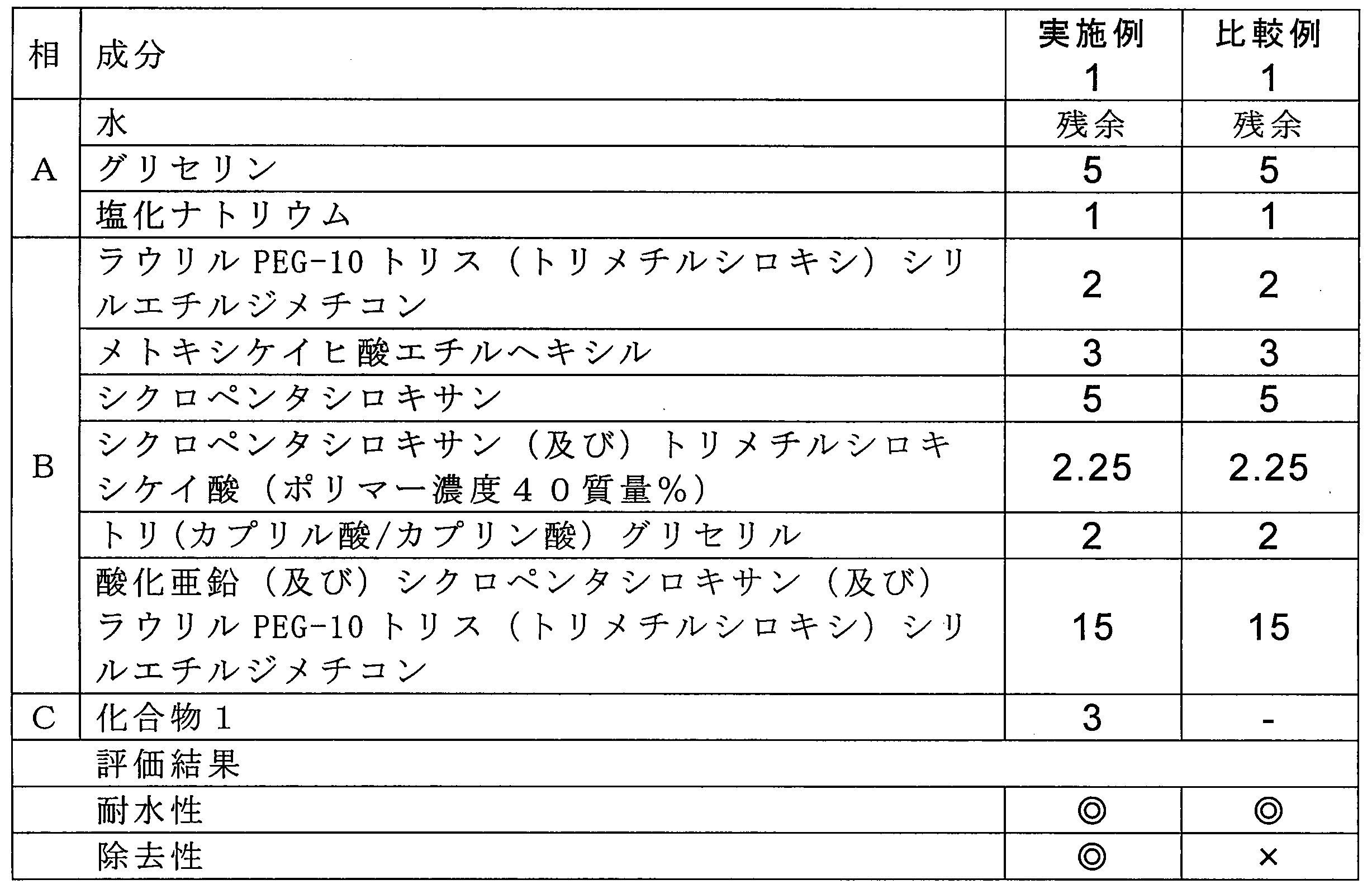
実施例1及び比較例1の各組成物を人工皮革上に2mg/cm2の塗布量で均一に塗布し、30分後、pH7.0の水の水滴を静かに滴下して、表面に形成された水滴を写真撮影して、その形状に基づいて接触角をθ/2法で測定し、下記の基準で評価した。
◎:接触角の平均値が75°以上
○:接触角の平均値が70°以上75°未満
△:接触角の平均値が60°以上70°未満
×:接触角の平均値が60°未満
結果を表1に示す。
実施例1及び比較例1の各組成物を人工皮革上に2mg/cm2の塗布量で均一に塗布し、30分後、市販のハンドソープ(薬用液体ハンドソープ:ライオン社製)を用いて洗浄し、化粧膜の洗い流し易さを目視で観察し、以下の基準に従って除去性を評価した。
◎:ほぼ完全に除去された。
○:ほぼ除去されたが、一部組成物の残留が認められる。
△:一部除去されたが、組成物の残留が顕著に認められる。
×:除去されなかった。
結果を表1に示す。
表2に示す各成分を使用して下記製造方法により実施例2及び比較例2乃至4の組成物を製造した。表2中の各成分の配合量は、特記しない限り「質量%」(「重量%」)を表す。
(1)A相の成分を混合する。
(2)B相の成分を混合する。
(3)常温にて、A相の成分の混合物にB相の成分の混合物を少量ずつ添加し、エマルションを調製する。
(4)上記ゲル状エマルジョンに成分Cを混合して化粧料を調製する。

実施例1及び比較例1の各組成物を人工皮革上に0.5mg/cm2の塗布量で均一に塗布し、30分後、pH7.0の水の水滴を静かに滴下して、表面に形成された水滴を写真撮影して、その形状に基づいて接触角をθ/2法で測定し、下記の基準で評価した。
◎:接触角の平均値が75°以上
○:接触角の平均値が70°以上75°未満
△:接触角の平均値が60°以上70°未満
×:接触角の平均値が60°未満
結果を表2に示す。
実施例2及び比較例2乃至4の各組成物を人工皮膚(バイオスキンプレート;ビューラックス社製)上にゴム製指サックを装着した指で、0.5mg/cm2の塗布量で塗布し、30分後、市販のアルカリ性固形セッケン(花王ホワイト:花王社製)を用いて洗浄し、化粧膜の洗い流し易さを目視で観察し、以下の基準に従って除去性を評価した。
◎:ほぼ完全に除去された。
○:ほぼ除去されたが、一部組成物の残留が認められる。
△:一部除去されたが、組成物の残留が顕著に認められる。
×:除去されなかった。
結果を表2に示す。
表3に示す各成分を使用して下記製造方法により実施例3及び比較例5乃至6の組成物を製造した。表3中の各成分の配合量は、特記しない限り「質量%」(「重量%」)を表す。
(1)A相の成分を110℃に加熱し混合溶解する。
(2)上記(1)で調製した混合液に、B相、C相およびD相を添加し、90℃で均一に混合する。
(3)上記(2)で調製した混合液を、溶融状態のまま金皿容器に充填した後、冷却して油性ファンデーションとする。

実施例3及び比較例5乃至7の各組成物を人工皮革上に0.5mg/cm2の塗布量で均一に塗布し、30分後、pH7.0の水の水滴を静かに滴下して、表面に形成された水滴を写真撮影して、その形状に基づいて接触角をθ/2法で測定し、下記の基準で評価した。
◎:接触角の平均値が75°以上
○:接触角の平均値が70°以上75°未満
△:接触角の平均値が60°以上70°未満
×:接触角の平均値が60°未満
結果を表3に示す。
実施例3及び比較例5乃至7の各組成物を人工皮膚(バイオスキンプレート;ビューラックス社製)上にゴム製指サックを装着した指で、0.5mg/cm2の塗布量で塗布し、30分後、市販のアルカリ性固形セッケン(花王ホワイト:花王社製)を用いて洗浄し、化粧膜の洗い流し易さを目視で観察し、以下の基準に従って除去性を評価した。
◎:ほぼ完全に除去された。
○:ほぼ除去されたが、一部組成物の残留が認められる。
△:一部除去されたが、組成物の残留が顕著に認められる。
×:除去されなかった。
結果を表3に示す。
エマルジョン型の本発明の組成物の例として、油中水型日焼け止めクリーム(実施例4)の処方を示す。
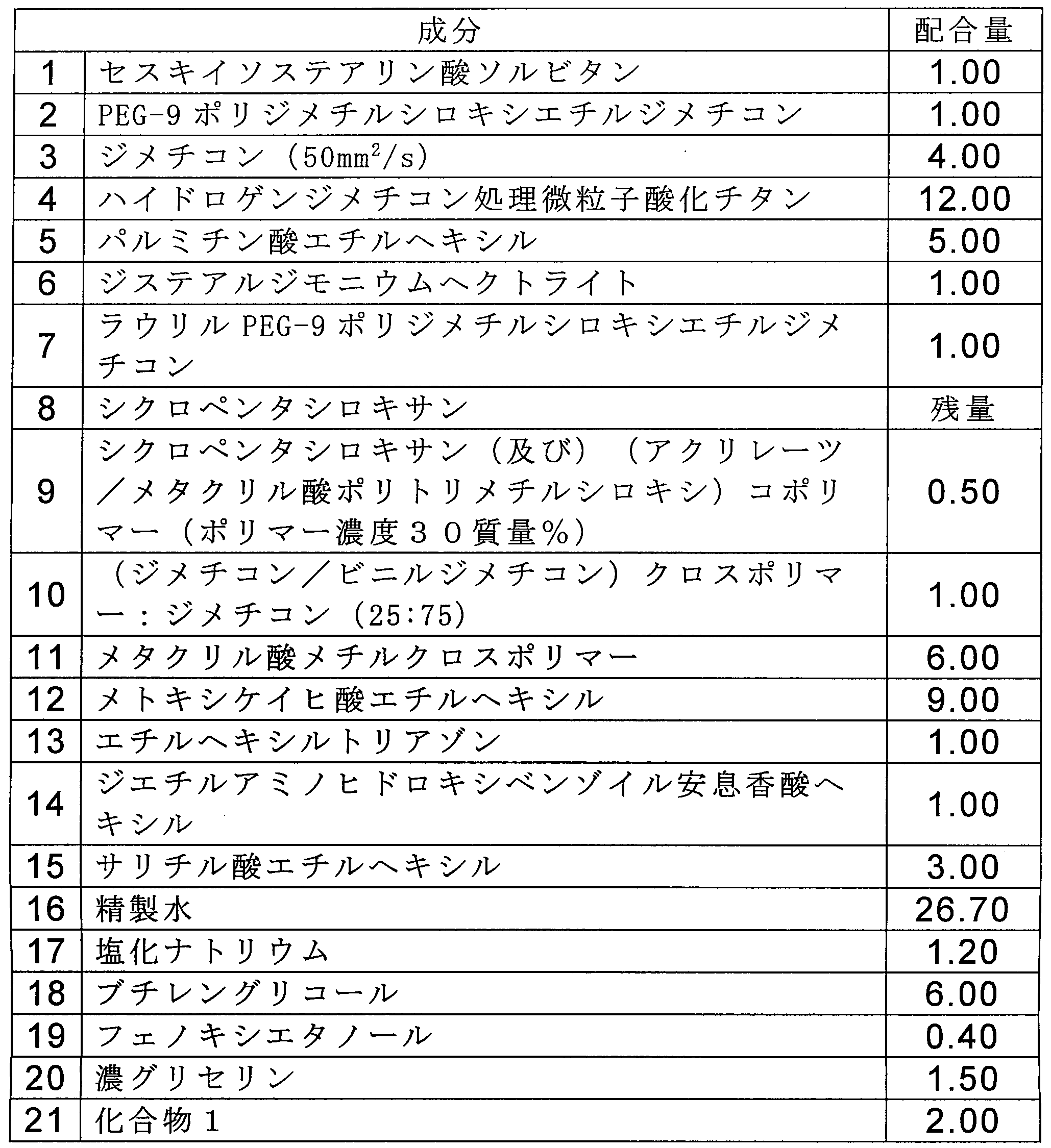
(1)成分1~15を混合する。
(2)成分16~20を混合する。
(3)常温にて、上記(1)にて得られた混合物に、上記(2)で得られた混合物を少量ずつ添加し、エマルションを調製する。
(4)上記(3)で得られたエマルションに成分21を混合して油中水型日焼け止めクリームとする。
非エマルジョン型の本発明の組成物の例として、リップグロス(実施例5)、アイシャドー(実施例6)及び口紅(実施例7)の処方を示す。

(1)成分1~6を110℃に加熱し混合溶解する。
(2)上記(1)で調製した混合液に、成分7~成分13を添加し、90℃で均一に混合する。
(3)上記(2)で調製した混合液を、溶融状態のまま金皿容器に充填した後、冷却してリップグロスとする。

(1)成分1~13を110℃に加熱し混合溶解する。
(2)上記(1)で調製した混合液に、成分14~16を添加し、90℃で均一に混合する。
(3)上記(2)で調製した混合液を、溶融状態のまま金皿容器に充填した後、冷却してアイシャドーとする。

(1)成分1~11を110℃に加熱し混合溶解する。
(2)成分12~14を3本ロールを用いて混合する。
(3)上記(1)で調製した混合液に、上記(2)で調整した混合液および成分15~17を添加し、90℃で均一に混合する。
(4)上記(3)で調製した混合液を、溶融状態のまま口紅容器に充填した後、冷却して口紅とする。
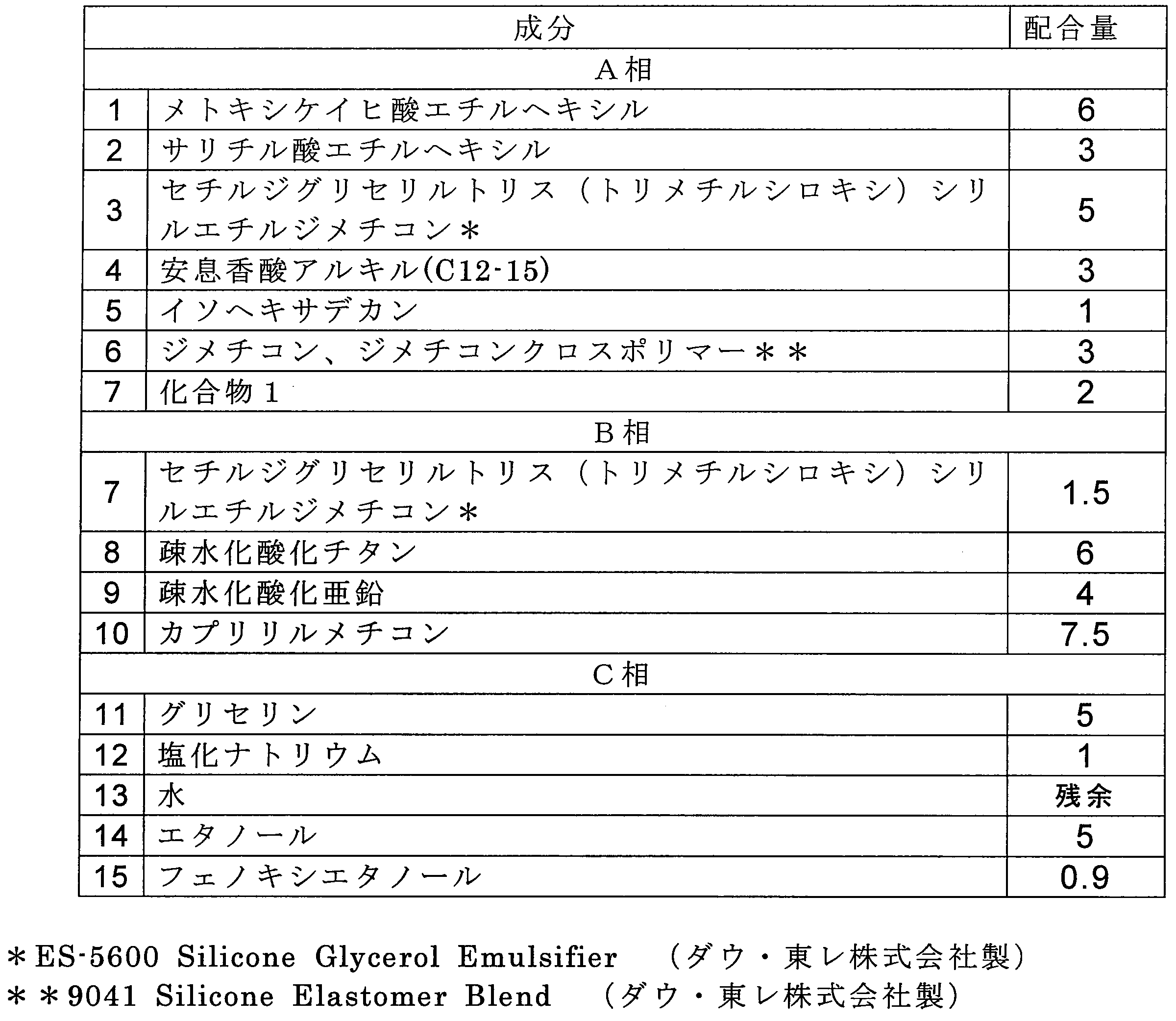
(1)A相の成分を混合する。
(2)B相の成分を3本ロールを用いて混合する。
(3)C相の成分を混合する。
(4)A相とB相を混合してAB相とする。
(5)AB相を撹拌しながらC相をゆっくり加えて乳化する。
Claims (11)
- (A)下記構造式(1):

Rcは、一般式:-R1-(OR2)p-(O)w-R3-COOH(R1 は炭素数2~22の直鎖又は分岐鎖のアルキレン基を表し、R2 は炭素数2~4の直鎖又は分岐鎖のアルキレン基を表し、R3 は結合手(-)又は炭素数1~22の直鎖若しくは分岐鎖のアルキレン基を表し、pは0~200の数を表し、wは0又は1の数を表す)で示されるカルボキシル基含有有機基を表し、
Rは、同一又は異なり、炭素数1~22のアルキル若しくはアルコキシ基又はフェニル基を表し、
R´は、Rc又はRであり、
aは0以上の数であり、bは正の数であり、a+bは2~30の範囲の数である。)で表される、室温(25℃)で液状のカルボン酸変性シリコーン、及び
(B)油剤、
を含む化粧料。 - 前記構造式(1)において、a、bが共に正の数であり、a+bは2~20の範囲の数であり、a/bが0.3~3.0である、請求項1記載の化粧料。
- 前記(A)カルボン酸変性シリコーンを化粧料の全質量に対して0.1~10質量%の範囲で含む、請求項1又は2記載の化粧料。
- 前記(B)油剤が少なくとも1種の紫外線吸収剤を含む、請求項1乃至3のいずれかに記載の化粧料。
- 前記(B)油剤を化粧料の全質量に対して5~99質量%の範囲で含む、請求項1乃至4のいずれかに記載の化粧料。
- (C)油溶性皮膜形成剤を更に含む、請求項1乃至5のいずれかに記載の化粧料。
- (D)疎水性粉体を更に含む、請求項1乃至6のいずれかに記載の化粧料。
- 更に(E)水を含む請求項1乃至7のいずれかに記載の化粧料。
- 油中水型乳化化粧料である請求項8記載の化粧料。
- (F)界面活性剤を更に含む、請求項8又は9記載の化粧料。
- 前記(F)界面活性剤を化粧料の全質量に対して0.5~15質量%の範囲で含む、請求項10記載の化粧料。
Priority Applications (4)
| Application Number | Priority Date | Filing Date | Title |
|---|---|---|---|
| CN201980065649.2A CN112804988B (zh) | 2018-08-15 | 2019-07-31 | 化妆料 |
| KR1020217007421A KR102836860B1 (ko) | 2018-08-15 | 2019-07-31 | 화장료 |
| US17/268,061 US12502345B2 (en) | 2018-08-15 | 2019-07-31 | Cosmetic |
| EP19850694.1A EP3838257B1 (en) | 2018-08-15 | 2019-07-31 | Cosmetic containing a carboxylic acid modified silicone |
Applications Claiming Priority (2)
| Application Number | Priority Date | Filing Date | Title |
|---|---|---|---|
| JP2018-152813 | 2018-08-15 | ||
| JP2018152813 | 2018-08-15 |
Publications (1)
| Publication Number | Publication Date |
|---|---|
| WO2020036063A1 true WO2020036063A1 (ja) | 2020-02-20 |
Family
ID=69525474
Family Applications (1)
| Application Number | Title | Priority Date | Filing Date |
|---|---|---|---|
| PCT/JP2019/029937 Ceased WO2020036063A1 (ja) | 2018-08-15 | 2019-07-31 | 化粧料 |
Country Status (6)
| Country | Link |
|---|---|
| US (1) | US12502345B2 (ja) |
| EP (1) | EP3838257B1 (ja) |
| JP (1) | JP7422354B2 (ja) |
| KR (1) | KR102836860B1 (ja) |
| CN (1) | CN112804988B (ja) |
| WO (1) | WO2020036063A1 (ja) |
Cited By (5)
| Publication number | Priority date | Publication date | Assignee | Title |
|---|---|---|---|---|
| WO2022075372A1 (ja) | 2020-10-09 | 2022-04-14 | ダウ・東レ株式会社 | カルボン酸共変性オルガノポリシロキサンおよびその用途 |
| US12023403B2 (en) | 2018-08-15 | 2024-07-02 | Dow Toray Co., Ltd. | Oil-in-water type emulsion cosmetics |
| US12453694B2 (en) | 2019-04-24 | 2025-10-28 | Dow Toray Co., Ltd. | Cosmetic composition |
| US12502345B2 (en) | 2018-08-15 | 2025-12-23 | Dow Toray Co., Ltd. | Cosmetic |
| US12569428B2 (en) | 2019-04-10 | 2026-03-10 | Dow Toray Co., Ltd. | Oil-in-water cleansing cosmetic composition |
Families Citing this family (1)
| Publication number | Priority date | Publication date | Assignee | Title |
|---|---|---|---|---|
| FR3126877B1 (fr) * | 2021-09-15 | 2023-08-11 | Oreal | Composition de soin et/ou de maquillage comprenant un élastomère de silicone à fonctions acides carboxyliques et un copolymère à base de résine de silicone et de silicone de type diméthiconol. |
Citations (18)
| Publication number | Priority date | Publication date | Assignee | Title |
|---|---|---|---|---|
| JPS62103007A (ja) * | 1985-10-24 | 1987-05-13 | ダウ・コ−ニング・コ−ポレ−シヨン | 頭髪トリ−トメント用組成物 |
| JPH02243612A (ja) | 1989-01-31 | 1990-09-27 | Toray Dow Corning Silicone Co Ltd | 化粧料 |
| JPH0812545A (ja) | 1994-06-30 | 1996-01-16 | Toray Dow Corning Silicone Co Ltd | 制汗・消臭剤 |
| JPH0812524A (ja) | 1994-06-30 | 1996-01-16 | Toray Dow Corning Silicone Co Ltd | メーキャップ化粧料 |
| JPH0812546A (ja) | 1994-06-30 | 1996-01-16 | Toray Dow Corning Silicone Co Ltd | 日焼け防止用化粧料 |
| JPH09241511A (ja) | 1996-03-08 | 1997-09-16 | Toray Dow Corning Silicone Co Ltd | シリコーンゴムサスペンジョン |
| JPH1036219A (ja) | 1996-07-23 | 1998-02-10 | Toray Dow Corning Silicone Co Ltd | 化粧料 |
| JPH1149957A (ja) | 1997-06-02 | 1999-02-23 | Dow Corning Corp | シリコーンエラストマーの製造方法 |
| JPH11193331A (ja) | 1997-07-21 | 1999-07-21 | Dow Corning Corp | 溶剤の粘度を調整する方法 |
| JP2000281523A (ja) | 1998-06-23 | 2000-10-10 | Dow Corning Toray Silicone Co Ltd | 化粧品原料、化粧品、および化粧品の製造方法 |
| JP2001011281A (ja) | 1999-05-24 | 2001-01-16 | Dow Corning Corp | エラストマーシリコーンポリエーテルを含む組成物 |
| JP2013144655A (ja) | 2012-01-16 | 2013-07-25 | Shiseido Co Ltd | 油中水型乳化皮膚化粧料 |
| JP2013177370A (ja) | 2012-01-30 | 2013-09-09 | Shiseido Co Ltd | メーキャップ化粧料 |
| WO2014185316A1 (ja) * | 2013-05-15 | 2014-11-20 | 富士フイルム株式会社 | 油中水型化粧料 |
| JP2015203026A (ja) * | 2014-04-15 | 2015-11-16 | ジェイオーコスメティックス株式会社 | 化粧料 |
| WO2017018358A1 (ja) * | 2015-07-24 | 2017-02-02 | 東レ・ダウコーニング株式会社 | 硬化シリコーン粒子、これを配合した化粧料 |
| WO2017191798A1 (ja) * | 2016-05-02 | 2017-11-09 | 東レ・ダウコーニング株式会社 | シリコーン粒子、これを配合した化粧料及び塗料及び樹脂 |
| JP2018115211A (ja) * | 2018-04-27 | 2018-07-26 | ジェイオーコスメティックス株式会社 | 化粧料 |
Family Cites Families (69)
| Publication number | Priority date | Publication date | Assignee | Title |
|---|---|---|---|---|
| US4501619A (en) * | 1983-11-14 | 1985-02-26 | Dow Corning Corporation | Aqueous emulsions of carboxyl-containing silicone fluids and a method for their preparation |
| US4844888A (en) * | 1987-11-13 | 1989-07-04 | The Gillette Company | Polysiloxane cosmetic composition |
| JP2657219B2 (ja) | 1988-04-12 | 1997-09-24 | 株式会社資生堂 | 水中油型乳化化粧料 |
| US5596061A (en) | 1993-12-28 | 1997-01-21 | Mona Industries, Inc. | Organosilicone having a carboxyl functional group thereon |
| JP3273874B2 (ja) | 1994-02-25 | 2002-04-15 | 株式会社リコー | 被記録材の再生方法および再生装置 |
| JPH08157335A (ja) * | 1994-12-08 | 1996-06-18 | Kao Corp | 毛髪化粧料 |
| EP0741558B1 (en) * | 1994-03-02 | 1998-07-15 | Kao Corporation | Hair cosmetic composition |
| JPH08109263A (ja) | 1994-10-12 | 1996-04-30 | Kao Corp | カルボン酸多価金属塩変性オルガノ(ポリ)シロキサン、その製造法並びにこれを含有するゲル化剤及び化粧料 |
| JP3450541B2 (ja) * | 1995-08-24 | 2003-09-29 | 花王株式会社 | 化粧料用粉体及びこれを含有する化粧料 |
| JPH1143417A (ja) | 1997-07-28 | 1999-02-16 | Shiseido Co Ltd | 水中油型乳化化粧料 |
| US5948391A (en) | 1998-03-16 | 1999-09-07 | Petroferm Inc | Silicone salicylate esters in personal care |
| US6238656B1 (en) | 1998-06-23 | 2001-05-29 | Dow Corning Toray Silicone Corporation, Ltd. | Cosmetic raw materials, cosmetic products, and methods of manufacturing cosmetic products |
| CA2322345A1 (en) | 1999-10-14 | 2001-04-14 | Rohm And Haas Company | Method for preparing ultraviolet radiation-absorbing compositions |
| US6290941B1 (en) | 1999-11-23 | 2001-09-18 | Color Access, Inc. | Powder to liquid compositions |
| US6342209B1 (en) | 2000-05-04 | 2002-01-29 | Revlon Consumer Products Corporation | Cosmetic compositions containing film forming polymers plasticized with esters and malic acid |
| US6991782B2 (en) | 2000-06-19 | 2006-01-31 | L'oréal | Cosmetic compositions comprising at least one polymethylsilsesquioxane film former |
| JP3898434B2 (ja) * | 2000-11-07 | 2007-03-28 | 株式会社ノエビア | 酸化チタンの油性分散体及び親油性酸化チタン粉体、並びに増粘・皮膜形成性組成物、及びこれらの製造方法、並びにこれらを含有する化粧料 |
| JP2002146188A (ja) * | 2000-11-07 | 2002-05-22 | Noevir Co Ltd | 油中水型乳化組成物 |
| JP4834236B2 (ja) * | 2001-03-22 | 2011-12-14 | 日本精化株式会社 | シリコーン誘導体及びこれを含有する油剤、化粧料及び外用剤 |
| JP4772978B2 (ja) | 2001-03-30 | 2011-09-14 | 株式会社コーセー | 日焼け止め組成物 |
| JP4169947B2 (ja) * | 2001-04-23 | 2008-10-22 | 株式会社カネボウ化粧品 | 化粧料 |
| JP2003292415A (ja) * | 2002-04-01 | 2003-10-15 | Shin Etsu Chem Co Ltd | 化粧料 |
| US6887836B2 (en) | 2002-05-09 | 2005-05-03 | The Procter & Gamble Company | Home care compositions comprising a dicarboxy functionalized polyorganosiloxane |
| JP2004026669A (ja) | 2002-06-21 | 2004-01-29 | Kao Corp | 皮膚化粧料 |
| JP2004091423A (ja) | 2002-09-03 | 2004-03-25 | Yuskin Seiyaku Kk | 水中油型乳化化粧料 |
| US7981405B2 (en) * | 2002-11-26 | 2011-07-19 | Kao Corporation | Cosmetic hair preparation |
| JP4865388B2 (ja) | 2006-04-07 | 2012-02-01 | 株式会社 資生堂 | 表面処理酸化亜鉛粉体及びこれを含有する化粧料 |
| JP2010138074A (ja) | 2007-04-13 | 2010-06-24 | Dai Ichi Kogyo Seiyaku Co Ltd | 水系分散体及び水系化粧料 |
| JP5488975B2 (ja) * | 2007-06-29 | 2014-05-14 | 日清オイリオグループ株式会社 | シリコーンを含有する化粧料 |
| EP2174985B1 (en) * | 2007-07-26 | 2017-02-15 | Shiseido Company, Ltd. | Gel composition and cosmetic preparation |
| US20110182846A1 (en) | 2007-08-10 | 2011-07-28 | Shiseido Company Ltd. | Surface Treating Agent, Surface-Treated Powder, And Cosmetic |
| WO2009048125A1 (ja) * | 2007-10-12 | 2009-04-16 | Genzo Mizutani | 油性物質の増粘ゲル化剤 |
| WO2009072007A2 (en) * | 2007-12-07 | 2009-06-11 | Foamix Ltd. | Carriers, formulations, methods for formulating unstable active agents for external application and uses thereof |
| JP5305677B2 (ja) | 2008-02-05 | 2013-10-02 | 株式会社 資生堂 | 洗浄料 |
| JP5353357B2 (ja) | 2008-04-03 | 2013-11-27 | 信越化学工業株式会社 | カルボキシル基を有するオルガノポリシロキサン |
| JP5616578B2 (ja) | 2008-10-22 | 2014-10-29 | 東レ・ダウコーニング株式会社 | 非硬化型コーティング用組成物 |
| JP2011073971A (ja) | 2009-09-29 | 2011-04-14 | Shiseido Co Ltd | 日焼け止め化粧料 |
| WO2011078407A1 (en) | 2009-12-24 | 2011-06-30 | Dow Corning Toray Co., Ltd. | Copolymer having carbosiloxane dendrimer structure, and composition and cosmetic containing the same |
| CN102686646B (zh) | 2009-12-24 | 2015-08-19 | 道康宁东丽株式会社 | 用在化妆品中的粉末用的表面处理剂及含有用该表面处理剂处理的粉末的化妆品 |
| JP5634738B2 (ja) | 2010-04-20 | 2014-12-03 | 東レ・ダウコーニング株式会社 | 非硬化型コーティング用組成物 |
| JP5368394B2 (ja) | 2010-08-11 | 2013-12-18 | 信越化学工業株式会社 | 新規オルガノポリシロキサン化合物およびそれを含む化粧料 |
| JP5197723B2 (ja) | 2010-11-26 | 2013-05-15 | 株式会社 資生堂 | 日焼け止め水中油型乳化化粧料 |
| CN103827234A (zh) | 2011-08-03 | 2014-05-28 | 堺化学工业株式会社 | 分散体 |
| RU2600030C2 (ru) * | 2011-09-30 | 2016-10-20 | Шисейдо Компани, Лтд. | Косметическая эмульсия типа "масло в воде" |
| JP5554308B2 (ja) | 2011-10-27 | 2014-07-23 | 株式会社 資生堂 | 日焼け止め水中油型乳化化粧料 |
| JP5203537B1 (ja) | 2011-11-11 | 2013-06-05 | 株式会社 資生堂 | 水中油型乳化日焼け止め化粧料 |
| JP6105920B2 (ja) | 2011-12-27 | 2017-03-29 | 東レ・ダウコーニング株式会社 | 共変性オルガノポリシロキサン、それを含有してなる油中水型エマルション用乳化剤、外用剤および化粧料 |
| JP6369887B2 (ja) | 2011-12-27 | 2018-08-08 | 東レ・ダウコーニング株式会社 | 新規な共変性オルガノポリシロキサン、それを含有してなる処理剤および外用剤 |
| JP6092545B2 (ja) | 2012-08-22 | 2017-03-08 | 東レ・ダウコーニング株式会社 | カルボシロキサンデンドリマー構造および親水性基を有する共重合体およびその用途 |
| JP5797618B2 (ja) | 2012-08-22 | 2015-10-21 | 東レ・ダウコーニング株式会社 | カルボシロキサンデンドリマー構造を有する共重合体、並びに、それを含む組成物及び化粧料 |
| JP5962567B2 (ja) * | 2013-04-09 | 2016-08-03 | 信越化学工業株式会社 | 水中油型日焼け止め化粧料 |
| JP6307259B2 (ja) * | 2013-12-11 | 2018-04-04 | 東レ・ダウコーニング株式会社 | 表面処理粉体、それを含むスラリー組成物、化粧料用原料及び化粧料 |
| US9943477B2 (en) | 2013-12-20 | 2018-04-17 | L'oreal | Emulsion compositions containing a novel preservative system |
| WO2015125332A1 (ja) | 2014-02-20 | 2015-08-27 | 株式会社マンダム | クレンジングシート及びクレンジング用組成物 |
| ES2894864T5 (en) | 2014-08-28 | 2025-10-20 | Oreal | Gel composition and gel comprising a uv filter |
| KR102480670B1 (ko) | 2014-10-31 | 2022-12-23 | 가부시키가이샤 시세이도 | 유중 수형 유화 자외선 차단 화장료 |
| US20160120786A1 (en) | 2014-11-03 | 2016-05-05 | L'oreal | Use of specific acrylates copolymer as spf booster |
| JP6560519B2 (ja) | 2015-03-27 | 2019-08-14 | 株式会社コーセー | 液状油性クレンジング料 |
| JP6110450B1 (ja) | 2015-09-29 | 2017-04-05 | 株式会社 資生堂 | 微細エマルション型化粧料及びその製造方法 |
| JP6826534B2 (ja) | 2015-10-09 | 2021-02-03 | ダウ・東レ株式会社 | 皮膜形成剤及びそれを用いた化粧料組成物および化粧料 |
| JP6833572B2 (ja) | 2016-03-29 | 2021-02-24 | 株式会社コーセー | 洗浄剤組成物 |
| EP3524633A4 (en) | 2016-10-04 | 2020-06-03 | Dow Toray Co., Ltd. | INNOVATIVE RESIN LINEAR ORGANOPOLYSILOXANE BLOCK COPOLYMERS, USE THEREOF AND METHOD FOR PRODUCING THE SAME |
| CN112689500B (zh) | 2018-08-15 | 2023-09-12 | 陶氏东丽株式会社 | 水包油型乳化化妆料 |
| US20210322296A1 (en) | 2018-08-15 | 2021-10-21 | Dow Toray Co., Ltd. | Aqueous dispersion composition and use thereof |
| JP7422354B2 (ja) | 2018-08-15 | 2024-01-26 | ジェイオーコスメティックス株式会社 | 化粧料 |
| JP7371854B2 (ja) | 2018-08-15 | 2023-10-31 | ジェイオーコスメティックス株式会社 | 水中油型乳化化粧料 |
| KR102844511B1 (ko) | 2018-08-15 | 2025-08-12 | 다우 도레이 캄파니 리미티드 | 수중유형 유화 화장료 |
| WO2020208838A1 (ja) | 2019-04-10 | 2020-10-15 | ダウ・東レ株式会社 | 水中油型クレンジング化粧料 |
| CN113710226B (zh) | 2019-04-24 | 2024-02-27 | 陶氏东丽株式会社 | 化妆料 |
-
2019
- 2019-07-31 JP JP2019140768A patent/JP7422354B2/ja active Active
- 2019-07-31 US US17/268,061 patent/US12502345B2/en active Active
- 2019-07-31 KR KR1020217007421A patent/KR102836860B1/ko active Active
- 2019-07-31 EP EP19850694.1A patent/EP3838257B1/en active Active
- 2019-07-31 CN CN201980065649.2A patent/CN112804988B/zh active Active
- 2019-07-31 WO PCT/JP2019/029937 patent/WO2020036063A1/ja not_active Ceased
Patent Citations (19)
| Publication number | Priority date | Publication date | Assignee | Title |
|---|---|---|---|---|
| JPS62103007A (ja) * | 1985-10-24 | 1987-05-13 | ダウ・コ−ニング・コ−ポレ−シヨン | 頭髪トリ−トメント用組成物 |
| JPH02243612A (ja) | 1989-01-31 | 1990-09-27 | Toray Dow Corning Silicone Co Ltd | 化粧料 |
| JPH0812545A (ja) | 1994-06-30 | 1996-01-16 | Toray Dow Corning Silicone Co Ltd | 制汗・消臭剤 |
| JPH0812524A (ja) | 1994-06-30 | 1996-01-16 | Toray Dow Corning Silicone Co Ltd | メーキャップ化粧料 |
| JPH0812546A (ja) | 1994-06-30 | 1996-01-16 | Toray Dow Corning Silicone Co Ltd | 日焼け防止用化粧料 |
| JPH09241511A (ja) | 1996-03-08 | 1997-09-16 | Toray Dow Corning Silicone Co Ltd | シリコーンゴムサスペンジョン |
| JPH1036219A (ja) | 1996-07-23 | 1998-02-10 | Toray Dow Corning Silicone Co Ltd | 化粧料 |
| JP4080597B2 (ja) | 1997-06-02 | 2008-04-23 | ダウ・コ−ニング・コ−ポレ−ション | シリコーンエラストマーの製造方法 |
| JPH1149957A (ja) | 1997-06-02 | 1999-02-23 | Dow Corning Corp | シリコーンエラストマーの製造方法 |
| JPH11193331A (ja) | 1997-07-21 | 1999-07-21 | Dow Corning Corp | 溶剤の粘度を調整する方法 |
| JP2000281523A (ja) | 1998-06-23 | 2000-10-10 | Dow Corning Toray Silicone Co Ltd | 化粧品原料、化粧品、および化粧品の製造方法 |
| JP2001011281A (ja) | 1999-05-24 | 2001-01-16 | Dow Corning Corp | エラストマーシリコーンポリエーテルを含む組成物 |
| JP2013144655A (ja) | 2012-01-16 | 2013-07-25 | Shiseido Co Ltd | 油中水型乳化皮膚化粧料 |
| JP2013177370A (ja) | 2012-01-30 | 2013-09-09 | Shiseido Co Ltd | メーキャップ化粧料 |
| WO2014185316A1 (ja) * | 2013-05-15 | 2014-11-20 | 富士フイルム株式会社 | 油中水型化粧料 |
| JP2015203026A (ja) * | 2014-04-15 | 2015-11-16 | ジェイオーコスメティックス株式会社 | 化粧料 |
| WO2017018358A1 (ja) * | 2015-07-24 | 2017-02-02 | 東レ・ダウコーニング株式会社 | 硬化シリコーン粒子、これを配合した化粧料 |
| WO2017191798A1 (ja) * | 2016-05-02 | 2017-11-09 | 東レ・ダウコーニング株式会社 | シリコーン粒子、これを配合した化粧料及び塗料及び樹脂 |
| JP2018115211A (ja) * | 2018-04-27 | 2018-07-26 | ジェイオーコスメティックス株式会社 | 化粧料 |
Non-Patent Citations (2)
| Title |
|---|
| "Silicone Handbook", pages: 166 - 167 |
| See also references of EP3838257A4 |
Cited By (5)
| Publication number | Priority date | Publication date | Assignee | Title |
|---|---|---|---|---|
| US12023403B2 (en) | 2018-08-15 | 2024-07-02 | Dow Toray Co., Ltd. | Oil-in-water type emulsion cosmetics |
| US12502345B2 (en) | 2018-08-15 | 2025-12-23 | Dow Toray Co., Ltd. | Cosmetic |
| US12569428B2 (en) | 2019-04-10 | 2026-03-10 | Dow Toray Co., Ltd. | Oil-in-water cleansing cosmetic composition |
| US12453694B2 (en) | 2019-04-24 | 2025-10-28 | Dow Toray Co., Ltd. | Cosmetic composition |
| WO2022075372A1 (ja) | 2020-10-09 | 2022-04-14 | ダウ・東レ株式会社 | カルボン酸共変性オルガノポリシロキサンおよびその用途 |
Also Published As
| Publication number | Publication date |
|---|---|
| JP2020029454A (ja) | 2020-02-27 |
| EP3838257A4 (en) | 2022-05-11 |
| KR102836860B1 (ko) | 2025-07-23 |
| CN112804988B (zh) | 2023-07-18 |
| CN112804988A (zh) | 2021-05-14 |
| JP7422354B2 (ja) | 2024-01-26 |
| KR20210043636A (ko) | 2021-04-21 |
| EP3838257B1 (en) | 2026-01-07 |
| US20210244641A1 (en) | 2021-08-12 |
| US12502345B2 (en) | 2025-12-23 |
| EP3838257A1 (en) | 2021-06-23 |
Similar Documents
| Publication | Publication Date | Title |
|---|---|---|
| JP7371854B2 (ja) | 水中油型乳化化粧料 | |
| JP7060025B2 (ja) | 有機基変性有機ケイ素樹脂及びその製造方法、ならびに化粧料 | |
| US12023403B2 (en) | Oil-in-water type emulsion cosmetics | |
| US10130579B2 (en) | Cosmetic material | |
| JP7422354B2 (ja) | 化粧料 | |
| JP7422353B2 (ja) | 水中油型乳化化粧料 | |
| KR102801855B1 (ko) | 화장료 | |
| EP3960152A1 (en) | Cosmetic preparation | |
| EP3711744A1 (en) | Cosmetic |
Legal Events
| Date | Code | Title | Description |
|---|---|---|---|
| 121 | Ep: the epo has been informed by wipo that ep was designated in this application |
Ref document number: 19850694 Country of ref document: EP Kind code of ref document: A1 |
|
| NENP | Non-entry into the national phase |
Ref country code: DE |
|
| ENP | Entry into the national phase |
Ref document number: 20217007421 Country of ref document: KR Kind code of ref document: A |
|
| ENP | Entry into the national phase |
Ref document number: 2019850694 Country of ref document: EP Effective date: 20210315 |
|
| WWG | Wipo information: grant in national office |
Ref document number: 2019850694 Country of ref document: EP |