WO2020075561A1 - 化粧板、透明性樹脂フィルム及び化粧板の製造方法 - Google Patents
化粧板、透明性樹脂フィルム及び化粧板の製造方法 Download PDFInfo
- Publication number
- WO2020075561A1 WO2020075561A1 PCT/JP2019/038597 JP2019038597W WO2020075561A1 WO 2020075561 A1 WO2020075561 A1 WO 2020075561A1 JP 2019038597 W JP2019038597 W JP 2019038597W WO 2020075561 A1 WO2020075561 A1 WO 2020075561A1
- Authority
- WO
- WIPO (PCT)
- Prior art keywords
- layer
- resin film
- transparent resin
- thickness
- decorative board
- Prior art date
- Legal status (The legal status is an assumption and is not a legal conclusion. Google has not performed a legal analysis and makes no representation as to the accuracy of the status listed.)
- Ceased
Links
Images
Classifications
-
- B—PERFORMING OPERATIONS; TRANSPORTING
- B32—LAYERED PRODUCTS
- B32B—LAYERED PRODUCTS, i.e. PRODUCTS BUILT-UP OF STRATA OF FLAT OR NON-FLAT, e.g. CELLULAR OR HONEYCOMB, FORM
- B32B3/00—Layered products comprising a layer with external or internal discontinuities or unevennesses, or a layer of non-planar shape; Layered products comprising a layer having particular features of form
- B32B3/26—Layered products comprising a layer with external or internal discontinuities or unevennesses, or a layer of non-planar shape; Layered products comprising a layer having particular features of form characterised by a particular shape of the outline of the cross-section of a continuous layer; characterised by a layer with cavities or internal voids ; characterised by an apertured layer
- B32B3/28—Layered products comprising a layer with external or internal discontinuities or unevennesses, or a layer of non-planar shape; Layered products comprising a layer having particular features of form characterised by a particular shape of the outline of the cross-section of a continuous layer; characterised by a layer with cavities or internal voids ; characterised by an apertured layer characterised by a layer comprising a deformed thin sheet, i.e. the layer having its entire thickness deformed out of the plane, e.g. corrugated, crumpled
-
- B—PERFORMING OPERATIONS; TRANSPORTING
- B32—LAYERED PRODUCTS
- B32B—LAYERED PRODUCTS, i.e. PRODUCTS BUILT-UP OF STRATA OF FLAT OR NON-FLAT, e.g. CELLULAR OR HONEYCOMB, FORM
- B32B27/00—Layered products comprising a layer of synthetic resin
-
- B—PERFORMING OPERATIONS; TRANSPORTING
- B32—LAYERED PRODUCTS
- B32B—LAYERED PRODUCTS, i.e. PRODUCTS BUILT-UP OF STRATA OF FLAT OR NON-FLAT, e.g. CELLULAR OR HONEYCOMB, FORM
- B32B21/00—Layered products comprising a layer of wood, e.g. wood board, veneer, wood particle board
- B32B21/04—Layered products comprising a layer of wood, e.g. wood board, veneer, wood particle board comprising wood as the main or only constituent of a layer, which is next to another layer of the same or of a different material
- B32B21/08—Layered products comprising a layer of wood, e.g. wood board, veneer, wood particle board comprising wood as the main or only constituent of a layer, which is next to another layer of the same or of a different material of synthetic resin
-
- B—PERFORMING OPERATIONS; TRANSPORTING
- B32—LAYERED PRODUCTS
- B32B—LAYERED PRODUCTS, i.e. PRODUCTS BUILT-UP OF STRATA OF FLAT OR NON-FLAT, e.g. CELLULAR OR HONEYCOMB, FORM
- B32B15/00—Layered products comprising a layer of metal
- B32B15/04—Layered products comprising a layer of metal comprising metal as the main or only constituent of a layer, which is next to another layer of the same or of a different material
- B32B15/08—Layered products comprising a layer of metal comprising metal as the main or only constituent of a layer, which is next to another layer of the same or of a different material of synthetic resin
- B32B15/082—Layered products comprising a layer of metal comprising metal as the main or only constituent of a layer, which is next to another layer of the same or of a different material of synthetic resin comprising vinyl resins; comprising acrylic resins
-
- B—PERFORMING OPERATIONS; TRANSPORTING
- B32—LAYERED PRODUCTS
- B32B—LAYERED PRODUCTS, i.e. PRODUCTS BUILT-UP OF STRATA OF FLAT OR NON-FLAT, e.g. CELLULAR OR HONEYCOMB, FORM
- B32B15/00—Layered products comprising a layer of metal
- B32B15/04—Layered products comprising a layer of metal comprising metal as the main or only constituent of a layer, which is next to another layer of the same or of a different material
- B32B15/08—Layered products comprising a layer of metal comprising metal as the main or only constituent of a layer, which is next to another layer of the same or of a different material of synthetic resin
- B32B15/085—Layered products comprising a layer of metal comprising metal as the main or only constituent of a layer, which is next to another layer of the same or of a different material of synthetic resin comprising polyolefins
-
- B—PERFORMING OPERATIONS; TRANSPORTING
- B32—LAYERED PRODUCTS
- B32B—LAYERED PRODUCTS, i.e. PRODUCTS BUILT-UP OF STRATA OF FLAT OR NON-FLAT, e.g. CELLULAR OR HONEYCOMB, FORM
- B32B15/00—Layered products comprising a layer of metal
- B32B15/04—Layered products comprising a layer of metal comprising metal as the main or only constituent of a layer, which is next to another layer of the same or of a different material
- B32B15/08—Layered products comprising a layer of metal comprising metal as the main or only constituent of a layer, which is next to another layer of the same or of a different material of synthetic resin
- B32B15/09—Layered products comprising a layer of metal comprising metal as the main or only constituent of a layer, which is next to another layer of the same or of a different material of synthetic resin comprising polyesters
-
- B—PERFORMING OPERATIONS; TRANSPORTING
- B32—LAYERED PRODUCTS
- B32B—LAYERED PRODUCTS, i.e. PRODUCTS BUILT-UP OF STRATA OF FLAT OR NON-FLAT, e.g. CELLULAR OR HONEYCOMB, FORM
- B32B15/00—Layered products comprising a layer of metal
- B32B15/18—Layered products comprising a layer of metal comprising iron or steel
-
- B—PERFORMING OPERATIONS; TRANSPORTING
- B32—LAYERED PRODUCTS
- B32B—LAYERED PRODUCTS, i.e. PRODUCTS BUILT-UP OF STRATA OF FLAT OR NON-FLAT, e.g. CELLULAR OR HONEYCOMB, FORM
- B32B21/00—Layered products comprising a layer of wood, e.g. wood board, veneer, wood particle board
- B32B21/02—Layered products comprising a layer of wood, e.g. wood board, veneer, wood particle board the layer being formed of fibres, chips, or particles, e.g. MDF, HDF, OSB, chipboard, particle board, hardboard
-
- B—PERFORMING OPERATIONS; TRANSPORTING
- B32—LAYERED PRODUCTS
- B32B—LAYERED PRODUCTS, i.e. PRODUCTS BUILT-UP OF STRATA OF FLAT OR NON-FLAT, e.g. CELLULAR OR HONEYCOMB, FORM
- B32B21/00—Layered products comprising a layer of wood, e.g. wood board, veneer, wood particle board
- B32B21/14—Layered products comprising a layer of wood, e.g. wood board, veneer, wood particle board comprising wood board or veneer
-
- B—PERFORMING OPERATIONS; TRANSPORTING
- B32—LAYERED PRODUCTS
- B32B—LAYERED PRODUCTS, i.e. PRODUCTS BUILT-UP OF STRATA OF FLAT OR NON-FLAT, e.g. CELLULAR OR HONEYCOMB, FORM
- B32B27/00—Layered products comprising a layer of synthetic resin
- B32B27/06—Layered products comprising a layer of synthetic resin as the main or only constituent of a layer, which is next to another layer of the same or of a different material
- B32B27/065—Layered products comprising a layer of synthetic resin as the main or only constituent of a layer, which is next to another layer of the same or of a different material of foam
-
- B—PERFORMING OPERATIONS; TRANSPORTING
- B32—LAYERED PRODUCTS
- B32B—LAYERED PRODUCTS, i.e. PRODUCTS BUILT-UP OF STRATA OF FLAT OR NON-FLAT, e.g. CELLULAR OR HONEYCOMB, FORM
- B32B27/00—Layered products comprising a layer of synthetic resin
- B32B27/06—Layered products comprising a layer of synthetic resin as the main or only constituent of a layer, which is next to another layer of the same or of a different material
- B32B27/08—Layered products comprising a layer of synthetic resin as the main or only constituent of a layer, which is next to another layer of the same or of a different material of synthetic resin
-
- B—PERFORMING OPERATIONS; TRANSPORTING
- B32—LAYERED PRODUCTS
- B32B—LAYERED PRODUCTS, i.e. PRODUCTS BUILT-UP OF STRATA OF FLAT OR NON-FLAT, e.g. CELLULAR OR HONEYCOMB, FORM
- B32B27/00—Layered products comprising a layer of synthetic resin
- B32B27/16—Layered products comprising a layer of synthetic resin specially treated, e.g. irradiated
-
- B—PERFORMING OPERATIONS; TRANSPORTING
- B32—LAYERED PRODUCTS
- B32B—LAYERED PRODUCTS, i.e. PRODUCTS BUILT-UP OF STRATA OF FLAT OR NON-FLAT, e.g. CELLULAR OR HONEYCOMB, FORM
- B32B27/00—Layered products comprising a layer of synthetic resin
- B32B27/18—Layered products comprising a layer of synthetic resin characterised by the use of special additives
-
- B—PERFORMING OPERATIONS; TRANSPORTING
- B32—LAYERED PRODUCTS
- B32B—LAYERED PRODUCTS, i.e. PRODUCTS BUILT-UP OF STRATA OF FLAT OR NON-FLAT, e.g. CELLULAR OR HONEYCOMB, FORM
- B32B27/00—Layered products comprising a layer of synthetic resin
- B32B27/30—Layered products comprising a layer of synthetic resin comprising vinyl (co)polymers; comprising acrylic (co)polymers
- B32B27/302—Layered products comprising a layer of synthetic resin comprising vinyl (co)polymers; comprising acrylic (co)polymers comprising aromatic vinyl (co)polymers, e.g. styrenic (co)polymers
-
- B—PERFORMING OPERATIONS; TRANSPORTING
- B32—LAYERED PRODUCTS
- B32B—LAYERED PRODUCTS, i.e. PRODUCTS BUILT-UP OF STRATA OF FLAT OR NON-FLAT, e.g. CELLULAR OR HONEYCOMB, FORM
- B32B27/00—Layered products comprising a layer of synthetic resin
- B32B27/30—Layered products comprising a layer of synthetic resin comprising vinyl (co)polymers; comprising acrylic (co)polymers
- B32B27/304—Layered products comprising a layer of synthetic resin comprising vinyl (co)polymers; comprising acrylic (co)polymers comprising vinyl halide (co)polymers, e.g. PVC, PVDC, PVF, PVDF
-
- B—PERFORMING OPERATIONS; TRANSPORTING
- B32—LAYERED PRODUCTS
- B32B—LAYERED PRODUCTS, i.e. PRODUCTS BUILT-UP OF STRATA OF FLAT OR NON-FLAT, e.g. CELLULAR OR HONEYCOMB, FORM
- B32B27/00—Layered products comprising a layer of synthetic resin
- B32B27/30—Layered products comprising a layer of synthetic resin comprising vinyl (co)polymers; comprising acrylic (co)polymers
- B32B27/306—Layered products comprising a layer of synthetic resin comprising vinyl (co)polymers; comprising acrylic (co)polymers comprising vinyl acetate or vinyl alcohol (co)polymers
-
- B—PERFORMING OPERATIONS; TRANSPORTING
- B32—LAYERED PRODUCTS
- B32B—LAYERED PRODUCTS, i.e. PRODUCTS BUILT-UP OF STRATA OF FLAT OR NON-FLAT, e.g. CELLULAR OR HONEYCOMB, FORM
- B32B27/00—Layered products comprising a layer of synthetic resin
- B32B27/30—Layered products comprising a layer of synthetic resin comprising vinyl (co)polymers; comprising acrylic (co)polymers
- B32B27/308—Layered products comprising a layer of synthetic resin comprising vinyl (co)polymers; comprising acrylic (co)polymers comprising acrylic (co)polymers
-
- B—PERFORMING OPERATIONS; TRANSPORTING
- B32—LAYERED PRODUCTS
- B32B—LAYERED PRODUCTS, i.e. PRODUCTS BUILT-UP OF STRATA OF FLAT OR NON-FLAT, e.g. CELLULAR OR HONEYCOMB, FORM
- B32B27/00—Layered products comprising a layer of synthetic resin
- B32B27/32—Layered products comprising a layer of synthetic resin comprising polyolefins
-
- B—PERFORMING OPERATIONS; TRANSPORTING
- B32—LAYERED PRODUCTS
- B32B—LAYERED PRODUCTS, i.e. PRODUCTS BUILT-UP OF STRATA OF FLAT OR NON-FLAT, e.g. CELLULAR OR HONEYCOMB, FORM
- B32B27/00—Layered products comprising a layer of synthetic resin
- B32B27/36—Layered products comprising a layer of synthetic resin comprising polyesters
-
- B—PERFORMING OPERATIONS; TRANSPORTING
- B32—LAYERED PRODUCTS
- B32B—LAYERED PRODUCTS, i.e. PRODUCTS BUILT-UP OF STRATA OF FLAT OR NON-FLAT, e.g. CELLULAR OR HONEYCOMB, FORM
- B32B27/00—Layered products comprising a layer of synthetic resin
- B32B27/36—Layered products comprising a layer of synthetic resin comprising polyesters
- B32B27/365—Layered products comprising a layer of synthetic resin comprising polyesters comprising polycarbonates
-
- B—PERFORMING OPERATIONS; TRANSPORTING
- B32—LAYERED PRODUCTS
- B32B—LAYERED PRODUCTS, i.e. PRODUCTS BUILT-UP OF STRATA OF FLAT OR NON-FLAT, e.g. CELLULAR OR HONEYCOMB, FORM
- B32B27/00—Layered products comprising a layer of synthetic resin
- B32B27/40—Layered products comprising a layer of synthetic resin comprising polyurethanes
-
- B—PERFORMING OPERATIONS; TRANSPORTING
- B32—LAYERED PRODUCTS
- B32B—LAYERED PRODUCTS, i.e. PRODUCTS BUILT-UP OF STRATA OF FLAT OR NON-FLAT, e.g. CELLULAR OR HONEYCOMB, FORM
- B32B3/00—Layered products comprising a layer with external or internal discontinuities or unevennesses, or a layer of non-planar shape; Layered products comprising a layer having particular features of form
- B32B3/26—Layered products comprising a layer with external or internal discontinuities or unevennesses, or a layer of non-planar shape; Layered products comprising a layer having particular features of form characterised by a particular shape of the outline of the cross-section of a continuous layer; characterised by a layer with cavities or internal voids ; characterised by an apertured layer
- B32B3/266—Layered products comprising a layer with external or internal discontinuities or unevennesses, or a layer of non-planar shape; Layered products comprising a layer having particular features of form characterised by a particular shape of the outline of the cross-section of a continuous layer; characterised by a layer with cavities or internal voids ; characterised by an apertured layer characterised by an apertured layer, the apertures going through the whole thickness of the layer, e.g. expanded metal, perforated layer, slit layer regular cells B32B3/12
-
- B—PERFORMING OPERATIONS; TRANSPORTING
- B32—LAYERED PRODUCTS
- B32B—LAYERED PRODUCTS, i.e. PRODUCTS BUILT-UP OF STRATA OF FLAT OR NON-FLAT, e.g. CELLULAR OR HONEYCOMB, FORM
- B32B3/00—Layered products comprising a layer with external or internal discontinuities or unevennesses, or a layer of non-planar shape; Layered products comprising a layer having particular features of form
- B32B3/26—Layered products comprising a layer with external or internal discontinuities or unevennesses, or a layer of non-planar shape; Layered products comprising a layer having particular features of form characterised by a particular shape of the outline of the cross-section of a continuous layer; characterised by a layer with cavities or internal voids ; characterised by an apertured layer
- B32B3/30—Layered products comprising a layer with external or internal discontinuities or unevennesses, or a layer of non-planar shape; Layered products comprising a layer having particular features of form characterised by a particular shape of the outline of the cross-section of a continuous layer; characterised by a layer with cavities or internal voids ; characterised by an apertured layer characterised by a layer formed with recesses or projections, e.g. hollows, grooves, protuberances, ribs
-
- B—PERFORMING OPERATIONS; TRANSPORTING
- B32—LAYERED PRODUCTS
- B32B—LAYERED PRODUCTS, i.e. PRODUCTS BUILT-UP OF STRATA OF FLAT OR NON-FLAT, e.g. CELLULAR OR HONEYCOMB, FORM
- B32B37/00—Methods or apparatus for laminating, e.g. by curing or by ultrasonic bonding
- B32B37/12—Methods or apparatus for laminating, e.g. by curing or by ultrasonic bonding characterised by using adhesives
-
- B—PERFORMING OPERATIONS; TRANSPORTING
- B32—LAYERED PRODUCTS
- B32B—LAYERED PRODUCTS, i.e. PRODUCTS BUILT-UP OF STRATA OF FLAT OR NON-FLAT, e.g. CELLULAR OR HONEYCOMB, FORM
- B32B38/00—Ancillary operations in connection with laminating processes
- B32B38/0008—Electrical discharge treatment, e.g. corona, plasma treatment; wave energy or particle radiation
-
- B—PERFORMING OPERATIONS; TRANSPORTING
- B32—LAYERED PRODUCTS
- B32B—LAYERED PRODUCTS, i.e. PRODUCTS BUILT-UP OF STRATA OF FLAT OR NON-FLAT, e.g. CELLULAR OR HONEYCOMB, FORM
- B32B38/00—Ancillary operations in connection with laminating processes
- B32B38/06—Embossing
-
- B—PERFORMING OPERATIONS; TRANSPORTING
- B32—LAYERED PRODUCTS
- B32B—LAYERED PRODUCTS, i.e. PRODUCTS BUILT-UP OF STRATA OF FLAT OR NON-FLAT, e.g. CELLULAR OR HONEYCOMB, FORM
- B32B5/00—Layered products characterised by the non- homogeneity or physical structure, i.e. comprising a fibrous, filamentary, particulate or foam layer; Layered products characterised by having a layer differing constitutionally or physically in different parts
- B32B5/18—Layered products characterised by the non- homogeneity or physical structure, i.e. comprising a fibrous, filamentary, particulate or foam layer; Layered products characterised by having a layer differing constitutionally or physically in different parts characterised by features of a layer of foamed material
-
- B—PERFORMING OPERATIONS; TRANSPORTING
- B32—LAYERED PRODUCTS
- B32B—LAYERED PRODUCTS, i.e. PRODUCTS BUILT-UP OF STRATA OF FLAT OR NON-FLAT, e.g. CELLULAR OR HONEYCOMB, FORM
- B32B7/00—Layered products characterised by the relation between layers; Layered products characterised by the relative orientation of features between layers, or by the relative values of a measurable parameter between layers, i.e. products comprising layers having different physical, chemical or physicochemical properties; Layered products characterised by the interconnection of layers
- B32B7/02—Physical, chemical or physicochemical properties
-
- B—PERFORMING OPERATIONS; TRANSPORTING
- B32—LAYERED PRODUCTS
- B32B—LAYERED PRODUCTS, i.e. PRODUCTS BUILT-UP OF STRATA OF FLAT OR NON-FLAT, e.g. CELLULAR OR HONEYCOMB, FORM
- B32B7/00—Layered products characterised by the relation between layers; Layered products characterised by the relative orientation of features between layers, or by the relative values of a measurable parameter between layers, i.e. products comprising layers having different physical, chemical or physicochemical properties; Layered products characterised by the interconnection of layers
- B32B7/04—Interconnection of layers
- B32B7/12—Interconnection of layers using interposed adhesives or interposed materials with bonding properties
-
- B—PERFORMING OPERATIONS; TRANSPORTING
- B44—DECORATIVE ARTS
- B44C—PRODUCING DECORATIVE EFFECTS; MOSAICS; TARSIA WORK; PAPERHANGING
- B44C1/00—Processes, not specifically provided for elsewhere, for producing decorative surface effects
- B44C1/16—Processes, not specifically provided for elsewhere, for producing decorative surface effects for applying transfer pictures or the like
-
- C—CHEMISTRY; METALLURGY
- C08—ORGANIC MACROMOLECULAR COMPOUNDS; THEIR PREPARATION OR CHEMICAL WORKING-UP; COMPOSITIONS BASED THEREON
- C08K—Use of inorganic or non-macromolecular organic substances as compounding ingredients
- C08K5/00—Use of organic ingredients
- C08K5/16—Nitrogen-containing compounds
- C08K5/34—Heterocyclic compounds having nitrogen in the ring
- C08K5/3467—Heterocyclic compounds having nitrogen in the ring having more than two nitrogen atoms in the ring
- C08K5/3477—Six-membered rings
- C08K5/3492—Triazines
-
- C—CHEMISTRY; METALLURGY
- C09—DYES; PAINTS; POLISHES; NATURAL RESINS; ADHESIVES; COMPOSITIONS NOT OTHERWISE PROVIDED FOR; APPLICATIONS OF MATERIALS NOT OTHERWISE PROVIDED FOR
- C09J—ADHESIVES; NON-MECHANICAL ASPECTS OF ADHESIVE PROCESSES IN GENERAL; ADHESIVE PROCESSES NOT PROVIDED FOR ELSEWHERE; USE OF MATERIALS AS ADHESIVES
- C09J11/00—Features of adhesives not provided for in group C09J9/00, e.g. additives
- C09J11/02—Non-macromolecular additives
- C09J11/06—Non-macromolecular additives organic
-
- C—CHEMISTRY; METALLURGY
- C09—DYES; PAINTS; POLISHES; NATURAL RESINS; ADHESIVES; COMPOSITIONS NOT OTHERWISE PROVIDED FOR; APPLICATIONS OF MATERIALS NOT OTHERWISE PROVIDED FOR
- C09J—ADHESIVES; NON-MECHANICAL ASPECTS OF ADHESIVE PROCESSES IN GENERAL; ADHESIVE PROCESSES NOT PROVIDED FOR ELSEWHERE; USE OF MATERIALS AS ADHESIVES
- C09J7/00—Adhesives in the form of films or foils
- C09J7/50—Adhesives in the form of films or foils characterised by a primer layer between the carrier and the adhesive
-
- E—FIXED CONSTRUCTIONS
- E04—BUILDING
- E04F—FINISHING WORK ON BUILDINGS, e.g. STAIRS, FLOORS
- E04F13/00—Coverings or linings, e.g. for walls or ceilings
- E04F13/07—Coverings or linings, e.g. for walls or ceilings composed of covering or lining elements; Sub-structures therefor; Fastening means therefor
-
- E—FIXED CONSTRUCTIONS
- E04—BUILDING
- E04F—FINISHING WORK ON BUILDINGS, e.g. STAIRS, FLOORS
- E04F13/00—Coverings or linings, e.g. for walls or ceilings
- E04F13/07—Coverings or linings, e.g. for walls or ceilings composed of covering or lining elements; Sub-structures therefor; Fastening means therefor
- E04F13/08—Coverings or linings, e.g. for walls or ceilings composed of covering or lining elements; Sub-structures therefor; Fastening means therefor composed of a plurality of similar covering or lining elements
-
- E—FIXED CONSTRUCTIONS
- E04—BUILDING
- E04F—FINISHING WORK ON BUILDINGS, e.g. STAIRS, FLOORS
- E04F13/00—Coverings or linings, e.g. for walls or ceilings
- E04F13/07—Coverings or linings, e.g. for walls or ceilings composed of covering or lining elements; Sub-structures therefor; Fastening means therefor
- E04F13/08—Coverings or linings, e.g. for walls or ceilings composed of covering or lining elements; Sub-structures therefor; Fastening means therefor composed of a plurality of similar covering or lining elements
- E04F13/0866—Coverings or linings, e.g. for walls or ceilings composed of covering or lining elements; Sub-structures therefor; Fastening means therefor composed of a plurality of similar covering or lining elements composed of several layers, e.g. sandwich panels or layered panels
-
- E—FIXED CONSTRUCTIONS
- E04—BUILDING
- E04F—FINISHING WORK ON BUILDINGS, e.g. STAIRS, FLOORS
- E04F13/00—Coverings or linings, e.g. for walls or ceilings
- E04F13/07—Coverings or linings, e.g. for walls or ceilings composed of covering or lining elements; Sub-structures therefor; Fastening means therefor
- E04F13/08—Coverings or linings, e.g. for walls or ceilings composed of covering or lining elements; Sub-structures therefor; Fastening means therefor composed of a plurality of similar covering or lining elements
- E04F13/0871—Coverings or linings, e.g. for walls or ceilings composed of covering or lining elements; Sub-structures therefor; Fastening means therefor composed of a plurality of similar covering or lining elements having an ornamental or specially shaped visible surface
- E04F13/0873—Coverings or linings, e.g. for walls or ceilings composed of covering or lining elements; Sub-structures therefor; Fastening means therefor composed of a plurality of similar covering or lining elements having an ornamental or specially shaped visible surface the visible surface imitating natural stone, brick work, tiled surface or the like
-
- E—FIXED CONSTRUCTIONS
- E04—BUILDING
- E04F—FINISHING WORK ON BUILDINGS, e.g. STAIRS, FLOORS
- E04F15/00—Flooring
- E04F15/02—Flooring or floor layers composed of a number of similar elements
- E04F15/10—Flooring or floor layers composed of a number of similar elements of other materials, e.g. fibrous or chipped materials, organic plastics, magnesite tiles, hardboard, or with a top layer of other materials
-
- B—PERFORMING OPERATIONS; TRANSPORTING
- B32—LAYERED PRODUCTS
- B32B—LAYERED PRODUCTS, i.e. PRODUCTS BUILT-UP OF STRATA OF FLAT OR NON-FLAT, e.g. CELLULAR OR HONEYCOMB, FORM
- B32B2250/00—Layers arrangement
- B32B2250/03—3 layers
-
- B—PERFORMING OPERATIONS; TRANSPORTING
- B32—LAYERED PRODUCTS
- B32B—LAYERED PRODUCTS, i.e. PRODUCTS BUILT-UP OF STRATA OF FLAT OR NON-FLAT, e.g. CELLULAR OR HONEYCOMB, FORM
- B32B2255/00—Coating on the layer surface
- B32B2255/10—Coating on the layer surface on synthetic resin layer or on natural or synthetic rubber layer
-
- B—PERFORMING OPERATIONS; TRANSPORTING
- B32—LAYERED PRODUCTS
- B32B—LAYERED PRODUCTS, i.e. PRODUCTS BUILT-UP OF STRATA OF FLAT OR NON-FLAT, e.g. CELLULAR OR HONEYCOMB, FORM
- B32B2255/00—Coating on the layer surface
- B32B2255/26—Polymeric coating
-
- B—PERFORMING OPERATIONS; TRANSPORTING
- B32—LAYERED PRODUCTS
- B32B—LAYERED PRODUCTS, i.e. PRODUCTS BUILT-UP OF STRATA OF FLAT OR NON-FLAT, e.g. CELLULAR OR HONEYCOMB, FORM
- B32B2255/00—Coating on the layer surface
- B32B2255/28—Multiple coating on one surface
-
- B—PERFORMING OPERATIONS; TRANSPORTING
- B32—LAYERED PRODUCTS
- B32B—LAYERED PRODUCTS, i.e. PRODUCTS BUILT-UP OF STRATA OF FLAT OR NON-FLAT, e.g. CELLULAR OR HONEYCOMB, FORM
- B32B2266/00—Composition of foam
- B32B2266/02—Organic
- B32B2266/0214—Materials belonging to B32B27/00
- B32B2266/0221—Vinyl resin
-
- B—PERFORMING OPERATIONS; TRANSPORTING
- B32—LAYERED PRODUCTS
- B32B—LAYERED PRODUCTS, i.e. PRODUCTS BUILT-UP OF STRATA OF FLAT OR NON-FLAT, e.g. CELLULAR OR HONEYCOMB, FORM
- B32B2266/00—Composition of foam
- B32B2266/02—Organic
- B32B2266/0214—Materials belonging to B32B27/00
- B32B2266/0221—Vinyl resin
- B32B2266/0228—Aromatic vinyl resin, e.g. styrenic (co)polymers
-
- B—PERFORMING OPERATIONS; TRANSPORTING
- B32—LAYERED PRODUCTS
- B32B—LAYERED PRODUCTS, i.e. PRODUCTS BUILT-UP OF STRATA OF FLAT OR NON-FLAT, e.g. CELLULAR OR HONEYCOMB, FORM
- B32B2266/00—Composition of foam
- B32B2266/02—Organic
- B32B2266/0214—Materials belonging to B32B27/00
- B32B2266/0221—Vinyl resin
- B32B2266/0235—Vinyl halide, e.g. PVC, PVDC, PVF, PVDF
-
- B—PERFORMING OPERATIONS; TRANSPORTING
- B32—LAYERED PRODUCTS
- B32B—LAYERED PRODUCTS, i.e. PRODUCTS BUILT-UP OF STRATA OF FLAT OR NON-FLAT, e.g. CELLULAR OR HONEYCOMB, FORM
- B32B2266/00—Composition of foam
- B32B2266/02—Organic
- B32B2266/0214—Materials belonging to B32B27/00
- B32B2266/0242—Acrylic resin
-
- B—PERFORMING OPERATIONS; TRANSPORTING
- B32—LAYERED PRODUCTS
- B32B—LAYERED PRODUCTS, i.e. PRODUCTS BUILT-UP OF STRATA OF FLAT OR NON-FLAT, e.g. CELLULAR OR HONEYCOMB, FORM
- B32B2266/00—Composition of foam
- B32B2266/02—Organic
- B32B2266/0214—Materials belonging to B32B27/00
- B32B2266/025—Polyolefin
-
- B—PERFORMING OPERATIONS; TRANSPORTING
- B32—LAYERED PRODUCTS
- B32B—LAYERED PRODUCTS, i.e. PRODUCTS BUILT-UP OF STRATA OF FLAT OR NON-FLAT, e.g. CELLULAR OR HONEYCOMB, FORM
- B32B2266/00—Composition of foam
- B32B2266/02—Organic
- B32B2266/0214—Materials belonging to B32B27/00
- B32B2266/0264—Polyester
-
- B—PERFORMING OPERATIONS; TRANSPORTING
- B32—LAYERED PRODUCTS
- B32B—LAYERED PRODUCTS, i.e. PRODUCTS BUILT-UP OF STRATA OF FLAT OR NON-FLAT, e.g. CELLULAR OR HONEYCOMB, FORM
- B32B2266/00—Composition of foam
- B32B2266/02—Organic
- B32B2266/0214—Materials belonging to B32B27/00
- B32B2266/0278—Polyurethane
-
- B—PERFORMING OPERATIONS; TRANSPORTING
- B32—LAYERED PRODUCTS
- B32B—LAYERED PRODUCTS, i.e. PRODUCTS BUILT-UP OF STRATA OF FLAT OR NON-FLAT, e.g. CELLULAR OR HONEYCOMB, FORM
- B32B2270/00—Resin or rubber layer containing a blend of at least two different polymers
-
- B—PERFORMING OPERATIONS; TRANSPORTING
- B32—LAYERED PRODUCTS
- B32B—LAYERED PRODUCTS, i.e. PRODUCTS BUILT-UP OF STRATA OF FLAT OR NON-FLAT, e.g. CELLULAR OR HONEYCOMB, FORM
- B32B2274/00—Thermoplastic elastomer material
-
- B—PERFORMING OPERATIONS; TRANSPORTING
- B32—LAYERED PRODUCTS
- B32B—LAYERED PRODUCTS, i.e. PRODUCTS BUILT-UP OF STRATA OF FLAT OR NON-FLAT, e.g. CELLULAR OR HONEYCOMB, FORM
- B32B2307/00—Properties of the layers or laminate
- B32B2307/40—Properties of the layers or laminate having particular optical properties
- B32B2307/402—Coloured
- B32B2307/4026—Coloured within the layer by addition of a colorant, e.g. pigments, dyes
-
- B—PERFORMING OPERATIONS; TRANSPORTING
- B32—LAYERED PRODUCTS
- B32B—LAYERED PRODUCTS, i.e. PRODUCTS BUILT-UP OF STRATA OF FLAT OR NON-FLAT, e.g. CELLULAR OR HONEYCOMB, FORM
- B32B2307/00—Properties of the layers or laminate
- B32B2307/40—Properties of the layers or laminate having particular optical properties
- B32B2307/412—Transparent
-
- B—PERFORMING OPERATIONS; TRANSPORTING
- B32—LAYERED PRODUCTS
- B32B—LAYERED PRODUCTS, i.e. PRODUCTS BUILT-UP OF STRATA OF FLAT OR NON-FLAT, e.g. CELLULAR OR HONEYCOMB, FORM
- B32B2307/00—Properties of the layers or laminate
- B32B2307/40—Properties of the layers or laminate having particular optical properties
- B32B2307/414—Translucent
-
- B—PERFORMING OPERATIONS; TRANSPORTING
- B32—LAYERED PRODUCTS
- B32B—LAYERED PRODUCTS, i.e. PRODUCTS BUILT-UP OF STRATA OF FLAT OR NON-FLAT, e.g. CELLULAR OR HONEYCOMB, FORM
- B32B2307/00—Properties of the layers or laminate
- B32B2307/50—Properties of the layers or laminate having particular mechanical properties
- B32B2307/514—Oriented
- B32B2307/516—Oriented mono-axially
-
- B—PERFORMING OPERATIONS; TRANSPORTING
- B32—LAYERED PRODUCTS
- B32B—LAYERED PRODUCTS, i.e. PRODUCTS BUILT-UP OF STRATA OF FLAT OR NON-FLAT, e.g. CELLULAR OR HONEYCOMB, FORM
- B32B2307/00—Properties of the layers or laminate
- B32B2307/50—Properties of the layers or laminate having particular mechanical properties
- B32B2307/514—Oriented
- B32B2307/518—Oriented bi-axially
-
- B—PERFORMING OPERATIONS; TRANSPORTING
- B32—LAYERED PRODUCTS
- B32B—LAYERED PRODUCTS, i.e. PRODUCTS BUILT-UP OF STRATA OF FLAT OR NON-FLAT, e.g. CELLULAR OR HONEYCOMB, FORM
- B32B2307/00—Properties of the layers or laminate
- B32B2307/50—Properties of the layers or laminate having particular mechanical properties
- B32B2307/54—Yield strength; Tensile strength
-
- B—PERFORMING OPERATIONS; TRANSPORTING
- B32—LAYERED PRODUCTS
- B32B—LAYERED PRODUCTS, i.e. PRODUCTS BUILT-UP OF STRATA OF FLAT OR NON-FLAT, e.g. CELLULAR OR HONEYCOMB, FORM
- B32B2307/00—Properties of the layers or laminate
- B32B2307/50—Properties of the layers or laminate having particular mechanical properties
- B32B2307/554—Wear resistance
-
- B—PERFORMING OPERATIONS; TRANSPORTING
- B32—LAYERED PRODUCTS
- B32B—LAYERED PRODUCTS, i.e. PRODUCTS BUILT-UP OF STRATA OF FLAT OR NON-FLAT, e.g. CELLULAR OR HONEYCOMB, FORM
- B32B2307/00—Properties of the layers or laminate
- B32B2307/50—Properties of the layers or laminate having particular mechanical properties
- B32B2307/584—Scratch resistance
-
- B—PERFORMING OPERATIONS; TRANSPORTING
- B32—LAYERED PRODUCTS
- B32B—LAYERED PRODUCTS, i.e. PRODUCTS BUILT-UP OF STRATA OF FLAT OR NON-FLAT, e.g. CELLULAR OR HONEYCOMB, FORM
- B32B2307/00—Properties of the layers or laminate
- B32B2307/70—Other properties
- B32B2307/71—Resistive to light or to UV
-
- B—PERFORMING OPERATIONS; TRANSPORTING
- B32—LAYERED PRODUCTS
- B32B—LAYERED PRODUCTS, i.e. PRODUCTS BUILT-UP OF STRATA OF FLAT OR NON-FLAT, e.g. CELLULAR OR HONEYCOMB, FORM
- B32B2307/00—Properties of the layers or laminate
- B32B2307/70—Other properties
- B32B2307/712—Weather resistant
-
- B—PERFORMING OPERATIONS; TRANSPORTING
- B32—LAYERED PRODUCTS
- B32B—LAYERED PRODUCTS, i.e. PRODUCTS BUILT-UP OF STRATA OF FLAT OR NON-FLAT, e.g. CELLULAR OR HONEYCOMB, FORM
- B32B2307/00—Properties of the layers or laminate
- B32B2307/70—Other properties
- B32B2307/714—Inert, i.e. inert to chemical degradation, corrosion
-
- B—PERFORMING OPERATIONS; TRANSPORTING
- B32—LAYERED PRODUCTS
- B32B—LAYERED PRODUCTS, i.e. PRODUCTS BUILT-UP OF STRATA OF FLAT OR NON-FLAT, e.g. CELLULAR OR HONEYCOMB, FORM
- B32B2307/00—Properties of the layers or laminate
- B32B2307/70—Other properties
- B32B2307/724—Permeability to gases, adsorption
- B32B2307/7242—Non-permeable
- B32B2307/7244—Oxygen barrier
-
- B—PERFORMING OPERATIONS; TRANSPORTING
- B32—LAYERED PRODUCTS
- B32B—LAYERED PRODUCTS, i.e. PRODUCTS BUILT-UP OF STRATA OF FLAT OR NON-FLAT, e.g. CELLULAR OR HONEYCOMB, FORM
- B32B2307/00—Properties of the layers or laminate
- B32B2307/70—Other properties
- B32B2307/726—Permeability to liquids, absorption
- B32B2307/7265—Non-permeable
-
- B—PERFORMING OPERATIONS; TRANSPORTING
- B32—LAYERED PRODUCTS
- B32B—LAYERED PRODUCTS, i.e. PRODUCTS BUILT-UP OF STRATA OF FLAT OR NON-FLAT, e.g. CELLULAR OR HONEYCOMB, FORM
- B32B2307/00—Properties of the layers or laminate
- B32B2307/70—Other properties
- B32B2307/732—Dimensional properties
-
- B—PERFORMING OPERATIONS; TRANSPORTING
- B32—LAYERED PRODUCTS
- B32B—LAYERED PRODUCTS, i.e. PRODUCTS BUILT-UP OF STRATA OF FLAT OR NON-FLAT, e.g. CELLULAR OR HONEYCOMB, FORM
- B32B2307/00—Properties of the layers or laminate
- B32B2307/70—Other properties
- B32B2307/75—Printability
-
- B—PERFORMING OPERATIONS; TRANSPORTING
- B32—LAYERED PRODUCTS
- B32B—LAYERED PRODUCTS, i.e. PRODUCTS BUILT-UP OF STRATA OF FLAT OR NON-FLAT, e.g. CELLULAR OR HONEYCOMB, FORM
- B32B2310/00—Treatment by energy or chemical effects
- B32B2310/14—Corona, ionisation, electrical discharge, plasma treatment
-
- B—PERFORMING OPERATIONS; TRANSPORTING
- B32—LAYERED PRODUCTS
- B32B—LAYERED PRODUCTS, i.e. PRODUCTS BUILT-UP OF STRATA OF FLAT OR NON-FLAT, e.g. CELLULAR OR HONEYCOMB, FORM
- B32B2317/00—Animal or vegetable based
- B32B2317/16—Wood, e.g. woodboard, fibreboard, woodchips
-
- B—PERFORMING OPERATIONS; TRANSPORTING
- B32—LAYERED PRODUCTS
- B32B—LAYERED PRODUCTS, i.e. PRODUCTS BUILT-UP OF STRATA OF FLAT OR NON-FLAT, e.g. CELLULAR OR HONEYCOMB, FORM
- B32B2323/00—Polyalkenes
- B32B2323/10—Polypropylene
-
- B—PERFORMING OPERATIONS; TRANSPORTING
- B32—LAYERED PRODUCTS
- B32B—LAYERED PRODUCTS, i.e. PRODUCTS BUILT-UP OF STRATA OF FLAT OR NON-FLAT, e.g. CELLULAR OR HONEYCOMB, FORM
- B32B2419/00—Buildings or parts thereof
-
- B—PERFORMING OPERATIONS; TRANSPORTING
- B32—LAYERED PRODUCTS
- B32B—LAYERED PRODUCTS, i.e. PRODUCTS BUILT-UP OF STRATA OF FLAT OR NON-FLAT, e.g. CELLULAR OR HONEYCOMB, FORM
- B32B2451/00—Decorative or ornamental articles
Definitions
- the present invention relates to a decorative board, a transparent resin film, and a method for manufacturing a decorative board.
- the inkjet printing method has an advantage that the substrate to be printed is not limited to the film, and printing can be performed on a substrate having a flat plate, unevenness, or a curved surface.
- the pattern layer printed by the inkjet printing method is on the outermost surface of the substrate, the surface performance such as scratch resistance, stain resistance, and weather resistance is insufficient, and it is transparent to protect the pattern layer. Resin film was required.
- a protective layer is provided on one surface of a transparent polypropylene containing a triazine-based ultraviolet absorber and a hindered amine-based light stabilizer, and an adhesive layer is provided on the other surface. Overlaminated films are disclosed.
- the present invention provides a decorative plate, a transparent resin film and a decorative plate which can have excellent weather resistance in the concaves and convexes of the transparent resin film even when the unevenness is formed on the outermost surface of the transparent resin film. It aims at providing the manufacturing method of.
- the present inventors have found that in the thickness direction, a base material, a pattern layer, and a transparent resin film are laminated in this order, and the transparent resin film is at least At least one ultraviolet absorber having a thermoplastic resin layer and having an uneven shape on the side opposite to the side on which the pattern layer is laminated, and between the pattern layer and the thermoplastic resin layer. It has been found that a decorative board having excellent weather resistance can be obtained by forming a layer containing the above even if an uneven shape is formed on the surface, and completed the present invention.
- the present invention is a decorative board in which a base material, a pattern layer, and a transparent resin film are laminated in this order in the thickness direction, wherein the transparent resin film has at least a thermoplastic resin layer, and , Having a concavo-convex shape on the side opposite to the side on which the pattern layer is laminated, and having at least one layer containing an ultraviolet absorber between the pattern layer and the thermoplastic resin layer. It is a decorative board.
- the thickness of the concave and convex portions of the transparent resin film is preferably 80 ⁇ m or more. Further, it is preferable that the transparent resin film has an uneven shape on the side on which the pattern layer is laminated. Further, it is preferable that Rzmax defined by JIS B 0601 (2001) of the uneven shape on the side of the transparent resin film on which the pattern layer is laminated is 80 ⁇ m or less. Further, it is preferable to have an adhesive layer between the pattern layer and the transparent resin film. The thickness of the adhesive layer is 10 ⁇ m or more, and is larger than Rzmax defined in JIS B 0601 (2001) having an uneven shape on the side of the transparent resin film on which the pattern layer is laminated. It is preferable.
- the adhesive layer is preferably a layer containing the ultraviolet absorber.
- the adhesive layer preferably contains the ultraviolet absorber in an amount of 0.5% by mass or more and 2% by mass or less.
- the ultraviolet absorber contained in the adhesive layer is preferably a triazine-based ultraviolet absorber.
- the transparent resin film has an adhesive primer layer on the side of the thermoplastic resin layer on which the picture layer is laminated.
- the adhesion primer layer is preferably a layer containing the ultraviolet absorber.
- the ultraviolet absorber contained in the adhesion primer layer is preferably a triazine-based ultraviolet absorber.
- the adhesive primer layer preferably has a thickness of 0.5 ⁇ m or more and 10 ⁇ m or less.
- the transparent resin film of the present invention is preferably used for protecting the picture layer laminated on one side of the substrate.
- the method for manufacturing a decorative board of the present invention comprises a step of forming an adhesive layer on the surface of the transparent resin film on which the pattern layer is laminated, and the transparent resin film via the adhesive layer. And a step of attaching the above-mentioned pattern layer to each other.
- the decorative board of the present invention is excellent in weather resistance even if an uneven shape is formed on the outermost surface of the transparent resin film. Further, the transparent resin film of the present invention can impart excellent weather resistance to a decorative board.
- the decorative board of the present invention is a decorative board in which a base material, a pattern layer, and a transparent resin film are laminated in this order in the thickness direction, and the transparent resin film has at least a thermoplastic resin layer. And has a concavo-convex shape on the side opposite to the side on which the pattern layer is laminated, and has at least one layer containing an ultraviolet absorber between the pattern layer and the thermoplastic resin layer. It is characterized by
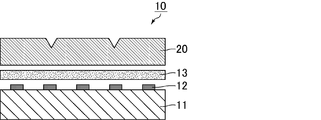
- FIG. 1 is a sectional view schematically showing a preferred example of the decorative board of the present invention.
- a decorative board 10 of the present invention a base material 11, a pattern layer 12, and a transparent resin film 20 are laminated in this order in the thickness direction, and the transparent resin film 20 is a pattern. It has an uneven shape on the side opposite to the side on which the layer 12 is laminated.
- the lower and upper limits of the numerical range represented by “to” mean “greater than or equal to” (for example, ⁇ to ⁇ means ⁇ or more and ⁇ or less).
- the base material is not particularly limited, and is appropriately determined depending on, for example, the use of the decorative board of the present invention.
- the material forming the base material is not particularly limited, and examples thereof include known materials such as resin materials, wood materials, and metal materials. Among them, as the material forming the above-mentioned base material, a resin material or a wood material having rigidity and lightness is preferable. Also, a composite material of these may be used.
- the resin material preferably contains, for example, a thermoplastic resin.
- thermoplastic resin examples include polyvinyl chloride resins, polyvinyl acetate resins, polyvinyl resins such as polyvinyl alcohol resins, polyethylene, polypropylene, polystyrene, ethylene-vinyl acetate copolymer resins (EVA), ethylene- (meth) acrylic acid.
- Polyolefin resin such as resin, polyester resin such as polyethylene terephthalate resin (PET resin), acrylic resin, polycarbonate resin, polyurethane resin, acrylonitrile-butadiene-styrene copolymer resin (ABS resin), acrylonitrile-styrene copolymer resin, etc.
- thermoplastic resin simple substance and copolymer or a mixed resin thereof.
- polyolefin resin, acrylonitrile-butadiene-styrene copolymer resin, polyvinyl chloride resin, ionomer and the like are preferable.
- the resin material may be foamed.
- examples of the wood material include various materials such as cedar, cypress, zelkova, pine, lauan, teak, and melapy
- examples of the core material include a veneer made of these materials and a single piece of wood. Any of a board, a wood plywood (including LVL), a particle board, a medium density fiberboard (MDF), a high density fiberboard (HDF), a laminated material, or the like, or a laminated material in which these are appropriately laminated may be used.
- Examples of the metal material include iron.
- the base material may include an inorganic compound.
- the linear expansion coefficient of the base material can be reduced, and as a result, the water resistance of the transparent resin film described below can be improved.
- the types of resins forming the base material composed of the plurality of resins may be the same or different, and the base material composed of a plurality of resins may be used.
- the thickness of the material may be the same or different.
- the base material may have a hollow structure, or a slit groove or a through hole may be provided in a part of the base material.
- the thickness of the substrate is not particularly limited, and is preferably 0.01 mm or more, more preferably 0.1 mm or more and 50 mm or less.
- the base material includes a substantially plate shape other than a flat plate, and includes a base material having irregularities and a curved surface.
- a pattern layer is laminated on one surface side of the base material.
- the pattern layer is a layer that imparts decorative properties to the decorative board of the present invention, and may be, for example, a uniformly colored concealing layer (solid printing layer), or various patterns may be printed with an ink and a printing machine. It may be a pattern layer formed by printing and a layer in which a hiding layer and a pattern layer are combined (hereinafter, a pattern layer).
- the above-mentioned concealing layer when the above-mentioned base material is colored or has color unevenness, it is possible to give an intended color and adjust the surface color.
- a stone pattern imitating the surface of rock such as wood pattern, marble pattern (eg travertine marble pattern), cloth pattern imitating texture or cloth-like pattern, tiling pattern, brickwork It is possible to apply a pattern or the like, or a pattern such as a parquet or a patchwork in which these are combined to the decorative board.
- These patterns are formed by multicolor printing with normal process colors of yellow, red, blue, and black, and also by multicolor printing with special colors performed by preparing individual color plates that make up the pattern. To be done.
- a binder resin in which a colorant such as a pigment and a dye, an extender pigment, a solvent, a stabilizer, a plasticizer, a catalyst and a curing agent are appropriately mixed is used.
- the binder resin is not particularly limited, and examples thereof include urethane resin, acrylic resin, urethane-acrylic resin, urethane-acrylic copolymer resin, vinyl chloride / vinyl acetate copolymer resin, vinyl chloride / vinyl acetate / acrylic copolymer. Preference is given to coalescing resins, acrylic resins, polyester resins, nitrocellulose resins and the like. As the binder resin, any of these may be used alone or in combination of two or more.
- colorant carbon black (black ink), iron black, titanium white, antimony white, yellow lead, titanium yellow, red halo, cadmium red, ultramarine, cobalt blue and other inorganic pigments, quinacridone red, isoindolinone Organic pigments such as yellow and phthalocyanine blue, metal pigments consisting of scale-like foil pieces such as dyes, aluminum and brass, pearlescent pigments consisting of scale-like foil pieces such as titanium dioxide coated mica and basic lead carbonate. are preferred.
- the thickness of the pattern layer is not particularly limited, and is preferably 0.1 ⁇ m or more, more preferably 0.5 ⁇ m or more and 600 ⁇ m or less. When the thickness of the pattern layer is within the above range, an excellent design can be imparted to the decorative board of the present invention and concealing property can be imparted. When the base material itself has a design property such as a veneer, the pattern layer may not be provided.
- the decorative board of the present invention has at least one layer containing an ultraviolet absorber between the pattern layer and the thermoplastic resin layer of the transparent resin film described below.
- the layer containing the ultraviolet absorber may be a primer layer for adhesion provided in the transparent resin film described below, or may be an adhesive layer described below, both of which the ultraviolet absorber It may be a contained layer.
- Transparent resin film In the decorative board of the present invention, a transparent resin film is laminated on the side of the pattern layer opposite to the base material.
- the transparent resin film has at least a thermoplastic resin layer, and has an uneven shape on the side opposite to the side on which the pattern layer is laminated.
- thermoplastic resin layer is a layer that plays a role of protecting a pattern layer laminated on one surface of a base material described later.
- the thermoplastic resin layer may be translucent or colored as long as it is transparent, as long as the pattern layer is visible.
- thermoplastic resin examples include olefin resins such as polyethylene, polypropylene, polybutene, polymethylpentene, and olefinic thermoplastic elastomer, polyethylene terephthalate, polybutylene terephthalate, polyethylene naphthalate, ethylene glycol-terephthalic acid-isophthalic acid copolymer Combined resin, terephthalic acid-ethylene glycol-1,4 cyclohexanedimethanol copolymer resin, polyester resin such as polyester thermoplastic elastomer, polymethyl (meth) acrylate, methyl (meth) acrylate-butyl (meth) acrylate copolymer Resin, acrylic resin such as methyl (meth) acrylate-styrene copolymer resin, polycarbonate resin, polyvinyl chloride, polystyrene, ionomer, etc. It is. Among them, polypropylene is preferably used because of its high tensile strength,
- the thermoplastic resin layer may be unstretched, but may be uniaxially stretched or biaxially stretched as necessary.
- the thickness of the thermoplastic resin layer is not particularly limited, but the preferred lower limit is 20 ⁇ m, the preferred upper limit is less than 500 ⁇ m, the more preferred lower limit is 60 ⁇ m, and the more preferred upper limit is 420 ⁇ m. If the thickness of the thermoplastic resin layer is less than 20 ⁇ m, the tensile strength may be insufficient and the surface of the pattern layer may not be protected, and if it is 500 ⁇ m or more, the transmittance of the transparent resin film may be reduced and the pattern may be reduced. The visibility of the pattern on the layer may be reduced.
- the thermoplastic resin layer may be composed of one layer or a laminate composed of two or more layers.
- thermoplastic resin layer when the thermoplastic resin layer is composed of a plurality of layers, the type of resin to be formed may be the same or different, and the thickness of the substrate made of a plurality of resins may be the same. It may be different.
- the method for laminating two or more layers of the thermoplastic resin layer is not limited as long as it is a general method, and examples thereof include a dry laminating method and an extrusion heat laminating method.
- thermoplastic resin layer may be subjected to surface treatment such as saponification treatment, glow discharge treatment, corona discharge treatment, plasma discharge treatment, ultraviolet ray (UV) treatment, and flame treatment without departing from the spirit of the present invention.
- surface treatment such as saponification treatment, glow discharge treatment, corona discharge treatment, plasma discharge treatment, ultraviolet ray (UV) treatment, and flame treatment without departing from the spirit of the present invention.
- the transparent resin film preferably has an adhesive primer layer on the side of the thermoplastic resin layer on which the pattern layer is laminated.
- an adhesive primer layer By having the above-mentioned adhesion primer layer, the adhesion between the above-mentioned transparent resin film and the above-mentioned pattern layer can be made stronger.
- the adhesive primer layer preferably contains a binder resin.
- the binder resin include urethane resins, acrylic resins, acryl-urethane resins, acryl-urethane copolymer resins, cellulose resins, polyester resins, vinyl chloride-vinyl acetate copolymer resins, and the like.
- a urethane acrylate oligomer is added to the ionizing radiation curable resin composition of the surface protective layer described later, it is preferable that the urethane resin is contained in terms of the adhesion to the pattern layer and the efficiency during production.
- the thickness of the adhesive primer layer is preferably 0.5 ⁇ m or more and 10 ⁇ m or less.
- the adhesiveness with the pattern layer can be suitably secured, and when the thickness is 10 ⁇ m or less, the transparent resin film does not become too thick and sufficient transparency can be obtained, and the decorative board design The property can be suitably secured.
- blocking during film formation can be suppressed. Blocking is a phenomenon in which the films become difficult to separate when a transparent resin film is formed, a primer for adhesion is applied, and the film is rolled up and then unwound.
- the adhesion primer layer may contain inorganic fine particles such as silica.
- the adhesive primer layer is preferably a layer containing the ultraviolet absorber.
- weather resistance can be suitably imparted to the decorative board of the present invention.
- an organic or inorganic ultraviolet absorber can be used. Above all, an organic ultraviolet absorber having excellent transparency is preferably used. Examples of the organic UV absorber include 2- (2′-hydroxy-3 ′, 5′-di-tert-butylphenyl) -5-chlorobenzotriazole and 2- (2′-hydroxy-3 ′).
- UV absorbers 2- (2'-hydroxy-3', 5'-di-tert-butylphenyl) benzotriazo , 2'-hydroxyphenyl benzotriazole-based UV absorbers such as 2- (2'-hydroxy-5'-methylphenyl) benzotriazole, and benzotriazole-based UV absorbers such as 2,2'-dihydroxy-4 -2,2'-dihydroxybenzophenone-based UV absorbers such as -methoxybenzophenone, 2,2'-dihydroxy-4,4'-dimethoxybenzophenone, 2,2'-dihydroxy-4,4'-tetrahydroxybenzophenone, 2 -Hydroxy-4-methoxybenzophenone, 2,4-dihydroxybenzophenone, 2-hydroxybenzophenone-based UV absorbers, benzophenone-based UV absorbers, phenyl salicylate, 4-t-butyl-phenyl
- triazine-based ultraviolet absorber examples include, for example, 2,4-bis (2,4-dimethylphenyl) -6- (2-hydroxy-4-n-octyloxyphenyl) -1,3,5-triazine, 2 -(2,4-Dihydroxyphenyl) -4,6-bis (2,4-dimethylphenyl) -1,3,5-triazine, 2- (2,4-dihydroxyphenyl) -4,6-diphenyl-1 , 3,5-triazine, 4,4 ′, 4 ′′-(1,3,5-triazine-2,4,6-triyltriimino) tristris (2-ethylhexyl) benzoate, 2- (2- Hydroxy-4-methoxyphenyl) -4,6-diphenyl-1,3,5-triazine, N, N ′, N ′′ -tri (m-tolyl) -1,3,5-triazine-2,4 6-triamine,
- a reactive UV absorber having an acryloyl group or a methacryloyl group introduced into the benzotriazole skeleton can also be used.
- an inorganic ultraviolet absorber can be added.
- titanium oxide, cerium oxide, iron oxide or the like having a particle size of 0.2 ⁇ m or less can be used.
- the content of the ultraviolet absorber is appropriately determined depending on the ultraviolet absorbing ability of the ultraviolet absorber used.
- a triazine-based ultraviolet absorber is used as the ultraviolet absorber, it is preferably 1% by mass or more and 10% by mass or less in the adhesive primer layer. If the content in the adhesive primer layer is less than 1% by mass, weather resistance may not be sufficiently imparted, and if the content in the adhesive primer layer exceeds 10% by mass, the transparency of the film may be reduced. May deteriorate the design of the decorative board, or the adhesiveness to the pattern layer or the like may not be sufficiently obtained, and the processability of the transparent resin film may deteriorate.
- the content of the ultraviolet absorber is more preferably 2% by mass or more and 7% by mass or less.
- the transparent resin film preferably has a surface protective layer on the side of the thermoplastic resin layer opposite to the side on which the picture layer is laminated.
- a surface protective layer By having the surface protective layer, the durability of the transparent resin film (scratch resistance, stain resistance, weather resistance, etc.) can be improved, and the surface of the pattern layer can be more preferably protected, It is possible to suitably prevent the deterioration of the design property due to the scratch of the transparent resin film itself.
- the surface protective layer may have a single layer structure, a plurality of layer structures made of the same or different materials, or the materials shown below may be appropriately mixed.
- the surface protective layer is not particularly limited, but includes, for example, a two-component curable resin or a crosslinked cured product of an ionizing radiation curable resin composition, and the crosslinked cured product is preferably transparent. As long as it is transparent, it may be translucent or colored as long as the pattern layer described later can be visually recognized.
- the binder resin of the adhesive primer layer may be used.
- the ionizing radiation curable resin include an oligomer having a radically polymerizable unsaturated bond or a cationically polymerizable functional group in the molecule (hereinafter, also referred to as so-called prepolymer, macromonomer, etc.) and / or a radical in the molecule.
- a monomer having a polymerizable unsaturated bond or a cationically polymerizable functional group is preferably used.
- the ionizing radiation here means an electromagnetic wave or charged particles having energy capable of polymerizing or crosslinking a molecule, and usually an electron beam (EB) or an ultraviolet ray (UV) is generally used.
- EB electron beam
- UV ultraviolet ray
- the oligomer or monomer examples include compounds having a radically polymerizable unsaturated group such as a (meth) acryloyl group and a (meth) acryloyloxy group, and a cationically polymerizable functional group such as an epoxy group in the molecule. These oligomers and monomers may be used alone or in combination of two or more.
- the (meth) acryloyl group means an acryloyl group or a methacryloyl group.
- oligomers having a radically polymerizable unsaturated group in the molecule include oligomers such as urethane (meth) acrylate, polyester (meth) acrylate, epoxy (meth) acrylate, melamine (meth) acrylate and triazine (meth) acrylate. Can be preferably used, and urethane (meth) acrylate oligomer is more preferable.
- the molecular weight is usually about 250 to 100,000.
- a polyfunctional monomer for example, a polyfunctional monomer is preferable, and a polyfunctional (meth) acrylate is more preferable.
- the polyfunctional (meth) acrylate include diethylene glycol di (meth) acrylate, propylene glycol di (meth) acrylate, bisphenol A ethylene oxide-modified di (meth) acrylate, trimethylolpropane tri (meth) acrylate, trimethylolpropane.
- the polyfunctional monomer refers to a monomer having a plurality of radically polymerizable unsaturated groups.
- the above-mentioned ionizing radiation curable resin composition contains an ionizing radiation curable resin component composed of a urethane acrylate oligomer and a polyfunctional monomer, and as the ionizing radiation curable resin component, a urethane acrylate oligomer / polyfunctional It is particularly preferable that the monomer (mass ratio) is 6/4 to 9/1. Within this mass ratio range, scratch resistance can be made more excellent.
- a monofunctional monomer may be appropriately used within a range not deviating from the object of the present invention. Examples of the monofunctional monomer include methyl (meth) acrylate, 2-ethylhexyl (meth) acrylate, and phenoxyethyl (meth) acrylate.
- the above ionizing radiation-curable resin composition is cross-linked with ultraviolet rays, it is preferable to add a photopolymerization initiator to the ionizing radiation-curable resin composition.
- a photopolymerization initiator acetophenones, benzophenones, thioxanthones, benzoin, benzoin methyl ethers alone or in combination. Can be used.
- the ionizing radiation curable resin composition is a resin system having a cationically polymerizable unsaturated group
- the photopolymerization initiator an aromatic diazonium salt, an aromatic sulfonium salt, an aromatic iodonium salt, a metacerone compound, benzoin Sulfonic acid esters and the like can be used alone or as a mixture.
- the amount of these photopolymerization initiators added is about 0.1 to 10 parts by mass with respect to 100 parts by mass of the ionizing radiation-curable resin component.
- additives may be further added to the above ionizing radiation curable resin composition, if necessary.
- these additives include urethane resin, polyvinyl acetal resin, polyester resin, polyolefin resin, styrene resin, polyamide resin, polycarbonate resin, acetal resin, vinyl chloride-vinyl acetate copolymer resin, vinyl acetate resin, acrylic resin.
- Resin thermoplastic resin such as cellulose resin, lubricant such as silicone resin, wax, fluororesin, UV absorber such as benzotriazole, benzophenone, triazine, light stabilizer such as hindered amine radical scavenger, dye, pigment, etc. Colorants and the like.
- the electron beam source of ionizing radiation for example, various electron beam accelerators such as Cockcroft-Walton type, Van de Graft type, resonance transformer type, insulating core transformer type, or linear type, dynamitron type, high frequency type, etc. It is possible to use one that irradiates an electron having an energy of 70 to 1000 keV. Further, the irradiation dose of the electron beam is preferably, for example, about 1 to 10 Mrad.
- the ultraviolet ray source of the ionizing radiation for example, a light source such as an ultrahigh pressure mercury lamp, a high pressure mercury lamp, a low pressure mercury lamp, a carbon arc lamp, a black light, a metal halide lamp can be used, and the wavelength of the ultraviolet ray is usually 190 to 380 nm. The wavelength range is mainly used.
- the thickness of the surface protective layer is not particularly limited, but the preferred lower limit is 0.1 ⁇ m, the preferred upper limit is 50 ⁇ m, the more preferred lower limit is 1 ⁇ m, and the more preferred upper limit is 30 ⁇ m.
- the thickness of the surface protective layer is less than 0.1 ⁇ m, sufficient durability (scratch resistance, stain resistance, weather resistance, etc.) may not be imparted, and when it exceeds 50 ⁇ m, the transparency of the present invention may be reduced. In some cases, the transmittance of the water-soluble resin film is lowered and the visibility of the design of the design layer is reduced.
- a primer layer for a surface protective layer between the surface protective layer and the thermoplastic resin layer.
- the primer layer for the surface protective layer preferably contains the ultraviolet absorber.
- the primer layer for a surface protective layer contains the ultraviolet absorber, weather resistance can be more suitably imparted to the decorative board of the present invention.
- the same one as the above-mentioned adhesive primer layer can be preferably used.
- the transparent resin film has an uneven shape on the side opposite to the side on which the picture layer is laminated.
- the depth of the uneven shape on the side opposite to the side on which the pattern layer is laminated is not particularly limited, for example, the center line average roughness Ra defined in JIS B 0601 (1982) is 1 ⁇ m or more and 30 ⁇ m or less. It is preferable to appropriately adjust it so that it falls within the range.
- the transparent resin film may have an uneven shape on the side on which the picture layer is laminated.
- Rzmax defined by JIS B 0601 (2001) of the irregular shape is 80 ⁇ m or less. It is preferable.
- Rzmax defined by JIS B 0601 (2001) having an uneven shape on the side on which the pattern layer is laminated exceeds 80 ⁇ m, bubbles easily enter between the pattern layer and the transparent resin film, and
- the decorative sheet of the invention may have poor design.
- Rzmax defined by JIS B 0601 (2001) of the uneven shape on the side where the above-mentioned pattern layer is laminated is 60 ⁇ m or less.
- the above Rzmax can be obtained by measuring under the following conditions using a surface roughness measuring device (“SURFCOM-FLEX-50A”, manufactured by Tokyo Seimitsu Co., Ltd.).
- the method for forming the uneven shape is not particularly limited, and examples thereof include embossing by heat and a method of transferring the uneven shape by a shaping sheet.
- embossing by heat for example, a well-known sheet-fed method or a method of performing embossing by a rotary embossing machine can be mentioned.
- the embossed pattern includes, for example, grain, hairline, satin, wood grain conduit groove, stone board surface unevenness, cloth surface texture, and line groove.
- the temperature for embossing is not particularly limited, but is preferably a temperature at which so-called emboss return in which uneven patterns disappear during thermocompression molding is reduced.
- the concavo-convex shape may be formed by the above method on both sides of the transparent resin film, or on one side of the transparent resin film.
- the uneven shape may be formed by the above method, and the uneven shape formed on one side may be made to follow the uneven shape formed on the other side.
- the thickness of the transparent resin film is not particularly limited, but the thickness of the concave and convex portions is preferably 80 ⁇ m or more. If the thickness of the concave-convex shape of the transparent resin film is less than 80 ⁇ m, sufficient decorative performance (wear resistance, scratch resistance) may not be imparted to the decorative plate of the present invention.
- the above-mentioned “concave-shaped concave portion” will be described.
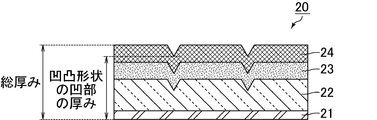
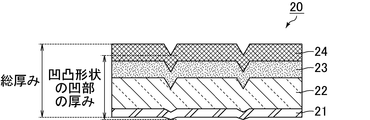
- 2 and 3 are sectional views schematically showing a preferred example of the transparent resin film constituting the decorative board of the present invention. In the transparent resin film 20 shown in FIGS. 2 and 3, the adhesion primer layer 21, the thermoplastic resin layer 22, the surface protection layer primer layer 23, and the surface protection layer 24 are laminated in this order in the thickness direction.
- the “concave-concave concave portion” refers to the thinnest portion of the thickness of the transparent resin film, and is a portion including the concave-convex deepest concave portion of the surface protective layer 24, and the transparent resin film 20. It can be confirmed by observing the cross section of the above with a microscope.
- the length from the surface having the surface protective layer 24 to the opposite surface is the total thickness of the transparent resin film 20, and from the bottom of the deepest concave portion on the surface protective layer 24 side.
- the length to the surface of the adhesive primer layer 21 is the “thickness of the concave and convex portions”.
- the surface protection of the transparent resin layer 20 is performed.
- a protrusion will be generated on the opposite surface corresponding to the deepest concave portion of the unevenness on the layer 24 side, but the bottom of the deepest concave portion of the uneven shape on the surface protective layer 24 side of the transparent resin layer 20.
- To the surface on the opposite side where such a protrusion exists is the "thickness of the concave-convex concave portion".
- the preferable lower limit of the total thickness of the transparent resin film is 100 ⁇ m
- the preferable upper limit is 500 ⁇ m
- the more preferable lower limit is 140 ⁇ m
- the more preferable upper limit is 460 ⁇ m.
- the upper limit of the thickness of the concave and convex portions of the transparent resin film is not particularly limited, but is preferably 500 ⁇ m, for example.
- the transparent resin film is preferably used for protecting the pattern layer laminated on one side of the substrate.
- a transparent resin film used for protecting a pattern layer laminated on one side of such a substrate is also an aspect of the present invention.
- the decorative board of the present invention preferably has an adhesive layer between the pattern layer and a transparent resin film described later.
- the adhesion between the above-mentioned pattern layer and the transparent resin film described later can be further strengthened.
- the adhesive layer preferably contains a binder resin.
- the binder resin include urethane resins, acrylic resins, acryl-urethane resins, acryl-urethane copolymer resins, cellulose resins, polyester resins, vinyl chloride-vinyl acetate copolymer resins, and the like.
- urethane resin is preferable from the viewpoint of the adhesion between the pattern layer and the transparent resin film described later and the efficiency during production.
- the thickness of the adhesive layer is not particularly limited, but when the thickness is 10 ⁇ m or more and the transparent resin film has a concavo-convex shape on the side on which the pattern layer is laminated, the concavo-convex shape of JIS B 0601 is used. It is preferably larger than Rzmax defined in (2001). If the thickness of the adhesive layer is 10 ⁇ m or more, and if it is larger than Rzmax defined in JIS B 0601 (2001) of the uneven shape on the side where the pattern layer of the transparent resin film described later is laminated, Adhesion between the pattern layer and the transparent resin film described later can be suitably secured.
- the adhesive layer when the thickness of the adhesive layer is less than 10 ⁇ m, the adhesiveness between the pattern layer and the transparent resin film described below may not be sufficiently imparted, and the pattern layer of the transparent resin film described below may be insufficient. If it is smaller than Rzmax defined in JIS B 0601 (2001) of the uneven shape on the side to be laminated, bubbles may be introduced between the above-mentioned pattern layer and the transparent resin film described later to deteriorate the design. There is.
- the adhesive layer may include inorganic fine particles such as silica.
- the method for sticking the adhesive layer is not particularly limited, but for example, a hot-melt method or a thermal laminating method, and a water-based adhesive, a heat-sensitive adhesive, a pressure-sensitive adhesive, or a hot-melt adhesive is used for lamination Can be obtained.
- the adhesive layer is preferably a layer containing the ultraviolet absorber.
- the adhesive layer is a layer containing the ultraviolet absorber, excellent weather resistance can be suitably imparted to the decorative board of the present invention.
- an organic or inorganic ultraviolet absorber can be used. Above all, an organic ultraviolet absorber having excellent transparency is preferably used. Examples of the organic UV absorber include 2- (2′-hydroxy-3 ′, 5′-di-tert-butylphenyl) -5-chlorobenzotriazole and 2- (2′-hydroxy-3 ′).
- UV absorbers 2- (2'-hydroxy-3', 5'-di-tert-butylphenyl) benzotriazo , 2'-hydroxyphenyl benzotriazole-based UV absorbers such as 2- (2'-hydroxy-5'-methylphenyl) benzotriazole, and benzotriazole-based UV absorbers such as 2,2'-dihydroxy-4 -2,2'-dihydroxybenzophenone-based UV absorbers such as -methoxybenzophenone, 2,2'-dihydroxy-4,4'-dimethoxybenzophenone, 2,2'-dihydroxy-4,4'-tetrahydroxybenzophenone, 2 -Hydroxy-4-methoxybenzophenone, 2,4-dihydroxybenzophenone, 2-hydroxybenzophenone-based UV absorbers, benzophenone-based UV absorbers, phenyl salicylate, 4-t-butyl-phenyl
- triazine-based UV absorbers are preferable from the viewpoint of suitably imparting weather resistance, designability, bleeding suppression, and the like.
- the triazine-based UV absorber the triazine-based UV absorber described in the above-mentioned adhesion primer layer can be appropriately selected and used.
- a reactive UV absorber having an acryloyl group or a methacryloyl group introduced into the benzotriazole skeleton can also be used.
- an inorganic ultraviolet absorber can be added.
- titanium oxide, cerium oxide, iron oxide or the like having a particle size of 0.2 ⁇ m or less can be used.
- the content of the above-mentioned ultraviolet absorber is appropriately determined depending on the ultraviolet absorbing ability of the ultraviolet absorber used.
- a triazine-based UV absorber is used as the UV absorber, it is preferably contained in the adhesive layer in an amount of 0.5% by mass or more and 2% by mass or less.
- the content in the adhesive layer is less than 0.5% by mass, weather resistance may not be sufficiently imparted, and when the content in the adhesive layer exceeds 2% by mass, the adhesive layer The transparency of the decorative plate is impaired and the designability of the decorative plate is reduced, or the adhesion between the above-mentioned pattern layer and the transparent resin film described below cannot be sufficiently obtained, and the processability of the decorative plate of the present invention is reduced.
- the content of the ultraviolet absorber is more preferably 1% by mass or more and 1.5% by mass or less.
- Method of manufacturing decorative board for example, a heat-melting method, a heat-laminating method, a water-based adhesive, a heat-sensitive adhesive, a pressure-sensitive adhesive, a hot-melt adhesive, or the above-mentioned adhesive layer is formed.
- the method of laminating the above-mentioned base material, the above-mentioned pattern layer, and the above-mentioned transparent resin film using an adhesive etc. is mentioned.
- the step of forming the adhesive layer on the surface of the transparent resin film on which the picture layer is laminated, and the transparent resin film and the picture layer via the adhesive layer It is preferable to have a step of laminating.
- Such a method for producing a decorative board of the present invention is also an aspect of the present invention.
- air is introduced into the uneven shape on the side on which the picture layer formed on the transparent resin film is laminated, so-called air damage is prevented, and the design of the picture layer is improved. The decrease can be suppressed.
- the thickness of the decorative board of the present invention is not particularly limited, and is preferably 0.05 mm or more, more preferably 1 mm or more and 50 mm or less.
- Example 1 A transparent polypropylene film (thickness 60 ⁇ m) was prepared, and a two-component curable urethane resin having an isocyanate as a curing agent was applied to one surface of the transparent polypropylene film to obtain a primer layer for adhesion having a thickness of 2 ⁇ m. Then, a transparent polypropylene resin (80 ⁇ m in thickness) was melt extruded on the other surface of the transparent polypropylene film (the surface opposite to the adhesive primer layer), and they were laminated by a heat lamination method.
- a two-component curable urethane resin having isocyanate as a curing agent is applied to protect the surface to a thickness of 2 ⁇ m.
- a layer primer layer was formed.
- a urethane acrylate oligomer which is an ionizing radiation curable resin, is applied as a surface protection layer on the surface coated with the primer layer for the surface protection layer by a gravure coating method, and then an electron beam is irradiated under the conditions of an acceleration voltage of 165 keV and 5 Mrad. Then, a surface protective layer having a thickness of 15 ⁇ m was formed.
- the surface protective layer side was heated by an infrared non-contact type heater, and then immediately embossed by hot pressure to form an uneven shape, thereby producing a transparent resin film.
- the obtained transparent resin film had a thickness of 159 ⁇ m, the thickness of the concave and convex portions was 100 ⁇ m, and Rzmax was 40 ⁇ m.
- HDF high-density fiberboard
- a pattern layer having a thickness of 2 ⁇ m was provided on one surface of the HDF by an inkjet printer to prepare a base material.
- a two-component curable polyester resin having an isocyanate as a curing agent was applied to form an adhesive layer having a thickness of 50 ⁇ m.
- the resin film was laminated so that the adhesion primer layer and the pattern layer faced each other.
- a triazine-based ultraviolet absorber product name ADEKA STAB LA-46, manufactured by ADEKA
- ADEKA triazine-based ultraviolet absorber
- Example 2 A decorative board was prepared in the same manner as in Example 1 except that triazine-based UV absorber (product name: ADEKA STAB LA-46, manufactured by ADEKA) was added to the two-component curable polyester resin in an amount of 0.5% by mass. It was made. The thickness of the obtained transparent resin film and the thickness of the concave and convex portions were as shown in Table 1.
- triazine-based UV absorber product name: ADEKA STAB LA-46, manufactured by ADEKA
- Example 3 A decorative board was produced in the same manner as in Example 1 except that a triazine-based ultraviolet absorber (product name: ADEKA STAB LA-46, manufactured by ADEKA) was added to the two-component curable polyester resin in an amount of 2% by mass. .
- a triazine-based ultraviolet absorber product name: ADEKA STAB LA-46, manufactured by ADEKA
- the thickness of the obtained transparent resin film and the thickness of the concave and convex portions were as shown in Table 1.
- Example 4 A transparent polypropylene film (thickness 50 ⁇ m) is used in place of the transparent polypropylene film (thickness 60 ⁇ m), and a two-component curable urethane resin having an isocyanate as a curing agent is applied to one surface of the transparent polypropylene film (thickness 50 ⁇ m). Then, a primer layer for adhesion having a thickness of 2 ⁇ m was obtained. Next, a transparent polypropylene resin (thickness 50 ⁇ m) was melt-extruded on the other surface (opposite side of the adhesion primer layer) of the transparent polypropylene film (thickness 50 ⁇ m), and they were laminated by a heat lamination method.
- Example 1 After forming a primer layer for a surface protective layer and a surface protective layer in the same manner as in Example 1, embossing was performed with a shallow embossing plate different from that in Example 1 to obtain a transparent resin film.
- a two-component curable polyester resin having an isocyanate as a curing agent was applied to form an adhesive layer having a thickness of 10 ⁇ m.
- the resin film was laminated so that the adhesion primer layer and the pattern layer faced each other.
- a decorative board was produced in the same manner as in Example 1 except for the above.
- the thickness of the obtained transparent resin film and the thickness of the concave and convex portions were as shown in Table 1.
- Example 5 A decorative board was prepared in the same manner as in Example 4 except that triazine-based ultraviolet absorber (product name: ADEKA STAB LA-46, manufactured by ADEKA) was added to the two-component curable polyester resin in an amount of 0.5% by mass. It was made. The thickness of the obtained transparent resin film and the thickness of the concave and convex portions were as shown in Table 1.
- triazine-based ultraviolet absorber product name: ADEKA STAB LA-46, manufactured by ADEKA
- Example 6 A transparent polypropylene film (thickness 60 ⁇ m) was prepared, and a two-component curable urethane resin having an isocyanate as a curing agent was applied to one surface of the transparent polypropylene film to obtain a primer layer for adhesion having a thickness of 2 ⁇ m. Then, a transparent polypropylene resin (thickness 60 ⁇ m) was melt-extruded on the other surface of the transparent polypropylene film (the surface opposite to the adhesive primer layer), and they were laminated by a heat lamination method.
- Example 2 After forming a primer layer for a surface protective layer and a surface protective layer in the same manner as in Example 1, embossing was performed with a shallow embossing plate different from that in Example 1 to obtain a transparent resin film.
- a two-component curable polyester resin having an isocyanate as a curing agent was applied to form an adhesive layer having a thickness of 40 ⁇ m.
- the resin film was laminated so that the adhesion primer layer and the pattern layer faced each other.
- a triazine-based ultraviolet absorber product name ADEKA STAB LA-46, manufactured by ADEKA
- ADEKA STAB LA-46 product name ADEKA STAB LA-46, manufactured by ADEKA
- a decorative board was produced in the same manner as in Example 1 except for the above.
- the thickness of the obtained transparent resin film and the thickness of the concave and convex portions were as shown in Table 1.
- Example 7 A decorative board was produced in the same manner as in Example 1 except that the benzotriazole-based UV absorber (product name: ADEKA STAB LA-36, manufactured by ADEKA) was used as the UV absorber added to the two-component curable polyester resin. did.
- the thickness of the obtained transparent resin film and the thickness of the concave and convex portions were as shown in Table 1.
- Example 1 A decorative board was obtained in the same manner as in Example 4 except that the ultraviolet absorber was not added to the two-component curing type polyester resin.
- the thickness of the obtained transparent resin film and the thickness of the concave and convex portions were as shown in Table 1.
- Example 8 A transparent resin film and a decorative board were produced in the same manner as in Example 4 except that embossing was performed using a deep embossing plate different from that in Example 4.
- the thickness of the obtained transparent resin film and the thickness of the concave and convex portions were as shown in Table 1.
- Example 9 Instead of the transparent polypropylene film (thickness 60 ⁇ m), a transparent polypropylene film (thickness 80 ⁇ m) is used, and one surface of the transparent polypropylene film (thickness 80 ⁇ m) is coated with a two-component curable urethane resin containing isocyanate as a curing agent. Then, a primer layer for adhesion having a thickness of 2 ⁇ m was obtained. Then, a transparent polypropylene resin (thickness 80 ⁇ m) was melt-extruded on the other surface (opposite side of the bonding primer layer) of the transparent polypropylene film (thickness 80 ⁇ m), and they were laminated by a heat lamination method.
- Example 1 After forming a primer layer for a surface protective layer and a surface protective layer in the same manner as in Example 1, embossing was performed with a deep embossing plate different from that in Example 1 to obtain a transparent resin film.
- a two-component curable polyester resin having an isocyanate as a curing agent was applied to form an adhesive layer having a thickness of 100 ⁇ m.
- the resin film was laminated so that the adhesion primer layer and the pattern layer faced each other.
- a decorative board was produced in the same manner as in Example 2 except for the above.
- the thickness of the obtained transparent resin film and the thickness of the concave and convex portions were as shown in Table 1.
- Example 10 On the surface of the transparent resin film obtained in the same manner as in Example 4 on the side having the adhesive primer layer, a two-component curable polyester resin having an isocyanate as a curing agent was applied to form an adhesive layer having a thickness of 5 ⁇ m. The resulting transparent resin film was laminated so that the adhesive primer layer and the pattern layer were opposed to each other. A decorative board was produced in the same manner as in Example 4 except for the above. The thickness of the obtained transparent resin film and the thickness of the concave and convex portions were as shown in Table 1.
- Example 11 A decorative board was produced in the same manner as in Example 1 except that a triazine-based ultraviolet absorber (product name ADEKA STAB LA-46, manufactured by ADEKA) was added to the two-component curable polyester resin in an amount of 3% by mass. .
- ADEKA STAB LA-46 product name ADEKA STAB LA-46, manufactured by ADEKA
- the thickness of the obtained transparent resin film and the thickness of the concave and convex portions were as shown in Table 1.
- Example 12 A transparent polypropylene film (thickness: 60 ⁇ m) is prepared, and an isocyanate containing 5% by mass of a triazine-based ultraviolet absorber (product name ADK STAB LA-46, manufactured by ADEKA) is used as a curing agent on one surface of the transparent polypropylene film.
- a two-component curing type urethane resin was applied to obtain a bonding primer layer having a thickness of 2 ⁇ m.
- a transparent polypropylene resin (thickness: 80 ⁇ m) was melt-extruded on the other surface of the transparent polypropylene film (on the side opposite to the adhesive primer), and they were laminated by a heat lamination method.
- the surface protective layer having a thickness of 2 ⁇ m After corona treatment is applied to the surface of the transparent polypropylene resin (80 ⁇ m) (opposite side of the adhesion primer), a two-component curing type urethane resin having isocyanate as a curing agent is applied. A primer layer was formed. After that, a urethane acrylate oligomer, which is an ionizing radiation curable resin, is applied as a surface protection layer on the surface coated with the primer layer for the surface protection layer by a gravure coating method, and then an electron beam is irradiated under the conditions of an acceleration voltage of 165 keV and 5 Mrad. Then, a surface protective layer having a thickness of 15 ⁇ m was formed.
- the surface protective layer side was heated by an infrared non-contact type heater, and then immediately embossed by hot pressure to form an uneven shape, thereby producing a transparent resin film.
- the obtained transparent resin film had a thickness of 159 ⁇ m, and the concave and convex portions had a thickness of 100 ⁇ m.
- an HDF (high-density fiberboard) (thickness: 3 mm) was prepared, and a substrate having a pattern layer with a thickness of 2 ⁇ m provided on one surface of the HDF with an inkjet printer was prepared.
- a two-component curable polyester resin having an isocyanate as a curing agent was applied to form an adhesive layer having a thickness of 30 ⁇ m.
- the adhesion primer layer of the resin film and the pattern layer were laminated so as to face each other. Thereafter, a pressure of 10 kg / m 2 was applied, and curing was performed for 3 days in a room temperature environment to obtain a decorative board.
- the thickness of the obtained transparent resin film and the thickness of the concave and convex portions are as shown in Table 2.
- Example 13 The content of the triazine-based UV absorber (product name ADK STAB LA-46, manufactured by ADEKA) added to the adhesive primer layer was changed to 1% by mass (Example 13) or 10% by mass (Example 14).
- a transparent resin film and a decorative board were produced in the same manner as in Example 12 except that the above was performed.
- the thickness of the obtained transparent resin film and the thickness of the concave and convex portions are as shown in Table 2.
- Example 15 A two-component curable urethane resin containing 1% by mass of a triazine-based ultraviolet absorber (product name ADK STAB LA-46, manufactured by ADEKA) as a curing agent on one surface of a transparent polypropylene film (60 ⁇ m) (thickness 0 0.5 ⁇ m) was applied to form an adhesion primer layer.
- a transparent polypropylene resin (thickness 60 ⁇ m) was extruded and laminated on the other surface of the transparent polypropylene film (60 ⁇ m) in place of the transparent polypropylene resin (thickness 80 ⁇ m) by extrusion lamination.
- a transparent resin film and a decorative board were produced.
- the thickness of the obtained transparent resin film and the thickness of the concave and convex portions are as shown in Table 2.
- Example 16 A transparent resin film and a decorative board were produced in the same manner as in Example 12 except that the thickness of the adhesive primer layer was 10 ⁇ m.
- the thickness of the obtained transparent resin film and the thickness of the concave and convex portions are as shown in Table 2.
- Example 17 Except that 1% by mass of a triazine-based UV absorber (product name ADEKA STAB LA-46, manufactured by ADEKA) was added to a two-component curing type polyester resin (thickness 50 ⁇ m) using isocyanate as a curing agent, which is an adhesive layer.
- a transparent resin film and a decorative board were produced in the same manner as in Example 12. The thickness of the obtained transparent resin film and the thickness of the concave and convex portions are as shown in Table 2.
- Example 18 A transparent resin film and a decorative plate were prepared in the same manner as in Example 12 except that the ultraviolet absorber added to the adhesive primer layer was changed to a benzotriazole-based ultraviolet absorber (product name: ADEKA STAB LA-36, manufactured by ADEKA). It was made.
- the thickness of the obtained transparent resin film and the thickness of the concave and convex portions are as shown in Table 2.
- Example 2 A transparent resin film and a decorative board were produced in the same manner as in Example 15 except that the ultraviolet absorber was not added to the adhesive primer layer.
- the thickness of the obtained transparent resin film and the thickness of the concave and convex portions are as shown in Table 2.
- Example 19 A transparent resin film and a decorative board were produced in the same manner as in Example 12 except that the thickness of the adhesive primer layer was 13 ⁇ m.
- the thickness of the obtained transparent resin film and the thickness of the concave and convex portions are as shown in Table 2.
- Adhesion strength without any problem (adhesion strength exceeds 20 N / 25 mm) +: Adhesion strength was slightly weak (adhesion strength 15 N / 25 mm or more, 20 N / 25 mm or less) -: Adhesion strength was very weak (Adhesion strength less than 15 N / 25 mm)
- the adhesion strength of the decorative boards obtained in Examples and Comparative Examples was transparent at a tensile speed of 200 mm / min and a peeling angle of 180 ° using a Tensilon universal testing machine “RTC-1250A” (manufactured by Orientec Co., Ltd.). The maximum value of the peel strength [N / 25 mm width] when peeling between the functional resin film and the base material on which the pattern layer is laminated was measured and defined as the adhesion strength.
- the decorative boards obtained in Examples 1 to 11 had excellent weather resistance.
- the thickness of the concave and convex portions of the transparent resin film, Rzmax, and the thickness of the adhesive layer are within predetermined ranges, and in Examples 1 to 6 using the triazine-based ultraviolet absorber, abrasion resistance It was also excellent in designability and processability.
- Example 7 in which the benzotriazole-based ultraviolet absorber was used as the ultraviolet absorber, yellowing occurred, which was slightly inferior in designability and inferior in processability.
- Example 8 in which the concave and convex portions of the transparent resin film were less than 80 ⁇ m the abrasion resistance was poor.
- Example 9 in which Rzmax of the transparent resin film exceeds 80 ⁇ m and in Example 10 in which the thickness of the adhesive layer is less than 10 ⁇ m, air deficiency occurred, so that the design was poor. Further, in Example 11 in which the adhesive layer contained 3% by mass of the ultraviolet absorber, the transparency was lowered, and the designability was poor. In Comparative Example 1 having no layer containing the ultraviolet absorber, the weather resistance was poor.
- the decorative boards obtained in Examples 12 to 19 have excellent weather resistance.
- the thickness of the concave and convex portions of the transparent resin film is within a predetermined range
- the thickness of the adhesive primer layer is within a predetermined range
- the thickness of the adhesive primer layer is within a predetermined range
- the thickness of the adhesive primer layer is within a predetermined range
- the thickness of the adhesive primer layer is within a predetermined range
- the thickness of the adhesive primer layer is within a predetermined range
- the thickness of the adhesive primer layer is within a predetermined range
- the thickness of the adhesive primer layer is within a predetermined range
- the thickness of the adhesive primer layer is within a predetermined range
- abrasion resistance It was also excellent in the properties, designability, film-forming property and processability.
- Example 18 in which the benzotriazole-based ultraviolet absorber was used as the ultraviolet absorber, yellowing occurred, and the design was slightly inferior.
- Example 19 in which the thickness of the adhesion primer layer exceeds 10 ⁇ m, the transparency
- the decorative board of the present invention is also excellent in weather resistance, it is suitably used for doors such as fittings and sliding doors, flooring materials, walls, ceilings, and various decorative molded bodies which are building materials.
Landscapes
- Engineering & Computer Science (AREA)
- Architecture (AREA)
- Civil Engineering (AREA)
- Structural Engineering (AREA)
- Wood Science & Technology (AREA)
- Life Sciences & Earth Sciences (AREA)
- Chemical & Material Sciences (AREA)
- Organic Chemistry (AREA)
- Physics & Mathematics (AREA)
- Thermal Sciences (AREA)
- Plasma & Fusion (AREA)
- Health & Medical Sciences (AREA)
- Chemical Kinetics & Catalysis (AREA)
- Medicinal Chemistry (AREA)
- Polymers & Plastics (AREA)
- Laminated Bodies (AREA)
Abstract
Description
更に、インクジェット印刷法は印刷する基材がフィルムに限らず、平板や凹凸や曲面を備えた基材に対しても印刷が可能というメリットがある。
しかし、インクジェット印刷法で印刷された絵柄層は基材の最表面にあることから、耐傷性や耐汚染性及び耐候性等の表面性能が不十分であり、その絵柄層を保護するために透明性樹脂フィルムが必要であった。
また、上記透明性樹脂フィルムは、上記絵柄層が積層される側に凹凸形状を有することが好ましい。
また、上記透明性樹脂フィルムの上記絵柄層が積層される側に有する凹凸形状のJIS B 0601(2001)で定義されるRzmaxが、80μm以下であることが好ましい。
また、上記絵柄層と上記透明性樹脂フィルムとの間に、接着剤層を有することが好ましい。
また、上記接着剤層の厚みは、10μm以上であり、かつ、上記透明性樹脂フィルムの上記絵柄層が積層される側に有する凹凸形状のJIS B 0601(2001)で定義されるRzmaxよりも大きいことが好ましい。
また、上記接着剤層は、上記紫外線吸収剤を含有する層であることが好ましい。
また、上記接着剤層は、紫外線吸収剤を0.5質量%以上2質量%以下で含有することが好ましい。
また、上記接着剤層に含有される紫外線吸収剤は、トリアジン系紫外線吸収剤であることが好ましい。
また、上記透明性樹脂フィルムは、上記熱可塑性樹脂層の上記絵柄層が積層される側に接着用プライマー層を有することが好ましい。
また、上記接着用プライマー層は、上記紫外線吸収剤を含有する層であることが好ましい。
また、上記接着用プライマー層に含有される紫外線吸収剤は、トリアジン系紫外線吸収剤であることが好ましい。
また、上記接着用プライマー層は、厚みが0.5μm以上10μm以下であることが好ましい。
また、本発明の透明性樹脂フィルムは、基材の一方に積層される絵柄層を保護するために用いられることが好ましい。
また、本発明の化粧板の製造方法は、透明性樹脂フィルムの絵柄層が積層される側の面に接着剤層を形成する工程、及び、上記接着剤層を介して、上記透明性樹脂フィルムと上記絵柄層とを貼り合わせる工程を有することを特徴とする。
また、本発明の透明性樹脂フィルムは、化粧板に対して、優れた耐候性を付与することができる。
本発明の化粧板は、厚み方向において、基材、絵柄層、及び、透明性樹脂フィルムがこの順に積層されている化粧板であって、上記透明性樹脂フィルムは、少なくとも熱可塑性樹脂層を有し、かつ、上記絵柄層が積層される側と反対側に凹凸形状を有し、上記絵柄層と、上記熱可塑性樹脂層との間に、少なくとも1層の紫外線吸収剤を含有する層を有することを特徴とする。
図1は、本発明の化粧板の好ましい一例を模式的に示す断面図である。
図1に示すように、本発明の化粧板10は、厚み方向において、基材11、絵柄層12、及び、透明性樹脂フィルム20がこの順に積層されており、透明性樹脂フィルム20は、絵柄層12が積層された側と反対側に凹凸形状を有する。
図1に示すように、絵柄層12と、透明性樹脂フィルム20との間には、接着剤層13を有することが好ましい。
以下、本発明の化粧板の各構成について説明する。
なお、以下の記載において、「~」で表される数値範囲の下限上限は「以上以下」を意味する(例えば、α~βならば、α以上β以下である)。
本発明の化粧板は、厚み方向において、基材、絵柄層、及び、透明性樹脂フィルムがこの順に積層されている。
上記基材としては特に限定されず、例えば、本発明の化粧板の用途に合わせて適宜決定される。
上記基材を構成する材料としては特に限定されず、例えば、樹脂材料、木質材料、金属材料等公知の材料が挙げられる。その中でも、上記基材を構成する材料としては、剛性や軽さを備える樹脂材料や木質材料が好ましい。また、これらの複合材料であっても良い。
上記樹脂材料としては、例えば、熱可塑性樹脂を含有することが好ましい。
上記熱可塑性樹脂としては、ポリ塩化ビニル樹脂、ポリ酢酸ビニル樹脂、ポリビニルアルコール樹脂などのポリビニル樹脂、ポリエチレン、ポリプロピレン、ポリスチレン、エチレン-酢酸ビニル共重合体樹脂(EVA)、エチレン-(メタ)アクリル酸系樹脂などのポリオレフィン樹脂、ポリエチレンテレフタレート樹脂(PET樹脂)などのポリエステル樹脂、アクリル樹脂、ポリカーボネート樹脂、ポリウレタン樹脂、アクリロニトリル-ブタジエンースチレン共重合体樹脂(ABS樹脂)、アクリロニトリル-スチレン共重合体樹脂などの熱可塑性樹脂の単体及び共重合体、あるいは、これらの混合樹脂が好ましく挙げられる。なかでも、ポリオレフィン樹脂やアクリロニトリル-ブタジエン-スチレン共重合体樹脂、ポリ塩化ビニル樹脂、アイオノマー等が好ましい。更に、上記樹脂材料は、発泡されていてもよい。
上記金属材料としては、例えば、鉄等が挙げられる。
なお、基材は平板以外の略板状も含み、凹凸や曲面を備えているものも含まれる。
本発明の化粧板は、上記基材の一方の面側に絵柄層が積層されている。
上記絵柄層は、本発明の化粧板に装飾性を付与する層であり、例えば、均一に着色が施された隠蔽層(ベタ印刷層)でもよいし、種々の模様をインキと印刷機を使用して印刷することにより形成される図柄層であってもよいし、隠蔽層と図柄層とを組み合わせた層(以下、模様層)であってもよい。
また、図柄層を設けることで、木目模様、大理石模様(例えばトラバーチン大理石模様)などの岩石の表面を模した石目模様、布目や布状の模様を模した布地模様、タイル貼模様、煉瓦積模様など、あるいはこれらを複合した寄木、パッチワークなどの模様を化粧板に付与することができる。これらの模様は通常の黄色、赤色、青色、及び黒色のプロセスカラーによる多色印刷によって形成される他、模様を構成する個々の色の版を用意して行う特色による多色印刷などによっても形成される。
また、上記着色剤としては、カーボンブラック(墨)、鉄黒、チタン白、アンチモン白、黄鉛、チタン黄、弁柄、カドミウム赤、群青、コバルトブルーなどの無機顔料、キナクリドンレッド、イソインドリノンイエロー、フタロシアニンブルーなどの有機顔料、又は染料、アルミニウム、真鍮などの鱗片状箔片からなる金属顔料、二酸化チタン被覆雲母、塩基性炭酸鉛などの鱗片状箔片からなる真珠光沢(パール)顔料などが好ましく挙げられる。
なお、突板等のように予め上記基材自体が意匠性を備えている場合には、絵柄層を設けなくてもよい。
本発明の化粧板は、上記絵柄層と、後述する透明性樹脂フィルムが有する熱可塑性樹脂層との間に、少なくとも1層の紫外線吸収剤を含有する層を有する。
上記紫外線吸収剤を含有する層としては、後述する透明性樹脂フィルムが備える接着用プライマー層であってもよいし、後述する接着剤層であってもよいし、これらがともに上記紫外線吸収剤を含有する層であってもよい。
本発明の化粧板は、上記絵柄層の上記基材と反対側に、透明性樹脂フィルムが積層されている。
上記透明性樹脂フィルムは、少なくとも熱可塑性樹脂層を有し、かつ、上記絵柄層が積層される側と反対側に凹凸形状を有する。
上記熱可塑性樹脂層は、後述する基材の一方の面上に積層される絵柄層を保護する役割を果たす層である。上記熱可塑性樹脂層は、透明である限り、上記絵柄層が視認できる範囲であれば、半透明でも着色されていてもよい。
上記熱可塑性樹脂としては、例えば、ポリエチレン、ポリプロピレン、ポリブテン、ポリメチルペンテン、オレフィン系熱可塑性エラストマー等のオレフィン樹脂、ポリエチレンテレフタレート、ポリブチレンテレフタレート、ポリエチレンナレフタレート、エチレングリコール-テレフタル酸-イソフタール酸共重合体樹脂、テレフタル酸-エチレングリコール-1,4シクロヘキサンジメタノール共重合体樹脂、ポリエステル系熱可塑性エラストマー等のポリエステル樹脂、ポリメチル(メタ)アクリレート、メチル(メタ)アクリレート-ブチル(メタ)アクリレート共重合体樹脂、メチル(メタ)アクリレート-スチレン共重合体樹脂等のアクリル樹脂、ポリカーボネート樹脂、ポリ塩化ビニル、ポリスチレン、アイオノマー等が挙げられる。なかでも、引張強度が高く、耐薬品性能に優れ、生産工程面で優れていることからポリプロピレンが好適に用いられる。
なお、本明細書において、(メタ)アクリレートとは、アクリレート又はメタクリレートを意味する。
また、上記熱可塑性樹脂層の厚みとしては特に限定されないが、好ましい下限は20μm、好ましい上限は500μm未満であり、より好ましい下限は60μm、より好ましい上限は420μmである。上記熱可塑性樹脂層の厚みが20μm未満であると、引張強度が不十分となり上記絵柄層の表面を保護できないことがあり、500μm以上であると、上記透明性樹脂フィルムの透過率が低下し絵柄層の絵柄の視認性が低下してしまうことがある。
上記熱可塑性樹脂層を2層以上に積層する方法としては、一般的な方法であれば限定されず、ドライラミネート法や押出し熱ラミネート等が挙げられる。
上記透明性樹脂フィルムは、上記熱可塑性樹脂層の上記絵柄層が積層される側に接着用プライマー層を有することが好ましい。
上記接着用プライマー層を有することにより、上記透明性樹脂フィルムと、上記絵柄層との密着性をより強固にすることができる。
上記バインダー樹脂としては、例えば、ウレタン樹脂、アクリル樹脂、アクリル-ウレタン樹脂、アクリル-ウレタン共重合体樹脂、セルロース樹脂、ポリエステル樹脂、塩化ビニル-酢酸ビニル共重合体樹脂等が挙げられる。後述する表面保護層の電離放射線硬化性樹脂組成物にウレタンアクリレートオリゴマーを配合する場合は、上記絵柄層との密着性や生産時の効率からウレタン樹脂を含むものが好ましい。
更に、上記接着用プライマー層は、シリカ等の無機微粒子を含んでいてもよい。
上記接着用プライマー層が上記紫外線吸収剤を含有する層であることにより、本発明の化粧板に耐候性を好適に付与することができる。
上記有機系の紫外線吸収剤としては、例えば、2-(2’-ヒドロキシ-3’,5’-ジ-tert-ブチルフェニル)-5-クロロベンゾトリアゾール、2-(2’-ヒドロキシ-3’-tert-ブチル-5’-メチルフェニル)-5-クロロベンゾトリアゾール、2-(2’-ヒドロキシ-3’-tert-アミル-5’-メチルフェニル)-5-クロロベンゾトリアゾール、2-(2’-ヒドロキシ-3’-イソブチル-5’-メチルフェニル)-5-クロロベンゾトリアゾール、2-(2’-ヒドロキシ-3’-イソブチル-5’-プロピルフェニル)-5-クロロベンゾトリアゾール等の2’-ヒドロキシフェニル-5-クロロベンゾトリアゾール系紫外線吸収剤類、2-(2’-ヒドロキシ-3’,5’-ジ-tert-ブチルフェニル)ベンゾトリアゾール、2-(2’-ヒドロキシ-5’-メチルフェニル)ベンゾトリアゾール等の2’-ヒドロキシフェニルベンゾトリアゾール系紫外線吸収剤類等のベンゾトリアゾール系紫外線吸収剤、2,2’-ジヒドロキシ-4-メトキシベンゾフェノン、2,2’-ジヒドロキシ-4,4’-ジメトキシベンゾフェノン、2,2’-ジヒドロキシ-4,4’-テトラヒドロキシベンゾフェノン等の2,2’-ジヒドロキシベンゾフェノン系紫外線吸収剤類、2-ヒドロキシ-4-メトキシベンゾフェノン、2,4-ジヒドロキシベンゾフェノン等の2-ヒドロキシベンゾフェノン系紫外線吸収剤類等のベンゾフェノン系紫外線吸収剤、サルチル酸フェニル、4-t-ブチル-フェニル-サリシレート等のサリチル酸エステル系紫外線吸収剤が挙げられる。
なかでも、耐候性や意匠性、ブリード抑制等を好適に付与する観点から、トリアジン系紫外線吸収剤が好ましい。
その他に、ベンゾトリアゾール骨格にアクリロイル基又はメタクリロイル基を導入した反応型紫外線吸収剤等も用いることができる。或いは、高い透明度を要求されない場合は、無機系紫外線吸収剤を添加することもできる。無機系紫外線吸収剤としては、粒径0.2μm以下の酸化チタン、酸化セリウム、酸化鉄等が用いることもできる。
上記紫外線吸収剤としてトリアジン系紫外線吸収剤を用いる場合、上記接着用プライマー層中に1質量%以上10質量%以下であることが好ましい。
上記接着用プライマー層中の含有量が1質量%未満であると、耐候性を十分に付与できないことがあり、上記接着用プライマー層中の含有量が10質量%を超えると、フィルムの透明性が損なわれ化粧板の意匠性が低下したり、上記絵柄層等との密着性が十分に得られず、上記透明性樹脂フィルムの加工適性が低下したりすることがある。
上記紫外線吸収剤の含有量は、2質量%以上7質量%以下であることがより好ましい。
透明性樹脂フィルムは、上記熱可塑性樹脂層の上記絵柄層が積層される側と反対側に、表面保護層を有することが好ましい。
上記表面保護層を有することにより、上記透明性樹脂フィルムの耐久性(耐傷性、耐汚染性、耐候性等)を向上することができ、より好適に絵柄層の表面の保護が可能となり、上記透明性樹脂フィルム自体の傷付きによる意匠性の低下を好適に防止できる。
なお、上記表面保護層は、単一の層構成であってもよく、同一又は異なる材料からなる複数の層構成であってもよいし、下記に示す材料を適宜混合させてもよい。
上記2液硬化型樹脂としては、上記接着用プライマー層のバインダー樹脂を用いればよい。
上記電離放射線硬化性樹脂としては、例えば、分子中にラジカル重合性不飽和結合又はカチオン重合性官能基を有するオリゴマー(以下、所謂プレポリマー、マクロモノマー等も包含する)及び/又は分子中にラジカル重合性不飽和結合又はカチオン重合性官能基を有するモノマーが好ましく用いられる。なお、ここで電離放射線とは、分子を重合或いは架橋させ得るエネルギーを有する電磁波又は荷電粒子を意味し、通常は、電子線(EB)又は紫外線(UV)が一般的である。
上記多官能(メタ)アクリレートとしては、例えば、ジエチレングリコールジ(メタ)アクリレート、プロピレングリコールジ(メタ)アクリレート、ビスフェノールAエチレンオキサイド変性ジ(メタ)アクリレート、トリメチロールプロパントリ(メタ)アクリレート、トリメチロールプロパンエチレンオキサイドトリ(メタ)アクリレート、ジペンタエリスリトールテトラ(メタ)アクリレート、ジペンタエリスリトールペンタ(メタ)アクリレート{5官能(メタ)アクリレート}、ジペンタエリスリトールヘキサ(メタ)アクリレート{6官能(メタ)アクリレート}等が挙げられる。ここで、多官能モノマーとは、複数のラジカル重合性不飽和基を有するモノマーをいう。
なお、必要に応じ、上記電離放射線硬化性樹脂成分に加えて、単官能モノマーを本発明の目的に反しない範囲で適宜使用しても良い。
上記単官能モノマーとしては、例えば、メチル(メタ)アクリレート、2-エチルヘキシル(メタ)アクリレート、フェノキシエチル(メタ)アクリレート等が挙げられる。
上記電離放射線硬化性樹脂組成物がラジカル重合性不飽和基を有する樹脂系の場合、上記光重合開始剤として、アセトフェノン類、ベンゾフェノン類、チオキサントン類、ベンゾイン、ベンゾインメチルエーテル類を単独又は混合して用いることができる。
また、上記電離放射線硬化性樹脂組成物がカチオン重合性不飽和基を有する樹脂系の場合、上記光重合開始剤として、芳香族ジアゾニウム塩、芳香族スルホニウム塩、芳香族ヨードニウム塩、メタセロン化合物、ベンゾインスルホン酸エステル等を単独又は混合物として用いることができる。なお、これらの光重合開始剤の添加量としては、電離放射線硬化性樹脂成分100質量部に対して0.1~10質量部程度である。
また、上記電離放射線の紫外線源としては、例えば、超高圧水銀灯、高圧水銀灯、低圧水銀灯、カーボンアーク灯、ブラックライト、メタルハライドランプ等の光源が使用でき、上記紫外線の波長としては通常190~380nmの波長域が主として用いられる。
上記表面保護層用プライマー層を有することにより、上記表面保護層と上記熱可塑性樹脂層との密着性をより強固にすることができる。
上記表面保護層用プライマー層は、上記紫外線吸収剤を含有することが好ましい。上記表面保護層用プライマー層が上記紫外線吸収剤を含有することにより、本発明の化粧板に耐候性をより好適に付与することができる。
上記表面保護層用プライマー層としては、上述した接着用プライマー層と同様のものを好適に用いることができる。
上記透明性樹脂フィルムは、上記絵柄層が積層される側と反対側に凹凸形状を有する。
上記絵柄層が積層される側と反対側に有する凹凸形状の深さとしては特に限定されないが、例えば、JIS B 0601(1982)に規定される中心線平均粗さRaが、1μm以上30μm以下の範囲内になるように適宜調整することが好ましい。
上記透明性樹脂フィルムが、上記絵柄層が積層される側に凹絵柄層が積層される凸形状を有する場合、その凹凸形状のJIS B 0601(2001)で定義されるRzmaxが、80μm以下であることが好ましい。
上記絵柄層が積層される側に有する凹凸形状のJIS B 0601(2001)で定義されるRzmaxが80μmを超えると、上記絵柄層と上記透明性樹脂フィルムとの間に気泡が入り込みやすくなり、本発明の化粧板の意匠性が低下することがある。
上記絵柄層が積層される側に有する凹凸形状のJIS B 0601(2001)で定義されるRzmaxが60μm以下であることがより好ましい。
なお、本明細書において、上記Rzmaxは、表面粗さ測定器(「SURFCOM-FLEX-50A」、東京精密社製)を用い、下記の条件で測定することにより得ることができる。
(測定条件)
測定回数:n=5(任意の5点)
算出規格:JIS’01
測定種別:粗さ測定
評価長さ:12.5mm
カットオフ値:2.5mm
測定速度:0.60mm/s
フィルタ種別:ガウシアン
形状除去:直線
λs値:8.0μm
凹凸形状に方向性がある場合には、流れ方向とその垂直方向を測定し、両者で数値の大きなものをRzmaxとする。
熱によるエンボス加工としては、例えば、周知の枚葉、又は、輪転式のエンボス機によるエンボス加工を施す方法が挙げられる。
また、エンボスの柄模様としては、例えば、砂目、ヘアライン、梨地、木目版導管溝、石板表面凹凸、布表面テクスチュア、万線条溝等が挙げられる。
また、エンボス加工する際の温度としては特に限定されないが、加熱圧着成形時に凹凸模様が消失する所謂エンボス戻りが少なくなる温度が好ましい。
また、上記絵柄層が積層される側に凹凸形状を有する場合、上記透明性樹脂フィルムの双方の側について、上記方法により凹凸形状を形成しても良いし、上記透明性樹脂フィルムの一方の側について、上記方法により凹凸形状を形成し、該一方の側に形成した凹凸形状に追従させて他方の側の凹凸形状を形成しても良い。
ここで、上記「凹凸形状の凹部」について説明する。
図2及び3は、本発明の化粧板を構成する透明性樹脂フィルムの好ましい一例を模式的に示す断面図である。
図2及び3に示す透明性樹脂フィルム20では、厚み方向において、接着用プライマー層21、熱可塑性樹脂層22、表面保護層用プライマー層23及び表面保護層24がこの順に積層されている。
「凹凸形状の凹部」とは、上記透明性樹脂フィルムの厚みのうち最も薄い部分を指すものであり、表面保護層24の凹凸形状の最も深い凹部を含む部分であり、上記透明性樹脂フィルム20の断面を顕微鏡観察することにより、確認することができる。
なお、図2では、表面保護層24を有する側の面から、反対側の面までの長さが上記透明性樹脂フィルム20の総厚みであり、表面保護層24側の最も深い凹部の底から、接着用プライマー層21の表面までの長さが「凹凸形状の凹部の厚み」である。
なお、表面保護層24側の面から凹凸形状を形成することで、反対側の面にまで凹凸形状が生じている場合には、図3に示すように、上記透明性樹脂層20の表面保護層24側の凹凸形状の最も深い凹部に対応して反対側の面には突起部が発生することになるが、透明性樹脂層20の表面保護層24側の凹凸形状の最も深い凹部の底から、このような突起部の存在する反対側の面までの長さが「凹凸形状の凹部の厚み」となる。
上記透明性樹脂フィルムの総厚みの好ましい下限は100μm、好ましい上限は500μmであり、より好ましい下限は140μm、より好ましい上限は460μmである。
上記透明性樹脂フィルムの凹凸形状の凹部の厚みの上限は特に限定されないが、例えば、500μmであることが好ましい。
このような基材の一方に積層される絵柄層を保護するために用いられる透明性樹脂フィルムもまた、本発明の一態様である。
本発明の化粧板は、上記絵柄層と後述する透明性樹脂フィルムとの間に、接着剤層を有することが好ましい。
上記接着剤層を有することにより、上記絵柄層と後述する透明性樹脂フィルムとの密着性をより強固にすることもできる。
上記バインダー樹脂としては、例えば、ウレタン樹脂、アクリル樹脂、アクリル-ウレタン樹脂、アクリル-ウレタン共重合体樹脂、セルロース樹脂、ポリエステル樹脂、塩化ビニル-酢酸ビニル共重合体樹脂等が挙げられる。後述する表面保護層の電離放射線硬化性樹脂組成物にウレタンアクリレートオリゴマーを配合する場合は、上記絵柄層と後述する透明性樹脂フィルムとの密着性や生産時の効率からウレタン樹脂が好ましい。
上記接着剤層の厚みが10μm以上であり、かつ、後述する透明性樹脂フィルムの上記絵柄層が積層される側に有する凹凸形状のJIS B 0601(2001)で定義されるRzmaxよりも大きければ、上記絵柄層と後述する透明性樹脂フィルムとの密着性を好適に確保できる。
一方で、上記接着剤層の厚みが10μm未満であると、上記絵柄層と後述する透明性樹脂フィルムとの密着性を十分に付与できない場合があり、後述する透明性樹脂フィルムの上記絵柄層が積層される側に有する凹凸形状のJIS B 0601(2001)で定義されるRzmaxよりも小さい場合には、上記絵柄層と後述する透明性樹脂フィルムとの間に気泡が入り込み意匠性が低下することがある。
なお、上記接着剤層は、シリカ等の無機微粒子を含んでいてもよい。
上記接着剤層が上記紫外線吸収剤を含有する層であることにより、本発明の化粧板に優れた耐候性を好適に付与することができる。
上記有機系の紫外線吸収剤としては、例えば、2-(2’-ヒドロキシ-3’,5’-ジ-tert-ブチルフェニル)-5-クロロベンゾトリアゾール、2-(2’-ヒドロキシ-3’-tert-ブチル-5’-メチルフェニル)-5-クロロベンゾトリアゾール、2-(2’-ヒドロキシ-3’-tert-アミル-5’-メチルフェニル)-5-クロロベンゾトリアゾール、2-(2’-ヒドロキシ-3’-イソブチル-5’-メチルフェニル)-5-クロロベンゾトリアゾール、2-(2’-ヒドロキシ-3’-イソブチル-5’-プロピルフェニル)-5-クロロベンゾトリアゾール等の2’-ヒドロキシフェニル-5-クロロベンゾトリアゾール系紫外線吸収剤類、2-(2’-ヒドロキシ-3’,5’-ジ-tert-ブチルフェニル)ベンゾトリアゾール、2-(2’-ヒドロキシ-5’-メチルフェニル)ベンゾトリアゾール等の2’-ヒドロキシフェニルベンゾトリアゾール系紫外線吸収剤類等のベンゾトリアゾール系紫外線吸収剤、2,2’-ジヒドロキシ-4-メトキシベンゾフェノン、2,2’-ジヒドロキシ-4,4’-ジメトキシベンゾフェノン、2,2’-ジヒドロキシ-4,4’-テトラヒドロキシベンゾフェノン等の2,2’-ジヒドロキシベンゾフェノン系紫外線吸収剤類、2-ヒドロキシ-4-メトキシベンゾフェノン、2,4-ジヒドロキシベンゾフェノン等の2-ヒドロキシベンゾフェノン系紫外線吸収剤類等のベンゾフェノン系紫外線吸収剤、サルチル酸フェニル、4-t-ブチル-フェニル-サリシレート等のサリチル酸エステル系紫外線吸収剤が挙げられる。
なかでも、耐候性や意匠性、ブリード抑制等を好適に付与する観点から、トリアジン系紫外線吸収剤が好ましい。
なお、トリアジン系紫外線吸収剤としては、上述した接着用プライマー層で記載したトリアジン系紫外線吸収剤を適宜選択して用いることができる。
その他に、ベンゾトリアゾール骨格にアクリロイル基又はメタクリロイル基を導入した反応型紫外線吸収剤等も用いることができる。或いは、高い透明度を要求されない場合は、無機系紫外線吸収剤を添加することもできる。無機系紫外線吸収剤としては、粒径0.2μm以下の酸化チタン、酸化セリウム、酸化鉄等を用いることもできる。
上記紫外線吸収剤としてトリアジン系紫外線吸収剤を用いる場合、上記接着剤層中0.5質量%以上2質量%以下で含有することが好ましい。
上記接着剤層中の含有量が0.5質量%未満であると、耐候性を十分に付与できないことがあり、上記接着剤層中の含有量が2質量%を超えると、上記接着剤層の透明性が損なわれ化粧板の意匠性が低下したり、上記絵柄層と後述する透明性樹脂フィルムとの密着性が十分に得られず、本発明の化粧板の加工適性が低下したりすることがある。
上記紫外線吸収剤の含有量は、1質量%以上1.5質量%以下であることがより好ましい。
本発明の化粧板の製造方法としては、例えば、加熱溶融法や熱ラミネート法、そして水系接着剤や感熱接着剤、感圧接着剤の他、ホットメルト接着剤、上述した接着剤層を形成する接着剤等を用いて、上記基材、上記絵柄層、及び、上記透明性樹脂フィルムを積層させる方法等が挙げられる。
なかでも、上記透明性樹脂フィルムの上記絵柄層が積層される側の面に上記接着剤層を形成する工程、及び、上記接着剤層を介して、上記透明性樹脂フィルムと上記絵柄層とを貼り合わせる工程を有することが好ましい。
このような本発明の化粧板を製造する方法もまた、本発明の一態様である。
本発明の化粧板の製造方法では、上記透明性樹脂フィルムに形成された上記絵柄層が積層される側の凹凸形状に空気が入り込む、いわゆるエアガミの発生を防止し、上記絵柄層の意匠性の低下を抑制することができる。
本発明の化粧板の厚みとしては特に限定されず、例えば、0.05mm以上が好ましく、1mm以上50mm以下であることがより好ましい。
透明ポリプロピレンフィルム(厚み60μm)を用意し、該透明ポリプロピレンフィルムの一方の面に、イソシアネートを硬化剤とする2液硬化型ウレタン樹脂を塗工し、厚み2μmの接着用プライマー層を得た。次いで、透明ポリプロピレンフィルムのもう一方の面(接着用プライマー層の反対面側)に、透明ポリプロピレン系樹脂(厚み80μm)を溶融押し出し、それらを熱ラミネート方式で積層した。
上記透明ポリプロピレン系樹脂(厚み80μm)の表面(接着用プライマーの反対面側)にコロナ処理を施した後、イソシアネートを硬化剤とする2液硬化型ウレタン樹脂を塗工し、厚み2μmの表面保護層用プライマー層を形成した。
その後、表面保護層用プライマー層を塗工した面に表面保護層として電離放射線硬化型樹脂であるウレタンアクリレートオリゴマーをグラビアコート方式で塗工した後、加速電圧165keV、5Mradの条件で電子線を照射し、厚み15μmの表面保護層を形成した。
上記表面保護層側を赤外線非接触方式のヒーターで加熱した後、直ちに熱圧によるエンボス加工を行い、凹凸形状を賦形し、透明性樹脂フィルムを作成した。得られた透明性樹脂フィルムは、厚みが159μmであり、凹凸形状の凹部の厚みが100μm、Rzmaxは40μmであった。
その一方で、HDF(高密度繊維板)(厚み3mm)を用意し、上記HDFの一方の面に、インクジェットプリンターにて厚み2μmの絵柄層を設けて基材を準備した。
得られた透明性樹脂フィルムの接着用プライマー層を有する側の面に、イソシアネートを硬化剤とする2液硬化型ポリエステル樹脂を塗布して厚み50μmの接着剤層を形成し、得られた透明性樹脂フィルムの接着用プライマー層と上記絵柄層とが対向するように積層した。このとき、上記2液硬化型ポリエステル樹脂に、トリアジン系紫外線吸収剤(製品名アデカスタブLA-46、ADEKA社製)を1質量%となるように添加した。
その後、10kg/m2の圧力を掛け3日間、常温環境下で養生し、化粧板を得た。得られた透明性樹脂フィルムの厚み、凹凸形状の凹部の厚みは表1に示す通りであった。
2液硬化型ポリエステル樹脂に、トリアジン系紫外線吸収剤(製品名アデカスタブLA-46、ADEKA社製)を0.5質量%なるように添加したこと以外は、実施例1と同様にして化粧板を作製した。得られた透明性樹脂フィルムの厚み、凹凸形状の凹部の厚みは表1に示す通りであった。
2液硬化型ポリエステル樹脂に、トリアジン系紫外線吸収剤(製品名アデカスタブLA-46、ADEKA社製)を2質量%なるように添加したこと以外は、実施例1と同様にして化粧板を作製した。得られた透明性樹脂フィルムの厚み、凹凸形状の凹部の厚みは表1に示す通りであった。
透明ポリプロピレンフィルム(厚み60μm)に代えて、透明ポリプロピレンフィルム(厚み50μm)を用い、上記透明ポリプロピレンフィルム(厚み50μm)の一方の面に、イソシアネートを硬化剤とする2液硬化型ウレタン樹脂を塗工し、厚み2μmの接着用プライマー層を得た。次いで、上記透明ポリプロピレンフィルム(厚み50μm)のもう一方の面(接着用プライマー層の反対面側)に、透明ポリプロピレン系樹脂(厚み50μm)を溶融押し出し、それらを熱ラミネート方式で積層した。その後、実施例1と同様にして表面保護層用プライマー層及び表面保護層を形成した後、実施例1とは異なる浅いエンボス版にてエンボス加工を行い、透明性樹脂フィルムを得た。
得られた透明性樹脂フィルムの接着用プライマー層を有する側の面に、イソシアネートを硬化剤とする2液硬化型ポリエステル樹脂を塗布して厚み10μmの接着剤層を形成し、得られた透明性樹脂フィルムの接着用プライマー層と絵柄層とが対向するように積層した。
上記以外は実施例1と同様にして化粧板を作製した。得られた透明性樹脂フィルムの厚み、凹凸形状の凹部の厚みは表1に示す通りであった。
2液硬化型ポリエステル樹脂に、トリアジン系紫外線吸収剤(製品名アデカスタブLA-46、ADEKA社製)を0.5質量%なるように添加したこと以外は、実施例4と同様にして化粧板を作製した。得られた透明性樹脂フィルムの厚み、凹凸形状の凹部の厚みは表1に示す通りであった。
透明ポリプロピレンフィルム(厚み60μm)を用意し、該透明ポリプロピレンフィルムの一方の面に、イソシアネートを硬化剤とする2液硬化型ウレタン樹脂を塗工し、厚み2μmの接着用プライマー層を得た。次いで、透明ポリプロピレンフィルムのもう一方の面(接着用プライマー層の反対面側)に、透明ポリプロピレン系樹脂(厚み60μm)を溶融押し出し、それらを熱ラミネート方式で積層した。
その後、実施例1と同様にして表面保護層用プライマー層及び表面保護層を形成した後、実施例1とは異なる浅いエンボス版にてエンボス加工を行い、透明性樹脂フィルムを得た。
得られた透明性樹脂フィルムの接着用プライマー層を有する側の面に、イソシアネートを硬化剤とする2液硬化型ポリエステル樹脂を塗布して厚み40μmの接着剤層を形成し、得られた透明性樹脂フィルムの接着用プライマー層と絵柄層とが対向するように積層した。
このとき、上記2液硬化型ポリエステル樹脂に、トリアジン系紫外線吸収剤(製品名アデカスタブLA-46、ADEKA社製)を0.5質量%となるように添加した。
上記以外は実施例1と同様にして化粧板を作製した。得られた透明性樹脂フィルムの厚み、凹凸形状の凹部の厚みは表1に示す通りであった。
2液硬化型ポリエステル樹脂に添加する紫外線吸収剤を、ベンゾトリアゾール系紫外線吸収剤(製品名アデカスタブLA-36、ADEKA社製)に変更したこと以外は、実施例1と同様にして化粧板を作製した。得られた透明性樹脂フィルムの厚み、凹凸形状の凹部の厚みは表1に示す通りであった。
2液硬化型ポリエステル樹脂への紫外線吸収剤の添加をしないこと以外は、実施例4と同様に化粧板を得た。得られた透明性樹脂フィルムの厚み、凹凸形状の凹部の厚みは表1に示す通りであった。
実施例4とは異なる深いエンボス版にてエンボス加工を行ったこと以外は実施例4と同様に透明性樹脂フィルム及び化粧板を作製した。得られた透明性樹脂フィルムの厚み、凹凸形状の凹部の厚みは表1に示す通りであった。
透明ポリプロピレンフィルム(厚み60μm)に代えて、透明ポリプロピレンフィルム(厚み80μm)を用い、上記透明ポリプロピレンフィルム(厚み80μm)の一方の面に、イソシアネートを硬化剤とする2液硬化型ウレタン樹脂を塗工し、厚み2μmの接着用プライマー層を得た。次いで、上記透明ポリプロピレンフィルム(厚み80μm)のもう一方の面(接着用プライマー層の反対面側)に、透明ポリプロピレン系樹脂(厚み80μm)を溶融押し出し、それらを熱ラミネート方式で積層した。その後、実施例1と同様にして表面保護層用プライマー層及び表面保護層を形成した後、実施例1とは異なる深いエンボス版にてエンボス加工を行い、透明性樹脂フィルムを得た。
得られた透明性樹脂フィルムの接着用プライマー層を有する側の面に、イソシアネートを硬化剤とする2液硬化型ポリエステル樹脂を塗布して厚み100μmの接着剤層を形成し、得られた透明性樹脂フィルムの接着用プライマー層と絵柄層とが対向するように積層した。
上記以外は実施例2と同様にして化粧板を作製した。得られた透明性樹脂フィルムの厚み、凹凸形状の凹部の厚みは表1に示す通りであった。
実施例4と同様にして得た透明性樹脂フィルムの接着用プライマー層を有する側の面に、イソシアネートを硬化剤とする2液硬化型ポリエステル樹脂を塗布して厚み5μmの接着剤層を形成し、得られた透明性樹脂フィルムの接着用プライマー層と絵柄層とが対向するように積層した。
上記以外は実施例4と同様にして化粧板を作製した。得られた透明性樹脂フィルムの厚み、凹凸形状の凹部の厚みは表1に示す通りであった。
2液硬化型ポリエステル樹脂に、トリアジン系紫外線吸収剤(製品名アデカスタブLA-46、ADEKA社製)を3質量%なるように添加したこと以外は、実施例1と同様にして化粧板を作製した。得られた透明性樹脂フィルムの厚み、凹凸形状の凹部の厚みは表1に示す通りであった。
透明ポリプロピレンフィルム(厚み60μm)を用意し、該透明ポリプロピレンフィルムの一方の面に、トリアジン系紫外線吸収剤(製品名アデカスタブLA-46、ADEKA社製)を5質量%含有するイソシアネートを硬化剤とする2液硬化型ウレタン樹脂を塗工し、厚み2μmの接着用プライマー層を得た。次いで、透明ポリプロピレンフィルムのもう一方の面(接着用プライマーの反対面側)に、透明ポリプロピレン系樹脂(厚み80μm)を溶融押し出し、それらを熱ラミネート方式で積層した。
上記透明ポリプロピレン樹脂(80μm)の表面(接着用プライマーの反対面側)にコロナ処理を施した後、イソシアネートを硬化剤とする2液硬化型ウレタン樹脂を塗工し、厚み2μmの表面保護層用プライマー層を形成した。
その後、表面保護層用プライマー層を塗工した面に表面保護層として電離放射線硬化型樹脂であるウレタンアクリレートオリゴマーをグラビアコート方式で塗工した後、加速電圧165keV、5Mradの条件で電子線を照射し、厚み15μmの表面保護層を形成した。
上記表面保護層側を赤外線非接触方式のヒーターで加熱した後、直ちに熱圧によるエンボス加工を行い、凹凸形状を賦形し、透明性樹脂フィルムを作成した。得られた透明性樹脂フィルムは、厚みが159μmであり、凹凸形状の凹部の厚みが100μmであった。
その一方で、HDF(高密度繊維板)(厚み3mm)を用意し、上記HDFの一方の面にインクジェットプリンターにて厚み2μmの絵柄層を設けた基材を準備した。
得られた透明性樹脂フィルムの接着用プライマー層を有する側の面に、イソシアネートを硬化剤とする2液硬化型ポリエステル樹脂を塗布して厚み30μmの接着剤層を形成し、得られた透明性樹脂フィルムの接着用プライマー層と上記絵柄層とを対向するように積層した。その後、10kg/m2の圧力を掛け3日間、常温環境下で養生し、化粧板を得た。得られた透明性樹脂フィルムの厚み、凹凸形状の凹部の厚みは表2に示す通りであった。
接着用プライマー層に添加するトリアジン系紫外線吸収剤(製品名アデカスタブLA-46、ADEKA社製)の含有量を、1質量%(実施例13)、又は、10質量%(実施例14)に変更した以外は、実施例12と同様にして透明性樹脂フィルム及び化粧板を作製した。得られた透明性樹脂フィルムの厚み、凹凸形状の凹部の厚みは表2に示す通りであった。
透明ポリプロピレンフィルム(60μm)の一方の面に、トリアジン系紫外線吸収剤(製品名アデカスタブLA-46、ADEKA社製)を1質量%含有したイソシアネートを硬化剤とする2液硬化型ウレタン樹脂(厚み0.5μm)を塗工し、接着用プライマー層を形成した。上記透明ポリプロピレンフィルム(60μm)のもう一方の面に、透明ポリプロピレン系樹脂(厚み80μm)に代えて、透明ポリプロピレン系樹脂(厚み60μm)を押し出し熱ラミネート方式で積層した以外は、実施例12と同様にして透明性樹脂フィルム及び化粧板を作製した。得られた透明性樹脂フィルムの厚み、凹凸形状の凹部の厚みは表2に示す通りであった。
接着用プライマー層の厚みを10μmとした以外は、実施例12と同様にして透明性樹脂フィルム及び化粧板を作製した。得られた透明性樹脂フィルムの厚み、凹凸形状の凹部の厚みは表2に示す通りであった。
接着剤層であるイソシアネートを硬化剤とする2液硬化型ポリエステル樹脂(厚み50μm)にトリアジン系紫外線吸収剤(製品名アデカスタブLA-46、ADEKA社製)を1質量%添加したこと以外は、実施例12と同様にして透明性樹脂フィルム及び化粧板を作製した。得られた透明性樹脂フィルムの厚み、凹凸形状の凹部の厚みは表2に示す通りであった。
接着用プライマー層に添加する紫外線吸収剤をベンゾトリアゾール系紫外線吸収剤(製品名アデカスタブLA-36、ADEKA社製)に変更した以外は、実施例12と同様にして透明性樹脂フィルム及び化粧板を作製した。得られた透明性樹脂フィルムの厚み、凹凸形状の凹部の厚みは表2に示す通りであった。
接着用プライマー層に紫外線吸収剤を添加しないという点以外は、実施例15と同様にして、透明性樹脂フィルム及び化粧板を作製した。得られた透明性樹脂フィルムの厚み、凹凸形状の凹部の厚みは表2に示す通りであった。
接着用プライマー層の厚みを13μmとした以外は、実施例12と同様にして、透明性樹脂フィルム及び化粧板を作製した。得られた透明性樹脂フィルムの厚み、凹凸形状の凹部の厚みは表2に示す通りであった。
実施例1~19並びに比較例1及び2で得られた化粧板における透明性樹脂フィルムの絵柄層が積層される側に有する凹凸形状のJIS B 0601(2001)で定義されるRzmaxは、表面粗さ測定器(「SURFCOM-FLEX-50A」、東京精密社製)を用い、下記の条件で測定した。
(測定条件)
測定回数:n=5(任意の5点)
算出規格:JIS’01
測定種別:粗さ測定
評価長さ:12.5mm
カットオフ値:2.5mm
測定速度:0.60mm/s
フィルタ種別:ガウシアン
形状除去:直線
λs値:8.0μm
凹凸形状に方向性がある場合には、流れ方向とその垂直方向を測定し、両者で数値の大きなものをRzmaxとした。
<耐摩耗性(テーバー摩耗試験)>
実施例1~19並びに比較例1及び2で得られた化粧板について、フローリングの日本農林規格;摩耗A試験に準拠し、テーバー式摩耗試験機(理学工業(株)製)と摩耗輪(S-42)を用いて荷重1kgで試験を行い、1000回転させた時の絵柄模様層の柄残りを評価した。その結果を表1及び2に示した。
++:絵柄模様層が8割以上残っている
+:絵柄模様層が半分以上8割未満残っている
-:絵柄模様層が半分未満残っている
実施例1~19並びに比較例1及び2で得られた化粧板を、下記の条件に設定した超促進耐候試験機(岩崎電気(株)製 アイスーパーUVテスター)に投入し、20時間照射と4時間結露を1サイクルとし、17サイクル運転した後、取り出した。
(促進試験条件)
・ブラックパネル温度:63℃
・湿度:50%RH
・照射強度:60W/m2(365nm)
その後、上記促進試験の前後の化粧板の色差変化を、色彩色差計(ミノルタ(株)製CR-300)で測定した。すなわち、促進試験前後の化粧板のL値、a値、b値を測定し、下記式1により色差変化ΔEを算出した。その結果を表1及び2に示した。
ΔE=[(ΔL)2+(Δa)2+(Δb)2]1/2 式1
++:ΔE<1.0
+:1.0≦ΔE<1.5
-:ΔE≧1.5
ΔL=|L値(耐候性試験後)-L値(耐候性試験前)|
Δa=|a値(耐候性試験後)-a値(耐候性試験前)|
Δb=|a値(耐候性試験後)-a値(耐候性試験前)|
実施例1~19並びに比較例1及び2で得られた化粧板について、印刷柄を目視にて評価した。その結果を表1及び2に示した。
+++:印刷柄が明瞭に見える
++:印刷柄が僅かに曇って見える
+:印刷柄が僅かに黄変して見える
-:印刷柄が明瞭に見えない
実施例12~19及び比較例2について、得られた透明性樹脂フィルムの作製時の不具合(ブロッキング)の有無を確認し、製膜性を評価した。その結果を表2に示した。
++:ブロッキングしなかった
+:僅かにブロッキングした
-:ブロッキングした
実施例1~19並びに比較例1及び2について、得られた透明性樹脂フィルムの凹凸形状を有する側と反対側面と、基材の絵柄層を備える面とが接するように積層した際に、密着強度を評価した。その結果を表1及び2に示した。
++:問題なく密着していた(密着強度20N/25mmを超える)
+:密着強度が僅かに弱かった(密着強度15N/25mm以上、20N/25mm以下)
-:密着強度が非常に弱かった(密着強度15N/25mm未満)
密着強度は、実施例及び比較例にて得られた化粧板について、テンシロン万能試験機「RTC-1250A」(オリエンテック社製)を用いて、引張速度200mm/min、剥離角度180°方向で透明性樹脂フィルムと、絵柄層が積層された基材との間を剥がした際の剥離強度[N/25mm幅]の最大値を測定し、密着強度とした。

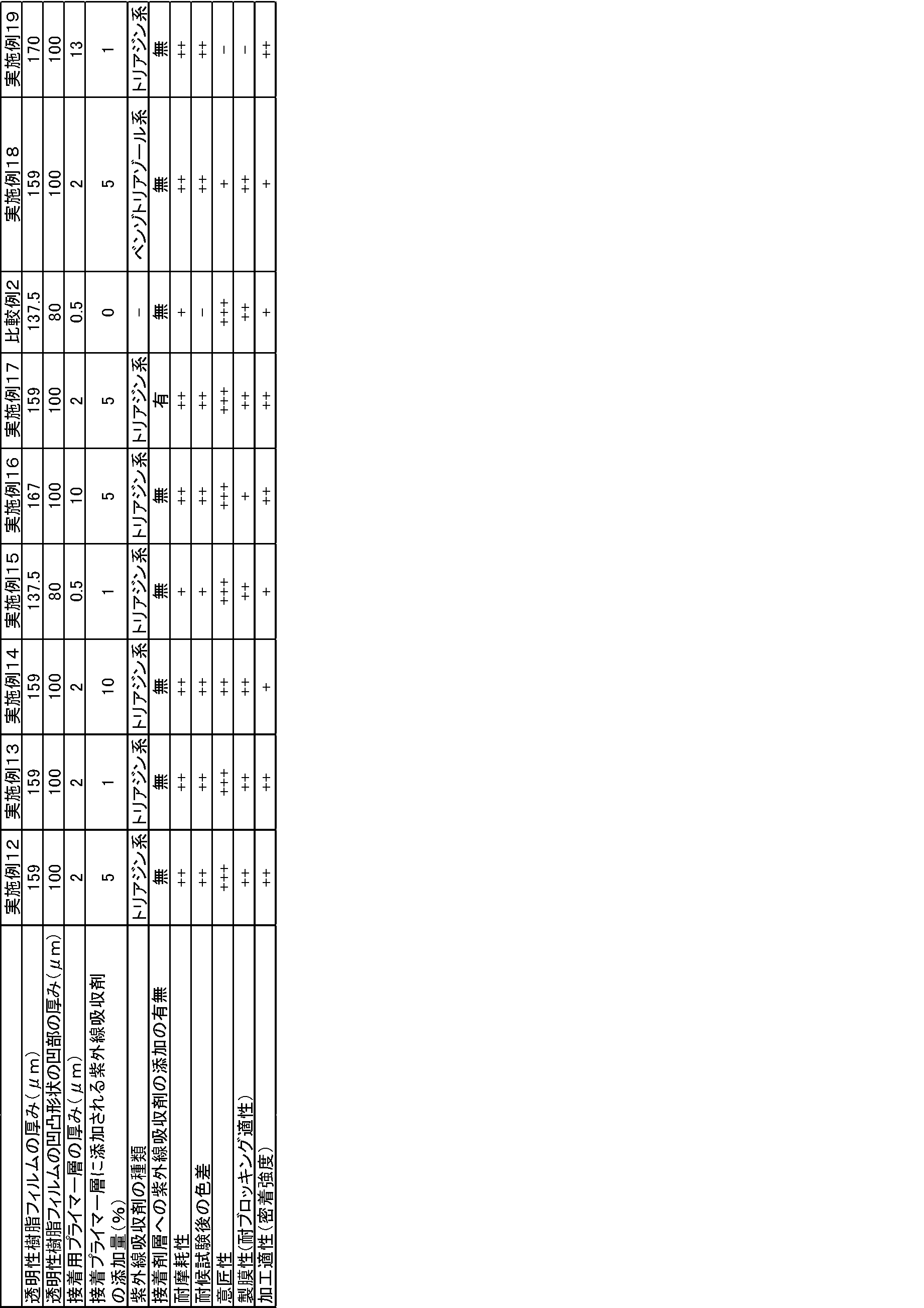
特に、透明性樹脂フィルムの凹凸形状の凹部の厚み、及び、Rzmax、並びに、接着剤層の厚みが所定の範囲であり、トリアジン系紫外線吸収剤を用いた実施例1~6では、耐摩耗性、意匠性及び加工適性においても優れていた。
一方で、紫外線吸収剤としてベンゾトリアゾール系紫外線吸収剤を用いた実施例7では、黄変が生じてしまい、意匠性においてわずかに劣っており、また、加工適性においても劣っていた。また、透明性樹脂フィルムの凹凸形状の凹部が80μm未満であった実施例8では、耐摩耗性において劣っていた。また、透明性樹脂フィルムのRzmaxが80μmを超える実施例9、接着剤層の厚みが10μm未満の実施例10では、エアガミが発生したため意匠性において劣っていた。また、接着剤層に紫外線吸収剤を3質量%含有する実施例11では、透明性が低下してしまい、意匠性において劣っていた。
紫外線吸収剤を含有する層を有さない比較例1では、耐候性において劣っていた。
特に、透明性樹脂フィルムの凹凸形状の凹部の厚みが所定の範囲であり、接着用プライマー層の厚みが所定の範囲であり、トリアジン系紫外線吸収剤を用いた実施例12~17では、耐摩耗性、意匠性、製膜性及び加工適性においても優れていた。
一方で、紫外線吸収剤としてベンゾトリアゾール系紫外線吸収剤を用いた実施例18では、黄変が生じてしまい、意匠性においてわずかに劣っていた。また、接着用プライマー層の厚みが10μmを超える実施例19では、透明性が低下してしまい、意匠性において劣っていた。
紫外線吸収剤を含有する層を有さない比較例2では、耐候性において劣っていた。
11 基材
12 絵柄層
13 接着剤層
20 透明性樹脂フィルム
21 接着用プライマー層
22 熱可塑性樹脂層
23 表面保護層用プライマー層
24 表面保護層
Claims (15)
- 厚み方向において、基材、絵柄層、及び、透明性樹脂フィルムがこの順に積層されている化粧板であって、
前記透明性樹脂フィルムは、少なくとも熱可塑性樹脂層を有し、かつ、前記絵柄層が積層される側と反対側に凹凸形状を有し、
前記絵柄層と、前記熱可塑性樹脂層との間に、少なくとも1層の紫外線吸収剤を含有する層を有する
ことを特徴とする化粧板。 - 前記透明性樹脂フィルムの凹凸形状の凹部の厚みは、80μm以上である請求項1記載の化粧板。
- 前記透明性樹脂フィルムは、前記絵柄層が積層される側に凹凸形状を有する請求項1又は2記載の化粧板。
- 前記透明性樹脂フィルムの前記絵柄層が積層される側に有する凹凸形状のJIS B 0601(2001)で定義されるRzmaxが、80μm以下である請求項3記載の化粧板。
- 前記絵柄層と前記透明性樹脂フィルムとの間に、接着剤層を有する請求項1、2、3又は4に記載の化粧板。
- 前記接着剤層の厚みは、10μm以上であり、かつ、前記透明性樹脂フィルムの前記絵柄層が積層される側に有する凹凸形状のJIS B 0601(2001)で定義されるRzmaxよりも大きい請求項5記載の化粧板。
- 前記接着剤層は、前記紫外線吸収剤を含有する層である請求項5又は6に記載の化粧板。
- 前記接着剤層は、紫外線吸収剤を0.5質量%以上2質量%以下で含有する請求項7記載の化粧板。
- 前記接着剤層に含有される紫外線吸収剤は、トリアジン系紫外線吸収剤である請求項7又は8記載の化粧板。
- 前記透明性樹脂フィルムは、前記熱可塑性樹脂層の前記絵柄層が積層される側に接着用プライマー層を有する請求項1、2、3、4、5、6、7、8又は9記載の化粧板。
- 前記接着用プライマー層は、前記紫外線吸収剤を含有する層である請求項10記載の化粧板。
- 前記接着用プライマー層に含有される紫外線吸収剤は、トリアジン系紫外線吸収剤である請求項11記載の化粧板。
- 前記接着用プライマー層は、厚みが0.5μm以上10μm以下である請求項10、11又は12記載の化粧板。
- 基材の一方に積層される絵柄層を保護するために用いられ、請求項1、2、3、4、5、6、7、8、9、10、11、12又は13記載の化粧板に用いられることを特徴とする透明性樹脂フィルム。
- 請求項1、2、3、4、5、6、7、8、9、10、11、12又は13記載の化粧板の製造方法であって、
透明性樹脂フィルムの絵柄層が積層される側の面に接着剤層を形成する工程、及び、
前記接着剤層を介して、前記透明性樹脂フィルムと前記絵柄層とを貼り合わせる工程を有する
ことを特徴とする化粧板の製造方法。
Priority Applications (4)
| Application Number | Priority Date | Filing Date | Title |
|---|---|---|---|
| CN201980067303.6A CN112839808A (zh) | 2018-10-12 | 2019-09-30 | 装饰板、透明性树脂膜和装饰板的制造方法 |
| EP19871990.8A EP3865299A4 (en) | 2018-10-12 | 2019-09-30 | Decorative sheet, transparent resin film, and decorative sheet production method |
| US17/283,662 US12441089B2 (en) | 2018-10-12 | 2019-09-30 | Decorative board, transparent resin film, and decorative board production method |
| KR1020217012503A KR102789470B1 (ko) | 2018-10-12 | 2019-09-30 | 화장판, 투명성 수지 필름 및 화장판의 제조 방법 |
Applications Claiming Priority (4)
| Application Number | Priority Date | Filing Date | Title |
|---|---|---|---|
| JP2018-193829 | 2018-10-12 | ||
| JP2018193829 | 2018-10-12 | ||
| JP2018-193828 | 2018-10-12 | ||
| JP2018193828 | 2018-10-12 |
Publications (1)
| Publication Number | Publication Date |
|---|---|
| WO2020075561A1 true WO2020075561A1 (ja) | 2020-04-16 |
Family
ID=70164882
Family Applications (1)
| Application Number | Title | Priority Date | Filing Date |
|---|---|---|---|
| PCT/JP2019/038597 Ceased WO2020075561A1 (ja) | 2018-10-12 | 2019-09-30 | 化粧板、透明性樹脂フィルム及び化粧板の製造方法 |
Country Status (5)
| Country | Link |
|---|---|
| US (1) | US12441089B2 (ja) |
| EP (1) | EP3865299A4 (ja) |
| KR (1) | KR102789470B1 (ja) |
| CN (1) | CN112839808A (ja) |
| WO (1) | WO2020075561A1 (ja) |
Cited By (1)
| Publication number | Priority date | Publication date | Assignee | Title |
|---|---|---|---|---|
| JP2021154742A (ja) * | 2019-09-30 | 2021-10-07 | 大日本印刷株式会社 | 化粧材の製造方法 |
Families Citing this family (1)
| Publication number | Priority date | Publication date | Assignee | Title |
|---|---|---|---|---|
| JP7828749B2 (ja) * | 2021-12-17 | 2026-03-12 | 共和レザー株式会社 | 合成樹脂表皮材、合成樹脂表皮材の製造方法及び成形体 |
Citations (14)
| Publication number | Priority date | Publication date | Assignee | Title |
|---|---|---|---|---|
| JPH11115106A (ja) * | 1997-10-14 | 1999-04-27 | Dainippon Printing Co Ltd | 化粧シート |
| JP2000289162A (ja) * | 1999-04-13 | 2000-10-17 | Toppan Printing Co Ltd | 化粧シート |
| JP2000343649A (ja) * | 1999-06-02 | 2000-12-12 | Toppan Printing Co Ltd | 化粧シート |
| JP2002036467A (ja) * | 2000-07-26 | 2002-02-05 | Toppan Printing Co Ltd | 化粧シート |
| JP2004090507A (ja) * | 2002-09-02 | 2004-03-25 | Dainippon Printing Co Ltd | 化粧シートおよび水系塗工液 |
| JP2005120255A (ja) | 2003-10-17 | 2005-05-12 | Toppan Printing Co Ltd | オーバーラミネート用フィルム |
| JP2006068947A (ja) * | 2004-08-31 | 2006-03-16 | Daiken Trade & Ind Co Ltd | 化粧材およびその製造方法 |
| JP2010069709A (ja) * | 2008-09-18 | 2010-04-02 | Toppan Cosmo Inc | 化粧シート |
| JP2012106506A (ja) * | 2005-03-31 | 2012-06-07 | Dainippon Printing Co Ltd | 化粧シート |
| JP2016168711A (ja) * | 2015-03-12 | 2016-09-23 | 凸版印刷株式会社 | 化粧シート及び化粧材 |
| WO2018062299A1 (ja) * | 2016-09-29 | 2018-04-05 | 大日本印刷株式会社 | 化粧シート及びこれを用いた化粧材 |
| JP2018058284A (ja) * | 2016-10-06 | 2018-04-12 | 凸版印刷株式会社 | 化粧シート及び化粧部材 |
| JP2018089970A (ja) * | 2016-11-29 | 2018-06-14 | 凸版印刷株式会社 | 化粧シート及び化粧シートの製造方法 |
| JP2019155777A (ja) * | 2018-03-14 | 2019-09-19 | 凸版印刷株式会社 | 化粧シート及び化粧部材 |
Family Cites Families (54)
| Publication number | Priority date | Publication date | Assignee | Title |
|---|---|---|---|---|
| JPH07256752A (ja) | 1994-03-24 | 1995-10-09 | Toppan Printing Co Ltd | 化粧シート及びこの製造に用いる冷却ロール |
| JPH09141812A (ja) | 1995-11-17 | 1997-06-03 | Oji Paper Co Ltd | エンボス剥離紙及びその製造方法 |
| JPH10211675A (ja) | 1997-01-31 | 1998-08-11 | Dainippon Printing Co Ltd | 化粧シート及びその製造方法 |
| JPH10217407A (ja) | 1997-02-03 | 1998-08-18 | Dainippon Printing Co Ltd | 化粧シート及びその製造方法 |
| JP4036510B2 (ja) | 1997-11-28 | 2008-01-23 | 大日本印刷株式会社 | 化粧板の製造方法 |
| JP2000015768A (ja) | 1998-07-01 | 2000-01-18 | Lintec Corp | 化粧シートの製造方法 |
| WO2000020296A1 (en) | 1998-10-06 | 2000-04-13 | Kao Corporation | Wrapping films |
| JP2000335628A (ja) | 1998-10-06 | 2000-12-05 | Kao Corp | ラッピングフィルム |
| EP1233007B1 (en) | 1999-07-01 | 2008-06-18 | Sekisui Chemical Co., Ltd. | Interlayer for Laminated Glass |
| JP3913948B2 (ja) | 1999-12-01 | 2007-05-09 | 積水化学工業株式会社 | 熱可塑性樹脂中間膜 |
| JP2003056168A (ja) | 2001-08-21 | 2003-02-26 | Toppan Printing Co Ltd | 床材及びその製造方法 |
| JP3973106B2 (ja) | 2003-11-07 | 2007-09-12 | 旭化成ケミカルズ株式会社 | 難燃性熱可塑性樹脂組成物 |
| JP4570424B2 (ja) * | 2004-03-29 | 2010-10-27 | 大日本印刷株式会社 | 化粧シート又は化粧板の表面に形成された凹部の着色方法 |
| JP2006077173A (ja) | 2004-09-10 | 2006-03-23 | Mitsubishi Chem Mkv Co | ポリオレフィン系樹脂フィルム |
| JPWO2006043460A1 (ja) | 2004-10-18 | 2008-05-22 | 旭化成ケミカルズ株式会社 | 難燃剤組成物 |
| US20060182984A1 (en) | 2005-02-17 | 2006-08-17 | Abele Wolfgang P | Protected polycarbonate films having thermal and UV radiation stability, and method of making |
| JP5034205B2 (ja) * | 2005-03-31 | 2012-09-26 | 大日本印刷株式会社 | 化粧シート |
| JP4892913B2 (ja) | 2005-09-30 | 2012-03-07 | 大日本印刷株式会社 | エンボス化粧シートの製造方法 |
| JP2007106056A (ja) | 2005-10-17 | 2007-04-26 | Toppan Cosmo Inc | 立体成形用化粧シート |
| PL1842647T3 (pl) | 2006-04-03 | 2009-07-31 | Kuraray Europe Gmbh | Sposób wytwarzania jednostronnie deseniowo tłoczonej folii na bazie częściowo zacetalowanego polialkoholu winylowego |
| JP2007297568A (ja) | 2006-05-08 | 2007-11-15 | Asahi Kasei Chemicals Corp | 難燃性ポリアミド系樹脂組成物 |
| JP5125160B2 (ja) * | 2007-03-14 | 2013-01-23 | 大日本印刷株式会社 | 賦型シート、樹脂化粧板及びその製造方法 |
| JP5076588B2 (ja) * | 2007-03-27 | 2012-11-21 | 大日本印刷株式会社 | 化粧シート |
| FR2920431B1 (fr) | 2007-08-29 | 2010-03-12 | Essilor Int | Procede de preparation d'un materiau transparent de type alliage de polymere thermodurcissable/polymere thermoplastique et son application dans l'optique pour la fabrication de verres organiques. |
| US8519035B2 (en) | 2007-09-04 | 2013-08-27 | Basf Se | Cyclic phosphines as flame retardants |
| EP2253467A4 (en) * | 2008-03-12 | 2013-01-16 | Dainippon Printing Co Ltd | DECORATION FOIL FOR THREE-DIMENSIONAL WORKPIECE |
| JP4964985B2 (ja) | 2008-03-24 | 2012-07-04 | シャープ株式会社 | ナノインプリントフィルムの製造方法 |
| US20110091690A1 (en) | 2009-10-20 | 2011-04-21 | Sipix Chemical Inc. | Composite optical film and decorated article comprising the same |
| US20110151208A1 (en) | 2009-12-20 | 2011-06-23 | Ming-Hung Huang | Method for fabricating decorative film and decorated article formed with the same thereof |
| JP5149916B2 (ja) | 2010-01-20 | 2013-02-20 | 住友化学株式会社 | 光学用マットフィルム |
| JP2012035513A (ja) * | 2010-08-06 | 2012-02-23 | Dainippon Printing Co Ltd | 化粧シート及びこれを用いた金属化粧板 |
| JP5664091B2 (ja) * | 2010-09-30 | 2015-02-04 | 大日本印刷株式会社 | 真空成形用化粧シート |
| EP2762309B1 (en) * | 2011-09-30 | 2019-12-04 | Dai Nippon Printing Co., Ltd. | Decorative sheet and decorative metal plate using same |
| JP5871568B2 (ja) | 2011-11-10 | 2016-03-01 | シャープ株式会社 | 光沢画像形成方法および光沢画像積層物 |
| JP5903391B2 (ja) | 2013-02-06 | 2016-04-13 | 大豊工業株式会社 | 摺動部材の製造方法 |
| JP6217293B2 (ja) | 2013-10-04 | 2017-10-25 | 富士ゼロックス株式会社 | ペン状デバイス用の専用紙 |
| KR102014667B1 (ko) | 2014-01-10 | 2019-08-26 | 다이니폰 인사츠 가부시키가이샤 | 화장 시트 및 화장판, 그리고 그것들의 제조 방법 |
| JP5839066B2 (ja) * | 2014-03-19 | 2016-01-06 | 大日本印刷株式会社 | 化粧シート、及びこれを用いた化粧部材 |
| JP6405225B2 (ja) | 2014-07-31 | 2018-10-17 | ダイヤプラスフィルム株式会社 | ポリオレフィン系樹脂発泡フィルムおよび積層フィルム |
| JP6549937B2 (ja) | 2014-09-26 | 2019-07-24 | セーレン株式会社 | 積層シートおよび成形体、並びにそれらの製造方法 |
| JP6368903B2 (ja) | 2014-10-08 | 2018-08-08 | 平岡織染株式会社 | 和紙調複合シート |
| JP6657599B2 (ja) * | 2015-03-30 | 2020-03-04 | 大日本印刷株式会社 | 加飾シート |
| JP6511949B2 (ja) * | 2015-05-12 | 2019-05-15 | 凸版印刷株式会社 | 化粧シート及び化粧板 |
| JP6552097B2 (ja) * | 2015-08-07 | 2019-07-31 | 森永製菓株式会社 | 飲食品の苦味改善剤、飲食品の苦味改善方法、及び飲食用組成物 |
| JP6720487B2 (ja) | 2015-08-25 | 2020-07-08 | 凸版印刷株式会社 | 化粧シート及び金属化粧部材 |
| ES2699451T3 (es) | 2016-02-24 | 2019-02-11 | Profol Kunststoffe Gmbh | Laminado decorativo de laminado en estado fundido |
| JP6364514B2 (ja) | 2016-02-26 | 2018-07-25 | 積水化学工業株式会社 | 耐火シートおよびその巻回体 |
| JP6805692B2 (ja) | 2016-03-31 | 2020-12-23 | 大日本印刷株式会社 | 化粧シート及びこれを用いた成型品 |
| KR102636882B1 (ko) | 2016-09-12 | 2024-02-20 | 도판 인사츠 가부시키가이샤 | 엠보싱 화장 시트 및 그 제조 방법 |
| JP7103224B2 (ja) | 2016-09-28 | 2022-07-20 | 大日本印刷株式会社 | 化粧シート及び化粧板 |
| JP6981126B2 (ja) | 2017-09-15 | 2021-12-15 | 東洋インキScホールディングス株式会社 | 感光性絶縁性樹脂組成物、シート状感光性絶縁性樹脂組成物、および剥離性フィルム付きのシート状感光性絶縁性樹脂組成物 |
| JP6750763B1 (ja) | 2018-10-12 | 2020-09-02 | 大日本印刷株式会社 | 透明性樹脂フィルム、化粧板及び化粧板の製造方法 |
| JP6787464B2 (ja) | 2018-10-12 | 2020-11-18 | 大日本印刷株式会社 | 化粧板及び該化粧板の製造方法 |
| KR102829658B1 (ko) | 2019-04-18 | 2025-07-03 | 다이니폰 인사츠 가부시키가이샤 | 투명성 수지 필름, 투명성 수지 필름의 제조 방법, 및 화장재 |
-
2019
- 2019-09-30 WO PCT/JP2019/038597 patent/WO2020075561A1/ja not_active Ceased
- 2019-09-30 KR KR1020217012503A patent/KR102789470B1/ko active Active
- 2019-09-30 CN CN201980067303.6A patent/CN112839808A/zh active Pending
- 2019-09-30 EP EP19871990.8A patent/EP3865299A4/en active Pending
- 2019-09-30 US US17/283,662 patent/US12441089B2/en active Active
Patent Citations (14)
| Publication number | Priority date | Publication date | Assignee | Title |
|---|---|---|---|---|
| JPH11115106A (ja) * | 1997-10-14 | 1999-04-27 | Dainippon Printing Co Ltd | 化粧シート |
| JP2000289162A (ja) * | 1999-04-13 | 2000-10-17 | Toppan Printing Co Ltd | 化粧シート |
| JP2000343649A (ja) * | 1999-06-02 | 2000-12-12 | Toppan Printing Co Ltd | 化粧シート |
| JP2002036467A (ja) * | 2000-07-26 | 2002-02-05 | Toppan Printing Co Ltd | 化粧シート |
| JP2004090507A (ja) * | 2002-09-02 | 2004-03-25 | Dainippon Printing Co Ltd | 化粧シートおよび水系塗工液 |
| JP2005120255A (ja) | 2003-10-17 | 2005-05-12 | Toppan Printing Co Ltd | オーバーラミネート用フィルム |
| JP2006068947A (ja) * | 2004-08-31 | 2006-03-16 | Daiken Trade & Ind Co Ltd | 化粧材およびその製造方法 |
| JP2012106506A (ja) * | 2005-03-31 | 2012-06-07 | Dainippon Printing Co Ltd | 化粧シート |
| JP2010069709A (ja) * | 2008-09-18 | 2010-04-02 | Toppan Cosmo Inc | 化粧シート |
| JP2016168711A (ja) * | 2015-03-12 | 2016-09-23 | 凸版印刷株式会社 | 化粧シート及び化粧材 |
| WO2018062299A1 (ja) * | 2016-09-29 | 2018-04-05 | 大日本印刷株式会社 | 化粧シート及びこれを用いた化粧材 |
| JP2018058284A (ja) * | 2016-10-06 | 2018-04-12 | 凸版印刷株式会社 | 化粧シート及び化粧部材 |
| JP2018089970A (ja) * | 2016-11-29 | 2018-06-14 | 凸版印刷株式会社 | 化粧シート及び化粧シートの製造方法 |
| JP2019155777A (ja) * | 2018-03-14 | 2019-09-19 | 凸版印刷株式会社 | 化粧シート及び化粧部材 |
Non-Patent Citations (1)
| Title |
|---|
| See also references of EP3865299A4 |
Cited By (9)
| Publication number | Priority date | Publication date | Assignee | Title |
|---|---|---|---|---|
| JP2021154742A (ja) * | 2019-09-30 | 2021-10-07 | 大日本印刷株式会社 | 化粧材の製造方法 |
| JP2021154743A (ja) * | 2019-09-30 | 2021-10-07 | 大日本印刷株式会社 | 化粧材の製造方法 |
| JP2021154744A (ja) * | 2019-09-30 | 2021-10-07 | 大日本印刷株式会社 | 化粧材の製造方法 |
| JPWO2021066034A1 (ja) * | 2019-09-30 | 2021-11-25 | 大日本印刷株式会社 | 化粧材の製造方法 |
| JP6996664B2 (ja) | 2019-09-30 | 2022-01-17 | 大日本印刷株式会社 | 化粧材の製造方法 |
| JP6996654B2 (ja) | 2019-09-30 | 2022-01-17 | 大日本印刷株式会社 | 化粧材の製造方法 |
| JP6996652B2 (ja) | 2019-09-30 | 2022-01-17 | 大日本印刷株式会社 | 化粧材の製造方法 |
| JP6996653B2 (ja) | 2019-09-30 | 2022-01-17 | 大日本印刷株式会社 | 化粧材の製造方法 |
| US11969980B2 (en) | 2019-09-30 | 2024-04-30 | Dai Nippon Printing Co., Ltd. | Method for producing decorative material |
Also Published As
| Publication number | Publication date |
|---|---|
| KR102789470B1 (ko) | 2025-03-31 |
| KR20210076023A (ko) | 2021-06-23 |
| US20220009207A1 (en) | 2022-01-13 |
| US12441089B2 (en) | 2025-10-14 |
| EP3865299A1 (en) | 2021-08-18 |
| CN112839808A (zh) | 2021-05-25 |
| EP3865299A4 (en) | 2022-06-15 |
Similar Documents
| Publication | Publication Date | Title |
|---|---|---|
| JP6737428B1 (ja) | 透明性樹脂フィルム、化粧板及び化粧板の製造方法 | |
| JP6787514B2 (ja) | 化粧板及び該化粧板の製造方法 | |
| JP6760532B2 (ja) | 透明性樹脂フィルム、化粧板及び化粧板の製造方法 | |
| JP6747565B2 (ja) | 透明性樹脂フィルム、化粧板及び化粧板の製造方法 | |
| KR20220070001A (ko) | 화장재의 제조 방법 | |
| KR102789470B1 (ko) | 화장판, 투명성 수지 필름 및 화장판의 제조 방법 | |
| KR101456731B1 (ko) | 화장 시트 및 그것을 사용한 화장판 | |
| JP6753504B2 (ja) | 透明性樹脂フィルム、化粧板及び化粧板の製造方法 | |
| WO2020075565A1 (ja) | 透明性樹脂フィルム、化粧板及び化粧板の製造方法 | |
| JP2008155460A (ja) | 化粧シートおよびそれを用いた化粧板 | |
| KR102956797B1 (ko) | 투명성 수지 필름, 화장판 및 화장판의 제조 방법 |
Legal Events
| Date | Code | Title | Description |
|---|---|---|---|
| 121 | Ep: the epo has been informed by wipo that ep was designated in this application |
Ref document number: 19871990 Country of ref document: EP Kind code of ref document: A1 |
|
| NENP | Non-entry into the national phase |
Ref country code: DE |
|
| ENP | Entry into the national phase |
Ref document number: 20217012503 Country of ref document: KR Kind code of ref document: A |
|
| ENP | Entry into the national phase |
Ref document number: 2019871990 Country of ref document: EP Effective date: 20210512 |
|
| WWG | Wipo information: grant in national office |
Ref document number: 17283662 Country of ref document: US |