WO2020189537A1 - Matériau filtrant et unité filtrante - Google Patents
Matériau filtrant et unité filtrante Download PDFInfo
- Publication number
- WO2020189537A1 WO2020189537A1 PCT/JP2020/010999 JP2020010999W WO2020189537A1 WO 2020189537 A1 WO2020189537 A1 WO 2020189537A1 JP 2020010999 W JP2020010999 W JP 2020010999W WO 2020189537 A1 WO2020189537 A1 WO 2020189537A1
- Authority
- WO
- WIPO (PCT)
- Prior art keywords
- filter medium
- fiber
- fiber sheet
- mass
- filter
- Prior art date
- Legal status (The legal status is an assumption and is not a legal conclusion. Google has not performed a legal analysis and makes no representation as to the accuracy of the status listed.)
- Ceased
Links
Images


Classifications
-
- B—PERFORMING OPERATIONS; TRANSPORTING
- B01—PHYSICAL OR CHEMICAL PROCESSES OR APPARATUS IN GENERAL
- B01D—SEPARATION
- B01D39/00—Filtering material for liquid or gaseous fluids
- B01D39/14—Other self-supporting filtering material ; Other filtering material
- B01D39/16—Other self-supporting filtering material ; Other filtering material of organic material, e.g. synthetic fibres
-
- B—PERFORMING OPERATIONS; TRANSPORTING
- B01—PHYSICAL OR CHEMICAL PROCESSES OR APPARATUS IN GENERAL
- B01D—SEPARATION
- B01D39/00—Filtering material for liquid or gaseous fluids
- B01D39/14—Other self-supporting filtering material ; Other filtering material
- B01D39/16—Other self-supporting filtering material ; Other filtering material of organic material, e.g. synthetic fibres
- B01D39/1607—Other self-supporting filtering material ; Other filtering material of organic material, e.g. synthetic fibres the material being fibrous
- B01D39/1623—Other self-supporting filtering material ; Other filtering material of organic material, e.g. synthetic fibres the material being fibrous of synthetic origin
-
- B—PERFORMING OPERATIONS; TRANSPORTING
- B01—PHYSICAL OR CHEMICAL PROCESSES OR APPARATUS IN GENERAL
- B01D—SEPARATION
- B01D39/00—Filtering material for liquid or gaseous fluids
- B01D39/14—Other self-supporting filtering material ; Other filtering material
- B01D39/16—Other self-supporting filtering material ; Other filtering material of organic material, e.g. synthetic fibres
- B01D39/18—Other self-supporting filtering material ; Other filtering material of organic material, e.g. synthetic fibres the material being cellulose or derivatives thereof
-
- B—PERFORMING OPERATIONS; TRANSPORTING
- B01—PHYSICAL OR CHEMICAL PROCESSES OR APPARATUS IN GENERAL
- B01D—SEPARATION
- B01D46/00—Filters or filtering processes specially modified for separating dispersed particles from gases or vapours
- B01D46/52—Particle separators, e.g. dust precipitators, using filters embodying folded corrugated or wound sheet material
-
- B—PERFORMING OPERATIONS; TRANSPORTING
- B01—PHYSICAL OR CHEMICAL PROCESSES OR APPARATUS IN GENERAL
- B01D—SEPARATION
- B01D46/00—Filters or filtering processes specially modified for separating dispersed particles from gases or vapours
- B01D46/52—Particle separators, e.g. dust precipitators, using filters embodying folded corrugated or wound sheet material
- B01D46/521—Particle separators, e.g. dust precipitators, using filters embodying folded corrugated or wound sheet material using folded, pleated material
-
- B—PERFORMING OPERATIONS; TRANSPORTING
- B32—LAYERED PRODUCTS
- B32B—LAYERED PRODUCTS, i.e. PRODUCTS BUILT-UP OF STRATA OF FLAT OR NON-FLAT, e.g. CELLULAR OR HONEYCOMB, FORM
- B32B5/00—Layered products characterised by the non- homogeneity or physical structure, i.e. comprising a fibrous, filamentary, particulate or foam layer; Layered products characterised by having a layer differing constitutionally or physically in different parts
- B32B5/22—Layered products characterised by the non- homogeneity or physical structure, i.e. comprising a fibrous, filamentary, particulate or foam layer; Layered products characterised by having a layer differing constitutionally or physically in different parts characterised by the presence of two or more layers which are next to each other and are fibrous, filamentary, formed of particles or foamed
- B32B5/24—Layered products characterised by the non- homogeneity or physical structure, i.e. comprising a fibrous, filamentary, particulate or foam layer; Layered products characterised by having a layer differing constitutionally or physically in different parts characterised by the presence of two or more layers which are next to each other and are fibrous, filamentary, formed of particles or foamed one layer being a fibrous or filamentary layer
- B32B5/26—Layered products characterised by the non- homogeneity or physical structure, i.e. comprising a fibrous, filamentary, particulate or foam layer; Layered products characterised by having a layer differing constitutionally or physically in different parts characterised by the presence of two or more layers which are next to each other and are fibrous, filamentary, formed of particles or foamed one layer being a fibrous or filamentary layer another layer next to it also being fibrous or filamentary
-
- B—PERFORMING OPERATIONS; TRANSPORTING
- B01—PHYSICAL OR CHEMICAL PROCESSES OR APPARATUS IN GENERAL
- B01D—SEPARATION
- B01D2239/00—Aspects relating to filtering material for liquid or gaseous fluids
- B01D2239/02—Types of fibres, filaments or particles, self-supporting or supported materials
-
- B—PERFORMING OPERATIONS; TRANSPORTING
- B01—PHYSICAL OR CHEMICAL PROCESSES OR APPARATUS IN GENERAL
- B01D—SEPARATION
- B01D2239/00—Aspects relating to filtering material for liquid or gaseous fluids
- B01D2239/06—Filter cloth, e.g. knitted, woven non-woven; self-supported material
- B01D2239/065—More than one layer present in the filtering material
-
- Y—GENERAL TAGGING OF NEW TECHNOLOGICAL DEVELOPMENTS; GENERAL TAGGING OF CROSS-SECTIONAL TECHNOLOGIES SPANNING OVER SEVERAL SECTIONS OF THE IPC; TECHNICAL SUBJECTS COVERED BY FORMER USPC CROSS-REFERENCE ART COLLECTIONS [XRACs] AND DIGESTS
- Y02—TECHNOLOGIES OR APPLICATIONS FOR MITIGATION OR ADAPTATION AGAINST CLIMATE CHANGE
- Y02A—TECHNOLOGIES FOR ADAPTATION TO CLIMATE CHANGE
- Y02A50/00—TECHNOLOGIES FOR ADAPTATION TO CLIMATE CHANGE in human health protection, e.g. against extreme weather
- Y02A50/20—Air quality improvement or preservation, e.g. vehicle emission control or emission reduction by using catalytic converters
- Y02A50/2351—Atmospheric particulate matter [PM], e.g. carbon smoke microparticles, smog, aerosol particles, dust
Definitions
- the present invention relates to a filter medium that can be used as an air filter for general industry, air conditioners, air purifiers, vacuum cleaners, automobiles, etc., and a filter unit provided with the filter medium.
- Air filters and air purifiers used in buildings, factories, automobiles, general households, etc. use air filters with filter media loaded in the frame.
- Such a filter is subjected to a mountain valley-shaped process called pleating process to increase the filtration area so that more filter media can be loaded within the limited dimensions.
- the shape is maintained by applying a string-shaped resin part (bead) containing hot melt resin extending in the direction intersecting the ridgeline of the mountain part of the pleats to the pleated filter medium, and the gap between the pleats is maintained. Is secured, and the one combined with the frame is used as the filter unit.
- Such a pleated filter medium is obtained by laminating a plurality of fiber sheets having different densities in order to maintain the strength as an air filter, to achieve high collection and reduction of pressure loss (low pressure loss). Is often used.
- the filter medium obtained by laminating a plurality of fiber sheets includes, for example, a fiber sheet (aggregate layer) for imparting strength as an air filter and a fiber sheet (dust collection layer) for collecting particles in the air. It is a filter medium in which In particular, the fiber sheet used as the aggregate layer is required to have high strength and low pressure loss.
- the pressure loss of the filter unit in which the pleated filter medium is loaded into the frame is the pressure loss due to the ventilation resistance of the filter medium itself (filter medium pressure loss) and the pressure loss due to the structure caused by the deformation of the pleated filter medium due to wind pressure (structural pressure loss). It consists of.
- structural pressure loss means that when air is passed through the filter media, the filter media expands and deforms due to the wind pressure on the filter media, narrowing the width of the air flow path sandwiched between adjacent pleated filter media, and the filter media come into contact with each other. This is caused by the difficulty of air flow. Therefore, in order to reduce structural pressure loss, a filter medium having a thin thickness and being hard to bend has been studied.
- Patent Document 1 has a non-woven fabric mainly composed of organic fibers in which single fibers are fixed as a practical filter medium suitable for high wind velocity filtration and capable of mini-pleating with high air permeability and thin filter medium thickness.
- the non-woven fabric is composed of a plurality of single fibers having different young ratios and fineness, and contains at least non-crimped single fibers having a Young ratio of 150 cN / dtex or more and a fineness of 7 dtex or more at a ratio of 20% or more of the total fiber mass.
- the single fibers are fixed with a resin having a glass transition temperature of 30 ° C. or higher, the specific strength at 1% elongation is 1000 N ⁇ cm / g or more, and the air permeability is 100 cm 3 / cm 2 ⁇ sec.
- the above-mentioned filter medium is disclosed.
- Patent Document 2 it is advantageous to add short glass fibers to the aggregate layer of the filter medium for the filter because it has high strength and can reduce the pressure loss.
- the filter material containing the glass fibers is pleated, the fluffing of the glass fibers occurs. It is described that it will be a problem.
- the filter medium as a filter medium for a filter containing short glass fibers and less fluffing, the filter medium contains two or more layers of sheets, and at least the first sheet contains short glass fibers, organic short fibers and a binder resin.
- the organic short fibers include those having a fiber diameter of at least 1 to 20 ⁇ m, and the organic short fibers having a fiber diameter of 1 to 20 ⁇ m are at least 25% by mass with respect to the glass short fibers, and the second sheet.
- a filter medium for a filter characterized in that is an electlet-processed non-woven fabric sheet, is disclosed.
- the structural pressure loss in the pleated filter medium folded so that the peaks and valleys are alternately continuous is that when air is passed through the filter medium, the filter medium expands and deforms due to the wind pressure on the filter medium. , It occurs because the width of the air flow path sandwiched between adjacent pleated filter media is narrowed, and the filter media come into contact with each other, making it difficult for air to flow. Therefore, when the pitch between adjacent mountain portions is as short as 5.0 mm or less or 3.5 mm or less, the air flow path is narrow and the pressure loss during ventilation becomes particularly large.
- Patent Document 1 it is considered to suppress the pressure loss by using a pleated filter medium having a height of 8 mm in the pleated portion, but the pitch of the pleated peak portion is not described. .. Patent Document 2 does not describe or suggest the problem that the pressure loss becomes large in the filter medium having a short pitch of the mountain portion of the pleated filter medium and the means for solving this problem.
- one or more embodiments of the present invention provide pressure loss during ventilation in a pleated filter medium in which peaks and valleys are alternately continuous and the pitch of the peaks on at least one surface is 5.0 mm or less. The purpose is to reduce.
- One or more embodiments of the present invention for achieving the above object have any of the following configurations.
- the thickness of the filter medium is 0.10 mm to 0.43 mm.
- the filter medium according to (1) which has a shape located on a curve.
- the filter medium according to one or more embodiments of the present invention and the filter unit using the same have a low pressure loss even though the pitch of the pleated peaks is as short as 0.5 mm to 5.0 mm.
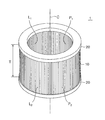
- FIG. 1 is a perspective view of a filter unit 1 including a filter medium 10 and a pair of frames 20 and 20 that support the filter medium 10.
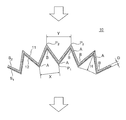
- FIG. 2 is a schematic view of a part of a cross section of the filter medium 10 in the filter unit 1 shown in FIG. 1 by a plane perpendicular to the axis C.
- FIG. 3 shows a string-shaped resin portion containing hot melt resin in a direction orthogonal to the ridge line L 1 of the mountain portion A on the side of the first surface S 1 in order to facilitate holding the pleated shape of the filter medium 10.
- Bead) R 1 is continuously applied, and a string-shaped resin portion (bead) R 2 containing hot melt resin is continuously applied in a direction orthogonal to the ridge line L 2 of the mountain portion A on the side of the second surface S 2.
- the applied filter medium 10 a schematic view of a portion of a section along the ridge line L 1, the plane perpendicular to the L 2 at the crest a.
- FIG. 4 shows a string-shaped resin portion containing a hot melt resin in a direction orthogonal to the ridge line L 1 of the mountain portion A on the side of the first surface S 1 in order to facilitate holding the pleated shape of the filter medium 10.
- Bead) R 1 is applied intermittently, and a string-shaped resin portion (bead) R 2 containing hot melt resin is intermittently applied in a direction orthogonal to the ridge line L 2 of the mountain portion A on the side of the second surface S 2.
- the applied filter medium 10 a schematic view of a portion of a section along the ridge line L 1, the plane perpendicular to the L 2 at the crest a.
- the resin portions R 1 and R 2 since the adjacent resin portions R 1 and R 2 are in contact with each other and connected to each other, the resin portions R 1 and R 2 form a single string and extend continuously.
- the filter medium of the present invention has a structure in which a first fiber sheet which is an aggregate layer and a second fiber sheet which is a dust collecting layer are laminated. Further, the filter medium of the present invention has a pleated shape in which peaks and valleys are alternately continuous. In this pleated shape, the height of the ridges is 5 mm to 50 mm, and the pitch of the ridges on at least one surface is 0.5 mm to 5.0 mm. A preferred embodiment of the pleated shape of the filter medium will be described with reference to the specific examples shown in FIGS.
- FIG. 1 is a perspective view of a filter unit 1 including a filter medium 10 and a pair of frames 20 and 20 supporting the filter medium 10.
- the filter medium 10 is formed into a cylindrical shape centered on the shaft C, and both ends thereof are fixed and sealed to the annular frames 20 and 20, respectively, with a hot melt adhesive.
- the air processed by the filter unit 1 is supplied from the outside of the filter medium 10, passes through the filter medium 10, and is discharged from the inside in the direction of the axis C.
- FIG. 2 is a schematic view of a part of a cross section of the filter medium 10 in the filter unit 1 shown in FIG. 1 by a plane perpendicular to the axis C.
- the filter medium 10 has a pleated shape in which mountain portions A and valley portions B are folded so as to be alternately continuous.
- One surface of the filter medium 10 and the first surface S 1, the rear surface of the first surface and the second surface S 2.
- the first surface S 1 is the inner peripheral surface of the filter medium 10
- the second surface S 2 is the outer peripheral surface of the filter medium 10.
- the top of the mountain portion A of the first side surface S 1 and top P 1 to the top of the mountain portion A of the second side surface S 2 with the top P 2.
- the air flow is indicated by a white arrow.
- the ridge line formed by the top P 1 is the ridge line formed by the top P 1 on the side of the first surface S 1
- the ridge line L is formed by the top P 2 on the top of the mountain portion A on the side of the second surface S 2. Let it be 2 .
- the height H of the crest A is from the top P 1 of the first side surface S 1, up to the top P 2 of the second side surface S 2, along a direction perpendicular to the plane containing the top P 1 Refers to the distance.
- the height H of the mountain portion A is preferably 5 mm to 50 mm.
- At least one of the pitch X of the mountain portion A on the first surface S1 of the filter medium 10 and the pitch Y of the mountain portion A on the second surface S2 is preferably 0.5 mm to 5.0 mm. It is preferably 0.5 mm to 3.5 mm, more preferably 0.5 mm to 3.0 mm.
- the top portion P 1 of the mountain portion A on the side of the first surface S 1 of the filter medium 10 is formed.
- the pitch X of ridges a in the first surface S 1 is typically within the predetermined range.
- the pitch Y of the mountain portion A on the second surface S2 may be within the predetermined range.
- the structural pressure drop in the pleated filter medium is particularly large when the pitch of the peaks on at least one surface is 3.5 mm or less or 3.0 mm or less, but in the present embodiment, such a short peak pitch is used. It is possible to reduce the structural pressure loss in the pleated filter medium.
- the crest A is (coincident to the axis C) extending a direction perpendicular on the section, the top P 1 of the peak portion A of the first side surface S 1 of the filter medium 10, when located on the convex curve to a second side surface S 2, the curvature radius of the curve can be, for example 200mm or less, it is 150mm or less or 120mm or less.
- Such a filter medium 10 has a problem that the pitch X of the mountain portion A on the first surface S1 is particularly small and the structural pressure loss becomes large. However, in the present embodiment, this problem can be solved by the features described later. it can.
- a convex curve extends over the entire circumference toward the second surface where the top of the mountain portion is located on the side of the first surface of the filter medium on the cross section perpendicular to the direction in which the mountain portion extends.
- It is a cylindrical filter medium that has a closed circular shape, but may have other shapes.
- the curve may be a partially open curve such as a parabola or a semicircle, or a curve having a shape closed over the entire circumference such as an ellipse or a circular or flattened ellipse. May be good.
- a string-shaped resin portion (bead) containing hot melt resin extending in the direction intersecting the ridgeline of the mountain portion is applied on one or both surfaces of the filter medium. It is preferable to form the ridge.
- the resin portion is not depicted in FIGS. 1 and 2.
- FIGS. 3 and 4 describe an embodiment of the filter medium 10 coated with the string-shaped resin portions R 1 and R 2 containing the hot melt resin extending in the direction orthogonal to the ridge lines L 1 and L 2 of the mountain portion A. Therefore, the pitch of the mountain portion A of the filter medium 10 is drawn at a pitch different from that in FIG.
- the filter medium 10 according to the embodiment shown in FIGS. 3 and 4 has the same characteristics as the filter medium 10 according to the embodiment shown in FIG. 2 except that the resin portions R 1 and R 2 are applied.
- FIG. 3 shows a string-shaped resin portion containing hot melt resin in a direction orthogonal to the ridge line L 1 of the mountain portion A on the side of the first surface S 1 in order to facilitate holding the pleated shape of the filter medium 10.
- Bead) R 1 is continuously applied, and a string-shaped resin portion (bead) R 2 containing hot melt resin is continuously applied in a direction orthogonal to the ridge line L 2 of the mountain portion A on the side of the second surface S 2.
- the applied filter medium 10 a schematic view of a portion of a section along the ridge line L 1, the plane perpendicular to the L 2 at the crest a.
- the string-shaped resin portions R 1 and R 2 extend in a direction orthogonal to the ridge lines L1 and L2 of the mountain portion A.
- FIG. 4 shows a string-shaped resin portion containing a hot melt resin in a direction orthogonal to the ridge line L 1 of the mountain portion A on the side of the first surface S 1 in order to facilitate holding the pleated shape of the filter medium 10.
- Bead) R 1 is applied intermittently, and a string-shaped resin portion (bead) R 2 containing hot melt resin is intermittently applied in a direction orthogonal to the ridge line L 2 of the mountain portion A on the side of the second surface S 2.
- the applied filter medium 10 a schematic view of a portion of a section along the ridge line L 1, the plane perpendicular to the L 2 at the crest a.
- the string-shaped resin portions R 1 and R 2 are present in the vicinity of the tops P 1 and P 2 of the mountain portion A, and are not present in the vicinity of the bottom of the valley portion B, but are adjacent mountains. Since the resin portions R 1 and R 2 applied to the portion A are in contact with each other, the resin portions R 1 and R 2 form a single string and are orthogonal to the ridge lines L 1 and L 2 of the mountain portion A. It extends in the direction.
- the string-shaped resin portions R 1 and R 2 extend in the direction orthogonal to the ridge lines L 1 and L 2 of the mountain portion A, but are limited to this embodiment. Instead, it suffices to extend in the direction intersecting the ridges L1 and L2 of the mountain portion A.
- the string-shaped resin portions R 1 and R 2 may partially or completely permeate the fiber sheet of the filter medium 10.
- a plurality of string-shaped resin portions R 1 and R 2 may be formed at different positions in the direction in which the mountain portion A extends, or only one may be formed.
- the string-shaped resin portions R 1 and R 2 may be formed over the entire circumferential direction of the axis C of the filter medium 10, or may be formed only partially. Further, a resin part R 1 string-like first on the surface S 1 of the filter medium 10, one of the string-like resin portion R 2 on the second surface S 2 of the filter medium 10 may not be present ..
- the thickness W of the string-shaped resin portions R 1 and R 2 is preferably 0.5 mm to 2.5 mm. ..
- the width of the string-shaped resin portions R 1 and R 2 in the directions of the ridges L 1 and L 2 of the mountain portion A can be, for example, 0.5 mm to 2.5 mm.
- applying hot melt resin on the filter medium in the direction intersecting the ridgeline of the mountain portion of the filter medium to form a string-shaped resin portion is referred to as "bead processing", and the formed string.
- the resin part in the shape may be referred to as a "bead”.
- the filter medium of the present invention preferably has a thickness of 0.10 mm to 0.43 mm, more preferably 0.10 mm to 0.40 mm, more preferably 0.10 mm to 0.37 mm, and 0. It is particularly preferably .10 mm to 0.34 mm.
- the thickness of the filter medium is more preferably 0.20 mm or more in the above range. When the thickness of the filter medium is within this range, the structural pressure loss is reduced.
- the thickness of the filter medium corresponds to the thickness D of the filter medium 10 shown in FIGS.
- the basis weight of the filter medium of the present invention is not particularly reduced, and can be, for example, 10 to 100 g / m 2 , preferably 20 to 80 g / m 2 .
- the filter medium of the present invention preferably has a rigidity of 1000 ⁇ N or more, more preferably 1200 ⁇ N or more, more preferably 1300 ⁇ N or more, and particularly preferably 1500 ⁇ N or more according to the Gale method.
- the pressure loss due to the structure of the pleated filter medium is determined by the balance between the thickness of the filter medium and the rigidity and softness. The thinner the thickness, the lower the pressure loss, which is preferable.
- the rigidity of the filter medium by the Gale method is at least 1000 ⁇ N. is necessary. When the rigidity of the filter medium by the Gale method is within the above range, the deformation of the filter medium is suppressed during ventilation, so that the structural pressure loss is reduced.
- the rigidity of the filter medium by the Gale method is preferably higher as long as it does not impair the pleating workability, and the upper limit is not particularly limited, but it should be 5000 ⁇ N or less in order to achieve good foldability capable of forming a sharp mountain shape. Is preferable, and typically it can be 4000 ⁇ N or less or 3500 ⁇ N or less.
- the filter medium of the present invention has a structure in which a first fiber sheet which is an aggregate layer and a second fiber sheet which is a dust collecting layer are laminated, and other sheets may be further laminated.
- the first fiber sheet and the second fiber sheet are each preferably composed of a non-woven fabric sheet.
- the filter medium 10 of the illustrated embodiment is a laminated filter medium in which a first fiber sheet 11 which is an aggregate layer and a second fiber sheet 12 which is a dust collecting layer are laminated.
- the first fiber sheet 11 is arranged on the outer peripheral side corresponding to the upstream of the air flow
- the second fiber sheet 12 is arranged on the inner peripheral side corresponding to the downstream of the air flow.
- the first fiber sheet which is the aggregate layer, aims to impart mechanical strength such as rigidity to the filter medium.
- the first fiber sheet preferably has a modulus of 50 N or more at 1% elongation.
- a filter medium containing the first fiber sheet having a modulus in this range when stretched by 1% suppresses deformation of the filter medium during ventilation, so that structural pressure loss is particularly reduced.
- the first fiber sheet preferably contains fibers and a binder resin, and preferably further contains pulp.
- Examples of the fiber contained in the first fiber sheet include one or more selected from organic fibers and inorganic fibers.
- the organic fiber include polyester fiber (PET fiber and the like), vinylon fiber, polyamide fiber, ultrahigh molecular weight polyethylene fiber, polypropylene fiber, polyaramid fiber, carbon fiber and the like.
- the organic fiber one or more kinds snooped from polyester fiber and vinylon fiber are particularly preferable.
- the inorganic fiber include glass fiber and metal fiber, and glass fiber is particularly preferable.
- Vinylon fibers include vinylon fibers produced by a water-based wet spinning method that has been used for a long time, and vinylon fibers having a high young rate produced by a newly developed solvent wet cooling gel spinning method.
- the vinylon fibers produced by the solvent wet cooling gel spinning method have a higher Young ratio and a higher elongation at break of 4 to 15% than the vinylon fibers produced by the conventionally used aqueous wet spinning method.
- the fiber contained in the first fiber sheet is preferably a non-crimped single fiber.
- the fiber accumulation in the non-woven fabric becomes flat, so that the orientation of each single fiber is one-dimensional, and there is no looseness. Therefore, when an external force is applied to the non-woven fabric, the elongation due to the looseness is small, and thus the tensile resistance force corresponding to the physical properties of the single yarn is likely to be generated immediately, which is preferable.
- the blending ratio of fibers having a Young's modulus of 200 cN / dtex or more is preferably 35% by mass or more, more preferably 38% by mass or more, more preferably 40% by mass or more, still more preferably 42% by mass or more. More preferably, it is 45% by mass or more.
- the first fiber sheet having a blending ratio of fibers having a Young's modulus of 200 cN / dtex or more in this range is particularly preferable as an aggregate layer because it has high strength and is not easily deformed, and the pressure loss of the filter medium containing the same is small.
- the upper limit of the blending ratio of fibers having a Young's modulus of 200 cN / dtex or more in the first fiber sheet is not particularly limited, but may be, for example, 70% by mass or less or 60% by mass or less.
- the fiber having a Young's modulus of 200 cN / dtex or more may be an organic fiber or an inorganic fiber, but one or more selected from vinylon fiber and glass fiber can be preferably used. More preferably, the first fiber sheet contains 5% by mass or more of organic fibers having a Young's modulus of 200 cN / dtex or more based on the total amount of the first fiber sheet.
- an organic fiber contained in the first fiber sheet particularly an organic fiber having a Young's modulus of 200 cN / dtex or more
- a fiber having a large fineness is suitable for increasing strength and bending rigidity.
- organic fibers having a fineness of 7 dtex (fiber diameter 26 ⁇ m) or more are suitable.
- the fineness is preferably in the range of 7 to 40 dtex (fiber diameter 26 to 63 ⁇ m).
- the fine fiber plays a role of joining the high-strength thick fiber.
- the organic fiber contained in the first fiber sheet a mixed fiber of a fiber having a high fineness and a fiber having a fineness is preferable.
- the fiber diameter added next to the fineness is the fiber diameter when the specific gravity of the fiber material is 1.30 g / cm 3 .
- organic fibers that form the skeleton have low collection efficiency, so fine organic fibers with a fineness of 1 to 6 dtex (fiber diameter of 10 to 24 ⁇ m) are also blended to ensure collection performance from fine particles to coarse particles and dust. It is good to control the holding amount.
- organic fibers include polyester fibers.
- the fiber length of the organic fiber contained in the first fiber sheet is not particularly limited, but the average fiber length is 5 mm or more from the viewpoint of imparting sufficient tensile strength and preventing scattering and fluffing when glass fiber is contained. Is preferable.
- the upper limit of the fiber length of the organic fiber is not particularly limited, but if the fiber length is too long, the dispersibility in water tends to deteriorate, so 30 mm or less is preferable, and 20 mm or less is more preferable.
- the fiber diameter of the glass fiber contained in the first fiber sheet is not particularly limited, but as with the organic fiber, if the fiber diameter is small, it is difficult to impart the intended strength as an aggregate layer, so that the glass fiber
- the fiber diameter is preferably 5 ⁇ m or more, more preferably 10 ⁇ m or more, more preferably 13 ⁇ m or more, and if the fiber diameter is too large, there are problems that the filter medium is difficult to bend during pleating and the surface of the filter medium has a lot of fluff.
- the fiber diameter of the above is preferably 25 ⁇ m or less, more preferably 20 ⁇ m or less, and even more preferably 15 ⁇ m or less.
- the fiber length of the glass fiber is not particularly limited, but if the fiber length is short, the number of entanglement points with the organic fiber for one glass fiber is reduced, and the glass fiber is easily scattered from the sheet.
- the average fiber length is preferably 5 mm or more, more preferably 10 mm or more, and if the fiber length is too long, the dispersibility in water tends to deteriorate, so that the average fiber length is 30 mm or less. It is preferably 20 mm or less, and more preferably 20 mm or less.
- the glass fiber is preferably 50% by mass or less, more preferably 45% by mass or less, and more preferably 40% by mass or less with respect to the total amount of the first fiber sheet.
- the first fiber sheet does not have to contain glass fibers at all, but the glass fibers are preferably 10% by mass or more, more preferably 20% by mass or more, based on the total amount of the first fiber sheet. When it is preferably 30% by mass or more, it is easy to increase the rigidity and softness of the filter medium containing the first fiber sheet, and the thickness of the first fiber sheet is reduced to reduce the pressure loss as the filter medium. Is easy.
- the first fiber sheet preferably further contains pulp.
- the pulp has a function of reducing the thickness of the first fiber sheet to reduce the pressure loss of the filter medium and a function of suppressing the popping out or fluffing of the glass fiber when the glass fiber is contained.
- the pulp content per total amount of the first fiber sheet is preferably 10% by mass or more, more preferably 15% by mass or more.
- the upper limit of the pulp content per total amount of the first fiber sheet is not particularly limited, but is preferably 30% by mass or less, and more preferably 25% by mass or less.
- the first fiber sheet contains a binder resin.
- the binder resin has a function of adhering the fibers to each other and giving the first fiber sheet strength.
- the binder resin is not particularly limited, and polyvinyl alcohol resin, vinyl acetate resin, acrylic resin, urethane resin, acrylic-styrene resin and the like can be used. In particular, it is preferable to use a polyvinyl alcohol resin or an acrylic resin as the binder resin because there is little offensive odor. Further, the binder resin is preferably 10 to 40% by mass in the first fiber sheet. If it is small, the strength of the first fiber sheet tends to decrease, and if it is large, the pressure loss of the filter medium tends to increase.
- the first fiber sheet contains pigments, dyes, colorants, water repellents, water absorbents, flame retardants, stabilizers, antioxidants, ultraviolet absorbers, metal particles, etc.
- Other components such as inorganic compound particles, crystal nucleating agents, lubricants, plasticizers, fragrances, deodorants, antibacterial agents, antifungal agents, antiviral agents, antiallergen agents, repellents, gas adsorbents, gas adsorbed porous bodies, etc. Can be added.
- the basis weight can be, for example, 10 g / m 2 to 60 g / m 2 , preferably 20 g / m 2 to 50 g / m 2 .
- the thickness can be, for example, 0.05 mm to 0.33 mm, preferably 0.10 mm to 0.30 mm.
- the method for producing the first fiber sheet is not particularly limited and can be arbitrarily selected from known methods, but the papermaking method is preferable because it is easy to mix thick and fine fibers.
- the second fiber sheet is not particularly limited as long as it is a fiber sheet having a function of collecting (collecting) particles such as dust, but is a non-woven fabric manufactured by a manufacturing method (for example, a melt blow method) capable of ultrafine particles. It is preferable to have.
- the non-woven fabric preferably uses polyolefin fibers, particularly preferably polypropylene fibers, in order to achieve even higher collection efficiency.
- the second fiber sheet is also preferably an electret-processed non-woven fabric.
- the electret processing method is not particularly limited, and a charging method arbitrarily selected from a corona discharge method, a fluid contact method, a triboelectric charging method, etc. may be applied to the non-woven fabric sheet.
- the fiber used for the electret non-woven fabric in the present invention may contain an additive for improving the charging effect by the electret processing.
- an additive for improving the charging effect by the electret processing Various types of such additives can be used, but among them, hindered amine-based additives and triazine-based additives are more preferable because static electricity can be easily maintained.
- the basis weight can be, for example, 10 g / m 2 to 50 g / m 2 , preferably 10 g / m 2 to 40 g / m 2 . be able to. Further, for the same reason, the thickness can be, for example, 0.05 mm to 0.20 mm, preferably 0.05 mm to 0.15 mm.
- the method for producing the filter medium by laminating the first fiber sheet and the second fiber sheet is not particularly limited.
- the first fiber sheet and the second fiber sheet may be simply laminated, or the first fiber sheet and the second fiber sheet are bonded to each other via an adhesive such as a heat-sealing resin or a moisture-curable resin. You may.
- the method of adhering the first fiber sheet and the second fiber sheet with an adhesive is preferable because the fiber sheets are not easily peeled off during pleating.
- a heat-sealing resin is used, a powdery adhesive is sprayed on one of the first fiber sheet and the second fiber sheet, heated in a furnace, and then laminated with the other fiber sheet. be able to.
- a method of pleating the filter medium there are methods such as a reciprocating method and a rotary method, and any of them can be used. Further, in order to maintain the pleated shape, it is preferable to perform processing using a comb for holding a gap between mountains or a separator such as a string-shaped resin part (bead), and the bead is used from the viewpoint of production efficiency. It is preferable to perform the processing (bead processing).
- the filter unit of the present invention is obtained by combining and fixing the filter medium of the present invention and a frame body that supports the filter medium.
- a sheet in which functional particles such as a fungicide, an antiallergen agent, and a gas-adsorbed porous body are impregnated or sandwiched upstream or downstream of the filter medium is fixed to the frame together with the filter medium.
- a metal frame, a non-woven fabric frame, a paper frame, or the like can be used, and any shape may be used.
- An adhesive tape, urethane adhesive, hot melt adhesive, or the like can be used to bond the frame to the filter medium, but the hot melt adhesive is preferable from the viewpoint of workability and adhesiveness.
- a pair of annular frame bodies 20 and 20 are used as the frame body, but the present invention is not limited to this example.
- ⁇ Thickness> The thickness was measured using a dial thickness gauge (TECLOCK SM-114 stylus shape 10 mm ⁇ , scale 0.01 mm, measuring force 2.5 N). The measurement was performed by sampling 5 places arbitrarily from 1 sample, and the average value was used.
- TECLOCK SM-114 stylus shape 10 mm ⁇ , scale 0.01 mm, measuring force 2.5 N The measurement was performed by sampling 5 places arbitrarily from 1 sample, and the average value was used.
- the rigidity and softness were measured by a Gale / flexibility tester manufactured by Toyo Seiki Seisakusho Co., Ltd. based on the 6.7.4 Gale method of JIS L 1913 (2010).
- the rigidity and softness of the Gale tester was determined by the following method. Five test pieces were collected with the length direction of the non-woven fabric (direction in which the non-woven fabric flows in the manufacturing process: MD direction) as the length direction of the test piece. Using the following formula, the average value of 5 test pieces, 1 time each on the front and back, was calculated and rounded to one significant digit to calculate the rigidity ( ⁇ N) of the sample.
- the stiffness by the Gale method may be referred to as "Gale stiffness” or "rigidity”.
- ⁇ Fiber sheet modulus> According to the method described in 6.3 of JIS L 1913 (2010), a sample of 5 cm ⁇ 20 cm was collected from the first fiber sheet used in Examples and Comparative Examples, and the vertical direction (nonwoven fabric flow in the manufacturing process). The modulus at 1% extension was measured by pulling at a gripping interval of 10 cm and a speed of 10 cm / min with respect to the direction (MD direction).
- the filter is set by sandwiching it between the upper and lower wind tunnels of the measuring device, closed so that air does not leak between the filter unit and the wind tunnel, and the filter unit when air is passed through with a suction processing air volume of 8.0 m 3 / min.
- the upstream and downstream differential pressure was measured with a manometer (Manostar Gauge WO81 manufactured by Yamamoto Electric Mfg. Co., Ltd.).
- the filter is set so as to be sandwiched between the upper and lower wind tunnels of the measuring device, closed so that air does not leak between the filter unit and the wind tunnel, and air is passed through with a suction processing air volume of 8.0 m 3 / min, and the filter is upstream and downstream.
- Example 1 (First fiber sheet) After producing the fiber aggregate by the wet paper making method of the inclined wire method, the fiber aggregate was impregnated with the binder resin and dried and heat-treated to prepare the first fiber sheet having a basis weight of 35 g / m 2 .
- the first fiber sheet is a first polyethylene terephthalate (PET) fiber (fineness 3.3 dtex, fiber length 10 mm, non-crimping, Young ratio 45 cN / dtex) 4% by mass, a second PET fiber (fineness 6.6 dtex).
- PET polyethylene terephthalate
- first fiber sheet of Example 1 had a modulus of 59 N and a thickness of 0.28 mm at 1% elongation.
- a non-woven fabric having a basis weight of 25 g / m 2 was prepared from polypropylene to which 1% by mass of the triazine compound "Kimasorb” (registered trademark) 944 (manufactured by Ciba Geigy Japan) was added by the melt blow method. Further, the obtained non-woven fabric was electret-processed by a fluid contact method to prepare an electret non-woven fabric. This electret non-woven fabric was used as a second fiber sheet. The thickness of the obtained second fiber sheet of Example 1 was 0.10 mm.
- the obtained filter medium (laminated sheet) of Example 1 had a basis weight of 60 g / m 2 , a thickness of 0.38 mm, and a rigidity and softness of 3500 ⁇ N.
- the filter medium was pleated and beaded and attached to a frame to prepare a filter unit. This filter unit will be described with reference to FIGS. 1 and 2.
- the filter medium 10 was cut out by pleating and beading so that the width (T in FIG. 1) was 200 mm, the height of the mountain portion (H in FIG. 2) was 20 mm, and the pitch of the mountain portion was the pitch described later. As shown in FIG.
- FIG. 2 shows a schematic view of a part of the cross section of the filter medium 10 in the filter unit 1 shown in FIG. 1 with a surface perpendicular to the axis C.
- the filter medium 10 has a structure in which a first fiber sheet 11 and a second fiber sheet 12 are laminated, and the first fiber sheet 11 is located on the outside and the second fiber sheet 12 is located on the inside.
- the air to be processed is supplied from the outside of the filter medium 10, passes through the filter medium 10 in the order of the first fiber sheet 11 and the second fiber sheet 12, and is discharged from the inside in the direction of the axis C.
- First apex P 1 of the side surface S 1 of the filter medium 10 since it is located on an arc having a diameter of 200 mm, located on an arc of a radius of curvature 100 mm.
- the first surface S 1 side of the top portion P 1 of the pitch X of the filter medium 10 (the curved inner mountain pitch) is 1 mm
- the pitch Y (curved outer top P 2 of the second side surface S 2 of the filter medium 10
- the mountain pitch) is 3 mm.
- the height H of the ridges A of the filter medium 10 (the radial distance from the apex P 1 to the apex P 2), as described above, it is 20 mm.
- the filter unit 1 using the filter medium 10 of Example 1 had a collection efficiency of 99.95%, a pressure loss of "+” (80 Pa), and a fluff of "+". Since the collection efficiency was high, the pressure loss was small, and the fluff was small, the overall evaluation of the filter medium 10 of Example 1 was set to good (+).
- the first PET fiber, the second PET fiber, the first vinylon fiber, the first glass fiber, the second glass fiber, the pulp, and the binder resin used in the following Examples and Comparative Examples were carried out, respectively. It is the same as these materials in Example 1.
- the second vinylon fiber (fineness 7 dtex, fiber length 10 mm, non-crimp, Young's modulus 250 cN / dtex) used in Example 7, Example 8, and Comparative Example 1 has a lower fineness than the first vinylon fiber.
- Example 2 Similar to Example 1, after producing a fiber aggregate by a wet paper making method of an inclined wire method, the fiber aggregate is impregnated with a binder resin and heat-treated by drying to obtain a first fiber sheet having a basis weight of 30 g / m 2 .
- the first fiber sheet of Example 2 has 4% by mass of the first PET fiber, 7% by mass of the first vinylon fiber, 24% by mass of the first glass fiber, 24% by mass of the second glass fiber, and 10% by mass of pulp. % And 31% by mass of the binder resin.
- the obtained first fiber sheet of Example 1 had a modulus of 54 N at 1% elongation and a thickness of 0.24 mm.
- the first fiber sheet of Example 2 has a higher proportion of glass fibers and a smaller basis weight than the first fiber sheet of Example 1, and therefore has a smaller thickness.
- a filter medium was obtained by laminating the first fiber sheet and the second fiber sheet in the same manner as in Example 1.
- the obtained filter medium (laminated sheet) of Example 2 had a basis weight of 55 g / m 2 , a thickness of 0.34 mm, and a rigidity and softness of 1800 ⁇ N.
- the filter medium was pleated, beaded, and framed in the same manner as in Example 1, to produce a filter unit having the same dimensions and shape as in Example 1.
- the filter unit using the filter medium of Example 2 had a collection efficiency of 99.95%, a pressure loss of "++” (74 Pa), and a fluffing of "+". Since the collection efficiency was high, the pressure loss was remarkably small, and the fluff was small, the overall evaluation of the filter medium of Example 2 was set to good (+).
- Example 2 Since the filter medium of Example 2 has a smaller thickness than that of Example 1, the rigidity and softness are lowered, but the blending ratio of fibers having a Young's modulus of 200 cN / dtex or more including glass fibers and vinylon fibers is increased. Practical rigidity (1000 ⁇ N or more) could be maintained. Further, the filter medium of Example 2 was able to further reduce the pressure loss due to the decrease in thickness as compared with Example 1.
- Example 3 Similar to Example 1, after producing a fiber aggregate by a wet paper making method of an inclined wire method, the fiber aggregate is impregnated with a binder resin and heat-treated by drying to obtain a first fiber sheet having a basis weight of 30 g / m 2 .
- the first fiber sheet of Example 3 has 4% by mass of the first PET fiber, 7% by mass of the first vinylon fiber, 16% by mass of the first glass fiber, 24% by mass of the second glass fiber, and 18% by mass of pulp. % And 31% by mass of the binder resin.
- the obtained modulus of the first fiber sheet of Example 3 at 1% elongation was 53 N, and the thickness was 0.22 mm.
- the thickness of the first fiber sheet of Example 3 is further reduced by reducing the ratio of glass fibers and increasing the ratio of pulp as compared with the first fiber sheet of Example 2.
- a filter medium was obtained by laminating the first fiber sheet and the second fiber sheet in the same manner as in Example 1.
- the obtained filter medium (laminated sheet) of Example 3 had a basis weight of 55 g / m 2 , a thickness of 0.32 mm, and a rigidity and softness of 1670 ⁇ N.
- the filter medium was pleated, beaded, and framed in the same manner as in Example 1, to produce a filter unit having the same dimensions and shape as in Example 1.
- the filter unit using the filter medium of Example 3 had a collection efficiency of 99.95%, a pressure loss of "++” (70 Pa), and a fluffing of "+". Since the collection efficiency was high, the pressure loss was remarkably small, and the fluff was small, the overall evaluation of the filter medium of Example 3 was set to good (+). Since the filter medium of Example 3 has a smaller thickness than that of Example 2, the pressure loss can be further reduced.
- Example 4 Similar to Example 1, after producing a fiber aggregate by a wet paper making method of an inclined wire method, the fiber aggregate is impregnated with a binder resin and heat-treated by drying to obtain a first fiber sheet having a basis weight of 30 g / m 2 .
- the first fiber sheet of Example 4 has 4% by mass of the first PET fiber, 7% by mass of the first vinylon fiber, 24% by mass of the first glass fiber, 16% by mass of the second glass fiber, and 18% by mass of pulp. % And 31% by mass of the binder resin.
- the obtained modulus of the first fiber sheet of Example 4 at 1% elongation was 56 N, and the thickness was 0.22 mm.
- the first fiber sheet of Example 4 has the same total ratio of glass fibers as that of the first fiber sheet of Example 3, but has a higher ratio of the first glass fibers having a shorter fiber length. , It is intended to suppress fluffing by increasing the fineness of overlapping fibers.
- a filter medium was obtained by laminating the first fiber sheet and the second fiber sheet in the same manner as in Example 1.
- the obtained filter medium (laminated sheet) of Example 4 had a basis weight of 55 g / m 2 , a thickness of 0.32 mm, and a rigidity and softness of 1520 ⁇ N.
- the filter medium was pleated, beaded, and framed in the same manner as in Example 1, to produce a filter unit having the same dimensions and shape as in Example 1.
- the filter unit using the filter medium of Example 4 had a collection efficiency of 99.95%, a pressure loss of "++” (70 Pa), and a fluffing of "++". Since the collection efficiency is high, the pressure loss is remarkably small, and the fluffing is remarkably suppressed, the comprehensive evaluation of the filter medium of Example 4 was set to the best (++).
- the filter medium of Example 4 is a filter medium that further suppresses fluffing while maintaining the characteristics of the filter medium of Example 3.
- Example 4 it is considered that by increasing the ratio of the first glass fiber having a short fiber length as compared with Example 3, the fineness of the overlapping of the fibers was increased and the fluffing was remarkably suppressed.
- Example 5 Similar to Example 1, after producing a fiber aggregate by a wet paper making method of an inclined wire method, the fiber aggregate is impregnated with a binder resin and heat-treated by drying to obtain a first fiber sheet having a basis weight of 30 g / m 2 .
- the first fiber sheet of Example 5 is 4% by mass of the first PET fiber, 7% by mass of the first vinylon fiber, 40% by mass of the first glass fiber, 18% by mass of pulp, and 31% by mass of the binder resin. It was configured as follows. The obtained modulus of the first fiber sheet of Example 5 at 1% elongation was 61 N and the thickness was 0.22 mm.
- the first fiber sheet of Example 5 has the same total ratio of glass fibers as that of the first fiber sheet of Example 4, but uses only the first glass fiber having a short fiber length and uses fibers. By not using the long second glass fiber, it is intended to further enhance the fineness of the overlapping of the fibers and further suppress the fluffing.
- a filter medium was obtained by laminating the first fiber sheet and the second fiber sheet in the same manner as in Example 1.
- the obtained filter medium (laminated sheet) of Example 5 had a basis weight of 55 g / m 2 , a thickness of 0.32 mm, and a rigidity and softness of 1730 ⁇ N.
- the filter medium was pleated, beaded, and framed in the same manner as in Example 1, to produce a filter unit having the same dimensions and shape as in Example 1.
- the filter unit using the filter medium of Example 5 had a collection efficiency of 99.95%, a pressure loss of "++” (70 Pa), and a fluffing of "++". Since the collection efficiency is high, the pressure loss is remarkably small, and the fluffing is remarkably suppressed, the comprehensive evaluation of the filter medium of Example 5 was set to the best (++).
- the filter medium of Example 5 is a filter medium that further suppresses fluffing while maintaining the characteristics of the filter medium of Example 4.
- Example 5 as compared with Example 4, the ratio of the first glass fiber having a short fiber length was further increased, so that the fineness of the overlapping of the fibers was further increased and the fluffing was remarkably suppressed. Conceivable.
- Example 6 Similar to Example 1, after producing a fiber aggregate by a wet paper making method of an inclined wire method, the fiber aggregate is impregnated with a binder resin and heat-treated by drying to obtain a first fiber sheet having a basis weight of 30 g / m 2 .
- the first fiber sheet of Example 6 is 4% by mass of the first PET fiber, 7% by mass of the first vinylon fiber, 35% by mass of the first glass fiber, 23% by mass of pulp, and 31% by mass of the binder resin. It was configured as follows. The obtained modulus of the first fiber sheet of Example 6 at 1% elongation was 55 N and the thickness was 0.20 mm.
- the first fiber sheet of Example 6 is the same as that of Example 5 in that only the first glass fiber having a short fiber length is used and the second glass fiber having a long fiber length is not used, but Example 5 It is intended to reduce the thickness of the laminated sheet by reducing the ratio of the first glass fiber and increasing the ratio of pulp as compared with the first fiber sheet.
- a filter medium was obtained by laminating the first fiber sheet and the second fiber sheet in the same manner as in Example 1.
- the obtained filter medium (laminated sheet) of Example 5 had a basis weight of 55 g / m 2 , a thickness of 0.30 mm, and a rigidity and softness of 1300 ⁇ N.
- the filter medium was pleated, beaded, and framed in the same manner as in Example 1, to produce a filter unit having the same dimensions and shape as in Example 1.
- the filter unit using the filter medium of Example 6 had a collection efficiency of 99.95%, a pressure loss of "++” (72 Pa), and a fluffing of "++". Since the collection efficiency is high, the pressure loss is remarkably small, and the fluffing is remarkably suppressed, the comprehensive evaluation of the filter medium of Example 6 was set to the best (++).
- the filter medium of Example 6 Since the filter medium of Example 6 had a higher pulp ratio than the filter medium of Example 5, fluffing was remarkably suppressed. On the other hand, the filter medium of Example 6 has a reduced ratio of fibers having a Young's modulus of 200 cN / dtex or more containing glass fibers and vinylon fibers as compared with the filter medium of Example 5, so that the rigidity and softness are reduced. However, the filter medium is easily deformed during ventilation, and as a result, the pressure loss is slightly increased.
- Example 7 Similar to Example 1, after producing a fiber aggregate by a wet paper making method of an inclined wire method, the fiber aggregate is impregnated with a binder resin and heat-treated by drying to obtain a first fiber sheet having a basis weight of 30 g / m 2 .
- the first fiber sheet of Example 7 has 4% by mass of the first PET fiber, 7% by mass of the first vinylon fiber, and a second vinylon fiber (fineness 7dtex, fiber length 10mm, non-crimping, Young ratio 250cN / dtex) 48% by mass, 10% by mass of pulp, and 31% by mass of binder resin.
- the obtained modulus of the first fiber sheet of Example 7 at 1% elongation was 54 N, and the thickness was 0.30 mm.
- the first fiber sheet of Example 7 does not contain glass fibers as compared with the first fiber sheet of Example 2, and instead contains a second vinylon fiber.
- the ratio of fibers having a Young's modulus of 200 cN / dtex or more in the first fiber sheet of Example 7 is 55% by mass as in the first fiber sheet of Example 2.
- a filter medium was obtained by laminating the first fiber sheet and the second fiber sheet in the same manner as in Example 1.
- the obtained filter medium (laminated sheet) of Example 7 had a basis weight of 55 g / m 2 , a thickness of 0.40 mm, and a rigidity and softness of 1800 ⁇ N.
- the filter medium was pleated, beaded, and framed in the same manner as in Example 1, to produce a filter unit having the same dimensions and shape as in Example 1.
- the filter unit using the filter medium of Example 7 had a collection efficiency of 99.94%, a pressure loss of "+” (82 Pa), and a fluffing of "++". Since the collection efficiency was high, the pressure loss was small, and the fluffing was remarkably small, the overall evaluation of the filter medium of Example 7 was set to good (+).
- the filter medium of Example 7 does not contain glass fibers, fluffing is remarkably small.
- the filter medium of Example 7 does not contain glass fiber, but by blending the second vinylon fiber, it maintains the same degree of rigidity and softness as the filter medium of Example 2. However, since the filter medium of Example 7 was thicker than the filter medium of Example 2, the pressure loss was slightly increased.
- Example 8 Similar to Example 1, after producing a fiber aggregate by a wet paper making method of an inclined wire method, the fiber aggregate is impregnated with a binder resin and heat-treated by drying to obtain a first fiber sheet having a basis weight of 30 g / m 2 .
- the first fiber sheet of Example 8 contains 4% by mass of the first PET fiber, 7% by mass of the first vinylon fiber, and a second vinylon fiber (fineness 7dtex, fiber length 10mm, non-crimping, Young ratio 250cN /). dtex) 40% by mass, 18% by mass of pulp, and 31% by mass of binder resin.
- the obtained first fiber sheet of Example 8 had a modulus of 52 N at 1% elongation and a thickness of 0.27 mm.
- the first fiber sheet of Example 8 is different from the first fiber sheet of Example 2 in that it does not contain glass fiber and contains a second vinylon fiber, and the first fiber of Example 7 is contained.
- the amount of the second vinylon fiber in the sheet is reduced and the ratio of pulp is increased.
- the ratio of fibers having a Young's modulus of 200 cN / dtex or more in the first fiber sheet of Example 8 is 47% by mass.
- a filter medium was obtained by laminating the first fiber sheet and the second fiber sheet in the same manner as in Example 1.
- the obtained filter medium (laminated sheet) of Example 8 had a basis weight of 55 g / m 2 , a thickness of 0.37 mm, and a rigidity and softness of 1600 ⁇ N.
- the filter medium was pleated, beaded, and framed in the same manner as in Example 1, to produce a filter unit having the same dimensions and shape as in Example 1.
- the filter unit using the filter medium of Example 8 had a collection efficiency of 99.94%, a pressure loss of "+” (80 Pa), and a fluffing of "++". Since the collection efficiency was high, the pressure loss was small, and the fluffing was remarkably small, the overall evaluation of the filter medium of Example 8 was set to good (+).
- the filter medium of Example 8 does not contain glass fibers, fluffing is remarkably small.
- the filter medium of Example 8 has a reduced rigidity and softness because the ratio of the second vinylon fiber is reduced as compared with the filter medium of Example 7, but the pressure loss is higher than that of the filter medium of Example 7 because the thickness of the filter medium is reduced. Improved.
- ⁇ Comparative example 1> (First fiber sheet) Similar to Example 1, after producing a fiber aggregate by a wet paper making method of an inclined wire method, the fiber aggregate is impregnated with a binder resin and heat-treated by drying to obtain a first fiber sheet having a basis weight of 30 g / m 2 .
- the first fiber sheet of Comparative Example 1 is 14% by mass of the first PET fiber, 7% by mass of the first vinylon fiber, 25% by mass of the second vinylon fiber, 23% by mass of pulp, and 31% by mass of the binder resin. It was configured as follows.
- the obtained modulus of the first fiber sheet of Comparative Example 1 at 1% elongation was 48 N and the thickness was 0.24 mm.
- the first fiber sheet of Comparative Example 1 is the first fiber sheet of Example 8 in which the ratio of the second vinylon fiber is reduced and the ratio of pulp is increased.
- the ratio of fibers having a Young's modulus of 200 cN / dtex or more in the first fiber sheet of Comparative Example 1 is 32% by mass.
- a filter medium was obtained by laminating the first fiber sheet and the second fiber sheet in the same manner as in Example 1.
- the obtained filter medium (laminated sheet) of Comparative Example 1 had a basis weight of 55 g / m 2 , a thickness of 0.34 mm, and a rigidity and softness of 900 ⁇ N.
- the filter medium was pleated, beaded, and framed in the same manner as in Example 1, to produce a filter unit having the same dimensions and shape as in Example 1.
- the filter unit using the filter medium of Comparative Example 1 had a collection efficiency of 99.94%, a pressure loss of "-" (90 Pa), and a fluffing of "++". Although the collection efficiency is high and the fluffing is remarkably small, the pressure loss is large and it is not suitable for practical use. Therefore, the comprehensive evaluation of the filter medium of Comparative Example 1 was evaluated as poor (-).
- the ratio of fibers having a Young's modulus of 200 cN / dtex or more in the first fiber sheet is as low as 32% by mass, the rigidity and softness is less than 1000 ⁇ N, and the fibers are easily deformed during ventilation and have a large pressure loss. ..
- ⁇ Comparative example 2> (First fiber sheet) Similar to Example 1, after producing a fiber aggregate by a wet paper making method of an inclined wire method, the fiber aggregate is impregnated with a binder resin and heat-treated by drying to obtain a first fiber sheet having a basis weight of 30 g / m 2 .
- the first fiber sheet of Comparative Example 2 is 4% by mass of the first PET fiber, 7% by mass of the first vinylon fiber, 25% by mass of the first glass fiber, 33% by mass of pulp, and 31% by mass of the binder resin. It was configured as follows. The obtained modulus of the first fiber sheet of Comparative Example 2 at 1% elongation was 49 N and the thickness was 0.18 mm.
- the first fiber sheet of Comparative Example 2 is the first fiber sheet of Example 6 in which the ratio of the first glass fiber is reduced and the ratio of pulp is increased.
- the ratio of fibers having a Young's modulus of 200 cN / dtex or more in the first fiber sheet of Comparative Example 2 is 32% by mass.
- a filter medium was obtained by laminating the first fiber sheet and the second fiber sheet in the same manner as in Example 1.
- the obtained filter medium (laminated sheet) of Comparative Example 2 had a basis weight of 55 g / m 2 , a thickness of 0.28 mm, and a rigidity and softness of 900 ⁇ N.
- the filter medium was pleated, beaded, and framed in the same manner as in Example 1, to produce a filter unit having the same dimensions and shape as in Example 1.
- the filter unit using the filter medium of Comparative Example 2 had a collection efficiency of 99.94%, a pressure loss of "-" (85 Pa), and a fluff of "+". Although the collection efficiency is high and the fluffing is small, the pressure loss is worse than that of the filter medium of Example 6, so that the overall evaluation of the filter medium of Comparative Example 2 is poor ( ⁇ ).
- the ratio of fibers having a Young's modulus of 200 cN / dtex or more in the first fiber sheet is as low as 32% by mass, the rigidity and softness is less than 1000 ⁇ N, and the fibers are easily deformed during ventilation and have a large pressure loss. ..
- ⁇ Comparative example 3> (First fiber sheet) Similar to Example 1, after producing a fiber aggregate by a wet paper making method of an inclined wire method, the fiber aggregate is impregnated with a binder resin and heat-treated by drying to obtain a first fiber sheet having a basis weight of 30 g / m 2 . Made.
- the first fiber sheet of Comparative Example 3 was configured to contain 19% by mass of the first PET fiber, 40% by mass of the second PET fiber, 10% by mass of pulp, and 31% by mass of the binder resin.
- the obtained modulus of the first fiber sheet of Comparative Example 3 at 1% elongation was 49 N and the thickness was 0.25 mm.
- the first fiber sheet of Comparative Example 3 is obtained by not blending vinylon fiber and glass fiber having a high Young's modulus in the first fiber sheet of Example 2 and increasing the ratio of PET fibers having a low Young's modulus. ..
- the ratio of fibers having a Young's modulus of 200 cN / dtex or more in the first fiber sheet of Comparative Example 3 is 0% by mass.
- a filter medium was obtained by laminating the first fiber sheet and the second fiber sheet in the same manner as in Example 1.
- the obtained filter medium (laminated sheet) of Comparative Example 3 had a basis weight of 55 g / m 2 , a thickness of 0.35 mm, and a rigidity and softness of 700 ⁇ N.
- the filter medium was pleated, beaded, and framed in the same manner as in Example 1, to produce a filter unit having the same dimensions and shape as in Example 1.
- the filter unit using the filter medium of Comparative Example 3 had a collection efficiency of 99.93%, a pressure loss of "-" (95 Pa), and a fluffing of "++". Since the collection efficiency is high and the fluffing is remarkably small, but the pressure loss is large, the comprehensive evaluation of the filter medium of Comparative Example 3 was evaluated as poor (-).
- the filter medium of Comparative Example 3 does not contain fibers having a Young's modulus of 200 cN / dtex or more in the first fiber sheet, the rigidity and softness is less than 1000 ⁇ N, and the filter medium is easily deformed during ventilation and has a large pressure loss.
- ⁇ Comparative example 4> (First fiber sheet) Similar to Example 1, after producing a fiber aggregate by a wet paper making method of an inclined wire method, the fiber aggregate is impregnated with a binder resin and heat-treated by drying to obtain a first fiber sheet having a basis weight of 30 g / m 2 . Made.
- the first fiber sheet of Comparative Example 4 has 7% by mass of the first PET fiber, 20% by mass of the second PET fiber, 25% by mass of the first vinylon fiber, 7% by mass of the second vinylon fiber, and 10% by mass of the pulp. % And 31% by mass of the binder resin.
- the obtained modulus of the first fiber sheet of Comparative Example 4 at 1% elongation was 49 N and the thickness was 0.35 mm.
- the first fiber sheet of Comparative Example 4 is the first fiber sheet of Example 2, which is not blended with glass fibers but is appropriately blended with the first and second PET resins, and is a first vinylon having a large fiber diameter. 25% by mass of the fiber and 7% by mass of the second vinylon fiber having a small fiber diameter are used. Further, in the first fiber sheet of Comparative Example 4, in the first fiber sheet of Example 7, the first and second PET resins were appropriately blended to increase the ratio of the first vinylon fiber and the second vinylon. The ratio of fibers is lowered. The ratio of fibers having a Young's modulus of 200 cN / dtex or more in the first fiber sheet of Comparative Example 4 is 32% by mass.
- a filter medium was obtained by laminating the first fiber sheet and the second fiber sheet in the same manner as in Example 1.
- the obtained filter medium (laminated sheet) of Comparative Example 4 had a basis weight of 55 g / m 2 , a thickness of 0.45 mm, and a rigidity and softness of 2000 ⁇ N.
- the filter medium was pleated, beaded, and framed in the same manner as in Example 1, to produce a filter unit having the same dimensions and shape as in Example 1.
- the filter unit using the filter medium of Comparative Example 4 had a collection efficiency of 99.95%, a pressure loss of "-" (95 Pa), and a fluffing of "++". Since the collection efficiency is high and the fluffing is remarkably small, but the pressure loss is large, the comprehensive evaluation of the filter medium of Comparative Example 4 was evaluated as poor (-). Since the filter medium of Comparative Example 4 has a large thickness of 0.45 mm, the pressure loss is large.
- the filter medium of the present invention can be used for air filters used in household air purifiers and air conditioners for buildings, factories, automobiles, etc.
Landscapes
- Chemical & Material Sciences (AREA)
- Chemical Kinetics & Catalysis (AREA)
- Filtering Materials (AREA)
- Filtering Of Dispersed Particles In Gases (AREA)
- Laminated Bodies (AREA)
Abstract
Priority Applications (3)
| Application Number | Priority Date | Filing Date | Title |
|---|---|---|---|
| CN202080021209.XA CN113613753A (zh) | 2019-03-15 | 2020-03-13 | 过滤材料和过滤器单元 |
| JP2020522884A JP7415919B2 (ja) | 2019-03-15 | 2020-03-13 | 濾材及びフィルターユニット |
| KR1020217025566A KR102946526B1 (ko) | 2019-03-15 | 2020-03-13 | 여과재 및 필터 유닛 |
Applications Claiming Priority (2)
| Application Number | Priority Date | Filing Date | Title |
|---|---|---|---|
| JP2019-048657 | 2019-03-15 | ||
| JP2019048657 | 2019-03-15 |
Publications (1)
| Publication Number | Publication Date |
|---|---|
| WO2020189537A1 true WO2020189537A1 (fr) | 2020-09-24 |
Family
ID=72519316
Family Applications (1)
| Application Number | Title | Priority Date | Filing Date |
|---|---|---|---|
| PCT/JP2020/010999 Ceased WO2020189537A1 (fr) | 2019-03-15 | 2020-03-13 | Matériau filtrant et unité filtrante |
Country Status (4)
| Country | Link |
|---|---|
| JP (1) | JP7415919B2 (fr) |
| KR (1) | KR102946526B1 (fr) |
| CN (1) | CN113613753A (fr) |
| WO (1) | WO2020189537A1 (fr) |
Families Citing this family (1)
| Publication number | Priority date | Publication date | Assignee | Title |
|---|---|---|---|---|
| KR102560018B1 (ko) * | 2021-11-26 | 2023-07-27 | (주)수시스템 | 원통형 필터카트리지 제조용 지그 및 이에 의해 제조된 원통형 필터카트리지 |
Citations (8)
| Publication number | Priority date | Publication date | Assignee | Title |
|---|---|---|---|---|
| JPS6216284A (ja) * | 1985-07-16 | 1987-01-24 | Teijin Memorex Kk | フロツピ−デイスク |
| JPH11141065A (ja) * | 1997-11-07 | 1999-05-25 | Toyo Tire & Rubber Co Ltd | 陸屋根の防水施工方法 |
| JP2003093821A (ja) * | 2001-09-26 | 2003-04-02 | Mitsubishi Heavy Ind Ltd | 難燃性フィルタ及びその製造方法 |
| WO2008120572A1 (fr) * | 2007-03-29 | 2008-10-09 | Toray Industries, Inc. | Support de filtrage et unité de filtrage |
| JP2009208014A (ja) * | 2008-03-05 | 2009-09-17 | Toray Ind Inc | 成形濾材およびフィルターユニット |
| JP2015140495A (ja) * | 2014-01-28 | 2015-08-03 | 帝人株式会社 | 湿式不織布およびエアフィルター用濾材 |
| JP2015187325A (ja) * | 2014-03-14 | 2015-10-29 | 東レ株式会社 | 難燃性支持体 |
| JP2017155385A (ja) * | 2016-03-04 | 2017-09-07 | 東レ株式会社 | エアクリーナー用不織布 |
Family Cites Families (4)
| Publication number | Priority date | Publication date | Assignee | Title |
|---|---|---|---|---|
| KR100570036B1 (ko) * | 2001-04-05 | 2006-04-10 | 다이킨 고교 가부시키가이샤 | 필터 여재, 그것을 이용한 필터 팩 및 에어 필터 유니트및 필터 여재의 제조 방법 |
| JP2014151299A (ja) | 2013-02-13 | 2014-08-25 | Toray Ind Inc | フィルター用濾材およびエアフィルター |
| JP6115596B2 (ja) * | 2014-12-26 | 2017-04-19 | ダイキン工業株式会社 | エアフィルタ用濾材、フィルタパック、エアフィルタユニット、およびエアフィルタ用濾材の製造方法 |
| JP2017176920A (ja) * | 2016-03-28 | 2017-10-05 | 東レ株式会社 | フィルタ濾材 |
-
2020
- 2020-03-13 WO PCT/JP2020/010999 patent/WO2020189537A1/fr not_active Ceased
- 2020-03-13 CN CN202080021209.XA patent/CN113613753A/zh active Pending
- 2020-03-13 KR KR1020217025566A patent/KR102946526B1/ko active Active
- 2020-03-13 JP JP2020522884A patent/JP7415919B2/ja active Active
Patent Citations (8)
| Publication number | Priority date | Publication date | Assignee | Title |
|---|---|---|---|---|
| JPS6216284A (ja) * | 1985-07-16 | 1987-01-24 | Teijin Memorex Kk | フロツピ−デイスク |
| JPH11141065A (ja) * | 1997-11-07 | 1999-05-25 | Toyo Tire & Rubber Co Ltd | 陸屋根の防水施工方法 |
| JP2003093821A (ja) * | 2001-09-26 | 2003-04-02 | Mitsubishi Heavy Ind Ltd | 難燃性フィルタ及びその製造方法 |
| WO2008120572A1 (fr) * | 2007-03-29 | 2008-10-09 | Toray Industries, Inc. | Support de filtrage et unité de filtrage |
| JP2009208014A (ja) * | 2008-03-05 | 2009-09-17 | Toray Ind Inc | 成形濾材およびフィルターユニット |
| JP2015140495A (ja) * | 2014-01-28 | 2015-08-03 | 帝人株式会社 | 湿式不織布およびエアフィルター用濾材 |
| JP2015187325A (ja) * | 2014-03-14 | 2015-10-29 | 東レ株式会社 | 難燃性支持体 |
| JP2017155385A (ja) * | 2016-03-04 | 2017-09-07 | 東レ株式会社 | エアクリーナー用不織布 |
Also Published As
| Publication number | Publication date |
|---|---|
| JPWO2020189537A1 (fr) | 2020-09-24 |
| JP7415919B2 (ja) | 2024-01-17 |
| KR20210136991A (ko) | 2021-11-17 |
| KR102946526B1 (ko) | 2026-04-01 |
| CN113613753A (zh) | 2021-11-05 |
Similar Documents
| Publication | Publication Date | Title |
|---|---|---|
| JP5434076B2 (ja) | 濾材およびフィルターユニット | |
| WO2011088185A2 (fr) | Filtre à air avec particules sorbantes | |
| CN101795746A (zh) | 改进的打褶纳米纤维网结构 | |
| JPH04180808A (ja) | 成形フィルター | |
| JP2015183327A (ja) | メルトブロー不織布および複合濾材 | |
| JPH08120552A (ja) | 複合繊維不織布 | |
| JP6076077B2 (ja) | エアフィルター | |
| JP2014151299A (ja) | フィルター用濾材およびエアフィルター | |
| JP2002018216A (ja) | フィルタ | |
| JP4110628B2 (ja) | 布帛およびその製造方法 | |
| JP2981534B2 (ja) | カセット式多段フィルター | |
| WO2020189537A1 (fr) | Matériau filtrant et unité filtrante | |
| JP5080753B2 (ja) | フィルタエレメント、その製造方法及び使用方法 | |
| JP3646861B2 (ja) | 粒子含有不織布およびその製造方法 | |
| JP2004082109A (ja) | エアフィルタ濾材 | |
| JP2002001020A (ja) | 濾 材 | |
| JP2022009716A (ja) | エアフィルター濾材及びエアフィルター | |
| JP7424298B2 (ja) | フィルター用濾材およびフィルター | |
| CN205252760U (zh) | 一种圆筒型空气净化器用滤芯 | |
| JP3675686B2 (ja) | 空気清浄用フィルター | |
| CN112252047B (zh) | 一种性能提高的静电过滤棉、其制备方法及应用 | |
| JP2019166513A (ja) | 集塵脱臭濾材及び集塵脱臭フィルター | |
| WO2022202891A1 (fr) | Filtre | |
| JP4254893B2 (ja) | 布帛およびその製造方法 | |
| JP2018061924A (ja) | エアフィルター用不織布濾材 |
Legal Events
| Date | Code | Title | Description |
|---|---|---|---|
| ENP | Entry into the national phase |
Ref document number: 2020522884 Country of ref document: JP Kind code of ref document: A |
|
| 121 | Ep: the epo has been informed by wipo that ep was designated in this application |
Ref document number: 20774370 Country of ref document: EP Kind code of ref document: A1 |
|
| ENP | Entry into the national phase |
Ref document number: 20217025566 Country of ref document: KR Kind code of ref document: A |
|
| NENP | Non-entry into the national phase |
Ref country code: DE |
|
| 122 | Ep: pct application non-entry in european phase |
Ref document number: 20774370 Country of ref document: EP Kind code of ref document: A1 |