WO2020194886A1 - Composition durcissable et objet durci obtenu à partir de celle-ci - Google Patents
Composition durcissable et objet durci obtenu à partir de celle-ci Download PDFInfo
- Publication number
- WO2020194886A1 WO2020194886A1 PCT/JP2019/047558 JP2019047558W WO2020194886A1 WO 2020194886 A1 WO2020194886 A1 WO 2020194886A1 JP 2019047558 W JP2019047558 W JP 2019047558W WO 2020194886 A1 WO2020194886 A1 WO 2020194886A1
- Authority
- WO
- WIPO (PCT)
- Prior art keywords
- curable composition
- mass
- meth
- acrylate
- urethane
- Prior art date
- Legal status (The legal status is an assumption and is not a legal conclusion. Google has not performed a legal analysis and makes no representation as to the accuracy of the status listed.)
- Ceased
Links
Images


Classifications
-
- C—CHEMISTRY; METALLURGY
- C08—ORGANIC MACROMOLECULAR COMPOUNDS; THEIR PREPARATION OR CHEMICAL WORKING-UP; COMPOSITIONS BASED THEREON
- C08G—MACROMOLECULAR COMPOUNDS OBTAINED OTHERWISE THAN BY REACTIONS ONLY INVOLVING UNSATURATED CARBON-TO-CARBON BONDS
- C08G75/00—Macromolecular compounds obtained by reactions forming a linkage containing sulfur with or without nitrogen, oxygen, or carbon in the main chain of the macromolecule
- C08G75/02—Polythioethers
- C08G75/04—Polythioethers from mercapto compounds or metallic derivatives thereof
- C08G75/045—Polythioethers from mercapto compounds or metallic derivatives thereof from mercapto compounds and unsaturated compounds
Definitions
- the present invention relates to curable compositions, such as curable compositions used in the manufacture of transparent displays and adhesives, and curable products thereof.
- Patent Document 1 An active energy ray-curable resin composition using a photocurable component and predetermined inorganic particles has been proposed (Patent Document 1). .. In the same document, haze (cloudiness) is controlled as an index of transparency, whereby an excellent curable composition having high transparency is obtained.
- the transparent cured product of the curable composition used in a screen or the like of an image display device has a demand for making an image brighter and clearer.
- the conventional resin composition as shown in Patent Document 1 although the predetermined transparency is obtained, the light transmittance is not examined, and the clear visibility of the image is not always sufficient. Absent.
- the curable composition adheres well to the main body of the electronic device (such as a substrate). Under such circumstances, there is still room for improvement in the conventional resin composition in terms of maintaining the quality under predetermined usage conditions and adhering to the substrate.
- the present invention provides a curable composition capable of forming a cured product having excellent adhesion to a substrate, high total light transmittance and well-suppressed cloudiness, and a cured product thereof. The purpose.
- the total mass of (A) urethane (meth) acrylate, (B) thiocarboxylic acid derivative, and (C) triallyl isocyanurate is 95% or more of the total mass of the curable composition. It is preferable to have.
- the problem of the present invention is solved by the transparent cured product obtained from the curable composition of the present invention.
- the curable composition of the present invention has high adhesion to the substrate. Further, by curing the curable composition of the present invention, it is possible to obtain a highly transparent cured product having a high degree of cloudiness and a high total light transmittance.
- the curable composition of the present invention is a curable composition containing (A) urethane (meth) acrylate, (B) thiocarboxylic acid derivative, (C) triallyl isocyanurate, and (D) photopolymerization initiator.
- A) urethane (meth) acrylate 40 parts by mass or more of (B) thiocarboxylic acid derivative, and (C) triallyl isocyanurate with 100 parts by mass of (A) urethane (meth) acrylate. It is characterized by containing 50 parts by mass or more.
- the curable composition of the present invention has excellent adhesion to a substrate, and the cured product has a high light transmittance and the haze is suppressed, thereby providing excellent transparency and transparency. Have.
- Haze is used as an index of transparency.
- Haze is the degree of cloudiness, which indicates the degree of transparency of transparent materials such as glass, plastic, and liquid. It is a percentage of the value obtained by dividing the scattered light transmittance of the test piece by the total light transmittance. expressed. Therefore, the smaller the value, the less the scattered light is transmitted and the less cloudy the material is.
- the transmittance total light transmittance
- the transmittance is a ratio of the amount of transmitted light to the amount of light incident on the material to be measured, and is obtained as a value in consideration of reflection on the surface of the material and absorption inside the material.
- the haze is measured according to JIS-K-7361: 2000, and "transparent” or “highly transparent” means that the haze is less than 5%.
- the haze is preferably less than 1%.
- the total light transmittance is measured by the method of JIS K7361-1, and high transmittance (excellent in transmittance) means that the transmittance is 99.0% or more.
- the curable composition of the present invention contains (A) urethane (meth) acrylate.
- (meth) acrylate is used as a generic term for acrylate and methacrylate, and includes either one or both of acrylate and methacrylate. The same is true for other similar expressions.
- the urethane (meth) acrylate resin can be produced, for example, by synthesizing a urethane prepolymer with a polyol and a polyisocyanate and adding a (meth) acrylate having a hydroxyl group to the urethane prepolymer.
- the curable composition of the present invention contains (A) urethane (meth) acrylate to obtain adhesion of the curable composition to the substrate, and further cures the curable composition to obtain a cured coating film. Flexibility is obtained and the possibility of peeling from the substrate is suppressed. If the number of (meth) acryloyl functional groups is too large, the crosslink density is high, the warpage of the cured product is large, and the toughness tends to be poor. Therefore, bifunctional and trifunctional ones are preferable.
- a urethane resin having two (meth) acryloyl groups is particularly preferably used.
- the weight average molecular weight of the bifunctional urethane (meth) acrylate is preferably in the range of 1500 to 20000.
- the weight average molecular weight of the bifunctional urethane (meth) acrylate is 1500 or more, the curing shrinkage of the bifunctional urethane (meth) acrylate is reduced, and the cured product is less likely to warp.
- the weight average molecular weight of the bifunctional urethane (meth) acrylate is 20000 or less, the viscosity is improved and the handleability in the composition preparation is improved.
- bifunctional urethane (meth) acrylates examples include U-108A, U-200AX, UA-112P, UA-5201, U-340AX, UA-511, UA-512, and UA- manufactured by Shin-Nakamura Chemical Industries.
- Examples of commercially available products of trifunctional urethane (meth) acrylate include Evecryl 4513, Evecryl 4740, KRM8296, Evecryl 8296, and Evecryl 8311 manufactured by Daicel Ornex.
- urethane (meth) acrylate (A) one of the above types may be used, or a combination of a plurality of types may be used.
- the amount of the urethane (meth) acrylate used (A) is preferably in the range of 30 to 40% by mass, particularly 34 to 36%, based on the total mass of the curable composition.
- the curable composition of the present invention contains (B) a thiocarboxylic acid derivative in an amount of 50 parts by mass or more, preferably 60 to 120 parts by mass with respect to 100 parts by mass of (A) urethane (meth) acrylate.
- the light transmittance of the cured coating film can be improved by containing the (B) thiocarboxylic acid derivative.
- the thiocarboxylic acid derivative may be used alone or in combination of two or more.
- thiocarboxylic acid derivative examples thereof include compounds having 1 to 6 groups represented by. Specific examples thereof include ⁇ -mercaptopropionic acid, 2-ethylhexyl-3-mercaptopropionate, n-octyl-3-mercaptopropionate, methoxybutyl-3-mercaptopropionate, and stearyl-3-mercaptopropionate.
- Linear or branched compounds such as pionate, trimetylolpropane tris (3-mercaptopropionate) propionate, pentaerythritol tetrakis (3-mercaptopropionate), tetraethylene glycol bis (3-mercaptopropionate) , And tris-[(3-mercaptopropionyloxy) -ethyl] -mercaptopropionic acid derivatives containing compounds having a cyclic structure such as isocyanurate, and in the present invention, tris-[(3-mercaptopropionyloxy) -Ethyl] -Isocyanurate is particularly preferably used.
- the amount of the thiocarboxylic acid derivative used (B) is preferably in the range of 25 to 40% by mass, particularly 30 to 38%, based on the total mass of the curable composition. (B) When the amount of the thiocarboxylic acid derivative used is 25% by mass or more, sufficient light transmittance of the cured coating film can be obtained, and when it is 40% by mass or less, it is cured more than urethane (meth) acrylate alone. It is possible to obtain better adhesion of the sex composition to the substrate.
- the curable composition of the present invention contains (C) triallyl isocyanurate in an amount of 40 parts by mass or more, preferably 45 to 95 parts by mass with respect to 100 parts by mass of (A) urethane (meth) acrylate.
- triallyl isocyanurate acts as a cross-linking aid and an adhesion-imparting agent in a curable composition by adding a small amount of about 10% by mass to the curable composition.
- (C) triallyl isocyanurate in an amount of 40 parts by mass or more, the haze value of the cured coating film can be lowered, the light transmittance can be made high, and heat resistance can be imparted.
- the amount of triallyl isocyanurate (C) used is preferably in the range of 20 to 40% by mass, particularly 24 to 33%, based on the total mass of the curable composition.
- the curable composition of the present invention contains (D) a photopolymerization initiator.
- a photopolymerization initiator examples include benzoins such as benzoin, benzyl, benzoin methyl ether, benzoin ethyl ether, benzoin n-propyl ether, benzoin isopropyl ether, benzoin n-butyl ether; benzoin alkyl ethers; Benthraquinones such as benzophenone, p-methylbenzophenone, Michler's ketone, methylbenzophenone, 4,4'-dichlorobenzophenone, 4,4'-bisdiethylaminobenzophenone; acetophenone, ⁇ -hydroxyacetophenone, 2,2-dimethoxy-2-phenylacetophenone , 2,2-Diethoxy-2-phenylacetophenone, 1,1-dichloroacetophenone, 1-hydroxycyclohe
- the above (D) photopolymerization initiator can be used alone or in combination of two or more, but in order to improve the surface characteristics without impairing the flexibility of the cured product, ⁇ -hydroxyacetophenone-based photopolymerization initiator is started. It is preferable to use an agent.
- the photopolymerization initiator (D) is added at a ratio of preferably 0.1 to 10 parts by mass, more preferably 0.3 to 5 parts by mass, based on 100 parts by mass of the (A) urethane (meth) acrylate. ..
- the total mass of the above-mentioned (A) urethane (meth) acrylate, the above-mentioned (B) thiocarboxylic acid derivative, and the above-mentioned (C) triallyl isocyanurate is preferably 95% or more of the total mass of the curable composition.
- a known and commonly used diluent, particularly a reactive diluent, can be used for adjusting the viscosity.
- a monofunctional (meth) acrylate compound which is a compound having one ethylenically unsaturated group in the molecule, has a high dilution effect and is preferable.
- Additives include photocurable monomers, silicone-based and fluorine-based defoamers, leveling agents, known and commonly used thermal polymerization inhibitors, UV absorbers, silane coupling agents, plasticizers, foaming agents, flame retardants, and antistatic agents.
- An inhibitor, an antistatic agent, an antibacterial / antifungal agent, etc. can be blended.
- the curable composition of the present invention may contain a thermosetting component as long as it does not impair the desired properties, but generally does not use a thermosetting component. As a result, it is possible to obtain a cured product having more excellent transparency and light transmittance and having little change with time.
- the curable composition of the present invention has high adhesion to the substrate, it can be easily and surely bonded to the substrate, and the durability of the equipment or parts to be bonded can be improved.
- the curable composition of the present invention composed of the above-mentioned components can be made into a cured product by photocuring. At the time of curing, the curable composition is applied to a base material such as quartz glass and then irradiated with active energy rays to cure.
- the curable composition of the present invention preferably has a viscosity of 1 to 50 dPa ⁇ s.
- any method such as a dip coating method, a flow coating method, a bar coater method, and a screen printing method can be applied.
- a low pressure mercury lamp, a medium pressure mercury lamp, a high pressure mercury lamp, an ultrahigh pressure mercury lamp, a xenon lamp, a metal halide lamp and the like are suitable.
- UV-LED, laser beam, electron beam and the like can also be used as active energy rays.
- the curable composition of the present invention is filled in the recesses, the filled curable composition is cured by ultraviolet rays, and the cured product is taken out from the recesses to form a molded product.
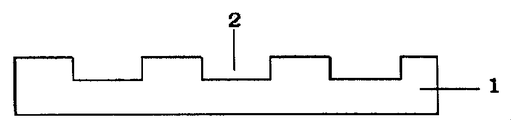
- the method of obtaining the above will be illustrated with reference to the drawings.
- FIG. 1 shows a plate (1) having a recess (2) on its surface.
- a metal material such as stainless steel is used.
- FIG. 2 shows a state (3) in which this plate is filled with the curable composition of the present invention.
- the curable composition is filled into the recesses of the plate using a doctor knife or the like.
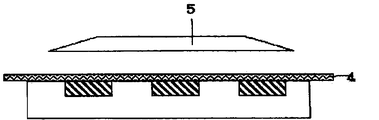
- FIG. 3 shows a step of covering the base material (4) from the upper part thereof and irradiating the light source (5) on the upper part with ultraviolet rays to cure the curable composition of the present invention.
- a transparent polyethylene terephthalate or polycarbonate film that transmits ultraviolet rays is used as the base material (4).
- FIG. 4 shows a state in which the cured product is separated from the plate (1) to obtain a cured molded product (6).
- the curable composition of the present invention can be molded and used in advance. In the molding method by photocuring while the recesses are filled, the thickness can be increased because the curing is not hindered by oxygen, and the thickness of the thickest portion can be 5 mm.
- the curable composition of the present invention can also be applied to transparent screens such as touch panels, and as insulating materials such as solder resists, interlayer insulating materials, and coverlays. Further, the curable composition of the present invention may be applied as a solder dam. Furthermore, since the composition of the present invention has good adhesion, it can also be used as an adhesive, particularly a colorless and transparent adhesive used for transparent screens and the like.
- the entire surface of the substrate is coated smoothly and evenly with the curable composition.
- the surface of the curable composition shows traces of bursting bubbles, and the surface of the coating film is non-uniform.
- Pencil hardness evaluation Above 2. An effect film similar to the cured film for evaluation used in the evaluation of dryness to the touch was prepared, and the surface hardness thereof was measured using a pencil hardness tester (manufactured by Toyo Seiki Seisakusho Co., Ltd.). In this test, each test piece was pressed with a 3H and 4H pencil sharpened so that the tip of the core was flat, at an angle of about 45 ° and with a load of 1 kg, and was 0.5 to 1 mm. By moving at least 7 mm at a speed of / s, the state of peeling of the distance coating film was evaluated according to the following criteria. The results are shown in Table 1.
- Adhesion evaluation Above Adhesion of the cured coating film (thickness 10 ⁇ m) similar to that used for pencil hardness evaluation is based on JIS K 5600-5-6, and a cross cut is made in a 10 mm x 10 mm grid pattern using a cross cut guide. A cross-cut tape peel ring test was performed by forming 100x100 grids. The remaining number of grids was visually observed according to the following criteria. The results are shown in Table 1.
- the haze is a value expressed as a percentage of the value obtained by dividing the scattered light transmittance of the test piece by the total light transmittance, and is a value of the total light transmittance.
- the measurement results are shown in Table 1.
- Heat resistance test (total light transmittance and haze evaluation after heat treatment) 7-1. Preparation of heat-treated sample Above 3. A heat-treated sample was prepared by storing a cured coating film similar to that used for pencil hardness evaluation in a hot air circulation type drying oven at a temperature of 100 ° C. for 2 hours. 7-2. Evaluation of total light transmittance and haze of the heat-treated sample The total light transmittance transmission and haze value of the heat-treated sample obtained by this are evaluated in the above 5. Evaluation of total light transmittance and 6. It was determined by the same measurement method as the haze (cloud value) evaluation. The measurement results are shown in Table 1.
- TEMPIC Tris-[(3-mercaptopropionyloxy) -ethyl] -isocyanurate
- KBM-5103 3-acryloxypropyltrimethoxysilane manufactured by IGM Resins, light ester P-1M manufactured by Shinetsu Chemical Industry Co., Ltd .: Mono (2-hydroxyethyl methacrylate) phosphate, Floren AC-2300C manufactured by Kyoeisha Chemical Co., Ltd .: Olefin polymer (antifoaming agent), Polyflow KL-700 manufactured by Kyoeisha Chemical Co., Ltd .: Silicone-containing polymer (base material wetting agent), Kyoeisha Chemical Co., Ltd. Made by Co., Ltd.
- the curable composition of the present invention is excellent in printability, and the cured product has excellent physical properties in all of the properties of touch-drying property, pencil hardness, and adhesion. Further, the cured product of the present invention has a high light transmittance of 99.0% or more after exposure to the heat resistance test and after exposure to the weather resistance test, and the haze value is also the initial value and the heat resistance test exposure. Since it is suppressed to 1.5% or less both after and after exposure to the weather resistance test, the initial colorless and transparent beautiful state is used for a long period of time, especially as a transparent protective material for liquid crystal displays and touch panels. It can be seen that it is also resistant to.
Landscapes
- Chemical & Material Sciences (AREA)
- Health & Medical Sciences (AREA)
- Chemical Kinetics & Catalysis (AREA)
- Medicinal Chemistry (AREA)
- Polymers & Plastics (AREA)
- Organic Chemistry (AREA)
- Macromonomer-Based Addition Polymer (AREA)
- Polymers With Sulfur, Phosphorus Or Metals In The Main Chain (AREA)
Abstract
Le problème décrit par la présente invention est de fournir : une composition durcissable susceptible de former des objets durcis qui ont une excellente adhérence aux substrats et ont une transmittance de lumière totale élevée et un trouble réduit de manière satisfaisante; et un objet durci obtenu à partir de la composition durcissable. La solution selon l'invention porte sur une composition durcissable qui comprend (A) un (méth)acrylate d'uréthane, (B) un dérivé d'acide thiocarboxylique, (C) un isocyanurate de triallyle, et (D) un initiateur de photopolymérisation, le dérivé d'acide thiocarboxylique (B) étant contenu à raison de 50 parties en masse ou plus pour 100 parties en masse du (méth)acrylate d'uréthane (A), et l'isocyanurate de triallyle (C) étant contenu à raison de 40 parties en masse ou plus pour 100 parties en masse du (méth)acrylate d'uréthane (A); et un objet durci formé à partir de la composition durcissable.
Priority Applications (2)
| Application Number | Priority Date | Filing Date | Title |
|---|---|---|---|
| CN201980094251.1A CN113574093B (zh) | 2019-03-27 | 2019-12-05 | 固化性组合物和其固化物 |
| KR1020217031907A KR102718117B1 (ko) | 2019-03-27 | 2019-12-05 | 경화성 조성물 및 그의 경화물 |
Applications Claiming Priority (2)
| Application Number | Priority Date | Filing Date | Title |
|---|---|---|---|
| JP2019060238A JP7551278B2 (ja) | 2019-03-27 | 2019-03-27 | 硬化性組成物、およびその硬化物 |
| JP2019-060238 | 2019-03-27 |
Publications (1)
| Publication Number | Publication Date |
|---|---|
| WO2020194886A1 true WO2020194886A1 (fr) | 2020-10-01 |
Family
ID=72610818
Family Applications (1)
| Application Number | Title | Priority Date | Filing Date |
|---|---|---|---|
| PCT/JP2019/047558 Ceased WO2020194886A1 (fr) | 2019-03-27 | 2019-12-05 | Composition durcissable et objet durci obtenu à partir de celle-ci |
Country Status (4)
| Country | Link |
|---|---|
| JP (1) | JP7551278B2 (fr) |
| KR (1) | KR102718117B1 (fr) |
| CN (1) | CN113574093B (fr) |
| WO (1) | WO2020194886A1 (fr) |
Citations (10)
| Publication number | Priority date | Publication date | Assignee | Title |
|---|---|---|---|---|
| JPS5667333A (en) * | 1979-11-06 | 1981-06-06 | Asahi Denka Kogyo Kk | Curable composition |
| JPH03210364A (ja) * | 1990-01-12 | 1991-09-13 | Asahi Denka Kogyo Kk | 光学的造形用樹脂組成物 |
| JPH1195233A (ja) * | 1997-09-18 | 1999-04-09 | Sekisui Finechem Co Ltd | 液晶注入口封止剤及び液晶表示セル |
| JP2002155141A (ja) * | 2000-09-06 | 2002-05-28 | Sekisui Chem Co Ltd | 液晶注入口封止剤及び液晶表示セル |
| WO2009010423A1 (fr) * | 2007-07-17 | 2009-01-22 | Cytec Surface Specialties, S.A. | Compositions à plusieurs composants à fonctionnalité thiol pour des matériaux stratifiés |
| WO2009132070A2 (fr) * | 2008-04-22 | 2009-10-29 | The Regents Of The University Of Colorado, A Body Corporate | Systèmes de thiol-vinyl et de thiol-yne pour polymères à mémoire de forme |
| JP2016117832A (ja) * | 2014-12-22 | 2016-06-30 | 昭和電工株式会社 | 光硬化性組成物およびその用途 |
| US20170007362A1 (en) * | 2015-07-07 | 2017-01-12 | Align Technology, Inc. | Dental materials using thermoset polymers |
| US20170145247A1 (en) * | 2015-11-20 | 2017-05-25 | Industrial Technology Research Institute | Packaging composition and packaging structure employing the same |
| WO2019224699A1 (fr) * | 2018-05-22 | 2019-11-28 | 3M Innovative Properties Company | Processus de traitement d'une composition à base de thiolène durcissable par rayonnement avec une technologie de fabrication additive |
Family Cites Families (6)
| Publication number | Priority date | Publication date | Assignee | Title |
|---|---|---|---|---|
| US4891152A (en) * | 1987-12-28 | 1990-01-02 | Hughes Aircraft Company | Dispersion of liquid crystal droplets in a photopolymerized matrix and devices made therefrom |
| JP5846709B2 (ja) | 2008-03-31 | 2016-01-20 | 太陽ホールディングス株式会社 | 活性エネルギー線硬化性樹脂組成物、およびその硬化物と透明成型品 |
| JP5550818B2 (ja) | 2008-05-09 | 2014-07-16 | 電気化学工業株式会社 | 光学部品用接着剤 |
| WO2012126695A1 (fr) | 2011-03-23 | 2012-09-27 | Huntsman Advanced Materials (Switzerland) Gmbh | Composition thiol-ène durcissable stable |
| JPWO2017170050A1 (ja) | 2016-03-31 | 2019-02-14 | 昭和電工株式会社 | レジストインキ及びその硬化物並びに配線の保護膜及びその製造方法 |
| DE102018102916A1 (de) | 2018-02-09 | 2019-08-14 | Delo Industrie Klebstoffe Gmbh & Co. Kgaa | Mit aktinischer Strahlung fixierbare Masse und ihre Verwendung |
-
2019
- 2019-03-27 JP JP2019060238A patent/JP7551278B2/ja active Active
- 2019-12-05 KR KR1020217031907A patent/KR102718117B1/ko active Active
- 2019-12-05 WO PCT/JP2019/047558 patent/WO2020194886A1/fr not_active Ceased
- 2019-12-05 CN CN201980094251.1A patent/CN113574093B/zh active Active
Patent Citations (10)
| Publication number | Priority date | Publication date | Assignee | Title |
|---|---|---|---|---|
| JPS5667333A (en) * | 1979-11-06 | 1981-06-06 | Asahi Denka Kogyo Kk | Curable composition |
| JPH03210364A (ja) * | 1990-01-12 | 1991-09-13 | Asahi Denka Kogyo Kk | 光学的造形用樹脂組成物 |
| JPH1195233A (ja) * | 1997-09-18 | 1999-04-09 | Sekisui Finechem Co Ltd | 液晶注入口封止剤及び液晶表示セル |
| JP2002155141A (ja) * | 2000-09-06 | 2002-05-28 | Sekisui Chem Co Ltd | 液晶注入口封止剤及び液晶表示セル |
| WO2009010423A1 (fr) * | 2007-07-17 | 2009-01-22 | Cytec Surface Specialties, S.A. | Compositions à plusieurs composants à fonctionnalité thiol pour des matériaux stratifiés |
| WO2009132070A2 (fr) * | 2008-04-22 | 2009-10-29 | The Regents Of The University Of Colorado, A Body Corporate | Systèmes de thiol-vinyl et de thiol-yne pour polymères à mémoire de forme |
| JP2016117832A (ja) * | 2014-12-22 | 2016-06-30 | 昭和電工株式会社 | 光硬化性組成物およびその用途 |
| US20170007362A1 (en) * | 2015-07-07 | 2017-01-12 | Align Technology, Inc. | Dental materials using thermoset polymers |
| US20170145247A1 (en) * | 2015-11-20 | 2017-05-25 | Industrial Technology Research Institute | Packaging composition and packaging structure employing the same |
| WO2019224699A1 (fr) * | 2018-05-22 | 2019-11-28 | 3M Innovative Properties Company | Processus de traitement d'une composition à base de thiolène durcissable par rayonnement avec une technologie de fabrication additive |
Non-Patent Citations (1)
| Title |
|---|
| TIAM, FOO CHEN ET AL.: "Ageing properties of polyurethane methacrylate and off-stoichiometry thiol-ene polymers after nitrogen and argon plasma treatment", JOURNAL OF APPLIED POLYMER SCIENCE, vol. 133, no. 42, 2016, XP055744143 * |
Also Published As
| Publication number | Publication date |
|---|---|
| JP2020158650A (ja) | 2020-10-01 |
| CN113574093B (zh) | 2024-04-09 |
| KR102718117B1 (ko) | 2024-10-17 |
| KR20210146942A (ko) | 2021-12-06 |
| CN113574093A (zh) | 2021-10-29 |
| JP7551278B2 (ja) | 2024-09-17 |
Similar Documents
| Publication | Publication Date | Title |
|---|---|---|
| EP2275459B1 (fr) | Copolymère vinyle aromatique polyfonctionnel, son procédé de fabrication et composition de résine | |
| CN103119109B (zh) | 喷墨用固化性组合物及电子部件的制造方法 | |
| CN105705525B (zh) | 印刷电路板用固化型组合物、使用其的固化涂膜和印刷电路板 | |
| JP2010018753A (ja) | (メタ)アクリレート化合物及びそれを含有する活性エネルギー線硬化型樹脂組成物並びにその硬化物 | |
| JPWO2012081708A1 (ja) | 光硬化性樹脂組成物、画像表示用装置、その製造方法 | |
| KR20100055160A (ko) | 하드코팅액, 이를 사용한 하드코팅 필름 및 화상표시장치 | |
| JP2019167542A (ja) | 光硬化性樹脂組成物並びにそれを用いた光硬化性遮光塗料、光漏洩防止材、液晶表示パネル及び液晶表示装置、並びに光硬化方法 | |
| KR101501499B1 (ko) | 자외선 경화 수지 조성물 | |
| JP2012102166A (ja) | 帯電防止コーティング用組成物 | |
| JP4600605B1 (ja) | 帯電防止コーティング用組成物 | |
| JP7082527B2 (ja) | 防曇組成物及び成形品 | |
| JP2001113648A (ja) | 放射線硬化型樹脂組成物の硬化皮膜を有するフィルム | |
| JP5641554B2 (ja) | 活性エネルギー線硬化型光学用組成物及び高屈折率樹脂 | |
| JP2003306619A (ja) | ハードコート剤用感光性樹脂組成物及びその硬化皮膜を有するフィルム | |
| JP7551278B2 (ja) | 硬化性組成物、およびその硬化物 | |
| JP2016050231A (ja) | 光硬化性樹脂組成物およびそれを用いた光硬化性遮光塗料、液晶表示パネル、液晶表示装置 | |
| JP6596852B2 (ja) | 硬化性樹脂組成物および積層構造体 | |
| JP4806965B2 (ja) | 帯電防止塗膜の形成方法 | |
| KR101667413B1 (ko) | 광경화형 광학용 투명 점착 시트 및 그 제조 방법 | |
| JPWO2013146651A1 (ja) | 環状エーテル基含有(メタ)アクリレート | |
| JPH03237113A (ja) | 活性エネルギー線重合性不飽和樹脂組成物及びそれを含む硬化性組成物 | |
| JP6894835B2 (ja) | 活性エネルギー線硬化性組成物及び硬化物 | |
| KR102367697B1 (ko) | 광학 물품용 활성 에너지선 경화형 수지 조성물, 경화물 및 광학 시트 | |
| JP5782067B2 (ja) | 光硬化性組成物、成型品 | |
| KR20250042444A (ko) | 보안제품 스크린 인쇄용 바인더 조성물 |
Legal Events
| Date | Code | Title | Description |
|---|---|---|---|
| 121 | Ep: the epo has been informed by wipo that ep was designated in this application |
Ref document number: 19920850 Country of ref document: EP Kind code of ref document: A1 |
|
| NENP | Non-entry into the national phase |
Ref country code: DE |
|
| 122 | Ep: pct application non-entry in european phase |
Ref document number: 19920850 Country of ref document: EP Kind code of ref document: A1 |