WO2020202938A1 - 樹脂粒子及びその製造方法、並びに該樹脂粒子を含む親水性付与剤 - Google Patents
樹脂粒子及びその製造方法、並びに該樹脂粒子を含む親水性付与剤 Download PDFInfo
- Publication number
- WO2020202938A1 WO2020202938A1 PCT/JP2020/008113 JP2020008113W WO2020202938A1 WO 2020202938 A1 WO2020202938 A1 WO 2020202938A1 JP 2020008113 W JP2020008113 W JP 2020008113W WO 2020202938 A1 WO2020202938 A1 WO 2020202938A1
- Authority
- WO
- WIPO (PCT)
- Prior art keywords
- mass
- resin particles
- parts
- monomer
- ethylenically unsaturated
- Prior art date
- Legal status (The legal status is an assumption and is not a legal conclusion. Google has not performed a legal analysis and makes no representation as to the accuracy of the status listed.)
- Ceased
Links
Classifications
-
- C—CHEMISTRY; METALLURGY
- C08—ORGANIC MACROMOLECULAR COMPOUNDS; THEIR PREPARATION OR CHEMICAL WORKING-UP; COMPOSITIONS BASED THEREON
- C08F—MACROMOLECULAR COMPOUNDS OBTAINED BY REACTIONS ONLY INVOLVING CARBON-TO-CARBON UNSATURATED BONDS
- C08F220/00—Copolymers of compounds having one or more unsaturated aliphatic radicals, each having only one carbon-to-carbon double bond, and only one being terminated by only one carboxyl radical or a salt, anhydride ester, amide, imide or nitrile thereof
- C08F220/02—Monocarboxylic acids having less than ten carbon atoms; Derivatives thereof
- C08F220/10—Esters
- C08F220/12—Esters of monohydric alcohols or phenols
- C08F220/16—Esters of monohydric alcohols or phenols of phenols or of alcohols containing two or more carbon atoms
- C08F220/18—Esters of monohydric alcohols or phenols of phenols or of alcohols containing two or more carbon atoms with acrylic or methacrylic acids
-
- C—CHEMISTRY; METALLURGY
- C08—ORGANIC MACROMOLECULAR COMPOUNDS; THEIR PREPARATION OR CHEMICAL WORKING-UP; COMPOSITIONS BASED THEREON
- C08F—MACROMOLECULAR COMPOUNDS OBTAINED BY REACTIONS ONLY INVOLVING CARBON-TO-CARBON UNSATURATED BONDS
- C08F2/00—Processes of polymerisation
- C08F2/12—Polymerisation in non-solvents
- C08F2/16—Aqueous medium
- C08F2/22—Emulsion polymerisation
- C08F2/24—Emulsion polymerisation with the aid of emulsifying agents
- C08F2/26—Emulsion polymerisation with the aid of emulsifying agents anionic
-
- C—CHEMISTRY; METALLURGY
- C08—ORGANIC MACROMOLECULAR COMPOUNDS; THEIR PREPARATION OR CHEMICAL WORKING-UP; COMPOSITIONS BASED THEREON
- C08L—COMPOSITIONS OF MACROMOLECULAR COMPOUNDS
- C08L25/00—Compositions of, homopolymers or copolymers of compounds having one or more unsaturated aliphatic radicals, each having only one carbon-to-carbon double bond, and at least one being terminated by an aromatic carbocyclic ring; Compositions of derivatives of such polymers
- C08L25/02—Homopolymers or copolymers of hydrocarbons
- C08L25/04—Homopolymers or copolymers of styrene
- C08L25/08—Copolymers of styrene
- C08L25/10—Copolymers of styrene with conjugated dienes
-
- C—CHEMISTRY; METALLURGY
- C08—ORGANIC MACROMOLECULAR COMPOUNDS; THEIR PREPARATION OR CHEMICAL WORKING-UP; COMPOSITIONS BASED THEREON
- C08F—MACROMOLECULAR COMPOUNDS OBTAINED BY REACTIONS ONLY INVOLVING CARBON-TO-CARBON UNSATURATED BONDS
- C08F2/00—Processes of polymerisation
- C08F2/12—Polymerisation in non-solvents
- C08F2/16—Aqueous medium
- C08F2/22—Emulsion polymerisation
-
- C—CHEMISTRY; METALLURGY
- C08—ORGANIC MACROMOLECULAR COMPOUNDS; THEIR PREPARATION OR CHEMICAL WORKING-UP; COMPOSITIONS BASED THEREON
- C08F—MACROMOLECULAR COMPOUNDS OBTAINED BY REACTIONS ONLY INVOLVING CARBON-TO-CARBON UNSATURATED BONDS
- C08F20/00—Homopolymers and copolymers of compounds having one or more unsaturated aliphatic radicals, each having only one carbon-to-carbon double bond, and only one being terminated by only one carboxyl radical or a salt, anhydride, ester, amide, imide or nitrile thereof
- C08F20/02—Monocarboxylic acids having less than ten carbon atoms, Derivatives thereof
- C08F20/04—Acids, Metal salts or ammonium salts thereof
- C08F20/06—Acrylic acid; Methacrylic acid; Metal salts or ammonium salts thereof
-
- C—CHEMISTRY; METALLURGY
- C08—ORGANIC MACROMOLECULAR COMPOUNDS; THEIR PREPARATION OR CHEMICAL WORKING-UP; COMPOSITIONS BASED THEREON
- C08F—MACROMOLECULAR COMPOUNDS OBTAINED BY REACTIONS ONLY INVOLVING CARBON-TO-CARBON UNSATURATED BONDS
- C08F210/00—Copolymers of unsaturated aliphatic hydrocarbons having only one carbon-to-carbon double bond
- C08F210/04—Monomers containing three or four carbon atoms
- C08F210/08—Butenes
- C08F210/10—Isobutene
- C08F210/12—Isobutene with conjugated diolefins, e.g. butyl rubber
-
- C—CHEMISTRY; METALLURGY
- C08—ORGANIC MACROMOLECULAR COMPOUNDS; THEIR PREPARATION OR CHEMICAL WORKING-UP; COMPOSITIONS BASED THEREON
- C08F—MACROMOLECULAR COMPOUNDS OBTAINED BY REACTIONS ONLY INVOLVING CARBON-TO-CARBON UNSATURATED BONDS
- C08F212/00—Copolymers of compounds having one or more unsaturated aliphatic radicals, each having only one carbon-to-carbon double bond, and at least one being terminated by an aromatic carbocyclic ring
- C08F212/34—Monomers containing two or more unsaturated aliphatic radicals
- C08F212/36—Divinylbenzene
-
- C—CHEMISTRY; METALLURGY
- C08—ORGANIC MACROMOLECULAR COMPOUNDS; THEIR PREPARATION OR CHEMICAL WORKING-UP; COMPOSITIONS BASED THEREON
- C08F—MACROMOLECULAR COMPOUNDS OBTAINED BY REACTIONS ONLY INVOLVING CARBON-TO-CARBON UNSATURATED BONDS
- C08F216/00—Copolymers of compounds having one or more unsaturated aliphatic radicals, each having only one carbon-to-carbon double bond, and at least one being terminated by an alcohol, ether, aldehydo, ketonic, acetal or ketal radical
- C08F216/36—Copolymers of compounds having one or more unsaturated aliphatic radicals, each having only one carbon-to-carbon double bond, and at least one being terminated by an alcohol, ether, aldehydo, ketonic, acetal or ketal radical by a ketonic radical
-
- C—CHEMISTRY; METALLURGY
- C08—ORGANIC MACROMOLECULAR COMPOUNDS; THEIR PREPARATION OR CHEMICAL WORKING-UP; COMPOSITIONS BASED THEREON
- C08F—MACROMOLECULAR COMPOUNDS OBTAINED BY REACTIONS ONLY INVOLVING CARBON-TO-CARBON UNSATURATED BONDS
- C08F220/00—Copolymers of compounds having one or more unsaturated aliphatic radicals, each having only one carbon-to-carbon double bond, and only one being terminated by only one carboxyl radical or a salt, anhydride ester, amide, imide or nitrile thereof
- C08F220/02—Monocarboxylic acids having less than ten carbon atoms; Derivatives thereof
- C08F220/10—Esters
- C08F220/12—Esters of monohydric alcohols or phenols
- C08F220/14—Methyl esters, e.g. methyl (meth)acrylate
-
- C—CHEMISTRY; METALLURGY
- C08—ORGANIC MACROMOLECULAR COMPOUNDS; THEIR PREPARATION OR CHEMICAL WORKING-UP; COMPOSITIONS BASED THEREON
- C08F—MACROMOLECULAR COMPOUNDS OBTAINED BY REACTIONS ONLY INVOLVING CARBON-TO-CARBON UNSATURATED BONDS
- C08F236/00—Copolymers of compounds having one or more unsaturated aliphatic radicals, at least one having two or more carbon-to-carbon double bonds
- C08F236/02—Copolymers of compounds having one or more unsaturated aliphatic radicals, at least one having two or more carbon-to-carbon double bonds the radical having only two carbon-to-carbon double bonds
- C08F236/04—Copolymers of compounds having one or more unsaturated aliphatic radicals, at least one having two or more carbon-to-carbon double bonds the radical having only two carbon-to-carbon double bonds conjugated
- C08F236/06—Butadiene
-
- C—CHEMISTRY; METALLURGY
- C08—ORGANIC MACROMOLECULAR COMPOUNDS; THEIR PREPARATION OR CHEMICAL WORKING-UP; COMPOSITIONS BASED THEREON
- C08L—COMPOSITIONS OF MACROMOLECULAR COMPOUNDS
- C08L25/00—Compositions of, homopolymers or copolymers of compounds having one or more unsaturated aliphatic radicals, each having only one carbon-to-carbon double bond, and at least one being terminated by an aromatic carbocyclic ring; Compositions of derivatives of such polymers
- C08L25/02—Homopolymers or copolymers of hydrocarbons
- C08L25/04—Homopolymers or copolymers of styrene
- C08L25/08—Copolymers of styrene
- C08L25/14—Copolymers of styrene with unsaturated esters
Definitions
- the present invention relates to resin particles, a method for producing the same, and a hydrophilicity-imparting agent containing the resin particles.
- Examples of the method for producing crosslinkable hydrophilic particles include a method of polymerizing a hydrophilic monomer in a solvent-based solvent and a method of polymerizing a hydrophobic monomer in an aqueous solvent and then hydrolyzing the polymer.
- a method for polymerizing a hydrophilic monomer in a solvent-based solvent for example, Patent Document 1 discloses a method for producing hydrophilic fine particles in which acrylamide and its derivatives are polymerized in a solvent containing a water-miscible organic solvent such as alcohol.
- Patent Document 2 discloses hydrophilic crosslinked polymer fine particles prepared by adding a predetermined hydrophilic monomer, a (meth) acrylamide-based monomer, a crosslinkable unsaturated monomer, or the like to an organic solvent. There is. Further, as a method of hydrolyzing a polymer after polymerizing a hydrophobic monomer in an aqueous solvent, for example, in Patent Documents 3 and 4, acrylonitrile and a crosslinkable monomer are polymerized in an aqueous medium. It is disclosed that an aqueous dispersion can be obtained by adding an alkali metal hydroxide such as sodium hydroxide to the obtained particles and hydrolyzing the obtained particles.
- an alkali metal hydroxide such as sodium hydroxide
- the resin particles polymerized with a solvent-based solvent as in Patent Documents 1 and 2 above have a problem that they are not environmentally friendly in that a solvent-based solvent is used.
- a film or a coating film is formed using a resin composition containing resin particles formed by using a monomer containing a nitrogen atom as in Patent Documents 3 and 4, there is a problem that the film or the coating film is colored. was there.
- Patent Documents 3 and 4 in order to obtain hydrophilic resin particles and an aqueous dispersion, it is necessary to carry out a hydrolysis reaction using an aqueous sodium hydroxide solution (caustic soda) under harsh conditions of 90 to 95 ° C. It was.
- crosslinked polyacrylic acid particles it is also conceivable to add crosslinked polyacrylic acid particles to a solvent to form an aqueous dispersion, but since the crosslinked polyacrylic acid particles have high hydrophilicity and high viscosity of the aqueous dispersion, they are used as various additives. In that case, there is a problem that the viscosity becomes thick and the compounding becomes difficult.
- the present inventor has cross-linked a specific hydroxymethylacrylic acid-based monomer which is a hydrophilic monomer and a polyfunctional ethylenically unsaturated monomer. It has been found that the resin particles containing the crosslinked structure can be polymerized in granular form even when polymerized in an aqueous solvent, and harsh hydrolysis conditions are not required. The resin particles obtained in this way are environmentally friendly because no solvent-based solvent is used. That is, the present invention includes the following inventions.
- Resin particles characterized by containing a crosslinked structure in which at least one of the monomers represented by the following general formula (1) and a polyfunctional ethylenically unsaturated monomer are crosslinked.
- R 1 represents an alkyl group having 1 to 4 carbon atoms, a hydrogen atom, an alkali metal atom or a quaternary ammonium.
- [6] The resin particle according to any one of [1] to [5], which has a hygroscopicity of 2.5% by mass or more.
- a method for producing resin particles in which at least one of the monomers represented by the formula (2) and a polyfunctional ethylenically unsaturated monomer are dispersed in an aqueous solvent in the presence of an emulsifier.
- a method for producing resin particles which comprises emulsion polymerization for carrying out a polymerization reaction. (R 2 represents an alkyl group having 1 to 4 carbon atoms.)
- the monomer represented by the general formula (1) (hydroxymethylacrylic acid-based monomer) can be granulated even if it is polymerized in an aqueous solvent by copolymerizing with a crosslinkable monomer.
- Hydrophilic resin particles can be produced without using a solvent-based solvent. Further, by using the hydroxymethylacrylic acid-based monomer, hydrophilic resin particles can be produced without hydrolysis under harsh conditions. Further, when the resin particles of the present invention are used, the viscosity of the particle dispersion is extremely low as compared with the crosslinked polyacrylic acid having a similar skeleton, and the compounding composition can be easily added to various resin compositions and coating agents. Obtainable.
- the resin particles of the present invention include at least one of the monomers represented by the following general formula (1) (hereinafter referred to as hydroxymethylacrylic acid-based monomer) and a polyfunctional ethylenically unsaturated monomer. Includes a crosslinked structure.
- R 1 represents an alkyl group having 1 to 4 carbon atoms, a hydrogen atom, an alkali metal atom or a quaternary ammonium.
- a hydrogen atom, an alkali metal atom and a quaternary ammonium have an alkyl having R 1 having 1 to 4 carbon atoms. It may be introduced by hydrolyzing R 1 after polymerizing a hydroxymethylacrylic acid-based monomer as a group to form resin particles.
- the alkyl group having 1 to 4 carbon atoms represented by R 1 is preferably an alkyl group having 1 to 2 carbon atoms, and more preferably an alkyl group having 1 carbon atom (methyl group).
- the resin particles of the present invention have a monomer unit derived from a hydroxymethylacrylic acid-based monomer (also referred to as a structural unit. Meaning of a residue after a carbon double bond is involved in polymerization. The same applies hereinafter). Wherever the resin particles have, the resin particles may be any of unhydrolyzed product, partially hydrolyzed product, completely hydrolyzed product, and hydrolyzed neutralized product.
- the unhydrolyzed product contains a monomer unit derived from a hydroxymethylacrylic acid-based monomer in which R 1 is an alkyl group having 1 to 4 carbon atoms, and R 1 is a hydrogen atom, an alkali metal atom, or a quaternary. It is substantially free of monomeric units derived from hydroxymethylacrylic acid-based monomers that are ammonium.
- the partially hydrolyzate or its neutralized product consists of a monomer unit derived from a hydroxymethylacrylic acid-based monomer in which R 1 is an alkyl group having 1 to 4 carbon atoms, and R 1 is a hydrogen atom or an alkali metal atom.
- the complete hydrolyzate or its neutralized product contains substantially no monomer unit derived from a hydroxymethylacrylic acid-based monomer in which R 1 is an alkyl group having 1 to 4 carbon atoms, and R 1 is a hydrogen atom.
- R 1 is an alkyl group having 1 to 4 carbon atoms
- R 1 is a hydrogen atom.
- the monomer unit (structural unit) derived from the hydroxymethylacrylic acid-based monomer in the resin particles is preferably 20% by mass or more, more preferably 30% by mass or more, and 50% by mass or more. It is more preferably 70% by mass or more, particularly preferably 80% by mass or more, most preferably 90% by mass or more, and 99.99% by mass or less. It is more preferably 99.9% by mass or less, further preferably 99% by mass or less, particularly preferably 97% by mass or less, and most preferably 95% by mass or less.
- the polyfunctional ethylenically unsaturated monomer one kind or two or more kinds can be used, and it is preferable that the polyfunctional ethylenically unsaturated monomer is a non-hydrolyzable monomer.
- the resin particles of the present invention contained in the aqueous dispersion can be hydrolyzed by adding a basic aqueous solution such as an aqueous sodium hydroxide solution, an aqueous ammonia solution, or an aqueous cyclohexylamine solution. Therefore, it is more preferable that the non-hydrolyzable monomer has base hydrolysis resistance.
- the non-hydrolyzable monomer is preferably a polyfunctional monomer (hydrocarbons) composed of only carbon atoms and hydrogen atoms, and may have an ether bond if necessary.
- the polyfunctional monomer as a hydrocarbon which may have an ether bond is referred to as a hydrocarbon-based cross-linking agent which may have an ether bond in the present specification.
- the hydrocarbon-based cross-linking agent which may have an ether bond preferably has two or more ethylenically unsaturated bonds, and more preferably has two ethylenically unsaturated bonds.
- hydrocarbon-based cross-linking agent which may have an ether bond
- examples of the hydrocarbon-based cross-linking agent which may have an ether bond include divinylbenzene; 1,3-butadiene; trivinylbenzene; divinylnaphthalene; trivinylcyclohexane; divinyl ether; diallyl ether; and polyvalent.
- examples thereof include methacrylic acid ester.
- the diallyl ether include dialkylene glycol diallyl ethers such as diethylene glycol diallyl ether, dipropylene glycol diallyl ether and dibutylene glycol diallyl ether; and polyalkylene glycols such as polyethylene glycol diallyl ether, polypropylene glycol diallyl ether and polybutylene glycol diallyl ether.
- Dialyl ether can be mentioned.
- the polyvalent methacrylate ester include ethylene glycol dimethacrylate, diethylene glycol dimethacrylate, triethylene glycol dimethacrylate, tetraethylene glycol dimethacrylate, polyethylene glycol dimethacrylate, 1,3-butanediol dimethacrylate, and 1,4-butane.
- the hydrocarbon-based cross-linking agent which may have an ether bond preferably has two or more ethylenically unsaturated bonds, and more preferably has two ethylenically unsaturated bonds.
- Specific examples of the hydrocarbon-based cross-linking agent which may have an ether bond include divinylbenzene; 1,3-butadiene; trivinylbenzene; divinylnaphthalene; trivinylcyclohexane; divinyl ether; diallyl ether; and polyvalent.
- Methacrylic acid esters etc., among others, more preferably at least one of divinylbenzene, 1,3-butadiene, diallyl ether, and polyvalent methacrylic acid ester, and of divinylbenzene and 1,3-butadiene. It is more preferably at least one kind, and particularly preferably divinylbenzene.
- the proportion of the bifunctional unsaturated monomer in the polyfunctional ethylenically unsaturated monomer is preferably 50% by mass or more, more preferably 70% by mass or more, and 90% by mass or more. Is more preferable, and 95% by mass or more is particularly preferable, and 100% by mass is most preferable (the polyfunctional ethylenically unsaturated monomer consists of only a bifunctional unsaturated monomer).
- the monomer unit derived from the polyfunctional ethylenically unsaturated monomer in the resin particles is preferably 0.01% by mass or more, more preferably 0.1% by mass or more, and 0.5% by mass. % Or more, more preferably 2% by mass or more, most preferably 5% by mass or more, preferably 70% by mass or less, and more preferably 50% by mass or less. It is preferably 30% by mass or less, more preferably 20% by mass or less, and most preferably 10% by mass or less.
- the resin particles may contain a monomer unit derived from a monomer other than the hydroxymethylacrylic acid-based monomer and the polyfunctional ethylenically unsaturated monomer, but the monomer unit may be contained. It is preferably 75% by mass or less, more preferably 65% by mass or less, further preferably 50% by mass or less, preferably 30% by mass or less, and preferably 20% by mass or less. More preferably, it is more preferably 10% by mass or less, particularly preferably 5% by mass or less, and most preferably 2% by mass or less.
- the resin particles do not contain a monomer unit derived from a monomer containing a nitrogen atom in a substantially covalent bond.
- the film or the like may be colored.
- the nitrogen atom in the resin particles is 1% by mass or less, preferably 0.5% by mass or less, and more preferably 0.1% by mass or less.
- the resin particles of the present invention may be core-shell particles composed of a core portion and a shell portion provided on the surface thereof.
- the shell portion may have the above-mentioned structure including a crosslinked structure in which at least one of hydroxymethylacrylic acid-based monomers and a polyfunctional ethylenically unsaturated monomer are crosslinked.
- the core portion preferably contains a monomer unit derived from a monofunctional (meth) acrylic monomer.
- the monofunctional (meth) acrylic monomer a C 1-12 alkyl ester of (meth) acrylic acid is preferable, and a C 1-4 alkyl ester of (meth) acrylic acid is more preferable.
- the monofunctional (meth) acrylic monomer include methyl (meth) acrylate, ethyl (meth) acrylate, propyl (meth) acrylate, n-butyl (meth) acrylate, isobutyl (meth) acrylate, and t-butyl (meth). Examples thereof include acrylate, 2-ethylhexyl (meth) acrylate, and lauryl (meth) acrylate, and one or more of them can be used.
- the core portion preferably contains a monomer unit derived from a monofunctional (meth) acrylic monomer in an amount of 50% by mass or more, more preferably 70% by mass or more, and further preferably 90% by mass or more. , 100% by mass is particularly preferable.
- the core portion may or may not contain a monomer unit derived from a hydroxymethylacrylic acid-based monomer and a polyfunctional ethylenically unsaturated monomer.
- a monomer other than the monofunctional (meth) acrylic monomer may be contained, and examples of the monomer other than the monofunctional (meth) acrylic monomer include a monofunctional styrene-based monomer.
- styrene-based monomer examples include alkylstyrenes such as styrene, o-methylstyrene, m-methylstyrene, p-methylstyrene, ⁇ -methylstyrene, ethylvinylbenzene, and pt-butylstyrene; o-.
- alkylstyrenes such as styrene, o-methylstyrene, m-methylstyrene, p-methylstyrene, ⁇ -methylstyrene, ethylvinylbenzene, and pt-butylstyrene; o-.
- styrene-based monofunctional monomers such as halogen group-containing styrenes such as chlorostyrene, m-chlorostyrene and p-chlorostyrene. Each of these monomers may be used alone,
- the volume average particle diameter of the resin particles is preferably 10 nm to 10 ⁇ m, more preferably 50 nm to 5 ⁇ m, further preferably 100 nm to 1 ⁇ m, and particularly preferably 150 to 500 nm.
- the moisture absorption rate (water absorption rate) of the resin particles at a temperature of 25 ° C. and a relative humidity of 60% is preferably 2.5% by mass or more, more preferably 3 to 25% by mass, and 5 to 15% by mass. Is more preferable.
- the hygroscopicity is determined in more detail according to the procedure described in Examples.
- the resin particles of the present invention are hydroxymethylacrylic acid-based monomers represented by the formula (1) in which R 1 is an alkyl group having 1 to 4 carbon atoms (hereinafter referred to as hydroxymethylacrylic acid ester). ),
- the polyfunctional ethylenically unsaturated monomer (hereinafter, these may be collectively referred to as "raw material monomer component") are polymerized in an aqueous solvent, and if necessary, partially or completely. Obtained by hydrolysis.
- hydroxymethylacrylic acid ester is used as the hydrophilic monomer, the product can be made into particles even if it is polymerized in an aqueous solvent.
- the hydrolyzate can maintain the particle state even if it is hydrolyzed after polymerization.
- an aqueous dispersion containing water and the above resin particles dispersed in the water can be obtained, and the aqueous dispersion will be described later.
- the polymerization method examples include suspension polymerization, emulsion polymerization, dispersion polymerization and the like.
- emulsion polymerization in which the above-mentioned raw material monomer component is dispersed in a reaction solvent and a (radical) polymerization reaction is carried out in the presence of an emulsifier is preferable.
- the method for producing resin particles of the present invention includes an emulsifier.
- the amount of the monomer component used for the emulsion polymerization is adjusted so as to be formed by the emulsion polymerization.
- the resin particles of the present invention are core-shell particles composed of a core portion and a shell portion provided on the surface thereof, the shell portion is polyfunctional ethylenically unsaturated with at least one kind of hydroxymethylacrylic acid-based monomer.
- Emulsion polymerization is carried out so as to include a crosslinked structure in which the saturated monomer is crosslinked.
- the emulsion polymerization may be carried out in only one step or in multiple steps.
- R 2 represents an alkyl group having 1 to 4 carbon atoms.
- the emulsifier one kind or two or more kinds can be used, and it may be a non-reactive surfactant or a reactive surfactant having a radically polymerizable group in the structure.
- Non-reactive surfactants include anionic and nonionic surfactants.
- anionic surfactant include fatty acid salts, alkyl (allyl) sulfonates, alkyl sulfates, and polyoxyethylene alkyl (phenyl) ether sulfates
- nonionic surfactant include polyoxyethylene. Examples thereof include alkyl (phenyl) ether, polyoxyethylene sorbitan fatty acid ester, polyoxyethylene fatty acid ester, and polyoxyethylene polyoxypropylene block polymer.
- Reactive surfactants include anionic and nonionic surfactants.
- anionic reactive surfactant include, but are not limited to, an ether sulfate type reactive surfactant and a phosphoric acid ester-based reactive surfactant.
- the ether sulfate type reactive surfactant has a polyoxyalkylene alkyl ether sulfate or a polyoxyalkylene phenyl ether sulfate as a basic skeleton, and has a polymerizable alkenyl group (for example, an allyl group), a (meth) acryloyl group, or the like.
- the compound to have is included.
- Latemuru PD-104, PD-105 (manufactured by Kao Corporation), Eleminor RS-30, NHS-20 (manufactured by Sanyo Chemical Industries, Ltd.), Aqualon KH-5, KH-10, KH-20 (Daiichi Kogyo Seiyaku Co., Ltd.) (Manufactured by ADEKA Corporation), Adecaria Soap SR-10, SR-20, etc. (manufactured by ADEKA Corporation).
- the phosphate ester-based reactive surfactant contains an alkyl phosphate, a polyoxyalkylene alkyl ether phosphoric acid (salt) or a polyoxyalkylene phenyl ether phosphoric acid (salt) as a basic skeleton, and a polymerizable alkenyl group (salt).
- a compound having an allyl group), a (meth) acryloyl group and the like is included.
- SIPOMER PZ-100 manufactured by Solvay Nikka Co., Ltd.
- H-3330PL New Frontier S-510 (manufactured by Dai-ichi Kogyo Seiyaku Co., Ltd.)
- Maxemul 6106, 6112 manufactured by Croda
- ADEKA CORPORATION PP-70 stock
- Mide by company ADEKA etc.
- anionic reactive surfactants include SIPOMER COPS1 (manufactured by Solvay Nikka Co., Ltd.), Eleminor JS-20 (manufactured by Sanyo Chemical Industries, Ltd.), Maxemul 5010, 5011 (manufactured by Croda International Co., Ltd.) and the like.
- the nonionic reactive surfactant includes a compound having a polyoxyalkylene alkyl ether as a basic skeleton and having a polymerizable alkenyl group (for example, an allyl group), a (meth) acryloyl group and the like.
- Adecaria Soap NE-10, NE-20, NE-30, ER-10, ER-20, ER-30 (manufactured by ADEKA Corporation), Latemuru PD-420, PD-430, PD-450 (Co., Ltd.) Kao Corporation), Aqualon RN-10, RN-20, RN-30, RN-50 (manufactured by Daiichi Kogyo Seiyaku Co., Ltd.) and the like.
- the surfactant for emulsion polymerization of hydroxymethylacrylic acid ester preferably contains a reactive surfactant, more preferably an anionic reactive surfactant, and more preferably an ether sulfate type reactive surfactant. It is more preferable to include.
- the emulsifier is preferably 0.05 parts by mass or more, more preferably 0.1 parts by mass or more, and further preferably 0.3 parts by mass or more with respect to 100 parts by mass of the total of the raw material monomer components. , 20 parts by mass or less, more preferably 10 parts by mass or less, further preferably 5 parts by mass or less, and particularly preferably 3 parts by mass or less.
- aqueous solvent examples include water alone or a mixed solvent of water and a water-miscible organic solvent, but water alone is preferable.
- the aqueous solvent typically refers to a solvent having a water content of more than 50% by volume.
- water ion-exchanged water (deionized water), distilled water, pure water, or the like can be used.
- water-miscible organic solvent an organic solvent (lower alcohol or the like) that can be uniformly mixed with water can be used.
- an aqueous solvent in which 80% by volume or more of the aqueous solvent is water is preferable, an aqueous solvent in which 90% by volume or more of the aqueous solvent is water is more preferable, and an aqueous solvent is more preferable.
- An aqueous solvent in which 95% by volume or more of the solvent is water is more preferable, an aqueous solvent substantially composed of water (an aqueous solvent in which 99.5% by volume or more is water) is particularly preferable, and water alone is most preferable. ..
- the aqueous solvent is, for example, 100 parts by mass or more, preferably 200 parts by mass or more, more preferably 400 parts by mass or more, and further preferably 700 parts by mass or more with respect to 100 parts by mass of the monomer composition. It is preferably 2000 parts by mass or less, more preferably 1500 parts by mass or less, and further preferably 1000 parts by mass or less.
- the mode of adding the raw material monomer component into the reaction system is not particularly limited, and the whole amount is charged into the reaction vessel at once before the addition of the polymerization initiator; a part of the monomer composition is polymerized. After that, various embodiments are adopted, such as a mode in which the balance is added to the reaction system at once or in a divided manner; a mode in which the monomer composition is continuously added into the reaction system at a constant ratio; can do. From the viewpoint of preventing the formation of a coarse polymer, it is preferable to polymerize a part of the monomer composition and then add the rest into the reaction system (once or continuously). In this case, it is preferable to add the remainder after starting the polymerization of a part of the monomer composition and before the polymerization is completed while maintaining the polymerization temperature.
- polymerizing the raw material monomer component for example, means such as a polymerization initiator, irradiation with ultraviolet rays or radiation, application of heat, etc. are used, and it is preferable to use a polymerization initiator.
- a polymerization initiator redox type polymerization initiator in which an oxidizing agent and a reducing agent are combined is preferable.
- oxidizing agent one kind or two or more kinds can be used, for example, hydrogen peroxide, t-butyl hydroperoxide, cumene hydroperoxide, p-menthan hydroperoxide, diisopropylbenzene peroxide, 1, Hydroperoxides such as 1,3,3-tetramethylhydroperoxide, 2,4,4-trimethylpentyl-2-hydroperoxide; ketone peroxides such as methyl ethyl ketone peroxide, cyclohexanone peroxide, acetyl ketone peroxide; Persulfates such as potassium sulfate, ammonium persulfate, and sodium persulfate;
- ascorbic acid and ascorbic acid salts such as sodium ascorbate and potassium ascorbate
- erythorbic acid and erythorbinate such as sodium erisorbate and potassium erythorbate.
- Tartrates such as tartrate and sodium tartrate, potassium tartrate; phosphites such as sodium bisulfite and sodium bisulfite, potassium bisulfite; hydrogen bisulfites such as sodium bisulfite, potassium bisulfite; sodium sulfite, potassium sulfite Sodium bisulfites such as sodium bisulfite, potassium bisulfite and the like; thiosulfites such as sodium thiosulfite and potassium thiosulfite; thiosulfites such as sodium thiosulfite and potassium thiosulfite; sodium pyrosulfite, pyrosulfite Sodium pyrosulfites such as potassium; sodium pyrosulfite, sodium pyrosulfite pyrosulfites such as potassium hydrogen sulfite; pyrophosphates such as sodium pyrophosphate and potassium pyrophosphate; sodium hydroxymethanesulfonate (sodium formaldeh
- the redox-type polymerization initiator shall be a polymerization initiator in which one or more oxidizing agents selected from hydroperoxides and one or more reducing agents selected from ascorbic acid and ascorbic acid salts are combined. Is preferable, and a polymerization initiator in which hydrogen peroxide (oxidizing agent) and ascorbic acid (reducing agent) are combined is more preferable.
- the total amount of the reducing agent and the oxidizing agent is preferably 0.1 part by mass or more, more preferably 0.5 part by mass or more, still more preferably 1 with respect to 100 parts by mass of the total raw material monomer component. It is 5 parts by mass or more, preferably 5 parts by mass or less, more preferably 3 parts by mass or less, and further preferably 2 parts by mass or less.
- the polymerization initiator may be charged in the entire amount at the beginning (before the start of the reaction), a part thereof may be charged first, and the rest may be continuously added by feed, or may be added by pulse intermittently. , These may be added in a combined method.
- the reaction temperature at the time of carrying out the polymerization reaction is, for example, preferably 30 ° C. or higher, more preferably 60 ° C. or higher, preferably 100 ° C. or lower, and more preferably 95 ° C. or lower. When the reaction temperature is within this range, the polymerization reaction can be easily controlled.
- the reaction time is usually preferably 10 minutes to 1200 minutes, more preferably 30 minutes to 360 minutes.
- Aqueous dispersion An aqueous dispersion containing the above-mentioned water and the above-mentioned resin particles dispersed in the water is also included in the scope of the present invention.
- the resin particles have an ester group and a hydroxymethyl group, and are excellent in hydrophilicity. Further, the dispersibility in water is good, the storage stability as a dispersion is also good, and hydrolysis can be carried out more easily.
- a basic aqueous solution such as an aqueous sodium hydroxide solution, an aqueous ammonia solution, or an aqueous cyclohexylamine solution is added to the resin particles contained in the aqueous dispersion.
- This can be hydrolyzed.
- partial neutralization or complete neutralization can be performed by appropriately adding an acid to the hydrolyzed solution.
- the group corresponding to R 1 of the formula (1) can be made into a hydrogen atom, an alkali metal atom, or a quaternary ammonium.
- the pH and volume average particle diameter of the resin particles can be easily adjusted, so that the resin particles can be used in a wide range of applications.
- the pH of the unhydrolyzed resin particles is preferably 1.5 or more and less than 7, more preferably 2 or more and 6 or less, and further preferably 2.5 or more and 5.5 or less. It is particularly preferably 2.7 or more and 5.0 or less.
- the pH of the hydrolyzed resin particles is preferably 5 or more and less than 14, more preferably 6 or more and 13.9 or less, and further preferably 6.5 or more and 13.8 or less. , 7.5 or more and 13.7 or less is particularly preferable.
- the volume average particle diameter of the resin particles contained in the aqueous dispersion is preferably 10 nm to 10 ⁇ m, more preferably 50 nm to 5 ⁇ m, further preferably 100 nm to 1 ⁇ m, and even more preferably 150 to 500 nm. Especially preferable.
- ⁇ Preparation of coating film for evaluation (acrylic plate)> After blending a crosslinked fine particle dispersion in 5.0 parts by mass of an acrylic resin emulsion (“Udable EF-015” manufactured by Nippon Catalyst Co., Ltd., polymer solid content: 50% by mass) so that the crosslinked fine particles are 0.25 parts by mass. , Stirred well with a stirrer chip to obtain a coating material for evaluation. The obtained evaluation paint was applied to a transparent acrylic plate (manufactured by Nippon Test Panel Co., Ltd., length: 70 mm, width: 150 mm, thickness: 2 mm) with an applicator so that the film thickness after coating was 50 ⁇ m.
- An acrylic plate (A) having a laminated coating film was prepared by drying at 100 ° C. for 10 minutes with a blower constant temperature incubator (“DNF400” manufactured by Yamato Scientific Co., Ltd.).
- the obtained evaluation paint is applied to a transparent polyethylene terephthalate film (manufactured by Toyobo Co., Ltd., Cosmo Shine A4300, length: 297 mm, width: 210 mm, thickness: 0.100 mm) so that the film thickness after coating is 50 ⁇ m.
- the film was applied with a coater and dried at 100 ° C. for 10 minutes in a blower constant temperature incubator (“DNF400” manufactured by Yamato Scientific Co., Ltd.) to prepare a polyethylene terephthalate film (B) having a laminated coating film.
- ⁇ Preparation of coating film for evaluation (aluminum plate)>
- the coated surface of the aluminum test panel (manufactured by Nippon Test Panel Co., Ltd., A1050P, length: 150 mm, width: 70 mm, thickness: 0.800 mm) was wiped with a Kimwipe soaked in acetone until the Kimwipe did not get black stains.
- Ultra Sealer III (manufactured by Nippon Paint Co., Ltd.) was applied to an aluminum test panel washed with acetone with a bar coater so that the film thickness after coating was 11.5 ⁇ m, and a blower constant temperature incubator (manufactured by Yamato Scientific Co., Ltd.) was applied.
- An aluminum test panel having a modified surface was prepared by drying at 100 ° C. for 10 minutes at “DNF400”).
- Clarepovar 28-98 Karl Co., Ltd. saponification degree 98% or more, polymerization degree 1700
- PVA active ingredient 10.0% by mass
- PEG active ingredient 10.
- the obtained evaluation paint was applied to a surface-modified aluminum test panel with a bar coater so that the film thickness after coating was 11.5 ⁇ m, and a blower constant temperature incubator (“DNF400” manufactured by Yamato Scientific Co., Ltd.).
- the aluminum plate (C) on which the coating film was laminated was prepared by drying at 200 ° C. for 1 minute.
- Adecaria Soap SR-20 an anionic reactive surfactant containing 832.0 parts by mass of deionized water and ether sulfate-type ammonium salt as main components, in a stainless steel reaction kettle equipped with a stirrer, thermometer and cooler. 100% by mass of active ingredient, manufactured by ADEKA) diluted to 25.0% by mass of active ingredient with ion-exchanged water (hereinafter referred to as "SR-20 (25.0% by mass of active ingredient)”) is 0.96% by mass.
- the internal temperature was raised to 75 ° C. and maintained at the same temperature.
- An initial polymerization reaction was carried out by adding 21.0 parts by mass of an aqueous solution of -ascorbic acid (L-ascorbic acid concentration 1.90% by mass) into the above reaction vessel. Subsequently, the remaining 160.0 parts by mass of the above-mentioned monomer composition, hydrogen peroxide solution (hydrogen peroxide concentration 0.22% by mass) 479.0 parts by mass, and L-ascorbic acid aqueous solution (L-ascorbic acid concentration). 46.04 parts by mass of a mixed composition of 479.0 parts by mass (0.33% by mass) and 7.04 parts by mass of SR-20 (active ingredient 25.0% by mass) from different inlets to the reaction vessel 4 It was dropped uniformly over time.
- Example 2 10.0 parts by mass of the crosslinked fine particle dispersion (1a) and 4.6 parts by mass of an aqueous ammonia (ammonia concentration 2.8% by mass) were added to the reaction vessel, and the mixture was stirred at 25 ° C. for 30 minutes to disperse the crosslinked fine particle (2).
- the crosslinked fine particle dispersion (2a) was obtained.
- the number of moles of the methoxycarbonyl group in RHMA added when the crosslinked fine particle dispersion (1a) was prepared was the same as the number of moles of ammonia added to the crosslinked fine particle dispersion (1a).
- Table 1 shows various physical properties measured using the obtained crosslinked fine particle dispersion (2a).
- Example 3 To a stainless steel reaction vessel equipped with a stirrer, a thermometer and a cooler, add 1472.6 parts by mass of deionized water and 0.16 parts by mass of SR-20 (active ingredient 25.0% by mass) to adjust the internal temperature. The temperature was raised to 75 ° C. and kept at the same temperature. On the other hand, 200.0 parts by mass of the monomer composition was prepared by mixing 198.0 parts by mass of RHMA and 2.0 parts by mass of DVB810 in a container different from the above reaction kettle.
- Example 4 10.0 parts by mass of the crosslinked fine particle dispersion (3a) and 5.1 parts by mass of an aqueous ammonia (ammonia concentration 2.8% by mass) were added to the reaction vessel, and the mixture was stirred at 25 ° C. for 30 minutes to disperse the crosslinked fine particle (4).
- the crosslinked fine particle dispersion (4a) was obtained.
- the number of moles of the methoxycarbonyl group in RHMA added when the crosslinked fine particle dispersion (3a) was prepared was the same as the number of moles of ammonia added to the crosslinked fine particle dispersion (3a).
- Table 1 shows various physical properties measured using the obtained crosslinked fine particle dispersion (4a).
- a mixed composition of 479.0 parts by mass (0.33% by mass) and 6.77 parts by mass of DBSNa (6.5% by mass of active ingredient) was placed in a reaction vessel from different inlets over 4 hours. And dropped evenly. After completion of the dropping, the internal temperature was raised to 85 ° C., and the mixture was kept at the same temperature for 2 hours for aging, and then the reaction solution was cooled to obtain a crosslinked fine particle dispersion (c1a) in which the crosslinked fine particles (c1) were dispersed. It was. Table 1 shows various physical properties measured using the obtained crosslinked fine particle dispersion (c1a).
- ⁇ Comparative example 2 10.0 parts by mass of the crosslinked fine particle dispersion (c1a) and 0.5 part by mass of an aqueous ammonia (ammonia concentration 28% by mass) were added to the reaction vessel, and the mixture was stirred at 25 ° C. for 30 minutes to disperse the crosslinked fine particles (c2). A fine particle dispersion (c2a) was obtained. The number of moles of the methoxycarbonyl group in the MMA added when the crosslinked fine particle dispersion (c1a) was prepared was the same as the number of moles of ammonia added to the crosslinked fine particle dispersion (c1a). Table 1 shows various physical properties measured using the obtained crosslinked fine particle dispersion (c2a).
- Examples 5-1 to 5-3> The amount of the aqueous ammonia solution (ammonia concentration 2.8% by mass) added is the value shown in Table 2 (1.2 parts by mass (Example 5-1), 2.3 parts by mass (Example 5-2), 9.
- a crosslinked fine particle dispersion (5-1a, 5-2a, 5-3a) was prepared in the same manner as in Example 2 except that the content was changed to 2 parts by mass (Example 5-3).
- the pH and average particle size were measured using the obtained crosslinked fine particle dispersion (5-1a, 5-2a, 5-3a), and the measurement results are shown in Table 2.
- Example 2 The pH of the crosslinked fine particle dispersion (1a) (Example 1) and the crosslinked fine particle dispersion (2a) (Example 2) was also measured, and Table 2 shows the pH and the volume average particle diameter.
- Table 2 “Mol%” in the description describes the ratio of the amount of the aqueous ammonia solution added in each example when the amount of the aqueous solution of ammonia added in Example 2 was used as a reference (100 mol%).
- Example 6-1 to 6-4 > 1.2 parts by mass (Example 6-1), 2.3 parts by mass (Example 6-2), 4.6 parts by mass of sodium hydroxide aqueous solution (sodium hydroxide concentration 6.6% by mass) instead of ammonia aqueous solution
- Crosslinked fine particle dispersions (6-1a, 6-2a, 6-3a, 6) in the same manner as in Example 2 except that parts by mass (Example 6-3) and 9.2 parts by mass (Example 6-4) were added.
- -4a) was prepared. The pH and average particle size were measured using the obtained crosslinked fine particle dispersion (6-1a, 6-2a, 6-3a, 6-4a), and the measurement results are shown in Table 2.
- Example 6-3 the number of moles of methoxycarbonyl group in RHMA added when the crosslinked fine particle dispersion (1a) was prepared and the number of moles of sodium hydroxide added to the crosslinked fine particle dispersion (1a).
- “Mol%” in Table 2 indicates the ratio of the amount of sodium hydroxide aqueous solution added in each example when 4.6 parts by mass of sodium hydroxide aqueous solution was added as a reference (100 mol%). Described.
- Example 7-1 to 7-3> The amount of the aqueous ammonia solution (ammonia concentration 2.8% by mass) added is the values shown in Table 2 (1.3 parts by mass (Example 7-1), 2.5 parts by mass (Example 7-2), 10.
- Crosslinked fine particle dispersions (7-1a, 7-2a, 7-3a) were produced in the same manner as in Example 4 except that they were changed to 2 parts by mass (Example 7-3)).
- the pH and average particle size were measured using the obtained crosslinked fine particle dispersions (7-1a, 7-2a, 7-3a), and the measurement results are shown in Table 2.
- the pH of Examples 3 and 4 was also measured, and the pH is shown in Table 2.
- “Mol%” in Table 2 is based on the amount of the aqueous ammonia solution added in Example 4 (100 mol%). ), The ratio of the amount of the aqueous ammonia solution added in each example is described. Further, although the crosslinked fine particles (7-1a, 7-2a, 7-3a) are in the form of particles, the scattering intensity is low and the accurate particle size cannot be measured because the particles contain water and swell. It was.
- Example 8-3 the number of moles of methoxycarbonyl group in RHMA added when the crosslinked fine particle dispersion (3a) was prepared and the number of moles of sodium hydroxide added to the crosslinked fine particle dispersion (3a).
- “Mol%” in Table 2 is the ratio of the amount of sodium hydroxide aqueous solution added in each example when 5.1 parts by mass of sodium hydroxide aqueous solution was added as a reference (100 mol%). Described. Further, although the crosslinked fine particles (8-1a, 8-2a, 8-3a, 8-4a) are in the form of particles, since the particles contain water and swell, the scattering intensity is low and the accurate particle diameter could not be measured.
- Example 9-1 to 9-2 Same as Example 2 except that 0.38 parts by mass (Example 9-1) and 0.75 parts by mass (Example 9-2) of cyclohexaneamine (cyclohexaneamine concentration 100% by mass) were added instead of the aqueous ammonia solution.
- Cross-linked fine particle dispersions (9-1a, 9-2a) were prepared.
- Example 9-2 the number of moles of methoxycarbonyl group in RHMA added when the crosslinked fine particle dispersion (1a) was prepared and the number of moles of cyclohexaneamine added to the crosslinked fine particle dispersion (1a) were It was the same.
- “Mol%” in Table 3 indicates the ratio of the amount of the cyclohexaneamine aqueous solution added in each example when 0.75 parts by mass of the cyclohexaneamine aqueous solution was added as a reference (100 mol%). ..
- Example 10 to 14 Crosslinked fine particle dispersions (10a to 14a) were prepared in the same manner as in Example 2 except that the particle composition was changed to the particle composition shown in Table 3 and an aqueous sodium hydroxide solution was added instead of the aqueous ammonia solution.
- the contact angle was measured using the obtained crosslinked fine particle dispersion (10a to 14a), and the measurement results are shown in Table 3.
- “Mol%” in Table 3 is the ratio of the amount of sodium hydroxide aqueous solution added in each example when 4.6 parts by mass of sodium hydroxide aqueous solution was added as a reference (100 mol%). Described.
- PEGDAE polyethylene glycol diallyl ether
- 4EGDMA tetraethylene glycol dimethacrylate
- the polyethylene glycol diallyl ether is Uniox (registered trademark) manufactured by Nichiyu Co., Ltd. AA-480R was used as tetraethylene glycol dimethacrylate, and Light Ester 4EG manufactured by Kyoeisha Chemical Co., Ltd. was used.
- Adecaria Soap SR- an anionic reactive emulsifier containing 1378.0 parts by mass of deionized water and ether sulfate-type ammonium salt as main components, in a first stainless steel reaction vessel equipped with a stirrer, a thermometer and a cooler. 20 (100% by mass of active ingredient, manufactured by ADEKA) diluted to 10% by mass of active ingredient with ion-exchanged water (hereinafter referred to as "SR-20 (25% by mass of active ingredient)”) was added by 0.96 parts by mass. The internal temperature was raised to 75 ° C. and maintained at the same temperature.
- MMA was charged to prepare 100 parts by mass of the monomer composition A.
- 90 parts by mass of RHMA and 10 parts by mass of DVB810 were mixed in a third reaction kettle different from the first reaction kettle and the second reaction kettle to prepare 100 parts by mass of the monomer composition B.
- 100 parts by mass of the monomer composition A, 20 parts by mass of a hydrogen peroxide solution (concentration: 3.35% by mass), and an aqueous L-ascorbic acid solution 20 parts by mass (concentration: 5.0% by mass) was added to the first reaction vessel to carry out the initial polymerization reaction.
- the internal temperature of the first reaction kettle was maintained at 75 ° C., the temperature was maintained at the same temperature for 2 hours for aging, and then the reaction solution was cooled to disperse the polymer water in which the polymer (15) was dispersed.
- Body (15) was obtained. 10 parts by mass of the aqueous polymer dispersion (15) obtained above and 0.76 parts by mass of a sodium hydroxide aqueous solution (concentration 10.0% by mass) as a basic aqueous solution were added to the first reaction vessel, and the temperature was 25 ° C.
- a polymer aqueous dispersion (15) in which the partially hydrolyzed polymer was dispersed was obtained by stirring overnight at.
- Example 17 Crosslinked fine particle dispersions (16 to 17) were prepared in the same manner as in Example 15 except that the particle composition was changed to the particle composition shown in Table 3.
- “BA” in Table 3 was n-butyl acrylate. is there.
- the mixture was further stirred for 1 hour to hydrolyze and condense tetramethoxysilane to obtain a suspension of silica particles.
- the average particle size of the silica particles was 100 nm.
- the obtained suspension was dried using an instantaneous vacuum evaporator to take out powdered silica particles.
- a Cracks System 8B type manufactured by Hosokawa Micron Co., Ltd.
- drying conditions a heating tube temperature of 175 ° C. and a decompression degree of 200 torr were adopted.
- the above-mentioned instantaneous vacuum evaporator includes a stainless steel pipe having an inner diameter of 8 mm and a length of 9 m covered with a jacket to which heated steam is supplied, a supply unit that supplies suspension to one end of the steel pipe, and the other end of the steel pipe. It was provided with a powder collection chamber in a reduced pressure state, which was connected to a section and provided with a bag filter for separating powder and steam. Then, the suspension supplied from the supply unit is heated when passing through the steel pipe and separated into powder and steam, the powder is collected by the bag filter, the steam is condensed, and then the apparatus. It was configured to be discharged to the outside.
- a crosslinked fine particle dispersion (c4a) was prepared in the same manner as in Example 1 except that the powdery silica particles were used as the particles.
- the contact angle was measured using the obtained crosslinked fine particle dispersion (c4a), and the measurement results are shown in Table 3.
- the average particle size of the melamine particles was 200 nm.
- a crosslinked fine particle dispersion (c5a) was prepared in the same manner as in Example 1 except that the above melamine particles were used as the particles.
- the contact angle was measured using the obtained crosslinked fine particle dispersion (c5a), and the measurement results are shown in Table 3.
- ⁇ Comparative Example 6> A crosslinked fine particle dispersion (c6a) was prepared in the same manner as in Example 1 except that crosslinked polyacrylic acid (100CLPAH manufactured by FUJIFILM Wako Chemical Co., Ltd.) was used as the particles. However, in Comparative Example 6 using the crosslinked polyacrylic acid, the viscosity was too high to be blended.
- crosslinked polyacrylic acid 100CLPAH manufactured by FUJIFILM Wako Chemical Co., Ltd.
- ⁇ Viscosity of aqueous dispersion> The crosslinked fine particle dispersion (6-3a) was dried with a spray dryer (GA-32 manufactured by Yamato Scientific Co., Ltd.) to obtain a crosslinked fine particle powder (6-3b). 9.0 parts by mass of ion-exchanged water was added to 1.0 part by mass of the crosslinked fine particle powder (6-3b), and the mixture was sufficiently stirred with a stirrer chip to prepare a 10% by mass aqueous dispersion. Subsequently, using a cone plate type viscometer (DV-II + Pro Brookfield Rotor No.
- the resin particles of the present invention can be used as a hydrophilicity imparting agent, a moisture absorbing agent, a column filler, an antistatic agent, a stain resistant paint, a water absorbing resin, a matting agent, a medical diagnostic agent, a coating agent, a water retaining agent, and a moisture absorbing / releasing agent. It can be used as an agent, a refractive index adjusting agent, an antiblocking agent, an antifogging agent, and the like.
Landscapes
- Chemical & Material Sciences (AREA)
- Health & Medical Sciences (AREA)
- Chemical Kinetics & Catalysis (AREA)
- Medicinal Chemistry (AREA)
- Polymers & Plastics (AREA)
- Organic Chemistry (AREA)
- Addition Polymer Or Copolymer, Post-Treatments, Or Chemical Modifications (AREA)
- Paints Or Removers (AREA)
- Polymerisation Methods In General (AREA)
Abstract
Description
すなわち、本発明は、以下の発明を含む。

(R1は、炭素数1~4のアルキル基、水素原子、アルカリ金属原子または4級アンモニウムを表す。)
[2]前記多官能エチレン性不飽和単量体が非加水分解性単量体である[1]に記載の樹脂粒子。
[3]前記多官能エチレン性不飽和単量体がエーテル結合を有していてもよい炭化水素系架橋剤であり、エチレン性不飽和結合を2以上有する[1]又は[2]に記載の樹脂粒子。
[4]前記多官能エチレン性不飽和単量体はジビニルベンゼン及び1,3-ブタジエンの少なくとも1種である[1]~[3]のいずれかに記載の樹脂粒子。
[5]前記一般式(1)由来の単量体単位が合計で30~99.99質量%である[1]~[4]のいずれかに記載の樹脂粒子。
[6]吸湿率が2.5質量%以上である[1]~[5]のいずれかに記載の樹脂粒子。
[7]水と、その水中に分散した[1]~[6]のいずれかに記載の樹脂粒子と、を含む水分散体。
[8]前記樹脂粒子の体積平均粒子径が10nm~10μmである[7]に記載の水分散体。
[9]前記[1]~[6]のいずれかに記載の樹脂粒子を含む親水性付与剤。
[10]樹脂粒子の製造方法であって、乳化剤の存在下、式(2)で示される単量体の少なくとも1種と、多官能エチレン性不飽和単量体とを水系溶媒に分散させて重合反応を行う乳化重合を含むことを特徴とする樹脂粒子の製造方法。
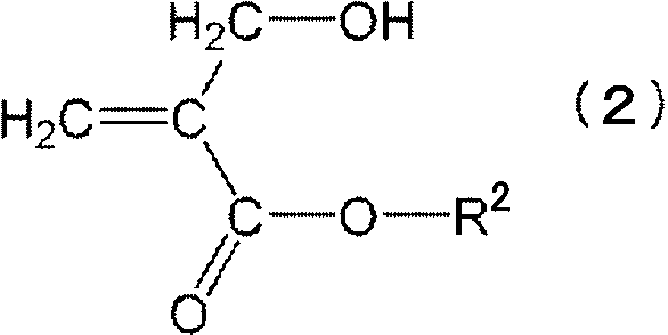
(R2は、炭素数1~4のアルキル基を表す。)
また、本発明の樹脂粒子を用いた場合、類似骨格のポリアクリル酸架橋体と比較すると、粒子分散体の粘度が極めて低く、各種樹脂組成物やコーティング剤に添加し、容易に配合組成物を得ることができる。
本発明の樹脂粒子は、下記一般式(1)で示される単量体(以下、ヒドロキシメチルアクリル酸系単量体という)の少なくとも1種と、多官能エチレン性不飽和単量体とが架橋した架橋構造を含む。

(R1は、炭素数1~4のアルキル基、水素原子、アルカリ金属原子または4級アンモニウムを表す。なお水素原子、アルカリ金属原子、4級アンモニウムは、R1が炭素数1~4のアルキル基であるヒドロキシメチルアクリル酸系単量体を重合して樹脂粒子にした後で、R1を加水分解することで導入されたものであってもよい。)
該エーテル結合を有していてもよい炭化水素系架橋剤は、エチレン性不飽和結合を2以上有することが好ましく、エチレン性不飽和結合を2つ有することがさらに好ましい。エーテル結合を有していてもよい炭化水素系架橋剤としては、具体的には、ジビニルベンゼン;1,3-ブタジエン;トリビニルベンゼン;ジビニルナフタレン;トリビニルシクロヘキサン;ジビニルエーテル;ジアリルエーテル;多価メタクリル酸エステル;等が挙げられるが、中でも、ジビニルベンゼン、1,3-ブタジエン、ジアリルエーテル、及び多価メタクリル酸エステルの少なくとも1種であることがより好ましく、ジビニルベンゼン及び1,3-ブタジエンの少なくとも1種であることがさらに好ましく、ジビニルベンゼンであることが特に好ましい。
単官能(メタ)アクリル系モノマー以外の単量体を含んでもよく、単官能(メタ)アクリル系モノマー以外の単量体としては、例えば、単官能スチレン系単量体が挙げられる。スチレン系単量体としては、例えば、スチレン、o-メチルスチレン、m-メチルスチレン、p-メチルスチレン、α-メチルスチレン、エチルビニルベンゼン、p-t-ブチルスチレン等のアルキルスチレン類;o-クロロスチレン、m-クロロスチレン、p-クロロスチレン等のハロゲン基含有スチレン類等のスチレン系単官能単量体等が挙げられる。これらの単量体は、それぞれ単独で用いてもよく、2種以上を併用してもよい。
本発明の樹脂粒子は、式(1)で表されるヒドロキシメチルアクリル酸系単量体のうちR1が炭素数1~4のアルキル基であるもの(以下、ヒドロキシメチルアクリル酸エステルという)と、多官能エチレン性不飽和単量体と(以下、これらをまとめて「原料単量体成分」という場合がある)を水系溶媒中で重合し、必要に応じ、部分的に又は完全に加水分解することにより得られる。親水性モノマーとしてヒドロキシメチルアクリル酸エステルを用いると、水系溶媒中で重合しても、生成物を粒子状にできる。また多官能エチレン性不飽和単量体を用いて架橋構造を導入しているため、重合後に加水分解しても、加水分解物は粒子状態を維持できる。上記重合により、水と、その水中に分散した上記樹脂粒子と、を含む水分散体が得られるが、水分散体については後述する。

(R2は、炭素数1~4のアルキル基を表す。)
上述した水と、その水中に分散した上記樹脂粒子と、を含む水分散体も本発明の範囲に包含される。本発明の水分散体は、樹脂粒子が、エステル基及びヒドロキシメチル基を有しており、親水性に優れている。また水に対する分散性が良好であり、分散体としての貯蔵安定性も良好であり、さらに容易に加水分解を行うことが可能である。加水分解及びその後、必要に応じて中和を行う場合、水分散体に含まれている樹脂粒子に対して、例えば、水酸化ナトリウム水溶液、アンモニア水溶液、シクロヘキシルアミン水溶液等の塩基性水溶液を添加することで加水分解を行うことができる。さらに、加水分解液に適宜酸を添加することで、部分中和又は完全中和を行うことができる。加水分解及び中和を行うことで、式(1)のR1に該当する基を水素原子、アルカリ金属原子、または4級アンモニウムにできる。重合時、加水分解時、及び中和時に用いる酸や塩基の量を調整したり、R1が水素原子である単量体単位の割合を調整することで、樹脂粒子のpH及び体積平均粒子径を容易に調整することができるため、樹脂粒子を幅広い用途で用いることができる。
得られた架橋微粒子分散体をイオン交換水で希釈して光散乱粒度分布測定機(Particle Sizing Systems社製「NicompMODEL380」)にて測定して、体積平均粒子径(nm)を求め、この値を架橋微粒子の体積平均粒子径とした。
内径4cmのガラス製のシャーレに架橋微粒子分散体を10質量部計量し、送風定温恒温器(ヤマト科学社製「DNF400」)にて105℃で2時間乾燥した。得られた乾燥粉体をメノウ鉢ですりつぶし乾燥粉末とした。続いて、乾燥粉末を再度送風定温恒温器にて105℃で60分乾燥させ、試験用粉末を得た。
蓋つきの内径4cmのガラス製のシャーレを用意し、シャーレの質量を測定し、測定した質量をX(g)とした。次に、得られた試験用粉末約0.5質量部を蓋つきの内径4cmのガラス製のシャーレに入れた後に蓋をして、正確に質量を測定し、測定した質量をY(g)とした。続いて、試験用粉末入りのシャーレの蓋を外した状態で、恒温恒湿器(エスペック社製「SH-241」)に入れて温度25℃、相対湿度60%の条件下で24時間保存し、その後、シャーレに蓋をして取り出して、吸湿後の質量を測定し、測定した質量をZ(g)とした。吸湿率(吸水率)は以下の計算式で計算した。
吸湿率(%)=[(Z-Y)/(Y-X)]×100
アクリル樹脂エマルション(日本触媒社製「ユーダブルEF-015」、ポリマー固形分:50質量%)5.0質量部に架橋微粒子分が0.25質量部となるように架橋微粒子分散体を配合した後、スターラーチップで十分に攪拌し、評価用塗料を得た。得られた評価用塗料を透明なアクリル板(日本テストパネル社製、縦:70mm、横:150mm、厚さ:2mm)に、塗工後の膜厚が50μmとなるようにアプリケーターで塗布し、送風定温恒温器(ヤマト科学社製「DNF400」)にて100℃で10分間乾燥して、塗膜が積層されたアクリル板(A)を作製した。
アクリル樹脂エマルション(日本触媒社製「ユーダブルEF-015」、ポリマー固形分:50質量%)5.0質量部に架橋微粒子分が0.25質量部となるように架橋微粒子分散体を配合した後、混合装置(泡とり練太郎 ARE-310 シンキー社製)で十分に攪拌し、評価用塗料を得た。得られた評価用塗料を透明なポリエチレンテレフタレートフィルム(東洋紡社製、コスモシャインA4300 縦:297mm、横:210mm、厚さ:0.100mm)に、塗工後の膜厚が50μmとなるようにバーコーターで塗布し、送風定温恒温器(ヤマト科学社製「DNF400」)にて100℃で10分間乾燥して、塗膜が積層されたポリエチレンテレフタレートフィルム(B)を作製した。
アルミテストパネル(日本テストパネル社製、A1050P 縦:150mm、横:70mm、厚さ:0.800mm)の塗工面をアセトンを含ませたキムワイプで、キムワイプに黒い汚れがつかなくなるまで拭いた。次に、ウルトラシーラーIII(日本ペイント社製)をアセトン洗浄したアルミテストパネルに、塗工後の膜厚が11.5μmとなるようにバーコーターで塗布し、送風定温恒温器(ヤマト科学社製「DNF400」)にて100℃で10分間乾燥して、表面が改質されたアルミテストパネルを準備した。クラレポバール28-98(クラレ社製 けん化度98%以上、重合度1700)をイオン交換水で有効成分10.0質量%に希釈したもの(以下、「PVA(有効成分10.0質量%)」という)を5.0質量部に、ポリエチレングリコール3400(富士フィルム和光純薬社製 分子量3400)をイオン交換水で有効成分10.0質量%に希釈したもの(以下、「PEG(有効成分10.0質量%)」という)を5.0質量部加え、スターラーチップで十分に攪拌して、親水性バインダー(有効成分10.0質量%)を得た。続いて、親水性バインダー(有効成分10.0質量%)10.0質量部に架橋微粒子分が0.20質量部となるように架橋微粒子分散体を配合した後、混合装置(泡とり練太郎 ARE-310 シンキー社製)で十分に攪拌し、評価用塗料を得た。得られた評価用塗料を表面改質されたアルミテストパネルに、塗工後の膜厚が11.5μmとなるようにバーコーターで塗布し、送風定温恒温器(ヤマト科学社製「DNF400」)にて200℃で1分間乾燥して、塗膜が積層されたアルミニウム板(C)を作製した。
得られた塗膜が積層されたアクリル板(A)を温度23℃、相対湿度65%の雰囲気中に一晩静置した後、静的接触角測定装置(協和界面化学社製「DM-500」)を用い、塗膜に純水を2μL滴下して、水滴が塗膜の表面に接触した30秒後の接触角を測定した。なお、表1中に参考例として記載したが、塗膜を積層していない上記アクリル板(A)の接触角は84.9°であった。
上記アクリル板(A)を上記ポリエチレンテレフタレートフィルム(B)又は上記アルミニウム板(C)に代えた以外は「塗膜親水性評価(アクリル板)」に記載の方法と同じ方法で接触角を測定した。
pHメーター(堀場製作所社製「F-72」)により25℃での値を測定した。
攪拌機、温度計および冷却機を備えたステンレス製の反応釜に、脱イオン水832.0質量部およびエーテルサルフェート型アンモニウム塩を主成分とするアニオン性反応型界面活性剤アデカリアソープSR-20(有効成分100質量%、ADEKA社製)をイオン交換水で有効成分25.0質量%に希釈したもの(以下、「SR-20(有効成分25.0質量%)」という)を0.96質量部加え、内温を75℃まで昇温し、同温度に保った。他方、上記反応釜とは異なる容器で、2-ヒドロキシメチルアクリル酸メチル(以下「RHMA」と称する)180.0質量部とジビニルベンゼン(新日鉄住金化学社製、ジビニルベンゼン純度81%、以下「DVB810」と称する)20.0質量部とを混合して、単量体組成物200.0質量部を調製した。次に、上記反応釜内を窒素ガスで置換した後、上記単量体組成物40.0質量部、過酸化水素水(過酸化水素濃度1.28質量%)21.0質量部、及びL-アスコルビン酸水溶液(L-アスコルビン酸濃度1.90質量%)21.0質量部を上記反応釜内に添加して、初期重合反応を行った。続いて、上記単量体組成物の残部160.0質量部、過酸化水素水(過酸化水素濃度0.22質量%)479.0質量部、及びL-アスコルビン酸水溶液(L-アスコルビン酸濃度0.33質量%)479.0質量部とSR-20(有効成分25.0質量%)7.04質量部との混合組成物486.04質量部を、各々異なる投入口より反応釜へ4時間かけて均一に滴下した。滴下終了後、内温を85℃まで昇温し、同温度で2時間保持して熟成した後、反応溶液を冷却して、架橋微粒子(1)が分散した架橋微粒子分散体(1a)を得た。得られた架橋微粒子分散体(1a)を用いて測定した各種物性を表1に示した。
架橋微粒子分散体(1a)10.0質量部およびアンモニア水溶液(アンモニア濃度2.8質量%)4.6質量部を反応釜に加え、25℃で30分撹拌し、架橋微粒子(2)が分散した架橋微粒子分散体(2a)を得た。なお、架橋微粒子分散体(1a)を作製する際に添加されたRHMA中におけるメトキシカルボニル基のモル数と架橋微粒子分散体(1a)に添加したアンモニアのモル数は同じであった。得られた架橋微粒子分散体(2a)を用いて測定した各種物性を表1に示した。
攪拌機、温度計および冷却機を備えたステンレス製の反応釜に、脱イオン水1472.6質量部とSR-20(有効成分25.0質量%)0.16質量部とを加え、内温を75℃まで昇温し、同温度に保った。他方、上記反応釜とは異なる容器で、RHMA198.0質量部とDVB810 2.0質量部とを混合して、単量体組成物200.0質量部を調製した。次に、上記反応釜内を窒素ガスで置換した後、上記単量体組成物100.0質量部、過酸化水素水(過酸化水素濃度2.68質量%)20.0質量部、及びL-アスコルビン酸水溶液(L-アスコルビン酸濃度4.00質量%)20.0質量部を上記反応釜内に添加して、初期重合反応を行った。続いて、上記単量体組成物の残部100.0質量部、過酸化水素水(過酸化水素濃度0.50質量%)160.0質量部、及びL-アスコルビン酸水溶液(L-アスコルビン酸濃度0.75質量%)160.0質量部とSR-20(有効成分25.0質量%)7.84質量部とアンモニア水溶液(アンモニア濃度28.0質量%)0.36質量部との混合組成物168.2質量部を、各々異なる投入口より反応釜へ4時間かけて均一に滴下した。滴下終了後、内温を85℃まで昇温し、同温度で2時間保持して熟成した後、反応溶液を冷却して、架橋微粒子(3)が分散した架橋微粒子分散体(3a)を得た。得られた架橋微粒子分散体(3a)を用いて測定した各種物性を表1に示した。
架橋微粒子分散体(3a)10.0質量部およびアンモニア水溶液(アンモニア濃度2.8質量%)5.1質量部を反応釜に加え、25℃で30分撹拌し、架橋微粒子(4)が分散した架橋微粒子分散体(4a)を得た。なお、架橋微粒子分散体(3a)を作製する際に添加されたRHMA中におけるメトキシカルボニル基のモル数と架橋微粒子分散体(3a)に添加したアンモニアのモル数は同じであった。得られた架橋微粒子分散体(4a)を用いて測定した各種物性を表1に示した。なお、架橋微粒子(4)は粒子状となってはいるが、粒子が水を含み膨潤しているため、散乱強度が低く正確な粒子径を測定できなかった。
攪拌機、温度計および冷却機を備えたステンレス製の反応釜に、脱イオン水832.0質量部とドデシルベンゼンスルホン酸ナトリウム水溶液(有効成分6.5質量%、以下「DBSNa(有効成分6.5質量%)」と称する)0.92質量部とを加え、内温を75℃まで昇温し、同温度に保った。他方、上記反応釜とは異なる容器で、メタクリル酸メチル(以下「MMA」と称する)180.0質量部とDVB810 20.0質量部を混合して、単量体組成物200.0質量部を調製した。次に、上記反応釜内を窒素ガスで置換した後、上記単量体組成物40.0質量部、過酸化水素水(過酸化水素濃度1.28質量%)21.0質量部、及びL-アスコルビン酸水溶液(L-アスコルビン酸濃度1.90質量%)21.0質量部を上記反応釜内に添加して、初期重合反応を行った。続いて、上記単量体組成物の残部160.0質量部、過酸化水素水(過酸化水素濃度0.22質量%)479.0質量部、及びL-アスコルビン酸水溶液(L-アスコルビン酸濃度0.33質量%)479.0質量部とDBSNa(有効成分6.5質量%)6.77質量部との混合組成物485.77質量部を、各々異なる投入口より反応釜へ4時間かけて均一に滴下した。滴下終了後、内温を85℃まで昇温し、同温度で2時間保持して熟成した後、反応溶液を冷却して、架橋微粒子(c1)が分散した架橋微粒子分散体(c1a)を得た。得られた架橋微粒子分散体(c1a)を用いて測定した各種物性を表1に示した。
架橋微粒子分散体(c1a)10.0質量部およびアンモニア水溶液(アンモニア濃度28質量%)0.5質量部を反応釜に加え、25℃で30分撹拌し、架橋微粒子(c2)が分散した架橋微粒子分散体(c2a)を得た。なお、架橋微粒子分散体(c1a)を作製する際に添加されたMMA中におけるメトキシカルボニル基のモル数と架橋微粒子分散体(c1a)に添加したアンモニアのモル数は同じであった。得られた架橋微粒子分散体(c2a)を用いて測定した各種物性を表1に示した。
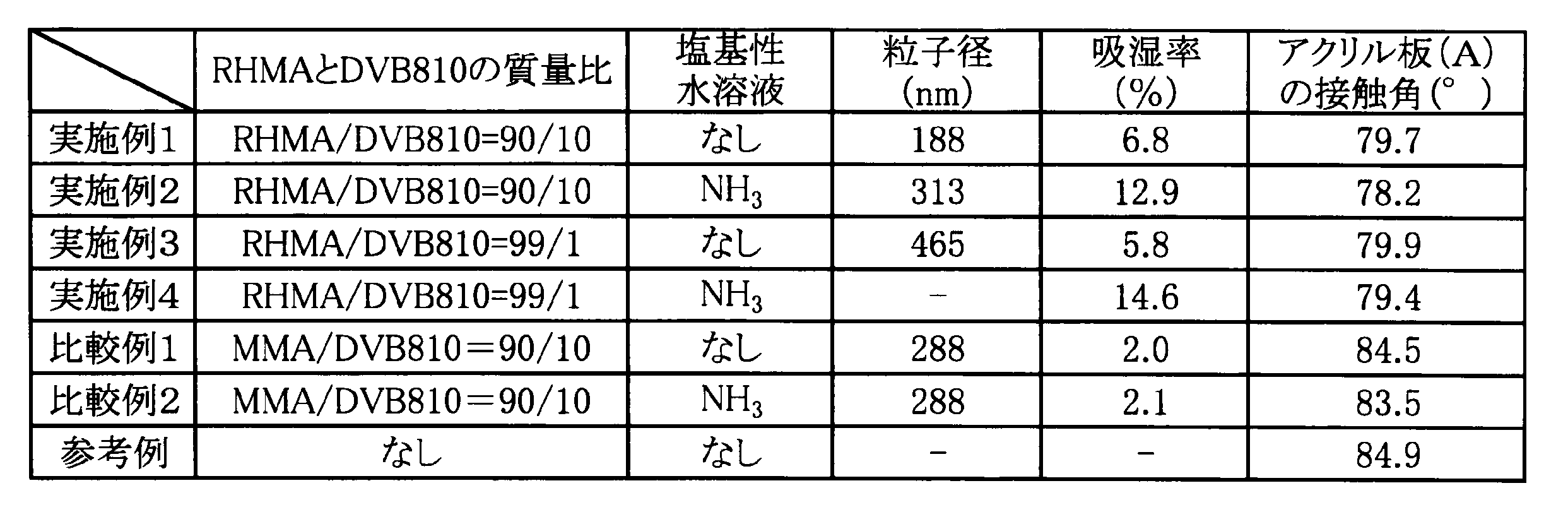
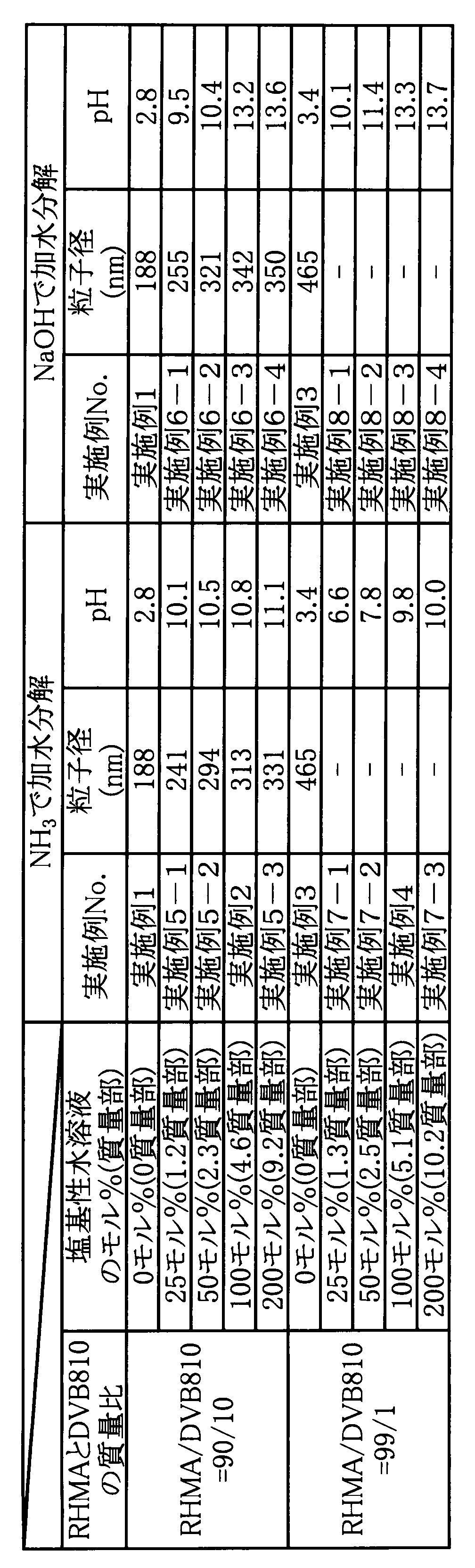
アンモニア水溶液(アンモニア濃度2.8質量%)の添加量を表2に記載の値(1.2質量部(実施例5-1)、2.3質量部(実施例5-2)、9.2質量部(実施例5-3))に変更した以外は実施例2と同様に架橋微粒子分散体(5-1a、5-2a、5-3a)を作製した。得られた架橋微粒子分散体(5-1a、5-2a、5-3a)を用いてpH及び平均粒子径を測定し、測定結果を表2に示した。なお、架橋微粒子分散体(1a)(実施例1)及び架橋微粒子分散体(2a)(実施例2)についてもpHを測定し、表2にpH及び体積平均粒子径を示しており、表2中の「モル%」は実施例2でのアンモニア水溶液の添加量を基準(100モル%)としたときの各実施例におけるアンモニア水溶液の添加量の比率を記載した。
アンモニア水溶液に代えて水酸化ナトリウム水溶液(水酸化ナトリウム濃度6.6質量%)を1.2質量部(実施例6-1)、2.3質量部(実施例6-2)、4.6質量部(実施例6-3)、9.2質量部(実施例6-4)添加した以外は実施例2と同様に架橋微粒子分散体(6-1a、6-2a、6-3a、6-4a)を作製した。得られた架橋微粒子分散体(6-1a、6-2a、6-3a、6-4a)を用いてpH及び平均粒子径を測定し、測定結果を表2に示した。なお、実施例6-3では、架橋微粒子分散体(1a)を作製する際に添加されたRHMA中におけるメトキシカルボニル基のモル数と架橋微粒子分散体(1a)に添加した水酸化ナトリウムのモル数は同じであった。表2中の「モル%」は水酸化ナトリウム水溶液を4.6質量部添加した場合の添加量を基準(100モル%)としたときの各実施例における水酸化ナトリウム水溶液の添加量の比率を記載した。
アンモニア水溶液(アンモニア濃度2.8質量%)の添加量を表2に記載の値(1.3質量部(実施例7-1)、2.5質量部(実施例7-2)、10.2質量部(実施例7-3))に変更した以外は実施例4と同様に架橋微粒子分散体(7-1a、7-2a、7-3a)を作製した。得られた架橋微粒子分散体(7-1a、7-2a、7-3a)を用いてpH及び平均粒子径を測定し、測定結果を表2に示した。なお、実施例3及び実施例4についてもpHを測定し、表2にpHを示しており、表2中の「モル%」は実施例4でのアンモニア水溶液の添加量を基準(100モル%)としたときの各実施例におけるアンモニア水溶液の添加量の比率を記載した。また、架橋微粒子(7-1a、7-2a、7-3a)は粒子状となってはいるが、粒子が水を含み膨潤しているため、散乱強度が低く正確な粒子径を測定できなかった。
アンモニア水溶液に代えて水酸化ナトリウム水溶液(水酸化ナトリウム濃度6.6質量%)を1.3質量部(実施例8-1)、2.5質量部(実施例8-2)、5.1質量部(実施例8-3)、10.2質量部(実施例8-4)添加した以外は実施例4と同様に架橋微粒子分散体(8-1a、8-2a、8-3a、8-4a)を作製した。得られた架橋微粒子分散体(8-1a、8-2a、8-3a、8-4a)を用いてpHを測定し、測定結果を表2に示した。なお、実施例8-3では、架橋微粒子分散体(3a)を作製する際に添加されたRHMA中におけるメトキシカルボニル基のモル数と架橋微粒子分散体(3a)に添加した水酸化ナトリウムのモル数は同じであった。表2中の「モル%」は水酸化ナトリウム水溶液を5.1質量部添加した場合の添加量を基準(100モル%)としたときの各実施例における水酸化ナトリウム水溶液の添加量の比率を記載した。また、架橋微粒子(8-1a、8-2a、8-3a、8-4a)は粒子状となってはいるが、粒子が水を含み膨潤しているため、散乱強度が低く正確な粒子径を測定できなかった。
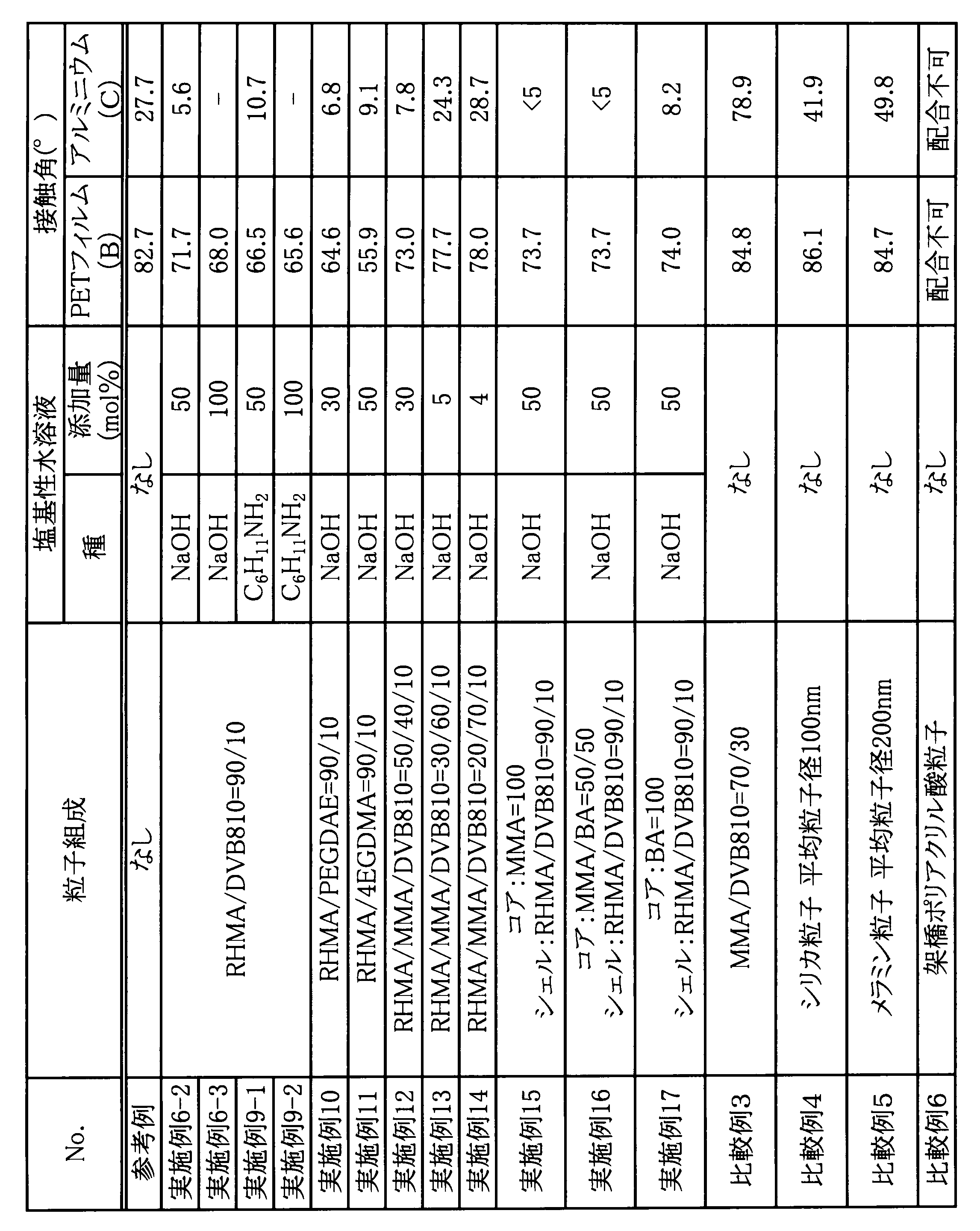
アンモニア水溶液に代えてシクロヘキサンアミン(シクロヘキサンアミン濃度100質量%)を0.38質量部(実施例9-1)、0.75質量部(実施例9-2)添加した以外は実施例2と同様に架橋微粒子分散体(9-1a、9-2a)を作製した。なお、実施例9-2では、架橋微粒子分散体(1a)を作製する際に添加されたRHMA中におけるメトキシカルボニル基のモル数と架橋微粒子分散体(1a)に添加したシクロヘキサンアミンのモル数は同じであった。表3中の「モル%」はシクロヘキサンアミン水溶液を0.75質量部添加した場合の添加量を基準(100モル%)としたときの各実施例におけるシクロヘキサンアミン水溶液の添加量の比率を記載した。
粒子組成を表3に記載の粒子組成に変更し、アンモニア水溶液に代えて水酸化ナトリウム水溶液を添加した以外は実施例2と同様に架橋微粒子分散体(10a~14a)を作製した。得られた架橋微粒子分散体(10a~14a)を用いて接触角を測定し、測定結果を表3に示した。表3中の「モル%」は水酸化ナトリウム水溶液を4.6質量部添加した場合の添加量を基準(100モル%)としたときの各実施例における水酸化ナトリウム水溶液の添加量の比率を記載した。なお、表3中の「PEGDAE」はポリエチレングリコールジアリルエーテルのことであり、「4EGDMA」はテトラエチレングリコールジメタクリレートのことであり、ポリエチレングリコールジアリルエーテルとしては、日油社製ユニオックス(登録商標)AA-480Rを、テトラエチレングリコールジメタクリレートとしては、共栄社化学社製ライトエステル4EGを用いた。
攪拌機、温度計及び冷却機を備えたステンレス製の第1の反応釜に、脱イオン水1378.0質量部、及びエーテルサルフェート型アンモニウム塩を主成分とするアニオン性反応性乳化剤アデカリアソープSR-20(有効成分100質量%、ADEKA社製)をイオン交換水で有効成分10質量%に希釈したもの(以下「SR-20(有効成分25質量%)」という)0.96質量部を加え、内温を75℃まで昇温し、同温度に保った。他方、第1の反応釜とは異なる第2の反応釜で、MMA100質量部を投入し、単量体組成物A 100質量部を調製した。さらに、第1の反応釜、第2の反応釜とは異なる第3の反応釜で、RHMA90質量部と、DVB810 10質量部とを混合して、単量体組成物B100質量部を調製した。
次に、第1の反応釜内を窒素ガスで置換した後、前記単量体組成物A100質量部、過酸化水素水(濃度3.35質量%)20質量部、及びL-アスコルビン酸水溶液(濃度5.0質量%)20質量部を第1の反応釜内に添加して、初期重合反応を行った。続いて、前記単量体組成物B100質量部、過酸化水素水(濃度0.83質量%)100質量部、及びL-アスコルビン酸水溶液(濃度1.25質量%)100質量部、SR-20(有効成分10質量%)7.04質量部とアンモニア水溶液(濃度28質量%)0.36質量部とイオン交換水92.6質量%との混合組成物100質量部を、各々異なる投入口より、第1の反応釜へ3時間かけて均一に滴下した。滴下終了後、第1の反応釜の内温を75℃に保持し、同温度で2時間保持して熟成した後、反応溶液を冷却して、重合体(15)が分散した重合体水分散体(15)を得た。
前記で得られた重合体水分散体(15)10質量部、及び塩基性水溶液として水酸化ナトリウム水溶液(濃度10.0質量%)0.76質量部を第1の反応釜に加え、25℃で終夜撹拌することにより、部分的に加水分解された重合体が分散した重合体水分散体(15)を得た。
粒子組成を表3に記載の粒子組成に変更した以外は実施例15(と同様に架橋微粒子分散体(16~17)を作製した。なお、表3中の「BA」はn-ブチルアクリレートである。
粒子組成を表3に記載の粒子組成に変更した以外は実施例1と同様に架橋微粒子分散体(c3a)を作製した。得られた架橋微粒子分散体(c3a)を用いて接触角を測定し、測定結果を表3に示した。
攪拌機、滴下装置および温度計を備えた容量10Lのガラス製反応器に、有機溶媒としてのメチルアルコール4266.5gと、28重量%アンモニア水(水および触媒)333.0gとを仕込み、攪拌しながら液温を20±0.5℃に調節した。一方、滴下装置に、シリコン化合物としてのテトラメトキシシラン333.0gをメチルアルコール533.0gに溶解してなる溶液を仕込んだ。そして、滴下装置から該溶液を1時間かけて滴下した。滴下終了後、さらに1時間攪拌することにより、テトラメトキシシランの加水分解,縮合を行い、シリカ粒子の懸濁液を得た。該シリカ粒子の平均粒子径は100nmであった。得られた懸濁液を瞬間真空蒸発装置を用いて乾燥させることにより、粉体状のシリカ粒子を取り出した。瞬間真空乾燥装置としては、クラックス・システム 8B型(ホソカワミクロン株式会社製)を使用した。また乾燥条件として、加熱管温度175℃、減圧度200torrを採用した。上記の瞬間真空蒸発装置は、加熱水蒸気が供給されるジャケットで覆われた内径8mm、長さ9mのステンレス鋼管と、該鋼管の一端部に懸濁液を供給する供給部と、鋼管の他端部に接続された、粉体と蒸気とを分離するバッグフィルタが設けられた減圧状態の粉体捕集室とを備えていた。そして、供給部から供給された懸濁液は、鋼管内を通過する際に加熱されて粉体と蒸気とに分離し、粉体はバッグフィルタによって捕集され、蒸気は凝縮された後、装置外に排出される構成となっていた。
粒子として粉体状の上記シリカ粒子を用いた以外は実施例1と同様に架橋微粒子分散体(c4a)を作製した。得られた架橋微粒子分散体(c4a)を用いて接触角を測定し、測定結果を表3に示した。
攪拌機、温度計、および冷却機を備えたステンレス製の反応釜に、脱イオン水1400部および65重量%DBSNa6部を加え、内温を90℃まで昇温し、同温度に保った。
他方、上記反応釜とは異なる上記と同一設備を保有した反応容器に、メラミン100部、37重量%ホルマリン193部、25重量%アンモニア水3部を加え、70℃まで昇温して、同温度で40分間保持した後、上記90℃に保持された65重量%DBSNa水溶液中に投入した。その後、10重量%DBS水溶液50部を投入して、さらに90℃にて5時間保持して熟成を行い、アミノ樹脂粒子を含有する分散液を得た。上記アミノ樹脂粒子を含有する分散液1752部に10重量%硫酸バンド水溶液30部を添加して、30分攪拌を行った。その後、その分散液を遠心分離機により固液分離を行い、得られたケーキを窒素雰囲気下の190℃で保持された熱風乾燥機乾燥にて5時間保持し、乾燥を行った後、ジェットミル粉砕機(粉砕圧:0.7MPa)による粉砕と気流分級を行い、メラミン樹脂粒子を得た。該メラミン粒子の平均粒子径は200nmであった。
粒子として上記メラミン粒子を用いた以外は実施例1と同様に架橋微粒子分散体(c5a)を作製した。得られた架橋微粒子分散体(c5a)を用いて接触角を測定し、測定結果を表3に示した。
粒子として架橋ポリアクリル酸(富士フイルムワコーケミカル社製100CLPAH)を用いた以外は実施例1と同様に架橋微粒子分散体(c6a)を作製した。しかし、上記架橋ポリアクリル酸を用いた比較例6では粘度が高すぎるため、配合することができなかった。
架橋微粒子分散体(6-3a)を、スプレードライヤー(ヤマト科学社製 GA-32)で乾燥させ、架橋微粒子粉体(6-3b)を得た。架橋微粒子粉体(6-3b)1.0質量部にイオン交換水9.0質量部を加え、スターラーチップで十分に攪拌し、10質量%の水分散体を調製した。続いて、コーンプレート型粘度計(DV-II+Pro ブルックフィールド社 ローターNo.CPE-42 回転数30rpm)を用いて、試料皿に1質量部の水分散体を入れ、25℃における粒子水分散体の粘度を測定したところ、5.62mPa・sであった。
比較例6で用いた架橋ポリアクリル酸粒子についても同様にして、0.1質量%の水分散体の粘度を測定したところ、10.4mPa・sであり、0.1質量%しか架橋ポリアクリル酸粒子を含有していないにもかかわらず粘度が非常に高くなった。
このことから本発明の樹脂粒子は、各種添加剤として使用する場合の配合性が極めて高いといえる。
Claims (10)
- 下記一般式(1)で示される単量体の少なくとも1種と、多官能エチレン性不飽和単量体とが架橋した架橋構造を含むことを特徴とする樹脂粒子。
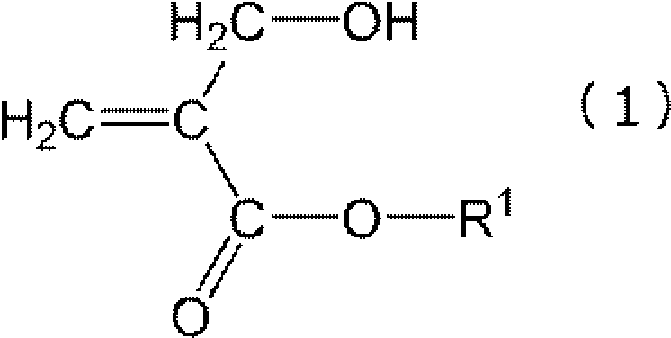
(R1は、炭素数1~4のアルキル基、水素原子、アルカリ金属原子または4級アンモニウムを表す。) - 前記多官能エチレン性不飽和単量体が非加水分解性単量体である請求項1に記載の樹脂粒子。
- 前記多官能エチレン性不飽和単量体がエーテル結合を有していてもよい炭化水素系架橋剤であり、エチレン性不飽和結合を2以上有する請求項1又は2に記載の樹脂粒子。
- 前記多官能エチレン性不飽和単量体はジビニルベンゼン及び1,3-ブタジエンの少なくとも1種である請求項1~3のいずれか1項に記載の樹脂粒子。
- 前記一般式(1)由来の単量体単位が合計で30~99.99質量%である請求項1~4のいずれか1項に記載の樹脂粒子。
- 吸湿率が2.5質量%以上である請求項1~5のいずれか1項に記載の樹脂粒子。
- 水と、その水中に分散した請求項1~6のいずれか1項に記載の樹脂粒子と、を含む水分散体。
- 前記樹脂粒子の体積平均粒子径が10nm~10μmである請求項7に記載の水分散体。
- 請求項1~6のいずれか1項に記載の樹脂粒子を含む親水性付与剤。
- 樹脂粒子の製造方法であって、乳化剤の存在下、式(2)で示される単量体の少なくとも1種と、多官能エチレン性不飽和単量体とを水系溶媒に分散させて重合反応を行う乳化重合を含むことを特徴とする樹脂粒子の製造方法。
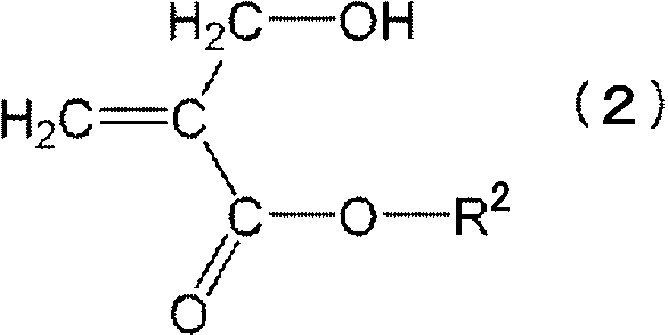
(R2は、炭素数1~4のアルキル基を表す。)
Priority Applications (5)
| Application Number | Priority Date | Filing Date | Title |
|---|---|---|---|
| EP20783607.3A EP3950741A4 (en) | 2019-03-29 | 2020-02-27 | RESIN PARTICLE AND MANUFACTURING METHOD THEREOF AND HYDROPHILIC-IMPENDING AGENT WITH SAID RESIN PARTICLE |
| KR1020217031068A KR102716795B1 (ko) | 2019-03-29 | 2020-02-27 | 수지 입자 및 그 제조방법, 및 그 수지 입자를 포함하는 친수성 부여제 |
| CN202080024714.XA CN113661189B (zh) | 2019-03-29 | 2020-02-27 | 树脂颗粒及其制备方法和含有该树脂颗粒的亲水性赋予剂 |
| US17/598,436 US12545778B2 (en) | 2019-03-29 | 2020-02-27 | Resin particle and production method therefor, and hydrophilicity imparting agent containing said resin particle |
| JP2021511241A JP7162125B2 (ja) | 2019-03-29 | 2020-02-27 | 樹脂粒子及びその製造方法、並びに該樹脂粒子を含む親水性付与剤 |
Applications Claiming Priority (2)
| Application Number | Priority Date | Filing Date | Title |
|---|---|---|---|
| JP2019-067834 | 2019-03-29 | ||
| JP2019067834 | 2019-03-29 |
Publications (1)
| Publication Number | Publication Date |
|---|---|
| WO2020202938A1 true WO2020202938A1 (ja) | 2020-10-08 |
Family
ID=72668099
Family Applications (1)
| Application Number | Title | Priority Date | Filing Date |
|---|---|---|---|
| PCT/JP2020/008113 Ceased WO2020202938A1 (ja) | 2019-03-29 | 2020-02-27 | 樹脂粒子及びその製造方法、並びに該樹脂粒子を含む親水性付与剤 |
Country Status (6)
| Country | Link |
|---|---|
| US (1) | US12545778B2 (ja) |
| EP (1) | EP3950741A4 (ja) |
| JP (1) | JP7162125B2 (ja) |
| KR (1) | KR102716795B1 (ja) |
| CN (1) | CN113661189B (ja) |
| WO (1) | WO2020202938A1 (ja) |
Cited By (6)
| Publication number | Priority date | Publication date | Assignee | Title |
|---|---|---|---|---|
| JP2022073608A (ja) * | 2020-11-02 | 2022-05-17 | 株式会社日本触媒 | 重合体粒子およびそれらを用いた吸湿剤 |
| JP2022081973A (ja) * | 2020-11-20 | 2022-06-01 | 株式会社日本触媒 | 空孔形成剤 |
| JP2022174721A (ja) * | 2021-05-11 | 2022-11-24 | ゼロックス コーポレイション | 水性コーティング組成物のための架橋有機添加剤 |
| JP2023058950A (ja) * | 2021-10-14 | 2023-04-26 | 株式会社日本触媒 | アンチブロッキング剤 |
| JP2023078540A (ja) * | 2021-11-26 | 2023-06-07 | 株式会社日本触媒 | 空孔形成用組成物 |
| JP2023142508A (ja) * | 2022-03-25 | 2023-10-05 | 株式会社日本触媒 | アンチブロッキング剤 |
Families Citing this family (3)
| Publication number | Priority date | Publication date | Assignee | Title |
|---|---|---|---|---|
| JP7522623B2 (ja) * | 2020-09-24 | 2024-07-25 | 株式会社日本触媒 | 分散体並びに該分散体から形成された樹脂フィルム及び光学フィルム |
| JP7512152B2 (ja) * | 2020-09-24 | 2024-07-08 | 株式会社日本触媒 | 重合体粒子を含むゴム組成物 |
| JPWO2024252703A1 (ja) * | 2023-06-08 | 2024-12-12 |
Citations (11)
| Publication number | Priority date | Publication date | Assignee | Title |
|---|---|---|---|---|
| JPS5527346A (en) | 1978-08-16 | 1980-02-27 | Japan Exlan Co Ltd | Aqueous dispersion of microhydrogel, its preparation, and preparation of microhydrogel |
| JPH04132705A (ja) | 1990-01-05 | 1992-05-07 | Mitsubishi Paper Mills Ltd | 水溶性ポリマー微粒子の製造方法 |
| JPH083251A (ja) | 1994-06-20 | 1996-01-09 | Kansai Paint Co Ltd | 親水性架橋重合体微粒子及びその製造方法 |
| JPH10158471A (ja) * | 1996-11-28 | 1998-06-16 | Nippon Shokubai Co Ltd | 硬化性樹脂組成物 |
| JP2007046044A (ja) * | 2005-07-15 | 2007-02-22 | Toray Ind Inc | 熱可塑性樹脂組成物、成形品およびフィルム |
| JP2007254727A (ja) * | 2006-02-22 | 2007-10-04 | Nippon Shokubai Co Ltd | 有機微粒子、樹脂組成物、光学フィルムおよび光学フィルムの製造方法 |
| JP2008163187A (ja) * | 2006-12-28 | 2008-07-17 | Toray Ind Inc | 熱可塑性重合体およびその製造方法 |
| JP2008299096A (ja) * | 2007-05-31 | 2008-12-11 | Nippon Shokubai Co Ltd | 偏光子保護フィルム、偏光板、および液晶表示装置 |
| JP2017056404A (ja) | 2015-09-16 | 2017-03-23 | 日本エクスラン工業株式会社 | 吸湿性ミリビーズ並びに吸湿性ミリビーズを用いた除湿ユニットおよび除湿装置 |
| JP2017105906A (ja) * | 2015-12-08 | 2017-06-15 | 株式会社日本触媒 | 有機ナノ微粒子及び複合粒子 |
| JP2019067834A (ja) | 2017-09-29 | 2019-04-25 | パナソニックIpマネジメント株式会社 | 部品実装装置、部品実装ライン、部品実装装置による部品実装方法及び部品実装ラインによる部品実装方法 |
Family Cites Families (7)
| Publication number | Priority date | Publication date | Assignee | Title |
|---|---|---|---|---|
| DE1570641C3 (de) | 1965-12-31 | 1982-01-28 | Bayer Ag, 5090 Leverkusen | Vernetzte Acrylsäureester-Mischpolymerisate und Verfahren zu ihrer Herstellung |
| US5681889A (en) | 1994-06-20 | 1997-10-28 | Kansai Paint Co., Ltd | Hydrophilic crosslinked polymer fine particles and process for production thereof |
| NO20002632L (no) | 1999-06-01 | 2000-12-04 | Nippon Catalytic Chem Ind | Herdbart behandlingsmiddel og herdebehandlingsprosess |
| JP2006219576A (ja) * | 2005-02-10 | 2006-08-24 | Asahi Glass Co Ltd | 重合体の製造方法、塗料用組成物および塗装物品 |
| KR20110069785A (ko) * | 2008-09-19 | 2011-06-23 | 토요 탄소 가부시키가이샤 | 친수화 미립자의 제조방법 및 그 방법으로 수득된 친수화 미립자 |
| JP5629779B2 (ja) * | 2010-10-05 | 2014-11-26 | 東洋炭素株式会社 | 親水化微粒子の製造方法 |
| CN104334635B (zh) * | 2012-06-26 | 2017-11-10 | 株式会社钟化 | 非双折射性树脂材料及膜 |
-
2020
- 2020-02-27 CN CN202080024714.XA patent/CN113661189B/zh active Active
- 2020-02-27 WO PCT/JP2020/008113 patent/WO2020202938A1/ja not_active Ceased
- 2020-02-27 JP JP2021511241A patent/JP7162125B2/ja active Active
- 2020-02-27 EP EP20783607.3A patent/EP3950741A4/en active Pending
- 2020-02-27 US US17/598,436 patent/US12545778B2/en active Active
- 2020-02-27 KR KR1020217031068A patent/KR102716795B1/ko active Active
Patent Citations (11)
| Publication number | Priority date | Publication date | Assignee | Title |
|---|---|---|---|---|
| JPS5527346A (en) | 1978-08-16 | 1980-02-27 | Japan Exlan Co Ltd | Aqueous dispersion of microhydrogel, its preparation, and preparation of microhydrogel |
| JPH04132705A (ja) | 1990-01-05 | 1992-05-07 | Mitsubishi Paper Mills Ltd | 水溶性ポリマー微粒子の製造方法 |
| JPH083251A (ja) | 1994-06-20 | 1996-01-09 | Kansai Paint Co Ltd | 親水性架橋重合体微粒子及びその製造方法 |
| JPH10158471A (ja) * | 1996-11-28 | 1998-06-16 | Nippon Shokubai Co Ltd | 硬化性樹脂組成物 |
| JP2007046044A (ja) * | 2005-07-15 | 2007-02-22 | Toray Ind Inc | 熱可塑性樹脂組成物、成形品およびフィルム |
| JP2007254727A (ja) * | 2006-02-22 | 2007-10-04 | Nippon Shokubai Co Ltd | 有機微粒子、樹脂組成物、光学フィルムおよび光学フィルムの製造方法 |
| JP2008163187A (ja) * | 2006-12-28 | 2008-07-17 | Toray Ind Inc | 熱可塑性重合体およびその製造方法 |
| JP2008299096A (ja) * | 2007-05-31 | 2008-12-11 | Nippon Shokubai Co Ltd | 偏光子保護フィルム、偏光板、および液晶表示装置 |
| JP2017056404A (ja) | 2015-09-16 | 2017-03-23 | 日本エクスラン工業株式会社 | 吸湿性ミリビーズ並びに吸湿性ミリビーズを用いた除湿ユニットおよび除湿装置 |
| JP2017105906A (ja) * | 2015-12-08 | 2017-06-15 | 株式会社日本触媒 | 有機ナノ微粒子及び複合粒子 |
| JP2019067834A (ja) | 2017-09-29 | 2019-04-25 | パナソニックIpマネジメント株式会社 | 部品実装装置、部品実装ライン、部品実装装置による部品実装方法及び部品実装ラインによる部品実装方法 |
Non-Patent Citations (1)
| Title |
|---|
| See also references of EP3950741A4 |
Cited By (9)
| Publication number | Priority date | Publication date | Assignee | Title |
|---|---|---|---|---|
| JP2022073608A (ja) * | 2020-11-02 | 2022-05-17 | 株式会社日本触媒 | 重合体粒子およびそれらを用いた吸湿剤 |
| JP7550606B2 (ja) | 2020-11-02 | 2024-09-13 | 株式会社日本触媒 | 重合体粒子およびそれらを用いた吸湿剤 |
| JP2022081973A (ja) * | 2020-11-20 | 2022-06-01 | 株式会社日本触媒 | 空孔形成剤 |
| JP7573422B2 (ja) | 2020-11-20 | 2024-10-25 | 株式会社日本触媒 | 空孔形成剤 |
| JP2022174721A (ja) * | 2021-05-11 | 2022-11-24 | ゼロックス コーポレイション | 水性コーティング組成物のための架橋有機添加剤 |
| JP2023058950A (ja) * | 2021-10-14 | 2023-04-26 | 株式会社日本触媒 | アンチブロッキング剤 |
| JP2023078540A (ja) * | 2021-11-26 | 2023-06-07 | 株式会社日本触媒 | 空孔形成用組成物 |
| JP7801883B2 (ja) | 2021-11-26 | 2026-01-19 | 株式会社日本触媒 | 空孔形成用組成物 |
| JP2023142508A (ja) * | 2022-03-25 | 2023-10-05 | 株式会社日本触媒 | アンチブロッキング剤 |
Also Published As
| Publication number | Publication date |
|---|---|
| JPWO2020202938A1 (ja) | 2020-10-08 |
| CN113661189A (zh) | 2021-11-16 |
| KR102716795B1 (ko) | 2024-10-11 |
| CN113661189B (zh) | 2024-06-07 |
| EP3950741A1 (en) | 2022-02-09 |
| JP7162125B2 (ja) | 2022-10-27 |
| KR20210133268A (ko) | 2021-11-05 |
| EP3950741A4 (en) | 2022-12-21 |
| US12545778B2 (en) | 2026-02-10 |
| US20220162434A1 (en) | 2022-05-26 |
Similar Documents
| Publication | Publication Date | Title |
|---|---|---|
| JP7162125B2 (ja) | 樹脂粒子及びその製造方法、並びに該樹脂粒子を含む親水性付与剤 | |
| JP5000613B2 (ja) | 有機粒子含有組成物 | |
| CN101720335A (zh) | 复合材料颗粒及其制备方法 | |
| CN110088147A (zh) | 聚乙烯醇系树脂、分散剂和悬浮聚合用分散剂 | |
| MX2015003283A (es) | Composicion de revestimiento acuosa y revestimiento anti-brillo formado a partir de la misma. | |
| JP5876761B2 (ja) | 樹脂粒子の製造方法 | |
| JP2017119843A (ja) | 中空ポリマー粒子、ポリマー粒子懸濁液の製造方法、および中空ポリマー粒子の製造方法 | |
| JP5460262B2 (ja) | 異形樹脂粒子の製造方法、異形樹脂粒子及び光拡散性材料 | |
| TW201233689A (en) | Methyl methacrylate polymer production method | |
| JP2019116535A (ja) | 樹脂粒子分散体 | |
| CN103443153B (zh) | 氯乙烯系树脂乳液及其制造方法以及水性墨和记录用纸 | |
| CN115947904A (zh) | 一种poss复合聚丙烯酸酯水分散体及其制备方法 | |
| JP2012057177A (ja) | 光拡散媒体用有機粒子 | |
| Gong et al. | Preparation and characterization of fluorine-containing soap-free acrylic emulsion | |
| Wang et al. | Micromorphology and thermal properties of polyurethane/polyacrylate soap-free emulsion in the presence of functional monomers | |
| CN104968695A (zh) | 具有聚合物核壳结构的阳离子性乳液、水性墨和记录介质 | |
| JP2006249389A (ja) | 水酸基含有ポリマーの製造方法 | |
| JPH08151550A (ja) | 壁紙用コーティング剤 | |
| JP7093288B2 (ja) | 水性エマルションの製造方法 | |
| JP6924020B2 (ja) | 椀型中空ポリマー粒子及びその製造方法 | |
| JP7522623B2 (ja) | 分散体並びに該分散体から形成された樹脂フィルム及び光学フィルム | |
| JP2021188042A (ja) | 樹脂微粒子、樹脂組成物及びコロイド結晶 | |
| JP2008200869A (ja) | シリコーン系粒子を被膜に用いた被膜付き基材 | |
| JP7550606B2 (ja) | 重合体粒子およびそれらを用いた吸湿剤 | |
| JPH07185296A (ja) | 新規な4級アンモニウム型界面活性剤、乳化重合用乳化剤、懸濁重合用分散剤、樹脂改質剤 |
Legal Events
| Date | Code | Title | Description |
|---|---|---|---|
| 121 | Ep: the epo has been informed by wipo that ep was designated in this application |
Ref document number: 20783607 Country of ref document: EP Kind code of ref document: A1 |
|
| ENP | Entry into the national phase |
Ref document number: 2021511241 Country of ref document: JP Kind code of ref document: A |
|
| ENP | Entry into the national phase |
Ref document number: 20217031068 Country of ref document: KR Kind code of ref document: A |
|
| NENP | Non-entry into the national phase |
Ref country code: DE |
|
| ENP | Entry into the national phase |
Ref document number: 2020783607 Country of ref document: EP Effective date: 20211029 |
|
| WWG | Wipo information: grant in national office |
Ref document number: 17598436 Country of ref document: US |