WO2021029413A1 - 感圧接着層形成性オルガノポリシロキサン組成物およびその使用 - Google Patents
感圧接着層形成性オルガノポリシロキサン組成物およびその使用 Download PDFInfo
- Publication number
- WO2021029413A1 WO2021029413A1 PCT/JP2020/030624 JP2020030624W WO2021029413A1 WO 2021029413 A1 WO2021029413 A1 WO 2021029413A1 JP 2020030624 W JP2020030624 W JP 2020030624W WO 2021029413 A1 WO2021029413 A1 WO 2021029413A1
- Authority
- WO
- WIPO (PCT)
- Prior art keywords
- component
- group
- sensitive adhesive
- pressure
- adhesive layer
- Prior art date
- Legal status (The legal status is an assumption and is not a legal conclusion. Google has not performed a legal analysis and makes no representation as to the accuracy of the status listed.)
- Ceased
Links
Classifications
-
- C—CHEMISTRY; METALLURGY
- C09—DYES; PAINTS; POLISHES; NATURAL RESINS; ADHESIVES; COMPOSITIONS NOT OTHERWISE PROVIDED FOR; APPLICATIONS OF MATERIALS NOT OTHERWISE PROVIDED FOR
- C09J—ADHESIVES; NON-MECHANICAL ASPECTS OF ADHESIVE PROCESSES IN GENERAL; ADHESIVE PROCESSES NOT PROVIDED FOR ELSEWHERE; USE OF MATERIALS AS ADHESIVES
- C09J183/00—Adhesives based on macromolecular compounds obtained by reactions forming in the main chain of the macromolecule a linkage containing silicon, with or without sulfur, nitrogen, oxygen, or carbon only; Adhesives based on derivatives of such polymers
- C09J183/04—Polysiloxanes
-
- H—ELECTRICITY
- H04—ELECTRIC COMMUNICATION TECHNIQUE
- H04R—LOUDSPEAKERS, MICROPHONES, GRAMOPHONE PICK-UPS OR LIKE ACOUSTIC ELECTROMECHANICAL TRANSDUCERS; ELECTRIC HEARING AIDS; PUBLIC ADDRESS SYSTEMS
- H04R31/00—Apparatus or processes specially adapted for the manufacture of transducers or diaphragms therefor
- H04R31/003—Apparatus or processes specially adapted for the manufacture of transducers or diaphragms therefor for diaphragms or their outer suspension
-
- B—PERFORMING OPERATIONS; TRANSPORTING
- B32—LAYERED PRODUCTS
- B32B—LAYERED PRODUCTS, i.e. PRODUCTS BUILT-UP OF STRATA OF FLAT OR NON-FLAT, e.g. CELLULAR OR HONEYCOMB, FORM
- B32B27/00—Layered products comprising a layer of synthetic resin
- B32B27/28—Layered products comprising a layer of synthetic resin comprising synthetic resins not wholly covered by any one of the sub-groups B32B27/30 - B32B27/42
- B32B27/283—Layered products comprising a layer of synthetic resin comprising synthetic resins not wholly covered by any one of the sub-groups B32B27/30 - B32B27/42 comprising polysiloxanes
-
- B—PERFORMING OPERATIONS; TRANSPORTING
- B32—LAYERED PRODUCTS
- B32B—LAYERED PRODUCTS, i.e. PRODUCTS BUILT-UP OF STRATA OF FLAT OR NON-FLAT, e.g. CELLULAR OR HONEYCOMB, FORM
- B32B7/00—Layered products characterised by the relation between layers; Layered products characterised by the relative orientation of features between layers, or by the relative values of a measurable parameter between layers, i.e. products comprising layers having different physical, chemical or physicochemical properties; Layered products characterised by the interconnection of layers
- B32B7/04—Interconnection of layers
- B32B7/06—Interconnection of layers permitting easy separation
-
- B—PERFORMING OPERATIONS; TRANSPORTING
- B32—LAYERED PRODUCTS
- B32B—LAYERED PRODUCTS, i.e. PRODUCTS BUILT-UP OF STRATA OF FLAT OR NON-FLAT, e.g. CELLULAR OR HONEYCOMB, FORM
- B32B7/00—Layered products characterised by the relation between layers; Layered products characterised by the relative orientation of features between layers, or by the relative values of a measurable parameter between layers, i.e. products comprising layers having different physical, chemical or physicochemical properties; Layered products characterised by the interconnection of layers
- B32B7/04—Interconnection of layers
- B32B7/12—Interconnection of layers using interposed adhesives or interposed materials with bonding properties
-
- C—CHEMISTRY; METALLURGY
- C08—ORGANIC MACROMOLECULAR COMPOUNDS; THEIR PREPARATION OR CHEMICAL WORKING-UP; COMPOSITIONS BASED THEREON
- C08G—MACROMOLECULAR COMPOUNDS OBTAINED OTHERWISE THAN BY REACTIONS ONLY INVOLVING UNSATURATED CARBON-TO-CARBON BONDS
- C08G77/00—Macromolecular compounds obtained by reactions forming a linkage containing silicon with or without sulfur, nitrogen, oxygen or carbon in the main chain of the macromolecule
- C08G77/04—Polysiloxanes
- C08G77/12—Polysiloxanes containing silicon bound to hydrogen
-
- C—CHEMISTRY; METALLURGY
- C08—ORGANIC MACROMOLECULAR COMPOUNDS; THEIR PREPARATION OR CHEMICAL WORKING-UP; COMPOSITIONS BASED THEREON
- C08G—MACROMOLECULAR COMPOUNDS OBTAINED OTHERWISE THAN BY REACTIONS ONLY INVOLVING UNSATURATED CARBON-TO-CARBON BONDS
- C08G77/00—Macromolecular compounds obtained by reactions forming a linkage containing silicon with or without sulfur, nitrogen, oxygen or carbon in the main chain of the macromolecule
- C08G77/04—Polysiloxanes
- C08G77/14—Polysiloxanes containing silicon bound to oxygen-containing groups
-
- C—CHEMISTRY; METALLURGY
- C08—ORGANIC MACROMOLECULAR COMPOUNDS; THEIR PREPARATION OR CHEMICAL WORKING-UP; COMPOSITIONS BASED THEREON
- C08G—MACROMOLECULAR COMPOUNDS OBTAINED OTHERWISE THAN BY REACTIONS ONLY INVOLVING UNSATURATED CARBON-TO-CARBON BONDS
- C08G77/00—Macromolecular compounds obtained by reactions forming a linkage containing silicon with or without sulfur, nitrogen, oxygen or carbon in the main chain of the macromolecule
- C08G77/04—Polysiloxanes
- C08G77/14—Polysiloxanes containing silicon bound to oxygen-containing groups
- C08G77/16—Polysiloxanes containing silicon bound to oxygen-containing groups to hydroxy groups
-
- C—CHEMISTRY; METALLURGY
- C08—ORGANIC MACROMOLECULAR COMPOUNDS; THEIR PREPARATION OR CHEMICAL WORKING-UP; COMPOSITIONS BASED THEREON
- C08G—MACROMOLECULAR COMPOUNDS OBTAINED OTHERWISE THAN BY REACTIONS ONLY INVOLVING UNSATURATED CARBON-TO-CARBON BONDS
- C08G77/00—Macromolecular compounds obtained by reactions forming a linkage containing silicon with or without sulfur, nitrogen, oxygen or carbon in the main chain of the macromolecule
- C08G77/04—Polysiloxanes
- C08G77/14—Polysiloxanes containing silicon bound to oxygen-containing groups
- C08G77/18—Polysiloxanes containing silicon bound to oxygen-containing groups to alkoxy or aryloxy groups
-
- C—CHEMISTRY; METALLURGY
- C08—ORGANIC MACROMOLECULAR COMPOUNDS; THEIR PREPARATION OR CHEMICAL WORKING-UP; COMPOSITIONS BASED THEREON
- C08G—MACROMOLECULAR COMPOUNDS OBTAINED OTHERWISE THAN BY REACTIONS ONLY INVOLVING UNSATURATED CARBON-TO-CARBON BONDS
- C08G77/00—Macromolecular compounds obtained by reactions forming a linkage containing silicon with or without sulfur, nitrogen, oxygen or carbon in the main chain of the macromolecule
- C08G77/04—Polysiloxanes
- C08G77/20—Polysiloxanes containing silicon bound to unsaturated aliphatic groups
-
- C—CHEMISTRY; METALLURGY
- C08—ORGANIC MACROMOLECULAR COMPOUNDS; THEIR PREPARATION OR CHEMICAL WORKING-UP; COMPOSITIONS BASED THEREON
- C08L—COMPOSITIONS OF MACROMOLECULAR COMPOUNDS
- C08L83/00—Compositions of macromolecular compounds obtained by reactions forming in the main chain of the macromolecule a linkage containing silicon with or without sulfur, nitrogen, oxygen or carbon only; Compositions of derivatives of such polymers
- C08L83/02—Polysilicates
-
- C—CHEMISTRY; METALLURGY
- C08—ORGANIC MACROMOLECULAR COMPOUNDS; THEIR PREPARATION OR CHEMICAL WORKING-UP; COMPOSITIONS BASED THEREON
- C08L—COMPOSITIONS OF MACROMOLECULAR COMPOUNDS
- C08L83/00—Compositions of macromolecular compounds obtained by reactions forming in the main chain of the macromolecule a linkage containing silicon with or without sulfur, nitrogen, oxygen or carbon only; Compositions of derivatives of such polymers
- C08L83/04—Polysiloxanes
-
- C—CHEMISTRY; METALLURGY
- C08—ORGANIC MACROMOLECULAR COMPOUNDS; THEIR PREPARATION OR CHEMICAL WORKING-UP; COMPOSITIONS BASED THEREON
- C08L—COMPOSITIONS OF MACROMOLECULAR COMPOUNDS
- C08L83/00—Compositions of macromolecular compounds obtained by reactions forming in the main chain of the macromolecule a linkage containing silicon with or without sulfur, nitrogen, oxygen or carbon only; Compositions of derivatives of such polymers
- C08L83/04—Polysiloxanes
- C08L83/06—Polysiloxanes containing silicon bound to oxygen-containing groups
-
- C—CHEMISTRY; METALLURGY
- C09—DYES; PAINTS; POLISHES; NATURAL RESINS; ADHESIVES; COMPOSITIONS NOT OTHERWISE PROVIDED FOR; APPLICATIONS OF MATERIALS NOT OTHERWISE PROVIDED FOR
- C09J—ADHESIVES; NON-MECHANICAL ASPECTS OF ADHESIVE PROCESSES IN GENERAL; ADHESIVE PROCESSES NOT PROVIDED FOR ELSEWHERE; USE OF MATERIALS AS ADHESIVES
- C09J183/00—Adhesives based on macromolecular compounds obtained by reactions forming in the main chain of the macromolecule a linkage containing silicon, with or without sulfur, nitrogen, oxygen, or carbon only; Adhesives based on derivatives of such polymers
- C09J183/04—Polysiloxanes
- C09J183/06—Polysiloxanes containing silicon bound to oxygen-containing groups
-
- C—CHEMISTRY; METALLURGY
- C09—DYES; PAINTS; POLISHES; NATURAL RESINS; ADHESIVES; COMPOSITIONS NOT OTHERWISE PROVIDED FOR; APPLICATIONS OF MATERIALS NOT OTHERWISE PROVIDED FOR
- C09J—ADHESIVES; NON-MECHANICAL ASPECTS OF ADHESIVE PROCESSES IN GENERAL; ADHESIVE PROCESSES NOT PROVIDED FOR ELSEWHERE; USE OF MATERIALS AS ADHESIVES
- C09J7/00—Adhesives in the form of films or foils
- C09J7/20—Adhesives in the form of films or foils characterised by their carriers
- C09J7/203—Adhesives in the form of films or foils characterised by their carriers characterised by the structure of the release feature on the carrier layer
-
- C—CHEMISTRY; METALLURGY
- C09—DYES; PAINTS; POLISHES; NATURAL RESINS; ADHESIVES; COMPOSITIONS NOT OTHERWISE PROVIDED FOR; APPLICATIONS OF MATERIALS NOT OTHERWISE PROVIDED FOR
- C09J—ADHESIVES; NON-MECHANICAL ASPECTS OF ADHESIVE PROCESSES IN GENERAL; ADHESIVE PROCESSES NOT PROVIDED FOR ELSEWHERE; USE OF MATERIALS AS ADHESIVES
- C09J7/00—Adhesives in the form of films or foils
- C09J7/30—Adhesives in the form of films or foils characterised by the adhesive composition
- C09J7/38—Pressure-sensitive adhesives [PSA]
-
- H—ELECTRICITY
- H04—ELECTRIC COMMUNICATION TECHNIQUE
- H04R—LOUDSPEAKERS, MICROPHONES, GRAMOPHONE PICK-UPS OR LIKE ACOUSTIC ELECTROMECHANICAL TRANSDUCERS; ELECTRIC HEARING AIDS; PUBLIC ADDRESS SYSTEMS
- H04R9/00—Transducers of moving-coil, moving-strip, or moving-wire type
- H04R9/06—Loudspeakers
-
- B—PERFORMING OPERATIONS; TRANSPORTING
- B32—LAYERED PRODUCTS
- B32B—LAYERED PRODUCTS, i.e. PRODUCTS BUILT-UP OF STRATA OF FLAT OR NON-FLAT, e.g. CELLULAR OR HONEYCOMB, FORM
- B32B2405/00—Adhesive articles, e.g. adhesive tapes
-
- B—PERFORMING OPERATIONS; TRANSPORTING
- B32—LAYERED PRODUCTS
- B32B—LAYERED PRODUCTS, i.e. PRODUCTS BUILT-UP OF STRATA OF FLAT OR NON-FLAT, e.g. CELLULAR OR HONEYCOMB, FORM
- B32B2457/00—Electrical equipment
-
- C—CHEMISTRY; METALLURGY
- C09—DYES; PAINTS; POLISHES; NATURAL RESINS; ADHESIVES; COMPOSITIONS NOT OTHERWISE PROVIDED FOR; APPLICATIONS OF MATERIALS NOT OTHERWISE PROVIDED FOR
- C09J—ADHESIVES; NON-MECHANICAL ASPECTS OF ADHESIVE PROCESSES IN GENERAL; ADHESIVE PROCESSES NOT PROVIDED FOR ELSEWHERE; USE OF MATERIALS AS ADHESIVES
- C09J2483/00—Presence of polysiloxane
-
- H—ELECTRICITY
- H04—ELECTRIC COMMUNICATION TECHNIQUE
- H04R—LOUDSPEAKERS, MICROPHONES, GRAMOPHONE PICK-UPS OR LIKE ACOUSTIC ELECTROMECHANICAL TRANSDUCERS; ELECTRIC HEARING AIDS; PUBLIC ADDRESS SYSTEMS
- H04R7/00—Diaphragms for electromechanical transducers; Cones
Definitions
- the present invention relates to a curing reactive organopolysiloxane composition that forms a pressure sensitive adhesive layer and its use.
- polysiloxane-based pressure-sensitive adhesive compositions Compared with acrylic and rubber pressure sensitive adhesive compositions, polysiloxane-based pressure-sensitive adhesive compositions have electrical insulation, heat resistance, cold resistance, adhesiveness to various adherends, and if necessary. Since it is excellent in transparency, an addition reaction curing type pressure-sensitive adhesive composition is particularly widely used. Further, in recent years, application to advanced electronic materials such as smart devices, display element fields, speakers, etc. has been studied, and it has excellent heat resistance and cold resistance for the purpose of protecting the electrode layer and the display layer and improving the adhesiveness between the layers. It is expected that the polysiloxane-based pressure-sensitive adhesive will work effectively.
- the degree of freedom in designing the storage elastic modulus (for example, shear storage elastic modulus G') is high, the curability is excellent, and the adhesive strength is sufficient for practical use.
- a polysiloxane-based pressure-sensitive adhesive composition having is required, but the pressure-sensitive adhesive composition described in known documents and the like does not sufficiently satisfy these characteristics, and there is still room for improvement. I'm leaving.
- Patent Document 1 discloses an adhesive rubber sheet, which has a small content of the resin component in the ratio of the resin component and the siloxane polymer component, and has specific properties such as a molecular weight and a hydroxyl group content. There is no description or suggestion of using a combination of resin components. Further, the adhesive rubber sheet uses fine powder silica or the like, and does not satisfy the storage elastic modulus (G') which is the object of the present invention.
- Patent Document 2 discloses a silicone pressure-sensitive adhesive using an organopolysiloxane resin having a number average molecular weight of 950 to 1600, but it differs in molecular weight in particular and has specific properties such as the content of hydroxyl groups. There is no description or suggestion of using a combination of resin components equipped with. Further, although the silicone pressure-sensitive adhesive has a certain adhesive strength, it does not satisfy the storage elastic modulus (G') which is the object of the present invention.
- G' storage elastic modulus
- Patent Document 3 describes a transparent resin in which the ratio of the amount of substance of the resin component to the polymer component is in the range of 0.5 to 1.0, and the difference in storage elastic modulus G'at low temperature and room temperature is small. Laminates with an adhesive layer have been proposed. However, only those having a condensation-reactive property are specifically disclosed as the transparent resin adhesive layer, and there is a problem that the curing reaction is too slow for industrial use. Further, the transparent resin adhesive layer does not satisfy the storage elastic modulus (G') and the practically sufficient adhesive force, which are the objects of the present invention.
- Patent Document 4 a curable silicone composition capable of forming a cured layer having a sufficient elastic modulus and loss coefficient (tan ⁇ ) in a flexible laminate application.
- the composition specifically disclosed in the examples and the like discloses a combination of resin components having different weight average molecular weights in a part thereof, the problem of the present invention cannot be sufficiently solved. ..
- adhesion promoter Although the use of an adhesion promoter is described as an optional component in these prior art documents, a specific amount of the adhesion promoter, which is an organosilicon compound having a specific functional group, is added in relation to the cross-linking agent. No description or suggestion has been made regarding its use within the scope and the technical effects it brings.
- the present invention has been made to solve the above problems, has a high degree of freedom in designing the storage elastic modulus (G'), is excellent in curability, and has sufficient adhesive strength and tensile adhesive strength for practical use.
- An object of the present invention is to provide a curing-reactive organopolysiloxane composition that forms a pressure-sensitive adhesive layer. Furthermore, the present invention provides the use of the curing reactive organopolysiloxane composition or a cured product thereof as a pressure-sensitive adhesive layer, use as an elastic adhesive member in a wide range of applications, and an apparatus or apparatus provided with them. The purpose is to do.
- one of the objects of the present invention is the sum of the contents of hydroxyl groups and hydrolyzable groups with respect to all silicon atoms in the molecule in the hydrosilylation reaction-curable pressure-sensitive adhesive layer-forming organopolysiloxane composition.
- Organosilicon compounds using organopolysiloxane resin of mol% or less, containing an alkenyl group in the molecule, and having the property of being usable as an adhesion promoter (these are ordinary silicone pressure-sensitive adhesives).
- alkenyl group-containing dialkylpolysiloxanes or alkenyl group-containing organopolysiloxane resin which are used as the main agent, in combination.
- the above-mentioned problems are the use of the curing-reactive organopolysiloxane composition or its cured product as a pressure-sensitive adhesive layer, use as an electronic material or a member for a display device, an electronic component provided with them, and a display device. , Can be achieved by the speaker.
- the pressure-sensitive adhesive layer-forming organopolysiloxane composition of the present invention has excellent curability by hydrosilylation reaction, is cured, has sufficient adhesive strength for practical use, is particularly excellent in tensile adhesive strength, and has a storage elastic modulus ( It is possible to form a pressure-sensitive adhesive layer having a high degree of freedom in designing G') and having sufficient adhesiveness for practical use. Further, the curing-reactive organopolysiloxane composition or a cured product thereof can be suitably used as a pressure-sensitive adhesive layer, an electronic material, or a member for a display device, and an electric / electronic component or a display device provided with them.
- the viscoelasticity of the adhesive layer in a wide temperature range including low temperature is sufficient. Therefore, in the temperature range including low temperature to room temperature, it is applied to a base material such as an electronic component. Since it is possible to form a pressure-sensitive adhesive layer that does not easily cause the problem of poor adhesion, it has the advantages of being easy to industrialize and being expected to improve the performance of the obtained laminates such as display devices and speakers. ..
- the composition is rapidly cured by a curing reaction including a hydrosilylation reaction, has a high degree of freedom in designing the storage elastic modulus (G'), and preferably has a shear storage elastic modulus G'at 0.005 MPa or more at room temperature.
- the elastic modulus can be designed in a wide range of areas, and a pressure-sensitive adhesive layer having excellent tensile adhesive strength in addition to practically sufficient adhesive strength is formed.
- each component thereof, its quantitative range, and the characteristics of the pressure-sensitive adhesive layer will be described.
- the organopolysiloxane composition of the present invention is cured by a hydrosilylation reaction to form a pressure-sensitive adhesive layer having a certain adhesive strength, and in the composition, a hydroxyl group with respect to all silicon atoms in the molecule.
- Organopolysiloxane resin having a sum of the content of hydrolyzable groups of 9 mol% or less is used, and does not correspond to a chain or cyclic organopolysiloxane or organopolysiloxane resin having an alkenyl group as a main ingredient. It is characterized in that an organosilicon compound having at least one alkenyl group in the molecule is used in combination, and the SiH / Vi ratio in the composition is designed to be 1.0 or more.
- a hydrosilylation reaction-curable silicone-based pressure-sensitive adhesive is cured by using a chain or cyclic polydialkylsiloxane having an alkenyl group in the molecule as a main component and an organopolysiloxane resin as an adhesion-imparting component.
- a specific amount of an organic silicon compound having an alkenyl group which does not correspond to these main agents or adhesive-imparting components, is used to realize the pressure-sensitive adhesiveness and adhesive properties of a product. It is possible to design the shear storage elastic coefficient G'of the pressure-sensitive adhesive layer obtained while improving the curability, the stress at the time of 500% strain, and the adhesive force within a practical range with an extremely high degree of freedom. Moreover, the tensile strength and the like of the obtained viscous pressure adhesive layer can be further improved.
- the organopolysiloxane composition of the present invention (A) A chain or cyclic organopolysiloxane having an average of more than 1 alkenyl group in the molecule. (B) Organopolysiloxane resin in which the sum of the contents of hydroxyl groups and hydrolyzable groups with respect to all silicon atoms in the molecule is 9 mol% or less.
- (C) Organohydrogenpolysiloxane having at least two Si—H bonds in the molecule,
- (D) Organosilicon compounds having an average of more than 1 alkenyl group in the molecule (excluding the components corresponding to the components (A) and (B)),
- the component (C) comprises (E) an effective amount of a hydrosilylation reaction catalyst, and optionally (A') a chain organopolysiloxane containing no carbon-carbon double bond-containing reactive group in the molecule.
- the ratio (molar ratio) of the amount of substance of SiH group in component (C) to the sum of the amount of substance of alkenyl group in component (A), component (B) and component (D) is It is an amount of 1.0 or more.
- composition contains a hydrosilylation reaction catalyst, from the viewpoint of handling workability, (F) a curing retarder may be further contained, and other additions may be made within a range not contrary to the object of the present invention. It may contain an agent.
- an agent hereinafter, each component will be described.
- the alkenyl group-containing organopolysiloxane of the component (A) is a chain or cyclic polysiloxane molecule, which is the main component (base polymer) of this composition, and has an average number of silicon atoms exceeding 1 in one molecule.
- the number of suitable alkenyl groups containing an alkenyl group bonded to is 1.5 or more in one molecule.
- alkenyl group of the organopolysiloxane component (A) examples include an alkenyl group having 2 to 10 carbon atoms such as a vinyl group, an allyl group, a butenyl group, a pentenyl group, a hexenyl group and a heptenyl group, and a vinyl group in particular. Alternatively, it is preferably a hexenyl group.
- the bonding position of the alkenyl group of the component (A) include the terminal of the molecular chain and / or the side chain of the molecular chain.
- the component (A) may contain only a single component, or may be a mixture of two or more different components.
- examples of the organic group bonded to a silicon atom other than the alkenyl group include an alkyl group such as a methyl group; an aralkyl group; an alkyl halide group, and the like, in particular, a methyl group and It is preferably a phenyl group.
- the component (A) has a chain or cyclic polysiloxane molecular structure unlike the component (B).
- the component (A) is preferably linear, linear with some branches (branched chain) or cyclic, and may partially include cyclic or three-dimensional network.
- it is a linear or branched diorganopolysiloxane in which the main chain consists of repeating diorganosiloxane units and both ends of the molecular chain are sealed with a triorganosyloxy group, and is intramolecular.
- Polydialkylsiloxanes having an alkenyl group, polydialkylsiloxane / allylalkylsiloxane copolymers and the like are industrially common forms.
- the siloxane unit that gives the branched-chain organopolysiloxane is a T unit or a Q unit, which will be described later.
- the properties of the component (A) at room temperature may be oily or raw rubber, and the viscosity of the component (A) is preferably 50 mPa ⁇ s or more, particularly 100 mPa ⁇ s or more at 25 ° C.
- the organopolysiloxane composition according to the present invention is a solvent type, at least a part of the component (A) has a viscosity of 100,000 mPa ⁇ s or more at (A1) 25 ° C., or JIS K6249.
- these alkenyl group-containing organopolysiloxanes reduce or remove volatile or low molecular weight siloxane oligomers (octamethyltetrasiloxane (D4), decamethylpentasiloxane (D5), etc.). It is preferable that it is.
- the degree may be designed as desired, but may be less than 1% by mass of the entire component (A), less than 0.1% by mass for each siloxane oligomer, and may be reduced to near the detection limit if necessary.
- the content of the portion (hereinafter referred to as "vinyl content") is preferably in the range of 0.005 to 0.400% by mass, and particularly preferably in the range of 0.005 to 0.300% by mass. Further, from the viewpoint of increasing the elastic modulus and tensile stress of the obtained pressure-sensitive adhesive layer, the vinyl content is more preferably in the range of 0.03 to 0.40% by mass, and 0.04 to 0. The range of .40% by mass is particularly preferable.
- the component (A) may be a mixture of alkenyl group-containing organopolysiloxanes having two different vinyl contents, but the average value of the vinyl contents is preferably in the above range.
- a component (A) having a viscosity lower than that of the component (A1) can be used.
- the viscosity at 25 ° C. of (A2) is 100,000 mPa.
- Organopolysiloxanes containing less than alkenyl groups are available.
- examples other than the viscosity of the component (A2) are the same as those of the component (A1).
- the component (A) may be a cyclic alkenyl group-containing organopolysiloxane, and specifically, 1,3,5,7-tetramethyl-1,3,5,7-tetravinyl. Cyclic siloxanes having an alkenyl group such as cyclotetrasiloxane may be used.
- the component (A) preferably contains a chain alkenyl group-containing organopolysiloxane, but the cyclic alkenyl group-containing organopolysiloxane has reactivity in addition to its function as a main agent. It may function as a diluent or a control agent for curing reactivity, and it is preferable to use it as appropriate according to the viscosity, production method, curing characteristics, etc. of the composition to be designed.
- Organopolysiloxane resin is one of the characteristic components of the present invention, and is a tackifier component that imparts adhesive strength to a substrate, and at the same time, has a storage elastic modulus and a practical adhesive strength range. It is a component that realizes. More specifically, the component (B) is an organopolysiloxane resin or a mixture thereof in which the content of a hydroxyl group or a hydrolyzable group is suppressed, and a hydrolysis / polymerization reaction occurs between the components (B). By using a combination of resins that are difficult and have different average molecular weights, a predetermined storage elastic modulus and a practical adhesive strength range in the cured product, the pressure-sensitive adhesive layer, are realized.
- the component (B) has a sum of the contents of hydroxyl groups and hydrolyzable groups in the molecule in the range of 9 mol% or less with respect to the total silicon atoms in the organopolysiloxane resin molecule. It is preferably 7 mol% or less based on the total silicon atoms in the molecule.
- the content of such a hydroxyl group and a hydrolyzable group can also be expressed by converting all these functional groups into hydroxyl groups.
- the mass% thereof is calculated as the sum of the contents of the above hydroxyl groups and hydrolyzable groups.
- the sum of the hydroxyl groups and the contents of these hydrolyzable groups converted into hydroxyl groups in the organopolysiloxane resin molecule is 2.0% by mass or less, preferably 1.6% by mass or less. it can.
- the hydroxyl group or hydrolyzable group is directly bonded to silicon such as T unit or Q unit among the siloxane units in the resin structure described later, and is a group generated as a result of hydrolysis of silane or silane as a raw material. Therefore, the content of hydroxyl groups or hydrolyzable groups can be reduced by hydrolyzing the synthesized organopolysiloxane resin with a silylating agent such as trimethylsilane.
- the amount of the hydroxyl group or hydrolyzable group in the component (B) exceeds the above upper limit, the condensation reaction between the organopolysiloxane resin molecules proceeds, and the organopolysiloxane resin structure having a large molecular weight is formed in the cured product. It becomes easy to be formed.
- Such an organopolysiloxane resin having a large molecular weight tends to impair the curability of the entire composition, the curability of the composition at a low temperature becomes insufficient, and the obtained pressure-sensitive adhesive layer is practically sufficient. It may not have a storage modulus.
- the component (B) may cause curing failure by inhibiting the hydrosilylation reaction, or the temperature required for the progress of the curing reaction.
- the conditions may be high, which may be unfavorable for industrial production.
- the component (B) is an organopolysiloxane resin or a mixture thereof, which is an organopolysiloxane having a three-dimensional structure.
- it consists of R 2 SiO 2/2 unit (D unit) and RSiO 3/2 unit (T unit) (in the formula, R represents a monovalent organic group independent of each other) and contains a hydroxyl group or a hydrolyzable group.
- a resin having a hydroxyl group or a hydrolyzable group in the above range can be mentioned.
- it is composed of R 3 SiO 1/2 unit (M unit) and SiO 4/2 unit (Q unit), and the sum of the contents of hydroxyl groups and hydrolyzable groups with respect to all silicon atoms in the molecule is 0 to 7 mol%.
- a resin also referred to as MQ resin
- MQ resin a resin in the range (preferably 0.0 to 1.6% by mass when all these functional groups are converted into hydroxyl groups).
- the monovalent organic group of R is preferably a monovalent hydrocarbon group having 1 to 10 carbon atoms, an alkyl group having 1 to 10 carbon atoms, an alkenyl group having 2 to 10 carbon atoms, and an aryl group having 6 to 10 carbon atoms.
- a cycloalkyl group having 6 to 10 carbon atoms, a benzyl group, a phenylethyl group, and a phenylpropyl group are exemplified.
- 90 mol% or more of R is preferably an alkyl group or a phenyl group having 1 to 6 carbon atoms, and 95 to 100 mol% of R is particularly preferably a methyl group or a phenyl group.
- the molar ratio of M unit to Q unit is 0.5 to 2. It is preferably 0. This is because if the molar ratio is less than 0.5, the adhesive force to the substrate may decrease, and if it is larger than 2.0, the cohesive force of the substances constituting the adhesive layer decreases. It is also possible to include D units and T units in the component (B) as long as the characteristics of the present invention are not impaired. Further, these organopolysiloxane resins may have low molecular weight siloxane oligomers reduced or removed from the viewpoint of preventing contact failure.
- the component (B) in the present invention is an organopolysiloxane resin mixture containing the following components (b1) and (b2) in a mass ratio of 1:99 to 99: 1.
- (B1) The sum of the contents of hydroxyl groups and hydrolyzable groups with respect to all silicon atoms in the molecule is 9 mol% or less, and the weight average molecular weight (Mw) measured by gel permeation chromatography (GPC) in terms of standard polystyrene.
- the sum of the contents of hydroxyl groups and hydrolyzable groups with respect to all silicon atoms in the molecule is 9 mol% or less, and the weight average molecular weight (Mw) measured by gel permeation chromatography (GPC) in terms of standard polystyrene.
- Mw weight average molecular weight measured by gel permeation chromatography
- the component (b1) and the component (b2), an organopolysiloxane resin differ from each other in their weight average molecular weight (Mw).
- Mw weight average molecular weight
- the weight average molecular weight (Mw) is an average molecular weight considering the ratio of individual molecules to the whole in each organopolysiloxane resin measured by gel permeation chromatography (GPC) in terms of standard polystyrene. ..
- the component (b1) is an organopolysiloxane resin having a large molecular weight, and its weight average molecular weight (Mw) is 4500 or more, preferably 5000 or more, and particularly preferably 5500 or more.
- (b1) component has a weight average molecular weight (Mw) in the range of 5000-10000, made from the above R 3 SiO 1/2 units (M units) and SiO 4/2 units (Q units) Resin Is particularly suitable.
- the component (b2) is an organopolysiloxane resin having a small molecular weight, and its weight average molecular weight (Mw) is less than 4500, preferably 4000 or less, and particularly preferably 3750 or less.
- the component (b1) is a resin composed of the above-mentioned R 3 SiO 1/2 unit (M unit) and SiO 4/2 unit (Q unit) having a weight average molecular weight (Mw) in the range of 500 to 3750. Is particularly suitable.
- the mixing ratio is particularly limited. However, depending on the composition and the design of viscoelasticity, it may be in the range of 5:95 to 95: 5, may be in the range of 10:90 to 90:10, and may be in the range of 15:85 to 85:15. It may be in the range of.
- the pressure-sensitive adhesive layer-forming organopolysiloxane composition according to the present invention is preferably an organopolysiloxane resin with respect to the component (A) which is a chain-like or cyclic reactive siloxane component and the component (A') described later.
- the mass ratio of the component (B) is preferably in the range of 0.9 to 3.0.
- the mass ratio of the component (B) to the component (A) and the component (A') described later may be in the range of 1.1 to 3.0, in order to achieve the desired adhesive strength and storage elastic modulus.
- it may be 1.4 or more, 1.5 or more, or 2.0 or more, and the range of 1.4 to 3.0 is particularly preferable.
- the component (C) is an organohydrogenpolysiloxane having two or more Si—H bonds in the molecule, and is a cross-linking agent for the organopolysiloxane composition according to the present invention.
- the molecular structure of the component (C) is not limited, and examples thereof include a linear chain, a linear chain having a partial branch, a branched chain, a cyclic, or an organopolysiloxane resin, and a linear chain is preferable. , A linear or organopolysiloxane resin with some branches.
- Silicon atom bond The bond position of the hydrogen atom is not particularly limited, and both the terminal chain and the side chain are exemplified.
- the content of the silicon atom-bonded hydrogen atom is preferably 0.1 to 2.0% by mass, and more preferably 0.5 to 1.7% by mass.
- Examples of the organic group bonded to the silicon atom include an alkyl group having 1 to 8 carbon atoms such as a methyl group; an aryl group such as a phenyl group; an aralkyl group; and an alkyl halide group, and the total number of them is 50 mol. % Or more is preferably an alkyl group or a phenyl group having 1 to 8 carbon atoms.
- the other organic group is preferably a methyl group or a phenyl group in terms of ease of production and compatibility with the above-mentioned preferable components (A) and (B).
- component (C) examples include tris (dimethylhydrogensiloxy) methylsilane, tetra (dimethylhydrogensiloxy) silane, both-terminal trimethylsiloxy group-blocking methylhydrogenpolysiloxane, and both-terminal trimethylsiloxy group-blocking dimethylsiloxane.
- Methylhydrogensiloxane copolymer both-ended dimethylhydrogensiloxy group-blocked dimethylsiloxane / methylhydrogensiloxane copolymer, cyclic methylhydrogenoligosiloxane, cyclic methylhydrogensiloxane / dimethylsiloxane copolymer, both ends of the molecular chain Trimethylsiloxy group-blocked methylhydrogensiloxane / diphenylsiloxane copolymer, trimethylsiloxy group-blocked methylhydrogensiloxane / diphenylsiloxane / dimethylsiloxane copolymer at both ends of the molecular chain, hydrolyzate condensate of trimethoxysilane, (CH 3 ) Copolymer consisting of 2 HSiO 1/2 unit and SiO 4/2 unit, (CH 3 ) 2 HSiO 1/2 unit, SiO 4/2 unit and (C 6 H 5
- the component (D) is a characteristic component in the present invention, and is an organosilicon compound having an average number of alkenyl groups exceeding 1 in the molecule, and is added to the above-mentioned components (A) and (B). Not applicable.
- the organosilicon compound having such an alkenyl group is usually a reaction mixture of an alkenyl group-containing silane and an alkenyl group-containing silane-siloxane used as an independent adhesion-imparting agent in a curable siloxane composition, and is a polydialkylsiloxane. It is a component different from the polyorganosiloxane component and the organopolysiloxane resin component such as.
- the reaction mixture of the alkenyl group-containing silane-siloxane may contain a hetero atom such as a nitrogen atom, and may be in the form of a reaction mixture containing a silatlan derivative or a carbasilatlan derivative having a structure in which the entire molecule is cyclized.
- these organosilicon compounds having an alkenyl group preferably have a function as an independent adhesive-imparting agent, have a low degree of polymerization and a low viscosity, and have a viscosity at 25 ° C. of 1 to 500 mPa ⁇ s, which is more preferable. Is preferably in the range of 1 to 350 mPa ⁇ s.
- (d1) An organosilicon compound having at least one silicon atom-bonded alkenyl group and one silicon atom-bonded alkoxy group in one molecule.
- (d2) An organosilicon compound having at least one silicon atom-bonded alkenyl group, a silicon atom-bonded alkoxy group, and a silicon atom-bonded epoxy-containing monovalent organic group in one molecule.
- An example is at least one organic silicon compound selected from the group consisting of an organosiloxane and a reaction mixture of an organosiloxane having at least one silicon atom-bonded alkenyl group in one molecule.
- the organosilicon compound as the component (d1) and the component (d2) may be silanes having a silicon atom number of 1, silane oligomers having a silicon atom number of 2 to 3, and siloxanes having a branching unit.
- the component (d2) is a siloxane unit represented by EpSiO 1.5 (Ep is a monovalent organic group containing a silicon atom bond epoxy) in the molecule, and R 1 R 2 SiO 1.0 (R 1 is carbon).
- R 1 is an organic silicon compound having a siloxane unit represented by an alkyl group having 1 to 12 carbon atoms), and further, a silicon atom bond is formed in the molecule. It may have a hydroxy group or an alkoxy group. Since such a component (d2) has at least one epoxy-containing unified organic group in the molecule, good adhesiveness can be imparted to various substrates, and in particular, tensile adhesive strength. It is particularly preferable in terms of excellent pressure-sensitive adhesive layer forming property.
- the organosilicon compound as the component (d3) and the component (d4) is obtained as a reaction mixture of functional silane / siloxane, and is preferably in the presence of a basic substance such as potassium hydroxide or sodium hydroxide. Is a condensation reaction mixture in which each component is heated and mixed while stirring.
- particularly suitable component (D) is (d4-1) an organosilane having at least one silicon atom-bonded alkoxy group and one silicon atom-bonded epoxy-containing monovalent organic group in one molecule, and one molecule.
- a siloxane unit represented by EpSiO 1.5 (Ep is a monovalent organic group containing a silicon atom bond epoxy) and R 1 R 2 SiO 1.0 (R 1 is an alkoxy group having 2 to 12 carbon atoms, and R 1 is an organic silicon compound having a siloxane unit represented by an alkyl group having 1 to 12 carbon atoms), and may further have a silicon atom-bonded hydroxy group or an alkoxy group in the molecule.
- a component (d4-1) is excellent in handling workability, and in addition to being rapidly cured by a hydrosilylation curing reaction without impairing viscous properties such as shear storage elastic modulus G'at room temperature, it is a molecule. Since it has at least one epoxy-containing unified organic group inside, it is possible to impart good adhesiveness to various base materials, and in particular, it has excellent pressure-sensitive adhesive layer forming property with excellent tensile adhesive strength. Especially preferable in that respect.
- a glycidoxyalkyl group such as a 3-glycidoxypropyl group and a 4-glycidoxybutyl group
- contains epoxy such as oxylanylalkyl group such as 4-oxylanylbutyl group and 8-oxylanyloctyl group.
- a monovalent organic group is exemplified.
- the alkenyl group having 2 to 12 carbon atoms is the same group as described above, and a vinyl group, an allyl group or a hexenyl group is preferable. Further, the alkyl group having 1 to 12 carbon atoms is industrially preferably a methyl group.
- the composition of the present invention has a hydrosilylation reaction curable property, and is contained in the component (C) with respect to the sum of the amounts of substances of the alkenyl groups contained in the component (D) in addition to the components (A) and (B). It is characterized in that the amount of substance of the silicon atom-bonded hydrogen atom (SiH) group is designed. As a result, the pressure-sensitive adhesive layer-forming organopolysiloxane composition of the present invention has excellent curing properties.
- the amount of the component (C) used is (C) with respect to the sum of the amounts (amount of substance) of the alkenyl groups in the components (A), (B) and (D) in the composition.
- the amount of substance of the silicon atom-bonded hydrogen atom (SiH) group in the component needs to be 1.0 or more, preferably in the range of 1.0 to 100, and preferably 1.0 to 60. It may be in the range of 1.5 to 55, or 2.0 to 50. In this range, the compositions of the present invention exhibit good curing properties. On the other hand, if the molar ratio is less than 1.0, the composition of the present invention may cause curing failure.
- the amount of SiH groups exceeds the above upper limit, the amount of the curing agent remaining without reacting tends to increase, which causes problems such as adverse effects on the cured physical properties such as brittleness of the cured product and generation of gas. In some cases.
- the component (C) with respect to the sum of the amounts (amount of substance) of the alkenyl groups in the component (A) and the component (B) in the composition (that is, the amount excluding the alkenyl groups in the component (D)).
- the amount of substance of the silicon atom-bonded hydrogen atom (SiH) group that is, the molar ratio can be designed to be 10 or more, or 20 or more, and is preferable.
- the amount (amount of substance) and (B) of alkenyl groups in the component (A) in the composition for the purpose of improving the adhesion of the pressure-sensitive adhesive layer obtained by curing the composition to a substrate such as glass.
- the amount of substance of the silicon atom-bonded hydrogen atom (SiH) group in the component (C) should be designed in the range of 20 to 100 and 22 to 90 with respect to the sum of the amount of alkenyl groups (amount of substance) in the component. Is particularly preferable.
- the amount of the component (C) used is designed in the above range, the technical effect of improving the adhesion to the base material can be achieved more effectively.
- the most suitable amount of the component (C) used is The ratio (molar ratio) of the amount of substance of SiH group in component (C) to the sum of the amount of substance of alkenyl group in component (A) and (B) is an amount in the range of 20 to 100. And The ratio (molar ratio) of the amount of substance of SiH group in component (C) to the sum of the amount of substance of alkenyl group in component (A), component (B) and component (D) is 2.0 to It is an amount in the range of 80.
- the organopolysiloxane composition according to the present invention contains (E) a hydrosilylation reaction catalyst.
- the hydrosilylation reaction catalyst include a platinum-based catalyst, a rhodium-based catalyst, and a palladium-based catalyst, and a platinum-based catalyst is preferable because it can remarkably accelerate the curing of the present composition.
- a platinum-based catalyst a platinum-alkenylsiloxane complex is preferable, and since the platinum-alkenylsiloxane complex is particularly stable, 1,3-divinyl-1,1,3,3-tetramethyldi It is preferably siloxane.
- a non-platinum metal catalyst such as iron, ruthenium, or iron / cobalt may be used.
- the content of the hydrosilylation reaction catalyst is not particularly limited, but the amount of the platinum-based metal is in the range of 0.1 to 200 pm with respect to the total amount of solids in the composition. , 0.1 to 150 ppm, 0.1 to 100 ppm, or 0.1 to 50 ppm, and practically contains a platinum metal excluding the ligand of the hydrosilylation reaction catalyst.
- the amount is preferably in the above range.
- the solid content is a component (mainly a main agent, an adhesion-imparting component, a cross-linking agent, a catalyst, and other non-volatile components) that forms a cured layer when the organopolysiloxane composition according to the present invention is cured. Yes, it does not contain volatile components such as solvents that volatilize during heat curing.
- the content of the platinum-based metal in the organopolysiloxane composition according to the present invention is 50 ppm or less (45 ppm or less, 35 ppm or less, 30 ppm or less, 25 ppm or less or 20 ppm or less), it is high after curing or by heating or ultraviolet rays. When exposed to energy rays, it may be possible to suppress discoloration and coloring of the transparent pressure-sensitive adhesive layer.
- the content of the platinum-based metal is 0.1 ppm or more, and if it is less than the lower limit, it may cause curing failure.
- the component (F) is a curing retarder, which suppresses the cross-linking reaction between the alkenyl group in the composition and the SiH group in the component (C), prolongs the pot life at room temperature, and improves storage stability. It is compounded for the purpose. Therefore, in practical use, it is a component close to essential for the pressure-sensitive adhesive layer-forming organopolysiloxane composition of the present invention.
- the component (E) is exemplified by an acetylene compound, an enyne compound, an organic nitrogen compound, an organic phosphorus compound, and an oxime compound.
- the pressure-sensitive adhesive layer-forming organopolysiloxane composition of the present invention has a viscosity increase of 1.5 times or less after 8 hours at room temperature after preparation of the composition, and is 80 to 200. It is preferable that it can be cured at ° C. Suppression of thickening is important from the viewpoint of handling workability, pot life, and characteristics after curing, and even if it contains a large excess of component (C) and optionally has a low platinum-based metal content. This is because the curability can be ensured by curing at a high temperature (80 to 200 ° C.) higher than a certain level. It should be noted that such a composition can be realized by selecting a suitable combination and blending amount of each of the above components, the hydrosilylation catalyst and the component (E).
- the organopolysiloxane composition according to the present invention may contain an organic solvent as a solvent in addition to each of the above components.
- the type and blending amount of the organic solvent are adjusted in consideration of coating workability and the like.
- the organic solvent include aromatic hydrocarbon solvents such as toluene, xylene and benzene, aliphatic hydrocarbon solvents such as heptane, hexane, octane and isoparaffin, ester solvents such as ethyl acetate and isobutyl acetate, and diisopropl.
- Examples include ether, ether solvents such as 1,4-dioxane, chlorinated aliphatic hydrocarbon solvents such as trichloroethylene, perchloroethylene, and methylene chloride, solvent volatile oils, etc., for wettability to sheet-like substrates. Two or more types may be combined depending on the situation.
- the amount of the organic solvent blended is preferably such that a mixture of the components (A) to (C) can be uniformly applied to the surface of the sheet-like substrate.
- the components (A), (B) and (C) The total amount of the components is 5 to 3000 parts by mass per 100 parts by mass.
- the organopolysiloxane composition according to the present invention may optionally contain components other than the above components as long as the technical effects of the present invention are not impaired.
- antioxidants for example, antioxidants; light stabilizers; flame retardants; antistatic agents and the like can be included.
- pigments, dyes, inorganic fine particles for example, pigments, dyes, inorganic fine particles (reinforcing filler, dielectric filler, conductive filler, thermally conductive filler) and the like can be optionally blended.
- the organopolysiloxane composition according to the present invention may optionally contain non-polydimethylsiloxane or polydimethyldiphenylsiloxane that does not contain a carbon-carbon double bond-containing reactive group such as an alkenyl group, an acrylic group or a methacryl group.
- a reactive organopolysiloxane can be blended, which can improve the loss coefficient (tan ⁇ ), storage elasticity (G') and loss elasticity (G ′′) of the pressure-sensitive adhesive layer.
- the loss coefficient of the pressure-sensitive adhesive layer can be increased, and such a composition is the present invention. Is included in the range of.
- the component (A') is a chain organopolysiloxane that does not participate in the curing reaction due to hydrosilylation
- the mass ratio with the component (B) in the composition is the adhesive strength of the composition, the storage elastic modulus, and the like. Can affect the characteristics of.
- the mass ratio of the component (B) to the component (A) and the component (A') may be in the range of 1.1 to 3.0 in order to achieve the desired adhesive strength and storage elastic modulus. In addition, it may be 1.4 or more, 1.5 or more, or 2.0 or more, and the range of 1.4 to 3.0 is particularly preferable.
- the component (A) and the component (A') are used. Even if the mass ratio of the components is designed in the range of 100: 0 to 60:40, the range of 100: 0 to 65:35, the range of 90:10 to 65:35, the range of 85:15 to 70:30, etc. Good.
- the method for preparing the organopolysiloxane composition according to the present invention is not particularly limited, and is carried out by uniformly mixing the respective components. If necessary, a solvent may be added, or the mixture may be prepared by mixing at a temperature of 0 to 200 ° C. using a known stirrer or kneader.
- the organopolysiloxane composition of the present invention forms a coating film by coating on a substrate, and is heated under a temperature condition of 80 to 200 ° C., preferably 90 to 190 ° C. To make a cured product.
- the coating method include gravure coat, offset coat, offset gravure, roll coat, reverse roll coat, air knife coat, curtain coat, and comma coat.
- the coating amount can be designed to a desired thickness according to the application such as a display device.
- the thickness of the pressure-sensitive adhesive layer after curing is 1 to 1,000 ⁇ m and 5 to 900 ⁇ m. It may be 10 to 800 ⁇ m, but is not limited thereto.
- the organopolysiloxane composition of the present invention is characterized in that the cured layer obtained by curing the composition by a hydrosilylation reaction is pressure-sensitive adhesive. Since the pressure-sensitive adhesive layer of the present invention has the above-mentioned structure and exhibits practically sufficient adhesive force, it can be used by replacing a known silicone pressure-sensitive adhesive as desired.
- a pressure-sensitive adhesive layer having a thickness of 50 ⁇ m obtained by curing the organopolysiloxane composition of the present invention is pulled against a polymethylmethacrylate sheet having a thickness of 2 mm by using a 180 ° peeling test method according to JIS Z0237. It is possible to design a pressure-sensitive adhesive layer having an adhesive strength in the range of 360 to 4000 gf / inch measured at a speed of 300 mm / min, and a pressure-sensitive adhesive layer in the range of 1300 to 3500 gf / inch is preferable.
- the above thickness (50 ⁇ m) is the thickness of the cured layer itself, which is a reference for objectively defining the adhesive strength of the cured layer according to the present invention, and the organopolysiloxane composition of the present invention has a thickness of 50 ⁇ m. Needless to say, it can be used as a cured layer or a pressure-sensitive adhesive layer having an arbitrary thickness.
- the pressure-sensitive adhesive layer-forming organopolysiloxane composition of the present invention can be designed so that the shear storage elastic modulus G'at 25 ° C. of the pressure-sensitive adhesive layer obtained by its curing is in the range of 0.005 to 20.00 MPa.
- the storage elastic modulus G' may be in the range of 0.10 to 20.00 MPa, may be in the range of 1.00 to 20.00 MPa, and is preferably in the range of 1.50 to 18.00 MPa. Is included in the scope of the present invention.
- composition of the present invention can be designed so that the stress of the pressure-sensitive adhesive layer obtained by its curing at 500% strain at 25 ° C. can be designed in the range of 0.005 MPa to 3 MPa, and is 0.20 MPa to 3 MPa. May be good.
- the pressure-sensitive adhesive layer-forming organopolysiloxane composition of the present invention has such a storage elastic modulus G'at room temperature (25 ° C.), a tensile stress, and the above-mentioned practical adhesive force.
- G'at room temperature 25 ° C.
- a tensile stress 25 ° C.
- the above-mentioned practical adhesive force 25 ° C.
- it is suitable for applications in the fields of electronic devices such as speakers and transducers, members of electrical devices, advanced electronic materials such as smart devices, and display elements.
- the storage elastic modulus (G') of the pressure-sensitive adhesive layer according to the present invention can be measured by a known measuring method. For example, it can be measured using a storage elastic modulus (G') MCR301 viscoelasticity measuring device (manufactured by Antonio Par), and a disk-shaped sample having a diameter of 8 mm and a thickness of about 0.5 to 1 mm is used, and an 8 mm parallel plate is used. , Frequency 1 Hz, strain 0.1%, heating rate 3 ° C./min, measurement in the range of ⁇ 70 ° C. to 250 ° C., and can be obtained as a value at 25 ° C.
- the pressure-sensitive adhesive layer according to the present invention may have a storage elastic modulus G'at 1.0 Hz at ⁇ 20 ° C., which is three times or more the storage elastic modulus G'at 1.0 Hz at 25 ° C.
- the organopolysiloxane composition of the present invention may be substantially transparent, translucent or opaque, and its transparency can be designed according to the use of the pressure-sensitive adhesive layer.
- the light transmittance of the pressure-sensitive adhesive layer for a display device composed of a cured layer having a thickness of 100 ⁇ m at a wavelength of 450 nm is 80 when the value of air is 100%.
- a translucent to opaque pressure-sensitive adhesive layer may be used, and depending on required characteristics other than light transmission, coloring or light transmission may occur. Filler components or additives that impair the properties may be used.
- the organopolysiloxane composition of the present invention can be designed so that the cured product is not colored in addition to the above transparency by optionally reducing the content of the platinum-based metal in the cured layer. It is possible. Further, the cured layer of the present invention can be designed so that its color tone does not change significantly even when exposed to high energy rays such as high temperature and ultraviolet rays for a long time, and in particular, the problem of yellowing does not occur. is there.
- the cured product of the present invention can be used, in particular, as a pressure-sensitive adhesive layer.
- the surface of the pressure-sensitive adhesive layer or the base material may be subjected to surface treatment such as primer treatment, corona treatment, etching treatment, and plasma treatment.
- the pressure-sensitive adhesive layer of the present invention has excellent adhesion to a base material such as a display device, and therefore, if necessary, these steps are added to further improve the adhesion to the adherend. It may be improved, or higher production efficiency may be realized by omitting these steps.
- the curable organopolysiloxane composition according to the present invention is applied to a release liner and then cured by heating under the above temperature conditions, and the release liner is peeled off to form a film-like substrate, a tape-like substrate, or a tape-like substrate.
- a release liner After being bonded to a sheet-like base material (hereinafter referred to as "film-like base material") or coated on a film-like base material, it is cured by heating under the above temperature conditions, and the surface of the base material is felt.
- a pressure adhesive layer can be formed.
- a laminated body provided with a cured layer obtained by curing the organopolysiloxane composition according to the present invention on these film-like substrates, particularly a film-like pressure-sensitive adhesive layer, is an adhesive tape, an adhesive plaster, a low-temperature support, and the like. It may be used for transfer films, labels, emblems and decorative or explanatory markings. Further, the cured layer obtained by curing the organopolysiloxane composition according to the present invention may be used for assembling automobile parts, toys, electronic circuits, or keyboards.
- a cured layer obtained by curing the organopolysiloxane composition according to the present invention may be used for constructing and using a laminated touch screen or a flat panel display.
- the surface of the film-like base material opposite to the pressure-sensitive adhesive layer surface may be surface-treated such as scratch prevention, stain prevention, fingerprint adhesion prevention, antiglare, antireflection, and antistatic treatment. ..
- Examples of the type of the base material include paperboard, cardboard, clay coat paper, polyolefin laminated paper, particularly polyethylene laminated paper, synthetic resin film / sheet, natural fiber cloth, synthetic fiber cloth, artificial leather cloth, and metal foil.
- the base material is preferably in the form of a film or a sheet.
- the thickness is not particularly limited, and a desired thickness can be designed according to the application.
- a support film that has been subjected to primer treatment, corona treatment, etching treatment, or plasma treatment may be used.
- the surface of the film-like base material opposite to the pressure-sensitive adhesive layer surface may be surface-treated such as scratch prevention, stain prevention, fingerprint adhesion prevention, antiglare, antireflection, antistatic and the like. ..
- Examples of the coating method on the base material include gravure coat, offset coat, offset gravure, roll coat using an offset transfer roll coater, reverse roll coat, air knife coat, curtain coat using a curtain flow coater, and comma coat.
- Meyerbar and other methods used for the purpose of forming a known cured layer can be used without limitation.
- the coating amount can be designed to a desired thickness according to the application such as a display device.
- the thickness of the pressure-sensitive adhesive layer after curing is 1 to 1,000 ⁇ m and 5 to 900 ⁇ m. It may be 10 to 800 ⁇ m, but is not limited thereto.
- the pressure-sensitive adhesive layer according to the present invention may be a single layer or a plurality of layers formed by laminating two or more pressure-sensitive adhesive layers, depending on the required characteristics.
- the pressure-sensitive adhesive film prepared one by one may be bonded to the multi-layer pressure-sensitive adhesive layer, and the pressure-sensitive adhesive layer-forming organopolysiloxane composition is applied on a film substrate provided with a release layer or the like.
- the step of working and curing may be performed a plurality of times.
- the pressure-sensitive adhesive layer according to the present invention is given a role as another functional layer selected from a dielectric layer, a conductive layer, a heat radiating layer, an insulating layer, a reinforcing layer, etc., in addition to an adhesive or adhesive function between members. Is also good.
- the cured layer obtained by curing the organopolysiloxane composition of the present invention is a pressure-sensitive adhesive layer, particularly a pressure-sensitive adhesive film
- the cured layer is a film base material provided with a release layer having a release coating ability.
- the release layer preferably has a release coating ability such as a silicone-based release agent, a fluorine-based release agent, an alkyd-based release agent, or a fluorosilicone-based release agent, and physically fine irregularities on the surface of the base material.
- the base material itself which is difficult to form or adhere to the pressure-sensitive adhesive layer of the present invention, may be used, and it is preferable to use a release layer obtained by curing a fluorosilicone-based release agent.
- the release layer may be a different release layer which is a first release layer and a second release layer having different types and release forces of the release agent constituting the release layer, and is a fluorosilicone-based release agent.
- the cured product obtained by curing the organopolysiloxane composition of the present invention has both viscoelasticity and adhesive strength as described above, and is therefore useful as an elastic adhesive member as a member of various electronic devices or electrical devices.
- it is useful as an electronic material, a member for a display device or a member for a transducer (including for a sensor, a speaker, an actuator, and a generator), and a suitable use of the cured product is a member for an electronic component or a display device. ..
- the cured product according to the present invention may be transparent or opaque, but a film-shaped cured product, particularly a substantially transparent pressure-sensitive adhesive film, is suitable as a member for a display panel or a display, and in particular, It is particularly useful for so-called touch panel applications in which devices, especially electronic devices, can be operated by touching the screen with a fingertip or the like. Further, the opaque elastic adhesive layer is particularly useful for applications of film-like or sheet-like members used in sensors, speakers, actuators, etc., where transparency is not required and the adhesive layer itself is required to have a certain degree of elasticity or flexibility. Is.
- the pressure-sensitive adhesive layer obtained by curing the organopolysiloxane composition of the present invention can realize the same pressure-sensitive adhesive characteristics as the conventional silicone pressure-sensitive adhesive layer, and has poor curing and reduced curability. Adhesion to a base material such as a display device can be improved without causing the problem of.
- the cured product obtained by curing the organopolysiloxane composition of the present invention can be used for the construction and utilization of a laminated touch screen or a flat panel display, and a specific method of use thereof is a pressure-sensitive adhesive layer (particularly). , Silicone PSA) can be used without particular limitation.
- the cured product obtained by curing the organopolysiloxane composition of the present invention is an optically transparent silicone-based pressure-sensitive adhesive film disclosed in JP-A-2014-522436 or Table 2013-512326 and the like.
- it can be used as an adhesive layer in the manufacture of display devices such as touch panels.
- the cured product obtained by curing the organopolysiloxane composition of the present invention may be used as an adhesive film for a polarizing plate used in the manufacture of a display device such as a touch panel, and the touch panel described in JP2013-0650009A. It may be used as a pressure-sensitive adhesive layer used for bonding between the display module and the display module.
- the use of the curing-reactive organopolysiloxane composition of the present invention and the cured product obtained by curing the composition is not limited to those disclosed above, and includes a cured product obtained by curing the composition.
- the pressure-sensitive adhesive film can be used in various display devices for displaying characters, symbols, and images.
- the surface shape of such a display device may be a curved or curved shape instead of a flat surface, and is used for various flat panel displays (FPDs), automobiles (including electric vehicles), aircraft, and the like.
- FPDs flat panel displays
- automobiles including electric vehicles
- aircraft and the like.
- a curved transparent screen is exemplified.
- these display devices have icons for executing functions or programs on the screen or display, notification displays such as e-mail programs, and operation buttons for various devices such as car navigation devices, audio devices, and air conditioners.
- a touch panel function that can be displayed and enables input operations by touching these icons, notification displays, and operation buttons may be added.
- the cured product obtained by curing the composition has excellent adhesiveness and viscous properties, it is a film that is a transducer member (including for a sensor, a speaker, an actuator, and a generator) such as a membrane for a speaker.
- it can be used as a sheet-like member, and can also be used as a sealing layer or an adhesive layer used for a secondary battery, a fuel cell, or a solar cell module.
- JP-A-2017-047767, JP-A-2014-182335, JP-A-2014-063064, JP-A-2013-233852, etc. disclose vehicle display devices having a curved display surface.
- the pressure-sensitive adhesive layer according to the present invention can be suitably applied or replaced as a part or all of the adhesive layer or the adhesive layer for which transparency is required in these documents.
- each composition was applied to a PET film (manufactured by Toray Industries, Inc., product name Lumirror (registered trademark) S10, thickness 50 ⁇ m) so that the cured thickness was 50 ⁇ m, and cured at 150 ° C. for 3 minutes. After leaving for 1 day, the sample was cut to a width of 20 mm, and the adhesive layer surface was bonded to a PMMA plate (manufactured by PALTEK, acrylicite L001, 50x120x2 mm) using a roller to obtain a test piece.
- PALTEK acrylicite L001, 50x120x2 mm
- the test piece using the PMMA plate has an adhesive force (at a width of 20 mm) at a tensile speed of 300 mm / min using a 180 ° peeling test method according to JIS Z0237 using an RTC-1210 tensile tester manufactured by Orientec. The measurement was converted to the display unit gf / inch). (Dynamic viscoelasticity: storage elastic modulus G'at 25 ° C) Each composition was applied to a release liner coated with a fluorosilicone release coating so that the thickness after curing was about 100 ⁇ m, and cured at 150 ° C. for 3 minutes.
- the stress and strain were obtained from the exact sample width and thickness for each sample and the distance between the crossheads, and the stress at 500% strain was recorded (unit: MPa). (Tensile adhesive strength) Each composition was applied to a release liner coated with a fluorosilicone release coating so that the thickness after curing was about 200 ⁇ m, cured at 150 ° C. for 3 minutes, and another release liner was attached to the surface of the adhesive. .. The sample was cut into 5 mm squares, the peeling liner was peeled off, and two PMMA plates (manufactured by PALTEK, acrylicite L001, 75x25x2 mm) in which the adhesive layers were combined in a cross shape were bonded together to form a test piece.
- PMMA plates manufactured by PALTEK, acrylicite L001, 75x25x2 mm
- Table 1 shows the materials of the curing-reactive organopolysiloxane composition.
- the viscosity or plasticity of each component was measured at room temperature by the following method. [viscosity] The viscosity (mPa ⁇ s) was measured using a rotational viscometer compliant with JIS K7117-1, and the kinematic viscosity (mm 2 / s) was measured using an Ubbelohde viscometer compliant with JIS Z8803. The value.
- the plasticity is a value measured according to the method specified in JIS K 6249 (25 ° C, 4.2 g spherical sample with a load of 1 kgf applied for 3 minutes, read to 1/100 mm, and read this. The value is multiplied by 100).
- Example 1 36.4 parts by weight of vinyl-functional polydimethylsiloxane of component a2, 99.4 parts by weight of MQ silicone resin of component b1, 30.9 parts by weight of toluene, 1.30 parts by weight of methylhydrogenpolysiloxane of component c1, component f 0.491 parts by weight of a 20% solution of the curing retardant and 2.00 parts by weight of an alkenyl group-containing organosilicon compound (adhesion accelerator) as a component d were mixed well at room temperature, and the platinum-based hydrosilylation reaction of the component e was mixed with the mixture. 0.355 parts by weight of the catalyst was added to prepare a curing-reactive organopolysiloxane composition.
- the molar ratio (SiH / Vi ratio) of SiH groups in component c1 to the amount of alkenyl groups in component a2 is 28.7, and SiH in component c1 with respect to the sum of alkenyl groups in component a2 and alkenyl groups in component d.
- the molar ratio of the groups (SiH / Vi ratio) was 5.00, and the content of the platinum metal with respect to the solid content was 22 ppm.
- the composition was cured by the above method, viscoelasticity, stress strain, adhesive force to PMMA plate, tensile adhesive strength were measured by the method shown above, and the evaluation results and the like are shown in Table 2.
- Example 2 32.3 parts by weight of vinyl-functional polydimethylsiloxane of component a2, 100.8 parts by weight of MQ silicone resin of component b1, 4.3 parts by weight of MQ silicone resin of component b2, 29.3 parts by weight of toluene, methyl of component c1 1.56 parts by weight of hydrogen polysiloxane, 0.491 parts by weight of a 20% curing retardant solution of component f, and 2.00 parts by weight of an alkenyl group-containing organosilicon compound (adhesion accelerator) as component d are well mixed at room temperature.
- an alkenyl group-containing organosilicon compound as component d
- the molar ratio (SiH / Vi ratio) of SiH groups in component c1 to the amount of alkenyl groups in component a2 is 31.7, and SiH in component c2 with respect to the sum of alkenyl groups in component a2 and alkenyl groups in component d.
- the molar ratio of the groups (SiH / Vi ratio) was 5.00, and the content of the platinum metal with respect to the solid content was 22 ppm.
- the composition was cured by the above method, viscoelasticity, stress strain, adhesive force to PMMA plate, tensile adhesive strength were measured by the method shown above, and the evaluation results and the like are shown in Table 2.
- Example 3 32.3 parts by weight of vinyl-functional polydimethylsiloxane of component a2, 100.8 parts by weight of MQ silicone resin of component b1, 4.3 parts by weight of MQ silicone resin of component b2, 29.3 parts by weight of toluene, methyl of component c1 3.74 parts by weight of hydrogen polysiloxane, 0.491 parts by weight of a 20% curing retardant solution of component f, and 2.00 parts by weight of an alkenyl group-containing organosilicon compound (adhesion accelerator) as component d are well mixed at room temperature.
- an alkenyl group-containing organosilicon compound as component d
- the molar ratio (SiH / Vi ratio) of SiH groups in component c1 to the amount of alkenyl groups in component a2 is 76.2, and SiH in component c1 with respect to the sum of alkenyl groups in component a2 and alkenyl groups in component d.
- the molar ratio of the groups (SiH / Vi ratio) was 12.0, and the content of the platinum metal with respect to the solid content was 22 ppm.
- the composition was cured by the above method, viscoelasticity, stress strain, adhesive force to PMMA plate, tensile adhesive strength were measured by the method shown above, and the evaluation results and the like are shown in Table 2.
- Example 4 36.4 parts by weight of vinyl-functional polydimethylsiloxane of component a1, 99.4 parts by weight of MQ silicone resin of component b1, 86.4 parts by weight of toluene, 0.349 parts by weight of methylhydrogenpolysiloxane of component c1, component f 0.409 parts by weight of a 20% solution of the curing retardant and 1.00 parts by weight of an alkenyl group-containing organosilicon compound (adhesion accelerator) as a component d were mixed well at room temperature, and the platinum-based hydrosilylation reaction of the component f was mixed with the mixture. 0.355 parts by weight of the catalyst was added to prepare a curing-reactive organopolysiloxane composition.
- the molar ratio (SiH / Vi ratio) of the SiH group in the component c1 to the amount of the alkenyl group in the component a1 is 31.6, and the SiH in the component c1 with respect to the sum of the alkenyl group in the component a1 and the alkenyl group in the component d.
- the molar ratio of the groups (SiH / Vi ratio) was 2.43, and the content of the platinum metal with respect to the solid content was 22 ppm.
- the composition was cured by the above method, viscoelasticity, stress strain, adhesive force to PMMA plate, tensile adhesive strength were measured by the method shown above, and the evaluation results and the like are shown in Table 2.
- the molar ratio of SiH groups (SiH / Vi ratio) in component c1 to the amount of alkenyl groups in component a2 is 5.40, and in component c1 with respect to the sum of the amount of alkenyl groups in component a2 and the alkenyl groups in component d.
- the molar ratio of SiH groups (SiH / Vi ratio) was 0.94, and the content of platinum metal with respect to solid content was 22 ppm. An attempt was made to cure the composition by the above method, but it did not cure.
- the molar ratio (SiH / Vi ratio) of SiH groups in component c2 to the amount of alkenyl groups in component a2 is 5.40, and SiH in component c1 with respect to the sum of alkenyl groups in component a2 and alkenyl groups in component d.
- the molar ratio of the groups (SiH / Vi ratio) was 0.85, and the content of the platinum metal with respect to the solid content was 22 ppm.
- the molar ratio (SiH / Vi ratio) of the SiH group in the component c1 to the amount of the alkenyl group in the component a2 was 5.40, and the content of the platinum metal with respect to the solid content was 22 ppm.
- the composition was cured by the above method, viscoelasticity, stress strain, adhesive force to PMMA plate, tensile adhesive strength were measured by the method shown above, and the evaluation results and the like are shown in Table 2.
- the molar ratio (SiH / Vi ratio) of the SiH group in the component c1 to the amount of the alkenyl group in the component a2 was 5.40, and the content of the platinum metal with respect to the solid content was 22 ppm.
- the composition was cured by the above method, viscoelasticity, stress strain, adhesive force to PMMA plate, tensile adhesive strength were measured by the method shown above, and the evaluation results and the like are shown in Table 2.
- the molar ratio (SiH / Vi ratio) of the SiH group in the component c1 to the amount of the alkenyl group in the component a1 is 31.6, and the SiH in the component c1 with respect to the sum of the alkenyl group in the component a1 and the alkenyl group in the component d.
- the molar ratio of the groups (SiH / Vi ratio) was 0.87, and the content of the platinum metal with respect to the solid content was 22 ppm.
- the pressure-sensitive adhesive layer-forming organopolysiloxane compositions according to Examples 1 to 4 have sufficient curability and have a storage elastic modulus G'at 25 ° C. in a wide range of 1.0 MPa or more. It was possible to design, the stress at the time of 500% strain was 0.20 MPa or more, and the adhesive force to PMMA was 1300 gf / inch or more. From this, it is possible to obtain a pressure-sensitive adhesive layer-forming organopolysiloxane composition having excellent curing reactivity, having sufficient adhesive strength for practical use, and being able to design viscous properties such as storage elastic modulus in a wide range. I was able to.
- Example 1 and Comparative Example 3 and Example 2 and Comparative Example 4 each have the same composition except for the component d, but when the Comparative Example and the Example are compared in terms of their tensile adhesive strength, the component d The value was higher in the example to which was added. That is, even if the composition has a similar SiH / Vi ratio to the composition using the component d, the adhesive properties of each composition of the comparative example cannot be sufficiently improved.
Landscapes
- Chemical & Material Sciences (AREA)
- Organic Chemistry (AREA)
- Chemical Kinetics & Catalysis (AREA)
- Polymers & Plastics (AREA)
- Health & Medical Sciences (AREA)
- Medicinal Chemistry (AREA)
- Engineering & Computer Science (AREA)
- Acoustics & Sound (AREA)
- Signal Processing (AREA)
- Physics & Mathematics (AREA)
- Manufacturing & Machinery (AREA)
- Adhesives Or Adhesive Processes (AREA)
- Compositions Of Macromolecular Compounds (AREA)
Abstract
Description
まず、本発明にかかる感圧接着層形成性オルガノポリシロキサン組成物について説明する。当該組成物は、ヒドロシリル化反応を含む硬化反応により速やかに硬化し、貯蔵弾性率(G’) の設計の自由度が高く、好適には、室温におけるせん断貯蔵弾性率G’が0.005MPa以上の幅広い領域で弾性率を設計することができ、実用上十分な粘着力に加えて優れた引張接着強さを有する感圧接着層を形成するものである。以下、その各構成成分およびその量的範囲、および感圧接着層の特性について説明する。
(A)分子内に平均して1を超える数のアルケニル基を有する鎖状または環状のオルガノポリシロキサン、
(B)分子内の全ケイ素原子に対する水酸基および加水分解性基の含有量の和が9モル%以下であるオルガノポリシロキサンレジン、
(C)分子内に少なくとも2個のSi-H結合を有するオルガノハイドロジェンポリシロキサン、
(D)分子内に平均して1を超える数のアルケニル基を有する有機ケイ素化合物(ただし、(A)成分および(B)成分に該当する成分を除く)、
(E)有効量のヒドロシリル化反応触媒、および
任意で、(A´)分子内に炭素-炭素二重結合含有反応性基を含まない鎖状オルガノポリシロキサン
を含有してなり、(C)成分の量が、上記の(A)成分中、(B)成分中および(D)成分中のアルケニル基の物質量の和に対する(C)成分中のSiH基の物質量の比(モル比)が1.0以上となる量である。また、当該組成物は、ヒドロシリル化反応触媒を含むので、取扱作業性の見地から、さらに、(F)硬化遅延剤を含有してもよく、本発明の目的に反しない範囲で、その他の添加剤を含むものであってよい。以下、各成分について説明する。
(b1)分子内の全ケイ素原子に対する水酸基および加水分解性基の含有量の和が9モル%以下であり、ゲルパーミエーションクロマトグラフィー(GPC)により標準ポリスチレン換算で測定される重量平均分子量(Mw)が4500以上であるオルガノポリシロキサンレジン、
(b2)分子内の全ケイ素原子に対する水酸基および加水分解性基の含有量の和が9モル%以下であり、ゲルパーミエーションクロマトグラフィー(GPC)により標準ポリスチレン換算で測定される重量平均分子量(Mw)が4500未満であるオルガノポリシロキサンレジン
本発明に係る感圧接着層形成性オルガノポリシロキサン組成物は、好適には、鎖状または環状の反応性シロキサン成分である(A)成分および後述する(A´)成分に対する、オルガノポリシロキサンレジンである(B)成分の質量比が0.9~3.0の範囲にあることが好ましい。特に、(B)成分として、上記の特徴的なオルガノポリシロキサンレジン混合物を選択し、かつ、鎖状のシロキサンポリマー成分に対して上記のレジン成分が前記範囲となるように配合されていると、本発明の目的とする硬化性、粘着力および貯蔵弾性率等の特性が好適に実現されるためである。特に、(A)成分および後述する(A´)成分に対する、(B)成分の質量比は1.1~3.0の範囲であってよく、所望の粘着力および貯蔵弾性率を実現するために、1.4以上、1.5以上、あるいは2.0以上であってもよく、1.4~3.0の範囲が特に好ましい。一方、(A)成分および後述する(A´)成分に対する、(B)成分の質量比が前記範囲外であると、他の構成を調整しても本発明の目的とする硬化性、粘着力および貯蔵弾性率等の特性が実現できない場合がある。
ケイ素原子結合水素原子の含有量は0.1~2.0質量%であることが好ましく、0.5~1.7質量%であることがより好ましい。
(d1)一分子中にケイ素原子結合アルケニル基とケイ素原子結合アルコキシ基を少なくとも1個ずつ有する有機ケイ素化合物、
(d2)一分子中にケイ素原子結合アルケニル基とケイ素原子結合アルコキシ基とケイ素原子結合エポキシ含有一価有機基を少なくとも1個ずつ有する有機ケイ素化合物、
(d3)一分子中にケイ素原子結合アルコキシ基を少なくとも1個有するシランもしくはシロキサンと、一分子中にケイ素原子結合ヒドロキシ基とケイ素原子結合アルケニル基を少なくとも1個ずつ有するオルガノシロキサンの反応混合物、および
(d4) 一分子中にケイ素原子結合アルコキシ基とケイ素原子結合エポキシ含有一価有機基を少なくとも1個ずつ有するオルガノシランと、一分子中にケイ素原子結合ヒドロキシ基またはアルコキシ基を少なくとも1個ずつ有するオルガノシロキサン、および一分子中にケイ素原子結合アルケニル基を少なくとも1個ずつ有するオルガノシロキサンの反応混合物
からなる群より選択される少なくとも一種の有機ケイ素化合物が例示される。
EpSiO1.5(Epはケイ素原子結合エポキシ含有一価有機基)で表されるシロキサン単位と、R1R2SiO1.0(R1は炭素原子数2~12のアルケニル基であり、R1は炭素原子数1~12のアルキル基)で表されるシロキサン単位を有する有機ケイ素化合物であり、さらに、分子内に、ケイ素原子結合ヒドロキシ基またはアルコキシ基を有してもよい。このような(d4-1)成分は、取り扱い作業性に優れ、室温におけるせん断貯蔵弾性率G’等の粘弾特性を損なうことなく、ヒドロシリル化硬化反応により迅速に硬化することに加えて、分子内にエポキシ含有一化有機基を少なくとも1個有するため、各種の基材に対しても良好な接着性を付与することができ、特に、引張接着強さに優れた感圧接着層形成性の点で特に好ましい。
本発明の組成物は、ヒドロシリル化反応硬化性であり、(A)、(B)成分に加えて、(D)成分に含まれるアルケニル基の物質量の和に対して、(C)成分中のケイ素原子結合水素原子(SiH)基の物質量が設計されていることを特徴とする。これにより、本発明の感圧接着層形成性オルガノポリシロキサン組成物は、優れた硬化特性を有するものである。
上記の(A)成分中および(B)成分中のアルケニル基の物質量の和に対する(C)成分中のSiH基の物質量の比(モル比)が20~100の範囲となる量であって、かつ、
上記の(A)成分中、(B)成分中および(D)成分中のアルケニル基の物質量の和に対する(C)成分中のSiH基の物質量の比(モル比)が2.0~80の範囲となる量
である。
本発明にかかるオルガノポリシロキサン組成物は、(E)ヒドロシリル化反応触媒を含む。ヒドロシリル化反応触媒としては、白金系触媒、ロジウム系触媒、パラジウム系触媒が例示され、本組成物の硬化を著しく促進できることから白金系触媒が好ましい。この白金系触媒としては、白金-アルケニルシロキサン錯体が好ましく、特に、この白金-アルケニルシロキサン錯体の安定性が良好であることから、1,3-ジビニル-1,1,3,3-テトラメチルジシロキサンであることが好ましい。なお、ヒドロシリル化反応を促進する触媒としては、鉄、ルテニウム、鉄/コバルトなどの非白金系金属触媒を用いてもよい。
本発明にかかるオルガノポリシロキサン組成物には、任意選択により、アルケニル基、アクリル基、メタクリル基等の炭素-炭素二重結合含有反応性基を含まないポリジメチルシロキサンまたはポリジメチルジフェニルシロキサンなどの非反応性のオルガノポリシロキサンを配合することができ、これにより、感圧接着層の損失係数(tanδ)、貯蔵弾性率(G’)および損失弾性率(G’’)を改善することができる場合がある。例えば、水酸基末端を有するポリジメチルシロキサン、トリメチルシロキシ末端を有するポリジメチルシロキサンまたはポリジメチルジフェニルシロキサンの使用により、感圧接着層の損失係数を増加させることができ、そのような組成物は、本発明の範囲に包含される。
本発明のオルガノポリシロキサン組成物は、ヒドロシリル化反応により当該組成物を硬化させてなる硬化層が感圧接着性であることを特徴とする。本発明の感圧接着層は、上記の構成を有し、実用上十分な粘着力を発現することから、公知のシリコーン感圧接着剤を所望により置き換えて利用可能である。
本発明の感圧接着層形成性オルガノポリシロキサン組成物は、その硬化により得られる感圧接着層の25℃におけるせん断貯蔵弾性率G’が0.005~20.00MPaの範囲で設計可能であり、当該貯蔵弾性率G’が0.10~20.00MPaの範囲であってよく、1.00~20.00MPaの範囲であってよく、1.50~18.00MPaの範囲であるものも好適に本発明の範囲に含まれる。
本発明のオルガノポリシロキサン組成物は、実質的に透明、半透明または不透明のいずれであってもよく、当該感圧接着層の用途に応じてその透明性を設計することができる。なお、目視で透明である場合、より客観的には、厚み100μmの硬化層からなる表示装置用の感圧接着層の波長450nmの光の透過率が空気の値を100%とした場合に80%以上であり、好適には90%以上であり、95%以上に設計してもよい。一方、光透過性が求められない電気・電子部品の接着等においては、半透明~不透明な感圧接着層であってもよく、光透過性以外の要求特性に応じて、着色性あるいは光透過性を損なうようなフィラー成分または添加剤を利用しても良い。
本発明の硬化物は、特に、感圧接着剤層として使用することができる。また、被着体との密着性を向上させるために、感圧接着剤層または基材の表面に対してプライマー処理、コロナ処理、エッチング処理、プラズマ処理等の表面処理を行ってもよい。ただし、本発明の感圧接着剤層は、上記のとおり、表示デバイス等の基材への密着性に優れることから、必要に応じ、これらの工程を加えてさらに被着体との密着性を向上させてもよく、これらの工程を省くことにより、より高い生産効率を実現してもよい。
本発明のオルガノポリシロキサン組成物を硬化してなる硬化物は、積層タッチスクリーン又はフラットパネルディスプレイの構築及び利用に使用することができ、その具体的な使用方法は、感圧接着剤層(特に、シリコーンPSA)の公知の使用方法を特に制限なく用いることができる。
表1に示す各成分を用いて、各実施例・比較例・参考例に示す硬化反応性のオルガノポリシロキサン組成物を調製した。なお、表1における%は全て質量%である。
Waters社製ゲルパーミエーションクロマトグラフィー(GPC)を用い、テトラヒドロフラン(THF)を溶媒として、標準ポリスチレン換算で、オルガノポリシロキサンレジン等のオルガノポリシロキサン成分の重量平均分子量(Mw)、数平均分子量(Mn)を求めた。
(オルガノポリシロキサンレジン中の水酸基(OH)含有量の測定)
ガラスフリープローブを備えたブルカー製ACP-30029Si NMRスペクトロメーターを用い、テトラメチルシランの化学シフトを0 ppmとしたときに、-93から-103.5 ppmに現れるSi(OH)O2/3単位の全シリコンに対する存在比率からモル含量を得、さらに、オルガノポリシロキサンレジン中の水酸基(OH)の質量%にも換算した。なお、以下の実施例におけるオルガノポリシロキサンレジン中に水酸基以外の加水分解性官能基は含まれていなかった。
(粘着力測定)
各組成物を、PETフィルム(株式会社東レ製、製品名ルミラー(登録商標)S10、厚さ50μm)に硬化後の厚みが50μmとなるように塗工し、150℃で3分間硬化させた。1日放置後、同試料を幅20mmに切断し、粘着層面をPMMA板(パルテック製、アクリライトL001,50x120x2mm)にローラーを用いて貼り合せて試験片とした。PMMA板を用いた試験片は、オリエンテック社製RTC-1210引っ張り試験機を用いてJIS Z0237に準じて180°引き剥がし試験方法を用いて引張速度300mm/minにて粘着力(20mm幅での測定を表示単位gf/インチに換算)を測定した。
(動的粘弾性:25℃における貯蔵弾性率G’)
各組成物を硬化後の厚みが約100μmになるようにフロロシリコーン剥離コーティングを塗工した剥離ライナーに塗工し、150℃で3分間硬化させた。この感圧接着剤フィルムを5枚以上重ね合わせ、厚さ500μm以上である、両面を剥離ライナーに挟まれたフィルムサンプルを得た。当該フィルムを直径8mmにくりぬき、動的粘弾性装置(Anoton Paar社製、MCR301)のパラレルプレートプローブに貼り付けて、貯蔵弾性率G’を測定した。測定条件は、-70℃~250℃の範囲であり、周波数1Hz、昇温速度3℃/分にて測定し、損失係数、貯蔵弾性率G’、損失弾性率G’’を測定し、25℃における貯蔵弾性率G’を記録した(単位:MPa)。
(引張試験)
上記の動的粘弾性試験用サンプルと同じようにして得た厚さ500μm以上である、両面を剥離ライナーに挟まれたフィルムサンプルを、幅約5mm、長さ約70mmに切断し、粘着剤表面にベビーパウダーを塗りながら剥離ライナーを剥がして、引張試験サンプルとした。引張試験は島津社製Autograph AGS-Xを用い、サンプルの上下約25mmを掴んで、300mm/分の速度で行った。応力およびひずみは各サンプルごとの正確なサンプルの幅と厚さ、クロスヘッド間距離から求め、歪500%時の応力を記録した(単位:MPa)。
(引張接着強さ)
各組成物を硬化後の厚みが約200μmになるようにフロロシリコーン剥離コーティングを塗工した剥離ライナーに塗工し、150℃で3分間硬化させ、粘着剤表面に別の剥離ライナーを貼り合せた。同試料を5mm角に切断し、剥離ライナーを剥がして粘着層を十字状に組み合わせた2枚のPMMA板(パルテック製、アクリライトL001,75x25x2mm)間に貼り合せて試験片とした。島津社製Autograph AGS-Xを用い、上下のPMMA板をそれぞれつかむ治具を用い、粘着面が垂直に引き剥がされるようにして、100mm/分の速度で引張試験を行い、破断時の応力を測定した。
[粘度]
粘度(mPa・s)は、JIS K7117-1に準拠した回転粘度計を使用して測定した値であり、動粘度(mm2/s)は、JIS Z8803に準拠したウベローデ型粘度計によって測定した値である。
[可塑度]
可塑度は、JIS K 6249に規定される方法に準じて測定された値(25℃、4.2gの球状試料に1kgfの荷重を3分間かけたときの厚さを1/100mmまで読み、この数値を100倍したもの)で示した。

*3-グリシドキシプロピルトリメトキシシラン、シラノール末端ジメチルポリシロキサン、および1,3,5,7-テトラメチル―1,3,5,7-テトラビニルシクロテトラシロキサンの水酸化カリウム存在下における縮合反応混合物
成分a2のビニル官能性ポリジメチルシロキサン36.4重量部、成分b1のMQシリコーン樹脂99.4重量部、トルエン30.9重量部、成分c1のメチルハイドロジェンポリシロキサン1.30重量部、成分fの硬化遅延剤20%溶液0.491重量部、成分dであるアルケニル基含有有機ケイ素化合物(接着促進剤)2.00重量部を室温でよく混合し、混合物に成分eの白金系ヒドロシリル化反応触媒0.355重量部を加えて硬化反応性のオルガノポリシロキサン組成物とした。成分a2中のアルケニル基の量に対する成分c1中のSiH基のモル比(SiH/Vi比)は28.7、成分a2中のアルケニル基と成分d中のアルケニル基の和に対する成分c1中のSiH基のモル比(SiH/Vi比)は5.00、白金金属の固形分に対する含量は22ppmであった。
当該組成物を上記の方法で硬化させ、上記に示す方法により、粘弾性、応力歪、PMMA板に対する粘着力、引張接着強さを測定し、その評価結果等を表2に示した。
成分a2のビニル官能性ポリジメチルシロキサン32.3重量部、成分b1のMQシリコーン樹脂100.8重量部、成分b2のMQシリコーン樹脂4.3重量部、トルエン29.3重量部、成分c1のメチルハイドロジェンポリシロキサン1.56重量部、成分fの硬化遅延剤20%溶液0.491重量部、成分dであるアルケニル基含有有機ケイ素化合物(接着促進剤)2.00重量部を室温でよく混合し、混合物に成分eの白金系ヒドロシリル化反応触媒0.355重量部を加えて硬化反応性のオルガノポリシロキサン組成物とした。成分a2中のアルケニル基の量に対する成分c1中のSiH基のモル比(SiH/Vi比)は31.7、成分a2中のアルケニル基と成分d中のアルケニル基の和に対する成分c2中のSiH基のモル比(SiH/Vi比)は5.00、白金金属の固形分に対する含量は22ppmであった。
当該組成物を上記の方法で硬化させ、上記に示す方法により、粘弾性、応力歪、PMMA板に対する粘着力、引張接着強さを測定し、その評価結果等を表2に示した。
成分a2のビニル官能性ポリジメチルシロキサン32.3重量部、成分b1のMQシリコーン樹脂100.8重量部、成分b2のMQシリコーン樹脂4.3重量部、トルエン29.3重量部、成分c1のメチルハイドロジェンポリシロキサン3.74重量部、成分fの硬化遅延剤20%溶液0.491重量部、成分dであるアルケニル基含有有機ケイ素化合物(接着促進剤)2.00重量部を室温でよく混合し、混合物に成分eの白金系ヒドロシリル化反応触媒0.355重量部を加えて硬化反応性のオルガノポリシロキサン組成物とした。成分a2中のアルケニル基の量に対する成分c1中のSiH基のモル比(SiH/Vi比)は76.2、成分a2中のアルケニル基と成分d中のアルケニル基の和に対する成分c1中のSiH基のモル比(SiH/Vi比)は12.0、白金金属の固形分に対する含量は22ppmであった。
当該組成物を上記の方法で硬化させ、上記に示す方法により、粘弾性、応力歪、PMMA板に対する粘着力、引張接着強さを測定し、その評価結果等を表2に示した。
成分a1のビニル官能性ポリジメチルシロキサン36.4重量部、成分b1のMQシリコーン樹脂99.4重量部、トルエン86.4重量部、成分c1のメチルハイドロジェンポリシロキサン0.349重量部、成分fの硬化遅延剤20%溶液0.409重量部、成分dであるアルケニル基含有有機ケイ素化合物(接着促進剤)1.00重量部を室温でよく混合し、混合物に成分fの白金系ヒドロシリル化反応触媒0.355重量部を加えて硬化反応性のオルガノポリシロキサン組成物とした。成分a1中のアルケニル基の量に対する成分c1中のSiH基のモル比(SiH/Vi比)は31.6、成分a1中のアルケニル基と成分d中のアルケニル基の和に対する成分c1中のSiH基のモル比(SiH/Vi比)は2.43、白金金属の固形分に対する含量は22ppmであった。
当該組成物を上記の方法で硬化させ、上記に示す方法により、粘弾性、応力歪、PMMA板に対する粘着力、引張接着強さを測定し、その評価結果等を表2に示した。
成分a2のビニル官能性ポリジメチルシロキサン36.4重量部、成分b1のMQシリコーン樹脂99.4重量部、トルエン86.4重量部、成分c1のメチルハイドロジェンポリシロキサン0.298重量部、成分fの硬化遅延剤20%溶液0.491重量部、成分dであるアルケニル基含有有機ケイ素化合物(接着促進剤)2.00重量部を室温でよく混合し、混合物に成分eの白金系ヒドロシリル化反応触媒0.355重量部を加えて硬化反応性のオルガノポリシロキサン組成物とした。成分a2中のアルケニル基の量に対する成分c1中のSiH基のモル比(SiH/Vi比)は5.40、成分a2中のアルケニル基の量と成分d中のアルケニル基の和に対する成分c1中のSiH基のモル比(SiH/Vi比)は0.94、白金金属の固形分に対する含量は22ppmであった。
当該組成物を上記の方法で硬化させようとしたが、硬化しなかった。
成分a2のビニル官能性ポリジメチルシロキサン32.3重量部、成分b1のMQシリコーン樹脂100.8重量部、成分b2のMQシリコーン樹脂4.3重量部、トルエン84.9重量部、成分c1のメチルハイドロジェンポリシロキサン0.266重量部、成分fの硬化遅延剤20%溶液0.491重量部、成分dであるアルケニル基含有有機ケイ素化合物(接着促進剤)2.00重量部を室温でよく混合し、混合物に成分eの白金系ヒドロシリル化反応触媒0.355重量部を加えて硬化反応性のオルガノポリシロキサン組成物とした。成分a2中のアルケニル基の量に対する成分c2中のSiH基のモル比(SiH/Vi比)は5.40、成分a2中のアルケニル基と成分d中のアルケニル基の和に対する成分c1中のSiH基のモル比(SiH/Vi比)は0.85、白金金属の固形分に対する含量は22ppmであった。
当該組成物を上記の方法で硬化させようとしたが、硬化しなかった。
成分a2のビニル官能性ポリジメチルシロキサン36.4重量部、成分b1のMQシリコーン樹脂99.4重量部、トルエン30.9重量部、成分c1のメチルハイドロジェンポリシロキサン0.298重量部、成分fの硬化遅延剤20%溶液0.491重量部、を室温でよく混合し、混合物に成分eの白金系ヒドロシリル化反応触媒0.355重量部を加えて硬化反応性のオルガノポリシロキサン組成物とした。成分a2中のアルケニル基の量に対する成分c1中のSiH基のモル比(SiH/Vi比)は5.40、白金金属の固形分に対する含量は22ppmであった。
当該組成物を上記の方法で硬化させ、上記に示す方法により、粘弾性、応力歪、PMMA板に対する粘着力、引張接着強さを測定し、その評価結果等を表2に示した。
成分a2のビニル官能性ポリジメチルシロキサン32.3重量部、成分b1のMQシリコーン樹脂100.8重量部、成分b2のMQシリコーン樹脂4.3重量部、トルエン84.9重量部、成分c1のメチルハイドロジェンポリシロキサン0.266重量部、成分fの硬化遅延剤20%溶液0.491重量部、を室温でよく混合し、混合物に成分eの白金系ヒドロシリル化反応触媒0.355重量部を加えて硬化反応性のオルガノポリシロキサン組成物とした。成分a2中のアルケニル基の量に対する成分c1中のSiH基のモル比(SiH/Vi比)は5.40、白金金属の固形分に対する含量は22ppmであった。
当該組成物を上記の方法で硬化させ、上記に示す方法により、粘弾性、応力歪、PMMA板に対する粘着力、引張接着強さを測定し、その評価結果等を表2に示した。
成分a1のビニル官能性ポリジメチルシロキサン36.4重量部、成分b1のMQシリコーン樹脂99.4重量部、トルエン86.4重量部、成分c1のメチルハイドロジェンポリシロキサン0.349重量部、成分fの硬化遅延剤20%溶液0.409重量部、成分dであるアルケニル基含有有機ケイ素化合物(接着促進剤)3.00重量部を室温でよく混合し、混合物に成分eの白金系ヒドロシリル化反応触媒0.355重量部を加えて硬化反応性のオルガノポリシロキサン組成物とした。成分a1中のアルケニル基の量に対する成分c1中のSiH基のモル比(SiH/Vi比)は31.6、成分a1中のアルケニル基と成分d中のアルケニル基の和に対する成分c1中のSiH基のモル比(SiH/Vi比)は0.87、白金金属の固形分に対する含量は22ppmであった。
当該組成物を上記の方法で硬化させようとしたが、硬化しなかった。
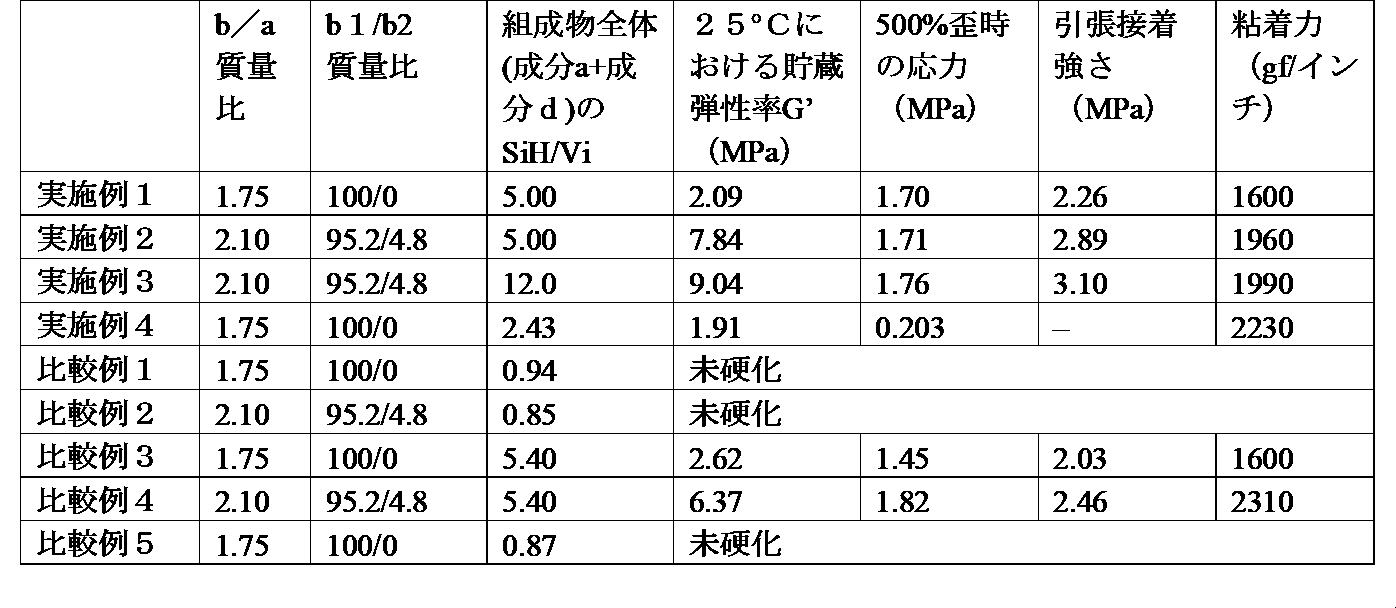
表2に示すとおり、実施例1~4に係る感圧接着層形成性オルガノポリシロキサン組成物は十分な硬化性を有し、25℃における貯蔵弾性率G’を1.0MPa以上の広い範囲で設計でき、500%歪時の応力が0.20MPa以上あり、PMMAへの粘着力も1300gf/インチ以上で設計することができた。このことから、硬化反応性に優れ、実用上十分な粘着力を有し、かつ、貯蔵弾性率等の粘弾特性を幅広い範囲で設計可能な感圧接着層形成性オルガノポリシロキサン組成物を得ることができた。
これに対し、実施例1と比較例3、実施例2と比較例4は、それぞれ成分dを除けば同じ組成であるが、比較例と実施例をその引張接着強さにおいて対比すると、成分dを添加した実施例の方が高い値を示した。すなわち、成分dを使用する組成に対し、類似したSiH/Vi比を有する組成であっても、比較例の各組成物はその接着特性が十分に改善することができないものである。
Claims (16)
- (A)分子内に平均して1を超える数のアルケニル基を有する鎖状または環状のオルガノポリシロキサン、
(B)分子内の全ケイ素原子に対する水酸基および加水分解性基の含有量の和が9モル%以下であるオルガノポリシロキサンレジン、
(C)分子内に少なくとも2個のSi-H結合を有するオルガノハイドロジェンポリシロキサン、
(D)分子内に平均して1を超える数のアルケニル基を有する有機ケイ素化合物(ただし、(A)成分および(B)成分に該当する成分を除く)、
(E)有効量のヒドロシリル化反応触媒、および
任意で、(A´)分子内に炭素-炭素二重結合含有反応性基を含まない鎖状オルガノポリシロキサン
を含有してなり、(C)成分の量が、上記の(A)成分中、(B)成分中および(D)成分中のアルケニル基の物質量の和に対する(C)成分中のSiH基の物質量の比(モル比)が1.0以上となる量である、感圧接着層形成性オルガノポリシロキサン組成物。 - (D)成分が、
(d1)一分子中にケイ素原子結合アルケニル基とケイ素原子結合アルコキシ基を少なくとも1個ずつ有する有機ケイ素化合物、
(d2)一分子中にケイ素原子結合アルケニル基とケイ素原子結合アルコキシ基とケイ素原子結合エポキシ含有一価有機基を少なくとも1個ずつ有する有機ケイ素化合物、
(d3)一分子中にケイ素原子結合アルコキシ基を少なくとも1個有するシランもしくはシロキサンと、一分子中にケイ素原子結合ヒドロキシ基とケイ素原子結合アルケニル基を少なくとも1個ずつ有するオルガノシロキサンの反応混合物、および
(d4) 一分子中にケイ素原子結合アルコキシ基とケイ素原子結合エポキシ含有一価有機基を少なくとも1個ずつ有するオルガノシランと、一分子中にケイ素原子結合ヒドロキシ基を少なくとも1個ずつ有するオルガノシロキサン、および一分子中にケイ素原子結合アルケニル基を少なくとも1個ずつ有するオルガノシロキサンの反応混合物
からなる群より選択される少なくとも一種の有機ケイ素化合物である、請求項1に記載の感圧接着層形成性オルガノポリシロキサン組成物。 - (D)成分が、
(d4-1)一分子中にケイ素原子結合アルコキシ基とケイ素原子結合エポキシ含有一価有機基を少なくとも1個ずつ有するオルガノシランと、一分子中にケイ素原子結合ヒドロキシ基またはアルコキシ基を少なくとも1個ずつ有するオルガノシロキサン、および一分子中にケイ素原子結合アルケニル基を少なくとも1個ずつ有するオルガノシロキサンの縮合反応混合物であり、分子内に、
EpSiO1.5(Epはケイ素原子結合エポキシ含有一価有機基)で表されるシロキサン単位と、R1R2SiO1.0(R1は炭素原子数2~12のアルケニル基であり、R1は炭素原子数1~12のアルキル基)で表されるシロキサン単位を有する有機ケイ素化合物である、請求項1または請求項2に記載の感圧接着層形成性オルガノポリシロキサン組成物。 - (D)成分が、接着促進剤である、請求項1~3のいずれか1項に記載の感圧接着層形成性オルガノポリシロキサン組成物。
- (A)成分と(A’)成分の和に対する(B)成分の質量比が、0.9~3.0の範囲にあり、当該組成物の硬化により得られる感圧接着層の25℃におけるせん断貯蔵弾性率G’が0.005MPa~20MPaであり、25℃における500%歪時の応力が0.005MPa~3MPaであり、当該組成物の硬化により得られる厚み50μmの感圧接着層の、厚み2mmのポリメチルメタクリレートシートに対する、JIS Z 0237に従う180°引き剥がし試験方法を用いて引張速度300mm/minにより測定された粘着力が360gf/inch~4000gf/inchであることを特徴とする、請求項1~4のいずれかに記載の感圧接着層形成性オルガノポリシロキサン組成物。
- (C)成分の量が、上記の(A)成分中および(B)成分中のアルケニル基の物質量の和に対する(C)成分中のSiH基の物質量の比(モル比)が20~100の範囲となる量である、請求項1~5のいずれかに記載の感圧接着層形成性オルガノポリシロキサン組成物。
- (C)成分の量が、上記の(A)成分中、(B)成分中および(D)成分中のアルケニル基の物質量の和に対する(C)成分中のSiH基の物質量の比(モル比)が2.0~50の範囲となる量である、請求項1~6のいずれかに記載の感圧接着層形成性オルガノポリシロキサン組成物。
- (B)成分が、以下の(b1)成分および(b2)成分を1:99~99:1の質量比で含む、オルガノポリシロキサンレジン混合物である、請求項1~7のいずれかに記載の感圧接着層形成性オルガノポリシロキサン組成物。
(b1)分子内の全ケイ素原子に対する水酸基および加水分解性基の含有量の和が9モル%以下であり、ゲルパーミエーションクロマトグラフィー(GPC)により標準ポリスチレン換算で測定される重量平均分子量(Mw)が4500以上であるオルガノポリシロキサンレジン、
(b2)分子内の全ケイ素原子に対する水酸基および加水分解性基の含有量の和が9モル%以下であり、ゲルパーミエーションクロマトグラフィー(GPC)により標準ポリスチレン換算で測定される重量平均分子量(Mw)が4500未満であるオルガノポリシロキサンレジン - (A)成分の少なくとも一部が、(A1)25℃において100,000mPa・s以上の粘度を有するか、JIS K6249に規定される方法に準じて測定された可塑度が50~200の範囲にある生ゴム状のアルケニル基含有オルガノポリシロキサンであり、そのアルケニル基中のビニル(CH2=CH)部分の含有量が0.005~0.400質量%の範囲にある鎖状オルガノポリシロキサンであり、
(B)成分であるオルガノポリシロキサンレジン混合物が、R3SiO1/2単位(式中、Rは一価有機基であり、Rの90モル%以上が炭素数1~6のアルキル基またはフェニル基である;M単位)及びSiO4/2単位(Q単位)から実質的になるオルガノポリシロキサンレジン混合物であり、
(E)成分の量が、組成物中の固形分中の白金系金属の含有量が0.1~200ppmの範囲である、請求項1~8のいずれか1項に記載の感圧接着層形成性オルガノポリシロキサン組成物。 - (A)成分と(A’)成分の和に対する(B)成分の質量比が、1.4~3.0の範囲にあり、当該組成物の硬化により得られる感圧接着層の25℃におけるせん断貯蔵弾性率G’が1.0MPa~20MPaであり、25℃における500%歪時の応力が0.20MPa~3MPaであり、当該組成物の硬化により得られる厚み50μmの感圧接着層の、厚み2mmのポリメチルメタクリレートシートに対する、JIS Z 0237に従う180°引き剥がし試験方法を用いて引張速度300mm/minにより測定された粘着力が1300gf/inch~3500gf/inchであることを特徴とする、請求項1~9のいずれか1項に記載の感圧接着層形成性オルガノポリシロキサン組成物。
- 請求項1~10のいずれか1項に記載の感圧接着層形成性オルガノポリシロキサン組成物を硬化してなる感圧接着剤層。
- フィルム状基材上に、請求項1~10のいずれか1項に記載の感圧接着層形成性オルガノポリシロキサン組成物を硬化してなる感圧接着剤層を備えた積層体。
- 1または2以上のフィルム状基材に当該感圧接着剤層に対する剥離層が設けられている、請求項12に記載の積層体。
- 請求項1~10のいずれか1項記載の感圧接着層形成性オルガノポリシロキサン組成物を硬化してなる、弾性粘着部材。
- 請求項14に記載の弾性粘着部材を含む電子機器または電気的装置。
- 請求項14に記載の弾性粘着部材を含むスピーカー。
Priority Applications (5)
| Application Number | Priority Date | Filing Date | Title |
|---|---|---|---|
| CN202080058542.8A CN114341294B (zh) | 2019-08-13 | 2020-08-11 | 压敏粘接层形成性聚有机硅氧烷组合物及其使用 |
| EP20852295.3A EP4015215A4 (en) | 2019-08-13 | 2020-08-11 | SELF-ADHESIVE LAYER-FORMING ORGANOPOLYSILOXA COMPOSITION AND THEIR USE |
| US17/634,934 US20220275262A1 (en) | 2019-08-13 | 2020-08-11 | Pressure-sensitive adhesive layer-forming organopolysiloxane composition, and use thereof |
| JP2021539302A JP7648329B2 (ja) | 2019-08-13 | 2020-08-11 | 感圧接着層形成性オルガノポリシロキサン組成物およびその使用 |
| KR1020227007762A KR102888507B1 (ko) | 2019-08-13 | 2020-08-11 | 감압 접착층 형성성 오가노폴리실록산 조성물 및 그의 사용 |
Applications Claiming Priority (2)
| Application Number | Priority Date | Filing Date | Title |
|---|---|---|---|
| JP2019148346 | 2019-08-13 | ||
| JP2019-148346 | 2019-08-13 |
Publications (1)
| Publication Number | Publication Date |
|---|---|
| WO2021029413A1 true WO2021029413A1 (ja) | 2021-02-18 |
Family
ID=74569641
Family Applications (1)
| Application Number | Title | Priority Date | Filing Date |
|---|---|---|---|
| PCT/JP2020/030624 Ceased WO2021029413A1 (ja) | 2019-08-13 | 2020-08-11 | 感圧接着層形成性オルガノポリシロキサン組成物およびその使用 |
Country Status (6)
| Country | Link |
|---|---|
| US (1) | US20220275262A1 (ja) |
| EP (1) | EP4015215A4 (ja) |
| JP (1) | JP7648329B2 (ja) |
| KR (1) | KR102888507B1 (ja) |
| CN (1) | CN114341294B (ja) |
| WO (1) | WO2021029413A1 (ja) |
Cited By (2)
| Publication number | Priority date | Publication date | Assignee | Title |
|---|---|---|---|---|
| WO2022138913A1 (ja) * | 2020-12-25 | 2022-06-30 | ダウ・東レ株式会社 | 感圧接着層形成性オルガノポリシロキサン組成物、その使用およびその組成設計方法 |
| WO2022226796A1 (en) * | 2021-04-27 | 2022-11-03 | Dow Silicones Corporation | Silicone pressure sensitive adhesive, composition and method for its preparation, and use in a flexible display device |
Families Citing this family (6)
| Publication number | Priority date | Publication date | Assignee | Title |
|---|---|---|---|---|
| CN112513218B (zh) * | 2018-08-01 | 2023-02-03 | 信越化学工业株式会社 | 有机硅压敏粘合剂组合物和使用其的压敏粘合带或压敏粘合膜 |
| WO2020032287A1 (ja) | 2018-08-10 | 2020-02-13 | ダウ・東レ株式会社 | 感圧接着層形成性オルガノポリシロキサン組成物およびその使用 |
| WO2021029412A1 (ja) | 2019-08-13 | 2021-02-18 | ダウ・東レ株式会社 | 感圧接着層形成性オルガノポリシロキサン組成物およびその使用 |
| CN114269876B (zh) * | 2019-08-13 | 2024-05-14 | 陶氏东丽株式会社 | 压敏粘接层形成性聚有机硅氧烷组合物及其使用 |
| US20260015466A1 (en) * | 2022-08-05 | 2026-01-15 | Wacker Chemicals AG | Silicone composition as an oca-like silicone ocr and method of bonding display panel using the same |
| JP2026502425A (ja) * | 2022-12-23 | 2026-01-23 | ダウ シリコーンズ コーポレーション | 減衰/衝撃吸収機能を有する層間接着剤層を有する電子物品 |
Citations (13)
| Publication number | Priority date | Publication date | Assignee | Title |
|---|---|---|---|---|
| JPH05214316A (ja) | 1991-10-18 | 1993-08-24 | Dow Corning Corp | 低エネルギー基材へ高接着性を有するシリコーン感圧接着剤 |
| JP2002322363A (ja) * | 2001-04-10 | 2002-11-08 | Dow Corning Corp | シリコーン組成物およびそれから製造されるシリコーン接着剤 |
| JP2006225420A (ja) | 2005-02-15 | 2006-08-31 | Shin Etsu Chem Co Ltd | 付加硬化型シリコーンゴム組成物及び粘着ゴムシート |
| JP2013065009A (ja) | 2011-09-18 | 2013-04-11 | Tpk Touch Solutions (Xiamen) Inc | タッチ・ディスプレイ装置及び製造方法 |
| JP2013512326A (ja) | 2010-03-16 | 2013-04-11 | エルジー・ハウシス・リミテッド | 粘着フィルム及びタッチパネル |
| JP2013233852A (ja) | 2012-05-08 | 2013-11-21 | Yupiteru Corp | 車載用表示装置 |
| JP2014063064A (ja) | 2012-09-21 | 2014-04-10 | Dainippon Printing Co Ltd | 車載用表示装置、及び車載用透過型曲面スクリーン |
| JP2014522436A (ja) | 2011-06-02 | 2014-09-04 | ダウ コーニング コーポレーション | 厚膜感圧接着剤及びそれから作製した積層構造体 |
| JP2014182335A (ja) | 2013-03-21 | 2014-09-29 | Dainippon Printing Co Ltd | 粘着層付き車載用曲面スクリーン部材、車載用曲面スクリーン及び車載用表示装置 |
| JP2017047767A (ja) | 2015-09-01 | 2017-03-09 | 株式会社デンソー | 車両用表示装置 |
| WO2017082654A1 (ko) | 2015-11-12 | 2017-05-18 | 동우 화인켐 주식회사 | 광학적층체 및 이를 포함하는 화상표시장치 |
| WO2017188308A1 (ja) | 2016-04-26 | 2017-11-02 | 東レ・ダウコーニング株式会社 | フレキシブル積層体及びそれを備えたフレキシブルディスプレイ |
| WO2019009175A1 (ja) * | 2017-07-07 | 2019-01-10 | 東レ・ダウコーニング株式会社 | 感圧接着層形成性オルガノポリシロキサン組成物およびその使用 |
Family Cites Families (7)
| Publication number | Priority date | Publication date | Assignee | Title |
|---|---|---|---|---|
| JPS5224258A (en) * | 1975-08-19 | 1977-02-23 | Toray Silicone Co Ltd | Curable organopolysiloxane composition |
| US4087585A (en) * | 1977-05-23 | 1978-05-02 | Dow Corning Corporation | Self-adhering silicone compositions and preparations thereof |
| JP4503271B2 (ja) * | 2003-11-28 | 2010-07-14 | 東レ・ダウコーニング株式会社 | シリコーン積層体の製造方法 |
| JP5933029B2 (ja) | 2012-11-30 | 2016-06-08 | キヤノンアネルバ株式会社 | スパッタリング装置および基板処理装置 |
| KR20170016392A (ko) * | 2014-05-30 | 2017-02-13 | 다우 코닝 도레이 캄파니 리미티드 | 유기 규소 화합물, 경화성 실리콘 조성물, 및 반도체 장치 |
| US20170188308A1 (en) * | 2015-12-23 | 2017-06-29 | Intel Corporation | Extending an operational lifetime of an internet of things (IOT) device |
| KR102757571B1 (ko) * | 2019-10-31 | 2025-01-22 | 다우 실리콘즈 코포레이션 | 실리콘 감압 접착제 조성물 및 이의 제조 및 사용 방법 |
-
2020
- 2020-08-11 JP JP2021539302A patent/JP7648329B2/ja active Active
- 2020-08-11 US US17/634,934 patent/US20220275262A1/en active Pending
- 2020-08-11 WO PCT/JP2020/030624 patent/WO2021029413A1/ja not_active Ceased
- 2020-08-11 KR KR1020227007762A patent/KR102888507B1/ko active Active
- 2020-08-11 EP EP20852295.3A patent/EP4015215A4/en active Pending
- 2020-08-11 CN CN202080058542.8A patent/CN114341294B/zh active Active
Patent Citations (13)
| Publication number | Priority date | Publication date | Assignee | Title |
|---|---|---|---|---|
| JPH05214316A (ja) | 1991-10-18 | 1993-08-24 | Dow Corning Corp | 低エネルギー基材へ高接着性を有するシリコーン感圧接着剤 |
| JP2002322363A (ja) * | 2001-04-10 | 2002-11-08 | Dow Corning Corp | シリコーン組成物およびそれから製造されるシリコーン接着剤 |
| JP2006225420A (ja) | 2005-02-15 | 2006-08-31 | Shin Etsu Chem Co Ltd | 付加硬化型シリコーンゴム組成物及び粘着ゴムシート |
| JP2013512326A (ja) | 2010-03-16 | 2013-04-11 | エルジー・ハウシス・リミテッド | 粘着フィルム及びタッチパネル |
| JP2014522436A (ja) | 2011-06-02 | 2014-09-04 | ダウ コーニング コーポレーション | 厚膜感圧接着剤及びそれから作製した積層構造体 |
| JP2013065009A (ja) | 2011-09-18 | 2013-04-11 | Tpk Touch Solutions (Xiamen) Inc | タッチ・ディスプレイ装置及び製造方法 |
| JP2013233852A (ja) | 2012-05-08 | 2013-11-21 | Yupiteru Corp | 車載用表示装置 |
| JP2014063064A (ja) | 2012-09-21 | 2014-04-10 | Dainippon Printing Co Ltd | 車載用表示装置、及び車載用透過型曲面スクリーン |
| JP2014182335A (ja) | 2013-03-21 | 2014-09-29 | Dainippon Printing Co Ltd | 粘着層付き車載用曲面スクリーン部材、車載用曲面スクリーン及び車載用表示装置 |
| JP2017047767A (ja) | 2015-09-01 | 2017-03-09 | 株式会社デンソー | 車両用表示装置 |
| WO2017082654A1 (ko) | 2015-11-12 | 2017-05-18 | 동우 화인켐 주식회사 | 광학적층체 및 이를 포함하는 화상표시장치 |
| WO2017188308A1 (ja) | 2016-04-26 | 2017-11-02 | 東レ・ダウコーニング株式会社 | フレキシブル積層体及びそれを備えたフレキシブルディスプレイ |
| WO2019009175A1 (ja) * | 2017-07-07 | 2019-01-10 | 東レ・ダウコーニング株式会社 | 感圧接着層形成性オルガノポリシロキサン組成物およびその使用 |
Non-Patent Citations (1)
| Title |
|---|
| See also references of EP4015215A4 |
Cited By (2)
| Publication number | Priority date | Publication date | Assignee | Title |
|---|---|---|---|---|
| WO2022138913A1 (ja) * | 2020-12-25 | 2022-06-30 | ダウ・東レ株式会社 | 感圧接着層形成性オルガノポリシロキサン組成物、その使用およびその組成設計方法 |
| WO2022226796A1 (en) * | 2021-04-27 | 2022-11-03 | Dow Silicones Corporation | Silicone pressure sensitive adhesive, composition and method for its preparation, and use in a flexible display device |
Also Published As
| Publication number | Publication date |
|---|---|
| JPWO2021029413A1 (ja) | 2021-02-18 |
| EP4015215A1 (en) | 2022-06-22 |
| KR20220045009A (ko) | 2022-04-12 |
| US20220275262A1 (en) | 2022-09-01 |
| JP7648329B2 (ja) | 2025-03-18 |
| CN114341294B (zh) | 2024-05-28 |
| KR102888507B1 (ko) | 2025-11-21 |
| CN114341294A (zh) | 2022-04-12 |
| EP4015215A4 (en) | 2023-08-23 |
Similar Documents
| Publication | Publication Date | Title |
|---|---|---|
| JP7046196B2 (ja) | 感圧接着層形成性オルガノポリシロキサン組成物およびその使用 | |
| JP7046198B2 (ja) | 感圧接着層形成性オルガノポリシロキサン組成物およびその使用 | |
| JP7046197B2 (ja) | 感圧接着層形成性オルガノポリシロキサン組成物およびその使用 | |
| KR102888507B1 (ko) | 감압 접착층 형성성 오가노폴리실록산 조성물 및 그의 사용 | |
| KR102853453B1 (ko) | 감압 접착층 형성성 오가노폴리실록산 조성물 및 그의 사용 | |
| JPWO2020121939A1 (ja) | シリコーン感圧接着剤組成物およびその用途 | |
| US12503630B2 (en) | Organopolysiloxane composition having pressure-sensitive adhesive layer formation properties, and use of said composition | |
| US20240117231A1 (en) | Pressure sensitive adhesive layer-forming organopolysiloxane composition, use of same, and composition design method for same | |
| EP4612250A1 (en) | Silicone-based pressure sensitive adhesive layer-forming composition and use thereof | |
| US12415923B2 (en) | Curable silicone composition and cured product of same |
Legal Events
| Date | Code | Title | Description |
|---|---|---|---|
| 121 | Ep: the epo has been informed by wipo that ep was designated in this application |
Ref document number: 20852295 Country of ref document: EP Kind code of ref document: A1 |
|
| ENP | Entry into the national phase |
Ref document number: 2021539302 Country of ref document: JP Kind code of ref document: A |
|
| NENP | Non-entry into the national phase |
Ref country code: DE |
|
| ENP | Entry into the national phase |
Ref document number: 20227007762 Country of ref document: KR Kind code of ref document: A |
|
| ENP | Entry into the national phase |
Ref document number: 2020852295 Country of ref document: EP Effective date: 20220314 |