WO2021065257A1 - 積層延伸ポリアミドフィルム - Google Patents
積層延伸ポリアミドフィルム Download PDFInfo
- Publication number
- WO2021065257A1 WO2021065257A1 PCT/JP2020/032243 JP2020032243W WO2021065257A1 WO 2021065257 A1 WO2021065257 A1 WO 2021065257A1 JP 2020032243 W JP2020032243 W JP 2020032243W WO 2021065257 A1 WO2021065257 A1 WO 2021065257A1
- Authority
- WO
- WIPO (PCT)
- Prior art keywords
- layer
- polyamide
- film
- mass
- copolymer
- Prior art date
- Legal status (The legal status is an assumption and is not a legal conclusion. Google has not performed a legal analysis and makes no representation as to the accuracy of the status listed.)
- Ceased
Links
Classifications
-
- B—PERFORMING OPERATIONS; TRANSPORTING
- B29—WORKING OF PLASTICS; WORKING OF SUBSTANCES IN A PLASTIC STATE IN GENERAL
- B29C—SHAPING OR JOINING OF PLASTICS; SHAPING OF MATERIAL IN A PLASTIC STATE, NOT OTHERWISE PROVIDED FOR; AFTER-TREATMENT OF THE SHAPED PRODUCTS, e.g. REPAIRING
- B29C55/00—Shaping by stretching, e.g. drawing through a die; Apparatus therefor
- B29C55/02—Shaping by stretching, e.g. drawing through a die; Apparatus therefor of plates or sheets
- B29C55/10—Shaping by stretching, e.g. drawing through a die; Apparatus therefor of plates or sheets multiaxial
- B29C55/12—Shaping by stretching, e.g. drawing through a die; Apparatus therefor of plates or sheets multiaxial biaxial
- B29C55/14—Shaping by stretching, e.g. drawing through a die; Apparatus therefor of plates or sheets multiaxial biaxial successively
-
- B—PERFORMING OPERATIONS; TRANSPORTING
- B29—WORKING OF PLASTICS; WORKING OF SUBSTANCES IN A PLASTIC STATE IN GENERAL
- B29C—SHAPING OR JOINING OF PLASTICS; SHAPING OF MATERIAL IN A PLASTIC STATE, NOT OTHERWISE PROVIDED FOR; AFTER-TREATMENT OF THE SHAPED PRODUCTS, e.g. REPAIRING
- B29C48/00—Extrusion moulding, i.e. expressing the moulding material through a die or nozzle which imparts the desired form; Apparatus therefor
- B29C48/001—Combinations of extrusion moulding with other shaping operations
- B29C48/0018—Combinations of extrusion moulding with other shaping operations combined with shaping by orienting, stretching or shrinking, e.g. film blowing
-
- B—PERFORMING OPERATIONS; TRANSPORTING
- B29—WORKING OF PLASTICS; WORKING OF SUBSTANCES IN A PLASTIC STATE IN GENERAL
- B29C—SHAPING OR JOINING OF PLASTICS; SHAPING OF MATERIAL IN A PLASTIC STATE, NOT OTHERWISE PROVIDED FOR; AFTER-TREATMENT OF THE SHAPED PRODUCTS, e.g. REPAIRING
- B29C48/00—Extrusion moulding, i.e. expressing the moulding material through a die or nozzle which imparts the desired form; Apparatus therefor
- B29C48/022—Extrusion moulding, i.e. expressing the moulding material through a die or nozzle which imparts the desired form; Apparatus therefor characterised by the choice of material
-
- B—PERFORMING OPERATIONS; TRANSPORTING
- B29—WORKING OF PLASTICS; WORKING OF SUBSTANCES IN A PLASTIC STATE IN GENERAL
- B29C—SHAPING OR JOINING OF PLASTICS; SHAPING OF MATERIAL IN A PLASTIC STATE, NOT OTHERWISE PROVIDED FOR; AFTER-TREATMENT OF THE SHAPED PRODUCTS, e.g. REPAIRING
- B29C48/00—Extrusion moulding, i.e. expressing the moulding material through a die or nozzle which imparts the desired form; Apparatus therefor
- B29C48/16—Articles comprising two or more components, e.g. co-extruded layers
- B29C48/18—Articles comprising two or more components, e.g. co-extruded layers the components being layers
- B29C48/21—Articles comprising two or more components, e.g. co-extruded layers the components being layers the layers being joined at their surfaces
-
- B—PERFORMING OPERATIONS; TRANSPORTING
- B29—WORKING OF PLASTICS; WORKING OF SUBSTANCES IN A PLASTIC STATE IN GENERAL
- B29C—SHAPING OR JOINING OF PLASTICS; SHAPING OF MATERIAL IN A PLASTIC STATE, NOT OTHERWISE PROVIDED FOR; AFTER-TREATMENT OF THE SHAPED PRODUCTS, e.g. REPAIRING
- B29C55/00—Shaping by stretching, e.g. drawing through a die; Apparatus therefor
- B29C55/005—Shaping by stretching, e.g. drawing through a die; Apparatus therefor characterised by the choice of materials
-
- B—PERFORMING OPERATIONS; TRANSPORTING
- B29—WORKING OF PLASTICS; WORKING OF SUBSTANCES IN A PLASTIC STATE IN GENERAL
- B29C—SHAPING OR JOINING OF PLASTICS; SHAPING OF MATERIAL IN A PLASTIC STATE, NOT OTHERWISE PROVIDED FOR; AFTER-TREATMENT OF THE SHAPED PRODUCTS, e.g. REPAIRING
- B29C55/00—Shaping by stretching, e.g. drawing through a die; Apparatus therefor
- B29C55/02—Shaping by stretching, e.g. drawing through a die; Apparatus therefor of plates or sheets
- B29C55/023—Shaping by stretching, e.g. drawing through a die; Apparatus therefor of plates or sheets using multilayered plates or sheets
-
- B—PERFORMING OPERATIONS; TRANSPORTING
- B29—WORKING OF PLASTICS; WORKING OF SUBSTANCES IN A PLASTIC STATE IN GENERAL
- B29C—SHAPING OR JOINING OF PLASTICS; SHAPING OF MATERIAL IN A PLASTIC STATE, NOT OTHERWISE PROVIDED FOR; AFTER-TREATMENT OF THE SHAPED PRODUCTS, e.g. REPAIRING
- B29C55/00—Shaping by stretching, e.g. drawing through a die; Apparatus therefor
- B29C55/02—Shaping by stretching, e.g. drawing through a die; Apparatus therefor of plates or sheets
- B29C55/10—Shaping by stretching, e.g. drawing through a die; Apparatus therefor of plates or sheets multiaxial
- B29C55/12—Shaping by stretching, e.g. drawing through a die; Apparatus therefor of plates or sheets multiaxial biaxial
-
- B—PERFORMING OPERATIONS; TRANSPORTING
- B29—WORKING OF PLASTICS; WORKING OF SUBSTANCES IN A PLASTIC STATE IN GENERAL
- B29C—SHAPING OR JOINING OF PLASTICS; SHAPING OF MATERIAL IN A PLASTIC STATE, NOT OTHERWISE PROVIDED FOR; AFTER-TREATMENT OF THE SHAPED PRODUCTS, e.g. REPAIRING
- B29C55/00—Shaping by stretching, e.g. drawing through a die; Apparatus therefor
- B29C55/02—Shaping by stretching, e.g. drawing through a die; Apparatus therefor of plates or sheets
- B29C55/10—Shaping by stretching, e.g. drawing through a die; Apparatus therefor of plates or sheets multiaxial
- B29C55/12—Shaping by stretching, e.g. drawing through a die; Apparatus therefor of plates or sheets multiaxial biaxial
- B29C55/14—Shaping by stretching, e.g. drawing through a die; Apparatus therefor of plates or sheets multiaxial biaxial successively
- B29C55/143—Shaping by stretching, e.g. drawing through a die; Apparatus therefor of plates or sheets multiaxial biaxial successively firstly parallel to the direction of feed and then transversely thereto
-
- B—PERFORMING OPERATIONS; TRANSPORTING
- B29—WORKING OF PLASTICS; WORKING OF SUBSTANCES IN A PLASTIC STATE IN GENERAL
- B29C—SHAPING OR JOINING OF PLASTICS; SHAPING OF MATERIAL IN A PLASTIC STATE, NOT OTHERWISE PROVIDED FOR; AFTER-TREATMENT OF THE SHAPED PRODUCTS, e.g. REPAIRING
- B29C55/00—Shaping by stretching, e.g. drawing through a die; Apparatus therefor
- B29C55/02—Shaping by stretching, e.g. drawing through a die; Apparatus therefor of plates or sheets
- B29C55/10—Shaping by stretching, e.g. drawing through a die; Apparatus therefor of plates or sheets multiaxial
- B29C55/12—Shaping by stretching, e.g. drawing through a die; Apparatus therefor of plates or sheets multiaxial biaxial
- B29C55/16—Shaping by stretching, e.g. drawing through a die; Apparatus therefor of plates or sheets multiaxial biaxial simultaneously
-
- B—PERFORMING OPERATIONS; TRANSPORTING
- B32—LAYERED PRODUCTS
- B32B—LAYERED PRODUCTS, i.e. PRODUCTS BUILT-UP OF STRATA OF FLAT OR NON-FLAT, e.g. CELLULAR OR HONEYCOMB, FORM
- B32B27/00—Layered products comprising a layer of synthetic resin
- B32B27/06—Layered products comprising a layer of synthetic resin as the main or only constituent of a layer, which is next to another layer of the same or of a different material
- B32B27/08—Layered products comprising a layer of synthetic resin as the main or only constituent of a layer, which is next to another layer of the same or of a different material of synthetic resin
-
- B—PERFORMING OPERATIONS; TRANSPORTING
- B32—LAYERED PRODUCTS
- B32B—LAYERED PRODUCTS, i.e. PRODUCTS BUILT-UP OF STRATA OF FLAT OR NON-FLAT, e.g. CELLULAR OR HONEYCOMB, FORM
- B32B27/00—Layered products comprising a layer of synthetic resin
- B32B27/18—Layered products comprising a layer of synthetic resin characterised by the use of special additives
- B32B27/20—Layered products comprising a layer of synthetic resin characterised by the use of special additives using fillers, pigments, thixotroping agents
-
- B—PERFORMING OPERATIONS; TRANSPORTING
- B32—LAYERED PRODUCTS
- B32B—LAYERED PRODUCTS, i.e. PRODUCTS BUILT-UP OF STRATA OF FLAT OR NON-FLAT, e.g. CELLULAR OR HONEYCOMB, FORM
- B32B27/00—Layered products comprising a layer of synthetic resin
- B32B27/34—Layered products comprising a layer of synthetic resin comprising polyamides
-
- B—PERFORMING OPERATIONS; TRANSPORTING
- B32—LAYERED PRODUCTS
- B32B—LAYERED PRODUCTS, i.e. PRODUCTS BUILT-UP OF STRATA OF FLAT OR NON-FLAT, e.g. CELLULAR OR HONEYCOMB, FORM
- B32B37/00—Methods or apparatus for laminating, e.g. by curing or by ultrasonic bonding
- B32B37/14—Methods or apparatus for laminating, e.g. by curing or by ultrasonic bonding characterised by the properties of the layers
- B32B37/15—Methods or apparatus for laminating, e.g. by curing or by ultrasonic bonding characterised by the properties of the layers with at least one layer being manufactured and immediately laminated before reaching its stable state, e.g. in which a layer is extruded and laminated while in semi-molten state
- B32B37/153—Methods or apparatus for laminating, e.g. by curing or by ultrasonic bonding characterised by the properties of the layers with at least one layer being manufactured and immediately laminated before reaching its stable state, e.g. in which a layer is extruded and laminated while in semi-molten state at least one layer is extruded and immediately laminated while in semi-molten state
-
- B—PERFORMING OPERATIONS; TRANSPORTING
- B32—LAYERED PRODUCTS
- B32B—LAYERED PRODUCTS, i.e. PRODUCTS BUILT-UP OF STRATA OF FLAT OR NON-FLAT, e.g. CELLULAR OR HONEYCOMB, FORM
- B32B38/00—Ancillary operations in connection with laminating processes
- B32B38/0012—Mechanical treatment, e.g. roughening, deforming, stretching
-
- B—PERFORMING OPERATIONS; TRANSPORTING
- B32—LAYERED PRODUCTS
- B32B—LAYERED PRODUCTS, i.e. PRODUCTS BUILT-UP OF STRATA OF FLAT OR NON-FLAT, e.g. CELLULAR OR HONEYCOMB, FORM
- B32B7/00—Layered products characterised by the relation between layers; Layered products characterised by the relative orientation of features between layers, or by the relative values of a measurable parameter between layers, i.e. products comprising layers having different physical, chemical or physicochemical properties; Layered products characterised by the interconnection of layers
- B32B7/04—Interconnection of layers
- B32B7/12—Interconnection of layers using interposed adhesives or interposed materials with bonding properties
-
- B—PERFORMING OPERATIONS; TRANSPORTING
- B65—CONVEYING; PACKING; STORING; HANDLING THIN OR FILAMENTARY MATERIAL
- B65D—CONTAINERS FOR STORAGE OR TRANSPORT OF ARTICLES OR MATERIALS, e.g. BAGS, BARRELS, BOTTLES, BOXES, CANS, CARTONS, CRATES, DRUMS, JARS, TANKS, HOPPERS, FORWARDING CONTAINERS; ACCESSORIES, CLOSURES, OR FITTINGS THEREFOR; PACKAGING ELEMENTS; PACKAGES
- B65D65/00—Wrappers or flexible covers; Packaging materials of special type or form
- B65D65/38—Packaging materials of special type or form
- B65D65/40—Applications of laminates for particular packaging purposes
-
- B—PERFORMING OPERATIONS; TRANSPORTING
- B29—WORKING OF PLASTICS; WORKING OF SUBSTANCES IN A PLASTIC STATE IN GENERAL
- B29K—INDEXING SCHEME ASSOCIATED WITH SUBCLASSES B29B, B29C OR B29D, RELATING TO MOULDING MATERIALS OR TO MATERIALS FOR MOULDS, REINFORCEMENTS, FILLERS OR PREFORMED PARTS, e.g. INSERTS
- B29K2077/00—Use of PA, i.e. polyamides, e.g. polyesteramides or derivatives thereof, as moulding material
-
- B—PERFORMING OPERATIONS; TRANSPORTING
- B29—WORKING OF PLASTICS; WORKING OF SUBSTANCES IN A PLASTIC STATE IN GENERAL
- B29L—INDEXING SCHEME ASSOCIATED WITH SUBCLASS B29C, RELATING TO PARTICULAR ARTICLES
- B29L2007/00—Flat articles, e.g. films or sheets
-
- B—PERFORMING OPERATIONS; TRANSPORTING
- B29—WORKING OF PLASTICS; WORKING OF SUBSTANCES IN A PLASTIC STATE IN GENERAL
- B29L—INDEXING SCHEME ASSOCIATED WITH SUBCLASS B29C, RELATING TO PARTICULAR ARTICLES
- B29L2007/00—Flat articles, e.g. films or sheets
- B29L2007/002—Panels; Plates; Sheets
-
- B—PERFORMING OPERATIONS; TRANSPORTING
- B29—WORKING OF PLASTICS; WORKING OF SUBSTANCES IN A PLASTIC STATE IN GENERAL
- B29L—INDEXING SCHEME ASSOCIATED WITH SUBCLASS B29C, RELATING TO PARTICULAR ARTICLES
- B29L2009/00—Layered products
-
- B—PERFORMING OPERATIONS; TRANSPORTING
- B32—LAYERED PRODUCTS
- B32B—LAYERED PRODUCTS, i.e. PRODUCTS BUILT-UP OF STRATA OF FLAT OR NON-FLAT, e.g. CELLULAR OR HONEYCOMB, FORM
- B32B38/00—Ancillary operations in connection with laminating processes
- B32B38/0012—Mechanical treatment, e.g. roughening, deforming, stretching
- B32B2038/0028—Stretching, elongating
-
- B—PERFORMING OPERATIONS; TRANSPORTING
- B32—LAYERED PRODUCTS
- B32B—LAYERED PRODUCTS, i.e. PRODUCTS BUILT-UP OF STRATA OF FLAT OR NON-FLAT, e.g. CELLULAR OR HONEYCOMB, FORM
- B32B2250/00—Layers arrangement
- B32B2250/03—3 layers
-
- B—PERFORMING OPERATIONS; TRANSPORTING
- B32—LAYERED PRODUCTS
- B32B—LAYERED PRODUCTS, i.e. PRODUCTS BUILT-UP OF STRATA OF FLAT OR NON-FLAT, e.g. CELLULAR OR HONEYCOMB, FORM
- B32B2250/00—Layers arrangement
- B32B2250/24—All layers being polymeric
-
- B—PERFORMING OPERATIONS; TRANSPORTING
- B32—LAYERED PRODUCTS
- B32B—LAYERED PRODUCTS, i.e. PRODUCTS BUILT-UP OF STRATA OF FLAT OR NON-FLAT, e.g. CELLULAR OR HONEYCOMB, FORM
- B32B2264/00—Composition or properties of particles which form a particulate layer or are present as additives
- B32B2264/10—Inorganic particles
- B32B2264/102—Oxide or hydroxide
- B32B2264/1021—Silica
-
- B—PERFORMING OPERATIONS; TRANSPORTING
- B32—LAYERED PRODUCTS
- B32B—LAYERED PRODUCTS, i.e. PRODUCTS BUILT-UP OF STRATA OF FLAT OR NON-FLAT, e.g. CELLULAR OR HONEYCOMB, FORM
- B32B2264/00—Composition or properties of particles which form a particulate layer or are present as additives
- B32B2264/30—Particles characterised by physical dimension
- B32B2264/303—Average diameter greater than 1µm
-
- B—PERFORMING OPERATIONS; TRANSPORTING
- B32—LAYERED PRODUCTS
- B32B—LAYERED PRODUCTS, i.e. PRODUCTS BUILT-UP OF STRATA OF FLAT OR NON-FLAT, e.g. CELLULAR OR HONEYCOMB, FORM
- B32B2307/00—Properties of the layers or laminate
- B32B2307/30—Properties of the layers or laminate having particular thermal properties
- B32B2307/306—Resistant to heat
-
- B—PERFORMING OPERATIONS; TRANSPORTING
- B32—LAYERED PRODUCTS
- B32B—LAYERED PRODUCTS, i.e. PRODUCTS BUILT-UP OF STRATA OF FLAT OR NON-FLAT, e.g. CELLULAR OR HONEYCOMB, FORM
- B32B2307/00—Properties of the layers or laminate
- B32B2307/50—Properties of the layers or laminate having particular mechanical properties
- B32B2307/514—Oriented
- B32B2307/518—Oriented bi-axially
-
- B—PERFORMING OPERATIONS; TRANSPORTING
- B32—LAYERED PRODUCTS
- B32B—LAYERED PRODUCTS, i.e. PRODUCTS BUILT-UP OF STRATA OF FLAT OR NON-FLAT, e.g. CELLULAR OR HONEYCOMB, FORM
- B32B2307/00—Properties of the layers or laminate
- B32B2307/50—Properties of the layers or laminate having particular mechanical properties
- B32B2307/54—Yield strength; Tensile strength
-
- B—PERFORMING OPERATIONS; TRANSPORTING
- B32—LAYERED PRODUCTS
- B32B—LAYERED PRODUCTS, i.e. PRODUCTS BUILT-UP OF STRATA OF FLAT OR NON-FLAT, e.g. CELLULAR OR HONEYCOMB, FORM
- B32B2307/00—Properties of the layers or laminate
- B32B2307/50—Properties of the layers or laminate having particular mechanical properties
- B32B2307/558—Impact strength, toughness
-
- B—PERFORMING OPERATIONS; TRANSPORTING
- B32—LAYERED PRODUCTS
- B32B—LAYERED PRODUCTS, i.e. PRODUCTS BUILT-UP OF STRATA OF FLAT OR NON-FLAT, e.g. CELLULAR OR HONEYCOMB, FORM
- B32B2307/00—Properties of the layers or laminate
- B32B2307/50—Properties of the layers or laminate having particular mechanical properties
- B32B2307/56—Damping, energy absorption
-
- B—PERFORMING OPERATIONS; TRANSPORTING
- B32—LAYERED PRODUCTS
- B32B—LAYERED PRODUCTS, i.e. PRODUCTS BUILT-UP OF STRATA OF FLAT OR NON-FLAT, e.g. CELLULAR OR HONEYCOMB, FORM
- B32B2307/00—Properties of the layers or laminate
- B32B2307/50—Properties of the layers or laminate having particular mechanical properties
- B32B2307/58—Cuttability
- B32B2307/581—Resistant to cut
-
- B—PERFORMING OPERATIONS; TRANSPORTING
- B32—LAYERED PRODUCTS
- B32B—LAYERED PRODUCTS, i.e. PRODUCTS BUILT-UP OF STRATA OF FLAT OR NON-FLAT, e.g. CELLULAR OR HONEYCOMB, FORM
- B32B2307/00—Properties of the layers or laminate
- B32B2307/70—Other properties
- B32B2307/726—Permeability to liquids, absorption
- B32B2307/7265—Non-permeable
-
- B—PERFORMING OPERATIONS; TRANSPORTING
- B32—LAYERED PRODUCTS
- B32B—LAYERED PRODUCTS, i.e. PRODUCTS BUILT-UP OF STRATA OF FLAT OR NON-FLAT, e.g. CELLULAR OR HONEYCOMB, FORM
- B32B2307/00—Properties of the layers or laminate
- B32B2307/70—Other properties
- B32B2307/732—Dimensional properties
-
- B—PERFORMING OPERATIONS; TRANSPORTING
- B32—LAYERED PRODUCTS
- B32B—LAYERED PRODUCTS, i.e. PRODUCTS BUILT-UP OF STRATA OF FLAT OR NON-FLAT, e.g. CELLULAR OR HONEYCOMB, FORM
- B32B2307/00—Properties of the layers or laminate
- B32B2307/70—Other properties
- B32B2307/746—Slipping, anti-blocking, low friction
-
- B—PERFORMING OPERATIONS; TRANSPORTING
- B32—LAYERED PRODUCTS
- B32B—LAYERED PRODUCTS, i.e. PRODUCTS BUILT-UP OF STRATA OF FLAT OR NON-FLAT, e.g. CELLULAR OR HONEYCOMB, FORM
- B32B2439/00—Containers; Receptacles
- B32B2439/40—Closed containers
- B32B2439/46—Bags
-
- B—PERFORMING OPERATIONS; TRANSPORTING
- B32—LAYERED PRODUCTS
- B32B—LAYERED PRODUCTS, i.e. PRODUCTS BUILT-UP OF STRATA OF FLAT OR NON-FLAT, e.g. CELLULAR OR HONEYCOMB, FORM
- B32B2439/00—Containers; Receptacles
- B32B2439/70—Food packaging
-
- B—PERFORMING OPERATIONS; TRANSPORTING
- B32—LAYERED PRODUCTS
- B32B—LAYERED PRODUCTS, i.e. PRODUCTS BUILT-UP OF STRATA OF FLAT OR NON-FLAT, e.g. CELLULAR OR HONEYCOMB, FORM
- B32B2553/00—Packaging equipment or accessories not otherwise provided for
Definitions
- the present invention relates to a biaxially stretched polyamide film having excellent adhesiveness.
- the present invention relates to a biaxially stretched polyamide film having excellent water resistance and adhesive strength with a sealant film.
- Biaxially stretched polyamide film is used as a packaging material, especially a material for food packaging, because it has excellent tensile strength, bending strength, pinhole resistance, oil resistance, oxygen gas barrier property, and the like.
- a biaxially stretched polyamide film is usually made by laminating (also called a laminate) a heat-sealable polyolefin film (also called a sealant film) such as polyethylene or polypropylene, and heat-sealing the edge of the bag to form a packaging bag or the like. used.
- Biaxially stretched polyamide films are widely used as food packaging materials.
- the polyamide 6/66 copolymer is less likely to be oriented and crystallized than the polyamide 6, the polyamide film containing a large amount of the polyamide 6/66 copolymer has a reduced mechanical strength even when the same stretching method is used. There is a problem that it ends up.
- a five-layer biaxially stretched polyamide film is proposed in which a layer containing polyamide 6 as a main component, a layer composed of polyamide 6 and polyamide 6/66, and a barrier layer containing an ethylene-vinyl acetate copolymer saponified product are laminated and extruded.
- a barrier layer containing an ethylene-vinyl acetate copolymer saponified product since it contains a barrier layer containing an ethylene-vinyl acetate copolymer saponified product, the film of the clip grip portion in the tenter cannot be recovered and reused.
- An object of the present invention is to solve the above-mentioned problems of a conventional biaxially stretched polyamide film, and not only has excellent adhesive strength, particularly water-resistant laminate strength, but also biaxial strength in which dots are less likely to come off during printing and mechanical strength is also excellent.
- An object of the present invention is to provide a stretched polyamide film at a low cost.
- the present inventors have laminated a substrate layer containing polyamide 6 as a main component with an easy-adhesive layer containing a polyamide 6 copolymer as a main component, and an easy-slip layer on the opposite side thereof. It has been found that the problem can be solved by a laminated stretched polyamide film formed under stretching conditions, and the present invention has been completed.
- a biaxially stretched film composed of at least three layers composed of a polyamide resin composition in the order of an easy-adhesion layer (B layer), a base material layer (A layer), and an easy-slip layer (C layer).
- a laminated stretched polyamide film characterized by satisfying (1) to (4).
- the layer A contains 10 to 50% by mass of the polyamide 6 copolymer having 50 to 90% by mass of polyamide 6 and 3 to 35% by mass of the copolymerization component in the copolymer.
- the B layer contains 60 to 100% by mass of the polyamide 6 copolymer and 0 to 40% by mass of the polyamide 6 in which the ratio of the copolymerization component in the copolymer is 3 to 35% by mass.
- the C layer contains 70% by mass or more of polyamide 6 and 0.05 to 1% by mass of fine particles having an average particle size of 0.1 to 10 ⁇ m.
- the tensile breaking strength in both the MD direction and the TD direction is 150 MPa or more.
- the laminate strength is 3.3 N / 15 mm or more.
- the polyamide 6 copolymer is a polyamide 6/66 copolymer.
- the thickness of the laminated stretched polyamide film is 5 to 30 ⁇ m, the thickness of the A layer is 4 ⁇ m or more, the thickness of the B layer is 0.5 ⁇ m or more, and the thickness of the C layer is 0.5 ⁇ m or more.
- the laminated stretched polyamide film according to the embodiment of the present invention has excellent tensile strength, impact strength, and bending strength of the biaxially stretched polyamide film due to the base material layer (layer A) containing 50 to 90% by mass of polyamide 6. Has pinhole resistance, oil resistance, and oxygen gas barrier resistance. Further, the easy-adhesion layer (B layer) can contribute to the above-mentioned excellent properties of the biaxially stretched polyamide film, and can extremely increase the lamination strength with the sealant film. In particular, the water resistant laminate strength can be significantly improved.
- the easy-slip layer can reduce the coefficient of friction by containing a predetermined amount of fine particles having an average particle diameter of 0.1 to 10 ⁇ m, and even when the laminated stretched polyamide film of the present invention is used as a bag. Since the bags have good slipperiness, the bags are excellent in transportability when filling the contents.
- the laminated stretched polyamide film of the present invention is a laminated polyamide film containing a layer containing a copolymerized polyamide that is difficult to be oriented and crystallized (difficult to increase the strength) by setting a specific plane orientation degree, but has mechanical strength. Excellent for.
- the laminated stretched polyamide film of the present invention has strong water-resistant laminate strength in addition to the excellent impact strength, pinhole resistance, oxygen gas barrier property, etc. of the biaxially stretched polyamide film. It is effective in preventing the packaging bag from breaking due to impact or vibration during transportation. Further, the laminated stretched polyamide film of the present invention has an advantage that the productivity is good and economical because the coating step for improving the adhesiveness can be omitted, and there are few defects such as scratches generated in the coating step. The laminated stretched polyamide film of the present invention has an advantage of being hygienic because the coating agent is not laminated.
- the ratio of the copolymerization component in the copolymer is 3 to 35% by mass on one surface of the base material layer (A layer) containing 50 to 90% by mass or more of polyamide 6.
- An easy-adhesion layer (B layer) containing 60 to 100% by mass and 0 to 40% by mass of a certain polyamide 6 copolymer, and fine particles having an average particle diameter of 0.1 to 10 ⁇ m on the surface opposite to the B layer.
- This is a laminated stretched polyamide film in which an easy-to-slip layer (C layer) containing 0.05 to 1% by mass of polyamide 6 as a main component is laminated.
- the total thickness of the laminated stretched polyamide film of the present invention is 5 to 30 ⁇ m.
- the thickness of the base material layer (layer A) of the laminated stretched polyamide film of the present invention is preferably 4.0 ⁇ m or more. More preferably, it is 4.5 ⁇ m or more. If the thickness of the base material layer (layer A) is thinner than 4.0 ⁇ m, the entire film may be too soft to be processed by a printing machine or a bag making machine.
- the thickness of the easy-adhesion layer (B layer) of the laminated stretched polyamide film of the present invention is preferably 0.5 ⁇ m or more.
- the thickness of the B layer is thinner than 0.5 ⁇ m, the water resistant laminate strength which is the object of the present invention cannot be obtained.
- the thickness of the B layer is thicker than 5 ⁇ m, the water-resistant laminate strength becomes saturated, while the strength of the entire film decreases, so 5 ⁇ m or less is preferable.
- the thickness of the slippery layer (C layer) of the laminated stretched polyamide film of the present invention is preferably 0.5 ⁇ m or more.
- the thickness of the C layer is thinner than 0.5 ⁇ m, the effect of improving the slipperiness is weakened. In addition, the thickness unevenness tends to increase.
- the base material layer (layer A) of the laminated stretched polyamide film of the present invention has a polyamide 6 ratio of 50 to 90% by mass.
- the amount of polyamide 6 is less than 50% by mass, sufficient impact strength, pinhole resistance, dimensional stability at high temperature, and transparency cannot be obtained.
- the polyamide 6 used for the base material layer (layer A) is usually produced by ring-opening polymerization of ⁇ -caprolactam.
- the polyamide 6 obtained by ring-opening polymerization is usually melt-extruded by an extruder after removing the ⁇ -caprolactam monomer with hot water and then drying.
- the relative viscosity of the polyamide 6 is preferably 1.8 to 4.5, more preferably 2.6 to 3.2. If the relative viscosity is less than 1.8, the impact strength of the film is insufficient. If it is larger than 4.5, the load on the extruder becomes large and it becomes difficult to obtain a sheet before stretching.
- the base material layer (layer A) contains 10 to 50% by mass of the polyamide 6 copolymer. By containing the polyamide 6 copolymer in the A layer, the adhesive strength between the A layer and the B layer can be increased.
- the polyamide 6 copolymer contained in the base material layer (A layer) preferably has the same copolymerization component as the polyamide 6 copolymer in the B layer.
- the layer A may contain 0.5 to 30% by mass of polyamide MXD6 (polymethaxylylene adipamide).
- polyamide MXD6 polymethaxylylene adipamide
- the layer A may contain 0.5 to 30% by mass of a polyamide elastomer or a polyolefin elastomer.
- a polyamide elastomer or a polyolefin elastomer By including a polyamide elastomer or a polyolefin elastomer, pinhole resistance can be improved.
- polyamide elastomer examples include a polyamide elastomer composed of a hard segment of nylon 12 and a soft segment of polytetramethylene glycol.
- Examples of the polyolefin elastomer used include block copolymers having polyolefin as a hard segment and various rubber components as soft segments.
- Examples of the polyolefin constituting the hard segment include ethylene, propylene, 1-butene, 1-pentene, 4-methyl-1-pentene, and the like.
- Examples of the rubber component constituting the soft segment include ethylene-propylene rubber (EPR), ethylene propylene diene rubber (EPDM), and polybutadiene.
- the easy-adhesion layer (B layer) of the laminated stretched polyamide film of the present invention contains 60 to 100% by mass of a polyamide 6 copolymer in which the ratio of the copolymerization component in the copolymer is 3 to 35% by mass. If the content of the polyamide 6 copolymer in the easy-adhesion layer (B layer) is less than 60% by mass, sufficient water-resistant laminate strength cannot be obtained.
- the ratio of the copolymerization component in the above-mentioned polyamide 6 copolymer is 3 to 35% by mass. If the ratio of the copolymerization component is less than 3% by mass, sufficient water resistant laminate strength cannot be obtained.
- the melting point of the polyamide 6 copolymer is preferably 170 to 220 ° C. More preferably, it is 175 to 215 ° C, and even more preferably 180 to 210 ° C. If the melting point of the polyamide 6 copolymer is higher than 215 ° C., sufficient water resistance and adhesiveness may not be obtained. If the melting point of the polyamide 6 copolymer is lower than 170 ° C., it may be difficult to handle when supplying the raw material.
- the polyamide 6 copolymer used for the easy-adhesion layer (B layer) is obtained by copolymerizing ⁇ -caprolactam or aminocaproic acid with a copolymerization component at a ratio of 3 to 35% by mass.
- the copolymerization ratio is mass% after removing the monomer remaining after the copolymerization with hot water or the like.
- a copolymerization component to ⁇ -caprolactam for example, it can be obtained by copolymerizing a salt of diamine with an amino acid other than ⁇ -caprolactam, an amino acid other than aminocaproic acid, or a dicarboxylic acid.
- Examples of the monomer copolymerized with ⁇ -caprolactam in the polymerization of the polyamide 6 copolymer include undecanelactam, lauryllactam, aminoundecanoic acid, aminolauric acid, adipic acid, pimeric acid, azelaic acid, sebacic acid, and terephthalic acid. , Isophthalic acid, hexamethylenediamine, nonanediamine, decanediamine, methylpentanediamine, metaxylylenediamine, trimethylhexamethylenediamine, and the like.
- polyamide 6 copolymer examples include a polyamide 6/66 copolymer, a polyamide 6/12 copolymer, a polyamide 6 / 6T copolymer, a polyamide 6/610 copolymer, and a polyamide 6/6 I copolymer. , Polyamide 6 / 9T copolymer, polyamide 6/11 copolymer, and the like.
- the polyamide 6/66 copolymer used for the easy-adhesion layer (B layer) can be obtained by a method of polymerizing from ⁇ -caprolactam and a hexamethylenediammonium adipate salt.
- Commercially available products such as Ultramid C3301 (manufactured by BASF) and Nylon 5023B (manufactured by Ube Industries, Ltd.) can also be used.
- the polyamide 6/66 copolymer which may be contained in the layer A in an amount of 0.5 to 30% by mass the above-mentioned one can be used.
- the copolymerization ratio of the polyamide 6 and the polyamide 66 in the polyamide 6/66 copolymer is such that the ratio of the polyamide 66 in the polyamide 6/66 copolymer is 3 to 35% by mass. It is preferably 5 to 30% by mass. More preferably, it is 5 to 25% by mass. When the ratio of the polyamide 66 in the polyamide 6/66 copolymer is less than 3% by mass, the easy adhesiveness which is the subject of the present invention is not exhibited. When the ratio of the polyamide 66 in the polyamide 6/66 copolymer is more than 35% by mass, the crystallinity of the copolymer becomes low and it may be difficult to handle.
- the relative viscosity of the polyamide 6/66 copolymer is preferably 1.8 to 4.5, more preferably 2.6 to 3.2.
- the polyamide 6/12 copolymer used for the easy-adhesion layer (B layer) can be obtained by a method of polymerizing from ⁇ -caprolactam and ⁇ -lauryl lactam. Commercially available products such as nylon resin 7024B (manufactured by Ube Industries, Ltd.) can also be used. As the polyamide 6/12 copolymer which may be contained in the layer A in an amount of 0.5 to 30% by mass, the above-mentioned one can be used.
- the ratio of the polyamide 12 in the polyamide 6/12 copolymer is 3 to 35% by mass. It is preferably 5 to 30% by mass. More preferably, it is 5 to 25% by mass.
- the ratio of the polyamide 12 in the polyamide 6/12 copolymer is less than 3% by mass, the easy adhesiveness which is the subject of the present invention is not exhibited.
- the ratio of the polyamide 12 in the polyamide 6/12 copolymer is more than 35% by mass, the crystallinity of the copolymer becomes low and it may be difficult to handle.
- the relative viscosity of the polyamide 6/12 copolymer is preferably 1.8 to 4.5, more preferably 2.5 to 4.0.
- An important point in the present invention is that the surface to be laminated with the sealant is laminated by laminating the easy-adhesion layer (B layer) containing the polyamide 6 copolymer on the surface of the base material layer (A layer) on the side to be laminated with the sealant.
- the point is that the degree of crystallinity is lowered and the adhesiveness is improved.
- the easy-to-slip layer (C layer) of the laminated stretched polyamide film of the present invention contains 70% by mass or more of polyamide 6 and 0.05 to 1% by mass of fine particles having an average particle size of 0.1 to 10 ⁇ m.
- the polyamide 6 in an amount of 70% by mass or more, the strength of the laminated stretched polyamide film can be maintained.
- minute protrusions are formed on the surface of the easy-to-slip layer (C layer), reducing contact between the laminated stretched film surfaces. Make the film slippery.
- the fine particles can be appropriately selected from inorganic lubricants such as silica, kaolin and zeolite, and polymer organic lubricants such as acrylic and polystyrene. From the viewpoint of transparency and slipperiness, it is preferable to use silica fine particles.
- the average particle size of the fine particles is preferably 0.5 to 5.0 ⁇ m, more preferably 1.0 to 3.0 ⁇ m. If the average particle size is less than 0.5 ⁇ m, a large amount of addition is required to obtain good slipperiness, and if it exceeds 5.0 ⁇ m, the surface roughness of the film becomes too large and the appearance deteriorates. It is not preferable because it does not satisfy the practical characteristics of.
- the range of the pore volume of the fine particles is preferably 0.5 to 2.0 ml / g, and more preferably 0.8 to 1.6 ml / g. If the pore volume is less than 0.5 ml / g, voids are likely to occur and the transparency of the film deteriorates, and if the pore volume exceeds 2.0 ml / g, surface protrusions due to fine particles are less likely to occur. This is not preferable because the slipperiness of the film deteriorates.
- the slippery layer (C layer) of the laminated stretched polyamide film of the present invention can contain fatty acid amide and / or fatty acid bisamide for the purpose of improving slipperiness.
- fatty acid amide and / or the fatty acid bisamide include erucic acid amide, stearic acid amide, ethylene bisstearic acid amide, ethylene bisbehenic acid amide, and ethylene bisoleic acid amide.
- the content of fatty acid amide and / or fatty acid bisamide in the polyamide polymer is preferably 0.01 to 0.40% by mass, and more preferably 0.05 to 0.30% by mass. If the content of fatty acid amide and / or fatty acid bisamide is less than the above range, the slipperiness is poor and the processability in printing, laminating, etc. is poor, and if it exceeds the above range, the surface is bleeded to the film surface over time. It may cause spots, which is not preferable in terms of quality.
- the base material layer (A layer), the easy-adhesive layer (B layer), and / or the easy-slip layer (C layer) of the laminated stretched polyamide film of the present invention are heat-resistant within a range that does not impair properties such as water-resistant laminate strength.
- Various additives such as stabilizers, antioxidants, antistatic agents, light-resistant agents, impact-resistant improvers, lubricants, and blocking inhibitors can be contained.
- the laminated stretched polyamide film of the present invention exhibits excellent bending fatigue resistance and impact resistance, and also has good processability such as laminating and bag making. Therefore, the laminated stretched polyamide film of the present invention has the following characteristics.
- the laminated stretched polyamide film of the present invention has a laminate strength of 3.3 N / 15 mm or more in both the MD direction and the TD direction, which is obtained by dry laminating the sealant film measured by the method described in Examples. Yes, it is preferably 3.5 N / 15 mm or more. When the laminate strength is 3.3 N / 15 mm or more, a packaging bag that is sufficiently hard to break can be obtained.
- the water-resistant lamination strength (lamination strength under water adhesion conditions) of the laminated stretched polyamide film of the present invention is preferably 2.0 N / 15 mm or more in both the MD direction and the TD direction, and more preferably 3.0 N / 15 mm or more. preferable. If the water resistant laminate strength is 2.0 N / 15 mm or more, it can be used for pickle bags and large water bags for business use.
- the tensile breaking strength of the laminated stretched polyamide film of the present invention is 150 MPa or more in both the MD direction and the TD direction, preferably 170 MPa or more. When the tensile breaking strength is 150 MPa or more, a packaging bag that is sufficiently difficult to break can be obtained.
- the impact strength of the laminated stretched polyamide film of the present invention is preferably 0.9 J / 15 ⁇ m or more, and more preferably 1.0 J / 15 ⁇ m or more. When the impact strength is 0.9 J / 15 ⁇ m or more, a packaging bag that is sufficiently hard to break can be obtained.
- the plane orientation ⁇ P measured by the method described in Examples of the laminated stretched polyamide film of the present invention is preferably 0.20 or more and 0.40 or less.
- the bending resistance pinhole resistance (the number of pinholes after the bending test) measured by the method described in the examples of the laminated stretched polyamide film of the present invention is preferably 20 or less, and more preferably 10 or less. If the number of pinholes after the bending test is 20 or less, the occurrence of pinholes can be suppressed against bending during transportation.
- the coefficient of dynamic friction measured by the method described in the examples of the laminated stretched polyamide film of the present invention is preferably 1.0 or less. 0.7 or less is more preferable. If the coefficient of kinetic friction is larger than 1.0, it becomes difficult to handle the film.
- the raw material resin is melt-extruded using an extruder, extruded into a film from a T-die, cast on a cooling roll and cooled to obtain an unstretched film.
- a method of laminating the easy-adhesion layer (B layer) and the easy-slip layer (C layer) on the base material layer (A layer) is preferable.
- a dry laminating method, an extrusion laminating method, or the like can also be selected.
- the relative viscosities of the polyamides used for the A layer, the B layer and the C layer are selected so that the difference in the melt viscosities of the A layer, the B layer and the C layer is small.
- the melting temperature of the resin is preferably 220 to 350 ° C. If it is less than the above, unmelted matter or the like may be generated, and appearance defects such as defects may occur. If it exceeds the above, deterioration of the resin or the like may be observed, and molecular weight or appearance may be deteriorated.
- the die temperature is preferably 250 to 350 ° C.
- the cooling roll temperature is preferably ⁇ 30 to 80 ° C., more preferably 0 to 50 ° C.
- a method using an air knife or an electrostatic adhesion method for imprinting an electrostatic charge is preferably applied. it can. In particular, the latter is preferably used.
- the opposite side of the cooling roll of the cast unstretched film It is also preferable to cool the opposite side of the cooling roll of the cast unstretched film.
- the unstretched film thus obtained is stretched in the biaxial direction to obtain the laminated stretched polyamide film of the present invention.
- the stretching method for obtaining the laminated stretched polyamide film of the present invention may be either a sequential biaxial stretching method or a simultaneous biaxial stretching method.
- the sequential biaxial stretching method is preferable because the film forming speed can be increased and it is advantageous in terms of manufacturing cost.
- a uniaxially stretched film obtained by a uniaxially stretched method may be used, and a uniaxially stretched polyamide film having good lamination strength can be obtained.
- the impact resistance and pinhole resistance of the biaxially stretched polyamide film are better.
- a normal sequential biaxial stretching device is used as the device.
- the manufacturing conditions are that the extrusion temperature is 200 ° C to 300 ° C, the stretching temperature in the longitudinal direction (which may be abbreviated as MD or MD direction), which is the flow direction of the device, is 50 to 100 ° C, and the stretching ratio in the longitudinal direction is 2.
- the stretching temperature in the width direction (may be abbreviated as TD or TD direction) of the device is 120 to 200 ° C., the stretching ratio in the width direction is 3 to 5 times, and the heat fixing temperature is in the range of 200 ° C. to 230 ° C. Is preferable.
- the stretching conditions in the longitudinal direction (MD) of the laminated stretched polyamide film of the present invention it is preferably stretched 3 times or more, more preferably 3.16 times or more, and most preferably 3.2 times or more. .. If the draw ratio in the longitudinal direction is smaller than 3 times, the degree of orientation of the film becomes small, and sufficient mechanical strength cannot be obtained.
- the stretch ratio in the longitudinal direction of the laminated polyamide film of the present invention is preferably 5 times or less, more preferably 4 times or less, and most preferably 3.5 times or less. If the draw ratio in the longitudinal direction is too high, not only the film formation becomes unstable, but also the orientation of the obtained film becomes too high, which may reduce the adhesiveness with the sealant film.
- the stretching conditions in the width direction (TD) of the laminated stretched polyamide film of the present invention are preferably 3.0 times or more, more preferably 3.2 times or more, and most preferably 3.5 times or more. If the draw ratio in the width direction is less than 3.0 times, not only the thickness unevenness of the film becomes worse, but also sufficient mechanical strength cannot be obtained.
- the draw ratio in the width direction of the laminated polyamide film of the present invention is preferably 5 times or less, more preferably 4.5 times or less, and most preferably 4.2 times or less. If the draw ratio in the width direction is too high, not only the film formation becomes unstable, but also the orientation of the obtained film becomes too high, which may reduce the adhesiveness with the sealant film.
- a coating layer may be provided between the layer containing the polyamide copolymer and the sealant layer.
- the coating agent is preferably water resistant in order to increase the water resistant laminate strength.
- corona treatment, flame treatment or the like may be performed.
- the present invention will be specifically described with reference to Examples, but the present invention is not limited to the Examples as long as the gist thereof is not exceeded.
- the film was evaluated based on the following measurement method. Unless otherwise specified, the measurement was carried out in a measurement room in an environment of 23 ° C. and 65% relative humidity.
- Film thickness Divide the film into 10 equal parts in the width direction (TD) of the film (for a narrow film, divide it so that the width that can measure the thickness can be secured), and divide the film into 10 pieces of 100 mm in the longitudinal direction.
- the film is cut out in layers and conditioned for 2 hours or more in an environment with a temperature of 23 ° C. and a relative humidity of 65%.
- the thickness at the center of each sample was measured with a thickness measuring device manufactured by Tester Sangyo, and the average value was taken as the thickness.
- the thickness of the base material layer (A layer), the easy-adhesive layer (B layer), and the easy-slip layer (C layer) is the total thickness of the laminated stretched polyamide film measured by the above method, and the base material layer measured at the time of film formation. It was calculated based on the ratio of the discharge amounts of each of the (A layer), the easy-adhesion layer (B layer), and the easy-slip layer (C layer).
- Pinhole resistance The number of pinholes was measured by the following method using a gelboflex tester BE1006 with a constant temperature bath manufactured by Tester Sangyo Co., Ltd. A polyester-based adhesive [a mixture of TM-569 (product name) and CAT-10L (product name) manufactured by Toyo Morton Co., Ltd. in a mass ratio of 7.2 / 1 (solid content concentration 23%)] was applied to the film. After coating so that the resin solid content after drying is 3.2 g / m 2 , a linear low-density polyethylene film (L-LDPE film: manufactured by Toyo Spinning Co., Ltd., Rix (registered trademark) L4102) 40 ⁇ m as a sealant film. Was dry-laminated and aged in an environment of 40 ° C. for 2 days to obtain a laminated film.
- L-LDPE film linear low-density polyethylene film
- the obtained dry laminate film was cut into a size of 28.0 cm ⁇ 24.0 cm, and the cut film was conditioned by leaving it at a temperature of 23 ° C. and a relative humidity of 50% for 6 hours or more. After that, the rectangular test film is wound to form a cylinder having a diameter of 8.9 cm. Then, one end of the cylindrical film is fixed to the outer circumference of the disk-shaped fixed head of the Gelboflex tester, and the other end of the cylindrical film is opposed to the fixed head at a distance of 19.4 cm from the disk-shaped movable head of the tester. Fixed on the outer circumference.
- the movable head is rotated 440 ° in the direction of the fixed head while approaching 7.6 cm along the axes of both heads facing each other in parallel, and subsequently, the movable head is rotated 6.4 cm straight without rotation, and then they are moved straight.
- a one-cycle bending test in which the movement was executed in the reverse direction to return the movable head to the initial position was continuously repeated for 1000 cycles at a speed of 40 cycles per minute. The implementation was carried out at 1 ° C. After that, the number of pinholes generated in the portion within 19.4 cm ⁇ 25.5 cm excluding the portion fixed to the outer periphery of the fixed head and the movable head of the tested film was measured (that is, the number of pinholes per 495 cm 2 was measured. Measured).
- Laminate strength A laminate film produced in the same manner as described in the description of pinhole resistance evaluation is cut into strips having a width of 15 mm and a length of 200 mm, and one end of the laminate film is lined with a biaxially stretched polyamide film. Peeled at the interface with the low-density polyethylene film, and used (manufactured by Shimadzu Corporation, Autograph) under the conditions of temperature 23 ° C, relative humidity 50%, tensile speed 200 mm / min, and peeling angle 90 °. The laminating strength of the strip-shaped laminating film was measured three times and evaluated by the average value.
- Example 1 Using a device consisting of one 60 mm caliber extruder for the A layer, two 25 mm caliber extruders for the B layer and C layer, and a 380 mm wide co-extruded T-die, polyamide as the base material layer (A layer). 6 (relative viscosity 2.8, melting point 220 ° C.) and polyamide 6/66 copolymer (polyamide 66 ratio 25% by mass, relative viscosity 2.8, melting point 198 ° C.) at a ratio of 70/30 by mass.
- polyamide 6 relative viscosity 2.8, melting point 220 ° C.
- polyamide 6/66 copolymer polyamide 66 ratio 25% by mass, relative viscosity 2.8, melting point 198 ° C.
- Polyamide 6 (relative viscosity 2.8, melting point 220 ° C.) and polyamide MXD6 are blended at a ratio of 95/5 by mass, and contains 0.54% by mass of silica fine particles and 0.15% by mass of ethylene bisstearic acid amide.
- the material added so as to be added is melt-extruded and laminated with a feed block into an easy-adhesion layer (B layer) / base material layer (A layer) / easy-slip layer (C layer) to form a sheet from a T die. It was extruded and brought into close contact with a cooling roll whose temperature was adjusted to 20 ° C. to obtain a 200 ⁇ m laminated unstretched sheet.
- the raw material used was dried so that the water content was 0.1% by mass before use. Further, as the silica fine particles, a pore volume of 1.6 ml / g and an average particle diameter of 3.9 ⁇ m were used.
- the obtained laminated unstretched sheet was guided to a roll-type stretching machine, stretched 1.7 times in the longitudinal direction at 70 ° C. using the difference in peripheral speeds of the rolls, and then further stretched 1.91 times at 70 ° C. (MD stretch ratio 3.25 times). Subsequently, this uniaxially stretched film was continuously led to a tenter type stretcher, preheated at 110 ° C., stretched 3.9 times at 130 ° C. in the width direction, heat-fixed at 210 ° C., and then at 210 ° C. A 5% relaxation treatment was carried out to obtain a laminated biaxially stretched polyamide film of 3 types and 3 layers laminated in the order of B layer / A layer / C layer.
- the total thickness of the laminated stretched polyamide film is 15 ⁇ m
- the thickness of the base material layer (A layer) is 12 ⁇ m
- the thicknesses of the front and back easy-adhesive layers (B layer) and easy-slip layer (C layer) are 1.
- the composition of the feed block and the discharge amount of the extruder were adjusted so as to be 5 ⁇ m each.
- Example 2 In the film forming method of Example 1 described above, a laminated biaxially stretched polyamide film was produced in the same manner as in Example 1 except that the resin ratio of each layer and the film forming conditions were changed to the conditions shown in Table 1.
- Example 7 Laminated biaxial as in Example 1 except that a polyamide 6/12 copolymer (7024B manufactured by Ube Industries, Ltd .: relative viscosity 2.6, melting point 201 ° C.) was used instead of the polyamide 6/66 copolymer. A stretched polyamide film was produced.
- a polyamide 6/12 copolymer 7024B manufactured by Ube Industries, Ltd .: relative viscosity 2.6, melting point 201 ° C.
- Example 8 to 12 In the film forming method of Example 7 described above, a laminated biaxially stretched polyamide film was produced in the same manner as in Example 1 except that the resin ratio of each layer and the film forming conditions were changed to the conditions shown in Table 1.
- the feed block is laminated on the surface layer (B layer) / base material layer (A layer) / surface layer (B layer), extruded into a sheet from the T die, and brought into close contact with a cooling roll whose temperature has been adjusted to 20 ° C.
- a 200 ⁇ m laminated unstretched sheet was obtained.
- the raw material used was dried so that the water content was 0.1% by mass before use. Further, as the silica fine particles, a pore volume of 1.6 ml / g and an average particle diameter of 3.9 ⁇ m were used.
- the obtained laminated unstretched sheet was formed into a film under the same conditions as in Example 1 to obtain a two-kind, three-layer laminated biaxially stretched polyamide film in which the B layer / A layer / B layer were laminated in this order.
- the material added so as to be contained is melt-extruded, laminated in a surface layer (C layer) / base material layer (A layer) / surface layer (C layer) configuration with a feed block, and extruded into a sheet from a T die.
- a 200 ⁇ m laminated unstretched sheet was obtained by adhering it to a cooling roll whose temperature was adjusted to ° C.
- the raw material used was dried so that the water content was 0.1% by mass before use. Further, as the silica fine particles, a pore volume of 1.6 ml / g and an average particle diameter of 3.9 ⁇ m were used.
- the obtained laminated unstretched sheet was formed into a film under the same conditions as in Example 1 to obtain a two-kind, three-layer laminated biaxially stretched polyamide film in which the C layer / A layer / C layer were laminated in this order.
- Tables 1 and 2 show the film forming conditions and the physical characteristics of the biaxially stretched polyamide films produced in Examples 1 to 12 and Comparative Examples 1 to 10.
- Comparative Example 1 since the content of the polyamide 6/66 copolymer in the base material layer (A layer) is small, the difference in the content of the polyamide 6/66 copolymer from the easy-adhesion layer (B layer) Since the adhesive strength between the layers is weak due to the large size, the lamination strength is lowered. Further, in Comparative Example 2, since the content of the polyamide 6/66 copolymer in the base material layer (A layer) was too large, the orientation due to stretching was weakened, and the tensile breaking strength was low.
- Comparative Example 3 since the content of the polyamide 6/66 copolymer in the easy-adhesion layer (B layer) was small, the adhesiveness between the sealant and the polyamide film was weak, and the lamination strength was weak.
- Comparative Example 4 since the draw ratio in the MD direction was low, the degree of surface orientation of the film was low, and the tensile breaking strength was low.
- Comparative Example 5 since the draw ratio in the MD direction was high, the degree of surface orientation was too high, and as a result, the adhesive strength between the B layer / A layer and the A layer / C layer was lowered, and the lamination strength was lowered.
- Comparative Example 6 since the heat fixing temperature was low, sufficient heat was not applied to improve the adhesiveness of the adhesive layer (B layer), so that the lamination strength was low. In addition, the heat shrinkage rate was high and the dimensional stability was poor.
- Comparative Example 7 since the heat fixing temperature was too high, the film became brittle and the tensile breaking strength decreased.
- Comparative Example 8 since the easy-slip layer (C layer) was not laminated, the friction coefficient was high and the slipperiness was insufficient. Further, since the ratio of the polyamide 6/66 copolymer in all the layers was increased, the orientation was difficult to be formed, and the tensile breaking strength was lowered.
- Comparative Example 9 since the surface layer did not contain the polyamide 6/66 copolymer, the water-resistant laminate strength was inferior. In Comparative Example 10, the adhesiveness could be improved by providing the coat layer, but the printability was inferior.
- the laminated stretched polyamide film of the present invention is excellent in heat resistance, impact resistance, pinhole resistance, and also excellent water resistance and adhesiveness (water resistance laminate strength). Therefore, it can be suitably used for applications of packaging materials such as liquid packaging.
- the laminated stretched polyamide film of the present invention can be applied to pickle bags, bags for large-sized water products for business use, and the like.
Landscapes
- Engineering & Computer Science (AREA)
- Mechanical Engineering (AREA)
- Laminated Bodies (AREA)
- Shaping By String And By Release Of Stress In Plastics And The Like (AREA)
- Wrappers (AREA)
Abstract
Description
また、チューブラー法による厚さ精度の良好な二軸延伸ポリアミド6/66共重合体フィルムの製造方法が提案されている(特許文献4参照)。
これらのポリアミド6/66共重合体からなる二軸延伸ポリアミドフィルムは、ポリアミド6やポリアミド66に比べて融点が低いため、耐熱性や高温での寸法安定性が悪く、ボイル処理やレトルト処理に使う包装袋用のフィルムには適さない。また、ポリアミド6/66共重合体は、ポリアミド6と比べて配向結晶化しにくいため、ポリアミド6/66共重合体を多く含むポリアミドフィルムは、同様の延伸方法を用いた場合でも力学強度が低下してしまうといった問題がある。
〔1〕 少なくとも易接着層(B層)、基材層(A層)、易滑層(C層)の順にポリアミド樹脂組成物からなる3層で構成された二軸延伸フィルムであって、下記(1)~(4)を満足することを特徴とする積層延伸ポリアミドフィルム。
(1)前記A層は、ポリアミド6を50~90質量%、共重合体中の共重合成分の比率が3~35質量%であるポリアミド6共重合体を10~50質量%含有し、
(2)前記B層は共重合体中の共重合成分の比率が3~35質量%であるポリアミド6共重合体を60~100質量%とポリアミド6を0~40質量%含有し、
(3)前記C層は、ポリアミド6を70質量%以上と平均粒子径が0.1~10μmの微粒子を0.05~1質量%含有し、
(4)MD方向及びTD方向の引張破断強度がいずれも150MPa以上であり、
(5)ラミネート強度が3.3N/15mm以上である。
〔2〕 前記積層延伸ポリアミドフィルムの面配向度ΔPが0.20以上であることを特徴とする〔1〕に記載の積層延伸ポリアミドフィルム
〔3〕 前記ポリアミド6共重合体がポリアミド6/66共重合体であることを特徴とする〔1〕又は〔2〕に記載の積層延伸ポリアミドフィルム。
〔4〕 前記ポリアミド6共重合体がポリアミド6/12共重合体であることを特徴とする〔1〕又は〔2〕に記載の積層延伸ポリアミドフィルム。
〔5〕 積層延伸ポリアミドフィルムの厚みが5~30μmであり、A層の厚みが4μm以上であり、B層の厚みが0.5μm以上であり、C層の厚みが0.5μm以上であることを特徴とする〔1〕~〔4〕のいずれかに記載の積層延伸ポリアミドフィルム。
〔6〕 耐水ラミネート強度が2.0N/15mm以上であることを特徴とする〔1〕~〔5〕のいずれかに記載の積層延伸ポリアミドフィルム。
また易接着層(B層)は、二軸延伸ポリアミドフィルムが持つ上記の優れた特性に寄与しつつ、シーラントフィルムとのラミネート強度を極めて強くすることができる。特に耐水ラミネート強度を大幅に向上できる。
更に、易滑層(C層)は、平均粒子径0.1~10μmの微粒子を所定量含有することにより、摩擦係数を小さくでき、本発明の積層延伸ポリアミドフィルムを袋とした際にも、袋同士の滑り性が良いので、内容物を充填する際の袋の搬送性に優れる。
更に、本発明の積層延伸ポリアミドフィルムは、特定の面配向度とすることにより、配向結晶化しにくい(強度を高くいにくい)共重合ポリアミドを含有する層を含む積層ポリアミドフィルムでありながら、力学強度に優れる。
また、本発明の積層延伸ポリアミドフィルムは、接着性を改善するコーティング工程を省けるため、生産性が良く経済的であり、コーティング工程で発生する傷などの欠点が少ないという利点がある。本発明の積層延伸ポリアミドフィルムは、コーティング剤が積層されていないので衛生的であるという利点がある。
本発明の積層延伸ポリアミドフィルムは、ポリアミド6を50~90質量%以上を含む基材層(A層)の一方の面に、共重合体中の共重合成分の比率が3~35質量%であるポリアミド6共重合体60~100質量%と0~40質量%のポリアミド6を含む易接着層(B層)と、B層とは反対の面に平均粒子径が0.1~10μmの微粒子を0.05~1質量%含有するポリアミド6を主成分とする易滑層(C層)が積層された積層延伸ポリアミドフィルムである。
本発明の積層延伸ポリアミドフィルムの合計厚みは、5~30μmである。積層延伸ポリアミドフィルムの合計厚みが30μmより厚い場合、強度的に性能が飽和する。また、シーラントとラミネートして包装袋とした時の柔軟性が悪くなる。
本発明の積層延伸ポリアミドフィルムの基材層(A層)の厚みは、4.0μm以上が好ましい。より好ましくは、4.5μm以上である。基材層(A層)の厚みが4.0μmより薄い場合、フィルム全体が柔らかすぎて、印刷機や製袋機で加工できなくなる場合がある。
本発明の積層延伸ポリアミドフィルムの基材層(A層)は、ポリアミド6の比率は50~90質量%である。ポリアミド6が50質量%より少ない場合、十分な衝撃強度、耐ピンホール性、高温での寸法安定性、透明性が得られなくなる。
本発明の積層延伸ポリアミドフィルムの易接着層(B層)は、共重合体中の共重合成分の比率が3~35質量%であるポリアミド6共重合体を60~100質量%含む。
易接着層(B層)のポリアミド6共重合体の含有量が60質量%より少ない場合、十分な耐水ラミネート強度が得られなくなる。
上記ポリアミド6共重合体中の共重合成分の比率は3~35質量%である。共重合成分の比率が3質量%未満である場合、十分な耐水ラミネート強度が得られなくなる。
共重合体中の共重合成分の比率が35質量%より大きいと、原料供給する際にハンドリングしにくくなる場合がある。
上記ポリアミド6共重合体の融点は、170~220℃が好ましい。より好ましくは、175~215℃、更に好ましくは180~210℃である。ポリアミド6共重合体の融点が215℃より高いと十分な耐水接着性が得られなくなる場合がある。ポリアミド6共重合体の融点が170℃より低いと、原料供給する際にハンドリングしにくくなる場合がある。
ε-カプロラクタムへの共重合成分としては、例えば、ε-カプロラクタム以外のラクタムやアミノカプロン酸以外のアミノ酸やジカルボン酸とジアミンの塩を共重合することで得られる。ポリアミド6共重合体の重合においてε-カプロラクタムと共重合されるモノマーとしては、例えば、ウンデカンラクタム、ラウリルラクタム、アミノウンデカン酸、アミノラウリル酸、アジピン酸、ピメリン酸、アゼライン酸、セバシン酸、テレフタル酸、イソフタル酸、ヘキサメチレンジアミン、ノナンジアミン、デカンジアミン、メチルペンタンジアミン、メタキシリレンジアミン、トリメチルヘキサメチレンジアミン、等が挙げられる。
上記ポリアミド6共重合体としては、例えば、ポリアミド6/66共重合体、ポリアミド6/12共重合体、ポリアミド6/6T共重合体、ポリアミド6/610共重合体、ポリアミド6/6I共重合体、ポリアミド6/9T共重合体、ポリアミド6/11共重合体、などが挙げられる。
Ultramid C3301(BASF社製)、Nylon 5023B(宇部興産株式会社製)などの市販されているものも使用できる。
なお、A層に0.5~30質量%含有させてもよいポリアミド6/66共重合体も、上記のものを使用できる。
ポリアミド6/66共重合体中のポリアミド66の比率が3質量%より少ない場合、本発明の課題である易接着性が発現しない。
ポリアミド6/66共重合体中のポリアミド66の比率が35質量%より多い場合、共重合体の結晶性が低くなり、取り扱いが困難になる場合がある。
ポリアミド6/66共重合体の相対粘度は、1.8~4.5であることが好ましく、より好ましくは、2.6~3.2である。
ナイロン樹脂7024B(宇部興産株式会社製)などの市販されているものも使用できる。
なお、A層に0.5~30質量%含有させてもよいポリアミド6/12共重合体も、上記のものを使用できる。
ポリアミド6/12共重合体中のポリアミド12の比率が3質量%より少ない場合、本発明の課題である易接着性が発現しない。
ポリアミド6/12共重合体中のポリアミド12の比率が35質量%より多い場合、共重合体の結晶性が低くなり、取り扱いが困難になる場合がある。
ポリアミド6/12共重合体の相対粘度は、1.8~4.5であることが好ましく、より好ましくは、2.5~4.0である。
本発明の積層延伸ポリアミドフィルムの易滑層(C層)は、ポリアミド6を70質量%以上と平均粒子径が0.1~10μmの微粒子を0.05~1質量%含有する。
ポリアミド6を70質量%以上含有することで、積層延伸ポリアミドフィルムの強度を維持することができる。
平均粒子径が0.1~10μmの微粒子を0.05~1質量%含有することで、易滑層(C層)表面に微小な突起が形成され、積層延伸フィルム面間の接触を減らし、フィルムを滑り易くする。
本発明の積層延伸ポリアミドフィルムは、耐屈曲疲労性、耐衝撃性に優れた特性を示すと共に、ラミネート、製袋加工等の加工適性も良好である。そのため、本発明の積層延伸ポリアミドフィルムは、以下の特性を持つ。
本発明の積層延伸ポリアミドフィルムは、実施例に記載した方法で測定されるシーラントフィルムをドライラミネートして得られたラミネートフィルムのラミネート強度が、MD方向及びTD方向いずれも3.3N/15mm以上であり、3.5N/15mm以上であることが好ましい。ラミネート強度が3.3N/15mm以上であれば、十分に破袋しにくい包装袋を得ることができる。
本発明の積層延伸ポリアミドフィルムの耐水ラミネート強度(水付着条件下でのラミネート強度)は、MD方向及びTD方向いずれも2.0N/15mm以上であることが好ましく、3.0N/15mm以上がより好ましい。耐水ラミネート強度が2.0N/15mm以上であれば、漬物袋や業務用途の大型の水物用の袋などに使用できる。
本発明の積層延伸ポリアミドフィルムの衝撃強度は、0.9J/15μm以上であることが好ましく、1.0J/15μm以上であることがより好しい。衝撃強度が0.9J/15μm以上であれば、十分に破袋しにくい包装袋を得ることができる。
本発明の積層延伸ポリアミドフィルムの実施例に記載した方法で測定される面配向度ΔPは、0.20以上、0.40以下であることが好ましい。面配向度ΔPが0.20以上であれば十分な引張破断強度や衝撃強度が得られる。面配向度ΔPを0.40より大きくするには延伸倍率を高くする必要があり、フィルムの生産性が悪くなる場合がある。
本発明の積層延伸ポリアミドフィルムの実施例に記載した方法で測定される耐屈曲ピンホール性(屈曲テスト後のピンホール数)は、20個以下であることが好ましく、10個以下がより好ましい。屈曲テスト後のピンホール数が20個以下であれば、輸送時の屈曲に対してピンホールの発生を抑制できる。
本発明の積層延伸ポリアミドフィルムの製造方法について以下に説明する。
まず、押出機を用いて原料樹脂を溶融押出しし、Tダイからフィルム状に押出し、冷却ロール上にキャストして冷却し、未延伸フィルムを得る。
基材層(A層)に易接着層(B層)と易滑層(C層)を積層する方法としては、フィードブロックやマルチマニホールドなどを使用した共押出法が好ましい。共押出法以外に、ドライラミネート法、押出ラミネート法等を選ぶこともできる。
樹脂の溶融温度は好ましくは220~350℃である。上記未満であると未溶融物などが発生し、欠点などの外観不良が発生することがあり、上記を超えると樹脂の劣化などが観察され、分子量低下、外観低下が発生することがある。ダイ温度は250~350℃が好ましい。
Tダイから押出されたフィルム状溶融物を回転冷却ドラムにキャストし冷却して未延伸フィルムを得るには、例えば、エアナイフを使用する方法や静電荷を印荷する静電密着法等が好ましく適用できる。特に後者が好ましく使用される。
装置としては通常の逐次二軸延伸装置が用いられる。製造の条件としては、押出温度は200℃~300℃、装置の流れ方向である長手方向(MD又はMD方向と略す場合がある)の延伸温度は50~100℃、長手方向の延伸倍率は2~5倍、装置の幅方向(TD又はTD方向と略す場合がある)延伸温度は120~200℃、幅方向延伸倍率は3~5倍、熱固定温度は200℃~230℃の範囲であることが好ましい。
本発明の積層ポリアミドフィルムの長手方向の延伸倍率は5倍以下が好ましく、更に好ましくは4倍以下、最も好ましくは3.5倍以下が好ましい。長手方向の延伸倍率が高すぎると、製膜が不安定となるばかりか、得られたフィルムの配向が高くなりすぎ、シーラントフィルムとの接着性が低下する恐れがある。
幅方向の延伸倍率が3.0倍未満であると、フィルムの厚みムラが悪くなるばかりか、十分な力学強度が得られない。
本発明の積層ポリアミドフィルムの幅方向の延伸倍率は5倍以下が好ましく、更に好ましくは4.5倍以下、最も好ましくは4.2倍以下が好ましい。幅方向の延伸倍率が高すぎると、製膜が不安定となるばかりか、得られたフィルムの配向が高くなりすぎ、シーラントフィルムとの接着性が低下する恐れがある。
なお、フィルムの評価は次の測定法に基づいて行った。特に記載しない場合は、測定は23℃、相対湿度65%の環境の測定室で行った。
フィルムの幅方向(TD)に10等分して(幅が狭いフィルムについては厚みを測定できる幅が確保できる幅になるよう当分する)、長手方向に100mmのフィルムを10枚重ねで切り出し、温度23℃、相対湿度65%の環境下で2時間以上コンディショニングする。テスター産業製厚み測定器で、それぞれのサンプルの中央の厚み測定し、その平均値を厚みとした。
基材層(A層)と易接着層(B層)と易滑層(C層)の厚みは、上記方法で測定した積層延伸ポリアミドフィルムの合計の厚みを、製膜時に測定した基材層(A層)、易接着層(B層)、易滑層(C層)それぞれの吐出量の比をもとに算出した。
JIS-C2151に準拠し、下記条件によりフィルムのC層面同士の動摩擦係数を評価した。
測定雰囲気:23℃、50%RH(相対湿度)
試験片:幅130mm、長さ250mm
試験速度:150mm/分
ロールサンプルから幅方向で10点サンプルを採取した。そのサンプルについてJIS K 7142-1996 5.1(A法)により、ナトリウムD線を光源としてアッベ屈折計によりフィルム長手方向の屈折率(nx)、幅方向の屈折率(ny)、厚み方向の屈折率(nz)を測定し、下記式によって面配向係数(ΔP)を算出した。なお、得られた面配向係数の平均値を面配向係数とした。
ΔP=(nx+ny)/2-nz
幅方向の面配向係数差は、上記の10点のサンプルの最大値と最小値の差とした。
JIS K 7113に準ずる。フィルムの長手方向(MD)及び幅方向(TD)に幅10mm、長さ100mmの試料を、剃刀を用いて切り出して試料とした。23℃、65%RHの雰囲気下で12時間放置したあと、測定は23℃、65%RHの雰囲気下、チャック間距離100mm、引張速度200mm/分の条件で行い、5回の測定結果の平均値を用いた。測定装置としては島津製作所社製オートグラフAG5000Aを用いた。
東洋精機製作所株式会社製のフィルムインパクトテスターを使用し、温度23℃、相対湿度65%の環境下で10回測定し、その平均値で評価した。衝撃球面は、直径1/2インチのものを用いた。単位はJを用いた。
幅20mm×長さ250mmの寸法のフィルム各5個を長手方向(MD)及び幅方向(TD)から切り出し、試験片とした。各試験片には,試験片の中央部を中心にして間隔200mm±2mmの標線を付けた。加熱前の試験片の標線の間隔を0.1mmの精度で測定した。試験片を熱風乾燥機(エスペック社製、PHH-202)内に無荷重の状態で吊り下げ、160℃、10分の加熱条件で熱処理を施した。試験片を恒温槽から取り出して室温まで冷却した後,初めに測定したときと同じ部分について長さ及び幅を測定した。各試験片の寸法変化率は,長手方向及び幅方向について寸法変化の初期値に対する百分率として計算した。各方向の寸法変化率は,その方向での測定値の平均とした。
テスター産業株式会社製の恒温槽付ゲルボフレックステスターBE1006を使用し、下記の方法によりピンホール数を測定した。
フィルムにポリエステル系接着剤〔東洋モートン株式会社製のTM-569(製品名)及びCAT-10L(製品名)を質量比で7.2/1に混合したもの(固形分濃度23%)〕を乾燥後の樹脂固形分が3.2g/m2となるように塗布した後、シーラントフィルムとして線状低密度ポリエチレンフィルム(L-LDPEフィルム:東洋紡績株式会社製、リックス(登録商標)L4102)40μmをドライラミネートし、40℃の環境下で2日間エージングを行い、ラミネートフィルムを得た。
耐ピンホール性評価の説明に記載した方法と同様にして作製したラミネートフィルムを幅15mm×長さ200mmの短冊状に切断し、ラミネートフィルムの一端を二軸延伸ポリアミドフィルムと線状低密度ポリエチレンフィルムとの界面で剥離し、(株式会社島津製作所製、オートグラフ)を用い、温度23℃、相対湿度50%、引張り速度200mm/分、剥離角度90°の条件下で、上記短冊状ラミネートフィルムのラミネート強度を3回測定し、その平均値で評価した。
耐ピンホール性評価の説明に記載した方法と同様にして作製したラミネートフィルムを幅15mm×長さ200mmの短冊状に切断し、ラミネートフィルムの一端を二軸延伸ポリアミドフィルムと線状低密度ポリエチレンフィルムとの界面で剥離し、(株式会社島津製作所製、オートグラフ)を用い、温度23℃、相対湿度50%、引張り速度200mm/分、剥離角度90°の条件下で、上記短冊状ラミネートフィルムの剥離界面に水をスポイトで垂らしながらラミネート強度を3回測定し、その平均値で評価した。
0.25gのポリアミドを25mlのメスフラスコ中で1.0g/dlの濃度になるように96%硫酸で溶解したポリアミド溶液を20℃にて相対粘度を測定した。
JIS K7121に準じてセイコーインスルメンツ社製、SSC5200型示差走査熱量測定器を用いて、窒素雰囲気中で、試料質量:10mg、昇温開始温度:30℃、昇温速度:20℃/分で測定し、吸熱ピーク温度(Tmp)を融点として求めた。
A層用の口径60mm押出機1台とB層用及びC層用の口径25mmの押出機2台と380mm巾の共押出Tダイよりなる装置を使用し、基材層(A層)としてポリアミド6(相対粘度2.8、融点220℃)とポリアミド6/66共重合体(ポリアミド66の比率が25質量%、相対粘度2.8、融点198℃)を質量比で70/30の割合で配合したもの、易接着層(B層)としてポリアミド6(相対粘度2.8、融点220℃)とポリアミド6/66共重合体(ポリアミド66の比率が25質量%、相対粘度2.8、融点198℃)を質量比で15/85の割合で配合し、シリカ微粒子0.54質量%、エチレンビスステアリン酸アマイドを0.15質量%含まれるように添加したもの、易滑層(C層)としてポリアミド6(相対粘度2.8、融点220℃)とポリアミドMXD6を質量比で95/5の割合で配合し、シリカ微粒子0.54質量%、エチレンビスステアリン酸アマイドを0.15質量%含まれるように添加したものを溶融押出しして、フィードブロックで易接着層(B層)/基材層(A層)/易滑層(C層)の構成に積層してTダイからシート状に押出し、20℃に温調した冷却ロールに密着させて200μmの積層未延伸シートを得た。
なお、使用した原料は、水分率が0.1質量%になるように乾燥してから使用した。
また、シリカ微粒子は、細孔容積1.6ml/g、平均粒子径3.9μmを用いた。
なお、積層延伸ポリアミドフィルムの厚みは、合計厚みが15μm、基材層(A層)の厚みが12μm、表裏の易接着層(B層)及び易滑層(C層)の厚みがそれぞれ1.5μmずつになるように、フィードブロックの構成と押出し機の吐出量を調整した。
前述した実施例1の製膜方法において、各層の樹脂比率、製膜条件を表1に示した条件に変更した以外は実施例1と同じように積層二軸延伸ポリアミドフィルムを作製した。
ポリアミド6/66共重合体の代わりにポリアミド6/12共重合体(宇部興産株式会社製7024B:相対粘度2.6、融点201℃)を用いた以外は実施例1と同じように積層二軸延伸ポリアミドフィルムを作製した。
前述した実施例7の製膜方法において、各層の樹脂比率、製膜条件を表1に示した条件に変更した以外は実施例1と同じように積層二軸延伸ポリアミドフィルムを作製した。
前述した実施例1の製膜方法において、各層の樹脂比率、製膜条件を表2に示した条件に変更した以外は実施例1と同じように積層二軸延伸ポリアミドフィルムを作製した。
A層用の口径60mm押出機1台とB層用の口径25mmの押出機1台と380mm巾の共押出Tダイよりなる装置を使用し、基材層(A層)としてポリアミド6(相対粘度2.8、融点220℃)、易接着層(B層)としてポリアミド6(相対粘度2.8、融点220℃)とポリアミド6/66共重合体(ポリアミド66の比率が25質量%、相対粘度2.8、融点198℃)を質量比で15/85の割合で配合し、シリカ微粒子0.54質量%、エチレンビスステアリン酸アマイドを0.15質量%含まれるように添加したものを溶融押出しして、フィードブロックで表層(B層)/基材層(A層)/表層(B層)の構成に積層してTダイからシート状に押出し、20℃に温調した冷却ロールに密着させて200μmの積層未延伸シートを得た。
なお、使用した原料は、水分率が0.1質量%になるように乾燥してから使用した。
また、シリカ微粒子は、細孔容積1.6ml/g、平均粒子径3.9μmを用いた。
得られた積層未延伸シートを、実施例1と同様の条件で製膜して、B層/A層/B層の順に積層された2種3層の積層二軸延伸ポリアミドフィルムを得た。
A層用の口径60mm押出機1台とB層用の口径25mmの押出機1台と380mm巾の共押出Tダイよりなる装置を使用し、基材層(A層)としてポリアミド6(相対粘度2.8、融点220℃)、易滑層(C層)としてポリアミド6(相対粘度2.8、融点220℃)にシリカ微粒子0.54質量%、エチレンビスステアリン酸アマイドを0.15質量%含まれるように添加したものを溶融押出しして、フィードブロックで表層(C層)/基材層(A層)/表層(C層)の構成に積層してTダイからシート状に押出し、20℃に温調した冷却ロールに密着させて200μmの積層未延伸シートを得た。
なお、使用した原料は、水分率が0.1質量%になるように乾燥してから使用した。
また、シリカ微粒子は、細孔容積1.6ml/g、平均粒子径3.9μmを用いた。
得られた積層未延伸シートを、実施例1と同様の条件で製膜して、C層/A層/C層の順に積層された2種3層の積層二軸延伸ポリアミドフィルムを得た。

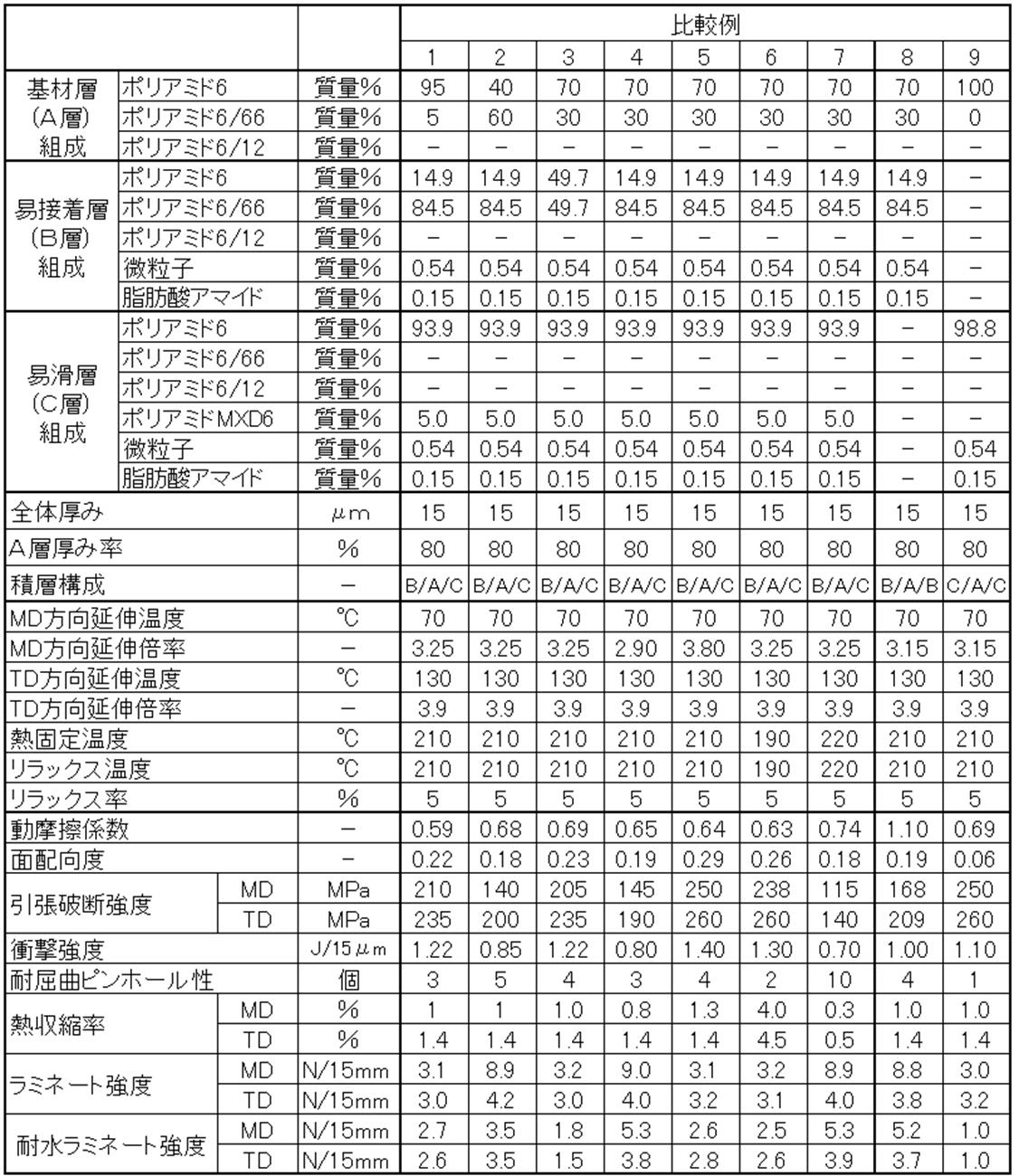
更に実施例1~12の場合は、面配向度を特定の範囲にしていることにより、優れた引張破断強度を同時に有していることがわかる。
また比較例2では、基材層(A層)中のポリアミド6/66共重合体の含有量が多すぎるため、延伸による配向が弱くなり、引張破断強度が低かった。
比較例4ではMD方向の延伸倍率が低いため、フィルムの面配向度が低くなり、引張破断強度が低かった。
比較例5ではMD方向の延伸倍率が高いため、面配向度が高くなりすぎた結果、B層/A層及びA層/C層間の接着強度が低下し、ラミネート強度が低下した。
比較例6では熱固定温度低かったため、接着層(B層)の接着性を向上するのに十分な熱が与えられていないため、ラミネート強度が低かった。また、熱収縮率が高く寸法安定性が悪かった。
比較例8では易滑層(C層)を積層していないため、摩擦係数が高く滑り性が不十分であった。また、全層中のポリアミド6/66共重合体比率が多くなるために、配向が付きにくくなり、引張破断強度が低下した。
比較例9では、表層にポリアミド6/66共重合体を含有していないので、耐水ラミネート強度が劣る結果であった。
比較例10では、コート層を設けることで接着性を向上させることができたが、印刷性に劣っていた。
本発明の積層延伸ポリアミドフィルムは、漬物袋、業務用途の大型の水物用の袋などに適用できる。
Claims (6)
- 少なくとも易接着層(B層)、基材層(A層)、易滑層(C層)の順にポリアミド樹脂組成物からなる3層で構成された二軸延伸フィルムであって、下記(1)~(4)を満足することを特徴とする積層延伸ポリアミドフィルム。
(1)前記A層は、ポリアミド6を50~90質量%、共重合体中の共重合成分の比率が3~35質量%であるポリアミド6共重合体を10~50質量%含有し、
(2)前記B層は共重合体中の共重合成分の比率が3~35質量%であるポリアミド6共重合体を60~100質量%とポリアミド6を0~40質量%含有し、
(3)前記C層は、ポリアミド6を70質量%以上と平均粒子径が0.1~10μmの微粒子を0.05~1質量%含有し、
(4)MD方向及びTD方向の引張破断強度がいずれも150MPa以上であり、
(5)ラミネート強度が3.3N/15mm以上である。 - 前記積層延伸ポリアミドフィルムの面配向度ΔPが0.20以上であることを特徴とする請求項1に記載の積層延伸ポリアミドフィルム
- 前記ポリアミド6共重合体がポリアミド6/66共重合体であることを特徴とする請求項1又は2に記載の積層延伸ポリアミドフィルム。
- 前記ポリアミド6共重合体がポリアミド6/12共重合体であることを特徴とする請求項1又は2に記載の積層延伸ポリアミドフィルム。
- 積層延伸ポリアミドフィルムの厚みが5~30μmであり、A層の厚みが4μm以上であり、B層の厚みが0.5μm以上であり、C層の厚みが0.5μm以上であることを特徴とする請求項1~4のいずれかに記載の積層延伸ポリアミドフィルム。
- 耐水ラミネート強度が2.0N/15mm以上であることを特徴とする請求項1~5のいずれかに記載の積層延伸ポリアミドフィルム。
Priority Applications (5)
| Application Number | Priority Date | Filing Date | Title |
|---|---|---|---|
| KR1020227010192A KR20220075331A (ko) | 2019-10-04 | 2020-08-26 | 적층 연신 폴리아미드 필름 |
| EP20871662.1A EP4039473A4 (en) | 2019-10-04 | 2020-08-26 | Multilayered stretched polyamide film |
| CN202080068349.2A CN114450156B (zh) | 2019-10-04 | 2020-08-26 | 层叠拉伸聚酰胺膜 |
| US17/765,623 US11794457B2 (en) | 2019-10-04 | 2020-08-26 | Multilayered stretched polyamide film |
| JP2020562780A JP7131635B2 (ja) | 2019-10-04 | 2020-08-26 | 積層延伸ポリアミドフィルム |
Applications Claiming Priority (2)
| Application Number | Priority Date | Filing Date | Title |
|---|---|---|---|
| JP2019-183713 | 2019-10-04 | ||
| JP2019183713 | 2019-10-04 |
Publications (1)
| Publication Number | Publication Date |
|---|---|
| WO2021065257A1 true WO2021065257A1 (ja) | 2021-04-08 |
Family
ID=75337849
Family Applications (1)
| Application Number | Title | Priority Date | Filing Date |
|---|---|---|---|
| PCT/JP2020/032243 Ceased WO2021065257A1 (ja) | 2019-10-04 | 2020-08-26 | 積層延伸ポリアミドフィルム |
Country Status (7)
| Country | Link |
|---|---|
| US (1) | US11794457B2 (ja) |
| EP (1) | EP4039473A4 (ja) |
| JP (1) | JP7131635B2 (ja) |
| KR (1) | KR20220075331A (ja) |
| CN (1) | CN114450156B (ja) |
| TW (1) | TWI826727B (ja) |
| WO (1) | WO2021065257A1 (ja) |
Families Citing this family (3)
| Publication number | Priority date | Publication date | Assignee | Title |
|---|---|---|---|---|
| WO2020195795A1 (ja) | 2019-03-28 | 2020-10-01 | 東洋紡株式会社 | 積層延伸ポリアミドフィルム |
| EP4039473A4 (en) | 2019-10-04 | 2023-12-20 | Toyobo Co., Ltd. | Multilayered stretched polyamide film |
| EP4309894A4 (en) * | 2021-03-17 | 2025-03-19 | Toyobo Co., Ltd. | BIAXIALLY STRETCHED POLYAMIDE FILM AND LAMINATE FILM |
Citations (5)
| Publication number | Priority date | Publication date | Assignee | Title |
|---|---|---|---|---|
| JPH0568084B2 (ja) | 1989-05-25 | 1993-09-28 | Musashino Tsuko Kk | |
| JPH0637081A (ja) | 1992-07-14 | 1994-02-10 | Oki Electric Ind Co Ltd | ウエハの乾燥方法及びこの方法におけるウエハ乾燥装置 |
| JP2000309076A (ja) * | 1999-02-23 | 2000-11-07 | Toyobo Co Ltd | 積層フィルム |
| JP2002029014A (ja) * | 2000-07-17 | 2002-01-29 | Toyobo Co Ltd | 積層フィルム |
| WO2002016133A1 (en) * | 2000-08-22 | 2002-02-28 | Toyo Boseki Kabushiki Kaisha | Laminated biaxially-oriented polyamide film and process for producing the same |
Family Cites Families (28)
| Publication number | Priority date | Publication date | Assignee | Title |
|---|---|---|---|---|
| JPS5337773A (en) | 1976-09-20 | 1978-04-07 | Mitsubishi Chem Ind | Method of producing stretching polyamid film |
| JPS578647A (en) | 1980-06-09 | 1982-01-16 | Mitsubishi Rayon Co | Heat resisting contractive improved hollow vessel in polyester |
| JPH0637081B2 (ja) | 1989-10-16 | 1994-05-18 | 出光石油化学株式会社 | 二軸延伸ナイロン6―66共重合体フィルムの製造方法 |
| DE69021607T2 (de) | 1989-03-10 | 1996-01-18 | Idemitsu Petrochemical Co | Verfahren zum Herstellen von biaxial orientierten Nylon-Folien. |
| JPH04178814A (ja) | 1990-11-14 | 1992-06-25 | Tohoku Nippon Denki Software Kk | キーボード入力装置 |
| JP2870255B2 (ja) | 1991-09-06 | 1999-03-17 | 日本電気株式会社 | 電子交換装置 |
| JP2000006340A (ja) * | 1998-06-19 | 2000-01-11 | Toyobo Co Ltd | ガスバリア性積層フィルム |
| JP4660866B2 (ja) * | 1999-02-22 | 2011-03-30 | 東洋紡績株式会社 | 易接着性ポリアミドフィルム |
| WO2000059724A1 (fr) | 1999-04-02 | 2000-10-12 | Kureha Kagaku Kogyo Kabushiki Kaisha | Film a boyau multicouche |
| JP4568964B2 (ja) | 2000-06-30 | 2010-10-27 | 東洋紡績株式会社 | ポリアミド系積層フィルム |
| JP2002103446A (ja) | 2000-09-29 | 2002-04-09 | Toyobo Co Ltd | ニ軸配向ポリアミドフィルムの製造方法及びそれによって得られるニ軸配向ポリアミドフィルムとそれを用いた積層フィルム。 |
| JP4178814B2 (ja) | 2002-02-28 | 2008-11-12 | 東洋紡績株式会社 | ポリアミド系積層フィルム |
| JP4655185B2 (ja) * | 2002-12-03 | 2011-03-23 | 東洋紡績株式会社 | ポリアミド積層フィルム |
| DE102005043287A1 (de) * | 2005-09-09 | 2007-03-15 | Kalle Gmbh | Mehrschichtige Wursthülle mit drei nebeneinander liegenden Schichten auf Polyamidbasis |
| JP5068084B2 (ja) | 2007-01-31 | 2012-11-07 | グンゼ株式会社 | ポリアミド系多層フィルム |
| KR101418134B1 (ko) * | 2007-10-26 | 2014-07-09 | 도요보 가부시키가이샤 | 폴리아미드계 적층 이축연신 필름 및 증착 폴리아미드계 적층 수지 필름 |
| JP2009154294A (ja) | 2007-12-25 | 2009-07-16 | Toyobo Co Ltd | ポリアミド系積層2軸延伸フィルム |
| JP5348535B2 (ja) * | 2009-03-30 | 2013-11-20 | 東洋紡株式会社 | 積層2軸延伸ポリアミド系フィルム |
| JP5446422B2 (ja) | 2009-04-22 | 2014-03-19 | 東洋紡株式会社 | 積層2軸延伸ポリアミド系フィルム |
| CN102190120B (zh) | 2010-03-04 | 2013-12-11 | 厦门长天企业有限公司 | 一种聚酰胺薄膜及其制造方法 |
| JP5383563B2 (ja) | 2010-03-10 | 2014-01-08 | グンゼ株式会社 | ポリアミド系多層フィルム |
| JP5979977B2 (ja) * | 2012-05-21 | 2016-08-31 | グンゼ株式会社 | 冷間成形用多層延伸フィルム |
| JP2018095863A (ja) * | 2016-12-14 | 2018-06-21 | 東洋紡株式会社 | 二軸延伸ポリアミド樹脂フィルム及びそれを用いた積層体。 |
| WO2019065161A1 (ja) * | 2017-09-28 | 2019-04-04 | 東洋紡株式会社 | 積層延伸ポリアミドフィルム |
| JPWO2019142631A1 (ja) * | 2018-01-17 | 2020-07-16 | 東洋紡株式会社 | 積層延伸ポリアミドフィルム |
| CN109367045A (zh) * | 2018-09-26 | 2019-02-22 | 江阴长庚高科技材料有限公司 | 一种高抗冲双向拉伸聚酰胺薄膜及其二泡生产方法与应用 |
| WO2020195795A1 (ja) | 2019-03-28 | 2020-10-01 | 東洋紡株式会社 | 積層延伸ポリアミドフィルム |
| EP4039473A4 (en) | 2019-10-04 | 2023-12-20 | Toyobo Co., Ltd. | Multilayered stretched polyamide film |
-
2020
- 2020-08-26 EP EP20871662.1A patent/EP4039473A4/en not_active Withdrawn
- 2020-08-26 CN CN202080068349.2A patent/CN114450156B/zh active Active
- 2020-08-26 WO PCT/JP2020/032243 patent/WO2021065257A1/ja not_active Ceased
- 2020-08-26 KR KR1020227010192A patent/KR20220075331A/ko active Pending
- 2020-08-26 US US17/765,623 patent/US11794457B2/en active Active
- 2020-08-26 JP JP2020562780A patent/JP7131635B2/ja active Active
- 2020-09-18 TW TW109132196A patent/TWI826727B/zh active
Patent Citations (5)
| Publication number | Priority date | Publication date | Assignee | Title |
|---|---|---|---|---|
| JPH0568084B2 (ja) | 1989-05-25 | 1993-09-28 | Musashino Tsuko Kk | |
| JPH0637081A (ja) | 1992-07-14 | 1994-02-10 | Oki Electric Ind Co Ltd | ウエハの乾燥方法及びこの方法におけるウエハ乾燥装置 |
| JP2000309076A (ja) * | 1999-02-23 | 2000-11-07 | Toyobo Co Ltd | 積層フィルム |
| JP2002029014A (ja) * | 2000-07-17 | 2002-01-29 | Toyobo Co Ltd | 積層フィルム |
| WO2002016133A1 (en) * | 2000-08-22 | 2002-02-28 | Toyo Boseki Kabushiki Kaisha | Laminated biaxially-oriented polyamide film and process for producing the same |
Non-Patent Citations (1)
| Title |
|---|
| See also references of EP4039473A4 |
Also Published As
| Publication number | Publication date |
|---|---|
| US11794457B2 (en) | 2023-10-24 |
| TWI826727B (zh) | 2023-12-21 |
| US20220266580A1 (en) | 2022-08-25 |
| CN114450156B (zh) | 2023-07-04 |
| JP7131635B2 (ja) | 2022-09-06 |
| JPWO2021065257A1 (ja) | 2021-04-08 |
| TW202120334A (zh) | 2021-06-01 |
| KR20220075331A (ko) | 2022-06-08 |
| CN114450156A (zh) | 2022-05-06 |
| EP4039473A1 (en) | 2022-08-10 |
| EP4039473A4 (en) | 2023-12-20 |
Similar Documents
| Publication | Publication Date | Title |
|---|---|---|
| JP7323020B2 (ja) | ラミネートフィルム | |
| JP2021121507A (ja) | 積層延伸ポリアミドフィルム | |
| CN114450156B (zh) | 层叠拉伸聚酰胺膜 | |
| JP7322458B2 (ja) | 易接着性ポリアミドフィルム | |
| JP7463966B2 (ja) | 積層延伸ポリアミドフィルム | |
| JP7463961B2 (ja) | ガスバリア性ポリアミドフィルム | |
| JP4618228B2 (ja) | ポリアミド系混合樹脂積層フィルムロール、およびその製造方法 | |
| KR20240076774A (ko) | 2축 연신 폴리아미드 필름 및 포장 재료 | |
| JP2021017023A (ja) | 積層延伸ポリアミドフィルム | |
| JP3829866B1 (ja) | ポリアミド系混合樹脂積層フィルムロール、およびその製造方法 | |
| JP3829865B1 (ja) | ポリアミド系混合樹脂積層フィルムロール、およびその製造方法 |
Legal Events
| Date | Code | Title | Description |
|---|---|---|---|
| ENP | Entry into the national phase |
Ref document number: 2020562780 Country of ref document: JP Kind code of ref document: A |
|
| 121 | Ep: the epo has been informed by wipo that ep was designated in this application |
Ref document number: 20871662 Country of ref document: EP Kind code of ref document: A1 |
|
| NENP | Non-entry into the national phase |
Ref country code: DE |
|
| ENP | Entry into the national phase |
Ref document number: 2020871662 Country of ref document: EP Effective date: 20220504 |
|
| WWG | Wipo information: grant in national office |
Ref document number: 202247018800 Country of ref document: IN |
|
| WWW | Wipo information: withdrawn in national office |
Ref document number: 2020871662 Country of ref document: EP |