WO2021090823A1 - 樹脂組成物および電子電気機器部品 - Google Patents
樹脂組成物および電子電気機器部品 Download PDFInfo
- Publication number
- WO2021090823A1 WO2021090823A1 PCT/JP2020/041157 JP2020041157W WO2021090823A1 WO 2021090823 A1 WO2021090823 A1 WO 2021090823A1 JP 2020041157 W JP2020041157 W JP 2020041157W WO 2021090823 A1 WO2021090823 A1 WO 2021090823A1
- Authority
- WO
- WIPO (PCT)
- Prior art keywords
- mass
- resin composition
- polycarbonate resin
- formula
- parts
- Prior art date
- Legal status (The legal status is an assumption and is not a legal conclusion. Google has not performed a legal analysis and makes no representation as to the accuracy of the status listed.)
- Ceased
Links
- 0 CC(C)(*)C(Oc1c(*)cc(*=C=Cc(cc2C)cc(*)c2OC(C)(C)*)cc1C)=O Chemical compound CC(C)(*)C(Oc1c(*)cc(*=C=Cc(cc2C)cc(*)c2OC(C)(C)*)cc1C)=O 0.000 description 1
Classifications
-
- C—CHEMISTRY; METALLURGY
- C08—ORGANIC MACROMOLECULAR COMPOUNDS; THEIR PREPARATION OR CHEMICAL WORKING-UP; COMPOSITIONS BASED THEREON
- C08L—COMPOSITIONS OF MACROMOLECULAR COMPOUNDS
- C08L69/00—Compositions of polycarbonates; Compositions of derivatives of polycarbonates
-
- C—CHEMISTRY; METALLURGY
- C08—ORGANIC MACROMOLECULAR COMPOUNDS; THEIR PREPARATION OR CHEMICAL WORKING-UP; COMPOSITIONS BASED THEREON
- C08G—MACROMOLECULAR COMPOUNDS OBTAINED OTHERWISE THAN BY REACTIONS ONLY INVOLVING UNSATURATED CARBON-TO-CARBON BONDS
- C08G64/00—Macromolecular compounds obtained by reactions forming a carbonic ester link in the main chain of the macromolecule
- C08G64/04—Aromatic polycarbonates
-
- C—CHEMISTRY; METALLURGY
- C08—ORGANIC MACROMOLECULAR COMPOUNDS; THEIR PREPARATION OR CHEMICAL WORKING-UP; COMPOSITIONS BASED THEREON
- C08G—MACROMOLECULAR COMPOUNDS OBTAINED OTHERWISE THAN BY REACTIONS ONLY INVOLVING UNSATURATED CARBON-TO-CARBON BONDS
- C08G64/00—Macromolecular compounds obtained by reactions forming a carbonic ester link in the main chain of the macromolecule
- C08G64/04—Aromatic polycarbonates
- C08G64/06—Aromatic polycarbonates not containing aliphatic unsaturation
-
- C—CHEMISTRY; METALLURGY
- C08—ORGANIC MACROMOLECULAR COMPOUNDS; THEIR PREPARATION OR CHEMICAL WORKING-UP; COMPOSITIONS BASED THEREON
- C08G—MACROMOLECULAR COMPOUNDS OBTAINED OTHERWISE THAN BY REACTIONS ONLY INVOLVING UNSATURATED CARBON-TO-CARBON BONDS
- C08G64/00—Macromolecular compounds obtained by reactions forming a carbonic ester link in the main chain of the macromolecule
- C08G64/20—General preparatory processes
- C08G64/30—General preparatory processes using carbonates
- C08G64/307—General preparatory processes using carbonates and phenols
-
- C—CHEMISTRY; METALLURGY
- C08—ORGANIC MACROMOLECULAR COMPOUNDS; THEIR PREPARATION OR CHEMICAL WORKING-UP; COMPOSITIONS BASED THEREON
- C08K—Use of inorganic or non-macromolecular organic substances as compounding ingredients
- C08K3/00—Use of inorganic substances as compounding ingredients
- C08K3/01—Use of inorganic substances as compounding ingredients characterized by their specific function
- C08K3/013—Fillers, pigments or reinforcing additives
-
- C—CHEMISTRY; METALLURGY
- C08—ORGANIC MACROMOLECULAR COMPOUNDS; THEIR PREPARATION OR CHEMICAL WORKING-UP; COMPOSITIONS BASED THEREON
- C08K—Use of inorganic or non-macromolecular organic substances as compounding ingredients
- C08K3/00—Use of inorganic substances as compounding ingredients
- C08K3/34—Silicon-containing compounds
-
- C—CHEMISTRY; METALLURGY
- C08—ORGANIC MACROMOLECULAR COMPOUNDS; THEIR PREPARATION OR CHEMICAL WORKING-UP; COMPOSITIONS BASED THEREON
- C08K—Use of inorganic or non-macromolecular organic substances as compounding ingredients
- C08K3/00—Use of inorganic substances as compounding ingredients
- C08K3/38—Boron-containing compounds
-
- C—CHEMISTRY; METALLURGY
- C08—ORGANIC MACROMOLECULAR COMPOUNDS; THEIR PREPARATION OR CHEMICAL WORKING-UP; COMPOSITIONS BASED THEREON
- C08K—Use of inorganic or non-macromolecular organic substances as compounding ingredients
- C08K5/00—Use of organic ingredients
- C08K5/36—Sulfur-, selenium-, or tellurium-containing compounds
- C08K5/41—Compounds containing sulfur bound to oxygen
- C08K5/42—Sulfonic acids; Derivatives thereof
-
- C—CHEMISTRY; METALLURGY
- C08—ORGANIC MACROMOLECULAR COMPOUNDS; THEIR PREPARATION OR CHEMICAL WORKING-UP; COMPOSITIONS BASED THEREON
- C08K—Use of inorganic or non-macromolecular organic substances as compounding ingredients
- C08K5/00—Use of organic ingredients
- C08K5/49—Phosphorus-containing compounds
- C08K5/51—Phosphorus bound to oxygen
- C08K5/52—Phosphorus bound to oxygen only
- C08K5/521—Esters of phosphoric acids, e.g. of H3PO4
-
- C—CHEMISTRY; METALLURGY
- C08—ORGANIC MACROMOLECULAR COMPOUNDS; THEIR PREPARATION OR CHEMICAL WORKING-UP; COMPOSITIONS BASED THEREON
- C08K—Use of inorganic or non-macromolecular organic substances as compounding ingredients
- C08K7/00—Use of ingredients characterised by shape
- C08K7/02—Fibres or whiskers
- C08K7/04—Fibres or whiskers inorganic
- C08K7/14—Glass
-
- C—CHEMISTRY; METALLURGY
- C08—ORGANIC MACROMOLECULAR COMPOUNDS; THEIR PREPARATION OR CHEMICAL WORKING-UP; COMPOSITIONS BASED THEREON
- C08K—Use of inorganic or non-macromolecular organic substances as compounding ingredients
- C08K9/00—Use of pretreated ingredients
- C08K9/08—Ingredients agglomerated by treatment with a binding agent
-
- C—CHEMISTRY; METALLURGY
- C08—ORGANIC MACROMOLECULAR COMPOUNDS; THEIR PREPARATION OR CHEMICAL WORKING-UP; COMPOSITIONS BASED THEREON
- C08K—Use of inorganic or non-macromolecular organic substances as compounding ingredients
- C08K3/00—Use of inorganic substances as compounding ingredients
- C08K3/38—Boron-containing compounds
- C08K2003/382—Boron-containing compounds and nitrogen
-
- C—CHEMISTRY; METALLURGY
- C08—ORGANIC MACROMOLECULAR COMPOUNDS; THEIR PREPARATION OR CHEMICAL WORKING-UP; COMPOSITIONS BASED THEREON
- C08K—Use of inorganic or non-macromolecular organic substances as compounding ingredients
- C08K3/00—Use of inorganic substances as compounding ingredients
- C08K3/38—Boron-containing compounds
- C08K2003/382—Boron-containing compounds and nitrogen
- C08K2003/385—Binary compounds of nitrogen with boron
-
- C—CHEMISTRY; METALLURGY
- C08—ORGANIC MACROMOLECULAR COMPOUNDS; THEIR PREPARATION OR CHEMICAL WORKING-UP; COMPOSITIONS BASED THEREON
- C08K—Use of inorganic or non-macromolecular organic substances as compounding ingredients
- C08K5/00—Use of organic ingredients
- C08K5/0008—Organic ingredients according to more than one of the "one dot" groups of C08K5/01 - C08K5/59
- C08K5/0066—Flame-proofing or flame-retarding additives
-
- C—CHEMISTRY; METALLURGY
- C08—ORGANIC MACROMOLECULAR COMPOUNDS; THEIR PREPARATION OR CHEMICAL WORKING-UP; COMPOSITIONS BASED THEREON
- C08L—COMPOSITIONS OF MACROMOLECULAR COMPOUNDS
- C08L2203/00—Applications
- C08L2203/20—Applications use in electrical or conductive gadgets
-
- C—CHEMISTRY; METALLURGY
- C08—ORGANIC MACROMOLECULAR COMPOUNDS; THEIR PREPARATION OR CHEMICAL WORKING-UP; COMPOSITIONS BASED THEREON
- C08L—COMPOSITIONS OF MACROMOLECULAR COMPOUNDS
- C08L2205/00—Polymer mixtures characterised by other features
- C08L2205/02—Polymer mixtures characterised by other features containing two or more polymers of the same C08L -group
- C08L2205/025—Polymer mixtures characterised by other features containing two or more polymers of the same C08L -group containing two or more polymers of the same hierarchy C08L, and differing only in parameters such as density, comonomer content, molecular weight, structure
Definitions
- the present invention relates to a resin composition for electronic and electrical equipment parts that uses electromagnetic waves with a frequency of 1 GHz or higher and electronic and electrical equipment parts that use electromagnetic waves with a frequency of 1 GHz or higher.
- Polycarbonate resin is widely used in many fields as a resin having excellent heat resistance, impact resistance, transparency, etc.
- the polycarbonate resin composition reinforced with an inorganic filler such as glass fiber exhibits various excellent performances such as dimensional stability, mechanical strength, heat resistance, and electrical characteristics, and thus exhibits various excellent performances such as cameras, OA equipment, and electrical and electronic parts. It is widely used in such industrial fields.
- Patent Document 1 contains at least one resin selected from the group consisting of a thermoplastic resin, a curable resin, and a composite resin of a thermoplastic resin and a curable resin, and a nanoscale carbon tube.
- a resin composition for a GHz band electronic component is disclosed, wherein the nanoscale carbon tube is contained in a proportion of 0.0001 to 0.4% by mass based on the above resin.
- An object of the present invention is to solve such a problem, which is a resin composition for electronic and electrical equipment parts using an electromagnetic wave having a frequency of 1 GHz or more, a low dielectric loss tangent resin composition, and a frequency of 1 GHz. It is an object of the present invention to provide electronic and electrical equipment parts using the above electromagnetic waves.
- R 1 and R 2 are independently hydrogen atoms or methyl groups, and W 1 represents a single bond or a divalent group.
- R 1 and R 2 are independently hydrogen atoms or methyl groups, and W 1 represents a single bond or a divalent group.
- ⁇ 3> The resin composition according to ⁇ 2>, wherein the mass ratio of the structural unit represented by the formula (1) in the polycarbonate resin to 100 parts by mass of the inorganic filler is 150 parts by mass or more.
- ⁇ 4> The resin composition according to ⁇ 2> or ⁇ 3>, wherein the inorganic filler contains at least one selected from the group consisting of glass fiber, talc, and boron nitride.
- ⁇ 5> The resin composition according to any one of ⁇ 2> to ⁇ 4>, wherein the inorganic filler contains glass fibers.
- ⁇ 6> The resin composition according to any one of ⁇ 1> to ⁇ 5>, wherein the carbonate unit other than the structural unit represented by the formula (1) includes the structural unit represented by the formula (5). Stuff.
- W 2 represents a single bond or a divalent group.
- W 2 represents a single bond or a divalent group.
- ⁇ 7> 90% by mass or more of all the constituent units are represented by the polycarbonate resin (A1) which is the constituent unit represented by the above formula (1), and 90% by mass or more of all the constituent units are represented by the above formula (5).
- the resin composition according to ⁇ 6>, which contains the polycarbonate resin (A2) as a constituent unit, and 45% by mass or more of the polycarbonate resin contained in the resin composition is the polycarbonate resin (A1).
- the viscosity average molecular weight of the polycarbonate resin (A1) is 16,000 or more and 30,000 or less
- the viscosity average molecular weight of the polycarbonate resin (A2) is 16,000 or more and 35,000 or less.
- the resin composition according to. ⁇ 9> In the polycarbonate resin, 30 to 70% by mass of all the structural units is a structural unit represented by the above formula (1), and 70 to 30% by mass of all the structural units is represented by the above formula (5).
- the resin composition according to ⁇ 6>, which contains the polycarbonate resin (A3) which is a constituent unit, and 50% by mass or more of the polycarbonate resin contained in the resin composition is the polycarbonate resin (A3).
- ⁇ 10> The resin composition according to any one of ⁇ 1> to ⁇ 9>, wherein the pencil hardness measured according to JIS K5600 when the resin composition is formed into a flat plate is H or more.
- ⁇ 11> The resin composition according to any one of ⁇ 1> to ⁇ 10>, wherein the dielectric loss tangent at a frequency of 2.45 GHz when the resin composition is formed into a flat plate is 0.0053 or less. .. ⁇ 12>
- An electronic and electrical equipment component that uses an electromagnetic wave having a frequency of 1 GHz or more formed from the resin composition according to any one of ⁇ 1> to ⁇ 12>.
- the resin composition in which W 1 is represented by the formula (2a) or the formula (2i) described later in the formula (1) is represented by the structural unit represented by the formula (1).
- the structural unit represented by the formula (1) is a resin composition represented by the formula (3) or the formula (4-2) described later.
- the carbonate unit other than the structural unit represented by the formula (1) is the structural unit represented by the formula (5) described later, and W 2 will be described later.
- ⁇ D> Further, in any of the above resin compositions, a resin composition in which the total amount of the polycarbonate resin (A1) and the polycarbonate resin (A2) accounts for 90% by mass or more of the polycarbonate resin contained in the resin composition.
- ⁇ E> Further, in any of the above resin compositions, a resin composition that does not contain an inorganic filler and contains a polycarbonate resin in a proportion of 80% by mass or more in the resin composition.
- ⁇ F> Further, in any of the above resin compositions, a resin composition containing an inorganic filler and containing the polycarbonate resin and the inorganic filler in a total of 80% by mass or more in the resin composition.
- a resin composition containing an inorganic filler and containing a fibrous or plate-like inorganic filler a resin composition containing an inorganic filler and containing a fibrous or plate-like inorganic filler.
- a heat stabilizer preferably a phosphorus-based stabilizer, more preferably tris (2,4-di-tert-butylphenyl) phosphite
- an antioxidant preferably a hindered phenolic antioxidant, more preferably octadecyl-3- (3,5-di-tert-butyl-4-hydroxy).
- a release agent preferably an ester of an aliphatic carboxylic acid and an alcohol, more preferably pentaerythritol tetrastearate is added to 100 parts by mass of the polycarbonate resin.
- the total of the polycarbonate resin, the inorganic filler, the heat stabilizer, the antioxidant, and the mold release agent, which are selectively blended is 98% by mass.
- the resin composition as described above preferably 100% by mass.
- the total of the polycarbonate resin, the inorganic filler, the heat stabilizer, the antioxidant, the mold release agent, and the flame retardant, which are selectively blended is A resin composition of 98% by mass or more (preferably 100% by mass).
- the resin composition for electronic and electrical equipment parts (hereinafter, may be simply referred to as "the resin composition of the present invention") using an electromagnetic wave having a frequency of 1 GHz or more of the present invention contains a polycarbonate resin, and the formula in the polycarbonate resin is used.
- the mass ratio of the structural unit represented by (1) to the carbonate unit other than the structural unit represented by the formula (1) is 33 to 100: 67 to 0.
- low dielectric loss tangent can be achieved.
- the scratch resistance of the obtained electronic and electrical equipment parts can be improved.
- the scratch resistance here refers to, for example, the property that the surface of electronic and electrical equipment parts is not easily scratched. It is presumed that the reason for this is that the polycarbonate resin contains a predetermined ratio or more of the structural units represented by the formula (1) such as the structural units derived from bisphenol C.
- the resin composition of the present invention contains a polycarbonate resin.
- the polycarbonate resin used in the present invention contains a structural unit represented by the formula (1) and a carbonate unit other than the structural unit represented by the formula (1) (hereinafter, may be referred to as “another carbonate unit”).
- the mass ratio of the structural unit represented by the formula (1) to the carbonate unit other than the structural unit represented by the formula (1) is 33 to 100: 67 to 0.
- the mass ratio of the structural unit represented by the formula (1) to the carbonate unit other than the structural unit represented by the formula (1) is 33 to 100: 67 to 0, but 35 to 100: 65 to 0.
- the polycarbonate resin may contain only one type of each of the structural unit represented by the formula (1) and the carbonate unit other than the structural unit represented by the formula (1), or may contain two or more types. .. When two or more types are included, the total amount is preferably in the above range.
- the polycarbonate resin used in the present invention is usually composed of a structural unit represented by the formula (1), a carbonate unit other than the structural unit represented by the formula (1), and a terminal group.
- the other carbonate unit may have a branched structure.
- the content of the structural unit represented by the formula (1) and other carbonate units in the present invention is a ratio based on all the structural units excluding both terminal groups (100% by mass).
- the structural unit represented by the formula (1) is as follows. (In formula (1), R 1 and R 2 are independently hydrogen atoms or methyl groups, and W 1 represents a single bond or a divalent group.)
- R 1 and R 2 represent a hydrogen atom or a methyl group.
- R 1 and R 2 are hydrogen atoms, the weather resistance of the electronic and electrical equipment components of the present invention tends to be further improved.
- R 1 and R 2 are methyl groups, the heat resistance and moisture resistance and heat stability of the electronic and electrical equipment parts of the present invention tend to be further improved. Therefore, R 1 and R 2 may be appropriately selected according to the requirements, but are more preferably hydrogen atoms.
- W 1 represents a single bond or a divalent group.
- the divalent group include an oxygen atom, a sulfur atom, a divalent organic group, and a group composed of a combination thereof, and a divalent organic group is preferable.
- the divalent organic group is not particularly limited as long as it is conventionally known and can be appropriately selected and used. Examples thereof include organic groups represented by the following formulas (2a) to (2h).
- R 3 and R 4 independently represent a hydrogen atom, a monovalent hydrocarbon group having 1 to 24 carbon atoms, or an alkoxy group having 1 to 24 carbon atoms, among which carbon atoms are represented. It is preferably a monovalent hydrocarbon group of 1 to 24.
- the monovalent hydrocarbon group having 1 to 24 carbon atoms includes an alkyl group having 1 to 24 carbon atoms, an alkenyl group having 2 to 24 carbon atoms, and an aryl group having 6 to 24 carbon atoms which may have a substituent. , An arylalkyl group having 7 to 24 carbon atoms and the like, and an alkyl group having 1 to 24 carbon atoms is preferable.
- Examples of the alkyl group having 1 to 24 carbon atoms include a linear or branched alkyl group and an alkyl group having a partially cyclic structure, and among them, a linear alkyl group is preferable.
- Examples of the alkyl group having 1 to 24 carbon atoms include a methyl group, an ethyl group, an n-propyl group, an n-butyl group, an n-pentyl group, an n-hexyl group, an n-heptyl group, an n-octyl group and the like. However, it is preferably a methyl group.
- Examples of the alkenyl group having 2 to 24 carbon atoms include a linear alkenyl group, a branched alkenyl group, and an alkenyl group having a partially cyclic structure. Among them, a linear alkenyl group is preferable.
- Examples of the linear alkenyl group having 2 to 24 carbon atoms include a vinyl group, an n-propenyl group, an n-butenyl group, an n-pentenyl group, an n-hexenyl group, an n-heptenyl group and an n-octenyl group. Etc., but a vinyl group is preferable.
- Examples of the aryl group having 6 to 24 carbon atoms include an aryl group which may have a substituent such as an alkyl group such as a phenyl group, a naphthyl group, a methylphenyl group, a dimethylphenyl group and a trimethylphenyl group.
- Examples of the arylalkyl group having 7 to 24 carbon atoms include a benzyl group.
- alkoxy group having 1 to 24 carbon atoms examples include a linear, branched, and partially cyclic alkoxy group, and among them, a linear alkoxy group is preferable.
- linear alkoxy group examples include a methoxy group, an ethoxy group, a propoxy group, a butoxy group and the like.
- X 1 represents an oxygen atom or NR a .
- Ra is synonymous with R 3 and R 4 described above.
- X 2 represents a divalent hydrocarbon group having 3 to 18 carbon atoms, for example, a propylene group, a butylene group, a pentylene group, a hexylene group, a heptylene group, an octylene group, a nonylene group and a decylene group.
- Undecylene group, dodecylene group and the like, and each of them may further have a substituent. Examples of the substituent include a methyl group, an ethyl group, a propyl group, a butyl group, a pentyl group, a phenyl group and the like.
- X 2 may have a crosslinked structure.
- the formula (2c) is preferably represented by the formula (2i).
- R 11 independently represents a monovalent hydrocarbon group having 1 to 24 carbon atoms or an alkoxy group having 1 to 24 carbon atoms.
- the details of the monovalent hydrocarbon group having 1 to 24 carbon atoms and the alkoxy group having 1 to 24 carbon atoms are the same as those of R 3 in the formula (2a).
- q is an integer of 0 to 3, preferably 0. * Is the binding site for other groups.
- X 3 represents an alkylene group having 1 to 7 carbon atoms.
- the alkylene group may be a linear group, a branched chain, or may have a cyclic structure, and examples thereof include a methylene group, an ethylene group, a propylene group, and a butylene group.
- M represents an integer of 1 to 500, and among them, 5 to 300 is preferable, and 10 to 100 is more preferable.
- the raw material monomer of the structural unit represented by the formula (1) for example, Bis (4-hydroxy-3-methylphenyl) methane, Bis (4-hydroxy-3,5-dimethylphenyl) methane, 1,1-bis (4-hydroxy-3-methylphenyl) ethane, 1,1-bis (4-hydroxy-3,5-dimethylphenyl) ethane, 2,2-bis (4-hydroxy-3-methylphenyl) propane, 2,2-bis (4-hydroxy-3,5-dimethylphenyl) propane, 2,2-Bis (4-hydroxy-3-isopropylphenyl) propane, 2,2-bis (4-hydroxy-3-methylphenyl) butane, 2,2-bis (4-hydroxy-3,5-dimethylphenyl) butane, 1,3-bis (2- (4-hydroxy-3-methylphenyl) -2-propyl) benzene, 1,4-Bis (2- (4-Hydroxy-3-methylphenyl) -2-propyl) benzene, 1,1
- aromatic dihydroxy compounds 2,2-bis (4-hydroxy-3-methylphenyl) propane, 2,2-bis (4-hydroxy-3,5-dimethylphenyl) propane, and 1,1-bis (4-Hydroxy-3-methylphenyl) cyclohexane, 1,1-bis (4-hydroxy-3-methylphenyl) -3,3,5-trimethylcyclohexane are preferable, and 2,2-bis (4-hydroxy-3) -Methylphenyl) propane and 2,2-bis (4-hydroxy-3,5-dimethylphenyl) propane are more preferred, and 2,2-bis (4-hydroxy-3-methylphenyl) propane is even more preferred.
- the structural unit represented by the formula (1) is more preferably the structural unit represented by the following formulas (3), (4), and (4-2), and the formula (3) or the formula (4-2).
- the structural unit represented by 2) is more preferable.
- the other carbonate unit include the structural units represented by the following formulas (5) and (6), and the structural unit represented by the formula (5) is preferable.
- 90% by mass or more (preferably 95% by mass or more, more preferably 99% by mass or more) of the other carbonate units is preferably the structural unit represented by the formula (5).
- W 2 represents a single bond or a divalent group.
- W 2 has the same meaning as W 1 described above, and the preferred range is also the same.
- formula (2a) is preferable.
- R 5 , R 6 , R 7 , R 8 , R 9 and R 10 respectively represent at least one selected from a hydrogen atom and an alkyl group having 1 to 6 carbon atoms, respectively.
- the alkyl group having 1 to 6 carbon atoms include a methyl group, an ethyl group, a propyl group and the like.
- R 5 , R 6 , R 7 and R 8 are preferably alkyl groups having 1 to 6 carbon atoms, and more preferably methyl groups. Hydrogen atoms are preferable for R 9 and R 10.
- carbonate units examples include 2,2-bis (4-hydroxyphenyl) propane (bisphenol A), 2,2-bis (4-hydroxyphenyl) cyclohexane, and 2,2-bis (4-hydroxyphenyl).
- examples thereof include structural units derived from hydroxyphenyl) -3,3,5-trimethylcyclohexane and 6,6'-dihydroxy-3,3,3', 3'-tetramethyl-1,1'-spirobiindan.
- 2,2-bis (4-hydroxyphenyl) propane (bisphenol A), 6,6'-dihydroxy-3,3,3', 3'-tetramethyl-1,1'-spirobiindane are more preferable.
- 2,2-Bis (4-hydroxyphenyl) propane (bisphenol A) is even more preferred.
- polycarbonate resin in the present invention a specific example of the polycarbonate resin in the present invention will be described.
- the following polycarbonate resins are preferable.
- a blend of polycarbonate resin (A1) and polycarbonate resin (A2) (2) Polycarbonate resin (A3) (3) Blend of polycarbonate resin (A1) and polycarbonate resin (A3) (4) Blend of polycarbonate resin (A2) and polycarbonate resin (A3) (5) Polycarbonate resin (A1), polycarbonate resin (A2) and polycarbonate Blend of resin (A3) (6)
- a polycarbonate resin other than the polycarbonate resin (A1) to the polycarbonate resin (A3) is further contained in a proportion of more than 0% by mass and not more than 5% by mass.
- Blended product a polycarbonate resin other than the polycarbonate resin (A1) to the polycarbonate resin (A3) is further contained in a proportion of more than 0% by mass and not more than 5% by mass.
- the polycarbonate resin (A1) to the polycarbonate resin (A3) are as follows.
- Polycarbonate resin (A1): 90% by mass or more (preferably 95% by mass or more, more preferably 99% by mass or more) of all the constituent units is the constituent unit represented by the formula (1)
- the first embodiment of the polycarbonate resin in the present invention contains the polycarbonate resin (A1) and the polycarbonate resin (A2), and 45% by mass or more of the polycarbonate resin contained in the resin composition is the polycarbonate resin (A1). It is a form.
- the ratio of the polycarbonate resin (A1) in the polycarbonate resin contained in the resin composition is preferably 48% by mass or more, more preferably 50% by mass or more, and 50% by mass. It is more preferably more than%, more preferably 55% by mass or more, and even more preferably 60% by mass or more.
- the ratio of the polycarbonate resin (A1) in the polycarbonate resin contained in the resin composition is preferably 100% by mass or less. By setting the value to the upper limit or less, the heat resistance tends to be further improved.
- the total amount of the polycarbonate resin (A1) and the polycarbonate resin (A2) preferably occupies 90% by mass or more of the polycarbonate resin contained in the resin composition, and preferably 95% by mass or more. More preferably, it occupies 99% by mass or more, and it may be 100% by mass.
- the polycarbonate resin is a structural unit in which 30 to 70% by mass of all the structural units is represented by the formula (1), and 70 to 30% by mass of all the structural units is. It contains the polycarbonate resin (A3) which is a structural unit represented by the formula (5), and is 50% by mass or more, preferably 60% by mass or more, more preferably 70% by mass or more of the polycarbonate resin contained in the resin composition, and further.
- the polycarbonate resin (A3) is preferably in the form of 80% by mass or more, more preferably 90% by mass or more, still more preferably 95% by mass or more, and even more preferably 99% by mass or more.
- the proportion of the structural unit represented by the formula (1) in the polycarbonate resin (A3) is preferably 30% by mass or more, more preferably 33% by mass or more. It is more preferably 35% by mass or more, further preferably 37% by mass or more, and even more preferably 40% by mass or more. By setting the value to the lower limit or more, both the low dielectric loss tangent and the scratch resistance tend to be further improved.
- the proportion of the structural unit represented by the formula (1) in the polycarbonate resin (A3) is preferably 99% by mass or less, more preferably 95% by mass or less, and 90% by mass or less. More preferably, it is more preferably 80% by mass or less, and even more preferably 70% by mass or less. By setting the value to the upper limit or less, the heat resistance tends to be further improved.
- the proportion of the structural unit represented by the formula (5) in the polycarbonate resin (A3) is preferably 30% by mass or more, more preferably 33% by mass or more, and 35. It is more preferably 7% by mass or more, further preferably 37% by mass or more, further preferably 40% by mass or more, and may be more than 50% by mass. By setting the value to the lower limit or more, both the low dielectric loss tangent and the scratch resistance tend to be further improved.
- the proportion of the structural unit represented by the formula (5) in the polycarbonate resin (A3) is preferably 99% by mass or less, more preferably 95% by mass or less, and 90% by mass or less. More preferably, it is more preferably 80% by mass or less, and even more preferably 70% by mass or less. By setting the value to the upper limit or less, the heat resistance tends to be further improved.
- the viscosity average molecular weight of the polycarbonate resin contained in the resin composition of the present invention is not particularly limited and may be appropriately selected as long as it does not impair the object of the present invention.
- the viscosity average molecular weight (Mv) converted from the solution viscosity is usually 10,000 to 50,000.
- the viscosity average molecular weight (Mv) of the polycarbonate resin is preferably 11,000 or more, more preferably 12,000 or more, still more preferably 13,000 or more, and particularly preferably 14,000 or more.
- the viscosity average molecular weight (Mv) of the polycarbonate resin is preferably 40,000 or less, more preferably 35,000 or less, still more preferably 30,000 or less, and particularly preferably 28,000 or less.
- the viscosity average molecular weight of the polycarbonate resin (A1) is preferably 16,000 or more and 30,000 or less.
- the viscosity average molecular weight of the polycarbonate resin (A1) is preferably 17,000 or more, preferably 28,000 or less, and more preferably 26,000 or less.
- the viscosity average molecular weight of the polycarbonate resin (A2) is preferably 16,000 or more and 35,000 or less.
- the viscosity average molecular weight of the polycarbonate resin (A2) is preferably 18,000 or more, and more preferably 20,000 or more.
- the viscosity average molecular weight of the polycarbonate resin (A1) is more preferably 30,000 or less, and further preferably 27,000 or less.
- the viscosity average molecule of the polycarbonate resin (A3) is preferably 10,000 or more, more preferably 15,000 or more.
- the viscosity average molecular weight of the polycarbonate resin (A3) is preferably 35,000 or less, more preferably 30,000 or less, further preferably 26,000 or less, and 24,000 or less. It is more preferable to have. In the present invention, it is particularly preferable to satisfy the viscosity average molecular weight in the second embodiment of the polycarbonate resin.
- the viscosity average molecular weight is measured according to the description of Examples described later.
- the method for producing the polycarbonate resin is not particularly limited as long as it is a known method, and can be appropriately selected and used.
- Examples of the method for producing the polycarbonate resin include a melt transesterification method, an interfacial polymerization method, a pyridine method, a ring-opening polymerization method for a cyclic carbonate compound, and a solid phase transesterification method for a prepolymer.
- the transesterification method and the surface polymerization method are preferable, and the melt transesterification method is more preferable.
- the resin composition of the present invention does not contain an inorganic filler, it preferably contains a polycarbonate resin in a proportion of 80% by mass or more, more preferably 85% by mass or more, and 90% by mass or more. It is more preferably contained in a proportion, more preferably in a proportion of 95% by mass or more, and may be contained in a proportion of 98% by mass or more.
- the resin composition of the present invention contains an inorganic filler, the total content of the polycarbonate resin and the inorganic filler is preferably 80% by mass or more, and more preferably 85% by mass or more.
- the polycarbonate resin may contain only one type, or may contain two or more types. When two or more types are included, the total amount is preferably in the above range.
- the resin composition of the present invention may contain an inorganic filler, and preferably contains an inorganic filler.
- the inorganic filler When the inorganic filler is included, the rigidity of the obtained electronic and electrical equipment parts can be increased.
- the dielectric loss tangent when an inorganic filler is blended, the dielectric loss tangent generally tends to be high.
- a polycarbonate resin containing a certain amount of the structural unit represented by the formula (1) low dielectric loss tangent can be achieved even if an inorganic filler is blended.
- the inorganic filler refers to a filler contained in a resin component to improve strength and / or rigidity, and may be in any form such as fibrous, plate-like, granular, or amorphous, but is fibrous or fibrous. Plate shape is preferable. By using a fibrous or plate-shaped inorganic filler, higher rigidity can be obtained with a relatively small amount of addition. In particular, by using a fibrous inorganic filler, higher rigidity can be obtained with a relatively small amount of addition.
- the inorganic filler used in the present invention preferably has a raw material aspect ratio (aspect ratio before melt-kneading) of 2 or more, more preferably 3 or more, and further 20 or more, 100 or more, 150 or more.
- the upper limit of the aspect ratio is, for example, 400 or less, preferably 350 or less, more preferably 300 or less, and further, 260 or less.
- the inorganic filler used in the present invention preferably has an aspect ratio of 2 or more, more preferably 3 or more, and further 5 or more or 8 or more in the pellet or electronic / electrical equipment component. You may.
- the upper limit of the aspect ratio is, for example, 100 or less, preferably 60 or less, more preferably 50 or less, and further, 40 or less.
- the aspect ratio is a number average value of the aspect ratios of any 100 inorganic fillers.
- the aspect ratio is calculated from the measured values obtained by randomly extracting the target inorganic filler from the image obtained by observation with an optical microscope, measuring the length thereof, and measuring the length thereof. ..
- the observation magnification is set to 20 times. The same applies to the number average length and the like described later.
- the form of the inorganic filler is fibrous, for example, glass fiber, carbon fiber, silica / alumina fiber, zirconia fiber, boron fiber, boron nitride fiber, potassium silicon nitride titanate fiber, metal fiber, wallastnite and the like can be used. included.
- glass fiber is preferable.
- the fiber When the inorganic filler is fibrous, the fiber may have a cross section of any shape such as a circle, an ellipse, an oval, a rectangle, a shape in which both short sides of a rectangle are combined with a semicircle, or an eyebrows. It is good, but a circular shape is preferable.
- the term "circle” here is intended to include, in addition to a circle in the mathematical sense, what is usually referred to as a circle in the technical field of the present invention.
- the fibers preferably have a number average fiber length of 0.1 to 10 mm, more preferably 1 to 5 mm.
- the lower limit of the number average fiber diameter of the glass fibers is preferably 4.0 ⁇ m or more, more preferably 4.5 ⁇ m or more, and further preferably 5.0 ⁇ m or more.
- the upper limit of the number average fiber diameter of the glass fibers is preferably 15.0 ⁇ m or less, more preferably 14.0 ⁇ m or less, and may be 12.0 ⁇ m or less.
- the fibrous inorganic filler is preferably glass fiber, and such glass fiber is generally supplied E glass (Electrical glass), C glass (Chemical glass), A glass (Alkari glass), S glass (High strength). Glass) and fibers obtained by melt-spinning glass such as alkali-resistant glass are used, but can be used as long as they can be made into glass fibers, and are not particularly limited.
- the glass fiber preferably contains E glass.
- the glass fiber used in the present invention is surface-treated with a surface treatment agent such as a silane coupling agent such as ⁇ -methacryloxypropyltrimethoxysilane, ⁇ -glycidoxypropyltrimethoxysilane, or ⁇ -aminopropyltriethoxysilane. It is preferable that it is.
- the amount of the surface treatment agent adhered is preferably 0.01 to 1% by mass of the glass fiber.
- a fatty acid amide compound such as silicone oil, an antistatic agent such as a quaternary ammonium salt, a resin having a film-forming ability such as an epoxy resin and a urethane resin, a resin having a film-forming ability, and heat. It is also possible to use a surface-treated mixture of a stabilizer, a flame retardant, and the like.
- Glass fiber is available as a commercial product.
- Commercially available products include, for example, Nippon Electric Glass Co., Ltd., T-187, T-571, T-595, T-286H, T-756H, T-289H, Owens Corning Co., Ltd., DEFT2A, PPG Co., Ltd., HP3540. , Nitto Boseki Co., Ltd., CSG3PA820 and the like.
- the plate-shaped inorganic filler exhibits a function of reducing anisotropy and warpage, and examples thereof include glass flakes, talc, mica, mica, kaolin, boron nitride, and metal foil. Of the plate-like inorganic fillers, talc and boron nitride are preferred.
- the glass flakes preferably have a number average thickness of 0.5 to 20 ⁇ m and a number average length of 0.05 to 1.0 mm.
- Other granular or amorphous fillers include ceramic beads, glass beads, asbestos, clay, zeolites, potassium titanate, barium sulfate, titanium oxide, silicon oxide, aluminum oxide, magnesium hydroxide and the like.
- the glass beads preferably have a number average diameter of 5 to 100 ⁇ m.
- the content of the inorganic filler (preferably the total content of at least one selected from the group consisting of glass fiber, talc, and boron nitride, more preferably the content of glass fiber) is based on 100 parts by mass of the polycarbonate resin. It is preferably 10 parts by mass or more and 100 parts by mass or less.
- the value is preferably 10 parts by mass or more and 100 parts by mass or less.
- the lower limit of the content of the inorganic filler can be adjusted according to the application, and may be, for example, 15 parts by mass or more, and further 20 parts by mass or more and 30 parts by mass or more with respect to 100 parts by mass of the polycarbonate resin. It may be.
- the upper limit of the content of the inorganic filler is preferably 80 parts by mass or less, more preferably 60 parts by mass or less, and more preferably 40 parts by mass or less with respect to 100 parts by mass of the polycarbonate resin. More preferred.
- the mass ratio of the structural unit represented by the formula (1) in the polycarbonate resin to 100 parts by mass of the inorganic filler is preferably 150 parts by mass or more. By setting the content to 150 parts by mass or more, it is possible to maintain the dielectric loss tangent low while maintaining the rigidity high.
- the mass ratio of the structural unit represented by the formula (1) in the polycarbonate resin to 100 parts by mass of the inorganic filler is preferably 200 parts by mass or more, more preferably 300 parts by mass or more, and 400 parts by mass. It is even more preferable that the number is more than one part.
- the upper limit of the mass ratio of the structural unit represented by the formula (1) in the polycarbonate resin to 100 parts by mass of the inorganic filler is preferably 2000 parts by mass or less, and preferably 1500 parts by mass or less. It is more preferably 1200 parts by mass or less, and even more preferably 1000 parts by mass or less.
- the resin composition of the present invention may contain only one kind of inorganic filler, or may contain two or more kinds of inorganic fillers. When two or more types are included, the total amount is preferably in the above range.
- the resin composition of the present invention may contain other components other than the above, if necessary, as long as the desired physical properties are not significantly impaired.
- other components include thermoplastic resins other than polycarbonate resins and various resin additives.
- the thermoplastic resin other than the polycarbonate resin include an impact resistance improving agent, a styrene resin other than the impact resistance improving agent, and a polyester resin.
- the resin additive include a heat stabilizer, an antioxidant, a mold release agent, an ultraviolet absorber, an antistatic agent, a flame retardant, a flame retardant aid, a dye, a pigment, an antifogging agent, a lubricant, and an antiblocking agent.
- Examples include fluidity improvers, plasticizers, dispersants, antibacterial agents and the like.
- 1 type may be contained in the resin additive, and 2 or more types may be contained in arbitrary combinations and ratios.
- Impact resistance improver As the impact resistance improving agent, the description in paragraphs 0069 to 0075 of JP-A-2019-135290 can be referred to, and these contents are incorporated in the present specification.
- a phosphorus-based stabilizer is preferably used. Any known phosphorus-based stabilizer can be used. Specific examples include phosphoric acid, phosphonic acid, phosphite, phosphinic acid, polyphosphoric acid and other phosphorus oxo acids; acidic sodium pyrophosphate, potassium pyrophosphate, acidic calcium pyrophosphate and other acidic pyrophosphate metal salts; phosphorus. Phosphates of Group 1 or Group 2B metals such as potassium acid, sodium phosphate, cesium phosphate, zinc phosphate; organic phosphate compounds, organic phosphite compounds, organic phosphonite compounds, etc. Is particularly preferable.
- organic phosphite compound examples include triphenyl phosphite, tris (monononylphenyl) phosphite, tris (monononyl / dinonyl-phenyl) phosphite, tris (2,4-di-tert-butylphenyl) phosphite, and monooctyl.
- organic phosphite compound examples include "ADEKA STAB (registered trademark; the same applies hereinafter) 1178", “ADEKA STAB 2112", “ADEKA STAB HP-10”, and “AX-71” manufactured by ADEKA. , "JP-351”, “JP-360”, “JP-3CP” manufactured by Johoku Chemical Industry Co., Ltd., “Irgafos (registered trademark; the same applies hereinafter) 168" manufactured by BASF, etc. can be mentioned.
- ADKA STAB registered trademark; the same applies hereinafter
- the content of the heat stabilizer in the resin composition of the present invention is usually 0.001 part by mass or more, preferably 0.005 part by mass or more, and more preferably 0.01 part by mass or more with respect to 100 parts by mass of the polycarbonate resin. It is usually 1 part by mass or less, preferably 0.5 part by mass or less, and more preferably 0.3 part by mass or less.
- the resin composition of the present invention may contain only one type of heat stabilizer, or may contain two or more types of heat stabilizers. When two or more types are included, the total amount is preferably in the above range.
- antioxidant a phenolic antioxidant is preferable, and a hindered phenolic antioxidant is more preferable.
- Specific examples of hindered phenolic antioxidants include pentaerythritol tetrakis [3- (3,5-di-tert-butyl-4-hydroxyphenyl) propionate] and octadecyl-3- (3,5-di-tert).
- pentaerythritol tetrakis [3- (3,5-di-tert-butyl-4-hydroxyphenyl) propionate] and octadecyl-3- (3,5-di-tert-butyl-4-hydroxyphenyl) propionate are preferable.
- hindered phenolic stabilizers include BASF's "Irganox (registered trademark; the same applies hereinafter) 1010", “Irganox 1076", ADEKA's "ADEKA STAB AO-50", and “ADEKA STAB”. AO-60 ”and the like.
- the content of the antioxidant in the resin composition of the present invention is usually 0.001 part by mass or more, preferably 0.005 part by mass or more, and more preferably 0.01 part by mass or more with respect to 100 parts by mass of the polycarbonate resin. It is usually 1 part by mass or less, preferably 0.5 part by mass or less, and more preferably 0.3 part by mass or less.
- the resin composition of the present invention may contain only one type of antioxidant, or may contain two or more types of antioxidants. When two or more types are included, the total amount is preferably in the above range.
- release agent examples include an aliphatic carboxylic acid, an ester of an aliphatic carboxylic acid and an alcohol, an aliphatic hydrocarbon compound having a number average molecular weight of 200 to 15,000, and a polysiloxane-based silicone oil.
- the aliphatic carboxylic acid examples include saturated or unsaturated aliphatic monovalent, divalent or trivalent carboxylic acids.
- the aliphatic carboxylic acid also includes an alicyclic carboxylic acid.
- the preferred aliphatic carboxylic acid is a monovalent or divalent carboxylic acid having 6 to 36 carbon atoms, and an aliphatic saturated monovalent carboxylic acid having 6 to 36 carbon atoms is more preferable.
- aliphatic carboxylic acids include palmitic acid, stearic acid, caproic acid, caproic acid, lauric acid, araquinic acid, behenic acid, lignoceric acid, cerotic acid, melissic acid, tetrariacontanoic acid, montanic acid, and adipine.
- Examples include acid and azelaic acid.
- aliphatic carboxylic acid in the ester of the aliphatic carboxylic acid and the alcohol for example, the same one as the above-mentioned aliphatic carboxylic acid can be used.
- examples of alcohols include saturated or unsaturated monohydric or polyhydric alcohols. These alcohols may have a substituent such as a fluorine atom or an aryl group. Among these, monohydric or polyhydric saturated alcohols having 30 or less carbon atoms are preferable, and aliphatic saturated monohydric alcohols or aliphatic saturated polyhydric alcohols having 30 or less carbon atoms are more preferable.
- the aliphatic term also contains an alicyclic compound.
- alcohols include octanol, decanol, dodecanol, stearyl alcohol, behenyl alcohol, ethylene glycol, diethylene glycol, glycerin, pentaerythritol, 2,2-dihydroxyperfluoropropanol, neopentylene glycol, ditrimethylolpropane, dipentaerythritol and the like. Can be mentioned.
- the above ester may contain an aliphatic carboxylic acid and / or an alcohol as impurities. Further, the above ester may be a pure substance or a mixture of a plurality of compounds. Further, the aliphatic carboxylic acid and the alcohol which are combined to form one ester may be used alone or in any combination and ratio of two or more.
- esters of aliphatic carboxylic acid and alcohol include beeswax (a mixture containing myricyl palmitate as a main component), stearyl stearate (stearate stearate), behenyl behenate, stearyl behenate, and glycerin mono. Palmitate, glycerin monostearate, glycerin distearate, glycerin tristearate, pentaerythritol monopalmitate, pentaerythritol monostearate, pentaerythritol distearate, pentaerythritol tristearate, pentaerythritol tetrastearate, etc. Be done.
- the content of the release agent in the resin composition of the present invention is usually 0.001 part by mass or more, preferably 0.% by mass, based on 100 parts by mass of the total of the polycarbonate resin and other resin components to be blended as needed. It is 01 parts by mass or more, and usually 2 parts by mass or less, preferably 1 part by mass or less, and more preferably 0.6 parts by mass or less.
- the release agent may contain only one type, or may contain two or more types. When two or more types are included, the total amount is preferably in the above range.
- the polycarbonate resin composition of the present invention exerts a more remarkable effect when a flame retardant is added, and the flame retardancy is improved.
- Preferred flame retardants to be used include metal sulfonic acid salt-based flame retardants, bromine-based flame retardants, phosphorus-based flame retardants, and silicon-containing compound-based flame retardants. Among these, sulfonic acid metal salt-based flame retardants, bromine-based flame retardants, and phosphorus-based flame retardants are more preferable, and sulfonic acid metal salt-based flame retardants and phosphorus-based flame retardants are even more preferable.
- the content of the flame retardant in the resin composition of the present invention is usually 0.001 part by mass or more, preferably 0.01 part by mass or more, and more preferably 0.05 part by mass or more with respect to 100 parts by mass of the polycarbonate resin. Yes, it is usually 30 parts by mass or less, preferably 25 parts by mass or less, and more preferably 20 parts by mass or less.
- the resin composition of the present invention may contain only one kind of flame retardant, or may contain two or more kinds of flame retardants. When two or more types are included, the total amount is preferably in the above range.
- sulfonic acid metal salt-based flame retardant examples include aliphatic sulfonic acid metal salts and aromatic sulfonic acid metal salts.
- Metals of these metal salts include sodium, lithium, potassium, rubidium, cesium, long-periodic table group 1 metals; beryllium, magnesium magnesium; calcium, strontium, barium, etc., long-periodic table group 2. Examples include metal.
- the sulfonic acid metal salt may be used alone or in admixture of two or more.
- an aromatic sulfonic acid metal salt and a perfluoroalkane sulfonic acid metal salt are preferable, and a perfluoroalkane sulfonic acid metal salt is particularly preferable.
- aromatic sulfonic acid metal salt examples include an aromatic sulfonic acid alkali metal salt, an aromatic sulfonic acid alkaline earth metal salt, and the like, such as an aromatic sulfonic acid alkali metal salt and an aromatic sulfon sulfone.
- the acid-alkali earth metal salt may be a polymer.
- aromatic sulfone sulfonic acid metal salt examples include, for example, sodium diphenylsulfone-3-sulfonate, potassium diphenylsulfone-3-sulfonate, sodium 4,4′-dibromodiphenyl-3-sulfonate, 4 , 4'-Dibromodiphenyl-Sulfone-3-sulfone potassium, 4-chloro-4'-nitrodiphenylsulfone-3-sulfonate calcium, diphenylsulfone-3,3'-disulfonic acid disodium, diphenylsulfone-3, Examples thereof include dipotassium 3'-disulfonate.
- perfluoroalkanesulfonic acid metal salt examples include an alkali metal salt of perfluoroalcansulfonic acid, an alkaline earth metal salt of perfluoroalcansulfonic acid, and the like, and more preferably, a par of 4 to 8 carbon atoms.
- examples thereof include a sulfonic acid alkali metal salt having a fluoroalcan group, a sulfonic acid alkaline earth metal salt having a perfluoroalcan group having 4 to 8 carbon atoms, and the like.
- perfluoroalkane sulfonic acid metal salt examples include sodium perfluorobutane sulfonate, potassium perfluorobutane sulfonate, sodium perfluoromethyl butane sulfonate, potassium perfluoromethyl butane-potassium sulfonate, and sodium perfluorooctane sulfonate.
- the content of the sulfonic acid metal salt-based flame retardant is preferably 0.01 part by mass or more, more preferably 0.03 part by mass with respect to 100 parts by mass of the polycarbonate resin. It is more than parts, more preferably 0.04 parts by mass or more, and particularly preferably 0.06 parts by mass or more.
- the content of the sulfonic acid metal salt-based flame retardant is preferably 1 part by mass or less, more preferably 0.5 part by mass or less, and further preferably 0.3 with respect to 100 parts by mass of the polycarbonate resin. It is not more than parts by mass, and particularly preferably 0.2 parts by mass or less.
- the resin composition of the present invention may contain only one type of sulfonic acid metal salt-based flame retardant, or may contain two or more types. When two or more types are included, the total amount is preferably in the above range.
- bromine-based flame retardant examples include brominated epoxy such as tetrabromobisphenol A, tribromophenol, brominated aromatic triazine, tetrabromobisphenol A epoxy oligomer, and tetrabromobisphenol A epoxy polymer, and decabromodiphenyl oxide.
- brominated polycarbonate brominated imide such as ethylenebistetrabromophthalimide, decabromodiphenylethane, brominated polystyrene, hexabromocyclododecane and the like.
- brominated benzyl (meth) acrylate, brominated epoxy, brominated polystyrene, and brominated imide are preferable from the viewpoint of good thermal stability, and brominated benzyl (meth) acrylate, brominated polystyrene, brominated polycarbonate, and brominated polycarbonate are preferable.
- Brominated imide is more preferred, and brominated polystyrene, brominated polycarbonate and brominated imide are even more preferred.
- the brominated flame retardant is preferably contained in an amount of 2 to 30 parts by mass, more preferably 10 to 28 parts by mass, and further preferably 15 to 25 parts by mass with respect to 100 parts by mass of the polycarbonate resin.
- the resin composition of the present invention may contain only one type of brominated flame retardant, or may contain two or more types. When two or more types are included, the total amount is preferably in the above range.
- Examples of the phosphorus-based flame retardant include red phosphorus, coated red phosphorus, polyphosphate-based compound, phosphoric acid ester-based compound, and phosphazene-based compound.
- a phosphoric acid ester-based compound is preferable, and an aromatic condensed phosphoric acid ester-based compound is more preferable.
- the phosphate ester compound may be a small molecule, an oligomer, or a polymer, and specific examples thereof include, for example, trimethyl phosphate, triethyl phosphate, tributyl phosphate, trioctyl phosphate, and tributoxyethyl.
- the content of the phosphorus-based flame retardant is preferably 2 parts by mass or more, more preferably 3 parts by mass or more, based on 100 parts by mass of the polycarbonate resin. It is more preferably 4 parts by mass or more, and even more preferably 5 parts by mass or more.
- the content of the phosphorus-based flame retardant is preferably 30 parts by mass or less, more preferably 25 parts by mass or less, still more preferably 16 parts by mass or less, and further, with respect to 100 parts by mass of the polycarbonate resin. It is preferably 10 parts by mass or less, and even more preferably 8 parts by mass or less.
- the resin composition of the present invention may contain only one type of phosphorus-based flame retardant, or may contain two or more types. When two or more types are included, the total amount is preferably in the above range.
- Examples of the silicon-containing compound-based flame retardant include a silicone varnish, a silicone resin in which the substituent bonded to the silicon atom is an aromatic hydrocarbon group and an aliphatic hydrocarbon group having 2 or more carbon atoms, and the main chain has a branched structure.
- a silicone compound having an aromatic group among the organic functional groups contained therein a silicone powder carrying a polydiorganosiloxane polymer which may have a functional group on the surface of the silica powder, and an organopolysiloxane-polycarbonate copolymer. And so on.
- the silicon-containing compound flame retardant is contained in an amount of 2 to 30 parts by mass, more preferably 3 to 25 parts by mass, and further preferably 4 to 20 parts by mass with respect to 100 parts by mass of the polycarbonate resin.
- the resin composition of the present invention may contain only one type of silicon-containing compound-based flame retardant, or may contain two or more types. When two or more types are included, the total amount is preferably in the above range.
- the polycarbonate resin composition of the present invention may contain a dripping inhibitor.
- the drip-preventing agent By containing the drip-preventing agent, the melting characteristics of the resin composition can be improved, and specifically, the drip-preventing property at the time of combustion can be improved.
- a fluoropolymer is preferable, and one type of fluoropolymer may be used, or two or more types may be used in any combination and in any ratio.
- fluoropolymer examples include fluoroolefin resins.
- the fluoroolefin resin is usually a polymer or copolymer containing a fluoroethylene structure. Specific examples include difluoroethylene resin, tetrafluoroethylene resin, tetrafluoroethylene / hexafluoropropylene copolymer resin and the like. Of these, tetrafluoroethylene resin and the like are preferable. Examples of this fluoroethylene resin include fluoroethylene resins having a fibril forming ability.
- fluoroethylene resin having a fibril-forming ability examples include “Teflon (registered trademark) 6J” manufactured by Mitsui-Dupont Fluorochemical Co., Ltd., “Polyflon (registered trademark) F201L” manufactured by Daikin Chemical Industries, Ltd., and “Polyflon (registered trademark) F103". , “Polyflon (registered trademark) FA500B” and the like.
- a fluoroethylene polymer having a multilayer structure obtained by polymerizing a vinyl-based monomer can also be used, and as such a fluoroethylene polymer, a polystyrene-fluoroethylene composite or a polystyrene-acrylonitrile-fluoroethylene
- a fluoroethylene polymer a polystyrene-fluoroethylene composite or a polystyrene-acrylonitrile-fluoroethylene
- examples thereof include a composite, a polymethylmethacrylate-fluoroethylene composite, a polybutylmethacrylate-fluoroethylene composite, and specific examples thereof include “Metabrene (registered trademark) A-3800" manufactured by Mitsubishi Rayon Co., Ltd. and GE Specialty Chemical Co., Ltd.
- Examples thereof include "Blendex (registered trademark) 449" manufactured by Brendex. It should be noted that one type of anti-dripping agent may be contained, and two or more types may be contained in
- the content of the anti-dripping agent is preferably 0.01 part by mass or more, more preferably 0.05 part by mass or more, and further preferably 0.08 part by mass or more with respect to 100 parts by mass of the polycarbonate resin. It is more preferably 0.1 part by mass or more, and even more preferably 0.2 part by mass or more.
- the content of the anti-dripping agent is preferably 1 part by mass or less, more preferably 0.8 parts by mass or less, and further preferably 0.5 part by mass or less with respect to 100 parts by mass of the polycarbonate resin.
- UV absorber As the ultraviolet absorber, the description in paragraphs 0059 to 0062 of JP-A-2016-216534 can be referred to, and these contents are incorporated in the present specification.
- Antistatic agent As the antistatic agent, the descriptions in paragraphs 0063 to 0067 of JP2016-216534A can be referred to, and these contents are incorporated in the present specification.
- the pencil hardness measured according to JIS K5600 when molded into a flat plate can be H or more, and further can be 2H or more and 3H or more.
- the upper limit of the pencil hardness is not particularly defined, but for example, 5H or less, further 4H or less, sufficiently satisfies the required performance.
- scratch resistance can be improved by using a polycarbonate resin containing a structural unit represented by the formula (1).
- the dielectric loss tangent at a frequency of 2.45 GHz when molded into a flat plate can be 0.0053 or less, and further 0.0050 or less and 0.0045 or less. You can also.
- the lower limit of the dielectric loss tangent at the frequency of 2.45 GHz is not particularly specified, but 0.0010 or more is practical.
- the dielectric loss tangent can be lowered by using the polycarbonate resin containing the structural unit represented by the formula (1).
- the resin composition of the present invention preferably has a flame retardancy of V-0 based on the UR-94 standard when molded into a flat plate having a thickness of 1.5 mm.
- the method for producing the resin composition of the present invention is not limited, and a known method for producing the resin composition can be widely adopted, and the above-mentioned polycarbonate resin and other components to be blended as needed can be used, for example, a tumbler or a henschel mixer.
- a tumbler or a henschel mixer After mixing in advance using various mixers such as, there is a method of melt-kneading with a mixer such as a Banbury mixer, a roll, a brabender, a single-screw kneading extruder, a twin-screw kneading extruder, and a kneader.
- the temperature of melt-kneading is not particularly limited, but is usually in the range of 240 to 320 ° C.
- the above-mentioned resin composition (for example, pellets) is molded by various molding methods to obtain electronic and electrical equipment parts. That is, the electronic and electrical equipment parts of the present invention are molded from the resin composition of the present invention.
- the shape of the electronic and electrical equipment parts is not particularly limited and may be appropriately selected depending on the application and purpose of the electronic and electrical equipment parts. , Polygonal shape, deformed product, hollow product, frame shape, box shape, panel shape, button shape and the like. Of these, film-shaped, frame-shaped, panel-shaped, and button-shaped ones are preferable, and the thickness is, for example, about 1 mm to 5 mm in the case of frame-shaped and panel-shaped.
- the method for molding electronic and electrical equipment parts is not particularly limited, and conventionally known molding methods can be adopted, for example, injection molding method, injection compression molding method, extrusion molding method, deformed extrusion method, transfer molding method, hollow molding.
- Method, gas-assisted hollow molding method, blow molding method, extrusion blow molding, IMC (in-mold coating molding) molding method, rotary molding method, multi-layer molding method, two-color molding method, insert molding method, sandwich molding method, foaming Examples include a molding method and a pressure molding method.
- the resin composition of the present invention is suitable for electronic and electrical equipment parts obtained by an injection molding method, an injection compression molding method, or an extrusion molding method.
- the resin composition of the present invention is not limited to the electronic and electrical equipment parts obtained by these.
- the resin composition of the present invention is used for electronic and electrical equipment parts that use electromagnetic waves having a frequency of 1 GHz or higher. Electromagnetic waves having a frequency of 1 GHz or higher may pass through at least a part of the electronic / electrical equipment component.
- the electronic and electrical equipment component of the present invention can be used in a wide band having a frequency of 1 GHz or more, but generally, the frequency is 1 to 20 GHz, particularly, the frequency is 1 to 10 GHz, and further, the frequency is 1 to 3 GHz. It is preferably used in the band in the range of.
- the electronic and electrical equipment components in the present invention include housings, circuit boards, semiconductor interlayer insulating films, antenna parts, insulating material resistors for high-frequency coaxial cables, switches, capacitors, photosensors, and the like.
- Can be used for agricultural machinery such as ships, tractors, harvesters, smartphones, tablets, wearable devices, computers, television receivers, VR goggles, cameras, speakers, drones, robots, sensors, medical equipment, analytical equipment, and other mechanical parts.
- it is preferably used as a housing for electronic and electrical equipment.
- Example of PC (A1) synthesis> Weigh 100 mol% of 2,2-bis (4-hydroxy-3-methylphenyl) propane, 103 mol% of diphenyl carbonate (DPC) and 1.5 ⁇ 10-6 mol% of catalyst cesium carbonate, and mix. Prepared. Next, the mixture was put into a first reactor having a content of 200 L equipped with a stirrer, a heat medium jacket, a vacuum pump, and a reflux condenser. Next, the inside of the first reactor was depressurized to 1.33 kPa (10 Torr), and then the operation of restoring the pressure to atmospheric pressure with nitrogen was repeated 5 times to replace the inside of the first reactor with nitrogen.
- DPC diphenyl carbonate
- the internal temperature of the first reactor was gradually raised through a heat medium having a temperature of 230 ° C. in a heat medium jacket to dissolve the mixture. Then, the stirrer was rotated at 55 rpm to control the temperature inside the heat medium jacket, and the internal temperature of the first reactor was maintained at 220 ° C. Then, while distilling off the phenol produced by the oligomerization reaction of the aromatic dihydroxy compound and DPC performed inside the first reactor, the pressure inside the first reactor was increased to 101.3 kPa in absolute pressure over 40 minutes. The pressure was reduced from (760 Torr) to 13.3 kPa (100 Torr).
- the transesterification reaction was carried out for 80 minutes while maintaining the pressure in the first reactor at 13.3 kPa and further distilling off phenol.
- the inside of the system is restored to 101.3 kPa with nitrogen in absolute pressure, boosted to 0.2 MPa with gauge pressure, and the oligomer in the first reactor is passed through a transfer pipe preheated to 200 ° C. or higher.
- the second reactor had an internal capacity of 200 L and was equipped with a stirrer, a heat medium jacket, a vacuum pump and a reflux condenser, and the internal pressure was controlled to atmospheric pressure and the internal temperature was controlled to 240 ° C.
- the oligomer pumped into the second reactor is stirred at 16 rpm, the internal temperature is raised with a heat medium jacket, and the inside of the second reactor is passed through the second reactor at an absolute pressure of 101.3 kPa to 13.3 kPa over 40 minutes. The pressure was reduced to. Then, the temperature was continued to rise, and the internal pressure was reduced from 13.3 kPa to 399 Pa (3 Torr) in absolute pressure over another 40 minutes to remove the distilled phenol from the system. Further, the temperature was continuously raised, and after the absolute pressure in the second reactor reached 70 Pa (about 0.5 Torr), 70 Pa was maintained and the polycondensation reaction was carried out. The final internal temperature in the second reactor was 285 ° C.
- the polycondensation reaction was terminated when the stirrer of the second reactor became a predetermined stirring power.
- the inside of the second reactor is restored to an absolute pressure of 101.3 kPa with nitrogen, and the gauge pressure is increased to 0.2 MPa, and the aromatic polycarbonate resin is extracted in a strand shape from the bottom of the tank of the second reactor. , Pelted using a rotary cutter while cooling in a water tank.
- the obtained pellets are blended with a 4-fold mol amount of butyl p-toluenesulfonate with respect to cesium carbonate, supplied to a twin-screw extruder, extruded onto a strand through a die of the extruder, and cut with a cutter.
- ⁇ Ratio of formula (1) (mass ratio of structural units represented by formula (1) in polycarbonate resin> The mass ratio of the structural unit represented by the formula (1) in the polycarbonate resin was calculated from the mixing ratio of the resin, the molecular weight of the molecules constituting the structural unit represented by the formula (1), and the viscosity average molecular weight.
- the molten resin composition extruded into a strand shape was rapidly cooled in a cooling water tank and pelletized using a pelletizer to obtain pellets.
- the obtained pellets were pre-dried at 100 ° C. using a hot air dryer for 6 hours, and then used at an injection molding machine (NEX80) manufactured by Nissei Resin Industry Co., Ltd. at a cylinder temperature of 280 ° C. and a mold temperature of 80 ° C.
- Injection molding was performed under the condition of a molding cycle of 50 seconds to mold a flat plate-shaped test piece having a size of 100 mm ⁇ 100 mm ⁇ 2 mm.
- Comparative Examples 1, 3 and 5 were dried at 120 ° C.
- ⁇ Dissipation factor> For the dielectric loss tangent, a value at a frequency of 2.45 GHz was measured by a perturbation method for a flat plate-shaped test piece of 100 mm ⁇ 1.5 mm ⁇ 2 mm formed from the resin composition. Specifically, after a flat plate-shaped test piece of 100 mm ⁇ 1.5 mm ⁇ 2 mm is obtained by cutting from the flat plate-shaped test piece obtained by the above method, a cavity manufactured by KEYSIGHT, a network analyzer, and Kanto Electronics Applied Development Co., Ltd. Using a resonator, the dielectric loss tangent at a frequency of 2.45 GHz was measured by the perturbation method. The results are shown in Tables 2-5.
- ⁇ Flame retardant UL-94 (1.5 mmt)>
- the obtained pellets (Examples 17 to 20 only) are pre-dried at 100 ° C. using a hot air dryer for 6 hours, and then a cylinder is used using an injection molding machine (SE-100) manufactured by Sumitomo Heavy Industries, Ltd. Injection molding was performed under the conditions of a temperature of 280 ° C. and a mold temperature of 80 ° C. to mold a test piece for a combustion test having a size of 125 mm ⁇ 13 mm ⁇ thickness 1.5 mm.
- the obtained combustion test piece was subjected to a vertical combustion test based on the UL-94 test.
- the flammability results were V-0, V-1, V-2 in order of preference, and nonstandard ones were classified as NG.
- the results are shown in Table 5 (Examples 17 to 20).
- the ratio of the formula (1) means the mass ratio (mass%) of the structural unit represented by the formula (1) in the polycarbonate resin contained in the resin composition.
- the resin composition of the present invention had a low dielectric loss tangent (Examples 1 to 20). Furthermore, the pencil hardness could be increased.
- the compositions of Comparative Examples had a high dielectric loss tangent (Comparative Examples 1 to 5). In addition, the pencil hardness was also low in some of the comparative examples.
Landscapes
- Chemical & Material Sciences (AREA)
- Health & Medical Sciences (AREA)
- Chemical Kinetics & Catalysis (AREA)
- Medicinal Chemistry (AREA)
- Polymers & Plastics (AREA)
- Organic Chemistry (AREA)
- Compositions Of Macromolecular Compounds (AREA)
Abstract
周波数1GHz以上の電磁波を使用する電子電気機器部品用樹脂組成物であって、低誘電正接の樹脂組成物、ならびに、周波数1GHz以上の電磁波を使用する電子電気機器部品の提供。ポリカーボネート樹脂を含み、前記ポリカーボネート樹脂における、式(1)で表される構成単位と式(1)で表される構成単位以外のカーボネート単位の質量比率が、33~100:67~0である、周波数1GHz以上の電磁波を使用する電子電気機器部品用樹脂組成物。式(1)中、R1およびR2は、それぞれ独立に、水素原子またはメチル基であり、W1は、単結合または2価の基を表す。
Description
本発明は、周波数1GHz以上の電磁波を使用する電子電気機器部品用樹脂組成物および周波数1GHz以上の電磁波を使用する電子電気機器部品に関する。
ポリカーボネート樹脂は、耐熱性、耐衝撃性、透明性等に優れた樹脂として、多くの分野で幅広く用いられている。中でもガラス繊維といった無機充填剤で強化されたポリカーボネート樹脂組成物は、寸法安定性、機械的強度、耐熱性、および電気的特性といった種々優れた性能を示すことから、カメラ、OA機器、電気電子部品といった産業分野で幅広く使用されている。
一方、近年、通信情報量の急増に伴い、GHz帯における誘電正接が低い材料が求められるようになっている。例えば、特許文献1には、熱可塑性樹脂、硬化性樹脂、および熱可塑性樹脂と硬化性樹脂との複合樹脂からなる群から選ばれる少なくとも1種の樹脂、および、ナノスケールカーボンチューブを含有し、ナノスケールカーボンチューブが上記樹脂を基準として0.0001~0.4質量%の割合で含有されていることを特徴とするGHz帯域電子部品用樹脂組成物が開示されている。
上述の通り、樹脂組成物における低誘電正接の実現について検討されている。しかしながら、樹脂組成物の用途の多様化に伴い、新規な低誘電正接材料が求められている。
本発明はかかる課題を解決することを目的とするものであって、周波数1GHz以上の電磁波を使用する電子電気機器部品用樹脂組成物であって、低誘電正接の樹脂組成物、ならびに、周波数1GHz以上の電磁波を使用する電子電気機器部品を提供することを目的とする。
本発明はかかる課題を解決することを目的とするものであって、周波数1GHz以上の電磁波を使用する電子電気機器部品用樹脂組成物であって、低誘電正接の樹脂組成物、ならびに、周波数1GHz以上の電磁波を使用する電子電気機器部品を提供することを目的とする。
上記課題のもと、本発明者らが検討を行った結果、特定のカーボネート単位を含むポリカーボネート樹脂を採用することにより、低誘電正接の樹脂組成物が得られることを見出した。具体的には、下記手段により、上記課題は解決された。
<1>ポリカーボネート樹脂を含み、前記ポリカーボネート樹脂における、式(1)で表される構成単位と式(1)で表される構成単位以外のカーボネート単位の質量比率が、33~100:67~0である、周波数1GHz以上の電磁波を使用する電子電気機器部品用樹脂組成物。
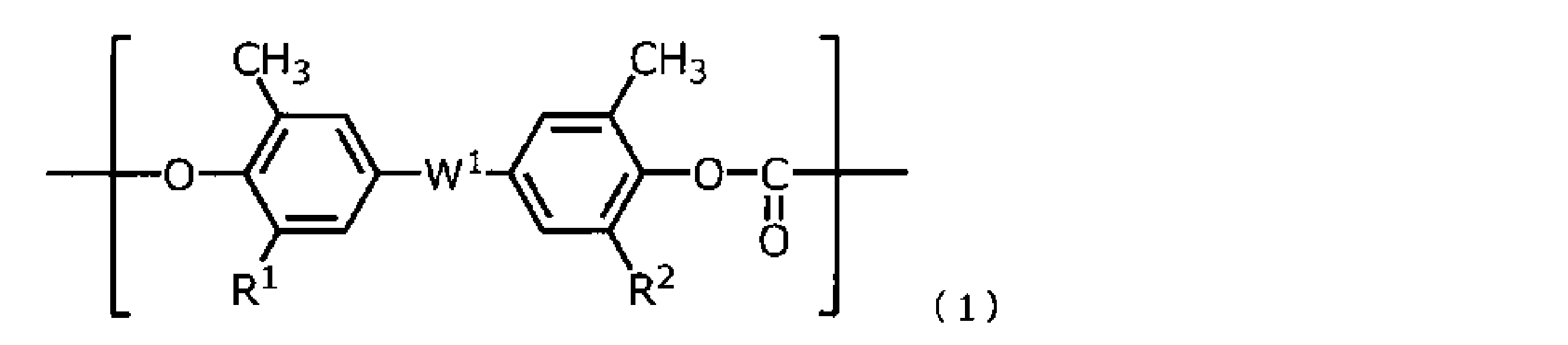
(式(1)中、R1およびR2は、それぞれ独立に、水素原子またはメチル基であり、W1は、単結合または2価の基を表す。)
<2>さらに、前記ポリカーボネート樹脂100質量部に対し、無機充填剤を、10質量部以上100質量部以下の割合で含む、<1>に記載の樹脂組成物。
<3>前記無機充填剤100質量部に対する、前記ポリカーボネート樹脂中の式(1)で表される構成単位の質量割合が、150質量部以上である、<2>に記載の樹脂組成物。
<4>前記無機充填剤が、ガラス繊維、タルク、および、窒化ホウ素からなる群から選ばれる少なくとも1種を含む、<2>または<3>に記載の樹脂組成物。
<5>前記無機充填剤が、ガラス繊維を含む、<2>~<4>のいずれか1つに記載の樹脂組成物。
<6>前記式(1)で表される構成単位以外のカーボネート単位が、式(5)で表される構成単位を含む、<1>~<5>のいずれか1つに記載の樹脂組成物。
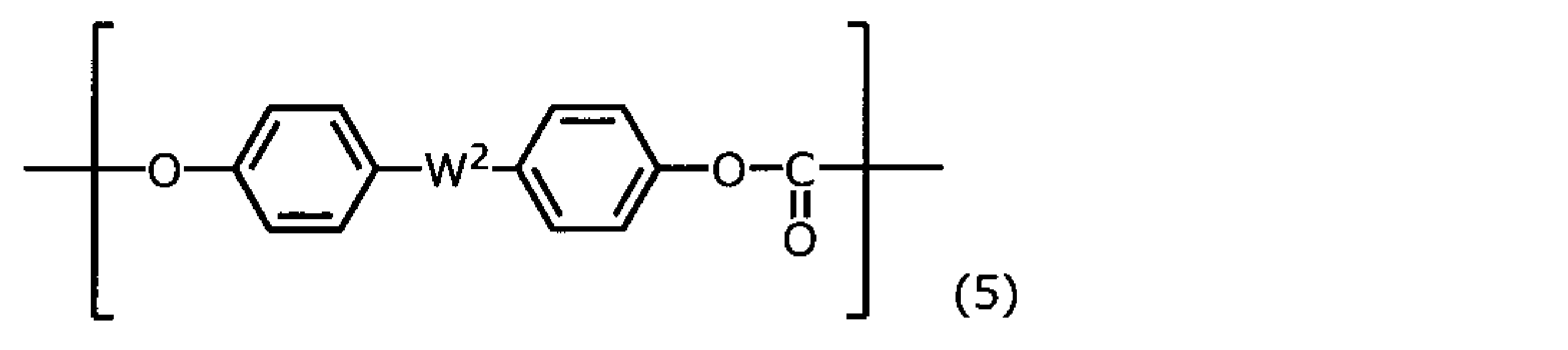
(式(5)中、W2は、単結合または2価の基を表す。)
<7>全構成単位の90質量%以上が前記式(1)で表される構成単位であるポリカーボネート樹脂(A1)と、全構成単位の90質量%以上が前記式(5)で表される構成単位であるポリカーボネート樹脂(A2)とを含み、前記樹脂組成物に含まれるポリカーボネート樹脂の45質量%以上が、前記ポリカーボネート樹脂(A1)である、<6>に記載の樹脂組成物。
<8>前記ポリカーボネート樹脂(A1)の粘度平均分子量が16,000以上30,000以下であり、前記ポリカーボネート樹脂(A2)の粘度平均分子量が16,000以上35,000以下である、<7>に記載の樹脂組成物。
<9>前記ポリカーボネート樹脂が、全構成単位の30~70質量%が前記式(1)で表される構成単位であり、全構成単位の70~30質量%が前記式(5)で表される構成単位であるポリカーボネート樹脂(A3)を含み、前記樹脂組成物に含まれるポリカーボネート樹脂の50質量%以上が、前記ポリカーボネート樹脂(A3)である、<6>に記載の樹脂組成物。
<10>前記樹脂組成物を平板状に成形したときの、JIS K5600に従って測定した鉛筆硬度がH以上である、<1>~<9>のいずれか1つに記載の樹脂組成物。
<11>前記樹脂組成物を平板状に成形したときの、周波数2.45GHzにおける誘電正接が、0.0053以下である、<1>~<10>のいずれか1つに記載の樹脂組成物。
<12>さらに、前記ポリカーボネート樹脂100質量部に対し、難燃剤を、0.001質量部以上30質量部以下の割合で含む、<1>~<11>のいずれか1つに記載の樹脂組成物。
<13><1>~<12>のいずれか1つに記載の樹脂組成物から形成された周波数1GHz以上の電磁波を使用する電子電気機器部品。
<14>前記電子電気機器部品の少なくとも一部を周波数1GHz以上の電磁波が通過している、<13>に記載の電子電気機器部品。
<1>ポリカーボネート樹脂を含み、前記ポリカーボネート樹脂における、式(1)で表される構成単位と式(1)で表される構成単位以外のカーボネート単位の質量比率が、33~100:67~0である、周波数1GHz以上の電磁波を使用する電子電気機器部品用樹脂組成物。
<2>さらに、前記ポリカーボネート樹脂100質量部に対し、無機充填剤を、10質量部以上100質量部以下の割合で含む、<1>に記載の樹脂組成物。
<3>前記無機充填剤100質量部に対する、前記ポリカーボネート樹脂中の式(1)で表される構成単位の質量割合が、150質量部以上である、<2>に記載の樹脂組成物。
<4>前記無機充填剤が、ガラス繊維、タルク、および、窒化ホウ素からなる群から選ばれる少なくとも1種を含む、<2>または<3>に記載の樹脂組成物。
<5>前記無機充填剤が、ガラス繊維を含む、<2>~<4>のいずれか1つに記載の樹脂組成物。
<6>前記式(1)で表される構成単位以外のカーボネート単位が、式(5)で表される構成単位を含む、<1>~<5>のいずれか1つに記載の樹脂組成物。
<7>全構成単位の90質量%以上が前記式(1)で表される構成単位であるポリカーボネート樹脂(A1)と、全構成単位の90質量%以上が前記式(5)で表される構成単位であるポリカーボネート樹脂(A2)とを含み、前記樹脂組成物に含まれるポリカーボネート樹脂の45質量%以上が、前記ポリカーボネート樹脂(A1)である、<6>に記載の樹脂組成物。
<8>前記ポリカーボネート樹脂(A1)の粘度平均分子量が16,000以上30,000以下であり、前記ポリカーボネート樹脂(A2)の粘度平均分子量が16,000以上35,000以下である、<7>に記載の樹脂組成物。
<9>前記ポリカーボネート樹脂が、全構成単位の30~70質量%が前記式(1)で表される構成単位であり、全構成単位の70~30質量%が前記式(5)で表される構成単位であるポリカーボネート樹脂(A3)を含み、前記樹脂組成物に含まれるポリカーボネート樹脂の50質量%以上が、前記ポリカーボネート樹脂(A3)である、<6>に記載の樹脂組成物。
<10>前記樹脂組成物を平板状に成形したときの、JIS K5600に従って測定した鉛筆硬度がH以上である、<1>~<9>のいずれか1つに記載の樹脂組成物。
<11>前記樹脂組成物を平板状に成形したときの、周波数2.45GHzにおける誘電正接が、0.0053以下である、<1>~<10>のいずれか1つに記載の樹脂組成物。
<12>さらに、前記ポリカーボネート樹脂100質量部に対し、難燃剤を、0.001質量部以上30質量部以下の割合で含む、<1>~<11>のいずれか1つに記載の樹脂組成物。
<13><1>~<12>のいずれか1つに記載の樹脂組成物から形成された周波数1GHz以上の電磁波を使用する電子電気機器部品。
<14>前記電子電気機器部品の少なくとも一部を周波数1GHz以上の電磁波が通過している、<13>に記載の電子電気機器部品。
<A>さらに、上記いずれかの樹脂組成物において、式(1)中、W1が後述する式(2a)または式(2i)で表される、樹脂組成物。
<B>さらに、上記いずれかの樹脂組成物において、式(1)で表される構成単位が、後述する式(3)または式(4-2)で表される樹脂組成物。
<C>さらに、上記いずれかの樹脂組成物において、式(1)で表される構成単位以外のカーボネート単位が後述する式(5)で表される構成単位であって、W2が後述する式(2a)で表される、樹脂組成物。
<D>さらに、上記いずれかの樹脂組成物において、ポリカーボネート樹脂(A1)とポリカーボネート樹脂(A2)の合計量が樹脂組成物に含まれるポリカーボネート樹脂の90質量%以上を占める樹脂組成物。
<E>さらに、上記いずれかの樹脂組成物において、無機充填剤を含まず、かつ、ポリカーボネート樹脂を、樹脂組成物中、80質量%以上の割合で含む、樹脂組成物。
<F>さらに、上記いずれかの樹脂組成物において、無機充填剤を含み、かつ、ポリカーボネート樹脂と無機充填剤を合計で、樹脂組成物中、80質量%以上の割合で含む、樹脂組成物。
<G>さらに、上記いずれかの樹脂組成物において、無機充填剤を含み、無機充填剤が繊維状または板状のものを含む、樹脂組成物。
<H>さらに、上記いずれかの樹脂組成物において、熱安定剤(好ましくは、リン系安定剤、より好ましくはトリス(2,4-ジ-tert-ブチルフェニル)ホスファイト)をポリカーボネート樹脂100質量部に対して、0.001質量部以上1質量部以下の割合で含む、樹脂組成物。
<I>さらに、上記いずれかの樹脂組成物において、酸化防止剤(好ましくは、ヒンダードフェノール系酸化防止剤、より好ましくはオクタデシル-3-(3,5-ジ-tert-ブチル-4-ヒドロキシフェニル)プロピオネート)をポリカーボネート樹脂100質量部に対して、0.001質量部以上1質量部以下の割合で含む、樹脂組成物。
<J>さらに、上記いずれかの樹脂組成物において、離型剤(好ましくは、脂肪族カルボン酸とアルコールとのエステル、より好ましくはペンタエリスリトールテトラステアレート)をポリカーボネート樹脂100質量部に対して、0.001質量部以上2質量部以下の割合で含む、樹脂組成物。
<K>さらに、上記いずれかの樹脂組成物において、ポリカーボネート樹脂と、無機充填剤と、選択的に配合される、熱安定剤と、酸化防止剤と、離型剤との合計が98質量%以上(好ましくは100質量%)である、樹脂組成物。
<L>さらに、上記いずれかの樹脂組成物において、ポリカーボネート樹脂と、無機充填剤と、選択的に配合される、熱安定剤と、酸化防止剤と、離型剤と、難燃剤の合計が98質量%以上(好ましくは100質量%)である、樹脂組成物。
<B>さらに、上記いずれかの樹脂組成物において、式(1)で表される構成単位が、後述する式(3)または式(4-2)で表される樹脂組成物。
<C>さらに、上記いずれかの樹脂組成物において、式(1)で表される構成単位以外のカーボネート単位が後述する式(5)で表される構成単位であって、W2が後述する式(2a)で表される、樹脂組成物。
<D>さらに、上記いずれかの樹脂組成物において、ポリカーボネート樹脂(A1)とポリカーボネート樹脂(A2)の合計量が樹脂組成物に含まれるポリカーボネート樹脂の90質量%以上を占める樹脂組成物。
<E>さらに、上記いずれかの樹脂組成物において、無機充填剤を含まず、かつ、ポリカーボネート樹脂を、樹脂組成物中、80質量%以上の割合で含む、樹脂組成物。
<F>さらに、上記いずれかの樹脂組成物において、無機充填剤を含み、かつ、ポリカーボネート樹脂と無機充填剤を合計で、樹脂組成物中、80質量%以上の割合で含む、樹脂組成物。
<G>さらに、上記いずれかの樹脂組成物において、無機充填剤を含み、無機充填剤が繊維状または板状のものを含む、樹脂組成物。
<H>さらに、上記いずれかの樹脂組成物において、熱安定剤(好ましくは、リン系安定剤、より好ましくはトリス(2,4-ジ-tert-ブチルフェニル)ホスファイト)をポリカーボネート樹脂100質量部に対して、0.001質量部以上1質量部以下の割合で含む、樹脂組成物。
<I>さらに、上記いずれかの樹脂組成物において、酸化防止剤(好ましくは、ヒンダードフェノール系酸化防止剤、より好ましくはオクタデシル-3-(3,5-ジ-tert-ブチル-4-ヒドロキシフェニル)プロピオネート)をポリカーボネート樹脂100質量部に対して、0.001質量部以上1質量部以下の割合で含む、樹脂組成物。
<J>さらに、上記いずれかの樹脂組成物において、離型剤(好ましくは、脂肪族カルボン酸とアルコールとのエステル、より好ましくはペンタエリスリトールテトラステアレート)をポリカーボネート樹脂100質量部に対して、0.001質量部以上2質量部以下の割合で含む、樹脂組成物。
<K>さらに、上記いずれかの樹脂組成物において、ポリカーボネート樹脂と、無機充填剤と、選択的に配合される、熱安定剤と、酸化防止剤と、離型剤との合計が98質量%以上(好ましくは100質量%)である、樹脂組成物。
<L>さらに、上記いずれかの樹脂組成物において、ポリカーボネート樹脂と、無機充填剤と、選択的に配合される、熱安定剤と、酸化防止剤と、離型剤と、難燃剤の合計が98質量%以上(好ましくは100質量%)である、樹脂組成物。
本発明により、周波数1GHz以上の電磁波を使用する電子電気機器部品用樹脂組成物であって、低誘電正接の樹脂組成物、ならびに、周波数1GHz以上の電磁波を使用する電子電気機器部品を提供可能になった。
以下において、本発明の内容について詳細に説明する。なお、本明細書において「~」とはその前後に記載される数値を下限値および上限値として含む意味で使用される。
本明細書において、各種物性値および特性値は、特に述べない限り、23℃におけるものとする。
なお、本明細書における「質量部」とは成分の相対量を示し、「質量%」とは成分の絶対量を示す。
本明細書において、各種物性値および特性値は、特に述べない限り、23℃におけるものとする。
なお、本明細書における「質量部」とは成分の相対量を示し、「質量%」とは成分の絶対量を示す。
本発明の周波数1GHz以上の電磁波を使用する電子電気機器部品用樹脂組成物(以下、単に、「本発明の樹脂組成物」ということがある)は、ポリカーボネート樹脂を含み、前記ポリカーボネート樹脂における、式(1)で表される構成単位と式(1)で表される構成単位以外のカーボネート単位の質量比率が、33~100:67~0であることを特徴とする。
このような構成とすることにより、低誘電正接を達成することができる。
さらに、得られる電子電気機器部品の耐擦傷性を高くすることができる。特に、低誘電正接と高い耐擦傷性を両立することが可能になる。ここでの耐擦傷性は、例えば、電子電気機器部品の表面に擦り傷が付きにくい性質をいう。
この理由は、ポリカーボネート樹脂が、ビスフェノールC由来の構成単位等の式(1)で表される構成単位を所定の割合以上含むことに基づくと推測される。
このような構成とすることにより、低誘電正接を達成することができる。
さらに、得られる電子電気機器部品の耐擦傷性を高くすることができる。特に、低誘電正接と高い耐擦傷性を両立することが可能になる。ここでの耐擦傷性は、例えば、電子電気機器部品の表面に擦り傷が付きにくい性質をいう。
この理由は、ポリカーボネート樹脂が、ビスフェノールC由来の構成単位等の式(1)で表される構成単位を所定の割合以上含むことに基づくと推測される。
<ポリカーボネート樹脂>
本発明の樹脂組成物はポリカーボネート樹脂を含む。本発明で用いるポリカーボネート樹脂においては、式(1)で表される構成単位と式(1)で表される構成単位以外のカーボネート単位(以下、「他のカーボネート単位」ということがある)を含み、式(1)で表される構成単位と式(1)で表される構成単位以外のカーボネート単位の質量比率が、33~100:67~0である。
前記式(1)で表される構成単位と式(1)で表される構成単位以外のカーボネート単位の質量比率は、33~100:67~0であるが、35~100:65~0であることが好ましく、37~100:63~0であることがより好ましく、40~100:60~0であることがさらに好ましく、45~100:55~0であってもよく、47~100:53~0であってもよく、60~100:40~0であってもよく、75~100:25~0であってもよい。このような範囲とすることにより、より低い誘電正接を達成できる。
ポリカーボネート樹脂は、式(1)で表される構成単位と式(1)で表される構成単位以外のカーボネート単位を、それぞれ1種のみ含んでいてもよいし、2種以上含んでいてもよい。2種以上含む場合、合計量が上記範囲となることが好ましい。
本発明の樹脂組成物はポリカーボネート樹脂を含む。本発明で用いるポリカーボネート樹脂においては、式(1)で表される構成単位と式(1)で表される構成単位以外のカーボネート単位(以下、「他のカーボネート単位」ということがある)を含み、式(1)で表される構成単位と式(1)で表される構成単位以外のカーボネート単位の質量比率が、33~100:67~0である。
前記式(1)で表される構成単位と式(1)で表される構成単位以外のカーボネート単位の質量比率は、33~100:67~0であるが、35~100:65~0であることが好ましく、37~100:63~0であることがより好ましく、40~100:60~0であることがさらに好ましく、45~100:55~0であってもよく、47~100:53~0であってもよく、60~100:40~0であってもよく、75~100:25~0であってもよい。このような範囲とすることにより、より低い誘電正接を達成できる。
ポリカーボネート樹脂は、式(1)で表される構成単位と式(1)で表される構成単位以外のカーボネート単位を、それぞれ1種のみ含んでいてもよいし、2種以上含んでいてもよい。2種以上含む場合、合計量が上記範囲となることが好ましい。
本発明で用いるポリカーボネート樹脂は、通常、式(1)で表される構成単位と式(1)で表される構成単位以外のカーボネート単位と、末端基から構成される。他のカーボネート単位は分岐構造であってもよい。
本発明における式(1)で表される構成単位および他のカーボネート単位の含有量は、両末端基を除く全構成単位を基準(100質量%)とした割合である。
本発明における式(1)で表される構成単位および他のカーボネート単位の含有量は、両末端基を除く全構成単位を基準(100質量%)とした割合である。
次に、式(1)で表される構成単位について説明する。式(1)で表される構成単位は、以下の通りである。
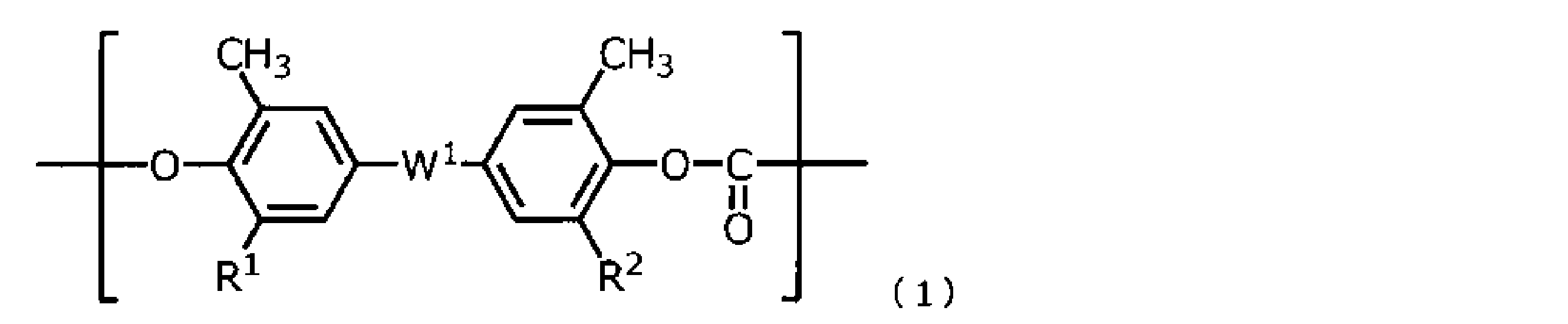
(式(1)中、R1およびR2は、それぞれ独立に、水素原子またはメチル基であり、W1は、単結合または2価の基を表す。)
式(1)中、R1およびR2は、水素原子またはメチル基を表す。R1およびR2が、水素原子の場合は、本発明の電子電気機器部品の耐候性がより向上する傾向にある。R1およびR2が、メチル基の場合は、本発明の電子電気機器部品の耐熱性、耐湿熱安定性がより向上する傾向にある。このため、R1およびR2は要求に応じて適宜選択すればよいが、水素原子であることがより好ましい。
式(1)中、W1は、単結合または2価の基を表す。2価の基は、酸素原子、硫黄原子、および、2価の有機基、ならびに、これらの組み合わせからなる基が例示され、2価の有機基が好ましい。
2価の有機基としては、従来公知のものであれば特に制限はなく適宜選択して用いることができるが、例えば、下記式(2a)~(2h)で表される有機基が挙げられる。
2価の有機基としては、従来公知のものであれば特に制限はなく適宜選択して用いることができるが、例えば、下記式(2a)~(2h)で表される有機基が挙げられる。
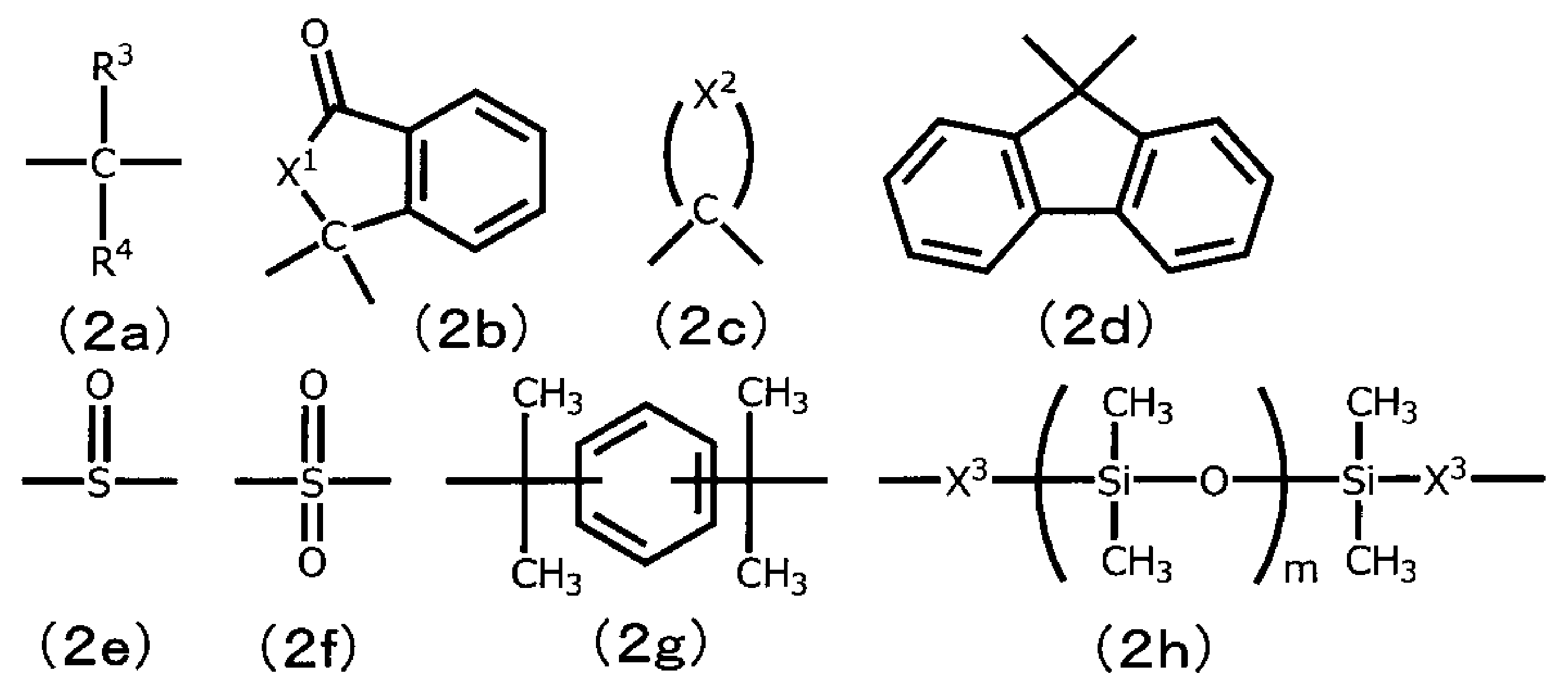
式(2a)中、R3およびR4は、それぞれ独立に、水素原子、炭素数1~24の1価の炭化水素基、または炭素数1~24のアルコキシ基を表すが、なかでも炭素数1~24の1価の炭化水素基であることが好ましい。
炭素数1~24の1価の炭化水素基としては、炭素数1~24のアルキル基、炭素数2~24のアルケニル基、置換基を有していてもよい炭素数6~24のアリール基、炭素数7~24のアリールアルキル基等が挙げられ、炭素数1~24のアルキル基が好ましい。
炭素数1~24のアルキル基としては、直鎖状、分岐状のアルキル基、一部環状構造を有するアルキル基などが挙げられるが、なかでも直鎖状のアルキル基であることが好ましい。炭素数1~24のアルキル基としては、例えば、メチル基、エチル基、n-プロピル基、n-ブチル基、n-ペンチル基、n-ヘキシル基、n-へプチル基、n-オクチル基等が挙げられるが、メチル基であることが好ましい。
炭素数2~24のアルケニル基としては、直鎖状、分岐状のアルケニル基、一部環状構造を有するアルケニル基などが挙げられるが、なかでも直鎖状のアルケニル基が好ましい。炭素数2~24の直鎖状のアルケニル基としては、例えば、ビニル基、n-プロペニル基、n-ブテニル基、n-ペンテニル基、n-ヘキセニル基、n-へプテニル基、n-オクテニル基等が挙げられるが、ビニル基であることが好ましい。
炭素数6~24のアリール基としては、フェニル基、ナフチル基、メチルフェニル基、ジメチルフェニル基、トリメチルフェニル基などのアルキル基等の置換基を有していてもよいアリール基が挙げられる。炭素数7~24のアリールアルキル基としては、ベンジル基などが挙げられる。
炭素数1~24のアルコキシ基としては、直鎖状、分岐状、一部環状構造を有するアルコキシ基などが挙げられるが、なかでも直鎖状のアルコキシ基が好ましい。直鎖状のアルコキシ基の具体例としては、メトキシ基、エトキシ基、プロポキシ基、ブトキシ基などが挙げられる。
式(2b)中、X1は酸素原子またはNRaを表す。ここで、Raは上述のR3およびR4と同義である。
式(2c)中、X2は、炭素数3~18の2価の炭化水素基を表し、例えば、プロピレン基、ブチレン基、ペンチレン基、ヘキシレン基、ヘプチレン基、オクチレン基、ノニレン基、デシレン基、ウンデシレン基、ドデシニレン基などが挙げられ、それぞれさらに置換基を有していてもよい。置換基としては、メチル基、エチル基、プロピル基、ブチル基、ペンチル基、フェニル基などが挙げられる。さらにX2は、架橋構造を有していてもよい。
式(2c)は、式(2i)で表されることが好ましい。
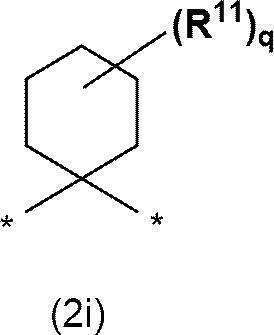
式(2c)は、式(2i)で表されることが好ましい。
式(2i)中、R11は、それぞれ独立に、炭素数1~24の1価の炭化水素基、または炭素数1~24のアルコキシ基を表す。炭素数1~24の1価の炭化水素基および炭素数1~24のアルコキシ基の詳細は、式(2a)中のR3と同じである。
qは、0~3の整数であり、0が好ましい。
*は他の基との結合部位である。
qは、0~3の整数であり、0が好ましい。
*は他の基との結合部位である。
式(2h)中、X3は、炭素数1~7のアルキレン基を表す。このアルキレン基は、直鎖であっても分岐鎖であってもよく、環状構造を有していてもよく、例えば、メチレン基、エチレン基、プロピレン基、ブチレン基等が挙げられる。
mは1~500の整数を表すが、なかでも5~300であることが好ましく、10~100であることがより好ましい。
式(1)で表される構成単位の原料モノマーの具体例としては、例えば、
ビス(4-ヒドロキシ-3-メチルフェニル)メタン、
ビス(4-ヒドロキシ-3,5-ジメチルフェニル)メタン、
1,1-ビス(4-ヒドロキシ-3-メチルフェニル)エタン、
1,1-ビス(4-ヒドロキシ-3,5-ジメチルフェニル)エタン、
2,2-ビス(4-ヒドロキシ-3-メチルフェニル)プロパン、
2,2-ビス(4-ヒドロキシ-3,5-ジメチルフェニル)プロパン、
2,2-ビス(4-ヒドロキシ-3-イソプロピルフェニル)プロパン、
2,2-ビス(4-ヒドロキシ-3-メチルフェニル)ブタン、
2,2-ビス(4-ヒドロキシ-3,5-ジメチルフェニル)ブタン、
1,3-ビス(2-(4-ヒドロキシ-3-メチルフェニル)-2-プロピル)ベンゼン、
1,4-ビス(2-(4-ヒドロキシ-3-メチルフェニル)-2-プロピル)ベンゼン、
1,1-ビス(4-ヒドロキシ-3-メチルフェニル)シクロヘキサン、
1,1-ビス(4-ヒドロキシ-3,5-ジメチルフェニル)シクロヘキサン、
1,1-ビス(4-ヒドロキシ-3-メチルフェニル)-3,3,5-トリメチルシクロヘキサン、
1,1-ビス(4-ヒドロキシ-3,5-ジメチルフェニル)-3,3,5-トリメチルシクロヘキサン、
ビス(4-ヒドロキシ-3-メチルフェニル)ジフェニルメタン、
9,9-ビス(4-ヒドロキシ-3-メチルフェニル)フルオレン、
9,9-ビス(4-ヒドロキシ-3,5-ジメチルフェニル)フルオレン、
ビス(4-ヒドロキシ-3-メチルフェニル)スルホン、
3,3-ビス(4-ヒドロキシ-3-メチルフェニル)フタリド、
2-メチル-3,3’-ビス(4-ヒドロキシ-3-メチルフェニル)フタルイミジン、
2-フェニル-3,3’-ビス(4-ヒドロキシ-3-メチルフェニル)フタルイミジン、
4,4’-ジヒドロキシ-3,3’-ジメチルビフェニル、
4,4’-ジヒドロキシ-3,3’,5,5’-テトラメチルビフェニル
等の芳香族ジヒドロキシ化合物に由来する構成単位が挙げられる。
ビス(4-ヒドロキシ-3-メチルフェニル)メタン、
ビス(4-ヒドロキシ-3,5-ジメチルフェニル)メタン、
1,1-ビス(4-ヒドロキシ-3-メチルフェニル)エタン、
1,1-ビス(4-ヒドロキシ-3,5-ジメチルフェニル)エタン、
2,2-ビス(4-ヒドロキシ-3-メチルフェニル)プロパン、
2,2-ビス(4-ヒドロキシ-3,5-ジメチルフェニル)プロパン、
2,2-ビス(4-ヒドロキシ-3-イソプロピルフェニル)プロパン、
2,2-ビス(4-ヒドロキシ-3-メチルフェニル)ブタン、
2,2-ビス(4-ヒドロキシ-3,5-ジメチルフェニル)ブタン、
1,3-ビス(2-(4-ヒドロキシ-3-メチルフェニル)-2-プロピル)ベンゼン、
1,4-ビス(2-(4-ヒドロキシ-3-メチルフェニル)-2-プロピル)ベンゼン、
1,1-ビス(4-ヒドロキシ-3-メチルフェニル)シクロヘキサン、
1,1-ビス(4-ヒドロキシ-3,5-ジメチルフェニル)シクロヘキサン、
1,1-ビス(4-ヒドロキシ-3-メチルフェニル)-3,3,5-トリメチルシクロヘキサン、
1,1-ビス(4-ヒドロキシ-3,5-ジメチルフェニル)-3,3,5-トリメチルシクロヘキサン、
ビス(4-ヒドロキシ-3-メチルフェニル)ジフェニルメタン、
9,9-ビス(4-ヒドロキシ-3-メチルフェニル)フルオレン、
9,9-ビス(4-ヒドロキシ-3,5-ジメチルフェニル)フルオレン、
ビス(4-ヒドロキシ-3-メチルフェニル)スルホン、
3,3-ビス(4-ヒドロキシ-3-メチルフェニル)フタリド、
2-メチル-3,3’-ビス(4-ヒドロキシ-3-メチルフェニル)フタルイミジン、
2-フェニル-3,3’-ビス(4-ヒドロキシ-3-メチルフェニル)フタルイミジン、
4,4’-ジヒドロキシ-3,3’-ジメチルビフェニル、
4,4’-ジヒドロキシ-3,3’,5,5’-テトラメチルビフェニル
等の芳香族ジヒドロキシ化合物に由来する構成単位が挙げられる。
芳香族ジヒドロキシ化合物としては、なかでも2,2-ビス(4-ヒドロキシ-3-メチルフェニル)プロパン、2,2-ビス(4-ヒドロキシ-3,5-ジメチルフェニル)プロパン、1,1-ビス(4-ヒドロキシ-3-メチルフェニル)シクロヘキサン、1,1-ビス(4-ヒドロキシ-3-メチルフェニル)-3,3,5-トリメチルシクロヘキサンが好ましく、2,2-ビス(4-ヒドロキシ-3-メチルフェニル)プロパン、2,2-ビス(4-ヒドロキシ-3,5-ジメチルフェニル)プロパンがより好ましく、2,2-ビス(4-ヒドロキシ-3-メチルフェニル)プロパンがさらに好ましい。
すなわち、式(1)で表される構成単位は、下記式(3)、式(4)、式(4-2)で表される構成単位がより好ましく、式(3)または式(4-2)で表される構成単位がさらに好ましい。これらの構成単位を含むことにより、本発明の効果がより効果的に発揮される。

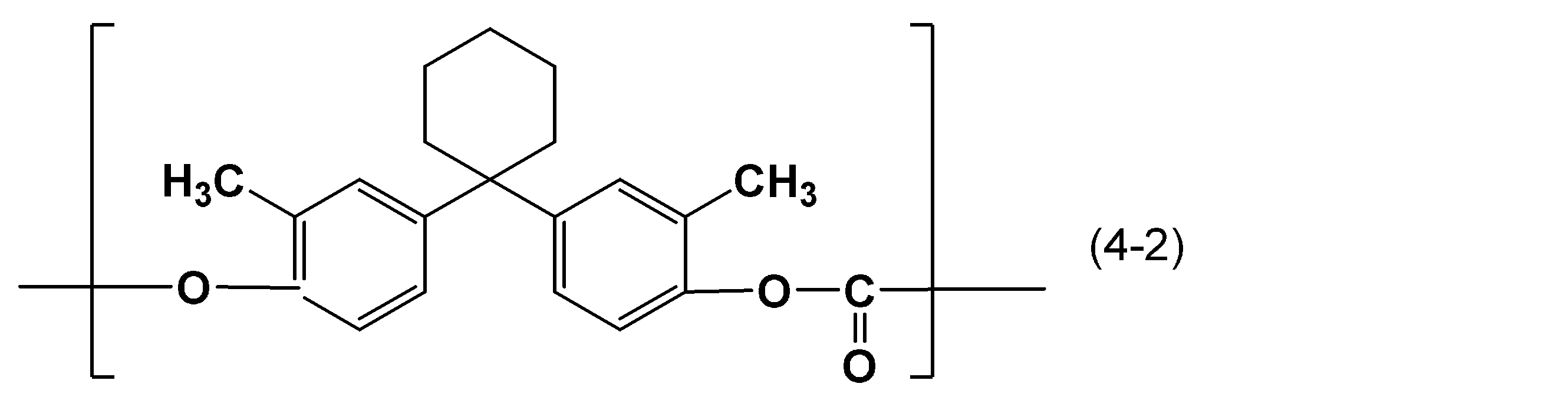
次に、式(1)で表される構成単位以外のカーボネート単位について説明する。
本発明のポリカーボネート樹脂に含まれる他のカーボネート単位は、その種類等、特に定めるものではなく、公知のカーボネート単位を広く用いることができる。
本発明のポリカーボネート樹脂に含まれる他のカーボネート単位は、その種類等、特に定めるものではなく、公知のカーボネート単位を広く用いることができる。
他のカーボネート単位は、具体的には、下記式(5)および式(6)で表される構成単位が挙げられ、式(5)で表される構成単位が好ましい。特に、他のカーボネート単位の90質量%以上(好ましくは95質量%以上、より好ましくは99質量%以上)が、式(5)で表される構成単位であることが好ましい。
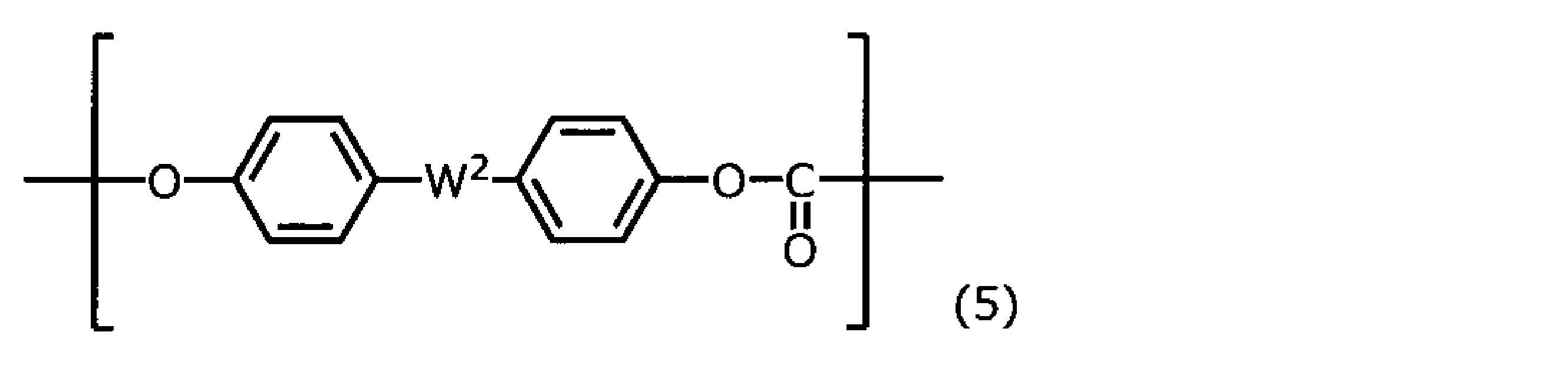
(式(5)中、W2は、単結合または2価の基を表す。)
式(5)中、W2は、前述のW1と同義であり、好ましい範囲も同様である。特に、式(2a)が好ましい。
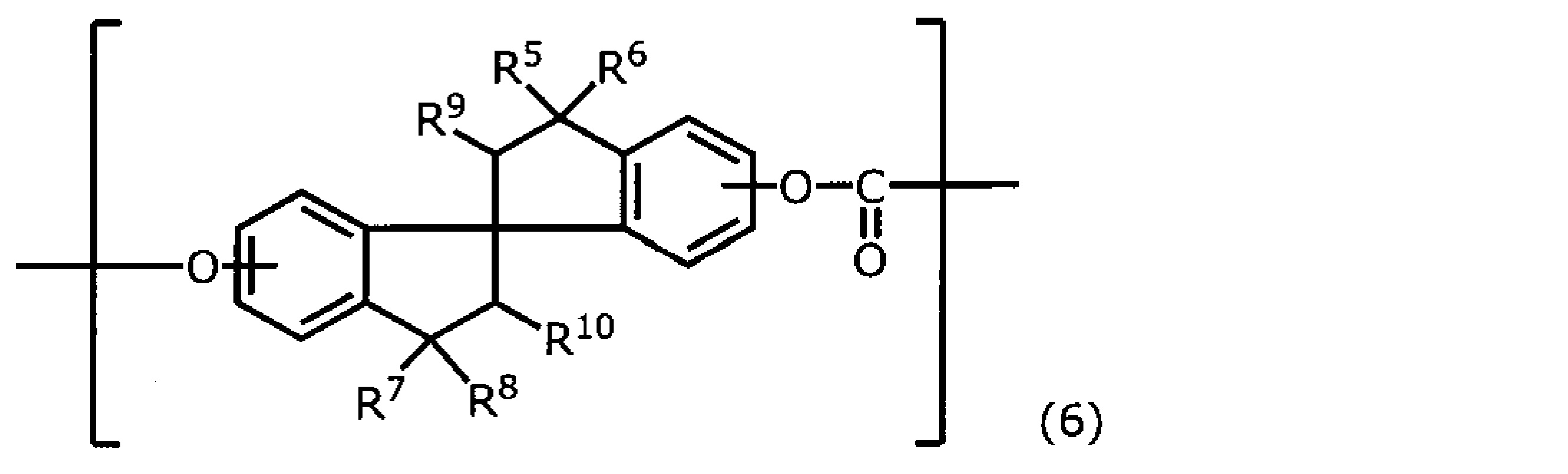
式(6)中、R5、R6、R7、R8、R9およびR10はそれぞれ独立に水素原子、炭素数1~6のアルキル基から選ばれる少なくとも1種を表す。炭素数1~6のアルキル基としては、例えばメチル基、エチル基、プロピル基等が挙げられる。式(6)中、R5、R6、R7、およびR8は、炭素数1~6のアルキル基であることが好ましく、メチル基であることがより好ましい。R9およびR10は水素原子が好ましい。
他のカーボネート単位としては、具体的には、2,2-ビス(4-ヒドロキシフェニル)プロパン(ビスフェノールA)、2,2-ビス(4-ヒドロキシフェニル)シクロヘキサン、2,2-ビス(4-ヒドロキシフェニル)-3,3,5-トリメチルシクロヘキサン、6,6’-ジヒドロキシ-3,3,3’,3’-テトラメチル-1,1’-スピロビインダンに由来する構成単位が挙げられる。なかでも、2,2-ビス(4-ヒドロキシフェニル)プロパン(ビスフェノールA)、6,6’-ジヒドロキシ-3,3,3’,3’-テトラメチル-1,1’-スピロビインダンがより好ましく、2,2-ビス(4-ヒドロキシフェニル)プロパン(ビスフェノールA)がさらに好ましい。
次に、本発明におけるポリカーボネート樹脂の具体例について述べる。本発明においては、以下のポリカーボネート樹脂が好ましい。
(1)ポリカーボネート樹脂(A1)とポリカーボネート樹脂(A2)のブレンド物
(2)ポリカーボネート樹脂(A3)
(3)ポリカーボネート樹脂(A1)とポリカーボネート樹脂(A3)のブレンド物
(4)ポリカーボネート樹脂(A2)とポリカーボネート樹脂(A3)のブレンド物
(5)ポリカーボネート樹脂(A1)とポリカーボネート樹脂(A2)とポリカーボネート樹脂(A3)のブレンド物
(6)上記(1)~(5)において、さらに、ポリカーボネート樹脂(A1)~ポリカーボネート樹脂(A3)以外のポリカーボネート樹脂を0質量%超5質量%以下の割合で含むブレンド物
(1)ポリカーボネート樹脂(A1)とポリカーボネート樹脂(A2)のブレンド物
(2)ポリカーボネート樹脂(A3)
(3)ポリカーボネート樹脂(A1)とポリカーボネート樹脂(A3)のブレンド物
(4)ポリカーボネート樹脂(A2)とポリカーボネート樹脂(A3)のブレンド物
(5)ポリカーボネート樹脂(A1)とポリカーボネート樹脂(A2)とポリカーボネート樹脂(A3)のブレンド物
(6)上記(1)~(5)において、さらに、ポリカーボネート樹脂(A1)~ポリカーボネート樹脂(A3)以外のポリカーボネート樹脂を0質量%超5質量%以下の割合で含むブレンド物
ここで、上記ポリカーボネート樹脂(A1)~ポリカーボネート樹脂(A3)は、以下の通りである。
ポリカーボネート樹脂(A1):
全構成単位の90質量%以上(好ましくは95質量%以上、より好ましくは99質量%以上)が、式(1)で表される構成単位であるポリカーボネート樹脂
ポリカーボネート樹脂(A2):
全構成単位の90質量%以上(好ましくは95質量%以上、より好ましくは99質量%以上)が、式(5)で表される構成単位であるポリカーボネート樹脂
ポリカーボネート樹脂(A3):
全構成単位の30~70質量%が式(1)で表される構成単位であり、全構成単位の70~30質量%が式(5)で表される構成単位であるポリカーボネート樹脂
ポリカーボネート樹脂(A1):
全構成単位の90質量%以上(好ましくは95質量%以上、より好ましくは99質量%以上)が、式(1)で表される構成単位であるポリカーボネート樹脂
ポリカーボネート樹脂(A2):
全構成単位の90質量%以上(好ましくは95質量%以上、より好ましくは99質量%以上)が、式(5)で表される構成単位であるポリカーボネート樹脂
ポリカーボネート樹脂(A3):
全構成単位の30~70質量%が式(1)で表される構成単位であり、全構成単位の70~30質量%が式(5)で表される構成単位であるポリカーボネート樹脂
本発明におけるポリカーボネート樹脂の第一の実施形態は、ポリカーボネート樹脂(A1)と、ポリカーボネート樹脂(A2)とを含み、樹脂組成物に含まれるポリカーボネート樹脂の45質量%以上が、ポリカーボネート樹脂(A1)である形態である。
第一の実施形態においては、樹脂組成物に含まれるポリカーボネート樹脂中のポリカーボネート樹脂(A1)の割合が、48質量%以上であることが好ましく、50質量%以上であることがより好ましく、50質量%超であることがさらに好ましく、55質量%以上であることが一層好ましく、60質量%以上であることがより一層好ましい。前記下限値以上とすることにより、低誘電正接と耐擦傷性の両方がより向上する傾向にある。
また、第一の実施形態においては、樹脂組成物に含まれるポリカーボネート樹脂中のポリカーボネート樹脂(A1)の割合が、100質量%以下であることが好ましい。前記上限値以下とすることにより、さらに、耐熱性が向上する傾向にある。
第一の実施形態においては、ポリカーボネート樹脂(A1)とポリカーボネート樹脂(A2)の合計量が樹脂組成物に含まれるポリカーボネート樹脂の90質量%以上を占めることが好ましく、95質量%以上を占めることがより好ましく、99質量%以上を占めることが一層好ましく、100質量%であってもよい。
第一の実施形態においては、樹脂組成物に含まれるポリカーボネート樹脂中のポリカーボネート樹脂(A1)の割合が、48質量%以上であることが好ましく、50質量%以上であることがより好ましく、50質量%超であることがさらに好ましく、55質量%以上であることが一層好ましく、60質量%以上であることがより一層好ましい。前記下限値以上とすることにより、低誘電正接と耐擦傷性の両方がより向上する傾向にある。
また、第一の実施形態においては、樹脂組成物に含まれるポリカーボネート樹脂中のポリカーボネート樹脂(A1)の割合が、100質量%以下であることが好ましい。前記上限値以下とすることにより、さらに、耐熱性が向上する傾向にある。
第一の実施形態においては、ポリカーボネート樹脂(A1)とポリカーボネート樹脂(A2)の合計量が樹脂組成物に含まれるポリカーボネート樹脂の90質量%以上を占めることが好ましく、95質量%以上を占めることがより好ましく、99質量%以上を占めることが一層好ましく、100質量%であってもよい。
本発明におけるポリカーボネート樹脂の第二の実施形態は、ポリカーボネート樹脂が、全構成単位の30~70質量%が式(1)で表される構成単位であり、全構成単位の70~30質量%が式(5)で表される構成単位であるポリカーボネート樹脂(A3)を含み、樹脂組成物に含まれるポリカーボネート樹脂の50質量%以上、好ましくは60質量%以上、より好ましくは70質量%以上、さらに好ましくは80質量%以上、一層好ましくは90質量%以上、より一層好ましくは95質量%以上、さらに一層好ましくは99質量%以上が、前記ポリカーボネート樹脂(A3)である形態である。
第二の実施形態においては、ポリカーボネート樹脂(A3)中の式(1)で表される構成単位の割合は、30質量%以上であることが好ましく、33質量%以上であることがより好ましく、35質量%以上であることがさらに好ましく、37質量%以上であることが一層好ましく、40質量%以上であることがより一層好ましい。前記下限値以上とすることにより、低誘電正接と耐擦傷性の両方がより向上する傾向にある。また、ポリカーボネート樹脂(A3)中の式(1)で表される構成単位の割合は、99質量%以下であることが好ましく、95質量%以下であることがより好ましく、90質量%以下であることがさらに好ましく、80質量%以下であることが一層好ましく、70質量%以下であることがより一層好ましい。前記上限値以下とすることにより、さらに耐熱性が向上する傾向にある。
第二の実施形態において、ポリカーボネート樹脂(A3)中の式(5)で表される構成単位の割合は、30質量%以上であることが好ましく、33質量%以上であることがより好ましく、35質量%以上であることがさらに好ましく、37質量%以上であることが一層好ましく、40質量%以上であることがより一層好ましく、50質量%超であってもよい。前記下限値以上とすることにより、低誘電正接と耐擦傷性の両方がより向上する傾向にある。また、ポリカーボネート樹脂(A3)中の式(5)で表される構成単位の割合は、99質量%以下であることが好ましく、95質量%以下であることがより好ましく、90質量%以下であることがさらに好ましく、80質量%以下であることが一層好ましく、70質量%以下であることがより一層好ましい。前記上限値以下とすることにより、さらに耐熱性が向上する傾向にある。
また、本発明の樹脂組成物に含まれるポリカーボネート樹脂の粘度平均分子量(混合物の場合は、混合物の粘度平均分子量)は、本発明の目的を損なわない範囲であれば特に制限はなく適宜選択することができるが、溶液粘度から換算した粘度平均分子量(Mv)で、通常10,000~50,000である。前記ポリカーボネート樹脂の粘度平均分子量(Mv)は、好ましくは11,000以上、より好ましくは12,000以上、さらに好ましくは13,000以上、特に好ましくは14,000以上である。ポリカーボネート樹脂の粘度平均分子量(Mv)は、好ましくは40,000以下、より好ましくは35,000以下、さらに好ましくは30,000以下、特に好ましくは28,000以下である。
本発明においては、上記ポリカーボネート樹脂(A1)の粘度平均分子量は16,000以上30,000以下であることが好ましい。ポリカーボネート樹脂(A1)の粘度平均分子量は、17,000以上であることが好ましく、また、28,000以下であることが好ましく、26,000以下であることがより好ましい。
本発明では、また、上記ポリカーボネート樹脂(A2)の粘度平均分子量が16,000以上35,000以下であることが好ましい。ポリカーボネート樹脂(A2)の粘度平均分子量は、18,000以上であることが好ましく、20,000以上であることがより好ましい。また、ポリカーボネート樹脂(A1)の粘度平均分子量は、30,000以下であることがより好ましく、27,000以下であることがさらに好ましい。
本発明では、特に、上記ポリカーボネート樹脂の第一の実施形態において、ポリカーボネート樹脂(A1)および(A2)が上記粘度平均分子量を満たすことが好ましい。
本発明では、特に、上記ポリカーボネート樹脂の第一の実施形態において、ポリカーボネート樹脂(A1)および(A2)が上記粘度平均分子量を満たすことが好ましい。
さらに、ポリカーボネート樹脂(A3)の粘度平均分子は10,000以上であることが好ましく、15,000以上であることがより好ましい。また、ポリカーボネート樹脂(A3)の粘度平均分子量は、35,000以下であることが好ましく、30,000以下であることがより好ましく、26,000以下であることがさらに好ましく、24,000以下であることが一層好ましい。
本発明では、特に、上記ポリカーボネート樹脂の第二の実施形態において、上記粘度平均分子量を満たすことが好ましい。
本発明では、特に、上記ポリカーボネート樹脂の第二の実施形態において、上記粘度平均分子量を満たすことが好ましい。
粘度平均分子量は、後述する実施例の記載に従って測定される。
ポリカーボネート樹脂の製造方法は、公知の手法であれば特に制限はなく適宜選択して用いることができる。ポリカーボネート樹脂の製造方法としては、例えば、溶融エステル交換法、界面重合法、ピリジン法、環状カーボネート化合物の開環重合法、プレポリマーの固相エステル交換法などを挙げることができるが、なかでも溶融エステル交換法、界面重合法が好ましく、溶融エステル交換法がより好ましい。
本発明の樹脂組成物は、無機充填剤を含まない場合、ポリカーボネート樹脂を、80質量%以上の割合で含むことが好ましく、85質量%以上の割合で含むことがより好ましく、90質量%以上の割合で含むことがさらに好ましく、95質量%以上の割合で含むことがより一層好ましく、98質量%以上の割合で含んでいてもよい。
また、本発明の樹脂組成物は、無機充填剤を含む場合、ポリカーボネート樹脂と無機充填剤を合計で、80質量%以上の割合で含むことが好ましく、85質量%以上の割合で含むことがより好ましく、90質量%以上の割合で含むことがさらに好ましく、95質量%以上の割合で含むことがより一層好ましく、98質量%以上の割合で含んでいてもよい。
ポリカーボネート樹脂は1種のみ含んでいてもよいし、2種以上含んでいてもよい。2種以上含む場合、合計量が上記範囲となることが好ましい。
また、本発明の樹脂組成物は、無機充填剤を含む場合、ポリカーボネート樹脂と無機充填剤を合計で、80質量%以上の割合で含むことが好ましく、85質量%以上の割合で含むことがより好ましく、90質量%以上の割合で含むことがさらに好ましく、95質量%以上の割合で含むことがより一層好ましく、98質量%以上の割合で含んでいてもよい。
ポリカーボネート樹脂は1種のみ含んでいてもよいし、2種以上含んでいてもよい。2種以上含む場合、合計量が上記範囲となることが好ましい。
<無機充填剤>
本発明の樹脂組成物は、無機充填剤を含んでいてもよく、無機充填剤を含んでいることが好ましい。無機充填剤を含むと、得られる電子電気機器部品の剛性を高くすることができる。一方、無機充填剤を配合すると、一般的に誘電正接が高くなる傾向にある。しかしながら、本発明では、式(1)で表される構成単位を一定量含むポリカーボネート樹脂を配合することで、無機充填剤を配合しても、低誘電正接を達成できる。
本発明の樹脂組成物は、無機充填剤を含んでいてもよく、無機充填剤を含んでいることが好ましい。無機充填剤を含むと、得られる電子電気機器部品の剛性を高くすることができる。一方、無機充填剤を配合すると、一般的に誘電正接が高くなる傾向にある。しかしながら、本発明では、式(1)で表される構成単位を一定量含むポリカーボネート樹脂を配合することで、無機充填剤を配合しても、低誘電正接を達成できる。
無機充填剤とは、樹脂成分に含有させて強度および/または剛性を向上させるものをいい、繊維状、板状、粒状、無定形等いずれの形態のものであってもよいが、繊維状または板状が好ましい。繊維状または板状の無機充填剤を用いることにより、比較的少量の添加量でより高い剛性を得ることができる。特に、繊維状の無機充填剤を用いることにより、比較的少量の添加量でさらに高い剛性を得ることができる。
本発明で用いる無機充填剤は、原料アスペクト比(溶融混練前のアスペクト比)が、2以上であることが好ましく、3以上であることがより好ましく、さらには、20以上、100以上、150以上、200以上であってもよい。前記アスペクト比の上限は、例えば、400以下であり、350以下が好ましく、300以下であることがより好ましく、さらには、260以下であってもよい。
また、本発明で用いる無機充填剤は、ペレットまたは電子電気機器部品中のアスペクト比が、2以上であることが好ましく、3以上であることがより好ましく、さらには、5以上、8以上であってもよい。前記アスペクト比の上限は、例えば、100以下であり、60以下が好ましく、50以下であることがより好ましく、さらには、40以下であってもよい。
アスペクト比は、任意の100の無機充填剤のアスペクト比の数平均値とする。より具体的には、アスペクト比は、光学顕微鏡の観察で得られる画像に対して、対象とする無機充填剤をランダムに抽出して、その長さを測定し、得られた測定値から算出する。観察の倍率は20倍として行う。後述する数平均長等についても同様である。
本発明で用いる無機充填剤は、原料アスペクト比(溶融混練前のアスペクト比)が、2以上であることが好ましく、3以上であることがより好ましく、さらには、20以上、100以上、150以上、200以上であってもよい。前記アスペクト比の上限は、例えば、400以下であり、350以下が好ましく、300以下であることがより好ましく、さらには、260以下であってもよい。
また、本発明で用いる無機充填剤は、ペレットまたは電子電気機器部品中のアスペクト比が、2以上であることが好ましく、3以上であることがより好ましく、さらには、5以上、8以上であってもよい。前記アスペクト比の上限は、例えば、100以下であり、60以下が好ましく、50以下であることがより好ましく、さらには、40以下であってもよい。
アスペクト比は、任意の100の無機充填剤のアスペクト比の数平均値とする。より具体的には、アスペクト比は、光学顕微鏡の観察で得られる画像に対して、対象とする無機充填剤をランダムに抽出して、その長さを測定し、得られた測定値から算出する。観察の倍率は20倍として行う。後述する数平均長等についても同様である。
無機充填剤の形態が繊維状である場合、例えば、ガラス繊維、カーボン繊維、シリカ・アルミナ繊維、ジルコニア繊維、ホウ素繊維、窒化ホウ素繊維、窒化ケイ素チタン酸カリウム繊維、金属繊維、ワラストナイト等が含まれる。無機充填剤が繊維状の場合、ガラス繊維が好ましい。
無機充填剤が繊維状である場合、その繊維は、断面が、円形、楕円形、長円形、長方形、長方形の両短辺に半円を合わせた形状、まゆ型等いずれの形状であってもよいが、円形が好ましい。ここでの円形は、数学的な意味での円形に加え、本発明の技術分野において通常円形と称されるものを含む趣旨である。
無機充填剤が繊維状である場合、その繊維は、数平均繊維長が0.1~10mmのものが好ましく、1~5mmのものがより好ましい。このような数平均繊維長のガラス繊維を用いることにより、電子電気機器部品の機械的強度をより向上させることができる。また、ガラス繊維の数平均繊維径は、下限値が、4.0μm以上であることが好ましく、4.5μm以上であることがより好ましく、5.0μm以上であることがさらに好ましい。ガラス繊維の数平均繊維径の上限は、15.0μm以下であることが好ましく、14.0μm以下であることがより好ましく、12.0μm以下であってもよい。このような範囲の数平均繊維径を有するガラス繊維を用いることにより、湿熱処理をした後にもメッキ性により優れた電子電気機器部品が得られる。さらに、電子電気機器部品を長期間保存した場合や、長期間にわたって熱処理した場合にも、高いメッキ性を維持できる。
無機充填剤が繊維状である場合、その繊維は、数平均繊維長が0.1~10mmのものが好ましく、1~5mmのものがより好ましい。このような数平均繊維長のガラス繊維を用いることにより、電子電気機器部品の機械的強度をより向上させることができる。また、ガラス繊維の数平均繊維径は、下限値が、4.0μm以上であることが好ましく、4.5μm以上であることがより好ましく、5.0μm以上であることがさらに好ましい。ガラス繊維の数平均繊維径の上限は、15.0μm以下であることが好ましく、14.0μm以下であることがより好ましく、12.0μm以下であってもよい。このような範囲の数平均繊維径を有するガラス繊維を用いることにより、湿熱処理をした後にもメッキ性により優れた電子電気機器部品が得られる。さらに、電子電気機器部品を長期間保存した場合や、長期間にわたって熱処理した場合にも、高いメッキ性を維持できる。
繊維状の無機充填剤はガラス繊維が好ましいが、かかるガラス繊維は、一般的に供給されるEガラス(Electrical glass)、Cガラス(Chemical glass)、Aガラス(Alkali glass)、Sガラス(High strength glass)、および耐アルカリガラス等のガラスを溶融紡糸して得られる繊維が用いられるが、ガラス繊維にできるものであれば使用可能であり、特に限定されない。本発明では、ガラス繊維はEガラスを含むことが好ましい。
本発明で用いるガラス繊維は、例えば、γ-メタクリルオキシプロピルトリメトキシシラン、γ-グリシドキシプロピルトリメトキシシラン、γ-アミノプロピルトリエトキシシラン等のシランカップリング剤等の表面処理剤で表面処理されていることが好ましい。表面処理剤の付着量は、ガラス繊維の0.01~1質量%であることが好ましい。さらに必要に応じて、脂肪酸アミド化合物、シリコーンオイル等の潤滑剤、第4級アンモニウム塩等の帯電防止剤、エポキシ樹脂、ウレタン樹脂等の被膜形成能を有する樹脂、被膜形成能を有する樹脂と熱安定剤、難燃剤等の混合物で表面処理されたものを用いることもできる。
ガラス繊維は市販品として入手できる。市販品としては、例えば、日本電気硝子社製、T-187、T-571、T-595、T-286H、T-756H、T-289H、オーウェンスコーニング社製、DEFT2A、PPG社製、HP3540、日東紡社製、CSG3PA820等が挙げられる。
無機充填剤の形態が繊維状以外である場合、板状、粒状または無定形が好ましく、板状がより好ましい。
板状無機充填剤は、異方性およびソリを低減させる機能を発揮するものであり、ガラスフレーク、タルク、マイカ、雲母、カオリン、窒化ホウ素、金属箔等が挙げられる。板状無機充填剤の中で好ましいのは、タルクおよび窒化ホウ素である。
ガラスフレークとしては、数平均厚さが0.5~20μmであり、数平均長が0.05~1.0mmのものが好ましい。
板状無機充填剤は、異方性およびソリを低減させる機能を発揮するものであり、ガラスフレーク、タルク、マイカ、雲母、カオリン、窒化ホウ素、金属箔等が挙げられる。板状無機充填剤の中で好ましいのは、タルクおよび窒化ホウ素である。
ガラスフレークとしては、数平均厚さが0.5~20μmであり、数平均長が0.05~1.0mmのものが好ましい。
粒状または無定形の他の無機充填剤としては、セラミックビーズ、ガラスビーズ、アスベスト、クレー、ゼオライト、チタン酸カリウム、硫酸バリウム、酸化チタン、酸化ケイ素、酸化アルミニウム、水酸化マグネシウム等が挙げられる。
ガラスビーズとしては、数平均径が5~100μmのものが好ましい。
ガラスビーズとしては、数平均径が5~100μmのものが好ましい。
無機充填剤は、上記の他、特開2019-172712号公報の段落0029~0031の記載、特開2017-110180号公報の段落0075~0079の記載を参酌でき、これらの内容は本明細書に組み込まれる。
無機充填剤の含有量(好ましくはガラス繊維、タルク、および、窒化ホウ素からなる群から選ばれる少なくとも1種の合計含有量、より好ましくはガラス繊維の含有量)は、ポリカーボネート樹脂100質量部に対し、10質量部以上100質量部以下であることが好ましい。前記下限値以上とすることにより、得られる電子電気機器部品の剛性をより向上させることができる。一方、前記上限値以下とすることにより、製造時の加工性がより向上する傾向にある。
無機充填剤の含有量の下限値は、用途に応じて調整でき、ポリカーボネート樹脂100質量部に対し、例えば、15質量部以上であってもよく、さらには、20質量部以上、30質量部以上であってもよい。また、無機充填剤の含有量の上限値は、ポリカーボネート樹脂100質量部に対し、80質量部以下であることが好ましく、60質量部以下であることがより好ましく、40質量部以下であることがさらに好ましい。
無機充填剤の含有量の下限値は、用途に応じて調整でき、ポリカーボネート樹脂100質量部に対し、例えば、15質量部以上であってもよく、さらには、20質量部以上、30質量部以上であってもよい。また、無機充填剤の含有量の上限値は、ポリカーボネート樹脂100質量部に対し、80質量部以下であることが好ましく、60質量部以下であることがより好ましく、40質量部以下であることがさらに好ましい。
また、本発明の樹脂組成物においては、無機充填剤100質量部に対する、ポリカーボネート樹脂中の式(1)で表される構成単位の質量割合が、150質量部以上であることが好ましい。150質量部以上とすることにより、剛性を高く維持しつつ、誘電正接を低く維持することが可能になる。無機充填剤100質量部に対する、ポリカーボネート樹脂中の式(1)で表される構成単位の質量割合は、200質量部以上であることが好ましく、300質量部以上であることがより好ましく、400質量部以上であることがより一層好ましい。また、無機充填剤100質量部に対する、ポリカーボネート樹脂中の式(1)で表される構成単位の質量割合の上限値は、2000質量部以下であることが好ましく、1500質量部以下であることがより好ましく、1200質量部以下であることがさらに好ましく、1000質量部以下であることがより一層好ましい。前記上限値以下とすることにより、低誘電正接と耐擦傷性を両立し、さらに、耐熱性が向上する傾向にある。
本発明の樹脂組成物は、無機充填剤を1種のみ含んでいてもよいし、2種以上含んでいてもよい。2種以上含む場合、合計量が上記範囲となることが好ましい。
<その他の成分>
本発明の樹脂組成物は、所望の諸物性を著しく損なわない限り、必要に応じて、上記以外の他の成分を含有していてもよい。
他の成分としては、ポリカーボネート樹脂以外の熱可塑性樹脂や各種樹脂添加剤が例示される。
ポリカーボネート樹脂以外の熱可塑性樹脂としては、耐衝撃改良剤、耐衝撃改良剤以外のスチレン系樹脂、ポリエステル樹脂などが例示される。
樹脂添加剤としては、例えば、熱安定剤、酸化防止剤、離型剤、紫外線吸収剤、帯電防止剤、難燃剤、難燃助剤、染料、顔料、防曇剤、滑剤、アンチブロッキング剤、流動性改良剤、可塑剤、分散剤、抗菌剤などが挙げられる。なお、樹脂添加剤は1種が含有されていてもよく、2種以上が任意の組み合わせおよび比率で含有されていてもよい。
本発明の樹脂組成物は、所望の諸物性を著しく損なわない限り、必要に応じて、上記以外の他の成分を含有していてもよい。
他の成分としては、ポリカーボネート樹脂以外の熱可塑性樹脂や各種樹脂添加剤が例示される。
ポリカーボネート樹脂以外の熱可塑性樹脂としては、耐衝撃改良剤、耐衝撃改良剤以外のスチレン系樹脂、ポリエステル樹脂などが例示される。
樹脂添加剤としては、例えば、熱安定剤、酸化防止剤、離型剤、紫外線吸収剤、帯電防止剤、難燃剤、難燃助剤、染料、顔料、防曇剤、滑剤、アンチブロッキング剤、流動性改良剤、可塑剤、分散剤、抗菌剤などが挙げられる。なお、樹脂添加剤は1種が含有されていてもよく、2種以上が任意の組み合わせおよび比率で含有されていてもよい。
<<耐衝撃改良剤>>
耐衝撃改良剤としては、特開2019-135290号公報の段落0069~0075の記載を参酌でき、これらの内容は本明細書に組み込まれる。
耐衝撃改良剤としては、特開2019-135290号公報の段落0069~0075の記載を参酌でき、これらの内容は本明細書に組み込まれる。
<<熱安定剤>>
熱安定剤としては、リン系安定剤が好ましく用いられる。
リン系安定剤としては、公知の任意のものを使用できる。具体例を挙げると、リン酸、ホスホン酸、亜リン酸、ホスフィン酸、ポリリン酸などのリンのオキソ酸;酸性ピロリン酸ナトリウム、酸性ピロリン酸カリウム、酸性ピロリン酸カルシウムなどの酸性ピロリン酸金属塩;リン酸カリウム、リン酸ナトリウム、リン酸セシウム、リン酸亜鉛など第1族または第2B族金属のリン酸塩;有機ホスフェート化合物、有機ホスファイト化合物、有機ホスホナイト化合物などが挙げられるが、有機ホスファイト化合物が特に好ましい。
熱安定剤としては、リン系安定剤が好ましく用いられる。
リン系安定剤としては、公知の任意のものを使用できる。具体例を挙げると、リン酸、ホスホン酸、亜リン酸、ホスフィン酸、ポリリン酸などのリンのオキソ酸;酸性ピロリン酸ナトリウム、酸性ピロリン酸カリウム、酸性ピロリン酸カルシウムなどの酸性ピロリン酸金属塩;リン酸カリウム、リン酸ナトリウム、リン酸セシウム、リン酸亜鉛など第1族または第2B族金属のリン酸塩;有機ホスフェート化合物、有機ホスファイト化合物、有機ホスホナイト化合物などが挙げられるが、有機ホスファイト化合物が特に好ましい。
有機ホスファイト化合物としては、トリフェニルホスファイト、トリス(モノノニルフェニル)ホスファイト、トリス(モノノニル/ジノニル・フェニル)ホスファイト、トリス(2,4-ジ-tert-ブチルフェニル)ホスファイト、モノオクチルジフェニルホスファイト、ジオクチルモノフェニルホスファイト、モノデシルジフェニルホスファイト、ジデシルモノフェニルホスファイト、トリデシルホスファイト、トリラウリルホスファイト、トリステアリルホスファイト、2,2-メチレンビス(4,6-ジ-tert-ブチルフェニル)オクチルホスファイト等が挙げられる。
このような、有機ホスファイト化合物としては、具体的には、例えば、ADEKA社製「アデカスタブ(登録商標。以下同じ)1178」、「アデカスタブ2112」、「アデカスタブHP-10」、「AX-71」、城北化学工業社製「JP-351」、「JP-360」、「JP-3CP」、BASF社製「イルガフォス(登録商標。以下同じ)168」等が挙げられる。
このような、有機ホスファイト化合物としては、具体的には、例えば、ADEKA社製「アデカスタブ(登録商標。以下同じ)1178」、「アデカスタブ2112」、「アデカスタブHP-10」、「AX-71」、城北化学工業社製「JP-351」、「JP-360」、「JP-3CP」、BASF社製「イルガフォス(登録商標。以下同じ)168」等が挙げられる。
本発明の樹脂組成物における熱安定剤の含有量は、ポリカーボネート樹脂100質量部に対して、通常0.001質量部以上、好ましくは0.005質量部以上、より好ましくは0.01質量部以上であり、また、通常1質量部以下、好ましくは0.5質量部以下、より好ましくは0.3質量部以下である。熱安定剤の含有量を前記範囲とすることにより、熱安定剤の添加効果がより効果的に発揮される。
本発明の樹脂組成物は、熱安定剤を、1種のみ含んでいてもよいし、2種以上含んでいてもよい。2種以上含む場合、合計量が上記範囲となることが好ましい。
本発明の樹脂組成物は、熱安定剤を、1種のみ含んでいてもよいし、2種以上含んでいてもよい。2種以上含む場合、合計量が上記範囲となることが好ましい。
<<酸化防止剤>>
酸化防止剤としては、フェノール系酸化防止剤が好ましく、ヒンダードフェノール系酸化防止剤がより好ましい。
ヒンダードフェノール系酸化防止剤の具体例としては、ペンタエリスリトールテトラキス[3-(3,5-ジ-tert-ブチル-4-ヒドロキシフェニル)プロピオネート]、オクタデシル-3-(3,5-ジ-tert-ブチル-4-ヒドロキシフェニル)プロピオネート、チオジエチレンビス[3-(3,5-ジ-tert-ブチル-4-ヒドロキシフェニル)プロピオネート]、N,N’-ヘキサン-1,6-ジイルビス[3-(3,5-ジ-tert-ブチル-4-ヒドロキシフェニル)プロピオナミド]、2,4-ジメチル-6-(1-メチルペンタデシル)フェノール、ジエチル[[3,5-ビス(1,1-ジメチルエチル)-4-ヒドロキシフェニル]メチル]ホスフェート、3,3’,3’’,5,5’,5’’-ヘキサ-tert-ブチル-a,a’,a’’-(メシチレン-2,4,6-トリイル)トリ-p-クレゾール、4,6-ビス(オクチルチオメチル)-o-クレゾール、エチレンビス(オキシエチレン)ビス[3-(5-tert-ブチル-4-ヒドロキシ-m-トリル)プロピオネート]、ヘキサメチレンビス[3-(3,5-ジ-tert-ブチル-4-ヒドロキシフェニル)プロピオネート]、1,3,5-トリス(3,5-ジ-tert-ブチル-4-ヒドロキシベンジル)-1,3,5-トリアジン-2,4,6(1H,3H,5H)-トリオン、2,6-ジ-tert-ブチル-4-(4,6-ビス(オクチルチオ)-1,3,5-トリアジン-2-イルアミノ)フェノール、2-[1-(2-ヒドロキシ-3,5-ジ-tert-ペンチルフェニル)エチル]-4,6-ジ-tert-ペンチルフェニルアクリレート等が挙げられる。
酸化防止剤としては、フェノール系酸化防止剤が好ましく、ヒンダードフェノール系酸化防止剤がより好ましい。
ヒンダードフェノール系酸化防止剤の具体例としては、ペンタエリスリトールテトラキス[3-(3,5-ジ-tert-ブチル-4-ヒドロキシフェニル)プロピオネート]、オクタデシル-3-(3,5-ジ-tert-ブチル-4-ヒドロキシフェニル)プロピオネート、チオジエチレンビス[3-(3,5-ジ-tert-ブチル-4-ヒドロキシフェニル)プロピオネート]、N,N’-ヘキサン-1,6-ジイルビス[3-(3,5-ジ-tert-ブチル-4-ヒドロキシフェニル)プロピオナミド]、2,4-ジメチル-6-(1-メチルペンタデシル)フェノール、ジエチル[[3,5-ビス(1,1-ジメチルエチル)-4-ヒドロキシフェニル]メチル]ホスフェート、3,3’,3’’,5,5’,5’’-ヘキサ-tert-ブチル-a,a’,a’’-(メシチレン-2,4,6-トリイル)トリ-p-クレゾール、4,6-ビス(オクチルチオメチル)-o-クレゾール、エチレンビス(オキシエチレン)ビス[3-(5-tert-ブチル-4-ヒドロキシ-m-トリル)プロピオネート]、ヘキサメチレンビス[3-(3,5-ジ-tert-ブチル-4-ヒドロキシフェニル)プロピオネート]、1,3,5-トリス(3,5-ジ-tert-ブチル-4-ヒドロキシベンジル)-1,3,5-トリアジン-2,4,6(1H,3H,5H)-トリオン、2,6-ジ-tert-ブチル-4-(4,6-ビス(オクチルチオ)-1,3,5-トリアジン-2-イルアミノ)フェノール、2-[1-(2-ヒドロキシ-3,5-ジ-tert-ペンチルフェニル)エチル]-4,6-ジ-tert-ペンチルフェニルアクリレート等が挙げられる。
なかでも、ペンタエリスリトールテトラキス[3-(3,5-ジ-tert-ブチル-4-ヒドロキシフェニル)プロピオネート]、オクタデシル-3-(3,5-ジ-tert-ブチル-4-ヒドロキシフェニル)プロピオネートが好ましい。このようなヒンダードフェノール系安定剤としては、具体的には、例えば、BASF社製「Irganox(登録商標。以下同じ)1010」、「Irganox1076」、ADEKA社製「アデカスタブAO-50」、「アデカスタブAO-60」等が挙げられる。
本発明の樹脂組成物における酸化防止剤の含有量は、ポリカーボネート樹脂100質量部に対して、通常0.001質量部以上、好ましくは0.005質量部以上、より好ましくは0.01質量部以上であり、また、通常1質量部以下、好ましくは0.5質量部以下、より好ましくは0.3質量部以下である。酸化防止剤の含有量を前記範囲とすることにより、酸化防止剤の添加効果がより効果的に発揮される。
本発明の樹脂組成物は、酸化防止剤を1種のみ含んでいてもよいし、2種以上含んでいてもよい。2種以上含む場合、合計量が上記範囲となることが好ましい。
本発明の樹脂組成物は、酸化防止剤を1種のみ含んでいてもよいし、2種以上含んでいてもよい。2種以上含む場合、合計量が上記範囲となることが好ましい。
<<離型剤>>
離型剤としては、例えば、脂肪族カルボン酸、脂肪族カルボン酸とアルコールとのエステル、数平均分子量200~15,000の脂肪族炭化水素化合物、ポリシロキサン系シリコーンオイルなどが挙げられる。
離型剤としては、例えば、脂肪族カルボン酸、脂肪族カルボン酸とアルコールとのエステル、数平均分子量200~15,000の脂肪族炭化水素化合物、ポリシロキサン系シリコーンオイルなどが挙げられる。
脂肪族カルボン酸としては、例えば、飽和または不飽和の脂肪族1価の、2価のまたは3価カルボン酸を挙げることができる。ここで脂肪族カルボン酸とは、脂環式のカルボン酸も包含する。これらの中で好ましい脂肪族カルボン酸は炭素数6~36の1価のまたは2価のカルボン酸であり、炭素数6~36の脂肪族飽和1価のカルボン酸がさらに好ましい。かかる脂肪族カルボン酸の具体例としては、パルミチン酸、ステアリン酸、カプロン酸、カプリン酸、ラウリン酸、アラキン酸、ベヘン酸、リグノセリン酸、セロチン酸、メリシン酸、テトラリアコンタン酸、モンタン酸、アジピン酸、アゼライン酸などが挙げられる。
脂肪族カルボン酸とアルコールとのエステルにおける脂肪族カルボン酸としては、例えば、前記脂肪族カルボン酸と同じものが使用できる。一方、アルコールとしては、例えば、飽和または不飽和の1価のまたは多価アルコールが挙げられる。これらのアルコールは、フッ素原子、アリール基などの置換基を有していてもよい。これらの中では、炭素数30以下の1価のまたは多価の飽和アルコールが好ましく、炭素数30以下の脂肪族飽和1価のアルコールまたは脂肪族飽和多価アルコールがさらに好ましい。なお、ここで脂肪族とは、脂環式化合物も含有する。
かかるアルコールの具体例としては、オクタノール、デカノール、ドデカノール、ステアリルアルコール、ベヘニルアルコール、エチレングリコール、ジエチレングリコール、グリセリン、ペンタエリスリトール、2,2-ジヒドロキシペルフルオロプロパノール、ネオペンチレングリコール、ジトリメチロールプロパン、ジペンタエリスリトール等が挙げられる。
なお、上記のエステルは、不純物として脂肪族カルボン酸および/またはアルコールを含有していてもよい。また、上記のエステルは、純物質であってもよいが、複数の化合物の混合物であってもよい。さらに、結合して一つのエステルを構成する脂肪族カルボン酸およびアルコールは、それぞれ、1種のみで用いてもよく、2種以上を任意の組み合わせおよび比率で併用してもよい。
脂肪族カルボン酸とアルコールとのエステルの具体例としては、蜜ロウ(ミリシルパルミテートを主成分とする混合物)、ステアリン酸ステアリル(ステアリン酸ステアレート)、ベヘン酸ベヘニル、ベヘン酸ステアリル、グリセリンモノパルミテート、グリセリンモノステアレート、グリセリンジステアレート、グリセリントリステアレート、ペンタエリスリトールモノパルミテート、ペンタエリスリトールモノステアレート、ペンタエリスリトールジステアレート、ペンタエリスリトールトリステアレート、ペンタエリスリトールテトラステアレート等が挙げられる。
上記の他、離型剤としては、国際公開第2019/078162号の段落0029~0073に記載のエステル化合物等を採用でき、これらの内容は本明細書に組み込まれる。
本発明の樹脂組成物における離型剤の含有量は、ポリカーボネート樹脂および必要に応じて配合されるその他の樹脂成分の合計100質量部に対して、通常0.001質量部以上、好ましくは0.01質量部以上であり、また、通常2質量部以下、好ましくは1質量部以下、より好ましくは0.6質量部以下である。離型剤の含有量を前記範囲の下限値以上とすることにより、離型性の効果が効果的に発揮され、前記範囲の上限値以下とすることにより、耐加水分解性の低下および射出成形時の金型汚染などをより効果的に抑制することができる。離型剤の含有量によらず、透明性の優れた電子電気機器部品を得られるが、前記範囲の上限値以下とすることにより、硬度と耐熱性がより向上する傾向にある。
離型剤は、1種のみ含んでいてもよいし、2種以上含んでいてもよい。2種以上含む場合、合計量が上記範囲となることが好ましい。
離型剤は、1種のみ含んでいてもよいし、2種以上含んでいてもよい。2種以上含む場合、合計量が上記範囲となることが好ましい。
<<難燃剤>>
本発明のポリカーボネート樹脂組成物は、難燃剤を添加した場合に、さらに顕著な効果を発揮し、難燃性が向上する。使用する難燃剤としては、好ましくは、スルホン酸金属塩系難燃剤、臭素系難燃剤、リン系難燃剤および珪素含有化合物系難燃剤が挙げられる。これらの中でも、スルホン酸金属塩系難燃剤、臭素系難燃剤、リン系難燃剤がより好ましく、スルホン酸金属塩系難燃剤、リン系難燃剤がさらに好ましい。
本発明のポリカーボネート樹脂組成物は、難燃剤を添加した場合に、さらに顕著な効果を発揮し、難燃性が向上する。使用する難燃剤としては、好ましくは、スルホン酸金属塩系難燃剤、臭素系難燃剤、リン系難燃剤および珪素含有化合物系難燃剤が挙げられる。これらの中でも、スルホン酸金属塩系難燃剤、臭素系難燃剤、リン系難燃剤がより好ましく、スルホン酸金属塩系難燃剤、リン系難燃剤がさらに好ましい。
本発明の樹脂組成物における難燃剤の含有量は、ポリカーボネート樹脂100質量部に対して、通常0.001質量部以上、好ましくは0.01質量部以上、より好ましくは0.05質量部以上であり、また、通常30質量部以下、好ましくは25質量部以下、より好ましくは20質量部以下である。難燃剤の含有量を0.001質量部以上とすることにより、難燃効果が効果的に発揮される。難燃剤の含有量を30質量部以下とすることにより、得られる電子電気機器部品の機械強度が向上する傾向にある。
本発明の樹脂組成物は、難燃剤を1種のみ含んでいてもよいし、2種以上含んでいてもよい。2種以上含む場合、合計量が上記範囲となることが好ましい。
本発明の樹脂組成物は、難燃剤を1種のみ含んでいてもよいし、2種以上含んでいてもよい。2種以上含む場合、合計量が上記範囲となることが好ましい。
スルホン酸金属塩系難燃剤としては、脂肪族スルホン酸金属塩、芳香族スルホン酸金属塩等が挙げられる。これら金属塩の金属としては、ナトリウム、リチウム、カリウム、ルビジウム、セシウムの長周期型周期表第1族金属;ベリリウム、マグネシウムのマグネシウム類;カルシウム、ストロンチウム、バリウム等の長周期型周期表第2族金属等が挙げられる。スルホン酸金属塩は、1種または2種以上を混合して使用することもできる。スルホン酸金属塩としては、芳香族スルホンスルホン酸金属塩、パーフルオロアルカンスルホン酸金属塩が好ましく、特にはパーフルオロアルカンスルホン酸金属塩が好ましい。
芳香族スルホンスルホン酸金属塩としては、好ましくは、芳香族スルホンスルホン酸アルカリ金属塩、芳香族スルホンスルホン酸アルカリ土類金属塩等が挙げられ、芳香族スルホンスルホン酸アルカリ金属塩、芳香族スルホンスルホン酸アルカリ土類金属塩は重合体であってもよい。
芳香族スルホンスルホン酸金属塩の具体例としては、例えば、ジフェニルスルホン-3-スルホン酸ナトリウム、ジフェニルスルホン-3-スルホン酸カリウム、4,4’-ジブロモジフェニル-スルホン-3-スルホン酸ナトリウム、4,4’-ジブロモジフェニル-スルホン-3-スルホンのカリウム、4-クロロ-4’-ニトロジフェニルスルホン-3-スルホン酸カルシウム、ジフェニルスルホン-3,3’-ジスルホン酸ジナトリウム、ジフェニルスルホン-3,3’-ジスルホン酸ジカリウム等が挙げられる。
芳香族スルホンスルホン酸金属塩の具体例としては、例えば、ジフェニルスルホン-3-スルホン酸ナトリウム、ジフェニルスルホン-3-スルホン酸カリウム、4,4’-ジブロモジフェニル-スルホン-3-スルホン酸ナトリウム、4,4’-ジブロモジフェニル-スルホン-3-スルホンのカリウム、4-クロロ-4’-ニトロジフェニルスルホン-3-スルホン酸カルシウム、ジフェニルスルホン-3,3’-ジスルホン酸ジナトリウム、ジフェニルスルホン-3,3’-ジスルホン酸ジカリウム等が挙げられる。
パーフルオロアルカンスルホン酸金属塩としては、好ましくは、パーフルオロアルカンスルホン酸のアルカリ金属塩、パーフルオロアルカンスルホン酸のアルカリ土類金属塩等が挙げられ、より好ましくは、炭素数4~8のパーフルオロアルカン基を有するスルホン酸アルカリ金属塩、炭素数4~8のパーフルオロアルカン基を有するスルホン酸アルカリ土類金属塩等が挙げられる。
パーフルオロアルカンスルホン酸金属塩の具体例としては、パーフルオロブタンスルホン酸ナトリウム、パーフルオロブタンスルホン酸カリウム、パーフルオロメチルブタンスルホン酸ナトリウム、パーフルオロメチルブタン-スルホン酸カリウム、パーフルオロオクタンスルホン酸ナトリウム、パーフルオロオクタンスルホン酸カリウム、パーフルオロブタンスルホン酸のテトラエチルアンモニウム塩等が挙げられる。
スルホン酸金属塩系難燃剤(好ましくはパーフルオロアルカンスルホン酸金属塩)の含有量は、ポリカーボネート樹脂100質量部に対して、好ましくは0.01質量部以上であり、より好ましくは0.03質量部以上であり、さらに好ましくは0.04質量部以上であり、特に好ましくは0.06質量部以上である。また、スルホン酸金属塩系難燃剤の含有量は、ポリカーボネート樹脂100質量部に対して、好ましくは1質量部以下であり、より好ましくは0.5質量部以下であり、さらに好ましくは0.3質量部以下であり、特に好ましくは0.2質量部以下である。
本発明の樹脂組成物は、スルホン酸金属塩系難燃剤を1種のみ含んでいても、2種以上含んでいてもよい。2種以上含む場合、合計量が上記範囲となることが好ましい。
本発明の樹脂組成物は、スルホン酸金属塩系難燃剤を1種のみ含んでいても、2種以上含んでいてもよい。2種以上含む場合、合計量が上記範囲となることが好ましい。
臭素系難燃剤の具体例としては、例えば、テトラブロモビスフェノールA、トリブロモフェノール、臭素化芳香族トリアジン、テトラブロモビスフェノールAエポキシオリゴマー、テトラブロモビスフェノールAエポキシポリマー等の臭素化エポキシ、デカブロモジフェニルオキサイド、トリブロモアリルエーテル、ペンタブロモベンジルポリアクリレート等の臭素化ベンジル(メタ)アクリレート、臭素化ポリフェニレンエーテル、臭素化フェノキシ樹脂、グリシジル臭素化ビスフェノールA、テトラブロモビスフェノールAカーボネートオリゴマー、テトラブロモビスフェノールAカーボネートポリマー等の臭素化ポリカーボネート、エチレンビステトラブロモフタルイミド等の臭素化イミド、デカブロモジフェニルエタン、臭素化ポリスチレン、ヘキサブロモシクロドデカン等が挙げられる。これらの中でも熱安定性の良好な点より、臭素化ベンジル(メタ)アクリレート、臭素化エポキシ、臭素化ポリスチレン、臭素化イミドが好ましく、臭素化ベンジル(メタ)アクリレート、臭素化ポリスチレン、臭素化ポリカーボネートおよび臭素化イミドがより好ましく、臭素化ポリスチレン、臭素化ポリカーボネートおよび臭素化イミドがさらに好ましい。
臭素系難燃剤は、ポリカーボネート樹脂100質量部に対して、好ましくは2~30質量部、より好ましくは10~28質量部、さらに好ましくは15~25質量部含有される。
本発明の樹脂組成物は、臭素系難燃剤を1種のみ含んでいても、2種以上含んでいてもよい。2種以上含む場合、合計量が上記範囲となることが好ましい。
本発明の樹脂組成物は、臭素系難燃剤を1種のみ含んでいても、2種以上含んでいてもよい。2種以上含む場合、合計量が上記範囲となることが好ましい。
リン系難燃剤としては、赤燐、被覆された赤燐、ポリリン酸塩系化合物、リン酸エステル系化合物、ホスファゼン系化合物等が挙げられる。これらの中でも、リン酸エステル系化合物が好ましく、芳香族縮合リン酸エステル系化合物がより好ましい。
リン酸エステル化合物は、低分子であっても、オリゴマーであっても、ポリマーであってもよく、その具体例としては、例えば、トリメチルホスフェート、トリエチルホスフェート、トリブチルホスフェート、トリオクチルホスフェート、トリブトキシエチルホスフェート、トリフェニルホスフェート、トリクレジルホスフェート、クレジルジフェニルホスフェート、オクチルジフェニルホスフェート、ジイソプロピルフェニルホスフェート、トリス(クロロエチル)ホスフェート、トリス(ジクロロプロピル)ホスフェート、トリス(クロロプロピル)ホスフェート、ビス(2,3-ジブロモプロピル)-2,3-ジクロロプロピルホスフェート、トリス(2,3-ジブロモプロピル)ホスフェート、ビス(クロロプロピル)モノオクチルホスフェート、ビスフェノールAビスホスフェート、ヒドロキノンビスホスフェート、レゾルシンビスホスフェート、トリオキシベンゼントリホスフェート等や、フェニルレゾルシン・ポリホスフェート、クレジル・レゾルシン・ポリホスフェート、フェニル・クレジル・レゾルシン・ポリホスフェート、キシリル・レゾルシン・ポリホスフェート、フェニル-p-t-ブチルフェニル・レゾルシン・ポリホスフェート、フェニル・イソプロピルフェニル・レゾルシンポリホスフェート、クレジル・キシリル・レゾルシン・ポリホスフェート、フェニル・イソプロピルフェニル・ジイソプロピルフェニル・レゾルシンポリホスフェート等の縮合リン酸エステルが挙げられる。これらの中でも、熱安定性の面から、縮合リン酸エステルが好ましい。
リン酸エステル化合物は、低分子であっても、オリゴマーであっても、ポリマーであってもよく、その具体例としては、例えば、トリメチルホスフェート、トリエチルホスフェート、トリブチルホスフェート、トリオクチルホスフェート、トリブトキシエチルホスフェート、トリフェニルホスフェート、トリクレジルホスフェート、クレジルジフェニルホスフェート、オクチルジフェニルホスフェート、ジイソプロピルフェニルホスフェート、トリス(クロロエチル)ホスフェート、トリス(ジクロロプロピル)ホスフェート、トリス(クロロプロピル)ホスフェート、ビス(2,3-ジブロモプロピル)-2,3-ジクロロプロピルホスフェート、トリス(2,3-ジブロモプロピル)ホスフェート、ビス(クロロプロピル)モノオクチルホスフェート、ビスフェノールAビスホスフェート、ヒドロキノンビスホスフェート、レゾルシンビスホスフェート、トリオキシベンゼントリホスフェート等や、フェニルレゾルシン・ポリホスフェート、クレジル・レゾルシン・ポリホスフェート、フェニル・クレジル・レゾルシン・ポリホスフェート、キシリル・レゾルシン・ポリホスフェート、フェニル-p-t-ブチルフェニル・レゾルシン・ポリホスフェート、フェニル・イソプロピルフェニル・レゾルシンポリホスフェート、クレジル・キシリル・レゾルシン・ポリホスフェート、フェニル・イソプロピルフェニル・ジイソプロピルフェニル・レゾルシンポリホスフェート等の縮合リン酸エステルが挙げられる。これらの中でも、熱安定性の面から、縮合リン酸エステルが好ましい。
リン系難燃剤(好ましくは芳香族縮合リン酸エステル系難燃剤)の含有量は、ポリカーボネート樹脂100質量部に対して、好ましくは2質量部以上であり、より好ましくは3質量部以上であり、さらに好ましくは4質量部以上であり、一層好ましくは5質量部以上である。リン系難燃剤の含有量は、また、ポリカーボネート樹脂100質量部に対して、好ましくは30質量部以下であり、より好ましくは25質量部以下であり、さらに好ましくは16質量部以下であり、一層好ましくは10質量部以下であり、より一層好ましくは8質量部以下である。
本発明の樹脂組成物は、リン系難燃剤を1種のみ含んでいても、2種以上含んでいてもよい。2種以上含む場合、合計量が上記範囲となることが好ましい。
本発明の樹脂組成物は、リン系難燃剤を1種のみ含んでいても、2種以上含んでいてもよい。2種以上含む場合、合計量が上記範囲となることが好ましい。
珪素含有化合物系難燃剤としては、例えば、シリコーンワニス、ケイ素原子と結合する置換基が芳香族炭化水素基と炭素数2以上の脂肪族炭化水素基とからなるシリコーン樹脂、主鎖が分岐構造でかつ含有する有機官能基中に芳香族基を持つシリコーン化合物、シリカ粉末の表面に官能基を有していてもよいポリジオルガノシロキサン重合体を担持させたシリコーン粉末、オルガノポリシロキサン-ポリカーボネート共重合体等が挙げられる。
珪素含有化合物系難燃剤は、ポリカーボネート樹脂100質量部に対して、2~30質量部、より好ましくは3~25質量部、さらに好ましくは4~20質量部含有される。
本発明の樹脂組成物は、珪素含有化合物系難燃剤を1種のみ含んでいても、2種以上含んでいてもよい。2種以上含む場合、合計量が上記範囲となることが好ましい。
本発明の樹脂組成物は、珪素含有化合物系難燃剤を1種のみ含んでいても、2種以上含んでいてもよい。2種以上含む場合、合計量が上記範囲となることが好ましい。
<<滴下防止剤>>
本発明のポリカーボネート樹脂組成物は、滴下防止剤を含有していてもよい。滴下防止剤を含有することで、樹脂組成物の溶融特性を改良することができ、具体的には燃焼時の滴下防止性を向上させることができる。
本発明のポリカーボネート樹脂組成物は、滴下防止剤を含有していてもよい。滴下防止剤を含有することで、樹脂組成物の溶融特性を改良することができ、具体的には燃焼時の滴下防止性を向上させることができる。
滴下防止剤としては、フルオロポリマーが好ましく、フルオロポリマーは1種類を用いてもよく、2種類以上を任意の組み合わせおよび任意の比率で併用してもよい。
フルオロポリマーとしては、例えば、フルオロオレフィン樹脂が挙げられる。フルオロオレフィン樹脂は、通常フルオロエチレン構造を含む重合体あるいは共重合体である。具体例としてはジフルオロエチレン樹脂、テトラフルオロエチレン樹脂、テトラフルオロエチレン/ヘキサフルオロプロピレン共重合樹脂等が挙げられる。中でも好ましくはテトラフルオロエチレン樹脂等が挙げられる。このフルオロエチレン樹脂としては、フィブリル形成能を有するフルオロエチレン樹脂が挙げられる。
フィブリル形成能を有するフルオロエチレン樹脂としては、例えば、三井・デュポンフロロケミカル社製「テフロン(登録商標)6J」、ダイキン化学工業社製「ポリフロン(登録商標)F201L」、「ポリフロン(登録商標)F103」、「ポリフロン(登録商標)FA500B」などが挙げられる。さらに、フルオロエチレン樹脂の水性分散液の市販品として、例えば、三井デュポンフロロケミカル社製「テフロン(登録商標)30J」、「テフロン(登録商標)31-JR」、ダイキン化学工業社製「フルオン(登録商標)D-1」等が挙げられる。さらに、ビニル系単量体を重合してなる多層構造を有するフルオロエチレン重合体も使用することができ、このようなフルオロエチレン重合体としては、ポリスチレン-フルオロエチレン複合体、ポリスチレン-アクリロニトリル-フルオロエチレン複合体、ポリメタクリル酸メチル-フルオロエチレン複合体、ポリメタクリル酸ブチル-フルオロエチレン複合体等が挙げられ、具体例としては三菱レイヨン社製「メタブレン(登録商標)A-3800」、GEスペシャリティケミカル社製「ブレンデックス(登録商標)449」等が挙げられる。なお、滴下防止剤は、1種が含有されていてもよく、2種以上が任意の組み合わせおよび比率で含有されていてもよい。
滴下防止剤の含有量は、ポリカーボネート樹脂100質量部に対して、0.01質量部以上が好ましく、より好ましくは0.05質量部以上であり、さらに好ましくは0.08質量部以上であり、一層好ましくは0.1質量部以上であり、より一層好ましくは0.2質量部以上である。また、滴下防止剤の含有量は、ポリカーボネート樹脂100質量部に対して、1質量部以下が好ましく、より好ましくは0.8質量部以下、さらに好ましくは0.5質量部以下である。このように滴下防止剤を含有することで、樹脂組成物の溶融特性を改良することができ、具体的には燃焼時の滴下防止性を向上させることができる。
<<紫外線吸収剤>>
紫外線吸収剤としては、特開2016-216534号公報の段落0059~0062の記載を参酌でき、これらの内容は本明細書に組み込まれる。
紫外線吸収剤としては、特開2016-216534号公報の段落0059~0062の記載を参酌でき、これらの内容は本明細書に組み込まれる。
<<帯電防止剤>>
帯電防止剤としては、特開2016-216534号公報の段落0063~0067の記載を参酌でき、これらの内容は本明細書に組み込まれる。
帯電防止剤としては、特開2016-216534号公報の段落0063~0067の記載を参酌でき、これらの内容は本明細書に組み込まれる。
<樹脂組成物の特性>
次に、本発明の樹脂組成物の好ましい特性について述べる。
本発明の樹脂組成物は、平板状に成形したときの、JIS K5600に従って測定した鉛筆硬度をH以上とすることができ、さらには、2H以上、3H以上とすることもできる。前記鉛筆硬度の上限は特に定めるものではないが、例えば、5H以下、さらには4H以下でも十分に要求性能を満たすものである。本発明では、式(1)で表される構成単位を含むポリカーボネート樹脂を用いることにより、耐擦傷性を向上させることができる。
本発明の樹脂組成物は、平板状に成形したときの、周波数2.45GHzにおける誘電正接を、0.0053以下とすることができ、さらには、0.0050以下、0.0045以下とすることもできる。前記周波数2.45GHzにおける誘電正接の下限値については、特に定めるものではないが、0.0010以上が実際的である。本発明では、式(1)で表される構成単位を含むポリカーボネート樹脂を用いることにより、誘電正接を低くすることができる。
本発明の樹脂組成物は、1.5mm厚さの平板状に成形したときの、UR-94規格に基づく難燃性がV-0を満たすことが好ましい。
次に、本発明の樹脂組成物の好ましい特性について述べる。
本発明の樹脂組成物は、平板状に成形したときの、JIS K5600に従って測定した鉛筆硬度をH以上とすることができ、さらには、2H以上、3H以上とすることもできる。前記鉛筆硬度の上限は特に定めるものではないが、例えば、5H以下、さらには4H以下でも十分に要求性能を満たすものである。本発明では、式(1)で表される構成単位を含むポリカーボネート樹脂を用いることにより、耐擦傷性を向上させることができる。
本発明の樹脂組成物は、平板状に成形したときの、周波数2.45GHzにおける誘電正接を、0.0053以下とすることができ、さらには、0.0050以下、0.0045以下とすることもできる。前記周波数2.45GHzにおける誘電正接の下限値については、特に定めるものではないが、0.0010以上が実際的である。本発明では、式(1)で表される構成単位を含むポリカーボネート樹脂を用いることにより、誘電正接を低くすることができる。
本発明の樹脂組成物は、1.5mm厚さの平板状に成形したときの、UR-94規格に基づく難燃性がV-0を満たすことが好ましい。
<樹脂組成物の製造方法>
本発明の樹脂組成物の製造方法に制限はなく、公知の樹脂組成物の製造方法を広く採用でき、上記ポリカーボネート樹脂、ならびに、必要に応じて配合されるその他の成分を、例えばタンブラーやヘンシェルミキサーなどの各種混合機を用い予め混合した後、バンバリーミキサー、ロール、ブラベンダー、単軸混練押出機、二軸混練押出機、ニーダーなどの混合機で溶融混練する方法が挙げられる。
なお、溶融混練の温度は特に制限されないが、通常240~320℃の範囲である。
本発明の樹脂組成物の製造方法に制限はなく、公知の樹脂組成物の製造方法を広く採用でき、上記ポリカーボネート樹脂、ならびに、必要に応じて配合されるその他の成分を、例えばタンブラーやヘンシェルミキサーなどの各種混合機を用い予め混合した後、バンバリーミキサー、ロール、ブラベンダー、単軸混練押出機、二軸混練押出機、ニーダーなどの混合機で溶融混練する方法が挙げられる。
なお、溶融混練の温度は特に制限されないが、通常240~320℃の範囲である。
<電子電気機器部品>
上記した樹脂組成物(例えば、ペレット)は、各種の成形法で成形して電子電気機器部品とされる。すなわち、本発明の電子電気機器部品は、本発明の樹脂組成物から成形される。
電子電気機器部品の形状としては、特に制限はなく、電子電気機器部品の用途、目的に応じて適宜選択することができ、例えば、フィルム状、ロッド状、円筒状、環状、円形状、楕円形状、多角形形状、異形品、中空品、枠状、箱状、パネル状、ボタン状のもの等が挙げられる。中でも、フィルム状、枠状、パネル状、ボタン状のものが好ましく、厚さは例えば、枠状、パネル状の場合1mm~5mm程度である。
上記した樹脂組成物(例えば、ペレット)は、各種の成形法で成形して電子電気機器部品とされる。すなわち、本発明の電子電気機器部品は、本発明の樹脂組成物から成形される。
電子電気機器部品の形状としては、特に制限はなく、電子電気機器部品の用途、目的に応じて適宜選択することができ、例えば、フィルム状、ロッド状、円筒状、環状、円形状、楕円形状、多角形形状、異形品、中空品、枠状、箱状、パネル状、ボタン状のもの等が挙げられる。中でも、フィルム状、枠状、パネル状、ボタン状のものが好ましく、厚さは例えば、枠状、パネル状の場合1mm~5mm程度である。
電子電気機器部品を成形する方法としては、特に制限されず、従来公知の成形法を採用でき、例えば、射出成形法、射出圧縮成形法、押出成形法、異形押出法、トランスファー成形法、中空成形法、ガスアシスト中空成形法、ブロー成形法、押出ブロー成形、IMC(インモールドコ-ティング成形)成形法、回転成形法、多層成形法、2色成形法、インサート成形法、サンドイッチ成形法、発泡成形法、加圧成形法等が挙げられる。特に、本発明の樹脂組成物は、射出成形法、射出圧縮成形法、押出成形法で得られる電子電気機器部品に適している。しかしながら、本発明の樹脂組成物がこれらで得られた電子電気機器部品に限定されるものではないことは言うまでもない。
本発明の樹脂組成物は、周波数1GHz以上の電磁波を使用する電子電気機器部品に用いられる。前記電子電気機器部品は、その少なくとも一部を周波数1GHz以上の電磁波が通過していてもよい。ここで、本発明の電子電気機器部品は、周波数1GHz以上の広い範囲の帯域に利用可能であるが、一般には、周波数1~20GHz、特には、周波数1~10GHz、さらには、周波数1~3GHzの範囲の帯域において、好ましく用いられる。
より具体的には、本発明における電子電気機器部品には、電子電気機器の筐体、回路基板、半導体層間絶縁膜、アンテナ部品、高周波同軸ケーブルの絶縁材料抵抗器、スイッチ、コンデンサ、フォトセンサ等のベース部品、ICソケットやコネクタ、自動車、自転車、オートバイ、トラック、鉄道車両、ヘリコプター、航空機等の輸送機器、ブルドーザー、油圧ショベル、クレーン等の建設機械、商船、特殊用途船、漁船、艦艇等の船舶、トラクター、収穫機等の農業機械、スマートフォン、タブレット、ウェアラブルデバイス、コンピューター、テレビジョン受像機、VRゴーグル、カメラ、スピーカー、ドローン、ロボット、センサー、医療機器、分析機器等の機構部品に使用でき、特に、電子電気機器の筐体として好ましく用いられる。
より具体的には、本発明における電子電気機器部品には、電子電気機器の筐体、回路基板、半導体層間絶縁膜、アンテナ部品、高周波同軸ケーブルの絶縁材料抵抗器、スイッチ、コンデンサ、フォトセンサ等のベース部品、ICソケットやコネクタ、自動車、自転車、オートバイ、トラック、鉄道車両、ヘリコプター、航空機等の輸送機器、ブルドーザー、油圧ショベル、クレーン等の建設機械、商船、特殊用途船、漁船、艦艇等の船舶、トラクター、収穫機等の農業機械、スマートフォン、タブレット、ウェアラブルデバイス、コンピューター、テレビジョン受像機、VRゴーグル、カメラ、スピーカー、ドローン、ロボット、センサー、医療機器、分析機器等の機構部品に使用でき、特に、電子電気機器の筐体として好ましく用いられる。
以下に実施例を挙げて本発明をさらに具体的に説明する。以下の実施例に示す材料、使用量、割合、処理内容、処理手順等は、本発明の趣旨を逸脱しない限り、適宜、変更することができる。従って、本発明の範囲は以下に示す具体例に限定されるものではない。
1.原料
下記表1に示す材料を用いた。

下記表1に示す材料を用いた。
<PC(A1)の合成例>
2,2-ビス(4-ヒドロキシ-3-メチルフェニル)プロパン100モル%とジフェニルカーボネート(DPC)103モル%および触媒である炭酸セシウム1.5×10⁻⁶モル%を精秤し、混合物を調製した。次に、該混合物を、撹拌機、熱媒ジャケット、真空ポンプ、還流冷却器を具備した内容量200Lの第1反応器に投入した。
次に、第1反応器内を1.33kPa(10Torr)に減圧し、続いて、窒素で大気圧に復圧する操作を5回繰り返し、第1反応器の内部を窒素置換した。窒素置換後、熱媒ジャケットに温度230℃の熱媒を通じて第1反応器の内温を徐々に昇温させ、混合物を溶解させた。その後、55rpmで撹拌機を回転させ、熱媒ジャケット内の温度をコントロールして、第1反応器の内温を220℃に保った。そして、第1反応器の内部で行われる芳香族ジヒドロキシ化合物とDPCのオリゴマー化反応により副生するフェノールを留去しながら、40分間かけて第1反応器内の圧力を絶対圧で101.3kPa(760Torr)から13.3kPa(100Torr)まで減圧した。
続いて、第1反応器内の圧力を13.3kPaに保持し、フェノールをさらに留去させながら、80分間、エステル交換反応を行った。
その後、系内を窒素で絶対圧で101.3kPaに復圧の上、ゲージ圧で0.2MPaまで昇圧し、予め200℃以上に加熱した移送配管を経由して、第1反応器内のオリゴマーを、第2反応器に圧送した。尚、第2反応器は内容量200Lであり、撹拌機、熱媒ジャケット、真空ポンプならびに還流冷却管を具備しており、内圧は大気圧、内温は240℃に制御した。
次に、第2反応器内に圧送したオリゴマーを16rpmで撹拌し、熱媒ジャケットにて内温を昇温し、第2反応器内を40分かけて絶対圧で101.3kPaから13.3kPaまで減圧した。その後、昇温を継続し、さらに40分かけて、内圧を絶対圧で13.3kPaから399Pa(3Torr)まで減圧し、留出するフェノールを系外に除去した。さらに、昇温を続け、第2反応器内の絶対圧が70Pa(約0.5Torr)に到達後、70Paを保持し、重縮合反応を行った。第2反応器内の最終的な内部温度は285℃であった。第2反応器の撹拌機が予め定めた所定の撹拌動力となったときに、重縮合反応を終了した。
次いで、第2反応器内を、窒素により絶対圧で101.3kPaに復圧の上、ゲージ圧で0.2MPaまで昇圧し、第2反応器の槽底から芳香族ポリカーボネート樹脂をストランド状で抜き出し、水槽で冷却しながら、回転式カッターを使用してペレット化した。
得られたペレットと、炭酸セシウムに対して4倍mol量のp-トルエンスルホン酸ブチルとをブレンドし、二軸押出機に供給し、押出機のダイを通してストランド上に押出し、カッターで切断することで重合触媒を失活した芳香族ポリカーボネート樹脂PC(A1)
を得た。
2,2-ビス(4-ヒドロキシ-3-メチルフェニル)プロパン100モル%とジフェニルカーボネート(DPC)103モル%および触媒である炭酸セシウム1.5×10⁻⁶モル%を精秤し、混合物を調製した。次に、該混合物を、撹拌機、熱媒ジャケット、真空ポンプ、還流冷却器を具備した内容量200Lの第1反応器に投入した。
次に、第1反応器内を1.33kPa(10Torr)に減圧し、続いて、窒素で大気圧に復圧する操作を5回繰り返し、第1反応器の内部を窒素置換した。窒素置換後、熱媒ジャケットに温度230℃の熱媒を通じて第1反応器の内温を徐々に昇温させ、混合物を溶解させた。その後、55rpmで撹拌機を回転させ、熱媒ジャケット内の温度をコントロールして、第1反応器の内温を220℃に保った。そして、第1反応器の内部で行われる芳香族ジヒドロキシ化合物とDPCのオリゴマー化反応により副生するフェノールを留去しながら、40分間かけて第1反応器内の圧力を絶対圧で101.3kPa(760Torr)から13.3kPa(100Torr)まで減圧した。
続いて、第1反応器内の圧力を13.3kPaに保持し、フェノールをさらに留去させながら、80分間、エステル交換反応を行った。
その後、系内を窒素で絶対圧で101.3kPaに復圧の上、ゲージ圧で0.2MPaまで昇圧し、予め200℃以上に加熱した移送配管を経由して、第1反応器内のオリゴマーを、第2反応器に圧送した。尚、第2反応器は内容量200Lであり、撹拌機、熱媒ジャケット、真空ポンプならびに還流冷却管を具備しており、内圧は大気圧、内温は240℃に制御した。
次に、第2反応器内に圧送したオリゴマーを16rpmで撹拌し、熱媒ジャケットにて内温を昇温し、第2反応器内を40分かけて絶対圧で101.3kPaから13.3kPaまで減圧した。その後、昇温を継続し、さらに40分かけて、内圧を絶対圧で13.3kPaから399Pa(3Torr)まで減圧し、留出するフェノールを系外に除去した。さらに、昇温を続け、第2反応器内の絶対圧が70Pa(約0.5Torr)に到達後、70Paを保持し、重縮合反応を行った。第2反応器内の最終的な内部温度は285℃であった。第2反応器の撹拌機が予め定めた所定の撹拌動力となったときに、重縮合反応を終了した。
次いで、第2反応器内を、窒素により絶対圧で101.3kPaに復圧の上、ゲージ圧で0.2MPaまで昇圧し、第2反応器の槽底から芳香族ポリカーボネート樹脂をストランド状で抜き出し、水槽で冷却しながら、回転式カッターを使用してペレット化した。
得られたペレットと、炭酸セシウムに対して4倍mol量のp-トルエンスルホン酸ブチルとをブレンドし、二軸押出機に供給し、押出機のダイを通してストランド上に押出し、カッターで切断することで重合触媒を失活した芳香族ポリカーボネート樹脂PC(A1)
を得た。
<PC(A3-1)の合成例>
2,2-ビス(4-ヒドロキシフェニル)プロパン50モル%と2,2-ビス(4-ヒドロキシ-3-メチルフェニル)プロパン50モル%とジフェニルカーボネート(DPC)103モル%およい触媒である炭酸セシウム(Cat)1.5×10⁻⁶モル%を精秤し、混合物を調製した。次に、前記混合物を、撹拌機、熱媒ジャケット、真空ポンプ、還流冷却器を具備した内容量200Lの第1反応器に投入した。
その後、PC(A1)と同様の手法で芳香族ポリカーボネート樹脂PC(A3-1)を得た。
2,2-ビス(4-ヒドロキシフェニル)プロパン50モル%と2,2-ビス(4-ヒドロキシ-3-メチルフェニル)プロパン50モル%とジフェニルカーボネート(DPC)103モル%およい触媒である炭酸セシウム(Cat)1.5×10⁻⁶モル%を精秤し、混合物を調製した。次に、前記混合物を、撹拌機、熱媒ジャケット、真空ポンプ、還流冷却器を具備した内容量200Lの第1反応器に投入した。
その後、PC(A1)と同様の手法で芳香族ポリカーボネート樹脂PC(A3-1)を得た。
<PC(A3-2)の合成例>
2,2-ビス(4-ヒドロキシフェニル)プロパン50モル%と2,2-ビス(4-ヒドロキシ-3-メチルフェニル)シクロヘキサン50モル%とジフェニルカーボネート(DPC)103モル%および触媒である炭酸セシウム(Cat)1.5×10⁻⁶モル%を精秤し、混合物を調製した。次に、該混合物を、撹拌機、熱媒ジャケット、真空ポンプ、還流冷却器を具備した内容量200Lの第1反応器に投入した。
その後、PC(A1)と同様の手法で芳香族ポリカーボネート樹脂PC(A3-2)を得た。
2,2-ビス(4-ヒドロキシフェニル)プロパン50モル%と2,2-ビス(4-ヒドロキシ-3-メチルフェニル)シクロヘキサン50モル%とジフェニルカーボネート(DPC)103モル%および触媒である炭酸セシウム(Cat)1.5×10⁻⁶モル%を精秤し、混合物を調製した。次に、該混合物を、撹拌機、熱媒ジャケット、真空ポンプ、還流冷却器を具備した内容量200Lの第1反応器に投入した。
その後、PC(A1)と同様の手法で芳香族ポリカーボネート樹脂PC(A3-2)を得た。
<ポリカーボネート樹脂の粘度平均分子量(Mv)の測定>
ポリカーボネート樹脂の粘度平均分子量(Mv)は、溶媒としてメチレンクロライドを使用し、ウベローデ粘度計を用いて温度20℃での極限粘度(η)(単位:dL/g)を求め、以下のSchnellの粘度式から算出した。
η=1.23×10⁻⁴Mv0.83
ポリカーボネート樹脂の粘度平均分子量(Mv)は、溶媒としてメチレンクロライドを使用し、ウベローデ粘度計を用いて温度20℃での極限粘度(η)(単位:dL/g)を求め、以下のSchnellの粘度式から算出した。
η=1.23×10⁻⁴Mv0.83
<式(1)の割合(ポリカーボネート樹脂中の式(1)で表される構成単位の質量比率>
ポリカーボネート樹脂中の式(1)で表される構成単位の質量比率は、樹脂の混合比率および式(1)で表される構成単位を構成する分子の分子量と、粘度平均分子量より、算出した。
ポリカーボネート樹脂中の式(1)で表される構成単位の質量比率は、樹脂の混合比率および式(1)で表される構成単位を構成する分子の分子量と、粘度平均分子量より、算出した。
2.実施例1~実施例20、比較例1~比較例5
<樹脂組成物ペレットの製造(コンパウンド)>
上記表1に記載した各成分(ガラス繊維を除く)を、下記の表2~表5に示す割合(全て質量部にて表示)にて配合し、タンブラーミキサーにて20分間均一に混合した後、二軸押出機(東芝機械株式会社製、TEM26SX)を用いて、シリンダー設定温度280℃、スクリュー回転数250rpm、吐出量20kg/hrにて押出機上流部のバレルより押出機にフィードし、溶融混練した。ガラス繊維は、二軸押出機にサイドフィーダーから投入した。溶融混練後、ストランド状に押し出された溶融樹脂組成物を冷却水槽で急冷し、ペレタイザを用いてペレット化し、ペレットを得た。
得られたペレットを、熱風乾燥機を用いて100℃で、6時間予備乾燥実施後、日精樹脂工業株式会社製射出成形機(NEX80)を用いて、シリンダー温度280℃、金型温度80℃、成形サイクル50秒の条件で射出成形を行い、100mm×100mm×2mmの平板状試験片を成形した。ただし、比較例1、3および5は120℃で乾燥させた。
<樹脂組成物ペレットの製造(コンパウンド)>
上記表1に記載した各成分(ガラス繊維を除く)を、下記の表2~表5に示す割合(全て質量部にて表示)にて配合し、タンブラーミキサーにて20分間均一に混合した後、二軸押出機(東芝機械株式会社製、TEM26SX)を用いて、シリンダー設定温度280℃、スクリュー回転数250rpm、吐出量20kg/hrにて押出機上流部のバレルより押出機にフィードし、溶融混練した。ガラス繊維は、二軸押出機にサイドフィーダーから投入した。溶融混練後、ストランド状に押し出された溶融樹脂組成物を冷却水槽で急冷し、ペレタイザを用いてペレット化し、ペレットを得た。
得られたペレットを、熱風乾燥機を用いて100℃で、6時間予備乾燥実施後、日精樹脂工業株式会社製射出成形機(NEX80)を用いて、シリンダー温度280℃、金型温度80℃、成形サイクル50秒の条件で射出成形を行い、100mm×100mm×2mmの平板状試験片を成形した。ただし、比較例1、3および5は120℃で乾燥させた。
<誘電正接>
誘電正接は、樹脂組成物から形成された100mm×1.5mm×2mmの平板状試験片について、周波数2.45GHzにおける値を摂動法により測定した。
具体的には、上記方法によって得られた平板状試験片から100mm×1.5mm×2mmの平板状試験片を切削により得た後、KEYSIGHT社製、ネットワークアナライザおよび関東電子応用開発社製、空洞共振器を用いて、摂動法により、周波数2.45GHzにおける誘電正接を測定した。
結果を表2~表5に示す。
誘電正接は、樹脂組成物から形成された100mm×1.5mm×2mmの平板状試験片について、周波数2.45GHzにおける値を摂動法により測定した。
具体的には、上記方法によって得られた平板状試験片から100mm×1.5mm×2mmの平板状試験片を切削により得た後、KEYSIGHT社製、ネットワークアナライザおよび関東電子応用開発社製、空洞共振器を用いて、摂動法により、周波数2.45GHzにおける誘電正接を測定した。
結果を表2~表5に示す。
<鉛筆硬度の測定>
上記で得られた平板状試験片について、JIS K5600に準拠し、鉛筆硬度試験機を用いて、1kg荷重にて測定した鉛筆硬度を求めた。
鉛筆硬度試験機は、東洋精機製作所社製を用いた。
結果を表2~表5に示す。
上記で得られた平板状試験片について、JIS K5600に準拠し、鉛筆硬度試験機を用いて、1kg荷重にて測定した鉛筆硬度を求めた。
鉛筆硬度試験機は、東洋精機製作所社製を用いた。
結果を表2~表5に示す。
<難燃性:UL-94(1.5mmt)>
得られたペレット(実施例17~20のみ)を、熱風乾燥機を用いて100℃で、6時間予備乾燥実施後、住友重機械工業社製射出成形機(SE-100)を用いて、シリンダー温度280℃、金型温度80℃の条件で射出成形を行い、125mm×13mm×厚さ1.5mmの燃焼試験用試験片を成形した。
得られた燃焼試験片について、UL-94試験に基づき、垂直燃焼試験を行った。燃焼性結果は良好な順からV-0、V-1、V-2とし規格外のものをNGと分類した。
結果を表5に示す(実施例17~20)。
得られたペレット(実施例17~20のみ)を、熱風乾燥機を用いて100℃で、6時間予備乾燥実施後、住友重機械工業社製射出成形機(SE-100)を用いて、シリンダー温度280℃、金型温度80℃の条件で射出成形を行い、125mm×13mm×厚さ1.5mmの燃焼試験用試験片を成形した。
得られた燃焼試験片について、UL-94試験に基づき、垂直燃焼試験を行った。燃焼性結果は良好な順からV-0、V-1、V-2とし規格外のものをNGと分類した。
結果を表5に示す(実施例17~20)。

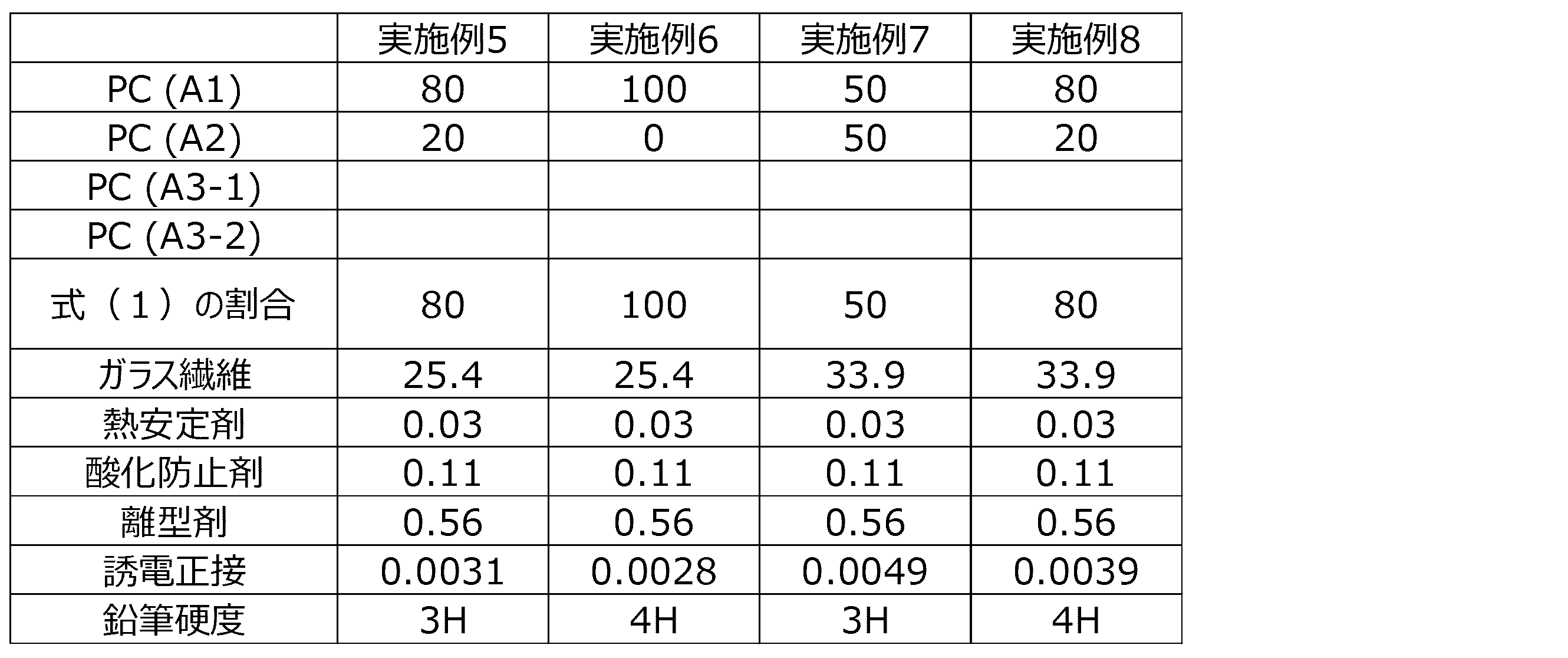
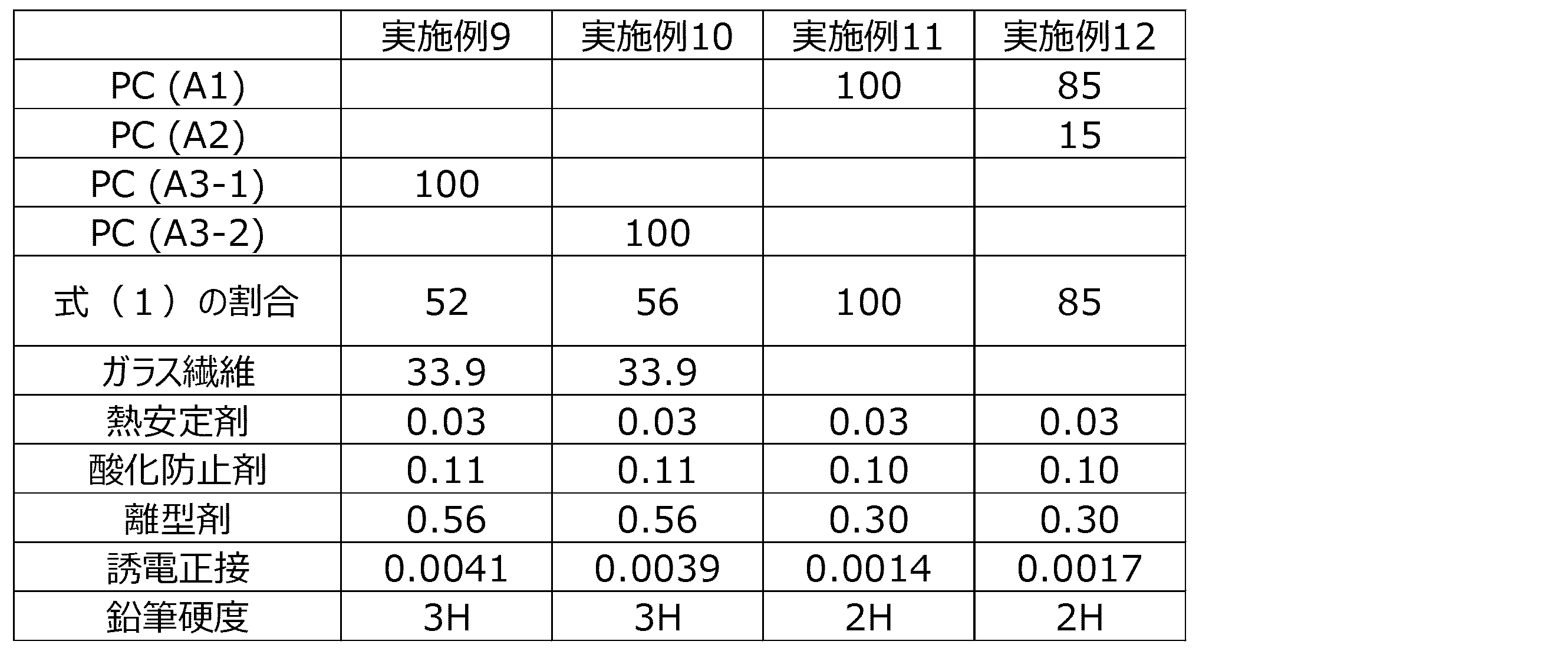
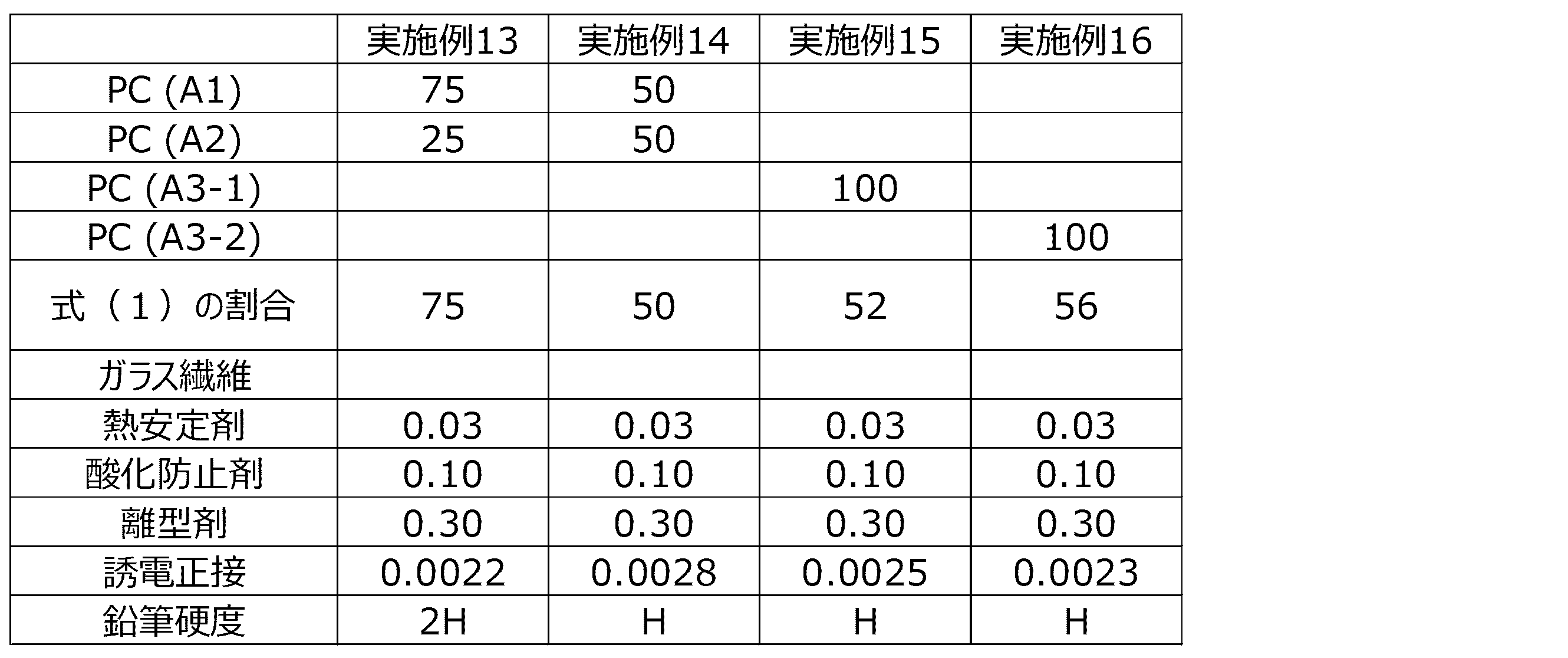
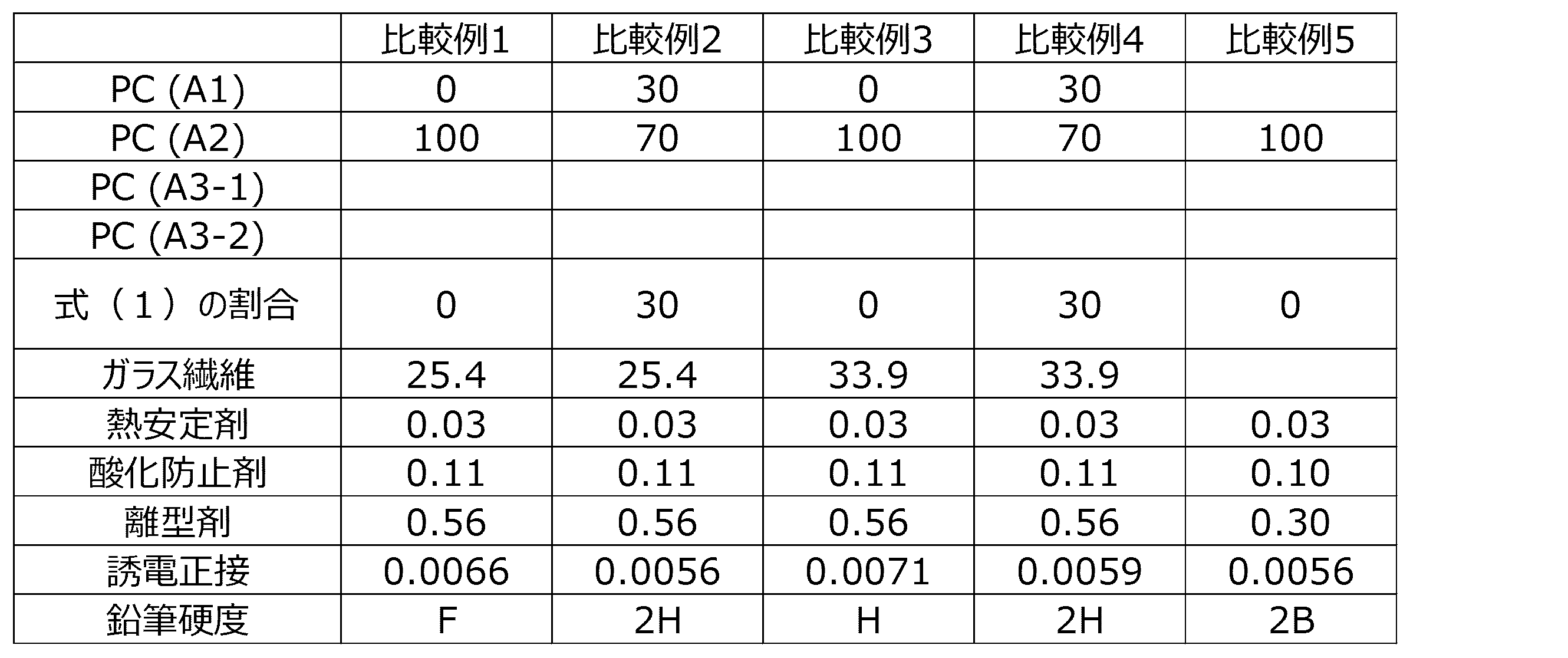
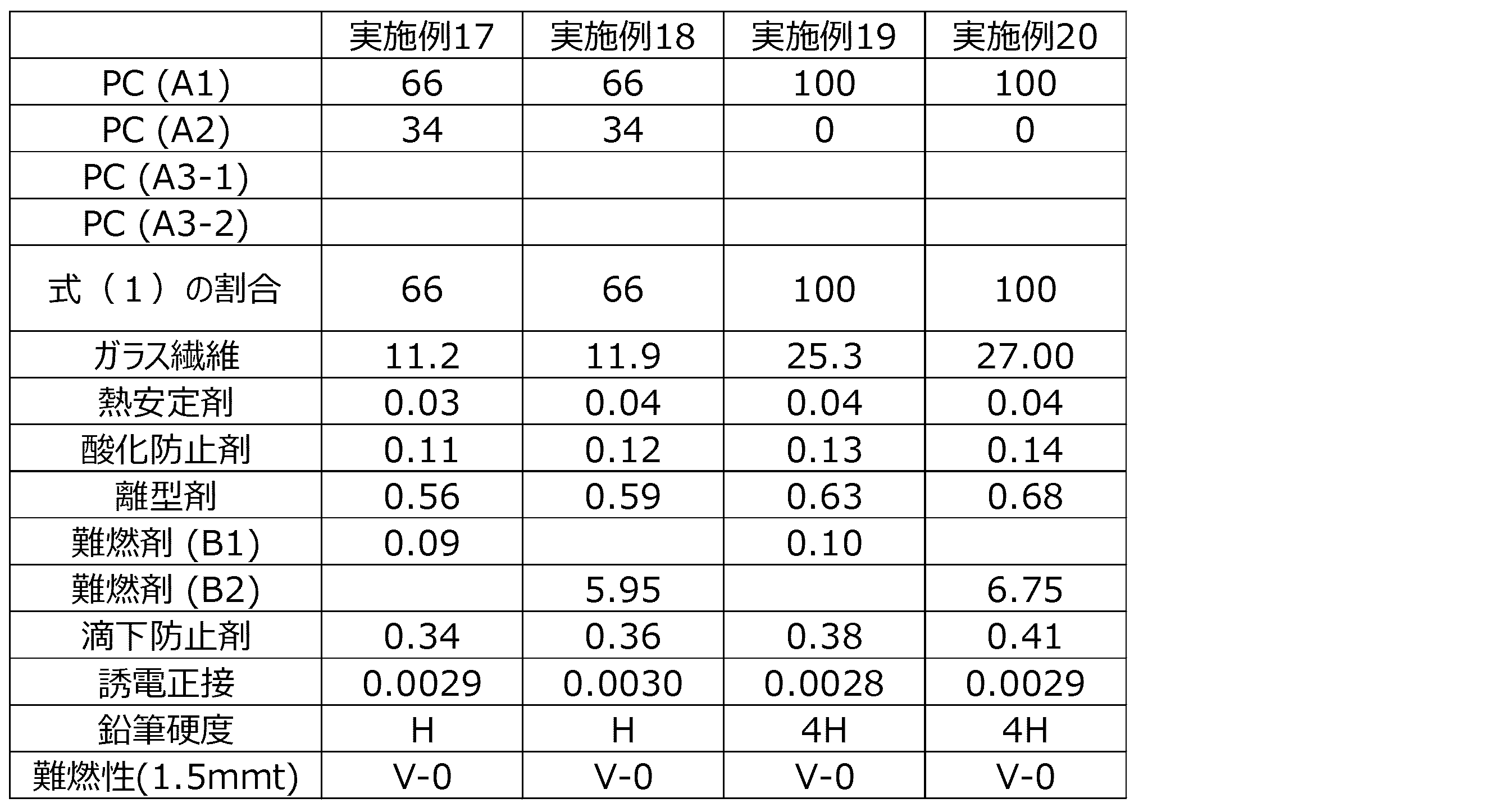
上記表2~5において、式(1)の割合とは、樹脂組成物に含まれるポリカーボネート樹脂中の式(1)で表される構成単位の質量比率(質量%)を意味する。
上記結果から明らかなとおり、本発明の樹脂組成物は、誘電正接が低かった(実施例1~20)。さらに、鉛筆硬度も高くすることができた。
一方、比較例の組成物は、誘電正接が高かった(比較例1~5)。また、一部の比較例については、鉛筆硬度も低かった。
上記結果から明らかなとおり、本発明の樹脂組成物は、誘電正接が低かった(実施例1~20)。さらに、鉛筆硬度も高くすることができた。
一方、比較例の組成物は、誘電正接が高かった(比較例1~5)。また、一部の比較例については、鉛筆硬度も低かった。
Claims (14)
- ポリカーボネート樹脂を含み、
前記ポリカーボネート樹脂における、式(1)で表される構成単位と式(1)で表される構成単位以外のカーボネート単位の質量比率が、33~100:67~0である、
周波数1GHz以上の電磁波を使用する電子電気機器部品用樹脂組成物。

- さらに、前記ポリカーボネート樹脂100質量部に対し、無機充填剤を、10質量部以上100質量部以下の割合で含む、請求項1に記載の樹脂組成物。
- 前記無機充填剤100質量部に対する、前記ポリカーボネート樹脂中の式(1)で表される構成単位の質量割合が、150質量部以上である、請求項2に記載の樹脂組成物。
- 前記無機充填剤が、ガラス繊維、タルク、および、窒化ホウ素からなる群から選ばれる少なくとも1種を含む、請求項2または3に記載の樹脂組成物。
- 前記無機充填剤が、ガラス繊維を含む、請求項2~4のいずれか1項に記載の樹脂組成物。
- 前記式(1)で表される構成単位以外のカーボネート単位が、式(5)で表される構成単位を含む、請求項1~5のいずれか1項に記載の樹脂組成物。
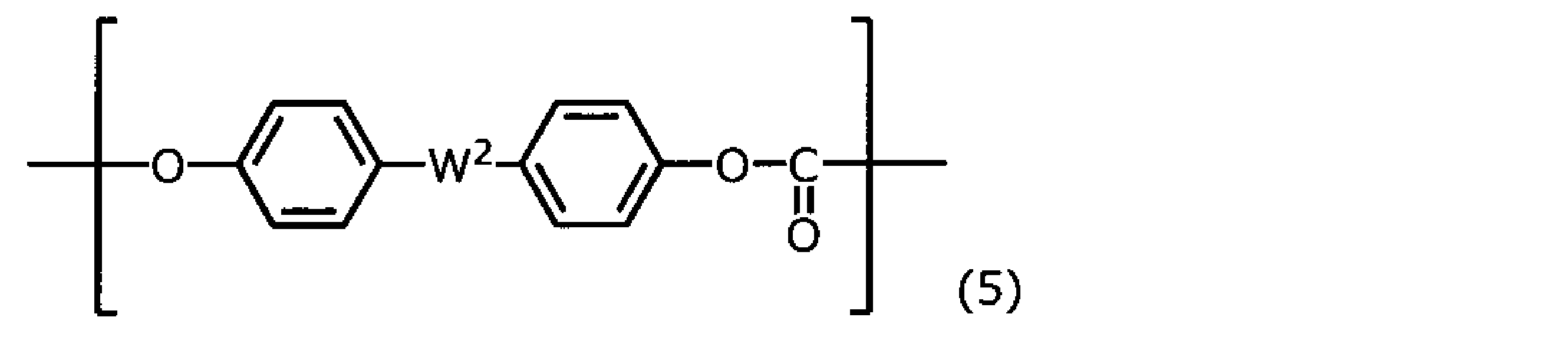
- 全構成単位の90質量%以上が前記式(1)で表される構成単位であるポリカーボネート樹脂(A1)と、全構成単位の90質量%以上が前記式(5)で表される構成単位であるポリカーボネート樹脂(A2)とを含み、
前記樹脂組成物に含まれるポリカーボネート樹脂の45質量%以上が、前記ポリカーボネート樹脂(A1)である、請求項6に記載の樹脂組成物。 - 前記ポリカーボネート樹脂(A1)の粘度平均分子量が16,000以上30,000以下であり、前記ポリカーボネート樹脂(A2)の粘度平均分子量が16,000以上35,000以下である、請求項7に記載の樹脂組成物。
- 前記ポリカーボネート樹脂が、全構成単位の30~70質量%が前記式(1)で表される構成単位であり、全構成単位の70~30質量%が前記式(5)で表される構成単位であるポリカーボネート樹脂(A3)を含み、
前記樹脂組成物に含まれるポリカーボネート樹脂の50質量%以上が、前記ポリカーボネート樹脂(A3)である、請求項6に記載の樹脂組成物。 - 前記樹脂組成物を平板状に成形したときの、JIS K5600に従って測定した鉛筆硬度がH以上である、請求項1~9のいずれか1項に記載の樹脂組成物。
- 前記樹脂組成物を平板状に成形したときの、周波数2.45GHzにおける誘電正接が、0.0053以下である、請求項1~10のいずれか1項に記載の樹脂組成物。
- さらに、前記ポリカーボネート樹脂100質量部に対し、難燃剤を、0.001質量部以上30質量部以下の割合で含む、請求項1~11のいずれか1項に記載の樹脂組成物。
- 請求項1~12のいずれか1項に記載の樹脂組成物から形成された周波数1GHz以上の電磁波を使用する電子電気機器部品。
- 前記電子電気機器部品の少なくとも一部を周波数1GHz以上の電磁波が通過している、請求項13に記載の電子電気機器部品。
Priority Applications (5)
| Application Number | Priority Date | Filing Date | Title |
|---|---|---|---|
| JP2021554945A JPWO2021090823A1 (ja) | 2019-11-06 | 2020-11-04 | |
| US17/774,399 US20220363894A1 (en) | 2019-11-06 | 2020-11-04 | Resin composition and electronic/electric equipment component |
| KR1020227010853A KR20220098720A (ko) | 2019-11-06 | 2020-11-04 | 수지 조성물 및 전자 전기 기기 부품 |
| EP20885134.5A EP4056623A4 (en) | 2019-11-06 | 2020-11-04 | RESIN COMPOSITION AND COMPONENT OF AN ELECTRONIC/ELECTRICAL DEVICE |
| CN202080075222.3A CN114641534B (zh) | 2019-11-06 | 2020-11-04 | 树脂组合物和电子电气设备部件 |
Applications Claiming Priority (2)
| Application Number | Priority Date | Filing Date | Title |
|---|---|---|---|
| JP2019-201275 | 2019-11-06 | ||
| JP2019201275 | 2019-11-06 |
Publications (1)
| Publication Number | Publication Date |
|---|---|
| WO2021090823A1 true WO2021090823A1 (ja) | 2021-05-14 |
Family
ID=75848417
Family Applications (1)
| Application Number | Title | Priority Date | Filing Date |
|---|---|---|---|
| PCT/JP2020/041157 Ceased WO2021090823A1 (ja) | 2019-11-06 | 2020-11-04 | 樹脂組成物および電子電気機器部品 |
Country Status (7)
| Country | Link |
|---|---|
| US (1) | US20220363894A1 (ja) |
| EP (1) | EP4056623A4 (ja) |
| JP (1) | JPWO2021090823A1 (ja) |
| KR (1) | KR20220098720A (ja) |
| CN (1) | CN114641534B (ja) |
| TW (1) | TWI870499B (ja) |
| WO (1) | WO2021090823A1 (ja) |
Cited By (1)
| Publication number | Priority date | Publication date | Assignee | Title |
|---|---|---|---|---|
| JP2023020067A (ja) * | 2021-07-30 | 2023-02-09 | 帝人株式会社 | アリル基含有ポリカーボネート樹脂及び硬化性樹脂組成物 |
Citations (11)
| Publication number | Priority date | Publication date | Assignee | Title |
|---|---|---|---|---|
| US3275601A (en) * | 1956-01-04 | 1966-09-27 | Bayer Ag | Manufacture of polycarbonates using tertiary amines, quaternary amines and salts thereof as catalysts |
| WO2005075571A1 (ja) | 2004-02-04 | 2005-08-18 | Osaka Gas Co., Ltd. | GHz帯域電子部品用樹脂組成物及びGHz帯域電子部品 |
| JP2010144182A (ja) * | 2010-01-25 | 2010-07-01 | Mitsubishi Engineering Plastics Corp | 電磁波抑制用樹脂組成物及び成形品 |
| JP2015108118A (ja) * | 2013-10-23 | 2015-06-11 | 三菱エンジニアリングプラスチックス株式会社 | ポリカーボネート樹脂組成物及び成形品 |
| JP2016216534A (ja) | 2015-05-14 | 2016-12-22 | 三菱瓦斯化学株式会社 | ポリカーボネート樹脂組成物 |
| JP2017110180A (ja) | 2015-12-10 | 2017-06-22 | 三菱エンジニアリングプラスチックス株式会社 | ポリカーボネート樹脂組成物及び成形品 |
| WO2019078162A1 (ja) | 2017-10-17 | 2019-04-25 | 三菱エンジニアリングプラスチックス株式会社 | 樹脂組成物および成形品 |
| JP2019135290A (ja) | 2017-03-31 | 2019-08-15 | 三菱エンジニアリングプラスチックス株式会社 | ポリカーボネート樹脂組成物及び成形品 |
| JP2019156924A (ja) * | 2018-03-09 | 2019-09-19 | 帝人株式会社 | 熱可塑性樹脂組成物 |
| JP2019172712A (ja) | 2016-08-23 | 2019-10-10 | 三菱瓦斯化学株式会社 | ゴム組成物及びタイヤ |
| WO2019212020A1 (ja) * | 2018-05-02 | 2019-11-07 | 三菱エンジニアリングプラスチックス株式会社 | ミリ波レーダー用カバー及びそれを備えるミリ波レーダーモジュール |
Family Cites Families (7)
| Publication number | Priority date | Publication date | Assignee | Title |
|---|---|---|---|---|
| US5502098A (en) * | 1993-06-28 | 1996-03-26 | Cosmo Research Institute | Polymer composition for electrical part material |
| JPH0934155A (ja) * | 1995-07-21 | 1997-02-07 | Canon Inc | 電子写真感光体、該電子写真感光体を有するプロセスカ−トリッジ及び電子写真装置 |
| JP5293537B2 (ja) * | 2009-09-28 | 2013-09-18 | 三菱エンジニアリングプラスチックス株式会社 | ミリ波レーダー用カバー及びミリ波レーダー |
| JP2013018240A (ja) * | 2011-07-13 | 2013-01-31 | Mitsubishi Chemicals Corp | ポリカーボネート樹脂成形品の製造方法 |
| CN103702831B (zh) * | 2011-08-01 | 2016-03-23 | 三菱化学株式会社 | 聚碳酸酯树脂层积体 |
| JP7639686B2 (ja) * | 2019-08-29 | 2025-03-05 | 三菱ケミカル株式会社 | 熱可塑性樹脂組成物及び成形品 |
| US11936103B2 (en) * | 2019-10-29 | 2024-03-19 | Teijin Limited | Conductive film for antennas, and antenna |
-
2020
- 2020-11-04 US US17/774,399 patent/US20220363894A1/en not_active Abandoned
- 2020-11-04 KR KR1020227010853A patent/KR20220098720A/ko active Pending
- 2020-11-04 CN CN202080075222.3A patent/CN114641534B/zh active Active
- 2020-11-04 EP EP20885134.5A patent/EP4056623A4/en active Pending
- 2020-11-04 WO PCT/JP2020/041157 patent/WO2021090823A1/ja not_active Ceased
- 2020-11-04 TW TW109138433A patent/TWI870499B/zh active
- 2020-11-04 JP JP2021554945A patent/JPWO2021090823A1/ja active Pending
Patent Citations (11)
| Publication number | Priority date | Publication date | Assignee | Title |
|---|---|---|---|---|
| US3275601A (en) * | 1956-01-04 | 1966-09-27 | Bayer Ag | Manufacture of polycarbonates using tertiary amines, quaternary amines and salts thereof as catalysts |
| WO2005075571A1 (ja) | 2004-02-04 | 2005-08-18 | Osaka Gas Co., Ltd. | GHz帯域電子部品用樹脂組成物及びGHz帯域電子部品 |
| JP2010144182A (ja) * | 2010-01-25 | 2010-07-01 | Mitsubishi Engineering Plastics Corp | 電磁波抑制用樹脂組成物及び成形品 |
| JP2015108118A (ja) * | 2013-10-23 | 2015-06-11 | 三菱エンジニアリングプラスチックス株式会社 | ポリカーボネート樹脂組成物及び成形品 |
| JP2016216534A (ja) | 2015-05-14 | 2016-12-22 | 三菱瓦斯化学株式会社 | ポリカーボネート樹脂組成物 |
| JP2017110180A (ja) | 2015-12-10 | 2017-06-22 | 三菱エンジニアリングプラスチックス株式会社 | ポリカーボネート樹脂組成物及び成形品 |
| JP2019172712A (ja) | 2016-08-23 | 2019-10-10 | 三菱瓦斯化学株式会社 | ゴム組成物及びタイヤ |
| JP2019135290A (ja) | 2017-03-31 | 2019-08-15 | 三菱エンジニアリングプラスチックス株式会社 | ポリカーボネート樹脂組成物及び成形品 |
| WO2019078162A1 (ja) | 2017-10-17 | 2019-04-25 | 三菱エンジニアリングプラスチックス株式会社 | 樹脂組成物および成形品 |
| JP2019156924A (ja) * | 2018-03-09 | 2019-09-19 | 帝人株式会社 | 熱可塑性樹脂組成物 |
| WO2019212020A1 (ja) * | 2018-05-02 | 2019-11-07 | 三菱エンジニアリングプラスチックス株式会社 | ミリ波レーダー用カバー及びそれを備えるミリ波レーダーモジュール |
Non-Patent Citations (1)
| Title |
|---|
| See also references of EP4056623A4 |
Cited By (2)
| Publication number | Priority date | Publication date | Assignee | Title |
|---|---|---|---|---|
| JP2023020067A (ja) * | 2021-07-30 | 2023-02-09 | 帝人株式会社 | アリル基含有ポリカーボネート樹脂及び硬化性樹脂組成物 |
| JP7719658B2 (ja) | 2021-07-30 | 2025-08-06 | 帝人株式会社 | アリル基含有ポリカーボネート樹脂及び硬化性樹脂組成物 |
Also Published As
| Publication number | Publication date |
|---|---|
| CN114641534B (zh) | 2024-02-20 |
| TW202128829A (zh) | 2021-08-01 |
| EP4056623A1 (en) | 2022-09-14 |
| KR20220098720A (ko) | 2022-07-12 |
| JPWO2021090823A1 (ja) | 2021-05-14 |
| TWI870499B (zh) | 2025-01-21 |
| EP4056623A4 (en) | 2023-10-25 |
| US20220363894A1 (en) | 2022-11-17 |
| CN114641534A (zh) | 2022-06-17 |
Similar Documents
| Publication | Publication Date | Title |
|---|---|---|
| JP2020173945A (ja) | 低誘電放熱フィルム用組成物及び低誘電放熱フィルム | |
| JP4951835B2 (ja) | ポリカーボネート樹脂組成物 | |
| JP2022080749A (ja) | ポリカーボネート樹脂組成物 | |
| WO2021090823A1 (ja) | 樹脂組成物および電子電気機器部品 | |
| TW201120136A (en) | Flame-retardant polycarbonate resin composition and moldings thereof | |
| KR101293390B1 (ko) | 방향족 폴리카보네이트 수지 조성물 및 그것을 이용한성형체 | |
| JP7793357B2 (ja) | 熱伝導性ポリカーボネート樹脂組成物及び成形品 | |
| JP7632297B2 (ja) | レーザーダイレクトストラクチャリング用樹脂組成物、成形品、および、メッキ付き成形品の製造方法 | |
| JP5546115B2 (ja) | 難燃性樹脂組成物 | |
| JP5370446B2 (ja) | ポリカーボネート樹脂組成物 | |
| JP5370447B2 (ja) | ポリカーボネート樹脂組成物 | |
| JP5554185B2 (ja) | 難燃性樹脂組成物 | |
| JP7105583B2 (ja) | ポリカーボネート樹脂組成物および成形品 | |
| JP7699308B1 (ja) | 難燃性ポリカーボネート樹脂組成物 | |
| JP2014040571A (ja) | 熱伝導性ポリカーボネート樹脂組成物およびそれからなる成形体 | |
| JP2025162033A (ja) | ポリカーボネート樹脂組成物 | |
| JP2019206650A (ja) | 難燃性ポリカーボネート樹脂組成物 | |
| JP2023140301A (ja) | ポリカーボネート樹脂組成物 | |
| WO2023181868A1 (ja) | ポリカーボネート樹脂組成物及びアンテナ用部材 | |
| WO2023214485A1 (ja) | 樹脂組成物および成形品 | |
| JP2025044913A (ja) | ポリカーボネート樹脂組成物 | |
| JP2025044914A (ja) | ポリカーボネート樹脂組成物 | |
| WO2024117159A1 (ja) | 樹脂組成物、ペレット、成形品、および、樹脂組成物の製造方法 | |
| JP2024082421A (ja) | ポリカーボネート樹脂組成物 | |
| WO2023181849A1 (ja) | ポリカーボネート樹脂組成物及びアンテナ用部材 |
Legal Events
| Date | Code | Title | Description |
|---|---|---|---|
| 121 | Ep: the epo has been informed by wipo that ep was designated in this application |
Ref document number: 20885134 Country of ref document: EP Kind code of ref document: A1 |
|
| ENP | Entry into the national phase |
Ref document number: 2021554945 Country of ref document: JP Kind code of ref document: A |
|
| NENP | Non-entry into the national phase |
Ref country code: DE |
|
| ENP | Entry into the national phase |
Ref document number: 2020885134 Country of ref document: EP Effective date: 20220607 |