WO2021106944A1 - Composition durcissable - Google Patents
Composition durcissable Download PDFInfo
- Publication number
- WO2021106944A1 WO2021106944A1 PCT/JP2020/043861 JP2020043861W WO2021106944A1 WO 2021106944 A1 WO2021106944 A1 WO 2021106944A1 JP 2020043861 W JP2020043861 W JP 2020043861W WO 2021106944 A1 WO2021106944 A1 WO 2021106944A1
- Authority
- WO
- WIPO (PCT)
- Prior art keywords
- meth
- component
- curable composition
- acrylate
- present
- Prior art date
- Legal status (The legal status is an assumption and is not a legal conclusion. Google has not performed a legal analysis and makes no representation as to the accuracy of the status listed.)
- Ceased
Links
Images
Classifications
-
- C—CHEMISTRY; METALLURGY
- C08—ORGANIC MACROMOLECULAR COMPOUNDS; THEIR PREPARATION OR CHEMICAL WORKING-UP; COMPOSITIONS BASED THEREON
- C08F—MACROMOLECULAR COMPOUNDS OBTAINED BY REACTIONS ONLY INVOLVING CARBON-TO-CARBON UNSATURATED BONDS
- C08F20/00—Homopolymers and copolymers of compounds having one or more unsaturated aliphatic radicals, each having only one carbon-to-carbon double bond, and only one being terminated by only one carboxyl radical or a salt, anhydride, ester, amide, imide or nitrile thereof
- C08F20/02—Monocarboxylic acids having less than ten carbon atoms, Derivatives thereof
- C08F20/10—Esters
- C08F20/26—Esters containing oxygen in addition to the carboxy oxygen
- C08F20/32—Esters containing oxygen in addition to the carboxy oxygen containing epoxy radicals
-
- B—PERFORMING OPERATIONS; TRANSPORTING
- B01—PHYSICAL OR CHEMICAL PROCESSES OR APPARATUS IN GENERAL
- B01J—CHEMICAL OR PHYSICAL PROCESSES, e.g. CATALYSIS OR COLLOID CHEMISTRY; THEIR RELEVANT APPARATUS
- B01J31/00—Catalysts comprising hydrides, coordination complexes or organic compounds
- B01J31/02—Catalysts comprising hydrides, coordination complexes or organic compounds containing organic compounds or metal hydrides
- B01J31/0215—Sulfur-containing compounds
- B01J31/0222—Sulfur-containing compounds comprising sulfonyl groups
-
- C—CHEMISTRY; METALLURGY
- C08—ORGANIC MACROMOLECULAR COMPOUNDS; THEIR PREPARATION OR CHEMICAL WORKING-UP; COMPOSITIONS BASED THEREON
- C08F—MACROMOLECULAR COMPOUNDS OBTAINED BY REACTIONS ONLY INVOLVING CARBON-TO-CARBON UNSATURATED BONDS
- C08F2/00—Processes of polymerisation
- C08F2/38—Polymerisation using regulators, e.g. chain terminating agents, e.g. telomerisation
- C08F2/40—Polymerisation using regulators, e.g. chain terminating agents, e.g. telomerisation using retarding agents
-
- C—CHEMISTRY; METALLURGY
- C08—ORGANIC MACROMOLECULAR COMPOUNDS; THEIR PREPARATION OR CHEMICAL WORKING-UP; COMPOSITIONS BASED THEREON
- C08F—MACROMOLECULAR COMPOUNDS OBTAINED BY REACTIONS ONLY INVOLVING CARBON-TO-CARBON UNSATURATED BONDS
- C08F2/00—Processes of polymerisation
- C08F2/44—Polymerisation in the presence of compounding ingredients, e.g. plasticisers, dyestuffs, fillers
-
- C—CHEMISTRY; METALLURGY
- C08—ORGANIC MACROMOLECULAR COMPOUNDS; THEIR PREPARATION OR CHEMICAL WORKING-UP; COMPOSITIONS BASED THEREON
- C08F—MACROMOLECULAR COMPOUNDS OBTAINED BY REACTIONS ONLY INVOLVING CARBON-TO-CARBON UNSATURATED BONDS
- C08F2/00—Processes of polymerisation
- C08F2/46—Polymerisation initiated by wave energy or particle radiation
- C08F2/48—Polymerisation initiated by wave energy or particle radiation by ultraviolet or visible light
-
- C—CHEMISTRY; METALLURGY
- C08—ORGANIC MACROMOLECULAR COMPOUNDS; THEIR PREPARATION OR CHEMICAL WORKING-UP; COMPOSITIONS BASED THEREON
- C08F—MACROMOLECULAR COMPOUNDS OBTAINED BY REACTIONS ONLY INVOLVING CARBON-TO-CARBON UNSATURATED BONDS
- C08F2/00—Processes of polymerisation
- C08F2/46—Polymerisation initiated by wave energy or particle radiation
- C08F2/48—Polymerisation initiated by wave energy or particle radiation by ultraviolet or visible light
- C08F2/50—Polymerisation initiated by wave energy or particle radiation by ultraviolet or visible light with sensitising agents
-
- C—CHEMISTRY; METALLURGY
- C08—ORGANIC MACROMOLECULAR COMPOUNDS; THEIR PREPARATION OR CHEMICAL WORKING-UP; COMPOSITIONS BASED THEREON
- C08F—MACROMOLECULAR COMPOUNDS OBTAINED BY REACTIONS ONLY INVOLVING CARBON-TO-CARBON UNSATURATED BONDS
- C08F20/00—Homopolymers and copolymers of compounds having one or more unsaturated aliphatic radicals, each having only one carbon-to-carbon double bond, and only one being terminated by only one carboxyl radical or a salt, anhydride, ester, amide, imide or nitrile thereof
- C08F20/02—Monocarboxylic acids having less than ten carbon atoms, Derivatives thereof
- C08F20/04—Acids, Metal salts or ammonium salts thereof
- C08F20/06—Acrylic acid; Methacrylic acid; Metal salts or ammonium salts thereof
-
- C—CHEMISTRY; METALLURGY
- C08—ORGANIC MACROMOLECULAR COMPOUNDS; THEIR PREPARATION OR CHEMICAL WORKING-UP; COMPOSITIONS BASED THEREON
- C08F—MACROMOLECULAR COMPOUNDS OBTAINED BY REACTIONS ONLY INVOLVING CARBON-TO-CARBON UNSATURATED BONDS
- C08F20/00—Homopolymers and copolymers of compounds having one or more unsaturated aliphatic radicals, each having only one carbon-to-carbon double bond, and only one being terminated by only one carboxyl radical or a salt, anhydride, ester, amide, imide or nitrile thereof
- C08F20/02—Monocarboxylic acids having less than ten carbon atoms, Derivatives thereof
- C08F20/10—Esters
- C08F20/34—Esters containing nitrogen, e.g. N,N-dimethylaminoethyl (meth)acrylate
-
- C—CHEMISTRY; METALLURGY
- C08—ORGANIC MACROMOLECULAR COMPOUNDS; THEIR PREPARATION OR CHEMICAL WORKING-UP; COMPOSITIONS BASED THEREON
- C08F—MACROMOLECULAR COMPOUNDS OBTAINED BY REACTIONS ONLY INVOLVING CARBON-TO-CARBON UNSATURATED BONDS
- C08F222/00—Copolymers of compounds having one or more unsaturated aliphatic radicals, each having only one carbon-to-carbon double bond, and at least one being terminated by a carboxyl radical and containing at least one other carboxyl radical in the molecule; Salts, anhydrides, esters, amides, imides, or nitriles thereof
- C08F222/10—Esters
- C08F222/1006—Esters of polyhydric alcohols or polyhydric phenols
- C08F222/102—Esters of polyhydric alcohols or polyhydric phenols of dialcohols, e.g. ethylene glycol di(meth)acrylate or 1,4-butanediol dimethacrylate
- C08F222/1025—Esters of polyhydric alcohols or polyhydric phenols of dialcohols, e.g. ethylene glycol di(meth)acrylate or 1,4-butanediol dimethacrylate of aromatic dialcohols
-
- C—CHEMISTRY; METALLURGY
- C08—ORGANIC MACROMOLECULAR COMPOUNDS; THEIR PREPARATION OR CHEMICAL WORKING-UP; COMPOSITIONS BASED THEREON
- C08K—Use of inorganic or non-macromolecular organic substances as compounding ingredients
- C08K5/00—Use of organic ingredients
- C08K5/0008—Organic ingredients according to more than one of the "one dot" groups of C08K5/01 - C08K5/59
- C08K5/0025—Crosslinking or vulcanising agents; including accelerators
-
- C—CHEMISTRY; METALLURGY
- C08—ORGANIC MACROMOLECULAR COMPOUNDS; THEIR PREPARATION OR CHEMICAL WORKING-UP; COMPOSITIONS BASED THEREON
- C08K—Use of inorganic or non-macromolecular organic substances as compounding ingredients
- C08K5/00—Use of organic ingredients
- C08K5/36—Sulfur-, selenium-, or tellurium-containing compounds
- C08K5/45—Heterocyclic compounds having sulfur in the ring
- C08K5/46—Heterocyclic compounds having sulfur in the ring with oxygen or nitrogen in the ring
-
- C—CHEMISTRY; METALLURGY
- C08—ORGANIC MACROMOLECULAR COMPOUNDS; THEIR PREPARATION OR CHEMICAL WORKING-UP; COMPOSITIONS BASED THEREON
- C08K—Use of inorganic or non-macromolecular organic substances as compounding ingredients
- C08K5/00—Use of organic ingredients
- C08K5/36—Sulfur-, selenium-, or tellurium-containing compounds
- C08K5/45—Heterocyclic compounds having sulfur in the ring
- C08K5/46—Heterocyclic compounds having sulfur in the ring with oxygen or nitrogen in the ring
- C08K5/47—Thiazoles
-
- C—CHEMISTRY; METALLURGY
- C09—DYES; PAINTS; POLISHES; NATURAL RESINS; ADHESIVES; COMPOSITIONS NOT OTHERWISE PROVIDED FOR; APPLICATIONS OF MATERIALS NOT OTHERWISE PROVIDED FOR
- C09D—COATING COMPOSITIONS, e.g. PAINTS, VARNISHES OR LACQUERS; FILLING PASTES; CHEMICAL PAINT OR INK REMOVERS; INKS; CORRECTING FLUIDS; WOODSTAINS; PASTES OR SOLIDS FOR COLOURING OR PRINTING; USE OF MATERIALS THEREFOR
- C09D4/00—Coating compositions, e.g. paints, varnishes or lacquers, based on organic non-macromolecular compounds having at least one polymerisable carbon-to-carbon unsaturated bond ; Coating compositions, based on monomers of macromolecular compounds of groups C09D183/00 - C09D183/16
-
- C—CHEMISTRY; METALLURGY
- C09—DYES; PAINTS; POLISHES; NATURAL RESINS; ADHESIVES; COMPOSITIONS NOT OTHERWISE PROVIDED FOR; APPLICATIONS OF MATERIALS NOT OTHERWISE PROVIDED FOR
- C09J—ADHESIVES; NON-MECHANICAL ASPECTS OF ADHESIVE PROCESSES IN GENERAL; ADHESIVE PROCESSES NOT PROVIDED FOR ELSEWHERE; USE OF MATERIALS AS ADHESIVES
- C09J11/00—Features of adhesives not provided for in group C09J9/00, e.g. additives
- C09J11/02—Non-macromolecular additives
- C09J11/06—Non-macromolecular additives organic
-
- C—CHEMISTRY; METALLURGY
- C09—DYES; PAINTS; POLISHES; NATURAL RESINS; ADHESIVES; COMPOSITIONS NOT OTHERWISE PROVIDED FOR; APPLICATIONS OF MATERIALS NOT OTHERWISE PROVIDED FOR
- C09J—ADHESIVES; NON-MECHANICAL ASPECTS OF ADHESIVE PROCESSES IN GENERAL; ADHESIVE PROCESSES NOT PROVIDED FOR ELSEWHERE; USE OF MATERIALS AS ADHESIVES
- C09J133/00—Adhesives based on homopolymers or copolymers of compounds having one or more unsaturated aliphatic radicals, each having only one carbon-to-carbon double bond, and at least one being terminated by only one carboxyl radical, or of salts, anhydrides, esters, amides, imides, or nitriles thereof; Adhesives based on derivatives of such polymers
- C09J133/04—Homopolymers or copolymers of esters
-
- C—CHEMISTRY; METALLURGY
- C09—DYES; PAINTS; POLISHES; NATURAL RESINS; ADHESIVES; COMPOSITIONS NOT OTHERWISE PROVIDED FOR; APPLICATIONS OF MATERIALS NOT OTHERWISE PROVIDED FOR
- C09J—ADHESIVES; NON-MECHANICAL ASPECTS OF ADHESIVE PROCESSES IN GENERAL; ADHESIVE PROCESSES NOT PROVIDED FOR ELSEWHERE; USE OF MATERIALS AS ADHESIVES
- C09J133/00—Adhesives based on homopolymers or copolymers of compounds having one or more unsaturated aliphatic radicals, each having only one carbon-to-carbon double bond, and at least one being terminated by only one carboxyl radical, or of salts, anhydrides, esters, amides, imides, or nitriles thereof; Adhesives based on derivatives of such polymers
- C09J133/04—Homopolymers or copolymers of esters
- C09J133/06—Homopolymers or copolymers of esters of esters containing only carbon, hydrogen and oxygen, the oxygen atom being present only as part of the carboxyl radical
- C09J133/10—Homopolymers or copolymers of methacrylic acid esters
-
- C—CHEMISTRY; METALLURGY
- C09—DYES; PAINTS; POLISHES; NATURAL RESINS; ADHESIVES; COMPOSITIONS NOT OTHERWISE PROVIDED FOR; APPLICATIONS OF MATERIALS NOT OTHERWISE PROVIDED FOR
- C09J—ADHESIVES; NON-MECHANICAL ASPECTS OF ADHESIVE PROCESSES IN GENERAL; ADHESIVE PROCESSES NOT PROVIDED FOR ELSEWHERE; USE OF MATERIALS AS ADHESIVES
- C09J4/00—Adhesives based on organic non-macromolecular compounds having at least one polymerisable carbon-to-carbon unsaturated bond ; adhesives, based on monomers of macromolecular compounds of groups C09J183/00 - C09J183/16
- C09J4/06—Organic non-macromolecular compounds having at least one polymerisable carbon-to-carbon unsaturated bond in combination with a macromolecular compound other than an unsaturated polymer of groups C09J159/00 - C09J187/00
-
- C—CHEMISTRY; METALLURGY
- C09—DYES; PAINTS; POLISHES; NATURAL RESINS; ADHESIVES; COMPOSITIONS NOT OTHERWISE PROVIDED FOR; APPLICATIONS OF MATERIALS NOT OTHERWISE PROVIDED FOR
- C09J—ADHESIVES; NON-MECHANICAL ASPECTS OF ADHESIVE PROCESSES IN GENERAL; ADHESIVE PROCESSES NOT PROVIDED FOR ELSEWHERE; USE OF MATERIALS AS ADHESIVES
- C09J5/00—Adhesive processes in general; Adhesive processes not provided for elsewhere, e.g. relating to primers
- C09J5/06—Adhesive processes in general; Adhesive processes not provided for elsewhere, e.g. relating to primers involving heating of the applied adhesive
-
- C—CHEMISTRY; METALLURGY
- C08—ORGANIC MACROMOLECULAR COMPOUNDS; THEIR PREPARATION OR CHEMICAL WORKING-UP; COMPOSITIONS BASED THEREON
- C08F—MACROMOLECULAR COMPOUNDS OBTAINED BY REACTIONS ONLY INVOLVING CARBON-TO-CARBON UNSATURATED BONDS
- C08F122/00—Homopolymers of compounds having one or more unsaturated aliphatic radicals each having only one carbon-to-carbon double bond, and at least one being terminated by a carboxyl radical and containing at least one other carboxyl radical in the molecule; Salts, anhydrides, esters, amides, imides or nitriles thereof
- C08F122/10—Esters
- C08F122/1006—Esters of polyhydric alcohols or polyhydric phenols, e.g. ethylene glycol dimethacrylate
-
- C—CHEMISTRY; METALLURGY
- C08—ORGANIC MACROMOLECULAR COMPOUNDS; THEIR PREPARATION OR CHEMICAL WORKING-UP; COMPOSITIONS BASED THEREON
- C08F—MACROMOLECULAR COMPOUNDS OBTAINED BY REACTIONS ONLY INVOLVING CARBON-TO-CARBON UNSATURATED BONDS
- C08F20/00—Homopolymers and copolymers of compounds having one or more unsaturated aliphatic radicals, each having only one carbon-to-carbon double bond, and only one being terminated by only one carboxyl radical or a salt, anhydride, ester, amide, imide or nitrile thereof
- C08F20/02—Monocarboxylic acids having less than ten carbon atoms, Derivatives thereof
- C08F20/10—Esters
Definitions
- irradiation with active energy rays (energy rays) or heating does not lead to curing, and a specific time elapses after the end of irradiation or heating, and then the curing is delayed.
- It relates to a curable composition having curability.
- curing is uncured immediately after the end of irradiation of energy rays or immediately after the end of heating, and after a specific time elapses after the end of irradiation of energy rays or the end of heating, is referred to as delayed curability, and a specific time. Is called the delayed curing time.
- the types of raw materials for cationically polymerizable compounds such as epoxy compounds are limited as compared with radically polymerizable compounds such as (meth) acrylate compounds. Since the raw material affects the curability of the composition depending on the number of functional groups, the main skeleton, modification, etc., the delayed curability is particularly controlled in the composition containing a cationically polymerizable compound as a main component, which has a limited variety of raw materials. There was a problem that it was difficult to do.
- the present invention has been made in view of the above circumstances, and regardless of whether the adherend is transparent or not, after irradiating or heating energy rays, operations such as bonding and tightening are performed. It is an object of the present invention to provide a curable composition capable of ensuring a delayed curing time and subsequently exhibiting delayed curing.
- the first embodiment of the present invention is a curable composition containing the following components (A) to (C): Component (A): Compound having (meth) acryloyl group in the molecule (B) Component: Saccharin (C) Component: Photocation catalyst as component (C-1).
- a second embodiment of the present invention is a curable composition containing the following components (A) to (C): Component (A): Compound having (meth) acryloyl group in the molecule (B) Component: Saccharin (C) Component: Thermal cation catalyst as component (C-2).
- a third embodiment of the present invention is a curable composition containing the following components (A) to (C): Component (A): Compound having (meth) acryloyl group in the molecule (B) Component: Saccharin (C) Component: Photocation catalyst as component (C-1) and thermal cation catalyst as component (C-2).
- the fourth embodiment of the present invention is the curable composition according to any one of the first to third embodiments, further comprising a radical polymerization accelerator as the component (D).
- the fifth embodiment of the present invention is the curable composition according to the fourth embodiment, wherein the component (D) is an amine compound other than the component (B).
- the sixth embodiment of the present invention is the curable composition according to any one of the first to fifth embodiments, which does not contain an organic peroxide.
- a seventh embodiment of the present invention is the curing according to the first embodiment, which is uncured immediately after the end of irradiation with energy rays and is cured after a lapse of a specific time after the end of irradiation with energy rays. It is a sex composition.
- the eighth embodiment of the present invention is the curable composition according to the second embodiment, which is uncured immediately after the end of heating and is cured after a lapse of a specific time after the end of heating.
- a ninth embodiment of the present invention is uncured immediately after the end of irradiation of energy rays or immediately after the end of heating, and is cured after a specific time has passed after the end of irradiation of energy rays or the end of heating.
- the curable composition according to the third embodiment is uncured immediately after the end of irradiation of energy rays or immediately after the end of heating, and is cured after a specific time has passed after the end of irradiation of energy rays or the end of heating.
- a tenth embodiment of the present invention is the curable composition according to any one of the seventh to ninth embodiments, wherein the specific time is 30 seconds to 10 hours.
- the eleventh embodiment of the present invention comprises applying the curable composition according to the seventh or ninth embodiment to an adherend and then irradiating the curable composition with energy rays. It is a curing method.
- a twelfth embodiment of the present invention is a curing method comprising applying the curable composition according to the eighth or ninth embodiment to an adherend and then heating the curable composition. is there.
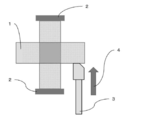
- FIG. 1 is a diagram showing a method of pushing a test piece with a constant force in order to confirm the development of delayed curability.
- the present invention is a curable composition containing the following components (A) to (C): Component (A): Compound having (meth) acryloyl group in the molecule (B) Component: Saccharin (C) Component: At least a photocationic catalyst as a component (C-1) and a thermal cation catalyst as a component (C-2) on the other hand.
- curable composition of the present invention regardless of whether the adherend is transparent or not, a delayed curing time for performing operations such as bonding and tightening after irradiation or heating with energy rays is secured. And then delayed curability may develop.
- the component (A) that can be used in the present invention is a compound having a (meth) acryloyl group in the molecule.
- the component (A) may be a compound having a (meth) acryloyl group in the molecule, and examples thereof include, but are limited to, (meth) acrylic oligomer, (meth) acrylic monomer, and (meth) acrylamide monomer. It's not a thing.
- the (meth) acryloyl group is a general term for an acryloyl group or a methacryloyl group, and a (meth) acrylic acid ester compound is also referred to as a (meth) acrylate.
- the (meth) acrylic oligomer has a main skeleton obtained by polymerizing an epoxy-modified (meth) acrylic oligomer, a urethane-modified (meth) acrylic oligomer, or a (meth) acrylic monomer, and has a (meth) acryloyl group at the end of the main skeleton.
- examples thereof include, but are not limited to, oligomers.
- Specific examples include so-called urethane-modified (meth) acrylic oligomers synthesized by reacting a polyvalent polyol with a polyfunctional isocyanate and a compound having a (meth) acryloyl group and a hydroxyl group.
- the polyvalent polyol may have various skeletons, and those having an ethylene oxide skeleton, a polyester skeleton, a polyether skeleton, a polybutadiene skeleton, a hydrogenated polybutadiene skeleton, and the like can be used. Further, examples thereof include, but are not limited to, bisphenol A type epoxy resin, bisphenol F type epoxy resin, and epoxy-modified (meth) acrylic oligomer obtained by adding (meth) acrylic acid to phenol novolac resin.
- the (meth) acrylic monomer used for forming the main skeleton of an oligomer having a main skeleton obtained by polymerizing a (meth) acrylic monomer and having a (meth) acryloyl group at the end of the main skeleton includes a (meth) acryloyl group in the molecule.
- a monofunctional monomer having one of the above is preferable, and specific examples thereof include (meth) acrylic acid, methyl (meth) acrylic acid, ethyl (meth) acrylic acid, -n-propyl (meth) acrylic acid, and (meth).
- the weight average molecular weight of the oligomer having a main skeleton obtained by polymerizing a (meth) acrylic monomer and having a (meth) acryloyl group at the end of the main skeleton is, for example, 1000 or more, preferably 5000 to 40,000.
- the weight average molecular weight is 5000 or more, the elasticity of the cured product tends to be easily exhibited, and cracks are less likely to occur in the cured product in the heat resistance test, which is preferable.
- the weight average molecular weight is 40,000 or less, the viscosity does not become too high, and stringing is less likely to occur when the curable composition is applied, which is preferable.
- Oligomers having a main skeleton obtained by polymerizing a (meth) acrylic monomer and having a (meth) acryloyl group at the end of the main skeleton can be obtained by various polymerization methods, and the method is not particularly limited, but the versatility of the monomer is limited.
- the radical polymerization method is preferable from the viewpoint of ease of reaction control.
- controlled radical polymerization is preferable, living radical polymerization is more preferable, and atom transfer radical polymerization is particularly preferable.
- the method of introducing the (meth) acryloyl group into the polymer of the (meth) acrylic monomer which is the main skeleton is as follows: (1) A vinyl-based polymer having a hydroxyl group at the terminal and chlorine, bromine, or a hydroxyl group-containing (1) Method by reaction with meta) acrylate compound, (2) Method by reaction between vinyl polymer having halogen group at terminal and alkali metal ion or quaternary ammonium ion-containing (meth) acrylate compound, (3) hydroxyl group at terminal Examples thereof include a method obtained by reacting a diisocyanate compound with a vinyl-based polymer having the above and reacting a residual isocyanate group with a hydroxyl group-containing (meth) acrylate.
- the oligomer having a main skeleton obtained by polymerizing a (meth) acrylic monomer and having a (meth) acryloyl group at the end of the main skeleton has a high temperature atmosphere such as 100 ° C. atmosphere or a high temperature high temperature such as 85 ° C. ⁇ 85% RH. It has the property of not losing its flexibility without deteriorating even in a damp atmosphere.
- the epoxy-modified (meth) acrylic oligomer and urethane-modified (meth) acrylic oligomer also preferably have a molecular weight of 1000 or more.
- a (meth) acrylic monomer can also be used as the component (A).
- the (meth) acrylic oligomer and the (meth) acrylic monomer can be mixed, or the (meth) acrylic oligomer or the (meth) acrylic monomer can be mixed for the purpose of lowering the viscosity of the curable composition to improve workability. It can also be used alone.
- 50 parts by mass or more of the component (A) is preferably a (meth) acrylic monomer, and 80 parts by mass or more is a (meth) acrylic monomer.
- Acrylic monomer is more preferable, and 100 parts by mass is further preferably a (meth) acrylic monomer.
- the (meth) acrylic monomer examples include a bifunctional monomer, a trifunctional monomer, a polyfunctional monomer having four or more functionalities, and the like, in addition to the monofunctional monomer. From the viewpoint of making the delayed curing time more controllable, the (meth) acrylic monomer preferably contains a bifunctional monomer, a trifunctional monomer, or a polyfunctional monomer having four or more functionalities.
- the component (A) contains a low molecular weight (meth) acrylic monomer having a molecular weight of less than 1000 because the addition has the effect of lowering the viscosity of the curable composition.
- a compound having a (meth) acryloyl group in two or more kinds of molecules is used as the component (A), it is more preferable that all of them are low molecular weight (meth) acrylic monomers having a molecular weight of less than 1000.
- the (meth) acrylic monomer preferably contains an acrylic monomer because the time required for curing is short.
- the monofunctional monomer examples include lauryl (meth) acrylate, stearyl (meth) acrylate, ethylcarbitol (meth) acrylate, tetrahydrofurfuryl (meth) acrylate, caprolactone-modified tetrahydrofurfuryl (meth) acrylate, and cyclohexyl (meth).
- Preferred monofunctional monomers are (meth) acrylic monomers having a hydroxyl group in the molecule and / or (meth) acrylic monomers having a saturated alicyclic structure.
- Specific examples of the (meth) acrylic monomer having a hydroxyl group include 2-hydroxyethyl (meth) acrylate, 2-hydroxypropyl (meth) acrylate, 2-hydroxybutyl (meth) acrylate, and 2- (meth) acryloyloxyethyl succinate.
- Acids, 2- (meth) acryloyloxyethyl hexahydrophthalic acid, 2- (meth) acryloyloxyethyl-2-hydroxypropylphthalate and the like can be mentioned, but are not limited thereto.
- the (meth) acrylic monomer having a saturated alicyclic structure include isobornyl (meth) acrylate, dicyclopentanyl (meth) acrylate, cyclohexyl (meth) acrylate, and adamantanyl (meth) acrylate. It is not limited. Most preferably, it is a (meth) acrylic monomer having an isobornyl skeleton and / or a dicyclopentanyl skeleton. According to one embodiment of the present invention, the component (A) contains both a (meth) acrylic monomer having a hydroxyl group in the molecule and the (meth) acrylic monomer having a saturated alicyclic structure.
- bifunctional monomer examples include 1,3-butylene glycol di (meth) acrylate, 1,4-butylene glycol di (meth) acrylate, tricyclodecanedimethanol di (meth) acrylate, and neopentyl glycol di ().
- trifunctional monomer examples include trimethylolpropane tri (meth) acrylate, pentaerythritol tri (meth) acrylate, EO-modified trimethylolpropane tri (meth) acrylate, PO-modified trimethylolpropane tri (meth) acrylate, and ethyl.
- Cyclohexane (ECH) -modified trimethylolpropane tri (meth) acrylate, ECH-modified glycerol tri (meth) acrylate, tris (acryloyloxyethyl) isocyanurate, isocyanurate ethylene oxide-modified di (meth) acrylate and the like can be mentioned. It is not limited.
- polyfunctional monomer having four or more functionalities examples include ditrimethylolpropane tetra (meth) acrylate, pentaerythritol tetra (meth) acrylate, dipentaerythritol monohydroxypenta (meth) acrylate, and alkyl-modified dipentaerythritol penta (. Examples thereof include, but are not limited to, meta) acrylate, dipentaerythritol hexa (meth) acrylate, and caprolactone-modified dipentaerythritol hexa (meth) acrylate.
- Examples of the (meth) acrylamide monomer that can be used in the present invention include, but are not limited to, dimethylacrylamide, acryloylmorpholine, diethylacrylamide, and the like. Diethyl acrylamide or dimethyl acrylamide is preferred in terms of price and availability. Specific examples of the (meth) acrylamide monomer include DMAA (registered trademark), ACMO (registered trademark), and DEAA (registered trademark) manufactured by KJ Chemicals Co., Ltd., but the present invention is not limited thereto. ..
- the component (B) that can be used in the present invention is saccharin.
- Saccharin is a compound represented by the following formula 1.
- the component (B) is preferably added in an amount of 0.1 to 5.0 parts by mass with respect to 100 parts by mass of the component (A), and a more preferable amount is 0.1 to 3.0 parts by mass.
- a more preferable amount is 0.1 to 3.0 parts by mass.
- the amount of the component (B) added is preferably in the above range with respect to 100 parts by mass of the total amount.
- the component (C) that can be used in the present invention is a cationic catalyst. If it is a compound that generates acid by energy ray irradiation ((C-1) component: photocation catalyst) or a compound that generates acid by heat due to heating ((C-2) component: thermal cation catalyst), component (C) Can be used as.
- the component (C) may be sold in a form dissolved or dispersed in a solvent or a plasticizer, and they may be used.
- the component (C) only one of the component (C-1) or the component (C-2) may be used, and the component (C-1) and the component (C-2) are used in combination. You may.
- the curable composition of the present invention contains the component (C-1)
- the curable composition can be cured by irradiation with energy rays.
- the curable composition of the present invention contains the component (C-2)
- the curable composition can be cured by heating.
- the component (C-1) and the component (C-2) only one type may be used, or two or more types may be used in combination.
- Specific photocation catalysts include iodonium-based cation species and sulfonium-based cation species, which are cation species, and phosphorus-based anion species, boron-based anion species, antimony-based anion species, arsenic-based anion species, or anion species. Examples thereof include salts composed of sulfonic acid-based anion species and the like, and one type or a combination of two or more types can be used.
- succinimidyl kanfasulfonate succinimidylphenyl sulfonate, succinimidyl toluyl sulphonate, succinimidyl trifluoromethyl sulfonate, phthalimidyl trifluoro sulfonate, naphthalimidyl kanfa sulphonate
- examples include, but are not limited to, those having naphthalimidyl methanesulfonate, naphthalimidyl trifluoromethane sulfonate, naphthalimidyl toluyl sulfonate, norbornene imidazole trifluoromethane sulfonate.
- R ⁇ examples include anions such as hexafluoroantimonate, tetrafluoroborate, hexafluorophosphate, hexafluoroarsenate, hexachloroantimonate, trifluoromethanesulfonic acid ion, and fluorosulfonic acid ion.
- photocation catalysts include CPI-100P, CPI-101P, CPI-110B, CPI-200K, CPI-210S, IK-1, IK-2 manufactured by Sun Appro Co., Ltd. WPI-113, WPI-116, WPI-169, WPI-170, WPAG-336, WPAG-376, WPAG-370, WPAG-469, WPAG-638, etc. , SP-150, SP-151, SP-170, SP-171, SP-172, etc., PC-2506, PC-2508, PC-2520 manufactured by Polyset, etc., Sun Aid SI-made by Sanshin Chemical Industry Co., Ltd.
- PI2074 60, SI-80, SI-100, SI-60L, SI-80L, SI-100L, SI-L145, SI-L150, SI-L160, SI-L110, SI-L147, etc.
- the registered trademark) PI2074 and the like can be mentioned, but the present invention is not limited thereto.
- a thermal cation polymerization initiator containing an amine salt or the like can be used as the thermal cation catalyst.
- the thermal cationic polymerization initiator is a compound that generates cationic species by heating.
- a thermal cationic polymerization initiator containing a salt having a quaternary ammonium cation can be mentioned.
- a salt composed of a quaternary ammonium cation and a borate anion, a salt composed of a quaternary ammonium cation and an antimony anion, and a salt composed of a quaternary ammonium cation and a phosphate anion are preferable.
- a salt consisting of an anion and a salt consisting of a quaternary ammonium cation and an antimony anion are particularly preferable.
- borate anion examples include tetrafluoroborate anion and tetrakis (perfluorophenyl) borate anion.
- antimony anion examples include tetrafluoroantimony anion and tetrakis (perfluorophenyl) antimony anion.
- phosphate anion examples include hexafluorophosphate anion and trifluoro [tris (perfluoroethyl)] phosphate anion.
- thermal cation catalysts examples include, but are not limited to, CXC-1612 and CXC-1821 as the K-PURE (registered trademark) series manufactured by King Industries.
- the component (C) it is preferable that 0.01 to 5.0 parts by mass of the component (C) is added with respect to 100 parts by mass of the component (A).
- the component (C) is 0.01 parts by mass or more, the delayed curing property is more effectively exhibited, and when the component (C) is 5.0 parts by mass or less, the storage stability is improved and the delayed curing time is shortened. It can be easily secured.
- the amount of the component (C) added is preferably in the above range with respect to 100 parts by mass of the total amount.
- the total amount thereof is preferably in the above range.
- the curable composition of the present invention may further contain a radical polymerization accelerator as the component (D).
- the radical polymerization accelerator is a compound that promotes the reaction of the component (A). Although the cause is unknown, although there is no raw material for generating radical species in the present invention, the component (A) is radically polymerized to cure the composition, and the component (D) has an effect of accelerating the polymerization. There is.
- the component (D) as a curing accelerator can be added within a range that does not impair the storage stability.
- the component (D) includes 1,2,3,4-tetrahydroquinoline, N, N-dimethylaniline, N, N-dimethyl-p-toluidine, and diisopropanol-p-toluidine (N, N).
- -Di (2-hydroxypropyl) -p-toluidine) tertiary amines such as triethylamine; polyamines such as diethylenetriamine, triethylenetetramine, pentaethylenehexamine; thiourea, ethylenethiourea, benzoylthiourea, acetylthiourea, tetra Examples include, but are not limited to, thioureas such as methylthiourea. Further, only one kind of the component (D) may be used, or two or more kinds may be mixed and used.
- a component other than the component (B) is selected as the component (D).
- the component (D) it is preferable that 0.01 to 5.0 parts by mass of the component (D) is added with respect to 100 parts by mass of the component (A).
- the component (D) is 0.01 parts by mass or more, the delayed curing time can be appropriately shortened, and when the component (D) is 5.0 parts by mass or less, the delayed curing property is more effectively exhibited. be able to.
- the amount of the component (D) added is preferably in the above range with respect to 100 parts by mass of the total amount.
- the total amount thereof is preferably in the above range.
- an organic peroxide can be further added, but it is preferable not to add it in order to more effectively develop the delayed curability.
- the content of the organic peroxide in the curable composition of the present invention is 100 parts by mass of the component (A) (when a plurality of types of the components (A) are used, the total amount is 100 parts by mass). On the other hand, for example, it is less than 0.1 parts by mass, preferably 0.01 parts by mass or less (lower limit value: 0 parts by mass).
- An organic peroxide is a compound in which one or two hydrogen atoms of hydrogen peroxide are substituted with an organic group, and is, for example, a hydroperoxide.
- the hydroperoxide is an organic peroxide having a structure as shown in the following formula 3, where R 1 represents a chain aliphatic hydrocarbon, a cyclic aliphatic hydrocarbon, an aromatic hydrocarbon or a derivative thereof. Specific examples thereof include p-menthane hydroperoxide, diisopropylbenzene hydroperoxide, 1,1,3,3-tetramethylbutyl hydroperoxide, cumene hydroperoxide, and t-butyl hydroperoxide. It is not limited to.
- the curable composition of the present invention is filled with a chelating agent, an antioxidant, a polymerization inhibitor and a filler in order to adjust the properties of the curable composition of the present invention and the physical properties of the cured product to the extent that the properties are not impaired.
- the material may be further blended.
- a chelating agent may be further added to the curable composition of the present invention for the purpose of improving storage stability.
- the means for adding the chelating agent is not particularly limited, and a composition in which the solid chelating agent is dissolved at 25 ° C. with a (meth) acrylic monomer that dissolves the solid chelating agent at 25 ° C., or a liquid chelating agent at 25 ° C. It is also possible to add a composition in which a liquid chelating agent is dissolved at 25 ° C. with a (meth) acrylic monomer compatible with the above. At the time of dissolution or compatibility, it may be heated to 30 to 60 ° C.
- the chelating agent is a compound that coordinates with metal ions, which are impurities in the curable composition, to chelate and inactivate the metal, and suppress the reactivity in the curable composition. Therefore, the curable composition can maintain storage stability by adding a chelating agent.
- chelating agent solid at 25 ° C. examples include EDTA / 2Na and EDTA / 4Na manufactured by Dojindo Kagaku Kenkyusho Co., Ltd., EDTA-based (ethylenediaminetetraacetic acid) and NTA-based (nitrochlorotetraacetic acid) manufactured by Kirest Co., Ltd.
- DTPA series (diethylenetriaminetetraacetic acid), HEDTA series (hydroxyethylethylenediaminetriacetic acid), TTHA series (triethylenetetraminehexacacetic acid), PDTA series (1,3-propanediaminetetraacetic acid), DPTA-OH series (1, 3-Diamino-2-hydroxypropanetetraacetic acid), HIDA type (hydroxyethyliminodiacetic acid), DHEG type (dihydroxyethylglycine), GEDTA type (glycol etherdiaminetetraacetic acid), CMGA type (diarboxymethylglutamic acid), Examples thereof include, but are not limited to, EDDS-based ((S, S) -ethylenediaminediaminedicacic acid) and EDTMP-based (ethylenediaminetetra (methylenephosphonic acid)) compounds.
- the chelating agent liquid at 25 ° C. examples include MZ-8 manufactured by Kirest Co., Ltd., HEDP-based (1-hydroxyethane-1,1-diphosphonic acid), and NTMP-based (nitrilotris (methylenephosphonic acid)). )) And PBTC-based (2-phosphono-1,2,4-butanetricarboxylic acid) compounds and the like, but are not limited thereto.
- These chelating agents dissolve or are compatible with highly polar (meth) acrylic oligomers and (meth) acrylic monomers, but have a main skeleton obtained by polymerizing (meth) acrylic monomers and (meth) at the end of the main skeleton. It is difficult or completely insoluble in low polar oligomers such as (meth) acrylic oligomers with acryloyl groups.
- a polymerization inhibitor can be further added in order to further suppress the change in viscosity with time.
- a polymerization inhibitor include, but are not limited to, 2,6-di-t-butyl-4-methylphenol, hydroquinone, hydroquinone monomethyl ether, and 4-t-butylcatechol.
- the concentration of the polymerization inhibitor in the component (A) is preferably 0.01 to 5.0% by mass, and curability can be maintained when the concentration of the polymerization inhibitor is 5.0% by mass or less.
- an antioxidant may be added depending on the purpose, and specific examples thereof include phenol-based antioxidants, thioether-based antioxidants, phosphorus-based antioxidants, and nitroxide-based antioxidants. It is not limited.
- a filler such as an inorganic filler or an organic filler can be appropriately added to the curable composition of the present invention.
- a filler By adding a filler, not only viscosity and thixophilicity but also curability and toughness can be adjusted.
- the inorganic filler include, but are not limited to, alumina, silica and the like.
- examples of the organic filler include, but are not limited to, a styrene filler, a rubber filler made of acrylic rubber, polybutadiene rubber, or the like, and a rubber filler having a core-shell structure.
- a particularly preferred inorganic filler is fumed silica.
- fumed silica examples include, but are limited to, a hydrophilic type in which silanol remains on the surface, a hydrophobic type in which the silanol is treated with dimethyldichlorosilane or the like to make the silica surface hydrophobic, and the like. is not it.
- Aerosil registered trademark
- specific products of the hydrophilic type include Aerosil (registered trademark) 90, 130, 150, 200, 255, 300, 380 manufactured by Nippon Aerosil Co., Ltd.
- specific products of the hydrophobic type include , Aerosil (registered trademark) R972 (dimethyldichlorosilane treatment), R974 (dimethyldichlorosilane treatment), R104 (octamethylcyclotetrasiloxane treatment), R106 (octamethylcyclotetrasiloxane treatment), R202 (treated by Nippon Aerosil Co., Ltd.) Polydimethylsiloxane treatment), R805 (octylsilane treatment), R812 (hexamethyldisilazane treatment), R816 (hexadecylsilane treatment), R711 (methacrylsilane treatment) and the like.
- the Cabot sill series which is a fumed silica manufactured by
- the curable composition of the present invention is mixed with a photosensitizer, a silane coupling agent, and a titanium cup.
- Additives such as ringing agents, leveling agents, plasticizers and solvents may be further added.
- the curable composition of the present invention can be produced by a conventionally known method. For example, it is produced by blending the components (A) to (C), and if necessary, the component (D) and a predetermined amount of the above-mentioned components other than these, and stirring and mixing by a conventionally known means. be able to. For example, a method may be used in which each component is weighed, put into a stirring pot, and stirred by a stirrer. You may stir while vacuum defoaming with a vacuum pump. The temperature at the time of stirring and mixing and the time for stirring and mixing are not particularly limited. Further, the curable composition of the present invention is preferably produced in a light-shielding environment.
- a known method of applying a sealant or an adhesive can be used.
- methods such as dispensing, spraying, inkjet, screen printing, gravure printing, dipping, and spin coating using an automatic coating machine can be used.
- the adherend it can be applied to any material such as metal, resin, ceramic, glass, etc., to which the curable composition of the present invention can exhibit adhesive ability.
- the resin may be plastic, elastomer, or rubber.
- a coating film can be formed after irradiation with active energy rays.
- the adherend since the delayed curing property is not sufficient, the adherend is limited to a material that transmits active energy rays, and it is necessary to form a coating film in advance and then irradiate the active energy rays.
- the curable composition of the present invention can be applied to those opaque to active energy rays, and there is no particular limitation on the adherend, and there is an advantage that the range of application is broadened.
- the energy ray refers to an electromagnetic wave or a charged particle beam having an energy quantum, and includes a light ray or an electron beam.
- ultraviolet rays having a wavelength of about 100 to 400 nm and visible light having a wavelength of about 400 to 800 nm can be preferably used.
- a light source for irradiating energy rays a high-pressure mercury lamp or an LED can be used.
- a belt conveyor type irradiator equipped with a high-pressure mercury lamp can be used, and for example, an integrated light amount of 0.1 to 60 kJ / m 2 is required.
- the illuminance of an LED irradiation device using an LED as a light source is generally 30 to 900 mW / cm 2 , and in some cases 20 to 300 mW / cm 2 .
- the light irradiation conditions can be adjusted by the type and amount of the raw material contained in the curable composition.
- the curable composition is uncured immediately after the end of irradiation with energy rays, and is cured after a lapse of a specific time after the end of irradiation with energy rays is referred to as having "delayed curability".
- the delayed curing time may be, for example, 30 seconds to 10 hours, preferably 30 seconds to 3 hours, and more preferably 30 seconds to 2 hours.
- the delayed curing time is 30 seconds or more, a sufficient time can be secured until the delayed curing property is exhibited. By securing the time until the delayed curing property is exhibited, it is possible to perform operations such as bonding, tightening, and fixing. Further, if the delayed curing time is 10 hours or less, the curing can proceed more efficiently. It is also suitable from the viewpoint of line tact in the production line.
- Various methods can be used for heating. Specific examples thereof include a hot air drying furnace and an IR furnace, and for example, the heating can be performed at 40 to 100 ° C. for 10 seconds to 24 hours.
- the heating conditions can be adjusted according to the type and amount of the raw material contained in the curable composition.
- the curable composition is uncured immediately after the end of heating, and is cured after a lapse of a specific time after the end of heating is referred to as having "delayed curability".
- the delayed curing time may be, for example, 30 seconds to 10 hours, preferably 30 seconds to 3 hours, and more preferably 30 seconds to 2 hours.
- Examples of the curing method of the curable composition of the present invention include a method of applying the curable composition of the present invention to an adherend and then irradiating the curable composition with energy rays.
- a curing method may be used in which a curable composition is applied to one adherend, and then the curable composition is irradiated with energy rays to adhere another adherend to the curable composition to cure the composition.
- the curable composition of the present invention is irradiated with energy rays, the curable composition is applied to one adherend, and another adherend is adhered to the adherend to be cured. Curing methods and the like can be mentioned, but the present invention is not limited to these.
- Examples of the curing method of the curable composition of the present invention include a method of applying the curable composition of the present invention to an adherend and then heating the curable composition.
- a curing method may be used in which a curable composition is applied to one adherend, the curable composition is heated, and another adherend is adhered to the curable composition to cure the adherend.
- Another embodiment is a curing method in which the curable composition of the present invention is heated, the curable composition is applied to one adherend, and another adherend is adhered to the adherend to cure the curable composition.
- the present invention is not limited to these.
- the present invention will be described in more detail with reference to Examples, but the present invention is not limited to these Examples (hereinafter, the curable composition is also simply referred to as a composition).
- composition shown in Table 1 has a component (C-1) added as a component (C-1): a photocation catalyst, and the composition shown in Table 2 has a component (C-2) as a component (C).
- the test piece 1 thus obtained was irradiated (or not irradiated) with light from the direction perpendicular to the surface of the slide glass on which the composition was placed by a spot irradiator under the specific light irradiation conditions shown in Table 3. ).
- a high-pressure mercury lamp was used as the light source.
- the mixture was left to stand according to the leaving temperature shown in Table 3.
- glass was used as the material of the adherend because it was considered that a metal could not be used because the composition of Comparative Example 2 may exhibit anaerobic curability.
- the delayed curing time was confirmed as follows.
- the delayed curing time is preferably 30 seconds to 10 hours.
- compositions of Examples 3 and 4 and Comparative Examples 3 and 4 exhibited delayed curability according to the following working method according to Table 4.
- 0.02 g of the composition was added dropwise to the surface of a slide glass having a length of 75 mm, a width of 25 mm, and a thickness of 1 mm.
- the other slide glass was placed at a right angle and fixed with the fixing jig 2 so that the bonding area was 25 mm ⁇ 25 mm.
- the test piece 1 thus obtained was placed on a hot plate set under heating conditions and heated at the specific temperature and time shown in Table 4. After the heating was stopped, the mixture was left to stand according to the leaving temperature shown in Table 4.
- the delayed curing time was confirmed as follows. Curing was confirmed for up to 6 hours immediately after the end of heating and every hour after the end of heating, and the time when the slide glass was first confirmed to be fixed was recorded as the delayed curing time. The results are summarized in Table 4 below. If curing is not confirmed, it is described as "x".
- the delayed curing time is preferably 30 seconds to 10 hours.
- Comparative Example 1 did not contain saccharin
- Comparative Example 2 did not contain a photocationic catalyst or a thermal cation catalyst, and delayed curability was not confirmed in these.
- Comparative Example 2 is a composition that exhibits anaerobic curability, but since the adherend is glass, it does not cure without generating metal ions.
- Example 1 a longer delayed curing time was obtained in Example 1 containing no organic peroxide.
- no organic peroxide is used as in Example 1, delayed curability can be more easily exhibited. Therefore, the desired delayed curing time can be obtained more easily.
- compositions of Examples 6-9 The components (A) to (C) and the chelating agent were weighed, put into a stirring pot, and stirred for 60 minutes in a light-shielded state to obtain the compositions of Examples 6 to 9.
- the detailed preparation amount is shown in Table 5 below, and all numerical values are expressed in parts by mass.
- a component (C-1) a photocationic catalyst is added as a component (C).
- the expression of delayed curability was confirmed for the compositions of Examples 6 to 9 according to the following working method according to Table 6 below.
- 0.02 g of the composition was added dropwise to the surface of a slide glass having a length of 75 mm, a width of 25 mm, and a thickness of 1 mm.
- the other slide glass was overlapped so as to have a bonding area of 25 mm ⁇ 25 mm so that the two slide glasses were at right angles, and fixed with the fixing jig 2.
- the test piece 1 thus obtained was irradiated (or not irradiated) with light from the direction perpendicular to the surface of the slide glass on which the composition was placed by a spot irradiator under the specific light irradiation conditions shown in Table 6.
- the delayed curing time was confirmed as follows. Immediately after the light irradiation is stopped, every minute for the first 10 minutes after the light irradiation is stopped, every 10 minutes for up to 60 minutes after 10 minutes, and every hour after 60 minutes for up to 6 hours, digital in the shearing direction. Curing was confirmed by measurement with a force gauge. That is, a force of 30 N was applied to the traveling direction 4 of the head using the head 3 of the digital force gauge, and the time when the slide glass was first confirmed to be fixed was recorded as the delayed curing time. The results are summarized in Table 6.
- the delayed curing time is preferably 30 seconds to 10 hours, more preferably 30 seconds to 3 hours.
- Examples 6 to 9 contained the components (A) to (C), and the delayed curing property by light was confirmed.
- Examples 6 to 9 all use (meth) acrylic monomer as the component (A), but Examples 7 to 9 using a bifunctional monomer or a trifunctional monomer use a monofunctional monomer. Compared with Example 6, the delayed curing time tended to be shorter.
- Example 9 using the trifunctional methacrylic monomer than in Example 7 using the bifunctional methacrylic monomer.
- Example 8 using the acrylic monomer is considered to have a shorter time to cure and higher reactivity than Example 7 using the methacrylate monomer.
- the curable composition of the present invention exhibits stable and controllable delayed curability. As a result, a delayed curing time can be secured, which enables operations such as bonding, tightening, and fixing regardless of whether the adherend is transparent or non-transparent, and can be used in various fields. It can be applied.
- Test piece 2 Fixing jig 3: Digital force gauge head (digital force gauge body omitted) 4: Head traveling direction
Landscapes
- Chemical & Material Sciences (AREA)
- Organic Chemistry (AREA)
- Chemical Kinetics & Catalysis (AREA)
- Health & Medical Sciences (AREA)
- Medicinal Chemistry (AREA)
- Polymers & Plastics (AREA)
- Engineering & Computer Science (AREA)
- Materials Engineering (AREA)
- Life Sciences & Earth Sciences (AREA)
- Wood Science & Technology (AREA)
- Addition Polymer Or Copolymer, Post-Treatments, Or Chemical Modifications (AREA)
- Adhesives Or Adhesive Processes (AREA)
Abstract
Priority Applications (5)
| Application Number | Priority Date | Filing Date | Title |
|---|---|---|---|
| EP20894467.8A EP4067394A4 (fr) | 2019-11-26 | 2020-11-25 | Composition durcissable |
| JP2021561458A JP7648909B2 (ja) | 2019-11-26 | 2020-11-25 | 硬化性組成物 |
| US17/755,996 US12528893B2 (en) | 2019-11-26 | 2020-11-25 | Curable composition |
| CN202080079953.5A CN114729072B (zh) | 2019-11-26 | 2020-11-25 | 固化性组合物 |
| KR1020227012273A KR20220107160A (ko) | 2019-11-26 | 2020-11-25 | 경화성 조성물 |
Applications Claiming Priority (2)
| Application Number | Priority Date | Filing Date | Title |
|---|---|---|---|
| JP2019-213030 | 2019-11-26 | ||
| JP2019213030 | 2019-11-26 |
Publications (1)
| Publication Number | Publication Date |
|---|---|
| WO2021106944A1 true WO2021106944A1 (fr) | 2021-06-03 |
Family
ID=76129415
Family Applications (1)
| Application Number | Title | Priority Date | Filing Date |
|---|---|---|---|
| PCT/JP2020/043861 Ceased WO2021106944A1 (fr) | 2019-11-26 | 2020-11-25 | Composition durcissable |
Country Status (6)
| Country | Link |
|---|---|
| US (1) | US12528893B2 (fr) |
| EP (1) | EP4067394A4 (fr) |
| JP (1) | JP7648909B2 (fr) |
| KR (1) | KR20220107160A (fr) |
| CN (1) | CN114729072B (fr) |
| WO (1) | WO2021106944A1 (fr) |
Cited By (1)
| Publication number | Priority date | Publication date | Assignee | Title |
|---|---|---|---|---|
| JP2023074099A (ja) * | 2021-11-17 | 2023-05-29 | 株式会社スリーボンド | 光硬化性組成物 |
Citations (16)
| Publication number | Priority date | Publication date | Assignee | Title |
|---|---|---|---|---|
| JPS61133201A (ja) | 1984-11-30 | 1986-06-20 | Sunstar Giken Kk | 室温硬化性弾性組成物 |
| JPH06108013A (ja) * | 1992-07-24 | 1994-04-19 | Loctite Ireland Ltd | 表面間をシール又は付着する方法及びそれに用いる嫌気性接着剤組成物 |
| JPH1150014A (ja) * | 1997-07-30 | 1999-02-23 | Three Bond Co Ltd | 暗反応硬化組成物およびその硬化方法 |
| JPH1180250A (ja) | 1997-04-18 | 1999-03-26 | Kanegafuchi Chem Ind Co Ltd | 重合体、該重合体の製造方法、及び、該重合体を用いた硬化性組成物 |
| JP2000038404A (ja) | 1998-07-23 | 2000-02-08 | Kanegafuchi Chem Ind Co Ltd | 末端にアルケニル基を有する重合体の製造方法及び該重合体を用いた硬化性組成物 |
| JP2001271055A (ja) | 2000-03-27 | 2001-10-02 | Kanegafuchi Chem Ind Co Ltd | シーリング材組成物 |
| JP2002069121A (ja) | 2000-08-25 | 2002-03-08 | Kanegafuchi Chem Ind Co Ltd | ビニル系重合体の精製方法 |
| JP2004285119A (ja) * | 2003-03-19 | 2004-10-14 | Arakawa Chem Ind Co Ltd | 熱硬化性および活性エネルギー線硬化性樹脂組成物とその硬化方法 |
| JP2005240005A (ja) * | 2004-01-30 | 2005-09-08 | Dainippon Ink & Chem Inc | 硬化性樹脂組成物、転写材及び保護層の形成方法 |
| JP2013076967A (ja) * | 2011-09-15 | 2013-04-25 | Three Bond Co Ltd | 液晶滴下工法用シール剤 |
| WO2013084753A1 (fr) * | 2011-12-05 | 2013-06-13 | 株式会社スリーボンド | Composition de résine durcissable à deux composants |
| JP2017214499A (ja) * | 2016-06-01 | 2017-12-07 | 株式会社スリーボンド | 嫌気硬化性組成物 |
| US20170369618A1 (en) * | 2014-12-22 | 2017-12-28 | Arkema France | Liquid (meth)acrylic syrup, method for impregnating a fibrous substrate with said syrup, and composite material produced after polymerisation of said impregnation syrup |
| JP2018159069A (ja) | 2017-03-22 | 2018-10-11 | パナソニックIpマネジメント株式会社 | 光硬化性樹脂組成物及び接着剤 |
| JP2019213030A (ja) | 2018-06-04 | 2019-12-12 | 凸版印刷株式会社 | 看視システム |
| US20200040131A1 (en) | 2017-03-22 | 2020-02-06 | Panasonic Intellectual Property Management Co., Ltd. | Photocurable resin composition, adhesive, stacked structure, method for fabricating the stacked structure, and display device |
Family Cites Families (8)
| Publication number | Priority date | Publication date | Assignee | Title |
|---|---|---|---|---|
| US4656229A (en) * | 1985-12-02 | 1987-04-07 | National Starch And Chemical Corporation | Anaerobic adhesive compositions |
| JPH0662692B2 (ja) | 1991-10-30 | 1994-08-17 | オーテックス株式会社 | 光重合反応開始剤 |
| EP0659859B1 (fr) * | 1993-12-20 | 1999-03-31 | National Starch and Chemical Investment Holding Corporation | Adhésifs structurels acryliques |
| JP3431782B2 (ja) * | 1996-03-08 | 2003-07-28 | 昭和高分子株式会社 | 硬化性複合材料組成物及びその硬化方法 |
| CA2307100A1 (fr) * | 1997-10-20 | 1999-04-29 | Satoshi Ikushima | Composition de revetement et procede de revetement avec celle-ci |
| WO2015168576A1 (fr) * | 2014-05-01 | 2015-11-05 | Henkel IP & Holding GmbH | Compositions durcissables par voie anaérobie contenant des composés acide dicarboxylique bloqué |
| WO2017126704A1 (fr) | 2016-01-22 | 2017-07-27 | セメダイン株式会社 | Composition photodurcissable et produit |
| WO2020129813A1 (fr) | 2018-12-18 | 2020-06-25 | 株式会社スリーボンド | Procédé de fabrication d'une plaque d'acier stratifiée, dispositif de fabrication d'une plaque d'acier stratifiée, et composition durcissable utilisée pour ceux-ci |
-
2020
- 2020-11-25 JP JP2021561458A patent/JP7648909B2/ja active Active
- 2020-11-25 US US17/755,996 patent/US12528893B2/en active Active
- 2020-11-25 EP EP20894467.8A patent/EP4067394A4/fr active Pending
- 2020-11-25 CN CN202080079953.5A patent/CN114729072B/zh active Active
- 2020-11-25 KR KR1020227012273A patent/KR20220107160A/ko active Pending
- 2020-11-25 WO PCT/JP2020/043861 patent/WO2021106944A1/fr not_active Ceased
Patent Citations (16)
| Publication number | Priority date | Publication date | Assignee | Title |
|---|---|---|---|---|
| JPS61133201A (ja) | 1984-11-30 | 1986-06-20 | Sunstar Giken Kk | 室温硬化性弾性組成物 |
| JPH06108013A (ja) * | 1992-07-24 | 1994-04-19 | Loctite Ireland Ltd | 表面間をシール又は付着する方法及びそれに用いる嫌気性接着剤組成物 |
| JPH1180250A (ja) | 1997-04-18 | 1999-03-26 | Kanegafuchi Chem Ind Co Ltd | 重合体、該重合体の製造方法、及び、該重合体を用いた硬化性組成物 |
| JPH1150014A (ja) * | 1997-07-30 | 1999-02-23 | Three Bond Co Ltd | 暗反応硬化組成物およびその硬化方法 |
| JP2000038404A (ja) | 1998-07-23 | 2000-02-08 | Kanegafuchi Chem Ind Co Ltd | 末端にアルケニル基を有する重合体の製造方法及び該重合体を用いた硬化性組成物 |
| JP2001271055A (ja) | 2000-03-27 | 2001-10-02 | Kanegafuchi Chem Ind Co Ltd | シーリング材組成物 |
| JP2002069121A (ja) | 2000-08-25 | 2002-03-08 | Kanegafuchi Chem Ind Co Ltd | ビニル系重合体の精製方法 |
| JP2004285119A (ja) * | 2003-03-19 | 2004-10-14 | Arakawa Chem Ind Co Ltd | 熱硬化性および活性エネルギー線硬化性樹脂組成物とその硬化方法 |
| JP2005240005A (ja) * | 2004-01-30 | 2005-09-08 | Dainippon Ink & Chem Inc | 硬化性樹脂組成物、転写材及び保護層の形成方法 |
| JP2013076967A (ja) * | 2011-09-15 | 2013-04-25 | Three Bond Co Ltd | 液晶滴下工法用シール剤 |
| WO2013084753A1 (fr) * | 2011-12-05 | 2013-06-13 | 株式会社スリーボンド | Composition de résine durcissable à deux composants |
| US20170369618A1 (en) * | 2014-12-22 | 2017-12-28 | Arkema France | Liquid (meth)acrylic syrup, method for impregnating a fibrous substrate with said syrup, and composite material produced after polymerisation of said impregnation syrup |
| JP2017214499A (ja) * | 2016-06-01 | 2017-12-07 | 株式会社スリーボンド | 嫌気硬化性組成物 |
| JP2018159069A (ja) | 2017-03-22 | 2018-10-11 | パナソニックIpマネジメント株式会社 | 光硬化性樹脂組成物及び接着剤 |
| US20200040131A1 (en) | 2017-03-22 | 2020-02-06 | Panasonic Intellectual Property Management Co., Ltd. | Photocurable resin composition, adhesive, stacked structure, method for fabricating the stacked structure, and display device |
| JP2019213030A (ja) | 2018-06-04 | 2019-12-12 | 凸版印刷株式会社 | 看視システム |
Non-Patent Citations (1)
| Title |
|---|
| See also references of EP4067394A4 |
Cited By (2)
| Publication number | Priority date | Publication date | Assignee | Title |
|---|---|---|---|---|
| JP2023074099A (ja) * | 2021-11-17 | 2023-05-29 | 株式会社スリーボンド | 光硬化性組成物 |
| JP7773691B2 (ja) | 2021-11-17 | 2025-11-20 | 株式会社スリーボンド | 光硬化性組成物 |
Also Published As
| Publication number | Publication date |
|---|---|
| CN114729072A (zh) | 2022-07-08 |
| EP4067394A4 (fr) | 2024-02-21 |
| US12528893B2 (en) | 2026-01-20 |
| EP4067394A1 (fr) | 2022-10-05 |
| US20220389129A1 (en) | 2022-12-08 |
| JP7648909B2 (ja) | 2025-03-19 |
| KR20220107160A (ko) | 2022-08-02 |
| CN114729072B (zh) | 2024-07-30 |
| JPWO2021106944A1 (fr) | 2021-06-03 |
Similar Documents
| Publication | Publication Date | Title |
|---|---|---|
| TWI495699B (zh) | 黏著劑組成物及表面保護膜 | |
| TWI494403B (zh) | 黏接劑、光學構件用黏接劑、設有黏接劑層之光學構件、影像顯示裝置、活性能量射線及/或熱硬化性黏接劑組成物、黏接劑組成物 | |
| TWI704202B (zh) | 黏著劑組合物及表面保護膜 | |
| CN105934459B (zh) | 固化后柔软性优异的固化性树脂、(甲基)丙烯酰化固化性树脂和液晶密封剂组合物 | |
| US11872619B2 (en) | Method for manufacturing laminated steel sheet, apparatus for manufacturing laminated steel sheet, and curable composition used for the same | |
| JP2009144145A (ja) | 粘着剤、光学部材用粘着剤、及び粘着剤層付き光学部材 | |
| JP6503736B2 (ja) | 二液型硬化性樹脂組成物 | |
| JP6766315B2 (ja) | 嫌気硬化性組成物 | |
| JP2022516602A (ja) | カチオン硬化型組成物及び前記組成物を使用した基材の接合、キャスティング及びコーティングのための方法 | |
| KR20160014569A (ko) | 액정 표시 소자용 시일제, 상하 도통 재료, 액정 표시 소자 및 액정 표시 소자용 시일제의 제조 방법 | |
| JP2018159069A (ja) | 光硬化性樹脂組成物及び接着剤 | |
| WO2021106944A1 (fr) | Composition durcissable | |
| JP6902198B2 (ja) | 嫌気硬化性組成物 | |
| JP2018062590A (ja) | 光硬化性組成物 | |
| JP2019167415A (ja) | 光硬化性樹脂組成物及び接着剤 | |
| JP2015044936A (ja) | 仮固定用組成物及びこの組成物を用いた仮固定・剥離方法 | |
| KR20180089280A (ko) | 광/습기 경화형 수지 조성물, 전자 부품용 접착제, 및, 표시 소자용 접착제 | |
| JP2017134124A5 (ja) | 光硬化性樹脂組成物、表示素子シール剤、液晶表示素子シール剤、液晶表示パネル及び液晶表示パネルの製造方法 | |
| JP7479698B2 (ja) | シール剤組成物、及び液晶素子 | |
| JP7394011B2 (ja) | 光硬化性樹脂組成物およびそれを用いた液晶表示装置 | |
| JP2015174885A (ja) | 接着剤組成物及び接合体 | |
| JP7773691B2 (ja) | 光硬化性組成物 | |
| TWI921475B (zh) | 光硬化性樹脂組成物、液晶密封劑、暨使用其之液晶顯示面板及其製造方法 | |
| WO2016002865A1 (fr) | Agent adhésif de type mélange en deux parties | |
| JP7734966B2 (ja) | 液状洗浄剤組成物及び硬化性組成物の洗浄方法 |
Legal Events
| Date | Code | Title | Description |
|---|---|---|---|
| 121 | Ep: the epo has been informed by wipo that ep was designated in this application |
Ref document number: 20894467 Country of ref document: EP Kind code of ref document: A1 |
|
| ENP | Entry into the national phase |
Ref document number: 2021561458 Country of ref document: JP Kind code of ref document: A |
|
| NENP | Non-entry into the national phase |
Ref country code: DE |
|
| ENP | Entry into the national phase |
Ref document number: 2020894467 Country of ref document: EP Effective date: 20220627 |
|
| WWG | Wipo information: grant in national office |
Ref document number: 17755996 Country of ref document: US |