WO2022220175A1 - Tissu de serviette et son procédé de production - Google Patents
Tissu de serviette et son procédé de production Download PDFInfo
- Publication number
- WO2022220175A1 WO2022220175A1 PCT/JP2022/017080 JP2022017080W WO2022220175A1 WO 2022220175 A1 WO2022220175 A1 WO 2022220175A1 JP 2022017080 W JP2022017080 W JP 2022017080W WO 2022220175 A1 WO2022220175 A1 WO 2022220175A1
- Authority
- WO
- WIPO (PCT)
- Prior art keywords
- yarn
- spun
- yarns
- plied
- twisted
- Prior art date
- Legal status (The legal status is an assumption and is not a legal conclusion. Google has not performed a legal analysis and makes no representation as to the accuracy of the status listed.)
- Ceased
Links
Images

Classifications
-
- D—TEXTILES; PAPER
- D03—WEAVING
- D03D—WOVEN FABRICS; METHODS OF WEAVING; LOOMS
- D03D27/00—Woven pile fabrics
- D03D27/02—Woven pile fabrics wherein the pile is formed by warp or weft
- D03D27/06—Warp pile fabrics
- D03D27/08—Terry fabrics
-
- D—TEXTILES; PAPER
- D02—YARNS; MECHANICAL FINISHING OF YARNS OR ROPES; WARPING OR BEAMING
- D02G—CRIMPING OR CURLING FIBRES, FILAMENTS, THREADS, OR YARNS; YARNS OR THREADS
- D02G3/00—Yarns or threads, e.g. fancy yarns; Processes or apparatus for the production thereof, not otherwise provided for
- D02G3/02—Yarns or threads characterised by the material or by the materials from which they are made
- D02G3/04—Blended or other yarns or threads containing components made from different materials
-
- D—TEXTILES; PAPER
- D02—YARNS; MECHANICAL FINISHING OF YARNS OR ROPES; WARPING OR BEAMING
- D02G—CRIMPING OR CURLING FIBRES, FILAMENTS, THREADS, OR YARNS; YARNS OR THREADS
- D02G3/00—Yarns or threads, e.g. fancy yarns; Processes or apparatus for the production thereof, not otherwise provided for
- D02G3/22—Yarns or threads characterised by constructional features, e.g. blending, filament/fibre
- D02G3/26—Yarns or threads characterised by constructional features, e.g. blending, filament/fibre with characteristics dependent on the amount or direction of twist
- D02G3/28—Doubled, plied, or cabled threads
-
- D—TEXTILES; PAPER
- D02—YARNS; MECHANICAL FINISHING OF YARNS OR ROPES; WARPING OR BEAMING
- D02G—CRIMPING OR CURLING FIBRES, FILAMENTS, THREADS, OR YARNS; YARNS OR THREADS
- D02G3/00—Yarns or threads, e.g. fancy yarns; Processes or apparatus for the production thereof, not otherwise provided for
- D02G3/22—Yarns or threads characterised by constructional features, e.g. blending, filament/fibre
- D02G3/26—Yarns or threads characterised by constructional features, e.g. blending, filament/fibre with characteristics dependent on the amount or direction of twist
- D02G3/28—Doubled, plied, or cabled threads
- D02G3/281—Doubled, plied, or cabled threads using one drawing frame for two slivers and twisting of the slivers to a single yarn, i.e. spin-twisting
-
- D—TEXTILES; PAPER
- D02—YARNS; MECHANICAL FINISHING OF YARNS OR ROPES; WARPING OR BEAMING
- D02G—CRIMPING OR CURLING FIBRES, FILAMENTS, THREADS, OR YARNS; YARNS OR THREADS
- D02G3/00—Yarns or threads, e.g. fancy yarns; Processes or apparatus for the production thereof, not otherwise provided for
- D02G3/22—Yarns or threads characterised by constructional features, e.g. blending, filament/fibre
- D02G3/34—Yarns or threads having slubs, knops, spirals, loops, tufts, or other irregular or decorative effects, i.e. effect yarns
-
- D—TEXTILES; PAPER
- D03—WEAVING
- D03D—WOVEN FABRICS; METHODS OF WEAVING; LOOMS
- D03D1/00—Woven fabrics designed to make specified articles
- D03D1/0017—Woven household fabrics
-
- D—TEXTILES; PAPER
- D03—WEAVING
- D03D—WOVEN FABRICS; METHODS OF WEAVING; LOOMS
- D03D13/00—Woven fabrics characterised by the special disposition of the warp or weft threads, e.g. with curved weft threads, with discontinuous warp threads, with diagonal warp or weft
- D03D13/008—Woven fabrics characterised by the special disposition of the warp or weft threads, e.g. with curved weft threads, with discontinuous warp threads, with diagonal warp or weft characterised by weave density or surface weight
-
- D—TEXTILES; PAPER
- D03—WEAVING
- D03D—WOVEN FABRICS; METHODS OF WEAVING; LOOMS
- D03D15/00—Woven fabrics characterised by the material, structure or properties of the fibres, filaments, yarns, threads or other warp or weft elements used
- D03D15/20—Woven fabrics characterised by the material, structure or properties of the fibres, filaments, yarns, threads or other warp or weft elements used characterised by the material of the fibres or filaments constituting the yarns or threads
- D03D15/208—Woven fabrics characterised by the material, structure or properties of the fibres, filaments, yarns, threads or other warp or weft elements used characterised by the material of the fibres or filaments constituting the yarns or threads cellulose-based
- D03D15/217—Woven fabrics characterised by the material, structure or properties of the fibres, filaments, yarns, threads or other warp or weft elements used characterised by the material of the fibres or filaments constituting the yarns or threads cellulose-based natural from plants, e.g. cotton
-
- D—TEXTILES; PAPER
- D03—WEAVING
- D03D—WOVEN FABRICS; METHODS OF WEAVING; LOOMS
- D03D15/00—Woven fabrics characterised by the material, structure or properties of the fibres, filaments, yarns, threads or other warp or weft elements used
- D03D15/20—Woven fabrics characterised by the material, structure or properties of the fibres, filaments, yarns, threads or other warp or weft elements used characterised by the material of the fibres or filaments constituting the yarns or threads
- D03D15/283—Woven fabrics characterised by the material, structure or properties of the fibres, filaments, yarns, threads or other warp or weft elements used characterised by the material of the fibres or filaments constituting the yarns or threads synthetic polymer-based, e.g. polyamide or polyester fibres
-
- D—TEXTILES; PAPER
- D03—WEAVING
- D03D—WOVEN FABRICS; METHODS OF WEAVING; LOOMS
- D03D15/00—Woven fabrics characterised by the material, structure or properties of the fibres, filaments, yarns, threads or other warp or weft elements used
- D03D15/40—Woven fabrics characterised by the material, structure or properties of the fibres, filaments, yarns, threads or other warp or weft elements used characterised by the structure of the yarns or threads
- D03D15/41—Woven fabrics characterised by the material, structure or properties of the fibres, filaments, yarns, threads or other warp or weft elements used characterised by the structure of the yarns or threads with specific twist
-
- D—TEXTILES; PAPER
- D03—WEAVING
- D03D—WOVEN FABRICS; METHODS OF WEAVING; LOOMS
- D03D15/00—Woven fabrics characterised by the material, structure or properties of the fibres, filaments, yarns, threads or other warp or weft elements used
- D03D15/40—Woven fabrics characterised by the material, structure or properties of the fibres, filaments, yarns, threads or other warp or weft elements used characterised by the structure of the yarns or threads
- D03D15/47—Woven fabrics characterised by the material, structure or properties of the fibres, filaments, yarns, threads or other warp or weft elements used characterised by the structure of the yarns or threads multicomponent, e.g. blended yarns or threads
-
- D—TEXTILES; PAPER
- D03—WEAVING
- D03D—WOVEN FABRICS; METHODS OF WEAVING; LOOMS
- D03D15/00—Woven fabrics characterised by the material, structure or properties of the fibres, filaments, yarns, threads or other warp or weft elements used
- D03D15/40—Woven fabrics characterised by the material, structure or properties of the fibres, filaments, yarns, threads or other warp or weft elements used characterised by the structure of the yarns or threads
- D03D15/49—Woven fabrics characterised by the material, structure or properties of the fibres, filaments, yarns, threads or other warp or weft elements used characterised by the structure of the yarns or threads textured; curled; crimped
-
- D—TEXTILES; PAPER
- D10—INDEXING SCHEME ASSOCIATED WITH SUBLASSES OF SECTION D, RELATING TO TEXTILES
- D10B—INDEXING SCHEME ASSOCIATED WITH SUBLASSES OF SECTION D, RELATING TO TEXTILES
- D10B2201/00—Cellulose-based fibres, e.g. vegetable fibres
- D10B2201/01—Natural vegetable fibres
- D10B2201/02—Cotton
-
- D—TEXTILES; PAPER
- D10—INDEXING SCHEME ASSOCIATED WITH SUBLASSES OF SECTION D, RELATING TO TEXTILES
- D10B—INDEXING SCHEME ASSOCIATED WITH SUBLASSES OF SECTION D, RELATING TO TEXTILES
- D10B2401/00—Physical properties
- D10B2401/02—Moisture-responsive characteristics
- D10B2401/022—Moisture-responsive characteristics hydrophylic
-
- D—TEXTILES; PAPER
- D10—INDEXING SCHEME ASSOCIATED WITH SUBLASSES OF SECTION D, RELATING TO TEXTILES
- D10B—INDEXING SCHEME ASSOCIATED WITH SUBLASSES OF SECTION D, RELATING TO TEXTILES
- D10B2503/00—Domestic or personal
Definitions
- the present invention relates to a terry cloth and a method for manufacturing the same, and more particularly to a terry cloth that is bulky, has a soft texture, does not easily lose fluff, and has excellent water absorbency, and a method for manufacturing the same.
- water absorption is one of the major features of cotton towels, but for example, when you sweat or wipe off the water with a towel after taking a bath, the water may not be wiped off sufficiently. This tendency is especially seen in terry cloth that is thin and has a flat texture without bulk. This is due to the fact that towels are poor in wiping water absorption functionality, i.e., quickly absorb a large amount of water on the skin, and this is a problem that should be improved.
- Patent Document 3 In order to reduce costs, it has been proposed to process the spun yarn by sizing a single yarn of the spun yarn without using this water-soluble yarn, drying it, and then untwisting it in the opposite direction of the spun yarn.
- Patent Document 4 Furthermore, in order to obtain a knitted fabric with a beautiful weave, a hard-twisted textured yarn of a synthetic fiber in which S twist and Z twist are alternately fused along the yarn axis in one single yarn. has been proposed (Patent Document 4). Furthermore, in order to obtain crisp texture, a thermoplastic synthetic multifilament yarn is false-twisted and crimped in the opposite direction to the single yarn of the spun yarn of natural fibers or synthetic fibers. Then, the false twisted yarn and the spun yarn are combined to create a cross-twisted yarn that is twisted in the same direction as the single spun yarn (Patent Document 5).
- Non-Patent Document 1 In contrast to ring-spun yarn that is widely used in the past to make a single yarn by twisting one cotton roving yarn, one roving yarn and one roving yarn are arranged in parallel, and these two yarns are spun. There is a fine spun twisted yarn (silo spun) that is made by combining and twisting to make a single yarn. It has been introduced that fine-spun twisted yarn has higher strength and elongation than ring-spun yarn, so that warp yarn breakage does not occur and weaving properties can be improved (Non-Patent Document 1).
- Patent Documents 1 and 2 the technique of plying, dissolving and removing the water-soluble yarn twisted in the opposite direction to the twist direction of the hard-twisted yarn in Patent Documents 1 and 2 is a dissolution removal step of the water-soluble yarn and a dissolution disposal step of the solution. resulting in high manufacturing costs. In particular, the disposal cost of the dissolution liquid is too large to be ignored.
- Patent Document 3 the single yarn is untwisted after sizing, so the sizing step causes high manufacturing costs.
- Patent Document 4 the S and Z twists are alternately fused in the longitudinal direction of one yarn, so the fusion process results in high manufacturing costs.
- Patent Document 5 a spun yarn single yarn and a thermoplastic synthetic multifilament yarn are false twisted and crimped in the opposite direction to the spun yarn single yarn, but the process is complicated and the production cost is high.
- the spun fused twisted yarn introduced in Non-Patent Document 1 is hard and rigid, has a strong tightness, and lacks a feeling of swelling, so even if it is used as it is for the pile yarn of towels, it cannot provide a bulky and fluffy texture. . If the number of twists in the spun plied yarn is reduced in order to develop bulges, bulges are developed to some extent, but a large number of long fluffs are generated and fluffing of the product cannot be improved.
- An object of the present invention is to solve the above problems and to provide a terry cloth that has a bulky and soft texture, does not easily lose fluff, and has excellent water absorbency, and a method for producing the same.
- the terry cloth according to one aspect of the present invention includes: A toweling fabric in which pile yarns are anchored in a ground structure in which warp ground yarns and weft ground yarns intersect, At least one of the warp base yarn, the weft base yarn, and the pile yarn is formed of spun and twisted yarn, In the spun and twisted yarn, two or more roving yarns are twisted in the primary twist direction as a single yarn, and one of the roving yarns has a uniform twist, and at least one of the other roving yarns has a uniform twist.
- the spun and plied twisted yarn which has a part of the real twist with irregular strand length and twisting angle, is opened and swollen.
- the spun, plied and twisted yarn has a large number of highly entangled portions at the irregular real twist locations, and the spun, plied, and twisted yarn is expressed from the highly entangled portions on the surface of the spun, plied, and twisted yarn. It is preferable to have fine fluff. As a result, the fine fluff is pulled out from the portion where the threads are strongly entangled, so that the terry cloth is provided with fluff-shedding resistance, and the fluff-shedding property can be remarkably improved.
- the spun, plied and twisted yarn is untwisted in the opposite direction in a range of 5 to 80% of the number of ply twists.
- the terry cloth can have a puffy texture and is preferable in terms of water absorbency as compared with the case without this structure.
- the spun, plied, and twisted yarn has a cotton blend ratio of 40% by weight or more and less than 60% by weight of synthetic fibers.
- the quick-drying property and dimensional stability of the synthetic fiber can be imparted in a well-balanced manner while maintaining the water absorption and hygroscopicity of the cotton.
- the yarn count of the spun, plied and twisted yarn is preferably No. 5 to No. 300. As a result, compared to the case without this configuration, it is possible to cope with thick terry cloth and thin terry cloth.
- the terry cloth has a basis weight of 80 to 1000 g/m 2 .
- the characteristics of the present invention such as a puffy texture, fluff-removing performance, and water absorbency, can be exhibited in terry cloth for various uses, as compared to the case without this configuration.
- a method for manufacturing a terry cloth according to one aspect of the present invention includes: A terry cloth in which pile yarns are anchored in a ground structure in which warp base yarns and weft base yarns intersect, wherein at least one of the warp base yarns, the weft base yarns, and the pile yarns is a spun, plied, and twisted yarn.
- the spun and twisted yarn is A step of aligning two or more roving yarns in the same direction and twisting them into a single yarn to form a fine-spun twisted yarn; a step of ply-twisting and untwisting the spun plied yarn in a direction opposite to the first twisting direction to form a spun plied and twisted textured yarn; Manufactured in a process comprising
- the spun, plied and twisted textured yarn it is preferable to rub the spun, plied, twisted yarn at the same time as untwisting the spun, plied, twisted yarn.
- untwisting and rubbing can be carried out in one step, so that a puffy texture, water absorbency, and fluff-removing performance can be achieved at a low manufacturing cost.
- the spun, plied and twisted yarn is preferably untwisted at a rotation speed of 5 to 80% of the initial twist.
- a terry cloth that has a bulky and soft texture, is resistant to fluffing, and has excellent water absorbency, and a method for producing the same.
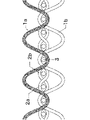
- FIG. 1 is a schematic diagram showing a cross-sectional structure of a towel cloth according to an embodiment of the present invention
- FIG. 2A is an enlarged photograph of a single spun and twisted yarn of Example 1
- FIG. 2B is an enlarged photograph of a single spun and twisted yarn of Comparative Example 1.
- 2C shows an enlarged photograph of the spun plied twisted single yarn of Comparative Example 2.
- FIG. 1 is a schematic diagram showing the cross-sectional structure of the towel cloth according to this embodiment.
- the terry cloth is constructed by intersecting pile yarns 1a and 1b in a ground structure in which warp yarns 2a and 2b and weft yarns 3 intersect.
- the upper side of FIG. 1 is the front side of the terry cloth (or ground texture)
- 1a is the front pile yarn
- 1b is the back pile yarn.
- spun and twisted yarns obtained by untwisting the spun and twisted yarns described below are used for the pile yarns 1a and 1b.
- the spun plied yarn used for the pile yarns 1a and 1b is formed by twisting two roving yarns such as cotton arranged in parallel as a single yarn in the first twist direction. At this time, one of the roving yarns is uniformly twisted, but the other roving yarn varies in strand length and twisting angle, and the resulting spun yarn is two-ply yarn with a slight real twist here and there. It becomes a single yarn in a state like For this reason, the spun plied yarn has an distorted twist structure in which a number of irregular twists and strongly entangled portions are present in the single yarn.
- the spun plied yarn according to the present embodiment is prepared by arranging two or more rovings into a single yarn and pre-twisting them. As described above, the spun plied yarn is preferably prepared by aligning two roving yarns in parallel and plying them into a single yarn. If both of the roving yarns to be pulled are made of cotton, the terry cloth using this will have the unique dry feel of cotton and will be excellent in water absorbency and hygroscopicity.
- One roving yarn of cotton and one synthetic fiber yarn of long fibers or short fibers such as polyester or polyamide may be spun and twisted to form a single yarn.
- the spun plied twisted yarn is untwisted while rubbing the spun plied twisted yarn with a rubber belt to develop finely raised fluff on the surface of the yarn and at the same time physically open the yarn.
- the warp is expanded to form a spun plied and twisted yarn.
- the developed fine fluff is pulled out from the strongly entangled portion of the yarn and raised, and the spun, plied and twisted yarn has fluff-shedding resistance and significantly improves fluff-shedding property.
- the untwisted yarns are opened and swelled, so that a high bulkiness and a soft texture can be obtained.
- the spun plied and twisted yarn according to the present embodiment is a single yarn of a spun plied twisted yarn obtained by ply twisting two or more rovings in the ply twisting direction, and ply twisting in the direction opposite to the ply twisting direction to untwist. do.
- the untwisting rate at this time is preferably in the range of 5 to 80% of the number of rotations of the first twist, from the viewpoints of puffy texture, fluff removal property, and water absorbency. Furthermore, those in the range of 10 to 65% are particularly preferred. If the amount is less than 5%, the texture and water absorbency are poor, and if the amount exceeds 80%, the entanglement is weakened, causing fluff removal and yarn breakage.
- the yarn count of the spun and twisted yarn is preferably from 5 to 300 because it can be used for thick terry cloth and thin cloth. No. 16 to No. 100 is preferable for obtaining a particularly bulging and repulsive texture.
- the terry cloth according to the present embodiment has a basis weight in the range of 80 to 1000 g/m 2 because it can exhibit the features of the present embodiment, such as a puffy texture, fluff-removing performance, and water absorbency.
- more specific examples of terry cloth basis weight are as follows. Those of m 2 are preferred. A thickness of less than 100 g/m 2 is thin and bulky, and a thickness of more than 1000 g/m 2 is too thick and heavy.
- the terry cloth according to the present embodiment is a terry cloth in which pile yarns are anchored in a ground structure in which warp base yarns and weft base yarns intersect.
- a manufacturing comprising a step of twisting, a step of ply-twisting and untwisting a single yarn in the direction opposite to the primary twisting direction to form a spun plied twisted yarn, and a step of locking the pile yarn to the ground structure. manufactured by the method. Each step will be described in order below.
- the spun plied and twisted yarn forming step the spun plied yarn formed by preliminary twisting is untwisted in the opposite direction in the range of 5 to 80% using a rotating device.
- the rotating tool used for this untwisting is not particularly limited, but it has a surface made of a material that has a high frictional force with the yarn, and the yarn can be brought into close contact with the yarn without slipping and untwisted precisely. , rotating belts, rotating rings, rotating rolls and the like are preferred.
- Rubber, polyurethane resin, silicone resin, or the like is preferable as the material of the contact portion.
- a rubber rotating belt is particularly preferable because of its versatility, durability, and the like.
- the specific untwisting method at this time is to bring a rotating belt in close contact with the running spun plied twisted yarn (to the belly of the yarn), and rub the rotating belt in the opposite direction to the first twisting direction.
- the plied yarn is untwisted to obtain a spun plied and twisted yarn.
- the spun, plied, and twisted yarn develops fine fluff due to rubbing and bulges due to opening.
- the terry cloth of the present embodiment has a bulky and soft texture, improved fluff removal, and excellent water absorbency.
- a method of continuously performing the ply twisting process and the untwisting process in one process by connecting the ply twisting process and the untwisting process is effective in terms of processing efficiency and yarn quality. Especially preferred from the viewpoint of stability.
- the obtained spun and twisted yarn is used as a pile yarn, which is engaged with the ground texture in which the warp base yarn and the weft base yarn intersect, and is woven into a terry cloth.
- the spun, plied and twisted yarn can be applied to either one of the warp base yarn and the weft base yarn, or both of them.
- weaving is performed by appropriately designing the pile length, vertical density, horizontal density, basis weight, etc. according to the desired use of the towel. Quick-drying and water absorbency are not determined by basis weight, but are rate-controlled by the ratio of synthetic fibers and cotton.
- the blend ratio of the pile yarn of the spun, twisted, and twisted yarn and the synthetic fiber of the base yarn are increased.
- the drainability is improved and the quick drying property is improved.
- synthetic fibers do not absorb water, but cotton absorbs water.
- the woven terry fabric fabric is dyed.
- the dyeing process follows the normal process for cotton towels: desizing, alkali scouring, hydrogen peroxide bleaching, dyeing with reactive dyes, and setting with a pin tenter for finishing. When finishing with a white background, the dyeing process is skipped, and the finishing is done by scouring, bleaching, and setting.
- the synthetic fiber is mixed with cotton, if the synthetic fiber is polyester, it is dyed with a disperse dye at 130°C, and then the cotton side is dyed with a reactive dye at 80°C. In the case of a nylon blend, it is dyed with an acid dye, then cotton is dyed, and each is set and finished.
- the synthetic fibers When such synthetic fibers are mixed with cotton, the synthetic fibers are dyed with a disperse dye, and the cotton is dyed with a reactive dye, so that dyeing is performed in two dyeing processes.
- a disperse dye When such synthetic fibers are mixed with cotton, the synthetic fibers are dyed with a disperse dye, and the cotton is dyed with a reactive dye, so that dyeing is performed in two dyeing processes.
- a disperse dyes and reactive dyes we use the same color dyeing to make the colors of disperse dyes and reactive dyes the same, different color dyeing to dye them as completely different colors, and dark and light dyeing (chambray) to develop colors with the intention of similar color differences. Choose accordingly.
- the water absorbency of terry cloth is the ability of the terry cloth to wipe off moisture after taking a bath, etc., and was evaluated according to the modified Larose test method of JIS L-1907.
- the outline of the test is to express the sum of the water absorption speed and the amount of water absorbed by applying a load to the towel as a water absorption index.
- a terry cloth with a higher index is better because it quickly absorbs water on the skin and absorbs a large amount of water.
- the indices are as follows: 700 or more: very good water absorption, less than 500: good, less than 300: normal, less than 100: poor. The measurement was performed at five locations and the average value was used. In addition, measurements were made on the finished towel cloth (before washing) and after washing.
- Example 1 Manufacturing method and evaluation method of terry cloth Processing of spun and twisted yarn
- roving yarn equivalent to No. 32 of cotton is placed one by one on the left and right.
- a spun twisted yarn of No. 16 single yarn was made (650 turns/m, Z twist).
- the under-twisted single yarn was twisted S-twisted (right-twisted) in the opposite direction to the single yarn with a rubber belt at 150 turns/m, and untwisted while being rubbed (untwisted rate: 23%).
- an untwisted 500 turns/m, Z-twisted No. 16 single yarn was obtained.
- FIG. 2 is an enlarged photograph of the yarn single yarn of the example, and FIG.
- FIG. 2A shows an enlarged photograph of the untwisted fine-spun twisted yarn single yarn of Example 1.
- FIG. 2A shows that a spun plied yarn single yarn that is first twisted with a Z twist of 650 times / m is untwisted by twisting it with an S twist (right twist) in the opposite direction to the single yarn with a twist of 150 times / m.
- S twist right twist
- the untwisted 16th single yarn spun and twisted processed yarn is used for the front and back pile yarns of the fabric
- the warp ground yarn is the ring spun yarn 16 single yarn
- the weft ground yarn is the ring.
- a 100% cotton terry cloth was woven with a spun yarn No. 20 single yarn and a pile yarn held in such a ground structure with a warp density of 60/inch and a weft density of 42 yarns/inch.
- This woven greige fabric was desized, scoured, bleached, set, and finished with a white background according to the usual cotton processing methods.
- the finished terry cloth had a thickness of 4.45 mm and a basis weight of 422 g/m 2 .
- the finished terry cloth was evaluated in accordance with the evaluation methods described above in terms of bulkiness of the terry cloth, physical quantity of fluffy texture, ease of fluff removal, and water absorbency. Table 1 shows the evaluation results.
- FIG. 2B is an enlarged photograph of a finely spun twisted yarn single yarn twisted at 650 turns/m with a Z-twist but not subsequently untwisted. From the photograph of the twisted yarn in FIG. 2B, the appearance of fluff and the yarn diameter of the fine-spun twisted yarn were measured and evaluated.
- the finished terry cloth had a thickness of 4.01 mm and a basis weight of 433 g/m 2 . Evaluation was carried out in the same manner as in Example 1. The results are also shown in Table 1.
- FIG. 2C shows an enlarged photograph of the untwisted spun twisted single yarn of Comparative Example 2.
- FIG. 2C is an enlarged photograph of a finely spun twisted yarn single yarn twisted with 500 turns/m in a Z-twist but not subsequently untwisted. From the photograph of the twisted yarn in FIG. 2C, the appearance of fluff and the yarn diameter of the finely spun twisted yarn were measured and evaluated.
- the finished terry cloth had a thickness of 3.96 mm and a basis weight of 444 g/m 2 . Evaluation was carried out in the same manner as in Example 1. The results are also shown in Table 1.
- Example 1 was a wonderful white terry cloth that had excellent dryness, had a soft texture, did not easily lose fluff, and had high water absorbency.
- the bulk height is 10.55 cm 3 /g, which is 14% to 18% higher than Comparative Examples 1 and 2, and the compression work is 5.80 gf. cm 2 , and increased by 1.5 to 1.6 times, respectively, confirming the high bulk and soft texture.
- the fluff removal rate in washing was 0.034%, which was 25% to 26% less fluff removal compared to Comparative Examples 1 and 2.
- the wiping water absorption index before washing was 4.8 to 3.5 times that of the same comparative example, which was a good level of 500 or more. After washing, it was 1.4 to 1.2 times, which was a very excellent level of 700 or more, and the white towel exhibited high water absorbency. There were no particular problems in yarn processing, weaving, and finishing, and processing could be carried out smoothly.
- Example 2 Twisted Yarn Processing As a pile yarn, according to the method of Example 1, a spun twisted yarn of a single yarn of cotton No. 20 under-twisted in a Z twist of 580 times / m was made, and then this under-twisted single yarn was made into a single yarn. Using the same rubber belt as in Example 1, the S-twisting (right-hand twisting) in the opposite direction was applied with a ply twist of 155 turns/m to untwist (untwisting rate: 27%). As a result, untwisted 425 twists/m, Z-twisted No. 20 single yarn was obtained (580 twists/mZ ⁇ 155 twists/m, S untwisted ⁇ 425/mZ).
- this untwisted spun and plied twisted yarn of No. 20 single yarn is used for the front and back pile yarns of the fabric, and both the warp ground yarn and the weft ground yarn are the 16 single yarn of cotton ring spun yarn.
- the woven fabric was desized, scoured, bleached, dyed with a navy blue reactive dye at 80° C. for 40 minutes, and set to finish.
- the finished terry cloth had a thickness of 3.99 mm, a basis weight of 411 g/m 2 and a bulk height of 9.71 cm 3 /g.
- Example 3 As a comparison to Example 2, it was woven, dyed and finished according to Example 2, except that untwisted cotton No. 20 single yarn with Z twist of 580 turns/m was used for the pile yarn.
- the finished terry cloth had a thickness of 3.24 mm, a basis weight of 408 g/m 2 and a bulk height of 7.94 cm 3 /g.
- Example 2 has a bulk height of 9.71 cm 3 /g, which is 22% higher than that of Comparative Example 3. It had a certain texture. In addition, fluff shedding was less. As for the water absorption rate, one drop was simply dropped from a height of 10 cm using a hand-held dropper, and the water absorption rate was measured. As described above, the terry cloth was a dark blue terry cloth that was excellent in texture, fluff removal, and water absorbency. On the other hand, Comparative Example 3 was a conventional terry cloth with lower bulkiness than Example 2, and inferior in swollen feeling, fluff removal, and water absorption (water absorption speed: 2 seconds).
- Example 3 Twisted yarn processing As a pile yarn, 1 cotton roving yarn equivalent to No. 22 and polyester multifilament long fiber drawn yarn of 110 decitex, 48 filaments are arranged one by one on the left and right. 1050 times per 1 m of twist) to make a spun plied yarn of No. 16.6 single yarn (1050 times/m, Z twist). Subsequently, the under-twisted single yarn was continuously subjected to S-twisting (right-hand twisting) in the opposite direction to the single yarn with the rubber belt of Example 1, and was untwisted ( untwisting rate: 55%). As a result, untwisted 470 turns/m, Z-twisted No. 16.6 single yarn was obtained (1050 turns/mZ ⁇ 580 turns/m, S untwisted ⁇ 470/mZ). .
- the untwisted 16.6 single yarn spun and twisted processed yarn is used for the front and back pile yarns of the fabric, and the warp ground yarn is the 16 single yarn of cotton ring-spun yarn, and the weft yarn.
- No. 20 single yarn of ring-spun cotton yarn is used for the ground yarn, with a vertical density of 60/inch and a horizontal density of 42 yarns/inch.
- This woven raw fabric is desized, scoured and bleached, and the polyester side is dyed with a gray disperse dye at 130°C for 40 minutes, and then the cotton side is dyed with a black reactive dye at 80°C for 40 minutes. set and finished.
- the finished terry cloth had a thickness of 4.44 mm, a basis weight of 396 g/m 2 and a bulk height of 11.21 cm 3 /g.
- Example 4 As a comparison with Example 3, it was woven, dyed and finished according to Example 3, except that the untwisted cotton/polyester spun plied yarn was used at 1050 turns/m and Z-twist was used for the pile yarn.
- the finished terry cloth had a thickness of 3.64 mm, a basis weight of 417 g/m 2 and a bulk height of 8.73 cm 3 /g.
- Example 3 has a bulk height of 11.21 cm 3 /g, which is 28% higher than that of Comparative Example 4. It had a certain texture. In addition, fluff fell off little, and in the same simple water absorption rate evaluation as in Example 2, the water absorption was good in 1 second or less, and it had excellent functionality. In addition, it was a terry cloth dyed in shades of gray and black in chambray, which dries quickly in washing, has little shrinkage in washing, is excellent in dimensional stability, and is rich in color design. On the other hand, Comparative Example 4 was a terry cloth inferior to Example 3 in all of the properties of bulkiness, puffiness, fluff removal, and water absorbency (water absorption speed: 3 seconds).
Landscapes
- Engineering & Computer Science (AREA)
- Textile Engineering (AREA)
- Mechanical Engineering (AREA)
- Life Sciences & Earth Sciences (AREA)
- Botany (AREA)
- Yarns And Mechanical Finishing Of Yarns Or Ropes (AREA)
- Woven Fabrics (AREA)
Abstract
Priority Applications (2)
| Application Number | Priority Date | Filing Date | Title |
|---|---|---|---|
| EP22788100.0A EP4324968B1 (fr) | 2021-04-15 | 2022-04-05 | Tissu de serviette et son procédé de production |
| US17/927,551 US12060662B2 (en) | 2021-04-15 | 2022-04-05 | Towel cloth and manufacturing method thereof |
Applications Claiming Priority (2)
| Application Number | Priority Date | Filing Date | Title |
|---|---|---|---|
| JP2021-068858 | 2021-04-15 | ||
| JP2021068858A JP7051159B2 (ja) | 2021-04-15 | 2021-04-15 | タオル地及びその製造方法 |
Publications (1)
| Publication Number | Publication Date |
|---|---|
| WO2022220175A1 true WO2022220175A1 (fr) | 2022-10-20 |
Family
ID=76968143
Family Applications (1)
| Application Number | Title | Priority Date | Filing Date |
|---|---|---|---|
| PCT/JP2022/017080 Ceased WO2022220175A1 (fr) | 2021-04-15 | 2022-04-05 | Tissu de serviette et son procédé de production |
Country Status (4)
| Country | Link |
|---|---|
| US (1) | US12060662B2 (fr) |
| EP (1) | EP4324968B1 (fr) |
| JP (1) | JP7051159B2 (fr) |
| WO (1) | WO2022220175A1 (fr) |
Cited By (1)
| Publication number | Priority date | Publication date | Assignee | Title |
|---|---|---|---|---|
| JP7372718B1 (ja) | 2023-04-25 | 2023-11-01 | 伊澤タオル株式会社 | タオル生地及びその製造方法 |
Citations (10)
| Publication number | Priority date | Publication date | Assignee | Title |
|---|---|---|---|---|
| JPS5112747U (fr) | 1974-07-16 | 1976-01-30 | ||
| JPS5398442A (en) | 1977-02-02 | 1978-08-28 | Teijin Ltd | Textured yarn with hard twist hand and method of manufacture thereof |
| JPS6433227A (en) * | 1987-07-27 | 1989-02-03 | Kanebo Ltd | Slub yarn of fine spun monofilament |
| JP2000119927A (ja) | 1998-10-09 | 2000-04-25 | Nisshinbo Ind Inc | セルロース系繊維嵩高糸および嵩高織編物の製造方法 |
| JP2005200790A (ja) * | 2004-01-15 | 2005-07-28 | Unitika Textiles Ltd | 精紡交撚糸及びその製造方法 |
| JP2008025055A (ja) | 2006-07-21 | 2008-02-07 | Kuraray Trading Kk | ループパイル織編物 |
| JP2014025273A (ja) | 2012-07-27 | 2014-02-06 | Kunimoto Co Ltd | 鉄筋など棒状部材の連結具 |
| JP2017042370A (ja) * | 2015-08-27 | 2017-03-02 | 一広株式会社 | タオルおよびタオルの製造方法 |
| JP2021006671A (ja) * | 2020-09-15 | 2021-01-21 | 伊澤タオル株式会社 | タオル地及びその製造方法 |
| JP2021050462A (ja) * | 2020-12-23 | 2021-04-01 | 伊澤タオル株式会社 | タオル地 |
Family Cites Families (12)
| Publication number | Priority date | Publication date | Assignee | Title |
|---|---|---|---|---|
| GB1318413A (en) * | 1969-06-17 | 1973-05-31 | Commw Scient Ind Res Org | Yarn and method of forming same |
| CA946723A (en) | 1973-02-01 | 1974-05-07 | John W. Lacon | Method of and apparatus for forming articles from fibrous material |
| JPS5112747A (ja) | 1974-07-23 | 1976-01-31 | Nippon Telegraph & Telephone | Danseihyomenhafuiruta |
| US4059873A (en) * | 1975-08-29 | 1977-11-29 | E. I. Du Pont De Nemours And Company | Fluid process for making continuous filament heather yarn |
| CS239668B1 (en) * | 1983-09-29 | 1986-01-16 | Petr Kroupa | Buching yarn with staple fibre and its method of manufacture |
| US4809493A (en) * | 1985-11-01 | 1989-03-07 | Kuraray Company Limited | Water-absorbing shrinkable yarn |
| JPH0813283A (ja) * | 1994-06-23 | 1996-01-16 | Kanebo Ltd | タオル地 |
| CN101492843B (zh) * | 2008-12-31 | 2010-05-12 | 武汉科技学院 | 一种嵌入式系统定位纺纱方法 |
| JP7376328B2 (ja) * | 2018-11-26 | 2023-11-08 | 帝人フロンティア株式会社 | 抗菌撚糸、並びに抗菌撚糸を備える抗菌糸及び抗菌布 |
| US11598027B2 (en) * | 2019-12-18 | 2023-03-07 | Patrick Yarn Mills, Inc. | Methods and systems for forming a composite yarn |
| US20210348310A1 (en) * | 2020-03-03 | 2021-11-11 | Coats American, Inc. | Fire and abrasion resistant yarn |
| US11732388B2 (en) * | 2020-09-03 | 2023-08-22 | Loftex Home, Llc | Composite low-twist yarn towel and production method thereof |
-
2021
- 2021-04-15 JP JP2021068858A patent/JP7051159B2/ja active Active
-
2022
- 2022-04-05 WO PCT/JP2022/017080 patent/WO2022220175A1/fr not_active Ceased
- 2022-04-05 EP EP22788100.0A patent/EP4324968B1/fr active Active
- 2022-04-05 US US17/927,551 patent/US12060662B2/en active Active
Patent Citations (10)
| Publication number | Priority date | Publication date | Assignee | Title |
|---|---|---|---|---|
| JPS5112747U (fr) | 1974-07-16 | 1976-01-30 | ||
| JPS5398442A (en) | 1977-02-02 | 1978-08-28 | Teijin Ltd | Textured yarn with hard twist hand and method of manufacture thereof |
| JPS6433227A (en) * | 1987-07-27 | 1989-02-03 | Kanebo Ltd | Slub yarn of fine spun monofilament |
| JP2000119927A (ja) | 1998-10-09 | 2000-04-25 | Nisshinbo Ind Inc | セルロース系繊維嵩高糸および嵩高織編物の製造方法 |
| JP2005200790A (ja) * | 2004-01-15 | 2005-07-28 | Unitika Textiles Ltd | 精紡交撚糸及びその製造方法 |
| JP2008025055A (ja) | 2006-07-21 | 2008-02-07 | Kuraray Trading Kk | ループパイル織編物 |
| JP2014025273A (ja) | 2012-07-27 | 2014-02-06 | Kunimoto Co Ltd | 鉄筋など棒状部材の連結具 |
| JP2017042370A (ja) * | 2015-08-27 | 2017-03-02 | 一広株式会社 | タオルおよびタオルの製造方法 |
| JP2021006671A (ja) * | 2020-09-15 | 2021-01-21 | 伊澤タオル株式会社 | タオル地及びその製造方法 |
| JP2021050462A (ja) * | 2020-12-23 | 2021-04-01 | 伊澤タオル株式会社 | タオル地 |
Non-Patent Citations (2)
| Title |
|---|
| JOURNAL OF THE TEXTILE MACHINERY SOCIETY OF JAPAN, vol. 3889, no. 2, 1985, pages 108 - 110 |
| See also references of EP4324968A4 |
Cited By (3)
| Publication number | Priority date | Publication date | Assignee | Title |
|---|---|---|---|---|
| JP7372718B1 (ja) | 2023-04-25 | 2023-11-01 | 伊澤タオル株式会社 | タオル生地及びその製造方法 |
| WO2024225182A1 (fr) * | 2023-04-25 | 2024-10-31 | 伊澤タオル株式会社 | Tissu pour serviette et son procédé de fabrication |
| JP2024157230A (ja) * | 2023-04-25 | 2024-11-07 | 伊澤タオル株式会社 | タオル生地及びその製造方法 |
Also Published As
| Publication number | Publication date |
|---|---|
| US12060662B2 (en) | 2024-08-13 |
| EP4324968A1 (fr) | 2024-02-21 |
| US20240218574A1 (en) | 2024-07-04 |
| JP7051159B2 (ja) | 2022-04-11 |
| JP2021107610A (ja) | 2021-07-29 |
| EP4324968A4 (fr) | 2025-03-05 |
| EP4324968B1 (fr) | 2026-05-06 |
Similar Documents
| Publication | Publication Date | Title |
|---|---|---|
| US11952685B2 (en) | Towel cloth | |
| JP7207776B2 (ja) | タオル地及びその製造方法 | |
| WO2022059487A1 (fr) | Tissu de serviette et son procédé de production | |
| WO2024225182A1 (fr) | Tissu pour serviette et son procédé de fabrication | |
| CN205062317U (zh) | 一种抗起球磨毛面料 | |
| JP5740327B2 (ja) | 防シワ性に優れたハンカチ | |
| WO2026083756A1 (fr) | Fil filé bouclé, son procédé de fabrication, serviette bouclée l'utilisant, et procédé de fabrication de serviette bouclée | |
| US12060662B2 (en) | Towel cloth and manufacturing method thereof | |
| JP2019214814A (ja) | 紡績糸および織編物 | |
| JP7264552B2 (ja) | タオル地 | |
| KR20030036445A (ko) | 장섬유 코듀로이 직물의 제조방법 | |
| JP2010037662A (ja) | シルクライク織物 | |
| CN217324470U (zh) | 零捻双股线纱及牛仔面料 | |
| JP5298553B2 (ja) | 混繊糸及びそれを用いた織編物 | |
| JP7588009B2 (ja) | 合撚糸及びこれを用いてなる編物、織物の製造方法 | |
| JP7141781B1 (ja) | タオル生地及びその製造方法 | |
| CN218910680U (zh) | 舒弹海绵牛仔面料及牛仔服装 | |
| JP7553171B1 (ja) | タオル生地及びその製造方法 | |
| CN220619275U (zh) | 厚重舒适且纹理感强牛仔面料以及服装 | |
| US20250188654A1 (en) | Terry structure with selectively composite twist in pile and process of manufacturing | |
| JP7372954B2 (ja) | 紡績糸織物 | |
| US20250305188A1 (en) | Plied yarns constructed from different fiber types and methods of forming the plied yarns | |
| WO2025248801A1 (fr) | Fil de poil pour tissu de serviette, son procédé de production, tissu de serviette et son procédé de production | |
| CN118516793A (zh) | 纯棉桃皮绒色织面料及其加工方法 | |
| JP2026043703A (ja) | タオル生地、タオル用パイル糸およびその製造方法 |
Legal Events
| Date | Code | Title | Description |
|---|---|---|---|
| WWE | Wipo information: entry into national phase |
Ref document number: 17927551 Country of ref document: US |
|
| 121 | Ep: the epo has been informed by wipo that ep was designated in this application |
Ref document number: 22788100 Country of ref document: EP Kind code of ref document: A1 |
|
| WWE | Wipo information: entry into national phase |
Ref document number: 2022788100 Country of ref document: EP |
|
| NENP | Non-entry into the national phase |
Ref country code: DE |
|
| ENP | Entry into the national phase |
Ref document number: 2022788100 Country of ref document: EP Effective date: 20231115 |
|
| WWG | Wipo information: grant in national office |
Ref document number: 2022788100 Country of ref document: EP |