WO2022249859A1 - オキサジシラシクロペンタン化合物の製造方法 - Google Patents
オキサジシラシクロペンタン化合物の製造方法 Download PDFInfo
- Publication number
- WO2022249859A1 WO2022249859A1 PCT/JP2022/019510 JP2022019510W WO2022249859A1 WO 2022249859 A1 WO2022249859 A1 WO 2022249859A1 JP 2022019510 W JP2022019510 W JP 2022019510W WO 2022249859 A1 WO2022249859 A1 WO 2022249859A1
- Authority
- WO
- WIPO (PCT)
- Prior art keywords
- aza
- compound
- disilacyclopentane
- oxadisilacyclopentane
- tetramethyl
- Prior art date
- Legal status (The legal status is an assumption and is not a legal conclusion. Google has not performed a legal analysis and makes no representation as to the accuracy of the status listed.)
- Ceased
Links
Classifications
-
- C—CHEMISTRY; METALLURGY
- C07—ORGANIC CHEMISTRY
- C07F—ACYCLIC, CARBOCYCLIC OR HETEROCYCLIC COMPOUNDS CONTAINING ELEMENTS OTHER THAN CARBON, HYDROGEN, HALOGEN, OXYGEN, NITROGEN, SULFUR, SELENIUM OR TELLURIUM
- C07F7/00—Compounds containing elements of Groups 4 or 14 of the Periodic Table
- C07F7/02—Silicon compounds
- C07F7/08—Compounds having one or more C—Si linkages
- C07F7/0834—Compounds having one or more O-Si linkage
- C07F7/0838—Compounds with one or more Si-O-Si sequences
- C07F7/0872—Preparation and treatment thereof
- C07F7/089—Treatments not covered by a preceding group
-
- C—CHEMISTRY; METALLURGY
- C07—ORGANIC CHEMISTRY
- C07F—ACYCLIC, CARBOCYCLIC OR HETEROCYCLIC COMPOUNDS CONTAINING ELEMENTS OTHER THAN CARBON, HYDROGEN, HALOGEN, OXYGEN, NITROGEN, SULFUR, SELENIUM OR TELLURIUM
- C07F7/00—Compounds containing elements of Groups 4 or 14 of the Periodic Table
- C07F7/02—Silicon compounds
- C07F7/08—Compounds having one or more C—Si linkages
- C07F7/0834—Compounds having one or more O-Si linkage
- C07F7/0838—Compounds with one or more Si-O-Si sequences
- C07F7/0872—Preparation and treatment thereof
- C07F7/0874—Reactions involving a bond of the Si-O-Si linkage
-
- C—CHEMISTRY; METALLURGY
- C07—ORGANIC CHEMISTRY
- C07F—ACYCLIC, CARBOCYCLIC OR HETEROCYCLIC COMPOUNDS CONTAINING ELEMENTS OTHER THAN CARBON, HYDROGEN, HALOGEN, OXYGEN, NITROGEN, SULFUR, SELENIUM OR TELLURIUM
- C07F7/00—Compounds containing elements of Groups 4 or 14 of the Periodic Table
- C07F7/02—Silicon compounds
- C07F7/08—Compounds having one or more C—Si linkages
- C07F7/10—Compounds having one or more C—Si linkages containing nitrogen having a Si-N linkage
Definitions
- the present invention relates to a method for producing an oxadisilacyclopentane compound.
- the oxadisilacyclopentane compound is useful as a raw material compound for heat-resistant materials, electronic materials, optical materials, cosmetics, and the like.
- oxadisilacyclopentane compound for example, 1,2-bis(chlorodimethylsilyl)ethane obtained by the hydrosilylation reaction of chlorodimethylvinylsilane and chlorodimethylsilane is reacted with water to produce high A method of thermally decomposing a molecular compound (see Patent Document 1), a method of reacting 1,3-bis(chloromethyl)-1,1,3,3-tetramethyldisiloxane with magnesium (see Non-Patent Document 1).
- 2,2,5,5-tetramethyl-1-oxa-2,5-disilacyclopentane is produced by the reaction of 1,2-bis(chlorodimethylsilyl)ethane and water.
- the hydrogen chloride produced by this reaction acts as a catalyst, the ring-opening reaction proceeds, and a polymer compound is rapidly formed. Therefore, a thermal decomposition reaction is required to obtain 2,2,5,5-tetramethyl-1-oxa-2,5-disilacyclopentane from this polymer compound.
- a temperature of at least 200°C or higher is required, and a temperature of 300°C or higher is required to obtain the target product at a practical reaction rate. It is not industrially advantageous because it requires energy.
- Non-Patent Document 1 the reaction must be carried out while adding magnesium as needed to suppress side reactions, which complicates the operation and is not industrially advantageous.
- the method of Non-Patent Document 2 not only requires a two-step reaction to obtain the desired oxadisilacyclopentane compound, but also has a low yield and requires the use of a highly toxic tin compound. , was not industrially advantageous.
- the present invention has been made in view of the above circumstances, and an object of the present invention is to provide a method for producing an oxadisilacyclopentane compound efficiently and in good yield.
- the present inventors have found that by reacting an azadisilacyclopentane compound with water, oxadisila can be obtained without requiring a reaction at high temperatures or complicated operations.
- a cyclopentane compound can be obtained, and the method for obtaining an oxadisilacyclopentane compound in this way suppresses the formation reaction of a polymer compound due to the ring-opening reaction of the oxadisilacyclopentane compound in the reaction system.
- the present invention has been completed by finding that
- R 1 to R 4 each independently represent an unsubstituted monovalent hydrocarbon group having 1 to 4 carbon atoms
- R 5 is a hydrogen atom, a substituted or unsubstituted A monovalent hydrocarbon group or the following general formula (2) (Wherein, R 1 to R 4 have the same meanings as above, m is an integer of 0 to 5, and n is an integer of 1 to 5.
- a dashed line represents a bond.
- the azadisilacyclopentane compound represented by the following general formula (3) is reacted with water (In the formula, R 1 to R 4 have the same meanings as above.)
- a method for producing an oxadisilacyclopentane compound represented by 2. A method for producing an oxadisilacyclopentane compound according to 1, using an acid compound as a catalyst, 3. 2. The method for producing an oxadisilacyclopentane compound according to 2, wherein the acid compound is a carboxylic acid; 4.
- an oxadisilacyclopentane compound useful as a raw material compound for heat-resistant materials, electronic materials, optical materials, cosmetics, etc. can be produced efficiently and in good yield.
- the method for producing an oxadisilacyclopentane compound of the present invention comprises reacting an azadisilacyclopentane compound represented by the following general formula (1) (hereinafter referred to as “compound (1)”) with water, An oxadisilacyclopentane compound represented by the following general formula (3) (hereinafter referred to as “compound (3)”) is obtained.
- compound (1) an azadisilacyclopentane compound represented by the following general formula (1)
- compound (3) an oxadisilacyclopentane compound represented by the following general formula (3)
- R 1 to R 4 each independently represent an unsubstituted monovalent hydrocarbon group having 1 to 4 carbon atoms.
- the unsubstituted monovalent hydrocarbon group having 1 to 4 carbon atoms represented by R 1 to R 4 may be linear, branched or cyclic, and examples thereof include alkyl and alkenyl groups. Specific examples thereof include linear alkyl groups such as methyl, ethyl, n-propyl and n-butyl groups; branched alkyl groups such as isopropyl, isobutyl, sec-butyl and tert-butyl groups; cyclopropyl and cyclobutyl groups.
- alkyl groups alkenyl groups such as vinyl, allyl, 1-propenyl, isopropenyl and 1-butenyl groups; Among these, an alkyl group having 1 to 3 carbon atoms is preferable, and a methyl group and an ethyl group are more preferable.
- R 5 represents a hydrogen atom, a substituted or unsubstituted monovalent hydrocarbon group having 1 to 20 carbon atoms, or a group represented by general formula (2) below.
- the substituted or unsubstituted monovalent hydrocarbon group having 1 to 20 carbon atoms for R 5 may be linear, branched or cyclic, and has 1 to 20 carbon atoms, preferably 1 to 10 carbon atoms, more Alkyl groups preferably having 1 to 6 carbon atoms; alkenyl groups having 2 to 20 carbon atoms, preferably 2 to 10 carbon atoms, more preferably 2 to 6 carbon atoms; aryl groups having 6 to 20 carbon atoms, preferably 6 to 10 carbon atoms; 20, preferably 7 to 10 aralkyl groups, and the like.
- n-octyl n-decyl, n-dodecyl, n-tetradecyl, n-hexadecyl, Linear alkyl groups such as n-octadecyl and n-icosyl groups; Branched alkyl groups such as isopropyl, isobutyl, sec-butyl, tert-butyl, thexyl and 2-ethylhexyl groups; Cyclic groups such as cyclopentyl and cyclohexyl groups alkenyl groups such as vinyl, allyl, 1-butenyl and 1-pentenyl groups; aryl groups such as phenyl and tolyl groups; and aralkyl groups such as benzyl groups.
- the hydrogen atoms of these monovalent hydrocarbon groups may be substituted, and specific examples of the substituents include alkoxy groups such as methoxy, ethoxy and (n- or iso)propoxy groups.
- substituents include alkoxy groups such as methoxy, ethoxy and (n- or iso)propoxy groups.
- halogen atoms such as a fluorine atom, a chlorine atom, a bromine atom and an iodine atom; a cyano group; an amino group; and an acyl group having 2 to 10 carbon atoms.
- the monovalent hydrocarbon group for R 5 is a C 1-3 hydrocarbon group such as methyl, ethyl, (n- or isopropyl), etc., from the viewpoint of the availability of raw materials and usefulness of the product.
- alkyl groups alkenyl groups having 3 to 5 carbon atoms such as allyl, 1-butenyl and 1-pentenyl groups, and aryl groups such
- n is an integer of 1-5, preferably an integer of 1-4, more preferably 2 or 3;
- a preferred combination of m and n is where m is 0 or 1 and n is 2 or 3.
- group represented by formula (2) examples include (2,2,5,5-tetramethyl-1-aza-2,5-disilacyclopent-1-yl)ethyl, (2, 2,5,5-tetraethyl-1-aza-2,5-disilacyclopent-1-yl)ethyl, (2,2,5,5-tetrapropyl-1-aza-2,5-disilacyclo pent-1-yl)ethyl, (2,2,5,5-tetraisopropyl-1-aza-2,5-disilacyclopent-1-yl)ethyl, (2,2,5,5-tetrabutyl- 1-aza-2,5-disilacyclopent-1-yl)ethyl, (2,2,5,5-tetramethyl-1-aza-2,5-disilacyclopent-1-yl)propyl, (2,2,5,5-tetraethyl-1-aza-2,5-disilacyclopent-1-yl)
- the group represented by the general formula (2) for R 5 is (2,2,5,5-tetramethyl-1-aza -2,5-disilacyclopent-1-yl)ethyl group, (2,2,5,5-tetramethyl-1-aza-2,5-disilacyclopent-1-yl)ethylaminoethyl group is preferred.
- R 5 is a hydrogen atom, an allyl group, a 2,2,5,5-tetramethyl-1-aza-2,5-disilacyclopent-1-yl)ethyl group, ( A 2,2,5,5-tetramethyl-1-aza-2,5-disilacyclopent-1-yl)ethylaminoethyl group is more preferred.
- compound (1) examples include 2,2,5,5-tetramethyl-1-aza-2,5-disilacyclopentane, 2,2,5,5-tetraethyl-1-aza-2, 5-disilacyclopentane, 2,2,5,5-tetrapropyl-1-aza-2,5-disilacyclopentane, 2,2,5,5-tetraisopropyl-1-aza-2,5- Disilacyclopentane, 2,2,5,5-tetrabutyl-1-aza-2,5-disilacyclopentane, 2,5-diethyl-2,5-dimethyl-1-aza-2,5-disila Cyclopentane, 2,5-di-tert-butyl-2,5-dimethyl-1-aza-2,5-disilacyclopentane, 1,2,2,5,5-pentamethyl-1-aza-2,5 -disilacyclopentane, 1-methyl-2,2,5,5-tetraethyl
- 2,2,5,5-tetramethyl-1-aza-2,5-disilacyclopentane, 1-allyl-2,2, 5,5-tetramethyl-1-aza-2,5-disilacyclopentane, 1,1′-(1,2-ethanediyl)bis(2,2,5,5-tetramethyl-1-aza-2 ,5-disilacyclopentane) and bis[(2,2,5,5-tetramethyl-1-aza-2,5-disilacyclopent-1-yl)ethyl]amine are preferred.
- These compounds may be commercially available ones or may be produced. When it is produced, it can be obtained by a conventionally known method, for example, by reacting a primary amine compound with a 1,2-bis(chlorosilyl)ethane compound.
- the compounding ratio of the above compound (1) and water is not particularly limited, but from the viewpoint of reactivity and productivity, 0.5 to 50.5 ml of water per 1 mol of the azadisilacyclopentane moiety of compound (1) is used. 0 mol is preferred, and 0.8 to 20.0 mol is more preferred.
- the catalyst used is preferably an acid compound, and specific examples thereof include inorganic acids such as hydrochloric acid, sulfuric acid, and nitric acid; methanesulfonic acid, benzenesulfonic acid, p-toluenesulfonic acid, dodecylbenzenesulfonic acid, trifluoromethane Sulfonic acid compounds such as sulfonic acid; carboxylic acids such as acetic acid, propionic acid, butyric acid, malonic acid, succinic acid, maleic acid, benzoic acid, and phthalic acid; salts of the above acids; aluminum chloride, zinc chloride, titanium tetrachloride, etc. Examples include Lewis acid compounds. Among these, carboxylic acids are particularly preferred, and acetic acid is more preferred.
- the amount used is not particularly limited, but from the viewpoint of reactivity and productivity, it is preferably 0.0001 to 0.5 mol, and 0.001 to 0.2 mol, per 1 mol of compound (1). Mole is more preferred.
- reaction can be carried out without a solvent.
- compound (1) may be added to water, or water may be added to compound (1).
- a more preferable method is to add compound (1) dropwise to .
- an acid compound as a catalyst it is preferable to use it by mixing with water.
- the said reaction can also be performed using a solvent.
- the solvent include any solvent that does not inhibit the reaction, and hydrocarbon solvents such as pentane, hexane, cyclohexane, heptane, isooctane, benzene, toluene, and xylene; diethyl ether, tetrahydrofuran, dioxane, and ethylene glycol.
- Ether solvents such as dimethyl ether, ethylene glycol diethyl ether, diethylene glycol dimethyl ether, diethylene glycol diethyl ether, dipropylene glycol dimethyl ether, dipropylene glycol diethyl ether; ester solvents such as ethyl acetate, butyl acetate, propylene glycol monomethyl ether acetate; acetonitrile, N , N-dimethylformamide, N-methylpyrrolidone, aprotic polar solvents such as dimethylsulfoxide; chlorinated hydrocarbon solvents such as dichloromethane and chloroform; alcoholic solvents such as methanol and ethanol; A seed
- compound (1), water and the solvent can be mixed in any order, but it is preferable to mix a mixture of compound (1) and solvent with water. It is more preferable to add water to the mixture, and it is even more preferable to add water dropwise to the same mixture. In this case, water may be used as a mixture with a solvent.
- the mixing ratio of water and solvent is not particularly limited, but the weight ratio of water/solvent is preferably 1/0.5 to 1/5.
- a catalyst it may be added to the mixture of compound (1) and solvent or to water.
- the reaction temperature for the above reaction is not particularly limited, but is preferably 0 to 100°C, more preferably 15 to 85°C, even more preferably 20 to 80°C, and even more preferably 20 to 70°C.
- the reaction time is also not particularly limited, but preferably 1 to 15 hours, more preferably 1 to 10 hours, even more preferably 1 to 7 hours, and even more preferably 1 to 5 hours.
- the above reaction may be performed in the air or in an atmosphere of an inert gas such as nitrogen or argon.
- Compound (1) undergoes an irreversible reaction with water under mild conditions and is converted to the desired compound (3).
- the method of obtaining compound (3) in this way the formation reaction of the polymer compound due to the ring-opening reaction of compound (1) in the reaction system is suppressed. Therefore, it is more advantageous than the conventional method of thermally decomposing a polymer compound produced by reacting 1,2-bis(chlorodimethylsilyl)ethane with water, which requires a high-temperature reaction.
- reaction liquid thus obtained, liquid separation is performed as necessary, and the desired product can be obtained by ordinary methods such as distillation and distillation of low-boiling compounds.
- Example 1 200 g (11.1 mol) of water and 2.0 g (0.03 mol) of acetic acid were charged into a flask equipped with a stirrer, a reflux device, a dropping funnel and a thermometer. 159.4 g (1.0 mol) of 5-tetramethyl-1-aza-2,5-disilacyclopentane was added dropwise over 30 minutes, and the mixture was stirred at that temperature for 3 hours. After the reaction, the lower layer separated into two layers was removed, and the upper layer was distilled.
- Example 2 In a flask equipped with stirrer, reflux, dropping funnel and thermometer, 159.4 g (1.0 mol) of 2,2,5,5-tetramethyl-1-aza-2,5-disilacyclopentane, 400 g of dipropylene glycol dimethyl ether was charged, 22.5 g (1.25 mol) of water was added dropwise at 45 to 55° C. over 30 minutes, and the mixture was stirred at that temperature for 2 hours. The reaction liquid was distilled to obtain 115.3 g of 2,2,5,5-tetramethyl-1-oxa-2,5-disilacyclopentane as a fraction having a boiling point of 49-50° C./6.0 kPa ( Yield 72%).
- Example 3 In a flask equipped with stirrer, reflux, dropping funnel and thermometer, 159.4 g (1.0 mol) of 2,2,5,5-tetramethyl-1-aza-2,5-disilacyclopentane, 350 g of tetrahydrofuran was charged, 18.9 g (1.05 mol) of water was added dropwise at 45 to 55° C. over 2 hours, and the mixture was stirred at that temperature for 2 hours. The reaction liquid was distilled to obtain 132.0 g of 2,2,5,5-tetramethyl-1-oxa-2,5-disilacyclopentane as a fraction having a boiling point of 49-50° C./6.0 kPa ( Yield 82%).
- Example 4 In a flask equipped with stirrer, reflux, dropping funnel and thermometer, 199.4 g of 1-allyl-2,2,5,5-tetramethyl-1-aza-2,5-disilacyclopentane (1. 0 mol) and 400 g of tetrahydrofuran were charged, and a mixture of 36.0 g (1.5 mol) of water and 36.0 g of tetrahydrofuran was added dropwise at 45 to 55° C. over 8 hours, followed by stirring for 2 hours at that temperature.
- the reaction liquid was distilled to obtain 110.5 g of 2,2,5,5-tetramethyl-1-oxa-2,5-disilacyclopentane as a fraction having a boiling point of 49-50° C./6.0 kPa ( Yield 69%).
- reaction liquid was distilled to obtain 114.5 g of 2,2,5,5-tetramethyl-1-oxa-2,5-disilacyclopentane as a fraction having a boiling point of 49-50°C/6.0 kPa ( Yield 71%).
Landscapes
- Chemical & Material Sciences (AREA)
- Organic Chemistry (AREA)
- Chemical Kinetics & Catalysis (AREA)
- Low-Molecular Organic Synthesis Reactions Using Catalysts (AREA)
Abstract
Description
しかしながら、熱分解により目的のオキサジシラシクロペンタン化合物を得るためには、最低でも200℃以上、実用的な反応速度で目的物を得るには300℃以上の温度が必要となり、製造において大量のエネルギーを必要とするため工業的には有利ではない。
さらに、非特許文献2の方法では、目的のオキサジシラシクロペンタン化合物を得るのに2段階の反応が必要なだけでなく、収率が低く、毒性の高いスズ化合物を使用しなければならないため、工業的に有利ではなかった。
1. 下記一般式(1)
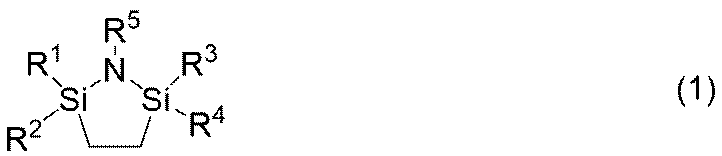
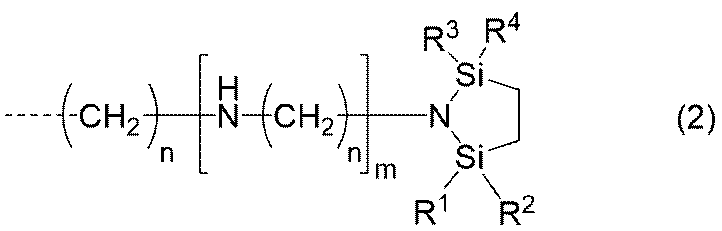
で示される基を表す。]
で示されるアザジシラシクロペンタン化合物と、水とを反応させる、下記一般式(3)

で示されるオキサジシラシクロペンタン化合物の製造方法、
2. 触媒として、酸化合物を用いる1記載のオキサジシラシクロペンタン化合物の製造方法、
3. 前記酸化合物が、カルボン酸である2記載のオキサジシラシクロペンタン化合物の製造方法、
4. 反応温度が、0~100℃である1~3のいずれかに記載のオキサジシラシクロペンタン化合物の製造方法
を提供する。
本発明のオキサジシラシクロペンタン化合物の製造方法は、下記一般式(1)で示されるアザジシラシクロペンタン化合物(以下、「化合物(1)」という。)と、水とを反応させて、下記一般式(3)で示されるオキサジシラシクロペンタン化合物(以下、「化合物(3)」という。)を得るものである。

ここで、R1~R4の炭素数1~4の非置換の1価炭化水素基は、直鎖状、分岐状または環状のいずれでもよく、アルキル、アルケニル基等が挙げられる。
その具体例としては、メチル、エチル、n-プロピル、n-ブチル基の直鎖状のアルキル基;イソプロピル、イソブチル、sec-ブチル、tert-ブチル基の分岐状のアルキル基;シクロプロピル、シクロブチル基の環状のアルキル基;ビニル、アリル、1-プロペニル、イソプロペニル、1-ブテニル基等のアルケニル基等が挙げられる。
これらの中でも、炭素数1~3のアルキル基が好ましく、メチル基、エチル基がより好ましい。

その具体例としては、メチル、エチル、n-プロピル、n-ブチル、n-ペンチル、n-ヘキシル、n-ヘプチル、n-オクチル、n-デシル、n-ドデシル、n-テトラデシル、n-ヘキサデシル、n-オクタデシル、n-イコシル基等の直鎖状のアルキル基;イソプロピル、イソブチル、sec-ブチル、tert-ブチル、テキシル、2-エチルヘキシル基等の分岐状のアルキル基;シクロペンチル、シクロヘキシル基等の環状のアルキル基;ビニル、アリル、1-ブテニル、1-ペンテニル基等のアルケニル基;フェニル、トリル基等のアリール基;ベンジル基等のアラルキル基等が挙げられる。
また、これらの1価炭化水素基の水素原子の一部または全部が置換されていてもよく、該置換基の具体例としては、メトキシ、エトキシ、(n-またはイソ)プロポキシ基等のアルコキシ基;フッ素原子、塩素原子、臭素原子、ヨウ素原子等のハロゲン原子;シアノ基;アミノ基;炭素数2~10のアシル基等が挙げられる。
これらの中でも、R5の1価炭化水素基としては、原料の入手容易性、生成物の有用性の観点から、メチル、エチル、(n-またはイソ)プロピル基等の炭素数1~3のアルキル基、アリル、1-ブテニル、1-ペンテニル基等の炭素数3~5のアルケニル基、フェニル基等のアリール基が好ましい。
nは、1~5の整数、好ましくは1~4の整数、より好ましくは2または3である。
mとnの好ましい組み合わせは、mが、0または1であり、nが、2または3の場合である。
これらの中でも、R5の一般式(2)で表される基としては、原料の入手容易性、生成物の有用性の観点から、(2,2,5,5-テトラメチル-1-アザ-2,5-ジシラシクロペント-1-イル)エチル基、(2,2,5,5-テトラメチル-1-アザ-2,5-ジシラシクロペント-1-イル)エチルアミノエチル基が好ましい。
これらの中でも、原料の入手性、生成物の有用性の観点から、2,2,5,5-テトラメチル-1-アザ-2,5-ジシラシクロペンタン、1-アリル-2,2,5,5-テトラメチル-1-アザ-2,5-ジシラシクロペンタン、1,1’-(1,2-エタンジイル)ビス(2,2,5,5-テトラメチル-1-アザ-2,5-ジシラシクロペンタン)、ビス[(2,2,5,5-テトラメチル-1-アザ-2,5-ジシラシクロペント-1-イル)エチル]アミンが好ましい。なお、これらの化合物は、市販されているものを用いてもよいし、製造してもよい。製造する場合、従来公知の方法に従えばよく、例えば、1級アミン化合物と1,2-ビス(クロロシリル)エタン化合物を反応させる方法等によって得ることができる。
用いられる触媒としては、酸化合物が好ましく、その具体例としては、例えば、塩酸、硫酸、硝酸等の無機酸;メタンスルホン酸、ベンゼンスルホン酸、p-トルエンスルホン酸、ドデシルベンゼンスルホン酸、トリフルオロメタンスルホン酸等のスルホン酸化合物;酢酸、プロピオン酸、酪酸、マロン酸、コハク酸、マレイン酸、安息香酸、フタル酸等のカルボン酸;上記酸の塩;塩化アルミニウム、塩化亜鉛、四塩化チタン等のルイス酸化合物等が挙げられる。
これらの中でも、特にカルボン酸が好ましく、酢酸がより好ましい。
この場合、化合物(1)を水に添加しても、水を化合物(1)に添加してもよいが、反応速度向上の観点から、水中に化合物(1)を添加する方法が好ましく、水中に化合物(1)を滴下する方法がより好ましい。なお、触媒として酸化合物を用いる場合、水と混合して用いることが好ましい。
溶媒の具体例としては、反応を阻害しないものであれば任意であり、ペンタン、ヘキサン、シクロヘキサン、ヘプタン、イソオクタン、ベンゼン、トルエン、キシレン等の炭化水素系溶媒;ジエチルエーテル、テトラヒドロフラン、ジオキサン、エチレングリコールジメチルエーテル、エチレングリコールジエチルエーテル、ジエチレングリコールジメチルエーテル、ジエチレングリコールジエチルエーテル、ジプロピレングリコールジメチルエーテル、ジプロピレングリコールジエチルエーテル等のエーテル系溶媒;酢酸エチル、酢酸ブチル、プロピレングリコールモノメチルエーテルアセテート等のエステル系溶媒;アセトニトリル、N,N-ジメチルホルムアミド、N-メチルピロリドン、ジメチルスルホキシド等の非プロトン性極性溶媒;ジクロロメタン、クロロホルム等の塩素化炭化水素系溶媒;メタノール、エタノール等のアルコール系溶媒等が挙げられ、これらは、1種を単独で用いても、2種以上を混合して用いてもよい。
これらの中でも、水との相溶性向上による反応速度向上の点から、エーテル系溶媒、エステル系溶媒、非プロトン性極性溶媒が好ましい。
また、反応時間も特に限定されないが、1~15時間が好ましく、1~10時間がより好ましく、1~7時間がさらに好ましく、1~5時間がより一層好ましい。
なお、上記反応は、大気下で行っても、窒素、アルゴン等の不活性ガス雰囲気下で行ってもよい。
撹拌機、還流器、滴下ロートおよび温度計を備えたフラスコに、水200g(11.1モル)、酢酸2.0g(0.03モル)を仕込み、25~35℃で2,2,5,5-テトラメチル-1-アザ-2,5-ジシラシクロペンタン159.4g(1.0モル)を30分かけて滴下し、その温度のままで3時間撹拌した。反応後、2層分離した下層を除去し、上層を蒸留した。2,2,5,5-テトラメチル-1-オキサ-2,5-ジシラシクロペンタンを沸点49-50℃/6.0kPaの留分として、105.8g得た(収率66%)。
撹拌機、還流器、滴下ロートおよび温度計を備えたフラスコに、2,2,5,5-テトラメチル-1-アザ-2,5-ジシラシクロペンタン159.4g(1.0モル)、ジプロピレングリコールジメチルエーテル400gを仕込み、45~55℃で水22.5g(1.25モル)を30分かけて滴下し、その温度のままで2時間撹拌した。反応液を蒸留し、2,2,5,5-テトラメチル-1-オキサ-2,5-ジシラシクロペンタンを沸点49-50℃/6.0kPaの留分として、115.3g得た(収率72%)。
撹拌機、還流器、滴下ロートおよび温度計を備えたフラスコに、2,2,5,5-テトラメチル-1-アザ-2,5-ジシラシクロペンタン159.4g(1.0モル)、テトラヒドロフラン350gを仕込み、45~55℃で水18.9g(1.05モル)を2時間かけて滴下し、その温度のままで2時間撹拌した。反応液を蒸留し、2,2,5,5-テトラメチル-1-オキサ-2,5-ジシラシクロペンタンを沸点49-50℃/6.0kPaの留分として、132.0g得た(収率82%)。
撹拌機、還流器、滴下ロートおよび温度計を備えたフラスコに、1-アリル-2,2,5,5-テトラメチル-1-アザ-2,5-ジシラシクロペンタン199.4g(1.0モル)、テトラヒドロフラン400gを仕込み、45~55℃で水36.0g(1.5モル)およびテトラヒドロフラン36.0gの混合液を8時間かけて滴下し、その温度のままで2時間撹拌した。反応液を蒸留し、2,2,5,5-テトラメチル-1-オキサ-2,5-ジシラシクロペンタンを沸点49-50℃/6.0kPaの留分として、110.5g得た(収率69%)。
撹拌機、還流器、滴下ロートおよび温度計を備えたフラスコに、1,1’-(1,2-エタンジイル)ビス(2,2,5,5-テトラメチル-1-アザ-2,5-ジシラシクロペンタン)172.4g(0.5モル)、テトラヒドロフラン400gを仕込み、65~75℃で水36.0g(1.5モル)およびテトラヒドロフラン36.0gの混合液を8時間かけて滴下し、その温度のままで2時間撹拌した。反応液を蒸留し、2,2,5,5-テトラメチル-1-オキサ-2,5-ジシラシクロペンタンを沸点49-50℃/6.0kPaの留分として、114.5g得た(収率71%)。
撹拌機、還流器、滴下ロートおよび温度計を備えたフラスコに、ビス[(2,2,5,5-テトラメチル-1-アザ-2,5-ジシラシクロペント-1-イル)エチル]アミン194.0g(0.5モル)、テトラヒドロフラン400gを仕込み、65~75℃で水36.0g(1.5モル)およびテトラヒドロフラン36.0gの混合液を8時間かけて滴下し、その温度のままで2時間撹拌した。反応液を蒸留し、2,2,5,5-テトラメチル-1-オキサ-2,5-ジシラシクロペンタンを沸点49-50℃/6.0kPaの留分として、128.8g得た(収率80%)。
撹拌機、還流器、滴下ロートおよび温度計を備えたフラスコに、1,2-ビス(クロロジメチルシリル)エタン215.3g(1.0モル)を仕込み、50~60℃で水900g(50.0モル)を1時間で滴下し、その温度で1時間撹拌した。反応後、2層分離した下層を除去し、上層に50質量%水酸化カリウム水溶液6.4gを添加し、生成した高分子化合物の熱分解反応を行った。目的の2,2,5,5-テトラメチル-1-オキサ-2,5-ジシラシクロペンタンの生成が確認できたのは、内温250℃以上となってからであった。370℃で5時間反応の後、蒸留を行った。2,2,5,5-テトラメチル-1-オキサ-2,5-ジシラシクロペンタンを沸点49-50℃/6.0kPaの留分として、78.3g得た(収率49%)。
Claims (4)
- 下記一般式(1)

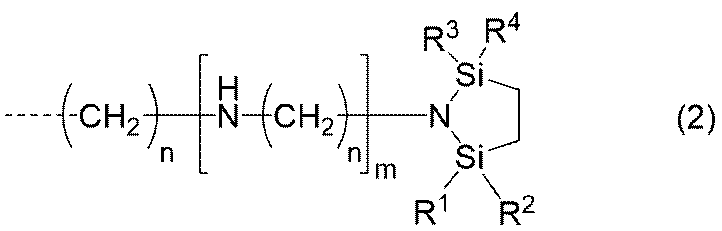
で示される基を表す。]
で示されるアザジシラシクロペンタン化合物と、水とを反応させる、下記一般式(3)

で示されるオキサジシラシクロペンタン化合物の製造方法。 - 触媒として、酸化合物を用いる請求項1記載のオキサジシラシクロペンタン化合物の製造方法。
- 前記酸化合物が、カルボン酸である請求項2記載のオキサジシラシクロペンタン化合物の製造方法。
- 反応温度が、0~100℃である請求項1~3のいずれか1項記載のオキサジシラシクロペンタン化合物の製造方法。
Priority Applications (3)
| Application Number | Priority Date | Filing Date | Title |
|---|---|---|---|
| US18/563,193 US20240279254A1 (en) | 2021-05-26 | 2022-05-02 | Method for producing oxadisilacyclopentane compound |
| EP22811133.2A EP4349841B1 (en) | 2021-05-26 | 2022-05-02 | Method for producing oxadisilacyclopentane compound |
| KR1020237043898A KR20240011762A (ko) | 2021-05-26 | 2022-05-02 | 옥사디실라시클로펜탄 화합물의 제조 방법 |
Applications Claiming Priority (2)
| Application Number | Priority Date | Filing Date | Title |
|---|---|---|---|
| JP2021-088116 | 2021-05-26 | ||
| JP2021088116 | 2021-05-26 |
Publications (1)
| Publication Number | Publication Date |
|---|---|
| WO2022249859A1 true WO2022249859A1 (ja) | 2022-12-01 |
Family
ID=84228730
Family Applications (1)
| Application Number | Title | Priority Date | Filing Date |
|---|---|---|---|
| PCT/JP2022/019510 Ceased WO2022249859A1 (ja) | 2021-05-26 | 2022-05-02 | オキサジシラシクロペンタン化合物の製造方法 |
Country Status (5)
| Country | Link |
|---|---|
| US (1) | US20240279254A1 (ja) |
| EP (1) | EP4349841B1 (ja) |
| JP (1) | JP7619323B2 (ja) |
| KR (1) | KR20240011762A (ja) |
| WO (1) | WO2022249859A1 (ja) |
Families Citing this family (1)
| Publication number | Priority date | Publication date | Assignee | Title |
|---|---|---|---|---|
| JP7722322B2 (ja) * | 2022-10-18 | 2025-08-13 | 信越化学工業株式会社 | オキサジシラシクロペンタン化合物の製造方法 |
Citations (1)
| Publication number | Priority date | Publication date | Assignee | Title |
|---|---|---|---|---|
| JPH0525182A (ja) | 1991-07-16 | 1993-02-02 | Shin Etsu Chem Co Ltd | シルエチレンオキサイドの製造方法 |
-
2022
- 2022-05-02 KR KR1020237043898A patent/KR20240011762A/ko active Pending
- 2022-05-02 WO PCT/JP2022/019510 patent/WO2022249859A1/ja not_active Ceased
- 2022-05-02 US US18/563,193 patent/US20240279254A1/en active Pending
- 2022-05-02 JP JP2022075857A patent/JP7619323B2/ja active Active
- 2022-05-02 EP EP22811133.2A patent/EP4349841B1/en active Active
Patent Citations (1)
| Publication number | Priority date | Publication date | Assignee | Title |
|---|---|---|---|---|
| JPH0525182A (ja) | 1991-07-16 | 1993-02-02 | Shin Etsu Chem Co Ltd | シルエチレンオキサイドの製造方法 |
Non-Patent Citations (5)
| Title |
|---|
| COLIN G. PITT AND KENNETH R. SKILLERN: "The Preparation, isomerization, and oxidation of silylhydrazines. ", INORGANIC CHEMISTRY, vol. 6, no. 5, 1 May 1967 (1967-05-01), pages 865 - 870, XP093010578, DOI: 10.1021/ic50051a003 * |
| INORG. CHEM., vol. 49, 2010, pages 11133 |
| PET. CHEM., vol. 56, 2016, pages 798 |
| See also references of EP4349841A4 |
| STEWART CONSTANTINE A., DICKIE DIANE A., PARKES MARIE V., SARIA JOSEPHAT A., KEMP RICHARD A.: "Reactivity of Bis(2,2,5,5-tetramethyl-2,5-disila-1-azacyclopent-1-yl)tin with CO 2 , OCS, and CS 2 and Comparison to That of Bis[bis(trimethylsilyl)amido]tin", INORGANIC CHEMISTRY, AMERICAN CHEMICAL SOCIETY, EASTON , US, vol. 49, no. 23, 6 December 2010 (2010-12-06), Easton , US , pages 11133 - 11141, XP093010579, ISSN: 0020-1669, DOI: 10.1021/ic101709q * |
Also Published As
| Publication number | Publication date |
|---|---|
| TW202313638A (zh) | 2023-04-01 |
| EP4349841A1 (en) | 2024-04-10 |
| EP4349841A4 (en) | 2025-06-18 |
| JP7619323B2 (ja) | 2025-01-22 |
| EP4349841B1 (en) | 2026-03-25 |
| US20240279254A1 (en) | 2024-08-22 |
| JP2022183028A (ja) | 2022-12-08 |
| KR20240011762A (ko) | 2024-01-26 |
Similar Documents
| Publication | Publication Date | Title |
|---|---|---|
| JP7619323B2 (ja) | オキサジシラシクロペンタン化合物の製造方法 | |
| JP7803244B2 (ja) | オキサジシラシクロペンタン化合物の製造方法 | |
| JP7722322B2 (ja) | オキサジシラシクロペンタン化合物の製造方法 | |
| KR102371954B1 (ko) | 신규 비스알콕시실란 화합물 및 그의 제조 방법 | |
| US9181284B2 (en) | Method for producing aminoalkylalkoxysilanes | |
| JP4793547B2 (ja) | オルガノシロキサンが結合したイミドの製造方法、及びオルガノシロキサンが結合したアミド酸トリオルガノシリルエステルとその製造方法 | |
| CN111630057A (zh) | 氨基碘代硅烷和合成这些氨基碘代硅烷的方法 | |
| TWI917638B (zh) | 噁二矽環戊烷化合物之製造方法 | |
| JPS6352629B2 (ja) | ||
| JP2019151598A (ja) | イミン構造含有オルガノキシシラン化合物の製造方法 | |
| JP2016040233A (ja) | ビシクロアミノオルガノキシシラン化合物及びその製造方法 | |
| JP2017206475A (ja) | カルバマトアルキルシランの製造方法 | |
| JP7310894B2 (ja) | 第1級アミノシロキサン化合物の製造方法 | |
| JP4524602B2 (ja) | かご状オリゴシロキサンの製造方法 | |
| JPH0210837B2 (ja) | ||
| US7847116B2 (en) | Method of manufacturing an aminoaryl-containing organosilicon compound and method of manufacturing an intermediate product of the aforementioned compound | |
| JP2009173637A (ja) | 有機ケイ素化合物およびその製造方法 | |
| CN112638913A (zh) | 用于制备双环胍的方法 | |
| JP7219434B2 (ja) | 環状シロキサン化合物の製造方法、環状シロキサン化合物、組成物、および耐熱性材料 | |
| JP2025015965A (ja) | 有機ケイ素化合物の製造方法 | |
| JP2888751B2 (ja) | ポリオルガノシランの製造方法 | |
| CN121175320A (zh) | 具有用甲硅烷基保护的羧基的有机氧基硅烷化合物及其制造方法 | |
| JP2006104123A (ja) | かご状オリゴシロキサンの修飾方法 | |
| JPS634548B2 (ja) | ||
| JPS6356231B2 (ja) |
Legal Events
| Date | Code | Title | Description |
|---|---|---|---|
| 121 | Ep: the epo has been informed by wipo that ep was designated in this application |
Ref document number: 22811133 Country of ref document: EP Kind code of ref document: A1 |
|
| WWE | Wipo information: entry into national phase |
Ref document number: 18563193 Country of ref document: US |
|
| ENP | Entry into the national phase |
Ref document number: 20237043898 Country of ref document: KR Kind code of ref document: A |
|
| WWE | Wipo information: entry into national phase |
Ref document number: 1020237043898 Country of ref document: KR |
|
| NENP | Non-entry into the national phase |
Ref country code: DE |
|
| WWE | Wipo information: entry into national phase |
Ref document number: 2022811133 Country of ref document: EP |
|
| ENP | Entry into the national phase |
Ref document number: 2022811133 Country of ref document: EP Effective date: 20240102 |
|
| WWG | Wipo information: grant in national office |
Ref document number: 2022811133 Country of ref document: EP |