WO2023054142A1 - 組成物、樹脂、膜および光センサ - Google Patents
組成物、樹脂、膜および光センサ Download PDFInfo
- Publication number
- WO2023054142A1 WO2023054142A1 PCT/JP2022/035284 JP2022035284W WO2023054142A1 WO 2023054142 A1 WO2023054142 A1 WO 2023054142A1 JP 2022035284 W JP2022035284 W JP 2022035284W WO 2023054142 A1 WO2023054142 A1 WO 2023054142A1
- Authority
- WO
- WIPO (PCT)
- Prior art keywords
- resin
- group
- particles
- mass
- film
- Prior art date
- Legal status (The legal status is an assumption and is not a legal conclusion. Google has not performed a legal analysis and makes no representation as to the accuracy of the status listed.)
- Ceased
Links
Images


Classifications
-
- G—PHYSICS
- G02—OPTICS
- G02B—OPTICAL ELEMENTS, SYSTEMS OR APPARATUS
- G02B5/00—Optical elements other than lenses
- G02B5/02—Diffusing elements; Afocal elements
-
- C—CHEMISTRY; METALLURGY
- C08—ORGANIC MACROMOLECULAR COMPOUNDS; THEIR PREPARATION OR CHEMICAL WORKING-UP; COMPOSITIONS BASED THEREON
- C08F—MACROMOLECULAR COMPOUNDS OBTAINED BY REACTIONS ONLY INVOLVING CARBON-TO-CARBON UNSATURATED BONDS
- C08F2/00—Processes of polymerisation
- C08F2/38—Polymerisation using regulators, e.g. chain terminating agents, e.g. telomerisation
-
- C—CHEMISTRY; METALLURGY
- C08—ORGANIC MACROMOLECULAR COMPOUNDS; THEIR PREPARATION OR CHEMICAL WORKING-UP; COMPOSITIONS BASED THEREON
- C08F—MACROMOLECULAR COMPOUNDS OBTAINED BY REACTIONS ONLY INVOLVING CARBON-TO-CARBON UNSATURATED BONDS
- C08F265/00—Macromolecular compounds obtained by polymerising monomers on to polymers of unsaturated monocarboxylic acids or derivatives thereof as defined in group C08F20/00
- C08F265/04—Macromolecular compounds obtained by polymerising monomers on to polymers of unsaturated monocarboxylic acids or derivatives thereof as defined in group C08F20/00 on to polymers of esters
- C08F265/06—Polymerisation of acrylate or methacrylate esters on to polymers thereof
-
- C—CHEMISTRY; METALLURGY
- C08—ORGANIC MACROMOLECULAR COMPOUNDS; THEIR PREPARATION OR CHEMICAL WORKING-UP; COMPOSITIONS BASED THEREON
- C08F—MACROMOLECULAR COMPOUNDS OBTAINED BY REACTIONS ONLY INVOLVING CARBON-TO-CARBON UNSATURATED BONDS
- C08F283/00—Macromolecular compounds obtained by polymerising monomers on to polymers provided for in subclass C08G
- C08F283/01—Macromolecular compounds obtained by polymerising monomers on to polymers provided for in subclass C08G on to unsaturated polyesters
-
- C—CHEMISTRY; METALLURGY
- C08—ORGANIC MACROMOLECULAR COMPOUNDS; THEIR PREPARATION OR CHEMICAL WORKING-UP; COMPOSITIONS BASED THEREON
- C08K—Use of inorganic or non-macromolecular organic substances as compounding ingredients
- C08K3/00—Use of inorganic substances as compounding ingredients
- C08K3/18—Oxygen-containing compounds, e.g. metal carbonyls
- C08K3/20—Oxides; Hydroxides
- C08K3/22—Oxides; Hydroxides of metals
- C08K2003/2237—Oxides; Hydroxides of metals of titanium
- C08K2003/2241—Titanium dioxide
-
- C—CHEMISTRY; METALLURGY
- C08—ORGANIC MACROMOLECULAR COMPOUNDS; THEIR PREPARATION OR CHEMICAL WORKING-UP; COMPOSITIONS BASED THEREON
- C08K—Use of inorganic or non-macromolecular organic substances as compounding ingredients
- C08K3/00—Use of inorganic substances as compounding ingredients
- C08K3/34—Silicon-containing compounds
- C08K3/36—Silica
Definitions
- the present invention relates to compositions, resins, films, and optical sensors containing particles with a high refractive index.
- Titanium oxide is a particle with a high refractive index. Attempts to use such particles with a high refractive index for light scattering films and the like are being investigated.
- Patent Document 1 a polyfunctional unsaturated double bond-containing monomer, an unsaturated double bond-containing acrylic copolymer, an average particle size of 0.1 to 10.0 ⁇ m, and a refractive index of 1 .34 to 1.75.
- an object of the present invention is to provide a composition with excellent curability.
- Another object of the present invention is to provide a resin, a film and an optical sensor.
- the present inventor conducted extensive studies, and as a result, found that the above-described object can be achieved with the composition described below, and completed the present invention.
- the present invention provides the following.
- a composition comprising particles having a refractive index of 2.0 or more and an average primary particle size of 200 nm or less, a film-forming component, and a solvent,
- the film-forming component contains two or more resins, or contains one or more resins and one or more polymerizable monomers,
- a composition in which at least one of the resins includes a resin a having a partial structure represented by formula (1);
- Ar 1 represents an aromatic ring
- L 1 represents a single bond or an r+1 valent linking group
- R 1 represents an ethylenically unsaturated bond-containing group
- R 10 represents a substituent
- * represents a linker
- n represents 1 or 2
- m represents 0 or an integer of 1 or more
- r represents an integer of 1 or more, when m is 2 or more, m R 10 may be the same or different,
- r 1 's may be the same or different.
- the film-forming component includes a resin as a dispersant for the particles and a resin as a binder, and at least one selected from the resin as the dispersant for the particles and the resin as the binder is The composition according to ⁇ 1> or ⁇ 2>, which is resin a.
- the film-forming component contains 40 to 250 parts by mass of the resin as the binder with respect to 100 parts by mass of the resin as the dispersing agent for the particles.
- the film-forming component includes a resin having a structure in which a plurality of polymer chains are bonded to a trivalent or higher linking group, and a resin having a repeating unit having a graft chain, At least one selected from a resin having a structure in which a plurality of polymer chains are bonded to the trivalent or higher linking group and a resin having a repeating unit having a graft chain is the resin a.
- ⁇ 6> The composition according to ⁇ 5>, wherein the graft chain includes repeating units of a polyester structure.
- the resin a is a resin containing at least one repeating unit selected from repeating units represented by formula (1-1) and repeating units represented by formula (1-2), ⁇ 1
- resin a has an acid value of 20 to 200 mgKOH/g. ⁇ 10>
- a film having a thickness of 8 ⁇ m was formed by heating at 200° C. for 5 minutes using the composition, the film contained a first phase containing the particles and the first phase.
- a phase-separated structure is formed with a second phase containing less particles than the second phase.
- the particles have an average primary particle size of 100 nm or less.
- the particles are inorganic particles.
- the inorganic particles include titanium oxide particles, strontium titanate particles, barium titanate particles, zinc oxide particles, magnesium oxide particles, zirconium oxide particles, aluminum oxide particles, aluminum hydroxide particles, barium sulfate particles and zinc sulfide particles.
- composition according to ⁇ 13> comprising at least one selected from ⁇ 15> Resin containing at least one repeating unit selected from repeating units represented by formula (1-1) and repeating units represented by formula (1-2); wherein L 1 represents a single bond or an r+1 valent linking group, R 1 represents an ethylenically unsaturated bond-containing group, R 2 and R 3 each independently represent a hydrogen atom or an alkyl group; L 11 represents a single bond or a divalent linking group, r represents an integer of 1 or more, When r is 2 or more, r 1 's may be the same or different.
- ⁇ 16> A film obtained using the composition according to any one of ⁇ 1> to ⁇ 14>.
- ⁇ 17> An optical sensor including the film according to ⁇ 16>.
- compositions with excellent curability can be provided. Also, resins, films and optical sensors can be provided.
- FIG. 1 is a schematic diagram illustrating one embodiment of an optical sensor of the present invention
- FIG. 4 is a schematic diagram showing another embodiment of the optical sensor of the present invention
- a numerical range represented by "to” means a range including the numerical values before and after "to” as lower and upper limits.
- a description that does not indicate substitution or unsubstituted includes a group (atomic group) having no substituent and a group (atomic group) having a substituent.
- an "alkyl group” includes not only an alkyl group having no substituent (unsubstituted alkyl group) but also an alkyl group having a substituent (substituted alkyl group).
- (meth)acrylate represents acrylate and methacrylate
- (meth)acryl represents acrylic and methacryl
- (meth)allyl represents allyl and methallyl
- (meth) ) acryloyl stands for acryloyl and methacryloyl.
- Me in the chemical formulas represents a methyl group
- Et represents an ethyl group
- Pr represents a propyl group
- Bu represents a butyl group
- Ph represents a phenyl group.
- Exposure includes not only exposure using light but also drawing using particle beams such as electron beams and ion beams, unless otherwise specified.
- Light used for exposure includes actinic rays or radiation such as emission line spectra of mercury lamps, far ultraviolet rays represented by excimer lasers, extreme ultraviolet rays (EUV light), X-rays and electron beams.
- the weight average molecular weight and number average molecular weight are defined as polystyrene equivalent values measured by gel permeation chromatography (GPC).
- the weight average molecular weight (Mw) and number average molecular weight (Mn) are measured using, for example, HLC-8220GPC (manufactured by Tosoh Corporation) and TOSOH TSKgel Super HZM-H and TOSOH TSKgel Super HZ4000 as columns. It can be obtained by using a column connected with TOSOH TSKgel Super HZ2000 and using tetrahydrofuran as a developing solvent.
- the refractive index value is the refractive index value for light with a wavelength of 589 nm at 23° C., unless otherwise specified.
- composition of the present invention comprises particles having a refractive index of 2.0 or more and an average primary particle size of 200 nm or less, a film-forming component, and a solvent,
- the film-forming component comprises two or more resins, or comprises one or more resins and one or more polymerizable monomers, At least one of the resins is characterized by containing a resin a having a partial structure represented by formula (1).
- the composition of the present invention contains, as film-forming components, two or more resins, or one or more resins and one or more polymerizable monomers, and at least one of the resins has the formula (1) Contains a resin a having a partial structure represented by Since the resin a has a partial structure represented by the formula (1), the ⁇ - ⁇ interaction between the aromatic rings makes it easier for the resin a to approach each other during film formation, and the curing reaction of the resin a proceeds. presumed to be easier. In addition, since the resin a has the partial structure represented by the formula (1), the curing reaction between the resin a and the film-forming components other than the resin a can also be accelerated, and the curing reaction occurs during film formation.
- the composition of the present invention has excellent curability. Since the composition of the present invention has excellent curability, the occurrence of undercuts can be suppressed, for example, when a pattern is formed by photolithography using the composition of the present invention. Also, by using the composition of the present invention, a film having excellent adhesion to a support can be formed.
- the composition of the present invention can sufficiently advance the curing reaction in the deep part of the film. Therefore, it is particularly effective when the composition of the present invention is a photocurable composition.
- the composition of the present invention preferably further contains a photopolymerization initiator (preferably a radical photopolymerization initiator).
- composition of the present invention contains particles having a refractive index of 2.0 or more and the above-described film-forming component, a film containing the above-described particles can be obtained by forming a film using the composition of the present invention. It is also possible to form a phase-separated structure of a first phase and a second phase containing less particles than the first phase.
- the resin a has a partial structure represented by formula (1), the ⁇ - ⁇ interaction between the aromatic rings and the ⁇ - ⁇ interaction between the aromatic ring and the ethylenically unsaturated bond-containing group For this reason, it is assumed that the resins a are likely to approach each other during film formation, appropriately promoting the aggregation of the resins a, and facilitating the formation of the phase separation structure.
- the position of the particles in the film is biased, and the first phase, which is a region with a large refractive index, and the region with a small refractive index in the film. It is thought that the second phase is mixed. Since light scattering occurs between these two phases, the film obtained from the composition of the present invention has excellent light scattering properties.
- the film obtained using the composition of the present invention also has excellent heat resistance. It is presumed that this is because a strong network is formed by the resin a in the film, so that fluctuations in the state of dispersion of particles in the film due to heating can be suppressed.
- the composition of the present invention also has excellent storage stability. Particles with a refractive index of 2.0 or more generally have a large specific gravity. Since particles with a small particle size are used, sedimentation of the particles in the solvent-containing composition can be suppressed, resulting in excellent storage stability.
- the film When the composition of the present invention is heated at 200° C. for 5 minutes to form a film having a thickness of 8 ⁇ m, the film contains the first phase containing the particles and the It is preferable to form a phase-separated structure with a second phase having a low particle content.
- a phase-separated structure By forming such a phase-separated structure in the film, the light scattering property is improved, and the angular dependence of the scattered light can be reduced.
- the base material of the first phase and the second phase is a film-forming component or a cured product derived from the film-forming component.
- the mere agglomeration of the particles is one form of the particles, and the mere agglomeration of the particles itself is not the first phase.
- the first phase is a film-forming component or a cured product derived from the film-forming component in which the particles are present.
- the second phase may contain less particles than the first phase, and does not have to substantially contain the particles. It is preferable that the second phase does not substantially contain the above-mentioned particles, because it is easy to obtain better light scattering properties.
- Formation of a phase separation structure of the first phase and the second phase in the film can be observed using a scanning electron microscope (SEM), a transmission electron microscope (TEM), or an optical microscope.
- SEM scanning electron microscope
- TEM transmission electron microscope
- the composition is applied onto a support such as a glass substrate and heated at 200° C. for 5 minutes to form a film having a thickness of 4 ⁇ m.
- Observation using a microscope (SEM), a transmission electron microscope (TEM), or an optical microscope can be used to examine whether a phase separation structure of the first phase and the second phase is formed in the film.
- exposure for curing the polymerizable compound may be performed before the heating.
- phase separation structure it can be achieved by appropriately changing the types of resins and polymerizable monomers used as film-forming components.
- a method of using a film-forming component containing a first resin and a second resin having low compatibility with the first resin When such a film-forming component is used, a phase separation structure of a phase containing the first resin as the main component and a phase containing the second resin as the main component can be formed during film formation.
- the phase containing the resin as a dispersant as a main component A large number of particles can be unevenly distributed.
- a method of using a first resin and a polymerizable monomer having low compatibility with the first resin as a film-forming component is used.
- a phase separation structure of a phase containing the first resin as a main component and a phase containing a cured product derived from a polymerizable monomer as a main component is formed during film formation. can be done.
- the types of resins and polymerizable monomers used in the film-forming component are changed as appropriate, and the film-forming component undergoes spinodal decomposition during film formation to form a first phase and a second phase. and a method of forming a phase separation structure.
- the phase-separated structure in the film preferably has a phase interface isotropically present in the film, and is more preferably a sea-island structure or a co-continuous phase structure, for example.
- the sea-island structure is a structure formed by a continuous sea region and a discontinuous island region.
- the second phase may be the sea and the first phase may form islands, or the first phase may be the sea and the second phase may form islands. The case where the first phase is the sea and the second phase forms islands is preferable from the viewpoint of transmittance.
- a co-continuous phase structure is a network structure in which each of the first phase and the second phase forms a continuous phase structure in an interpenetrating manner.
- the maximum transmittance of light in the wavelength range of 400 to 700 nm of this film is the wavelength of light scattering. From the viewpoint of reducing dependence, it is preferably 80% or less, more preferably 70% or less, even more preferably 60% or less, and particularly preferably 50% or less.
- the lower limit of the maximum value of the transmittance is preferably 1% or more, more preferably 5% or more, still more preferably 10% or more, and even more preferably 15% or more. % or more is particularly preferable.
- the maximum transmittance of light of 400 to 1000 nm of the film is preferably 80% or less, more preferably 75% or less, further preferably 70% or less, and 60% or less. is more preferably 50% or less is particularly preferable.
- the lower limit of the maximum value of the transmittance is preferably 1% or more, more preferably 5% or more, still more preferably 10% or more, and even more preferably 15% or more. % or more is particularly preferable.
- the average value of the interphase refractive index difference in the film is preferably 0.1 or more, more preferably 0.2 or more, further preferably 0.3 or more, and 0.4 or more. It is particularly preferred to have
- the haze of the film based on JIS K 7136 is preferably 30 to 100%.
- the upper limit is preferably 99% or less, more preferably 95% or less, and even more preferably 90% or less.
- the lower limit is preferably 35% or more, more preferably 40% or more, and even more preferably 50% or more.
- Formation of a film having such spectral characteristics can be achieved by appropriately adjusting the shape of the phase separation structure, the refractive index of the particles, the amount of particles present in the film and the uneven distribution of the particles. At this time, the higher the refractive index of the particles, the abundance of the particles, and the uneven distribution of the particles, the better.
- the solid content concentration of the composition of the present invention is preferably 5-80% by mass.
- the upper limit is preferably 75% by mass or less, more preferably 70% by mass or less.
- the lower limit is preferably 10% by mass or more, more preferably 15% by mass or more, and even more preferably 20% by mass or more.
- composition of the present invention contains particles (hereinafter also referred to as particles P1) having a refractive index of 2.0 or more and an average primary particle diameter of 200 nm or less.
- the average primary particle size of the particles P1 is 200 nm or less, and preferably 100 nm or less from the viewpoint of storage stability of the composition.
- the average primary particle diameter of the particles P1 is preferably 5 nm or more and 100 nm or less, more preferably 10 nm or more and 100 nm or less, from the viewpoint of the storage stability of the composition and the light scattering properties of the resulting film, and 20 nm. It is more preferably 100 nm or less, still more preferably 30 nm or more and 100 nm or less, even more preferably 40 nm or more and 100 nm or less, and particularly preferably 50 nm or more and 100 nm or less.
- the average primary particle size of particles is a value measured by the following method. That is, the primary particle diameter of the particles can be obtained by observing the particles with a transmission electron microscope (TEM) and observing a portion where the particles are not aggregated (primary particles). The particle size distribution of the particles can be determined by taking a transmission electron micrograph of the primary particles using a transmission electron microscope and then using the photograph to measure the particle size distribution with an image processor. In the present specification, the average primary particle diameter of particles is defined as the number-based arithmetic mean diameter calculated from the particle size distribution. In this specification, an electron microscope (H-7000) manufactured by Hitachi Ltd. is used as a transmission electron microscope, and Luzex AP manufactured by Nireco Corporation is used as an image processing apparatus.
- H-7000 electron microscope manufactured by Hitachi Ltd.
- the refractive index of the particles P1 is 2.0 or more, preferably 2.2 or more, and more preferably 2.4 or more.
- the upper limit of the refractive index of the particles P1 is not particularly limited, it can be 5 or less, and can also be 4 or less.
- the refractive index of the particles is the value measured by the following method.
- a dispersion liquid is prepared using particles, a resin (dispersant) having a known refractive index, and propylene glycol monomethyl ether acetate.
- the prepared dispersion liquid and a resin having a known refractive index are mixed to prepare coating liquids having particle concentrations of 10% by mass, 20% by mass, 30% by mass, and 40% by mass in the total solid content of the coating liquid. do.
- the refractive index of the resulting film is measured using ellipsometry (Lambda Ace RE-3300, manufactured by SCREEN Holdings Co., Ltd.). The refractive index corresponding to the particle concentration is then plotted on a graph to derive the particle refractive index.
- the specific gravity of the particles P1 is preferably 1-7 g/cm 3 .
- the upper limit is preferably 6 g/cm 3 or less, more preferably 5 g/cm 3 or less.
- the lower limit of the specific gravity is not particularly limited, it can be 1.5 g/cm 3 or more, and can also be 2 g/cm 3 or more.
- the particles P1 are preferably transparent or white particles. Moreover, the particles P1 are preferably inorganic particles. Specific examples of inorganic particles include titanium oxide particles, strontium titanate particles, barium titanate particles, zinc oxide particles, magnesium oxide particles, zirconium oxide particles, aluminum oxide particles, barium sulfate particles, and zinc sulfide particles.
- the inorganic particles used as the particles P1 are preferably particles containing titanium atoms, more preferably titanium oxide particles.
- the titanium oxide particles preferably have a titanium dioxide (TiO 2 ) content (purity) of 70% by mass or more, more preferably 80% by mass or more, and even more preferably 85% by mass or more.
- the titanium oxide particles preferably have a content of low order titanium oxide, titanium oxynitride, etc. represented by Ti n O 2n-1 (n represents a number of 2 to 4) of 30% by mass or less, It is more preferably 20% by mass or less, and even more preferably 15% by mass or less.
- the titanium oxide may be rutile-type titanium oxide or anatase-type titanium oxide.
- Rutile-type titanium oxide is preferred from the viewpoint of colorability and stability over time of dispersions and compositions.
- rutile-type titanium oxide has good colorability with little change in color difference even when heated.
- the rutile ratio of titanium oxide is preferably 95% or more, more preferably 99% or more.
- a known rutile-type titanium oxide can be used.
- a sulfuric acid method ilmenite ore and titanium slag are used as raw materials, which are dissolved in concentrated sulfuric acid to separate the iron content as iron sulfate, and the separated solution is hydrolyzed to obtain hydroxide precipitates.
- Rutile-type titanium oxide is preferably rutile-type titanium oxide obtained by a chlorine method.
- the specific surface area of the titanium oxide particles is preferably 10 to 400 m 2 /g, more preferably 10 to 200 m 2 /g, more preferably 10 to 400 m 2 /g, as measured by the BET (Brunauer, Emmett, Teller) method. It is more preferably 150 m 2 /g, particularly preferably 10 to 40 m 2 /g, most preferably 10 to 20 m 2 /g.
- the pH of titanium oxide is preferably 6-8.
- the oil absorption of titanium oxide is preferably 10 to 60 (g/100 g), more preferably 10 to 40 (g/100 g).
- the total amount of Fe 2 O 3 , Al 2 O 3 , SiO 2 , Nb 2 O 5 and Na 2 O is preferably 0.1% by mass or less, and 0.05% by mass or less. more preferably 0.02% by mass or less, and particularly preferably substantially free of these.
- the shape of the titanium oxide particles There are no particular restrictions on the shape of the titanium oxide particles. Examples thereof include isotropic shapes (eg, spherical, polyhedral, etc.), anisotropic shapes (eg, needle-like, rod-like, plate-like, etc.), irregular shapes, and the like.
- the hardness (Mohs hardness) of the titanium oxide particles is preferably 5 to 8, more preferably 7 to 7.5.
- Inorganic particles such as titanium oxide particles may be surface-treated with a surface treatment agent such as an organic compound.
- Surface treatment agents used for surface treatment of titanium oxide include polyol, aluminum oxide, aluminum hydroxide, silica (silicon oxide), hydrated silica, alkanolamine, stearic acid, organosiloxane, zirconium oxide, hydrogen dimethicone, and silane coupling agent. , titanate coupling agents, and the like. Among them, silane coupling agents are preferred.
- the surface treatment may be carried out using a single surface treating agent, or two or more surface treating agents may be used in combination.
- Inorganic particles such as titanium oxide particles are also preferably coated with a basic metal oxide or basic metal hydroxide.
- Basic metal oxides or basic metal hydroxides include metal compounds containing magnesium, zirconium, cerium, strontium, antimony, barium, calcium, or the like.
- titanium oxide particles As titanium oxide particles, titanium oxide particles described in "Titanium Oxide Physical Properties and Applied Technology Manabu Seino, Pages 13-45, June 25, 1991, published by Gihodo Publishing" can also be suitably used.
- particles can be preferably used as the particles P1.
- a commercially available product may be used as it is, or a classified product may be used.
- Commercially available titanium oxide particles include, for example, trade names Typaque R-550, R-580, R-630, R-670, R-680, R-780 and R-780-2 manufactured by Ishihara Sangyo Co., Ltd.
- strontium titanate particles include SW-100 (manufactured by Titan Kogyo Co., Ltd.).
- barium sulfate particles include BF-1L (manufactured by Sakai Chemical Industry Co., Ltd.).
- zinc oxide particles include Zincox Super F-1 (manufactured by Hakusui Tech Co., Ltd.).
- zirconium oxide particles include Z-NX (manufactured by Taiyo Koko Co., Ltd.) and Zirconeo-Cp (manufactured by Itec Co., Ltd.).
- the content of the particles P1 is preferably 5 to 90 mass% of the total solid content of the composition.
- the upper limit is preferably 85% by mass or less, more preferably 80% by mass or less, and even more preferably 70% by mass or less.
- the lower limit is preferably 6% by mass or more, more preferably 10% by mass or more, and even more preferably 15% by mass or more.
- the composition of the present invention may contain only one type of particles P1, or may contain two or more types.
- When only one kind of particles P1 is contained better storage stability is likely to be obtained.
- the angle dependence of light scattering can be further reduced.
- the total amount thereof preferably falls within the above range.
- the composition of the present invention can contain particles having a refractive index of less than 2.0, an average primary particle size of 500 nm or more, and a specific gravity smaller than that of the particles P1 (hereinafter also referred to as particles P2).
- particles P2 a specific gravity smaller than that of the particles P1
- the average primary particle diameter of the particles P2 is 500 nm or more, preferably 500 nm or more and 6000 nm or less, more preferably 500 nm or more and 5000 nm or less, even more preferably 500 nm or more and less than 3000 nm, and 500 nm or more and 2500 nm or less. , more preferably 500 nm or more and 2000 nm or less, particularly preferably 500 nm or more and 1500 nm or less, and most preferably 500 nm or more and 1000 nm or less.
- the refractive index of the particles P2 is less than 2.0, preferably 1.9 or less, more preferably 1.8 or less, and particularly preferably 1.7 or less.
- the lower limit of the refractive index of the particles P2 is not particularly limited, it can be 1.0 or more, and can also be 1.1 or more.
- the difference between the refractive index of the particles P1 and the refractive index of the particles P2 is preferably 0.5 or more, more preferably 0.7 or more, because a film with excellent light scattering properties can be easily obtained. , is more preferably 0.9 or more.
- the value of the refractive index of the particles P1 is the mass average value of the refractive indices of the two or more types of particles P1. use. The same applies to the case where the composition of the present invention contains two or more kinds of particles P2.
- the specific gravity of the particles P2 is preferably 2.5 g/cm 3 or less, more preferably 2.4 g/cm 3 or less, even more preferably 2.2 g/cm 3 or less, and 2.0 g/cm 3 or less. /cm 3 or less is particularly preferred.
- the lower limit of the specific gravity of the particles P2 is not particularly limited, but may be 0.5 g/cm 3 or more, and may be 0.9 g/cm 3 or more.
- the particles P2 are preferably transparent or white particles.
- the particles P2 include inorganic particles and resin particles.
- the inorganic particles include silica particles, hollow titanium oxide particles, hollow zirconia particles, etc. Silica particles are preferred.
- Commercially available inorganic particles include Silysia series manufactured by Fuji Silysia Chemical Co., Ltd. (eg, Silysia 310P), and Seahoster series manufactured by Nippon Shokubai Co., Ltd. (eg, Seahoster KE-S250).
- the resin particles include particles made of synthetic resins such as (meth)acrylic resins, styrene resins, polyamide resins, polyimide resins, polyolefin resins, polyurethane resins, polyurea resins, polyester resins, melanin resins, and silicone resins, as well as chitin and chitosan. , cellulose, crosslinked starch, particles made of natural polymers such as crosslinked cellulose, and the like. Among them, synthetic resin particles are preferably used because they have advantages such as easy control of the particle size.
- fine particles may be obtained by a crushing method. , is preferable from the viewpoint of ease and accuracy of particle size control.
- a relatively hard resin such as polymethyl methacrylate (PMMA)
- PMMA polymethyl methacrylate
- Resin particles are also available as commercial products, for example, MX-40T, MX-80H3wT, MX-150, MX-180TA, MX-300, MX-500, MX-1000, MX-1500H, MR-2HG, MR-7HG, MR-10HG, MR-3GSN, MR-5GSN, MR-7G, MR-10G, MR-5C, MR-7GC (manufactured by Soken Chemical Co., Ltd., acrylic resin particles), SX-130H, SX-350H, SX-500H (manufactured by Soken Chemical Co., Ltd., styrene resin particles), MBX-5, MBX-8, MBX-12MBX-15, MBX-20, MB20X-5, MB30X-5, MB30X- 8, MB30X-20, SBX-6, SBX-8, SBX-12, SBX-17 (above, manufactured by Sekisui Plastics Co., Ltd., acrylic resin particles), Chem
- the particles P2 are also preferably hollow particles.
- Hollow particles refer to particles having a void portion in which the material constituting the particles does not exist inside from the surface of the particles.
- the size, shape, and number of void portions are not particularly limited. It may have an outer shell structure with a void in the center, or may have a structure in which a plurality of fine voids are dispersed inside the particle.
- the hollow particles preferably have a porosity of 1 to 90%.
- the lower limit of the porosity is preferably 5% or more, more preferably 10% or more.
- the upper limit of the porosity is preferably 85% or less, more preferably 80% or less.
- the porosity of the hollow particles refers to the ratio of the volume occupied by the voids to the total volume of the hollow particles. For the porosity of hollow particles, observe the hollow particles using a transmission electron microscope, measure the outer diameter and the pore diameter, and calculate the "ratio of the volume occupied by the voids to the total volume" by the following formula. can be measured by Formula: ⁇ (void diameter) 3 /(outer diameter) 3 ⁇ x 100%
- 100 hollow particles observed with a transmission electron microscope are arbitrarily selected, and the circle-equivalent diameters of the outside and voids of these hollow particles are measured to determine the outer diameter and the void diameter.
- a method of calculating the porosity by a formula and using the average value as the porosity can be used. It can also be known from the measurement of the particle refractive index if the shell material of the particle (its refractive index) and the hollow shape are known.
- the shape of the hollow particles is preferably spherical, but may be irregular or other shapes other than spherical.
- the hollow particles may be hollow particles composed of an inorganic material (hereinafter also referred to as hollow inorganic particles) or hollow particles composed of a resin material (hereinafter also referred to as hollow resin particles).
- Materials constituting the hollow resin particles include (meth) acrylic resins, styrene resins, polyamide resins, polyimide resins, polyolefin resins, polyurethane resins, polyurea resins, polyester resins, silicone resins, melanin resins, and the like. Acrylic resins and styrene resins are preferred, and (meth)acrylic resins are more preferred.
- Methods for producing hollow resin particles include, for example, a method in which resin particles are made to contain a foaming agent and then the foaming agent is foamed; A method of melting resin particles and injecting a gas such as air into them, or a method of mixing a polymerizable monomer and a non-polymerizable solvent and polymerizing them to enclose the solvent in the resin particles. After obtaining, a method of removing the solvent (hereinafter also referred to as a solvent removal method), and the like.
- the hollow inorganic particles are preferably hollow silica particles. That is, the hollow inorganic particles are preferably silica particles having a void in the center. Specific examples of hollow silica particles include hollow particles described in JP-A-2013-237593 and WO 2007/060884.
- the content of the particles P2 is preferably 1 to 70 mass% of the total solid content of the composition.
- the upper limit is preferably 60% by mass or less, more preferably 50% by mass or less.
- the lower limit is preferably 2% by mass or more, more preferably 5% by mass or more, and even more preferably 10% by mass or more.
- the composition of the present invention may contain only one type of particles P2, or may contain two or more types. When only one kind of particles P2 is contained, better storage stability is likely to be obtained. Moreover, when two or more kinds of particles P2 are included, the angle dependence of light scattering can be further reduced. When two or more kinds of particles P2 are included, the total amount thereof is preferably within the above range.
- the total content of the particles P1 and P2 in the total solid content of the composition is preferably 30% by mass or more, more preferably 35% by mass or more, and preferably 40% by mass or more. More preferred.
- the upper limit is preferably 90% by mass or less, more preferably 80% by mass or less, and even more preferably 70% by mass or less.
- the particles P1 be 20 to 500 parts by mass per 100 parts by mass of the particles P2.
- the upper limit is preferably 450 parts by mass or less, more preferably 400 parts by mass or less, and even more preferably 300 parts by mass or less.
- the lower limit is preferably 25 parts by mass or more, more preferably 30 parts by mass or more, and even more preferably 35 parts by mass or more.
- compositions of the invention contain a film-forming component.
- the film-forming component used in the present invention contains two or more resins, or one or more resins and one or more polymerizable monomers. At least one of the resins includes resin a (hereinafter also referred to as resin a) having a partial structure represented by formula (1).
- the film-forming component includes a resin.
- the resin includes a resin as a dispersant for the particles P1 and a resin as a binder, and at least one selected from the resin as a dispersant and the resin as a binder is preferably the resin a.
- both the resin as the dispersant and the resin as the binder are resin a
- the curability is good, and the effects of improving undercut, heat resistance, and tape peeling resistance are further increased.
- the resin a is a binder and the later-described resin b is a dispersant
- the interaction between the phase-separated resins increases the phase separation and improves the light scattering properties.
- the later-described resin b is the binder and the resin a is the dispersant
- the interaction between the dispersants enhances the phase separation and improves the light scattering properties.
- the film-forming component contains a resin as a dispersant and a resin as a binder
- the film-forming component contains 30 to 250 parts by mass of a resin as a binder with respect to 100 parts by mass of the resin as a dispersant.
- the lower limit is preferably 40 parts by mass or more, more preferably 50 parts by mass or more.
- the upper limit is preferably 225 parts by mass or less, more preferably 200 parts by mass or less.
- the content of the dispersant in the composition is preferably 5 to 150 parts by mass with respect to 100 parts by mass of the particles P1 described above.
- the upper limit is preferably 140 parts by mass or less, more preferably 125 parts by mass or less, and even more preferably 100 parts by mass or less.
- the lower limit is preferably 10 parts by mass or more, more preferably 15 parts by mass or more, and even more preferably 25 parts by mass or more.
- the resin as the binder preferably has low compatibility with the resin as the dispersing agent for the particles.
- the film-forming component includes a resin having a structure in which a plurality of polymer chains are bonded to a trivalent or higher linking group (hereinafter also referred to as resin A1) and a resin having a repeating unit having a graft chain (hereinafter also referred to as resin A2). and, and at least one selected from resin A1 and resin A2 is preferably resin a.
- resin A1 and resin A2 is preferably resin a.
- At least one selected from the resin A1 and the resin A2 is the resin a, so that the aggregation of the resin a is moderately promoted during film formation, and the size of the first phase and the second phase is reduced. Moderate growth is also possible, and the formation of a phase-separated structure can be further promoted. Therefore, it is possible to form a film having more excellent light scattering properties.
- Both the resin A1 and the resin A2 may be the resin a, or one of the resin A1 and the resin A2 may be the resin a and the other may be the resin b described later. When both the resin A1 and the resin A2 are the resin a, the curability is good, and the effect of improving the undercut, heat resistance, and tape peeling resistance is further increased.
- the resin A1 is the resin a and the resin b described later is the resin A2
- the phase separation property is improved and the light scattering property is improved.
- the resin A2 is the resin a and the resin b described later is the resin A1
- the phase separation property is improved and the light scattering property is improved.
- one of the resin A1 and the resin A2 is a dispersant and the other is a binder described later because the phase separation structure described above is easily formed in the film during film formation, and the resin A1 is a dispersant and the resin A2 is more preferably the binder.
- a preferred combination of the resin A1 and the resin A2 is a polymer in which the polymer chain bonded to the trivalent or higher linking group in the resin A1 contains repeating units having at least one structure selected from poly(meth)acrylic structures and polystyrene structures. and a combination in which the resin A2 is a graft chain containing repeating units of a polyester structure.
- the resin a may be a random polymer or a block polymer.
- the resin content is preferably 0.1 to 60% by mass based on the total solid content of the composition.
- the lower limit is preferably 1% by mass or more, more preferably 5% by mass or more.
- the upper limit is preferably 50% by mass or less, more preferably 45% by mass or less.
- the film-forming component is a resin (resin A2) having a repeating unit having a graft chain with respect to 100 parts by mass of a resin (resin A1) having a structure in which a plurality of polymer chains are bonded to a trivalent or higher linking group. It is preferable to contain 40 to 250 parts by mass.
- the lower limit is preferably 50 parts by mass or more, more preferably 60 parts by mass or more.
- the upper limit is preferably 225 parts by mass or less, more preferably 200 parts by mass or less.
- the total amount of the resin contained in the composition the total amount of the resin (resin A1) having a structure in which a plurality of polymer chains are bonded to a trivalent or higher linking group and the resin (resin A2) having a repeating unit having a graft chain
- the content is preferably 50% by mass or more, more preferably 80% by mass or more, and even more preferably 90% by mass or more.
- Resin a is a resin having a partial structure represented by formula (1).
- Ar 1 represents an aromatic ring
- L 1 represents a single bond or an r+1 valent linking group
- R 1 represents an ethylenically unsaturated bond-containing group
- R 10 represents a substituent
- * represents a linker
- n represents 1 or 2
- m represents 0 or an integer of 1 or more
- r represents an integer of 1 or more
- m may be the same or different
- r 1 's may be the same or different.
- the aromatic ring represented by Ar 1 in formula (1) includes an aromatic hydrocarbon ring and an aromatic heterocyclic ring, preferably an aromatic hydrocarbon ring. Heteroatoms contained in the heteroaromatic ring include nitrogen, sulfur and oxygen atoms.
- the aromatic heterocycle is preferably a 5- or 6-membered ring.
- the aromatic ring represented by Ar 1 may be a condensed ring, but is preferably a monocyclic aromatic ring. Specific examples of aromatic hydrocarbon rings include benzene ring, naphthalene ring, anthracene ring, and fluorene ring.
- aromatic heterocycles include pyrrole ring, furan ring, thiophene ring, pyridine ring, imidazole ring, pyrazole ring, oxazole ring, thiazole ring, pyridazine ring, pyrimidine ring, pyrazine ring, indole ring and isoindole.
- ring benzimidazole ring, benzoxazole ring, benzothiazole ring, benzotriazole ring, quinoline ring, isoquinoline ring, quinazoline ring, quinoxaline ring and the like.
- the aromatic ring represented by Ar 1 is preferably a benzene ring.
- Examples of the substituent represented by R 10 in formula (1) include the groups exemplified for the substituent T to be described later, preferably an alkyl group, an aryl group, a heteroaryl group or a halogen atom.
- the r+1-valent linking group represented by L 1 in formula (1) includes an aliphatic hydrocarbon group, -O-, -CO-, -COO-, -OCO-, -CONH-, -NHCO-, -NH- , -S- and groups in which two or more of these are combined.
- the number of carbon atoms in the aliphatic hydrocarbon group is preferably 1-30, more preferably 1-20, even more preferably 1-15.
- the alkylene group may be linear, branched or cyclic.
- the aliphatic hydrocarbon group may have a substituent. Examples of substituents include halogen atoms, hydroxy groups, amino groups, and thiol groups, and hydroxy groups are preferred.
- the r+1 valence represented by L 1 is preferably a group represented by formula (L-1).
- *1 is a bond with Ar 1
- *2 is a bond with R 1
- L 2 represents an r+1-valent linking group
- r represents an integer of 1 or more.
- the r+1-valent linking group represented by L2 is preferably a group containing an aliphatic hydrocarbon group.
- a preferred embodiment of the r+1-valent linking group represented by L 2 includes an embodiment in which L 2 is an aliphatic hydrocarbon group.
- two or more aliphatic hydrocarbon groups are -O-, -CO-, -COO-, -OCO-, -CONH-, - Examples include a group bonded via NHCO-, -NH- or -S-.
- Examples of the ethylenically unsaturated bond-containing group represented by R 1 in formula (1) include a vinyl group, a styrene group, a maleimide group, a (meth)allyl group, a (meth)acryloyl group, a (meth)acryloyloxy group, and a (meth) acryloylamide group and the like, preferably a (meth)acryloyl group, a (meth)acryloyloxy group or a (meth)acryloylamide group, more preferably a (meth)acryloyloxy group, and an acryloyloxy group; It is even more preferable to have
- n in formula (1) represents 1 or 2, preferably 1.
- Examples of the resin containing a partial structure in which n in formula (1) is 1 include a resin containing a repeating unit represented by formula (1-1), which will be described later, and a repeating unit represented by formula (1-2). A resin etc. are mentioned.
- resins containing a partial structure in which n in formula (1) is 2 include resins containing repeating units of the structures shown below.
- n in formula (1) represents 0 or an integer of 1 or more, preferably 0, 1 or 2, more preferably 0 or 1, and still more preferably 0.
- r in formula (1) represents an integer of 1 or more, preferably 1 or 2, more preferably 2.
- Halogen atom e.g., fluorine atom, chlorine atom, bromine atom, iodine atom
- alkyl group preferably alkyl group having 1 to 30 carbon atoms
- alkenyl group preferably alkenyl group having 2 to 30 carbon atoms
- alkynyl group Preferably an alkynyl group having 2 to 30 carbon atoms
- an aryl group preferably an aryl group having 6 to 30 carbon atoms
- a heteroaryl group preferably a heteroaryl group having 1 to 30 carbon atoms
- an amino group preferably amino group having 0 to 30 carbon atoms
- alkoxy group preferably alkoxy group having 1 to 30 carbon atoms
- aryloxy group preferably aryloxy group having 6 to 30 carbon atoms
- heteroaryloxy group preferably carbon 1 to 30 heteroaryloxy groups
- acyl groups preferably acyl groups having 2 to 30 carbon atoms
- alkoxy group preferably alk
- Resin a is preferably a resin containing at least one repeating unit selected from repeating units represented by formula (1-1) and repeating units represented by formula (1-2).
- the repeating unit represented by formula (1-1) and the repeating unit represented by formula (1-2) are repeating units containing the partial structure represented by formula (1) described above.
- L 1 represents a single bond or an r+1 valent linking group
- R 1 represents an ethylenically unsaturated bond-containing group
- R 2 and R 3 each independently represent a hydrogen atom or an alkyl group
- L 11 represents a single bond or a divalent linking group
- r represents an integer of 1 or more, When r is 2 or more, r 1 's may be the same or different.
- L 1 , R 1 and r are synonymous with L 1 , R 1 and r in formulas (1-1) and (1-2) and L 1 , R 1 and r in formula (1).
- the number of carbon atoms in the alkyl group represented by R 2 in formula (1-1) is preferably 1-10, more preferably 1-5, even more preferably 1-3.
- the alkyl group may be linear, branched or cyclic, but preferably linear.
- R 2 is preferably a hydrogen atom or a methyl group, more preferably a hydrogen atom.
- the number of carbon atoms in the alkyl group represented by R 3 in formula (1-2) is preferably 1-10, more preferably 1-5, even more preferably 1-3.
- the alkyl group may be linear, branched or cyclic, but preferably linear.
- R3 is preferably a hydrogen atom or a methyl group, more preferably a methyl group.
- the divalent linking group represented by L 11 in formula (1-2) includes an alkylene group, an arylene group, -O-, -CO-, -COO-, -OCO-, -CONH-, -NHCO-, - NH—, —S— and groups in which two or more of these are combined.
- the number of carbon atoms in the alkylene group is preferably 1-30, more preferably 1-20, even more preferably 1-15.
- the alkylene group may be linear, branched or cyclic.
- the arylene group preferably has 6 to 30 carbon atoms, more preferably 6 to 20 carbon atoms, and even more preferably 6 to 10 carbon atoms.
- An alkylene group and an arylene group may have a substituent. Examples of the substituent include the groups exemplified for the substituent T described above.
- the divalent linking group represented by L 11 is preferably a group containing an alkylene group.
- the resin a preferably has an acid group.
- the acid group include a carboxy group, a sulfo group, and a phosphoric acid group, with the carboxy group being preferred.
- Resin a also preferably contains a partial structure represented by formula (2).
- Ar 2 represents an aromatic ring
- R 20 represents a substituent
- * represents a linking hand
- n represents an integer of 1 or more
- m represents 0 or an integer of 1 or more
- m R 10 may be the same or different.
- Ar 2 , R 20 , n and m in formula (2) are synonymous with Ar 1 , R 10 , n and m in formula (1).
- resin a contains a partial structure represented by formula (2)
- resin a contains at least repeating units selected from repeating units represented by formula (2-1) and repeating units represented by formula (2-2).
- a resin containing one type of repeating unit is preferred.
- R 21 and R 22 each independently represent a hydrogen atom or an alkyl group
- L21 represents a single bond or a divalent linking group.
- R 21 in formula (2-1) are the same as those described for R 2 in formula (1-1), and the preferred range is also the same.
- the details of R 22 in formula (2-2) are the same as those described for R 3 in formula (1-2), and the preferred range is also the same.
- the details of L 21 in formula (2-2) are the same as those described for L 11 in formula (1-2), and the preferred range is also the same.
- Resin a may further contain a repeating unit represented by formula (3-1). According to this aspect, it is possible to further improve heat resistance and tape peeling resistance.
- R 31 represents a hydrogen atom or an alkyl group
- L 31 represents a single bond or a divalent linking group
- R32 represents an alkyl group or an aryl group.
- the number of carbon atoms in the alkyl group represented by R 31 in formula (3-1) is preferably 1-10, more preferably 1-5, even more preferably 1-3.
- the alkyl group may be linear, branched or cyclic, but preferably linear.
- R3 is preferably a hydrogen atom or a methyl group, more preferably a methyl group.
- the divalent linking group represented by L 31 in formula (3-1) includes an alkylene group, an arylene group, -O-, -CO-, -COO-, -OCO-, -CONH-, -NHCO-, - NH—, —S— and groups in which two or more of these are combined.
- the number of carbon atoms in the alkylene group is preferably 1-30, more preferably 1-20, even more preferably 1-15.
- the alkylene group may be linear, branched or cyclic.
- the arylene group preferably has 6 to 30 carbon atoms, more preferably 6 to 20 carbon atoms, and even more preferably 6 to 10 carbon atoms.
- L 31 is preferably a single bond or an alkylene group, more preferably an alkylene group.
- R 32 in formula (3-1) represents an alkyl group or an aryl group, preferably an aryl group.
- the number of carbon atoms in the alkyl group represented by R 32 is preferably 1-30, more preferably 1-20, even more preferably 1-15.
- Alkyl groups may be linear, branched or cyclic.
- the number of carbon atoms in the aryl group represented by R 32 is preferably 6-30, more preferably 6-20, even more preferably 6-10.
- Examples of the resin a include a resin having a structure in which a plurality of polymer chains are bonded to a trivalent or higher linking group (resin A1), a resin having a repeating unit having a graft chain (resin A2), a random polymer and a block polymer. , a resin having a structure in which a plurality of polymer chains are bonded to a trivalent or higher linking group (resin A1), or a resin having a repeating unit having a graft chain (resin A2).
- the resin A1 is a resin having a structure in which a plurality of polymer chains are bonded to a trivalent or higher linking group
- the polymer chains bonded to the trivalent or higher linking group are represented by the above formula (1). It preferably contains a partial structure, and more preferably contains a repeating unit represented by the above formula (1-1) or (1-2).
- a resin having a structure in which a plurality of polymer chains are bonded to a trivalent or higher linking group may be used as a binder or as a dispersant. It is preferably used as a dispersant.
- the resin a When the resin a has a structure in which a plurality of polymer chains are bonded to a trivalent or higher linking group, the resin a preferably has a structure represented by the following formula (SP-1).
- Z 1 represents a (m+n)-valent linking group
- Y 1 and Y 2 each independently represent a single bond or a linking group
- a 1 is a heterocyclic group, an acid group, a group having a basic nitrogen atom, a urea group, a urethane group, a group having a coordinating oxygen atom, a hydrocarbon group having 4 or more carbon atoms, an alkoxysilyl group, an epoxy group, represents a group containing a functional group selected from an isocyanate group and a hydroxy group
- P 1 represents a polymer chain having a partial structure represented by the above formula (1)
- n represents 1 to 20
- m represents 2 to 20
- m+n is 3 to 21
- n Y 1 and A 1
- n 1 to 20, preferably 1 to 10, more preferably 1 to 6, even more preferably 1 to 4.
- the lower limit of n can be 2 or more, or 3 or more.
- m represents 2 to 20, preferably 2 to 10, more preferably 2 to 6, even more preferably 2 to 4.
- m+n is 3 to 21, preferably 3 to 12, more preferably 3 to 10, and even more preferably 3 to 6.
- the lower limit of m+n can be 4 or more, or 5 or more.
- a 1 represents a group containing the functional group described above.
- the functional group of A 1 is preferably a heterocyclic group, an acid group, a group having a basic nitrogen atom, a hydrocarbon group having 4 or more carbon atoms and a hydroxy group, more preferably an acid group.
- the acid group include a carboxy group, a sulfo group, and a phosphoric acid group, with the carboxy group being preferred.
- At least one functional group described above may be included in one A1 , and two or more may be included.
- a 1 preferably contains 1 to 10, more preferably 1 to 6, substituents as described above.
- the group containing the above-described functional group represented by A 1 includes the above-described functional group, 1 to 200 carbon atoms, 0 to 20 nitrogen atoms, 0 to 100 oxygen atoms, 1 to 400 and a group formed by bonding with a linking group consisting of 0 to 40 sulfur atoms.
- one or more acid groups are attached via a chain saturated hydrocarbon group having 1 to 10 carbon atoms, a cyclic saturated hydrocarbon group having 3 to 10 carbon atoms, or an aromatic hydrocarbon group having 5 to 10 carbon atoms.
- a group formed by bonding and the like are included.
- the above chain saturated hydrocarbon group, cyclic saturated hydrocarbon group and aromatic hydrocarbon group may further have a substituent.
- substituents include an alkyl group having 1 to 20 carbon atoms, an aryl group having 6 to 16 carbon atoms, a hydroxy group, a carboxy group, an amino group, a sulfonamide group, an N-sulfonylamide group, an acyloxy group having 1 to 6 carbon atoms, Examples include an alkoxy group having 1 to 20 carbon atoms, a halogen atom, an alkoxycarbonyl group having 2 to 7 carbon atoms, a cyano group, a carbonate ester group, and an ethylenically unsaturated bond-containing group.
- the functional group itself may be A1 .
- the formula weight of A 1 is preferably 30-2000.
- the upper limit is preferably 1000 or less, more preferably 800 or less.
- the lower limit is preferably 50 or more, more preferably 100 or more.
- Z 1 represents a (m+n)-valent linking group.
- (m+n)-valent linking groups include 1 to 100 carbon atoms, 0 to 10 nitrogen atoms, 0 to 50 oxygen atoms, 1 to 200 hydrogen atoms, and 0 to 20 sulfur atoms.
- a group consisting of Examples of the (m+n)-valent linking group include the following structural units or groups (which may form a ring structure) formed by combining two or more of the following structural units. * in the following formulas represents a bond.
- the (m+n)-valent linking group may have a substituent.
- Substituents include an alkyl group having 1 to 20 carbon atoms, an aryl group having 6 to 16 carbon atoms, a hydroxy group, an amino group, a carboxy group, a sulfonamide group, an N-sulfonylamide group, and an acyloxy group having 1 to 6 carbon atoms. , an alkoxy group having 1 to 20 carbon atoms, a halogen atom, an alkoxycarbonyl group having 2 to 7 carbon atoms, a cyano group, a carbonate ester group, an ethylenically unsaturated bond-containing group, and the like.
- the (m+n)-valent linking group represented by Z 1 is preferably a group represented by any one of formulas (Z-1) to (Z-4).
- Lz 3 represents a trivalent group, Tz 3 represents a single bond or a divalent linking group, and three Tz 3 present may be the same or different.
- Lz 4 represents a tetravalent group, Tz 4 represents a single bond or a divalent linking group, and the four Tz 4s present may be the same or different.
- Lz 5 represents a pentavalent group, Tz 5 represents a single bond or a divalent linking group, and five Tz 5 may be the same or different.
- Lz 6 represents a hexavalent group, Tz 6 represents a single bond or a divalent linking group, and the 6 Tz 6 present may be the same or different.
- * represents a bond.
- the divalent linking groups represented by Tz 3 to Tz 6 include an alkylene group, an arylene group, a heterocyclic group, -O-, -CO-, -COO-, -OCO-, -NR-, -CONR-, - NRCO-, -S-, -SO-, -SO 2 -, and linking groups formed by linking two or more of these.
- each R independently represents a hydrogen atom, an alkyl group or an aryl group.
- the number of carbon atoms in the alkyl group and alkylene group is preferably 1-30.
- the upper limit is more preferably 25 or less, even more preferably 20 or less.
- the lower limit is more preferably 2 or more, and still more preferably 3 or more.
- Alkyl groups and alkylene groups may be linear, branched or cyclic.
- the aryl group and the arylene group preferably have 6 to 20 carbon atoms, more preferably 6 to 12 carbon atoms.
- the heterocyclic group is preferably a 5- or 6-membered ring.
- the heteroatom possessed by the heterocyclic group is preferably an oxygen atom, a nitrogen atom and a sulfur atom.
- the number of heteroatoms possessed by the heterocyclic group is preferably 1 to 3.
- Alkylene groups, arylene groups, heterocyclic groups, alkyl groups and aryl groups may be unsubstituted or may have a substituent. Examples of the substituent include the groups exemp
- Examples of the trivalent group represented by Lz 3 include groups obtained by removing one hydrogen atom from the above divalent linking group.
- Examples of the tetravalent group represented by Lz 4 include groups obtained by removing two hydrogen atoms from the above divalent linking group.
- Examples of the pentavalent group represented by Lz 5 include groups obtained by removing three hydrogen atoms from the above divalent linking group.
- Examples of the hexavalent group represented by Lz 6 include groups obtained by removing 4 hydrogen atoms from the above divalent linking group.
- the trivalent to hexavalent groups represented by Lz 3 to Lz 6 may have a substituent. Examples of the substituent include the groups exemplified for the substituent T described above.
- the chemical formula weight of Z 1 is preferably 20-3000.
- the upper limit is preferably 2000 or less, more preferably 1500 or less.
- the lower limit is preferably 50 or more, more preferably 100 or more. If the chemical formula weight of Z1 is within the above range, the dispersibility of the pigment in the composition can be improved.
- the chemical formula weight of Z1 is a value calculated from the structural formula.
- Y 1 and Y 2 each independently represent a single bond or a linking group.
- Linking groups include groups consisting of 1-100 carbon atoms, 0-10 nitrogen atoms, 0-50 oxygen atoms, 1-200 hydrogen atoms, and 0-20 sulfur atoms. be done. The groups described above may further have the substituents described above. Examples of the linking group represented by Y 1 and Y 2 include the following structural units or groups formed by combining two or more of the following structural units.
- Y 1 and Y 2 are preferably groups containing a sulfur atom.
- P 1 represents a polymer chain having the partial structure represented by formula (1) above.
- the polymer chain represented by P1 is preferably a polymer chain containing repeating units of at least one structure selected from poly(meth)acrylic structures and polystyrene structures.
- the polymer chain represented by P 1 is a polymer chain containing at least one repeating unit selected from repeating units represented by the above formula (1-1) and repeating units represented by formula (1-2). is more preferable.
- the repeating unit represented by formula (1-1) is a repeating unit having a polystyrene structure
- the repeating unit represented by formula (1-2) is a repeating unit having a poly(meth)acrylic structure.
- repeating unit (1) the repeating unit represented by formula (1-1) and the repeating unit represented by formula (1-2) are collectively referred to as repeating unit (1).
- the content of repeating unit (1) in all repeating units constituting P1 is preferably 10 to 80% by mass.
- the upper limit is preferably 75% by mass or less, more preferably 70% by mass or less.
- the lower limit is preferably 15% by mass or more, more preferably 20% by mass or more.
- the polymer chain represented by P1 may contain a repeating unit having an acid group, but preferably does not contain a repeating unit having an acid group from the viewpoint of dispersibility.
- the repeating unit having an acid group is at least one repeating unit selected from repeating units represented by the above formula (2-1) and repeating units represented by the formula (2-2). preferable.
- the repeating unit represented by formula (2-1) and the repeating unit represented by formula (2-2) are collectively referred to as repeating unit (2).
- the content of repeating units having an acid group in all repeating units constituting P 1 is preferably 0 to 90% by mass.
- the upper limit is preferably 85% by mass or less, more preferably 80% by mass or less.
- the lower limit can be 1% by mass or more, and can also be 10% by mass or more. Further, the content of the repeating unit (2) in all the repeating units constituting P1 is preferably 0 to 90% by mass.
- the upper limit is preferably 85% by mass or less, more preferably 80% by mass or less.
- the lower limit can be 1% by mass or more, and can also be 10% by mass or more.
- the polymer chain represented by P 1 further includes a repeating unit represented by the above formula (3-1).
- heat resistance and tape peeling resistance can be further improved.
- the content of the repeating unit represented by formula (3-1) in all repeating units constituting P 1 is preferably 10 to 90% by mass.
- the upper limit is preferably 85% by mass or less, more preferably 80% by mass or less.
- the lower limit is preferably 15% by mass or more, more preferably 20% by mass or more.
- the weight average molecular weight of the polymer chain represented by P 1 is preferably 1,000 or more, more preferably 1,500 to 50,000.
- the upper limit is preferably 30,000 or less, more preferably 10,000 or less.
- the lower limit is preferably 1800 or more, more preferably 2000 or more.
- the weight average molecular weight of P1 is a value calculated from the weight average molecular weight of the raw material used for introducing the polymer chain.
- Resin A2 -Resin having a repeating unit having a graft chain
- the resin a is a resin having a repeating unit having a graft chain
- the resin a is a resin containing a repeating unit having a graft chain and a repeating unit having a partial structure represented by the above formula (1).
- a resin having a repeating unit having a graft chain may be used as a binder or as a dispersant. It is preferably used as a binder.
- graft chain means a polymer chain branching from the main chain of the repeating unit.
- the length of the graft chain is not particularly limited, but the longer the graft chain, the higher the steric repulsion effect, which makes it possible to enhance the dispersibility of the particles and facilitate the formation of a phase separation structure.
- the graft chain preferably has 40 to 10,000 atoms excluding hydrogen atoms, more preferably 50 to 2,000 atoms excluding hydrogen atoms, and 60 to 60 atoms excluding hydrogen atoms. 500 is more preferred.
- the graft chain preferably contains repeating units of at least one structure selected from a polyether structure, a polyester structure, a poly(meth)acrylic structure, a polystyrene structure, a polyurethane structure, a polyurea structure and a polyamide structure. More preferably, it contains a repeating unit of at least one structure selected from a polyester structure, a poly(meth)acrylic structure and a polystyrene structure, more preferably a repeating unit of a polyether structure or a polyester structure, and a repeating unit of a polyester structure. It is particularly preferred to include units.
- Repeating units of the polyester structure include repeating units of structures represented by the following formula (G-1), formula (G-4), or formula (G-5).
- Repeating units of the polyether structure include repeating units having a structure represented by the following formula (G-2).
- Repeating units of the poly(meth)acrylic structure include repeating units having a structure represented by the following formula (G-3).
- Repeating units of a polystyrene structure include repeating units of a structure represented by the following formula (G-6).
- R G1 and R G2 each independently represent an alkylene group.
- the alkylene group represented by R G1 and R G2 is not particularly limited, but is preferably a linear or branched alkylene group having 1 to 20 carbon atoms, and a linear or branched alkylene group having 2 to 16 carbon atoms. More preferred are linear or branched alkylene groups having 3 to 12 carbon atoms.
- R G3 represents a hydrogen atom or a methyl group
- Q G1 represents -O- or -NH-
- L G1 represents a single bond or a divalent linking group
- R G4 represents hydrogen Represents an atom or substituent.
- the divalent linking group represented by L G1 includes an alkylene group (preferably an alkylene group having 1 to 12 carbon atoms), an alkyleneoxy group (preferably an alkyleneoxy group having 1 to 12 carbon atoms), an oxyalkylenecarbonyl group (preferably is an oxyalkylenecarbonyl group having 1 to 12 carbon atoms), an arylene group (preferably an arylene group having 6 to 20 carbon atoms), -NH-, -SO-, -SO 2 -, -CO-, -O-, - COO-, OCO-, -S- and groups formed by combinations of two or more of these may be mentioned.
- substituents represented by R G4 include a hydroxy group, a carboxy group, an alkyl group, an aryl group, a heterocyclic group, an alkoxy group, an aryloxy group, a heterocyclic oxy group, an alkylthioether group, an arylthioether group, a heterocyclic thioether group, Examples include ethylenically unsaturated bond-containing groups, epoxy groups, oxetanyl groups, blocked isocyanate groups, and the like.
- RG5 represents a hydrogen atom or a methyl group
- RG6 represents an aryl group.
- the aryl group represented by R G6 preferably has 6 to 30 carbon atoms, more preferably 6 to 20 carbon atoms, and still more preferably 6 to 12 carbon atoms.
- the aryl group represented by RG6 may have a substituent.
- Substituents include hydroxy group, carboxy group, alkyl group, aryl group, heterocyclic group, alkoxy group, aryloxy group, heterocyclic oxy group, alkylthioether group, arylthioether group, heterocyclic thioether group, and ethylenically unsaturated Examples include bond-containing groups, epoxy groups, oxetanyl groups, blocked isocyanate groups, and the like.
- the terminal structure of the graft chain is not particularly limited. It may be a hydrogen atom or a substituent.
- substituents include alkyl groups, aryl groups, heteroaryl groups, alkoxy groups, aryloxy groups, heteroaryloxy groups, alkylthioether groups, arylthioether groups, heteroarylthioether groups, and the like. Among them, a group having a steric repulsion effect is preferable, and an alkyl group or an alkoxy group having 5 to 24 carbon atoms is preferable from the viewpoint of improving the dispersibility of particles and facilitating the formation of a phase-separated structure during film formation.
- the alkyl group and alkoxy group may be linear, branched or cyclic, preferably linear or branched.
- the graft chain is represented by the following formula (G-1a), formula (G-2a), formula (G-3a), formula (G-4a), formula (G-5a) or formula (G-6a). and more preferably a structure represented by Formula (G-1a), Formula (G-4a) or Formula (G-5a).
- R G1 and R G2 each represent an alkylene group
- R G3 represents a hydrogen atom or a methyl group
- Q G1 represents -O- or -NH-
- L G1 represents a single bond or represents a divalent linking group
- RG4 represents a hydrogen atom or a substituent
- RG5 represents a hydrogen atom or a methyl group
- RG6 represents an aryl group
- W100 represents a hydrogen atom or a substituent
- n1 to n6 each independently represent an integer of 2 or more.
- R G1 to R G6 , Q G1 and L G1 have the same meanings as R G1 to R G6 , Q G1 and L G1 described in formulas (G-1) to (G-6), and the preferred ranges are also the same. be.
- W 100 is preferably a substituent.
- substituents include alkyl groups, aryl groups, heteroaryl groups, alkoxy groups, aryloxy groups, heteroaryloxy groups, alkylthioether groups, arylthioether groups, heteroarylthioether groups, and the like. Among them, a group having a steric repulsion effect is preferable, and an alkyl group or an alkoxy group having 5 to 24 carbon atoms is preferable from the viewpoint of improving the dispersibility of particles and facilitating the formation of a phase-separated structure during film formation.
- the alkyl group and alkoxy group may be linear, branched or cyclic, preferably linear or branched.
- each of n1 to n6 is preferably an integer of 2 to 100, more preferably an integer of 2 to 80, and even more preferably an integer of 8 to 60.
- R 1 G1 in each repeating unit when n1 is 2 or more may be the same or different.
- the arrangement of each repeating unit is not particularly limited, and may be random, alternating, or block. The same applies to formulas (G-2a) to (G-6a).
- the graft chain has a structure represented by formula (G-1a), formula (G-4a) or formula (G-5a), wherein R G1 is a structure containing two or more different repeating units. is also preferred.
- Repeating units having a graft chain include repeating units represented by formula (G-100).
- X G100 represents a trivalent linking group
- LG100 represents a single bond or a divalent linking group
- W1 represents a graft chain.
- the trivalent linking group represented by X G100 includes a poly(meth)acrylic linking group, a polyalkyleneimine linking group, a polyester linking group, a polyurethane linking group, a polyurea linking group, a polyamide linking group, and a polyether and polystyrene-based linking groups, preferably poly(meth)acrylic-based linking groups and polyalkyleneimine-based linking groups, and more preferably poly(meth)acrylic-based linking groups.
- the divalent linking group represented by LG100 includes an alkylene group (preferably an alkylene group having 1 to 12 carbon atoms), an arylene group (preferably an arylene group having 6 to 20 carbon atoms), -NH-, -SO-, -SO 2 -, -CO-, -O-, -COO-, OCO-, -S- and groups formed by combining two or more of these.
- the graft chain represented by W1 includes the graft chain described above.
- the repeating unit having a graft chain is preferably a repeating unit represented by formula (G-101).
- RG represents a hydrogen atom or an alkyl group
- LG100 represents a single bond or a divalent linking group
- W1 represents a graft chain
- L G100 and W 1 in formula (G-101) are synonymous with L G100 and W 1 in formula (G-100).
- the number of carbon atoms in the alkyl group represented by R 1 G100 in formula (G-101) is preferably 1-10, more preferably 1-5, even more preferably 1-3.
- the alkyl group may be linear, branched or cyclic, but preferably linear.
- RG100 is preferably a hydrogen atom or a methyl group, more preferably a methyl group.
- the weight average molecular weight of the repeating unit having a graft chain is preferably 1,000 or more, more preferably 1,000 to 10,000, even more preferably 1,000 to 7,500.
- the weight-average molecular weight of a repeating unit having a graft chain is a value calculated from the weight-average molecular weight of the raw material monomer used for polymerization of the repeating unit.
- a repeating unit having a graft chain can be formed by polymerizing a macromonomer.
- the macromonomer means a polymer compound in which a polymerizable group is introduced at the terminal of the polymer.
- the weight average molecular weight of the macromonomer corresponds to the repeating unit having a graft chain.
- the content of the repeating unit having a graft chain in the total mass of the resin a is preferably 1 to 90% by mass.
- the upper limit is preferably 80% by mass or less, more preferably 70% by mass or less, even more preferably 75% by mass or less, and even more preferably 60% by mass or less.
- the lower limit is preferably 5% by mass or more, more preferably 10% by mass or more.
- the resin a is a resin having a repeating unit having a graft chain
- the resin a further contains a repeating unit having a partial structure represented by the above formula (1) in addition to the repeating unit having the graft chain. is preferred.
- the repeating unit having a partial structure represented by formula (1) includes the repeating unit represented by the above formula (1-1) and the repeating unit represented by formula (1-2) (repeating unit (1)). is preferably Also, the content of the repeating unit (1) in the total mass of the resin a is preferably 1 to 80% by mass. The upper limit is preferably 75% by mass or less, more preferably 70% by mass or less. The lower limit is preferably 5% by mass or more, more preferably 10% by mass or more.
- the resin a When the resin a is a resin having a repeating unit having a graft chain, the resin a preferably further contains a repeating unit having an acid group. According to this aspect, a composition having better curability can be obtained.
- the repeating unit having an acid group is at least one repeating unit (repeating unit ( 2)) is preferred.
- the content of the repeating unit (2) in the total mass of the resin a is preferably 1 to 80% by mass.
- the upper limit is preferably 75% by mass or less, more preferably 70% by mass or less.
- the lower limit is preferably 5% by mass or more, more preferably 10% by mass or more.
- the resin a is a resin having a repeating unit having a graft chain
- the resin a further contains a repeating unit represented by the formula (3-1) described above.
- heat resistance and tape peeling resistance can be further improved.
- the content of the repeating unit represented by formula (3-1) in the total mass of resin a is preferably 1 to 80 mass %.
- the upper limit is preferably 75% by mass or less, more preferably 70% by mass or less.
- the lower limit is preferably 5% by mass or more, more preferably 10% by mass or more.
- resin a examples include resins B-1 to B-32, D-1 to D-11, etc. in Examples described later, but are not limited to these.
- the weight average molecular weight of resin a is preferably 3,000 to 120,000, more preferably 5,000 to 120,000, even more preferably 8,000 to 120,000.
- the upper limit is preferably 80,000 or less, more preferably 60,000 or less.
- the lower limit is preferably 9,000 or more, more preferably 10,000 or more.
- the ethylenically unsaturated bond-containing group value of resin a is preferably 0.05 to 2.1 mmol/g, more preferably 0.1 to 2.0 mmol/g. If the ethylenically unsaturated bond-containing group value of the resin a is within the above range, the curability is good and the occurrence of undercutting can be further suppressed.
- the upper limit is preferably 1.9 mmol/g or less, more preferably 1.8 mmol/g or less.
- the lower limit is preferably 0.2 mmol/g or more, more preferably 0.3 mmol/g or more.
- the ethylenically unsaturated bond-containing group value of the resin is a numerical value representing the molar amount of the ethylenically unsaturated bond-containing group value per 1 g of the solid content of the resin.
- the value calculated from the charged raw material is used when it can be calculated from the raw material used for synthesizing the resin.
- the value measured using the hydrolysis method is used for those that cannot be calculated from the raw materials used in the synthesis of the resin.
- the component (a) of the ethylenically unsaturated bond-containing group site is extracted from the resin by alkali treatment, the content thereof is measured by high performance liquid chromatography (HPLC), and calculated from the following formula.
- HPLC high performance liquid chromatography
- the value measured by the NMR method is used.
- Ethylenically unsaturated bond-containing group value of resin [mmol/g] (content of component (a) [ppm]/molecular weight of component (a) [g/mol])/(weight of resin [g] x (Resin solid content concentration [mass%]/100) x 10)
- the acid value of resin a is preferably 10 to 250 mgKOH/g, more preferably 20 to 200 mgKOH/g. If the acid value of the resin a is within the above range, the phase separation size is likely to be appropriate during film formation, and the scattering property can be further improved.
- the upper limit is preferably 180 mgKOH/g or less, more preferably 170 mgKOH/g or less.
- the lower limit is preferably 30 mgKOH/g or more, more preferably 40 mgKOH/g or more.
- the acid value of the resin a is preferably 80 to 250 mgKOH/g.
- the upper limit is preferably 200 mgKOH/g or less, more preferably 180 mgKOH/g or less, and even more preferably 170 mgKOH/g or less.
- the lower limit is preferably 90 mgKOH/g or more, more preferably 100 mgKOH/g or more, and even more preferably 120 mgKOH/g or more.
- the acid value of the resin a is preferably 10 to 150 mgKOH/g.
- the upper limit is preferably 130 mgKOH/g or less, more preferably 110 mgKOH/g or less, and even more preferably 90 mgKOH/g or less.
- the lower limit is preferably 20 mgKOH/g or more, more preferably 30 mgKOH/g or more, and even more preferably 40 mgKOH/g or more.
- the content of resin a is preferably 5 to 70% by mass based on the total solid content of the composition.
- the upper limit is preferably 60% by mass or less, more preferably 50% by mass or less.
- the lower limit is preferably 10% by mass or more, more preferably 15% by mass or more.
- the content of resin a in the total amount of resin contained in the composition is preferably 10 to 100% by mass, more preferably 20 to 100% by mass, and 30 to 100% by mass. More preferred.
- the composition of the present invention may contain only one type of resin a, or may contain two or more types. When two or more types of resin a are included, the total amount thereof preferably falls within the above range.
- the film-forming component in the composition of the present invention can further contain resin b, which is a resin different from resin a.
- resin b is a resin that does not correspond to the resin a. That is, the resin b is a resin that does not contain the partial structure represented by the above formula (1).
- the resin b may be a dispersant for particles or a binder.
- any known resin can be used as the resin b.
- the weight average molecular weight of resin b is preferably 2,000 to 2,000,000.
- the upper limit is preferably 1,000,000 or less, more preferably 500,000 or less.
- the lower limit is preferably 3,000 or more, more preferably 4,000 or more, and even more preferably 5,000 or more.
- a resin having an acid group can be used as the resin b.
- resins having acid groups include resins having repeating units having acid groups.
- the acid group includes, for example, a carboxy group, a phosphoric acid group, a sulfo group, a phenolic hydroxy group and the like, and a carboxy group is preferred.
- the acid value of the resin having acid groups is preferably 30-500 mgKOH/g.
- the lower limit is more preferably 50 mgKOH/g or more, still more preferably 70 mgKOH/g or more.
- the upper limit is more preferably 400 mgKOH/g or less, more preferably 200 mgKOH/g or less, particularly preferably 150 mgKOH/g or less, and most preferably 120 mgKOH/g or less.
- a repeating unit derived from a compound represented by the following formula (ED1) and/or a compound represented by the following formula (ED2) (hereinafter, these compounds may be referred to as an "ether dimer").
- ED1 a compound represented by the following formula
- ED2 a compound represented by the following formula
- R 1 and R 2 each independently represent a hydrogen atom or a hydrocarbon group having 1 to 25 carbon atoms which may have a substituent.
- R represents a hydrogen atom or an organic group having 1 to 30 carbon atoms.
- the description in JP-A-2010-168539 can be referred to.
- paragraph number 0317 of JP-A-2013-029760 can be referred to, the content of which is incorporated herein.
- a resin containing a repeating unit derived from a compound represented by the following formula (X) can be used as the resin b.
- R 1 represents a hydrogen atom or a methyl group
- R 2 represents an alkylene group having 2 to 10 carbon atoms
- R 3 represents a hydrogen atom or 1 to 20 carbon atoms which may contain a benzene ring.
- represents an alkyl group of n represents an integer of 1-15.
- a resin containing a repeating unit having a graft chain can also be used as the resin b.
- the resin contains a repeating unit having a graft chain
- steric hindrance due to the graft chain can more effectively suppress aggregation of particles in the composition, and excellent storage stability can be obtained.
- a phase separation structure can be easily formed in the film during film formation.
- a resin containing a repeating unit having a graft chain may be used as a dispersant or as a binder.
- the graft chain preferably contains repeating units of at least one structure selected from a polyether structure, a polyester structure, a poly(meth)acrylic structure, a polystyrene structure, a polyurethane structure, a polyurea structure and a polyamide structure. More preferably, it contains a repeating unit of at least one structure selected from a polyester structure, a poly(meth)acrylic structure and a polystyrene structure, more preferably a repeating unit of a polyether structure or a polyester structure, and a repeating unit of a polyester structure. It is particularly preferred to include units.
- repeating unit having a graft chain examples include the repeating unit represented by the above formula (G-100).
- the content of the repeating unit having a graft chain in the resin containing a repeating unit having a graft chain is preferably 10 to 90% by mass.
- the upper limit is preferably 80% by mass or less, more preferably 70% by mass or less.
- the lower limit is preferably 15% by mass or more, more preferably 20% by mass or more.
- the resin containing a repeating unit having a graft chain preferably further contains a repeating unit having an acid group.
- the acid group possessed by the repeating unit having an acid group include a carboxy group, a phosphoric acid group, a sulfo group, a phenolic hydroxy group and the like, and a carboxy group is preferred.
- the repeating unit having an acid group is at least one repeating unit (repeating unit (2 )).
- the content of the repeating unit having an acid group in the resin containing the repeating unit having a graft chain is preferably 1 to 50% by mass.
- the upper limit is preferably 40% by mass or less, more preferably 35% by mass or less.
- the lower limit is preferably 3% by mass or more, more preferably 5% by mass or more.
- the resin containing a repeating unit having a graft chain may further contain a repeating unit having a polymerizable group.
- the polymerizable group includes an ethylenically unsaturated bond-containing group and a cyclic ether group such as an epoxy group and an oxetane group.
- the content of the repeating unit having a polymerizable group in the resin containing the repeating unit having a graft chain is preferably 1 to 50% by mass.
- the upper limit is preferably 40% by mass or less, more preferably 35% by mass or less.
- the lower limit is preferably 3% by mass or more, more preferably 5% by mass or more.
- the resin containing a repeating unit having a graft chain preferably further contains a repeating unit having neither a graft chain, an acid group nor a crosslinkable group. According to this aspect, it is possible to prevent the phase separation size from becoming excessively large in the film, and it is possible to form a film having more excellent light scattering properties.
- the repeating unit having neither a graft chain, an acid group nor a crosslinkable group include the repeating unit represented by the above formula (3-1).
- the content of repeating units having none of graft chains, acid groups and crosslinkable groups in the resin containing repeating units having graft chains is preferably 1 to 50% by mass.
- the upper limit is preferably 40% by mass or less, more preferably 35% by mass or less.
- the lower limit is preferably 3% by mass or more, more preferably 5% by mass or more.
- the weight average molecular weight of the resin containing a repeating unit having a graft chain used as resin b is preferably 10,000 to 50,000, more preferably 12,000 to 40,000, and even more preferably 13,000 to 36,000.
- a resin having a structure in which a plurality of polymer chains are bonded to a trivalent or higher linking group can also be used.
- a resin having a structure represented by formula (SP-101) (hereinafter also referred to as resin (SP-101)).
- Resin (SP-101) can be preferably used as a dispersant, but may also be used as a binder.
- Z 101 represents a (m+n)-valent linking group
- Y 101 and Y 102 each independently represent a single bond or a linking group
- a 101 is a heterocyclic group, an acid group, a group having a basic nitrogen atom, a urea group, a urethane group, a group having a coordinating oxygen atom, a hydrocarbon group having 4 or more carbon atoms, an alkoxysilyl group, an epoxy group, represents a group containing a functional group selected from an isocyanate group and a hydroxy group
- P 101 represents the polymer chain
- n represents 1 to 20
- m represents 2 to 20
- m+n is 3 to 21
- n Y 101 and A 101 may be the same or different
- Each of m Y 102 and P 101 may be the same or different.
- Z 101 , A 101 , Y 101 , Y 102 , m, n, and m+n in formula (SP-101) are Z 101 , A 101 , Y 101 , Y 102 , m in formula (SP-1) described above. , n, and m+n, and the preferred ranges are also the same.
- P 101 represents a polymer chain.
- the polymer chain represented by P 101 preferably contains repeating units of at least one structure selected from a polyether structure, a polyester structure, a poly(meth)acrylic structure, a polystyrene structure, a polyurethane structure, a polyurea structure and a polyamide structure.
- a polyether structure, a polyester structure, a poly(meth)acrylic structure and a polystyrene structure It is more preferable to contain a repeating unit having a structure of, and it is particularly preferable to contain a repeating unit having a poly(meth)acrylic structure.
- repeating units of the polyester structure include repeating units of the structure represented by formula (G-1), formula (G-4) or formula (G-5) described above.
- Repeating units of the polyether structure include repeating units of the structure represented by formula (G-2) described above.
- Repeating units of the poly(meth)acrylic structure include repeating units of the structure represented by formula (G-3) described above.
- the repeating unit of the polystyrene structure includes the repeating unit of the structure represented by formula (G-6) described above.
- the repeating number of the repeating unit in P 101 is preferably 3-2000.
- the upper limit is preferably 1500 or less, more preferably 1000 or less.
- the lower limit is preferably 5 or more, more preferably 7 or more.
- P 101 also preferably contains a repeating unit having an acid group.
- the content of repeating units having an acid group in all repeating units constituting P 101 is preferably 10 to 80% by mass.
- the lower limit is preferably 15% by mass or more, more preferably 20% by mass or more.
- the upper limit is preferably 70% by mass or less, more preferably 60% by mass or less.
- the weight average molecular weight of the polymer chain represented by P 101 is preferably 1,000 or more, more preferably 1,000 to 10,000.
- the upper limit is preferably 9000 or less, more preferably 6000 or less, even more preferably 3000 or less.
- the lower limit is preferably 1200 or more, more preferably 1400 or more.
- the weight average molecular weight of P101 is a value calculated from the weight average molecular weight of the raw material used for introducing the polymer chain.
- the weight-average molecular weight of the resin having a structure in which a plurality of polymer chains are bonded to a trivalent or higher linking group used as the resin b is preferably from 5,000 to 20,000, more preferably from 6,000 to 18,000, and from 7,000 to 7,000. 15,000 is more preferred.
- resin (SP-101) examples include polymer compounds C-1 to C-31 described in paragraph numbers 0196 to 0209 of JP-A-2013-043962, and paragraph numbers of JP-A-2014-177613.
- Resin b is also available as a commercial product, and specific examples thereof include Disperbyk series manufactured by BYK-Chemie (e.g., Disperbyk-111, 2001, etc.), Solsperse series manufactured by Nippon Lubrizol Co., Ltd. ( For example, Solsperse 20000, 76500, etc.), Ajisper series manufactured by Ajinomoto Fine-Techno Co., Inc., and the like can be mentioned. Further, the product described in paragraph number 0129 of JP-A-2012-137564 and the product described in paragraph number 0235 of JP-A-2017-194662 can also be used as the resin b.
- Disperbyk series manufactured by BYK-Chemie e.g., Disperbyk-111, 2001, etc.
- Solsperse series manufactured by Nippon Lubrizol Co., Ltd. For example, Solsperse 20000, 76500, etc.
- the content of resin b is preferably 150 parts by mass or less, more preferably 140 parts by mass or less, and even more preferably 130 parts by mass or less with respect to 100 parts by mass of resin a.
- the lower limit is preferably 10 parts by mass or more, more preferably 20 parts by mass or more.
- the composition of the present invention may contain only one type of resin b, or may contain two or more types. When two or more types of resin b are included, the total amount thereof preferably falls within the above range.
- the composition of the present invention may be substantially free of resin b.
- the composition of the present invention does not substantially contain the resin b, it means that the content of the resin b in the total solid content of the composition is 0.5% by mass or less. It is preferably 1% by mass or less, and more preferably does not contain resin b.
- the film-forming component may contain a polymerizable monomer.
- a polymerizable monomer known compounds that can be crosslinked by radicals, acids or heat can be used. Examples thereof include compounds having an ethylenically unsaturated bond-containing group and compounds having a cyclic ether group.
- Ethylenically unsaturated bond-containing groups include vinyl groups, (meth)allyl groups, (meth)acryloyl groups and (meth)acryloyloxy groups.
- Cyclic ether groups include epoxy groups and oxetanyl groups.
- the polymerizable monomer is preferably a radically polymerizable monomer or a cationically polymerizable monomer, more preferably a radically polymerizable monomer.
- the polymerizable monomer used in the present invention may be a polymerizable monomer containing a ring structure, in which case it is more preferably a radically polymerizable monomer containing a ring structure.
- a polymerizable monomer containing a ring structure When a polymerizable monomer containing a ring structure is used, it tends to undergo phase separation from the resin. In particular, the above effect is remarkable when a radically polymerizable monomer containing a ring structure is used.
- the ring structure contained in the polymerizable monomer is preferably an alicyclic ring because the above effect can be obtained more remarkably.
- the aliphatic ring is preferably an aliphatic bridged ring.
- a bridged aliphatic ring is an aliphatic ring having a structure in which two or more atoms that are not adjacent to each other are linked in one aliphatic ring.
- Specific examples of the aliphatic bridged ring include a tricyclodecane ring, an adamantane ring and the like, and a tricyclodecane ring is preferred.
- the number of ring structures contained in the polymerizable monomer is preferably 1 to 5, more preferably 1 to 3, and more preferably 1.
- Specific examples of radically polymerizable monomers containing ring structures include dimethylol-tricyclodecane diacrylate and 1,3-adamantanediol diacrylate.
- the radically polymerizable monomer is not particularly limited as long as it is a compound that can be polymerized by the action of radicals.
- the radically polymerizable monomer is preferably a compound having an ethylenically unsaturated bond-containing group, more preferably a compound having two or more ethylenically unsaturated bond-containing groups, and a compound having three or more ethylenically unsaturated bond-containing groups. is more preferred.
- the upper limit of the number of ethylenically unsaturated bond-containing groups is, for example, preferably 15 or less, more preferably 6 or less.
- Ethylenically unsaturated bond-containing groups include vinyl groups, styrene groups, (meth)allyl groups, (meth)acryloyl groups and (meth)acryloyloxy groups, and (meth)acryloyl groups and (meth)acryloyloxy groups. It is preferably a group.
- the radically polymerizable monomer is preferably a 3- to 15-functional (meth)acrylate compound, more preferably a 3- to 6-functional (meth)acrylate compound. It is also preferred that the radically polymerizable monomer contains a ring structure.
- the molecular weight of the radically polymerizable monomer is preferably 200-3000.
- the upper limit of the molecular weight is preferably 2500 or less, more preferably 2000 or less.
- the lower limit of the molecular weight is preferably 250 or more, more preferably 300 or more.
- the radically polymerizable monomer is also preferably a compound having an ethylenically unsaturated bond-containing group with at least one addition-polymerizable ethylene group and a boiling point of 100°C or higher under normal pressure.
- monofunctional acrylates and methacrylates such as polyethylene glycol mono (meth) acrylate, polypropylene glycol mono (meth) acrylate, phenoxyethyl (meth) acrylate; polyethylene glycol di (meth) acrylate, trimethylolethane tri(meth) ) acrylate, neopentyl glycol di(meth)acrylate, pentaerythritol tri(meth)acrylate, pentaerythritol tetra(meth)acrylate, dipentaerythritol penta(meth)acrylate, dipentaerythritol hexa(meth)acrylate, hexanediol (meth)
- n is 0-14 and m is 1-8.
- Plural R and T in the same molecule may be the same or different.
- Specific examples of the compounds represented by formulas (MO-1) to (MO-5) include compounds described in paragraphs 0248 to 0251 of JP-A-2007-269779, the contents of which are the present invention. incorporated into the specification.
- Radical polymerizable monomers include dipentaerythritol tri(meth)acrylate (commercially available as KAYARAD D-330; manufactured by Nippon Kayaku Co., Ltd.), dipentaerythritol tetra(meth)acrylate (commercially available as KAYARAD D- 320; manufactured by Nippon Kayaku Co., Ltd.), dipentaerythritol penta(meth)acrylate (as a commercial product, KAYARAD D-310; manufactured by Nippon Kayaku Co., Ltd.), dipentaerythritol hexa(meth)acrylate (as a commercial product) KAYARAD DPHA; manufactured by Nippon Kayaku Co., Ltd., NK Ester A-DPH-12E; manufactured by Shin-Nakamura Chemical Co., Ltd.), and their (meth)acryloyl groups via ethylene glycol and/or propylene glycol residues (for example, commercially available from Sarto
- trifunctional (meth)acrylate compounds such as pentaerythritol tri(meth)acrylate.
- Commercial products of trifunctional (meth)acrylate compounds include Aronix M-309, M-310, M-321, M-350, M-360, M-313, M-315, M-306 and M-305.
- M-303, M-452, M-450 manufactured by Toagosei Co., Ltd.
- the radically polymerizable monomer may have an acid group such as a carboxy group, a sulfo group, and a phosphoric acid group.
- examples of radically polymerizable monomers having an acid group include esters of aliphatic polyhydroxy compounds and unsaturated carboxylic acids. Examples of commercially available products include Aronix series M-305, M-510 and M-520 manufactured by Toagosei Co., Ltd.
- the acid value of the radically polymerizable monomer having an acid group is preferably 0.1-40 mgKOH/g.
- the lower limit is preferably 5 mgKOH/g or more.
- the upper limit is preferably 30 mgKOH/g or less.
- Examples of cationically polymerizable monomers include compounds having a cationically polymerizable group.
- Examples of cationic polymerizable groups include cyclic ether groups such as epoxy groups and oxetanyl groups.
- the cationically polymerizable monomer is preferably a compound having a cyclic ether group, more preferably a compound having an epoxy group (also referred to as an epoxy compound).
- the molecular weight of the cationic polymerizable monomer is preferably 200-3000.
- the upper limit of the molecular weight is preferably 2500 or less, more preferably 2000 or less.
- the lower limit of the molecular weight is preferably 250 or more, more preferably 300 or more.
- Epoxy compounds include compounds having one or more epoxy groups in one molecule, and compounds having two or more epoxy groups are preferred. It is preferable to have 1 to 100 epoxy groups in one molecule.
- the upper limit of the number of epoxy groups may be, for example, 10 or less, or 5 or less.
- the lower limit of epoxy groups is preferably two or more.
- epoxy compounds examples include compounds represented by the following formula (EP1).
- R EP1 to R EP3 each independently represent a hydrogen atom, a halogen atom or an alkyl group.
- the alkyl group may have a cyclic structure and may have a substituent.
- R EP1 and R EP2 , and R EP2 and R EP3 may combine with each other to form a ring structure.
- Q EP represents a single bond or an n EP -valent organic group.
- R EP1 to R EP3 may combine with Q EP to form a ring structure.
- nEP represents an integer of 2 or more, preferably 2-10, more preferably 2-6. However, n EP is 2 when Q EP is a single bond.
- R EP1 to R EP3 and Q EP can be referred to paragraphs 0087 to 0088 of JP-A-2014-089408, and the contents thereof are incorporated herein.
- Specific examples of the compound represented by the formula (EP1) include compounds described in paragraph 0090 of JP-A-2014-089408 and compounds described in paragraph No. 0151 of JP-A-2010-054632. the contents of which are incorporated herein.
- a commercially available product can also be used as the cationic polymerizable monomer.
- ADEKA Co., Ltd. ADEKA GLYCIROL series (eg, ADEKA GLYCIROL ED-505, etc.), Daicel Corporation Epolead series (eg, Epolead GT401, etc.), and the like.
- the content of the polymerizable monomer is preferably 0.1 to 40% by mass based on the total solid content of the composition.
- the lower limit is preferably 0.5% by mass or more, more preferably 1% by mass or more.
- the upper limit is preferably 30% by mass or less, more preferably 20% by mass or less.
- a polymerizable monomer may be used individually by 1 type, and may use 2 or more types together. When two or more polymerizable monomers are used in combination, the total amount is preferably within the above range. When two types of polymerizable monomers are used in combination, two or more types of radically polymerizable monomers may be used alone, or a combination of radically polymerizable monomers and cationic polymerizable monomers may be used.
- the total content of the polymerizable monomer and the resin is preferably 10 to 90% by mass based on the total solid content of the composition.
- the upper limit is preferably 80% by mass or less, more preferably 75% by mass or less, and even more preferably 70% by mass or less.
- the lower limit is preferably 20% by mass or more, more preferably 30% by mass or more.
- the ratio of the polymerizable monomer to the resin is preferably 10 to 400 parts by mass of the polymerizable monomer per 100 parts by mass of the resin.
- the lower limit is preferably 15 parts by mass or more, more preferably 20 parts by mass or more.
- the upper limit is preferably 380 parts by mass or less, more preferably 350 parts by mass or less.
- the composition of the invention contains a solvent.
- An organic solvent is mentioned as a solvent.
- the solvent is basically not particularly limited as long as it satisfies the solubility of each component and the coatability of the composition.
- Organic solvents include ester-based solvents, ketone-based solvents, alcohol-based solvents, amide-based solvents, ether-based solvents, and hydrocarbon-based solvents. For these details, the description of paragraph number 0223 of International Publication No. 2015/166779 can be considered, and the content thereof is incorporated herein. Ester-based solvents substituted with cyclic alkyl groups and ketone-based solvents substituted with cyclic alkyl groups can also be preferably used.
- organic solvents include acetone, methyl ethyl ketone, cyclohexane, cyclohexanone, cyclopentanone, ethyl acetate, butyl acetate, cyclohexyl acetate, ethylene dichloride, tetrahydrofuran, toluene, ethylene glycol monomethyl ether, ethylene glycol monoethyl ether, and ethylene glycol dimethyl ether.
- an organic solvent with a low metal content it is preferable to use an organic solvent with a low metal content, and the metal content of the organic solvent is preferably, for example, 10 mass ppb (parts per billion) or less. If necessary, an organic solvent with a ppt (parts per trillion) mass level may be used, and such an organic solvent is provided by, for example, Toyo Gosei Co., Ltd. (Chemical Daily, November 13, 2015).
- Examples of methods for removing impurities such as metals from organic solvents include distillation (molecular distillation, thin film distillation, etc.) and filtration using a filter.
- the filter pore size of the filter used for filtration is preferably 10 ⁇ m or less, more preferably 5 ⁇ m or less, and even more preferably 3 ⁇ m or less.
- the material of the filter is preferably polytetrafluoroethylene, polyethylene or nylon.
- the organic solvent may contain isomers (compounds with the same number of atoms but different structures). Moreover, only one isomer may be contained, or a plurality of isomers may be contained.
- the content of peroxide in the organic solvent is preferably 0.8 mmol/L or less, and more preferably substantially free of peroxide.
- the content of the solvent in the composition is preferably 10-95% by mass.
- the lower limit is preferably 20% by mass or more, more preferably 30% by mass or more, and even more preferably 40% by mass or more.
- the upper limit is preferably 90% by mass or less, more preferably 85% by mass or less, and even more preferably 80% by mass or less. Only one solvent may be used, or two or more solvents may be used in combination. When two or more solvents are used in combination, the total is preferably within the above range.
- the composition of the invention can contain a photoinitiator.
- Photopolymerization initiators include radical photopolymerization initiators and cationic photopolymerization initiators. It is preferable to select and use according to the type of the polymerizable monomer. When a radically polymerizable monomer is used as the polymerizable monomer, it is preferable to use a radical photopolymerization initiator as the photopolymerization initiator. Moreover, when a cationic polymerizable monomer is used as the polymerizable monomer, it is preferable to use a photocationic polymerization initiator as the photopolymerization initiator.
- the photopolymerization initiator is not particularly limited and can be appropriately selected from known photopolymerization initiators. For example, compounds having photosensitivity to light in the ultraviolet region to the visible region are preferred.
- the content of the photopolymerization initiator is preferably 0.1 to 30% by mass, more preferably 0.5 to 20% by mass, and 1 to 15% by mass of the total solid content of the composition. is more preferred.
- the composition of the present invention may contain only one type of photopolymerization initiator, or may contain two or more types. When two or more photopolymerization initiators are included, the total amount thereof preferably falls within the above range.
- photoradical polymerization initiator examples include halogenated hydrocarbon derivatives (e.g., compounds having a triazine skeleton, compounds having an oxadiazole skeleton, etc.), acylphosphine compounds, hexaarylbiimidazole compounds, oxime compounds, organic peroxides, Thio compounds, ketone compounds, aromatic onium salts, ⁇ -hydroxyketone compounds, ⁇ -aminoketone compounds and the like.
- halogenated hydrocarbon derivatives e.g., compounds having a triazine skeleton, compounds having an oxadiazole skeleton, etc.
- acylphosphine compounds e.g., acylphosphine compounds
- hexaarylbiimidazole compounds e.g., acylphosphine compounds
- oxime compounds organic peroxides
- Thio compounds Thio compounds
- ketone compounds aromatic onium salts
- photopolymerization initiators include trihalomethyltriazine compounds, benzyldimethylketal compounds, ⁇ -hydroxyketone compounds, ⁇ -aminoketone compounds, acylphosphine compounds, phosphine oxide compounds, metallocene compounds, oxime compounds, hexaarylbi imidazole compounds, onium compounds, benzothiazole compounds, benzophenone compounds, acetophenone compounds, cyclopentadiene-benzene-iron complexes, halomethyloxadiazole compounds and 3-aryl-substituted coumarin compounds, oxime compounds, ⁇ -hydroxyketones compounds, ⁇ -aminoketone compounds, and acylphosphine compounds, more preferably oxime compounds.
- ⁇ -hydroxyketone compounds include Omnirad 184, Omnirad 1173, Omnirad 2959, Omnirad 127 (manufactured by IGM Resins B.V.), Irgacure 184, Irgacure 1173, Irgacure 2959, Irgacure 127 (above company) and the like.
- ⁇ -aminoketone compounds include Omnirad 907, Omnirad 369, Omnirad 369E, Omnirad 379EG (manufactured by IGM Resins B.V.), Irgacure 907, Irgacure 369, Irgacure 369E, Irgacure 379EG (manufactured by Irgacure 369E, Irgacure 379EG). made), etc.
- acylphosphine compounds include Omnirad 819, Omnirad TPO H (manufactured by IGM Resins B.V.), Irgacure 819, and Irgacure TPO (manufactured by BASF).
- Examples of oxime compounds include compounds described in JP-A-2001-233842, compounds described in JP-A-2000-080068, compounds described in JP-A-2006-342166, J. Am. C. S. Compounds described in Perkin II (1979, pp.1653-1660); C. S. Compounds described in Perkin II (1979, pp.156-162), compounds described in Journal of Photopolymer Science and Technology (1995, pp.202-232), compounds described in JP-A-2000-066385, Compounds described in JP-A-2004-534797, compounds described in JP-A-2006-342166, compounds described in JP-A-2017-019766, compounds described in Patent No. 6065596, International Publication No.
- oxime compounds include 3-benzoyloxyiminobutane-2-one, 3-acetoxyiminobutane-2-one, 3-propionyloxyiminobutane-2-one, 2-acetoxyiminopentane-3-one, 2-acetoxyimino-1-phenylpropan-1-one, 2-benzoyloxyimino-1-phenylpropan-1-one, 3-(4-toluenesulfonyloxy)iminobutan-2-one, 2-ethoxycarbonyloxyimino -1-phenylpropane-1-one, 1-[4-(phenylthio)phenyl]-3-cyclohexyl-propane-1,2-dione-2-(O-acetyloxime) and the like.
- Photopolymerization initiator 2 described in JP-A-2012-014052 manufactured by ADEKA.
- the oxime compound it is also preferable to use a compound having no coloring property or a compound having high transparency and resistance to discoloration.
- Commercially available products include ADEKA Arkles NCI-730, NCI-831, and NCI-930 (manufactured by ADEKA Corporation).
- An oxime compound having a fluorene ring can also be used as a radical photopolymerization initiator.
- Specific examples of oxime compounds having a fluorene ring include compounds described in JP-A-2014-137466.
- An oxime compound having a skeleton in which at least one benzene ring of a carbazole ring is a naphthalene ring can also be used as a radical photopolymerization initiator.
- Specific examples of such oxime compounds include compounds described in WO2013/083505.
- An oxime compound having a fluorine atom can also be used as a radical photopolymerization initiator.
- Specific examples of the oxime compound having a fluorine atom include compounds described in JP-A-2010-262028, compounds 24, 36 to 40 described in JP-A-2014-500852, and JP-A-2013-164471. and the compound (C-3) of.
- An oxime compound having a nitro group can be used as a photoradical polymerization initiator.
- the oxime compound having a nitro group is also preferably a dimer.
- Specific examples of the oxime compound having a nitro group include the compounds described in paragraph numbers 0031 to 0047 of JP-A-2013-114249 and paragraph numbers 0008-0012 and 0070-0079 of JP-A-2014-137466; Compounds described in paragraphs 0007 to 0025 of Japanese Patent No. 4223071 and ADEKA Arkles NCI-831 (manufactured by ADEKA Corporation) can be mentioned.
- An oxime compound having a benzofuran skeleton can also be used as a photoradical polymerization initiator.
- Specific examples include OE-01 to OE-75 described in WO 2015/036910.
- an oxime compound in which a substituent having a hydroxy group is bonded to the carbazole skeleton can also be used.
- Examples of such a photopolymerization initiator include the compounds described in International Publication No. 2019/088055.
- oxime compounds include compounds with the structures shown below.
- the oxime compound is preferably a compound having a maximum absorption wavelength in the wavelength range of 350 to 500 nm, more preferably a compound having a maximum absorption wavelength in the wavelength range of 360 to 480 nm.
- the molar extinction coefficient of the oxime compound at a wavelength of 365 nm or a wavelength of 405 nm is preferably high from the viewpoint of sensitivity, more preferably 1000 to 300000, further preferably 2000 to 300000, even more preferably 5000 to 200000. It is particularly preferred to have The molar extinction coefficient of a compound can be measured using known methods. For example, it is preferable to measure with a spectrophotometer (Cary-5 spectrophotometer manufactured by Varian) using ethyl acetate at a concentration of 0.01 g/L.
- radical photopolymerization initiator a difunctional or trifunctional or higher radical photopolymerization initiator may be used.
- a radical photopolymerization initiator two or more radicals are generated from one molecule of the radical photopolymerization initiator, so good sensitivity can be obtained.
- the crystallinity is lowered, the solubility in a solvent or the like is improved, and precipitation becomes difficult over time, and the stability over time of the resin composition can be improved.
- Specific examples of bifunctional or trifunctional or higher photoradical polymerization initiators include Japanese Patent Publication No. 2010-527339, Japanese Patent Publication No. 2011-524436, International Publication No.
- the content of the radical photopolymerization initiator is preferably 0.1 to 30% by mass, more preferably 0.5 to 20% by mass, and 1 to 15% by mass of the total solid content of the composition. It is even more preferable to have
- the composition of the present invention may contain only one type of photopolymerization initiator, or may contain two or more types. When two or more photopolymerization initiators are included, the total amount thereof preferably falls within the above range.
- a photoacid generator is mentioned as a photocationic polymerization initiator.
- photoacid generators include diazonium salts, phosphonium salts, sulfonium salts, onium salt compounds such as iodonium salts, imidosulfonates, oximesulfonates, diazodisulfones, disulfones, and o-nitrobenzyl, which are decomposed by light irradiation to generate acids.
- Sulfonate compounds such as sulfonate can be mentioned.
- photocationic polymerization initiators include compounds represented by the following formulas (b1), (b2), and (b3).
- R 201 to R 207 each independently represent an organic group.
- the number of carbon atoms in the organic group is preferably 1-30.
- Examples of organic groups include alkyl groups and aryl groups.
- two of R 201 to R 203 may combine to form a ring structure, and the ring may contain an oxygen atom, a sulfur atom, an ester bond, an amide bond, or a carbonyl group.
- X - represents a non-nucleophilic anion.
- non-nucleophilic anions examples include sulfonate anions, carboxylate anions, bis(alkylsulfonyl)amide anions, tris(alkylsulfonyl)methide anions, BF 4 ⁇ , PF 6 ⁇ , SbF 6 ⁇ and the like. Details of the compounds represented by formulas (b1), (b2), and (b3) can be referred to paragraphs 0139 to 0214 of JP-A-2009-258603, the contents of which are incorporated herein.
- a commercially available photocationic polymerization initiator can also be used.
- Commercially available photo cationic polymerization initiators include Adeka Arkles SP series (for example, Adeka Arkles SP-606) manufactured by ADEKA Corporation, IRGACURE250, IRGACURE270 and IRGACURE290 manufactured by BASF Corporation.
- the content of the photocationic polymerization initiator is preferably 0.1 to 30% by mass in the total solid content of the composition, more preferably 0.5 to 20% by mass, and 1 to 15% by mass. It is even more preferable to have
- the composition of the present invention may contain only one type of photopolymerization initiator, or may contain two or more types. When two or more photopolymerization initiators are included, the total amount thereof preferably falls within the above range.
- the composition of the present invention can further contain pigment derivatives.
- Pigment derivatives include compounds having a structure in which a portion of the chromophore is substituted with an acidic group, a basic group, or a phthalimidomethyl group.
- Acid groups include sulfo groups, carboxy groups and their quaternary ammonium bases. An amino group etc. are mentioned as a basic group.
- Details of the pigment derivative can be referred to paragraphs 0162 to 0183 of JP-A-2011-252065, the contents of which are incorporated herein.
- the content of the pigment derivative is preferably 1 to 30 parts by mass, more preferably 3 to 20 parts by mass, based on 100 parts by mass of the pigment. Only one pigment derivative may be used, or two or more pigment derivatives may be used in combination. When two or more pigment derivatives are used in combination, the total of them is preferably within the above range.
- the composition of the present invention may contain an anti-staining agent.
- the anti-coloring agent include phenol compounds, phosphite ester compounds, thioether compounds, etc. Phenol compounds having a molecular weight of 500 or more, phosphite ester compounds having a molecular weight of 500 or more, or thioether compounds having a molecular weight of 500 or more are more preferable.
- the anti-coloring agent is preferably a phenol compound, more preferably a phenol compound having a molecular weight of 500 or more.
- Phenol compounds include hindered phenol compounds. Particularly preferred are compounds having a substituent at a site (ortho position) adjacent to the phenolic hydroxy group. As the aforementioned substituent, a substituted or unsubstituted alkyl group having 1 to 22 carbon atoms is preferred. Compounds having a phenol group and a phosphite ester group in the same molecule are also preferred.
- polysubstituted phenolic compounds are particularly preferably used.
- R is a hydrogen atom or a substituent.
- R is a hydrogen atom, a halogen atom, an optionally substituted amino group, an optionally substituted alkyl group, an optionally substituted aryl group, an optionally substituted alkoxy group, optionally substituted aryloxy group, optionally substituted alkylamino group, optionally substituted arylamino group, optionally substituted alkylsulfonyl group , an optionally substituted arylsulfonyl group is preferred, an optionally substituted amino group, an optionally substituted alkyl group, an optionally substituted aryl group, a substituent
- An alkoxy group which may have a substituent, an aryloxy group which may have a substituent, an alkylamino group which may have a substituent, and an arylamino group which may have a substituent are more preferred.
- a more preferred form is a composite anti-coloring agent in which a plurality of structures exhibiting antioxidant functions represented by the above formulas (A) to (C) are present in the same molecule, specifically the above formula (A).
- Compounds in which 2 to 4 structures exhibiting antioxidant functions represented by (C) are present in the same molecule are preferred.
- the formula (B) semi-hindered type is more preferable.
- Representative examples of commercially available products include Sumilizer BHT (manufactured by Sumitomo Chemical), Irganox 1010, 1222 (manufactured by BASF), ADEKA STAB AO-20, AO-50, AO-60 (ADEKA Corporation). made), etc.
- Examples of (B) include Sumilizer BBM-S (manufactured by Sumitomo Chemical Co., Ltd.), Irganox 245 (manufactured by BASF), and ADEKA STAB AO-80 (manufactured by ADEKA Corporation).
- Examples of (C) include ADEKA STAB AO-30 and AO-40 (manufactured by ADEKA Corporation).
- the phosphite ester compounds and thioether compounds include compounds and commercial products described in paragraphs 0213 to 0214 of International Publication No. 2017/159910.
- Commercially available anti-coloring agents include, in addition to the above representative examples, Adekastab AO-50F, Adekastab AO-60G, Adekastab AO-330 (ADEKA Corporation), and the like.
- compounds described in paragraphs 0211 to 0223 of JP-A-2015-034961 can also be used as the anti-coloring agent.
- the content of the coloring inhibitor is preferably 0.01 to 20% by mass, more preferably 0.1 to 15% by mass, and 0.3 to 5% by mass of the total solid content of the composition. It is even more preferable to have Only one anti-coloring agent may be used, or two or more anti-coloring agents may be used in combination. When two or more kinds are used in combination, it is preferable that the total amount thereof is within the above range.
- the composition of the invention may contain an ultraviolet absorber.
- ultraviolet absorbers include conjugated diene compounds, aminobutadiene compounds, methyldibenzoyl compounds, coumarin compounds, salicylate compounds, benzophenone compounds, benzotriazole compounds, acrylonitrile compounds, and hydroxyphenyltriazine compounds. Specific examples of such compounds include paragraph numbers 0038 to 0052 of JP-A-2009-217221, paragraph numbers 0052-0072 of JP-A-2012-208374, and paragraph numbers 0317-0317 of JP-A-2013-068814.
- UV absorbers examples include UV-503 (manufactured by Daito Chemical Co., Ltd.), Tinuvin series and Uvinul series manufactured by BASF, and Sumisorb series manufactured by Sumika Chemtex Co., Ltd. .
- Benzotriazole compounds include the MYUA series manufactured by Miyoshi Oil (Kagaku Kogyo Nippo, February 1, 2016).
- the ultraviolet absorber is a compound described in paragraph numbers 0049 to 0059 of Japanese Patent No.
- the content of the ultraviolet absorber is preferably 0.1 to 10% by mass, more preferably 0.1 to 7% by mass, and 0.1 to 5% by mass of the total solid content of the composition. 0.1 to 3% by mass is particularly preferable. Only one type of ultraviolet absorber may be used, or two or more types may be used in combination. When two or more kinds are used in combination, it is preferable that the total amount thereof is within the above range.
- the composition of the invention can contain a silane coupling agent.
- the silane coupling agent means a silane compound having a hydrolyzable group and other functional groups.
- the hydrolyzable group refers to a substituent that is directly bonded to a silicon atom and capable of forming a siloxane bond by at least one of hydrolysis reaction and condensation reaction.
- Hydrolyzable groups include, for example, halogen atoms, alkoxy groups, acyloxy groups and the like, with alkoxy groups being preferred. That is, the silane coupling agent is preferably a compound having an alkoxysilyl group.
- Examples of functional groups other than hydrolyzable groups include vinyl group, (meth)allyl group, (meth)acryloyl group, (meth)acryloyloxy group, mercapto group, epoxy group, oxetanyl group, amino group, and ureido group. groups, sulfide groups, isocyanate groups, phenyl groups, etc., with amino groups, (meth)acryloyl groups, (meth)acryloyloxy groups and epoxy groups being preferred.
- silane coupling agent examples include N- ⁇ -aminoethyl- ⁇ -aminopropylmethyldimethoxysilane (manufactured by Shin-Etsu Chemical Co., Ltd., trade name KBM-602), N- ⁇ -aminoethyl- ⁇ -amino propyltrimethoxysilane (manufactured by Shin-Etsu Chemical Co., Ltd., trade name KBM-603), N- ⁇ -aminoethyl- ⁇ -aminopropyltriethoxysilane (manufactured by Shin-Etsu Chemical Co., Ltd., trade name KBE-602), ⁇ -aminopropyltrimethoxysilane (manufactured by Shin-Etsu Chemical Co., Ltd., trade name KBM-903), ⁇ -aminopropyltriethoxysilane (manufactured by Shin-Etsu Chemical Co., Ltd., trade name KBM
- silane coupling agent examples include compounds described in paragraph numbers 0018 to 0036 of JP-A-2009-288703 and compounds described in paragraph numbers 0056-0066 of JP-A-2009-242604. , the contents of which are incorporated herein.
- the content of the silane coupling agent is preferably 0.01 to 10% by mass, more preferably 0.1 to 7% by mass, and 1 to 5% by mass of the total solid content of the composition. is more preferred. Only one type of silane coupling agent may be used, or two or more types may be used in combination. When two or more kinds are used in combination, it is preferable that the total amount thereof is within the above range.
- the composition of the present invention can contain a polymerization inhibitor.
- polymerization inhibitors include hydroquinone, p-methoxyphenol, di-tert-butyl-p-cresol, pyrogallol, tert-butylcatechol, 1,4-benzoquinone, 4,4′-thiobis(3-methyl-6-tert -butylphenol), 2,2′-methylenebis(4-methyl-6-t-butylphenol), N-nitrosophenylhydroxyamine salts (ammonium salts, cerous salts, etc.), and p-methoxyphenol is preferred.
- the content of the polymerization inhibitor is preferably 0.0001 to 5% by mass, more preferably 0.0001 to 1% by mass, based on the total solid content of the composition.
- the composition of the invention may contain a chain transfer agent.
- a chain transfer agent a compound described in paragraph 0225 of WO 2017/159190 can be used.
- the content of the chain transfer agent is preferably 0.2 to 5.0% by mass, more preferably 0.4 to 3.0% by mass, based on the total solid content of the composition.
- the content of the chain transfer agent is preferably 1 to 40 parts by mass, more preferably 2 to 20 parts by mass, per 100 parts by mass of the polymerizable monomer. Only one type of chain transfer agent may be used, or two or more types may be used in combination. When two or more kinds are used in combination, it is preferable that the total amount thereof is within the above range.
- the composition of the present invention can further contain a sensitizer.
- the sensitizer is preferably a compound that sensitizes the photopolymerization initiator by an electron transfer mechanism or an energy transfer mechanism.
- Sensitizers include compounds that absorb in the range of 300-450 nm.
- paragraph numbers 0231 to 0253 of JP-A-2010-106268 corresponding paragraph numbers 0256 to 0273 of US Patent Application Publication No. 2011/0124824
- the content of the sensitizer is preferably 0.1 to 20% by mass, more preferably 0.5 to 15% by mass, based on the total solid content of the composition. Only one type of sensitizer may be used, or two or more types may be used in combination. When two or more kinds are used in combination, it is preferable that the total amount thereof is within the above range.
- the composition of the present invention can further contain a co-sensitizer.
- the co-sensitizer is preferably a compound having the action of further improving the sensitivity of the photopolymerization initiator or sensitizer to actinic radiation, or suppressing inhibition of polymerization of the polymerizable monomer by oxygen.
- paragraph numbers 0254 to 0257 of JP-A-2010-106268 corresponding paragraph numbers 0277 to 0279 of US Patent Application Publication No. 2011/0124824 can be referred to, and this The contents are incorporated herein.
- the content of the co-sensitizer is preferably 0.1 to 30% by mass, more preferably 1 to 25% by mass, and 1.5 to 20% by mass of the total solid content of the composition. is more preferred. Only one co-sensitizer may be used, or two or more co-sensitizers may be used in combination. When two or more kinds are used in combination, it is preferable that the total amount thereof is within the above range.
- the composition of the present invention may contain various types of surfactants from the viewpoint of further improving coatability.
- various surfactants such as fluorine-based surfactants, nonionic surfactants, cationic surfactants, anionic surfactants and silicone surfactants can be used.
- the surfactant is preferably a silicone-based surfactant or a fluorine-based surfactant.
- the fluorine content in the fluorine-based surfactant is preferably 3-40% by mass, more preferably 5-30% by mass, and particularly preferably 7-25% by mass.
- a fluorosurfactant having a fluorine content within this range is effective in terms of uniformity of the thickness of the coating film and saving liquid, and has good solubility in the composition.
- JP 2014-041318 Paragraph Nos. 0060 to 0064 (corresponding International Publication No. 2014/017669 Paragraph Nos. 0060 to 0064) surfactants described in, JP 2011- Examples include surfactants described in paragraphs 0117 to 0132 of JP-A-132503 and surfactants described in JP-A-2020-008634, the contents of which are incorporated herein.
- Commercially available fluorosurfactants include Megafac F-171, F-172, F-173, F-176, F-177, F-141, F-142, F-143 and F-144.
- the fluorosurfactant has a molecular structure with a functional group containing a fluorine atom, and an acrylic compound in which the functional group containing a fluorine atom is cleaved and the fluorine atom volatilizes when heat is applied is also suitable.
- fluorine-based surfactants include MegaFac DS series manufactured by DIC Corporation (Chemical Daily (February 22, 2016), Nikkei Sangyo Shimbun (February 23, 2016)), for example, Mega Fac DS-21.
- fluorosurfactant it is also preferable to use a polymer of a fluorine atom-containing vinyl ether compound having a fluorinated alkyl group or a fluorinated alkylene ether group and a hydrophilic vinyl ether compound as the fluorosurfactant.
- fluorosurfactants include fluorosurfactants described in JP-A-2016-216602, the contents of which are incorporated herein.
- a block polymer can also be used as the fluorosurfactant.
- the fluorosurfactant has a repeating unit derived from a (meth)acrylate compound having a fluorine atom and 2 or more (preferably 5 or more) alkyleneoxy groups (preferably ethyleneoxy groups and propyleneoxy groups) (meta)
- a fluorine-containing polymer compound containing a repeating unit derived from an acrylate compound can also be preferably used.
- the fluorine-containing surfactants described in paragraphs 0016 to 0037 of JP-A-2010-032698 and the following compounds are also exemplified as fluorine-based surfactants used in the present invention.
- the weight average molecular weight of the above compound is preferably 3000-50000, for example 14000. In the above compounds, % indicating the ratio of repeating units is mol%.
- a fluoropolymer having an ethylenically unsaturated bond-containing group in a side chain can also be used as the fluorosurfactant.
- Specific examples include compounds described in paragraph numbers 0050 to 0090 and paragraph numbers 0289 to 0295 of JP-A-2010-164965, MEGAFACE RS-101, RS-102 and RS-718K manufactured by DIC Corporation, and RS-72-K.
- compounds described in paragraphs 0015 to 0158 of JP-A-2015-117327 can also be used.
- a fluorine-containing imide salt compound represented by formula (fi-1) is a surfactant.
- m represents 1 or 2
- n represents an integer of 1 to 4
- a represents 1 or 2
- X a + is a valent metal ion, primary ammonium ion, Represents secondary ammonium ion, tertiary ammonium ion, quaternary ammonium ion or NH4 + .
- Nonionic surfactants include glycerol, trimethylolpropane, trimethylolethane and their ethoxylates and propoxylates (e.g., glycerol propoxylate, glycerol ethoxylate, etc.), polyoxyethylene lauryl ether, polyoxyethylene stearyl ether, Polyoxyethylene oleyl ether, polyoxyethylene octylphenyl ether, polyoxyethylene nonylphenyl ether, polyethylene glycol dilaurate, polyethylene glycol distearate, sorbitan fatty acid ester, Pluronic L10, L31, L61, L62, 10R5, 17R2, 25R2 (BASF company), Tetronic 304, 701, 704, 901, 904, 150R1 (manufactured by BASF), Solsperse 20000 (manufactured by Nippon Lubrizol Co., Ltd.), NCW-101, NCW-1001, NCW-1002 (Fuji
- Silicone surfactants include DOWSIL SH8400, SH8400 FLUID, FZ-2122, 67 Additive, 74 Additive, M Additive, SF 8419 OIL (manufactured by Dow Toray Industries, Inc.), TSF-4300, TSF-4445, TSF-4460, TSF-4452 (manufactured by Momentive Performance Materials), KP-341, KF-6000, KF-6001, KF-6002, KF-6003 (manufactured by Shin-Etsu Chemical Co., Ltd.) , BYK-307, BYK-322, BYK-323, BYK-330, BYK-333, BYK-3760, BYK-UV3510 (manufactured by BYK-Chemie) and the like.
- a compound having the following structure can also be used as the silicone-based surfactant.
- the content of the surfactant is preferably 0.001-2.0% by mass, more preferably 0.005-1.0% by mass, based on the total solid content of the composition. Only one type of surfactant may be used, or two or more types may be used in combination. When two or more kinds are used in combination, it is preferable that the total amount thereof is within the above range.
- plasticizers include dioctyl phthalate, didodecyl phthalate, triethylene glycol dicaprylate, dimethyl glycol phthalate, tricresyl phosphate, dioctyl adipate, dibutyl sebacate, triacetyl glycerin and the like.
- the storage container for the composition of the present invention is not particularly limited, and known storage containers can be used.
- a storage container a multi-layer bottle whose inner wall is composed of 6 types and 6 layers of resin and a bottle with a 7-layer structure of 6 types of resin are used for the purpose of suppressing the contamination of raw materials and compositions with impurities. It is also preferred to use Examples of such a container include the container described in JP-A-2015-123351.
- the inner wall of the container is preferably made of glass or stainless steel for the purpose of preventing metal elution from the inner wall of the container, enhancing the storage stability of the composition, and suppressing deterioration of components.
- compositions of the present invention can be prepared by mixing the aforementioned ingredients.
- each component may be blended all at once, or each component may be dissolved or dispersed in a solvent and then blended successively.
- the preparation of the composition includes a process of dispersing the particles.
- mechanical forces used for dispersing particles include compression, squeezing, impact, shearing, cavitation, and the like.
- any filter that has been conventionally used for filtration or the like can be used without particular limitation.
- fluorine resin such as polytetrafluoroethylene (PTFE), polyamide resin such as nylon (eg nylon-6, nylon-6,6), polyolefin resin such as polyethylene, polypropylene (PP) (high density, ultra high molecular weight (including polyolefin resin).
- PTFE polytetrafluoroethylene
- nylon eg nylon-6, nylon-6,6)
- polyolefin resin such as polyethylene
- PP polypropylene
- polypropylene including high density polypropylene
- nylon are preferred.
- the pore size of the filter is preferably 0.01 to 10.0 ⁇ m, more preferably 0.05 to 3.0 ⁇ m, even more preferably about 0.1 to 2.0 ⁇ m.
- the pore size value of the filter reference can be made to the filter manufacturer's nominal value.
- Various filters provided by Nippon Pall Co., Ltd. (DFA4201NIEY, etc.), Advantech Toyo Co., Ltd., Nihon Entegris Co., Ltd. (former Japan Microlith Co., Ltd.), Kitz Micro Filter Co., Ltd., and the like can be used as filters.
- fibrous filter media include polypropylene fibers, nylon fibers, and glass fibers.
- Commercially available products include SBP type series (SBP008, etc.), TPR type series (TPR002, TPR005, etc.), and SHPX type series (SHPX003, etc.) manufactured by Roki Techno.
- filters When using filters, different filters (eg, a first filter and a second filter, etc.) may be combined. At that time, filtration with each filter may be performed only once, or may be performed twice or more. Also, filters with different pore sizes within the range described above may be combined. Further, the filtration with the first filter may be performed only on the dispersion liquid, and after mixing other components, the filtration with the second filter may be performed.
- filters eg, a first filter and a second filter, etc.
- the membrane of the invention is a membrane obtained using the composition of the invention described above.
- the maximum value of the transmittance of light in the wavelength range of 400 to 700 nm of the film of the present invention is preferably 80% or less, more preferably 70% or less, and even more preferably 60% or less, 50% or less is particularly preferred.
- the lower limit of the maximum value of the transmittance is preferably 1% or more, more preferably 5% or more, still more preferably 10% or more, and even more preferably 15% or more. % or more is particularly preferable.
- the maximum value of the transmittance of light in the wavelength range of 400 to 1000 nm of the film of the present invention is preferably 80% or less, more preferably 75% or less, and even more preferably 70% or less, It is more preferably 60% or less, particularly preferably 50% or less.
- the lower limit of the maximum value of the transmittance is preferably 1% or more, more preferably 5% or more, still more preferably 10% or more, and even more preferably 15% or more. % or more is particularly preferable.
- the film of the present invention has a first phase containing the above-described particles P1 (particles having a refractive index of 2.0 or more and an average primary particle diameter of 200 nm or less), and It is also preferable that a phase-separated structure is formed with the second phase containing less particles P1.
- the phase separation structure is preferably a sea-island structure or a co-continuous phase structure. By forming these phase separation structures, light can be effectively scattered between the first phase and the second phase, and particularly excellent light scattering properties are likely to be obtained.
- the second phase may be the sea and the first phase may form islands, or the first phase may be the sea and the second phase may form islands.
- the case where the first phase is the sea and the second phase forms islands is preferable from the viewpoint of transmittance.
- the case where the first phase is an island and the second phase forms a sea is preferable from the viewpoint of angle dependence.
- the haze based on JIS K 7136 of the film of the present invention is preferably 30-100%.
- the upper limit is preferably 99% or less, more preferably 95% or less, and even more preferably 90% or less.
- the lower limit is preferably 35% or more, more preferably 40% or more, and even more preferably 50% or more. If the haze of the film is within the above range, sufficient light scattering ability can be obtained while ensuring a sufficient amount of light transmission.
- the value of L* in the CIE1976 L*a*b* color system of the film of the present invention is preferably 35-100.
- the value of L* is preferably 40 or more, more preferably 50 or more, and even more preferably 60 or more. According to this aspect, a film having excellent whiteness can be obtained.
- the value of L* is preferably 95 or less, more preferably 90 or less, and even more preferably 85 or less. According to this aspect, a film having appropriate visible transparency can be obtained.
- the value of a* is preferably ⁇ 15 or more, more preferably ⁇ 10 or more, and even more preferably ⁇ 5 or more.
- the value of a* is preferably 10 or less, more preferably 5 or less, and even more preferably 0 or less. According to this aspect, a film having excellent whiteness can be obtained.
- the value of b* is preferably ⁇ 35 or more, more preferably ⁇ 30 or more, and even more preferably ⁇ 25 or more. Also, the value of b* is preferably 20 or less, more preferably 10 or less, and even more preferably 0 or less. According to this aspect, a film having excellent whiteness can be obtained.
- the thickness of the film of the present invention is preferably 1-40 ⁇ m.
- the upper limit of the film thickness is preferably 30 ⁇ m or less, more preferably 20 ⁇ m or less, and even more preferably 15 ⁇ m or less.
- the lower limit of the film thickness is preferably 2 ⁇ m or more, more preferably 4 ⁇ m or more, and even more preferably 5 ⁇ m or more. If the film thickness is within the above range, sufficient light scattering ability can be obtained. Furthermore, the effect of improving the optical sensitivity of the device by thinning the sensor and suppressing crosstalk can be expected.
- the film of the present invention has high light scattering properties and is preferably used as a light scattering film.
- the film of the present invention can be suitably used as a scattering layer for light-emitting devices, a scattering layer for display devices, a scattering layer for ambient light sensors, and the like.
- a head-mounted display consists of a display element, an eye piece, a light source, a projection part, etc., and can be used inside, between, or at any position.
- head-mounted displays include JP-A-2019-061199, JP-A-2021-032975, JP-A-2019-032434, JP-A-2018-018077, JP-A-2016-139112, and US patents.
- the membrane of the invention can be produced through the process of applying the composition of the invention onto a support.
- the support include substrates made of materials such as silicon, non-alkali glass, soda glass, Pyrex (registered trademark) glass, and quartz glass.
- An organic film, an inorganic film, or the like may be formed on these substrates.
- materials for the organic film include resins.
- a substrate made of resin can also be used as the support.
- a charge-coupled device (CCD), a complementary metal oxide semiconductor (CMOS), a transparent conductive film, or the like may be formed on the support.
- the support also has a black matrix that isolates each pixel.
- the support may be provided with an undercoat layer for improving adhesion to the upper layer, preventing diffusion of substances, or planarizing the surface of the substrate.
- an undercoat layer for improving adhesion to the upper layer, preventing diffusion of substances, or planarizing the surface of the substrate.
- a known method can be used as a method for applying the composition to the support.
- drop method drop cast
- slit coating method spray method
- roll coating method spin coating
- methods described in publications inkjet (e.g., on-demand method, piezo method, thermal method), ejection system printing such as nozzle jet, flexographic printing, screen printing, gravure printing, reverse offset printing, metal mask printing, etc. a printing method; a transfer method using a mold or the like; a nanoimprint method, and the like.
- the application method for inkjet is not particularly limited, and for example, the method described in the patent publication shown in "Spreading and Usable Inkjet-Infinite Possibilities Seen in Patents-, Published in February 2005, Sumibe Techno Research". (especially pages 115 to 133) and, JP 2003-262716, JP 2003-185831, JP 2003-261827, JP 2012-126830, JP 2006-169325, etc. methods described.
- spin coating is preferably performed at a speed of 300 to 6000 rpm, and more preferably at a speed of 400 to 3000 rpm.
- the temperature of the support during spin coating is preferably 10 to 100.degree. C., more preferably 20 to 70.degree.
- membrane excellent in coating uniformity If it is said range, it will be easy to manufacture the film
- the dropping method drop casting
- a desired film thickness can be obtained by controlling the amount of the composition to be dropped, the solid content concentration, and the area of the drop region.
- composition layer formed on the support may be dried (pre-baked).
- Pre-baking conditions are preferably, for example, a temperature of 60 to 150° C. for 30 seconds to 15 minutes.
- the film manufacturing method may further include a step of forming a pattern.
- the pattern forming method include a pattern forming method using a photolithography method and a pattern forming method using a dry etching method.
- the step of forming a pattern may not be performed. The process of forming the pattern will be described in detail below.
- the pattern formation method by photolithography includes a step of patternwise exposing the composition layer formed by applying the composition of the present invention (exposure step), and removing the unexposed portion of the composition layer. and a step of developing to form a pattern (developing step). If necessary, a step of baking the developed pattern (post-baking step) may be provided. Each step will be described below.
- the composition layer is exposed patternwise.
- the composition layer can be pattern-exposed by exposing the composition layer through a mask having a predetermined mask pattern using an exposure device such as a stepper. Thereby, the exposed portion can be cured.
- Radiation (light) that can be used for exposure includes g-line, i-line, and the like. Light with a wavelength of 300 nm or less (preferably light with a wavelength of 180 to 300 nm) can also be used.
- Light having a wavelength of 300 nm or less includes KrF rays (wavelength: 248 nm), ArF rays (wavelength: 193 nm), etc., and KrF rays (wavelength: 248 nm) are preferable.
- the exposure may be performed by continuously irradiating the light, or by pulsing the light (pulse exposure).
- pulse exposure is an exposure method in which exposure is performed by repeating light irradiation and rest in short-time (for example, millisecond level or less) cycles.
- the pulse width is preferably 100 nanoseconds (ns) or less, more preferably 50 nanoseconds or less, and even more preferably 30 nanoseconds or less.
- the lower limit of the pulse width is not particularly limited, but may be 1 femtosecond (fs) or more, and may be 10 femtoseconds or more.
- the frequency is preferably 1 kHz or higher, more preferably 2 kHz or higher, and even more preferably 4 kHz or higher.
- the upper limit of the frequency is preferably 50 kHz or less, more preferably 20 kHz or less, and even more preferably 10 kHz or less.
- the maximum instantaneous illuminance is preferably 50000000 W/ m2 or more, more preferably 100000000 W/ m2 or more, and even more preferably 200000000 W/ m2 or more.
- the upper limit of the maximum instantaneous illuminance is preferably 1000000000 W/m 2 or less, more preferably 800000000 W/m 2 or less, and even more preferably 500000000 W/m 2 or less.
- the pulse width is the time during which the light is applied in the pulse cycle.
- the frequency is the number of pulse cycles per second.
- the maximum instantaneous illuminance is the average illuminance within the time during which the light is irradiated in the pulse period.
- the pulse cycle is a cycle in which light irradiation and rest in pulse exposure are set as one cycle.
- the irradiation amount is, for example, preferably 0.03 to 2.5 J/cm 2 , more preferably 0.05 to 1.0 J/cm 2 , and 0.08 to 0.5 J/cm 2 .
- the oxygen concentration during exposure can be appropriately selected.
- exposure may be performed in the atmosphere, or in a low-oxygen atmosphere with an oxygen concentration of 19% by volume or less (e.g., 15% by volume, 5% by volume, substantially oxygen-free). Exposure may be in an oxygen-enriched atmosphere exceeding 21 vol.% (eg, 22 vol.%, 30 vol.%, 50 vol.%).
- the exposure illuminance can be set as appropriate, and is preferably selected from the range of 1000 to 100000 W/m 2 .
- the oxygen concentration and exposure illuminance may be appropriately combined.
- the illuminance may be 10000 W/m 2 at an oxygen concentration of 10% by volume and 20000 W/m 2 at an oxygen concentration of 35% by volume.
- an unexposed portion of the composition layer after exposure is removed by development to form a pattern.
- the development and removal of the composition layer in the unexposed area can be carried out using a developer.
- the unexposed portion of the composition layer in the exposure step is eluted into the developer, leaving only the photocured portion on the support.
- the temperature of the developer is preferably 20 to 30° C., for example.
- the development time is preferably 20 to 180 seconds. Further, in order to improve the residue removability, the step of shaking off the developer every 60 seconds and then supplying new developer may be repeated several times.
- the developer includes an organic solvent, an alkaline developer, etc., and an alkaline developer is preferably used.
- an alkaline developer an alkaline aqueous solution (alkali developer) obtained by diluting an alkaline agent with pure water is preferable.
- alkaline agents include ammonia, ethylamine, diethylamine, dimethylethanolamine, diglycolamine, diethanolamine, hydroxylamine, ethylenediamine, tetramethylammonium hydroxide, tetraethylammonium hydroxide, tetrapropylammonium hydroxide, and tetrabutylammonium hydroxide.
- alkaline compounds and inorganic alkaline compounds such as sodium hydroxide, potassium hydroxide, sodium carbonate, sodium bicarbonate, sodium silicate and sodium metasilicate.
- concentration of the alkaline agent in the alkaline aqueous solution is preferably 0.001 to 10% by mass, more preferably 0.01 to 1% by mass.
- the developer may further contain a surfactant.
- surfactants include the surfactants described above, and nonionic surfactants are preferred.
- the developer may be produced once as a concentrated solution and then diluted to the required concentration when used. Although the dilution ratio is not particularly limited, it can be set, for example, in the range of 1.5 to 100 times.
- wash (rinse) with pure water after development. Rinsing is preferably carried out by supplying a rinse liquid to the composition layer after development while rotating the support on which the composition layer after development is formed.
- the nozzle for discharging the rinsing liquid from the central portion of the support to the peripheral portion of the support.
- the moving speed of the nozzle may be gradually decreased.
- Additional exposure processing and post-baking are post-development curing treatments for complete curing.
- the heating temperature in post-baking is preferably 100 to 260° C., for example.
- the lower limit of the heating temperature is preferably 120°C or higher, more preferably 160°C or higher.
- the upper limit of the heating temperature is preferably 240°C or lower, more preferably 220°C or lower.
- Post-baking can be performed continuously or batchwise using a heating means such as a hot plate, a convection oven (hot air circulating dryer), or a high-frequency heater so that the developed film satisfies the above conditions.
- the additional exposure process is performed, the light used for exposure preferably has a wavelength of 400 nm or less. Further, the additional exposure process may be performed by the method described in Korean Patent Publication No. 10-2017-0122130.
- Pattern formation by a dry etching method involves curing the composition layer formed by applying the composition of the present invention onto a support to form a cured product layer, and then applying a patterned resist on the cured product layer. A layer may be formed, and then dry etching may be performed on the cured product layer using an etching gas using the patterned resist layer as a mask.
- descriptions in paragraphs 0010 to 0067 of JP-A-2013-064993 can be referred to, and the contents thereof are incorporated herein.
- optical sensor of the invention comprises the membrane of the invention.
- Types of optical sensors include ambient light sensors, illuminance sensors, and the like, which are preferably used as ambient light sensors.
- An ambient light sensor is a sensor that detects the color of ambient light (environmental light).
- the optical sensor of the present invention also preferably has an optical filter having at least one type of pixels selected from colored pixels and infrared transmission filter pixels.
- colored pixels include red pixels, blue pixels, green pixels, yellow pixels, cyan pixels, and magenta pixels.
- the film of the present invention is preferably provided on the light incident side of the optical filter. By providing the film of the present invention on the light incident side of the optical filter, it is possible to further reduce the angular dependence of each pixel.
- the optical sensor 1 shown in FIG. 1 is provided with an optical filter 110 having pixels 111 to 114 on a photoelectric conversion element 101 .
- a film 121 of the present invention is formed on the optical filter 110 .
- An example of the pixels 111 to 114 forming the optical filter 110 is a combination of the pixel 111 being a red pixel, the pixel 112 being a blue pixel, the pixel 113 being a green pixel, and the pixel 114 being an infrared transmission filter pixel.
- the optical filter 110 has four types of pixels (pixels 111 to 114). or more. It can be appropriately selected depending on the application.
- a flattening layer may be interposed between the photoelectric conversion element 101 and the optical filter 110 or between the optical filter 110 and the film 121 of the present invention.
- Fig. 2 shows another embodiment of the optical sensor.
- an optical filter 110 having pixels 111 to 114 is provided on a photoelectric conversion element 101.
- the optical filter 110 has a configuration similar to that of the embodiment described above.
- a member having the film 122 of the present invention formed on the surface of a transparent support 130 is arranged on the optical filter 110 .
- Examples of the transparent support 130 include a glass substrate and a resin substrate.
- a member having the film 122 of the present invention formed on the surface of the transparent support 130 is arranged on the optical filter 110 at a predetermined interval. may be in contact with the member having the film 122 of the present invention formed on the surface of the transparent support 130 .
- the film 122 of the present invention is formed only on one side of the transparent support 130, but the film 122 of the present invention may be formed on both sides of the transparent support 130. .
- the film 122 of the present invention is formed on the surface of the transparent support 130 on the optical filter 110 side, but the surface of the transparent support 130 opposite to the optical filter 110 side is formed.
- the film 122 of the present invention may be formed on the .
- a flattening layer may be interposed between the photoelectric conversion element 101 and the optical filter 110 or between the film 122 of the present invention and the transparent support 130 .
- the primary particle size of the particles was obtained by observing the particles with a transmission electron microscope (TEM) and observing the portion where the particles were not aggregated (primary particles). Specifically, after taking a transmission electron micrograph of the primary particles using a transmission microscope, the particle size distribution was determined by measuring the particle size distribution with an image processor using the photograph. The average primary particle diameter of the particles was defined as the number-based arithmetic mean diameter calculated from the particle size distribution.
- An electron microscope (H-7000) manufactured by Hitachi, Ltd. was used as a transmission electron microscope, and Luzex AP manufactured by Nireco Corporation was used as an image processing apparatus.
- a dispersion was prepared using particles, a resin (dispersant) having a known refractive index, and propylene glycol monomethyl ether acetate. After that, the prepared dispersion liquid and a resin having a known refractive index are mixed to prepare coating liquids having particle concentrations of 10% by mass, 20% by mass, 30% by mass, and 40% by mass in the total solid content of the coating liquid. bottom. These coating liquids were formed on a silicon wafer to a thickness of 300 nm, and the refractive index of the resulting film was measured using ellipsometry (Lambda Ace RE-3300, manufactured by SCREEN Holdings Co., Ltd.). The particle concentration and refractive index were then plotted on a graph to derive the particle refractive index.
- ⁇ Measurement of specific gravity of particles> 50 g of particles were placed in a 100 mL volumetric flask. Subsequently, 100 mL of water was measured using another 100 mL graduated cylinder. After that, the measured amount of water was added to the volumetric flask to the extent that the particles were soaked, and then ultrasonic waves were applied to the volumetric flask to blend the particles with the water. After that, additional water was added until reaching the marked line of the volumetric flask, and the specific gravity was calculated as 50 g/(volume of water remaining in the volumetric flask) specific gravity.
- the ethylenically unsaturated bond-containing group value of the resin was calculated from the raw materials used for synthesizing the resin.
- the acid value represents the mass of potassium hydroxide required to neutralize acidic components per gram of solid content.
- AT-510 trade name: AT-510, manufactured by Kyoto Electronics Industry Co., Ltd.
- A 56.11 x Vs x 0.5 x f/w
- f titer of 0.1 mol / L sodium hydroxide aqueous solution
- w mass of measurement sample (g) (converted to solid content)
- Resin B having the following structure.
- Synthesis Examples 2 to 11 Synthesis of Resins B-1 to B-4 and B-6 to B-11
- Synthesis Example 1 except for changing the ratio of the raw materials, the following structures were prepared in the same manner as in Synthesis Example 1.
- Resins B-1 to B-4 and B-6 to B-11 were synthesized respectively.
- n1, n2, n3 and n4 are mass ratios.
- the weight average molecular weight of the resin was controlled by the amount of 1-dodecanethiol.
- PGMEA Propylene glycol monomethyl ether acetate
- -Synthesis of Resin B-13- Synthesis Example 1 is the same as Synthesis Example 1, except that NK Ester CB-1 (manufactured by Shin-Nakamura Chemical Co., Ltd.) is used instead of PVBA, and macromonomer MM-2 is used instead of macromonomer MM-1.
- the numerical value attached to the main chain is the mass ratio
- the numerical value attached to the side chain is the number of repeating units.
- the numerical value attached to the main chain is the mass ratio
- the numerical value attached to the side chain is the number of repeating units.
- Synthesis Example 27 Synthesis of Resin B-27
- compound m-1 compound having the following structure
- PVBA p-vinylbenzoic acid
- the numerical value attached to the main chain is the mass ratio
- the numerical value attached to the side chain is the number of repeating units.
- a resin B-31 having the following structure was synthesized in the same manner as in Synthesis Example 1 except that the macromonomer MM-6 was used instead of the macromonomer MM-1.
- the numerical value attached to the main chain is the mass ratio
- the numerical value attached to the side chain is the number of repeating units.
- a solution was prepared by adding 5.281 g (23.0 mmol) of 36 g, 2,2′-azobis(isobutyrate)dimethyl. The solution in the Erlenmeyer flask was added dropwise to the three-necked flask over 2.5 hours (dropping rate: 2.80 mL/min). Next, 54.90 g of PGMEA for washing was added to the Erlenmeyer flask to wash the inside of the Erlenmeyer flask, and then the PGMEA in the Erlenmeyer flask was dropped into the three-necked flask and stirred for 2.5 hours.
- the subscript numbers are the number of repeating units.
- Synthesis Example 42 Synthesis of Resin D-9
- Synthesis Example 34 in the same manner as in Synthesis Example 34, except that NK Ester CB-1 (manufactured by Shin-Nakamura Chemical Co., Ltd.) was used instead of itaconic acid.
- the subscript numbers are the number of repeating units.
- Synthesis Example 46 Synthesis of Resin d-2
- d-2 having the following structure was prepared in the same manner as in Synthesis Example 33 except that the raw materials were changed to methacrylic acid and lauryl methacrylate and the proportions were changed. was synthesized (weight average molecular weight: 1.2 ⁇ 10 4 , acid value: 158.0 mgKOH/g).
- the numerical values attached to the main chain are mass ratios.
- composition was produced by mixing raw materials shown in the table below.
- Dispersions 1 to 22 Dispersions 1 to 22 described above
- M-1 KAYARAD DPHA (manufactured by Nippon Kayaku Co., Ltd., dipentaerythritol hexa (meth) acrylate)
- M-2 KAYARAD RP-1040 (manufactured by Nippon Kayaku Co., Ltd., compound with the following structure)
- M-3 NK ester A-TMMT (manufactured by Shin-Nakamura Chemical Co., Ltd.)
- M-4 Light acrylate DCP-A (manufactured by Kyoeisha Chemical Co., Ltd., dimethylol-tricyclodecane diacrylate)
- I-1 Irgacure OXE01 (manufactured by BASF Japan Ltd.)
- I-2 Omnirad 369 (manufactured by IGM Resins B.V.)
- I-3 Omnirad TPO H (manufactured by IGM Resins B.V.)
- I-4 Irgacure OXE03 (manufactured by BASF Japan Ltd.)
- A-1 Adekastab AO-80 (manufactured by ADEKA Co., anti-coloring agent)
- A-2 Irganox 1010 (manufactured by BASF, coloring inhibitor)
- A-3 A compound having the following structure (silane coupling agent)
- a glass wafer having a film after exposure is placed on a horizontal rotating table of a spin/shower developing machine (DW-30 type, manufactured by Chemitronics Co., Ltd.), and an alkaline developer (CD-2060, Fujifilm Electronics Materials) is applied. (manufactured by Kozu Co., Ltd.) was used for puddle development at 23° C. for 60 seconds.
- the glass wafer after the paddle development was fixed on a horizontal rotary table by a vacuum chuck method, and while the glass wafer was rotated at a rotation speed of 50 rpm by a rotating device, pure water was sprayed from above the center of rotation in the form of a shower.
- the pattern (film) formed on the glass wafer is photographed with an optical microscope, and the area where the pattern (film) is in close contact with the glass wafer is identified from the color density.
- Area ratio Y (300-2x) 2 / (300 x 300) -Evaluation criteria- 5: Average undercut length less than 5 ⁇ m 4: Average undercut length 5 ⁇ m or more and less than 10 ⁇ m 3: Average undercut length 10 ⁇ m or more and less than 15 ⁇ m 2: Undercut length Average value of 15 ⁇ m or more and less than 20 ⁇ m 1: Average value of undercut length 20 ⁇ m or more
- tape peeling resistance An ultraviolet curable tape (D-510TT, manufactured by Lintec Co., Ltd.) is attached to the surface of the pattern formed on the glass wafer, and an exposure machine (Portable Cure 100, manufactured by Sen Special Light Source Co., Ltd.) is used. After curing the UV curable tape by irradiating with an exposure dose of 1000 mJ/cm 2 , the tape was peeled off from the surface of the pattern to measure the tape peeling resistance. The pattern peeling rate was calculated from the number of patterns on the glass wafer before and after the tape peeling resistance test, and the tape peeling resistance was evaluated according to the following criteria.
- Pattern peeling rate ((A1-A2)/A1) x 100
- A1 Number of patterns formed on glass wafer before tape peeling resistance test
- A2 Number of patterns formed on glass wafer after tape peeling resistance test -Evaluation criteria- 5: Pattern peeling rate is less than 10%
- Pattern peeling rate is 10% or more and less than 20%
- Pattern peeling rate is 20% or more and less than 30%
- Pattern peeling rate is 30% or more and less than 40% 1: Pattern peeling rate is 40% or more
- pre-baking heat treatment
- FPA-3000i5+ manufactured by Canon Inc.
- light with a wavelength of 365 nm is irradiated at an exposure amount of 1000 mJ/cm 2 for exposure, and then a hot plate at 220° C.
- a heat treatment (post-baking) was performed for 5 minutes using a sintering film to form a film having a thickness of 8 ⁇ m.
- the transmittance of light in the wavelength range of 400 to 1000 nm of the obtained film was measured using a spectrophotometer (U-4100, manufactured by Hitachi High-Tech Co., Ltd.), and the maximum transmittance (T max ) and the absolute value of the difference (transmittance difference ⁇ T) between the transmittance (T 940 ) of light with a wavelength of 940 nm and the transmittance (T 450 ) of light with a wavelength of 450 nm.
- Transmittance difference ⁇ T
- Transmittance difference ⁇ T is less than 15%.
- Transmittance difference ⁇ T is 15% or more and less than 25%.
- Transmittance difference ⁇ T is 25% or more and less than 30%.
- Transmittance difference ⁇ T is 30% or more and less than 35%.
- Transmittance difference ⁇ T is 35% or more.
- the maximum transmittance Tmax is 60% or less. 4: The maximum transmittance value T max exceeds 60% and is 70% or less. 3: The maximum transmittance value T max exceeds 70% and is 75% or less. 2: The maximum transmittance value T max exceeds 75% and is 80% or less. 1: The maximum transmittance Tmax exceeds 80%.
- the membrane prepared above was heated at 265° C. for 5 minutes.
- the transmittance of the film after heating was measured, the maximum change in transmittance was obtained, and the heat resistance was evaluated according to the following criteria.
- the transmittance was measured 5 times for each sample, and the average value of the 3 times results excluding the maximum and minimum values was adopted.
- the maximum value of the amount of change in transmittance means the amount of change at the wavelength in which the amount of change in transmittance of the film before and after heating is the largest in the wavelength range of 400 to 1000 nm.
- compositions of the examples were evaluated to have good resistance to undercut and tape peeling, and had excellent curability.
- films obtained using the compositions of Examples were excellent in light scattering properties.
- the films obtained using the compositions of Examples were also excellent in heat resistance.
- the coating was applied using a spin coater so that the subsequent thickness would be 8 ⁇ m, and heat treatment (pre-baking) was performed using a hot plate at 120° C. for 2 minutes.
- FPA-3000i5+ manufactured by Canon Inc.
- light with a wavelength of 365 nm is irradiated at an exposure amount of 1000 mJ/cm 2 for exposure, and then a hot plate at 220° C. is used.
- a heat treatment (post-baking) was performed for 5 minutes using a sintering film to form a film having a thickness of 8 ⁇ m.
- a cross section in the thickness direction of the obtained film was observed using a scanning electron microscope (SEM) (S-4800H, manufactured by Hitachi High-Tech Co., Ltd.) (magnification: 10,000 times) to confirm the uneven distribution of particles. It was investigated whether a phase separation state was formed. All of the obtained films had a phase-separated structure of a first phase containing particles in the film and a second phase containing less particles than the first phase.
- SEM scanning electron microscope
- Optical sensor 101 Photoelectric conversion elements 111 to 114: Pixel 110: Optical filters 121, 122: Film 130: Transparent support
Landscapes
- Chemical & Material Sciences (AREA)
- Health & Medical Sciences (AREA)
- Chemical Kinetics & Catalysis (AREA)
- Medicinal Chemistry (AREA)
- Polymers & Plastics (AREA)
- Organic Chemistry (AREA)
- Physics & Mathematics (AREA)
- General Physics & Mathematics (AREA)
- Optics & Photonics (AREA)
- Compositions Of Macromolecular Compounds (AREA)
Abstract
Description
上記膜形成成分は、樹脂を2種以上含むか、あるいは、1種以上の樹脂と1種以上の重合性モノマーとを含み、
上記樹脂の少なくとも1種は、式(1)で表される部分構造を有する樹脂aを含む、組成物;
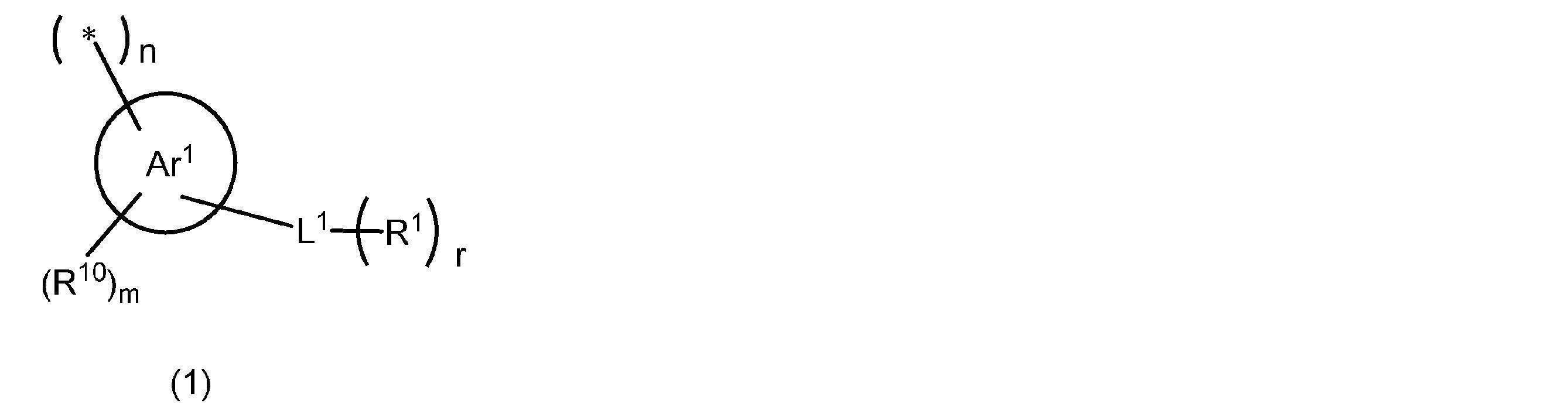
mが2以上の場合、m個のR10は同じであってもよく、異なっていてもよく、
rが2以上の場合、r個のR1は同じであってもよく、異なっていてもよい。
<2> 上記樹脂aのエチレン性不飽和結合含有基価が0.1~2.0mmol/gである、<1>に記載の組成物。
<3> 上記膜形成成分は、上記粒子の分散剤としての樹脂と、バインダーとしての樹脂とを含み、上記粒子の分散剤としての樹脂および上記バインダーとしての樹脂から選ばれる少なくとも1種が、上記樹脂aである、<1>または<2>に記載の組成物。
<4> 上記膜形成成分は、上記粒子の分散剤としての樹脂の100質量部に対して、上記バインダーとしての樹脂を40~250質量部含む、<3>に記載の組成物。
<5> 上記膜形成成分は、3価以上の連結基に複数個のポリマー鎖が結合した構造の樹脂と、グラフト鎖を有する繰り返し単位を有する樹脂と、を含み、
上記3価以上の連結基に複数個のポリマー鎖が結合した構造の樹脂、および、上記グラフト鎖を有する繰り返し単位を有する樹脂から選ばれる少なくとも1種が、上記樹脂aである、
<1>~<4>のいずれか1つに記載の組成物。
<6> 上記グラフト鎖がポリエステル構造の繰り返し単位を含む、<5>に記載の組成物。
<7> 上記樹脂aは、式(1-1)で表される繰り返し単位および式(1-2)で表される繰り返し単位から選ばれる少なくとも1種の繰り返し単位を含む樹脂である、<1>~<6>のいずれか1つに記載の組成物;
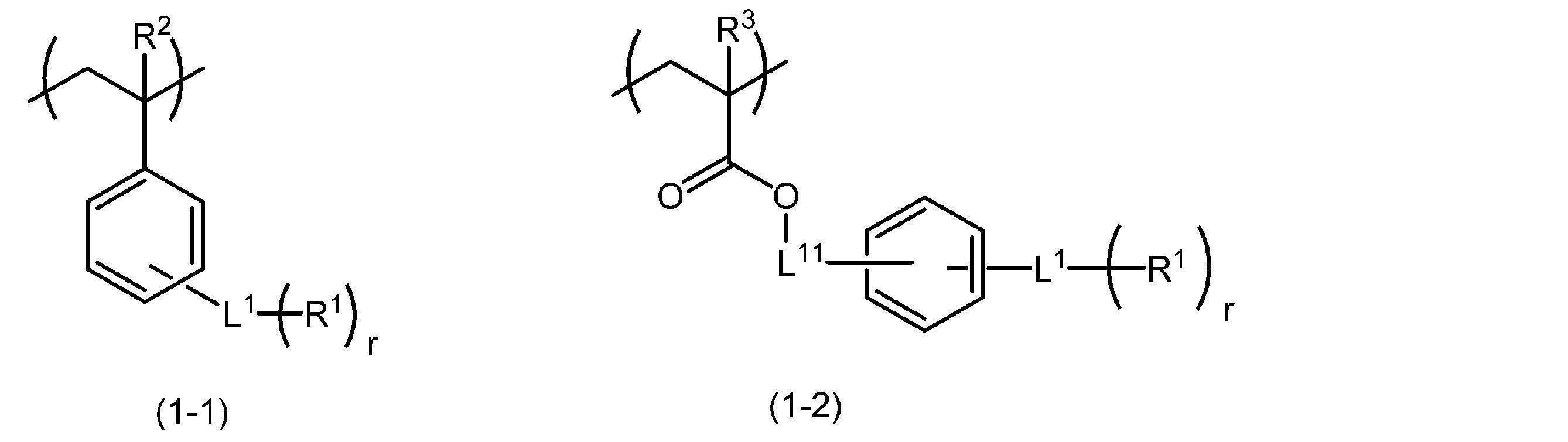
R1はエチレン性不飽和結合含有基を表し、
R2およびR3はそれぞれ独立して、水素原子またはアルキル基を表し、
L11は単結合または2価の連結基を表し、
rは1以上の整数を表し、
rが2以上の場合、r個のR1は同じであってもよく、異なっていてもよい。
<8> 上記樹脂aの重量平均分子量が8000~120000である、<1>~<7>のいずれか1つに記載の組成物。
<9> 上記樹脂aの酸価が20~200mgKOH/gである、<1>~<8>のいずれか1つに記載の組成物。
<10> 上記組成物を用いて、200℃で5分加熱して厚さ8μmの膜を製膜した際に、上記膜中には上記粒子を含む第1の相と、上記第1の相よりも上記粒子の含有量が少ない第2の相との相分離構造が形成されている、<1>~<9>のいずれか1つに記載の組成物。
<11> 上記相分離構造は海島構造または共連続相構造である、<10>に記載の組成物。
<12> 上記粒子の平均一次粒子径が100nm以下である、<1>~<11>のいずれか1つに記載の組成物。
<13> 上記粒子が無機粒子である、<1>~<12>のいずれか1つに記載の組成物。
<14> 上記無機粒子は、酸化チタン粒子、チタン酸ストロンチウム粒子、チタン酸バリウム粒子、酸化亜鉛粒子、酸化マグネシウム粒子、酸化ジルコニウム粒子、酸化アルミニウム粒子、水酸化アルミニウム粒子、硫酸バリウム粒子および硫化亜鉛粒子から選ばれる少なくとも1種を含む、<13>に記載の組成物。
<15> 式(1-1)で表される繰り返し単位および式(1-2)で表される繰り返し単位から選ばれる少なくとも1種の繰り返し単位を含む樹脂;
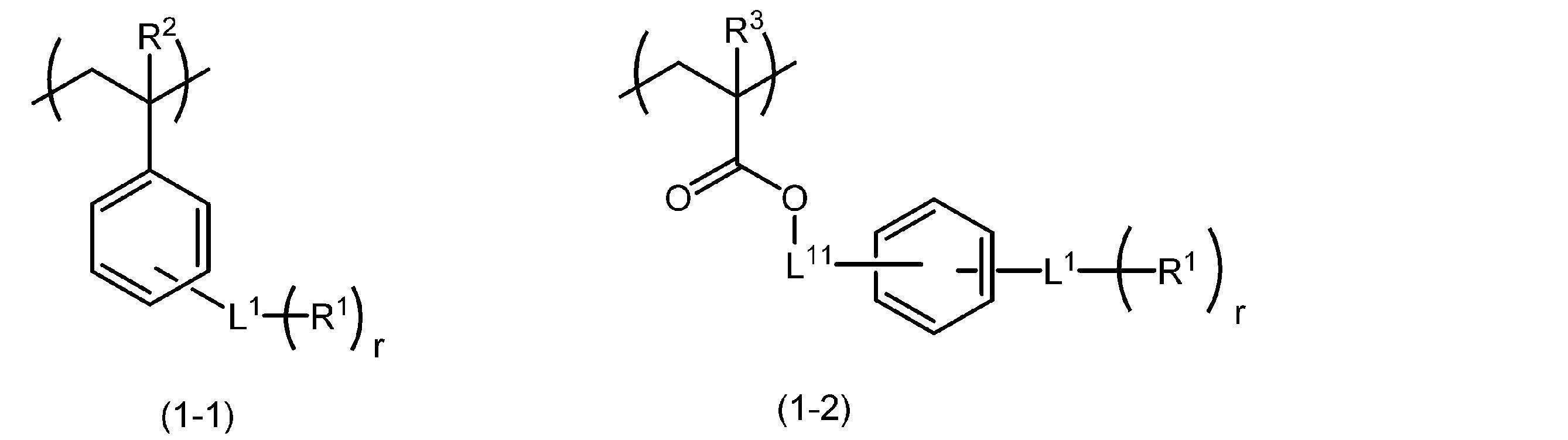
R1はエチレン性不飽和結合含有基を表し、
R2およびR3はそれぞれ独立して、水素原子またはアルキル基を表し、
L11は単結合または2価の連結基を表し、
rは1以上の整数を表し、
rが2以上の場合、r個のR1は同じであってもよく、異なっていてもよい。
<16> <1>~<14>のいずれか1つに記載の組成物を用いて得られる膜。
<17> <16>に記載の膜を含む光センサ。
以下に記載する構成要件の説明は、本発明の代表的な実施態様に基づいてなされることがあるが、本発明はそのような実施態様に限定されるものではない。
本明細書において、「~」を用いて表される数値範囲は、「~」の前後に記載される数値を下限値及び上限値として含む範囲を意味する。
本明細書における基(原子団)の表記において、置換及び無置換を記していない表記は、置換基を有さない基(原子団)と共に置換基を有する基(原子団)を包含する。例えば、「アルキル基」とは、置換基を有さないアルキル基(無置換アルキル基)のみならず、置換基を有するアルキル基(置換アルキル基)を包含する。
本明細書において、「(メタ)アクリレート」は、アクリレート及びメタクリレートを表し、「(メタ)アクリル」は、アクリル及びメタクリルを表し、「(メタ)アリル」は、アリル及びメタリルを表し、「(メタ)アクリロイル」は、アクリロイル及びメタクリロイルを表す。
本明細書において、化学式中のMeはメチル基を、Etはエチル基を、Prはプロピル基を、Buはブチル基を、Phはフェニル基をそれぞれ示す。
本明細書において「露光」とは、特に断らない限り、光を用いた露光のみならず、電子線、イオンビーム等の粒子線を用いた描画も露光に含める。また、露光に用いられる光としては、水銀灯の輝線スペクトル、エキシマレーザーに代表される遠紫外線、極紫外線(EUV光)、X線、電子線等の活性光線または放射線が挙げられる。
本明細書において、重量平均分子量および数平均分子量は、ゲルパーミエーションクロマトグラフィ(GPC)により測定したポリスチレン換算値として定義される。本明細書において、重量平均分子量(Mw)及び数平均分子量(Mn)は、例えば、HLC-8220GPC(東ソー(株)製)を用い、カラムとして、TOSOH TSKgel Super HZM-HとTOSOH TSKgel Super HZ4000とTOSOH TSKgel Super HZ2000とを連結したカラムを用い、展開溶媒としてテトラヒドロフランを用いることによって求めることができる。
本明細書において、屈折率の値は、特に断りがない限り、23℃での波長589nmの光に対する屈折率の値である。
本発明の組成物は、屈折率が2.0以上で平均一次粒子径が200nm以下の粒子と、膜形成成分と、溶剤と、を含む組成物であって、
膜形成成分は、樹脂を2種以上含むか、あるいは、1種以上の樹脂と1種以上の重合性モノマーとを含み、
樹脂の少なくとも1種は、式(1)で表される部分構造を有する樹脂aを含むことを特徴とする。
また、例えば組成物が膜形成成分として重合性化合物及び光重合開始剤を含む場合、上記加熱の前に重合性化合物の硬化のための露光を行ってもよい。
また、上記膜の400~1000nmの光の透過率の最大値は、80%以下であることが好ましく、75%以下であることがより好ましく、70%以下であることが更に好ましく、60%以下であることがより一層好ましく、50%以下であることが特に好ましい。上記透過率の最大値の下限は1%以上であることが好ましく、5%以上であることがより好ましく、10%以上であることが更に好ましく、15%以上であることがより一層好ましく、20%以上であることが特に好ましい。
本発明の組成物は、屈折率が2.0以上で平均一次粒子径が200nm以下の粒子(以下、粒子P1ともいう)を含む。
堺化学工業(株)製の商品名R-3L、R-5N、R-7E、R-11P、R-21、R-25、R-32、R-42、R-44、R-45M、R-62N、R-310、R-650、SR-1、D-918、GTR-100、FTR-700、TCR-52、A-110、A-190、SA-1、SA-1L、STR-100A-LP、STR-100C-LP、TCA-123E;
テイカ(株)製の商品名JR、JRNC、JR-301、JR-403、JR-405、JR-600A、JR-600E、JR-603、JR-605、JR-701、JR-800、JR-805、JR-806、JR-1000、MT-01、MT-05、MT-10EX、MT-100S、MT-100TV、MT-100Z、MT-100AQ、MT-100WP、MT-100SA、MT-100HD、MT-150EX、MT-150W、MT-300HD、MT-500B、MT-500SA、MT-500HD、MT-600B、MT-600SA、MT-700B、MT-700BS、MT-700HD、MT-700Z;
チタン工業(株)製の商品名KR-310、KR-380、KR-380N、ST-485SA15;
富士チタン工業(株)製の商品名TR-600、TR-700、TR-750、TR-840、TR-900;
白石カルシウム(株)製の商品名Brilliant1500等が挙げられる。また、特開2015-067794号公報の段落番号0025~0027に記載の酸化チタン粒子を用いることもできる。
本発明の組成物は、屈折率が2.0未満で、平均一次粒子径が500nm以上で、粒子P1よりも比重の小さい粒子(以下、粒子P2ともいう)を含有することができる。本発明の組成物がP1のほかにP2を含む場合は、粒子P1と粒子P2との間で散乱が生じて、膜に照射された光を効率よく散乱して透過させることができる。このため、このような組成物を用いることでより光散乱性に優れた膜を形成することができる。
式:{(空隙径)3/(外径)3}×100%
本発明の組成物は膜形成成分を含む。本発明で用いられる膜形成成分は、樹脂を2種以上含むか、あるいは、1種以上の樹脂と1種以上の重合性モノマーとを含むものである。そして、樹脂の少なくとも1種は、式(1)で表される部分構造を有する樹脂a(以下、樹脂aともいう)を含む。
膜形成成分は、樹脂を含む。樹脂は、上記粒子P1の分散剤としての樹脂と、バインダーとしての樹脂とを含み、分散剤としての樹脂およびバインダーとしての樹脂から選ばれる少なくとも1種が、樹脂aであることが好ましい。
また、組成物中における分散剤の含有量は、上述した粒子P1の100質量部に対して5~150質量部であることが好ましい。上限は、140質量部以下であることが好ましく、125量部以下であることがより好ましく、100質量部以下であることが更に好ましい。下限は、10質量部以上であることが好ましく、15質量部以上であることがより好ましく、25質量部以上であることが更に好ましい。
樹脂A1および樹脂A2の両方が樹脂aであってもよく、樹脂A1および樹脂A2の一方が樹脂aで、他方が後述する樹脂bであってもよい。
樹脂A1および樹脂A2の両方が樹脂aである場合は、硬化性が良好であり、アンダーカット、耐熱性、テープ剥離耐性の改良効果が更に大きくなる。また、樹脂A1が樹脂aであり、後述する樹脂bが樹脂A2である場合、相分離性が向上し、光散乱性が良化する。また、樹脂A2が樹脂aであり、後述する樹脂bが樹脂A1である場合、相分離性が向上し、光散乱性が良化する。
製膜時に膜中に上述した相分離構造を形成しやすいという理由から樹脂A1および樹脂A2の一方が分散剤で、他方が後述するバインダーであることが好ましく、樹脂A1が分散剤で、樹脂A2がバインダーであることがより好ましい。
また、膜形成成分は、3価以上の連結基に複数個のポリマー鎖が結合した構造の樹脂(樹脂A1)の100質量部に対して、グラフト鎖を有する繰り返し単位を有する樹脂(樹脂A2)を40~250質量部含むことが好ましい。下限は、50質量部以上であることが好ましく、60質量部以上であることがより好ましい。上限は、225質量部以下であることが好ましく、200質量部以下であることがより好ましい。
また、組成物に含まれる樹脂全量における3価以上の連結基に複数個のポリマー鎖が結合した構造の樹脂(樹脂A1)とグラフト鎖を有する繰り返し単位を有する樹脂(樹脂A2)との合計の含有量は、50質量%以上含であることが好ましく、80質量%以上であることがより好ましく、90質量%以上であることが更に好ましい。
樹脂aは、式(1)で表される部分構造を有する樹脂である。

mが2以上の場合、m個のR10は同じであってもよく、異なっていてもよく、
rが2以上の場合、r個のR1は同じであってもよく、異なっていてもよい。
Ar1が表す芳香族環は、縮合環であってもよいが、単環の芳香族環であることが好ましい。
芳香族炭化水素環の具体例としては、ベンゼン環、ナフタレン環、アントラセン環、フルオレン環などが挙げられる。
芳香族複素環の具体例としては、ピロール環、フラン環、チオフェン環、ピリジン環、イミダゾール環、ピラゾ―ル環、オキサゾール環、チアゾール環、ピリダジン環、ピリミジン環、ピラジン環、インドール環、イソインドール環、ベンゾイミダゾール環、ベンゾオキサゾール環、ベンゾチアゾール環、ベンゾトリアゾール環、キノリン環、イソキノリン環、キナゾリン環、キノキサリン環などが挙げられる。
Ar1が表す芳香族環は、ベンゼン環であることが好ましい。

L2が表すr+1価の連結基の好ましい態様として、L2が脂肪族炭化水素基である態様が挙げられる。
また、L2が表すr+1価の連結基の好ましい別の態様として、2個以上の脂肪族炭化水素基を、-O-、-CO-、-COO-、-OCO-、-CONH-、-NHCO-、-NH-または-S-を介して結合した基である態様が挙げられる。
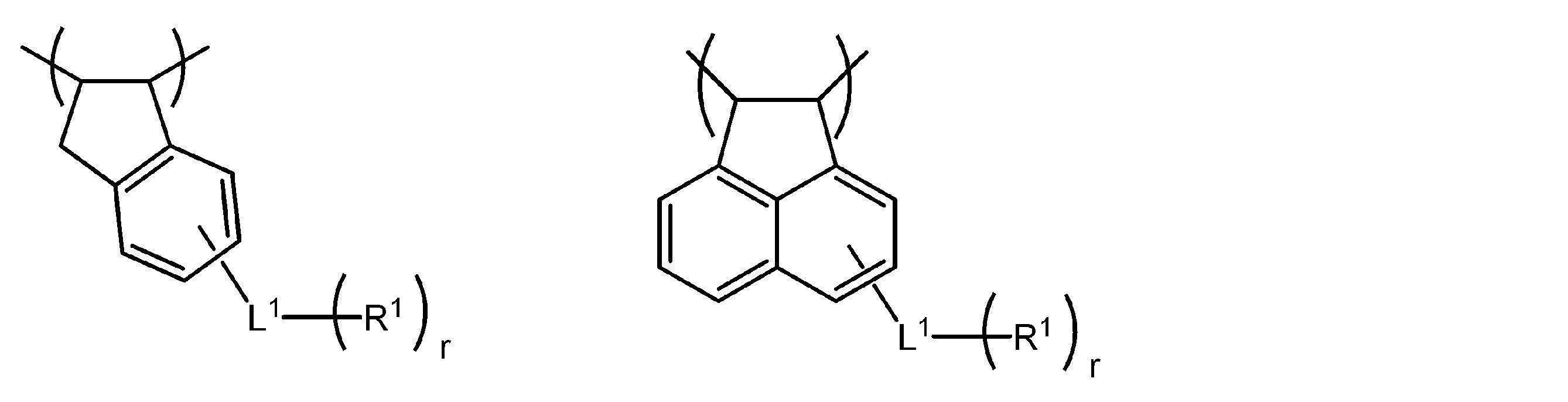
式(1)のrは、1以上の整数を表し、1または2であることが好ましく、2であることがより好ましい。
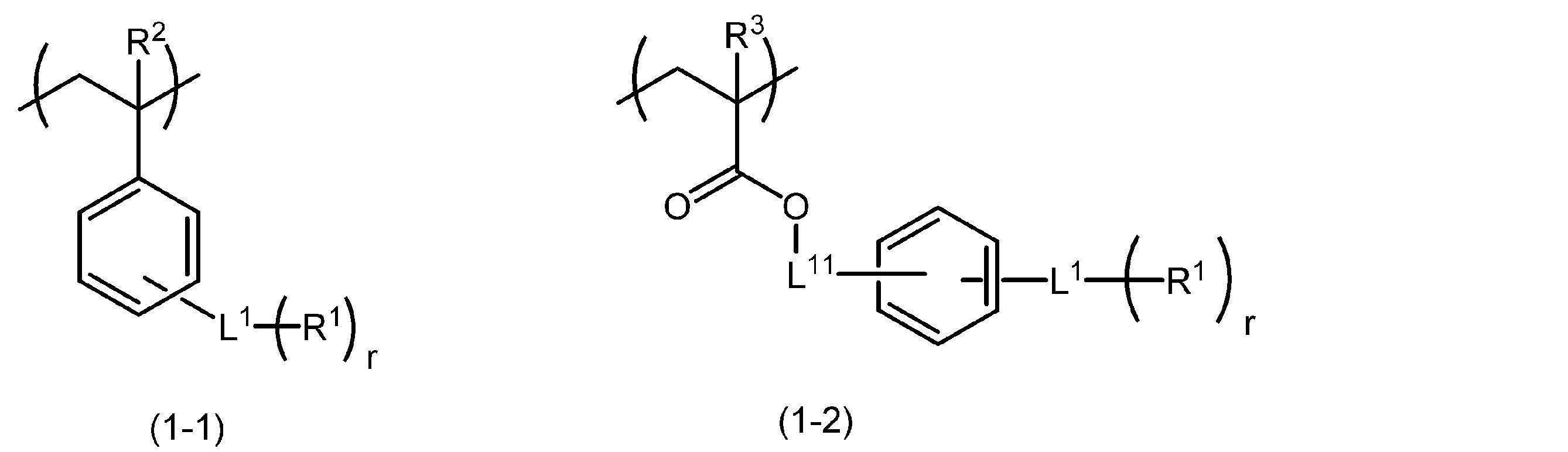
R1はエチレン性不飽和結合含有基を表し、
R2およびR3はそれぞれ独立して、水素原子またはアルキル基を表し、
L11は単結合または2価の連結基を表し、
rは1以上の整数を表し、
rが2以上の場合、r個のR1は同じであってもよく、異なっていてもよい。
L11が表す2価の連結基は、アルキレン基を含む基であることが好ましい。
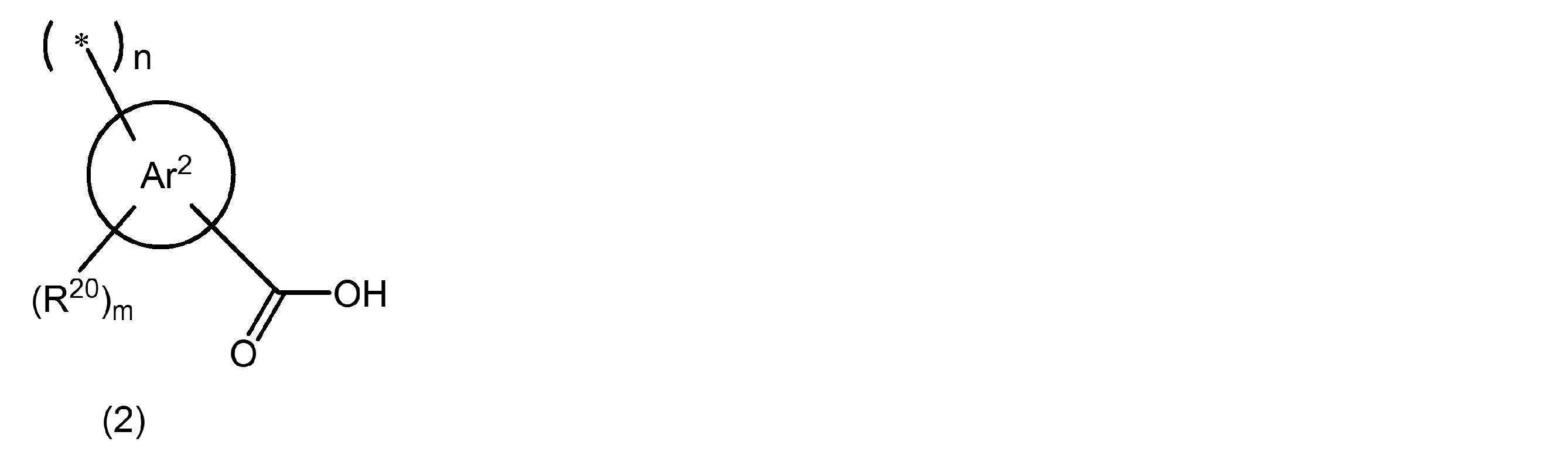
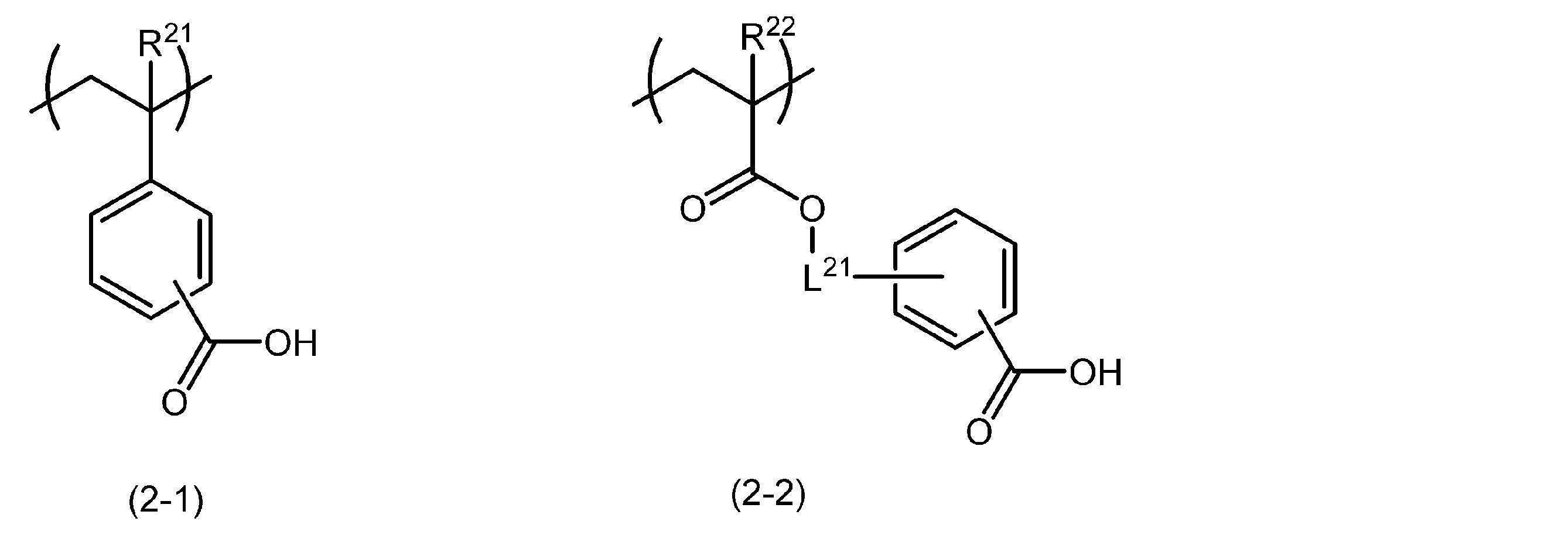
L21は単結合または2価の連結基を表す。
式(2-2)のR22の詳細は、式(1-2)のR3で説明した内容と同様であり、好ましい範囲も同様である。
式(2-2)のL21の詳細は、式(1-2)のL11で説明した内容と同様であり、好ましい範囲も同様である。

L31は、単結合または2価の連結基を表し、
R32は、アルキル基またはアリール基を表す。
L31は、単結合またはアルキレン基であることが好ましく、アルキレン基であることがより好ましい。
R32が表すアルキル基の炭素数は、1~30が好ましく、1~20がより好ましく、1~15が更に好ましい。アルキル基は、直鎖、分岐、環状のいずれでもよい。
R32が表すアリール基の炭素数は、6~30が好ましく、6~20がより好ましく、6~10が更に好ましい。
樹脂aが3価以上の連結基に複数個のポリマー鎖が結合した構造の樹脂である場合、3価以上の連結基に結合しているポリマー鎖が、上述した式(1)で表される部分構造を含むことが好ましく、上述した式(1-1)または式(1-2)で表される繰り返し単位を含むことがより好ましい。3価以上の連結基に複数個のポリマー鎖が結合した構造の樹脂は、バインダーとして用いてもよく、分散剤として用いてもよい。分散剤として用いることが好ましい。

Y1およびY2は、それぞれ独立して単結合または連結基を表し、
A1は、複素環基、酸基、塩基性窒素原子を有する基、ウレア基、ウレタン基、配位性酸素原子を有する基、炭素数4以上の炭化水素基、アルコキシシリル基、エポキシ基、イソシアネート基およびヒドロキシ基から選ばれる官能基を含む基を表し、
P1は、上述した式(1)で表される部分構造を有するポリマー鎖を表し、
nは1~20を表し、mは2~20を表し、m+nは3~21であり、
n個のY1およびA1はそれぞれ同一であってもよく、異なっていてもよく、
m個のY2およびP1はそれぞれ同一であってもよく、異なっていてもよい。
式(SP-1)において、mは2~20を表し、2~10であることが好ましく、2~6であることがより好ましく、2~4であることが更に好ましい。
式(SP-1)において、m+nは3~21であり、3~12であることが好ましく、3~10であることがより好ましく、3~6であることが更に好ましい。m+nの下限は4以上とすることもでき、5以上とすることもできる。

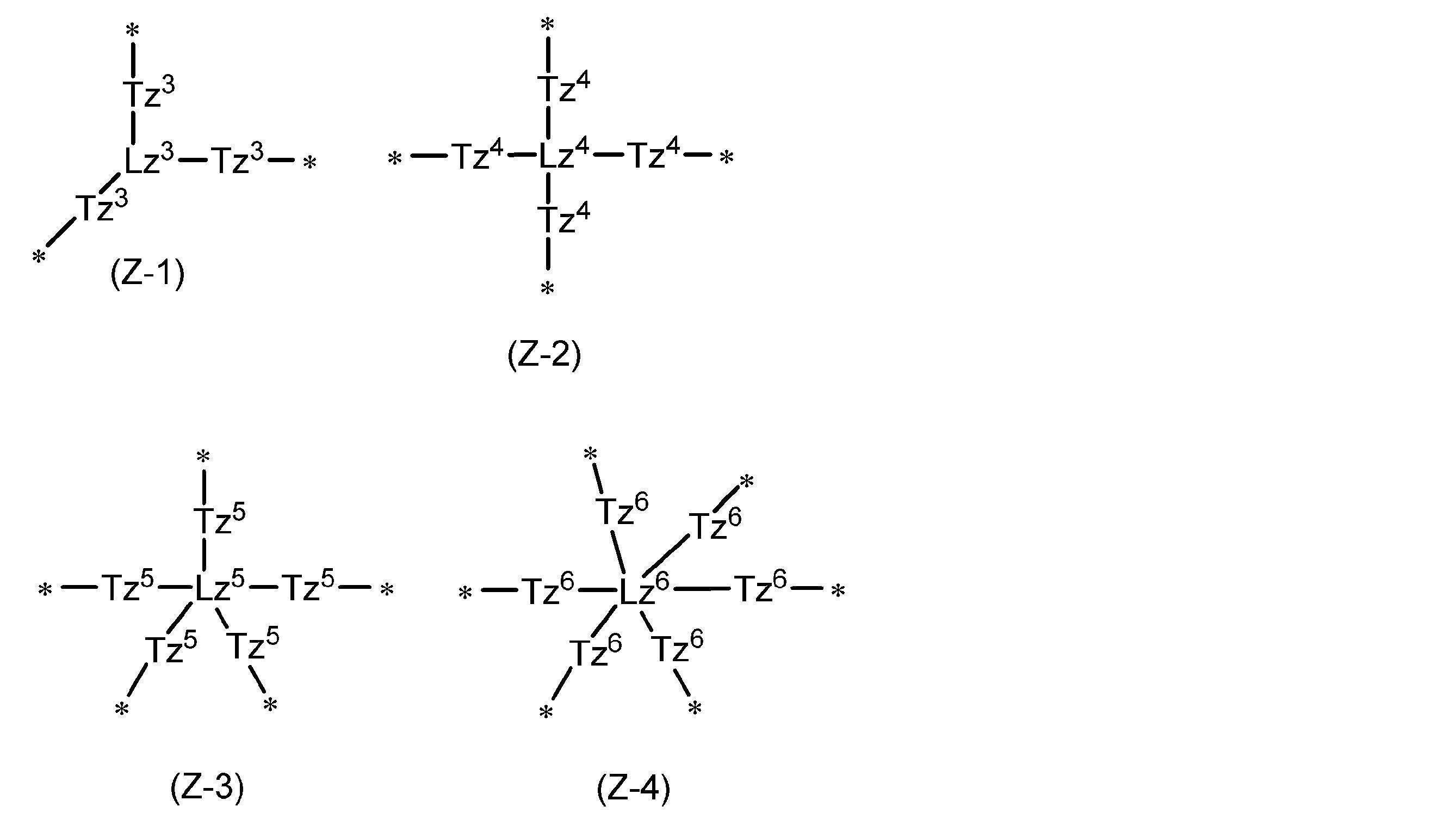
式(Z-2)中、Lz4は4価の基を表し、Tz4は単結合又は2価の連結基を表し、4個存在するTz4は互いに同一であっても異なっていてもよい。
式(Z-3)中、Lz5は5価の基を表し、Tz5は単結合又は2価の連結基を表し、5個存在するTz5は互いに同一であっても異なっていてもよい。
式(Z-4)中、Lz6は6価の基を表し、Tz6は単結合又は2価の連結基を表し、6個存在するTz6は互いに同一であっても異なっていてもよい。
上記式中、*は結合手を表す。
アリール基およびアリーレン基の炭素数は、6~20が好ましく、6~12がより好ましい。
複素環基は、5員環または6員環が好ましい。複素環基が有するヘテロ原子は、酸素原子、窒素原子および硫黄原子が好ましい。複素環基が有するヘテロ原子の数は、1~3個が好ましい。
アルキレン基、アリーレン基、複素環基、アルキル基およびアリール基は、無置換であってもよく、置換基を有してもよい。置換基としては、上述した置換基Tで挙げた基が挙げられる。
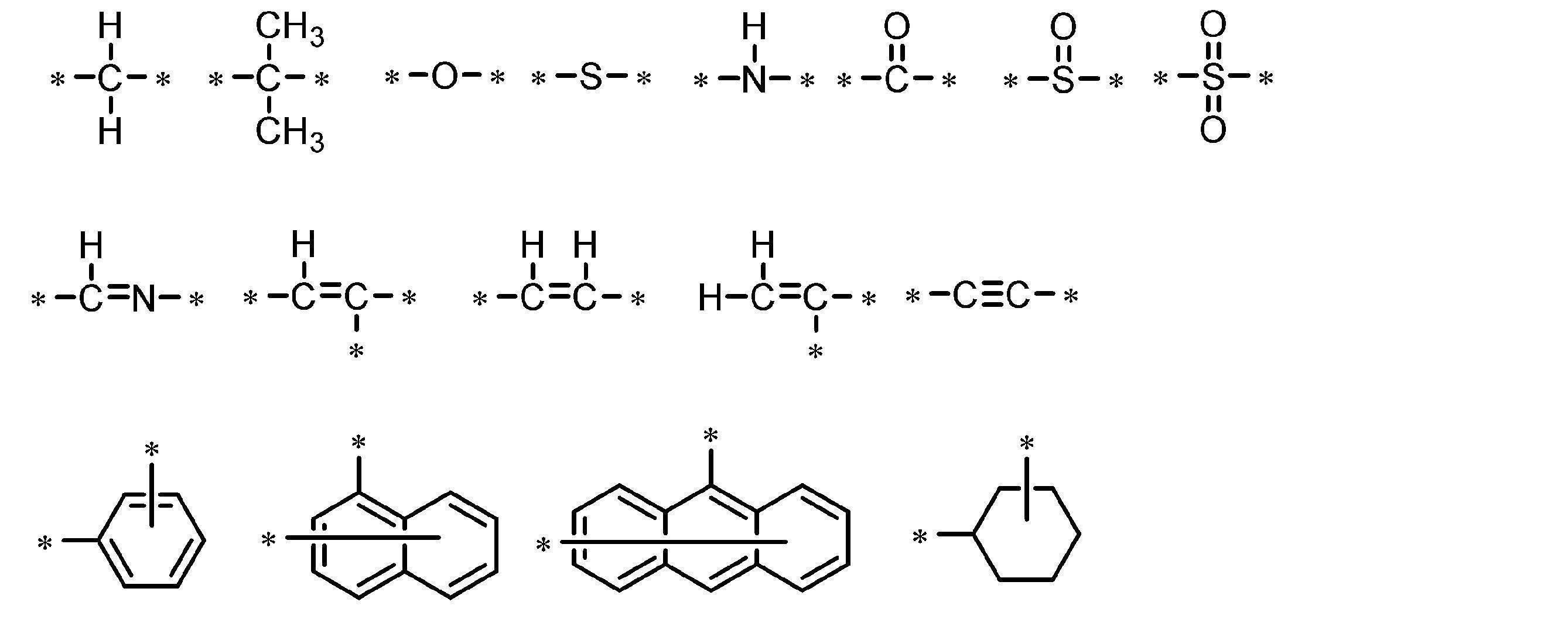
また、P1を構成する全繰り返し単位中における繰り返し単位(1)の含有量は、10~80質量%であることが好ましい。上限は、75質量%以下であることが好ましく、70質量%以下であることがより好ましい。下限は、15質量%以上であることが好ましく、20質量%以上であることがより好ましい。
P1を構成する全繰り返し単位中における酸基を有する繰り返し単位の含有量は、0~90質量%であることが好ましい。上限は、85質量%以下であることが好ましく、80質量%以下であることがより好ましい。下限は、1質量%以上とすることができ、10質量%以上とすることもできる。
また、P1を構成する全繰り返し単位中における繰り返し単位(2)の含有量は、0~90質量%であることが好ましい。上限は、85質量%以下であることが好ましく、80質量%以下であることがより好ましい。下限は、1質量%以上とすることができ、10質量%以上とすることもできる。
樹脂aがグラフト鎖を有する繰り返し単位を有する樹脂である場合、樹脂aは、グラフト鎖を有する繰り返し単位と、上述した式(1)で表される部分構造を有する繰り返し単位とを含む樹脂であることが好ましい。グラフト鎖を有する繰り返し単位を有する樹脂は、バインダーとして用いてもよく、分散剤として用いてもよい。バインダーとして用いることが好ましい。

LG1が表す2価の連結基としては、アルキレン基(好ましくは炭素数1~12のアルキレン基)、アルキレンオキシ基(好ましくは炭素数1~12のアルキレンオキシ基)、オキシアルキレンカルボニル基(好ましくは炭素数1~12のオキシアルキレンカルボニル基)、アリーレン基(好ましくは炭素数6~20のアリーレン基)、-NH-、-SO-、-SO2-、-CO-、-O-、-COO-、OCO-、-S-およびこれらの2以上を組み合わせてなる基が挙げられる。
RG4が表す置換基としては、ヒドロキシ基、カルボキシ基、アルキル基、アリール基、複素環基、アルコキシ基、アリールオキシ基、複素環オキシ基、アルキルチオエーテル基、アリールチオエーテル基、複素環チオエーテル基、エチレン性不飽和結合含有基、エポキシ基、オキセタニル基およびブロックイソシアネート基等が挙げられる。
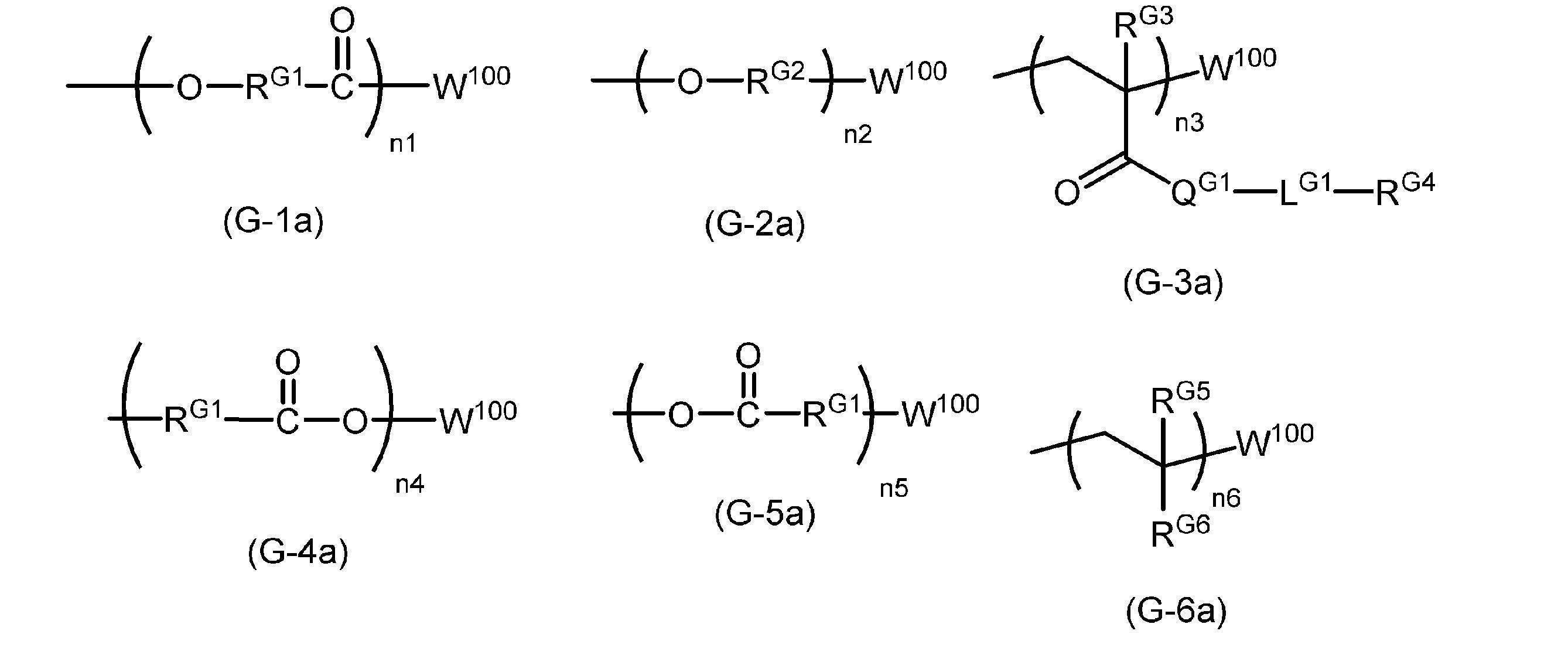
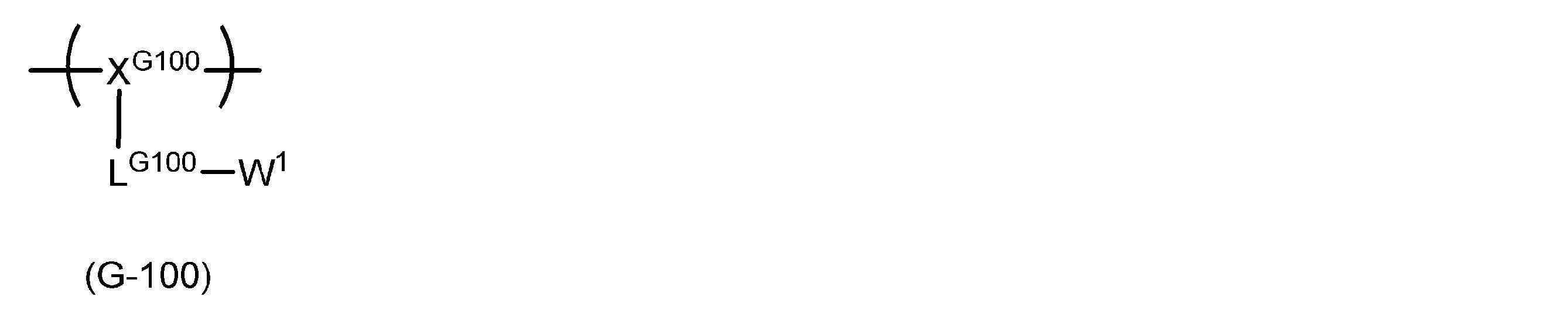
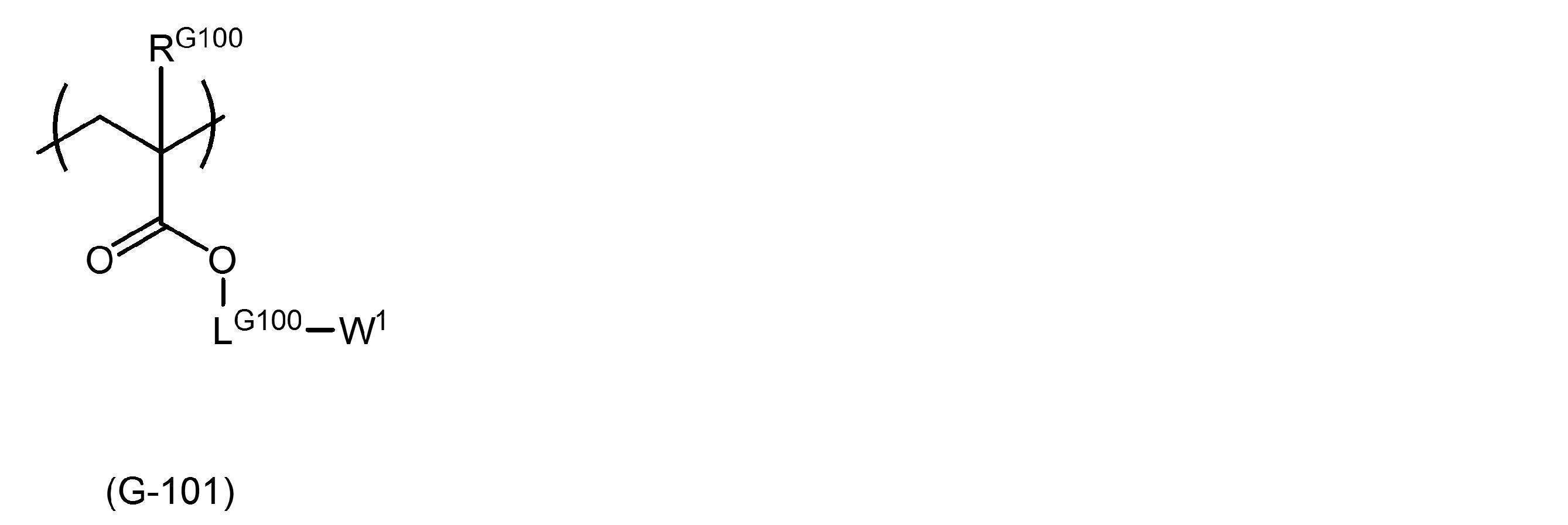
式(G-101)のRG100が表すアルキル基の炭素数は、1~10であることが好ましく、1~5であることがより好ましく、1~3であることが更に好ましい。アルキル基は、直鎖、分岐、環状のいずれでもよいが、直鎖であることが好ましい。RG100は水素原子またはメチル基であることが好ましく、メチル基であることがより好ましい。
なお、樹脂のエチレン性不飽和結合含有基価は、樹脂の固形分1gあたりのエチレン性不飽和結合含有基価のモル量を表した数値である。樹脂のエチレン性不飽和結合含有基価は、樹脂の合成に用いた原料から算出できるものについては仕込みの原料から算出した値を用いる。また、樹脂のエチレン性不飽和結合含有基価について、樹脂の合成に用いた原料から算出ができないものについては、加水分解法を用いて測定した値を用いる。具体的には、アルカリ処理によって樹脂からエチレン性不飽和結合含有基部位の成分(a)を取り出し、その含有量を高速液体クロマトグラフィー(HPLC)により測定し、下記式から算出する。また、樹脂から上記成分(a)をアルカリ処理で抽出することができない場合においては、NMR法(核磁気共鳴)にて測定した値を用いる。
樹脂のエチレン性不飽和結合含有基価[mmol/g]=(成分(a)の含有量[ppm]/成分(a)の分子量[g/mol])/(樹脂の秤量値[g]×(樹脂の固形分濃度[質量%]/100)×10)
また、樹脂aが分散剤である場合には、樹脂aの酸価は80~250mgKOH/gであることが好ましい。上限は、200mgKOH/g以下であることが好ましく、180mgKOH/g以下であることがより好ましく、170mgKOH/g以下であることが更に好ましい。下限は、90mgKOH/g以上であることが好ましく、100mgKOH/g以上であることがより好ましく、120mgKOH/g以上であることが更に好ましい。
また、樹脂aがバインダーである場合には、樹脂aの酸価は10~150mgKOH/gであることが好ましい。上限は、130mgKOH/g以下であることが好ましく、110mgKOH/g以下であることがより好ましく、90mgKOH/g以下であることが更に好ましい。下限は、20mgKOH/g以上であることが好ましく、30mgKOH/g以上であることがより好ましく、40mgKOH/g以上であることが更に好ましい。
また、組成物に含まれる樹脂全量中における樹脂aの含有量は、10~100質量%であることが好ましく、20~100質量%であることがより好ましく、30~100質量%であることが更に好ましい。
本発明の組成物は、樹脂aを1種類のみ含んでいてもよいし、2種類以上含んでいてもよい。樹脂aを2種類以上含む場合は、それらの合計量が上記範囲となることが好ましい。
本発明の組成物における膜形成成分は、上記樹脂aとは異なる樹脂である樹脂bを更に含むことができる。なお、樹脂bは、樹脂aに該当しない樹脂である。すなわち、樹脂bは上述した式(1)で表される部分構造を含まない樹脂である。樹脂bは、粒子の分散剤であってもよく、バインダーであってもよい。




Y101およびY102は、それぞれ独立して単結合または連結基を表し、
A101は、複素環基、酸基、塩基性窒素原子を有する基、ウレア基、ウレタン基、配位性酸素原子を有する基、炭素数4以上の炭化水素基、アルコキシシリル基、エポキシ基、イソシアネート基およびヒドロキシ基から選ばれる官能基を含む基を表し、
P101は、ポリマー鎖を表し、
nは1~20を表し、mは2~20を表し、m+nは3~21であり、
n個のY101およびA101はそれぞれ同一であってもよく、異なっていてもよく、
m個のY102およびP101はそれぞれ同一であってもよく、異なっていてもよい。
また、本発明の組成物は、樹脂bを実質的に含有しないものであってもよい。なお、本発明の組成物が樹脂bを実質的に含有しない場合とは、組成物の全固形分中における樹脂bの含有量が、0.5質量%以下であることを意味し、0.1質量%以下であることが好ましく、樹脂bを含有しないことが更に好ましい。
膜形成成分は重合性モノマーを含有するものであってもよい。重合性モノマーとしては、ラジカル、酸あるいは熱により架橋可能な公知の化合物を用いることができる。例えば、エチレン性不飽和結合含有基を有する化合物、環状エーテル基を有する化合物等が挙げられる。エチレン性不飽和結合含有基としては、ビニル基、(メタ)アリル基、(メタ)アクリロイル基および(メタ)アクリロイルオキシ基などが挙げられる。環状エーテル基としては、エポキシ基、オキセタニル基などが挙げられる。重合性モノマーは、ラジカル重合性モノマーまたはカチオン重合性モノマーが好ましく、ラジカル重合性モノマーがより好ましい。


本発明の組成物は、溶剤を含有する。溶剤としては、有機溶剤が挙げられる。溶剤は、各成分の溶解性や組成物の塗布性を満足すれば基本的には特に制限はない。有機溶剤としては、エステル系溶剤、ケトン系溶剤、アルコール系溶剤、アミド系溶剤、エーテル系溶剤、炭化水素系溶剤などが挙げられる。これらの詳細については、国際公開第2015/166779号の段落番号0223の記載を参酌でき、この内容は本明細書に組み込まれる。また、環状アルキル基が置換したエステル系溶剤、環状アルキル基が置換したケトン系溶剤も好ましく用いることもできる。有機溶剤の具体例としては、アセトン、メチルエチルケトン、シクロヘキサン、シクロヘキサノン、シクロペンタノン、酢酸エチル、酢酸ブチル、酢酸シクロヘキシル、エチレンジクロライド、テトラヒドロフラン、トルエン、エチレングリコールモノメチルエーテル、エチレングリコールモノエチルエーテル、エチレングリコールジメチルエーテル、プロピレングリコールモノメチルエーテル、プロピレングリコールモノエチルエーテル、アセチルアセトン、ジアセトンアルコール、エチレングリコールモノメチルエーテルアセテート、エチレングリコールエチルエーテルアセテート、エチレングリコールモノイソプロピルエーテル、エチレングリコールモノブチルエーテルアセテート、3-メトキシプロパノール、2-メトキシエタノール、ジエチレングリコールモノメチルエーテル、ジエチレングリコールモノエチルエーテル、ジエチレングリコールジメチルエーテル、ジエチレングリコールジエチルエーテル、プロピレングリコールモノメチルエーテルアセテート、プロピレングリコールモノエチルエーテルアセテート、3-メトキシプロピルアセテート、N,N-ジメチルホルムアミド、ジメチルスルホキシド、γ-ブチロラクトン、乳酸メチル、乳酸エチル、ブチルジグリコールアセテート、3-メトキシブチルアセテート、3-メトキシ-N,N-ジメチルプロパンアミド、3-ブトキシ-N,N-ジメチルプロパンアミド、ガンマブチロラクトン、スルホラン、アニソール、1,4-ジアセトキシブタン、ジエチレングリコールモノエチルエーテルアセタート、二酢酸ブタン-1,3-ジイル、ジプロピレングリコールメチルエーテルアセタート、2-メトキシプロピルアセテート、2-メトキシ-1-プロパノール、イソプロピルアルコールなどが挙げられる。これらの有機溶剤は、単独にて、又は混合して使用することができる。
本発明の組成物は、光重合開始剤を含有することができる。光重合開始剤としては、光ラジカル重合開始剤、光カチオン重合開始剤などが挙げられる。重合性モノマーの種類に応じて選択して用いることが好ましい。重合性モノマーとしてラジカル重合性モノマーを用いた場合においては、光重合開始剤として光ラジカル重合開始剤を用いることが好ましい。また、重合性モノマーとしてカチオン重合性モノマーを用いた場合においては、光重合開始剤として光カチオン重合開始剤を用いることが好ましい。光重合開始剤としては、特に制限はなく、公知の光重合開始剤の中から適宜選択することができる。例えば、紫外領域から可視領域の光線に対して感光性を有する化合物が好ましい。
光ラジカル重合開始剤としては、ハロゲン化炭化水素誘導体(例えば、トリアジン骨格を有する化合物、オキサジアゾール骨格を有する化合物など)、アシルホスフィン化合物、ヘキサアリールビイミダゾール化合物、オキシム化合物、有機過酸化物、チオ化合物、ケトン化合物、芳香族オニウム塩、α-ヒドロキシケトン化合物、α-アミノケトン化合物などが挙げられる。光重合開始剤は、露光感度の観点から、トリハロメチルトリアジン化合物、ベンジルジメチルケタール化合物、α-ヒドロキシケトン化合物、α-アミノケトン化合物、アシルホスフィン化合物、ホスフィンオキサイド化合物、メタロセン化合物、オキシム化合物、ヘキサアリールビイミダゾール化合物、オニウム化合物、ベンゾチアゾール化合物、ベンゾフェノン化合物、アセトフェノン化合物、シクロペンタジエン-ベンゼン-鉄錯体、ハロメチルオキサジアゾール化合物および3-アリール置換クマリン化合物であることが好ましく、オキシム化合物、α-ヒドロキシケトン化合物、α-アミノケトン化合物、および、アシルホスフィン化合物から選ばれる化合物であることがより好ましく、オキシム化合物であることが更に好ましい。また、光重合開始剤としては、特開2014-130173号公報の段落0065~0111に記載された化合物、特許第6301489号公報に記載された化合物、MATERIAL STAGE 37~60p,vol.19,No.3,2019に記載されたパーオキサイド系光重合開始剤、国際公開第2018/221177号に記載の光重合開始剤、国際公開第2018/110179号に記載の光重合開始剤、特開2019-043864号公報に記載の光重合開始剤、特開2019-044030号公報に記載の光重合開始剤、特開2019-167313号公報に記載の過酸化物系開始剤、特開2020-055992号公報に記載のオキサゾリジン基を有するアミノアセトフェノン系開始剤、特開2013-190459号公報に記載のオキシム系光重合開始剤、特開2020-172619号公報に記載の重合体、国際公開第2020/152120号に記載の式1で表される化合物などが挙げられ、これらの内容は本明細書に組み込まれる。

光カチオン重合開始剤としては、光酸発生剤が挙げられる。光酸発生剤としては、光照射により分解して酸を発生する、ジアゾニウム塩、ホスホニウム塩、スルホニウム塩、ヨードニウム塩などのオニウム塩化合物、イミドスルホネート、オキシムスルホネート、ジアゾジスルホン、ジスルホン、o-ニトロベンジルスルホネート等のスルホネート化合物などを挙げることができる。
本発明の組成物は、更に顔料誘導体を含有することができる。顔料誘導体としては、発色団の一部分を、酸性基、塩基性基またはフタルイミドメチル基で置換した構造を有する化合物が挙げられる。酸基としては、スルホ基、カルボキシ基及びその4級アンモニウム塩基などが挙げられる。塩基性基としては、アミノ基などが挙げられる。顔料誘導体の詳細は、特開2011-252065号公報の段落番号0162~0183の記載を参酌でき、この内容は本明細書に組み込まれる。顔料誘導体の含有量は、顔料100質量部に対し、1~30質量部であることが好ましく、3~20質量部であることがより好ましい。顔料誘導体は、1種のみを用いてもよいし、2種以上を併用してもよい。顔料誘導体を2種以上併用する場合は、それらの合計が上記範囲であることが好ましい。
本発明の組成物は、着色防止剤を含有することができる。着色防止剤としては、フェノール化合物、亜リン酸エステル化合物、チオエーテル化合物などが挙げられ、分子量500以上のフェノール化合物、分子量500以上の亜リン酸エステル化合物又は分子量500以上のチオエーテル化合物がより好ましい。また、着色防止剤は、フェノール化合物であることが好ましく、分子量500以上のフェノール化合物であることがより好ましい。
本発明の組成物は、紫外線吸収剤を含有することができる。紫外線吸収剤としては、共役ジエン化合物、アミノブタジエン化合物、メチルジベンゾイル化合物、クマリン化合物、サリシレート化合物、ベンゾフェノン化合物、ベンゾトリアゾール化合物、アクリロニトリル化合物、ヒドロキシフェニルトリアジン化合物などが挙げられる。このような化合物の具体例としては、特開2009-217221号公報の段落番号0038~0052、特開2012-208374号公報の段落番号0052~0072、特開2013-068814号公報の段落番号0317~0334、特開2016-162946号公報の段落番号0061~0080に記載された化合物が挙げられ、これらの内容は本明細書に組み込まれる。紫外線吸収剤の市販品としては、例えば、UV-503(大東化学(株)製)、BASF社製のTinuvinシリーズ、Uvinul(ユビナール)シリーズ、住化ケムテックス(株)製のSumisorbシリーズなどが挙げられる。また、ベンゾトリアゾール化合物としては、ミヨシ油脂製のMYUAシリーズ(化学工業日報、2016年2月1日)が挙げられる。また、紫外線吸収剤は、特許第6268967号公報の段落番号0049~0059に記載された化合物、国際公開第2016/181987号の段落番号0059~0076に記載された化合物、国際公開第2020/137819号に記載されたチオアリール基置換ベンゾトリアゾール型紫外線吸収剤を用いることもできる。
本発明の組成物は、シランカップリング剤を含有することができる。本明細書において、シランカップリング剤とは、加水分解性基とそれ以外の官能基とを有するシラン化合物のことを意味する。また、加水分解性基とは、ケイ素原子に直結し、加水分解反応及び縮合反応の少なくともいずれかによってシロキサン結合を生じ得る置換基をいう。加水分解性基としては、例えば、ハロゲン原子、アルコキシ基、アシルオキシ基などが挙げられ、アルコキシ基が好ましい。すなわち、シランカップリング剤は、アルコキシシリル基を有する化合物が好ましい。また、加水分解性基以外の官能基としては、例えば、ビニル基、(メタ)アリル基、(メタ)アクリロイル基、(メタ)アクリロイルオキシ基、メルカプト基、エポキシ基、オキセタニル基、アミノ基、ウレイド基、スルフィド基、イソシアネート基、フェニル基などが挙げられ、アミノ基、(メタ)アクリロイル基、(メタ)アクリロイルオキシ基およびエポキシ基が好ましい。シランカップリング剤の具体例としては、N-β-アミノエチル-γ-アミノプロピルメチルジメトキシシラン(信越化学工業(株)製、商品名 KBM-602)、N-β-アミノエチル-γ-アミノプロピルトリメトキシシラン(信越化学工業(株)製、商品名 KBM-603)、N-β-アミノエチル-γ-アミノプロピルトリエトキシシラン(信越化学工業(株)製、商品名 KBE-602)、γ-アミノプロピルトリメトキシシラン(信越化学工業(株)製、商品名 KBM-903)、γ-アミノプロピルトリエトキシシラン(信越化学工業(株)製、商品名 KBE-903)、3-メタクリロキシプロピルメチルジメトキシシラン(信越化学工業(株)製、商品名 KBM-502)、3-メタクリロキシプロピルトリメトキシシラン(信越化学工業(株)製、商品名 KBM-503)等がある。また、シランカップリング剤の具体例については、特開2009-288703号公報の段落番号0018~0036に記載の化合物、特開2009-242604号公報の段落番号0056~0066に記載の化合物が挙げられ、これらの内容は本明細書に組み込まれる。
本発明の組成物は、重合禁止剤を含有することができる。重合禁止剤としては、ハイドロキノン、p-メトキシフェノール、ジ-tert-ブチル-p-クレゾール、ピロガロール、tert-ブチルカテコール、1,4-ベンゾキノン、4,4’-チオビス(3-メチル-6-tert-ブチルフェノール)、2,2’-メチレンビス(4-メチル-6-t-ブチルフェノール)、N-ニトロソフェニルヒドロキシアミン塩(アンモニウム塩、第一セリウム塩等)が挙げられ、p-メトキシフェノールが好ましい。重合禁止剤の含有量は、組成物の全固形分中0.0001~5質量%であることが好ましく、0.0001~1質量%であることがより好ましい。
本発明の組成物は、連鎖移動剤を含有することができる。連鎖移動剤としては、国際公開第2017/159190号の段落0225に記載の化合物を用いることができる。連鎖移動剤の含有量は、組成物の全固形分中0.2~5.0質量%であることが好ましく、0.4~3.0質量%であることがより好ましい。また、連鎖移動剤の含有量は、重合性モノマーの100質量部に対し、1~40質量部であることが好ましく、2~20質量部であることがより好ましい。連鎖移動剤は、1種類のみを用いてもよく、2種類以上を併用してもよい。2種類以上を併用する場合は、それらの合計量が上記範囲となることが好ましい。
本発明の組成物は、更に増感剤を含有することができる。増感剤は、光重合開始剤に対し、電子移動機構又はエネルギー移動機構で増感させる化合物であることが好ましい。増感剤としては、300~450nmの範囲に吸収を有する化合物が挙げられる。増感剤の詳細については、特開2010-106268号公報の段落番号0231~0253(対応する米国特許出願公開第2011/0124824号明細書の段落番号0256~0273)の記載を参酌でき、この内容は本明細書に組み込まれる。増感剤の含有量は、組成物の全固形分中0.1~20質量%であることが好ましく、0.5~15質量%であることがより好ましい。増感剤は、1種類のみを用いてもよく、2種類以上を併用してもよい。2種類以上を併用する場合は、それらの合計量が上記範囲となることが好ましい。
本発明の組成物は、更に共増感剤を含有することができる。共増感剤は、光重合開始剤や増感剤の活性放射線に対する感度を一層向上させる、あるいは、酸素による重合性モノマーの重合阻害を抑制する等の作用を有する化合物であることが好ましい。共増感剤の詳細については、特開2010-106268号公報の段落番号0254~0257(対応する米国特許出願公開第2011/0124824号明細書の段落番号0277~0279)の記載を参酌でき、この内容は本明細書に組み込まれる。共増感剤の含有量は、組成物の全固形分中0.1~30質量%であることが好ましく、1~25質量%であることがより好ましく、1.5~20質量%であることが更に好ましい。共増感剤は1種類のみを用いてもよく、2種類以上を併用してもよい。2種類以上を併用する場合は、それらの合計量が上記範囲となることが好ましい。
本発明の組成物は、塗布適性をより向上させる観点から、各種類の界面活性剤を含有させてもよい。界面活性剤としては、フッ素系界面活性剤、ノニオン系界面活性剤、カチオン系界面活性剤、アニオン系界面活性剤、シリコーン系界面活性剤などの各種界面活性剤を使用することができる。界面活性剤はシリコーン系界面活性剤またはフッ素系界面活性剤であることが好ましい。

更に、組成物に対しては、膜の物性を改良するために可塑剤や感脂化剤等の公知の添加剤を加えてもよい。可塑剤としては、例えば、ジオクチルフタレート、ジドデシルフタレート、トリエチレングリコールジカプリレート、ジメチルグリコールフタレート、トリクレジルホスフェート、ジオクチルアジペート、ジブチルセバケート、トリアセチルグリセリン等が挙げられる。
本発明の組成物の収容容器としては、特に限定はなく、公知の収容容器を用いることができる。また、収容容器として、原材料や組成物中への不純物混入を抑制することを目的に、容器内壁を6種6層の樹脂で構成する多層ボトルや6種の樹脂を7層構造にしたボトルを使用することも好ましい。このような容器としては例えば特開2015-123351号公報に記載の容器が挙げられる。また、容器内壁は、容器内壁からの金属溶出を防ぎ、組成物の保存安定性を高めたり、成分変質を抑制するなどの目的で、ガラス製やステンレス製などにすることも好ましい。
本発明の組成物は、前述の成分を混合して調製できる。組成物の調製に際しては、各成分を一括配合してもよいし、各成分を溶剤に溶解および分散のうち少なくとも一方をした後に逐次配合してもよい。また、配合する際の投入順序や作業条件は特に制約を受けない。
また、組成物の調製にあたり、粒子を分散させるプロセスを含むことが好ましい。粒子を分散させるプロセスにおいて、粒子の分散に用いる機械力としては、圧縮、圧搾、衝撃、剪断、キャビテーションなどが挙げられる。これらプロセスの具体例としては、ビーズミル、サンドミル、ロールミル、ボールミル、ペイントシェーカー、マイクロフルイダイザー、高速インペラー、サンドグラインダー、フロージェットミキサー、高圧湿式微粒化、超音波分散などが挙げられる。またサンドミル(ビーズミル)における粒子の粉砕においては、径の小さいビーズを使用する、ビーズの充填率を大きくする事等により粉砕効率を高めた条件で処理することが好ましい。また、粉砕処理後にろ過、遠心分離などで粗粒子を除去することが好ましい。また、粒子を分散させるプロセスおよび分散機は、「分散技術大全、株式会社情報機構発行、2005年7月15日」や「サスペンション(固/液分散系)を中心とした分散技術と工業的応用の実際 総合資料集、経営開発センター出版部発行、1978年10月10日」、特開2015-157893号公報の段落番号0022に記載のプロセス及び分散機を好適に使用出来る。また、粒子を分散させるプロセスにおいては、ソルトミリング工程にて粒子の微細化処理を行ってもよい。ソルトミリング工程に用いられる素材、機器、処理条件等は、例えば特開2015-194521号公報、特開2012-046629号公報の記載を参酌できる。
本発明の膜は、上述した本発明の組成物を用いて得られる膜である。
本発明の膜の波長400~700nmの範囲の光の透過率の最大値は、80%以下であることが好ましく、70%以下であることがより好ましく、60%以下であることが更に好ましく、50%以下であることが特に好ましい。上記透過率の最大値の下限は1%以上であることが好ましく、5%以上であることがより好ましく、10%以上であることが更に好ましく、15%以上であることがより一層好ましく、20%以上であることが特に好ましい。
本発明の膜は、本発明の組成物を支持体上に適用する工程を経て製造できる。支持体としては、例えば、シリコン、無アルカリガラス、ソーダガラス、パイレックス(登録商標)ガラス、石英ガラスなどの材質で構成された基板が挙げられる。これらの基板には、有機膜や無機膜などが形成されていてもよい。有機膜の材料としては樹脂などが挙げられる。また、支持体としては、樹脂で構成された基板を用いることもできる。また、支持体には、電荷結合素子(CCD)、相補型金属酸化膜半導体(CMOS)、透明導電膜などが形成されていてもよい。また、支持体には、各画素を隔離するブラックマトリクスが形成されている場合もある。また、支持体には、必要により、上部の層との密着性改良、物質の拡散防止或いは基板表面の平坦化のために下塗り層を設けてもよい。また、支持体としてガラス基板を用いる場合においては、ガラス基板上に無機膜を形成したり、ガラス基板を脱アルカリ処理して用いることが好ましい。
フォトリソグラフィ法でのパターン形成方法は、本発明の組成物を適用して形成した組成物層に対しパターン状に露光する工程(露光工程)と、未露光部の組成物層を除去することにより現像してパターンを形成する工程(現像工程)と、を含むことが好ましい。必要に応じて、現像されたパターンをベークする工程(ポストベーク工程)を設けてもよい。以下、各工程について説明する。
露光工程では組成物層をパターン状に露光する。例えば、組成物層に対し、ステッパー等の露光装置を用いて、所定のマスクパターンを有するマスクを介して露光することで、組成物層をパターン露光することができる。これにより、露光部分を硬化することができる。露光に際して用いることができる放射線(光)としては、g線、i線等が挙げられる。また、波長300nm以下の光(好ましくは波長180~300nmの光)を用いることもできる。波長300nm以下の光としては、KrF線(波長248nm)、ArF線(波長193nm)などが挙げられ、KrF線(波長248nm)が好ましい。
次に、露光後の組成物層における未露光部の組成物層を現像除去してパターンを形成する。未露光部の組成物層の現像除去は、現像液を用いて行うことができる。これにより、露光工程における未露光部の組成物層が現像液に溶出し、光硬化した部分だけが支持体上に残る。現像液の温度は、例えば、20~30℃が好ましい。現像時間は、20~180秒が好ましい。また、残渣除去性を向上させるため、現像液を60秒ごとに振り切り、さらに新たに現像液を供給する工程を数回繰り返してもよい。
ドライエッチング法でのパターン形成は、本発明の組成物を支持体上に適用して形成した組成物層を硬化して硬化物層を形成し、次いで、この硬化物層上にパターニングされたレジスト層を形成し、次いで、パターニングされたレジスト層をマスクとして硬化物層に対してエッチングガスを用いてドライエッチングするなどの方法で行うことができる。ドライエッチング法でのパターン形成については、特開2013-064993号公報の段落番号0010~0067の記載を参酌でき、この内容は本明細書に組み込まれる。
本発明の光センサは、本発明の膜を有する。光センサの種類としては、環境光センサ、照度センサなどが挙げられ、環境光センサとして好ましく用いられる。環境光センサとは、周囲の光(環境光)の色合いを検知するセンサのことである。
粒子の一次粒子径は、粒子を透過型電子顕微鏡(TEM)で観察し、粒子が凝集していない部分(一次粒子)を観測して求めた。具体的には、一次粒子を透過型顕微鏡を用いて透過型電子顕微鏡写真を撮影した後、その写真を用いて画像処理装置で粒度分布を測定して求めた。粒子の平均一次粒子径は、粒度分布から算出された個数基準の算術平均径を平均一次粒子径とした。透過型電子顕微鏡として(株)日立製作所製電子顕微鏡(H-7000)を用い、画像処理装置として(株)ニレコ製ルーゼックスAPを用いた。
粒子と、屈折率が既知である樹脂(分散剤)と、プロピレングリコールモノメチルエーテルアセテートとを用いて分散液を作製した。その後、作製した分散液と屈折率が既知の樹脂とを混合し、塗布液の全固形分中における粒子の濃度が10質量%、20質量%、30質量%、40質量%の塗布液を作製した。これらの塗布液をシリコンウエハ上に300nmの厚さで製膜した後、得られた膜の屈折率をエリプソメトリー(ラムダエースRE-3300、(株)SCREENホールディングス製)を用いて測定した。その後、粒子の濃度と屈折率をグラフ上にプロットし、粒子の屈折率を導出した。
100mLメスフラスコ中に50gの粒子を投入した。続いて別の100mLメスシリンダーを用いて水を100mL量り取った。その後、粒子が浸る程度、量り取った水をメスフラスコに入れ、続いて、メスフラスコに超音波を加えて、粒子と水をなじませた。その後、メスフラスコの標線に到達するまで追加で水を入れ、50g/(メスフラスコに残った水の体積)=比重として算出した。
樹脂の重量平均分子量は、以下の条件に従って、ゲルパーミエーションクロマトグラフィ(GPC)によって測定した。
カラムの種類:TOSOH TSKgel Super HZM-Hと、TOSOH TSKgel Super HZ4000と、TOSOH TSKgel Super HZ2000とを連結したカラム
展開溶媒:テトラヒドロフラン
カラム温度:40℃
流量(サンプル注入量):1.0μL(サンプル濃度0.1質量%)
装置名:東ソー(株)製 HLC-8220GPC
検出器:RI(屈折率)検出器
検量線ベース樹脂:ポリスチレン樹脂
樹脂のエチレン性不飽和結合含有基価については、樹脂の合成に用いた原料から算出した。
酸価は、固形分1gあたりの酸性成分を中和するのに要する水酸化カリウムの質量を表したものである。測定サンプルをテトラヒドロフラン/水=9/1混合溶媒に溶解し、電位差滴定装置(商品名:AT-510、京都電子工業製)を用いて、得られた溶液を、25℃にて、0.1mol/L水酸化ナトリウム水溶液で中和滴定した。滴定pH曲線の変曲点を滴定終点として、次式により酸価を算出した。
A=56.11×Vs×0.5×f/w
A:酸価(mgKOH/g)
Vs:滴定に要した0.1mol/L水酸化ナトリウム水溶液の使用量(mL)
f:0.1mol/L水酸化ナトリウム水溶液の力価
w:測定サンプル質量(g)(固形分換算)
(合成例1)樹脂B-5の合成
三口フラスコにp-ビニル安息香酸(PVBA)の29.0g(0.20mol)、ベンジルメタクリレート(BzMA)の15.4g(0.09mol)、マクロモノマーMM-1の111.1g(0.04mmol)、1-メトキシ-2-プロパノール(MFG)の66.6gを加えた。なお、マクロモノマーMM-1は、下記構造の化合物の50質量%プロピレングリコールモノメチルエーテルアセテート溶液である。
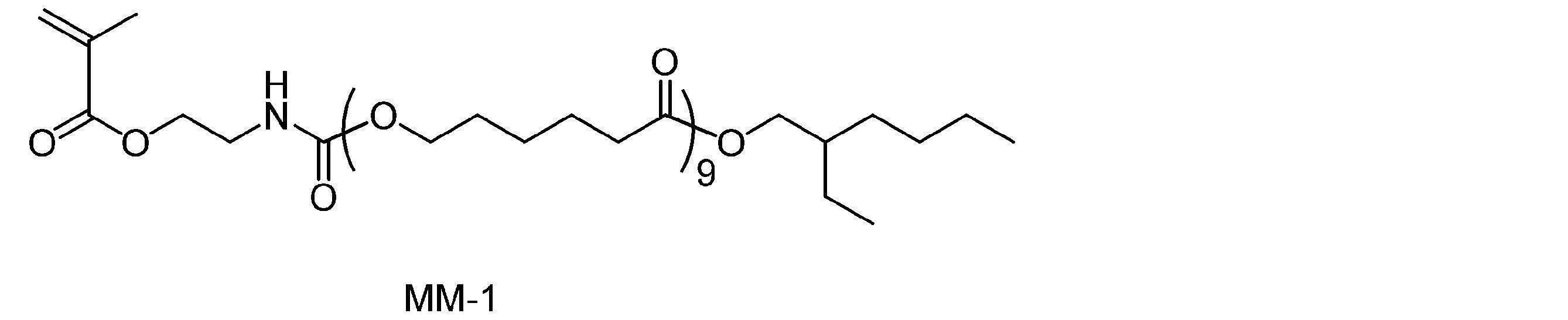
次に、プレポリマーB-5’の溶液に対して、2,2,6,6-テトラメチルピペリジン 1-オキシル(TEMPO)の0.59g(3.80mmol)、4-ヒドロキシブチルアクリレートグリシジルエーテル(4HBAGE)の11.00g(55.00mmol)、テトラブチルアンモニウムブロミドの2.96g(9.00mmol)加えた後に、酸素濃度20%以上で、90℃、48時間攪拌して、下記構造の樹脂B-5得た(収量:290.0g、重量平均分子量:2.8×10⁴、酸価:70.0mgKOH/g、エチレン性不飽和結合含有基価(以下、C=C価ともいう):0.05mmol/g)。以下の構造式中、主鎖に付記した数値は質量比であり、側鎖に付記した数値は繰り返し単位の数である。

合成例1において、原料の割合を変更したこと以外は合成例1と同様の方法で下記構造の樹脂B-1~B-4、B-6~B-11をそれぞれ合成した。以下の構造式中、n1、n2、n3、n4は質量比である。なお、樹脂の重量平均分子量は1-ドデカンチオールの量で制御した。

合成例1において、4HBAGEの代わりに、サイクロマ-M100((株)ダイセル製)を用いたこと以外は合成例1と同様の方法で下記構造の樹脂B-12を合成した(重量平均分子量:2.8×10⁴、酸価:70.0mgKOH/g、C=C価:0.5mmol/g)。以下の構造式中、主鎖に付記した数値は質量比であり、側鎖に付記した数値は繰り返し単位の数である。

-マクロモノマーMM-2の合成-
三口フラスコに、ε-カプロラクトン(1204.6g)、δ-バレロラクトン(212.6g)、及び、2-エチル-1-ヘキサノール(82.5g)を導入し、窒素を吹き込みながら、混合物を撹拌した。次に、混合物にモノブチル錫オキシド(0.71g)を加え、得られた混合物を90℃に加熱した。7時間後、1H-NMR(nuclear magnetic resonance)にて、原料である2-エチル-1-ヘキサノールに由来するシグナルが消失したのを確認後、混合物を110℃に加熱した。窒素下にて110℃で12時間重合反応を続けた後、1H-NMRでε-カプロラクトン及びδ-バレロラクトンに由来するシグナルの消失を確認し、混合物を80℃まで降温した。フラスコ内を空気置換した後、混合物に2,6-ジt-ブチル-4-メチルフェノール(0.40g)を添加した。さらに、得られた混合物に対して、カレンズMOI(昭和電工(株)製、メタクリル酸2-イソシアナトエチル)(100.3g)を30分かけて滴下した。空気下にて1時間反応を続けた後、1H-NMRにてメタクリル酸2-イソシアナトエチルに由来するシグナルが消失したのを確認した。プロピレングリコールモノメチルエーテルアセテート(PGMEA)(1600.0g)を混合物に添加し、下記構造のマクロモノマーMM-の50質量%PGMEA溶液(3200g)を得た。マクロモノマーMM-2の構造は1H-NMRにより確認した。繰り返し単位の数は、原料のε-カプロラクトン、δ-バレロラクトン及び2-エチル-1-ヘキサノールの仕込みモル数から算出し、20であった。重量平均分子量は6000、結晶化温度は6℃であった。

合成例1において、PVBAのかわりにNKエステルCB-1(新中村化学工業(株)製)を用い、マクロモノマーMM-1のかわりにマクロモノマーMM-2を用いたこと以外は合成例1と同様の方法で下記構造の樹脂B-13を合成した(重量平均分子量:2.8×10⁴、酸価:70.0mgKOH/g、C=C価:0.35mmol/g)。以下の構造式中、主鎖に付記した数値は質量比であり、側鎖に付記した数値は繰り返し単位の数である。
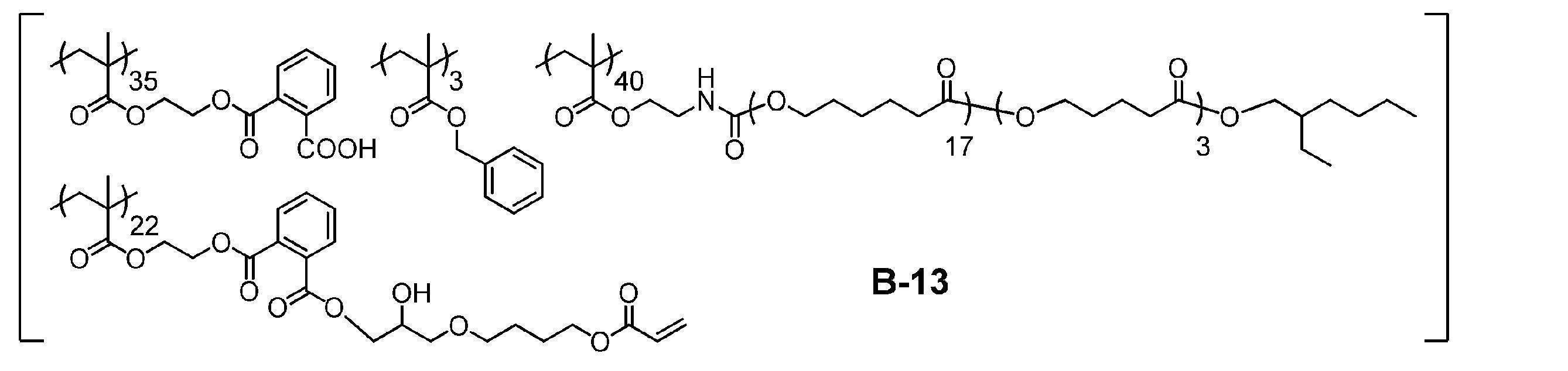
合成例1において、メタクリル酸ベンジルのかわりにアクリル酸ベンジルを用いたこと以外は合成例1と同様の方法で下記構造の樹脂B-14を合成した(重量平均分子量:2.8×10⁴、酸価:70.0mgKOH/g、C=C価:0.5mmol/g)。以下の構造式中、主鎖に付記した数値は質量比であり、側鎖に付記した数値は繰り返し単位の数である。
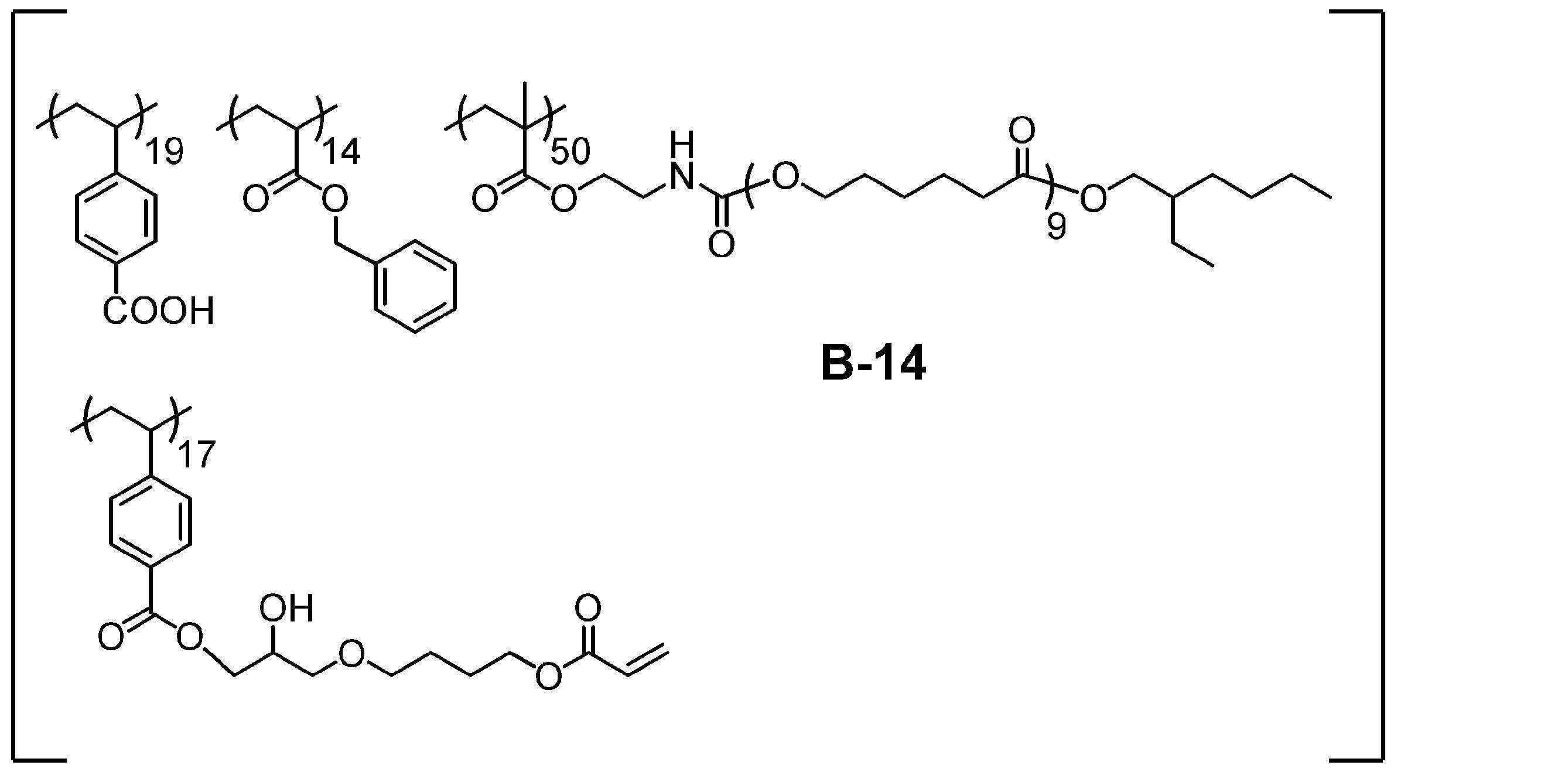
-マクロモノマーMM-3の合成
マクロモノマーMM-2の合成において用いたラクトン化合物の種類、及び、その仕込み量を変更した以外は、同様の操作を行い、マクロモノマーMM-3を合成した。

合成例1において、メタクリル酸ベンジルのかわりにスチレンを用い、マクロモノマーMM-1のかわりにマクロモノマーMM-3を用いたこと以外は合成例1と同様の方法で下記構造の樹脂B-15を合成した(重量平均分子量:2.8×10⁴、酸価:70.0mgKOH/g、C=C価:0.5mmol/g)。以下の構造式中、主鎖に付記した数値は質量比であり、側鎖に付記した数値は繰り返し単位の数である。
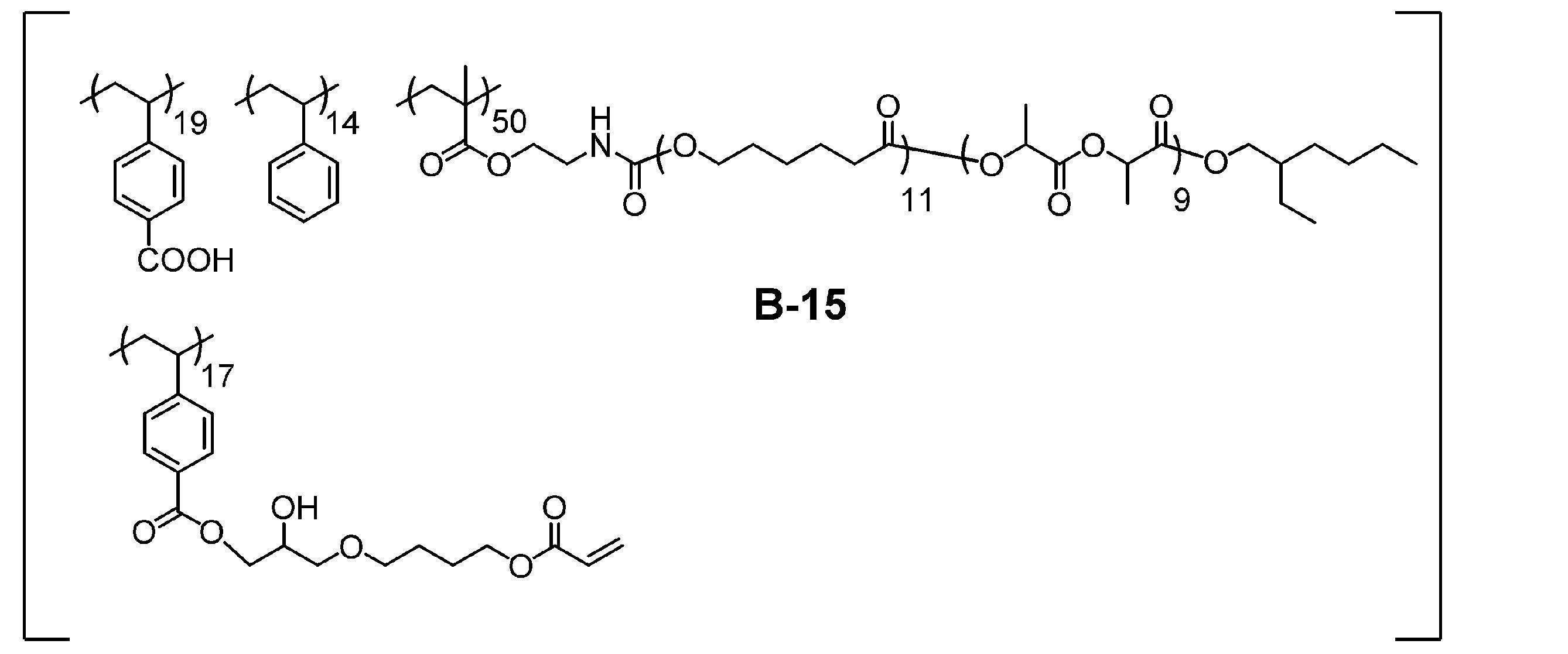
-マクロモノマーMM-4の合成
マクロモノマーMM-2の合成において用いたラクトン化合物の種類、及び、その仕込み量を変更した以外は、同様の操作を行い、マクロモノマーMM-4を合成した。

合成例1において、メタクリル酸ベンジルのかわりにメタクリル酸メチルを用い、マクロモノマーMM-1のかわりにマクロモノマーMM-4を用いたこと以外は合成例1と同様の方法で下記構造の樹脂B-16を合成した(重量平均分子量:2.8×10⁴、酸価:70.0mgKOH/g、C=C価:0.5mmol/g)。以下の構造式中、主鎖に付記した数値は質量比であり、側鎖に付記した数値は繰り返し単位の数である。

-マクロモノマーMM-5の合成
マクロモノマーMM-2の合成において用いたラクトン化合物(ε-カプロラクトンとδ-バレロラクトン)の種類、及び、その仕込み量を変更した以外は、同様の操作を行い、マクロモノマーMM-5を合成した。

合成例1において、メタクリル酸ベンジルのかわりにアクリル酸-2-ヒドロキシエチルを用い、マクロモノマーMM-1のかわりにマクロモノマーMM-5を用いたこと以外は合成例1と同様の方法で下記構造の樹脂B-17を合成した(重量平均分子量:2.8×10⁴、酸価:70.0mgKOH/g、C=C価:0.5mmol/g)。以下の構造式中、主鎖に付記した数値は質量比であり、側鎖に付記した数値は繰り返し単位の数である。
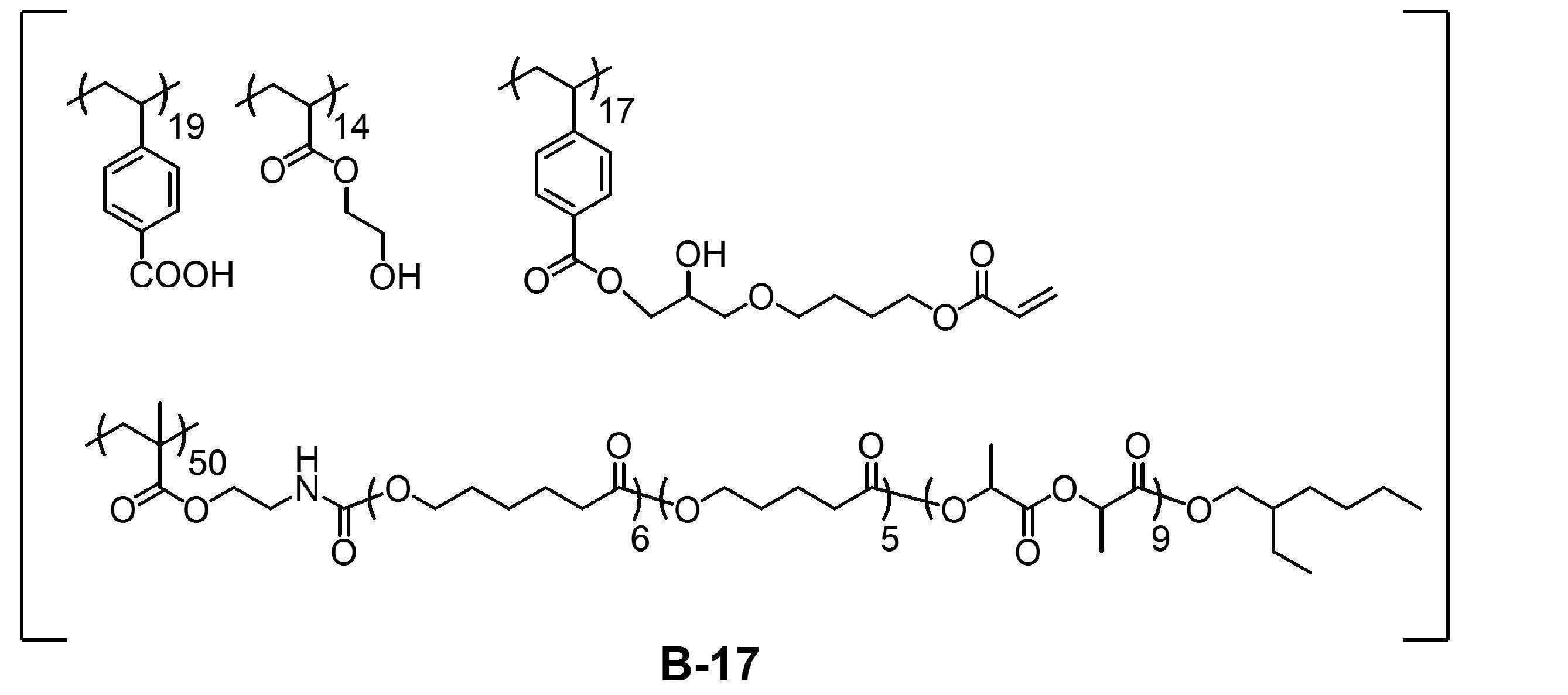
合成例1において、メタクリル酸ベンジルのかわりにN-ブチルアクリルアミドを用い、マクロモノマーMM-1のかわりにマクロモノマーMM-2を用いたこと以外は合成例1と同様の方法で下記構造の樹脂B-18を合成した(重量平均分子量:2.8×10⁴、酸価:70.0mgKOH/g、C=C価:0.5mmol/g)。以下の構造式中、主鎖に付記した数値は質量比であり、側鎖に付記した数値は繰り返し単位の数である。

合成例1において、4HBAGEのかわりにアクリル酸グリシジルを用いたこと以外は合成例1と同様の方法で下記構造の樹脂B-19を合成した(重量平均分子量:2.7×10⁴、酸価:70.0mgKOH/g、C=C価:0.5mmol/g)。以下の構造式中、主鎖に付記した数値は質量比であり、側鎖に付記した数値は繰り返し単位の数である。
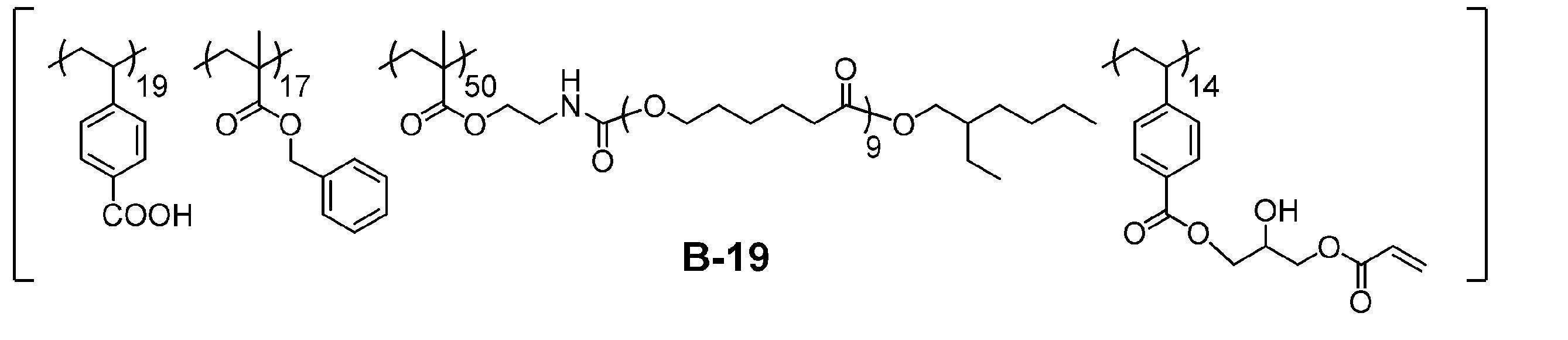
合成例1において、4HBAGEのかわりにメタクリル酸グリシジルを用いたこと以外は合成例1と同様の方法で下記構造の樹脂B-20を合成した(重量平均分子量:2.7×10⁴、酸価:70.0mgKOH/g、C=C価:0.5mmol/g)。以下の構造式中、主鎖に付記した数値は質量比であり、側鎖に付記した数値は繰り返し単位の数である。

合成例1において、4HBAGEのかわりに1,2-エポキシ-9-デセンを用いたこと以外は合成例1と同様の方法で下記構造の樹脂B-21を合成した(重量平均分子量:2.8×10⁴、酸価:70.0mgKOH/g、C=C価:0.5mmol/g)。以下の構造式中、主鎖に付記した数値は質量比であり、側鎖に付記した数値は繰り返し単位の数である。

合成例1のプレポリマーB-5’の合成において、原料として4-ビニル安息香酸(27.7g,0.189mol)、マクロモノマーMM-1(106.1g,0.04mol),メタクリル酸ベンジル(19.3g,0.11mol)、アクリル酸2―ヒドロキシエチル(6.0g,0.05mol)を用いたこと以外は同様の合成法で、プレポリマーB-22’を合成した。プレポリマーB-22’の溶液に1-イソシアナトー4-ビニルベンゼン(7.6g,0.05mol)を加えて、80℃1h攪拌することで、下記構造の樹脂B-22を合成した(重量平均分子量:2.8×10⁴、酸価:70.0mgKOH/g、C=C価:0.5mmol/g)
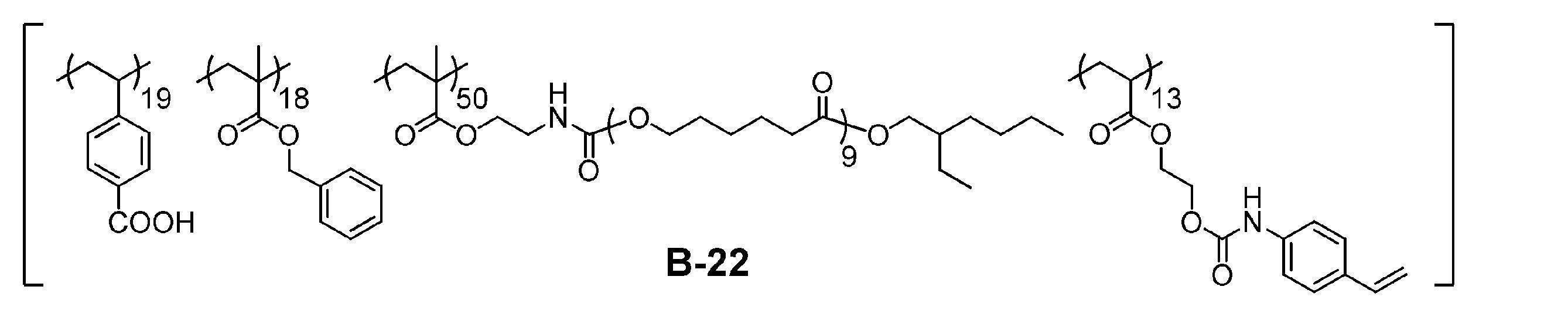
合成例22において、プレポリマーの原料の割合とイソシアン酸4-マレイミドフェニルを用いたこと以外は同様の合成法で、下記構造の樹脂B-23を合成した(重量平均分子量:2.8×10⁴、酸価:70.0mgKOH/g、C=C価:0.5mmol/g)

合成例1において、4HBAGEのかわりにアリルグリシジルエーテルを用いたこと以外は合成例1と同様の方法で下記構造の樹脂B-24を合成した(重量平均分子量:2.8×10⁴、酸価:70.0mgKOH/g、C=C価:0.5mmol/g)。以下の構造式中、主鎖に付記した数値は質量比であり、側鎖に付記した数値は繰り返し単位の数である。

合成例1において、4HBAGEのかわりに1,2-エポキシ-4-ビニルシクロヘキサンを用いたこと以外は合成例1と同様の方法で下記構造の樹脂B-25を合成した(重量平均分子量:2.8×10⁴、酸価:70.0mgKOH/g、C=C価:0.5mmol/g)。以下の構造式中、主鎖に付記した数値は質量比であり、側鎖に付記した数値は繰り返し単位の数である。
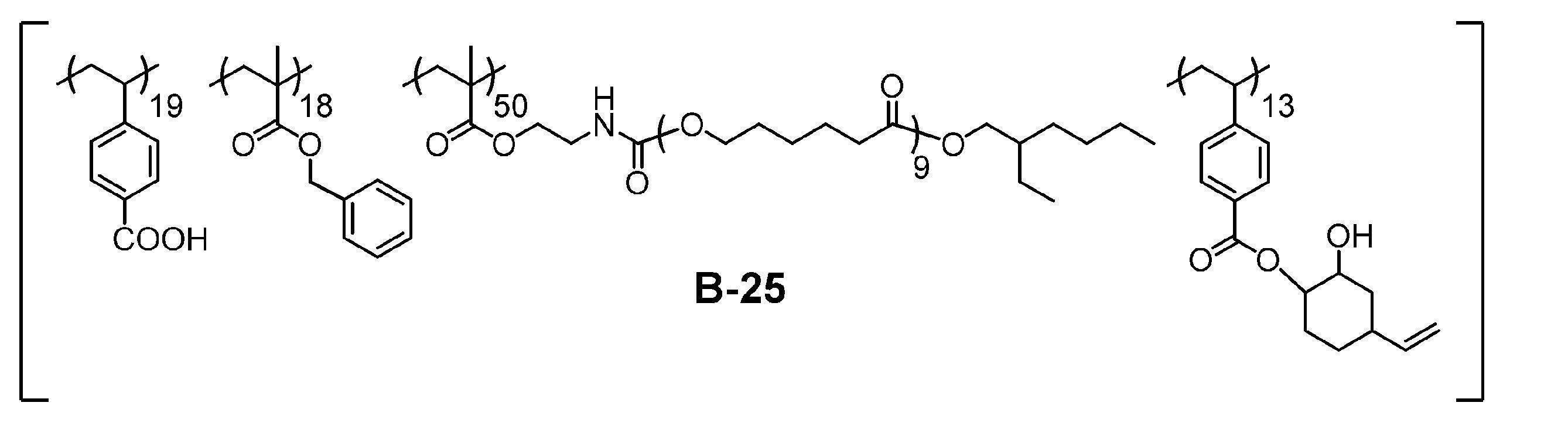
-化合物C-1の合成-
200mLの3口フラスコに、グリシドール(アルドリッチ社製)5.0g、酢酸ブチル53g、p-メトキシフェノール0.04g、カレンズBEI(昭和電工(株)製)14.5g、ネオスタンU600(日東化成(株)製)0.04gを加え、ゆっくりと60℃に昇温させた。60℃で4時間重合反応を続けた後、1H-NMRでカレンズBEIに由来するシグナルの消失を確認し、水50gを加え撹拌させた。分液し水層を廃棄することにより得られた有機層を再度水50gで洗浄した。洗浄後の有機層に、硫酸マグネシウム3gを加え、ろ過した後、2,6-ジ-t-ブチル-4-メチルフェノール(0.4g)を加えて濃縮することで化合物C-1を12g得た。

合成例1において、4HBAGEのかわりに化合物C-1を用いたこと以外は合成例1と同様の方法で下記構造の樹脂B-26を合成した(重量平均分子量:2.8×10⁴、酸価:70.0mgKOH/g、C=C価:0.5mmol/g)。以下の構造式中、主鎖に付記した数値は質量比であり、側鎖に付記した数値は繰り返し単位の数である。

合成例1において、p-ビニル安息香酸(PVBA)のかわりに化合物m-1(下記構造の化合物)を用いたこと以外は合成例1と同様の方法で下記構造の樹脂B-27を合成した(重量平均分子量:2.8×10⁴、酸価:70.0mgKOH/g、C=C価:0.5mmol/g)。以下の構造式中、主鎖に付記した数値は質量比であり、側鎖に付記した数値は繰り返し単位の数である。

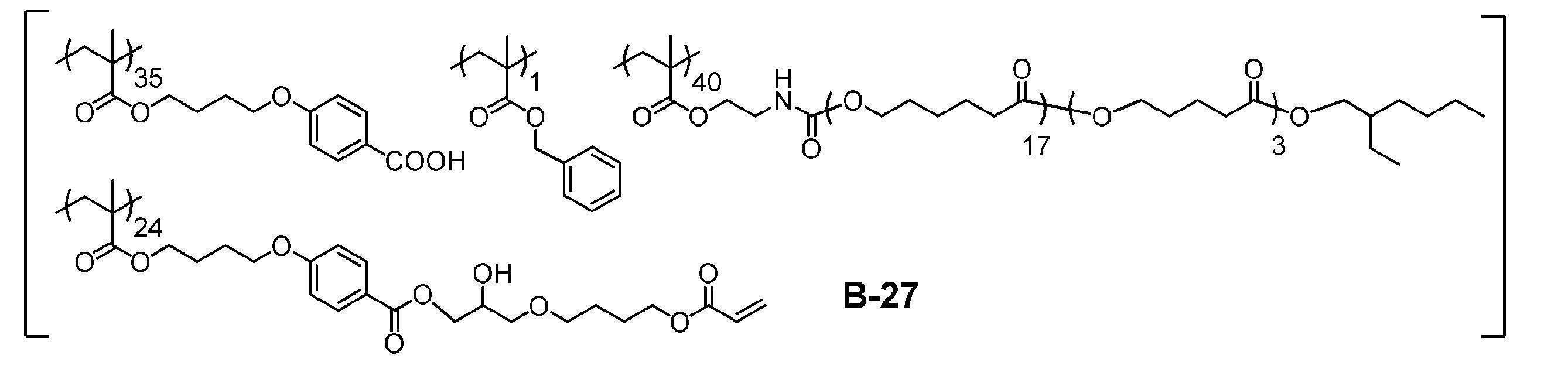
-化合物C-2の合成-
500mLの3口フラスコに、4-ビニルフェノール(富士フイルム和光純薬社製)60.0g、2-ブロモプロピオニルクロリド(TCI社製)85.6g、塩化メチレン100gを加え、室温で4時間反応させた。反応後、水で分液した後に有機層を取り出し、ヘキサンで晶析して析出した固体をろ過することで、化合物C-2を140g得た。
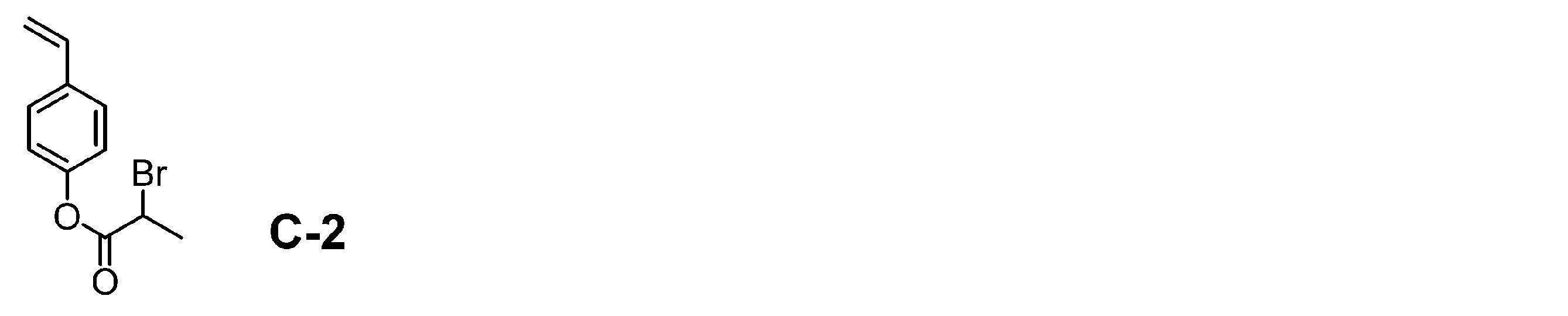
合成例1において、メタクリル酸ベンジルのかわりにスチレンおよび化合物C-2を用いて、比率を変更したこと以外は合成例1と同様の方法で下記構造のプレポリマーB-28’を合成した(35質量%溶液)。以下の構造式中、主鎖に付記した数値は質量比であり、側鎖に付記した数値は繰り返し単位の数である。
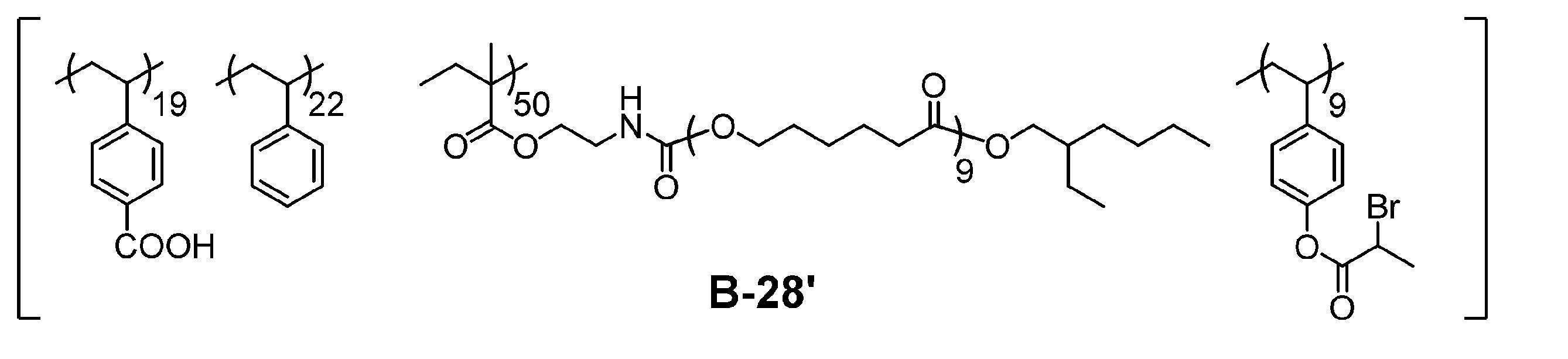
プレポリマーB-28’の溶液300gにジアザビシクロウンデセン(DBU)6.00gを加えて、室温で2時間攪拌した後に、水500mLと0.1N塩酸200mLで分液し、樹脂-B-28を合成した(重量平均分子量:2.8×10⁴、酸価:70.0mgKOH/g、C=C価:0.5mmol/g)。以下の構造式中、主鎖に付記した数値は質量比であり、側鎖に付記した数値は繰り返し単位の数である。
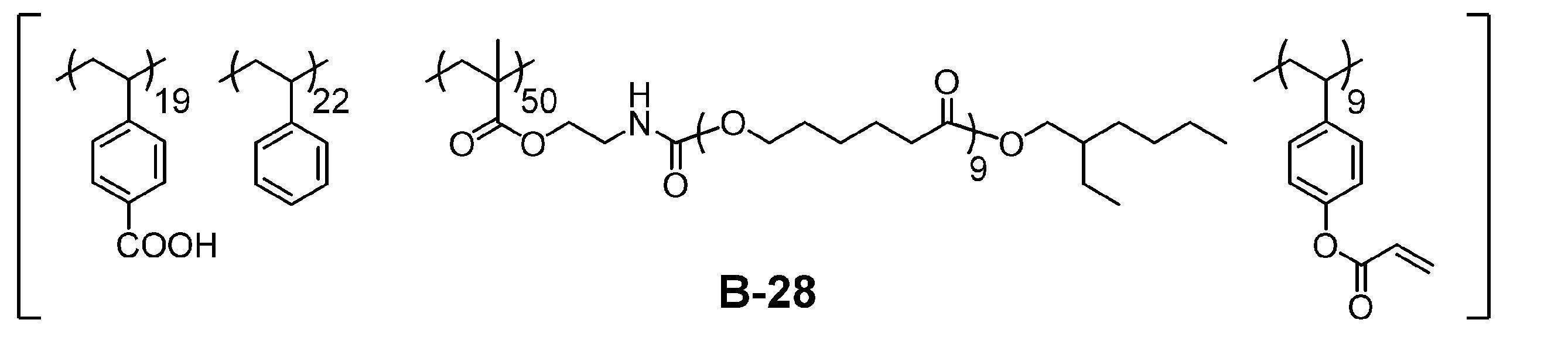
合成例28において、p-ビニル安息香酸(PVBA)のかわりにメタクリル酸を用いたこと以外は合成例28と同様の方法で下記構造の樹脂B-29を合成した(重量平均分子量:2.8×10⁴、酸価:70.0mgKOH/g、C=C価:0.5mmol/g)。以下の構造式中、主鎖に付記した数値は質量比であり、側鎖に付記した数値は繰り返し単位の数である。

合成例1において、マクロモノマーMM-1のかわりにメタクリル酸メチルを用いたこと以外は合成例1と同様の方法で下記構造の樹脂B-30を合成した(重量平均分子量:2.8×10⁴、酸価:70.0mgKOH/g、C=C価:0.5mmol/g)。以下の構造式中、主鎖に付記した数値は質量比であり、側鎖に付記した数値は繰り返し単位の数である。
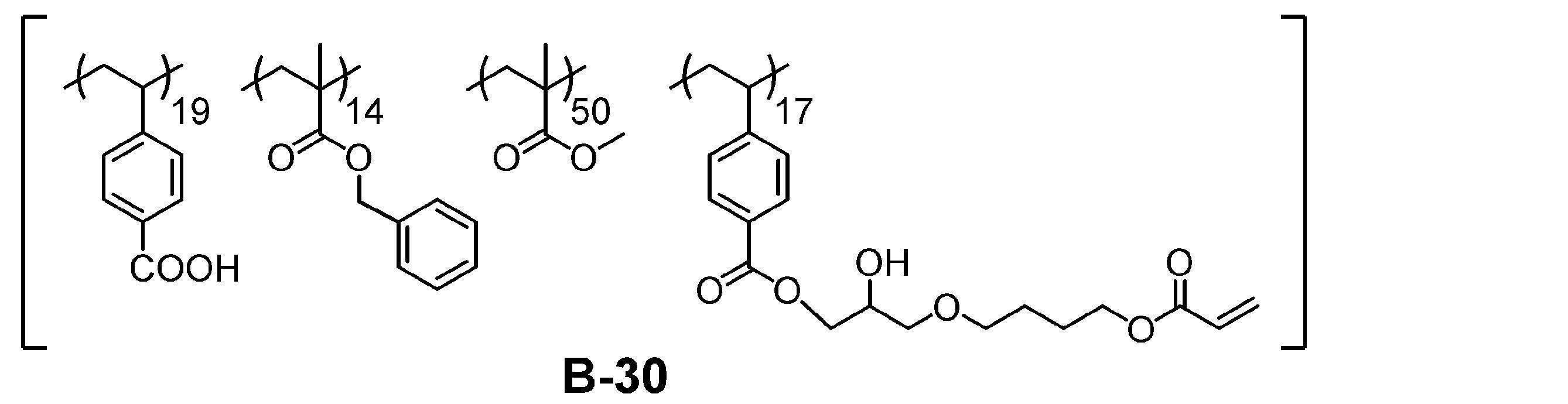
-マクロモノマーMM-6の合成-
3000mLメスシリンダーに、メタクリル酸メチル435.8g、メタクリル酸ブチル412.6g、3-メルカプトプロピオン酸38.5g及び重合開始剤(V-601、富士フイルム和光純薬社製)4.20gを加え、酪酸ブチル570.0gに溶解してモノマー溶液を調製した。5000mLの3つ口フラスコにPGMEA713.0gを加え、80℃で撹拌し、上記モノマー溶液を2時間かけて滴下し、更に80℃で2時間撹拌した。重合開始剤(V-601、富士フイルム和光純薬社製)を更に4.20g追加後、95℃に昇温して更に2時間撹拌した。得られた溶液に、更に、メタクリル酸グリシジル62.0g、4-ヒドロキシ-2,2,6,6-テトラメチルピペリジン1-オキシルフリーラジカル2.0g及びテトラブチルアンモニウムブロミド26.0gを加え、100℃で更に3時間撹拌した。得られた反応溶液をメタノールで再沈殿することにより、マクロモノマーMM-6を合成した。

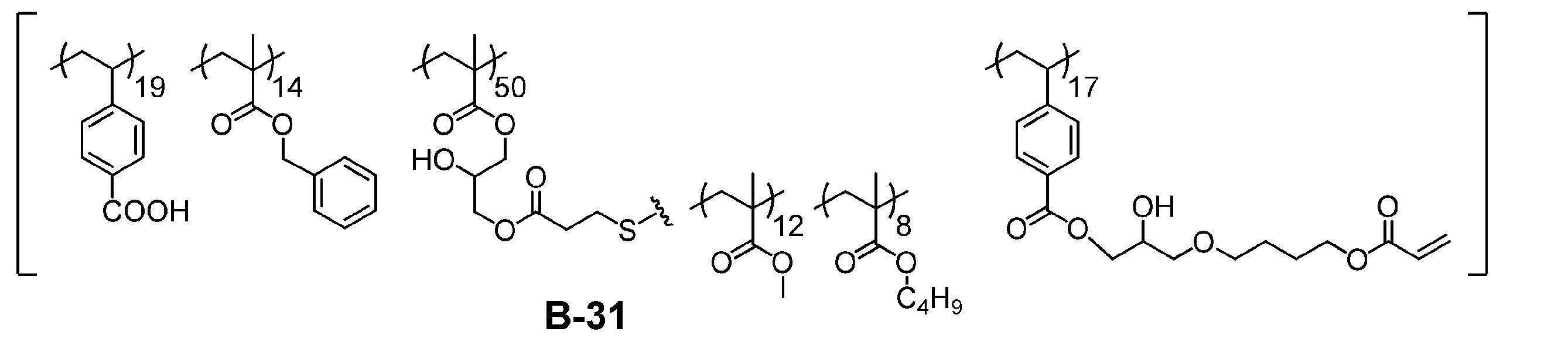
-化合物C-4の合成-
合成例28のC-2の合成において、4-ビニルフェノールの代わりに4―ビニルベンジルアミンを用いたこと以外は同様の方法で下記構造のC-4を合成した。
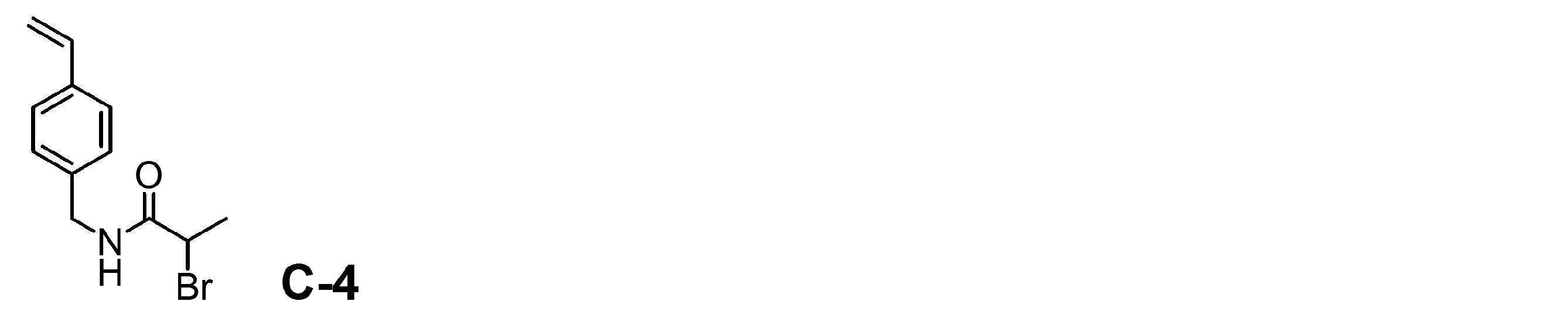
合成例28のB-28の合成において、C-2の代わりにC-4を用いて、原料の割合を変えたこと以外は同様の方法で下記構造のB-32を合成した。
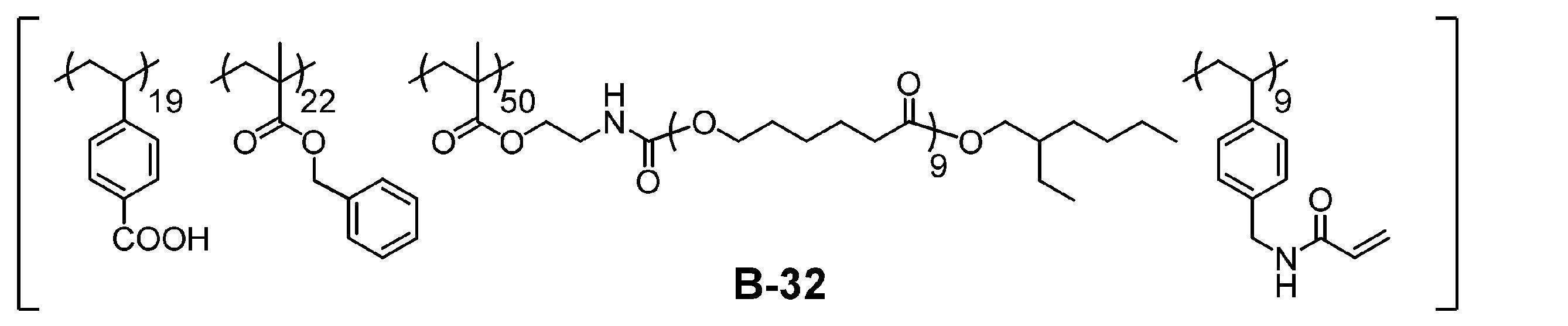
合成例1のプレポリマーB-5’の合成において、原料の割合を変更した以外は同様の方法で下記構造のb-1を合成した(重量平均分子量:2.8×10⁴、酸価:70.0mgKOH/g)。以下の構造式中、主鎖に付記した数値は質量比である。

-中間体D-1’’の合成-
三口フラスコにジペンタエリスリトールヘキサキス(3-メルカプトプロピオネート)(DPMP)の94.84g(0.12mol)、イタコン酸の55.16g(0.42mol)、MFGの350.00gを加えた。室温で窒素置換して酸素濃度1%以下を確認後、80℃に昇温し、攪拌した(窒素流量50mL/min、攪拌速度200rpm)。温度安定化後、2,2’-アゾビス(イソ酪酸)ジメチルの0.24g(1.06mmol)を加えて、2時間攪拌した。次いで、2,2’-アゾビス(イソ酪酸)ジメチルの0.24g(1.06mmol)を加えて、90℃に昇温し、2時間攪拌した。室温まで冷却し、中間体D-1’’の30質量%溶液を得た(収量:495.90g)。
三口フラスコにプロピレングリコールモノメチルエーテルアセテート(PGMEA)の549.00gを加え、室温で窒素置換して酸素濃度1%以下にしたのち、80℃に昇温し、攪拌した(窒素流量50mL/min、攪拌速度200rpm)。
三角フラスコに中間体D-1’’の412.49g(0.1mol)、メタクリル酸の230.21g(2.67mol)、化合物C-2の1268.29g(0.4010mol)、PGMEAの937.36g、2,2’-アゾビス(イソ酪酸)ジメチルの5.281g(23.0mmol)を加えた溶液を調製した。三角フラスコ中の溶液を三口フラスコに2.5時間かけて滴下した(滴下速度2.80mL/min)。次いで、三角フラスコに洗い込み用のPGMEA54.90gを加えて三角フラスコ内を洗浄したのち、三角フラスコ内のPGMEAを三口フラスコに滴下した後、2.5時間攪拌した。
次いで、三口フラスコに2,2’-アゾビス(イソ酪酸)ジメチルの5.281g(23.0mmol)を加えて、90℃に昇温し、2時間攪拌した(窒素流量50mL/min、攪拌速度250rpm)。室温まで冷却し、プレポリマーD-1’の40質量%溶液を得た(収量:3300g、重量平均分子量:1.3×104、酸価:153.1mgKOH/g)。
合成例28の樹脂B-28の合成において、B-28’の代わりにプレポリマー-D-1’を用いたこと以外は同様の方法で下記構造のD-1を合成した(重量平均分子量:1.2×10⁴、酸価:155.0mgKOH/g、C=C価:0.28mmol/g)。
合成例34において、原料の割合を変更した合成例34と同様の方法で下記構造の樹脂D-2~D-6をそれぞれ合成した。以下の構造式中、添え字の数字は繰り返し単位の数である。
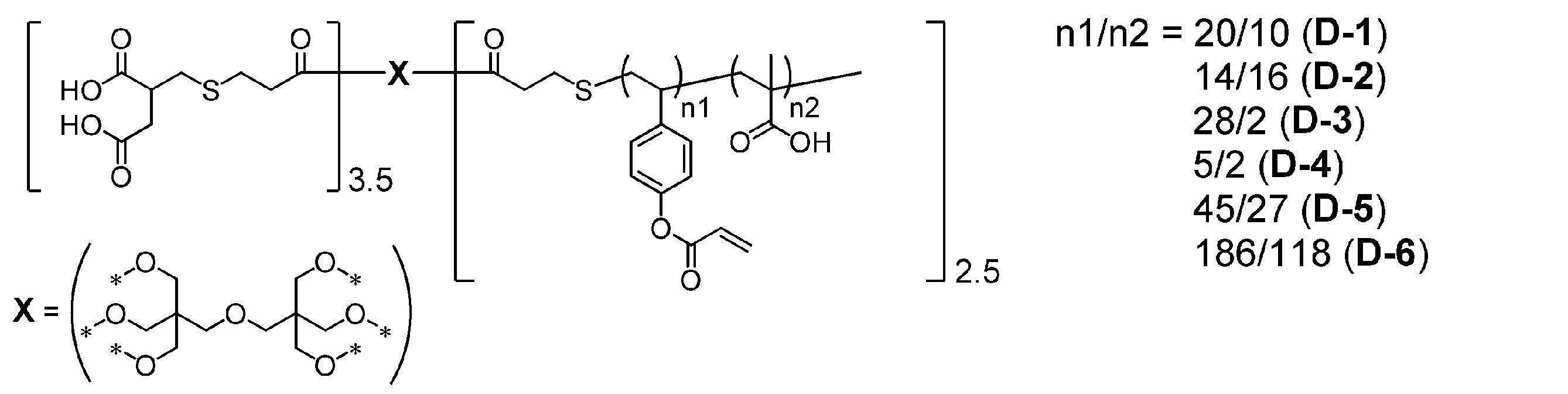
-化合物C-3の合成-
化合物C-2の合成において、2-ブロモプロピオニルクロリドのかわりに6-ブロモヘキサノイルクロリドを用いた以外は、化合物C-2と同様の方法で化合物C-3を合成した。
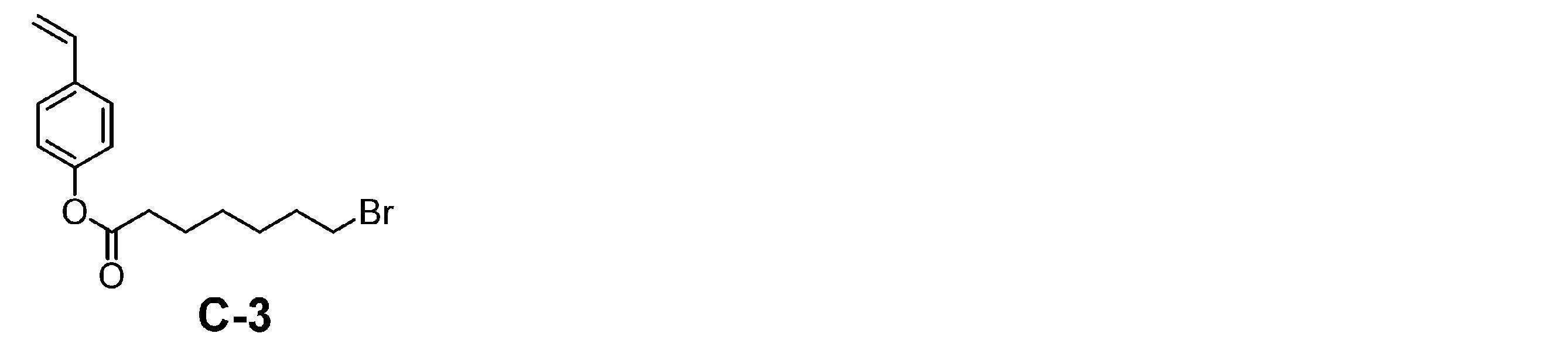
合成例34において、化合物C-2のかわりに化合物C-3を用いたこと以外は合成例34と同様の方法で下記構造の樹脂D-7を合成した(重量平均分子量:1.4×10⁴、酸価:158.0mgKOH/g、C=C価:0.28mmol/g)。以下の構造式中、添え字の数字は繰り返し単位の数である。

合成例34において、メタクリル酸のかわりにPVBAを用いたこと以外は合成例34と同様の方法で下記構造の樹脂D-8を合成した(重量平均分子量:1.3×10⁴、酸価:158.0mgKOH/g、C=C価:0.23mmol/g)。以下の構造式中、添え字の数字は繰り返し単位の数である。
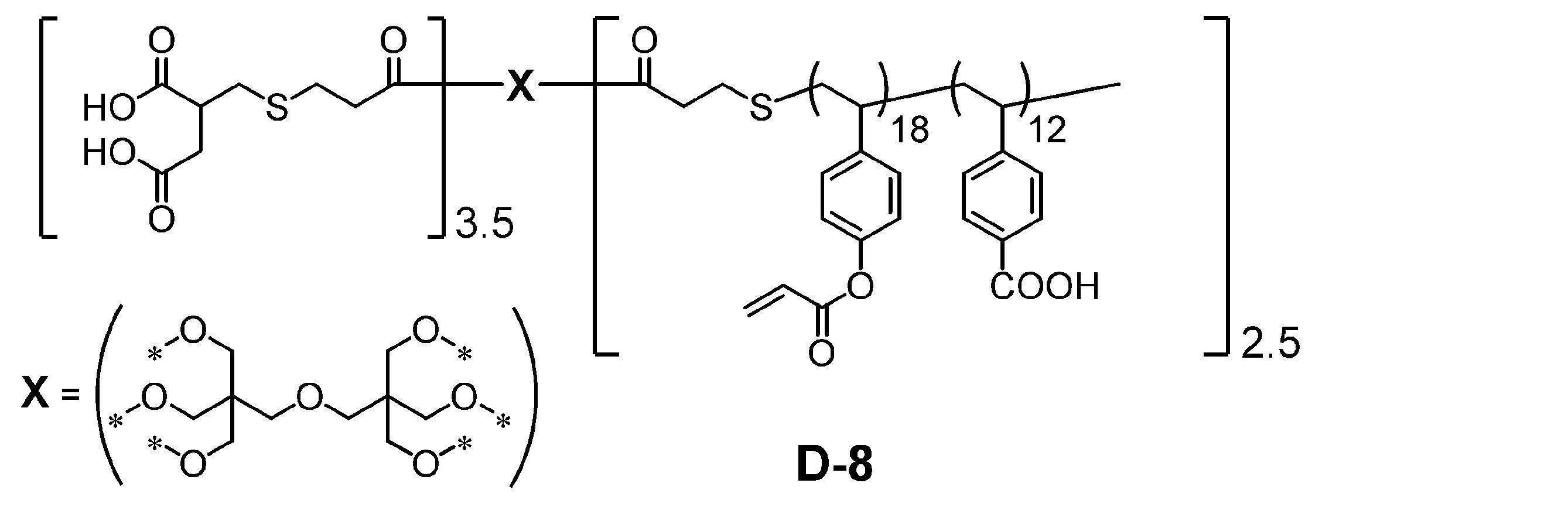
合成例34において、イタコン酸のかわりにNKエステルCB-1(新中村化学工業(株)製)を用いたこと以外は合成例34と同様の方法で下記構造の樹脂D-9を合成した(重量平均分子量:1.2×10⁴、酸価:158.0mgKOH/g、C=C価:0.26mmol/g)。以下の構造式中、添え字の数字は繰り返し単位の数である。
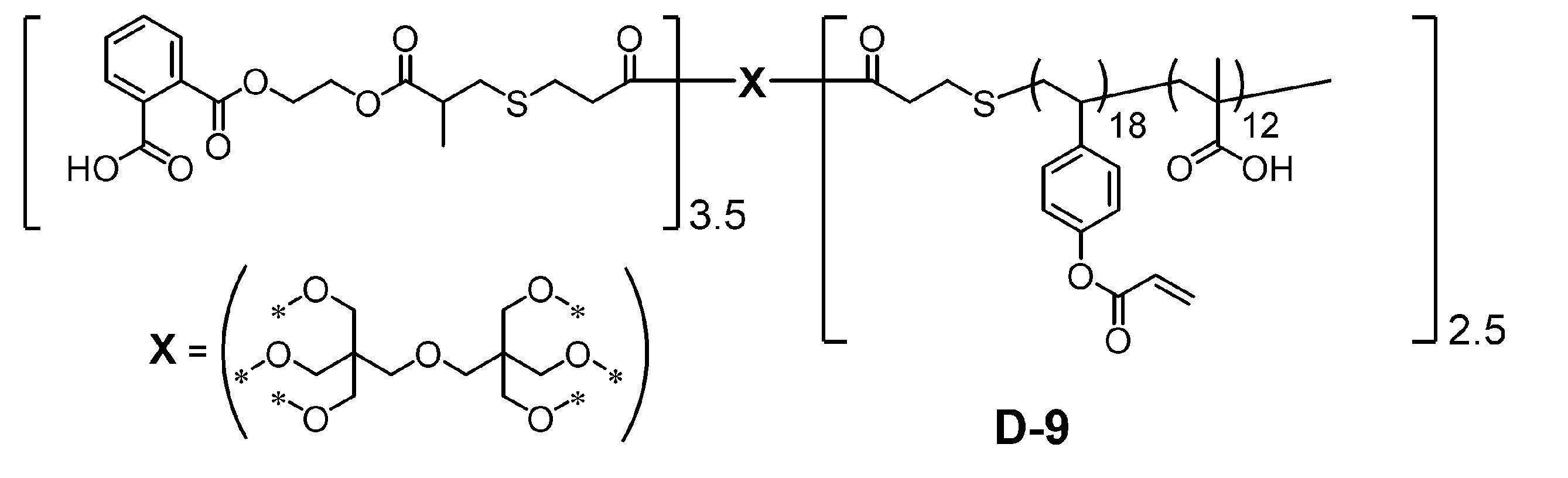
特開2011-054439号公報の段落0101及び段落0102に記載の実施例1に準拠して、下記化学式に示す組成(構成成分の種類及び含有量)となるように各構成成分を導く化合物を用いて、ブロックポリマーを合成した。合成したブロックポリマーをPGMEAに溶解して、下記構造の樹脂D-10(ポリマー濃度35質量%)を調製した(重量平均分子量:1.2×10⁴、酸価:158.0mgKOH/g、C=C価:0.5mmol/g)。樹脂D-10は、式中のbの左側の2つユニットと右側の2ユニットがそれぞれひとかたまりのブロックをなしているブロックポリマーである。以下の構造式中、主鎖に付記した数値は質量比である。
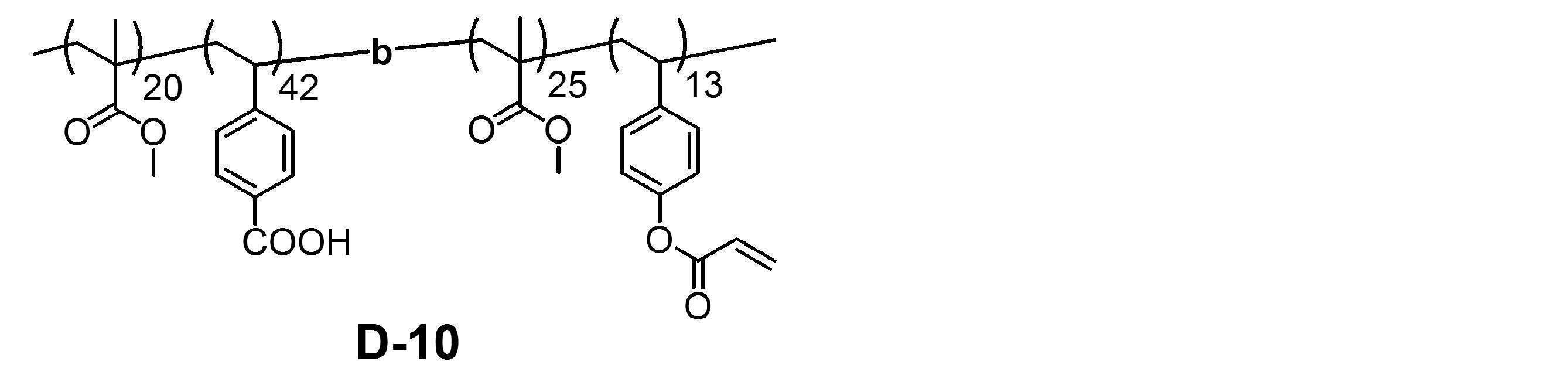
合成例30において、メタクリル酸ベンジルとメタクリル酸メチルのかわりにメタクリル酸ブチルを用い、4HBAGEのかわりにメタクリル酸グリシジルを用いたこと以外は合成例30と同様の方法で下記構造の樹脂D-11を合成した(重量平均分子量:1.2×10⁴、酸価:158.0mgKOH/g、C=C価:0.5mmol/g)。以下の構造式中、主鎖に付記した数値は質量比である。
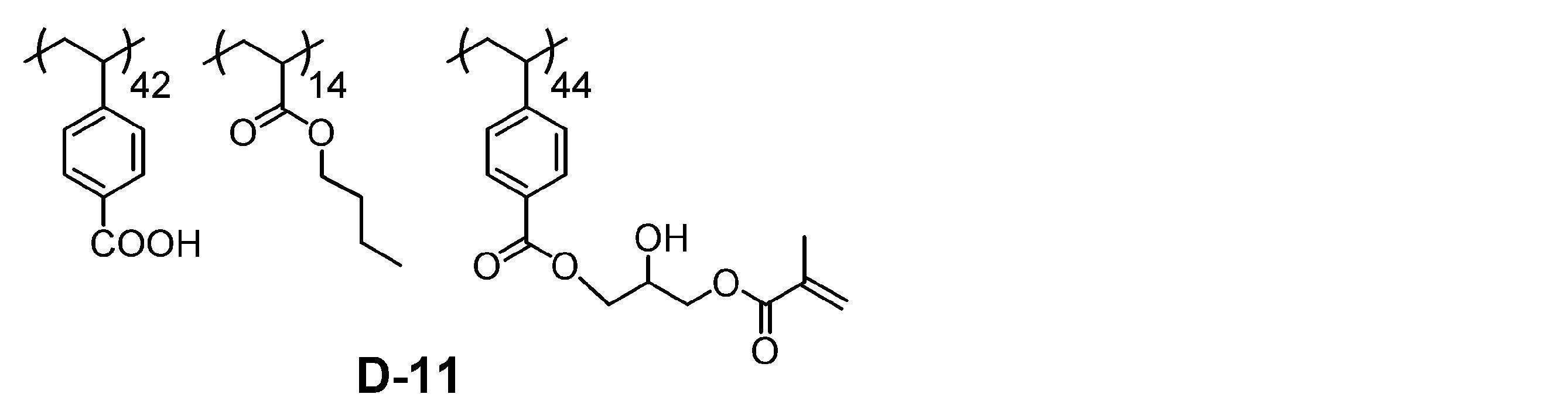
合成例34において、化合物C-2のかわりにメタクリル酸メチルを用いたこと以外は合成例34と同様の方法で下記構造の樹脂d-1を合成した(重量平均分子量:1.2×10⁴、酸価:158.0mgKOH/g)。以下の構造式中、添え字の数字は繰り返し単位の数である。
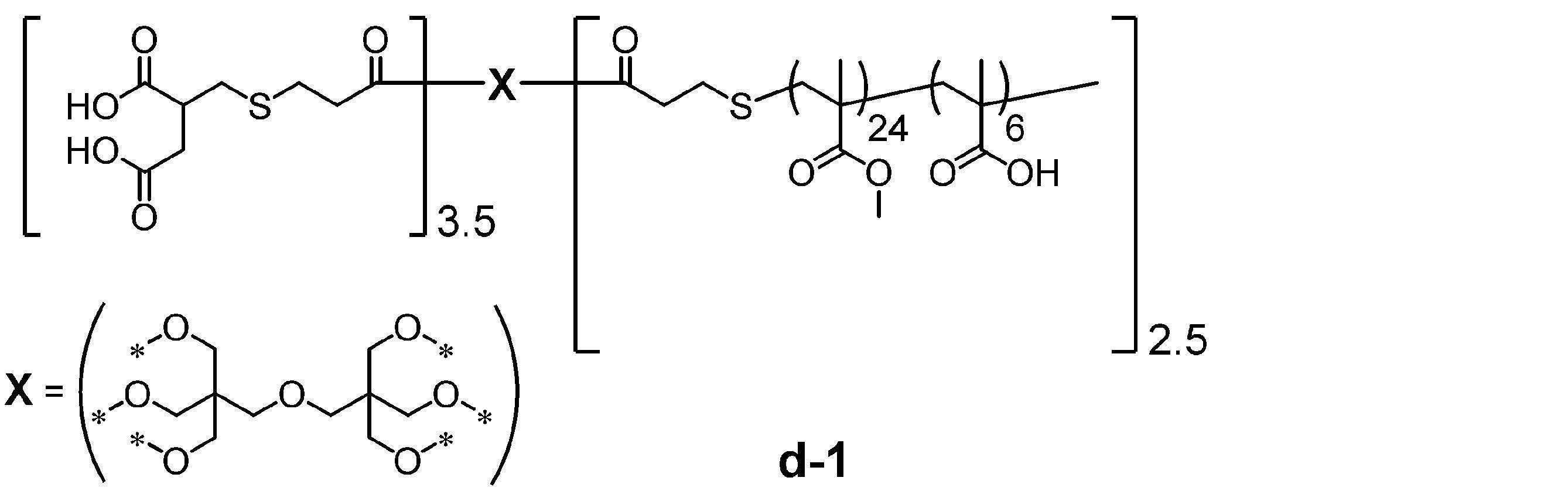
合成例33において、原料の種類をメタクリル酸、メタクリル酸ラウリルにかえて、割合を変更した以外は合成例33と同様の方法で下記構造のd-2を合成した(重量平均分子量:1.2×10⁴、酸価:158.0mgKOH/g)。以下の構造式中、主鎖に付記した数値は質量比である。
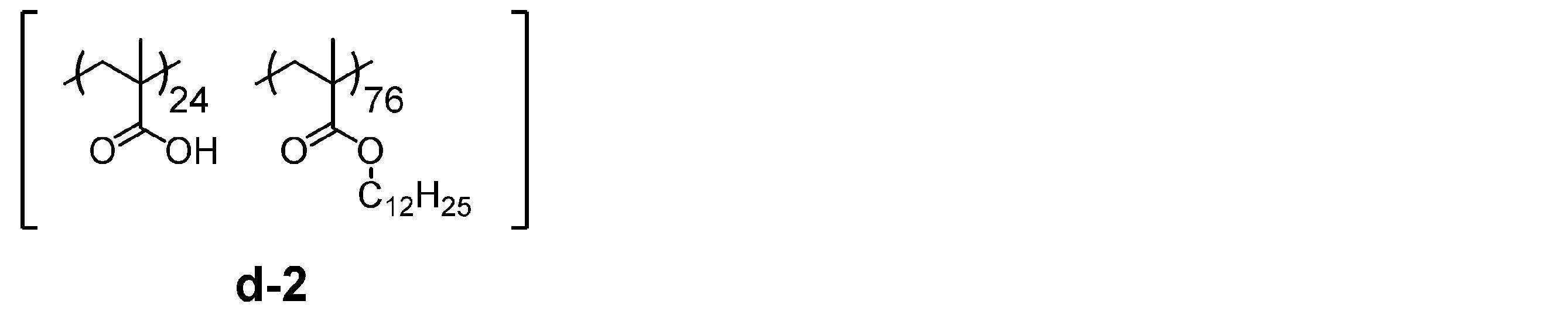
合成例33において、原料の種類をメタクリル酸、メタクリル酸グリシジルにかえて、割合を変更した以外は合成例33と同様の方法で下記構造の樹脂T-1を合成した(重量平均分子量:2.8×10⁴、酸価:70.0mgKOH/g、C=C価:0.5mmol/g)。以下の構造式中、主鎖に付記した数値は質量比である。
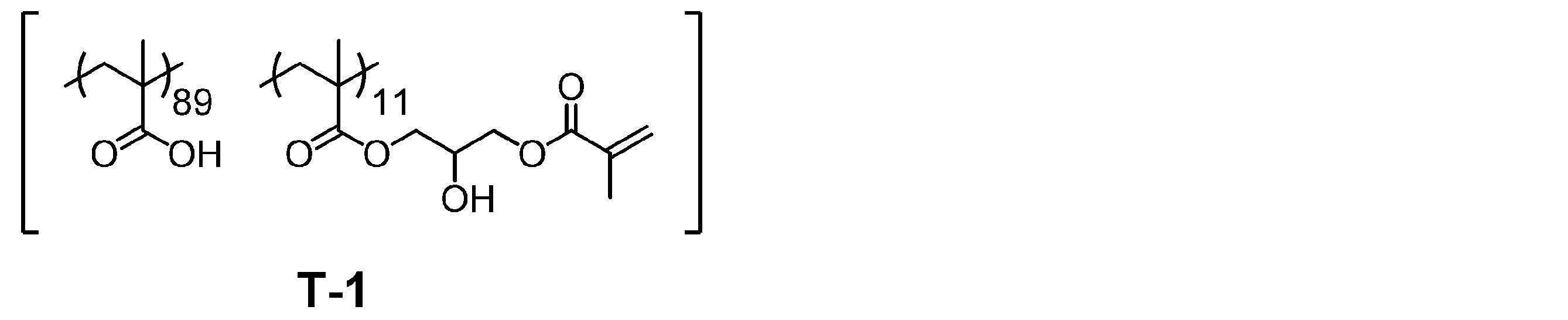
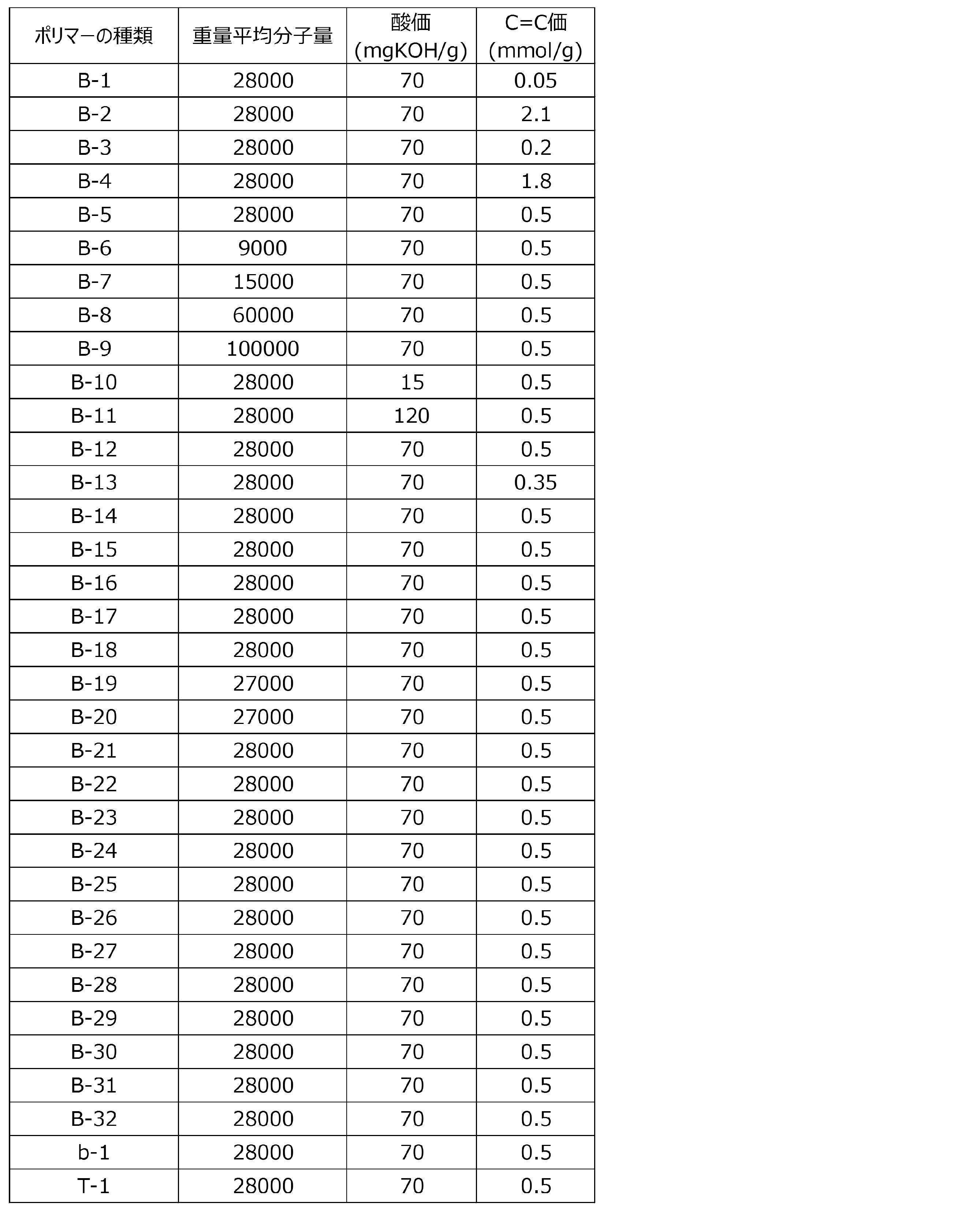
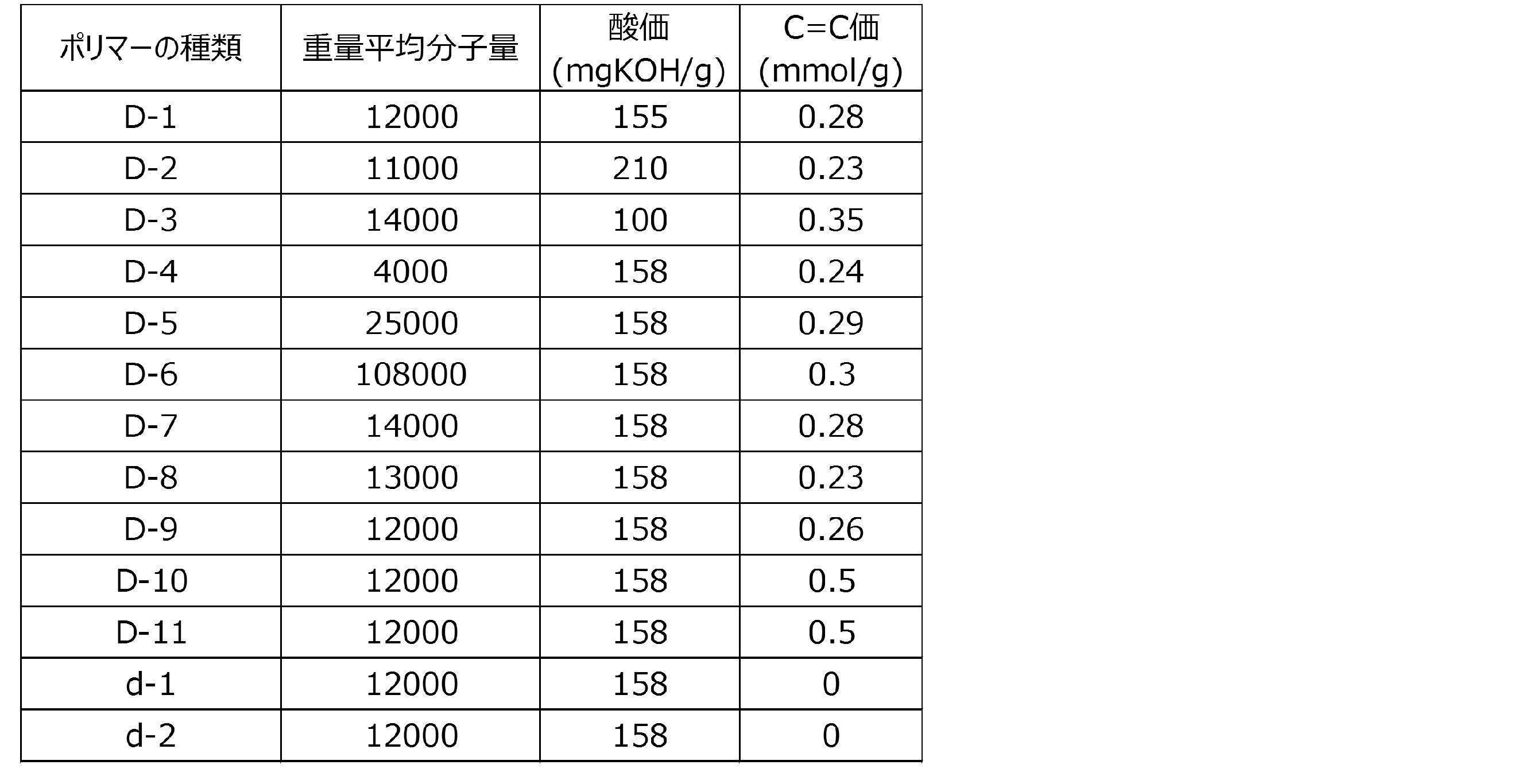
下記の表に記載の組成の混合液に対し、循環型分散装置(ビーズミル)として、寿工業(株)製ウルトラアペックスミルを用いて、以下の分散処理を行い、分散液を製造した。
ビーズ径:直径0.2mm
ビーズ充填率:65体積%
周速:6m/秒
ポンプ供給量:10.8kg/時
冷却水:水道水
ビーズミル環状通路内容積:0.15L
分散処理する混合液量:0.65kg
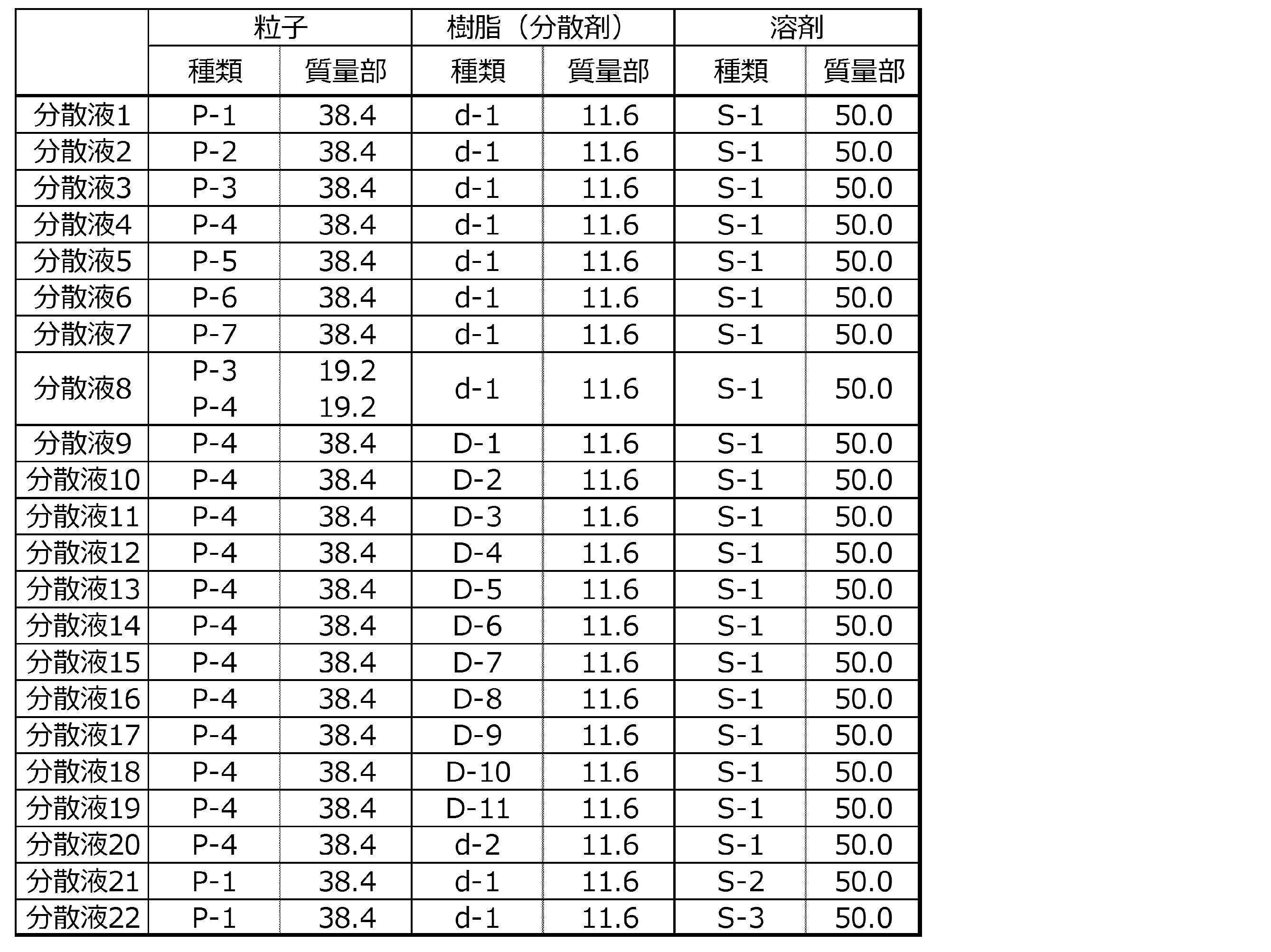
(粒子)
P-1~P-7:下記表に記載の粒子

D-1~D-11、d-1、d-2:上述した樹脂D-1~D-11、d-1、d-2
S-1:プロピレングリコールモノメチルエーテルアセテート(PGMEA)
S-2:プロピレングリコールモノメチルエーテル(PGME)
S-3:シクロペンタノン
下記表に記載の原料を混合して、組成物を製造した。
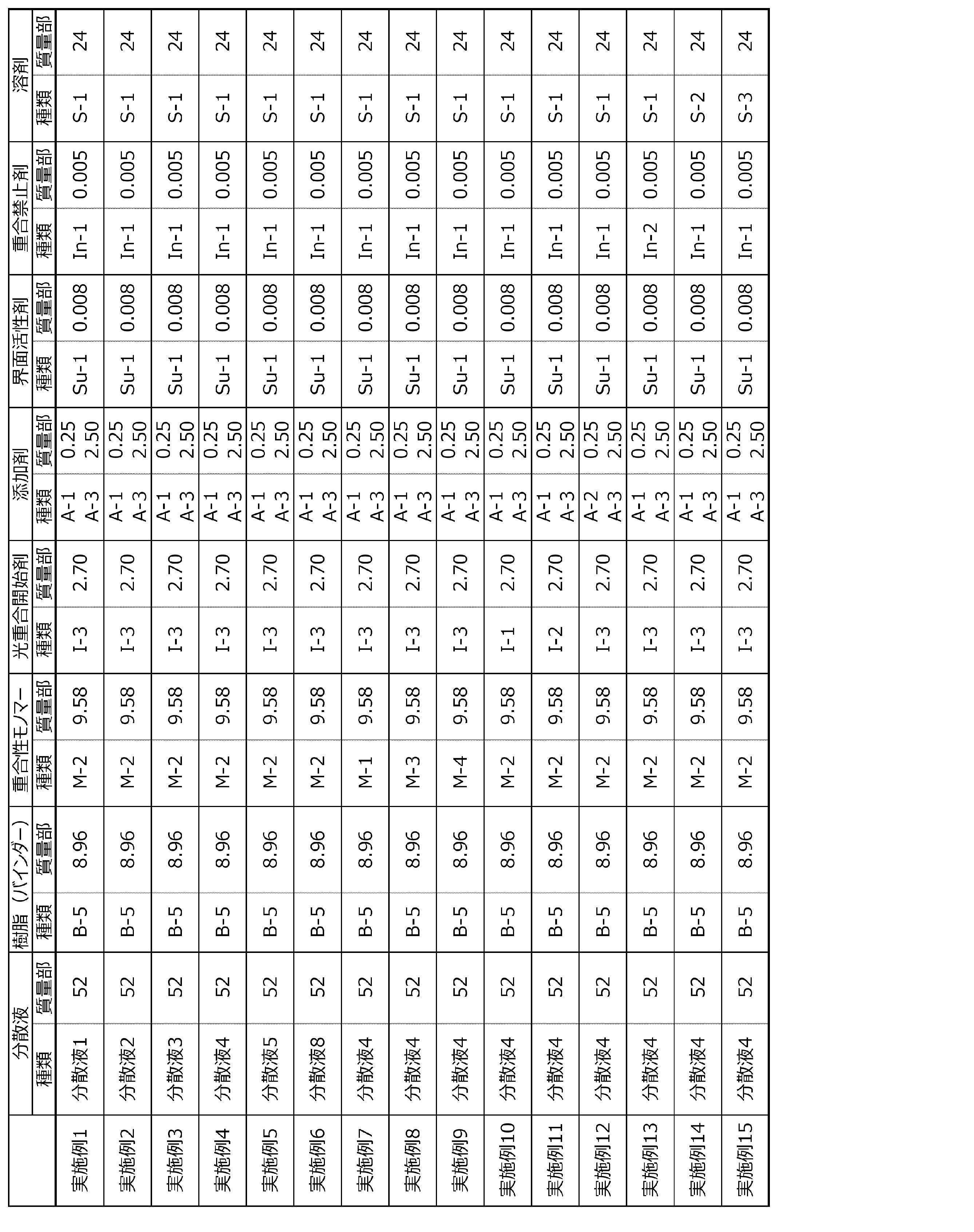
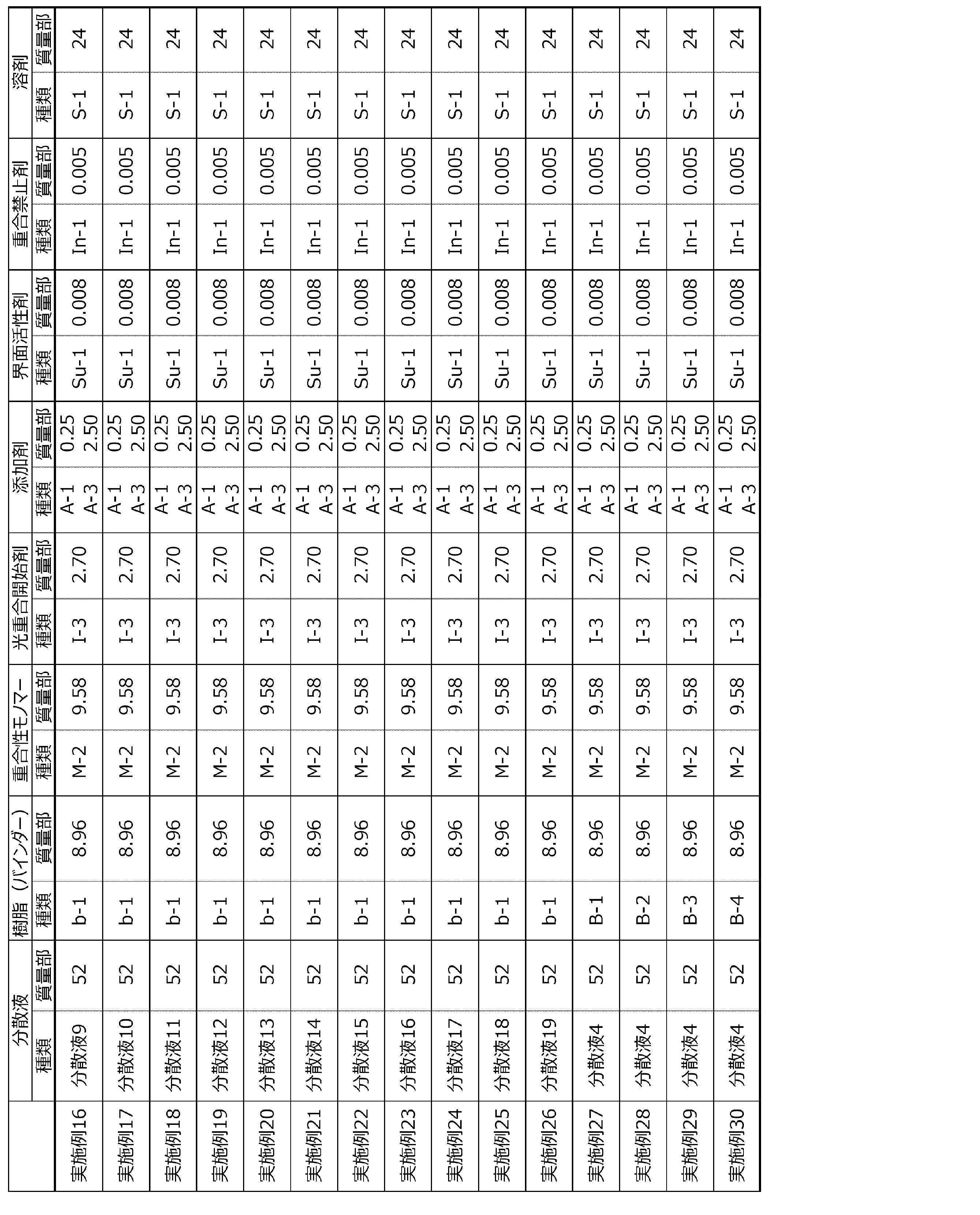


(分散液)
分散液1~22:上述した分散液1~22
B-1~B-32、b-1、T-1:上述した樹脂B-1~B-32、b-1、T-1
M-1:KAYARAD DPHA(日本化薬(株)製、ジペンタエリスリトールヘキサ(メタ)アクリレート)
M-2:KAYARAD RP-1040(日本化薬(株)製、下記構造の化合物)
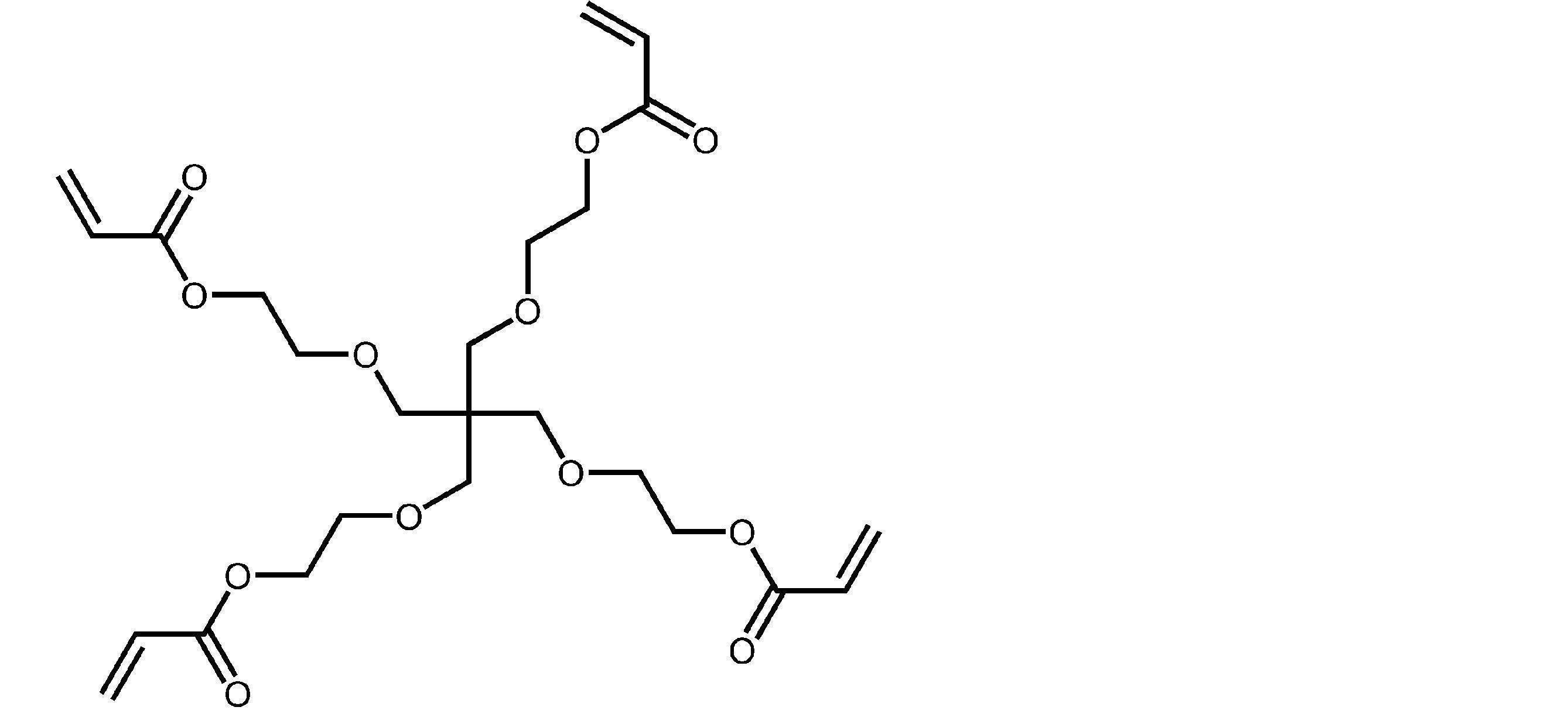
M-4:ライトアクリレートDCP-A(共栄社化学(株)製、ジメチロール-トリシクロデカンジアクリレート)
I-1:Irgacure OXE01(BASFジャパン(株)製)
I-2:Omnirad 369(IGM Resins B.V.社製)
I-3:Omnirad TPO H(IGM Resins B.V.社製)
I-4:Irgacure OXE03(BASFジャパン(株)製)
A-1:アデカスタブAO-80((株)ADEKA製、着色防止剤)
A-2:Irganox 1010(BASF社製、着色防止剤)
A-3:下記構造の化合物(シランカップリング剤)
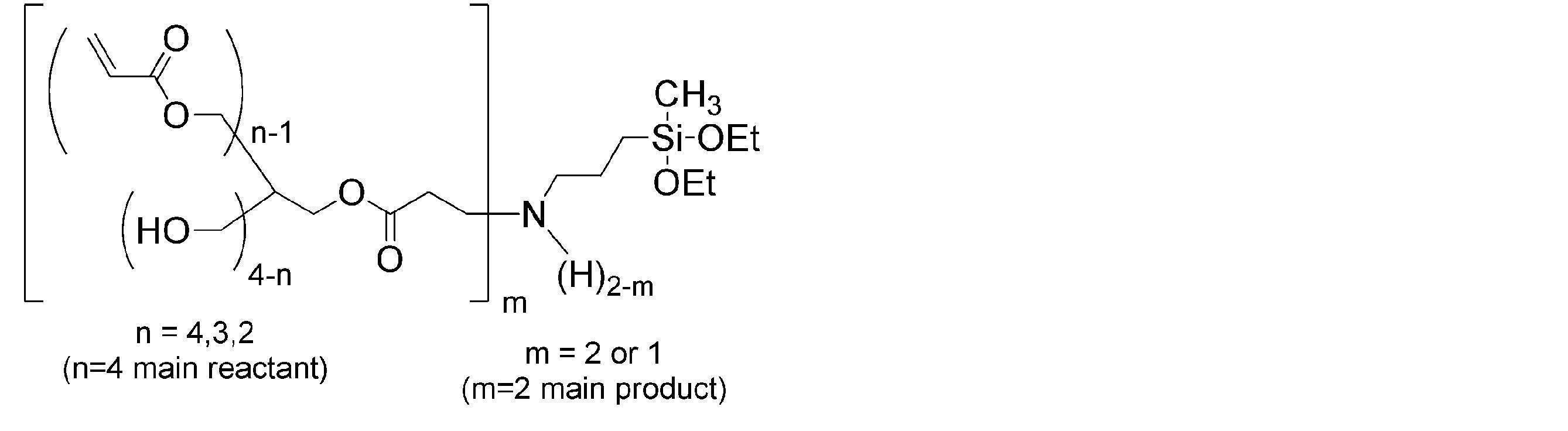
Su-1:KF―6001(信越化学工業社製、下記構造のシリコーン系界面活性剤)

In-1:p-メトキシフェノール
In-2:1,4-ベンゾキノン
S-1:プロピレングリコールモノメチルエーテルアセテート(PGMEA)
S-2:プロピレングリコールモノメチルエーテル(PGME)
S-3:シクロペンタノン
各組成物を、下塗り層(富士フイルムエレクトロニクスマテリアルズ(株)製、CT-4000L、厚さ0.1μm)付き8インチ(=203.2mm)のガラスウエハ上に、ポストベーク後の厚さが8μmになるようにスピンコータを用いて塗布し、120℃のホットプレートを用いて2分間加熱処理(プリベーク)を行った。
次いで、i線ステッパー露光装置FPA-3000i5+(Canon(株)製)を使用して、300μm四方の開口部を有するマスクを介して365nmの波長の光を1700mJ/cm2の露光量で照射して露光した。露光後の膜を有するガラスウエハを、スピン・シャワー現像機(DW-30型、(株)ケミトロニクス製)の水平回転テーブル上に載置し、アルカリ現像液(CD-2060、富士フイルムエレクトロニクスマテリアルズ(株)製)を用いて23℃で60秒間パドル現像した。次いで、パドル現像後のガラスウエハを、真空チャック方式で水平回転テーブルに固定し、回転装置によってガラスウエハを回転数50rpmで回転させつつ、その回転中心の上方より純水を噴出ノズルからシャワー状に供給してリンス処理(23秒×2回)を行い、次いで、スピン乾燥を行い、次いで、220℃で5分間、ホットプレートを用いて加熱処理(ポストベーク)を行い、パターン(パターンサイズ300μm)を形成した。
得られたパターンについて、アンダーカット、テープ剥離耐性を評価して硬化性を評価した。
ガラスウエハ上に形成されたパターン(膜)を光学顕微鏡により撮影し、色の濃淡からパターン(膜)がガラスウエハに密着している領域を特定してパターン(膜)がガラスウエハに密着している領域の面積S2を算出した。
パターンの面積S1(=300μm×300μm)に対するパターンがガラスウエハに密着している領域の面積S2の面積比Y(=S2/S1)を算出し、以下の式よりアンダーカットの長さの平均値xを算出した。
面積比Y=(300-2x)2/(300×300)
-評価基準-
5:アンダーカットの長さの平均値が5μm未満
4:アンダーカットの長さの平均値5μm以上、10μm未満
3:アンダーカットの長さの平均値10μm以上、15μm未満
2:アンダーカットの長さの平均値15μm以上、20μm未満
1:アンダーカットの長さの平均値20μm以上
ガラスウエハ上に形成されたパターンの表面に、紫外線硬化型テープ(D-510TT、リンテック(株)製)を貼り付けて、露光機(Portable Cure 100、セン特殊光源(株)製)を用いて1000mJ/cm2の露光量で照射して露光して紫外線硬化型テープを硬化させたのち、パターンの表面からテープを剥離して、テープ剥離耐性を行った。
テープ剥離耐性試験前後のガラスウエハ上のパターンの個数から、パターン剥離率を算出し、以下の基準でテープ剥離耐性を評価した。
パターン剥離率=((A1-A2)/A1)×100
A1:テープ剥離耐性試験前のガラスウエハ上に形成されているパターンの個数
A2:テープ剥離耐性試験後のガラスウエハ上に形成されているパターンの個数
-評価基準-
5:パターン剥離率が10%未満
4:パターン剥離率が10%以上、20%未満
3:パターン剥離率が20%以上、30%未満
2:パターン剥離率が30%以上、40%未満
1:パターン剥離率が40%以上
各組成物を、下塗り層(富士フイルムエレクトロニクスマテリアルズ(株)製、CT-4000L、厚さ0.1μm)付き8インチ(=203.2mm)のガラスウエハ上に、ポストベーク後の厚さが8μmになるようにスピンコータを用いて塗布し、120℃のホットプレートを用いて2分間加熱処理(プリベーク)を行った。次いで、i線ステッパー露光装置FPA-3000i5+(Canon(株)製)を使用して、365nmの波長の光を1000mJ/cm2の露光量で照射して露光し、その後、220℃のホットプレートを用いて5分間加熱処理(ポストベーク)を行い、厚さ8μmの膜を形成した。
得られた膜の波長400~1000nmの範囲の光の透過率を分光光度計(U-4100、(株)日立ハイテク製)を用いて測定し、前述の範囲における透過率の最大値(Tmax)及び波長940nmの光の透過率(T940)と波長450nmの光の透過率(T450)との差の絶対値(透過率差ΔT)を算出した。
透過率差ΔT=|T940-T450|
5:透過率差ΔTが15%未満である。
4:透過率差ΔTが15%以上25%未満である。
3:透過率差ΔTが25%以上30%未満である。
2:透過率差ΔTが30%以上35%未満である。
1:透過率差ΔTが35%以上である。
5:透過率の最大値Tmaxが60%以下である。
4:透過率の最大値Tmaxが60%を超え70%以下である。
3:透過率の最大値Tmaxが70%を超え75%以下である。
2:透過率の最大値Tmaxが75%を超え80%以下である。
1:透過率の最大値Tmaxが80%を超えている。
上記で作製した膜を265℃で5分間加熱した。加熱後の膜の透過率を測定し、透過率の変化量の最大値を求め、以下の基準にて耐熱性を評価した。透過率の測定は各試料につき5回行い、最大値と最小値を除いた3回の結果の平均値を採用した。また、透過率の変化量の最大値とは、加熱前後の膜の、波長400~1000nmの範囲における透過率の変化量が最も大きい波長における変化量を意味する。
(評価基準)
5:透過率の変化量の最大値が1%以下である。
4:透過率の変化量の最大値が1%を超えて2%以下である。
3:透過率の変化量の最大値が2%を超えて4%以下である。
2:透過率の変化量の最大値が4%を超えて5%以下である。
1:透過率の変化量の最大値が5%を超えている。
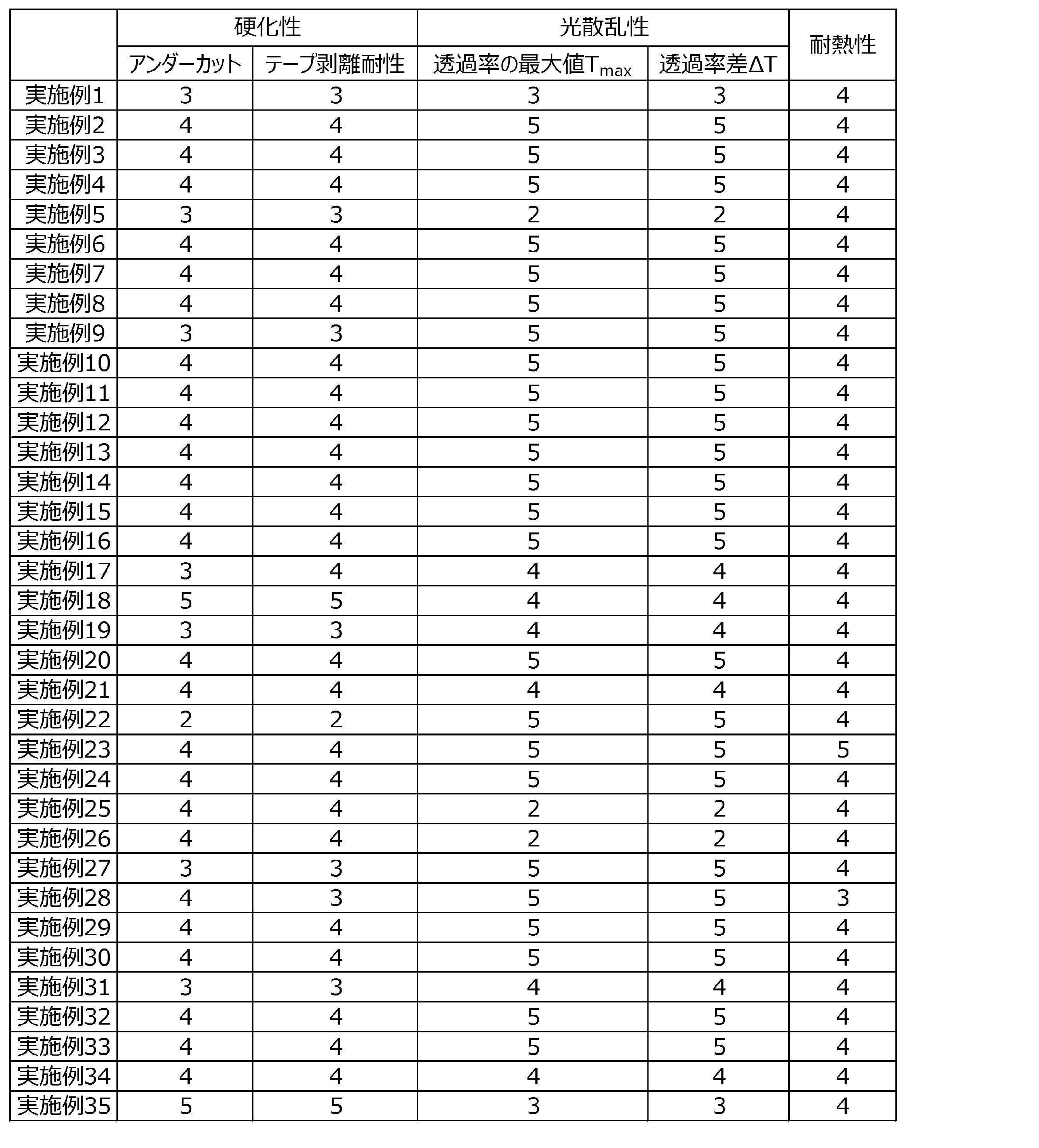

得られた膜は、いずれも、膜中に粒子を含む第1の相と、第1の相よりも粒子の含有量が少ない第2の相との相分離構造が形成されていた。
101:光電変換素子
111~114:画素
110:光学フィルタ
121、122:膜
130:透明支持体
Claims (17)
- 屈折率が2.0以上で平均一次粒子径が200nm以下の粒子と、膜形成成分と、溶剤と、を含む組成物であって、
前記膜形成成分は、樹脂を2種以上含むか、あるいは、1種以上の樹脂と1種以上の重合性モノマーとを含み、
前記樹脂の少なくとも1種は、式(1)で表される部分構造を有する樹脂aを含む、組成物;
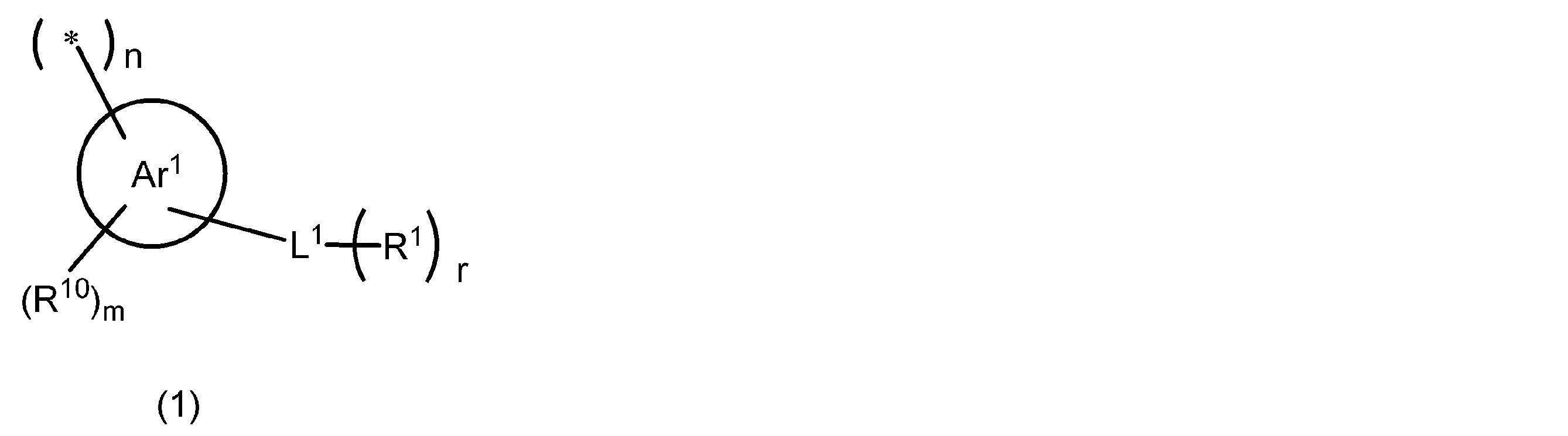
mが2以上の場合、m個のR10は同じであってもよく、異なっていてもよく、
rが2以上の場合、r個のR1は同じであってもよく、異なっていてもよい。 - 前記樹脂aのエチレン性不飽和結合含有基価が0.1~2.0mmol/gである、請求項1に記載の組成物。
- 前記膜形成成分は、前記粒子の分散剤としての樹脂と、バインダーとしての樹脂とを含み、前記粒子の分散剤としての樹脂および前記バインダーとしての樹脂から選ばれる少なくとも1種が、前記樹脂aである、請求項1または2に記載の組成物。
- 前記膜形成成分は、前記粒子の分散剤としての樹脂の100質量部に対して、前記バインダーとしての樹脂を40~250質量部含む、請求項3に記載の組成物。
- 前記膜形成成分は、3価以上の連結基に複数個のポリマー鎖が結合した構造の樹脂と、グラフト鎖を有する繰り返し単位を有する樹脂と、を含み、
前記3価以上の連結基に複数個のポリマー鎖が結合した構造の樹脂、および、前記グラフト鎖を有する繰り返し単位を有する樹脂から選ばれる少なくとも1種が、前記樹脂aである、
請求項1または2に記載の組成物。 - 前記グラフト鎖がポリエステル構造の繰り返し単位を含む、請求項5に記載の組成物。
- 前記樹脂aは、式(1-1)で表される繰り返し単位および式(1-2)で表される繰り返し単位から選ばれる少なくとも1種の繰り返し単位を含む樹脂である、請求項1または2に記載の組成物;
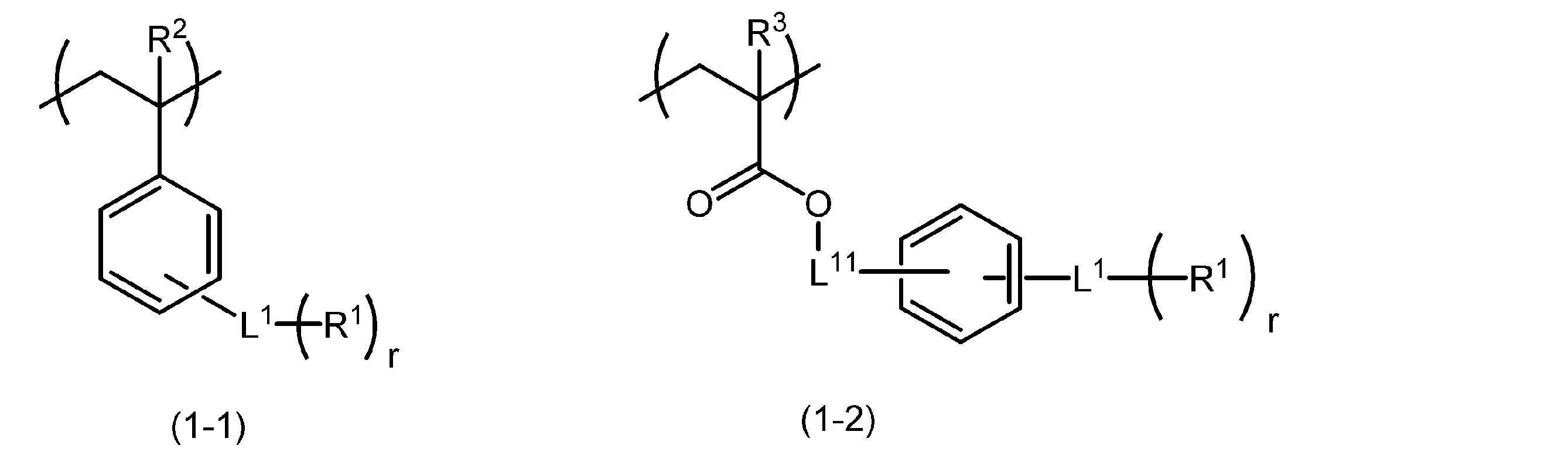
R1はエチレン性不飽和結合含有基を表し、
R2およびR3はそれぞれ独立して、水素原子またはアルキル基を表し、
L11は単結合または2価の連結基を表し、
rは1以上の整数を表し、
rが2以上の場合、r個のR1は同じであってもよく、異なっていてもよい。 - 前記樹脂aの重量平均分子量が8000~120000である、請求項1または2に記載の組成物。
- 前記樹脂aの酸価が20~200mgKOH/gである、請求項1または2に記載の組成物。
- 前記組成物を用いて、200℃で5分加熱して厚さ8μmの膜を製膜した際に、前記膜中には前記粒子を含む第1の相と、前記第1の相よりも前記粒子の含有量が少ない第2の相との相分離構造が形成されている、請求項1または2に記載の組成物。
- 前記相分離構造は海島構造または共連続相構造である、請求項10に記載の組成物。
- 前記粒子の平均一次粒子径が100nm以下である、請求項1または2に記載の組成物。
- 前記粒子が無機粒子である、請求項1または2に記載の組成物。
- 前記無機粒子は、酸化チタン粒子、チタン酸ストロンチウム粒子、チタン酸バリウム粒子、酸化亜鉛粒子、酸化マグネシウム粒子、酸化ジルコニウム粒子、酸化アルミニウム粒子、水酸化アルミニウム粒子、硫酸バリウム粒子および硫化亜鉛粒子から選ばれる少なくとも1種を含む、請求項13に記載の組成物。
- 式(1-1)で表される繰り返し単位および式(1-2)で表される繰り返し単位から選ばれる少なくとも1種の繰り返し単位を含む樹脂;
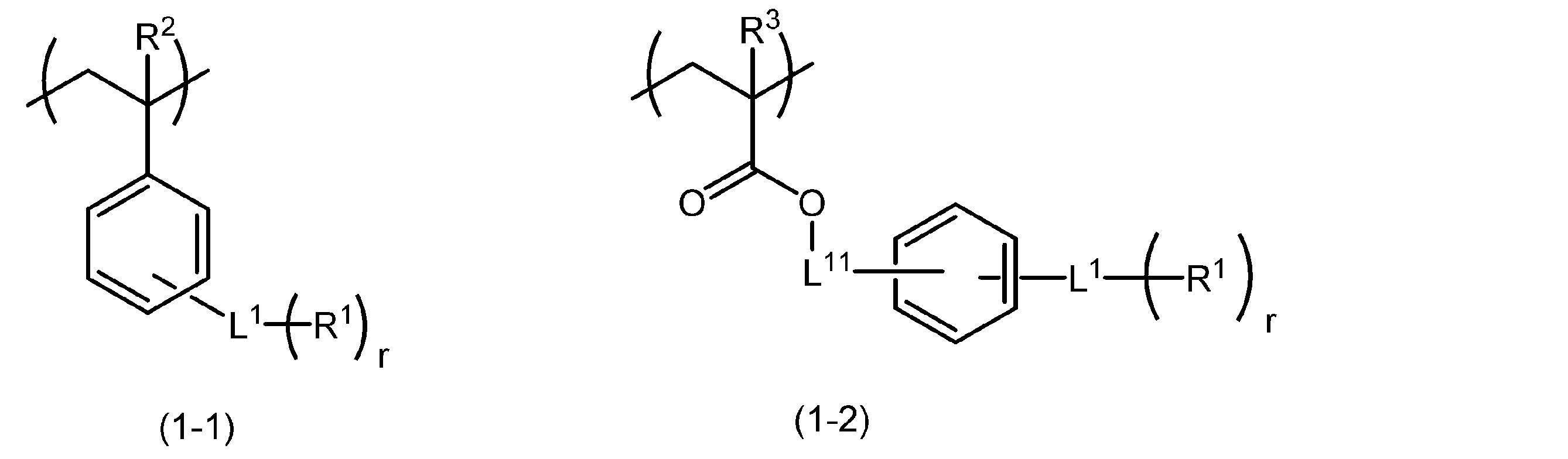
R1はエチレン性不飽和結合含有基を表し、
R2およびR3はそれぞれ独立して、水素原子またはアルキル基を表し、
L11は単結合または2価の連結基を表し、
rは1以上の整数を表し、
rが2以上の場合、r個のR1は同じであってもよく、異なっていてもよい。 - 請求項1または2に記載の組成物を用いて得られる膜。
- 請求項16に記載の膜を含む光センサ。
Priority Applications (3)
| Application Number | Priority Date | Filing Date | Title |
|---|---|---|---|
| EP22876009.6A EP4410855A4 (en) | 2021-09-29 | 2022-09-22 | COMPOSITION, RESIN, FILM AND OPTICAL SENSOR |
| CN202280060166.5A CN117916279A (zh) | 2021-09-29 | 2022-09-22 | 组合物、树脂、膜及光传感器 |
| JP2023551398A JPWO2023054142A1 (ja) | 2021-09-29 | 2022-09-22 |
Applications Claiming Priority (2)
| Application Number | Priority Date | Filing Date | Title |
|---|---|---|---|
| JP2021-159034 | 2021-09-29 | ||
| JP2021159034 | 2021-09-29 |
Publications (1)
| Publication Number | Publication Date |
|---|---|
| WO2023054142A1 true WO2023054142A1 (ja) | 2023-04-06 |
Family
ID=85780689
Family Applications (1)
| Application Number | Title | Priority Date | Filing Date |
|---|---|---|---|
| PCT/JP2022/035284 Ceased WO2023054142A1 (ja) | 2021-09-29 | 2022-09-22 | 組成物、樹脂、膜および光センサ |
Country Status (5)
| Country | Link |
|---|---|
| EP (1) | EP4410855A4 (ja) |
| JP (1) | JPWO2023054142A1 (ja) |
| CN (1) | CN117916279A (ja) |
| TW (1) | TW202319783A (ja) |
| WO (1) | WO2023054142A1 (ja) |
Citations (108)
| Publication number | Priority date | Publication date | Assignee | Title |
|---|---|---|---|---|
| JP2000066385A (ja) | 1998-08-18 | 2000-03-03 | Ciba Specialty Chem Holding Inc | 高感度で高レジスト厚さのi線ホトレジスト用スルホニルオキシム類 |
| JP2000080068A (ja) | 1998-06-26 | 2000-03-21 | Ciba Specialty Chem Holding Inc | 新規o―アシルオキシム光開始剤 |
| JP2001233842A (ja) | 1999-12-15 | 2001-08-28 | Ciba Specialty Chem Holding Inc | オキシムエステルの光開始剤 |
| JP2003185831A (ja) | 2002-11-14 | 2003-07-03 | Seiko Epson Corp | カラーフィルタ及びその製造方法、液晶装置及びその製造方法、並びに電子機器 |
| JP2003261827A (ja) | 2002-03-07 | 2003-09-19 | Sekisui Chem Co Ltd | 着色樹脂エマルジョン、インクジェット印刷用インク及びカラーフィルター |
| JP2003262716A (ja) | 2002-03-11 | 2003-09-19 | Jsr Corp | カラーフィルタ保護膜用組成物および保護膜 |
| JP2004534797A (ja) | 2001-06-11 | 2004-11-18 | チバ スペシャルティ ケミカルズ ホールディング インコーポレーテッド | 組み合わされた構造を有するオキシムエステルの光開始剤 |
| JP2006169325A (ja) | 2004-12-14 | 2006-06-29 | Sony Corp | インクジェット用記録液、インクカートリッジ、およびインクジェット記録方法 |
| WO2007060884A1 (ja) | 2005-11-25 | 2007-05-31 | Catalysts & Chemicals Industries Co., Ltd. | 中空シリカ微粒子、それを含む透明被膜形成用組成物、および透明被膜付基材 |
| JP4223071B2 (ja) | 2006-12-27 | 2009-02-12 | 株式会社Adeka | オキシムエステル化合物及び該化合物を含有する光重合開始剤 |
| JP2009145395A (ja) | 2007-12-11 | 2009-07-02 | Tokyo Ohka Kogyo Co Ltd | プリウェット剤及びそのプリウェット剤を用いたレジスト保護膜形成方法 |
| JP2009217221A (ja) | 2008-02-13 | 2009-09-24 | Fujifilm Corp | 感光性着色組成物、並びにカラーフィルタ及びその製造方法 |
| JP2009242604A (ja) | 2008-03-31 | 2009-10-22 | Fujifilm Corp | 重合性組成物および固体撮像素子 |
| JP2009258603A (ja) | 2007-09-26 | 2009-11-05 | Fujifilm Corp | ネガ型レジスト組成物及びそれを用いたレジストパターン形成方法 |
| JP2009288703A (ja) | 2008-05-30 | 2009-12-10 | Fujifilm Corp | 着色硬化性組成物、カラーフィルタ、及び、固体撮像素子 |
| JP2010032698A (ja) | 2008-07-28 | 2010-02-12 | Fujifilm Corp | カラーフィルタ用着色硬化性組成物、カラーフィルタ、カラーフィルタの製造方法、及び液晶表示素子 |
| JP2010054632A (ja) | 2008-08-26 | 2010-03-11 | Fujifilm Corp | ネガ型レジスト組成物及びパターン形成方法 |
| JP2010106268A (ja) | 2008-10-03 | 2010-05-13 | Fujifilm Corp | 分散組成物、重合性組成物、遮光性カラーフィルタ、固体撮像素子、液晶表示装置、ウェハレベルレンズ、及び撮像ユニット |
| JP2010164965A (ja) | 2008-12-19 | 2010-07-29 | Mitsubishi Chemicals Corp | カラーフィルタ画素形成用組成物、カラーフィルタ、液晶表示装置及び有機elディスプレイ |
| JP2010168539A (ja) | 2008-12-26 | 2010-08-05 | Nippon Shokubai Co Ltd | α−アリルオキシメチルアクリル酸系重合体及びその製造方法 |
| JP2010527339A (ja) | 2007-05-11 | 2010-08-12 | ビーエーエスエフ ソシエタス・ヨーロピア | オキシムエステル光重合開始剤 |
| JP2010262028A (ja) | 2009-04-30 | 2010-11-18 | Nippon Steel Chem Co Ltd | ブラックマトリックス用感光性樹脂組成物 |
| JP2011054439A (ja) | 2009-09-02 | 2011-03-17 | Nippon Zeon Co Ltd | 全固体二次電池 |
| JP2011132503A (ja) | 2009-11-25 | 2011-07-07 | Sumitomo Chemical Co Ltd | 樹脂組成物及び表示装置 |
| JP2011524436A (ja) | 2008-06-06 | 2011-09-01 | ビーエーエスエフ ソシエタス・ヨーロピア | 光開始剤混合物 |
| JP2011252065A (ja) | 2010-06-01 | 2011-12-15 | Fujifilm Corp | 顔料分散組成物、着色硬化性組成物、固体撮像素子用カラーフィルタ及びその製造方法、並びに固体撮像素子 |
| JP2012014052A (ja) | 2010-07-02 | 2012-01-19 | Fujifilm Corp | 着色感光性樹脂組成物、カラーフィルタ、カラーフィルタの製造方法、及び液晶表示装置 |
| JP2012046629A (ja) | 2010-08-26 | 2012-03-08 | Fujifilm Corp | 赤色着色組成物、着色硬化性組成物、固体撮像素子用カラーフィルタ及びその製造方法、並びに固体撮像素子 |
| JP2012126830A (ja) | 2010-12-15 | 2012-07-05 | Sony Corp | インクジェット用インク組成物、インクジェット記録方法、インクカートリッジ、記録ユニット及びインクジェット記録装置 |
| JP2012137564A (ja) | 2010-12-24 | 2012-07-19 | Fujifilm Corp | 固体撮像素子のカラーフィルタ用感光性透明組成物、並びに、これを用いた固体撮像素子のカラーフィルタの製造方法、固体撮像素子のカラーフィルタ、及び、固体撮像素子 |
| US20120235099A1 (en) | 2011-03-17 | 2012-09-20 | Fujifilm Corporation | Radiation-sensitive colored composition, colored cured film, color filter and method of producing the same, solid-state imaging device, liquid crystal display apparatus, and method of producing dye |
| JP2012198408A (ja) | 2011-03-22 | 2012-10-18 | Fujifilm Corp | 着色感放射線性組成物、パターンの形成方法、カラーフィルタ及びそのカラーフィルタの製造方法、並びに、固体撮像素子 |
| JP2012208374A (ja) | 2011-03-30 | 2012-10-25 | Fujifilm Corp | 感放射線性組成物、パターン形成方法、カラーフィルタ及びその製造方法、並びに、固体撮像素子 |
| JP2013029760A (ja) | 2011-07-29 | 2013-02-07 | Fujifilm Corp | 着色硬化性組成物、着色硬化膜、カラーフィルタ、パターン形成方法、カラーフィルタの製造方法、固体撮像素子及び画像表示装置 |
| JP2013043962A (ja) | 2011-08-26 | 2013-03-04 | Fujifilm Corp | 着色剤含有粒子、着色剤含有粒子分散液、及び高分子化合物 |
| JP2013064993A (ja) | 2011-08-31 | 2013-04-11 | Fujifilm Corp | カラーフィルタの製造方法、カラーフィルタ、及び固体撮像素子 |
| JP2013068814A (ja) | 2011-09-22 | 2013-04-18 | Fujifilm Corp | 着色感放射線性組成物、カラーフィルタ及びそのカラーフィルタの製造方法、並びに、固体撮像素子 |
| JP2013114249A (ja) | 2011-12-01 | 2013-06-10 | Toppan Printing Co Ltd | 黒色感光性樹脂組成物およびカラーフィルタ |
| WO2013083505A1 (en) | 2011-12-07 | 2013-06-13 | Basf Se | Oxime ester photoinitiators |
| JP2013522445A (ja) | 2010-03-22 | 2013-06-13 | ヘンケル コーポレイション | マクロ光開始剤およびそれらの硬化性組成物 |
| JP2013164471A (ja) | 2012-02-09 | 2013-08-22 | Jsr Corp | 硬化性樹脂組成物、表示素子用硬化膜、表示素子用硬化膜の形成方法及び表示素子 |
| JP2013190459A (ja) | 2012-03-12 | 2013-09-26 | Tokyo Ohka Kogyo Co Ltd | 感光性樹脂組成物、カラーフィルタ、表示装置、光重合開始剤、及び化合物 |
| WO2013167515A1 (en) | 2012-05-09 | 2013-11-14 | Basf Se | Oxime ester photoinitiators |
| JP2013237593A (ja) | 2012-05-16 | 2013-11-28 | Nagoya Institute Of Technology | シリカナノ中空粒子の製造方法 |
| JP2014500852A (ja) | 2010-10-05 | 2014-01-16 | ビーエーエスエフ ソシエタス・ヨーロピア | ベンゾカルバゾール化合物のオキシムエステル誘導体ならびに前記誘導体の光重合性の組成物における光開始剤としての使用 |
| WO2014017669A1 (en) | 2012-07-27 | 2014-01-30 | Fujifilm Corporation | Near infrared absorptive liquid composition, near infrared cut filter using the same, method of manufacturing the same, and camera module and method of manufacturing the same |
| JP5430746B2 (ja) | 2009-05-19 | 2014-03-05 | 常州強力電子新材料有限公司 | ケトオキシムエステル系光開始剤 |
| JP2014089408A (ja) | 2012-10-31 | 2014-05-15 | Fujifilm Corp | 積層体およびこれを有するカラーフィルタ |
| JP2014130173A (ja) | 2012-12-27 | 2014-07-10 | Fujifilm Corp | カラーフィルタ用組成物、赤外線透過フィルタ及びその製造方法、並びに赤外線センサー |
| JP2014137466A (ja) | 2013-01-16 | 2014-07-28 | Jsr Corp | 感放射線性着色組成物、着色硬化膜及び表示素子 |
| JP2014177613A (ja) | 2012-08-31 | 2014-09-25 | Fujifilm Corp | 分散組成物、これを用いた硬化性組成物、透明膜、マイクロレンズ、及び固体撮像素子 |
| JP5647738B2 (ja) | 2010-11-23 | 2015-01-07 | 常州強力先端電子材料有限公司 | 高感光度のカルバゾールオキシムエステル系光開始剤、その製造方法及び使用 |
| WO2015004565A1 (en) | 2013-07-08 | 2015-01-15 | Basf Se | Oxime ester photoinitiators |
| JP2015034961A (ja) | 2012-11-16 | 2015-02-19 | 富士フイルム株式会社 | 白色感光性樹脂組成物、白色硬化膜、白色パターン、及びその製造方法 |
| WO2015036910A1 (en) | 2013-09-10 | 2015-03-19 | Basf Se | Oxime ester photoinitiators |
| JP2015067794A (ja) | 2013-09-30 | 2015-04-13 | 太陽インキ製造株式会社 | プリント配線板用白色硬化型組成物、これを用いた硬化塗膜及びプリント配線板 |
| JP2015117327A (ja) | 2013-12-19 | 2015-06-25 | Dic株式会社 | 界面活性剤組成物、コーティング組成物及びレジスト組成物 |
| JP2015123351A (ja) | 2013-12-27 | 2015-07-06 | コダマ樹脂工業株式会社 | 耐薬品性吹込み成形積層容器 |
| JP2015157893A (ja) | 2014-02-24 | 2015-09-03 | 日本化薬株式会社 | インドレニン化合物 |
| WO2015152153A1 (ja) | 2014-04-04 | 2015-10-08 | 株式会社Adeka | オキシムエステル化合物及び該化合物を含有する光重合開始剤 |
| JP2015194521A (ja) | 2014-03-31 | 2015-11-05 | 東洋インキScホールディングス株式会社 | カラーフィルタ用着色組成物、およびカラーフィルタ |
| WO2015166779A1 (ja) | 2014-05-01 | 2015-11-05 | 富士フイルム株式会社 | 着色組成物、膜、カラーフィルタ、パターン形成方法、カラーフィルタの製造方法、固体撮像素子および赤外線センサ |
| WO2016034963A1 (en) | 2014-09-04 | 2016-03-10 | Basf Se | Polycyclic photoinitiators |
| JP2016139112A (ja) | 2015-01-21 | 2016-08-04 | ソニー株式会社 | ウェアラブルディスプレイ装置および画像表示方法 |
| JP2016162946A (ja) | 2015-03-04 | 2016-09-05 | Jsr株式会社 | 固体撮像装置 |
| WO2016181987A1 (ja) | 2015-05-12 | 2016-11-17 | 旭硝子株式会社 | 光学フィルタおよび撮像装置 |
| JP2016216602A (ja) | 2015-05-20 | 2016-12-22 | Dic株式会社 | フッ素系界面活性剤およびこれを含有する組成物 |
| WO2017033680A1 (ja) | 2015-08-26 | 2017-03-02 | パナソニックヘルスケアホールディングス株式会社 | 超低温フリーザ |
| WO2017051680A1 (ja) | 2015-09-25 | 2017-03-30 | 株式会社Adeka | オキシムエステル化合物及び該化合物を含有する重合開始剤 |
| JP2017523465A (ja) | 2014-07-15 | 2017-08-17 | 常州強力電子新材料股▲ふん▼有限公司Cahngzhou Tronly New Electronic Materials Co.,Ltd. | オキシムエステル類光開始剤含有感光性組成物及びその使用 |
| JP2017151342A (ja) | 2016-02-26 | 2017-08-31 | 東洋インキScホールディングス株式会社 | 感光性着色組成物およびカラーフィルタ |
| WO2017159190A1 (ja) | 2016-03-14 | 2017-09-21 | 富士フイルム株式会社 | 組成物、膜、硬化膜、光学センサおよび膜の製造方法 |
| WO2017159910A1 (ko) | 2016-03-16 | 2017-09-21 | 주식회사 수콘 | 휴대단말기 스피커용 인쇄회로기판형 진동장치 |
| JP2017167399A (ja) | 2016-03-17 | 2017-09-21 | 株式会社Dnpファインケミカル | カラーフィルタ用感光性着色樹脂組成物、カラーフィルタ、表示装置 |
| WO2017164127A1 (ja) | 2016-03-25 | 2017-09-28 | 東レ株式会社 | 着色樹脂組成物、カラーフィルタ基板、および液晶表示装置 |
| JP2017194662A (ja) | 2015-06-15 | 2017-10-26 | 東洋インキScホールディングス株式会社 | 感光性組成物、カラーフィルタ用感光性組成物、およびカラーフィルタ |
| JP2017198865A (ja) | 2016-04-27 | 2017-11-02 | 東京応化工業株式会社 | 感光性組成物 |
| KR20170122130A (ko) | 2016-04-26 | 2017-11-03 | 제이에스알 가부시끼가이샤 | 착색 경화막의 제조 방법 및 컬러 필터의 화소 패턴의 형성 방법 |
| JP6268967B2 (ja) | 2013-11-19 | 2018-01-31 | 三菱ケミカル株式会社 | 着色樹脂組成物、カラーフィルタ、液晶表示装置及び有機el表示装置 |
| JP2018018077A (ja) | 2016-07-28 | 2018-02-01 | 中強光電股▲ふん▼有限公司 | ヘッドマウントディスプレイ |
| WO2018037812A1 (ja) * | 2016-08-25 | 2018-03-01 | 富士フイルム株式会社 | 硬化性組成物及びその製造方法、硬化膜及びその製造方法、カラーフィルタ、固体撮像素子、固体撮像装置、並びに、赤外線センサ |
| JP6301489B2 (ja) | 2014-03-18 | 2018-03-28 | 常州強力電子新材料股▲ふん▼有限公司Cahngzhou Tronly New Electronic Materials Co.,Ltd. | ニトロ基含有ビスオキシムエステル系光重合開始剤及びその合成製造方法と応用 |
| KR20180061467A (ko) | 2016-11-28 | 2018-06-08 | 삼성디스플레이 주식회사 | 디스플레이 장치 및 이를 구비하는 헤드 장착 전자 장치 |
| WO2018110179A1 (ja) | 2016-12-13 | 2018-06-21 | 日油株式会社 | ペルオキシシンナメート誘導体、該化合物を含有する重合性組成物 |
| JP2018101034A (ja) | 2016-12-20 | 2018-06-28 | コニカミノルタ株式会社 | 映像表示装置およびヘッドマウントディスプレイ |
| WO2018163668A1 (ja) | 2017-03-07 | 2018-09-13 | 富士フイルム株式会社 | 組成物、膜、光センサおよび分散剤 |
| WO2018221177A1 (ja) | 2017-06-01 | 2018-12-06 | 日油株式会社 | トリアジンペルオキシド誘導体、該化合物を含有する重合性組成物 |
| JP2019032434A (ja) | 2017-08-08 | 2019-02-28 | 大日本印刷株式会社 | 表示装置 |
| JP2019043864A (ja) | 2017-08-31 | 2019-03-22 | 学校法人東京理科大学 | ペルオキシエステル基を有するベンゾフェノン誘導体、該化合物を含有する重合性組成物およびその硬化物、当該硬化物の製造方法 |
| JP2019044030A (ja) | 2017-08-31 | 2019-03-22 | 学校法人東京理科大学 | ペルオキシエステル基を有するチオキサントン誘導体を含有する重合性組成物およびその硬化物、当該硬化物の製造方法 |
| JP2019061199A (ja) | 2017-09-28 | 2019-04-18 | セイコーエプソン株式会社 | 虚像表示装置 |
| WO2019088055A1 (ja) | 2017-10-30 | 2019-05-09 | 株式会社Adeka | 化合物、組成物、硬化物及び硬化物の製造方法 |
| JP2019070714A (ja) | 2017-10-06 | 2019-05-09 | 日本ペイント・オートモーティブコーティングス株式会社 | 防眩コーティング組成物、それを用いた光学積層部材、及び防眩ハードコート層の形成方法 |
| WO2019163505A1 (ja) * | 2018-02-21 | 2019-08-29 | 富士フイルム株式会社 | 硬化性組成物、硬化物、カラーフィルタ、カラーフィルタの製造方法、固体撮像素子及び画像表示装置 |
| JP2019167313A (ja) | 2018-03-26 | 2019-10-03 | 日油株式会社 | ペルオキシシンナメート誘導体、該化合物を含有する重合性組成物およびその硬化物、並びに当該硬化物の製造方法 |
| JP2020008634A (ja) | 2018-07-04 | 2020-01-16 | 三菱ケミカル株式会社 | 感光性樹脂組成物、隔壁、有機電界発光素子、画像表示装置及び照明 |
| JP2020055992A (ja) | 2018-07-17 | 2020-04-09 | 奇▲たい▼科技股▲ふん▼有限公司 | 液体光開始化合物とその用途 |
| WO2020084854A1 (ja) | 2018-10-24 | 2020-04-30 | 三菱マテリアル電子化成株式会社 | 含フッ素イミド塩化合物及び界面活性剤 |
| JP2020101671A (ja) | 2018-12-21 | 2020-07-02 | 株式会社日立エルジーデータストレージ | ヘッドマウントディスプレイ |
| WO2020137819A1 (ja) | 2018-12-26 | 2020-07-02 | ミヨシ油脂株式会社 | 耐光性、耐熱性および耐久性紫外線吸収剤 |
| WO2020152120A1 (en) | 2019-01-23 | 2020-07-30 | Basf Se | Oxime ester photoinitiators having a special aroyl chromophore |
| TW202028805A (zh) | 2018-09-06 | 2020-08-01 | 以色列商魯姆斯有限公司 | 具有雷射二極體照明的近眼顯示器 |
| JP2020172619A (ja) | 2019-03-28 | 2020-10-22 | 株式会社Adeka | 重合体 |
| WO2020262270A1 (ja) * | 2019-06-27 | 2020-12-30 | 富士フイルム株式会社 | 組成物、膜および光センサ |
| US10921499B1 (en) | 2018-06-12 | 2021-02-16 | Facebook Technologies, Llc | Display devices and methods for processing light |
| CN112394509A (zh) | 2019-08-13 | 2021-02-23 | 宏达国际电子股份有限公司 | 头戴式显示装置 |
| JP2021032975A (ja) | 2019-08-21 | 2021-03-01 | 株式会社Jvcケンウッド | ヘッドマウントディスプレイ |
| US20210063745A1 (en) | 2019-08-27 | 2021-03-04 | Apple Inc. | Transparent Display System With Peripheral Illumination |
Family Cites Families (2)
| Publication number | Priority date | Publication date | Assignee | Title |
|---|---|---|---|---|
| JP2515010B2 (ja) * | 1989-01-26 | 1996-07-10 | 株式会社メニコン | 眼用レンズ材料 |
| JP6701324B2 (ja) * | 2016-04-06 | 2020-05-27 | 富士フイルム株式会社 | 組成物、膜、硬化膜、光学センサおよび膜の製造方法 |
-
2022
- 2022-09-22 WO PCT/JP2022/035284 patent/WO2023054142A1/ja not_active Ceased
- 2022-09-22 JP JP2023551398A patent/JPWO2023054142A1/ja not_active Abandoned
- 2022-09-22 CN CN202280060166.5A patent/CN117916279A/zh active Pending
- 2022-09-22 EP EP22876009.6A patent/EP4410855A4/en active Pending
- 2022-09-26 TW TW111136303A patent/TW202319783A/zh unknown
Patent Citations (116)
| Publication number | Priority date | Publication date | Assignee | Title |
|---|---|---|---|---|
| JP2000080068A (ja) | 1998-06-26 | 2000-03-21 | Ciba Specialty Chem Holding Inc | 新規o―アシルオキシム光開始剤 |
| JP2000066385A (ja) | 1998-08-18 | 2000-03-03 | Ciba Specialty Chem Holding Inc | 高感度で高レジスト厚さのi線ホトレジスト用スルホニルオキシム類 |
| JP2001233842A (ja) | 1999-12-15 | 2001-08-28 | Ciba Specialty Chem Holding Inc | オキシムエステルの光開始剤 |
| JP2004534797A (ja) | 2001-06-11 | 2004-11-18 | チバ スペシャルティ ケミカルズ ホールディング インコーポレーテッド | 組み合わされた構造を有するオキシムエステルの光開始剤 |
| JP2006342166A (ja) | 2001-06-11 | 2006-12-21 | Ciba Specialty Chem Holding Inc | 組み合わされた構造を有するオキシムエステルの光開始剤 |
| JP2003261827A (ja) | 2002-03-07 | 2003-09-19 | Sekisui Chem Co Ltd | 着色樹脂エマルジョン、インクジェット印刷用インク及びカラーフィルター |
| JP2003262716A (ja) | 2002-03-11 | 2003-09-19 | Jsr Corp | カラーフィルタ保護膜用組成物および保護膜 |
| JP2003185831A (ja) | 2002-11-14 | 2003-07-03 | Seiko Epson Corp | カラーフィルタ及びその製造方法、液晶装置及びその製造方法、並びに電子機器 |
| JP2006169325A (ja) | 2004-12-14 | 2006-06-29 | Sony Corp | インクジェット用記録液、インクカートリッジ、およびインクジェット記録方法 |
| WO2007060884A1 (ja) | 2005-11-25 | 2007-05-31 | Catalysts & Chemicals Industries Co., Ltd. | 中空シリカ微粒子、それを含む透明被膜形成用組成物、および透明被膜付基材 |
| JP4223071B2 (ja) | 2006-12-27 | 2009-02-12 | 株式会社Adeka | オキシムエステル化合物及び該化合物を含有する光重合開始剤 |
| JP2010527339A (ja) | 2007-05-11 | 2010-08-12 | ビーエーエスエフ ソシエタス・ヨーロピア | オキシムエステル光重合開始剤 |
| JP2009258603A (ja) | 2007-09-26 | 2009-11-05 | Fujifilm Corp | ネガ型レジスト組成物及びそれを用いたレジストパターン形成方法 |
| JP2009145395A (ja) | 2007-12-11 | 2009-07-02 | Tokyo Ohka Kogyo Co Ltd | プリウェット剤及びそのプリウェット剤を用いたレジスト保護膜形成方法 |
| JP2009217221A (ja) | 2008-02-13 | 2009-09-24 | Fujifilm Corp | 感光性着色組成物、並びにカラーフィルタ及びその製造方法 |
| JP2009242604A (ja) | 2008-03-31 | 2009-10-22 | Fujifilm Corp | 重合性組成物および固体撮像素子 |
| JP2009288703A (ja) | 2008-05-30 | 2009-12-10 | Fujifilm Corp | 着色硬化性組成物、カラーフィルタ、及び、固体撮像素子 |
| JP2011524436A (ja) | 2008-06-06 | 2011-09-01 | ビーエーエスエフ ソシエタス・ヨーロピア | 光開始剤混合物 |
| JP2010032698A (ja) | 2008-07-28 | 2010-02-12 | Fujifilm Corp | カラーフィルタ用着色硬化性組成物、カラーフィルタ、カラーフィルタの製造方法、及び液晶表示素子 |
| JP2010054632A (ja) | 2008-08-26 | 2010-03-11 | Fujifilm Corp | ネガ型レジスト組成物及びパターン形成方法 |
| JP2010106268A (ja) | 2008-10-03 | 2010-05-13 | Fujifilm Corp | 分散組成物、重合性組成物、遮光性カラーフィルタ、固体撮像素子、液晶表示装置、ウェハレベルレンズ、及び撮像ユニット |
| US20110124824A1 (en) | 2008-10-03 | 2011-05-26 | Fujifilm Corporation | Dispersion composition, polymerizable composition, light-shielding color filter, solid-state image pick-up element, liquid crystal display device, wafer level lens, and image pick-up unit |
| JP2010164965A (ja) | 2008-12-19 | 2010-07-29 | Mitsubishi Chemicals Corp | カラーフィルタ画素形成用組成物、カラーフィルタ、液晶表示装置及び有機elディスプレイ |
| JP2010168539A (ja) | 2008-12-26 | 2010-08-05 | Nippon Shokubai Co Ltd | α−アリルオキシメチルアクリル酸系重合体及びその製造方法 |
| JP2010262028A (ja) | 2009-04-30 | 2010-11-18 | Nippon Steel Chem Co Ltd | ブラックマトリックス用感光性樹脂組成物 |
| JP5430746B2 (ja) | 2009-05-19 | 2014-03-05 | 常州強力電子新材料有限公司 | ケトオキシムエステル系光開始剤 |
| JP2011054439A (ja) | 2009-09-02 | 2011-03-17 | Nippon Zeon Co Ltd | 全固体二次電池 |
| JP2011132503A (ja) | 2009-11-25 | 2011-07-07 | Sumitomo Chemical Co Ltd | 樹脂組成物及び表示装置 |
| JP2013522445A (ja) | 2010-03-22 | 2013-06-13 | ヘンケル コーポレイション | マクロ光開始剤およびそれらの硬化性組成物 |
| JP2011252065A (ja) | 2010-06-01 | 2011-12-15 | Fujifilm Corp | 顔料分散組成物、着色硬化性組成物、固体撮像素子用カラーフィルタ及びその製造方法、並びに固体撮像素子 |
| JP2012014052A (ja) | 2010-07-02 | 2012-01-19 | Fujifilm Corp | 着色感光性樹脂組成物、カラーフィルタ、カラーフィルタの製造方法、及び液晶表示装置 |
| JP2012046629A (ja) | 2010-08-26 | 2012-03-08 | Fujifilm Corp | 赤色着色組成物、着色硬化性組成物、固体撮像素子用カラーフィルタ及びその製造方法、並びに固体撮像素子 |
| JP2014500852A (ja) | 2010-10-05 | 2014-01-16 | ビーエーエスエフ ソシエタス・ヨーロピア | ベンゾカルバゾール化合物のオキシムエステル誘導体ならびに前記誘導体の光重合性の組成物における光開始剤としての使用 |
| JP5647738B2 (ja) | 2010-11-23 | 2015-01-07 | 常州強力先端電子材料有限公司 | 高感光度のカルバゾールオキシムエステル系光開始剤、その製造方法及び使用 |
| JP2012126830A (ja) | 2010-12-15 | 2012-07-05 | Sony Corp | インクジェット用インク組成物、インクジェット記録方法、インクカートリッジ、記録ユニット及びインクジェット記録装置 |
| JP2012137564A (ja) | 2010-12-24 | 2012-07-19 | Fujifilm Corp | 固体撮像素子のカラーフィルタ用感光性透明組成物、並びに、これを用いた固体撮像素子のカラーフィルタの製造方法、固体撮像素子のカラーフィルタ、及び、固体撮像素子 |
| JP2012208494A (ja) | 2011-03-17 | 2012-10-25 | Fujifilm Corp | 着色感放射線性組成物、着色硬化膜、カラーフィルタ及びカラーフィルタの製造方法、固体撮像素子、液晶表示装置、並びに、染料の製造方法 |
| US20120235099A1 (en) | 2011-03-17 | 2012-09-20 | Fujifilm Corporation | Radiation-sensitive colored composition, colored cured film, color filter and method of producing the same, solid-state imaging device, liquid crystal display apparatus, and method of producing dye |
| JP2012198408A (ja) | 2011-03-22 | 2012-10-18 | Fujifilm Corp | 着色感放射線性組成物、パターンの形成方法、カラーフィルタ及びそのカラーフィルタの製造方法、並びに、固体撮像素子 |
| JP2012208374A (ja) | 2011-03-30 | 2012-10-25 | Fujifilm Corp | 感放射線性組成物、パターン形成方法、カラーフィルタ及びその製造方法、並びに、固体撮像素子 |
| JP2013029760A (ja) | 2011-07-29 | 2013-02-07 | Fujifilm Corp | 着色硬化性組成物、着色硬化膜、カラーフィルタ、パターン形成方法、カラーフィルタの製造方法、固体撮像素子及び画像表示装置 |
| JP2013043962A (ja) | 2011-08-26 | 2013-03-04 | Fujifilm Corp | 着色剤含有粒子、着色剤含有粒子分散液、及び高分子化合物 |
| JP2013064993A (ja) | 2011-08-31 | 2013-04-11 | Fujifilm Corp | カラーフィルタの製造方法、カラーフィルタ、及び固体撮像素子 |
| JP2013068814A (ja) | 2011-09-22 | 2013-04-18 | Fujifilm Corp | 着色感放射線性組成物、カラーフィルタ及びそのカラーフィルタの製造方法、並びに、固体撮像素子 |
| JP2013114249A (ja) | 2011-12-01 | 2013-06-10 | Toppan Printing Co Ltd | 黒色感光性樹脂組成物およびカラーフィルタ |
| WO2013083505A1 (en) | 2011-12-07 | 2013-06-13 | Basf Se | Oxime ester photoinitiators |
| JP2013164471A (ja) | 2012-02-09 | 2013-08-22 | Jsr Corp | 硬化性樹脂組成物、表示素子用硬化膜、表示素子用硬化膜の形成方法及び表示素子 |
| JP2013190459A (ja) | 2012-03-12 | 2013-09-26 | Tokyo Ohka Kogyo Co Ltd | 感光性樹脂組成物、カラーフィルタ、表示装置、光重合開始剤、及び化合物 |
| WO2013167515A1 (en) | 2012-05-09 | 2013-11-14 | Basf Se | Oxime ester photoinitiators |
| JP2017019766A (ja) | 2012-05-09 | 2017-01-26 | ビーエーエスエフ ソシエタス・ヨーロピアBasf Se | オキシムエステル光開始剤 |
| JP2013237593A (ja) | 2012-05-16 | 2013-11-28 | Nagoya Institute Of Technology | シリカナノ中空粒子の製造方法 |
| WO2014017669A1 (en) | 2012-07-27 | 2014-01-30 | Fujifilm Corporation | Near infrared absorptive liquid composition, near infrared cut filter using the same, method of manufacturing the same, and camera module and method of manufacturing the same |
| JP2014041318A (ja) | 2012-07-27 | 2014-03-06 | Fujifilm Corp | 近赤外線吸収性組成物、これを用いた近赤外線カットフィルタ及びその製造方法、並びに、カメラモジュール及びその製造方法 |
| JP2014177613A (ja) | 2012-08-31 | 2014-09-25 | Fujifilm Corp | 分散組成物、これを用いた硬化性組成物、透明膜、マイクロレンズ、及び固体撮像素子 |
| JP2014089408A (ja) | 2012-10-31 | 2014-05-15 | Fujifilm Corp | 積層体およびこれを有するカラーフィルタ |
| JP2015034961A (ja) | 2012-11-16 | 2015-02-19 | 富士フイルム株式会社 | 白色感光性樹脂組成物、白色硬化膜、白色パターン、及びその製造方法 |
| JP2014130173A (ja) | 2012-12-27 | 2014-07-10 | Fujifilm Corp | カラーフィルタ用組成物、赤外線透過フィルタ及びその製造方法、並びに赤外線センサー |
| JP2014137466A (ja) | 2013-01-16 | 2014-07-28 | Jsr Corp | 感放射線性着色組成物、着色硬化膜及び表示素子 |
| JP6065596B2 (ja) | 2013-01-16 | 2017-01-25 | Jsr株式会社 | 感放射線性着色組成物、着色硬化膜及び表示素子 |
| WO2015004565A1 (en) | 2013-07-08 | 2015-01-15 | Basf Se | Oxime ester photoinitiators |
| JP2016532675A (ja) | 2013-07-08 | 2016-10-20 | ビーエーエスエフ ソシエタス・ヨーロピアBasf Se | オキシムエステル光開始剤 |
| JP6469669B2 (ja) | 2013-07-08 | 2019-02-13 | ビーエーエスエフ ソシエタス・ヨーロピアBasf Se | オキシムエステル光開始剤 |
| WO2015036910A1 (en) | 2013-09-10 | 2015-03-19 | Basf Se | Oxime ester photoinitiators |
| JP2015067794A (ja) | 2013-09-30 | 2015-04-13 | 太陽インキ製造株式会社 | プリント配線板用白色硬化型組成物、これを用いた硬化塗膜及びプリント配線板 |
| JP6268967B2 (ja) | 2013-11-19 | 2018-01-31 | 三菱ケミカル株式会社 | 着色樹脂組成物、カラーフィルタ、液晶表示装置及び有機el表示装置 |
| JP2015117327A (ja) | 2013-12-19 | 2015-06-25 | Dic株式会社 | 界面活性剤組成物、コーティング組成物及びレジスト組成物 |
| JP2015123351A (ja) | 2013-12-27 | 2015-07-06 | コダマ樹脂工業株式会社 | 耐薬品性吹込み成形積層容器 |
| JP2015157893A (ja) | 2014-02-24 | 2015-09-03 | 日本化薬株式会社 | インドレニン化合物 |
| JP6301489B2 (ja) | 2014-03-18 | 2018-03-28 | 常州強力電子新材料股▲ふん▼有限公司Cahngzhou Tronly New Electronic Materials Co.,Ltd. | ニトロ基含有ビスオキシムエステル系光重合開始剤及びその合成製造方法と応用 |
| JP2015194521A (ja) | 2014-03-31 | 2015-11-05 | 東洋インキScホールディングス株式会社 | カラーフィルタ用着色組成物、およびカラーフィルタ |
| WO2015152153A1 (ja) | 2014-04-04 | 2015-10-08 | 株式会社Adeka | オキシムエステル化合物及び該化合物を含有する光重合開始剤 |
| WO2015166779A1 (ja) | 2014-05-01 | 2015-11-05 | 富士フイルム株式会社 | 着色組成物、膜、カラーフィルタ、パターン形成方法、カラーフィルタの製造方法、固体撮像素子および赤外線センサ |
| JP2017523465A (ja) | 2014-07-15 | 2017-08-17 | 常州強力電子新材料股▲ふん▼有限公司Cahngzhou Tronly New Electronic Materials Co.,Ltd. | オキシムエステル類光開始剤含有感光性組成物及びその使用 |
| WO2016034963A1 (en) | 2014-09-04 | 2016-03-10 | Basf Se | Polycyclic photoinitiators |
| JP2016139112A (ja) | 2015-01-21 | 2016-08-04 | ソニー株式会社 | ウェアラブルディスプレイ装置および画像表示方法 |
| JP2016162946A (ja) | 2015-03-04 | 2016-09-05 | Jsr株式会社 | 固体撮像装置 |
| WO2016181987A1 (ja) | 2015-05-12 | 2016-11-17 | 旭硝子株式会社 | 光学フィルタおよび撮像装置 |
| JP2016216602A (ja) | 2015-05-20 | 2016-12-22 | Dic株式会社 | フッ素系界面活性剤およびこれを含有する組成物 |
| JP2017194662A (ja) | 2015-06-15 | 2017-10-26 | 東洋インキScホールディングス株式会社 | 感光性組成物、カラーフィルタ用感光性組成物、およびカラーフィルタ |
| WO2017033680A1 (ja) | 2015-08-26 | 2017-03-02 | パナソニックヘルスケアホールディングス株式会社 | 超低温フリーザ |
| WO2017051680A1 (ja) | 2015-09-25 | 2017-03-30 | 株式会社Adeka | オキシムエステル化合物及び該化合物を含有する重合開始剤 |
| JP2017151342A (ja) | 2016-02-26 | 2017-08-31 | 東洋インキScホールディングス株式会社 | 感光性着色組成物およびカラーフィルタ |
| WO2017159190A1 (ja) | 2016-03-14 | 2017-09-21 | 富士フイルム株式会社 | 組成物、膜、硬化膜、光学センサおよび膜の製造方法 |
| WO2017159910A1 (ko) | 2016-03-16 | 2017-09-21 | 주식회사 수콘 | 휴대단말기 스피커용 인쇄회로기판형 진동장치 |
| JP2017167399A (ja) | 2016-03-17 | 2017-09-21 | 株式会社Dnpファインケミカル | カラーフィルタ用感光性着色樹脂組成物、カラーフィルタ、表示装置 |
| WO2017164127A1 (ja) | 2016-03-25 | 2017-09-28 | 東レ株式会社 | 着色樹脂組成物、カラーフィルタ基板、および液晶表示装置 |
| KR20170122130A (ko) | 2016-04-26 | 2017-11-03 | 제이에스알 가부시끼가이샤 | 착색 경화막의 제조 방법 및 컬러 필터의 화소 패턴의 형성 방법 |
| JP2017198865A (ja) | 2016-04-27 | 2017-11-02 | 東京応化工業株式会社 | 感光性組成物 |
| JP2018018077A (ja) | 2016-07-28 | 2018-02-01 | 中強光電股▲ふん▼有限公司 | ヘッドマウントディスプレイ |
| WO2018037812A1 (ja) * | 2016-08-25 | 2018-03-01 | 富士フイルム株式会社 | 硬化性組成物及びその製造方法、硬化膜及びその製造方法、カラーフィルタ、固体撮像素子、固体撮像装置、並びに、赤外線センサ |
| KR20180061467A (ko) | 2016-11-28 | 2018-06-08 | 삼성디스플레이 주식회사 | 디스플레이 장치 및 이를 구비하는 헤드 장착 전자 장치 |
| WO2018110179A1 (ja) | 2016-12-13 | 2018-06-21 | 日油株式会社 | ペルオキシシンナメート誘導体、該化合物を含有する重合性組成物 |
| JP2018101034A (ja) | 2016-12-20 | 2018-06-28 | コニカミノルタ株式会社 | 映像表示装置およびヘッドマウントディスプレイ |
| WO2018163668A1 (ja) | 2017-03-07 | 2018-09-13 | 富士フイルム株式会社 | 組成物、膜、光センサおよび分散剤 |
| WO2018221177A1 (ja) | 2017-06-01 | 2018-12-06 | 日油株式会社 | トリアジンペルオキシド誘導体、該化合物を含有する重合性組成物 |
| JP2019032434A (ja) | 2017-08-08 | 2019-02-28 | 大日本印刷株式会社 | 表示装置 |
| JP2019044030A (ja) | 2017-08-31 | 2019-03-22 | 学校法人東京理科大学 | ペルオキシエステル基を有するチオキサントン誘導体を含有する重合性組成物およびその硬化物、当該硬化物の製造方法 |
| JP2019043864A (ja) | 2017-08-31 | 2019-03-22 | 学校法人東京理科大学 | ペルオキシエステル基を有するベンゾフェノン誘導体、該化合物を含有する重合性組成物およびその硬化物、当該硬化物の製造方法 |
| JP2019061199A (ja) | 2017-09-28 | 2019-04-18 | セイコーエプソン株式会社 | 虚像表示装置 |
| JP2019070714A (ja) | 2017-10-06 | 2019-05-09 | 日本ペイント・オートモーティブコーティングス株式会社 | 防眩コーティング組成物、それを用いた光学積層部材、及び防眩ハードコート層の形成方法 |
| WO2019088055A1 (ja) | 2017-10-30 | 2019-05-09 | 株式会社Adeka | 化合物、組成物、硬化物及び硬化物の製造方法 |
| WO2019163505A1 (ja) * | 2018-02-21 | 2019-08-29 | 富士フイルム株式会社 | 硬化性組成物、硬化物、カラーフィルタ、カラーフィルタの製造方法、固体撮像素子及び画像表示装置 |
| JP2019167313A (ja) | 2018-03-26 | 2019-10-03 | 日油株式会社 | ペルオキシシンナメート誘導体、該化合物を含有する重合性組成物およびその硬化物、並びに当該硬化物の製造方法 |
| US10921499B1 (en) | 2018-06-12 | 2021-02-16 | Facebook Technologies, Llc | Display devices and methods for processing light |
| JP2020008634A (ja) | 2018-07-04 | 2020-01-16 | 三菱ケミカル株式会社 | 感光性樹脂組成物、隔壁、有機電界発光素子、画像表示装置及び照明 |
| JP2020055992A (ja) | 2018-07-17 | 2020-04-09 | 奇▲たい▼科技股▲ふん▼有限公司 | 液体光開始化合物とその用途 |
| TW202028805A (zh) | 2018-09-06 | 2020-08-01 | 以色列商魯姆斯有限公司 | 具有雷射二極體照明的近眼顯示器 |
| WO2020084854A1 (ja) | 2018-10-24 | 2020-04-30 | 三菱マテリアル電子化成株式会社 | 含フッ素イミド塩化合物及び界面活性剤 |
| JP2020101671A (ja) | 2018-12-21 | 2020-07-02 | 株式会社日立エルジーデータストレージ | ヘッドマウントディスプレイ |
| WO2020137819A1 (ja) | 2018-12-26 | 2020-07-02 | ミヨシ油脂株式会社 | 耐光性、耐熱性および耐久性紫外線吸収剤 |
| WO2020152120A1 (en) | 2019-01-23 | 2020-07-30 | Basf Se | Oxime ester photoinitiators having a special aroyl chromophore |
| JP2020172619A (ja) | 2019-03-28 | 2020-10-22 | 株式会社Adeka | 重合体 |
| WO2020262270A1 (ja) * | 2019-06-27 | 2020-12-30 | 富士フイルム株式会社 | 組成物、膜および光センサ |
| CN112394509A (zh) | 2019-08-13 | 2021-02-23 | 宏达国际电子股份有限公司 | 头戴式显示装置 |
| JP2021032975A (ja) | 2019-08-21 | 2021-03-01 | 株式会社Jvcケンウッド | ヘッドマウントディスプレイ |
| US20210063745A1 (en) | 2019-08-27 | 2021-03-04 | Apple Inc. | Transparent Display System With Peripheral Illumination |
Non-Patent Citations (13)
| Title |
|---|
| "Actual comprehensive data collection on dispersion technology and industrial application centered on suspension (solid/liquid dispersion system", 10 October 1978, MANAGEMENT DEVELOPMENT CENTER |
| "Dispersion Technology Comprehension", 15 July 2005, JOHOKIKO CO., LTD. |
| "Extension of Use of Ink Jet - Infinite Possibilities in Patent", February 2005, S.B. RESEARCH CO., LTD., pages: 115 - 133 |
| "Manufacturing & Application of Microspheres & Powders", 2005, CMC PUBLISHING CO., LTD. |
| "Ultrafine Particles and Materials", 1993, SHOKABO CO., LTD. |
| J. C. S. PERKIN II, 1979, pages 1653 - 1660 |
| JOURNAL OF PHOTOPOLYMER SCIENCE AND TECHNOLOGY, 1995, pages 202 - 232 |
| MANABU KIYONO: "Titanium Oxide - Physical Properties and Applied Technology", 25 June 1991, GIHODO SHUPPAN CO., LTD., pages: 13 - 45 |
| MATERIAL STAGE, vol. 19, no. 3, 2019, pages 37 - 60 |
| NIKKEI BUSINESS DAILY, 23 February 2016 (2016-02-23) |
| THE CHEMICAL DAILY, 1 February 2016 (2016-02-01) |
| THE CHEMICAL DAILY, 22 February 2016 (2016-02-22) |
| TOYO GOSEI CO., LTD.: "The Chemical Daily", 13 November 2015 |
Also Published As
| Publication number | Publication date |
|---|---|
| EP4410855A4 (en) | 2024-12-18 |
| TW202319783A (zh) | 2023-05-16 |
| JPWO2023054142A1 (ja) | 2023-04-06 |
| CN117916279A (zh) | 2024-04-19 |
| EP4410855A1 (en) | 2024-08-07 |
Similar Documents
| Publication | Publication Date | Title |
|---|---|---|
| JP6701324B2 (ja) | 組成物、膜、硬化膜、光学センサおよび膜の製造方法 | |
| JP6893236B2 (ja) | 組成物、膜、光センサおよび分散剤 | |
| JP7741950B2 (ja) | 組成物、膜および光センサ | |
| JPWO2017159190A1 (ja) | 組成物、膜、硬化膜、光学センサおよび膜の製造方法 | |
| JP7016891B2 (ja) | 組成物、膜、カラーフィルタ、固体撮像素子、画像表示装置および化合物の製造方法 | |
| JP2024014989A (ja) | 着色感光性組成物、硬化物、カラーフィルタ、固体撮像素子、及び、画像表示装置 | |
| JPWO2019150833A1 (ja) | 組成物、膜、赤外線透過フィルタおよび固体撮像素子 | |
| JP7312824B2 (ja) | 組成物、膜および光センサ | |
| JP7470780B2 (ja) | 組成物、膜及び光センサ | |
| JP7507865B2 (ja) | 着色組成物、硬化物、カラーフィルタ、固体撮像素子、画像表示装置、並びに、樹脂及びその製造方法 | |
| JP7437422B2 (ja) | 着色組成物、膜、光学フィルタ、固体撮像素子および画像表示装置 | |
| JP2023099085A (ja) | 樹脂、硬化性組成物、硬化物、カラーフィルタ、固体撮像素子、画像表示装置及び高分子化合物 | |
| EP4410855A1 (en) | Composition, resin, film and optical sensor | |
| WO2023210394A1 (ja) | 組成物、膜、光センサおよび光センサの製造方法 | |
| WO2022196599A1 (ja) | 膜および光センサ |
Legal Events
| Date | Code | Title | Description |
|---|---|---|---|
| 121 | Ep: the epo has been informed by wipo that ep was designated in this application |
Ref document number: 22876009 Country of ref document: EP Kind code of ref document: A1 |
|
| WWE | Wipo information: entry into national phase |
Ref document number: 2023551398 Country of ref document: JP |
|
| WWE | Wipo information: entry into national phase |
Ref document number: 202280060166.5 Country of ref document: CN |
|
| NENP | Non-entry into the national phase |
Ref country code: DE |
|
| ENP | Entry into the national phase |
Ref document number: 2022876009 Country of ref document: EP Effective date: 20240429 |