WO2023190878A1 - テトラヒドロナフタレン誘導体 - Google Patents
テトラヒドロナフタレン誘導体 Download PDFInfo
- Publication number
- WO2023190878A1 WO2023190878A1 PCT/JP2023/013197 JP2023013197W WO2023190878A1 WO 2023190878 A1 WO2023190878 A1 WO 2023190878A1 JP 2023013197 W JP2023013197 W JP 2023013197W WO 2023190878 A1 WO2023190878 A1 WO 2023190878A1
- Authority
- WO
- WIPO (PCT)
- Prior art keywords
- substituted
- alkyl
- amino
- unsubstituted
- compound
- Prior art date
- Legal status (The legal status is an assumption and is not a legal conclusion. Google has not performed a legal analysis and makes no representation as to the accuracy of the status listed.)
- Ceased
Links
Images


Classifications
-
- A—HUMAN NECESSITIES
- A61—MEDICAL OR VETERINARY SCIENCE; HYGIENE
- A61P—SPECIFIC THERAPEUTIC ACTIVITY OF CHEMICAL COMPOUNDS OR MEDICINAL PREPARATIONS
- A61P35/00—Antineoplastic agents
-
- A—HUMAN NECESSITIES
- A61—MEDICAL OR VETERINARY SCIENCE; HYGIENE
- A61K—PREPARATIONS FOR MEDICAL, DENTAL OR TOILETRY PURPOSES
- A61K31/00—Medicinal preparations containing organic active ingredients
- A61K31/13—Amines
- A61K31/135—Amines having aromatic rings, e.g. ketamine, nortriptyline
-
- A—HUMAN NECESSITIES
- A61—MEDICAL OR VETERINARY SCIENCE; HYGIENE
- A61K—PREPARATIONS FOR MEDICAL, DENTAL OR TOILETRY PURPOSES
- A61K31/00—Medicinal preparations containing organic active ingredients
- A61K31/13—Amines
- A61K31/135—Amines having aromatic rings, e.g. ketamine, nortriptyline
- A61K31/136—Amines having aromatic rings, e.g. ketamine, nortriptyline having the amino group directly attached to the aromatic ring, e.g. benzeneamine
-
- A—HUMAN NECESSITIES
- A61—MEDICAL OR VETERINARY SCIENCE; HYGIENE
- A61K—PREPARATIONS FOR MEDICAL, DENTAL OR TOILETRY PURPOSES
- A61K31/00—Medicinal preparations containing organic active ingredients
- A61K31/33—Heterocyclic compounds
- A61K31/335—Heterocyclic compounds having oxygen as the only ring hetero atom, e.g. fungichromin
- A61K31/34—Heterocyclic compounds having oxygen as the only ring hetero atom, e.g. fungichromin having five-membered rings with one oxygen as the only ring hetero atom, e.g. isosorbide
- A61K31/343—Heterocyclic compounds having oxygen as the only ring hetero atom, e.g. fungichromin having five-membered rings with one oxygen as the only ring hetero atom, e.g. isosorbide condensed with a carbocyclic ring, e.g. coumaran, bufuralol, befunolol, clobenfurol, amiodarone
-
- A—HUMAN NECESSITIES
- A61—MEDICAL OR VETERINARY SCIENCE; HYGIENE
- A61K—PREPARATIONS FOR MEDICAL, DENTAL OR TOILETRY PURPOSES
- A61K31/00—Medicinal preparations containing organic active ingredients
- A61K31/33—Heterocyclic compounds
- A61K31/395—Heterocyclic compounds having nitrogen as a ring hetero atom, e.g. guanethidine or rifamycins
- A61K31/435—Heterocyclic compounds having nitrogen as a ring hetero atom, e.g. guanethidine or rifamycins having six-membered rings with one nitrogen as the only ring hetero atom
- A61K31/44—Non condensed pyridines; Hydrogenated derivatives thereof
- A61K31/4402—Non condensed pyridines; Hydrogenated derivatives thereof only substituted in position 2, e.g. pheniramine, bisacodyl
-
- A—HUMAN NECESSITIES
- A61—MEDICAL OR VETERINARY SCIENCE; HYGIENE
- A61K—PREPARATIONS FOR MEDICAL, DENTAL OR TOILETRY PURPOSES
- A61K31/00—Medicinal preparations containing organic active ingredients
- A61K31/33—Heterocyclic compounds
- A61K31/395—Heterocyclic compounds having nitrogen as a ring hetero atom, e.g. guanethidine or rifamycins
- A61K31/435—Heterocyclic compounds having nitrogen as a ring hetero atom, e.g. guanethidine or rifamycins having six-membered rings with one nitrogen as the only ring hetero atom
- A61K31/44—Non condensed pyridines; Hydrogenated derivatives thereof
- A61K31/4418—Non condensed pyridines; Hydrogenated derivatives thereof having a carbocyclic group directly attached to the heterocyclic ring, e.g. cyproheptadine
-
- A—HUMAN NECESSITIES
- A61—MEDICAL OR VETERINARY SCIENCE; HYGIENE
- A61K—PREPARATIONS FOR MEDICAL, DENTAL OR TOILETRY PURPOSES
- A61K31/00—Medicinal preparations containing organic active ingredients
- A61K31/33—Heterocyclic compounds
- A61K31/395—Heterocyclic compounds having nitrogen as a ring hetero atom, e.g. guanethidine or rifamycins
- A61K31/435—Heterocyclic compounds having nitrogen as a ring hetero atom, e.g. guanethidine or rifamycins having six-membered rings with one nitrogen as the only ring hetero atom
- A61K31/47—Quinolines; Isoquinolines
-
- A—HUMAN NECESSITIES
- A61—MEDICAL OR VETERINARY SCIENCE; HYGIENE
- A61K—PREPARATIONS FOR MEDICAL, DENTAL OR TOILETRY PURPOSES
- A61K31/00—Medicinal preparations containing organic active ingredients
- A61K31/69—Boron compounds
-
- A—HUMAN NECESSITIES
- A61—MEDICAL OR VETERINARY SCIENCE; HYGIENE
- A61K—PREPARATIONS FOR MEDICAL, DENTAL OR TOILETRY PURPOSES
- A61K51/00—Preparations containing radioactive substances for use in therapy or testing in vivo
- A61K51/02—Preparations containing radioactive substances for use in therapy or testing in vivo characterised by the carrier, i.e. characterised by the agent or material covalently linked or complexing the radioactive nucleus
- A61K51/04—Organic compounds
- A61K51/0402—Organic compounds carboxylic acid carriers, fatty acids
-
- C—CHEMISTRY; METALLURGY
- C07—ORGANIC CHEMISTRY
- C07C—ACYCLIC OR CARBOCYCLIC COMPOUNDS
- C07C229/00—Compounds containing amino and carboxyl groups bound to the same carbon skeleton
- C07C229/46—Compounds containing amino and carboxyl groups bound to the same carbon skeleton having amino or carboxyl groups bound to carbon atoms of rings other than six-membered aromatic rings of the same carbon skeleton
- C07C229/50—Compounds containing amino and carboxyl groups bound to the same carbon skeleton having amino or carboxyl groups bound to carbon atoms of rings other than six-membered aromatic rings of the same carbon skeleton with amino groups and carboxyl groups bound to carbon atoms being part of the same condensed ring system
-
- C—CHEMISTRY; METALLURGY
- C07—ORGANIC CHEMISTRY
- C07D—HETEROCYCLIC COMPOUNDS
- C07D213/00—Heterocyclic compounds containing six-membered rings, not condensed with other rings, with one nitrogen atom as the only ring hetero atom and three or more double bonds between ring members or between ring members and non-ring members
- C07D213/02—Heterocyclic compounds containing six-membered rings, not condensed with other rings, with one nitrogen atom as the only ring hetero atom and three or more double bonds between ring members or between ring members and non-ring members having three double bonds between ring members or between ring members and non-ring members
- C07D213/04—Heterocyclic compounds containing six-membered rings, not condensed with other rings, with one nitrogen atom as the only ring hetero atom and three or more double bonds between ring members or between ring members and non-ring members having three double bonds between ring members or between ring members and non-ring members having no bond between the ring nitrogen atom and a non-ring member or having only hydrogen or carbon atoms directly attached to the ring nitrogen atom
- C07D213/24—Heterocyclic compounds containing six-membered rings, not condensed with other rings, with one nitrogen atom as the only ring hetero atom and three or more double bonds between ring members or between ring members and non-ring members having three double bonds between ring members or between ring members and non-ring members having no bond between the ring nitrogen atom and a non-ring member or having only hydrogen or carbon atoms directly attached to the ring nitrogen atom with substituted hydrocarbon radicals attached to ring carbon atoms
-
- C—CHEMISTRY; METALLURGY
- C07—ORGANIC CHEMISTRY
- C07D—HETEROCYCLIC COMPOUNDS
- C07D215/00—Heterocyclic compounds containing quinoline or hydrogenated quinoline ring systems
- C07D215/02—Heterocyclic compounds containing quinoline or hydrogenated quinoline ring systems having no bond between the ring nitrogen atom and a non-ring member or having only hydrogen atoms or carbon atoms directly attached to the ring nitrogen atom
- C07D215/16—Heterocyclic compounds containing quinoline or hydrogenated quinoline ring systems having no bond between the ring nitrogen atom and a non-ring member or having only hydrogen atoms or carbon atoms directly attached to the ring nitrogen atom with hetero atoms or with carbon atoms having three bonds to hetero atoms with at the most one bond to halogen, e.g. ester or nitrile radicals, directly attached to ring carbon atoms
- C07D215/20—Oxygen atoms
-
- C—CHEMISTRY; METALLURGY
- C07—ORGANIC CHEMISTRY
- C07D—HETEROCYCLIC COMPOUNDS
- C07D307/00—Heterocyclic compounds containing five-membered rings having one oxygen atom as the only ring hetero atom
- C07D307/77—Heterocyclic compounds containing five-membered rings having one oxygen atom as the only ring hetero atom ortho- or peri-condensed with carbocyclic rings or ring systems
- C07D307/78—Benzo [b] furans; Hydrogenated benzo [b] furans
- C07D307/82—Benzo [b] furans; Hydrogenated benzo [b] furans with hetero atoms or with carbon atoms having three bonds to hetero atoms with at the most one bond to halogen, e.g. ester or nitrile radicals, directly attached to carbon atoms of the hetero ring
- C07D307/83—Oxygen atoms
Definitions
- the present invention relates to tetrahydronaphthalene derivatives.
- L-type amino acid transporter 1 (LAT1) is an amino acid transporter discovered by one of the inventors in 1998, and is an amino acid transporter that is used in cancer cells. It is a membrane protein responsible for the uptake of amino acids into the membrane. Since LAT1 is expressed with high specificity in cancer cells, many attempts have been made domestically and internationally as a target for cancer diagnosis and treatment. LAT1 is not present in normal cells in most tissues, but is specifically expressed in cancer cells, and is responsible for supplying amino acids as nutrients in cancer tissues (Non-Patent Document 1 and Non-Patent Document 2).
- Non-Patent Document 2 amino acids taken into cancer cells by LAT1 are not only used as nutrients, but also play a role in regulating protein synthesis, intracellular metabolism, and cell growth via the amino acid signal system.
- LAT1 inhibitors are being developed to reduce cancer tissue size.
- Non-Patent Document 3 compounds that are transported by LAT1, exhibit accumulation in cancer cells, and can emit ⁇ rays have also been developed.
- boron compounds have also been developed that are transported by LAT1 and exhibit accumulation in cancer cells, and are used for boron delivery to cancer cells in boron neutron capture therapy (BNCT) (Non-Patent Document 2).
- Non-Patent Document 1 and Non-Patent Document 2 radioactive compounds have been developed that are transported by LAT1 and accumulate in cancer cells, and are used for cancer detection and diagnosis by PET and SPECT.
- Kanai Y Segawa H, Miyamoto Ki, Uchino H, TAKEDA E, EXPRESSION CHARACTERIZATION OF A TRANSPRTER FORGE NEUTRAL ACIDS ACIDS ACTIDs ATED by The Heavy Chain of 4f2 Antigen (CD98). J Biol Chem. 1998 SEP 11; 273(37):23629-32. doi: 10.1074/jbc.273.37.23629. Kanai Y. Amino acid transporter LAT1 (SLC7A5) as a molecular target for cancer diagnosis and therapeutics. Pharmacol Ther 230: Feb. 2022, 107964.
- Watabe T Kaneda-Nakashima K, Shirakami Y, Liu Y, Ooe K, Teramoto T, Toyoshima A, Shimosegawa E, Nakano T,Kanai Y, Shinohara A, Hatazawa J. Targeted alpha therapy using astatine (211At)-labeled phenylalanine: A preclinical study in glioma bearing mice.Oncotarget. 2020 Apr 14;11(15):1388-1398. doi: 10.18632/oncotarget.27552.
- Some drugs are known to have the ability to inhibit LAT1-mediated amino acid uptake into cancer cells and exhibit anticancer effects; There is a need for the development of drugs that can effectively maintain the concentration.
- LAT1 has an exchange transport function, and when amino acids are present outside the cell, even if an existing drug such as L-BPA is once delivered into the cell, it is immediately released outside the cell through exchange transport.
- the LAT1 inhibitory effect lasts, and the effective blood concentration can be maintained for a long time, or by inhibiting the uptake of L-BPA into cancer cells by LAT1, There is a need to develop compounds that prevent the release of accumulated substances from cells.
- An object of the present invention is to provide a tetrahydronaphthalene derivative that can be useful for cancer treatment, cancer diagnosis, etc.
- a compound represented by the following formula (I) or a pharmaceutically acceptable salt thereof is substituted or unsubstituted benzyloxy, substituted or unsubstituted benzyl, substituted or unsubstituted phenyl, substituted or unsubstituted phenylC1-6 alkyl, substituted or unsubstituted biphenyl, substituted or unsubstituted
- R 1C is a substituted or unsubstituted 8- to 16-membered polycyclic group, and the polycyclic group is a ring which may optionally contain N, O and/or S in addition to the C atom. is, [1] or a pharmaceutically acceptable salt thereof.
- R 1C is a 5- to 7-membered aromatic ring group having a substituent
- the substituent includes substituted or unsubstituted benzyloxy, substituted or unsubstituted benzyl, substituted or unsubstituted phenyl, substituted or necessarily contains at least one group selected from the group consisting of unsubstituted phenyl C1-6 alkyl, substituted or unsubstituted pyridyl, substituted or unsubstituted naphthyl, and substituted or unsubstituted biphenyl,
- the benzyloxy, benzyl, phenyl, phenyl C1-6 alkyl, pyridyl, naphthyl, or biphenyl is substituted, halogen, hydroxy, cyano, amino, C1-6 alkylamino, di(C1-6 alkyl )Amino, C1-6 alkyl, C2-6 alkenyl, C
- M represents O;
- R 1C is a 5- to 7-membered aromatic ring group having a substituent, such as substituted or unsubstituted benzyloxy, substituted or unsubstituted benzyl, substituted or unsubstituted phenyl, substituted or unsubstituted necessarily contains at least one group selected from the group consisting of substituted phenyl C1-6 alkyl, substituted or unsubstituted pyridyl, substituted or unsubstituted naphthyl, and substituted or unsubstituted biphenyl, Substituents in this case include halogen, hydroxy, cyano, amino, C1-6 alkylamino, C1-6 alkyl, C2-6 alkenyl, C2-6 alkynyl, C1-6 alkoxy, C1-6 alkoxyC1-6 Alkyl, nitro, C1-6 haloalkyl, carbamoyl, C1-6 alkylamin
- An L-type amino acid transporter LAT1 selective inhibitor comprising the compound according to any one of [1] to [5] or a pharmaceutically acceptable salt thereof.
- a pharmaceutical composition for cancer treatment comprising the compound according to any one of [1] to [5] or a pharmaceutically acceptable salt thereof.
- a composition for retaining L-BPA in cells which comprises the compound according to any one of [1] to [5] or a pharmaceutically acceptable salt thereof.
- M represents S, O, NH, or absence (single bond);
- R 20 represents a radioactive isotope;
- a composition for cancer treatment containing is represented by the following formula (II).
- R 20 represents an ⁇ -ray emitting nuclide and/or a ⁇ -ray emitting nuclide.
- the composition for cancer treatment according to claim 10 wherein the ⁇ -ray emitting nuclide is 211 At and the ⁇ -ray emitting nuclide is 131 I.
- M represents S, O, NH, or absence (single bond);
- a drug for BNCT containing R 30 represents a substituent containing boron.
- a sustained inhibitor of LAT1 comprising the compound according to any one of [1] to [5] or a pharmaceutically acceptable salt thereof.
- a composition for enhancing BNCT effect comprising the compound according to any one of [1] to [5] or a pharmaceutically acceptable salt thereof.
- novel compound of the present invention can be used alone or in combination with other compounds as a drug for treating cancer. It may also be useful in tumor treatment or diagnosis methods including BNCT and nuclear medicine therapy.
- 1 is a graph showing the results of a [ 14 C]L-alanine uptake inhibition test using a cell line stably expressing human LAT2 for the compounds of Examples and BCH.
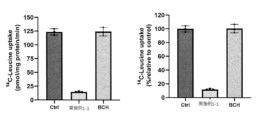
- FIG. 2 is a graph showing the amount of [ 14 C]L-leucine uptake 30 minutes after treatment with and removal of the compound of Example or BCH in a cell line that highly expresses human LAT1.
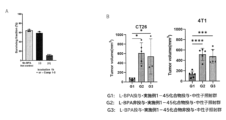
- FIG. 3A shows the results of examining the BNCT-enhancing effect of the compounds of Examples evaluated using cultured cells.
- FIG. 3B shows the results of examining the BNCT-enhancing effect of the compounds of Examples evaluated using a mouse allograft tumor model.
- the present invention relates to a new tetrahydronaphthalene derivative.
- the compound when a compound having an asymmetric carbon is represented, unless otherwise specified, the compound includes any of the racemic form, the R form, and the S form.
- the tetrahydronaphthalene derivative of the present invention is a compound represented by the following formula (I) or a pharmaceutically acceptable salt thereof.
- M represents S, O, or NH
- R 1C consists of a 5- to 7-membered aromatic heterocyclic group having a substituent, a C5- to 7-membered aromatic ring group having a substituent, and a substituted or unsubstituted 8- to 16-membered polycyclic group represents one of the structures selected from the group,
- the substituent in the 5- to 7-membered aromatic heterocyclic group having the substituent or the C5- to 7-membered aromatic ring group having the substituent is substituted or unsubstituted benzyloxy, substituted or unsubstituted benzyl, substituted or unsubstituted phenyl, substituted or unsubstituted phenylC1-6 alkyl, substituted or
- examples of the C5- to 7-membered aromatic ring group having a substituent include a phenyl group.
- the 5- to 7-membered aromatic heterocycle in the 5- to 7-membered aromatic heterocycle having a substituent contains one or more heteroatoms selected from O, N, and S. Represents a 5- to 7-membered aromatic ring group.
- the group formed from a 5- to 7-membered aromatic heterocycle includes, for example, thienyl, furyl, pyrrolyl, imidazolyl, pyrazolyl, thiazolyl, isothiazolyl, oxazolyl, isoxazolyl, pyridyl, pyrazinyl, pyrimidinyl, pyridazinyl, Examples include 1,2,4-oxadiazolyl, 1,3,4-oxadiazolyl, 1,2,4-thiadiazolyl, 1,3,4-thiadiazolyl, triazolyl, tetrazolyl, and triazinyl.
- the substituted or unsubstituted 8- to 16-membered polycyclic group refers to a group formed from a substituted or unsubstituted 8- to 16-membered polycyclic compound, such as naphthyl, quinolyl, Isoquinolyl, benzothiophenyl, benzofuranyl, benzimidazolyl, benzoxazolyl, benzodioxolyl, benzisoxazolyl, benzothiazolyl, benzisothiazolyl, benzotriazolyl, imidazopyridinyl, thienopyridinyl, furopyridinyl, pyrrolopyridinyl, pyra Zolopyridinyl, oxazolopyridinyl, thiazolopyridinyl, imidazopyrazinyl, imidazopyrimidinyl, thienopyrimidinyl, furopyrimidinyl,
- substituents means being substituted with any substituent within the range of 1 to 4, 1 to 5, or 1 to 6.
- the substituent referred to in "5- to 7-membered aromatic heterocyclic group having said substituent” or "C5- to 7-membered aromatic ring group having said substituent” is substituted or unsubstituted benzyloxy, substituted or unsubstituted Substituted benzyl, substituted or unsubstituted phenyl, substituted or unsubstituted phenylC1-6 alkyl, substituted or unsubstituted biphenyl, substituted or unsubstituted pyridyl, substituted or unsubstituted naphthyl, halogen, hydroxy, cyano, amino , C1-6 alkylamino, di(C1-6 alkyl)amino, C1-6 alkyl, C2-6 alkenyl, C2-6 alkynyl, C1-6 al
- substituted or unsubstituted means that it may be optionally substituted with any substituent.
- Substituents in the substituted naphthyl are not limited, but include, for example, halogen, hydroxy, cyano, amino, C1-6 alkylamino, C1-6 alkyl, C2-6 alkenyl, C2-6 alkynyl, C1-6 alkoxyl, Benzyloxy, benzyl, phenyl, phenylC1-6 alkyl, C1-6 alkoxyC1-6 alkyl, nitro
- halogen may be any of F, Cl, Br, and I, but preferably F, Cl, and Br, and particularly preferably F or Cl.
- C1-6 alkylamino refers to amino having a linear or branched C1-6 saturated hydrocarbon group. Includes methylamino, ethylamino, propyl (e.g. n-propyl and isopropyl) amino, butyl (e.g. n-butyl, isobutyl, t-butyl) amino, pentyl (e.g. n-pentyl, isopentyl, neopentyl) amino, and the like. It will be done.
- it is a linear or branched C1-C4 alkylamino group, including, but not limited to, a methylamino group, an ethylamino group, an isopropylamino group, a butylamino group, and the like.
- di(C1-6 alkyl)amino refers to amino having two linear or branched C1-6 saturated hydrocarbon groups.
- di(C1-6 alkyl)amino groups include dimethylamino, diethylamino, methylethylamino, dipropyl (e.g. n-propyl and isopropyl)amino, dibutyl (e.g. n-butyl, isobutyl, t-butyl)amino , dipentyl (eg, n-pentyl, isopentyl, neopentyl) amino, and the like.
- it is an amino group having two linear or branched C1-C4 alkyl groups, such as, but not limited to, dimethylamino group, diethylamino group, methylethylamino group, methylisopropylamino group, methyl Examples include butylamino group.
- C1-6 alkyl refers to a linear or branched C1-6 saturated hydrocarbon group.
- C1-6 alkyl groups include methyl, ethyl, propyl (e.g. n-propyl and isopropyl), butyl (e.g. n-butyl, isobutyl, t-butyl), pentyl (e.g. n-pentyl, isopentyl, Neopentyl), etc.
- it is a linear or branched C1-C4 alkyl group, including, but not limited to, a methyl group, an ethyl group, an isopropyl group, a butyl group, and the like.
- C2-6 alkenyl refers to a straight-chain or branched C2-C6 unsaturated hydrocarbon group containing a double bond.
- Examples of C2-6 alkenyl groups include ethenyl, propenyl, butenyl, and the like.
- C2-6 alkynyl refers to a straight-chain or branched C2-C6 unsaturated hydrocarbon group containing a triple bond.
- Examples of C2-6 alkynyl groups include acetylene, methylacetylene, butyne, pentyne, and the like.
- C1-6 haloalkyl refers to a C1-6 alkyl group having one or more halogen substituents.
- the C1-6 haloalkyl group is preferably represented by C 2 X 5 , CH 2 3 , C2F5 , CHF2 , CH2F , CCl3 , CHCl2 , C2Cl5 , and the like .
- trifluoromethyl, difluoromethyl, or monofluoromethyl is particularly preferred.
- C1-6 alkoxyl represents a group having a linear or branched C1-6 alkyl group and an oxygen molecule.
- C1-6 alkoxy or alkoxyl preferably has a linear or branched C1-C4 alkyl group, and includes, but is not limited to, groups such as methoxy, ethoxy, isopropoxy, butoxy, and the like.
- C1-6 alkoxyC1-6 alkyl includes, but is not limited to, methoxyethyl, ethoxyethyl, and the like.
- C1-6 alkylamino or di(C1-6 alkyl)amino is represented as NR 11 R 12 such that R 11 R 12 each independently represents H or C1-6 alkyl.
- R 11 R 12 each independently represents H or C1-6 alkyl.
- a group except when R 11 and R 12 are both H). Examples include, but are not limited to, methylamino, dimethylamino, ethylamino, i-propylamino, and the like.
- C1-6 alkylaminocarbonyl or di(C1-6 alkyl)aminocarbonyl is represented as CONR 13 R 14 , and R 13 and R 14 are each independently H or C1-6 alkyl. (However, the case where both R 13 and R 14 are H is excluded). Examples include, but are not limited to, methylaminocarbonyl, dimethylaminocarbonyl, ethylaminocarbonyl, i-propylaminocarbonyl, and the like.
- C1-6 alkylcarbonyl includes, but is not limited to, methylcarbonyl, ethylcarbonyl, and the like.
- C1-6 alkoxycarbonyl includes, but is not limited to, methoxycarbonyl, ethoxycarbonyl, propoxycarbonyl, isopropoxycarbonyl, butoxycarbonyl, isobutoxycarbonyl, sec-butoxycarbonyl, tert-butoxycarbonyl, pentyloxy Examples include carbonyl, hexyloxycarbonyl, and the like.
- COOR 10 R 10 is H or C1-6 alkyl, amino, alkylamino (NR 11 R 12 (R 11 R 12 each independently represents H or C1-6 alkyl)
- R 10 is H or C1-6 alkyl, amino, alkylamino (NR 11 R 12 (R 11 R 12 each independently represents H or C1-6 alkyl)
- Examples include, but are not limited to, methyloxycarbonyl, aminooxycarbonyl, and the like.
- C1-6 haloalkylsulfanyl, C1-6 haloalkylsulfinyl, and C1-6 haloalkylsulfonyl include, but are not limited to, trifluoromethylsulfanyl, trifluoromethylsulfinyl group, trifluoromethylsulfonyl, and the like, respectively. can be mentioned.
- C1-6 alkylthio includes, but is not limited to, methylthio, ethylthio, propylthio, isopropylthio, butylthio, sec-butylthio, tert-butylthio, pentylthio, hesylthio, and the like.
- C1-6 alkylsulfinyl includes, but is not limited to, methylsulfinyl, ethylsulfinyl, and the like.
- C1-6 alkylsulfonyl includes, but is not limited to, methylsulfonyl, ethylsulfonyl, and the like.
- substituted C1-6 alkyl includes, but is not limited to, linear or branched C1-6 alkyl in which one to three hydrogen atoms are substituted with other groups. .
- substituted C1-6 alkoxy includes, but is not limited to, straight-chain or branched C1-6 alkoxy in which one or two hydrogen atoms are substituted with other groups.
- the substituted C1-6 alkoxy C1-6 alkyl is, but not limited to, a straight chain or branched C1-6 alkoxy C1 in which one or two hydrogen atoms are substituted with other groups. Contains ⁇ 6 alkyl.
- C3-8 cycloalkyl refers to, for example, cyclopropyl, cyclobutyl, cyclopentyl, cyclohexyl, cycloheptyl, or cyclooctyl.
- a 3- to 8-membered non-aromatic heterocycle refers to, for example, a 3- to 8-membered saturated ring containing one or two heteroatoms selected from oxygen atoms, nitrogen atoms, and sulfur atoms. or an unsaturated ring that is not an aromatic ring.
- Examples include aziridino, azetidino, morpholino, thiomorpholino, 1-pyrrolidinyl, piperidino, 4-piperidinyl, 1-piperazinyl, 1-pyrrolyl, oxazolidino, thiazolidino, tetrahydrofuranyl, and tetrahydropyranyl.
- C3-8 cycloalkylamino refers to, for example, cyclopropylamino, cyclobutylamino, cyclopentylamino, cyclohexylamino, cycloheptylamino, or cyclooctylamino.
- 3- to 8-membered non-aromatic heterocyclic substituted amino includes, for example, aziridinoamino, azetidinoamino, morpholinoamino, thiomorpholinoamino, 1-pyrrolidinylamino, piperidinoamino, 4-piperidinylamino, 1- Examples include piperazinylamino, 1-pyrrorylamino, oxazolidinoamino, thiazolidinoamino and the like.
- the substituent containing boron includes, for example, boronic acid (-B(OH) 2 ), boronic acid ester, boronic acid amide, or boron cluster.
- Boron clusters include, but are not limited to, BSH (sodium borocaptate), dodecaborate, decaborate, or carborane.
- the ⁇ -ray emitting nuclide and/or the ⁇ -ray emitting nuclide are not limited, but preferred examples include 211 At as the ⁇ -ray emitting nuclide, and 131 I as the ⁇ -ray emitting nuclide.
- formula (I) includes, but is not limited to, or It is preferable that
- R 1C is substituted or unsubstituted pyridylphenyl, substituted or unsubstituted biphenyl, substituted or unsubstituted phenylpyridyl, substituted or unsubstituted biphenyl, substituted phenyl, substituted or unsubstituted pyridyl, substituted or unsubstituted naphthyl substituted phenyl, substituted or unsubstituted naphthyl substituted pyridyl, substituted or unsubstituted naphthyl, substituted or unsubstituted benzofuranyl, substituted or unsubstituted benzothiophenyl, substituted or unsubstituted acenaphthene , substituted or unsubstituted quinoline, substituted or unsubstituted quinoline substituted phenyl, substituted or unsubstituted
- substituents in the case of substitution include halogen, hydroxy, cyano, amino, C1-6 alkylamino, C1-6 alkyl, C2-6 alkenyl, C2-6 alkynyl, C1-6 alkoxy, benzyloxy, benzyl, Phenyl, phenylC1-6 alkyl, C1-6 alkoxyC1-6 alkyl, nitro, C1-6 haloalkyl, carbamoyl, C1-6 alkylaminocarbonyl, di(C1-6 alkyl)aminocarbonyl, C1-6 alkoxycarbonyl, C1 ⁇ 6 alkylcarbonyl, COOR 10 (R 10 is H or C1-6 alkyl, amino, C1-6 alkylamino), morpholinocarbonyl, C1-6 haloalkylsulfanyl, C1-6 haloalkylsulfinyl, C1-6 haloalkylsulfonyl, C1-6 alkylthio, C1-6 alkylsulf
- the M is an O atom.
- n 0, n is 1 or 2
- R 2 is halogen, hydroxy, cyano, amino, C1-6 alkylamino, C1-6 alkyl, C2-6, but not limited to.
- it is a group selected from the group consisting of:
- R 1C is substituted or unsubstituted pyridylphenyl, substituted or unsubstituted biphenyl, substituted or unsubstituted phenylpyridyl, substituted or unsubstituted biphenyl. More preferably, it is one selected from the group consisting of phenyl, substituted or unsubstituted naphthyl-substituted phenyl, and substituted or unsubstituted naphthyl, and n is 0.
- substituents in the case of substitution include halogen, amino, C1-4 alkylamino, di(C1-4 alkyl)amino, C1-4 alkyl, C2-4 alkenyl, C2-4 alkynyl, C1-4 alkoxy, Benzyloxy, benzyl, phenyl, phenylC1-4 alkyl, C1-4 alkoxyC1-4 alkyl, nitro, C1-4 haloalkyl, carbamoyl, C1-4 alkylaminocarbonyl, di(C1-4 alkyl)aminocarbonyl, C1-4 1-5 independently selected from the group consisting of 4 alkoxycarbonyl, C1-4 alkylcarbonyl, COOR 10 (R 10 is H or C1-4 alkyl, amino, C1-4 alkylamino), and morpholinocarbonyl It is more preferable that it is a group of
- particularly preferred compounds include any of the following compounds or pharmaceutically acceptable salts thereof.
- 2-amino-7-(naphthalen-2-yloxy)-1,2,3,4-tetrahydronaphthalene-2-carboxylic acid 2-amino-7-(naphthalen-1-yloxy)-1,2,3,4-tetrahydronaphthalene-2-carboxylic acid; 2-amino-7-((3'-fluoro-[1,1'-biphenyl]-2-yl)oxy)-1,2,3,4-tetrahydronaphthalene-2-carboxylic acid; 2-amino-7-((3'-chloro-[1,1'-biphenyl]-2-yl)oxy)-1,2,3,4-tetrahydronaphthalene-2-carboxylic acid; 2-amino-7-(2-(naphthalen-1-yl)phenoxy)-1,2,3,4
- salts with inorganic bases include salts with inorganic bases, salts with organic bases, salts with inorganic acids, salts with organic acids, salts with basic or acidic amino acids, etc. .
- Suitable examples of salts with inorganic bases include alkali metal salts such as sodium salts and potassium salts; alkaline earth metal salts such as calcium salts and magnesium salts; and aluminum salts and ammonium salts.
- Suitable examples of salts with organic bases include salts with trimethylamine, triethylamine, pyridine, picoline, ethanolamine, diethanolamine, triethanolamine, dicyclohexylamine, N,N'-dibenzylethylenediamine, and the like.
- Suitable examples of salts with inorganic acids include salts with hydrochloric acid, hydrobromic acid, nitric acid, sulfuric acid, phosphoric acid, and the like.
- Suitable examples of salts with organic acids include formic acid, acetic acid, trifluoroacetic acid, fumaric acid, oxalic acid, tartaric acid, maleic acid, citric acid, succinic acid, malic acid, methanesulfonic acid, benzenesulfonic acid, p - Salts with toluenesulfonic acid, etc. are included.
- salts with basic amino acids include salts with arginine, lysine, ornithine, etc.
- preferred examples of salts with acidic amino acids include salts with aspartic acid, glutamic acid, etc. It will be done.
- LAT1 inhibitors are created with the intention of binding to the distal pocket (see Non-Patent Document 2), which is a binding pocket of LAT1 revealed by cryo-electron microscopy analysis. There are no existing compounds known to bind to this distal pocket.
- the compounds of the present invention are expected to have an amino group and a carboxyl group fixed as substituents of a cyclic tetrahydronaphthalene derivative, and have LAT1 selectivity as a common property. Furthermore, the linkage between tetrahydronaphthalene and the terminal ring structure (for example, an aromatic ring) on the R 1c side is -M-, and a ring structure such as a phenyl group or a polycyclic group is directly bonded to -M-, so the compound It is thought that the overall shape will have fewer bends, and will be shaped to easily fit into a location called a distal pocket in LAT-1.
- the compound of the present invention can strongly bind to LAT1 and exhibit the effect of continuously suppressing LAT1 even after exposure to the compound has ended.
- the compounds of the present invention have the ability to inhibit amino acid uptake into cancer cells via LAT1, thereby exhibiting anticancer effects, and furthermore have high LAT1 affinity and high LAT1 selectivity, It is expected that the suppressive effect will last and the blood concentration will be effectively maintained.
- One embodiment of the compound of the present invention can inhibit the uptake of substances into cancer cells by LAT1 due to its high affinity and selectivity for LAT1, and its sustained LAT1 inhibitory effect. Furthermore, enhancement of the BNCT effect can be achieved by blocking the extracellular release of substances useful for BNCT, such as, for example, L-BPA.
- the compound of the present invention when it contains an ⁇ -ray emitting nuclide or a ⁇ -ray emitting nuclide, it has high affinity and high selectivity for LAT1, so that it is efficiently and selectively transported and emits radiation. It can act as a releasable compound.
- the compounds of the invention when containing a boron atom, can function in BNCT as a boron-containing compound used for boron delivery to cancer cells.
- it can also serve as a radioactive compound used for cancer detection and diagnosis by PET or SPECT.
- the method for producing the novel tetrahydronaphthalene derivative is not limited, but may be, for example, the following method using particularly preferred compounds as representative examples.
- a hydantoin compound represented by the following general formula (III) is prepared from a tetralone type compound represented by the following general formula (II), and then an amino acid (formula (IV)) is prepared.
- the compound of the present invention can be prepared by protecting the amino group and carboxyl group of the resulting amino acid and modifying or substituting the group that binds to M.
- MR 13 represents, for example, OH.
- tetralone type compounds of formula (II) are converted to hydantoins of formula (III) by treatment with ammonium carbonate and potassium cyanide. This reaction is carried out, for example, in an aqueous ethanol mixture at a temperature of 50°C to 90°C, preferably between 80°C and 90°C.
- Direct hydrolysis of this hydantoin to the amino acid (formula (IV)) requires treatment with a strong base, such as sodium hydroxide solution or barium hydroxide, at reflux temperature.
- the reaction time at this time is preferably a long time, for example, 10 to 30 hours.
- Hydantoin compounds are thus converted to amino acids.
- the amino group and carboxyl group of the obtained compound are protected by a conventional method.
- the protecting group is not limited, for example, a carbamate protecting group, an amide protecting group, and an alkyl protecting group are preferably used.
- Such carbamate-based protecting groups include tert-butoxycarbonyl group (Boc), benzyloxycarbonyl group, 9-fluorenylmethyloxycarbonyl group (Fmoc), and 2,2,2-trichloroethoxycarbonyl group (Troc).
- the amide protecting group include an acetyl group, benzoyl group, etc.
- examples of the alkyl protecting group include a methyl group, t-butyl group, benzyl group, etc.
- the group bonded to M can be reacted as appropriate.
- an ether can be obtained by reacting the phenol obtained above with the halogenated ring structure in the presence of a base.
- the bases used at this time include potassium carbonate, tripotassium phosphate, cesium carbonate, triethylamine, N,N-diisopropylethylamine, pyridine, sodium ethoxide, potassium tert-butoxide, sodium hydride, lithium hexamethyldisilate.
- Examples include dido, sodium hexamethyldisilazide, n-butyllithium, and the like.
- the catalysts used at this time include palladium(II) acetate, palladium(II) chloride, tris(dibenzylideneacetone)dipalladium(0), and [1,1'-bis(diphenylphosphino)ferrocene]palladium.
- (II) Dichloride dichloromethane adduct, palladium catalysts such as tetrakis(triphenylphosphine)palladium(0), or catalysts such as copper iodide, bromide, oxidation, etc., and the like.
- the ligands used at this time include triphenylphosphine, tricyclohexylphosphine, 1,1'-bis(diphenylphosphino)ferrocene, 2-dicyclohexylphosphine-2',6'-dimethoxybiphenyl, 2-dicyclohexyl Examples include phosphino-2',4',6'-triisopropylbiphenyl and 2-dicyclohexylphosphino-2'-(N,N-dimethylamino)biphenyl.
- Deprotection can be carried out by conventional methods, such as hydrolysis, catalytic hydrogenation, decarboxylation, or oxidation.
- the CI and CCI steps are reactions in which a tetralone type compound is converted into hydantoin by treatment with ammonium carbonate and potassium cyanide.
- This reaction is carried out, for example, in an aqueous ethanol mixture at a temperature of 50°C to 90°C, preferably between 80°C and 90°C.
- Direct hydrolysis of this hydantoin to amino acids requires treatment with a strong base, such as sodium hydroxide solution or barium hydroxide, at reflux temperature.
- the reaction time at this time is preferably a long time, for example, 10 to 30 hours.
- Such hydantoin compounds are then converted to amino acids.
- the reaction indicated by CIV is a step of obtaining a thioether by reacting a halogenated ring structure in the presence of a base.
- the bases used at this time include potassium carbonate, tripotassium phosphate, cesium carbonate, triethylamine, N,N-diisopropylethylamine, pyridine, sodium ethoxide, sodium tert-butoxide, potassium tert-butoxide, sodium hydride, Examples include lithium hexamethyldisilazide, sodium hexamethyldisilazide, n-butyllithium, zinc chloride, zinc bromide, zinc iodide, and lithium iodide.
- the catalysts used at this time include palladium such as di- ⁇ -bromobis(tri-t-butylphosphine)dipalladium (I), nickel such as nickel acetate, nickel chloride, copper chloride, copper bromide, and iodide.
- palladium such as di- ⁇ -bromobis(tri-t-butylphosphine)dipalladium (I)
- nickel such as nickel acetate
- nickel chloride copper chloride
- copper bromide copper bromide
- iodide iodide
- copper catalysts and ligands for copper include heterocyclic carbenes such as 1,3-bis(2,6-diisopropylphenyl)imidazolium chloride, triphenylphosphine, and the like.
- the reaction indicated by CCIV is a process of obtaining an amino compound by reacting a halogenated ring structure in the presence of a base.
- the bases used include potassium carbonate, tripotassium phosphate, cesium carbonate, triethylamine, N,N-diisopropylethylamine, pyridine, sodium ethoxide, sodium tert-butoxide, potassium tert-butoxide, sodium hydride, Examples include lithium hexamethyldisilazide, sodium hexamethyldisilazide, n-butyllithium, and the like.
- the catalyst used is a palladium catalyst such as palladium acetate
- the ligand is 2,8,9-triisobutyl-2,5,8,9-tetraaza-1-phosphabicyclo[3,3,3]
- Examples include bicyclic triaminophosphines such as undecane.
- Examples include, but are not limited to, palladium acetate catalyst in the presence of sodium t-butoxide, 2,8,9-triisobutyl-2,5,8,9-tetraaza-1-phosphabicyclo[3,3,3]undecane as the ligand. It can be synthesized in the presence of a toluene solvent at a reaction temperature of 80° C. and a reaction time of about 18 hours.
- purification follows conventional methods and may be modified as appropriate.
- the compound when it is a racemate, it can be used as is, or the optical purity of the R or S form can be increased, for example, in order to obtain a preferred compound for use in boron neutron capture therapy.
- optical resolution known methods may be used as appropriate; for example, in addition to a method of optical resolution (using ⁇ -chymotrypsin, etc.) after a hydrolysis step and an esterification step, a method using acylase after a hydrolysis step Simplified methods involving simplified steps may also be employed.
- LAT1 [L-type amino acid transporter 1 (LAT1) selective inhibitor]
- the tetrahydronaphthalene derivative of the present invention has affinity for the amino acid transporter LAT1 expressed on the surface of cells. It also preferably has no affinity for the amino acid transporter LAT2.
- LAT1 is a type of amino acid transporter, which is a membrane protein required for intracellular uptake of neutral branched chain amino acids and aromatic amino acids, and has been shown to be specifically expressed in cancer. LAT1 is responsible for supplying amino acids as nutrients in cancer tissues. Furthermore, amino acids taken into cancer cells by LAT1 are not only used as nutrients, but also play a role in regulating protein synthesis, intracellular metabolism, and cell growth via the amino acid signal system.
- LAT1 selective inhibitor refers to a substance that inhibits intracellular uptake of amino acids via LAT1, and more preferably inhibits amino acid transporter (e.g., LAT2) in normal cells. , is a substance that inhibits intracellular influx via LAT1.
- the tetrahydronaphthalene derivatives of the present invention can be used as such in the form of the above-mentioned compounds or pharmaceutically acceptable salts, or mixed with pharmaceutically acceptable carriers in the form of formulations known to those skilled in the art, or in the form of micro/nanoparticles. It can be used as a LAT1 selective inhibitor in the form of encapsulation or the like.
- the tetrahydronaphthalene derivative of the present invention has a ratio of affinity for cells expressing LAT1/affinity for cells expressing LAT2, preferably 2 times or more, more preferably 5 times or more, and still more preferably 10 times or more. That's more than double that.
- the tetrahydronaphthalene derivatives of the present invention inhibit the function of LAT1, which is specifically expressed in cancer cells, thereby inducing nutritional starvation in a cancer-specific manner. It can be used as a LAT1 inhibitor that suppresses internal metabolism and cell growth to reduce cancer tissue size. As a result of functional inhibition, nutrient supply to cells is blocked, and protein synthesis, intracellular metabolism, and cell growth are suppressed through suppression of amino acid signaling systems, leading to attenuation of tumor cells.
- the tetrahydronaphthalene derivative of the present invention may be, for example, a compound having a structure in which a therapeutic radioactive isotope is introduced as a substituent, or a pharmaceutically acceptable salt thereof.
- the radioactive isotope is an ⁇ -ray emitting nuclide and/or a ⁇ -ray emitting nuclide.
- it can be provided as a pharmaceutical composition for cancer treatment containing a compound having a structure in which 211 At, an ⁇ -ray emitting nuclide, is introduced as a substituent, or a pharmaceutically acceptable salt thereof.
- 211 At is a radioactive isotope of astatine (At), which is an element belonging to the halogen family.
- the 211 At emits high-energy alpha rays that are cell-killing and decays into stable lead ( 207 Pb).
- the half-life of 211 At is 7.2 hours. That is, since 211 At is short-lived and highly cell-killing, cancer tissue can be efficiently destroyed by labeling the 211 At as a substituent and guiding it to the affected area.
- 211 At is a substituent in a LAT1-affinity compound, it is possible to specifically accumulate LAT1-expressing cancer cells and irradiate them with ⁇ -rays. Since this drug rarely occurs, it is possible to provide a therapeutic effect with almost no risk of side effects.
- composition for cancer treatment preferably comprising a compound having a structure in which a ⁇ -ray emitting nuclide 131 I is introduced as a substituent, or a pharmaceutically acceptable salt thereof.
- the preparation of the tetrahydronaphthalene derivative of the present invention When used as a LAT1 selective inhibitor, it can be used for tumor treatment.
- the formulation is administered by any suitable route of administration in such a manner that the Tetrahydronaphthalene Derivative accumulates in the target tumor.
- Treatments using tetrahydronaphthalene derivatives can be administered, but are not limited to, such that the tumor:blood ratio is at least 1.5:1, preferably 2:1.
- the tetrahydronaphthalene derivative can be administered at once or continuously. Depending on the case, it can also be administered separately.
- Tetrahydronaphthalene derivatives can be used alone as anticancer drugs, but they are also used in existing anticancer drugs, existing molecular target drugs, immune checkpoint inhibitors including anti-PD-1 antibodies, and selective serotonin with antitumor effects. It can be used in combination with reuptake inhibitors, mTOR inhibitors, other LAT1 inhibitors, etc., or in combination with radiotherapy including particle beam therapy, surgical therapy, BNCT, and nuclear medicine therapy. If desired, tetrahydronaphthalene derivatives can be used against residual tumors after surgical treatment, metastatic tumors, or for the purpose of inhibiting metastasis.
- BNCT effect enhancing composition The tetrahydronaphthalene derivative of the present invention can also be used after administering a BNCT drug that shows accumulation in cancer cells, such as BSH (sodium borocaptate) or L-boronophenylalanine (L-BPA).
- a BNCT drug that shows accumulation in cancer cells
- BSH sodium borocaptate
- L-BPA L-boronophenylalanine
- the tetrahydronaphthalene derivative of the present invention can be administered simultaneously with substances such as sodium borocaptate (BSH) and L-boronophenylalanine (L-BPA), or consecutively within a certain period of time. Since it is possible to prevent the drug from flowing out from inside the cells, its efficacy can be enhanced during BNCT. For example, even if a drug such as L-BPA is not continuously administered during neutron irradiation, the drug can remain in cells for a long time. Thereby, the overall dosage of the drug can be kept low, and the efficacy of BNCT can be effectively exhibited.
- BSH sodium borocaptate
- L-BPA L-boronophenylalanine
- the tetrahydronaphthalene derivatives of the present invention can contain boron-containing groups in place of, or in addition to, any of the groups in the compounds described above.
- the boron-containing group is either a boronic acid (-B(OH) 2 ), a boronate ester, a boronic acid amide, or a boron cluster.
- the boron cluster is preferably BSH, dodecaborate, decaborate, or carborane.
- Such compounds may be used neat or in the form of pharmaceutically acceptable salts, or mixed with pharmaceutically acceptable carriers in formulations known to those skilled in the art, or encapsulated in micro/nanoparticles, etc. , can be advantageously used for BNCT.
- examples of the boronate ester or boronic acid amide group in this definition include a group having a chain structure such as -B(NR 71 ) 2 or -B(OR 71 ) 2 , or together with atom B, represents a group having a cyclic structure.
- R 71 represents a linear or branched C1-C10 alkyl group.
- straight chain or branched C1-C10 alkyl group any alkyl group having 1 to 10 carbon atoms may be used.
- it is a linear or branched C1-C8 alkyl group, more preferably a linear or branched C1-6 alkyl group.
- these groups include, but are not limited to, a methyl group, an ethyl group, an isopropyl group, a butyl group, and the like.
- N atom examples include, but are not limited to, pinacol, 2,2-dimethyl-1,3-propanediol, N-methyldiethanolamine, 1-6-diaminonaphthalene, N-methyliminodiacetic acid, 1,1,1-trishydroxymethylethane.
- boronic acid pinacol ester include, but are not limited to, boronic acid pinacol ester, boronic acid MIDA ester, boronic acid 1,3-propanediol ester, boronic acid neopentyl glycol ester, boronic acid catechol ester, boronic acid pinanediol ester, Included are acid biscyclohexyl diol ester, boronic acid MPM ester, trifluoroborate salt, cyclic triol borate salt, and a cyclic body of diaminonaphthalenamide and boron.
- boronic acid pinacol ester include, but are not limited to, boronic acid pinacol ester, boronic acid MIDA ester, boronic acid 1,3-propanediol ester, boronic acid neopentyl glycol ester, boronic acid catechol ester, boronic acid pinanediol ester, Included are acid bis
- the proportion of boron 10 is preferably 75% by mass or more, more preferably 80% by mass or more, even more preferably 90% by mass or more, particularly preferably , 95% by mass or more.
- boron-10 and boron-11 are present as isotopes, with boron-10 being 20% and boron-11 being 80%. Therefore, it is also preferable to concentrate boron having a mass number of 10 (boron 10) prior to producing the tetrahydronaphthalene derivative of the present invention.
- boron atom source for example, commercially available products may be used as the boron atom source.
- 10B concentrated boric acid manufactured by Stella Chemifa Co., Ltd.
- boron 10 can be measured by multi-type ICP emission spectrometry (ICP-OES) using Agilent 710 (manufactured by Agilent).
- ICP-OES multi-type ICP emission spectrometry
- Agilent 710 manufactured by Agilent
- the ICP-OES used for measurement is adjusted according to JIS K0116.
- the compound preferably contains, but is not limited to, boronic acid (B(OH) 2 ) or a boronic acid ester having a chain or cyclic structure, together with B atoms, and boronic acid (B(OH) 2 ) or boron More preferred are pinacol esters of acids.
- a compound containing such a boron-containing group can be obtained, for example, by reacting a compound represented by formula (I) with a boron compound in a solvent in the presence of a palladium catalyst, an organic phosphorus compound, and a base. It will be done.
- palladium catalysts include, but are not limited to, palladium(II) acetate, palladium(II) chloride, and tris(dibenzylideneacetone)dipalladium(0), [1,1'-bis(diphenylphosphino) )ferrocene]palladium(II) dichloride dichloromethane adduct, tetrakis(triphenylphosphine)palladium(0), and the like.
- organic phosphorus compounds include, but are not limited to, triphenylphosphine, tricyclohexylphosphine, 1,1'-bis(diphenylphosphino)ferrocene, 2-dicyclohexylphosphine-2',6'-dimethoxybiphenyl, 2- Examples include dicyclohexylphosphino-2',4',6'-triisopropylbiphenyl and 2-dicyclohexylphosphino-2'-(N,N-dimethylamino)biphenyl.
- Examples of the base include, but are not limited to, potassium acetate, sodium acetate, sodium carbonate, cesium carbonate, potassium carbonate, and sodium hydrogen carbonate.
- boron compounds include boric acid esters and boric acid amides, preferably B(OR) 3 , B(NR) 3 , B(OR) 2 (NR), (RO) 2 BB(OR) 2 or B(OR)(NR) 2 (R is a linear or branched C1-C10 alkyl group, phenyl group, or benzyl group). Further, among these, a compound represented by (RO) 2 BB(OR) 2 is particularly preferably used.
- the term "linear or branched C1-C10 alkyl group” may be any alkyl group having 1 to 10 carbon atoms, but preferably a straight-chain or branched C1-C8 alkyl group.
- the boron compound is typically, but not limited to, bis(pinacolato)diboron.
- the solvent examples include, but are not limited to, ether solvents such as 1,4-dioxane, tetrahydrofuran, and 1,2-dimethoxyethane; hydrocarbon solvents such as toluene; and N,N-dimethylformamide and dimethyl sulfoxide.
- ether solvents such as 1,4-dioxane, tetrahydrofuran, and 1,2-dimethoxyethane
- hydrocarbon solvents such as toluene
- N,N-dimethylformamide and dimethyl sulfoxide exemplified.
- a preferred solvent is dimethyl sulfoxide.
- the reaction temperature is, for example, 20°C to 160°C, preferably 60°C to 120°C.
- the tetrahydronaphthalene derivative of the present invention contains boron
- treatment with the formulation is carried out by administering it by any suitable route of administration and in such a way that the tetrahydronaphthalene derivative accumulates in the target tumor.
- the tetrahydronaphthalene derivative is preferably concentrated in the tumor before irradiation, and the tumor:blood ratio before irradiation is at least 1.5:1, preferably 2:1.
- the tetrahydronaphthalene derivative can be administered at once or continuously. Depending on the case, it can also be administered separately.
- the site is irradiated with an effective amount of low energy neutron radiation (eg, epithermal neutron radiation).
- the area can be irradiated through the skin, or the area can be fully or partially exposed before irradiation.
- Administration of the tetrahydronaphthalene derivative followed by radiation can be repeated as necessary.
- the tetrahydronaphthalene derivatives of the invention can be used as anticancer agents against residual or metastatic tumors after treatment with BNCT.
- the tetrahydronaphthalene derivatives of the present invention can also be prepared as medicaments containing radioactive isotopes for diagnostic purposes.
- a drug containing radioisotope activity typically, although not limited to, 18 F is used as the F atom contained in the compound, and 131 is used as the I atom contained in the compound.
- I, 123 I, or 11 C can be used as the C atom contained in the compound.
- the compounds obtained in this manner can be used, for example, in RI tests and nuclear medicine tests.
- the tetrahydronaphthalene derivative of the present invention containing the compound is administered as a PET drug or a SPECT drug, images are acquired before treatment, and information such as the accumulation distribution of the derivative in the body and the tumor tissue/normal tissue abundance ratio (T/N ratio) is obtained. Based on this information, it is also possible to predict the therapeutic effects of BNCT in advance and formulate a research or treatment plan. The mode of administration and other information can be found in the [Drugs for BNCT] section.
- the diagnostic agent may preferably be a cancer diagnostic agent such as a PET probe or a SPECT probe.
- cancer when referring to a cancer therapeutic agent has the same meaning as “malignant tumor.”
- cancer or “malignant tumor” includes both epithelial (“cancer”) such as squamous cell carcinoma and non-epithelial (“sarcoma” (eg, osteosarcoma and leukemia)).
- cancer epithelial
- sarcoma non-epithelial
- brain tumors including glioblastoma, malignant glioma, and meningioma, other head and neck cancers, malignant melanoma, skin cancer, breast cancer, lung cancer, thymic cancer, Mesothelioma, uterine cancer, ovarian cancer, kidney cancer, pancreatic cancer, biliary tract cancer, liver cancer, colon cancer, esophageal cancer, stomach cancer, tongue cancer, prostate cancer, osteosarcoma, multiple sexual myeloma, leukemia, etc.
- diseases other than cancer in which LAT1 is involved in pathogenesis may also be targeted, such as autoimmune diseases such as multiple sclerosis and rheumatoid arthritis, and allergic diseases such as atopic dermatitis.
- Administration of the tetrahydronaphthalene derivatives of the present invention can be done orally and parenterally.
- parenteral administration intravenous, intraarterial (e.g., via the carotid artery), intramuscular, subcutaneous, intramedullary, intrathecal, intraventricular, intraperitoneal, intrathoracic, intrapelvic, or intranasal administration. It can be done.
- Preparations can be in the form of powders, granules, fine granules, dry syrups, tablets, capsules, injections, liquids, etc.
- it may be mixed with appropriate excipients and/or pharmaceutically acceptable carriers and administered to patients alone or in combination with other drugs using known pharmaceutical methods. obtain.
- Additives include, for example, excipients; disintegrants; binders; lubricants; diluents; buffers such as phosphoric acid, citric acid, succinic acid, acetic acid, and other organic acids or their salts; isotonic preservatives; wetting agents; emulsifiers; dispersants; stabilizers; solubilizers; antioxidants such as ascorbic acid; proteins (e.g., serum albumin, gelatin, or immunoglobulins); hydrophilic polymers (e.g., polyvinylpyrrolidone); amino acids (e.g., glycine, glutamic acid, aspartic acid, or arginine); monosaccharides, disaccharides, and other carbohydrates (including cellulose or its derivatives, glucose, mannose, or dextrin); chelating agents (e.g., EDTA); sugar alcohols (e.g., mannitol or sorbitol); counterions (e.g
- active agents eg, polysorbates, poloxamers
- Carriers that may be preferably used include, but are not limited to, pharmaceutically inert aqueous carriers. Such carriers include saline, buffered saline, dextrose, water, and the like.
- the pharmaceutically acceptable carrier is pharmaceutically inert. Suitable excipients and/or pharmaceutically acceptable carriers are non-toxic to recipients at the dosages and concentrations used. Particularly preferred formulations are injections prepared with an aqueous carrier.
- the preparation of the tetrahydronaphthalene derivative of the present invention is a drug containing the target drug in an amount effective to achieve the intended purpose, and "therapeutically effective amount” or “pharmacologically effective amount” is defined by those skilled in the art.
- therapeutically effective amount or “pharmacologically effective amount” is defined by those skilled in the art.
- a therapeutically effective amount refers to an amount of a drug that reduces the disease state after administration of the drug.
- the therapeutic efficacy and toxicity of such compounds can be determined by standard pharmacological procedures in cell culture or experimental animals.
- the dosage lies preferably within a range of circulating concentrations that include the ED 50 with little or no toxicity. The dose varies within this range depending on the dosage form used, patient sensitivity, and route of administration. For example, the dosage is appropriately selected depending on the patient's age and other conditions, the type of disease, the type of preparation, and the like.
- Step 1 Production of 7'-hydroxy-3',4'-dihydro-1'H-spiro[imidazolidine-4,2'-naphthalene]-2,5-dione
- the hydantoin compound (3.42 g, 14.7 mmol) obtained in Step 1 was mixed with an aqueous sodium hydroxide solution in which sodium hydroxide (11.8 g, 295 mmol) was dissolved in pure water (59 mL). suspended in. This was heated to reflux. After refluxing for 18 hours, the mixture was cooled and neutralized with 10% hydrochloric acid. The obtained precipitate was collected by filtration and further washed with cold water. The obtained solid was dried under reduced pressure to obtain the target compound (2.67 g). This dried amino acid compound was used as it was in the next step without being purified.
- Step 3 Production of methyl 2-((tert-butoxycarbonyl)amino)-7-hydroxy-1,2,3,4-tetrahydronaphthalene-2-carboxylate
- methanol 54 mL
- thionyl chloride 1.40 mL, 19.4 mmol
- Step 4 Production of methyl 2-((tert-butoxycarbonyl)amino)-7-(naphthalen-2-yloxy)-1,2,3,4-tetrahydronaphthalene-2-carboxylate
- a pressure-resistant tube put the phenol obtained in step 3 (280 mg, 0.871 mmol), 2-iodonaphthalene (266 mg, 1.05 mmol), cesium carbonate (851 mg, 2.61 mmol), and iodide.
- Copper (I) 50 mg, 0.261 mmol
- N,N-dimethylglycine hydrochloride 36 mg, 0.261 mmol
- dioxane 5 mL
- the reaction was carried out at 90°C for about 18 hours. Thereafter, the reaction solution was cooled in an ice bath, and ethyl acetate (50 mL) and distilled water (25 mL) were added. After stirring for about 5 minutes, the mixture was filtered through Celite, and the resulting filtrate was transferred to a separatory funnel. The aqueous phase was further extracted with ethyl acetate (25 mL), and the resulting organic phases were combined and washed with saturated brine (49 mL). After drying over anhydrous magnesium sulfate, it was removed by filtration, and the residue obtained by filtration was purified by silica gel column chromatography to obtain the desired product (250 mg, yield 64%).
- Step 5 Production of 2-((tert-butoxycarbonyl)amino)-7-(naphthalen-2-yloxy)-1,2,3,4-tetrahydronaphthalene-2-carboxylic acid
- the diaryl ether compound (250 mg, 0.559 mmol) obtained in step 2 was dissolved in methanol (10 mL), and sodium hydroxide (0.22 g, 5.59 mmol) was added to pure water (2. An aqueous sodium hydroxide solution dissolved in 2 mL) was added. After reacting at 55° C. for 1.5 hours, the solvent was distilled off under reduced pressure. The pH of the mixture was adjusted to below 7 with 1N hydrochloric acid, and the mixture was extracted with ethyl acetate (50 mL). The aqueous phase was further extracted with ethyl acetate (25 mL), and the resulting organic phases were combined and washed with pure water and saturated brine. After drying over anhydrous magnesium sulfate, the residue was removed by filtration to obtain the desired product (180 mg, yield 74%). This carboxylic acid compound was used as it was in the next step without being purified.
- Step 6 Production of 2-carboxy-7-(naphthalen-2-yloxy)-1,2,3,4-tetrahydronaphthalene-2-aminium chloride
- the carboxylic acid compound (180 mg, 0.415 mmol) obtained in step 5 was dissolved in CPME (10 mL), and 3M HCl-CPME (10 mL) was added thereto. This was reacted at 50°C for 2 hours. After the reaction was completed, the reaction solution was cooled in an ice bath, and the precipitated solid was collected by filtration. Furthermore, after washing with CPME and diethyl ether, the product was dried under reduced pressure to obtain the desired product (91 mg, yield 59%).
- Example 1-2 7-([1,1′-biphenyl]-3-yloxy)-2-carboxy-1,2,3,4-tetrahydronaphthalene-2-aminium chloride (Compound 1-9) Production Step 1 (Step I -IV) Preparation of methyl 7-([1,1′-biphenyl]-3-yloxy)-2-((tert-butoxycarbonyl)amino)-1,2,3,4-tetrahydronaphthalene-2-carboxylate
- Example 1 The following compound was obtained in the same manner as Steps 1 to 4 of Step 1, except that 2-iodonaphthalene in Step 4 was changed to 3-iodo-1,1'-biphenyl.
- Step 2 Preparation of 7-([1,1'-biphenyl]-3-yloxy)-2-carboxy-1,2,3,4-tetrahydronaphthalene-2-aminium chloride
- the above compound obtained in Step 1 was The following compound was synthesized in the same manner as Steps 5 and 6 of Example 1-1.
- Example 1-3 Production step 1 of 7-(benzofuran-5-yloxy)-2-carboxy-1,2,3,4-tetrahydronaphthalene-2-aminium chloride (compound 1-16) (steps I-IV) Preparation of methyl 7-(benzofuran-5-yloxy)-2-((tert-butoxycarbonyl)amino)-1,2,3,4-tetrahydronaphthalene-2-carboxylate Steps from Step 1 of Example 1-1 The following compound was obtained in the same manner as in Example 4, except that 2-iodonaphthalene in Step 4 of the Example was replaced with 5-iodobenzofuran.
- Step 2 The above compound obtained in step 1 of manufacturing 7-(benzofuran-5-yloxy)-2-carboxy-1,2,3,4-tetrahydronaphthalene-2-aminium chloride was added to step 5 of Example 1-1. , 6, the following compound was synthesized.
- Example 1-4 Production step 1 of 2-carboxy-7-(naphthalen-1-yloxy)-1,2,3,4-tetrahydronaphthalene-2-aminium chloride (compound 1-10) (steps I-IV) Preparation of methyl 2-((tert-butoxycarbonyl)amino)-7-(naphthalen-1-yloxy)-1,2,3,4-tetrahydronaphthalene-2-carboxylate Steps from Step 1 of Example 1-1 The following compound was obtained in the same manner as in Example 4, except that 2-iodonaphthalene in Step 4 of Example was replaced with 1-iodonaphthalene.
- Step 2 The above compound obtained in step 1 of manufacturing 2-carboxy-7-(naphthalen-1-yloxy)-1,2,3,4-tetrahydronaphthalene-2-aminium chloride was added to step 5 of Example 1-1. , 6, the following compound was synthesized.
- Example 1-5) Production step 1 (step I- IV) Production Example 1 of methyl 2-((tert-butoxycarbonyl)amino)-7-((7-methoxynaphthalen-2-yl)oxy)-1,2,3,4-tetrahydronaphthalene-2-carboxylate- The following compound was obtained in the same manner as Step 1 to Step 4 of Example 1, except that 2-iodonaphthalene in Step 4 of Example was changed to 2-iodo-7-methoxynaphthalene.
- Step 2 Preparation of 2-carboxy-7-((7-methoxynaphthalen-2-yl)oxy)-1,2,3,4-tetrahydronaphthalene-2-aminium chloride The above compound was added to Step 5 of Example 1-1. , 6, the following compound was synthesized.
- Example 1-6 Production step 1 of 2-amino-7-((6-(dimethylamino)naphthalen-2-yl)oxy)-1,2,3,4-tetrahydronaphthalene-2-carboxylic acid (compound 1-2) (process I-IV) Production of methyl 2-((tert-butoxycarbonyl)amino)-7-((6-(dimethylamino)naphthalen-2-yl)oxy)-1,2,3,4-tetrahydronaphthalene-2-carboxylate The following compound was obtained in the same manner as Step 1 to Step 4 of Example 1-1, except that 2-iodonaphthalene in Step 4 of Example was replaced with 6-iodo-N,N-dimethylnaphthalen-2-amine.
- Step 2 Production of 2-((tert-butoxycarbonyl)amino)-7-((6-(dimethylamino)naphthalen-2-yl)oxy)-1,2,3,4-tetrahydronaphthalene-2-carboxylic acid
- the above compound The following compound was synthesized in the same manner as Step 5 of Example 1-1. Further, this carboxylic acid compound was used as it was in the next step without being purified.
- Step 3 Production of 2-amino-7-((6-(dimethylamino)naphthalen-2-yl)oxy)-1,2,3,4-tetrahydronaphthalene-2-carboxylic acid
- the above compound 70 mg, 0.147 mmol
- the pH was raised to 7 with 1H aqueous sodium hydroxide solution, and a precipitate was observed.
- This precipitate was collected by filtration and further purified by silica gel column chromatography to obtain the following target compound (41 mg, yield 74%).
- Example 1--7 Production step 1 of 2-amino-7-((7-(dimethylamino)naphthalen-2-yl)oxy)-1,2,3,4-tetrahydronaphthalene-2-carboxylic acid (compound 1-1) I-IV) Production of methyl 2-((tert-butoxycarbonyl)amino)-7-((7-(dimethylamino)naphthalen-2-yl)oxy)-1,2,3,4-tetrahydronaphthalene-2-carboxylate The following compound was obtained in the same manner as Step 1 to Step 4 of Example 1-1, except that 2-iodonaphthalene in Step 4 of Example was replaced with 7-iodo-N,N-dimethylnaphthalen-2-amine.
- Step 2 Production of 2-((tert-butoxycarbonyl)amino)-7-((7-(dimethylamino)naphthalen-2-yl)oxy)-1,2,3,4-tetrahydronaphthalene-2-carboxylic acid
- the above compound The following compound was synthesized in the same manner as Step 5 of Example 1-1. Further, this carboxylic acid compound was used as it was in the next step without being purified.
- Step 3 Production of 2-amino-7-((7-(dimethylamino)naphthalen-2-yl)oxy)-1,2,3,4-tetrahydronaphthalene-2-carboxylic acid
- the above compound was prepared in Example 1-6.
- the following compound was synthesized in the same manner as in Step 3.
- Example 1-78 Production step 1 of 2-amino-7-(quinolin-6-yloxy)-1,2,3,4-tetrahydronaphthalene-2-carboxylic acid (compound 1-18) (steps I-IV) Preparation of methyl 2-((tert-butoxycarbonyl)amino)-7-(quinolin-6-yloxy)-1,2,3,4-tetrahydronaphthalene-2-carboxylate Steps from Step 1 of Example 1-1 4, except that 2-iodonaphthalene in step 4 of the example was replaced with 3-(3-iodophenyl)pyridine to obtain the following compound.
- Step 2 Production of 2-((tert-butoxycarbonyl)amino)-7-(quinolin-6-yloxy)-1,2,3,4-tetrahydronaphthalene-2-carboxylic acid
- the above compound was added to the step of Example 1-6.
- the following compound was synthesized in the same manner as in Example 2. Further, this carboxylic acid compound was used as it was in the next step without being purified.
- Step 3 Production of 2-amino-7-(quinolin-6-yloxy)-1,2,3,4-tetrahydronaphthalene-2-carboxylic acid
- the above compound was prepared in the same manner as in Step 3 of Example 1-6 to produce the following compound. was synthesized.
- Example 1-9 Production step 1 of 2-amino-7-(3-(pyridin-2-yl)phenoxy)-1,2,3,4-tetrahydronaphthalene-2-carboxylic acid (compound 1-21) (steps I-IV) Production Example 1-1 of methyl 2-((tert-butoxycarbonyl)amino)-7-(3-(pyridin-2-yl)phenoxy)-1,2,3,4-tetrahydronaphthalene-2-carboxylate The following compound was obtained in the same manner as Step 1 to Step 4 of Example 1, except that 2-iodonaphthalene in Step 4 of Example was changed to 2-(3-iodophenyl)pyridine.
- Step 2 Production of 2-((tert-butoxycarbonyl)amino)-7-(3-(pyridin-2-yl)phenoxy)-1,2,3,4-tetrahydronaphthalene-2-carboxylic acid.
- the following compound was synthesized in the same manner as Step 2 of 1-6. Further, this carboxylic acid compound was used as it was in the next step without being purified.
- Step 3 Production of 2-amino-7-(3-(pyridin-2-yl)phenoxy)-1,2,3,4-tetrahydronaphthalene-2-carboxylic acid
- the above compound was prepared in the same manner as in Step 3 of Example 1-6.
- the following compound was synthesized.
- Example 1-10 2-Carboxy-7-((4'-chloro-[1,1'-biphenyl]-3-yl)oxy)-1,2,3,4-tetrahydronaphthalene-2-aminium chloride (compound 1-31 ) manufacturing step 1 (process I-IV) Methyl 2-((tert-butoxycarbonyl)amino)-7-((4'-chloro-[1,1'-biphenyl]-3-yl)oxy)-1,2,3,4-tetrahydronaphthalene-2 - Manufacture of carboxylate in the same manner as Steps 1 to 4 of Example 1-1, except that 2-iodonaphthalene in Step 4 of Example was converted to 3-bromo-4'-chloro-1,1'-biphenyl.
- Step 2 (Process V-VI) In Step 1 of the production of 2-carboxy-7-((4'-chloro-[1,1'-biphenyl]-3-yl)oxy)-1,2,3,4-tetrahydronaphthalene-2-aminium chloride Using the obtained above compound, the following compound was synthesized in the same manner as Steps 5 and 6 of Example 1-1.
- Step 2 (Process V-VI) In Step 1 of the production of 2-carboxy-7-((3'-chloro-[1,1'-biphenyl]-3-yl)oxy)-1,2,3,4-tetrahydronaphthalene-2-aminium chloride Using the obtained above compound, the following compound was synthesized in the same manner as Steps 5 and 6 of Example 1-1.
- Step 2 Production of 7-([1,1'-biphenyl]-4-yloxy)-2-carboxy-1,2,3,4-tetrahydronaphthalene-2-aminium chloride
- the above compound obtained in Step 1 was The following compound was synthesized in the same manner as Steps 5 and 6 of Example 1-1.
- Example 1-13 Production step 1 of 2-carboxy-7-(3-(naphthalen-2-yl)phenoxy)-1,2,3,4-tetrahydronaphthalene-2-aminium chloride (compound 1-32) (steps I-IV ) Production Example 1-1 of methyl 2-((tert-butoxycarbonyl)amino)-7-(3-(naphthalen-2-yl)phenoxy)-1,2,3,4-tetrahydronaphthalene-2-carboxylate The following compound was obtained in the same manner as Step 1 to Step 4 of Example 1, except that 2-iodonaphthalene in Step 4 of Example was changed to 2-(3-iodophenyl)naphthalene.
- Step 2 Production of 2-carboxy-7-(3-(naphthalen-2-yl)phenoxy)-1,2,3,4-tetrahydronaphthalene-2-aminium chloride
- the above compound obtained in Step 1 was prepared in Example 1.
- the following compound was synthesized in the same manner as Steps 5 and 6 of -1.
- Step 2 (Process V-VI) In Step 1 of the production of 2-carboxy-7-((4'-fluoro-[1,1'-biphenyl]-3-yl)oxy)-1,2,3,4-tetrahydronaphthalene-2-aminium chloride Using the obtained above compound, the following compound was synthesized in the same manner as Steps 5 and 6 of Example 1-1.
- Step 2 (Process V-VI) 2-carboxy-7-((3'-(trifluoromethyl)-[1,1'-biphenyl]-3-yl)oxy)-1,2,3,4-tetrahydronaphthalene-2-aminium chloride
- the following compound was synthesized using the above compound obtained in Production Step 1 in the same manner as in Steps 5 and 6 of Example 1-1.
- Example 1-16 Production step 1 of 7-([1,1′-biphenyl]-2-yloxy)-2-carboxy-1,2,3,4-tetrahydronaphthalene-2-aminium chloride (compound 1-34) (step I -IV) Production Example 1 of methyl 7-([1,1'-biphenyl]-2-yloxy)-2-((tert-butoxycarbonyl)amino)-1,2,3,4-tetrahydronaphthalene-2-carboxylate -1 in the same manner as Step 1 to Step 4, except that 2-iodonaphthalene in Step 4 of Example was changed to 2-iodo-1,1'-biphenyl, and the reaction temperature was changed from 90°C to 120°C.
- Step 2 Production of 7-([1,1'-biphenyl]-2-yloxy)-2-carboxy-1,2,3,4-tetrahydronaphthalene-2-aminium chloride
- the above compound obtained in Step 1 was The following compound was synthesized in the same manner as Steps 5 and 6 of Example 1-1.
- Example 1-17 Production step 1 of 2-carboxy-7-(phenanthren-3-yloxy)-1,2,3,4-tetrahydronaphthalene-2-aminium chloride (compound 1-35) (steps I-IV) Preparation of methyl 2-((tert-butoxycarbonyl)amino)-7-(phenanthren-3-yloxy)-1,2,3,4-tetrahydronaphthalene-2-carboxylate Steps from Step 1 of Example 1-1 The following compound was obtained in the same manner as in Example 4, except that 2-iodonaphthalene in Step 4 of Example was replaced with 3-iodophenanthrene.
- Step 2 The above compound obtained in step 1 of manufacturing 2-carboxy-7-(phenanthren-3-yloxy)-1,2,3,4-tetrahydronaphthalene-2-aminium chloride was added to step 5 of Example 1-1. , 6, the following compound was synthesized.
- step 1 Production step 1 of 2-amino-7-((7-dimethylamino)naphthalen-1-yl)oxy)-1,2,3,4-tetrahydronaphthalene-2-carboxylic acid (compound 1-36)
- step I -IV Production example of methyl 2-((tert-butoxycarbonyl)amino)-7-((7-dimethylamino)naphthalen-1-yl)oxy)-1,2,3,4-tetrahydronaphthalene-2-carboxylate
- 2-iodonaphthalene in Step 4 of Example was changed to 8-iodo-N,N-dimethylnaphthalen-2-amine.
- Step 2 Production of 2-((tert-butoxycarbonyl)amino)-7-((7-dimethylamino)naphthalen-1-yl)oxy)-1,2,3,4-tetrahydronaphthalene-2-carboxylic acid.
- the following compound was synthesized in the same manner as Step 2 of Example 1-6. Further, this carboxylic acid compound was used as it was in the next step without being purified.
- Step 3 Preparation of 2-amino-7-((7-dimethylamino)naphthalen-1-yl)oxy)-1,2,3,4-tetrahydronaphthalene-2-carboxylic acid
- the above compound was prepared in the steps of Examples 1-6.
- the following compound was synthesized in the same manner as in Example 3.
- Step 2 The above compound obtained in step 1 of producing 7-(anthracen-2-yloxy)-2-carboxy-1,2,3,4-tetrahydronaphthalene-2-aminium chloride was added to step 5 of Example 1-1. , 6, the following compound was synthesized.
- Step 2 2-((tert-butoxycarbonyl)amino)-7-((4'-(dimethylamino)-[1,1'-biphenyl]-3-yl)oxy)-1,2,3,4-tetrahydronaphthalene Production of -2-carboxylic acid
- the following compound was synthesized using the above compound in the same manner as in Step 2 of Example 1-6. Further, this carboxylic acid compound was used as it was in the next step without being purified.
- Step 3 Production of 2-amino-7-((4'-(dimethylamino)-[1,1'-biphenyl]-3-yl)oxy)-1,2,3,4-tetrahydronaphthalene-2-carboxylic acid as described above The following compound was synthesized in the same manner as in Step 3 of Example 1-6.
- Example 1-21 Production Step 1 of 2-carboxy-7-((6-fluoronaphthalen-2-yl)oxy)-1,2,3,4-tetrahydronaphthalene-2-aminium chloride (Compound 1-7) IV) Production Example 1 of methyl 2-((tert-butoxycarbonyl)amino)-7-((6-fluoronaphthalen-2-yl)oxy)-1,2,3,4-tetrahydronaphthalene-2-carboxylate- The following compound was obtained in the same manner as Step 1 to Step 4 of Example 1, except that 2-iodonaphthalene in Step 4 of Example was changed to 2-bromo-6-fluoronaphthalene.
- Step 2 Production of 2-carboxy-7-((6-fluoronaphthalen-2-yl)oxy)-1,2,3,4-tetrahydronaphthalene-2-aminium chloride
- the above compound obtained in step 1 was used in Example
- the following compound was synthesized in the same manner as Steps 5 and 6 of 1-1.
- Example 1-22 Production Step 1 of 2-carboxy-7-((8-chloronaphthalen-2-yl)oxy)-1,2,3,4-tetrahydronaphthalene-2-aminium chloride (Compound 1-44) IV) Production Example 1 of methyl 2-((tert-butoxycarbonyl)amino)-7-((8-chloronaphthalen-2-yl)oxy)-1,2,3,4-tetrahydronaphthalene-2-carboxylate- The following compound was obtained in the same manner as Step 1 to Step 4 of Example 1, except that 2-iodonaphthalene in Step 4 of Example was changed to 7-bromo-1-chloronaphthalene.
- Step 2 Production of 2-carboxy-7-((8-chloronaphthalen-2-yl)oxy)-1,2,3,4-tetrahydronaphthalene-2-aminium chloride
- the above compound obtained in step 1 was used in Example
- the following compound was synthesized in the same manner as Steps 5 and 6 of 1-1.
- Step 2 (Process V-VI) In Step 1 of the production of 2-carboxy-7-((4'-methyl-[1,1'-biphenyl]-3-yl)oxy)-1,2,3,4-tetrahydronaphthalene-2-aminium chloride Using the obtained above compound, the following compound was synthesized in the same manner as Steps 5 and 6 of Example 1-1.
- Example 1-24 Production step 1 of 2-carboxy-7-((1,2-dihydroacenaphthylen-5-yl)oxy)-1,2,3,4-tetrahydronaphthalene-2-aminium chloride (compound 1-47)
- Process I-IV Production of methyl 2-((tert-butoxycarbonyl)amino)-7-((1,2-dihydroacenaphthylen-5-yl)oxy)-1,2,3,4-tetrahydronaphthalene-2-carboxylate
- the following compound was obtained in the same manner as Step 1 to Step 4 of Example 1-1, except that 2-iodonaphthalene in Step 4 of Example was changed to 5-iodo-1,2-dihydroacenaphthylene.
- Step 2 The above compound obtained in step 1 of producing 2-carboxy-7-((1,2-dihydroacenaphthylen-5-yl)oxy)-1,2,3,4-tetrahydronaphthalene-2-aminium chloride The following compound was synthesized in the same manner as Steps 5 and 6 of Example 1-1.
- Example 1-25 Production of 2-carboxy-7-((5,6,7,8-tetrahydronaphthalen-2-yl)oxy)-1,2,3,4-tetrahydronaphthalene-2-aminium chloride (compound 1-48) Step 1 (Process I-IV) Methyl 2-((tert-butoxycarbonyl)amino)-7-((5,6,7,8-tetrahydronaphthalen-2-yl)oxy)-1,2,3,4-tetrahydronaphthalene-2-carboxylate Production Example 1-1 Steps 1 to 4 were repeated, except that 2-iodonaphthalene in Step 4 of Example was changed to 5-iodo-1,2,3,4-tetrahydronaphthalene, and the following The compound was obtained.
- Step 2 2-Carboxy-7-((5,6,7,8-tetrahydronaphthalen-2-yl)oxy)-1,2,3,4-tetrahydronaphthalene-2-aminium chloride obtained in Step 1
- the following compound was synthesized using the above compound in the same manner as Steps 5 and 6 of Example 1-1.
- Step 2 Production of 2-((tert-butoxycarbonyl)amino)-7-(2-(naphthalen-2-yl)phenoxy)-1,2,3,4-tetrahydronaphthalene-2-carboxylic acid.
- the following compound was synthesized in the same manner as Step 5 of 1-1. Further, this carboxylic acid compound was used as it was in the next step without being purified.
- Step 3 (Process VI) 3M HCl-CPME (5 mL) was added to the carboxylic acid compound (180 mg, 0.353 mmol) obtained above. This was reacted at 60°C for 2 hours. After the reaction was completed, the solvent was distilled off, and the resulting residue was purified by silica gel column chromatography to obtain the desired product (110 mg, 70%).
- Example 1-2-7 2-Carboxy-7-((4'-fluoro-[1,1'-biphenyl]-2-yl)oxy)-1,2,3,4-tetrahydronaphthalene-2-aminium chloride (compound 1-52 ) manufacturing step 1 (process I-IV) Methyl 2-((tert-butoxycarbonyl)amino)-7-((4'-fluoro-[1,1'-biphenyl]-2-yl)oxy)-1,2,3,4-tetrahydronaphthalene-2 - Manufacture of carboxylate in the same manner as Steps 1 to 4 of Example 1-1, except that 2-iodonaphthalene in Step 4 of Example was converted to 2-bromo-4'-fluoro-1,1'-biphenyl.
- Step 2 (Process V-VI) In Step 1 of the production of 2-carboxy-7-((4'-fluoro-[1,1'-biphenyl]-2-yl)oxy)-1,2,3,4-tetrahydronaphthalene-2-aminium chloride Using the obtained above compound, the following compound was synthesized in the same manner as in Steps 2 and 3 of Example 1-26.
- Step 2 (Process V-VI) In Step 1 of the production of 2-carboxy-7-((4'-chloro-[1,1'-biphenyl]-2-yl)oxy)-1,2,3,4-tetrahydronaphthalene-2-aminium chloride Using the obtained above compound, the following compound was synthesized in the same manner as Steps 2 and 3 of Example 1-26.
- Step 2 Step 2 (Process V-VI) Steps for producing 2-carboxy-7-((4'-trifluoromethyl-[1,1'-biphenyl]-2-yl)oxy)-1,2,3,4-tetrahydronaphthalene-2-aminium chloride
- the following compound was synthesized using the above compound obtained in Step 1 in the same manner as Steps 2 and 3 of Example 1-26.
- Step 2 (Process V-VI) In Step 1 of the production of 2-carboxy-7-((3'-fluoro-[1,1'-biphenyl]-2-yl)oxy)-1,2,3,4-tetrahydronaphthalene-2-aminium chloride Using the obtained above compound, the following compound was synthesized in the same manner as Steps 2 and 3 of Example 1-26.
- Example 1-31 Production step 1 of 3-(2-((7-ammonio-7-carboxy-5,6,7,8-tetrahydronaphthalen-2-yl)oxy)phenyl)pyridin-1-ium chloride (compound 1-65) ( Steps I-IV) Production Example 1-1 of methyl 2-((tert-butoxycarbonyl)amino)-7-(2-(pyridin-3-yl)phenoxy)-1,2,3,4-tetrahydronaphthalene-2-carboxylate in the same manner as Step 1 to Step 4 of Example, except that 2-iodonaphthalene in Step 4 of Example was changed to 3-(2-bromophenyl)pyridine, and the reaction temperature was further increased from 90°C to 120°C, The following compound was obtained.
- Step 2 The above compound obtained in Step 1 of producing 3-(2-((7-ammonio-7-carboxy-5,6,7,8-tetrahydronaphthalen-2-yl)oxy)phenyl)pyridin-1-ium chloride The following compound was synthesized in the same manner as Steps 2 and 3 of Example 1-26.
- Example 1-32 Production step 1 of 2-(2-((7-ammonio-7-carboxy-5,6,7,8-tetrahydronaphthalen-2-yl)oxy)phenyl)pyridin-1-ium chloride (compound 1-66) ( Steps I-IV) Production Example 1-1 of methyl 2-((tert-butoxycarbonyl)amino)-7-(2-(pyridin-2-yl)phenoxy)-1,2,3,4-tetrahydronaphthalene-2-carboxylate in the same manner as Step 1 to Step 4 of Example, except that 2-iodonaphthalene in Step 4 of Example was changed to 2-(2-bromophenyl)pyridine, and the reaction temperature was further increased from 90°C to 120°C, The following compound was obtained.
- Step 2 The above compound obtained in Step 1 of producing 2-(2-((7-ammonio-7-carboxy-5,6,7,8-tetrahydronaphthalen-2-yl)oxy)phenyl)pyridin-1-ium chloride The following compound was synthesized in the same manner as Steps 2 and 3 of Example 1-26.
- Step 2 (Process V-VI) In Step 1 of the production of 2-carboxy-7-((3'-chloro-[1,1'-biphenyl]-2-yl)oxy)-1,2,3,4-tetrahydronaphthalene-2-aminium chloride Using the obtained above compound, the following compound was synthesized in the same manner as in Steps 2 and 3 of Example 1-26.
- Step 2 (Process V-VI) In step 1 of the production of 2-carboxy-7-((3'-isopropyl-[1,1'-biphenyl]-2-yl)oxy)-1,2,3,4-tetrahydronaphthalene-2-aminium chloride Using the obtained above compound, the following compound was synthesized in the same manner as Steps 2 and 3 of Example 1-26.
- Example 1-35 Production step 1 of 2-carboxy-7-(2-(naphthalen-1-yl)phenoxy)-1,2,3,4-tetrahydronaphthalene-2-aminium chloride (compound 1-68) (steps I-IV )
- Step 2 Production of 2-carboxy-7-(2-(naphthalen-1-yl)phenoxy)-1,2,3,4-tetrahydronaphthalene-2-aminium chloride
- the above compound obtained in Step 1 was prepared in Example 1.
- Steps 2 and 3 of -26 the following compound and a mixture of its isomers were obtained.
- HRMS (ESI) m/z calcd for C 27 H 24 NO 3 [M+H] + 410.1756, found 410.1821.
- Step 2 Preparation of 2-carboxy-7-((2'-fluoro-[1,1'-biphenyl]-2-yl)oxy)-1,2,3,4-tetrahydronaphthalene-2-aminium chloride
- the following compound was synthesized using the above compound obtained in Step 1 in the same manner as in Steps 2 and 3 of Example 1-26.
- Example 1-3-7 2-Carboxy-7-((2'-chloro-[1,1'-biphenyl]-2-yl)oxy)-1,2,3,4-tetrahydronaphthalene-2-aminium chloride (compound 1-57 ) manufacturing step 1 (process I-IV) Methyl 2-((tert-butoxycarbonyl)amino)-7-((2'-chloro-[1,1'-biphenyl]-2-yl)oxy)-1,2,3,4-tetrahydronaphthalene-2 - Manufacture of carboxylate in the same manner as Steps 1 to 4 of Example 1-1, except that 2-iodonaphthalene in Step 4 of Example was converted to 2-bromo-2'-chloro-1,1'-biphenyl.
- Step 2 (Process V-VI) In Step 1 of the production of 2-carboxy-7-((2'-chloro-[1,1'-biphenyl]-2-yl)oxy)-1,2,3,4-tetrahydronaphthalene-2-aminium chloride Using the obtained above compound, the following compound was synthesized in the same manner as Steps 2 and 3 of Example 1-26.
- Step I- IV Production step 1 of methyl 2-((tert-butoxycarbonyl)amino)-7-((8-chloronaphthalen-1-yl)oxy)-1,2,3,4-tetrahydronaphthalene-2-carboxylate- 1, Step 1 to Step 4, except that 2-iodonaphthalene in Step 4 of Example was changed to 1-bromo-8-chloronaphthalene, and the reaction temperature was changed from 90°C to 120°C. The following compound was obtained.
- Step 2 Production of 2-carboxy-7-((8-chloronaphthalen-1-yl)oxy)-1,2,3,4-tetrahydronaphthalene-2-aminium chloride
- the above compound obtained in Step 1 was used in Example
- the following compound was synthesized in the same manner as Steps 2 and 3 of 1-26.
- Step 2 (Process V-VI) In step 1 of the production of 2-carboxy-7-((3'-methoxy-[1,1'-biphenyl]-2-yl)oxy)-1,2,3,4-tetrahydronaphthalene-2-aminium chloride Using the obtained above compound, the following compound was synthesized in the same manner as in Steps 2 and 3 of Example 1-26.
- Example 1-40 Production step 1 of 2-((7-ammonio-7-carboxy-5,6,7,8-tetrahydronaphthalen-2-yl)oxy)-3-phenylpyridin-1-ium chloride (compound 1-69)
- I-IV Production Example 1 of methyl 2-((tert-butoxycarbonyl)amino)-7-((3-phenylpyridin-2-yl)oxy)-1,2,3,4-tetrahydronaphthalene-2-carboxylate- 1, Step 1 to Step 4, except that 2-iodonaphthalene in Step 4 of Example was changed to 2-bromo-3-phenylpyridine, and the reaction temperature was changed from 90°C to 120°C. The following compound was obtained.
- Step 2 The above compound obtained in step 1 of producing 2-((7-ammonio-7-carboxy-5,6,7,8-tetrahydronaphthalen-2-yl)oxy)-3-phenylpyridin-1-ium chloride, The following compound was synthesized in the same manner as Steps 2 and 3 of Example 1-26.
- Example 1-41 2-Carboxy-7-((3'-(trifluoromethyl)-[1,1'-biphenyl]-2-yl)oxy)-1,2,3,4-tetrahydronaphthalene-2-aminium chloride ( Manufacturing step 1 (process I-IV) of compound 1-64) Methyl 2-((tert-butoxycarbonyl)amino)-7-((3'-(trifluoromethyl)-[1,1'-biphenyl]-2-yl)oxy)-1,2,3,4- Preparation of tetrahydronaphthalene-2-carboxylate In the same manner as Steps 1 to 4 of Example 1-1, except that 2-iodonaphthalene in Step 4 of Example was replaced with 2-bromo-3'-(trifluoromethyl).
- Step 2 2-carboxy-7-((3'-(trifluoromethyl)-[1,1'-biphenyl]-2-yl)oxy)-1,2,3,4-tetrahydronaphthalene-2-aminium chloride
- the following compound was synthesized using the above compound obtained in Production Step 1 in the same manner as in Steps 2 and 3 of Example 1-26.
- Step 2 (Process V-VI) In step 1 of the production of 2-carboxy-7-((3'-nitro-[1,1'-biphenyl]-2-yl)oxy)-1,2,3,4-tetrahydronaphthalene-2-aminium chloride Using the obtained above compound, the following compound was synthesized in the same manner as Steps 2 and 3 of Example 1-26.
- Step 2 (Process V-VI) In Step 1 of the production of 2-carboxy-7-((3'-methyl-[1,1'-biphenyl]-2-yl)oxy)-1,2,3,4-tetrahydronaphthalene-2-aminium chloride Using the obtained above compound, the following compound was synthesized in the same manner as Steps 2 and 3 of Example 1-26.
- Example 1-44 Production step 1 of 2-carboxy-7-((8-fluoronaphthalen-1-yl)oxy)-1,2,3,4-tetrahydronaphthalene-2-aminium chloride (compound 1-80) IV) Production Example 1 of methyl 2-((tert-butoxycarbonyl)amino)-7-((8-fluoronaphthalen-1-yl)oxy)-1,2,3,4-tetrahydronaphthalene-2-carboxylate- 1, Step 1 to Step 4, except that 2-iodonaphthalene in Step 4 of Example was changed to 1-bromo-8-fluoronaphthalene, and the reaction temperature was increased from 90°C to 120°C. The following compound was obtained.
- Step 2 Production of 2-carboxy-7-((8-fluoronaphthalen-1-yl)oxy)-1,2,3,4-tetrahydronaphthalene-2-aminium chloride
- the above compound obtained in Step 1 was used in Example
- the following compound was synthesized in the same manner as Steps 2 and 3 of 1-26.
- Step 2 Production of 2-carboxy-7-((2',3'-difluoro-[1,1'-biphenyl]-2-yl)oxy)-1,2,3,4-tetrahydronaphthalene-2-aminium chloride
- the following compound was synthesized using the above compound obtained in Step 1 in the same manner as in Steps 2 and 3 of Example 1-26.
- Step 2 Production of 2-carboxy-7-((8-methylnaphthalen-1-yl)oxy)-1,2,3,4-tetrahydronaphthalene-2-aminium chloride
- the above compound obtained in Step 1 was used in Example
- the following compound was synthesized in the same manner as Steps 2 and 3 of 1-26.
- Example 1-4-7 2-Carboxy-7-((3'-ethyl-[1,1'-biphenyl]-2-yl)oxy)-1,2,3,4-tetrahydronaphthalene-2-aminium chloride (compound 1-91 ) manufacturing step 1 (process I-IV) Methyl 2-((tert-butoxycarbonyl)amino)-7-((3'-ethyl-[1,1'-biphenyl]-2-yl)oxy)-1,2,3,4-tetrahydronaphthalene-2 - Manufacture of carboxylate in the same manner as Steps 1 to 4 of Example 1-1, except that 2-iodonaphthalene in Step 4 of Example was converted to 2-bromo-3'-ethyl-1,1'-biphenyl.
- Step 2 (Process V-VI) In step 1 of the production of 2-carboxy-7-((3'-ethyl-[1,1'-biphenyl]-2-yl)oxy)-1,2,3,4-tetrahydronaphthalene-2-aminium chloride Using the obtained above compound, the following compound was synthesized in the same manner as Steps 2 and 3 of Example 1-26.
- Step 2 2-Carboxy-7-((3'-chloro-4'-fluoro-[1,1'-biphenyl]-2-yl)oxy)-1,2,3,4-tetrahydronaphthalene-2-aminium chloride
- the following compound was synthesized using the above compound obtained in Production Step 1 in the same manner as in Steps 2 and 3 of Example 1-26.
- Step 2 2-Carboxy-7-((2'-chloro-3'-fluoro-[1,1'-biphenyl]-2-yl)oxy)-1,2,3,4-tetrahydronaphthalene-2-aminium chloride
- the following compound was synthesized using the above compound obtained in Production Step 1 in the same manner as in Steps 2 and 3 of Example 1-26.
- Step 2 (Process V-VI) 2-carboxy-7-((3'-(dimethylammonio)-[1,1'-biphenyl]-2-yl)oxy)-1,2,3,4-tetrahydronaphthalene-2-aminium chloride
- the following compound was synthesized using the above compound obtained in Production Step 1 in the same manner as in Steps 2 and 3 of Example 1-26.
- Example 1-51 7-((2'-Bromo-3-nitro-[1,1'-biphenyl]-2-yl)oxy)-2-carboxy-1,2,3,4-tetrahydronaphthalene-2-aminium chloride ( Manufacturing step 1 (process I-IV) of compound 1-99) Methyl 7-((2'-bromo-3-nitro-[1,1'-biphenyl]-2-yl)oxy)-2-((tert-butoxycarbonyl)amino)-1,2,3,4- Production of tetrahydronaphthalene-2-carboxylate methyl 7-((2'-bromo-3-nitro-[1,1'-biphenyl]-2-yl)oxy)-2-((tert-butoxycarbonyl)amino)- 1,2,3,4-tetrahydronaphthalene-2-carboxylate In the same manner as Step 1 to Step 4 of Example 1-1, except that 2-iodonaphthalene
- Step 2 (Process V-VI) 7-((2'-bromo-3-nitro-[1,1'-biphenyl]-2-yl)oxy)-2-carboxy-1,2,3,4-tetrahydronaphthalene-2-aminium chloride
- the following compound was synthesized using the above compound obtained in Production Step 1 in the same manner as in Steps 2 and 3 of Example 1-26.
- Step 2 Step 2 (Process V-VI) Steps for producing 2-carboxy-7-((3'-(methylthio)-[1,1'-biphenyl]-2-yl)oxy)-1,2,3,4-tetrahydronaphthalene-2-aminium chloride
- the following compound was synthesized using the above compound obtained in Step 1 in the same manner as Steps 2 and 3 of Example 1-26.
- Step 2 Production of 2-carboxy-7-((2',3'-dichloro-[1,1'-biphenyl]-2-yl)oxy)-1,2,3,4-tetrahydronaphthalene-2-aminium chloride
- the following compound was synthesized using the above compound obtained in Step 1 in the same manner as in Steps 2 and 3 of Example 1-26.
- Step 2 2-Carboxy-7-((3'-chloro-2'-fluoro-[1,1'-biphenyl]-2-yl)oxy)-1,2,3,4-tetrahydronaphthalene-2-aminium chloride
- the following compound was synthesized using the above compound obtained in Production Step 1 in the same manner as in Steps 2 and 3 of Example 1-26.
- Step 2 2-Carboxy-7-((2'-fluoro-3'-methyl-[1,1'-biphenyl]-2-yl)oxy)-1,2,3,4-tetrahydronaphthalene-2-aminium chloride
- the following compound was synthesized using the above compound obtained in Production Step 1 in the same manner as in Steps 2 and 3 of Example 1-26.
- Step 2 Production of 2-carboxy-7-((3',4'-difluoro-[1,1'-biphenyl]-2-yl)oxy)-1,2,3,4-tetrahydronaphthalene-2-aminium chloride
- the following compound was synthesized using the above compound obtained in Step 1 in the same manner as in Steps 2 and 3 of Example 1-26.
- Step 2 2-Carboxy-7-((2'-chloro-3'-methyl-[1,1'-biphenyl]-2-yl)oxy)-1,2,3,4-tetrahydronaphthalene-2-aminium chloride
- the following compound was synthesized using the above compound obtained in Production Step 1 in the same manner as in Steps 2 and 3 of Example 1-26.
- Step 2 2-Carboxy-7-((2',3', 4'-trifluoro-[1,1'-biphenyl]-2-yl)oxy)-1,2,3,4-tetrahydronaphthalen-2-ami
- the following compound was synthesized using the above compound obtained in step 1 of manufacturing nium chloride in the same manner as steps 2 and 3 of Example 1-26.
- Step 2 Production of 2-carboxy-7-((2',4'-difluoro-[1,1'-biphenyl]-2-yl)oxy)-1,2,3,4-tetrahydronaphthalene-2-aminium chloride
- the following compound was synthesized using the above compound obtained in Step 1 in the same manner as in Steps 2 and 3 of Example 1-26.
- Example 1-60 Production of 2-carboxy-7-((8-methoxynaphthalen-1-yl)oxy)-1,2,3,4-tetrahydronaphthalene-2-aminium chloride (compound 1-107) 2-carboxy-7- ((8-methoxynaphthalen-1-yl)oxy)-1,2,3,4-tetrahydronaphthalen-2-aminium chloride Step 1 (Process I-IV) Production Example 1 of methyl 2-((tert-butoxycarbonyl)amino)-7-((8-methoxynaphthalen-1-yl)oxy)-1,2,3,4-tetrahydronaphthalene-2-carboxylate- 1, Step 1 to Step 4, except that 2-iodonaphthalene in Step 4 of Example was changed to 1-bromo-8-methoxynaphthalene, and the reaction temperature was changed from 90°C to 120°C.
- Step 2 Production of 2-carboxy-7-((8-methoxynaphthalen-1-yl)oxy)-1,2,3,4-tetrahydronaphthalene-2-aminium chloride
- the above compound obtained in step 1 was used in Example
- the following compound was synthesized in the same manner as Steps 2 and 3 of 1-26.
- Example 1-61 Production of 2-carboxy-7-((8-phenylnaphthalen-1-yl)oxy)-1,2,3,4-tetrahydronaphthalene-2-aminium chloride (compound 1-108) 2-carboxy-7- ((8-phenylnaphthalen-1-yl)oxy)-1,2,3,4-tetrahydronaphthalen-2-aminium chloride Step 1 (Process I-IV) Production Example 1 of methyl 2-((tert-butoxycarbonyl)amino)-7-((8-phenylnaphthalen-1-yl)oxy)-1,2,3,4-tetrahydronaphthalene-2-carboxylate- 1, Step 1 to Step 4, except that 2-iodonaphthalene in Step 4 of Example was changed to 1-bromo-8-phenylnaphthalene, and the reaction temperature was increased from 90°C to 120°C.
- Step 2 Production of 2-carboxy-7-((8-phenylnaphthalen-1-yl)oxy)-1,2,3,4-tetrahydronaphthalene-2-aminium chloride
- the above compound obtained in step 1 was used in Example
- the following compound was synthesized in the same manner as Steps 2 and 3 of 1-26.
- Step 2 (Process V-VI) In step 1 of the production of 2-carboxy-7-((3'-vinyl-[1,1'-biphenyl]-2-yl)oxy)-1,2,3,4-tetrahydronaphthalene-2-aminium chloride Using the obtained above compound, the following compound was synthesized in the same manner as Steps 2 and 3 of Example 1-26.
- Step 2 2-Carboxy-7-((2',3',5'-trifluoro-[1,1'-biphenyl]-2-yl)oxy)-1,2,3,4-tetrahydronaphthalene-2-ami
- the following compound was synthesized using the above compound obtained in step 1 of producing nium chloride in the same manner as steps 2 and 3 of Example 1-26.
- Step 2 (Process V-VI) 2-Carboxy-7-((2',3',4',5',6'-pentafluoro-[1,1'-biphenyl]-2-yl)oxy)-1,2,3,4- Production of tetrahydronaphthalene-2-aminium chloride
- the following compound was synthesized using the above compound obtained in Step 1 in the same manner as in Steps 2 and 3 of Example 1-26.
- Step 2 Production of 2-carboxy-7-((3',5'-difluoro-[1,1'-biphenyl]-2-yl)oxy)-1,2,3,4-tetrahydronaphthalene-2-aminium chloride
- the following compound was synthesized using the above compound obtained in Step 1 in the same manner as in Steps 2 and 3 of Example 1-26.
- Step 2 (Process V-VI) 2-Carboxy-7-((3'-chloro-5'-fluoro-[1,1'-biphenyl]-2-yl)oxy)-1,2,3,4-tetrahydronaphthalene-2-aminium chloride
- the following compound was synthesized using the above compound obtained in Production Step 1 in the same manner as in Steps 2 and 3 of Example 1-26.
- Step 2 2-Carboxy-7-((2',3'-dichloro-5'-fluoro-[1,1'-biphenyl]-2-yl)oxy)-1,2,3,4-tetrahydronaphthalene-2-
- the following compound was synthesized using the above compound obtained in step 1 of producing aminium chloride in the same manner as steps 2 and 3 of Example 1-26.
- the reaction was carried out at 100°C for about 1 hour. Thereafter, the reaction solution was cooled in an ice bath, and ethyl acetate (50 mL) and distilled water (50 mL) were added. After stirring for about 5 minutes, the mixture was filtered through Celite, and the resulting filtrate was transferred to a separatory funnel. The aqueous phase was further extracted with ethyl acetate (50 mL), and the resulting organic phases were combined and washed with saturated brine (50 mL). After drying over anhydrous magnesium sulfate, it was removed by filtration, and the residue obtained by filtration was purified by silica gel column chromatography to obtain the desired product (2.59 g, yield 94%).
- Step 2 Production of 2-carboxy-7-(4-nitrophenoxy)-1,2,3,4-tetrahydronaphthalene-2-aminium chloride The above compound obtained in step 1 of Example 1-1, step 5, The following compound was synthesized in the same manner as in Example 6.
- Step 2 The above compound obtained in step 1 of producing 2-carboxy-7-(2-(naphthalen-1-yl)-4-nitrophenoxy)-1,2,3,4-tetrahydronaphthalene-2-aminium chloride The following compound was synthesized in the same manner as Steps 5 and 6 of Example 1-1.
- Step 1 (Processes XI-XIII) Preparation of methyl 2-((tert-butoxycarbonyl)amino)-6-hydroxy-1,2,3,4-tetrahydronaphthalene-2-carboxylate (compound 2-1) Steps 1 to 3 of Example 1 In the same manner, except that 7-hydroxy-2-tetralone in Step 1 of the Example was replaced with 6-hydroxy-2-tetralone, the following compound was obtained.
- Step 2 Production of methyl 2-((tert-butoxycarbonyl)amino)-6-(naphthalen-2-yloxy)-1,2,3,4-tetrahydronaphthalene-2-carboxylate Same as Step 4 of Example 1-1 The following compound was obtained.
- Step 3 (Processes XV-XVI)
- the above compound obtained in Step 2 of producing 2-carboxy-6-(naphthalen-2-yloxy)-1,2,3,4-tetrahydronaphthalene-2-aminium chloride was added to Steps 5 and 6 of Example 1.
- the following compound was synthesized in the same manner as above.
- Example 2-2 Production step 1 of 3-(4-((6-ammonio-6-carboxy-5,6,7,8-tetrahydronaphthalen-2-yl)oxy)phenyl)pyridin-1-ium chloride (compound 1-22)
- Steps I-IV Production Example 1-1 of methyl 2-((tert-butoxycarbonyl)amino)-6-(4-(pyridin-3-yl)phenoxy)-1,2,3,4-tetrahydronaphthalene-2-carboxylate
- 2-iodonaphthalene in Step 4 of Example was changed to 3-(3-iodophenyl)pyridine.
- Step 2 Production of 2-((tert-butoxycarbonyl)amino)-6-(4-(pyridin-3-yl)phenoxy)-1,2,3,4-tetrahydronaphthalene-2-carboxylic acid.
- the following compound was synthesized in the same manner as Step 5 of 1-1. Further, this carboxylic acid compound was used as it was in the next step without being purified.
- Step 3 Preparation of 3-(4-((6-ammonio-6-carboxy-5,6,7,8-tetrahydronaphthalen-2-yl)oxy)phenyl)pyridzin-1-ium chloride
- the above compound (300 mg, 0 .651 mmol) was added with 10% hydrochloric acid (15 mL), and the mixture was stirred under reflux for 1 hour. After cooling, the resulting precipitate was collected by filtration to obtain the following target compound (190 mg, yield 67%).
- Example 3 Synthesis of Tetrahydronaphthalene Derivative for BNCT
- the following compounds can be synthesized.
- Step 4 Step IV of Example 1-1
- Step B-1 the same method as Step 4 (Step IV) of Example 1-1 can be adopted for Step B-1.
- the B-2 step is a step of reducing by a conventional method such as hydrogenation in the presence of Pd--C
- the B-3 step is a step of iodination using a Sandmeyer type synthesis method.
- step B-4 is a step of reacting with bis(pinacolato)diboron in the presence of a base and a Pd catalyst such as Pd(PPh 3 ) 4 .
- the compound thus obtained can be depinacolized by a conventional method as shown in Step B-5.
- it can be synthesized by alkaline saponification in step B-6, and de-Boc can be removed in step B-7 with an acid such as HCl-dioxane.
- Example 7 Synthesis of 211 At-labeled tetrahydronaphthalene derivative
- the compound having boronic acid obtained in Example 6 is reacted with a solution containing 211 At, 211 At can be introduced at the same position instead of boronic acid.
- cell clones stably expressing the introduced gene were selected by limiting dilution method in the presence of 0.9 mg/mL Geneticin (registered trademark), and among the obtained cell clones, those with high [ 14 C]L-leucine uptake and Cell clones that maintained stable expression even after 10 passages were obtained. These cells were used for evaluation of affinity and selectivity for LAT1 and LAT2.
- Example 1 L-leucine uptake inhibition test 1-1 using HEK293 cell line stably expressing human LAT1. It has been confirmed that L-leucine is responsible for the uptake of L-leucine in the absence of sodium ions in the HEK293 cell line that stably expresses human LAT1.
- a HEK293 cell line stably expressing human LAT1 was plated in a 24-well plate at 1 ⁇ 10 5 cells/well, and 48 hours later, a [ 14 C]L-leucine uptake inhibition test using compounds was performed.
- the cells After removing the medium and washing the cells with Hank's balanced salt solution (Na + -free HBSS) that does not contain sodium ions, the cells were cultured in Na + -free HBSS for 10 minutes. Then, in the presence of the racemic test compound (both 0.1, 1.0, 10, and 0 ⁇ M), 1 ⁇ M of [ 14 C]L-leucine was incorporated in Na + -free HBSS for 1 min. The cells were washed three times with ice-cold Na + -free HBSS. 500 ⁇ L of 1M NaOH was added to the well, the cells were lysed after 30 minutes, and the cell lysate was collected.
- Na + -free HBSS Hank's balanced salt solution
- the amount of [ 14 C]L-leucine in the cell lysate was determined using a liquid scintillator.
- the amount of protein in the cell lysate was measured using a BCA Assay Kit (Thermofisher Scientific), and the amount of [ 14 C]L-leucine uptake per minute per mg of cell protein was calculated.
- the compounds of Examples suppressed the uptake of [ 14 C]L-leucine in the HEK293 cell line stably expressing human LAT1.
- the compound of Example 1-1 (compound 1-5) inhibited the uptake of labeled leucine in HEK293 cell line stably expressing human LAT1 in a concentration-dependent manner, and the inhibition rate was lower than that of the compound (compound 1-5).
- Racemic form was as strong as about 70% at 0.1 ⁇ M, and the 50% inhibitory concentration (racemic form) was 0.1 ⁇ M or less.
- the degree of LAT1 inhibition of the compounds of Examples was compared with BCH (BCH, 2-aminobicyclo-(2,2,1)-heptane-2-carboxylic acid), an existing LAT1 inhibitor.
- BCH 2-aminobicyclo-(2,2,1)-heptane-2-carboxylic acid
- the degree of inhibition was compared.
- FIG. 1A 0.1 to 10 ⁇ M of BCH weakly inhibited LAT1-mediated [ 14 C]L-leucine uptake.
- Table 1 among the compounds of Examples, compounds with a higher suppressive effect than BCH are shown as A, those that show a suppressive effect comparable to BCH are shown as B, and compounds that have a lower suppressive effect than BCH are shown as C.
- the HEK293 cell line stably expressing human LAT2 was plated in a 24-well plate at 1 ⁇ 10 5 cells/well, and 48 hours later, the Example In the presence of the racemic compound 1-1 (both 0.1, 1.0, 10, and 0 ⁇ M), 1 ⁇ M [ 14 C]L-alanine was incorporated in Na + -free HBSS for 1 min. Thereafter, the amount of [ 14 C]L-alanine taken up and the amount of protein in the cell lysate were measured, and the amount of [ 14 C]L-alanine taken up per minute per 1 mg of cellular protein was determined.
- the racemic compound 1-1 both 0.1, 1.0, 10, and 0 ⁇ M
- Example 3 Sustained inhibitory effect on leucine uptake after removal of compound
- the compound of the example was applied in advance to a cell line that highly expresses human LAT1, and after its removal, the uptake of [ 14 C]L-leucine remaining was examined. Similar to the uptake inhibition test, the cells were seeded in a 24-well plate, and MEM (minimum essential medium) medium containing 20 ⁇ M of the compound (racemic form) was added to the wells and allowed to act for 30 minutes. MEM medium containing no compound was used as a control.
- MEM minimum essential medium
- the cells were washed three times with MEM medium and cultured for an additional 30 minutes in MEM medium. Thereafter, the plate was washed three times with Na + Free-HBSS, and 1 ⁇ M [ 14 C]L-leucine dissolved in Na + Free-HBSS was incorporated for 1 minute. The cells were washed three times with ice-cold Na + Free-HBSS, and the amount of [ 14 C]L-leucine incorporated into the cells was determined using a liquid scintillator. In addition, as in other tests, the amount of protein in the cell fluid was measured, and the amount of [ 14 C]L-leucine taken up per minute per mg of protein in the cell fluid was determined.
- FIG. 2 shows the comparison results between Example 1-1 and BHC.
- Non-Patent Document 2 is the binding pocket of LAT1 revealed by cryo-electron microscopy analysis.
- Example 1-30 Example 1-33, Example 1-35, Example 1-42, Example 1-43, Example 1-45, Example 1-46, Example 1-48, Example 1-49, Example 1-50, Example 1-52, Example 1-53, Example 1-54, Example 1-55, Example 1-57, Example 1-58, Example 1- Compounds of 59, Examples 1-62, and Examples 1-63.
- Example 4 Cell proliferation inhibitory effect using mouse colon cancer cells
- Mouse colon cancer-derived CT26 cells were adjusted to 0.5 x 10⁴ cells/mL and seeded at 1000 cells/well in a 96-well plate.
- the cells were cultured in RPMI 1640 medium supplemented with 10% fetal bovine serum at 37°C and 5% CO 2 .
- the medium was exchanged 24 hours after the start of culture, and the effect of the compound on cell proliferation was examined by replacing the medium with a medium containing the compound of the example.
- Compounds were used at concentrations of 0.01, 0.03, 0.1, 0.3, 1, 3, 10, or 30 ⁇ M.
- the cells were cultured in medium containing no compound.
- the cell number was evaluated by CCK-8 assay (Cell Counting Kit-8, Dojindo Co., Ltd.), and the concentration of the compound giving a growth inhibition rate of 50% (IC 50 value) was determined as compared to the control. ) was calculated.
- L-BPA was taken up into cells, washed with HBSS, cultured for 60 minutes in RPMI medium containing the compound of Example 1-1 obtained in the present invention (10 ⁇ M), and further washed with HBSS. It was peeled off and stored in HBSS at room temperature for 1.5 hours ((+) in Figure 3A).
- cells were cultured in RPMI medium without L-[10B]BPA for 15 minutes, washed with HBSS, detached, and stored in HBSS at room temperature for 1.5 hours ((No BPA Hot control in Figure 3A). )). These three cell samples were irradiated with neutron beams (5 MW, 4 minutes). After irradiation, cells were plated to determine viable cells, and the number of colonies produced was measured 2 weeks later. The number of viable cells was evaluated as Surviving fraction (%) (Fig. 3A).
- L-[ 10 B]BPA is not treated with the compound of Example 1-1 after being taken into cells, L-[ 10 B]BPA will leak from the cells and cell death due to neutron irradiation will not occur.
- L-[ 10 B]BPA is taken up into cells and then treated with the compound of Example 1-1 obtained by the present invention to inhibit LAT1
- L-[ 10 B]BPA is absorbed into cells.
- a large BNCT enhancement effect was obtained by maintaining the BNCT within the range and enhancing the neutron irradiation effect.
- mice Female triple negative breast cancer cells 4T1 and mouse colon cancer cells CT26 were plate cultured and then transplanted subcutaneously into the lower limbs of BALB/c mice.
- 400 mg/kg of L-[ 10 B]BPA or a vehicle as a control was intravenously administered through the tail vein.
- Group 1 received the compound of Example 1-45 intravenously at a dose of 25 mg/kg 1 hour and 1.5 hours after L-[ 10 B]BPA administration.
- a vehicle was administered instead of L-[ 10 B]BPA, and 1 hour and 1.5 hours later, the compound of Example 1-45 obtained in the present invention was administered at a dose of 25 mg/kg. Administered intravenously.
- a vehicle was administered intravenously instead of the compound of Example 1-45 at 1 hour and 1.5 hours after L-[ 10 B]BPA administration.
- the lower limbs were irradiated with neutron beams under anesthesia (5 MW, 30 minutes). Tumors were excised 11 days after irradiation and their volumes were compared.
Landscapes
- Health & Medical Sciences (AREA)
- Chemical & Material Sciences (AREA)
- Organic Chemistry (AREA)
- Life Sciences & Earth Sciences (AREA)
- General Health & Medical Sciences (AREA)
- Pharmacology & Pharmacy (AREA)
- Animal Behavior & Ethology (AREA)
- Medicinal Chemistry (AREA)
- Public Health (AREA)
- Veterinary Medicine (AREA)
- Epidemiology (AREA)
- Chemical Kinetics & Catalysis (AREA)
- Physics & Mathematics (AREA)
- Optics & Photonics (AREA)
- General Chemical & Material Sciences (AREA)
- Nuclear Medicine, Radiotherapy & Molecular Imaging (AREA)
- Proteomics, Peptides & Aminoacids (AREA)
- Pharmaceuticals Containing Other Organic And Inorganic Compounds (AREA)
Abstract
Description
[1]
下記式(I)で表される化合物又はその薬学的に許容される塩:
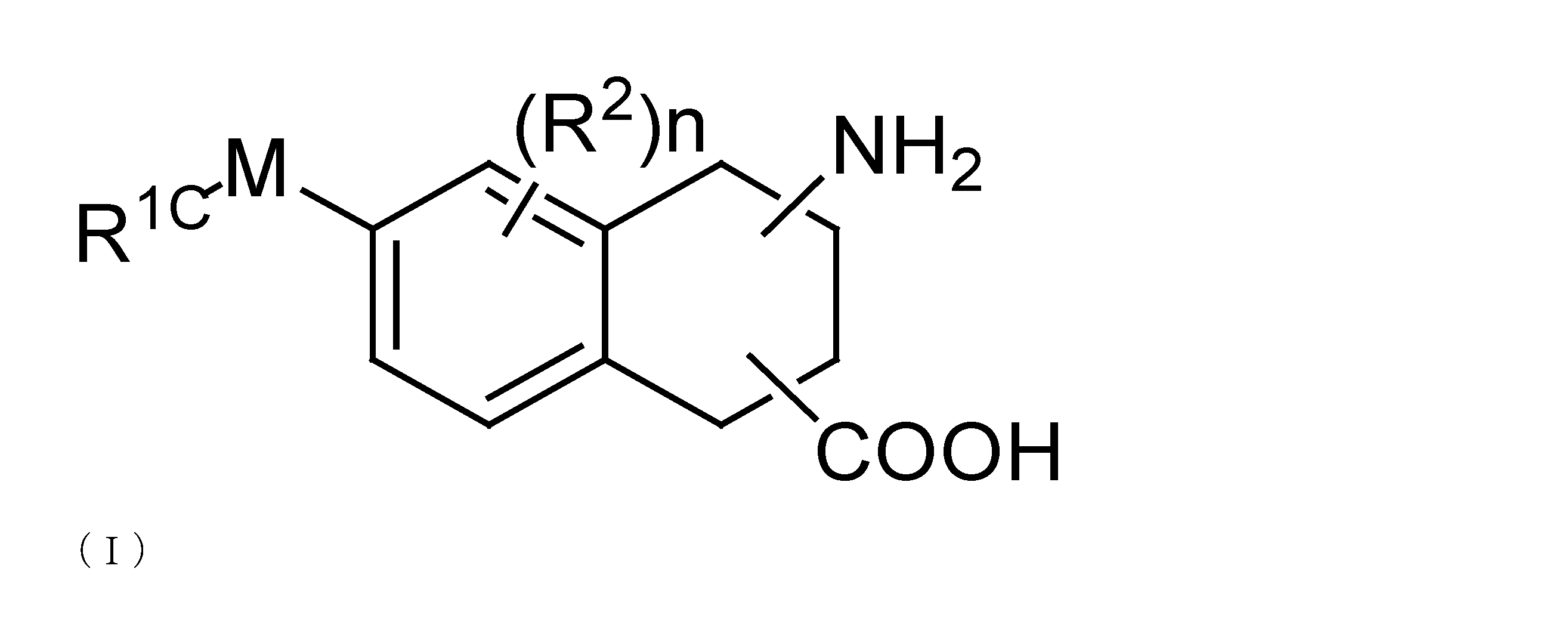
Mは、S、O、又はNHを表し、R1Cは、置換基を有する5員~7員芳香族複素環基、置換基を有するC5員~7員芳香族環基、及び置換又は非置換の8員~16員の多環基からなる群より選択される構造のいずれかを表し、
ここで、該置換基を有する5員~7員芳香族複素環基又は該置換基を有するC5員~7員芳香族環基の置換基は、置換又は非置換のベンジルオキシ、置換又は非置換のベンジル、置換又は非置換のフェニル、置換又は非置換のフェニルC1~6アルキル、置換又は非置換のビフェニル、置換又は非置換のピリジル、置換又は非置換のナフチル、ハロゲン、ヒドロキシ、シアノ、アミノ、C1~6アルキルアミノ、ジ(C1~6アルキル)アミノ、C1~6アルキル、C2~6アルケニル、C2~6アルキニル、C1~6アルコキシル、C1~6アルコキシC1~6アルキル、ニトロ、C1~6ハロアルキル、カルバモイル、C1~6アルキルアミノカルボニル、ジ(C1~6アルキル)アミノカルボニル、C1~6アルコキシカルボニル、C1~6アルキルカルボニル、
COOR10(R10は、H又はC1~6アルキル、アミノ、C1~6アルキルアミノ、又はジ(C1~6アルキル)アミノ)、3員~8員の非芳香族複素環、モルフォリノカルボニル、C3~8シクロアルキル、C3~8シクロアルキルアミノ、3~8員非芳香族複素環置換アミノ、C1~6ハロアルキルスルファニル、C1~6ハロアルキルスルフィニル、C1~6ハロアルキルスルホニル、C1~6アルキルチオ、C1~6アルキルスルフィニル、C1~6アルキルスルホニル、アミノスルホニル、スルホ、スルファモイル、18F、123I、ホウ素を含む置換基、α線放出核種及びβ線放出核種からなる群より独立して選択される1~5個の基であり、
ここで、該多環式基の置換基は、ハロゲン、ヒドロキシ、シアノ、アミノ、C1~6アルキルアミノ、ジ(C1~6アルキル)アミノ、C1~6アルキル、C2~6アルケニル、C2~6アルキニル、C1~6アルコキシル、ベンジルオキシ、ベンジル、フェニル、フェニルC1~6アルキル、C1~6アルコキシC1~6アルキル、ニトロ、C1~6ハロアルキル、カルバモイル、C1~6アルキルアミノカルボニル、ジ(C1~6アルキル)アミノカルボニル、C1~6アルコキシカルボニル、C1~6アルキルカルボニル、
COOR10(R10は、H又はC1~6アルキル、アミノ、C1~6アルキルアミノ、又はジ(C1~6アルキル)アミノ)、
3員~8員の非芳香族複素環、モルフォリノカルボニル、C3~8シクロアルキル、C3~8シクロアルキルアミノ、3~8員非芳香族複素環置換アミノ、C1~6ハロアルキルスルファニル、C1~6ハロアルキルスルフィニル、C1~6ハロアルキルスルホニル、C1~6アルキルチオ、C1~6アルキルスルフィニル、C1~6アルキルスルホニル、アミノスルホニル、スルホ、スルファモイル、18F、123I、ホウ素を含む置換基、α線放出核種及びβ線放出核種からなる群から独立して選択される1~6個の基であり;
あるいは、
Mは、S、O、NH、又は不存在(単に単結合を表す)で、R1Cは、18F、123I、ホウ素を含む置換基、α線放出核種及び/又はβ線放出核種を表し;
R2は、ハロゲン、ヒドロキシ、シアノ、アミノ、C1~6アルキルアミノ、C1~6アルキル、C2~6アルケニル、C2~6アルキニル、C1~6アルコキシル、ベンジルオキシ、ベンジル、フェニル、フェニルC1~6アルキル、C1~6アルコキシC1~6アルキル、ニトロ、C1~6ハロアルキル、カルバモイル、C1~6アルキルアミノカルボニル、ジ(C1~6アルキル)アミノカルボニル、C1~6アルコキシカルボニル、C1~6アルキルカルボニル、COOR10(R10は、H又はC1~6アルキル、アミノ、C1~6アルキルアミノ、又はジ(C1~6アルキル)アミノ)、3員~8員の非芳香族複素環、モルフォリノカルボニル、C3~8シクロアルキル、C3~8シクロアルキルアミノ、3~8員非芳香族複素環置換アミノ、C1~6ハロアルキルスルファニル、C1~6ハロアルキルスルフィニル、C1~6ハロアルキルスルホニル、C1~6アルキルチオ、C1~6アルキルスルフィニル、C1~6アルキルスルホニル、アミノスルホニル、スルホ、及びスルファモイルからなる群から独立して選択される基を表し;そして
nは、0~5のいずれかの整数を表す。
[2]
前記R1Cが、置換又は非置換の8員~16員の多環基であり、該多環基は、C原子の他に、任意にN、O及び/又はSを含んでいても良い環である、[1]
に記載の化合物又はその薬学的に許容される塩。
[3]
前記R1Cが、置換基を有する5員~7員芳香族環基であり、該置換基として、置換又は非置換のベンジルオキシ、置換又は非置換のベンジル、置換又は非置換のフェニル、置換又は非置換のフェニルC1~6アルキル、置換又は非置換のピリジル、置換又は非置換のナフチル、及び置換又は非置換のビフェニルからなる群より選択される少なくとも1つの基を必ず含み、
ここで、該ベンジルオキシ、ベンジル、フェニル、フェニルC1~6アルキル、ピリジル、ナフチル、又はビフェニルが置換されている場合、ハロゲン、ヒドロキシ、シアノ、アミノ、C1~6アルキルアミノ、ジ(C1~6アルキル)アミノ、C1~6アルキル、C2~6アルケニル、C2~6アルキニル、C1~6アルコキシル、ベンジルオキシ、ベンジル、フェニル、フェニルC1~6アルキル、C1~6アルコキシC1~6アルキル、ニトロ、C1~6ハロアルキル、カルバモイル、C1~6アルキルアミノカルボニル、ジ(C1~6アルキル)アミノカルボニル、C1~6アルコキシカルボニル、C1~6アルキルカルボニル、COOR10(R10は、H又はC1~6アルキル、アミノ、C1~6アルキルアミノ、又はジ(C1~6アルキル)アミノ)、3員~8員の非芳香族複素環、モルフォリノカルボニル、C3~8シクロアルキル、C3~8シクロアルキルアミノ、3~8員非芳香族複素環置換アミノ、C1~6ハロアルキルスルファニル、C1~6ハロアルキルスルフィニル、C1~6ハロアルキルスルホニル、C1~6アルキルチオ、C1~6アルキルスルフィニル、C1~6アルキルスルホニル、アミノスルホニル、スルホ、及びスルファモイルからなる群から独立して選択される1~5個の基で置換されている、[1]に記載の化合物又はその薬学的に許容される塩。
[4]
前記R1Cが、置換又は非置換のピリジルフェニル、置換又は非置換のビフェニル、置換又は非置換のビフェニル置換フェニル、置換又は非置換のナフチル置換フェニル、置換又は非置換のナフチル、置換又は非置換のキノリン置換フェニル、置換又は非置換のイソキノリン、置換又は非置換のイソキノリン置換フェニル、置換又は非置換のアントラセン、置換又は非置換のアントラセン置換フェニル、置換又は非置換のジチアゾールイリデンアミノナフチル、置換又は非置換のジチアゾールイリデンアミノビフェニル、置換又は非置換のベンゾフラニル、置換又は非置換のベンゾチオフェニル、置換又は非置換のアセナフテン、及び置換又は非置換のジチアゾールイリデンアミノフェニルからなる群より選択される1種であり、
該置換の場合の置換基は、ハロゲン、ヒドロキシ、シアノ、アミノ、C1~6アルキルアミノ、ジ(C1~4アルキル)アミノ、C1~6アルキル、C2~6アルケニル、C2~6アルキニル、C1~6アルコキシ、C1~6アルコキシC1~6アルキル、ニトロ、C1~6ハロアルキル、カルバモイル、C1~6アルキルアミノカルボニル、ジ(C1~6アルキル)アミノカルボニル、C1~6アルコキシカルボニル、C1~6アルキルカルボニル、COOR10(R10は、H又はC1~6アルキル、アミノ、C1~6アルキルアミノ)、モルフォリノカルボニル、C1~6ハロアルキルスルファニル、C1~6ハロアルキルスルフィニル、C1~6ハロアルキルスルホニル、C1~6アルキルチオ、C1~6アルキルスルフィニル、C1~6アルキルスルホニル、アミノスルホニル、スルホ、C3~8シクロアルキル、3~8員非芳香族複素環、C3~8シクロアルキルアミノ、3~8員非芳香族複素環置換アミノ、ジアルキルアミノ、及びスルファモイルからなる群から選択される1~5個の基である、[1]に記載の化合物又はその薬学的に許容される塩。
[5]
式(I)中、
MはOを表し、
R1Cは、置換基を有する5員~7員芳香族環基であり、該置換基として、置換又は非置換のベンジルオキシ、置換又は非置換のベンジル、置換又は非置換のフェニル、置換又は非置換のフェニルC1~6アルキル、置換又は非置換のピリジル、置換又は非置換のナフチル、及び置換又は非置換のビフェニルからなる群より選択される少なくとも1つの基を必ず含み、
該置換の場合の置換基は、ハロゲン、ヒドロキシ、シアノ、アミノ、C1~6アルキルアミノ、C1~6アルキル、C2~6アルケニル、C2~6アルキニル、C1~6アルコキシ、C1~6アルコキシC1~6アルキル、ニトロ、C1~6ハロアルキル、カルバモイル、C1~6アルキルアミノカルボニル、ジ(C1~6アルキル)アミノカルボニル、C1~6アルコキシカルボニル、C1~6アルキルカルボニル、COOR10(R10は、H又はC1~6アルキル、アミノ、C1~6アルキルアミノ)、モルフォリノカルボニル、C1~6ハロアルキルスルファニル、C1~6ハロアルキルスルフィニル、C1~6ハロアルキルスルホニル、C1~6アルキルチオ、C1~6アルキルスルフィニル、C1~6アルキルスルホニル、アミノスルホニル、スルホ、C3~8シクロアルキル、3~8員非芳香族複素環、C3~8シクロアルキルアミノ、3~8員非芳香族複素環置換アミノ、ジアルキルアミノ、及びスルファモイルからなる群から選択される1~5個の基であり、
nは、0を表す、請求項1に記載の化合物又はその薬学的に許容される塩。
[6]
[1]~[5]のいずれか1項に記載の化合物又はその薬学的に許容される塩を含む、L型アミノ酸トランスポーターLAT1選択的阻害剤。
[7]
[1]~[5]のいずれか1項に記載の化合物又はその薬学的に許容される塩を含む、がん治療用医薬組成物。
[8]
[1]~[5]のいずれか1項に記載の化合物又はその薬学的に許容される塩を含み、L-BPAを細胞内に保持する為の組成物。
[9]
下記式(II)で表される化合物又はその薬学的に許容される塩:

Mは、S、O、NH、又は不存在(単結合)を表し;
R20は放射性同位体を表す;
を含有するがん治療用組成物。
[10]
前記R20は、α線放出核種及び/又はβ線放出核種を表す、[9]に記載のがん治療用組成物。
[11]
前記α線放出核種が、211Atであり、前記β線放出核種が、131Iである、請求項10に記載のがん治療用組成物。
[12]
下記式(III)で表される化合物又はその薬学的に許容される塩:
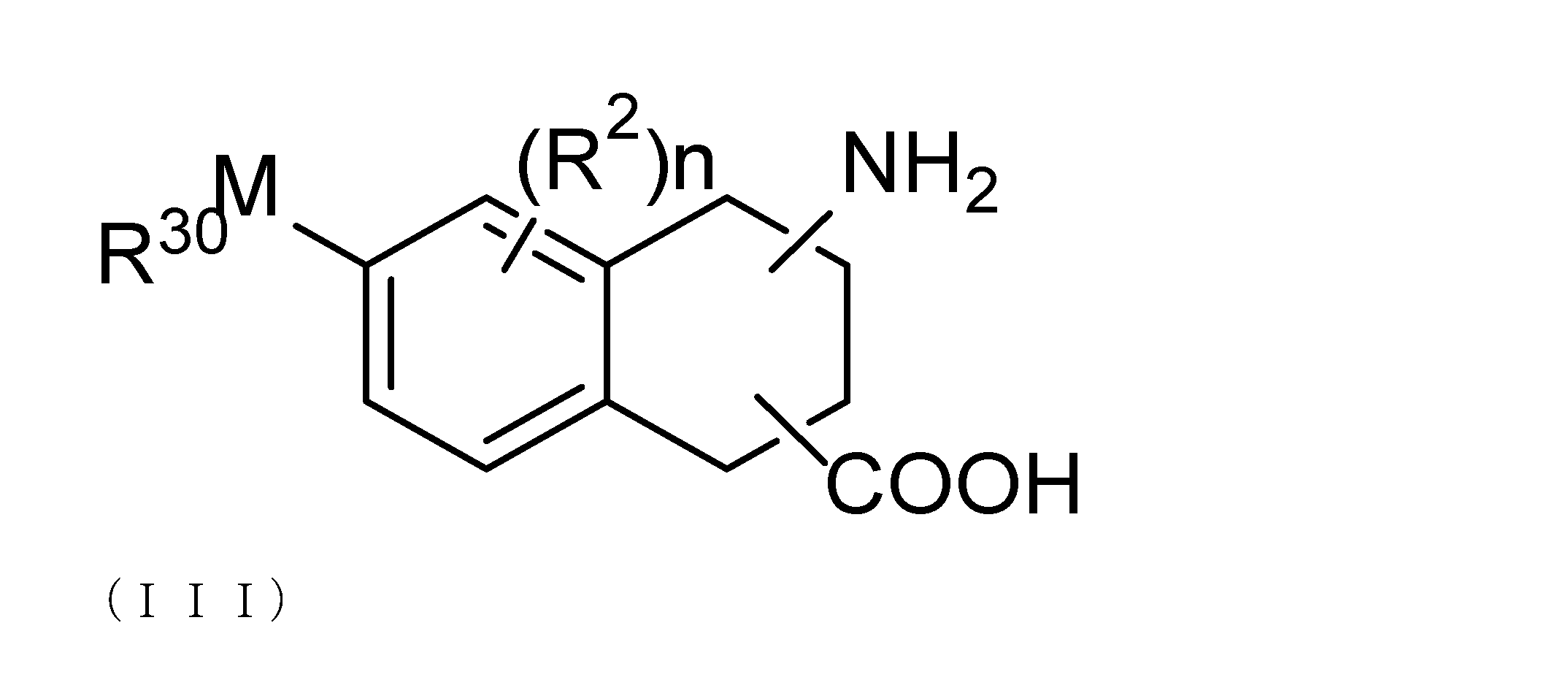
Mは、S、O、NH、又は不存在(単結合)を表し;
R30は、ホウ素を含む置換基を表す
を含有するBNCT用薬剤。
[13]
前記R30は、ボロン酸(‐B(OH)2)、ボロン酸エステル、ボロン酸アミド、又はホウ素クラスターを表す、[12]に記載のBNCT用薬剤。
[14]
下記式(IV)で表される化合物又はその薬学的に許容される塩:
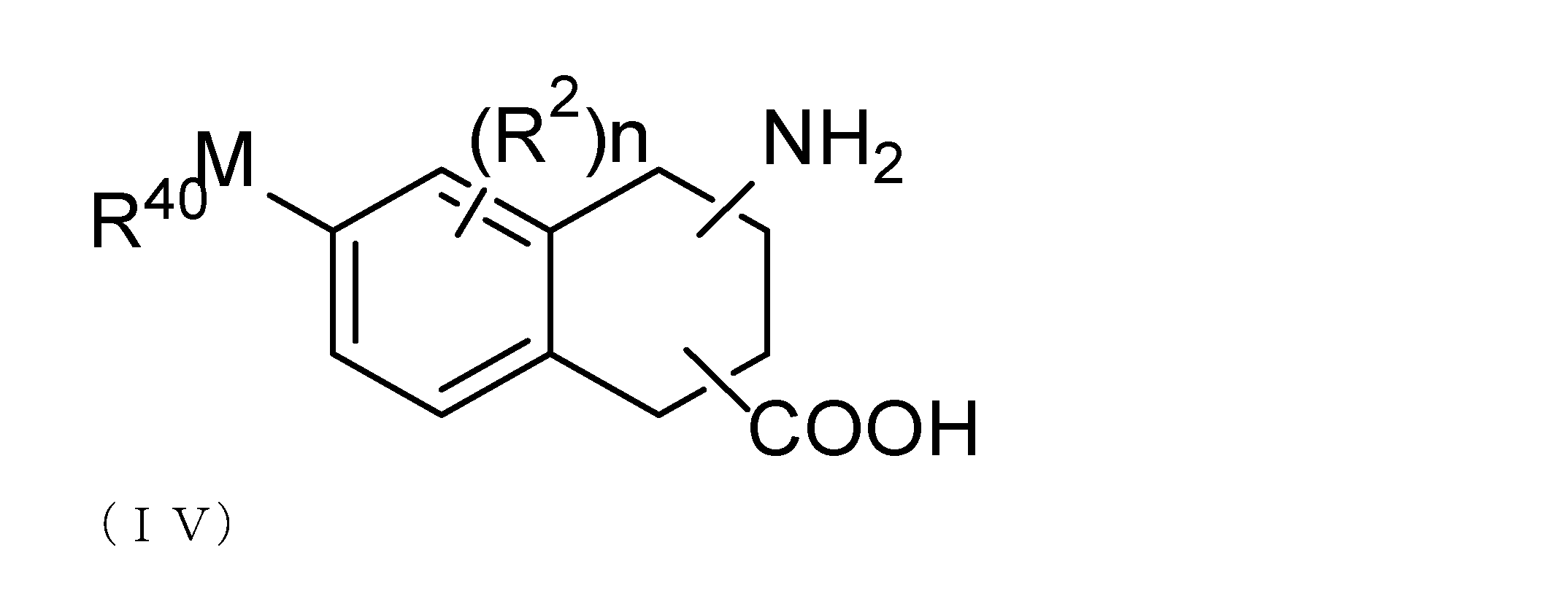
Mは、S、O、NH、又は不存在(単結合)を表し;
R40は、放射性同位体を表す、
を含有するがん診断薬。
[15]
前記R40は、18F又は123Iである、[14]に記載のがん診断薬。
[16]
前記がん診断薬が、PET用プローブ又はSPECT用プローブである、[14]又は[15]に記載のがん診断薬。
[17]
[1]~[5]のいずれか1項に記載の化合物又はその薬学的に許容される塩を含む、LAT1の持続的抑制剤。
[18]
[1]~[5]のいずれか1項に記載の化合物又はその薬学的に許容される塩を含む、BNCT効果増強用組成物。
本発明のテトラヒドロナフタレン誘導体は、下記式(I)で表される化合物又はその薬学的に許容される塩である。

Mは、S、O、又はNHを表し、
R1Cは、置換基を有する5員~7員芳香族複素環基、置換基を有するC5員~7員芳香族環基、及び置換又は非置換の8員~16員の多環基からなる群より選択される構造のいずれかを表し、
ここで、該置換基を有する5員~7員芳香族複素環基又は該置換基を有するC5員~7員芳香族環基における置換基は、置換又は非置換のベンジルオキシ、置換又は非置換のベンジル、置換又は非置換のフェニル、置換又は非置換のフェニルC1~6アルキル、置換又は非置換のビフェニル、置換又は非置換のピリジル、置換又は非置換のナフチル、ハロゲン、ヒドロキシ、シアノ、アミノ、C1~6アルキルアミノ、ジ(C1~6アルキル)アミノ、C1~6アルキル、C2~6アルケニル、C2~6アルキニル、C1~6アルコキシル、C1~6アルコキシC1~6アルキル、ニトロ、C1~6ハロアルキル、カルバモイル、C1~6アルキルアミノカルボニル、ジ(C1~6アルキル)アミノカルボニル、C1~6アルコキシカルボニル、C1~6アルキルカルボニル、
COOR10(R10は、H又はC1~6アルキル、アミノ、C1~6アルキルアミノ、又はジ(C1~6アルキル)アミノ)、3員~8員の非芳香族複素環、モルフォリノカルボニル、C3~8シクロアルキル、C3~8シクロアルキルアミノ、3~8員非芳香族複素環置換アミノ、C1~6ハロアルキルスルファニル、C1~6ハロアルキルスルフィニル、C1~6ハロアルキルスルホニル、C1~6アルキルチオ、C1~6アルキルスルフィニル、C1~6アルキルスルホニル、アミノスルホニル、スルホ、スルファモイル、18F、123I、ホウ素を含む置換基、α線放出核種及びβ線放出核種からなる群より独立して選択される1~5個の基であり、
ここで、該多環式基の置換基は、ハロゲン、ヒドロキシ、シアノ、アミノ、C1~6アルキルアミノ、ジ(C1~6アルキル)アミノ、C1~6アルキル、C2~6アルケニル、C2~6アルキニル、C1~6アルコキシル、ベンジルオキシ、ベンジル、フェニル、フェニルC1~6アルキル、C1~6アルコキシC1~6アルキル、ニトロ、C1~6ハロアルキル、カルバモイル、C1~6アルキルアミノカルボニル、ジ(C1~6アルキル)アミノカルボニル、C1~6アルコキシカルボニル、C1~6アルキルカルボニル、
COOR10(R10は、H又はC1~6アルキル、アミノ、C1~6アルキルアミノ、又はジ(C1~6アルキル)アミノ)、
3員~8員非芳香族複素環、モルフォリノカルボニル、C3~8シクロアルキル、C3~8シクロアルキルアミノ、3~8員非芳香族複素環置換アミノ、C1~6ハロアルキルスルファニル、C1~6ハロアルキルスルフィニル、C1~6ハロアルキルスルホニル、C1~6アルキルチオ、C1~6アルキルスルフィニル、C1~6アルキルスルホニル、アミノスルホニル、スルホ、スルファモイル、18F、123I、ホウ素を含む置換基、α線放出核種及びβ線放出核種からなる群から独立して選択される1~6個の基であり;
あるいは、
Mは、S、O、NH、又は不存在(単に単結合を表す)で、R1Cは、18F、123I、ホウ素を含む置換基、α線放出核種及び/又はβ線放出核種を表し;
R2は、ハロゲン、ヒドロキシ、シアノ、アミノ、C1~6アルキルアミノ、C1~6アルキル、C2~6アルケニル、C2~6アルキニル、C1~6アルコキシル、ベンジルオキシ、ベンジル、フェニル、フェニルC1~6アルキル、C1~6アルコキシC1~6アルキル、ニトロ、C1~6ハロアルキル、カルバモイル、C1~6アルキルアミノカルボニル、ジ(C1~6アルキル)アミノカルボニル、C1~6アルコキシカルボニル、C1~6アルキルカルボニル、COOR10(R10は、H又はC1~6アルキル、アミノ、C1~6アルキルアミノ、又はジ(C1~6アルキル)アミノ)、3員~8員の非芳香族複素環、モルフォリノカルボニル、C3~8シクロアルキル、C3~8シクロアルキルアミノ、3~8員非芳香族複素環置換アミノ、C1~6ハロアルキルスルファニル、C1~6ハロアルキルスルフィニル、C1~6ハロアルキルスルホニル、C1~6アルキルチオ、C1~6アルキルスルフィニル、C1~6アルキルスルホニル、アミノスルホニル、スルホ、及びスルファモイルからなる群から独立して選択される基を表し;
nは、0~5のいずれかの整数を表す。
該置換基を有する5員~7員芳香族複素環基」又は「該置換基を有するC5員~7員芳香族環基」でいう置換基は、置換又は非置換のベンジルオキシ、置換又は非置換のベンジル、置換又は非置換のフェニル、置換又は非置換のフェニルC1~6アルキル、置換又は非置換のビフェニル、置換又は非置換のピリジル、置換又は非置換のナフチル、ハロゲン、ヒドロキシ、シアノ、アミノ、C1~6アルキルアミノ、ジ(C1~6アルキル)アミノ、C1~6アルキル、C2~6アルケニル、C2~6アルキニル、C1~6アルコキシル、C1~6アルコキシC1~6アルキル、ニトロ、C1~6ハロアルキル、カルバモイル、C1~6アルキルアミノカルボニル、ジ(C1~6アルキル)アミノカルボニル、C1~6アルコキシカルボニル、C1~6アルキルカルボニル、
COOR10(R10は、H又はC1~6アルキル、アミノ、C1~6アルキルアミノ、又はジ(C1~6アルキル)アミノ)、3員~8員の非芳香族複素環、モルフォリノカルボニル、C3~8シクロアルキル、C3~8シクロアルキルアミノ、3~8員非芳香族複素環置換アミノ、C1~6ハロアルキルスルファニル、C1~6ハロアルキルスルフィニル、C1~6ハロアルキルスルホニル、C1~6アルキルチオ、C1~6アルキルスルフィニル、C1~6アルキルスルホニル、アミノスルホニル、スルホ、及びスルファモイルからなる群より独立して選択される1~5個の基であり、
ここで、該多環式基の置換基は、ハロゲン、ヒドロキシ、シアノ、アミノ、C1~6アルキルアミノ、ジ(C1~6アルキル)アミノ、C1~6アルキル、C2~6アルケニル、C2~6アルキニル、C1~6アルコキシル、ベンジルオキシ、ベンジル、フェニル、フェニルC1~6アルキル、C1~6アルコキシC1~6アルキル、ニトロ、C1~6ハロアルキル、カルバモイル、C1~6アルキルアミノカルボニル、ジ(C1~6アルキル)アミノカルボニル、C1~6アルコキシカルボニル、C1~6アルキルカルボニル、
COOR10(R10は、H又はC1~6アルキル、アミノ、C1~6アルキルアミノ、又はジ(C1~6アルキル)アミノ)、
3員~8員の非芳香族複素環、モルフォリノカルボニル、C3~8シクロアルキル、C3~8シクロアルキルアミノ、3~8員非芳香族複素環置換アミノ、C1~6ハロアルキルスルファニル、C1~6ハロアルキルスルフィニル、C1~6ハロアルキルスルホニル、C1~6アルキルチオ、C1~6アルキルスルフィニル、C1~6アルキルスルホニル、アミノスルホニル、スルホ、及びスルファモイルからなる群から独立して選択される1~5個の基であり得る。
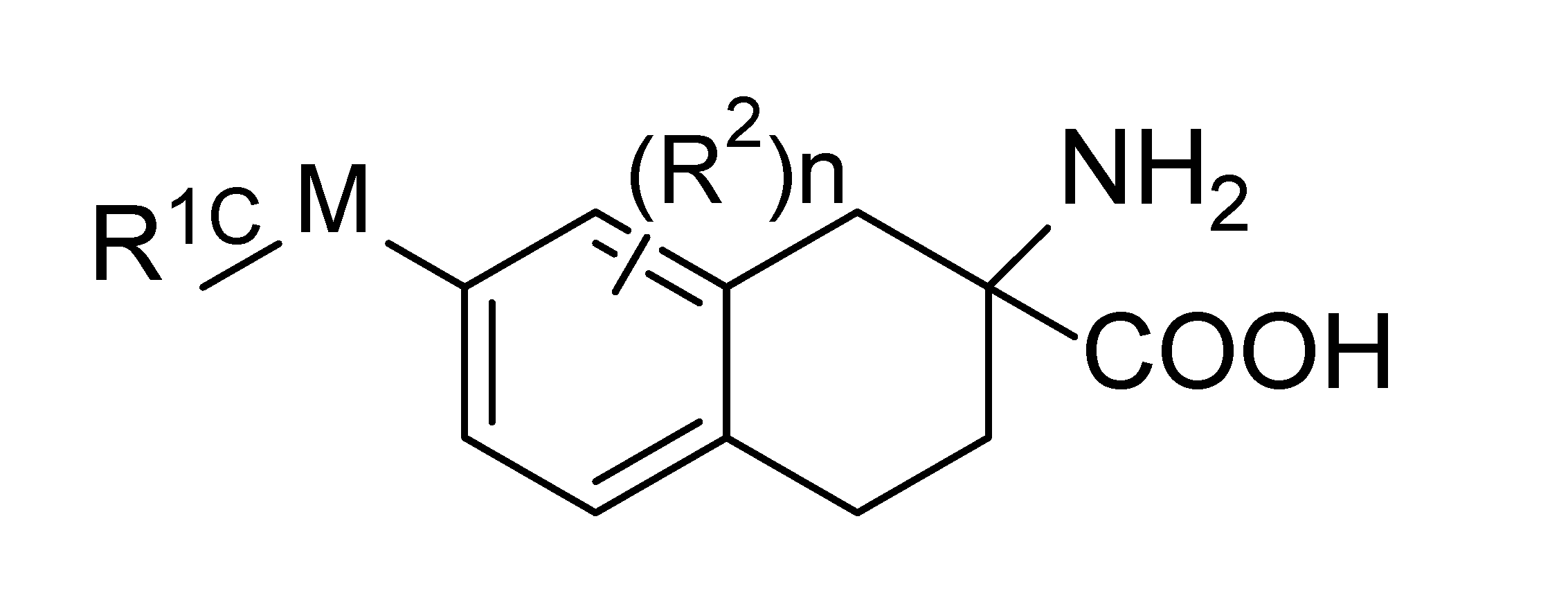
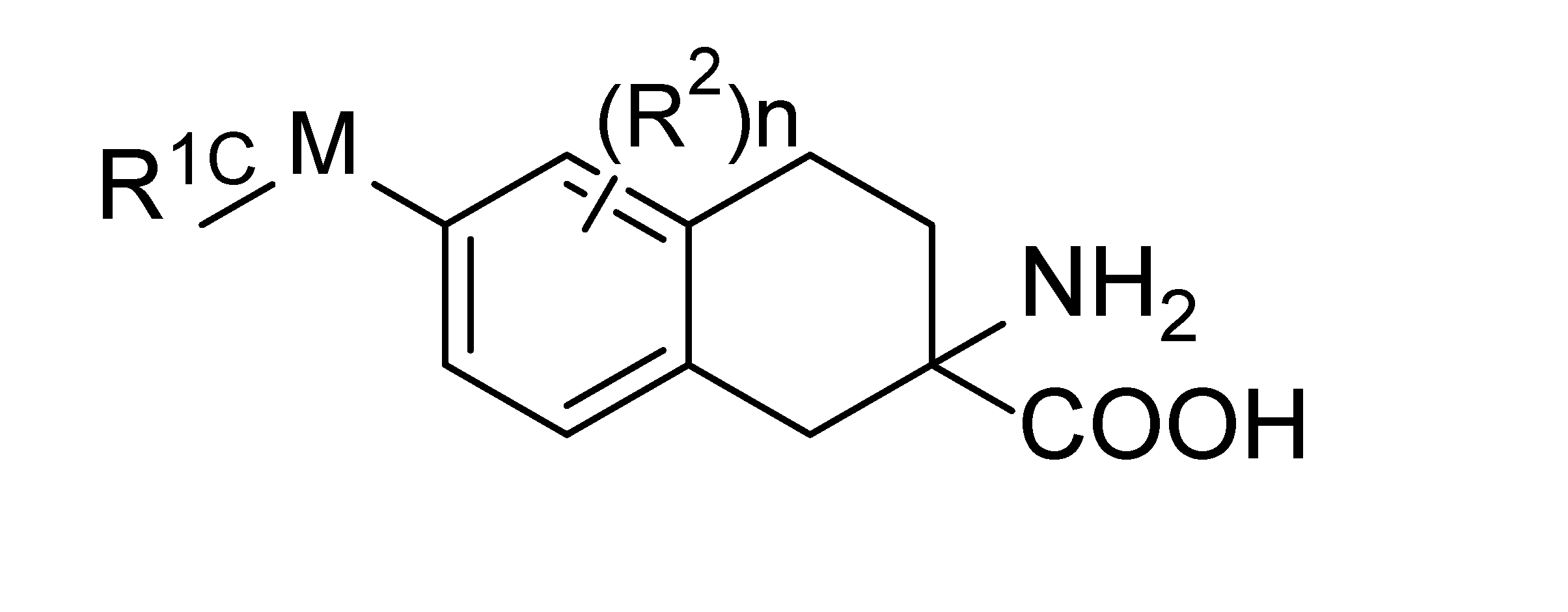
ここで、置換の場合の置換基は、ハロゲン、ヒドロキシ、シアノ、アミノ、C1~6アルキルアミノ、C1~6アルキル、C2~6アルケニル、C2~6アルキニル、C1~6アルコキシ、ベンジルオキシ、ベンジル、フェニル、フェニルC1~6アルキル、C1~6アルコキシC1~6アルキル、ニトロ、C1~6ハロアルキル、カルバモイル、C1~6アルキルアミノカルボニル、ジ(C1~6アルキル)アミノカルボニル、C1~6アルコキシカルボニル、C1~6アルキルカルボニル、COOR10(R10は、H又はC1~6アルキル、アミノ、C1~6アルキルアミノ)、モルフォリノカルボニル、C1~6ハロアルキルスルファニル、C1~6ハロアルキルスルフィニル、C1~6ハロアルキルスルホニル、C1~6アルキルチオ、C1~6アルキルスルフィニル、C1~6アルキルスルホニル、アミノスルホニル、スルホ、C3~8シクロアルキル、3~8員非芳香族複素環、C3~8シクロアルキルアミノ、3~8員非芳香族複素環アミノ、ジアルキルアミノ、及びスルファモイルからなる群から選択される基であることが好ましく、ハロゲン、ヒドロキシ、シアノ、アミノ、C1~6アルキルアミノ、C1~6アルキル、C2~6アルケニル、C2~6アルキニル、C1~6アルコキシ、ベンジルオキシ、ベンジル、フェニル、フェニルC1~6アルキル、C1~6アルコキシC1~6アルキル、ニトロ、C1~6ハロアルキル、カルバモイル、C1~6アルキルアミノカルボニル、ジ(C1~6アルキル)アミノカルボニル、C1~6アルコキシカルボニル、C1~6アルキルカルボニル、COOR10(R10は、H又はC1~6アルキル、アミノ、C1~6アルキルアミノ)、及びモルフォリノカルボニルからなる群から選択される基であることがより好ましい。
ここで、置換の場合の置換基は、ハロゲン、アミノ、C1~4アルキルアミノ、ジ(C1~4アルキル)アミノ、C1~4アルキル、C2~4アルケニル、C2~4アルキニル、C1~4アルコキシ、ベンジルオキシ、ベンジル、フェニル、フェニルC1~4アルキル、C1~4アルコキシC1~4アルキル、ニトロ、C1~4ハロアルキル、カルバモイル、C1~4アルキルアミノカルボニル、ジ(C1~4アルキル)アミノカルボニル、C1~4アルコキシカルボニル、C1~4アルキルカルボニル、COOR10(R10は、H又はC1~4アルキル、アミノ、C1~4アルキルアミノ)、及びモルフォリノカルボニルからなる群から独立して選択される1~5個の基であることがより好ましい。
2-アミノ-7-(ナフタレン-2-イルオキシ)-1,2,3,4-テトラヒドロナフタレン-2-カルボン酸;
2-アミノ-7-(ナフタレン-1-イルオキシ)-1,2,3,4-テトラヒドロナフタレン-2-カルボン酸;
2-アミノ-7-((3’-フルオロ-[1,1’-ビフェニル]-2-イル)オキシ)-1,2,3,4-テトラヒドロナフタレン-2-カルボン酸;
2-アミノ-7-((3’-クロロ-[1,1’-ビフェニル]-2-イル)オキシ)-1,2,3,4-テトラヒドロナフタレン-2-カルボン酸;
2-アミノ-7-(2-(ナフタレン-1-イル)フェノキシ)-1,2,3,4-テトラヒドロナフタレン-2-カルボン酸;
2-アミノ-7-((3’-ニトロ-[1,1’-ビフェニル]-2-イル)オキシ)-1,2,3,4-テトラヒドロナフタレン-2-カルボン酸;
2-アミノ-7-((3’-メチル-[1,1’-ビフェニル]-2-イル)オキシ)-1,2,3,4-テトラヒドロナフタレン-2-カルボン酸;
2-アミノ-7-((2’,3’-ジフルオロ-[1,1’-ビフェニル]-2-イル)オキシ)-1,2,3,4-テトラヒドロナフタレン-2-カルボン酸;
2-アミノ-7-((8-メチルナフタレン-1-イル)オキシ)-1,2,3,4-テトラヒドロナフタレン-2-カルボン酸;
2-アミノ-7-((3’-クロロ-4’-フルオロ-[1,1’-ビフェニル]-2-イル)オキシ)-1,2,3,4-テトラヒドロナフタレン-2-カルボン酸;
2-アミノ-7-((2’-クロロ-3’-フルオロ-[1,1’-ビフェニル]-2-イル)オキシ)-1,2,3,4-テトラヒドロナフタレン-2-カルボン酸;
2-アミノ-7-((3’-(ジメチルアミノ)-[1,1’-ビフェニル]-2-イル)オキシ)-1,2,3,4-テトラヒドロナフタレン-2-カルボン酸;
2-アミノ-7-((3’-(メチルチオ)-[1,1’-ビフェニル]-2-イル)オキシ)- 1,2,3,4-テトラヒドロナフタレン-2-カルボン酸;
2-アミノ-7-((2’,3’-ジクロロ-[1,1’-ビフェニル]-2-イル)オキシ)-1,2,3,4-テトラヒドロナフタレン-2-カルボン酸;
2-アミノ-7-((3’-クロロ-2’-フルオロ-[1,1’-ビフェニル]-2-イル)オキシ)-1,2,3,4-テトラヒドロナフタレン-2-カルボン酸;
2-アミノ-7-((2’-フルオロ-3’-メチル-[1,1’-ビフェニル]-2-イル)オキシ)-1,2,3,4-テトラヒドロナフタレン-2-カルボン酸;
2-アミノ-7-((2’-クロロ-3’-メチル-[1,1’-ビフェニル]-2-イル)オキシ)-1,2,3,4-テトラヒドロナフタレン-2-カルボン酸;
2-アミノ-7-((2’,3’, 4’-トリフルオロ-[1,1’-ビフェニル]-2-イル)オキシ)-1,2,3,4-テトラヒドロナフタレン-2-カルボン酸;
2-アミノ-7-((2’,3’,5’-トリフルオロ-[1,1’-ビフェニル]-2-イル)オキシ)-1,2,3,4-テトラヒドロナフタレン-2-カルボン酸;又は
2-アミノ-7-(2-(ナフタレン-1-イル)-4-ニトロフェノキシ)-1,2,3,4-テトラヒドロナフタレン-2-カルボン酸。
本発明の化合物の別の1つの態様では、ホウ素原子を含む場合、BNCTにおいて、がん細胞へのホウ素送達に用いられるホウ素含有化合物として機能することができる。
あるいは、本発明の化合物のさらに別の態様では、PETやSPECTによるがんの検出、診断に用いられる放射性化合物ともなり得る。
本発明において、新規なテトラヒドロナフタレン誘導体の製造方法は、限定はされないが、特に好ましい化合物を代表例として、例えば、以下のような方法であり得る。
まず、例えば、下記一般式(II)で表されるテトラロンタイプの化合物から、下記一般式(III)のヒダントイン化合物を調製し、その後アミノ酸(式(IV))を調製する。得られるアミノ酸のアミノ基及びカルボキシル基を保護し、Mに結合する基を修飾又は置換することで本発明の化合物を調製することができる。
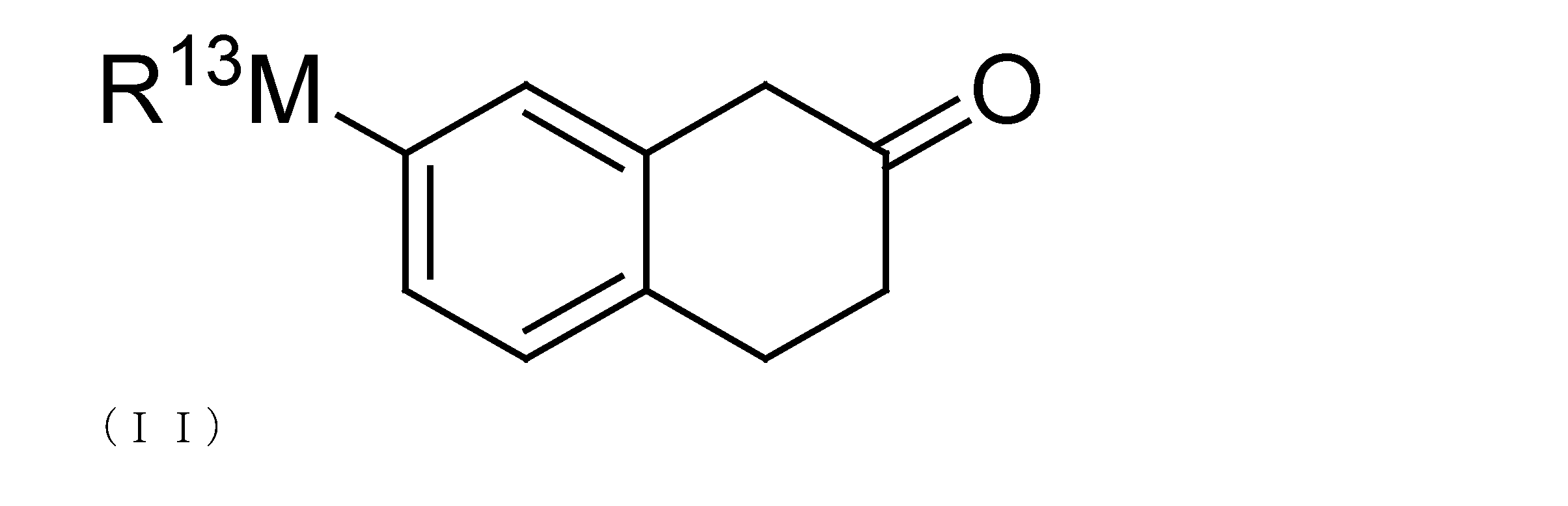

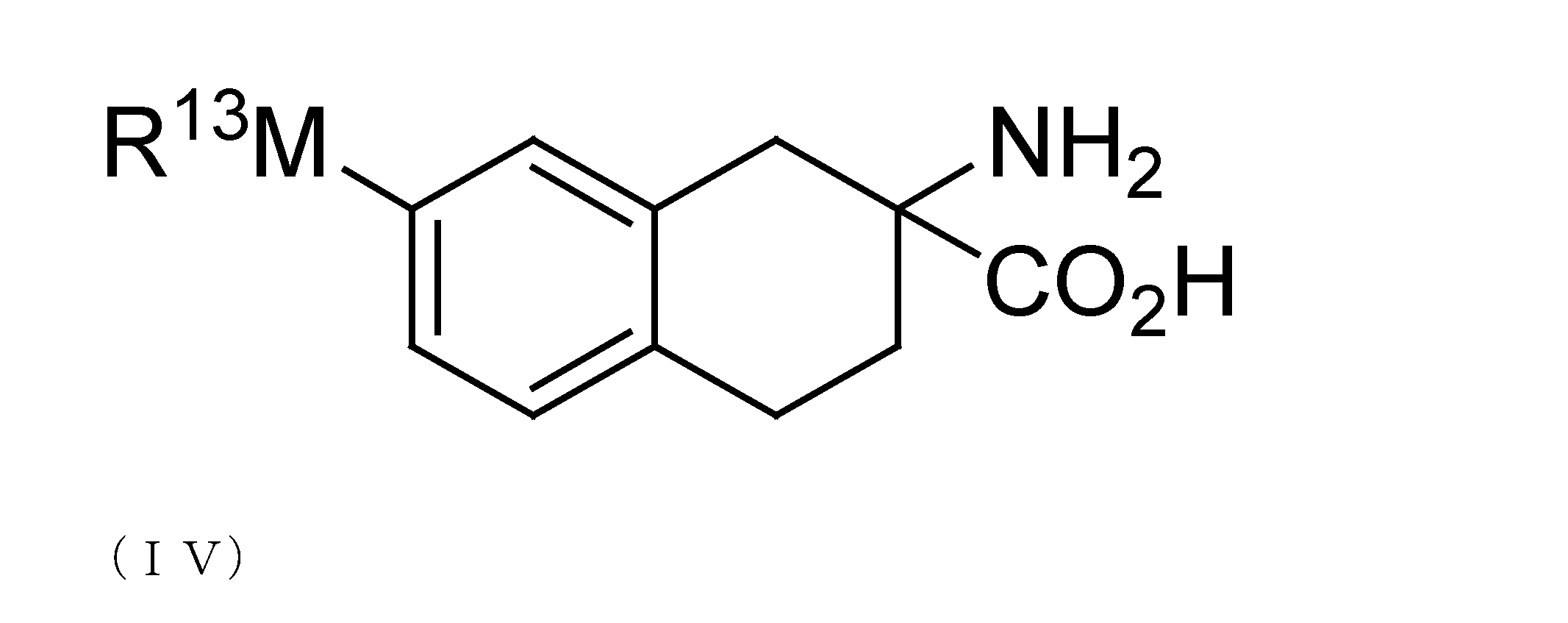
ここで、式(II)のテトラロンタイプの化合物は、炭酸アンモニウム及びシアン化カリウムでの処理により、式(III)のヒダントインに変換される。この反応は、例えば、含水エタノール混合物中で50℃~90℃、好ましくは80℃と90℃の間の温度で行われる。このヒダントインのアミノ酸(式(IV))への直接加水分解には、還流温度での、強塩基、例えば、水酸化ナトリウム溶液又は水酸化バリウムでの処理が必要である。この時の反応時間は、例えば、10~30時間などの長時間であることが好ましい。このようにヒダントイン化合物は、アミノ酸に変換される。

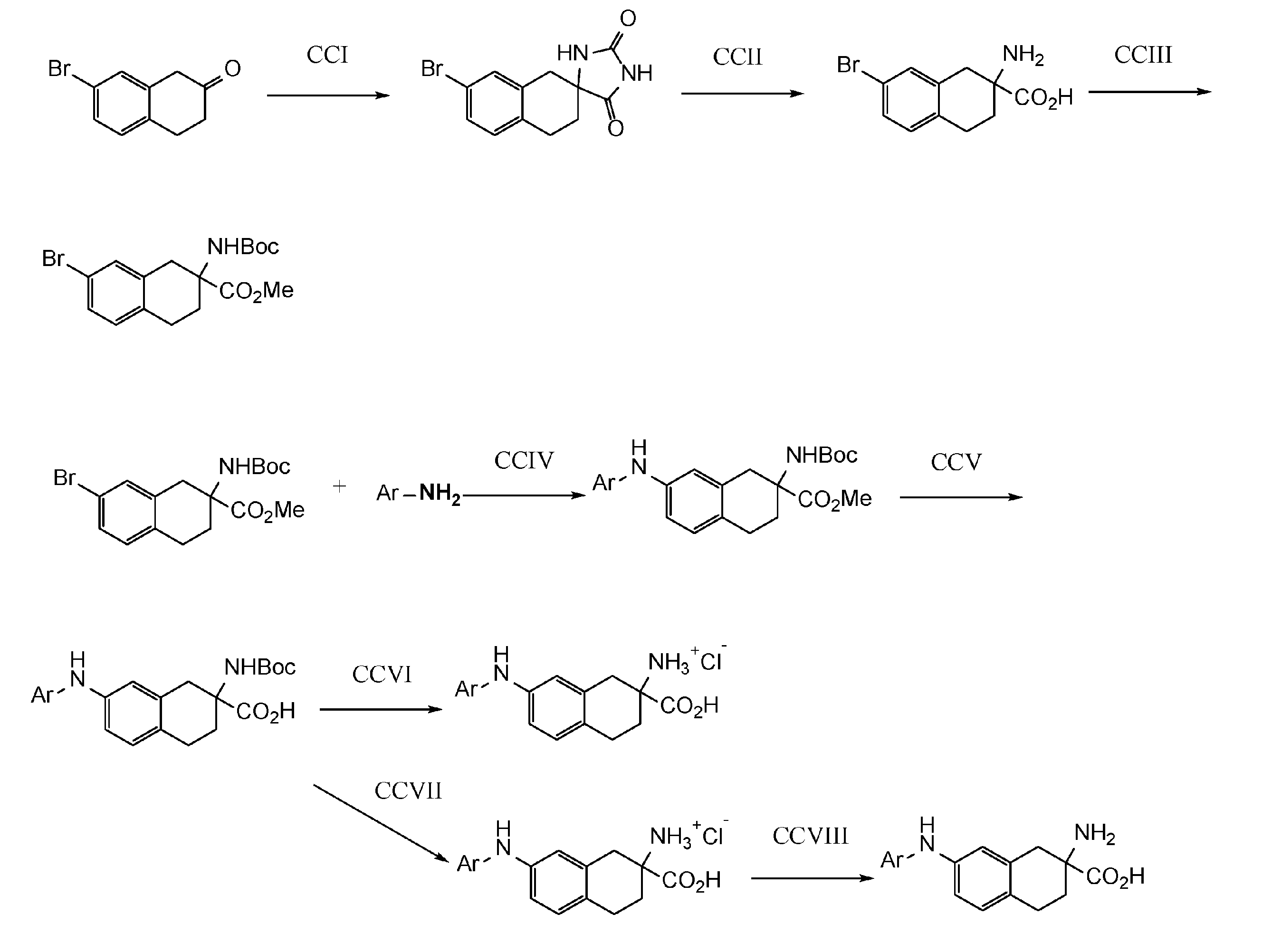
次に、CIVで示される反応は、ハロゲン化した環構造体を塩基の存在下で反応させることによって、チオエーテル体を得る工程である。この時、使用される塩基としては、炭酸カリウム、リン酸三カリウム、炭酸セシウム、トリエチルアミン、N,N-ジイソプロピルエチルアミン、ピリジン、ナトリウムエトキシド、ナトリウムtert-ブトキシド、カリウムtert-ブトキシド、水素化ナトリウム、リチウムヘキサメチルジシラジド、ナトリウムヘキサメチルジシラジド、n-ブチルリチウム、塩化亜鉛、臭化亜鉛、ヨウ化亜鉛、ヨウ化リチウム等が挙げられる。この時、使用される触媒としては、ジ-μ-ブロモビス(トリ-t-ブチルホスフィン)ジパラジウム(I)等のパラジウム、酢酸ニッケル、塩化ニッケル等のニッケル、塩化銅、臭化銅、ヨウ化銅当の銅触媒、リガンドとしては、1,3-ビス(2,6-ジイソプロピルフェニル)イミダゾリウムクロリド等のヘテロサイクリックカルベン、トリフェニルホスフィン等が挙げられる。
本発明のテトラヒドロナフタレン誘導体は、細胞の表面に発現しているアミノ酸トランスポーターLAT1に親和性を有する。また好ましくは、アミノ酸トランスポーターLAT2に親和性を有さない。LAT1は、中性分枝鎖アミノ酸や芳香族アミノ酸の細胞内取り込みに必要な膜タンパク質であるアミノ酸トランスポーターの一種であり、がんに特異的に発現することが明らかになっている。LAT1は、がん組織における栄養分としてのアミノ酸供給を担っている。また、LAT1によってがん細胞に取り込まれたアミノ酸は、栄養分としてのみでなく、アミノ酸シグナル系を介して、タンパク質合成、細胞内代謝、細胞成長の調節を担っている。本明細書中において、「LAT1選択的阻害剤」とは、LAT1を介したアミノ酸の細胞内取込みを阻害する物質を意味し、より好ましくは、正常細胞におけるアミノ酸トランスポーター(例えば、LAT2)よりも、LAT1を介する細胞内流入を阻害する物質である。
本発明のテトラヒドロナフタレン誘導体は、がん細胞に特異的に発現するLAT1を機能阻害させることにより、がん特異的に栄養飢餓を誘導し、またアミノ酸シグナル系の抑制を介して、タンパク質合成、細胞内代謝、細胞成長を抑制してがん組織の縮小を図るLAT1阻害薬として使用することができる。機能阻害の結果として、細胞への栄養の補給が遮断され、またアミノ酸シグナル系の抑制を介して、タンパク質合成、細胞内代謝、細胞成長が抑制され、腫瘍細胞を減弱させることに繋がる。
本発明のテトラヒドロナフタレン誘導体はまた、例えば、BSH(ボロカプテイトナトリウム)やL-ボロノフェニルアラニン(L-BPA)などのようにがん細胞に集積性を示すBNCT用薬剤を投与した後に、当該薬剤が細胞内から細胞外へ流出するのを防ぐことで、BNCTの効果を増強することができ、BNCT効果増強用組成物として用いることもできる。
本発明のテトラヒドロナフタレン誘導体は、上記の化合物のいずれかの基に代って、又は上記化合物のいずれかの基に追加した形で、ホウ素を含有する基を含むことができる。ホウ素を含有する基は、ボロン酸(‐B(OH)2)、ボロン酸エステル、ボロン酸アミド、又はホウ素クラスターのいずれかであることが好ましい。ここで、ホウ素クラスターは、BSH、ドデカボレート、デカボレート、又はカルボランのいずれかであることが好ましい。このような化合物は、そのままあるいは薬学的に許容できる塩の形態で、又は薬学的に許容できるキャリアーと混合して当業者に公知の製剤の形で、あるいはマイクロ/ナノパーティクルに封入等の形で、BNCTに好都合に用いられうる。
本発明のテトラヒドロナフタレン誘導体は、診断用の放射性同位体を含む薬剤として調製することもできる。放射性同位体射能を含む薬剤として調製する場合には、限定はされないが、典型的には、化合物中に含まれるF原子として、18Fを用いること、化合物中に含まれるI原子として、131I、123Iを用いること、又は化合物中に含まれるC原子として11Cを用いることができる。このようにして得られる化合物を、例えば、RI検査や核医学検査に用いることが可能である。これらは、限定はされないが、シンチグラフィの断層撮影、SPECT(Single Photon Emission Computed Tomography)やPET(Positron Emission Tomography (陽電子放出断層撮影)用の薬剤を含む。すなわち、対象に対して、放射能を含む本発明のテトラヒドロナフタレン誘導体をPET用薬剤又はSPECT用薬剤として投与し、治療前に画像を取得し、誘導体の体内集積分布、腫瘍組織/正常組織存在比(T/N比)等の情報を得ることができる。これらの情報を基にBNCTの治療効果を事前に想定し、研究または治療計画を策定することも可能である。なお、投与態様その他は、[BNCT用薬剤]の項で記載した内容に準じる。診断薬は、好ましくはPET用プローブ又はSPECT用プローブなどのがん診断薬であり得る。
ここで、「がん」又は「悪性腫瘍」は、扁平上皮がんなどの上皮系(「癌」)と非上皮系(「肉腫」(例えば骨肉腫や白血病))のいずれも含む。特に限定されないが、これらには、神経膠芽腫、悪性神経膠腫、及び髄膜腫等を含む脳腫瘍、その他頭頸部がん、悪性黒色腫、皮膚がん、乳がん、肺がん、胸腺がん、中皮腫、子宮がん、卵巣がん、腎臓がん、膵臓がん、胆道がん、肝臓がん、大腸がん、食道がん、胃がん、舌がん、前立腺がん、骨肉腫、多発性骨髄腫、あるいは白血病等が特に適な対象となり得る。
さらに、多発性硬化症、関節リウマチ等の自己免疫性疾患、およびアトピー性皮膚炎等のアレルギー性疾患等のLAT1が病態形成に関わるがん以外の疾患も対象となり得る。
(JEOL RESONANCE/JNM-ECZ500R/500MHz
2-カルボキシ-7-(ナフタレン-2-イルオキシ)-1,2,3,4-テトラヒドロナフタレン-2-アミニウムクロリド(化合物1-5)の製造
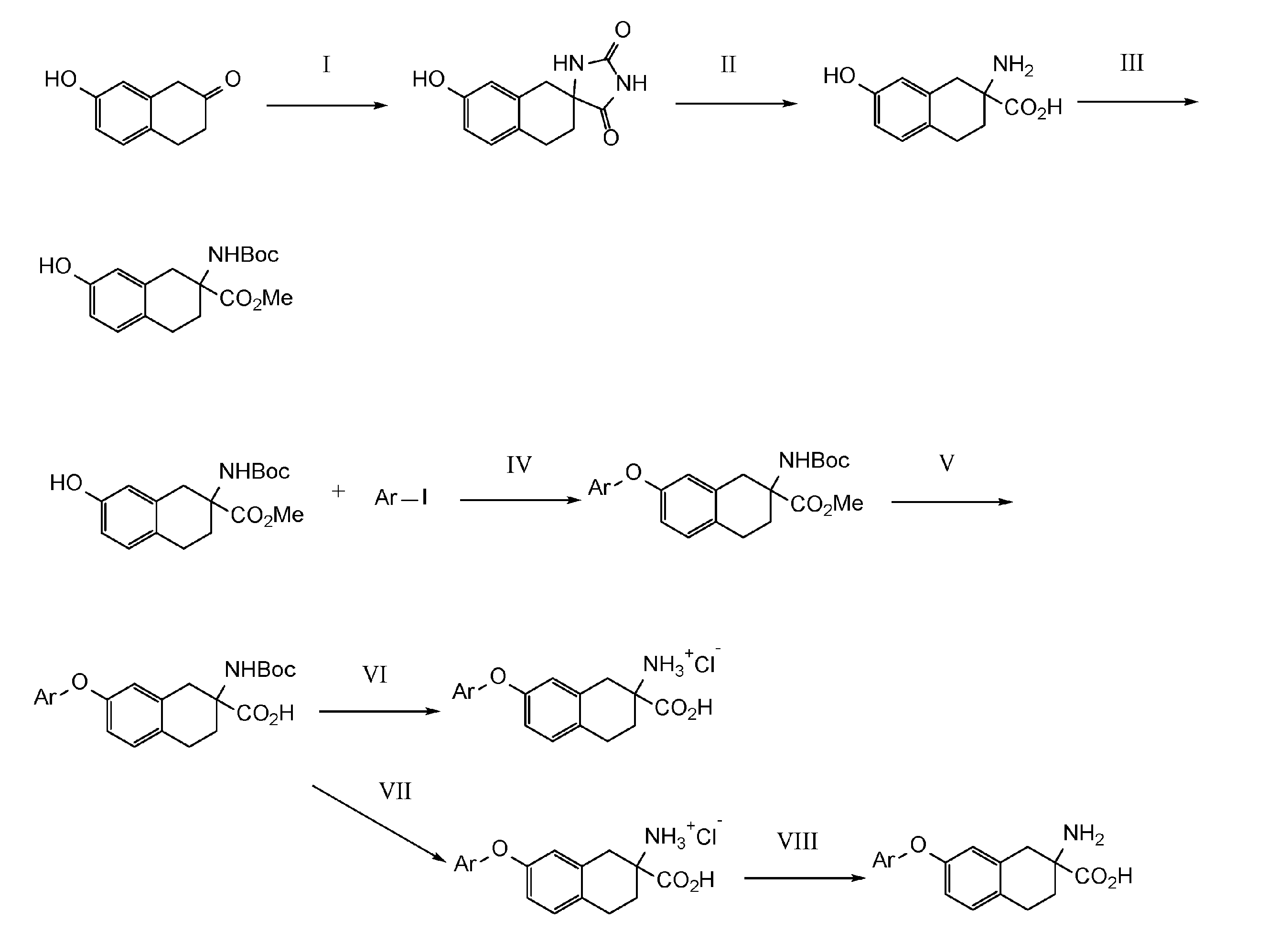
7’-ヒドロキシ-3’,4’-ジヒドロ-1’H-スピロ[イミダゾリジン-4,2’-ナフタレン]-2,5-ジオンの製造
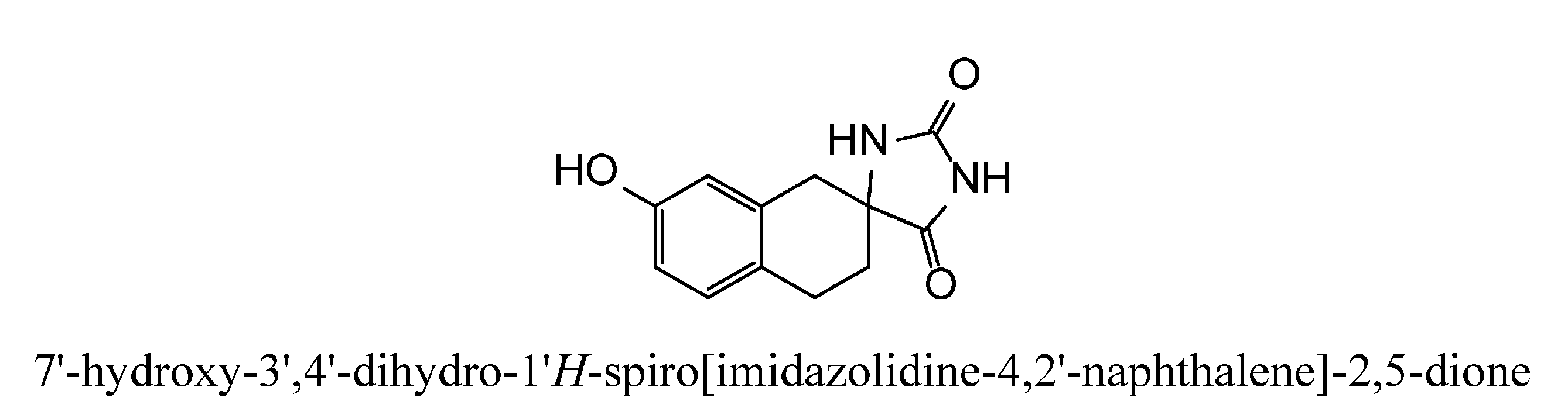
2-アミノ-7-ヒドロキシ-1,2,3,4-テトラヒドロナフタレン-2-カルボン酸の製造
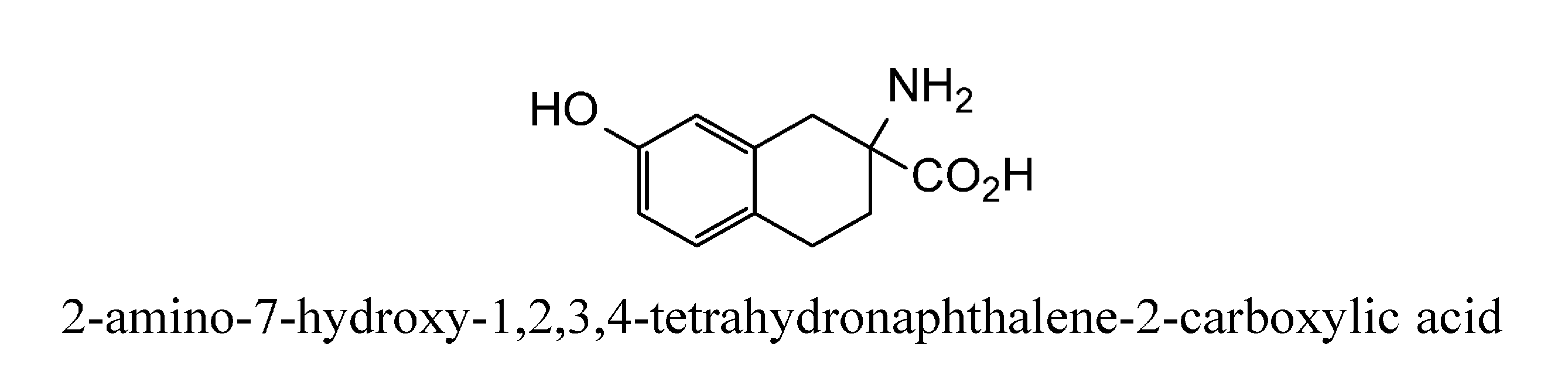
メチル 2-((tert-ブトキシカルボニル)アミノ)-7-ヒドロキシ-1,2,3,4-テトラヒドロナフタレン-2-カルボキシレートの製造

1H-NMR (CDCl3); 1.42 (s, 9H), 2.05-2.12 (m, 1H), 2.38-2.45 (m, 1H), 2.75-2.77 (m, 2H), 2.90 (d, J = 16.0 Hz, 1H), 3.25 (d, J = 15.5 Hz, 1H), 3.76 (s, 3H), 4.89 (s, 1H), 5.89 (brs, 1H), 6.54 (s, 1H), 6.66 (dd, J = 2.5, 8.0 Hz, 1H), 6.96 (d, J = 8.0 Hz, 1H).
メチル 2-((tert-ブトキシカルボニル)アミノ)-7-(ナフタレン-2-イルオキシ)-1,2,3,4-テトラヒドロナフタレン-2-カルボキシレートの製造

1H-NMR (CDCl3); 1.43 (s, 9H), 2.11-2.17 (m, 1H), 2.82-2.85 (m, 2H), 2.91 (d, J = 16.5 Hz, 1H), 3.28 (d, J = 17.0 Hz, 1H), 3.76 (s, 3H), 4.89 (brs, 1H), 6.77 (d, J = 3.0 Hz, 1H), 6.88 (dd, J = 2.5, 8.5 Hz, 1H), 7.10 (d, J = 8.0 Hz, 1H), 7.24 (dd, J = 2.5, 9.5 Hz, 1H), 7.29 (d, J = 2.5 Hz, 1H), 7.38-7.46 (m, 2H), 7.70 (d, J = 8.0 Hz, 1H), 7.82 (dd, J = 2.5, 8.0 Hz, 1H).
2-((tert-ブトキシカルボニル)アミノ)-7-(ナフタレン-2-イルオキシ)-1,2,3,4-テトラヒドロナフタレン-2-カルボン酸の製造

2-カルボキシ-7-(ナフタレン-2-イルオキシ)-1,2,3,4-テトラヒドロナフタレン-2-アミニウムクロリドの製造
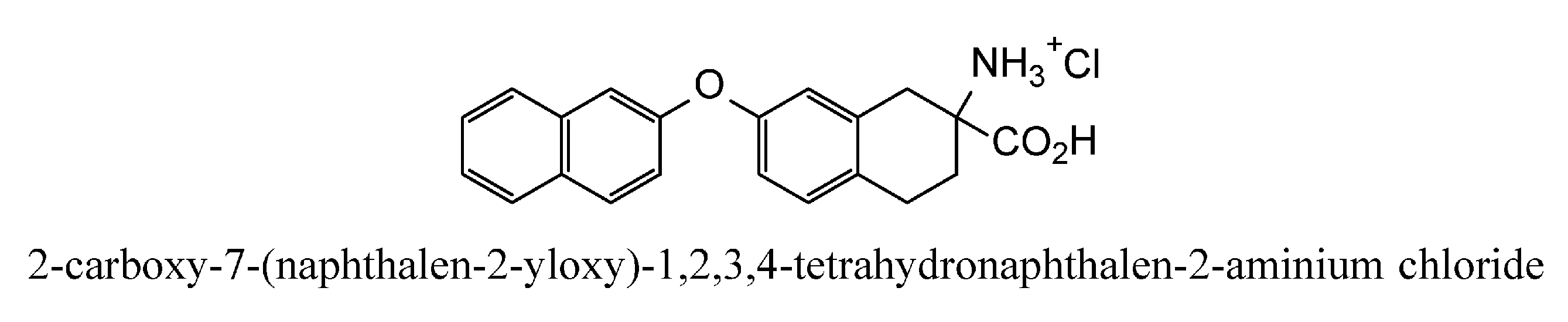
1H-NMR (CD3OD); 2.16-2.21 (m, 1H), 2.41-2.47 (m, 1H), 2.88-2.95 (m, 1H), 3.00 (d, J = 16.5 Hz, 1H), 3.02-3.08 (m, 1H), 3.49 (d, J = 17.0 Hz, 1H), 6.77 (d, J = 3.0 Hz, 1H), 6.88 (d, J = 2.0 Hz, 1H), 6.94 (dd, J = 2.5, 8.0 Hz, 1H), 7.21-7.24 (m, 1H), 7.27 (d, J = 2.5 Hz, 1H), 7.38-7.46 (m, 2H), 7.68 (d, J = 8.0 Hz, 1H), 7.82-7.87 (m, 1H).
7-([1,1’-ビフェニル]-3-イルオキシ)-2-カルボキシ-1,2,3,4-テトラヒドロナフタレン-2-アミニウムクロリド(化合物1-9)の製造
ステップ1(工程I-IV)
メチル 7-([1,1’-ビフェニル]-3-イルオキシ)-2-((tert-ブトキシカルボニル)アミノ)-1,2,3,4-テトラヒドロナフタレン-2-カルボキシレートの製造
実施例1-1のステップ1からステップ4と同様にして、ただし、ステップ4の2-ヨードナフタレンを3-ヨード-1,1’-ビフェニルに変えて、下記化合物を得た。
1H-NMR (CDCl3); 1.42 (s, 9H), 2.09-2.15 (m, 1H), 2.48 (brs, 1H), 2.81-2.83 (m, 2H), 2.91 (d, J = 16.5 Hz, 1H), 3.27 (d, J = 17.0 Hz, 1H), 3.76 (s, 3H), 4.81 (brs, 1H), 6.75 (d, J = 2.0 Hz, 1H), 6.87 (dd, J = 3.0, 8.5 Hz, 1H), 6.96-6.98 (m, 1H), 7.09 (d, J = 8.0 Hz, 1H), 7.24 (t, J = 2.0 Hz, 1H), 7.32-7.44 (m, 5H), 7.55-7.57 (m, 2H).
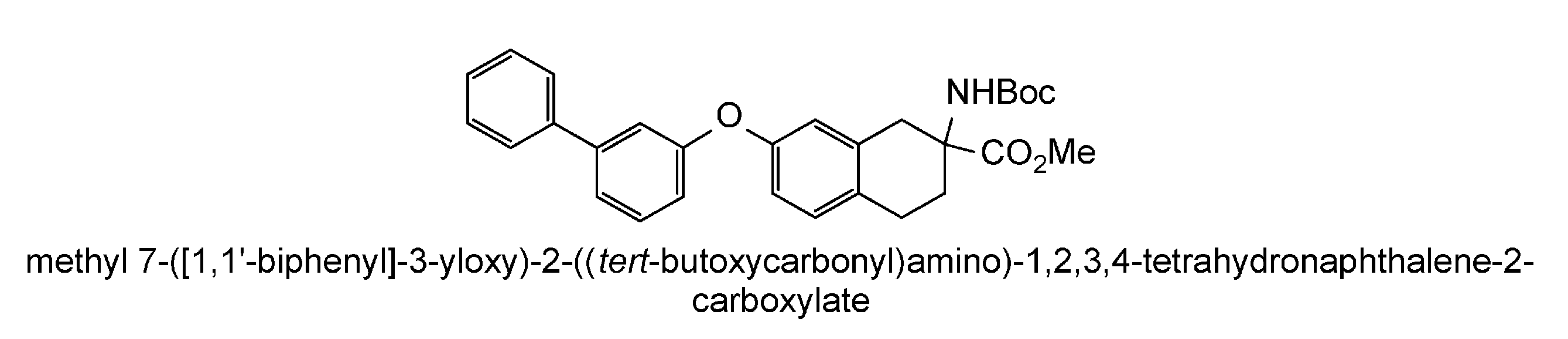
7-([1,1’-ビフェニル]-3-イルオキシ)-2-カルボキシ-1,2,3,4-テトラヒドロナフタレン-2-アミニウムクロリドの製造
ステップ1で得られた上記化合物を、実施例1-1のステップ5および6と同様にして、下記化合物を合成した。
1H-NMR (CD3OD); 2.15-2.20 (m, 1H), 2.38-2.45 (m, 1H), 2.86-2.93 (m, 1H), 3.00 (d, J = 17.0 Hz, 1H), 3.00-3.06 (m, 1H), 3.49 (d, J = 17.0 Hz, 1H), 6.87 (d, J = 2.5 Hz, 1H), 6.93 (dd, J = 2.5, 8.5 Hz, 1H), 6.94-6.96 (m, 1H), 7.18 (t, J = 2.0, 1H), 7.21 (d, J = 8.0, 1H), 7.31-7.37 (m, 2H), 7.39-7.43 (m, 2H), 7.53-7.55 (m, 1H).

7-(ベンゾフラン-5-イルオキシ)-2-カルボキシ-1,2,3,4-テトラヒドロナフタレン-2-アミニウムクロリド(化合物1-16)の製造
ステップ1(工程I-IV)
メチル 7-(ベンゾフラン-5-イルオキシ)-2-((tert-ブトキシカルボニル)アミノ)-1,2,3,4-テトラヒドロナフタレン-2-カルボキシレートの製造
実施例1-1のステップ1からステップ4と同様にして、ただし、実施例のステップ4の2-ヨードナフタレンを5-ヨードベンゾフランに変えて、下記化合物を得た。
1H-NMR (CDCl3); 1.42 (s, 9H), 2.08-2.14 (m, 1H), 2.47 (brs, 1H), 2.79-2.82 (m, 2H), 2.88 (d, J = 17.0 Hz, 1H), 3.25 (d, J = 17.5 Hz, 1H), 3.76 (s, 3H), 4.81 (brs, 1H), 6.71 (d, J = 2.5 Hz, 1H), 6.80 (dd, J = 3.0, 8.5 Hz, 1H), 7.00 (dd, J = 2.5, 8.5 Hz, 1H), 7.06 (d, J = 9.0 Hz, 1H), 7.20 (d, J = 3.0 Hz, 1H), 7.46 (d, J = 8.5 Hz, 1H), 7.64 (d, J = 2.0 Hz, 1H).
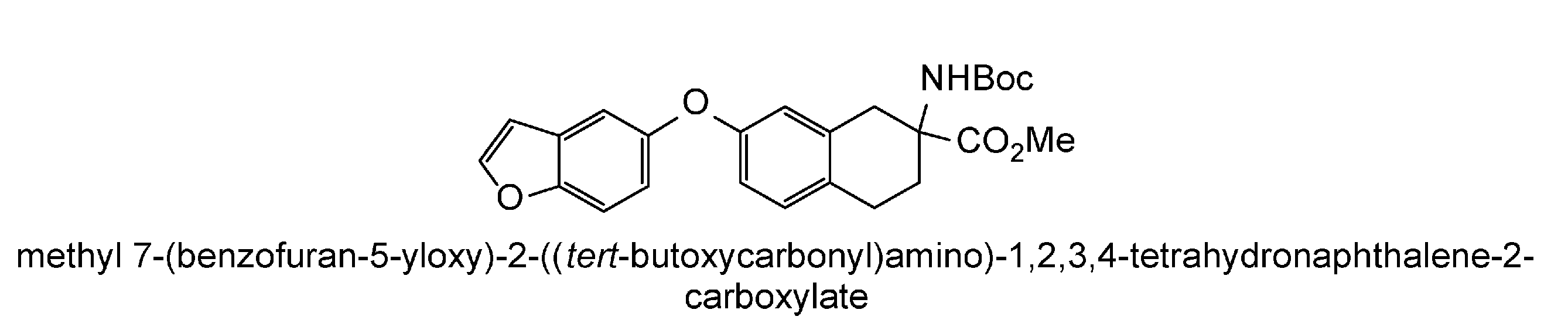
7-(ベンゾフラン-5-イルオキシ)-2-カルボキシ-1,2,3,4-テトラヒドロナフタレン-2-アミニウムクロリドの製造
ステップ1で得られた上記化合物を、実施例1-1のステップ5、6と同様にして、下記化合物を合成した。
1H-NMR (CD3OD); 2.14-2.19 (m, 1H), 2.37-2.43 (m, 1H), 2.84-2.90 (m, 1H), 2.96 (d, J = 17.0 Hz, 1H), 2.99-3.04 (m, 1H), 3.45 (d, J = 17.5 Hz, 1H), 6.75 (d, J = 2.5 Hz, 1H), 6.79 (dd, J = 1.0, 2.0 Hz, 1H), 6.83 (dd, J = 3.0, 8.5 Hz, 1H), 6.97 (dd, J = 2.5, 8.5 Hz, 1H), 7.16 (d, J = 8.5, 1H), 7.21 (d, 3.0 Hz, 1H), 7.48 (d, J = 9.0 Hz, 1H), 7.77 (d, J = 2.5 Hz, 1H).
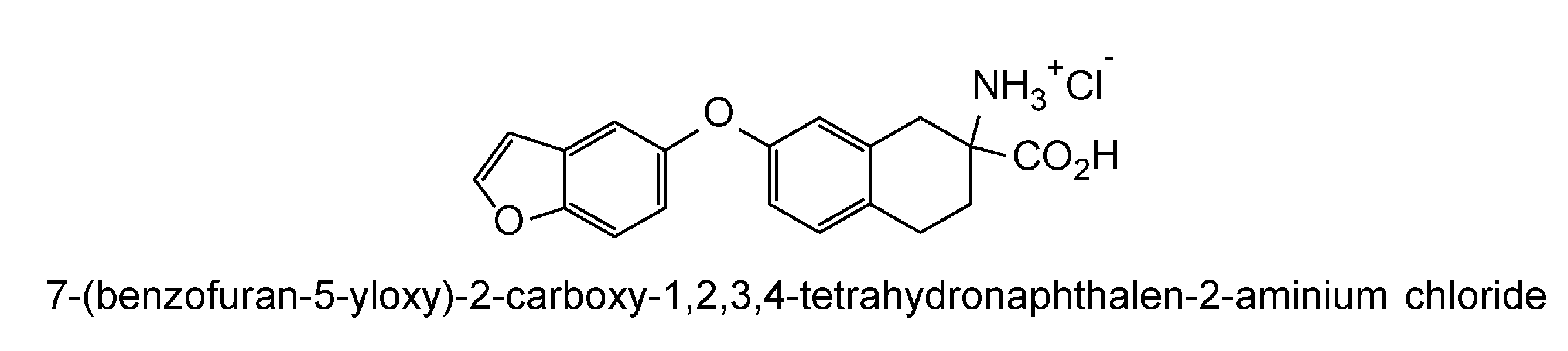
2-カルボキシ-7-(ナフタレン-1-イルオキシ)-1,2,3,4-テトラヒドロナフタレン-2-アミニウムクロリド(化合物1-10)の製造
ステップ1(工程I-IV)
メチル 2-((tert-ブトキシカルボニル)アミノ)-7-(ナフタレン-1-イルオキシ)-1,2,3,4-テトラヒドロナフタレン-2-カルボキシレートの製造
実施例1-1のステップ1からステップ4と同様にして、ただし、実施例のステップ4の2-ヨードナフタレンを1-ヨードナフタレンに変えて、下記化合物を得た。
1H-NMR (CDCl3); 1.42 (s, 9H), 2.09-2.15 (m, 1H), 2.48 (brs, 1H), 2.81-2.84 (m, 2H), 2.88 (d, J = 16.5 Hz, 1H), 3.25 (d, J = 17.0 Hz, 1H), 3.76 (s, 3H), 4.80 (brs, 1H), 6.74 (d, J = 3.0 Hz, 1H), 6.86 (dd, J = 3.0, 8.5 Hz, 1H), 6.93 (dd, J = 1.0, 8.5 Hz, 1H), 7.08 (d, J = 8.5 Hz, 1H), 7.38 (t, J = 8.0 Hz, 1H), 7.47-7.54 (m, 2H), 7.61 (d, J = 8.0 Hz, 1H), 7.87 (dd, J = 1.0, 8.5 Hz, 1H), 8.19 (d, J = 8.0 Hz, 1H).
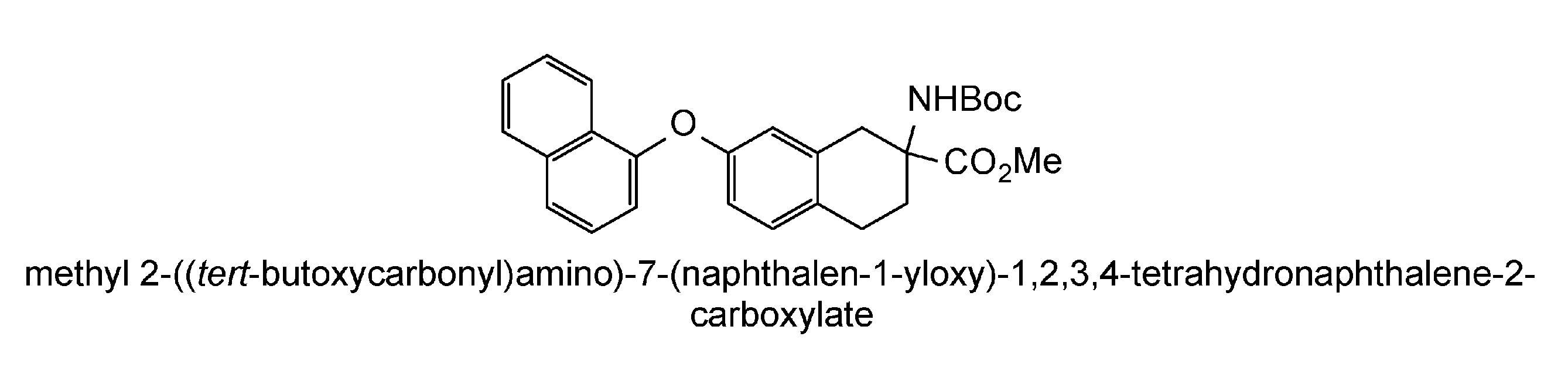
2-カルボキシ-7-(ナフタレン-1-イルオキシ)-1,2,3,4-テトラヒドロナフタレン-2-アミニウムクロリドの製造
ステップ1で得られた上記化合物を、実施例1-1のステップ5、6と同様にして、下記化合物を合成した。
1H-NMR (CD3OD); 2.16-2.21 (m, 1H), 2.38-2.44 (m, 1H), 2.86-2.92 (m, 1H), 2.97 (d, J = 18.0 Hz, 1H), 3.00-3.05 (m, 1H), 3.45 (d, J = 17.5 Hz, 1H), 6.82 (d, J = 2.0 Hz, 1H), 6.89 (dd, J = 3.0, 8.5 Hz, 1H), 6.93 (dd, J = 1.0, 8.5 Hz, 1H), 7.19 (d, J = 9.0, 1H), 7.39 (t, J = 8.0, 1H), 7.45-7.48 (m, 1H), 7.50-7.53 (m, 1H), 7.65 (d, J = 8.0 Hz, 1H), 7.90 (d, J = 8.5 Hz, 1H), 8.09 (d, J = 8.5 Hz, 1H).
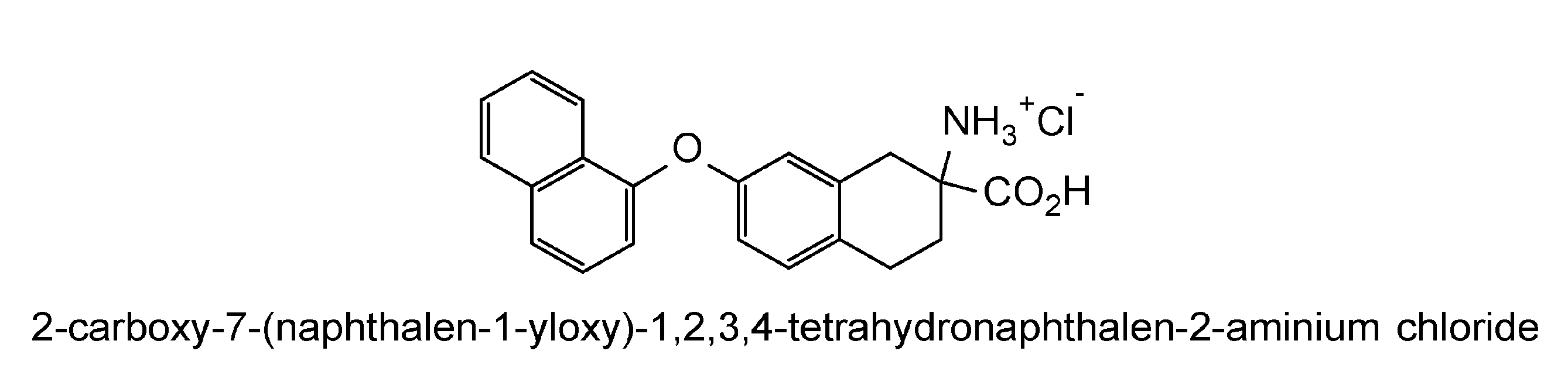
2-カルボキシ-7-((7-メトキシナフタレン-2-イル)オキシ)-1,2,3,4-テトラヒドロナフタレン-2-アミニウムクロリド(化合物1-25)の製造
ステップ1(工程I-IV)
メチル 2-((tert-ブトキシカルボニル)アミノ)-7-((7-メトキシナフタレン-2-イル)オキシ)-1,2,3,4-テトラヒドロナフタレン-2-カルボキシレートの製造
実施例1-1のステップ1からステップ4と同様にして、ただし、実施例のステップ4の2-ヨードナフタレンを2-ヨード-7-メトキシナフタレンに変えて、下記化合物を得た。
1H-NMR (CDCl3); 1.43 (s, 9H), 2.10-2.16 (m, 1H), 2.50 (brs, 1H), 2.83-2.85 (m, 2H), 2.91 (d, J = 16.5 Hz, 1H), 3.28 (d, J = 17.0 Hz, 1H), 3.77 (s, 3H), 3.89 (s, 3H), 4.83 (brs, 1H), 6.80 (d, J = 2.5 Hz, 1H), 6.89 (dd, J = 2.5, 8.5 Hz, 1H), 7.00 (d, J = 2.5 Hz, 1H), 7.04-7.11 (m, 3H), 7.18 (d, J = 1.5 Hz, 1H), 7.70 (d, J = 9.0 Hz, 1H), 7.73 (d, J = 9.0 Hz, 1H).

2-カルボキシ-7-((7-メトキシナフタレン-2-イル)オキシ)-1,2,3,4-テトラヒドロナフタレン-2-アミニウムクロリドの製造
上記化合物を、実施例1-1のステップ5,6と同様にして、下記化合物を合成した。
1H-NMR (CD3OD); 2.17-2.20 (m, 1H), 2.39-2.45 (m, 1H), 2.89-2.92 (m, 1H), 3.00 (d, J = 17.0 Hz, 1H), 3.02-3.05 (m, 1H), 3.48 (d, J = 17.5 Hz, 1H), 3.85 (s, 3H), 6.86 (s, 1H), 6.93 (d, J = 8.0 Hz, 1H), 7.02-7.07 (m, 3H), 7.20-7.22 (m, 2H), 7.71 (dd, J = 2.0, 8.5 Hz, 1H), 7.75 (dd, J = 2.5, 9.0, 1H).

2-アミノ-7-((6-(ジメチルアミノ)ナフタレン-2-イル)オキシ)-1,2,3,4-テトラヒドロナフタレン-2-カルボン酸(化合物1-2)の製造
ステップ1(工程I-IV)
メチル 2-((tert-ブトキシカルボニル)アミノ)-7-((6-(ジメチルアミノ)ナフタレン-2-イル)オキシ)-1,2,3,4-テトラヒドロナフタレン-2-カルボキシレートの製造
実施例1-1のステップ1からステップ4と同様にして、ただし、実施例のステップ4の2-ヨードナフタレンを6-ヨード-N,N-ジメチルナフタレン-2-アミンに変えて、下記化合物を得た。
1H-NMR (CDCl3); 1.42 (s, 9H), 2.09-2.15 (m, 1H), 2.49 (brs, 1H), 2.80-2.83 (m, 2H), 2.87 (d, J = 16.5 Hz, 1H), 3.04 (s, 6H), 3.24 (d, J = 16.5 Hz, 1H), 3.76 (s, 3H), 4.81 (brs, 1H), 6.72 (d, J = 2.5 Hz, 1H), 6.83 (dd, J = 3.0, 8.5 Hz, 1H), 6.94 (d, J = 2.5 Hz, 1H), 7.06 (d, J = 9.0 Hz, 1H), 7.14 (dd, J = 2.5, 9.0 Hz, 1H), 7.18 (dd, J = 2.5, 9.5 Hz, 1H), 7.24 (d, J = 2.5 Hz, 1H), 7.60 (d, J = 9.5 Hz, 1H), 7.65 (d, J = 8.5 Hz, 1H).
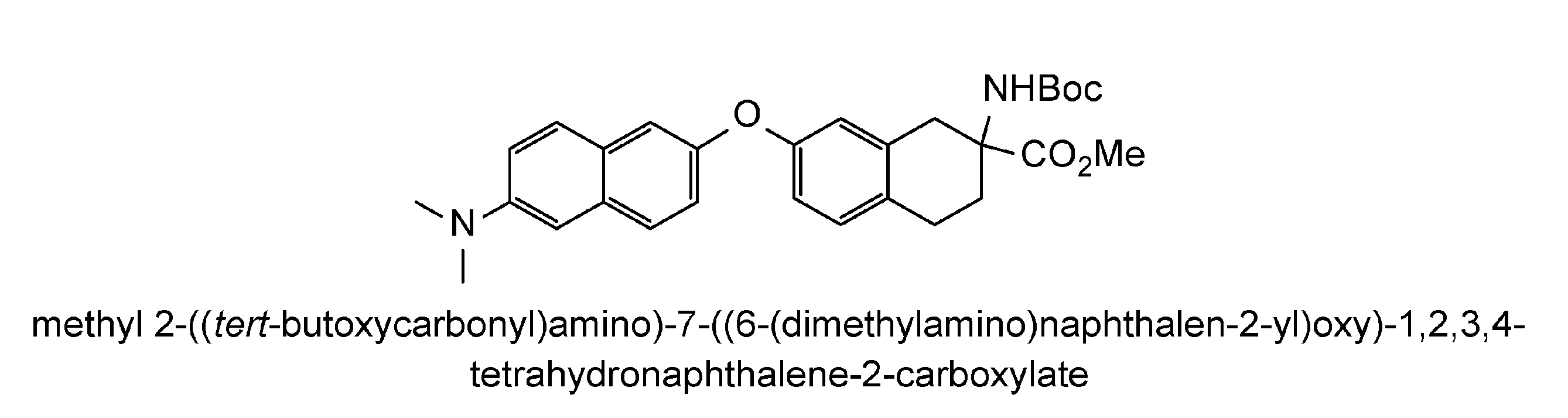
2-((tert-ブトキシカルボニル)アミノ)-7-((6-(ジメチルアミノ)ナフタレン-2-イル)オキシ)-1,2,3,4-テトラヒドロナフタレン-2-カルボン酸の製造
上記化合物を、実施例1-1のステップ5と同様にして、下記化合物を合成した。また、このカルボン酸化合物を精製せずにそのまま次工程に用いた。

2-アミノ-7-((6-(ジメチルアミノ)ナフタレン-2-イル)オキシ)-1,2,3,4-テトラヒドロナフタレン-2-カルボン酸の製造
上記化合物(70 mg, 0.147 mmol)に、10% 塩酸を加え、還流下1時間攪拌させた。冷却後、1H 水酸化ナトリウム水溶液でpHを7まで上昇させると析出物が認められた。この析出物を濾取し、さらにこの析出物をシリカゲルカラムクロマトグラフィーにて精製することにより、目的の下記化合物(41 mg, 収率74%)を得た。
1H-NMR (DMSO-d6); 1.85-1.87 (m, 1H), 2.06-2.08 (m, 1H), 2.73 (d, J = 18.0 Hz, 1H), 2.74-2.82 (m, 2H), 2.98 (s, 6H), 3.26 (d, J = 17.5 Hz, 1H), 6.73 (d, J = 2.0 Hz, 1H), 6.77 (dd, J = 3.0, 9.0 Hz, 1H), 6.97 (d, J = 2.0, 1H), 7.09-7.12 (m, 2H), 7.21-7.24 (m, 2H), 7.65 (d, J = 9.5 Hz, 1H), 7.71 (d, J = 8.5, 1H).
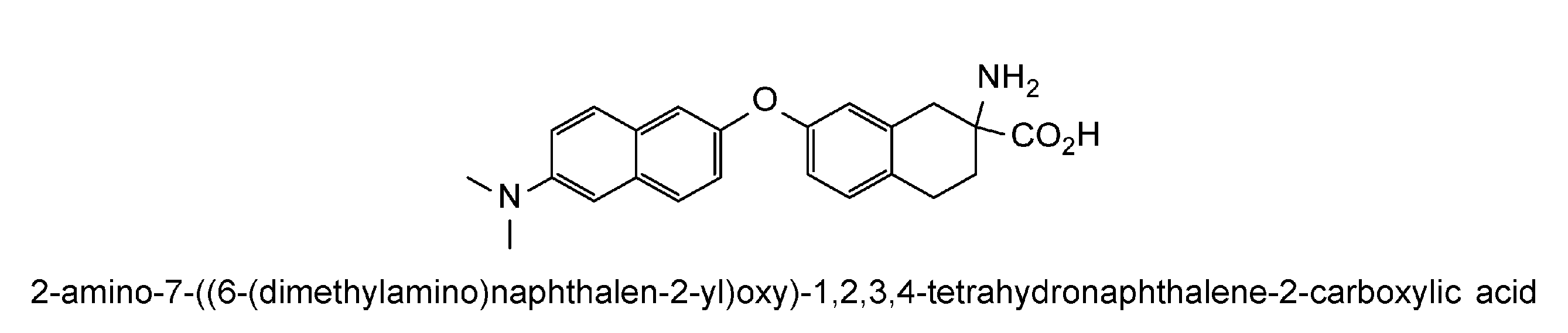
2-アミノ-7-((7-(ジメチルアミノ)ナフタレン-2-イル)オキシ)-1,2,3,4-テトラヒドロナフタレン-2-カルボン酸(化合物1-1)の製造
ステップ1(工程I-IV)
メチル 2-((tert-ブトキシカルボニル)アミノ)-7-((7-(ジメチルアミノ)ナフタレン-2-イル)オキシ)-1,2,3,4-テトラヒドロナフタレン-2-カルボキシレートの製造
実施例1-1のステップ1からステップ4と同様にして、ただし、実施例のステップ4の2-ヨードナフタレンを7-ヨード-N,N-ジメチルナフタレン-2-アミンに変えて、下記化合物を得た。
1H-NMR (CDCl3); 1.43 (s, 9H), 2.10-2.16 (m, 1H), 2.50 (brs, 1H), 2.82-2.84 (m, 2H), 2.89 (d, J = 16.0 Hz, 1H), 3.03 (s, 6H), 3.26 (d, J = 16.5 Hz, 1H), 3.76 (s, 3H), 4.81 (brs, 1H), 6.76-6.78 (m, 2H), 6.88 (dd, J = 3.0, 9.0 Hz, 1H), 6.96 (dd, J = 2.5, 9.0 Hz, 1H), 7.06-7.11 (m, 2H), 7.65-7.67 (m, 2H).
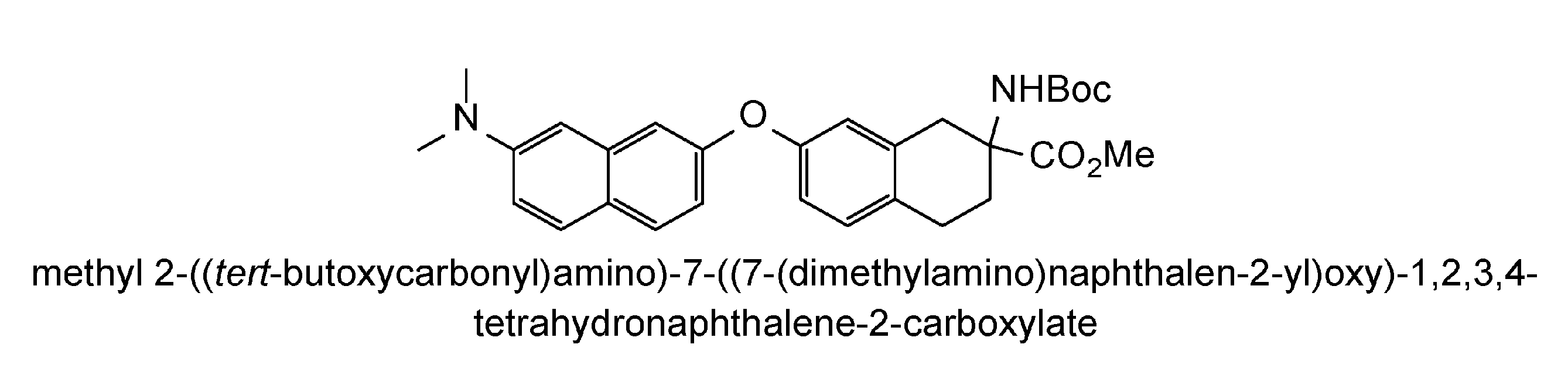
2-((tert-ブトキシカルボニル)アミノ)-7-((7-(ジメチルアミノ)ナフタレン-2-イル)オキシ)-1,2,3,4-テトラヒドロナフタレン-2-カルボン酸の製造
上記化合物を、実施例1-1のステップ5と同様にして、下記化合物を合成した。また、このカルボン酸化合物を精製せずにそのまま次工程に用いた。

2-アミノ-7-((7-(ジメチルアミノ)ナフタレン-2-イル)オキシ)-1,2,3,4-テトラヒドロナフタレン-2-カルボン酸の製造
上記化合物を、実施例1-6のステップ3と同様にして、下記化合物を合成した。
1H-NMR (DMSO-d6); 1.84-1.87 (m, 1H), 2.06-2.12 (m, 1H), 2.71 (d, J = 17.0 Hz, 1H), 2.72-2.83 (m, 2H), 2.97 (s, 6H), 3.30 (d, J = 17.0 Hz, 1H), 6.79-6.82 (m, 3H), 6.89 (dd, J = 2.0, 8.5 Hz, 1H), 7.06 (d, J = 2.5 Hz, 1H), 7.10-7.12 (m, 2H), 7.68-7.74 (m, 2H).

2-アミノ-7-(キノリン-6-イルオキシ)-1,2,3,4-テトラヒドロナフタレン-2-カルボン酸(化合物1-18)の製造
ステップ1(工程I-IV)
メチル 2-((tert-ブトキシカルボニル)アミノ)-7-(キノリン-6-イルオキシ)-1,2,3,4-テトラヒドロナフタレン-2-カルボキシレートの製造
実施例1-1のステップ1からステップ4と同様にして、ただし、実施例のステップ4の2-ヨードナフタレンを3-(3-ヨードフェニル)ピリジンに変えて、下記化合物を得た。
1H-NMR (CDCl3); 1.43 (s, 9H), 2.12-2.18 (m, 1H), 2.49 (brs, 1H), 2.85-2.87 (m, 2H), 2.94 (d, J = 16.5 Hz, 1H), 3.31 (d, J = 16.5 Hz, 1H), 3.77 (s, 3H), 4.85 (brs, 1H), 6.80 (d, J = 3.0 Hz, 1H), 6.90 (dd, J = 2.5, 8.0 Hz, 1H), 7.14 (d, J = 8.5 Hz, 1H), 7.21 (d, J = 3.0 Hz, 1H), 7.37 (dd, J = 4.5, 8.5 Hz, 1H), 7.48 (dd, J = 2.0, 9.0 Hz, 1H), 8.01 (dd, J = 1.0, 8.5 Hz, 1H), 8.08 (d, J = 9.5 Hz, 1H), 8.83 (dd, J = 1.5, 4.0 Hz, 1H).

2-((tert-ブトキシカルボニル)アミノ)-7-(キノリン-6-イルオキシ)-1,2,3,4-テトラヒドロナフタレン-2-カルボン酸の製造
上記化合物を、実施例1-6のステップ2と同様にして、下記化合物を合成した。また、このカルボン酸化合物を精製せずにそのまま次工程に用いた。

2-アミノ-7-(キノリン-6-イルオキシ)-1,2,3,4-テトラヒドロナフタレン-2-カルボン酸の製造
上記化合物を、実施例1-6のステップ3と同様にして、下記化合物を合成した。
1H-NMR (DMSO-d6); 1.84-1.87 (m, 1H), 2.07-2.13 (m, 1H), 2.74 (d, J = 17.5 Hz, 1H), 2.78-2.84 (m, 2H), 3.32 (d, J = 17.0 Hz, 1H), 6.88-6.90 (m, 2H), 7.16 (d, J = 9.0 Hz, 1H), 7.35 (d, J = 2.5 Hz, 1H), 7.48-7.52 (m, 2H), 8.04 (d, J = 9.0 Hz, 1H), 8.25 (dd, J = 1.5, 8.5 Hz, 1H), 8.81 (dd, J = 1.5, 4.5 Hz, 1H).
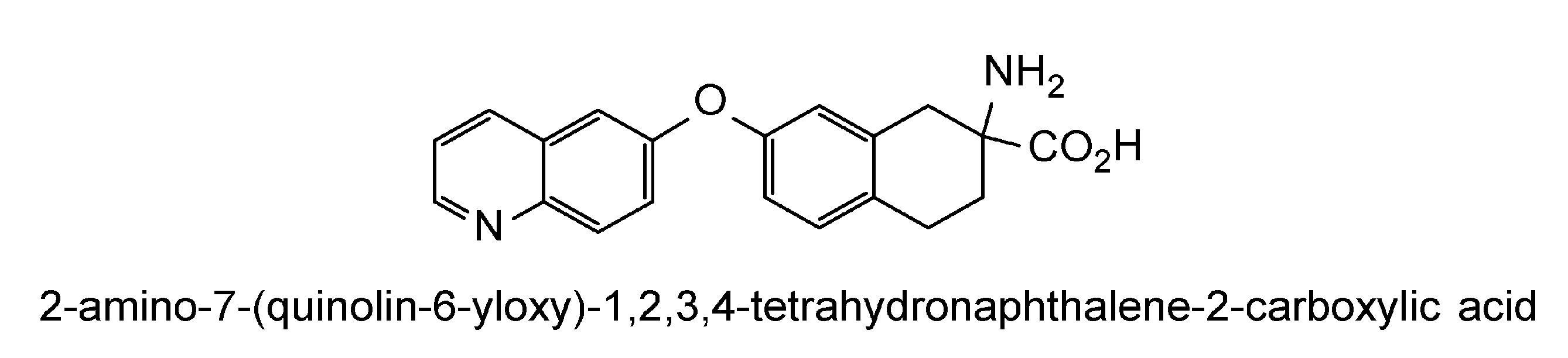
2-アミノ-7-(3-(ピリジン-2-イル)フェノキシ)-1,2,3,4-テトラヒドロナフタレン-2-カルボン酸(化合物1-21)の製造
ステップ1(工程I-IV)
メチル 2-((tert-ブトキシカルボニル)アミノ)-7-(3-(ピリジン-2-イル)フェノキシ)-1,2,3,4-テトラヒドロナフタレン-2-カルボキシレートの製造
実施例1-1のステップ1からステップ4と同様にして、ただし、実施例のステップ4の2-ヨードナフタレンを2-(3-ヨードフェニル)ピリジンに変えて、下記化合物を得た。
1H-NMR (CDCl3); 1.42 (s, 9H), 2.09-2.15 (m, 1H), 2.49 (brs, 1H), 2.81-2.83 (m, 2H), 2.90 (d, J = 17.0 Hz, 1H), 3.26 (d, J = 17.5 Hz, 1H), 3.76 (s, 3H), 4.83 (brs, 1H), 7.03-7.05 (m, 1H), 7.08 (d, J = 8.5 Hz, 1H), 7.23-7.25 (m, 1H), 7.43 (t, J = 8.0 Hz, 1H), 7.64-7.65 (m, 1H), 7.69 (d, J = 8.0 Hz, 1H), 7.72-7.77 (m, 1H), 8.67-8.68 (m, 1H).
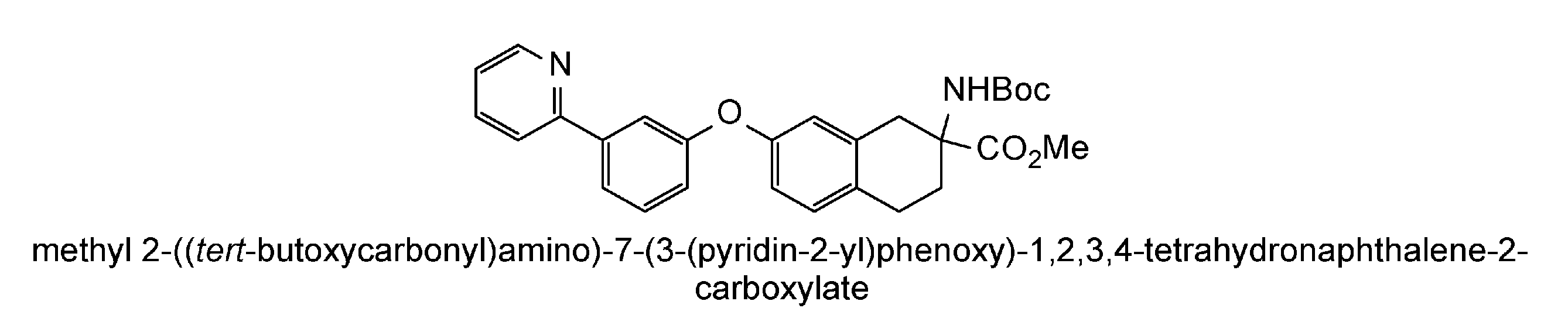
2-((tert-ブトキシカルボニル)アミノ)-7-(3-(ピリジン-2-イル)フェノキシ)-1,2,3,4-テトラヒドロナフタレン-2-カルボン酸の製造
上記化合物を、実施例1-6のステップ2と同様にして、下記化合物を合成した。また、このカルボン酸化合物を精製せずにそのまま次工程に用いた。

2-アミノ-7-(3-(ピリジン-2-イル)フェノキシ)-1,2,3,4-テトラヒドロナフタレン-2-カルボン酸の製造
上記化合物を、実施例1-6のステップ3と同様にして、下記化合物を合成した。
1H-NMR (DMSO-d6); 1.81-1.86 (m, 1H), 2.04-2.10 (m, 1H), 2.67-2.80 (m, 2H), 2.71 (d, J = 17.0 Hz, 1H), 3.29 (d, J = 17.5 Hz, 1H), 6.81-6.92 (m, 2H), 7.02-7.04 (m, 1H), 7.10 (d, J = 9.0 Hz, 1H), 7.33-7.36 (m, 1H), 7.47 (t, J = 8.0 Hz, 1H), 7.70 (s, 1H), 7.80 (d, J = 7.0 Hz, 1H), 7.86 (t, J = 7.5 Hz, 1H), 7.94 (d, J = 7.5 Hz, 1H), 8.62 (d, J = 4.5 Hz, 1H).
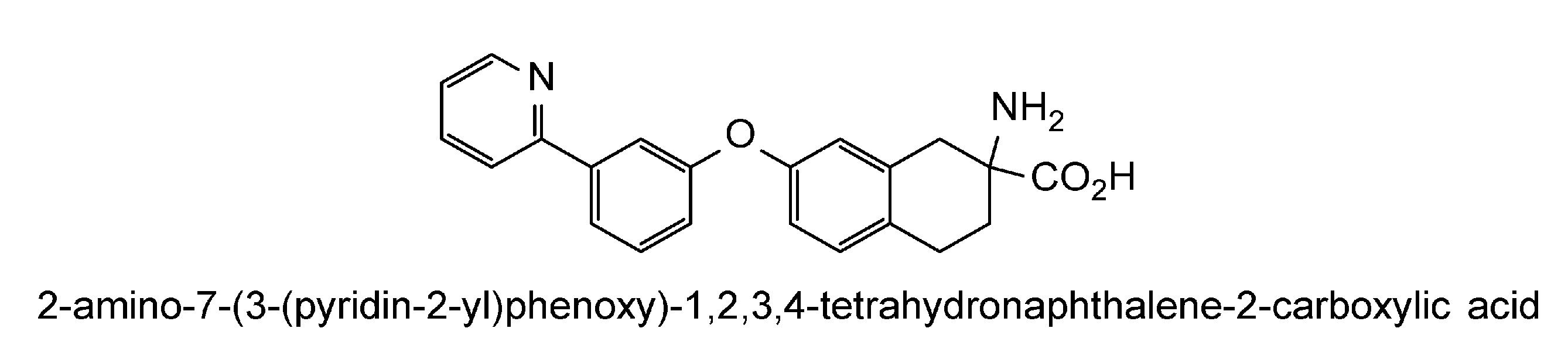
2-カルボキシ-7-((4’-クロロ-[1,1’-ビフェニル]-3-イル)オキシ)-1,2,3,4-テトラヒドロナフタレン-2-アミニウムクロリド(化合物1-31)の製造
ステップ1(工程I-IV)
メチル 2-((tert-ブトキシカルボニル)アミノ)-7-((4’-クロロ-[1,1’-ビフェニル]-3-イル)オキシ)-1,2,3,4-テトラヒドロナフタレン-2-カルボキシレートの製造
実施例1-1のステップ1からステップ4と同様にして、ただし、実施例のステップ4の2-ヨードナフタレンを3-ブロモ-4’-クロロ‐1,1’-ビフェニルに変えて、下記化合物を得た。
1H-NMR (CDCl3); 1.42 (s, 9H), 2.09-2.15 (m, 1H), 2.47 (brs, 1H), 2.81-2.84 (m, 2H), 2.92 (d, J = 17.5 Hz, 1H), 3.28 (d, J = 17.0 Hz, 1H), 3.76 (s, 3H), 4.81 (brs, 1H), 6.75 (d, J = 2.5 Hz, 1H), 6.87 (dd, J = 2.5, 8.0 Hz, 1H), 6.97 (dd, J = 2.0, 7.5 Hz, 1H), 7.09 (d, J = 8.0 Hz, 1H), 7.19 (t, J = 2.0 Hz, 1H), 7.27-7.29 (m, 1H), 7.37-7.40 (m, 3H), 7.47 7.50 (m, 2H).
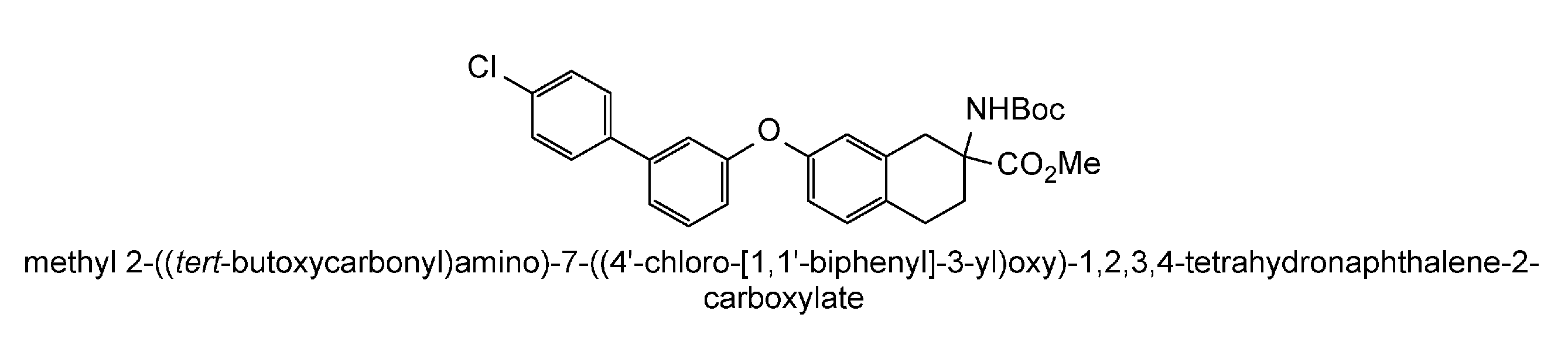
2-カルボキシ-7-((4’-クロロ-[1,1’-ビフェニル]-3-イル)オキシ)-1,2,3,4-テトラヒドロナフタレン-2-アミニウムクロリドの製造
ステップ1で得られた上記化合物を、実施例1-1のステップ5、6と同様にして、下記化合物を合成した。
1H-NMR (CD3OD); 2.16-2.21 (m, 1H), 2.38-2.45 (m, 1H), 2.86-2.93 (m, 1H), 3.00 (d, J = 16.5 Hz, 1H), 3.00-3.06 (m, 1H), 3.49 (d, J = 17.0 Hz, 1H), 6.86 (d, J = 2.0 Hz, 1H), 6.92 (dd, J = 2.0, 8.5 Hz, 1H), 6.96 (dd, J = 2.5, 8.5 Hz, 1H), 7.19 (brs, 1H), 7.21 (t, J = 8.0, 1H), 7.35 (d, J = , 7.5 Hz, 1H), 7.40-7.43 (m, 3H), 7.54 (d, J = 8.0 Hz, 1H).

2-カルボキシ-7-((3’-クロロ-[1,1’-ビフェニル]-3-イル)オキシ)-1,2,3,4-テトラヒドロナフタレン-2-アミニウムクロリド(化合物1-30)の製造
ステップ1(工程I-IV)
メチル 2-((tert-ブトキシカルボニル)アミノ)-7-((3’-クロロ-[1,1’-ビフェニル]-3-イル)オキシ)-1,2,3,4-テトラヒドロナフタレン-2-カルボキシレートの製造
実施例1-1のステップ1からステップ4と同様にして、ただし、実施例のステップ4の2-ヨードナフタレンを3-ブロモ-3’-クロロ‐1,1’-ビフェニルに変えて、下記化合物を得た。
1H-NMR (CDCl3); 1.42 (s, 9H), 2.09-2.16 (m, 1H), 2.48 (brs, 1H), 2.81-2.84 (m, 2H), 2.92 (d, J = 17.0 Hz, 1H), 3.28 (d, J = 16.5 Hz, 1H), 3.76 (s, 3H), 4.82 (brs, 1H), 6.74 (d, J = 2.5 Hz, 1H), 6.86 (dd, J = 3.0, 8.5 Hz, 1H), 6.97-7.00 (m, 1H), 7.09 (d, J = 8.5 Hz, 1H), 7.20 (t, J = 2.5 Hz, 1H), 7.28-7.41 (m, 4H), 7.43 (dt, J = 1.5, 8.0 Hz, 1H), 7.54 (t, J = 2.0 Hz, 1H).
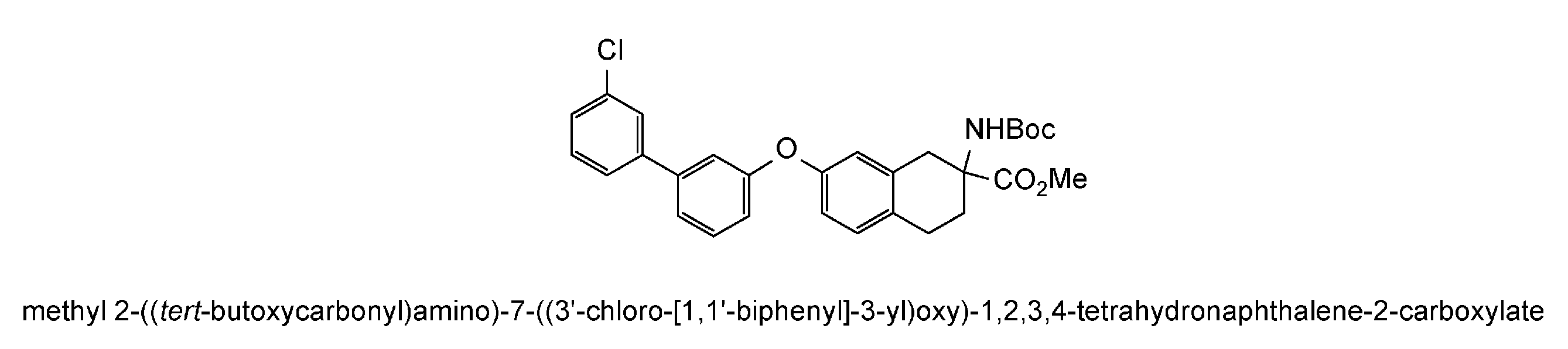
2-カルボキシ-7-((3’-クロロ-[1,1’-ビフェニル]-3-イル)オキシ)-1,2,3,4-テトラヒドロナフタレン-2-アミニウムクロリドの製造
ステップ1で得られた上記化合物を、実施例1-1のステップ5、6と同様にして、下記化合物を合成した。
1H-NMR (CD3OD); 2.15-2.20 (m, 1H), 2.39-2.45 (m, 1H), 2.86-2.93 (m, 1H), 3.00 (d, J = 18.0 Hz, 1H), 3.01-3.07 (m, 1H), 3.50 (d, J = 17.5 Hz, 1H), 6.87 (d, J = 2.5 Hz, 1H), 6.93 (dd, J = 2.5, 8.5 Hz, 1H), 6.99 (dd, J = 2.5, 8.5 Hz, 1H), 7.18 (t, J = 2.0, 1H), 7.22 (d, J = 8.5, 1H), 7.34-7.36 (m, 2H), 7.39-7.45 (m, 2H), 7.49 (dt, J = 1.5, 7.5 Hz, 1H), 7.55 (t, J = 2.5 Hz, 1H).

7-([1,1’-ビフェニル]-4-イルオキシ)-2-カルボキシ-1,2,3,4-テトラヒドロナフタレン-2-アミニウムクロリド(化合物1-19)の製造
ステップ1(工程I-IV)
メチル 7-([1,1’-ビフェニル]-4-イルオキシ-2-((tert-ブトキシカルボニル)アミノ)-1,2,3,4-テトラヒドロナフタレン-2-カルボキシレートの製造
実施例1-1のステップ1からステップ4と同様にして、ただし、実施例のステップ4の2-ヨードナフタレンを4-ヨード-1,1’-ビフェニルに変えて、下記化合物を得た。
1H-NMR (CDCl3); 1.43 (s, 9H), 2.10-2.16 (m, 1H), 2.49 (brs, 1H), 2.82-2.84 (m, 2H), 2.92 (d, J = 17.0 Hz, 1H), 3.28 (d, J = 17.0 Hz, 1H), 3.77 (s, 3H), 4.83 (brs, 1H), 6.76 (d, J = 2.0 Hz, 1H), 6.87 (dd, J = 2.0, 8.0 Hz, 1H), 7.04-7.07 (m, 2H), 7.10 (d, J = 8.5 Hz, 1H), 7.31-7.35 (m, 1H), 7.42-7.45 (m, 2H), 7.53-7.58 (m, 4H).

7-([1,1’-ビフェニル]-4-イルオキシ)-2-カルボキシ-1,2,3,4-テトラヒドロナフタレン-2-アミニウムクロリドの製造
ステップ1で得られた上記化合物を、実施例1-1のステップ5、6と同様にして、下記化合物を合成した。
1H-NMR (CD3OD); 2.16-2.21 (m, 1H), 2.39-2.45 (m, 1H), 2.86-2.93 (m, 1H), 3.00 (d, J = 17.0 Hz, 1H), 3.00-3.06 (m, 1H), 3.49 (d, J = 17.0 Hz, 1H), 6.85 (d, J = 2.0 Hz, 1H), 6.91 (dd, J = 2.0, 8.0 Hz, 1H), 7.03-7.06 (m, 2H), 7.21 (d, J = 8.0, 1H), 7.31 (t, J = 7.5, 1H), 7.40-7.43 (m, 2H), 7.57-7.61 (m, 4H).
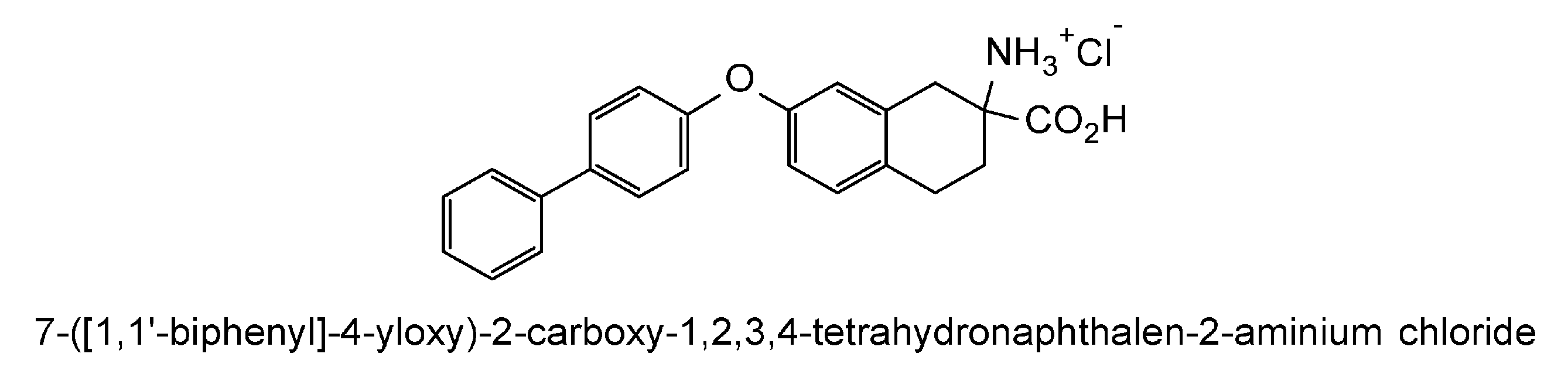
2-カルボキシ-7-(3-(ナフタレン-2-イル)フェノキシ)-1,2,3,4-テトラヒドロナフタレン-2-アミニウムクロリド(化合物1-32)の製造
ステップ1(工程I-IV)
メチル 2-((tert-ブトキシカルボニル)アミノ)-7-(3-(ナフタレン-2-イル)フェノキシ)-1,2,3,4-テトラヒドロナフタレン-2-カルボキシレートの製造
実施例1-1のステップ1からステップ4と同様にして、ただし、実施例のステップ4の2-ヨードナフタレンを2-(3-ヨードフェニル)ナフタレンに変えて、下記化合物を得た。
1H-NMR (CDCl3); 1.42 (s, 9H), 2.11-2.16 (m, 1H), 2.48 (brs, 1H), 2.81-2.84 (m, 2H), 2.92 (d, J = 16.5 Hz, 1H), 3.28 (d, J = 16.5 Hz, 1H), 3.76 (s, 3H), 4.81 (brs, 1H), 6.78 (d, J = 2.5 Hz, 1H), 6.89 (dd, J = 2.5, 8.5 Hz, 1H), 6.98-7.01 (m, 1H), 7.10 (d, J = 8.0 Hz, 1H), 7.38 (t, J = 1.5 Hz, 1H), 7.41-7.51 (m, 4H), 7.71 (dd, J = 1.5, 8.5 Hz, 1H), 7.85-7.91 (m, 3H), 8.02 (s, 1H).

2-カルボキシ-7-(3-(ナフタレン-2-イル)フェノキシ)-1,2,3,4-テトラヒドロナフタレン-2-アミニウムクロリドの製造
ステップ1で得られた上記化合物を、実施例1-1のステップ5、6と同様にして、下記化合物を合成した。
1H-NMR (CD3OD); 2.15-2.20 (m, 1H), 2.38-2.44 (m, 1H), 2.86-2.93 (m, 1H), 3.00 (d, J = 16.5 Hz, 1H), 3.00-3.06 (m, 1H), 3.49 (d, J = 17.0 Hz, 1H), 6.89 (d, J = 2.0 Hz, 1H), 6.95 (dd, J = 2.5, 8.0 Hz, 1H), 6.98-7.00 (m, 1H), 7.22 (d, J = 8.0, 1H), 7.33 (m, 1H), 7.44-7.51 (m, 4H), 7.70 (dd, J = 1.5, 8.5 Hz, 1H), 7.85-7.92 (m, 3H), 8.03 (s, 1H).

2-カルボキシ-7-((4’-フルオロ-[1,1’-ビフェニル]-3-イル)オキシ)-1,2,3,4-テトラヒドロナフタレン-2-アミニウムクロリド(化合物1-40)の製造
ステップ1(工程I-IV)
メチル 2-((tert-ブトキシカルボニル)アミノ)-7-((4’-フルオロ-[1,1’-ビフェニル]-3-イル)オキシ)-1,2,3,4-テトラヒドロナフタレン-2-カルボキシレートの製造
実施例1-1のステップ1からステップ4と同様にして、ただし、実施例のステップ4の2-ヨードナフタレンを4’-フルオロ-3-ヨード-1,1’-ビフェニルに変えて、下記化合物を得た。
1H-NMR (CDCl3); 1.42 (s, 9H), 2.09-2.15 (m, 1H), 2.48 (brs, 1H), 2.81-2.84 (m, 2H), 2.92 (d, J = 17.0 Hz, 1H), 3.28 (d, J = 17.5 Hz, 1H), 3.76 (s, 3H), 4.81 (brs, 1H), 6.75 (d, J = 2.5 Hz, 1H), 6.87 (dd, J = 2.0, 8.0 Hz, 1H), 6.96 (dd, J = 2.0, 8.0 Hz, 1H), 7.08-7.14 (m, 3H), 7.18 (t, J = 1.5 Hz, 1H), 7.28 (t, J = 1.5 Hz, 1H), 7.38 (t, J = 8.0 Hz, 1H), 7.49-7.53 (m, 2H).
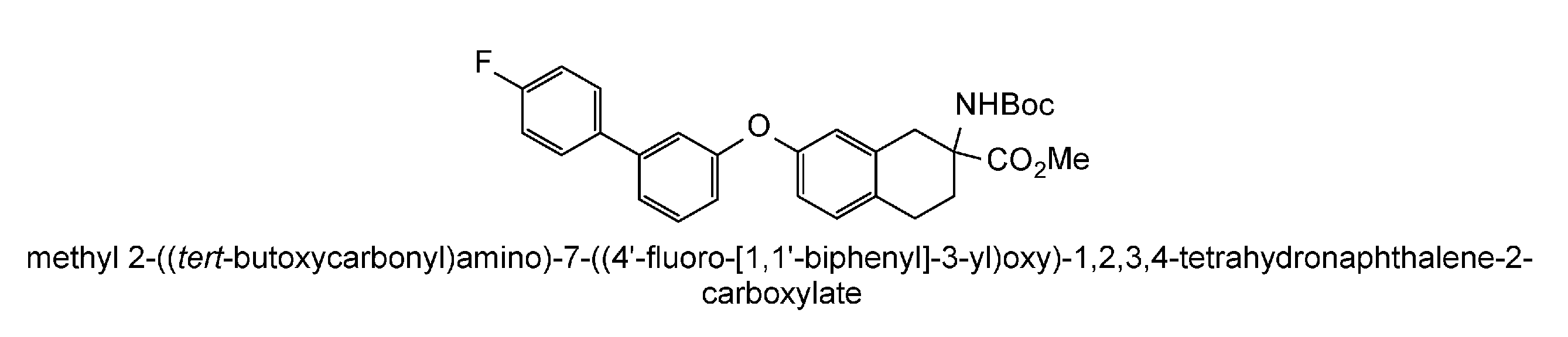
2-カルボキシ-7-((4’-フルオロ-[1,1’-ビフェニル]-3-イル)オキシ)-1,2,3,4-テトラヒドロナフタレン-2-アミニウムクロリドの製造
ステップ1で得られた上記化合物を、実施例1-1のステップ5、6と同様にして、下記化合物を合成した。
1H-NMR (CD3OD); 2.16-2.19 (m, 1H), 2.39-2.45 (m, 1H), 2.86-2.93 (m, 1H), 3.00 (d, J = 16.5 Hz, 1H), 3.02-3.05 (m, 1H), 3.49 (d, J = 17.0 Hz, 1H), 6.86 (d, J = 2.0 Hz, 1H), 6.91-6.95 (m, 2H), 7.13-7.22 (m, 4H), 7.32-7.34 (m, 1H), 7.41 (t, J = 7.5 Hz, 1H), 7.55-7.58 (m, 2H).
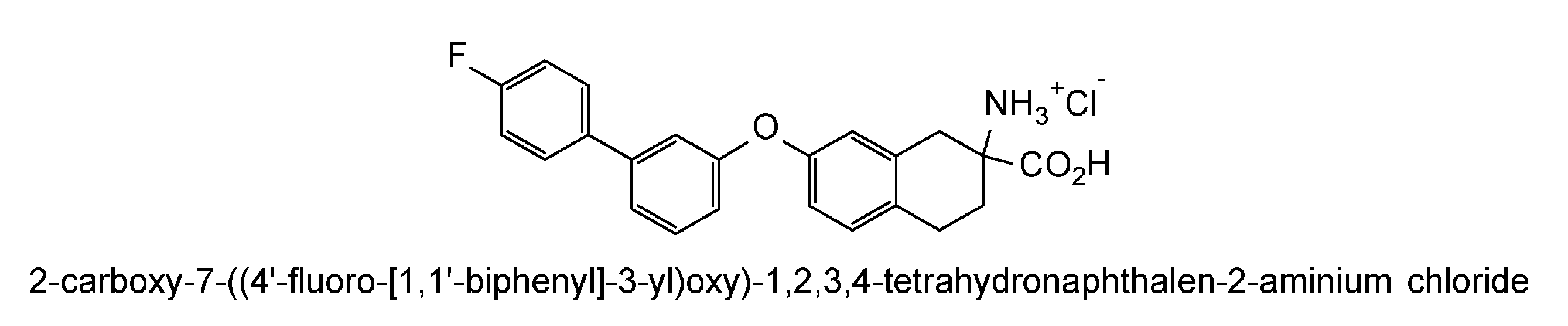
2-カルボキシ-7-((3’-(トリフルオロメチル)-[1,1’-ビフェニル]-3-イル)オキシ)-1,2,3,4-テトラヒドロナフタレン-2-アミニウムクロリド(化合物1-37)の製造
ステップ1(工程I-IV)
メチル 2-((tert-ブトキシカルボニル)アミノ)-7-((3’-(トリフルオロメチル)-[1,1’-ビフェニル]-3-イル)オキシ)-1,2,3,4-テトラヒドロナフタレン-2-カルボキシレートの製造
実施例1-1のステップ1からステップ4と同様にして、ただし、実施例のステップ4の2-ヨードナフタレンを3-ヨード-3’-(トリフルオロメチル)-1,1’-ビフェニルに変えて、下記化合物を得た。
1H-NMR (CDCl3); 1.42 (s, 9H), 2.09-2.16 (m, 1H), 2.47 (brs, 1H), 2.82-2.84 (m, 2H), 2.92 (d, J = 16.5 Hz, 1H), 3.29 (d, J = 16.5 Hz, 1H), 3.76 (s, 3H), 4.82 (brs, 1H), 6.75 (d, J = 2.0 Hz, 1H), 6.87 (dd, J = 2.5, 9.0 Hz, 1H), 7.01 (dd, J = 2.0, 8.0 Hz, 1H), 7.10 (d, J = 8.5 Hz, 1H), 7.24 (t, J = 1.5 Hz, 1H), 7.32-7.34 (m, 1H), 7.42 (t, J = 8.5 Hz, 1H), 7.55 (t, J = 7.5 Hz, 1H), 7.61 (d, J = 7.5 Hz, 1H), 7.73 (d, J = 8.0 Hz, 1H), 7.80 (s, 1H).

2-カルボキシ-7-((3’-(トリフルオロメチル)-[1,1’-ビフェニル]-3-イル)オキシ)-1,2,3,4-テトラヒドロナフタレン-2-アミニウムクロリドの製造
ステップ1で得られた上記化合物を、実施例1-1のステップ5、6と同様にして、下記化合物を合成した。
1H-NMR (CD3OD); 2.15-2.20 (m, 1H), 2.39-2.45 (m, 1H), 2.86-2.93 (m, 1H), 3.00 (d, J = 18.5 Hz, 1H), 3.03-3.07 (m, 1H), 3.50 (d, J = 18.0 Hz, 1H), 6.88 (d, J = 2.5 Hz, 1H), 6.94 (dd, J = 3.0, 9.0 Hz, 1H), 7.01 (dd, J = 1.5, 7.0 Hz, 1H), 7.22-7.24 (m, 2H), 7.40 (dd, J = 2.0, 7.0 Hz, 1H), 7.46 (t, J = 7.5 Hz, 1H), 7.62-7.67 (m, 2H), 7.82-7.84 (m, 2H).
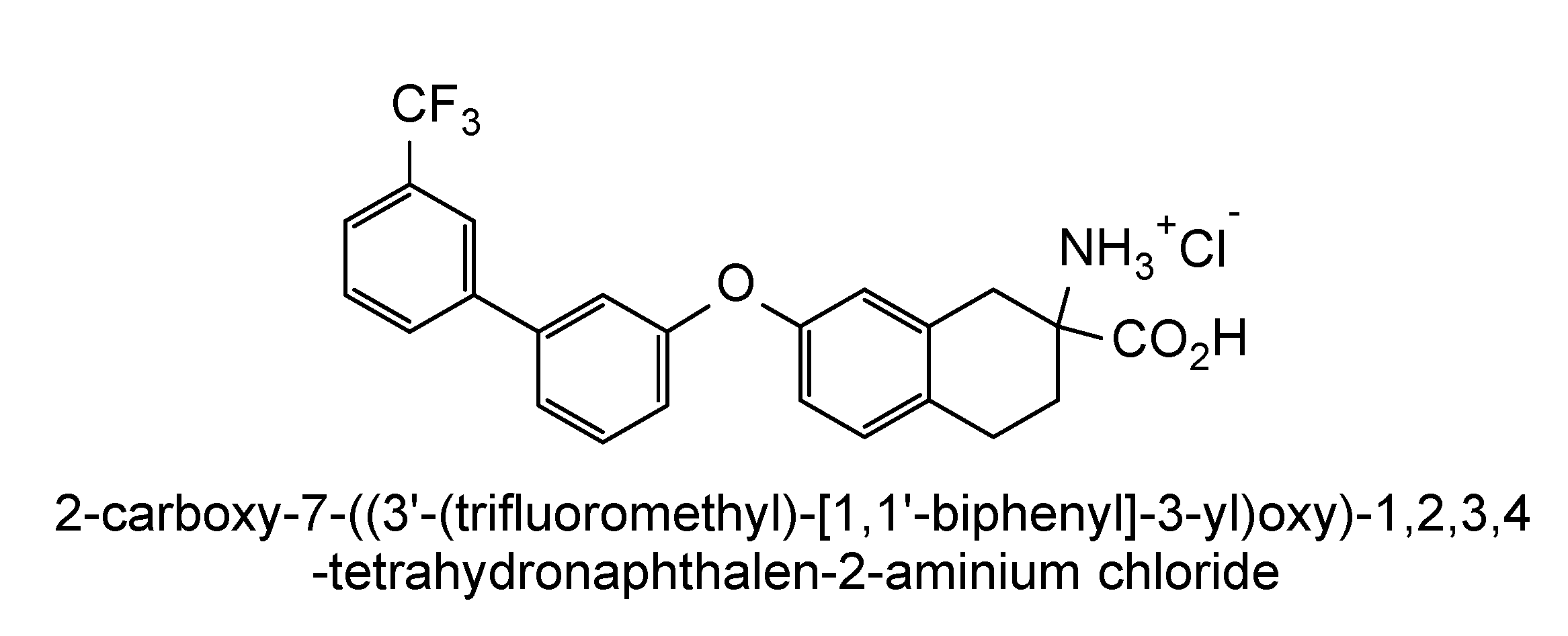
7-([1,1’-ビフェニル]-2-イルオキシ)-2-カルボキシ-1,2,3,4-テトラヒドロナフタレン-2-アミニウムクロリド(化合物1-34)の製造
ステップ1(工程I-IV)
メチル 7-([1,1’-ビフェニル]-2-イルオキシ)-2-((tert-ブトキシカルボニル)アミノ)-1,2,3,4-テトラヒドロナフタレン-2-カルボキシレートの製造
実施例1-1のステップ1からステップ4と同様にして、ただし、実施例のステップ4の2-ヨードナフタレンを2-ヨード-1,1’-ビフェニルに変えて、さらに、反応温度を90℃から120℃にして、下記化合物を得た。
1H-NMR (CDCl3); 1.42 (s, 9H), 2.05-2.11 (m, 1H), 2.46 (brs, 1H), 2.76-2.78 (m, 2H), 2.84 (d, J = 17.0 Hz, 1H), 3.21 (d, J = 17.0 Hz, 1H), 3.75 (s, 3H), 4.76 (brs, 1H), 6.62 (d, J = 2.5 Hz, 1H), 6.75 (dd, J = 2.5, 8.0 Hz, 1H), 6.98-7.02 (m, 2H), 7.18-7.22 (m, 1H), 7.27-7.31 (m, 2H), 7.35-7.38 (m, 2H), 7.45 (dd, J = 1.5, 7.5 Hz, 1H), 7.52-7.54 (m, 2H).
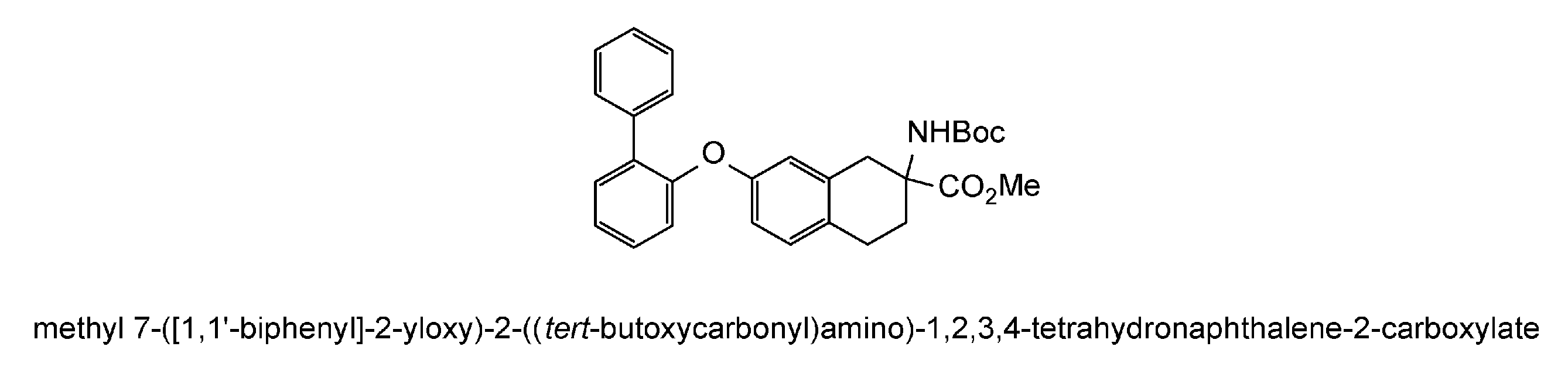
7-([1,1’-ビフェニル]-2-イルオキシ)-2-カルボキシ-1,2,3,4-テトラヒドロナフタレン-2-アミニウムクロリドの製造
ステップ1で得られた上記化合物を、実施例1-1のステップ5、6と同様にして、下記化合物を合成した。
1H-NMR (CD3OD); 2.10-2.15 (m, 1H), 2.35-2.39 (m, 1H), 2.78-2.84 (m, 1H), 2.91 (d, J = 17.2 Hz, 1H), 2.93-2.99 (m, 1H), 3.41 (d, J = 17.2 Hz, 1H), 6.65 (d, J = 2.4 Hz, 1H), 6.72 (dd, J = 2.4, 8.2 Hz, 1H), 7.00 (d, J = 7.9 Hz, 1H), 7.09 (d, J = 8.3 Hz, 1H), 7.24-7.27 (m, 2H), 7.30-7.35 (m, 3H), 7.45-7.50 (m, 3H).

2-カルボキシ-7-(フェナントレン-3-イルオキシ)-1,2,3,4-テトラヒドロナフタレン-2-アミニウムクロリド(化合物1-35)の製造
ステップ1(工程I-IV)
メチル 2-((tert-ブトキシカルボニル)アミノ)-7-(フェナントレン-3-イルオキシ)-1,2,3,4-テトラヒドロナフタレン-2-カルボキシレートの製造
実施例1-1のステップ1からステップ4と同様にして、ただし、実施例のステップ4の2-ヨードナフタレンを3-ヨードフェナントレンに変えて、下記化合物を得た。
1H-NMR (CDCl3); 1.43 (s, 9H), 2.11-2.18 (m, 1H), 2.50 (brs, 1H), 2.84-2.86 (m, 2H), 2.91 (d, J = 16.5 Hz, 1H), 3.28 (d, J = 17.0 Hz, 1H), 3.76 (s, 3H), 4.83 (brs, 1H), 6.80 (d, J = 3.0 Hz, 1H), 6.91 (dd, J = 2.5, 8.5 Hz, 1H), 7.11 (d, J = 8.0 Hz, 1H), 7.30 (dd, J = 2.5, 9.0 Hz, 1H), 7.58-7.63 (m, 2H), 7.68 (d, J = 9.0 Hz, 1H), 7.72 (d, J = 9.0 Hz, 1H), 7.86-7.89 (m, 2H), 8.25 (d, J = 2.5 Hz, 1H), 8.49-8.51 (m, 1H).

2-カルボキシ-7-(フェナントレン-3-イルオキシ)-1,2,3,4-テトラヒドロナフタレン-2-アミニウムクロリドの製造
ステップ1で得られた上記化合物を、実施例1-1のステップ5、6と同様にして、下記化合物を合成した。
1H-NMR (CD3OD); 2.16-2.22 (m, 1H), 2.39-2.46 (m, 1H), 2.89-2.95 (m, 1H), 3.00 (d, J = 18.0 Hz, 1H), 3.01-3.07 (m, 1H), 3.50 (d, J = 17.2 Hz, 1H), 6.92 (d, J = 2.6 Hz, 1H), 6.97-6.99 (m, 1H), 7.25 (d, J = 8.4 Hz, 1H), 7.29 (dd, J = 2.4, 8.4 Hz, 1H), 7.58-7.60 (m, 2H), 7.69-7.75 (m, 2H), 7.88-7.92 (m, 2H), 8.24 (m, 1H), 8.47-8.49 (m, 1H).

2-アミノ-7-((7-ジメチルアミノ)ナフタレン-1-イル)オキシ)-1,2,3,4-テトラヒドロナフタレン-2-カルボン酸(化合物1-36)の製造
ステップ1(工程I-IV)
メチル 2-((tert-ブトキシカルボニル)アミノ)-7-((7-ジメチルアミノ)ナフタレン-1-イル)オキシ)-1,2,3,4-テトラヒドロナフタレン-2-カルボキシレートの製造
実施例1-1のステップ1からステップ4と同様にして、ただし、実施例のステップ4の2-ヨードナフタレンを8-ヨード-N,N-ジメチルナフタレン-2-アミンに変えて、下記化合物を得た。
1H-NMR (CDCl3); 1.43 (s, 9H), 2.09-2.15 (m, 1H), 2.49 (brs, 1H), 2.81-2.83 (m, 2H), 2.87 (d, J = 18.0 Hz, 1H), 3.03 (s, 6H), 3.24 (d, J = 16.5 Hz, 1H), 3.76 (s, 3H), 4.80 (brs, 1H), 6.75 (d, J = 2.0 Hz, 1H), 6.85-6.89 (m, 2H), 7.07 (d, J = 8.5 Hz, 1H), 7.10 (t, J = 8.0 Hz, 1H), 7.19-7.21 (m, 2H), 7.48 (d, J = 8.5 Hz, 1H), 7.74 (d, J = 10.0 Hz, 1H).

2-((tert-ブトキシカルボニル)アミノ)-7-((7-ジメチルアミノ)ナフタレン-1-イル)オキシ)-1,2,3,4-テトラヒドロナフタレン-2-カルボン酸の製造
上記化合物を、実施例1-6のステップ2と同様にして、下記化合物を合成した。また、このカルボン酸化合物を精製せずにそのまま次工程に用いた。
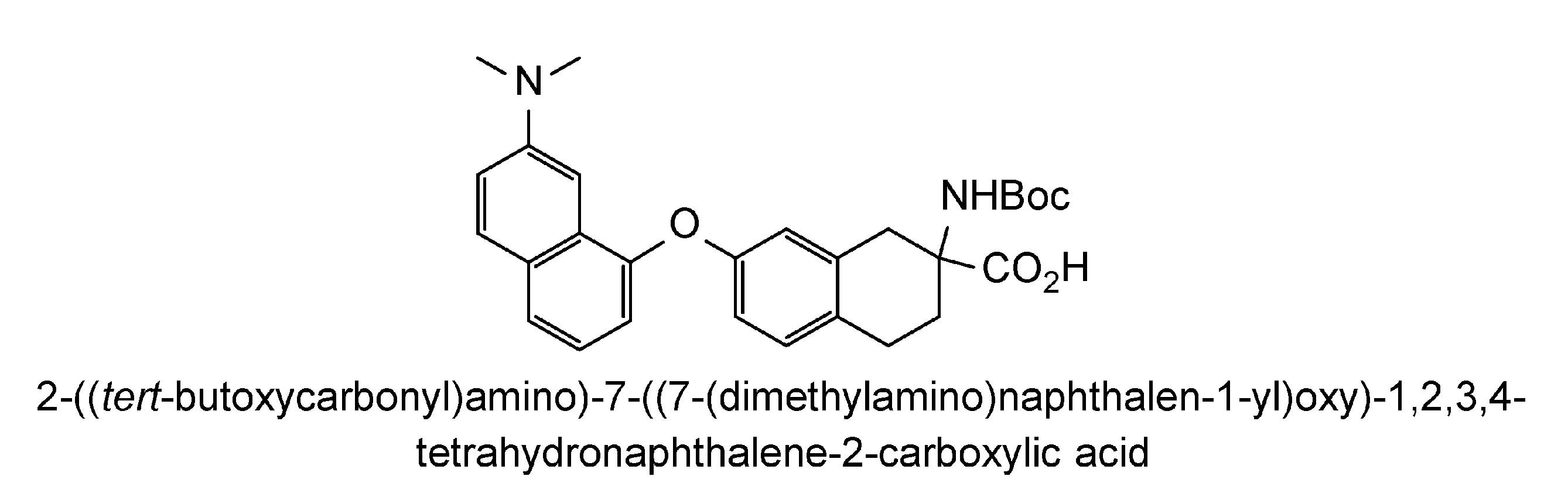
2-アミノ-7-((7-ジメチルアミノ)ナフタレン-1-イル)オキシ)-1,2,3,4-テトラヒドロナフタレン-2-カルボン酸の製造
上記化合物を、実施例1-6のステップ3と同様にして、下記化合物を合成した。
1H-NMR (DMSO-d6); 1.82-1.86 (m, 1H), 2.04-2.10 (m, 1H), 2.70 (d, J = 18.0 Hz, 1H), 2.70-2.80 (m, 2H), 2.97 (s, 6H), 3.27 (d, J = 17.0 Hz, 1H), 6.76-6.78 (m, 2H), 6.81 (d, J = 7.5 Hz, 1H), 7.03 (d, J = 2.5 Hz, 1H), 7.07 (d, J = 8.0 Hz, 1H), 7.10 (t, J = 8.0 Hz, 1H), 7.28 (dd, J = 3.0, 9.5 Hz, 1H), 7.51 (d, J = 8.5 Hz, 1H), 7.79 (d, J = 9.0 Hz, 1H).
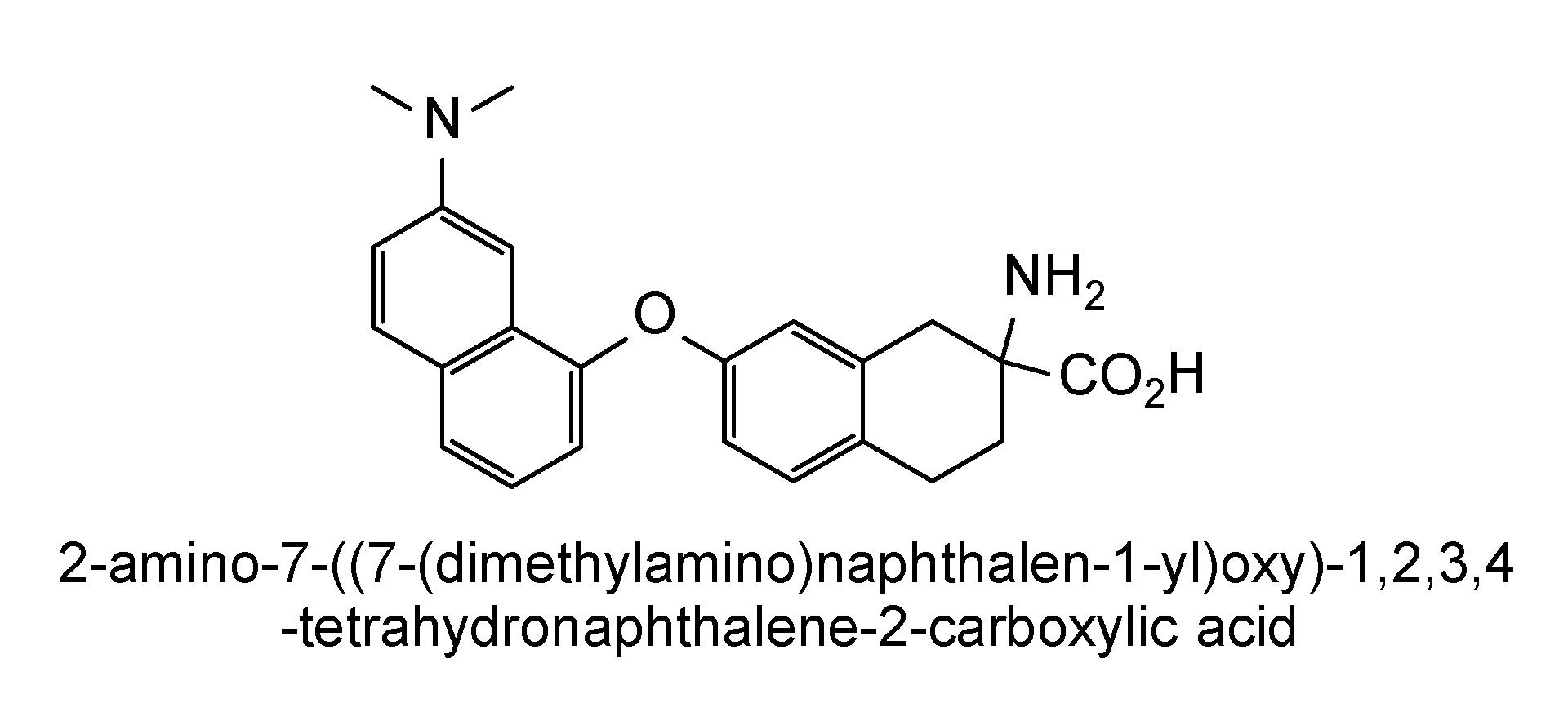
7-(アントラセン-2-イルオキシ)-2-カルボキシ-1,2,3,4-テトラヒドロナフタレン-2-アミニウムクロリド(化合物1-42)の製造
ステップ1(工程I-IV)
メチル 7-(アントラセン-2-イルオキシ)-2-((tert-ブトキシカルボニル)アミノ)-1,2,3,4-テトラヒドロナフタレン-2-カルボキシレートの製造
実施例1-1のステップ1からステップ4と同様にして、ただし、実施例のステップ4の2-ヨードナフタレンを2-ヨードアントラセンに変えて、下記化合物を得た。
1H-NMR (CDCl3); 1.44 (s, 9H), 2.12-2.18 (m, 1H), 2.51 (brs, 1H), 2.85-2.87 (m, 2H), 2.93 (d, J = 16.5 Hz, 1H), 3.30 (d, J = 16.5 Hz, 1H), 3.77 (s, 3H), 4.84 (brs, 1H), 6.83 (d, J = 1.5 Hz, 1H), 6.94 (dd, J = 2.5, 8.0 Hz, 1H), 7.14 (d, J = 8.5 Hz, 1H), 7.27 (dd, J = 2.5, 9.5 Hz, 1H), 7.34 (s, 1H), 7.41-7.46 (m, 2H), 7.92 (d, J = 7.5 Hz, 1H), 7.97-8.00 (m, 2H), 8.25 (s, 1H), 8.40 (s, 1H).

7-(アントラセン-2-イルオキシ)-2-カルボキシ-1,2,3,4-テトラヒドロナフタレン-2-アミニウムクロリドの製造
ステップ1で得られた上記化合物を、実施例1-1のステップ5、6と同様にして、下記化合物を合成した。
1H-NMR (CD3OD); 2.17-2.22 (m, 1H), 2.41-2.47 (m, 1H), 2.89-2.96 (m, 1H), 3.02 (d, J = 17.0 Hz, 1H), 3.04-3.09 (m, 1H), 3.51 (d, J = 17.0 Hz, 1H), 6.94 (d, J = 2.5 Hz, 1H), 7.00 (dd, J = 2.0, 8.5 Hz, 1H), 7.24-7.26 (m, 2H), 7.35 (d, J = 1.5 Hz, 1H), 7.41-7.46 (m, 2H), 7.93 (d, J = 8.0 Hz, 1H), 8.00 (d, J = 7.5 Hz, 1H), 8.05 (d, J = 9.0 Hz, 1H), 8.23 (s, 1H), 8.44 (s, 1H).
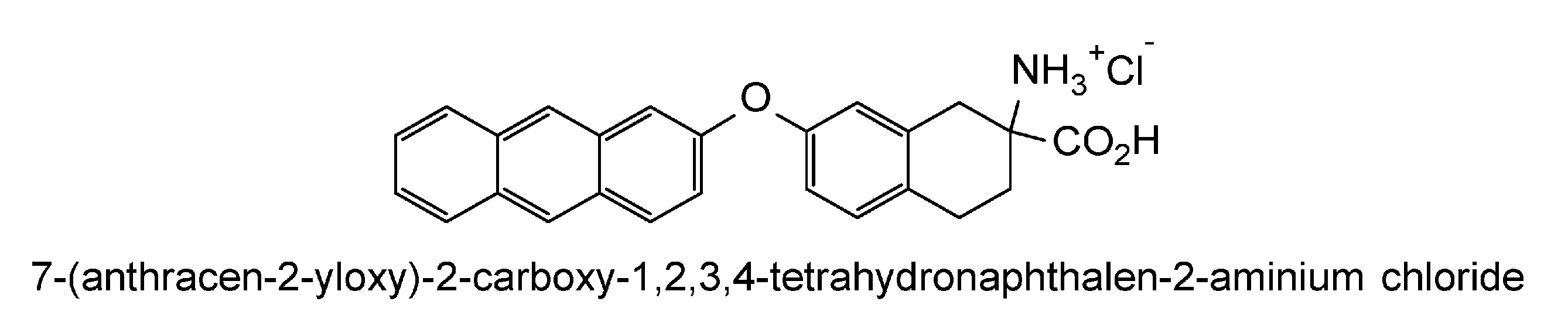
2-アミノ-7-((4’-(ジメチルアミノ)-[1,1’-ビフェニル]-3-イル)オキシ)-1,2,3,4-テトラヒドロナフタレン-2-カルボン酸(化合物1-41)の製造
ステップ1(工程I-IV)
メチル 2-((tert-ブトキシカルボニル)アミノ)-7-((4’-(ジメチルアミノ)-[1,1’-ビフェニル]-3-イル)オキシ)-1,2,3,4-テトラヒドロナフタレン-2-カルボキシレートの製造
実施例1-1のステップ1からステップ4と同様にして、ただし、実施例のステップ4の2-ヨードナフタレンを3’-ヨード-N,N-ジメチル-[1,1’-ビフェニル]-4-アミンに変えて、下記化合物を得た。
1H-NMR (CDCl3); 1.42 (s, 9H), 2.09-2.15 (m, 1H), 2.49 (brs, 1H), 2.80-2.83 (m, 2H), 2.89 (d, J = 16.5 Hz, 1H), 2.99 (s, 6H), 3.25 (d, J = 17.0 Hz, 1H), 3.76 (s, 3H), 4.81 (brs, 1H), 6.75 (d, J = 2.5 Hz, 1H), 6.77-6.79 (m, 2H), 6.85-6.87 (m, 2H), 7.07 (d, J = 8.0 Hz, 1H), 7.20 (t, J = 2.5 Hz, 1H), 7.29-7.31 (m, 1H), 7.34 (t, J = 7.5 Hz, 1H), 7.46-7.49 (m, 2H).

2-((tert-ブトキシカルボニル)アミノ)-7-((4’-(ジメチルアミノ)-[1,1’-ビフェニル]-3-イル)オキシ)-1,2,3,4-テトラヒドロナフタレン-2-カルボン酸の製造
上記化合物を、実施例1-6のステップ2と同様にして、下記化合物を合成した。また、このカルボン酸化合物を精製せずにそのまま次工程に用いた。
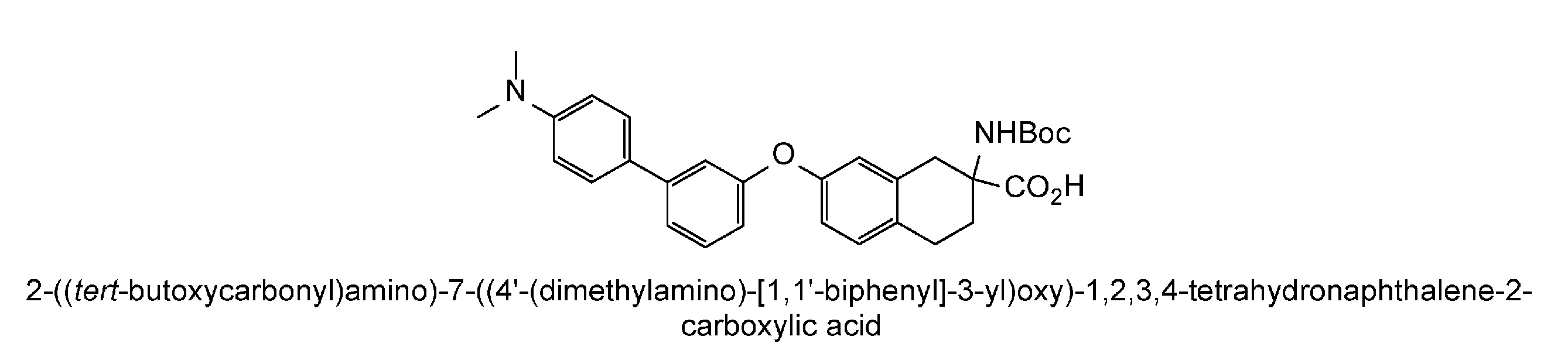
2-アミノ-7-((4’-(ジメチルアミノ)-[1,1’-ビフェニル]-3-イル)オキシ)-1,2,3,4-テトラヒドロナフタレン-2-カルボン酸の製造
上記化合物を、実施例1-6のステップ3と同様にして、下記化合物を合成した。
1H-NMR (DMSO-d6); 1.79-1.82 (m, 1H), 2.02-2.08 (m, 1H), 2.68 (d, J = 18.0 Hz, 1H), 2.72-2.78 (m, 2H), 2.91 (s, 6H), 3.26 (d, J = 17.0 Hz, 1H), 6.75-6.79 (m, 5H), 7.08 (d, J = 8.0 Hz, 1H), 7.16 (s, 1H), 7.30-7.36 (m, 2H), 7.46 (d, J = 8.5 Hz, 2H).
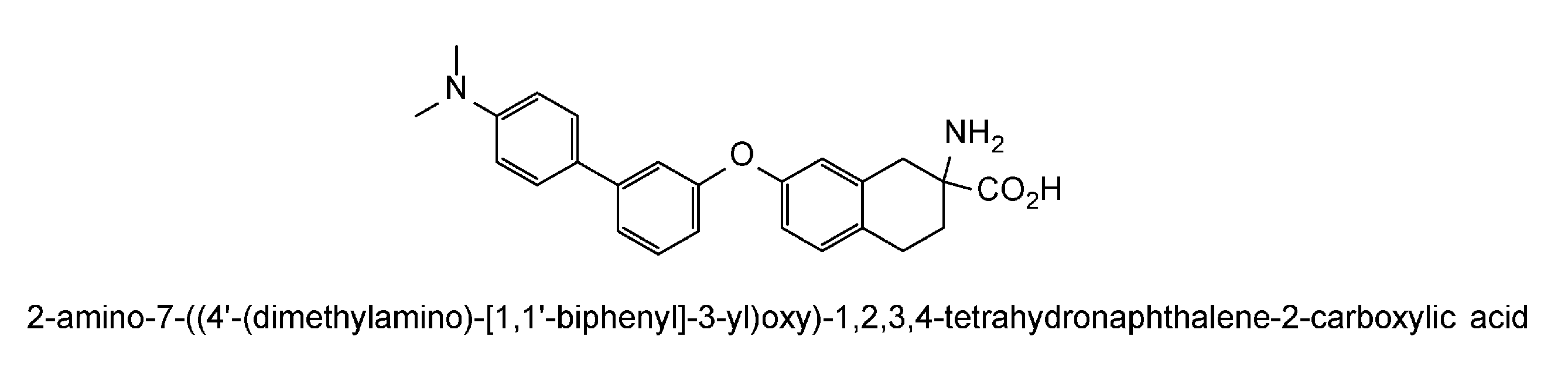
2-カルボキシ-7-((6-フルオロナフタレン-2-イル)オキシ)-1,2,3,4-テトラヒドロナフタレン-2-アミニウムクロリド(化合物1-7)の製造
ステップ1(工程I-IV)
メチル 2-((tert-ブトキシカルボニル)アミノ)-7-((6-フルオロナフタレン-2-イル)オキシ)-1,2,3,4-テトラヒドロナフタレン-2-カルボキシレートの製造
実施例1-1のステップ1からステップ4と同様にして、ただし、実施例のステップ4の2-ヨードナフタレンを2-ブロモ-6-フルオロナフタレンに変えて、下記化合物を得た。
1H-NMR (CDCl3); 1.43 (s, 9H), 2.10-2.17 (m, 1H), 2.49 (brs, 1H), 2.83-2.85 (m, 2H), 2.91 (d, J = 17.0 Hz, 1H), 3.29 (d, J = 17.0 Hz, 1H), 3.76 (s, 3H), 4.82 (brs, 1H), 6.76 (d, J = 2.0 Hz, 1H), 6.87 (dd, J = 2.5, 8.5 Hz, 1H), 7.11 (d, J = 8.5 Hz, 1H), 7.23 (dd, J = 2.0, 8.5 Hz, 1H), 7.26-7.29 (m, 2H), 7.44 (dd, J = 3.0, 10.0 Hz, 1H), 7.68 (dd, J = 6.0, 9.5 Hz, 1H), 7.76 (d, J = 8.5 Hz, 1H).

2-カルボキシ-7-((6-フルオロナフタレン-2-イル)オキシ)-1,2,3,4-テトラヒドロナフタレン-2-アミニウムクロリドの製造
ステップ1で得られた上記化合物を、実施例1-1のステップ5、6と同様にして、下記化合物を合成した。
1H-NMR (CD3OD); 2.16-2.21 (m, 1H), 2.40-2.46 (m, 1H), 2.88-2.94 (m, 1H), 3.00 (d, J = 17.0 Hz, 1H), 3.03-3.07 (m, 1H), 3.49 (d, J = 17.0 Hz, 1H), 6.87 (d, J = 2.5 Hz, 1H), 6.93 (dd, J = 2.0, 8.0 Hz, 1H), 7.23 (d, J = 9.0 Hz, 1H), 7.26-7.31 (m, 3H), 7.52 (dd, J = 3.0, 10.5 Hz, 1H), 7.74 (dd, J = 6.0, 9.5 Hz, 1H), 7.85 (d, J = 9.5 Hz, 1H).

2-カルボキシ-7-((8-クロロナフタレン-2-イル)オキシ)-1,2,3,4-テトラヒドロナフタレン-2-アミニウムクロリド(化合物1-44)の製造
ステップ1(工程I-IV)
メチル 2-((tert-ブトキシカルボニル)アミノ)-7-((8-クロロナフタレン-2-イル)オキシ)-1,2,3,4-テトラヒドロナフタレン-2-カルボキシレートの製造
実施例1-1のステップ1からステップ4と同様にして、ただし、実施例のステップ4の2-ヨードナフタレンを7-ブロモ-1-クロロナフタレンに変えて、下記化合物を得た。
1H-NMR (CDCl3); 1.43 (s, 9H), 2.11-2.18 (m, 1H), 2.48 (brs, 1H), 2.84-2.86 (m, 2H), 2.93 (d, J = 16.5 Hz, 1H), 3.29 (d, J = 17.0 Hz, 1H), 3.77 (s, 3H), 4.83 (brs, 1H), 6.79 (d, J = 2.5 Hz, 1H), 6.89 (dd, J = 2.0, 8.0 Hz, 1H), 7.12 (d, J = 8.5 Hz, 1H), 7.28 (dd, J = 2.0, 8.5 Hz, 1H), 7.31 (t, J = 7.5 Hz, 1H), 7.55-7.56 (m, 1H), 7.73-7.75 (m, 2H), 7.84 (d, J = 9.5 Hz, 1H).
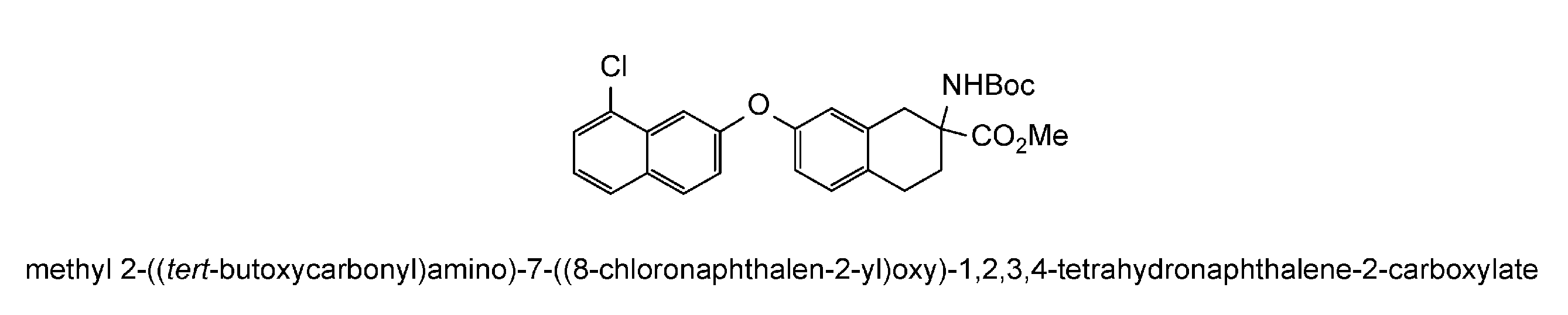
2-カルボキシ-7-((8-クロロナフタレン-2-イル)オキシ)-1,2,3,4-テトラヒドロナフタレン-2-アミニウムクロリドの製造
ステップ1で得られた上記化合物を、実施例1-1のステップ5、6と同様にして、下記化合物を合成した。
1H-NMR (CD3OD); 2.18-2.23 (m, 1H), 2.41-2.47 (m, 1H), 2.90-2.96 (m, 1H), 3.03 (d, J = 18.0 Hz, 1H), 3.04-3.10 (m, 1H), 3.52 (d, J = 18.0 Hz, 1H), 6.94 (d, J = 1.5 Hz, 1H), 6.99 (dd, J = 1.5, 8.0 Hz, 1H), 7.27 (d, J = 9.0 Hz, 1H), 7.32 (dd, J = 3.0, 9.5 Hz, 1H), 7.35 (d, J = 8.0 Hz, 1H), 7.57 (d, J = 7.5 Hz, 1H), 7.61 (d, J = 2.5 Hz, 1H), 7.82 (d, J = 8.0 Hz, 1H), 7.93 (d, J = 9.0 Hz, 1H).

2-カルボキシ-7-((4’-メチル-[1,1’-ビフェニル]-3-イル)オキシ)-1,2,3,4-テトラヒドロナフタレン-2-アミニウムクロリド(化合物1-45)の製造
ステップ1(工程I-IV)
メチル 2-((tert-ブトキシカルボニル)アミノ)-7-((4’-メチル-[1,1’-ビフェニル]-3-イル)オキシ)-1,2,3,4-テトラヒドロナフタレン-2-カルボキシレートの製造
実施例1-1のステップ1からステップ4と同様にして、ただし、実施例のステップ4の2-ヨードナフタレンを3-ヨード-4’-メチル-1,1’-ビフェニルに変えて、下記化合物を得た。
1H-NMR (CDCl3); 1.42 (s, 9H), 2.09-2.15 (m, 1H), 2.39 (s, 3H), 2.50 (brs, 1H), 2.82-2.83 (m, 2H), 2.90 (d, J = 16.0 Hz, 1H), 3.27 (d, J = 17.0 Hz, 1H), 3.76 (s, 3H), 4.81 (brs, 1H), 6.75 (d, J = 2.5 Hz, 1H), 6.86 (dd, J = 2.0, 8.0 Hz, 1H), 6.93-6.95 (m, 1H), 7.08 (d, J = 8.5 Hz, 1H), 7.22-7.24 (m, 3H), 7.30-7.32 (m, 1H), 7.37 (t, J = 8.0 Hz, 1H), 7.45-7.47 (m, 2H).
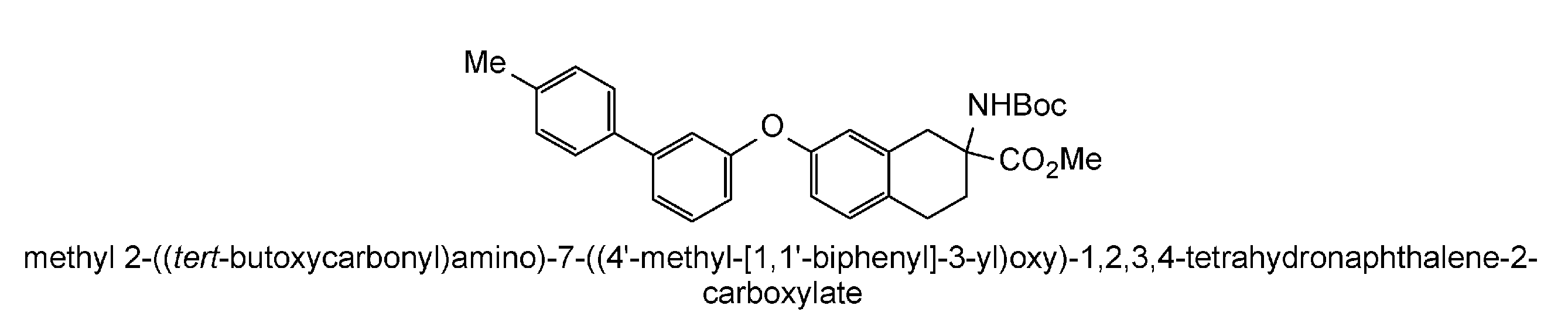
2-カルボキシ-7-((4’-メチル-[1,1’-ビフェニル]-3-イル)オキシ)-1,2,3,4-テトラヒドロナフタレン-2-アミニウムクロリドの製造
ステップ1で得られた上記化合物を、実施例1-1のステップ5、6と同様にして、下記化合物を合成した。
1H-NMR (CD3OD); 2.15-2.20 (m, 1H), 2.35 (s, 3H), 2.38-2.44 (m, 1H), 2.86-2.92 (m, 1H), 2.99 (d, J = 18.0 Hz, 1H), 3.00-3.06 (m, 1H), 3.49 (d, J = 17.0 Hz, 1H), 6.85 (d, J = 2.0 Hz, 1H), 6.91-6.93 (m, 2H), 7.16 (m, 1H), 7.20-7.23 (m, 3H), 7.33 (d, J = 8.0 Hz, 1H), 7.39 (t, J = 8.0 Hz, 1H), 7.43 (d, J = 8.0 Hz, 2H).
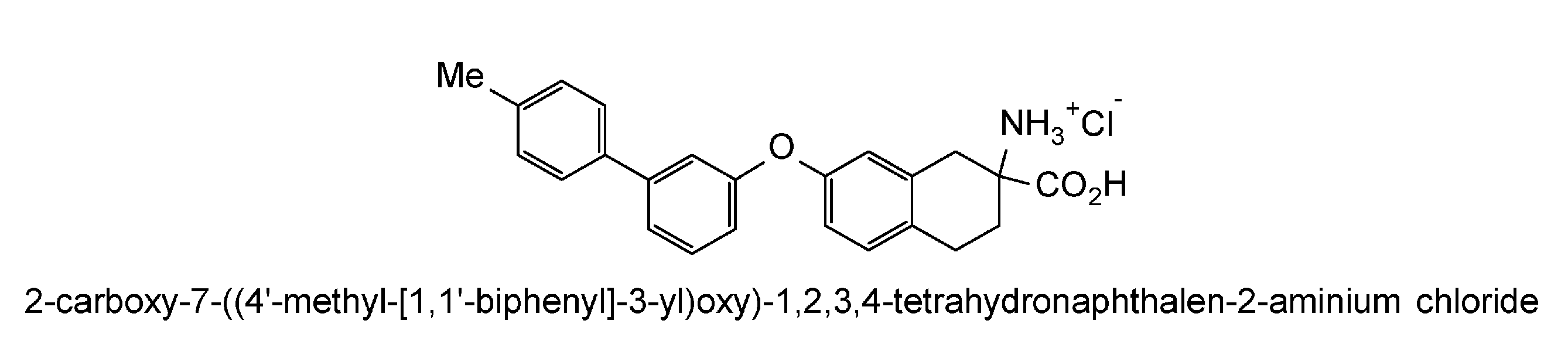
2-カルボキシ-7-((1,2-ジヒドロアセナフチレン-5-イル)オキシ)-1,2,3,4-テトラヒドロナフタレン-2-アミニウムクロリド(化合物1-47)の製造
ステップ1(工程I-IV)
メチル 2-((tert-ブトキシカルボニル)アミノ)-7-((1,2-ジヒドロアセナフチレン-5-イル)オキシ)-1,2,3,4-テトラヒドロナフタレン-2-カルボキシレートの製造
実施例1-1のステップ1からステップ4と同様にして、ただし、実施例のステップ4の2-ヨードナフタレンを5-ヨード-1,2-ジヒドロアセナフチレンに変えて、下記化合物を得た。
1H-NMR (CDCl3); 1.42 (s, 9H), 2.07-2.13 (m, 1H), 2.48 (brs, 1H), 2.79-2.81 (m, 2H), 2.84 (d, J = 17.5 Hz, 1H), 3.22 (d, J = 17.0 Hz, 1H), 3.37-3.39 (m, 2H), 3.44-3.47 (m, 2H), 3.75 (s, 3H), 4.79 (brs, 1H), 6.68 (d, J = 2.0 Hz, 1H), 6.81 (dd, J = 2.5, 8.0 Hz, 1H), 6.98 (d, J = 7.5 Hz, 1H), 7.04 (d, J = 8.5 Hz, 1H), 7.18 (d, J = 7.5 Hz, 1H), 7.30 (d, J = , 7.0 Hz, 1H), 7.41 (dd, J = 7.0, 8.0 Hz, 1H), 7.67 (m, J = 8.0 Hz, 1H).
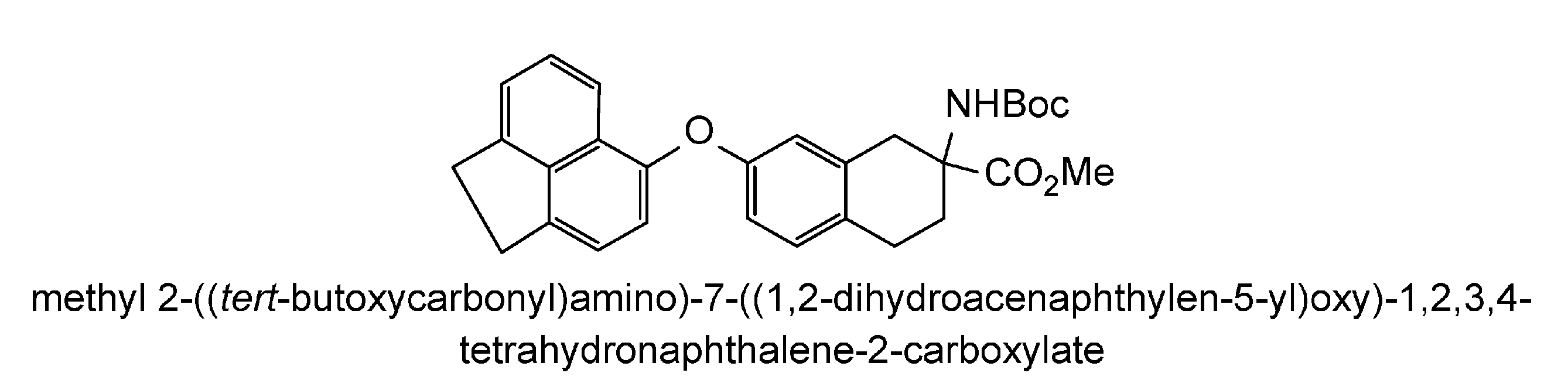
2-カルボキシ-7-((1,2-ジヒドロアセナフチレン-5-イル)オキシ)-1,2,3,4-テトラヒドロナフタレン-2-アミニウムクロリドの製造
ステップ1で得られた上記化合物を、実施例1-1のステップ5、6と同様にして、下記化合物を合成した。
1H-NMR (CD3OD); 2.13-2.18 (m, 1H), 2.36-2.42 (m, 1H), 2.83-3.03 (m, 3H), 3.35-3.37 (m, 2H), 3.41-3.44 (m, 2H), 6.74 (d, J = 2.6 Hz, 1H), 6.84 (dd, J = 2.7, 8.5 Hz, 1H), 6.97 (d, J = 7.4 Hz, 1H), 7.14 (d, J = 8.5 Hz, 1H), 7.20 (d, J = 7.6 Hz, 1H), 7.29 (d, J = 6.8 Hz, 1H), 7.35-7.39 (m, 1H), 7.53 (d, J = 8.4 Hz, 1H).

2-カルボキシ-7-((5,6,7,8-テトラヒドロナフタレン-2-イル)オキシ)-1,2,3,4-テトラヒドロナフタレン-2-アミニウムクロリド(化合物1-48)の製造
ステップ1(工程I-IV)
メチル 2-((tert-ブトキシカルボニル)アミノ)-7-((5,6,7,8-テトラヒドロナフタレン-2-イル)オキシ)-1,2,3,4-テトラヒドロナフタレン-2-カルボキシレートの製造
実施例1-1のステップ1からステップ4と同様にして、ただし、実施例のステップ4の2-ヨードナフタレンを5-ヨード-1,2,3,4-テトラヒドロナフタレンに変えて、下記化合物を得た。
1H-NMR (CDCl3); 1.42 (s, 9H), 1.76-1.82 (m, 4H), 2.08-2.14 (m, 1H), 2.48 (brs, 1H), 2.72-2.75 (m, 4H), 2.79-2.82 (m, 2H), 2.88 (d, J = 17.0 Hz, 1H), 3.24 (d, J = 16.5 Hz, 1H), 3.76 (s, 3H), 4.81 (brs, 1H), 6.67 (d, J = 2.0 Hz, 1H), 6.70 (d, J = 2.5 Hz, 1H), 6.74 (dd, J = 3.0, 8.5 Hz, 1H), 6.80 (dd, J = 3.0, 8.5 Hz, 1H), 7.01 (d, J = 8.5 Hz, 1H), 7.05 (d, J = 8.0 Hz, 1H).
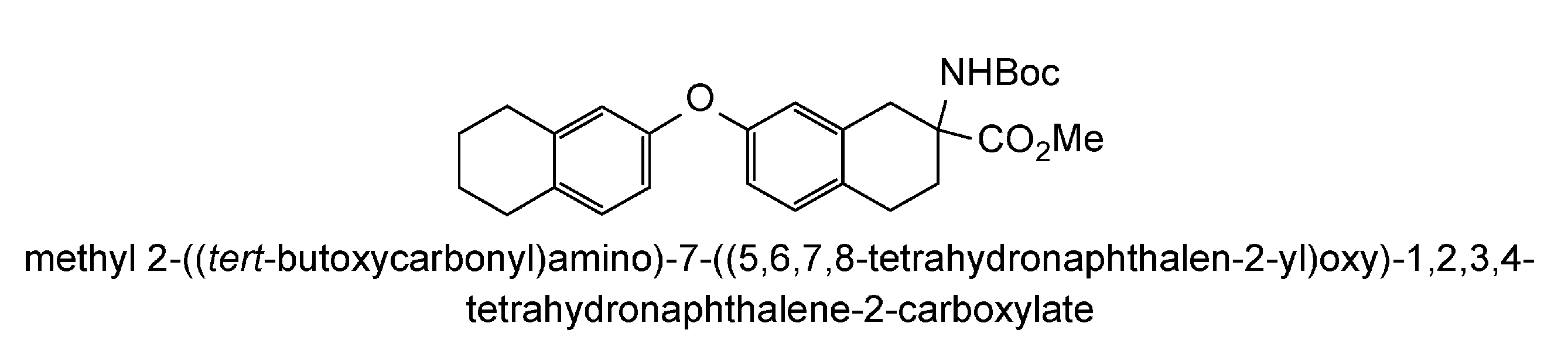
2-カルボキシ-7-((5,6,7,8-テトラヒドロナフタレン-2-イル)オキシ)-1,2,3,4-テトラヒドロナフタレン-2-アミニウムクロリドの製造
ステップ1で得られた上記化合物を、実施例1-1のステップ5、6と同様にして、下記化合物を合成した。
1H-NMR (CD3OD); 1.76-1.81 (m, 4H), 2.14-2.19 (m, 1H), 2.37-2.43 (m, 1H), 2.70-2.73 (m, 4H), 2.83-2.90 (m, 1H), 2.97 (d, J = 17.5 Hz, 1H), 3.00-3.03 (m, 1H), 3.46 (d, J = 17.0 Hz, 1H), 6.64 (d, J = 2.5 Hz, 1H), 6.68 (dd, J = 2.0, 8.0 Hz, 1H), 6.74 (d, J = 2.0 Hz, 1H), 6.81 (dd, J = 2.5, 8.5 Hz, 1H), 7.00 (d, J = 8.5 Hz, 1H), 7.15 (d, J = 8.5 Hz, 1H).

2-カルボキシ-7-(2-(ナフタレン-2-イル)フェノキシ)-1,2,3,4-テトラヒドロナフタレン-2-アミニウムクロリド(化合物1-49)の製造
ステップ1(工程I-IV)
メチル 2-((tert-ブトキシカルボニル)アミノ)-7-(2-(ナフタレン-2-イル)フェノキシ)-1,2,3,4-テトラヒドロナフタレン-2-カルボキシレートの製造
実施例1-1のステップ1からステップ4と同様にして、ただし、実施例のステップ4の2-ヨードナフタレンを2-(2-ヨードフェニル)ナフタレンに変えて、さらに、反応温度を90℃から120℃にして、下記化合物を得た。
1H-NMR (CDCl3); 1.41 (s, 9H), 2.04-2.10 (m, 1H), 2.44 (brs, 1H), 2.74-2.77 (m, 2H), 2.83 (d, J = 16.5 Hz, 1H), 3.19 (d, J = 16.5 Hz, 1H), 3.74 (s, 3H), 4.75 (brs, 1H), 6.64 (d, J = 2.0 Hz, 1H), 6.77 (dd, J = 2.5, 8.0 Hz, 1H), 6.99-7.04 (m, 2H), 7.24 (dd, J = 1.5, 7.5 Hz, 1H), 7.33 (td, J = 1.5, 8.0 Hz, 1H), 7.44-7.48 (m, 2H), 7.56 (dd, J = 1.5, 7.5 Hz, 1H), 7.70 (dd, J = 1.5, 8.0 Hz, 1H), 7.81-7.86 (m, 3H), 7.99 (d, J = 1.5 Hz, 1H).
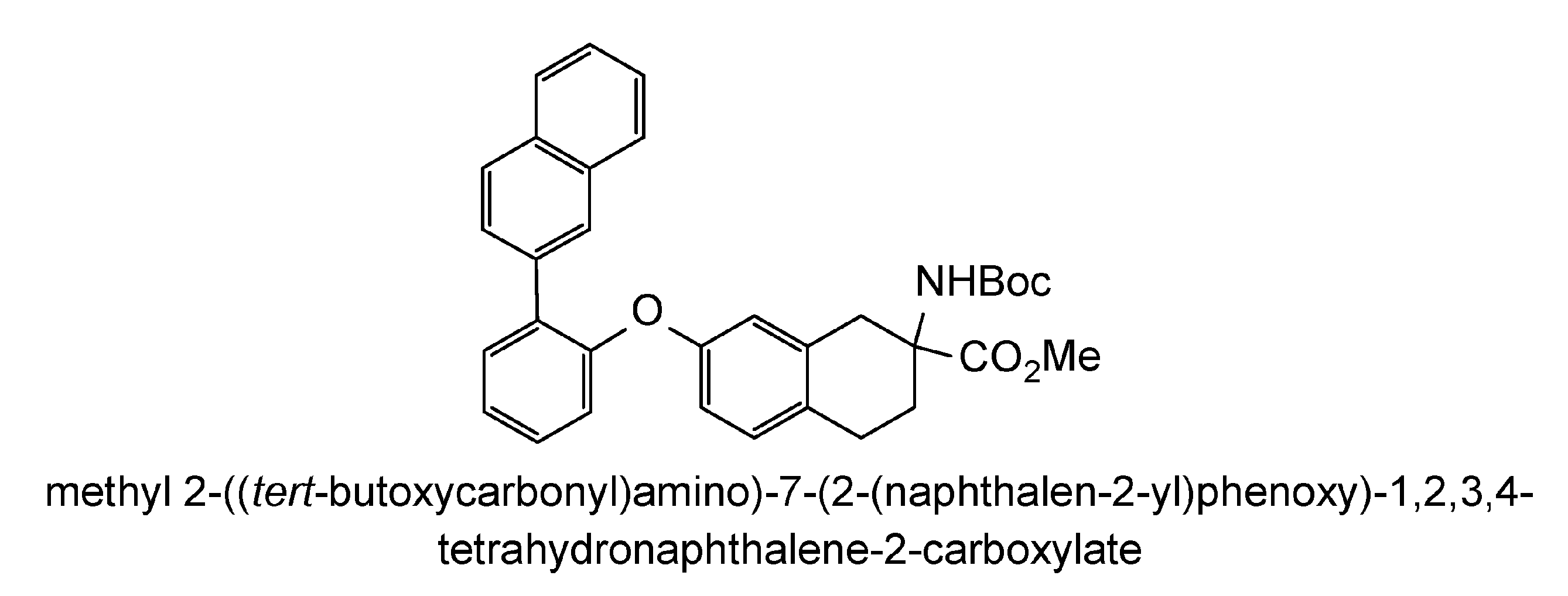
2-((tert-ブトキシカルボニル)アミノ)-7-(2-(ナフタレン-2-イル)フェノキシ)-1,2,3,4-テトラヒドロナフタレン-2-カルボン酸の製造
上記化合物を、実施例1-1のステップ5と同様にして、下記化合物を合成した。また、このカルボン酸化合物を精製せずにそのまま次工程に用いた。
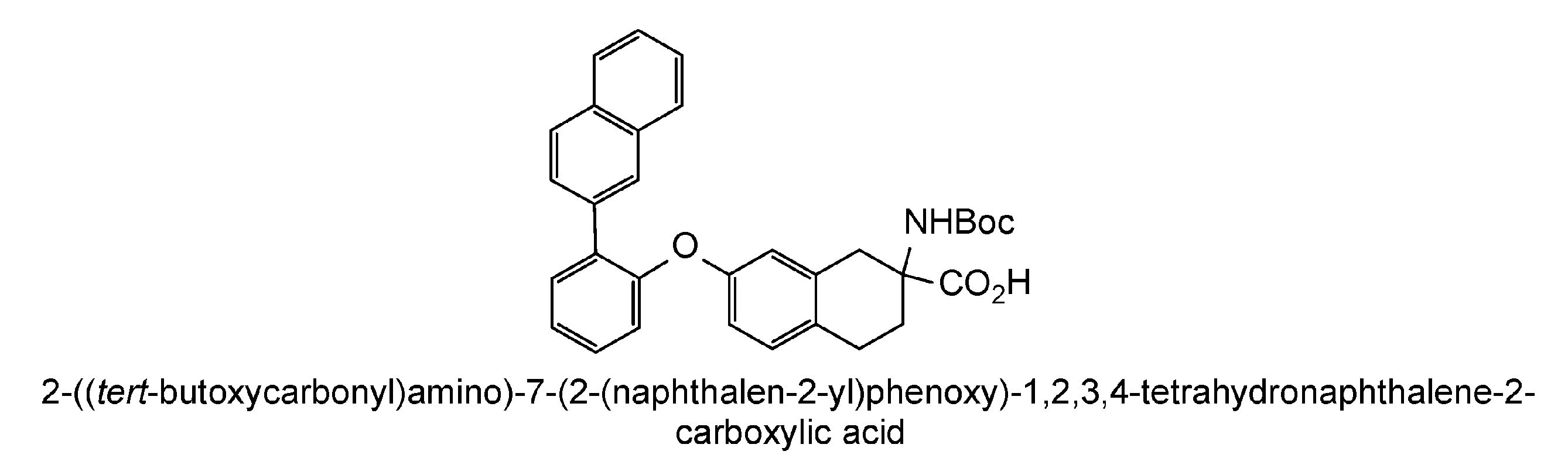
上記で得られたカルボン酸化合物(180 mg, 0.353 mmol)に3M HCl-CPME(5 mL)を加えた。これを60℃、2時間反応させた。反応終了後、溶媒を留去させた後、得られた残渣をシリカゲルカラムクロマトグラフィーにて精製し、目的物(110 mg, 70%)を得た。
1H-NMR (CD3OD); 1.97-2.01 (m, 1H), 2.24-2.31 (m, 1H), 2.67-2.73 (m, 1H), 2.76 (d, J = 17.5 Hz, 1H), 2.84-2.90 (m, 1H), 3.49 (d, J = 17.5 Hz, 1H), 6.63 (d, J = 2.0 Hz, 1H), 6.69 (dd, J = 2.0, 8.5 Hz, 1H), 7.00-7.06 (m, 2H), 7.30 (td, J = 1.5, 7.5 Hz, 1H), 7.37 (td, J = 2.0, 8.0 Hz, 1H), 7.43-7.46 (m, 2H), 7.59 (dd, J = 1.0, 7.5 Hz, 1H), 7.67 (dd, J = 2.0, 8.5 Hz, 1H), 7.77-7.83 (m, 3H), 7.97 (s, 1H).
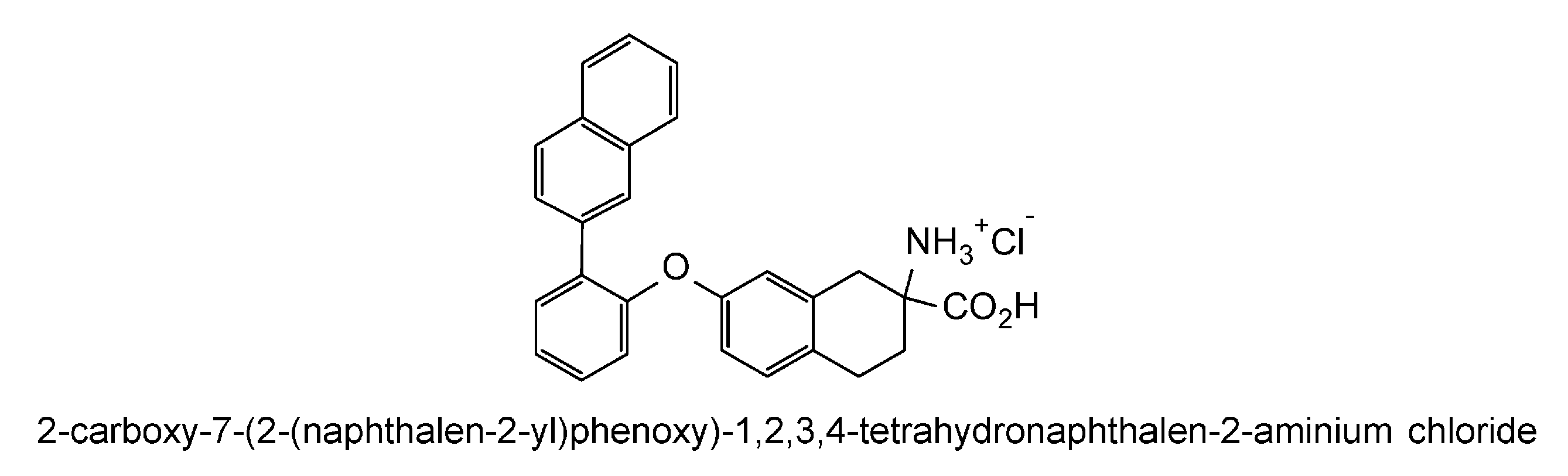
2-カルボキシ-7-((4’-フルオロ-[1,1’-ビフェニル]-2-イル)オキシ)-1,2,3,4-テトラヒドロナフタレン-2-アミニウムクロリド(化合物1-52)の製造
ステップ1(工程I-IV)
メチル 2-((tert-ブトキシカルボニル)アミノ)-7-((4’-フルオロ-[1,1’-ビフェニル]-2-イル)オキシ)-1,2,3,4-テトラヒドロナフタレン-2-カルボキシレートの製造
実施例1-1のステップ1からステップ4と同様にして、ただし、実施例のステップ4の2-ヨードナフタレンを2-ブロモ-4’-フルオロ-1,1’-ビフェニルに変えて、さらに、反応温度を90℃から120℃にして、下記化合物を得た。
1H-NMR (CDCl3); 1.42 (s, 9H), 2.05-2.12 (m, 1H), 2.44 (brs, 1H), 2.76-2.79 (m, 2H), 2.85 (d, J = 16.5 Hz, 1H), 3.22 (d, J = 17.0 Hz, 1H), 3.75 (s, 3H), 4.77 (brs, 1H), 6.61 (d, J = 2.5 Hz, 1H), 6.73 (dd, J = 3.0, 8.5 Hz, 1H), 6.97-7.07 (m, 4H), 7.19 (td, J = 1.0, 7.5 Hz, 1H), 7.29 (td, J = 1.5, 8.0 Hz, 1H), 7.41 (dd, J = 1.0, 7.5 Hz, 1H), 7.48-7.52 (m, 2H).
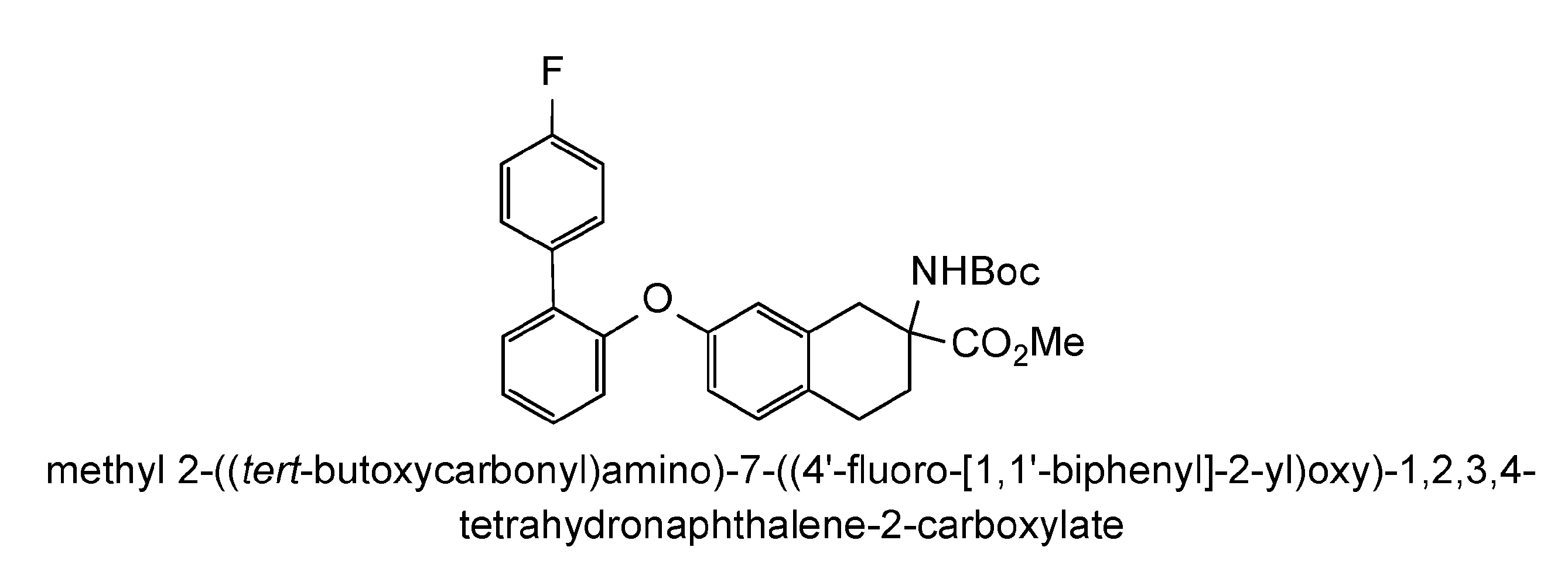
2-カルボキシ-7-((4’-フルオロ-[1,1’-ビフェニル]-2-イル)オキシ)-1,2,3,4-テトラヒドロナフタレン-2-アミニウムクロリドの製造
ステップ1で得られた上記化合物を、実施例1-26のステップ2、3と同様にして、下記化合物を合成した。
1H-NMR (CD3OD); 2.02-2.05 (m, 1H), 2.29-2.35 (m, 1H), 2.73-2.79 (m, 1H), 2.82 (d, J = 17.0 Hz, 1H), 2.89-2.95 (m, 1H), 3.40 (d, J = 17.5 Hz, 1H), 6.62 (d, J = 2.5 Hz, 1H), 6.68 (dd, J = 3.0, 8.5 Hz, 1H), 6.98 (dd, J = 1.5, 8.0 Hz, 1H), 7.02-7.06 (m, 3H), 7.24 (td, J = 1.0, 7.5 Hz, 1H), 7.33 (td, J = 1.5, 8.0 Hz, 1H), 7.44 (dd, J = 2.0, 8.0 Hz, 1H), 7.50-7.54 (m, 2H).
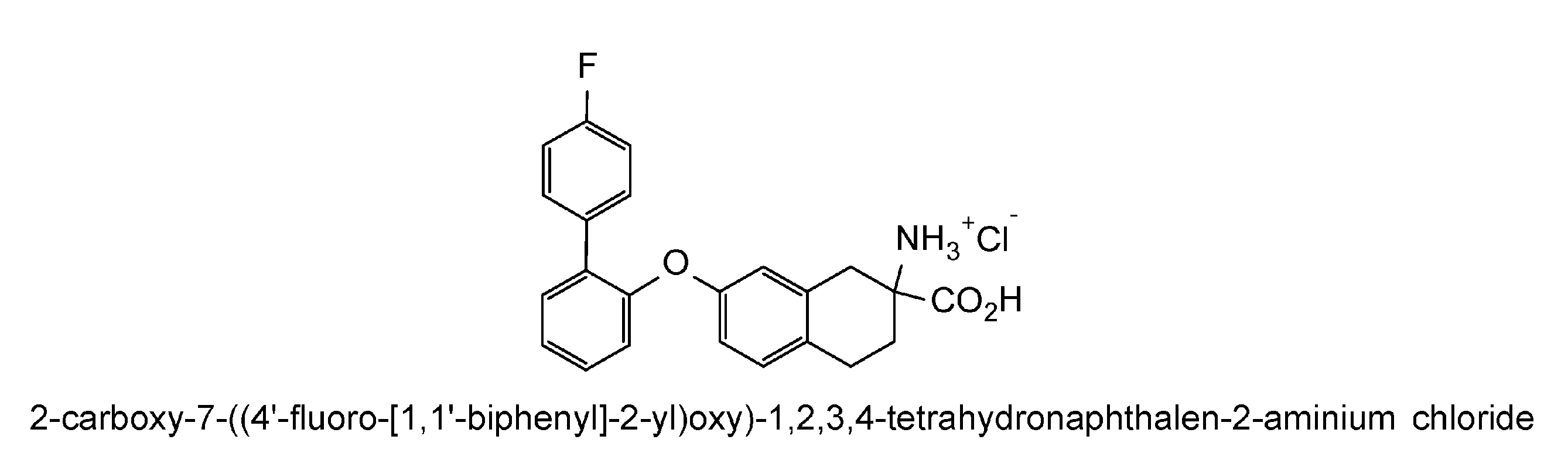
2-カルボキシ-7-((4’-クロロ-[1,1’-ビフェニル]-2-イル)オキシ)-1,2,3,4-テトラヒドロナフタレン-2-アミニウムクロリド(化合物1-53)の製造
ステップ1(工程I-IV)
メチル 2-((tert-ブトキシカルボニル)アミノ)-7-((4’-クロロ-[1,1’-ビフェニル]-2-イル)オキシ)-1,2,3,4-テトラヒドロナフタレン-2-カルボキシレートの製造
実施例1-1のステップ1からステップ4と同様にして、ただし、実施例のステップ4の2-ヨードナフタレンを2-ブロモ-4’-クロロ-1,1’-ビフェニルに変えて、さらに、反応温度を90℃から120℃にして、下記化合物を得た。
1H-NMR (CDCl3); 1.43 (s, 9H), 2.06-2.12 (m, 1H), 2.45 (brs, 1H), 2.77-2.79 (m, 2H), 2.86 (d, J = 17.5 Hz, 1H), 3.23 (d, J = 17.0 Hz, 1H), 3.76 (s, 3H), 4.78 (brs, 1H), 6.61 (d, J = 2.0 Hz, 1H), 6.73 (dd, J = 3.0, 8.5 Hz, 1H), 6.98 (dd, J = 1.0, 8.0 Hz, 1H), 7.02 (d, J = 8.5 Hz, 1H), 7.20 (td, J = 2.0, 8.0 Hz, 1H), 7.30 (td, J = 1.5, 8.0 Hz, 1H), 7.31-7.35 (m, 2H), 7.41 (dd, J = 2.0, 7.5 Hz, 1H), 7.46-7.49 (m, 2H).
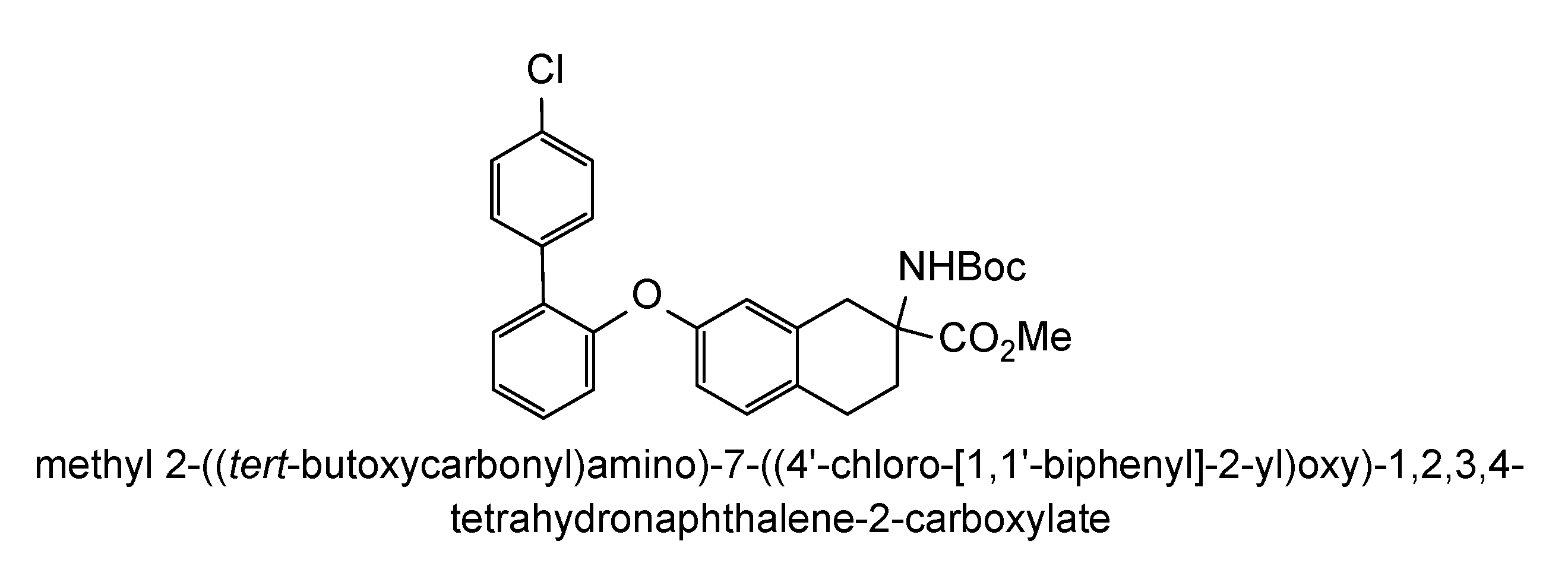
2-カルボキシ-7-((4’-クロロ-[1,1’-ビフェニル]-2-イル)オキシ)-1,2,3,4-テトラヒドロナフタレン-2-アミニウムクロリドの製造
ステップ1で得られた上記化合物を、実施例1-26のステップ2、3と同様にして、下記化合物を合成した。
1H-NMR (CD3OD); 2.02-2.07 (m, 1H), 2.29-2.35 (m, 1H), 2.74-2.79 (m, 1H), 2.83 (d, J = 18.1 Hz, 1H), 2.89-2.95 (m, 1H), 3.39 (d, J = 17.3 Hz, 1H), 6.62 (d, J = 2.6 Hz, 1H), 6.68 (dd, J = 2.5, 8.5 Hz, 1H), 6.99 (d, J = 8.1 Hz, 1H), 7.06 (d, J = 8.4 Hz, 1H), 7.25 (t, J = 7.5 Hz, 1H), 7.30-7.36 (m, 3H), 7.46 (dd, J = 1.7, 8.4 Hz, 1H), 7.50 (d, J = 8.4 Hz, 2H).
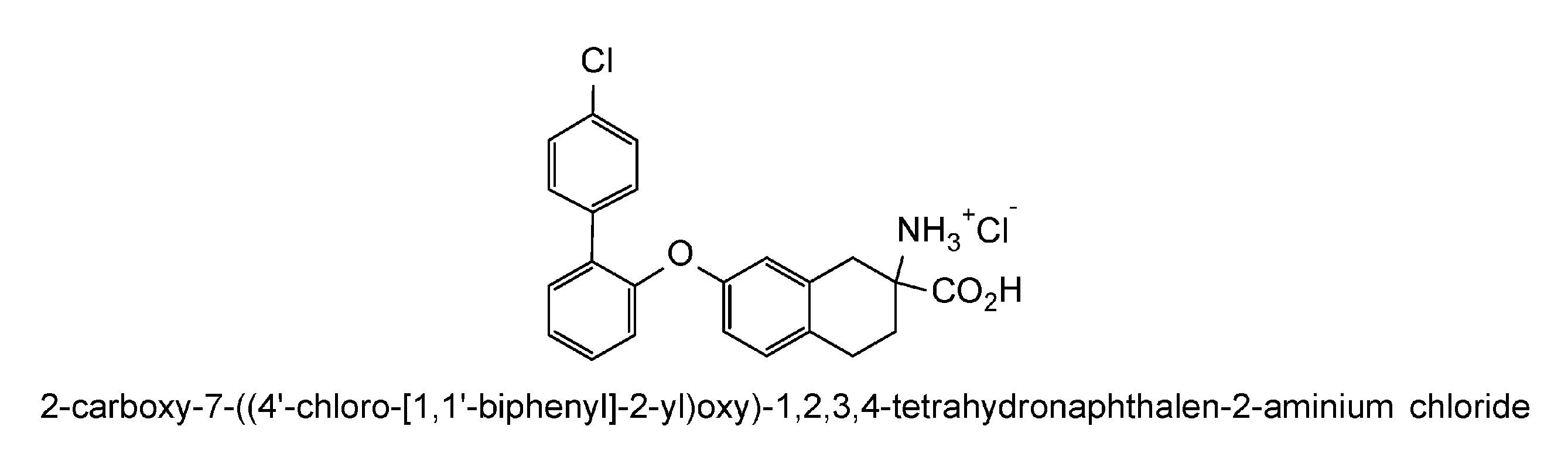
2-カルボキシ-7-((4’-トリフルオロメチル-[1,1’-ビフェニル]-2-イル)オキシ)-1,2,3,4-テトラヒドロナフタレン-2-アミニウムクロリド(化合物1-63)の製造
ステップ1(工程I-IV)
メチル 2-((tert-ブトキシカルボニル)アミノ)-7-((4’-トリフルオロメチル-[1,1’-ビフェニル]-2-イル)オキシ)-1,2,3,4-テトラヒドロナフタレン-2-カルボキシレートの製造
実施例1-1のステップ1からステップ4と同様にして、ただし、実施例のステップ4の2-ヨードナフタレンを2-ブロモ-4’-(トリフルオロメチル)-1,1’-ビフェニルに変えて、さらに、反応温度を90℃から120℃にして、下記化合物を得た。
1H-NMR (CDCl3); 1.42 (s, 9H), 2.06-2.12 (m, 1H), 2.44 (brs, 1H), 2.77-2.80 (m, 2H), 2.87 (d, J = 16.5 Hz, 1H), 3.24 (d, J = 17.0 Hz, 1H), 3.75 (s, 3H), 4.78 (brs, 1H), 6.64 (d, J = 3.0 Hz, 1H), 6.75 (dd, J = 2.0, 8.0 Hz, 1H), 7.00 (dd, J = 1.0, 8.0 Hz, 1H), 7.03 (d, J = 8.5 Hz, 1H), 7.22 (td, J = 1.0, 7.5 Hz, 1H), 7.33 (td, J = 2.0, 8.0 Hz, 1H), 7.44 (dd, J = 1.5, 7.5 Hz, 1H), 7.62-7.67 (m, 4H).
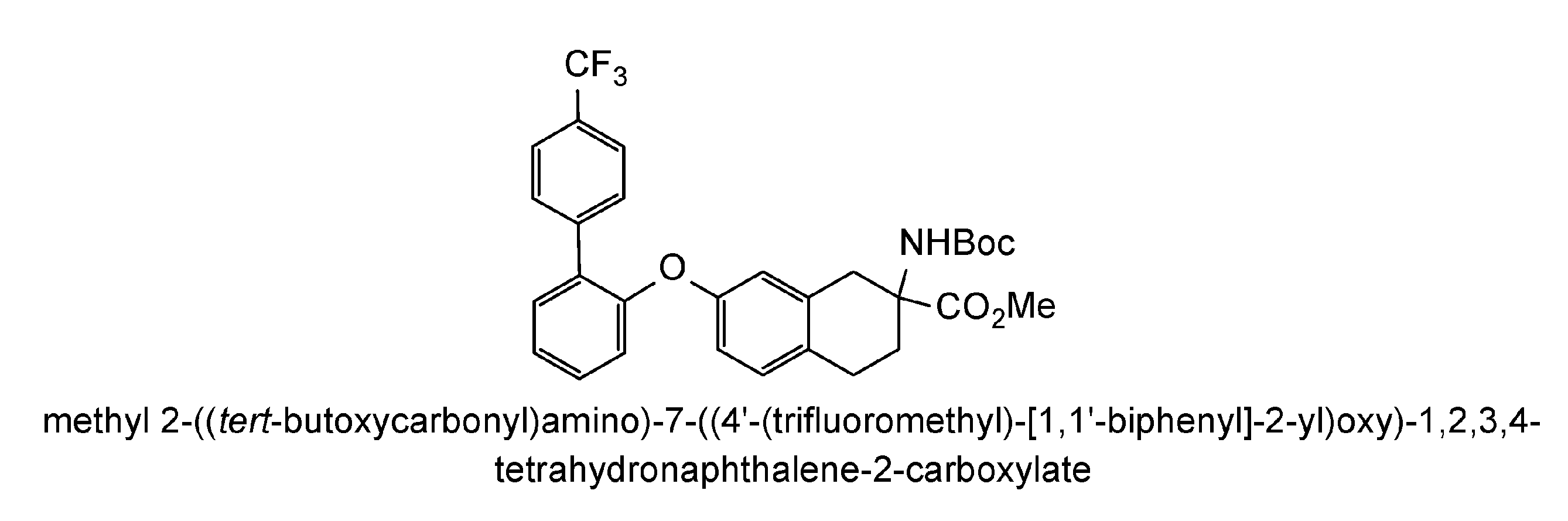
2-カルボキシ-7-((4’-トリフルオロメチル-[1,1’-ビフェニル]-2-イル)オキシ)-1,2,3,4-テトラヒドロナフタレン-2-アミニウムクロリドの製造
ステップ1で得られた上記化合物を、実施例1-26のステップ2、3と同様にして、下記化合物を合成した。
1H-NMR (CD3OD); 2.04-2.07 (m, 1H), 2.30-2.36 (m, 1H), 2.75-2.82 (m, 1H), 2.84 (d, J = 17.5 Hz, 1H), 2.91-2.96 (m, 1H), 3.40 (d, J = 17.5 Hz, 1H), 6.66 (d, J = 2.0 Hz, 1H), 6.71 (dd, J = 2.0, 8.5 Hz, 1H), 7.01 (dd, J = 1.0, 8.0 Hz, 1H), 7.08 (d, J = 8.5 Hz, 1H), 7.28 (td, J = 1.0, 7.5 Hz, 1H), 7.39 (td, J = 1.5, 8.5 Hz, 1H), 7.50 (dd, J = 1.5, 8.0 Hz, 1H), 7.63 (d, J = 8.0 Hz, 2H), 7.71 (d, J = 8.5 Hz, 2H).

2-カルボキシ-7-((3’-フルオロ-[1,1’-ビフェニル]-2-イル)オキシ)-1,2,3,4-テトラヒドロナフタレン-2-アミニウムクロリド(化合物1-54)の製造
ステップ1(工程I-IV)
メチル 2-((tert-ブトキシカルボニル)アミノ)-7-((3’-フルオロ-[1,1’-ビフェニル]-2-イル)オキシ)-1,2,3,4-テトラヒドロナフタレン-2-カルボキシレートの製造
実施例1-1のステップ1からステップ4と同様にして、ただし、実施例のステップ4の2-ヨードナフタレンを2-ブロモ-3’-フルオロ-1,1’-ビフェニルに変えて、さらに、反応温度を90℃から120℃にして、下記化合物を得た。
1H-NMR (CDCl3); 1.42 (s, 9H), 2.05-2.12 (m, 1H), 2.45 (brs, 1H), 2.77-2.79 (m, 2H), 2.86 (d, J = 17.0 Hz, 1H), 3.22 (d, J = 16.5 Hz, 1H), 3.76 (s, 3H), 4.77 (brs, 1H), 6.62 (d, J = 2.5 Hz, 1H), 6.75 (dd, J = 2.5, 8.5 Hz, 1H), 6.98-7.03 (m, 3H), 7.20 (td, J = 1.0, 7.5 Hz, 1H), 7.28-7.35 (m, 4H), 7.43 (dd, J = 1.5, 8.0 Hz, 1H).
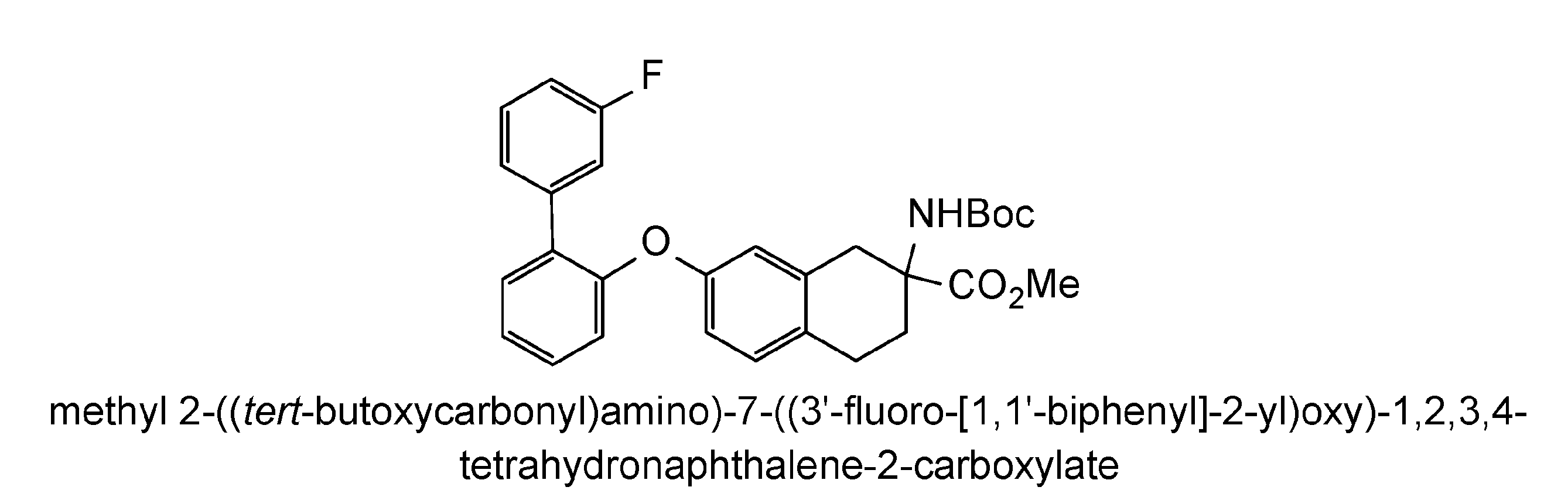
2-カルボキシ-7-((3’-フルオロ-[1,1’-ビフェニル]-2-イル)オキシ)-1,2,3,4-テトラヒドロナフタレン-2-アミニウムクロリドの製造
ステップ1で得られた上記化合物を、実施例1-26のステップ2、3と同様にして、下記化合物を合成した。
1H-NMR (CD3OD); 2.04-2.08 (m, 1H), 2.30-2.36 (m, 1H), 2.75-2.82 (m, 1H), 2.85 (d, J = 17.5 Hz, 1H), 2.91-2.96 (m, 1H), 3.41 (d, J = 17.0 Hz, 1H), 6.65 (d, J = 2.5 Hz, 1H), 6.71 (dd, J = 2.5, 8.5 Hz, 1H), 6.98-7.02 (m, 2H), 7.08 (d, J = 8.5 Hz, 1H), 7.24-7.27 (m, 2H), 7.31-7.37 (m, 3H), 7.47 (dd, J = 2.0, 7.5 Hz, 1H).
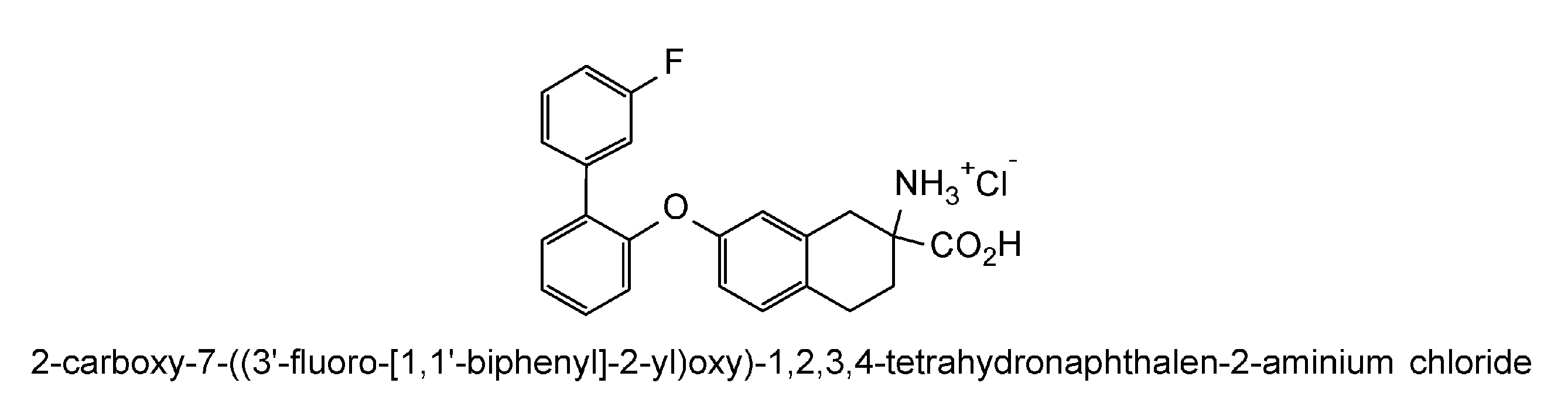
3-(2-((7-アンモニオ-7-カルボキシ-5,6,7,8-テトラヒドロナフタレン-2-イル)オキシ)フェニル)ピリジン-1-イウムクロリド(化合物1-65)の製造
ステップ1(工程I-IV)
メチル 2-((tert-ブトキシカルボニル)アミノ)-7-(2-(ピリジン-3-イル)フェノキシ)-1,2,3,4-テトラヒドロナフタレン-2-カルボキシレートの製造
実施例1-1のステップ1からステップ4と同様にして、ただし、実施例のステップ4の2-ヨードナフタレンを3-(2-ブロモフェニル)ピリジンに変えて、さらに、反応温度を90℃から120℃にして、下記化合物を得た。
1H-NMR (CDCl3); 1.42 (s, 9H), 2.05-2.12 (m, 1H), 2.44 (brs, 1H), 2.76-2.79 (m, 2H), 2.86 (d, J = 16.5 Hz, 1H), 3.23 (d, J = 16.5 Hz, 1H), 3.75 (s, 3H), 4.79 (brs, 1H), 6.62 (d, J = 3.0 Hz, 1H), 6.74 (dd, J = 2.0, 8.0 Hz, 1H), 7.01-7.03 (m, 2H), 7.23 (td, J = 1.0, 7.5 Hz, 1H), 7.30 (dd, J = 5.0, 8.0 Hz, 1H), 7.34 (td, J = 1.5, 8.0 Hz, 1H), 7.45 (dd, J = 1.5, 7.5 Hz, 1H), 7.88 (dt, J = 2.5, 4.0 Hz, 1H), 8.54 (brs, 1H), 8.79 (brs, 1H).
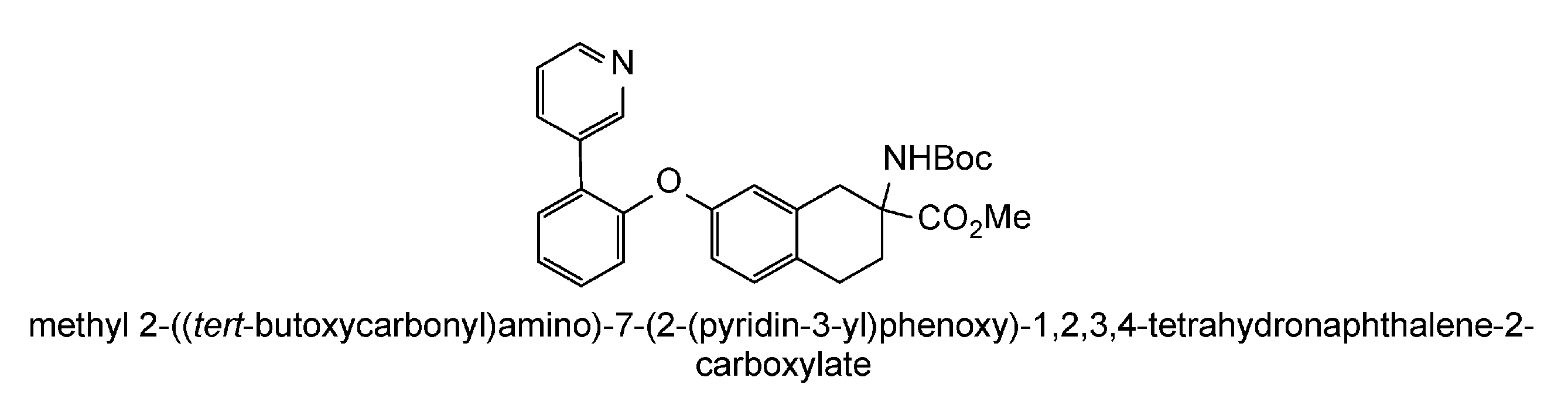
3-(2-((7-アンモニオ-7-カルボキシ-5,6,7,8-テトラヒドロナフタレン-2-イル)オキシ)フェニル)ピリジン-1-イウムクロリドの製造
ステップ1で得られた上記化合物を、実施例1-26のステップ2、3と同様にして、下記化合物を合成した。
1H-NMR (CD3OD); 2.12-2.15 (m, 1H), 2.32-2.38 (m, 1H), 2.80-2.86 (m, 1H), 2.93 (d, J = 16.5 Hz, 1H), 2.98-2.99 (m, 1H), 3.42 (d, J = 17.2 Hz, 1H), 6.71 (d, J = 2.4 Hz, 1H), 6.75 (dd, J = 2.2, 8.1 Hz, 1H), 7.04 (d, J = 8.1 Hz, 1H), 7.12 (d, J = 8.3 Hz, 1H), 7.32 (t, J = 7.4 Hz, 1H), 7.43 (t, J = 7.8 Hz, 1H), 7.55 (d, J = 7.5 Hz, 1H), 7.70 (brs, 1H), 8.21 (d, J = 7.6 Hz, 1H).
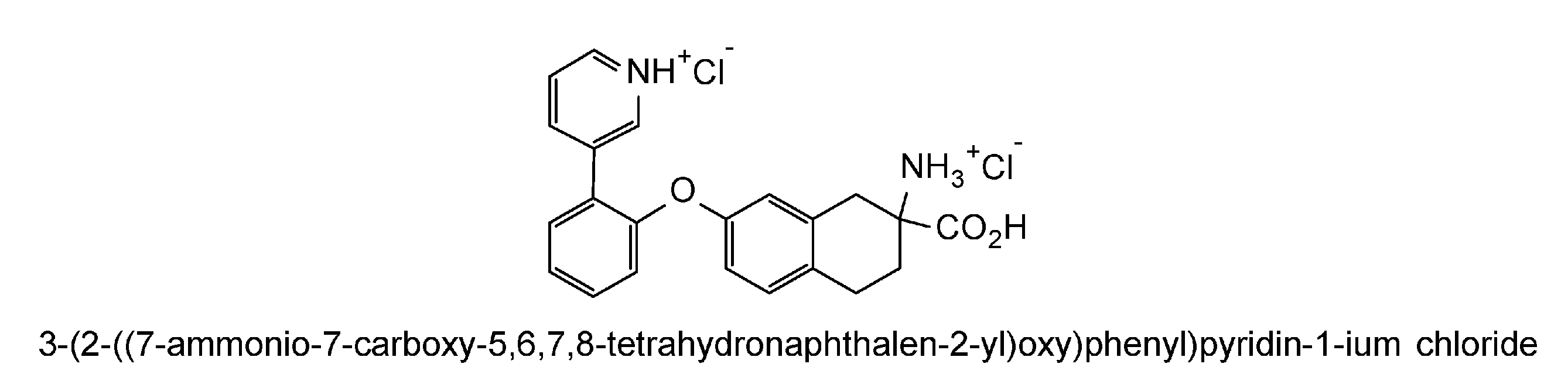
2-(2-((7-アンモニオ-7-カルボキシ-5,6,7,8-テトラヒドロナフタレン-2-イル)オキシ)フェニル)ピリジン-1-イウムクロリド(化合物1-66)の製造
ステップ1(工程I-IV)
メチル 2-((tert-ブトキシカルボニル)アミノ)-7-(2-(ピリジン-2-イル)フェノキシ)-1,2,3,4-テトラヒドロナフタレン-2-カルボキシレートの製造
実施例1-1のステップ1からステップ4と同様にして、ただし、実施例のステップ4の2-ヨードナフタレンを2-(2-ブロモフェニル)ピリジンに変えて、さらに、反応温度を90℃から120℃にして、下記化合物を得た。
1H-NMR (CDCl3); 1.42 (s, 9H), 2.05-2.12 (m, 1H), 2.46 (brs, 1H), 2.77-2.79 (m, 2H), 2.85 (d, J = 17.5 Hz, 1H), 3.21 (d, J = 17.5 Hz, 1H), 3.75 (s, 3H), 4.77 (brs, 1H), 6.66 (d, J = 2.5 Hz, 1H), 6.78 (dd, J = 2.0, 8.0 Hz, 1H), 6.99 (dd, J = 1.5, 8.5 Hz, 1H), 7.02 (d, J = 8.0 Hz, 1H), 7.18-7.27 (m, 3H), 7.65 (td, J = 1.5, 8.0 Hz, 1H), 7.83 (d, J = 8.0 Hz, 1H), 7.93 (dd, J = 1.5, 8.0 Hz, 1H), 8.69 (td, J = 1.0, 2.0 Hz, 1H).
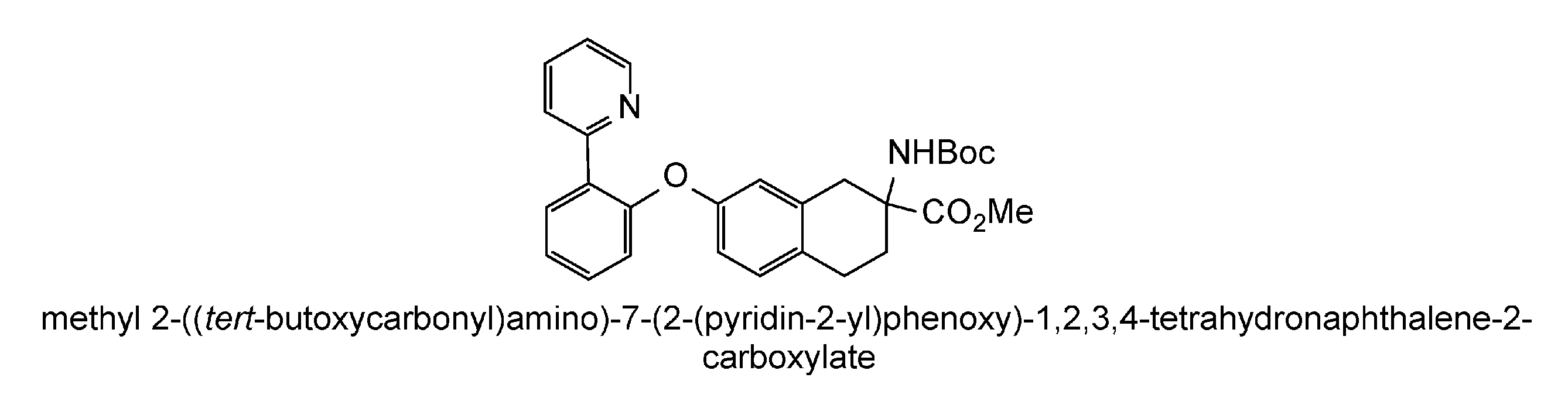
2-(2-((7-アンモニオ-7-カルボキシ-5,6,7,8-テトラヒドロナフタレン-2-イル)オキシ)フェニル)ピリジン-1-イウムクロリドの製造
ステップ1で得られた上記化合物を、実施例1-26のステップ2、3と同様にして、下記化合物を合成した。
1H-NMR (CD3OD); 2.15-2.20 (m, 1H), 2.36-2.42 (m, 1H), 2.86-2.93 (m, 1H), 2.97-3.02 (m, 1H), 3.03 (d, J = 17.5 Hz, 1H), 3.46 (d, J = 17.5 Hz, 1H), 6.90-6.93 (m, 2H), 7.08 (d, J = 8.5 Hz, 1H), 7.22 (d, J = 8.0 Hz, 1H), 7.40 (t, J = 9.0 Hz, 1H), 7.61-7.65 (m, 1H), 7.79 (dd, J = 1.5, 8.0 Hz, 1H), 8.04 (t, J = 6.0 Hz, 1H), 8.34 (d, J = 8.0 Hz, 1H), 8.65 (td, J = 2.0, 8.0 Hz, 1H), 8.89 (d, J = 5.5 Hz, 1H).
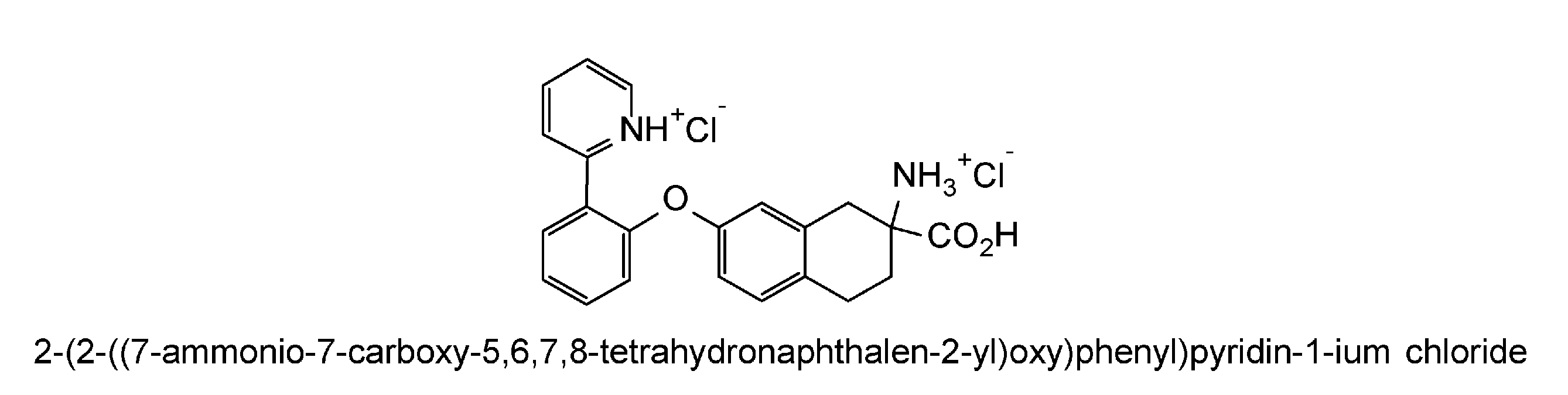
2-カルボキシ-7-((3’-クロロ-[1,1’-ビフェニル]-2-イル)オキシ)-1,2,3,4-テトラヒドロナフタレン-2-アミニウムクロリド(化合物1-55)の製造
ステップ1(工程I-IV)
メチル 2-((tert-ブトキシカルボニル)アミノ)-7-((3’-クロロ-[1,1’-ビフェニル]-2-イル)オキシ)-1,2,3,4-テトラヒドロナフタレン-2-カルボキシレートの製造
実施例1-1のステップ1からステップ4と同様にして、ただし、実施例のステップ4の2-ヨードナフタレンを2-ブロモ-3’-クロロ-1,1’-ビフェニルに変えて、さらに、反応温度を90℃から120℃にして、下記化合物を得た。
1H-NMR (CDCl3); 1.42 (s, 9H), 2.06-2.12 (m, 1H), 2.46 (brs, 1H), 2.77-2.83 (m, 2H), 2.86 (d, J = 17.0 Hz, 1H), 3.22 (d, J = 17.5 Hz, 1H), 3.75 (s, 3H), 4.77 (brs, 1H), 6.62 (d, J = 2.0 Hz, 1H), 6.74 (dd, J = 2.0, 8.5 Hz, 1H), 6.97-7.01 (m, 2H), 7.20 (td, J = 1.0, 7.5 Hz, 1H), 7.26-7.32 (m, 3H), 7.40-7.43 (m, 2H), 7.53 (d, J = 2.0 Hz, 1H).
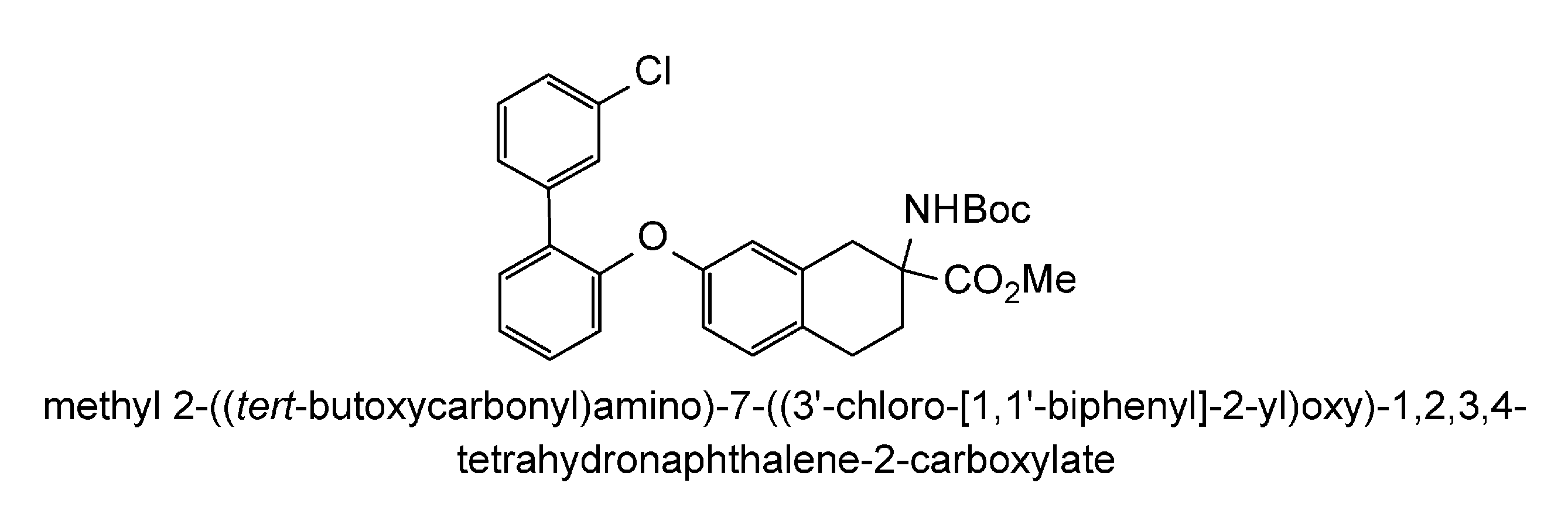
2-カルボキシ-7-((3’-クロロ-[1,1’-ビフェニル]-2-イル)オキシ)-1,2,3,4-テトラヒドロナフタレン-2-アミニウムクロリドの製造
ステップ1で得られた上記化合物を、実施例1-26のステップ2、3と同様にして、下記化合物を合成した。
1H-NMR (CD3OD); 2.01-2.03 (m, 1H), 2.28-2.34 (m, 1H), 2.73-2.77 (m, 1H), 2.81 (d, J = 17.0 Hz, 1H), 2.89-2.94 (m, 1H), 3.40 (d, J = 17.0 Hz, 1H), 6.63 (d, J = 2.0 Hz, 1H), 6.69 (dd, J = 3.0, 8.5 Hz, 1H), 6.99 (dd, J = 1.5, 8.0 Hz, 1H), 7.06 (d, J = 8.5 Hz, 1H), 7.23-7.36 (m, 4H), 7.42-7.46 (m, 2H), 7.52 (t, J = 1.5 Hz, 1H).
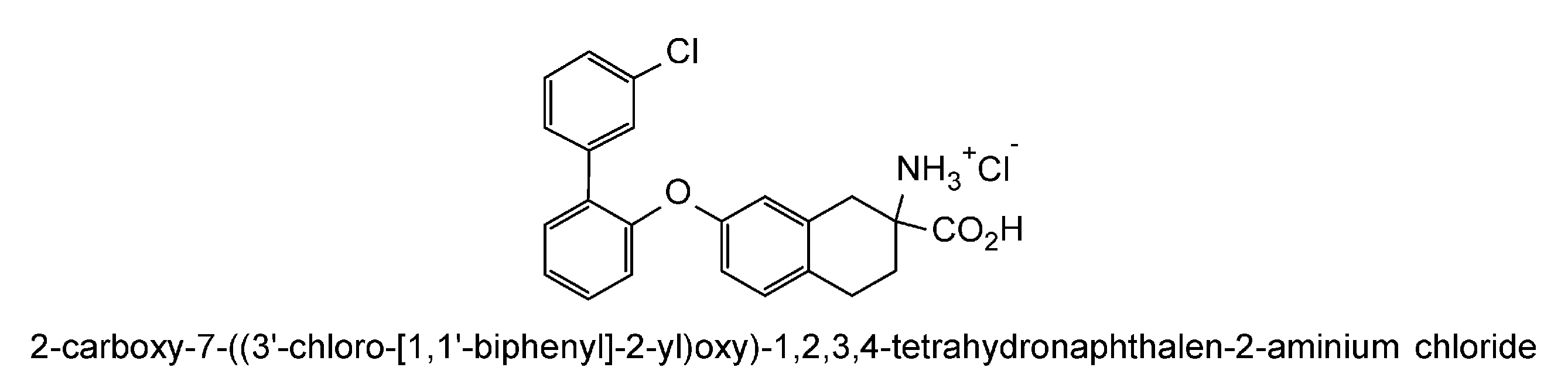
2-カルボキシ-7-((3’-イソプロピル-[1,1’-ビフェニル]-2-イル)オキシ)-1,2,3,4-テトラヒドロナフタレン-2-アミニウムクロリド(化合物1-60)の製造
ステップ1(工程I-IV)
メチル 2-((tert-ブトキシカルボニル)アミノ)-7-((3’-イソプロピル-[1,1’-ビフェニル]-2-イル)オキシ)-1,2,3,4-テトラヒドロナフタレン-2-カルボキシレートの製造
実施例1-1のステップ1からステップ4と同様にして、ただし、実施例のステップ4の2-ヨードナフタレンを2-ブロモ-3’-イソプロピル-1,1’-ビフェニルに変えて、さらに、反応温度を90℃から120℃にして、下記化合物を得た。
1H-NMR (CDCl3); 1.22 (d, J = 6.5 Hz, 6H), 1.42 (s, 9H), 2.05-2.11 (m, 1H), 2.46 (brs, 1H), 2.76-2.78 (m, 2H), 2.83 (d, J = 18.0 Hz, 1H), 2.87-2.92 (m, 1H), 3.19 (d, J = 17.0 Hz, 1H), 3.75 (s, 3H), 4.75 (brs, 1H), 6.60 (d, J = 2.0 Hz, 1H), 6.73 (dd, J = 3.0, 8.5 Hz, 1H), 6.99-7.09 (m, 2H), 7.15 (d, J = 7.5 Hz, 1H), 7.20 (td, J = 1.0, 7.5 Hz, 1H), 7.26-7.34 (m, 3H), 7.38 (s, 1H), 7.46 (dd J = 1.5, 7.5 Hz, 1H).
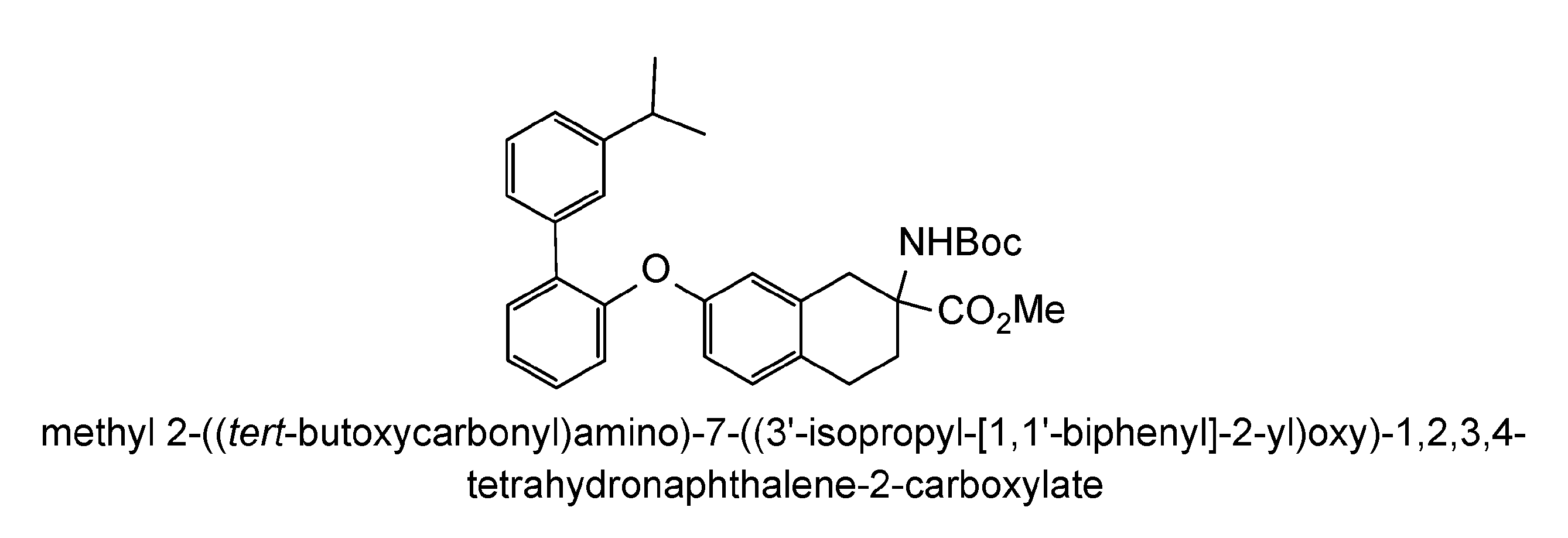
2-カルボキシ-7-((3’-イソプロピル-[1,1’-ビフェニル]-2-イル)オキシ)-1,2,3,4-テトラヒドロナフタレン-2-アミニウムクロリドの製造
ステップ1で得られた上記化合物を、実施例1-26のステップ2、3と同様にして、下記化合物を合成した。
1H-NMR (CD3OD); 1.21 (d, J = 7.0 Hz, 6H), 2.02-2.05 (m, 1H), 2.28-2.34 (m, 1H), 2.73-2.77 (m, 1H), 2.81 (d, J = 17.0 Hz, 1H), 2.85-2.93 (m, 2H), 3.39 (d, J = 17.0 Hz, 1H), 6.61 (d, J = 2.5 Hz, 1H), 6.68 (dd, J = 2.5, 8.0 Hz, 1H), 6.99 (d, J = 8.0 Hz, 1H), 7.05 (d, J = 8.5 Hz, 1H), 7.12 (d, J = 7.5 Hz, 1H), 7.20-7.28 (m, 3H), 7.32 (td, J = 1.5, 7.0 Hz, 1H), 7.37 (s, 1H), 7.44 (dd, J = 1.5, 8.0 Hz, 1H).
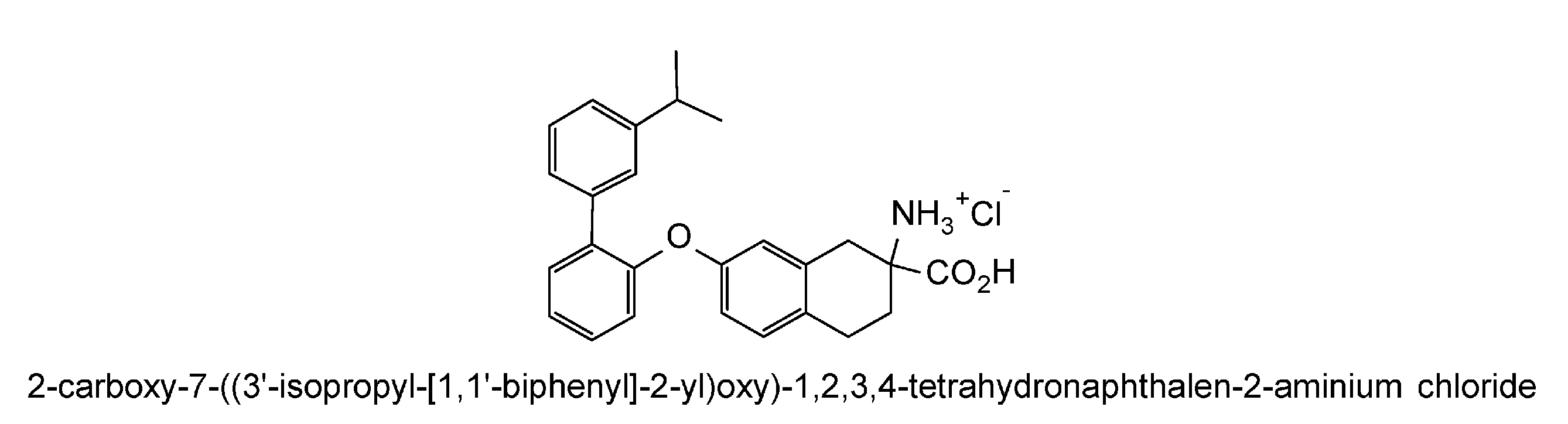
2-カルボキシ-7-(2-(ナフタレン-1-イル)フェノキシ)-1,2,3,4-テトラヒドロナフタレン-2-アミニウムクロリド(化合物1-68)の製造
ステップ1(工程I-IV)
メチル 2-((tert-ブトキシカルボニル)アミノ)-7-(2-(ナフタレン-1-イル)フェノキシ)-1,2,3,4-テトラヒドロナフタレン-2-カルボキシレートの製造
実施例1-1のステップ1からステップ4と同様にして、ただし、実施例のステップ4の2-ヨードナフタレンを1-(2-ブロモフェニル)ナフタレンに変えて、さらに、反応温度を90℃から120℃にして、下記化合物およびその異性体の混合物を得た。
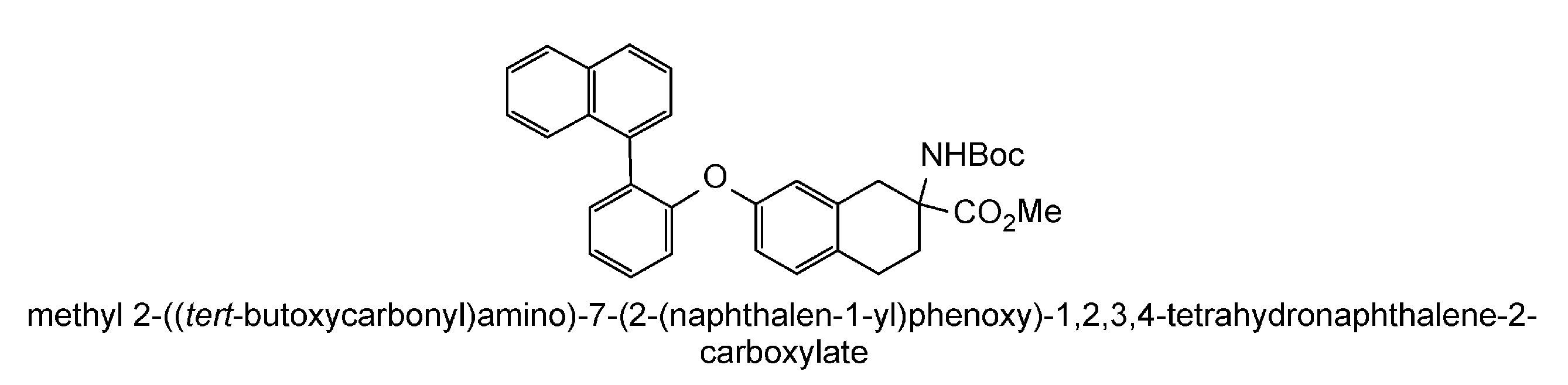
2-カルボキシ-7-(2-(ナフタレン-1-イル)フェノキシ)-1,2,3,4-テトラヒドロナフタレン-2-アミニウムクロリドの製造
ステップ1で得られた上記化合物を、実施例1-26のステップ2、3と同様にして、下記化合物およびその異性体の混合物を得た。
HRMS (ESI) m/z calcd for C27H24NO3 [M+H]+ 410.1756, found 410.1821.
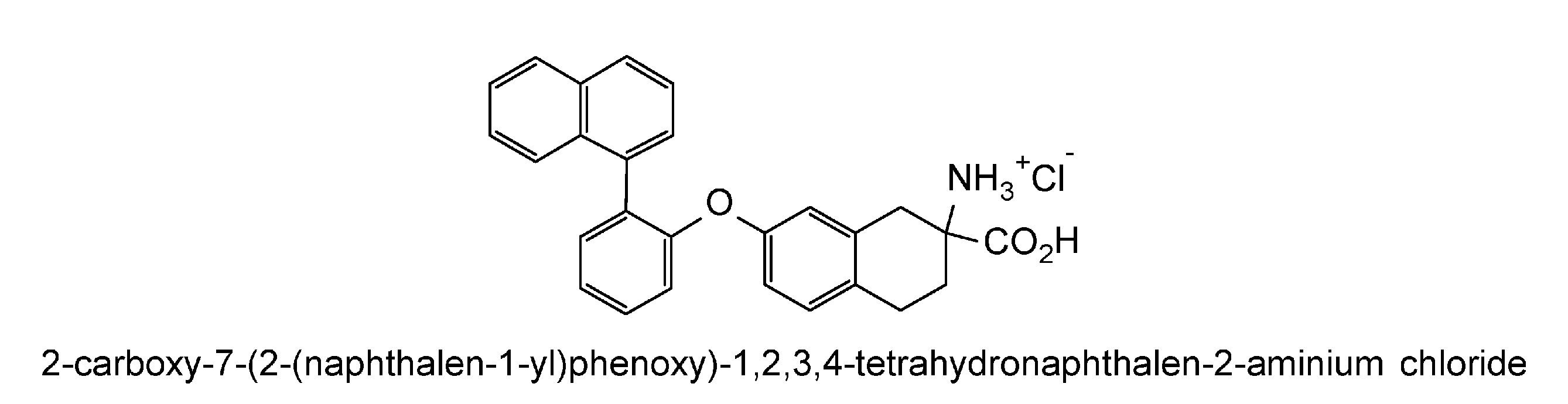
2-カルボキシ-7-((2’-フルオロ-[1,1’-ビフェニル]-2-イル)オキシ)-1,2,3,4-テトラヒドロナフタレン-2-アミニウムクロリド(化合物1-56)の製造
ステップ1(工程I-IV)
メチル 2-((tert-ブトキシカルボニル)アミノ)-7-((2’-フルオロ-[1,1’-ビフェニル]-2-イル)オキシ)-1,2,3,4-テトラヒドロナフタレン-2-カルボキシレートの製造
実施例1-1のステップ1からステップ4と同様にして、ただし、実施例のステップ4の2-ヨードナフタレンを2-ブロモ-2’-フルオロ-1,1’-ビフェニルに変えて、さらに、反応温度を90℃から120℃にして、下記化合物を得た。
1H-NMR (CDCl3); 1.42 (s, 9H), 2.05-2.12 (m, 1H), 2.47 (brs, 1H), 2.75-2.78 (m, 2H), 2.84 (d, J = 17.0 Hz, 1H), 3.20 (d, J = 17.5 Hz, 1H), 3.76 (s, 3H), 4.76 (brs, 1H), 6.65 (d, J = 2.5 Hz, 1H), 6.77 (dd, J = 2.0, 8.0 Hz, 1H), 6.97 (dd, J = 1.0, 8.0 Hz, 1H), 7.00 (d, J = 8.0 Hz, 1H), 7.06-7.10 (m, 1H), 7.14 (dd, J = 1.5, 7.5 Hz, 1H), 7.18 (td, J = 1.0, 7.5 Hz, 1H), 7.28-7.39 (m, 4H).
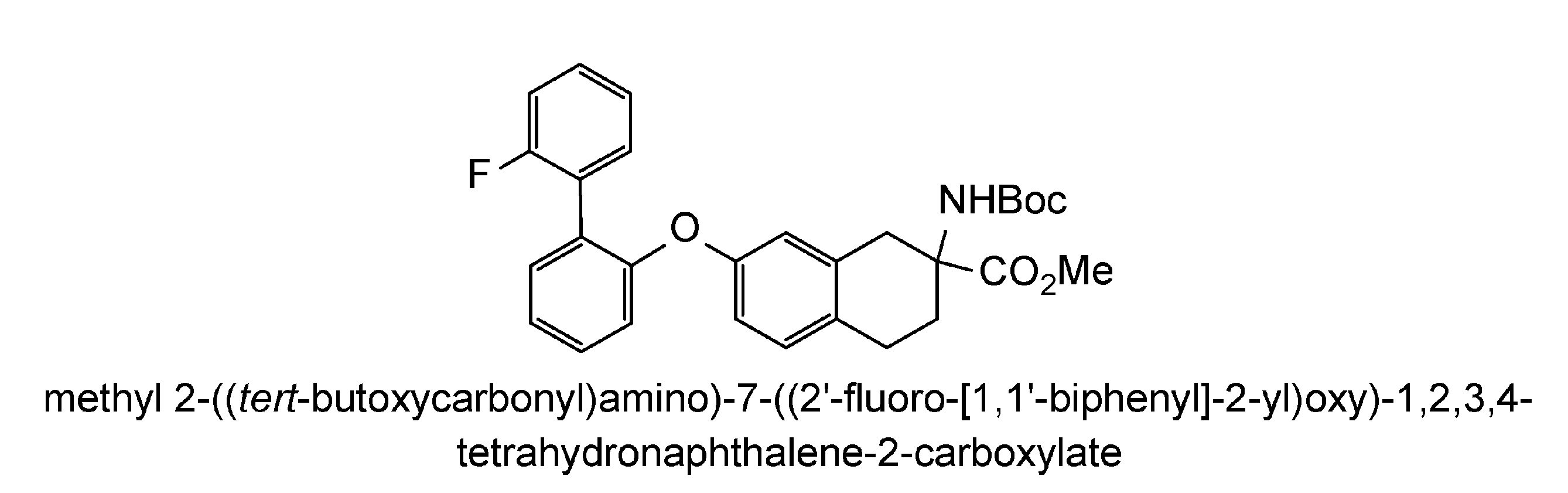
2-カルボキシ-7-((2’-フルオロ-[1,1’-ビフェニル]-2-イル)オキシ)-1,2,3,4-テトラヒドロナフタレン-2-アミニウムクロリドの製造
2-carboxy-7-((2’-fluoro-[1,1’-biphenyl]-2-yl)oxy)-1,2,3,4-tetrahydronaphthalen-2-aminium chloride
ステップ1で得られた上記化合物を、実施例1-26のステップ2、3と同様にして、下記化合物を合成した。
1H-NMR (CD3OD); 2.15-2.16 (m, 1H), 2.34-2.40 (m, 1H), 2.79-2.86 (m, 1H), 2.92 (d, J = 17.5 Hz, 1H), 2.95-3.00 (m, 1H), 3.42 (d, J = 17.5 Hz, 1H), 6.69 (d, J = 2.5 Hz, 1H), 6.75 (dd, J = 3.0, 8.5 Hz, 1H), 6.97 (d, J = 8.5 Hz, 1H), 7.05-7.07 (m, 1H), 7.10 (d, J = 8.0 Hz, 1H), 7.15 (td, J = 1.5, 7.5 Hz, 1H), 7.23 (td, J = 1.0, 7.5 Hz, 1H), 7.29-7.38 (m, 4H).

2-カルボキシ-7-((2’-クロロ-[1,1’-ビフェニル]-2-イル)オキシ)-1,2,3,4-テトラヒドロナフタレン-2-アミニウムクロリド(化合物1-57)の製造
ステップ1(工程I-IV)
メチル 2-((tert-ブトキシカルボニル)アミノ)-7-((2’-クロロ-[1,1’-ビフェニル]-2-イル)オキシ)-1,2,3,4-テトラヒドロナフタレン-2-カルボキシレートの製造
実施例1-1のステップ1からステップ4と同様にして、ただし、実施例のステップ4の2-ヨードナフタレンを2-ブロモ-2’-クロロ-1,1’-ビフェニルに変えて、さらに、反応温度を90℃から120℃にして、下記化合物を得た。
1H-NMR (CDCl3); 1.42 (s, 9H), 2.04-2.10 (m, 1H), 2.46 (brs, 1H), 2.73-2.78 (m, 2H), 2.82 (d, J = 16.3 Hz, 1H), 3.18 (d, J = 16.9 Hz, 1H), 3.75 (s, 3H), 4.74 (brs, 1H), 6.60 (d, J = 2.6 Hz, 1H), 6.74 (dd, J = 2.6, 8.4 Hz, 1H), 6.96-6.99 (m, 2H), 7.16-7.25 (m, 3H), 7.29-7.35 (m, 3H), 7.39-7.41 (m, 1H).
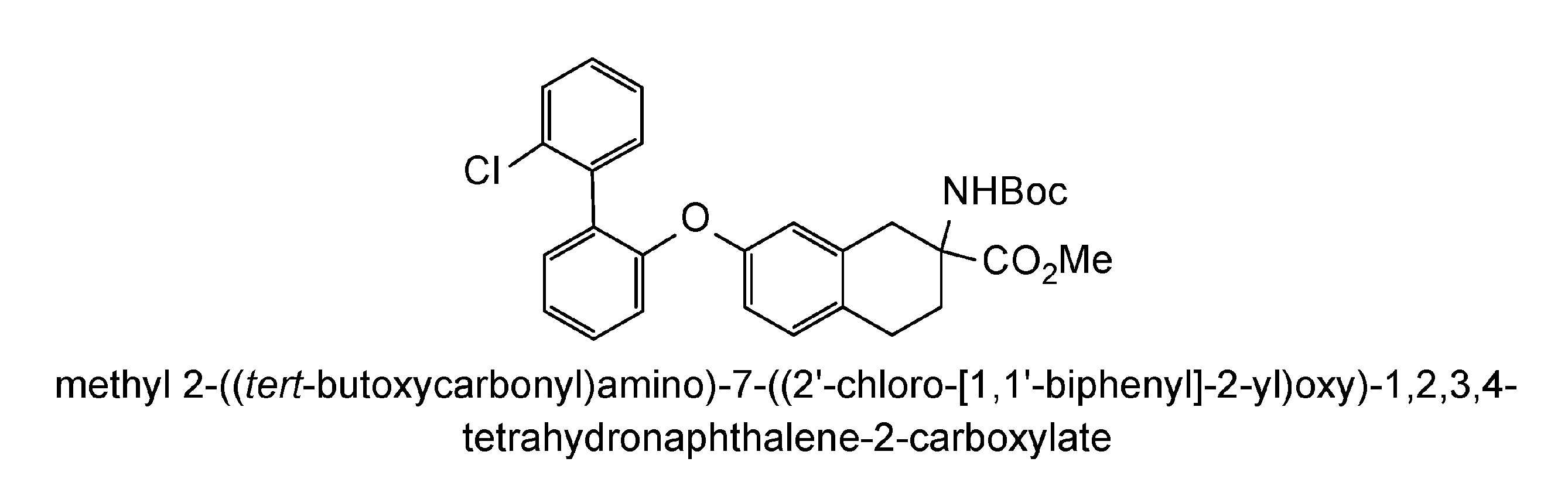
2-カルボキシ-7-((2’-クロロ-[1,1’-ビフェニル]-2-イル)オキシ)-1,2,3,4-テトラヒドロナフタレン-2-アミニウムクロリドの製造
ステップ1で得られた上記化合物を、実施例1-26のステップ2、3と同様にして、下記化合物を合成した。
1H-NMR (CD3OD); 2.10-2.15 (m, 1H), 2.33-2.39 (m, 1H), 2.78-2.85 (m, 1H), 2.91 (d, J = 17.5 Hz, 1H), 2.94-2.99 (m, 1H), 3.41 (d, J = 17.0 Hz, 1H), 6.66 (d, J = 2.0 Hz, 1H), 6.74 (dd, J = 2.5, 8.5 Hz, 1H), 6.97 (dd, J = 1.0, 8.0 Hz, 1H), 7.07 (d, J = 8.5 Hz, 1H), 7.21 (td, J = 1.0, 7.5 Hz, 1H), 7.24-7.32 (m, 4H), 7.35-7.41 (m, 2H).
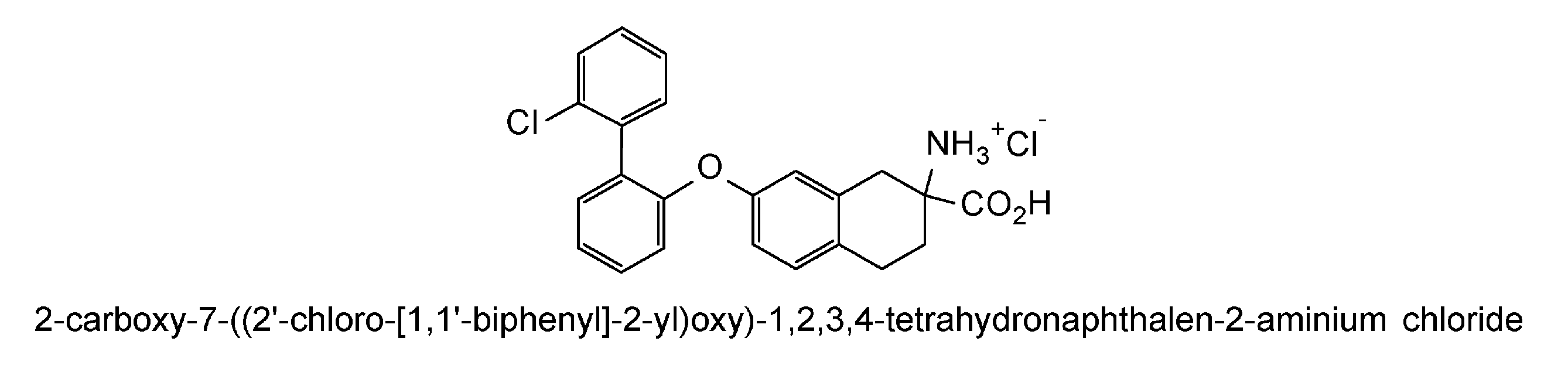
2-カルボキシ-7-((8-クロロナフタレン-1-イル)オキシ)-1,2,3,4-テトラヒドロナフタレン-2-アミニウムクロリド(化合物1-62)の製造
ステップ1(工程I-IV)
メチル 2-((tert-ブトキシカルボニル)アミノ)-7-((8-クロロナフタレン-1-イル)オキシ)-1,2,3,4-テトラヒドロナフタレン-2-カルボキシレートの製造
実施例1-1のステップ1からステップ4と同様にして、ただし、実施例のステップ4の2-ヨードナフタレンを1-ブロモ-8-クロロナフタレンに変えて、さらに、反応温度を90℃から120℃にして、下記化合物を得た。
1H-NMR (CDCl3); 1.42 (s, 9H), 2.07-2.14 (m, 1H), 2.48 (brs, 1H), 2.79-2.82 (m, 2H), 2.86 (d, J = 17.5 Hz, 1H), 3.23 (d, J = 17.5 Hz, 1H), 3.75 (s, 3H), 4.81 (brs, 1H), 6.61 (d, J = 2.5 Hz, 1H), 6.75 (dd, J = 2.0, 8.0 Hz, 1H), 7.06 (d, J = 9.0 Hz, 1H), 7.11 (dd, J = 1.0, 8.0 Hz, 1H), 7.38 (t, J = 8.0 Hz, 1H), 7.44 (t, J = 8.0 Hz, 1H), 7.53 (dd, J = 1.0, 7.0 Hz, 1H), 7.68 (d, J = 8.0 Hz, 1H), 7.78 (d, J = 8.0 Hz, 1H).
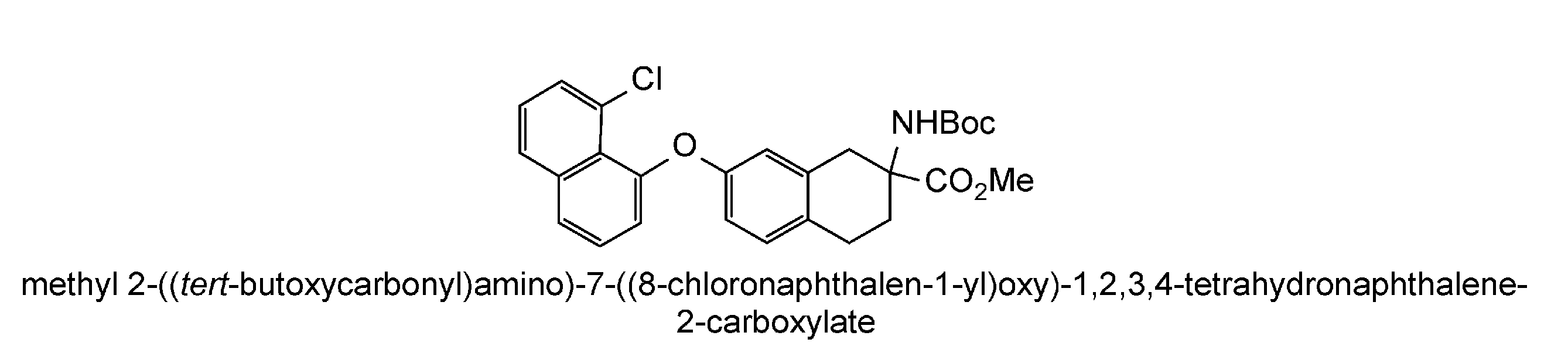
2-カルボキシ-7-((8-クロロナフタレン-1-イル)オキシ)-1,2,3,4-テトラヒドロナフタレン-2-アミニウムクロリドの製造
ステップ1で得られた上記化合物を、実施例1-26のステップ2、3と同様にして、下記化合物を合成した。
1H-NMR (CD3OD); 2.14-2.19 (m, 1H), 2.37-2.43 (m, 1H), 2.83-2.90 (m, 1H), 2.94 (d, J = 17.0 Hz, 1H), 2.98-3.04 (m, 1H), 3.44 (d, J = 17.5 Hz, 1H), 6.65 (d, J = 2.5 Hz, 1H), 6.75 (dd, J = 2.5, 8.0 Hz, 1H), 7.12 (dd, J = 1.0, 7.5 Hz, 1H), 7.15 (d, J = 8.0 Hz, 1H), 7.43 (t, J = 7.5 Hz, 1H), 7.49-7.54 (m, 2H), 7.78-7.80 (m, 1H), 7.89 (dd, J = 1.0, 8.0 Hz, 1H).
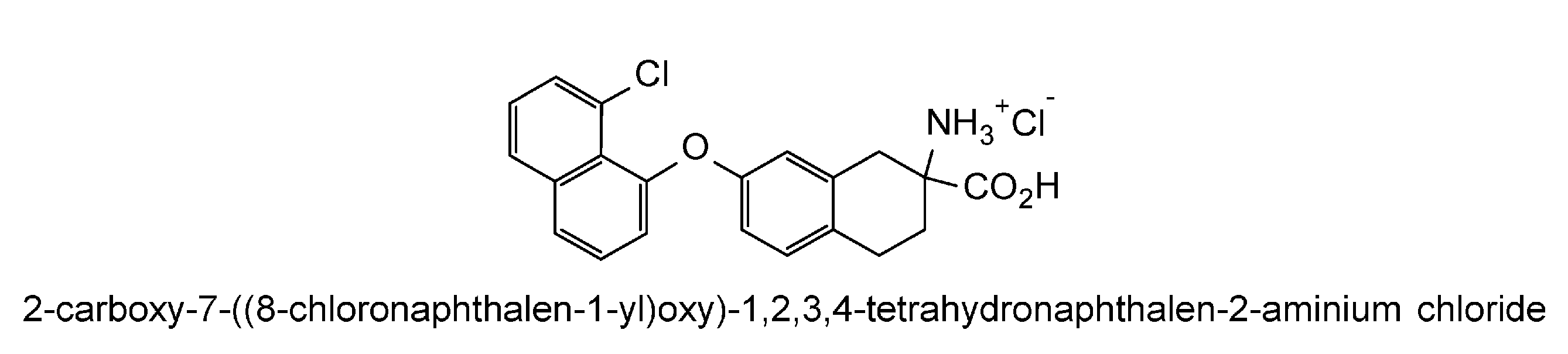
2-カルボキシ-7-((3’-メトキシ-[1,1’-ビフェニル]-2-イル)オキシ)-1,2,3,4-テトラヒドロナフタレン-2-アミニウムクロリド(化合物1-59)の製造
ステップ1(工程I-IV)
メチル 2-((tert-ブトキシカルボニル)アミノ)-7-((3’-メトキシ-[1,1’-ビフェニル]-2-イル)オキシ)-1,2,3,4-テトラヒドロナフタレン-2-カルボキシレートの製造
実施例1-1のステップ1からステップ4と同様にして、ただし、実施例のステップ4の2-ヨードナフタレンを2-ブロモ-3’-メトキシ-1,1’-ビフェニルに変えて、さらに、反応温度を90℃から120℃にして、下記化合物を得た。
1H-NMR (CDCl3); 1.42 (s, 9H), 2.05-2.11 (m, 1H), 2.45 (brs, 1H), 2.77-2.78 (m, 2H), 2.84 (d, J = 17.0 Hz, 1H), 3.21 (d, J = 16.5 Hz, 1H), 3.75 (s, 3H), 3.77 (s, 3H), 4.77 (brs, 1H), 6.62 (d, J = 2.0 Hz, 1H), 6.74 (dd, J = 2.0, 8.0 Hz, 1H), 6.84-6.86 (m, 1H), 6.98-7.01 (m, 2H), 7.09 (t, J = 1.5 Hz, 1H), 7.11 (dt, J = 1.5, 7.5 Hz, 1H), 7.20 (td, J = 1.0, 7.5 Hz, 1H), 7.27-7.31 (m, 2H), 7.45 (dd, J = 1.5, 7.0 Hz, 1H).

2-カルボキシ-7-((3’-メトキシ-[1,1’-ビフェニル]-2-イル)オキシ)-1,2,3,4-テトラヒドロナフタレン-2-アミニウムクロリドの製造
ステップ1で得られた上記化合物を、実施例1-26のステップ2、3と同様にして、下記化合物を合成した。
1H-NMR (CD3OD); 1.99-2.03 (m, 1H), 2.27-2.34 (m, 1H), 2.72-2.79 (m, 1H), 2.79 (d, J = 17.0 Hz, 1H), 2.88-2.93 (m, 1H), 3.39 (d, J = 17.0 Hz, 1H), 3.73 (s, 3H), 6.61 (d, J = 3.0 Hz, 1H), 6.68 (dd, J = 2.0, 8.5 Hz, 1H), 6.82 (td, J = 1.5, 8.0 Hz, 1H), 6.98 (dd, J = 1.5, 8.0 Hz, 1H), 7.04-7.07 (m, 3H), 7.20-7.25 (m, 2H), 7.32 (td, J = 1.5, 8.0 Hz, 1H), 7.46 (dd, J = 1.5 , 7.5 Hz, 1H).
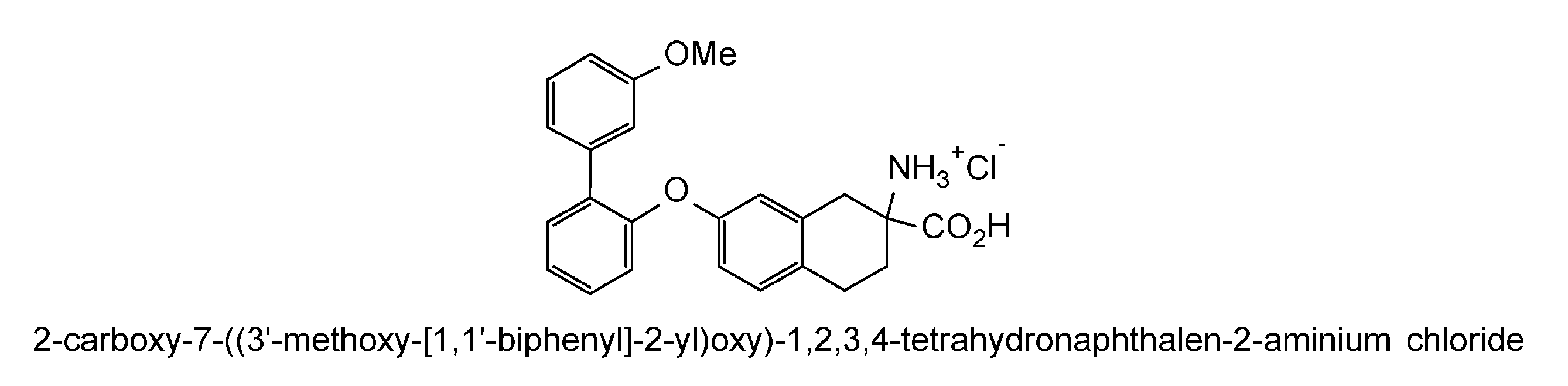
2-((7-アンモニオ-7-カルボキシ-5,6,7,8-テトラヒドロナフタレン-2-イル)オキシ)-3-フェニルピリジン-1-イウムクロリド(化合物1-69)の製造
ステップ1(工程I-IV)
メチル 2-((tert-ブトキシカルボニル)アミノ)-7-((3-フェニルピリジン-2-イル)オキシ)-1,2,3,4-テトラヒドロナフタレン-2-カルボキシレートの製造
実施例1-1のステップ1からステップ4と同様にして、ただし、実施例のステップ4の2-ヨードナフタレンを2-ブロモ-3-フェニルピリジンに変えて、さらに、反応温度を90℃から120℃にして、下記化合物を得た。
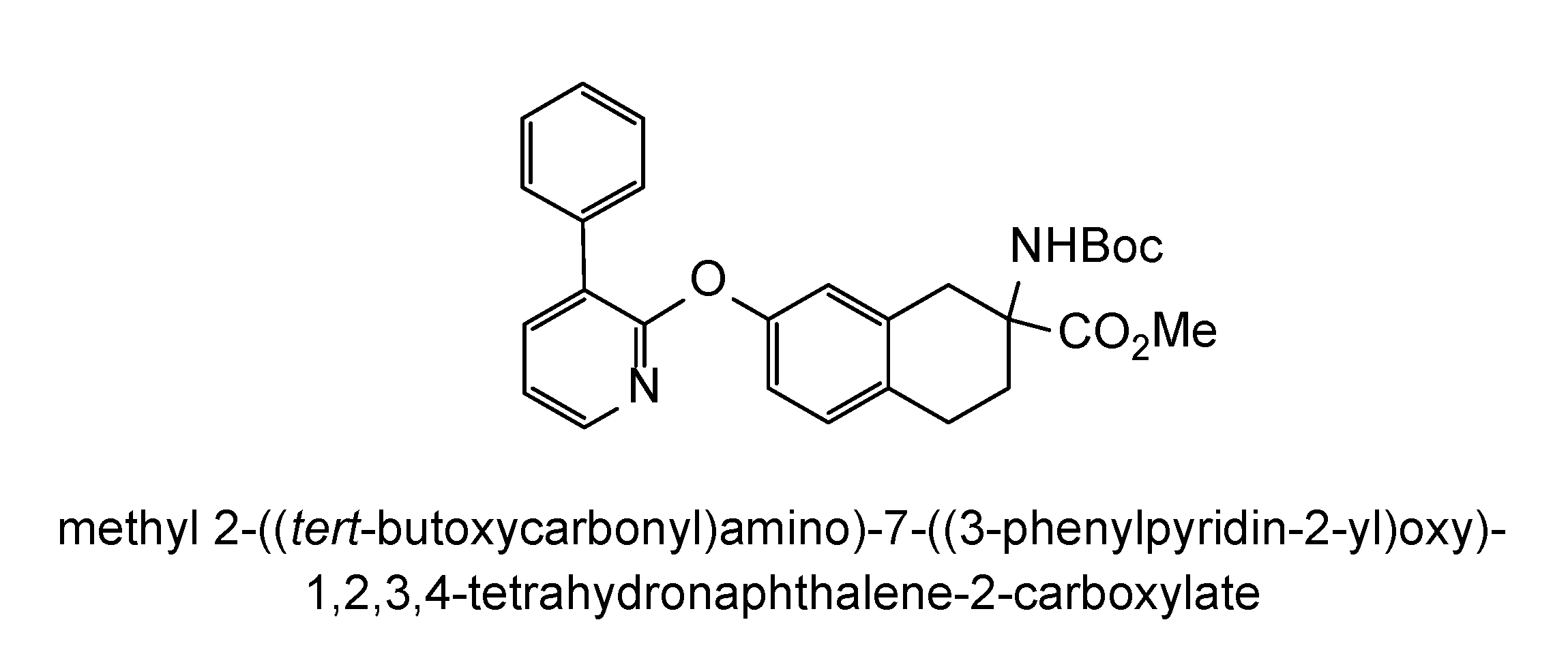
2-((7-アンモニオ-7-カルボキシ-5,6,7,8-テトラヒドロナフタレン-2-イル)オキシ)-3-フェニルピリジン-1-イウムクロリドの製造
ステップ1で得られた上記化合物を、実施例1-26のステップ2、3と同様にして、下記化合物を合成した。
1H-NMR (CD3OD); 2.13-2.18 (m, 1H), 2.40-2.46 (m, 1H), 2.89-2.95 (m, 1H), 3.03 (d, J = 17.0 Hz, 1H), 3.01-3.05 (m, 1H), 3.49 (d, J = 17.0 Hz, 1H), 6.97-7.00 (m, 2H), 7.25 (d, J = 8.0 Hz, 1H), 7.39-7.47 (m, 4H), 7.63-7.65 (m, 2H), 8.14-8.45 (m, 2H).
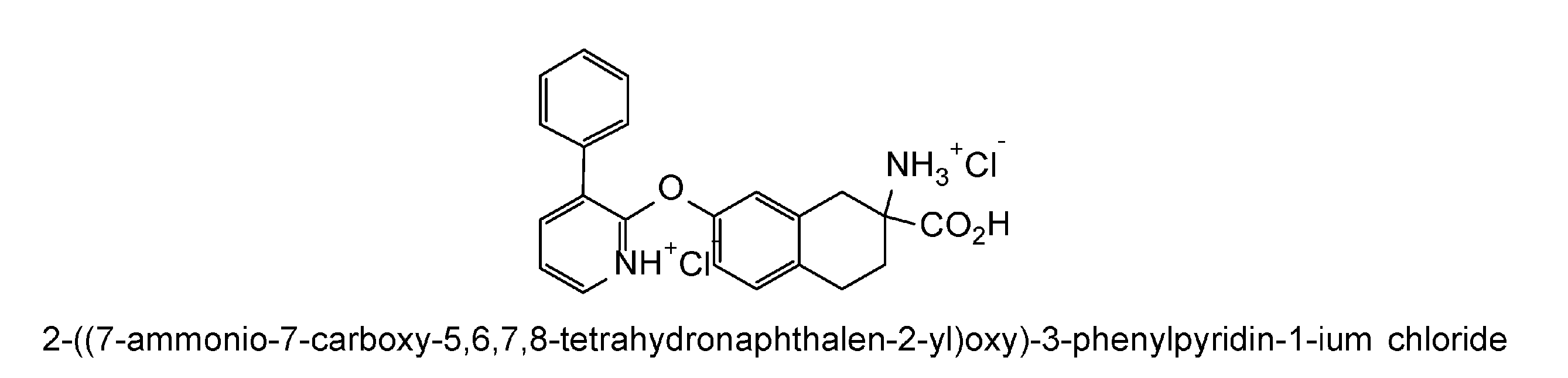
2-カルボキシ-7-((3’-(トリフルオロメチル)-[1,1’-ビフェニル]-2-イル)オキシ)-1,2,3,4-テトラヒドロナフタレン-2-アミニウムクロリド(化合物1-64)の製造
ステップ1(工程I-IV)
メチル 2-((tert-ブトキシカルボニル)アミノ)-7-((3’-(トリフルオロメチル)-[1,1’-ビフェニル]-2-イル)オキシ)-1,2,3,4-テトラヒドロナフタレン-2-カルボキシレートの製造
実施例1-1のステップ1からステップ4と同様にして、ただし、実施例のステップ4の2-ヨードナフタレンを2-ブロモ-3’-(トリフルオロメチル)-1,1’-ビフェニルに変えて、さらに、反応温度を90℃から120℃にして、下記化合物を得た。
1H-NMR (CDCl3); 1.42 (s, 9H), 2.05-2.11 (m, 1H), 2.44 (brs, 1H), 2.76-2.78 (m, 2H), 2.85 (d, J = 16.5 Hz, 1H), 3.22 (d, J = 16.5 Hz, 1H), 3.75 (s, 3H), 4.76 (brs, 1H), 6.61 (d, J = 2.5 Hz, 1H), 6.73 (dd, J = 2.5, 8.0 Hz, 1H), 7.00-7.02 (m, 2H), 7.22 (td, J = 1.0, 8.0 Hz, 1H), 7.33 (td, J = 1.5, 8.0 Hz, 1H), 7.44 (dd, J = 1.5, 7.0 Hz, 1H), 7.48 (d, J = 8.0 Hz, 1H), 7.55 (d, J = 8.0 Hz, 1H), 7.72 (d, J = 7.5 Hz, 1H), 7.80 (s, 1H).
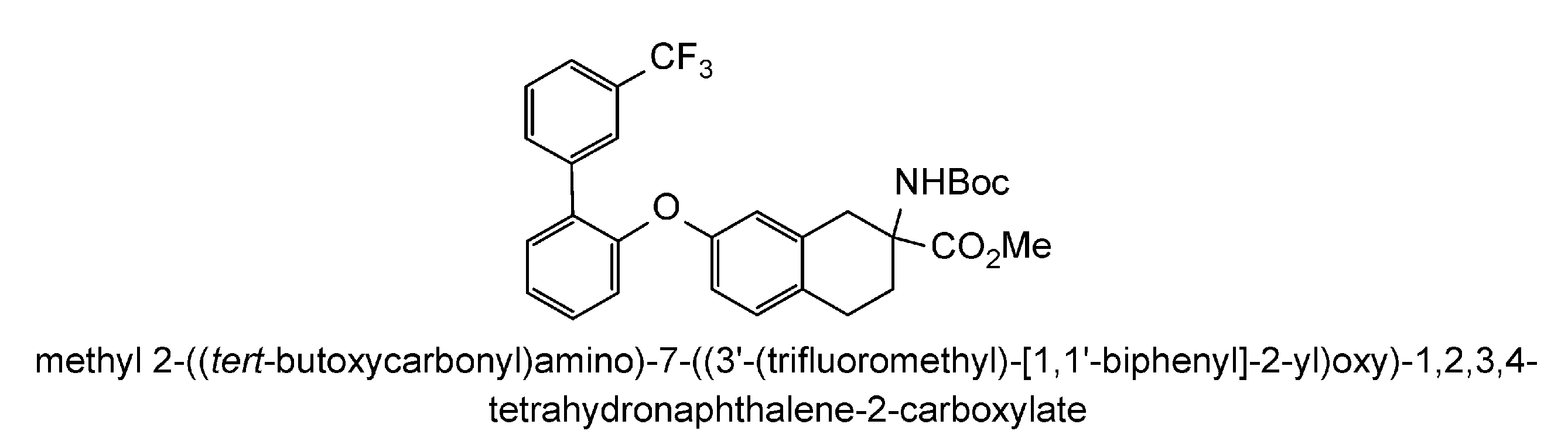
2-カルボキシ-7-((3’-(トリフルオロメチル)-[1,1’-ビフェニル]-2-イル)オキシ)-1,2,3,4-テトラヒドロナフタレン-2-アミニウムクロリドの製造
ステップ1で得られた上記化合物を、実施例1-26のステップ2、3と同様にして、下記化合物を合成した。
1H-NMR (CD3OD); 2.07-2.10 (m, 1H), 2.30-2.36 (m, 1H), 2.76-2.83 (m, 1H), 2.87 (d, J = 17.0 Hz, 1H), 2.91-2.96 (m, 1H), 3.40 (d, J = 17.0 Hz, 1H), 6.66 (d, J = 2.0 Hz, 1H), 6.71 (dd, J = 2.0, 8.5 Hz, 1H), 7.02 (d, J = 8.0 Hz, 1H), 7.08 (d, J = 9.0 Hz, 1H), 7.29 (td, J = 1.0, 7.5 Hz, 1H), 7.39 (td, J = 2.0, 8.0 Hz, 1H), 7.50 (dd, J = 2.0, 7.5 Hz, 1H), 7.51-7.58 (m, 2H), 7.76 (d, J = 8.0 Hz, 1H), 7.82 (s, 1H).
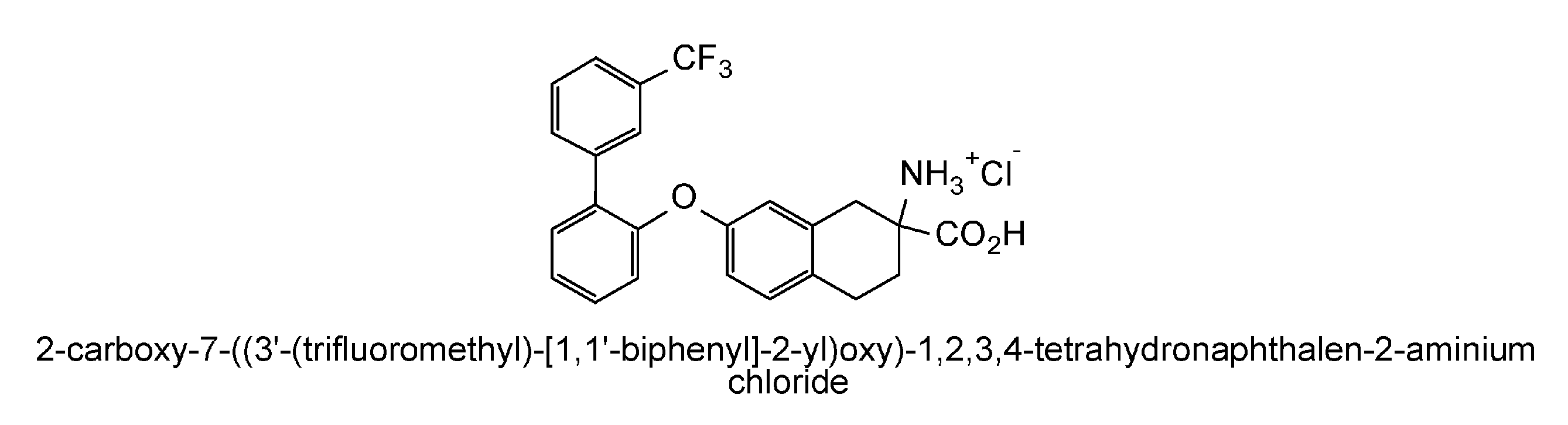
2-カルボキシ-7-((3’-ニトロ-[1,1’-ビフェニル]-2-イル)オキシ)-1,2,3,4-テトラヒドロナフタレン-2-アミニウムクロリド(化合物1-74)の製造
ステップ1(工程I-IV)
メチル 2-((tert-ブトキシカルボニル)アミノ)-7-((3’-ニトロ-[1,1’-ビフェニル]-2-イル)オキシ)-1,2,3,4-テトラヒドロナフタレン-2-カルボキシレートの製造
実施例1-1のステップ1からステップ4と同様にして、ただし、実施例のステップ4の2-ヨードナフタレンを2-ブロモ-3’-ニトロ-1,1’-ビフェニルに変えて、さらに、反応温度を90℃から120℃にして、下記化合物を得た。
1H-NMR (CDCl3); 1.41 (s, 9H), 2.05-2.12 (m, 1H), 2.43 (brs, 1H), 2.77-2.79 (m, 2H), 2.87 (d, J = 17.5 Hz, 1H), 3.24 (d, J = 17.5 Hz, 1H), 3.75 (s, 3H), 4.77 (brs, 1H), 6.63 (d, J = 3.0 Hz, 1H), 6.74 (dd, J = 2.5, 8.0 Hz, 1H), 7.01-7.03 (m, 2H), 7.24 (td, J = 1.0, 6.5 Hz, 1H), 7.36 (td, J = 1.5, 8.0 Hz, 1H), 7.47 (dd, J = 1.5, 7.5 Hz, 1H), 7.54 (t, J = 8.0 Hz, 1H), 7.90 (dt, J = 2.0, 3.0 Hz, 1H), 8.15-8.17 (m, 1H), 8.44 (t, J = 2.5 Hz, 1H).
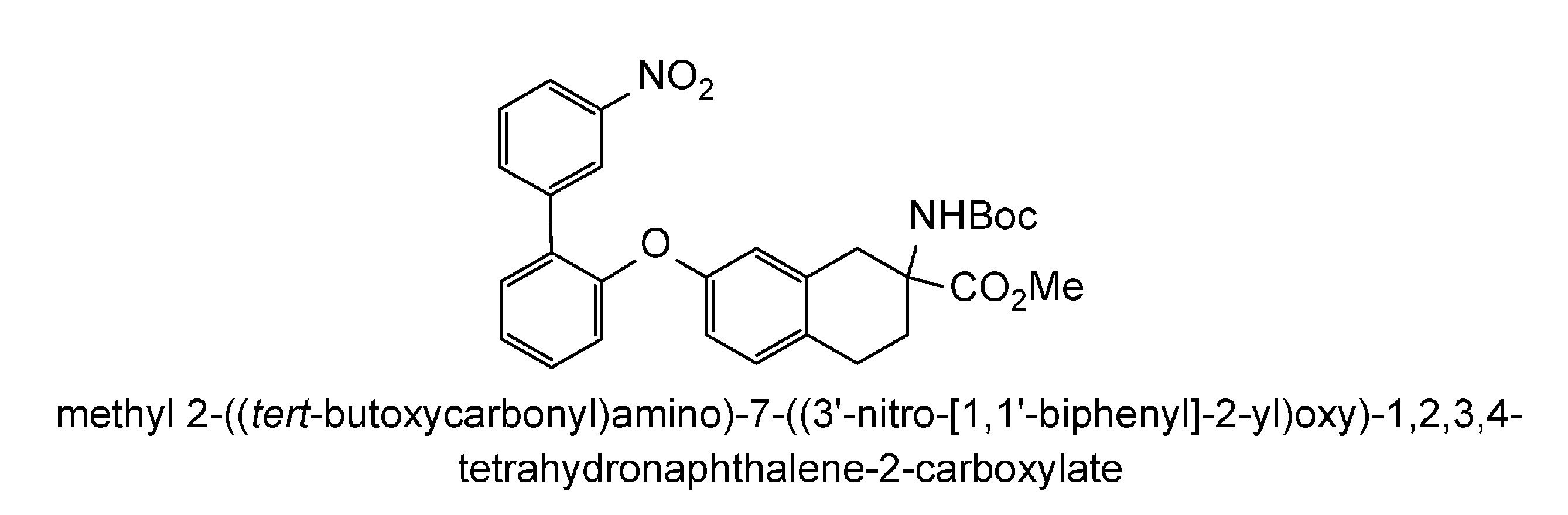
2-カルボキシ-7-((3’-ニトロ-[1,1’-ビフェニル]-2-イル)オキシ)-1,2,3,4-テトラヒドロナフタレン-2-アミニウムクロリドの製造
ステップ1で得られた上記化合物を、実施例1-26のステップ2、3と同様にして、下記化合物を合成した。
1H-NMR (CD3OD); 2.01-2.04 (m, 1H), 2.27-2.33 (m, 1H), 2.73-2.79 (m, 1H), 2.82 (d, J = 17.5 Hz, 1H), 2.88-2.94 (m, 1H), 3.39 (d, J = 17.0 Hz, 1H), 6.66 (d, J = 2.0 Hz, 1H), 6.70 (dd, J = 2.5, 8.0 Hz, 1H), 7.02 (d, J = 8.5 Hz, 1H), 7.06 (d, J = 9.0 Hz, 1H), 7.29 (t, J = 8.0 Hz, 1H), 7.39 (td, J = 2.0, 8.0 Hz, 1H), 7.53 (dd, J = 2.0, 7.5 Hz, 1H), 7.59 (t, J = 8.0 Hz, 1H), 7.93 (d, J = 8.0 Hz, 1H), 8.14 (dd, J = 2.0, 8.5 Hz, 1H), 8.41 (t, J = 2.5 Hz, 1H).
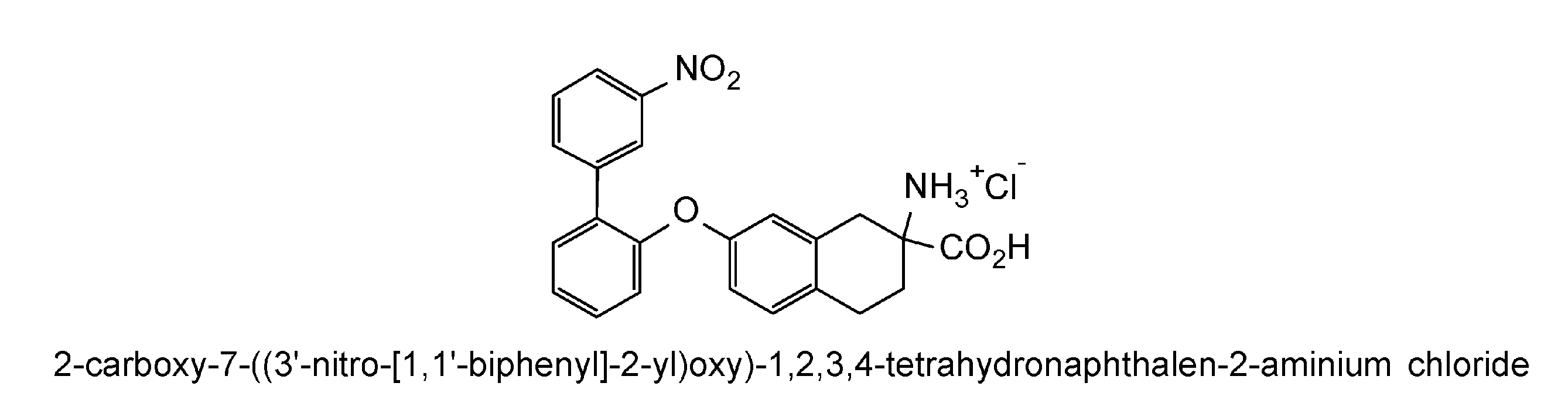
2-カルボキシ-7-((3’-メチル-[1,1’-ビフェニル]-2-イル)オキシ)-1,2,3,4-テトラヒドロナフタレン-2-アミニウムクロリド(化合物1-76)の製造
ステップ1(工程I-IV)
メチル 2-((tert-ブトキシカルボニル)アミノ)-7-((3’-メチル-[1,1’-ビフェニル]-2-イル)オキシ)-1,2,3,4-テトラヒドロナフタレン-2-カルボキシレートの製造
実施例1-1のステップ1からステップ4と同様にして、ただし、実施例のステップ4の2-ヨードナフタレンを2-ブロモ-3’-メチル-1,1’-ビフェニルに変えて、さらに、反応温度を90℃から120℃にして、下記化合物を得た。
1H-NMR (CDCl3); 1.42 (s, 9H), 2.05-2.11 (m, 1H), 2.36 (s, 3H), 2.45 (brs, 1H), 2.77-2.78 (m, 2H), 2.84 (d, J = 17.0 Hz, 1H), 3.21 (d, J = 17.5 Hz, 1H), 3.75 (s, 3H), 4.76 (brs, 1H), 6.62 (d, J = 2.0 Hz, 1H), 6.75 (dd, J = 2.0, 8.0 Hz, 1H), 6.97 (dd, J = 1.5, 8.0 Hz, 1H), 7.00 (d, J = 8.5 Hz, 1H), 7.11 (d, J = 7.5 Hz, 1H), 7.18 (td, J = 1.0, 7.5 Hz, 1H), 7.23-7.29 (m, 2H), 7.32-7.34 (m, 2H), 7.43 (dd, J = 1.5, 7.5 Hz, 1H).
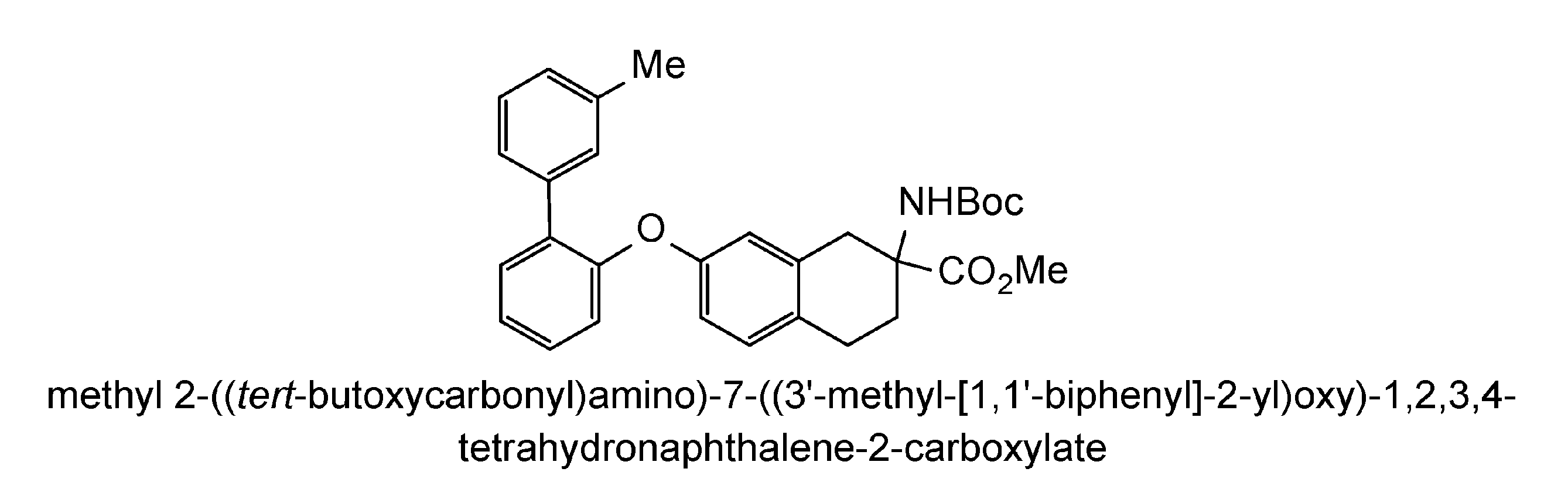
2-カルボキシ-7-((3’-メチル-[1,1’-ビフェニル]-2-イル)オキシ)-1,2,3,4-テトラヒドロナフタレン-2-アミニウムクロリドの製造
ステップ1で得られた上記化合物を、実施例1-26のステップ2、3と同様にして、下記化合物を合成した。
1H-NMR (CD3OD); 2.01-2.04 (m, 1H), 2.28-2.34 (m, 1H), 2.31 (s, 3H), 2.73-2.77 (m, 1H), 2.80 (d, J = 17.5 Hz, 1H), 2.87-2.93 (m, 1H), 3.39 (d, J = 17.5 Hz, 1H), 6.60 (d, J = 2.5 Hz, 1H), 6.67 (dd, J = 2.0, 8.0 Hz, 1H), 6.97 (dd, J = 1.0, 8.5 Hz, 1H), 7.04 (d, J = 8.0 Hz, 1H), 7.06 (d, J = 8.0 Hz, 1H), 7.17 (t, J = 7.0 Hz, 1H), 7.22 (td, J = 1.5, 7.5 Hz, 1H), 7.27-7.32 (m, 3H), 7.42 (dd, J = 2.0, 7.5 Hz, 1H).
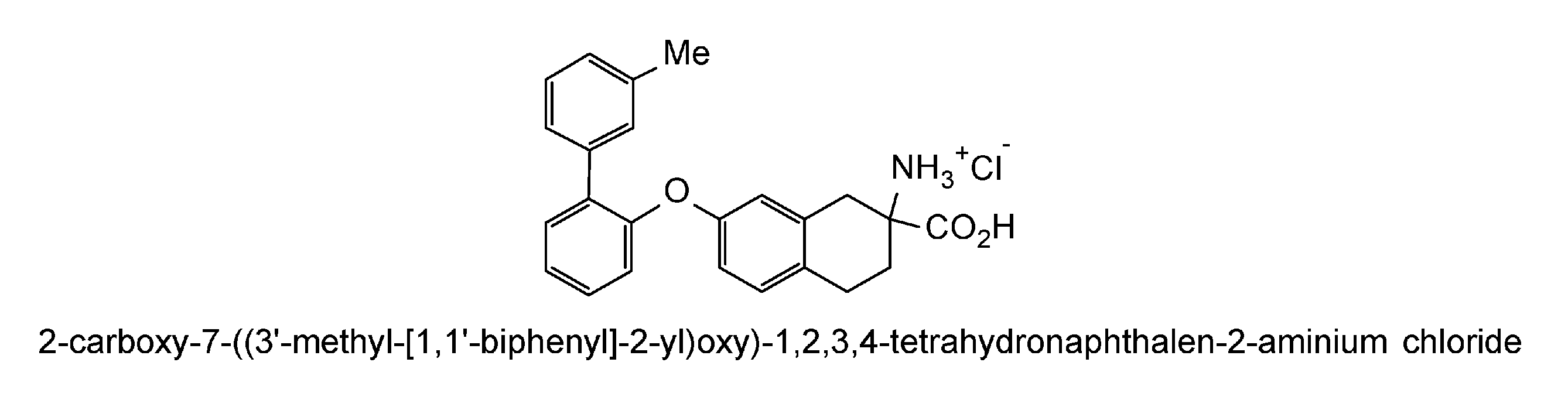
2-カルボキシ-7-((8-フルオロナフタレン-1-イル)オキシ)-1,2,3,4-テトラヒドロナフタレン-2-アミニウムクロリド(化合物1-80)の製造
ステップ1(工程I-IV)
メチル 2-((tert-ブトキシカルボニル)アミノ)-7-((8-フルオロナフタレン-1-イル)オキシ)-1,2,3,4-テトラヒドロナフタレン-2-カルボキシレートの製造
実施例1-1のステップ1からステップ4と同様にして、ただし、実施例のステップ4の2-ヨードナフタレンを1-ブロモ-8-フルオロナフタレンに変えて、さらに、反応温度を90℃から120℃にして、下記化合物を得た。
1H-NMR (CDCl3); 1.41 (s, 9H), 2.09-2.14 (m, 1H), 2.47 (brs, 1H), 2.79-2.82 (m, 2H), 2.86 (d, J = 16.5 Hz, 1H), 3.23 (d, J = 17.0 Hz, 1H), 3.75 (s, 3H), 4.80 (brs, 1H), 6.65 (d, J = 2.0 Hz, 1H), 6.79 (dd, J = 2.5, 8.0 Hz, 1H), 7.02-7.12 (m, 3H), 7.39-7.44 (m, 2H), 7.65 (d, J = 8.0 Hz, 2H).
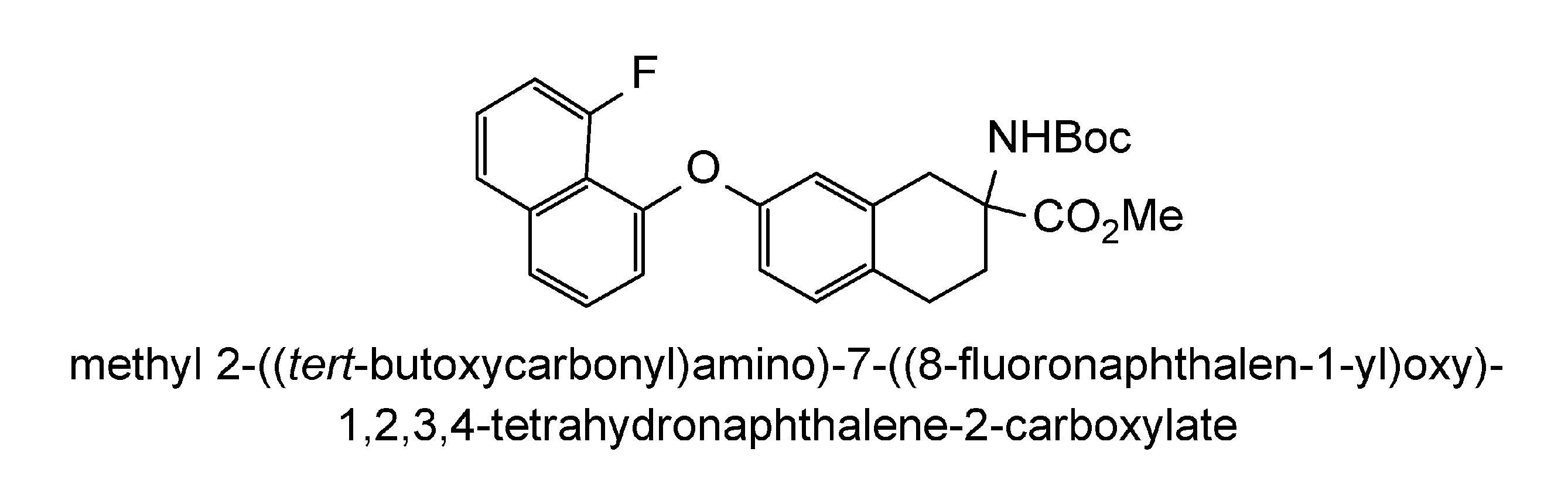
2-カルボキシ-7-((8-フルオロナフタレン-1-イル)オキシ)-1,2,3,4-テトラヒドロナフタレン-2-アミニウムクロリドの製造
ステップ1で得られた上記化合物を、実施例1-26のステップ2、3と同様にして、下記化合物を合成した。
1H-NMR (CD3OD); 2.13-2.18 (m, 1H), 2.37-2.43 (m, 1H), 2.83-2.90 (m, 1H), 2.94 (d, J = 17.5 Hz, 1H), 2.98-3.04 (m, 1H), 3.45 (d, J = 17.0 Hz, 1H), 6.70 (d, J = 3.0 Hz, 1H), 6.79 (dd, J = 2.5, 8.5 Hz, 1H), 7.05 (d, J = 7.5 Hz, 1H), 7.11 (dd, J = 7.0, 12.5 Hz, 1H), 7.16 (d, J = 8.5 Hz, 1H), 7.44-7.50 (m, 2H), 7.72-7.75 (m, 2H).
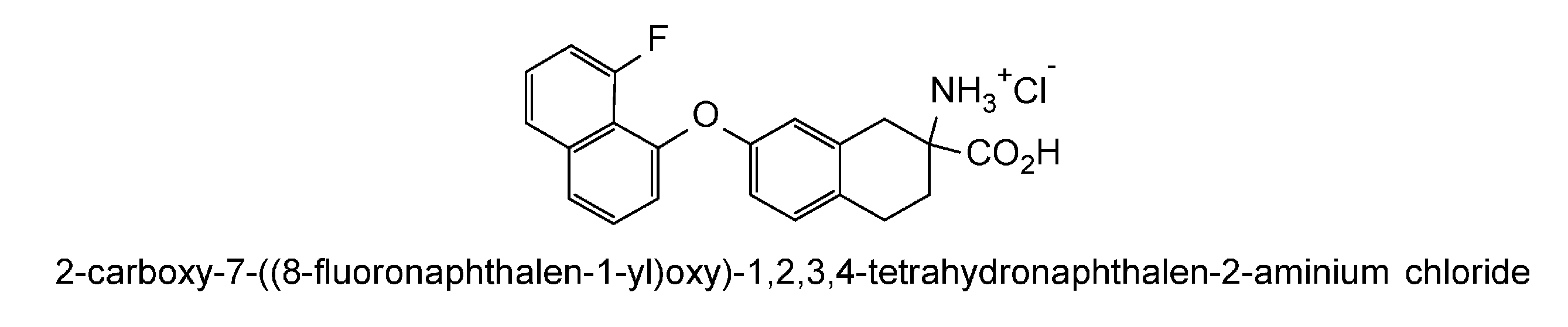
2-カルボキシ-7-((2’,3’-ジフルオロ-[1,1’-ビフェニル]-2-イル)オキシ)-1,2,3,4-テトラヒドロナフタレン-2-アミニウムクロリド(化合物1-88)の製造
ステップ1(工程I-IV)
メチル 2-((tert-ブトキシカルボニル)アミノ)-7-((2’,3’-ジフルオロ-[1,1’-ビフェニル]-2-イル)オキシ)-1,2,3,4-テトラヒドロナフタレン-2-カルボキシレートの製造
実施例1-1のステップ1からステップ4と同様にして、ただし、実施例のステップ4の2-ヨードナフタレンを2’-ブロモ-2,3-ジフルオロ-1,1’-ビフェニルに変えて、さらに、反応温度を90℃から120℃にして、下記化合物を得た。
1H-NMR (CDCl3); 1.42 (s, 9H), 2.06-2.12 (m, 1H), 2.45 (brs, 1H), 2.77-2.81 (m, 2H), 2.86 (d, J = 17.5 Hz, 1H), 3.22 (d, J = 17.5 Hz, 1H), 3.75 (s, 3H), 4.75 (brs, 1H), 6.66 (d, J = 2.0 Hz, 1H), 6.77 (dd, J = 2.5, 8.5 Hz, 1H), 6.96 (dd, J = 1.5, 8.0 Hz, 1H), 7.02 (d, J = 8.0 Hz, 1H), 7.05-7.14 (m, 3H), 7.18 (td, J = 1.0, 8.0 Hz, 1H), 7.32-7.38 (m, 2H).
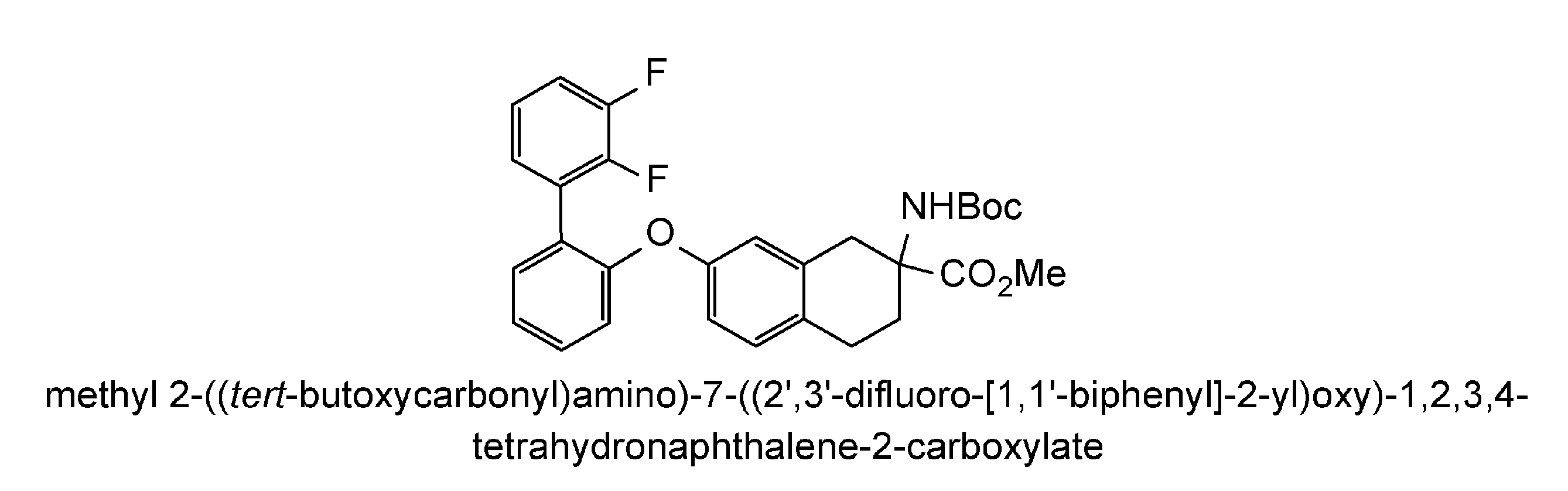
2-カルボキシ-7-((2’,3’-ジフルオロ-[1,1’-ビフェニル]-2-イル)オキシ)-1,2,3,4-テトラヒドロナフタレン-2-アミニウムクロリドの製造
ステップ1で得られた上記化合物を、実施例1-26のステップ2、3と同様にして、下記化合物を合成した。
1H-NMR (CD3OD); 2.00-2.05 (m, 1H), 2.30-2.36 (m, 1H), 2.75-2.79 (m, 1H), 2.82 (d, J = 17.5 Hz, 1H), 2.91-2.96 (m, 1H), 3.42 (d, J = 17.0 Hz, 1H), 6.68 (d, J = 2.0 Hz, 1H), 6.73 (dd, J = 3.0, 9.0 Hz, 1H), 6.97 (dd, J = 1.0, 8.5 Hz, 1H), 7.08 (d, J = 8.0 Hz, 1H), 7.13-7.24 (m, 3H), 7.36-7.40 (m, 2H).

2-カルボキシ-7-((8-メチルナフタレン-1-イル)オキシ)-1,2,3,4-テトラヒドロナフタレン-2-アミニウムクロリド(化合物1-86)の製造
ステップ1(工程I-IV)
メチル 2-((tert-ブトキシカルボニル)アミノ)-7-((8-メチルナフタレン-1-イル)オキシ)-1,2,3,4-テトラヒドロナフタレン-2-カルボキシレートの製造
実施例1-1のステップ1からステップ4と同様にして、ただし、実施例のステップ4の2-ヨードナフタレンを1-ブロモ-8-メチルナフタレンに変えて、さらに、反応温度を90℃から120℃にして、下記化合物を得た。
1H-NMR (CDCl3); 1.42 (s, 9H), 2.08-2.14 (m, 1H), 2.47 (brs, 1H), 2.79-2.82 (m, 5H), 2.86 (d, J = 16.0 Hz, 1H), 3.24 (d, J = 17.0 Hz, 1H), 3.75 (s, 3H), 4.78 (brs, 1H), 6.63 (d, J = 2.0 Hz, 1H), 6.76 (dd, J = 3.0, 8.5 Hz, 1H), 6.93 (dd, J = 1.0, 8.0 Hz, 1H), 7.05 (d, J = 8.0 Hz, 1H), 7.24 (d, J = 7.0 Hz, 1H), 7.33-7.37 (m, 2H), 7.62 (dd, J = 1.5, 9.0 Hz, 1H), 7.70 (d, J = 8.0 Hz, 1H).
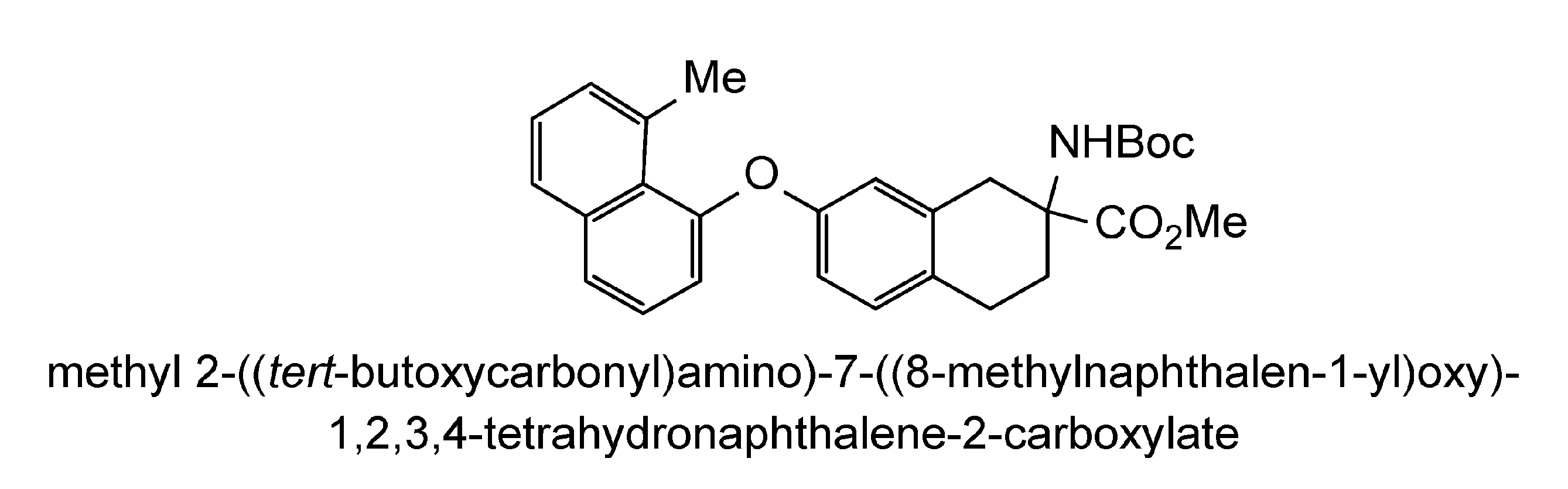
2-カルボキシ-7-((8-メチルナフタレン-1-イル)オキシ)-1,2,3,4-テトラヒドロナフタレン-2-アミニウムクロリドの製造
ステップ1で得られた上記化合物を、実施例1-26のステップ2、3と同様にして、下記化合物を合成した。
1H-NMR (CD3OD); 2.13-2.19 (m, 1H), 2.38-2.44 (m, 1H), 2.75 (s, 3H), 2.84-2.91 (m, 1H), 2.94 (d, J = 17.0 Hz, 1H), 2.98-3.04 (m, 1H), 3.44 (d, J = 17.0 Hz, 1H), 6.69 (d, J = 2.5 Hz, 1H), 6.78 (dd, J = 3.0, 9.0 Hz, 1H), 6.96 (dd, J = 1.0, 8.0 Hz, 1H), 7.17 (d, J = 8.0 Hz, 1H), 7.24 (d, J = 8.0 Hz, 1H), 7.35-7.39 (m, 2H), 7.68 (dd, J = 1.0, 8.0 Hz, 1H), 7.74 (d, J = 8.0 Hz, 1H).

2-カルボキシ-7-((3’-エチル-[1,1’-ビフェニル]-2-イル)オキシ)-1,2,3,4-テトラヒドロナフタレン-2-アミニウムクロリド(化合物1-91)の製造
ステップ1(工程I-IV)
メチル 2-((tert-ブトキシカルボニル)アミノ)-7-((3’-エチル-[1,1’-ビフェニル]-2-イル)オキシ)-1,2,3,4-テトラヒドロナフタレン-2-カルボキシレートの製造
実施例1-1のステップ1からステップ4と同様にして、ただし、実施例のステップ4の2-ヨードナフタレンを2-ブロモ-3’-エチル-1,1’-ビフェニルに変えて、さらに、反応温度を90℃から120℃にして、下記化合物を得た。
1H-NMR (CDCl3); 1.22 (t, J = 8.0 Hz, 3H), 1.42 (s, 9H), 2.05-2.11 (m, 1H), 2.45 (brs, 1H), 2.65 (q, J = 7.5 Hz, 2H), 2.76-2.78 (m, 2H), 2.84 (d, J = 17.0 Hz, 1H), 3.20 (d, J = 17.0 Hz, 1H), 3.75 (s, 3H), 4.75 (brs, 1H), 6.61 (d, J = 2.0 Hz, 1H), 6.74 (dd, J = 2.5, 8.0 Hz, 1H), 6.98-7.00 (m, 2H), 7.13 (d, J = 7.5 Hz, 1H), 7.19 (td, J = 2.0, 7.5 Hz, 1H), 7.25-7.29 (m, 2H), 7.33-7.36 (m, 2H), 7.45 (dd, J = 2.0, 8.0 Hz, 1H).

2-カルボキシ-7-((3’-エチル-[1,1’-ビフェニル]-2-イル)オキシ)-1,2,3,4-テトラヒドロナフタレン-2-アミニウムクロリドの製造
ステップ1で得られた上記化合物を、実施例1-26のステップ2、3と同様にして、下記化合物を合成した。
1H-NMR (CD3OD); 1.19 (t, J = 7.5 Hz, 3H), 2.00-2.03 (m, 1H), 2.27-2.34 (m, 1H), 2.61 (q, J = 7.5 Hz, 2H), 2.72-2.78 (m, 1H), 2.79 (d, J = 17.0 Hz, 1H), 2.87-2.93 (m, 1H), 3.39 (d, J = 17.5 Hz, 1H), 6.60 (d, J = 2.5 Hz, 1H), 6.67 (dd, J = 2.5, 8.0 Hz, 1H), 6.98 (dd, J = 1.0, 8.0 Hz, 1H), 7.04 (d, J = 8.5 Hz, 1H), 7.09 (d, J = 7.5 Hz, 1H), 7.19-7.24 (m, 2H), 7.27-7.34 (m, 3H), 7.52 (dd, J = 1.5, 7.5 Hz, 1H).
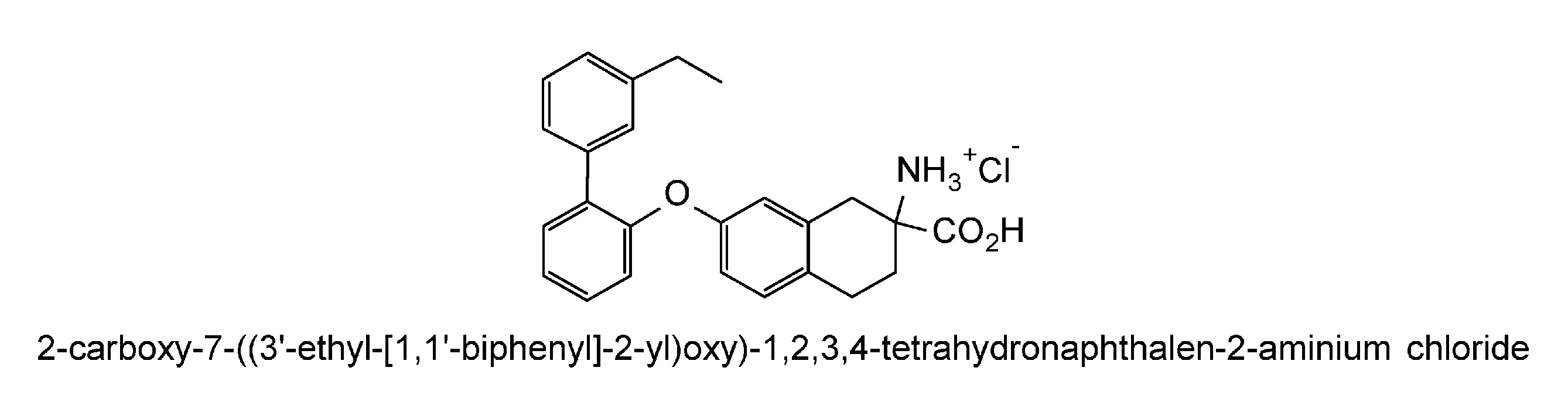
2-カルボキシ-7-((3’-クロロ-4’-フルオロ-[1,1’-ビフェニル]-2-イル)オキシ)-1,2,3,4-テトラヒドロナフタレン-2-アミニウムクロリド(化合物1-93)の製造
ステップ1(工程I-IV)
メチル 2-((tert-ブトキシカルボニル)アミノ)-7-((3’-クロロ-4’-フルオロ-[1,1’-ビフェニル]-2-イル)オキシ)-1,2,3,4-テトラヒドロナフタレン-2-カルボキシレートの製造
実施例1-1のステップ1からステップ4と同様にして、ただし、実施例のステップ4の2-ヨードナフタレンを2-ブロモ-3’-クロロ-4’-フルオロ-1,1’-ビフェニルに変えて、さらに、反応温度を90℃から120℃にして、下記化合物を得た。
1H-NMR (CDCl3); 1.42 (s, 9H), 2.06-2.12 (m, 1H), 2.43 (brs, 1H), 2.77-2.79 (m, 2H), 2.87 (d, J = 17.0 Hz, 1H), 3.24 (d, J = 17.0 Hz, 1H), 3.75 (s, 3H), 4.76 (brs, 1H), 6.61 (d, J = 2.5 Hz, 1H), 6.72 (dd, J = 2.5, 8.0 Hz, 1H), 6.98 (d, J = 8.0 Hz, 1H), 7.02 (d, J = 8.0 Hz, 1H), 7.12 (t, J = 9.0 Hz, 1H), 7.19 (td, J = 1.5, 7.5 Hz, 1H), 7.30 (td, J = 1.5, 8.0 Hz, 1H), 7.38-7.42 (m, 2H), 7.58 (dd, J = 2.5, 7.5 Hz, 1H).

2-カルボキシ-7-((3’-クロロ-4’-フルオロ-[1,1’-ビフェニル]-2-イル)オキシ)-1,2,3,4-テトラヒドロナフタレン-2-アミニウムクロリドの製造
ステップ1で得られた上記化合物を、実施例1-26のステップ2、3と同様にして、下記化合物を合成した。
1H-NMR (CD3OD); 2.01-2.04 (m, 1H), 2.28-2.34 (m, 1H), 2.71-2.76 (m, 1H), 2.80 (d, J = 17.5 Hz, 1H), 2.83-2.93 (m, 1H), 3.39 (d, J = 17.0 Hz, 1H), 6.60 (d, J = 2.5 Hz, 1H), 6.66-6.71 (m, 2H), 6.82 (dd, J = 1.0, 6.5 Hz, 1H), 6.91 (t, J = 1.5 Hz, 1H), 6.98 (dd, J = 1.0, 8.0 Hz, 1H), 7.04 (d, J = 8.0 Hz, 1H), 7.15 (t, J = 8.0 Hz, 1H), 7.23 (td, J = 1.0, 7.0 Hz, 1H), 7.31 (td, J = 1.5, 8.0 Hz, 1H), 7.46 (dd, J = 2.0, 7.5 Hz, 1H).
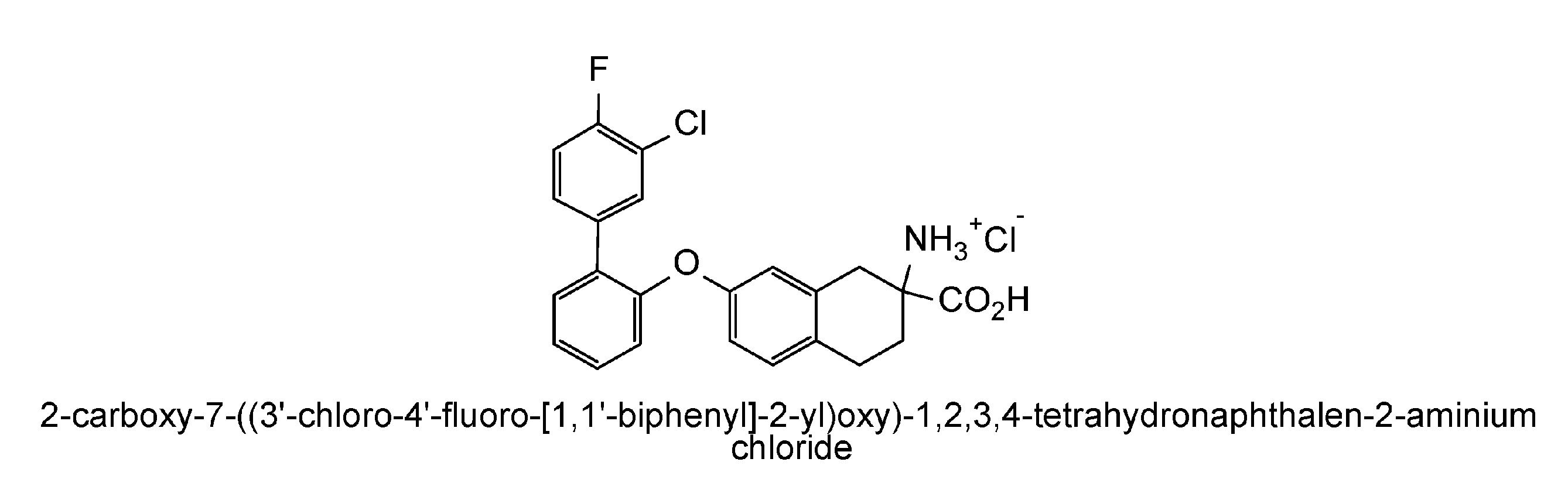
2-カルボキシ-7-((2’-クロロ-3’-フルオロ-[1,1’-ビフェニル]-2-イル)オキシ)-1,2,3,4-テトラヒドロナフタレン-2-アミニウムクロリド(化合物1-89)の製造
ステップ1(工程I-IV)
メチル 2-((tert-ブトキシカルボニル)アミノ)-7-((2’-クロロ-3’-フルオロ-[1,1’-ビフェニル]-2-イル)オキシ)-1,2,3,4-テトラヒドロナフタレン-2-カルボキシレートの製造
実施例1-1のステップ1からステップ4と同様にして、ただし、実施例のステップ4の2-ヨードナフタレンを2’-ブロモ-2-クロロ-3-フルオロ-1,1’-ビフェニルに変えて、さらに、反応温度を90℃から120℃にして、下記化合物を得た。
1H-NMR (CDCl3); 1.42 (s, 9H), 2.05-2.11 (m, 1H), 2.44 (brs, 1H), 2.75-2.78 (m, 2H), 2.83 (d, J = 16.5 Hz, 1H), 3.20 (d, J = 17.0 Hz, 1H), 3.75 (s, 3H), 4.74 (brs, 1H), 6.61 (d, J = 2.0 Hz, 1H), 6.73 (dd, J = 2.5, 8.0 Hz, 1H), 6.97-6.99 (m, 2H), 7.10-7.12 (m, 2H), 7.16-7.23 (m, 2H), 7.30 (dd, J = 1.5, 7.5 Hz, 1H), 7.35 (td, J = 1.5, 8.0 Hz, 1H).

2-カルボキシ-7-((2’-クロロ-3’-フルオロ-[1,1’-ビフェニル]-2-イル)オキシ)-1,2,3,4-テトラヒドロナフタレン-2-アミニウムクロリドの製造
ステップ1で得られた上記化合物を、実施例1-26のステップ2、3と同様にして、下記化合物を合成した。
1H-NMR (CD3OD); 2.00-2.04 (m, 1H), 2.29-2.35 (m, 1H), 2.74-2.80 (m, 1H), 2.80 (d, J = 17.0 Hz, 1H), 2.90-2.95 (m, 1H), 3.40 (d, J = 17.0 Hz, 1H), 6.66 (d, J = 1.5 Hz, 1H), 6.71 (dd, J = 2.0, 8.0 Hz, 1H), 6.97 (d, J = 8.0 Hz, 1H), 7.06 (d, J = 8.5 Hz, 1H), 7.13-7.23 (m, 3H), 7.26-7.31 (m, 2H), 7.38 (td, J = 1.0, 7.0 Hz, 1H).
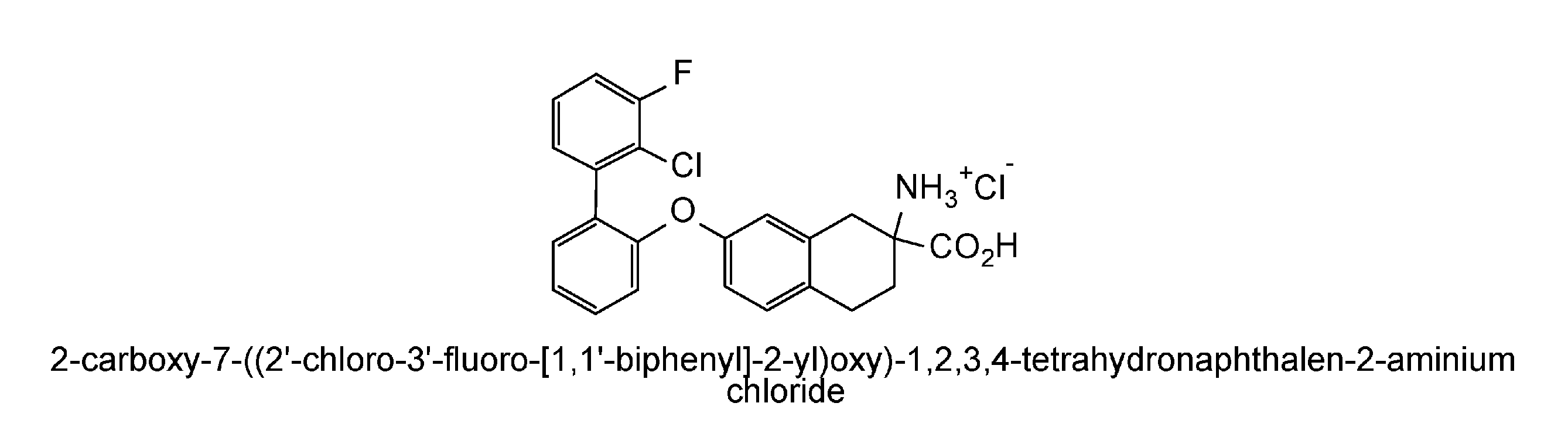
2-カルボキシ-7-((3’-(ジメチルアンモニオ)-[1,1’-ビフェニル]-2-イル)オキシ)-1,2,3,4-テトラヒドロナフタレン-2-アミニウムクロリド(化合物1-67)の製造
ステップ1(工程I-IV)
メチル 2-((tert-ブトキシカルボニル)アミノ)-7-((3’-(ジメチルアミノ)-[1,1’-ビフェニル]-2-イル)オキシ)-1,2,3,4-テトラヒドロナフタレン-2-カルボキシレートの製造
実施例1-1のステップ1からステップ4と同様にして、ただし、実施例のステップ4の2-ヨードナフタレンを2’-ブロモ-N,N-ジメチル-[1,1’-ビフェニル]-3-アミンに変えて、さらに、反応温度を90℃から120℃にして、下記化合物を得た。
1H-NMR (CDCl3); 1.42 (s, 9H), 2.04-2.11 (m, 1H), 2.46 (brs, 1H), 2.75-2.79 (m, 2H), 2.83 (d, J = 16.5 Hz, 1H), 2.87 (s, 6H), 3.20 (d, J = 17.0 Hz, 1H), 3.75 (s, 3H), 4.76 (brs, 1H), 6.61 (d, J = 2.5 Hz, 1H), 6.69-6.70 (m, 1H), 6.74 (dd, J = 3.0, 9.0 Hz, 1H), 6.86-6.89 (m, 2H), 6.99-7.00 (m, 2H), 7.18-7.29 (m, 3H), 7.47 (dd, J = 2.0, 7.5 Hz, 1H).
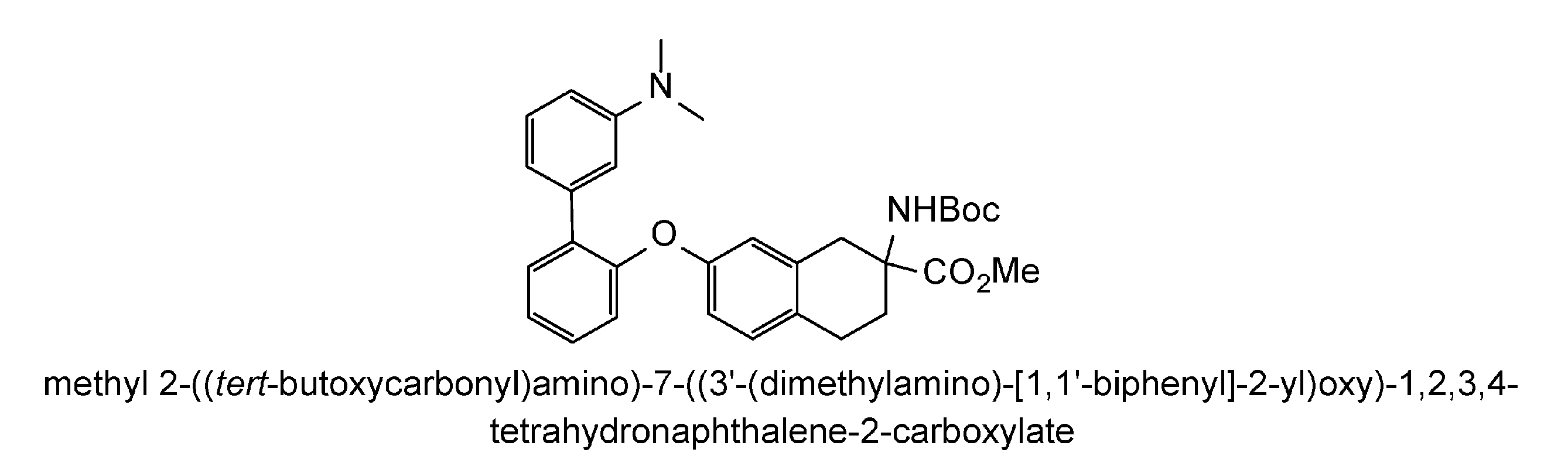
2-カルボキシ-7-((3’-(ジメチルアンモニオ)-[1,1’-ビフェニル]-2-イル)オキシ)-1,2,3,4-テトラヒドロナフタレン-2-アミニウムクロリドの製造
ステップ1で得られた上記化合物を、実施例1-26のステップ2、3と同様にして、下記化合物を合成した。
1H-NMR (CD3OD); 2.12-2.17 (m, 1H), 2.33-2.39 (m, 1H), 2.81-2.88 (m, 1H), 2.96 (d, J = 17.0 Hz, 1H), 2.92-2.98 (m, 1H), 3.28 (s, 6H), 3.40 (d, J = 17.5 Hz, 1H), 6.72 (d, J = 2.5 Hz, 1H), 6.76 (dd, J = 1.5, 8.0 Hz, 1H), 7.04 (d, J = 8.0 Hz, 1H), 7.11 (d, J = 8.5 Hz, 1H), 7.31 (t, J = 7.0 Hz, 1H), 7.42 (td, J = 1.5, 9.0 Hz, 1H), 7.54 (dd, J = 1.5, 8.0 Hz, 1H), 7.58-7.65 (m, 2H), 7.71 (d, J = 7.5 Hz, 1H), 7.89 (s, 1H).
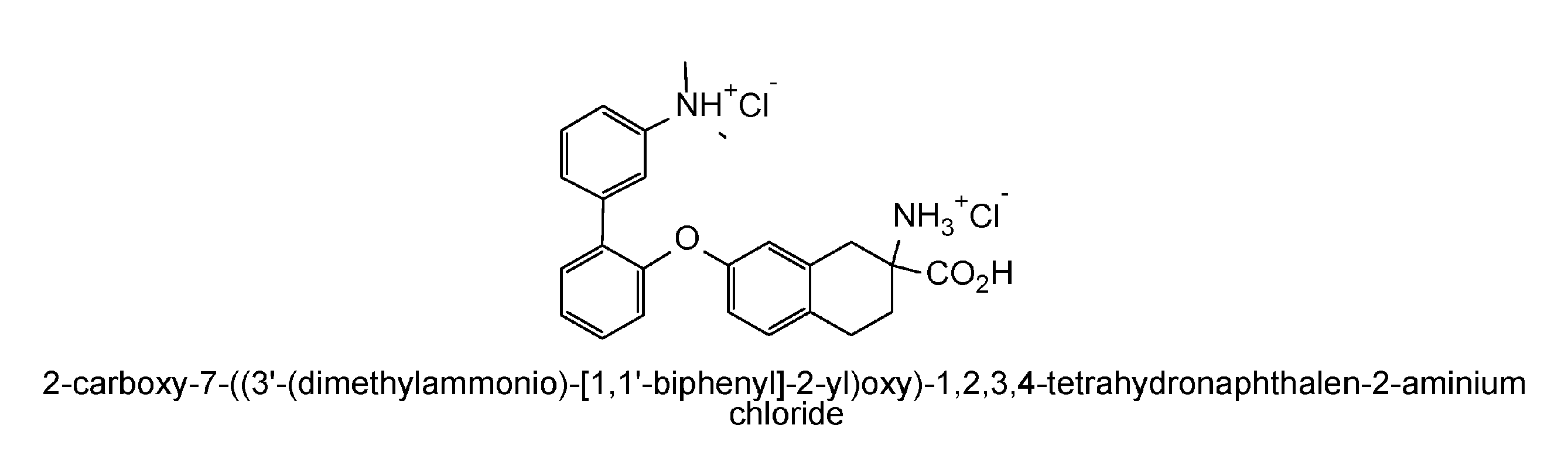
7-((2’-ブロモ-3-ニトロ-[1,1’-ビフェニル]-2-イル)オキシ)-2-カルボキシ-1,2,3,4-テトラヒドロナフタレン-2-アミニウムクロリド(化合物1-99)の製造
ステップ1(工程I-IV)
メチル 7-((2’-ブロモ-3-ニトロ-[1,1’-ビフェニル]-2-イル)オキシ)-2-((tert-ブトキシカルボニル)アミノ)-1,2,3,4-テトラヒドロナフタレン-2-カルボキシレートの製造
methyl 7-((2’-bromo-3-nitro-[1,1’-biphenyl]-2-yl)oxy)-2-((tert-butoxycarbonyl)amino)-1,2,3,4-tetrahydronaphthalene-2-carboxylate
実施例1-1のステップ1からステップ4と同様にして、ただし、実施例のステップ4の2-ヨードナフタレンを2’-ブロモ-2-フルオロ-3-ニトロ-1,1’-ビフェニルに変えて、さらに、反応温度を90℃から120℃にして、下記化合物を得た。
1H-NMR (CDCl3); 1.43 (s, 9H), 1.98-2.02 (m, 1H), 2.43 (brs, 1H), 2.66-2.71 (m, 2H), 2.69 (d, J = 18.0 Hz, 1H), 3.05 (d, J = 17.5 Hz, 1H), 3.74 (s, 3H), 4.69 (brs, 1H), 6.30 (s, 1H), 6.47 (t, J = 8.5 Hz, 1H), 6.79 (d, J = 8.5 Hz, 1H), 7.10-7.24 (m, 3H), 7.40 (t, J = 8.0 Hz, 1H), 7.48-7.56 (m, 2H), 7.96 (dd, J = 1.5, 8.0 Hz, 1H).
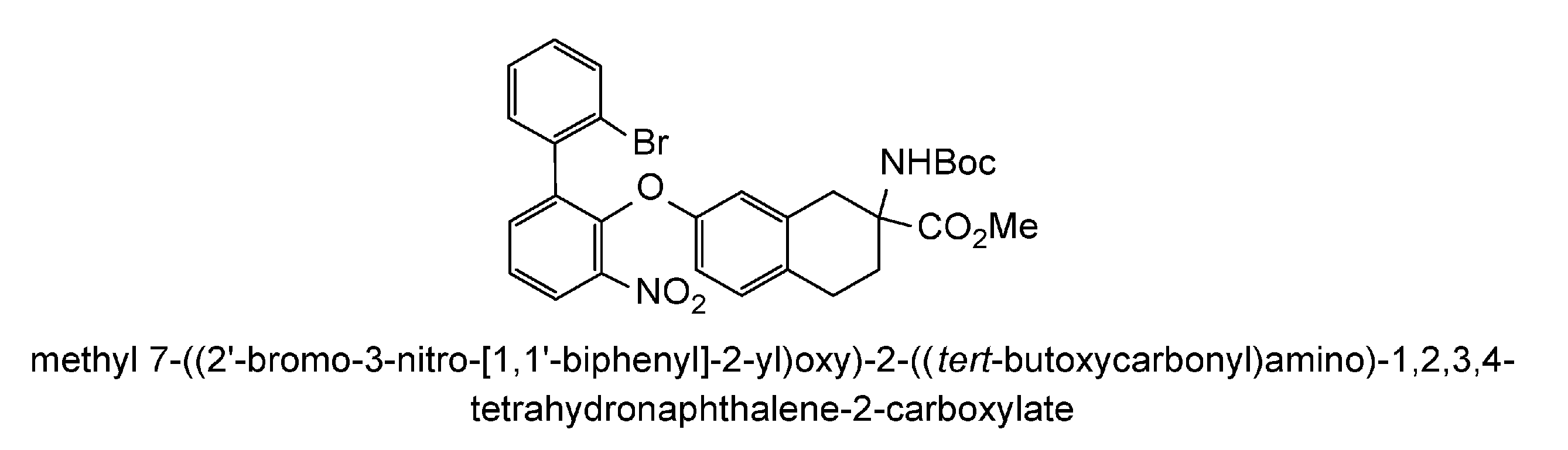
7-((2’-ブロモ-3-ニトロ-[1,1’-ビフェニル]-2-イル)オキシ)-2-カルボキシ-1,2,3,4-テトラヒドロナフタレン-2-アミニウムクロリドの製造
ステップ1で得られた上記化合物を、実施例1-26のステップ2、3と同様にして、下記化合物を合成した。
1H-NMR (DMSO-d6); 1.99-2.12 (m, 2H), 2.65-2.75 (m, 2H), 2.87-2.92 (m, 1H), 3.12-3.39 (a proton overlapped with water protons, 1H), 6.45-6.46 (m, 2H), 6.90 (dd, J = 4.5, 9.0 Hz, 1H), 7.19-7.30 (m, 3H), 7.59-7.63 (m, 2H), 7.71-7.73 (m, 1H), 8.15 (dd, J = 1.5, 8.0 Hz, 1H).
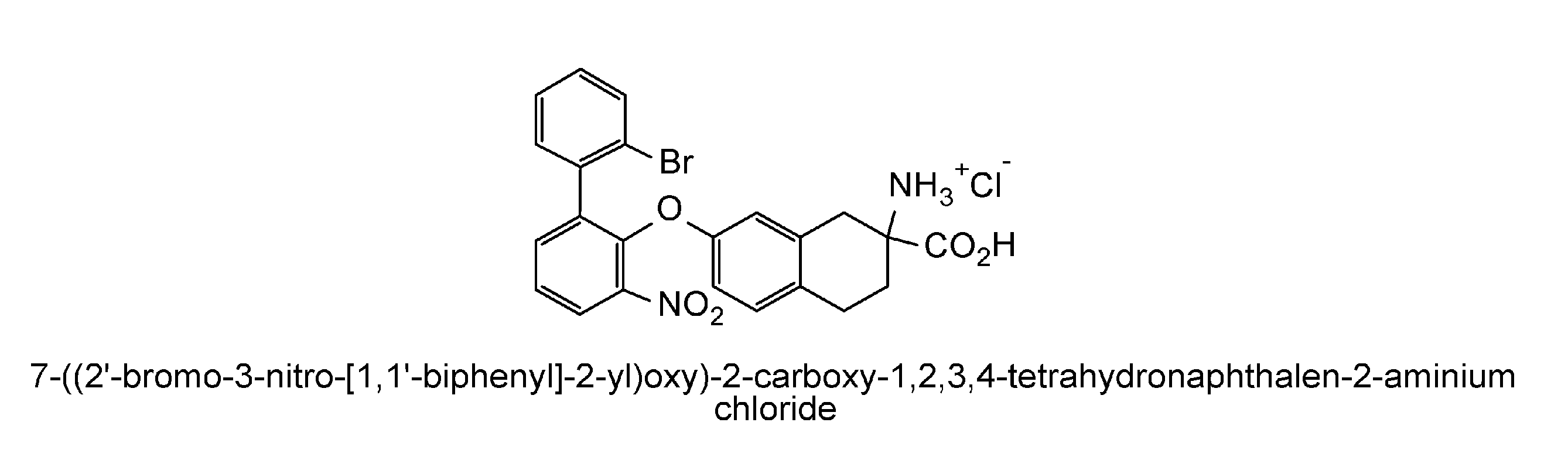
2-カルボキシ-7-((3’-(メチルチオ)-[1,1’-ビフェニル]-2-イル)オキシ)- 1,2,3,4-テトラヒドロナフタレン-2-アミニウムクロリド(化合物1-94)の製造
ステップ1(工程I-IV)
メチル 2-((tert-ブトキシカルボニル)アミノ)-7-((3’-(メチルチオ)-[1,1’-ビフェニル]-2-イル)オキシ)-1,2,3,4-テトラヒドロナフタレン-2-カルボキシレートの製造
実施例1-1のステップ1からステップ4と同様にして、ただし、実施例のステップ4の2-ヨードナフタレンを2-ブロモ-3’-メチルチオ-1,1’-ビフェニルに変えて、さらに、反応温度を90℃から120℃にして、下記化合物を得た。
1H-NMR (CDCl3); 1.42 (s, 9H), 2.05-2.11 (m, 1H), 2.41 (s, 3H), 2.46 (brs, 1H), 2.76-2.78 (m, 2H), 2.85 (d, J = 16.5 Hz, 1H), 3.21 (d, J = 17.0 Hz, 1H), 3.75 (s, 3H), 4.76 (brs, 1H), 6.61 (d, J = 2.5 Hz, 1H), 6.73 (dd, J = 3.0, 8.5 Hz, 1H), 6.99-7.01 (m, 2H), 7.18-7.22 (m, 2H), 7.25-7.32 (m, 3H), 7.39 (m, 1H), 7.43 (dd, J = 2.0, 7.5 Hz, 1H).
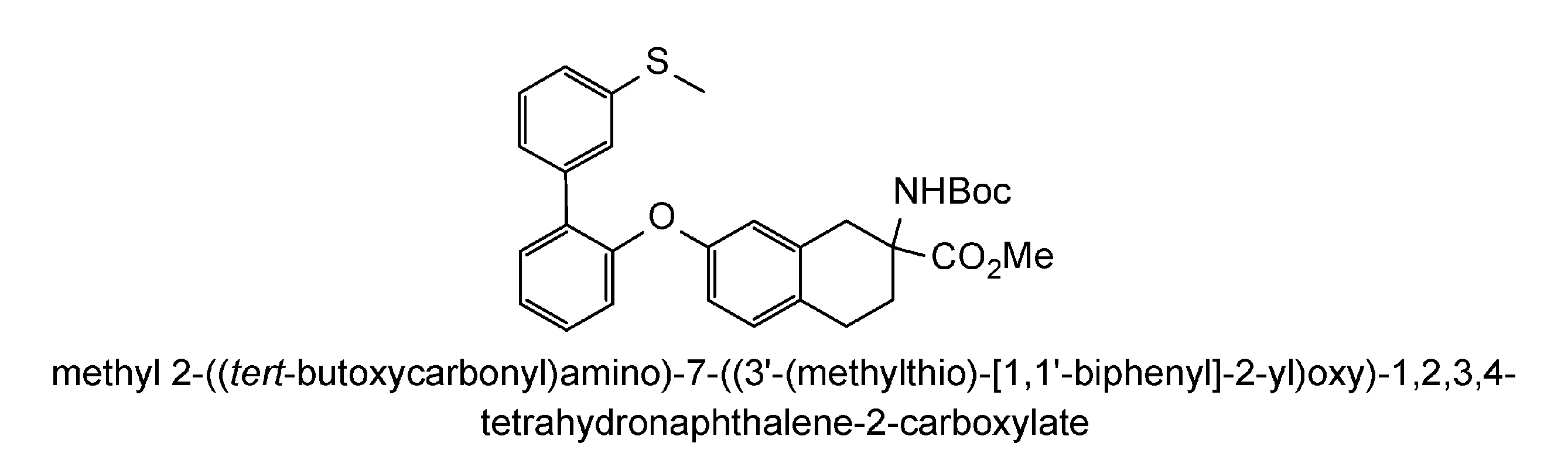
2-カルボキシ-7-((3’-(メチルチオ)-[1,1’-ビフェニル]-2-イル)オキシ)-1,2,3,4-テトラヒドロナフタレン-2-アミニウムクロリドの製造
ステップ1で得られた上記化合物を、実施例1-26のステップ2、3と同様にして、下記化合物を合成した。
1H-NMR (CD3OD); 2.10-2.15 (m, 1H), 2.33-2.38 (m, 1H), 2.39 (s, 3H), 2.78-2.85 (m, 1H), 2.91 (d, J = 16.5 Hz, 1H), 2.94-2.99 (m, 1H), 3.41 (d, J = 17.0 Hz, 1H), 6.65 (d, J = 2.0 Hz, 1H), 6.71 (dd, J = 2.0, 8.0 Hz, 1H), 7.02 (dd, J = 1.0, 8.0 Hz, 1H), 7.09 (d, J = 8.0 Hz, 1H), 7.15-7.18 (m, 1H), 7.23-7.28 (m, 3H), 7.35 (dd, J = 2.0, 8.0 Hz, 1H), 7.37 (dd, J = 2.0, 3.5 Hz, 1H), 7.46 (dd, J = 1.5, 8.0 Hz, 1H).
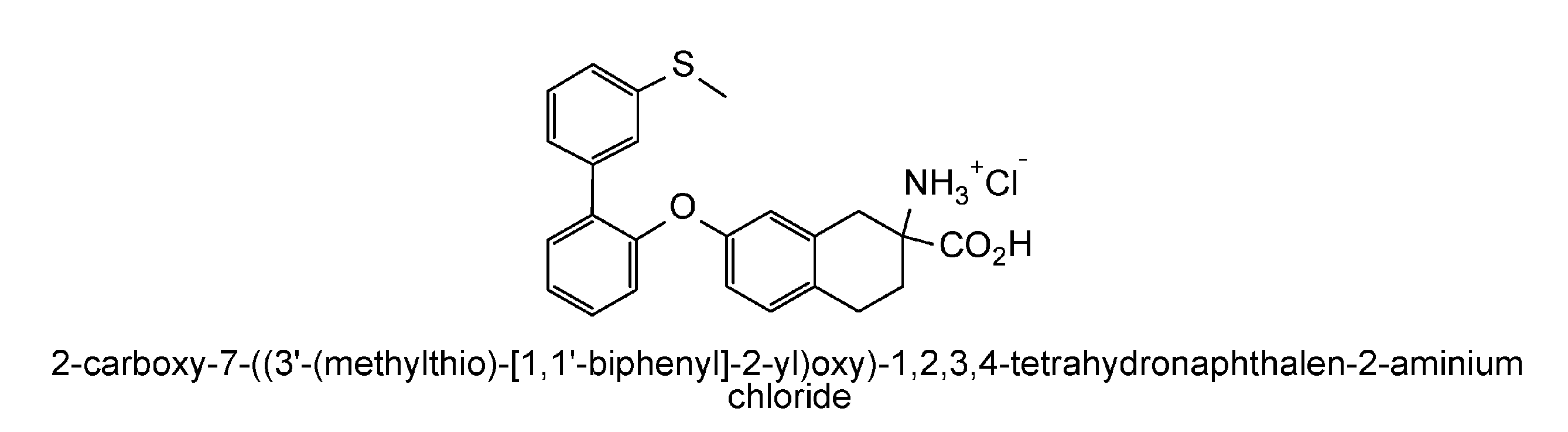
2-カルボキシ-7-((2’,3’-ジクロロ-[1,1’-ビフェニル]-2-イル)オキシ)-1,2,3,4-テトラヒドロナフタレン-2-アミニウムクロリド(化合物1-100)の製造
ステップ1(工程I-IV)
メチル 2-((tert-ブトキシカルボニル)アミノ)-7-((2’,3’-ジクロロ-[1,1’-ビフェニル]-2-イル)オキシ)-1,2,3,4-テトラヒドロナフタレン-2-カルボキシレートの製造
実施例1-1のステップ1からステップ4と同様にして、ただし、実施例のステップ4の2-ヨードナフタレンを2’-ブロモ-2,3-ジクロロ-1,1’-ビフェニルに変えて、さらに、反応温度を90℃から120℃にして、下記化合物を得た。
1H-NMR (CDCl3); 1.42 (s, 9H), 2.05-2.11 (m, 1H), 2.46 (brs, 1H), 2.77-2.78 (m, 2H), 2.83 (d, J = 16.5 Hz, 1H), 3.19 (d, J = 16.5 Hz, 1H), 3.76 (s, 3H), 4.75 (brs, 1H), 6.61 (brs, 1H), 6.73 (brs, 1H), 6.96-6.98 (m, 2H), 7.16-7.22 (m, 3H), 7.28 (dd, J = 2.0, 7.5 Hz, 1H), 7.35 (td, J = 1.5, 8.5 Hz, 1H), 7.41 (dd, J = 2.0, 7.5 Hz, 1H).
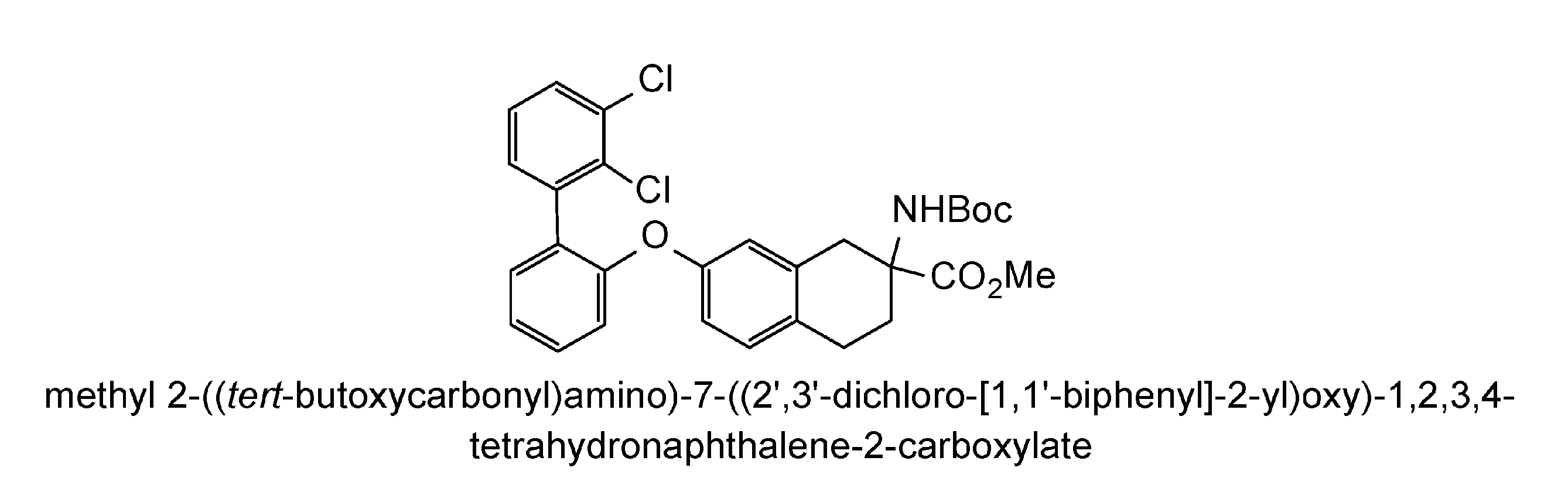
2-カルボキシ-7-((2’,3’-ジクロロ-[1,1’-ビフェニル]-2-イル)オキシ)-1,2,3,4-テトラヒドロナフタレン-2-アミニウムクロリドの製造
ステップ1で得られた上記化合物を、実施例1-26のステップ2、3と同様にして、下記化合物を合成した。
1H-NMR (CD3OD); 2.10-2.15 (m, 1H), 2.34-2.40 (m, 1H), 2.79-2.85 (m, 1H), 2.91 (d, J = 17.5 Hz, 1H), 2.94-3.00 (m, 1H), 3.42 (d, J = 17.0 Hz, 1H), 6.69 (d, J = 2.0 Hz, 1H), 6.75 (dd, J = 2.5, 8.0 Hz, 1H), 6.98 (d, J = 8.0 Hz, 1H), 7.09 (d, J = 8.5 Hz, 1H), 7.21-7.26 (m, 3H), 7.30 (dd, J = 2.0, 7.5 Hz, 1H), 7.39 (td, J = 1.7, 8.0 Hz, 1H), 7.47 (dd, J = 3.0, 7.0 Hz, 1H).

2-カルボキシ-7-((3’-クロロ-2’-フルオロ-[1,1’-ビフェニル]-2-イル)オキシ)-1,2,3,4-テトラヒドロナフタレン-2-アミニウムクロリド(化合物1-101)の製造
ステップ1(工程I-IV)
メチル 2-((tert-ブトキシカルボニル)アミノ)-7-((3’-クロロ-2’-フルオロ-[1,1’-ビフェニル]-2-イル)オキシ)-1,2,3,4-テトラヒドロナフタレン-2-カルボキシレートの製造
実施例1-1のステップ1からステップ4と同様にして、ただし、実施例のステップ4の2-ヨードナフタレンを2’-ブロモ-3-クロロ-2-フルオロ-1,1’-ビフェニルに変えて、さらに、反応温度を90℃から120℃にして、下記化合物を得た。
1H-NMR (CDCl3); 1.42 (s, 9H), 2.06-2.12 (m, 1H), 2.47 (brs, 1H), 2.78-2.79 (m, 2H), 2.85 (d, J = 17.5 Hz, 1H), 3.22 (d, J = 17.0 Hz, 1H), 3.76 (s, 3H), 4.77 (brs, 1H), 6.65 (d, J = 2.5 Hz, 1H), 6.76 (dd, J = 2.5, 8.5 Hz, 1H), 6.95-6.97 (m, 1H), 7.02 (d, J = 9.0 Hz, 1H), 7.09 (td, J = 1.0, 8.0 Hz, 1H), 7.17 (td, J = 1.0, 7.0 Hz, 1H), 7.25-7.29 (m, 1H), 7.32-7.36 (m, 3H).
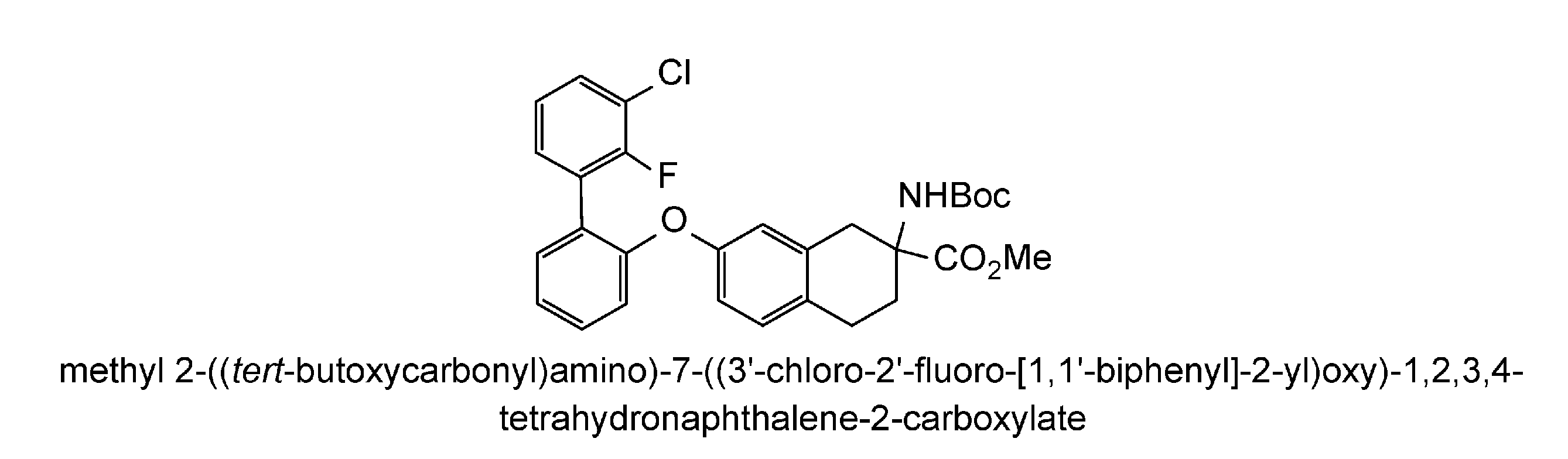
2-カルボキシ-7-((3’-クロロ-2’-フルオロ-[1,1’-ビフェニル]-2-イル)オキシ)-1,2,3,4-テトラヒドロナフタレン-2-アミニウムクロリドの製造
ステップ1で得られた上記化合物を、実施例1-26のステップ2、3と同様にして、下記化合物を合成した。
1H-NMR (CD3OD); 2.11-2.16 (m, 1H), 2.35-2.41 (m, 1H), 2.80-2.87 (m, 1H), 2.94 (d, J = 17.3 Hz, 1H), 2.97-3.01 (m, 1H), 3.44 (d, J = 17.2 Hz, 1H), 6.72 (d, J = 2.6 Hz, 1H), 6.77 (dd, J = 2.6, 8.4 Hz, 1H), 6.99 (d, J = 8.1 Hz, 1H), 7.12 (d, J = 8.4 Hz, 1H), 7.15 (t, J = 7.9 Hz, 1H), 7.24 (t, J = 7.5 Hz, 1H), 7.29 (td, J = 1.9, 7.9 Hz, 1H), 7.38-7.43 (m, 3H).
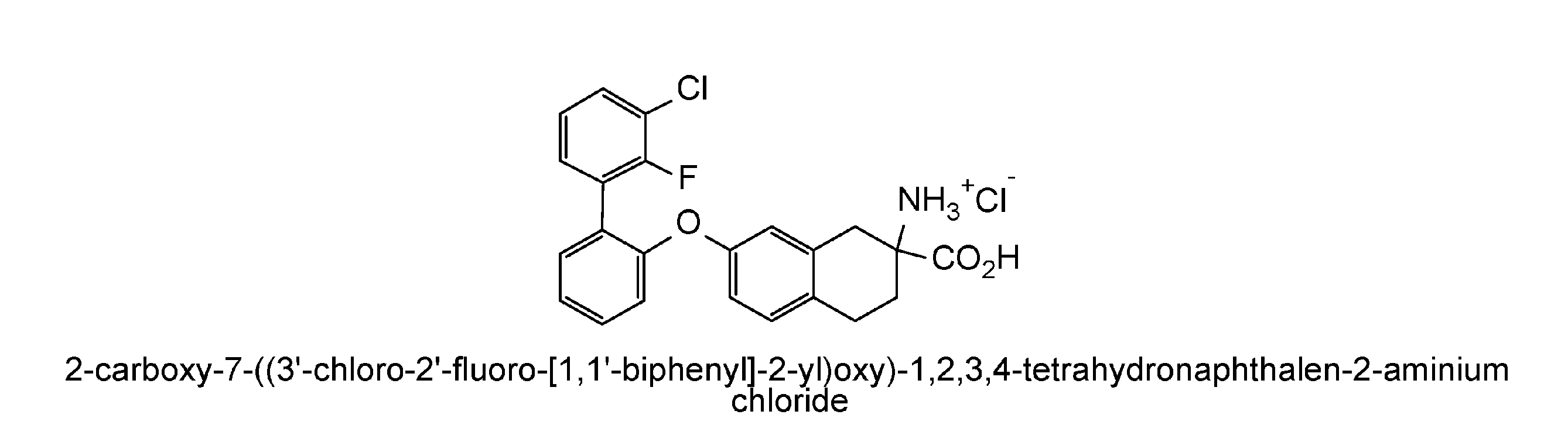
2-カルボキシ-7-((2’-フルオロ-3’-メチル-[1,1’-ビフェニル]-2-イル)オキシ)-1,2,3,4-テトラヒドロナフタレン-2-アミニウムクロリド(化合物1-102)の製造
ステップ1(工程I-IV)
メチル 2-((tert-ブトキシカルボニル)アミノ)-7-((2’-フルオロ-3’-メチル-[1,1’-ビフェニル]-2-イル)オキシ)-1,2,3,4-テトラヒドロナフタレン-2-カルボキシレートの製造
実施例1-1のステップ1からステップ4と同様にして、ただし、実施例のステップ4の2-ヨードナフタレンを2’-ブロモ-2-フルオロ-3-メチル-1,1’-ビフェニルに変えて、さらに、反応温度を90℃から120℃にして、下記化合物を得た。
1H-NMR (CDCl3); 1.42 (s, 9H), 2.04-2.11 (m, 1H), 2.28 (s, 3H), 2.46 (brs, 1H), 2.75-2.78 (m, 2H), 2.84 (d, J = 17.0 Hz, 1H), 3.20 (d, J = 17.0 Hz, 1H), 3.75 (s, 3H), 4.77 (brs, 1H), 6.65 (d, J = 2.5 Hz, 1H), 6.77 (dd, J = 2.0, 8.0 Hz, 1H), 6.95 (dd, J = 1.0, 8.0 Hz, 1H), 7.00 (d, J = 8.5 Hz, 1H), 7.03 (d, J = 7.5 Hz, 1H), 7.12-7.19 (m, 3H), 7.28-7.34 (m, 1H), 7.53 (dd, J = 1.0, 8.0 Hz, 1H).
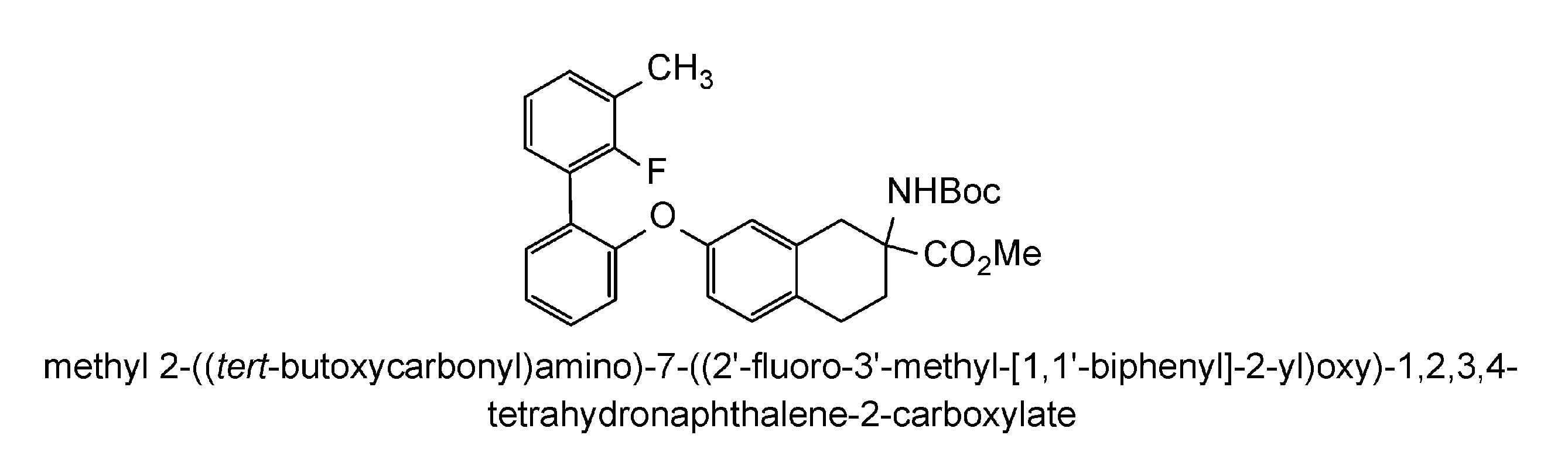
2-カルボキシ-7-((2’-フルオロ-3’-メチル-[1,1’-ビフェニル]-2-イル)オキシ)-1,2,3,4-テトラヒドロナフタレン-2-アミニウムクロリドの製造
ステップ1で得られた上記化合物を、実施例1-26のステップ2、3と同様にして、下記化合物を合成した。
1H-NMR (CD3OD); 2.10-2.16 (m, 1H), 2.24 (s, 3H), 2.33-2.40 (m, 1H), 2.79-2.86 (m, 1H), 2.92 (d, J = 17.9 Hz, 1H), 2.94-3.00 (m, 1H), 3.43 (d, J = 17.2 Hz, 1H), 6.69 (d, J = 2.6 Hz, 1H), 6.75 (dd, J = 2.6, 8.2 Hz, 1H), 6.95-6.97 (m, 1H), 7.02 (t, J = 7.5 Hz, 1H), 7.10 (d, J = 8.5 Hz, 1H), 7.12-7.17 (m, 2H), 7.21 (td, J = 0.9, 7.0 Hz, 1H), 7.33-7.37 (m, 2H).

2-カルボキシ-7-((3’,4’-ジフルオロ-[1,1’-ビフェニル]-2-イル)オキシ)-1,2,3,4-テトラヒドロナフタレン-2-アミニウムクロリド(化合物1-103)の製造
ステップ1(工程I-IV)
メチル 2-((tert-ブトキシカルボニル)アミノ)-7-((3’,4’-ジフルオロ-[1,1’-ビフェニル]-2-イル)オキシ)-1,2,3,4-テトラヒドロナフタレン-2-カルボキシレートの製造
実施例1-1のステップ1からステップ4と同様にして、ただし、実施例のステップ4の2-ヨードナフタレンを2-ブロモ-3’,4’-ジフルオロ-1,1’-ビフェニルに変えて、さらに、反応温度を90℃から120℃にして、下記化合物を得た。
1H-NMR (CDCl3); 1.42 (s, 9H), 2.06-2.12 (m, 1H), 2.44 (brs, 1H), 2.77-2.80 (m, 2H), 2.87 (d, J = 16.5 Hz, 1H), 3.24 (d, J = 16.5 Hz, 1H), 3.75 (s, 3H), 4.78 (brs, 1H), 6.61 (d, J = 2.5 Hz, 1H), 6.73 (dd, J = 2.0, 8.0 Hz, 1H), 6.97 (dd, J = 1.5, 9.0 Hz, 1H), 7.02 (d, J = 9.0 Hz, 1H), 7.12-7.21 (m, 2H), 7.24-7.27 (m, 1H), 7.30 (td, J = 1.5, 8.0 Hz, 1H), 7.37-7.41 (m, 2H).
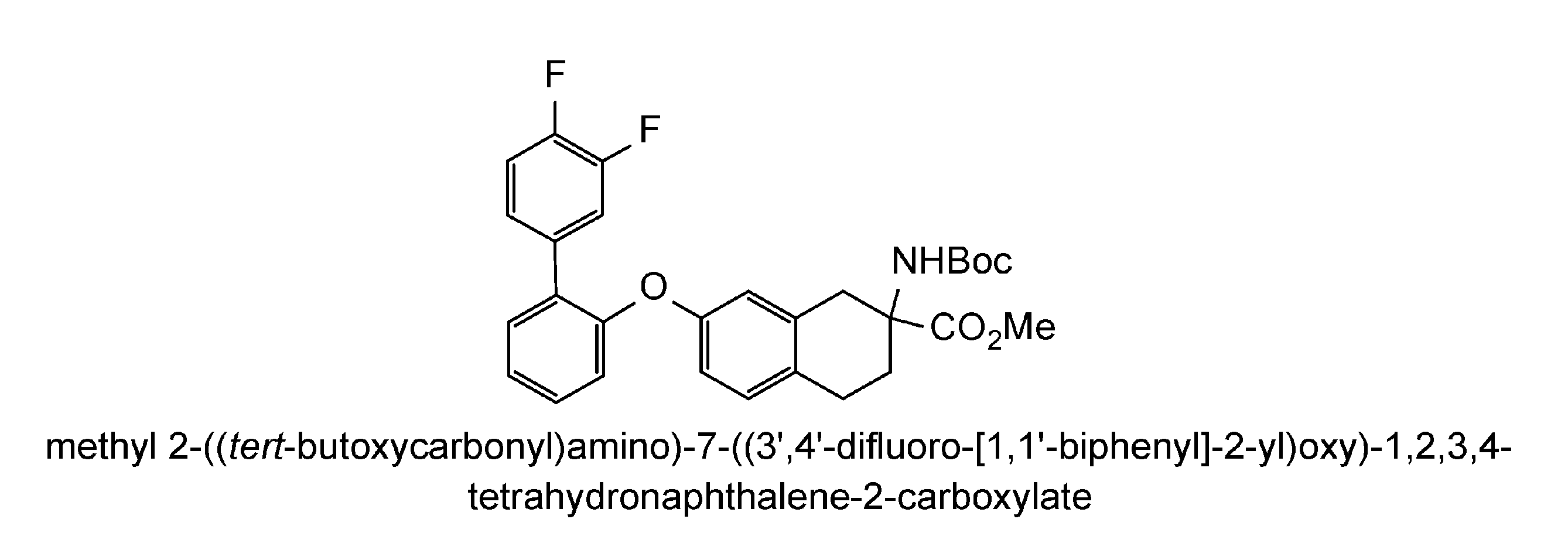
2-カルボキシ-7-((3’,4’-ジフルオロ-[1,1’-ビフェニル]-2-イル)オキシ)-1,2,3,4-テトラヒドロナフタレン-2-アミニウムクロリドの製造
ステップ1で得られた上記化合物を、実施例1-26のステップ2、3と同様にして、下記化合物を合成した。
1H-NMR (CD3OD); 2.05-2.10 (m, 1H), 2.31-2.37 (m, 1H), 2.76-2.83 (m, 1H), 2.87 (d, J = 17.5 Hz, 1H), 2.92-2.97 (m, 1H), 3.42 (d, J = 17.5 Hz, 1H), 6.66 (d, J = 2.6 Hz, 1H), 6.71 (dd, J = 2.7, 8.5 Hz, 1H), 7.00 (d, J = 8.4 Hz, 1H), 7.09 (d, J = 8.5 Hz, 1H), 7.20-7.27 (m, 2H), 7.30-7.33 (m, 1H), 7.36 (td, J = 1.8, 7.8 Hz, 1H), 7.41-7.45 (m, 1H), 7.52 (dd, J = 1.7, 7.5 Hz, 1H).
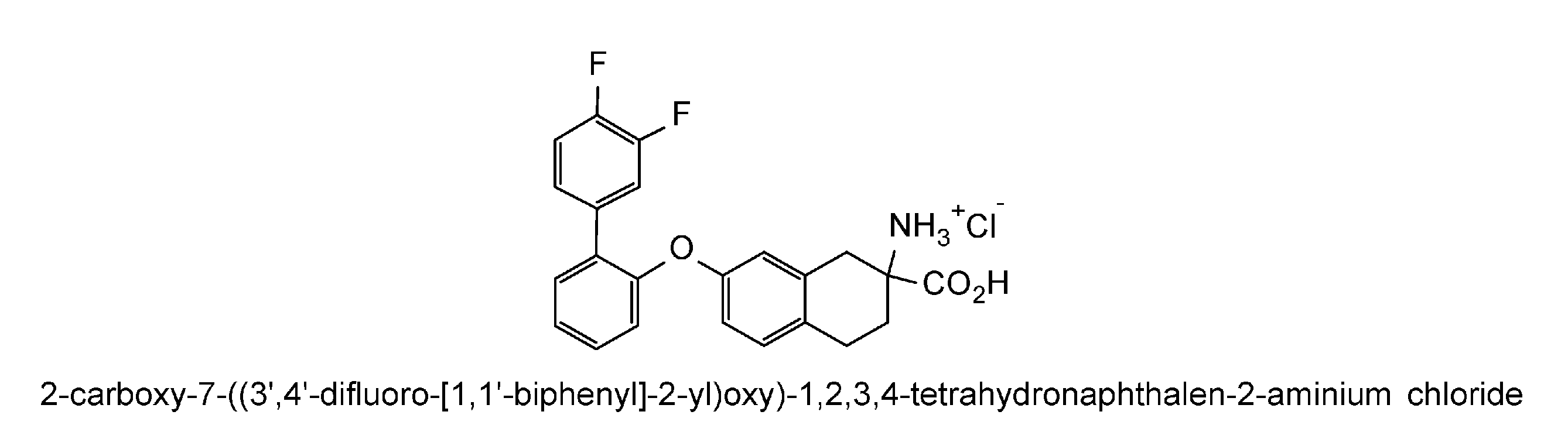
2-カルボキシ-7-((2’-クロロ-3’-メチル-[1,1’-ビフェニル]-2-イル)オキシ)-1,2,3,4-テトラヒドロナフタレン-2-アミニウムクロリド(化合物1-104)の製造
ステップ1(工程I-IV)
メチル 2-((tert-ブトキシカルボニル)アミノ)-7-((2’-クロロ-3’-メチル-[1,1’-ビフェニル]-2-イル)オキシ)-1,2,3,4-テトラヒドロナフタレン-2-カルボキシレートの製造
実施例1-1のステップ1からステップ4と同様にして、ただし、実施例のステップ4の2-ヨードナフタレンを2’-ブロモ-2-クロロ-3-メチル-1,1’-ビフェニルに変えて、さらに、反応温度を90℃から120℃にして、下記化合物を得た。
1H-NMR (CDCl3); 1.42 (s, 9H), 2.04-2.10 (m, 1H), 2.45 (brs, 1H), 2.74-2.77 (m, 2H), 2.82 (d, J = 16.5 Hz, 1H), 3.18 (d, J = 16.6 Hz, 1H), 3.75 (s, 3H), 4.75 (brs, 1H), 6.61-6.62 (m, 1H), 6.73-6.76 (m, 1H), 6.96-6.98 (m, 2H), 7.13-7.19 (m, 4H), 7.28-7.34 (m, 2H).

2-カルボキシ-7-((2’-クロロ-3’-メチル-[1,1’-ビフェニル]-2-イル)オキシ)-1,2,3,4-テトラヒドロナフタレン-2-アミニウムクロリドの製造
ステップ1で得られた上記化合物を、実施例1-26のステップ2、3と同様にして、下記化合物を合成した。
1H-NMR (CD3OD); 2.09-2.15 (m, 1H), 2.33-2.39 (m, 1H), 2.37 (s, 3H), 2.78-2.84 (m, 1H), 2.90 (d, J = 17.3 Hz, 1H), 2.93-2.99 (m, 1H), 3.41 (d, J = 17.3 Hz, 1H), 6.67 (d, J = 2.7 Hz, 1H), 6.95-6.97 (m, 1H), 7.06-7.16 (m, 3H), 7.18-7.23 (m, 2H), 7.26-7.29 (m, 2H), 7.36 (td, J = 1.8, 7.8 Hz, 1H).

2-カルボキシ-7-((2’,3’, 4’-トリフルオロ-[1,1’-ビフェニル]-2-イル)オキシ)-1,2,3,4-テトラヒドロナフタレン-2-アミニウムクロリド(化合物1-105)の製造
ステップ1(工程I-IV)
メチル 2-((tert-ブトキシカルボニル)アミノ)-7-((2’,3’, 4’-トリフルオロ-[1,1’-ビフェニル]-2-イル)オキシ)-1,2,3,4-テトラヒドロナフタレン-2-カルボキシレートの製造
実施例1-1のステップ1からステップ4と同様にして、ただし、実施例のステップ4の2-ヨードナフタレンを2’-ブロモ-2,3,4-トリフルオロ-1,1’-ビフェニルに変えて、さらに、反応温度を90℃から120℃にして、下記化合物を得た。
1H-NMR (CDCl3); 1.42 (s, 9H), 2.08-2.13 (m, 1H), 2.45 (brs, 1H), 2.78-2.80 (m, 2H), 2.87 (d, J = 17.0 Hz, 1H), 3.24 (d, J = 16.7 Hz, 1H), 3.76 (s, 3H), 4.77 (brs, 1H), 6.66 (d, J = 2.6 Hz, 1H), 6.77 (dd, J = 2.5, 8.3 Hz, 1H), 6.94-7.01 (m, 2H), 7.03 (d, J = 8.4 Hz, 1H), 7.06-7.11 (m, 1H), 7.18 (td, J = 1.0, 7.5 Hz, 1H), 7.33-7.36 (m, 2H).
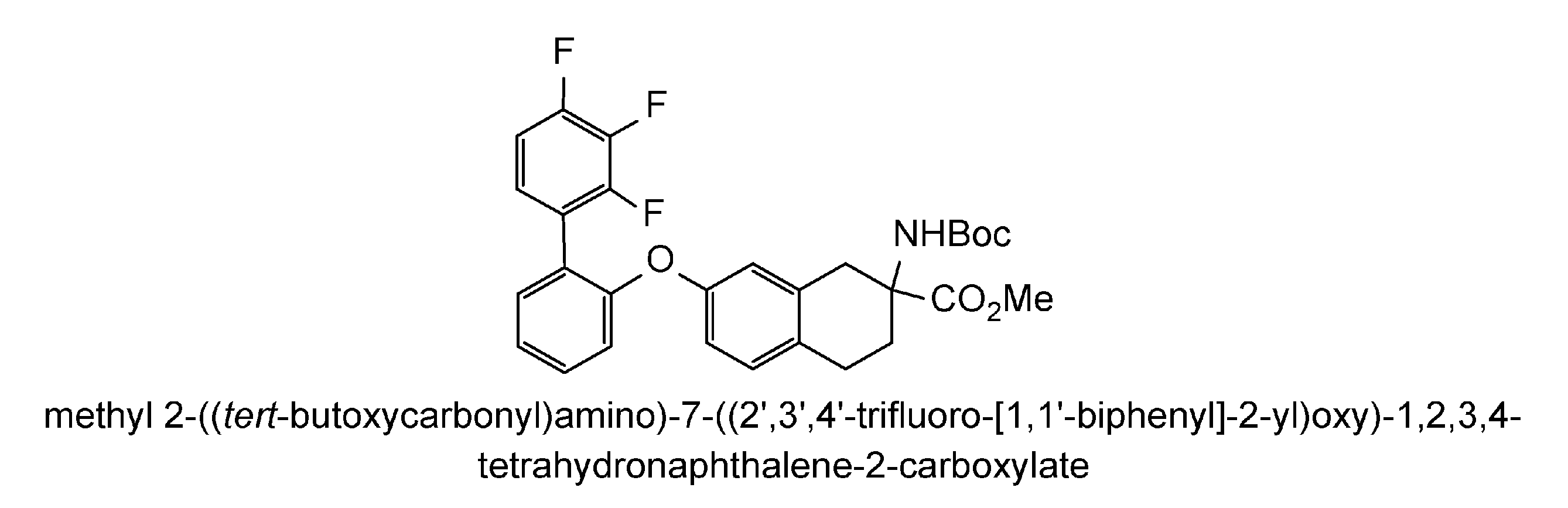
2-カルボキシ-7-((2’,3’, 4’-トリフルオロ-[1,1’-ビフェニル]-2-イル)オキシ)-1,2,3,4-テトラヒドロナフタレン-2-アミニウムクロリドの製造
ステップ1で得られた上記化合物を、実施例1-26のステップ2、3と同様にして、下記化合物を合成した。
1H-NMR (CD3OD); 2.03-2.07 (m, 1H), 2.30-2.36 (m, 1H), 2.76-2.81 (m, 1H), 2.85 (d, J = 17.8 Hz, 1H), 2.91-2.97 (m, 1H), 3.42 (d, J = 17.2 Hz, 1H), 6.68 (d, J = 2.6 Hz, 1H), 6.73 (dd, J = 2.6, 8.5 Hz, 1H), 6.96 (d, J = 8.3 Hz, 1H), 7.09 (d, J = 8.6 Hz, 1H), 7.12-7.18 (m, 2H), 7.22 (m, 1H), 7.37-7.38 (m, 2H).

2-カルボキシ-7-((2’,4’-ジフルオロ-[1,1’-ビフェニル]-2-イル)オキシ)-1,2,3,4-テトラヒドロナフタレン-2-アミニウムクロリド(化合物1-106)の製造
ステップ1(工程I-IV)
メチル 2-((tert-ブトキシカルボニル)アミノ)-7-((2’,4’-ジフルオロ-[1,1’-ビフェニル]-2-イル)オキシ)-1,2,3,4-テトラヒドロナフタレン-2-カルボキシレートの製造
実施例1-1のステップ1からステップ4と同様にして、ただし、実施例のステップ4の2-ヨードナフタレンを2’-ブロモ-2,4-ジフルオロ-1,1’-ビフェニルに変えて、さらに、反応温度を90℃から120℃にして、下記化合物を得た。
1H-NMR (CDCl3); 1.42 (s, 9H), 2.06-2.12 (m, 1H), 2.46 (brs, 1H), 2.77-2.89 (m, 2H), 2.86 (d, J = 16.9 Hz, 1H), 3.22 (d, J = 17.0 Hz, 1H), 3.75 (s, 3H), 4.77 (brs, 1H), 6.64 (d, J = 2.5 Hz, 1H), 6.76 (dd, J = 2.6, 8.4 Hz, 1H), 6.84 (td, J = 2.4, 9.3 Hz, 1H), 6.87-6.91 (m, 1H), 6.96 (dd, J = 0.3, 7.7 Hz, 1H), 7.01 (d, J = 8.5 Hz, 1H), 7.17 (td, J = 0.5, 7.5 Hz, 1H), 7.30-7.36 (m, 3H).
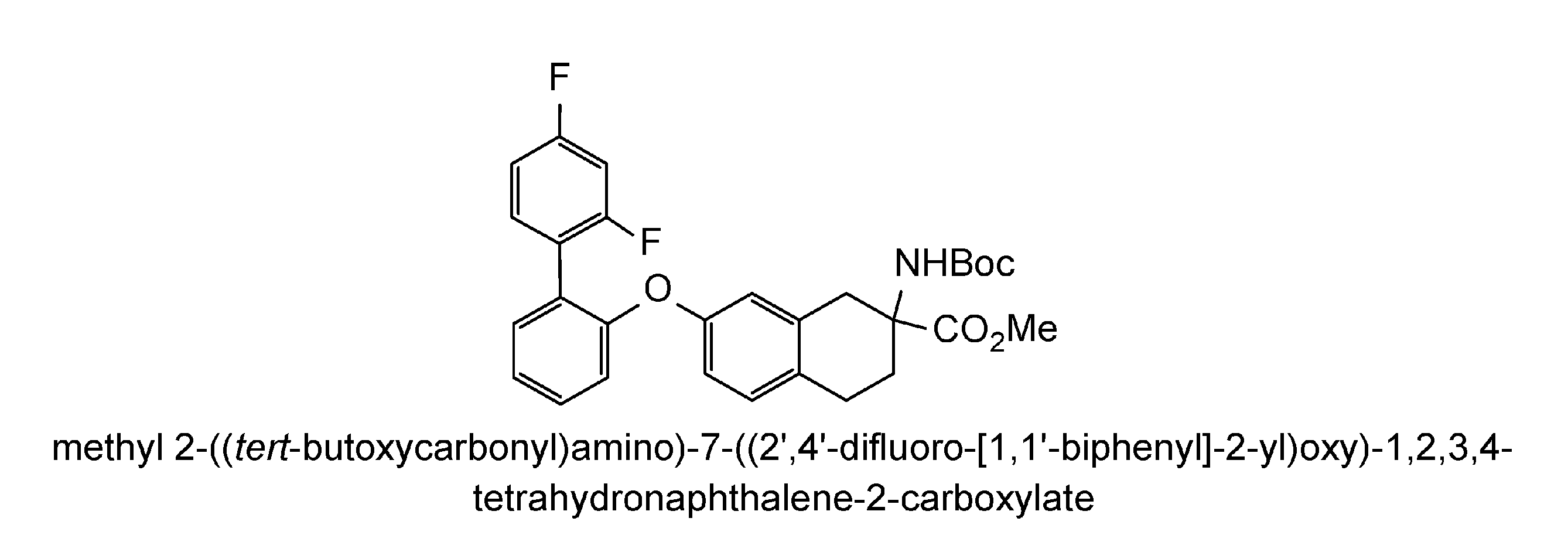
2-カルボキシ-7-((2’,4’-ジフルオロ-[1,1’-ビフェニル]-2-イル)オキシ)-1,2,3,4-テトラヒドロナフタレン-2-アミニウムクロリドの製造
ステップ1で得られた上記化合物を、実施例1-26のステップ2、3と同様にして、下記化合物を合成した。
1H-NMR (CD3OD); 2.11-2.16 (m, 1H), 2.34-2.40 (m, 1H), 2.80-2.86 (m, 1H), 2.93 (d, J = 17.3 Hz, 1H), 2.96-3.00 (m, 1H), 3.42 (d, J = 17.2 Hz, 1H), 6.68 (d, J = 2.6 Hz, 1H), 6.74 (dd, J = 2.7, 8.5 Hz, 1H), 6.91-6.98 (m, 3H), 7.10 (d, J = 8.3 Hz, 1H), 7.23 (t, J = 7.5 Hz, 1H), 7.35-7.40 (m, 3H).

2-カルボキシ-7-((8-メトキシナフタレン-1-イル)オキシ)-1,2,3,4-テトラヒドロナフタレン-2-アミニウムクロリド(化合物1-107)の製造
2-carboxy-7-((8-methoxynaphthalen-1-yl)oxy)-1,2,3,4-tetrahydronaphthalen-2-aminium chloride
ステップ1(工程I-IV)
メチル 2-((tert-ブトキシカルボニル)アミノ)-7-((8-メトキシナフタレン-1-イル)オキシ)-1,2,3,4-テトラヒドロナフタレン-2-カルボキシレートの製造
実施例1-1のステップ1からステップ4と同様にして、ただし、実施例のステップ4の2-ヨードナフタレンを1-ブロモ-8-メトキシナフタレンに変えて、さらに、反応温度を90℃から120℃にして、下記化合物を得た。
1H-NMR (CDCl3); 1.41 (s, 9H), 2.08-2.12 (m, 1H), 2.45 (brs, 1H), 2.77-2.79 (m, 2H), 2.83 (d, J = 16.5 Hz, 1H), 3.20 (d, J = 16.5 Hz, 1H), 3.74 (s, 3H), 4.79 (brs, 1H), 6.53 (d, J = 2.0 Hz, 1H), 6.68 (dd, J = 2.0, 9.0 Hz, 1H), 6.80 (d, J = 8.0 Hz, 1H), 6.99 (d, J = 8.5 Hz, 1H), 7.06 (dd, J = 1.5, 7.5 Hz, 1H), 7.37-7.47 (m, 3H), 7.64 (d, J = 1.0, 8.0 Hz, 1H).
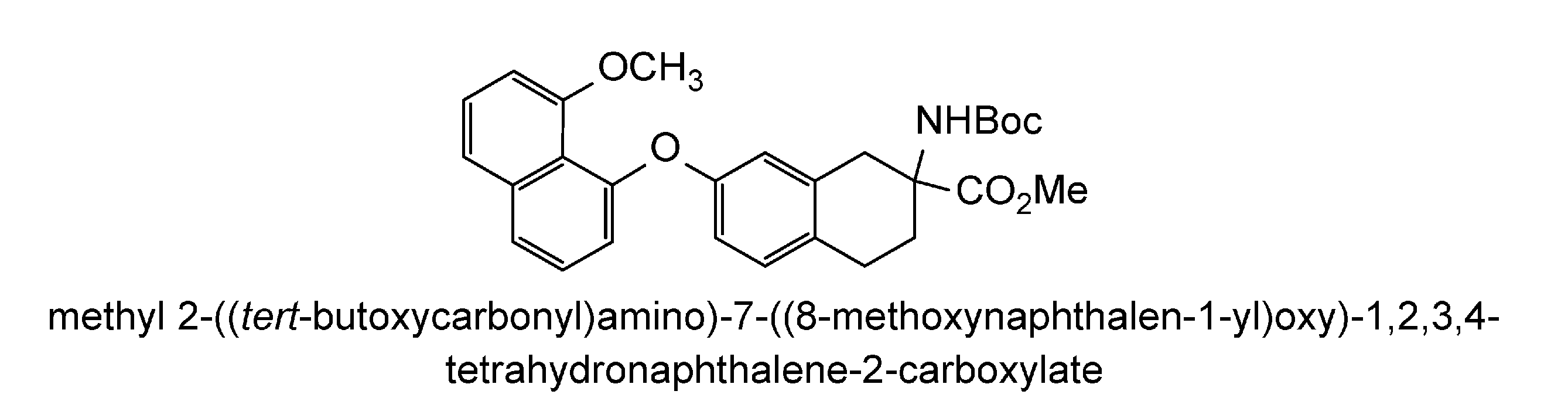
2-カルボキシ-7-((8-メトキシナフタレン-1-イル)オキシ)-1,2,3,4-テトラヒドロナフタレン-2-アミニウムクロリドの製造
ステップ1で得られた上記化合物を、実施例1-26のステップ2、3と同様にして、下記化合物を合成した。
1H-NMR (CD3OD); 2.11-2.16 (m, 1H), 2.34-2.40 (m, 1H), 2.81-2.87 (m, 1H), 2.88 (d, J = 17.4 Hz, 1H), 2.94-3.00 (m, 1H), 3.39 (d, J = 17.2 Hz, 1H), 3.65 (s, 3H), 6.52 (d, J = 2.7 Hz, 1H), 6.67 (dd, J = 2.7, 8.5 Hz, 1H), 7.04 (dd, J = 0.9, 7.4 Hz, 1H), 7.09 (d, J = 8.5 Hz, 1H), 7.38-7.49 (m, 3H), 7.70 (dd, J = 0.8, 8.0 Hz, 1H).
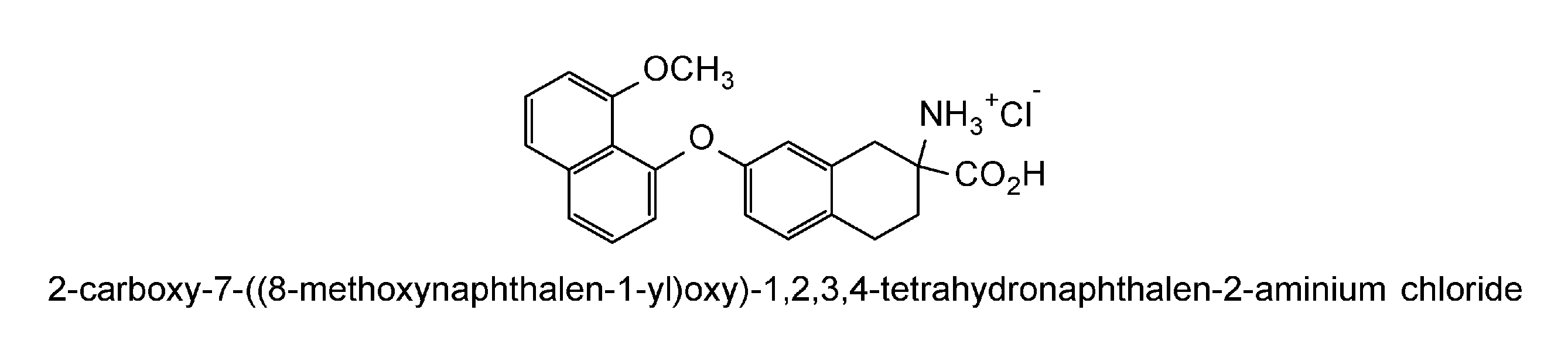
2-カルボキシ-7-((8-フェニルナフタレン-1-イル)オキシ)-1,2,3,4-テトラヒドロナフタレン-2-アミニウムクロリド(化合物1-108)の製造
2-carboxy-7-((8-phenylnaphthalen-1-yl)oxy)-1,2,3,4-tetrahydronaphthalen-2-aminium chloride
ステップ1(工程I-IV)
メチル 2-((tert-ブトキシカルボニル)アミノ)-7-((8-フェニルナフタレン-1-イル)オキシ)-1,2,3,4-テトラヒドロナフタレン-2-カルボキシレートの製造
実施例1-1のステップ1からステップ4と同様にして、ただし、実施例のステップ4の2-ヨードナフタレンを1-ブロモ-8-フェニルナフタレンに変えて、さらに、反応温度を90℃から120℃にして、下記化合物を得た。
1H-NMR (CDCl3); 1.43 (s, 9H), 2.01-2.07 (m, 1H), 2.41 (brs, 1H), 2.65-2.71 (m, 3H), 3.05 (d, J = 17.0 Hz, 1H), 3.76 (s, 3H), 4.73 (brs, 1H), 5.95 (d, J = 2.0 Hz, 1H), 6.07 (dd, J = 3.0, 9.0 Hz, 1H), 6.75 (d, J = 8.5 Hz, 1H), 7.05 (dd, J = 1.5, 7.5 Hz, 1H), 7.14-7.20 (m, 5H), 7.25-7.27 (m, 1H), 7.44-7.52 (m, 2H), 7.77 (dd, J = 1.0, 8.5 Hz, 1H), 7.90 (dd, J = 1.0, 8.5 Hz, 1H).
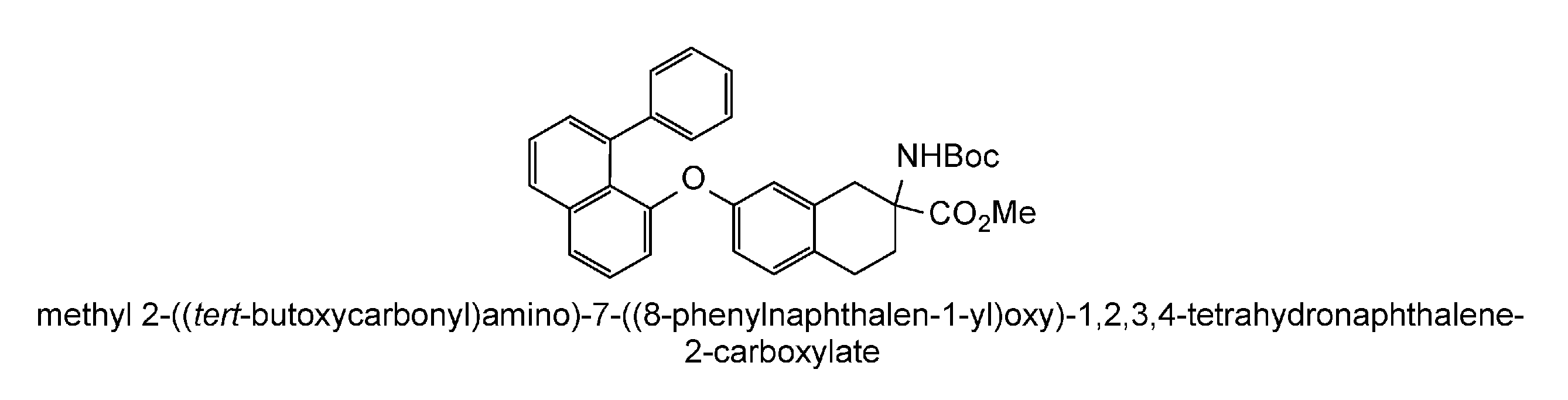
2-カルボキシ-7-((8-フェニルナフタレン-1-イル)オキシ)-1,2,3,4-テトラヒドロナフタレン-2-アミニウムクロリドの製造
ステップ1で得られた上記化合物を、実施例1-26のステップ2、3と同様にして、下記化合物を合成した。
1H-NMR (CD3OD); 2.07-2.12 (m, 1H), 2.30-2.36 (m, 1H), 2.73-2.80 (m, 1H), 2.77 (d, J = 17.1 Hz, 1H), 2.87-2.93 (m, 1H), 3.27 (d, J = 17.2 Hz, 1H), 6.05 (d, J = 2.7 Hz, 1H), 6.15 (dd, J = 2.7, 8.5 Hz, 1H), 6.87 (d, J = 8.5 Hz, 1H), 6.99 (dd, J = 1.0, 7.5 Hz, 1H), 7.11-7.16 (m, 5H), 7.22 (dd, J = 1.2, 7.3 Hz, 1H), 7.45-7.53 (m, 2H), 7.80 (dd, J = 0.8, 8.5 Hz, 1H), 7.94 (dd, J = 1.0, 8.3 Hz, 1H).
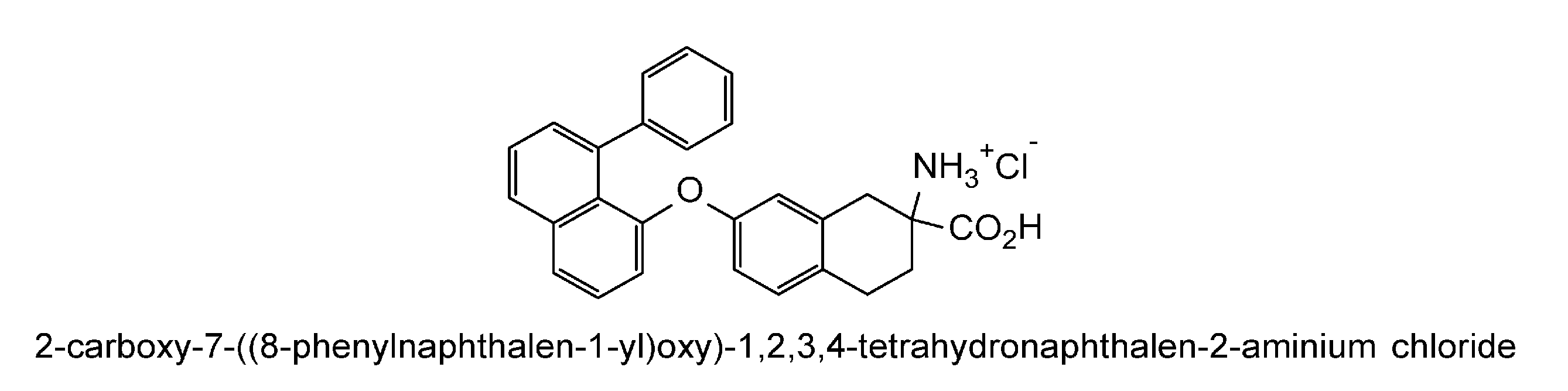
2-カルボキシ-7-((3’-ビニル-[1,1’-ビフェニル]-2-イル)オキシ)-1,2,3,4-テトラヒドロナフタレン-2-アミニウムクロリド(化合物1-110)の製造
ステップ1(工程I-IV)
メチル 2-((tert-ブトキシカルボニル)アミノ)-7-((3’-ビニル-[1,1’-ビフェニル]-2-イル)オキシ)-1,2,3,4-テトラヒドロナフタレン-2-カルボキシレートの製造
実施例1-1のステップ1からステップ4と同様にして、ただし、実施例のステップ4の2-ヨードナフタレンを2-ブロモ-3’-ビニル-1,1’-ビフェニルに変えて、さらに、反応温度を90℃から120℃にして、下記化合物を得た。
1H-NMR (CDCl3); 1.42 (s, 9H), 2.05-2.11 (m, 1H), 2.46 (brs, 1H), 2.75-2.78 (m, 2H), 2.84 (d, J = 17.0 Hz, 1H), 3.21 (d, J = 16.8 Hz, 1H), 3.75 (s, 3H), 4.76 (brs, 1H), 5.23 (d, J = 11.1 Hz, 1H), 5.71 (d, J = 17.3 Hz, 1H), 6.62 (d, J = 2.6 Hz, 1H), 6.69-6.75 (m, 2H), 6.99-7.01 (m, 2H), 7.20 (td, J = 1.1, 7.5 Hz, 1H), 7.28-7.35 (m, 3H), 7.43 (dt, J = 1.6, 7.1 Hz, 1H), 7.46 (dd, J = 1.8, 7.5 Hz, 1H), 7.56 (m, 1H).
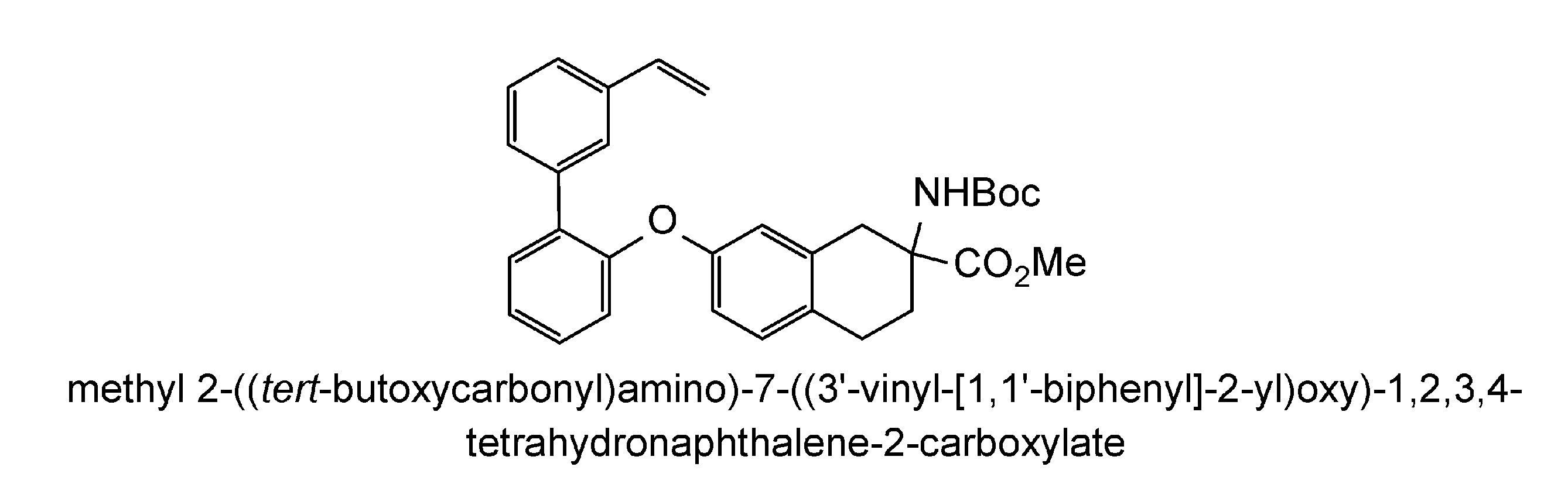
2-カルボキシ-7-((3’-ビニル-[1,1’-ビフェニル]-2-イル)オキシ)-1,2,3,4-テトラヒドロナフタレン-2-アミニウムクロリドの製造
ステップ1で得られた上記化合物を、実施例1-26のステップ2、3と同様にして、下記化合物を合成した。
1H-NMR (CD3OD); 2.01-2.06 (m, 1H), 2.28-2.34 (m, 1H), 2.72-2.77 (m, 1H), 2.79 (d, J = 17.8 Hz, 1H), 2.83-2.94 (m, 1H), 3.39 (d, J = 17.4 Hz, 1H), 5.20 (d, J = 10.9 Hz, 1H), 5.72 (d, J = 17.7 Hz, 1H), 6.63 (d, J = 2.6 Hz, 1H), 6.67-6.73 (m, 2H), 6.99-7.02 (m, 1H), 7.05 (d, J = 8.4 Hz, 1H), 7.23-7.43 (m, 5H), 7.45-7.47 (m, 1H), 7.55 (s, 1H).
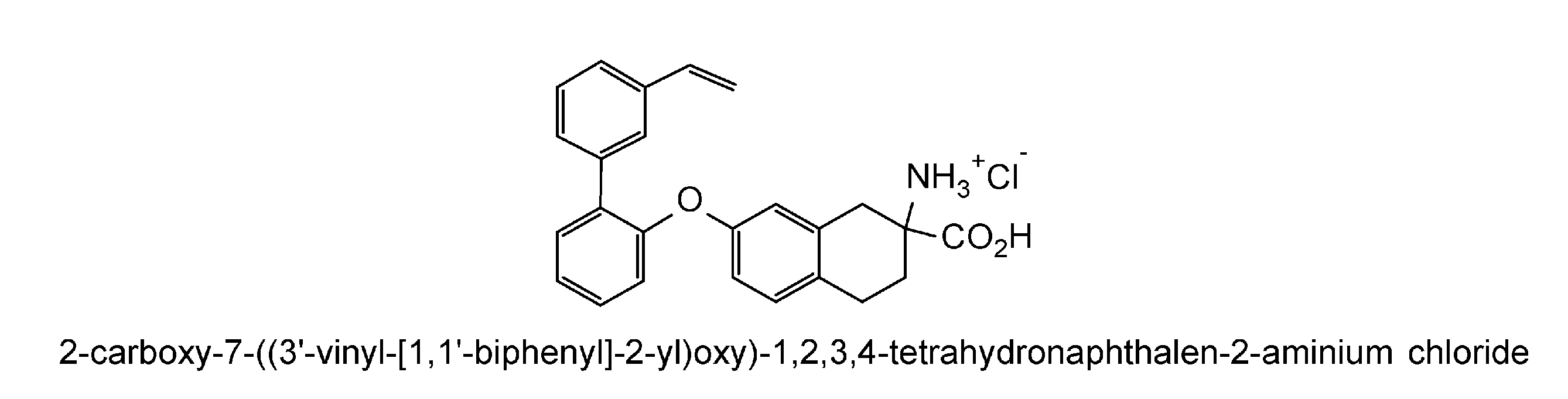
2-カルボキシ-7-((2’,3’,5’-トリフルオロ-[1,1’-ビフェニル]-2-イル)オキシ)-1,2,3,4-テトラヒドロナフタレン-2-アミニウムクロリド(化合物1-111)の製造
ステップ1(工程I-IV)
メチル 2-((tert-ブトキシカルボニル)アミノ)-7-((2’,3’,5’-トリフルオロ-[1,1’-ビフェニル]-2-イル)オキシ)-1,2,3,4-テトラヒドロナフタレン-2-カルボキシレートの製造
実施例1-1のステップ1からステップ4と同様にして、ただし、実施例のステップ4の2-ヨードナフタレンを2’-ブロモ-2,3,5-トリフルオロ-1,1’-ビフェニルに変えて、さらに、反応温度を90℃から120℃にして、下記化合物を得た。
1H-NMR (CDCl3); 1.42 (s, 9H), 2.07-2.13 (m, 1H), 2.46 (brs, 1H), 2.78-2.81 (m, 2H), 2.88 (d, J = 16.5 Hz, 1H), 3.24 (d, J = 16.5 Hz, 1H), 3.76 (s, 3H), 4.78 (brs, 1H), 6.68 (d, J = 2.5 Hz, 1H), 6.78 (dd, J = 2.5, 9.0 Hz, 1H), 6.87-6.96 (m, 3H), 7.04 (d, J = 8.0 Hz, 1H), 7.18 (td, J = 1.0, 7.5 Hz, 1H), 7.33-7.37 (m, 2H).
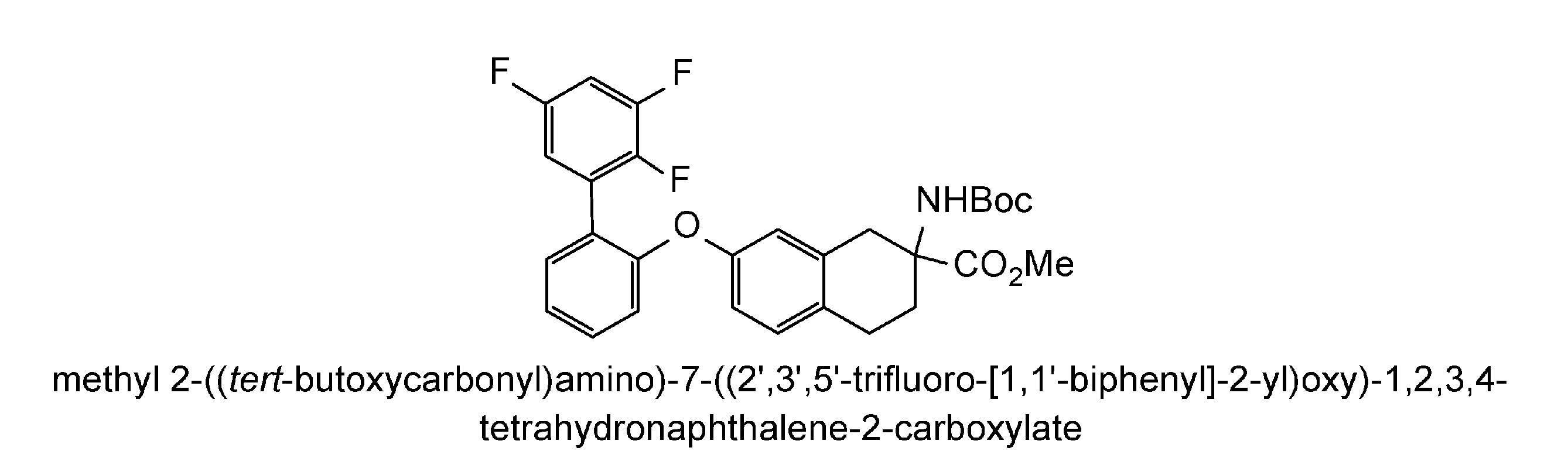
2-カルボキシ-7-((2’,3’,5’-トリフルオロ-[1,1’-ビフェニル]-2-イル)オキシ)-1,2,3,4-テトラヒドロナフタレン-2-アミニウムクロリドの製造
ステップ1で得られた上記化合物を、実施例1-26のステップ2、3と同様にして、下記化合物を合成した。
1H-NMR (CD3OD); 2.12-2.17 (m, 1H), 2.36-2.42 (m, 1H), 2.81-2.88 (m, 1H), 2.95 (d, J = 18.0 Hz, 1H), 2.98-3.02 (m, 1H), 3.45 (d, J = 17.0 Hz, 1H), 6.74 (d, J = 2.0 Hz, 1H), 6.78 (dd, J = 2.0, 8.5 Hz, 1H), 6.96-7.00 (m, 2H), 7.09-7.15 (m, 2H), 7.26 (td, J = 1.0, 8.5 Hz, 1H), 7.41-7.44 (m, 2H).

2-カルボキシ-7-((2’,3’,4’,5’,6’-ペンタフルオロ-[1,1’-ビフェニル]-2-イル)オキシ)-1,2,3,4-テトラヒドロナフタレン-2-アミニウムクロリド(化合物1-113)の製造
ステップ1(工程I-IV)
メチル 2-((tert-ブトキシカルボニル)アミノ)-7-((2’,3’,4’,5’,6’-ペンタフルオロ-[1,1’-ビフェニル]-2-イル)オキシ)-1,2,3,4-テトラヒドロナフタレン-2-カルボキシレートの製造
実施例1-1のステップ1からステップ4と同様にして、ただし、実施例のステップ4の2-ヨードナフタレンを2’-ブロモ-2,3,4,5,6-ペンタフルオロ-1,1’-ビフェニルに変えて、さらに、反応温度を90℃から120℃にして、下記化合物を得た。
1H-NMR (CDCl3); 1.42 (s, 9H), 2.09-2.15 (m, 1H), 2.45 (brs, 1H), 2.81-2.84 (m, 2H), 2.97 (d, J = 16.5 Hz, 1H), 3.32 (d, J = 16.5 Hz, 1H), 3.77 (s, 3H), 4.81 (brs, 1H), 6.73 (d, J = 2.5 Hz, 1H), 6.85 (dd, J = 2.0, 8.5 Hz, 1H), 7.10 (d, J = 8.0 Hz, 1H), 7.35-7.38 (m, 2H), 7.44-7.47 (m, 1H), 7.75 (d, J = 8.0 Hz, 1H).

2-カルボキシ-7-((2’,3’,4’,5’,6’-ペンタフルオロ-[1,1’-ビフェニル]-2-イル)オキシ)-1,2,3,4-テトラヒドロナフタレン-2-アミニウムクロリドの製造
ステップ1で得られた上記化合物を、実施例1-26のステップ2、3と同様にして、下記化合物を合成した。
1H-NMR (CD3OD); 2.15-2.20 (m, 1H), 2.40-2.46 (m, 1H), 2.86-2.93 (m, 1H), 3.04 (d, J = 17.0 Hz, 1H), 3.03-3.08 (m, 1H), 3.53 (d, J = 17.0 Hz, 1H), 6.93-6.96 (m, 2H), 7.24 (d, J = 8.5 Hz, 1H), 7.43-7.48 (m, 2H), 7.53 (td, J = 1.0, 8.0 Hz, 1H), 7.80-7.81 (m, 1H).
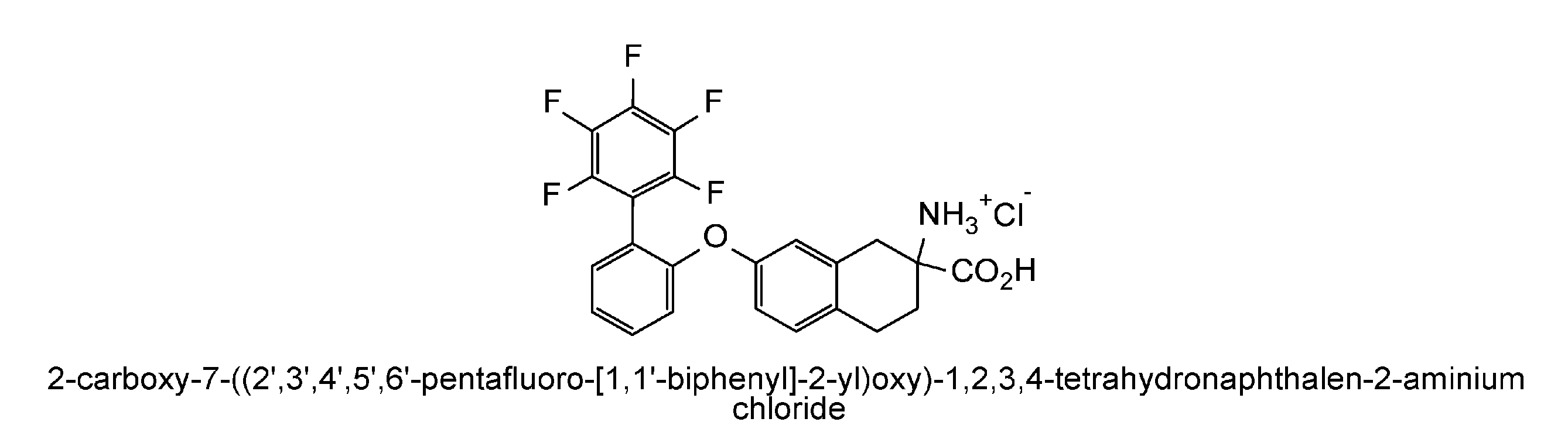
2-カルボキシ-7-((3’,5’-ジフルオロ-[1,1’-ビフェニル]-2-イル)オキシ)-1,2,3,4-テトラヒドロナフタレン-2-アミニウムクロリド(化合物1-114)の製造
ステップ1(工程I-IV)
メチル 2-((tert-ブトキシカルボニル)アミノ)-7-((3’,5’-ジフルオロ-[1,1’-ビフェニル]-2-イル)オキシ)-1,2,3,4-テトラヒドロナフタレン-2-カルボキシレートの製造
実施例1-1のステップ1からステップ4と同様にして、ただし、実施例のステップ4の2-ヨードナフタレンを2-ブロモ-3’,5’-ジフルオロ-1,1’-ビフェニルに変えて、さらに、反応温度を90℃から120℃にして、下記化合物を得た。
1H-NMR (CDCl3); 1.42 (s, 9H), 2.06-2.13 (m, 1H), 2.45 (brs, 1H), 2.78-2.80 (m, 2H), 2.87 (d, J = 16.5 Hz, 1H), 3.24 (d, J = 17.0 Hz, 1H), 3.76 (s, 3H), 4.78 (brs, 1H), 6.63 (d, J = 2.0 Hz, 1H), 6.72-6.77 (m, 2H), 6.97 (dd, J = 1.0, 8.0 Hz, 1H), 7.03 (d, J = 8.0 Hz, 1H), 7.07-7.12 (m, 2H), 7.20 (td, J = 1.5, 7.5 Hz, 1H), 7.32 (td, J = 2.0, 8.5 Hz, 1H), 7.41 (dd, J = 2.0, 8.5 Hz, 1H).
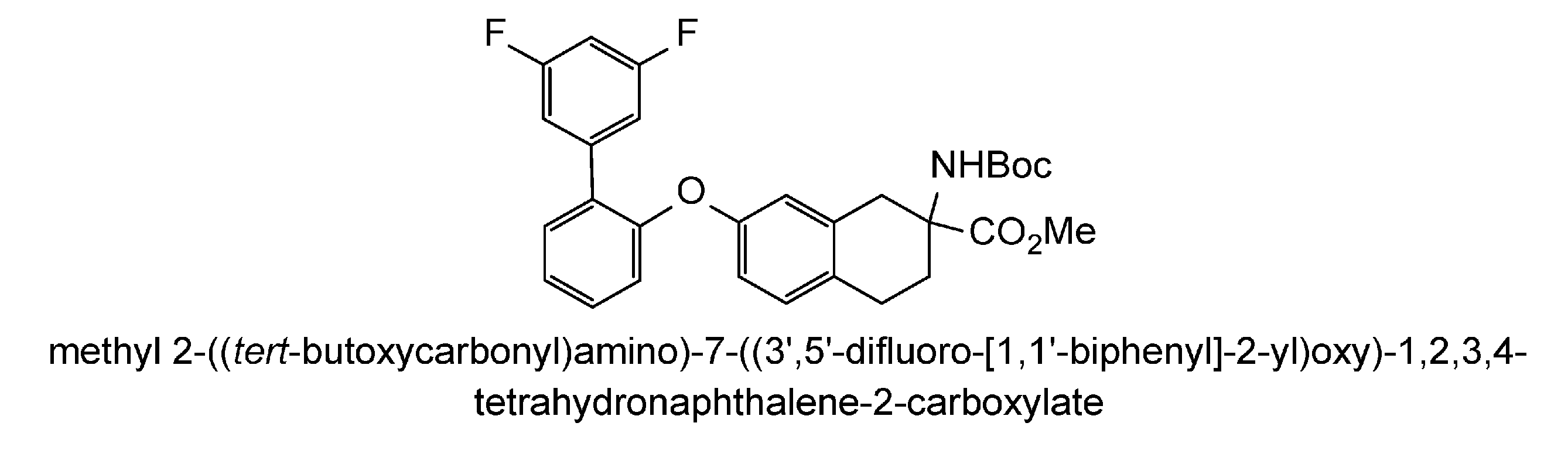
2-カルボキシ-7-((3’,5’-ジフルオロ-[1,1’-ビフェニル]-2-イル)オキシ)-1,2,3,4-テトラヒドロナフタレン-2-アミニウムクロリドの製造
ステップ1で得られた上記化合物を、実施例1-26のステップ2、3と同様にして、下記化合物を合成した。
1H-NMR (CD3OD); 2.09-2.12 (m, 1H), 2.33-2.39 (m, 1H), 2.78-2.85 (m, 1H), 2.90 (d, J = 18.0 Hz, 1H), 2.94-3.00 (m, 1H), 3.43 (d, J = 17.5 Hz, 1H), 6.69 (brs, 1H), 6.74 (dd, J = 2.5, 8.5 Hz, 1H), 6.84-6.89 (m, 1H), 7.01 (d, J = 8.0 Hz, 1H), 7.11-7.15 (m, 3H), 7.27 (t, J = 7.5 Hz, 1H), 7.39 (td, J = 1.0, 9.0 Hz, 1H), 7.49 (dd, J = 1.0, 8.0 Hz, 1H).
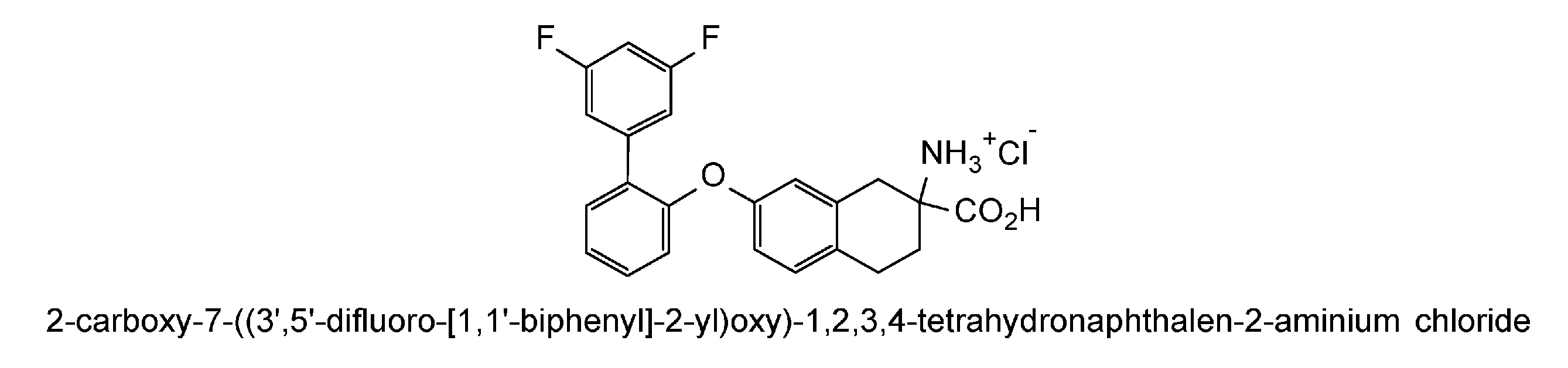
2-カルボキシ-7-((3’-クロロ-5’-フルオロ-[1,1’-ビフェニル]-2-イル)オキシ)-1,2,3,4-テトラヒドロナフタレン-2-アミニウムクロリド(化合物1-115)の製造
ステップ1(工程I-IV)
メチル 2-((tert-ブトキシカルボニル)アミノ)-7-((3’-クロロ-5’-フルオロ-[1,1’-ビフェニル]-2-イル)オキシ)-1,2,3,4-テトラヒドロナフタレン-2-カルボキシレートの製造
実施例1-1のステップ1からステップ4と同様にして、ただし、実施例のステップ4の2-ヨードナフタレンを2-ブロモ-3’-クロロ-5’-フルオロ-1,1’-ビフェニルに変えて、さらに、反応温度を90℃から120℃にして、下記化合物を得た。
1H-NMR (CDCl3); 1.42 (s, 9H), 2.06-2.13 (m, 1H), 2.45 (brs, 1H), 2.78-2.80 (m, 2H), 2.87 (d, J = 17.0 Hz, 1H), 3.24 (d, J = 17.0 Hz, 1H), 3.76 (s, 3H), 4.78 (brs, 1H), 6.63 (d, J = 2.0 Hz, 1H), 6.74 (dd, J = 2.0, 8.0 Hz, 1H), 6.97 (d, J = 7.5 Hz, 1H), 7.01-7.05 (m, 2H), 7.18-7.21 (m, 2H), 7.30-7.34 (m, 2H), 7.40 (dd, J = 2.0, 7.5 Hz, 1H).

2-カルボキシ-7-((3’-クロロ-5’-フルオロ-[1,1’-ビフェニル]-2-イル)オキシ)-1,2,3,4-テトラヒドロナフタレン-2-アミニウムクロリドの製造
ステップ1で得られた上記化合物を、実施例1-26のステップ2、3と同様にして、下記化合物を合成した。
1H-NMR (CD3OD); 2.11-2.16 (m, 1H), 2.35-2.41 (m, 1H), 2.79-2.86 (m, 1H), 2.93 (d, J = 18.0 Hz, 1H), 2.97-3.01 (m, 1H), 3.44 (d, J = 17.5 Hz, 1H), 6.70 (d, J = 2.0 Hz, 1H), 6.75 (dd, J = 3.0, 8.5 Hz, 1H), 7.02 (d, J = 8.0 Hz, 1H), 7.11-7.14 (m, 2H), 7.23 (d, J = 9.5 Hz, 1H), 7.28 (t, J = 7.0 Hz, 1H), 7.38-7.42 (m, 2H), 7.49 (dd, J = 1.0, 7.0 Hz, 1H).

2-カルボキシ-7-((2’,3’-ジクロロ-5’-フルオロ-[1,1’-ビフェニル]-2-イル)オキシ)-1,2,3,4-テトラヒドロナフタレン-2-アミニウムクロリド(化合物1-116)の製造
ステップ1(工程I-IV)
メチル 2-((tert-ブトキシカルボニル)アミノ)-7-((2’,3’-ジクロロ-5’-フルオロ-[1,1’-ビフェニル]-2-イル)オキシ)-1,2,3,4-テトラヒドロナフタレン-2-カルボキシレートの製造
実施例1-1のステップ1からステップ4と同様にして、ただし、実施例のステップ4の2-ヨードナフタレンを2’-ブロモ-2,3-ジクロロ-5-フルオロ-1,1’-ビフェニルに変えて、さらに、反応温度を90℃から120℃にして、下記化合物を得た。
1H-NMR (CDCl3); 1.42 (s, 9H), 2.05-2.12 (m, 1H), 2.46 (brs, 1H), 2.78-2.79 (m, 2H), 2.85 (d, J = 16.5 Hz, 1H), 3.22 (d, J = 16.5 Hz, 1H), 3.76 (s, 3H), 4.77 (brs, 1H), 6.63 (brs, 1H), 6.75 (d, J = 7.5 Hz, 1H), 6.96 (d, J = 8.0 Hz, 1H), 6.99-7.02 (m, 2H), 7.15-7.20 (m, 2H), 7.26-7.27 (m, 1H), 7.36 (td, J = 2.0, 8.0 Hz, 1H).
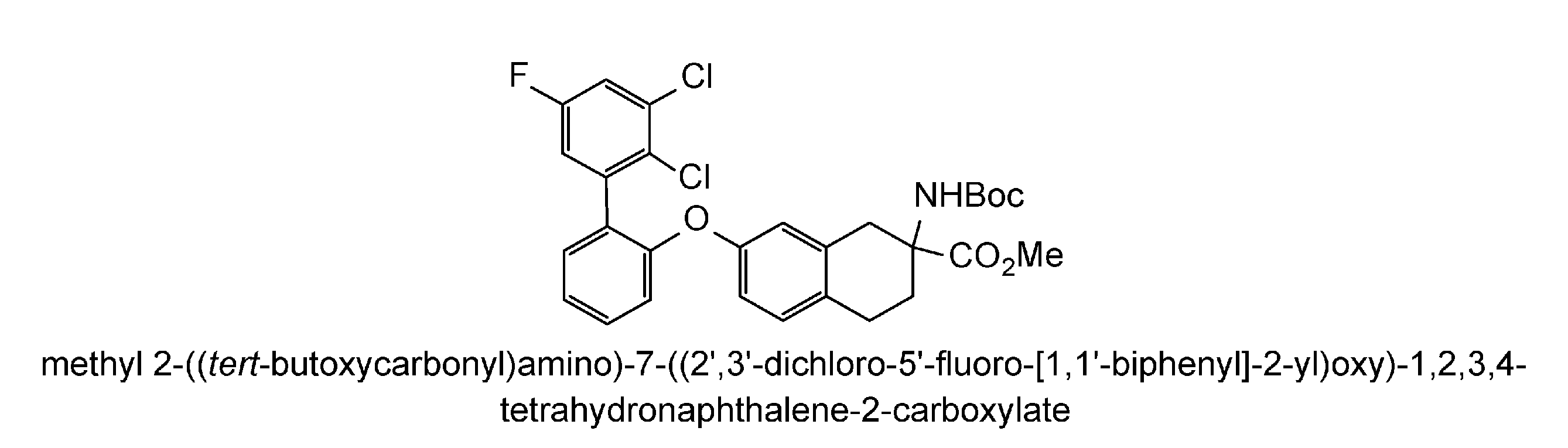
2-カルボキシ-7-((2’,3’-ジクロロ-5’-フルオロ-[1,1’-ビフェニル]-2-イル)オキシ)-1,2,3,4-テトラヒドロナフタレン-2-アミニウムクロリドの製造
ステップ1で得られた上記化合物を、実施例1-26のステップ2、3と同様にして、下記化合物を合成した。
1H-NMR (CD3OD); 2.11-2.16 (m, 1H), 2.35-2.41 (m, 1H), 2.80-2.87 (m, 1H), 2.93 (d, J = 18.0 Hz, 1H), 2.97-3.01 (m, 1H), 3.44 (d, J = 17.5 Hz, 1H), 6.72 (brs, 1H), 6.77 (dd, J = 2.5, 8.0 Hz, 1H), 6.98 (d, J = 8.5 Hz, 1H), 7.09-7.13 (m, 2H), 7.24 (t, J = 8.0 Hz, 1H), 7.32 (dd, J = 2.0, 7.5 Hz, 1H), 7.37 (dd, J = 2.5, 8.0 Hz, 1H), 7.41 (td, J = 1.5, 8.0 Hz, 1H).
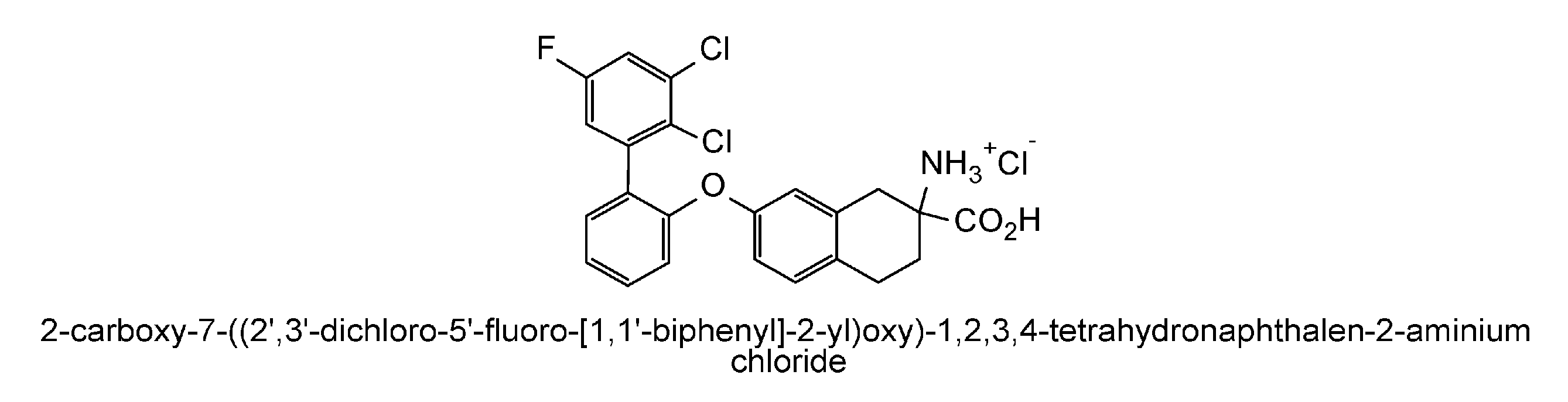
2-カルボキシ-7-(4-ニトロフェノキシ)-1,2,3,4-テトラヒドロナフタレン-2-アミニウムクロリド(化合物1-117)の製造
ステップ1(工程I-IV)
メチル 2-((tert-ブトキシカルボニル)アミノ)-7-(4-ニトロフェノキシ)-1,2,3,4-テトラヒドロナフタレン-2-カルボキシレートの製造
実施例1-1のステップ3により得られたフェノール体(2.00 g, 6.22 mmol)、1-フルオロ-4-ニトロベンゼン(1.05 g, 7.47 mmol)、炭酸セシウム(4.05 g, 12.4 mmol)、DMSO(15 mL)を加えた。100℃にて約1時間反応させた。その後、反応液を氷浴中にて冷却させ、酢酸エチル(50 mL)および蒸留水(50 mL)を加えた。約5分間撹拌させた後、セライト濾過し、得られた濾液を分液漏斗に移した。水相をさらに酢酸エチル(50 mL)にて抽出させ、得られた有機相を合わせ、飽和食塩水(50 mL)で洗浄した。無水硫酸マグネシウムにて乾燥後、濾過により除去し、濾過にて得られた残渣をシリカゲルカラムクロマトグラフィーにて精製し目的物(2.59 g、収率94%)を得た。
1H-NMR (CDCl3); 1.43 (s, 9H), 2.12-2.18 (m, 1H), 2.45 (brs, 1H), 2.85-2.88 (m, 2H), 2.98 (d, J = 17.2 Hz, 1H), 3.35 (d, J = 17.0 Hz, 1H), 3.77 (s, 3H), 4.83 (brs, 1H), 6.81 (d, J = 2.5 Hz, 1H), 6.89 (dd, J = 2.5, 8.3 Hz, 1H), 6.99-7.02 (m, 2H), 7.17 (d, J = 8.3 Hz, 1H), 8.18-8.21 (m, 2H).

2-カルボキシ-7-(4-ニトロフェノキシ)-1,2,3,4-テトラヒドロナフタレン-2-アミニウムクロリドの製造
ステップ1で得られた上記化合物を、実施例1-1のステップ5、6と同様にして、下記化合物を合成した。
1H-NMR (CD3OD); 2.17-2.22 (m, 1H), 2.41-2.47 (m, 1H), 2.90-2.97 (m, 1H), 3.05 (d, J = 17.5 Hz, 1H), 3.04-3.10 (m, 1H), 3.53 (d, J = 17.0 Hz, 1H), 6.98-7.01 (m, 2H), 7.06-7.09 (m, 2H), 7.30 (d, J = 8.0 Hz, 1H), 8.21-8.24 (m, 2H).

2-カルボキシ-7-(2-(ナフタレン-1-イル)-4-ニトロフェノキシ)-1,2,3,4-テトラヒドロナフタレン-2-アミニウムクロリド(化合物1-118)の製造
ステップ1(工程I-IV)
メチル 2-((tert-ブトキシカルボニル)アミノ)-7-(2-(ナフタレン-1-イル)-4-ニトロフェノキシ)-1,2,3,4-テトラヒドロナフタレン-2-カルボキシレートの製造
実施例1-68のステップ1と同様にして、ただし、1-フルオロ-4-ニトロベンゼンを1-(2-フルオロ-5-ニトロフェニル)ナフタレンに変えて、下記化合物を得た。

2-カルボキシ-7-(2-(ナフタレン-1-イル)-4-ニトロフェノキシ)-1,2,3,4-テトラヒドロナフタレン-2-アミニウムクロリドの製造
ステップ1で得られた上記化合物を、実施例1-1のステップ5、6と同様にして、下記化合物を合成した。
HRMS (ESI) m/z calcd for C27H23N2O5[M+H]+ 455.1607 found 455.1908.

2-カルボキシ-6-(ナフタレン-2-イルオキシ)-1,2,3,4-テトラヒドロナフタレン-2-アミニウムクロリドの製造
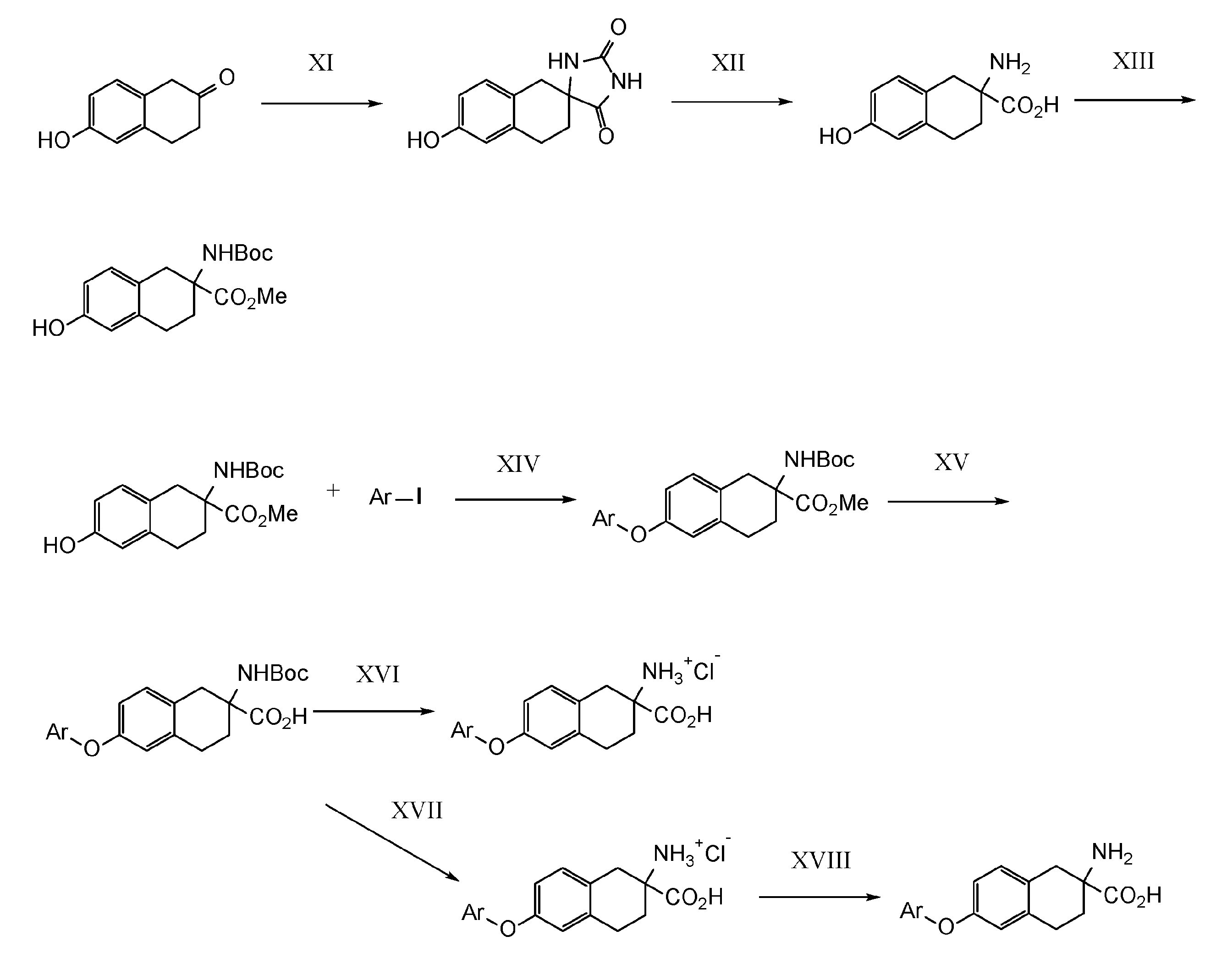
メチル 2-((tert-ブトキシカルボニル)アミノ)-6-ヒドロキシ-1,2,3,4-テトラヒドロナフタレン-2-カルボキシレート(化合物2-1)の製造
実施例1のステップ1からステップ3と同様にして、ただし、実施例のステップ1の7-ヒドロキシ-2-テトラロンを6-ヒドロキシ-2-テトラロンに変えて、下記化合物を得た。
1H-NMR (CDCl3); 1.42 (s, 9H), 2.05-2.13 (m, 1H), 2.50 (brs, 1H), 2.76-2.79 (m, 2H), 2.85 (d, J = 15.5 Hz, 1H), 3.15 (d, J = 16.0 Hz, 1H), 3.77 (s, 3H), 4.80 (brs, 1H), 6.59 (s, 1H), 6.62 (dd, J = 2.0, 8.0 Hz, 1H), 6.90 (d, J = 8.0 Hz, 1H).

メチル 2-((tert-ブトキシカルボニル)アミノ)-6-(ナフタレン-2-イルオキシ)-1,2,3,4-テトラヒドロナフタレン-2-カルボキシレートの製造
実施例1-1のステップ4と同様にして、下記化合物を得た。
1H-NMR (CDCl3); 1.43 (s, 9H), 2.10-2.16 (m, 1H), 2.49 (brs, 1H), 2.79-2.82 (m, 2H), 2.94 (d, J = 16.5 Hz, 1H), 3.25 (d, J = 16.5 Hz, 1H), 3.78 (s, 3H), 4.81 (brs, 1H), 6.81 (d, J = 2.5 Hz, 1H), 6.86 (dd, J = 2.0, 8.0 Hz, 1H), 7.04 (d, J = 8.0 Hz, 1H), 7.26 (dd, J = 2.5, 7.0 Hz, 1H), 7.32 (d, J = 2.5 Hz, 1H), 7.39-7.42 (m, 1H), 7.44-7.47 (m, 1H), 7.72 (d, J = 8.0 Hz, 1H), 7.81-7.84 (m, 2H).

2-カルボキシ-6-(ナフタレン-2-イルオキシ)-1,2,3,4-テトラヒドロナフタレン-2-アミニウムクロリドの製造
ステップ2で得られた上記化合物を、実施例1のステップ5、6と同様にして、下記化合物を合成した。
1H-NMR (CD3OD); 2.13-2.18 (m, 1H), 2.39-2.45 (m, 1H), 2.85-2.92 (m, 1H), 2.99-3.05 (m, 1H), 3.04 (d, J = 17.0 Hz, 1H), 3.50 (d, J = 16.5 Hz, 1H), 6.90 (d, J = 2.0 Hz, 1H), 6.93 (dd, J = 2.0, 8.0 Hz, 1H), 7.20 (d, J = 8.5 Hz, 1H), 7..23 (dd, J = 2.0, 9.0 Hz, 1H), 7.29 (d, J = 2.0, 1H), 7.38-7.41 (m, 1H), 7.43-7.46 (m, 1H), 7.70 (d, J = 8.0 Hz, 1H), 7.83-7.88 (m, 2H).

3-(4-((6-アンモニオ-6-カルボキシ-5,6,7,8-テトラヒドロナフタレン-2-イル)オキシ)フェニル)ピリジン-1-イウムクロリド(化合物1-22)の製造
ステップ1(工程I-IV)
メチル 2-((tert-ブトキシカルボニル)アミノ)-6-(4-(ピリジン-3-イル)フェノキシ)-1,2,3,4-テトラヒドロナフタレン-2-カルボキシレートの製造
実施例1-1のステップ1からステップ4と同様にして、ただし、実施例のステップ4の2-ヨードナフタレンを3-(3-ヨードフェニル)ピリジンに変えて、下記化合物を得た。
1H-NMR (CDCl3); 1.43 (s, 9H), 2.10-2.16 (m, 1H), 2.48 (brs, 1H), 2.80-2.82 (m, 2H), 2.94 (d, J = 16.5 Hz, 1H), 3.25 (d, J = 16.5 Hz, 1H), 3.78 (s, 3H), 4.81 (brs, 1H), 6.81 (d, J = 2.0 Hz, 1H), 6.85 (dd, J = 2.5, 8.0 Hz, 1H), 7.02-7.05 (m, 2H), 7.23 (t, J = 2.0 Hz, 1H), 7.32 (dd, J = 2.0, 7.0 Hz, 1H), 7.35-7.37 (m, 1H), 7.44 (t, J = 8.0 Hz, 1H), 7.85 (dt, J = 2.0, 8.0 Hz, 1H), 8.59 (dd, J = 2.0, 5.5 Hz, 1H), 8.82 (d, J = 1.5 Hz, 1H).
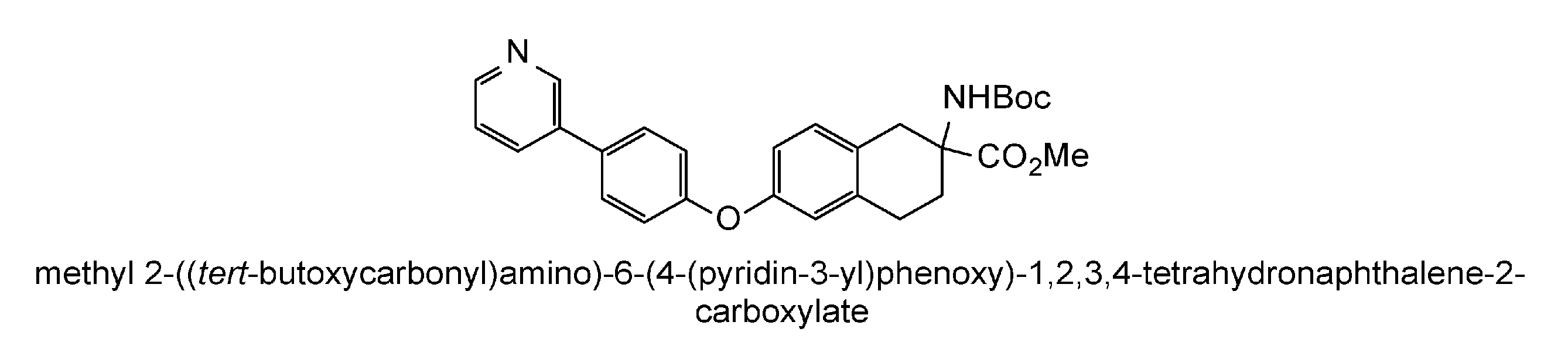
2-((tert-ブトキシカルボニル)アミノ)-6-(4-(ピリジン-3-イル)フェノキシ)-1,2,3,4-テトラヒドロナフタレン-2-カルボン酸の製造
上記化合物を、実施例1-1のステップ5と同様にして、下記化合物を合成した。また、このカルボン酸化合物を精製せずにそのまま次工程に用いた。
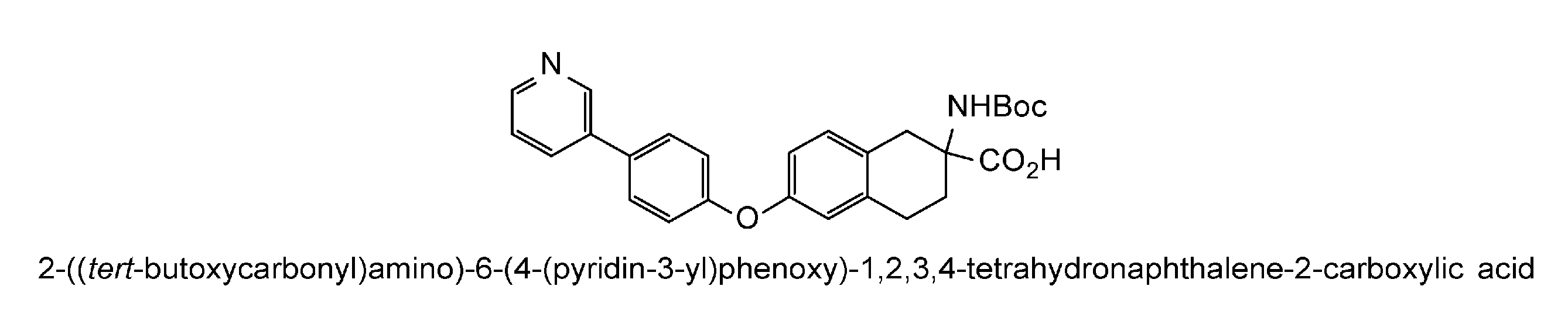
3-(4-((6-アンモニオ-6-カルボキシ-5,6,7,8-テトラヒドロナフタレン-2-イル)オキシ)フェニル)ピリwジン-1-イウムクロリドの製造
上記化合物(300 mg, 0.651 mmol)に、10% 塩酸(15 mL)を加え、還流下1時間攪拌させた。冷却後得られた析出物を濾取し、目的の下記化合物(190 mg、収率67%)を得た。
1H-NMR (CD3OD); 2.15-2.20 (m, 1H), 2.38-2.44 (m, 1H), 2.88-2.95 (m, 1H), 3.00-3.06 (m, 1H), 3.06 (d, J = 17.0 Hz, 1H), 3.49 (d, J = 16.5 Hz, 1H), 6.93-6.94 (m, 2H), 7.14-7.16 (m, 1H), 7.22 (dd, J = 2.0, 9.0 Hz, 1H), 7.50 (t, J = 1.0 Hz, 3H), 7.57-7.59 (m, 2H), 8.18 (dd, J = 6.0, 7.5 Hz, 1H), 8.86 (d, J = 5.5 Hz, 1H), 8.90-8.93 (m, 1H), 9.19 (d, J = 2.5 Hz, 1H).
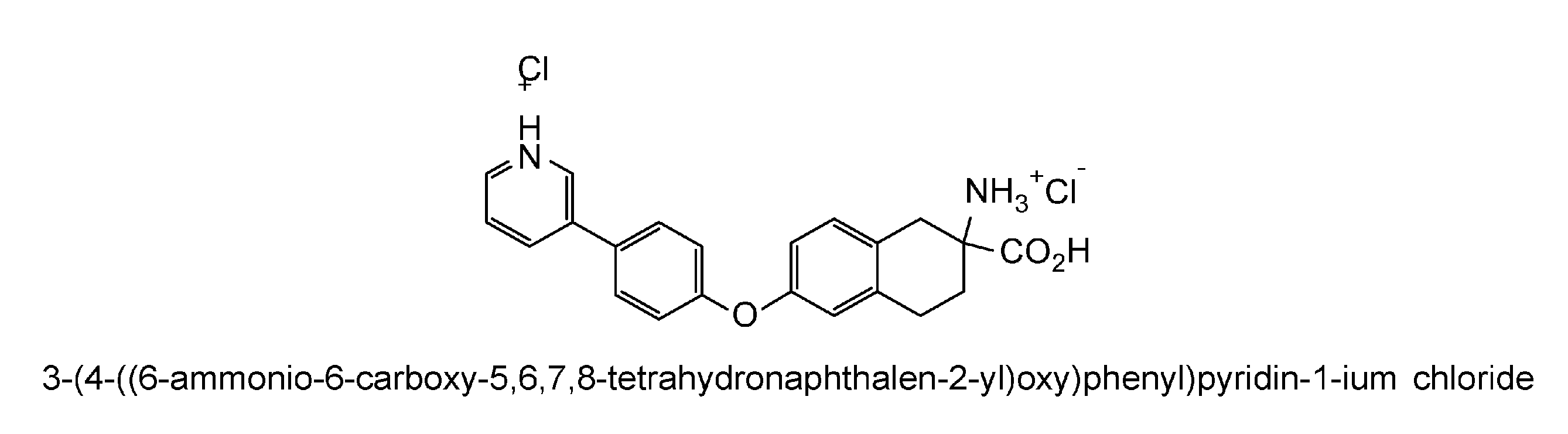
BNCT用テトラヒドロナフタレン誘導体の合成
BNCTに用いることができる化合物として、例えば、下記のような化合物を合成することができる。
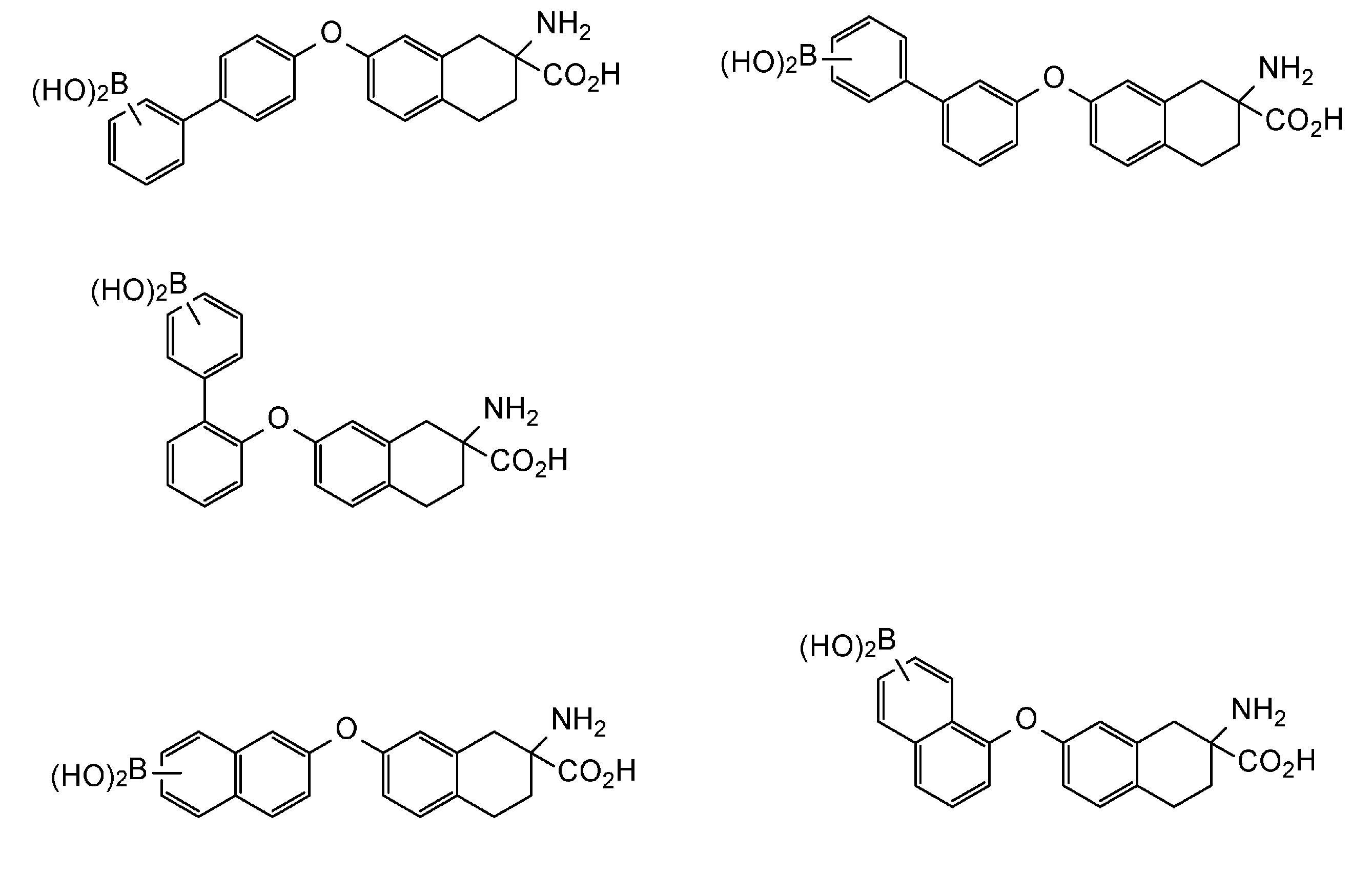

211At標識化テトラヒドロナフタレン誘導体の合成
放射性同位体を用いたがん治療に用いることができる化合物として、例えば、下記のような化合物を合成することができる。
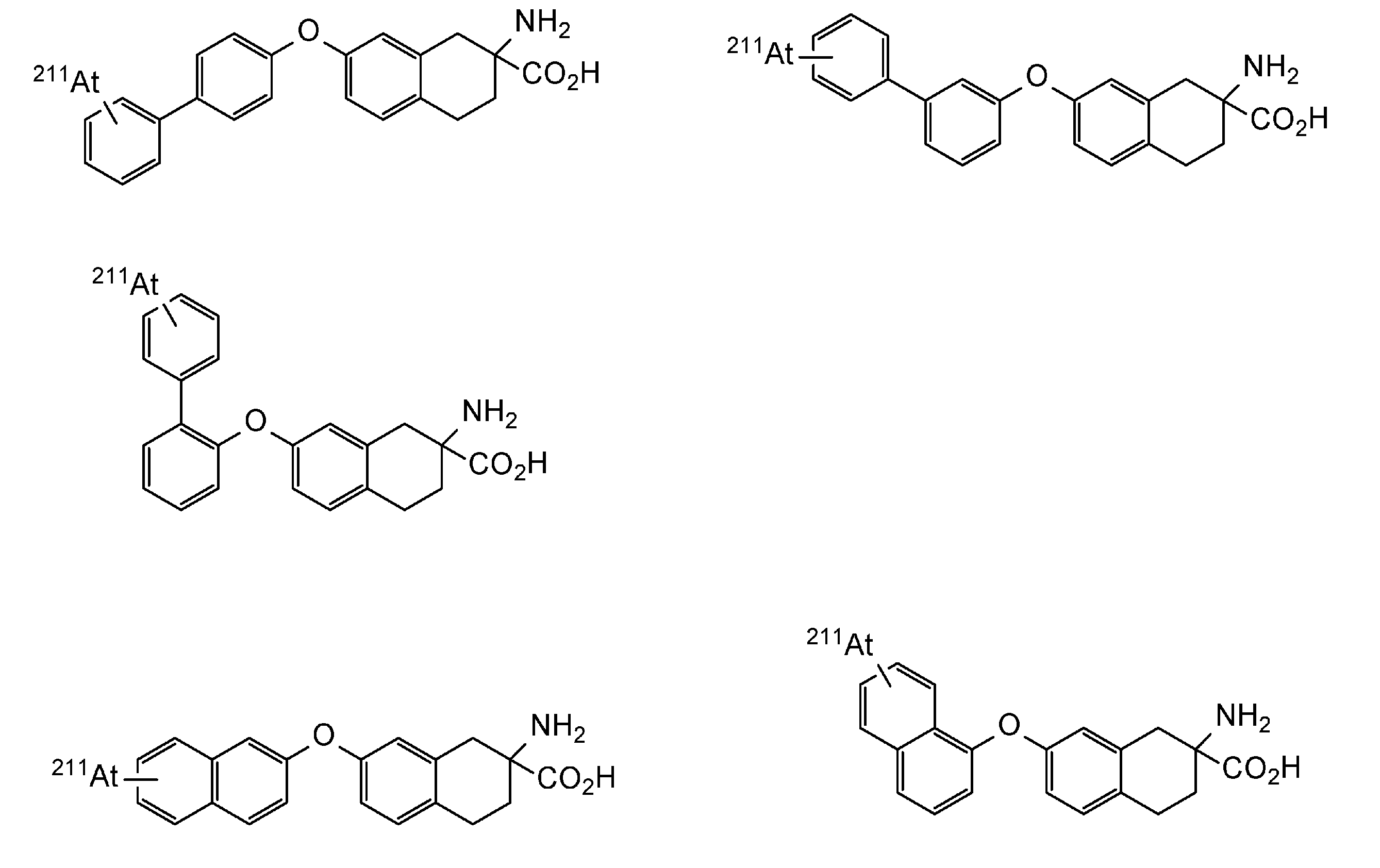
F標識化テトラヒドロナフタレン誘導体の合成
放射性同位体を用いたがん診断に用いることができる化合物として、例えば、下記のような化合物を合成することができる。
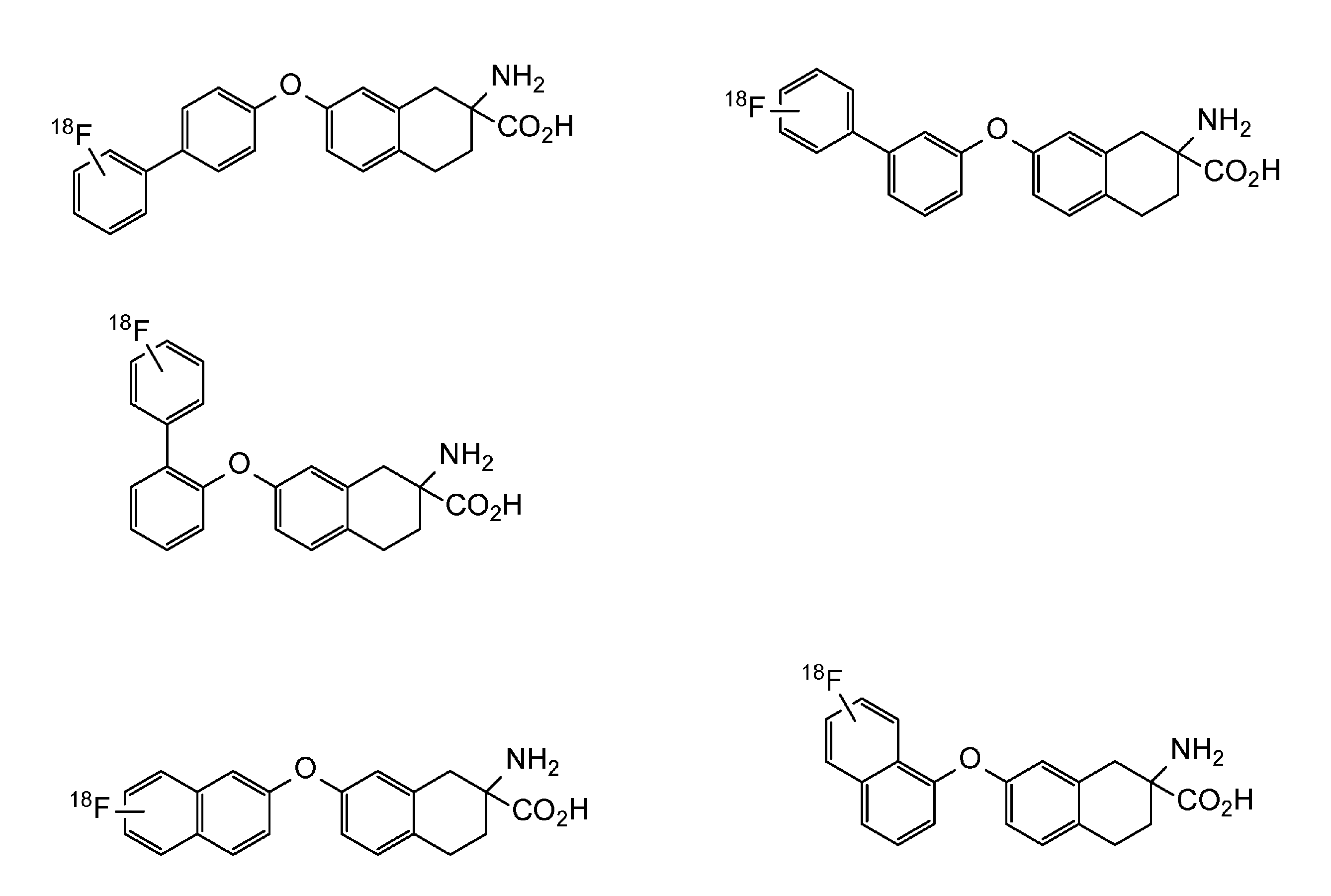
BNCT用テトラヒドロナフタレン誘導体の合成
BNCTに用いることができる化合物として、例えば、下記のような化合物を合成することができる。
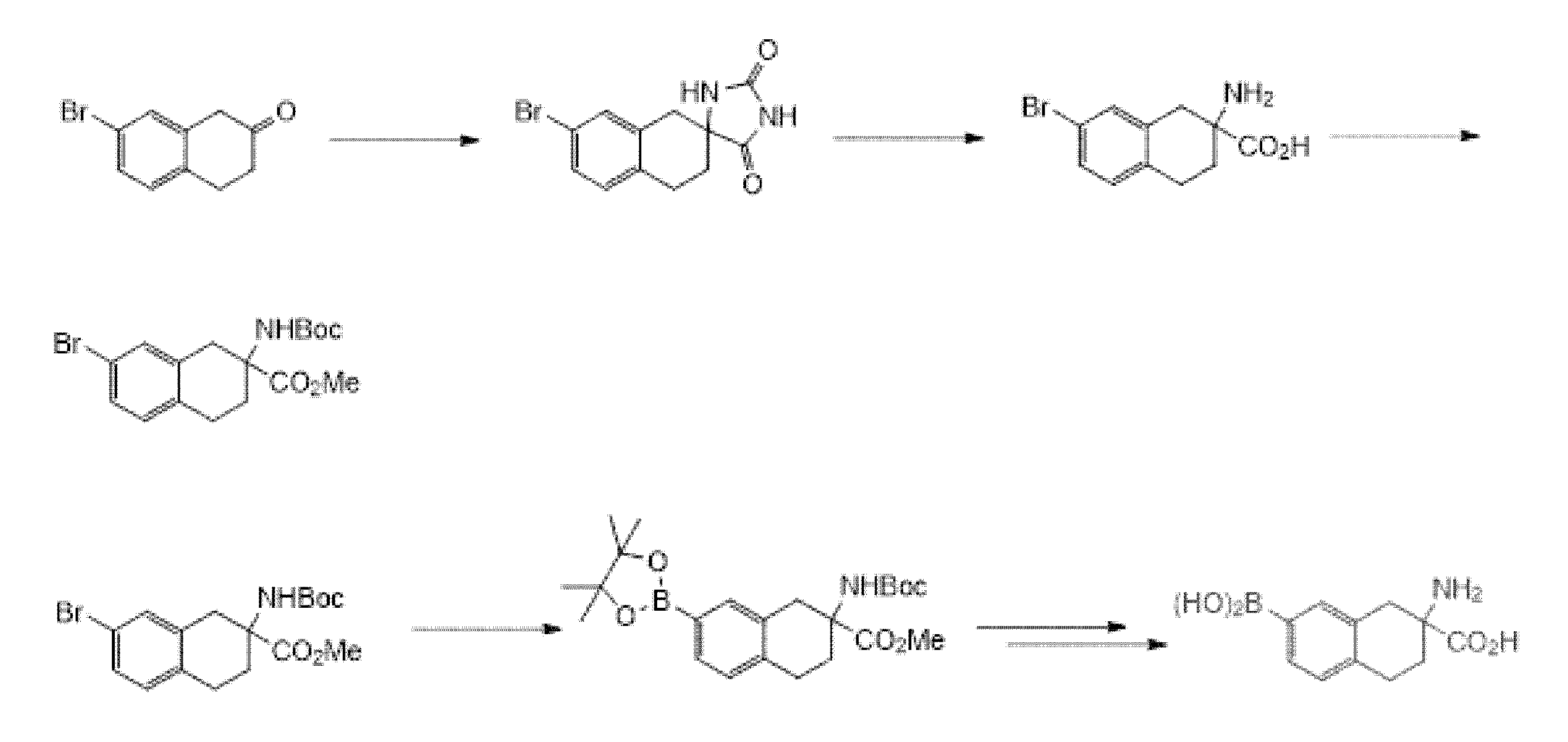

211At標識化テトラヒドロナフタレン誘導体の合成
放射性同位体を用いたがん治療に用いることができる化合物として、例えば、実施例6で得られたボロン酸を有する化合物に211Atを含む溶液を反応させ、同位置にボロン酸の代わりに211Atを導入することができる。

標識化テトラヒドロナフタレン誘導体の合成
放射性同位体を用いたがん診断に用いることができる化合物として、例えば、下記のような化合物を合成することができる。
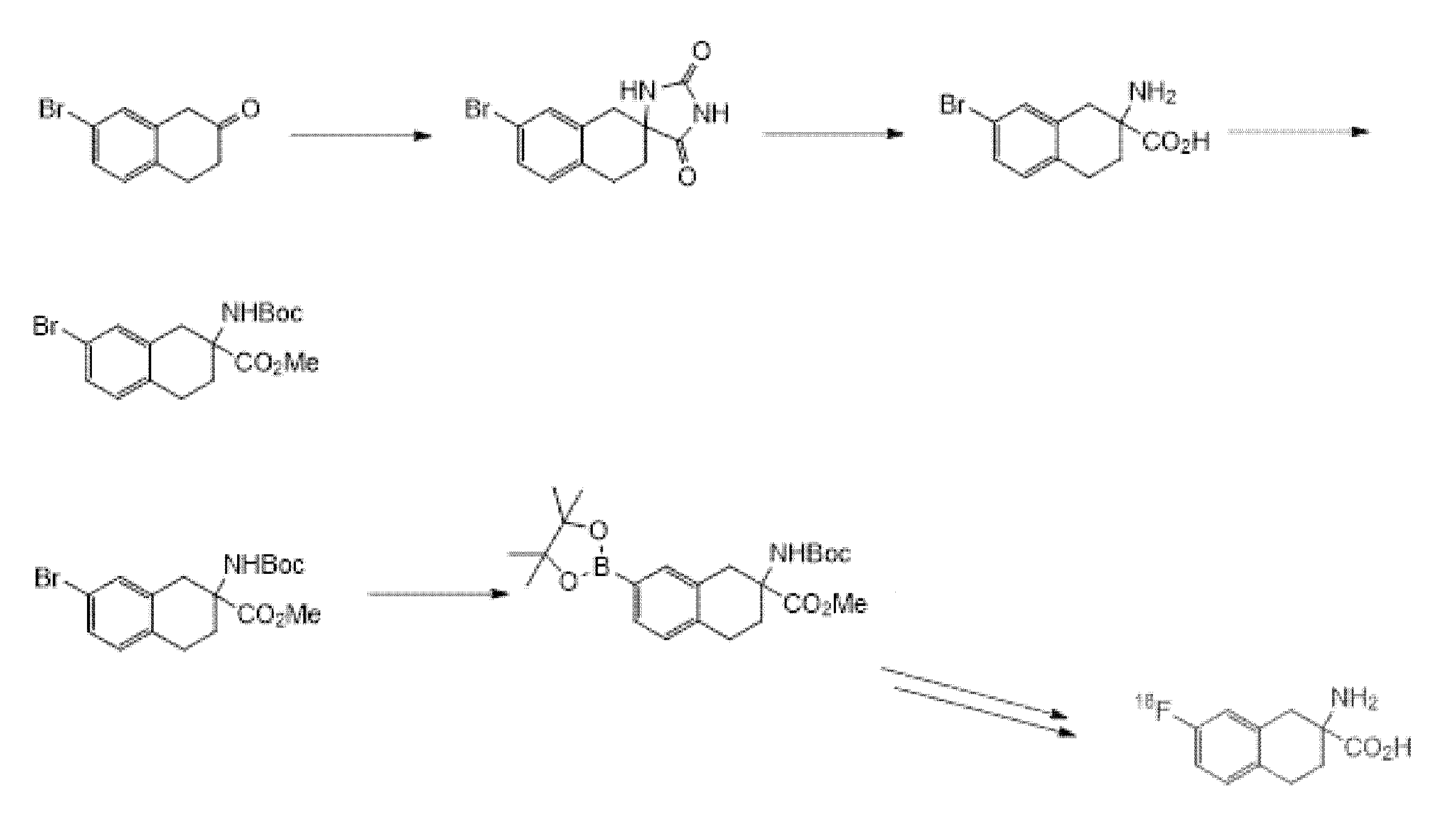

(1)ヒトLAT1及びLAT2安定発現HEK293細胞株の作製
ヒトLAT1及びLAT2を安定発現するHEK293細胞をそれぞれ作製した。
アンピシリン及びネオマイシン耐性マーカーを有し、ヒトLAT1もしくはLAT2の全長 cDNAをCMV(サイトメガロウィルス)のプロモーター下に挿入した、シャトルベクターDNA(LAT1:pcDNA3.1(+)-hLAT1、LAT2:pcDNA3.1(+)-hLAT2;発現ベクターpcDNA3.1(+)はインビトロジェン社製)を構築した。このベクターを、HEK293細胞にリポフェクタミン(登録商標)2000(インビトロジェン)を用いた方法により、製造者の指示に従って遺伝子導入した。その後0.9 mg/mL Geneticin(登録商標)存在下限界希釈法にて導入遺伝子の安定発現細胞クローンを選択し、取得した細胞クローンのなかで[14C]L-ロイシンの取り込みが高く、かつ10継代の後にも安定した発現を維持した細胞クローンを取得した。この細胞をLAT1及びLAT2への親和性および選択性評価等に用いた。
1―1. ヒトLAT1安定発現HEK293細胞株のナトリウムイオン非存在下でのL-ロイシンの取り込みは、LAT1が担っていることが確認されている。ヒトLAT1安定発現HEK293細胞株を24穴プレートに1×10⁵Cell/Wellで播き、48時間後に化合物による[14C]L-ロイシンの取り込み阻害試験を行った。培地を除去してナトリウムイオンを含まないHank‘s balanced salt solution(Na+-free HBSS)で細胞を洗った後、Na+-free HBSS中で10分間培養した。その後、ラセミ体である試験化合物(ともに0.1,1.0,10,0μM)の存在下で、1μMの[14C]L-ロイシンをNa+-free HBSS中で1分間取り込ませた後、Na+-free HBSSを氷冷したもので細胞を3回洗った。ウェルに1MNaOH500μLを加え、30分おいて細胞を溶解させ、細胞溶解液を回収した。液体シンチレーターを用い、細胞溶解液の[14C]L-ロイシン量を求めた。また、BCA Assay Kit(Thermofisher Scientific)を用いて細胞溶解液のタンパク量を測定し、細胞のタンパク質1mg当たりの[14C]L-ロイシンの1分間当たりの取り込み量を算出した。
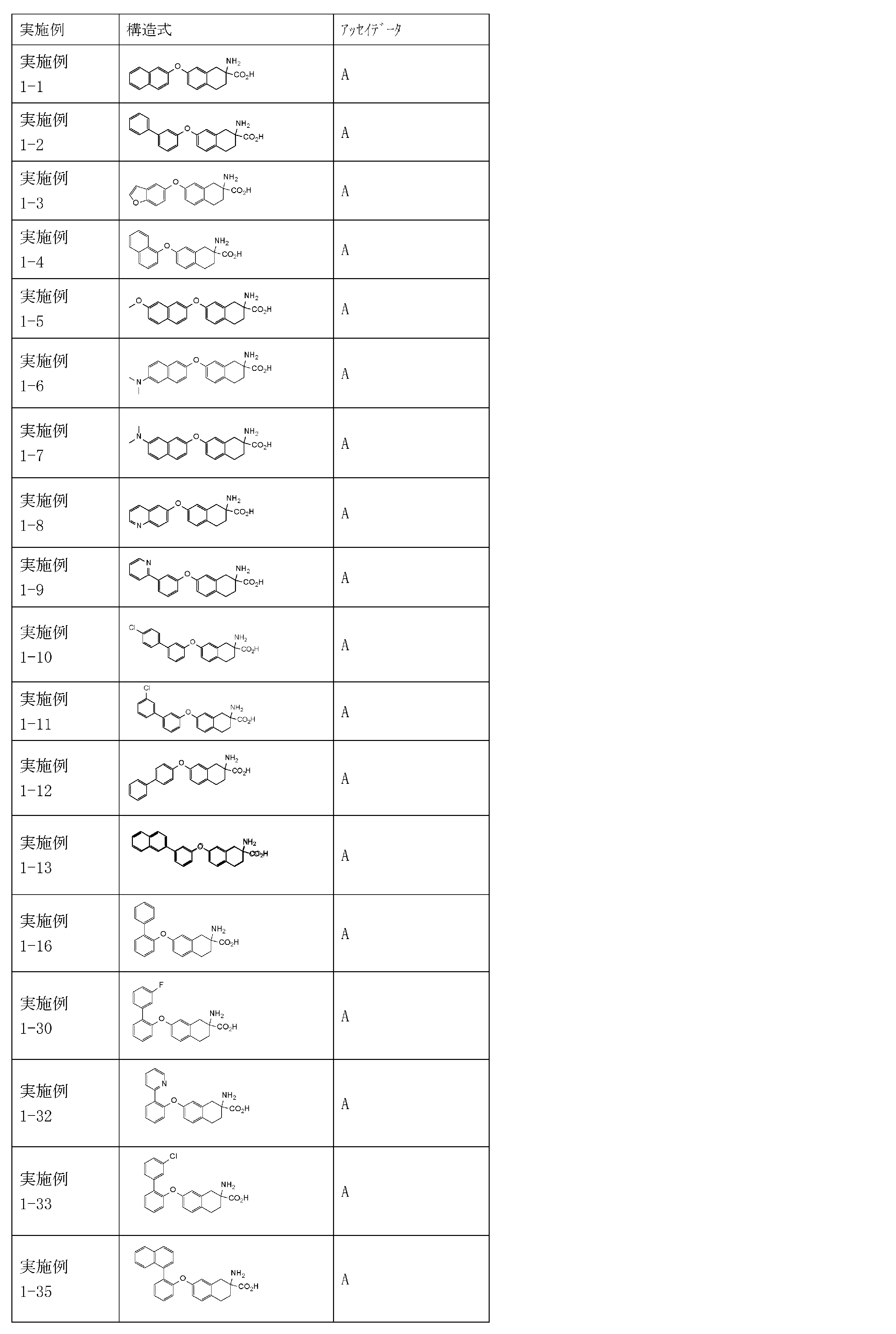


特に顕著な効果を有する化合物は、例えば、実施例1-1、実施例1-4、実施例1-45、実施例1-46、実施例1-53、実施例1-54、実施例1-55、実施例1-57、実施例1-58、及び実施例1-63の化合物であった。
ヒトLAT2安定発現HEK293細胞株を用い、実施例1-1の化合物による[14C]L-アラニンの取り込み阻害を行った。ヒトLAT1安定発現HEK293細胞株での[14C]L-ロイシン取り込み阻害実験と同様に、ヒトLAT2安定発現HEK293細胞株を24穴プレートに1×10⁵Cell/Wellで播き、48時間後に実施例1-1のラセミ体である化合物(ともに0.1,1.0,10,0μM)の存在下で、1μMの[14C]L-アラニンをNa+-free HBSS中で1分間取り込ませた後、[14C]L-アラニンの取り込み量及び細胞溶解液のタンパク量を測定し、細胞のタンパク質1mg当たりの[14C]L-アラニンの、1分間当たりの取り込み量を求めた。その結果、この細胞において化合物は、アラニンの取り込み抑制は、50%抑制濃度1μM程度であり、LAT1安定発現HEK293細胞株での[14C]L-ロイシン取り込み阻害よりも弱い阻害作用であることが明らかになった(図1B)。
化合物除去後のロイシン取り込み持続抑制効果
ヒトLAT1高発現細胞株において、あらかじめ実施例の化合物を作用させ、それを除去した後に残存する[14C]L-ロイシンの取り込みを調べた。
取り込み阻害試験と同様に24穴プレートに播種し、化合物(ラセミ体)を20μM含むMEM (Minimum Essential Medium)培地をウェルに加えて30分間作用させた。対照として化合物を含まないMEM培地を用いた。
実施例1-30、実施例1-33、実施例1-35、実施例1-42、実施例1-43、実施例1-45、実施例1-46、実施例1-48、実施例1-49、実施例1-50、実施例1-52、実施例1-53、実施例1-54、実施例1-55、実施例1-57、実施例1-58、実施例1-59、実施例1-62、及び実施例1-63の化合物。
マウス大腸癌由来CT26細胞を 0.5×10⁴細胞/mLに調整し、96ウェルプレートに1000細胞/ウェルで藩種して、10%胎児牛血清添加RPMI 1640培地で、5%CO2、37°Cで培養した。培養開始後24時間で培地交換し、実施例の化合物を含んだ培地に置き換えることで化合物の細胞増殖に対する作用を検討した。化合物は、0.01,0.03,0.1,0.3,1,3,10,又は30μMの濃度を用いた。対照として、化合物を含まない培地で培養した。化合物処理開始後72時間で、CCK-8アッセイ(Cell Counting Kit-8、Dojindo株式会社)により細胞数を評価し、対照と比較して、50%の増殖抑制率を与える化合物濃度(IC50値)を算出した。
表2に、実施例の化合物について、IC50値が0.9μmol/L以下であるものをA、0.9~5μmol/LのものをB、それより高いものをCと評価して示した。評価した実施例の化合物のうち、多くの化合物では、0.9μmol/L以下の極めて低いIC50値が得られた。
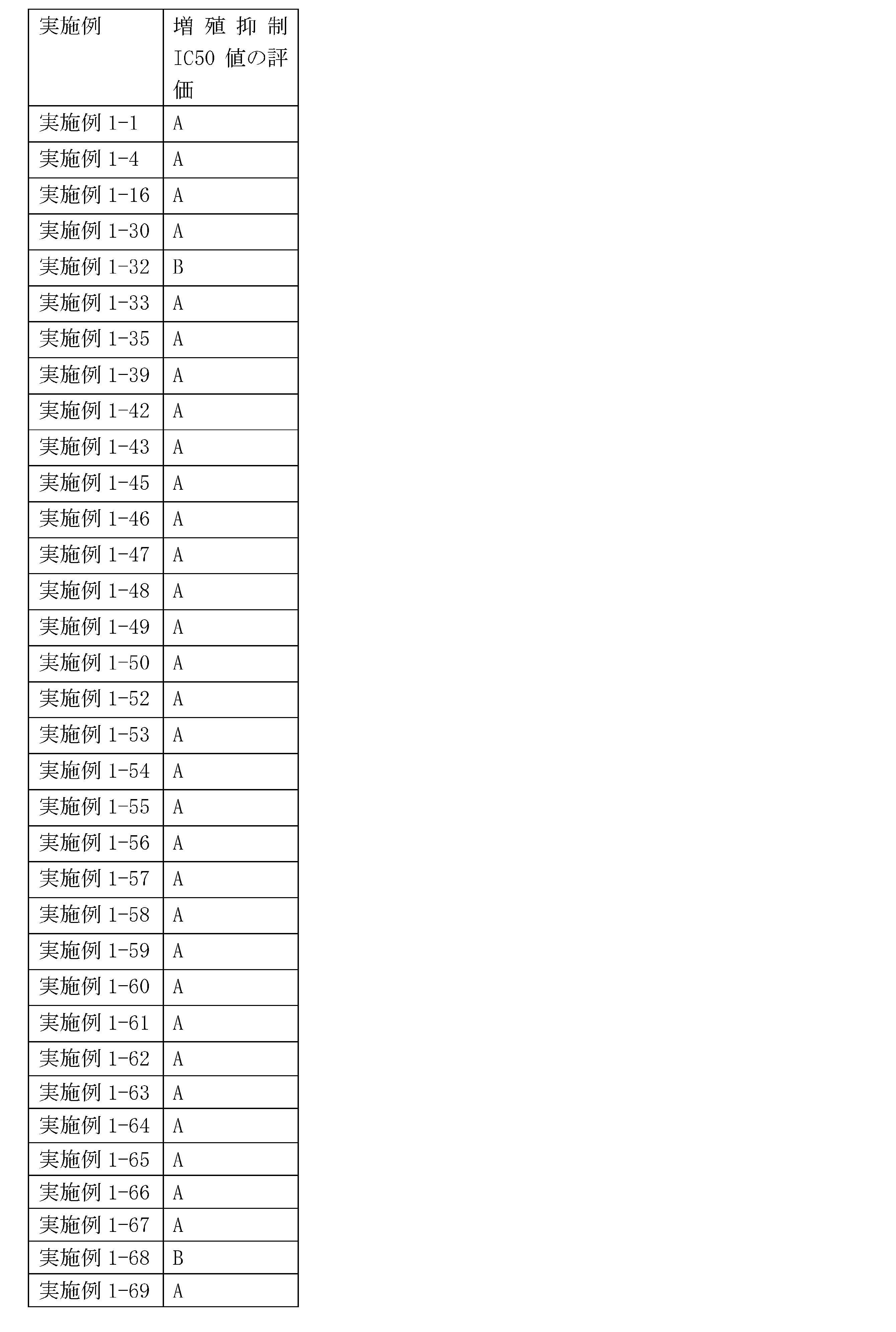
・培養細胞を用いたBNCT増強効果の検討
ヒト乳がん細胞MCF7をRPMI培地で48時間平板培養した後、100μMのL-[10B]BPAを含むRPMI培地に交換し、15分間培養することで、L-[10B]BPAを細胞に取り込ませた。HBSSで洗浄後、RPMI培地中で60分培養し、さらにHBSS洗浄後、細胞を剥がし、HBSS中で室温にて1.5時間保管した(図3A中の(-))。また、L-BPAを細胞に取り込ませ、HBSSで洗浄後、本発明で得られる実施例1-1の化合物(10μM)を含んだRPMI培地中で60分培養し、さらにHBSS洗浄後、細胞を剥がし、HBSS中で室温にて1.5時間保管した(図3A中の(+))。また、L-[10B]BPAを含まないRPMI培地で15分間培養し、HBSSで洗浄後、細胞を剥がし、HBSS中で室温にて1.5時間保管した(図3A中の(No BPA Hot control))。これら3つの細胞試料に中性子線を照射した(5MW、4分間)。照射後、生存細胞を測定するため、細胞を平板培養し、2週間後に生成したコロニー数を測定した。生存細胞数は、Surviving fraction (%)として評価した(図3A)。
マウスのトリプルネガティブ乳がん細胞4T1およびマウスの大腸がん細胞CT26を、平板培養後、BALB/cマウス下肢の皮下へ移植した。1週間後、尾静脈より400mg/kgのL-[10B]BPAあるいは対照として溶媒を静脈内投与した。第1群は、L-[10B]BPA投与の1時間後および1.5時間後に、実施例1-45の化合物を25mg/kgの用量で静脈内投与した。第2群は、L-[10B]BPAの代わりに溶媒を投与し、その1時間後および1.5時間後に、本発明で得られる実施例1-45の化合物を25mg/kgの用量で静脈内投与した。第3群は、L-[10B]BPA投与の1時間後および1.5時間後に、実施例1-45の化合物の代わりに溶媒を静脈内投与した。第1群、第2群、第3群に対して、L-[10B]BPA投与あるいはその対照としての溶媒投与から2.5時間後に、麻酔下で下肢に中性子線を照射した(5MW、30分間)。照射から11日後に腫瘍を摘出し、その容積を比較した。
Claims (18)
- 下記式(I)で表される化合物又はその薬学的に許容される塩:
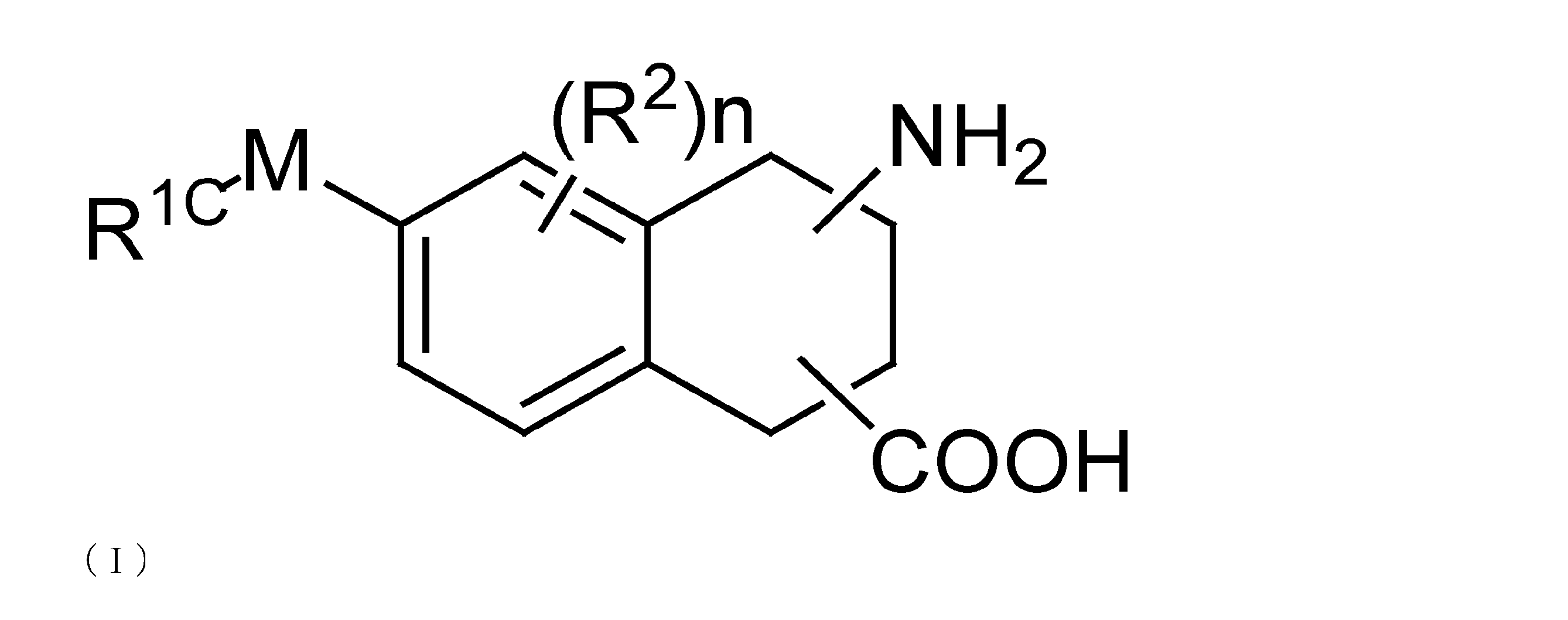
Mは、S、O、又はNHを表し;
R1Cは、置換基を有する5員~7員芳香族複素環基、置換基を有するC5員~7員芳香族環基、及び置換又は非置換の8員~16員の多環基からなる群より選択される構造のいずれかを表し、
ここで、該置換基を有する5員~7員芳香族複素環基又は該置換基を有するC5員~7員芳香族環基の置換基は、置換又は非置換のベンジルオキシ、置換又は非置換のベンジル、置換又は非置換のフェニル、置換又は非置換のフェニルC1~6アルキル、置換又は非置換のビフェニル、置換又は非置換のピリジル、置換又は非置換のナフチル、ハロゲン、ヒドロキシ、シアノ、アミノ、C1~6アルキルアミノ、ジ(C1~6アルキル)アミノ、C1~6アルキル、C2~6アルケニル、C2~6アルキニル、C1~6アルコキシル、C1~6アルコキシC1~6アルキル、ニトロ、C1~6ハロアルキル、カルバモイル、C1~6アルキルアミノカルボニル、ジ(C1~6アルキル)アミノカルボニル、C1~6アルコキシカルボニル、C1~6アルキルカルボニル、
COOR10(R10は、H又はC1~6アルキル、アミノ、C1~6アルキルアミノ、又はジ(C1~6アルキル)アミノ)、3員~8員の非芳香族複素環、モルフォリノカルボニル、C3~8シクロアルキル、C3~8シクロアルキルアミノ、3~8員非芳香族複素環置換アミノ、C1~6ハロアルキルスルファニル、C1~6ハロアルキルスルフィニル、C1~6ハロアルキルスルホニル、C1~6アルキルチオ、C1~6アルキルスルフィニル、C1~6アルキルスルホニル、アミノスルホニル、スルホ、スルファモイル、18F、123I、ホウ素を含む置換基、α線放出核種及びβ線放出核種からなる群より独立して選択される1~5個の基であり、
ここで、該多環式基の置換基は、ハロゲン、ヒドロキシ、シアノ、アミノ、C1~6アルキルアミノ、ジ(C1~6アルキル)アミノ、C1~6アルキル、C2~6アルケニル、C2~6アルキニル、C1~6アルコキシル、ベンジルオキシ、ベンジル、フェニル、フェニルC1~6アルキル、C1~6アルコキシC1~6アルキル、ニトロ、C1~6ハロアルキル、カルバモイル、C1~6アルキルアミノカルボニル、ジ(C1~6アルキル)アミノカルボニル、C1~6アルコキシカルボニル、C1~6アルキルカルボニル、
COOR10(R10は、H又はC1~6アルキル、アミノ、C1~6アルキルアミノ、又はジ(C1~6アルキル)アミノ)、
3員~8員の非芳香族複素環、モルフォリノカルボニル、C3~8シクロアルキル、C3~8シクロアルキルアミノ、3~8員非芳香族複素環置換アミノ、C1~6ハロアルキルスルファニル、C1~6ハロアルキルスルフィニル、C1~6ハロアルキルスルホニル、C1~6アルキルチオ、C1~6アルキルスルフィニル、C1~6アルキルスルホニル、アミノスルホニル、スルホ、スルファモイル、
18F、123I、ホウ素を含む置換基、α線放出核種及びβ線放出核種からなる群から独立して選択される1~6個の基であり;
あるいは、
Mは、S、O、NH、又は不存在(単に単結合を表す)で、R1Cは、18F、123I、ホウ素を含む置換基、α線放出核種及び/又はβ線放出核種を表し;
R2は、ハロゲン、ヒドロキシ、シアノ、アミノ、C1~6アルキルアミノ、C1~6アルキル、C2~6アルケニル、C2~6アルキニル、C1~6アルコキシル、ベンジルオキシ、ベンジル、フェニル、フェニルC1~6アルキル、C1~6アルコキシC1~6アルキル、ニトロ、C1~6ハロアルキル、カルバモイル、C1~6アルキルアミノカルボニル、ジ(C1~6アルキル)アミノカルボニル、C1~6アルコキシカルボニル、C1~6アルキルカルボニル、COOR10(R10は、H又はC1~6アルキル、アミノ、C1~6アルキルアミノ、又はジ(C1~6アルキル)アミノ)、3員~8員の非芳香族複素環、モルフォリノカルボニル、C3~8シクロアルキル、C3~8シクロアルキルアミノ、3~8員非芳香族複素環置換アミノ、C1~6ハロアルキルスルファニル、C1~6ハロアルキルスルフィニル、C1~6ハロアルキルスルホニル、C1~6アルキルチオ、C1~6アルキルスルフィニル、C1~6アルキルスルホニル、アミノスルホニル、スルホ、及びスルファモイルからなる群から独立して選択される基を表し;そして
nは、0~5のいずれかの整数を表す。 - 前記R1Cが、置換又は非置換の8員~16員の多環基であり、該多環基は、C原子の他に、任意にN、O及び/又はSを含んでいても良い環である、請求項1に記載の化合物又はその薬学的に許容される塩。
- 前記R1Cが、置換基を有する5員~7員芳香族環基であり、該置換基として、置換又は非置換のベンジルオキシ、置換又は非置換のベンジル、置換又は非置換のフェニル、置換又は非置換のフェニルC1~6アルキル、置換又は非置換のピリジル、置換又は非置換のナフチル、及び置換又は非置換のビフェニルからなる群より選択される少なくとも1つの基を必ず含み、
ここで、該ベンジルオキシ、ベンジル、フェニル、フェニルC1~6アルキル、ピリジル、ナフチル、又はビフェニルが置換されている場合、ハロゲン、ヒドロキシ、シアノ、アミノ、C1~6アルキルアミノ、ジ(C1~6アルキル)アミノ、C1~6アルキル、C2~6アルケニル、C2~6アルキニル、C1~6アルコキシル、ベンジルオキシ、ベンジル、フェニル、フェニルC1~6アルキル、C1~6アルコキシC1~6アルキル、ニトロ、C1~6ハロアルキル、カルバモイル、C1~6アルキルアミノカルボニル、ジ(C1~6アルキル)アミノカルボニル、C1~6アルコキシカルボニル、C1~6アルキルカルボニル、COOR10(R10は、H又はC1~6アルキル、アミノ、C1~6アルキルアミノ、又はジ(C1~6アルキル)アミノ)、3員~8員の非芳香族複素環、モルフォリノカルボニル、C3~8シクロアルキル、C3~8シクロアルキルアミノ、3~8員非芳香族複素環置換アミノ、C1~6ハロアルキルスルファニル、C1~6ハロアルキルスルフィニル、C1~6ハロアルキルスルホニル、C1~6アルキルチオ、C1~6アルキルスルフィニル、C1~6アルキルスルホニル、アミノスルホニル、スルホ、及びスルファモイルからなる群から独立して選択される1~5個の基で置換されている、請求項1に記載の化合物又はその薬学的に許容される塩。 - 前記R1Cが、置換又は非置換のピリジルフェニル、置換又は非置換のビフェニル、置換又は非置換のビフェニル置換フェニル、置換又は非置換のナフチル置換フェニル、置換又は非置換のナフチル、置換又は非置換のキノリン置換フェニル、置換又は非置換のイソキノリン、置換又は非置換のイソキノリン置換フェニル、置換又は非置換のアントラセン、置換又は非置換のアントラセン置換フェニル、置換又は非置換のジチアゾールイリデンアミノナフチル、置換又は非置換のジチアゾールイリデンアミノビフェニル、置換又は非置換のベンゾフラニル、置換又は非置換のベンゾチオフェニル、置換又は非置換のアセナフテン、及び置換又は非置換のジチアゾールイリデンアミノフェニルからなる群より選択される1種であり、
該置換の場合の置換基は、ハロゲン、ヒドロキシ、シアノ、アミノ、C1~6アルキルアミノ、ジ(C1~4アルキル)アミノ、C1~6アルキル、C2~6アルケニル、C2~6アルキニル、C1~6アルコキシ、C1~6アルコキシC1~6アルキル、ニトロ、C1~6ハロアルキル、カルバモイル、C1~6アルキルアミノカルボニル、ジ(C1~6アルキル)アミノカルボニル、C1~6アルコキシカルボニル、C1~6アルキルカルボニル、COOR10(R10は、H又はC1~6アルキル、アミノ、C1~6アルキルアミノ)、モルフォリノカルボニル、C1~6ハロアルキルスルファニル、C1~6ハロアルキルスルフィニル、C1~6ハロアルキルスルホニル、C1~6アルキルチオ、C1~6アルキルスルフィニル、C1~6アルキルスルホニル、アミノスルホニル、スルホ、C3~8シクロアルキル、3~8員非芳香族複素環、C3~8シクロアルキルアミノ、3~8員非芳香族複素環置換アミノ、ジアルキルアミノ、及びスルファモイルからなる群から選択される1~5個の基である、請求項1に記載の化合物又はその薬学的に許容される塩。 - 式(I)中、
MはOを表し、
R1Cは、置換基を有する5員~7員芳香族環基であり、該置換基として、置換又は非置換のベンジルオキシ、置換又は非置換のベンジル、置換又は非置換のフェニル、置換又は非置換のフェニルC1~6アルキル、置換又は非置換のピリジル、置換又は非置換のナフチル、及び置換又は非置換のビフェニルからなる群より選択される少なくとも1つの基を必ず含み、
該置換の場合の置換基は、ハロゲン、ヒドロキシ、シアノ、アミノ、C1~6アルキルアミノ、C1~6アルキル、C2~6アルケニル、C2~6アルキニル、C1~6アルコキシ、C1~6アルコキシC1~6アルキル、ニトロ、C1~6ハロアルキル、カルバモイル、C1~6アルキルアミノカルボニル、ジ(C1~6アルキル)アミノカルボニル、C1~6アルコキシカルボニル、C1~6アルキルカルボニル、COOR10(R10は、H又はC1~6アルキル、アミノ、C1~6アルキルアミノ)、モルフォリノカルボニル、C1~6ハロアルキルスルファニル、C1~6ハロアルキルスルフィニル、C1~6ハロアルキルスルホニル、C1~6アルキルチオ、C1~6アルキルスルフィニル、C1~6アルキルスルホニル、アミノスルホニル、スルホ、C3~8シクロアルキル、3~8員非芳香族複素環、C3~8シクロアルキルアミノ、3~8員非芳香族複素環置換アミノ、ジアルキルアミノ、及びスルファモイルからなる群から選択される1~5個の基であり、
nは、0を表す、請求項1に記載の化合物又はその薬学的に許容される塩。 - 請求項1~5のいずれか1項に記載の化合物又はその薬学的に許容される塩を含む、L型アミノ酸トランスポーターLAT1選択的阻害剤。
- 請求項1~5のいずれか1項に記載の化合物又はその薬学的に許容される塩を含む、がん治療用医薬組成物。
- 請求項1~5のいずれか1項に記載の化合物又はその薬学的に許容される塩を含み、L-BPAを細胞内に保持する為の組成物。
- 下記式(II)で表される化合物又はその薬学的に許容される塩:
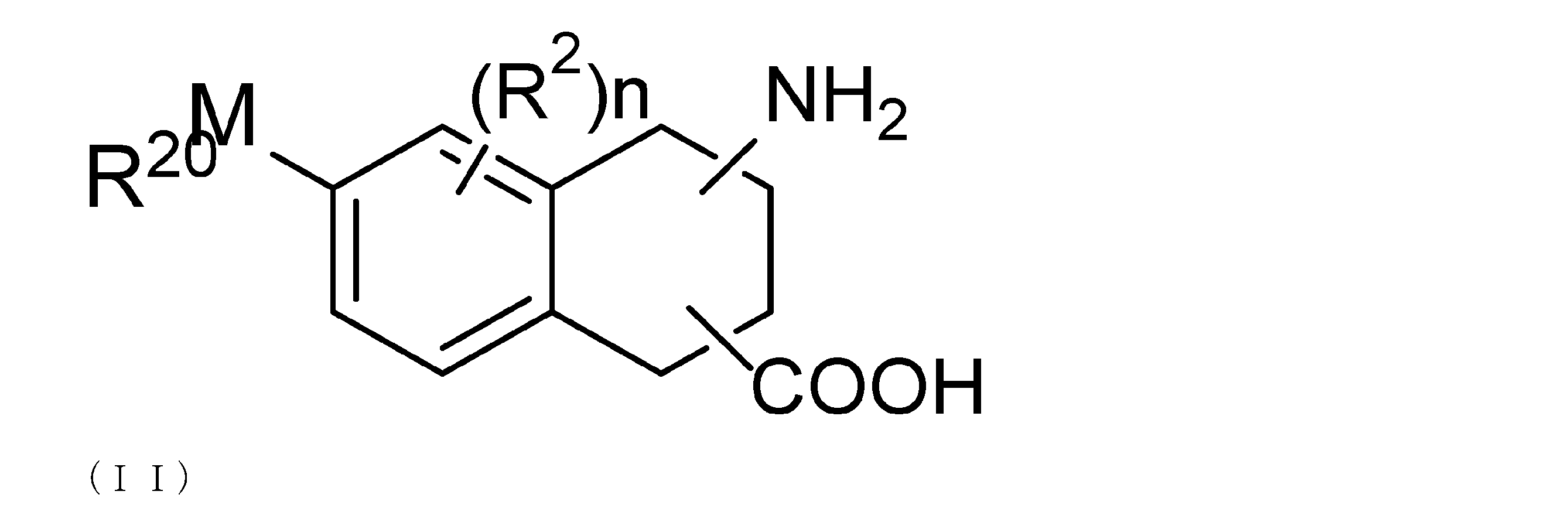
Mは、S、O、NH、又は不存在(単結合)を表し;
R20は放射性同位体を表す;
を含有するがん治療用組成物。 - 前記R20は、α線放出核種及び/又はβ線放出核種を表す、請求項9に記載のがん治療用組成物。
- 前記α線放出核種が、211Atであり、前記β線放出核種が、131Iである、請求項10に記載のがん治療用組成物。
- 下記式(III)で表される化合物又はその薬学的に許容される塩:
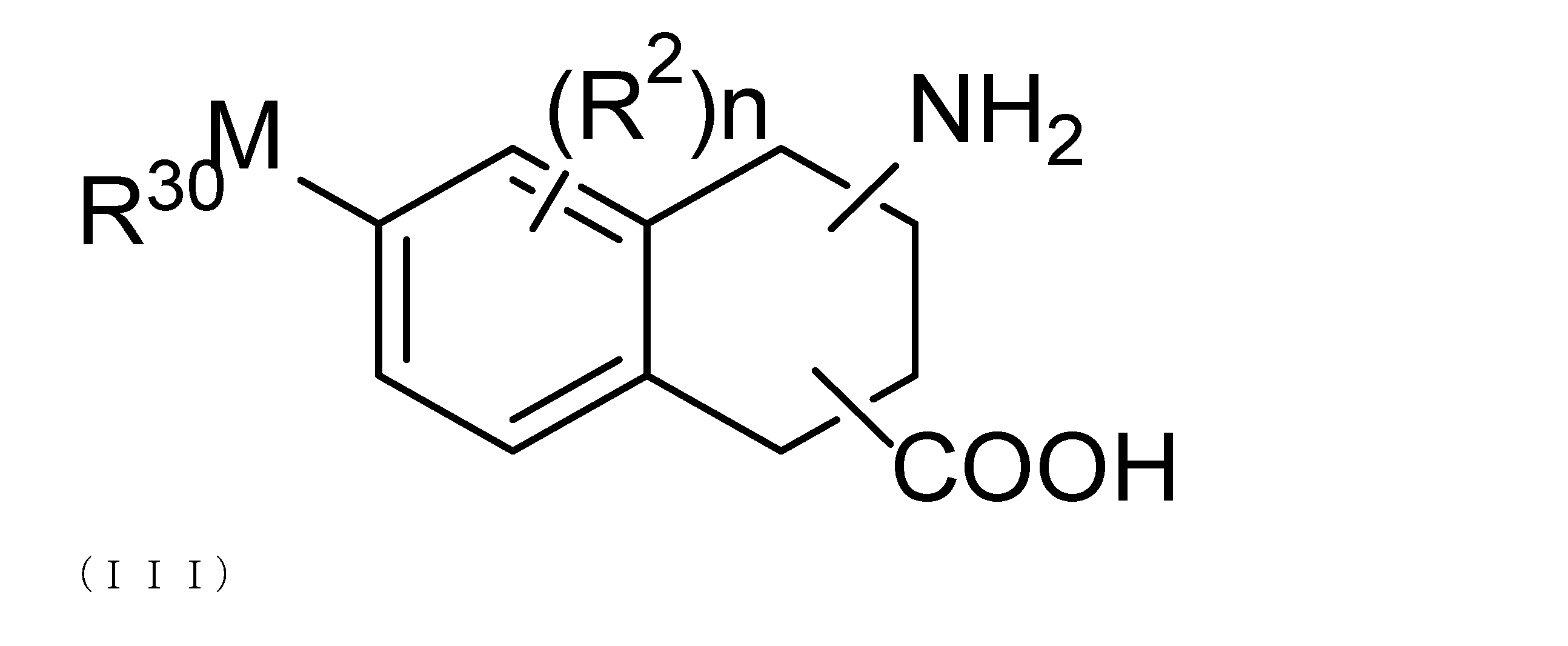
Mは、S、O、NH、又は不存在(単結合)を表し;
R30は、ホウ素を含む置換基を表す
を含有するBNCT用薬剤。 - 前記R30は、ボロン酸(‐B(OH)2)、ボロン酸エステル、ボロン酸アミド、又はホウ素クラスターを表す、請求項12に記載のBNCT用薬剤。
- 下記式(IV)で表される化合物又はその薬学的に許容される塩:
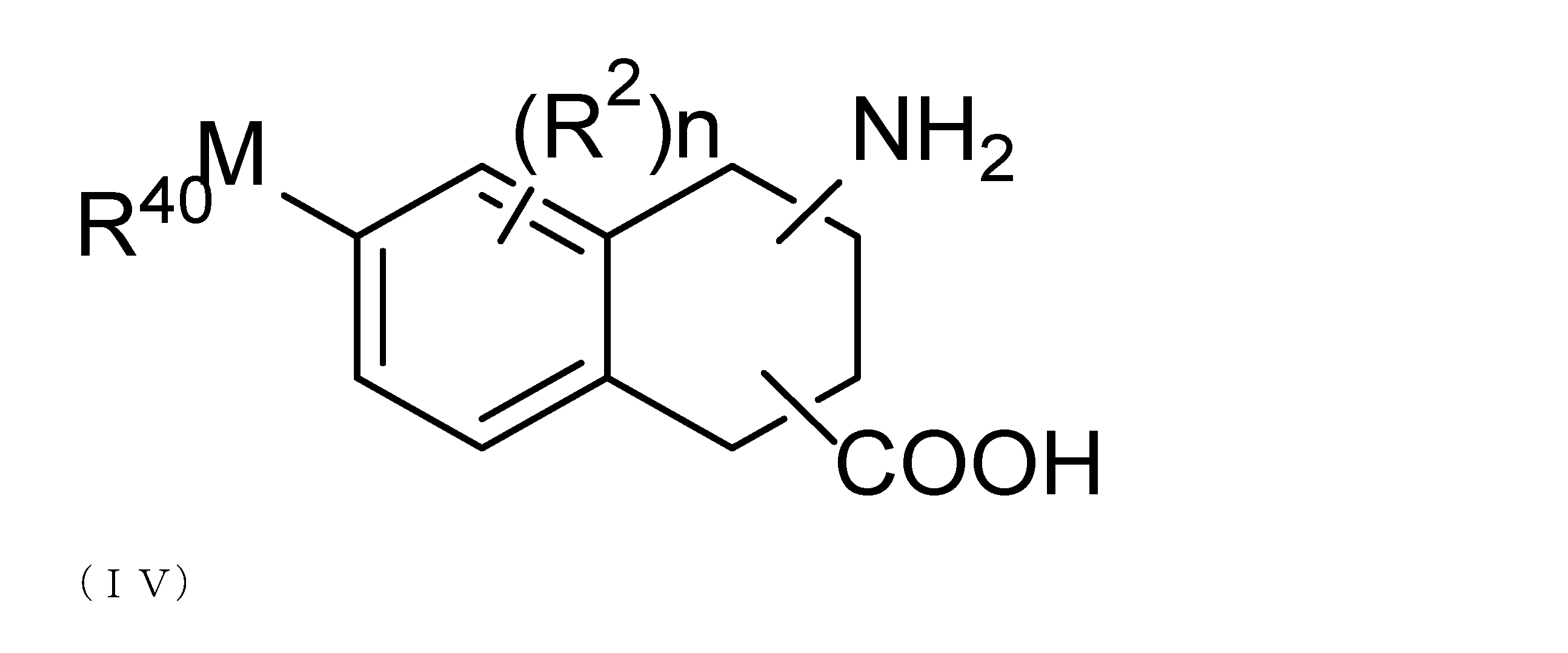
Mは、S、O、NH、又は不存在(単結合)を表し;
R40は、放射性同位体を表す、
を含有するがん診断薬。 - 前記R40は、18F又は123Iである、請求項14に記載のがん診断薬。
- 前記がん診断薬が、PET用プローブ又はSPECT用プローブである、請求項14又は15に記載のがん診断薬。
- 請求項1~5のいずれか1項に記載の化合物又はその薬学的に許容される塩を含む、LAT1の持続的抑制剤。
- 請求項1~5のいずれか1項に記載の化合物又はその薬学的に許容される塩を含む、BNCT効果増強用組成物。
Priority Applications (7)
| Application Number | Priority Date | Filing Date | Title |
|---|---|---|---|
| EP23780886.0A EP4501906A1 (en) | 2022-03-31 | 2023-03-30 | Tetrahydronaphthalene derivative |
| CN202380032126.4A CN118974007A (zh) | 2022-03-31 | 2023-03-30 | 四氢萘衍生物 |
| AU2023246242A AU2023246242A1 (en) | 2022-03-31 | 2023-03-30 | Tetrahydronaphthalene derivative |
| US18/852,099 US20260035339A1 (en) | 2022-03-31 | 2023-03-30 | Tetrahydronaphthalene derivative |
| JP2024512801A JPWO2023190878A1 (ja) | 2022-03-31 | 2023-03-30 | |
| KR1020247036406A KR20240167916A (ko) | 2022-03-31 | 2023-03-30 | 테트라히드로나프탈렌 유도체 |
| IL315993A IL315993A (en) | 2022-03-31 | 2023-03-30 | Tetrahydronaphthalene derivative |
Applications Claiming Priority (2)
| Application Number | Priority Date | Filing Date | Title |
|---|---|---|---|
| JP2022-058114 | 2022-03-31 | ||
| JP2022058114 | 2022-03-31 |
Publications (1)
| Publication Number | Publication Date |
|---|---|
| WO2023190878A1 true WO2023190878A1 (ja) | 2023-10-05 |
Family
ID=88202795
Family Applications (1)
| Application Number | Title | Priority Date | Filing Date |
|---|---|---|---|
| PCT/JP2023/013197 Ceased WO2023190878A1 (ja) | 2022-03-31 | 2023-03-30 | テトラヒドロナフタレン誘導体 |
Country Status (8)
| Country | Link |
|---|---|
| US (1) | US20260035339A1 (ja) |
| EP (1) | EP4501906A1 (ja) |
| JP (1) | JPWO2023190878A1 (ja) |
| KR (1) | KR20240167916A (ja) |
| CN (1) | CN118974007A (ja) |
| AU (1) | AU2023246242A1 (ja) |
| IL (1) | IL315993A (ja) |
| WO (1) | WO2023190878A1 (ja) |
Cited By (1)
| Publication number | Priority date | Publication date | Assignee | Title |
|---|---|---|---|---|
| JP2023149495A (ja) * | 2022-03-31 | 2023-10-13 | Atransen Pharma株式会社 | L型アミノ酸トランスポーター1特異的化合物の製造方法 |
Citations (4)
| Publication number | Priority date | Publication date | Assignee | Title |
|---|---|---|---|---|
| CN101768086A (zh) * | 2008-12-29 | 2010-07-07 | 北京富卡生物技术有限公司 | 氨基甲醇衍生物及其盐类化合物及其合成方法和其药物用途 |
| WO2012018015A1 (ja) * | 2010-08-03 | 2012-02-09 | ステラファーマ株式会社 | シクロ環含有アミノ酸骨格結合ホウ素化合物 |
| PL215215B1 (pl) * | 2010-12-14 | 2013-11-29 | Univ Mikolaja Kopernika | Kwas 2-amino-6-dihydroksyborylo-1,2,3,4-tetrahydronaftaleno-2-karboksylowy i sposób jego wytwarzania |
| WO2019027059A1 (ja) * | 2017-08-04 | 2019-02-07 | 国立大学法人大阪大学 | 放射標識されたアリール化合物の製造方法 |
-
2023
- 2023-03-30 KR KR1020247036406A patent/KR20240167916A/ko active Pending
- 2023-03-30 US US18/852,099 patent/US20260035339A1/en active Pending
- 2023-03-30 EP EP23780886.0A patent/EP4501906A1/en active Pending
- 2023-03-30 JP JP2024512801A patent/JPWO2023190878A1/ja active Pending
- 2023-03-30 AU AU2023246242A patent/AU2023246242A1/en active Pending
- 2023-03-30 IL IL315993A patent/IL315993A/en unknown
- 2023-03-30 WO PCT/JP2023/013197 patent/WO2023190878A1/ja not_active Ceased
- 2023-03-30 CN CN202380032126.4A patent/CN118974007A/zh active Pending
Patent Citations (4)
| Publication number | Priority date | Publication date | Assignee | Title |
|---|---|---|---|---|
| CN101768086A (zh) * | 2008-12-29 | 2010-07-07 | 北京富卡生物技术有限公司 | 氨基甲醇衍生物及其盐类化合物及其合成方法和其药物用途 |
| WO2012018015A1 (ja) * | 2010-08-03 | 2012-02-09 | ステラファーマ株式会社 | シクロ環含有アミノ酸骨格結合ホウ素化合物 |
| PL215215B1 (pl) * | 2010-12-14 | 2013-11-29 | Univ Mikolaja Kopernika | Kwas 2-amino-6-dihydroksyborylo-1,2,3,4-tetrahydronaftaleno-2-karboksylowy i sposób jego wytwarzania |
| WO2019027059A1 (ja) * | 2017-08-04 | 2019-02-07 | 国立大学法人大阪大学 | 放射標識されたアリール化合物の製造方法 |
Non-Patent Citations (6)
| Title |
|---|
| "REMINGTON'S PHARMACEUTICAL SCIENCES", MAACK PUBLISHING CO., article "Japanese Pharmacopoeia and its latest supplement" |
| CHUN SUNG KIM, SEON-HO CHO,HONG SUNG CHUN,SOOK-YOUNG LEE, HITOSHI ENDOU,YOSHIKATSU KANAI , DO KYUNG KIM: "BCH, an Inhibitor of System L Amino Acid Transporters, Induces Apoptosis in Cancer Cells", BIOL. PHARM. BULL, vol. 31, no. 6, 30 June 2008 (2008-06-30), pages 1096 - 10100, XP055634843, DOI: 10.1248/bpb.31.1096 * |
| KANAI Y.: "Amino acid transporter LAT1 (SLC7A5) as a molecular target for cancer diagnosis and therapeutics.", PHARMACOL THER, vol. 230, February 2022 (2022-02-01), pages 107964 |
| KANAI YSEGAWA HMIYAMOTO KIUCHINO HTAKEDA EENDOU H.: "Expression cloning and characterization of a transporter for large neutral amino acids activated by the heavy chain of 4F2 antigen (CD98", J BIOL CHEM., vol. 273, no. 37, 11 September 1998 (1998-09-11), pages 23629 - 32, XP002925590, DOI: 10.1074/jbc.273.37.23629 |
| KANEDA-NAKASHIMA KZHANG ZMANABE YSHIMOYAMA AKABAYAMA KWATABE TKANAI YOOE KTOYOSHIMA ASHIRAKAMI Y: "a-Emitting cancer therapy using At-AAMT targeting LAT1.", CANCER SCI., vol. 112, no. 3, March 2021 (2021-03-01), pages 1132 - 1140 |
| WATABE T, KANEDA-NAKASHIMA K, SHIRAKAMI Y, LIU Y, OOE K, TERAMOTO T, TOYOSHIMA A, SHIMOSEGAWA E, NAKANO T,KANAI Y, SHINOHARA A, HA: "Targeted alpha therapy using astatine (211At)-labeled phenylalanine: A preclinical study in glioma bearing mice", ONCOTARGET, vol. 11, no. 15, 14 April 2020 (2020-04-14), pages 1388 - 1398, XP055900640, DOI: 10.18632/oncotarget.27552 |
Cited By (1)
| Publication number | Priority date | Publication date | Assignee | Title |
|---|---|---|---|---|
| JP2023149495A (ja) * | 2022-03-31 | 2023-10-13 | Atransen Pharma株式会社 | L型アミノ酸トランスポーター1特異的化合物の製造方法 |
Also Published As
| Publication number | Publication date |
|---|---|
| US20260035339A1 (en) | 2026-02-05 |
| AU2023246242A1 (en) | 2024-10-10 |
| KR20240167916A (ko) | 2024-11-28 |
| IL315993A (en) | 2024-11-01 |
| JPWO2023190878A1 (ja) | 2023-10-05 |
| CN118974007A (zh) | 2024-11-15 |
| EP4501906A1 (en) | 2025-02-05 |
Similar Documents
| Publication | Publication Date | Title |
|---|---|---|
| AU2025275335A1 (en) | Novel small molecule inhibitors of TEAD transcription factors | |
| JP6216421B2 (ja) | 造影剤の合成および使用のための組成物、方法およびシステム | |
| RS66976B1 (sr) | Inhibiranje ljudskog integrina alfa4beta7 | |
| IL288174B2 (en) | Pyrrolidine compounds | |
| US9238631B2 (en) | Radiolabeled amino acids for diagnostic imaging | |
| JPWO2015129374A1 (ja) | 18f原子が導入された4‐ボロノ−l−フェニルアラニンの製造方法および18f原子が導入された4‐ボロノ−l−フェニルアラニンの前駆体 | |
| US11583596B2 (en) | Radiolabeled Darapladib and analogs thereof and their use as imaging compounds | |
| JP2024543013A (ja) | Rxfp1アゴニスト | |
| US10519143B2 (en) | Substituted-indole-compounds as estrogen receptor down-regulators | |
| JP2022511269A (ja) | シャペロン介在性オートファジー調節剤として有用な化合物 | |
| US20260035339A1 (en) | Tetrahydronaphthalene derivative | |
| US20240199656A1 (en) | Boron neutron capture therapy (bnct) probe | |
| JP7713740B2 (ja) | ボロノ-フェニルアラニンの誘導体 | |
| JP6273251B2 (ja) | 芳香族アミノ酸誘導体およびそれを用いるpetプローブ | |
| JP7716980B2 (ja) | エストロゲン受容体拮抗剤 | |
| CN116462635A (zh) | 一种吡嗪-1(2h)-2-氧代类化合物及其制备方法与应用 | |
| RU2832735C2 (ru) | Антагонист эстрогенового рецептора | |
| RU2832735C9 (ru) | Антагонист эстрогенового рецептора | |
| WO2025263500A1 (ja) | アミノ酸誘導体 | |
| HK40062570A (en) | Estrogen receptor antagonist | |
| CN109516914A (zh) | 苯丙炔酸类小分子有机化合物及其合成方法和用途 | |
| HK1241356B (en) | Compositions, methods and systems for the synthesis and use of imaging agents |
Legal Events
| Date | Code | Title | Description |
|---|---|---|---|
| 121 | Ep: the epo has been informed by wipo that ep was designated in this application |
Ref document number: 23780886 Country of ref document: EP Kind code of ref document: A1 |
|
| ENP | Entry into the national phase |
Ref document number: 2024512801 Country of ref document: JP Kind code of ref document: A |
|
| WWE | Wipo information: entry into national phase |
Ref document number: 814976 Country of ref document: NZ Ref document number: AU2023246242 Country of ref document: AU |
|
| WWE | Wipo information: entry into national phase |
Ref document number: 2401006383 Country of ref document: TH |
|
| WWE | Wipo information: entry into national phase |
Ref document number: 18852099 Country of ref document: US |
|
| WWE | Wipo information: entry into national phase |
Ref document number: 315993 Country of ref document: IL |
|
| WWE | Wipo information: entry into national phase |
Ref document number: 202380032126.4 Country of ref document: CN |
|
| ENP | Entry into the national phase |
Ref document number: 2023246242 Country of ref document: AU Date of ref document: 20230330 Kind code of ref document: A |
|
| WWE | Wipo information: entry into national phase |
Ref document number: 202447076964 Country of ref document: IN |
|
| ENP | Entry into the national phase |
Ref document number: 20247036406 Country of ref document: KR Kind code of ref document: A |
|
| WWE | Wipo information: entry into national phase |
Ref document number: 2023780886 Country of ref document: EP |
|
| ENP | Entry into the national phase |
Ref document number: 2023780886 Country of ref document: EP Effective date: 20241031 |
|
| NENP | Non-entry into the national phase |
Ref country code: DE |
|
| WWE | Wipo information: entry into national phase |
Ref document number: 11202406838U Country of ref document: SG |
|
| WWP | Wipo information: published in national office |
Ref document number: 18852099 Country of ref document: US |