WO2024116569A1 - 打音低減材及び熱可塑性樹脂組成物 - Google Patents
打音低減材及び熱可塑性樹脂組成物 Download PDFInfo
- Publication number
- WO2024116569A1 WO2024116569A1 PCT/JP2023/034461 JP2023034461W WO2024116569A1 WO 2024116569 A1 WO2024116569 A1 WO 2024116569A1 JP 2023034461 W JP2023034461 W JP 2023034461W WO 2024116569 A1 WO2024116569 A1 WO 2024116569A1
- Authority
- WO
- WIPO (PCT)
- Prior art keywords
- polymer
- mass
- parts
- thermoplastic resin
- acid ester
- Prior art date
- Legal status (The legal status is an assumption and is not a legal conclusion. Google has not performed a legal analysis and makes no representation as to the accuracy of the status listed.)
- Ceased
Links
Images

Classifications
-
- C—CHEMISTRY; METALLURGY
- C08—ORGANIC MACROMOLECULAR COMPOUNDS; THEIR PREPARATION OR CHEMICAL WORKING-UP; COMPOSITIONS BASED THEREON
- C08L—COMPOSITIONS OF MACROMOLECULAR COMPOUNDS
- C08L25/00—Compositions of, homopolymers or copolymers of compounds having one or more unsaturated aliphatic radicals, each having only one carbon-to-carbon double bond, and at least one being terminated by an aromatic carbocyclic ring; Compositions of derivatives of such polymers
- C08L25/02—Homopolymers or copolymers of hydrocarbons
- C08L25/16—Homopolymers or copolymers of alkyl-substituted styrenes
-
- C—CHEMISTRY; METALLURGY
- C08—ORGANIC MACROMOLECULAR COMPOUNDS; THEIR PREPARATION OR CHEMICAL WORKING-UP; COMPOSITIONS BASED THEREON
- C08F—MACROMOLECULAR COMPOUNDS OBTAINED BY REACTIONS ONLY INVOLVING CARBON-TO-CARBON UNSATURATED BONDS
- C08F265/00—Macromolecular compounds obtained by polymerising monomers on to polymers of unsaturated monocarboxylic acids or derivatives thereof as defined in group C08F20/00
- C08F265/04—Macromolecular compounds obtained by polymerising monomers on to polymers of unsaturated monocarboxylic acids or derivatives thereof as defined in group C08F20/00 on to polymers of esters
-
- C—CHEMISTRY; METALLURGY
- C08—ORGANIC MACROMOLECULAR COMPOUNDS; THEIR PREPARATION OR CHEMICAL WORKING-UP; COMPOSITIONS BASED THEREON
- C08F—MACROMOLECULAR COMPOUNDS OBTAINED BY REACTIONS ONLY INVOLVING CARBON-TO-CARBON UNSATURATED BONDS
- C08F279/00—Macromolecular compounds obtained by polymerising monomers on to polymers of monomers having two or more carbon-to-carbon double bonds as defined in group C08F36/00
- C08F279/02—Macromolecular compounds obtained by polymerising monomers on to polymers of monomers having two or more carbon-to-carbon double bonds as defined in group C08F36/00 on to polymers of conjugated dienes
- C08F279/04—Vinyl aromatic monomers and nitriles as the only monomers
-
- C—CHEMISTRY; METALLURGY
- C08—ORGANIC MACROMOLECULAR COMPOUNDS; THEIR PREPARATION OR CHEMICAL WORKING-UP; COMPOSITIONS BASED THEREON
- C08L—COMPOSITIONS OF MACROMOLECULAR COMPOUNDS
- C08L25/00—Compositions of, homopolymers or copolymers of compounds having one or more unsaturated aliphatic radicals, each having only one carbon-to-carbon double bond, and at least one being terminated by an aromatic carbocyclic ring; Compositions of derivatives of such polymers
- C08L25/02—Homopolymers or copolymers of hydrocarbons
- C08L25/04—Homopolymers or copolymers of styrene
- C08L25/08—Copolymers of styrene
- C08L25/12—Copolymers of styrene with unsaturated nitriles
-
- C—CHEMISTRY; METALLURGY
- C08—ORGANIC MACROMOLECULAR COMPOUNDS; THEIR PREPARATION OR CHEMICAL WORKING-UP; COMPOSITIONS BASED THEREON
- C08L—COMPOSITIONS OF MACROMOLECULAR COMPOUNDS
- C08L69/00—Compositions of polycarbonates; Compositions of derivatives of polycarbonates
-
- C—CHEMISTRY; METALLURGY
- C08—ORGANIC MACROMOLECULAR COMPOUNDS; THEIR PREPARATION OR CHEMICAL WORKING-UP; COMPOSITIONS BASED THEREON
- C08L—COMPOSITIONS OF MACROMOLECULAR COMPOUNDS
- C08L2203/00—Applications
- C08L2203/30—Applications used for thermoforming
-
- C—CHEMISTRY; METALLURGY
- C08—ORGANIC MACROMOLECULAR COMPOUNDS; THEIR PREPARATION OR CHEMICAL WORKING-UP; COMPOSITIONS BASED THEREON
- C08L—COMPOSITIONS OF MACROMOLECULAR COMPOUNDS
- C08L2205/00—Polymer mixtures characterised by other features
- C08L2205/02—Polymer mixtures characterised by other features containing two or more polymers of the same C08L -group
- C08L2205/025—Polymer mixtures characterised by other features containing two or more polymers of the same C08L -group containing two or more polymers of the same hierarchy C08L, and differing only in parameters such as density, comonomer content, molecular weight, structure
-
- C—CHEMISTRY; METALLURGY
- C08—ORGANIC MACROMOLECULAR COMPOUNDS; THEIR PREPARATION OR CHEMICAL WORKING-UP; COMPOSITIONS BASED THEREON
- C08L—COMPOSITIONS OF MACROMOLECULAR COMPOUNDS
- C08L2205/00—Polymer mixtures characterised by other features
- C08L2205/03—Polymer mixtures characterised by other features containing three or more polymers in a blend
-
- C—CHEMISTRY; METALLURGY
- C08—ORGANIC MACROMOLECULAR COMPOUNDS; THEIR PREPARATION OR CHEMICAL WORKING-UP; COMPOSITIONS BASED THEREON
- C08L—COMPOSITIONS OF MACROMOLECULAR COMPOUNDS
- C08L2205/00—Polymer mixtures characterised by other features
- C08L2205/03—Polymer mixtures characterised by other features containing three or more polymers in a blend
- C08L2205/035—Polymer mixtures characterised by other features containing three or more polymers in a blend containing four or more polymers in a blend
Definitions
- the present invention relates to an impact noise reducing material that can be blended with a thermoplastic resin composition to provide a molded article that has excellent mechanical properties such as surface gloss, impact resistance, and rigidity, while suppressing the generation of impact noise.
- the present invention also relates to a thermoplastic resin composition that contains this impact noise reducing material.
- Rubber-reinforced resins such as ABS resin are widely used as molding materials for vehicle parts such as automobile interior parts due to their excellent mechanical properties, heat resistance, and moldability.
- Patent Document 1 Conventionally, automobile interior parts have been molded from rubber-reinforced resins that use ethylene- ⁇ -olefin rubber polymers as the rubber component, which has been shown to maintain a certain level of mechanical strength while preventing the squeaking noises that occur when parts come into contact with each other (Patent Document 1). However, Patent Document 1 did not address the issue of suppressing the hammering noise known as "rattle.”
- Patent Documents 2 to 4 It has been proposed to obtain a flame-retardant resin composition with excellent vibration-damping properties by blending an elastomeric block polymer with a flame-retardant rubber-reinforced resin and setting the loss factor at the secondary resonance frequency at 25°C to 0.02 or more.
- Patent Documents 2 to 4 do not consider at all how to suppress noise such as hammering sounds.
- thermoplastic resin composition that can solve this problem and provide a molded article in which the generation of hammering sounds is suppressed, the gloss of the molded article is preferably well maintained, and the generation of squeak sounds is furthermore preferably suppressed
- the present applicant has proposed a thermoplastic resin composition that is at least composed of a rubber-reinforced styrene-based thermoplastic resin (A1) that contains a specific thermoplastic elastomer that functions as a hammering sound reducing material as a rubber portion, and that has a loss factor ( ⁇ ) of a specific value or more in the frequency range of 20 to 12,400 Hz (Patent Document 5).
- A1 rubber-reinforced styrene-based thermoplastic resin
- ⁇ loss factor
- thermoplastic resin composition containing, as an impact sound reduction material, a hydrogenated copolymer obtained by hydrogenating a copolymer consisting of block portions (I) mainly composed of structural units derived from aromatic vinyl compounds and random portions (II) mainly composed of structural units derived from aromatic vinyl compounds and butadiene, in which the content of structural units derived from aromatic vinyl compounds contained in block portions (I) and random portions (II) is 55 to 80 mass % when the entire copolymer is taken as 100 mass %, and the hydrogenated copolymer has a main dispersion peak of tan ⁇ at 0°C or higher (Patent Document 6).
- thermoplastic resin composition of Patent Document 6 is not fully satisfactory in terms of mechanical properties such as impact resistance, and further improvements are required for its wide application.
- the object of the present invention is to provide an impact noise reducing material that, when blended with a thermoplastic resin composition, can suppress the generation of impact noise and provide a molded product with excellent mechanical properties such as impact resistance, and a thermoplastic resin composition that contains this impact noise reducing material.
- the inventors have discovered that an impact noise reduction material made from a specific (meth)acrylic acid ester polymer can solve the above problems.
- the gist of the present invention is as follows:
- a hammering sound reducing material comprising a (meth)acrylic acid ester-based polymer (B) having a polymer (b2) containing one or more structural units selected from the group consisting of a structural unit derived from a methacrylic acid ester compound, a structural unit derived from an aromatic vinyl compound, and a structural unit derived from a vinyl cyanide compound,
- the polymer (b1) has a temperature (peak temperature) showing a peak value of the primary dispersion of tan ⁇ measured by the following method, which is ⁇ 5° C.
- the polymer (b1) is molded into a sheet having a thickness of 1.0 to 1.1 mm by a heat press set at a temperature of 150° C., and a measurement sample is prepared by cutting out a piece having a length of 36 mm and a width of 10 mm from the sheet.
- a measurement sample is prepared by cutting out a piece having a length of 36 mm and a width of 10 mm from the sheet.
- 8 mm portions on both ends of the long sides of the measurement sample are fixed with a tensile jig, tan ⁇ is measured under the following conditions, and the peak temperature and peak strength are determined.
- Measuring device Dynamic viscoelasticity measuring device ("DMA850” manufactured by TA Instruments) Mode: Tensile Frequency: 1Hz Heating rate: 5°C/min Measurement temperature: -60 to +60°C
- thermoplastic resin composition comprising a resin component (A) containing a rubber-reinforced styrene-based thermoplastic resin (A1) and the impact noise reduction material described in [1] or [2].
- thermoplastic resin composition according to [3] which contains 95 to 70 parts by mass of the resin component (A) and 5 to 30 parts by mass of the impact noise reducing material (wherein the total of the resin component (A) and the impact noise reducing material is 100 parts by mass).
- the present invention provides a molded product made of thermoplastic resin that suppresses the generation of impact noise and has excellent mechanical properties such as impact resistance and rigidity.
- the impact sound reduction material made of the specific (meth)acrylic acid ester polymer (B) of the present invention not only effectively suppresses impact sounds, but also effectively maintains the mechanical properties of the resulting molded product.
- the impact sound reduction material of the present invention with the resin component (A) containing the rubber-reinforced styrene-based thermoplastic resin (A1), it is possible to suppress not only impact sounds but also squeak sounds.
- the molded article obtained from the thermoplastic resin composition of the present invention not only has acoustic properties in which hitting sounds and creaking sounds are suppressed, but also has excellent mechanical strength such as impact resistance and rigidity, because the (meth)acrylic acid ester-based polymer (B), which functions as a hitting sound reducing material, also functions as a constituent component of the thermoplastic resin composition. Therefore, according to the present invention, an article with low impact noise and high impact resistance is provided. In particular, by forming at least the contact portion of an article having at least two parts that may come into intermittent contact with each other due to vibration or the like from the thermoplastic resin composition of the present invention, it is possible to provide an article that is quieter or muffled, with hitting sounds and creaking sounds suppressed while adequately maintaining mechanical strength.
- vibration damping that has been studied in the past is related to the continuous vibrations that occur in an object when the object is subjected to continuous vibrations.
- impact noise is related to the instantaneous vibrations that occur when an object collides with another object.
- the two have completely different times for absorbing and dissipating energy. In order to suppress the impact noise, it is necessary to make the speed at which the energy is absorbed and dispersed extremely instantaneously.
- vibration control is concerned with vibration noise caused by continuous vibration.
- impact sound is concerned with sounds caused by momentary impacts. In this respect, the two are different.
- FIG. 1 is a perspective view showing a test piece used in measuring sound pressure in the examples.
- (co)polymerization means homopolymerization and/or copolymerization.
- (Meth)acrylic means acrylic and/or methacrylic.
- (Meth)acrylate means acrylate and/or methacrylate.
- structural unit refers to a structural portion contained in a polymer and derived from a compound (monomer) before polymerization. The content of the structural unit derived from each compound in a polymer corresponds to the content of the compound in the raw monomer mixture used to produce the polymer.
- the impact noise reducing material of the present invention is A polymer (b1) having a structural unit derived from an acrylic acid ester compound (hereinafter, sometimes simply referred to as an "acrylic acid ester unit”) and a structural unit derived from a methacrylic acid ester compound (hereinafter, sometimes simply referred to as a "methacrylic acid ester unit”) and having a glass transition temperature of -15°C to +5°C;
- the polymer (b2) includes one or more structural units selected from the group consisting of a structural unit derived from a methacrylic acid ester compound (methacrylic acid ester unit), a structural unit derived from an aromatic vinyl compound (hereinafter, sometimes simply referred to as an "aromatic vinyl unit”), and a structural unit derived from a cyanide vinyl compound (hereinafter, sometimes simply referred to as a "cyanide vinyl unit”).
- the polymer (b1) is characterized in that the temperature (peak temperature) showing the peak value of the main dispersion of tan ⁇ measured by the following method is ⁇ 5° C. to +20° C., and the peak value, that is, the peak intensity, is 2.055 or more (hereinafter, sometimes referred to as the "(meth)acrylic acid ester polymer (B) of the present invention").
- the polymer (b1) is molded into a sheet having a thickness of 1.0 to 1.1 mm by a heat press set at a temperature of 150° C., and a measurement sample is prepared by cutting out a piece having a length of 36 mm and a width of 10 mm from the sheet.
- a measurement sample is prepared by cutting out a piece having a length of 36 mm and a width of 10 mm from the sheet.
- 8 mm portions on both ends of the long sides of the measurement sample are fixed with a tensile jig, tan ⁇ is measured under the following conditions, and the peak temperature and peak strength are determined.
- Measuring device Dynamic viscoelasticity measuring device ("DMA850” manufactured by TA Instruments) Mode: Tensile Frequency: 1Hz Heating rate: 5°C/min Measurement temperature: -60 to +60°C
- the polymer (b1) contained in the (meth)acrylic acid ester-based polymer (B) of the present invention contains an acrylic acid ester unit and a methacrylic acid ester unit, and thus can suppress noise such as hammering sounds. This is believed to be because the structural unit of a polar monomer such as methyl methacrylate converts noise such as hammering sounds into heat. Furthermore, when the glass transition temperature of the polymer (b1) containing acrylic acid ester units and methacrylic acid ester units is ⁇ 15° C. to +5° C., noise such as hammering sounds can be suppressed in the room temperature region.
- the temperature (peak temperature) showing the peak value of the main dispersion of tan ⁇ measured for this polymer (b1) is ⁇ 5° C. to +20° C.
- the peak intensity, which is the peak value is 2.055 or more, so that an excellent effect of reducing hitting sounds can be obtained.
- the polymer (b2) containing the specific structural unit mechanical properties such as impact resistance can be exhibited.
- the form of existence of the polymer (b1) and the polymer (b2) in the (meth)acrylic acid ester-based polymer (B) of the present invention is not particularly limited, but it is effective in improving impact resistance and is preferable that the polymer (b1) corresponding to the rubber portion is at least partially bonded to the polymer (b2) corresponding to the resin portion by graft polymerization or the like to form a graft copolymer.
- the polymer (b2) corresponding to the rubber portion is at least partially bonded to the polymer (b2) corresponding to the resin portion by graft polymerization or the like to form a graft copolymer.
- the (meth)acrylic acid ester-based polymer (B) is preferably composed of at least a graft copolymer in which at least a part of the polymer (b2) is grafted to at least a part of the polymer (b1), and a (co)polymer constituting the polymer (b2) that is not grafted to the polymer (b1).
- the (meth)acrylic acid ester-based polymer (B) may further contain a polymer (b1) to which the polymer (b2) is not grafted.
- the (meth)acrylic acid ester-based polymer (B) may further contain other components such as additives.
- the polymer (b1) comprises acrylate units and methacrylate units.
- the content ratio of acrylic acid ester units and methacrylic acid ester units in the polymer (b1) is preferably such that the acrylic acid ester units are more in view of adjusting the glass transition temperature, and is preferably such that the methacrylic acid ester units are more in view of the impact sound suppression effect.
- the content of acrylic acid ester units is 57 to 72 parts by mass and the content of methacrylic acid ester units is 43 to 28 parts by mass, and more preferably, the content of acrylic acid ester units is 61 to 70 parts by mass and the content of methacrylic acid ester units is 39 to 30 parts by mass, out of a total of 100 parts by mass of acrylic acid ester units and methacrylic acid ester units.
- Polymer (b1) may contain structural units other than acrylic acid ester units and methacrylic acid ester units, as long as the objective of the present invention is not impaired.
- structural units include structural units derived from the crosslinking agent described below.
- the polymer (b1) contains a structural unit derived from a crosslinking agent
- the appearance such as gloss is improved.
- the content of the structural unit derived from the crosslinking agent is high, the degree of swelling of the obtained (meth)acrylic acid ester-based polymer (B) is decreased, and the effect as a hitting noise reducing material is impaired.
- the content thereof is preferably 0.4 parts by mass or less, particularly preferably 0.10 to 0.25 parts by mass, per 100 parts by mass of the polymer (b1).
- the polymer (b1) may contain structural units derived from vinyl compounds other than acrylic acid ester units and methacrylic acid ester units.
- vinyl compounds include aromatic vinyl compounds and vinyl cyanide compounds exemplified in the description of the rubber-reinforced styrene-based thermoplastic resin (A1) described below.
- the content ratio thereof is preferably 20 parts by mass or less, particularly 0 to 10 parts by mass, per 100 parts by mass of the polymer (b1).
- the acrylic ester compound constituting the acrylic ester unit is preferably an acrylic ester compound having an alkyl group with a carbon number of 1 to 8.
- ethyl acrylate, n-butyl acrylate, and n-ethylhexyl acrylate are preferred, and n-butyl acrylate is more preferred, because the thermoplastic resin composition containing the resulting (meth)acrylic ester polymer (B) has excellent impact resistance.
- These alkyl acrylate compounds may be used alone or in combination of two or more.
- methacrylic acid ester compound constituting the methacrylic acid ester unit a methacrylic acid ester compound having an alkyl group with a carbon number of 1 to 8 is preferred.
- methyl methacrylate, ethyl methacrylate, n-propyl methacrylate, isopropyl methacrylate, n-butyl methacrylate, and isobutyl methacrylate are preferred, and methyl methacrylate is more preferred, because they provide an excellent effect of reducing tapping noise in a thermoplastic resin composition containing the obtained (meth)acrylic acid ester-based polymer (B).
- These methacrylic acid ester compounds may be used alone or in combination of two or more.
- crosslinking agent examples include allyl (meth)acrylate, butylene di(meth)acrylate, ethylene glycol di(meth)acrylate, propylene glycol di(meth)acrylate, 1,3-butanediol di(meth)acrylate, 1,4-butylene glycol di(meth)acrylate, polyethylene glycol di(meth)acrylate, polypropylene glycol di(meth)acrylate, polybutylene glycol di(meth)acrylate, polyester di(meth)acrylate, polyurethane di(meth)acrylate, polybutadiene di(meth)acrylate, divinylbenzene, trivinylbenzene, triallyl cyanurate, triallyl isocyanurate, trimethylolpropane diallyl ether, pentaerythritol triallyl ether, diallyl dimethyl ammonium chloride, and polyglycerin poly(meth)acrylate. These may be used alone or in combination
- the polymer (b1) can be produced according to a conventional method using a monomer mixture containing an acrylic acid ester compound and a methacrylic acid ester compound, and optionally a crosslinking agent and other vinyl compounds, in the above-mentioned preferred proportions of each structural unit.
- the method for producing the polymer (b1) is not particularly limited.
- Examples of the method for producing the polymer (b1) include a method of emulsion polymerization of a monomer mixture containing an acrylic acid ester compound, a methacrylic acid ester compound, and, if necessary, a crosslinking agent and other vinyl compounds.
- An example of a method for producing polymer (b1) by emulsion polymerization is a method in which an acrylic acid ester compound, a methacrylic acid ester compound, and optionally a crosslinking agent and other vinyl compounds (hereinafter, these may be referred to as a "raw material monomer mixture") and a radical initiator are added to an aqueous solvent, and copolymerized in the presence of an emulsifier.
- the radical initiator, the raw material monomer mixture, and the crosslinking agent may be added all at once, in portions, or continuously.
- the emulsifier may be any of known emulsifiers, such as carboxylic acid emulsifiers, such as alkali metal salts of oleic acid, palmitic acid, stearic acid, and rosin acid, and alkali metal salts of alkenyl succinic acid; anionic emulsifiers selected from alkyl sulfates, sodium alkylbenzene sulfonates, sodium alkyl sulfosuccinates, and sodium polyoxyethylene nonylphenyl ether sulfates; and the like. These may be used alone or in combination of two or more kinds.
- carboxylic acid emulsifiers such as alkali metal salts of oleic acid, palmitic acid, stearic acid, and rosin acid, and alkali metal salts of alkenyl succinic acid
- anionic emulsifiers selected from alkyl sulfates, sodium alkylbenzene s
- the amount of emulsifier added is preferably 0.01 to 3.0 parts by mass, and more preferably 0.05 to 2.0 parts by mass, per 100 parts by mass of the raw material monomer mixture in terms of controlling the particle size of the polymer (b1).
- the initiator used in the production of the polymer (b1) is a radical polymerization initiator for radical polymerization, and there are no particular limitations on the type.
- radical polymerization initiators include azo polymerization initiators, photopolymerization initiators, inorganic peroxides, organic peroxides, and redox-based initiators that combine organic peroxides with transition metals and reducing agents.
- azo polymerization initiators, inorganic peroxides, organic peroxides, and redox-based initiators that can initiate polymerization by heating are preferred. These may be used alone or in combination of two or more.
- Azo polymerization initiators include, for example, 2,2'-azobis(4-methoxy-2,4-dimethylvaleronitrile), 2,2'-azobis(2,4-dimethylvaleronitrile), 2,2'-azobisisobutyronitrile, 2,2'-azobis(2-methylbutyronitrile), 1,1'-azobis(cyclohexane-1-carbonitrile), 1-[(1-cyano-1-methylethyl)azo]formamide, 4,4'-azobis(4-cyanovaleric acid), dimethyl 2,2'-azobis (2-methylpropionate), dimethyl 1,1'-azobis(1-cyclohexanecarboxylate), 2,2'-azobis[2-methyl-N-(2-hydroxyethyl)propionamide], 2,2'-azobis(N-butyl-2-methylpropionamide), 2,2'-azobis(N-cyclohexyl-2-methylpropionamide), 2,2'-azobis[2-(2-imida
- inorganic peroxides examples include potassium persulfate, sodium persulfate, ammonium persulfate, and hydrogen peroxide.
- organic peroxides include peroxyester compounds. Specific examples include ⁇ , ⁇ '-bis(neodecanoylperoxy)diisopropylbenzene, cumylperoxyneodecanoate, 1,1,3,3-tetramethylbutylperoxyneodecanoate, 1-cyclohexyl-1-methylethylperoxyneodecanoate, t-hexylperoxyneodecanoate, t-butylperoxyneodecanoate, t-hexylperoxypivalate, t-butylperoxypivalate, 1,1,3,3-tetramethylbutylperoxy-2-ethylhexanoate, 2,5-dimethyl-2,5-bis(2-ethylhexanoylperoxy)hexane, 1-cyclohexyl-1-methylethylperoxy-2-ethylhexanoate, and t-hex
- a preferred redox initiator is a combination of an organic peroxide with ferrous sulfate, a chelating agent, and a reducing agent.
- examples include a combination of cumene hydroperoxide, ferrous sulfate, sodium pyrophosphate, and dextrose, or a combination of t-butyl hydroperoxide, sodium formaldehyde sulfoxylate (Rongalit), ferrous sulfate, and disodium ethylenediaminetetraacetate.
- the amount of initiator added is usually 5 parts by mass or less, preferably 3 parts by mass or less, for example 0.001 to 3 parts by mass, per 100 parts by mass of the raw material monomer mixture.
- Emulsion polymerization is usually carried out at 40 to 100°C for about 30 to 600 minutes.
- the polymer (b1) according to the present invention is characterized in that the glass transition temperature is within the range of -15°C to +5°C. If the glass transition temperature is lower than -15°C or higher than +5°C, an excellent effect of reducing hitting sounds cannot be obtained. From the viewpoint of excellent effect of reducing hitting sounds, the glass transition temperature of the polymer (b1) is preferably -10°C to 0°C, particularly preferably -7°C to 0°C.
- the ratio of acrylic acid ester to methacrylic acid ester may be adjusted.
- the glass transition temperature of polymer (b1) is measured by the method described in the Examples section below.
- the temperature (peak temperature) showing the peak value of the primary dispersion of tan ⁇ measured by the following method is ⁇ 5° C. to +20° C., and the peak intensity, which is the peak value, is 2.055 or more.
- the polymer (b1) is molded into a sheet having a thickness of 1.0 to 1.1 mm by a heat press set at a temperature of 150° C., and a measurement sample is prepared by cutting out a piece having a length of 36 mm and a width of 10 mm from the sheet.
- a measurement sample is prepared by cutting out a piece having a length of 36 mm and a width of 10 mm from the sheet.
- 8 mm portions on both ends of the long sides of the measurement sample are fixed with a tensile jig, tan ⁇ is measured under the following conditions, and the peak temperature and peak strength are determined.
- Measuring device Dynamic viscoelasticity measuring device ("DMA850” manufactured by TA Instruments) Mode: Tensile Frequency: 1Hz Heating rate: 5°C/min Measurement temperature: -60 to +60°C
- the peak temperature of the polymer (b1) is -5°C to +20°C, it has an excellent effect in reducing the impact noise. From this viewpoint, it is preferable that the peak temperature of the polymer (b1) is 0 to +20°C, and particularly 0 to +15°C.
- the peak intensity of the polymer (b1) is 2.055 or more, the impact noise is more effectively suppressed. From this viewpoint, the peak intensity of the polymer (b1) is more preferably 2.07 or more, and particularly preferably 2.09 or more. There is no particular upper limit to the peak intensity, but it is usually 3 or less.
- the polymer (b2) is a polymer (b2) containing one or more structural units selected from the group consisting of a structural unit derived from a methacrylic acid ester compound (methacrylic acid ester unit), a structural unit derived from an aromatic vinyl compound (aromatic vinyl unit), and a structural unit derived from a vinyl cyanide compound (vinyl cyanide unit).
- Examples of combinations of structural units contained in the polymer (b2) include the following 1) to 5), but are not limited to these. 1) Methacrylate units alone 2) Methacrylate units and aromatic vinyl units 3) Methacrylate units and vinyl cyanide units 4) Aromatic vinyl units and vinyl cyanide units 5) Methacrylate unit, aromatic vinyl unit, and vinyl cyanide unit
- those having aromatic vinyl units and vinyl cyanide units, and 5) those having methacrylic acid ester units, aromatic vinyl units, and vinyl cyanide units are preferred, in particular from the viewpoint of achieving both impact sound reduction and physical properties.
- the content of methacrylic acid ester units is 95 to 60 parts by mass and the content of aromatic vinyl units is 5 to 40 parts by mass out of a total of 100 parts by mass of methacrylic acid ester units and aromatic vinyl units.
- the content of methacrylic acid ester units is 95 to 60 parts by mass and the content of vinyl cyanide units is 5 to 40 parts by mass out of a total of 100 parts by mass of methacrylic acid ester units and vinyl cyanide units.
- the content of aromatic vinyl units is 95 to 60 parts by mass and the content of vinyl cyanide units is 5 to 40 parts by mass out of a total of 100 parts by mass of aromatic vinyl units and vinyl cyanide units.
- the content of methacrylic acid ester units is 60 to 80 parts by mass
- the content of aromatic vinyl units is 35 to 15 parts by mass
- the content of vinyl cyanide units is 25 to 5 parts by mass out of a total of 100 parts by mass of methacrylic acid ester units, aromatic vinyl units, and vinyl cyanide units.
- Polymer (b2) may contain structural units derived from vinyl compounds other than aromatic vinyl units, vinyl cyanide units, and alkyl methacrylate units, to the extent that the object of the present invention is not impaired. However, in order to more effectively obtain the effects of including aromatic vinyl units, vinyl cyanide units, and alkyl methacrylate units, it is preferable that the content of structural units derived from other vinyl compounds in 100 parts by mass of polymer (b2) is 20 parts by mass or less, and in particular 0 to 10 parts by mass.
- aromatic vinyl compounds constituting the aromatic vinyl units of the polymer (b2) include styrene, ⁇ -methylstyrene, o-, m- or p-methylstyrene, vinylxylene, p-t-butylstyrene, ethylstyrene, etc.
- styrene is preferred from the viewpoint of increasing the impact resistance of the resulting molded article.
- aromatic vinyl compounds may be used alone or in combination of two or more.
- Examples of the vinyl cyanide compound constituting the vinyl cyanide unit of the polymer (b2) include acrylonitrile, methacrylonitrile, etc. Among these, acrylonitrile is preferred from the viewpoint of increasing the impact resistance of the resulting molded article. These vinyl cyanide compounds may be used alone or in combination of two or more.
- the methacrylic acid ester compound constituting the alkyl methacrylate unit of the polymer (b2) is preferably a methacrylic acid ester compound in which the alkyl group has a carbon number of 1 to 8.
- methyl methacrylate, ethyl methacrylate, n-propyl methacrylate, isopropyl methacrylate, n-butyl methacrylate, and isobutyl methacrylate are preferred, and methyl methacrylate is more preferred, because they provide an excellent effect of reducing drumming noise in a thermoplastic resin composition containing the resulting (meth)acrylic acid ester-based polymer (B).
- These methacrylic acid ester compounds may be used alone or in combination of two or more.
- vinyl compounds constituting the other vinyl compound units include vinyl compounds other than aromatic vinyl compounds, vinyl cyanide compounds, and methacrylic acid ester compounds used in the production of the rubber-reinforced styrene-based thermoplastic resin (A1) described below.
- the polymer (b2) can be produced by carrying out polymerization, preferably in the presence of the polymer (b1), using a raw material monomer mixture containing one or more of an aromatic vinyl compound, a vinyl cyanide compound and a methacrylic acid ester compound, and other vinyl compounds used as necessary, in the same manner as in the polymerization method of the vinyl monomer (a1) into the rubber polymer (g) in the rubber-reinforced styrenic thermoplastic resin (A1) described later.
- the (meth)acrylic acid ester polymer (B) of the present invention is produced by polymerizing one or more of aromatic vinyl compounds, vinyl cyanide compounds and methacrylic acid ester compounds constituting the polymer (b2) in the presence of the polymer (b1) as described above, and other vinyl compounds used as necessary. This method makes it possible to obtain a (meth)acrylic acid ester polymer (B) which is a graft copolymer in which at least a portion of the polymer (b2) is graft-copolymerized onto at least a portion of the polymer (b1).
- the (meth)acrylic acid ester-based polymer (B) may contain a polymer (b2) which is not graft polymerized onto the polymer (b1), or a polymer (b1) which is not graft polymerized onto the polymer (b2).
- the ratio of polymer (b1) and polymer (b2) contained in the (meth)acrylic acid ester polymer (B) is preferably 30 to 80 parts by mass of polymer (b1) and 70 to 20 parts by mass of polymer (b2) (wherein the total of polymer (b1) and polymer (b2) is 100 parts by mass), and more preferably 40 to 70 parts by mass of polymer (b1) and 60 to 30 parts by mass of polymer (b2).
- the swelling degree of the THF-insoluble matter of the (meth)acrylic acid ester polymer (B) of the present invention measured by the following method is preferably 1000% or more.
- the swelling degree of the (meth)acrylic acid ester polymer (B) of the present invention is 1000% or more, which indicates that the molecular weight between crosslinking points of the polymer (b1) contained in the (meth)acrylic acid ester polymer (B) of the present invention is large and the polymer (b1) is easily swollen.
- the inhibition of molecular chain motion due to crosslinking is small, and a remarkably excellent effect of reducing hitting noise is exhibited.
- the swelling degree of the (meth)acrylic acid ester polymer (B) is more preferably 1200% or more, and even more preferably 1300% or more.
- the swelling degree of the (meth)acrylic acid ester polymer (B) is preferably 1200 to 3000%, and more preferably 1300 to 3000%.
- a crosslinking agent should not be used in the production of the polymer (b1), or if a crosslinking agent is used, the amount of the crosslinked structure in the polymer (b1) should be reduced to 0.4 parts by mass or less, particularly 0 to 0.25 parts by mass, per 100 parts by mass of the polymer (b1).
- the gel content of the (meth)acrylic acid ester polymer (B) of the present invention is preferably 90% or less, particularly 88% or less. If the gel content is 90% or less, the effect of reducing hitting noise is excellent. On the other hand, from the viewpoint of appearance such as gloss, the gel content is preferably 75% or more.
- the amount of crosslinking agent used during the production of polymer (b1) can be adjusted.
- the gel content of the (meth)acrylic acid ester polymer (B) is measured by the method described in the Examples section below.
- the weight average molecular weight of the acetonitrile soluble portion of the (meth)acrylic acid ester polymer (B) of the present invention (hereinafter sometimes referred to as "the molecular weight of the acetonitrile soluble portion") is preferably 50,000 to 80,000, particularly 55,000 to 70,000.
- the molecular weight of the acetonitrile soluble portion of the (meth)acrylic acid ester polymer (B) is within the above range, the polymer has excellent impact resistance.
- the molecular weight of the acetonitrile-soluble portion of the (meth)acrylic acid ester polymer (B) is measured by the method described in the Examples section below.
- the graft ratio of the (meth)acrylic acid ester polymer (B) of the present invention is preferably 35 to 120%, particularly preferably 40 to 80%.
- the graft ratio is equal to or higher than the lower limit, the impact resistance is excellent.
- the graft ratio is equal to or lower than the upper limit, sufficient fluidity can be ensured for injection molding.
- the amounts of polymerization initiator and chain transfer agent used during the production of polymer (b1) may be adjusted.
- the graft ratio of the (meth)acrylic acid ester polymer (B) is measured by the method described in the Examples section below.
- thermoplastic resin composition contains a resin component (A) containing a rubber-reinforced styrene-based thermoplastic resin (A1) and the impact noise reducing material of the present invention.
- the hitting sound reducing material of the present invention comprises the above-mentioned (meth)acrylic acid ester polymer (B) of the present invention.
- the thermoplastic resin composition of the present invention may contain only one type of the (meth)acrylic acid ester-based polymer (B) of the present invention as the impact sound reducing material, or may contain two or more types of the (meth)acrylic acid ester-based polymer (B) of the present invention as the impact sound reducing material.
- the thermoplastic resin composition of the present invention preferably contains 95 to 70 parts by mass of resin component (A) and 5 to 30 parts by mass of the impact sound reducing material, totaling 100 parts by mass. If the content of resin component (A) is equal to or less than the above upper limit and the content of the impact sound reducing material is equal to or more than the above lower limit, the impact sound reducing effect is excellent. On the other hand, if the content of resin component (A) is equal to or more than the above lower limit and the content of the impact sound reducing material is equal to or less than the above upper limit, the inherent properties of resin component (A) are fully exhibited.
- the thermoplastic resin composition of the present invention more preferably contains 95 to 80 parts by mass of resin component (A) and 5 to 20 parts by mass of the impact sound reducing material, relative to a total of 100 parts by mass of resin component (A) and impact sound reducing material.
- the resin component (A) of the thermoplastic resin composition of the present invention contains a rubber-reinforced styrene-based thermoplastic resin (A1) and a styrene-based resin (A2) described below, it preferably contains 95 to 70 parts by mass of the resin component (A) and 5 to 30 parts by mass of the impact sound reducing material so that the total is 100 parts by mass, more preferably contains 90 to 70 parts by mass of the resin component (A) and 10 to 30 parts by mass of the impact sound reducing material per 100 parts by mass of the resin component (A) and the impact sound reducing material, and even more preferably contains 90 to 75 parts by mass of the resin component (A) and 10 to 25 parts by mass of the impact sound reducing material per 100 parts by mass of the resin component (A) and the impact sound reducing material.
- the resin component (A) of the thermoplastic resin composition of the present invention contains a rubber-reinforced styrene-based thermoplastic resin (A1), a styrene-based resin (A2), and an aromatic polycarbonate resin (A3) described below, it preferably contains 95 to 70 parts by mass of the resin component (A) and 5 to 30 parts by mass of the impact sound reducing material so that the total is 100 parts by mass, more preferably contains 95 to 80 parts by mass of the resin component (A) and 5 to 20 parts by mass of the impact sound reducing material per 100 parts by mass of the resin component (A) and the impact sound reducing material, and even more preferably contains 95 to 85 parts by mass of the resin component (A) and 5 to 15 parts by mass of the impact sound reducing material per 100 parts by mass of the resin component (A) and the impact sound reducing material.
- the thermoplastic resin composition of the present invention contains at least a rubber-reinforced styrene-based thermoplastic resin (A1) as the resin component (A), and preferably contains, together with the rubber-reinforced styrene-based thermoplastic resin (A1), a styrene-based resin (A2) or a styrene-based resin (A2) and an aromatic polycarbonate resin (A3).
- the resin component (A) according to the present invention does not include the (meth)acrylic acid ester polymer (B) of the above-mentioned hitting sound reducing material.
- the rubber-reinforced styrene-based thermoplastic resin (A1) contains a rubber polymer portion and a vinyl copolymer portion.
- a rubber-reinforced styrene-based thermoplastic resin (A1) can be produced by polymerizing a vinyl monomer (a1) such as an aromatic vinyl compound in the presence of a rubber polymer (g). Details will be described later.
- Examples of the rubbery polymer (g) include conjugated diene rubbers such as polybutadiene, polyisoprene, butadiene-styrene copolymers, and butadiene-acrylonitrile copolymers; olefin-based rubbery polymers such as ethylene-propylene copolymers, ethylene-propylene-non-conjugated diene copolymers, ethylene-butene-1 copolymers, and ethylene-butene-1-non-conjugated diene copolymers; acrylic rubbers; silicone rubbers; polyurethane rubbers; silicone-acrylic IPN rubbers; natural rubbers; conjugated diene block copolymers; and hydrogenated conjugated diene block copolymers.
- Preferred rubbery polymers (g) are described below.
- ethylene- ⁇ -olefin rubber polymers are preferred as the rubber polymer (g) because they are particularly effective in reducing both impact noise and squeak noise.
- rubber-reinforced styrene-based thermoplastic resins (A1) obtained by polymerizing vinyl monomers (a1) containing aromatic vinyl compounds and vinyl cyanide compounds in the presence of ethylene- ⁇ -olefin rubber polymers are preferred because they are also effective in improving impact resistance.
- the rubber-reinforced styrene-based thermoplastic resin (A1) is preferably a rubber-reinforced styrene-based thermoplastic resin (A1) that contains a rubber polymer portion made of ethylene- ⁇ -olefin rubber and a vinyl copolymer portion that contains structural units derived from aromatic vinyl compounds and structural units derived from vinyl cyanide compounds.
- the ethylene- ⁇ -olefin rubber polymer is not particularly limited, but examples include ethylene- ⁇ -olefin rubber polymers containing ethylene and an ⁇ -olefin having 3 or more carbon atoms.
- the ethylene content is preferably 5 to 95% by mass, more preferably 50 to 90% by mass, and even more preferably 60 to 88% by mass, assuming that the total amount of monomers constituting the ethylene- ⁇ -olefin rubber polymer is 100% by mass.
- ⁇ -olefins having 3 or more carbon atoms include propylene, 1-butene, 2-butene, isobutene, 1-pentene, 2-methyl-1-butene, 2-methyl-2-butene, 3-methylbutene, 1-hexene, 4-methyl-1-pentene, 3-methyl-1-pentene, 1-heptene, 1-octene, 1-decene, 1-undecene, etc.
- These ⁇ -olefins may be contained alone or in combination of two or more. Of the above ⁇ -olefins, propylene and 1-butene are preferred.
- the content of the ⁇ -olefin is preferably 95 to 5 mass%, more preferably 50 to 10 mass%, and particularly preferably 40 to 12 mass%, assuming that the total amount of monomers constituting the ethylene- ⁇ -olefin rubber polymer is 100 mass%.
- the ethylene- ⁇ -olefin rubber polymer may be a binary copolymer composed of ethylene and an ⁇ -olefin, or a polymer composed of these and further other compounds (such as a ternary copolymer or quaternary copolymer). Examples of other compounds include non-conjugated diene compounds.
- Non-conjugated diene compounds used in ethylene- ⁇ -olefin rubbery polymers include alkenylnorbornenes, cyclic dienes, and aliphatic dienes, and preferably dicyclopentadiene and 5-ethylidene-2-norbornene. These non-conjugated diene compounds can be used alone or in combination of two or more.
- the content of non-conjugated diene compound units in ethylene- ⁇ -olefin rubbery polymers is usually less than 30% by mass, and preferably less than 15% by mass.
- the above acrylic rubber is not particularly limited, but a (co)polymer of a (meth)acrylic acid alkyl ester compound having an alkyl group with 1 to 8 carbon atoms, or a copolymer of this (meth)acrylic acid alkyl ester compound and a vinyl monomer copolymerizable therewith, is preferred.
- acrylic acid alkyl ester compounds having an alkyl group with 1 to 8 carbon atoms used herein include methyl acrylate, ethyl acrylate, propyl acrylate, n-butyl acrylate, i-butyl acrylate, amyl acrylate, hexyl acrylate, n-octyl acrylate, 2-ethylhexyl acrylate, cyclohexyl acrylate, etc.
- methacrylic acid alkyl ester compounds having an alkyl group with 1 to 8 carbon atoms include methyl methacrylate, ethyl methacrylate, propyl methacrylate, n-butyl methacrylate, i-butyl methacrylate, amyl methacrylate, hexyl methacrylate, n-octyl methacrylate, 2-ethylhexyl methacrylate, cyclohexyl methacrylate, etc.
- n-butyl acrylate and 2-ethylhexyl acrylate are preferred. These can be used alone or in combination of two or more.
- the polyfunctional vinyl compound refers to a monomer having two or more vinyl groups in one monomer molecule.
- the polyfunctional vinyl compound has a function of crosslinking the (meth)acrylic rubber and a role as a reaction initiation point during graft polymerization.
- Specific examples of polyfunctional vinyl monomers include polyfunctional aromatic vinyl compounds such as divinylbenzene and divinyltoluene, (meth)acrylic acid esters of polyhydric alcohols such as (poly)ethylene glycol dimethacrylate and trimethylolpropane triacrylate, diallyl maleate, diallyl fumarate, triallyl cyanurate, triallyl cyanurate, diallyl phthalate, allyl methacrylate, etc. These polyfunctional vinyl compounds can be used alone or in combination of two or more.
- aromatic vinyl compounds and vinyl cyanide compounds all of those described below can be used.
- other copolymerizable monomers include acrylamide, methacrylamide, vinylidene chloride, alkyl vinyl ethers with an alkyl group having 1 to 6 carbon atoms, (meth)acrylic acid alkyl esters with an alkyl group having 9 or more carbon atoms, (meth)acrylic acid, etc. These can be used alone or in combination of two or more.
- the preferred monomer composition of the acrylic rubber is 80 to 99.99% by mass, more preferably 90 to 99.95% by mass, of (meth)acrylic acid alkyl ester compound units having an alkyl group with 1 to 8 carbon atoms, 0.01 to 5% by mass, more preferably 0.05 to 2.5% by mass, of polyfunctional vinyl compound units, and 0 to 20% by mass, more preferably 0 to 10% by mass, of other vinyl monomer units copolymerizable therewith.
- the total monomer composition is 100% by mass.
- the volume average particle size of the acrylic rubber is preferably 50 to 1000 nm, more preferably 50 to 700 nm, and particularly preferably 50 to 500 nm.
- conjugated diene block copolymers include copolymers containing at least one of the following blocks A or C, and at least one of the following blocks B or A/B, or polymers of blocks B or A/B. These can be produced by known anionic polymerization methods, such as those disclosed in JP-B-47-28915, JP-B-47-3252, JP-B-48-2423, JP-B-48-20038, etc.
- conjugated diene block copolymer examples include those shown in the following formulas (1) to (13), where each of blocks A, B, A/B, and C is defined as follows:
- C tapered block consisting of a copolymer of conjugated diene and aromatic vinyl compound, with the aromatic vinyl compound gradually increasing
- A-B (1) A-B-A (2) A-B-C (3) A-B1-B2 (4)
- B1 is a conjugated diene polymer block or a copolymer block of a conjugated diene and an aromatic vinyl compound, and the vinyl bond content of the conjugated diene portion is preferably 20% or more.
- B2 is a conjugated diene polymer block or a copolymer block of a conjugated diene and an aromatic vinyl compound, and the vinyl bond content of the conjugated diene portion is preferably less than 20%.
- A-A/B (5) A-A/B-C (6)
- A-A/B-B (7) A-A/B-A (8)
- B2-B1-B2 (9) (Here, B1 and B2 are the same as above.)
- the conjugated diene block copolymer may also be a copolymer having these basic skeletons repeated.
- the conjugated diene block copolymer may be a conjugated diene block copolymer obtained by further coupling the conjugated diene block copolymer.
- the compound having the structure of the above formula (4) is disclosed in JP-A-2-133406, while the compounds having the structures of the above formulas (5) and (6) are disclosed in JP-A-2-305814 and JP-A-3-72512.
- the conjugated dienes used here include 1,3-butadiene, isoprene, 2,3-dimethyl-1,3-butadiene, 1,3-pentadiene, 2-methyl-1,3-pentadiene, 1,3-hexadiene, 4,5-diethyl-1,3-octadiene, 3-butyl-1,3-octadiene, chloroprene, etc.
- 1,3-butadiene, isoprene, and 1,3-pentadiene are preferred as conjugated dienes, and 1,3-butadiene is more preferred.
- the aromatic vinyl compounds used here include styrene, t-butylstyrene, ⁇ -methylstyrene, p-methylstyrene, hydroxystyrene, vinylxylene, monochlorostyrene, dichlorostyrene, monobromostyrene, dibromostyrene, fluorostyrene, p-t-butylstyrene, ethylstyrene, vinylnaphthalene, divinylbenzene, 1,1-diphenylstyrene, N,N-diethyl-p-aminoethylstyrene, N,N-diethyl-p-aminoethylstyrene, vinylpyridine, etc., with styrene and ⁇ -methylstyrene being preferred, and styrene being particularly preferred.
- the ratio of aromatic vinyl compound/conjugated diene in the conjugated diene block copolymer is 0-70/100-30 by mass, preferably 0-60/100-40, and more preferably 0-50/100-50.
- the ratio of aromatic vinyl compound/conjugated diene is preferably 10-70/90-30. If the content of aromatic vinyl compound exceeds 70% by mass, it becomes resinous, and its effect as a rubber component is inferior, which is not preferable.
- the amount of vinyl bonds in the conjugated diene portion of the conjugated diene block is usually in the range of 5 to 80%.
- the number average molecular weight of the conjugated diene block copolymer is usually 10,000 to 1,000,000, preferably 20,000 to 500,000, and more preferably 20,000 to 200,000.
- the number average molecular weight of part A in the above structural formula is preferably in the range of 3,000 to 150,000
- the number average molecular weight of part B is preferably in the range of 5,000 to 200,000.
- the number average molecular weight is a value measured by gel permeation chromatography (GPC).
- the amount of vinyl bonds in the conjugated diene compound can be adjusted using amines such as N,N,N',N'-tetramethylethylenediamine, trimethylamine, triethylamine, diazocyclo(2,2,2)octaamine, etc.; ethers such as tetrahydrofuran, diethylene glycol dimethyl ether, diethylene glycol dibutyl ether, etc.; thioethers; phosphines; phosphoamides; alkylbenzenesulfonates; potassium or sodium alkoxides, etc.
- amines such as N,N,N',N'-tetramethylethylenediamine, trimethylamine, triethylamine, diazocyclo(2,2,2)octaamine, etc.
- ethers such as tetrahydrofuran, diethylene glycol dimethyl ether, diethylene glycol dibutyl ether, etc.
- thioethers phosphines
- Coupling agents used in the present invention include diethyl adipate, divinylbenzene, methyldichlorosilane, silicon tetrachloride, butyltrichlorosilane, tetrachlorotin, butyltrichlorotin, dimethylchlorosilane, tetrachlorogermanium, 1,2-dibromoethane, 1,4-chloromethylbenzene, bis(trichlorosilyl)ethane, epoxidized linseed oil, tolylene diisocyanate, 1,2,4-benzenetriisocyanate, etc.
- the hydrogenated conjugated diene block copolymer is a partially hydrogenated or completely hydrogenated product in which at least 30% of the carbon-carbon double bonds in the conjugated diene portion of the conjugated diene block copolymer, preferably 50% or more, are hydrogenated, and more preferably 90% or more are hydrogenated.
- the hydrogenation reaction of the conjugated diene block copolymer can be carried out by a known method.
- the desired hydrogenated conjugated diene block copolymer can be obtained by adjusting the hydrogenation rate by a known method. Specific methods include those disclosed in JP-B-42-8704, JP-B-43-6636, JP-B-63-4841, JP-B-63-5401, JP-A-2-133406, JP-A-1-297413, etc.
- the rubber polymer (g) used in the present invention preferably has a gel content of 70% by mass or more from the viewpoints of mechanical properties such as impact resistance and rigidity, and appearance such as gloss.
- the gel content of the rubber polymer (g) is more preferably 80% by mass or more, and even more preferably 90% by mass or more.
- the gel content can be adjusted by appropriately setting the type and amount of crosslinkable monomer, the type and amount of molecular weight regulator, the polymerization time, the polymerization temperature, the polymerization conversion rate, etc., during the production of the rubber polymer (g).
- the preferred rubber polymers (g) used in the present invention are ethylene- ⁇ -olefin rubber polymers such as polybutadiene, butadiene-styrene copolymers, ethylene-propylene copolymers, and ethylene-propylene-non-conjugated diene copolymers, acrylic rubbers, silicone rubbers, conjugated diene block copolymers, and hydrogenated conjugated diene block copolymers, and more preferred are ethylene- ⁇ -olefin rubber polymers such as ethylene-propylene copolymers and ethylene-propylene-non-conjugated diene copolymers, acrylic rubbers, conjugated diene block copolymers, and hydrogenated conjugated diene block copolymers, and particularly preferred are acrylic rubbers, ethylene-propylene copolymers, ethylene-propylene-non-conjugated diene copolymers, conjugated diene block copolymers, and hydrogen
- the rubber polymer (g) can be obtained by known methods such as emulsion polymerization, solution polymerization, bulk polymerization, and suspension polymerization. Of these, acrylic rubbers are preferably produced by emulsion polymerization. Ethylene-propylene copolymers, ethylene-propylene-non-conjugated diene copolymers, conjugated diene block copolymers, and hydrogenated conjugated diene block copolymers are preferably produced by solution polymerization. Polybutadiene and butadiene-styrene copolymers are preferably produced by solution polymerization.
- the rubber-reinforced styrene-based thermoplastic resin (A1) is obtained by polymerizing an aromatic vinyl compound or an aromatic vinyl compound and another vinyl monomer (a1) copolymerizable with the aromatic vinyl compound in the presence of the rubber polymer (g). That is, the vinyl monomer (a1) may be an aromatic vinyl compound alone, or a mixture of an aromatic vinyl compound and another vinyl monomer copolymerizable with the aromatic vinyl compound.
- the rubber-reinforced styrene-based thermoplastic resin (A1) is preferably one obtained by polymerizing 20 to 97 parts by mass of an aromatic vinyl compound or other vinyl monomer (a1) copolymerizable with aromatic vinyl compounds and aromatic vinyl compounds in the presence of 3 to 80 parts by mass of the rubber polymer (g) (where the total of the rubber polymer (g) and the vinyl monomer (a1) is 100 parts by mass).
- the more preferred ratio is 7 to 65 parts by mass of the rubber polymer (g) and 35 to 93 parts by mass of the vinyl monomer (a1).
- aromatic vinyl compound used here, all of those described for the aromatic vinyl compound polymer block A of the conjugated diene block copolymer above can be used. Styrene and ⁇ -methylstyrene are particularly preferred. These can be used alone or in combination of two or more.
- vinyl monomers copolymerizable with aromatic vinyl compounds include vinyl cyanide compounds, (meth)acrylic acid ester compounds, maleimide compounds, and other various functional group-containing unsaturated compounds.
- various functional group-containing unsaturated compounds include unsaturated acid compounds, epoxy group-containing unsaturated compounds, hydroxyl group-containing unsaturated compounds, acid anhydride group-containing unsaturated compounds, oxazoline group-containing unsaturated compounds, and substituted or unsubstituted amino group-containing unsaturated compounds.
- These other vinyl monomers can be used alone or in combination of two or more.
- vinyl cyanide compounds include acrylonitrile and methacrylonitrile. These can be used alone or in combination of two or more. Chemical resistance is imparted by using a vinyl cyanide compound.
- the amount of vinyl cyanide compound used is usually 0 to 60% by mass, preferably 5 to 50% by mass, based on the total amount of vinyl monomer (a1).
- Examples of (meth)acrylic acid ester compounds include methyl acrylate, ethyl acrylate, butyl acrylate, methyl methacrylate, ethyl methacrylate, and butyl methacrylate. These can be used alone or in combination of two or more.
- the use of a (meth)acrylic acid ester compound improves surface hardness.
- the amount of the (meth)acrylic acid ester compound used is usually 0 to 80 mass% as a percentage of the total amount of vinyl monomer (a1).
- maleimide compounds include maleimide, N-phenylmaleimide, N-cyclohexylmaleimide, N-methylmaleimide, and N-benzylmaleimide. These can be used alone or in combination of two or more. In order to introduce maleimide units, imidization may be performed after copolymerization with maleic anhydride. Heat resistance is imparted by using a maleimide compound. The amount of the maleimide compound used is usually 1 to 60 mass% as a percentage of the total amount of vinyl monomer (a1).
- Unsaturated acid compounds include acrylic acid, methacrylic acid, ethacrylic acid, maleic acid, fumaric acid, itaconic acid, crotonic acid, cinnamic acid, etc. These can be used alone or in combination of two or more.
- epoxy group-containing unsaturated compounds examples include glycidyl acrylate, glycidyl methacrylate, allyl glycidyl ether, etc. These can be used alone or in combination of two or more.
- Hydroxy-containing unsaturated compounds include 3-hydroxy-1-propene, 4-hydroxy-1-butene, cis-4-hydroxy-2-butene, trans-4-hydroxy-2-butene, 3-hydroxy-3-methyl-1-propene, 2-hydroxyethyl methacrylate, 2-hydroxyethyl acrylate, N-(4-hydroxyphenyl)maleimide, etc. These can be used alone or in combination of two or more.
- oxazoline group-containing unsaturated compounds examples include vinyloxazoline. These can be used alone or in combination of two or more.
- unsaturated compounds containing an acid anhydride group examples include maleic anhydride, itaconic anhydride, and citraconic anhydride. These can be used alone or in combination of two or more.
- substituted or unsubstituted amino group-containing unsaturated compounds include aminoethyl acrylate, propylaminoethyl acrylate, dimethylaminoethyl methacrylate, phenylaminoethyl methacrylate, N-vinyldiethylamine, N-acetylvinylamine, acrylamine, N-methylacrylamine, acrylamide, N-methylacrylamide, p-aminostyrene, etc. These can be used alone or in combination of two or more.
- the compatibility of the rubber-reinforced styrene-based thermoplastic resin (A1) with the styrene-based resin (A2) and the aromatic polycarbonate resin (A3) may be improved when the resin is blended with them.
- the amount of the above-mentioned various other functional group-containing unsaturated compounds used is usually 0.1 to 20% by mass, preferably 0.1 to 10% by mass, of the total amount of the rubber-reinforced styrene-based thermoplastic resin (A1) and the styrene-based resin (A2).
- the amount of monomers other than aromatic vinyl compounds in the vinyl monomer (a1) is usually 80% by mass or less, preferably 60% by mass or less, and more preferably 50% by mass or less, when the total amount of the vinyl monomer (a1) is 100% by mass.
- the rubber-reinforced styrene-based thermoplastic resin (A1) can be produced by known polymerization methods, such as emulsion polymerization, bulk polymerization, solution polymerization, suspension polymerization, and a combination of these.
- the rubber-like polymer (g) is obtained by emulsion polymerization
- the rubber-reinforced styrene-based thermoplastic resin (A1) can be produced by the same emulsion polymerization.
- the rubber-like polymer (g) is obtained by solution polymerization, it is generally and preferably produced by bulk polymerization, solution polymerization, and suspension polymerization.
- the rubber-reinforced styrene-based thermoplastic resin (A1) can be produced by emulsion polymerization. Even if the rubber-like polymer (g) is produced by emulsion polymerization, the rubber-reinforced styrene-based thermoplastic resin (A1) can be produced by bulk polymerization, solution polymerization, and suspension polymerization after solidification and isolation.
- a polymerization initiator When manufacturing by emulsion polymerization, a polymerization initiator, chain transfer agent, emulsifier, etc. are used. All known agents can be used.
- Polymerization initiators include cumene hydroperoxide, p-menthane hydroperoxide, diisopropylbenzene hydroperoxide, tetramethylbutyl hydroperoxide, tert-butyl hydroperoxide, potassium persulfate, azobisisobutyronitrile, etc.
- As polymerization initiator assistants it is preferable to use redox systems such as various reducing agents, sugar-containing iron pyrophosphate formulations, and sulfoxylate formulations.
- Chain transfer agents include octyl mercaptan, n-dodecyl mercaptan, t-dodecyl mercaptan, n-hexyl mercaptan, and terpinolenes.
- alkylbenzenesulfonates such as sodium dodecylbenzenesulfonate, aliphatic sulfonates such as sodium lauryl sulfate, higher fatty acid salts such as potassium laurate, potassium stearate, potassium oleate, potassium palmitate, and rosinates such as potassium rosinate can be used.
- the rubber polymer (g) and the vinyl monomer (a1) may be polymerized by adding the vinyl monomer (a1) all at once in the presence of the entire rubber polymer (g), or by adding it in portions or continuously. Also, a portion of the rubber polymer (g) may be added during the polymerization.
- the latex obtained is usually coagulated with a coagulant. Then, the latex is washed with water and dried to obtain a powder of the rubber-reinforced styrene-based thermoplastic resin (A1).
- A1 rubber-reinforced styrene-based thermoplastic resin
- two or more kinds of latexes of the rubber-reinforced styrene-based thermoplastic resin (A1) obtained by the emulsion polymerization may be appropriately blended and then coagulated.
- the latex of the styrene-based resin (A2) may be appropriately blended and then coagulated.
- inorganic salts such as calcium chloride, magnesium sulfate, magnesium chloride, etc.; and acids such as sulfuric acid, acetic acid, citric acid, malic acid, etc.
- Powder of the rubber-reinforced styrene-based thermoplastic resin (A1) can also be obtained by spray drying the latex.
- Solvents that can be used when producing rubber-reinforced styrene-based thermoplastic resin (A1) by solution polymerization are inert polymerization solvents used in normal radical polymerization.
- solvents include aromatic hydrocarbons such as ethylbenzene and toluene; ketones such as methyl ethyl ketone and acetone; acetonitrile, dimethylformamide, and N-methylpyrrolidone.
- the polymerization temperature is usually in the range of 80 to 140°C, preferably 85 to 120°C.
- a polymerization initiator may be used during polymerization, or the polymerization may be carried out by thermal polymerization without using a polymerization initiator.
- organic peroxides such as ketone peroxide, dialkyl peroxide, diacyl peroxide, peroxy ester, hydroperoxide, azobisisobutyronitrile, benzoyl peroxide, and the like are suitably used.
- a chain transfer agent for example, mercaptans, terpenes, ⁇ -methylstyrene dimer, etc. can be used.
- the polymerization initiators, chain transfer agents, etc. described for solution polymerization can be used.
- the amount of residual monomer in the rubber-reinforced styrene-based thermoplastic resin (A1) obtained by each of the above polymerization methods is usually 10,000 ppm or less, preferably 5,000 ppm or less.
- the rubber-reinforced styrene-based thermoplastic resin (A1) obtained by polymerizing vinyl monomer (a1) in the presence of rubber polymer (g) contains a copolymer in which vinyl monomer (a1) is graft-copolymerized onto rubber polymer (g), and an ungrafted component ((co)polymer of vinyl monomer (a1)) that is not grafted onto rubber polymer (g).
- the graft ratio of the rubber-reinforced styrene-based thermoplastic resin (A1) is usually adjusted to 5 to 100% by mass, preferably 10 to 90% by mass, more preferably 15 to 85% by mass, and particularly preferably 20 to 80% by mass.
- the graft ratio can be changed by various factors such as the type and amount of polymerization initiator, the type and amount of chain transfer agent, the polymerization method, the contact time between the vinyl monomer (a1) and the rubber polymer (g) during polymerization, the type of rubber polymer (g), and the polymerization temperature.
- T is the mass (g) of the insoluble matter obtained by adding 1 g of the rubber-reinforced styrene-based thermoplastic resin (A1) to 20 ml of acetone, shaking the mixture for 2 hours using a shaker, and then centrifuging the mixture for 60 minutes using a centrifuge (rotation speed: 32,000 rpm) to separate the insoluble matter from the soluble matter.
- S is the mass (g) of the rubber polymer (g) contained in 1 g of the rubber-reinforced styrene-based thermoplastic resin (A1).
- the measurement is carried out using methyl ethyl ketone instead of acetone.
- the intrinsic viscosity [ ⁇ ] of the acetone-soluble portion of the rubber-reinforced styrene-based thermoplastic resin (A1) is usually 0.15 to 1.2 dl/g, preferably 0.2 to 1.0 dl/g, and more preferably 0.2 to 0.8 dl/g.
- the average particle size of the grafted rubber polymer particles dispersed in the rubber-reinforced styrene-based thermoplastic resin (A1) is usually 50 to 3,000 nm, preferably 50 to 2,500 nm, and particularly preferably 50 to 2,000 nm. If the rubber particle size is less than 50 nm, the impact resistance tends to be poor. If the rubber particle size is more than 3,000 nm, the surface appearance of the molded article tends to be poor.
- a transparent rubber-reinforced styrene-based thermoplastic resin (A1) By substantially matching the refractive index of the copolymer of the rubber polymer (g) and the vinyl monomer (a1) used and/or making the particle size of the dispersed rubber polymer (g) substantially equal to or smaller than the wavelength of visible light (usually 1,500 nm or less), a transparent rubber-reinforced styrene-based thermoplastic resin (A1) can be obtained. These transparent resins can also be used as the rubber-reinforced styrene-based thermoplastic resin (A1) of the present invention.
- the rubber-reinforced styrene-based thermoplastic resin (A1) may be used alone or in the form of a mixture of two or more types having different copolymer compositions, physical properties, etc.
- the styrene-based resin (A2) is a (co)polymer obtained by polymerizing an aromatic vinyl compound, or an aromatic vinyl compound and another vinyl monomer (a2) copolymerizable with the aromatic vinyl compound. That is, the vinyl monomer (a2) may be an aromatic vinyl compound alone, or a mixture of an aromatic vinyl compound and another vinyl monomer copolymerizable with the aromatic vinyl compound. As the aromatic vinyl compound and the other vinyl monomer copolymerizable with the aromatic vinyl compound used here, all of those described as the vinyl monomer (a1) in the rubber-reinforced styrene-based thermoplastic resin (A1) can be used.
- the vinyl monomer (a2) may be the same as or different from the vinyl monomer (a1).
- the content of monomers other than aromatic vinyl compounds in the vinyl monomer (a2) is usually 80% by mass or less, preferably 60% by mass or less, and more preferably 50% by mass or less, when the total amount of the vinyl monomer (a2) is 100% by mass.
- Preferred styrene-based resins (A2) include styrene homopolymers, styrene-acrylonitrile copolymers, styrene-methyl methacrylate copolymers, styrene-acrylonitrile-methyl methacrylate copolymers, styrene-maleimide compound copolymers, and copolymers of these with the aforementioned functional group-containing unsaturated compounds.
- the styrene-based resin (A2) can be produced by the known polymerization methods described in the production method of the rubber-reinforced styrene-based thermoplastic resin (A1) above, such as emulsion polymerization, bulk polymerization, solution polymerization, suspension polymerization, or a combination of these methods.
- the styrene-based resin (A2) may be used alone or in the form of a mixture of two or more types having different copolymerization compositions, physical properties, etc.
- the aromatic polycarbonate resin (A3) can be any of those obtained by known polymerization methods, such as an interfacial polycondensation method between a dihydroxyaryl compound and phosgene, or an ester exchange reaction (melt polycondensation) between a dihydroxyaryl compound and a carbonate compound such as diphenyl carbonate.
- the dihydroxyaryl compounds include bis(4-hydroxyphenyl)methane, 1,1-bis(4-hydroxyphenyl)ethane, 2,2-bis(4-hydroxyphenyl)butane, 2,2-bis(4-hydroxyphenyl)octane, bis(4-hydroxyphenyl)propane, 2,2-bis(4-hydroxy-3-t-butylphenyl)propane, 2,2-bis(4-hydroxy-3-t-butylphenyl)propane, 1,1-bis(4-hydroxyphenyl)cyclopentane, 1,1-bis(4-hydroxyphenyl)cyclohexane, 4,4'-dihydroxyphenyl ether, 4,4'-dihydroxyphenyl sulfide, 4,4'-dihydroxyphenyl sulfone, 4,4'-dihydroxy-3,3'-dimethyldiphenyl sulfone, hydroquinone, and resorcin.
- polyorganosiloxane terminated with hydroxyaryloxy may be used. These may be used alone or in combination of two or more. Of these, 2,2-bis(4-hydroxyphenylpropane (bisphenol A) is preferred.
- the viscosity average molecular weight of the aromatic polycarbonate resin (A3) is preferably 12,000 to 40,000, more preferably 15,000 to 35,000, and particularly preferably 18,000 to 30,000.
- Two or more aromatic polycarbonate resins with different molecular weights can also be used as the aromatic polycarbonate resin (A3).
- the viscosity average molecular weight of the aromatic polycarbonate resin (A3) can usually be calculated by inserting the specific viscosity ( ⁇ sp) measured at 20° C. and a concentration [0.7 g/100 ml (methylene chloride)] using methylene chloride as a solvent into the following formula (iii).
- Viscosity average molecular weight ([ ⁇ ] x 8130) 1.205 (iii)
- [ ⁇ ] [( ⁇ sp ⁇ 1.12+1) 1/2 ⁇ 1]/0.56C, where C represents the concentration.
- the resin component (A) contains a rubber-reinforced styrene-based thermoplastic resin (A1) and a styrene-based resin (A2)
- the contents of the rubber-reinforced styrene-based thermoplastic resin (A1) and the styrene-based resin (A2) in 100% by mass of the resin component (A) are preferably 0.1 to 99% by mass and 1 to 99.9% by mass, respectively.
- the heat resistance and flowability are good.
- the content ratio of the rubber-reinforced styrene-based thermoplastic resin (A1) and the styrene-based resin (A2) is preferably 1 to 80 mass% of the rubber-reinforced styrene-based thermoplastic resin (A1) and 20 to 99 mass% of the styrene-based resin (A2), and more preferably 5 to 60 mass% of the rubber-reinforced styrene-based thermoplastic resin (A1) and 40 to 95 mass% of the styrene-based resin (A2).
- the resin component (A) contains a rubber-reinforced styrene-based thermoplastic resin (A1), a styrene-based resin (A2), and an aromatic polycarbonate resin (A3)
- the contents of the rubber-reinforced styrene-based thermoplastic resin (A1), the styrene-based resin (A2), and the aromatic polycarbonate resin (A3) in 100% by mass of the resin component (A) are preferably 0.1 to 89% by mass, 1 to 89.9% by mass, and 10 to 98.9% by mass, respectively. If the content falls within the above range, the heat resistance and flowability are further improved.
- the content ratios of the rubber-reinforced styrene-based thermoplastic resin (A1), the styrene-based resin (A2) and the aromatic polycarbonate resin (A3) are preferably 1-60% by mass for the rubber-reinforced styrene-based thermoplastic resin (A1), 5-64% by mass for the styrene-based resin (A2) and 35-94% by mass for the aromatic polycarbonate resin (A3), and even more preferably 5-50% by mass for the rubber-reinforced styrene-based thermoplastic resin (A1), 8-55% by mass for the styrene-based resin (A2) and 40-87% by mass for the aromatic polycarbonate resin (A3).
- the resin component (A) according to the present invention may contain other resins in addition to the rubber-reinforced styrene-based thermoplastic resin (A1), the styrene-based resin (A2), and the aromatic polycarbonate resin (A3), as long as the object of the present invention is not impaired.
- thermoplastic resins include polyolefin resins, vinyl chloride resins, acrylic resins, polyester resins, polyamide resins, polyacetal resins, polyphenylene ether resins, polyarylene sulfide resins, etc. These thermoplastic resins can be used alone or in combination of two or more.
- thermoplastic resin composition of the present invention contains these other resins, the content thereof is preferably 50% by mass or less, particularly 30% by mass or less, based on 100% by mass of the resin component (A) containing the rubber-reinforced styrene-based thermoplastic resin (A1), the styrene-based resin (A2), the aromatic polycarbonate resin (A3), and other resins.
- thermoplastic resin composition of the present invention may contain components other than the resin component (A) and the hitting sound reducing material, as long as the object of the present invention is not impaired.
- the thermoplastic resin composition of the present invention may contain a sliding property imparting agent.
- the sliding property imparting agent not only imparts sliding property to the thermoplastic resin composition to facilitate assembly of an article made of a molded article obtained from the thermoplastic resin composition of the present invention, but also has the effect of suppressing the generation of abnormal noises, such as creaking noises, from the article made of such a molded article during use.
- agents that impart sliding properties include low molecular weight polyethylene oxide, ultra-high molecular weight polyethylene, polytetrafluoroethylene, low molecular weight (e.g., number average molecular weight of 10,000 or less) polyolefin wax, silicone oil, etc., as described in JP 2011-137066 A.
- polyethylene wax having a melting point of 0 to 120° C. is preferable.
- a polyolefin wax having such a melting point or other additives having a melting point of 0 to 120° C. are added to the thermoplastic resin composition of the present invention, the effect of suppressing the generation of abnormal noise such as creaking noise can be obtained even if the rubber part of the rubber-reinforced styrene-based thermoplastic resin (A1) does not have a melting point (Tm).
- These sliding property imparting agents can be used alone or in combination of two or more.
- the blending amount is preferably 0.1 to 10 parts by mass per 100 parts by mass of the rubber-reinforced styrene-based thermoplastic resin (A1).
- a heat aging inhibitor can be added to the thermoplastic resin composition of the present invention.
- the heat aging inhibitor is not particularly limited as long as it is a heat aging inhibitor that is blended in rubber, etc.
- a phenol-based antioxidant and a phosphorus-based antioxidant are preferred.
- phenol-based antioxidant is a phenol-based antioxidant with a phenol group having a t-butyl group at the ortho position, as represented by the following general formula (I):
- R 1 and R 2 each independently represent a hydrogen atom or an alkyl group having 1 to 8 carbon atoms, and t-Bu represents a t-butyl group.
- the substituents R 1 and R 2 are preferably each independently a hydrogen atom, a t-butyl group, or a methyl group, more preferably a hydrogen atom or a methyl group, and particularly preferably a hydrogen atom for R 1.
- the phenolic antioxidant used in the present invention is preferably a compound having one or more groups represented by the above general formula (I), and more preferably a compound represented by any one of the following formulae (C1), (C2), and (C3).
- R 3 and R 4 each independently represent a hydrogen atom or an alkyl group having 1 to 8 carbon atoms. Particularly preferably, R 3 and R 4 each represent a tC 4 H 9 group.
- the blending amount is preferably 0.01 to 5 parts by mass, more preferably 0.02 to 3 parts by mass, even more preferably 0.03 to 2 parts by mass, and particularly preferably 0.03 to 1 part by mass, based on 100 parts by mass of the thermoplastic resin composition of the present invention.
- the most preferred blending amount range of the heat aging inhibitor is 0.02 to 0.6 parts by mass, 0.02 to 0.2 parts by mass, 0.03 to 0.6 parts by mass, or 0.03 to 0.2 parts by mass.
- additives that can be blended in the thermoplastic resin composition of the present invention include antioxidants, ultraviolet absorbers, weathering agents, fillers, antistatic agents, flame retardants, antifogging agents, lubricants, antibacterial agents, antifungal agents, tackifiers, plasticizers, colorants, graphite, carbon black, carbon nanotubes, pigments (including pigments imparted with functionality such as infrared absorption and reflection), etc. These may be used alone or in combination of two or more.
- the amount of these other additives is usually 0.1 to 30 parts by mass per 100 parts by mass of resin component (A).
- thermoplastic resin composition of the present invention can be produced by mixing the components in a predetermined mixing ratio using a tumbler mixer, Henschel mixer, or the like, and then melt-kneading them under appropriate conditions using a kneader such as a single-screw extruder, a twin-screw extruder, a Banbury mixer, a kneader, a roll, or a feeder ruder.
- a preferred kneader is a twin-screw extruder.
- the components may be kneaded all at once or may be kneaded in multiple stages or in separate blends.
- the mixture After kneading the mixture using a Banbury mixer or kneader, the mixture can be pelletized using an extruder.
- the melt-kneading temperature is usually from 180 to 240°C, preferably from 190 to 230°C.
- thermoplastic resin composition of the present invention Preferred physical properties of the thermoplastic resin composition of the present invention will be described below.
- the physical properties of the thermoplastic resin composition of the present invention described below are specifically measured by the method described in the Examples section below.
- the thermoplastic resin composition of the present invention preferably has a maximum sound pressure in the frequency range of 20 to 20,000 Hz of less than 68.9 dB in the case of a thermoplastic resin composition not containing an aromatic polycarbonate resin (A3), and preferably has a maximum sound pressure of less than 70.5 dB in the case of a thermoplastic resin composition containing an aromatic polycarbonate resin (A3), when measured by the method described in the Examples section below.
- thermoplastic resin composition of the present invention preferably has an abnormal noise risk value of 3 or less, as measured by the method described in the Examples section below.
- thermoplastic resin composition of the present invention preferably retains high mechanical strength and heat resistance, and preferably has the following physical properties, each of which is measured by the method described in the Examples section below.
- thermoplastic resin composition not containing aromatic polycarbonate resin (A3) Charpy impact strength (23°C): 8 kJ/ m2 or more Tensile yield stress: 38 MPa or more Bending strength: 58 MPa or more Bending modulus: 1850 MPa or more Deflection temperature under load (1.8 MPa): 87°C or more Rockwell hardness: 95 or more
- thermoplastic resin composition containing aromatic polycarbonate resin (A3) Charpy impact strength (23°C): 50 kJ/ m2 or more Charpy impact strength (-30°C): 25 kJ/ m2 or more
- Charpy impact strength 22 MPa or more Flexural strength: 62 MPa or more Flexural modulus: 1750 MPa or more
- Deflection temperature under load 1.8 MPa: 100°C or more Rockwell hardness: 100 or more
- the MVR measured by the method described in the Examples section below is preferably 6 cm3 /10 min. or more.
- the MVR measured by the method described in the Examples section below is preferably 10 cm3 /10 min. or more.
- thermoplastic resin composition of the present invention preferably has a gloss of 88% or more, particularly 95% or more, as measured by the method described in the Examples section below.
- the molded article of the present invention can be produced by molding the thermoplastic resin composition by a known molding method such as injection molding, gas injection molding, press molding, sheet extrusion molding, vacuum molding, profile extrusion molding, foam molding, material extrusion deposition, or powder sintering layer-by-layer manufacturing.
- the molded article of the present invention obtained by molding the thermoplastic resin composition of the present invention can be used for vehicle interior and exterior parts.
- vehicle interior and exterior parts For example, seat belt buckles, upper boxes, cup holders, door trim, door knobs, door pockets, door linings, pillar garnishes, consoles, console boxes, room mirrors, sun visors, center panels, ventilators, air conditioners, air conditioner panels, heater control panels, plate-shaped blades, valve shutters, louvers, etc., ducts, meter panels, meter cases, meter visors, instrument panel upper garnishes, instrument panel lower garnishes, A/T indicators, on/off switches (slide parts, slide plates), switch bezels, grill front defrosters, grill side defrosters, lid clusters, cover installers and other masks (mask switches, mask radios, etc.), pockets (pocket decks, pocket cards, etc.), steering wheel horn pads, cup holders, switch parts, switch boxes, assist grips
- the molded article of the present invention may be composed of one part or two or more parts.
- the molded article of the present invention is suitable for use as a part of an article that includes at least two parts that may come into contact with each other and that may generate a hitting sound when the two parts come into contact with each other.
- an article can be provided that includes at least two parts that may come into contact with each other, and at least a part of the other part that may come into contact with at least one of the two parts is formed from the thermoplastic resin composition of the present invention.
- an article can be provided that includes at least a first part and a second part that may come into contact with each other, and at least a part of the first part that may come into contact with the second part is formed from the thermoplastic resin composition of the present invention.
- the first part is formed entirely or a part or all of the part that comes into contact with the second part is formed from the thermoplastic resin composition of the present invention.
- the second part that comes into contact with the first part may be a part molded from the thermoplastic resin composition of the present invention, or it may be a part molded from a resin other than the thermoplastic resin composition of the present invention, or a part made of other materials such as metal.
- Resins other than the thermoplastic resin composition of the present invention include polypropylene resins, rubber-reinforced aromatic vinyl resins such as ABS resins, acrylic resins such as polymethyl methacrylate, polycarbonate resins, polycarbonate/ABS alloys, nylon resins, nylon/ABS alloys, PET resins, PET/ABS alloys, PBT/ABS alloys, thermoplastic elastomers, thermosetting elastomers, etc.
- the above-mentioned article having at least a first part and a second part that may come into contact with each other is not particularly limited as long as the first and second parts are capable of coming into contact with each other as described above.
- the article may include an article in which the first and second parts are adjacent to each other with a gap therebetween but come into intermittent contact with each other due to an external force such as vibration or opening/closing operation.
- the article may include an article in which both parts are loosely fitted into each other.
- the fitting method of the two parts is not particularly limited as long as the two parts are loosely fitted together. For example, it may be a snap fit, a screw fit, or an engagement.
- Such articles include articles having an opening and closing part (e.g., a lid, a door) configured in a push-open manner using a push latch or a magnetic latch. More specifically, examples of vehicle interior parts include opening and closing parts such as a sunglasses tray.
- an opening and closing part e.g., a lid, a door
- vehicle interior parts include opening and closing parts such as a sunglasses tray.
- thermoplastic resin compositions were produced using, as raw materials, resin components produced by the following methods and the following commercially available products.
- the internal temperature was cooled to 100 ° C., and 0.2 parts of octadecyl-3-(3,5-di-t-butyl-4-hydroxyphenol)-propionate and 0.02 parts of dimethyl silicone oil; KF-96-100cSt (trade name: manufactured by Shin-Etsu Silicone Co., Ltd.) were added, and the reaction mixture was extracted from the autoclave, and the unreacted matter and the solvent were distilled off by steam distillation, and the volatile matter was substantially degassed using a 40 mm ⁇ vented extruder (cylinder temperature 220 ° C., vacuum degree 760 mmHg), and pelletized.
- the graft ratio of the obtained AES resin (A1-2) was 70%, and the intrinsic viscosity [ ⁇ ] of the acetone soluble matter was 0.47 dl / g.
- the polymerization temperature was increased to 75°C, and the polymerization was terminated by continuing stirring for 1 hour, to obtain a latex of a copolymer.
- the polymerization conversion rate was 99%.
- the obtained latex was coagulated by adding calcium chloride, and the powder-like heat-resistant AS resin (A2-2) was obtained through washing, filtration, and drying processes.
- the intrinsic viscosity [ ⁇ ] of the acetone soluble portion of the obtained heat-resistant AS resin (A2-2) was 0.40 dl/g.
- the impact sound reducing material (BX-8) of Comparative Example I-8 is the following commercially available product.
- Glass transition temperature (Tg) Glass transition temperature (Tg)
- a DSC curve was measured using a differential scanning calorimeter ("Q200" manufactured by TA Instruments) under conditions of heating once from -90°C to 50°C (1st run), then cooling to -90°C, and then heating from -90°C to 50°C at 10°C/min (2nd run).
- the midpoint glass transition temperature of the 2nd run determined from this DSC curve was taken as the glass transition temperature in the present invention.
- the graft structure does not have a crosslinked structure, it cannot be obtained as a THF insoluble matter. Since it dissolves in THF and an accurate swelling degree cannot be obtained, when the gel content is 1% or less, the swelling degree is determined to be 3000% or more.
- T is the mass (g) of the acetonitrile insoluble component of the (meth)acrylic acid ester polymer (B)
- S is the mass (g) of the rubber polymer (b1) contained in 1 g of the (meth)acrylic acid ester polymer (B).
- Graft ratio (mass%) ⁇ (T ⁇ S)/S ⁇ 100
- a monomer mixture (I) was prepared by mixing 71.22 parts of n-butyl acrylate (hereinafter abbreviated as BA), 28.55 parts of methyl methacrylate (hereinafter abbreviated as MMA), and 0.23 parts of allyl methacrylate (hereinafter abbreviated as AMA) as a crosslinking agent.
- BA n-butyl acrylate
- MMA methyl methacrylate
- AMA allyl methacrylate
- 220 parts of water and 0.1 parts of sodium dodecylbenzenesulfonate as an emulsifier were charged into a 10L glass reactor equipped with a stirring device, a raw material and auxiliary agent adding device, a thermometer, a heating device, etc., and the internal temperature was raised to 70 ° C. under a nitrogen stream while stirring.
- RED aqueous solution an aqueous solution (hereinafter abbreviated as RED aqueous solution) in which 0.01 parts of tetrasodium ethylenediaminetetraacetate dihydrate, 0.002 parts of ferrous sulfate heptahydrate, and 0.3 parts of sodium formaldehyde sulfoxylate were dissolved in 8.5 parts of water was charged into the reactor. Immediately after that, 100 parts of the monomer mixture (I) and 0.2 parts of cumene hydroperoxide were continuously added over a period of 3 hours.
- the acrylic rubber polymer (R-1) latex was dried to obtain a film, and the glass transition temperature (Tg) of the film was measured by the above-mentioned method.
- Tg glass transition temperature
- the peak intensity and peak temperature of Tan ⁇ were measured by the above-mentioned method. The results are shown in Table 1A.
- graft copolymer (B-1) latex 150 minutes after the start of polymerization, the remaining 48 mass% of the RED aqueous solution and 0.03 parts of t-butyl hydroperoxide were charged into the reactor, and the polymerization was terminated after maintaining the temperature at the same temperature for 60 minutes to obtain a graft copolymer (B-1) latex.
- the graft copolymer (B-1) latex was coagulated, washed with water, and dried to obtain a powdered graft copolymer (B-1).
- the gel content, swelling degree, graft ratio, and molecular weight of the acetonitrile soluble matter of the obtained graft copolymer (B-1) were measured, and the results are shown in Table 2A.
- the acrylic rubber polymers (R-1) to (R-12) correspond to the polymer (b1) of the present invention
- the graft copolymers (B-1) to (B-13) correspond to the (meth)acrylic acid ester polymer (B) of the present invention in which the polymer (b2) is graft-polymerized onto the polymer (b1).
- thermoplastic resin composition [Examples I-1 to 18, II-1 to 18, Comparative Examples I-1 to 11, II-1 to 11]
- the raw materials shown in Tables 3A, 3B, 4A, and 4B were mixed in the ratios shown in the same tables.
- the mixture was then melt-kneaded at 250°C using a twin-screw extruder (model name "TEX44, Japan Steel Works") and pelletized.
- the following measurements and evaluations were carried out using the obtained resin composition. The results are shown in Tables 3A, 3B, 4A, and 4B.
- thermoplastic resin composition was injection molded under the conditions of a cylinder temperature of 240°C, a mold temperature of 60°C, and an injection rate of 10 g/sec to obtain a plate-shaped molded body having a length of 80 mm, a width of 54 mm, and a thickness of 2.4 mm.
- a hole having a diameter of 1 mm was drilled using a drill press at a position 5 mm from the upper side and 5 mm from the left side, and at a position 5 mm from the upper side and 5 mm from the right side, respectively, to prepare a test piece as shown in FIG. 1.
- a single octopus thread was passed through two holes in the test piece, and the test piece was suspended using an H-shaped stand, a clamp, and a muff.
- the clamp was installed so that it was 28 cm high from the experimental table.
- the center of the test piece surface was installed so that it was 18 cm high from the experimental table.
- the distance from the clamp that suspends the test piece to the upper side of the test piece was 6 cm.
- a PCB Piezotronics sound pressure microphone product name: 378B02 was installed using an H-stand, clamp, and muff at a position 10 cm away from the center of the surface of the hanging test piece in the vertical direction to the surface of the test piece.
- the sound pressure microphone was installed at a height of 18 cm from the experimental table.
- the center of the surface of the test piece opposite to the one where the microphone was placed was struck with a force of 35 to 40 N using an impact hammer (product name: 086E80) manufactured by PCB Piezotronics, which can measure striking force.
- the sound was collected by the sound pressure microphone and converted into a frequency spectrum of sound pressure using a Fourier transform analyzer (product name: Multi JOB FFT Analyzer OR34J-4) manufactured by Oros.
- the maximum value of sound pressure (dB) and its frequency (Hz) in the obtained frequency spectrum were used as the measured values.
- the measurements were carried out in a room at room temperature of 23°C.
- the same operation as in the sound pressure measurement of the hitting sounds was performed, and the time change of the sound pressure was measured using a Fourier transform analyzer (product name: Multi JOB FFT Analyzer OR34J-4) manufactured by Oros Co., Ltd.
- the time required for the sound pressure to decrease to 1/4 of the maximum sound pressure from the generation of the sound was used as the attenuation time of the hitting sounds.
- the attenuation of the hitting sound is preferably shorter than 0.008 seconds, more preferably shorter than 0.006 seconds, in the styrene-based resin formulations of Examples I-1 to 18 and Comparative Examples I-1 to 11.
- the attenuation of the hitting sound is preferably shorter than 0.008 seconds, more preferably shorter than 0.007 seconds, in the PC alloy-based formulations of Examples II-1 to 18 and Comparative Examples II-1 to 11.
- thermoplastic resin composition was measured in accordance with ISO 1133 at a temperature of 240° C. and a load of 98 N.
- ⁇ Charpy impact strength> The pellets of the thermoplastic resin composition obtained by melt kneading were molded into a molded article having a length of 80 mm, a width of 10 mm and a thickness of 4 mm using an injection molding machine (manufactured by Toshiba Machine Co., Ltd., "IS55FP-1.5A") under conditions of a cylinder temperature of 240°C and a mold temperature of 60°C, to prepare a molded article for a Charpy impact test.
- the Charpy impact strength (impact direction: edgewise) of the obtained molded product (Type B1, notched: Shape A single notch) was measured in accordance with ISO 179-1: 2013 edition at a test temperature of 23°C or -30°C. A higher Charpy impact strength means better impact resistance.
- the black pellets were injection molded under conditions of a cylinder temperature of 240° C., a mold temperature of 60° C., and an injection rate of 20 g/sec to obtain a plate-shaped molded product having a length of 100 mm, a width of 100 mm, and a thickness of 3 mm.
- the reflectance (%) of the surface of the molded article was measured at an incident angle of 60° and a reflection angle of 60° in accordance with ISO 2813 using a "Gloss Meter VG7000" manufactured by Nippon Denshoku Industries Co., Ltd. A higher reflectance indicates a better surface appearance.
- thermoplastic resin composition was injection molded using a Toshiba Machine IS-170FA injection molding machine at a cylinder temperature of 250°C, an injection pressure of 50 MPa, and a mold temperature of 60°C to obtain an injection molded plate measuring 150 mm in length, 100 mm in width, and 4 mm in thickness.
- Test pieces measuring 60 mm in length, 100 mm in width, and 4 mm in thickness and 50 mm in length, 25 mm in width, and 4 mm in thickness were cut out from this plate using a disc saw, and the ends were chamfered with sandpaper of grit #100, after which fine burrs were removed with a cutter knife, and two plates, one large and one small, were used as test pieces.
- the two test pieces were aged for 300 hours in an oven adjusted to 80°C ⁇ 5°C, and then cooled at 25°C for 24 hours.
- the large and small test pieces were then fixed to a Ziegler stick-slip tester SSP-02, and rubbed together three times at an amplitude of 20 mm under four conditions of loads of 5N, 40N, speeds of 1mm/sec, and 10mm/sec in an atmosphere of 23°C and 50% RH.
- the risk value of the abnormal noise was measured.
- the value of the condition with the largest measured risk value of the abnormal noise was extracted and used as the measured value. The higher the risk value of the abnormal noise, the higher the risk of the occurrence of creaking noise. If the risk value of the abnormal noise is 3 or less, it is considered to be good.
- thermoplastic compositions of the examples containing the hammering sound reducing material made of the (meth)acrylic acid ester polymer (B) of the present invention have excellent hammering sound attenuation effect, good gloss, and excellent appearance, as well as excellent mechanical strength such as impact resistance.
- thermoplastic resin compositions of Comparative Examples I-1 to 10 and II-1 to 10 which use a (meth)acrylic acid ester polymer not satisfying the requirements of the present invention as a hitting sound reducing material, are inferior in hitting sound reducing effect.
- Comparative Example I-11 in which a conventional thermoplastic elastomer was used as the impact sound reducing material, was inferior in impact resistance, and Comparative Example II-11 was inferior in low-temperature impact resistance.
Landscapes
- Chemical & Material Sciences (AREA)
- Health & Medical Sciences (AREA)
- Chemical Kinetics & Catalysis (AREA)
- Medicinal Chemistry (AREA)
- Polymers & Plastics (AREA)
- Organic Chemistry (AREA)
- Compositions Of Macromolecular Compounds (AREA)
- Graft Or Block Polymers (AREA)
- Addition Polymer Or Copolymer, Post-Treatments, Or Chemical Modifications (AREA)
Abstract
Description
メタクリル酸エステル化合物に由来する構造単位、芳香族ビニル化合物に由来する構造単位、及びシアン化ビニル化合物に由来する構造単位よりなる群から選ばれる1種又は2種以上を含む重合体(b2)とを有する(メタ)アクリル酸エステル系重合体(B)よりなる打音低減材であって、
前記重合体(b1)について、以下の方法で測定したtanδの主分散のピーク値を示す温度(ピーク温度)が-5℃~+20℃であり、該ピーク値であるピーク強度が2.055以上であることを特徴とする打音低減材。
<Tanδの測定方法>
重合体(b1)を用いて設定温度150℃のヒートプレスによって厚さ1.0~1.1mmのシートを成形し、該シートから長さ36mm×幅10mmに切り出して測定サンプルを作製する。
以下の動的粘弾性測定装置を用い、該測定サンプルの長辺の両端各8mm部分を引張治具で固定し、以下の条件でtanδを測定し、ピーク温度およびピーク強度を求める。
測定装置:動的粘弾性測定装置(TA Instruments製「DMA850」)
モード:引張
周波数:1Hz
昇温速度:5℃/分
測定温度:-60~+60℃
<膨潤度の測定方法>
(メタ)アクリル酸エステル系重合体(B)をテトラヒドロフラン(THF)中に24時間浸漬後、遠心分離操作を経て分離された不溶分を真空乾燥して重量(重量b)を測定する。
得られたTHF不溶分を再びTHF中に24時間浸漬後、THFで膨潤したサンプル重量(重量c)を測定し、次式によってTHF不溶分の膨潤度を求める。
膨潤度(%)=c/b×100
このため、本発明によれば、低打音性かつ高耐衝撃性の物品が提供される。
特に、振動等により間欠的に互いに接触することのある少なくとも2つの部品を備えた物品の少なくとも当該接触部を、本発明の熱可塑性樹脂組成物で形成することにより、機械的強度を十分に維持した上で、打音及び軋み音が抑制され、静音化又は消音化された物品を提供することができる。
両者は、エネルギーを吸収分散する時間が全く異なる。
打音を抑制するためには、エネルギーの吸収分散速度を極めて瞬間的な時間とする必要がある。
「制振性」は連続的な振動によって生じる振動騒音を問題とする。これに対し、「打音」は瞬間的な打撃によって生じる音を問題とする。この点において、両者は異なる。
「構造単位」とは、重合体中に含まれる、重合前の化合物(単量体、即ちモノマー)に由来する構造部分を意味する。重合体の各化合物に由来する構造単位の含有割合は、当該重合体の製造に用いた原料単量体混合物中の該化合物の含有割合に該当する。
本発明の打音低減材は、
アクリル酸エステル化合物に由来する構造単位(以下、単に「アクリル酸エステル単位」と称す場合がある。)とメタクリル酸エステル化合物に由来する構造単位(以下、単に「メタクリル酸エステル単位」と称す場合がある。)とを備え、ガラス転移温度が-15℃~+5℃である重合体(b1)と、
メタクリル酸エステル化合物に由来する構造単位(メタクリル酸エステル単位)、芳香族ビニル化合物に由来する構造単位(以下、単に「芳香族ビニル単位」と称す場合がある。)、及びシアン化ビニル化合物に由来する構造単位(以下、単に「シアン化ビニル単位」と称す場合がある。)よりなる群から選ばれる1種又は2種以上を含む重合体(b2)とを有し、重合体(b1)について、以下の方法で測定したtanδの主分散のピーク値を示す温度(ピーク温度)が-5℃~+20℃であり、該ピーク値であるピーク強度が2.055以上である(メタ)アクリル酸エステル系重合体(B)(以下、「本発明の(メタ)アクリル酸エステル系重合体(B)」と称す場合がある。)よりなることを特徴とする。
重合体(b1)を用いて設定温度150℃のヒートプレスによって厚さ1.0~1.1mmのシートを成形し、該シートから長さ36mm×幅10mmに切り出して測定サンプルを作製する。
以下の動的粘弾性測定装置を用い、該測定サンプルの長辺の両端各8mm部分を引張治具で固定し、以下の条件でtanδを測定し、ピーク温度およびピーク強度を求める。
測定装置:動的粘弾性測定装置(TA Instruments製「DMA850」)
モード:引張
周波数:1Hz
昇温速度:5℃/分
測定温度:-60~+60℃
本発明の(メタ)アクリル酸エステル系重合体(B)に含まれる重合体(b1)が、アクリル酸エステル単位とメタクリル酸エステル単位とを含むことで、打音のような騒音を抑制できる。これは、メチルメタクリレートのような極性を持つモノマーの構造単位が打音のような騒音を熱に変換することによるものと考えられる。
また、アクリル酸エステル単位とメタクリル酸エステル単位とを含む重合体(b1)のガラス転移温度が-15℃~+5℃であることで、室温領域において打音のような騒音を抑制できる。
また、この重合体(b1)について測定したtanδの主分散のピーク値を示す温度(ピーク温度)が-5℃~+20℃であり、該ピーク値であるピーク強度が2.055以上であることで、優れた打音低減効果が得られる。
更に、上記特定の構造単位を含む重合体(b2)を有することで、耐衝撃性等の機械的物性を発現できる。
本発明の(メタ)アクリル酸エステル系重合体(B)における重合体(b1)と重合体(b2)の存在形態には特に制限はないが、ゴム質部分に該当する重合体(b1)の少なくとも一部に、樹脂部分に該当する重合体(b2)がグラフト重合などにより結合したグラフト共重合体を形成していることが耐衝撃性の向上に有効であり、好ましい。
換言すれば、(メタ)アクリル酸エステル系重合体(B)において、重合体(b2)の少なくとも一部が重合体(b1)の少なくとも一部にグラフト重合などにより結合していることが好ましい。
従って、(メタ)アクリル酸エステル系重合体(B)は、重合体(b2)の少なくとも一部が重合体(b1)の少なくとも一部にグラフトしたグラフト共重合体と、重合体(b1)にグラフト重合していない重合体(b2)を構成する(共)重合体とから少なくとも構成されることが好ましい。(メタ)アクリル酸エステル系重合体(B)は、さらに、重合体(b2)がグラフトしていない重合体(b1)を含んでいてもよい。(メタ)アクリル酸エステル系重合体(B)は、更には添加剤等のその他の成分を含んでもよい。
<構造単位>
本発明に係る重合体(b1)は、アクリル酸エステル単位とメタクリル酸エステル単位とを備える。
重合体(b1)に含まれるアクリル酸エステル単位とメタクリル酸エステル単位の含有割合は、ガラス転移温度の調整の観点から、アクリル酸エステル単位が多いことが好ましく、打音抑制効果の観点からメタクリル酸エステル単位が多いことが好ましい。
このため、重合体(b1)が架橋剤に由来する構造単位を含む場合、その含有割合は、重合体(b1)100質量部中に0.4質量部以下、特に0.10~0.25質量部であることが好ましい。
これらのアクリル酸アルキルエステル化合物は、1種を単独で用いてもよく、2種以上を組み合わせて用いてもよい。
これらのメタクリル酸エステル化合物は、1種を単独で用いてもよく、2種以上を組み合わせて用いてもよい。
これらは1種を単独で用いてもよく、2種以上を併用してもよい。
重合体(b1)は、アクリル酸エステル化合物及びメタクリル酸エステル化合物と、必要に応じて用いられる架橋剤及び他のビニル化合物を含む単量体混合物を、上記の好適な各構造単位割合となるように用いて、常法に従って製造することができる。
ラジカル開始剤と、原料単量体混合物、架橋剤の添加方法は、一括、分割、連続のいずれでもよい。
本発明に係る重合体(b1)のガラス転移温度は、-15℃~+5℃の範囲内であることを特徴とする。ガラス転移温度が-15℃未満であっても、+5℃を超えても、優れた打音低減効果を得ることができない。打音低減効果に優れる観点から、重合体(b1)のガラス転移温度は、-10℃~0℃、特に-7℃~0℃であることが好ましい。
本発明に係る重合体(b1)について、以下の方法で測定したtanδの主分散のピーク値を示す温度(ピーク温度)は-5℃~+20℃であり、該ピーク値であるピーク強度は2.055以上である。
重合体(b1)を用いて設定温度150℃のヒートプレスによって厚さ1.0~1.1mmのシートを成形し、該シートから長さ36mm×幅10mmに切り出して測定サンプルを作製する。
以下の動的粘弾性測定装置を用い、該測定サンプルの長辺の両端各8mm部分を引張治具で固定し、以下の条件でtanδを測定し、ピーク温度およびピーク強度を求める。
測定装置:動的粘弾性測定装置(TA Instruments製「DMA850」)
モード:引張
周波数:1Hz
昇温速度:5℃/分
測定温度:-60~+60℃
<構造単位>
重合体(b2)は、メタクリル酸エステル化合物に由来する構造単位(メタクリル酸エステル単位)、芳香族ビニル化合物に由来する構造単位(芳香族ビニル単位)、及びシアン化ビニル化合物に由来する構造単位(シアン化ビニル単位)よりなる群から選ばれる1種又は2種以上を含む重合体(b2)である。
1) メタクリル酸エステル単位単独
2) メタクリル酸エステル単位と芳香族ビニル単位
3) メタクリル酸エステル単位とシアン化ビニル単位
4) 芳香族ビニル単位とシアン化ビニル単位
5) メタクリル酸エステル単位と芳香族ビニル単位とシアン化ビニル単位
これらの芳香族ビニル化合物は、1種を単独で用いてもよく、2種以上を組み合わせて用いてもよい。
これらのシアン化ビニル化合物は、1種を単独で用いてもよく、2種以上を組み合わせて用いてもよい。
これらのメタクリル酸エステル化合物は、1種を単独で用いてもよく、2種以上を組み合わせて用いてもよい。
重合体(b2)は、好ましくは重合体(b1)の存在下に、芳香族ビニル化合物、シアン化ビニル化合物及びメタクリル酸エステル化合物のうちの1種又は2種以上と、必要に応じて用いられるその他のビニル化合物を含む原料単量体混合物を用いて、後述のゴム強化スチレン系熱可塑性樹脂(A1)におけるゴム質重合体(g)へのビニル単量体(a1)の重合方法と同様に重合を行って製造することができる。
<重合体(b1)と重合体(b2)の含有割合>
本発明の(メタ)アクリル酸エステル系重合体(B)は、上記のように、重合体(b1)の存在下に、重合体(b2)を構成する芳香族ビニル化合物、シアン化ビニル化合物及びメタクリル酸エステル化合物のうちの1種又は2種以上と、必要に応じて用いられるその他のビニル化合物を重合させることにより製造される。この方法により、重合体(b1)の少なくとも一部に重合体(b2)の少なくとも一部がグラフト共重合したグラフト共重合体である(メタ)アクリル酸エステル系重合体(B)を得ることができる。
(メタ)アクリル酸エステル系重合体(B)には、重合体(b1)にグラフト重合していない重合体(b2)や、重合体(b2)がグラフト重合していない重合体(b1)が含まれていてもよい。
以下の方法で測定される本発明の(メタ)アクリル酸エステル系重合体(B)のTHF不溶分の膨潤度(以下、単に「膨潤度」と称す場合がある。)は1000%以上であることが好ましい。
打音低減効果の観点から、(メタ)アクリル酸エステル系重合体(B)の膨潤度は1200%以上であることがより好ましく、1300%以上であることが更に好ましい。一方、膨潤度の上限には特に制限はないが、外観性をよりよくするためには、(メタ)アクリル酸エステル系重合体(B)の膨潤度は1200~3000%であることが好ましく、より好ましくは1300~3000%である。
(メタ)アクリル酸エステル系重合体(B)をテトラヒドロフラン(THF)中に24時間浸漬後、遠心分離操作を経て分離された不溶分を真空乾燥して重量(重量b)を測定する。
得られたTHF不溶分を再びTHF中に24時間浸漬後、THFで膨潤したサンプル重量(重量c)を測定し、次式によってTHF不溶分の膨潤度を求める。
膨潤度(%)=c/b×100
本発明の(メタ)アクリル酸エステル系重合体(B)のゲル含有率は、90%以下、特に88%以下であることが好ましい。ゲル含有率が90%以下であれば、打音低減効果に優れる。一方、光沢等の外観性の観点からゲル含有率は75%以上であることが好ましい。
本発明の(メタ)アクリル酸エステル系重合体(B)のアセトニトリル可溶分の重量平均分子量(以下、「アセトニトリル可溶分の分子量」と称す場合がある。)は50000~80000、特に55000~70000であることが好ましい。(メタ)アクリル酸エステル系重合体(B)のアセトニトリル可溶分の分子量が上記範囲内であれば耐衝撃性に優れる。
本発明の(メタ)アクリル酸エステル系重合体(B)のグラフト率は35~120%、特に40~80%であることが好ましい。グラフト率が上記下限以上であれば耐衝撃性に優れる。一方、グラフト率が上記上限以下であれば射出成形を行う上で十分な流動性を確保できる。
本発明の熱可塑性樹脂組成物は、ゴム強化スチレン系熱可塑性樹脂(A1)を含む樹脂成分(A)と本発明の打音低減材を含むものである。
本発明の熱可塑性樹脂組成物は、打音低減材として前述の本発明の(メタ)アクリル酸エステル系重合体(B)の1種のみを含むものであってもよく、2種以上を含むものであってもよい。
本発明の熱可塑性樹脂組成物は、樹脂成分(A)として少なくともゴム強化スチレン系熱可塑性樹脂(A1)を含むものであり、ゴム強化スチレン系熱可塑性樹脂(A1)と共に、さらにスチレン系樹脂(A2)或いはスチレン系樹脂(A2)と芳香族ポリカーボネート樹脂(A3)とを含むことが好ましい。
本発明に係る樹脂成分(A)には、上述の打音低減材の(メタ)アクリル酸エステル系重合体(B)は含まれない。
ゴム強化スチレン系熱可塑性樹脂(A1)は、ゴム質重合体部とビニル系共重合体部とを含むものである。このようなゴム強化スチレン系熱可塑性樹脂(A1)は、ゴム質重合体(g)の存在下に、芳香族ビニル化合物等のビニル単量体(a1)を重合することにより製造することができる。詳細については後述する。
多官能性ビニル単量体の具体例としては、ジビニルベンゼン、ジビニルトルエン等の多官能性芳香族ビニル化合物;(ポリ)エチレングリコールジメタクリレート、トリメチロールプロパントリアクリレート等の多価アルコールの(メタ)アクリル酸エステル;ジアリルマレート、ジアリルフマレート、トリアリルシアヌレート、トリアリルシアヌレート、ジアリルフタレート、メタクリル酸アリル等が挙げられる。これらの多官能性ビニル化合物は、1種を単独で又は2種以上を組み合わせて使用することができる。
A;芳香族ビニル化合物重合体ブロック
B;共役ジエン重合体ブロック
A/B;芳香族ビニル化合物/共役ジエンのランダム共重合対ブロック
C;共役ジエンと芳香族ビニル化合物の共重合体からなり、かつ芳香族ビニル化合物が漸増するテーパーブロック
A-B-A (2)
A-B-C (3)
A-B1-B2 (4)
(ここで、B1は共役ジエン重合体ブロック又は共役ジエンと芳香族ビニル化合物との
共重合体ブロックであり、共役ジエン部分のビニル結合量は好ましくは20%以上である。B2は共役ジエン重合体ブロック又は共役ジエンと芳香族ビニル化合物の共重合体ブロックであり、共役ジエン部分のビニル結合含有量は好ましくは20%未満である。)
A-A/B (5)
A-A/B-C (6)
A-A/B-B (7)
A-A/B-A (8)
B2-B1-B2 (9)
(ここで、B1、B2は上記と同じ。)
C-B (10)
C-B-C (11)
C-A/B-C (12)
C-A-B (13)
上記式(4)の構造のものは、特開平2-133406号公報に示されている。上記式(5)及び上記式(6)の構造のものは、特開平2-305814号公報、特開平3-72512号公報に示されている。
これらのうち、上記構造式のA部の数平均分子量は3,000~150,000の範囲であることが好ましい。B部の数平均分子量は5,000~200,000の範囲であることが好ましい。
ここで、数平均分子量はゲルパーミエーションクロマトグラフィー(GPC)により測定された値である。
アミン等のアミン類;テトラヒドロフラン、ジエチレングリコールジメチルエーテル、ジエチレングリコールジブチルエーテル等のエーテル類;チオエーテル類;ホスフィン類;ホスホアミド類;アルキルベンゼンスルホン酸塩;カリウムやナトリウムのアルコキシド等を使用して行うことができる。
ゴム質重合体(g)1gをトルエン100mlに投入し、室温で48時間静置する。その後、100メッシュの金網(質量をW1グラムとする)で濾過したトルエン不溶分と金網を、温度80℃で6時間真空乾燥して秤量(質量W2グラムとする)する。W1及びW2を、下記式(i)に代入して、ゲル含有率を得る。
エチレン・プロピレン系ゴム質重合体においては、エチレン結晶を有するものがあり、このようなゴム質重合体を用いる場合は、80℃の温度で溶解しゲル含有率を求める。
ゲル含有率=〔〔W2(g)-W1(g)〕/1(g)〕×100 (i)
スチレン系樹脂(A2)のラテックスを適宜ブレンドした後、凝固してもよい。
凝固剤としては、塩化カルシウム、硫酸マグネシウム、塩化マグネシウム等の無機塩;硫酸、酢酸、クエン酸、リンゴ酸などの酸;を使用することができる。
ラテックスを噴霧乾燥することによりゴム強化スチレン系熱可塑性樹脂(A1)の粉末を得ることもできる。
連鎖移動剤を使用する場合、例えば、メルカプタン類、ターピンーレン類、α-メチルスチレンダイマー等を使用することができる。
グラフト率(質量%)={(T-S)/S}×100 (ii)
Sはゴム強化スチレン系熱可塑性樹脂(A1)1gに含まれるゴム質重合体(g)の質量(g)である。
ビニル単量体(a1)として芳香族ビニル化合物のみを用いた場合は、アセトンの代わりにメチルエチルケトンを用いて測定する。
スチレン系樹脂(A2)としては、芳香族ビニル化合物、或いは芳香族ビニル化合物及び芳香族ビニル化合物と共重合可能な他のビニル単量体(a2)とを重合してなる(共)重合体である。すなわち、ビニル単量体(a2)は、芳香族ビニル化合物単独でもよいし、芳香族ビニル化合物及び芳香族ビニル化合物と共重合可能な他のビニル単量体との混合物でもよい。ここで使用される芳香族ビニル化合物、及び芳香族ビニル化合物と共重合可能な他のビニル単量体としては、ゴム強化スチレン系熱可塑性樹脂(A1)におけるビニル単量体(a1)として記載したものが全て使用できる。
ビニル単量体(a2)は、上記ビニル単量体(a1)と同一であってもよいし、異なっていてもよい。
芳香族ポリカーボネート樹脂(A3)は、ジヒドロキシアリール化合物とホスゲンとの界面重縮合法、ジヒドロキシアリール化合物とジフェニルカーボネート等のカーボネート化合物とのエステル交換反応(溶融重縮合)によって得られるもの等、公知の重合法によって得られるものが全て使用できる。
粘度平均分子量=(〔η〕×8130)1.205 (iii)
ここで、〔η〕=〔(ηsp×1.12+1)1/2-1〕/0.56Cである。Cは濃度を示す。
本発明に係る樹脂成分(A)が、ゴム強化スチレン系熱可塑性樹脂(A1)及びスチレン系樹脂(A2)を含有する場合、樹脂成分(A)100質量%中のゴム強化スチレン系熱可塑性樹脂(A1)とスチレン系樹脂(A2)の含有量は、それぞれ0.1~99質量%、1~99.9質量%であることが好ましい。
上記範囲であれば耐熱性、流動性が良好である。
本発明に係る樹脂成分(A)が、ゴム強化スチレン系熱可塑性樹脂(A1)、スチレン系樹脂(A2)及び芳香族ポリカーボネート樹脂(A3)を含有する場合、樹脂成分(A)100質量%中のゴム強化スチレン系熱可塑性樹脂(A1)、スチレン系樹脂(A2)及び芳香族ポリカーボネート樹脂(A3)の含有量は、それぞれ0.1~89質量%、1~89.9質量%、10~98.9質量%であることが好ましい。
上記範囲であれば耐熱性、流動性が更に良好である。
本発明に係る樹脂成分(A)は、本発明の目的を損なわない範囲でゴム強化スチレン系熱可塑性樹脂(A1)、スチレン系樹脂(A2)及び芳香族ポリカーボネート樹脂(A3)以外のその他の樹脂を含有するものであってもよい。
本発明の熱可塑性樹脂組成物は、前記樹脂成分(A)及び打音低減材以外のその他の成分を、本発明の目的を損なわない範囲で含有していてもよい。
本発明の熱可塑性樹脂組成物は、摺動性付与剤を含んでもよい。摺動性付与剤は、熱可塑性樹脂組成物に摺動性を付与して、本発明の熱可塑性樹脂組成物から得られた成形品からなる物品の組み立てを容易にするだけでなく、使用時にかかる成形品からなる物品から軋み音等の異音が発生するのを抑制する効果を付与することができる。
このような融点を有するポリオレフィンワックスや、融点が0~120℃に存在するその他の添加剤を本発明の熱可塑性樹脂組成物に添加した場合、ゴム強化スチレン系熱可塑性樹脂(A1)のゴム質部分が融点(Tm)を備えていなくても、軋み音等の異音の発生抑制効果を得ることができる。これらの摺動性付与剤は、1種を単独で又は2種以上を組み合わせて用いることができる。
軋み音の発生が抑制され、表面の光沢の高い成形品を得るために、本発明の熱可塑性樹脂組成物には、熱老化防止剤を添加することができる。熱老化防止剤としては、ゴム等に配合されている熱老化防止剤であれば特に限定されない。熱老化防止剤としては、フェノール系酸化防止剤及びリン系酸化防止剤が好ましい。
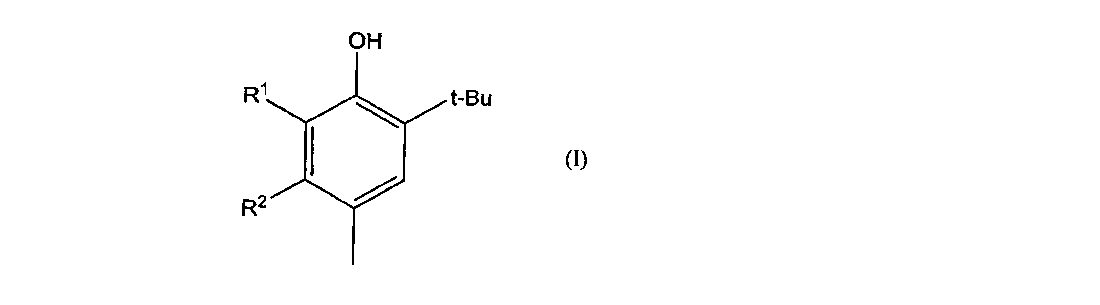


本発明の熱可塑性樹脂組成物に配合し得る他の添加剤としては、酸化防止剤、紫外線吸収剤、耐候剤、充填剤、帯電防止剤、難燃性付与剤、防曇剤、滑剤、抗菌剤、防かび剤、粘着付与剤、可塑剤、着色剤、黒鉛、カーボンブラック、カーボンナノチューブ、顔料(例えば、赤外線吸収、反射能力等の機能性を付与した顔料も含む。)等が挙げられる。これらは、1種を単独で用いても、2種以上を併用してもよい。
本発明の熱可塑性樹脂組成物は、各成分を所定の配合比で、タンブラーミキサーやヘンシェルミキサーなどで混合した後、一軸押出機、二軸押出機、バンバリーミキサー、ニーダー、ロール、フィーダールーダー等の混練機を用いて適当な条件下で溶融混練して製造することができる。好ましい混練機は、二軸押出機である。さらに、各々の成分を混練するに際しては、それらの成分を一括して混練しても、多段、分割配合して混練してもよい。
バンバリーミキサー、ニーダー等で混練した後、押出機によりペレット化することもできる。
溶融混練温度は、通常180~240℃、好ましくは190~230℃である。
以下に、本発明の熱可塑性樹脂組成物の好適物性等を説明する。以下に記載する本発明の熱可塑性樹脂組成物の物性等は具体的には、後掲の実施例の項に記載の方法で測定される。
本発明の熱可塑性樹脂組成物は、打音の抑制の観点から、後掲の実施例の項に記載の方法で測定した場合に、20~20,000Hzの周波数域の音圧の最大値が、芳香族ポリカーボネート樹脂(A3)を含まない熱可塑性樹脂組成物において68.9dB未満であることが好ましく、芳香族ポリカーボネート樹脂(A3)を含む熱可塑性樹脂組成物において70.5dB未満であることが好ましい。
本発明の熱可塑性樹脂組成物は、後掲の実施例の項に記載の方法で測定される異音リスク値が、3以下であることが好ましい。
本発明の熱可塑性樹脂組成物は、高い機械的強度と耐熱性を保持していることが好ましく、それぞれ後掲の実施例の項に記載の方法で測定される値で、本発明の熱可塑性樹脂組成物は、以下のような物性を有することが好ましい。
シャルピー衝撃強度(23℃):8kJ/m2以上
引張降伏応力:38MPa以上
曲げ強度:58MPa以上
曲げ弾性率:1850MPa以上
荷重たわみ温度(1.8MPa):87℃以上
ロックウェル硬さ:95以上
シャルピー衝撃強度(23℃):50kJ/m2以上
シャルピー衝撃強度(-30℃):25kJ/m2以上
引張降伏応力:42MPa以上
曲げ強度:62MPa以上
曲げ弾性率:1750MPa以上
荷重たわみ温度(1.8MPa):100℃以上
ロックウェル硬さ:100以上
本発明の熱可塑性樹脂組成物は、樹脂成分(A)として芳香族ポリカーボネート樹脂(A3)を含有しない場合、後掲の実施例の項に記載の方法で測定したMVRは6cm3/10min.以上であることが好ましい。本発明の熱可塑性樹脂組成物は、芳香族ポリカーボネート樹脂(A3)を含有する場合、後掲の実施例の項に記載の方法で測定したMVRは10cm3/10min.以上であることが好ましい。
本発明の熱可塑性樹脂組成物は、後掲の実施例の項に記載の方法で測定した光沢が88%以上、特に95%以上であることが好ましい。
本発明の成形品は、熱可塑性樹脂組成物を射出成形、ガスインジェクション成形、プレス成形、シート押出成形、真空成形、異形押出成形、発泡成形、材料押出堆積法、粉末焼結積層造形等の公知の成形法により成形することで製造することができる。
本発明によれば、例えば、互いに接触する可能性のある2つの部品を少なくとも備え、前記2つの部品の少なくとも一方の部品と接触する可能性のある他方の部品の部分の少なくとも一部を本発明の熱可塑性樹脂組成物で形成した物品を提供することができる。換言すれば、本発明によれば、互いに接触する可能性のある第一の部品と第二の部品とを少なくとも備え、前記第一の部品は、前記第二の部品と接触する可能性のある部分の少なくとも一部が、本発明の熱可塑性樹脂組成物で形成されている物品を提供することができる。この場合、前記第一の部品は、その全体又は前記第二の部品と接触する部分の一部若しくは全部が、本発明の熱可塑性樹脂組成物で形成されていることが好ましい。
両部品の嵌合の方式は、両部品が緩く嵌合している限り特に限定されない。例えば、スナップフィット、螺合、係合であってもよい。このような物品としては、例えば、プッシュラッチやマグネットラッチを用いてプッシュオープン式に構成された開閉部(例えば、蓋、扉)を備えた物品が挙げられる。より具体的には、車両内装部品ではサングラストレーなどの開閉部品が挙げられる。
以下の実施例及び比較例において、熱可塑性樹脂組成物の製造には、原材料は、以下の方法により製造した樹脂成分と、以下の市販品を用いた。
<(A1-1)の製造>
撹拌機付き重合容器に、水280部及びジエン系ゴム質重合体として、重量平均粒子径0.26μm、ゲル含有率90%のポリブタジエンラテックス60部(固形分換算)、ナトリウムホルムアルデヒドスルホキシレート0.3部、硫酸第一鉄0.0025部、エチレンジアミン四酢酸二ナトリウム0.01部を仕込み、脱酸素後、窒素気流中で撹拌しながら60℃に加熱した後、アクリロニトリル10部、スチレン30部、t-ドデシルメルカプタン0.2部、クメンハイドロパーオキサイド0.3部からなる単量体混合物を60℃で5時間かけて連続的に滴下した。滴下終了後、重合温度を65℃にし、1時間撹拌を続けた後、重合を終了させ、グラフト共重合体のラテックスを得た。重合転化率は98%であった。その後、得られたラテックスに、2,2’-メチレン-ビス(4-エチレン-6-t-ブチルフェノール)0.2部を添加し、塩化カルシウムを添加して凝固し、洗浄、濾過及び乾燥工程を経てパウダー状のABS樹脂(A1-1)を得た。得られたABS樹脂(A1-1)のグラフト率は40%、アセトン可溶分の極限粘度[η]は0.38dl/gであった。
リボン型撹拌機翼、助剤連続添加装置、温度計などを装備した容積20Lのステンレス製オートクレーブに、エチレン・α-オレフィン系ゴム質重合体として、エチレン・プロピレン共重合体(エチレン/プロピレン=78/22(%)、ムーニー粘度(ML1+4,100℃)20、融点(Tm)は40℃、ガラス転移温度(Tg)は-50℃)22部、スチレン55部、アクリロニトリル23部、t-ドデシルメルカプタン0.5部、トルエン110部を仕込み、内温を75℃に昇温して、オートクレーブ内容物を1時間撹拌して均一溶液とした。その後、t-ブチルパーオキシイソプロピルモノカーボネート0.45部を添加し、内温をさらに昇温して、100℃に達した後は、この温度を保持しながら、撹拌回転数100rpmとして重合反応を行った。重合反応開始後4時間目から、内温を120℃に昇温し、この温度を保持しながらさらに2時間反応を行って重合反応を終了した。その後、内温を100℃まで冷却し、オクタデシル-3-(3,5-ジ-t-ブチル-4-ヒドロキシフェノール)-プロピオネート0.2部、ジメチルシリコーンオイル;KF-96-100cSt(商品名:信越シリコーン株式会社製)0.02部を添加した後、反応混合物をオートクレーブより抜き出し、水蒸気蒸留により未反応物と溶媒を留去し、さらに40mmφベント付き押出機(シリンダー温度220℃、真空度760mmHg)を用いて揮発分を実質的に脱気させ、ペレット化した。得られたAES樹脂(A1-2)のグラフト率は70%、アセトン可溶分の極限粘度[η]は0.47dl/gであった。
<(A2-1)の製造>
AS樹脂(A2-1)として、アクリロニトリル単位及びスチレン単位の割合が、それぞれ、27%及び73%であり、極限粘度[η](メチルエチルケトン中、30℃)が0.47dl/g、ガラス転移温度(Tg)が103℃であるアクリロニトリル・スチレン共重合体を用いた。
撹拌機付き重合容器に、水250部及びパルミチン酸ナトリウム1.0部を投入し、脱酸素後、窒素気流中で撹拌しながら70℃まで加熱した。さらにナトリウムホルムアルデヒドスルホキシレート0.4部、硫酸第一鉄0.0025部、エチレンジアミン四酢酸二ナトリウム0.01部を仕込み後、α-メチルスチレン70部、アクリロニトリル25部、スチレン5部、t-ドデシルメルカプタン0.5部、クメンハイドロパーオキサイド0.2部から成る単量体混合物を、重合温度70℃で連続的に7時間かけて滴下した。滴下終了後、重合温度を75℃にし、1時間撹拌を続けて重合を終了させ、共重合体のラテックスを得た。重合転化率は99%であった。その後、得られたラテックスを塩化カルシウムを添加して凝固し、洗浄、濾過及び乾燥工程を経てパウダー状の耐熱AS樹脂(A2-2)を得た。得られた耐熱AS樹脂(A2-2)のアセトン可溶分の極限粘度[η]は0.40dl/gであった。
<(A3-1)>
PC樹脂(A3-1)として、三菱エンジニアリングプラスチック社製芳香族ポリカーボネート樹脂「NOVAREX 7022J(商品名)」を用いた。
打音低減材(B)としてはそれぞれ後述の実施例I-1~I-16で製造した打音低減材(B-1)~(B-16)又は比較例I-1~I-7で製造した打音低減材(BX-1)~(BX-7)を用いた。
<打音低減材(BX-8)>
旭化成社製スチレン・ブタジエン共重合体の水素添加物「S1605」(スチレン含量:66%、水添率:95%)
実施例及び比較例における重合体の各種物性及び特性の評価方法は以下の通りである。
JIS K7121に準拠して、示差走査熱量測定装置(TA Instruments製「Q200」)を用いて、-90℃から50℃まで一度昇温(1stラン)し、次いで-90℃まで冷却し、次いで-90℃から50℃まで10℃/分で昇温(2ndラン)させる条件にてDSC曲線を測定した。このDSC曲線から求められる2ndランの中間点ガラス転移温度を本発明におけるガラス転移温度とした。
日機装社製「Microtrac Model:9230UPA」を用いて光子相関法により求めた。
重合体(b1)のラテックスを、凝固・乾燥させ重合体(b1)のサンプルを得た。次いでサンプルを設定温度150℃のヒートプレスによって厚さ1.0~1.1mmのシート状に成形し、長さ36mm×幅10mmに切り出して測定サンプルを作製した。
以下の動的粘弾性測定装置を用い、サンプルの長辺の両端各8mm部分を引張治具で固定し、以下の条件でTanδを測定し、ピーク温度およびピーク強度を求めた。
測定装置:動的粘弾性測定装置(TA Instruments製「DMA850」)
モード:引張
周波数:1Hz
昇温速度:5℃/分
測定温度:-60℃~+60℃
(メタ)アクリル酸エステル系重合体(B)をテトラヒドロフラン(THF)中に24時間浸漬後、遠心分離操作を経て分離された不溶分を真空乾燥して重量(重量b)を測定した。
得られたTHF不溶分を再びTHF中に24時間浸漬後、THFで膨潤したサンプル重量(重量c)を測定し、次式によってTHF不溶分の膨潤度を求めた。
膨潤度(%)=c/b×100
ここでの膨潤度は(メタ)アクリル酸エステル系重合体(B)中に含まれる、グラフト構造体の膨潤度を指す。ただし、グラフト構造体が架橋構造を有さない場合THF不溶分として得ることができない。THFに溶解し正確な膨潤度が求められないため、ゲル含有率1%以下の場合は膨潤度を3000%以上と判定した。
(メタ)アクリル酸エステル系重合体(B)1gをTHF100mlに投入し、室温で48時間静置した後、100メッシュの金網(質量をW1グラムとする)で濾過したTHF不溶分と金網を、温度80℃で6時間真空乾燥して秤量(質量W2グラムとする)した。W1及びW2を、下記式(i)に代入して、ゲル含有率を得た。
ゲル含有率=〔〔W2(g)-W1(g)〕/1(g)〕×100 (i)
(メタ)アクリル酸エステル系重合体(B)1gを20mLのアセトニトリルに添加し、振とう機により2時間振とうした後、得られた懸濁アセトニトリル溶液を遠心分離機(回転数;32,000rpm)で60分間遠心分離し、沈殿成分(アセトニトリル不溶成分)とアセトニトリル溶液(アセトニトリル可溶成分)を分取した。そして、沈殿成分(アセトニトリル不溶成分)を乾燥させてその質量(T(g))を測定し、下記式によりグラフト率を算出した。
下記式におけるTは、(メタ)アクリル酸エステル系重合体(B)のアセトニトリル不溶成分の質量(g)である。Sは(メタ)アクリル酸エステル系重合体(B)1gに含まれるゴム質重合体(b1)の質量(g)である。
グラフト率(質量%)={(T-S)/S}×100
上記のグラフト率の評価で得られたアセトニトリル可溶分のポリスチレン換算の重量平均分子量を、次に示す条件でゲル・パーミエーションクロマトグラフィにより測定し、標準ポリスチレンで検量線を作成し、その分子量と保持時間の関係から算出した。
装置:Waters社製「GPC-244」
カラム:東ソー社製「TSK-gel-GMH」
溶媒:THF
流速0.8mL/分
測定温度:23℃
n-ブチルアクリレート(以下、BAと略記する)71.22部、メチルメタクリレート(以下、MMAと略記する)28.55部、架橋剤としてアリルメタクリレート0.23部(以下、AMAと略記する)を混合して、単量体混合物(I)を調製した。
攪拌装置、原料及び助剤添加装置、温度計、加熱装置などを備えた、容量10Lのガラス製反応器に、水220部、乳化剤としてドデシルベンゼンスルホン酸ナトリウム0.1部を仕込み、攪拌しつつ、窒素気流下で、内温を70℃まで昇温した。70℃に達した時点で、8.5部の水に、エチレンジアミン四酢酸四ナトリウム二水塩0.01部と硫酸第一鉄七水和物0.002部、ナトリウムホルムアルデヒドスルホキシレート0.3部を溶解した水溶液(以下、RED水溶液と略記する)のうち、84質量%分を反応器に仕込んだ。その直後に単量体混合物(I)100部、クメンハイドロパーオキサイド0.2部を、3時間にわたって連続添加した。途中滴下開始1時間時点で、20部の水に、ドデシルベンゼンスルホン酸1.6部を溶解した水溶液を、反応器に仕込んだ。単量体混合物(I)の連続添加終了直後、RED水溶液の残り16質量%分とクメンハイドロパーオキサイド0.005部を反応器に仕込み、さらに30分間、反応器の内温を70℃に保持した後、重合反応を終了し、アクリル系ゴム質重合体(R-1)ラテックスを得た。
このときの重合転化率は97%であった。
得られたアクリル系ゴム質重合体(R-1)粒子について前述の方法で測定した重量平均粒子径は150nmであった。
このアクリル系ゴム質重合体(R-1)ラテックスを乾燥して得られたフィルムについて、前述の方法でガラス転移温度(Tg)を測定した。
また、前述の方法でTanδのピーク強度及びピーク温度を測定した。
結果を表1Aに示す。
表1A,1Bに示した配合とした以外は、(R-1)と同様にして、それぞれアクリル系ゴム質重合体(R-2)~(R-12)と(RX-1)~(RX-9)を製造した。
ただし、(R-1)重合開始時のドデシルベンゼンスルホン酸ナトリウムについては、0.10~0.33部の範囲で使用量を調整することで、表1A,1Bに示す重量平均粒子径のアクリル系ゴム質重合体を得た。
これらのアクリル系ゴム質重合体の重量平均粒子径、Tg、tanδのピーク強度及びピーク温度の測定結果を表1A,1Bに示す。
表1Bには、市販品の旭化成社製スチレン・ブタジエン共重合体の水素添加物「S1605」について測定したTg、tanδのピーク強度及びピーク温度を併記した。
スチレン(以下、STと略記する)30.4部、アクリロニトリル(以下、ANと略記する)9.6部、及びt-ブチルメルカプタン0.05部を混合して、単量体混合物(II)を調製した。アクリル系ゴム質重合体(R-1)ラテックスの製造に使用したガラス製反応器に、上記アクリル系ゴム質重合体(R-1)ラテックス60部(固形分換算)、水12部、ドデシルベンゼンスルホン酸ナトリウム0.36部を仕込み、攪拌しつつ、窒素気流下、70℃に昇温した。70℃に達した時点で、2部の水に、エチレンジアミン四酢酸四ナトリウム二水塩0.003部と硫酸第一鉄七水和物0.001部、ナトリウムホルムアルデヒドスルホキシレート0.05部を溶解した水溶液(RED水溶液)のうち、52質量%分を反応器に仕込み、その直後から単量体混合物(II)の全量、及びt-ブチルハイドロパーオキサイド0.06部を、2時間30分にわたって連続添加し、重合を行った。重合を開始して150分後にRED水溶液の残48質量%分とt-ブチルハイドロパーオキサイド0.03部を反応器に仕込み、60分間、同温度で保持した後に重合を終了し、グラフト共重合体(B-1)ラテックスを得た。
このグラフト共重合体(B-1)ラテックスを凝固、水洗、乾燥し、粉末状のグラフト共重合体(B-1)を得た。得られたグラフト共重合体(B-1)のゲル含有率、膨潤度、グラフト率、アセトニトリル可溶分の分子量を測定し、結果を表2Aに示す。
上記で得られたアクリル系ゴム質重合体(R-2)~(R-12)、(RX-1)~(RX-9)を用い、表2A,2Bに示す配合としたこと以外は、(B-1)と同様にしてそれぞれグラフト共重合体(B-2)~(B-13)及び(BX-1)~(BX-9)を製造した。
これらのグラフト共重合体のゲル含有率、膨潤度、グラフト率、アセトニトリル可溶分の分子量の測定結果を表2A,2Bに示す。


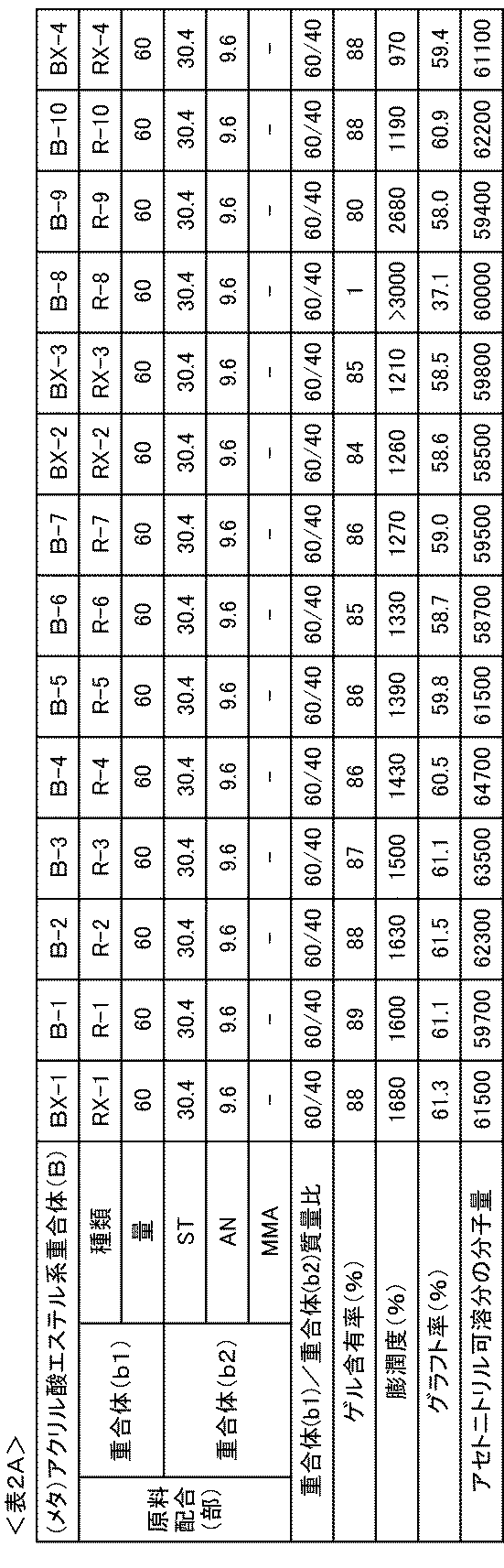

[熱可塑性樹脂組成物の製造]
表3A,3B,4A,4Bに示す原料を同表に示す配合割合で混合した。その後、二軸押出機(型式名「TEX44、日本製鋼所」)を用いて、250℃で溶融混練してペレット化した。得られた樹脂組成物を用い、下記の測定及び評価を行った。結果を表3A,3B,4A,4Bに示す。
<打音の音圧測定>
各熱可塑性樹脂組成物を用い、シリンダー温度240℃、金型温度60℃、射出率10g/秒の条件で射出成形して、長さ80mm、幅54mm、厚み2.4mmの板状の成形体を得た。成形品の上辺から5mm且つ左辺から5mmの位置、及び上辺から5mm且つ右辺から5mmの位置に、それぞれボール盤を用いて直径1mmの孔を開け、図1に示すような試験片を作製した。そして、前記試験片の孔2か所に1本のタコ糸を通し、H型スタンド、クランプ、ムッフを用いて前記試験片を吊り下げた。なお、この時クランプは実験台から28cmの高さになるよう設置した。また、試験片面の中央が実験台から18cmの高さになるように設置した。この時、試験片を吊り下げるクランプから試験片上辺までの距離は6cmとなる。また、吊り下げた試験片の面中央の位置から、試験片面に対して垂直方向に10cm離した位置に、試験片面に向けてPCBピエゾトロニクス社製の音圧マイクロフォン(商品名;378B02)をH型スタンド、クランプ、ムッフを用いて設置した。また、前記音圧マイクロフォンは実験台から18cmの高さになるよう設置した。
前記マイクロフォンを設置した反対側の試験片面の中央を、打撃力を測定できるPCBピエゾトロにクス社製のインパクトハンマー(商品名;086E80)を用いて35から40Nで叩いたときの響きを、前記音圧マイクロフォンで集音して、オロス社製のフーリエ変換アナライザー(商品名;マルチJOBFFTアナライザ OR34J-4)にて音圧の周波数スペクトルに変換した。得られた周波数スペクトル中の音圧(dB)の最大値とその周波数(Hz)を測定値として用いた。
測定は室温23℃の部屋で行った。
前記打音の音圧測定と同様の操作を行い、オロス社製のフーリエ変換アナライザー(商品名:マルチJOB FFTアナライザ OR34J-4)にて音圧の時間変化を測定した。音の発生から、音圧が最大音圧の1/4の音圧に静まるまでに要する時間を打音の減衰時間として用いた。
打音の減衰は、実施例I-1~18、比較例I-1~11のスチレン系樹脂処方においては0.008秒よりも短いことが好ましく、0.006秒よりも短いことがより好ましい。実施例II-1~18、比較例II-1~11のPCアロイ系処方においては0.008秒よりも短いことが好ましく、0.007秒よりも短いことがより好ましい。
ISO1133に準じて、温度240℃および荷重98Nの条件で、各熱可塑性樹脂組成物のメルトボリュームフローレートを測定した。
溶融混練して得られた熱可塑性樹脂組成物のペレットを射出成形機(東芝機械社製、「IS55FP-1.5A」)によりシリンダー温度240℃、金型温度60℃の条件で、縦80mm、横10mm、厚さ4mmの成形品を成形し、シャルピー衝撃試験用成形品とした。
得られた成形品(タイプB1、ノッチ有:形状A シングルノッチ)について、ISO 179-1:2013年度版に準拠し、試験温度23℃又は-30℃でシャルピー衝撃強度(打撃方向:エッジワイズ)を測定した。シャルピー衝撃強度が高いほど、耐衝撃性に優れることを意味する。
ISO527に従って測定した。
ISO527に従って測定した。
ISO527に従って測定した。
ISO178に従って測定した。
ISO178に従って測定した。
ISO75に従って、1.8MPa荷重条件で測定した。
ISO2039に従って測定した。
各熱可塑性樹脂組成物のペレット100部とカーボンブラック0.8部とをヘンシェルミキサーを用いて混合し、この混合物を250℃に加熱した押出機に供給し、混練して黒色ペレットを得た。黒色ペレットをシリンダー温度240℃、金型温度60℃、射出率20g/秒の条件で射出成形して、長さ100mm、幅100mm、厚み3mmの板状の成形体を得た。
日本電色工業株式会社製の「光沢計VG7000」を用い、ISO2813に準拠して、入射角60°、反射角60°における成形体の表面の反射率(%)を測定した。反射率が高いほど表面外観に優れることを意味する。
各熱可塑性樹脂組成物を東芝機械製IS-170FA射出成形機によりシリンダ温度250℃、射出圧力50MPa、金型温度60℃にて射出成形し、縦150mm、横100mm、厚さ4mmの射出成形プレートを得た。このプレートから、縦60mm、横100mm、厚さ4mm及び縦50mm、横25mm、厚さ4mmの試験片をディスクソーで切り出し、番手#100のサンドペーパーで端部を面取りした後、細かなバリをカッターナイフで除去し、大小2枚のプレートを試験片として用いた。
2枚の試験片を80℃±5℃に調整したオーブンで300時間エージングし、25℃で24時間冷却後、大きな試験片と小さな試験片をジグラー(ZIEGLER)社製スティックスリップ試験機SSP-02に固定し、温度23℃、湿度50%RHの雰囲気下で荷重5N、40N、速度1mm/秒、10mm/秒の4条件にて振幅20mmで3回擦り合わせたときの異音リスク値を測定した。測定された異音リスク値が最も大きい条件の数値を抽出して測定値とした。異音リスク値が大きいほど軋み音の発生リスクは高くなる。異音リスク値が3以下であれば良好である。
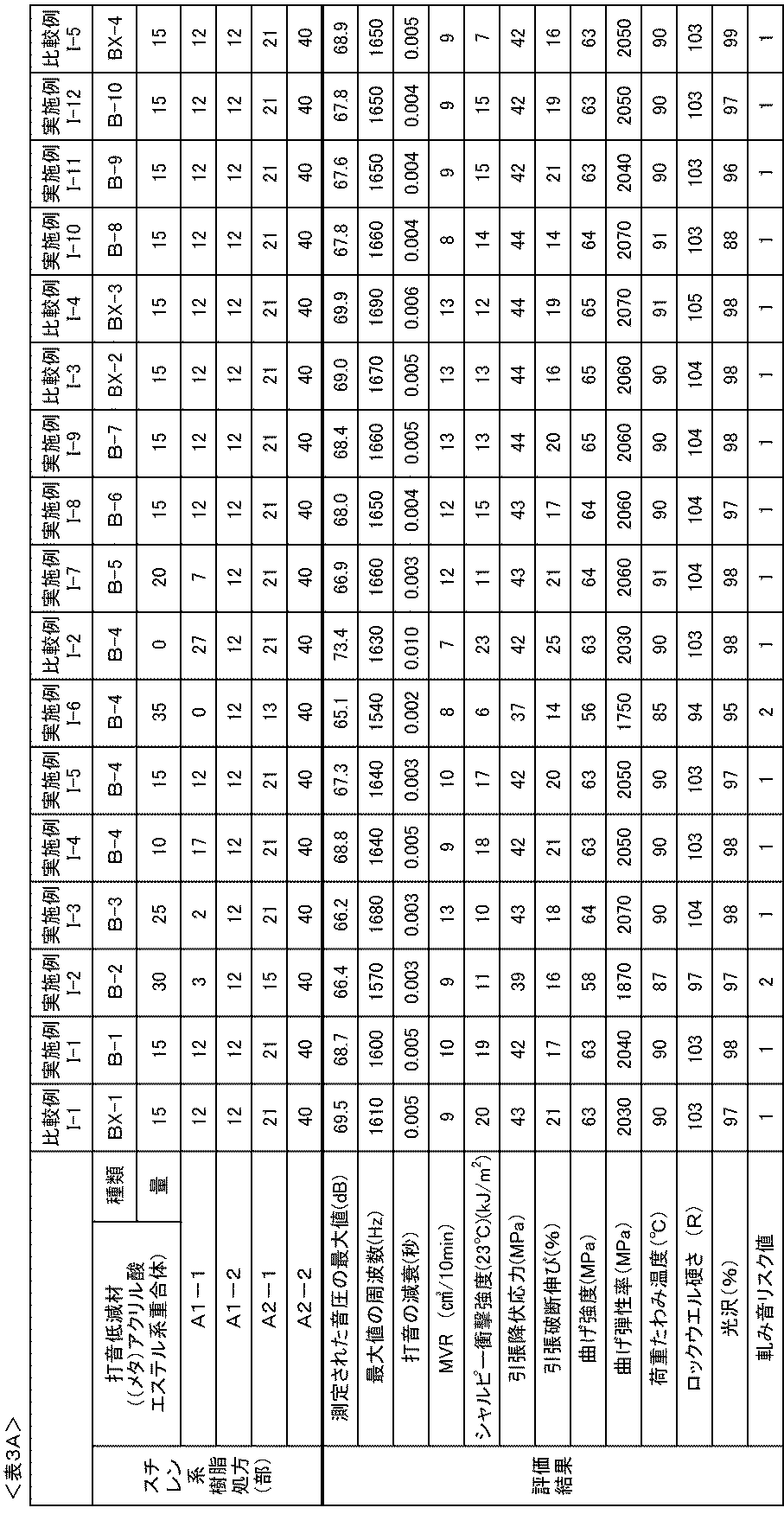


一方、本発明の規定を満たさない(メタ)アクリル酸エステル系重合体を打音低減材として用いた比較例I-1~10及び比較例II-1~10の熱可塑性樹脂組成物では、打音低減効果に劣る。
従来の熱可塑性エラストマーを打音低減材として用いた比較例I-11では、耐衝撃性に劣り、比較例II-11では低温耐衝撃性に劣る。
本出願は、2022年12月1日付で出願された日本特許出願2022-192966に基づいており、その全体が引用により援用される。
Claims (5)
- アクリル酸エステル化合物に由来する構造単位とメタクリル酸エステル化合物に由来する構造単位とを備え、ガラス転移温度が-15℃~+5℃である重合体(b1)と、
メタクリル酸エステル化合物に由来する構造単位、芳香族ビニル化合物に由来する構造単位、及びシアン化ビニル化合物に由来する構造単位よりなる群から選ばれる1種又は2種以上を含む重合体(b2)とを有する(メタ)アクリル酸エステル系重合体(B)よりなる打音低減材であって、
前記重合体(b1)について、以下の方法で測定したtanδの主分散のピーク値を示す温度(ピーク温度)が-5℃~+20℃であり、該ピーク値であるピーク強度が2.055以上であることを特徴とする打音低減材。
<Tanδの測定方法>
重合体(b1)を用いて設定温度150℃のヒートプレスによって厚さ1.0~1.1mmのシートを成形し、該シートから長さ36mm×幅10mmに切り出して測定サンプルを作製する。
以下の動的粘弾性測定装置を用い、該測定サンプルの長辺の両端各8mm部分を引張治具で固定し、以下の条件でtanδを測定し、ピーク温度およびピーク強度を求める。
測定装置:動的粘弾性測定装置(TA Instruments製「DMA850」)
モード:引張
周波数:1Hz
昇温速度:5℃/分
測定温度:-60~+60℃ - (メタ)アクリル酸エステル系重合体(B)が、以下の方法で測定したTHF不溶分の膨潤度が1000%以上である、請求項1に記載の打音低減材。
<膨潤度の測定方法>
(メタ)アクリル酸エステル系重合体(B)をテトラヒドロフラン(THF)中に24時間浸漬後、遠心分離操作を経て分離された不溶分を真空乾燥して重量(重量b)を測定する。
得られたTHF不溶分を再びTHF中に24時間浸漬後、THFで膨潤したサンプル重量(重量c)を測定し、次式によってTHF不溶分の膨潤度を求める。
膨潤度(%)=c/b×100 - ゴム強化スチレン系熱可塑性樹脂(A1)を含む樹脂成分(A)と、請求項1に記載の打音低減材とを含む熱可塑性樹脂組成物。
- ゴム強化スチレン系熱可塑性樹脂(A1)を含む樹脂成分(A)と、請求項2に記載の打音低減材とを含む熱可塑性樹脂組成物。
- 前記樹脂成分(A)95~70質量部と、前記打音低減材5~30質量部とを含む(ただし、樹脂成分(A)と打音低減材の合計で100質量部とする。)、請求項3又は4に記載の熱可塑性樹脂組成物。
Priority Applications (4)
| Application Number | Priority Date | Filing Date | Title |
|---|---|---|---|
| CN202380078187.4A CN120187801B (zh) | 2022-12-01 | 2023-09-22 | 打击声降低材料和热塑性树脂组合物 |
| US18/726,823 US12215218B2 (en) | 2022-12-01 | 2023-09-22 | Hitting sound reducing material and thermoplastic resin composition |
| EP23897228.5A EP4628545A4 (en) | 2022-12-01 | 2023-09-22 | Rattle noise reduction material and thermoplastic resin composition |
| MX2025006162A MX2025006162A (es) | 2022-12-01 | 2025-05-27 | Material reductor de sonido de golpe y composicion de resina termoplastica |
Applications Claiming Priority (2)
| Application Number | Priority Date | Filing Date | Title |
|---|---|---|---|
| JP2022192966A JP7468606B1 (ja) | 2022-12-01 | 2022-12-01 | 熱可塑性樹脂組成物 |
| JP2022-192966 | 2022-12-01 |
Publications (1)
| Publication Number | Publication Date |
|---|---|
| WO2024116569A1 true WO2024116569A1 (ja) | 2024-06-06 |
Family
ID=90667701
Family Applications (1)
| Application Number | Title | Priority Date | Filing Date |
|---|---|---|---|
| PCT/JP2023/034461 Ceased WO2024116569A1 (ja) | 2022-12-01 | 2023-09-22 | 打音低減材及び熱可塑性樹脂組成物 |
Country Status (7)
| Country | Link |
|---|---|
| US (1) | US12215218B2 (ja) |
| EP (1) | EP4628545A4 (ja) |
| JP (1) | JP7468606B1 (ja) |
| CN (1) | CN120187801B (ja) |
| MX (1) | MX2025006162A (ja) |
| TW (1) | TW202428762A (ja) |
| WO (1) | WO2024116569A1 (ja) |
Citations (16)
| Publication number | Priority date | Publication date | Assignee | Title |
|---|---|---|---|---|
| JPS428704B1 (ja) | 1963-12-26 | 1967-04-20 | ||
| JPS436636B1 (ja) | 1963-04-25 | 1968-03-12 | ||
| US3419634A (en) | 1966-01-03 | 1968-12-31 | Gen Electric | Organopolysiloxane polycarbonate block copolymers |
| JPS4820038B1 (ja) | 1969-07-31 | 1973-06-18 | ||
| JPS634841B2 (ja) | 1983-01-20 | 1988-02-01 | Asahi Chemical Ind | |
| JPS635401B2 (ja) | 1983-10-07 | 1988-02-03 | Asahi Chemical Ind | |
| JPH01297413A (ja) | 1988-05-25 | 1989-11-30 | Japan Synthetic Rubber Co Ltd | ゴム変性熱可塑性樹脂の製造方法 |
| JPH02133406A (ja) | 1988-11-14 | 1990-05-22 | Japan Synthetic Rubber Co Ltd | 水素化ブロック共重合体及びその組成物 |
| JPH02305814A (ja) | 1989-05-19 | 1990-12-19 | Japan Synthetic Rubber Co Ltd | 水添ジエン系共重合体およびその組成物 |
| JPH0372512A (ja) | 1989-05-19 | 1991-03-27 | Japan Synthetic Rubber Co Ltd | 水添ジエン系共重合体、変性水添ジエン系共重合体およびその組成物 |
| JP2000230104A (ja) * | 1999-02-09 | 2000-08-22 | Kanegafuchi Chem Ind Co Ltd | ゴム強化スチレン系樹脂組成物 |
| JP2011137066A (ja) | 2009-12-28 | 2011-07-14 | Techno Polymer Co Ltd | 軋み音を低減した自動車内装部品 |
| JP2020139028A (ja) * | 2019-02-27 | 2020-09-03 | テクノUmg株式会社 | 打音の低減された熱可塑性樹脂組成物及び成形品 |
| WO2020195798A1 (ja) * | 2019-03-26 | 2020-10-01 | 株式会社カネカ | 熱可塑性樹脂組成物及び成形体 |
| JP2022143324A (ja) * | 2021-03-17 | 2022-10-03 | テクノUmg株式会社 | 熱可塑性組成物及びその成形品 |
| JP2022150927A (ja) * | 2021-03-26 | 2022-10-07 | テクノUmg株式会社 | 打音低減材、熱可塑性組成物及びその成形品 |
Family Cites Families (6)
| Publication number | Priority date | Publication date | Assignee | Title |
|---|---|---|---|---|
| JP2678068B2 (ja) | 1989-07-12 | 1997-11-17 | 株式会社クラレ | Abs樹脂組成物 |
| JPH083249A (ja) | 1994-06-23 | 1996-01-09 | Kuraray Co Ltd | 熱可塑性樹脂及びその組成物 |
| JP2001158841A (ja) | 1999-12-02 | 2001-06-12 | Techno Polymer Co Ltd | 制振性難燃樹脂組成物 |
| JP5977506B2 (ja) | 2011-12-01 | 2016-08-24 | テクノポリマー株式会社 | 軋み音低減用熱可塑性樹脂組成物、接触用部品及び構造体 |
| US20200216657A1 (en) * | 2017-08-29 | 2020-07-09 | Techno-Umg Co., Ltd. | Thermoplastic resin composition and moulded article with reduced rattling noise |
| US11603465B1 (en) | 2021-03-17 | 2023-03-14 | Techno-Umg Co., Ltd. | Thermoplastic composition and molded article thereof |
-
2022
- 2022-12-01 JP JP2022192966A patent/JP7468606B1/ja active Active
-
2023
- 2023-09-22 EP EP23897228.5A patent/EP4628545A4/en active Pending
- 2023-09-22 CN CN202380078187.4A patent/CN120187801B/zh active Active
- 2023-09-22 WO PCT/JP2023/034461 patent/WO2024116569A1/ja not_active Ceased
- 2023-09-22 US US18/726,823 patent/US12215218B2/en active Active
- 2023-10-06 TW TW112138417A patent/TW202428762A/zh unknown
-
2025
- 2025-05-27 MX MX2025006162A patent/MX2025006162A/es unknown
Patent Citations (16)
| Publication number | Priority date | Publication date | Assignee | Title |
|---|---|---|---|---|
| JPS436636B1 (ja) | 1963-04-25 | 1968-03-12 | ||
| JPS428704B1 (ja) | 1963-12-26 | 1967-04-20 | ||
| US3419634A (en) | 1966-01-03 | 1968-12-31 | Gen Electric | Organopolysiloxane polycarbonate block copolymers |
| JPS4820038B1 (ja) | 1969-07-31 | 1973-06-18 | ||
| JPS634841B2 (ja) | 1983-01-20 | 1988-02-01 | Asahi Chemical Ind | |
| JPS635401B2 (ja) | 1983-10-07 | 1988-02-03 | Asahi Chemical Ind | |
| JPH01297413A (ja) | 1988-05-25 | 1989-11-30 | Japan Synthetic Rubber Co Ltd | ゴム変性熱可塑性樹脂の製造方法 |
| JPH02133406A (ja) | 1988-11-14 | 1990-05-22 | Japan Synthetic Rubber Co Ltd | 水素化ブロック共重合体及びその組成物 |
| JPH02305814A (ja) | 1989-05-19 | 1990-12-19 | Japan Synthetic Rubber Co Ltd | 水添ジエン系共重合体およびその組成物 |
| JPH0372512A (ja) | 1989-05-19 | 1991-03-27 | Japan Synthetic Rubber Co Ltd | 水添ジエン系共重合体、変性水添ジエン系共重合体およびその組成物 |
| JP2000230104A (ja) * | 1999-02-09 | 2000-08-22 | Kanegafuchi Chem Ind Co Ltd | ゴム強化スチレン系樹脂組成物 |
| JP2011137066A (ja) | 2009-12-28 | 2011-07-14 | Techno Polymer Co Ltd | 軋み音を低減した自動車内装部品 |
| JP2020139028A (ja) * | 2019-02-27 | 2020-09-03 | テクノUmg株式会社 | 打音の低減された熱可塑性樹脂組成物及び成形品 |
| WO2020195798A1 (ja) * | 2019-03-26 | 2020-10-01 | 株式会社カネカ | 熱可塑性樹脂組成物及び成形体 |
| JP2022143324A (ja) * | 2021-03-17 | 2022-10-03 | テクノUmg株式会社 | 熱可塑性組成物及びその成形品 |
| JP2022150927A (ja) * | 2021-03-26 | 2022-10-07 | テクノUmg株式会社 | 打音低減材、熱可塑性組成物及びその成形品 |
Non-Patent Citations (1)
| Title |
|---|
| See also references of EP4628545A1 |
Also Published As
| Publication number | Publication date |
|---|---|
| MX2025006162A (es) | 2025-07-01 |
| US12215218B2 (en) | 2025-02-04 |
| US20240425690A1 (en) | 2024-12-26 |
| TW202428762A (zh) | 2024-07-16 |
| CN120187801B (zh) | 2026-04-07 |
| CN120187801A (zh) | 2025-06-20 |
| JP2024080075A (ja) | 2024-06-13 |
| EP4628545A1 (en) | 2025-10-08 |
| EP4628545A4 (en) | 2026-04-29 |
| JP7468606B1 (ja) | 2024-04-16 |
Similar Documents
| Publication | Publication Date | Title |
|---|---|---|
| JP5738527B2 (ja) | 軋み音を低減した自動車内装部品 | |
| US11603465B1 (en) | Thermoplastic composition and molded article thereof | |
| CN111032715B (zh) | 减低碰撞噪声的热塑性树脂组合物及成型品 | |
| JP7085479B2 (ja) | 打音の低減された熱可塑性樹脂組成物及び成形体 | |
| JP7343985B2 (ja) | 打音の低減された熱可塑性樹脂組成物及び成形品 | |
| US11739209B2 (en) | Thermoplastic composition and molded article thereof | |
| JP7468606B1 (ja) | 熱可塑性樹脂組成物 | |
| JP7241895B2 (ja) | 樹脂組成物の製造方法及び成形品の製造方法 | |
| JP7092273B1 (ja) | 熱可塑性組成物及びその成形品 | |
| JP7122194B2 (ja) | 打音の低減された熱可塑性樹脂組成物及び成形品 | |
| JP7240898B2 (ja) | 打音の低減された熱可塑性樹脂組成物及び成形品 | |
| JP5925825B2 (ja) | 軋み音を低減した自動車内装部品 | |
| JP2022150927A (ja) | 打音低減材、熱可塑性組成物及びその成形品 | |
| JP7673882B1 (ja) | 制振性付与材、熱可塑性樹脂組成物及び成形品 | |
| JP7360838B2 (ja) | ゴム強化樹脂用の艶消剤、これを含有する熱可塑性樹脂組成物及び成形品 | |
| WO2025182203A1 (ja) | 制振性付与材、熱可塑性樹脂組成物及び成形品 |
Legal Events
| Date | Code | Title | Description |
|---|---|---|---|
| WWE | Wipo information: entry into national phase |
Ref document number: 18726823 Country of ref document: US |
|
| 121 | Ep: the epo has been informed by wipo that ep was designated in this application |
Ref document number: 23897228 Country of ref document: EP Kind code of ref document: A1 |
|
| WWE | Wipo information: entry into national phase |
Ref document number: 202517033927 Country of ref document: IN |
|
| WWP | Wipo information: published in national office |
Ref document number: 202517033927 Country of ref document: IN |
|
| WWE | Wipo information: entry into national phase |
Ref document number: 202380078187.4 Country of ref document: CN |
|
| WWE | Wipo information: entry into national phase |
Ref document number: 2501003415 Country of ref document: TH |
|
| WWE | Wipo information: entry into national phase |
Ref document number: MX/A/2025/006162 Country of ref document: MX |
|
| WWP | Wipo information: published in national office |
Ref document number: 202380078187.4 Country of ref document: CN |
|
| WWE | Wipo information: entry into national phase |
Ref document number: 2023897228 Country of ref document: EP |
|
| WWP | Wipo information: published in national office |
Ref document number: MX/A/2025/006162 Country of ref document: MX |
|
| NENP | Non-entry into the national phase |
Ref country code: DE |
|
| ENP | Entry into the national phase |
Ref document number: 2023897228 Country of ref document: EP Effective date: 20250701 |
|
| WWP | Wipo information: published in national office |
Ref document number: 2023897228 Country of ref document: EP |