WO2024252542A1 - 三酸化二ガリウム単結晶基板、三酸化二ガリウム単結晶の製造方法、および三酸化二ガリウム単結晶基板の製造方法 - Google Patents
三酸化二ガリウム単結晶基板、三酸化二ガリウム単結晶の製造方法、および三酸化二ガリウム単結晶基板の製造方法 Download PDFInfo
- Publication number
- WO2024252542A1 WO2024252542A1 PCT/JP2023/021097 JP2023021097W WO2024252542A1 WO 2024252542 A1 WO2024252542 A1 WO 2024252542A1 JP 2023021097 W JP2023021097 W JP 2023021097W WO 2024252542 A1 WO2024252542 A1 WO 2024252542A1
- Authority
- WO
- WIPO (PCT)
- Prior art keywords
- single crystal
- ga2o3
- crystal substrate
- crucible
- concentration
- Prior art date
- Legal status (The legal status is an assumption and is not a legal conclusion. Google has not performed a legal analysis and makes no representation as to the accuracy of the status listed.)
- Ceased
Links
Images




Classifications
-
- C—CHEMISTRY; METALLURGY
- C30—CRYSTAL GROWTH
- C30B—SINGLE-CRYSTAL GROWTH; UNIDIRECTIONAL SOLIDIFICATION OF EUTECTIC MATERIAL OR UNIDIRECTIONAL DEMIXING OF EUTECTOID MATERIAL; REFINING BY ZONE-MELTING OF MATERIAL; PRODUCTION OF A HOMOGENEOUS POLYCRYSTALLINE MATERIAL WITH DEFINED STRUCTURE; SINGLE CRYSTALS OR HOMOGENEOUS POLYCRYSTALLINE MATERIAL WITH DEFINED STRUCTURE; AFTER-TREATMENT OF SINGLE CRYSTALS OR A HOMOGENEOUS POLYCRYSTALLINE MATERIAL WITH DEFINED STRUCTURE; APPARATUS THEREFOR
- C30B29/00—Single crystals or homogeneous polycrystalline material with defined structure characterised by the material or by their shape
- C30B29/10—Inorganic compounds or compositions
- C30B29/16—Oxides
-
- C—CHEMISTRY; METALLURGY
- C01—INORGANIC CHEMISTRY
- C01G—COMPOUNDS CONTAINING METALS NOT COVERED BY SUBCLASSES C01D OR C01F
- C01G15/00—Compounds of gallium, indium or thallium
-
- C—CHEMISTRY; METALLURGY
- C30—CRYSTAL GROWTH
- C30B—SINGLE-CRYSTAL GROWTH; UNIDIRECTIONAL SOLIDIFICATION OF EUTECTIC MATERIAL OR UNIDIRECTIONAL DEMIXING OF EUTECTOID MATERIAL; REFINING BY ZONE-MELTING OF MATERIAL; PRODUCTION OF A HOMOGENEOUS POLYCRYSTALLINE MATERIAL WITH DEFINED STRUCTURE; SINGLE CRYSTALS OR HOMOGENEOUS POLYCRYSTALLINE MATERIAL WITH DEFINED STRUCTURE; AFTER-TREATMENT OF SINGLE CRYSTALS OR A HOMOGENEOUS POLYCRYSTALLINE MATERIAL WITH DEFINED STRUCTURE; APPARATUS THEREFOR
- C30B9/00—Single-crystal growth from melt solutions using molten solvents
- C30B9/04—Single-crystal growth from melt solutions using molten solvents by cooling of the solution
- C30B9/08—Single-crystal growth from melt solutions using molten solvents by cooling of the solution using other solvents
Definitions
- the present disclosure relates to a gallium trioxide single crystal substrate, a method for producing gallium trioxide single crystals, and a method for producing gallium trioxide single crystal substrates.
- JP 2016-079080 A Patent Document 1
- JP 2017-193466 A Patent Document 2
- JP 2020-105069 A Patent Document 3
- JP 2020-011899 A Patent Document 4
- JP 2020-059633 A Patent Document 5
- a gallium trioxide single crystal hereinafter also referred to as "Ga 2 O 3 single crystal”
- Pt -Rh alloy platinum-rhodium alloy
- Pt-Ir alloy platinum-Ir alloy
- Non-Patent Document 1 discloses the feasibility of dissolving digallium trioxide (hereinafter also referred to as “ Ga2O3 " ) in liquid boron oxide (hereinafter also referred to as “ B2O3 " ) and then cooling the solution to precipitate Ga2O3 single crystals due to the solubility difference between the above-mentioned B2O3 and Ga2O3 .
- Ga2O3 digallium trioxide
- B2O3 liquid boron oxide
- JP 2016-079080 A JP 2017-193466 A JP 2020-105069 A JP 2020-011899 A JP 2020-059633 A
- the digallium trioxide single crystal substrate according to the present disclosure is a digallium trioxide single crystal substrate having a circular main surface.
- the diameter of the digallium trioxide single crystal substrate is 100 mm or more.
- the thickness of the digallium trioxide single crystal substrate is 600 ⁇ m or more.
- the digallium trioxide single crystal substrate contains boron.
- the concentration of the boron is 4 ppm by mass or more and 200 ppm by mass or less, as measured by glow discharge mass spectrometry.
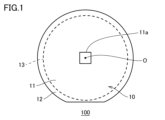
- FIG. 1 is an explanatory diagram illustrating a main surface of a digallium trioxide single crystal substrate according to this embodiment.
- FIG. 2 is an explanatory diagram illustrating five measurement points set on the main surface of the gallium trioxide single crystal substrate of FIG. 1 to determine the nanoindentation hardness.
- FIG. 3 is an explanatory diagram illustrating a Hall measurement sample prepared using the central portion of a gallium trioxide single crystal substrate according to this embodiment in order to measure the characteristics of resistivity, carrier concentration, and electron mobility of the substrate.
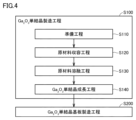
- FIG. 4 is a flow chart showing an example of a method for producing a digallium trioxide single crystal substrate, including a method for producing a digallium trioxide single crystal according to this embodiment.
- FIG. 4 is a flow chart showing an example of a method for producing a digallium trioxide single crystal substrate, including a method for producing a digallium trioxide single crystal according to this embodiment.
- FIG. 5 is a schematic diagram illustrating a manufacturing apparatus used in the method for manufacturing a digallium trioxide single crystal according to this embodiment.
- FIG. 6 is a graph showing the relationship between nanoindentation hardness and crack load in the digallium trioxide single crystal substrates produced in the examples.
- Ga2O3 single crystal is a crystal having a strong cleavage property and is easily cracked in a specific direction. Therefore, in the process of obtaining a gallium trioxide single crystal substrate (hereinafter also referred to as " Ga2O3 single crystal substrate") from a Ga2O3 single crystal, there is a concern that many of the substrates will be cracked during cutting and peripheral processing of the Ga2O3 single crystal, and during transportation after the substrate is obtained. Therefore, there is a demand for suppressing the occurrence of cracks in the Ga2O3 single crystal substrate. On the other hand, it is known that the strength of a gallium arsenide single crystal to which boron (B) is added as an impurity is improved.
- B boron
- the present disclosure aims to provide a gallium trioxide single crystal substrate capable of suppressing the occurrence of cracks, a method for manufacturing a gallium trioxide single crystal, and a method for manufacturing a gallium trioxide single crystal substrate.
- the present inventors have conducted intensive research to solve the above problems and have completed the present disclosure.
- the present inventors have discovered that when a Ga2O3 single crystal substrate is obtained from the Ga2O3 single crystal by adding a small amount of B to the Ga2O3 single crystal, the occurrence of cracks can be suppressed, and have discovered an appropriate concentration of B that can suppress the occurrence of cracks in the substrate.
- B being a member of the same group as gallium (Ga), does not adversely affect the electrical properties of the substrate, and have arrived at the present disclosure.
- a gallium trioxide single crystal substrate is a gallium trioxide single crystal substrate having a circular main surface.
- the gallium trioxide single crystal substrate has a diameter of 100 mm or more.
- the gallium trioxide single crystal substrate has a thickness of 600 ⁇ m or more.
- the gallium trioxide single crystal substrate contains boron.
- the concentration of the boron is 4 ppm by mass or more and 200 ppm by mass or less by glow discharge mass spectrometry.
- a gallium trioxide single crystal substrate having such characteristics can suppress the occurrence of cracks.
- the concentration of boron is preferably 5 ppm by mass or more and 100 ppm by mass or less in glow discharge mass spectrometry. This makes it possible to further suppress the occurrence of cracks in the gallium trioxide single crystal substrate.
- the main surface is preferably a (001) plane of a gallium trioxide single crystal.
- the main surface preferably has a central portion including the center and an outer periphery surrounding the central portion.
- the outer periphery is preferably a chamfered region.
- the nanoindentation hardness measured at five points on the main surface according to a nanoindentation method using a Berkovich indenter under conditions of a maximum load of 10 mN and a crossing angle between one side of the indentation and the direction of the [100] direction of the gallium trioxide single crystal projected onto the main surface being 0° or more and 10° or less is preferably 14.8 GPa or more and 22.0 GPa or less.
- the two mutually perpendicular axes on the main surface that pass through the center are the X-axis and the Y-axis
- the Y-axis is the b-axis of the digallium trioxide single crystal
- the five coordinates (X, Y) defined by the X-axis and the Y-axis are preferably (0, 0), (r-5, 0), (0, r-5), (-(r-5), 0), and (0, -(r-5)).
- the units of r and X and Y in the coordinates (X, Y) are preferably mm. This can further suppress the occurrence of cracks in the digallium trioxide single crystal substrate.
- the gallium trioxide single crystal substrate may contain both or either of rhodium and iridium. In this case, it is preferable that the rhodium concentration and the iridium concentration are both 0.1 mass ppm or less in glow discharge mass spectrometry. This makes it possible to prevent adverse effects on the electrical characteristics of the gallium trioxide single crystal substrate.
- the resistivity of the digallium trioxide single crystal substrate measured at 25° C. in Hall measurement by the Van der Pauw method is preferably 1.0 ⁇ 10 ⁇ 3 ⁇ cm or more and 2.0 ⁇ cm or less.
- the carrier concentration of the digallium trioxide single crystal substrate measured at 25° C. in Hall measurement by the Van der Pauw method is preferably 4.0 ⁇ 10 17 cm ⁇ 3 or more and 1.4 ⁇ 10 19 cm ⁇ 3 or less.
- the electron mobility of the digallium trioxide single crystal substrate measured at 25° C. in Hall measurement by the Van der Pauw method is preferably 0.2 cm 2 /V ⁇ s or more and 15000 cm 2 /V ⁇ s or less. This allows the digallium trioxide single crystal substrate to have good electrical characteristics.
- a method for producing gallium trioxide single crystals is carried out under atmospheric conditions.
- the manufacturing method includes the steps of preparing a single crystal growth apparatus including at least a cylindrical crucible and a heating device arranged to surround the outer periphery of the crucible, accommodating a seed crystal consisting of the digallium trioxide single crystal at the bottom of the crucible, and accommodating a lump or powder of digallium trioxide polycrystal, an n-type dopant, and boron oxide above the seed crystal in the crucible, heating the crucible with the heating device to melt a part of the seed crystal, and obtaining a solution in which the digallium trioxide derived from the part of the seed crystal and the digallium trioxide polycrystal is dissolved in the boron oxide at a first concentration and the n-type dopant is dissolved in a second concentration, and contacting the solution with the remainder of the seed crystal, and growing a crystal from the solution on the remainder
- the crucible is made of platinum.
- the concentration of boron in the digallium trioxide single crystal is 4 ppm by mass or more and 200 ppm by mass or less by glow discharge mass spectrometry.
- a method for producing gallium trioxide single crystals is carried out under a nitrogen atmosphere.
- the manufacturing method includes the steps of preparing a single crystal growth apparatus including at least a cylindrical crucible and a heating device arranged to surround the outer periphery of the crucible; accommodating a seed crystal consisting of the digallium trioxide single crystal at the bottom of the crucible, and accommodating lump or powdered digallium trioxide polycrystal, an n-type dopant, and boron oxide above the seed crystal in the crucible; heating the crucible with the heating device to melt a portion of the seed crystal and obtain a solution in which a portion of the seed crystal and digallium trioxide derived from the digallium trioxide polycrystal are dissolved in the boron oxide at a first concentration and the n-type dopant is dissolved in a second concentration, and contacting the solution with the remainder of the seed crystal; and growing a crystal from the solution on the remainder of
- the crucible is made of pyrolytic boron nitride.
- concentration of boron in the digallium trioxide single crystal is 4 ppm by mass or more and 200 ppm by mass or less by glow discharge mass spectrometry.
- the single crystal growth apparatus preferably has a nozzle for introducing the gallium trioxide polycrystal and the n-type dopant into the crucible, and a lid for sealing the crucible.
- the lid preferably has a hole through which the nozzle is inserted.
- the step of obtaining the digallium trioxide single crystal preferably includes the steps of: analyzing the concentration of digallium trioxide derived from a part of the seed crystals and the digallium trioxide polycrystals in the solution, and the n-type dopant, by sampling the solution in the crucible sealed by the lid through the nozzle; injecting the digallium trioxide polycrystals into the solution in the crucible through the nozzle so that the concentration is within ⁇ 5% of the first concentration, according to the analysis result of the concentration of the digallium trioxide; and injecting the n-type dopant into the solution in the crucible through the nozzle so that the concentration is within ⁇ 5% of the second concentration, according to the analysis result of the concentration of the n-type dopant.
- This makes it possible to obtain digallium trioxide single crystals for manufacturing digallium trioxide single crystal substrates that can suppress the occurrence of cracks with a high yield.
- a method for producing a digallium trioxide single crystal substrate includes a step of obtaining a digallium trioxide single crystal substrate having a circular main surface by processing the digallium trioxide single crystal obtained by the method for producing the digallium trioxide single crystal.
- a production method having such characteristics can obtain a digallium trioxide single crystal substrate that can suppress the occurrence of cracks.
- the main surface is preferably a (001) plane of the digallium trioxide single crystal.
- the main surface preferably has a central portion including the center and an outer periphery surrounding the central portion.
- the outer periphery is preferably a region that has been chamfered.
- the coordinates (X, Y) of the five locations defined by the X-axis and the Y-axis are preferably (0, 0), (r-5, 0), (0, r-5), (-(r-5), 0), and (0, -(r-5)).
- the units of r and X and Y in the coordinates (X, Y) are preferably mm.
- the digallium trioxide single crystal substrate preferably contains both or either of rhodium and iridium.
- concentrations of the rhodium and the iridium are preferably both 0.1 ppm by mass or less in glow discharge mass spectrometry.
- the resistivity of the digallium trioxide single crystal substrate measured at 25° C. in the Hall measurement by the Van der Pauw method is preferably 1.0 ⁇ 10 ⁇ 3 ⁇ cm or more and 2.0 ⁇ cm or less.
- the carrier concentration of the digallium trioxide single crystal substrate measured at 25° C. in the Hall measurement by the Van der Pauw method is preferably 4.0 ⁇ 10 17 cm ⁇ 3 or more and 1.4 ⁇ 10 19 cm ⁇ 3 or less.
- the electron mobility of the digallium trioxide single crystal substrate measured at 25° C. in the Hall measurement by the Van der Pauw method is preferably 0.2 cm 2 /V ⁇ s or more and 15000 cm 2 /V ⁇ s or less. This allows the digallium trioxide single crystal substrate to further suppress the occurrence of cracks and to have good electrical properties.
- A-B refers to the upper and lower limits of a range (i.e., greater than or equal to A and less than or equal to B). If no unit is stated for A, and only a unit is stated for B, the units of A and B are the same. Furthermore, when compounds are expressed in chemical formulas in this specification, if the atomic ratio is not specifically limited, this includes all conventionally known atomic ratios, and should not necessarily be limited to only those within the stoichiometric range.
- the "main surface" of a gallium trioxide single crystal substrate means both of the two circular faces of the gallium trioxide single crystal substrate.
- the “face” used in the term “in-plane” means the "main surface.”
- the diameter of a gallium trioxide single crystal substrate is described as "100 mm,” this means that the diameter is approximately 100 mm (approximately 95 to 105 mm), or 4 inches.
- the diameter is described as "150 mm,” this means that the diameter is approximately 150 mm (approximately 145 to 155 mm), or 6 inches.
- the diameter can be measured using a conventionally known outer diameter measuring device such as a caliper.
- nanoindentation hardness means an indentation hardness obtained by performing an instrumented indentation test in accordance with ISO 14577, an international standard including the nanoindentation method (Ryo Nikkenya, “Mechanical property evaluation method using a nanoindenter”, Analysis, 561 (2021), pp. 457-461). Specifically, it means a hardness obtained by performing an indentation test using a Berkovich indenter at a predetermined position on the main surface of a gallium trioxide single crystal substrate according to the nanoindentation method to obtain a load-displacement curve and analyzing this load-displacement curve.
- the "nanoindentation hardness” is obtained by dividing the maximum load (mN) applied to the gallium trioxide single crystal substrate by the Berkovich indenter by the area (mm 2 ) where the Berkovich indenter was in contact with the gallium trioxide single crystal substrate when the maximum load was applied.
- the unit of the "nanoindentation hardness” is Pascal (Pa).
- the gallium trioxide single crystal substrate ( Ga2O3 single crystal substrate) according to this embodiment is a Ga2O3 single crystal substrate having a circular main surface.
- the diameter of the Ga2O3 single crystal substrate is 100 mm or more.
- the thickness of the Ga2O3 single crystal substrate is 600 ⁇ m or more.
- the Ga2O3 single crystal substrate contains boron.
- the concentration of the boron is 4 ppm by mass or more and 200 ppm by mass or less in glow discharge mass spectrometry.
- the Ga2O3 single crystal substrate having such characteristics can suppress the occurrence of cracks.
- the diameter of the Ga2O3 single crystal substrate is 100 mm or more as described above.
- the diameter of the Ga2O3 single crystal substrate is preferably 99.5 mm or more and 152.5 mm or less.
- such a Ga2O3 single crystal substrate is preferably a Ga2O3 single crystal substrate having a diameter of 100 mm or 150 mm, in other words, a Ga2O3 single crystal substrate having a diameter of 4 inches or 6 inches. This allows the large-diameter Ga2O3 single crystal substrate to have the characteristic of being less likely to crack.
- the thickness of the Ga 2 O 3 single crystal substrate is 600 ⁇ m or more as described above.
- the thickness of the Ga 2 O 3 single crystal substrate is preferably 650 ⁇ m or more and 700 ⁇ m or less. This allows the Ga 2 O 3 single crystal substrate having a commonly used thickness to have the characteristic of being less likely to crack.
- the diameter of the Ga 2 O 3 single crystal substrate is determined based on the circular shape before the OF, IF, etc. are formed, even if the main surface does not have a geometrically circular shape due to the influence of an orientation flat (hereinafter also referred to as "OF"), an index flat (hereinafter also referred to as "IF”), etc.
- OF orientation flat
- IF index flat
- the diameter of the Ga 2 O 3 single crystal substrate can be measured by using a conventionally known outer diameter measuring device such as a caliper.
- the thickness of the Ga 2 O 3 single crystal substrate can be measured by using a non-contact thickness measuring device (product name (model): "TAP-2H-200XY", manufactured by COMS Co., Ltd.).
- the positioning accuracy of the measuring device is 25 ⁇ m.
- the display resolution of the measuring device is 0.01 ⁇ m.
- the repeatability of the measuring device is 0.01 ⁇ m.
- the measuring device used to measure the thickness of the Ga2O3 single crystal substrate is not limited to the above measuring device, and other measuring devices can be used as long as they have the same or higher positioning accuracy, display resolution, and repeatability.
- the "thickness of the Ga2O3 single crystal substrate” means the thickness at the center of the main surface of the Ga2O3 single crystal substrate.
- the Ga2O3 single crystal substrate has a circular main surface as described above.
- the term "circular shape” representing the shape of the main surface includes a geometric circular shape, as well as a shape in which the main surface does not form a geometric circular shape due to at least one of a notch, OF, or IF being formed on the periphery of the main surface as described above.
- shape in which the main surface does not form a geometric circular shape refers to a shape in which the length of the line segment extending from any point on the periphery of the main surface to the center of the main surface from any point on the notch, OF, or IF to the center of the main surface is short .
- shape in which the main surface does not form a geometric circular shape also includes a shape in which the lengths of all the line segments extending from any point on the periphery of the main surface to the center of the main surface are not necessarily the same due to the shape of the Ga2O3 single crystal that is the raw material of the Ga2O3 single crystal substrate.
- the center of the main surface refers to the position of the center of gravity
- the diameter of the Ga2O3 single crystal substrate refers to the length of the longest line segment that extends from any point on the outer periphery of the Ga2O3 single crystal substrate, passing through the center of the main surface, to another point on the outer periphery.
- the main surface is preferably the (001) plane of the Ga2O3 single crystal. It is known that a Ga2O3 single crystal substrate having the (001) plane of the Ga2O3 single crystal as the main surface is prone to cracks and breakage due to external stress because the (001) plane generally has a strong cleavage tendency. In other words, this embodiment can suppress the occurrence of cracks in a Ga2O3 single crystal substrate having the (001) plane of the Ga2O3 single crystal as the main surface.
- the crystal plane of the main surface has an accuracy error of ⁇ 0.5°.
- the main surface when the main surface is the "(001) plane" of a Ga2O3 single crystal, it means that the main surface may be a (001) just plane, or the main surface may be a plane having an off angle of -0.5 to +0.5° from the (001) plane.
- the off angle from the (001) plane on the main surface of a Ga2O3 single crystal substrate can be measured using a conventionally known crystal orientation measuring device (for example, product name (product number): "2991G2", manufactured by Rigaku Corporation).
- the main surface preferably has a central portion including the center and an outer peripheral portion surrounding the central portion.
- the outer peripheral portion is preferably a region that has been chamfered.
- FIG. 1 is an explanatory diagram for explaining the main surface of a gallium trioxide single crystal substrate according to this embodiment.
- the main surface 10 has a central portion 11 including the center and an outer peripheral portion 12 that surrounds the outer periphery of the central portion 11.
- the central portion 11 is a region in the Ga2O3 single crystal substrate 100 where epitaxial layers for forming, for example, an electronic device are laminated.
- the outer peripheral portion 12 is a region that has been chamfered.
- the Ga2O3 single crystal substrate 100 can reduce the occurrence of cracks and chips at the outer edge of the outer peripheral portion 12 during handling.
- the chamfering of the outer peripheral portion 12 can be performed by a conventionally known method.
- the central portion 11 preferably has a circular shape. This allows the length from the center O of the main surface 10 to the boundary 13 between the central portion 11 and the outer periphery 12 to be expressed by a fixed numerical value of 1, called "r", as described below.
- the "circular shape" representing the shape of the central portion 11 includes not only a geometric circular shape, but also a shape in which a geometric circular shape, such as an approximately circular shape, is not formed due to chamfering or the like of the outer periphery 12.
- the length r from the center O of the main surface 10 to the boundary 13 between the central portion 11 and the outer periphery 12 refers to the length of the shortest line segment among the line segments extending from the center O of the main surface 10 to the boundary 13 between the central portion 11 and the outer periphery 12.
- the shape of the central portion 11 may be a polygonal shape, such as a triangle, a rectangle, or a hexagon.
- the width of the outer periphery 12, that is, the length from the outer edge of the outer periphery 12 to the boundary 13 between the central portion 11 and the outer periphery 12, is preferably 2 to 5 mm. This is because the region of the width of the outer periphery 12 of the Ga2O3 single crystal substrate 100 may have residual processing distortion during chamfering, and is known to have a large variation in the number of dislocations for each substrate and poor flatness, and is generally not used as a material for semiconductor devices.
- the central portion 11 and the peripheral portion 12 are distinguished by the difference in thickness of the Ga2O3 single crystal substrate 100 at those portions.
- the thickness of the Ga2O3 single crystal substrate 100 at the peripheral portion 12 is less than 99% of the thickness of the Ga2O3 single crystal substrate 100 at the central portion 11.
- the peripheral portion 12 means a region that has been chamfered as described above, and the thickness at the peripheral portion 12 is less than 99% of the thickness at the central portion 11.
- the thickness at the central portion 11 is 675 ⁇ m
- the thickness at the peripheral portion 12 is 668 ⁇ m or less.
- the thicknesses at the central portion 11 and the peripheral portion 12 can be measured by using the non-contact thickness measuring device described above.
- the measuring device used to measure the thickness of the central portion 11 and the peripheral portion 12 is not limited to the above measuring device, and other measuring devices can be used as long as they have the same or higher positioning accuracy, display resolution, and repeatability.
- the thickness of the Ga2O3 single crystal substrate 100 at the central portion 11 means the thickness at the center O of the main surface 10 of the Ga2O3 single crystal substrate 100. This allows the length "r" from the center O of the main surface 10 to the boundary 13 between the central portion 11 and the outer periphery 12 to be calculated as a specific value (unit: mm).
- the nanoindentation hardness measured at five points on the main surface according to the nanoindentation method using a Berkovich indenter under conditions of a maximum load of 10 mN and a crossing angle between one side of the indentation and the direction of the [100] direction of the gallium trioxide single crystal projected onto the main surface being 0° or more and 10° or less is preferably 14.8 GPa or more and 22.0 GPa or less.
- the coordinates (X, Y) of the five points defined by the X-axis and the Y-axis are preferably (0, 0), (r-5, 0), (0, r-5), (-(r-5), 0), and (0, -(r-5)).
- the units of r and X and Y in the coordinates (X, Y) are preferably mm. It is more preferable that the nanoindentation hardness measured at five points on the main surface is 15.0 GPa or more and 21.0 GPa or less.
- FIG. 2 is an explanatory diagram illustrating five measurement points set on the main surface of the gallium trioxide single crystal substrate of FIG. 1 to determine the nanoindentation hardness.
- a method for measuring nanoindentation hardness measured at five points on the main surface 10 according to the nanoindentation method using a Berkovich indenter will be described.
- the above measurement method can be performed, for example, by using a nanoindenter (product name: "Bruker Hysitron TI980 Triboindenter", manufactured by Bruker Japan Co., Ltd.).
- a preliminary measurement is performed on the Ga2O3 single crystal substrate 100 so that a load can be applied such that the cross angle between one side of the indentation of the Berkovich indenter and the direction of the [100] direction of the Ga2O3 single crystal projected onto the main surface is 0° or more and 10° or less.
- the Ga2O3 single crystal substrate 100 is fixed to the sample stage of the nanoindenter.
- the Ga2O3 single crystal substrate 100 on the sample stage is observed using an optical system provided in the nanoindenter, and for example, an arbitrary position in the center 11 on the main surface 10 is designated as the measurement point.
- the measurement points it is preferable to specify other than the above-mentioned five points on the main surface 10 (i.e., other than the positions of the above-mentioned five coordinates (X, Y) of (0,0), (r-5,0), (0,r-5), (-(r-5),0), and (0,-(r-5))) as the measurement points in order to contribute to the main measurement described later. Furthermore, a Berkovich indenter is moved to the measurement points, and an indentation test is performed with a maximum load of 10 mN, and then the Ga2O3 single crystal substrate 100 is removed from the sample stage.
- the intersection angle can be obtained by a conventionally known method.
- a main measurement is performed to determine the nanoindentation hardness. If the crossing angle determined in the preliminary measurement is 0° or more and 10° or less, the Ga2O3 single crystal substrate 100 is fixed to the sample stage in the same orientation as in the preliminary test. If the crossing angle determined in the preliminary measurement exceeds 10°, the orientation of the Ga2O3 single crystal substrate 100 is adjusted so that the crossing angle is 0° or more and 10° or less, and then the Ga2O3 single crystal substrate 100 is fixed to the sample stage.
- the Ga2O3 single crystal substrate 100 on the sample stage is observed using an optical system provided in the nanoindenter , and one of the coordinates (X, Y) of the five points on the main surface 10 (for example, (0, 0)) is designated as the measured point.
- the Berkovich indenter is moved to the measurement location (for example, (0,0)), and an indentation test is performed with a maximum load of 10 mN, after which the Ga2O3 single crystal substrate 100 is removed from the sample stage. At this time, an indentation of the Berkovich indenter is formed at the measurement location.
- the area ( mm2 ) where the Berkovich indenter was in contact with the Ga2O3 single crystal substrate 100 when the maximum load of 10 mN was applied can be calculated, and the nanoindentation hardness at the measurement location (for example, (0,0)) can be obtained by dividing the maximum load of 10 mN by the area ( mm2 ).
- the remaining coordinates (X, Y) of the above five points on the main surface 10 are specified as the measurement points. Thereafter, an indentation test is performed in the same manner as when (0, 0) is specified as the measurement point, and a predetermined calculation is performed, thereby determining the nanoindentation hardness at the remaining coordinates (X, Y) of the above five points on the main surface 10.
- GDMS Glow Discharge Mass Spectroscopy
- a method for measuring the concentration of B in the Ga2O3 single crystal substrate using glow discharge mass spectrometry (GDMS) will be described.
- GDMS refers to a technique in which a glow discharge plasma is generated using an analytical sample as a cathode in a high-purity argon atmosphere, and the surface of the analytical sample is sputtered in the plasma, and the ionized constituent elements in the analytical sample are measured with a mass spectrometer. This allows the qualitative and quantitative analysis of impurity elements, including B, other than Ga and O contained in the Ga2O3 single crystal substrate.
- the ion source for the GDMS either a flat cell or a pin-shaped cell is applied.
- the GDMS can be carried out, for example, as follows. First, a Ga2O3 single crystal substrate is obtained by the manufacturing method described later. The Ga2O3 single crystal substrate is then cleaved to obtain a Ga2O3 analysis sample in the shape of a strip of 2 mm square and 20 mm long. The non-cleaved direction is cut using a known means such as a precision hand grinder. This is placed on a sample placement section attached to the following device. Here, it is preferable that the sample placement section is cleaned in a conventional manner to prevent contamination and to remove foreign matter, and pre-sputtered for 60 minutes.
- GDMS can be performed on the Ga2O3 analysis sample placed on the sample placement surface under the following conditions.
- B which is an element other than Ga and O among the constituent elements of the Ga2O3 analysis sample
- a semi-quantitative value can be calculated by correcting the ion intensity ratio of Ga and B with a relative sensitivity factor (RSF).
- RSF relative sensitivity factor
- a value built into the software attached to the following device can be used.
- Glow discharge mass spectrometer product name (product number): VG-9000, manufactured by VG Elemental
- Ion source Pin cell (cooled with liquid nitrogen during analysis)
- Discharge area diameter 10mm
- Discharge gas High purity argon (6N grade)
- Discharge conditions 2 mA, 1 kV (constant current mode)
- Detector Faraday cup and multiplier.
- Mass resolution 4000 or more m/ ⁇ m (high resolution mode).
- the detection limit of the GDMS is preferably 0.01 mass ppm.
- the Ga2O3 single crystal substrate may contain both or either of rhodium (Rh) and iridium (Ir).
- the Rh concentration and the Ir concentration are preferably 0.1 mass ppm or less in GDMS. It is more preferable that the Rh concentration and the Ir concentration are 0.01 mass ppm or less in GDMS.
- the lower limit of the Rh concentration and the Ir concentration is that they are not detected in GDMS. If the Rh and Ir are in the above-mentioned concentration range, it is possible to prevent adverse effects on electrical characteristics.
- the Rh and Ir are known as elements that may be contained in the Ga2O3 single crystal substrate.
- the Rh concentration and the Ir concentration can be easily set to 0.1 mass ppm or less in GDMS by using platinum or pyrolytic boron nitride as the material of the crucible.
- the Ga2O3 single crystal substrate can suppress the occurrence of cracks, and can have good electrical properties due to the low concentration of Rh and Ir.
- the resistivity of the gallium trioxide single crystal substrate measured at 25 °C in the Hall measurement by the Van der Pauw method is preferably 1.0 ⁇ 10-3 ⁇ cm or more and 2.0 ⁇ cm or less.
- the resistivity measured at 25°C in the Hall measurement by the Van der Pauw method using the center of the Ga2O3 single crystal substrate as the measurement target is preferably 1.0 ⁇ 10-3 ⁇ cm or more and 2.0 ⁇ cm or less. This allows the substrate to have good electrical properties as an n-type (electron-donating type ) Ga2O3 single crystal substrate, and thus contributes to the formation of electronic devices.
- the resistivity is less than 1.0x10⁻³ ⁇ cm, when a Schottky barrier diode is fabricated using the Ga2O3 single crystal substrate, the reverse current increases, the breakdown voltage deteriorates, and there is a risk of thermal runaway. If the resistivity exceeds 2.0 ⁇ cm, the forward voltage is high and there is a risk of low efficiency.
- the resistivity is preferably 5.0x10⁻³ ⁇ cm or more and 1.0x10⁻¹ ⁇ cm or less.
- FIG. 3 is an explanatory diagram for explaining a Hall measurement sample prepared using the center of the gallium trioxide single crystal substrate according to this embodiment in order to measure the characteristics of resistivity, carrier concentration, and electron mobility in the substrate.
- a Ga 2 O 3 single crystal substrate 100 to be measured is obtained by applying a conventionally known processing method to a Ga 2 O 3 single crystal obtained based on a manufacturing method described later.
- a rectangular slice 11a (for example, 600 ⁇ m thick) having a length of 10 mm and a width of 10 mm and a center O (for example, the center of the main surface 10) is prepared from the center of the Ga 2 O 3 single crystal substrate 100.
- electrodes 21 made of gold are formed at the four corners of the rectangular slice 11a (surface to be measured), thereby obtaining a Hall measurement sample.
- the shape of the electrode 21 is not limited to the rectangular shape shown in the figure, and may be a sector shape or a circle.
- the resistivity can be obtained by applying Hall measurement by the Van der Pauw method to the rectangular piece 11a equipped with such electrodes 21 in an atmosphere of 25° C.
- the resistivity obtained by using the rectangular piece as the measurement object is defined as the resistivity of the Ga2O3 single crystal substrate measured at 25° C. in Hall measurement by the Van der Pauw method.
- the carrier concentration of the Ga2O3 single crystal substrate measured at 25°C by the Van der Pauw Hall measurement is preferably 4.0 x 1017 cm -3 or more and 1.4 x 1019 cm -3 or less.
- the electron mobility of the Ga2O3 single crystal substrate measured at 25°C by the Van der Pauw Hall measurement is preferably 0.2 cm2 /V.s or more and 15000 cm2 /V.s or less.
- the carrier concentration of the Ga2O3 single crystal substrate is less than 4.0 x 1017 cm -3 , there is a risk of a large loss when a Schottky barrier diode is fabricated using the Ga2O3 single crystal substrate.
- the carrier concentration exceeds 1.4 ⁇ 10 cm -3 , when a Schottky barrier diode is fabricated from the Ga2O3 single crystal substrate , the reverse current increases, the breakdown voltage deteriorates, and there is a risk of thermal runaway.
- the carrier concentration and the electron mobility are controlled within the above-mentioned ranges, respectively, to obtain a preferable resistivity within the above-mentioned range.
- the carrier concentration is more preferably 4.5 ⁇ 10 17 cm ⁇ 3 or more and 4.0 ⁇ 10 18 cm ⁇ 3 or less.
- the electron mobility is more preferably 10 cm 2 /V ⁇ s or more and 1500 cm 2 /V ⁇ s or less. This allows the n-type Ga 2 O 3 single crystal substrate to have good electrical properties that can be used for various electronic devices.
- the carrier concentration and electron mobility can both be determined by the same method as the above-mentioned resistivity measurement method.
- the Ga2O3 single crystal substrate according to this embodiment has the above-mentioned characteristics, and therefore can be used as a substrate for forming optical devices and electronic devices.
- the Ga2O3 single crystal substrate has good electrical characteristics, and therefore is preferably used as a substrate for forming electronic devices.
- the method for producing a gallium trioxide single crystal ( Ga2O3 single crystal) is preferably a method for producing a Ga2O3 single crystal constituting a Ga2O3 single crystal substrate having a circular main surface as described above.
- the method for producing the Ga2O3 single crystal is carried out in an air atmosphere and can include the following steps.
- the manufacturing method includes the steps of preparing a single crystal growth apparatus (hereinafter also referred to as " Ga2O3 single crystal growth apparatus") having at least a cylindrical crucible and a heating device arranged to surround the outer periphery of the crucible, placing a seed crystal consisting of the Ga2O3 single crystal in the bottom of the crucible and placing lump or powdered digallium trioxide polycrystal ( Ga2O3 polycrystal ), an n-type dopant, and boron oxide ( B2O3 ) above the seed crystal in the crucible, and heating the crucible with the heating device to melt a part of the seed crystal, and to melt Ga2O3 derived from a part of the seed crystal and the Ga2O3 polycrystal at a first concentration, and the n-type dopant at a second concentration, respectively, in the B2O3 polycrystal.
- Ga2O3 single crystal growth apparatus having at least a cylindrical crucible and a heating device arranged to
- the method includes the steps of obtaining a solution in which Ga is dissolved in gallium trioxide, contacting the solution with the remainder of the seed crystal, and growing a crystal from the solution on the remainder of the seed crystal to obtain a Ga2O3 single crystal.
- the crucible is made of platinum.
- the boron concentration in the digallium trioxide single crystal is 4 ppm by mass or more and 200 ppm by mass or less in GDMS.
- the manufacturing method includes the steps of preparing a single crystal growth apparatus (hereinafter also referred to as " Ga2O3 single crystal growth apparatus") including at least a cylindrical crucible and a heating device arranged to surround the outer periphery of the crucible, placing a seed crystal consisting of the Ga2O3 single crystal in the bottom of the crucible and placing lump-shaped or powder-shaped Ga2O3 polycrystal, an n-type dopant, and B2O3 above the seed crystal in the crucible, and heating the crucible with the heating device to melt a part of the seed crystal, and to melt the Ga2O3 derived from the part of the seed crystal and the Ga2O3 polycrystal at a first concentration, and the n -type dopant at
- the crucible in this embodiment is made of pyrolytic boron nitride (pBN).
- pBN pyrolytic boron nitride
- the boron concentration in the digallium trioxide single crystal is 4 mass ppm or more and 200 mass ppm or less in GDMS.
- Fig. 4 is a flow chart showing an example of a method for manufacturing a gallium trioxide single crystal substrate, including the method for manufacturing a gallium trioxide single crystal according to this embodiment.
- the method for manufacturing a Ga2O3 single crystal according to this embodiment is preferably included in the method for manufacturing a Ga2O3 single crystal substrate, for example, as the Ga2O3 single crystal manufacturing process S100 shown in the flow chart of Fig. 4.
- the method for manufacturing a Ga2O3 single crystal substrate according to this embodiment includes a Ga2O3 single crystal manufacturing process S100 and a Ga2O3 single crystal substrate manufacturing process S200.
- the Ga2O3 single crystal manufacturing process S100 includes a step (first step: preparation step S110) of preparing a Ga2O3 single crystal growth apparatus having at least a cylindrical crucible and a heating device arranged to surround the outer periphery of the crucible.
- preparation step S110 in addition to the Ga2O3 single crystal growth apparatus, it is preferable to prepare a seed crystal consisting of the Ga2O3 single crystal, a lump or powdered Ga2O3 polycrystal , an n-type dopant, and solid B2O3 .
- the Ga2O3 single crystal production step S100 includes a step of accommodating the seed crystal at the bottom of the crucible, and accommodating the Ga2O3 polycrystal , the n-type dopant, and the B2O3 above the seed crystal in the crucible (second step: raw material accommodation step S120).
- the Ga2O3 single crystal manufacturing process S100 includes a step of melting a part of the seed crystal by heating the crucible with the heating device, obtaining a solution in which Ga2O3 derived from the part of the seed crystal and the Ga2O3 polycrystal is dissolved in the B2O3 at a first concentration, and the n-type dopant is dissolved in a second concentration in the B2O3 , and contacting the solution with the remainder of the seed crystal (third step: raw material melting step S130).
- the Ga2O3 single crystal manufacturing process S100 further includes a step of growing a crystal on the remainder of the seed crystal from the solution to obtain a Ga2O3 single crystal (fourth step: Ga2O3 single crystal growing step S140).
- the atmosphere in which the Ga2O3 single crystal growing step S140 is performed is a nitrogen atmosphere or an air atmosphere depending on the material of the crucible.
- the present inventors have focused on the method for growing Ga2O3 single crystals constituting the Ga2O3 single crystal substrate having the above-mentioned characteristics, which involves dissolving Ga2O3 in liquid B2O3 in a crucible, and then cooling the mixture to precipitate Ga2O3 single crystals due to the solubility difference between B2O3 and Ga2O3 . In this case, they have found that a small amount of B2O3 is incorporated into the precipitated Ga2O3 single crystal.
- Ga2O3 single crystal substrate is obtained from a Ga2O3 single crystal containing B at a predetermined concentration, the occurrence of cracks in the Ga2O3 single crystal substrate is suppressed, and have arrived at a method for producing Ga2O3 single crystals according to this embodiment.
- n-type dopant refers to an oxide of an element that can impart n-type (electron-donating) conductivity to the Ga2O3 single crystal substrate by being contained in the Ga2O3 single crystal substrate as a dopant.
- elements that can impart n-type (electron-donating) conductivity to the Ga2O3 single crystal substrate include tin (Sn), silicon (Si), and germanium (Ge).
- Fig. 5 is a schematic diagram for explaining a manufacturing apparatus used in the manufacturing method of the digallium trioxide single crystal according to this embodiment.
- the Ga2O3 single crystal manufacturing apparatus shown in Fig. 5 is used.
- the Ga2O3 single crystal growth apparatus includes the above-mentioned crucible 2, a crucible holding stage 8 for holding the crucible 2, a lower shaft 9 for supporting the crucible 2 and the crucible holding stage 8, and a heating device 1 for heating the crucible 2.
- the Ga2O3 single crystal growth apparatus further includes a lid 3 for sealing the crucible 2.
- the lid 3 has a function of preventing B2O3 from evaporating outward due to heating from a solution 52 in which Ga2O3 and an n-type dopant are dissolved in B2O3 in the crucible 2 (hereinafter, also referred to as "B2O3-Ga2O3 solution 52 " ) in the Ga2O3 single crystal growth step S140.
- the Ga2O3 single crystal growth apparatus has nozzles for introducing Ga2O3 polycrystals and an n-type dopant into the crucible 2.
- the nozzles are made up of a first nozzle 41 and a second nozzle 42, each of which penetrates the lid 3 from the outside so that its tip is located inside the crucible 2.
- the first nozzle 41 functions as a supply path for supplying Ga2O3 polycrystals from the outside into the crucible 2.
- the second nozzle 42 functions as a supply path for supplying an n-type dopant from the outside into the crucible 2.
- a chamber capable of accommodating the crucible 2 , the lid 3, the first nozzle 41 and the second nozzle 42, the crucible holding stage 8, the lower shaft 9, and the heating device 1 may be prepared in order to perform the Ga2O3 single crystal growth step S140 in a nitrogen atmosphere, although this is not shown in the figures.
- the dimensions and materials of the chamber are not particularly limited as long as the chamber has a size and material capable of accommodating the Ga2O3 single crystal growth apparatus and the like and being capable of making the internal atmosphere a nitrogen atmosphere.
- the heating device of the Ga2O3 single crystal growth apparatus may be disposed outside the chamber.
- the heating device 1 is arranged to surround the outer periphery of the crucible 2 for the purpose of heating the crucible 2.
- the heating device 1 can be, for example, a conventionally known electric heater (hereinafter, also simply referred to as "heater”).
- the heater is, for example, two bodies, and the two bodies are arranged to surround the outer periphery of the crucible 2.
- the output of the heater may be controlled independently for each body.
- the heater may be divided into a plurality of parts for each body in a direction perpendicular to the axis of the crucible 2, thereby forming a multi-stage structure.
- the output of the heater is controlled independently for each part formed in the multi-stage structure. This allows the temperature of the contents in the crucible 2 to be precisely adjusted along the axial direction of the crucible 2. For example, by independently controlling the heater output for each of the multiple stages, the growth rate of the Ga 2 O 3 single crystal grown in the crucible 2 can be stabilized.
- the crucible 2 in the Ga 2 O 3 single crystal growth apparatus is cylindrical.
- the crucible 2 accommodates a seed crystal 51 made of a Ga 2 O 3 single crystal at its bottom. Furthermore, a lump or powdered Ga 2 O 3 polycrystal, an n-type dopant, and solid B 2 O 3 are accommodated on the seed crystal 51. That is, the crucible 2 has a function of holding the seed crystal 51, the Ga 2 O 3 polycrystal, the n-type dopant, and B 2 O 3.
- the crucible 2 has a function of growing a Ga 2 O 3 single crystal on the seed crystal 51 by precipitating the Ga 2 O 3 single crystal from a B 2 O 3 -Ga 2 O 3 solution 52 inside the crucible 2 as described later.
- the crucible 2 various materials that can withstand the temperature of the B 2 O 3 -Ga 2 O 3 solution 52 are used.
- the material of the crucible 2 platinum, platinum alloys containing rhodium or iridium, pBN, etc. can be adopted.
- the atmosphere in which the Ga 2 O 3 single crystal growth step S140 is performed is an air atmosphere
- the crucible 2 is made of platinum. This allows the rhodium concentration and the iridium concentration in the Ga 2 O 3 single crystal obtained by the above manufacturing method to be zero or extremely low (for example, 0.1 mass ppm or less).
- the crucible 2 is made of pBN.
- the manufacturing cost of the Ga 2 O 3 single crystal growth apparatus can be reduced.
- the rhodium concentration and the iridium concentration can be zero or extremely low (for example, 0.1 mass ppm or less).
- the inner diameter of the crucible 2 depends on the diameter of the Ga2O3 single crystal to be manufactured, but can be, for example, 90 mm or more and 165 mm or less.
- the Ga2O3 single crystal growth apparatus can be equipped with a thermocouple capable of measuring the temperature of the crucible 2 heated by the heating device 1.
- a plurality of thermocouples may be arranged on the outside of the crucible 2 along the axial direction.
- a known temperature monitor can be used as the thermocouple.
- the Ga2O3 single crystal growth apparatus includes a crucible-holding stage 8 that holds the crucible 2.
- the crucible-holding stage 8 contacts the bottom of the crucible 2 to hold the crucible 2.
- the crucible-holding stage 8 may have a cylindrical appearance.
- the material of the crucible-holding stage 8 is not particularly limited, but may be, for example, quartz, alumina, or silicon carbide.
- the outer diameter of the crucible-holding stage 8 depends on the diameter of the crucible 2 to be supported, and is, for example, 75 mm or more and 200 mm or less.
- the lower shaft 9 can support the crucible 2 and the crucible holding stage 8 by supporting the crucible holding stage 8 from below.
- the lower shaft 9 can be, for example, a rod shape that is circular or rectangular in horizontal cross section.
- the material of the lower shaft 9 can be, for example, molybdenum, carbon, silicon carbide, or the like.
- the n-type dopant is preferably prepared as, for example, tin oxide ( SnO2 ) , silicon oxide ( SiO2 ), or the like.
- the seed crystal 51, the bulk or powdered Ga2O3 polycrystal , the n-type dopant, and the solid B2O3 may be prepared by purchasing commercially available products.
- the crucible 2 constituting the Ga2O3 single crystal growth apparatus is made of platinum.
- a raw material accommodation process S120 is performed.
- the raw material accommodation process S120 is a process of accommodating the seed crystal at the bottom of the crucible, and accommodating the Ga2O3 polycrystal , the n-type dopant, and the B2O3 above the seed crystal in the crucible.
- the purpose of the raw material accommodation process S120 is to accommodate various raw materials in the crucible 2 for crystal growth using a Ga2O3 single crystal growth device.
- a seed crystal 51 made of a Ga2O3 single crystal is accommodated at the bottom of the crucible 2.
- a plurality of chunk-shaped or powder-shaped Ga2O3 polycrystals are accommodated and stacked on the seed crystal 51 accommodated in the crucible 2. Further, an n-type dopant and solid B 2 O 3 are contained.
- the amount of n-type dopant contained in the crucible 2 is preferably determined in advance so that the dopant concentration in the Ga 2 O 3 single crystal to be grown is appropriate. In this way, an n-type Ga 2 O 3 single crystal substrate is obtained from the Ga 2 O 3 single crystal obtained by the Ga 2 O 3 single crystal manufacturing process S100.
- the amount of the n-type dopant contained in the crucible 2 is preferably adjusted so that the atomic concentration of Sn, Si, or Ge as the dopant is 2.0 ⁇ 10 19 cm ⁇ 3 or less (for example, 1.0 ⁇ 10 17 cm ⁇ 3 or more and 2.0 ⁇ 10 19 cm ⁇ 3 or less) in the Ga 2 O 3 single crystal substrate.
- the purpose of the raw material melting step S130 is to melt a part of the seed crystal 51 by heating the crucible 2 with the heating device 1 when growing a crystal using a Ga 2 O 3 single crystal growth device, and to obtain a B 2 O 3 -Ga 2 O 3 solution 52 in which Ga 2 O 3 originating from a part of the seed crystal 51 and the Ga 2 O 3 polycrystal is dissolved in B 2 O 3 at a first concentration and the n-type dopant is dissolved in B 2 O 3 at a second concentration.
- the purpose is to bring the B 2 O 3 -Ga 2 O 3 solution 52 into contact with the remaining part of the seed crystal 51.
- the Ga 2 O 3 single crystal growth step S140 This allows the Ga 2 O 3 single crystal to be grown on the remaining part of the seed crystal 51 in the next step, the Ga 2 O 3 single crystal growth step S140.
- the raw material melting step S130 specifically, the crucible 2 containing the seed crystal 51, the Ga 2 O 3 polycrystal, the n-type dopant, and the B 2 O 3 is supported on the crucible holding stage 8. Then, a current is supplied to the heating device 1 to heat the crucible 2. As a result, the solid B 2 O 3 melts and becomes liquid B 2 O 3 , and the Ga 2 O 3 polycrystal gradually dissolves in B 2 O 3 as the B 2 O 3 reaches a predetermined temperature (about 1000° C.) or higher.
- the first concentration i.e., the concentration of Ga2O3 in B2O3 in the B2O3 - Ga2O3 solution 52
- the concentration of Ga2O3 that can be dissolved in B2O3 depends on the temperature of B2O3 . Therefore, in the raw material melting step S130 , the B2O3 - Ga2O3 solution 52 is preferably heated to 1200 to 1500°C.
- the second concentration i.e., the concentration of the n - type dopant in B2O3 in the B2O3 - Ga2O3 solution 52
- the concentration of the n - type dopant in B2O3 in the B2O3 - Ga2O3 solution 52 may be any concentration that is used in a conventionally known method for producing Ga2O3 single crystals, and is preferably, for example, 2 to 300 mass ppm.
- the first concentration and the second concentration can be measured in the same manner as the Ga 2 O 3 concentration and the n-type dopant concentration in the analysis step described below.
- the Ga2O3 single crystal growing process S140 is a process for obtaining a Ga2O3 single crystal by growing a crystal on the remaining part of the seed crystal from the solution.
- the crucible 2 is gradually pulled downward (towards the bottom of the crucible 2) along its axis relative to the heating device 1, so that a temperature gradient can be formed in the crucible 2 such that the temperature on the seed crystal 51 side is low and the temperature on the B2O3 - Ga2O3 solution 52 side is high.
- a Ga 2 O 3 single crystal is precipitated due to the solubility difference between B 2 O 3 and Ga 2 O 3 , and the crystal can be continuously grown.
- the temperature of the portion in contact with the seed crystal 51 in the B 2 O 3 -Ga 2 O 3 solution 52 (hereinafter also referred to as the "seed crystal portion") is preferably 1150 to 1430°C, more preferably 1200 to 1388°C.
- the Ga 2 O 3 single crystal is precipitated from the B 2 O 3 -Ga 2 O 3 solution 52 due to the solubility difference between the B 2 O 3 and Ga 2 O 3 , so that the Ga 2 O 3 concentration and the n-type dopant concentration in the B 2 O 3 -Ga 2 O 3 solution 52 decrease as the step proceeds.
- the Ga 2 O 3 single crystal growth step S140 preferably includes a step of analyzing the concentration of Ga 2 O 3 derived from a part of the seed crystal and the Ga 2 O 3 polycrystal in the solution, and the n-type dopant, by sampling the solution in the crucible sealed by the lid through the nozzle (hereinafter also referred to as the "analysis step”). Further, the Ga2O3 single crystal growth step S140 preferably includes a step of introducing the Ga2O3 polycrystal into the solution in the crucible through the nozzle so that the Ga2O3 concentration is within ⁇ 5% of the first concentration according to the analysis result of the Ga2O3 concentration (hereinafter also referred to as the " Ga2O3 concentration adjustment step").
- the Ga2O3 single crystal growth step S140 preferably includes a step of introducing the n-type dopant into the solution in the crucible through the nozzle so that the Ga2O3 concentration is within ⁇ 5% of the second concentration according to the analysis result of the n-type dopant concentration (hereinafter also referred to as the "n-type dopant concentration adjustment step").
- the above-mentioned manufacturing method can stabilize the concentrations of Ga2O3 and n-type dopant in the B2O3-Ga2O3 solution 52 from the beginning to the end of the Ga2O3 single crystal growth step S140.
- the B2O3- Ga2O3 solution 52 in the crucible 2 sealed by the lid 3 is sampled by an appropriate means through the first nozzle 41 or the second nozzle 42 at predetermined time intervals (for example, every two hours). Sampling can be performed, for example, by using a pipe made of the same material as the nozzle to collect about 0.5 g of the B2O3 - Ga2O3 solution 52 in the crucible 2 through the first nozzle 41 or the second nozzle 42 .
- the concentrations of Ga 2 O 3 and the above-mentioned n-type dopant in the B 2 O 3 -Ga 2 O 3 solution 52 can be analyzed using high-frequency inductively coupled plasma (ICP) emission spectrometry or ICP-mass spectrometry.
- ICP inductively coupled plasma
- Ga2O3 polycrystals are introduced into the B2O3-Ga2O3 solution 52 in the crucible 2 through the first nozzle 41 so that the Ga2O3 concentration is within ⁇ 5% of the first concentration according to the analysis result on the Ga2O3 concentration obtained from the analysis step performed at predetermined time intervals. Note that in the Ga2O3 concentration adjustment step, if the analysis result of the Ga2O3 concentration is within ⁇ 5 % of the first concentration, Ga2O3 polycrystals are not introduced.
- the n-type dopant concentration in the B 2 O 3 -Ga 2 O 3 solution 52 also decreases with the precipitation of the Ga 2 O 3 single crystal. Therefore, in the n-type dopant concentration adjustment step, an n-type dopant is introduced into the B 2 O 3 -Ga 2 O 3 solution 52 in the crucible 2 through the second nozzle 42 so that the concentration is within ⁇ 5% of the second concentration according to the analysis result on the Ga 2 O 3 concentration obtained from the analysis step performed at predetermined intervals. Note that in the n-type dopant concentration adjustment step, if the analysis result of the n-type dopant concentration is within ⁇ 5% of the second concentration, the n-type dopant is not introduced.
- the B2O3 in the B2O3 - Ga2O3 solution 52 may be taken into the Ga2O3 single crystal and may be lost due to sublimation . Therefore, if the concentration of B2O3 in the B2O3 - Ga2O3 solution 52 drops too much, the first nozzle 41 may be used to add B2O3 to adjust the concentration of B2O3 .
- the crucible 2 is pulled downward along its axis relative to the heating device 1 at the above-mentioned speed, so that Ga 2 O 3 single crystals are continuously precipitated from the B 2 O 3 -Ga 2 O 3 solution 52 in the crucible 2, and the thickness of the ingot increases, and the interface between the Ga 2 O 3 single crystal and the B 2 O 3 -Ga 2 O 3 solution 52 rises toward the lid 3.
- the crystal growth of the Ga 2 O 3 single crystal continues until the thickness of the Ga 2 O 3 single crystal ingot reaches a desired thickness. In this manner, the Ga 2 O 3 single crystal can be obtained.
- the boron concentration in the Ga 2 O 3 single crystal is 4 mass ppm or more and 200 mass ppm or less in GDMS.
- the concentration of boron in the Ga2O3 single crystal is preferably 5 mass ppm or more and 100 mass ppm or less in GDMS.
- the GDMS for the Ga2O3 single crystal can be carried out in the same manner as the GDMS for the Ga2O3 single crystal substrate described above.
- the Ga2O3 single crystal manufacturing method can also be performed under a nitrogen atmosphere in the above-mentioned series of steps.
- the crucible 2 constituting the Ga2O3 single crystal growth apparatus is made of pBN.
- the Ga2O3 single crystal growth apparatus is housed in a chamber filled with nitrogen. Even in the Ga2O3 single crystal manufacturing method having such characteristics, it is possible to obtain a Ga2O3 single crystal for manufacturing a Ga2O3 single crystal substrate capable of suppressing the occurrence of cracks.
- the manufacturing method of the Ga2O3 single crystal substrate includes a step of obtaining a Ga2O3 single crystal substrate having a circular main surface by processing the Ga2O3 single crystal obtained by the manufacturing method of the Ga2O3 single crystal.
- the manufacturing method of the Ga2O3 single crystal substrate includes a Ga2O3 single crystal manufacturing step S100 and a Ga2O3 single crystal substrate manufacturing step S200.
- the purpose of the Ga2O3 single crystal substrate manufacturing step S200 is to obtain a Ga2O3 single crystal substrate by processing the Ga2O3 single crystal obtained by the Ga2O3 single crystal manufacturing step S100.
- the Ga2O3 single crystal substrate manufacturing step S200 includes the following cutting step, outer circumference grinding step, and polishing step, and the Ga2O3 single crystal substrate can be obtained by performing these steps in this order.
- the cutting step is a step of slicing the Ga 2 O 3 single crystal ingot taken out of the crucible 2 into a wafer having a predetermined thickness in order to obtain a Ga 2 O 3 single crystal substrate from the ingot.
- the outer periphery grinding step is a step of grinding the outer periphery of the wafer to obtain a wafer having a main surface consisting of a central portion and an outer periphery surrounding the outer periphery of the central portion.
- the outer periphery grinding step is a step of performing chamfering. Therefore, the outer periphery grinding step can obtain a main surface having a chamfered region as the outer periphery.
- the cutting step and the outer periphery grinding step can use a conventionally known cutting method and outer periphery grinding method.
- the polishing step is a step of mirror-finishing the central portion of the main surface.
- the polishing step can use a conventionally known polishing method.
- the central portion can have a surface roughness Ra of 20 nm or less as specified in JIS B 0681-2:2018.
- the Ga2O3 single crystal substrate according to this embodiment is manufactured.
- a Ga2O3 single crystal manufacturing method particularly in the Ga2O3 single crystal growth step S140, a Ga2O3 single crystal in which a small amount of B2O3 is incorporated into the precipitated Ga2O3 single crystal can be grown. This allows a Ga2O3 single crystal substrate having an appropriate strength that can suppress the occurrence of cracks to be obtained from the Ga2O3 single crystal containing B.
- a Ga2O3 single crystal substrate was manufactured using a Ga2O3 single crystal manufacturing apparatus as shown in Fig. 5, and according to the flow chart shown in Fig. 4.
- Samples 11 to 19 are examples
- Samples a to c are comparative examples.
- Ga2O3 single crystal substrate [Production of Ga2O3 single crystal substrate] ⁇ Sample a> According to the method disclosed in the above-mentioned Patent Document 1, a Ga2O3 single crystal was obtained by using the Vertical Bridgeman (VB) method. When obtaining the Ga2O3 single crystal, an appropriate amount of tin oxide ( SnO2 ) was added as an n-type dopant. Furthermore, the Ga2O3 single crystal was subjected to the above-mentioned cutting process, outer circumference grinding process, and polishing process in this order to obtain a Ga2O3 single crystal substrate of sample a. The diameter of the Ga2O3 single crystal substrate of sample a was 100 mm, and the thickness was 650 ⁇ m.
- VB Vertical Bridgeman
- Example b> (Preparation step S110 in Ga2O3 single crystal manufacturing process S100)
- the Ga2O3 single crystal growth apparatus, the seed crystal 51 made of a Ga2O3 single crystal, the block-shaped Ga2O3 polycrystal , SnO2 as an n-type dopant, and solid B2O3 were prepared by a conventionally known method or by purchasing commercially available products.
- the crucible 2 constituting the Ga2O3 single crystal growth apparatus had an inner diameter of 105 mm and was made of platinum.
- a seed crystal 51 was placed at the bottom of the crucible 2, and a block of Ga2O3 polycrystal , SnO2 , and solid B2O3 were placed above the seed crystal 51 in this order. Specifically, a plurality of block of Ga2O3 polycrystals were placed and stacked. SnO2 was added on the Ga2O3 polycrystal , and solid B2O3 was placed on top of it. The amount of SnO2 added was set to an amount that would result in an atomic concentration of Sn of 3.0 x 1018 cm -3 in the Ga2O3 single crystal substrate.
- the first concentration which is the concentration of Ga 2 O 3 in B 2 O 3 in the B 2 O 3 -Ga 2 O 3 solution 52, was set to 20 mass%.
- the second concentration which is the concentration of SnO 2 in the B 2 O 3 , was set to 100 mass ppm.
- the remaining part of the seed crystal 51 and the B 2 O 3 —Ga 2 O 3 solution 52 were brought into contact with each other at their interface.
- the above-mentioned analysis step, Ga2O3 concentration adjustment step, and n-type dopant concentration adjustment step were carried out, thereby controlling the concentrations of Ga2O3 and n-type dopant in the B2O3 - Ga2O3 solution 52 to be within ⁇ 5 % from the beginning to the end of the Ga2O3 single crystal growth step S140.
- the Ga2O3 single crystal ingot obtained in the Ga2O3 single crystal growth step S140 was processed in each step of a cutting step, a peripheral grinding step, and a polishing step to obtain a Ga2O3 single crystal substrate.
- the cutting step the ingot was sliced into a wafer having a thickness of 700 ⁇ m using a conventionally known method.
- the peripheral grinding step the wafer was ground so as to be chamfered on the outer periphery using a conventionally known method to obtain a wafer having a main surface consisting of a central portion and an outer periphery surrounding the outer periphery of the central portion.
- the polishing step the central portion was polished using a conventionally known polishing method, and the surface roughness Ra of the central portion, as defined in JIS B 0681-2:2018, was set to 0.2 nm.
Landscapes
- Chemical & Material Sciences (AREA)
- Organic Chemistry (AREA)
- Engineering & Computer Science (AREA)
- Crystallography & Structural Chemistry (AREA)
- Materials Engineering (AREA)
- Metallurgy (AREA)
- Inorganic Chemistry (AREA)
- Crystals, And After-Treatments Of Crystals (AREA)
Abstract
Description
Ga2O3単結晶は、強いへき開性を有する結晶であって特定方向に割れやすい。このためGa2O3単結晶から三酸化二ガリウム単結晶基板(以下、「Ga2O3単結晶基板」とも記す)を得るプロセスにおいては、Ga2O3単結晶の切断時および外周加工時、ならびに上記基板を得た後の輸送時等の場面で、上記基板の多くが割れ不良となることが懸念されている。したがって上記Ga2O3単結晶基板に対しては、割れの発生を抑制することが要請されている。一方、ホウ素(B)が不純物として添加されたヒ化ガリウム単結晶は、強度が向上することが知られている。上記特許文献1~5に開示された坩堝等を用いてGa2O3単結晶を得る場合、Bが不純物として上記Ga2O3単結晶中に混入する可能性は極めて小さい。上記非特許文献1は、B2O3とGa2O3との間の溶解度差よりGa2O3単結晶を析出させること実現可能性について言及している限りであって、Bが含まれることに基づく上記Ga2O3単結晶基板の強度向上効果、ならびに上記Ga2O3単結晶基板の割れの発生を抑制する効果については何ら示唆していない。
本開示によれば、割れの発生を抑制することができる三酸化二ガリウム単結晶基板、三酸化二ガリウム単結晶の製造方法、および三酸化二ガリウム単結晶基板の製造方法を提供することができる。
以下、本開示の実施形態の概要について説明する。本発明者らは、上記課題を解決するために鋭意検討を重ね、本開示を完成させた。本発明者らは、Ga2O3単結晶にBを微量添加することによって上記Ga2O3単結晶からGa2O3単結晶基板を得た場合、割れの発生を抑制できること、および上記基板の割れの発生を抑制することができるBの適切な濃度を知見した。とりわけBは、ガリウム(Ga)と同族であるために、上記基板の電気的特性に悪影響を与えないことも知見し、本開示に到達した。
[1]本開示の一態様に係る三酸化二ガリウム単結晶基板は、円形状の主表面を有する三酸化二ガリウム単結晶基板である。上記三酸化二ガリウム単結晶基板の直径は、100mm以上である。上記三酸化二ガリウム単結晶基板の厚みは、600μm以上である。上記三酸化二ガリウム単結晶基板は、ホウ素を含む。上記ホウ素の濃度は、グロー放電質量分析において4質量ppm以上200質量ppm以下である。このような特徴を有する三酸化二ガリウム単結晶基板は、割れの発生を抑制することができる。
以下、本開示に係る一実施形態(以下、「本実施形態」とも記す)についてさらに詳細に説明するが、本開示はこれらに限定されるものではない。以下では図面を参照しながら説明する場合があるが、本明細書および図面において同一または対応する要素に同一の符号を付すものとし、それらについて同じ説明は繰り返さない。さらに図面においては、各構成要素を理解しやすくするために縮尺を適宜調整して示しており、図面に示される各構成要素の縮尺と実際の構成要素の縮尺とは必ずしも一致しない。
本実施形態に係る三酸化二ガリウム単結晶基板(Ga2O3単結晶基板)は、円形状の主表面を有するGa2O3単結晶基板である。上記Ga2O3単結晶基板の直径は、100mm以上である。上記Ga2O3単結晶基板の厚みは、600μm以上である。上記Ga2O3単結晶基板は、ホウ素を含む。上記ホウ素の濃度は、グロー放電質量分析において4質量ppm以上200質量ppm以下である。このような特徴を有するGa2O3単結晶基板は、割れの発生を抑制することができる。
上記Ga2O3単結晶基板の直径は、上述のように100mm以上である。とりわけ上記Ga2O3単結晶基板の直径は、99.5mm以上152.5mm以下であることが好ましい。このようなGa2O3単結晶基板としては、具体的には、直径が100mmまたは150mmであるGa2O3単結晶基板、換言すれば直径が4インチまたは6インチのGa2O3単結晶基板であることが好ましい。これにより大口径のGa2O3単結晶基板において、割れにくい特徴を有することができる。
(円形状)
上記Ga2O3単結晶基板は、上述のように円形状の主表面を有する。本明細書において当該主表面の形状を表す「円形状」には、幾何学的な円形状が含まれるほか、上述のように上記主表面の外周にノッチ、OF、またはIFの少なくともいずれかが形成されることにより、主表面が幾何学的な円形状を形成しない場合の形状が含まれる。ここで「主表面が幾何学的な円形状を形成しない場合の形状」とは、主表面の外周上の任意の点から上記主表面の中心まで延びる線分のうち、上記ノッチ、OF、およびIF上の任意の点から主表面の中心まで延びる線分において長さが短くなる場合の形状を意味する。さらに「主表面が幾何学的な円形状を形成しない場合の形状」には、主表面の外周上の任意の点から上記主表面の中心まで延びる線分すべての長さが、Ga2O3単結晶基板の原料となるGa2O3単結晶の形状に起因して、同一になるとは限らない場合の形状も含まれる。この場合、主表面の中心については、重心の位置をいい、Ga2O3単結晶基板の直径については、Ga2O3単結晶基板の外周上の任意の点から上記主表面の中心を通過し上記外周上の他の点まで延びる線分のうち、最長となる線分の長さをいうものとする。
上記主表面は、Ga2O3単結晶の(001)面であることが好ましい。Ga2O3単結晶の(001)面を主表面とするGa2O3単結晶基板は、一般に上記(001)面が強いへき開性を有する面であるので、外部応力によってクラック等が入りやすく、もって割れやすいことが知られる。つまり本実施形態は、Ga2O3単結晶の(001)面を主表面としたGa2O3単結晶基板において、割れの発生を抑制することができる。
上記主表面は、その中心を含む中心部と、上記中心部を囲む外周部とを有することが好ましい。上記外周部は、面取り加工が施された領域であることが好ましい。図1は、本実施形態に係る三酸化二ガリウム単結晶基板の主表面を説明する説明図である。たとえば図1に示すGa2O3単結晶基板100において主表面10は、その中心を含む中心部11と、中心部11の外周を囲む外周部12とを有する。中心部11は、Ga2O3単結晶基板100において、たとえば電子デバイスを構成するためのエピタキシャル層を積層させる領域である。外周部12は、面取り加工が施された領域である。外周部12が面取り加工されることにより、Ga2O3単結晶基板100は、取扱い時の外周部12の外縁における割れ、欠けの事象を低減することができる。外周部12に対する面取り加工は、従来公知の方法を用いることができる。
上記Ga2O3単結晶基板において、バーコビッチ圧子を用いたナノインデンテーション法に従って、最大荷重を10mNとし、かつ圧痕の一辺と、上記三酸化二ガリウム単結晶の[100]方向を上記主表面に投影した方向との交差角が0°以上10°以下となるように荷重を付与する条件の下で、上記主表面上の5箇所にて測定したナノインデンテーション硬さは、いずれも14.8GPa以上22.0GPa以下であることが好ましい。上記主表面の上記中心から、上記中心部と上記外周部との境界までの長さをrとし、上記中心を通り、上記主表面上の互いに直交する2軸をX軸およびY軸とし、かつ上記Y軸を上記三酸化二ガリウム単結晶のb軸とするとき、上記X軸および上記Y軸で規定される上記5箇所の座標(X、Y)は、(0,0)、(r-5,0)、(0,r-5)、(-(r-5),0)、および(0,-(r-5))であることが好ましい。上記r、ならびに上記座標(X、Y)中のXおよびYの単位はmmであることが好ましい。上記主表面上の5箇所にて測定したナノインデンテーション硬さは、いずれも15.0GPa以上21.0GPa以下であることがより好ましい。
最初に、Ga2O3単結晶基板100に対し、バーコビッチ圧子の圧痕の一辺と、上記Ga2O3単結晶の[100]方向を上記主表面に投影した方向との交差角が0°以上10°以下となるように荷重を付与可能とするための予備測定が行われる。まず上記ナノインデンターの試料ステージにGa2O3単結晶基板100が固定させられる。次に、上記ナノインデンターに備わる光学系を用いて上記試料ステージ上のGa2O3単結晶基板100が観察されることにより、たとえば主表面10上の中心部11の任意の位置が被測定箇所として指定される。この被測定箇所としては、後述する本測定に資するために、主表面10上の上述した5箇所以外(すなわち上記5箇所の座標(X、Y)である(0,0)、(r-5,0)、(0,r-5)、(-(r-5),0)、および(0,-(r-5))の位置以外)が指定されることが好ましい。さらに上記被測定箇所にバーコビッチ圧子が移動させられ、最大荷重10mNで押込み試験が行なわれた後、上記試料ステージからGa2O3単結晶基板100が取り出される。このとき上記被測定箇所にバーコビッチ圧子の圧痕が形成されているので、当該圧痕の一辺と、Ga2O3単結晶基板100を構成するGa2O3単結晶の[100]方向との交差角を求めることが可能となる。ここで上記交差角は、従来公知の方法により求めることができる。
次に、ナノインデンテーション硬さを求める本測定が行われる。上記予備測定で求めた上記交差角が0°以上10°以下である場合、上記予備試験のときと同じ向きで、Ga2O3単結晶基板100が上記試料ステージに固定される。上記予備測定で求めた上記交差角が10°を超える場合、上記交差角が0°以上10°以下となるようにGa2O3単結晶基板100の向きが調整された上で、Ga2O3単結晶基板100が上記試料ステージに固定される。さらに、上記ナノインデンターに備わる光学系を用いて上記試料ステージ上のGa2O3単結晶基板100が観察されることにより、主表面10上の上述した5箇所の座標(X、Y)の一つ(たとえば(0,0))が被測定箇所として指定される。続いて上記被測定箇所(たとえば(0、0))にバーコビッチ圧子が移動させられ、最大荷重10mNで押込み試験が行われた後、上記試料ステージよりGa2O3単結晶基板100が取り出される。このとき上記被測定箇所には、バーコビッチ圧子の圧痕が形成されている。したがって上記圧痕に基づいて、上記の最大荷重10mNの付加時に上記バーコビッチ圧子がGa2O3単結晶基板100と接触していた面積(mm2)が算出可能となり、かつ上記面積(mm2)で最大荷重10mNが除算されることにより、上記被測定箇所(たとえば(0、0))におけるナノインデンテーション硬さを求めることができる。
上記Ga2O3単結晶基板は、上述のようにホウ素(B)を含む。上記Bの濃度は、グロー放電質量分析(Glow Discharge Mass Spectrometry:GDMS)において4質量ppm以上200質量ppm以下である。上記Bの濃度は、GDMSにおいて4質量ppm未満である場合、Bを含むことによる強度向上効果が加工時および運搬時等に付加される外部応力に抵抗するのに十分ではない恐れがある。上記Bの濃度は、GDMSにおいて200質量ppmを超える場合、Ga2O3単結晶中でBがクラスタ化したり、結晶成長中の熱履歴により残留歪が大きくなりすぎたりすることにより、上記Ga2O3単結晶基板が割れやすくなる恐れがある。上記Bの濃度は、GDMSにおいて5質量ppm以上100質量ppm以下であることが好ましい。上記Bの濃度は、GDMSにおいて50質量ppm以上100質量ppm以下であることがより好ましい。
以下、グロー放電質量分析(GDMS)を用い、上記Ga2O3単結晶基板中のBの濃度を測定する方法について説明する。GDMSとは、高純度のアルゴン雰囲気下で分析試料を陰極としてグロー放電プラズマを発生させ、上記プラズマ内で上記分析試料の表面をスパッタすることにより、イオン化した上記分析試料中の構成元素を質量分析計で測定する手法をいう。これにより、上記Ga2O3単結晶基板中に含まれるGaおよびO以外の、Bをはじめとする不純物元素の定性および定量を行うことができる。上記GDMSのイオン源としては、フラットセルとピン状セルとのどちらかを適用する。ピン状セルについては、形状を凡そ2mm角かつ長さ20mmの短冊状に形成することが可能な分析試料に適用することができる。具体的には、へき開によって試料作成が可能なSi単結晶、ヒ化ガリウム(GaAs)単結晶およびリン化インジウム(InP)単結晶などを分析する場合に使用される。フラットセルは、直径10mm程度の円盤状に形成可能な分析試料に適用することができ、たとえば多結晶体などを分析する場合を挙げることができる。いずれにしても、分析試料への外部からの不純物元素の汚染を避ける観点から、上記GDMSのイオン源としてフラットセルとピン状セルとのどちらかを選択することが好ましい。上記Ga2O3単結晶基板は、主表面の面方位が(001)面である場合、一方向をへき開によって分析試料が作成できるため、上記Ga2O3単結晶基板から長手方向をへき開面としたピン状セルの形状を有する分析試料を作製し、これをGDMSのイオン源とすることが好ましい。
装置:グロー放電質量分析装置(商品名(品番):VG-9000、VG Elemental社製)
イオン源:ピン状セル(分析時は液体窒素で冷却)
放電面積:直径10mm
放電ガス:高純度アルゴン(6Nグレード)
放電条件:2mA、1kV(定電流モード)
検出器:ファラデーカップおよびマルチプライヤー
質量分解能:4000以上のm/Δm(高分解能モード)。
上記Ga2O3単結晶基板は、ロジウム(Rh)およびイリジウム(Ir)の両方またはいずれか一方を含む場合がある。この場合、上記Rhの濃度および上記Irの濃度は、いずれもGDMSにおいて0.1質量ppm以下であることが好ましい。上記Rhの濃度および上記Irの濃度は、いずれもGDMSにおいて0.01質量ppm以下であることがより好ましい。上記Rhの濃度および上記Irの濃度の下限は、いずれもGDMSにおいて検出されないことである。上記Rhおよび上記Irが上述した濃度範囲であれば、電気的特性に悪影響が及ぶことを防ぐことができる。
本実施形態に係るGa2O3単結晶基板おいて、Van der Pauw法によるホール測定において25℃にて測定される上記三酸化二ガリウム単結晶基板の比抵抗は、1.0×10⁻³Ω・cm以上2.0Ω・cm以下であることが好ましい。具体的には、上記Ga2O3単結晶基板の中心を測定対象としてVan der Pauw法によるホール測定において25℃にて求めた比抵抗は、1.0×10⁻³Ω・cm以上2.0Ω・cm以下の値を示すことが好ましい。これによりn型(電子供与型)のGa2O3単結晶基板として良好な電気的特性を有することができ、もって電子デバイスの形成に寄与することが可能となる。上記Ga2O3単結晶基板おいて、上記比抵抗が1.0×10⁻³Ω・cm未満である場合、上記Ga2O3単結晶基板を用いてショットキーバリアダイオードを作製した際などに逆方向電流が大きくなり、耐圧が悪化し、熱暴走する恐れがある。上記比抵抗が2.0Ω・cmを超える場合、順方向電圧が高く、低効率となる恐れがある。上記比抵抗は、5.0×10⁻³Ω・cm以上1.0×10⁻¹Ω・cm以下であることが好ましい。
本実施形態において、Van der Pauw法によるホール測定において25℃にて測定される上記Ga2O3単結晶基板のキャリア濃度は、4.0×1017cm-3以上1.4×1019cm-3以下であることが好ましい。Van der Pauw法によるホール測定において25℃にて測定される上記Ga2O3単結晶基板の電子移動度は、0.2cm2/V・s以上15000cm2/V・s以下であることが好ましい。同時に、上記Ga2O3単結晶基板は、上記キャリア濃度が4.0×1017cm-3未満である場合、上記Ga2O3単結晶基板を用いてショットキーバリアダイオードを作製した際に損失が大きくなる恐れがある。上記キャリア濃度が1.4×1019cm-3を超える場合、上記Ga2O3単結晶基板からショットキーバリアダイオードを作製した際などに逆方向電流が大きくなり、耐圧が悪化し、熱暴走する恐れがある。上記Ga2O3単結晶基板においては、キャリア濃度および電子移動度を、それぞれ上述した範囲に制御することにより、上述した範囲の好ましい比抵抗を得ることができる。
本実施形態に係るGa2O3単結晶基板は、上述した特性を備えることから光学デバイスおよび電子デバイスを形成するための基板として適用することができる。とりわけGa2O3単結晶基板は、良好な電気的特性を備えることから電子デバイスを形成するための基板として適用することが好ましい。
本実施形態に係る三酸化二ガリウム単結晶(Ga2O3単結晶)の製造方法は、たとえば上述した円形状の主表面を有するGa2O3単結晶基板を構成するGa2O3単結晶の製造方法であることが好ましい。たとえば上記Ga2O3単結晶の製造方法は、大気雰囲気下で実行され、次の工程を含むことができる。すなわち上記製造方法は、円筒状の坩堝と、上記坩堝の外周を包囲するように配置される加熱装置とを少なくとも備える単結晶成長装置(以下、「Ga2O3単結晶成長装置」とも記す)を準備する工程と、上記坩堝の底部に上記Ga2O3単結晶からなる種結晶を収容し、かつ上記坩堝内の上記種結晶よりも上部に塊状または粉末状の三酸化二ガリウム多結晶(Ga2O3多結晶)、n型ドーパント、および酸化ホウ素(B2O3)を収容する工程と、上記加熱装置で上記坩堝を加熱することにより、上記種結晶の一部を融解し、かつ上記種結晶の一部および上記Ga2O3多結晶に由来するGa2O3が第1濃度で、上記n型ドーパントが第2濃度でそれぞれ上記B2O3に溶解した溶液を得るとともに、上記溶液と上記種結晶の残部とを接触させる工程と、上記溶液から上記種結晶の残部上に結晶を成長させることによりGa2O3単結晶を得る工程とを含む。上記坩堝は、白金からなる。上記三酸化二ガリウム単結晶におけるホウ素の濃度は、GDMSにおいて4質量ppm以上200質量ppm以下である。このような特徴を有するGa2O3単結晶の製造方法により、割れの発生を抑制することができるGa2O3単結晶基板を製造するためのGa2O3単結晶を得ることができる。
図5に示すように、Ga2O3単結晶成長装置は、上述した坩堝2と、坩堝2を保持する坩堝保持用ステージ8と、坩堝2および坩堝保持用ステージ8を支持する下軸9と、坩堝2を加熱する加熱装置1とを備える。さらにGa2O3単結晶成長装置は、坩堝2を密閉するための蓋体3を有する。蓋体3は、Ga2O3単結晶成長工程S140において、坩堝2内のB2O3中にGa2O3およびn型ドーパントを溶解させた溶液52(以下、「B2O3-Ga2O3溶液52」とも記す)から、加熱によってB2O3が外部へ蒸散することを防ぐ機能を有する。Ga2O3単結晶成長装置は、坩堝2内にGa2O3多結晶およびn型ドーパントを投入するためのノズルを有する。上記ノズルは、第1ノズル41および第2ノズル42からなり、それぞれ外部から蓋体3を貫通することによって先端が坩堝2内に位置する。第1ノズル41は、外部より坩堝2内にGa2O3多結晶を供給するための供給路として機能する。第2ノズル42は、外部より坩堝2内にn型ドーパントを供給するための供給路として機能する。
図5に示すように、Ga2O3単結晶成長装置において加熱装置1は、坩堝2を加熱する目的で、坩堝2の外周を包囲するように配置される。加熱装置1は、たとえば従来公知の電気式ヒータ(以下、単に「ヒータ」とも記す)を採用することができる。上記ヒータは、たとえば2体とされ、この2体が坩堝2の外周を囲むように配置される。ヒータの出力は、1体毎に独立して制御される場合がある。とりわけヒータは、とりわけ図5に示すように、1体毎に坩堝2の軸に対し垂直方向に複数の部分に分割されることにより、多段に構成される場合がある。この場合、多段に構成した部分毎にヒータの出力が独立して制御されることが好ましい。これにより坩堝2内の内容物の温度を、坩堝2の軸方向に沿って詳細に調整することができる。たとえば多段に構成した部分毎にヒータの出力を独立して制御することにより、坩堝2内にて成長するGa2O3単結晶の成長速度を安定させることができる。
図5に示すように、Ga2O3単結晶成長装置において坩堝2は、円筒状である。坩堝2は、その底部においてGa2O3単結晶からなる種結晶51が収容される。さらに、種結晶51上に塊状または粉末状のGa2O3多結晶、n型ドーパント、および固体のB2O3が収容される。つまり坩堝2は、種結晶51、Ga2O3多結晶、n型ドーパント、およびB2O3を保持する機能を有する。加えて坩堝2はその内部において、後述するようにB2O3-Ga2O3溶液52からGa2O3単結晶を析出させることにより、種結晶51上にGa2O3単結晶を成長させる機能を有する。
蓋体3は、特に限定されないが、たとえばpBN、カルシア(CaO)安定化ジルコニアなどからなる場合がある。蓋体3は、Ga2O3単結晶成長工程S140において、坩堝2内のB2O3-Ga2O3溶液52中のB2O3が加熱によって外部へ蒸散されることを防ぐ目的で、坩堝2の上部に配置される。蓋体3は、ノズル(第1ノズル41および第2ノズル42)が挿入される穴を有している。
第1ノズル41および第2ノズル42は、特に限定されないが、たとえばpBNコートカーボン、サファイアなどからなる場合がある。第1ノズル41および第2ノズル42は、上記穴を通じて蓋体3を貫通し、その先端を坩堝2内に位置させることにより、坩堝2の内外を連絡する。これにより第1ノズル41は、外部より坩堝2内にGa2O3を供給するための供給路として機能することができる。第2ノズル42は、外部より坩堝2内にn型ドーパントを供給するための供給路として機能することができる。第1ノズル41および第2ノズル42を通じてGa2O3多結晶またはn型ドーパントを坩堝2内のB2O3-Ga2O3溶液52に供給することにより、B2O3-Ga2O3溶液52中のGa2O3多結晶およびn型ドーパントの濃度を常に一定とすることができる。
Ga2O3単結晶成長装置は、坩堝2を保持する坩堝保持用ステージ8を備える。坩堝保持用ステージ8は、坩堝2の底部に接して坩堝2を保持する。坩堝保持用ステージ8は、円筒形の外観を有する場合がある。坩堝保持用ステージ8の材料としては、特に限定されないが、たとえば石英、アルミナまたは炭化ケイ素などを採用することができる。坩堝保持用ステージ8の外径は、支持する坩堝2の直径にも依るが、たとえば75mm以上200mm以下である。
下軸9は、坩堝保持用ステージ8をその下方から支持することによって、坩堝2および坩堝保持用ステージ8を支持することができる。下軸9は、たとえば水平断面視円形または水平断面視矩形の棒状とすることができる。下軸9の材料としては、たとえばモリブデン、カーボンまたは炭化ケイ素などを採用することができる。以下、上記Ga2O3単結晶の製造方法(Ga2O3単結晶製造工程S100)に含まれる各工程について説明する。ここでは、まず大気雰囲気下で実行されるGa2O3単結晶製造工程S100を説明する。
(第1工程:準備工程S110)
図4に示すように、まずGa2O3単結晶製造工程S100においては、準備工程S110が実行される。準備工程S110は、円筒状の坩堝と、上記坩堝の外周を包囲するように配置される加熱装置とを少なくとも備えるGa2O3単結晶成長装置を準備する工程である。準備工程S110においては、上述したGa2O3単結晶成長装置のほかに、種結晶51、塊状または粉末状のGa2O3多結晶、n型ドーパント、および固体のB2O3もそれぞれ準備されることが好ましい。種結晶51は、上述のようにGa2O3単結晶からなる。n型ドーパントは、たとえば酸化スズ(SnO2)、酸化ケイ素(SiO2)等として準備されることが好ましい。種結晶51、塊状または粉末状のGa2O3多結晶、n型ドーパント、および固体のB2O3は、市販のものを入手することにより準備されてもよい。Ga2O3単結晶成長装置を構成する坩堝2は、白金からなる。
次にGa2O3単結晶製造工程S100においては、原材料収容工程S120が実行される。原材料収容工程S120は、上記坩堝の底部に上記種結晶を収容し、かつ上記坩堝内の上記種結晶よりも上部に上記Ga2O3多結晶、上記n型ドーパント、および上記B2O3を収容する工程である。原材料収容工程S120の目的は、Ga2O3単結晶成長装置を用いて結晶成長を行うための各種の原材料を坩堝2内に収容することである。原材料収容工程S120においては、まず坩堝2の底部にGa2O3単結晶からなる種結晶51が収容される。次に坩堝2に収容された種結晶51上に、塊状または粉末状のGa2O3多結晶が複数個収容され、積み重ねられる。さらにn型ドーパント、および固体のB2O3が収容される。坩堝2に収容するn型ドーパントの量は、成長させようとするGa2O3単結晶中のドーパント濃度が適切となるように予め決定しておくことが好ましい。これによりGa2O3単結晶製造工程S100により得られるGa2O3単結晶から、n型のGa2O3単結晶基板が得られる。坩堝2に収容する上記n型ドーパントの量としては、たとえばドーパントとしてのSn、Si、またはGeの原子濃度がGa2O3単結晶基板において2.0×1019cm-3以下(たとえば1.0×1017cm-3以上2.0×1019cm-3以下)となるように調整されることが好ましい。
次にGa2O3単結晶製造工程S100においては、原材料溶融工程S130が実行される。原材料溶融工程S130は、上記加熱装置で上記坩堝を加熱することにより、上記種結晶の一部を融解し、かつ上記種結晶の一部および上記Ga2O3多結晶に由来するGa2O3が第1濃度で、上記n型ドーパントが第2濃度でそれぞれ上記B2O3に溶解した溶液を得るとともに、上記溶液と上記種結晶の残部とを接触させる工程である。原材料溶融工程S130の目的は、Ga2O3単結晶成長装置を用いて結晶成長を行うにあたり、加熱装置1で坩堝2を加熱することによって、種結晶51の一部を融解するとともに、種結晶51の一部および上記Ga2O3多結晶に由来するGa2O3が第1濃度で、上記n型ドーパントが第2濃度でそれぞれB2O3に溶解したB2O3-Ga2O3溶液52を得ることである。さらにB2O3-Ga2O3溶液52と種結晶51の残部とを接触させることである。これにより次工程であるGa2O3単結晶成長工程S140において、種結晶51の残部上にGa2O3単結晶を結晶成長させることができる。原材料溶融工程S130においては、具体的には、種結晶51、上記Ga2O3多結晶、上記n型ドーパント、および上記B2O3を収容した坩堝2が坩堝保持用ステージ8に支持される。その後、加熱装置1に電流が供給され、坩堝2が加熱される。これにより固体のB2O3が溶融して液体のB2O3となり、さらにB2O3が所定温度(約1000℃)以上となることによって、Ga2O3多結晶がB2O3に徐々に溶解する。n型ドーパントもB2O3に溶解する。続いて種結晶51の一部も融解し、B2O3中に溶解する。以上により種結晶51の残部とB2O3-Ga2O3溶液52とが接触する。
次にGa2O3単結晶製造工程S100においては、Ga2O3単結晶成長工程S140が実行される。Ga2O3単結晶成長工程S140は、上記溶液から上記種結晶の残部上に結晶を成長させることによりGa2O3単結晶を得る工程である。Ga2O3単結晶成長工程S140は、たとえば加熱装置1に対し坩堝2を、その軸に沿って下向き(坩堝2の底部側)に徐々に引き下げていくことにより、坩堝2において種結晶51側の温度が低く、B2O3-Ga2O3溶液52側の温度が高くなるような温度勾配を形成することができる。これによりB2O3-Ga2O3溶液52中の種結晶51に接触する部分において、上記B2O3とGa2O3との間の溶解度差よりGa2O3単結晶を析出させることにより、連続的に結晶成長させることができる。この場合、結晶格子が連続した単結晶のインゴットとしてGa2O3単結晶を得るために、坩堝2をその軸に沿って下向きに引下げるスピードを、たとえば1~3mm/時とすることが好ましい。B2O3-Ga2O3溶液52中の種結晶51に接触する部分(以下、「種結晶部」とも記す)の温度は、1150~1430℃とすることが好ましく、1200~1388℃とすることがより好ましい。
<Ga2O3単結晶基板製造工程S200>
本実施形態に係るGa2O3単結晶基板の製造方法は、上記Ga2O3単結晶の製造方法により得られたGa2O3単結晶を加工することにより、円形状の主表面を有するGa2O3単結晶基板を得る工程を含む。図4に示すように、上記Ga2O3単結晶基板の製造方法は、Ga2O3単結晶製造工程S100と、Ga2O3単結晶基板製造工程S200とを含む。Ga2O3単結晶基板製造工程S200の目的は、Ga2O3単結晶製造工程S100により得られたGa2O3単結晶を加工することによって、Ga2O3単結晶基板を得ることである。Ga2O3単結晶基板製造工程S200は、次の切断工程、外周研削工程、および研磨工程を含み、これらの工程がこの順で実行されることによりGa2O3単結晶基板を得ることができる。
上記の各工程が実行されることにより、本実施形態に係るGa2O3単結晶基板が製造される。上記Ga2O3単結晶の製造方法においては、とりわけGa2O3単結晶成長工程S140にて、析出するGa2O3単結晶中に僅かにB2O3が取り込まれたGa2O3単結晶を結晶成長させることができる。これによりBを含む上記Ga2O3単結晶から、割れの発生を抑制することができる適切な強度を有するGa2O3単結晶基板を得ることができる。
<試料a>
上記特許文献1に開示された方法に沿って、垂直ブリッジマン(VB:Vertical Bridgeman)法を用いることによりGa2O3単結晶を得た。上記Ga2O3単結晶を得る際には、n型ドーパントとしての酸化スズ(SnO2)を適量添加した。さらにGa2O3単結晶に対し、上述した切断工程、外周研削工程、および研磨工程をこの順に実行することにより、試料aのGa2O3単結晶基板を得た。試料aのGa2O3単結晶基板の直径は、100mmであり、厚みは、650μmであった。
(Ga2O3単結晶製造工程S100における準備工程S110)
まず上記Ga2O3単結晶成長装置、Ga2O3単結晶からなる種結晶51、塊状のGa2O3多結晶、n型ドーパントとしてのSnO2、および固体のB2O3を従来公知の方法により準備し、あるいは市販のものを入手することにより準備した。Ga2O3単結晶成長装置を構成する坩堝2としては、内径が105mmであり、白金からなるものを用いた。
次に従来公知の方法により、坩堝2の底部に種結晶51を収容し、かつこの種結晶51よりも上部に塊状のGa2O3多結晶、SnO2、および固体のB2O3をこの順に収容した。具体的には、塊状のGa2O3多結晶を複数個収容し、積み重ねた。続いて上記Ga2O3多結晶上にSnO2を添加し、かつ固体のB2O3を配置した。SnO2の添加量としては、Ga2O3単結晶基板においてSnの原子濃度が3.0×1018cm-3となる量とした。
次に、種結晶51、塊状のGa2O3多結晶、SnO2、および固体のB2O3を内部に収容した坩堝2を坩堝保持用ステージ8で支持した。その後、加熱装置1に電流を供給して坩堝2を加熱し、固体のB2O3を溶融して液体のB2O3とするとともに、上記B2O3中にGa2O3多結晶および種結晶51の一部、ならびにSnO2をそれぞれ溶解することによりB2O3-Ga2O3溶液52を調製した。B2O3-Ga2O3溶液52におけるB2O3中のGa2O3の濃度である第1濃度については、20質量%とした。上記B2O3中のSnO2の濃度である第2濃度については、100質量ppmとした。次いで種結晶51の残部とB2O3-Ga2O3溶液52とを、その界面にて接触させた。
次に、加熱装置1に対し坩堝2を、その軸に沿って下向き(底部側)に徐々に引下げていくことにより、坩堝2において種結晶51側の温度が低く、B2O3-Ga2O3溶液52側の温度が高くなるような温度勾配とした。これによりB2O3-Ga2O3溶液52中の種結晶51に接触する部分である種結晶部において、上記B2O3とGa2O3との間の溶解度差よりGa2O3単結晶を析出させ、連続的に結晶成長させた。さらに、この操作をGa2O3単結晶の厚みが30mmとなるまで継続した。種結晶部の温度については1100℃とした。坩堝2をその軸に沿って下向きに引下げるスピードについては2mm/時とした。以上によりGa2O3単結晶のインゴットを得た。
最後に、Ga2O3単結晶成長工程S140において得たGa2O3単結晶のインゴットに対し、切断工程、外周研削工程、および研磨工程の各工程において加工することによって、Ga2O3単結晶基板を得た。まず切断工程においては、従来公知の方法を用いて上記インゴットを700μmの厚みを有するウェーハとなるようにスライスした。外周研削工程においては、従来公知の方法を用いて上記ウェーハの外周に面取り加工を施すように研削することにより、中心部と上記中心部の外周を囲む外周部とからなる主表面を有するウェーハを得た。さらに研磨工程においては、従来公知の研磨方法を用いて上記中心部を研磨し、上記中心部において、たとえばJIS B 0681-2:2018に規定される表面粗さRaを0.2nmとした。
原材料溶融工程S130において調製したB2O3-Ga2O3溶液52における第1濃度を、25質量%とし、Ga2O3単結晶成長工程S140において種結晶部の温度を1500℃としたこと以外、試料bと同じ要領とすることにより、試料cのGa2O3単結晶基板を製造した。試料cのGa2O3単結晶基板の直径は、100mmであり、厚みは、650μmであった。
原材料溶融工程S130において調製したB2O3-Ga2O3溶液52における第1濃度を、20質量%とし、Ga2O3単結晶成長工程S140において種結晶部の温度を1200℃としたこと以外、試料bと同じ要領とすることにより、試料11のGa2O3単結晶基板を製造した。試料11のGa2O3単結晶基板の直径は、100mmであり、厚みは、650μmであった。
Ga2O3単結晶成長工程S140において種結晶部の温度を1273℃としたこと以外、試料11と同じ要領とすることにより、試料12のGa2O3単結晶基板を製造した。試料12のGa2O3単結晶基板の直径は、100mmであり、厚みは、650μmであった。
原材料溶融工程S130において調製したB2O3-Ga2O3溶液52における第1濃度を、25質量%とし、Ga2O3単結晶成長工程S140において種結晶部の温度を1323℃としたこと以外、試料11と同じ要領とすることにより、試料13のGa2O3単結晶基板を製造した。試料13のGa2O3単結晶基板の直径は、100mmであり、厚みは、650μmであった。
準備工程S110において単結晶成長装置を収容するチャンバー、およびpBNからなる坩堝2を準備したこと、原材料溶融工程S130およびGa2O3単結晶成長工程S140を窒素雰囲気下で実行したこと、ならびにGa2O3単結晶成長工程S140において種結晶部の温度を1348℃としたこと以外、試料13と同じ要領とすることにより、試料14のGa2O3単結晶基板を製造した。試料14のGa2O3単結晶基板の直径は、100mmであり、厚みは、650μmであった。
Ga2O3単結晶成長工程S140において種結晶部の温度を1368℃としたこと以外、試料13と同じ要領とすることにより、試料15のGa2O3単結晶基板を製造した。試料15のGa2O3単結晶基板の直径は、100mmであり、厚みは、650μmであった。
Ga2O3単結晶成長工程S140において種結晶部の温度を1388℃としたこと以外、試料13と同じ要領とすることにより、試料16のGa2O3単結晶基板を製造した。試料16のGa2O3単結晶基板の直径は、100mmであり、厚みは、650μmであった。
準備工程S110において内径が160mmの坩堝2を準備したこと、Ga2O3単結晶成長工程S140において種結晶部の温度を1273℃としたこと以外、試料13と同じ要領とすることにより、試料17のGa2O3単結晶基板を製造した。試料17のGa2O3単結晶基板の直径は、150mmであり、厚みは、680μmであった。
Ga2O3単結晶成長工程S140において種結晶部の温度を1323℃としたこと以外、試料17と同じ要領とすることにより、試料18のGa2O3単結晶基板を製造した。試料18のGa2O3単結晶基板の直径は、150mmであり、厚みは、680μmであった。
準備工程S110において単結晶成長装置を収容するチャンバー、およびpBNからなる坩堝2を準備したこと、原材料溶融工程S130およびGa2O3単結晶成長工程S140を窒素雰囲気下で実行したこと、Ga2O3単結晶成長工程S140において種結晶部の温度を1388℃としたこと以外、試料17と同じ要領とすることにより、試料19のGa2O3単結晶基板を製造した。試料19のGa2O3単結晶基板の直径は、150mmであり、厚みは、680μmであった。
試料a~試料c、および試料11~試料19のGa2O3単結晶基板に対し、上述したGDMSを用いた組成分析方法を実行することにより、上記Ga2O3単結晶基板に含まれるホウ素(B)の濃度を測定した。結果を表1に示す。表1に示す各元素の濃度の単位は、質量ppmである。また表1中の「<0.3」は、0.3質量ppm未満であったことを意味する。
試料a~試料c、および試料11~試料19のGa2O3単結晶基板に対し、上述した測定方法を実行することにより、主表面上の所定の5箇所におけるナノインデンテーション硬さをそれぞれ求めた。上述した測定方法を実行するために用いた測定装置および測定条件は、次のとおりである。
使用圧子:バーコビッチ圧子
最大荷重:10mN
測定雰囲気:大気
測定温度:室温(25℃)
圧子稜線の少なくとも一辺とGa2O3単結晶の[100]方向を上記主表面に投影した方向との交差角:0~10°。
試料a~試料c、および試料11~試料19のGa2O3単結晶基板に対し、主表面の中心にフォースゲージを用いて荷重をかけることにより、上記基板が割れる荷重を調べた。結果を表1に示す。測定された荷重が大きいほど、割れにくいと評価することができる。上述した割れ荷重テストを実行するのに用いたフォースゲージおよびアタッチメントは、次のとおりである。
フォースゲージ:「PS-200N(型式)」、株式会社イマダ製、最大荷重200N
アタッチメント:円錐形(S-3)。
試料a~試料c、および試料11~試料19のGa2O3単結晶基板に対し、上記基板の中央部を用いて作製したホール測定用サンプルを作製し、それぞれのホール測定用サンプルに対して上述した測定方法を実行することにより、各試料における比抵抗、キャリア濃度、および電子移動度を求めた。結果を表2に示す。

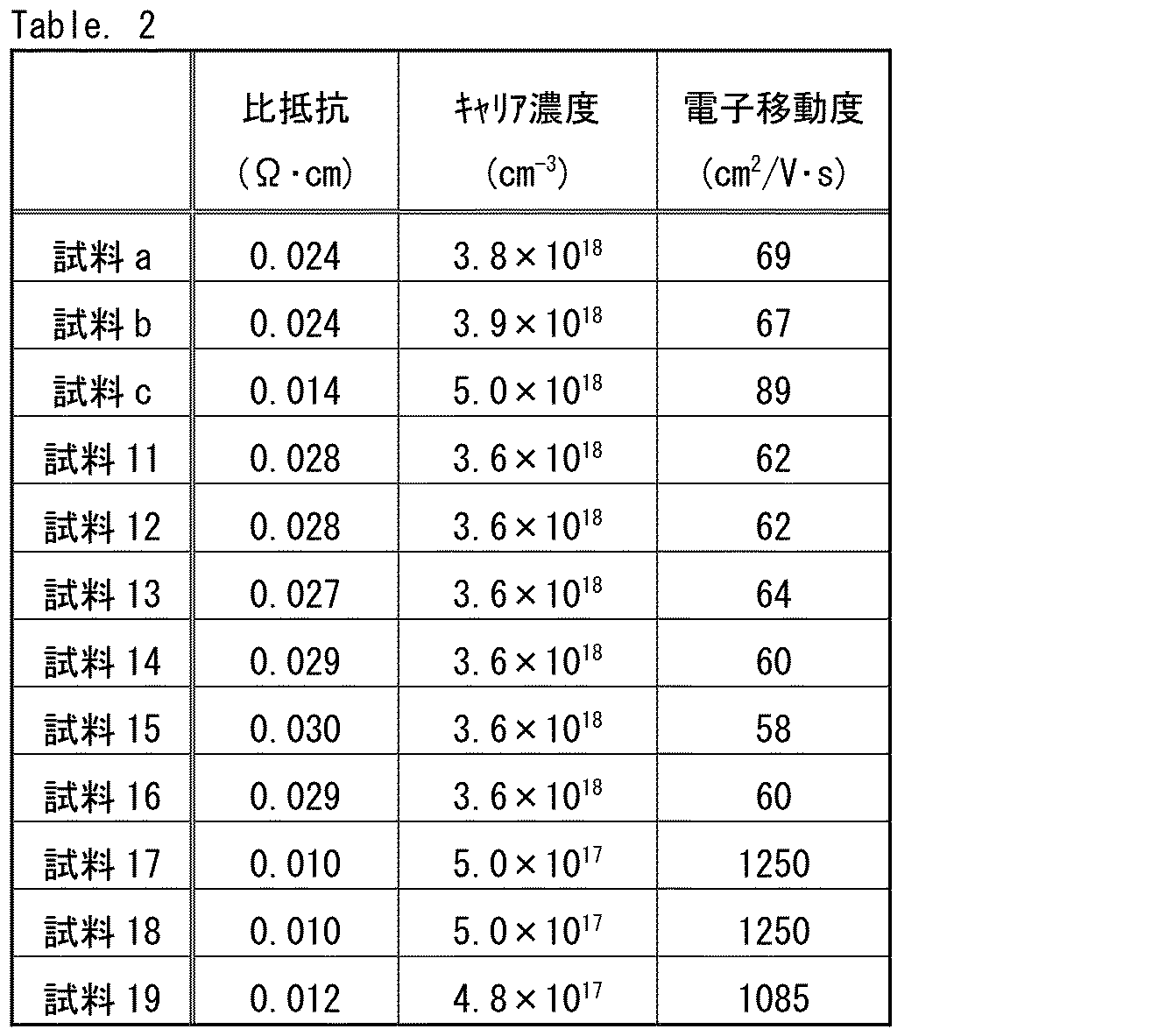
表1および表2によれば、試料11~試料19のGa2O3単結晶基板は、いずれもGDMSにおいてBの濃度が4質量ppm以上200質量ppm以下であった。この場合、ナノインデンテーション硬さは、平均値がいずれも14.8GPa以上22.0GPa以下であって、割れ荷重が90N以上を示した。これに対し試料a~試料cのGa2O3単結晶基板は、いずれもGDMSにおいてBの濃度が4質量ppm未満、または200質量ppmを超えた。この場合、ナノインデンテーション硬さは、平均値が14.8GPa未満、あるいは22.0GPa超となり、割れ荷重が90N未満を示した。したがって、試料11~試料19のGa2O3単結晶基板は、割れの発生が抑制されることが示唆された。
Claims (10)
- 円形状の主表面を有する三酸化二ガリウム単結晶基板であって、
前記三酸化二ガリウム単結晶基板の直径は、100mm以上であり、
前記三酸化二ガリウム単結晶基板の厚みは、600μm以上であり、
前記三酸化二ガリウム単結晶基板は、ホウ素を含み、
前記ホウ素の濃度は、グロー放電質量分析において4質量ppm以上200質量ppm以下である、三酸化二ガリウム単結晶基板。 - 前記ホウ素の濃度は、グロー放電質量分析において5質量ppm以上100質量ppm以下である、請求項1に記載の三酸化二ガリウム単結晶基板。
- 前記主表面は、三酸化二ガリウム単結晶の(001)面であり、
前記主表面は、その中心を含む中心部と、前記中心部を囲む外周部とを有し、
前記外周部は、面取り加工が施された領域であり、
バーコビッチ圧子を用いたナノインデンテーション法に従って、最大荷重を10mNとし、かつ圧痕の一辺と、前記三酸化二ガリウム単結晶の[100]方向を前記主表面に投影した方向との交差角が0°以上10°以下となるように荷重を付与する条件の下で、前記主表面上の5箇所にて測定したナノインデンテーション硬さは、いずれも14.8GPa以上22.0GPa以下であり、
前記主表面の前記中心から、前記中心部と前記外周部との境界までの長さをrとし、前記中心を通り、前記主表面上の互いに直交する2軸をX軸およびY軸とし、かつ前記Y軸を前記三酸化二ガリウム単結晶のb軸とするとき、前記X軸および前記Y軸で規定される前記5箇所の座標(X、Y)は、(0,0)、(r-5,0)、(0,r-5)、(-(r-5),0)、および(0,-(r-5))であり、前記r、ならびに前記座標(X、Y)中のXおよびYの単位はmmである、請求項1または請求項2に記載の三酸化二ガリウム単結晶基板。 - 前記三酸化二ガリウム単結晶基板は、ロジウムおよびイリジウムの両方またはいずれか一方を含み、
前記ロジウムの濃度および前記イリジウムの濃度は、いずれもグロー放電質量分析において0.1質量ppm以下である、請求項1から請求項3のいずれか1項に記載の三酸化二ガリウム単結晶基板。 - Van der Pauw法によるホール測定において25℃にて測定される前記三酸化二ガリウム単結晶基板の比抵抗は、1.0×10⁻³Ω・cm以上2.0Ω・cm以下であり、
Van der Pauw法によるホール測定において25℃にて測定される前記三酸化二ガリウム単結晶基板のキャリア濃度は、4.0×1017cm-3以上1.4×1019cm-3以下であり、
Van der Pauw法によるホール測定において25℃にて測定される前記三酸化二ガリウム単結晶基板の電子移動度は、0.2cm2/V・s以上15000cm2/V・s以下である、請求項1から請求項4のいずれか1項に記載の三酸化二ガリウム単結晶基板。 - 三酸化二ガリウム単結晶の製造方法であって、
前記製造方法は、大気雰囲気下で実行され、かつ
円筒状の坩堝と、前記坩堝の外周を包囲するように配置される加熱装置とを少なくとも備える単結晶成長装置を準備する工程と、
前記坩堝の底部に前記三酸化二ガリウム単結晶からなる種結晶を収容し、かつ前記坩堝内の前記種結晶よりも上部に塊状または粉末状の三酸化二ガリウム多結晶、n型ドーパント、および酸化ホウ素を収容する工程と、
前記加熱装置で前記坩堝を加熱することにより、前記種結晶の一部を融解し、かつ前記種結晶の一部および前記三酸化二ガリウム多結晶に由来する三酸化二ガリウムが第1濃度で、前記n型ドーパントが第2濃度でそれぞれ前記酸化ホウ素に溶解した溶液を得るとともに、前記溶液と前記種結晶の残部とを接触させる工程と、
前記溶液から前記種結晶の残部上に結晶を成長させることにより三酸化二ガリウム単結晶を得る工程とを含み、
前記坩堝は、白金からなり、
前記三酸化二ガリウム単結晶におけるホウ素の濃度は、グロー放電質量分析において4質量ppm以上200質量ppm以下である、三酸化二ガリウム単結晶の製造方法。 - 三酸化二ガリウム単結晶の製造方法であって、
前記製造方法は、窒素雰囲気下で実行され、かつ
円筒状の坩堝と、前記坩堝の外周を包囲するように配置される加熱装置とを少なくとも備える単結晶成長装置を準備する工程と、
前記坩堝の底部に前記三酸化二ガリウム単結晶からなる種結晶を収容し、かつ前記坩堝内の前記種結晶よりも上部に塊状または粉末状の三酸化二ガリウム多結晶、n型ドーパント、および酸化ホウ素を収容する工程と、
前記加熱装置で前記坩堝を加熱することにより、前記種結晶の一部を融解し、かつ前記種結晶の一部および前記三酸化二ガリウム多結晶に由来する三酸化二ガリウムが第1濃度で、前記n型ドーパントが第2濃度でそれぞれ前記酸化ホウ素に溶解した溶液を得るとともに、前記溶液と前記種結晶の残部とを接触させる工程と、
前記溶液から前記種結晶の残部上に結晶を成長させることにより三酸化二ガリウム単結晶を得る工程とを含み、
前記坩堝は、熱分解窒化ホウ素からなり、
前記三酸化二ガリウム単結晶におけるホウ素の濃度は、グロー放電質量分析において4質量ppm以上200質量ppm以下である、三酸化二ガリウム単結晶の製造方法。 - 前記単結晶成長装置は、前記坩堝内に前記三酸化二ガリウム多結晶および前記n型ドーパントを投入するためのノズル、および前記坩堝を密閉するための蓋体を有し、
前記蓋体は、前記ノズルが挿入される穴を有し、
前記三酸化二ガリウム単結晶を得る工程は、
前記ノズルを通じて前記蓋体により密閉された前記坩堝中の前記溶液をサンプリングすることにより、前記溶液中の前記種結晶の一部および前記三酸化二ガリウム多結晶に由来する三酸化二ガリウム、ならびに前記n型ドーパントの濃度を分析する工程と、
前記三酸化二ガリウムの濃度に関する分析結果に応じ、前記第1濃度に対しプラスマイナス5%以内の濃度となるように、前記ノズルを通じて前記坩堝中の前記溶液に前記三酸化二ガリウム多結晶を投入する工程と、
前記n型ドーパントの濃度に関する分析結果に応じ、前記第2濃度に対しプラスマイナス5%以内の濃度となるように、前記ノズルを通じて前記坩堝中の前記溶液に前記n型ドーパントを投入する工程とを含む、請求項6または請求項7に記載の三酸化二ガリウム単結晶の製造方法。 - 請求項6から請求項8のいずれか1項に記載の三酸化二ガリウム単結晶の製造方法により得た前記三酸化二ガリウム単結晶を加工することにより、円形状の主表面を有する三酸化二ガリウム単結晶基板を得る工程を含む、三酸化二ガリウム単結晶基板の製造方法。
- 前記主表面は、三酸化二ガリウム単結晶の(001)面であり、
前記主表面は、その中心を含む中心部と、前記中心部を囲む外周部とを有し、
前記外周部は、面取り加工が施された領域であり、
バーコビッチ圧子を用いたナノインデンテーション法に従って、最大荷重を10mNとし、かつ圧痕の一辺と、前記三酸化二ガリウム単結晶の[100]方向を前記主表面に投影した方向との交差角が0°以上10°以下となるように荷重を付与する条件の下で、前記主表面上の5箇所にて測定したナノインデンテーション硬さは、いずれも14.8GPa以上22.0GPa以下であり、
前記主表面の前記中心から、前記中心部と前記外周部との境界までの長さをrとし、前記中心を通り、前記主表面上の互いに直交する2軸をX軸およびY軸とし、かつ前記Y軸を前記三酸化二ガリウム単結晶のb軸とするとき、前記X軸および前記Y軸で規定される前記5箇所の座標(X、Y)は、(0,0)、(r-5,0)、(0,r-5)、(-(r-5),0)、および(0,-(r-5))であり、前記r、ならびに前記座標(X、Y)中のXおよびYの単位はmmであり、
前記三酸化二ガリウム単結晶基板は、ロジウムおよびイリジウムの両方またはいずれか一方を含み、
前記ロジウムの濃度および前記イリジウムの濃度は、いずれもグロー放電質量分析において0.1質量ppm以下であり、
Van der Pauw法によるホール測定において25℃にて測定される前記三酸化二ガリウム単結晶基板の比抵抗は、1.0×10⁻³Ω・cm以上2.0Ω・cm以下であり、
Van der Pauw法によるホール測定において25℃にて測定される前記三酸化二ガリウム単結晶基板のキャリア濃度は、4.0×1017cm-3以上1.4×1019cm-3以下であり、
Van der Pauw法によるホール測定において25℃にて測定される前記三酸化二ガリウム単結晶基板の電子移動度は、0.2cm2/V・s以上15000cm2/V・s以下である、請求項2に記載の三酸化二ガリウム単結晶基板。
Priority Applications (5)
| Application Number | Priority Date | Filing Date | Title |
|---|---|---|---|
| PCT/JP2023/021097 WO2024252542A1 (ja) | 2023-06-07 | 2023-06-07 | 三酸化二ガリウム単結晶基板、三酸化二ガリウム単結晶の製造方法、および三酸化二ガリウム単結晶基板の製造方法 |
| CN202380098293.9A CN121241171A (zh) | 2023-06-07 | 2023-06-07 | 三氧化二镓单晶衬底、三氧化二镓单晶的制造方法以及三氧化二镓单晶衬底的制造方法 |
| JP2025525510A JPWO2024252542A1 (ja) | 2023-06-07 | 2023-06-07 | |
| EP23940647.3A EP4726083A4 (en) | 2023-06-07 | 2023-06-07 | Monocrystalline substrate of digallium trioxide, process for producing a monocrystalline digallium trioxide, and process for producing a monocrystalline substrate of digallium trioxide |
| TW113115479A TW202449241A (zh) | 2023-06-07 | 2024-04-25 | 三氧化二鎵單晶基板、三氧化二鎵單晶之製造方法及三氧化二鎵單晶基板之製造方法 |
Applications Claiming Priority (1)
| Application Number | Priority Date | Filing Date | Title |
|---|---|---|---|
| PCT/JP2023/021097 WO2024252542A1 (ja) | 2023-06-07 | 2023-06-07 | 三酸化二ガリウム単結晶基板、三酸化二ガリウム単結晶の製造方法、および三酸化二ガリウム単結晶基板の製造方法 |
Publications (1)
| Publication Number | Publication Date |
|---|---|
| WO2024252542A1 true WO2024252542A1 (ja) | 2024-12-12 |
Family
ID=93795550
Family Applications (1)
| Application Number | Title | Priority Date | Filing Date |
|---|---|---|---|
| PCT/JP2023/021097 Ceased WO2024252542A1 (ja) | 2023-06-07 | 2023-06-07 | 三酸化二ガリウム単結晶基板、三酸化二ガリウム単結晶の製造方法、および三酸化二ガリウム単結晶基板の製造方法 |
Country Status (5)
| Country | Link |
|---|---|
| EP (1) | EP4726083A4 (ja) |
| JP (1) | JPWO2024252542A1 (ja) |
| CN (1) | CN121241171A (ja) |
| TW (1) | TW202449241A (ja) |
| WO (1) | WO2024252542A1 (ja) |
Cited By (1)
| Publication number | Priority date | Publication date | Assignee | Title |
|---|---|---|---|---|
| WO2025263085A1 (ja) * | 2024-06-17 | 2025-12-26 | 住友電気工業株式会社 | ベータ型三酸化二ガリウム単結晶の製造方法、ベータ型三酸化二ガリウム単結晶基板の製造方法、およびベータ型三酸化二ガリウム単結晶基板 |
Citations (10)
| Publication number | Priority date | Publication date | Assignee | Title |
|---|---|---|---|---|
| JP2001142039A (ja) * | 1998-12-18 | 2001-05-25 | Tokin Corp | 硬磁性ガーネット厚膜材料およびその製造方法 |
| JP2004182547A (ja) * | 2002-12-04 | 2004-07-02 | National Institute For Materials Science | 酸化ガリウムナノワイヤーとその製造方法 |
| JP2016079080A (ja) | 2014-10-21 | 2016-05-16 | 国立大学法人信州大学 | β−Ga2O3結晶の製造方法及び製造装置並びにるつぼ容器 |
| JP2017193466A (ja) | 2016-04-21 | 2017-10-26 | 国立大学法人信州大学 | 酸化ガリウム結晶の製造装置および酸化ガリウム結晶の製造方法 |
| JP2019075508A (ja) * | 2017-10-18 | 2019-05-16 | 矢崎総業株式会社 | 半導体装置および半導体ウェーハ |
| JP2020011899A (ja) | 2019-10-24 | 2020-01-23 | 不二越機械工業株式会社 | β−Ga2O3単結晶製造装置およびこれに用いる発熱体 |
| JP2020505305A (ja) * | 2017-01-25 | 2020-02-20 | 中国科学院上海光学精密机械研究所 | ドープされた酸化ガリウム結晶材料、その製造方法及び使用 |
| JP2020059633A (ja) | 2018-10-11 | 2020-04-16 | 国立大学法人信州大学 | 酸化ガリウム結晶の製造装置及び酸化ガリウム結晶の製造方法並びにこれらに用いる酸化ガリウム結晶育成用のるつぼ |
| JP2020105069A (ja) | 2020-02-28 | 2020-07-09 | 国立大学法人信州大学 | 酸化ガリウム結晶の製造装置および酸化ガリウム結晶の製造方法 |
| WO2021229356A1 (en) * | 2020-05-11 | 2021-11-18 | Silanna UV Technologies Pte Ltd | Metal oxide semiconductor-based light emitting device |
Family Cites Families (1)
| Publication number | Priority date | Publication date | Assignee | Title |
|---|---|---|---|---|
| JP5794955B2 (ja) * | 2012-07-11 | 2015-10-14 | 信越化学工業株式会社 | β−Ga2O3単結晶膜付基板の製造方法 |
-
2023
- 2023-06-07 WO PCT/JP2023/021097 patent/WO2024252542A1/ja not_active Ceased
- 2023-06-07 EP EP23940647.3A patent/EP4726083A4/en active Pending
- 2023-06-07 JP JP2025525510A patent/JPWO2024252542A1/ja active Pending
- 2023-06-07 CN CN202380098293.9A patent/CN121241171A/zh active Pending
-
2024
- 2024-04-25 TW TW113115479A patent/TW202449241A/zh unknown
Patent Citations (10)
| Publication number | Priority date | Publication date | Assignee | Title |
|---|---|---|---|---|
| JP2001142039A (ja) * | 1998-12-18 | 2001-05-25 | Tokin Corp | 硬磁性ガーネット厚膜材料およびその製造方法 |
| JP2004182547A (ja) * | 2002-12-04 | 2004-07-02 | National Institute For Materials Science | 酸化ガリウムナノワイヤーとその製造方法 |
| JP2016079080A (ja) | 2014-10-21 | 2016-05-16 | 国立大学法人信州大学 | β−Ga2O3結晶の製造方法及び製造装置並びにるつぼ容器 |
| JP2017193466A (ja) | 2016-04-21 | 2017-10-26 | 国立大学法人信州大学 | 酸化ガリウム結晶の製造装置および酸化ガリウム結晶の製造方法 |
| JP2020505305A (ja) * | 2017-01-25 | 2020-02-20 | 中国科学院上海光学精密机械研究所 | ドープされた酸化ガリウム結晶材料、その製造方法及び使用 |
| JP2019075508A (ja) * | 2017-10-18 | 2019-05-16 | 矢崎総業株式会社 | 半導体装置および半導体ウェーハ |
| JP2020059633A (ja) | 2018-10-11 | 2020-04-16 | 国立大学法人信州大学 | 酸化ガリウム結晶の製造装置及び酸化ガリウム結晶の製造方法並びにこれらに用いる酸化ガリウム結晶育成用のるつぼ |
| JP2020011899A (ja) | 2019-10-24 | 2020-01-23 | 不二越機械工業株式会社 | β−Ga2O3単結晶製造装置およびこれに用いる発熱体 |
| JP2020105069A (ja) | 2020-02-28 | 2020-07-09 | 国立大学法人信州大学 | 酸化ガリウム結晶の製造装置および酸化ガリウム結晶の製造方法 |
| WO2021229356A1 (en) * | 2020-05-11 | 2021-11-18 | Silanna UV Technologies Pte Ltd | Metal oxide semiconductor-based light emitting device |
Non-Patent Citations (3)
| Title |
|---|
| D. SAJUTI ET AL., MATER. TRANS., JIM, vol. 34, 1993, pages 1195 - 1199 |
| NIKENYA RYO, METHOD FOR EVALUATING MECHANICAL PROPERTY USING NANOINDENTER, BUNSEKI, vol. 561, 2021, pages 457 - 461 |
| See also references of EP4726083A4 |
Cited By (1)
| Publication number | Priority date | Publication date | Assignee | Title |
|---|---|---|---|---|
| WO2025263085A1 (ja) * | 2024-06-17 | 2025-12-26 | 住友電気工業株式会社 | ベータ型三酸化二ガリウム単結晶の製造方法、ベータ型三酸化二ガリウム単結晶基板の製造方法、およびベータ型三酸化二ガリウム単結晶基板 |
Also Published As
| Publication number | Publication date |
|---|---|
| TW202449241A (zh) | 2024-12-16 |
| EP4726083A4 (en) | 2026-08-12 |
| JPWO2024252542A1 (ja) | 2024-12-12 |
| CN121241171A (zh) | 2025-12-30 |
| EP4726083A1 (en) | 2026-04-15 |
Similar Documents
| Publication | Publication Date | Title |
|---|---|---|
| TWI664324B (zh) | Ga<sub>2</sub>O<sub>3</sub>系單晶基板 | |
| CN113423876B (zh) | 砷化镓单晶基板 | |
| WO2016027416A1 (ja) | 多結晶シリコン棒の製造方法および多結晶シリコン棒 | |
| WO2021025086A1 (ja) | SiC基板の製造方法 | |
| EP2995704A2 (en) | Sic single crystal and method for producing same | |
| TW202449241A (zh) | 三氧化二鎵單晶基板、三氧化二鎵單晶之製造方法及三氧化二鎵單晶基板之製造方法 | |
| US8547121B2 (en) | Quality control process for UMG-SI feedstock | |
| EP3243936B1 (en) | Method for producing a sic single crystal | |
| EP4692429A1 (en) | Digallium trioxide single crystal substrate, method for producing digallium trioxide single crystal, and method for producing digallium trioxide single crystal substrate | |
| WO2024252544A1 (ja) | 坩堝、それを用いたベータ型三酸化二ガリウム単結晶基板の製造方法、およびベータ型三酸化二ガリウム単結晶基板 | |
| JPWO2024252542A5 (ja) | ||
| TW202603234A (zh) | β型三氧化二鎵單晶基板、β型三氧化二鎵單晶之製造方法、及β型三氧化二鎵單晶基板之製造方法 | |
| WO2025263085A1 (ja) | ベータ型三酸化二ガリウム単結晶の製造方法、ベータ型三酸化二ガリウム単結晶基板の製造方法、およびベータ型三酸化二ガリウム単結晶基板 | |
| JP2024050122A (ja) | 単結晶の育成方法、半導体基板の製造方法、及び半導体基板 | |
| EP4667627A1 (en) | Beta-digallium trioxide single crystal substrate, method for manufacturing beta-digallium trioxide single crystal, and method for manufacturing beta-digallium trioxide single crystal substrate | |
| WO2026013718A1 (ja) | ベータ型三酸化二ガリウム単結晶基板、ベータ型三酸化二ガリウム単結晶の製造方法、およびベータ型三酸化二ガリウム単結晶基板の製造方法 | |
| US20260132546A1 (en) | Gallium arsenide single crystal substrate and method of producing same | |
| JP4345585B2 (ja) | シリコン単結晶の製造方法、およびこれに用いる覗き窓ガラス、結晶観察用窓ガラス、シリコン単結晶製造装置 | |
| JP7768464B2 (ja) | ヒ化ガリウム単結晶の製造方法、ヒ化ガリウム単結晶基板の製造方法、ヒ化ガリウム単結晶基板、およびヒ化ガリウム単結晶 | |
| JP2003347608A (ja) | 熱電素子用結晶体及びその製造方法並びに熱電素子の製造方法 | |
| CN111560648B (zh) | ScAlMgO4单晶基板及其制造方法 | |
| WO2025126448A1 (ja) | リン化インジウム単結晶基板、リン化インジウム単結晶、およびリン化インジウム単結晶の製造方法 | |
| WO2025126447A1 (ja) | リン化インジウム単結晶基板、リン化インジウム単結晶、およびリン化インジウム単結晶の製造方法 | |
| JP3969319B2 (ja) | 燐化物単結晶ウェーハの評価方法 | |
| Kozhemyakin et al. | Growth of Ga x In1− x Sb solid solution single crystals by the Czochralski method |
Legal Events
| Date | Code | Title | Description |
|---|---|---|---|
| 121 | Ep: the epo has been informed by wipo that ep was designated in this application |
Ref document number: 23940647 Country of ref document: EP Kind code of ref document: A1 |
|
| ENP | Entry into the national phase |
Ref document number: 2025525510 Country of ref document: JP Kind code of ref document: A |
|
| WWE | Wipo information: entry into national phase |
Ref document number: 2025525510 Country of ref document: JP |
|
| WWE | Wipo information: entry into national phase |
Ref document number: 2023940647 Country of ref document: EP |
|
| NENP | Non-entry into the national phase |
Ref country code: DE |
|
| ENP | Entry into the national phase |
Ref document number: 2023940647 Country of ref document: EP Effective date: 20260107 |
|
| ENP | Entry into the national phase |
Ref document number: 2023940647 Country of ref document: EP Effective date: 20260107 |
|
| ENP | Entry into the national phase |
Ref document number: 2023940647 Country of ref document: EP Effective date: 20260107 |
|
| ENP | Entry into the national phase |
Ref document number: 2023940647 Country of ref document: EP Effective date: 20260107 |
|
| ENP | Entry into the national phase |
Ref document number: 2023940647 Country of ref document: EP Effective date: 20260107 |
|
| WWP | Wipo information: published in national office |
Ref document number: 2023940647 Country of ref document: EP |