WO2024252673A1 - Dispositif de commande et procédé de commande - Google Patents
Dispositif de commande et procédé de commande Download PDFInfo
- Publication number
- WO2024252673A1 WO2024252673A1 PCT/JP2023/021560 JP2023021560W WO2024252673A1 WO 2024252673 A1 WO2024252673 A1 WO 2024252673A1 JP 2023021560 W JP2023021560 W JP 2023021560W WO 2024252673 A1 WO2024252673 A1 WO 2024252673A1
- Authority
- WO
- WIPO (PCT)
- Prior art keywords
- learning
- control device
- operation plan
- input
- information
- Prior art date
- Legal status (The legal status is an assumption and is not a legal conclusion. Google has not performed a legal analysis and makes no representation as to the accuracy of the status listed.)
- Ceased
Links
Images










Classifications
-
- G—PHYSICS
- G05—CONTROLLING; REGULATING
- G05B—CONTROL OR REGULATING SYSTEMS IN GENERAL; FUNCTIONAL ELEMENTS OF SUCH SYSTEMS; MONITORING OR TESTING ARRANGEMENTS FOR SUCH SYSTEMS OR ELEMENTS
- G05B23/00—Testing or monitoring of control systems or parts thereof
- G05B23/02—Electric testing or monitoring
Definitions
- Patent Publication No. 6885497 discloses an air conditioning management system for controlling air conditioners.
- the purpose of this air conditioning management system is to appropriately balance energy conservation in controlling air conditioners with the comfort of the air conditioner's users.
- the trained model is used to generate operation settings for the air conditioners.
- the air conditioning management system then proposes the generated operation settings to the manager of the air conditioners.
- the manager inputs into the air conditioning management system whether or not the proposed operation settings will be changed. For example, when the manager inputs that the operation settings will be changed, the air conditioning management system updates the trained model based on that input.
- the administrator had to input whether or not the operation settings had been changed. Therefore, in conventional air conditioning management systems, the administrator may have to bear a burden. To reduce this burden, it is possible to configure the system so that the administrator does not have to input whether or not the operation settings have been changed, but this can lead to a problem in that the trained model may be trained according to a policy that goes against the administrator's intentions.
- the present disclosure has been made to solve the above-mentioned problems, and its purpose is to learn an operating model that reflects the intentions of the administrator of the target device while reducing the burden on the administrator.
- the control device of the present disclosure includes a memory that stores an operation model related to the operation of the target equipment and a learning policy for the operation model, and a calculation device.
- the calculation device generates a first operation plan for the target equipment using the operation model.
- the calculation device notifies a user of the first operation plan and allows the user to input input information related to the first operation plan. Then, in a permissible state in which input of input information is permitted, if the input information is not input, the calculation device learns the operation model based on the learning policy.
- the control method disclosed herein comprises generating a first operation plan for a target device using an operation model related to the operation of the target device.
- the control method also comprises notifying a user of the first operation plan.
- the control method also comprises allowing a user to input input information related to the first operation plan. And, in an allowable state in which input of input information is allowed, if the input information is not input, the control method comprises learning an operation model based on a learning policy previously set by the user.
- an operating model can be learned that reflects the intentions of the administrator of the target device while reducing the burden on the administrator.
- FIG. 1 shows an example of a configuration of a management system according to first to third embodiments.
- FIG. 2 is a block diagram showing an example of a hardware configuration of a control device.
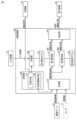
- FIG. 2 is a functional block diagram of a control device.
- FIG. 2 is a diagram showing an example of a first operation plan.
- FIG. 11 is a diagram showing an example of a second operation plan.
- FIG. 2 is a diagram illustrating an example of an integrated operation plan.
- 13 is an example of an input screen. 4 is a flowchart showing a process flow of the control device.
- FIG. 11 is a diagram showing an example of a first operation plan according to the second embodiment. 13 shows an example of a second operation plan according to the second embodiment.
- FIG. 11 is a diagram showing an example of an integrated operation plan according to the second embodiment.
- 13 is an example of an input screen according to the second embodiment;
- FIG. 13 is a diagram showing an example of a first operation plan according to the third embodiment.
- FIG. 13 is a diagram showing an example of a second operation plan according to the third embodiment.
- FIG. 13 is a diagram showing an example of an integrated operation plan according to the third embodiment. 13 illustrates an example of a configuration of a management system 500A according to a fourth embodiment.
- Embodiment 1 shows an example of the configuration of a management system 500 according to a first embodiment.
- the management system 500 includes a PC (Personal Computer) 20, an environmental server 30, a control device 100, and N air conditioners 10, where N is an integer equal to or greater than 1. These devices are configured to be able to communicate with each other via a network NW.
- PC Personal Computer
- N Air conditioner
- the PC 20 is also referred to as an "information processing device” and is a terminal operated by an administrator A who manages N air conditioners 10.
- the administrator A is also referred to as a "first user,” and the user of the air conditioner 10 is also referred to as a "second user.”
- the administrator A and the first user correspond to "users” in this disclosure.
- the air conditioners 10 are an example of "facility equipment” in this disclosure.
- the PC 20 includes a display device 25 and an input device 27.
- the display device 25 is, for example, a liquid crystal display (LCD) panel, and displays information to the administrator A.
- the input device 27 is, for example, a keyboard or a pointing device such as a mouse, and accepts commands from the user. When a touch panel is used as the user interface, the display device 25 and the input device 27 are integrally formed.
- the environmental server 30 outputs environmental information for each air conditioner 10.
- the environmental information is, for example, information indicating the environment of the air conditioner 10 for a certain period of time.
- the environmental information includes, for example, the outside air temperature of the facility in which the air conditioner 10 is installed.
- the certain period is, for example, one day.
- the environmental information may also include at least one of the following: weather, humidity, and a predicted value of the temperature (indoor temperature) in the room in which the air conditioner 10 is installed.
- the environmental information from the environmental server 30 is output to the control device 100.
- the control device 100 controls the N air conditioners 10.
- the control device 100 also generates appropriate operation plans for each of the N air conditioners 10 and notifies the manager A of the operation plans.
- the operation plan is, for example, information indicating a plan for operation of the air conditioners 10 from a start timing (e.g., 7:00 a.m.) described below until a first predetermined period (e.g., one day) has elapsed.
- the operation plan is a plan related to fluctuations in the set temperature of the air conditioners 10 (see Figures 4 and 5).
- the operation plan also includes a first operation plan and a second operation plan, as described below. Notification of the operation plan in this embodiment is performed by displaying an image related to the operation plan on the display device 25.
- the manager A can visually confirm the operation plan displayed on the display device 25.
- the control device 100 has an arithmetic unit 101, a memory 102, and an interface 103.
- the arithmetic unit 101 executes various processes and calculations. Each component is connected to each other via a data bus.
- the memory 102 includes a ROM (Read Only Memory) and a RAM (Random Access Memory), etc.
- the arithmetic unit 101 is also called a "processor” or a "control circuit.”
- the ROM stores the programs executed by the computing device 101.
- the RAM temporarily stores data generated by the execution of the programs in the computing device 101.
- the RAM can function as a temporary data memory used as a working area.
- the interface 103 is configured to communicate with devices external to the control device 100 (such as N air conditioners 10, an environmental server 30, and a PC 20).
- devices external to the control device 100 such as N air conditioners 10, an environmental server 30, and a PC 20.
- the N air conditioners 10 each include an outdoor unit 11, an indoor unit 13, and a sensor 16.
- the outdoor unit 11 includes a compressor 15 that compresses a refrigerant.
- the sensor 16 will be described in the third embodiment below.
- the air conditioners 10 and the outdoor unit 11 feedback control the compressor 15 so that the indoor temperature becomes the set temperature.
- the set temperature is set, for example, by an administrator or the like using a stored operation plan 132, which will be described later.
- FIG. 2 is a block diagram showing an example of a hardware configuration of the control device 100.
- the arithmetic device 101 is an arithmetic entity that executes various processes such as estimation processing and learning processing of estimation models (a first estimation model 121 and a second estimation model 122 described later) by executing various programs, and is an example of a computer.
- the arithmetic device 101 is composed of a CPU (Central Processing Unit), an FPGA (Field-Programmable Gate Array), a GPU (Graphics Processing Unit), and the like.
- the arithmetic device 101 may be composed of at least one of the CPU, the FPGA, and the GPU.
- the arithmetic device 101 may also be composed of a CPU and an FPGA, an FPGA and a GPU, a CPU and a GPU, or all of the CPU, the FPGA, and the GPU.
- the arithmetic device 101 may also be composed of a processing circuitry.
- Memory 102 includes a volatile storage area (e.g., a working area) that temporarily stores program code, work memory, etc. when the computing device 101 executes any program.
- memory 102 is composed of a volatile memory device such as DRAM (Dynamic Random Access Memory) or SRAM (Static Random Access Memory).
- memory 102 includes a non-volatile storage area.
- memory 102 is composed of a non-volatile memory device such as a hard disk or SSD (Solid State Drive).
- the memory 102 stores a first estimation model 121, a second estimation model 122, a learning policy 131, and a stored operation plan 132.
- the first estimation model 121 corresponds to the "operation model" of this disclosure.
- the first estimation model 121 and the second estimation model 122 are operation models related to the operation of the air conditioner 10.
- the first estimation model 121 and the second estimation model 122 are collectively referred to as the "estimation model.”
- the estimation model includes a neural network and parameters used in processing in the neural network.
- the estimation model includes at least a program capable of machine learning, and is optimized (adjusted) by performing machine learning. Learning the estimation model involves, for example, updating parameters. The learning of the estimation model will be described later.
- the learning policy 131 is a policy that indicates learning of the first estimation model 121.
- the learning policy 131 includes a first learning policy and a second learning policy.
- the first learning policy is a policy (emphasis on comfort) that learns the first estimation model 121 so as to improve the comfort of the user (second user) of the air conditioner 10. Improving the comfort of the user (second user) of the air conditioner 10 means, for example, performing an operation such that the set temperature of the air conditioner 10 is maintained at the room temperature. In this way, in the first learning policy, the energy consumption of the air conditioner 10 may increase, but the comfort of the second user of the air conditioner 10 may be improved.
- the second learning policy is a policy (emphasis on reducing energy consumption) for learning the first estimation model 121 so as to reduce the energy consumption (power consumption) of the air conditioner 10. In this way, with the second learning policy, the comfort of the second user is not significantly improved, but the energy consumption of the air conditioner 10 can be reduced.
- the administrator sets either the first learning policy or the second learning policy as the learning policy 131 using the PC 20.
- the administrator A sets the learning policy 131, for example, before starting the management system 500.
- information indicating the learning policy is output to the control device 100 and stored in the memory 102 of the control device 100. Therefore, the administrator A can set the learning policy 131 that reflects the administrator A's own intentions (preferences).
- the stored operation plan 132 is information indicating the operation plan of the air conditioner 10, and is a plan that is set in advance by the administrator.
- the stored operation plan 132 includes, for example, a combination of a time period and a set temperature for that time period.
- the stored operation plan 132 may also include an upper limit value for the operating frequency of the compressor 15.
- the administrator A sets the operation plan for each air conditioner 10 using the PC 20.
- the set operation plan is then set in the memory 102 as the stored operation plan 132. Therefore, the administrator A can set an operation plan that reflects the administrator A's own intentions (preferences).
- the stored operation plan 132 is described for a case in which the set temperature throughout the day is set to 25 degrees.
- the interface 103 communicates with external devices via the network NW.
- the programs stored in the ROM may be stored on a recording medium and distributed as a program product.
- the recording medium is a non-transitory medium from which a computer can read programs and the like.
- the programs may also be provided by information providers as program products that can be downloaded via the Internet, etc.
- [Functional block diagram of the control device] 3 is a functional block diagram of the control device 100.
- the control device 100 includes a prediction unit 110, a first estimation unit 111, a second estimation unit 112, an integration unit 104, a learning unit 106, and a storage unit 108.
- the control device 100 At a predetermined start timing (for example, 7:00 a.m.), the control device 100 generates an operation plan for each of the N air conditioners 10. The control device 100 then displays the operation plan on the display device 25 of the PC 20. In this embodiment, the control device 100 uses AI (Artificial Intelligence) to generate an operation plan for each of the N air conditioners 10.
- AI Artificial Intelligence
- the prediction unit 110 acquires environmental information from the environmental server 30.
- the environmental information is the above-mentioned outside air temperature, etc.
- the environmental information is input to the prediction unit 110.
- the prediction unit 110 acquires the stored operation plan 132 from the memory unit 108.
- the prediction unit 110 predicts the change in the operating frequency of the compressor 15 of the air conditioner 10 based on the environmental information and the stored operation plan 132.
- the change in the operating frequency is, for example, the change in the first predetermined period (for example, one day). Furthermore, the prediction of the change in the operating frequency may be performed using AI or may be performed by other methods.
- the operating frequency predicted by the prediction unit 110 is input to the first estimation unit 111 and the second estimation unit 112.
- the first estimation unit 111 generates (estimates) a first operating plan (see FIG. 4 described below) based on the operating frequency and the first estimation model 121.
- Data related to the estimated first operating plan is output to the integration unit 104.
- the integration unit 104 generates image data related to the integrated operation plan (see FIG. 6 described later) by integrating the data related to the first operation plan and the data related to the second operation plan.
- the integration unit 104 outputs the generated image data to the display device 25 of the PC 20.
- the display device 25 displays an image related to the integrated operation plan.
- the learning unit 106 learns the first estimation model 121 based on the learning policy 131 stored in the storage unit 108. An example of learning by the learning unit 106 will be described below.
- the learning unit 106 performs reinforcement learning using, for example, a deep Q-network (DQN) or the like, with a value determined based on the first index and the second index as a reward.
- the first index is an index corresponding to the first learning policy.
- the learning unit 106 increases the first index.
- the second index is an index corresponding to the second learning policy.
- the learning unit 106 increases the second index.
- the learning unit 106 may determine the first coefficient and the second coefficient based on the learning policy and input information described below, and perform reinforcement learning using a value determined based on the value obtained by multiplying the value of the first index by the first coefficient and the value obtained by multiplying the value of the second index by the second coefficient as a reward.
- the learning unit 106 sets the value of the first coefficient to "1.1" and the value of the second coefficient to "0.9".
- the learning unit 106 sets the value of the first coefficient to "0.9” and the value of the second coefficient to "1.1".
- the learning unit 106 typically performs unsupervised learning.
- the control device 100 can execute operation based on the learning policy on the air conditioner 10 by transmitting an operation signal to the air conditioner 10. For example, if the learning policy 131 is the first learning policy, the air conditioner 10 operates based on the first learning policy, that is, operates in a way that increases the comfort of the second user. Also, if the learning policy 131 is the second learning policy, the air conditioner 10 operates based on the second learning policy, that is, operates in a way that reduces the energy consumption of the air conditioner 10.
- the permissive state is a state in which the user is permitted to input information related to the integrated operation plan (first operation plan).
- the administrator can input input information from the input device 27. The input information will be described later.
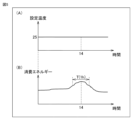
- Figures 4(A) and 4(B) are diagrams for explaining the first operation plan.
- Figures 5(A) and 5(B) are diagrams for explaining the second operation plan.
- Figures 4 and 5 are, for example, operation plans for the above-mentioned first predetermined period (one day) from the above-mentioned start timing (7:00 a.m.).
- Figures 4 and 5 the horizontal axis indicates time, and the vertical axis indicates the set temperature.
- Figures 4 (A) and 5 (A) are information showing the change in the set temperature of the air conditioner 10 over time.
- Figures 4 (B) and 5 (B) are information showing the change in the energy consumption of the air conditioner 10 over time.
- the second operation plan will be described with reference to FIG. 5.
- the stored operation plan 132 sets the set temperature to 25 degrees throughout the day. Therefore, as shown in FIG. 5(A), the set temperature in the second operation plan is maintained at 25 degrees.
- the information shown in FIG. 5(A) corresponds to the stored operation plan 132.
- the prediction unit 110 and the second estimation unit 112 predict the trend in energy consumption in FIG. 5(B) based on the environmental information and the stored operation plan 132.
- FIG. 5(B) it is shown that energy consumption increases in the period around 2 p.m.
- the period during which energy consumption increases is also referred to as the increase period T. It should be noted that the increase period is one hour (1 h).
- the example in FIG. 4 shows the first operation plan generated based on the first estimation model 121 learned with the second learning policy (policy of reducing energy consumption).
- the energy consumption during the increase period T is increased, whereas in FIG. 4(B), the energy consumption during the increase period T is suppressed.
- the set temperature during the increase period T is set to 27 degrees, which is higher than 25 degrees.
- the first operation plan generated based on the first estimation model 121 learned with the first learning policy (policy for improving the comfort of the second user) is not illustrated, but the first operation plan is as follows.
- the energy consumption during the increase period T1 is a value between FIG. 4(B) and FIG. 5(B), and the set temperature during the increase period is 26 degrees.
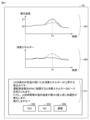
- FIG. 6 is a diagram showing an example of an integrated operation plan displayed on the display device 25.
- set temperature information 251, consumed energy information 252, difference information 201, YES button 202, NO button 203, and adjustment button 204 are shown.
- the set temperature information 251 is information that combines information indicating the change in the set temperature of the first operation plan (see FIG. 4(A)) and information indicating the change in the set temperature of the second operation plan (see FIG. 5(A)). More specifically, the set temperature information 251 is information in which the change in the set temperature of the first operation plan and the change in the set temperature of the second operation plan are superimposed. In the set temperature information 251, the change in the set temperature of the first operation plan is shown by a solid line, and the change in the set temperature of the second operation plan is shown by a dashed line.
- the energy consumption information 252 is information that integrates information showing the trend in energy consumption in the first operation plan (see FIG. 4(B)) and information showing the trend in energy consumption in the second operation plan (see FIG. 5(B)). More specifically, the energy consumption information 252 is information in which the trend in energy consumption in the first operation plan and the trend in energy consumption in the second operation plan are superimposed. In the energy consumption information 252, the trend in energy consumption in the first operation plan is shown by a solid line, and the trend in energy consumption in the second operation plan is shown by a dashed line.
- the difference information 201 is information relating to the difference between the first operation plan in FIG. 4 and the second operation plan in FIG. 5.
- the difference information includes effect information indicating the effect achieved by operating the air conditioner 10 with the first operation plan.
- the difference information 201 is information indicating the wording "The outside temperature is high around 2 p.m., so energy consumption will increase. If you raise the set temperature for that time by 2 degrees, the peak of energy consumption can be suppressed. Do you want to execute this?" In this wording, the effect information included in the difference information 201 is the information that "The peak of energy consumption can be suppressed."
- the integration unit 104 generates the difference information 201 by comparing the first operation plan and the second operation plan.
- the difference information 201 also includes question information that asks the administrator "whether or not to suppress peak energy consumption.” In other words, this question is about which of the first and second learning policies should be used to train the first estimation model 121.
- Manager A visually checks the set temperature information 251 and the energy consumption information 252, and if he/she agrees with the question, he/she operates the YES button 202. On the other hand, if he/she does not agree with the question, he/she operates the NO button 203.
- Operation of the YES button 202 indicates that the administrator inputs input information (see FIG. 3) indicating the second learning policy (a policy to reduce the energy consumption of the air conditioner 10).
- the control device 100 learns that an increase in energy consumption (an increase of the set temperature by 2 degrees) is permitted.
- the learning unit 106 learns the first estimation model 121 to reflect that an increase in energy consumption (an increase of the set temperature by 2 degrees) is permitted.
- pressing the NO button 203 indicates that the administrator is entering input information (see FIG. 3) indicating the first learning policy (a policy to improve the comfort of the second user of the air conditioner 10).
- the input information includes learning information.
- the learning information is information that the learning unit 106 uses to learn the first estimation model 121.
- the learning unit 106 learns the first estimation model 121 based on the learning information included in the input information.
- the learning information also includes information indicating which of the first and second learning policies will be used to learn the first estimation model 121.
- information indicating that the first estimation model 121 will be learned using the second learning policy is input as the learning information.
- NO button 203 information indicating that the first estimation model 121 will be learned using the first learning policy is input as the learning information.
- the administrator If the administrator does not agree with the set temperature information 251 and the energy consumption information 252, for example, the administrator operates the adjustment button 204.
- the adjustment button 204 When the adjustment button 204 is operated, an input screen on which the operating parameters can be input is displayed on the display device 25.
- the input operating parameters are the tolerances for the operation of the air conditioner 10.
- FIG. 7 is an example of an input screen where operating parameters are input.
- the set temperature is disclosed as an example of an operating parameter.
- a text image 205 saying "Please enter the set temperature" and an input area 206 for the set temperature are displayed.
- the administrator inputs a set temperature in the input area 206. For example, if the administrator visually checks the set temperature information 251 in FIG. 6 and feels that a set temperature of 27 degrees is too hot, the administrator inputs a set temperature of 26 degrees. As a result, the learning unit 106 updates the first estimation model 121 so as to propose a first operation plan in which the set temperature is 26 degrees. In this way, the learning unit 106 learns the first estimation model 121 based on the operation parameters input by the administrator. More specifically, the learning unit 106 learns the first estimation model 121 so as to output a first operation plan in which the air conditioner operates based on the input operation parameters. More specifically, the learning unit 106 learns the first estimation model 121 so as to output a first operation plan in which the operation parameters of the air conditioner 10 may be included in the operation parameters indicated by the input tolerance.
- the learning unit 106 learns the first estimation model 121 so as to output a first operating plan in which the set temperature during the increase period tends to be 26 degrees.
- the learning information includes the operating parameters of the air conditioner 10 (the set temperature in this embodiment). Then, when the operating parameters are input by the user, the learning unit 106 learns the first estimation model 121 based on the input set temperature.
- the operating parameters may be within the allowable range for operation of the air conditioner 10.
- the operating parameters input by the administrator may be, for example, the set temperature range.
- the learning unit 106 learns the first estimation model 121 so as to output a first operating plan in which the set temperature during the increase period tends to fall within the set temperature range.
- the operation parameter may also be the setting change period. For example, if the increase period T is "1 hour” and the manager feels that this "1 hour” is short, the manager inputs "2 hours” as the setting change period. When such an operation parameter is input, the learning unit 106 learns the first estimation model 121 so as to output a first operation plan in which the increase period tends to become the setting change period (2 hours).
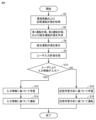
- Fig. 8 is a flowchart showing the flow of processing by the control device 100.
- the control device 100 starts the processing of this flowchart.
- Fig. 3 will also be referred to as appropriate.
- step S2 the control device 100 acquires environmental information from the environmental server 30 and the stored operation plan 132 from the memory unit 108.
- step S4 the control device 100 creates a first operation plan, a second operation plan, and an integrated operation plan (see the explanation in FIG. 3).
- step S6 the control device 100 displays the integrated operation plan on the display device 25 (see FIG. 6).
- step S8 the control device 100 controls the state of the control device 100 (or the PC 20) to a state (permitted state) in which input information is permitted from the user.
- the permissive state in this embodiment is a state in which input (operation) from the administrator is possible by displaying YES button 202 and NO button 203, etc.
- step S10 it is determined whether or not input information has been input by the administrator.
- the control device 100 determines that no input information has been input (NO in step S10).
- the control device 100 determines that input information has been input (YES in step S10).
- step S10 the process proceeds to step S12. If the answer is NO in step S10, the process proceeds to step S16.
- step S12 the control device 100 learns the first estimation model 121 based on the input information (the learning information and the operating parameters described above).
- step S14 the control device 100 operates the air conditioner 10 according to an operating plan (operating plan) based on the input information that has been input.
- the air conditioner 10 is operated according to an operation plan in which the set temperature during the increase period is increased by 2 degrees.
- the control device 100 transmits an operation signal to the air conditioner 10 to execute such an operation.
- step S16 the control device 100 learns the first estimation model 121 based on the learning policy 131 stored in the memory unit 108.
- This learning policy 131 is the first learning policy or the second learning policy described above.
- the control device 100 learns the first estimation model 121 based on the first learning policy.
- the control device 100 learns the first estimation model 121 based on the second learning policy.
- step S16 the control device 100 operates the air conditioner 10 according to an operation plan based on the learning policy 131 stored in the memory unit 108.
- step S12 when the first estimation model 121 is learned based on the input information, the control device 100 may generate the first operation plan again using the learned first estimation model 121. Then, the control device 100 may display the second operation plan, the regenerated first operation plan, and the difference information.
- the control device 100 notifies the user of the first operation plan.
- "notifying the user of the first operation plan” means displaying an image of the solid line portion of the set temperature information 251 in FIG. 6 and an image of the solid line portion of the energy consumption information 252 on the display device 25.
- the control device 100 learns the first estimation model 121 based on the learning policy 131 reflecting the manager's intention. Therefore, the control device 100 can learn the first estimation model 121 (operation model) so as to reflect the intention of the manager of the target device while reducing the burden on the manager.
- the control device 100 since the control device 100 generates the first operation plan using the first estimation model 121, it is possible to generate a first operation plan that reflects the intention of the manager of the target device while reducing the burden on the manager.
- a case will be described in which the control device 100 learns the first estimation model 121 with the first learning policy (a policy that emphasizes comfort) in step S16.
- a first operation plan is generated that reflects at least one of the following: "the increase period T tends to be shorter than one hour” and "the set temperature tends to be lower than 27 degrees.”
- the control device 100 learns the first estimation model 121 with the second learning policy (a policy to reduce energy consumption) in step S16.
- a first operation plan is generated that reflects at least one of the following: "the increase period T tends to be longer than one hour” and "the set temperature tends to be higher than 27 degrees.”
- the control device 100 also stores the stored operation plan 132.
- the control device 100 generates a second operation plan based on the stored operation plan without using the first estimation model 121.
- the control device 100 displays both the first operation plan and the second operation plan (see FIG. 6). That is, the control device 100 displays the first operation plan generated using the first estimation model 121 that reflects the manager's intention, and the second operation plan generated without using the first estimation model 121 (that is, an operation plan that does not reflect the manager's intention). Therefore, the manager can recognize both the first operation plan and the second operation plan.
- the learning of the second estimation model 122 may be any learning that is performed without using user input information.
- control device 100 notifies the administrator of difference information 201 regarding the difference between the first operation plan and the second operation plan (see FIG. 6). Therefore, the administrator can recognize the difference information 201 regarding the difference between the first operation plan and the second operation plan. In particular, in this embodiment, the administrator can recognize the effect of the first operation plan on the second operation plan (in the example of FIG. 6, the peak energy consumption can be reduced).
- step S18 when in the permissive state, if no input information is input (NO in step S10 in FIG. 8), the control device 100 operates the air conditioner 10 based on an operation plan corresponding to the learning policy 131 (step S18). For example, when the image shown in FIG. 6 is displayed on the display device 25, if no input information is input, the air conditioner 10 operates at the set temperature shown by the solid line in FIG. 6. With this configuration, even if no input information is input by the administrator, the air conditioner 10 can be operated with an operation plan that reflects the administrator's intentions (an operation plan corresponding to the learning policy 131).
- the input information also includes information indicating which of the first and second learning policies is to be used to train the first estimation model 121. Therefore, the administrator only needs to select either the first or second learning policy when entering the input information, thereby reducing the administrator's burden of entering information (corresponding to the YES button 202 and NO button 203 in FIG. 6).
- the first learning policy is a policy to learn the first estimation model 121 so as to improve the comfort of the second user of the air conditioner 10 (corresponding to the NO button 203 in FIG. 6).
- the second learning policy is a policy to learn the first estimation model 121 so as to reduce the energy consumption of the air conditioner 10 (corresponding to the YES button 202 in FIG. 6). Therefore, the administrator can select either a learning policy that prioritizes the comfort of the second user or a policy that prioritizes reducing energy consumption.
- the administrator can input driving parameters as input information (learning information) from the input screen in FIG. 7.
- the control device 100 then learns the first estimation model 121 based on the input driving parameters. Therefore, since the first estimation model 121 can be trained based on the driving parameters as well as the learning policy, learning that better reflects the administrator's intentions (more detailed learning) can be performed on the first estimation model 121.
- the control device 100 generates a first operation plan using environmental information (information obtainable from the environmental server 30) indicating the environment of the air conditioner 10 and the first estimation model 121. Therefore, the control device 100 can generate a first operation plan that reflects the environment of the air conditioner 10.
- the first operation plan includes information indicating the change in the set temperature of the air conditioner 10 over time (see FIG. 4(A)), and information indicating the change in the energy consumption of the air conditioner 10 over time (see FIG. 4(B)). Therefore, the manager can recognize the change in the set temperature and the change in the energy consumption of the air conditioner 10.
- the second operation plan also includes information indicating the change in the set temperature of the air conditioner 10 over time (see FIG. 5(A)), and information indicating the change in the energy consumption of the air conditioner 10 over time (see FIG. 5(B)).
- Embodiment 2 In the first embodiment, an example has been described in which the control device 100 controls the set temperature as the operation control of the air conditioner 10. In the second embodiment, an example will be described in which the control device 100 controls the operation frequency of the compressor 15 as the operation control of the air conditioner 10.
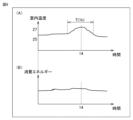
- FIG. 9 shows an example of a first operation plan of the second embodiment.
- FIG. 9 is a diagram corresponding to FIG. 4.
- FIG. 10 shows an example of a second operation plan of the second embodiment.
- FIG. 10 is a diagram corresponding to FIG. 5.
- the upper limit of the operation frequency is lowered during the increase period T, thereby reducing the energy consumption.
- the indoor temperature is suppressed by increasing the operation frequency during the increase period T.
- the vertical axis of Fig. 9(A) and Fig. 10(A) represents the indoor temperature. Note that the vertical axis of Fig. 9(A) and Fig. 10(A) may also represent the operating frequency.
- FIG. 11 is a diagram showing an example of an integrated operation plan according to the second embodiment.
- indoor temperature information 261, energy consumption information 262, difference information 211, a YES button 202, a NO button 203, and an adjustment button 204 are shown.
- Differential information 211 is an image that reads, "Energy consumption is expected to increase due to high outside temperatures around 2 p.m. If you limit the operating frequency to 60%, the peak energy consumption can be reduced. However, the indoor temperature during the above time period will rise by up to 2 degrees, decreasing comfort. Do you want to execute?"
- FIG. 12 is an example of an input screen that is displayed when the adjustment button 204 is operated.
- the upper limit of the operating frequency is disclosed as an example of an operating parameter.
- a text image 215 saying "Please enter the upper limit of the operating frequency" and an input area 216 for the upper limit of the operating frequency are displayed. The administrator inputs the upper limit of the operating frequency in the input area 216.
- the first operation plan includes information indicating the change in indoor temperature over time caused by the air conditioner 10 (FIG. 9(A)), and information indicating the change in energy consumption over time caused by the air conditioner (FIG. 9(B)). Therefore, the manager can recognize the change in indoor temperature and the change in energy consumption in the air conditioner 10.
- Embodiment 3 In the first and second embodiments, a configuration has been described in which the second learning policy is a policy for learning the first estimation model 121 so as to suppress the energy consumption of the air conditioner 10.
- the second learning policy of the third embodiment is a policy for learning the first estimation model 121 so as to suppress failures of the air conditioner 10.
- the first learning policy of the third embodiment is similar to that of the first and second embodiments, and is a policy for learning the first estimation model 121 so as to improve the comfort of the second user of the air conditioner 10.
- a sensor 16 provided in the air conditioner 10 is used (see Figs. 1 and 3).
- the sensor 16 detects a physical quantity related to the operation of the air conditioner 10.
- the physical quantity is, for example, a physical quantity of a specific part of the air conditioner 10.
- the specific part is, for example, the compressor 15, and the physical quantity is, for example, temperature.
- the first estimation unit 111 of the control device 100 generates a first operation plan using the stored operation plan 132, the physical quantities from the sensor 16, and the first estimation model 121. That is, in step S2 of FIG. 8, the control device 100 acquires physical quantities rather than environmental information.
- the second estimation unit 112 of the control device 100 generates a second operation plan using the stored operation plan 132, the physical quantities, and the second estimation model 122.
- FIG. 13 is a diagram for explaining the first operation plan of the third embodiment.
- the first operation plan of the example of FIG. 13 is an operation plan in the case where the first estimation model 121 has been trained to suppress failures of the air conditioner 10.
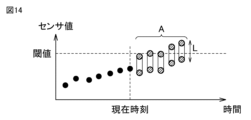
- FIG. 14 is a diagram for explaining the second operation plan of the third embodiment.
- the horizontal axis indicates time
- the vertical axis indicates the sensor value (the physical quantity described above).
- the vertical axis also indicates a predetermined threshold value. If the sensor value exceeds this threshold value, the air conditioner 10 will break down, or the probability of a breakdown will increase.
- the black circles before the current time are past sensor values detected by the sensor 16.
- the hatched circles after the current time are values estimated by the first estimation unit 111 in FIG. 13, and values estimated by the second estimation unit 112 in FIG. 14.
- an estimation range L of the sensor value is shown taking into account estimation errors and the like.
- the multiple estimation ranges L of the sensor value in FIGS. 13 and 14 and subsequent figures are also referred to as an estimation range group A.
- the control device 100 notifies the administrator of an abnormality in the air conditioner 10.
- the first and second operation plans are operation plans that indicate operation so that the sensor values from the current time onwards will be within estimated range group A.
- FIG. 15 is a diagram showing an example of an integrated operation plan according to the third embodiment.
- information 271 of the second operation plan information 272 of the first operation plan, difference information 221, a YES button 202, a NO button 203, and an adjustment button 204 are shown.
- Differential information 221 is information that reads, "With the current settings, there is a 50% chance of a breakdown after one month. If you limit the upper limit of the operating frequency to 70%, the chance of a breakdown after one month will drop to 30%. However, this may result in a decrease in comfort. Do you want to execute this?"
- this difference information 221 includes effect information indicating that when the air conditioner 10 is operated according to the first operation plan, the failure probability is reduced from 50% to 30%.
- Operation of the YES button 202 indicates that the administrator inputs input information (see FIG. 3) indicating the second learning policy (a policy for suppressing failures in the air conditioner 10). More specifically, the control device 100 learns that failure avoidance operation is permissible. Then, the learning unit 106 learns the first estimation model 121 to reflect that failure avoidance operation is permissible.
- pressing the NO button 203 indicates that the administrator is entering input information (see FIG. 3) indicating the first learning policy (a policy to improve the comfort of the second user of the air conditioner 10).
- the control device 100 displays the input screen of FIG. 12 on the display device 25.
- the learning unit 106 learns the first estimation model 121 based on the upper operating frequency limit input from the input screen of FIG. 12.
- the input operation parameter may be, for example, a tolerance for the failure probability.
- the learning unit 106 learns the first estimation model 121 based on the tolerance. Through such learning, the first estimation unit 111 generates a first operation plan in which the failure probability tends to be equal to or lower than the tolerance.
- the input operating parameter may also be, for example, a target value for the failure probability.
- the learning unit 106 learns the first estimation model 121 based on the target value. Through such learning, the first estimation unit 111 generates a first operating plan in which the failure probability tends to become the target value.
- the second learning policy is a policy for learning the first estimation model 121 so as to suppress breakdowns of the air conditioner 10. Therefore, the administrator can select, as the learning policy, either a focus on comfort for the second user or a focus on suppressing breakdowns.
- the first operation plan shown in FIG. 13 also includes failure information regarding a failure of the air conditioner 10.
- the failure information is information indicating whether or not the sensor value estimation range exceeds a threshold value. Therefore, the administrator can recognize whether or not there is a failure of the air conditioner 10 and the possibility of a future failure.
- Fig. 16 is a configuration example of a management system 500A according to embodiment 4.
- the management system 500A includes an environmental server 30, N air conditioners 10, and a control device 100A capable of communicating with the environmental server 30 and the N air conditioners 10.
- the control device 100A has a function that combines the functions of the PC 20 and the control device 100 in Fig. 1 .
- control device 100A includes a calculation device 101, a memory 102, an interface 103, a display device 25, and an input device 27.
- the manager A visually checks the first operation plan and the like displayed on the display device 25, and inputs input information and the like using the input device 27.
- the target device is an air conditioner.
- the target device may be other devices.
- the other devices may be, for example, freezers, water heaters, lighting equipment, and autonomous vehicles.
- control device 100 notifies the user of the first operation plan and the second operation plan.
- control device 100 may notify the user of the first operation plan without notifying the user of the second operation plan.
- the learning policy 131 may be changed by the administrator A or the like.
- the administrator A may change the learning policy 131 from the first learning policy to the second learning policy.
- the learning policy 131 may not be stored. In this case, if the determination in step S10 is NO, the processes in steps S16 and S18 are not executed.
- Air conditioner 11 Outdoor unit, 13 Indoor unit, 15 Compressor, 16 Sensor, 25 Display device, 27 Input device, 30 Environmental server, 100, 100A Control device, 101 Calculation device, 102 Memory, 103 Interface, 104 Integration unit, 106 Learning unit, 108 Storage unit, 110 Prediction unit, 111 First estimation unit, 112 Second estimation unit Part, 121 First estimation model, 122 Second estimation model, 131 Learning policy, 132 Stored operation plan, 201, 211, 221 Difference information, 202 YES button, 203 NO button, 204 Adjustment button, 205, 215 Text image, 206, 216 Input area, 251 Set temperature information, 252, 262 Energy consumption information, 261 Indoor temperature information.
Landscapes
- Physics & Mathematics (AREA)
- General Physics & Mathematics (AREA)
- Engineering & Computer Science (AREA)
- Automation & Control Theory (AREA)
- Air Conditioning Control Device (AREA)
Abstract
La présente invention porte sur un dispositif de commande (100) qui comprend une unité de stockage (108) qui stocke un premier modèle d'estimation (121) concernant le fonctionnement d'un climatiseur (10) et une politique d'apprentissage (131) pour le premier modèle d'estimation (121). Le dispositif de commande (100) utilise le premier modèle d'estimation (121) pour créer un premier plan de fonctionnement pour le climatiseur (10). De plus, le dispositif de commande (100) affiche le premier plan de fonctionnement sur un dispositif d'affichage (25), et permet une entrée par un utilisateur d'informations d'entrée concernant le premier plan de fonctionnement. Dans un état autorisé dans lequel l'entrée des informations d'entrée est autorisée, le dispositif de commande (100) entraîne le premier modèle d'estimation (121) sur la base de la politique d'apprentissage (131) lorsque les informations d'entrée ne sont pas entrées.
Priority Applications (1)
| Application Number | Priority Date | Filing Date | Title |
|---|---|---|---|
| PCT/JP2023/021560 WO2024252673A1 (fr) | 2023-06-09 | 2023-06-09 | Dispositif de commande et procédé de commande |
Applications Claiming Priority (1)
| Application Number | Priority Date | Filing Date | Title |
|---|---|---|---|
| PCT/JP2023/021560 WO2024252673A1 (fr) | 2023-06-09 | 2023-06-09 | Dispositif de commande et procédé de commande |
Publications (1)
| Publication Number | Publication Date |
|---|---|
| WO2024252673A1 true WO2024252673A1 (fr) | 2024-12-12 |
Family
ID=93795814
Family Applications (1)
| Application Number | Title | Priority Date | Filing Date |
|---|---|---|---|
| PCT/JP2023/021560 Ceased WO2024252673A1 (fr) | 2023-06-09 | 2023-06-09 | Dispositif de commande et procédé de commande |
Country Status (1)
| Country | Link |
|---|---|
| WO (1) | WO2024252673A1 (fr) |
Citations (2)
| Publication number | Priority date | Publication date | Assignee | Title |
|---|---|---|---|---|
| WO2018211559A1 (fr) * | 2017-05-15 | 2018-11-22 | 日本電気株式会社 | Système, procédé et programme de calcul de valeur de réglage |
| JP2020067270A (ja) * | 2018-10-23 | 2020-04-30 | 富士通株式会社 | 空調制御プログラム、空調制御方法および空調制御装置 |
-
2023
- 2023-06-09 WO PCT/JP2023/021560 patent/WO2024252673A1/fr not_active Ceased
Patent Citations (2)
| Publication number | Priority date | Publication date | Assignee | Title |
|---|---|---|---|---|
| WO2018211559A1 (fr) * | 2017-05-15 | 2018-11-22 | 日本電気株式会社 | Système, procédé et programme de calcul de valeur de réglage |
| JP2020067270A (ja) * | 2018-10-23 | 2020-04-30 | 富士通株式会社 | 空調制御プログラム、空調制御方法および空調制御装置 |
Similar Documents
| Publication | Publication Date | Title |
|---|---|---|
| US11231691B2 (en) | Systems and methods for agent interaction with building management system | |
| US20200356087A1 (en) | Model predictive maintenance system with event or condition based performance | |
| US9817383B1 (en) | Systems and methods for agent interaction with building management system | |
| JP7279445B2 (ja) | 予測方法、予測プログラムおよび情報処理装置 | |
| US20180299840A1 (en) | Systems and methods for interaction with a building management system | |
| JP5842654B2 (ja) | システム制御装置およびシステム制御方法 | |
| US20170045864A1 (en) | Systems and Methods for Energy-Efficient Control of an Energy-Consuming System | |
| US20250341330A1 (en) | Air conditioner, air conditioner control method, and air conditioner control system | |
| JP2016500938A (ja) | インテリジェント・コントローラにおける自動存在検出と存在関連制御 | |
| WO2013133967A1 (fr) | Système et procédé de régulation de la consommation d'énergie dans un bâtiment sur la base de données d'occupation, de données météorologiques, et de données de tarifs d'énergie | |
| JP7556357B2 (ja) | 情報処理装置、情報処理方法、並びにプログラム | |
| US11808467B2 (en) | Customized instantiation of provider-defined energy saving setpoint adjustments | |
| US20250137675A1 (en) | Systems and methods for learning and utilizing occupant tolerance in demand response | |
| JPWO2018207324A1 (ja) | 空調システム制御方法、空調システム制御装置および空調システム制御プログラム | |
| JP6986203B2 (ja) | 制御装置、制御システム、制御方法及び制御プログラム | |
| CN117146389A (zh) | 空调器控制方法、装置及空调器 | |
| WO2024252673A1 (fr) | Dispositif de commande et procédé de commande | |
| CN111271829B (zh) | 一种基于深度学习的空调智能制冷舒适控制方法及空调器 | |
| JP2020065346A (ja) | 制御装置、空調制御システム、制御方法及びプログラム | |
| JP2017143650A (ja) | 設備管理装置、設備管理システム及びプログラム | |
| JP2021002776A (ja) | 情報処理方法、情報処理装置、及びプログラム | |
| CN116734411A (zh) | 基于用户行为的空调控制方法、装置、空调及存储介质 | |
| JP6915762B1 (ja) | 割付支援プログラム、割付支援装置、割付学習プログラム、割付学習装置、及び、演算装置可読記憶媒体 | |
| JP7843871B2 (ja) | 空気調和機、学習装置及び推論装置 | |
| CN117806811B (zh) | 空调器的内存动态降频方法、空调器及存储介质 |
Legal Events
| Date | Code | Title | Description |
|---|---|---|---|
| 121 | Ep: the epo has been informed by wipo that ep was designated in this application |
Ref document number: 23940770 Country of ref document: EP Kind code of ref document: A1 |
|
| NENP | Non-entry into the national phase |
Ref country code: DE |