WO2024252714A1 - Procédé de production de protéine, procédé de production de viande cultivée, additif utilisé dans un procédé de production de viande cultivée, et kit utilisé dans un procédé de production de protéine - Google Patents
Procédé de production de protéine, procédé de production de viande cultivée, additif utilisé dans un procédé de production de viande cultivée, et kit utilisé dans un procédé de production de protéine Download PDFInfo
- Publication number
- WO2024252714A1 WO2024252714A1 PCT/JP2024/000839 JP2024000839W WO2024252714A1 WO 2024252714 A1 WO2024252714 A1 WO 2024252714A1 JP 2024000839 W JP2024000839 W JP 2024000839W WO 2024252714 A1 WO2024252714 A1 WO 2024252714A1
- Authority
- WO
- WIPO (PCT)
- Prior art keywords
- protein
- translation
- translating
- energy regenerating
- producing
- Prior art date
- Legal status (The legal status is an assumption and is not a legal conclusion. Google has not performed a legal analysis and makes no representation as to the accuracy of the status listed.)
- Ceased
Links
Images
Classifications
-
- A—HUMAN NECESSITIES
- A23—FOODS OR FOODSTUFFS; TREATMENT THEREOF, NOT COVERED BY OTHER CLASSES
- A23L—FOODS, FOODSTUFFS OR NON-ALCOHOLIC BEVERAGES, NOT OTHERWISE PROVIDED FOR; PREPARATION OR TREATMENT THEREOF
- A23L13/00—Meat products; Meat meal; Preparation or treatment thereof
-
- C—CHEMISTRY; METALLURGY
- C07—ORGANIC CHEMISTRY
- C07K—PEPTIDES
- C07K14/00—Peptides having more than 20 amino acids; Gastrins; Somatostatins; Melanotropins; Derivatives thereof
- C07K14/435—Peptides having more than 20 amino acids; Gastrins; Somatostatins; Melanotropins; Derivatives thereof from animals; from humans
-
- C—CHEMISTRY; METALLURGY
- C12—BIOCHEMISTRY; BEER; SPIRITS; WINE; VINEGAR; MICROBIOLOGY; ENZYMOLOGY; MUTATION OR GENETIC ENGINEERING
- C12N—MICROORGANISMS OR ENZYMES; COMPOSITIONS THEREOF; PROPAGATING, PRESERVING, OR MAINTAINING MICROORGANISMS; MUTATION OR GENETIC ENGINEERING; CULTURE MEDIA
- C12N9/00—Enzymes; Proenzymes; Compositions thereof; Processes for preparing, activating, inhibiting, separating or purifying enzymes
- C12N9/10—Transferases (2.)
-
- C—CHEMISTRY; METALLURGY
- C12—BIOCHEMISTRY; BEER; SPIRITS; WINE; VINEGAR; MICROBIOLOGY; ENZYMOLOGY; MUTATION OR GENETIC ENGINEERING
- C12P—FERMENTATION OR ENZYME-USING PROCESSES TO SYNTHESISE A DESIRED CHEMICAL COMPOUND OR COMPOSITION OR TO SEPARATE OPTICAL ISOMERS FROM A RACEMIC MIXTURE
- C12P21/00—Preparation of peptides or proteins
-
- C—CHEMISTRY; METALLURGY
- C12—BIOCHEMISTRY; BEER; SPIRITS; WINE; VINEGAR; MICROBIOLOGY; ENZYMOLOGY; MUTATION OR GENETIC ENGINEERING
- C12P—FERMENTATION OR ENZYME-USING PROCESSES TO SYNTHESISE A DESIRED CHEMICAL COMPOUND OR COMPOSITION OR TO SEPARATE OPTICAL ISOMERS FROM A RACEMIC MIXTURE
- C12P21/00—Preparation of peptides or proteins
- C12P21/02—Preparation of peptides or proteins having a known sequence of two or more amino acids, e.g. glutathione
-
- C—CHEMISTRY; METALLURGY
- C12—BIOCHEMISTRY; BEER; SPIRITS; WINE; VINEGAR; MICROBIOLOGY; ENZYMOLOGY; MUTATION OR GENETIC ENGINEERING
- C12N—MICROORGANISMS OR ENZYMES; COMPOSITIONS THEREOF; PROPAGATING, PRESERVING, OR MAINTAINING MICROORGANISMS; MUTATION OR GENETIC ENGINEERING; CULTURE MEDIA
- C12N9/00—Enzymes; Proenzymes; Compositions thereof; Processes for preparing, activating, inhibiting, separating or purifying enzymes
- C12N9/14—Hydrolases (3)
-
- C—CHEMISTRY; METALLURGY
- C12—BIOCHEMISTRY; BEER; SPIRITS; WINE; VINEGAR; MICROBIOLOGY; ENZYMOLOGY; MUTATION OR GENETIC ENGINEERING
- C12N—MICROORGANISMS OR ENZYMES; COMPOSITIONS THEREOF; PROPAGATING, PRESERVING, OR MAINTAINING MICROORGANISMS; MUTATION OR GENETIC ENGINEERING; CULTURE MEDIA
- C12N9/00—Enzymes; Proenzymes; Compositions thereof; Processes for preparing, activating, inhibiting, separating or purifying enzymes
- C12N9/90—Isomerases (5.)
Definitions
- the disclosure in this application relates to a method for producing proteins, a method for producing cultured meat, additives used in the method for producing cultured meat, and a kit for use in the method for producing proteins.
- a cell-free protein synthesis system is a system in which a medium containing intracellular elements involved in protein synthesis is prepared and protein synthesis is carried out cell-free.
- Various cell-free protein synthesis systems are known. Such synthesis systems include a system in which template DNA, which is a transcription template, is applied to a medium to synthesize a protein, which is the final product, and a system in which mRNA, which is a translation template, is applied to a medium to synthesize a protein.
- a cell-free protein synthesis system using extracts prepared from E. coli, insect cells, wheat germ, animal cells, etc. is known, and kits are commercially available from several companies. Proteins are synthesized using energy sources such as ATP and GTP, with mRNA as a translation template. However, when the energy source is consumed by protein synthesis, ATP changes to AMP or ADP, and GTP changes to GDP, resulting in a shortage of energy sources for protein synthesis. For this reason, it is known to add energy regenerating enzymes to cell-free protein synthesis systems, such as those that regenerate AMP or ADP to ATP and GDP to GTP. For example, Patent Document 1 discloses creatine kinase, myokinase, nucleoside diphosphate kinase (NDK), etc., as energy regenerating enzymes.
- NDK nucleoside diphosphate kinase
- Patent Document 2 describes, for example, the use of creatine kinase at a concentration of 0.1 mg/mL to 0.5 mg/mL.
- creatine kinase is known to be derived from rabbit muscle
- myokinase is known to be derived from yeast.
- energy regenerating enzymes are derived from living organisms, a process for isolating the enzyme is necessary, which makes them relatively expensive.
- the purpose of the disclosure of this application is to provide a method for producing a protein that self-replicates an energy regenerating enzyme, a method for producing cultured meat, an additive for use in the method for producing cultured meat, and a kit for use in the method for producing the protein.
- the disclosure of this application relates to the following: a protein production method, a cultured meat production method, an additive used in the cultured meat production method, and a kit used in the protein production method.
- a method for producing a protein comprising a protein translation step of translating a protein using a translation template mRNA in the absence of cells and in the presence of elements for translating the translation template mRNA into a protein
- the translation template mRNA is A method for producing a protein comprising a translation template mRNA for translating an energy regenerating enzyme.
- the protein translation step a first protein translation step of translating an energy regenerating enzyme using a translation template mRNA for translating the energy regenerating enzyme; a second protein translation step of translating a target protein using a translation product of the first protein translation step and a translation template mRNA for translating the target protein; A method for producing the protein according to (2) above.
- the protein translation step The method for producing a protein according to (2) above, which is carried out in the coexistence of a translation template mRNA for translating the energy regenerating enzyme and a translation template mRNA for translating the target protein.
- a method for producing cultured meat comprising: A method for producing cultured meat, comprising a step of culturing cells using a culture medium containing as an additive a translation product produced by the method for producing the protein described in (9) above.
- An additive for use in a cultured meat production method comprising: An additive comprising a translation product produced by the method for producing a protein according to (9) above.
- a kit for use in a method for producing a protein comprising: a translation template mRNA for translating an energy regenerating enzyme; an element for translating the translation template mRNA for translating said energy regenerating enzyme into a protein in the absence of a cell; Including kit.
- a translation template mRNA for translating an energy regenerating enzyme for translating an energy regenerating enzyme
- an element for translating the translation template mRNA for translating said energy regenerating enzyme into a protein in the absence of a cell
- Including kit Including kit.
- the kit according to (12) above further comprising a translation template mRNA for translating a target protein.
- the energy regenerating enzyme and the target protein are from the same biological species.
- the protein production method, cultured meat production method, additives used in the cultured meat production method, and kits used in the protein production method disclosed in this application can construct an energy regeneration system using an energy regeneration enzyme translated from a translation template in a cell-free protein synthesis system. Therefore, there is no need to add an isolated energy regeneration enzyme to the cell-free protein synthesis system.
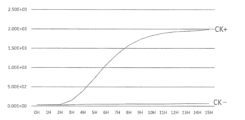
- FIG. 1 is a graph showing the time course of the GFP synthesized in Reference Example 1.
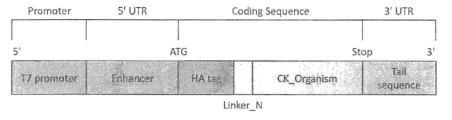
- FIG. 2 is a schematic diagram showing the transcription template DNA of CK.
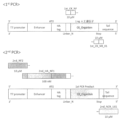
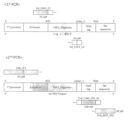
- FIG. 3 is a diagram showing an outline of the procedure for producing CK_DNA by PCR.
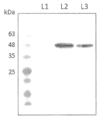
- FIG. 4 is a photograph substituting a drawing, which is a Western blot showing the results of self-amplification of an energy regenerating enzyme (CK) using a cell-free protein synthesis system in Example 1.
- FIG. 5 is a photograph substituting a drawing, which is a Western blot showing the results of self-amplification of energy-regenerating enzymes (CK) from various animals using a cell-free protein synthesis system in Example 2.
- FIG. 4 is a photograph substituting a drawing, which is a Western blot showing the results of self-amplification of energy-regenerating enzymes (CK) from various animals using a cell-free protein synthesis system in Example 2.
- FIG. 4 is a photograph substituting a drawing, which is a Western
- FIG. 6 is a graph showing the results of synthesizing GFP using the translation product obtained in Example 1 in Example 3.
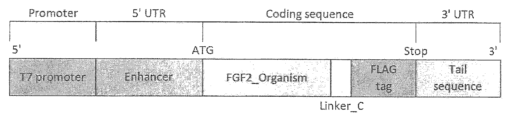
- FIG. 7 is a schematic diagram showing transcription template DNA of chicken, tuna and eel FGF2.
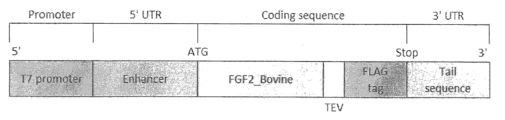
- FIG. 8 is a schematic diagram showing the transcription template DNA of bovine FGF2.
- FIG. 9 is a diagram showing an outline of the procedure for preparing FGF2_DNA by PCR.
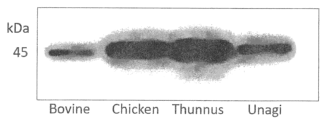
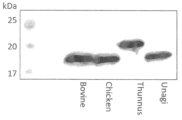
- FIG. 10 is a Western blot showing the results of synthesis of a target protein (FGF2) using the energy regenerating enzyme derived from the same organism in Example 4.
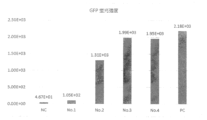
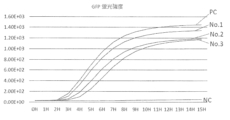
- FIG. 11 is a graph showing that in Example 5, in the presence of a translation template mRNA for translating an energy regenerating enzyme and a translation template mRNA for translating a target protein, an energy regeneration system is self-assembled and the target protein can be synthesized.
- the method for producing a protein according to the first embodiment includes a protein translation step of translating a protein using a translation template mRNA in the absence of cells and in the presence of elements for translating the translation template mRNA into a protein, the translation template mRNA including a translation template mRNA for translating an energy-regenerating enzyme, which is a protein.
- the cell-free protein synthesis system is a method of synthesizing proteins in a test tube by adding a translation template mRNA or a transcription template DNA to a solution containing amino acids, energy molecules such as ATP and GTP, an energy regeneration system, salts such as magnesium ions, and the like, to a cell-free extract containing translation components such as ribosomes, tRNA, aminoacylated tRNA synthetase, translation initiation factors, translation elongation factors, and translation termination factors.
- the protein production method disclosed in this application adds a translation template mRNA for translating the energy regeneration enzyme to the cell-free protein synthesis system instead of adding an isolated energy regeneration enzyme (produced separately as an additive) to the cell-free protein synthesis system.
- the method is characterized in that the energy regeneration system is self-constructed by using the energy regeneration enzyme translated from the translation template mRNA by the cell-free protein synthesis system. Therefore, when the term “elements for translating the translation template mRNA into a protein in the absence of cells" is used in this specification, it means a solution (translation solution) containing a cell-free extract, amino acids, energy molecules, and salts. In addition, the "element for translating a translation template mRNA into a protein in the absence of cells" can also be said to be an element for which "an isolated energy regenerating enzyme is not added at the start of protein synthesis.” Incidentally, energy regenerating enzymes are generally isolated from animals.
- an isolated energy regenerating enzyme is not added at the start of protein synthesis
- an isolated animal-derived energy regenerating enzyme is not added at the start of protein synthesis.
- the protein production method disclosed in the present application is characterized in that an energy regenerating system is self-constructed by using an energy regenerating enzyme translated from a translation template mRNA by a cell-free protein synthesis system, but from a technical point of view, the addition of an isolated animal-derived energy regenerating enzyme does not inhibit the self-construction of the energy regenerating system. Therefore, it does not prevent the addition of a trace amount of an isolated energy regenerating enzyme in order to smoothly proceed with the initial cycle of self-constructing the energy regenerating system.
- an isolated energy regenerating enzyme is added, it is preferable to add the same enzyme as the energy regenerating enzyme that translates from the translation template mRNA so that the added energy regenerating enzyme is not treated as an impurity.
- the cell-free protein synthesis system disclosed in this application is characterized in that no energy regenerating enzyme isolated at the start of synthesis is added.
- creatine kinase one example of an energy regenerating enzyme
- the cell-free extract disclosed in this application is preferably a non-animal cell-free extract.
- Non-animal cell-free extracts include, but are not limited to, those extracted by known methods from wheat germ, etc.
- Amino acids may be any of the naturally occurring amino acids, but non-natural amino acids may also be used.
- the energy molecule may be a known molecule used in protein synthesis.
- the energy molecule include nucleotide triphosphate, creatine phosphate, and formyl folate.
- examples of the nucleotide triphosphate include ATP, GTP, CTP, and UTP.
- ATP and GTP may be used as the energy molecule.
- ATP, GTP, CTP, and UTP may be used.
- Energy regenerating enzymes include enzymes known in the field of protein synthesis. Examples include, but are not limited to, creatine kinase, nucleoside diphosphate kinase, arginine kinase, pyruvate kinase, and adenylate kinase.
- Creatine kinase catalyzes the reaction of creatine phosphate and AMP to regenerate ADP into ATP.
- Nucleoside diphosphate kinase uses polyphosphate as a substrate and regenerates AMP and ADP into ATP, and GDP into GTP.
- Arginine kinase phosphorylates arginine (Arg) to generate arginine phosphate (PArg), and regenerates ATP by transferring the phosphate of the generated PArg to ADP.
- Pyruvate kinase transfers a phosphate group from phosphoenolpyruvate to ADP to regenerate ATP.
- Adenylate kinase is an enzyme that generates one molecule of AMP and one molecule of ATP from two molecules of ADP.
- the translation template mRNA for translating the energy regenerating enzyme is not particularly limited as long as it can translate the energy regenerating enzyme.
- the translation template mRNA includes a coding region that encodes the amino acid sequence of the energy regenerating enzyme, and non-translated regions may be appropriately linked to the 5' and 3' sides of the coding region. Examples of 5' and 3' non-translated regions for improving protein translation efficiency are described in International Publication Nos. WO 2022/185664 and WO 2021/070616 filed by the present applicant.
- the translation template mRNA disclosed in this application may use the non-translated regions described in International Publication Nos. WO 2022/185664 and WO 2021/070616 as necessary. The matters described in International Publication Nos. WO 2022/185664 and WO 2021/070616 are incorporated herein by reference.
- the salts used may be any known salts used in cell-free protein synthesis systems. Examples include, but are not limited to, magnesium acetate, potassium acetate, calcium chloride, etc.
- the method for producing a protein according to the first embodiment has the following advantages. (1) At the start of protein synthesis, no energy regenerating enzyme is added, and the energy regenerating system is constructed using only the energy regenerating enzyme translated from the translation template mRNA for translating the energy regenerating enzyme. Therefore, since there is no need for an isolated energy regenerating enzyme, costs can be reduced. (2) Proteins produced by a cell-free protein synthesis system can be used as medicines or foods. However, when a protein derived from a biological species that has never been ingested is ingested as a medicine or food, there is a risk of allergic reactions, etc. For example, creatine kinase is derived from rabbits, and commercially available energy regenerating enzymes are derived from limited biological species.
- the energy regenerating enzyme is obtained by translating a translation template mRNA, so that an energy regenerating enzyme derived from a desired biological species can be translated. This reduces the risk of allergies, etc. (3)
- the protein production method of the present application can obtain an energy regenerating enzyme derived from a desired species by translation, thereby solving problems caused by religious reasons or contamination with zoonotic viruses.
- Due to the influence of prion diseases there is a tendency to avoid using animal-derived raw materials to produce food and medicines. In the protein production method of the present application, even if the type of energy regenerating enzyme is animal, it is possible to produce proteins using only non-animal raw materials. Therefore, there is no risk of diseases derived from animal raw materials.
- the protein production method according to the second embodiment differs from the protein production method according to the first embodiment in that it includes a translation template mRNA for translating the target protein, but the other points are the same as the protein production method according to the first embodiment.
- the second embodiment of the protein production method will be described mainly with respect to the points different from the first embodiment. Therefore, it goes without saying that the matters already described in the first embodiment can be applied to the second embodiment even if they are not explicitly described in the second embodiment.
- target protein there are no particular limitations on the target protein, so long as it can be synthesized by a cell-free protein synthesis system.
- examples include growth factors; secretory proteins such as insulin and amylase; plasma proteins such as transferrin, myoglobin, and albumin; and the like.
- Examples of animal species of target proteins include fish such as salmon and eels; mammals such as humans, cows, and rabbits; and echinoderms such as sea urchins.
- the protein translation step in the protein production method according to the second embodiment is not particularly limited as long as it is possible to produce a target protein using an energy regenerating enzyme translated from a translation template mRNA for translating the energy regenerating enzyme.
- a first protein translation step is carried out in which an energy-regenerating enzyme is translated using a translation template mRNA for translating the energy-regenerating enzyme;
- a second protein translation step is carried out to translate the target protein using the translation product of the first protein translation step and a translation template mRNA for translating the target protein.
- An example can be given (hereinafter, sometimes referred to as the "first example").
- the translation is carried out in the presence of a translation template mRNA for translating the energy regenerating enzyme and a translation template mRNA for translating the target protein.
- a translation template mRNA for translating the energy regenerating enzyme and a translation template mRNA for translating the target protein.
- An example can be given (hereinafter, sometimes referred to as the "second example").
- the amount of the energy regenerating enzyme to be translated can be adjusted by adjusting the reaction time.
- the amount of the translation product of the first protein translation step added when the second protein translation step is performed can also be adjusted. Therefore, in the first example, the amount of the energy regenerating enzyme contained in the cell-free protein synthesis system when translating the target protein can be adjusted. By adjusting the amount of the energy regenerating enzyme, the translation efficiency of the target protein can be optimized.
- the second example the translation of the energy regenerating enzyme and the target protein is performed simultaneously, so the translation efficiency of the target protein is lower than in the first example, but the convenience of protein production is improved because there is no need to separate the protein translation steps.
- the translation template mRNA for translating the energy regenerating enzyme and the target protein may be synthesized using a nucleic acid synthesizer, or may be transcribed from a transcription template DNA.
- the transcription template DNA may contain a region encoding the translation template mRNA and a promoter sequence located at the 5' end of the region encoding the translation template mRNA.
- the translation template mRNA can be synthesized by translating the transcription template DNA in the absence of cells and in the presence of elements for transcribing the transcription template DNA into mRNA.
- the promoter sequence and elements for transcribing the transcription template DNA into mRNA may be any known sequence in the art. Examples of promoter sequences include, but are not limited to, a T7 promoter sequence, an SP6 promoter sequence, and a T3 promoter sequence.
- the method for producing a protein according to the second embodiment has the following advantages in addition to the advantages (1) to (4) achieved by the method for producing a protein according to the first embodiment. (5) In the effects (2) to (4) achieved by the method for producing a protein according to the first embodiment, the effect is achieved by replacing "energy regenerating enzyme" with "target protein".
- an enzyme for decomposing by-products e.g., inorganic pyrophosphate
- a translation template mRNA for translating an enzyme for folding (activating) the target protein may be added.
- enzymes for decomposing by-products include, but are not limited to, inorganic diphosphatase, inorganic pyrophosphatase, etc.
- enzymes for folding the target protein include, but are not limited to, disulfide isomerase, etc.
- the enzyme for decomposing by-products and/or the translation template mRNA for translating the enzyme for folding the target protein may be added during the first protein translation process, during the second protein translation process, or during the first and second protein translation processes.
- the enzyme for decomposing by-products and/or the translation template mRNA for translating the enzyme for folding the target protein may be added together with the translation template mRNA for translating the energy regenerating enzyme and the translation template mRNA for translating the target protein.
- the transcription template DNA may be designed to include a region encoding the translation template mRNA and a promoter region located at the 5' end of the region encoding the translation template mRNA.
- the coexistence of the enzyme for decomposing by-products and/or the enzyme for folding the target protein improves the translation efficiency of the target protein.
- the enzymes for decomposing by-products and/or the enzymes for folding the target protein are merely preferred examples, and other enzymes may be used as long as they improve the translation efficiency of the target protein.
- the combination of the energy regenerating enzyme and the target protein may be derived from the same biological species.
- the nucleic acid sequences of the energy regenerating enzyme and the target protein of the same biological species may be obtained from a known DB, and the translation template mRNA may be designed.
- a transcription template DNA may be designed that includes a region encoding the translation template mRNA and a promoter region located at the 5' end of the region encoding the translation template mRNA.
- the energy regenerating enzyme and the target protein are derived from the same biological species, the following effect is achieved in addition to the effects achieved by the first and second embodiments of the protein production method. (7)
- the produced protein is to be used in food, it may be objectionable to mix proteins derived from different species. By combining the energy regenerating enzyme and the target protein from the same species, the possibility of objection is reduced.
- the target protein may be a growth factor or a cytokine.
- cultured meat has been attracting attention from the perspectives of responding to population growth and increased food production, environmental issues due to the increase in pasture land for feeding meat animals, safety of administering antibiotics to animals, and ethics of taking the lives of animals.
- Cultured meat is produced by culturing stem cells extracted from animals in a culture medium containing substances necessary for cell growth, such as amino acids and carbohydrates, and growth factors are required for the culture. Cytokines are also required for cell differentiation.
- growth factors or cytokines include, but are not limited to, the following growth factors: ⁇ EGF (Epidermal growth factor): Epidermal growth factor, ⁇ IGF (Insulin-like growth factor): Insulin-like growth factor, TGF (Transforming growth factor): Transforming growth factor, bFGF or FGF2 (basic fibroblast growth factor): basic fibroblast growth factor, NGF (Nerve growth factor): Nerve growth factor, BDNF (Brain-derived neurotrophic factor): Brain-derived neurotrophic factor, ⁇ VEGF (Vesicular endothelial growth factor): Vascular endothelial growth factor, ⁇ G-CSF (Granulocyte-colony stimulating factor): Granulocyte colony stimulating factor, GM-CSF (Granulocyte-macrophage-colony stimulating factor): Granulocyte-macrophage colony stimulating factor, ⁇ PDGF (Platelet-derived growth factor): platelet-derived growth factor, E
- the target protein is a growth factor
- the following effect is achieved in addition to the effects achieved by the first and second embodiments of the protein production method.
- Growth factors are very expensive, but by using the protein production method disclosed in the present application, growth factors can be produced at low cost.
- the protein production method disclosed in this application has been described above by giving several specific embodiments and optional additional items that can be adopted, but various modifications may be made without being limited to these embodiments as long as they are within the scope of the technical ideas disclosed in this application.
- the optional additional items that can be adopted exemplified may be added alone, or any two or more additional items may be combined. When any two or more additional items are used in combination, the respective effects are synergistically exerted.
- an energy regenerating enzyme and/or a sequence for adding a protein tag to the N-terminus and/or C-terminus of the target protein may be linked to the translation template mRNA or transcription template DNA.
- the translation product in the method for producing a protein, when a growth factor is produced as the target protein, the translation product can be used in the method for producing cultured meat.
- the method for producing cultured meat may be carried out by a step of culturing cells using a culture medium containing the translation product as an additive.
- the culture medium may be a known culture medium.
- the cells may be cells of the animal to be cultured. There is no particular limitation on the animal to be cultured as long as it is consumed as meat.
- Examples of the animal to be cultured include, but are not limited to, mammals such as cows, pigs, horses, and sheep; birds such as chickens, ducks, and quails; fish such as salmon, eels, and tuna; and crustaceans such as shrimp and crabs.
- the translation product when a growth factor is produced as the target protein in a protein production method, the translation product can be used as an additive in the cultured meat production method.
- Embodiments of the cultured meat production method and embodiments of the additive have the following advantages. (9) Since growth factors are inexpensive to obtain, the cost of cultured meat can be reduced. (10) By using energy-regenerating enzymes and growth factors from the same species as the animal being cultured, it is possible to produce cultured meat that does not contain proteins derived from other types of animals.
- kits used in the protein production method Next, an embodiment of the kit used in the protein production method will be described.
- the energy regenerating enzyme was an enzyme isolated from an animal or the like.
- the present inventors have newly discovered that in the cell-free protein synthesis system, an energy regenerating enzyme obtained from a translation template mRNA for translating the energy regenerating enzyme is used to construct an energy regenerating system. Therefore, a kit used in the protein production method including a translation template mRNA for translating the energy regenerating enzyme and an element for translating the translation template mRNA into a protein in the absence of cells is a new invention.
- the kit used in the protein production method according to the embodiment can be said to be a kit to which no energy regenerating enzyme is added, since the energy regenerating system is constructed using only the energy regenerating enzyme translated from the translation template mRNA for translating the energy regenerating enzyme.
- the kit may further include a translation template mRNA for translating the target protein, and the energy regenerating enzyme and the target protein may be from the same organism.
- translation template mRNA for translating the energy regenerating enzyme "elements for translating the translation template mRNA into a protein in the absence of cells," and “translation template mRNA for translating a target protein” have already been explained in the embodiment of the protein production method. Therefore, detailed explanation will be omitted to avoid duplication.
- the "translation template mRNA for translating the energy regenerating enzyme", "elements for translating the translation template mRNA into protein in the absence of cells” and “translation template mRNA for translating the target protein” may be provided separately and mixed at the time of use.
- the "translation template mRNA for translating the energy regenerating enzyme” and “elements for translating the translation template mRNA into protein in the absence of cells” may be provided mixed together, and the “translation template mRNA for translating the target protein” may be provided separately.
- translation template mRNA for translating the energy regenerating enzyme may all be provided mixed together.
- reaction solution with the composition shown in Table 1 was added to a 96-well flat-bottom titer plate, and the reaction was allowed to proceed in a plate reader at room temperature (approximately 23°C).
- Example 1 Creatine Kinase Sequence Among the energy regenerating enzymes derived from various organisms, the sequence information (ACC. No.), organism species, and source of acquisition of creatine kinase (CK) are shown in Table 2. In Example 1, No. 4 CK_T (Thunnus, tuna) was used. Nos. 1 to 3 and 5 were used in Examples 2 to 4 described below.
- FIG. 2 shows an outline of the CK transcription template DNA (hereinafter, sometimes referred to as "CK_DNA").
- Table 3 shows the sequences of each region of CK_DNA. Note that the CK sequences of the above-mentioned Organisms No. 1 to 5 are inserted into the CK_Organisms in Table 3 below.
- CK_DNA was prepared by designing a primer as shown in FIG. 3 and performing two-step PCR.
- Table 4 shows the PCR primers
- Tables 5 and 6 show the PCR reaction solution composition
- Table 7 shows the PCR program.
- the synthesis method of the transcription template DNA was performed according to the instruction manual (May-2021/Ver.3.00) of PSS5100 by NUProtein Co., Ltd.
- the reagents and machines used are as follows.
- ⁇ PCR enzyme Toyobo Co., Ltd.
- a translation template mRNA was prepared using the prepared transcription template DNA.
- the transcription reaction was carried out in a 1.5 mL tube using the following reaction solution of PSS5100 manufactured by NUProtein and 2.5 ⁇ L of the second PCR reaction solution (containing transcription template DNA) prepared above, and incubated at 37° C. for 3 hours.
- a translation reaction solution having the following composition was prepared in a 1.5 mL tube, and was placed in an incubator set at 23 ° C. and reacted for 15 hours.
- the composition described in Table 9 was obtained by adding CK in addition to the translation template mRNA of CK_T.
- the composition described in Table 10 was obtained by adding only the translation template mRNA of CK_T, and no CK was added to the translation reaction solution.
- the translation reaction was carried out by administering the translation template mRNA of GFP prepared in ⁇ Reference Example 1> instead of the translation template mRNA of CK_T in Table 10.
- the units of the values in Tables 9 and 10 are ⁇ L, and X in Table 9 is 77.8 and X in Table 10 is 80.
- the stock concentration of the added CK is 20 mg/mL, and the final concentration is 200 ng/ ⁇ L.
- the 1.5 mL tube was centrifuged (15,000 g, 15 minutes, 4°C) and the supernatant was used as the protein solution after translation was completed. Western blotting of the obtained protein was performed.
- L2 is the result of the translation product obtained with the composition listed in Table 9
- L3 is the result of the translation product obtained with the composition listed in Table 10
- L1 is the result of the translation product obtained with the composition using GFP translation template mRNA.
- L3 where no isolated CK was added to the translation reaction solution
- CK_T was translated from the translation template mRNA, although it was less than in L2. From these results, it is believed that when the translation reaction is carried out with the composition listed in Table 10, CK_T is translated from the translation template mRNA by the elements contained in the translation reaction solution, and the translated CK_T establishes an energy regeneration system, causing CK_T to self-replicate.
- Example 2 The experiment was carried out in the same manner as in Example 1, except that CK_B (Bovine), CK_C (Chicken), and CK_U (Unagi) were used instead of CK_T (Thunnus) in Example 1, and the following primers were used as 1st_CK_NF and 1st_CK_NR_01.
- the primer CK_R (Rabbit) used in Example 4 described later is also listed.
- Table 11 the species of organism is listed after CK to specify which species of organism the primer is for.
- Example 3 The translation product CK_T (L3 in FIG. 4) obtained in the above ⁇ Example 1> was used to synthesize GFP as a target protein.
- Table 12 shows the composition of the translation reaction solution.
- the translation product CK_T was added in different amounts as shown in No. 1 to 4, and experiments were performed.
- the target protein was GFP, and the translation template mRNA described in Reference Example 1 was used.
- the negative control (NC) was without CK, CK_T, and GFP mRNA, and the positive control (PC) was CK instead of the translation product CK_T.
- the translation reaction was carried out for about 15 hours with the composition in Table 11, and the experiment was performed in the same manner as in the above ⁇ Reference Example 1> to measure the fluorescence intensity of the synthesized GFP.
- the unit of the values in Table 11 is ⁇ L.
- the stock concentration of the added CK was 20 mg/mL, and the final concentration was 200 ng/ ⁇ L.
- Example 4 Using the translation products of bovine, chicken, tuna, and eel CKs obtained in Example 2 above, synthesis was carried out for target proteins corresponding to FGF2 of each biological species listed in Table 13 below. The specific procedure is described below.
- FIG. 7 shows an outline of the transcription template DNA (hereinafter, sometimes referred to as "FGF2_DNA") of chicken, tuna, and eel FGF2.
- Table 14 shows the sequences of each region of FGF2_DNA. Note that the FGF2 sequences of Chicken, Thunnus, and Unagi in Table 13 above are inserted into FGF2_Organism in the following Table 13.
- FIG. 8 shows an outline of the transcription template DNA of bovine FGF2.
- Table 14 shows the sequences of each region of the transcription template DNA of bovine FGF2.
- the FGF2 sequence of Bovine in Table 13 is inserted into FGF2_Bovine in Table 15 below.
- the PCR reaction solution composition is the same as that in Tables 5 and 6 of Example 1, and the PCR program is the same as that in Table 7 of Example 1.
- the method for synthesizing the transcription template DNA, the reagents, and the machine are also the same as those in Example 1.
- Example 5 [Co-expression of energy regenerating enzyme and target protein]
- Example 5 a translation reaction was carried out in the presence of both a translation template mRNA for translating the energy regenerating enzyme and a translation template mRNA for translating the target protein.
- the experimental procedure is described below.
- (1) Energy Regenerating Enzyme A translation template mRNA was prepared in the same manner as in Example 1 using CK_R shown in No. 1 of Table 2 in Example 1.
- Target Protein The translation template mRNA of GFP described in Reference Example 1 was used.
- the composition of the translation reaction solution is shown in Table 20.
- the negative control (NC) did not contain CK, CK_Rabbit, or GFP mRNA, and the positive control (PC) used CK instead of the translation template mRNA of CK_Rabbit.
- the translation reaction was carried out for about 15 hours with the composition in Table 20, and the experiment was carried out in the same manner as in the above-mentioned ⁇ Reference Example 1>, and the fluorescence intensity of the synthesized GFP was measured.
- the protein production method, cultured meat production method, additives used in the cultured meat production method, and kit used in the protein production method disclosed in this application make it possible to construct an energy regeneration system for cell-free protein synthesis using an energy regeneration enzyme translated from a translation template mRNA. This is therefore useful in industries that require cell-free protein synthesis, such as the food industry, pharmaceutical industry, and research institutes.
Landscapes
- Chemical & Material Sciences (AREA)
- Life Sciences & Earth Sciences (AREA)
- Health & Medical Sciences (AREA)
- Organic Chemistry (AREA)
- Zoology (AREA)
- Engineering & Computer Science (AREA)
- Wood Science & Technology (AREA)
- Genetics & Genomics (AREA)
- Molecular Biology (AREA)
- Bioinformatics & Cheminformatics (AREA)
- General Health & Medical Sciences (AREA)
- Biochemistry (AREA)
- Biotechnology (AREA)
- Microbiology (AREA)
- General Engineering & Computer Science (AREA)
- Chemical Kinetics & Catalysis (AREA)
- General Chemical & Material Sciences (AREA)
- Proteomics, Peptides & Aminoacids (AREA)
- Medicinal Chemistry (AREA)
- Biophysics (AREA)
- Toxicology (AREA)
- Gastroenterology & Hepatology (AREA)
- Biomedical Technology (AREA)
- Nutrition Science (AREA)
- Food Science & Technology (AREA)
- Polymers & Plastics (AREA)
- Preparation Of Compounds By Using Micro-Organisms (AREA)
- Apparatus Associated With Microorganisms And Enzymes (AREA)
- Peptides Or Proteins (AREA)
Abstract
La présente invention a pour but de procurer un procédé de production d'une protéine qui autoprolifère une enzyme régénératrice d'énergie. La solution selon l'invention consiste en un procédé de production d'une protéine, le procédé comprenant une étape de traduction d'une protéine à l'aide d'un ARNm matrice de traduction en l'absence d'une cellule et en présence d'un élément de traduction de l'ARNm matrice de traduction en protéine, l'ARNm matrice de traduction comprenant un ARNm matrice de traduction pour la traduction d'une enzyme régénératrice d'énergie.
Priority Applications (1)
| Application Number | Priority Date | Filing Date | Title |
|---|---|---|---|
| CN202480002181.3A CN119452093A (zh) | 2023-06-05 | 2024-01-15 | 蛋白质的生产方法、培养肉的生产方法、用于培养肉的生产方法中的添加物、以及用于蛋白质的生产方法中的试剂盒 |
Applications Claiming Priority (2)
| Application Number | Priority Date | Filing Date | Title |
|---|---|---|---|
| JP2023-092204 | 2023-06-05 | ||
| JP2023092204A JP7426764B1 (ja) | 2023-06-05 | 2023-06-05 | タンパク質の生産方法、培養肉の生産方法、培養肉の生産方法に用いる添加物、および、タンパク質の生産方法に用いるキット |
Publications (1)
| Publication Number | Publication Date |
|---|---|
| WO2024252714A1 true WO2024252714A1 (fr) | 2024-12-12 |
Family
ID=89718103
Family Applications (1)
| Application Number | Title | Priority Date | Filing Date |
|---|---|---|---|
| PCT/JP2024/000839 Ceased WO2024252714A1 (fr) | 2023-06-05 | 2024-01-15 | Procédé de production de protéine, procédé de production de viande cultivée, additif utilisé dans un procédé de production de viande cultivée, et kit utilisé dans un procédé de production de protéine |
Country Status (3)
| Country | Link |
|---|---|
| JP (2) | JP7426764B1 (fr) |
| CN (1) | CN119452093A (fr) |
| WO (1) | WO2024252714A1 (fr) |
Citations (11)
| Publication number | Priority date | Publication date | Assignee | Title |
|---|---|---|---|---|
| JP2000333673A (ja) * | 1999-05-31 | 2000-12-05 | Wakenyaku Kk | 連続無細胞タンパク質合成手段 |
| US20030113778A1 (en) * | 2001-10-30 | 2003-06-19 | Schulte Jennifer Theresa | Enhanced in vitro nucleic acid synthesis using nucleoside monophosphates |
| JP2006340694A (ja) * | 2005-06-10 | 2006-12-21 | Post Genome Institute Co Ltd | 分子シャペロンを用いたinvitro転写・翻訳系によるタンパク質合成方法 |
| JP2007097438A (ja) * | 2005-09-30 | 2007-04-19 | Cellfree Sciences Co Ltd | 無細胞タンパク質合成方法 |
| JP2008029204A (ja) * | 2004-11-12 | 2008-02-14 | Cellfree Sciences Co Ltd | 無細胞タンパク質合成方法 |
| JP2011079845A (ja) * | 1999-03-17 | 2011-04-21 | Univ Leland Stanford Jr | 外因性アミノ酸および新規atp再生システムを用いたインビトロ高分子生合成の方法 |
| WO2018143145A1 (fr) * | 2017-01-31 | 2018-08-09 | 中外製薬株式会社 | Procédé de synthèse de peptides dans un système de traduction sans cellule |
| US20220257706A1 (en) * | 2019-07-10 | 2022-08-18 | Nanyang Technological University | Epidermal growth factor receptor (egfr) ligands |
| US20230016607A1 (en) * | 2020-01-02 | 2023-01-19 | Fyberaworks Foods, Inc. | A novel method to manufacture synthetic meat |
| JP2023036506A (ja) * | 2021-09-02 | 2023-03-14 | ダナグリーン カンパニー リミテッド | 植物性タンパク質を含む多孔質細胞支持体およびそれを用いて製造された培養肉 |
| WO2023047831A1 (fr) * | 2021-09-27 | 2023-03-30 | 国立大学法人 東京大学 | Gel de culture cellulaire, procédé de production de gel de culture cellulaire avec des cellules, procédé de production de cellules, tissu musculaire tridimensionnel produit par celui-ci, et viande cultivée |
-
2023
- 2023-06-05 JP JP2023092204A patent/JP7426764B1/ja active Active
- 2023-11-14 JP JP2023193568A patent/JP2024174795A/ja active Pending
-
2024
- 2024-01-15 CN CN202480002181.3A patent/CN119452093A/zh active Pending
- 2024-01-15 WO PCT/JP2024/000839 patent/WO2024252714A1/fr not_active Ceased
Patent Citations (11)
| Publication number | Priority date | Publication date | Assignee | Title |
|---|---|---|---|---|
| JP2011079845A (ja) * | 1999-03-17 | 2011-04-21 | Univ Leland Stanford Jr | 外因性アミノ酸および新規atp再生システムを用いたインビトロ高分子生合成の方法 |
| JP2000333673A (ja) * | 1999-05-31 | 2000-12-05 | Wakenyaku Kk | 連続無細胞タンパク質合成手段 |
| US20030113778A1 (en) * | 2001-10-30 | 2003-06-19 | Schulte Jennifer Theresa | Enhanced in vitro nucleic acid synthesis using nucleoside monophosphates |
| JP2008029204A (ja) * | 2004-11-12 | 2008-02-14 | Cellfree Sciences Co Ltd | 無細胞タンパク質合成方法 |
| JP2006340694A (ja) * | 2005-06-10 | 2006-12-21 | Post Genome Institute Co Ltd | 分子シャペロンを用いたinvitro転写・翻訳系によるタンパク質合成方法 |
| JP2007097438A (ja) * | 2005-09-30 | 2007-04-19 | Cellfree Sciences Co Ltd | 無細胞タンパク質合成方法 |
| WO2018143145A1 (fr) * | 2017-01-31 | 2018-08-09 | 中外製薬株式会社 | Procédé de synthèse de peptides dans un système de traduction sans cellule |
| US20220257706A1 (en) * | 2019-07-10 | 2022-08-18 | Nanyang Technological University | Epidermal growth factor receptor (egfr) ligands |
| US20230016607A1 (en) * | 2020-01-02 | 2023-01-19 | Fyberaworks Foods, Inc. | A novel method to manufacture synthetic meat |
| JP2023036506A (ja) * | 2021-09-02 | 2023-03-14 | ダナグリーン カンパニー リミテッド | 植物性タンパク質を含む多孔質細胞支持体およびそれを用いて製造された培養肉 |
| WO2023047831A1 (fr) * | 2021-09-27 | 2023-03-30 | 国立大学法人 東京大学 | Gel de culture cellulaire, procédé de production de gel de culture cellulaire avec des cellules, procédé de production de cellules, tissu musculaire tridimensionnel produit par celui-ci, et viande cultivée |
Non-Patent Citations (1)
| Title |
|---|
| ANONYMOUS: "NUProtein Home Page", NUPROTEIN HOMEPAGE, XP009560921, Retrieved from the Internet <URL:https://web.archive.org/web/20230405044835/http://www.nuprotein.jp/ja/> * |
Also Published As
| Publication number | Publication date |
|---|---|
| JP7426764B1 (ja) | 2024-02-02 |
| JP2024174394A (ja) | 2024-12-17 |
| CN119452093A (zh) | 2025-02-14 |
| JP2024174795A (ja) | 2024-12-17 |
Similar Documents
| Publication | Publication Date | Title |
|---|---|---|
| Craig | Hsp70 at the membrane: driving protein translocation | |
| Schwechheimer et al. | Biotechnology of riboflavin | |
| CN101014716B (zh) | 体外蛋白质合成的改进方法 | |
| JP5905724B2 (ja) | 化合物の製造のための組成物および方法 | |
| Kazuta et al. | Synthesis of milligram quantities of proteins using a reconstituted in vitro protein synthesis system | |
| JPH06503477A (ja) | 真核無細胞抽出物中での転写と翻訳の共役 | |
| JP2012503991A (ja) | 非天然アミノ酸による複製に依存する微生物およびワクチン | |
| JP2009077731A (ja) | 直交tRNA−アミノアシルtRNAシンテターゼ対を生産するための方法及び組成物 | |
| JP2002538832A (ja) | 外因性アミノ酸および新規atp再生システムを用いたインビトロ高分子生合成の方法 | |
| Failmezger et al. | Site-specific cleavage of ribosomal RNA in Escherichia coli-based cell-free protein synthesis systems | |
| CN111378708A (zh) | 一种优化的体外无细胞蛋白合成体系及其应用 | |
| AU2022204600B2 (en) | Process of production with controlled copper ions | |
| CN104342397B (zh) | 嘌呤类物质的制备方法 | |
| US7399610B2 (en) | Method for cell-free protein synthesis using extract solution derived from insect cell | |
| Samiullah et al. | Downregulation of ALAS1 by nicarbazin treatment underlies the reduced synthesis of protoporphyrin IX in shell gland of laying hens | |
| Albayrak et al. | Using E. coli-based cell-free protein synthesis to evaluate the kinetic performance of an orthogonal tRNA and aminoacyl-tRNA synthetase pair | |
| JP7426764B1 (ja) | タンパク質の生産方法、培養肉の生産方法、培養肉の生産方法に用いる添加物、および、タンパク質の生産方法に用いるキット | |
| JP7636135B2 (ja) | 人工エネルギー再生システムを必要としない新規の無真核細胞発現システム | |
| JP7531199B2 (ja) | タンパク質の製造方法及び無細胞タンパク質合成系キット | |
| CN116286706A (zh) | 来源于南极冰藻三角褐指藻ice-h的dmshb合成酶及其应用 | |
| Terada et al. | Escherichia coli cell-free protein synthesis and isotope labeling of mammalian proteins | |
| CN111378707A (zh) | 一种体外无细胞蛋白合成体系及其应用 | |
| Szaflarski et al. | Question 7: optimized energy consumption for protein synthesis | |
| JP2023514584A (ja) | 遺伝暗号の再プログラミングのため、長鎖炭素と環状アミノ酸が包含されるよう化学的基質を拡張する | |
| Yamane et al. | Enhanced cell‐free protein synthesis using a S30 extract from Escherichia coli grown rapidly at 42° C in an amino acid enriched medium |
Legal Events
| Date | Code | Title | Description |
|---|---|---|---|
| WWE | Wipo information: entry into national phase |
Ref document number: 202480002181.3 Country of ref document: CN |
|
| 121 | Ep: the epo has been informed by wipo that ep was designated in this application |
Ref document number: 24818955 Country of ref document: EP Kind code of ref document: A1 |
|
| WWE | Wipo information: entry into national phase |
Ref document number: 11202407941Q Country of ref document: SG |
|
| WWP | Wipo information: published in national office |
Ref document number: 202480002181.3 Country of ref document: CN |
|
| NENP | Non-entry into the national phase |
Ref country code: DE |