WO2024252714A1 - タンパク質の生産方法、培養肉の生産方法、培養肉の生産方法に用いる添加物、および、タンパク質の生産方法に用いるキット - Google Patents
タンパク質の生産方法、培養肉の生産方法、培養肉の生産方法に用いる添加物、および、タンパク質の生産方法に用いるキット Download PDFInfo
- Publication number
- WO2024252714A1 WO2024252714A1 PCT/JP2024/000839 JP2024000839W WO2024252714A1 WO 2024252714 A1 WO2024252714 A1 WO 2024252714A1 JP 2024000839 W JP2024000839 W JP 2024000839W WO 2024252714 A1 WO2024252714 A1 WO 2024252714A1
- Authority
- WO
- WIPO (PCT)
- Prior art keywords
- protein
- translation
- translating
- energy regenerating
- producing
- Prior art date
- Legal status (The legal status is an assumption and is not a legal conclusion. Google has not performed a legal analysis and makes no representation as to the accuracy of the status listed.)
- Ceased
Links
Images
Classifications
-
- A—HUMAN NECESSITIES
- A23—FOODS OR FOODSTUFFS; TREATMENT THEREOF, NOT COVERED BY OTHER CLASSES
- A23L—FOODS, FOODSTUFFS OR NON-ALCOHOLIC BEVERAGES, NOT OTHERWISE PROVIDED FOR; PREPARATION OR TREATMENT THEREOF
- A23L13/00—Meat products; Meat meal; Preparation or treatment thereof
-
- C—CHEMISTRY; METALLURGY
- C07—ORGANIC CHEMISTRY
- C07K—PEPTIDES
- C07K14/00—Peptides having more than 20 amino acids; Gastrins; Somatostatins; Melanotropins; Derivatives thereof
- C07K14/435—Peptides having more than 20 amino acids; Gastrins; Somatostatins; Melanotropins; Derivatives thereof from animals; from humans
-
- C—CHEMISTRY; METALLURGY
- C12—BIOCHEMISTRY; BEER; SPIRITS; WINE; VINEGAR; MICROBIOLOGY; ENZYMOLOGY; MUTATION OR GENETIC ENGINEERING
- C12N—MICROORGANISMS OR ENZYMES; COMPOSITIONS THEREOF; PROPAGATING, PRESERVING, OR MAINTAINING MICROORGANISMS; MUTATION OR GENETIC ENGINEERING; CULTURE MEDIA
- C12N9/00—Enzymes; Proenzymes; Compositions thereof; Processes for preparing, activating, inhibiting, separating or purifying enzymes
- C12N9/10—Transferases (2.)
-
- C—CHEMISTRY; METALLURGY
- C12—BIOCHEMISTRY; BEER; SPIRITS; WINE; VINEGAR; MICROBIOLOGY; ENZYMOLOGY; MUTATION OR GENETIC ENGINEERING
- C12P—FERMENTATION OR ENZYME-USING PROCESSES TO SYNTHESISE A DESIRED CHEMICAL COMPOUND OR COMPOSITION OR TO SEPARATE OPTICAL ISOMERS FROM A RACEMIC MIXTURE
- C12P21/00—Preparation of peptides or proteins
-
- C—CHEMISTRY; METALLURGY
- C12—BIOCHEMISTRY; BEER; SPIRITS; WINE; VINEGAR; MICROBIOLOGY; ENZYMOLOGY; MUTATION OR GENETIC ENGINEERING
- C12P—FERMENTATION OR ENZYME-USING PROCESSES TO SYNTHESISE A DESIRED CHEMICAL COMPOUND OR COMPOSITION OR TO SEPARATE OPTICAL ISOMERS FROM A RACEMIC MIXTURE
- C12P21/00—Preparation of peptides or proteins
- C12P21/02—Preparation of peptides or proteins having a known sequence of two or more amino acids, e.g. glutathione
-
- C—CHEMISTRY; METALLURGY
- C12—BIOCHEMISTRY; BEER; SPIRITS; WINE; VINEGAR; MICROBIOLOGY; ENZYMOLOGY; MUTATION OR GENETIC ENGINEERING
- C12N—MICROORGANISMS OR ENZYMES; COMPOSITIONS THEREOF; PROPAGATING, PRESERVING, OR MAINTAINING MICROORGANISMS; MUTATION OR GENETIC ENGINEERING; CULTURE MEDIA
- C12N9/00—Enzymes; Proenzymes; Compositions thereof; Processes for preparing, activating, inhibiting, separating or purifying enzymes
- C12N9/14—Hydrolases (3)
-
- C—CHEMISTRY; METALLURGY
- C12—BIOCHEMISTRY; BEER; SPIRITS; WINE; VINEGAR; MICROBIOLOGY; ENZYMOLOGY; MUTATION OR GENETIC ENGINEERING
- C12N—MICROORGANISMS OR ENZYMES; COMPOSITIONS THEREOF; PROPAGATING, PRESERVING, OR MAINTAINING MICROORGANISMS; MUTATION OR GENETIC ENGINEERING; CULTURE MEDIA
- C12N9/00—Enzymes; Proenzymes; Compositions thereof; Processes for preparing, activating, inhibiting, separating or purifying enzymes
- C12N9/90—Isomerases (5.)
Definitions
- the disclosure in this application relates to a method for producing proteins, a method for producing cultured meat, additives used in the method for producing cultured meat, and a kit for use in the method for producing proteins.
- a cell-free protein synthesis system is a system in which a medium containing intracellular elements involved in protein synthesis is prepared and protein synthesis is carried out cell-free.
- Various cell-free protein synthesis systems are known. Such synthesis systems include a system in which template DNA, which is a transcription template, is applied to a medium to synthesize a protein, which is the final product, and a system in which mRNA, which is a translation template, is applied to a medium to synthesize a protein.
- a cell-free protein synthesis system using extracts prepared from E. coli, insect cells, wheat germ, animal cells, etc. is known, and kits are commercially available from several companies. Proteins are synthesized using energy sources such as ATP and GTP, with mRNA as a translation template. However, when the energy source is consumed by protein synthesis, ATP changes to AMP or ADP, and GTP changes to GDP, resulting in a shortage of energy sources for protein synthesis. For this reason, it is known to add energy regenerating enzymes to cell-free protein synthesis systems, such as those that regenerate AMP or ADP to ATP and GDP to GTP. For example, Patent Document 1 discloses creatine kinase, myokinase, nucleoside diphosphate kinase (NDK), etc., as energy regenerating enzymes.
- NDK nucleoside diphosphate kinase
- Patent Document 2 describes, for example, the use of creatine kinase at a concentration of 0.1 mg/mL to 0.5 mg/mL.
- creatine kinase is known to be derived from rabbit muscle
- myokinase is known to be derived from yeast.
- energy regenerating enzymes are derived from living organisms, a process for isolating the enzyme is necessary, which makes them relatively expensive.
- the purpose of the disclosure of this application is to provide a method for producing a protein that self-replicates an energy regenerating enzyme, a method for producing cultured meat, an additive for use in the method for producing cultured meat, and a kit for use in the method for producing the protein.
- the disclosure of this application relates to the following: a protein production method, a cultured meat production method, an additive used in the cultured meat production method, and a kit used in the protein production method.
- a method for producing a protein comprising a protein translation step of translating a protein using a translation template mRNA in the absence of cells and in the presence of elements for translating the translation template mRNA into a protein
- the translation template mRNA is A method for producing a protein comprising a translation template mRNA for translating an energy regenerating enzyme.
- the protein translation step a first protein translation step of translating an energy regenerating enzyme using a translation template mRNA for translating the energy regenerating enzyme; a second protein translation step of translating a target protein using a translation product of the first protein translation step and a translation template mRNA for translating the target protein; A method for producing the protein according to (2) above.
- the protein translation step The method for producing a protein according to (2) above, which is carried out in the coexistence of a translation template mRNA for translating the energy regenerating enzyme and a translation template mRNA for translating the target protein.
- a method for producing cultured meat comprising: A method for producing cultured meat, comprising a step of culturing cells using a culture medium containing as an additive a translation product produced by the method for producing the protein described in (9) above.
- An additive for use in a cultured meat production method comprising: An additive comprising a translation product produced by the method for producing a protein according to (9) above.
- a kit for use in a method for producing a protein comprising: a translation template mRNA for translating an energy regenerating enzyme; an element for translating the translation template mRNA for translating said energy regenerating enzyme into a protein in the absence of a cell; Including kit.
- a translation template mRNA for translating an energy regenerating enzyme for translating an energy regenerating enzyme
- an element for translating the translation template mRNA for translating said energy regenerating enzyme into a protein in the absence of a cell
- Including kit Including kit.
- the kit according to (12) above further comprising a translation template mRNA for translating a target protein.
- the energy regenerating enzyme and the target protein are from the same biological species.
- the protein production method, cultured meat production method, additives used in the cultured meat production method, and kits used in the protein production method disclosed in this application can construct an energy regeneration system using an energy regeneration enzyme translated from a translation template in a cell-free protein synthesis system. Therefore, there is no need to add an isolated energy regeneration enzyme to the cell-free protein synthesis system.
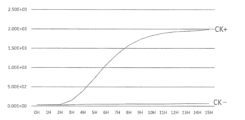
- FIG. 1 is a graph showing the time course of the GFP synthesized in Reference Example 1.
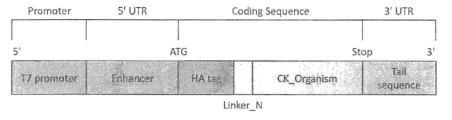
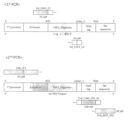
- FIG. 2 is a schematic diagram showing the transcription template DNA of CK.
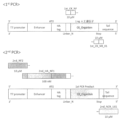
- FIG. 3 is a diagram showing an outline of the procedure for producing CK_DNA by PCR.
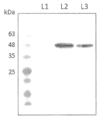
- FIG. 4 is a photograph substituting a drawing, which is a Western blot showing the results of self-amplification of an energy regenerating enzyme (CK) using a cell-free protein synthesis system in Example 1.
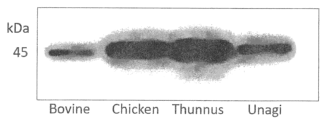
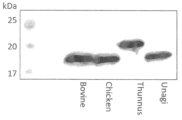
- FIG. 5 is a photograph substituting a drawing, which is a Western blot showing the results of self-amplification of energy-regenerating enzymes (CK) from various animals using a cell-free protein synthesis system in Example 2.
- FIG. 4 is a photograph substituting a drawing, which is a Western blot showing the results of self-amplification of energy-regenerating enzymes (CK) from various animals using a cell-free protein synthesis system in Example 2.
- FIG. 4 is a photograph substituting a drawing, which is a Western
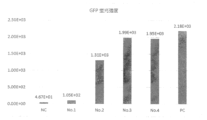
- FIG. 6 is a graph showing the results of synthesizing GFP using the translation product obtained in Example 1 in Example 3.
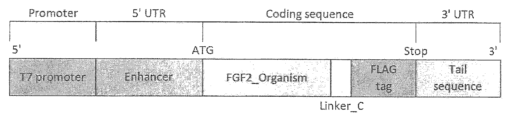
- FIG. 7 is a schematic diagram showing transcription template DNA of chicken, tuna and eel FGF2.
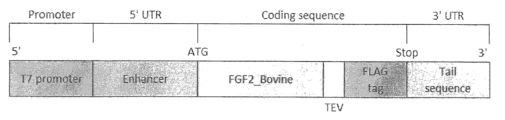
- FIG. 8 is a schematic diagram showing the transcription template DNA of bovine FGF2.
- FIG. 9 is a diagram showing an outline of the procedure for preparing FGF2_DNA by PCR.
- FIG. 10 is a Western blot showing the results of synthesis of a target protein (FGF2) using the energy regenerating enzyme derived from the same organism in Example 4.
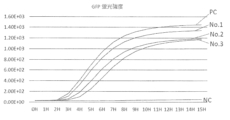
- FIG. 11 is a graph showing that in Example 5, in the presence of a translation template mRNA for translating an energy regenerating enzyme and a translation template mRNA for translating a target protein, an energy regeneration system is self-assembled and the target protein can be synthesized.
- the method for producing a protein according to the first embodiment includes a protein translation step of translating a protein using a translation template mRNA in the absence of cells and in the presence of elements for translating the translation template mRNA into a protein, the translation template mRNA including a translation template mRNA for translating an energy-regenerating enzyme, which is a protein.
- the cell-free protein synthesis system is a method of synthesizing proteins in a test tube by adding a translation template mRNA or a transcription template DNA to a solution containing amino acids, energy molecules such as ATP and GTP, an energy regeneration system, salts such as magnesium ions, and the like, to a cell-free extract containing translation components such as ribosomes, tRNA, aminoacylated tRNA synthetase, translation initiation factors, translation elongation factors, and translation termination factors.
- the protein production method disclosed in this application adds a translation template mRNA for translating the energy regeneration enzyme to the cell-free protein synthesis system instead of adding an isolated energy regeneration enzyme (produced separately as an additive) to the cell-free protein synthesis system.
- the method is characterized in that the energy regeneration system is self-constructed by using the energy regeneration enzyme translated from the translation template mRNA by the cell-free protein synthesis system. Therefore, when the term “elements for translating the translation template mRNA into a protein in the absence of cells" is used in this specification, it means a solution (translation solution) containing a cell-free extract, amino acids, energy molecules, and salts. In addition, the "element for translating a translation template mRNA into a protein in the absence of cells" can also be said to be an element for which "an isolated energy regenerating enzyme is not added at the start of protein synthesis.” Incidentally, energy regenerating enzymes are generally isolated from animals.
- an isolated energy regenerating enzyme is not added at the start of protein synthesis
- an isolated animal-derived energy regenerating enzyme is not added at the start of protein synthesis.
- the protein production method disclosed in the present application is characterized in that an energy regenerating system is self-constructed by using an energy regenerating enzyme translated from a translation template mRNA by a cell-free protein synthesis system, but from a technical point of view, the addition of an isolated animal-derived energy regenerating enzyme does not inhibit the self-construction of the energy regenerating system. Therefore, it does not prevent the addition of a trace amount of an isolated energy regenerating enzyme in order to smoothly proceed with the initial cycle of self-constructing the energy regenerating system.
- an isolated energy regenerating enzyme is added, it is preferable to add the same enzyme as the energy regenerating enzyme that translates from the translation template mRNA so that the added energy regenerating enzyme is not treated as an impurity.
- the cell-free protein synthesis system disclosed in this application is characterized in that no energy regenerating enzyme isolated at the start of synthesis is added.
- creatine kinase one example of an energy regenerating enzyme
- the cell-free extract disclosed in this application is preferably a non-animal cell-free extract.
- Non-animal cell-free extracts include, but are not limited to, those extracted by known methods from wheat germ, etc.
- Amino acids may be any of the naturally occurring amino acids, but non-natural amino acids may also be used.
- the energy molecule may be a known molecule used in protein synthesis.
- the energy molecule include nucleotide triphosphate, creatine phosphate, and formyl folate.
- examples of the nucleotide triphosphate include ATP, GTP, CTP, and UTP.
- ATP and GTP may be used as the energy molecule.
- ATP, GTP, CTP, and UTP may be used.
- Energy regenerating enzymes include enzymes known in the field of protein synthesis. Examples include, but are not limited to, creatine kinase, nucleoside diphosphate kinase, arginine kinase, pyruvate kinase, and adenylate kinase.
- Creatine kinase catalyzes the reaction of creatine phosphate and AMP to regenerate ADP into ATP.
- Nucleoside diphosphate kinase uses polyphosphate as a substrate and regenerates AMP and ADP into ATP, and GDP into GTP.
- Arginine kinase phosphorylates arginine (Arg) to generate arginine phosphate (PArg), and regenerates ATP by transferring the phosphate of the generated PArg to ADP.
- Pyruvate kinase transfers a phosphate group from phosphoenolpyruvate to ADP to regenerate ATP.
- Adenylate kinase is an enzyme that generates one molecule of AMP and one molecule of ATP from two molecules of ADP.
- the translation template mRNA for translating the energy regenerating enzyme is not particularly limited as long as it can translate the energy regenerating enzyme.
- the translation template mRNA includes a coding region that encodes the amino acid sequence of the energy regenerating enzyme, and non-translated regions may be appropriately linked to the 5' and 3' sides of the coding region. Examples of 5' and 3' non-translated regions for improving protein translation efficiency are described in International Publication Nos. WO 2022/185664 and WO 2021/070616 filed by the present applicant.
- the translation template mRNA disclosed in this application may use the non-translated regions described in International Publication Nos. WO 2022/185664 and WO 2021/070616 as necessary. The matters described in International Publication Nos. WO 2022/185664 and WO 2021/070616 are incorporated herein by reference.
- the salts used may be any known salts used in cell-free protein synthesis systems. Examples include, but are not limited to, magnesium acetate, potassium acetate, calcium chloride, etc.
- the method for producing a protein according to the first embodiment has the following advantages. (1) At the start of protein synthesis, no energy regenerating enzyme is added, and the energy regenerating system is constructed using only the energy regenerating enzyme translated from the translation template mRNA for translating the energy regenerating enzyme. Therefore, since there is no need for an isolated energy regenerating enzyme, costs can be reduced. (2) Proteins produced by a cell-free protein synthesis system can be used as medicines or foods. However, when a protein derived from a biological species that has never been ingested is ingested as a medicine or food, there is a risk of allergic reactions, etc. For example, creatine kinase is derived from rabbits, and commercially available energy regenerating enzymes are derived from limited biological species.
- the energy regenerating enzyme is obtained by translating a translation template mRNA, so that an energy regenerating enzyme derived from a desired biological species can be translated. This reduces the risk of allergies, etc. (3)
- the protein production method of the present application can obtain an energy regenerating enzyme derived from a desired species by translation, thereby solving problems caused by religious reasons or contamination with zoonotic viruses.
- Due to the influence of prion diseases there is a tendency to avoid using animal-derived raw materials to produce food and medicines. In the protein production method of the present application, even if the type of energy regenerating enzyme is animal, it is possible to produce proteins using only non-animal raw materials. Therefore, there is no risk of diseases derived from animal raw materials.
- the protein production method according to the second embodiment differs from the protein production method according to the first embodiment in that it includes a translation template mRNA for translating the target protein, but the other points are the same as the protein production method according to the first embodiment.
- the second embodiment of the protein production method will be described mainly with respect to the points different from the first embodiment. Therefore, it goes without saying that the matters already described in the first embodiment can be applied to the second embodiment even if they are not explicitly described in the second embodiment.
- target protein there are no particular limitations on the target protein, so long as it can be synthesized by a cell-free protein synthesis system.
- examples include growth factors; secretory proteins such as insulin and amylase; plasma proteins such as transferrin, myoglobin, and albumin; and the like.
- Examples of animal species of target proteins include fish such as salmon and eels; mammals such as humans, cows, and rabbits; and echinoderms such as sea urchins.
- the protein translation step in the protein production method according to the second embodiment is not particularly limited as long as it is possible to produce a target protein using an energy regenerating enzyme translated from a translation template mRNA for translating the energy regenerating enzyme.
- a first protein translation step is carried out in which an energy-regenerating enzyme is translated using a translation template mRNA for translating the energy-regenerating enzyme;
- a second protein translation step is carried out to translate the target protein using the translation product of the first protein translation step and a translation template mRNA for translating the target protein.
- An example can be given (hereinafter, sometimes referred to as the "first example").
- the translation is carried out in the presence of a translation template mRNA for translating the energy regenerating enzyme and a translation template mRNA for translating the target protein.
- a translation template mRNA for translating the energy regenerating enzyme and a translation template mRNA for translating the target protein.
- An example can be given (hereinafter, sometimes referred to as the "second example").
- the amount of the energy regenerating enzyme to be translated can be adjusted by adjusting the reaction time.
- the amount of the translation product of the first protein translation step added when the second protein translation step is performed can also be adjusted. Therefore, in the first example, the amount of the energy regenerating enzyme contained in the cell-free protein synthesis system when translating the target protein can be adjusted. By adjusting the amount of the energy regenerating enzyme, the translation efficiency of the target protein can be optimized.
- the second example the translation of the energy regenerating enzyme and the target protein is performed simultaneously, so the translation efficiency of the target protein is lower than in the first example, but the convenience of protein production is improved because there is no need to separate the protein translation steps.
- the translation template mRNA for translating the energy regenerating enzyme and the target protein may be synthesized using a nucleic acid synthesizer, or may be transcribed from a transcription template DNA.
- the transcription template DNA may contain a region encoding the translation template mRNA and a promoter sequence located at the 5' end of the region encoding the translation template mRNA.
- the translation template mRNA can be synthesized by translating the transcription template DNA in the absence of cells and in the presence of elements for transcribing the transcription template DNA into mRNA.
- the promoter sequence and elements for transcribing the transcription template DNA into mRNA may be any known sequence in the art. Examples of promoter sequences include, but are not limited to, a T7 promoter sequence, an SP6 promoter sequence, and a T3 promoter sequence.
- the method for producing a protein according to the second embodiment has the following advantages in addition to the advantages (1) to (4) achieved by the method for producing a protein according to the first embodiment. (5) In the effects (2) to (4) achieved by the method for producing a protein according to the first embodiment, the effect is achieved by replacing "energy regenerating enzyme" with "target protein".
- an enzyme for decomposing by-products e.g., inorganic pyrophosphate
- a translation template mRNA for translating an enzyme for folding (activating) the target protein may be added.
- enzymes for decomposing by-products include, but are not limited to, inorganic diphosphatase, inorganic pyrophosphatase, etc.
- enzymes for folding the target protein include, but are not limited to, disulfide isomerase, etc.
- the enzyme for decomposing by-products and/or the translation template mRNA for translating the enzyme for folding the target protein may be added during the first protein translation process, during the second protein translation process, or during the first and second protein translation processes.
- the enzyme for decomposing by-products and/or the translation template mRNA for translating the enzyme for folding the target protein may be added together with the translation template mRNA for translating the energy regenerating enzyme and the translation template mRNA for translating the target protein.
- the transcription template DNA may be designed to include a region encoding the translation template mRNA and a promoter region located at the 5' end of the region encoding the translation template mRNA.
- the coexistence of the enzyme for decomposing by-products and/or the enzyme for folding the target protein improves the translation efficiency of the target protein.
- the enzymes for decomposing by-products and/or the enzymes for folding the target protein are merely preferred examples, and other enzymes may be used as long as they improve the translation efficiency of the target protein.
- the combination of the energy regenerating enzyme and the target protein may be derived from the same biological species.
- the nucleic acid sequences of the energy regenerating enzyme and the target protein of the same biological species may be obtained from a known DB, and the translation template mRNA may be designed.
- a transcription template DNA may be designed that includes a region encoding the translation template mRNA and a promoter region located at the 5' end of the region encoding the translation template mRNA.
- the energy regenerating enzyme and the target protein are derived from the same biological species, the following effect is achieved in addition to the effects achieved by the first and second embodiments of the protein production method. (7)
- the produced protein is to be used in food, it may be objectionable to mix proteins derived from different species. By combining the energy regenerating enzyme and the target protein from the same species, the possibility of objection is reduced.
- the target protein may be a growth factor or a cytokine.
- cultured meat has been attracting attention from the perspectives of responding to population growth and increased food production, environmental issues due to the increase in pasture land for feeding meat animals, safety of administering antibiotics to animals, and ethics of taking the lives of animals.
- Cultured meat is produced by culturing stem cells extracted from animals in a culture medium containing substances necessary for cell growth, such as amino acids and carbohydrates, and growth factors are required for the culture. Cytokines are also required for cell differentiation.
- growth factors or cytokines include, but are not limited to, the following growth factors: ⁇ EGF (Epidermal growth factor): Epidermal growth factor, ⁇ IGF (Insulin-like growth factor): Insulin-like growth factor, TGF (Transforming growth factor): Transforming growth factor, bFGF or FGF2 (basic fibroblast growth factor): basic fibroblast growth factor, NGF (Nerve growth factor): Nerve growth factor, BDNF (Brain-derived neurotrophic factor): Brain-derived neurotrophic factor, ⁇ VEGF (Vesicular endothelial growth factor): Vascular endothelial growth factor, ⁇ G-CSF (Granulocyte-colony stimulating factor): Granulocyte colony stimulating factor, GM-CSF (Granulocyte-macrophage-colony stimulating factor): Granulocyte-macrophage colony stimulating factor, ⁇ PDGF (Platelet-derived growth factor): platelet-derived growth factor, E
- the target protein is a growth factor
- the following effect is achieved in addition to the effects achieved by the first and second embodiments of the protein production method.
- Growth factors are very expensive, but by using the protein production method disclosed in the present application, growth factors can be produced at low cost.
- the protein production method disclosed in this application has been described above by giving several specific embodiments and optional additional items that can be adopted, but various modifications may be made without being limited to these embodiments as long as they are within the scope of the technical ideas disclosed in this application.
- the optional additional items that can be adopted exemplified may be added alone, or any two or more additional items may be combined. When any two or more additional items are used in combination, the respective effects are synergistically exerted.
- an energy regenerating enzyme and/or a sequence for adding a protein tag to the N-terminus and/or C-terminus of the target protein may be linked to the translation template mRNA or transcription template DNA.
- the translation product in the method for producing a protein, when a growth factor is produced as the target protein, the translation product can be used in the method for producing cultured meat.
- the method for producing cultured meat may be carried out by a step of culturing cells using a culture medium containing the translation product as an additive.
- the culture medium may be a known culture medium.
- the cells may be cells of the animal to be cultured. There is no particular limitation on the animal to be cultured as long as it is consumed as meat.
- Examples of the animal to be cultured include, but are not limited to, mammals such as cows, pigs, horses, and sheep; birds such as chickens, ducks, and quails; fish such as salmon, eels, and tuna; and crustaceans such as shrimp and crabs.
- the translation product when a growth factor is produced as the target protein in a protein production method, the translation product can be used as an additive in the cultured meat production method.
- Embodiments of the cultured meat production method and embodiments of the additive have the following advantages. (9) Since growth factors are inexpensive to obtain, the cost of cultured meat can be reduced. (10) By using energy-regenerating enzymes and growth factors from the same species as the animal being cultured, it is possible to produce cultured meat that does not contain proteins derived from other types of animals.
- kits used in the protein production method Next, an embodiment of the kit used in the protein production method will be described.
- the energy regenerating enzyme was an enzyme isolated from an animal or the like.
- the present inventors have newly discovered that in the cell-free protein synthesis system, an energy regenerating enzyme obtained from a translation template mRNA for translating the energy regenerating enzyme is used to construct an energy regenerating system. Therefore, a kit used in the protein production method including a translation template mRNA for translating the energy regenerating enzyme and an element for translating the translation template mRNA into a protein in the absence of cells is a new invention.
- the kit used in the protein production method according to the embodiment can be said to be a kit to which no energy regenerating enzyme is added, since the energy regenerating system is constructed using only the energy regenerating enzyme translated from the translation template mRNA for translating the energy regenerating enzyme.
- the kit may further include a translation template mRNA for translating the target protein, and the energy regenerating enzyme and the target protein may be from the same organism.
- translation template mRNA for translating the energy regenerating enzyme "elements for translating the translation template mRNA into a protein in the absence of cells," and “translation template mRNA for translating a target protein” have already been explained in the embodiment of the protein production method. Therefore, detailed explanation will be omitted to avoid duplication.
- the "translation template mRNA for translating the energy regenerating enzyme", "elements for translating the translation template mRNA into protein in the absence of cells” and “translation template mRNA for translating the target protein” may be provided separately and mixed at the time of use.
- the "translation template mRNA for translating the energy regenerating enzyme” and “elements for translating the translation template mRNA into protein in the absence of cells” may be provided mixed together, and the “translation template mRNA for translating the target protein” may be provided separately.
- translation template mRNA for translating the energy regenerating enzyme may all be provided mixed together.
- reaction solution with the composition shown in Table 1 was added to a 96-well flat-bottom titer plate, and the reaction was allowed to proceed in a plate reader at room temperature (approximately 23°C).
- Example 1 Creatine Kinase Sequence Among the energy regenerating enzymes derived from various organisms, the sequence information (ACC. No.), organism species, and source of acquisition of creatine kinase (CK) are shown in Table 2. In Example 1, No. 4 CK_T (Thunnus, tuna) was used. Nos. 1 to 3 and 5 were used in Examples 2 to 4 described below.
- FIG. 2 shows an outline of the CK transcription template DNA (hereinafter, sometimes referred to as "CK_DNA").
- Table 3 shows the sequences of each region of CK_DNA. Note that the CK sequences of the above-mentioned Organisms No. 1 to 5 are inserted into the CK_Organisms in Table 3 below.
- CK_DNA was prepared by designing a primer as shown in FIG. 3 and performing two-step PCR.
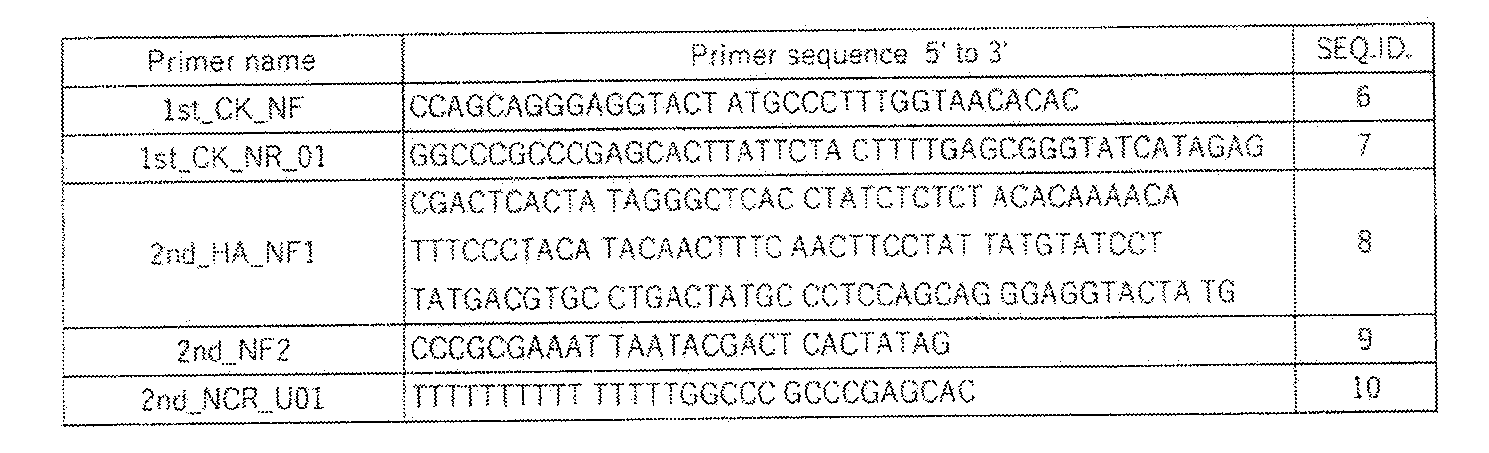
- Table 4 shows the PCR primers
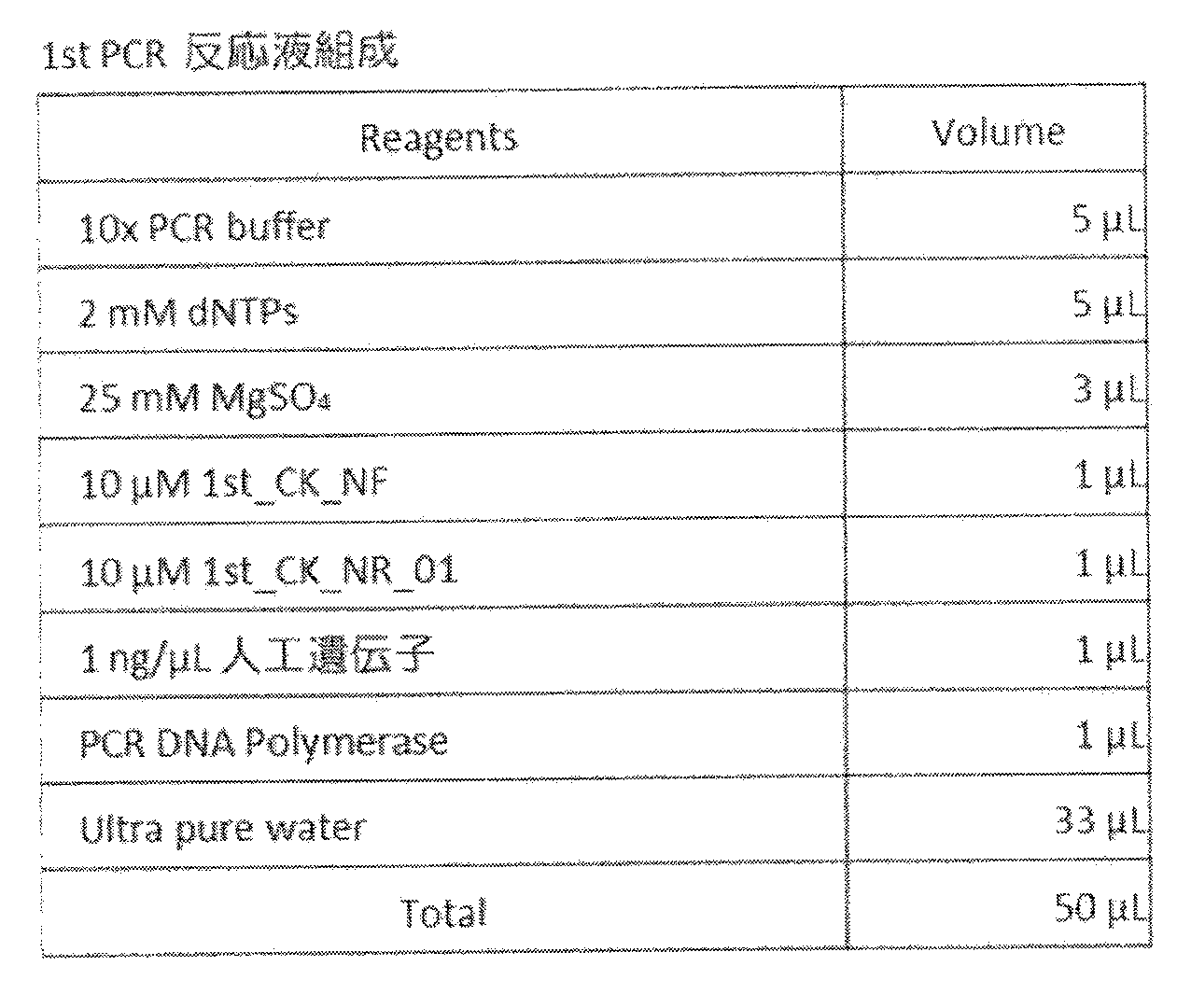
- Tables 5 and 6 show the PCR reaction solution composition
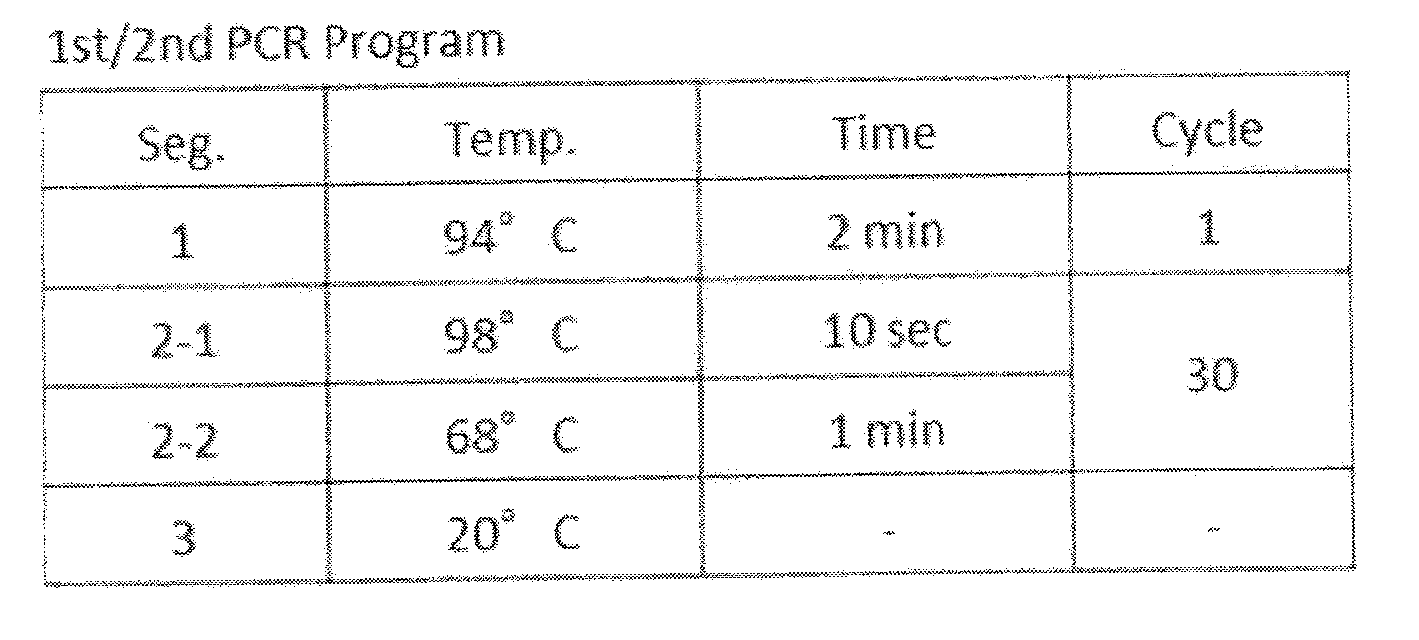
- Table 7 shows the PCR program.
- the synthesis method of the transcription template DNA was performed according to the instruction manual (May-2021/Ver.3.00) of PSS5100 by NUProtein Co., Ltd.
- the reagents and machines used are as follows.
- ⁇ PCR enzyme Toyobo Co., Ltd.
- a translation template mRNA was prepared using the prepared transcription template DNA.
- the transcription reaction was carried out in a 1.5 mL tube using the following reaction solution of PSS5100 manufactured by NUProtein and 2.5 ⁇ L of the second PCR reaction solution (containing transcription template DNA) prepared above, and incubated at 37° C. for 3 hours.
- a translation reaction solution having the following composition was prepared in a 1.5 mL tube, and was placed in an incubator set at 23 ° C. and reacted for 15 hours.
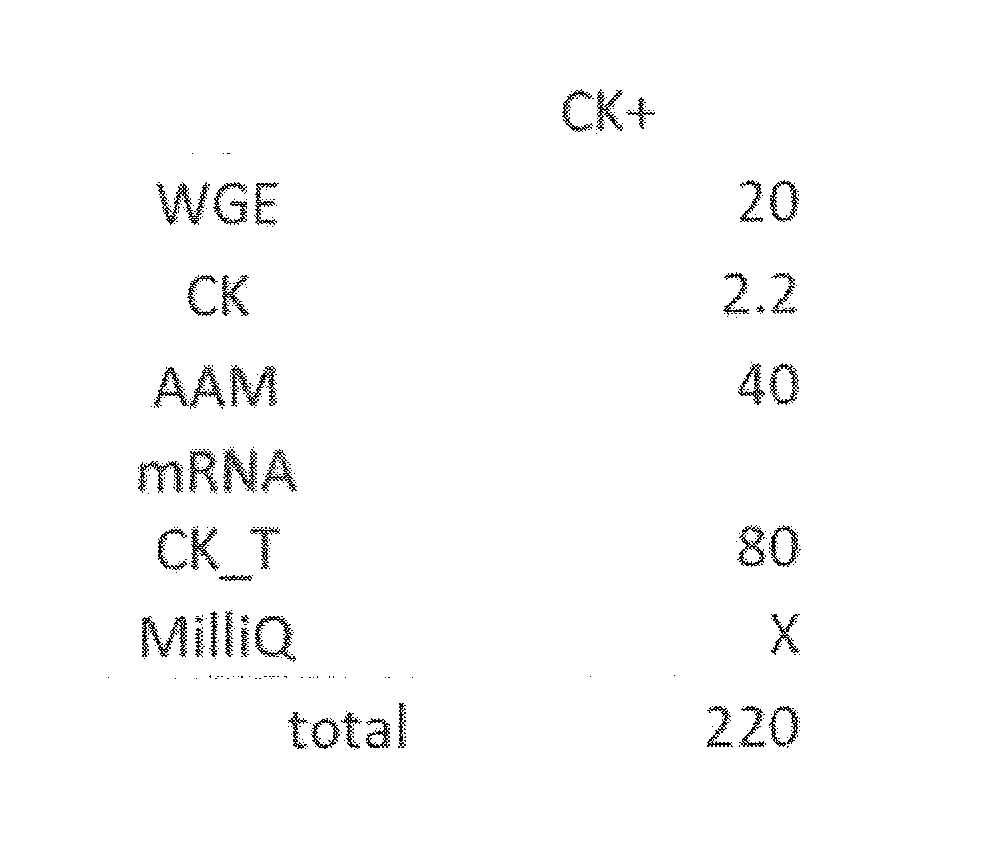
- the composition described in Table 9 was obtained by adding CK in addition to the translation template mRNA of CK_T.
- the composition described in Table 10 was obtained by adding only the translation template mRNA of CK_T, and no CK was added to the translation reaction solution.
- the translation reaction was carried out by administering the translation template mRNA of GFP prepared in ⁇ Reference Example 1> instead of the translation template mRNA of CK_T in Table 10.
- the units of the values in Tables 9 and 10 are ⁇ L, and X in Table 9 is 77.8 and X in Table 10 is 80.
- the stock concentration of the added CK is 20 mg/mL, and the final concentration is 200 ng/ ⁇ L.
- the 1.5 mL tube was centrifuged (15,000 g, 15 minutes, 4°C) and the supernatant was used as the protein solution after translation was completed. Western blotting of the obtained protein was performed.
- L2 is the result of the translation product obtained with the composition listed in Table 9
- L3 is the result of the translation product obtained with the composition listed in Table 10
- L1 is the result of the translation product obtained with the composition using GFP translation template mRNA.
- L3 where no isolated CK was added to the translation reaction solution
- CK_T was translated from the translation template mRNA, although it was less than in L2. From these results, it is believed that when the translation reaction is carried out with the composition listed in Table 10, CK_T is translated from the translation template mRNA by the elements contained in the translation reaction solution, and the translated CK_T establishes an energy regeneration system, causing CK_T to self-replicate.
- Example 2 The experiment was carried out in the same manner as in Example 1, except that CK_B (Bovine), CK_C (Chicken), and CK_U (Unagi) were used instead of CK_T (Thunnus) in Example 1, and the following primers were used as 1st_CK_NF and 1st_CK_NR_01.
- the primer CK_R (Rabbit) used in Example 4 described later is also listed.
- Table 11 the species of organism is listed after CK to specify which species of organism the primer is for.
- Example 3 The translation product CK_T (L3 in FIG. 4) obtained in the above ⁇ Example 1> was used to synthesize GFP as a target protein.
- Table 12 shows the composition of the translation reaction solution.
- the translation product CK_T was added in different amounts as shown in No. 1 to 4, and experiments were performed.
- the target protein was GFP, and the translation template mRNA described in Reference Example 1 was used.
- the negative control (NC) was without CK, CK_T, and GFP mRNA, and the positive control (PC) was CK instead of the translation product CK_T.
- the translation reaction was carried out for about 15 hours with the composition in Table 11, and the experiment was performed in the same manner as in the above ⁇ Reference Example 1> to measure the fluorescence intensity of the synthesized GFP.
- the unit of the values in Table 11 is ⁇ L.
- the stock concentration of the added CK was 20 mg/mL, and the final concentration was 200 ng/ ⁇ L.
- Example 4 Using the translation products of bovine, chicken, tuna, and eel CKs obtained in Example 2 above, synthesis was carried out for target proteins corresponding to FGF2 of each biological species listed in Table 13 below. The specific procedure is described below.
- FIG. 7 shows an outline of the transcription template DNA (hereinafter, sometimes referred to as "FGF2_DNA") of chicken, tuna, and eel FGF2.
- Table 14 shows the sequences of each region of FGF2_DNA. Note that the FGF2 sequences of Chicken, Thunnus, and Unagi in Table 13 above are inserted into FGF2_Organism in the following Table 13.
- FIG. 8 shows an outline of the transcription template DNA of bovine FGF2.
- Table 14 shows the sequences of each region of the transcription template DNA of bovine FGF2.
- the FGF2 sequence of Bovine in Table 13 is inserted into FGF2_Bovine in Table 15 below.
- the PCR reaction solution composition is the same as that in Tables 5 and 6 of Example 1, and the PCR program is the same as that in Table 7 of Example 1.
- the method for synthesizing the transcription template DNA, the reagents, and the machine are also the same as those in Example 1.
- Example 5 [Co-expression of energy regenerating enzyme and target protein]
- Example 5 a translation reaction was carried out in the presence of both a translation template mRNA for translating the energy regenerating enzyme and a translation template mRNA for translating the target protein.
- the experimental procedure is described below.
- (1) Energy Regenerating Enzyme A translation template mRNA was prepared in the same manner as in Example 1 using CK_R shown in No. 1 of Table 2 in Example 1.
- Target Protein The translation template mRNA of GFP described in Reference Example 1 was used.
- the composition of the translation reaction solution is shown in Table 20.
- the negative control (NC) did not contain CK, CK_Rabbit, or GFP mRNA, and the positive control (PC) used CK instead of the translation template mRNA of CK_Rabbit.
- the translation reaction was carried out for about 15 hours with the composition in Table 20, and the experiment was carried out in the same manner as in the above-mentioned ⁇ Reference Example 1>, and the fluorescence intensity of the synthesized GFP was measured.
- the protein production method, cultured meat production method, additives used in the cultured meat production method, and kit used in the protein production method disclosed in this application make it possible to construct an energy regeneration system for cell-free protein synthesis using an energy regeneration enzyme translated from a translation template mRNA. This is therefore useful in industries that require cell-free protein synthesis, such as the food industry, pharmaceutical industry, and research institutes.
Landscapes
- Chemical & Material Sciences (AREA)
- Life Sciences & Earth Sciences (AREA)
- Health & Medical Sciences (AREA)
- Organic Chemistry (AREA)
- Zoology (AREA)
- Engineering & Computer Science (AREA)
- Wood Science & Technology (AREA)
- Genetics & Genomics (AREA)
- Molecular Biology (AREA)
- Bioinformatics & Cheminformatics (AREA)
- General Health & Medical Sciences (AREA)
- Biochemistry (AREA)
- Biotechnology (AREA)
- Microbiology (AREA)
- General Engineering & Computer Science (AREA)
- Chemical Kinetics & Catalysis (AREA)
- General Chemical & Material Sciences (AREA)
- Proteomics, Peptides & Aminoacids (AREA)
- Medicinal Chemistry (AREA)
- Biophysics (AREA)
- Toxicology (AREA)
- Gastroenterology & Hepatology (AREA)
- Biomedical Technology (AREA)
- Nutrition Science (AREA)
- Food Science & Technology (AREA)
- Polymers & Plastics (AREA)
- Preparation Of Compounds By Using Micro-Organisms (AREA)
- Apparatus Associated With Microorganisms And Enzymes (AREA)
- Peptides Or Proteins (AREA)
Abstract
エネルギー再生酵素を自己増殖するタンパク質の生産方法を提供することを課題とする。 細胞の不存在下であってかつ翻訳鋳型mRNAをタンパク質に翻訳するための要素の存在下で、翻訳鋳型mRNAを用いてタンパク質を翻訳するタンパク質翻訳工程を備える、タンパク質の生産方法であって、 前記翻訳鋳型mRNAが、 エネルギー再生酵素を翻訳するための翻訳鋳型mRNAを含む タンパク質の生産方法により、課題を解決できる。
Description
本出願における開示は、タンパク質の生産方法、培養肉の生産方法、培養肉の生産方法に用いる添加物、および、タンパク質の生産方法に用いるキットに関する。
タンパク質を無細胞で合成する合成系は、タンパク質合成に関わる細胞内要素を含む媒体を準備して、無細胞でタンパク質合成を行う系である。こうした無細胞タンパク質合成系は種々知られている。かかる合成系として、転写鋳型である鋳型DNAを媒体に適用して最終産物であるタンパク質を合成する系と、翻訳鋳型であるmRNAを媒体に適用してタンパク質を合成する系とがある。
無細胞タンパク質合成系には、大腸菌、昆虫細胞、コムギ胚芽および動物細胞等から調製した抽出液を用いた系が知られており、キット化されたものが数社から市販されている。タンパク質は、mRNAを翻訳鋳型にしてATPやGTP等のエネルギー源を用いて合成される。しかしながら、タンパク質合成によりエネルギー源が消費されると、ATPはAMPまたはADPに変化し、GTPはGDPに変化することから、タンパク質合成のエネルギー源が不足することになる。そのため、無細胞タンパク質合成系には、AMPまたはADPをATPに再生し、GDPをGTPに再生する等のエネルギー再生酵素を添加することが知られている。エネルギー再生酵素としては、例えば、特許文献1では、クレアチンキナーゼ、ミヨキナーゼ又はヌクレオシドジフォスフェートキナーゼ(NDK)等が開示されている。
無細胞タンパク質合成系に添加するエネルギー再生酵素の量が少なすぎると、再生されるエネルギー源も少なくなり、その結果タンパク質の合成量も少なくなる。そのため、無細胞タンパク質合成系には、所定量のエネルギー再生酵素を添加する必要があり、特許文献2では、例えば、クレアチンキナーゼを0.1mg/mL~0.5mg/mLの濃度で使用することが記載されている。
エネルギー再生酵素の内、例えば、クレアチンキナーゼはウサギ筋肉由来、ミヨキナーゼは酵母由来のものが知られている。しかしながら、エネルギー再生酵素は生物由来であることから酵素を単離する工程が必要であり比較的価格が高いという問題がある。また、エネルギー再生酵素が失活することを避けるため、安定剤の添加や保管温度管理等に留意する必要があるという問題がある。
本出願における開示は、上記従来の問題点を解決するためになされたものである。本発明者らが鋭意研究を行ったところ、(1)エネルギー再生酵素を翻訳するための翻訳鋳型mRNAを用い、(2)無細胞タンパク質合成系によりエネルギー再生酵素を自己増殖させることで、無細胞タンパク質合成系に単離したエネルギー再生酵素自体を添加することなくエネルギー再生系を構築できること、を新たに見出した。
すなわち、本出願の開示の目的は、エネルギー再生酵素を自己増殖するタンパク質の生産方法、培養肉の生産方法、培養肉の生産方法に用いる添加物、および、タンパク質の生産方法に用いるキットを提供することである。
本出願の開示は、以下に示す、タンパク質の生産方法、培養肉の生産方法、培養肉の生産方法に用いる添加物、および、タンパク質の生産方法に用いるキットに関する。
(1)細胞の不存在下であってかつ翻訳鋳型mRNAをタンパク質に翻訳するための要素の存在下で、翻訳鋳型mRNAを用いてタンパク質を翻訳するタンパク質翻訳工程を備える、タンパク質の生産方法であって、
前記翻訳鋳型mRNAが、
エネルギー再生酵素を翻訳するための翻訳鋳型mRNAを含む
タンパク質の生産方法。
(2)前記翻訳鋳型mRNAが、目的タンパク質を翻訳するための翻訳鋳型mRNAを更に含む
上記(1)に記載のタンパク質の生産方法。
(3)前記タンパク質翻訳工程が、
前記エネルギー再生酵素を翻訳するための翻訳鋳型mRNAを用いてエネルギー再生酵素を翻訳する第1タンパク質翻訳工程と、
前記第1タンパク質翻訳工程の翻訳産物と、前記目的タンパク質を翻訳するための翻訳鋳型mRNAと、を用いて目的タンパク質を翻訳する第2タンパク質翻訳工程と、
を含む
上記(2)に記載のタンパク質の生産方法。
(4)前記タンパク質翻訳工程が、
前記エネルギー再生酵素を翻訳するための翻訳鋳型mRNAおよび前記目的タンパク質を翻訳するための翻訳鋳型mRNAが共存した状態で実施される
上記(2)に記載のタンパク質の生産方法。
(5)前記エネルギー再生酵素が、クレアチンキナーゼ、ヌクレオシド2リン酸キナーゼ、アルギニンキナーゼ、および、アデニル酸キナーゼからなる群から選択した少なくとも1種である
上記(1)~(4)の何れか一つに記載のタンパク質の生産方法。
(6)無機ジホスファターゼ、無機ピロホスファターゼおよびジスルフィドイソメラーゼからなる群から選択した少なくとも1種を翻訳するための翻訳鋳型mRNAを更に含む
上記(1)~(4)の何れか一つに記載のタンパク質の生産方法。
(7)前記エネルギー再生酵素を翻訳するための翻訳鋳型mRNA、および、前記目的タンパク質を翻訳するための翻訳鋳型mRNAが、
前記翻訳鋳型mRNAをコードする領域と、前記翻訳鋳型mRNAをコードする領域の5’末端に配置されるプロモーター領域と、を含む転写鋳型DNAを用い、
細胞の不存在下であってかつ前記転写鋳型DNAをmRNAに転写するための要素の存在下で、前記転写鋳型DNAを用いて翻訳したものである
上記(2)に記載のタンパク質の生産方法。
(8)前記エネルギー再生酵素および前記目的タンパク質が、同一の生物種のものである
上記(2)に記載のタンパク質の生産方法。
(9)前記目的タンパク質が成長因子である
上記(2)~(4)、(7)、(8)の何れか一つに記載のタンパク質の生産方法。
(10)培養肉の生産方法であって、
上記(9)に記載のタンパク質の生産方法で生産した翻訳産物を添加物として含む培養液を用いて細胞培養する工程を含む
培養肉の生産方法。
(11)培養肉の生産方法に用いる添加物であって、
上記(9)に記載のタンパク質の生産方法で生産した翻訳産物を含む
添加物。
(12)タンパク質の生産方法に用いるキットであって、該キットは、
エネルギー再生酵素を翻訳するための翻訳鋳型mRNAと、
細胞の不存在下であってかつ前記エネルギー再生酵素を翻訳するための翻訳鋳型mRNAをタンパク質に翻訳するための要素と、
を含む
キット。
(13)目的タンパク質を翻訳するための翻訳鋳型mRNAを更に含む
上記(12)に記載のキット。
(14)前記エネルギー再生酵素および前記目的タンパク質が、同一の生物種のものである
上記(13)に記載のキット。
前記翻訳鋳型mRNAが、
エネルギー再生酵素を翻訳するための翻訳鋳型mRNAを含む
タンパク質の生産方法。
(2)前記翻訳鋳型mRNAが、目的タンパク質を翻訳するための翻訳鋳型mRNAを更に含む
上記(1)に記載のタンパク質の生産方法。
(3)前記タンパク質翻訳工程が、
前記エネルギー再生酵素を翻訳するための翻訳鋳型mRNAを用いてエネルギー再生酵素を翻訳する第1タンパク質翻訳工程と、
前記第1タンパク質翻訳工程の翻訳産物と、前記目的タンパク質を翻訳するための翻訳鋳型mRNAと、を用いて目的タンパク質を翻訳する第2タンパク質翻訳工程と、
を含む
上記(2)に記載のタンパク質の生産方法。
(4)前記タンパク質翻訳工程が、
前記エネルギー再生酵素を翻訳するための翻訳鋳型mRNAおよび前記目的タンパク質を翻訳するための翻訳鋳型mRNAが共存した状態で実施される
上記(2)に記載のタンパク質の生産方法。
(5)前記エネルギー再生酵素が、クレアチンキナーゼ、ヌクレオシド2リン酸キナーゼ、アルギニンキナーゼ、および、アデニル酸キナーゼからなる群から選択した少なくとも1種である
上記(1)~(4)の何れか一つに記載のタンパク質の生産方法。
(6)無機ジホスファターゼ、無機ピロホスファターゼおよびジスルフィドイソメラーゼからなる群から選択した少なくとも1種を翻訳するための翻訳鋳型mRNAを更に含む
上記(1)~(4)の何れか一つに記載のタンパク質の生産方法。
(7)前記エネルギー再生酵素を翻訳するための翻訳鋳型mRNA、および、前記目的タンパク質を翻訳するための翻訳鋳型mRNAが、
前記翻訳鋳型mRNAをコードする領域と、前記翻訳鋳型mRNAをコードする領域の5’末端に配置されるプロモーター領域と、を含む転写鋳型DNAを用い、
細胞の不存在下であってかつ前記転写鋳型DNAをmRNAに転写するための要素の存在下で、前記転写鋳型DNAを用いて翻訳したものである
上記(2)に記載のタンパク質の生産方法。
(8)前記エネルギー再生酵素および前記目的タンパク質が、同一の生物種のものである
上記(2)に記載のタンパク質の生産方法。
(9)前記目的タンパク質が成長因子である
上記(2)~(4)、(7)、(8)の何れか一つに記載のタンパク質の生産方法。
(10)培養肉の生産方法であって、
上記(9)に記載のタンパク質の生産方法で生産した翻訳産物を添加物として含む培養液を用いて細胞培養する工程を含む
培養肉の生産方法。
(11)培養肉の生産方法に用いる添加物であって、
上記(9)に記載のタンパク質の生産方法で生産した翻訳産物を含む
添加物。
(12)タンパク質の生産方法に用いるキットであって、該キットは、
エネルギー再生酵素を翻訳するための翻訳鋳型mRNAと、
細胞の不存在下であってかつ前記エネルギー再生酵素を翻訳するための翻訳鋳型mRNAをタンパク質に翻訳するための要素と、
を含む
キット。
(13)目的タンパク質を翻訳するための翻訳鋳型mRNAを更に含む
上記(12)に記載のキット。
(14)前記エネルギー再生酵素および前記目的タンパク質が、同一の生物種のものである
上記(13)に記載のキット。
本出願で開示するタンパク質の生産方法、培養肉の生産方法、培養肉の生産方法に用いる添加物、および、タンパク質の生産方法に用いるキットは、無細胞タンパク質合成系により翻訳鋳型から翻訳したエネルギー再生酵素を用いてエネルギー再生系を構築できる。したがって、単離したエネルギー再生酵素を無細胞タンパク質合成系に添加する必要がない。
以下に、本出願で開示する、タンパク質の生産方法、培養肉の生産方法、培養肉の生産方法に用いる添加物、および、タンパク質の生産方法に用いるキットについて詳しく説明する。なお、以下の説明は、理解を容易にするためのものであり、本出願で開示する技術事項の範囲は、以下の説明に限定されない。以下の例示以外にも、本出願で開示する趣旨を損なわない範囲で適宜変更できることは言うまでもない。
(タンパク質の生産方法の第1の実施形態)
第1の実施形態に係るタンパク質の生産方法は、細胞の不存在下であってかつ翻訳鋳型mRNAをタンパク質に翻訳するための要素の存在下で、翻訳鋳型mRNAを用いてタンパク質を翻訳するタンパク質翻訳工程を備える。そして、翻訳鋳型mRNAは、タンパク質であるエネルギー再生酵素を翻訳するための翻訳鋳型mRNAを含む。
第1の実施形態に係るタンパク質の生産方法は、細胞の不存在下であってかつ翻訳鋳型mRNAをタンパク質に翻訳するための要素の存在下で、翻訳鋳型mRNAを用いてタンパク質を翻訳するタンパク質翻訳工程を備える。そして、翻訳鋳型mRNAは、タンパク質であるエネルギー再生酵素を翻訳するための翻訳鋳型mRNAを含む。
無細胞タンパク質合成系は、リボソーム、tRNA、アミノアシル化tRNA合成酵素、翻訳開始因子、翻訳伸長因子、翻訳終結因子などの翻訳成分を含む無細胞抽出液に対して、アミノ酸、ATPやGTPなどエネルギー分子、エネルギー再生系、マグネシウムイオンなど塩類等を含む溶液に、翻訳鋳型mRNAあるいは転写鋳型DNAを添加し、タンパク質を試験管内で合成する方法である。本出願で開示するタンパク質の生産方法は、無細胞タンパク質合成系に単離した(添加物として別途製造した)エネルギー再生酵素を添加する代わりに、エネルギー再生酵素を翻訳するための翻訳鋳型mRNAを添加する。そして、無細胞タンパク質合成系により翻訳鋳型mRNAから翻訳したエネルギー再生酵素を用いることで、エネルギー再生系を自己構築することが特徴である。したがって、本明細書において「細胞の不存在下であってかつ翻訳鋳型mRNAをタンパク質に翻訳するための要素」と記載した場合、無細胞抽出液と、アミノ酸と、エネルギー分子と、塩類を含む溶液(翻訳液)を意味する。また、「細胞の不存在下であってかつ翻訳鋳型mRNAをタンパク質に翻訳するための要素」は、「タンパク質合成開始時に単離したエネルギー再生酵素が添加されていない」要素ということもできる。ところで、エネルギー再生酵素は、一般的に動物から単離されている。したがって、「タンパク質合成開始時に単離したエネルギー再生酵素が添加されていない」は、「タンパク質合成開始時に単離した動物由来のエネルギー再生酵素が添加されていない」と換言してもよい。なお、上記のとおり、本出願で開示するタンパク質生産方法は、無細胞タンパク質合成系により翻訳鋳型mRNAから翻訳したエネルギー再生酵素を用いることでエネルギー再生系を自己構築することが特徴であるが、技術的観点からみて、単離した動物由来のエネルギー再生酵素の添加がエネルギー再生系の自己構築を阻害するものではない。したがって、エネルギー再生系を自己構築する初期段階のサイクルを円滑に進めるために、単離したエネルギー再生酵素を極微量添加することを妨げるものではない。なお、単離したエネルギー再生酵素を添加する場合、添加したエネルギー再生酵素が不純物として扱われないようにするため、翻訳鋳型mRNAから翻訳するエネルギー再生酵素と同じ酵素を添加することが望ましい。
上記のとおり、本出願で開示する無細胞タンパク質合成系は、合成開始時に単離したエネルギー再生酵素が添加されていないことが特徴である。ところで、エネルギー再生酵素の一例であるクレアチンキナーゼは、主に動物の筋肉に存在する。そのため、動物細胞由来の無細胞抽出液を用いた場合、無細胞抽出液にクレアチンキナーゼが含まれる恐れがある。したがって、本出願で開示する無細胞抽出液は、非動物系の無細胞抽出液が好ましい。非動物系の無細胞抽出液としては、限定されるものではないが、例えば、コムギ胚芽等から公知の方法で抽出したものが挙げられる。
アミノ酸は、天然型の各種アミノ酸を用いればよいが、非天然型であってもよい。
エネルギー分子は、タンパク質合成に用いられる公知の分子を用いればよい。エネルギー分子としては、例えば、ヌクレオチド三リン酸、クレアチンフォスフェート及びフォルミル葉酸が挙げられる。ここで、ヌクレオチド三リン酸には、ATP、GTP、CTP、UTPが挙げられる。翻訳鋳型mRNAからタンパク質を生産する場合は、エネルギー分子としてATPおよびGTPを用いればよい。転写鋳型DNAからタンパク質を生産する場合は、ATP、GTP、CTPおよびUTPを用いればよい。
エネルギー再生酵素は、タンパク質合成の分野において公知の酵素が挙げられる。限定されるものではないが、例えば、クレアチンキナーゼ、ヌクレオシド2リン酸キナーゼ、アルギニンキナーゼ、ピルビン酸キナーゼ、および、アデニル酸キナーゼ等が挙げられる。
クレアチンキナーゼは、クレアチンリン酸およびAMPの反応を触媒し、ADPをATPに再生する。ヌクレオシド2リン酸キナーゼは、ポリリン酸を基質として、AMPとADPをATPに、GDPをGTPに再生する。アルギニンキナーゼは、アルギニン(Arg)をリン酸化しアルギニンリン酸(PArg)を生成し、生成したPArgのリン酸をADPに移転することでATPを再生する。ピルビン酸キナーゼは、ホスホエノールプルビン酸からリン酸基をADPに転移しATPを再生する。アデニル酸キナーゼは、2分子のADPから1分子のAMPと1分子のATPを生成する酵素である。
エネルギー再生酵素を翻訳するための翻訳鋳型mRNAは、上記エネルギー再生酵素を翻訳できれば特に制限はない。翻訳鋳型mRNAは、エネルギー再生酵素のアミノ酸配列をコードするコード領域を含み、コード領域の5’および3’側に適宜非翻訳領域を連結すればよい。タンパク質の翻訳効率を向上するための5’非翻訳領域および3’非翻訳領域の例としては、本出願人が出願した国際公開第2022/185664号、国際公開第2021/070616号に記載されている。本出願で開示する翻訳鋳型mRNAは、必要に応じて国際公開第2022/185664号、国際公開第2021/070616号に記載されている非翻訳領域を用いてもよい。国際公開第2022/185664号および国際公開第2021/070616号に記載されている事項は、参照により本明細書に含まれる。
塩類は、無細胞タンパク質合成系で用いられている公知の塩類を用いればよい。限定されるものではないが、例えば、酢酸マグネシウム、酢酸カリウム、塩化カルシウム、等が挙げられる。
第1の実施形態に係るタンパク質の生産方法は、以下の効果を奏する。
(1)タンパク質合成開始時に、エネルギー再生酵素が添加されておらず、エネルギー再生酵素を翻訳するための翻訳鋳型mRNAから翻訳したエネルギー再生酵素のみを用いてエネルギー再生系が構築される。したがって、単離したエネルギー再生酵素が不要であることからコストダウンができる。
(2)無細胞タンパク質合成系により生産したタンパク質は、医薬品や食品として用いることができる。しかしながら、摂取したことが無い生物種由来のタンパク質を医薬品や食品として摂取した場合、アレルギー反応等を引き起こす恐れがある。例えば、クレアチンキナーゼはウサギ由来等、市販のエネルギー再生酵素は由来する生物種の選択肢が限定されている。一方、本出願ではエネルギー再生酵素は翻訳鋳型mRNAから翻訳することで得られることから、所望の生物種由来のエネルギー再生酵素を翻訳できる。したがって、アレルギー等の恐れを少なくできる。
(3)生産したタンパク質を食品や医薬品に使用する場合、宗教的理由あるいは人畜共通ウィルスの汚染を回避するために、特定の生物種の原料を使用できない場合がある。しかしながら、本出願のタンパク質生産方法では、所望の生物種由来のエネルギー再生酵素を翻訳により得られることから、宗教的理由あるいは人畜共通ウィルスの汚染による問題を解決できる。
(4)プリオン病等の影響により、動物由来の原料を使用して食品や医薬品を製造することが忌避される傾向にある。本出願のタンパク質生産方法では、エネルギー再生酵素の種類は動物であっても、非動物原料のみでタンパク質を生産することができる。したがって、動物原料由来の疾患等の恐れがない。
(1)タンパク質合成開始時に、エネルギー再生酵素が添加されておらず、エネルギー再生酵素を翻訳するための翻訳鋳型mRNAから翻訳したエネルギー再生酵素のみを用いてエネルギー再生系が構築される。したがって、単離したエネルギー再生酵素が不要であることからコストダウンができる。
(2)無細胞タンパク質合成系により生産したタンパク質は、医薬品や食品として用いることができる。しかしながら、摂取したことが無い生物種由来のタンパク質を医薬品や食品として摂取した場合、アレルギー反応等を引き起こす恐れがある。例えば、クレアチンキナーゼはウサギ由来等、市販のエネルギー再生酵素は由来する生物種の選択肢が限定されている。一方、本出願ではエネルギー再生酵素は翻訳鋳型mRNAから翻訳することで得られることから、所望の生物種由来のエネルギー再生酵素を翻訳できる。したがって、アレルギー等の恐れを少なくできる。
(3)生産したタンパク質を食品や医薬品に使用する場合、宗教的理由あるいは人畜共通ウィルスの汚染を回避するために、特定の生物種の原料を使用できない場合がある。しかしながら、本出願のタンパク質生産方法では、所望の生物種由来のエネルギー再生酵素を翻訳により得られることから、宗教的理由あるいは人畜共通ウィルスの汚染による問題を解決できる。
(4)プリオン病等の影響により、動物由来の原料を使用して食品や医薬品を製造することが忌避される傾向にある。本出願のタンパク質生産方法では、エネルギー再生酵素の種類は動物であっても、非動物原料のみでタンパク質を生産することができる。したがって、動物原料由来の疾患等の恐れがない。
(タンパク質の生産方法の第2の実施形態)
次に、タンパク質の生産方法の第2の実施形態について説明する。第2の実施形態に係るタンパク質の生産方法は、目的タンパク質を翻訳するための翻訳鋳型mRNAを含む点で第1の実施形態に係るタンパク質の生産方法と異なるが、その他の点は、第1の実施形態に係るタンパク質の生産方法と同じである。重複記載を避けるため、タンパク質の生産方法の第2の実施形態では、第1の実施形態と異なる点を中心に説明する。したがって、第2の実施形態において、明示的に説明をしなかったとしても、第1の実施形態において説明済みの事項を第2の実施形態に適用できることは言うまでもない。
次に、タンパク質の生産方法の第2の実施形態について説明する。第2の実施形態に係るタンパク質の生産方法は、目的タンパク質を翻訳するための翻訳鋳型mRNAを含む点で第1の実施形態に係るタンパク質の生産方法と異なるが、その他の点は、第1の実施形態に係るタンパク質の生産方法と同じである。重複記載を避けるため、タンパク質の生産方法の第2の実施形態では、第1の実施形態と異なる点を中心に説明する。したがって、第2の実施形態において、明示的に説明をしなかったとしても、第1の実施形態において説明済みの事項を第2の実施形態に適用できることは言うまでもない。
目的タンパク質は、無細胞タンパク質合成系により合成できるタンパク質であれば特に制限はない。例えば、成長因子;インスリン、アミラーゼ等の分泌タンパク質、トランスフェリン、ミオグロビン、アルブミン等の血漿タンパク質;等が挙げられる。また、目的タンパク質の動物種としては、例えば、サーモン、うなぎ等の魚類;ヒト、牛、ウサギ等の哺乳類;ウニ等の棘皮動物;等が挙げられる。
第2の実施形態に係るタンパク質の生産方法のタンパク質翻訳工程は、エネルギー再生酵素を翻訳するための翻訳鋳型mRNAから翻訳したエネルギー再生酵素を用いて目的タンパク質を生産できれば特に制限はない。
タンパク質翻訳工程の一例として、
エネルギー再生酵素を翻訳するための翻訳鋳型mRNAを用いてエネルギー再生酵素を翻訳する第1タンパク質翻訳工程を先ず実施し、
次に、第1タンパク質翻訳工程の翻訳産物と、目的タンパク質を翻訳するための翻訳鋳型mRNAと、を用いて目的タンパク質を翻訳する第2タンパク質翻訳工程を実施する、
例が挙げられる(以下、「第1の例」と記載することがある)。
エネルギー再生酵素を翻訳するための翻訳鋳型mRNAを用いてエネルギー再生酵素を翻訳する第1タンパク質翻訳工程を先ず実施し、
次に、第1タンパク質翻訳工程の翻訳産物と、目的タンパク質を翻訳するための翻訳鋳型mRNAと、を用いて目的タンパク質を翻訳する第2タンパク質翻訳工程を実施する、
例が挙げられる(以下、「第1の例」と記載することがある)。
タンパク質翻訳工程のその他の例として、
エネルギー再生酵素を翻訳するための翻訳鋳型mRNAおよび目的タンパク質を翻訳するための翻訳鋳型mRNAが共存した状態で実施する、
例が挙げられる(以下、「第2の例」と記載することがある)。
エネルギー再生酵素を翻訳するための翻訳鋳型mRNAおよび目的タンパク質を翻訳するための翻訳鋳型mRNAが共存した状態で実施する、
例が挙げられる(以下、「第2の例」と記載することがある)。
第1の例の場合は、第1タンパク質翻訳工程で翻訳鋳型mRNAからエネルギー再生酵素を先に翻訳することから、反応時間を調整することで翻訳するエネルギー再生酵素の量を調整できる。また、第2タンパク質翻訳工程を実施する際に添加する第1タンパク質翻訳工程の翻訳産物の量を調整することもできる。したがって、第1の例の場合は、目的タンパク質を翻訳する際の無細胞タンパク質合成系に含まれるエネルギー再生酵素の量を調整できる。エネルギー再生酵素の量を調整することで、目的タンパク質の翻訳効率を至適化できるとの効果を奏する。一方、第2の例の場合は、エネルギー再生酵素および目的タンパク質の翻訳を同時に実施することから第1の例より目的タンパク質の翻訳効率は低くなるものの、タンパク質翻訳工程を分ける必要がないことからタンパク質生産の利便性が向上する。
エネルギー再生酵素および目的タンパク質を翻訳するための翻訳鋳型mRNAは、核酸合成装置により合成したものを用いてもよいし、転写鋳型DNAから転写したものを用いてもよい。転写鋳型DNAは、翻訳鋳型mRNAをコードする領域と、翻訳鋳型mRNAをコードする領域の5’末端に配置されるプロモーター配列を含めばよい。翻訳鋳型mRNAは、細胞の不存在下であってかつ転写鋳型DNAをmRNAに転写するための要素の存在下で、転写鋳型DNAを用いて翻訳することで合成できる。プロモーター配列、転写鋳型DNAをmRNAに転写するための要素は、本技術分野において公知のものを用いればよい。例示であって限定するものではないが、プロモーター配列は、T7プロモーター配列、SP6プロモーター配列、T3プロモーター配列等が挙げられる。
第2の実施形態に係るタンパク質の生産方法は、第1の実施形態に係るタンパク質の生産方法が奏する(1)~(4)に記載の効果に加え、以下の効果を奏する。
(5)第1の実施形態に係るタンパク質の生産方法が奏する(2)~(4)に記載の効果において、「エネルギー再生酵素」を「目的タンパク質」と読み替えた効果を奏する。
(5)第1の実施形態に係るタンパク質の生産方法が奏する(2)~(4)に記載の効果において、「エネルギー再生酵素」を「目的タンパク質」と読み替えた効果を奏する。
[タンパク質の生産方法の実施形態において採用可能な任意付加的事項]
次に、タンパク質の生産方法の実施形態において採用可能な任意付加的事項について説明する。
(その他酵素を翻訳する翻訳鋳型mRNAの追加)
タンパク質翻訳工程では、エネルギー再生酵素に加え、転写/翻訳で生じる副産物(例えば、無機ピロリン酸)を分解するための酵素、および/または、目的タンパク質をフォールディング(目的タンパク質の活性化)するための酵素を翻訳するための翻訳鋳型mRNAが添加されていてもよい。副産物を分解するための酵素としては、限定されるものではないが、例えば、無機ジホスファターゼ、無機ピロホスファターゼ等が挙げられる。また、目的タンパク質をフォールディングするための酵素としては、限定されるものではないが、例えば、ジスルフィドイソメラーゼ等が挙げられる。
次に、タンパク質の生産方法の実施形態において採用可能な任意付加的事項について説明する。
(その他酵素を翻訳する翻訳鋳型mRNAの追加)
タンパク質翻訳工程では、エネルギー再生酵素に加え、転写/翻訳で生じる副産物(例えば、無機ピロリン酸)を分解するための酵素、および/または、目的タンパク質をフォールディング(目的タンパク質の活性化)するための酵素を翻訳するための翻訳鋳型mRNAが添加されていてもよい。副産物を分解するための酵素としては、限定されるものではないが、例えば、無機ジホスファターゼ、無機ピロホスファターゼ等が挙げられる。また、目的タンパク質をフォールディングするための酵素としては、限定されるものではないが、例えば、ジスルフィドイソメラーゼ等が挙げられる。
タンパク質翻訳工程が第1の例の場合、副産物を分解するための酵素、および/または、目的タンパク質をフォールディングするための酵素を翻訳するための翻訳鋳型mRNAは、第1タンパク質翻訳工程の際に添加されてもよいし、第2タンパク質翻訳工程の際に添加されてもよいし、第1タンパク質翻訳工程および第2タンパク質翻訳工程の際に添加されてもよい。タンパク質翻訳工程が第2の例の場合は、エネルギー再生酵素を翻訳するための翻訳鋳型mRNAおよび目的タンパク質を翻訳するための翻訳鋳型mRNAと共に、副産物を分解するための酵素、および/または、目的タンパク質をフォールディングするための酵素を翻訳するための翻訳鋳型mRNAが添加されればよい。その他酵素を翻訳する翻訳鋳型mRNAを転写鋳型DNAから転写することで作製する場合は、当該翻訳鋳型mRNAをコードする領域と、翻訳鋳型mRNAをコードする領域の5’末端に配置されるプロモーター領域を含む転写鋳型DNAを設計すればよい。タンパク質翻訳工程において、副産物を分解するための酵素、および/または、目的タンパク質をフォールディングする酵素が共存することで、目的タンパク質の翻訳効率が向上する。なお、副産物を分解するための酵素、および/または、目的タンパク質をフォールディングする酵素は、好ましい例示に過ぎず、目的タンパク質の翻訳効率が向上する酵素であれば、その他の酵素であってもよい。
その他酵素を翻訳する翻訳鋳型mRNAを追加した場合、タンパク質の生産方法の第1および第2の実施形態が奏する効果に加え、以下の効果を奏する。
(6)無細胞タンパク質合成系の効率的な合成を阻害する副産物を除去できることから、タンパク質の生産効率が向上する。また、生産したタンパク質の活性化ができる。
(6)無細胞タンパク質合成系の効率的な合成を阻害する副産物を除去できることから、タンパク質の生産効率が向上する。また、生産したタンパク質の活性化ができる。
(エネルギー再生酵素および目的タンパク質の生物種について)
エネルギー再生酵素および目的タンパク質の組合せは、同一の生物種由来となるようにしてもよい。その場合、公知のDBから同一生物種のエネルギー再生酵素および目的タンパク質の核酸配列を入手し、翻訳鋳型mRNAを設計すればよい。また、翻訳鋳型mRNAを転写鋳型DNAから転写することで作製する場合は、当該翻訳鋳型mRNAをコードする領域と、翻訳鋳型mRNAをコードする領域の5’末端に配置されるプロモーター領域を含む転写鋳型DNAを設計すればよい。
エネルギー再生酵素および目的タンパク質の組合せは、同一の生物種由来となるようにしてもよい。その場合、公知のDBから同一生物種のエネルギー再生酵素および目的タンパク質の核酸配列を入手し、翻訳鋳型mRNAを設計すればよい。また、翻訳鋳型mRNAを転写鋳型DNAから転写することで作製する場合は、当該翻訳鋳型mRNAをコードする領域と、翻訳鋳型mRNAをコードする領域の5’末端に配置されるプロモーター領域を含む転写鋳型DNAを設計すればよい。
エネルギー再生酵素および目的タンパク質の組合せを同一の生物種由来とした場合、タンパク質の生産方法の第1および第2の実施形態が奏する効果に加え、以下の効果を奏する。
(7)生産したタンパク質を食品に使用する場合、異なる生物種由来のタンパク質を混合することが忌避される場合がある。エネルギー再生酵素および目的タンパク質の組合せを同一の生物種由来とすることで、忌避の恐れが少なくなる。
(7)生産したタンパク質を食品に使用する場合、異なる生物種由来のタンパク質を混合することが忌避される場合がある。エネルギー再生酵素および目的タンパク質の組合せを同一の生物種由来とすることで、忌避の恐れが少なくなる。
(目的タンパク質について)
目的タンパク質は成長因子あるいはサイトカインであってもよい。近年、人口増加・食料増産への対応、食肉動物の餌となる牧草地増加に伴う環境問題、動物への抗生物質投与による安全性、動物の生命を奪うことに対する倫理等の観点から、培養肉が注目されている。培養肉は、アミノ酸や炭水化物など細胞の増殖に必要な物質が入った培養液を用い、動物から取り出した幹細胞を培養するが、培養には成長因子が必要である。また、細胞分化のためにはサイトカインが必要である。成長因子あるいはサイトカインとしては、限定されるものではないが、例えば、以下の成長因子が挙げられる。
・EGF(Epidermal growth factor):上皮成長因子、
・IGF(Insulin-like growth factor):インスリン様成長因子、
・TGF(Transforming growth factor):トランスフォーミング成長因子、
・bFGFまたはFGF2(basic fibroblast growth factor):塩基性線維芽細胞増殖因子、
・NGF(Nerve growth factor):神経成長因子、
・BDNF(Brain-derived neurotrophic factor):脳由来神経栄養因子、
・VEGF(Vesicular endothelial growth factor):血管内皮細胞増殖因子、
・G-CSF(Granulocyte-colony stimulating factor):顆粒球コロニー刺激因子、
・GM-CSF(Granulocyte-macrophage-colony stimulating factor):顆粒球マクロファージコロニー刺激因子、
・PDGF(Platelet-derived growth factor):血小板由来成長因子、
・EPO(Erythropoietin):エリスロポエチン、
・TPO(Thrombopoietin):トロンボポエチン、
・HGF(Hepatocyte growth factor):肝細胞増殖因子。
・LIF(leukemia inhibotory factor):白血病阻止因子
目的タンパク質は成長因子あるいはサイトカインであってもよい。近年、人口増加・食料増産への対応、食肉動物の餌となる牧草地増加に伴う環境問題、動物への抗生物質投与による安全性、動物の生命を奪うことに対する倫理等の観点から、培養肉が注目されている。培養肉は、アミノ酸や炭水化物など細胞の増殖に必要な物質が入った培養液を用い、動物から取り出した幹細胞を培養するが、培養には成長因子が必要である。また、細胞分化のためにはサイトカインが必要である。成長因子あるいはサイトカインとしては、限定されるものではないが、例えば、以下の成長因子が挙げられる。
・EGF(Epidermal growth factor):上皮成長因子、
・IGF(Insulin-like growth factor):インスリン様成長因子、
・TGF(Transforming growth factor):トランスフォーミング成長因子、
・bFGFまたはFGF2(basic fibroblast growth factor):塩基性線維芽細胞増殖因子、
・NGF(Nerve growth factor):神経成長因子、
・BDNF(Brain-derived neurotrophic factor):脳由来神経栄養因子、
・VEGF(Vesicular endothelial growth factor):血管内皮細胞増殖因子、
・G-CSF(Granulocyte-colony stimulating factor):顆粒球コロニー刺激因子、
・GM-CSF(Granulocyte-macrophage-colony stimulating factor):顆粒球マクロファージコロニー刺激因子、
・PDGF(Platelet-derived growth factor):血小板由来成長因子、
・EPO(Erythropoietin):エリスロポエチン、
・TPO(Thrombopoietin):トロンボポエチン、
・HGF(Hepatocyte growth factor):肝細胞増殖因子。
・LIF(leukemia inhibotory factor):白血病阻止因子
目的タンパク質を成長因子とした場合、タンパク質の生産方法の第1および第2の実施形態が奏する効果に加え、以下の効果を奏する。
(8)成長因子は非常に高価である。しかしながら、本出願で開示するタンパク質の生産方法を用いることで、成長因子を安価に製造することができる。
(8)成長因子は非常に高価である。しかしながら、本出願で開示するタンパク質の生産方法を用いることで、成長因子を安価に製造することができる。
以上、具体的な実施形態および採用可能な任意付加的事項をいくつか挙げて本出願で開示するタンパク質の生産方法について説明したが、本出願で開示する技術的思想の範囲内であれば、これらの実施形態に限定されず種々の変更をしてもよい。また、例示した採用可能な任意付加的事項は、単独で付加してもよいし、任意の2以上の付加的事項を組み合わせてよい。任意の2以上の付加的事項を組み合わせて用いた場合は、それぞれの効果を相乗的に奏する。また、必要に応じて、エネルギー再生酵素、および/または、目的タンパク質のN末端側および/またはC末端側にプロテインタグを付加するための配列を翻訳鋳型mRNAまたは転写鋳型DNAに連結してもよい。
(培養肉の生産方法の実施形態および添加物の実施形態)
タンパク質の生産方法において、目的タンパク質として成長因子を生産した場合、翻訳産物は培養肉の生産方法に用いることができる。培養肉の生産方法は、翻訳産物を添加物として含む培養液を用いて細胞培養する工程により実施すればよい。培養液は公知の培養液を用いればよい。細胞は、上記のとおり培養対象である動物の細胞を用いればよい。培養対象である動物としては、食肉として摂取しているものであれば特に制限はない。限定されるものではないが、牛、豚、馬、羊等の哺乳類;鶏、鴨、うずら等の鳥類;サーモン、うなぎ、マグロ等の魚類;エビ、カニ等の甲殻類;等が挙げられる。
タンパク質の生産方法において、目的タンパク質として成長因子を生産した場合、翻訳産物は培養肉の生産方法に用いることができる。培養肉の生産方法は、翻訳産物を添加物として含む培養液を用いて細胞培養する工程により実施すればよい。培養液は公知の培養液を用いればよい。細胞は、上記のとおり培養対象である動物の細胞を用いればよい。培養対象である動物としては、食肉として摂取しているものであれば特に制限はない。限定されるものではないが、牛、豚、馬、羊等の哺乳類;鶏、鴨、うずら等の鳥類;サーモン、うなぎ、マグロ等の魚類;エビ、カニ等の甲殻類;等が挙げられる。
また、タンパク質の生産方法において、目的タンパク質として成長因子を生産した場合、翻訳産物は培養肉の生産方法に用いる添加物として用いることができる。
培養肉の生産方法の実施形態および添加物の実施形態は、以下の効果を奏する。
(9)成長因子を安価に入手できることから、培養肉のコストを低減できる。
(10)培養対象の動物と同じ生物種のエネルギー再生酵素および成長因子を用いた場合、他の種類の動物由来のタンパク質を含まない培養肉を生産できる。
(9)成長因子を安価に入手できることから、培養肉のコストを低減できる。
(10)培養対象の動物と同じ生物種のエネルギー再生酵素および成長因子を用いた場合、他の種類の動物由来のタンパク質を含まない培養肉を生産できる。
(タンパク質の生産方法に用いるキットの実施形態)
次に、タンパク質の生産方法に用いるキットの実施形態について説明する。上記のとおり、従来の無細胞タンパク質合成系では、エネルギー再生酵素は動物等から単離した酵素を用いていた。一方、無細胞タンパク質合成系において、エネルギー再生酵素を翻訳するための翻訳鋳型mRNAから得られたエネルギー再生酵素を用いてエネルギー再生系を構築することは、本発明者らが新たに見出したことである。したがって、エネルギー再生酵素を翻訳するための翻訳鋳型mRNAと、細胞の不存在下であってかつ翻訳鋳型mRNAをタンパク質に翻訳するための要素と、を含むタンパク質の生産方法に用いるキットは新規の発明である。なお、実施形態に係るタンパク質の生産方法に用いるキットは、エネルギー再生酵素を翻訳するための翻訳鋳型mRNAから翻訳したエネルギー再生酵素のみを用いてエネルギー再生系が構築されるため、エネルギー再生酵素が添加されていないキット、ということもできる。また、キットは、目的タンパク質を翻訳するための翻訳鋳型mRNAを更に含んでもよく、エネルギー再生酵素および目的タンパク質が同一の生物種のものであってもよい。
次に、タンパク質の生産方法に用いるキットの実施形態について説明する。上記のとおり、従来の無細胞タンパク質合成系では、エネルギー再生酵素は動物等から単離した酵素を用いていた。一方、無細胞タンパク質合成系において、エネルギー再生酵素を翻訳するための翻訳鋳型mRNAから得られたエネルギー再生酵素を用いてエネルギー再生系を構築することは、本発明者らが新たに見出したことである。したがって、エネルギー再生酵素を翻訳するための翻訳鋳型mRNAと、細胞の不存在下であってかつ翻訳鋳型mRNAをタンパク質に翻訳するための要素と、を含むタンパク質の生産方法に用いるキットは新規の発明である。なお、実施形態に係るタンパク質の生産方法に用いるキットは、エネルギー再生酵素を翻訳するための翻訳鋳型mRNAから翻訳したエネルギー再生酵素のみを用いてエネルギー再生系が構築されるため、エネルギー再生酵素が添加されていないキット、ということもできる。また、キットは、目的タンパク質を翻訳するための翻訳鋳型mRNAを更に含んでもよく、エネルギー再生酵素および目的タンパク質が同一の生物種のものであってもよい。
「エネルギー再生酵素を翻訳するための翻訳鋳型mRNA」、「細胞の不存在下であってかつ翻訳鋳型mRNAをタンパク質に翻訳するための要素」、「目的タンパク質を翻訳するための翻訳鋳型mRNA」は、タンパク質の生産方法の実施形態で説明済みである。したがって、重複記載となることから詳しい記載は省略する。
「エネルギー再生酵素を翻訳するための翻訳鋳型mRNA」、「細胞の不存在下であってかつ翻訳鋳型mRNAをタンパク質に翻訳するための要素」および「目的タンパク質を翻訳するための翻訳鋳型mRNA」は、別々に提供され、使用時に混合すればよい。代替的に、「エネルギー再生酵素を翻訳するための翻訳鋳型mRNA」および「細胞の不存在下であってかつ翻訳鋳型mRNAをタンパク質に翻訳するための要素」は混合して提供され、「目的タンパク質を翻訳するための翻訳鋳型mRNA」は別体として提供されてもよい。更に代替的に、「エネルギー再生酵素を翻訳するための翻訳鋳型mRNA」、「細胞の不存在下であってかつ翻訳鋳型mRNAをタンパク質に翻訳するための要素」および「目的タンパク質を翻訳するための翻訳鋳型mRNA」は、全て混合されて提供されてもよい。
以下に実施例を掲げ、本出願で開示する実施形態を具体的に説明するが、この実施例は単に実施形態の説明のためのものである。本出願で開示する発明の範囲を限定したり、あるいは制限することを表すものではない。
<参考例1>
[無細胞タンパク質合成系を用いたタンパクの生産におけるクレアチンキナーゼの重要性]
先ず、蛍光タンパク質であるGFPを無細胞タンパク質合成する際に、ウサギから精製したクレアチンキナーゼを用いた場合と用いなかった場合のタンパク質合成の違いについて確認を行った。実験手順を以下に記載する。
[無細胞タンパク質合成系を用いたタンパクの生産におけるクレアチンキナーゼの重要性]
先ず、蛍光タンパク質であるGFPを無細胞タンパク質合成する際に、ウサギから精製したクレアチンキナーゼを用いた場合と用いなかった場合のタンパク質合成の違いについて確認を行った。実験手順を以下に記載する。
(1)原料
・WGE:コムギ胚芽抽出液。特開2006-288320号公報に記載の手順で作製した。
・CK:Roche Diagnostics Deutschland GmbH社製クレアチンキナーゼ(製品番号10127566001)
・AAM:アミノ酸基質。NUProtein社製PSS5100に付属のアミノ酸基質を用いた。
・mRNA:Water jellyfishのGFPのアミノ酸配列をコードするコード領域を含むように設計した。なお、mRNAは、後述する<実施例1>の表3のCK_Organisumの部分にGFPをコードする配列(Acc.No.P42212、Eurofins Genomicsから購入)を挿入した転写鋳型DNAを、実施例1と同様の手順で転写することで得た。
(2)翻訳反応
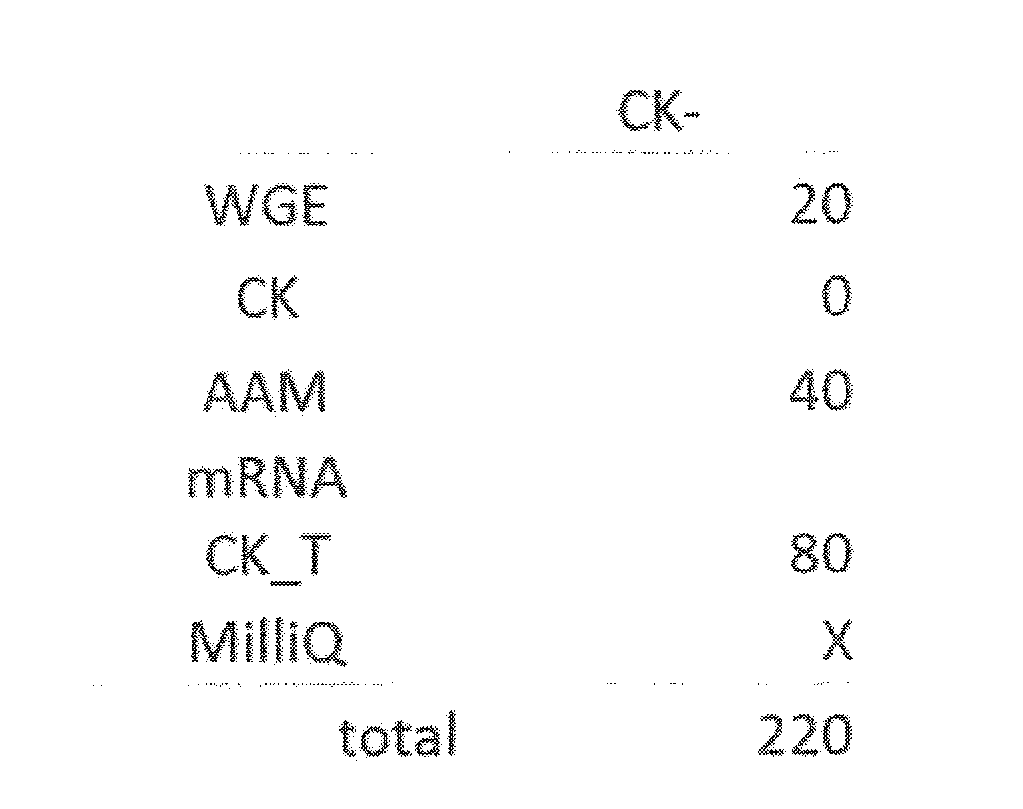
以下の表1に記載の組成の翻訳反応液を1.5mLチューブ中で調製した。なお、以下の表1に記載の組成液の単位はμLである。添加したCKのストック濃度は20mg/mL、終濃度は200ng/μLとなる。表1中のXについて、CK+は77.8、CK-は80である。
・WGE:コムギ胚芽抽出液。特開2006-288320号公報に記載の手順で作製した。
・CK:Roche Diagnostics Deutschland GmbH社製クレアチンキナーゼ(製品番号10127566001)
・AAM:アミノ酸基質。NUProtein社製PSS5100に付属のアミノ酸基質を用いた。
・mRNA:Water jellyfishのGFPのアミノ酸配列をコードするコード領域を含むように設計した。なお、mRNAは、後述する<実施例1>の表3のCK_Organisumの部分にGFPをコードする配列(Acc.No.P42212、Eurofins Genomicsから購入)を挿入した転写鋳型DNAを、実施例1と同様の手順で転写することで得た。
(2)翻訳反応
以下の表1に記載の組成の翻訳反応液を1.5mLチューブ中で調製した。なお、以下の表1に記載の組成液の単位はμLである。添加したCKのストック濃度は20mg/mL、終濃度は200ng/μLとなる。表1中のXについて、CK+は77.8、CK-は80である。
[規則26に基づく補充 17.04.2024]
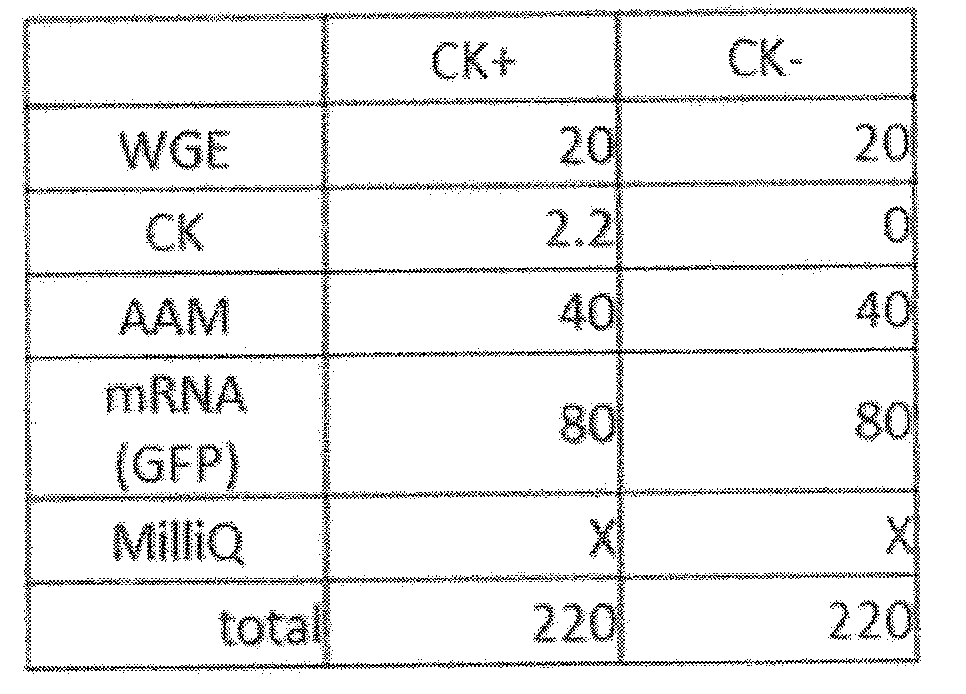
表1に記載の組成の反応液を96穴平底タイタープレートに添加し、これを室温(約23℃)のプレートリーダー中で反応させた。
[合成されたGFPの蛍光測定]
参考例1で合成されたGFPを含む溶液220μLのうち200μLを試料とし、波長475nmの励起光を0.5秒照射して、GFPからの蛍光強度を1時間毎に15時間、プレートリーダーで測定した(吸収フィルター500-550nm)。プレートリーダーは、GloMax(登録商標)プレートリーダー(プロメガ社)を用いた。測定結果を図1に示す。
参考例1で合成されたGFPを含む溶液220μLのうち200μLを試料とし、波長475nmの励起光を0.5秒照射して、GFPからの蛍光強度を1時間毎に15時間、プレートリーダーで測定した(吸収フィルター500-550nm)。プレートリーダーは、GloMax(登録商標)プレートリーダー(プロメガ社)を用いた。測定結果を図1に示す。
図1から明らかなように、無細胞タンパク質合成系にエネルギー再生酵素であるCKを添加(CK+)することでGFPの合成量が経時的に増加した。一方、CK未添加(CK-)の場合は、GFPは殆ど合成されなかった。以上の結果から、無細胞タンパク質合成系がエネルギー再生系を具備しない場合、目的タンパク質が効率的に合成されないことを確認した。
[規則26に基づく補充 17.04.2024]
[無細胞タンパク質合成系を用いたエネルギー再生酵素の自己増殖の確認]
<実施例1>
(1)クレアチンキナーゼ配列
各種生物由来のエネルギー再生酵素の中で、クレアチンキナーゼ(CK)の配列情報(ACC.No.)、生物種、入手先を表2に示す。なお、実施例1では、No.4のCK_T(Thunnus、マグロ)を用いた。No.1~3、5については、後述する実施例2~4で用いた。

[無細胞タンパク質合成系を用いたエネルギー再生酵素の自己増殖の確認]
<実施例1>
(1)クレアチンキナーゼ配列
各種生物由来のエネルギー再生酵素の中で、クレアチンキナーゼ(CK)の配列情報(ACC.No.)、生物種、入手先を表2に示す。なお、実施例1では、No.4のCK_T(Thunnus、マグロ)を用いた。No.1~3、5については、後述する実施例2~4で用いた。
[規則26に基づく補充 17.04.2024]
(2)転写鋳型DNA
図2にCKの転写鋳型DNA(以下、「CK_DNA」と記載することがある。)の概略を示す。また、表3にCK_DNAの各領域の配列を示す。なお、以下の表3のCK_Organismには、上記No.1~5のOrganismのCK配列が挿入される。

(2)転写鋳型DNA
図2にCKの転写鋳型DNA(以下、「CK_DNA」と記載することがある。)の概略を示す。また、表3にCK_DNAの各領域の配列を示す。なお、以下の表3のCK_Organismには、上記No.1~5のOrganismのCK配列が挿入される。
図3を参照して、PCRによるCK_DNAの作製手順について説明する。CK_DNAは、図3に示すようにPrimerを設計し、CK_DNAを2段階PCRにより作製した。表4にPCRプライマー、表5および表6にPCRの反応溶液組成、表7にPCRプログラムを示す。なお、転写鋳型DNAの合成方法等は、NUProtein株式会社のPSS5100の取り扱い説明書(May-2021/Ver.3.00)に準じて実施した。なお、使用した試薬および機械は以下のとおり。
・PCR酵素:東洋紡株式会社 KOD-Plus-Neo
・Primer,人工遺伝子:ユーロフィンジェノミクス株式会社 受託合成サービス
・Thermal Cycler:eppendorf社製 Mastecycler X50s
・微量高速冷却遠心機:トミー工業株式会社 MX-307
・PCR酵素:東洋紡株式会社 KOD-Plus-Neo
・Primer,人工遺伝子:ユーロフィンジェノミクス株式会社 受託合成サービス
・Thermal Cycler:eppendorf社製 Mastecycler X50s
・微量高速冷却遠心機:トミー工業株式会社 MX-307
[規則26に基づく補充 17.04.2024]
[規則26に基づく補充 17.04.2024]
[規則26に基づく補充 17.04.2024]

[規則26に基づく補充 17.04.2024]
(3)転写反応
次に、作製した転写鋳型DNAを用いて、翻訳鋳型mRNAを作製した。転写反応は、NUProtein社製PSS5100の以下の反応液を用い、先に作製した第2回のPCR反応溶液(転写鋳型DNA含有)2.5μLを用いて1.5mLチューブ中で調製し、37℃で3時間インキュベートした。
次に、作製した転写鋳型DNAを用いて、翻訳鋳型mRNAを作製した。転写反応は、NUProtein社製PSS5100の以下の反応液を用い、先に作製した第2回のPCR反応溶液(転写鋳型DNA含有)2.5μLを用いて1.5mLチューブ中で調製し、37℃で3時間インキュベートした。
[規則26に基づく補充 17.04.2024]

転写反応液25μLに対して10μLの4M酢酸アンモニウムを加えてよく混合し、さらに、100μLの100%エタノールを加えて混合し、卓上遠心機でフラッシュした後、-20℃で10分静置した。その後、遠心分離(12,000g、15分、4°C)した。上清を除去後、卓上遠心機を用いフラッシュした。再度上清を除去し、沈殿が乾燥するまで静置した。その後、転写反応液25μLに対して80μLの超純水を加え、沈殿物を溶解した。これを翻訳鋳型mRNA溶液とした。
(4)翻訳反応
次に、以下の組成の翻訳反応液を1.5mLチューブ中で調製し、23℃に設定したインキュベーターに入れて15時間反応させた。表9に記載の組成はCK_Tの翻訳鋳型mRNAに加えCKを加えた。表10に記載の組成はCK_Tの翻訳鋳型mRNAのみであり、翻訳反応液にCKは加えなかった。なお、比較のため、表10のCK_Tの翻訳鋳型mRNAに代え、<参考例1>で作製したGFPの翻訳鋳型mRNAを投与して翻訳反応を実施した。なお、表9および表10の数値の単位はμLで、表9のXは77.8、表10のXは80である。ある。添加したCKのストック濃度は20mg/mL、終濃度は200ng/μLとなる。
次に、以下の組成の翻訳反応液を1.5mLチューブ中で調製し、23℃に設定したインキュベーターに入れて15時間反応させた。表9に記載の組成はCK_Tの翻訳鋳型mRNAに加えCKを加えた。表10に記載の組成はCK_Tの翻訳鋳型mRNAのみであり、翻訳反応液にCKは加えなかった。なお、比較のため、表10のCK_Tの翻訳鋳型mRNAに代え、<参考例1>で作製したGFPの翻訳鋳型mRNAを投与して翻訳反応を実施した。なお、表9および表10の数値の単位はμLで、表9のXは77.8、表10のXは80である。ある。添加したCKのストック濃度は20mg/mL、終濃度は200ng/μLとなる。
[規則26に基づく補充 17.04.2024]
反応後、1.5mLチューブを遠心分離(15,000g、15分、4℃)し、上清を翻訳完了後のタンパク質溶液とした。得られたタンパク質のウェスタンブロッティングを行った。
<使用試薬類>
・ゲル:4-15% Tris-Glycine gel(バイオラッドラボラトリーズ社製)
・メンブレン:0.2μm PVDFメンブレン(バイオラッドラボラトリーズ社製)
・一次抗体:HA抗体(Proteintech社製)
・二次抗体:goat anti mouse HRP 抗体(Southern Biotech社製)
・ウェスタンブロット発光試薬:SuperSignal West Pico(Thermo社製)
・ゲル:4-15% Tris-Glycine gel(バイオラッドラボラトリーズ社製)
・メンブレン:0.2μm PVDFメンブレン(バイオラッドラボラトリーズ社製)
・一次抗体:HA抗体(Proteintech社製)
・二次抗体:goat anti mouse HRP 抗体(Southern Biotech社製)
・ウェスタンブロット発光試薬:SuperSignal West Pico(Thermo社製)
図4に結果を示す。図4のL2は表9に記載の組成で得られた翻訳産物の結果、L3は表10に記載の組成で得られた翻訳産物の結果、L1はGFPの翻訳鋳型mRNAを用いた組成で得られた翻訳産物の結果である。図4から明らかなように、翻訳反応液に単離したCKを加えなかったL3において、L2よりは少ないものの翻訳鋳型mRNAから所定量のCK_Tが翻訳されたことを確認した。以上の結果から、表10に記載の組成で翻訳反応を行うと、翻訳反応液に含まれる要素により翻訳鋳型mRNAからCK_Tが翻訳され、翻訳されたCK_Tがエネルギー再生系を構築することで、CK_Tが自己増殖したと考えられる。
[規則26に基づく補充 17.04.2024]
<実施例2>
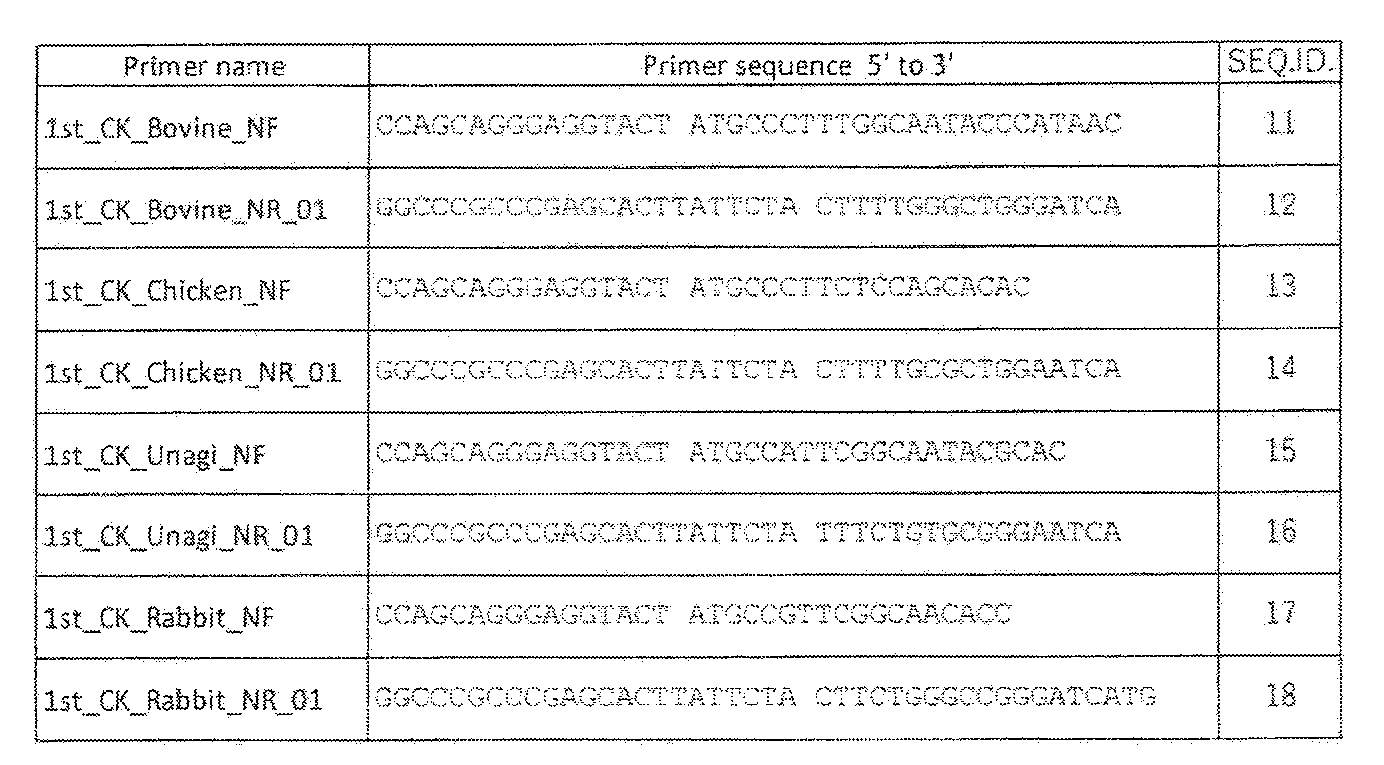
実施例1のCK_T(Thunnus、マグロ)に代え、CK_B(Bovine、ウシ)、CK_C(Chicken、ニワトリ)、CK_U(Unagi、ウナギ)を用い、1st_CK_NFおよび1st_CK_NR_01として、以下の配列のプライマーを用いた以外は、実施例1と同様の手順で実験を行った。なお、後述する実施例4で使用するCK_R(Rabbit、ウサギ)のプライマーも併せて記載する。表11では、CKの後ろに生物種を記載することで、どの生物種のプライマーであるのか特定する。
<実施例2>
実施例1のCK_T(Thunnus、マグロ)に代え、CK_B(Bovine、ウシ)、CK_C(Chicken、ニワトリ)、CK_U(Unagi、ウナギ)を用い、1st_CK_NFおよび1st_CK_NR_01として、以下の配列のプライマーを用いた以外は、実施例1と同様の手順で実験を行った。なお、後述する実施例4で使用するCK_R(Rabbit、ウサギ)のプライマーも併せて記載する。表11では、CKの後ろに生物種を記載することで、どの生物種のプライマーであるのか特定する。
図5に結果を示す。なお、比較のため、CK_T(Thunnus、マグロ)についてもレーンに投入し、ウェスタンブロッティングを行った。図5から明らかなように、哺乳類であるウシ、鳥類であるニワトリ、魚類であるマグロおよびウナギについても、翻訳反応液に含まれる要素により翻訳鋳型mRNAから各生物種のCKが翻訳され、翻訳されたCKがエネルギー再生系を構築することで、CKが自己増殖することを確認した。以上の結果から、エネルギー再生系の自己構築は、生物種に限定されないといえる。
[規則26に基づく補充 17.04.2024]
[エネルギー再生酵素以外のタンパク質の合成]
次に、エネルギー再生酵素を自己増殖する系を用いたタンパク質の合成を行った。
<実施例3>
上記<実施例1>で得られた翻訳産物であるCK_T(図4のL3)を用いて、GFPを目的タンパク質とした合成を行った。表12に翻訳反応液の組成を示す。翻訳産物であるCK_Tは、No.1~4に示すとおり添加量を変えて実験を行った。目的タンパク質はGFPで、参考例1に記載の翻訳鋳型mRNAを用いた。ネガティブコントロール(NC)はCK、CK_TおよびGFPのmRNAなし、ポジティブコントロール(PC)は翻訳産物であるCK_Tに代えCKを用いた。表11の組成で約15時間翻訳反応を実施し、上記<参考例1>と同様の手順で実験を行い合成されたGFPの蛍光強度を測定した。なお、表11の数値の単位はμLである。添加したCKのストック濃度は20mg/mL、終濃度は200ng/μLとなる。

[エネルギー再生酵素以外のタンパク質の合成]
次に、エネルギー再生酵素を自己増殖する系を用いたタンパク質の合成を行った。
<実施例3>
上記<実施例1>で得られた翻訳産物であるCK_T(図4のL3)を用いて、GFPを目的タンパク質とした合成を行った。表12に翻訳反応液の組成を示す。翻訳産物であるCK_Tは、No.1~4に示すとおり添加量を変えて実験を行った。目的タンパク質はGFPで、参考例1に記載の翻訳鋳型mRNAを用いた。ネガティブコントロール(NC)はCK、CK_TおよびGFPのmRNAなし、ポジティブコントロール(PC)は翻訳産物であるCK_Tに代えCKを用いた。表11の組成で約15時間翻訳反応を実施し、上記<参考例1>と同様の手順で実験を行い合成されたGFPの蛍光強度を測定した。なお、表11の数値の単位はμLである。添加したCKのストック濃度は20mg/mL、終濃度は200ng/μLとなる。
結果を図6に示す。CK_Tの翻訳産物を入れなかったNo.1ではGFPの生産はほとんど見られなかったが、No.2~No.4ではGFPの生産を確認した。以上の結果から、本出願で開示するタンパク質の生産方法は、翻訳鋳型mRNAで翻訳した翻訳産物であるCK_Tを用いて目的タンパク質を生産できることを確認した。
<実施例4>
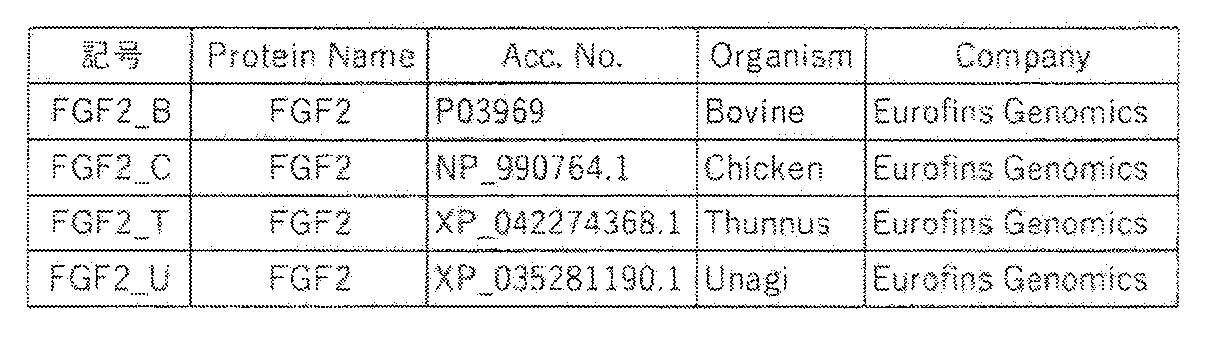
上記<実施例2>で得られた翻訳産物であるウシ、ニワトリ、マグロ、ウナギのCKを用い、以下の表13に記載のそれぞれの生物種に対応するFGF2を目的タンパク質とした合成を行った。具体的手順を以下に記載する。
上記<実施例2>で得られた翻訳産物であるウシ、ニワトリ、マグロ、ウナギのCKを用い、以下の表13に記載のそれぞれの生物種に対応するFGF2を目的タンパク質とした合成を行った。具体的手順を以下に記載する。
[規則26に基づく補充 17.04.2024]
[規則26に基づく補充 17.04.2024]
(1)FGF2の転写鋳型DNA(ニワトリ、マグロ、ウナギ)
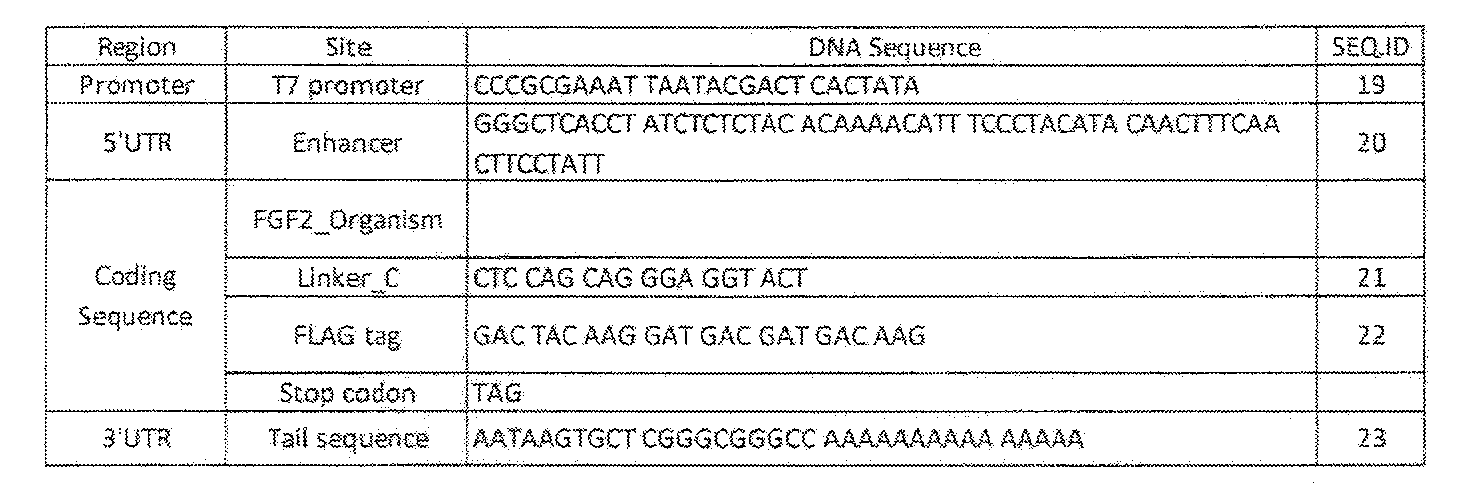
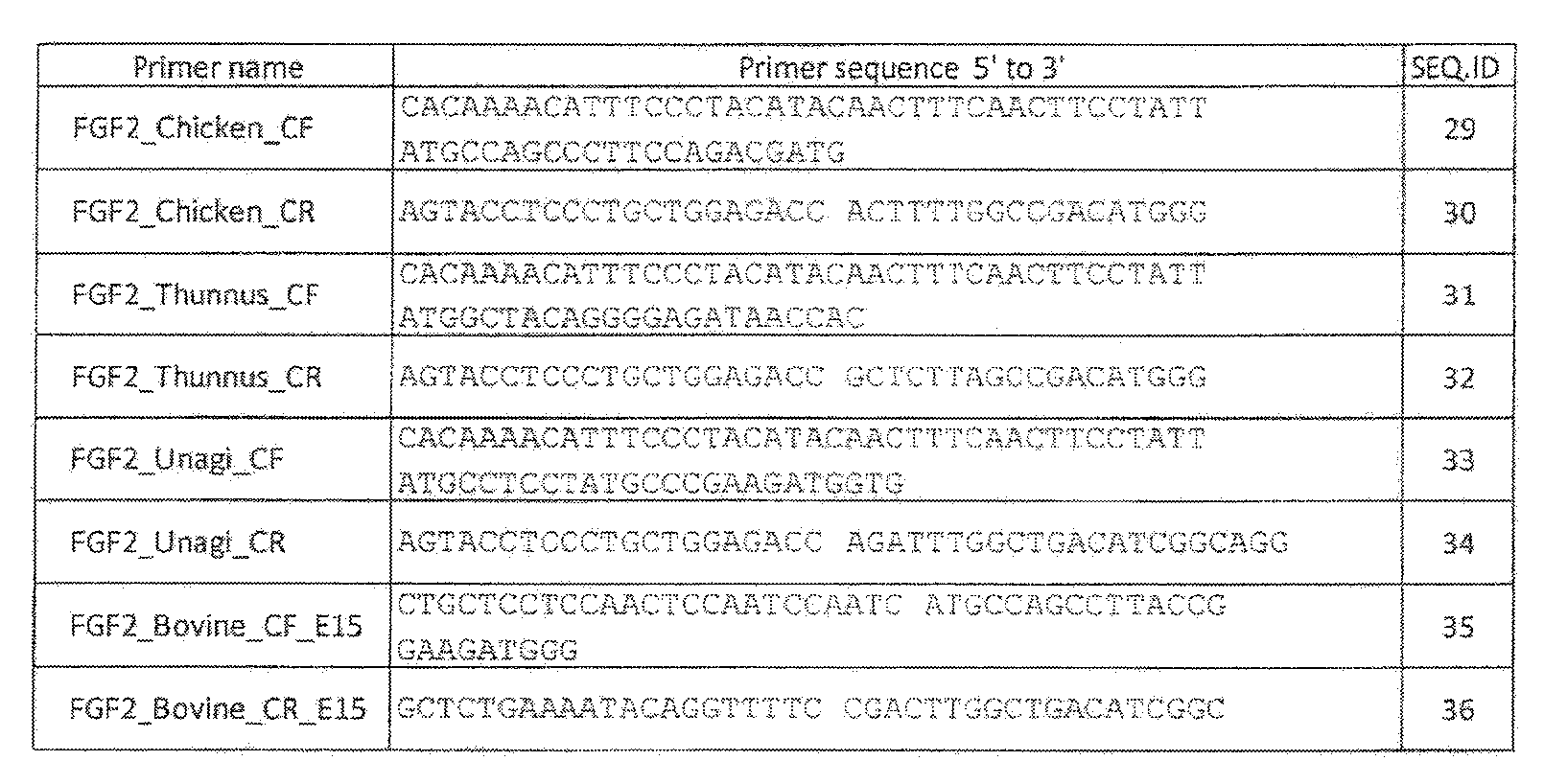
図7に、ニワトリ、マグロ、ウナギのFGF2の転写鋳型DNA(以下、「FGF2_DNA」と記載することがある。)の概略を示す。また、表14に、FGF2_DNAの各領域の配列を示す。なお、以下の表13のFGF2_Organismには、上記表13のChicken、Thunnus、UnagiのFGF2配列が挿入される。
(1)FGF2の転写鋳型DNA(ニワトリ、マグロ、ウナギ)
図7に、ニワトリ、マグロ、ウナギのFGF2の転写鋳型DNA(以下、「FGF2_DNA」と記載することがある。)の概略を示す。また、表14に、FGF2_DNAの各領域の配列を示す。なお、以下の表13のFGF2_Organismには、上記表13のChicken、Thunnus、UnagiのFGF2配列が挿入される。
[規則26に基づく補充 17.04.2024]
(2)FGF2の転写鋳型DNA(ウシ)
図8に、ウシのFGF2の転写鋳型DNAの概略を示す。また、表14にウシのFGF2の転写鋳型DNAの各領域の配列を示す。なお、以下の表15のFGF2_Bovineには、上記表13のBovineのFGF2配列が挿入される。

(2)FGF2の転写鋳型DNA(ウシ)
図8に、ウシのFGF2の転写鋳型DNAの概略を示す。また、表14にウシのFGF2の転写鋳型DNAの各領域の配列を示す。なお、以下の表15のFGF2_Bovineには、上記表13のBovineのFGF2配列が挿入される。
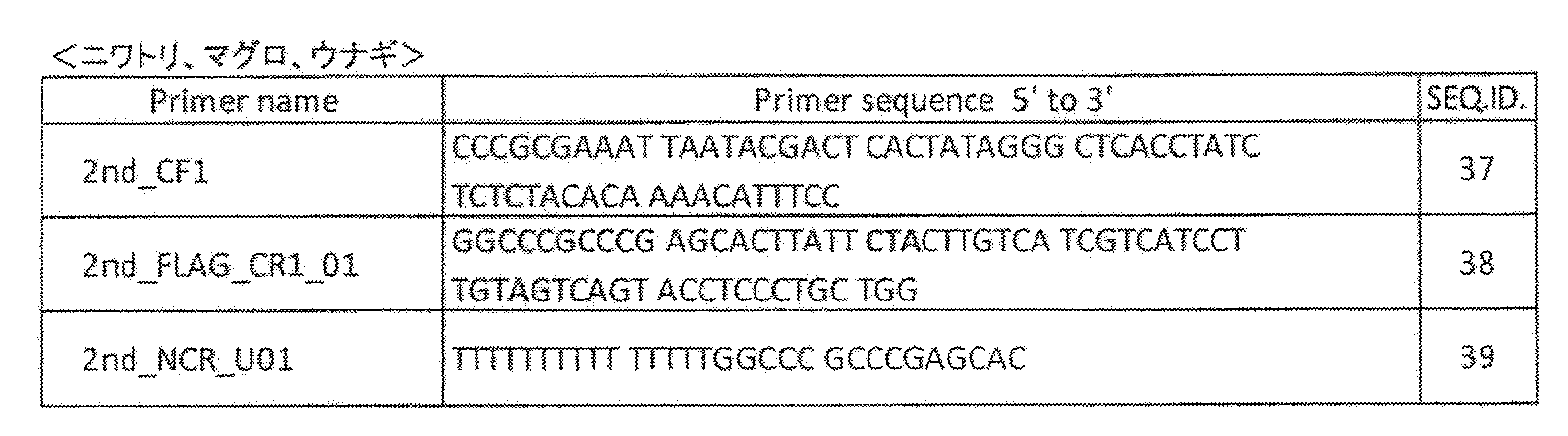
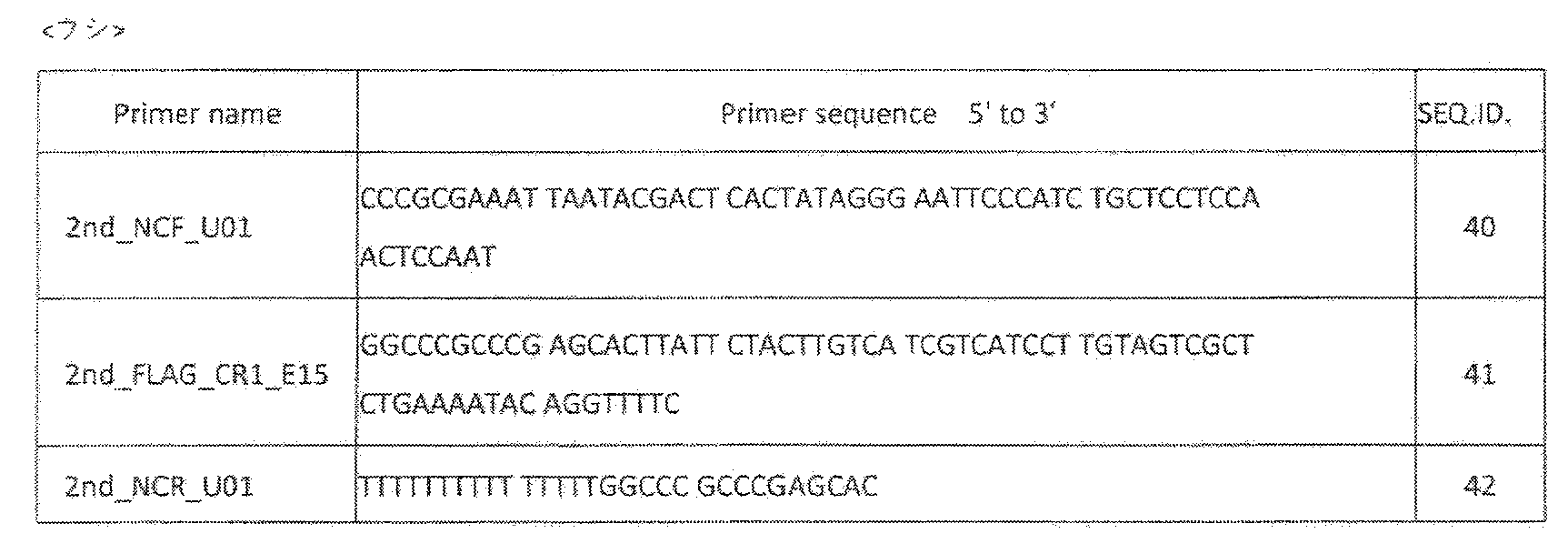
図9を参照して、PCRによるFGF2_DNAの作製手順について説明する。なお、ウシの場合は図9に示す転写鋳型DNAの構造とは異なるが、手順は同じである。図9に示すようにPrimerを設計し、FGF2_DNAを2段階PCRにより作製した。表16に各種生物種の1stPCRプライマー、表17にニワトリ、マグロ、ウナギの2ndPCRプライマー、表18にウシの2ndPCRプライマーを示す。なお、表18の“2nd_NCF_U01”および“2nd_FLAG_CR1_E15”は、それぞれ、図9の“2nd_CF1”および“2nd_FLAG_CR1_01”に相当する。“2nd_NCR_U01”は、生物種を問わず共通である。
PCRの反応溶液組成は、実施例1の表5および表6と同じであり、PCRプログラムも実施例1の表7と同じである。なお、転写鋳型DNAの合成方法、試薬および機械も実施例1と同様である。
[規則26に基づく補充 17.04.2024]
[規則26に基づく補充 17.04.2024]
(3)転写反応
上記(1)および(2)に記載のFGF2の転写鋳型DNA(ニワトリ、マグロ、ウナギ、ウシ)を用い、実施例1と同様の手順で転写反応を行った。
上記(1)および(2)に記載のFGF2の転写鋳型DNA(ニワトリ、マグロ、ウナギ、ウシ)を用い、実施例1と同様の手順で転写反応を行った。
(4)FGF2の合成
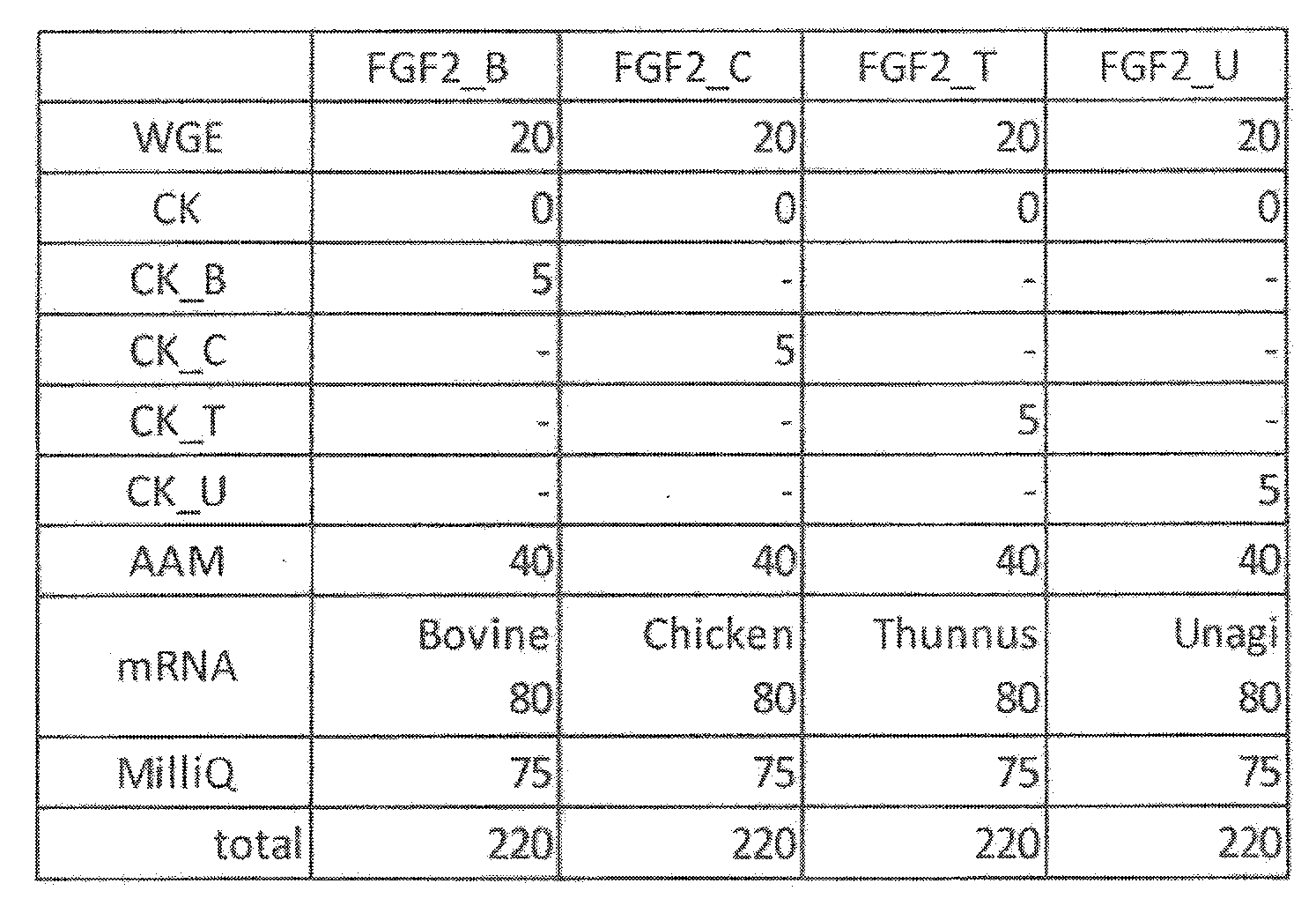
上記<実施例2>で得られた翻訳産物である各種CKと、上記(3)で得られた翻訳鋳型mRNAを用いて、FGF2の合成を行った。表19に翻訳反応液の組成を示す。表19の組成で、上記<実施例1>と同様の手順で実験を行った。なお、1次抗体については、実施例1の1次抗体に代え、以下の1次抗体を用いた。
・1次抗体:抗DYKDDDDKタグ(モノクローナル抗体 Code No.018-22381;富士フィルム和光純薬株式会社)
上記<実施例2>で得られた翻訳産物である各種CKと、上記(3)で得られた翻訳鋳型mRNAを用いて、FGF2の合成を行った。表19に翻訳反応液の組成を示す。表19の組成で、上記<実施例1>と同様の手順で実験を行った。なお、1次抗体については、実施例1の1次抗体に代え、以下の1次抗体を用いた。
・1次抗体:抗DYKDDDDKタグ(モノクローナル抗体 Code No.018-22381;富士フィルム和光純薬株式会社)
[規則26に基づく補充 17.04.2024]
結果を図10に示す。図10の結果から明らかなように、同一の生物種由来のエネルギー再生酵素を用いて、目的タンパク質を合成できることを確認した。
[エネルギー再生酵素と目的タンパク質の共発現]
<実施例5>
次に、エネルギー再生酵素を翻訳するための翻訳鋳型mRNAおよび目的タンパク質を翻訳するための翻訳鋳型mRNAが共存した状態で翻訳反応を行った。実験手順を以下に記載する。
(1)エネルギー再生酵素
実施例1の表2のNo.1に記載のCK_Rを用い、実施例1と同様の手順で翻訳鋳型mRNAを作製した。
(2)目的タンパク質
参考例1に記載のGFPの翻訳鋳型mRNAを用いた。
(3)エネルギー再生酵素と目的タンパク質の共発現
表20に翻訳反応液の組成を示す。ネガティブコントロール(NC)はCK、CK_RabbitおよびGFPのmRNAなし、ポジティブコントロール(PC)はCK_Rabbitの翻訳鋳型mRNAに代えCKを用いた。表20の組成で約15時間翻訳反応を実施し、上記<参考例1>と同様の手順で実験を行い合成されたGFPの蛍光強度を測定した。
<実施例5>
次に、エネルギー再生酵素を翻訳するための翻訳鋳型mRNAおよび目的タンパク質を翻訳するための翻訳鋳型mRNAが共存した状態で翻訳反応を行った。実験手順を以下に記載する。
(1)エネルギー再生酵素
実施例1の表2のNo.1に記載のCK_Rを用い、実施例1と同様の手順で翻訳鋳型mRNAを作製した。
(2)目的タンパク質
参考例1に記載のGFPの翻訳鋳型mRNAを用いた。
(3)エネルギー再生酵素と目的タンパク質の共発現
表20に翻訳反応液の組成を示す。ネガティブコントロール(NC)はCK、CK_RabbitおよびGFPのmRNAなし、ポジティブコントロール(PC)はCK_Rabbitの翻訳鋳型mRNAに代えCKを用いた。表20の組成で約15時間翻訳反応を実施し、上記<参考例1>と同様の手順で実験を行い合成されたGFPの蛍光強度を測定した。
[規則26に基づく補充 17.04.2024]
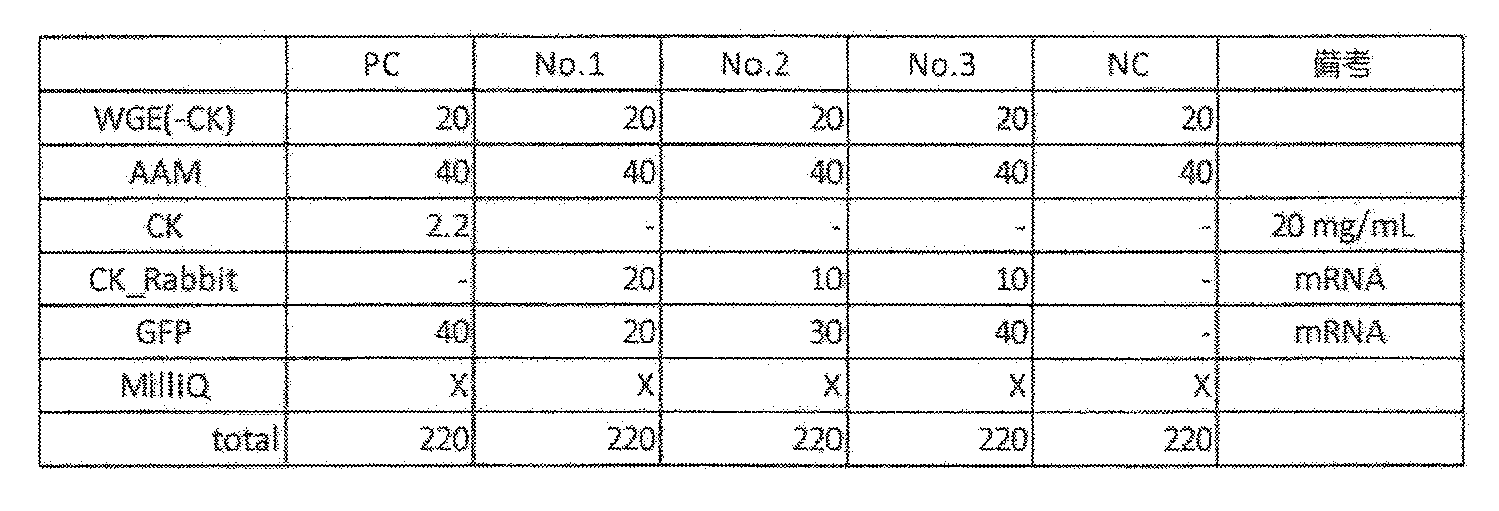
図11に結果を示す。図11から明らかなように、エネルギー再生酵素を翻訳するための翻訳鋳型mRNAおよび目的タンパク質を翻訳するための翻訳鋳型mRNAが共存した状態であっても、エネルギー再生系が自己構築され、目的タンパク質を合成できることを確認した。
本出願で開示するタンパク質の生産方法、培養肉の生産方法、培養肉の生産方法に用いる添加物、および、タンパク質の生産方法に用いるキットにより、翻訳鋳型mRNAから翻訳したエネルギー再生酵素を用いて、無細胞タンパク質合成のエネルギー再生系を構築できる。したがって、食品業界、製薬業界、研究機関等、無細胞タンパク質合成が必要な産業に有用である。
Claims (13)
- 細胞の不存在下であってかつ翻訳鋳型mRNAをタンパク質に翻訳するための要素の存在下で、翻訳鋳型mRNAを用いてタンパク質を翻訳するタンパク質翻訳工程を備える、タンパク質の生産方法であって、
前記翻訳鋳型mRNAが、
エネルギー再生酵素を翻訳するための翻訳鋳型mRNAを含み、
タンパク質合成開始時に、エネルギー再生酵素が添加されておらず、前記エネルギー再生酵素を翻訳するための翻訳鋳型mRNAから翻訳したエネルギー再生酵素のみを用いてエネルギー再生系が構築される
タンパク質の生産方法。 - 前記翻訳鋳型mRNAが、目的タンパク質を翻訳するための翻訳鋳型mRNAを更に含む
請求項1に記載のタンパク質の生産方法。 - 前記タンパク質翻訳工程が、
前記エネルギー再生酵素を翻訳するための翻訳鋳型mRNAを用いてエネルギー再生酵素を翻訳する第1タンパク質翻訳工程と、
前記第1タンパク質翻訳工程の翻訳産物と、前記目的タンパク質を翻訳するための翻訳鋳型mRNAと、を用いて目的タンパク質を翻訳する第2タンパク質翻訳工程と、
を含む
請求項2に記載のタンパク質の生産方法。 - 前記タンパク質翻訳工程が、
前記エネルギー再生酵素を翻訳するための翻訳鋳型mRNAおよび前記目的タンパク質を翻訳するための翻訳鋳型mRNAが共存した状態で実施される
請求項2に記載のタンパク質の生産方法。 - 前記エネルギー再生酵素が、クレアチンキナーゼ、ヌクレオシド2リン酸キナーゼ、アルギニンキナーゼ、および、アデニル酸キナーゼからなる群から選択した少なくとも1種である
請求項1~4の何れか一項に記載のタンパク質の生産方法。 - 無機ジホスファターゼ、無機ピロホスファターゼおよびジスルフィドイソメラーゼからなる群から選択した少なくとも1種を翻訳するための翻訳鋳型mRNAを更に含む
請求項1~4の何れか一項に記載のタンパク質の生産方法。 - 前記エネルギー再生酵素を翻訳するための翻訳鋳型mRNA、および、前記目的タンパク質を翻訳するための翻訳鋳型mRNAが、
前記翻訳鋳型mRNAをコードする領域と、前記翻訳鋳型mRNAをコードする領域の5’末端に配置されるプロモーター領域と、を含む転写鋳型DNAを用い、
細胞の不存在下であってかつ前記転写鋳型DNAをmRNAに転写するための要素の存在下で、前記転写鋳型DNAを用いて翻訳したものである
請求項2に記載のタンパク質の生産方法。 - 前記エネルギー再生酵素および前記目的タンパク質が、同一の生物種のものである
請求項2に記載のタンパク質の生産方法。 - 前記目的タンパク質が成長因子である
請求項2~4、7、8の何れか一項に記載のタンパク質の生産方法。 - 培養肉の生産方法であって、
請求項9に記載のタンパク質の生産方法で生産した翻訳産物を添加物として含む培養液を用いて細胞培養する工程を含む
培養肉の生産方法。 - タンパク質の生産方法に用いるキットであって、該キットは、
エネルギー再生酵素を翻訳するための翻訳鋳型mRNAと、
細胞の不存在下であってかつ前記エネルギー再生酵素を翻訳するための翻訳鋳型mRNAをタンパク質に翻訳するための要素と、
を含み、且つ、
前記エネルギー再生酵素を翻訳するための翻訳鋳型mRNAから翻訳したエネルギー再生酵素のみを用いてエネルギー再生系が構築されるため、エネルギー再生酵素が添加されていない
キット。 - 目的タンパク質を翻訳するための翻訳鋳型mRNAを更に含む
請求項11に記載のキット。 - 前記エネルギー再生酵素および前記目的タンパク質が、同一の生物種のものである
請求項12に記載のキット。
Priority Applications (1)
| Application Number | Priority Date | Filing Date | Title |
|---|---|---|---|
| CN202480002181.3A CN119452093A (zh) | 2023-06-05 | 2024-01-15 | 蛋白质的生产方法、培养肉的生产方法、用于培养肉的生产方法中的添加物、以及用于蛋白质的生产方法中的试剂盒 |
Applications Claiming Priority (2)
| Application Number | Priority Date | Filing Date | Title |
|---|---|---|---|
| JP2023-092204 | 2023-06-05 | ||
| JP2023092204A JP7426764B1 (ja) | 2023-06-05 | 2023-06-05 | タンパク質の生産方法、培養肉の生産方法、培養肉の生産方法に用いる添加物、および、タンパク質の生産方法に用いるキット |
Publications (1)
| Publication Number | Publication Date |
|---|---|
| WO2024252714A1 true WO2024252714A1 (ja) | 2024-12-12 |
Family
ID=89718103
Family Applications (1)
| Application Number | Title | Priority Date | Filing Date |
|---|---|---|---|
| PCT/JP2024/000839 Ceased WO2024252714A1 (ja) | 2023-06-05 | 2024-01-15 | タンパク質の生産方法、培養肉の生産方法、培養肉の生産方法に用いる添加物、および、タンパク質の生産方法に用いるキット |
Country Status (3)
| Country | Link |
|---|---|
| JP (2) | JP7426764B1 (ja) |
| CN (1) | CN119452093A (ja) |
| WO (1) | WO2024252714A1 (ja) |
Citations (11)
| Publication number | Priority date | Publication date | Assignee | Title |
|---|---|---|---|---|
| JP2000333673A (ja) * | 1999-05-31 | 2000-12-05 | Wakenyaku Kk | 連続無細胞タンパク質合成手段 |
| US20030113778A1 (en) * | 2001-10-30 | 2003-06-19 | Schulte Jennifer Theresa | Enhanced in vitro nucleic acid synthesis using nucleoside monophosphates |
| JP2006340694A (ja) * | 2005-06-10 | 2006-12-21 | Post Genome Institute Co Ltd | 分子シャペロンを用いたinvitro転写・翻訳系によるタンパク質合成方法 |
| JP2007097438A (ja) * | 2005-09-30 | 2007-04-19 | Cellfree Sciences Co Ltd | 無細胞タンパク質合成方法 |
| JP2008029204A (ja) * | 2004-11-12 | 2008-02-14 | Cellfree Sciences Co Ltd | 無細胞タンパク質合成方法 |
| JP2011079845A (ja) * | 1999-03-17 | 2011-04-21 | Univ Leland Stanford Jr | 外因性アミノ酸および新規atp再生システムを用いたインビトロ高分子生合成の方法 |
| WO2018143145A1 (ja) * | 2017-01-31 | 2018-08-09 | 中外製薬株式会社 | 無細胞翻訳系におけるペプチドの合成方法 |
| US20220257706A1 (en) * | 2019-07-10 | 2022-08-18 | Nanyang Technological University | Epidermal growth factor receptor (egfr) ligands |
| US20230016607A1 (en) * | 2020-01-02 | 2023-01-19 | Fyberaworks Foods, Inc. | A novel method to manufacture synthetic meat |
| JP2023036506A (ja) * | 2021-09-02 | 2023-03-14 | ダナグリーン カンパニー リミテッド | 植物性タンパク質を含む多孔質細胞支持体およびそれを用いて製造された培養肉 |
| WO2023047831A1 (ja) * | 2021-09-27 | 2023-03-30 | 国立大学法人 東京大学 | 細胞培養用ゲル、細胞入り細胞培養用ゲルの製造方法、細胞の製造方法、該細胞の製造方法により製造された三次元筋組織及び培養肉 |
-
2023
- 2023-06-05 JP JP2023092204A patent/JP7426764B1/ja active Active
- 2023-11-14 JP JP2023193568A patent/JP2024174795A/ja active Pending
-
2024
- 2024-01-15 CN CN202480002181.3A patent/CN119452093A/zh active Pending
- 2024-01-15 WO PCT/JP2024/000839 patent/WO2024252714A1/ja not_active Ceased
Patent Citations (11)
| Publication number | Priority date | Publication date | Assignee | Title |
|---|---|---|---|---|
| JP2011079845A (ja) * | 1999-03-17 | 2011-04-21 | Univ Leland Stanford Jr | 外因性アミノ酸および新規atp再生システムを用いたインビトロ高分子生合成の方法 |
| JP2000333673A (ja) * | 1999-05-31 | 2000-12-05 | Wakenyaku Kk | 連続無細胞タンパク質合成手段 |
| US20030113778A1 (en) * | 2001-10-30 | 2003-06-19 | Schulte Jennifer Theresa | Enhanced in vitro nucleic acid synthesis using nucleoside monophosphates |
| JP2008029204A (ja) * | 2004-11-12 | 2008-02-14 | Cellfree Sciences Co Ltd | 無細胞タンパク質合成方法 |
| JP2006340694A (ja) * | 2005-06-10 | 2006-12-21 | Post Genome Institute Co Ltd | 分子シャペロンを用いたinvitro転写・翻訳系によるタンパク質合成方法 |
| JP2007097438A (ja) * | 2005-09-30 | 2007-04-19 | Cellfree Sciences Co Ltd | 無細胞タンパク質合成方法 |
| WO2018143145A1 (ja) * | 2017-01-31 | 2018-08-09 | 中外製薬株式会社 | 無細胞翻訳系におけるペプチドの合成方法 |
| US20220257706A1 (en) * | 2019-07-10 | 2022-08-18 | Nanyang Technological University | Epidermal growth factor receptor (egfr) ligands |
| US20230016607A1 (en) * | 2020-01-02 | 2023-01-19 | Fyberaworks Foods, Inc. | A novel method to manufacture synthetic meat |
| JP2023036506A (ja) * | 2021-09-02 | 2023-03-14 | ダナグリーン カンパニー リミテッド | 植物性タンパク質を含む多孔質細胞支持体およびそれを用いて製造された培養肉 |
| WO2023047831A1 (ja) * | 2021-09-27 | 2023-03-30 | 国立大学法人 東京大学 | 細胞培養用ゲル、細胞入り細胞培養用ゲルの製造方法、細胞の製造方法、該細胞の製造方法により製造された三次元筋組織及び培養肉 |
Non-Patent Citations (1)
| Title |
|---|
| ANONYMOUS: "NUProtein Home Page", NUPROTEIN HOMEPAGE, XP009560921, Retrieved from the Internet <URL:https://web.archive.org/web/20230405044835/http://www.nuprotein.jp/ja/> * |
Also Published As
| Publication number | Publication date |
|---|---|
| JP7426764B1 (ja) | 2024-02-02 |
| JP2024174394A (ja) | 2024-12-17 |
| CN119452093A (zh) | 2025-02-14 |
| JP2024174795A (ja) | 2024-12-17 |
Similar Documents
| Publication | Publication Date | Title |
|---|---|---|
| Craig | Hsp70 at the membrane: driving protein translocation | |
| Schwechheimer et al. | Biotechnology of riboflavin | |
| CN101014716B (zh) | 体外蛋白质合成的改进方法 | |
| JP5905724B2 (ja) | 化合物の製造のための組成物および方法 | |
| Kazuta et al. | Synthesis of milligram quantities of proteins using a reconstituted in vitro protein synthesis system | |
| JPH06503477A (ja) | 真核無細胞抽出物中での転写と翻訳の共役 | |
| JP2012503991A (ja) | 非天然アミノ酸による複製に依存する微生物およびワクチン | |
| JP2009077731A (ja) | 直交tRNA−アミノアシルtRNAシンテターゼ対を生産するための方法及び組成物 | |
| JP2002538832A (ja) | 外因性アミノ酸および新規atp再生システムを用いたインビトロ高分子生合成の方法 | |
| Failmezger et al. | Site-specific cleavage of ribosomal RNA in Escherichia coli-based cell-free protein synthesis systems | |
| CN111378708A (zh) | 一种优化的体外无细胞蛋白合成体系及其应用 | |
| AU2022204600B2 (en) | Process of production with controlled copper ions | |
| CN104342397B (zh) | 嘌呤类物质的制备方法 | |
| US7399610B2 (en) | Method for cell-free protein synthesis using extract solution derived from insect cell | |
| Samiullah et al. | Downregulation of ALAS1 by nicarbazin treatment underlies the reduced synthesis of protoporphyrin IX in shell gland of laying hens | |
| Albayrak et al. | Using E. coli-based cell-free protein synthesis to evaluate the kinetic performance of an orthogonal tRNA and aminoacyl-tRNA synthetase pair | |
| JP7426764B1 (ja) | タンパク質の生産方法、培養肉の生産方法、培養肉の生産方法に用いる添加物、および、タンパク質の生産方法に用いるキット | |
| JP7636135B2 (ja) | 人工エネルギー再生システムを必要としない新規の無真核細胞発現システム | |
| JP7531199B2 (ja) | タンパク質の製造方法及び無細胞タンパク質合成系キット | |
| CN116286706A (zh) | 来源于南极冰藻三角褐指藻ice-h的dmshb合成酶及其应用 | |
| Terada et al. | Escherichia coli cell-free protein synthesis and isotope labeling of mammalian proteins | |
| CN111378707A (zh) | 一种体外无细胞蛋白合成体系及其应用 | |
| Szaflarski et al. | Question 7: optimized energy consumption for protein synthesis | |
| JP2023514584A (ja) | 遺伝暗号の再プログラミングのため、長鎖炭素と環状アミノ酸が包含されるよう化学的基質を拡張する | |
| Yamane et al. | Enhanced cell‐free protein synthesis using a S30 extract from Escherichia coli grown rapidly at 42° C in an amino acid enriched medium |
Legal Events
| Date | Code | Title | Description |
|---|---|---|---|
| WWE | Wipo information: entry into national phase |
Ref document number: 202480002181.3 Country of ref document: CN |
|
| 121 | Ep: the epo has been informed by wipo that ep was designated in this application |
Ref document number: 24818955 Country of ref document: EP Kind code of ref document: A1 |
|
| WWE | Wipo information: entry into national phase |
Ref document number: 11202407941Q Country of ref document: SG |
|
| WWP | Wipo information: published in national office |
Ref document number: 202480002181.3 Country of ref document: CN |
|
| NENP | Non-entry into the national phase |
Ref country code: DE |