WO2024252987A1 - 基板処理装置、処理具の交換方法及び交換具 - Google Patents
基板処理装置、処理具の交換方法及び交換具 Download PDFInfo
- Publication number
- WO2024252987A1 WO2024252987A1 PCT/JP2024/019560 JP2024019560W WO2024252987A1 WO 2024252987 A1 WO2024252987 A1 WO 2024252987A1 JP 2024019560 W JP2024019560 W JP 2024019560W WO 2024252987 A1 WO2024252987 A1 WO 2024252987A1
- Authority
- WO
- WIPO (PCT)
- Prior art keywords
- tool
- holding
- replacement
- replacement tool
- processing tool
- Prior art date
- Legal status (The legal status is an assumption and is not a legal conclusion. Google has not performed a legal analysis and makes no representation as to the accuracy of the status listed.)
- Ceased
Links
Images








Classifications
-
- H—ELECTRICITY
- H10—SEMICONDUCTOR DEVICES; ELECTRIC SOLID-STATE DEVICES NOT OTHERWISE PROVIDED FOR
- H10P—GENERIC PROCESSES OR APPARATUS FOR THE MANUFACTURE OR TREATMENT OF DEVICES COVERED BY CLASS H10
- H10P72/00—Handling or holding of wafers, substrates or devices during manufacture or treatment thereof
- H10P72/04—Apparatus for manufacture or treatment
- H10P72/0402—Apparatus for fluid treatment
- H10P72/0406—Apparatus for fluid treatment for cleaning followed by drying, rinsing, stripping, blasting or the like
- H10P72/0411—Apparatus for fluid treatment for cleaning followed by drying, rinsing, stripping, blasting or the like for wet cleaning or washing
- H10P72/0414—Apparatus for fluid treatment for cleaning followed by drying, rinsing, stripping, blasting or the like for wet cleaning or washing using mainly spraying means, e.g. nozzles
-
- B—PERFORMING OPERATIONS; TRANSPORTING
- B05—SPRAYING OR ATOMISING IN GENERAL; APPLYING FLUENT MATERIALS TO SURFACES, IN GENERAL
- B05C—APPARATUS FOR APPLYING FLUENT MATERIALS TO SURFACES, IN GENERAL
- B05C11/00—Component parts, details or accessories not specifically provided for in groups B05C1/00 - B05C9/00
- B05C11/02—Apparatus for spreading or distributing liquids or other fluent materials already applied to a surface ; Controlling means therefor; Control of the thickness of a coating by spreading or distributing liquids or other fluent materials already applied to the coated surface
- B05C11/08—Spreading liquid or other fluent material by manipulating the work, e.g. tilting
-
- B—PERFORMING OPERATIONS; TRANSPORTING
- B05—SPRAYING OR ATOMISING IN GENERAL; APPLYING FLUENT MATERIALS TO SURFACES, IN GENERAL
- B05C—APPARATUS FOR APPLYING FLUENT MATERIALS TO SURFACES, IN GENERAL
- B05C5/00—Apparatus in which liquid or other fluent material is projected, poured or allowed to flow on to the surface of the work
- B05C5/02—Apparatus in which liquid or other fluent material is projected, poured or allowed to flow on to the surface of the work the liquid or other fluent material being discharged through an outlet orifice by pressure, e.g. from an outlet device in contact or almost in contact, with the work
- B05C5/027—Coating heads with several outlets, e.g. aligned transversally to the moving direction of a web to be coated
-
- F—MECHANICAL ENGINEERING; LIGHTING; HEATING; WEAPONS; BLASTING
- F16—ENGINEERING ELEMENTS AND UNITS; GENERAL MEASURES FOR PRODUCING AND MAINTAINING EFFECTIVE FUNCTIONING OF MACHINES OR INSTALLATIONS; THERMAL INSULATION IN GENERAL
- F16L—PIPES; JOINTS OR FITTINGS FOR PIPES; SUPPORTS FOR PIPES, CABLES OR PROTECTIVE TUBING; MEANS FOR THERMAL INSULATION IN GENERAL
- F16L37/00—Couplings of the quick-acting type
- F16L37/24—Couplings of the quick-acting type in which the connection is made by inserting one member axially into the other and rotating it to a limited extent, e.g. with bayonet-action
-
- H—ELECTRICITY
- H10—SEMICONDUCTOR DEVICES; ELECTRIC SOLID-STATE DEVICES NOT OTHERWISE PROVIDED FOR
- H10P—GENERIC PROCESSES OR APPARATUS FOR THE MANUFACTURE OR TREATMENT OF DEVICES COVERED BY CLASS H10
- H10P52/00—Grinding, lapping or polishing of wafers, substrates or parts of devices
-
- H—ELECTRICITY
- H10—SEMICONDUCTOR DEVICES; ELECTRIC SOLID-STATE DEVICES NOT OTHERWISE PROVIDED FOR
- H10P—GENERIC PROCESSES OR APPARATUS FOR THE MANUFACTURE OR TREATMENT OF DEVICES COVERED BY CLASS H10
- H10P72/00—Handling or holding of wafers, substrates or devices during manufacture or treatment thereof
- H10P72/04—Apparatus for manufacture or treatment
- H10P72/0402—Apparatus for fluid treatment
- H10P72/0406—Apparatus for fluid treatment for cleaning followed by drying, rinsing, stripping, blasting or the like
- H10P72/0411—Apparatus for fluid treatment for cleaning followed by drying, rinsing, stripping, blasting or the like for wet cleaning or washing
- H10P72/0412—Apparatus for fluid treatment for cleaning followed by drying, rinsing, stripping, blasting or the like for wet cleaning or washing using mainly scrubbing means, e.g. brushes
-
- H—ELECTRICITY
- H10—SEMICONDUCTOR DEVICES; ELECTRIC SOLID-STATE DEVICES NOT OTHERWISE PROVIDED FOR
- H10P—GENERIC PROCESSES OR APPARATUS FOR THE MANUFACTURE OR TREATMENT OF DEVICES COVERED BY CLASS H10
- H10P72/00—Handling or holding of wafers, substrates or devices during manufacture or treatment thereof
- H10P72/06—Apparatus for monitoring, sorting, marking, testing or measuring
- H10P72/0604—Process monitoring, e.g. flow or thickness monitoring
-
- H—ELECTRICITY
- H10—SEMICONDUCTOR DEVICES; ELECTRIC SOLID-STATE DEVICES NOT OTHERWISE PROVIDED FOR
- H10P—GENERIC PROCESSES OR APPARATUS FOR THE MANUFACTURE OR TREATMENT OF DEVICES COVERED BY CLASS H10
- H10P72/00—Handling or holding of wafers, substrates or devices during manufacture or treatment thereof
- H10P72/30—Handling or holding of wafers, substrates or devices during manufacture or treatment thereof for conveying, e.g. between different workstations
- H10P72/33—Handling or holding of wafers, substrates or devices during manufacture or treatment thereof for conveying, e.g. between different workstations into and out of processing chamber
- H10P72/3302—Mechanical parts of transfer devices
-
- H—ELECTRICITY
- H10—SEMICONDUCTOR DEVICES; ELECTRIC SOLID-STATE DEVICES NOT OTHERWISE PROVIDED FOR
- H10P—GENERIC PROCESSES OR APPARATUS FOR THE MANUFACTURE OR TREATMENT OF DEVICES COVERED BY CLASS H10
- H10P72/00—Handling or holding of wafers, substrates or devices during manufacture or treatment thereof
- H10P72/70—Handling or holding of wafers, substrates or devices during manufacture or treatment thereof for supporting or gripping
- H10P72/76—Handling or holding of wafers, substrates or devices during manufacture or treatment thereof for supporting or gripping using mechanical means, e.g. clamps or pinches
- H10P72/7604—Handling or holding of wafers, substrates or devices during manufacture or treatment thereof for supporting or gripping using mechanical means, e.g. clamps or pinches the wafers being placed on a susceptor, stage or support
- H10P72/7614—Handling or holding of wafers, substrates or devices during manufacture or treatment thereof for supporting or gripping using mechanical means, e.g. clamps or pinches the wafers being placed on a susceptor, stage or support characterised by a plurality of individual support members, e.g. support posts or protrusions
-
- H—ELECTRICITY
- H10—SEMICONDUCTOR DEVICES; ELECTRIC SOLID-STATE DEVICES NOT OTHERWISE PROVIDED FOR
- H10P—GENERIC PROCESSES OR APPARATUS FOR THE MANUFACTURE OR TREATMENT OF DEVICES COVERED BY CLASS H10
- H10P72/00—Handling or holding of wafers, substrates or devices during manufacture or treatment thereof
- H10P72/70—Handling or holding of wafers, substrates or devices during manufacture or treatment thereof for supporting or gripping
- H10P72/78—Handling or holding of wafers, substrates or devices during manufacture or treatment thereof for supporting or gripping using vacuum or suction, e.g. Bernoulli chucks
Definitions
- the present disclosure relates to a substrate processing apparatus, a method for replacing a processing tool used in substrate processing, and a replacement tool for replacing a processing tool used in substrate processing.
- Patent Document 1 discloses a substrate processing apparatus including a holder configured to rotatably hold a substrate, and a supply unit configured to supply a processing liquid through a nozzle to a surface of the substrate held by the holder. It shows.
- This disclosure describes a substrate processing apparatus that allows efficient replacement of processing tools with a simple configuration, a method for replacing processing tools, and a replacement tool.
- An example of a substrate processing apparatus includes a holding section configured to hold a substrate, a rotating section configured to rotate the holding section, a processing tool configured to process the surface of the substrate held in the holding section, an exchange tool configured to be detachably attached to the holding section, a holding and transporting section configured to hold and transport the processing tool, and a control section.
- the exchange tool includes a main body configured to be engageable with an engagement section of the processing tool, and a flange section protruding from the circumferential surface of the main body section for attachment and detachment between the exchange tool and the holding section.
- the processing tool includes another fastening section configured to be fastened to a fastening section provided on the holding and transporting section.
- the control section is configured to execute a first process of attaching and detaching the processing tool to and from the holding and transporting section by controlling the rotating section to rotate the holding section when the replacement tool is attached to the holding section via the flange section and the engagement section of the processing tool is engaged with the main body section of the replacement tool.
- attaching and detaching means at least one of attaching and removing.
- the substrate processing apparatus disclosed herein allows for efficient replacement of processing tools with a simple configuration.
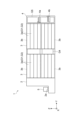
- FIG. 1 is a top view that illustrates a schematic diagram of an example of a substrate processing system.
- FIG. 2 is a side view that illustrates a schematic diagram of an example of a substrate processing system.
- FIG. 3 is a side view that illustrates an example of a thin film processing apparatus.
- FIG. 4 is a top view that illustrates an example of a holding portion.
- FIG. 5 is a cross-sectional view that illustrates an example of a processing tool unit.
- FIG. 6 is a perspective view that illustrates an example of a processing tool.
- FIG. 7 is a perspective view that illustrates an example of a holder and a replacement tool.
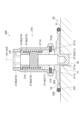
- FIG. 8 is a cross-sectional view that illustrates an example of a holder and a replacement tool.
- FIG. 1 is a top view that illustrates a schematic diagram of an example of a substrate processing system.
- FIG. 2 is a side view that illustrates a schematic diagram of an example of a substrate processing system.
- FIG. 9 is a perspective view, partially cut away, showing an example of a holder.
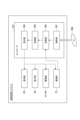
- FIG. 10 is a block diagram showing an example of a main part of a substrate processing system.
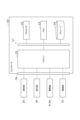
- FIG. 11 is a schematic diagram illustrating an example of a hardware configuration of the controller.
- FIG. 12 is a diagram for explaining a procedure for removing the processing tool from the processing tool unit by using the replacement tool.
- FIG. 13 is a diagram for explaining a procedure for removing the processing tool from the processing tool unit by using the replacement tool.
- FIG. 14 is a diagram for explaining a procedure for removing the processing tool from the processing tool unit by using the replacement tool.
- FIG. 15 is a diagram for explaining a procedure for attaching a processing tool to a processing tool unit using an exchange tool.
- FIG. 16 is a diagram for explaining a procedure for attaching the processing tool to the processing tool unit using the replacement tool.
- FIG. 17 is a cross-sectional view that illustrates a schematic diagram of another example of the processing tool.
- FIG. 18( a ) is a cross-sectional view that shows a schematic diagram of another example of the processing tool, and
- FIG. 18( b ) is a cross-sectional view that shows a schematic diagram of another example of the processing tool.
- FIG. 19 is a perspective view that illustrates a schematic diagram of another example of the replacement tool.
- FIG. 20 is a perspective view that illustrates another example of the holding portion.
- 21(a) is a side view showing, in a schematic manner, the state in which the gripping piece of the holding portion of FIG.
- FIG. 20 is releasing the replacement tool of FIG. 19, and FIG. 21(b) is a side view showing, in a schematic manner, the state in which the gripping piece of the holding portion of FIG. 20 is gripping the replacement tool of FIG. 19.
- FIG. 22 is a perspective view that illustrates a schematic diagram of another example of the replacement tool.
- 23 is a top view showing the main body of the replacement tool of FIG. 22.
- FIG. FIG. 24 is a diagram for explaining a state in which a processing tool is attached to the replacement tool of FIG. 23.
- FIG. 25 is a top view that illustrates a schematic diagram of another example of the replacement tool.
- FIG. 26 is a schematic cross-sectional view of the holder and the replacement tool of FIG.
- the substrate processing system 1 may be configured to perform, for example, a photolithography process on the substrate W.
- the photolithography process may include, for example, a process of forming a photosensitive thin film (e.g., a resist film, etc.) on the surface of the substrate W, a process of developing the photosensitive thin film after exposure, etc.
- the substrate W may be disk-shaped or may be a plate-shaped other than circular, such as a polygon.
- the substrate W may have a cutout portion cut out of a portion.
- the cutout portion may be, for example, a notch (a U-shaped, V-shaped, or other groove) or a linear portion extending in a straight line (so-called orientation flat).
- the substrate W may be, for example, a semiconductor substrate (silicon wafer), a glass substrate, a mask substrate, an FPD (Flat Panel Display) substrate, or any other type of substrate.
- the diameter of the substrate W may be, for example, about 200 mm to 450 mm.
- the substrate processing system 1 includes a loading/unloading station 2, at least one processing station 3, an interface station 4, and a controller Ctr (controller).
- the loading/unloading station 2, the at least one processing station 3, and the interface station 4 may be arranged in a line in this order, for example, along the Y direction.
- the at least one processing station 3 may include two or more processing stations 3 arranged between the loading/unloading station 2 and the interface station 4.
- the loading/unloading station 2 includes multiple mounting tables 2a and substrate transport devices 2b, 2c.
- the multiple mounting tables 2a may be lined up, for example, along the X direction (the width direction of the substrate processing system 1).
- Each of the multiple mounting tables 2a is configured to be able to mount one carrier 5 thereon.
- the carrier 5 is configured to accommodate at least one substrate W in a sealed state.
- the substrate transport devices 2b and 2c are each configured to be movable in, for example, the X direction (horizontal direction), the Y direction (horizontal direction), the Z direction (vertical direction), and around the vertical axis ( ⁇ direction).
- the substrate transport devices 2b and 2c may each include a drive mechanism for movement in each of the directions.
- the substrate transport devices 2b and 2c are configured to transfer the substrate W between the carrier 5 and the processing station 3.
- the transfer of the substrate W to the processing station 3 by the substrate transport devices 2b and 2c may include the transfer of the substrate W to the block G3.
- the block G3 may be arranged in the loading/unloading station 2 so as to be located near the substrate transport space 3b (described later) in the processing station 3.
- the block G3 may include multiple transfer devices (not shown) arranged in the vertical direction. Each transfer device may be configured to be accessible to the substrate transport devices 2b and 2c and the substrate transport device 3c (described later) of the processing station 3. Block G3 may be located in processing station 3 instead of in loading/unloading station 2.
- the processing station 3 is configured to perform various photolithography processes on the substrate W.
- the processing station 3 may include a plurality of modules 3a stacked vertically.
- each module 3a may include, for example, blocks G1 and G2 and a substrate transport space 3b extending along the Y direction.
- Blocks G1 and G2 may be lined up in the X direction so as to face each other with the substrate transport space 3b between them.
- Block G1 includes at least one thin film processing apparatus U1.
- Thin film processing apparatus U1 may be an apparatus that performs film processing by supplying a processing liquid to a substrate W, or an apparatus that performs film processing by supplying a predetermined gas to a substrate W.
- Thin film processing apparatus U1 may include, for example, a thin film forming apparatus, a developing processing apparatus, etc.
- Thin film forming apparatus may include, for example, a photosensitive thin film forming apparatus, an anti-reflective film forming apparatus, etc.
- Thin film processing may include forming a thin film and performing a developing process.
- multiple thin film processing apparatuses U1 are arranged in a line along the Y direction, but the number, arrangement, and type of thin film processing apparatuses U1 may be selected arbitrarily.
- the block G2 includes a plurality of heat treatment devices U2, a hydrophobization treatment device (not shown), and a peripheral exposure device U3.
- the plurality of heat treatment devices U2 are configured to perform heat treatment (e.g., heating, cooling) of the substrate W.
- the plurality of heat treatment devices U2 may be arranged vertically and horizontally in the block G2.
- the hydrophobization treatment device is configured to hydrophobize the surface of the substrate W in order to increase the adhesion between the substrate W and the treatment liquid that becomes the photosensitive thin film.
- the peripheral exposure device U3 is configured to expose a portion of the photosensitive thin film formed on the surface of the substrate W that is located at the peripheral portion.
- the hydrophobization treatment device and the peripheral exposure device U3 may be arranged vertically and horizontally in the block G2.
- the number and arrangement of the heat treatment devices U2, the hydrophobization treatment device, and the peripheral exposure device U3 may be selected arbitrarily.
- the peripheral exposure device U3 may be arranged in the interface station 4 instead of the treatment station 3 (block G2) or in addition to the treatment station 3 (block G2).
- a substrate transport device 3c is disposed within the substrate transport space 3b.
- the substrate transport device 3c is configured to be movable, for example, in each of the Y direction (horizontal direction), Z direction (up and down direction), and around the vertical axis ( ⁇ direction).
- the substrate transport device 3c may include a drive mechanism for movement in each of these directions.
- the substrate transport device 3c is configured to move within the substrate transport space 3b and to transfer substrates W between blocks G1 to G5.
- block G4 is disposed in the substrate transport space 3b at the boundary between the two processing stations 3.
- Block G4 may include multiple transfer devices (not shown) arranged vertically. Each transfer device may be configured to be accessible by the substrate transport device 3c of one of the two processing stations 3 and the substrate transport device 3c of the other of the two processing stations 3.
- block G5 may be disposed in interface station 4 so as to be located near substrate transport space 3b in processing station 3.
- Block G5 may include multiple transfer devices (not shown) arranged vertically. Each transfer device may be configured to be accessible by substrate transport device 3c and substrate transport devices 4a and 4b (described later) of interface station 4.
- the interface station 4 connects the processing station 3 to an exposure device (not shown) so as to transfer the substrate W between them.
- the exposure device may be adjacent to the interface station 4, for example, located on the opposite side of the interface station 4 from the processing station 3.
- the interface station 4 includes substrate transport devices 4a and 4b.
- the substrate transport devices 4a and 4b are each configured to be movable in, for example, the X direction (horizontal direction), the Y direction (horizontal direction), the Z direction (up and down direction), and around the vertical axis ( ⁇ direction).
- the substrate transport devices 4a and 4b may each include a drive mechanism for movement in each of the directions.
- the substrate transport devices 4a and 4b are configured to transfer substrates W between the processing station 3, the interface station 4, and the exposure device.
- the transfer of substrates W to and from the processing station 3 by the substrate transport devices 4a and 4b may include the transfer of substrates W to and from the block G5.
- the block G5 may be disposed in the interface station 4 so as to be located near the substrate transfer space 3b in the processing station 3.
- the block G5 may include a plurality of transfer devices (not shown) arranged in the vertical direction. Each transfer device may be configured to be accessible by the substrate transport devices 4a and 4b and the substrate transport device 3c of the processing station 3.
- Block G5 may be located in processing station 3 instead of in interface station 4.
- the controller Ctr is configured to partially or entirely control the substrate processing system 1.
- the thin film processing apparatus U1 includes a chamber 10, a holding unit 20, a suction unit 30, a rotation unit 40, a supply unit 50, a cup member 60, an imaging unit 70, and a cleaning cup 80.
- the chamber 10 is a housing configured so that the substrate W can be loaded and unloaded into and from the chamber.
- An unloading/unloading opening (not shown) is formed in the side wall of the chamber 10. The substrate W is transported into the chamber 10 and unloaded from the chamber 10 to the outside through the unloading/unloading opening by the substrate transport device 3c.
- the holding unit 20 is configured to operate based on a control signal from the controller Ctr and to hold the substrate W.
- the holding unit 20 includes a circular upper surface 21 that extends substantially horizontally, a suction hole 22, and a number of protrusions 23-27.
- the suction hole 22 is provided in the upper surface 21 so as to substantially coincide with the central axis Ax1, which is the center of rotation of the holding unit 20. Therefore, the suction hole 22 includes an opening formed in the upper surface 21 that is open toward the top.
- the multiple protrusions 23-27 are provided on the upper surface 21 so as to protrude upward from the upper surface 21.
- the multiple protrusions 23-27 are configured to support at their tips the substrate W placed on the holder 20.
- Each of the multiple protrusions 23 has an arc shape (e.g., a circular arc shape).
- the multiple protrusions 23 are arranged near the suction hole 22 so as to surround the suction hole 22 and present an annular shape as a whole. Therefore, the ends of adjacent protrusions 23 are spaced apart.
- Each of the multiple protrusions 24 has an arc shape (e.g., a circular arc shape).
- the multiple protrusions 24 are arranged outside the protrusions 23 so as to surround the protrusions 23 and present an annular shape as a whole. Therefore, the ends of adjacent protrusions 24 are spaced apart.
- Each of the multiple protrusions 25 has an arc shape (e.g., a circular arc shape).
- the multiple protrusions 25 are arranged outside the protrusions 24 so as to surround the protrusions 24 and to form a ring shape as a whole. Therefore, the ends of adjacent protrusions 25 are spaced apart.
- Each of the multiple protrusions 26 has an arc shape (e.g., a circular arc shape).
- the multiple protrusions 26 are arranged outside the protrusions 25 so as to surround the protrusions 25 and to form a ring shape as a whole. Therefore, the ends of adjacent protrusions 26 are spaced apart.
- the ridge 27 (first ridge) has an annular (e.g., circular) shape.
- the ridge 27 is arranged outside the ridge 26 so as to surround the ridge 26.
- the ridge 27 may be arranged along the vicinity of the outer periphery of the upper surface 21. Therefore, in the radial direction of the central axis Ax1, the multiple ridges 23 to 26 are arranged on the upper surface 21 inside the ridge 27.
- the suction unit 30 is connected to the suction hole 22.
- the suction unit 30 operates based on a control signal from the controller Ctr, and is configured to suck in the atmosphere near the suction hole 22 through the suction hole 22. Therefore, when the suction unit 30 operates while the substrate W is supported by the multiple protrusions 23-27, the atmosphere in the space between the substrate W and the upper surface 21 of the holder 20 is sucked in through the suction hole 22, and the space becomes negative pressure. As a result, the substrate W is attracted to the holder 20 with its posture approximately horizontal. In other words, the holder 20 and the suction unit 30 constitute a so-called vacuum chuck.
- the rotating unit 40 includes a driving unit 41 and a shaft 42.
- the driving unit 41 is configured to operate based on an operation signal from the controller Ctr and rotate the shaft 42.
- the driving unit 41 may be a power source such as an electric motor.
- the shaft 42 connects the driving unit 41 and the holding unit 20 and extends along the vertical direction. Therefore, the substrate W held by the holding unit 20 rotates around the vertical central axis Ax1 in a substantially horizontal position.
- the holding unit 20 and the rotating unit 40 constitute a so-called spin chuck.
- the supply unit 50 is configured to supply different types of processing liquids from a nozzle 100 (processing tool) to the front surface Wa of the substrate W held in the holding unit 20.
- the supply unit 50 includes a liquid source 51, a pipe 52, a holding base 53 (holding and transporting unit), a drive unit 54 (holding and transporting unit), and at least one nozzle N.
- the liquid source 51 may be configured as a supply source of a processing liquid.
- the processing liquid may be, for example, an acid-based processing liquid or an alkaline processing liquid.
- the pipe 52 connects the liquid source 51 to at least one nozzle 100.
- the pipe 52 is provided with a valve (not shown). The valve is configured to open and close based on an operation signal from the controller Ctr.
- the holding base 53 is configured to hold at least one nozzle 100.
- the holding base 53 includes at least one recess 53a, as illustrated in FIG. 5.
- the holding base 53 may include a number of recesses 53a corresponding to the number of nozzles 100.
- the recess 53a includes a bottom surface 53b and a main portion 53c.
- the bottom surface 53b is provided with a flow path 53e that is connected to the piping 52.
- the main portion 53c accommodates the base end portion 101 (described later) of the nozzle 100.
- the inner circumferential surface of the main portion 53c may be, for example, a substantially cylindrical surface.
- a female thread 53f (fastening portion) is provided on the inner circumferential surface of the main portion 53c.
- the drive unit 54 is connected to the holding base 53.
- the drive unit 54 operates based on an operation signal from the controller Ctr, and is configured to move the holding base 53 horizontally or up and down. Therefore, at least one nozzle N is configured to move horizontally or up and down above the holding unit 20.
- the holding base 53 and the drive unit 54 constitute a holding and transport unit for holding and transporting at least one nozzle 100.
- At least one nozzle 100 is configured to supply processing liquid from the liquid source 51 to the surface Wa of the substrate W when the nozzle 100 is positioned above the substrate W held by the holder 20. To this end, a flow path 100a is provided inside the nozzle 100, extending along the extension direction of the nozzle 100. At least one nozzle 100 may include two or more nozzles 100.
- the nozzle 100 includes a base end 101, a tip end 102, and an irregularly shaped portion 103 (engagement portion).
- the base end 101 has an outer shape that corresponds to the inner peripheral surface of the main portion 53c.
- a male thread 101a (another fastening portion) is provided on the outer peripheral surface of the base end 101.
- the nozzle 100 is attached to the holding base 53 by fastening the male thread 101a to the female thread 53f.
- the nozzle 100 is removed from the holding base 53 by loosening the male thread 101a from the female thread 53f.
- the nozzle 100 includes a male thread 101a that is configured to be fastened to the female thread 53f provided on the main portion 53c of the holding base 53.
- the tip portion 102 has a tapered shape that reduces in diameter toward the tip.
- the irregularly shaped portion 103 is located between the base end portion 101 and the tip portion 102.
- the outer peripheral surface of the irregularly shaped portion 103 has a non-circular irregular shape (a shape other than a perfect circle).
- the overall outer diameter of the irregularly shaped portion 103 may be larger than the inner diameter of the main portion 53c.
- the outer peripheral surface of the irregularly shaped portion 103 may have a generally hexagonal shape as a whole.
- the outer peripheral surface of the irregularly shaped portion 103 may have a shape in which the center of each side of the approximately hexagon is recessed inward in an arc shape.
- the outer diameter of the irregularly shaped portion 103 may be larger than the outer shape of the base end 101 (male thread 101a). Therefore, the upper end of the irregularly shaped portion 103 includes a shoulder 103a that protrudes radially outward from the base end 101.
- the upper surface of the shoulder 103a abuts against the lower surface of the holding base 53, and the end face of the base end 101 abuts against the bottom surface of the recess 53a. This prevents leakage of the processing liquid from the gap between the recess 53a and the nozzle 100.
- the base end 101 may be configured to be elastically deformable.
- the cup member 60 is provided so as to surround the periphery of the holding unit 20.
- the cup member 60 is configured to collect the processing liquid that splashes around from the outer periphery of the substrate W as the substrate W is held and rotated by the holding unit 20 and the rotating unit 40.
- a drainage port 61 and an exhaust port 62 are provided at the bottom of the cup member 60.
- the drain port 61 is configured to discharge the processing liquid collected by the cup member 60 to the outside of the thin film processing apparatus U1.
- the exhaust port 62 is configured to discharge the downward flow formed around the substrate W by the blower (not shown) to the outside of the thin film processing apparatus U1. The downward flow is accompanied by gas generated around the substrate W as the substrate W is processed with the processing liquid.
- the imaging unit 70 is disposed above the holding unit 20.
- the imaging unit 70 is configured to operate based on a control signal from the controller Ctr and capture an image of the center of rotation of the holding unit 20 and its surroundings.
- the imaging unit 70 is configured to transmit the captured image to the controller Ctr.
- the imaging unit 70 may be, for example, a CCD camera, a CMOS camera, etc.
- the installation location of the imaging unit 70 is not particularly limited as long as it can capture an image of the center of rotation of the holding unit 20 and its surroundings.
- the cleaning cup 80 is configured to clean the tip 102 of the nozzle 100 with cleaning liquid after the processing liquid has been supplied to the surface Wa of the substrate W.
- the cleaning cup 80 is positioned outside the cup member 60 and away from the cup member 60.
- the cleaning cup 80 has a bottomed cylindrical shape that opens upward so that the cleaning liquid can be stored.
- the cleaning liquid stored in the cleaning cup 80 may be, for example, a solvent.
- the replacement tool 200 includes a main body portion 210, a flange portion 220, and an annular elastic member 230 (e.g., an O-ring).
- annular elastic member 230 e.g., an O-ring
- the main body 210 has a cylindrical shape as a whole and extends in one predetermined direction.
- the main body 210 includes a base 211 (transmission part), an outer tube 212 (transmission part), a slide part 213, a biasing part 214, and at least one protrusion 215 (transmission part).
- the base portion 211 has a bottomed cylindrical shape and is configured to accommodate the tip portion 102 of the nozzle 100 when the nozzle 100 is attached to the replacement tool 200.
- the base portion 211 includes an upper portion 211a and a lower portion 211b, as illustrated in Figures 8 and 9.
- the outer peripheral surface of the upper portion 211a has an irregular shape that is non-circular (a shape other than a perfect circle).
- the outer peripheral surface of the upper portion 211a may have, for example, a generally hexagonal shape overall.
- the peripheral wall of the upper portion 211a may be provided with a number of accommodating portions 211c (transmission portions) corresponding to the number of at least one protrusion portion 215.
- the accommodating portions 211c may be through holes that penetrate the peripheral wall of the upper portion 211a, or may be grooves that are recessed inward from the outer peripheral surface of the upper portion 211a.
- the accommodating portions 211c may extend in the extension direction of the main body portion 210.
- a cylindrical portion 211d is provided near the inner peripheral edge of the upper end of the upper portion 211a.
- the cylindrical portion 211d extends upward along the extension direction of the exchange tool 200.
- the lower part 211b extends downward from the lower end of the upper part 211a.
- the lower part 211b is inserted into the suction hole 22 of the holding part 20.
- the central axis Ax1 of the holding part 20 and the central axis Ax2 of the replacement tool 200 approximately coincide with each other. Therefore, when the holding part 20 and the replacement tool 200 rotate, the holding part 20 and the replacement tool 200 rotate around approximately the common central axis Ax1, Ax2.
- the lower portion 211b may be integral with the upper portion 211a.
- a cutout 211e may be partially provided on the outer peripheral surface of the lower portion 211b. Therefore, as illustrated in FIG. 8, when the replacement tool 200 is held by the holder 20, a space V1 is formed between the outer peripheral surface of the cutout 211e and the inner peripheral surface of the suction hole 22.
- the cutout 211e may be, for example, a groove (a U-shaped, V-shaped, etc. groove) extending in the extension direction of the main body 210.
- the cutout 211e may be, for example, a flat portion (a so-called D-cut) extending in the extension direction of the main body 210.
- the outer tube portion 212 is disposed outside the base portion 211 and is configured to be slidable relative to the base portion 211.
- the outer tube portion 212 includes a lower portion 212a and an upper portion 212b.
- the inner circumferential surface of the lower portion 212a has a shape corresponding to the outer circumferential surface of the upper portion 211a of the base portion 211. That is, the inner circumferential surface of the lower portion 212a has an irregular shape that is non-circular (a shape other than a perfect circle).
- the inner circumferential surface of the lower portion 212a may have, for example, an approximately hexagonal shape overall.
- the inner shape of the lower portion 212a may be configured to be slightly larger than the outer shape of the upper portion 211a. Therefore, when the upper portion 211a is inserted into the lower portion 212a, the lower portion 212a and the upper portion 211a fit together.
- the outer tube portion 212 rotates together with the base portion 211 without spinning freely. That is, the inner circumferential surface of the lower portion 212a and the outer circumferential surface of the upper portion 211a form a transmission portion that transmits rotational force between the base portion 211 and the outer tube portion 212.
- the peripheral wall of the lower portion 212a may have at least one through hole 212c in a number corresponding to the number of protrusions 215.
- a female screw may be formed on the inner peripheral surface of the through hole 212c.
- the inner circumferential surface of the upper portion 212b (the inner circumferential surface of the opening OP of the main body portion 210) has a shape corresponding to the outer circumferential surface of the irregularly shaped portion 103 of the nozzle 100. That is, the inner circumferential surface of the upper portion 212b has an irregular shape that is non-circular (a shape other than a perfect circle).
- the inner circumferential surface of the upper portion 212b may, for example, have an approximately hexagonal shape overall.
- the inner shape of the upper portion 212b may be configured to be larger than the inner shape of the lower portion 212a.
- the outer tube portion 212 (replacement tool 200) and the nozzle 100 fit together (engage), and the tip portion 102 and irregularly shaped portion 103 of the nozzle 100 are accommodated within the main body portion 210. Therefore, when the replacement tool 200 rotates around the central axis Ax2 of the replacement tool 200, the nozzle 100 rotates together with the replacement tool 200 through the irregularly shaped portion 103 without idling. That is, the inner peripheral surface of the upper portion 212b and the outer peripheral surface of the irregularly shaped portion 103 constitute a transmission portion that transmits rotational force between the nozzle 100 and the replacement tool 200.
- the upper end portion of the upper portion 212b may have a shape that expands in diameter as it goes upward so that the irregularly shaped portion 103 can be smoothly inserted into the upper portion 212b.
- the upper portion 212b may be integrally formed with the lower portion 212a.
- the slide portion 213 is disposed inside the lower portion 212a.
- the slide portion 213 is configured to be slidable in the extension direction of the replacement tool 200 between the base portion 211 and the outer tube portion 212.
- the slide portion 213 includes a cylindrical portion 213a and a flange portion 213b.
- the cylindrical portion 213a extends along the extension direction of the replacement tool 200.
- the cylindrical portion 213a is configured to accommodate the tip portion 102 of the nozzle 100 when the nozzle 100 is attached to the replacement tool 200.
- the flange portion 213b extends (projects) from near the upper end of the cylindrical portion 213a radially outward of the central axis Ax2.
- the flange portion 213b may be a plate-like body having an annular shape.
- the outer shape of the flange portion 213b is configured to be smaller than the inner shape of the lower portion 212a but larger than the inner shape of the upper portion 212b. Therefore, the upper portion 212b functions as a stopper that restricts the upward movement of the flange portion 213b. Therefore, the flange portion 213b is prevented from slipping out to the outside through the opening OP of the upper portion 212b (replacement tool 200).
- the flange portion 213b may be configured integrally with the cylindrical portion 213a.
- the biasing portion 214 is configured to apply a biasing force to the outer tube portion 212 in the extension direction of the replacement tool 200 and in a direction that separates the base portion 211 and the outer tube portion 212.
- the biasing portion 214 may be, for example, a compression coil spring.
- the biasing portion 214 is disposed inside the lower portion 212a.
- the upper end of the biasing portion 214 is located between the outer peripheral surface of the cylindrical portion 213a and the inner peripheral surface of the lower portion 212a, and is in contact with the lower surface of the flange portion 213b.
- the lower end of the biasing portion 214 is located between the outer peripheral surface of the cylindrical portion 211d and the inner peripheral surface of the lower portion 212a, and is in contact with the upper surface of the upper portion 211a. Therefore, in the example of Figures 8 and 9, the biasing portion 214 is configured to apply a biasing force to the outer cylinder portion 212 via the slide portion 213.
- At least one protrusion 215 is configured to be attachable to a corresponding through hole 212c.
- the protrusion 215 may be, for example, a male thread, and may be configured to be fastened to the female thread of the corresponding through hole 212c.
- the at least one protrusion 215 may include two or more protrusions 215.
- the tip of the protrusion 215 protrudes from the inner peripheral surface of the outer tube portion 212 toward the base portion 211.
- the tip of the protrusion 215 is accommodated in the accommodating portion 211c of the base portion 211. Therefore, when the outer tube portion 212 is urged upward by the urging portion 214, the tip of the protrusion 215 comes into contact with the upper end of the accommodating portion 211c, preventing further upward movement of the outer tube portion 212.
- the protrusion 215 and the accommodating portion 211c function as a stopper that restricts the upward movement of the outer tube portion 212.
- the tip of the protrusion 215 comes into contact with the side wall of the accommodating portion 211c. Therefore, the outer cylinder portion 212 does not spin freely, but rotates together with the base portion 211. In other words, the tip of the protrusion portion 215 and the side wall of the storage portion 211c form a transmission portion that transmits rotational force between the base portion 211 and the outer cylinder portion 212.
- the flange portion 220 extends (projects) radially outward from near the upper end of the lower portion 211b about the central axis Ax2.
- the flange portion 213b may be a plate-like body having an annular shape.
- the flange portion 220 may be integrally formed with the base portion 211.
- the flange portion 220 may include a protrusion 221 (second protrusion) that protrudes downward (toward the lower portion 211b from the flange portion 220).
- the protrusion 221 has an annular (e.g., annular) shape.
- the protrusion 221 is disposed on the outside of the lower portion 211b so as to surround the lower portion 211b.
- the protrusion 221 may be disposed along the vicinity of the outer periphery of the lower surface of the flange portion 220.
- the outer shape of the flange portion 220 may be configured to be smaller than the outer shape of the substrate W. That is, when the exchange tool 200 is held by the holding part 20, the protrusion 221 may be located inside the protrusion 27. In the example of FIG. 7, the outer shape of the flange portion 220 is configured to be smaller than a virtual ring shape (virtual circle) formed by the multiple protrusions 23. In this case, when the exchange tool 200 is held by the holding part 20, the lower end of the protrusion 221 contacts the inner area of the multiple protrusions 23 on the upper surface 21 of the holding part 20.
- a virtual ring shape virtual circle
- the outer shape of the flange portion 220 may be such that when the exchange tool 200 is held by the holding part 20, the protrusion 221 is located between adjacent protrusions of the protrusions 23 to 27 in the radial direction of the central axis Ax2.
- the flange part 220 When the replacement tool 200 is held by the holding part 20, the flange part 220 is slightly separated from the upper surface 21 of the holding part 20 due to the presence of the protrusion 221. That is, as illustrated in FIG. 8, when the replacement tool 200 is held by the holding part 20, a space V2 is formed that is surrounded by the lower surface of the flange part 220, the protrusion 221, and the upper surface 21 of the holding part 20. Space V2 is connected to space V1. Therefore, when the suction part 30 operates, the atmosphere in space V2 is sucked in through the suction hole 22 and space V1, and space V2 becomes negative pressure. As a result, the flange part 220 is adsorbed to the holding part 20.
- the elastic member 230 is attached to the outer circumferential surface (end surface) of the flange portion 220.
- the suction portion 30 operates and the flange portion 220 is attracted to the holding portion 20 while the replacement tool 200 is held by the holding portion 20, the elastic member 230 is pressed downward. This prevents gas from leaking from the gap between the lower end of the protrusion 221 and the upper surface 21 of the holding portion 20.
- the controller Ctr is configured to control the substrate processing system 1 partially or entirely. As illustrated in FIG. 10, the controller Ctr has a reading unit M1, a storage unit M2, a processing unit M3, an instruction unit M4, and a communication unit M5 as functional modules. These functional modules are merely a division of the functions of the controller Ctr into a plurality of modules for convenience, and do not necessarily mean that the hardware constituting the controller Ctr is divided into such modules. Each functional module is not limited to being realized by the execution of a program, and may be realized by a dedicated electric circuit (e.g., a logic circuit) or an integrated circuit (ASIC: Application Specific Integrated Circuit) that integrates the same.
- ASIC Application Specific Integrated Circuit
- the reading unit M1 is configured to read a program from a computer-readable recording medium RM.
- the recording medium RM records a program for operating each part of the substrate processing system 1.
- the recording medium RM may be, for example, a semiconductor memory, an optical recording disk, a magnetic recording disk, or a magneto-optical recording disk.
- each part of the substrate processing system 1 may include the holding unit 20, the suction unit 30, the driving units 41, 54, and the imaging unit 70.
- the memory unit M2 is configured to store various data.
- the memory unit M2 may store, for example, a program read from the recording medium RM by the reading unit M1, setting data input by an operator via an external input device (not shown), etc.
- the memory unit M2 may store, for example, data on processing conditions (processing recipes) for processing the substrate W.
- the memory unit M2 may store, for example, data on images captured by the imaging unit 70.
- Processing unit M3 is configured to process various data. Processing unit M3 may generate control signals for operating each unit of substrate processing system 1, for example, based on the various data stored in memory unit M2.
- the processing unit M3 may, for example, control the rotating unit 40 to rotate the holding unit 20 when the replacement tool 200 is attached to the holding unit 20 via the flange portion 220 and the irregular portion 103 of the nozzle 100 is engaged with the upper portion 212b of the replacement tool 200 (first processing). This causes the male thread 101a of the nozzle 100 to be tightened or loosened relative to the female thread 53f of the holding base 53, so that the nozzle 100 is attached to or detached from the holding base 53.
- Processing unit M3 may, for example, operate suction unit 30 to adsorb flange portion 220 to holding unit 20 before the above-mentioned first process (second process).
- processing unit M3 may, for example, operate suction unit 30 with lower portion 211b of main body portion 210 inserted into suction hole 22 to generate negative pressure in space V2, thereby adsorbing flange portion 220 to holding unit 20.
- Processing unit M3 may, for example, before the above-mentioned first process, control driving unit 54 so that pressure is applied to slide portion 213 via nozzle 100 by holding base 53 until biasing portion 214 contracts a predetermined amount (third process).
- the third process may be performed in a state in which irregular portion 103 of nozzle 100 is inserted into outer tube portion 212 (upper portion 212b) of exchange tool 200 attached to holding unit 20, and irregular portion 103 of nozzle 100 is supported by slide portion 213.
- the processing unit M3 may determine the state of the replacement tool 200 and/or the nozzle 100, for example, based on the data of the captured image captured by the imaging unit 70.
- the determination of the state may include, for example, the presence or absence of the replacement tool 200 in the holding unit 20, the presence or absence of the nozzle 100 in the replacement tool 200, the appropriateness of the installation state of the replacement tool 200 relative to the holding unit 20, the appropriateness of the installation state of the nozzle 100 relative to the replacement tool 200, etc.
- the determination of the appropriateness of the installation state may include, for example, the determination of whether the replacement tool 200 is tilted relative to the holding unit 20, whether the flange portion 220 and the elastic member 230 of the replacement tool 200 are abutting against the upper surface 21 of the holding unit 20, whether the nozzle 100 is tilted relative to the replacement tool 200, whether the irregular portion 103 of the nozzle 100 is inserted into the opening OP of the main body portion 210, etc.
- the processing unit M3 may determine the presence or absence of the object by, for example, comparing the reference image with the captured image (so-called pattern matching), or may determine the presence or absence of the object in the current captured image by using the results obtained by machine learning of the past captured images.
- the processing unit M3 may issue an alarm from an alarm unit (not shown).
- the processing unit M3 may issue an alarm from an alarm unit (not shown).
- the alarm issued by the alarm unit may be, for example, a display (not shown) displaying an alarm (e.g., characters, figures, etc.), or a speaker (not shown) issuing an alarm sound or an alarm guide.
- the processing unit M3 may attach and detach the nozzle 100 to one of the multiple recesses 53a designated by the worker. In this case, the processing unit M3 may adjust the position of the holding base 53 by the drive unit 54 so that the recess 53a designated by the worker is located directly above the replacement tool 200 held by the holding unit 20.
- the instruction unit M4 is configured to transmit the control signal generated in the processing unit M3 to each part of the substrate processing system 1.
- the hardware of the controller Ctr may be configured, for example, by one or more control computers.
- the controller Ctr may include a circuit C1 as a hardware configuration, as exemplified in FIG. 11.
- the circuit C1 may be configured by electric circuit elements.
- the circuit C1 may include, for example, a processor C2, a memory C3, a storage C4, a driver C5, and an input/output port C6.
- the processor C2 may be configured to execute a program in cooperation with at least one of the memory C3 and the storage C4, and to implement each of the functional modules described above by performing input and output of signals via the input and output port C6.
- the memory C3 and the storage C4 may function as the memory unit M2.
- the driver C5 may be a circuit configured to drive each of the parts of the substrate processing system 1.
- the input and output port C6 may be configured to mediate the input and output of signals between the driver C5 and each of the parts of the substrate processing system 1.
- the substrate processing system 1 may include one controller Ctr, or may include a controller group (controller) composed of multiple controllers Ctr.
- each of the above-mentioned functional modules may be realized by one controller Ctr, or may be realized by a combination of two or more controllers Ctr.
- the controller Ctr is composed of multiple computers (circuits C1)
- each of the above-mentioned functional modules may be realized by one computer (circuit C1), or may be realized by a combination of two or more computers (circuits C1).
- the controller Ctr may have multiple processors C2.
- each of the above-mentioned functional modules may be realized by one processor C2, or may be realized by a combination of two or more processors C2.
- the irregularly shaped portion 103 of the nozzle 100 may not enter the opening OP. That is, as illustrated in FIG. 12(b), the irregularly shaped portion 103 may push the outer tube portion 212 and the slide portion 213 downward against the biasing force of the biasing portion 214.
- the replacement tool 200 rotates until the outer shape of the irregularly shaped portion 103 and the inner shape of the opening OP approximately match when viewed from above, the outer tube portion 212 and the slide portion 213 are pushed upward by the biasing force of the biasing portion 214.
- the irregularly shaped portion 103 is inserted into the main body portion 210 (upper portion 212b), as illustrated in FIG. 13(a).
- the controller Ctr instructs the drive part 54 to stop the descent of the holding base 53.
- the male screw 101a of the base end part 101 is loosened from the female screw 53f of the recess 53a, as illustrated in FIG. 13(b).
- the irregularly shaped part 103 pushes the outer tube part 212 and the slide part 213 downward against the biasing force of the biasing part 214.
- the controller Ctr issues an instruction to the drive unit 54 to raise the holding base 53, as illustrated in FIG. 14.
- the controller Ctr also issues an instruction to the rotation unit 40 to stop the rotation of the holding unit 20. This completes the process of removing the nozzle 100 from the holding base 53.
- the controller Ctr may execute a process of attaching a new nozzle 100 to the recess 53a of the holding base 53 that has become a vacant space after the nozzle 100 has been removed. Alternatively, the controller Ctr may execute a process of removing the nozzle 100 from another recess 53a. Alternatively, the controller Ctr may end the process.
- the controller Ctr instructs the suction unit 30 to adsorb the flange portion 220 to the holding unit 20. Also, a new nozzle 100 is attached to the replacement tool 200 so that the irregular portion 103 is inserted into the main body 210 (upper portion 212b). Furthermore, the controller Ctr instructs the rotation unit 40 to rotate the holding unit 20 counterclockwise when viewed from above.
- the rotation speed of the holding unit 20 may be, for example, about 30 rpm. As a result, the replacement tool 20 rotates together with the holding unit 20. Note that the timing for rotating the holding unit 20 may be before the holding base 53 descends.
- the controller Ctr instructs the drive unit 54 to position the recess 53a, which is an empty space, directly above the exchange tool 200 that holds the nozzle 100.
- the controller Ctr also instructs the drive unit 54 to lower the holding base 53, and insert the base end 101 of the nozzle 100 into the recess 53a of the holding base 53.
- the speed at which the holding base 53 descends may be, for example, about 1 mm/sec.
- the holding base 53 descends, so when the male thread 101a of the base end 101 of the nozzle 100 reaches the female thread 53f of the main part 53c of the holding base 53, the male thread 101a may not enter the female thread 53f.
- the controller Ctr continues the descent of the holding base 53.
- the irregular part 103 pushes the slide part 213 downward a predetermined amount against the biasing force of the biasing part 214. In other words, pressure is applied to the slide part 213 via the nozzle 100 until the biasing part 214 contracts a predetermined amount.
- the restoring force of the biasing part 214 causes the male thread 101a of the base end 101 of the slide part 213 and the female thread 53f of the main part 53c to press against each other.
- the replacement tool 200 and the nozzle 100 continue to rotate, so the tip of the thread of the male screw 101a is naturally guided to the entrance of the thread groove of the female screw 53f.
- the male screw 101a of the base end 101 is tightened against the female screw 53f of the recess 53a.
- the controller Ctr judges whether or not a predetermined torque has been reached in the rotating unit 40 that is rotating the holding unit 20. If the controller Ctr judges that the predetermined torque has not been reached, it continues to rotate the holding unit 20. On the other hand, if the controller Ctr judges that the predetermined torque has been reached, it stops the rotation of the holding unit 20 and the descent of the holding base 53 by issuing an instruction from the controller Ctr to the rotating unit 40 and the driving unit 54. This completes the tightening of the male thread 101a to the female thread 53f, as exemplified in FIG. 16(a).
- the controller Ctr issues an instruction to the drive unit 54 to raise the holding base 53, as shown in FIG. 16(b). This completes the process of attaching the nozzle 100 to the holding base 53.
- the suction hole 22 of the holding part 20 and its surroundings may be imaged by the imaging part 70.
- the controller Ctr may determine the state of the replacement tool 200 and/or the nozzle 100 based on the captured image. If the result of the determination indicates that the replacement tool 200 is not present, that the nozzle 100 is not present in the replacement tool 200, or that the replacement tool 200 and/or the nozzle 100 is not properly installed, the controller Ctr may cause the notification part to issue an alarm since the situation is not suitable for attaching the nozzle 100. On the other hand, if the result of the determination indicates that the replacement tool 200 is not present or that the nozzle 100 is not present in the replacement tool 200, the controller Ctr may proceed with the process of attaching the nozzle 100 to the holding base 53.
- the suction unit 30 can be operated with the lower portion 211b of the main body portion 210 inserted into the suction hole 22 to generate negative pressure in the space V2, thereby adsorbing the flange portion 220 to the holding portion 20.
- the suction unit 30 can be operated with the lower portion 211b of the main body portion 210 inserted into the suction hole 22 to generate negative pressure in the space V2, thereby adsorbing the flange portion 220 to the holding portion 20.
- the main body 210 (lower part 211b) may include a notch 211e extending in the extension direction of the replacement tool 200.
- the suction part 30 when the suction part 30 is operated with the lower part 211b inserted into the suction hole 22, the presence of the notch 211e forms a relatively large flow path (space V1) between the suction hole 22 and the lower part of the main body 210. Therefore, suction by the suction part 30 is performed through the space V1, making it easier for the flange part 220 to be adhered to the holding part 20. This makes it possible to more firmly attach the flange part 220 of the replacement tool 200 to the holding part 20.
- the flange portion 220 includes a protrusion 221 that protrudes downward, and when the replacement tool 200 is attached to the holding part 20, the protrusion 221 can be located inside the protrusion 27 of the holding part 20.
- the protrusion 221 is located inside the protrusion 27 and does not interfere with the protrusion 27.
- the protrusion 27 functions to support the substrate W, it is also possible to perform the function of adsorbing the flange portion 220 to the holding part 20. Furthermore, in this case, since the protrusion 221 is located inside the protrusion 27, the size of the flange portion 220 can be made smaller than the size of the substrate W. This makes it possible to make the replacement tool 200 more compact.
- the outer peripheral surface of the irregularly shaped portion 103 of the nozzle 100 may have a non-circular irregular shape.
- the main body 210 (upper portion 212b) of the replacement tool 200 may have a cylindrical shape capable of accommodating the irregularly shaped portion 103 of the nozzle 100.
- the inner peripheral surface of the opening OP of the main body 210 of the replacement tool 200 may have a shape corresponding to the outer peripheral surface of the irregularly shaped portion 103 of the nozzle 100.
- the rotation of the replacement tool 200 is transmitted to the nozzle 100 simply by inserting the irregularly shaped portion 103 of the nozzle 100 into the opening OP of the main body 210 of the replacement tool 200. Therefore, there is no need to use other members to prevent free rotation between the replacement tool 200 and the nozzle 100. Therefore, it is possible to make the replacement tool 200 and the nozzle 100 have a simple configuration.
- the biasing portion 214 can be configured to apply a biasing force to the outer tube portion 212 in the extension direction of the replacement tool 200 and in the direction separating the base portion 211 and the outer tube portion 212.
- the outer tube portion 212 is pushed by the nozzle 100 (irregularly shaped portion 103), and the outer tube portion 212 and the nozzle 100 descend against the biasing force of the biasing portion 214.
- the outer tube portion 212 returns to its original position due to the biasing force of the biasing portion 214, and the irregularly shaped portion 103 engages with the opening OP. In this way, the nozzle 100 can continue to descend until the irregularly shaped portion 103 enters the opening OP. This makes it possible to replace the nozzle 100 more efficiently.
- the outer peripheral surface of the base portion 211 may have a non-circular irregular shape.
- the inner peripheral surface of the outer cylinder portion 212 may have a shape corresponding to the outer peripheral surface of the base portion 211 (upper portion 211a).
- the inner peripheral surface of the upper portion 212b and the outer peripheral surface of the irregularly shaped portion 103 may constitute a transmission portion that transmits a rotational force between the nozzle 100 and the replacement tool 200. In this case, it is not necessary to use another member for preventing free rotation between the outer cylinder portion 212 and the base portion 211. Therefore, the replacement tool 200 can have a simple configuration.
- the main body 210 may include a protrusion 215 that protrudes from the outer tube 212 toward the base 211.
- the base 211 may include a housing 211c that houses the protrusion 215.
- the simple configuration of the protrusion 215 and the housing 211c makes it possible to prevent free rotation between the outer tube 212 and the base 211, and to prevent the outer tube 212, which is biased by the biasing portion 214, from slipping out of the base 211.
- the accommodating portion 211c can extend along the extension direction of the replacement tool 200.
- the movement of the outer tube portion 212 relative to the base portion 211 in the extension direction of the replacement tool 200 is limited according to the length of the accommodating portion 211c. Therefore, it is possible to adjust the stroke length of the outer tube portion 212 according to the length of the accommodating portion 211c.
- the state of the replacement tool 200 and/or the nozzle 100 can be automatically determined based on the image captured by the imaging unit 70. In this case, visual confirmation by the worker is not required when replacing the nozzle 100. This makes it possible to replace the nozzle 100 more efficiently.
- the male thread 101a was provided directly on the outer circumferential surface of the nozzle 100 (base end 101).
- the nozzle 100A (processing tool) may not be provided with a thread, and the nozzle 100A may be attached to the holding base 53 via a nut 120 (processing tool, another fastening part, engagement part).
- the holding base 53 includes a connection portion 55 that protrudes downward. Inside the connection portion 55, a flow path 53e that is connected to the piping 52 is provided.
- the connection portion 55 includes a base end portion 55a, a tip end portion 55b, and an intermediate portion 55c.
- the base end portion 55a may be integrally connected to the holding base 53.
- the tip end portion 55b has a shape corresponding to the base end portion 101 of the nozzle 100A, and is configured to be able to be accommodated in a recess 101b provided in the base end portion 101.
- the intermediate portion 55c is located between the base end portion 55a and the tip end portion 55b and connects them.
- a male thread 55d (fastening portion) is provided on the outer circumferential surface of the intermediate portion 55c.
- Nozzle 100A includes a base end 101 and a tip end 102.
- the outer shape of base end 101 is configured to be larger than the outer shape of tip end 102.
- the nut 120 includes a cylindrical portion 121 (engagement portion) and a flange portion 122.
- the inner shape of the cylindrical portion 121 is configured to be approximately the same as or larger than the outer shape of the base end portion 101, and is configured to be approximately the same as the outer shape of the intermediate portion 55c.
- a female thread 120a is provided on the inner peripheral surface of the cylindrical portion 121.
- the nut 120 is attached to the holding base 53 (connection portion 55) by tightening the female thread 120a against the male thread 55d. On the other hand, the nut 120 is removed from the holding base 53 (connection portion 55) by loosening the female thread 120a from the male thread 55d.
- the outer peripheral surface of the cylindrical portion 121 has a shape that corresponds to the inner peripheral surface of the upper portion 212b (the inner peripheral surface of the opening OP of the main body portion 210).
- the outer peripheral surface of the cylindrical portion 121 has an irregular shape that is non-circular (a shape other than a perfect circle). Therefore, when replacing the nozzle 100A with the replacement tool 200, the cylindrical portion 121 is inserted into the upper portion 212b, and the outer cylindrical portion 212 (replacement tool 200) and the nut 120 are fitted together (engaged).
- the flange portion 122 extends from near the lower end of the cylindrical portion 121 toward the inside in the radial direction of the nut 120.
- the flange portion 122 may be a plate-like body having an annular shape. That is, a through hole 122a may be provided in the center of the flange portion 122.
- the inner shape of the through hole 122a is configured to be larger than the outer shape of the tip portion 102 and smaller than the outer shape of the base end portion 101. Therefore, the tip portion 102 can pass through the through hole 122a, but the base end portion 101 cannot pass through the through hole 122a.
- the flange portion 122 is configured to hold the base end portion 101 between the tip portion 55b and the flange portion 122 when the nut 120 is attached to the intermediate portion 55c. Therefore, when the nut 120 is attached to the intermediate portion 55c, the nozzle 100A is prevented from slipping out of the nut 120.
- the flange portion 122 may be configured integrally with the cylindrical portion 121.
- the holding base 53 includes a recess 56 (fastening portion) that is recessed toward the inside.
- a female thread is provided on the inner peripheral surface of the recess 56.
- the brush 100B may be configured, for example, to scrub the surface Wa of the substrate W.
- the brush 100B may include a base portion 131, a brush portion 132 provided on the lower surface of the base portion 131, and a connection portion 133 provided on the upper surface of the base portion 131.
- the outer peripheral surface of the base portion 131 has a shape that corresponds to the inner peripheral surface of the upper portion 212b (the inner peripheral surface of the opening OP of the main body portion 210).
- the outer peripheral surface of the base portion 131 has an irregular shape that is non-circular (a shape other than a perfect circle). Therefore, when replacing the brush 100B with the replacement tool 200, the base portion 131 is inserted into the upper portion 212b, and the outer tube portion 212 (replacement tool 200) and the base portion 131 are fitted together (engaged).
- a male screw is provided on the outer peripheral surface of the connection part 133.
- the male screw of the connection part 133 is tightened against the female screw of the recess 56, thereby attaching the brush 100B to the holding base 53.
- the male screw of the connection part 133 is loosened from the female screw of the recess 56, thereby removing the brush 100B from the holding base 53.
- FIG. 18(a) also provides the same effect as the above example.
- the nozzle 100 may be attached to the holding base 53 by a screw 140 instead of the male thread 101a at the base end 101 of the nozzle 100.
- the holding base 53 includes a plurality of recesses 57 (fastening portions) recessed toward the inside.
- a female thread is provided on the inner peripheral surface of the recesses 57.
- the nozzle 100 may be provided with a flange portion 105 (another flange portion).
- the flange portion 105 extends (projects) from the outer peripheral surface of the nozzle 100 toward the radially outward direction of the nozzle 100.
- the flange portion 105 may be a plate-like body having an annular shape.
- the flange portion 105 may be configured integrally with the nozzle 100.
- the flange portion 105 is provided with a plurality of through holes 105a.
- the number of the plurality of through holes 105a may be the same as the number of the plurality of recesses 57.
- the positions of the plurality of through holes 105a correspond to the positions of the plurality of recesses 57, respectively.
- a female thread may be provided on the inner peripheral surface of the plurality of through holes 105a.
- the screw 140 includes a body 141 (another fastening portion) and a head 142 (engagement portion).
- a male thread is provided on the outer peripheral surface of the body 141.
- the outer shape of the body 141 may be substantially the same as the inner shape of the recess 57 and the inner shape of the through hole 105a.
- the head 142 is integrally connected to the base end of the body 141.
- the outer shape of the head 142 is configured to be larger than the outer shape of the body 141.
- the outer peripheral surface of the head 142 has an irregular shape that is non-circular (a shape other than a perfect circle). Therefore, when replacing the brush 100B with the replacement tool 200, the head 142 is inserted into the upper portion 212b, and the outer tube portion 212 (replacement tool 200) and the head 142 are fitted (engaged).
- the nozzle 100 is attached to the holding base 53 by tightening the male thread of the main body 141 against the female thread of the recess 57 and the through hole 105a.
- the brush 100B is removed from the holding base 53 by loosening the male thread of the main body 141 from the female thread of the recess 57 and the through hole 105a.
- the position of the holding base 53 may be adjusted by the drive unit 54 so that the recess 57 is located directly above the replacement tool 200.
- FIG. 18(b) also provides the same effect as the above example.
- the replacement tool 200 was attached to the holding part 20 by adsorbing the flange portion 220 to the holding part 20 using the suction part 30.
- the replacement tool 200 may be attached to the holding part 20A by physically gripping the outer periphery of the flange portion 220 using the holding part 20A illustrated in Figures 20 and 21.
- the holding part 20A may be used to hold a replacement tool 200 with an enlarged flange portion 220, as illustrated in Figure 19.
- the holding portion 20A includes a rotating plate 28 and a plurality of support portions 29.
- the rotating plate 28 is generally disk-shaped and is connected to the rotating portion 40.
- the support portions 29 are provided on the outer periphery of the rotating plate 28 so as to be arranged at generally equal intervals along the outer periphery of the rotating plate 28.
- the support portion 29 includes a gripping portion 29a and support bars 29b arranged on both sides of the gripping portion 29a.
- the gripping portion 29a includes a gripping piece 29c, a lever member 29d, and a biasing portion 29e.
- the gripping piece 29c is configured to physically grip the substrate W or the flange portion 220 by contacting the outer periphery of the substrate W or the outer periphery of the flange portion 220.
- the lower end of the gripping piece 29c is connected to one end of the lever member 29d.
- the lever member 29d is connected to the gripping piece 29c so as to form a predetermined angle (e.g., approximately 120°) with respect to the gripping piece 29c.
- the gripping piece 29c and the lever member 29d are attached to the rotating plate 28 via a rotating shaft 29f. Therefore, the gripping piece 29c is configured to be rotatable between a first position (see FIG. 21(a)) away from the outer periphery of the substrate W or the outer periphery of the flange portion 220, and a second position (see FIG. 21(b)) in contact with the outer periphery of the substrate W or the outer periphery of the flange portion 220.
- the gripping piece 29c rotates around the rotation axis 29f and moves to the second position (see FIG. 21(b)).
- the biasing force of the biasing portion 29e acts on the gripping piece 29c via the lever member 29d. Therefore, the gripping piece 29c presses against the outer periphery of the substrate W or the outer periphery of the flange portion 220. As a result, the gripping piece 29c grips the substrate W or the flange portion 220.
- the arm AR may be configured to move up and down by a drive unit (not shown).
- the support bar 29b includes an inclined surface S.
- the inclined surface S is provided on the inner peripheral edge side of the support bar 29b.
- the inclined surface S is inclined downward as it moves radially inward. Therefore, when the outer peripheral edge of the substrate W or the outer peripheral edge of the flange portion 220 contacts the inclined surface S, the substrate W or the flange portion 220 is guided while sliding along the inclined surface S and is positioned relative to the holding portion 20A.
- At least two replacement tool protrusions 240 may be provided on the upper portion 212b (opening OP of the main body portion 210) of the replacement tool 200.
- the replacement tool protrusions 240 may protrude radially inward from the opening OP.
- the replacement tool protrusions 240 may protrude so as to extend toward the central axis Ax2.
- the replacement tool protrusions 240 may be protrusions extending in the extension direction of the main body portion 210 (central axis Ax2).
- two replacement tool protrusions 240 (241, 242) are provided in the opening OP.
- the replacement tool protrusion 241 (first replacement tool protrusion) and the replacement tool protrusion 242 (second replacement tool protrusion) may be positioned so as to face each other with the center of the opening OP (central axis Ax2) between them.
- “facing” means that, when the position of one replacement tool protrusion 241 on the inner surface of the opening OP is taken as the base point (0°), the other replacement tool protrusion 242 is positioned within a range of 90° to 270° on the inner surface of the opening OP.
- the replacement tool protrusions 241, 242 may be separated in the radial direction of the opening OP in a range of 90° to 270°, may be separated in a range of 120° to 240°, may be separated in a range of 150° to 210°, or may be positioned so as to face each other at 180°.
- the replacement tool protrusions 240 when three or more replacement tool protrusions 240 are provided in the opening OP, at least two of the three or more replacement tool protrusions 240 may be positioned to face each other across the center of the opening OP (the central axis Ax2).
- the three or more replacement tool protrusions 240 may be arranged at approximately equal intervals in the radial direction of the opening OP, or may be arranged at different intervals.
- the irregularly shaped portion 103 of the nozzle 100 may include a plurality of processing tool protrusions 106 that protrude radially outward from the nozzle 100 (irregularly shaped portion 103).
- the irregularly shaped portion 103 includes six processing tool protrusions 106, but may include two or more processing tool protrusions 106.
- a processing tool recess 107 is formed between each of two processing tool protrusions 106 that are adjacent to each other in the circumferential direction of the irregularly shaped portion 103 among the multiple processing tool protrusions 106.
- the outer peripheral surface of the replacement tool protrusion 240 may have a shape corresponding to the outer peripheral surface of the processing tool recess 107. As illustrated in FIG. 23, when viewed from the extension direction of the main body 210 (center axis Ax2), the outer peripheral surface of the replacement tool protrusion 240 may be a convex surface having an arc shape, and the outer peripheral surface of the processing tool recess 107 may be a concave surface having an arc shape corresponding to the convex surface.
- the shapes of the outer peripheral surfaces of the replacement tool protrusion 240 and the processing tool recess 107 are not particularly limited as long as the replacement tool protrusion 240 and the processing tool recess 107 can abut when the replacement tool 200 rotates in a state in which the irregular part 103 of the nozzle 100 is accommodated in the opening OP.
- the replacement tool protrusion 240 and the processing tool protrusion 106 are each configured to be able to engage with the other when the irregular part 103 of the nozzle 100 is accommodated in the opening OP. Therefore, the irregularly shaped portion 103 may be polygonal (e.g., triangular, rectangular, hexagonal, octagonal, etc.) as a whole.
- the replacement tool protrusion 240 and the processing tool protrusion 106 may each be plate-shaped, semi-cylindrical, or polygonal prism-shaped (e.g., triangular, rectangular, hexagonal, octagonal, etc.).
- the processing tool protrusion 106 may ride up against the replacement tool protrusion 240, or a misalignment may occur between the center of the replacement tool 200 (central axis Ax2) and the center of the nozzle 100 (see FIG. 24(a)).
- the number of replacement tool protrusions 240 is the same as or less than the number of processing tool protrusions 106. Therefore, the replacement tool protrusion 240 is smoothly inserted into the processing tool recess 107 by rotating the replacement tool 200 (see FIGS.
- the replacement tool protrusions 241, 242 are positioned so as to face each other with the center of the opening OP (central axis Ax2) between them. Therefore, even if there is a positional misalignment between the center of the replacement tool 200 and the center of the nozzle 100, after the irregular portion 103 of the nozzle 100 is inserted into the opening OP, the replacement tool protrusion 240 remains in the processing tool recess 107 (see FIG. 24(d)). Therefore, when the replacement tool 200 rotates, the replacement tool protrusion 240 and the processing tool protrusion 106 are more reliably engaged. As a result of the above, it is possible to more reliably insert the irregular portion 103 of the nozzle 100 into the opening OP, and it is possible to more reliably transmit the rotation of the replacement tool 200 to the nozzle 100.
- the opening OP can have a substantially circular shape. Therefore, within the opening OP, the processing tool protrusion 106 does not engage with anything other than the replacement tool protrusion 240, so that the rotation of the replacement tool 200 can be transmitted to the nozzle 100 more reliably.
- the outer peripheral surface of the replacement tool protrusion 240 may have a shape that corresponds to the outer peripheral surface of the processing tool recess 107. Therefore, after the irregularly shaped portion 103 of the nozzle 100 is inserted into the opening OP, the replacement tool protrusion 240 and the processing tool protrusion 106 are more likely to engage closely. This makes it possible to more reliably transmit the rotation of the replacement tool 200 to the nozzle 100.
- the two replacement tool protrusions 241, 242 may be positioned so as to be 180° apart, or the two processing tool protrusions 106 may be positioned so as to be 180° apart.
- the width of the processing tool protrusion 106 is approximately the same as the width of the replacement tool protrusions 241, 242, and the processing tool protrusions 106 are spaced apart by approximately 170° in the circumferential direction of the irregularly shaped portion 103.
- the width of the processing tool protrusion 106 is approximately the same as the distance between the replacement tool protrusions 241, 242 in the circumferential direction of the irregularly shaped portion 103, and is approximately the same as the width of the processing tool recess 107.
- the replacement tool protrusion 240 can immediately abut against the processing tool protrusion 106.
- the flange portion 220 of the replacement tool 200 may be expanded in the radial direction of the central axis Ax2.
- the flange portion 220 may have a substantially circular shape when viewed from the extension direction of the central axis Ax2, and may have an area larger than the area of the upper surface 21 of the holding part 20.
- the flange portion 220 may be configured to cover the entire upper surface 21 of the holding part 20.
- the flange portion 220 may include a number of protrusions 222-227 that protrude downward from the lower surface S1 of the flange portion 220.
- the protrusions 222-227 may be annular (e.g., circular) and may be arranged concentrically around the central axis Ax2.
- the protrusion 222 may be higher than the other protrusions 223-227. Therefore, when the replacement tool 200 is attached to the holding portion 20 via the flange portion 220, the tip of the protrusion 222 contacts the upper surface 21 of the holding portion 20, while the other protrusions 223-227 do not have to contact the upper surface 21 of the holding portion 20 and the protrusions 23-26.
- the suction unit 30 operates with the replacement tool 200 attached to the holder 20 via the flange portion 220, the atmosphere in the space surrounded by the lower surface S1 of the flange portion 220, the upper surface 21 of the holder 20, and the protrusions 222 is sucked through the suction holes 22, and the space becomes negative pressure.
- the protrusions 222 closer to the central axis Ax2 of the multiple protrusions 222 to 227 contact the upper surface 21 of the holder 20, when the space becomes negative pressure and the flange portion 220 is sucked to the holder 20, the flange portion 220 is prevented from sagging downward. Therefore, the flange portion 220 is less likely to come into contact with the protrusions 23 to 26, so that it is possible to prevent contamination of the protrusions 23 to 26 with which the substrate W comes into contact when the holder 20 holds the substrate W.
- An example of a substrate processing apparatus includes a holding section configured to hold a substrate, a rotating section configured to rotate the holding section, a processing tool configured to process the surface of the substrate held by the holding section, an exchange tool configured to be detachably attached to the holding section, a holding and transporting section configured to hold and transport the processing tool, and a control section.
- the exchange tool includes a main body configured to be engageable with an engagement section of the processing tool, and a flange section protruding from the circumferential surface of the main body section for attachment and detachment between the exchange tool and the holding section.
- the processing tool includes another fastening section configured to be fastened to a fastening section provided on the holding and transporting section.
- the control section is configured to execute a first process of attaching and detaching the processing tool to and from the holding and transporting section by controlling the rotating section to rotate the holding section when the exchange tool is attached to the holding section via the flange section and the engagement section of the processing tool is engaged with the main body section of the exchange tool.
- the rotational force of the holding section by the rotating section acts on the exchange tool attached to the holding section via the flange section, thereby rotating the exchange tool.
- the processing tool is attached to and detached from the holding and transporting section by this rotation of the exchange tool.
- the holding unit and the rotating unit for holding and rotating the substrate are also used for holding and rotating the exchange tool, so that it is possible to efficiently exchange the processing tool with a very simple configuration in which the exchange tool is added to the equipment for substrate processing (the holding unit, the rotating unit, and the holding and transporting unit).
- the replacement tool may be detachably attached to a portion that approximately coincides with the rotation center of the holding part. In this case, since the rotation center of the replacement tool and the rotation center of the holding part approximately coincide, the rotation of the replacement tool via the holding part is more likely to act on the processing tool. This makes it possible to replace the processing tool more efficiently.
- Example 3 The apparatus of Example 1 or Example 2 may further include a suction unit configured to adsorb the substrate to the holding unit, the holding unit including a suction hole that opens upward and is connected to the suction unit, and the control unit may be configured to further execute a second process of operating the suction unit to adsorb the flange portion to the holding unit before the first process. In this case, it is possible to more firmly attach the flange portion of the replacement tool to the holding unit.
- the second process may include, before the first process, operating the suction unit with the lower part of the main body part inserted into the suction hole to generate negative pressure between the flange part and the upper surface of the holding part, thereby adsorbing the flange part to the holding part.
- the suction unit by inserting the lower part of the main body part into the suction hole, it is possible to accurately position the replacement tool relative to the holding part.
- the main body may include a notch in which the outer peripheral surface of the lower part is partially cut out so as to extend in the extension direction of the replacement tool.
- the suction part when the suction part is operated with the lower part of the main body inserted into the suction hole, the presence of the notch forms a relatively large flow path between the suction hole and the lower part of the main body. Therefore, the suction part performs suction through this flow path, making it easier for the flange part to adhere to the holding part. This makes it possible to more firmly attach the flange part of the replacement tool to the holding part.
- the holding part includes a first protrusion provided on the upper surface of the holding part to support the substrate and having an annular shape
- the first protrusion has an annular shape
- the flange part includes a second protrusion protruding toward the lower side of the main body part and having an annular shape
- the second protrusion may be located inside the first protrusion.
- Example 7 In any of the devices of Examples 1 to 6, the outer peripheral surface of the engagement portion of the processing tool may have a non-circular irregular shape, the main body of the replacement tool may have a cylindrical shape capable of accommodating the engagement portion of the processing tool, and the inner peripheral surface of the opening of the main body of the replacement tool may have a shape corresponding to the outer peripheral surface of the engagement portion of the processing tool.
- the rotation of the replacement tool is transmitted to the processing tool simply by inserting the engagement portion of the processing tool into the opening of the main body of the replacement tool. Therefore, there is no need to use other members to prevent free rotation between the replacement tool and the processing tool. Therefore, it is possible to simplify the configuration of the replacement tool and the processing tool.
- the main body of the exchange tool includes a cylindrical base, a cylindrical outer tube disposed outside the base, a transmission section configured to transmit a rotational force from the holding section between the base and the outer tube, and a biasing section, the outer tube being configured to be slidable relative to the base in the extension direction of the exchange tool, and the biasing section being configured to apply a biasing force to the outer tube in the extension direction of the exchange tool and in a direction separating the base and the outer tube.
- the main body of the replacement tool further includes a slide portion configured to be slidable inside the outer tube portion in the extension direction of the replacement tool between the base portion and the outer tube portion, and the biasing portion is configured to apply a biasing force to the outer tube portion via the slide portion, and the control unit may further execute a third process of controlling the holding and conveying unit so that, before the first process, the engagement portion of the processing tool is inserted into the outer tube portion of the replacement tool attached to the holding unit via the flange portion, and the processing tool is supported by the slide portion, and the biasing portion applies pressure to the slide portion via the processing tool by the holding and conveying unit until the biasing portion contracts by a predetermined amount.
- the holding and conveying unit when the holding and conveying unit is lowered toward the processing tool while rotating the replacement tool when attaching the processing tool to the holding and conveying unit, when another fastening portion of the processing tool reaches the fastening portion of the holding and conveying unit, these screw grooves may not mesh with each other. In other words, the processing tool may rotate freely relative to the holding and conveying unit without tightening the fastening portion and the other fastening portion.
- the holding and conveying part applies pressure to the slide part via the processing tool, causing the biasing part to shrink by a predetermined amount, and the restoring force of the biasing part acts on the processing tool via the slide part.
- the main body may include a protrusion that protrudes from the outer tube toward the base, and the base may include a housing that houses the protrusion.
- the simple configuration of the protrusion and housing makes it possible to prevent free rotation between the outer tube and the base, and to prevent the outer tube, which is biased by the biasing portion, from slipping out of the base.
- the processing tool may include a nozzle for supplying the processing liquid to the surface of the substrate.
- the processing tool may include a plurality of nozzles for supplying a processing liquid to a surface of the substrate, and the control unit may execute the first processing with respect to a designated one of the plurality of nozzles.
- Example 15 In any of the apparatuses of Examples 1 to 12, the processing tool may include a brush for scrubbing the surface of the substrate.
- Example 16 the processing tool may include another flange portion that protrudes from the peripheral surface of the processing tool, and the other fastening portion may be configured to be fastened to the fastening portion of the holding and conveying portion via the other flange portion.
- the holding part may be configured to be able to physically grip the peripheral portion of the substrate, and the replacement tool may be attached to the holding part by gripping the peripheral portion of the flange part by the holding part. In this case, it is possible to more firmly attach the flange part of the replacement tool to the holding part.
- Example 18 Any of the devices of Examples 1 to 17 may further include an imaging unit configured to image the holding unit, and the control unit may be configured to execute a fourth process of determining the state of the replacement tool and/or the processing tool based on the image captured by the imaging unit.
- the presence or absence of a replacement tool in the holding unit and the presence or absence of a processing tool in the replacement tool are automatically determined based on the captured image, eliminating the need for an operator to visually check when replacing the processing tool. This makes it possible to replace the processing tool more efficiently.
- Example 19 In any of the devices of Examples 1 to 18, the engaging portion of the processing tool is provided with a plurality of processing tool protrusions protruding radially outward from the engaging portion, the main body of the replacement tool is tubular to accommodate the engaging portion of the processing tool, and the opening of the main body of the replacement tool is provided with a first replacement tool protrusion and a second replacement tool protrusion that protrude radially inward from the opening and are configured to be able to engage with any of the plurality of processing tool protrusions when the engaging portion of the processing tool is accommodated in the opening, and the first replacement tool protrusion and the second replacement tool protrusion may be positioned to face each other with the center of the opening between them.
- the processing tool protrusion may ride up against the replacement tool protrusion, or a positional deviation may occur between the center of the replacement tool and the center of the processing tool.
- the number of replacement tool protrusions is the same as or less than the number of processing tool protrusions. Therefore, by rotating the replacement tool, the first and second replacement tool protrusions are smoothly inserted into the processing tool recesses formed between two processing tool protrusions adjacent to each other in the circumferential direction of the engagement part among the multiple processing tool protrusions.
- the first replacement tool protrusion and the second replacement tool protrusion are positioned so as to face each other with the center of the opening between them. Therefore, even if there is a positional deviation between the center of the replacement tool and the center of the processing tool, after the engagement part of the processing tool is inserted into the opening of the main body part of the replacement tool, the first and second replacement tool protrusions each remain in the processing tool recesses. Therefore, when the replacement tool rotates, the engagement between the replacement tool protrusion and the processing tool protrusion is more reliably performed. As a result, it is possible to more reliably insert the engagement part of the processing tool into the opening of the main body part of the replacement tool, and it is possible to more reliably transmit the rotation of the replacement tool to the processing tool.
- Example 19a In the device of Example 19, the opening may be substantially circular. In this case, the processing tool protrusion does not engage with anything other than the replacement tool protrusion within the opening of the main body of the replacement tool, so that the rotation of the replacement tool can be transmitted to the processing tool more reliably.
- the outer peripheral surfaces of the first and second replacement tool protrusions may have a shape corresponding to the outer peripheral surface of a processing tool recess formed between two adjacent processing tool protrusions among the multiple processing tool protrusions in the circumferential direction of the engagement portion.
- the replacement tool protrusion and the processing tool protrusion are more likely to engage closely. This makes it possible to more reliably transmit the rotation of the replacement tool to the processing tool.
- Example 19c In any of the devices of Examples 19, 19a, and 19b, the first and second replacement tool protrusions may be protrusions extending in the extension direction of the main body. In this case, when the engagement portion of the processing tool is inserted into the opening of the main body of the replacement tool, the processing tool moves smoothly along the replacement tool protrusion. This makes it possible to more reliably insert the engagement portion of the processing tool into the opening of the main body of the replacement tool.
- the flange portion of the replacement tool may have an area larger than the area of the surface of the holding part, and may be configured to cover the entire surface of the holding part when the replacement tool is attached to the holding part via the flange portion.
- any falling material e.g., liquid droplets, etc.
- the falling material falls onto the flange portion. Therefore, the presence of the flange portion prevents the falling material from adhering to the surface of the holding part. Therefore, when the substrate is held by the holding part after the processing tool is replaced, it is possible to prevent contamination of the substrate due to the falling material present on the surface of the holding part transferring to the substrate.
- Example 21 One example of a method for replacing a processing tool includes a first step of attaching a replacement tool to a holding part configured to hold a substrate, the replacement tool including a main body and a flange part extending from the periphery of the main body for attachment and detachment between the holding part, a second step of engaging an engagement part of a processing tool configured to process the surface of the substrate held in the holding part with the main body, the processing tool being configured to be transportable while held by the holding and transporting part, and a third step of attaching and detaching the processing tool to and from the holding and transporting part by rotating the holding part.
- the same effect as the device of Example 1 can be obtained.
- An example of an exchange tool is an exchange tool for exchanging a processing tool configured to process the surface of a substrate held by a holding part.
- the example of the exchange tool includes a main body portion configured to be able to engage with the engagement portion of the processing tool, and a flange portion that protrudes from the periphery of the main body portion for attachment and detachment to and from the holding part. In this case, the same effect as the device of Example 1 can be obtained.
- Example 23 In the exchange tool of Example 22, the main body is cylindrical and can accommodate the engaging portion of the processing tool, and the opening of the main body is provided with a first exchange tool protrusion and a second exchange tool protrusion that protrude radially inward of the opening, and the first exchange tool protrusion and the second exchange tool protrusion are positioned to face each other with the center of the opening between them, and may be configured to be able to engage with any of the multiple processing tool protrusions that are provided on the engaging portion of the processing tool and protrude radially outward of the engaging portion when the engaging portion of the processing tool is accommodated in the opening. In this case, the same effect as the device of Example 19 can be obtained.
- Example 24 In the exchange device of Example 23, the opening may be substantially circular. In this case, the same effect as the device of Example 19a can be obtained.
- Example 25 In the replacement tool of Example 23 or Example 24, the outer peripheral surfaces of the first and second replacement tool protrusions may have a shape corresponding to the outer peripheral surface of a processing tool recess formed between two adjacent processing tool protrusions among the multiple processing tool protrusions in the circumferential direction of the engagement part. In this case, the same effect as the device of Example 19b can be obtained.
- Example 27 In any of the replacement tools of Examples 22 to 26, the flange portion may have an area larger than the surface area of the holding portion, and may be configured to cover the entire surface of the holding portion when the replacement tool is attached to the holding portion via the flange portion. In this case, the same effect as the device of Example 20 can be obtained.
- 1...substrate processing system (substrate processing apparatus), 20, 20A...holding section, 22...suction hole, 27...protrusion (first protrusion), 30...suction section, 40...rotation section, 50...supply section, 53...holding base (holding and transport section), 53f...female screw (fastening section), 54...driving section (holding and transport section), 56...recess (fastening section), 57...recess (fastening section), 55...connection section, 55d...male screw (fastening section), 70...imaging section, 100, 100A...nozzle (processing tool), 100B...brush (processing tool), 101a...male screw (another fastening section), 103...irregularly shaped section (engagement section), 105...flange section (another flange section), 106...processing tool protrusion, 107...processing tool recess, 120...nut (processing tool, another Fastening part, engagement part), 121...Cylindrical part (engagement part), 140
Landscapes
- Engineering & Computer Science (AREA)
- General Engineering & Computer Science (AREA)
- Mechanical Engineering (AREA)
- Cleaning Or Drying Semiconductors (AREA)
- Exposure Of Semiconductors, Excluding Electron Or Ion Beam Exposure (AREA)
- Container, Conveyance, Adherence, Positioning, Of Wafer (AREA)
Abstract
Description
示している。
まず、図1及び図2を参照して、基板Wを処理するように構成された基板処理システム1(基板処理装置)について説明する。基板処理システム1は、例えば、基板Wに対してフォトリソグラフィ処理を実行するように構成されていてもよい。フォトリソグラフィ処理は、例えば、基板Wの表面に感光性薄膜(例えば、レジスト膜など)を形成する処理、露光後の感光性薄膜を現像する処理などを含んでいてもよい。
続いて、図3~図6を参照して、薄膜処理装置U1について詳しく説明する。薄膜処理装置U1は、薄膜処理装置U1は、チャンバ10と、保持部20と、吸引部30と、回転部40と、供給部50と、カップ部材60と、撮像部70と、洗浄カップ80とを含む。
ところで、保持部20に基板Wが保持されてない場合、保持部20に交換具200を取り付けることで、交換具200によってノズル100が保持ベース53に対して着脱される。すなわち、交換具200は、保持部20に対して着脱可能に取り付けられるように構成されている。そこで、図7~図9を参照して、交換具200について詳しく説明する。
コントローラCtrは、基板処理システム1を部分的又は全体的に制御するように構成されている。コントローラCtrは、図10に例示されるように、機能モジュールとして、読取部M1と、記憶部M2と、処理部M3と、指示部M4と、通信部M5とを有する。これらの機能モジュールは、コントローラCtrの機能を便宜上複数のモジュールに区切ったものに過ぎず、コントローラCtrを構成するハードウェアがこのようなモジュールに分かれていることを必ずしも意味するものではない。各機能モジュールは、プログラムの実行により実現されるものに限られず、専用の電気回路(例えば論理回路)、又は、これを集積した集積回路(ASIC:Application Specific Integrated Circuit)により実現されるものであってもよい。
続いて、図12~図14を参照して、交換具200を用いて保持ベース53からノズル100を取り外す方法について説明する。なお、保持ベース53からノズル100を取り外す前に、コントローラCtrによる吸引部30への指示により、フランジ部220を保持部20に対して吸着させておく。また、コントローラCtrによる回転部40への指示により、交換具200を上方から見たとき時計回りに保持部20を回転させる。保持部20の回転速度は、例えば、30rpm程度であってもよい。これにより、保持部20と共に、交換具200も回転する。なお、保持部20を回転させるタイミングは、保持ベース53の降下前であってもよい。
ところで、ノズル100からの基板Wへの処理液の供給が繰り返されると、メンテナンスのために新しいノズル100に交換する必要がある。このノズル100の交換作業は、通常、作業者が人手で行っていた。しかしながら、近年の薄膜処理装置U1はコンパクト化が進んでおり、作業者が薄膜処理装置U1の内部に手を入れることが難しい場合がある。また、薄膜処理装置U1において、駆動部54のメンテナンスを考慮して、薄膜処理装置U1の入口側に駆動部54が配置され、ノズル100を保持する保持ベース53が薄膜処理装置U1の奥側に配置されることがある。この場合、作業者が薄膜処理装置U1の内部に手を入れることがいっそう困難となる。
この場合、外筒部212とベース部211との間での空回りを防止するための他の部材を用いる必要がなくなる。そのため、交換具200を簡易な構成とすることが可能となる。
本明細書における開示はすべての点で例示であって制限的なものではないと考えられるべきである。特許請求の範囲及びその要旨を逸脱しない範囲において、以上の例に対して種々の省略、置換、変更などが行われてもよい。
例1.基板処理装置の一例は、基板を保持するように構成された保持部と、保持部を回転させるように構成された回転部と、保持部に保持されている基板の表面を処理するように構成された処理具と、保持部に対して着脱可能に取り付けられるように構成された交換具と、処理具を保持して搬送するように構成された保持搬送部と、制御部とを備える。交換具は、処理具の係合部と係合可能に構成された本体部と、保持部との間での着脱のために本体部の周面から張り出したフランジ部とを含む。処理具は、保持搬送部に設けられている締結部に対して締め付け可能に構成された別の締結部を含んでいる。制御部は、フランジ部を介して交換具が保持部に取り付けられており、且つ、処理具の係合部が交換具の本体部に係合された状態で、保持部を回転させるように回転部を制御することにより、処理具を保持搬送部に対して着脱させる第1の処理を実行するように構成されている。この場合、保持部に取り付けられている交換具に対して、回転部による保持部の回転力がフランジ部を介して作用することで、交換具が回転する。そして、この交換具の回転により、処理具が保持搬送部に対して着脱される。すなわち、例1の装置によれば、基板を保持及び回転させるための保持部及び回転部が、交換具の保持及び回転にも用いられる。そのため、基板処理のための設備(保持部、回転部及び保持搬送部)に交換具を追加するという極めて簡易な構成で、効率的に処理具を交換することが可能となる。
Claims (27)
- 基板を保持するように構成された保持部と、
前記保持部を回転させるように構成された回転部と、
前記保持部に保持されている前記基板の表面を処理するように構成された処理具と、
前記保持部に対して着脱可能に取り付けられるように構成された交換具と、
前記処理具を保持して搬送するように構成された保持搬送部と、
制御部とを備え、
前記処理具は、前記保持搬送部に設けられている締結部に対して締め付け可能に構成された別の締結部を含んでおり、
前記交換具は、
前記処理具の係合部と係合可能に構成された本体部と、
前記保持部との間での着脱のために前記本体部の周面から張り出したフランジ部とを含み、
前記制御部は、前記フランジ部を介して前記交換具が前記保持部に取り付けられており、且つ、前記処理具の前記係合部が前記交換具の前記本体部に係合された状態で、前記保持部を回転させるように前記回転部を制御することにより、前記処理具を前記保持搬送部に対して着脱させる第1の処理を実行するように構成されている、基板処理装置。 - 前記交換具は、前記保持部の回転中心と略一致する部分に対して着脱可能に取り付けられる、請求項1に記載の装置。
- 前記基板を前記保持部に対して吸着させるように構成された吸引部をさらに備え、
前記保持部は、上方に向けて開放され且つ前記吸引部に接続された吸引孔を含み、
前記制御部は、前記第1の処理の前に、前記吸引部を動作させて、前記フランジ部を前記保持部に対して吸着させる第2の処理をさらに実行するように構成されている、請求項1に記載の装置。 - 前記第2の処理は、前記第1の処理の前に、前記本体部の下部が前記吸引孔に挿入された状態で前記吸引部を動作させて、前記フランジ部と前記保持部の上面との間に負圧を生じさせることで前記フランジ部を前記保持部に対して吸着させることを含む、請求項3に記載の装置。
- 前記本体部は、その下部の外周面が前記交換具の延在方向において延びるように部分的に切り欠かれた切欠部を含んでいる、請求項4に記載の装置。
- 前記保持部は、前記基板を支持するために前記保持部の上面に設けられ且つ環状を呈する第1の突条を含み、
前記第1の突条は、環状を呈しており、
前記フランジ部は、前記本体部の下部側に向けて突出し且つ環状を呈する第2の突条を含み、
前記交換具が前記保持部に取り付けられた状態において、前記第2の突条は、前記第1の突条の内側に位置している、請求項3に記載の装置。 - 前記処理具の前記係合部の外周面は、非円形の異形状を呈しており、
前記交換具の前記本体部は、前記処理具の前記係合部を収容可能な筒状を呈しており、
前記交換具の前記本体部の開口の内周面は、前記処理具の前記係合部の外周面に対応する形状を呈している、請求項1に記載の装置。 - 前記交換具の前記本体部は、
筒状を呈するベース部と、
筒状を呈し且つ前記ベース部の外側に配置された外筒部と、
前記ベース部と前記外筒部との間で前記保持部からの回転力を伝達するように構成された伝達部と、
付勢部とを含み、
前記外筒部は、前記交換具の延在方向において、前記ベース部に対してスライド可能に構成されており、
前記付勢部は、前記交換具の延在方向で且つ前記ベース部と前記外筒部とを離隔させる方向に、前記外筒部に対して付勢力を付与するように構成されている、請求項1~7のいずれか一項に記載の装置。 - 前記交換具の前記本体部は、前記ベース部と前記外筒部との間において前記外筒部の内側で前記交換具の延在方向にスライド可能に構成されたスライド部をさらに含み、
前記付勢部は、前記スライド部を介して、前記外筒部に対して付勢力を付与するように構成されており、
前記制御部は、前記第1の処理の前に、前記フランジ部を介して前記保持部に取り付けられた前記交換具の前記外筒部に、前記処理具の前記係合部が挿入され、且つ、前記スライド部に前記処理具が支持された状態で、前記付勢部が所定量縮むまで、前記保持搬送部によって前記処理具を介して前記スライド部に圧力を付与するように、前記保持搬送部を制御する第3の処理をさらに実行するように構成されている、請求項8に記載の装置。 - 前記ベース部の外周面は、非円形の異形状を呈しており、
前記外筒部の内周面は、前記ベース部の外周面に対応する形状を呈しており、
前記伝達部は、前記ベース部の前記外周面及び前記外筒部の前記内周面によって構成されている、請求項8に記載の装置。 - 前記本体部は、前記外筒部から前記ベース部に向けて突出する突起部を含み、
前記ベース部は、前記突起部を収容する収容部を含む、請求項8に記載の装置。 - 前記収容部は、前記交換具の延在方向に沿って延びる、請求項11に記載の装置。
- 前記処理具は、前記基板の表面に対して処理液を供給するためのノズルを含む、請求項1に記載の装置。
- 前記処理具は、前記基板の表面に対して処理液を供給するための複数のノズルを含み、
前記制御部は、前記複数のノズルのうち指定された一つのノズルに対して、前記第1の処理を実行する、請求項1に記載の装置。 - 前記処理具は、前記基板の表面をスクラブ洗浄するためのブラシを含む、請求項1に記載の装置。
- 前記処理具は、前記処理具の周面から張り出した別のフランジ部とを含み、
前記別の締結部は、前記別のフランジ部を介して前記保持搬送部の前記締結部に締め付け可能に構成されている、請求項1に記載の装置。 - 前記保持部は、前記基板の周縁部を物理的に把持可能に構成されており、
前記交換具は、前記フランジ部の周縁部が前記保持部によって把持されることで、前記保持部に取り付けられる、請求項1に記載の装置。 - 前記保持部を撮像するように構成された撮像部をさらに備え、
前記制御部は、前記撮像部による撮像画像に基づいて、前記交換具及び/又は前記処理具の状態を判断する第4の処理を実行するように構成されている、請求項1に記載の装置。 - 前記処理具の前記係合部には、前記係合部の径方向外方に向けて突出する複数の処理具突部が設けられており、
前記交換具の前記本体部は、前記処理具の前記係合部を収容可能な筒状を呈しており、
前記交換具の前記本体部の開口には、前記開口の径方向内方に向けて突出し、且つ、前記処理具の前記係合部が前記開口内に収容された状態において前記複数の処理具突部のいずれかと係合可能に構成された、第1の交換具突部及び第2の交換具突部が設けられており、
前記第1の交換具突部と前記第2の交換具突部とは、前記開口の中心部を間において向かい合うように位置している、請求項1に記載の装置。 - 前記交換具の前記フランジ部は、前記保持部の表面の面積よりも大きな面積を有しており、前記フランジ部を介して前記交換具が前記保持部に取り付けられた状態において、前記保持部の表面全体を覆うように構成されている、請求項1に記載の装置。
- 基板を保持するように構成された保持部に交換具を取り付ける第1のステップであって、前記交換具は、本体部と、前記保持部との間での着脱のために前記本体部の周面から張り出したフランジ部とを含む、第1のステップと、
前記保持部に保持されている前記基板の表面を処理するように構成された処理具の係合部を前記本体部に係合させる第2のステップであって、前記処理具は、保持搬送部によって保持された状態で搬送可能に構成されている、第2のステップと、
前記保持部を回転させることにより、前記処理具を前記保持搬送部に対して着脱させる第3のステップとを含む、処理具の交換方法。 - 保持部に保持されている基板の表面を処理するように構成された処理具を交換するための交換具であって、
前記処理具の係合部と係合可能に構成された本体部と、
前記保持部との間での着脱のために前記本体部の周面から張り出したフランジ部とを含む、交換具。 - 前記本体部は、前記処理具の前記係合部を収容可能な筒状を呈しており、
前記本体部の開口には、前記開口の径方向内方に向けて突出する第1の交換具突部及び第2の交換具突部が設けられており、
前記第1の交換具突部と前記第2の交換具突部とは、
前記開口の中心部を間において向かい合うように位置しており、
前記処理具の前記係合部が前記開口内に収容された状態において、前記処理具の前記係合部に設けられ且つ前記係合部の径方向外方に向けて突出する複数の処理具突部のいずれかと係合可能に構成されている、請求項22に記載の交換具。 - 前記開口は略円形状を呈している、請求項23に記載の交換具。
- 前記第1及び第2の交換具突部の外周面は、前記複数の処理具突部のうち前記係合部の周方向において隣り合う2つの処理具突部の間に形成される処理具凹部の外周面に対応する形状を呈している、請求項23に記載の交換具。
- 前記第1及び第2の交換具突部は、前記本体部の延在方向において延びる突条である、請求項23に記載の交換具。
- 前記フランジ部は、前記保持部の表面の面積よりも大きな面積を有しており、前記フランジ部を介して前記交換具が前記保持部に取り付けられた状態において、前記保持部の表面全体を覆うように構成されている、請求項22~26のいずれか一項に記載の交換具。
Priority Applications (3)
| Application Number | Priority Date | Filing Date | Title |
|---|---|---|---|
| CN202480036126.6A CN121219821A (zh) | 2023-06-07 | 2024-05-28 | 基板处理装置、处理器具的更换方法以及更换器具 |
| JP2025526064A JPWO2024252987A1 (ja) | 2023-06-07 | 2024-05-28 | |
| KR1020257043066A KR20260020959A (ko) | 2023-06-07 | 2024-05-28 | 기판 처리 장치, 처리구의 교환 방법 및 교환구 |
Applications Claiming Priority (4)
| Application Number | Priority Date | Filing Date | Title |
|---|---|---|---|
| JP2023-093928 | 2023-06-07 | ||
| JP2023093928 | 2023-06-07 | ||
| JP2024-075317 | 2024-05-07 | ||
| JP2024075317 | 2024-05-07 |
Publications (1)
| Publication Number | Publication Date |
|---|---|
| WO2024252987A1 true WO2024252987A1 (ja) | 2024-12-12 |
Family
ID=93795974
Family Applications (1)
| Application Number | Title | Priority Date | Filing Date |
|---|---|---|---|
| PCT/JP2024/019560 Ceased WO2024252987A1 (ja) | 2023-06-07 | 2024-05-28 | 基板処理装置、処理具の交換方法及び交換具 |
Country Status (5)
| Country | Link |
|---|---|
| JP (1) | JPWO2024252987A1 (ja) |
| KR (1) | KR20260020959A (ja) |
| CN (1) | CN121219821A (ja) |
| TW (1) | TW202505596A (ja) |
| WO (1) | WO2024252987A1 (ja) |
Citations (3)
| Publication number | Priority date | Publication date | Assignee | Title |
|---|---|---|---|---|
| JPH10223584A (ja) * | 1997-02-07 | 1998-08-21 | Dainippon Screen Mfg Co Ltd | 基板洗浄装置 |
| JPH10256206A (ja) * | 1997-03-11 | 1998-09-25 | Dainippon Screen Mfg Co Ltd | 洗浄具及び基板洗浄方法並びに基板洗浄装置 |
| JP2022143186A (ja) * | 2021-03-17 | 2022-10-03 | 株式会社Screenホールディングス | 基板処理装置および処理具交換方法 |
Family Cites Families (1)
| Publication number | Priority date | Publication date | Assignee | Title |
|---|---|---|---|---|
| JP7478639B2 (ja) | 2020-10-02 | 2024-05-07 | 東京エレクトロン株式会社 | ノズルの位置調整方法及び液処理装置 |
-
2024
- 2024-05-28 KR KR1020257043066A patent/KR20260020959A/ko active Pending
- 2024-05-28 JP JP2025526064A patent/JPWO2024252987A1/ja active Pending
- 2024-05-28 WO PCT/JP2024/019560 patent/WO2024252987A1/ja not_active Ceased
- 2024-05-28 CN CN202480036126.6A patent/CN121219821A/zh active Pending
- 2024-06-06 TW TW113120940A patent/TW202505596A/zh unknown
Patent Citations (3)
| Publication number | Priority date | Publication date | Assignee | Title |
|---|---|---|---|---|
| JPH10223584A (ja) * | 1997-02-07 | 1998-08-21 | Dainippon Screen Mfg Co Ltd | 基板洗浄装置 |
| JPH10256206A (ja) * | 1997-03-11 | 1998-09-25 | Dainippon Screen Mfg Co Ltd | 洗浄具及び基板洗浄方法並びに基板洗浄装置 |
| JP2022143186A (ja) * | 2021-03-17 | 2022-10-03 | 株式会社Screenホールディングス | 基板処理装置および処理具交換方法 |
Also Published As
| Publication number | Publication date |
|---|---|
| KR20260020959A (ko) | 2026-02-12 |
| CN121219821A (zh) | 2025-12-26 |
| JPWO2024252987A1 (ja) | 2024-12-12 |
| TW202505596A (zh) | 2025-02-01 |
Similar Documents
| Publication | Publication Date | Title |
|---|---|---|
| TWI787481B (zh) | 切削裝置 | |
| US9623450B2 (en) | Substrate cleaning apparatus for cleaning a lower surface of a substrate | |
| CN110383452B (zh) | 电子装置制造设备、系统和方法中的装载端口操作 | |
| US7121414B2 (en) | Semiconductor cassette reducer | |
| CN101436564B (zh) | 基板保持旋转装置、基板清洗装置及基板处理装置 | |
| KR101239020B1 (ko) | 액처리 장치, 컵체의 탈착 방법 및 기억 매체 | |
| US20130214497A1 (en) | Substrate rotation holding apparatus and substrate processing apparatus | |
| WO1999046065A1 (en) | Micro-environment reactor for processing a microelectronic workpiece | |
| CN101064237A (zh) | 基板处理装置 | |
| KR20040081342A (ko) | 제조 대상물의 교환 장치 및 제조 대상물의 교환 장치를갖는 반송 시스템 | |
| US20160225644A1 (en) | Substrate processing apparatus and substrate processing method | |
| TWI779466B (zh) | 基板處理裝置 | |
| WO2024252987A1 (ja) | 基板処理装置、処理具の交換方法及び交換具 | |
| JP7635463B2 (ja) | 基板用の湿式洗浄噴霧プロセスチャンバ | |
| US11524319B2 (en) | Apparatus and method for cleaning wafer handling equipment | |
| WO2021220753A1 (ja) | 交換装置、及び交換方法 | |
| JP2012204759A (ja) | 基板保持装置、基板洗浄装置および基板処理装置 | |
| JP2026500712A (ja) | 基板を洗浄するための一体型の洗浄および乾燥モジュール | |
| JP2017188500A (ja) | 検査方法、検査装置及び検査システム | |
| WO2021220752A1 (ja) | 加工装置、及び加工装置の加工具の取付け方法 | |
| KR102226270B1 (ko) | 기판지지 모듈 | |
| JP7740828B2 (ja) | 交換装置、処理装置、及び交換方法 | |
| US12420315B2 (en) | Gas delivery pallet assembly, cleaning unit and chemical mechanical polishing system having the same | |
| JPWO2024252987A5 (ja) | ||
| WO2025166091A1 (en) | Robotic chamber cleaning and maintenance |
Legal Events
| Date | Code | Title | Description |
|---|---|---|---|
| 121 | Ep: the epo has been informed by wipo that ep was designated in this application |
Ref document number: 24819218 Country of ref document: EP Kind code of ref document: A1 |
|
| ENP | Entry into the national phase |
Ref document number: 2025526064 Country of ref document: JP Kind code of ref document: A |
|
| NENP | Non-entry into the national phase |
Ref country code: DE |
|
| WWE | Wipo information: entry into national phase |
Ref document number: 11202507932T Country of ref document: SG |
|
| WWP | Wipo information: published in national office |
Ref document number: 11202507932T Country of ref document: SG |