WO2024253033A1 - Composé de bore, complexe de base de lewis de celui-ci, et procédés de production d'hydrure, de polymère et d'adduit les utilisant - Google Patents
Composé de bore, complexe de base de lewis de celui-ci, et procédés de production d'hydrure, de polymère et d'adduit les utilisant Download PDFInfo
- Publication number
- WO2024253033A1 WO2024253033A1 PCT/JP2024/019998 JP2024019998W WO2024253033A1 WO 2024253033 A1 WO2024253033 A1 WO 2024253033A1 JP 2024019998 W JP2024019998 W JP 2024019998W WO 2024253033 A1 WO2024253033 A1 WO 2024253033A1
- Authority
- WO
- WIPO (PCT)
- Prior art keywords
- group
- carbon atoms
- groups
- boron compound
- lewis base
- Prior art date
- Legal status (The legal status is an assumption and is not a legal conclusion. Google has not performed a legal analysis and makes no representation as to the accuracy of the status listed.)
- Ceased
Links
Images

Classifications
-
- B—PERFORMING OPERATIONS; TRANSPORTING
- B01—PHYSICAL OR CHEMICAL PROCESSES OR APPARATUS IN GENERAL
- B01J—CHEMICAL OR PHYSICAL PROCESSES, e.g. CATALYSIS OR COLLOID CHEMISTRY; THEIR RELEVANT APPARATUS
- B01J31/00—Catalysts comprising hydrides, coordination complexes or organic compounds
- B01J31/16—Catalysts comprising hydrides, coordination complexes or organic compounds containing coordination complexes
- B01J31/22—Organic complexes
-
- C—CHEMISTRY; METALLURGY
- C07—ORGANIC CHEMISTRY
- C07B—GENERAL METHODS OF ORGANIC CHEMISTRY; APPARATUS THEREFOR
- C07B31/00—Reduction in general
-
- C—CHEMISTRY; METALLURGY
- C07—ORGANIC CHEMISTRY
- C07B—GENERAL METHODS OF ORGANIC CHEMISTRY; APPARATUS THEREFOR
- C07B37/00—Reactions without formation or introduction of functional groups containing hetero atoms, involving either the formation of a carbon-to-carbon bond between two carbon atoms not directly linked already or the disconnection of two directly linked carbon atoms
- C07B37/02—Addition
-
- C—CHEMISTRY; METALLURGY
- C07—ORGANIC CHEMISTRY
- C07B—GENERAL METHODS OF ORGANIC CHEMISTRY; APPARATUS THEREFOR
- C07B37/00—Reactions without formation or introduction of functional groups containing hetero atoms, involving either the formation of a carbon-to-carbon bond between two carbon atoms not directly linked already or the disconnection of two directly linked carbon atoms
- C07B37/10—Cyclisation
- C07B37/12—Diels-Alder reactions
-
- C—CHEMISTRY; METALLURGY
- C07—ORGANIC CHEMISTRY
- C07B—GENERAL METHODS OF ORGANIC CHEMISTRY; APPARATUS THEREFOR
- C07B61/00—Other general methods
-
- C—CHEMISTRY; METALLURGY
- C07—ORGANIC CHEMISTRY
- C07D—HETEROCYCLIC COMPOUNDS
- C07D215/00—Heterocyclic compounds containing quinoline or hydrogenated quinoline ring systems
- C07D215/02—Heterocyclic compounds containing quinoline or hydrogenated quinoline ring systems having no bond between the ring nitrogen atom and a non-ring member or having only hydrogen atoms or carbon atoms directly attached to the ring nitrogen atom
- C07D215/04—Heterocyclic compounds containing quinoline or hydrogenated quinoline ring systems having no bond between the ring nitrogen atom and a non-ring member or having only hydrogen atoms or carbon atoms directly attached to the ring nitrogen atom with only hydrogen atoms or radicals containing only hydrogen and carbon atoms, directly attached to the ring carbon atoms
- C07D215/06—Heterocyclic compounds containing quinoline or hydrogenated quinoline ring systems having no bond between the ring nitrogen atom and a non-ring member or having only hydrogen atoms or carbon atoms directly attached to the ring nitrogen atom with only hydrogen atoms or radicals containing only hydrogen and carbon atoms, directly attached to the ring carbon atoms having only hydrogen atoms, hydrocarbon or substituted hydrocarbon radicals, attached to the ring nitrogen atom
-
- C—CHEMISTRY; METALLURGY
- C07—ORGANIC CHEMISTRY
- C07F—ACYCLIC, CARBOCYCLIC OR HETEROCYCLIC COMPOUNDS CONTAINING ELEMENTS OTHER THAN CARBON, HYDROGEN, HALOGEN, OXYGEN, NITROGEN, SULFUR, SELENIUM OR TELLURIUM
- C07F5/00—Compounds containing elements of Groups 3 or 13 of the Periodic Table
- C07F5/02—Boron compounds
Definitions
- the present invention relates to novel boron compounds, their Lewis base complexes, and methods for producing hydrides, polymers, and adducts using them.
- Non-Patent Documents 1 and 2 describe boron compounds having phenyl groups partially substituted with fluorine as catalysts for the hydrogenation reaction of imines and quinoline derivatives with substituents introduced at the 2-position and/or 8-position.
- Non-Patent Document 2 also describes that quinoline itself without a substituent is difficult to generate FLP, and therefore it is difficult to hydrogenate it using an FLP catalyst. Furthermore, catalytic hydrogenation of unsubstituted quinoline under conditions where high concentrations of carbon monoxide and/or carbon dioxide coexist has not been studied, regardless of whether it is a transition metal catalyst or an FLP catalyst.
- Patent Document 1 discloses a method for hydrogenating unsaturated compounds using tris(pentafluorophenyl)borane as a catalyst.
- the activity of existing FLP-type catalysts also drops significantly, making it impossible to complete the reaction. For this reason, there is a demand for a catalyst that can suppress catalyst poisoning in the hydrogenation reaction and complete the reaction even under conditions in which high concentrations of carbon dioxide coexist.
- Patent Document 2 discloses a hydrogenation reaction using (2,6-dichlorophenyl)bis(3,5-dichloro-2,6-difluorophenyl)borane (ASB) or tris(3,5-dichloro-2,6-difluorophenyl)borane (MHB) as a catalyst. It has been reported that the use of the boron compound of Patent Document 2 suppresses catalyst poisoning in the hydrogenation reaction even under conditions in which high concentrations of carbon monoxide and/or carbon dioxide coexist, and the compound can be used as a catalyst for smoothly promoting the hydrogenation reaction of 2-methylquinoline. However, the catalytic activity toward unsubstituted quinoline has not been examined.
- the present invention aims to provide novel boron compounds and novel catalysts containing them.
- Patent Documents 1 and 2 have a common feature in that the meta position of the aryl group bonded to boron is substituted with an electron-withdrawing group.
- the present inventors then discovered that a novel boron compound in which the meta position of an aryl group bonded to boron is substituted with an electron-donating group can exhibit excellent properties, which led to the completion of the present invention.
- a method for producing a hydrogenated product comprising using the hydrogenation catalyst described in 4 above in the presence of crude hydrogen gas. 7.
- a polymerization initiator comprising the boron compound described in 1 above or the Lewis base complex described in 2 above.
- a method for producing a polymer comprising using the polymerization initiator described in 7 above.
- a Lewis acid catalyst comprising the boron compound described in 1 above.
- a method for producing an adduct comprising using the Lewis acid catalyst described in 9 above.
- the meta position of the aryl group bonded to boron is substituted with an electron donating group.
- the novel boron compound and Lewis base complex of the present invention can be suitably used to produce hydrides, polymers, adducts, and the like.
- FIG. 1 shows a novel boron compound.
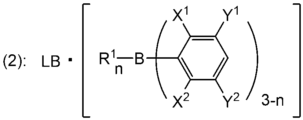
- FIG. 2 shows Lewis base complexes of novel boron compounds.
- boron compound according to an embodiment of the present invention is represented by the following formula (1).
- X1 and X2 are each independently selected from an electron-withdrawing group
- Y1 and Y2 are each independently selected from hydrogen and an electron-donating group, but are not both hydrogen
- R1 is selected from an organic group having 1 to 24 carbon atoms, which may have a substituent
- n is selected from an integer of 0 to 2.
- the following points are important with respect to the (2-X 1 , 3-Y 1 , 5-Y 2 , 6-X 2 ) phenyl group (hereinafter also referred to as a "substituted phenyl group") of the boron compound.
- an electron-donating group is introduced into one or both of the substituents (Y 1 , Y 2 ) at the meta positions.
- X 1 and X 2 are each independently selected from an electron-withdrawing group.
- the electron-withdrawing group include a halogeno group, a nitro group, a cyano group, a fluoroalkyl group, a substituted sulfonyl group such as a trifluoromethanesulfonyl group, an alkylsulfonyl group, and an arylsulfonyl group.
- a fluoroalkyl group, a trifluoromethanesulfonyl group, and a halogeno group are preferred, a halogeno group selected from a bromo group, a chloro group, and a fluoro group is more preferred, and a chloro group and a fluoro group are most preferred.
- X 1 and X 2 may be the same or different.
- X 1 may be a halogeno group
- X 2 may be a group other than a halogeno group (e.g., a substituted sulfonyl group).
- X 1 and X 2 are both halogeno groups
- X 1 may be a fluoro group
- X 2 may be a chloro group.
- Y1 and Y2 are each independently selected from hydrogen and an electron donating group, but are not both hydrogen.
- X1 and X2 may both be selected from an electron donating group, or one may be hydrogen and the other may be selected from an electron donating group, but are not both hydrogen.
- the electron donating group refers to a group that has the property of donating electrons to the phenyl group when bonded to the phenyl group, and is not particularly limited as long as the boron compound of the present invention can be obtained.
- Examples of the electron donating group include alkyl, alkenyl, alkynyl, cycloalkyl, alkoxy, amino, alkylamide, dialkylamino, silyl, trialkylsilyl, triarylsilyl, and alkylarylsilyl.
- Examples of the electron donating group include alkyl, alkenyl, alkoxy, alkylamide, dialkylamino, and trialkylsilyl, and alkyl, alkenyl, alkoxy, and trialkylsilyl are preferred.
- the alkyl group preferably has 1 to 24 carbon atoms, more preferably has 1 to 18 carbon atoms, further preferably has 1 to 15 carbon atoms, and even more preferably has 1 to 12 carbon atoms.
- the alkenyl preferably has 2 to 24 carbon atoms, more preferably has 2 to 18 carbon atoms, further preferably has 2 to 15 carbon atoms, and even more preferably has 2 to 12 carbon atoms.
- the alkynyl group preferably has 2 to 24 carbon atoms, more preferably has 2 to 18 carbon atoms, further preferably has 2 to 15 carbon atoms, and even more preferably has 2 to 12 carbon atoms.
- the cycloalkyl preferably has 3 to 24 carbon atoms, more preferably has 3 to 18 carbon atoms, even more preferably has 3 to 15 carbon atoms, and even more preferably has 3 to 12 carbon atoms.
- the alkoxy preferably has 1 to 24 carbon atoms, more preferably has 1 to 18 carbon atoms, even more preferably has 1 to 15 carbon atoms, and even more preferably has 1 to 12 carbon atoms.
- the alkylamide preferably has 3 to 27 carbon atoms, more preferably has 3 to 21 carbon atoms, further preferably has 3 to 18 carbon atoms, and further more preferably has 3 to 12 carbon atoms.
- the dialkylamino preferably has 2 to 48 carbon atoms, more preferably has 2 to 36 carbon atoms, further preferably has 2 to 30 carbon atoms, and even more preferably has 2 to 24 carbon atoms.
- the trialkylsilyl preferably has 3 to 72 carbon atoms, more preferably 3 to 54 carbon atoms, even more preferably 3 to 45 carbon atoms, and even more preferably 3 to 36 carbon atoms.
- alkyl group examples include a methyl group, an ethyl group, an n-propyl group, an isopropyl group, an n-butyl group, an isobutyl group, a t-butyl group, an n-pentyl group, an n-hexyl group, an n-dodecyl group, an n-tridecyl group, an n-tetradecyl group, an n-hexadecyl group, an n-octadecyl group, and an n-eicosyl group.
- alkenyl examples include ethenyl, n-propenyl, isopropenyl, n-butenyl, isobutenyl, n-pentenyl, n-hexenyl, n-dodecenyl, n-tridecenyl, n-tetradecenyl, n-hexadecenyl, n-octadecenyl, and n-eicosenyl.
- alkynyl group examples include an ethynyl group, an n-propynyl group, an n-butynyl group, an isobutynyl group, an n-pentynyl group, an n-hexynyl group, an n-dodecynyl group, an n-tridecynyl group, an n-tetradecynyl group, an n-hexadecynyl group, an n-octadecynyl group, and an n-eicosynyl group.
- Examples of the cycloalkyl include a cyclopropyl group, a cyclobutyl group, a cyclopentyl group, a cyclohexyl group, a cycloheptyl group, a cyclooctyl group, a norbornyl group, and an adamantyl group.
- Examples of the alkoxy include a methoxy group, an ethoxy group, a propoxy group, an isopropoxy group, an n-butoxy group, an isobutoxy group, a t-butoxy group, a pentoxy group, and a hexoxy group.
- alkylamide examples include a methylamide group, an ethylamide group, an n-propylamide group, an isopropylamide group, an n-butylamide group, an isobutylamide group, a t-butylamide group, an n-pentylamide group, an n-hexylamide group, an n-dodecylamide group, an n-tridecylamide group, an n-tetradecylamide group, an n-hexadecylamide group, an n-octadecylamide group, and an n-eicosylamide group.
- dialkylamino examples include a dimethylamino group, a diethylamino group, a di-n-propylamino group, a diisopropylamino group, a di-n-butylamino group, a diisobutylamino group, a di-t-butylamino group, a di-n-pentylamino group, a di-n-hexylamino group, a di-n-dodecylamino group, a di-n-tridecylamino group, a di-n-tetradecylamino group, a di-n-hexadecylamino group, a di-n-octadecylamino group, and a di-n-eicosylamino group.
- trialkylsilyl group examples include a trimethylsilyl group, a triethylsilyl group, a tri-n-propylsilyl group, a triisopropylsilyl group, a tri-n-butylsilyl group, a triisobutylsilyl group, a tri-t-butylsilyl group, a tri-n-pentylsilyl group, a tri-n-hexylsilyl group, a tri-n-dodecylsilyl group, a tri-n-tridecylsilyl group, a tri-n-tetradecylsilyl group, a tri-n-hexadecylsilyl group, a tri-n-octadecylsilyl group, and a tri-n-eicosylsilyl group.
- n is an integer of 0 to 2. It is preferable that n is 0 to 1.
- n is 0, three (2-X 1 , 3-Y 1 , 5-Y 2 , 6-X 2 )phenyl groups (substituted phenyl groups) are bonded to boron, and when n is 1, two substituted phenyl groups are bonded to boron.
- the number of substituted phenyl groups bonded to boron is 2 or 3, this is preferable because the properties as a catalyst and the like are improved.
- the boron compound may have one substituted phenyl group, two substituted phenyl groups, or three substituted phenyl groups. When the boron compound has two or more substituted phenyl groups, the substituted phenyl groups may be the same or different from each other.
- the organic group having 1 to 24 carbon atoms represented by R 1 is not particularly limited as long as the boron compound targeted by the present invention can be obtained, and examples thereof include an alkyl group having 1 to 24 carbon atoms, a cycloalkyl group having 3 to 24 carbon atoms, an aryl group having 3 to 24 carbon atoms, an alkoxy group having 1 to 24 carbon atoms, an aryloxy group having 6 to 24 carbon atoms, a linear or cyclic alkoxyalkyl group having 2 to 24 carbon atoms, an arylalkyl group having 7 to 24 carbon atoms, an arylalkoxy group having 7 to 24 carbon atoms, an alkylthio group having 1 to 24 carbon atoms, an arylthio group having 6 to 24 carbon atoms, and an arylalkylthio group having 7 to 24 carbon atoms.
- the boron compound does not have R 1 , when n is 1, the boron compound has one R 1 , and when n is 2, the boron compound has two R 1.
- the two R 1s in the boron compound may be the same or different.
- examples of the alkyl group having 1 to 24 carbon atoms include a methyl group, an ethyl group, an n-propyl group, an isopropyl group, an n-butyl group, an isobutyl group, a t-butyl group, an n-pentyl group, an n-hexyl group, an n-dodecyl group, an n-tridecyl group, an n-tetradecyl group, an n-hexadecyl group, an n-octadecyl group, an n-eicosyl group, etc.
- An alkyl group having 1 to 18 carbon atoms is preferred, and an alkyl group having 1 to 10 carbon atoms is more preferred.
- Cycloalkyl groups having 3 to 24 carbon atoms include, for example, cyclopropyl, cyclobutyl, cyclopentyl, cyclohexyl, cycloheptyl, cyclooctyl, norbornyl, and adamantyl groups. Of these, cycloalkyl groups having 3 to 18 carbon atoms are preferred, and cycloalkyl groups having 3 to 12 carbon atoms are more preferred.
- Examples of the aryl group having 3 to 24 carbon atoms include a phenyl group, a naphthyl group, an indenyl group, a biphenyl group, a phenanthrenyl group, an anthracenyl group, a 4-pyridyl group, a tolyl group, etc.
- An aryl group having 3 to 18 carbon atoms is preferred, and an aryl group having 3 to 15 carbon atoms is more preferred.
- R 1 does not include the (2-X 1 , 3-Y 1 , 5-Y 2 , 6-X 2 ) phenyl group (also called a "substituted phenyl group”) in the above formula (1), and the substituted phenyl group in the above formula (1) is excluded from R 1 .
- alkoxy groups having 1 to 24 carbon atoms include methoxy, ethoxy, propoxy, isopropoxy, n-butoxy, isobutoxy, t-butoxy, pentoxy, and hexoxy.
- Alkoxy groups having 1 to 18 carbon atoms are preferred, alkoxy groups having 1 to 15 carbon atoms are more preferred, and alkoxy groups having 1 to 10 carbon atoms are even more preferred.
- aryloxy groups having 6 to 24 carbon atoms include phenoxy groups, 1-naphthyloxy groups, p-ethylphenoxy groups, 3,5-diphenylphenoxy groups, 3,5-bis(3',4'-bis(trifluoromethyl)phenyl)phenoxy groups, and 4-n-octylphenoxy groups.
- Aryloxy groups having 6 to 18 carbon atoms are preferred, and aryloxy groups having 6 to 15 carbon atoms are more preferred.
- linear or cyclic alkoxyalkyl groups having 2 to 24 carbon atoms include methoxyethyl, ethoxyethyl, methoxyethoxymethyl, methoxyethoxymethyl, and ethoxyethoxyethyl groups. Of these, alkoxyalkyl groups having 2 to 18 carbon atoms are preferred, and alkoxyalkyl groups having 2 to 15 carbon atoms are more preferred.
- arylalkyl groups having 7 to 24 carbon atoms include benzyl, 2-phenylethyl, and 1-methyl-1-phenylethyl groups.
- Arylalkyl groups having 7 to 18 carbon atoms are preferred, and arylalkyl groups having 7 to 15 carbon atoms are more preferred.
- arylalkoxy groups having 7 to 24 carbon atoms include benzyloxy groups, chlorobenzyloxy groups, ⁇ -methylbenzyloxy groups, ⁇ , ⁇ -dimethylbenzyloxy groups, and phenylethyloxy groups.
- Arylalkoxy groups having 7 to 18 carbon atoms are preferred, and arylalkoxy groups having 7 to 15 carbon atoms are more preferred.
- alkylthio groups having 1 to 24 carbon atoms examples include methylthio, ethylthio, propylthio, n-butylthio, s-butylthio, t-butylthio, and i-propylthio.
- Alkylthio groups having 1 to 18 carbon atoms are preferred, and alkylthio groups having 1 to 15 carbon atoms are more preferred.
- arylthio groups having 6 to 24 carbon atoms include phenylthio groups, phenylmethanethio groups, o-, m-, or p-tolylthio groups, and groups derived from thiosalicylic acid and its esters.
- Arylthio groups having 6 to 18 carbon atoms are preferred, and arylthio groups having 6 to 15 carbon atoms are more preferred.
- arylalkylthio groups having 7 to 24 carbon atoms include methylthiophenyl, ethylthiophenyl, propylthiophenyl, n-butylthiophenyl, s-butylthiophenyl, t-butylthiophenyl, and i-propylthiophenyl groups.
- Arylalkylthio groups having 7 to 18 carbon atoms are preferred, and arylalkylthio groups having 7 to 15 carbon atoms are more preferred.
- Examples of the substituents that the organic group having 1 to 24 carbon atoms may have include halogen atoms, electron-withdrawing groups such as nitro and cyano groups, hydroxyl groups, alkoxy groups, aryloxy groups, carboxyl groups and salts thereof, alkoxycarbonyl groups, acyloxy groups, aroyloxy groups, amino groups, aminocarbonyl groups, cyano groups, sulfone groups and salts thereof, alkylsulfonyl groups, alkylsulfanyl groups, alkylsulfinyl groups, alkylsulfenyl groups, arylsulfonyl groups, arylsulfanyl groups, arylsulfinyl groups, arylsulfenyl groups, chain-like or cyclic alkyl groups, chain-like or cyclic alkenyl groups, aryl groups, heteroaryl groups, chain-like or cyclic dialkylamino groups, chain-like or
- substituents may further have a substituent.
- “may have a substituent” means that one or more hydrogen atoms of the organic group are substituted with a substituent, and for example, an alkyl group having a substituent refers to an alkyl group having a structure in which one or more hydrogen atoms of the alkyl group are substituted with a substituent.
- the organic group having 1 to 24 carbon atoms which may have a substituent and is represented by R1 above preferably has 2 or more carbon atoms, more preferably 4 or more carbon atoms, and even more preferably 6 or more carbon atoms, and preferably has 22 or less carbon atoms, and more preferably has 20 or less carbon atoms.
- the organic group having 1 to 24 carbon atoms represented by R 1 preferably has an electron-withdrawing substituent. This is because it is believed that the Lewis acidity of the Lewis acid compound portion in the boron compound according to the embodiment of the present invention can be further improved, and the performance as a catalyst can be further enhanced.
- the electron-withdrawing group a group consisting of a halogen atom is preferable among the above-mentioned nitro group, cyano group, and halogen atom.
- the organic group having 1 to 24 carbon atoms represented by R 1 is preferably an alkyl group or an aryl group, and more preferably an aryl group which may have a substituent.
- the organic group having 1 to 24 carbon atoms represented by R 1 is preferably an aryl group or a heteroaryl group, specifically, a 4-pyridyl group, a 2,5-difluoro-4-pyridyl group, a 2,6-difluoro-4-pyridyl group, a 2,3,6-trifluoro-4-pyridyl group, a 2,3,5,6-tetrafluoro-4-pyridyl group, a 2-fluorophenyl group, a 2,3-difluorophenyl group, a 2,4-difluorophenyl group, a 2,5-difluorophenyl group, a 2,6-difluorophenyl group, a 3,5-difluorophenyl group, a 2,3,6-trifluorophenyl group, a 2,4,6-trifluorophenyl group, a a 2,3,5,6-tetrafluoropheny
- the Lewis base complex of the boron compound according to the embodiment of the present invention is represented by the following formula (2).
- X1 and X2 are each independently selected from a halogeno group
- Y1 and Y2 are each independently selected from hydrogen and an electron-donating group, but are not both hydrogen
- R1 is selected from an organic group having 1 to 24 carbon atoms, which may have a substituent
- n is selected from an integer of 0 to 2
- LB is selected from a Lewis base.
- the Lewis base is generally called a Lewis base, includes at least one selected from the group consisting of Group 14, Group 15 and Group 16 atoms having at least one electron pair (lone electron pair) that is not used in a covalent bond, can donate its electron pair to boron to form a coordinate bond, and is not particularly limited as long as it can form the boron compound-Lewis base complex that is the object of the present invention.
- Lewis bases examples include H 2 O, CO, chain ethers such as diethyl ether, cyclic ethers such as tetrahydrofuran (THF), phosphines such as triphenylphosphine (PPh 3 ), phosphine oxides such as triethylphosphine oxide (Et 3 P ⁇ O), nitriles such as acetonitrile, amines such as triethylamine, and heterocyclic compounds containing nitrogen or oxygen.
- Preferred Lewis bases are nitriles such as acetonitrile, chain and cyclic ethers, phosphines, amines, and heterocyclic compounds.
- the above formula (2) shows a structure in which the boron compound of the above formula (1) and a Lewis base form a complex.
- X1 and X2 , Y1 and Y2 , and n in the above formula (2) respectively correspond to X1 and X2 , Y1 and Y2 , and n in the above formula (1).
- the chemical composition according to an embodiment of the present invention comprises the boron compound and/or Lewis base complex of the boron compound according to the embodiment of the present invention.
- Examples of the chemical composition according to the embodiment of the present invention include a chemical composition before the reaction in the production of a hydride, which will be described later, a composition containing the hydride after the reaction, a monomer composition before the reaction in the production of a polymer, a composition containing the polymer (resin) after the reaction, a chemical composition before the reaction in the production of an adduct, and a composition containing the adduct after the reaction.
- the boron compound and/or Lewis base complex of the boron compound according to the embodiment of the present invention is used as a hydrogenation catalyst.
- the method for producing a hydride according to the embodiment of the present invention preferably includes a step of adding a hydrogen atom to at least one unsaturated bond of an unsaturated compound using hydrogen gas or crude hydrogen gas as a hydrogen source in the presence of the above-mentioned hydrogenation catalyst (also referred to as a "hydrogenation step").
- hydride refers to a compound in which a hydrogen atom is added to at least one unsaturated bond of an unsaturated compound, and may also be referred to as a "hydrogenated compound".
- a hydrogen atom may be added to only one of the unsaturated bonds, or a hydrogen atom may be added to two or more of the unsaturated bonds. Therefore, the hydride in the method for producing a hydride according to the embodiment of the present invention may be an unsaturated compound or a saturated compound.
- the above-mentioned "crude hydrogen gas” refers to a mixed gas containing hydrogen produced from hydrocarbons such as natural gas, naphtha, heavy oil, coal, petroleum exhaust gas, and shale oil, alcohols such as methanol and ethanol, and organic waste such as biomass and industrial waste plastics, and contains carbon monoxide and/or carbon dioxide.
- the crude hydrogen gas may be produced in a large chemical plant, or may be supplied from a small household reformer.
- the hydrogen content of the crude hydrogen gas is not particularly limited, as it can be selected arbitrarily depending on the raw materials and equipment used, but from the viewpoint of smoothly proceeding with the hydrogenation reaction, the preferred hydrogen content is 20 mol% or more and less than 99.9 mol%, more preferably 50 mol% or more and less than 99.9 mol%, and even more preferably 70 mol% or more and less than 99.9 mol%, based on 100 mol% of the total of hydrogen, carbon monoxide, and carbon dioxide.
- the unsaturated compound used in the hydrogenation reaction is an imine, a nitrogen-containing heterocyclic compound, an aldehyde, a ketone, an alkene, an alkyne, an oligomer or polymer having an unsaturated bond, etc., and one or more types can be used.
- nitrogen-containing unsaturated heterocyclic compounds include pyridines, pyrazines, quinolines, acridines, 1,10-phenanthrolines, indoles, etc.
- oligomers and polymers having an unsaturated bond may have one or more unsaturated bonds in the same molecule.
- Examples of hydrogenated compounds obtainable by the method for producing hydrogenated products according to an embodiment of the present invention include nitrogen-containing heterocyclic compounds such as amines, piperidines, piperazines, tetrahydroquinolines, tetrahydrophenanthrolines, and indolines; alcohols, alkanes, and alkenes.
- nitrogen-containing heterocyclic compounds such as amines, piperidines, piperazines, tetrahydroquinolines, tetrahydrophenanthrolines, and indolines
- alcohols alkanes, and alkenes.
- a solvent can be used.
- the solvent that can be used is preferably one that does not react with the boron compound and/or Lewis base complex of the boron compound of the present invention as a hydrogenation catalyst, or does not inhibit the hydrogenation reaction of the unsaturated compound in the subsequent step, and can adequately dissolve the boron compound and/or Lewis base complex of the boron compound of the present invention and the unsaturated compound.
- aromatic hydrocarbon solvents such as toluene; aliphatic hydrocarbon solvents such as n-hexane; ketone solvents such as acetone; alcohol solvents such as methanol; ether solvents such as tetrahydrofuran; ester solvents such as ethyl acetate; nitrile solvents such as acetonitrile; halogenated hydrocarbon solvents such as dichloromethane; amide solvents such as dimethylformamide; sulfoxide solvents such as dimethyl sulfoxide; lactone solvents such as ⁇ -butyrolactone; carbonate ester solvents such as ethylene carbonate.
- aromatic hydrocarbon solvents such as toluene
- aliphatic hydrocarbon solvents such as n-hexane
- ketone solvents such as acetone
- alcohol solvents such as methanol
- ether solvents such as tetrahydrofuran
- ester solvents such as ethyl a
- aromatic hydrocarbon solvents such as toluene; aliphatic hydrocarbon solvents such as n-hexane; ether solvents such as tetrahydrofuran; halogenated hydrocarbon solvents such as dichloromethane.
- a mixed solvent of two or more of the above solvents can also be used.
- the solvents of these solutions may be the same or different. Also, the process may be carried out without using a solvent.
- the method for producing a hydride according to an embodiment of the present invention it is preferable to carry out hydrogenation by dissolving the boron compound and/or Lewis base complex of the boron compound, or unsaturated compound according to an embodiment of the present invention in a solvent and mixing with a hydrogen source such as hydrogen gas or crude hydrogen gas.
- the hydrogenation reaction according to the present invention can also be carried out while adding a hydrogen source.
- Another feature of the embodiment of the present invention is that the hydrogenation reaction can be carried out near normal pressure or under slightly pressurized conditions. The pressure may be normal pressure, but carrying out the hydrogenation reaction under pressurized conditions allows the hydrogenation reaction to be carried out efficiently.
- the method for producing a hydrogenated product according to an embodiment of the present invention includes the hydrogenation step as an essential feature, but may also include other steps. Examples of such steps include a purification step, a catalyst deactivation step, a dilution step, a concentration step, an extraction step, a recovery step of unreacted raw materials, a filtration step, and a catalyst recovery step.
- a step of filtering out the precipitate may be provided. If the hydrogenated compound is solid, a step of washing with a poor solvent such as n-hexane may be provided. If the hydrogenated compound is solid, a drying step may be provided. The drying step may be performed under reduced pressure. If the hydrogenated compound is liquid, a step of purifying it by distillation or the like may be provided.
- the catalyst If the catalyst is to be reused, it can be insolubilized or crystallized to precipitate, recovered through a filtration process, and reused in the next reaction.
- the boron compound and/or Lewis base complex of the boron compound of the embodiment of the present invention is used as an initiator.
- a compound having a cationic polymerizable group such as an oxirane group (oxirane ring), an oxetane group (oxetane ring), an ethylene sulfide group, a dioxolane group, a trioxolane group, a vinyl ether group, or a styryl group can be polymerized using the boron compound and/or Lewis base complex of the boron compound of the embodiment of the present invention as an initiator.
- Known conditions can be applied as polymerization conditions, and the reaction can be accelerated by applying heat.
- the method for producing a polymer according to an embodiment of the present invention includes the above-mentioned polymerization step as an essential feature, but may also include other steps. Examples of such steps include a purification step, a catalyst deactivation step, a dilution step, a concentration step, an extraction step, a step of recovering unreacted raw materials, a filtration step, and a catalyst recovery step.
- a step of filtering out the precipitate may be provided. If the polymerized compound is solid, a step of washing with a poor solvent such as n-hexane may be provided. If the polymerized compound is solid, a drying step may be provided. The drying step may be performed under reduced pressure. If the polymerized compound is liquid, a step of purifying it by distillation or the like may be provided. In the case of a compound that polymerizes to form a three-dimensional cross-linked structure, the polymerization reaction may be continued without removing the initiator, and the polymerization product may be used as is.
- the initiator If the initiator is to be reused, it can be insolubilized or crystallized to precipitate, recovered through a filtration process, and reused in the next reaction.
- the boron compound according to the embodiment of the present invention is used as a Lewis acid catalyst.
- the method for producing an adduct according to the present invention is not particularly limited, as long as it is a reaction promoted by activating an oxygen functional group or a nitrogen functional group in a Lewis acid manner, and therefore the reaction promotion effect is expected.
- the addition reaction of a carbon nucleophile represented by an enol derivative, an allyl silicon compound, or an allyl boron compound to a carbonyl compound such as an aldehyde or ketone the addition reaction of a carbon nucleophile represented by an enol derivative, an allyl silicon compound, or an allyl boron compound to an alkene or an ⁇ , ⁇ -unsaturated carbonyl compound
- the addition reaction of a heteroatom nucleophile represented by an enol derivative, an allyl silicon compound, or an allyl boron compound to a heteroatom nucleophile represented by an alcohol, a phenol, a carboxylic acid, an amide, an amine, a thiol, or a phosphine, the Diels-Alder reaction, etc. can be carried out in good yield by using the boron compound according to an embodiment of the present invention as a Lewis acid catalyst.
- the method for producing an adduct of the present invention essentially includes the addition reaction step described above, but may include other steps. Examples include a purification step, a catalyst deactivation step, a dilution step, a concentration step, an extraction step, a recovery step of unreacted raw materials, a filtration step, a catalyst recovery step, etc.
- a step of filtering out the precipitate may be provided. If the adduct is solid, a step of washing with a poor solvent such as n-hexane may be provided. If the adduct is solid, a drying step may be provided. The drying step may be performed under reduced pressure. If the adduct is liquid, a step of purifying it by distillation or the like may be provided.
- the catalyst If the catalyst is to be reused, it can be insolubilized or crystallized to precipitate, recovered through a filtration process, and reused in the next reaction.
- Hydrogenation catalyst for unsaturated compounds using crude hydrogen gas as a hydrogen source In the hydrogenation reaction of unsaturated compounds using crude hydrogen gas as a hydrogen source, the boron compound and/or Lewis base complex of the boron compound of the present invention is used as a hydrogenation catalyst. According to the hydrogenation catalyst for unsaturated compounds using crude hydrogen gas as a hydrogen source according to an embodiment of the present invention, even under conditions in which high concentrations of carbon monoxide and/or carbon dioxide coexist, catalyst poisoning in the hydrogenation reaction is suppressed, the hydrogenation reaction proceeds smoothly, and the target product can be obtained in a high yield.
- the term "crude hydrogen gas" is as defined above.
- reaction solution was added to a solution of trimethylsilyltrifluoromethanesulfonic acid (27.3mL, 151.3mmol) and AgOAc (1.3g, 8.0mmol) in THF (280mL) at 0°C, and the mixture was stirred at 30°C for 18 hours.
- NH 4 Cl (20mL) was added to the reaction solution, and the solvent was distilled off under reduced pressure.
- the organic layer was extracted with hexane (100mL x 3), washed with water (20mL x 3) and saturated saline (20mL x 3), dried with Na 2 SO 4 , and filtered.
- reaction solution was added to a THF (150mL) solution of trimethylsilyltrifluoromethanesulfonic acid (19.0mL, 105.2mmol) and AgOAc (0.7g, 4.0mmol) at 0°C, and the mixture was stirred at 30°C for 7 hours.
- NH 4 Cl (10mL) was added to the reaction solution, and the solvent was distilled off under reduced pressure.
- the organic layer was extracted with hexane (100mL x 3), washed with water (20mL x 3) and saturated saline (20mL x 3), dried with Na 2 SO 4 , and filtered.
- the obtained solid was extracted with hexane and filtered through Celite. After the solvent was distilled off under reduced pressure, the solid was dissolved in warm hexane and allowed to stand at 15 to 20°C to obtain tris(2,6-difluoro-3,5-bis(trimethylsilyl)phenyl)borane with a purity of 95-98% as colorless crystals in a yield of 35% (717.8 mg, 0.92 mmol).
- Example 6 Tris(2,6-difluoro-3,5-diallylphenyl)borane CH 3 CN complex (2b) (63.2 mg, 0.1 mmol; 5 mol%) was weighed in a 10 mL eggplant flask, 2-3 mL of toluene was added, and the volatile components were distilled off under reduced pressure. Toluene (1.3 mL) and tetradecane (141.5 mg; internal standard) were added again, and the mixture was transferred to a 30 mL autoclave.
- the meta position of the aryl group bonded to boron is substituted with an electron donating group.
- the novel boron compound and Lewis base complex of the present invention can be suitably used for producing hydrides, polymers, adducts, and the like.
Landscapes
- Chemical & Material Sciences (AREA)
- Organic Chemistry (AREA)
- Chemical Kinetics & Catalysis (AREA)
- Inorganic Chemistry (AREA)
- Engineering & Computer Science (AREA)
- Materials Engineering (AREA)
- Catalysts (AREA)
Abstract
L'invention concerne un composé de bore représenté par la formule (1). Dans la formule (1), X1 et X2 sont chacun indépendamment choisis parmi des groupes attracteurs d'électrons, Y1 et Y2 sont chacun indépendamment choisis parmi l'hydrogène et des groupes donneurs d'électrons, l'hydrogène n'étant pas sélectionné pour les deux simultanément, R1 est choisi parmi des groupes organiques en C1-24, le groupe organique en C1-24 peut avoir un substituant, et n est choisi parmi des nombres entiers de 0 à 2.
Priority Applications (1)
| Application Number | Priority Date | Filing Date | Title |
|---|---|---|---|
| JP2025526086A JPWO2024253033A1 (fr) | 2023-06-09 | 2024-05-31 |
Applications Claiming Priority (2)
| Application Number | Priority Date | Filing Date | Title |
|---|---|---|---|
| JP2023095773 | 2023-06-09 | ||
| JP2023-095773 | 2023-06-09 |
Publications (1)
| Publication Number | Publication Date |
|---|---|
| WO2024253033A1 true WO2024253033A1 (fr) | 2024-12-12 |
Family
ID=93795978
Family Applications (1)
| Application Number | Title | Priority Date | Filing Date |
|---|---|---|---|
| PCT/JP2024/019998 Ceased WO2024253033A1 (fr) | 2023-06-09 | 2024-05-31 | Composé de bore, complexe de base de lewis de celui-ci, et procédés de production d'hydrure, de polymère et d'adduit les utilisant |
Country Status (2)
| Country | Link |
|---|---|
| JP (1) | JPWO2024253033A1 (fr) |
| WO (1) | WO2024253033A1 (fr) |
Citations (7)
| Publication number | Priority date | Publication date | Assignee | Title |
|---|---|---|---|---|
| JPH1121287A (ja) * | 1997-06-30 | 1999-01-26 | Nippon Shokubai Co Ltd | トリス(フッ化アリール)ホウ素の単離方法 |
| JPH1129577A (ja) * | 1997-07-11 | 1999-02-02 | Nippon Shokubai Co Ltd | (フッ化アリール)ホウ素化合物の単離方法 |
| JPH1192480A (ja) * | 1997-09-18 | 1999-04-06 | Nippon Shokubai Co Ltd | (フッ化アリール)ホウ素化合物の取り扱い方法並びに炭化水素系溶液の調製方法 |
| JP2006206511A (ja) * | 2005-01-28 | 2006-08-10 | Nippon Shokubai Co Ltd | アリールホウ素化合物の安定化方法および安定化組成物 |
| JP2017206474A (ja) * | 2016-05-20 | 2017-11-24 | 株式会社日本触媒 | 不飽和化合物の水素化方法 |
| JP2019218267A (ja) * | 2018-06-14 | 2019-12-26 | 株式会社日本触媒 | トリアリールホウ素化合物を含む組成物 |
| JP2020033292A (ja) * | 2018-08-29 | 2020-03-05 | 株式会社日本触媒 | ホウ素化合物、およびそれを用いた水素化物、重合体ならびに付加体の製造方法 |
-
2024
- 2024-05-31 WO PCT/JP2024/019998 patent/WO2024253033A1/fr not_active Ceased
- 2024-05-31 JP JP2025526086A patent/JPWO2024253033A1/ja active Pending
Patent Citations (7)
| Publication number | Priority date | Publication date | Assignee | Title |
|---|---|---|---|---|
| JPH1121287A (ja) * | 1997-06-30 | 1999-01-26 | Nippon Shokubai Co Ltd | トリス(フッ化アリール)ホウ素の単離方法 |
| JPH1129577A (ja) * | 1997-07-11 | 1999-02-02 | Nippon Shokubai Co Ltd | (フッ化アリール)ホウ素化合物の単離方法 |
| JPH1192480A (ja) * | 1997-09-18 | 1999-04-06 | Nippon Shokubai Co Ltd | (フッ化アリール)ホウ素化合物の取り扱い方法並びに炭化水素系溶液の調製方法 |
| JP2006206511A (ja) * | 2005-01-28 | 2006-08-10 | Nippon Shokubai Co Ltd | アリールホウ素化合物の安定化方法および安定化組成物 |
| JP2017206474A (ja) * | 2016-05-20 | 2017-11-24 | 株式会社日本触媒 | 不飽和化合物の水素化方法 |
| JP2019218267A (ja) * | 2018-06-14 | 2019-12-26 | 株式会社日本触媒 | トリアリールホウ素化合物を含む組成物 |
| JP2020033292A (ja) * | 2018-08-29 | 2020-03-05 | 株式会社日本触媒 | ホウ素化合物、およびそれを用いた水素化物、重合体ならびに付加体の製造方法 |
Non-Patent Citations (1)
| Title |
|---|
| ZHENHUA ZHANG; HAIFENG DU: "A Highly cis‐Selective and Enantioselective Metal‐Free Hydrogenation of 2,3‐Disubstituted Quinoxalines", ANGEWANDTE CHEMIE, vol. 54, no. 2, 13 November 2014 (2014-11-13), Hoboken, USA, pages 623 - 626, XP072069095, ISSN: 1433-7851, DOI: 10.1002/anie.201409471 * |
Also Published As
| Publication number | Publication date |
|---|---|
| JPWO2024253033A1 (fr) | 2024-12-12 |
Similar Documents
| Publication | Publication Date | Title |
|---|---|---|
| EP2307431B1 (fr) | Procédé pour la fabrication d'amines à partir d'alcools et d'ammoniac | |
| JP6616757B2 (ja) | 水素化および脱水素触媒、ならびにこれを作成する方法および用いる方法 | |
| CN102329332B (zh) | 有机铝化合物 | |
| CN103962183B (zh) | 一种pnn配体-金属络合物催化剂及其制备方法和应用 | |
| CN107531601A (zh) | 桥连联芳香基配位体及由其制备的过渡金属化合物 | |
| CN114478337A (zh) | 一种轴手性含硫双芳基衍生物及其合成方法 | |
| CN111420709A (zh) | 氮杂环卡宾基混配型镍(ii)配合物在合成2-直链烷基苯并噻唑类化合物反应中的应用 | |
| CN103333069A (zh) | 金鸡纳碱衍生物为催化剂制备ɑ-羟基-β-二羰基化合物的方法 | |
| CN116410213A (zh) | 一种合成3-碳基-1-硼基环类化合物的方法 | |
| JP7079696B2 (ja) | ホウ素化合物、およびそれを用いた水素化物、重合体ならびに付加体の製造方法 | |
| WO2024253033A1 (fr) | Composé de bore, complexe de base de lewis de celui-ci, et procédés de production d'hydrure, de polymère et d'adduit les utilisant | |
| CN114478351A (zh) | 一种合成α-烷基取代吲哚-3-甲醛类化合物的方法 | |
| CN111217847B (zh) | 一种硫代硅烷配体及其制备方法和在芳基硼化催化反应中的应用 | |
| JPH04159288A (ja) | 光学活性ホスフィン化合物 | |
| CN113234099B (zh) | 一种烷基硼酸酯类化合物的光化学合成方法 | |
| CN105665025B (zh) | 一种pnn配体‑钴络合物催化剂及其制备方法和应用 | |
| CN118955540A (zh) | 一种α-氨基有机硼化合物的合成方法 | |
| CN106995461A (zh) | 一种含苯并呋喃结构的膦配体及其制备方法和应用 | |
| US20040024237A1 (en) | Synthesis of aminoarylboronic esters and substituted anilines from arenes via catalytic C-H activation/borylation/amination and uses thereof | |
| KR100915095B1 (ko) | 알파, 베타-알킨 에스터 화합물의 β-보론화 방법 | |
| CN114380863B (zh) | 金鸡纳碱衍生的nnp配体及其制备方法与用途 | |
| CN119285657B (zh) | 以烯丙基醇为底物合成烷基硼酸酯类化合物的方法 | |
| JP3797618B2 (ja) | クロマン化合物誘導体の製造方法 | |
| CN120904232A (zh) | 偕二氟烯烃官能化硅氧烷化合物、其制备方法及应用 | |
| JP3997748B2 (ja) | 新規なビニルシラン誘導体 |
Legal Events
| Date | Code | Title | Description |
|---|---|---|---|
| 121 | Ep: the epo has been informed by wipo that ep was designated in this application |
Ref document number: 24819263 Country of ref document: EP Kind code of ref document: A1 |
|
| ENP | Entry into the national phase |
Ref document number: 2025526086 Country of ref document: JP Kind code of ref document: A |
|
| WWE | Wipo information: entry into national phase |
Ref document number: 2025526086 Country of ref document: JP |
|
| NENP | Non-entry into the national phase |
Ref country code: DE |