WO2024253033A1 - ホウ素化合物、そのルイス塩基錯体、並びにそれらを用いる、水素化物、重合体及び付加体の製造方法 - Google Patents
ホウ素化合物、そのルイス塩基錯体、並びにそれらを用いる、水素化物、重合体及び付加体の製造方法 Download PDFInfo
- Publication number
- WO2024253033A1 WO2024253033A1 PCT/JP2024/019998 JP2024019998W WO2024253033A1 WO 2024253033 A1 WO2024253033 A1 WO 2024253033A1 JP 2024019998 W JP2024019998 W JP 2024019998W WO 2024253033 A1 WO2024253033 A1 WO 2024253033A1
- Authority
- WO
- WIPO (PCT)
- Prior art keywords
- group
- carbon atoms
- groups
- boron compound
- lewis base
- Prior art date
- Legal status (The legal status is an assumption and is not a legal conclusion. Google has not performed a legal analysis and makes no representation as to the accuracy of the status listed.)
- Ceased
Links
Images

Classifications
-
- B—PERFORMING OPERATIONS; TRANSPORTING
- B01—PHYSICAL OR CHEMICAL PROCESSES OR APPARATUS IN GENERAL
- B01J—CHEMICAL OR PHYSICAL PROCESSES, e.g. CATALYSIS OR COLLOID CHEMISTRY; THEIR RELEVANT APPARATUS
- B01J31/00—Catalysts comprising hydrides, coordination complexes or organic compounds
- B01J31/16—Catalysts comprising hydrides, coordination complexes or organic compounds containing coordination complexes
- B01J31/22—Organic complexes
-
- C—CHEMISTRY; METALLURGY
- C07—ORGANIC CHEMISTRY
- C07B—GENERAL METHODS OF ORGANIC CHEMISTRY; APPARATUS THEREFOR
- C07B31/00—Reduction in general
-
- C—CHEMISTRY; METALLURGY
- C07—ORGANIC CHEMISTRY
- C07B—GENERAL METHODS OF ORGANIC CHEMISTRY; APPARATUS THEREFOR
- C07B37/00—Reactions without formation or introduction of functional groups containing hetero atoms, involving either the formation of a carbon-to-carbon bond between two carbon atoms not directly linked already or the disconnection of two directly linked carbon atoms
- C07B37/02—Addition
-
- C—CHEMISTRY; METALLURGY
- C07—ORGANIC CHEMISTRY
- C07B—GENERAL METHODS OF ORGANIC CHEMISTRY; APPARATUS THEREFOR
- C07B37/00—Reactions without formation or introduction of functional groups containing hetero atoms, involving either the formation of a carbon-to-carbon bond between two carbon atoms not directly linked already or the disconnection of two directly linked carbon atoms
- C07B37/10—Cyclisation
- C07B37/12—Diels-Alder reactions
-
- C—CHEMISTRY; METALLURGY
- C07—ORGANIC CHEMISTRY
- C07B—GENERAL METHODS OF ORGANIC CHEMISTRY; APPARATUS THEREFOR
- C07B61/00—Other general methods
-
- C—CHEMISTRY; METALLURGY
- C07—ORGANIC CHEMISTRY
- C07D—HETEROCYCLIC COMPOUNDS
- C07D215/00—Heterocyclic compounds containing quinoline or hydrogenated quinoline ring systems
- C07D215/02—Heterocyclic compounds containing quinoline or hydrogenated quinoline ring systems having no bond between the ring nitrogen atom and a non-ring member or having only hydrogen atoms or carbon atoms directly attached to the ring nitrogen atom
- C07D215/04—Heterocyclic compounds containing quinoline or hydrogenated quinoline ring systems having no bond between the ring nitrogen atom and a non-ring member or having only hydrogen atoms or carbon atoms directly attached to the ring nitrogen atom with only hydrogen atoms or radicals containing only hydrogen and carbon atoms, directly attached to the ring carbon atoms
- C07D215/06—Heterocyclic compounds containing quinoline or hydrogenated quinoline ring systems having no bond between the ring nitrogen atom and a non-ring member or having only hydrogen atoms or carbon atoms directly attached to the ring nitrogen atom with only hydrogen atoms or radicals containing only hydrogen and carbon atoms, directly attached to the ring carbon atoms having only hydrogen atoms, hydrocarbon or substituted hydrocarbon radicals, attached to the ring nitrogen atom
-
- C—CHEMISTRY; METALLURGY
- C07—ORGANIC CHEMISTRY
- C07F—ACYCLIC, CARBOCYCLIC OR HETEROCYCLIC COMPOUNDS CONTAINING ELEMENTS OTHER THAN CARBON, HYDROGEN, HALOGEN, OXYGEN, NITROGEN, SULFUR, SELENIUM OR TELLURIUM
- C07F5/00—Compounds containing elements of Groups 3 or 13 of the Periodic Table
- C07F5/02—Boron compounds
Definitions
- the present invention relates to novel boron compounds, their Lewis base complexes, and methods for producing hydrides, polymers, and adducts using them.
- Non-Patent Documents 1 and 2 describe boron compounds having phenyl groups partially substituted with fluorine as catalysts for the hydrogenation reaction of imines and quinoline derivatives with substituents introduced at the 2-position and/or 8-position.
- Non-Patent Document 2 also describes that quinoline itself without a substituent is difficult to generate FLP, and therefore it is difficult to hydrogenate it using an FLP catalyst. Furthermore, catalytic hydrogenation of unsubstituted quinoline under conditions where high concentrations of carbon monoxide and/or carbon dioxide coexist has not been studied, regardless of whether it is a transition metal catalyst or an FLP catalyst.
- Patent Document 1 discloses a method for hydrogenating unsaturated compounds using tris(pentafluorophenyl)borane as a catalyst.
- the activity of existing FLP-type catalysts also drops significantly, making it impossible to complete the reaction. For this reason, there is a demand for a catalyst that can suppress catalyst poisoning in the hydrogenation reaction and complete the reaction even under conditions in which high concentrations of carbon dioxide coexist.
- Patent Document 2 discloses a hydrogenation reaction using (2,6-dichlorophenyl)bis(3,5-dichloro-2,6-difluorophenyl)borane (ASB) or tris(3,5-dichloro-2,6-difluorophenyl)borane (MHB) as a catalyst. It has been reported that the use of the boron compound of Patent Document 2 suppresses catalyst poisoning in the hydrogenation reaction even under conditions in which high concentrations of carbon monoxide and/or carbon dioxide coexist, and the compound can be used as a catalyst for smoothly promoting the hydrogenation reaction of 2-methylquinoline. However, the catalytic activity toward unsubstituted quinoline has not been examined.
- the present invention aims to provide novel boron compounds and novel catalysts containing them.
- Patent Documents 1 and 2 have a common feature in that the meta position of the aryl group bonded to boron is substituted with an electron-withdrawing group.
- the present inventors then discovered that a novel boron compound in which the meta position of an aryl group bonded to boron is substituted with an electron-donating group can exhibit excellent properties, which led to the completion of the present invention.
- a method for producing a hydrogenated product comprising using the hydrogenation catalyst described in 4 above in the presence of crude hydrogen gas. 7.
- a polymerization initiator comprising the boron compound described in 1 above or the Lewis base complex described in 2 above.
- a method for producing a polymer comprising using the polymerization initiator described in 7 above.
- a Lewis acid catalyst comprising the boron compound described in 1 above.
- a method for producing an adduct comprising using the Lewis acid catalyst described in 9 above.
- the meta position of the aryl group bonded to boron is substituted with an electron donating group.
- the novel boron compound and Lewis base complex of the present invention can be suitably used to produce hydrides, polymers, adducts, and the like.
- FIG. 1 shows a novel boron compound.
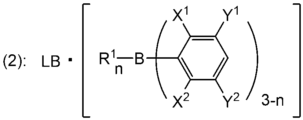
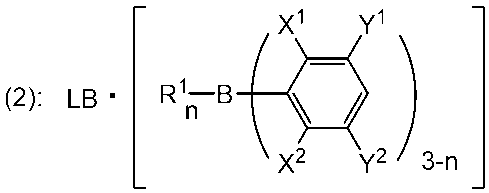
- FIG. 2 shows Lewis base complexes of novel boron compounds.
- boron compound according to an embodiment of the present invention is represented by the following formula (1).
- X1 and X2 are each independently selected from an electron-withdrawing group
- Y1 and Y2 are each independently selected from hydrogen and an electron-donating group, but are not both hydrogen
- R1 is selected from an organic group having 1 to 24 carbon atoms, which may have a substituent
- n is selected from an integer of 0 to 2.
- the following points are important with respect to the (2-X 1 , 3-Y 1 , 5-Y 2 , 6-X 2 ) phenyl group (hereinafter also referred to as a "substituted phenyl group") of the boron compound.
- an electron-donating group is introduced into one or both of the substituents (Y 1 , Y 2 ) at the meta positions.
- X 1 and X 2 are each independently selected from an electron-withdrawing group.
- the electron-withdrawing group include a halogeno group, a nitro group, a cyano group, a fluoroalkyl group, a substituted sulfonyl group such as a trifluoromethanesulfonyl group, an alkylsulfonyl group, and an arylsulfonyl group.
- a fluoroalkyl group, a trifluoromethanesulfonyl group, and a halogeno group are preferred, a halogeno group selected from a bromo group, a chloro group, and a fluoro group is more preferred, and a chloro group and a fluoro group are most preferred.
- X 1 and X 2 may be the same or different.
- X 1 may be a halogeno group
- X 2 may be a group other than a halogeno group (e.g., a substituted sulfonyl group).
- X 1 and X 2 are both halogeno groups
- X 1 may be a fluoro group
- X 2 may be a chloro group.
- Y1 and Y2 are each independently selected from hydrogen and an electron donating group, but are not both hydrogen.
- X1 and X2 may both be selected from an electron donating group, or one may be hydrogen and the other may be selected from an electron donating group, but are not both hydrogen.
- the electron donating group refers to a group that has the property of donating electrons to the phenyl group when bonded to the phenyl group, and is not particularly limited as long as the boron compound of the present invention can be obtained.
- Examples of the electron donating group include alkyl, alkenyl, alkynyl, cycloalkyl, alkoxy, amino, alkylamide, dialkylamino, silyl, trialkylsilyl, triarylsilyl, and alkylarylsilyl.
- Examples of the electron donating group include alkyl, alkenyl, alkoxy, alkylamide, dialkylamino, and trialkylsilyl, and alkyl, alkenyl, alkoxy, and trialkylsilyl are preferred.
- the alkyl group preferably has 1 to 24 carbon atoms, more preferably has 1 to 18 carbon atoms, further preferably has 1 to 15 carbon atoms, and even more preferably has 1 to 12 carbon atoms.
- the alkenyl preferably has 2 to 24 carbon atoms, more preferably has 2 to 18 carbon atoms, further preferably has 2 to 15 carbon atoms, and even more preferably has 2 to 12 carbon atoms.
- the alkynyl group preferably has 2 to 24 carbon atoms, more preferably has 2 to 18 carbon atoms, further preferably has 2 to 15 carbon atoms, and even more preferably has 2 to 12 carbon atoms.
- the cycloalkyl preferably has 3 to 24 carbon atoms, more preferably has 3 to 18 carbon atoms, even more preferably has 3 to 15 carbon atoms, and even more preferably has 3 to 12 carbon atoms.
- the alkoxy preferably has 1 to 24 carbon atoms, more preferably has 1 to 18 carbon atoms, even more preferably has 1 to 15 carbon atoms, and even more preferably has 1 to 12 carbon atoms.
- the alkylamide preferably has 3 to 27 carbon atoms, more preferably has 3 to 21 carbon atoms, further preferably has 3 to 18 carbon atoms, and further more preferably has 3 to 12 carbon atoms.
- the dialkylamino preferably has 2 to 48 carbon atoms, more preferably has 2 to 36 carbon atoms, further preferably has 2 to 30 carbon atoms, and even more preferably has 2 to 24 carbon atoms.
- the trialkylsilyl preferably has 3 to 72 carbon atoms, more preferably 3 to 54 carbon atoms, even more preferably 3 to 45 carbon atoms, and even more preferably 3 to 36 carbon atoms.
- alkyl group examples include a methyl group, an ethyl group, an n-propyl group, an isopropyl group, an n-butyl group, an isobutyl group, a t-butyl group, an n-pentyl group, an n-hexyl group, an n-dodecyl group, an n-tridecyl group, an n-tetradecyl group, an n-hexadecyl group, an n-octadecyl group, and an n-eicosyl group.
- alkenyl examples include ethenyl, n-propenyl, isopropenyl, n-butenyl, isobutenyl, n-pentenyl, n-hexenyl, n-dodecenyl, n-tridecenyl, n-tetradecenyl, n-hexadecenyl, n-octadecenyl, and n-eicosenyl.
- alkynyl group examples include an ethynyl group, an n-propynyl group, an n-butynyl group, an isobutynyl group, an n-pentynyl group, an n-hexynyl group, an n-dodecynyl group, an n-tridecynyl group, an n-tetradecynyl group, an n-hexadecynyl group, an n-octadecynyl group, and an n-eicosynyl group.
- Examples of the cycloalkyl include a cyclopropyl group, a cyclobutyl group, a cyclopentyl group, a cyclohexyl group, a cycloheptyl group, a cyclooctyl group, a norbornyl group, and an adamantyl group.
- Examples of the alkoxy include a methoxy group, an ethoxy group, a propoxy group, an isopropoxy group, an n-butoxy group, an isobutoxy group, a t-butoxy group, a pentoxy group, and a hexoxy group.
- alkylamide examples include a methylamide group, an ethylamide group, an n-propylamide group, an isopropylamide group, an n-butylamide group, an isobutylamide group, a t-butylamide group, an n-pentylamide group, an n-hexylamide group, an n-dodecylamide group, an n-tridecylamide group, an n-tetradecylamide group, an n-hexadecylamide group, an n-octadecylamide group, and an n-eicosylamide group.
- dialkylamino examples include a dimethylamino group, a diethylamino group, a di-n-propylamino group, a diisopropylamino group, a di-n-butylamino group, a diisobutylamino group, a di-t-butylamino group, a di-n-pentylamino group, a di-n-hexylamino group, a di-n-dodecylamino group, a di-n-tridecylamino group, a di-n-tetradecylamino group, a di-n-hexadecylamino group, a di-n-octadecylamino group, and a di-n-eicosylamino group.
- trialkylsilyl group examples include a trimethylsilyl group, a triethylsilyl group, a tri-n-propylsilyl group, a triisopropylsilyl group, a tri-n-butylsilyl group, a triisobutylsilyl group, a tri-t-butylsilyl group, a tri-n-pentylsilyl group, a tri-n-hexylsilyl group, a tri-n-dodecylsilyl group, a tri-n-tridecylsilyl group, a tri-n-tetradecylsilyl group, a tri-n-hexadecylsilyl group, a tri-n-octadecylsilyl group, and a tri-n-eicosylsilyl group.
- n is an integer of 0 to 2. It is preferable that n is 0 to 1.
- n is 0, three (2-X 1 , 3-Y 1 , 5-Y 2 , 6-X 2 )phenyl groups (substituted phenyl groups) are bonded to boron, and when n is 1, two substituted phenyl groups are bonded to boron.
- the number of substituted phenyl groups bonded to boron is 2 or 3, this is preferable because the properties as a catalyst and the like are improved.
- the boron compound may have one substituted phenyl group, two substituted phenyl groups, or three substituted phenyl groups. When the boron compound has two or more substituted phenyl groups, the substituted phenyl groups may be the same or different from each other.
- the organic group having 1 to 24 carbon atoms represented by R 1 is not particularly limited as long as the boron compound targeted by the present invention can be obtained, and examples thereof include an alkyl group having 1 to 24 carbon atoms, a cycloalkyl group having 3 to 24 carbon atoms, an aryl group having 3 to 24 carbon atoms, an alkoxy group having 1 to 24 carbon atoms, an aryloxy group having 6 to 24 carbon atoms, a linear or cyclic alkoxyalkyl group having 2 to 24 carbon atoms, an arylalkyl group having 7 to 24 carbon atoms, an arylalkoxy group having 7 to 24 carbon atoms, an alkylthio group having 1 to 24 carbon atoms, an arylthio group having 6 to 24 carbon atoms, and an arylalkylthio group having 7 to 24 carbon atoms.
- the boron compound does not have R 1 , when n is 1, the boron compound has one R 1 , and when n is 2, the boron compound has two R 1.
- the two R 1s in the boron compound may be the same or different.
- examples of the alkyl group having 1 to 24 carbon atoms include a methyl group, an ethyl group, an n-propyl group, an isopropyl group, an n-butyl group, an isobutyl group, a t-butyl group, an n-pentyl group, an n-hexyl group, an n-dodecyl group, an n-tridecyl group, an n-tetradecyl group, an n-hexadecyl group, an n-octadecyl group, an n-eicosyl group, etc.
- An alkyl group having 1 to 18 carbon atoms is preferred, and an alkyl group having 1 to 10 carbon atoms is more preferred.
- Cycloalkyl groups having 3 to 24 carbon atoms include, for example, cyclopropyl, cyclobutyl, cyclopentyl, cyclohexyl, cycloheptyl, cyclooctyl, norbornyl, and adamantyl groups. Of these, cycloalkyl groups having 3 to 18 carbon atoms are preferred, and cycloalkyl groups having 3 to 12 carbon atoms are more preferred.
- Examples of the aryl group having 3 to 24 carbon atoms include a phenyl group, a naphthyl group, an indenyl group, a biphenyl group, a phenanthrenyl group, an anthracenyl group, a 4-pyridyl group, a tolyl group, etc.
- An aryl group having 3 to 18 carbon atoms is preferred, and an aryl group having 3 to 15 carbon atoms is more preferred.
- R 1 does not include the (2-X 1 , 3-Y 1 , 5-Y 2 , 6-X 2 ) phenyl group (also called a "substituted phenyl group”) in the above formula (1), and the substituted phenyl group in the above formula (1) is excluded from R 1 .
- alkoxy groups having 1 to 24 carbon atoms include methoxy, ethoxy, propoxy, isopropoxy, n-butoxy, isobutoxy, t-butoxy, pentoxy, and hexoxy.
- Alkoxy groups having 1 to 18 carbon atoms are preferred, alkoxy groups having 1 to 15 carbon atoms are more preferred, and alkoxy groups having 1 to 10 carbon atoms are even more preferred.
- aryloxy groups having 6 to 24 carbon atoms include phenoxy groups, 1-naphthyloxy groups, p-ethylphenoxy groups, 3,5-diphenylphenoxy groups, 3,5-bis(3',4'-bis(trifluoromethyl)phenyl)phenoxy groups, and 4-n-octylphenoxy groups.
- Aryloxy groups having 6 to 18 carbon atoms are preferred, and aryloxy groups having 6 to 15 carbon atoms are more preferred.
- linear or cyclic alkoxyalkyl groups having 2 to 24 carbon atoms include methoxyethyl, ethoxyethyl, methoxyethoxymethyl, methoxyethoxymethyl, and ethoxyethoxyethyl groups. Of these, alkoxyalkyl groups having 2 to 18 carbon atoms are preferred, and alkoxyalkyl groups having 2 to 15 carbon atoms are more preferred.
- arylalkyl groups having 7 to 24 carbon atoms include benzyl, 2-phenylethyl, and 1-methyl-1-phenylethyl groups.
- Arylalkyl groups having 7 to 18 carbon atoms are preferred, and arylalkyl groups having 7 to 15 carbon atoms are more preferred.
- arylalkoxy groups having 7 to 24 carbon atoms include benzyloxy groups, chlorobenzyloxy groups, ⁇ -methylbenzyloxy groups, ⁇ , ⁇ -dimethylbenzyloxy groups, and phenylethyloxy groups.
- Arylalkoxy groups having 7 to 18 carbon atoms are preferred, and arylalkoxy groups having 7 to 15 carbon atoms are more preferred.
- alkylthio groups having 1 to 24 carbon atoms examples include methylthio, ethylthio, propylthio, n-butylthio, s-butylthio, t-butylthio, and i-propylthio.
- Alkylthio groups having 1 to 18 carbon atoms are preferred, and alkylthio groups having 1 to 15 carbon atoms are more preferred.
- arylthio groups having 6 to 24 carbon atoms include phenylthio groups, phenylmethanethio groups, o-, m-, or p-tolylthio groups, and groups derived from thiosalicylic acid and its esters.
- Arylthio groups having 6 to 18 carbon atoms are preferred, and arylthio groups having 6 to 15 carbon atoms are more preferred.
- arylalkylthio groups having 7 to 24 carbon atoms include methylthiophenyl, ethylthiophenyl, propylthiophenyl, n-butylthiophenyl, s-butylthiophenyl, t-butylthiophenyl, and i-propylthiophenyl groups.
- Arylalkylthio groups having 7 to 18 carbon atoms are preferred, and arylalkylthio groups having 7 to 15 carbon atoms are more preferred.
- Examples of the substituents that the organic group having 1 to 24 carbon atoms may have include halogen atoms, electron-withdrawing groups such as nitro and cyano groups, hydroxyl groups, alkoxy groups, aryloxy groups, carboxyl groups and salts thereof, alkoxycarbonyl groups, acyloxy groups, aroyloxy groups, amino groups, aminocarbonyl groups, cyano groups, sulfone groups and salts thereof, alkylsulfonyl groups, alkylsulfanyl groups, alkylsulfinyl groups, alkylsulfenyl groups, arylsulfonyl groups, arylsulfanyl groups, arylsulfinyl groups, arylsulfenyl groups, chain-like or cyclic alkyl groups, chain-like or cyclic alkenyl groups, aryl groups, heteroaryl groups, chain-like or cyclic dialkylamino groups, chain-like or
- substituents may further have a substituent.
- “may have a substituent” means that one or more hydrogen atoms of the organic group are substituted with a substituent, and for example, an alkyl group having a substituent refers to an alkyl group having a structure in which one or more hydrogen atoms of the alkyl group are substituted with a substituent.
- the organic group having 1 to 24 carbon atoms which may have a substituent and is represented by R1 above preferably has 2 or more carbon atoms, more preferably 4 or more carbon atoms, and even more preferably 6 or more carbon atoms, and preferably has 22 or less carbon atoms, and more preferably has 20 or less carbon atoms.
- the organic group having 1 to 24 carbon atoms represented by R 1 preferably has an electron-withdrawing substituent. This is because it is believed that the Lewis acidity of the Lewis acid compound portion in the boron compound according to the embodiment of the present invention can be further improved, and the performance as a catalyst can be further enhanced.
- the electron-withdrawing group a group consisting of a halogen atom is preferable among the above-mentioned nitro group, cyano group, and halogen atom.
- the organic group having 1 to 24 carbon atoms represented by R 1 is preferably an alkyl group or an aryl group, and more preferably an aryl group which may have a substituent.
- the organic group having 1 to 24 carbon atoms represented by R 1 is preferably an aryl group or a heteroaryl group, specifically, a 4-pyridyl group, a 2,5-difluoro-4-pyridyl group, a 2,6-difluoro-4-pyridyl group, a 2,3,6-trifluoro-4-pyridyl group, a 2,3,5,6-tetrafluoro-4-pyridyl group, a 2-fluorophenyl group, a 2,3-difluorophenyl group, a 2,4-difluorophenyl group, a 2,5-difluorophenyl group, a 2,6-difluorophenyl group, a 3,5-difluorophenyl group, a 2,3,6-trifluorophenyl group, a 2,4,6-trifluorophenyl group, a a 2,3,5,6-tetrafluoropheny
- the Lewis base complex of the boron compound according to the embodiment of the present invention is represented by the following formula (2).
- X1 and X2 are each independently selected from a halogeno group
- Y1 and Y2 are each independently selected from hydrogen and an electron-donating group, but are not both hydrogen
- R1 is selected from an organic group having 1 to 24 carbon atoms, which may have a substituent
- n is selected from an integer of 0 to 2
- LB is selected from a Lewis base.
- the Lewis base is generally called a Lewis base, includes at least one selected from the group consisting of Group 14, Group 15 and Group 16 atoms having at least one electron pair (lone electron pair) that is not used in a covalent bond, can donate its electron pair to boron to form a coordinate bond, and is not particularly limited as long as it can form the boron compound-Lewis base complex that is the object of the present invention.
- Lewis bases examples include H 2 O, CO, chain ethers such as diethyl ether, cyclic ethers such as tetrahydrofuran (THF), phosphines such as triphenylphosphine (PPh 3 ), phosphine oxides such as triethylphosphine oxide (Et 3 P ⁇ O), nitriles such as acetonitrile, amines such as triethylamine, and heterocyclic compounds containing nitrogen or oxygen.
- Preferred Lewis bases are nitriles such as acetonitrile, chain and cyclic ethers, phosphines, amines, and heterocyclic compounds.
- the above formula (2) shows a structure in which the boron compound of the above formula (1) and a Lewis base form a complex.
- X1 and X2 , Y1 and Y2 , and n in the above formula (2) respectively correspond to X1 and X2 , Y1 and Y2 , and n in the above formula (1).
- the chemical composition according to an embodiment of the present invention comprises the boron compound and/or Lewis base complex of the boron compound according to the embodiment of the present invention.
- Examples of the chemical composition according to the embodiment of the present invention include a chemical composition before the reaction in the production of a hydride, which will be described later, a composition containing the hydride after the reaction, a monomer composition before the reaction in the production of a polymer, a composition containing the polymer (resin) after the reaction, a chemical composition before the reaction in the production of an adduct, and a composition containing the adduct after the reaction.
- the boron compound and/or Lewis base complex of the boron compound according to the embodiment of the present invention is used as a hydrogenation catalyst.
- the method for producing a hydride according to the embodiment of the present invention preferably includes a step of adding a hydrogen atom to at least one unsaturated bond of an unsaturated compound using hydrogen gas or crude hydrogen gas as a hydrogen source in the presence of the above-mentioned hydrogenation catalyst (also referred to as a "hydrogenation step").
- hydride refers to a compound in which a hydrogen atom is added to at least one unsaturated bond of an unsaturated compound, and may also be referred to as a "hydrogenated compound".
- a hydrogen atom may be added to only one of the unsaturated bonds, or a hydrogen atom may be added to two or more of the unsaturated bonds. Therefore, the hydride in the method for producing a hydride according to the embodiment of the present invention may be an unsaturated compound or a saturated compound.
- the above-mentioned "crude hydrogen gas” refers to a mixed gas containing hydrogen produced from hydrocarbons such as natural gas, naphtha, heavy oil, coal, petroleum exhaust gas, and shale oil, alcohols such as methanol and ethanol, and organic waste such as biomass and industrial waste plastics, and contains carbon monoxide and/or carbon dioxide.
- the crude hydrogen gas may be produced in a large chemical plant, or may be supplied from a small household reformer.
- the hydrogen content of the crude hydrogen gas is not particularly limited, as it can be selected arbitrarily depending on the raw materials and equipment used, but from the viewpoint of smoothly proceeding with the hydrogenation reaction, the preferred hydrogen content is 20 mol% or more and less than 99.9 mol%, more preferably 50 mol% or more and less than 99.9 mol%, and even more preferably 70 mol% or more and less than 99.9 mol%, based on 100 mol% of the total of hydrogen, carbon monoxide, and carbon dioxide.
- the unsaturated compound used in the hydrogenation reaction is an imine, a nitrogen-containing heterocyclic compound, an aldehyde, a ketone, an alkene, an alkyne, an oligomer or polymer having an unsaturated bond, etc., and one or more types can be used.
- nitrogen-containing unsaturated heterocyclic compounds include pyridines, pyrazines, quinolines, acridines, 1,10-phenanthrolines, indoles, etc.
- oligomers and polymers having an unsaturated bond may have one or more unsaturated bonds in the same molecule.
- Examples of hydrogenated compounds obtainable by the method for producing hydrogenated products according to an embodiment of the present invention include nitrogen-containing heterocyclic compounds such as amines, piperidines, piperazines, tetrahydroquinolines, tetrahydrophenanthrolines, and indolines; alcohols, alkanes, and alkenes.
- nitrogen-containing heterocyclic compounds such as amines, piperidines, piperazines, tetrahydroquinolines, tetrahydrophenanthrolines, and indolines
- alcohols alkanes, and alkenes.
- a solvent can be used.
- the solvent that can be used is preferably one that does not react with the boron compound and/or Lewis base complex of the boron compound of the present invention as a hydrogenation catalyst, or does not inhibit the hydrogenation reaction of the unsaturated compound in the subsequent step, and can adequately dissolve the boron compound and/or Lewis base complex of the boron compound of the present invention and the unsaturated compound.
- aromatic hydrocarbon solvents such as toluene; aliphatic hydrocarbon solvents such as n-hexane; ketone solvents such as acetone; alcohol solvents such as methanol; ether solvents such as tetrahydrofuran; ester solvents such as ethyl acetate; nitrile solvents such as acetonitrile; halogenated hydrocarbon solvents such as dichloromethane; amide solvents such as dimethylformamide; sulfoxide solvents such as dimethyl sulfoxide; lactone solvents such as ⁇ -butyrolactone; carbonate ester solvents such as ethylene carbonate.
- aromatic hydrocarbon solvents such as toluene
- aliphatic hydrocarbon solvents such as n-hexane
- ketone solvents such as acetone
- alcohol solvents such as methanol
- ether solvents such as tetrahydrofuran
- ester solvents such as ethyl a
- aromatic hydrocarbon solvents such as toluene; aliphatic hydrocarbon solvents such as n-hexane; ether solvents such as tetrahydrofuran; halogenated hydrocarbon solvents such as dichloromethane.
- a mixed solvent of two or more of the above solvents can also be used.
- the solvents of these solutions may be the same or different. Also, the process may be carried out without using a solvent.
- the method for producing a hydride according to an embodiment of the present invention it is preferable to carry out hydrogenation by dissolving the boron compound and/or Lewis base complex of the boron compound, or unsaturated compound according to an embodiment of the present invention in a solvent and mixing with a hydrogen source such as hydrogen gas or crude hydrogen gas.
- the hydrogenation reaction according to the present invention can also be carried out while adding a hydrogen source.
- Another feature of the embodiment of the present invention is that the hydrogenation reaction can be carried out near normal pressure or under slightly pressurized conditions. The pressure may be normal pressure, but carrying out the hydrogenation reaction under pressurized conditions allows the hydrogenation reaction to be carried out efficiently.
- the method for producing a hydrogenated product according to an embodiment of the present invention includes the hydrogenation step as an essential feature, but may also include other steps. Examples of such steps include a purification step, a catalyst deactivation step, a dilution step, a concentration step, an extraction step, a recovery step of unreacted raw materials, a filtration step, and a catalyst recovery step.
- a step of filtering out the precipitate may be provided. If the hydrogenated compound is solid, a step of washing with a poor solvent such as n-hexane may be provided. If the hydrogenated compound is solid, a drying step may be provided. The drying step may be performed under reduced pressure. If the hydrogenated compound is liquid, a step of purifying it by distillation or the like may be provided.
- the catalyst If the catalyst is to be reused, it can be insolubilized or crystallized to precipitate, recovered through a filtration process, and reused in the next reaction.
- the boron compound and/or Lewis base complex of the boron compound of the embodiment of the present invention is used as an initiator.
- a compound having a cationic polymerizable group such as an oxirane group (oxirane ring), an oxetane group (oxetane ring), an ethylene sulfide group, a dioxolane group, a trioxolane group, a vinyl ether group, or a styryl group can be polymerized using the boron compound and/or Lewis base complex of the boron compound of the embodiment of the present invention as an initiator.
- Known conditions can be applied as polymerization conditions, and the reaction can be accelerated by applying heat.
- the method for producing a polymer according to an embodiment of the present invention includes the above-mentioned polymerization step as an essential feature, but may also include other steps. Examples of such steps include a purification step, a catalyst deactivation step, a dilution step, a concentration step, an extraction step, a step of recovering unreacted raw materials, a filtration step, and a catalyst recovery step.
- a step of filtering out the precipitate may be provided. If the polymerized compound is solid, a step of washing with a poor solvent such as n-hexane may be provided. If the polymerized compound is solid, a drying step may be provided. The drying step may be performed under reduced pressure. If the polymerized compound is liquid, a step of purifying it by distillation or the like may be provided. In the case of a compound that polymerizes to form a three-dimensional cross-linked structure, the polymerization reaction may be continued without removing the initiator, and the polymerization product may be used as is.
- the initiator If the initiator is to be reused, it can be insolubilized or crystallized to precipitate, recovered through a filtration process, and reused in the next reaction.
- the boron compound according to the embodiment of the present invention is used as a Lewis acid catalyst.
- the method for producing an adduct according to the present invention is not particularly limited, as long as it is a reaction promoted by activating an oxygen functional group or a nitrogen functional group in a Lewis acid manner, and therefore the reaction promotion effect is expected.
- the addition reaction of a carbon nucleophile represented by an enol derivative, an allyl silicon compound, or an allyl boron compound to a carbonyl compound such as an aldehyde or ketone the addition reaction of a carbon nucleophile represented by an enol derivative, an allyl silicon compound, or an allyl boron compound to an alkene or an ⁇ , ⁇ -unsaturated carbonyl compound
- the addition reaction of a heteroatom nucleophile represented by an enol derivative, an allyl silicon compound, or an allyl boron compound to a heteroatom nucleophile represented by an alcohol, a phenol, a carboxylic acid, an amide, an amine, a thiol, or a phosphine, the Diels-Alder reaction, etc. can be carried out in good yield by using the boron compound according to an embodiment of the present invention as a Lewis acid catalyst.
- the method for producing an adduct of the present invention essentially includes the addition reaction step described above, but may include other steps. Examples include a purification step, a catalyst deactivation step, a dilution step, a concentration step, an extraction step, a recovery step of unreacted raw materials, a filtration step, a catalyst recovery step, etc.
- a step of filtering out the precipitate may be provided. If the adduct is solid, a step of washing with a poor solvent such as n-hexane may be provided. If the adduct is solid, a drying step may be provided. The drying step may be performed under reduced pressure. If the adduct is liquid, a step of purifying it by distillation or the like may be provided.
- the catalyst If the catalyst is to be reused, it can be insolubilized or crystallized to precipitate, recovered through a filtration process, and reused in the next reaction.
- Hydrogenation catalyst for unsaturated compounds using crude hydrogen gas as a hydrogen source In the hydrogenation reaction of unsaturated compounds using crude hydrogen gas as a hydrogen source, the boron compound and/or Lewis base complex of the boron compound of the present invention is used as a hydrogenation catalyst. According to the hydrogenation catalyst for unsaturated compounds using crude hydrogen gas as a hydrogen source according to an embodiment of the present invention, even under conditions in which high concentrations of carbon monoxide and/or carbon dioxide coexist, catalyst poisoning in the hydrogenation reaction is suppressed, the hydrogenation reaction proceeds smoothly, and the target product can be obtained in a high yield.
- the term "crude hydrogen gas" is as defined above.
- reaction solution was added to a solution of trimethylsilyltrifluoromethanesulfonic acid (27.3mL, 151.3mmol) and AgOAc (1.3g, 8.0mmol) in THF (280mL) at 0°C, and the mixture was stirred at 30°C for 18 hours.
- NH 4 Cl (20mL) was added to the reaction solution, and the solvent was distilled off under reduced pressure.
- the organic layer was extracted with hexane (100mL x 3), washed with water (20mL x 3) and saturated saline (20mL x 3), dried with Na 2 SO 4 , and filtered.
- reaction solution was added to a THF (150mL) solution of trimethylsilyltrifluoromethanesulfonic acid (19.0mL, 105.2mmol) and AgOAc (0.7g, 4.0mmol) at 0°C, and the mixture was stirred at 30°C for 7 hours.
- NH 4 Cl (10mL) was added to the reaction solution, and the solvent was distilled off under reduced pressure.
- the organic layer was extracted with hexane (100mL x 3), washed with water (20mL x 3) and saturated saline (20mL x 3), dried with Na 2 SO 4 , and filtered.
- the obtained solid was extracted with hexane and filtered through Celite. After the solvent was distilled off under reduced pressure, the solid was dissolved in warm hexane and allowed to stand at 15 to 20°C to obtain tris(2,6-difluoro-3,5-bis(trimethylsilyl)phenyl)borane with a purity of 95-98% as colorless crystals in a yield of 35% (717.8 mg, 0.92 mmol).
- Example 6 Tris(2,6-difluoro-3,5-diallylphenyl)borane CH 3 CN complex (2b) (63.2 mg, 0.1 mmol; 5 mol%) was weighed in a 10 mL eggplant flask, 2-3 mL of toluene was added, and the volatile components were distilled off under reduced pressure. Toluene (1.3 mL) and tetradecane (141.5 mg; internal standard) were added again, and the mixture was transferred to a 30 mL autoclave.
- the meta position of the aryl group bonded to boron is substituted with an electron donating group.
- the novel boron compound and Lewis base complex of the present invention can be suitably used for producing hydrides, polymers, adducts, and the like.
Landscapes
- Chemical & Material Sciences (AREA)
- Organic Chemistry (AREA)
- Chemical Kinetics & Catalysis (AREA)
- Inorganic Chemistry (AREA)
- Engineering & Computer Science (AREA)
- Materials Engineering (AREA)
- Catalysts (AREA)
Abstract
式(1)で表されるホウ素化合物である。式(1)中、X1及びX2は、各々独立して、電子求引基から選択され、Y1及びY2は、各々独立して、水素及び電子供与基から選択されるが、同時に水素は選択されない、R1は、炭素数1~24の有機基から選択され、該炭素数1~24の有機基は置換基を有していても良く、nは、0~2の整数から選択される。
Description
本発明は、新規なホウ素化合物、そのルイス塩基錯体、並びにそれらを用いる、水素化物、重合体及び付加体の製造方法に関する。
従来、水素化反応に使用されてきた遷移金属触媒は、一酸化炭素により被毒されるので、粗水素ガスを水素源として水素化反応に用いることは困難であった。近年、金属を用いずに有機物のみを用いて分子状水素をヘテロリティックに開裂させることが可能なFLP(フラストレイテッドルイスペア)と呼ばれる状態を生み出す触媒により、遷移金属触媒を用いることなく水素化反応を進行させることが可能になった。非特許文献1、2は、イミン及び2位及び/又は8位に置換基を導入したキノリン誘導体の水素化反応の触媒として、フッ素で一部置換されたフェニル基を有するホウ素化合物を記載する。一方、非特許文献2は置換基を含まないキノリンそのものは、FLPが発生しにくいため、FLP触媒を用いて水素化することが難しいことも記載する。さらに、高濃度の一酸化炭素及び/又は二酸化炭素が共存する条件下においては無置換キノリンの触媒的水素化反応は、遷移金属触媒又はFLP触媒を問わず検討されていない。
特許文献1は、トリス(ペンタフルオロフェニル)ボランを触媒として用いる、不飽和化合物の水素化方法を開示する。しかし、一酸化炭素や二酸化炭素が高濃度で共存する条件下では、既存のFLP型触媒も活性が著しく低下し、反応を完結することはできなかった。このため、高濃度の二酸化炭素の共存する条件下においても、水素化反応における触媒被毒が抑制され、反応を完結できる触媒が求められている。
特許文献2は、(2,6-ジクロロフェニル)ビス(3,5-ジクロロ-2,6-ジフルオロフェニル)ボラン(ASB)又はトリス(3,5-ジクロロ-2,6-ジフルオロフェニル)ボラン(MHB)を触媒として用いる、水素化反応を開示する。特許文献2のホウ素化合物を用いると、高濃度の一酸化炭素及び/又は二酸化炭素が共存する条件下でも、水素化反応における触媒被毒が抑制され、2-メチルキノリンの水素化反応を円滑に進行させる触媒等として使用できることが報告されている。しかし、無置換キノリンに対する触媒活性は検討されていない。
Journal of Organometallic Chemistry,vol.847,2017,pp.258-262
Chemistry-A European Journal, vol. 18, 2012, pp. 574-585.
水素化反応における触媒被毒が抑制され、好ましくは、高濃度の一酸化炭素及び/又は二酸化炭素が共存する条件下においても、反応を円滑に進行させる触媒等として使用可能なホウ素化合物は、いまだその種類は不十分である。どのようなホウ素化合物が好ましい性質を有するか、十分に理解されているとはいえない。好ましい性質を有するホウ素化合物は、学術的にも工業的にも興味深い。
本発明は、新規なホウ素化合物を提供し、それらを含む新規な触媒などを提供することを目的とする。
本発明者は、鋭意検討したところ、特許文献1及び2の開示するホウ素化合物は、ホウ素に結合したアリール基のメタ位が、電子求引基で置換されているという共通の特徴を有することに、注目した。
そして、本発明者は、ホウ素に結合したアリール基のメタ位が、電子供与基で置換されている、新規なホウ素化合物は、優れた性質を示し得ることを見出して、本発明を完成させるに至った。
そして、本発明者は、ホウ素に結合したアリール基のメタ位が、電子供与基で置換されている、新規なホウ素化合物は、優れた性質を示し得ることを見出して、本発明を完成させるに至った。
本明細書は、下記の実施形態を含む。
1.下記式(1)で表されるホウ素化合物。
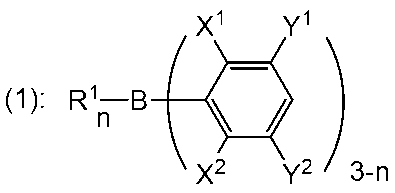
[上記式(1)中、X1及びX2は、各々独立して、電子求引基から選択され、Y1及びY2は、各々独立して、水素及び電子供与基から選択されるが、同時に水素は選択されない、R1は、炭素数1~24の有機基から選択され、該炭素数1~24の有機基は置換基を有していても良く、nは、0~2の整数から選択される。]
2.下記式(2)で表されるホウ素化合物のルイス塩基錯体。
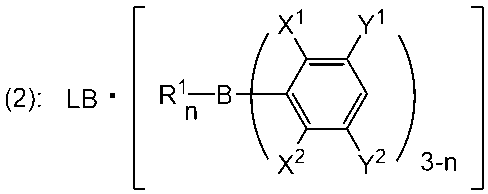
[上記式(2)中、X1及びX2は、各々独立して、電子求引基から選択され、Y1及びY2は、各々独立して、水素及び電子供与基から選択されるが、同時に水素は選択されない、R1は、炭素数1~24の有機基から選択され、該炭素数1~24の有機基は置換基を有していても良く、nは、0~2の整数から選択され、LBは、ルイス塩基から選択される。]
3.上記1に記載のホウ素化合物又は上記2に記載のルイス塩基錯体を含む化学品組成物。
4.上記1に記載のホウ素化合物又は上記2に記載のルイス塩基錯体を含む水素化触媒。
5.上記4に記載の水素化触媒を用いる、水素化物の製造方法。
6.粗水素ガス存在下で、上記4に記載の水素化触媒を用いることを含む、水素化物の製造方法。
7.上記1に記載のホウ素化合物又は上記2に記載のルイス塩基錯体を含む重合開始剤。
8.上記7に記載の重合開始剤を用いることを含む、重合体の製造方法。
9.上記1に記載のホウ素化合物を含むルイス酸触媒。
10.上記9に記載のルイス酸触媒を用いることを含む、付加体の製造方法。
1.下記式(1)で表されるホウ素化合物。
2.下記式(2)で表されるホウ素化合物のルイス塩基錯体。
3.上記1に記載のホウ素化合物又は上記2に記載のルイス塩基錯体を含む化学品組成物。
4.上記1に記載のホウ素化合物又は上記2に記載のルイス塩基錯体を含む水素化触媒。
5.上記4に記載の水素化触媒を用いる、水素化物の製造方法。
6.粗水素ガス存在下で、上記4に記載の水素化触媒を用いることを含む、水素化物の製造方法。
7.上記1に記載のホウ素化合物又は上記2に記載のルイス塩基錯体を含む重合開始剤。
8.上記7に記載の重合開始剤を用いることを含む、重合体の製造方法。
9.上記1に記載のホウ素化合物を含むルイス酸触媒。
10.上記9に記載のルイス酸触媒を用いることを含む、付加体の製造方法。
本発明の実施形態のホウ素化合物は、ホウ素に結合したアリール基のメタ位が、電子供与基で置換されている。本発明の新規なホウ素化合物及びルイス塩基錯体は、水素化物、重合体及び付加体などを製造するために好適に使用することができる。
1.ホウ素化合物
本発明の実施形態のホウ素化合物は、下記式(1)で表される。

[上記式(1)中、X1及びX2は、各々独立して電子求引基から選択され、Y1及びY2は、各々独立して、水素及び電子供与基から選択されるが、同時に水素は選択されない、R1は、炭素数1~24の有機基から選択され、該炭素数1~24の有機基は置換基を有していても良く、nは、0~2の整数から選択される。]
本発明の実施形態のホウ素化合物は、下記式(1)で表される。
本発明の実施形態のホウ素化合物では、ホウ素化合物の(2-X1,3-Y1,5-Y2,6-X2)フェニル基(以下、「置換フェニル基」ともいう)について、以下の観点が重要である。
(1)ホウ素中心を立体的に保護し、尚且つ置換フェニル基に電子求引性を与えるために、オルト位の置換基(X1、X2)として電子求引基を導入すること。
(2)ホウ素中心の電子親和性とルイス塩基錯体の安定性を適切に制するために、メタ位の置換基(Y1、Y2)の片方又は両方に電子供与基を導入すること。
(1)ホウ素中心を立体的に保護し、尚且つ置換フェニル基に電子求引性を与えるために、オルト位の置換基(X1、X2)として電子求引基を導入すること。
(2)ホウ素中心の電子親和性とルイス塩基錯体の安定性を適切に制するために、メタ位の置換基(Y1、Y2)の片方又は両方に電子供与基を導入すること。
上記式(1)中、X1及びX2は、各々独立して電子求引基から選択される。電子求引基として、例えば、ハロゲノ基、ニトロ基、シアノ基、フルオロアルキル基;トリフルオロメタンスルホニル基、アルキルスルホニル基、アリールスルホニル基等の置換スルホニル基等を例示することができ、フルオロアルキル基、トリフルオロメタンスルホニル基、及びハロゲノ基が好ましく、ブロモ基、クロロ基、フルオロ基から選択されるハロゲノ基がより好ましく、クロロ基、フルオロ基が最も好ましい。尚、X1及びX2は、同一でも、異なっていてもよい。例えば、X1はハロゲノ基であり、X2はハロゲノ基以外の基(例えば、置換スルホニル基)であってよい。例えば、X1とX2が共にハロゲノ基の場合、X1はフルオロ基であり、X2は、クロロ基であってよい。
上記式(1)中、Y1及びY2は、各々独立して、水素及び電子供与基から選択されるが、同時に水素は選択されない。従って、X1及びX2は、両方共電子供与基から選択されてよいし、片方が水素で、片方が、電子供与基から選択されてよいが、両方共水素であることはない。
本明細書において電子供与基とは、フェニル基と結合したときに、フェニル基に電子を供与する性質を有する基をいい、本発明が目的とするホウ素化合物を得られる限り特に制限されることはない。電子供与基として、例えば、アルキル、アルケニル、アルキニル、シクロアルキル、アルコキシ、アミノ、アルキルアミド、ジアルキルアミノ、シリル、トリアルキルシリル、トリアリールシリル、アルキルアリールシリル等を例示することができる。電子供与基として、アルキル、アルケニル、アルコキシ、アルキルアミド、ジアルキルアミノ、トリアルキルシリル等が好ましく、アルキル、アルケニル、アルコキシ、トリアルキルシリル等が好ましい。
本明細書において電子供与基とは、フェニル基と結合したときに、フェニル基に電子を供与する性質を有する基をいい、本発明が目的とするホウ素化合物を得られる限り特に制限されることはない。電子供与基として、例えば、アルキル、アルケニル、アルキニル、シクロアルキル、アルコキシ、アミノ、アルキルアミド、ジアルキルアミノ、シリル、トリアルキルシリル、トリアリールシリル、アルキルアリールシリル等を例示することができる。電子供与基として、アルキル、アルケニル、アルコキシ、アルキルアミド、ジアルキルアミノ、トリアルキルシリル等が好ましく、アルキル、アルケニル、アルコキシ、トリアルキルシリル等が好ましい。
アルキルの炭素数は、1~24であることが好ましく、1~18であることがより好ましく、1~15であることが更に好ましく、1~12であることが更により好ましい。
アルケニルの炭素数は、2~24であることが好ましく、2~18であることがより好ましく、2~15であることが更に好ましく、2~12であることが更により好ましい。
アルキニルの炭素数は、2~24であることが好ましく、2~18であることがより好ましく、2~15であることが更に好ましく、2~12であることが更により好ましい。
シクロアルキルの炭素数は、3~24であることが好ましく、3~18であることがより好ましく、3~15であることが更に好ましく、3~12であることが更により好ましい。
アルコキシの炭素数は、1~24であることが好ましく、1~18であることがより好ましく、1~15であることが更に好ましく、1~12であることが更により好ましい。
アルキルアミドの炭素数は、3~27であることが好ましく、3~21であることがより好ましく、3~18であることが更に好ましく、3~12であることが更により好ましい。
ジアルキルアミノの炭素数は、2~48であることが好ましく、2~36であることがより好ましく、2~30であることが更に好ましく、2~24であることが更により好ましい。
トリアルキルシリルの炭素数は、3~72であることが好ましく、3~54であることがより好ましく、3~45であることが更に好ましく、3~36であることが更により好ましい。
アルケニルの炭素数は、2~24であることが好ましく、2~18であることがより好ましく、2~15であることが更に好ましく、2~12であることが更により好ましい。
アルキニルの炭素数は、2~24であることが好ましく、2~18であることがより好ましく、2~15であることが更に好ましく、2~12であることが更により好ましい。
シクロアルキルの炭素数は、3~24であることが好ましく、3~18であることがより好ましく、3~15であることが更に好ましく、3~12であることが更により好ましい。
アルコキシの炭素数は、1~24であることが好ましく、1~18であることがより好ましく、1~15であることが更に好ましく、1~12であることが更により好ましい。
アルキルアミドの炭素数は、3~27であることが好ましく、3~21であることがより好ましく、3~18であることが更に好ましく、3~12であることが更により好ましい。
ジアルキルアミノの炭素数は、2~48であることが好ましく、2~36であることがより好ましく、2~30であることが更に好ましく、2~24であることが更により好ましい。
トリアルキルシリルの炭素数は、3~72であることが好ましく、3~54であることがより好ましく、3~45であることが更に好ましく、3~36であることが更により好ましい。
上記アルキルとして、例えば、メチル基、エチル基、n-プロピル基、イソプロピル基、n-ブチル基、イソブチル基、t-ブチル基、n-ペンチル基、n-ヘキシル基、n-ドデシル基、n-トリデシル基、n-テトラデシル基、n-ヘキサデシル基、n-オクタデシル基、n-エイコシル基等を例示することができる。
上記アルケニルとして、例えば、エテニル基、n-プロペニル基、イソプロペニル基、n-ブテニル基、イソブテニル基、n-ペンテニル基、n-ヘキセニル基、n-ドデセニル基、n-トリデセニル基、n-テトラデセニル基、n-ヘキサデセニル基、n-オクタデセニル基、n-エイコセニル基等を例示することができる。
上記アルキニルとして、例えば、エチニル基、n-プロピニル基、n-ブチニル基、イソブチニル基、n-ペンチニル基、n-ヘキシニル基、n-ドデシニル基、n-トリデシニル基、n-テトラデシニル基、n-ヘキサデシニル基、n-オクタデシニル基、n-エイコシニル基等を例示することができる。
上記シクロアルキルとして、例えば、シクロプロピル基、シクロブチル基、シクロペンチル基、シクロヘキシル基、シクロヘプチル基、シクロオクチル基、ノルボルニル基、アダマンチル基等を例示することができる。
上記アルコキシとして、例えば、メトキシ基、エトキシ基、プロポキシ基、イソプロポキシ基、n-ブトキシ基、イソブトキシ基、t-ブトキシ基、ペントキシ基、ヘキソキシ基等を例示できる。
上記アルキルアミドとして、例えば、メチルアミド基、エチルアミド基、n-プロピルアミド基、イソプロピルアミド基、n-ブチルアミド基、イソブチルアミド基、t-ブチルアミド基、n-ペンチルアミド基、n-ヘキシルアミド基、n-ドデシルアミド基、n-トリデシルアミド基、n-テトラデシルアミド基、n-ヘキサデシルアミド基、n-オクタデシルアミド基、n-エイコシルアミド基等を例示することができる。
上記ジアルキルアミノとして、例えば、ジメチルアミノ基、ジエチルアミノ基、ジn-プロピルアミノ基、ジイソプロピルアミノ基、ジn-ブチルアミノ基、ジイソブチルアミノ基、ジt-ブチルアミノ基、ジn-ペンチルアミノ基、ジn-ヘキシルアミノ基、ジn-ドデシルアミノ基、ジn-トリデシルアミノ基、ジn-テトラデシルアミノ基、ジn-ヘキサデシルアミノ基、ジn-オクタデシルアミノ基、ジn-エイコシルアミノ基等を例示することができる。
上記トリアルキルシリルとして、例えば、トリメチルシリル基、トリエチルシリル基、トリn-プロピルシリル基、トリイソプロピルシリル基、トリn-ブチルシリル基、トリイソブチルシリル基、トリt-ブチルシリル基、トリn-ペンチルシリル基、トリn-ヘキシルシリル基、トリn-ドデシルシリル基、トリn-トリデシルシリル基、トリn-テトラデシルシリル基、トリn-ヘキサデシルシリル基、トリn-オクタデシルシリル基、トリn-エイコシルシリル基等を例示することができる。
上記アルケニルとして、例えば、エテニル基、n-プロペニル基、イソプロペニル基、n-ブテニル基、イソブテニル基、n-ペンテニル基、n-ヘキセニル基、n-ドデセニル基、n-トリデセニル基、n-テトラデセニル基、n-ヘキサデセニル基、n-オクタデセニル基、n-エイコセニル基等を例示することができる。
上記アルキニルとして、例えば、エチニル基、n-プロピニル基、n-ブチニル基、イソブチニル基、n-ペンチニル基、n-ヘキシニル基、n-ドデシニル基、n-トリデシニル基、n-テトラデシニル基、n-ヘキサデシニル基、n-オクタデシニル基、n-エイコシニル基等を例示することができる。
上記シクロアルキルとして、例えば、シクロプロピル基、シクロブチル基、シクロペンチル基、シクロヘキシル基、シクロヘプチル基、シクロオクチル基、ノルボルニル基、アダマンチル基等を例示することができる。
上記アルコキシとして、例えば、メトキシ基、エトキシ基、プロポキシ基、イソプロポキシ基、n-ブトキシ基、イソブトキシ基、t-ブトキシ基、ペントキシ基、ヘキソキシ基等を例示できる。
上記アルキルアミドとして、例えば、メチルアミド基、エチルアミド基、n-プロピルアミド基、イソプロピルアミド基、n-ブチルアミド基、イソブチルアミド基、t-ブチルアミド基、n-ペンチルアミド基、n-ヘキシルアミド基、n-ドデシルアミド基、n-トリデシルアミド基、n-テトラデシルアミド基、n-ヘキサデシルアミド基、n-オクタデシルアミド基、n-エイコシルアミド基等を例示することができる。
上記ジアルキルアミノとして、例えば、ジメチルアミノ基、ジエチルアミノ基、ジn-プロピルアミノ基、ジイソプロピルアミノ基、ジn-ブチルアミノ基、ジイソブチルアミノ基、ジt-ブチルアミノ基、ジn-ペンチルアミノ基、ジn-ヘキシルアミノ基、ジn-ドデシルアミノ基、ジn-トリデシルアミノ基、ジn-テトラデシルアミノ基、ジn-ヘキサデシルアミノ基、ジn-オクタデシルアミノ基、ジn-エイコシルアミノ基等を例示することができる。
上記トリアルキルシリルとして、例えば、トリメチルシリル基、トリエチルシリル基、トリn-プロピルシリル基、トリイソプロピルシリル基、トリn-ブチルシリル基、トリイソブチルシリル基、トリt-ブチルシリル基、トリn-ペンチルシリル基、トリn-ヘキシルシリル基、トリn-ドデシルシリル基、トリn-トリデシルシリル基、トリn-テトラデシルシリル基、トリn-ヘキサデシルシリル基、トリn-オクタデシルシリル基、トリn-エイコシルシリル基等を例示することができる。
上記式(1)中、nは、0~2の整数である。nは、0~1であることが好ましい。nが0の場合、ホウ素に3つの(2-X1,3-Y1,5-Y2,6-X2)フェニル基(置換フェニル基)が結合し、nが1の場合、ホウ素に2つの置換フェニル基が結合する。ホウ素に結合する置換フェニル基の数が、2又は3場合、触媒等としての性質が向上するので、好ましい。
ホウ素化合物は、1つの置換フェニル基を有する場合、2つの置換フェニル基を有する場合、3つの置換フェニル基を有する場合がある。2つ以上の置換フェニル基を有する場合、それらの置換フェニル基は、相互に同一でも異なっていてもよい。
ホウ素化合物は、1つの置換フェニル基を有する場合、2つの置換フェニル基を有する場合、3つの置換フェニル基を有する場合がある。2つ以上の置換フェニル基を有する場合、それらの置換フェニル基は、相互に同一でも異なっていてもよい。
上記式(1)中、R1で表される炭素数1~24の有機基は、本発明が目的とするホウ素化合物を得られる限り、特に制限されることはないが、例えば、炭素数1~24のアルキル基、炭素数3~24のシクロアルキル基、炭素数3~24のアリール基、炭素数1~24のアルコキシ基、炭素数6~24のアリールオキシ基、炭素数2~24の鎖状もしくは環状アルコキシアルキル基、炭素数7~24のアリールアルキル基、炭素数7~24のアリールアルコキシ基、炭素数1~24のアルキルチオ基、炭素数6~24のアリールチオ基、炭素数7~24のアリールアルキルチオ基等を例示することができる。
nが0の場合、ホウ素化合物は、R1を有さず、nが1の場合、ホウ素化合物は、1つのR1を有し、nが2の場合、ホウ素化合物は、2つのR1を有する。nが2の場合、ホウ素化合物が有する2つのR1は、各々、同じでも、異なってもよい。
上記式(1)中のR1について、炭素数1~24のアルキル基として、例えば、メチル基、エチル基、n-プロピル基、イソプロピル基、n-ブチル基、イソブチル基、t-ブチル基、n-ペンチル基、n-ヘキシル基、n-ドデシル基、n-トリデシル基、n-テトラデシル基、n-ヘキサデシル基、n-オクタデシル基、n-エイコシル基等を挙げることができる。炭素数1~18のアルキル基が好ましく、炭素数1~10のアルキル基がより好ましい。
炭素数3~24のシクロアルキル基として、例えば、シクロプロピル基、シクロブチル基、シクロペンチル基、シクロヘキシル基、シクロヘプチル基、シクロオクチル基、ノルボルニル基、アダマンチル基等を挙げることができる。これらのうち、炭素数3~18のシクロアルキル基が好ましく、炭素数3~12のシクロアルキル基がより好ましい。
炭素数3~24のアリール基として、例えば、フェニル基、ナフチル基、インデニル基、ビフェニル基、フェナンスレニル基、アントラセニル基、4-ピリジル基、トリル基等を例示できる。炭素数3~18のアリール基が好ましく、炭素数3~15のアリール基がより好ましい。
ところで、R1は、上記式(1)中の(2-X1,3-Y1,5-Y2,6-X2)フェニル基(「置換フェニル基」ともいう)を含まず、R1から、上記式(1)中の置換フェニル基は除かれる。
ところで、R1は、上記式(1)中の(2-X1,3-Y1,5-Y2,6-X2)フェニル基(「置換フェニル基」ともいう)を含まず、R1から、上記式(1)中の置換フェニル基は除かれる。
炭素数1~24のアルコキシ基として、例えば、メトキシ基、エトキシ基、プロポキシ基、イソプロポキシ基、n-ブトキシ基、イソブトキシ基、t-ブトキシ基、ペントキシ基、ヘキソキシ基等を例示できる。炭素数1~18のアルコキシ基が好ましく、炭素数1~15のアルコキシ基がより好ましく、炭素数1~10のアルコキシ基がさらに好ましい。
炭素数6~24のアリールオキシ基として、例えば、フェノキシ基、1-ナフチルオキシ基、p-エチルフェノキシ基、3,5-ジフェニルフェノキシ基、3,5-ビス(3’,4’-ビス(トリフルオロメチル)フェニル)フェノキシ基、4-n-オクチルフェノキシ基等を例示できる。炭素数6~18のアリールオキシ基が好ましく、炭素数6~15のアリールオキシ基がより好ましい。
炭素数2~24の鎖状もしくは環状アルコキシアルキル基として、例えば、メトキシエチル基、エトキシエチル基、メトキシエトキシメチル基、メトキシエトキシメチル基、エトキシエトキシエチル基等を挙げることができる。これらのうち、炭素数2~18のアルコキシアルキル基が好ましく、炭素数2~15のアルコキシアルキル基がより好ましい。
炭素数7~24のアリールアルキル基としては、例えば、ベンジル基、2-フェニルエチル基、1-メチル-1-フェニルエチル基等を例示できる。炭素数7~18のアリールアルキル基が好ましく、炭素数7~15のアリールアルキル基がより好ましい。
炭素数7~24 のアリールアルコキシ基として、ベンジルオキシ基、クロロベンジルオキシ基、α-メチルベンジルオキシ基、α,α-ジメチルベンジルオキシ基、フェニルエチルオキシ基等を例示できる。炭素数7~18のアリールアルコキシ基が好ましく、炭素数7~15のアリールアルコキシ基がより好ましい。
炭素数1~24のアルキルチオ基としては、メチルチオ基、エチルチオ基、プロピルチオ基、n-ブチルチオ基、s-ブチルチオ基、t-ブチルチオ基、i-プロピルチオ基等を例示することができる。炭素数1~18のアルキルチオ基が好ましく、炭素数1~15 のアルキルチオ基がより好ましい。
炭素数6~24のアリールチオ基として、フェニルチオ基、フェニルメタンチオ基、o-、m-又はp-トリルチオ基、チオサリチル酸及びそのエステル類由来の基等を例示することができる。炭素数6~18のアリールチオ基が好ましく、炭素数6~15のアリールチオ基がより好ましい。
炭素数7~24のアリールアルキルチオ基としては、メチルチオフェニル基、エチルチオフェニル基、プロピルチオフェニル基、n-ブチルチオフェニル基、s-ブチルチオフェニル基、t-ブチルチオフェニル基、i-プロピルチオフェニル基等を挙げることができる。炭素数7~18 のアリールアルキルチオ基が好ましく、炭素数7~15のアリールアルキルチオ基がより好ましい。
上記炭素数1~24の有機基が有していても良い置換基としては、ハロゲン原子、ニトロ基、シアノ基等の電子求引性基、水酸基、アルコキシ基、アリールオキシ基、カルボキシル基およびその塩、アルコキシカルボニル基、アシルオキシ基、アロイルオキシ基、アミノ基、アミノカルボニル基、シアノ基、スルホン基及びその塩、アルキルスルホニル基、アルキルスルファニル基、アルキルスルフィニル基、アルキルスルフェニル基、アリールスルホニル基、アリールスルファニル基、アリールスルフィニル基、アリールスルフェニル基、鎖状もしくは環状アルキル基、鎖状もしくは環状アルケニル基、アリール基、ヘテロアリール基、鎖状もしくは環状ジアルキルアミノ基、鎖状もしくは環状ジアルキルアミノカルボニル基、鎖状もしくは環状アルコキシアルキル基等が挙げられる。これらの置換基は、さらに置換基を有していても良い。なお、「置換基を有しても良い」とは、有機基の水素原子の1 または2 以上が置換基で置換されていることを意味し、例えば置換基を有するアルキル基とは、アルキル基の水素原子の1または2以上が置換基で置換されている構造のアルキル基を表す。
上記R1で表される置換基を有していてもよい炭素数1~24の有機基は、全体として、炭素数は2以上であることが好ましく、4以上であることがより好ましく、6以上であることがさらに好ましく、22以下であることが好ましく、20以下であることがより好ましい。
上記R1で表される置換基を有していてもよい炭素数1~24の有機基は、全体として、炭素数は2以上であることが好ましく、4以上であることがより好ましく、6以上であることがさらに好ましく、22以下であることが好ましく、20以下であることがより好ましい。
上記R1で表される炭素数1~24の有機基は、電子求引性置換基を有していることが好ましい。これにより、本発明の実施形態のホウ素化合物におけるルイス酸性化合物部分のルイス酸性をより向上させることができ、触媒としての性能をより高めることができると考えられるからである。電子求引性基としては、上記ニトロ基、シアノ基、ハロゲン原子の中でもハロゲン原子からなる基が好ましい。上記ハロゲン原子からなる基としては、フルオロ基、クロロ基、ブロモ基、ヨード基が挙げられ、中でもフルオロ基及び/又はクロロ基が特に好ましい。
上記R1で表される炭素数1~24の有機基は、アルキル基又はアリール基であることが好ましく、置換基を有していても良いアリール基であることがより好ましい。
上記R1で表される炭素数1~24の有機基は、アルキル基又はアリール基であることが好ましく、置換基を有していても良いアリール基であることがより好ましい。
上記R1で表される炭素数1~24の有機基としては、具体的には、アリール基、ヘテロアリール基であることが好ましく、4-ピリジル基、2,5-ジフルオロ-4-ピリジル基、2,6-ジフルオロ-4-ピリジル基、2,3,6-トリフルオロ-4-ピリジル基、2,3,5,6-テトラフルオロ-4-ピリジル基、2-フルオロフェニル基、2,3-ジフルオロフェニル基、2,4-ジフルオロフェニル基、2,5-ジフルオロフェニル基、2,6-ジフルオロフェニル基、3,5-ジフルオロフェニル基、2,3,6-トリフルオロフェニル基、2,4,6-トリフルオロフェニル基、2,3,5,6-テトラフルオロフェニル基、2-クロロフェニル基、2,3-ジクロロフェニル基、2,4-ジクロロフェニル基、2,5-ジクロロフェニル基、2,6-ジクロロフェニル基、3,5-ジクロロフェニル基、2,3,6-トリクロロフェニル基、2,4,6-トリクロロフェニル基、2,3,5,6-テトラクロロフェニル基、3,5-ビス(トリフルオロメチル)フェニル基、2,6-ジフルオロ-4-クロロフェニル基、2,6-ジフルオロ-4-トリフルオロメチルフェニル基、2,6-ジフルオロ-3-クロロフェニル基、2 ,6-ジフルオロ-3,5-ジクロロフェニル基であることがより好ましく、2,6-ジフルオロフェニル基、2,6-ジクロロフェニル基、2,6-ジフルオロ-3-クロロフェニル基、2,6-ジフルオロ-3,5-ジクロロフェニル基であることが更に好ましく、2,6-ジクロロフェニル基、2,6-ジフルオロ-3,5-ジクロロフェニル基であることが特に好ましい。
2.ホウ素化合物のルイス塩基錯体
本発明の実施形態のホウ素化合物のルイス塩基錯体は、下記式(2)で表される。
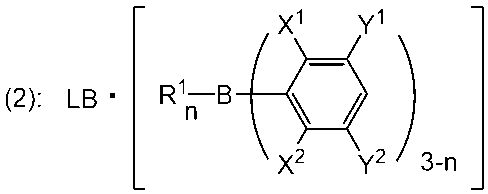
[上記式(2)中、X1及びX2は、各々独立して、ハロゲノ基から選択され、Y1及びY2は、各々独立して、水素及び電子供与基から選択されるが、同時に水素は選択されない、R1は、炭素数1~24の有機基から選択され、該炭素数1~24の有機基は置換基を有していても良く、nは、0~2の整数から選択され、LBは、ルイス塩基から選択される。]
本発明の実施形態のホウ素化合物のルイス塩基錯体は、下記式(2)で表される。
本明細書において、ルイス塩基とは、通常ルイス塩基と呼ばれており、共有結合に使われていない電子対(孤立電子対)を少なくとも1つ有する14族、15族及び16族原子から選択される少なくとも1種を含み、ホウ素にその電子対を与えて配位結合を形成することができ、本発明が目的とする、ホウ素化合物ルイス塩基錯体を形成することができる限り、特に制限されることはない。
ルイス塩基として、例えば、H2O、CO、ジエチルエーテルなどの鎖状エーテル類、テトラヒドロフラン(THF)などの環状エーテル類、トリフェニルホスフィン(PPh3)などのホスフィン類、トリエチルホスフィンオキシド(Et3P=O)などのホスフィンオキシド類、アセトニトリルなどのニトリル類、トリエチルアミン等のアミン類、窒素や酸素を含む複素環化合物を例示することができる。ルイス塩基として、アセトニトリルなどのニトリル類、鎖状及び環状エーテル類、ホスフィン類、アミン類、複素環化合物が、好ましい。
ルイス塩基として、例えば、H2O、CO、ジエチルエーテルなどの鎖状エーテル類、テトラヒドロフラン(THF)などの環状エーテル類、トリフェニルホスフィン(PPh3)などのホスフィン類、トリエチルホスフィンオキシド(Et3P=O)などのホスフィンオキシド類、アセトニトリルなどのニトリル類、トリエチルアミン等のアミン類、窒素や酸素を含む複素環化合物を例示することができる。ルイス塩基として、アセトニトリルなどのニトリル類、鎖状及び環状エーテル類、ホスフィン類、アミン類、複素環化合物が、好ましい。
上記式(2)は、上記式(1)のホウ素化合物とルイス塩基とが錯体を形成している構造を示す。
上記式(2)中の、X1及びX2、Y1及びY2、並びにnは、上記式(1)中の、X1及びX2、Y1及びY2、並びにnと、各々対応する。
上記式(2)中の、X1及びX2、Y1及びY2、並びにnの記載(説明)は、上記式(1)中の、X1及びX2、Y1及びY2、並びにnの記載(説明)と同じであり、上記式(1)中の、X1及びX2、Y1及びY2、並びにnの記載(説明)を参照することができる。
上記式(2)中の、X1及びX2、Y1及びY2、並びにnは、上記式(1)中の、X1及びX2、Y1及びY2、並びにnと、各々対応する。
上記式(2)中の、X1及びX2、Y1及びY2、並びにnの記載(説明)は、上記式(1)中の、X1及びX2、Y1及びY2、並びにnの記載(説明)と同じであり、上記式(1)中の、X1及びX2、Y1及びY2、並びにnの記載(説明)を参照することができる。
3.化学品組成物
本発明の実施形態の化学品組成物は、上記本発明の実施形態のホウ素化合物及び/又はホウ素化合物のルイス塩基錯体を含む。
本発明の実施形態の化学品組成物として、後述する水素化物の製造における反応前の化学品組成物、反応後の水素化物を含む組成物、重合体の製造における反応前のモノマー組成物、反応後の重合体(樹脂)を含む組成物、付加体の製造における反応前の化学品組成物、反応後の付加体を含む組成物等を例示できる。
本発明の実施形態の化学品組成物は、上記本発明の実施形態のホウ素化合物及び/又はホウ素化合物のルイス塩基錯体を含む。
本発明の実施形態の化学品組成物として、後述する水素化物の製造における反応前の化学品組成物、反応後の水素化物を含む組成物、重合体の製造における反応前のモノマー組成物、反応後の重合体(樹脂)を含む組成物、付加体の製造における反応前の化学品組成物、反応後の付加体を含む組成物等を例示できる。
4.水素化物の製造方法
本発明の実施形態の水素化物の製造方法では、上記本発明の実施形態のホウ素化合物及び/又はホウ素化合物のルイス塩基錯体を水素化触媒として用いる。本発明の実施形態の水素化物の製造方法は、好ましくは、水素ガスまたは粗水素ガスを水素源とし、上述の水素化触媒の存在下で、不飽和化合物の少なくとも1つの不飽和結合に水素原子を添加する工程(「水素化工程」ともいう)を含む。なお、上記「水素化物」とは、不飽和化合物の少なくとも1つの不飽和結合に水素原子が付加された化合物を意味し、「水素化された化合物」ということもある。
上記不飽和化合物が2つ以上の不飽和結合を含む場合、1つのみの不飽和結合に水素原子を添加しても良いが、2つ以上の不飽和結合に水素原子を添加しても良い。よって、本発明の実施形態の水素化物の製造方法における水素化物は、不飽和化合物であっても、飽和化合物であってもよい。
本発明の実施形態の水素化物の製造方法では、上記本発明の実施形態のホウ素化合物及び/又はホウ素化合物のルイス塩基錯体を水素化触媒として用いる。本発明の実施形態の水素化物の製造方法は、好ましくは、水素ガスまたは粗水素ガスを水素源とし、上述の水素化触媒の存在下で、不飽和化合物の少なくとも1つの不飽和結合に水素原子を添加する工程(「水素化工程」ともいう)を含む。なお、上記「水素化物」とは、不飽和化合物の少なくとも1つの不飽和結合に水素原子が付加された化合物を意味し、「水素化された化合物」ということもある。
上記不飽和化合物が2つ以上の不飽和結合を含む場合、1つのみの不飽和結合に水素原子を添加しても良いが、2つ以上の不飽和結合に水素原子を添加しても良い。よって、本発明の実施形態の水素化物の製造方法における水素化物は、不飽和化合物であっても、飽和化合物であってもよい。
上記「粗水素ガス」とは、天然ガス、ナフサ、重質油、石炭、石油排ガス、シェールオイルなどの炭化水素や、メタノール、エタノールなどのアルコール類、バイオマス、産業廃棄物プラスチックなどの有機性廃棄物から製造される水素を含む混合ガスであり、一酸化炭素及び/又は二酸化炭素を含む。大型の化学プラントで生産した粗水素ガスを用いてもよいし、小型の家庭用改質装置から供給されるものでもよい。粗水素ガスの水素含有量は、使用する原料、設備等によって任意に選択可能であるため、特に限定されるものではないが、水素化反応を円滑に進めるという観点で好ましい水素含有量は、水素と一酸化炭素と二酸化炭素の合計100モル%に対して、20モル%以上、99.9モル%未満であり、より好ましくは50モル%以上、99.9モル%未満であり、さらに好ましくは70モル%以上、99.9モル%未満である。
本発明の実施形態の水素化物の製造方法において、水素化反応に用いる不飽和化合物は、イミン、窒素含有複素環化合物、アルデヒド、ケトン、アルケン、アルキン、不飽和結合を有するオリゴマーもしくはポリマー等であり、一種または二種以上を用いることができる。窒素含有不飽和複素環化合物としては、ピリジン類、ピラジン類、キノリン類、アクリジン類、1,10-フェナントロリン類、インドール類等を挙げることができる。また、不飽和結合を有するオリゴマーやポリマーは同一分子内に1つもしくは2つ以上の不飽和結合を有していてもよい。
本発明の実施形態の水素化物の製造方法で得られる水素化された化合物としては、アミン類、ピペリジン類、ピペラジン類、テトラヒドロキノリン類、テトラヒドロフェナントロリン類、インドリン類等の窒素含有複素環化合物; アルコール、アルカン、アルケン等が例示される。
本発明の水素化物の製造方法では、溶剤を用いることができる。使用できる溶媒としては、水素化触媒としての本発明のホウ素化合物及び/又はホウ素化合物のルイス塩基錯体と反応せず、もしくは後段の不飽和化合物の水素化反応を阻害せず、本発明のホウ素化合物及び/又はホウ素化合物のルイス塩基錯体と不飽和化合物を適度に溶解できるものであることが好ましい。例えば、トルエンなどの芳香族炭化水素溶媒;n-ヘキサンなどの脂肪族炭化水素溶媒;アセトンなどのケトン系溶媒;メタノールなどのアルコール系溶媒;テトラヒドロフランなどのエーテル系溶媒;酢酸エチルなどのエステル系溶媒;アセトニトリルなどのニトリル系溶媒;ジクロロメタンなどのハロゲン化炭化水素溶媒;ジメチルホルムアミドなどのアミド系溶媒;ジメチルスルホキシドなどのスルホキシド系溶媒;γ-ブチロラクトン等のラクトン系溶媒;エチレンカーボネートなどの炭酸エステル系溶媒が上げられ、より好ましくは、トルエンなどの芳香族炭化水素溶媒;n-ヘキサンなどの脂肪族炭化水素溶媒;テトラヒドロフランなどのエーテル系溶媒;ジクロロメタンなどのハロゲン化炭化水素溶媒である。また、上記溶媒2種以上の混合溶媒を使用することができる。なお、事前に本発明の実施形態のホウ素化合物及び/又はホウ素化合物のルイス塩基錯体、不飽和化合物等を溶媒に溶かしておく場合、これらの溶液の溶媒は、同一としてもよいし、異なるものとしてもよい。また、溶媒を使用せずに実施してもよい。
本発明の実施形態の水素化物の製造方法では、本発明の実施形態のホウ素化合物及び/又はホウ素化合物のルイス塩基錯体、不飽和化合物を溶媒に溶かし、水素ガス、粗水素ガス等の水素源を混合することで水素化を実施することが好ましい。本発明に関わる水素化反応は、水素源を追加しながら反応を実施することもできる。本発明の実施形態では、水素化反応を常圧付近、もしくは微加圧の条件下にて実施できることも特徴である。当該圧力は常圧でもよいが、加圧状態で行うことにより、効率的に水素化反応を実施することができる。加圧で行う場合、圧力が大きすぎると加圧に必要なエネルギーが大きく、非効率となりうるので、500気圧以下が好ましく、100気圧以下がより好ましく、50気圧以下が特に好ましい。
本発明の実施形態の水素化物の製造方法では、上記水素化工程を必須の特徴として含むが、その他の工程を含んでも良い。例えば、精製工程、触媒不活性化工程、希釈工程、濃縮工程、抽出工程、未反応原料の回収工程、ろ過工程、触媒回収工程等が例示される。
例えば、水素化された化合物が不溶化または結晶化して析出した場合、析出物をろ別する工程を設けても良い。水素化された化合物が固形の場合、n-ヘキサンなどの貧溶媒等で洗浄する工程を設けても良い。水素化された化合物が固形の場合、乾燥する工程を設けても良い。上記乾燥する工程は、減圧下で行っても良い。水素化された化合物が液体の場合は、蒸留などして精製する工程を設けてもよい。
触媒を再利用する場合は、触媒を不溶化または結晶化して析出させて、ろ過工程により回収し、次の反応に再利用することもできる。
5.重合体の製造方法
本発明の実施形態の重合体の製造方法では、上記本発明の実施形態のホウ素化合物及び/又はホウ素化合物のルイス塩基錯体を開始剤として用いる。本発明の実施形態の重合体の製造方法では、例えば、オキシラン基(オキシラン環)、オキセタン基(オキセタン環)、エチレンスルフィド基、ジオキソラン基、トリオキソラン基、ビニルエーテル基、スチリル基等のカチオン重合性基を有する化合物を、上記本発明の実施形態のホウ素化合物及び/又はホウ素化合物のルイス塩基錯体を開始剤として用いて重合できる。重合の諸条件としては、公知の条件が適用でき、熱を加えることで反応を促進することもできる。
本発明の実施形態の重合体の製造方法では、上記本発明の実施形態のホウ素化合物及び/又はホウ素化合物のルイス塩基錯体を開始剤として用いる。本発明の実施形態の重合体の製造方法では、例えば、オキシラン基(オキシラン環)、オキセタン基(オキセタン環)、エチレンスルフィド基、ジオキソラン基、トリオキソラン基、ビニルエーテル基、スチリル基等のカチオン重合性基を有する化合物を、上記本発明の実施形態のホウ素化合物及び/又はホウ素化合物のルイス塩基錯体を開始剤として用いて重合できる。重合の諸条件としては、公知の条件が適用でき、熱を加えることで反応を促進することもできる。
本発明の実施形態の重合体の製造方法では、上記重合工程を必須の特徴として含むが、その他の工程を含んでも良い。例えば、精製工程、触媒不活性化工程、希釈工程、濃縮工程、抽出工程、未反応原料の回収工程、ろ過工程、触媒回収工程等が例示される。
例えば、重合した化合物が不溶化または結晶化して析出した場合、析出物をろ別する工程を設けても良い。重合した化合物が固形の場合、n-ヘキサンなどの貧溶媒等で洗浄する工程を設けても良い。重合した化合物が固形の場合、乾燥する工程を設けても良い。上記乾燥する工程は、減圧下で行っても良い。重合した化合物が液体の場合は、蒸留などして精製する工程を設けてもよい。重合して3次元架橋構造を形成する化合物の場合、開始剤を取り除かずに重合反応を継続し、そのまま重合生成物としてもよい。
開始剤を再利用する場合は、開始剤を不溶化または結晶化して析出させて、ろ過工程により回収し、次の反応に再利用することもできる。
6.付加体の製造方法
本発明の実施形態の付加体の製造方法では、上記本発明の実施形態のホウ素化合物をルイス酸触媒として用いる。本発明の付加体製造方法としては、酸素官能基、窒素官能基をルイス酸的に活性化することによって促進される反応であれば、反応促進効果が期待されるため、特に限定されるものではない。例えば、アルデヒド、ケトン等のカルボニル化合物へのエノール誘導体、アリルケイ素化合物、アリルホウ素化合物に代表される炭素求核剤の付加反応、アルケン、α,β-不飽和カルボニル化合物へのエノール誘導体、アリルケイ素化合物、アリルホウ素化合物に代表される炭素求核剤、アルコール類、フェノール類、カルボン酸類、アミド類、アミン類、チオール類、ホスフィン類に代表されるヘテロ原子求核剤の付加反応、Diels-Alder反応等を、本発明の実施形態のホウ素化合物をルイス酸触媒として用いることで収率良く行うことができる。
本発明の実施形態の付加体の製造方法では、上記本発明の実施形態のホウ素化合物をルイス酸触媒として用いる。本発明の付加体製造方法としては、酸素官能基、窒素官能基をルイス酸的に活性化することによって促進される反応であれば、反応促進効果が期待されるため、特に限定されるものではない。例えば、アルデヒド、ケトン等のカルボニル化合物へのエノール誘導体、アリルケイ素化合物、アリルホウ素化合物に代表される炭素求核剤の付加反応、アルケン、α,β-不飽和カルボニル化合物へのエノール誘導体、アリルケイ素化合物、アリルホウ素化合物に代表される炭素求核剤、アルコール類、フェノール類、カルボン酸類、アミド類、アミン類、チオール類、ホスフィン類に代表されるヘテロ原子求核剤の付加反応、Diels-Alder反応等を、本発明の実施形態のホウ素化合物をルイス酸触媒として用いることで収率良く行うことができる。
本発明の付加体の製造方法では、上記付加反応工程を必須に含むが、その他の工程を含んで良い。例えば、精製工程、触媒不活性化工程、希釈工程、濃縮工程、抽出工程、未反応原料の回収工程、ろ過工程、触媒回収工程等が例示される。
例えば、付加体が不溶化または結晶化して析出した場合、析出物をろ別する工程を設けても良い。付加体が固形の場合、n-ヘキサンなどの貧溶媒等で洗浄する工程を設けても良い。付加体が固形の場合、乾燥する工程を設けても良い。上記乾燥する工程は、減圧下で行っても良い。付加体が液体の場合は、蒸留などして精製する工程を設けてもよい。
触媒を再利用する場合は、触媒を不溶化または結晶化して析出させて、ろ過工程により回収し、次の反応に再利用することもできる。
7.粗水素ガスを水素源とする不飽和化合物の水素化触媒
粗水素ガスを水素源とする不飽和化合物の水素化反応では、上記本発明のホウ素化合物及び/又はホウ素化合物のルイス塩基錯体を水素化触媒として用いる。本発明の実施形態の粗水素ガスを水素源とする不飽和化合物の水素化触媒によれば、高濃度の一酸化炭素および/又は二酸化炭素が共存する条件下においても、水素化反応における触媒被毒が抑制され、水素化反応を円滑に進行させ、高収率で目的物を取得することができる。ここで「粗水素ガス」とは、上記の通りである。
粗水素ガスを水素源とする不飽和化合物の水素化反応では、上記本発明のホウ素化合物及び/又はホウ素化合物のルイス塩基錯体を水素化触媒として用いる。本発明の実施形態の粗水素ガスを水素源とする不飽和化合物の水素化触媒によれば、高濃度の一酸化炭素および/又は二酸化炭素が共存する条件下においても、水素化反応における触媒被毒が抑制され、水素化反応を円滑に進行させ、高収率で目的物を取得することができる。ここで「粗水素ガス」とは、上記の通りである。
以下、本発明を実施例及び比較例により具体的かつ詳細に説明するが、これらの実施例は本発明の一態様にすぎず、本発明はこれらの例によって何ら限定されるものではない。
尚、実施例の記載において、特に記載がない限り、溶媒を考慮しない部分を、重量部及び重量%の基準としている。
尚、実施例の記載において、特に記載がない限り、溶媒を考慮しない部分を、重量部及び重量%の基準としている。
実施例1.トリス(2,6-ジフルオロ-3,5-ビス(トリメチルシリル)フェニル)ボラン(1a)の合成
(i)(5-ブロモ-2,4-ジフルオロフェニル)トリメチルシランの合成

1,5-ジブロモ-2,4-ジフルオロベンゼン(21.8g、80.0mmol、1.3MのTHF溶液)に、0℃にて、iPrMgCl(96.0mL、96.0mmol、1.0Mのジエチルエーテル溶液)を滴下した後、30℃にて3時間攪拌した。反応溶液をトリメチルシリルトリフルオロメタンスルホン酸(27.3mL、151.3mmol)とAgOAc(1.3g、8.0mmol)のTHF(280mL)溶液に、0℃にて加えた後、30℃にて18時間攪拌した。反応溶液にNH4Cl(20mL)を加えた後、溶媒を減圧留去した。有機層をヘキサン(100mL×3)で抽出し、水(20mL×3)および飽和食塩水(20mL×3)を用いて洗浄した後、Na2SO4を用いて乾燥させ、ろ過した。溶媒を減圧留去することで(5-ブロモ-2,4-ジフルオロフェニル)トリメチルシランを黄濁した液体として得た(18.6g、70.2mmol、88%)。得られた液体を4Åモレキュラーシーブで乾燥させ、さらなる精製をせずに次の実験に用いた。
(i)(5-ブロモ-2,4-ジフルオロフェニル)トリメチルシランの合成
1H NMR (400 MHz, CDCl3): δ 7.49 (dd, 4JH,F = 8.4 Hz, 5.6 Hz , 1H, Ar-H), 6.82 (t, 3JH,F = 8.4 Hz, 1H, Ar-H), 0.31 (d, J = 0.8 Hz, 18H, Si(CH3)3). 19F NMR (376 MHz, CDCl3): δ -101.8 (m, 1F), -105.2 (q, J = 8.8 Hz, 1F).
(ii)(4,6-ジフルオロ-1,3-フェニレン)ビス(トリメチルシラン)の合成

(5-ブロモ-2,4-ジフルオロフェニル)トリメチルシラン(10.6g、40.0mmol、1.3MのTHF溶液)に、0℃にて、iPrMgCl(60.0mL、60.0mmol、1.0Mのジエチルエーテル溶液)を滴下後、30℃にて、1.5時間攪拌した。反応溶液をトリメチルシリルトリフルオロメタンスルホン酸(19.0mL、105.2mmol)とAgOAc(0.7g、4.0mmol)のTHF(150mL)溶液に、0℃にて加えた後、30℃にて7時間攪拌した。反応溶液にNH4Cl(10mL)を加えた後、溶媒を減圧留去した。有機層をヘキサン(100mL×3)で抽出し、水(20mL×3)および飽和食塩水(20mL×3)を用いて洗浄した後、Na2SO4を用いて乾燥させ、ろ過した。溶媒を減圧留去し、シリカゲルカラムクロマトグラフィー(展開溶媒:ヘキサン)を用いて精製することで(4,6-ジフルオロ-1,3-フェニレン)ビス(トリメチルシラン)を無色の液体として得た(7.4g、28.8mmol,72%)。得られた液体を4Åモレキュラーシーブで乾燥させ、さらなる精製をせずに次の実験に用いた。
1H NMR (400 MHz, CDCl3): δ 7.38 (t, 4JH,F = 7.2 Hz, 1H, Ar-H), 6.66 (t, 3JH,F = 9.0 Hz, 1H, Ar-H), 0.31 (s, 18H, Si(CH3)3). 13C{1H} NMR (101 MHz, CDCl3): δ 169.2 (dd, 1JC,F = 246.4 Hz, 3JC,F = 12.1 Hz), 141.5 (t, 3JC,F = 13.1 Hz), 121.4 (m), 102.6 (dt, J = 5.1 Hz, J = 28.8 Hz), -0.89. 19F NMR (376 MHz, CDCl3): δ -99.8 (t, JH,F = 7.5 Hz, 2F). HRMS (EI+): m/z Calcd for C12H20F2Si2 258.1072, found 258.1075.
(iii)(4,6-ジフルオロ-5-ヨード-1,3-フェニレン)ビス(トリメチルシラン)の合成

ジイソプロピルアミン(4.5mL、32.0mmol,0.3MのTHF溶液)に、nBuLi(26.7mL、32.0mmol、1.2Mのヘキサン溶液)を、-60℃にて、ゆっくり加えた。反応溶液を-60℃にて、1時間攪拌した後、(4,6-ジフルオロ-1,3-フェニレン)ビス(トリメチルシラン)(5.5g、21.3mmol、0.2MのTHF溶液)に、-78℃にて加えた。反応溶液を-78℃にて1時間攪拌した後、I2(10.8g、42.6mmol、1.1MのTHF溶液)を加え、室温にて14時間攪拌した。Na2S2O3水溶液(50mL)を加えた後、ヘキサン(200mL×2)とジエチルエーテル(100mL×1)を用いて抽出し、飽和食塩水(50mL×3)を用いて洗浄し、Na2SO4を用いて乾燥し、ろ過した。溶媒を減圧留去し、シリカゲルカラムクロマトグラフィー(展開溶媒:ヘキサン)を用いて精製した。溶媒を減圧留去し、得られた固体をエタノールを用いて洗浄することで(4,6-ジフルオロ-5-ヨード-1,3-フェニレン)ビス(トリメチルシラン)を無色の結晶として得た(6.4g、16.6mmol,78%)。得られた結晶を減圧下(約0.2mmHg)、100℃にて昇華精製した後、次の反応に用いた。
1H NMR (400 MHz, C6D6): δ 7.36 (t, 4JH,F = 6.8 Hz, 1H, Ar-H), 0.22 (s, 18H, Si(CH3)3). 13C{1H} NMR (101 MHz, C6D6): δ 168.4 (dd, 1JC,F = 244.4 Hz, 3JC,F = 6.1 Hz), 141.5 (t, 3JC,F =26.3 Hz), 122.5 (d, J = 35.4 Hz), 72.1, -1.2. 19F NMR (376 MHz, C6D6): δ -81.7 (d, 4JH,F = 7.5 Hz, 2F). HRMS (EI+): m/z Calcd for C12H19F2Si2I1 384.0038, found 384.0043.
(iv)トリス(2,6-ジフルオロ-3,5-ビス(トリメチルシリル)フェニル)ボラン(1a)の合成

(4,6-ジフルオロ-5-ヨード-1,3-フェニレン)ビス(トリメチルシラン)(3.2g、8.3mmol、0.2MのTHF溶液)に、0℃にて、iPrMgCl(5.1mL、8.3mmol、2.0MのTHF溶液)をゆっくり加えた。反応溶液を0℃にて1.5時間攪拌後、BF3・OEt2(0.3mL、2.6mmol)を、-10℃にてすばやく加えた。室温にて終夜攪拌後、溶媒を減圧留去した。得られた固体を、ヘキサンを用いて抽出し、セライトろ過した。溶媒を減圧留去した後固体を温ヘキサンにて溶解させ、15~20℃にて静置することで無色結晶として、純度95―98%のトリス(2,6-ジフルオロ-3,5-ビス(トリメチルシリル)フェニル)ボランを、収率35%(717.8mg、0.92mmol)で得た。
1H NMR (400 MHz, C6D6): δ 7.78 (t, 4JH,F = 7.0 Hz, 3H, Ar-H), 0.26 (s, 54H, Si(CH3)3). 11B NMR (128 MHz, C6D6): Not observed. 13C{1H} NMR (101 MHz, C6D6): δ 172.2 (dd, 1JC,F = 248.5 Hz, 3JC,F = 12.1 Hz), 146.6 (dt, J = 15.2 Hz, J = 3.0 Hz), 121.3 (m), 118.7 (t, J = 28.3 Hz), -1.0. 19F NMR (376 MHz, C6D6): δ -86.7 (d, 4JH,F = 7.5 Hz, 6F).
実施例2.トリス(2,6-ジフルオロ-3,5-ジアリルフェニル)ボラン(1b)の合成
(i)1,5-ジアリル-2,4-ジフルオロベンゼンの合成

1,5-ジブロモ-2,4-ジフルオロベンゼン(8.2g、30.0mmol、0.3MのTHF溶液)に、0℃にて、iPrMgCl(22.5mL、45.0mmol、2.0MのTHF溶液)を滴下した。反応溶液を室温にて1.5時間攪拌後、アリルブロミド(5.1mL、60.3mmol)を0℃にて加えた。室温にて20時間攪拌後、iPrMgCl(22.5mL、45.0mmol、2.0MのTHF溶液)を滴下し、2時間攪拌した。アリルブロミド(3.6mL、42.6mmol)を0℃にて加えた後、室温にて19時間攪拌した。NH4Cl水溶液(15mL)を加えた後、溶媒を減圧留去した。有機層を、ヘキサン(100mL×3)を用いて抽出し、水(20mL×3)と飽和食塩水(20mL×3)を用いて洗浄した後、Na2SO4を用いて乾燥し、ろ過した。溶媒を減圧留去することで1,5-ジアリル-2,4-ジフルオロベンゼンを無色の液体として得た(5.6g、28.8mmol、96%)。得られた液体は、さらなる精製をせずに次の実験に用いた。NMR測定用の単離サンプルは、減圧下(約0.2mmHg)、70℃にて蒸留することで得た。
(i)1,5-ジアリル-2,4-ジフルオロベンゼンの合成
1H NMR (400 MHz, CDCl3): δ 6.98 (t, 4JH,F = 8.6 Hz, 1H, Ar-H), 6.75 (t, 3JH,F = 9.6 Hz, 1H, Ar-H), 5.92 (m, 2H, CH2CH=CH2), 5.06 (m, 4H, CH2CH=CH2), 3.34 (d, J = 6.4 Hz, 4H, CH2CH=CH2). 13C{1H} NMR (101 MHz, C6D6): δ 159.7 (dd, 1JC,F = 247.5 Hz, J = 12.1 Hz), 135.9, 132.1 (q, J = 5.7 Hz), 122.8 (m), 116.2 (m), 103.6 (m), 32.7. 19F NMR (376 MHz, CDCl3): δ -121.1 (t, J = 9.4 Hz, 2F). HRMS (EI+): m/z Calcd for C12H12F2 194.0907, found 194.0902.
(ii)1,5-ジアリル-2,4-ジフルオロ-3-ヨードベンゼンの合成

ジイソプロピルアミン(6.1mL、43.5mmol、0.4MのTHF溶液)に、nBuLi(27.2mL、43.5mmol、1.6Mのヘキサン溶液)を、-78℃にて、ゆっくり加えた。反応溶液を-78℃にて1時間攪拌後、1,5-ジアリル-2,4-ジフルオロベンゼン(5.6g,29.0mmol,0.2MのTHF溶液)に、-78℃にてゆっくり加えた。反応溶液を-78℃にて1時間攪拌後、I2(14.6g,58.0mmol,0.4MのTHF溶液)を加え、室温にて12時間攪拌した。Na2S2O3水溶液(50mL)を加えた後、ヘキサン(100mL×2)とジエチルエーテル(100mL×1)を用いて抽出し、飽和食塩水(50mL×3)を用いて洗浄し、Na2SO4を用いて乾燥し、ろ過した。溶媒を減圧留去した後、減圧下(約0.2mmHg)、95℃にて揮発物を留去し、さらに減圧下(約0.2mmHg)、170℃にて蒸留することで、1,5-ジアリル-2,4-ジフルオロ-3-ヨードベンゼンを無色の液体として得た(7.1g、22.2mmol,77%)。
1H NMR (400 MHz, C6D6): δ 6.59 (t, 4JH,F = 8.2 Hz, 1H, Ar-H), 5.65 (m, 2H, CH2CH=CH2), 4.89 (m, 4H, CH2CH=CH2), 3.03 (d, J = 6.4 Hz, 4H, CH2CH=CH2). 13C{1H} NMR (101 MHz, C6D6): δ 159.3 (dd, 1JC,F = 245.4 Hz, 3JC,F = 5.1 Hz), 135.4, 131.9 (q, 3JC,F = 5.4 Hz), 123.5 (m), 116.6 (m), 71.6 (t, J = 30.3 Hz), 33.1 (t, 3JC,F = 4.0 Hz). 19F NMR (376 MHz, C6D6): δ -102.0 (d, 4JH,F = 7.5 Hz, 2F).
HRMS (EI+): m/z Calcd for C12H11F2I 319.9874, found 319.9883.
HRMS (EI+): m/z Calcd for C12H11F2I 319.9874, found 319.9883.
(iii)トリス(2,6-ジフルオロ-3,5-ジアリルフェニル)ボラン(1b)の合成

1,5-ジアリル-2,4-ジフルオロ-3-ヨードベンゼン(2.0g、6.3mmol、0.2MのTHF溶液)に、室温にて、iPrMgCl(3.2mL、6.3mmol、2.0MのTHF溶液)を加えた。反応溶液を室温にて1時間攪拌した後、BF3・OEt2(0.3mL、2.0mmol)を加え、室温にて一晩攪拌した。揮発成分を減圧留去した後、ヘキサンを加え、セライトろ過し、再度、揮発成分を全て減圧下にて留去した。得られた粗生成物へ十分な量のアセトニトリルを加え、室温にて攪拌した後、溶媒を減圧留去した。次に、ペンタンを加えて激しく攪拌すると白色固体が析出した。生じた白色固体を濾過により回収した。さらに、母液のペンタン溶液を-30度にて放置することで、白色結晶が生じた。これらの固体と結晶を合わせて回収することで、トリス(2,6-ジフルオロ-3,5-ジアリルフェニル)ボランのCH3CN錯体(2b)が収率26%(320.8mg、0.5mmol)にて得られた。得られたCH3CN錯体をトルエンに溶解させ、減圧乾燥させることで、トリス(2,6-ジフルオロ-3,5-ジアリルフェニル)ボラン(1b)を収率23%(265.1mg、0.4mmol)にて得た。
CH3CN錯体のNMR
1H NMR (400 MHz, CD3CN): δ 6.89 (t, 4JH,F = 8.2 Hz, 3H, Ar-H), 5.92 (m, 6H, CH2CH=CH2), 4.98 (m, 12H, CH2CH=CH2), 3.24 (d, J = 6.0 Hz, 12H, CH2CH=CH2), 1.96 (s, CH3CN). 11B NMR (128 MHz, CD3CN): -9.6. 13C{1H} NMR (101 MHz, CD3CN): δ 162.8 (dd, J = 1JC,F = 243.4 Hz, 15.2 Hz), 137.7, 130.5 (m), 122.2 (m), 115.9, 33.7. Resonances of the Cipso with respect to the boron atom were not observed. 19F NMR (376 MHz, CD3CN): δ -113.9 (d, 4JH,F = 7.5 Hz, 6F).
トリス(2,6-ジフルオロ-3,5-ジアリルフェニル)ボランのNMR
1H NMR (400 MHz, C6D6): δ 6.93 (t, 4JH,F = 8.2 Hz, 3H, Ar-H), 5.75 (m, 6H, CH2CH=CH2), 4.94 (m, 12H, CH2CH=CH2), 3.13 (d, J = 6.4 Hz, 12H, CH2CH=CH2). 11B NMR (128 MHz, C6D6): Not observed. 13C{1H} NMR (101 MHz, C6D6): δ 161.6 (dd, 1JC,F = 249.5 Hz, J = 11.1 Hz), 136.3, 135.9, 122.7 (m), 116.3, 32.9. Resonances of the Cipso with respect to the boron atom were not observed. 19F NMR (376 MHz, C6D6): δ -110.0 (d, 4JH,F = 7.5 Hz, 6F).
1H NMR (400 MHz, CD3CN): δ 6.89 (t, 4JH,F = 8.2 Hz, 3H, Ar-H), 5.92 (m, 6H, CH2CH=CH2), 4.98 (m, 12H, CH2CH=CH2), 3.24 (d, J = 6.0 Hz, 12H, CH2CH=CH2), 1.96 (s, CH3CN). 11B NMR (128 MHz, CD3CN): -9.6. 13C{1H} NMR (101 MHz, CD3CN): δ 162.8 (dd, J = 1JC,F = 243.4 Hz, 15.2 Hz), 137.7, 130.5 (m), 122.2 (m), 115.9, 33.7. Resonances of the Cipso with respect to the boron atom were not observed. 19F NMR (376 MHz, CD3CN): δ -113.9 (d, 4JH,F = 7.5 Hz, 6F).
トリス(2,6-ジフルオロ-3,5-ジアリルフェニル)ボランのNMR
1H NMR (400 MHz, C6D6): δ 6.93 (t, 4JH,F = 8.2 Hz, 3H, Ar-H), 5.75 (m, 6H, CH2CH=CH2), 4.94 (m, 12H, CH2CH=CH2), 3.13 (d, J = 6.4 Hz, 12H, CH2CH=CH2). 11B NMR (128 MHz, C6D6): Not observed. 13C{1H} NMR (101 MHz, C6D6): δ 161.6 (dd, 1JC,F = 249.5 Hz, J = 11.1 Hz), 136.3, 135.9, 122.7 (m), 116.3, 32.9. Resonances of the Cipso with respect to the boron atom were not observed. 19F NMR (376 MHz, C6D6): δ -110.0 (d, 4JH,F = 7.5 Hz, 6F).
実施例3~4及び比較例1~2.水素ガスを用いるキノリンの水素化反応
種々のホウ素化合物の存在下、キノリン(Qin)の水素化反応を行った。その手順は、下記の通りである。
30mLオートクレーブに、キノリン(2.0mmol)、ホウ素化合物(1a)、(1b)、(1’c)、(1’d)(0.1mmol;5mol%)、テトラデカン (内部標準)、トルエンを加えた。密閉した後、H2(10atm)を加圧し、100℃にて8時間攪拌した。室温に冷却した後、脱気し、GCを用いて、水素化キノリン(H4-Qin)の収率を算出した。
結果を下記表に示した。

種々のホウ素化合物の存在下、キノリン(Qin)の水素化反応を行った。その手順は、下記の通りである。
30mLオートクレーブに、キノリン(2.0mmol)、ホウ素化合物(1a)、(1b)、(1’c)、(1’d)(0.1mmol;5mol%)、テトラデカン (内部標準)、トルエンを加えた。密閉した後、H2(10atm)を加圧し、100℃にて8時間攪拌した。室温に冷却した後、脱気し、GCを用いて、水素化キノリン(H4-Qin)の収率を算出した。
結果を下記表に示した。
実施例5~6.水素を含む混合ガスを用いるキノリンの水素化反応
ホウ素化合物又はそのアセトニトリル錯体の存在下、H2/CO/CO2=1/1/1(モル比)の混合ガスを用いて、キノリンの水素化反応を行った。

ホウ素化合物又はそのアセトニトリル錯体の存在下、H2/CO/CO2=1/1/1(モル比)の混合ガスを用いて、キノリンの水素化反応を行った。
実施例5.
30mLオートクレーブにキノリン(263.2mg、2.0mmol)、トリス(2,6-ジフルオロ-3,5-ジアリルフェニル)ボラン(1b)(59.8mg、0.1mmol;5mol%)、テトラデカン(142.5mg;内部標準)、トルエン(1.3mL)を加えた。密閉した後、H2/CO/CO2(各20atm)を加圧し、100℃にて、8時間攪拌した。室温に冷却後、脱気し、水素化キノリン(H4-Qin)をGC収率>99%にて得た。
30mLオートクレーブにキノリン(263.2mg、2.0mmol)、トリス(2,6-ジフルオロ-3,5-ジアリルフェニル)ボラン(1b)(59.8mg、0.1mmol;5mol%)、テトラデカン(142.5mg;内部標準)、トルエン(1.3mL)を加えた。密閉した後、H2/CO/CO2(各20atm)を加圧し、100℃にて、8時間攪拌した。室温に冷却後、脱気し、水素化キノリン(H4-Qin)をGC収率>99%にて得た。
実施例6.
10mLナスフラスコにトリス(2,6-ジフルオロ-3,5-ジアリルフェニル)ボランのCH3CN錯体(2b)(63.2mg,0.1mmol;5mol%)を秤量し、トルエン2-3mLを加えた後、揮発成分を減圧下にて留去する。ここへ再度トルエン(1.3mL)とテトラデカン(141.5mg;内部標準)を加え、混合液を30mLオートクレーブへ移す。さらに、キノリン(253.0mg、2.0mmol)、を加え、密閉した後、H2/CO/CO2(各20atm)を加圧し、100℃にて8時間攪拌した。室温に冷却後、脱気し、水素化キノリンをGC収率77%にて得た。
10mLナスフラスコにトリス(2,6-ジフルオロ-3,5-ジアリルフェニル)ボランのCH3CN錯体(2b)(63.2mg,0.1mmol;5mol%)を秤量し、トルエン2-3mLを加えた後、揮発成分を減圧下にて留去する。ここへ再度トルエン(1.3mL)とテトラデカン(141.5mg;内部標準)を加え、混合液を30mLオートクレーブへ移す。さらに、キノリン(253.0mg、2.0mmol)、を加え、密閉した後、H2/CO/CO2(各20atm)を加圧し、100℃にて8時間攪拌した。室温に冷却後、脱気し、水素化キノリンをGC収率77%にて得た。
本発明の実施形態のホウ素化合物は、ホウ素に結合したアリール基のメタ位が、電子供与基で置換されている。本発明の新規なホウ素化合物及びルイス塩基錯体は、水素化物、重合体及び付加体などを製造するために好適に使用することができる。
[関連出願]
本出願は、2023年6月9日に日本国でされた特願2023-095773を基礎出願とするパリ条約第4条又は日本国特許法第41条に基づく優先権を主張する。この基礎出願の内容は、参照することによって、本明細書に組み込まれる。
[関連出願]
本出願は、2023年6月9日に日本国でされた特願2023-095773を基礎出願とするパリ条約第4条又は日本国特許法第41条に基づく優先権を主張する。この基礎出願の内容は、参照することによって、本明細書に組み込まれる。
Claims (10)
- 下記式(1)で表されるホウ素化合物。

- 下記式(2)で表されるホウ素化合物のルイス塩基錯体。
- 請求項1に記載のホウ素化合物又は請求項2に記載のルイス塩基錯体を含む化学品組成物。
- 請求項1に記載のホウ素化合物又は請求項2に記載のルイス塩基錯体を含む水素化触媒。
- 請求項4に記載の水素化触媒を用いる、水素化物の製造方法。
- 粗水素ガス存在下で、請求項4に記載の水素化触媒を用いることを含む、水素化物の製造方法。
- 請求項1に記載のホウ素化合物又は請求項2に記載のルイス塩基錯体を含む重合開始剤。
- 請求項7に記載の重合開始剤を用いることを含む、重合体の製造方法。
- 請求項1に記載のホウ素化合物を含むルイス酸触媒。
- 請求項9に記載のルイス酸触媒を用いることを含む、付加体の製造方法。
Priority Applications (1)
| Application Number | Priority Date | Filing Date | Title |
|---|---|---|---|
| JP2025526086A JPWO2024253033A1 (ja) | 2023-06-09 | 2024-05-31 |
Applications Claiming Priority (2)
| Application Number | Priority Date | Filing Date | Title |
|---|---|---|---|
| JP2023095773 | 2023-06-09 | ||
| JP2023-095773 | 2023-06-09 |
Publications (1)
| Publication Number | Publication Date |
|---|---|
| WO2024253033A1 true WO2024253033A1 (ja) | 2024-12-12 |
Family
ID=93795978
Family Applications (1)
| Application Number | Title | Priority Date | Filing Date |
|---|---|---|---|
| PCT/JP2024/019998 Ceased WO2024253033A1 (ja) | 2023-06-09 | 2024-05-31 | ホウ素化合物、そのルイス塩基錯体、並びにそれらを用いる、水素化物、重合体及び付加体の製造方法 |
Country Status (2)
| Country | Link |
|---|---|
| JP (1) | JPWO2024253033A1 (ja) |
| WO (1) | WO2024253033A1 (ja) |
Citations (7)
| Publication number | Priority date | Publication date | Assignee | Title |
|---|---|---|---|---|
| JPH1121287A (ja) * | 1997-06-30 | 1999-01-26 | Nippon Shokubai Co Ltd | トリス(フッ化アリール)ホウ素の単離方法 |
| JPH1129577A (ja) * | 1997-07-11 | 1999-02-02 | Nippon Shokubai Co Ltd | (フッ化アリール)ホウ素化合物の単離方法 |
| JPH1192480A (ja) * | 1997-09-18 | 1999-04-06 | Nippon Shokubai Co Ltd | (フッ化アリール)ホウ素化合物の取り扱い方法並びに炭化水素系溶液の調製方法 |
| JP2006206511A (ja) * | 2005-01-28 | 2006-08-10 | Nippon Shokubai Co Ltd | アリールホウ素化合物の安定化方法および安定化組成物 |
| JP2017206474A (ja) * | 2016-05-20 | 2017-11-24 | 株式会社日本触媒 | 不飽和化合物の水素化方法 |
| JP2019218267A (ja) * | 2018-06-14 | 2019-12-26 | 株式会社日本触媒 | トリアリールホウ素化合物を含む組成物 |
| JP2020033292A (ja) * | 2018-08-29 | 2020-03-05 | 株式会社日本触媒 | ホウ素化合物、およびそれを用いた水素化物、重合体ならびに付加体の製造方法 |
-
2024
- 2024-05-31 WO PCT/JP2024/019998 patent/WO2024253033A1/ja not_active Ceased
- 2024-05-31 JP JP2025526086A patent/JPWO2024253033A1/ja active Pending
Patent Citations (7)
| Publication number | Priority date | Publication date | Assignee | Title |
|---|---|---|---|---|
| JPH1121287A (ja) * | 1997-06-30 | 1999-01-26 | Nippon Shokubai Co Ltd | トリス(フッ化アリール)ホウ素の単離方法 |
| JPH1129577A (ja) * | 1997-07-11 | 1999-02-02 | Nippon Shokubai Co Ltd | (フッ化アリール)ホウ素化合物の単離方法 |
| JPH1192480A (ja) * | 1997-09-18 | 1999-04-06 | Nippon Shokubai Co Ltd | (フッ化アリール)ホウ素化合物の取り扱い方法並びに炭化水素系溶液の調製方法 |
| JP2006206511A (ja) * | 2005-01-28 | 2006-08-10 | Nippon Shokubai Co Ltd | アリールホウ素化合物の安定化方法および安定化組成物 |
| JP2017206474A (ja) * | 2016-05-20 | 2017-11-24 | 株式会社日本触媒 | 不飽和化合物の水素化方法 |
| JP2019218267A (ja) * | 2018-06-14 | 2019-12-26 | 株式会社日本触媒 | トリアリールホウ素化合物を含む組成物 |
| JP2020033292A (ja) * | 2018-08-29 | 2020-03-05 | 株式会社日本触媒 | ホウ素化合物、およびそれを用いた水素化物、重合体ならびに付加体の製造方法 |
Non-Patent Citations (1)
| Title |
|---|
| ZHENHUA ZHANG; HAIFENG DU: "A Highly cis‐Selective and Enantioselective Metal‐Free Hydrogenation of 2,3‐Disubstituted Quinoxalines", ANGEWANDTE CHEMIE, vol. 54, no. 2, 13 November 2014 (2014-11-13), Hoboken, USA, pages 623 - 626, XP072069095, ISSN: 1433-7851, DOI: 10.1002/anie.201409471 * |
Also Published As
| Publication number | Publication date |
|---|---|
| JPWO2024253033A1 (ja) | 2024-12-12 |
Similar Documents
| Publication | Publication Date | Title |
|---|---|---|
| EP2307431B1 (en) | Process for preparing amines from alcohols and ammonia | |
| JP6616757B2 (ja) | 水素化および脱水素触媒、ならびにこれを作成する方法および用いる方法 | |
| CN102329332B (zh) | 有机铝化合物 | |
| CN103962183B (zh) | 一种pnn配体-金属络合物催化剂及其制备方法和应用 | |
| CN107531601A (zh) | 桥连联芳香基配位体及由其制备的过渡金属化合物 | |
| CN114478337A (zh) | 一种轴手性含硫双芳基衍生物及其合成方法 | |
| CN111420709A (zh) | 氮杂环卡宾基混配型镍(ii)配合物在合成2-直链烷基苯并噻唑类化合物反应中的应用 | |
| CN103333069A (zh) | 金鸡纳碱衍生物为催化剂制备ɑ-羟基-β-二羰基化合物的方法 | |
| CN116410213A (zh) | 一种合成3-碳基-1-硼基环类化合物的方法 | |
| JP7079696B2 (ja) | ホウ素化合物、およびそれを用いた水素化物、重合体ならびに付加体の製造方法 | |
| WO2024253033A1 (ja) | ホウ素化合物、そのルイス塩基錯体、並びにそれらを用いる、水素化物、重合体及び付加体の製造方法 | |
| CN114478351A (zh) | 一种合成α-烷基取代吲哚-3-甲醛类化合物的方法 | |
| CN111217847B (zh) | 一种硫代硅烷配体及其制备方法和在芳基硼化催化反应中的应用 | |
| JPH04159288A (ja) | 光学活性ホスフィン化合物 | |
| CN113234099B (zh) | 一种烷基硼酸酯类化合物的光化学合成方法 | |
| CN105665025B (zh) | 一种pnn配体‑钴络合物催化剂及其制备方法和应用 | |
| CN118955540A (zh) | 一种α-氨基有机硼化合物的合成方法 | |
| CN106995461A (zh) | 一种含苯并呋喃结构的膦配体及其制备方法和应用 | |
| US20040024237A1 (en) | Synthesis of aminoarylboronic esters and substituted anilines from arenes via catalytic C-H activation/borylation/amination and uses thereof | |
| KR100915095B1 (ko) | 알파, 베타-알킨 에스터 화합물의 β-보론화 방법 | |
| CN114380863B (zh) | 金鸡纳碱衍生的nnp配体及其制备方法与用途 | |
| CN119285657B (zh) | 以烯丙基醇为底物合成烷基硼酸酯类化合物的方法 | |
| JP3797618B2 (ja) | クロマン化合物誘導体の製造方法 | |
| CN120904232A (zh) | 偕二氟烯烃官能化硅氧烷化合物、其制备方法及应用 | |
| JP3997748B2 (ja) | 新規なビニルシラン誘導体 |
Legal Events
| Date | Code | Title | Description |
|---|---|---|---|
| 121 | Ep: the epo has been informed by wipo that ep was designated in this application |
Ref document number: 24819263 Country of ref document: EP Kind code of ref document: A1 |
|
| ENP | Entry into the national phase |
Ref document number: 2025526086 Country of ref document: JP Kind code of ref document: A |
|
| WWE | Wipo information: entry into national phase |
Ref document number: 2025526086 Country of ref document: JP |
|
| NENP | Non-entry into the national phase |
Ref country code: DE |