WO2024256871A2 - Fluorination methods, reagents, fluorinated compositions, and methods of manufacture - Google Patents

Fluorination methods, reagents, fluorinated compositions, and methods of manufacture Download PDF

Info

Publication number
WO2024256871A2
WO2024256871A2 PCT/IB2024/000319 IB2024000319W WO2024256871A2 WO 2024256871 A2 WO2024256871 A2 WO 2024256871A2 IB 2024000319 W IB2024000319 W IB 2024000319W WO 2024256871 A2 WO2024256871 A2 WO 2024256871A2
Authority
WO
WIPO (PCT)
Prior art keywords
reagent
purified
fluorination
composition
salt
Prior art date
Legal status (The legal status is an assumption and is not a legal conclusion. Google has not performed a legal analysis and makes no representation as to the accuracy of the status listed.)
Ceased
Application number
PCT/IB2024/000319
Other languages
French (fr)
Other versions
WO2024256871A3 (en
Inventor
Gabriele PUPO
Francesco IBBA
Jamie FERGUSON-LEITCH
Jasraj Singh BABRA
Current Assignee (The listed assignees may be inaccurate. Google has not performed a legal analysis and makes no representation or warranty as to the accuracy of the list.)
Fluorok Ltd
Original Assignee
Fluorok Ltd
Priority date (The priority date is an assumption and is not a legal conclusion. Google has not performed a legal analysis and makes no representation as to the accuracy of the date listed.)
Filing date
Publication date
Application filed by Fluorok Ltd filed Critical Fluorok Ltd
Priority to CN202480052307.8A priority Critical patent/CN121712740A/en
Priority to AU2024305139A priority patent/AU2024305139A1/en
Priority to KR1020267001253A priority patent/KR20260027239A/en
Priority to EP24746793.9A priority patent/EP4727911A2/en
Publication of WO2024256871A2 publication Critical patent/WO2024256871A2/en
Publication of WO2024256871A3 publication Critical patent/WO2024256871A3/en
Priority to IL325229A priority patent/IL325229A/en
Priority to MX2025015028A priority patent/MX2025015028A/en
Anticipated expiration legal-status Critical
Ceased legal-status Critical Current

Links

Classifications

    • CCHEMISTRY; METALLURGY
    • C07ORGANIC CHEMISTRY
    • C07CACYCLIC OR CARBOCYCLIC COMPOUNDS
    • C07C201/00Preparation of esters of nitric or nitrous acid or of compounds containing nitro or nitroso groups bound to a carbon skeleton
    • C07C201/06Preparation of nitro compounds
    • C07C201/12Preparation of nitro compounds by reactions not involving the formation of nitro groups
    • CCHEMISTRY; METALLURGY
    • C01INORGANIC CHEMISTRY
    • C01BNON-METALLIC ELEMENTS; COMPOUNDS THEREOF; METALLOIDS OR COMPOUNDS THEREOF NOT COVERED BY SUBCLASS C01C
    • C01B9/00General methods of preparing halides
    • C01B9/08Fluorides
    • CCHEMISTRY; METALLURGY
    • C07ORGANIC CHEMISTRY
    • C07CACYCLIC OR CARBOCYCLIC COMPOUNDS
    • C07C205/00Compounds containing nitro groups bound to a carbon skeleton
    • C07C205/07Compounds containing nitro groups bound to a carbon skeleton the carbon skeleton being further substituted by halogen atoms
    • C07C205/11Compounds containing nitro groups bound to a carbon skeleton the carbon skeleton being further substituted by halogen atoms having nitro groups bound to carbon atoms of six-membered aromatic rings
    • CCHEMISTRY; METALLURGY
    • C07ORGANIC CHEMISTRY
    • C07CACYCLIC OR CARBOCYCLIC COMPOUNDS
    • C07C253/00Preparation of carboxylic acid nitriles
    • C07C253/30Preparation of carboxylic acid nitriles by reactions not involving the formation of cyano groups
    • CCHEMISTRY; METALLURGY
    • C07ORGANIC CHEMISTRY
    • C07CACYCLIC OR CARBOCYCLIC COMPOUNDS
    • C07C255/00Carboxylic acid nitriles
    • C07C255/49Carboxylic acid nitriles having cyano groups bound to carbon atoms of six-membered aromatic rings of a carbon skeleton
    • C07C255/50Carboxylic acid nitriles having cyano groups bound to carbon atoms of six-membered aromatic rings of a carbon skeleton to carbon atoms of non-condensed six-membered aromatic rings
    • CCHEMISTRY; METALLURGY
    • C07ORGANIC CHEMISTRY
    • C07DHETEROCYCLIC COMPOUNDS
    • C07D213/00Heterocyclic compounds containing six-membered rings, not condensed with other rings, with one nitrogen atom as the only ring hetero atom and three or more double bonds between ring members or between ring members and non-ring members
    • C07D213/02Heterocyclic compounds containing six-membered rings, not condensed with other rings, with one nitrogen atom as the only ring hetero atom and three or more double bonds between ring members or between ring members and non-ring members having three double bonds between ring members or between ring members and non-ring members
    • C07D213/04Heterocyclic compounds containing six-membered rings, not condensed with other rings, with one nitrogen atom as the only ring hetero atom and three or more double bonds between ring members or between ring members and non-ring members having three double bonds between ring members or between ring members and non-ring members having no bond between the ring nitrogen atom and a non-ring member or having only hydrogen or carbon atoms directly attached to the ring nitrogen atom
    • C07D213/60Heterocyclic compounds containing six-membered rings, not condensed with other rings, with one nitrogen atom as the only ring hetero atom and three or more double bonds between ring members or between ring members and non-ring members having three double bonds between ring members or between ring members and non-ring members having no bond between the ring nitrogen atom and a non-ring member or having only hydrogen or carbon atoms directly attached to the ring nitrogen atom with hetero atoms or with carbon atoms having three bonds to hetero atoms with at the most one bond to halogen, e.g. ester or nitrile radicals, directly attached to ring carbon atoms
    • C07D213/61Halogen atoms or nitro radicals
    • CCHEMISTRY; METALLURGY
    • C07ORGANIC CHEMISTRY
    • C07DHETEROCYCLIC COMPOUNDS
    • C07D213/00Heterocyclic compounds containing six-membered rings, not condensed with other rings, with one nitrogen atom as the only ring hetero atom and three or more double bonds between ring members or between ring members and non-ring members
    • C07D213/02Heterocyclic compounds containing six-membered rings, not condensed with other rings, with one nitrogen atom as the only ring hetero atom and three or more double bonds between ring members or between ring members and non-ring members having three double bonds between ring members or between ring members and non-ring members
    • C07D213/04Heterocyclic compounds containing six-membered rings, not condensed with other rings, with one nitrogen atom as the only ring hetero atom and three or more double bonds between ring members or between ring members and non-ring members having three double bonds between ring members or between ring members and non-ring members having no bond between the ring nitrogen atom and a non-ring member or having only hydrogen or carbon atoms directly attached to the ring nitrogen atom
    • C07D213/60Heterocyclic compounds containing six-membered rings, not condensed with other rings, with one nitrogen atom as the only ring hetero atom and three or more double bonds between ring members or between ring members and non-ring members having three double bonds between ring members or between ring members and non-ring members having no bond between the ring nitrogen atom and a non-ring member or having only hydrogen or carbon atoms directly attached to the ring nitrogen atom with hetero atoms or with carbon atoms having three bonds to hetero atoms with at the most one bond to halogen, e.g. ester or nitrile radicals, directly attached to ring carbon atoms
    • C07D213/78Carbon atoms having three bonds to hetero atoms, with at the most one bond to halogen, e.g. ester or nitrile radicals
    • C07D213/84Nitriles
    • C07D213/85Nitriles in position 3
    • CCHEMISTRY; METALLURGY
    • C07ORGANIC CHEMISTRY
    • C07DHETEROCYCLIC COMPOUNDS
    • C07D251/00Heterocyclic compounds containing 1,3,5-triazine rings
    • C07D251/02Heterocyclic compounds containing 1,3,5-triazine rings not condensed with other rings
    • C07D251/12Heterocyclic compounds containing 1,3,5-triazine rings not condensed with other rings having three double bonds between ring members or between ring members and non-ring members
    • C07D251/26Heterocyclic compounds containing 1,3,5-triazine rings not condensed with other rings having three double bonds between ring members or between ring members and non-ring members with only hetero atoms directly attached to ring carbon atoms
    • C07D251/28Only halogen atoms, e.g. cyanuric chloride

Definitions

  • fluorination reagents are crude fluorination reagents that can be further purified to provide a purified fluorination reagent.
  • fluorination reagents are purified fluorination reagents.
  • methods provided herein comprise combining a first salt with a second salt to form a mixed composition.
  • the first salt can comprise calcium and fluorine.
  • methods provided herein comprise applying mechanical force to a combination of a first salt and a second salt to form a mixed composition.
  • methods provided herein comprise subjecting the mixed composition to a fluid composition and collecting a resultant fluid thereof.
  • subjecting the mixed composition to a fluid composition produces a solid component and a resultant fluid.
  • methods provided herein comprise concentrating the resultant fluid.
  • concentrating the resultant fluid forms a crude fluorination reagent that can be further purified to provide a purified fluorination reagent.
  • concentrating the resultant fluid produces a reagent concentrate or precipitate.
  • methods provided herein comprise washing the fluorination reagent with a solvent to produce a reagent wash.
  • washing the fluorination reagent provides a second solid component and fluid reagent wash.
  • the reagent wash comprises a fluorination reagent.
  • the reagent wash comprises a purified fluorination reagent.
  • methods provided herein comprise concentrating the reagent wash to form a fluorination reagent.
  • concentrating the reagent wash provides a purified fluorination reagent.
  • the purified fluorination reagent has a higher concentration of fluorine compared to the crude fluorination reagent.
  • methods provided herein comprise contacting fluorination reagents with starting reagents to provide fluorinated products.
  • fluorination reagents are crude fluorination reagents that can be further purified to provide a purified fluorination reagent.
  • fluorination reagents are purified fluorination reagents.
  • contacting fluorination reagents with starting reagents fluorinates the starting reagents.
  • fluorination reagents are crude fluorination reagents that can be further purified to provide a purified fluorination reagent.
  • fluorination reagents are purified fluorination reagents.
  • fluorinating starting reagents using fluorination reagents provides fluorinated products.
  • methods provided herein comprise providing a fluorination reagent and a starting reagent.
  • the fluorination reagent comprises an alkali metal, fluoride, and at least one additional ion.
  • the alkali metal can comprise lithium, potassium, or sodium.
  • fluorination reagents can comprise an amount of phosphorous.
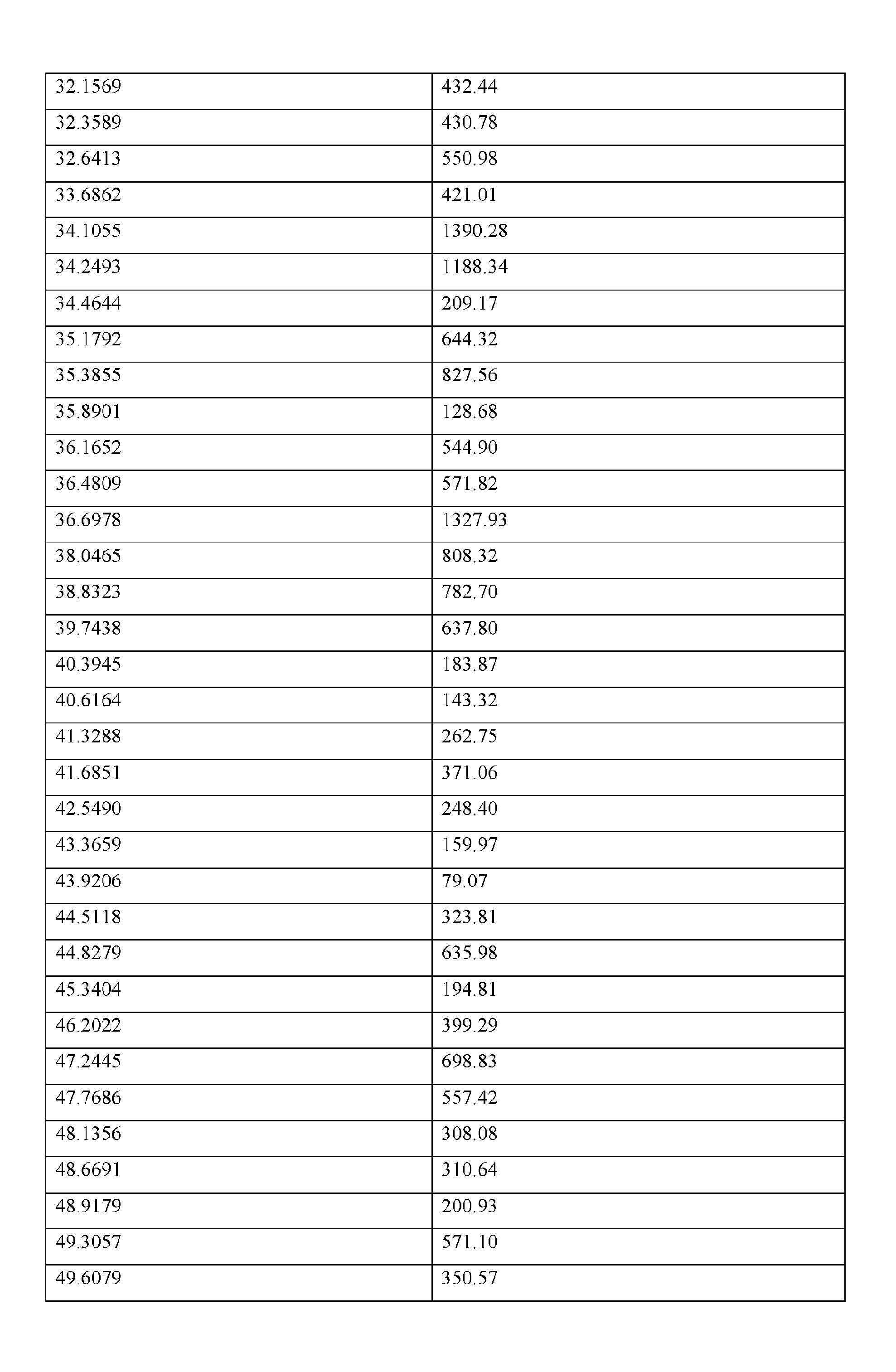
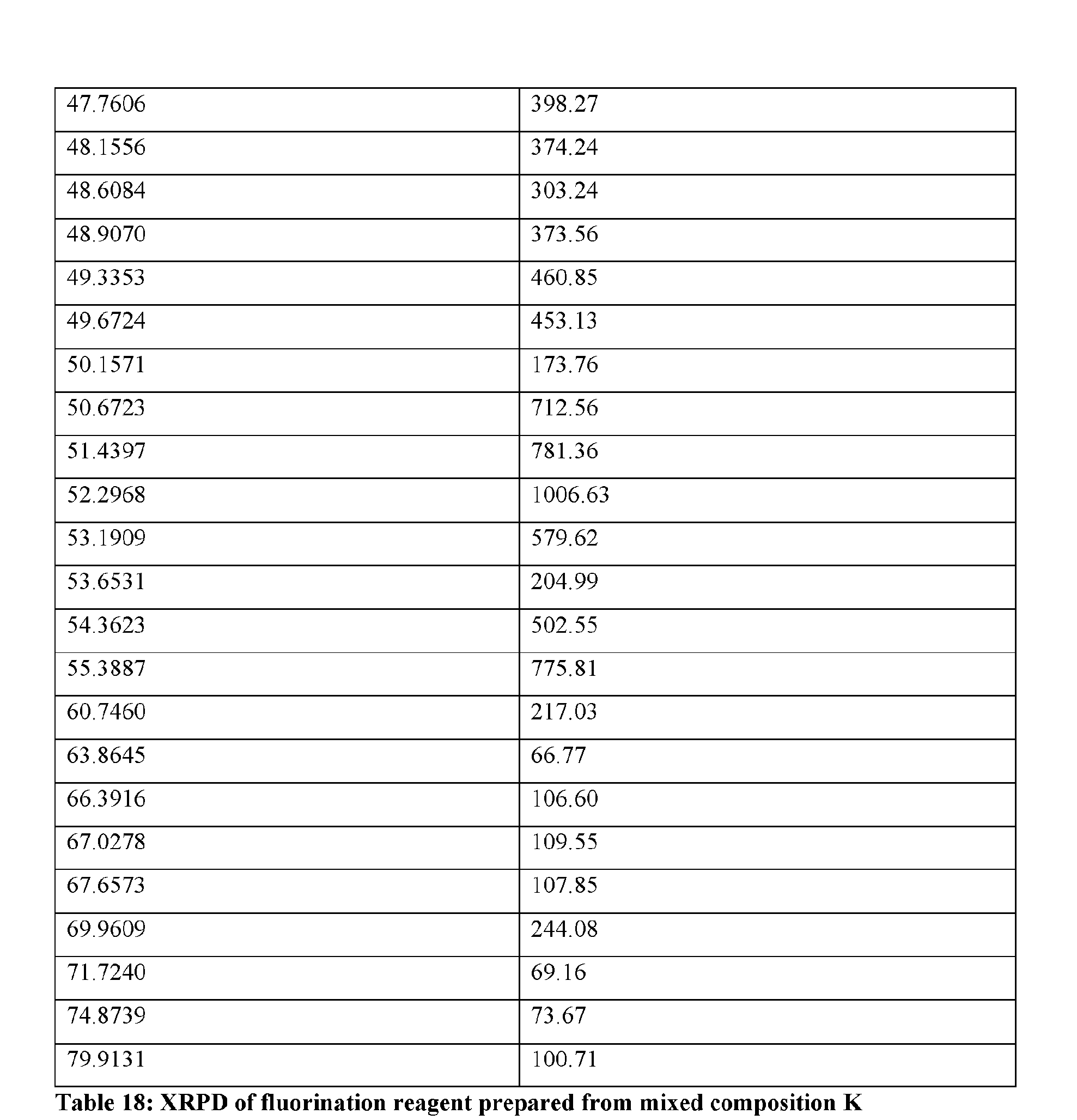
  • an amount of phosphorous in the fluorination reagent is about 1 ppm to about 25 ppm (e.g., about 1 ppm, about 10 ppm, about 20 ppm, or about 25 ppm). In some embodiments, an amount of phosphorous in the fluorination reagent is 0.015 % to about 12.5 % by weight (wt %). In some embodiments, fluorination reagents can be characterized by at least 1 (e.g., at least 2, at least 3, at least 5, at least 10, at least 20, at least 50, and/or at least 70) of the 2-theta values reported in any one of Tables 5, 6A, 8, 9, 12, 15-18, 20, 21, 23, 25-28.
  • methods provided herein comprise contacting starting reagents with fluorination reagents fluorinates starting reagents to yield fluorinated products. In some embodiments, contacting starting reagents with fluorination reagents provides fluorinated products.
  • methods for manufacturing fluorination reagents provided herein can comprise adjusting the pH of the resultant fluid prior to concentrating the resultant fluid.
  • the resultant fluid can be adjusted to a pH of about 6 to about 8.
  • an amount of phosphorous in a fluorination reagent is about 0.015 % to about 12.5 % by weight (wt %).
  • fluorination reagents are crude fluorination reagents that can be further purified to provide a purified fluorination reagent.
  • fluorination reagents are purified fluorination reagents.
  • methods for manufacturing fluorination reagents, and methods for fluorinating starting reagents provided herein can comprise an amount of calcium in the fluorination reagent.
  • fluorination reagents are purified fluorination reagents.
  • fluorination reagents are crude fluorination reagents that can be further purified to provide a purified fluorination reagent.
  • crude fluorination reagents are purified at least in part using a filtration process.
  • a filtrate is concentrated and/or dried during any step or process of any method described herein.
  • the filtration process comprises passing any solution described herein through the same or a plurality of filtration modules a plurality of times (e.g., by making three or more consecutive passes through the same module and/or by passing once each through three consecutively coupled modules).
  • a fluorine recovery of a filtration process employed herein is greater than 90% (e.g., greater than 95% or greater than 99%). In some embodiments, a rejection of one or more contaminants by a filtration process employed in any method described herein is greater than 90% (e.g., greater than 95% or greater than 99%). In some embodiments, an amount of calcium in the fluorination reagents is about 0.01 % to about 15 % by weight (wt %). In some embodiments, methods for manufacturing fluorination reagents provided herein can further comprise providing the mixed composition subjected to the fluid composition as the first salt. In some embodiments, the first salt is a recovered waste material. In some embodiments, the first salt comprises low purity calcium and fluoride. In some embodiments, the first salt can comprise calcium and fluorine in less than 80 weight percent in total.
  • pH of the resultant fluid is adjusted with an acid.
  • the acid can comprise a strong acid, a weak acid, a polyprotic acid, and/or combinations thereof.
  • the acid can comprise phosphoric acid, hydrochloric acid, boric acid, silicic acid, formic acid, acetic acid, benzoic acid, oxalic acid, sulfuric acid, sulfurous acid, carbonic acid, and/or combinations thereof.
  • the acid can comprise hydrochloric acid, phosphoric acid, sulfuric acid, and/or combinations thereof.
  • the resultant fluid can be adjusted to a pH of about 5 to about 10 (e.g., about 6 to about 9).
  • the fluid composition has a pH of about 7 or more (e.g., about 10 or more).
  • the fluid composition has a pH of about 12 to about 13.
  • a combination of the fluid composition and the mixed composition is at any suitable temperature.
  • a combination of the fluid composition and the mixed composition is at a temperature of about 0 to about 120 °C.
  • a combination of the fluid composition and the mixed composition is at a temperature of 80 °C or more.
  • a combination of the fluid composition and the mixed composition is at a temperature of 110 °C or less.
  • the mixed composition is subjected to the fluid composition for any suitable time.
  • the mixed composition is subjected to the fluid composition for about 0 hours to about 8 hours.
  • the mixed composition is subjected to the fluid composition for about 1 hour or more.
  • the mixed composition is subjected to the fluid composition for about 6 hours or less.
  • the mixed composition is subjected to the fluid composition for about 2 hours.
  • the fluid composition has a boiling point of about 30 °C or more (e.g., about 70 °C or more, about 120 °C or more). In some embodiments, the fluid composition has a boiling point of about 240 °C or less.
  • a combination of the solvent and fluorination reagent is at any suitable temperature.
  • fluorination reagents are crude fluorination reagents that can be further purified to provide a purified fluorination reagent. In some embodiments, fluorination reagents are purified fluorination reagents.
  • a combination of the solvent and fluorination reagent is at a temperature of about - 20 to about 240 °C. In some embodiments, a combination of the solvent and fluorination reagent is at a temperature of about 80 °C or more. In some embodiments, a combination of the solvent and the fluorination reagent is at a temperature of about 60 °C. In some embodiments, a combination of the solvent and fluorination reagent is at a temperature of about 235 °C or less.
  • fluorination reagents are washed with a solvent for about 4 hours to about 48 hours (e.g., about 8 hours to about 36 hours, about 10 hours to about 28 hours). In some embodiments, fluorination reagents are washed with a solvent for about 8 hours or more. In some embodiments, fluorination reagents are washed with a solvent for about 36 hours or less. In some embodiments, fluorination reagents are washed with a solvent for about 18 hours. In some embodiments, a solvent has a boiling point of about 30 °C or more (e.g., about 70 °C or more, about 120 °C or more).
  • a solvent has a boiling point of about 240 °C or less.
  • a solvent is an organic solvent, water, an alcohol, a polar aprotic solvent, a halocarbon, and/or combinations thereof.
  • a fluid composition is an organic solvent, water, an alcohol, a polar aprotic solvent, a halocarbon, and/or combinations thereof.
  • a solvent is acetonitrile, propionitrile, butyronitrile, toluene, 1,2- di chlorobenzene, chlorobenzene, fluorobenzene, 1,2-difluorobenzene, di chloroethane, trifluorotoluene, chloroform, sulfolane, DMF, DMSO, an alcohol (e.g., tert-butanol, tert-amyl alcohol), water, and/or combinations thereof.
  • an alcohol e.g., tert-butanol, tert-amyl alcohol
  • a fluid composition is acetonitrile, propionitrile, butyronitrile, toluene, 1,2-dichlorobenzene, chlorobenzene, fluorobenzene, 1,2-difluorobenzene, di chloroethane, trifluorotoluene, chloroform, sulfolane, DMF, DMSO, an alcohol (e.g., tert-butanol, tert-amyl alcohol), water, and/or combinations thereof.
  • a solvent is acetonitrile, propionitrile, butyronitrile, and/or combinations thereof.
  • a fluid composition is acetonitrile, propionitrile, butyronitrile, and/or combinations thereof.
  • the second salt is a metal hydroxide, a metal sulphite, a metal sulphate, a carbonate, or an inorganic phosphate (e.g., a pyrophosphate).
  • the second salt comprises NaOH, KOH, ISfeSOs, K2SO3, KHSO4, CaCOs, H2CO3, K2CO3, Na 2 CO 3 ., K4P2O7, Na 4 P 2 O7, Na 3 PO 4 , Li 3 PO 4 , KHCO3, K2CO3, NaHCO 3 , Cs 2 CO 3 , K2HPO4, KH2PO4, K3PO4, KPCh, K5P3O10, K2SO4, titanium phosphate, aluminum phosphate, uranium phosphate, and/or combinations thereof.
  • methods for manufacturing fluorination reagents, and methods for fluorinating starting reagents provided herein can comprise fluorination reagents with an amount phosphorous.
  • fluorination reagents are purified fluorination reagents.
  • fluorination reagents are crude fluorination reagents that can be further purified to provide a purified fluorination reagent.
  • an amount of phosphorous in the fluorination reagent is about 1 ppm to 25 ppm (e.g., about 1 ppm to about 10 ppm, about 5 ppm to about 15 ppm, about 10 ppm to about 20 ppm, or about 15 ppm to about 25 ppm).
  • an amount of phosphorous in the fluorination reagent is about 0.02 % to about 10 % by weight (wt %) (e.g., about 0.05 wt % to about 8 wt %, about 0.1 wt % to about 6 wt %, about 0.5 wt% to about 5 wt %, about 1 wt% to about 4 wt %). In some embodiments, an amount of phosphorous in the fluorination reagent is about 0.015 % by weight (wt %) or more (e.g., about 0.05 wt % or more, about 0.1 wt % or more, about 0.5 wt % or more).
  • an amount of phosphorous in the fluorination reagent is about 5 % by weight (wt %) or less (e.g., about 3 wt % or less, about 2 wt % or less, about 1 wt % or less, about 0.5 wt % or less, about 0.1 wt % or less, about 0.05 wt % or less).
  • a powder x-ray diffraction spectrum of the fluorination reagent comprises characteristic 29 reflections at about 5.2°, 31.5°, 36.8° and/or combinations thereof.
  • methods for manufacturing fluorination reagents provided herein can comprise fluorination reagents, wherein about 10 to about 80% (e.g., about 30 to about 60%) of fluoride in the first salt is converted into a fluoride of the fluorination reagent.
  • fluorination reagents are purified fluorination reagents.
  • fluorination reagents are crude fluorination reagents that can be further purified to provide purified fluorination reagents.
  • methods for manufacturing fluorination reagents, and methods for fluorinating starting reagents provided herein can comprise activated fluorination reagents.
  • activated fluorination reagents can be used as a fluorinating agent in that form.
  • methods for fluorinating starting reagents provided herein can comprise starting reagents (e.g., organic compounds).
  • starting reagents can comprise organic compounds (e.g., aromatic organic compounds).
  • the organic compound comprises l-chloro-4- nitrobenzene, l,2-dichloro-4-nitrobenzene, l,2-dichloro-4-nitrobenzene, 1 -chi oro-2, 4- dinitrobenzene, l,4-dichloro-2-nitrobenzene, 2-chloro-5-nitropyridine, 2-chloronicotinonitrile, 2,3,5,6-tetrachloroterephthalonitrile, 2,6-dichlorobenzonitrile, pentachloropyridine, 2, 3,5,6- tetrachloroterephthalonitrile, 2,6-dichlorobenzonitrile, 2,3,5,6-tetrachloro-4-fluoropyridine, 2,4,6- trichloro-l,3,5-triazine, 1,3 -dinitrobenzene, or 2, 4-
  • the at least one additional ion of the purified fluorination reagent comprises (i) at least one cation and at least one anion; or (ii) at least one zwitterion (e.g., psilocybin).
  • the at least one cation comprises K + , Na + , Ca 2+ , Li + , or Cs + .
  • the at least one anion comprises a hydroxide, a sulphate, a carbonate, a phosphate, or a pyrophosphate.
  • fluorination reagents are contacted with starting reagents under mechanochemical conditions (e.g., ball mill).
  • fluorination reagents are contacted with starting reagents in a reaction mixture.
  • the reaction mixture comprises a reaction solvent (e.g., an organic solvent, water, an alcohol, a polar aprotic solvent, a halocarbon, and/or combinations thereof).
  • the reaction solvent is acetonitrile, DMF, DMSO, sulfolane, and/or combinations thereof.
  • the reaction mixture further comprises an ammonium salt (e.g., TMAC).
  • TMAC ammonium salt
  • the reaction mixture is at a temperature of about 50 to about 200 °C. In some embodiments, the reaction mixture is at a temperature of about 50 °C or more (e.g., about 70 °C or more, about 110 °C or more, about 140 °C or more).
  • the reaction mixture is refluxed at a reaction temperature. In some embodiments, the reaction temperature and/or a reflux temperature is about 100 to about 175 °C.
  • the reaction mixture is stirred in a pressure vessel. In some embodiments, the reaction is performed in a heated twin-screw extruder.
  • fluorination reagents are contacted with starting reagents for about 1 hour to about 36 hours (e.g., about 2 hours to about 6 hours, about 12 hours to about 24 hours). In some embodiments, fluorination reagents are contacted with starting reagents for about 24 hours or less (e.g., about 12 hours or less, about 6 hours or less). In some embodiments, fluorination reagents are contacted with starting reagents for about 1 hour or more (e.g., about 2 hours or more, about 16 hours or more).
  • compositions comprising fluorination reagents.
  • fluorination reagents are crude fluorination reagents that can be further purified to provide a purified fluorination reagent.
  • fluorination reagents are purified fluorination reagents.
  • fluorination reagents comprise an alkali metal, fluoride, and at least one additional ion.
  • the alkali metal can comprise lithium, potassium, or sodium.
  • fluorination reagents can comprise an amount of phosphorous.
  • an amount of phosphorous in the fluorination reagent is 0.015 % to about 12.5 % by weight (wt %).
  • fluorination reagents can be characterized by at least 1 (e.g., at least 2, at least 3, at least 5, at least 10, at least 20, at least 50, and/or at least 70) of the 2-theta values reported in any one of Tables 5, 6A, 8, 9, 12, 15-18, 20, 21, 23, 25-28.
  • fluorination reagents can be used to fluorinate starting reagents to provide fluorinated products.
  • compositions comprising fluorination reagents provided herein can comprise an amount of calcium from about 0.01 % to about 15 % by weight (wt %).
  • fluorination reagents are crude fluorination reagents that can be further purified to provide purified fluorination reagents.
  • fluorination reagents are purified fluorination reagents.
  • an amount of phosphorous in the fluorination reagent is about 1 ppm to 25 ppm (e.g., about 1 ppm to about 10 ppm, about 5 ppm to about 15 ppm, about 10 ppm to about 20 ppm, or about 15 ppm to about 25 ppm).
  • an amount of phosphorous in the fluorination reagent is about 0.02 % to about 10 % by weight (wt %) (e.g., about 0.05 wt % to about 8 wt %, about 0.1 wt % to about 6 wt %, about 0.5 wt% to about 5 wt %, about 1 wt% to about 4 wt %). In some embodiments, an amount of phosphorous in the fluorination reagent is about 0.015 % by weight (wt %) or more (e.g., about 0.05 wt % or more, about 0.1 wt % or more, about 0.5 wt % or more).
  • an amount of phosphorous in the fluorination reagent is about 5 % by weight (wt %) or less (e.g., about 3 wt % or less, about 2 wt % or less, about 1 wt % or less, about 0.5 wt % or less, about 0.1 wt % or less, about 0.05 wt % or less).
  • the at least one additional ion comprises (i) at least one cation and at least one anion; or (ii) at least one zwitterion (e.g., psilocybin).
  • the at least one cation comprises K + , Na + , Ca 2+ , Li + , or Cs + .
  • the at least one anion comprises a hydroxide, a sulphate, a carbonate, a phosphate, a pyrophosphate.
  • FIG. 1 illustrates an exemplary schematic of a mechanochemical method for combining one or more salts provided herein to form a mixed composition.
  • FIG. 2 illustrates an exemplary schematic of a process for manufacturing a fluorination reagent provided herein.
  • FIG. 3 illustrates an exemplary schematic of a process for manufacturing a fluorination reagent provided herein.
  • FIG. 4 illustrates an exemplary schematic of a process for manufacturing a fluorination reagent provided herein.
  • FIG. 5 illustrates an exemplary schematic of a process for manufacturing a fluorination reagent provided herein.
  • FIG. 6 illustrates an exemplary schematic of a process for screening different mixed compositions provided herein, having either K + or Cs + as counter-ion.
  • FIG. 7 illustrates an exemplary schematic of a process for screening different mixed compositions provided herein with Na + as counter-ion.
  • NasPCk or NaHCCh were subjected to modified conditions accounting for the lower solubility in water (volume of water increased, volume of methanol decreased) of the resulting fluorination reagent.
  • FIG. 8 illustrates an exemplary schematic of a process for screening a mixed composition provided herein with Li + as counter-ion derived from LisPC Mixed composition was subjected to modified conditions according to the lower solubility in water of the resulting fluorination reagent.
  • FIG. 9 illustrates an exemplary schematic of a screening process for manufacturing a fluorination reagent provided herein at different pH values
  • FIG. 10 illustrates an exemplary schematic of a process for manufacturing a fluorination reagent provided herein from a first salt provided herein.
  • FIG. 11 illustrates a simplified exemplary schematic process for manufacturing a fluorination reagent provided herein.
  • FIG. 12 illustrates an exemplary schematic of a method of using a fluorination reagent provided herein to fluorinate aromatic compounds.
  • FIG. 13 illustrates a schematic of a method of using a fluorination reagent provided herein to fluorinate an aromatic compound.
  • FIG. 14 illustrates an exemplary schematic of a process for manufacturing a fluorination reagent provided herein.
  • fluorination reagents and compositions are provided herein, as well as methods of making and using such fluorination reagents and compositions.
  • such reagents and compositions are useful in producing fluorinated products in high yield and/or without the need for use of toxic reagents, such as HF.
  • a method of manufacturing a fluorination reagent comprises (1) combining (e.g., in the solid state) a first salt with a second salt, the first salt comprising fluoride (e.g., and calcium); and (2) subjecting a combination of the first salt and the second salt to a (e.g., aqueous) fluid composition.
  • the resultant fluid composition is subsequently concentrated (e.g., by evaporation or other suitable method) to produce a fluorination reagent composition.
  • the fluorination reagent composition is further washed with a (e.g., organic) solvent (e.g., an alcohol, such as methanol) to produce a reagent wash.
  • a (e.g., purified) fluorination reagent composition is recovered from the reagent wash (e.g., after filtering residual solids from the reagent wash).
  • separating a purified fluorination reagent from residual solids and/or separating contaminants from a resultant solution can independently comprise: centrifugation (e.g., using a decanter centrifuge and/or a disk stack centrifuge), press filtration, microfiltration, nanofiltration, ultrafiltration, cross-flow membrane filtration and/or combinations thereof.
  • centrifugation e.g., using a decanter centrifuge and/or a disk stack centrifuge
  • press filtration microfiltration, nanofiltration, ultrafiltration, cross-flow membrane filtration and/or combinations thereof.
  • crude fluorination reagents are purified at least in part using a filtration process.
  • a filtrate is concentrated and/or dried during any step or process of any method described herein.
  • the filtration process comprises passing any solution described herein through the same or a plurality of filtration modules a plurality of times (e.g., by making three or more consecutive passes through the same module and/or by passing once each through three consecutively coupled modules).
  • a fluorine recovery of a filtration process employed herein is greater than 90% (e.g., greater than 95% or greater than 99%).
  • a rejection of one or more contaminants by a filtration process employed in any method described herein is greater than 90% (e.g., greater than 95% or greater than 99%).
  • a method of manufacturing a purified fluorination reagent comprising: a. combining a first salt with a second salt to form a mixed composition, the first salt comprising calcium and fluoride; b. subjecting the mixed composition to a fluid composition (to produce a solid component and a resultant fluid) and collecting a resultant fluid thereof; c. concentrating the resultant fluid to produce a crude fluorination reagent (e.g., a reagent concentrate or precipitate); d.
  • a crude fluorination reagent e.g., a reagent concentrate or precipitate
  • a solvent e.g., an alcohol
  • a reagent wash a second solid component and fluid reagent wash
  • concentrating the reagent wash to form a purified fluorination reagent (e.g., the purified fluorination reagent having a higher concentration of fluorine compared to the crude fluorination reagent).
  • a method of manufacturing a purified fluorination reagent comprising: a. combining a first salt with a second salt to form a mixed composition, the first salt comprising calcium and fluoride; b. applying mechanical force to the mixed composition; c. subjecting the mixed composition to a fluid composition (to produce a solid component and a resultant fluid) and collecting a resultant fluid thereof; d. concentrating the resultant fluid to produce a crude fluorination reagent (e.g., a reagent concentrate or precipitate); e.
  • a crude fluorination reagent e.g., a reagent concentrate or precipitate
  • a solvent e.g., an alcohol
  • a reagent wash a second solid component and fluid reagent wash
  • concentrating the reagent wash to form a purified fluorination reagent (e.g., the purified fluorination reagent having a higher concentration of fluorine compared to the crude fluorination reagent).
  • compositions or methods of providing comprising reagents or reagent compositions.
  • reagents or reagent compositions provided herein are high purity and/or low- phosphorous reagents or reagent compositions.
  • presence of high purity and/or low phosphorous allows for the use of a reagent or reagent composition that produces high yield fluorination (e.g., relative to otherwise similar reagents/compositions having lower purity and/or higher phosphorous content).
  • reagent or reagent compositions provided herein provide an improved rate of fluorination (e.g., at least about 10% improved).
  • reagents or reagent compositions provided herein have a higher fluorine content compared to (e.g., crude) reagents or reagent compositions provided herein.
  • reagents or reagent compositions provide a rate of fluorination of a starting reagent (e.g., aromatic compound) that is higher when compared to a rate of fluorination provided by a (e.g., crude) reagent or reagent composition provided herein.
  • any reagent or reagent composition provided herein comprises a metal (e.g., alkali metal, alkaline earth metal).
  • a reagent or reagent composition comprises an alkali metal.
  • a reagent or reagent composition provided herein comprises an alkali metal (such as lithium, potassium, or sodium), fluoride, and (e.g., at least one additional) ion.
  • any composition provided herein comprises an ion (e.g., at least one additional ion herein).
  • a reagent e.g., fluorination reagent, such as a purified fluorination reagent, or crude fluorination reagent
  • reagent e.g., any reagent or mixed composition, such as used in making of a reagent
  • a reagent or reagent composition provided herein comprises at least one additional ion.
  • a (e.g., salt or salt comprising a) composition provided herein comprises (e.g., at least one additional) ion.
  • a (e.g., salt or salt comprising a) composition provided herein comprises at least one additional ion.
  • an (e.g., at least one additional) ion provided herein comprises a cation, anion, and/or zwitterion.
  • an (e.g., at least one) cation provided herein comprises an alkali metal, alkaline earth metal, transition metal, other metal, cationic complex or ligand, or the like.
  • an (e.g., at least one) cation provided herein is K + , Na + , Rb + , Ca 2+ , Mg 2+ , Fe 2+ , Fe 3+ , Cu + , Cu 2+ , Ag + , Li + , NH 4 + , Sr + , Ba 2+ , Zn 2+ , Cd 2+ , Al 3+ , [Co(NH3)e] 3+ , Co 3+ , Co 2+ , U 2+ , U 4+ , U 6+ , Ni 2+ , and/or Cs + .
  • (e.g., at least one) cation is K + , Na + , Ca 2+ , Li + , and/or Cs. +
  • an (e.g., at least one) anion provided herein comprises a hydroxide, a sulphate, a carbonate, a phosphate, a pyrophosphate, a halide, a chlorate, a nitrate, a carbonate, a hydride, a sulfite, or the like.
  • an (e.g., at least one) anion provided herein is a hydroxide, a sulphate, a carbonate, a phosphate, and/or a pyrophosphate.
  • an (e.g., at least one) zwitterion provided herein comprises an amino acid, a betaine, sulfamic acid, an acid, an aromatic compound, and/or a phospholipid.
  • an (e.g., at least one) zwitterion provided herein is an amino acid, trimethylglycine, cocamidopropyl betaine, sulfamic acid, anthranilic acid, psilocybin, and/or phosphatidylcholine.
  • an (e.g., at least one) zwitterion provided herein is psilocybin.
  • reagents and reagent compositions with high purity and/or low levels of impurities e.g., phosphorous, calcium, or the like.
  • impurities e.g., phosphorous, calcium, or the like.
  • high purity and low-content phosphorous allows for the use of a reagent or reagent composition that produces high-yield fluorination relative to other reagent or reagent compositions having low purity and/or higher phosphorous content.
  • high purity and low-content calcium allows for the use of a reagent or reagent composition that produces high- yield fluorination relative to other reagent or reagent compositions having low purity and/or higher calcium content.
  • low-content calcium and/or phosphorous and high purity reagent or reagent compositions allow substantially improved fluorination capabilities.
  • any reagent or reagent composition provided herein (and/or produced or used herein) comprises low-content phosphorus.
  • any reagent or reagent composition provided herein (and/or produced or used herein) comprises phosphorous in an amount of about 0.015 % to about 12.5 % by weight (wt %) (w/w).
  • a reagent or reagent composition provided herein comprises phosphorous in an amount of about 0.015 % by weight (wt %) or more (e.g., about 0.05 wt % or more, about 0.1 wt % or more, about 0.5 wt % or more).
  • a reagent or reagent composition provided herein comprises phosphorous in an amount of about 1 % by weight or less (e.g., about 1 wt % or less, about 0.5 wt% or less, about 0.1 wt% or less, about 0.05 wt % or less).
  • a reagent or reagent composition provided herein comprises phosphorous in an amount of about 0.05 % to about 10 wt % (e.g., about 0.1 wt % to about 6 wt %, about 0.5 wt% to about 5 wt %, about 1 wt% to about 4 wt %). In certain embodiments, a reagent or reagent composition provided herein comprises phosphorous in an amount of about 5 wt % or less (e.g., about 3 wt % or less, about 2 wt % or less, about 1 wt % or less, about 0.5 wt % or less, about 0.1 wt % or less).
  • a reagent or reagent composition provided herein comprises phosphorous in an amount of about 0.05 wt % to about 0.2 wt %.
  • any reagent or reagent composition provided herein comprises low-content calcium.
  • any reagent or reagent composition provided herein (and/or produced or used herein) comprises calcium in an amount of about 0.01 % to about 15 % by weight (wt %) (w/w).
  • a reagent or reagent composition provided herein comprises calcium in an amount of about 0.01 % by weight (wt %) or more (e.g., about 0.05 wt % or more, about 0.1 wt% or more, about 0.5 wt % or more, about 1 wt % or more).
  • a reagent or reagent composition provided herein comprises calcium in an amount of about 2 % by weight or less (e.g., about 1 wt% or less, about 0.5 wt% or less, about 0.1 wt % or less, about 0.05 wt% or less). [0057] In some embodiments, a reagent or reagent composition provided herein comprises calcium in an amount of about 0.05 wt % to about 12 wt % (e.g., about 0.1 wt % to about 8 wt %, about 0.5 wt % to about 4 wt %).
  • a reagent or reagent composition provided herein comprises calcium in an amount of about 6 wt % or less (e.g., about 4 wt % or less, about 2 wt % or less, about 1 wt % or less, about 0.5 wt % or less, about 0.1 wt % or less, about 0.05 wt % or less).
  • a reagent or reagent composition provided herein comprises calcium in an amount of about 0.01 % to about 0.05 wt %.
  • a powder x-ray diffraction spectrum of a reagent or reagent composition provided herein comprises characteristic 29 reflections at about 5.2°.
  • a powder x-ray diffraction spectrum of a reagent or reagent composition provided herein comprises characteristic 29 reflections at 5.2°, 31.5°, and/or 36.8°.
  • a powder x-ray diffraction spectrum of a reagent or reagent composition provided herein may further comprise peaks corresponding ⁇ 9.2°29 to one or more 2-theta values from Tables 5, 6A, 8, 9, 12, 14-18, 29, 21, 23, and/or 25-28.
  • a powder x-ray diffraction spectrum of a reagent or reagent composition provided herein comprises characteristic 29 reflections at 5.2°, 31.5°, and 36.8°.
  • any reagent or reagent composition provided herein comprises high-content fluorine.
  • fluorine conversion refers to a relative proportion or percentage (%) of fluorine from a (e.g., first) salt or salt composition provided herein that is converted to a reagent or reagent composition provided herein.
  • about 19 % to about 89 % of fluorine from a (e.g., first) salt or salt composition provided herein is converted into a (e.g., fluorination) reagent or reagent composition provided herein.
  • about 39% to about 69% of fluorine from a (e.g., first) salt or salt composition provided herein is converted into a (e.g., fluorination) reagent or reagent composition provided herein.
  • Fluorine wt% or F wt% refers to fluorine content by weight in a reagent or reagent composition provided herein.
  • Fluorine wt% or F wt% is measured by any suitable method (e.g., quantitative 19 F NMR).
  • a weight % of fluorine (F wt%) in a (e.g., fluorination) reagent or reagent composition provided herein is about 8% to about 75% (e.g., about 19% to about 79%, about 29% to about 69%, about 39% to about 59%, about 45% to about 55%).
  • a weight % of fluorine (F wt%) in a (e.g., fluorination) reagent or reagent composition provided herein is about 29% or more (e.g., about 39% or more, about 49% or more, about 59% or more, about 69% or more, about 79% or more). In still more specific embodiments, a weight % of fluorine (F wt%) in a (e.g., fluorination) reagent or reagent composition provided herein is about 75% or less.
  • a (e.g., fluorination) reagent or reagent composition provided herein can have an XRPD pattern comprising peaks corresponding ⁇ 0.2°29 to at least 1, at least 2, at least 3, at least 5, at least 10, at least 20, at least 50, and/or at least 70 of the 2-theta values reported in any one of Tables 5, 6A, 8, 9, 12, 15-18, 20, 21, 23, 25-28 provided herein.
  • a (e.g., fluorination) reagent or reagent composition provided herein can have an XRPD pattern comprising peaks corresponding ⁇ 0.2°29 to at least 10%, at least 30%, at least 50%, at least 70%, at least 90%, and/or 100% of the 2-theta values reported in any one of Tables 5, 6A, 8, 9, 12, 15-18, 20, 21, 23, 25-28 provided herein.
  • a (e.g., fluorination) reagent or reagent composition provided herein can have an XRPD pattern comprising peaks corresponding ⁇ 0.2°29 to at least 30% of the 502-theta values reported in Table 5 provided herein (the (e.g., fluorination) reagent or reagent composition may have an XRPD pattern comprising peaks corresponding to at least 15 of the 2-theta values, modified ⁇ 0.2°29, in Table 5).
  • a (e.g., fluorination) reagent or reagent composition provided herein (e.g., mixed composition C as provided herein in Example 3B).
  • a method provided herein comprises combining a first salt and a second salt.
  • a first salt provided herein comprises fluoride.
  • the first salt comprises calcium and fluoride.
  • the first salt further comprises additional ions, such as cations and/or anions provided herein.
  • the first salt comprises CaF2, CasfPO ⁇ F, and/or combinations thereof.
  • the first salt or composition comprising the first salt comprises fluoride. In specific embodiments, the first salt or composition comprising the first salt comprises calcium and fluoride. In some embodiments, the first salt or composition comprising the first salt further comprises additional ions, such as cations and/or anions provided herein. In specific embodiments, the first salt or composition comprising the first salt comprises CaF2, CasfPO ⁇ F, and/or combinations thereof.
  • a first salt e.g., a first salt provided herein
  • a composition comprising a first salt provided herein is sourced from a material with low-value, low-purity, such as a waste material.
  • the first salt provided herein is sourced from a waste material (e.g., calcium fluoride).
  • a composition comprising the first salt provided herein is sourced from a waste material.
  • provided herein are methods for manufacturing reagents or reagent composition with waste materials.
  • a waste material e.g., a waste material provided herein
  • a waste material provided herein is a (e.g., recovered) waste product (e.g., sourced from an industrial process).
  • a waste material herein is a (e.g., recovered) waste product from an industrial process such as semiconductor manufacturing, fluorochemical manufacturing, pharmaceutical manufacturing, or the like.
  • a waste material provided herein comprises fluorine (or a fluorinated salt), fluorapatite, calcium fluoride (e.g., in low purity), CFC-12, per- and polyfluoroalkyl substances (PF As), or the like.
  • PF As per- and polyfluoroalkyl substances
  • a waste material provided herein comprises fluorine, or a fluorinated salt (e.g., in low purity).
  • a waste material provided herein comprises fluorine and calcium (e.g., in low purity).
  • a waste material provided herein may be used as a raw, processed, or treated waste material to provide reagent or reagent compositions provided herein.
  • the first salt or composition comprising the first salt comprises calcium and fluoride in a collective amount of about 20% or less. In some embodiments, the first salt or composition comprising the first salt comprises calcium and fluoride in a collective amount of about 30% or less. In certain embodiments, the first salt or composition comprising the first salt comprises calcium and fluoride in a collective amount of about 40% or less. In certain embodiments, the first salt or composition comprising the first salt comprises calcium and fluoride in a collective amount of about 50% or less. In some embodiments, the first salt or composition comprising the first salt comprises calcium and fluoride in a collective amount of about 60% or less.
  • the first salt or composition comprising the first salt comprises calcium and fluoride in a collective amount of about 70% or less. In some embodiments, the first salt or composition comprising the first salt comprises calcium and fluoride in a collective amount of about 80% or less.
  • the first salt comprises calcium and fluoride in a collective amount of about 20% or less. In some embodiments, the first salt comprises calcium and fluoride in a collective amount of about 30% or less. In certain embodiments, the first salt comprises calcium and fluoride in a collective amount of about 40% or less. In certain embodiments, the first salt comprises calcium and fluoride in a collective amount of about 50% or less. In some embodiments, the first salt comprises calcium and fluoride in a collective amount of about 60% or less. In some embodiments, the first salt comprises calcium and fluoride in a collective amount of about 70% or less. In some embodiments, the first salt comprises calcium and fluoride in a collective amount of about 80% or less.
  • a second salt (e.g., a second salt provided) herein comprises a metal, such as an alkali metal or an alkaline earth metal.
  • the second salt comprises a metal (e.g., an alkali metal or an alkaline earth metal) and an anion (e.g., such as a phosphate, hydroxide, sulphate, carbonate, and/or sulphite).
  • the second salt comprises sodium, lithium, cesium, potassium, and/or combinations thereof.
  • the second salt further comprises phosphate (e.g., such as an inorganic phosphate or a pyrophosphate), hydroxide, carbonate, sulphite, and/or a sulphate.
  • the second salt is NaOH, Na 2 SO 3 , K2SO3, KOH, KHSO 4 , K2HPO4, KH2PO4, K3PO4, Na 3 PO 4 , Li 3 PO 4 , K2CO3, Na 2 CO3, NaHCOs, CS2CO3, K2SO4, KPO3, K5P3O10, K4P2O7, Na4P 2 O7, titanium phosphate, aluminum phosphate, uranium phosphate, and/or combinations of one or more thereof.
  • the second salt further comprises additional ions, such as cations and/or anions provided herein.
  • the second salt or composition comprising the second salt comprises a metal, such as an alkali metal or an alkaline earth metal.
  • the second salt or composition comprising the second salt comprises a metal (e.g., an alkali metal or an alkaline earth metal) and an anion (e.g., such as a phosphate, hydroxide, sulphate, carbonate, and/or sulphite).
  • the second salt or composition comprising the second salt comprises sodium, lithium, cesium, potassium, and/or combinations thereof.
  • the second salt further comprises phosphate (e.g., such as an inorganic phosphate or a pyrophosphate), hydroxide, carbonate, sulphite, and/or a sulphate.
  • the second salt or composition comprising the second salt is NaOH, Na 2 SO3, K2SO3, KOH, KHSO4, K2HPO4, KH2PO4, K3PO4, Na 3 PO 4 , IJ3PO4, K2CO3, Na 2 CO 3 , NaHCO 3 , Cs 2 CO 3 , K2SO4, KPO3, K5P3O10, K4P2O7, Na4P 2 O7, titanium phosphate, aluminum phosphate, uranium phosphate, and/or combinations of one or more thereof.
  • the second salt or composition comprising the second salt further comprises additional ions, such as cations and/or anions provided herein.
  • a composition or a method comprising combining a first salt (or a composition comprising the first salt) and a second salt (or a composition comprising the second salt) (e.g., a first salt or a second salt provided herein).
  • a ratio of a first ion in a first salt (or a composition comprising the first salt) provided herein to a second ion in a second salt (or a composition comprising the second salt) provided herein is about 0.1 :5 to about 5:0.1.
  • a ratio of the first ion in the first salt (or a composition comprising the first salt) to the second ion in the second salt (or a composition comprising the second salt) is about 1 : 1. In yet more specific embodiments, a ratio of the first ion in the first salt (or a composition comprising the first salt) to the second ion in the second salt (or a composition comprising the second salt) is about 1 :2.
  • the first salt (or a composition comprising the first salt) and the second salt (or a composition comprising the second salt) of any method provided herein are combined in any suitable manner (e.g., thereby providing a mixed composition described herein).
  • both the first salt (or a composition comprising the first salt) and the second salt (or a composition comprising the second salt) are combined as solids.
  • the first salt (or a composition comprising the first salt) and the second salt (or a composition comprising the second salt) are combined to form a solid salt combination.
  • a method provided herein comprises applying a mechanical force to a mixed composition provided herein (e.g., comprising the first salt or a composition comprising the first salt and the second salt or a composition comprising the second salt).
  • a mechanical force e.g., any suitable mechanical force provide herein is used.
  • a (e.g., mixed) composition provided herein comprises a first salt.
  • the first salt comprises fluoride.
  • the first salt comprises calcium and fluoride.
  • a (e.g., mixed) composition provided herein comprises a second salt.
  • a mechanical force (e.g., a mechanical force provided herein) comprises any suitable mechanical force, such as by using a ball mill, a planetary mill, a mortar and pestle, a twin-screw-extruder, an attritor, a drum mill, an ultrasonic bath, a mechanical press, and/or combinations of one or more thereof.
  • a mechanical force is applied using a high-shear mixer, an in-line homogenizer, one or more bead mills, and/or combinations thereof.
  • mechanical force provided herein is provided with a ball mill.
  • mechanical force is applied by increasing a pressure within a sealed vessel (e.g., to greater than 100, 200, or 2000 kPa).
  • a ball mill provided herein comprises ajar and balls (e.g., with a weight of about 1 g to about 20 g).
  • a first (e.g., salt) composition provided herein and a second (e.g., salt) composition provided herein are combined in ajar and balls are added.
  • mechanical force provided herein is provided with a twin screw-extruder, such as by extruding a combination of (e.g., salt) compositions provided herein at varying screw speeds, screw temperatures, residence times, or the like.
  • a twin screw-extruder provided herein is fixed with a gravimetric single screw feeder (e.g., hopper) for programmed addition of (e.g., salt) compositions provided herein.
  • mechanical force is applied under any suitable condition, such as at a selected or varying frequency, time, temperature, cycles, or the like.
  • a mechanical force provided herein is applied at a frequency of about 0.5 Hz to about 60 kHz (e.g., about 10 Hz to about 20 kHz).
  • a mechanical force provided herein is applied at a frequency of about 5 Hz or more (e.g., about 10 Hz or more, about 20 Hz or more, about 30 Hz or more).
  • a mechanical force provided herein is applied at about 35 Hz. In certain embodiments, a mechanical force provided herein is applied for about 1 cycle to about 50 cycles (e.g., about 5 to about 40 cycles, about 10 to about 30 cycles). In some embodiments, a mechanical force provided herein is applied for 1 cycle or more. In specific embodiments, a mechanical force provided herein is applied for 10 cycles. In some embodiments, mechanical force is applied to one or more compositions in solution-phase. In some embodiments, mechanical force is applied to one or more compositions in solid-phase.
  • mechanical force provided herein is applied at a temperature of about 20 to about 300 ° C (e.g., about 50 to about 250 ° C, about 100 to about 200 ° C). In some embodiments, mechanical force provided herein is applied at a temperature of about 20 ° C or more (e.g., about 50 ° C or more, about 100 ° C or more, about 150 ° C or more). In some embodiments, the reaction mixture is refluxed at a reaction temperature. In some embodiments, the reaction temperature and/or a reflux temperature is about 100 to about 175 °C. In some embodiments, the reaction mixture is stirred in a pressure vessel. In some embodiments, the reaction is performed in a heated twin-screw extruder. In specific embodiments, mechanical force provided herein is applied at a temperature of about 25 ° C (e.g., at room temperature).
  • a mechanical force provided herein is applied for about 5 minutes to about 3 hours (e.g., about 10 minutes to about 2.5 hours, about 20 minutes to about 2 hours, about 30 minutes to about 1.5 hours). In some embodiments, a mechanical force provided herein is applied for about 5 minutes or more (e.g., about 15 minutes or more, about 30 minutes or more, about 45 minutes or more, about 1 hour or more, about 2 hours or more). In specific embodiments, mechanical force provided herein is applied for about 45 minutes.
  • varying time, frequency, temperature, and/or the like of a mechanical force provides high yields of a reagent (e.g., fluorination reagent, such as a purified fluorination reagent, or crude fluorination reagent) or (e.g., reagent) composition (e.g., any reagent or mixed composition, such as used in making of a reagent) provided herein.
  • a reagent e.g., fluorination reagent, such as a purified fluorination reagent, or crude fluorination reagent
  • reagent e.g., any reagent or mixed composition, such as used in making of a reagent
  • a method provided herein comprises combining a first composition and a second composition, the first composition comprising a first salt and the second composition comprising a second salt.
  • the first and/or the second composition is a waste material provided herein (e.g., raw, processed, or treated waste material).
  • a composition or a method comprising subjecting a (e.g., mixed) composition to a (e.g., fluid) composition.
  • a (e.g., fluid) composition e.g., a composition or a method comprising subjecting a (e.g., mixed) composition to a (e.g., fluid) composition.
  • the (e.g., mixed) composition of any method provided herein is subjected to a (e.g., fluid) composition (e.g., thereby forming a reagent or reagent composition, such as described herein).
  • the (e.g., mixed) composition is subjected to a (e.g., fluid) composition under any suitable conditions, such as at any selected temperature, with any selected volume of fluid composition, with stirring or other agitation, at any selected pH (e.g., using a buffer), for any selected period of time, or the like.
  • a (e.g., fluid) composition under any suitable conditions, such as at any selected temperature, with any selected volume of fluid composition, with stirring or other agitation, at any selected pH (e.g., using a buffer), for any selected period of time, or the like.
  • an (e.g., fluid) composition provided herein comprises any suitable solvent.
  • a fluid composition e.g., a fluid composition provided herein
  • a fluid composition provided herein comprises a solvent.
  • a fluid composition provided herein comprises any suitable solvent (e.g., water or an organic solvent).
  • a fluid composition provided herein comprises a solvent (e.g., water).
  • a solvent is any suitable solvent, such as a polar aprotic solvent, water, an alcohol, a halocarbon and/or a combination thereof.
  • a solvent provided herein is acetonitrile, propionitrile, butyronitrile, toluene, 1,2-di chlorobenzene, chlorobenzene, fluorobenzene, 1,2-difluorobenzene, di chloroethane, trifluorotoluene, chloroform, sulfolane, DMF, DMSO, tert-butanol, tert-amyl alcohol, water, and/or combinations thereof.
  • a solvent provided herein is selected according to its characteristics, such as boiling point, ability to solubilize a composition provided herein, polarity, pH, or the like. [0086] In certain embodiments, a solvent provided herein has a boiling point of about 30 °C or more. In some embodiments, a solvent provided herein has a boiling point of about 70 °C or more. In certain embodiments, a solvent or (e.g., fluid) composition provided herein has a boiling point of about 120 °C or more. In some embodiments, a solvent or (e.g., fluid) composition provided herein has a boiling point of about 240 °C or less.
  • a (e.g., mixed) composition provided herein is subjected to a (e.g., fluid) composition provided herein for about 0 to about 8 hours.
  • a (e.g., mixed) composition is subjected to a (e.g., fluid) composition for about 1 hour or more.
  • a (e.g., mixed) composition is subjected to a (e.g., fluid) composition for about 6 hours or less.
  • a (e.g., mixed) composition is subjected to a (e.g., fluid) composition for about 2 hours.
  • a combination of a (e.g., mixed) composition provided herein and a (e.g., fluid) composition provided herein is at a temperature of about 0 to about 120 °C. In some embodiments, a combination of a (e.g., mixed) composition and a (e.g., fluid) composition is at a temperature of about 80 °C or more. In certain embodiments, a combination of a (e.g., mixed) composition and a (e.g., fluid) composition is at a temperature of about 110 °C or less.
  • the selected temperature of a combination of a (e.g., mixed) composition and (e.g., fluid) composition provided herein increases a yield of a reagent or reagent composition provided herein.
  • a (e.g., mixed) composition provided herein is subjected to a (e.g., fluid) composition at a selected pH of about 3 to about 12.
  • pH of a (e.g., fluid) composition provided herein can be modified in any suitable manner (e.g., by using a buffer).
  • the selected pH is about 4 or more.
  • the selected pH is about 7 or more.
  • the selected pH is about 10 or more.
  • a (e.g., mixed) composition of any method provided herein is subjected to a (e.g., fluid) composition provided herein, thereby forming a resultant fluid (e.g., comprising a (e.g., crude) reagent or reagent composition that can be further purified to provide a (e.g., purified reagent or reagent composition) and a washed (e.g., mixed) composition.
  • the washed (e.g., mixed) composition is a solid.
  • the resultant fluid comprises a reagent or reagent composition, such as described herein.
  • the resultant fluid comprises a crude reagent or reagent composition provided herein.
  • a method provided herein comprises adjusting pH (e.g., by any suitable means) of a (e.g., resultant) fluid described herein.
  • the pH of a resultant fluid of any method provided herein is adjusted (e.g., using an acid, base, and/or buffer).
  • pH of a resultant fluid provided herein is adjusted to a pH of about 5 to about 10.
  • pH of a resultant fluid is adjusted to a pH of about 6 to about 9.
  • pH of a resultant fluid is adjusted to a pH of about 6 to about 8 (e.g., thereby neutralizing the resultant fluid).
  • a pH of a resultant fluid is adjusted based on a presence of an alkaline impurity in the first salt (e.g., to a pH of about 6).
  • a pH of the resultant fluid is adjusted to a pH compatible with one or more downstream processes of a method described herein (e.g., a pH may be adjusted to about 7, about 8, or about 9 for a process requiring neutral or mildly basic solutions, such as when using a pH sensitive filtration media).
  • the pH of the resultant fluid is adjusted for compatibility with and/or separation on one or more ion exchange columns.
  • pH of a resultant fluid provided herein is adjusted to a pH of about 8 to about 14.
  • pH of a resultant fluid is adjusted to a pH of about 12 to about 13.
  • pH of a (e.g., resultant) fluid provided herein is adjusted with any suitable acid or base.
  • pH of a resultant fluid is adjusted (e.g., neutralized) with a (e.g., polyprotic) acid.
  • a resultant fluid described herein is neutralized.
  • an acid is any suitable acid, such as a strong acid, a weak acid, a polyprotic acid, and/or a combination thereof.
  • an acid provided herein is phosphoric acid, hydrochloric acid, formic acid, acetic acid, sulfuric acid, sulfurous acid, carbonic acid, benzoic acid, boric acid, silicic acid, oxalic acid, and/or a combination thereof.
  • polyprotic acids e.g., phosphoric acid
  • use of polyprotic acids e.g., phosphoric acid
  • a base is any suitable base, such as a strong base, a weak base, an organic base, or the like.
  • a base provided herein comprises a hydroxide, an amine, ammonia, a pyridine, and/or a combination thereof.
  • a base provided herein is NaOH, KOH, or LiOH.
  • a base provided herein is KOH.
  • the washed (e.g., mixed) composition comprises a salt (e.g., a first salt as described herein).
  • a method provided herein comprises combining the washed (e.g., mixed) composition and a second salt as provided herein (e.g., thereby forming a mixed composition described herein).
  • a mixed composition provided herein comprises the washed (e.g., mixed) composition.
  • a washed (e.g, mixed) composition described herein is provided as a first salt provided herein (e.g., thereby providing for sustainable manufacturing of a reagent or reagent composition described herein).
  • providing a washed (e.g., mixed) composition described herein as the first salt in methods and compositions described herein provides for sustainable manufacturing of reagents or reagent compositions.
  • providing a washed (e.g., mixed) composition described herein as the first salt in methods and compositions described herein reduces the cost of waste disposal and/or the cost manufacturing a reagent or reagent composition provided herein.
  • a composition or a method comprising concentrating a resultant fluid described herein (e.g., thereby forming a reagent or reagent composition, such as described herein).
  • a resultant fluid provided herein is concentrated by any suitable method and/or to any suitable endpoint provided herein.
  • concentrating a resultant fluid described herein provides a (e.g., crude) reagent or reagent composition (e.g., a reagent concentrate or precipitate).
  • concentrating a resultant fluid described herein provides a crude reagent or reagent composition (e.g., a reagent concentrate or precipitate).
  • the (e.g., crude) reagent or reagent composition is useful for fluorinating an organic compound provided herein (e.g., a starting reagent).
  • any suitable concentration method is used, such as by drying, lyophilizing, evaporating (e.g., using a rotary evaporator), distilling, or the like.
  • any fluid or wash provided herein is concentrated to any suitable endpoint (e.g., by about 10% or more).
  • a resultant fluid described herein is concentrated by drying, evaporation, and/or a combination thereof.
  • a resultant fluid described herein is concentrated under reduced pressure.
  • a resultant fluid described herein is concentrated under reduced pressure thereby providing a (e.g., crude) reagent or reagent composition provided herein.
  • alternate concentration methods may be performed prior to, during, after, or in place of drying, lyophilizing, evaporating, distilling or the like.
  • alternate concentration methods comprise reverse osmosis, ultra-high pressure reverse osmosis, falling film evaporation, agitated thin film evaporation, spray-drying, and/or any combination of two or more thereof (e.g., up to, and including, a combination of all methods thereof).
  • a composition or a method comprising washing a (e.g., crude) reagent or reagent composition with a (e.g., solvent) composition.
  • a (e.g., solvent) composition is any suitable solvent.
  • a (e.g., solvent) composition is any (e.g., organic) solvent provided herein.
  • the (e.g., crude) reagent or reagent composition of any method provided herein is washed with a (e.g., organic) solvent (e.g., thereby forming a reagent or reagent composition, such as described herein).
  • a (e.g., crude) reagent or reagent composition provided herein is washed with a (e.g., organic) solvent under any suitable conditions, such as at a targeted temperature, with any selected volume of fluid composition, with stirring or other agitation, at any selected pH (e.g., using a buffer), at any selected temperature, for any selected period of time, or the like.
  • a (e.g., crude) reagent or reagent composition provided herein is washed with an organic solvent (e.g., an alcohol).
  • a (e.g., crude) reagent or reagent composition provided herein is washed with a (e.g., organic) solvent for about 4 hours to about 48 hours.
  • a (e.g., crude) reagent or reagent composition provided herein is washed with a (e.g., organic) solvent for about 8 hours to about 36 hours.
  • a (e.g., crude) reagent or reagent composition provided herein is washed with a (e.g., organic) solvent for about 10 hours to about 28 hours.
  • a (e.g., crude) reagent or reagent composition provided herein is washed with a (e.g., organic) solvent for 8 hours or more.
  • a (e.g., crude) reagent or reagent composition provided herein is washed with a (e.g., organic) solvent for 36 hours or less.
  • a (e.g., crude) reagent or reagent composition provided herein is washed with a (e.g., organic) solvent for about 18 hours.
  • a combination of a (e.g., crude) reagent or reagent composition provided herein and a (e.g., organic) solvent is at a temperature of about -20 to about 240 °C. In some embodiments, a combination of the (e.g., crude) reagent or reagent composition and the (e.g., organic) solvent is at a temperature of about 80 °C or more. In certain embodiments, a combination of the (e.g., crude) reagent or reagent composition and the (e.g., organic) solvent is at a temperature of about 235 °C or less.
  • a (e.g., crude) reagent or reagent composition of any method provided herein is washed with a (e.g., organic) solvent described herein, thereby providing a reagent wash (e.g., a fluid reagent wash) and a washed (e.g., reagent) composition.
  • a (e.g., crude) reagent or reagent composition of any method provided herein is washed with a (e.g., organic) solvent, thereby providing a reagent wash (e.g., comprising a (e.g., purified) reagent or reagent composition).
  • the (e.g., fluid) reagent wash comprises a reagent or reagent composition, such as described herein.
  • the (e.g., fluid) reagent wash comprises a purified reagent or reagent composition provided herein.
  • provided herein is a composition or a method comprising concentrating a (e.g., fluid) reagent wash described herein (e.g., thereby forming a reagent or reagent composition, such as described herein).
  • a (e.g., fluid) reagent wash provided herein is concentrated by any suitable method and/or to any suitable endpoint provided herein.
  • concentrating (e.g., fluid) reagent wash provided herein provides and/or produces a (e.g., purified) reagent or reagent composition (e.g., a reagent wash concentrate or reagent precipitate).
  • a (e.g., purified) reagent or reagent composition is useful for fluorinating an organic compound provided herein (e.g., a starting reagent).
  • a reagent or reagent composition provided herein is activated, whereby the reagent or reagent composition comprises an (e.g., fluorination) reagent or reagent composition that can be used to fluorinate a starting reagent (e.g., organic compound) in that form.
  • any reagent or reagent composition provided herein comprises a fluorination reagent or reagent composition.
  • an (e.g., crude) reagent or reagent composition provided herein comprises a fluorination reagent or reagent composition provided herein.
  • a (e.g., purified) reagent or reagent composition provided herein comprises a fluorination reagent or reagent composition provided herein.
  • a starting reagent e.g., organic compound
  • a starting reagent e.g., a starting reagent provided herein
  • a starting reagent provided herein is an organic compound.
  • a starting reagent provided herein is an aromatic organic compound.
  • starting reagents provided herein comprise a leaving group (e.g., chlorine, iodine, bromine, nitro).
  • a leaving group of a starting reagent provided herein is chlorine.
  • a leaving group of a starting reagent is nitro.
  • a starting reagent (e.g., a starting reagent provided herein) comprises an aliphatic and/or or an aromatic organic compound substituted with one or more halogens selected from the group of Cl, Br, and I, or the like.
  • the starting reagent comprises a haloaromatic (e.g., chloroaromatic), haloalkyl compound (e.g., monohaloalkyl compound, dihaloalkyl compound, trihaloalkyl compound), chlorobenzene, haloheteroaromatics, wherein each compound may be optionally substituted with an electron withdrawing group (e.g., CN, nitro, or the like).
  • an electron withdrawing group e.g., CN, nitro, or the like.
  • a starting reagent provided herein is l-chloro-4-nitrobenzene, l,2-dichloro-4-nitrobenzene, l,2-dichloro-4-nitrobenzene, 1- chl oro-2, 4-dinitrobenzene, 1,4-di chi oro-2 -nitrobenzene, 2-chloro-5-nitropyridine, 2- chloronicotinonitrile, 2,3,5,6-tetrachloroterephthalonitrile, 2,6-dichlorobenzonitrile, pentachloropyridine, 2,3,5,6-tetrachloro-4-fluoropyridine, 2,4,6-trichloro-l,3,5-triazine, 1,3- dinitrobenzene, and/or 2,4-dichloro-l -nitrobenzene.
  • a reagent or reagent composition provided herein is used to fluorinate starting reagents provided herein to provide high value, high yield fluorinated reagents without the use of toxic chemicals such as HF.
  • a composition or a method comprising contacting a starting reagent provided herein with a reagent or reagent composition described herein (e.g., thereby fluorinating the starting reagent and providing a fluorinated product).
  • a starting reagent provided herein contacted with a reagent or reagent composition provided herein provides a fluorinated (e.g., organic) compound (e.g., a fluorinated product provided herein).
  • the starting reagent is contacted with the reagent or reagent composition under any suitable conditions, such as at any selected temperature, with stirring or other agitation, at any selected pH, for any selected period of time, or the like.
  • a combination of the (e.g., fluorination) reagent or reagent composition and the starting reagent is at a temperature of about 50 to about 200 °C. In some embodiments, a combination of the (e.g., fluorination) reagent or reagent composition and the starting reagent is at a temperature of about 50 °C or more. In certain embodiments, a combination of the (e.g., fluorination) reagent or reagent composition and the starting reagent is at a temperature of about 70 °C or more.
  • a combination of the (e.g., fluorination) reagent or reagent composition and the starting reagent is at a temperature of about 110 °C or more. In certain embodiments, a combination of the (e.g., fluorination) reagent or reagent composition and the starting reagent is at a temperature of about 140 °C or more. In specific embodiments, a combination of the (e.g., fluorination) reagent or reagent composition and the starting reagent is at a temperature of about 80 °C.
  • a combination of the (e.g., fluorination) reagent or reagent composition and the starting reagent is at a temperature of about 150 °C. In yet more specific embodiments, a combination of the (e.g., fluorination) reagent or reagent composition and the starting reagent is at a temperature of about 120 °C.
  • the starting reagent is contacted with the (e.g., fluorination) reagent or reagent composition for about 1 hour to about 36 hours (e.g., about 2 hours to about 6 hours, about 12 hours to about 24 hours). In some embodiments, the starting reagent is contacted with the (e.g., fluorination) reagent or reagent composition for about 24 hours or less (e.g., about 12 hours or less, about 6 hours or less). In certain embodiments, the starting reagent is contacted with the (e.g., fluorination) reagent or reagent composition for about 1 hour or more (e.g., about 2 hours or more, about 16 hours or more).
  • the starting reagent is contacted with the (e.g., fluorination) reagent or reagent composition for about 3 hours. In yet more specific embodiments, the starting reagent is contacted with the (e.g., fluorination) reagent or reagent composition for about 18 hours.
  • an amount of a reagent or reagent composition contacted with a starting reagent is calculated based at least in part on a number of fluorine atoms to be added to a starting reagent to yield a resulting fluorinated compound (e.g., a fluorinated product provided herein).
  • the amount of the (e.g., fluorination) reagent or reagent composition provided herein is about 0.5 equivalents to about 10 equivalents of the starting reagent multiplied by a number of fluorine atoms to be added.
  • the amount of reagent or reagent composition comprises about 1 eq or more per fluorine atoms to be added.
  • the amount of reagent or reagent composition comprises about 1.5 eq or more per fluorine atoms to be added. In still more specific embodiments, the amount of reagent or reagent composition comprises about 2 eq per fluorine atoms to be added.
  • a starting reagent e.g., aromatic organic compound
  • a (e.g., fluorination) reagent or reagent composition provided herein under mechanochemical conditions to provide a fluorinated (e.g., organic) compound.
  • fluorination e.g., organic
  • any suitable mechanical force is used as provided herein and under any suitable conditions as provided herein.
  • a starting reagent e.g., a starting reagent provided herein
  • a (e.g., fluorination) reagent or reagent composition provided herein in a laboratory mixer mill (e.g., and milled for 2 hours at 35 Hz) thereby providing a fluorinated compound.
  • a starting reagent e.g., aromatic organic compound
  • a reaction mixture provided herein comprises a starting reagent (e.g., aromatic organic compound), a (e.g., fluorination) reagent or reagent composition, and a reaction (e.g., organic) solvent.
  • a reaction solvent is any suitable solvent (e.g., organic solvent) provided herein.
  • the reaction solvent is DMSO, acetonitrile, DMF, and/or sulfolane.
  • the starting reagent is contacted with the (e.g., fluorination) reagent or reagent composition with any selected volume of reaction solvent.
  • a reaction mixture provided herein further comprises an ammonium salt.
  • a reaction mixture provided herein comprises a starting reagent (e.g., aromatic organic compound), a (e.g., fluorination) reagent or reagent composition, a reaction (e.g., organic) solvent, and an ammonium salt.
  • an ammonium salt provided herein comprises ammonium sulfate, ammonium bicarbonate, ammonium chloride (e.g., tetramethyl ammonium chloride (TMAC)), ammonium iodide, ammonium benzoate, benzyltrimethyl, ammonium hydroxide, ammonium carbonate, ammonium dichromate, ammonium acetate, ammonium bromide, sodium tetradecyl sulfate, and/or combinations thereof ammonium iodate.
  • an ammonium salt provided herein is TMAC.
  • addition of an ammonium salt to a reaction mixture results in high yields of a fluorinated product (e.g., a fluorinated provided herein).
  • an amount an ammonium salt is about 0 equivalents to about 5 equivalents of a starting reagent provided herein (e.g., about 0.5 to about 4 equivalents, about 1 to about 3 equivalents). In some embodiments, the amount of the ammonium salt is about 0.5 or more (e.g., about 0.75 or more, about 1 or more, about 2 or more, about 3 or more) equivalents of the starting reagent. In certain embodiments, the amount of ammonium salt is about 4 or less (e.g., about 3 or less, about 2 or less, about 1 or less, about 0.5 or less,) equivalents of the starting reagent. In specific embodiments, the amount of the ammonium salt is about 1 equivalent of the starting reagent.
  • a reaction mixture provided herein further comprises a trapping agent (e.g., a trapping agent provided herein).
  • a reaction mixture provided herein comprises a starting reagent (e.g., aromatic organic compound), a (e.g., fluorination) reagent or reagent composition, a reaction (e.g., organic) solvent, and a trapping agent.
  • a trapping agent comprises phthaloyl chloride.
  • an amount a trapping agent is about 0 equivalents to about 5 equivalents of a starting reagent provided herein (e.g., about 0.5 to about 4 equivalents, about 1 to about 3 equivalents).
  • the amount of trapping agent is about 0.5 or more (e.g., about 0.75 or more, about 1 or more, about 2 or more, about 3 or more) equivalents of the starting reagent.
  • the amount of trapping agent is about 4 or less (e.g., about 3 or less, about 2 or less, about 1 or less, about 0.5 or less,) equivalents of the starting reagent.
  • the amount of trapping agent is about 1 equivalent of the starting reagent.
  • a starting reagent provided herein contacted with a (e.g., fluorination) reagent or reagent composition provided herein fluorinates the starting reagent and provides a fluorinated product (e.g., fluorinated aromatic compound).
  • a leaving group e.g., chlorine
  • contacting a starting reagent with a (e.g., fluorination) reagent or reagent composition provided herein provides a fluorinated product in a yield of about 10% or more (e.g., about 20% or more, about 30% or more, about 40% or more, about 50% or more, about 60% or more, about 70% or more, about 80% or more, about 90% or more).
  • a yield of a fluorinated product provided herein is about 10% to about 95% (e.g., about 20% to about 80%, about 30% to about 70%, about 40% to about 60%).
  • a fluorinated product provided herein comprises a haloaromatic (e.g., fluoroaromatic), haloalkyl compound (e.g., monohaloalkyl compound, dihaloalkyl compound, trihaloalkyl compound), fluorobenzene, haloheteroaromatic, wherein each compound may be optionally substituted with an electron withdrawing group (e.g., CN, nitro, or the like).
  • haloaromatic e.g., fluoroaromatic
  • haloalkyl compound e.g., monohaloalkyl compound, dihaloalkyl compound, trihaloalkyl compound
  • fluorobenzene haloheteroaromatic
  • an electron withdrawing group e.g., CN, nitro, or the like
  • a fluorinated product provided herein is 2-chloro-l-fluoro-4-nitrobenzene, 1- fluoro-4-nitrobenzene, l-fluoro-2-nitrobenzene, l-fluoro-2,4-dinitrobenzene, 4-chloro-l-fluoro-2- nitrobenzene, 2-fluoro-5-nitropyridine, 2-fluoronicotinonitrile, 2, 3,5,6- tetrafluoroterephthalonitrile, 2,6-difluorobenzonitrile, 2-chloro-6-fluorobenzonitrile, 3,5-dichloro-
  • any of the steps provided herein can comprise any of the methods provided herein.
  • Example 1 Applying mechanical force to a combination of a first and second salt to form a mixed composition
  • Example 2 formation of a reagent or reagent composition
  • Example 3A formation of a reagent or reagent composition
  • Example 3B formation or a reagent or reagent composition
  • the filtrate was collected evaporated under reduced pressure and dried to yield an off- white purified fluorination reagent solid.
  • the purified fluorination reagent solid was collected and analyzed by quantitative 19 F NMR to determine fluoride content, the results of which are provided in Table 4 below.
  • An exemplary reaction scheme is provided in FIG. 2. Powder X-ray diffraction data for the prepared fluorination reagents is found in Table 5 below.
  • Example 3C formation of a reagent or reagent composition
  • Example 4A formation of a reagent or reagent composition
  • Table 7 Table 8: XRPD of fluorination reagent prepared from (10 g) mixed composition A
  • Table 9 XRPD of fluorination reagent prepared from (4 g) mixed composition A [0139]
  • Example 4B formation of a reagent or reagent composition from recycled first salt
  • Example 4A The dry filter residue of Example 4A (9 g) was mixed with K2HPO4 (1 equiv., 3.5 g) in a stainless steel milling jar.
  • the stainless steel milling jar was sealed finger tight and fastened to a MM500 Vario before milling for 10 cycles of 1 hour at 35 Hz followed by 45 min at 5 Hz.
  • the jar was removed from the mill and taken to a fume cupboard before opening.
  • the solid residue was removed and collected.
  • the resulting solid (5.4 g) was collected and mixed with water (10.0 mL) and the pH adjusted to > 12 by addition of aqueous KOH. The mixture was heated at 100 °C for 2 h.
  • Example 4C formation of a purified reagent or reagent composition from recycled first salt
  • Example 4B can be further stirred in methanol (30-40 volumes) at 50 °C for 1 h, then cooled down to rt and filtered. The filtrate can be collected evaporated under reduced pressure and dried to yield a purified fluorination reagent.
  • Example 5A formation of a reagent or reagent composition
  • Example 5B formation of a reagent or reagent composition
  • Table 12 XRPD data of fluorination reagent prepared from mixed composition B (without neutralization) [0149]
  • Example 5C formation of a reagent or reagent composition
  • Example 6 formation of a reagent or reagent composition
  • Example 7 formation of a reagent or reagent composition
  • Example 8 formation of a reagent or reagent composition varying second salt
  • Table 15 XRPD of fluorination reagent prepared from mixed composition M
  • Table 16 XRPD of fluorination reagent prepared from mixed composition H
  • Example 9 formation of a reagent or reagent composition varying second salt
  • Table 20 XRPD of fluorination reagent prepared from mixed composition E
  • Table 21 XRPD of fluorination reagent prepared from mixed composition J [0160]
  • Example 10 formation of a reagent or reagent composition varying second salt
  • Example 11 formation of a reagent or reagent composition
  • Table 27 XRPD of fluorination reagent with pH adjusted to 10
  • Table 28 XRPD of fluorination reagent with pH adjusted to 7
  • Example 12 formation of a reagent or reagent composition
  • a resultant suspension was charged into a benchtop centrifuge. The solids were then separated and were combined with water to form a slurry which was cycled through the centrifuge. The liquids were charged into a container equipped with an overhead stirrer and stirring commenced. The solution was charged with phosphoric acid until a pH of 6 was obtained and stirring was performed for 1 hour.
  • production of a purified fluorination reagent using a reactor equipped with an in-line homogeniser comprised charging the reactor, sealing the reactor, and applying mechanical force. The reaction mixture was and then cooled to room temperature. The resulting suspension was purified using similar methods to those described throughout this example. Further, spray-drying was tested for purification and produced similar results.
  • Example 13 formation of fluorinated compounds using purified fluorination reagent
  • Purified fluorination reagent prepared from mixed composition C in Table 1 (1.5 to 6 eq) and TMAC (1 eq) was stirred in a reaction solvent with an aromatic compound (1 eq), and under the conditions provided in Table 7.
  • An exemplary scheme for the preparation of the purified fluorination reagent from mixed composition C is provided in FIG. 11.
  • Example 14 formation of fluorinated compounds using purified fluorination reagent
  • Purified fluorination reagent prepared from mixed composition C in Table 1 (6 eq per fluorine in aromatic compound) and phthaloyl dichloride (1 eq) was stirred with an aromatic compound (1 eq) in sulfolane at 150 °C for 3 h.
  • the concentration of aromatic compound in the reaction mixture was 0.25 M.
  • a fluorinated compound was recovered with a yield of 10%.
  • the reaction scheme is provided in FIG. 13.

Landscapes

  • Chemical & Material Sciences (AREA)
  • Organic Chemistry (AREA)
  • Chemical Kinetics & Catalysis (AREA)
  • Health & Medical Sciences (AREA)
  • General Health & Medical Sciences (AREA)
  • Inorganic Chemistry (AREA)
  • Organic Low-Molecular-Weight Compounds And Preparation Thereof (AREA)

Abstract

Provided herein are compositions and methods of manufacturing compositions useful in producing fluorinated products.

Description

FLUORINATION METHODS, REAGENTS, FLUORINATED COMPOSITIONS, AND METHODS OF MANUFACTURE
CROSS-REFERENCE
[0001] This application claims the benefit of priority to U.S. Provisional Application No. 63/521,147, filed June 15, 2023, which is incorporated herein by reference.
BACKGROUND OF THE INVENTION
[0002] Use of hazardous and toxic reagents, such as HF, to manufacture and produce fluorination reagents is dangerous and harmful to the environment. Provided herein are processes for manufacturing fluorination reagents or reagent compositions reducing and/or eliminating use of dangerous reagents.
SUMMARY OF THE INVENTION
[0003] In one aspect provided herein are methods for manufacturing fluorination reagents. In some embodiments, fluorination reagents are crude fluorination reagents that can be further purified to provide a purified fluorination reagent. In some embodiments, fluorination reagents are purified fluorination reagents. In some embodiments, methods provided herein comprise combining a first salt with a second salt to form a mixed composition. In some embodiments, the first salt can comprise calcium and fluorine. In some embodiments, methods provided herein comprise applying mechanical force to a combination of a first salt and a second salt to form a mixed composition. In some embodiments, methods provided herein comprise subjecting the mixed composition to a fluid composition and collecting a resultant fluid thereof. In some embodiments, subjecting the mixed composition to a fluid composition produces a solid component and a resultant fluid.
[0004] In some embodiments, methods provided herein comprise concentrating the resultant fluid. In some embodiments, concentrating the resultant fluid forms a crude fluorination reagent that can be further purified to provide a purified fluorination reagent. In some embodiments, concentrating the resultant fluid produces a reagent concentrate or precipitate. In some embodiments, methods provided herein comprise washing the fluorination reagent with a solvent to produce a reagent wash. In some embodiments, washing the fluorination reagent provides a second solid component and fluid reagent wash. In some embodiments, the reagent wash comprises a fluorination reagent. In some embodiments, the reagent wash comprises a purified fluorination reagent.
[0005] In some embodiments, methods provided herein comprise concentrating the reagent wash to form a fluorination reagent. In some embodiments, concentrating the reagent wash provides a purified fluorination reagent. In some embodiments, the purified fluorination reagent has a higher concentration of fluorine compared to the crude fluorination reagent. In some embodiments, methods provided herein comprise contacting fluorination reagents with starting reagents to provide fluorinated products. In some embodiments, fluorination reagents are crude fluorination reagents that can be further purified to provide a purified fluorination reagent. In some embodiments, fluorination reagents are purified fluorination reagents. In some embodiments, contacting fluorination reagents with starting reagents fluorinates the starting reagents.
[0006] In one aspect, provided herein are methods for fluorinating starting reagents using fluorination reagents. In some embodiments, fluorination reagents are crude fluorination reagents that can be further purified to provide a purified fluorination reagent. In some embodiments, fluorination reagents are purified fluorination reagents. In some embodiments, fluorinating starting reagents using fluorination reagents provides fluorinated products. In some embodiments, methods provided herein comprise providing a fluorination reagent and a starting reagent. In some embodiments, the fluorination reagent comprises an alkali metal, fluoride, and at least one additional ion. In some embodiments, the alkali metal can comprise lithium, potassium, or sodium. In some embodiments, fluorination reagents can comprise an amount of phosphorous.
[0007] In some embodiments, an amount of phosphorous in the fluorination reagent is about 1 ppm to about 25 ppm (e.g., about 1 ppm, about 10 ppm, about 20 ppm, or about 25 ppm). In some embodiments, an amount of phosphorous in the fluorination reagent is 0.015 % to about 12.5 % by weight (wt %). In some embodiments, fluorination reagents can be characterized by at least 1 (e.g., at least 2, at least 3, at least 5, at least 10, at least 20, at least 50, and/or at least 70) of the 2-theta values reported in any one of Tables 5, 6A, 8, 9, 12, 15-18, 20, 21, 23, 25-28. In some embodiments, methods provided herein comprise contacting starting reagents with fluorination reagents fluorinates starting reagents to yield fluorinated products. In some embodiments, contacting starting reagents with fluorination reagents provides fluorinated products.
[0008] In some embodiments, methods for manufacturing fluorination reagents provided herein can comprise adjusting the pH of the resultant fluid prior to concentrating the resultant fluid. In some embodiments, the resultant fluid can be adjusted to a pH of about 6 to about 8. In some embodiments, an amount of phosphorous in a fluorination reagent is about 0.015 % to about 12.5 % by weight (wt %). In some embodiments, fluorination reagents are crude fluorination reagents that can be further purified to provide a purified fluorination reagent. In some embodiments, fluorination reagents are purified fluorination reagents. In some embodiments, methods for manufacturing fluorination reagents, and methods for fluorinating starting reagents provided herein can comprise an amount of calcium in the fluorination reagent.
[0009] In some embodiments, fluorination reagents are purified fluorination reagents. In some embodiments, fluorination reagents are crude fluorination reagents that can be further purified to provide a purified fluorination reagent. In some embodiments, crude fluorination reagents are purified at least in part using a filtration process. In some embodiments, a filtrate is concentrated and/or dried during any step or process of any method described herein. In some embodiments, the filtration process comprises passing any solution described herein through the same or a plurality of filtration modules a plurality of times (e.g., by making three or more consecutive passes through the same module and/or by passing once each through three consecutively coupled modules). In some embodiments, a fluorine recovery of a filtration process employed herein is greater than 90% (e.g., greater than 95% or greater than 99%). In some embodiments, a rejection of one or more contaminants by a filtration process employed in any method described herein is greater than 90% (e.g., greater than 95% or greater than 99%). In some embodiments, an amount of calcium in the fluorination reagents is about 0.01 % to about 15 % by weight (wt %). In some embodiments, methods for manufacturing fluorination reagents provided herein can further comprise providing the mixed composition subjected to the fluid composition as the first salt. In some embodiments, the first salt is a recovered waste material. In some embodiments, the first salt comprises low purity calcium and fluoride. In some embodiments, the first salt can comprise calcium and fluorine in less than 80 weight percent in total.
[0010] In some embodiments, pH of the resultant fluid is adjusted with an acid. In some embodiments, the acid can comprise a strong acid, a weak acid, a polyprotic acid, and/or combinations thereof. In some embodiments, the acid can comprise phosphoric acid, hydrochloric acid, boric acid, silicic acid, formic acid, acetic acid, benzoic acid, oxalic acid, sulfuric acid, sulfurous acid, carbonic acid, and/or combinations thereof. In some embodiments, the acid can comprise hydrochloric acid, phosphoric acid, sulfuric acid, and/or combinations thereof.
[0011] In some embodiments, the resultant fluid can be adjusted to a pH of about 5 to about 10 (e.g., about 6 to about 9). In some embodiments, the fluid composition has a pH of about 7 or more (e.g., about 10 or more). In some embodiments, the fluid composition has a pH of about 12 to about 13. In some embodiments, a combination of the fluid composition and the mixed composition is at any suitable temperature. In some embodiments, a combination of the fluid composition and the mixed composition is at a temperature of about 0 to about 120 °C. In some embodiments, a combination of the fluid composition and the mixed composition is at a temperature of 80 °C or more.
[0012] In some embodiments, a combination of the fluid composition and the mixed composition is at a temperature of 110 °C or less. In some embodiments, the mixed composition is subjected to the fluid composition for any suitable time. In some embodiments, the mixed composition is subjected to the fluid composition for about 0 hours to about 8 hours. In some embodiments, the mixed composition is subjected to the fluid composition for about 1 hour or more. In some embodiments, the mixed composition is subjected to the fluid composition for about 6 hours or less. In some embodiments, the mixed composition is subjected to the fluid composition for about 2 hours. [0013] In some embodiments, the fluid composition has a boiling point of about 30 °C or more (e.g., about 70 °C or more, about 120 °C or more). In some embodiments, the fluid composition has a boiling point of about 240 °C or less. In some embodiments, a combination of the solvent and fluorination reagent is at any suitable temperature. In some embodiments, fluorination reagents are crude fluorination reagents that can be further purified to provide a purified fluorination reagent. In some embodiments, fluorination reagents are purified fluorination reagents. In some embodiments, a combination of the solvent and fluorination reagent is at a temperature of about - 20 to about 240 °C. In some embodiments, a combination of the solvent and fluorination reagent is at a temperature of about 80 °C or more. In some embodiments, a combination of the solvent and the fluorination reagent is at a temperature of about 60 °C. In some embodiments, a combination of the solvent and fluorination reagent is at a temperature of about 235 °C or less.
[0014] In some embodiments, fluorination reagents are washed with a solvent for about 4 hours to about 48 hours (e.g., about 8 hours to about 36 hours, about 10 hours to about 28 hours). In some embodiments, fluorination reagents are washed with a solvent for about 8 hours or more. In some embodiments, fluorination reagents are washed with a solvent for about 36 hours or less. In some embodiments, fluorination reagents are washed with a solvent for about 18 hours. In some embodiments, a solvent has a boiling point of about 30 °C or more (e.g., about 70 °C or more, about 120 °C or more). In some embodiments, a solvent has a boiling point of about 240 °C or less. In some embodiments, a solvent is an organic solvent, water, an alcohol, a polar aprotic solvent, a halocarbon, and/or combinations thereof. In some embodiments, a fluid composition is an organic solvent, water, an alcohol, a polar aprotic solvent, a halocarbon, and/or combinations thereof.
[0015] In some embodiments, a solvent is acetonitrile, propionitrile, butyronitrile, toluene, 1,2- di chlorobenzene, chlorobenzene, fluorobenzene, 1,2-difluorobenzene, di chloroethane, trifluorotoluene, chloroform, sulfolane, DMF, DMSO, an alcohol (e.g., tert-butanol, tert-amyl alcohol), water, and/or combinations thereof. In some embodiments, a fluid composition is acetonitrile, propionitrile, butyronitrile, toluene, 1,2-dichlorobenzene, chlorobenzene, fluorobenzene, 1,2-difluorobenzene, di chloroethane, trifluorotoluene, chloroform, sulfolane, DMF, DMSO, an alcohol (e.g., tert-butanol, tert-amyl alcohol), water, and/or combinations thereof. In some embodiments, a solvent is acetonitrile, propionitrile, butyronitrile, and/or combinations thereof.
[0016] In some embodiments, a fluid composition is acetonitrile, propionitrile, butyronitrile, and/or combinations thereof. In some embodiments, the second salt is a metal hydroxide, a metal sulphite, a metal sulphate, a carbonate, or an inorganic phosphate (e.g., a pyrophosphate). In some embodiments, the second salt comprises NaOH, KOH, ISfeSOs, K2SO3, KHSO4, CaCOs, H2CO3, K2CO3, Na2CO3., K4P2O7, Na4P2O7, Na3PO4, Li3PO4, KHCO3, K2CO3, NaHCO3, Cs2CO3, K2HPO4, KH2PO4, K3PO4, KPCh, K5P3O10, K2SO4, titanium phosphate, aluminum phosphate, uranium phosphate, and/or combinations thereof.
[0017] In some embodiments, methods for manufacturing fluorination reagents, and methods for fluorinating starting reagents provided herein can comprise fluorination reagents with an amount phosphorous. In some embodiments, fluorination reagents are purified fluorination reagents. In some embodiments, fluorination reagents are crude fluorination reagents that can be further purified to provide a purified fluorination reagent. In some embodiments, an amount of phosphorous in the fluorination reagent is about 1 ppm to 25 ppm (e.g., about 1 ppm to about 10 ppm, about 5 ppm to about 15 ppm, about 10 ppm to about 20 ppm, or about 15 ppm to about 25 ppm). In some embodiments, an amount of phosphorous in the fluorination reagent is about 0.02 % to about 10 % by weight (wt %) (e.g., about 0.05 wt % to about 8 wt %, about 0.1 wt % to about 6 wt %, about 0.5 wt% to about 5 wt %, about 1 wt% to about 4 wt %). In some embodiments, an amount of phosphorous in the fluorination reagent is about 0.015 % by weight (wt %) or more (e.g., about 0.05 wt % or more, about 0.1 wt % or more, about 0.5 wt % or more).
[0018] In some embodiments, an amount of phosphorous in the fluorination reagent is about 5 % by weight (wt %) or less (e.g., about 3 wt % or less, about 2 wt % or less, about 1 wt % or less, about 0.5 wt % or less, about 0.1 wt % or less, about 0.05 wt % or less). In some embodiments, a powder x-ray diffraction spectrum of the fluorination reagent comprises characteristic 29 reflections at about 5.2°, 31.5°, 36.8° and/or combinations thereof. In some embodiments, methods for manufacturing fluorination reagents provided herein can comprise fluorination reagents, wherein about 10 to about 80% (e.g., about 30 to about 60%) of fluoride in the first salt is converted into a fluoride of the fluorination reagent. In some embodiments, fluorination reagents are purified fluorination reagents. In some embodiments fluorination reagents are crude fluorination reagents that can be further purified to provide purified fluorination reagents.
[0019] In some embodiments, methods for manufacturing fluorination reagents, and methods for fluorinating starting reagents provided herein can comprise activated fluorination reagents. In some embodiments activated fluorination reagents can be used as a fluorinating agent in that form. In some embodiments, methods for fluorinating starting reagents provided herein can comprise starting reagents (e.g., organic compounds).
[0020] In some embodiments, starting reagents can comprise organic compounds (e.g., aromatic organic compounds). In some embodiments, the organic compound comprises l-chloro-4- nitrobenzene, l,2-dichloro-4-nitrobenzene, l,2-dichloro-4-nitrobenzene, 1 -chi oro-2, 4- dinitrobenzene, l,4-dichloro-2-nitrobenzene, 2-chloro-5-nitropyridine, 2-chloronicotinonitrile, 2,3,5,6-tetrachloroterephthalonitrile, 2,6-dichlorobenzonitrile, pentachloropyridine, 2, 3,5,6- tetrachloroterephthalonitrile, 2,6-dichlorobenzonitrile, 2,3,5,6-tetrachloro-4-fluoropyridine, 2,4,6- trichloro-l,3,5-triazine, 1,3 -dinitrobenzene, or 2, 4-di chi oro-1 -nitrobenzene. In some embodiments, the at least one additional ion of the purified fluorination reagent comprises (i) at least one cation and at least one anion; or (ii) at least one zwitterion (e.g., psilocybin). In some embodiments, the at least one cation comprises K+, Na+, Ca2+, Li+, or Cs+.
[0021] In some embodiments, the at least one anion comprises a hydroxide, a sulphate, a carbonate, a phosphate, or a pyrophosphate. In some embodiments, fluorination reagents are contacted with starting reagents under mechanochemical conditions (e.g., ball mill). In some embodiments fluorination reagents are contacted with starting reagents in a reaction mixture. In some embodiments, the reaction mixture comprises a reaction solvent (e.g., an organic solvent, water, an alcohol, a polar aprotic solvent, a halocarbon, and/or combinations thereof). In some embodiments, the reaction solvent is acetonitrile, DMF, DMSO, sulfolane, and/or combinations thereof.
[0022] In some embodiments, the reaction mixture further comprises an ammonium salt (e.g., TMAC). In some embodiments, the reaction mixture is at a temperature of about 50 to about 200 °C. In some embodiments, the reaction mixture is at a temperature of about 50 °C or more (e.g., about 70 °C or more, about 110 °C or more, about 140 °C or more). In some embodiments, the reaction mixture is refluxed at a reaction temperature. In some embodiments, the reaction temperature and/or a reflux temperature is about 100 to about 175 °C. In some embodiments, the reaction mixture is stirred in a pressure vessel. In some embodiments, the reaction is performed in a heated twin-screw extruder. In some embodiments, fluorination reagents are contacted with starting reagents for about 1 hour to about 36 hours (e.g., about 2 hours to about 6 hours, about 12 hours to about 24 hours). In some embodiments, fluorination reagents are contacted with starting reagents for about 24 hours or less (e.g., about 12 hours or less, about 6 hours or less). In some embodiments, fluorination reagents are contacted with starting reagents for about 1 hour or more (e.g., about 2 hours or more, about 16 hours or more).
[0023] In one aspect, provided herein are compositions comprising fluorination reagents. In some embodiments, fluorination reagents are crude fluorination reagents that can be further purified to provide a purified fluorination reagent. In some embodiments, fluorination reagents are purified fluorination reagents. In some embodiments, fluorination reagents comprise an alkali metal, fluoride, and at least one additional ion. In some embodiments, the alkali metal can comprise lithium, potassium, or sodium. In some embodiments, fluorination reagents can comprise an amount of phosphorous. In some embodiments, an amount of phosphorous in the fluorination reagent is 0.015 % to about 12.5 % by weight (wt %). In some embodiments, fluorination reagents can be characterized by at least 1 (e.g., at least 2, at least 3, at least 5, at least 10, at least 20, at least 50, and/or at least 70) of the 2-theta values reported in any one of Tables 5, 6A, 8, 9, 12, 15-18, 20, 21, 23, 25-28. In some embodiments, fluorination reagents can be used to fluorinate starting reagents to provide fluorinated products.
[0024] In some embodiments, compositions comprising fluorination reagents provided herein can comprise an amount of calcium from about 0.01 % to about 15 % by weight (wt %). In some embodiments, fluorination reagents are crude fluorination reagents that can be further purified to provide purified fluorination reagents. In some embodiments, fluorination reagents are purified fluorination reagents. In some embodiments, an amount of phosphorous in the fluorination reagent is about 1 ppm to 25 ppm (e.g., about 1 ppm to about 10 ppm, about 5 ppm to about 15 ppm, about 10 ppm to about 20 ppm, or about 15 ppm to about 25 ppm). In some embodiments, an amount of phosphorous in the fluorination reagent is about 0.02 % to about 10 % by weight (wt %) (e.g., about 0.05 wt % to about 8 wt %, about 0.1 wt % to about 6 wt %, about 0.5 wt% to about 5 wt %, about 1 wt% to about 4 wt %). In some embodiments, an amount of phosphorous in the fluorination reagent is about 0.015 % by weight (wt %) or more (e.g., about 0.05 wt % or more, about 0.1 wt % or more, about 0.5 wt % or more). In some embodiments, an amount of phosphorous in the fluorination reagent is about 5 % by weight (wt %) or less (e.g., about 3 wt % or less, about 2 wt % or less, about 1 wt % or less, about 0.5 wt % or less, about 0.1 wt % or less, about 0.05 wt % or less). In some embodiments, the at least one additional ion comprises (i) at least one cation and at least one anion; or (ii) at least one zwitterion (e.g., psilocybin). In some embodiments, the at least one cation comprises K+, Na+, Ca2+, Li+, or Cs+. In some embodiments, the at least one anion comprises a hydroxide, a sulphate, a carbonate, a phosphate, a pyrophosphate.
BRIEF DESCRIPTION OF THE DRAWINGS
[0025] The novel features of the invention are set forth with particularity in the appended claims. A better understanding of the features and advantages of the present invention will be obtained by reference to the following detailed description that sets forth illustrative embodiments, in which the principles of the invention are utilized, and the accompanying drawings (also “Figure” and “FIG.” herein), of which:
[0026] FIG. 1 illustrates an exemplary schematic of a mechanochemical method for combining one or more salts provided herein to form a mixed composition.
[0027] FIG. 2 illustrates an exemplary schematic of a process for manufacturing a fluorination reagent provided herein.
[0028] FIG. 3 illustrates an exemplary schematic of a process for manufacturing a fluorination reagent provided herein.
[0029] FIG. 4 illustrates an exemplary schematic of a process for manufacturing a fluorination reagent provided herein. [0030] FIG. 5 illustrates an exemplary schematic of a process for manufacturing a fluorination reagent provided herein.
[0031] FIG. 6 illustrates an exemplary schematic of a process for screening different mixed compositions provided herein, having either K+ or Cs+ as counter-ion.
[0032] FIG. 7 illustrates an exemplary schematic of a process for screening different mixed compositions provided herein with Na+ as counter-ion. NasPCk or NaHCCh were subjected to modified conditions accounting for the lower solubility in water (volume of water increased, volume of methanol decreased) of the resulting fluorination reagent.
[0033] FIG. 8 illustrates an exemplary schematic of a process for screening a mixed composition provided herein with Li+ as counter-ion derived from LisPC Mixed composition was subjected to modified conditions according to the lower solubility in water of the resulting fluorination reagent.
[0034] FIG. 9 illustrates an exemplary schematic of a screening process for manufacturing a fluorination reagent provided herein at different pH values
[0035] FIG. 10 illustrates an exemplary schematic of a process for manufacturing a fluorination reagent provided herein from a first salt provided herein.
[0036] FIG. 11 illustrates a simplified exemplary schematic process for manufacturing a fluorination reagent provided herein.
[0037] FIG. 12 illustrates an exemplary schematic of a method of using a fluorination reagent provided herein to fluorinate aromatic compounds.
[0038] FIG. 13 illustrates a schematic of a method of using a fluorination reagent provided herein to fluorinate an aromatic compound.
[0039] FIG. 14 illustrates an exemplary schematic of a process for manufacturing a fluorination reagent provided herein.
DETAILED DESCRIPTION
Certain Definitions
[0040] As used herein and in the appended claims, the singular forms "a," "and," and "the" include plural referents unless the context clearly dictates otherwise. Thus, for example, reference to "an agent" includes a plurality of such agents, and reference to "the cell" includes reference to one or more cells (or to a plurality of cells) and equivalents thereof known to those skilled in the art, and so forth. When ranges are used herein for physical properties, such as molecular weight, or chemical properties, such as chemical formulae, all combinations and subcombinations of ranges and specific embodiments therein are intended to be included. The term "about" when referring to a number or a numerical range means that the number or numerical range referred to is an approximation within experimental variability (or within statistical experimental error), and thus the number or numerical range may vary between 1% and 15% of the stated number or numerical range. The term "comprising" (and related terms such as "comprise" or "comprises" or "having" or "including") is not intended to exclude that in other certain embodiments, for example, an embodiment of any composition of matter, composition, method, or process, or the like, described herein, may "consist of or "consist essentially of' the described features.
Detailed Description
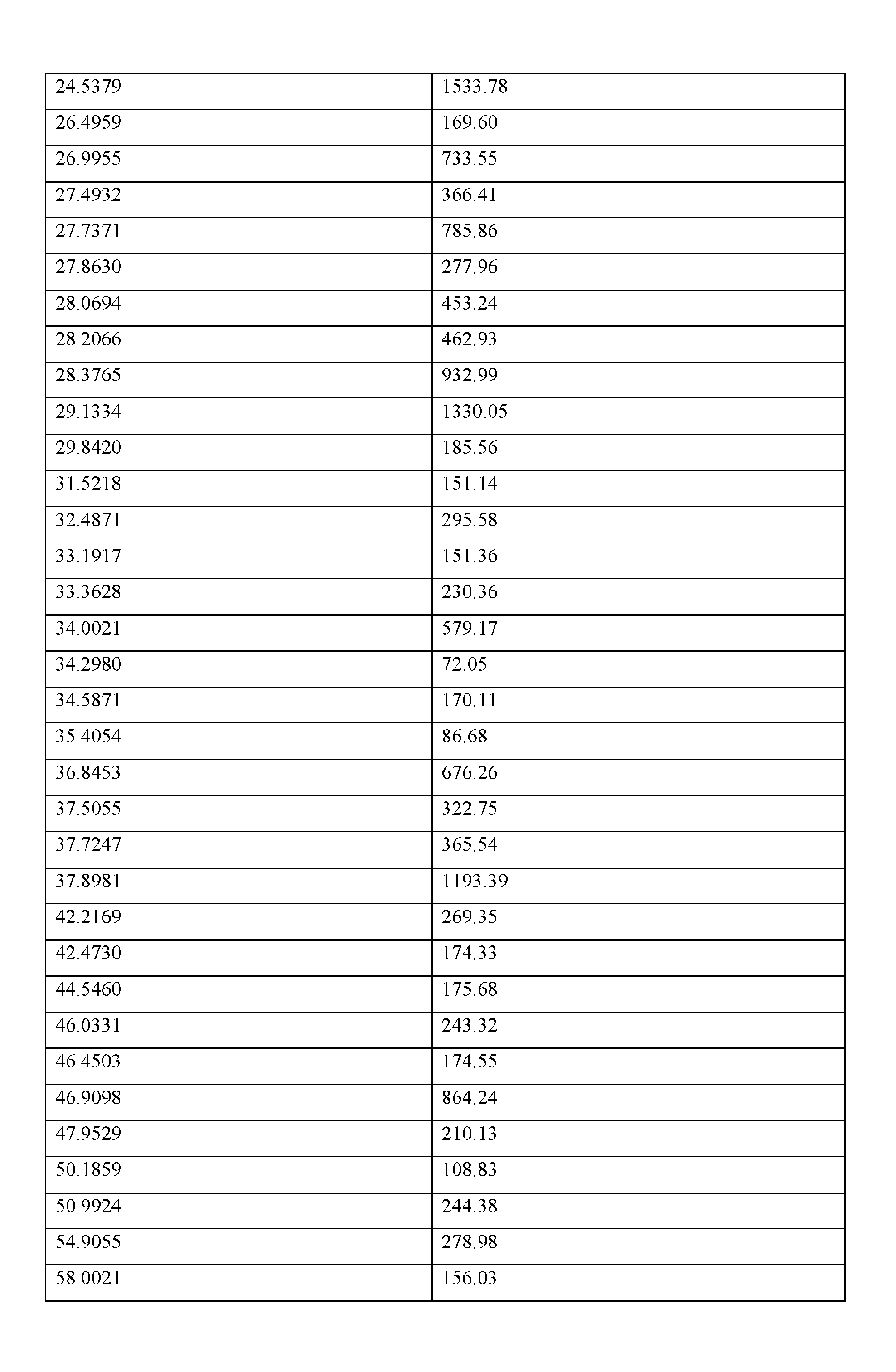
[0041] Provided herein are fluorination reagents and compositions, as well as methods of making and using such fluorination reagents and compositions. In some instances, such reagents and compositions are useful in producing fluorinated products in high yield and/or without the need for use of toxic reagents, such as HF.
[0042] In some embodiments, provided herein is a method of manufacturing a fluorination reagent. In specific embodiments, the method comprises (1) combining (e.g., in the solid state) a first salt with a second salt, the first salt comprising fluoride (e.g., and calcium); and (2) subjecting a combination of the first salt and the second salt to a (e.g., aqueous) fluid composition. In some embodiments, the resultant fluid composition is subsequently concentrated (e.g., by evaporation or other suitable method) to produce a fluorination reagent composition.
[0043] In certain embodiments, the fluorination reagent composition is further washed with a (e.g., organic) solvent (e.g., an alcohol, such as methanol) to produce a reagent wash. In specific embodiments a (e.g., purified) fluorination reagent composition is recovered from the reagent wash (e.g., after filtering residual solids from the reagent wash). In some embodiments, separating a purified fluorination reagent from residual solids and/or separating contaminants from a resultant solution can independently comprise: centrifugation (e.g., using a decanter centrifuge and/or a disk stack centrifuge), press filtration, microfiltration, nanofiltration, ultrafiltration, cross-flow membrane filtration and/or combinations thereof.
[0044] In some embodiments, crude fluorination reagents are purified at least in part using a filtration process. In some embodiments, a filtrate is concentrated and/or dried during any step or process of any method described herein. In some embodiments, the filtration process comprises passing any solution described herein through the same or a plurality of filtration modules a plurality of times (e.g., by making three or more consecutive passes through the same module and/or by passing once each through three consecutively coupled modules). In some embodiments, a fluorine recovery of a filtration process employed herein is greater than 90% (e.g., greater than 95% or greater than 99%). In some embodiments, a rejection of one or more contaminants by a filtration process employed in any method described herein is greater than 90% (e.g., greater than 95% or greater than 99%). In some embodiments, provided herein is a method of manufacturing a purified fluorination reagent, the method comprising: a. combining a first salt with a second salt to form a mixed composition, the first salt comprising calcium and fluoride; b. subjecting the mixed composition to a fluid composition (to produce a solid component and a resultant fluid) and collecting a resultant fluid thereof; c. concentrating the resultant fluid to produce a crude fluorination reagent (e.g., a reagent concentrate or precipitate); d. washing the crude fluorination reagent with a solvent (e.g., an alcohol) to produce a reagent wash (a second solid component and fluid reagent wash); and e. concentrating the reagent wash to form a purified fluorination reagent (e.g., the purified fluorination reagent having a higher concentration of fluorine compared to the crude fluorination reagent).
[0045] In specific embodiments, provided herein is a method of manufacturing a purified fluorination reagent, the method comprising: a. combining a first salt with a second salt to form a mixed composition, the first salt comprising calcium and fluoride; b. applying mechanical force to the mixed composition; c. subjecting the mixed composition to a fluid composition (to produce a solid component and a resultant fluid) and collecting a resultant fluid thereof; d. concentrating the resultant fluid to produce a crude fluorination reagent (e.g., a reagent concentrate or precipitate); e. washing the crude fluorination reagent with a solvent (e.g., an alcohol) to produce a reagent wash (a second solid component and fluid reagent wash); and f. concentrating the reagent wash to form a purified fluorination reagent (e.g., the purified fluorination reagent having a higher concentration of fluorine compared to the crude fluorination reagent).
[0046] In certain embodiments, provided herein are compositions or methods of providing (e.g., making, manufacturing, or the like) compositions comprising reagents or reagent compositions. In some embodiments, reagents or reagent compositions provided herein are high purity and/or low- phosphorous reagents or reagent compositions. In some embodiments, presence of high purity and/or low phosphorous (e.g., a purified fluorination reagent provided herein) allows for the use of a reagent or reagent composition that produces high yield fluorination (e.g., relative to otherwise similar reagents/compositions having lower purity and/or higher phosphorous content). In certain embodiments, reagent or reagent compositions provided herein provide an improved rate of fluorination (e.g., at least about 10% improved). In certain embodiments (e.g., purified) reagents or reagent compositions provided herein have a higher fluorine content compared to (e.g., crude) reagents or reagent compositions provided herein. In some embodiments (e.g., purified) reagents or reagent compositions provide a rate of fluorination of a starting reagent (e.g., aromatic compound) that is higher when compared to a rate of fluorination provided by a (e.g., crude) reagent or reagent composition provided herein.
[0047] In some embodiments, any reagent or reagent composition provided herein comprises a metal (e.g., alkali metal, alkaline earth metal). In certain embodiments, a reagent or reagent composition comprises an alkali metal. In specific embodiments, a reagent or reagent composition provided herein comprises an alkali metal (such as lithium, potassium, or sodium), fluoride, and (e.g., at least one additional) ion.
[0048] In certain embodiments, any composition provided herein comprises an ion (e.g., at least one additional ion herein). In some embodiments, a reagent (e.g., fluorination reagent, such as a purified fluorination reagent, or crude fluorination reagent) or (e.g., reagent) composition (e.g., any reagent or mixed composition, such as used in making of a reagent) provided herein comprises (e.g., at least one additional) ion. In specific embodiments, a reagent or reagent composition provided herein comprises at least one additional ion. In certain embodiments, a (e.g., salt or salt comprising a) composition provided herein comprises (e.g., at least one additional) ion. In specific embodiments, a (e.g., salt or salt comprising a) composition provided herein comprises at least one additional ion.
[0049] In some embodiments, an (e.g., at least one additional) ion provided herein comprises a cation, anion, and/or zwitterion. In some embodiments, an (e.g., at least one) cation provided herein comprises an alkali metal, alkaline earth metal, transition metal, other metal, cationic complex or ligand, or the like. In specific embodiments, an (e.g., at least one) cation provided herein is K+, Na+, Rb+, Ca2+, Mg2+, Fe2+, Fe3+, Cu+, Cu2+, Ag+, Li+, NH4 +, Sr+, Ba2+, Zn2+, Cd2+, Al3+, [Co(NH3)e]3+, Co3+, Co2+, U2+, U4+, U6+, Ni2+, and/or Cs+. In still more specific embodiments, (e.g., at least one) cation is K+, Na+, Ca2+, Li+, and/or Cs.+
[0050] In certain embodiments, an (e.g., at least one) anion provided herein comprises a hydroxide, a sulphate, a carbonate, a phosphate, a pyrophosphate, a halide, a chlorate, a nitrate, a carbonate, a hydride, a sulfite, or the like. In specific embodiments, an (e.g., at least one) anion provided herein is a hydroxide, a sulphate, a carbonate, a phosphate, and/or a pyrophosphate.
[0051] In certain embodiments, an (e.g., at least one) zwitterion provided herein comprises an amino acid, a betaine, sulfamic acid, an acid, an aromatic compound, and/or a phospholipid. In specific embodiments, an (e.g., at least one) zwitterion provided herein is an amino acid, trimethylglycine, cocamidopropyl betaine, sulfamic acid, anthranilic acid, psilocybin, and/or phosphatidylcholine. In still more specific embodiments, an (e.g., at least one) zwitterion provided herein is psilocybin. [0052] In certain embodiments, provided herein are reagents and reagent compositions with high purity and/or low levels of impurities (e.g., phosphorous, calcium, or the like). In some embodiments, high purity and low-content phosphorous allows for the use of a reagent or reagent composition that produces high-yield fluorination relative to other reagent or reagent compositions having low purity and/or higher phosphorous content. In certain embodiments, high purity and low-content calcium allows for the use of a reagent or reagent composition that produces high- yield fluorination relative to other reagent or reagent compositions having low purity and/or higher calcium content. In some instances, low-content calcium and/or phosphorous and high purity reagent or reagent compositions allow substantially improved fluorination capabilities.
[0053] In some embodiments, any reagent or reagent composition provided herein (and/or produced or used herein) comprises low-content phosphorus. In certain embodiments, any reagent or reagent composition provided herein (and/or produced or used herein) comprises phosphorous in an amount of about 0.015 % to about 12.5 % by weight (wt %) (w/w). In some embodiments, a reagent or reagent composition provided herein comprises phosphorous in an amount of about 0.015 % by weight (wt %) or more (e.g., about 0.05 wt % or more, about 0.1 wt % or more, about 0.5 wt % or more). In certain embodiments, a reagent or reagent composition provided herein comprises phosphorous in an amount of about 1 % by weight or less (e.g., about 1 wt % or less, about 0.5 wt% or less, about 0.1 wt% or less, about 0.05 wt % or less).
[0054] In some embodiments, a reagent or reagent composition provided herein comprises phosphorous in an amount of about 0.05 % to about 10 wt % (e.g., about 0.1 wt % to about 6 wt %, about 0.5 wt% to about 5 wt %, about 1 wt% to about 4 wt %). In certain embodiments, a reagent or reagent composition provided herein comprises phosphorous in an amount of about 5 wt % or less (e.g., about 3 wt % or less, about 2 wt % or less, about 1 wt % or less, about 0.5 wt % or less, about 0.1 wt % or less).
[0055] In specific embodiments, a reagent or reagent composition provided herein comprises phosphorous in an amount of about 0.05 wt % to about 0.2 wt %.
[0056] In some embodiments, any reagent or reagent composition provided herein (and/or produced or used herein) comprises low-content calcium. In certain embodiments, any reagent or reagent composition provided herein (and/or produced or used herein) comprises calcium in an amount of about 0.01 % to about 15 % by weight (wt %) (w/w). In some embodiments, a reagent or reagent composition provided herein comprises calcium in an amount of about 0.01 % by weight (wt %) or more (e.g., about 0.05 wt % or more, about 0.1 wt% or more, about 0.5 wt % or more, about 1 wt % or more). In certain embodiments, a reagent or reagent composition provided herein comprises calcium in an amount of about 2 % by weight or less (e.g., about 1 wt% or less, about 0.5 wt% or less, about 0.1 wt % or less, about 0.05 wt% or less). [0057] In some embodiments, a reagent or reagent composition provided herein comprises calcium in an amount of about 0.05 wt % to about 12 wt % (e.g., about 0.1 wt % to about 8 wt %, about 0.5 wt % to about 4 wt %). In certain embodiments, a reagent or reagent composition provided herein comprises calcium in an amount of about 6 wt % or less (e.g., about 4 wt % or less, about 2 wt % or less, about 1 wt % or less, about 0.5 wt % or less, about 0.1 wt % or less, about 0.05 wt % or less).
[0058] In specific embodiments, a reagent or reagent composition provided herein comprises calcium in an amount of about 0.01 % to about 0.05 wt %.
[0059] In certain embodiments, a powder x-ray diffraction spectrum of a reagent or reagent composition provided herein comprises characteristic 29 reflections at about 5.2°. In some embodiments, a powder x-ray diffraction spectrum of a reagent or reagent composition provided herein comprises characteristic 29 reflections at 5.2°, 31.5°, and/or 36.8°. In certain embodiments, a powder x-ray diffraction spectrum of a reagent or reagent composition provided herein may further comprise peaks corresponding ±9.2°29 to one or more 2-theta values from Tables 5, 6A, 8, 9, 12, 14-18, 29, 21, 23, and/or 25-28. In specific embodiments, a powder x-ray diffraction spectrum of a reagent or reagent composition provided herein comprises characteristic 29 reflections at 5.2°, 31.5°, and 36.8°.
[0060] In certain embodiments, any reagent or reagent composition provided herein comprises high-content fluorine. In some embodiments, fluorine conversion (or F conversion) refers to a relative proportion or percentage (%) of fluorine from a (e.g., first) salt or salt composition provided herein that is converted to a reagent or reagent composition provided herein. In some embodiments, about 19 % to about 89 % of fluorine from a (e.g., first) salt or salt composition provided herein is converted into a (e.g., fluorination) reagent or reagent composition provided herein. In specific embodiments, about 39% to about 69% of fluorine from a (e.g., first) salt or salt composition provided herein is converted into a (e.g., fluorination) reagent or reagent composition provided herein.
[0061] In certain embodiments, Fluorine wt% or F wt% refers to fluorine content by weight in a reagent or reagent composition provided herein. In certain embodiments, Fluorine wt% or F wt% is measured by any suitable method (e.g., quantitative 19F NMR). In some embodiments, a weight % of fluorine (F wt%) in a (e.g., fluorination) reagent or reagent composition provided herein is about 8% to about 75% (e.g., about 19% to about 79%, about 29% to about 69%, about 39% to about 59%, about 45% to about 55%). In specific embodiments, a weight % of fluorine (F wt%) in a (e.g., fluorination) reagent or reagent composition provided herein is about 29% or more (e.g., about 39% or more, about 49% or more, about 59% or more, about 69% or more, about 79% or more). In still more specific embodiments, a weight % of fluorine (F wt%) in a (e.g., fluorination) reagent or reagent composition provided herein is about 75% or less.
[0062] In certain embodiments, a (e.g., fluorination) reagent or reagent composition provided herein can be characterized by X-ray powder diffraction (XRPD) using Cu Kai (X = 1.5406 A) and/or Cu Ka2 (X = 1.5444 A). Due to differences in instruments, samples, and sample preparation, peak values are often reported with the modifier "±0.2°29". This is common practice in the solid- state chemical arts because of the variation inherent in peak values.
[0063] In certain embodiments, a (e.g., fluorination) reagent or reagent composition provided herein can have an XRPD pattern comprising peaks corresponding ±0.2°29 to at least 1, at least 2, at least 3, at least 5, at least 10, at least 20, at least 50, and/or at least 70 of the 2-theta values reported in any one of Tables 5, 6A, 8, 9, 12, 15-18, 20, 21, 23, 25-28 provided herein. In some embodiments, a (e.g., fluorination) reagent or reagent composition provided herein can have an XRPD pattern comprising peaks corresponding ±0.2°29 to at least 10%, at least 30%, at least 50%, at least 70%, at least 90%, and/or 100% of the 2-theta values reported in any one of Tables 5, 6A, 8, 9, 12, 15-18, 20, 21, 23, 25-28 provided herein. In specific embodiments, a (e.g., fluorination) reagent or reagent composition provided herein can have an XRPD pattern comprising peaks corresponding ±0.2°29 to at least 30% of the 502-theta values reported in Table 5 provided herein (the (e.g., fluorination) reagent or reagent composition may have an XRPD pattern comprising peaks corresponding to at least 15 of the 2-theta values, modified ±0.2°29, in Table 5).
[0064] Table 5 illustrates X-ray powder diffraction using Cu Kai (X = 1.5406 A) and/or Cu Ka2 ( = 1.5444 A) for a (e.g., fluorination) reagent or reagent composition provided herein (e.g., mixed composition C as provided herein in Example 3B).
[0065] In certain embodiments a method provided herein comprises combining a first salt and a second salt.
[0066] In some embodiments, a first salt provided herein comprises fluoride. In specific embodiments, the first salt comprises calcium and fluoride. In some embodiments, the first salt further comprises additional ions, such as cations and/or anions provided herein. In specific embodiments, the first salt comprises CaF2, CasfPO^F, and/or combinations thereof.
[0067] In some embodiments, the first salt or composition comprising the first salt comprises fluoride. In specific embodiments, the first salt or composition comprising the first salt comprises calcium and fluoride. In some embodiments, the first salt or composition comprising the first salt further comprises additional ions, such as cations and/or anions provided herein. In specific embodiments, the first salt or composition comprising the first salt comprises CaF2, CasfPO^F, and/or combinations thereof. [0068] In some embodiments, a first salt (e.g., a first salt provided herein) or a composition comprising a first salt provided herein is sourced from a material with low-value, low-purity, such as a waste material. In specific embodiments, the first salt provided herein is sourced from a waste material (e.g., calcium fluoride). In yet more specific embodiments, a composition comprising the first salt provided herein is sourced from a waste material. In certain embodiments, provided herein are methods for manufacturing reagents or reagent composition with waste materials. In some embodiments, a waste material (e.g., a waste material provided herein) comprises a raw, processed, and/or treated waste material. In certain embodiments, a waste material provided herein is a (e.g., recovered) waste product (e.g., sourced from an industrial process). In some embodiments, a waste material herein is a (e.g., recovered) waste product from an industrial process such as semiconductor manufacturing, fluorochemical manufacturing, pharmaceutical manufacturing, or the like. In certain embodiments, a waste material provided herein comprises fluorine (or a fluorinated salt), fluorapatite, calcium fluoride (e.g., in low purity), CFC-12, per- and polyfluoroalkyl substances (PF As), or the like. In specific embodiments, a waste material provided herein comprises fluorine, or a fluorinated salt (e.g., in low purity). In yet more specific embodiments, a waste material provided herein comprises fluorine and calcium (e.g., in low purity). In certain instances, a waste material provided herein may be used as a raw, processed, or treated waste material to provide reagent or reagent compositions provided herein.
[0069] In certain embodiments, the first salt or composition comprising the first salt comprises calcium and fluoride in a collective amount of about 20% or less. In some embodiments, the first salt or composition comprising the first salt comprises calcium and fluoride in a collective amount of about 30% or less. In certain embodiments, the first salt or composition comprising the first salt comprises calcium and fluoride in a collective amount of about 40% or less. In certain embodiments, the first salt or composition comprising the first salt comprises calcium and fluoride in a collective amount of about 50% or less. In some embodiments, the first salt or composition comprising the first salt comprises calcium and fluoride in a collective amount of about 60% or less. In some embodiments, the first salt or composition comprising the first salt comprises calcium and fluoride in a collective amount of about 70% or less. In some embodiments, the first salt or composition comprising the first salt comprises calcium and fluoride in a collective amount of about 80% or less.
[0070] In certain embodiments, the first salt comprises calcium and fluoride in a collective amount of about 20% or less. In some embodiments, the first salt comprises calcium and fluoride in a collective amount of about 30% or less. In certain embodiments, the first salt comprises calcium and fluoride in a collective amount of about 40% or less. In certain embodiments, the first salt comprises calcium and fluoride in a collective amount of about 50% or less. In some embodiments, the first salt comprises calcium and fluoride in a collective amount of about 60% or less. In some embodiments, the first salt comprises calcium and fluoride in a collective amount of about 70% or less. In some embodiments, the first salt comprises calcium and fluoride in a collective amount of about 80% or less.
[0071] In some embodiments, a second salt (e.g., a second salt provided) herein comprises a metal, such as an alkali metal or an alkaline earth metal. In certain embodiments, the second salt comprises a metal (e.g., an alkali metal or an alkaline earth metal) and an anion (e.g., such as a phosphate, hydroxide, sulphate, carbonate, and/or sulphite). In some embodiments, the second salt comprises sodium, lithium, cesium, potassium, and/or combinations thereof. In certain embodiments, the second salt further comprises phosphate (e.g., such as an inorganic phosphate or a pyrophosphate), hydroxide, carbonate, sulphite, and/or a sulphate. In specific embodiments, the second salt is NaOH, Na2SO3, K2SO3, KOH, KHSO4, K2HPO4, KH2PO4, K3PO4, Na3PO4, Li3PO4, K2CO3, Na2CO3, NaHCOs, CS2CO3, K2SO4, KPO3, K5P3O10, K4P2O7, Na4P2O7, titanium phosphate, aluminum phosphate, uranium phosphate, and/or combinations of one or more thereof. In some embodiments, the second salt further comprises additional ions, such as cations and/or anions provided herein.
[0072] In some embodiments, the second salt or composition comprising the second salt comprises a metal, such as an alkali metal or an alkaline earth metal. In certain embodiments, the second salt or composition comprising the second salt comprises a metal (e.g., an alkali metal or an alkaline earth metal) and an anion (e.g., such as a phosphate, hydroxide, sulphate, carbonate, and/or sulphite). In some embodiments, the second salt or composition comprising the second salt comprises sodium, lithium, cesium, potassium, and/or combinations thereof. In certain embodiments, the second salt further comprises phosphate (e.g., such as an inorganic phosphate or a pyrophosphate), hydroxide, carbonate, sulphite, and/or a sulphate. In specific embodiments, the second salt or composition comprising the second salt is NaOH, Na2SO3, K2SO3, KOH, KHSO4, K2HPO4, KH2PO4, K3PO4, Na3PO4, IJ3PO4, K2CO3, Na2CO3, NaHCO3, Cs2CO3 , K2SO4, KPO3, K5P3O10, K4P2O7, Na4P2O7, titanium phosphate, aluminum phosphate, uranium phosphate, and/or combinations of one or more thereof. In some embodiments, the second salt or composition comprising the second salt further comprises additional ions, such as cations and/or anions provided herein.
[0073] In some embodiments, provided herein is a composition or a method comprising combining a first salt (or a composition comprising the first salt) and a second salt (or a composition comprising the second salt) (e.g., a first salt or a second salt provided herein). In certain embodiments, a ratio of a first ion in a first salt (or a composition comprising the first salt) provided herein to a second ion in a second salt (or a composition comprising the second salt) provided herein is about 0.1 :5 to about 5:0.1. In specific embodiments, a ratio of the first ion in the first salt (or a composition comprising the first salt) to the second ion in the second salt (or a composition comprising the second salt) is about 1 : 1. In yet more specific embodiments, a ratio of the first ion in the first salt (or a composition comprising the first salt) to the second ion in the second salt (or a composition comprising the second salt) is about 1 :2.
[0074] In certain embodiments, the first salt (or a composition comprising the first salt) and the second salt (or a composition comprising the second salt) of any method provided herein are combined in any suitable manner (e.g., thereby providing a mixed composition described herein). In some embodiments, both the first salt (or a composition comprising the first salt) and the second salt (or a composition comprising the second salt) are combined as solids. In specific embodiments, the first salt (or a composition comprising the first salt) and the second salt (or a composition comprising the second salt) are combined to form a solid salt combination. In some embodiments, a method provided herein comprises applying a mechanical force to a mixed composition provided herein (e.g., comprising the first salt or a composition comprising the first salt and the second salt or a composition comprising the second salt). In specific embodiments, any suitable mechanical force provide herein is used.
[0075] In certain embodiments, a (e.g., mixed) composition provided herein comprises a first salt. In specific embodiments, the first salt comprises fluoride. In specific embodiments, the first salt comprises calcium and fluoride. In certain embodiments, a (e.g., mixed) composition provided herein comprises a second salt.
[0076] In certain embodiments, a mechanical force (e.g., a mechanical force provided herein) comprises any suitable mechanical force, such as by using a ball mill, a planetary mill, a mortar and pestle, a twin-screw-extruder, an attritor, a drum mill, an ultrasonic bath, a mechanical press, and/or combinations of one or more thereof. In certain embodiments, a mechanical force is applied using a high-shear mixer, an in-line homogenizer, one or more bead mills, and/or combinations thereof. In certain embodiments, mechanical force provided herein is provided with a ball mill. In some embodiments, mechanical force is applied by increasing a pressure within a sealed vessel (e.g., to greater than 100, 200, or 2000 kPa). In some embodiments, a ball mill provided herein comprises ajar and balls (e.g., with a weight of about 1 g to about 20 g). In certain embodiments, a first (e.g., salt) composition provided herein and a second (e.g., salt) composition provided herein are combined in ajar and balls are added. In some embodiments, mechanical force provided herein is provided with a twin screw-extruder, such as by extruding a combination of (e.g., salt) compositions provided herein at varying screw speeds, screw temperatures, residence times, or the like. A twin screw-extruder provided herein is fixed with a gravimetric single screw feeder (e.g., hopper) for programmed addition of (e.g., salt) compositions provided herein. [0077] In specific embodiments, mechanical force is applied under any suitable condition, such as at a selected or varying frequency, time, temperature, cycles, or the like. In some embodiments, a mechanical force provided herein is applied at a frequency of about 0.5 Hz to about 60 kHz (e.g., about 10 Hz to about 20 kHz). In certain embodiments, a mechanical force provided herein is applied at a frequency of about 5 Hz or more (e.g., about 10 Hz or more, about 20 Hz or more, about 30 Hz or more). In specific embodiments, a mechanical force provided herein is applied at about 35 Hz. In certain embodiments, a mechanical force provided herein is applied for about 1 cycle to about 50 cycles (e.g., about 5 to about 40 cycles, about 10 to about 30 cycles). In some embodiments, a mechanical force provided herein is applied for 1 cycle or more. In specific embodiments, a mechanical force provided herein is applied for 10 cycles. In some embodiments, mechanical force is applied to one or more compositions in solution-phase. In some embodiments, mechanical force is applied to one or more compositions in solid-phase.
[0078] In certain embodiments, mechanical force provided herein is applied at a temperature of about 20 to about 300 ° C (e.g., about 50 to about 250 ° C, about 100 to about 200 ° C). In some embodiments, mechanical force provided herein is applied at a temperature of about 20 ° C or more (e.g., about 50 ° C or more, about 100 ° C or more, about 150 ° C or more). In some embodiments, the reaction mixture is refluxed at a reaction temperature. In some embodiments, the reaction temperature and/or a reflux temperature is about 100 to about 175 °C. In some embodiments, the reaction mixture is stirred in a pressure vessel. In some embodiments, the reaction is performed in a heated twin-screw extruder. In specific embodiments, mechanical force provided herein is applied at a temperature of about 25 ° C (e.g., at room temperature).
[0079] In certain embodiments, a mechanical force provided herein is applied for about 5 minutes to about 3 hours (e.g., about 10 minutes to about 2.5 hours, about 20 minutes to about 2 hours, about 30 minutes to about 1.5 hours). In some embodiments, a mechanical force provided herein is applied for about 5 minutes or more (e.g., about 15 minutes or more, about 30 minutes or more, about 45 minutes or more, about 1 hour or more, about 2 hours or more). In specific embodiments, mechanical force provided herein is applied for about 45 minutes.
[0080] In some instances, varying time, frequency, temperature, and/or the like of a mechanical force (e.g., a mechanical force provided herein) provides high yields of a reagent (e.g., fluorination reagent, such as a purified fluorination reagent, or crude fluorination reagent) or (e.g., reagent) composition (e.g., any reagent or mixed composition, such as used in making of a reagent) provided herein.
[0081] In certain embodiments, a method provided herein comprises combining a first composition and a second composition, the first composition comprising a first salt and the second composition comprising a second salt. In more specific embodiments, the first and/or the second composition is a waste material provided herein (e.g., raw, processed, or treated waste material).
[0082] In some embodiments, provided herein is a composition or a method comprising subjecting a (e.g., mixed) composition to a (e.g., fluid) composition. In certain embodiments, the (e.g., mixed) composition of any method provided herein is subjected to a (e.g., fluid) composition (e.g., thereby forming a reagent or reagent composition, such as described herein). In some embodiments, the (e.g., mixed) composition is subjected to a (e.g., fluid) composition under any suitable conditions, such as at any selected temperature, with any selected volume of fluid composition, with stirring or other agitation, at any selected pH (e.g., using a buffer), for any selected period of time, or the like.
[0083] In certain embodiments, an (e.g., fluid) composition provided herein comprises any suitable solvent. In specific embodiments, a fluid composition (e.g., a fluid composition provided herein) comprises a solvent. In certain embodiments, a fluid composition provided herein comprises any suitable solvent (e.g., water or an organic solvent). In specific embodiments, a fluid composition provided herein comprises a solvent (e.g., water).
[0084] In some embodiments, a solvent (e.g., a solvent provided herein) is any suitable solvent, such as a polar aprotic solvent, water, an alcohol, a halocarbon and/or a combination thereof. In certain embodiments, a solvent provided herein is acetonitrile, propionitrile, butyronitrile, toluene, 1,2-di chlorobenzene, chlorobenzene, fluorobenzene, 1,2-difluorobenzene, di chloroethane, trifluorotoluene, chloroform, sulfolane, DMF, DMSO, tert-butanol, tert-amyl alcohol, water, and/or combinations thereof.
[0085] In some embodiments, a solvent provided herein is selected according to its characteristics, such as boiling point, ability to solubilize a composition provided herein, polarity, pH, or the like. [0086] In certain embodiments, a solvent provided herein has a boiling point of about 30 °C or more. In some embodiments, a solvent provided herein has a boiling point of about 70 °C or more. In certain embodiments, a solvent or (e.g., fluid) composition provided herein has a boiling point of about 120 °C or more. In some embodiments, a solvent or (e.g., fluid) composition provided herein has a boiling point of about 240 °C or less.
[0087] In some embodiments, a (e.g., mixed) composition provided herein is subjected to a (e.g., fluid) composition provided herein for about 0 to about 8 hours. In certain embodiments, a (e.g., mixed) composition is subjected to a (e.g., fluid) composition for about 1 hour or more. In some embodiments, a (e.g., mixed) composition is subjected to a (e.g., fluid) composition for about 6 hours or less. In specific embodiments, a (e.g., mixed) composition is subjected to a (e.g., fluid) composition for about 2 hours. [0088] In certain embodiments, a combination of a (e.g., mixed) composition provided herein and a (e.g., fluid) composition provided herein is at a temperature of about 0 to about 120 °C. In some embodiments, a combination of a (e.g., mixed) composition and a (e.g., fluid) composition is at a temperature of about 80 °C or more. In certain embodiments, a combination of a (e.g., mixed) composition and a (e.g., fluid) composition is at a temperature of about 110 °C or less. In certain instances, the selected temperature of a combination of a (e.g., mixed) composition and (e.g., fluid) composition provided herein increases a yield of a reagent or reagent composition provided herein. [0089] In certain embodiments, a (e.g., mixed) composition provided herein is subjected to a (e.g., fluid) composition at a selected pH of about 3 to about 12. In some embodiments, pH of a (e.g., fluid) composition provided herein can be modified in any suitable manner (e.g., by using a buffer). In certain embodiments, the selected pH is about 4 or more. In some embodiments, the selected pH is about 7 or more. In certain embodiments, the selected pH is about 10 or more.
[0090] In certain embodiments, a (e.g., mixed) composition of any method provided herein is subjected to a (e.g., fluid) composition provided herein, thereby forming a resultant fluid (e.g., comprising a (e.g., crude) reagent or reagent composition that can be further purified to provide a (e.g., purified reagent or reagent composition) and a washed (e.g., mixed) composition. In some embodiments, the washed (e.g., mixed) composition is a solid. In certain embodiments, the resultant fluid comprises a reagent or reagent composition, such as described herein. In specific embodiments, the resultant fluid comprises a crude reagent or reagent composition provided herein.
[0091] In certain embodiments, a method provided herein comprises adjusting pH (e.g., by any suitable means) of a (e.g., resultant) fluid described herein. In some embodiments, the pH of a resultant fluid of any method provided herein is adjusted (e.g., using an acid, base, and/or buffer). [0092] In certain embodiments, pH of a resultant fluid provided herein is adjusted to a pH of about 5 to about 10. In some embodiments, pH of a resultant fluid is adjusted to a pH of about 6 to about 9. In certain embodiments, pH of a resultant fluid is adjusted to a pH of about 6 to about 8 (e.g., thereby neutralizing the resultant fluid). In certain embodiments, a pH of a resultant fluid is adjusted based on a presence of an alkaline impurity in the first salt (e.g., to a pH of about 6). In certain embodiments, a pH of the resultant fluid is adjusted to a pH compatible with one or more downstream processes of a method described herein (e.g., a pH may be adjusted to about 7, about 8, or about 9 for a process requiring neutral or mildly basic solutions, such as when using a pH sensitive filtration media). In some cases, the pH of the resultant fluid is adjusted for compatibility with and/or separation on one or more ion exchange columns. [0093] In some embodiments, pH of a resultant fluid provided herein is adjusted to a pH of about 8 to about 14. In certain embodiments, pH of a resultant fluid is adjusted to a pH of about 12 to about 13.
[0094] In certain embodiments, pH of a (e.g., resultant) fluid provided herein is adjusted with any suitable acid or base. In some embodiments, pH of a resultant fluid is adjusted (e.g., neutralized) with a (e.g., polyprotic) acid. In specific embodiments, a resultant fluid described herein is neutralized.
[0095] In certain embodiments, an acid (e.g., an acid provided herein) is any suitable acid, such as a strong acid, a weak acid, a polyprotic acid, and/or a combination thereof. In some embodiments, an acid provided herein is phosphoric acid, hydrochloric acid, formic acid, acetic acid, sulfuric acid, sulfurous acid, carbonic acid, benzoic acid, boric acid, silicic acid, oxalic acid, and/or a combination thereof. In certain embodiments, use of polyprotic acids (e.g., phosphoric acid) provided herein avoids releasing additional anions.
[0096] In certain embodiments, a base (e.g., a base provided herein) is any suitable base, such as a strong base, a weak base, an organic base, or the like. In some embodiments, a base provided herein comprises a hydroxide, an amine, ammonia, a pyridine, and/or a combination thereof. In certain embodiments, a base provided herein is NaOH, KOH, or LiOH. In specific embodiments, a base provided herein is KOH.
[0097] In certain embodiments, the washed (e.g., mixed) composition comprises a salt (e.g., a first salt as described herein). In some embodiments, a method provided herein comprises combining the washed (e.g., mixed) composition and a second salt as provided herein (e.g., thereby forming a mixed composition described herein). In specific embodiments, a mixed composition provided herein comprises the washed (e.g., mixed) composition. In certain embodiments, a washed (e.g, mixed) composition described herein is provided as a first salt provided herein (e.g., thereby providing for sustainable manufacturing of a reagent or reagent composition described herein). In some instances, providing a washed (e.g., mixed) composition described herein as the first salt in methods and compositions described herein provides for sustainable manufacturing of reagents or reagent compositions. In certain instances, providing a washed (e.g., mixed) composition described herein as the first salt in methods and compositions described herein reduces the cost of waste disposal and/or the cost manufacturing a reagent or reagent composition provided herein.
[0098] In certain embodiments, provided herein is a composition or a method comprising concentrating a resultant fluid described herein (e.g., thereby forming a reagent or reagent composition, such as described herein). In some embodiments, a resultant fluid provided herein is concentrated by any suitable method and/or to any suitable endpoint provided herein. In certain embodiments, concentrating a resultant fluid described herein provides a (e.g., crude) reagent or reagent composition (e.g., a reagent concentrate or precipitate). In specific embodiments, concentrating a resultant fluid described herein provides a crude reagent or reagent composition (e.g., a reagent concentrate or precipitate). In yet more specific embodiments, the (e.g., crude) reagent or reagent composition is useful for fluorinating an organic compound provided herein (e.g., a starting reagent).
[0099] In certain embodiments, any suitable concentration method is used, such as by drying, lyophilizing, evaporating (e.g., using a rotary evaporator), distilling, or the like. In some embodiments, any fluid or wash provided herein is concentrated to any suitable endpoint (e.g., by about 10% or more). In specific embodiments, a resultant fluid described herein is concentrated by drying, evaporation, and/or a combination thereof. In still more specific embodiments, a resultant fluid described herein is concentrated under reduced pressure. In yet more specific embodiments, a resultant fluid described herein is concentrated under reduced pressure thereby providing a (e.g., crude) reagent or reagent composition provided herein.
[0100] In some embodiments, alternate concentration methods may be performed prior to, during, after, or in place of drying, lyophilizing, evaporating, distilling or the like. In some embodiments, alternate concentration methods comprise reverse osmosis, ultra-high pressure reverse osmosis, falling film evaporation, agitated thin film evaporation, spray-drying, and/or any combination of two or more thereof (e.g., up to, and including, a combination of all methods thereof).
[0101] In some embodiments, provided herein is a composition or a method comprising washing a (e.g., crude) reagent or reagent composition with a (e.g., solvent) composition. In certain embodiments, a (e.g., solvent) composition is any suitable solvent. In some embodiments, a (e.g., solvent) composition is any (e.g., organic) solvent provided herein. In certain embodiments, the (e.g., crude) reagent or reagent composition of any method provided herein is washed with a (e.g., organic) solvent (e.g., thereby forming a reagent or reagent composition, such as described herein). In some embodiments, a (e.g., crude) reagent or reagent composition provided herein is washed with a (e.g., organic) solvent under any suitable conditions, such as at a targeted temperature, with any selected volume of fluid composition, with stirring or other agitation, at any selected pH (e.g., using a buffer), at any selected temperature, for any selected period of time, or the like. In specific embodiments, a (e.g., crude) reagent or reagent composition provided herein is washed with an organic solvent (e.g., an alcohol).
[0102] In some embodiments, a (e.g., crude) reagent or reagent composition provided herein is washed with a (e.g., organic) solvent for about 4 hours to about 48 hours. In certain embodiments, a (e.g., crude) reagent or reagent composition provided herein is washed with a (e.g., organic) solvent for about 8 hours to about 36 hours. In some embodiments, a (e.g., crude) reagent or reagent composition provided herein is washed with a (e.g., organic) solvent for about 10 hours to about 28 hours. In certain embodiments, a (e.g., crude) reagent or reagent composition provided herein is washed with a (e.g., organic) solvent for 8 hours or more. In some embodiments, a (e.g., crude) reagent or reagent composition provided herein is washed with a (e.g., organic) solvent for 36 hours or less. In specific embodiments, a (e.g., crude) reagent or reagent composition provided herein is washed with a (e.g., organic) solvent for about 18 hours.
[0103] In certain embodiments, a combination of a (e.g., crude) reagent or reagent composition provided herein and a (e.g., organic) solvent is at a temperature of about -20 to about 240 °C. In some embodiments, a combination of the (e.g., crude) reagent or reagent composition and the (e.g., organic) solvent is at a temperature of about 80 °C or more. In certain embodiments, a combination of the (e.g., crude) reagent or reagent composition and the (e.g., organic) solvent is at a temperature of about 235 °C or less.
[0104] In some embodiments, a (e.g., crude) reagent or reagent composition of any method provided herein is washed with a (e.g., organic) solvent described herein, thereby providing a reagent wash (e.g., a fluid reagent wash) and a washed (e.g., reagent) composition. In certain embodiments, a (e.g., crude) reagent or reagent composition of any method provided herein is washed with a (e.g., organic) solvent, thereby providing a reagent wash (e.g., comprising a (e.g., purified) reagent or reagent composition). In some embodiments, the (e.g., fluid) reagent wash comprises a reagent or reagent composition, such as described herein. In specific embodiments, the (e.g., fluid) reagent wash comprises a purified reagent or reagent composition provided herein. [0105] In certain embodiments, provided herein is a composition or a method comprising concentrating a (e.g., fluid) reagent wash described herein (e.g., thereby forming a reagent or reagent composition, such as described herein). In some embodiments, a (e.g., fluid) reagent wash provided herein is concentrated by any suitable method and/or to any suitable endpoint provided herein. In certain embodiments, concentrating (e.g., fluid) reagent wash provided herein provides and/or produces a (e.g., purified) reagent or reagent composition (e.g., a reagent wash concentrate or reagent precipitate). In specific embodiments, the (e.g., purified) reagent or reagent composition is useful for fluorinating an organic compound provided herein (e.g., a starting reagent).
[0106] In certain embodiments, a reagent or reagent composition provided herein is activated, whereby the reagent or reagent composition comprises an (e.g., fluorination) reagent or reagent composition that can be used to fluorinate a starting reagent (e.g., organic compound) in that form. In some embodiments, any reagent or reagent composition provided herein comprises a fluorination reagent or reagent composition. In specific embodiments, an (e.g., crude) reagent or reagent composition provided herein comprises a fluorination reagent or reagent composition provided herein. In yet more specific embodiments, a (e.g., purified) reagent or reagent composition provided herein comprises a fluorination reagent or reagent composition provided herein.
[0107] In certain embodiments, provided herein is a method for fluorinating a starting reagent (e.g., organic compound). In some embodiments, a starting reagent (e.g., a starting reagent provided herein) is an organic compound. In specific embodiments, a starting reagent provided herein is an aromatic organic compound. In certain embodiments, starting reagents provided herein comprise a leaving group (e.g., chlorine, iodine, bromine, nitro). In specific embodiments, a leaving group of a starting reagent provided herein is chlorine. In still more specific embodiments, a leaving group of a starting reagent is nitro. In some embodiments, a starting reagent (e.g., a starting reagent provided herein) comprises an aliphatic and/or or an aromatic organic compound substituted with one or more halogens selected from the group of Cl, Br, and I, or the like. In certain embodiments the starting reagent comprises a haloaromatic (e.g., chloroaromatic), haloalkyl compound (e.g., monohaloalkyl compound, dihaloalkyl compound, trihaloalkyl compound), chlorobenzene, haloheteroaromatics, wherein each compound may be optionally substituted with an electron withdrawing group (e.g., CN, nitro, or the like). In some embodiments, a starting reagent provided herein is l-chloro-4-nitrobenzene, l,2-dichloro-4-nitrobenzene, l,2-dichloro-4-nitrobenzene, 1- chl oro-2, 4-dinitrobenzene, 1,4-di chi oro-2 -nitrobenzene, 2-chloro-5-nitropyridine, 2- chloronicotinonitrile, 2,3,5,6-tetrachloroterephthalonitrile, 2,6-dichlorobenzonitrile, pentachloropyridine, 2,3,5,6-tetrachloro-4-fluoropyridine, 2,4,6-trichloro-l,3,5-triazine, 1,3- dinitrobenzene, and/or 2,4-dichloro-l -nitrobenzene.
[0108] In some instances, a reagent or reagent composition provided herein is used to fluorinate starting reagents provided herein to provide high value, high yield fluorinated reagents without the use of toxic chemicals such as HF.
[0109] In certain embodiments, provided herein is a composition or a method comprising contacting a starting reagent provided herein with a reagent or reagent composition described herein (e.g., thereby fluorinating the starting reagent and providing a fluorinated product). In some embodiments, a starting reagent provided herein contacted with a reagent or reagent composition provided herein provides a fluorinated (e.g., organic) compound (e.g., a fluorinated product provided herein). In some embodiments, the starting reagent is contacted with the reagent or reagent composition under any suitable conditions, such as at any selected temperature, with stirring or other agitation, at any selected pH, for any selected period of time, or the like.
[0110] In certain embodiments, a combination of the (e.g., fluorination) reagent or reagent composition and the starting reagent is at a temperature of about 50 to about 200 °C. In some embodiments, a combination of the (e.g., fluorination) reagent or reagent composition and the starting reagent is at a temperature of about 50 °C or more. In certain embodiments, a combination of the (e.g., fluorination) reagent or reagent composition and the starting reagent is at a temperature of about 70 °C or more. In some embodiments, a combination of the (e.g., fluorination) reagent or reagent composition and the starting reagent is at a temperature of about 110 °C or more. In certain embodiments, a combination of the (e.g., fluorination) reagent or reagent composition and the starting reagent is at a temperature of about 140 °C or more. In specific embodiments, a combination of the (e.g., fluorination) reagent or reagent composition and the starting reagent is at a temperature of about 80 °C. In still more specific embodiments, a combination of the (e.g., fluorination) reagent or reagent composition and the starting reagent is at a temperature of about 150 °C. In yet more specific embodiments, a combination of the (e.g., fluorination) reagent or reagent composition and the starting reagent is at a temperature of about 120 °C.
[OHl] In certain embodiments, the starting reagent is contacted with the (e.g., fluorination) reagent or reagent composition for about 1 hour to about 36 hours (e.g., about 2 hours to about 6 hours, about 12 hours to about 24 hours). In some embodiments, the starting reagent is contacted with the (e.g., fluorination) reagent or reagent composition for about 24 hours or less (e.g., about 12 hours or less, about 6 hours or less). In certain embodiments, the starting reagent is contacted with the (e.g., fluorination) reagent or reagent composition for about 1 hour or more (e.g., about 2 hours or more, about 16 hours or more). In specific embodiments, the starting reagent is contacted with the (e.g., fluorination) reagent or reagent composition for about 3 hours. In yet more specific embodiments, the starting reagent is contacted with the (e.g., fluorination) reagent or reagent composition for about 18 hours.
[0112] In certain embodiments, an amount of a reagent or reagent composition contacted with a starting reagent is calculated based at least in part on a number of fluorine atoms to be added to a starting reagent to yield a resulting fluorinated compound (e.g., a fluorinated product provided herein). In some embodiments, the amount of the (e.g., fluorination) reagent or reagent composition provided herein is about 0.5 equivalents to about 10 equivalents of the starting reagent multiplied by a number of fluorine atoms to be added. In specific embodiments, the amount of reagent or reagent composition comprises about 1 eq or more per fluorine atoms to be added. In yet more specific embodiments, the amount of reagent or reagent composition comprises about 1.5 eq or more per fluorine atoms to be added. In still more specific embodiments, the amount of reagent or reagent composition comprises about 2 eq per fluorine atoms to be added.
[0113] In some embodiments, a starting reagent (e.g., aromatic organic compound) provided herein is contacted with a (e.g., fluorination) reagent or reagent composition provided herein under mechanochemical conditions to provide a fluorinated (e.g., organic) compound. In specific embodiments, any suitable mechanical force is used as provided herein and under any suitable conditions as provided herein. In still more specific embodiments, a starting reagent (e.g., a starting reagent provided herein) is combined with a (e.g., fluorination) reagent or reagent composition provided herein in a laboratory mixer mill (e.g., and milled for 2 hours at 35 Hz) thereby providing a fluorinated compound.
[0114] In certain embodiments, a starting reagent (e.g., aromatic organic compound) is contacted with a (e.g., fluorination) reagent or reagent composition provided herein in a reaction mixture. In some embodiments a reaction mixture provided herein comprises a starting reagent (e.g., aromatic organic compound), a (e.g., fluorination) reagent or reagent composition, and a reaction (e.g., organic) solvent. In certain embodiments, a reaction solvent is any suitable solvent (e.g., organic solvent) provided herein. In specific embodiments, the reaction solvent is DMSO, acetonitrile, DMF, and/or sulfolane.
[0115] In some embodiments, the starting reagent is contacted with the (e.g., fluorination) reagent or reagent composition with any selected volume of reaction solvent. In certain embodiments, a reaction mixture provided herein further comprises an ammonium salt. In specific embodiments, a reaction mixture provided herein comprises a starting reagent (e.g., aromatic organic compound), a (e.g., fluorination) reagent or reagent composition, a reaction (e.g., organic) solvent, and an ammonium salt. In certain embodiments, an ammonium salt provided herein comprises ammonium sulfate, ammonium bicarbonate, ammonium chloride (e.g., tetramethyl ammonium chloride (TMAC)), ammonium iodide, ammonium benzoate, benzyltrimethyl, ammonium hydroxide, ammonium carbonate, ammonium dichromate, ammonium acetate, ammonium bromide, sodium tetradecyl sulfate, and/or combinations thereof ammonium iodate. In specific embodiments, an ammonium salt provided herein is TMAC. In certain instances, addition of an ammonium salt to a reaction mixture (e.g., a reaction mixture provided herein) results in high yields of a fluorinated product (e.g., a fluorinated provided herein).
[0116] In certain embodiments, an amount an ammonium salt (e.g., an ammonium salt provided herein) is about 0 equivalents to about 5 equivalents of a starting reagent provided herein (e.g., about 0.5 to about 4 equivalents, about 1 to about 3 equivalents). In some embodiments, the amount of the ammonium salt is about 0.5 or more (e.g., about 0.75 or more, about 1 or more, about 2 or more, about 3 or more) equivalents of the starting reagent. In certain embodiments, the amount of ammonium salt is about 4 or less (e.g., about 3 or less, about 2 or less, about 1 or less, about 0.5 or less,) equivalents of the starting reagent. In specific embodiments, the amount of the ammonium salt is about 1 equivalent of the starting reagent.
[0117] In certain embodiments, a reaction mixture provided herein further comprises a trapping agent (e.g., a trapping agent provided herein). In specific embodiments, a reaction mixture provided herein comprises a starting reagent (e.g., aromatic organic compound), a (e.g., fluorination) reagent or reagent composition, a reaction (e.g., organic) solvent, and a trapping agent. In specific embodiments, a trapping agent comprises phthaloyl chloride.
[0118] In certain embodiments, an amount a trapping agent (e.g., a trapping agent provided herein) is about 0 equivalents to about 5 equivalents of a starting reagent provided herein (e.g., about 0.5 to about 4 equivalents, about 1 to about 3 equivalents). In some embodiments, the amount of trapping agent is about 0.5 or more (e.g., about 0.75 or more, about 1 or more, about 2 or more, about 3 or more) equivalents of the starting reagent. In certain embodiments, the amount of trapping agent is about 4 or less (e.g., about 3 or less, about 2 or less, about 1 or less, about 0.5 or less,) equivalents of the starting reagent. In specific embodiments, the amount of trapping agent is about 1 equivalent of the starting reagent.
[0119] In certain embodiments, a starting reagent provided herein contacted with a (e.g., fluorination) reagent or reagent composition provided herein fluorinates the starting reagent and provides a fluorinated product (e.g., fluorinated aromatic compound). In some embodiments, a leaving group (e.g., chlorine) of a starting reagent provided herein is replaced with fluorine. In certain embodiments, contacting a starting reagent with a (e.g., fluorination) reagent or reagent composition provided herein provides a fluorinated product in a yield of about 10% or more (e.g., about 20% or more, about 30% or more, about 40% or more, about 50% or more, about 60% or more, about 70% or more, about 80% or more, about 90% or more). In certain embodiments, a yield of a fluorinated product provided herein is about 10% to about 95% (e.g., about 20% to about 80%, about 30% to about 70%, about 40% to about 60%).
[0120] In some embodiments, a fluorinated product provided herein comprises a haloaromatic (e.g., fluoroaromatic), haloalkyl compound (e.g., monohaloalkyl compound, dihaloalkyl compound, trihaloalkyl compound), fluorobenzene, haloheteroaromatic, wherein each compound may be optionally substituted with an electron withdrawing group (e.g., CN, nitro, or the like). In some embodiments, a fluorinated product provided herein is 2-chloro-l-fluoro-4-nitrobenzene, 1- fluoro-4-nitrobenzene, l-fluoro-2-nitrobenzene, l-fluoro-2,4-dinitrobenzene, 4-chloro-l-fluoro-2- nitrobenzene, 2-fluoro-5-nitropyridine, 2-fluoronicotinonitrile, 2, 3,5,6- tetrafluoroterephthalonitrile, 2,6-difluorobenzonitrile, 2-chloro-6-fluorobenzonitrile, 3,5-dichloro-
2.4.6-trifluoropyridine, 2,3,5-trichloro-4,6-difluoropyridine, 2,3,5,6-tetrachloro-4-fluoropyridine,
2.4.6-trifluoro-l,3,5-triazine, l-fluoro-3 -nitrobenzene, and/or 2,4,6-trifluoro-l,3,5-triazine.
[0121] In certain embodiments, any of the steps provided herein can comprise any of the methods provided herein.
[0122] While preferred embodiments of the present invention have been shown and described herein, it will be obvious to those skilled in the art that such embodiments are provided by way of example only. Numerous variations, changes, and substitutions will now occur to those skilled in the art without departing from the invention. It should be understood that various alternatives to the embodiments of the invention described herein may be employed in practicing the invention. It is intended that the following claims define the scope of the invention and that methods and structures within the scope of these claims and their equivalents be covered thereby.
EXAMPLES
[0123] Example 1: Applying mechanical force to a combination of a first and second salt to form a mixed composition
[0124] To a 50 mL stainless steel milling jar was charged calcium fluoride, CaF2, (1 equiv.), and an activator provided in Table 1 (1). The jar was sealed finger tight and fastened to the MM500 Vario before milling for 10 cycles (1 hour at 35 Hz followed by 45 min at 5 Hz). For mixed composition B only, additional K2HPO4 (1 eq) was added to the mixture in the stainless steel milling jar. The jar was sealed finger tight and fastened to the MM500 Vario a second milling for 10 cycles (1 hour at 35 Hz followed by 45 min at 5 Hz). The jar was removed from the mill and taken to a fume cupboard before opening. The solid residue was removed and collected. An exemplary scheme is provided in FIG. 1.
Table 1
Figure imgf000029_0001
[0125] Example 2: formation of a reagent or reagent composition
[0126] A mixed composition provided in Table 1 was suspended in water (1-5 mL/g of mixed composition), the pH measured and adjusted if necessary. The suspension was stirred and heated at 100 C for 2 h. The mixture was allowed to cool to room temperature before adjusting to pH = 7. methanol (2-20 volumes) was added, and the suspension stirred for 30 minutes. The mixture was filtered washing with methanol. The filtrate was evaporated under reduced pressure. The off-white solid was collected and dried. [0127] When necessary, the resultant off-white solid was subjected to an additional purification step by stirring in methanol (30-40 mL/g) at 50 °C for 1 h, then cooled down to rt and filtered. The filtrate was collected evaporated under reduced pressure and dried to yield a purified fluorination reagent.
[0128] Example 3A: formation of a reagent or reagent composition
[0129] Mixed composition C provided in Table 1 (10.0 g, 34.4 mmol) was stirred in water (20.0 mL, pH = 12-13) and heated at 100 °C for 2 h. The mixture was allowed to cool to room temperature before adjusting to pH of 7 by addition of aqueous H3PO4. 200 ml of methanol were added, and the suspension stirred for 30 minutes. The mixture was filtered washing with methanol. The filtrate was evaporated under reduced pressure. The off-white fluorination reagent solid was collected and analyzed by quantitative 19F NMR to determine fluoride content (2.80 g, 54% fluorine conversion, 25 F wt%), the results of which are provided in Table 2 below.
Table 2
Figure imgf000030_0001
[0130] The off-white solid was stirred in methanol (115 mL) at 50 C for 1 h, then cooled down to rt and filtered. The filtrate was collected evaporated under reduced pressure and dried to yield an off-white purified fluorination reagent solid. The purified fluorination reagent solid was collected and analyzed by quantitative 19F NMR to determine fluoride content, the results of which are provided in Table 3 below. An exemplary reaction scheme is provided in FIG. 2.
Table 3
Figure imgf000030_0002
[0131] Example 3B: formation or a reagent or reagent composition
[0132] Mixed composition C provided in Table 1 (49.0 g, 168 mmol) was stirred in water (150 mL, pH = 12-13) and heated at 100 °C for 2 h. The mixture was allowed to cool to room temperature before adjusting to pH of 7 by addition of - 20 ml of H3PO4 20% (aqueous). 300 ml of methanol were added, and the suspension stirred for 30 minutes. The mixture was filtered washing with methanol. The filtrate was concentrated under reduced pressure to a small volume. Methanol (100 mL) was added to the flask and the suspension stirred at 50 °C for 1 h, then cooled down to rt and filtered. The filtrate was collected evaporated under reduced pressure and dried to yield an off- white purified fluorination reagent solid. The purified fluorination reagent solid was collected and analyzed by quantitative 19F NMR to determine fluoride content, the results of which are provided in Table 4 below. An exemplary reaction scheme is provided in FIG. 2. Powder X-ray diffraction data for the prepared fluorination reagents is found in Table 5 below.
Table 4
Figure imgf000031_0001
Table 5: XRPD of fluorination reagent prepared from mixed composition C
Figure imgf000031_0002
Figure imgf000032_0001
[0133] Example 3C: formation of a reagent or reagent composition
[0134] Mixed composition D provided in Table 1 (10.0 g, 34.4 mmol) was stirred in water (20.0 mL, pH = 12-13) and heated at 100 °C for 2 h. The mixture was allowed to cool to room temperature before adjusting to pH of 7 by addition of aqueous H3PO4. 200 ml of methanol were added, and the suspension stirred for 30 minutes. The mixture was filtered washing with methanol. The filtrate was evaporated under reduced pressure. The off-white fluorination reagent solid was collected and analyzed by quantitative 19F NMR to determine fluoride content (3 g, 55% fluorine conversion, 25 F wt%), the results of which are provided in Table 6A below. Powder X-ray diffraction data for the prepared fluorination reagent is provided in Table 6B below.
Table 6A
Figure imgf000033_0001
Table 6B
Figure imgf000033_0002
Figure imgf000034_0001
Figure imgf000035_0001
[0135] Example 4A: formation of a reagent or reagent composition
[0136] Mixed composition A exemplified in Table 1 (10.00 g, 39.64 mmol) was mixed with (50.0 mL) and the pH adjusted to > 12 by addition of aqueous KOH. The mixture was heated at 100 °C for 2 h. The mixture was allowed to cool to room temperature before adjusting to neutral by addition of aqueous H3PO4. 500 ml of methanol were added, and the suspension stirred for 30 minutes. The mixture was filtered washing with methanol. The filtrate was evaporated under reduced pressure, the filter residue was collected and dried separately. The dry filtrate was collected as an off-white fluorination reagent solid (2.20 g, 28% fluorine conversion, 18 F wt%).
[0137] The off-white solid was stirred in methanol (150 mL) at 50 °C for 1 h, then cooled down to rt and filtered. The filtrate was collected, evaporated under reduced pressure, and dried to yield an off-white purified fluorination reagent solid. (1.20 g, 23% F conversion, 28 fluorine wt%).
[0138] The process was run again with Mixed composition A exemplified in Table 1 (4.00 g). The results for both are shown below in Table 7. An exemplary reaction scheme is provided in FIG. 3. Powder X-ray diffraction data for the fluorination reagents prepared from Mixed composition A are found in Table 8 (10 g scale, 28 fluorine wt %) and Table 9 (4 g scale, 31 fluorine wt %) below.
Table 7
Figure imgf000035_0002
Table 8: XRPD of fluorination reagent prepared from (10 g) mixed composition A
Figure imgf000036_0001
Figure imgf000037_0001
Table 9: XRPD of fluorination reagent prepared from (4 g) mixed composition A
Figure imgf000037_0002
[0139] Example 4B: formation of a reagent or reagent composition from recycled first salt
[0140] The dry filter residue of Example 4A (9 g) was mixed with K2HPO4 (1 equiv., 3.5 g) in a stainless steel milling jar. The stainless steel milling jar was sealed finger tight and fastened to a MM500 Vario before milling for 10 cycles of 1 hour at 35 Hz followed by 45 min at 5 Hz. The jar was removed from the mill and taken to a fume cupboard before opening. The solid residue was removed and collected. The resulting solid (5.4 g) was collected and mixed with water (10.0 mL) and the pH adjusted to > 12 by addition of aqueous KOH. The mixture was heated at 100 °C for 2 h. The mixture was allowed to cool to room temperature before adjusting to a pH of 7 by addition of aqueous H3PO4. 100 ml of methanol were added, and the suspension stirred for 30 minutes. The mixture was filtered washing with methanol. The filtrate was evaporated, dried and collected as an off-white solid (0.315 g, 15 F wt %).
[0141] Example 4C: formation of a purified reagent or reagent composition from recycled first salt
[0142] The off-white solid of Example 4B can be further stirred in methanol (30-40 volumes) at 50 °C for 1 h, then cooled down to rt and filtered. The filtrate can be collected evaporated under reduced pressure and dried to yield a purified fluorination reagent.
[0143] Example 5A: formation of a reagent or reagent composition
[0144] Mixed composition A (4.00 g, 15.9 mmol) was mixed with water (10.0 mL) and the pH adjusted to > 12 by addition of aqueous KOH. The mixture was heated at 100 °C for 2 h. The mixture was allowed to cool to room temperature. The mixture was filtered washing with methanol. The filtrate was evaporated under reduced pressure. The dry filtrate was collected as an off-white solid.
[0145] The off-white solid was stirred in methanol (200 mL) at 70 °C for 2 h, then cooled down to rt and filtered. The filtrate was collected, evaporated under reduced pressure, and dried to yield an off-white solid. 19F NMR was taken to determine fluoride content, the results of which are provided in Table 10 below.
Table 10
Figure imgf000038_0001
[0146] Example 5B: formation of a reagent or reagent composition
[0147] Mixed composition B (4.00 g, 15.9 mmol) was mixed with water (10.0 mL) and the pH adjusted to > 12 by addition of aqueous KOH. The mixture was heated at 100 °C for 2 h. The mixture was allowed to cool to room temperature. The mixture was filtered washing with methanol. The filtrate was evaporated under reduced pressure. The dry filtrate was collected as an off-white solid.
[0148] The off-white solid was stirred in methanol (200 mL) at 70 °C for 2 h, then cooled down to rt and filtered. The filtrate was collected, evaporated under reduced pressure, and dried to yield an off-white solid. 19F NMR was taken to determine fluoride content, the results of which are provided in Table 11 below. Powder X-ray diffraction data for the prepared fluorination reagent is provided in Table 12 below.
Table 11
Figure imgf000039_0001
Table 12: XRPD data of fluorination reagent prepared from mixed composition B (without neutralization)
Figure imgf000039_0002
[0149] Example 5C: formation of a reagent or reagent composition
[0150] Mixed composition A (4.00 g, 15.9 mmol) was mixed with water (10.0 mL). The mixture was heated at 100 °C for 2 h. The mixture was allowed to cool to room temperature. The mixture was filtered washing with methanol. The filtrate was evaporated under reduced pressure. The dry filtrate was collected as an off-white solid.
[0151] The off-white solid was stirred in methanol (200 mL) at 70 °C for 2 h, then cooled down to rt and filtered. The filtrate was collected, evaporated under reduced pressure, and dried to yield an off-white solid. The pH was maintained at 9 throughout. 19F NMR was taken to determine fluoride content, the results of which are provided in Table 13 below.
Table 13
Figure imgf000040_0001
[0152] Example 6: formation of a reagent or reagent composition
[0153] Mixed composition A (10.00 g, 39.64 mmol) was mixed with methanol (500.0 mL). The mixture was heated at 70 °C for 18 h. The mixture was filtered washing with methanol. The filtrate was evaporated under reduced pressure. The dry filtrate was collected as an off-white solid (0.61 g, 10% F conversion, 24 F wt%). An exemplary reaction scheme is provided in FIG. 4.
[0154] Example 7: formation of a reagent or reagent composition
[0155] Mixed composition A (30.00 g, 1 Eq, 120 mmol) was mixed with water (75.0 mL) and the pH adjusted to > 12 by addition of aqueous KOH. The mixture was heated at 100 °C for 2 h. The mixture was allowed to cool to room temperature before adjusting to neutral by addition of HC1 IM. The mixture was filtered and the filtrate was evaporated under reduced pressure. The residue was then stirred in methanol (500 mL) at 70 °C for 18 h then filtered. The filtrate was collected evaporated under reduced pressure and dried to yield an off-white solid. (4.0 g, 17 % yield, 19 F wt%). An exemplary reaction scheme is provided in FIG. 5.
[0156] Example 8: formation of a reagent or reagent composition varying second salt
[0157] 10.00 g of a mixed composition provided in Table 1 (here, mixed composition M, H, G, and K), was mixed with water (20.0 mL), the pH was measured and adjusted to >12 by addition of aqueous KOH, where necessary. The mixture was heated at 100 °C for 2 h. The mixture was allowed to cool to room temperature before adjusting to neutral pH by addition of aqueous H3PO4. 200 ml of methanol were added, and the suspension stirred for 30 minutes. The mixture was filtered washing with methanol. The filtrate was evaporated under reduced pressure. The fluorination reagent, an off-white solid, was collected and analyzed by quantitative 19F NMR to determine fluoride content, the results of which are provided in Table 14 below. An exemplary reaction scheme is provided in FIG. 6. Powder X-ray diffraction data for the prepared fluorination reagents are found in Tables 15-18 below.
Table 14
Figure imgf000041_0001
Table 15: XRPD of fluorination reagent prepared from mixed composition M
Figure imgf000041_0002
Figure imgf000042_0001
Table 16: XRPD of fluorination reagent prepared from mixed composition H
Figure imgf000043_0001
Figure imgf000044_0001
Figure imgf000045_0001
Table 17: XRPD of fluorination reagent prepared from mixed composition G
Figure imgf000045_0002
Figure imgf000046_0001
Figure imgf000047_0001
Table 18: XRPD of fluorination reagent prepared from mixed composition K
Figure imgf000047_0002
Figure imgf000048_0001
Figure imgf000049_0001
[0158] Example 9: formation of a reagent or reagent composition varying second salt
[0159] 5.00 g of a mixed composition provided in Table 1 (here, mixed composition E and mixed composition J), was mixed with water (100.0 mL), the pH was measured and adjusted to >12 by addition of aqueous NaOH, where necessary. The mixture was heated at 100 °C for 2 h. The mixture was allowed to cool to room temperature before adjusting to neutral pH by addition of aqueous H3PO4. 25 ml of methanol were added, and the suspension stirred for 30 minutes. The mixture was filtered washing with methanol. The filtrate was evaporated under reduced pressure. The fluorination reagent, an off-white solid, was collected and analyzed by quantitative 19F NMR to determine fluoride content, the results of which are provided in Table 19. An exemplary reaction scheme is provided in FIG. 7. Powder X-ray diffraction data for the prepared fluorination reagents are found in Tables 20-21 below.
Table 19
Figure imgf000049_0002
Table 20: XRPD of fluorination reagent prepared from mixed composition E
Figure imgf000049_0003
Figure imgf000050_0001
Figure imgf000051_0001
Table 21: XRPD of fluorination reagent prepared from mixed composition J
Figure imgf000052_0001
Figure imgf000053_0001
[0160] Example 10: formation of a reagent or reagent composition varying second salt
[0161] Mixed composition F provided in Table 1 (2.5 g), was mixed with water (200.0 mL). The mixture was heated at 100 °C for 2 h. The mixture was allowed to cool to room temperature and the suspension filtered. The filtrate was evaporated under reduced pressure. The fluorination reagent, an off-white solid, was collected and analyzed by quantitative 19F NMR to determine fluoride content, the results of which are provided in Table 22. An exemplary reaction scheme is provided in FIG. 8. Powder X-ray diffraction data for the prepared fluorination reagent is found in Table 23 below.
Table 22
Figure imgf000054_0001
Table 23: XRPD of fluorination reagent prepared from mixed composition F
Figure imgf000054_0002
Figure imgf000055_0001
Figure imgf000056_0001
[0162] Example 11: formation of a reagent or reagent composition
[0163] Mixed composition C, provided in Table 1, (5.0 g, 17.2 mmol) was mixed with water (10.0 mL) and the pH adjusted to the desired value, as provided in Table 6, with either aqueous KOH or aqueous H3PO4. The mixture was then heated at 100 °C for 2 h. The mixture was allowed to cool to room temperature before adjusting to neutral. 100 ml of methanol were added and the suspension stirred for 30 minutes. The mixture was filtered washing with methanol. The filtrate was evaporated under reduced pressure. The fluorination reagent, an off-white solid, was collected and analyzed by quantitative 19F NMR to determine fluoride content, the results of which are provided in Table 24. An exemplary reaction scheme is provided in FIG. 9. Powder X-ray diffraction data for the prepared fluorination reagents are found in Tables 25-28 below.
Table 24
Figure imgf000056_0002
Table 25: XRPD of fluorination reagent with pH adjusted to 14
Figure imgf000056_0003
Figure imgf000057_0001
Figure imgf000058_0001
Table 26: XRPD of fluorination reagent with pH adjusted to 12.5
Figure imgf000058_0002
Table 27: XRPD of fluorination reagent with pH adjusted to 10
Figure imgf000058_0003
Figure imgf000059_0001
Table 28: XRPD of fluorination reagent with pH adjusted to 7
Figure imgf000060_0001
Figure imgf000061_0001
[0164] Example 12: formation of a reagent or reagent composition
[0165] CaF2 (4.00 g, 1 Eq, 51.2 mmol) and KOH (5.75 g, 2 Eq, 102 mmol) were stirred in water (100 ml) for 18 hours at 100 °C. The mixture was filtered, and the filtrate neutralized with aqueous H3PO4 before evaporation under reduced pressure. The crude was redissolved in methanol (200 mL) and stirred at 70 °C overnight. The suspension was filtered and the filtrate evaporated to yield 100 mg of material containing fluoride. F conversion was 3%. An exemplary reaction scheme is provided in FIG. 10. [0166] Additional purified reagents were prepared using a scheme similar to that provided in FIG. 14. A reactor described herein was charged with tripotassium phosphate, and mechanical force was applied according to methods described herein. The reactor was charged with calcium fluoride, heated to reflux, and aged before cooling to room temperature whilst continuing to apply mechanical force.
[0167] A resultant suspension was charged into a benchtop centrifuge. The solids were then separated and were combined with water to form a slurry which was cycled through the centrifuge. The liquids were charged into a container equipped with an overhead stirrer and stirring commenced. The solution was charged with phosphoric acid until a pH of 6 was obtained and stirring was performed for 1 hour.
[0168] The liquids were charged to and concentrated using a rotary evaporator to yield a white crystalline powder. A reactor as described herein was charged with methanol, mechanical force was applied, and the reactor was charged the white crystalline powder. The stirred suspension was heated, aged, cooled to room temperature, and discharged from the reactor. The resulting suspension was siphoned onto a Buchner funnel and filtered. The filter cake was re-slurried in methanol and then re-filtered.
[0169] The subsequent combined filtrates were then charged to a rotary evaporator and concentrated in vacuo to afford a crystalline solid comprising a purified fluorination reagent.
[0170] Production of a purified fluorination reagent was also achieved using reactions at elevated temperatures (including 150 °C) in a pressure flask, as well as using high shear mixing and/or a homogenizer as a reactor, as described herein.
[0171] For example, production of a purified fluorination reagent using a reactor equipped with an in-line homogeniser comprised charging the reactor, sealing the reactor, and applying mechanical force. The reaction mixture was and then cooled to room temperature. The resulting suspension was purified using similar methods to those described throughout this example. Further, spray-drying was tested for purification and produced similar results.
[0172] Example 13: formation of fluorinated compounds using purified fluorination reagent [0173] Purified fluorination reagent prepared from mixed composition C in Table 1 (1.5 to 6 eq) and TMAC (1 eq) was stirred in a reaction solvent with an aromatic compound (1 eq), and under the conditions provided in Table 7. An exemplary scheme for the preparation of the purified fluorination reagent from mixed composition C is provided in FIG. 11.
[0174] Reaction procedure: To an oven dried screw-cap vial, the solids were added followed by the solvent before sealing under a nitrogen atmosphere. The mixture was heated to the desired temperature for the required amount of time. After this time, the mixture was allowed to cool and an internal standard (/?-fluoroanisole or a,a,a-trifluorotoluene) was added and analyzed by quantitative 19F NMR. An exemplary reaction scheme is provided in FIG. 12. Exemplary results are provided in Table 29.
Table 29
Figure imgf000063_0001
Figure imgf000064_0001
[0175] Example 14: formation of fluorinated compounds using purified fluorination reagent [0176] Purified fluorination reagent prepared from mixed composition C in Table 1 (6 eq per fluorine in aromatic compound) and phthaloyl dichloride (1 eq) was stirred with an aromatic compound (1 eq) in sulfolane at 150 °C for 3 h. The concentration of aromatic compound in the reaction mixture was 0.25 M. A fluorinated compound was recovered with a yield of 10%. The reaction scheme is provided in FIG. 13.

Claims

CLAIMS WHAT IS CLAIMED IS:
1. A method of manufacturing a purified fluorination reagent, the method comprising:
(a) combining a first salt with a second salt to form a mixed composition, the first salt comprising calcium and fluoride;
(b) subjecting the mixed composition to a fluid composition (to produce a solid component and a resultant fluid) and collecting a resultant fluid thereof;
(c) concentrating the resultant fluid to produce a crude fluorination reagent (e.g., a reagent concentrate or precipitate);
(d) washing the crude fluorination reagent with a solvent (e.g., water or an alcohol) to produce a reagent wash (a second solid component and fluid reagent wash); and
(e) concentrating the reagent wash to form a purified fluorination reagent (e.g., the purified fluorination reagent having a higher concentration of fluorine compared to the crude fluorination reagent).
2. A method of manufacturing a purified fluorination reagent, the method comprising:
(a) combining a first salt with a second salt, the first salt comprising calcium and fluoride;
(b) applying mechanical force to the combination of the first salt and the second salt to form a mixed composition;
(c) subjecting the mixed composition to a fluid composition (to produce a solid component and a resultant fluid) and collecting a resultant fluid thereof;
(d) concentrating the resultant fluid to produce a crude fluorination reagent (e.g., a reagent concentrate or precipitate);
(e) washing the crude fluorination reagent with a solvent (e.g., water or an alcohol) to produce a reagent wash (a second solid component and fluid reagent wash); and
(f) concentrating the reagent wash to form a purified fluorination reagent (e.g., the purified fluorination reagent having a higher concentration of fluorine compared to the crude fluorination reagent).
3. A method of manufacturing a purified fluorination reagent, the method comprising:
(a) combining a first salt with a second salt to form a mixed composition, the first salt comprising calcium and fluoride;
(b) subjecting the mixed composition to a fluid composition (to produce a solid component and a resultant fluid) and collecting a resultant fluid thereof; and
(c) concentrating the resultant fluid to produce a purified fluorination reagent (e.g., a reagent concentrate or precipitate).
4. A method of manufacturing a purified fluorination reagent, the method comprising: (a) combining a first salt with a second salt, the first salt comprising calcium and fluoride;
(b) applying mechanical force to the combination of the first salt and the second salt to form a mixed composition;
(c) subjecting the mixed composition to a fluid composition (to produce a solid component and a resultant fluid) and collecting a resultant fluid thereof; and
(d) concentrating the resultant fluid to produce a purified fluorination reagent (e.g., a reagent concentrate or precipitate).
5. The method of any one of the preceding claims, wherein (a), (b), and (c) are performed substantially simultaneously, wherein (a), (b), and (c) are performed sequentially, or wherein (c) is performed prior to (b), and/or further comprising adjusting the pH of the resultant fluid (e.g., to a pH of about 6 to about 8) prior to concentrating the resultant fluid.
6. The method of any one of the preceding claims, wherein an amount of phosphorous in the purified fluorination reagent is about 0.015 % to about 12.5 % by weight (wt %) or is about 1 ppm to about 25 ppm (e.g., about 1 ppm, about 10 ppm, about 20 ppm, or about 25 ppm).
7. The method of any one of the preceding claims, wherein an amount of calcium in the purified fluorination reagent is about 0.01 % to about 15 % by weight (wt %) or is about 1 ppm to about 25 ppm (e.g., about 1 ppm, about 10 ppm, about 20 ppm, or about 25 ppm).
8. A method of fluorinating a starting reagent using a purified fluorination reagent to yield a fluorinated product, comprising:
(a) providing a purified fluorination reagent comprising an alkali metal comprising lithium, potassium, or sodium, fluoride, and at least one additional ion, wherein an amount of phosphorous in the purified fluorination reagent is about 0.015 % to about 12.5 % by weight (wt %), or is about 1 ppm to about 25 ppm (e.g., about 1 ppm, about 10 ppm, about 20 ppm, or about 25 ppm);
(b) providing a starting reagent;
(c) contacting the starting reagent with the purified fluorination reagent, whereby the starting reagent is fluorinated, thereby yielding the fluorinated product.
9. A method of fluorinating a starting reagent using a purified fluorination reagent to yield a fluorinated product, comprising:
(a) providing a purified fluorination reagent comprising an alkali metal comprising lithium, potassium, or sodium, fluoride, and at least one additional ion, the purified fluorination reagent being characterized by at least 1 (e.g., at least 2, at least 3, at least 5, at least 10, at least 20, at least 50, and/or at least 70) of the 2-theta values reported in any one of Tables 5, 6A, 8, 9, 12, 15-18, 20, 21, 23, 25-28;
(b) providing a starting reagent; (c) contacting the starting reagent with the purified fluorination reagent, whereby the starting reagent is fluorinated, thereby yielding the fluorinated product.
10. A method of manufacturing a purified fluorination reagent to provide a fluorinated product, the method comprising:
(a) combining a first salt with a second salt to form a mixed composition, the first salt comprising calcium and fluoride;
(b) subjecting the mixed composition to a fluid composition (to produce a solid component and a resultant fluid) and collecting a resultant fluid thereof;
(c) concentrating the resultant fluid to produce a crude fluorination reagent (e.g., a reagent concentrate or precipitate);
(d) washing the crude fluorination reagent with a solvent (e.g., water or an alcohol) to produce a reagent wash (a second solid component and fluid reagent wash); and
(e) concentrating the reagent wash to form a purified fluorination reagent (e.g., the purified fluorination reagent having a higher concentration of fluorine compared to the crude fluorination reagent).
(f) contacting the purified fluorination reagent with a starting reagent, whereby the starting reagent is fluorinated, thereby providing a fluorinated product.
11. A method of manufacturing a purified fluorination reagent to provide a fluorinated product, the method comprising:
(a) combining a first salt with a second salt, the first salt comprising calcium and fluoride;
(b) applying mechanical force to the combination of the first salt and the second salt to form a mixed composition;
(c) subjecting the mixed composition to a fluid composition (to produce a solid component and a resultant fluid) and collecting a resultant fluid thereof;
(d) concentrating the resultant fluid to produce a crude fluorination reagent (e.g., a reagent concentrate or precipitate);
(e) washing the crude fluorination reagent with a solvent (e.g., water or an alcohol) to produce a reagent wash (a second solid component and fluid reagent wash); and
(f) concentrating the reagent wash to form a purified fluorination reagent (e.g., a purified reagent concentrate or precipitate).
(g) contacting the purified fluorination reagent with a starting reagent, whereby the starting reagent is fluorinated, thereby providing a fluorinated product.
12. The method of any one of the preceding claims, further comprising providing the mixed composition subjected to the fluid composition as the first salt.
13. The method of any one of the preceding claims, wherein the first salt is a recovered waste material.
14. The method of any one of the preceding claims wherein the first salt comprises low purity calcium and fluoride (e.g., less than 80 weight percent in total is calcium and fluorine).
15. The method of any one of the preceding claims, wherein the pH of the resultant fluid is adjusted with an acid (e.g., strong acid, weak acid, polyprotic acid, and/or combinations thereof).
16. The method of any one of the preceding claims wherein the acid comprises phosphoric acid, hydrochloric acid, boric acid, silicic acid, formic acid, acetic acid, benzoic acid, oxalic acid, sulfuric acid, sulfurous acid, carbonic acid, and/or combinations thereof.
17. The method of any one of the preceding claims, wherein the acid comprises hydrochloric acid, phosphoric acid, sulfuric acid, and/or combinations thereof.
18. The method of any one of the preceding claims, wherein the pH of the resultant fluid is adjusted to a pH of about 5 to about 10 (e.g., about 6 to about 9).
19. The method of any one of the preceding claims, wherein the fluid composition has a pH of about 7 or more (e.g., about 10 or more).
20. The method of any one of the preceding claims, wherein the fluid composition has a pH of about 12 to about 13.
21. The method of any one of the preceding claims, wherein a combination of the fluid composition and the mixed composition is at a temperature of about 0 to about 200 °C.
22. The method of any one of the preceding claims, wherein a combination of the fluid composition and the mixed composition is at a temperature of 80 °C or more.
23. The method of any one of the preceding claims, wherein a combination of the fluid composition and the mixed composition is at a temperature of 110 °C or less.
24. The method of any one of the preceding claims, wherein the mixed composition is subjected to the fluid composition for about 0 hours to about 8 hours.
25. The method of any one of the preceding claims, wherein the mixed composition is subjected to the fluid composition for about 1 hour or more.
26. The method of any one of the preceding claims, wherein the mixed composition is subjected to the fluid composition for about 6 hours or less.
27. The method of any one of the preceding claims, wherein the mixed composition is subjected to the fluid composition for about 2 hours.
28. The method of any one of the preceding claims, wherein the fluid composition has a boiling point of about 30 °C or more (e.g., about 70 °C or more, about 120 °C or more).
29. The method of any one of the preceding claims, wherein the fluid composition has a boiling point of about 240 °C or less.
30. The method of any one of the preceding claims, wherein a combination of the solvent and the crude fluorination reagent is at a temperature of about -20 to about 240 °C.
31. The method of any one of the preceding claims, wherein a combination of the solvent and the crude fluorination reagent is at a temperature of about 80 °C or more.
32. The method of any one of the preceding claims, wherein a combination of the solvent and the crude fluorination reagent is at a temperature of about 60 °C.
33. The method of any one of the preceding claims, wherein a combination of the solvent and the crude fluorination reagent is at a temperature of about 235 °C or less.
34. The method of any one of the preceding claims, wherein the crude fluorination reagent is washed with the solvent for about 4 hours to about 48 hours (e.g., about 8 hours to about 36 hours, about 10 hours to about 28 hours).
35. The method of any one of the preceding claims, wherein the crude fluorination reagent is washed with the solvent for about 8 hours or more.
36. The method of any one of the preceding claims, wherein the crude fluorination reagent is washed with the solvent for about 36 hours or less.
37. The method of any one of the preceding claims, wherein the crude fluorination reagent is washed with the solvent for about 18 hours.
38. The method of any one of the preceding claims, wherein the solvent has a boiling point of about 30 °C or more (e.g., about 70 °C or more, about 120 °C or more).
39. The method of any one of the preceding claims, wherein the solvent has a boiling point of about 240 °C or less.
40. The method of any one of the preceding claims, wherein the solvent and/or the fluid composition is an organic solvent, water, an alcohol, a polar aprotic solvent, a halocarbon, and/or combinations thereof.
41. The method of any one of the preceding claims, wherein the solvent and/or the fluid composition is acetonitrile, propionitrile, butyronitrile, toluene, 1,2-di chlorobenzene, chlorobenzene, fluorobenzene, 1,2-difluorobenzene, di chloroethane, trifluorotoluene, chloroform, sulfolane, DMF, DMSO, an alcohol (e.g., tert-butanol, tert-amyl alcohol), water, and/or combinations thereof.
42. The method of any one of the preceding claims, wherein the solvent and/or the fluid composition is acetonitrile, propionitrile, butyronitrile, and/or combinations thereof.
43. The method of any one of the preceding claims, wherein the second salt is a metal hydroxide, a metal sulphite, a metal sulphate, a carbonate, or an inorganic phosphate (e.g., a pyrophosphate).
44. The method of any one of the preceding claims, wherein the second salt comprises NaOH, KOH, Na2SO3, K2SO3, KHSO4, CaCO3, H2CO3, K2CO3, Na2CO3., K4P2O7, Na4P2O7, Na3PO4, Li3PO4, KHCO3, K2CO3, NaHCO3, Cs2CO3, K2HPO4, KH2PO4, K3PO4, KPO3, KSP3OIO, K2SO4, titanium phosphate, aluminum phosphate, uranium phosphate, and/or combinations thereof.
45. The method of any one of the preceding claims, wherein an amount phosphorous in the purified fluorination reagent is about 0.02 % to about 10 % by weight (wt %) (e.g., about 0.05 wt % to about 8 wt %, about 0.1 wt % to about 6 wt %, about 0.5 wt% to about 5 wt %, about 1 wt% to about 4 wt %), or wherein an amount phosphorous in the purified fluorination reagent is about 1 ppm to about 25 ppm (e.g., about 1 ppm, about 10 ppm, about 20 ppm, or about 25 ppm).
46. The method of any one of the preceding claims, wherein an amount of phosphorous in the purified fluorination reagent is about 0.015 % by weight (wt %) or more (e.g., about 0.05 wt % or more, about 0.1 wt % or more, about 0.5 wt % or more) or is about 1 ppm to about 25 ppm (e.g., about 1 ppm, about 10 ppm, about 20 ppm, or about 25 ppm).
47. The method of any one of the preceding claims, wherein an amount of phosphorous in the purified fluorination reagent is about 5 % by weight (wt %) or less (e.g., about 3 wt % or less, about 2 wt % or less, about 1 wt % or less, about 0.5 wt % or less, about 0.1 wt % or less, about 0.05 wt % or less).
48. The method of any one of the preceding claims, wherein a powder x-ray diffraction spectrum of the crude fluorination reagent comprises characteristic 29 reflections at about 5.2°, 31.5°, 36.8° and/or combinations thereof.
49. The method of any one of the preceding claims, wherein about 10 to about 80% (e.g., about 30 to about 60%) of fluoride in the first salt is converted into a fluoride of the purified fluorination reagent.
50. The method of any one of the preceding claims, wherein the purified fluorination reagent is activated (e.g., can be used as a fluorinating agent in that form).
51. The method of any one of the preceding claims, wherein the starting reagent is an organic compound (e.g., aromatic organic compound).
52. The method of any one of the preceding claims, wherein the organic compound comprises l-chloro-4-nitrobenzene, l,2-dichloro-4-nitrobenzene, l,2-dichloro-4-nitrobenzene, 1- chl oro-2, 4-dinitrobenzene, 1,4-di chi oro-2 -nitrobenzene, 2-chloro-5-nitropyridine, 2- chloronicotinonitrile, 2,3,5,6-tetrachloroterephthalonitrile, 2, 6-di chlorobenzonitrile, pentachloropyridine, 2,3,5,6-tetrachloroterephthalonitrile, 2,6-dichlorobenzonitrile, 2,3,5,6-tetrachloro-4-fluoropyridine, 2,4,6-trichloro-l,3,5-triazine, 1,3-dinitrobenzene, or 2, 4-di chloro- 1 -nitrobenzene.
53. The method of any one of the preceding claims, wherein the at least one additional ion of the purified fluorination reagent comprises (i) at least one cation and at least one anion; or (ii) at least one zwitterion (e.g., psilocybin).
54. The method of any one of the preceding claims, wherein the at least one cation comprises K+, Na+, Ca2+, Li+, or Cs+.
55. The method of any one of the preceding claims, wherein the at least one anion comprises a hydroxide, a sulphate, a carbonate, a phosphate, a chloride, an iodide, or a pyrophosphate.
56. The method of any one of the preceding claims, wherein the purified fluorination reagent is contacted with the starting reagent under mechanochemical conditions (e.g., ball mill).
57. The method of any of the preceding claims, wherein the purified fluorination reagent is contacted with the starting reagent in a reaction mixture.
58. The method of any one of the preceding claims wherein the reaction mixture comprises a reaction solvent (e.g., an organic solvent, water, an alcohol, a polar aprotic solvent, a halocarbon, and/or combinations thereof).
59. The method of any one of the preceding claims, wherein the reaction solvent is acetonitrile, DMF, DMSO, sulfolane, and/or combinations thereof.
60. The method of any one of the preceding claims, wherein the reaction mixture further comprises an ammonium salt (e.g., TMAC) and/or a phase transfer agent (e.g., a crown ether).
61. The method of any one of the preceding claims, wherein the reaction mixture is at a temperature of about 50 to about 200 °C.
62. The method of any one of the preceding claims, wherein the reaction mixture is at a temperature of about 50 °C or more (e.g., about 70 °C or more, about 110 °C or more, about 140 °C or more).
63. The method of any one of the preceding claims, wherein the purified fluorination reagent is contacted with the starting reagent for about 1 hour to about 36 hours (e.g., about 2 hours to about 6 hours, about 12 hours to about 24 hours).
64. The method of any one of the preceding claims, wherein the purified fluorination reagent is contacted with the starting reagent for about 24 hours or less (e.g., about 12 hours or less, about 6 hours or less).
65. The method of any one of the preceding claims, wherein the purified fluorination reagent is contacted with the starting reagent for about 1 hour or more (e.g., about 2 hours or more, about 16 hours or more).
66. A purified fluorination reagent comprising an alkali metal comprising lithium, potassium, or sodium, fluoride, and at least one additional ion, wherein an amount of phosphorous in the purified fluorination is about 0.015 % to about 12.5 % by weight (wt %).
67. A purified fluorination reagent comprising potassium, fluoride, and at least one additional ion, the purified fluorination reagent being characterized by at least 1 (e.g., at least 2, at least 3, at least 5, at least 10, at least 20, at least 50, and/or at least 70) of the 2-theta values reported in any one of Tables 5, 6A, 8, 9, 12, 15-18, 20, 21, 23, 25-28.
68. The purified fluorination reagent of any one of the preceding claims, wherein an amount of calcium in the purified fluorination reagent is about 0.01 % to about 15 % by weight (wt %).
69. The purified fluorination reagent of any one of the preceding claims, wherein an amount of phosphorous in the purified fluorination reagent is about 0.02 % to about 10 % by weight (wt %) (e.g., about 0.05 wt % to about 8 wt %, about 0.1 wt % to about 6 wt %, about 0.5 wt% to about 5 wt %, about 1 wt% to about 4 wt %).
70. The purified fluorination reagent of any one of the preceding claims, wherein an amount of phosphorous in the purified fluorination reagent is about 0.015 % by weight (wt %) or more (e.g., about 0.05 wt % or more, about 0.1 wt % or more, about 0.5 wt % or more)
71. The purified fluorination reagent of any one of the preceding claims, wherein an amount of phosphorous in the purified fluorination reagent is about 5 % by weight (wt %) or less (e.g., about 3 wt % or less, about 2 wt % or less, about 1 wt % or less, about 0.5 wt % or less, about 0.1 wt % or less, about 0.05 wt % or less).
72. The purified fluorination reagent of any one of the preceding claims, wherein the at least one additional ion comprises (i) at least one cation and at least one anion; or (ii) at least one zwitterion (e.g., psilocybin).
73. The purified fluorination reagent of any one of the preceding claims, wherein the at least one cation comprises K+, Na+, Ca2+, Li+, or Cs+.
74. The purified fluorination reagent of any one of the preceding claims, wherein the at least one anion comprises a hydroxide, a sulphate, a carbonate, a phosphate, a pyrophosphate.
PCT/IB2024/000319 2023-06-15 2024-06-13 Fluorination methods, reagents, fluorinated compositions, and methods of manufacture Ceased WO2024256871A2 (en)

Priority Applications (6)

Application Number Priority Date Filing Date Title
CN202480052307.8A CN121712740A (en) 2023-06-15 2024-06-13 Fluorination methods, reagents, fluorinated compositions and manufacturing methods
AU2024305139A AU2024305139A1 (en) 2023-06-15 2024-06-13 Fluorination methods, reagents, fluorinated compositions, and methods of manufacture
KR1020267001253A KR20260027239A (en) 2023-06-15 2024-06-13 Fluoridation method, reagent, fluoridation composition, and preparation method
EP24746793.9A EP4727911A2 (en) 2023-06-15 2024-06-13 Fluorination methods, reagents, fluorinated compositions, and methods of manufacture
IL325229A IL325229A (en) 2023-06-15 2025-12-09 Fluorination methods, reagents, fluorinated compositions, and methods of manufacture
MX2025015028A MX2025015028A (en) 2023-06-15 2025-12-11 Fluorination methods, reagents, fluorinated compositions, and methods of manufacture

Applications Claiming Priority (2)

Application Number Priority Date Filing Date Title
US202363521147P 2023-06-15 2023-06-15
US63/521,147 2023-06-15

Publications (2)

Publication Number Publication Date
WO2024256871A2 true WO2024256871A2 (en) 2024-12-19
WO2024256871A3 WO2024256871A3 (en) 2025-03-06

Family

ID=91969227

Family Applications (1)

Application Number Title Priority Date Filing Date
PCT/IB2024/000319 Ceased WO2024256871A2 (en) 2023-06-15 2024-06-13 Fluorination methods, reagents, fluorinated compositions, and methods of manufacture

Country Status (8)

Country Link
EP (1) EP4727911A2 (en)
KR (1) KR20260027239A (en)
CN (1) CN121712740A (en)
AU (1) AU2024305139A1 (en)
IL (1) IL325229A (en)
MX (1) MX2025015028A (en)
TW (1) TW202506544A (en)
WO (1) WO2024256871A2 (en)

Family Cites Families (4)

* Cited by examiner, † Cited by third party
Publication number Priority date Publication date Assignee Title
DE1792648C3 (en) * 1968-09-28 1975-07-10 Hoechst Ag Werk Albert, 6202 Wiesbaden-Biebrich Device for the production of alkali monofluorophosphates
US4174349A (en) * 1978-10-30 1979-11-13 Allied Chemical Corporation Preparation of fluoroorganic compounds with calcium fluoride
JPS594370B2 (en) * 1979-11-22 1984-01-30 セントラル硝子株式会社 Method for producing alkali monofluorophosphate
CN101327923A (en) * 2007-06-19 2008-12-24 云南江磷集团股份有限公司 Preparation of sodium monofluorophosphate

Also Published As

Publication number Publication date
AU2024305139A1 (en) 2026-01-15
IL325229A (en) 2026-02-01
EP4727911A2 (en) 2026-04-22
KR20260027239A (en) 2026-02-27
CN121712740A (en) 2026-03-20
MX2025015028A (en) 2026-03-02
WO2024256871A3 (en) 2025-03-06
TW202506544A (en) 2025-02-16

Similar Documents

Publication Publication Date Title
JP4316393B2 (en) Calcium fluoride manufacturing method, recycling method and recycling method
KR20200029809A (en) Manufacturing method of lithium compound
UA46771C2 (en) METHOD OF PRODUCTION OF PRODUCTS CONTAINING FORIC ACID DIESOLES, AND DRY, FREE-FLOWING AND SUSTAINABLE PRODUCTS CONTAINING FOOD ACIDES
KR101975468B1 (en) Mehtod of preparing lithium hydroxide
CN101605723B (en) Method for producing hexafluorophosphate
KR20190036751A (en) Method of preparing lithium compound
EP3626695B1 (en) Method for producing ammonium sulfate nitrate
KR20250026239A (en) Crystals of 3-hydroxypropionate
WO2024256871A2 (en) Fluorination methods, reagents, fluorinated compositions, and methods of manufacture
KR102772276B1 (en) Crystals of 3-hydroxypropionate
NL8201925A (en) METHOD FOR PREPARING PURE SILICON DIOXIDE AND SILICON DIOXIDE OBTAINED BY THIS METHOD
US4965061A (en) Process for removing fluoride from a wastewater and producing hydrofluoric acid therefrom
US3846424A (en) Recovery of chlorine and cyanuric acid values from polychloroisocyanuric acid and salts thereof
US3835136A (en) Recovery of chlorine and cyanuric acid values from polychloroisocyanuric acid and salts thereof
AU2024302261A1 (en) Method of manufacture of an electrolyte precursor
WO2024256863A1 (en) Electrolytes and electrolyte components, additives, precursors thereof, and methods of manufacture
WO2024256865A1 (en) Electrolytes and electrolyte components, additives, precursors thereof, and methods of manufacture
US3835134A (en) Polychloroisocyanuric acids prepared from a monoalkali metal cyanurate
He et al. Synergy of framework dynamics and crown ether chemistry in covalent organic frameworks for Na+ capture
EP3095761A1 (en) Method for producing nonatitanate of alkali metal
CN105858686A (en) Process for preparing industrial sodium bromide using byproduct hydrobromic acid
CN112794346A (en) Method for simultaneously preparing calcium sulfate, potassium nitrate, potassium magnesium nitrate and magnesium carbonate from calcium magnesium ammonium nitrate liquid
RU2848679C1 (en) Method for obtaining a composite sorbent based on hydroxyapatite and zeolite
EP4324817B1 (en) Process of recovering 3-hydroxypropionic acid and slurry composition comprising 3-hydroxypropionic acid
JPH04261189A (en) Production of tin trifluoromethanesulfonate

Legal Events

Date Code Title Description
121 Ep: the epo has been informed by wipo that ep was designated in this application
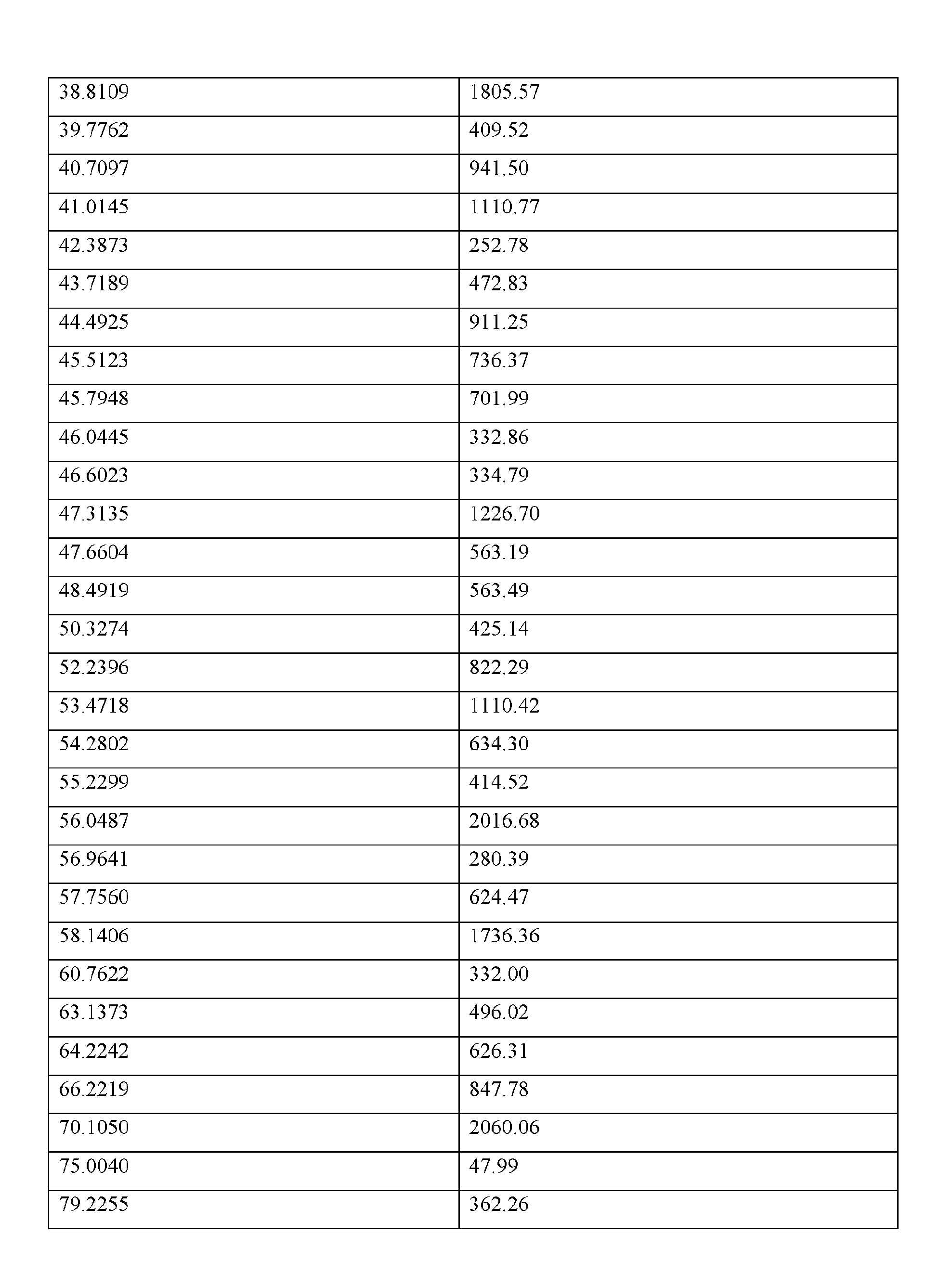
Ref document number: 24746793

Country of ref document: EP

Kind code of ref document: A2

WWE Wipo information: entry into national phase

Ref document number: 325229

Country of ref document: IL

WWE Wipo information: entry into national phase

Ref document number: MX/A/2025/015028

Country of ref document: MX

WWE Wipo information: entry into national phase

Ref document number: AU2024305139

Country of ref document: AU

REG Reference to national code

Ref country code: BR

Ref legal event code: B01A

Ref document number: 112025027655

Country of ref document: BR

ENP Entry into the national phase

Ref document number: 1020267001253

Country of ref document: KR

Free format text: ST27 STATUS EVENT CODE: A-0-1-A10-A15-NAP-PA0105 (AS PROVIDED BY THE NATIONAL OFFICE)

WWE Wipo information: entry into national phase

Ref document number: 1020267001253

Country of ref document: KR

ENP Entry into the national phase

Ref document number: 2024305139

Country of ref document: AU

Date of ref document: 20240613

Kind code of ref document: A

WWE Wipo information: entry into national phase

Ref document number: 2024746793

Country of ref document: EP

NENP Non-entry into the national phase

Ref country code: DE

ENP Entry into the national phase

Ref document number: 2024746793

Country of ref document: EP

Effective date: 20260115

ENP Entry into the national phase

Ref document number: 2024746793

Country of ref document: EP

Effective date: 20260115

ENP Entry into the national phase

Ref document number: 2024746793

Country of ref document: EP

Effective date: 20260115

WWP Wipo information: published in national office

Ref document number: 325229

Country of ref document: IL

ENP Entry into the national phase

Ref document number: 2024746793

Country of ref document: EP

Effective date: 20260115

WWP Wipo information: published in national office

Ref document number: 1020267001253

Country of ref document: KR

WWP Wipo information: published in national office

Ref document number: MX/A/2025/015028

Country of ref document: MX

WWP Wipo information: published in national office

Ref document number: 2024746793

Country of ref document: EP