WO2024257504A1 - 半導体薬液および半導体薬液の製造方法 - Google Patents
半導体薬液および半導体薬液の製造方法 Download PDFInfo
- Publication number
- WO2024257504A1 WO2024257504A1 PCT/JP2024/016925 JP2024016925W WO2024257504A1 WO 2024257504 A1 WO2024257504 A1 WO 2024257504A1 JP 2024016925 W JP2024016925 W JP 2024016925W WO 2024257504 A1 WO2024257504 A1 WO 2024257504A1
- Authority
- WO
- WIPO (PCT)
- Prior art keywords
- less
- continuous reactor
- chemical solution
- alcohol
- content
- Prior art date
- Legal status (The legal status is an assumption and is not a legal conclusion. Google has not performed a legal analysis and makes no representation as to the accuracy of the status listed.)
- Ceased
Links
Images
Classifications
-
- C—CHEMISTRY; METALLURGY
- C11—ANIMAL OR VEGETABLE OILS, FATS, FATTY SUBSTANCES OR WAXES; FATTY ACIDS THEREFROM; DETERGENTS; CANDLES
- C11D—DETERGENT COMPOSITIONS; USE OF SINGLE SUBSTANCES AS DETERGENTS; SOAP OR SOAP-MAKING; RESIN SOAPS; RECOVERY OF GLYCEROL
- C11D7/00—Compositions of detergents based essentially on non-surface-active compounds
- C11D7/22—Organic compounds
- C11D7/26—Organic compounds containing oxygen
- C11D7/261—Alcohols; Phenols
-
- C—CHEMISTRY; METALLURGY
- C07—ORGANIC CHEMISTRY
- C07B—GENERAL METHODS OF ORGANIC CHEMISTRY; APPARATUS THEREFOR
- C07B61/00—Other general methods
-
- C—CHEMISTRY; METALLURGY
- C07—ORGANIC CHEMISTRY
- C07C—ACYCLIC OR CARBOCYCLIC COMPOUNDS
- C07C29/00—Preparation of compounds having hydroxy or O-metal groups bound to a carbon atom not belonging to a six-membered aromatic ring
- C07C29/03—Preparation of compounds having hydroxy or O-metal groups bound to a carbon atom not belonging to a six-membered aromatic ring by addition of hydroxy groups to unsaturated carbon-to-carbon bonds, e.g. with the aid of H2O2
- C07C29/04—Preparation of compounds having hydroxy or O-metal groups bound to a carbon atom not belonging to a six-membered aromatic ring by addition of hydroxy groups to unsaturated carbon-to-carbon bonds, e.g. with the aid of H2O2 by hydration of carbon-to-carbon double bonds
-
- C—CHEMISTRY; METALLURGY
- C07—ORGANIC CHEMISTRY
- C07C—ACYCLIC OR CARBOCYCLIC COMPOUNDS
- C07C31/00—Saturated compounds having hydroxy or O-metal groups bound to acyclic carbon atoms
- C07C31/02—Monohydroxylic acyclic alcohols
- C07C31/10—Monohydroxylic acyclic alcohols containing three carbon atoms
-
- C—CHEMISTRY; METALLURGY
- C11—ANIMAL OR VEGETABLE OILS, FATS, FATTY SUBSTANCES OR WAXES; FATTY ACIDS THEREFROM; DETERGENTS; CANDLES
- C11D—DETERGENT COMPOSITIONS; USE OF SINGLE SUBSTANCES AS DETERGENTS; SOAP OR SOAP-MAKING; RESIN SOAPS; RECOVERY OF GLYCEROL
- C11D7/00—Compositions of detergents based essentially on non-surface-active compounds
- C11D7/22—Organic compounds
- C11D7/26—Organic compounds containing oxygen
-
- H—ELECTRICITY
- H10—SEMICONDUCTOR DEVICES; ELECTRIC SOLID-STATE DEVICES NOT OTHERWISE PROVIDED FOR
- H10P—GENERIC PROCESSES OR APPARATUS FOR THE MANUFACTURE OR TREATMENT OF DEVICES COVERED BY CLASS H10
- H10P52/00—Grinding, lapping or polishing of wafers, substrates or parts of devices
-
- H—ELECTRICITY
- H10—SEMICONDUCTOR DEVICES; ELECTRIC SOLID-STATE DEVICES NOT OTHERWISE PROVIDED FOR
- H10P—GENERIC PROCESSES OR APPARATUS FOR THE MANUFACTURE OR TREATMENT OF DEVICES COVERED BY CLASS H10
- H10P70/00—Cleaning of wafers, substrates or parts of devices
- H10P70/10—Cleaning before device manufacture, i.e. Begin-Of-Line process
- H10P70/15—Cleaning before device manufacture, i.e. Begin-Of-Line process by wet cleaning only
-
- C—CHEMISTRY; METALLURGY
- C11—ANIMAL OR VEGETABLE OILS, FATS, FATTY SUBSTANCES OR WAXES; FATTY ACIDS THEREFROM; DETERGENTS; CANDLES
- C11D—DETERGENT COMPOSITIONS; USE OF SINGLE SUBSTANCES AS DETERGENTS; SOAP OR SOAP-MAKING; RESIN SOAPS; RECOVERY OF GLYCEROL
- C11D2111/00—Cleaning compositions characterised by the objects to be cleaned; Cleaning compositions characterised by non-standard cleaning or washing processes
- C11D2111/10—Objects to be cleaned
- C11D2111/14—Hard surfaces
- C11D2111/22—Electronic devices, e.g. PCBs or semiconductors
Definitions
- the present invention relates to a semiconductor chemical solution and a method for manufacturing the semiconductor chemical solution.
- substrates such as semiconductor substrates and glass substrates are washed with a semiconductor chemical solution and then dried.
- a semiconductor chemical solution For example, isopropyl alcohol is used as the semiconductor chemical solution.
- Patent Document 1 describes a method for producing isopropyl alcohol by direct hydration of propylene.
- propylene and water are reacted in a reactor, with the ratio of propylene and water in the reactor being 1,300 to 2,100 parts by mass of water per 100 parts by mass of propylene, and the residence time of water in the reactor being more than 20 minutes and less than 50 minutes.
- t-butyl alcohol has a melting point of 26°C and is a solid at room temperature, so it is thought to be prone to leaving residues.
- the present invention aims to provide a semiconductor chemical solution with a reduced content of t-butyl alcohol and ethyl alcohol, and a method for producing a semiconductor chemical solution that can reduce the content of t-butyl alcohol and ethyl alcohol.
- a semiconductor chemical liquid that is substantially composed of isopropyl alcohol, in which the t-butyl alcohol content is 1000 ppb by mass or less and the ethyl alcohol content is 1000 ppb by mass or less.
- a method for producing a semiconductor chemical solution consisting essentially of isopropyl alcohol comprising the steps of supplying a raw material gas containing propylene, having an isobutene content of 1 ppm by volume or less, and an ethylene content of 1 ppm by volume or less, and raw material water to a continuous reactor and reacting them, wherein during the reaction, the continuous reactor has a gas phase portion and a liquid phase portion, and gas components are discharged from the gas phase portion and supplied to the continuous reactor, the mass ratio of the raw material gas to the raw material water being 0.01 or more and 0.20 or less, and the raw material water supplied to the continuous reactor is A method for manufacturing a semiconductor chemical solution, in which the residence time of the raw water in the continuous reactor, which is the ratio of the volume [L] of the liquid phase to the supply rate [L/min] of the raw water, is 10 minutes or more and 25 minutes or less, the residence time of the gas components in the continuous reactor, which is the ratio of the volume [L] of the gas phase to the discharge rate
- the present invention can provide a semiconductor chemical solution with a reduced content of t-butyl alcohol and ethyl alcohol, as well as a method for producing a semiconductor chemical solution that can reduce the content of t-butyl alcohol and ethyl alcohol.
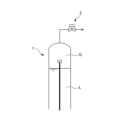
- 4A to 4C are diagrams illustrating an example of a reaction process in the method for producing a semiconductor chemical solution according to the present embodiment.
- the method for producing a semiconductor chemical liquid of this embodiment is a method for producing a semiconductor chemical liquid substantially composed of isopropyl alcohol, and includes a step of supplying a raw material gas and raw material water to a continuous reactor and reacting them (hereinafter, referred to as a reaction step).
- the method for producing a semiconductor chemical liquid of this embodiment may further include steps such as a recovery step and a purification step.
- the raw material gas contains propylene, and the propylene content is preferably 99 vol % or more, and more preferably 99.9 vol % or more.
- the isobutene content in the raw material gas is 1 ppm by volume or less, preferably 0.5 ppm by volume or less, and more preferably 0.1 ppm by volume or less.
- the ethylene content in the raw material gas is 1 ppm by volume or less, preferably 0.5 ppm by volume or less, and more preferably 0.1 ppm by volume or less.
- the raw material gas may contain an inert gas such as nitrogen gas, if necessary.
- the content of alkenes having six carbon atoms in the feed gas is small.
- the content of alkenes having six carbon atoms in the feed gas is preferably 1 ppm by volume or less, more preferably 0.5 ppm by volume or less, and even more preferably 0.1 ppm by volume or less.
- the raw water contains water, but preferably further contains an acid catalyst.
- the acid catalyst include phosphotungstic acid, silicotungstic acid, and silicomolybdic acid, and two or more of them may be used in combination.
- the pH of the raw water at 25°C is preferably 2.5 to 4.5.
- the pH of the raw water at 25°C is 2.5 to 4.5, the conversion rate of propylene and the selectivity of isopropyl alcohol are improved.
- reaction step An example of the reaction process will be described with reference to FIG. 1.
- a gas phase portion G containing the raw material gas is present at the top of the continuous reactor 1
- a liquid phase portion L containing the raw material water is present at the bottom of the continuous reactor 1.
- isopropyl alcohol generated in the reaction process is contained in the liquid phase portion L.
- the gas components are discharged from the gas phase portion G by repeatedly opening and closing the control valve 2.
- the mass ratio of the raw gas to the raw water supplied to the continuous reactor 1 is 0.01 or more and 0.20 or less, preferably 0.02 or more and 0.07 or less, and more preferably 0.03 or more and 0.05 or less. If the mass ratio of the raw gas to the raw water supplied to the continuous reactor 1 is less than 0.01, the productivity of the semiconductor chemical solution decreases, and if it exceeds 0.20, the content of t-butyl alcohol, ethyl alcohol, and alcohol with 6 carbon atoms in the semiconductor chemical solution increases.
- the volume ratio of the discharge amount of the gas components discharged from the continuous reactor 1 to the supply amount of the raw material gas supplied to the continuous reactor 1 is 0.03 or more and 0.30 or less, and preferably 0.11 or more and 0.16 or less. If the ratio of the discharge amount of the gas components discharged from the continuous reactor 1 to the supply amount of the raw material gas supplied to the continuous reactor 1 is less than 0.03, the contents of t-butyl alcohol, ethyl alcohol, and alcohols with a carbon number of 6 in the semiconductor chemical solution will increase, and if it exceeds 0.30, the conversion rate of propylene will decrease.
- the gas components discharged from the continuous reactor 1 include water contained in the raw water, propylene contained in the raw gas, impurities contained in the raw gas (e.g., propane), main products (isopropyl alcohol), by-products (e.g., hexene, isobutene, ethylene), etc.
- Hexene includes 4-methyl-1-pentene, which may be disproportionated to isobutene and ethylene.
- the content of isobutene in the gas components discharged from the continuous reactor 1 is preferably 0.1 ppm by volume or more and 20 ppm by volume or less, more preferably 1 ppm by volume or more and 8 ppm by volume or less.
- the content of ethylene in the gas components discharged from the continuous reactor 1 is preferably 0.1 ppm by volume or more and 20 ppm by volume or less, more preferably 1 ppm by volume or more and 5 ppm by volume or less.
- the residence time of the raw water in the continuous reactor 1 is from 10 to 25 minutes, and preferably from 12 to 18 minutes. If the residence time of the raw water in the continuous reactor 1 is less than 10 minutes, the conversion rate of propylene decreases, and if it exceeds 25 minutes, the content of t-butyl alcohol, ethyl alcohol, and alcohol with 6 carbon atoms in the semiconductor chemical solution increases.
- the residence time of the raw water in the continuous reactor 1 is calculated by the formula: (Volume [L] of the liquid phase L of the continuous reactor 1)/(Feed rate [L/min] of the raw water) It is calculated by:
- the residence time of the gas components in the continuous reactor 1 is 10 minutes or more and 150 minutes or less, and preferably 30 minutes or more and 100 minutes or less. If the residence time of the gas components in the continuous reactor 1 is less than 10 minutes, the conversion rate of propylene decreases, and if it exceeds 150 minutes, the content of t-butyl alcohol, ethyl alcohol, and alcohol with 6 carbon atoms in the semiconductor chemical solution increases.
- the residence time of the gas component in the continuous reactor 1 is calculated by the formula: (Volume [L] of the gas phase G of the continuous reactor 1)/(Discharge rate [L/min] of the gas component).
- the inside of the continuous reactor 1 is at high temperature and pressure, but the discharge rate of the gas components in the temperature and pressure state of the continuous reactor 1 can be obtained by adjusting the temperature and pressure of the gas components discharged from the continuous reactor 1 to 25° C. and 101 kPa (absolute pressure), respectively, and then analyzing the liquid phase and the gas phase.
- the temperature inside the continuous reactor 1 is preferably 200°C or higher and 300°C or lower, and more preferably 250°C or higher and 280°C or lower. If the temperature inside the continuous reactor 1 is 200°C or higher, the conversion rate of propylene improves, and if it is 300°C or lower, the content of t-butyl alcohol, ethyl alcohol, and alcohol with 6 carbon atoms in the semiconductor chemical solution decreases.
- the pressure in the continuous reactor 1 is preferably 150 atm or more and 280 atm or less, and more preferably 200 atm or more and 255 atm or less. If the pressure in the continuous reactor 1 is 150 atm or more, the conversion rate of propylene improves, and if it is 280 atm or less, the content of t-butyl alcohol, ethyl alcohol, and alcohol with 6 carbon atoms in the semiconductor chemical solution decreases.
- the propylene conversion is preferably 85% or more and 97% or less, and more preferably 92% or more and 95% or less.
- the selectivity of isopropyl alcohol is preferably 99% or more and 99.9% or less, and more preferably 99.5% or more and 99.8% or less.
- the conversion rate of propylene is calculated from the amount of propylene supplied to the continuous reactor 1 and the amount of propylene discharged outside the system.
- propylene discharged outside the system include propylene discharged from the gas phase G of the continuous reactor 1 via the control valve 2 (see FIG. 1), and propylene discharged outside the system from the recovery process and purification process described below without being returned to the reaction process.
- liquid components including isopropyl alcohol and raw water produced in the reaction step are discharged and transported to the recovery tower.
- the temperature of the recovery tower is preferably 80°C or more and 200°C or less, and more preferably 100°C or more and 150°C or less.
- the pressure of the recovery tower is preferably 100 kPa or more and 5000 kPa or less (absolute pressure), and more preferably 500 kPa or more and 2000 kPa or less (absolute pressure).
- the separated propylene is collected in a drum and reused as a raw gas.
- the content of isopropyl alcohol in the crude isopropyl alcohol aqueous solution is preferably 1% by mass or more and 20% by mass or less, and more preferably 3% by mass or more and 8% by mass or less.
- the amount of t-butyl alcohol and ethyl alcohol by-produced can be reduced by controlling the residence time of the raw water in the continuous reactor 1 and the residence time of the gas components in the continuous reactor 1.
- the mass ratios of t-butyl alcohol and ethyl alcohol to isopropyl alcohol in the crude isopropyl alcohol aqueous solution can be set to 1000 ppb or less, and can also be set to 500 ppb or less.
- the mass ratios of t-butyl alcohol and ethyl alcohol to isopropyl alcohol in the crude isopropyl alcohol aqueous solution are preferably 10 ppb or more, more preferably 100 ppb or more, and even more preferably 200 ppb or more, respectively, taking into account the cost and yield in the reaction process and the purification process.
- the amount of alcohol with 6 carbon atoms produced as a by-product can be reduced. Therefore, the mass ratio of alcohol with 6 carbon atoms to isopropyl alcohol in the crude isopropyl alcohol aqueous solution can be set to 200 ppb or more and 10,000 ppb or less, and can also be set to 2,000 ppb or more and 5,000 ppb or less.
- a decrease in the amount of 4-methyl-2-pentanol produced as a by-product by hydration of 4-methyl-1-pentene leads to a decrease in the amount of t-butyl alcohol and ethyl alcohol produced as by-products.
- the mass ratio of 4-methyl-2-pentanol to isopropyl alcohol in the crude isopropyl alcohol aqueous solution is preferably 1,000 ppb or more and 5,000 ppb or less, and more preferably 1,000 ppb or more and 3,000 ppb or less.
- the content of alcohol with 6 carbon atoms in the semiconductor chemical solution of this embodiment can be further reduced by distilling the crude isopropyl alcohol aqueous solution in a high boiling distillation column in the purification process described below.
- the crude isopropyl alcohol aqueous solution recovered in the recovery tower is discharged and purified.
- the crude isopropyl alcohol aqueous solution is purified by a distillation step in a low boiling distillation tower, a distillation step in an azeotropic distillation tower, a dehydration step, and a distillation step in a high boiling distillation tower.
- a third component capable of forming an azeotropic mixture with water is added to the dehydration distillation tower to form an azeotropic mixture of water and the third component, thereby removing water.
- the separated water is collected in a tank and reused as raw water.
- compounds with a boiling point higher than that of isopropyl alcohol are removed.
- the content of alcohol with a carbon number of 6 in the semiconductor chemical solution of this embodiment can be reduced to 1 ppb by mass or less, and can also be reduced to 0.1 ppb by mass or less.
- Particles can be removed by passing the bottoms taken out of the high boiling distillation tower through a filter.
- the number of stages in each distillation tower and the equivalent number of stages in the distillation tower converted into a tray tower are not particularly limited, but are preferably 5 to 320, and more preferably 10 to 300.
- the number of stages in the high boiling distillation tower and the equivalent number of stages in the distillation tower converted into a tray tower are preferably 5 to 20. This allows the content of alcohols with a carbon number of 6 in the semiconductor chemical solution of this embodiment to be reduced.
- the reflux ratio in the atmospheric distillation is not particularly limited, but is preferably 0.5 to 50, and more preferably 1 to 10.
- atmospheric pressure refers to a range of 90 kPa to 120 kPa (absolute pressure).
- the semiconductor chemical liquid of this embodiment is substantially composed of isopropyl alcohol.
- the content of isopropyl alcohol in the semiconductor chemical liquid of this embodiment is preferably 99.99 mass % or more, and more preferably 99.999 mass % or more.
- the content of t-butyl alcohol in the semiconductor chemical solution of this embodiment is 1000 mass ppb or less, and more preferably 500 mass ppb or less. Since the content of t-butyl alcohol in the semiconductor chemical solution of this embodiment is 1000 mass ppb or less, even if the semiconductor chemical solution of this embodiment is used to clean a substrate, the effect of t-butyl alcohol residues on the semiconductor device is reduced. Considering the cost and yield of the reaction process and purification process, the content of t-butyl alcohol in the semiconductor chemical solution of this embodiment is preferably 10 mass ppb or more, more preferably 100 mass ppb or more, and even more preferably 200 mass ppb or more.
- the content of ethyl alcohol in the semiconductor chemical solution of this embodiment is 1000 mass ppb or less, and more preferably 500 mass ppb or less. Taking into account the cost and yield of the reaction and purification processes, the content of ethyl alcohol in the semiconductor chemical solution of this embodiment is preferably 10 mass ppb or more, more preferably 100 mass ppb or more, and even more preferably 200 mass ppb or more.
- the isopropyl alcohol contained in the semiconductor chemical solution of this embodiment can be produced by the manufacturing method of the semiconductor chemical solution of this embodiment.
- the content of alcohol with 6 carbon atoms in the semiconductor chemical solution is preferably 1 ppb by mass or less, and more preferably 0.1 ppb by mass or less.
- alcohols with 6 carbon atoms include saturated aliphatic alcohols such as 1-hexyl alcohol, 2-hexyl alcohol, 3-hexyl alcohol, 2-methyl-1-pentyl alcohol, 2-methyl-2-pentyl alcohol, 2-methyl-3-pentyl alcohol, 4-methyl-1-pentyl alcohol, 4-methyl-2-pentyl alcohol, 3-methyl-1-pentyl alcohol, 3-methyl-3-pentyl alcohol, 2,3-dimethyl-1-butyl alcohol, and 2-ethyl-1-butyl alcohol.
- saturated aliphatic alcohols such as 1-hexyl alcohol, 2-hexyl alcohol, 3-hexyl alcohol, 2-methyl-1-pentyl alcohol, 2-methyl-2-pentyl alcohol, 2-methyl-3-pentyl alcohol, 4-methyl-1-pentyl alcohol, 4-methyl-2-pentyl alcohol, 3-methyl-1-pentyl alcohol, 3-methyl-3-pentyl alcohol, 2,3-dimethyl-1-butyl alcohol, and 2-eth
- the water content in the semiconductor chemical solution of this embodiment is preferably 0.1 ppm by mass or more and 100 ppm by mass or less, and more preferably 1 ppm by mass or more and 20 ppm by mass or less.
- Alcohol content when water content in sample is 10% by mass or less The alcohol content in the sample was measured using GC-MS under the following measurement conditions.
- the lower limit of quantification for the content of t-butyl alcohol and ethyl alcohol in the standard sample made of isopropyl alcohol was 10 mass ppb.
- the lower limit of quantification for the content of alcohol with 6 carbon atoms in the standard sample was 10 mass ppb.
- the concentration method is shown below, but the following operation is repeated as necessary to change the concentration ratio.
- the top temperature of the distillation tower is set to about 82°C, and distillation is performed for 10 hours.
- the theoretical number of plates of the precision distillation apparatus is 3 to 30, and the sample can be concentrated within this range.
- nitrogen was circulated in advance in the precision distillation apparatus to create an inert gas atmosphere.
- Example 1 (raw gas) The composition of the raw gas was analyzed by preparing standard gases of known concentrations and quantifying them.
- Propylene content 99% by volume or more Propane content: 1000 ppm by volume Methane content: less than 0.1 ppm by volume Ethane content: less than 0.1 ppm by volume Ethylene content: less than 0.1 ppm by volume
- Cyclopropane content 1 ppm by volume Content of 1-butene: less than 0.1 ppm by volume Content of isobutene: less than 0.1 ppm by volume Content of alkene having 5 carbon atoms (pentene): less than 0.1 ppm by volume Content of alkene having 6 carbon atoms (hexene): less than 0.1 ppm by volume
- the density of the feed gas under standard conditions (101.3 kPa, 0° C.) was 1.87 ⁇ 10 ⁇ 3 kg/L.
- reaction step The continuous reactor with an internal volume of 22.0 L was adjusted so that the volume of the liquid phase present at the bottom of the continuous reactor was 20.0 L and the volume of the gas phase present at the top of the continuous reactor was 2.0 L.
- raw water heated to 110 ° C. was supplied to the continuous reactor at a supply rate of 45 kg / h, and raw gas was supplied to the continuous reactor at a supply rate of 3 kg / h, that is, 1.87 ⁇ 10 3 L / h (standard state conversion), while gas components were discharged from the gas phase of the continuous reactor at a discharge rate of 200 L / h (standard state conversion).
- the temperature and pressure in the continuous reactor were set to 280 ° C.
- the residence time of the raw water in the continuous reactor is 20 minutes.
- the discharge rate of the gas components at 280° C. and 250 atm is 1.6 L/h, the residence time of the gas components in the continuous reactor is 74 minutes.
- Table 1 shows the reaction conditions in the reaction process.
- Table 2 shows the composition of the gas components (by volume).
- hexenes refer to hexenes other than 4-methyl-1-pentene.
- the liquid component was discharged from the liquid phase of the continuous reactor and transported to a recovery tower.
- the temperature and pressure in the recovery tower were set to 140 ° C. and 18 atm, respectively, to separate propylene dissolved in the water contained in the liquid component, and a crude isopropyl alcohol aqueous solution was obtained.
- the conversion rate of propylene was 95%, and the selectivity of isopropyl alcohol was 99.5%.
- the separated propylene was recovered in a drum to be reused as a raw material gas.
- Table 3 shows the composition (by mass) of the crude isopropyl alcohol aqueous solution.
- hexanols refer to hexanols other than 4-methyl-2-pentanol, 2-methyl-2-pentanol, 2-methyl-3-pentanol, 3-methyl-3-pentanol, 3-methyl-1-pentanol, 2,3-dimethyl-2-butanol, and 4-methyl-1-pentanol.
- the crude isopropyl alcohol aqueous solution was fed to a low boiling distillation tower to remove low boiling impurities, and the bottoms were obtained from the bottom of the tower.
- the bottoms were fed to an azeotropic distillation tower to remove high boiling impurities, and an azeotropic mixture of isopropyl alcohol and water (mass ratio 87.5:12.5) was obtained from the top of the tower.
- the azeotropic mixture was fed to a dehydration distillation tower to be dehydrated, and the bottoms were obtained from the bottom of the tower.
- the bottoms were fed to a high boiling distillation tower to remove high boiling impurities, and the distillate was obtained from the top of the tower.
- the number of stages of the high boiling distillation tower was 15.
- the distillate was passed through a fluororesin filter with a pore size of 10 nm to obtain a semiconductor chemical solution.
- Table 4 shows the composition (by mass) of the semiconductor chemical solution.
- hexanol means an alcohol with six carbon atoms.
- Example 2 A semiconductor chemical solution was obtained in the same manner as in Example 1, except that the feed rate of the raw water in the reaction step was changed to 60 kg/h and the residence time of the raw water in the continuous reactor was changed to 15 minutes (see Table 1). At this time, the conversion rate of propylene was 95%, and the selectivity of isopropyl alcohol was 99.5%.
- the compositions of the gas components, the crude isopropyl alcohol aqueous solution, and the semiconductor chemical solution are shown in Tables 2 to 4.
- Example 3 A semiconductor chemical solution was obtained in the same manner as in Example 1, except that the discharge rate of the gas components in the reaction step was changed to 250 L/h (standard state conversion) and the residence time of the gas components in the continuous reactor was changed to 59 minutes (see Table 1). At this time, the conversion rate of propylene was 94%, and the selectivity of isopropyl alcohol was 99.5%.
- the compositions of the gas components, crude isopropyl alcohol aqueous solution, and semiconductor chemical solution are shown in Tables 2 to 4.
- Example 4 The feed rate of the raw water in the reaction step was changed to 75 kg/h, the residence time of the raw water in the continuous reactor was changed to 12 minutes, the discharge rate of the gas components in the reaction step was changed to 120 L/h (standard state conversion), and the residence time of the gas components in the continuous reactor was changed to 123 minutes. Except for this, the semiconductor chemical solution was obtained in the same manner as in Example 1 (see Table 1). At this time, the conversion rate of propylene was 97%, and the selectivity of isopropyl alcohol was 99.5%. The compositions of the gas components, crude isopropyl alcohol aqueous solution, and semiconductor chemical solution are shown in Tables 2 to 4.
- Example 5 The feed rate of the raw water in the reaction step was changed to 75 kg/h, the residence time of the raw water in the continuous reactor was changed to 12 minutes, the discharge rate of the gas components in the reaction step was changed to 250 L/h (standard state conversion), and the residence time of the gas components in the continuous reactor was changed to 59 minutes. Except for this, the semiconductor chemical solution was obtained in the same manner as in Example 1 (see Table 1). At this time, the conversion rate of propylene was 94%, and the selectivity of isopropyl alcohol was 99.5%. The compositions of the gas components, crude isopropyl alcohol aqueous solution, and semiconductor chemical solution are shown in Tables 2 to 4.
- Example 6 The feed rate of the raw water in the reaction step was changed to 80 kg/h, the residence time of the raw water in the continuous reactor was changed to 11 minutes, the discharge rate of the gas components in the reaction step was changed to 500 L/h (standard state conversion), and the residence time of the gas components in the continuous reactor was changed to 30 minutes. Except for this, a semiconductor chemical solution was obtained in the same manner as in Example 1 (see Table 1). At this time, the conversion rate of propylene was 88%, and the selectivity of isopropyl alcohol was 99.5%. The compositions of the gas components, crude isopropyl alcohol aqueous solution, and semiconductor chemical solution are shown in Tables 2 to 4.
- Example 2 A semiconductor chemical solution was obtained in the same manner as in Example 1, except that the discharge rate of the gas components in the reaction step was changed to 30 L/h (standard state conversion) and the residence time of the gas components in the continuous reactor was changed to 494 minutes (see Table 1). At this time, the conversion rate of propylene was 99%, and the selectivity of isopropyl alcohol was 99.5%.
- the compositions of the gas components, crude isopropyl alcohol aqueous solution, and semiconductor chemical solution are shown in Tables 2 to 4.
- Example 3 A semiconductor chemical solution was obtained in the same manner as in Example 1, except that the feed rate of the raw water in the reaction step was changed to 30 kg/h and the residence time of the raw water in the continuous reactor was changed to 30 minutes (see Table 1). At this time, the conversion rate of propylene was 95%, and the selectivity of isopropyl alcohol was 99.5%.
- the compositions of the gas components, the crude isopropyl alcohol aqueous solution, and the semiconductor chemical solution are shown in Tables 2 to 4.
- the semiconductor chemicals of Examples 1 to 6 have low contents of t-butyl alcohol, ethyl alcohol, and hexanol.
- the semiconductor chemicals of Comparative Example 1 have high contents of t-butyl alcohol, ethyl alcohol, and hexanol because the residence time of the raw water and gas components in the continuous reactor is 30 minutes and 185 minutes, respectively.
- the semiconductor chemicals of Comparative Example 2 have high contents of t-butyl alcohol, ethyl alcohol, and hexanol because the residence time of the gas components in the continuous reactor is 494 minutes and C/B is 0.02.
- the semiconductor chemicals of Comparative Example 3 have high contents of t-butyl alcohol, ethyl alcohol, and hexanol because the residence time of the raw water in the continuous reactor is 30 minutes.
Landscapes
- Chemical & Material Sciences (AREA)
- Organic Chemistry (AREA)
- Health & Medical Sciences (AREA)
- Emergency Medicine (AREA)
- Life Sciences & Earth Sciences (AREA)
- Engineering & Computer Science (AREA)
- Chemical Kinetics & Catalysis (AREA)
- Oil, Petroleum & Natural Gas (AREA)
- Wood Science & Technology (AREA)
- Organic Low-Molecular-Weight Compounds And Preparation Thereof (AREA)
Priority Applications (3)
| Application Number | Priority Date | Filing Date | Title |
|---|---|---|---|
| KR1020257041758A KR20260021637A (ko) | 2023-06-13 | 2024-05-07 | 반도체 약액 및 반도체 약액의 제조방법 |
| JP2024551616A JP7634139B1 (ja) | 2023-06-13 | 2024-05-07 | 半導体洗浄用薬液および半導体洗浄用薬液の製造方法 |
| CN202480027193.1A CN121039789A (zh) | 2023-06-13 | 2024-05-07 | 半导体药液及半导体药液的制造方法 |
Applications Claiming Priority (2)
| Application Number | Priority Date | Filing Date | Title |
|---|---|---|---|
| JP2023-096884 | 2023-06-13 | ||
| JP2023096884 | 2023-06-13 |
Publications (1)
| Publication Number | Publication Date |
|---|---|
| WO2024257504A1 true WO2024257504A1 (ja) | 2024-12-19 |
Family
ID=93851967
Family Applications (1)
| Application Number | Title | Priority Date | Filing Date |
|---|---|---|---|
| PCT/JP2024/016925 Ceased WO2024257504A1 (ja) | 2023-06-13 | 2024-05-07 | 半導体薬液および半導体薬液の製造方法 |
Country Status (5)
| Country | Link |
|---|---|
| JP (1) | JP7634139B1 (ar) |
| KR (1) | KR20260021637A (ar) |
| CN (1) | CN121039789A (ar) |
| TW (1) | TW202500541A (ar) |
| WO (1) | WO2024257504A1 (ar) |
Citations (2)
| Publication number | Priority date | Publication date | Assignee | Title |
|---|---|---|---|---|
| JP2002121160A (ja) * | 2000-10-16 | 2002-04-23 | Mitsui Chemicals Inc | イソプロピルアルコールの製造方法 |
| WO2017217279A1 (ja) * | 2016-06-17 | 2017-12-21 | 株式会社トクヤマ | イソプロピルアルコールの製造方法及び不純物が低減されたイソプロピルアルコール |
Family Cites Families (2)
| Publication number | Priority date | Publication date | Assignee | Title |
|---|---|---|---|---|
| JP6980952B1 (ja) * | 2020-04-02 | 2021-12-15 | 株式会社トクヤマ | 半導体処理液及びその製造方法 |
| US20250171718A1 (en) * | 2022-03-16 | 2025-05-29 | Tokuyama Corporation | Semiconductor cleaning liquid and method for producing semiconductor cleaning liquid |
-
2024
- 2024-05-07 KR KR1020257041758A patent/KR20260021637A/ko active Pending
- 2024-05-07 CN CN202480027193.1A patent/CN121039789A/zh active Pending
- 2024-05-07 JP JP2024551616A patent/JP7634139B1/ja active Active
- 2024-05-07 WO PCT/JP2024/016925 patent/WO2024257504A1/ja not_active Ceased
- 2024-05-09 TW TW113117119A patent/TW202500541A/zh unknown
Patent Citations (2)
| Publication number | Priority date | Publication date | Assignee | Title |
|---|---|---|---|---|
| JP2002121160A (ja) * | 2000-10-16 | 2002-04-23 | Mitsui Chemicals Inc | イソプロピルアルコールの製造方法 |
| WO2017217279A1 (ja) * | 2016-06-17 | 2017-12-21 | 株式会社トクヤマ | イソプロピルアルコールの製造方法及び不純物が低減されたイソプロピルアルコール |
Also Published As
| Publication number | Publication date |
|---|---|
| JP7634139B1 (ja) | 2025-02-20 |
| KR20260021637A (ko) | 2026-02-13 |
| TW202500541A (zh) | 2025-01-01 |
| CN121039789A (zh) | 2025-11-28 |
| JPWO2024257504A1 (ar) | 2024-12-19 |
Similar Documents
| Publication | Publication Date | Title |
|---|---|---|
| KR102313108B1 (ko) | 이소프로필 알코올의 제조 방법 및 불순물이 저감된 이소프로필 알코올 | |
| JP7118898B2 (ja) | イソプロピルアルコール組成物及びイソプロピルアルコールの製造方法 | |
| JP7402385B1 (ja) | 半導体洗浄液および半導体洗浄液の製造方法 | |
| JP6810304B2 (ja) | 洗浄液及び高純度イソプロピルアルコールの製造方法 | |
| KR102471394B1 (ko) | 반도체 처리액 및 그 제조 방법 | |
| KR102486605B1 (ko) | 공액 디엔의 제조 방법 | |
| US7217849B2 (en) | Method for the preparation of n-propyl bromide | |
| JP7634139B1 (ja) | 半導体洗浄用薬液および半導体洗浄用薬液の製造方法 | |
| JP5531101B2 (ja) | トリメチロールプロパンの色数を改善する方法 | |
| TWI458700B (zh) | Method for separating epoxycyclohexane with n-pentanol | |
| RU2523011C2 (ru) | Способ очистки циклогексанона | |
| CN1413971A (zh) | 1.3-丙二醇中羰基物质的脱除方法 | |
| PL173885B1 (pl) | 1. Sposób otrzymywania cykloheksanonu o wysokiej czystości i niskiej zawartości aldehydów z produktów utleniania cykloheksanu i/lub produktów odwodorniania cykloheksanolu w procesie destylacji, w którym oddziela się zanieczyszczenia niżej wrzące od cykloheksanonu,wyodrębnia czysty cykloheksanon, wydziela cykloheksanol z pozostawieniem produktów wysokowrzących, a następnie wydzielony cykloheksanol po odwodomieniu zawraca do destylacji, znamienny tym, ze po wyodrębnieniu z produktów utleniania cykloheksanu i/lub produktów odwodorniania cykloheksanolu związków niżej wrzących od cykloheksanonu, pozostałą mieszaninę poddaje się destylacji w kolumnie pracującej pod ciśnieniem 30-100 Torr, w której czysty cykloheksanon odbiera się jako strumień boczny, z miejsca powyżej którego liczba półek teoretycznych stanowi 2-25% całkowitej liczby półek teoretycznych w kolumnie, natomiast destylat w sposób ciągły lub periodyczny zawraca się w ilości stanowiącej 0.05-3% strumienia bocznego do kolumny, w której wyodrębnia się zanieczyszczenia niżej wrzące od cykloheksanonu lub wykorzystuje do innych celów. | |
| JPH09309858A (ja) | アセトンの精製方法 |
Legal Events
| Date | Code | Title | Description |
|---|---|---|---|
| WWE | Wipo information: entry into national phase |
Ref document number: 2024551616 Country of ref document: JP |
|
| 121 | Ep: the epo has been informed by wipo that ep was designated in this application |
Ref document number: 24823126 Country of ref document: EP Kind code of ref document: A1 |
|
| NENP | Non-entry into the national phase |
Ref country code: DE |
|
| WWE | Wipo information: entry into national phase |
Ref document number: 11202508344X Country of ref document: SG |
|
| WWP | Wipo information: published in national office |
Ref document number: 11202508344X Country of ref document: SG |