WO2024257555A1 - 熱伝導性2液付加硬化型シリコーン組成物、硬化物及びシート - Google Patents
熱伝導性2液付加硬化型シリコーン組成物、硬化物及びシート Download PDFInfo
- Publication number
- WO2024257555A1 WO2024257555A1 PCT/JP2024/018539 JP2024018539W WO2024257555A1 WO 2024257555 A1 WO2024257555 A1 WO 2024257555A1 JP 2024018539 W JP2024018539 W JP 2024018539W WO 2024257555 A1 WO2024257555 A1 WO 2024257555A1
- Authority
- WO
- WIPO (PCT)
- Prior art keywords
- component
- thermally conductive
- mass
- silicone composition
- aluminum oxide
- Prior art date
- Legal status (The legal status is an assumption and is not a legal conclusion. Google has not performed a legal analysis and makes no representation as to the accuracy of the status listed.)
- Ceased
Links
Classifications
-
- C—CHEMISTRY; METALLURGY
- C08—ORGANIC MACROMOLECULAR COMPOUNDS; THEIR PREPARATION OR CHEMICAL WORKING-UP; COMPOSITIONS BASED THEREON
- C08L—COMPOSITIONS OF MACROMOLECULAR COMPOUNDS
- C08L83/00—Compositions of macromolecular compounds obtained by reactions forming in the main chain of the macromolecule a linkage containing silicon with or without sulfur, nitrogen, oxygen or carbon only; Compositions of derivatives of such polymers
- C08L83/04—Polysiloxanes
-
- C—CHEMISTRY; METALLURGY
- C08—ORGANIC MACROMOLECULAR COMPOUNDS; THEIR PREPARATION OR CHEMICAL WORKING-UP; COMPOSITIONS BASED THEREON
- C08J—WORKING-UP; GENERAL PROCESSES OF COMPOUNDING; AFTER-TREATMENT NOT COVERED BY SUBCLASSES C08B, C08C, C08F, C08G or C08H
- C08J5/00—Manufacture of articles or shaped materials containing macromolecular substances
- C08J5/18—Manufacture of films or sheets
-
- C—CHEMISTRY; METALLURGY
- C08—ORGANIC MACROMOLECULAR COMPOUNDS; THEIR PREPARATION OR CHEMICAL WORKING-UP; COMPOSITIONS BASED THEREON
- C08G—MACROMOLECULAR COMPOUNDS OBTAINED OTHERWISE THAN BY REACTIONS ONLY INVOLVING UNSATURATED CARBON-TO-CARBON BONDS
- C08G77/00—Macromolecular compounds obtained by reactions forming a linkage containing silicon with or without sulfur, nitrogen, oxygen or carbon in the main chain of the macromolecule
- C08G77/04—Polysiloxanes
- C08G77/12—Polysiloxanes containing silicon bound to hydrogen
-
- C—CHEMISTRY; METALLURGY
- C08—ORGANIC MACROMOLECULAR COMPOUNDS; THEIR PREPARATION OR CHEMICAL WORKING-UP; COMPOSITIONS BASED THEREON
- C08G—MACROMOLECULAR COMPOUNDS OBTAINED OTHERWISE THAN BY REACTIONS ONLY INVOLVING UNSATURATED CARBON-TO-CARBON BONDS
- C08G77/00—Macromolecular compounds obtained by reactions forming a linkage containing silicon with or without sulfur, nitrogen, oxygen or carbon in the main chain of the macromolecule
- C08G77/04—Polysiloxanes
- C08G77/20—Polysiloxanes containing silicon bound to unsaturated aliphatic groups
-
- C—CHEMISTRY; METALLURGY
- C08—ORGANIC MACROMOLECULAR COMPOUNDS; THEIR PREPARATION OR CHEMICAL WORKING-UP; COMPOSITIONS BASED THEREON
- C08K—Use of inorganic or non-macromolecular organic substances as compounding ingredients
- C08K3/00—Use of inorganic substances as compounding ingredients
- C08K3/18—Oxygen-containing compounds, e.g. metal carbonyls
- C08K3/20—Oxides; Hydroxides
- C08K3/22—Oxides; Hydroxides of metals
-
- C—CHEMISTRY; METALLURGY
- C08—ORGANIC MACROMOLECULAR COMPOUNDS; THEIR PREPARATION OR CHEMICAL WORKING-UP; COMPOSITIONS BASED THEREON
- C08K—Use of inorganic or non-macromolecular organic substances as compounding ingredients
- C08K5/00—Use of organic ingredients
- C08K5/54—Silicon-containing compounds
- C08K5/541—Silicon-containing compounds containing oxygen
- C08K5/5415—Silicon-containing compounds containing oxygen containing at least one Si—O bond
- C08K5/5419—Silicon-containing compounds containing oxygen containing at least one Si—O bond containing at least one Si—C bond
-
- C—CHEMISTRY; METALLURGY
- C08—ORGANIC MACROMOLECULAR COMPOUNDS; THEIR PREPARATION OR CHEMICAL WORKING-UP; COMPOSITIONS BASED THEREON
- C08L—COMPOSITIONS OF MACROMOLECULAR COMPOUNDS
- C08L83/00—Compositions of macromolecular compounds obtained by reactions forming in the main chain of the macromolecule a linkage containing silicon with or without sulfur, nitrogen, oxygen or carbon only; Compositions of derivatives of such polymers
- C08L83/04—Polysiloxanes
- C08L83/06—Polysiloxanes containing silicon bound to oxygen-containing groups
-
- C—CHEMISTRY; METALLURGY
- C09—DYES; PAINTS; POLISHES; NATURAL RESINS; ADHESIVES; COMPOSITIONS NOT OTHERWISE PROVIDED FOR; APPLICATIONS OF MATERIALS NOT OTHERWISE PROVIDED FOR
- C09K—MATERIALS FOR MISCELLANEOUS APPLICATIONS, NOT PROVIDED FOR ELSEWHERE
- C09K5/00—Heat-transfer, heat-exchange or heat-storage materials, e.g. refrigerants; Materials for the production of heat or cold by chemical reactions other than by combustion
- C09K5/08—Materials not undergoing a change of physical state when used
- C09K5/14—Solid materials, e.g. powdery or granular
-
- C—CHEMISTRY; METALLURGY
- C08—ORGANIC MACROMOLECULAR COMPOUNDS; THEIR PREPARATION OR CHEMICAL WORKING-UP; COMPOSITIONS BASED THEREON
- C08G—MACROMOLECULAR COMPOUNDS OBTAINED OTHERWISE THAN BY REACTIONS ONLY INVOLVING UNSATURATED CARBON-TO-CARBON BONDS
- C08G77/00—Macromolecular compounds obtained by reactions forming a linkage containing silicon with or without sulfur, nitrogen, oxygen or carbon in the main chain of the macromolecule
- C08G77/04—Polysiloxanes
- C08G77/14—Polysiloxanes containing silicon bound to oxygen-containing groups
- C08G77/18—Polysiloxanes containing silicon bound to oxygen-containing groups to alkoxy or aryloxy groups
-
- C—CHEMISTRY; METALLURGY
- C08—ORGANIC MACROMOLECULAR COMPOUNDS; THEIR PREPARATION OR CHEMICAL WORKING-UP; COMPOSITIONS BASED THEREON
- C08K—Use of inorganic or non-macromolecular organic substances as compounding ingredients
- C08K3/00—Use of inorganic substances as compounding ingredients
- C08K3/18—Oxygen-containing compounds, e.g. metal carbonyls
- C08K3/20—Oxides; Hydroxides
- C08K3/22—Oxides; Hydroxides of metals
- C08K2003/2227—Oxides; Hydroxides of metals of aluminium
Definitions
- the present invention relates to a thermally conductive two-part addition-curable silicone composition, a cured product, and a sheet.
- heat-generating electronic components generate heat during use, which can lead to a decrease in performance
- various heat dissipation technologies are used to solve this problem.
- a cooling component such as a heat sink
- the two are placed in close contact with each other, and heat is efficiently removed from the cooling component to dissipate heat.
- the thermal conductivity will decrease due to the presence of air, which has poor thermal conductivity, and the temperature of the heat-generating component will not decrease sufficiently.
- heat-dissipating materials with good thermal conductivity and conformability to the surface of the component, such as thermal grease and heat-dissipating sheets, are used.
- thermally conductive fillers used in heat dissipation materials include aluminum oxide, aluminum nitride, and magnesium oxide, which are insulating and highly thermally conductive.
- aluminum nitride and magnesium oxide have a higher thermal conductivity than aluminum oxide, they are also highly hygroscopic, and have the problem of absorbing moisture and becoming strongly alkaline.
- thermally conductive resin compositions using aluminum oxide as a thermally conductive filler include spherical aluminum oxide powder with an average particle size of 10 to 50 ⁇ m and a specified average sphericity and amount of hydroxyl groups, and aluminum oxide powder with an average particle size of 0.3 to 1 ⁇ m, with the volume ratios and fill amounts of each specified.
- sufficient thermal conductivity was not obtained with a filler with a maximum average particle size of 50 ⁇ m (Patent Document 1: Japanese Patent No. 5755977).
- examples include compound particles for high thermal conductive resin compounds that contain 60 to 80 volume % of spherical alumina particles with an average particle size of 80 to 100 ⁇ m and 20 to 40 volume % of non-spherical alumina particles with an average particle size of 0.5 to 7 ⁇ m, and high thermal conductive resin compounds that contain 60 to 85 volume % of these particles by volume.
- Patent Document 2 Japanese Patent No. 5085050.
- a highly thermally conductive silicone composition is exemplified that contains a total of 80 to 90 volume percent of spherical aluminum oxide particles with an average particle diameter of 50 to 150 ⁇ m and spherical or irregular aluminum oxide particles with an average particle diameter of 0.5 to 7 ⁇ m, and the volume ratio of the spherical aluminum oxide particles with an average particle diameter of 50 to 150 ⁇ m to the spherical or irregular aluminum oxide particles with an average particle diameter of 0.5 to 7 ⁇ m is 5:5 to 9.5:0.5.
- composition contains a large amount of a silane coupling agent for organopolysiloxane, and there is a problem that the hardness increases significantly and the elongation decreases significantly under high temperature and high humidity conditions (Patent Document 3: Japanese Patent No. 6648837).
- thermally conductive filler In order to obtain high thermal conductivity, it is possible to increase the proportion of thermally conductive filler in the thermally conductive composition, but increasing the proportion of thermally conductive filler increases the viscosity and makes it difficult to handle. Furthermore, when the proportion of thermally conductive filler is increased, it is necessary to increase the proportion of the silane coupling agent or organopolysiloxane having an alkoxy group at one end that treats the surface of the thermally conductive filler. These silane coupling agents and organopolysiloxanes are thought to condense under moisture-resistant conditions, and if a large amount of them is contained in a thermally conductive composition, this causes the hardness of the cured product of the thermally conductive composition to increase under moisture-resistant conditions. The cured product of a thermally conductive composition with increased hardness has reduced elongation and is unable to follow warping of the substrate, reducing its reliability as a heat dissipation material.
- two-component addition-curing materials are characterized by their ability to be stored at room temperature.
- dehydrogenation of the organohydrogenpolysiloxane can occur due to the thermally conductive filler, so it is necessary to suppress dehydrogenation by reducing the activity of the surface through surface treatment of the thermally conductive filler.
- silane coupling agent or organopolysiloxane with an alkoxy group at one end in order to improve the room temperature storage stability of two-component addition-curing heat-dissipating materials.
- the present invention has been made in consideration of the above circumstances, and aims to provide a highly thermally conductive two-part addition-curable silicone composition that has high thermal conductivity and high moisture resistance.
- a method for producing a coating composition comprising: an alkenyl group-containing organopolysiloxane; a spherical aluminum oxide powder having an average particle diameter of 80 to 120 ⁇ m; a spherical aluminum oxide powder having an average particle diameter of 60 to 80 ⁇ m; a spherical aluminum oxide powder having an average particle diameter of 25 to 60 ⁇ m; a spherical aluminum oxide powder having an average particle diameter of 5 to 25 ⁇ m; and a spherical or irregularly shaped aluminum oxide powder having an average particle diameter of 0.1 to 5 ⁇ m, which are blended in specific amounts and specific ratios; a first liquid containing a silane coupling agent and/or an organopolysiloxane having a hydrolyzable group and a platinum catalyst for hydrosilylation reaction; an alkenyl group-containing organopolysiloxane; and a ket
- a thermally conductive two-liquid addition-curable silicone composition consisting of a second liquid containing an organohydrogenpolysiloxane having hydrogen atoms bonded to isoatoms, a spherical aluminum oxide powder having an average particle diameter of 80 to 120 ⁇ m, a spherical aluminum oxide powder having an average particle diameter of 60 to 80 ⁇ m, a spherical aluminum oxide powder having an average particle diameter of 25 to 60 ⁇ m, a spherical aluminum oxide powder having an average particle diameter of 5 to 25 ⁇ m, and a spherical or irregularly shaped aluminum oxide powder having an average particle diameter of 0.1 to 5 ⁇ m, in specific amounts and specific ratios, and containing a silane coupling agent and/or an organopolysiloxane having a hydrolyzable group, solves the above problems, leading to the invention.
- the present invention provides a thermally conductive two-part addition-curable silicone composition
- a thermally conductive two-part addition-curable silicone composition comprising a first part and a second part, (A) an organopolysiloxane having at least two alkenyl groups bonded to silicon atoms in each molecule; (B) an organohydrogenpolysiloxane having at least two hydrogen atoms bonded to silicon atoms in each molecule; (C) A thermally conductive filler comprising a spherical aluminum oxide powder (C-1) having an average particle size of 80 ⁇ m or more and 120 ⁇ m or less, a spherical aluminum oxide powder (C-2) having an average particle size of 60 ⁇ m or more and less than 80 ⁇ m, a spherical aluminum oxide powder (C-3) having an average particle size of 25 ⁇ m or more and less than 60 ⁇ m, a spherical aluminum oxide powder (C-4) having an average particle size of 5 ⁇
- the present invention provides a thermally conductive two-part addition-curable silicone composition, characterized in that
- the blending ratio of the thermally conductive filler and the blending amount of the silane coupling agent or organopolysiloxane having an alkoxy group at one end are in appropriate ranges, and when this is cured, a sheet-like cured product with high thermal conductivity and high moisture resistance can be obtained.
- the viscosity of each of the first liquid and the second liquid at 25°C is 30 to 800 Pa ⁇ s when measured with a spiral viscometer at a rotation speed of 10 rpm.
- the shape of the thermally conductive two-part addition curing silicone composition will be stable and the workability will be excellent.
- the above component (C-5) is an irregularly shaped aluminum oxide powder.
- the contact area between the fillers will be larger than if the fillers were spherical, which will increase the thermal conductivity of the thermally conductive two-part addition-curable silicone composition.
- the present invention also provides a cured product of the above-mentioned thermally conductive two-part addition-curable silicone composition, characterized in that the hardness of the sheet-like cured product obtained by curing the thermally conductive two-part addition-curable silicone composition is in the range of 20 to 80 as measured using a Shore OO hardness tester as specified in ASTM D 2240-05.
- the cured product will become a rubber-like product with low hardness, reducing the possibility of the cured product coming off from its mounted position due to shock such as vibration. In addition, the cured product will not apply large stress to the electronic components it comes into contact with, resulting in a favorable solder life for the electronic components.
- the present invention also provides a cured product of the above-mentioned thermally conductive two-component addition-curable silicone composition, characterized in that the hardness of the sheet-shaped cured product obtained by curing the thermally conductive two-component addition-curable silicone composition is 10% or more when measured by a tensile test specified in JIS K 7161 using a tensile test piece of tensile type 2 dumbbell shaped according to JIS K 6251 after being subjected to 85°C/85% RH for 1000 hours.
- the heat dissipation material can follow the warping of electronic components that occurs under high temperature and high humidity conditions, and can efficiently remove heat from the electronic components.
- the present invention also provides a thermally conductive sheet obtained by curing the above-mentioned thermally conductive two-part addition curing silicone composition.
- thermally conductive sheets have high thermal conductivity and suppress the increase in hardness and decrease in elongation of the cured product due to moisture resistance conditions, making them useful as excellent heat dissipation materials for heat-generating electronic components.
- the present invention by using an appropriate blend ratio of thermally conductive filler and adding an appropriate amount of silane coupling agent or organopolysiloxane having an alkoxy group at one end, it is possible to provide a highly thermally conductive two-part addition-curable silicone composition and cured product that have high thermal conductivity and high moisture resistance.
- the cured product can be used as a heat dissipation material for heat-generating electronic components even under high temperature and high humidity conditions.
- thermally conductive two-part addition-curable silicone composition in which each component of the composition is mixed in specific amounts and ratios can solve the above problems, leading to the creation of the present invention.
- the present invention provides a thermally conductive two-part addition-curable silicone composition
- a thermally conductive two-part addition-curable silicone composition comprising a first part and a second part, (A) an organopolysiloxane having at least two alkenyl groups bonded to silicon atoms in each molecule; (B) an organohydrogenpolysiloxane having at least two hydrogen atoms bonded to silicon atoms in each molecule; (C) A thermally conductive filler comprising a spherical aluminum oxide powder (C-1) having an average particle size of 80 ⁇ m or more and 120 ⁇ m or less, a spherical aluminum oxide powder (C-2) having an average particle size of 60 ⁇ m or more and less than 80 ⁇ m, a spherical aluminum oxide powder (C-3) having an average particle size of 25 ⁇ m or more and less than 60 ⁇ m, a spherical aluminum oxide powder (C-4) having an average particle size of 5 ⁇
- the present invention relates to a thermally conductive two-part addition curable silicone composition, and the total of the (C-1) to (C-5) components is 1,700 to 2,000 parts by mass, and the total of the (C-1) to (C-5) components is 1,700 to 2,000 parts by mass, and the total of the (C-1) to (C-5) components is 1,700 to 2,000 parts by mass, and the total of the (C-1) to (C-5) components is 1,700 to 2,000 parts by mass, and the total of the (C-1) to (C-2) components is 1,700 to 2,000 parts by mass, and the total of the (C-2) to (C-3) components is 1,700 to 2,000 parts by mass, and the total of the (C-3) to (C-4) components is 1,700 to 2,000 parts by mass, and the total of the (C-4) to (C-5) components is 1,700 to 2,000 parts by mass, and the total of the (C-2) to (C-3 ...
- the present invention relates to a thermally conductive two-part addition
- the present invention relates to a thermally conductive two-component addition-curable silicone composition, and in particular to a thermally conductive two-component addition-curable silicone composition that has excellent thermal conductivity, easy handling, durability under high temperature and high humidity conditions, and reliability.
- the silicone composition of the present invention is characterized by containing the above-mentioned components (A) to (E), but may contain other components as necessary. Each component will be described below.
- the component (A) of the composition of the present invention is a component that serves as the main component (base polymer) of the composition.
- the component (A) is an organopolysiloxane having at least two alkenyl groups bonded to silicon atoms (hereinafter referred to as "silicon-bonded alkenyl groups”) in one molecule, and is, for example, represented by the following average composition formula (2).
- the component (A) preferably has 2 to 50, and more preferably 2 to 20, silicon-bonded alkenyl groups in one molecule.
- silicon-bonded alkenyl groups may be bonded to silicon atoms at the molecular chain terminals, or to silicon atoms at non-terminal locations (i.e., other than the molecular chain terminals), or a combination thereof.
- R3 is independently an alkenyl group
- R4 is independently an unsubstituted or substituted monovalent hydrocarbon group having no aliphatic unsaturated bonds
- c is 0.0001 to 0.2
- d is 1.7 to 2.2
- c+d is a number that satisfies 1.90 to 2.40.
- R3 is independently an alkenyl group, and examples of the alkenyl group include those having 2 to 6 carbon atoms, such as a vinyl group, an allyl group, an isopropenyl group, a 1-butenyl group, a 1-pentenyl group, and a 1-hexenyl group. Among these, an alkenyl group having 2 to 4 carbon atoms is preferred, and a vinyl group is particularly preferred.
- the remaining organic group bonded to the silicon atom ie, the unsubstituted or substituted monovalent hydrocarbon group R 4 having no aliphatic unsaturated bond, may be one having 1 to 12 carbon atoms, preferably a monovalent hydrocarbon group having 1 to 6 carbon atoms.
- alkyl groups such as methyl, ethyl, propyl, isopropyl, butyl, isobutyl, tert-butyl, pentyl, hexyl, cyclohexyl, octyl, and dodecyl; aryl groups such as phenyl, 1-naphthyl, 2-naphthyl, and tolyl; aralkyl groups such as benzyl and 2-phenylethyl; and chloromethyl and 3,3,3-trifluoropropyl groups in which some or all of the hydrogen atoms of these groups are substituted with halogen atoms such as fluorine, chlorine, and bromine. From the viewpoint of ease of synthesis, etc., the methyl, phenyl, and 3,3,3-trifluoropropyl groups are preferred.
- c is a number between 0.0001 and 0.2, and preferably between 0.0005 and 0.1.
- d is a number between 1.7 and 2.2, and preferably between 1.9 and 2.0.
- c+d is a number that satisfies 1.90 to 2.40, and preferably between 1.95 and 2.05.
- the kinetic viscosity of component (A) at 25°C measured with an Ostwald meter is preferably in the range of 10 to 100,000 mm2 /s, and more preferably 100 to 50,000 mm2 /s. When this kinetic viscosity is 10 to 100,000 mm2 /s, the resulting cured product has excellent strength, fluidity, and workability.
- organopolysiloxanes of component (A) that satisfy the above requirements include those represented by the following general formula (3): (wherein R5 is independently an unsubstituted or substituted monovalent hydrocarbon group, with the proviso that at least two R5s are alkenyl groups, and e is a number from 10 to 2,000.) Examples of the above-mentioned are represented by the following formula:
- the unsubstituted or substituted monovalent hydrocarbon group represented by R 5 is the same as that defined for R 3 (alkenyl group) and R 4 (unsubstituted or substituted monovalent hydrocarbon group having no aliphatic unsaturated bond), and the number of carbon atoms, specific examples, etc. are also the same.
- at least two of R 5 preferably 2 to 50, more preferably 2 to 20, are alkenyl groups. If the number of alkenyl groups is 2 or more, the crosslink density of the obtained thermally conductive silicone cured product is sufficient. If the number of alkenyl groups is 50 or less, the crosslink density of the obtained thermally conductive silicone cured product is sufficiently high and the curability is good.
- e is preferably a number of 40 to 1,200, more preferably a number of 50 to 600. If the number of e is 40 or more, the viscosity of the obtained thermally conductive silicone composition is sufficient, the handling workability is good, and the obtained cured product is not brittle. If the number of e is 1,200 or less, the viscosity of the obtained thermally conductive silicone composition is appropriate, and the handling workability is good.
- organopolysiloxanes represented by the above formula (3) include dimethylpolysiloxanes capped at both molecular chain terminals with dimethylvinylsiloxy groups, dimethylsiloxane-methylvinylsiloxane copolymers capped at both molecular chain terminals with trimethylsiloxy groups, dimethylsiloxane-methylvinylsiloxane copolymers capped at one molecular chain terminal with a trimethylsiloxy group and at the other terminal with a dimethylvinylsiloxy group, dimethylsiloxane-methylvinylsiloxane copolymers capped at both molecular chain terminals with dimethylvinylsiloxy groups, and dimethylsiloxane-diphenylsiloxane copolymers capped at both molecular chain terminals with dimethylvinylsiloxy groups.
- the organopolysiloxane of component (A) may be used alone or in combination of two or more types.
- the amount of component (A) in the entire composition consisting of the first and second liquids is preferably 0.5 to 10.0 mass%, and more preferably 0.8 to 5.0 mass%.
- organopolysiloxanes having alkenyl groups are themselves publicly known and are produced by conventional methods.
- the component (B) is an organohydrogenpolysiloxane having at least two hydrogen atoms bonded to silicon atoms (hereinafter also referred to as "silicon-bonded hydrogen atoms") in one molecule.
- the number of silicon-bonded hydrogen atoms in one molecule of this organohydrogenpolysiloxane is preferably 2 to 100, more preferably 2 to 50, and particularly preferably 2 to 20. If the number of silicon-bonded hydrogen atoms is too small, the crosslink density of the resulting thermally conductive silicone cured product will be too low and the product will not cure.
- the crosslink density of the resulting thermally conductive silicone cured product will be appropriate and flexible, and voids will not easily occur in the cured product due to dehydrogenation during storage or curing.
- the silicon-bonded hydrogen atoms may be at the molecular chain end, in the middle of the molecular chain, or both.
- component (B) examples include those represented by the following average composition formula (4).
- R6 is a hydrogen atom or independently a monovalent hydrocarbon group having no aliphatic unsaturated bonds, and f is a number from 8 to 1,000.
- R 6 is independently a monovalent hydrocarbon group having no aliphatic unsaturated bond, and the number of carbon atoms is preferably 1 to 12, more preferably 1 to 6.
- alkyl groups such as methyl, ethyl, propyl, isopropyl, butyl, isobutyl, tert-butyl, pentyl, hexyl, cyclohexyl, octyl, and dodecyl; aryl groups such as phenyl, 1-naphthyl, 2-naphthyl, and tolyl; aralkyl groups such as benzyl and 2-phenylethyl; and chloromethyl and 3,3,3-trifluoropropyl groups in which some or all of the hydrogen atoms of these groups are substituted with halogen atoms such as fluorine, chlorine, and bromine.
- halogen atoms such as fluorine, chlorine, and bromine.
- the number of silicon atoms in one molecule of the organohydrogenpolysiloxane of component (B) is usually 8 to 1,000, but from the viewpoint of improving the handling of the composition and the properties of the resulting cured product, it is preferably 20 to 500, and more preferably 20 to 100. If the degree of polymerization is 8 or more, the viscosity of the resulting thermally conductive silicone composition is suitable, the handling is also good, and the resulting cured product is not brittle. If the degree of polymerization is 1,000 or less, the viscosity of the resulting thermally conductive silicone composition is suitable, and the handling is also good.
- the viscosity of the organohydrogenpolysiloxane of component (B) is usually 1 to 10,000 mPa ⁇ s, preferably 3 to 2,000 mPa ⁇ s, and more preferably 10 to 1,000 mPa ⁇ s, and it is desirable for it to be liquid at room temperature (25°C).
- the viscosity is a value measured with a BM type viscometer (for example, manufactured by Tokyo Keiki Co., Ltd.).
- the rotor, rotation speed, and rotation time are appropriately selected according to the viscosity based on conventional methods.
- the organohydrogenpolysiloxane of component (B) may be used alone or in combination of two or more types.
- this organohydrogenpolysiloxane is synthesized by a conventionally known method.
- the amount of organohydrogenpolysiloxane in component (B) is such that there are 0.1 to 5.0 silicon-bonded hydrogen atoms (SiH groups) in component (B) per alkenyl group in component (A) in the entire composition consisting of the first and second liquids combined, preferably 0.2 to 2.0, and more preferably 0.5 to 1.5. If the amount is 0.1 or more, the effect of improving storage stability is sufficient, and if the amount is 5.0 or less, the physical properties of the resulting thermally conductive silicone cured product are stable.
- component (B) is used in the second liquid and is not contained in the first liquid. If component (B) is used in the first liquid, the first liquid will thicken and harden over time under room temperature conditions, and will not be able to maintain the viscosity it had at the time of production.
- Component (C) is a thermally conductive filler and consists of spherical aluminum oxide powder (C-1) having an average particle diameter of 80 to 120 ⁇ m, spherical aluminum oxide powder (C-2) having an average particle diameter of 60 to 80 ⁇ m, spherical aluminum oxide powder (C-3) having an average particle diameter of 25 to 60 ⁇ m, spherical aluminum oxide powder (C-4) having an average particle diameter of 5 to 25 ⁇ m, and spherical or irregularly shaped aluminum oxide powder (C-5) having an average particle diameter of 0.1 to 5 ⁇ m.
- the range of the average particle size of component (C-1) includes both end values, but the range of the average particle size of components (C-2) to (C-5) includes the lower limit value of the numerical range but does not include the upper limit value.
- the average particle size of component (C-1) is 80 ⁇ m or more and 120 ⁇ m or less, and, for example, the average particle size of component (C-2) is 60 ⁇ m or more and less than 80 ⁇ m.
- the average particle size in the present invention can be measured using a laser diffraction/scattering type particle size distribution measuring device, for example, the Microtrac MT3300EX manufactured by Nikkiso Co., Ltd.
- the average particle size is calculated by multiplying the measured particle size value by the relative particle amount (difference %) and dividing the result by the total relative particle amount (100%).
- the average particle size is the average diameter of the particles.
- the average particle size of component (C-1) is 80 to 120 ⁇ m, preferably 90 to 110 ⁇ m. If the average particle size of component (C-1) is greater than 120 ⁇ m, it may cause wear on the kneader and stirring blades, increase the material thickness when mounted, and increase the unevenness of the sheet surface, resulting in an increase in thermal resistivity.
- One type of spherical aluminum oxide powder of component (C-1) may be used, or two or more types of spherical aluminum oxide powder with different average particle sizes may be used in combination.
- the size of the powder is measured using a laser diffraction/scattering particle size distribution measuring device, such as Nikkiso Co., Ltd.'s Microtrac MT3300EX, and the particle size distribution is shown, and the distribution is divided into two, the particle size at which the larger side has a 10% abundance ratio and the smaller side has a 90% abundance ratio is taken as d90, then the d90 of component (C-1) is 90 ⁇ m or more and 170 ⁇ m or less, preferably 110 ⁇ m or more and 150 ⁇ m or less.
- the average particle size of component (C-2) is 60 to 80 ⁇ m, preferably 65 to 75 ⁇ m.
- the average particle size of component (C-3) is 25 to 60 ⁇ m, preferably 30 to 55 ⁇ m.
- the average particle size of component (C-4) is 5 to 25 ⁇ m, preferably 8 to 20 ⁇ m.
- the average particle size of component (C-5) is 0.1 to 5 ⁇ m, preferably 0.5 to 3 ⁇ m. If the average particle size is less than 0.1 ⁇ m, the surface area of the particles increases, and the interface area between the particles and the resin increases, which increases the interfacial thermal resistance, tending to deteriorate the thermal conductivity and causing a problem of a significant increase in the viscosity of the composition.
- the aluminum oxide powder of component (C-5) one type or two or more types with different average particle sizes may be used in combination.
- the shape of the component (C-5) is spherical or irregularly shaped aluminum oxide powder.
- irregular shapes are more preferable because spherical particles result in point contact between the fillers, reducing the contact area between the fillers. That is, in the present invention, it is preferable that the component (C-5) is an irregularly shaped aluminum oxide powder.
- shapes other than spherical are irregular.
- spherical refers to fillers with an average circularity of 0.85 or more. The average circularity is calculated as follows.
- a circularity of 1 is a perfect circle, and the further away from a perfect circle it is, the closer the circularity is to 0.
- the sphericity of 100 randomly selected particles thus obtained is determined, and the average value is taken as the average sphericity.
- the amount of component (C-1) is 200 to 600 parts by mass, preferably 230 to 550 parts by mass, per 100 parts by mass of the total of components (A), (B), and (D). If the amount of component (C-1) is too small, the filling properties will be poor and the thermal conductivity will decrease. If the amount of component (C-1) is too large, the filling properties will also be poor, the viscosity will increase, and wear on the kneader and stirring blades will increase.
- the amount of component (C-2) is 200 to 500 parts by mass, preferably 230 to 450 parts by mass, and more preferably 250 to 400 parts by mass, per 100 parts by mass of the total of components (A), (B), and (D). If the amount of component (C-2) is too small or too large, it becomes difficult to densely pack component (C), resulting in a decrease in thermal conductivity and an increase in viscosity.
- the amount of component (C-3) is 200 to 500 parts by mass, preferably 230 to 450 parts by mass, and more preferably 250 to 400 parts by mass, per 100 parts by mass of the total of components (A), (B), and (D). If the amount of component (C-3) is too small or too large, it becomes difficult to densely pack component (C), resulting in a decrease in thermal conductivity and an increase in viscosity.
- the amount of component (C-4) is 200 to 500 parts by mass, preferably 230 to 450 parts by mass, and more preferably 250 to 400 parts by mass, per 100 parts by mass of the total of components (A), (B), and (D). If the amount of component (C-4) is too small or too large, it becomes difficult to densely pack component (C), resulting in a decrease in thermal conductivity and an increase in viscosity.
- the amount of component (C-5) is 300 to 700 parts by mass, preferably 330 to 660 parts by mass, and more preferably 350 to 630 parts by mass, per 100 parts by mass of the total of components (A), (B), and (D). If the amount of component (C-5) is too small, it becomes difficult to pack component (C) densely, and oil separation increases over time. If the amount of component (C-5) is too large, the viscosity of the composition increases significantly, and the thermal conductivity decreases.
- the total amount of components (C-1) to (C-5) is 1700 to 2000 parts by mass, preferably 1800 to 1900 parts by mass, per 100 parts by mass of the total of components (A), (B), and (D). If the amount is less than 1700 parts by mass, the thermal conductivity of the composition may be insufficient, and if it exceeds 2000 parts by mass, it becomes difficult to fill the thermally conductive filler.
- the crystal structure of the aluminum oxide powder may be either single crystal or polycrystalline, but the ⁇ -phase is preferable for high thermal conductivity, and the specific gravity is preferably 3.7 or higher. If the specific gravity is 3.7 or higher, the ratio of voids and low crystal phases present inside the particles is appropriate, making it easier to increase thermal conductivity.
- the particle size of the aluminum oxide powder can be adjusted by classification.
- thermally conductive filler for component (C), and no other thermally conductive fillers are included.
- the (C) component is used in both the first and second liquids, and the ratio of the (C) component used in the first and second liquids is not particularly limited, so long as the mixing ratio of the first and second liquids is approximately the same mass ratio.
- the component (D) is a surface treatment agent, and is a silane coupling agent and/or a compound represented by the following general formula (1):
- R1 is independently a monovalent hydrocarbon group
- R2 is independently an alkyl group, an alkoxyalkyl group, an alkenyl group, or an acyl group
- a is a positive number from 5 to 100
- b is an integer from 1 to 3.
- the organopolysiloxane is represented by the formula:
- component (D) By adding component (D), the viscosity of the resulting silicone composition can be reduced.
- Silane coupling agents include vinyl silane coupling agents, epoxy silane coupling agents, acrylic silane coupling agents, and long-chain alkyl silane coupling agents, and can be used alone or in appropriate combination of two or more. Examples include hexyltrimethoxysilane, decyltrimethoxysilane, hexadecyltrimethoxysilane, decylmethyldimethoxysilane, decyldimethylmethoxysilane, decyltriethoxysilane, 7-octenyltrimethoxysilane, and phenyltrimethoxysilane, with decyltrimethoxysilane being particularly preferred.
- R 1 is independently an unsubstituted or substituted monovalent hydrocarbon group, preferably having 1 to 10 carbon atoms, more preferably 1 to 6, and even more preferably 1 to 3 carbon atoms, and specific examples thereof include alkyl groups such as methyl, ethyl, propyl, isopropyl, butyl, isobutyl, tert-butyl, pentyl, neopentyl, hexyl, cyclohexyl, octyl, and dodecyl; aryl groups such as phenyl; and chloromethyl, 3,3,3-trifluoropropyl, and cyanoethyl groups in which some or all of the hydrogen atoms of these groups have been substituted with halogen atoms such as fluorine, chlorine, and bromine, or with a cyano group.
- R 1 a methyl group, a phenyl group, or a 3,3,3-trifluoropropyl
- R 2 is independently an alkyl group, an alkoxyalkyl group, an alkenyl group, or an acyl group.
- alkyl group include the same linear alkyl group, branched alkyl group, and cyclic alkyl group as those exemplified in the above R 3.
- alkoxyalkyl group include a methoxyethyl group, a methoxypropyl group, and the like, and preferably has 2 to 10 carbon atoms.
- alkenyl group examples include a vinyl group, an allyl group, an isopropenyl group, a 1-butenyl group, a 1-pentenyl group, and a 1-hexenyl group, and preferably has 1 to 8 carbon atoms.
- alkenyl group examples include a vinyl group, an allyl group, an isopropenyl group, a 1-butenyl group, a 1-pentenyl group, and a 1-hexenyl group, and preferably has 1 to 8 carbon atoms.
- acyl group examples include an acetyl group, an octanoyl group, and the like, and preferably has 2 to 10 carbon atoms.
- R 2 is preferably an alkyl group, and particularly preferably a methyl group or an ethyl group.
- a is a number between 5 and 100, preferably between 8 and 50, and b is a number between 1 and 3, preferably 3.
- Suitable organopolysiloxanes of component (D) include the following: (In the formula, Me is a methyl group. The same applies below.)
- the viscosity of the organopolysiloxane of component (D) at 25°C is usually 0.01 to 30 Pa ⁇ s, preferably 0.1 to 10 Pa ⁇ s. If the viscosity is 0.01 Pa ⁇ s or more, oil bleeding of component (D) from the silicone composition is unlikely to occur. If the viscosity is 30 Pa ⁇ s or less, the resulting silicone composition has good fluidity and is easy to apply.
- component (D) when component (D) is used, it is preferable to prepare a heat-treated mixture at a temperature of 70°C or higher together with the above-mentioned component (C) or components (A) to (C). A more preferred temperature is 80 to 180°C.
- the above-mentioned component (C) can be pretreated with component (D).
- Treating component (C) with component (D) has the effect of lowering the viscosity of the resulting silicone composition.
- the surface treatment method of component (C) with component (D) can be a spray method using a fluid nozzle, a stirring method with shear force, a dry method using a ball mill or mixer, or a wet method using a water-based or organic solvent-based system. Stirring is performed to a degree that does not destroy the thermally conductive filler.
- the temperature in the system or the drying temperature after treatment in the dry method is appropriately determined depending on the type of surface treatment agent within a range where the surface treatment agent does not volatilize or decompose, for example, 80 to 180°C.
- the blending amount is 100 to 200 parts by mass, preferably 110 to 190 parts by mass, and more preferably 120 to 180 parts by mass, per 100 parts by mass of the total of components (A) and (B). If the blending amount is less than 100 parts by mass, the effect of reducing the viscosity is small. Furthermore, in two-part addition curing materials, dehydrogenation of the organohydrogenpolysiloxane occurs due to the thermally conductive filler during storage at room temperature. Therefore, if the amount of the silane coupling agent or the organopolysiloxane having an alkoxy group at one end is too small, the change over time in hardness during storage at room temperature cannot be suppressed.
- the blending amount of component (D) in the entire composition consisting of the first and second liquids is preferably 1.5 to 4.7% by mass, and more preferably 2.0 to 3.5% by mass.
- the (D) component is used in both the first and second liquids.
- the ratio of the (D) component used in the first and second liquids is not particularly limited, but for example, the same amount of the (D) component can be used in the first and second liquids. Also, it can be set according to the (C) component in each liquid.
- Component (E) of the composition of the present invention is a platinum group metal catalyst which promotes the addition reaction between the alkenyl groups in component (A) and the hydrogen atoms bonded to silicon atoms in component (B).
- a platinum group metal catalyst which promotes the addition reaction between the alkenyl groups in component (A) and the hydrogen atoms bonded to silicon atoms in component (B).
- chloroplatinic acid, alcohol-modified chloroplatinic acid, coordination compounds of chloroplatinic acid with olefins, aldehydes, vinylsiloxanes, or acetylene compounds, tetrakis(triphenylphosphine)palladium, and chlorotris(triphenylphosphine)rhodium. etc. are used, but a platinum catalyst is preferred, and a coordination compound of chloroplatinic acid and vinylsiloxane is most preferably used.
- the amount of component (E) may be a catalytic amount, but is usually an amount that is 0.1 to 500 ppm, and preferably 1 to 100 ppm, calculated as the mass of platinum group metal relative to the entire composition consisting of the first and second liquids. It is preferable to keep the amount of component (E) within this range, as this will ensure appropriate curing properties.
- component (E) is used in the first liquid and is not contained in the second liquid.
- composition of the present invention may contain various additives known per se, as necessary. Examples of other additives are given below.
- reaction control agents for adjusting the curing speed and storage stability specifically acetylene alcohols such as triallyl isocyanate alkyl maleate, ethynyldecyl methyl carbinol, and ethynylcyclohexanol, and silanes thereof, siloxane modifications, hydroperoxides, tetramethylethylenediamine, colorants such as ferrous oxide and ferric oxide, either alone or in combination, and fumed silica as a thixotropic agent, can be blended.
- the amount of each of these to be blended is preferably 0.01 to 100,000 ppm by mass per composition.
- the mixing device used to prepare the above composition may be a known mixer such as a static mixer, planetary mixer, or paddle mixer.
- the composition of the present invention is a thermally conductive two-part addition-curable silicone composition comprising a first part which contains the above-mentioned components (A), (C), (D), and (E) but does not contain the above-mentioned component (B), and a second part which contains the above-mentioned components (A), (B), (C), and (D) but does not contain the above-mentioned component (E).
- the method for producing the composition of the present invention may involve mixing the components of the first and second liquids.
- the first liquid may be produced, for example, by a method having the following steps. A step of mixing the components (A), (C), and (D) and heat-treating the mixture at a temperature of 70° C. or higher to obtain a heated mixture; A process in which the heated mixture obtained above is cooled to room temperature (25° C.) or below, and then component (E), a reaction regulator, a colorant, and a thixotropic agent are added.
- the second liquid is obtained by mixing the components (A), (C), and (D) and heating the mixture at a temperature of 70° C. or higher to obtain a heated mixture; A process in which the heated mixture obtained above is cooled to room temperature (25° C.) or below, and then component (B), a reaction regulator, a colorant, and a thixotropic agent are added.
- the heating temperature in the heat treatment step is preferably 70°C or higher, more preferably 70 to 180°C.
- the heating time is not particularly limited, and is preferably 1 hour or more, more preferably 1 to 3 hours.
- an additive it may be added at any step, but it is preferable to add it after the heated mixture has been cooled.
- a mixing device for preparing the above composition a known mixer such as a static mixer, planetary mixer, or paddle mixer can be used.
- the viscosity of each of the first liquid and the second liquid at 25°C is 30 to 800 Pa ⁇ s when measured at a rotation speed of 10 rpm using a spiral viscometer.
- the viscosity of the composition of the present invention at 25°C is 30 to 800 Pa ⁇ s for each of the first and second liquids, and preferably 70 to 400 Pa ⁇ s, as measured using a spiral viscometer: Malcom viscometer (Type PC-10AA, rotation speed 10 rpm). If the viscosity is 30 Pa ⁇ s or more, the shape retention of the composition is sufficient, and if it is 800 Pa ⁇ s or less, workability is not difficult.
- the viscosity can be set within the above range by setting the blending amount and blending ratio of component (C) within the range specified above.
- the thermal conductivity of the composition of the present invention is preferably 5.5 W/m ⁇ K or more, and more preferably 5.7 W/m ⁇ K or more, when measured by the hot disk method in accordance with ISO 22007-2. If the thermal conductivity is 5.5 W/m ⁇ K or more, the heat dissipation performance of heat-generating electronic components will be sufficient. There is no particular upper limit to the thermal conductivity, but it is preferably 6.9 W/m ⁇ K or less, and more preferably 6.7 W/m ⁇ K or less. In the present invention, the thermal conductivity can be set within the above range by setting the blending amount and blending ratio of component (C) within the range specified above.
- the present invention provides a thermally conductive sheet obtained by curing the above-mentioned thermally conductive two-part addition curable silicone composition.
- a thermally conductive sheet can be obtained by mixing the first and second liquids of the composition of the present invention in an arbitrary mixing ratio, molding the mixture, and leaving it at room temperature or heating it at 40 to 200° C.
- the properties of the thermally conductive sheet are not limited, but examples include gel, low hardness rubber, and high hardness rubber, with low hardness rubber being preferred.
- low hardness refers to a value of 20 to 80, preferably 30 to 70, measured using a Shore OO hardness tester as specified in ASTM D 2240-05. If the hardness is 20 or more, the heat dissipation material is less likely to shift from the mounted position or fall off due to shocks such as vibration after mounting. Furthermore, if the hardness is 80 or less, the stress applied to the electronic components is not large, and there is no adverse effect on the solder life.
- the present invention provides a cured product of the above-mentioned thermally conductive two-part addition-curable silicone composition, characterized in that the hardness of the sheet-like cured product obtained by curing the above-mentioned thermally conductive two-part addition-curable silicone composition is in the range of 20 to 80 as measured using a Shore OO hardness tester as specified in ASTM D 2240-05.
- the elongation of the sheet-like cured product (thermally conductive sheet) obtained by curing the composition of the present invention is preferably 20% or more at break when measured using a tensile test specified in JIS K 7161 using a No. 2 dumbbell-shaped tensile test piece conforming to JIS K 6251. If the elongation is 20% or more, the heat dissipation material can follow the warping of the electronic components when heat is applied to the electronic components after mounting. There is no particular upper limit to the elongation, but it is preferably 70% or less.
- the thickness of the sheet is not particularly limited, but is preferably 150 ⁇ m or more, and considering the size of the electronic components to be mounted, is preferably 5 mm or less.
- the present invention also provides a cured product of the above-mentioned thermally conductive two-part addition curable silicone composition, wherein the hardness of the sheet-like cured product obtained by curing the above-mentioned thermally conductive two-part addition curable silicone composition is such that after being subjected to 85°C/85% RH for 1000 hours, the elongation at break measured in a tensile test specified in JIS K 7161 using a No. 2 dumbbell-shaped tensile test piece in accordance with JIS K 6251 is 10% or more.
- the elongation at break is preferably 20% or more.
- the elongation after the humidity resistance test can be controlled to fall within the above range by, in particular, adjusting the blending amount of component (D) to fall within the range specified above.
- Thermal conductive sheets such as those described above have high thermal conductivity and suppress the increase in hardness and decrease in elongation of the cured product due to moisture resistance conditions, making them useful as excellent heat dissipation materials for heat-generating electronic components.
- Component A-1 Dimethylpolysiloxane terminated at both molecular chain ends with dimethylvinylsiloxy groups (kinetic viscosity 400 mm 2 /s, amount of Vi groups per 100 g 0.0185 mol, e in general formula (3) is 146)
- C-1-1 Component C-1-1: spherical aluminum oxide (average particle size 100 ⁇ m, density 3.98 g/cm 3 )
- C-2-1 Spherical aluminum oxide (average particle size 70 ⁇ m, density 3.98 g/cm 3 )
- C-3-1 Spherical aluminum oxide (average particle size 45 ⁇ m, density 3.98 g/cm 3 )
- C-4-1 Spherical aluminum oxide (average particle size 10 ⁇ m, density 3.98 g/cm 3 )
- C-5-1 Spherical aluminum oxide (average particle size 3 ⁇ m, density 3.98 g/cm 3 )
- C-5-2 irregular aluminum oxide (average particle size 1.2 ⁇ m, density 3.98 g/cm 3 )
- c-6-1 Spherical aluminum oxide (average particle size 150 ⁇ m, density 3.98 g/cm 3 )
- First Liquid The components (A), (C) and (D) were added to a 5 L planetary mixer manufactured by Inoue Seisakusho Co., Ltd. in the mass mixing ratios shown in Tables 1 to 3 and mixed, and then heat-treated and mixed at 150° C. for 1 hour to obtain Mixture 1. Next, this mixture 1 was sufficiently cooled to room temperature (25°C), and then component (E) was added in the mass mixing ratios shown in Tables 1 to 3 below and mixed uniformly at room temperature (25°C) for 20 minutes to obtain a first liquid.
- Second Liquid The components (A), (C) and (D) were added to a 5 L planetary mixer manufactured by Inoue Seisakusho Co., Ltd. in the mass mixing ratios shown in Tables 1 to 3, mixed, and heat-treated and mixed at 150° C. for 1 hour to obtain Mixture 2. Next, this mixture 2 was sufficiently cooled to room temperature (25°C), and then component (B) was added in the mass mixing ratios shown in Tables 1 to 3 below and mixed uniformly at room temperature (25°C) for 20 minutes to obtain a second liquid.
- Viscosity The viscosity of each of the first and second liquids in each example was measured at 25° C. using a spiral viscometer: Malcom viscometer (Type PC-10AA, rotation speed 10 rpm).
- the first and second liquids in each example were mixed and discharged at room temperature (25°C) using a static mixer MXA6.3-21 (manufactured by Noritake Co., Limited) so as to be uniform in a mass ratio of 1:1.
- the mixture was then thoroughly degassed in a vacuum and poured into a mold so that the thickness after curing would be 6 mm.
- the mixture was then cured at 25°C for 24 hours to obtain a sheet-like cured product.
- the thermal conductivity of the resulting cured product was measured at 25° C. using a hot disc method thermal property measuring device TPS 2500 S (manufactured by Kyoto Electronics Manufacturing Co., Ltd.) (hot disc method in accordance with ISO 22007-2).
- Hardness The first and second parts of each example were mixed and discharged at room temperature (25°C) using a static mixer MXA6.3-21 (manufactured by Noritake Co., Limited) so as to be uniform in a mass ratio of 1:1. The mixture was then thoroughly degassed in a vacuum and poured into a mold such that the thickness after curing would be 6 mm. The mixture was then cured at 25°C for 24 hours to obtain a sheet-like cured product. The hardness of the resulting cured product was measured by a Shore OO hardness tester as specified in ASTM D 2240-05, and the value measured 30 seconds after the start of the measurement was recorded.
- Example 1 and Comparative Example 1 were mixed and discharged at room temperature (25°C) using a static mixer MXA6.3-21 (manufactured by Noritake Co., Ltd.) so as to be uniform in a mass ratio of 1:1, and then thoroughly degassed in vacuum before being poured into a mold having a thickness of 2 mm after curing, and cured at 25°C for 24 hours to obtain a sheet-like cured product.
- the thermally conductive silicone cured product was then stored in a thermo-hygrostat at 85°C/85% RH and aged for 1000 hours. After 1000 hours had passed, the silicone cured product was removed.
- Dumbbell-shaped tensile test pieces in accordance with JIS K 6251 were punched out from the cured products before and after aging, and the elongation of the test pieces was measured by a tensile test specified in JIS K 7161 to measure the elongation at break.
- H/Vi represents the molar ratio of silicon-bonded hydrogen atoms (SiH groups) in component (B) to one alkenyl group in component (A) in the entire composition consisting of the first and second liquids combined.
- thermally conductive two-part addition curing silicone compositions of Examples 1 to 7 of the present invention obtained sheet-shaped cured products with thermal conductivity in the hot disk method according to ISO 22007-2, which is within the above-mentioned preferred range of 5.5 to 6.9 W/m ⁇ K, and exhibited excellent thermal conductivity properties.
- the viscosities of the first and second parts of the thermally conductive silicone composition and the hardness of the sheet-shaped cured products were also suitable values for use as heat dissipation materials for heat-generating electronic components (Tables 1 and 2).
- Example 1 in which the content of component (D) is appropriate, the decrease in elongation after 1000 hours of storage at 85°C/85% RH is suppressed, while in Comparative Example 1, in which the content of component (D) is excessive, the elongation is greatly decreased under moisture-resistant conditions, and therefore the reliability is poor.
- Comparative Example 2 shows that sufficient thermal conductivity cannot be obtained when component (C-1) is not included (Table 2).
- Comparative Example 3 when the particle size of the (C-1) component is large (containing the (c-6-1) component with a larger particle size instead), and in Comparative Example 4, when the amount of the (D) component is too small, the viscosity increases significantly to the point where it cannot be measured (Tables 2 and 3).
- the thermally conductive silicone composition obtained by the present invention has particularly excellent thermal conductivity, is easy to handle, and has excellent durability and reliability under high temperature and high humidity conditions, so it is expected to improve reliability in applications for heat dissipation and protection of electronic components such as power devices, transistors, thyristors, CPUs (central processing units), and GPUs (graphics processing units).
- a thermally conductive two-part addition curable silicone composition consisting of a first part and a second part, (A) an organopolysiloxane having at least two alkenyl groups bonded to silicon atoms in each molecule; (B) an organohydrogenpolysiloxane having at least two hydrogen atoms bonded to silicon atoms in each molecule; (C) A thermally conductive filler comprising a spherical aluminum oxide powder (C-1) having an average particle size of 80 ⁇ m or more and 120 ⁇ m or less, a spherical aluminum oxide powder (C-2) having an average particle size of 60 ⁇ m or more and less than 80 ⁇ m, a spherical aluminum oxide powder (C-3) having an average particle size of 25 ⁇ m or more and less than 60 ⁇ m, a spherical aluminum oxide powder (C-4) having an average particle size of 5 ⁇ m or more and less than 25 ⁇ m,
- the total of the (C-1) to (C-5) components is 1,700 to 2,000 parts by mass
- the total of the (C-1) to (C-5) components is 1,700 to 2,000 parts by mass
- the total of the (C-1) to (C-5) components is 1,700 to 2,000 parts by mass
- the total of the (C-1) to (C-2) components is 1,700 to 2,000 parts by mass
- the total of the (C-2) to (C-3) components is 1,700 to 2,000 parts by mass
- the total of the (C-3) to (C-4) components is 1,700 to 2,000 parts by mass
- the total of the (C-4) to (C-5) components is 1,700 to 2,000 parts by mass, and the total of the (C-2) to (C-3 ...
- a thermally conductive two-part addition-curable silicone composition comprising: [2]: The thermally conductive two-component addition-curable silicone composition according to [1], wherein the viscosity of each of the first liquid and the second liquid at 25°C is 30 to 800 Pa s when measured at a rotation speed of 10 rpm using a spiral viscometer. [3]: The thermally conductive two-part addition-curable silicone composition according to [1] or [2], wherein the component (C-5) is an irregularly shaped aluminum oxide powder.
- [4] A cured product of the thermally conductive two-part addition curable silicone composition according to any one of [1] to [3], characterized in that the hardness of the sheet-shaped cured product obtained by curing the thermally conductive two-part addition curable silicone composition is in the range of 20 to 80 as measured using a Shore OO hardness tester as specified in ASTM D 2240-05.
- the present invention is not limited to the above-described embodiments.
- the above-described embodiments are merely examples, and anything that has substantially the same configuration as the technical idea described in the claims of the present invention and exhibits similar effects is included within the technical scope of the present invention.
Landscapes
- Chemical & Material Sciences (AREA)
- Chemical Kinetics & Catalysis (AREA)
- Organic Chemistry (AREA)
- Health & Medical Sciences (AREA)
- Medicinal Chemistry (AREA)
- Polymers & Plastics (AREA)
- Engineering & Computer Science (AREA)
- Materials Engineering (AREA)
- Manufacturing & Machinery (AREA)
- Combustion & Propulsion (AREA)
- Thermal Sciences (AREA)
- Physics & Mathematics (AREA)
- Compositions Of Macromolecular Compounds (AREA)
Abstract
Description
(A)1分子中に少なくとも2個のケイ素原子に結合したアルケニル基を有するオルガノポリシロキサン、
(B)1分子中に少なくとも2個のケイ素原子に結合した水素原子を有するオルガノハイドロジェンポリシロキサン、
(C)平均粒子径80μm以上120μm以下の球状酸化アルミニウム粉末(C-1)、平均粒子径60μm以上80μm未満の球状酸化アルミニウム粉末(C-2)、平均粒子径25μm以上60μm未満の球状酸化アルミニウム粉末(C-3)、平均粒子径5μm以上25μm未満の球状酸化アルミニウム粉末(C-4)、及び平均粒子径0.1μm以上5μm未満の球状または不定形状酸化アルミニウム粉末(C-5)を含む熱伝導性充填剤、
(D)シランカップリング剤および/または下記一般式(1)

で表されるオルガノポリシロキサン、及び
(E)ヒドロシリル化反応用白金触媒
を含み、前記(A)~(E)成分のうち、前記第1液は前記(A)、(C)、(D)、及び(E)を含有し、前記(B)を含有せず、前記第2液は前記(A)、(B)、(C)、及び(D)を含有し、前記(E)を含有せず、前記第1液と前記第2液を合わせた組成物全体における前記(A)成分と(B)成分の合計100質量部に対して、前記(D)成分を100~200質量部含有しており、前記(A)成分と(B)成分と(D)成分の合計100質量部に対して、前記(C-1)成分を200~600質量部、前記(C-2)成分を200~500質量部、前記(C-3)成分を200~500質量部、前記(C-4)成分を200~500質量部、前記(C-5)成分を300~700質量部含有し、前記(C-1)~(C-5)成分の合計が1700~2000質量部、
であるものであることを特徴とする熱伝導性2液付加硬化型シリコーン組成物を提供する。
(A)1分子中に少なくとも2個のケイ素原子に結合したアルケニル基を有するオルガノポリシロキサン、
(B)1分子中に少なくとも2個のケイ素原子に結合した水素原子を有するオルガノハイドロジェンポリシロキサン、
(C)平均粒子径80μm以上120μm以下の球状酸化アルミニウム粉末(C-1)、平均粒子径60μm以上80μm未満の球状酸化アルミニウム粉末(C-2)、平均粒子径25μm以上60μm未満の球状酸化アルミニウム粉末(C-3)、平均粒子径5μm以上25μm未満の球状酸化アルミニウム粉末(C-4)、及び平均粒子径0.1μm以上5μm未満の球状または不定形状酸化アルミニウム粉末(C-5)を含む熱伝導性充填剤、
(D)シランカップリング剤および/または下記一般式(1)

で表されるオルガノポリシロキサン、及び
(E)ヒドロシリル化反応用白金触媒
を含み、前記(A)~(E)成分のうち、前記第1液は前記(A)、(C)、(D)、及び(E)を含有し、前記(B)を含有せず、前記第2液は前記(A)、(B)、(C)、及び(D)を含有し、前記(E)を含有せず、前記第1液と前記第2液を合わせた組成物全体における前記(A)成分と(B)成分の合計100質量部に対して、前記(D)成分を100~200質量部含有しており、前記(A)成分と(B)成分と(D)成分の合計100質量部に対して、前記(C-1)成分を200~600質量部、前記(C-2)成分を200~500質量部、前記(C-3)成分を200~500質量部、前記(C-4)成分を200~500質量部、前記(C-5)成分を300~700質量部含有し、前記(C-1)~(C-5)成分の合計が1700~2000質量部、
であるものであることを特徴とする熱伝導性2液付加硬化型シリコーン組成物である。
本発明は、熱伝導性2液付加硬化型シリコーン組成物に関する。特に優れた熱伝導性と、容易な取扱い性、高温、高湿条件下での耐久性、信頼性に優れる熱伝導性2液付加硬化型シリコーン組成物に関する。
本発明のシリコーン組成物は、上記(A)~(E)成分を含むことを特徴とするが、必要に応じてその他の成分を含むことができる。以下、各成分について説明する。
本発明の組成物の(A)成分は、組成物の主剤(ベースポリマー)となる成分である。(A)成分は、1分子中にケイ素原子に結合したアルケニル基(以下、「ケイ素原子結合アルケニル基」という)を少なくとも2個有するオルガノポリシロキサンであり、例えば下記平均組成式(2)で表されるものである。(A)成分は、上記ケイ素原子結合アルケニル基を1分子中に2~50個有することが好ましく、2~20個有することがより好ましい。これらのケイ素原子結合アルケニル基は、分子鎖末端のケイ素原子に結合していても、分子鎖非末端(即ち、分子鎖末端以外)のケイ素原子に結合していても、あるいはそれらの組み合わせであってもよい。


で表されるものが挙げられる。
(B)成分は、1分子中にケイ素原子に結合した水素原子(以下、「ケイ原子結合水素原子」ともいう)を少なくとも2個有するオルガノハイドロジェンポリシロキサンである。このオルガノハイドロジェンポリシロキサンが1分子中に有するケイ素原子結合水素原子は、好ましくは2~100個、より好ましくは2~50個、特に好ましくは2~20個である。ケイ素原子結合水素原子の数が少なすぎると得られる熱伝導性シリコーン硬化物の架橋密度が低くなりすぎて硬化しなくなる。ケイ素原子結合水素原子の数が100個以下であれば得られる熱伝導性シリコーン硬化物の架橋密度が適切で柔軟性があるうえ、保管時や硬化時における脱水素による硬化物中のボイド発生を起こしにくい。このケイ素原子に結合した水素原子は、分子鎖末端にあっても、分子鎖の途中にあっても、その両方にあってもよい。

(C)成分は、熱伝導性充填剤であり、平均粒子径80~120μmの球状酸化アルミニウム粉末(C-1)、平均粒子径60~80μmの球状酸化アルミニウム粉末(C-2)、平均粒子径25~60μmの球状酸化アルミニウム粉末(C-3)、平均粒子径5~25μmの球状酸化アルミニウム粉末(C-4)、平均粒子径0.1~5μmの球状または不定形状酸化アルミニウム粉末(C-5)からなる。
(C-1)~(C-5)成分の平均粒子径の範囲を上記のように表す場合、(C-1)成分の平均粒子径の範囲については、両端値を含むが、(C-2)~(C-5)成分の平均粒子径については、数値範囲の下限値を含み、上限値は含まないものとする。つまり、(C-1)成分の平均粒子径は、80μm以上120μm以下であり、例えば、(C-2)成分の平均粒子径は60μm以上80μm未満である。
そこで、試料粒子の周囲長(L)と同一の周囲長をもつ真円(半径r)を想定すると、L=2πr、X=πr2であるから、X=π×(L/2π)2となり、個々の粒子の球形度は、球形度=S/X=S×4π/L2として算出することができる。円形度1は完全な円の形状であり、完全な円の形状から遠ざかるほど、円形度は0に近づく。
このようにして得られた任意の粒子100個の球形度を求め、その平均値を平均球形度とする。
(D)成分は表面処理剤であり、シランカップリング剤および/または下記一般式(1)

で表されるオルガノポリシロキサンからなる。

本発明の組成物の(E)成分は白金族金属触媒であり、(A)成分中のアルケニル基と(B)成分中のケイ素原子に結合した水素原子の付加反応を促進する触媒である。例えば、塩化白金酸、アルコール変性塩化白金酸、塩化白金酸とオレフィン類、アルデヒド類、ビニルシロキサン類、もしくはアセチレン化合物との配位化合物、テトラキス(トリフェニルホスフィン)パラジウム、クロロトリス(トリフェニルホスフィン)ロジウム等が使用されるが、好ましくは白金触媒であり、最も好適には塩化白金酸とビニルシロキサンの配位化合物が使用される。
本発明の組成物には、その他の配合剤として上述した(A)~(E)成分以外に、必要に応じて、それ自体公知の種々の添加剤を配合することができる。その他の添加剤を以下に例示する。
本発明の組成物は、上記(A)、(C)、(D)及び(E)成分を含有し、上記(B)成分を含有しない第1液と、上記(A)、(B)、(C)及び(D)成分を含有し、上記(E)成分を含有しない第2液からなる熱伝導性2液付加硬化型シリコーン組成物である。
(A)、(C)及び(D)成分を混合し、温度70℃以上で加熱処理して、加熱混合物を得る工程、
上記で得られた加熱混合物を室温(25℃)以下に冷却した後、(E)成分や反応制御剤や着色剤、チクソ剤を添加する工程。
第2液は、(A)、(C)及び(D)成分を混合し、温度70℃以上で加熱処理して、加熱混合物を得る工程、
上記で得られた加熱混合物を室温(25℃)以下に冷却した後、(B)成分や反応制御剤や着色剤、チクソ剤を添加する工程。
例えば、本発明の組成物の上記第1液と第2液を任意の混合比で混合させた後に成型し、常温で放置する方法または40~200℃で加熱する方法により、熱伝導性シートが得られる。ただし、混合比は重量比で第1液:第2液=130:100~100:130が好ましく、第1液:第2液=110:100~100:110がより好ましい。
上記切断時伸びは20%以上が好ましい。耐湿試験後の伸びを上記範囲とするには、特に(D)成分の配合量を上記に規定した範囲内とすることにより達成できる。
A-1:分子鎖両末端ジメチルビニルシロキシ基封鎖ジメチルポリシロキサン(動粘度400mm2/s、100g当たりのVi基の物質量0.0185mol、一般式(3)においてeが146)
B-1:式(5)で示されるトリメチルシロキシ基封鎖メチルハイドロジェン・ジメチルポリシロキサン(Si-H量0.00128mol/g)


C-1-1:球状酸化アルミニウム(平均粒子径100μm、密度3.98g/cm3)
C-2-1:球状酸化アルミニウム(平均粒子径70μm、密度3.98g/cm3)
C-3-1:球状酸化アルミニウム(平均粒子径45μm、密度3.98g/cm3)
C-4-1:球状酸化アルミニウム(平均粒子径10μm、密度3.98g/cm3)
C-5-1:球状酸化アルミニウム(平均粒子径3μm、密度3.98g/cm3)
C-5-2:不定形状酸化アルミニウム(平均粒子径1.2μm、密度3.98g/cm3)
(比較用)
c-6-1:球状酸化アルミニウム(平均粒子径150μm、密度3.98g/cm3)
D-1:式(7)で示されるオルガノポリシロキサン

E-1:塩化白金酸のビニルシロキサン錯体(Pt含有量1質量%)
(株)井上製作所製5Lプラネタリーミキサーに、(A)成分、(C)成分及び(D)成分を表1~3の質量混合比で添加して混合し、150℃で1時間加熱処理混合し、混合物1を得た。
次いで、この混合物1を室温(25℃)まで十分冷却した後、(E)成分を下記表1~3の質量混合比で添加して均一に室温(25℃)で20分間混合し、第1液を得た。
(株)井上製作所製5Lプラネタリーミキサーに、(A)成分、(C)成分及び(D)成分を表1~3の質量混合比で添加して混合し、150℃で1時間加熱処理混合し、混合物2を得た。
次いで、この混合物2を室温(25℃)まで十分冷却した後、(B)成分を下記表1~3の質量混合比で添加して均一に室温(25℃)で20分間混合し、第2液を得た。
各例の第1液及び第2液それぞれについて、スパイラル粘度計:マルコム粘度計(タイプPC-10AA、回転数10rpm)を用いて25℃で粘度を測定した。
各例の第1液及び第2液を、1:1の質量比で均一になるようスタティックミキサーMXA6.3-21(株式会社ノリタケカンパニーリミテド製)を用いて常温(25℃)で混合吐出後、十分真空脱泡してから硬化後の厚さが6mmとなるような成形型に流し込み、25℃で24時間硬化してシート状の硬化物を得た。
得られた硬化物について、ホットディスク法熱物性測定装置TPS 2500 S(京都電子工業(株)製)を用いて25℃における熱伝導率を測定した(ISO 22007-2準拠のホットディスク法)。
各例の第1液及び第2液を、1:1の質量比で均一になるようスタティックミキサーMXA6.3-21(株式会社ノリタケカンパニーリミテド製)を用いて常温(25℃)で混合吐出後、十分真空脱泡してから硬化後の厚さが6mmとなるような成形型に流し込み、25℃で24時間硬化してシート状の硬化物を得た。
得られた硬化物の硬度(硬さ)をASTM D 2240-05に規定されるようにShore OO硬度計により測定し、測定開始から30秒後の値を採用した。
実施例1と比較例1の第1液及び第2液を、1:1の質量比で均一になるようスタティックミキサーMXA6.3-21(株式会社ノリタケカンパニーリミテド製)を用いて常温(25℃)で混合吐出後、十分真空脱泡してから硬化後の厚さが2mmとなるような成形型に流し込み、25℃で24時間硬化してシート状の硬化物を得た。その後、熱伝導性シリコーン硬化物を85℃/85%RHの恒温恒湿槽中に保管し、1000時間エージングを実施した。1000時間経過後にシリコーン硬化物を取り出した。
エージング前後の硬化物からJIS K 6251に準拠した引張2号形ダンベル状の引張試験片を打ち抜き、試験片の伸びをJIS K 7161に規定される引張試験により、切断時伸びを測定した。



[1]:第1液と第2液からなる熱伝導性2液付加硬化型シリコーン組成物であり、
(A)1分子中に少なくとも2個のケイ素原子に結合したアルケニル基を有するオルガノポリシロキサン、
(B)1分子中に少なくとも2個のケイ素原子に結合した水素原子を有するオルガノハイドロジェンポリシロキサン、
(C)平均粒子径80μm以上120μm以下の球状酸化アルミニウム粉末(C-1)、平均粒子径60μm以上80μm未満の球状酸化アルミニウム粉末(C-2)、平均粒子径25μm以上60μm未満の球状酸化アルミニウム粉末(C-3)、平均粒子径5μm以上25μm未満の球状酸化アルミニウム粉末(C-4)、及び平均粒子径0.1μm以上5μm未満の球状または不定形状酸化アルミニウム粉末(C-5)を含む熱伝導性充填剤、
(D)シランカップリング剤および/または下記一般式(1)
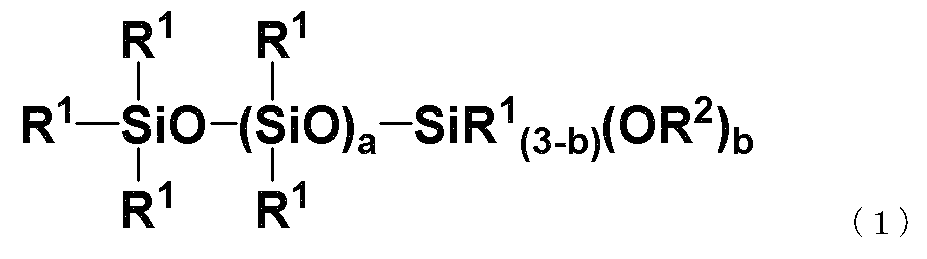
で表されるオルガノポリシロキサン、及び
(E)ヒドロシリル化反応用白金触媒
を含み、前記(A)~(E)成分のうち、前記第1液は前記(A)、(C)、(D)、及び(E)を含有し、前記(B)を含有せず、前記第2液は前記(A)、(B)、(C)、及び(D)を含有し、前記(E)を含有せず、前記第1液と前記第2液を合わせた組成物全体における前記(A)成分と(B)成分の合計100質量部に対して、前記(D)成分を100~200質量部含有しており、前記(A)成分と(B)成分と(D)成分の合計100質量部に対して、前記(C-1)成分を200~600質量部、前記(C-2)成分を200~500質量部、前記(C-3)成分を200~500質量部、前記(C-4)成分を200~500質量部、前記(C-5)成分を300~700質量部含有し、前記(C-1)~(C-5)成分の合計が1700~2000質量部、
であるものであることを特徴とする熱伝導性2液付加硬化型シリコーン組成物。
[2]:前記第1液と前記第2液のそれぞれについて25℃における粘度が、スパイラル粘度計による回転数10rpm測定時において、30~800Pa・sであることを特徴とする[1]の熱伝導性2液付加硬化型シリコーン組成物。
[3]:前記(C-5)成分が不定形状酸化アルミニウム粉末であることを特徴とする[1]又は[2]の熱伝導性2液付加硬化型シリコーン組成物。
[4]:[1]から[3]のいずれか1つの熱伝導性2液付加硬化型シリコーン組成物の硬化物であって、前記熱伝導性2液付加硬化型シリコーン組成物を硬化させて得られるシート状の硬化物の硬度をASTM D 2240-05に規定されるShore OO硬度計によって測定した値が20~80の範囲であることを特徴とする硬化物。
[5]:[1]から[3]のいずれか1つの熱伝導性2液付加硬化型シリコーン組成物の硬化物であって、前記熱伝導性2液付加硬化型シリコーン組成物を硬化させて得られるシート状の硬化物の硬度を85℃/85%RHに1000時間供したのち、JIS K 6251に準拠した引張2号形ダンベル状の引張試験片で、JIS K 7161に規定される引張試験により測定した切断時伸びが10%以上であることを特徴とする硬化物。
[6]:[1]から[3]のいずれか1つの熱伝導性2液付加硬化型シリコーン組成物を硬化してなるものであることを特徴とする熱伝導性シート。
Claims (6)
- 第1液と第2液からなる熱伝導性2液付加硬化型シリコーン組成物であり、
(A)1分子中に2個以上のケイ素原子に結合したアルケニル基を有するオルガノポリシロキサン、
(B)1分子中に2個以上のケイ素原子に結合した水素原子を有するオルガノハイドロジェンポリシロキサン、
(C)平均粒子径80μm以上120μm以下の球状酸化アルミニウム粉末(C-1)、平均粒子径60μm以上80μm未満の球状酸化アルミニウム粉末(C-2)、平均粒子径25μm以上60μm未満の球状酸化アルミニウム粉末(C-3)、平均粒子径5μm以上25μm未満の球状酸化アルミニウム粉末(C-4)、及び平均粒子径0.1μm以上5μm未満の球状または不定形状酸化アルミニウム粉末(C-5)を含む熱伝導性充填剤、
(D)シランカップリング剤と下記一般式(1)

で表されるオルガノポリシロキサンのいずれかまたは両方、及び
(E)ヒドロシリル化反応用白金触媒
を含み、前記(A)~(E)成分のうち、前記第1液は前記(A)、(C)、(D)、及び(E)を含有し、前記(B)を含有せず、前記第2液は前記(A)、(B)、(C)、及び(D)を含有し、前記(E)を含有せず、前記第1液と前記第2液を合わせた組成物全体における前記(A)成分と(B)成分の合計100質量部に対して、前記(D)成分を100~200質量部含有しており、前記(A)成分と(B)成分と(D)成分の合計100質量部に対して、前記(C-1)成分を200~600質量部、前記(C-2)成分を200~500質量部、前記(C-3)成分を200~500質量部、前記(C-4)成分を200~500質量部、前記(C-5)成分を300~700質量部含有し、前記(C-1)~(C-5)成分の合計が1700~2000質量部、
であるものであることを特徴とする熱伝導性2液付加硬化型シリコーン組成物。 - 前記第1液と前記第2液のそれぞれについて25℃における粘度が、スパイラル粘度計による回転数10rpm測定時において、30~800Pa・sであることを特徴とする請求項1に記載の熱伝導性2液付加硬化型シリコーン組成物。
- 前記(C-5)成分が不定形状酸化アルミニウム粉末であることを特徴とする請求項1に記載の熱伝導性2液付加硬化型シリコーン組成物。
- 請求項1から請求項3のいずれか1項に記載の熱伝導性2液付加硬化型シリコーン組成物の硬化物であって、前記熱伝導性2液付加硬化型シリコーン組成物を硬化させて得られるシート状の硬化物の硬度をASTM D 2240-05に規定されるShore OO硬度計によって測定した値が20~80の範囲であることを特徴とする硬化物。
- 請求項1から請求項3のいずれか1項に記載の熱伝導性2液付加硬化型シリコーン組成物の硬化物であって、前記熱伝導性2液付加硬化型シリコーン組成物を硬化させて得られるシート状の硬化物の硬度を85℃/85%RHに1000時間供したのち、JIS K 6251に準拠した引張2号形ダンベル状の引張試験片で、JIS K 7161に規定される引張試験により測定した切断時伸びが10%以上であることを特徴とする硬化物。
- 請求項1から請求項3のいずれか1項に記載の熱伝導性2液付加硬化型シリコーン組成物を硬化してなるものであることを特徴とする熱伝導性シート。
Priority Applications (3)
| Application Number | Priority Date | Filing Date | Title |
|---|---|---|---|
| CN202480038536.4A CN121311547A (zh) | 2023-06-12 | 2024-05-20 | 导热性双液加成固化型有机硅组合物、固化物及片 |
| KR1020257041079A KR20260018849A (ko) | 2023-06-12 | 2024-05-20 | 열전도성 2액 부가경화형 실리콘 조성물, 경화물 및 시트 |
| EP24823177.1A EP4725993A1 (en) | 2023-06-12 | 2024-05-20 | Thermally conductive two-component addition curing type silicone composition, cured product, and sheet |
Applications Claiming Priority (2)
| Application Number | Priority Date | Filing Date | Title |
|---|---|---|---|
| JP2023-096502 | 2023-06-12 | ||
| JP2023096502A JP2024178019A (ja) | 2023-06-12 | 2023-06-12 | 熱伝導性2液付加硬化型シリコーン組成物、硬化物及びシート |
Publications (1)
| Publication Number | Publication Date |
|---|---|
| WO2024257555A1 true WO2024257555A1 (ja) | 2024-12-19 |
Family
ID=93852063
Family Applications (1)
| Application Number | Title | Priority Date | Filing Date |
|---|---|---|---|
| PCT/JP2024/018539 Ceased WO2024257555A1 (ja) | 2023-06-12 | 2024-05-20 | 熱伝導性2液付加硬化型シリコーン組成物、硬化物及びシート |
Country Status (6)
| Country | Link |
|---|---|
| EP (1) | EP4725993A1 (ja) |
| JP (1) | JP2024178019A (ja) |
| KR (1) | KR20260018849A (ja) |
| CN (1) | CN121311547A (ja) |
| TW (1) | TW202506894A (ja) |
| WO (1) | WO2024257555A1 (ja) |
Citations (6)
| Publication number | Priority date | Publication date | Assignee | Title |
|---|---|---|---|---|
| JP5085050B2 (ja) | 2006-04-06 | 2012-11-28 | 株式会社マイクロン | 高熱伝導性樹脂コンパウンド・高熱伝導性樹脂成形体・放熱シート用配合粒子、高熱伝導性樹脂コンパウンド・高熱伝導性樹脂成形体・放熱シート、および、その製造方法 |
| JP5755977B2 (ja) | 2011-09-08 | 2015-07-29 | 電気化学工業株式会社 | 高熱伝導性樹脂組成物 |
| JP2019131734A (ja) * | 2018-02-01 | 2019-08-08 | 信越化学工業株式会社 | 2液付加反応硬化型放熱シリコーン組成物及びその製造方法 |
| JP6648837B2 (ja) | 2016-11-09 | 2020-02-14 | 信越化学工業株式会社 | 熱伝導性シリコーン組成物及びその硬化物、ならびに製造方法 |
| WO2022075434A1 (ja) * | 2020-10-09 | 2022-04-14 | ダウ・東レ株式会社 | 熱伝導性シリコーン組成物および熱伝導性部材 |
| JP2022536577A (ja) * | 2019-04-10 | 2022-08-18 | ヘンケル・アクチェンゲゼルシャフト・ウント・コムパニー・コマンディットゲゼルシャフト・アウフ・アクチェン | 熱伝導性シリコーンポッティング組成物 |
-
2023
- 2023-06-12 JP JP2023096502A patent/JP2024178019A/ja active Pending
-
2024
- 2024-05-20 KR KR1020257041079A patent/KR20260018849A/ko active Pending
- 2024-05-20 EP EP24823177.1A patent/EP4725993A1/en active Pending
- 2024-05-20 CN CN202480038536.4A patent/CN121311547A/zh active Pending
- 2024-05-20 WO PCT/JP2024/018539 patent/WO2024257555A1/ja not_active Ceased
- 2024-05-23 TW TW113119083A patent/TW202506894A/zh unknown
Patent Citations (6)
| Publication number | Priority date | Publication date | Assignee | Title |
|---|---|---|---|---|
| JP5085050B2 (ja) | 2006-04-06 | 2012-11-28 | 株式会社マイクロン | 高熱伝導性樹脂コンパウンド・高熱伝導性樹脂成形体・放熱シート用配合粒子、高熱伝導性樹脂コンパウンド・高熱伝導性樹脂成形体・放熱シート、および、その製造方法 |
| JP5755977B2 (ja) | 2011-09-08 | 2015-07-29 | 電気化学工業株式会社 | 高熱伝導性樹脂組成物 |
| JP6648837B2 (ja) | 2016-11-09 | 2020-02-14 | 信越化学工業株式会社 | 熱伝導性シリコーン組成物及びその硬化物、ならびに製造方法 |
| JP2019131734A (ja) * | 2018-02-01 | 2019-08-08 | 信越化学工業株式会社 | 2液付加反応硬化型放熱シリコーン組成物及びその製造方法 |
| JP2022536577A (ja) * | 2019-04-10 | 2022-08-18 | ヘンケル・アクチェンゲゼルシャフト・ウント・コムパニー・コマンディットゲゼルシャフト・アウフ・アクチェン | 熱伝導性シリコーンポッティング組成物 |
| WO2022075434A1 (ja) * | 2020-10-09 | 2022-04-14 | ダウ・東レ株式会社 | 熱伝導性シリコーン組成物および熱伝導性部材 |
Also Published As
| Publication number | Publication date |
|---|---|
| JP2024178019A (ja) | 2024-12-24 |
| CN121311547A (zh) | 2026-01-09 |
| TW202506894A (zh) | 2025-02-16 |
| EP4725993A1 (en) | 2026-04-15 |
| KR20260018849A (ko) | 2026-02-09 |
Similar Documents
| Publication | Publication Date | Title |
|---|---|---|
| JP5304588B2 (ja) | 熱伝導性シリコーン組成物及びその硬化物 | |
| KR102896173B1 (ko) | 고열전도성 실리콘 조성물 및 그 경화물 | |
| JP6648837B2 (ja) | 熱伝導性シリコーン組成物及びその硬化物、ならびに製造方法 | |
| JP5947267B2 (ja) | シリコーン組成物及び熱伝導性シリコーン組成物の製造方法 | |
| CN105400207A (zh) | 硅酮组合物 | |
| JP2017210518A (ja) | 熱伝導性シリコーン組成物及びその硬化物 | |
| JP5843364B2 (ja) | 熱伝導性組成物 | |
| JP5472055B2 (ja) | 熱伝導性シリコーングリース組成物 | |
| JPS63251466A (ja) | 熱伝導性液状シリコ−ンゴム組成物 | |
| CN111601853A (zh) | 有机硅组合物 | |
| CN115667407B (zh) | 高导热性有机硅组合物 | |
| JP2015212318A (ja) | 熱伝導性シリコーン組成物 | |
| CN114729194B (zh) | 导热性加成固化型有机硅组合物及其制造方法 | |
| CN118804952A (zh) | 双组分型导热性加成固化型有机硅组合物及其有机硅固化物 | |
| WO2024048335A1 (ja) | 熱伝導性シリコーン組成物 | |
| WO2023021954A1 (ja) | 熱伝導性シリコーン組成物及び熱伝導性シリコーン硬化物 | |
| CN112714784B (zh) | 导热性有机硅组合物及其固化物 | |
| WO2024195569A1 (ja) | 熱伝導性シリコーン組成物及びその硬化物、ならびに製造方法 | |
| JP2024178019A (ja) | 熱伝導性2液付加硬化型シリコーン組成物、硬化物及びシート | |
| WO2024024503A1 (ja) | 熱伝導性2液付加硬化型シリコーン組成物、硬化物及びシート | |
| WO2023171352A1 (ja) | 熱伝導性付加硬化型シリコーン組成物及びそのシリコーン硬化物 | |
| WO2024247760A1 (ja) | 熱伝導性2液付加硬化型シリコーン組成物、硬化物及びシート | |
| WO2025187619A1 (ja) | 熱伝導性シリコーン組成物 | |
| WO2025225085A1 (ja) | 熱伝導性組成物及びこれを用いた熱伝導性シートとその製造方法 | |
| TW202603064A (zh) | 熱傳導性聚矽氧組成物、硬化物及製造方法 |
Legal Events
| Date | Code | Title | Description |
|---|---|---|---|
| 121 | Ep: the epo has been informed by wipo that ep was designated in this application |
Ref document number: 24823177 Country of ref document: EP Kind code of ref document: A1 |
|
| WWE | Wipo information: entry into national phase |
Ref document number: CN2024800385364 Country of ref document: CN |
|
| ENP | Entry into the national phase |
Ref document number: 2024823177 Country of ref document: EP Effective date: 20260112 |
|
| WWE | Wipo information: entry into national phase |
Ref document number: 2024823177 Country of ref document: EP |
|
| NENP | Non-entry into the national phase |
Ref country code: DE |
|
| ENP | Entry into the national phase |
Ref document number: 2024823177 Country of ref document: EP Effective date: 20260112 |
|
| ENP | Entry into the national phase |
Ref document number: 2024823177 Country of ref document: EP Effective date: 20260112 |
|
| ENP | Entry into the national phase |
Ref document number: 2024823177 Country of ref document: EP Effective date: 20260112 |
|
| ENP | Entry into the national phase |
Ref document number: 2024823177 Country of ref document: EP Effective date: 20260112 |
|
| WWP | Wipo information: published in national office |
Ref document number: 2024823177 Country of ref document: EP |