EP0001113A1 - Thienothiazinderivate, deren Herstellung, sowie diese enthaltende Präparate - Google Patents
Thienothiazinderivate, deren Herstellung, sowie diese enthaltende Präparate Download PDFInfo
- Publication number
- EP0001113A1 EP0001113A1 EP78100832A EP78100832A EP0001113A1 EP 0001113 A1 EP0001113 A1 EP 0001113A1 EP 78100832 A EP78100832 A EP 78100832A EP 78100832 A EP78100832 A EP 78100832A EP 0001113 A1 EP0001113 A1 EP 0001113A1
- Authority
- EP
- European Patent Office
- Prior art keywords
- methyl
- pyridyl
- hydroxy
- thiazine
- dioxide
- Prior art date
- Legal status (The legal status is an assumption and is not a legal conclusion. Google has not performed a legal analysis and makes no representation as to the accuracy of the status listed.)
- Granted
Links
- 0 CN(*)/C(/*N*)=C(\C(CCCC*CC1)C1S(=O)=O)/O Chemical compound CN(*)/C(/*N*)=C(\C(CCCC*CC1)C1S(=O)=O)/O 0.000 description 2
Classifications
-
- C—CHEMISTRY; METALLURGY
- C07—ORGANIC CHEMISTRY
- C07D—HETEROCYCLIC COMPOUNDS
- C07D513/00—Heterocyclic compounds containing in the condensed system at least one hetero ring having nitrogen and sulfur atoms as the only ring hetero atoms, not provided for in groups C07D463/00, C07D477/00 or C07D499/00 - C07D507/00
- C07D513/02—Heterocyclic compounds containing in the condensed system at least one hetero ring having nitrogen and sulfur atoms as the only ring hetero atoms, not provided for in groups C07D463/00, C07D477/00 or C07D499/00 - C07D507/00 in which the condensed system contains two hetero rings
- C07D513/04—Ortho-condensed systems
-
- A—HUMAN NECESSITIES
- A61—MEDICAL OR VETERINARY SCIENCE; HYGIENE
- A61P—SPECIFIC THERAPEUTIC ACTIVITY OF CHEMICAL COMPOUNDS OR MEDICINAL PREPARATIONS
- A61P25/00—Drugs for disorders of the nervous system
- A61P25/04—Centrally acting analgesics, e.g. opioids
-
- A—HUMAN NECESSITIES
- A61—MEDICAL OR VETERINARY SCIENCE; HYGIENE
- A61P—SPECIFIC THERAPEUTIC ACTIVITY OF CHEMICAL COMPOUNDS OR MEDICINAL PREPARATIONS
- A61P29/00—Non-central analgesic, antipyretic or antiinflammatory agents, e.g. antirheumatic agents; Non-steroidal antiinflammatory drugs [NSAID]
-
- A—HUMAN NECESSITIES
- A61—MEDICAL OR VETERINARY SCIENCE; HYGIENE
- A61P—SPECIFIC THERAPEUTIC ACTIVITY OF CHEMICAL COMPOUNDS OR MEDICINAL PREPARATIONS
- A61P7/00—Drugs for disorders of the blood or the extracellular fluid
- A61P7/02—Antithrombotic agents; Anticoagulants; Platelet aggregation inhibitors
-
- C—CHEMISTRY; METALLURGY
- C07—ORGANIC CHEMISTRY
- C07D—HETEROCYCLIC COMPOUNDS
- C07D333/00—Heterocyclic compounds containing five-membered rings having one sulfur atom as the only ring hetero atom
- C07D333/02—Heterocyclic compounds containing five-membered rings having one sulfur atom as the only ring hetero atom not condensed with other rings
- C07D333/04—Heterocyclic compounds containing five-membered rings having one sulfur atom as the only ring hetero atom not condensed with other rings not substituted on the ring sulphur atom
- C07D333/26—Heterocyclic compounds containing five-membered rings having one sulfur atom as the only ring hetero atom not condensed with other rings not substituted on the ring sulphur atom with hetero atoms or with carbon atoms having three bonds to hetero atoms with at the most one bond to halogen, e.g. ester or nitrile radicals, directly attached to ring carbon atoms
- C07D333/30—Hetero atoms other than halogen
- C07D333/34—Sulfur atoms
-
- C—CHEMISTRY; METALLURGY
- C07—ORGANIC CHEMISTRY
- C07D—HETEROCYCLIC COMPOUNDS
- C07D333/00—Heterocyclic compounds containing five-membered rings having one sulfur atom as the only ring hetero atom
- C07D333/02—Heterocyclic compounds containing five-membered rings having one sulfur atom as the only ring hetero atom not condensed with other rings
- C07D333/04—Heterocyclic compounds containing five-membered rings having one sulfur atom as the only ring hetero atom not condensed with other rings not substituted on the ring sulphur atom
- C07D333/26—Heterocyclic compounds containing five-membered rings having one sulfur atom as the only ring hetero atom not condensed with other rings not substituted on the ring sulphur atom with hetero atoms or with carbon atoms having three bonds to hetero atoms with at the most one bond to halogen, e.g. ester or nitrile radicals, directly attached to ring carbon atoms
- C07D333/38—Carbon atoms having three bonds to hetero atoms with at the most one bond to halogen, e.g. ester or nitrile radicals
Definitions
- the present invention relates to thiazine derivatives, although thienothiazine derivatives of the general formula where A with the two carbon atoms is the group forms and the dashed line indicates the double bond present in the first and last case, R 1 is lower alkyl, R 2 is the residue of an aromatic heterocycle optionally substituted by one or two lower alkyl groups with 1 to 4 heteroatoms or one optionally substituted by halogen, hydroxy, lower Alkyl, trifluoromethyl or lower alkoxy is substituted phenoxy, R 3 is halogen and R 3 is hydrogen or halogen, and salts thereof.
- lower alkyl used in this specification denotes straight-chain or branched saturated hydrocarbon groups with 1-4 carbon atoms, e.g. Methyl, ethyl, propyl, isopropyl, t-butyl and the like.
- lower alkoxy refers to hydrocarbonoxy groups having up to 4 carbon atoms.
- halogen refers to the 4 halogens chlorine, bromine, fluorine, iodine.
- radical of an aromatic heterocycle with 1-4 heteroatoms which is optionally substituted by one or two lower alkyl groups includes radicals of 5- or 6-membered aromatic heterocycles with 1-4 nitrogen and / or oxygen which are optionally substituted by one or two lower alkyl groups and / or sulfur atoms, such as 2-thiazolyl, 4-methyl-2-thiazolyl, 4,5-dimethyl-2-thiazolyl, 5-methyl-1,3,4-thia-diazolyl, 2-pyrazinyl, 2-pyrimidinyl , 1,2,4-triazin-3-yl, 2-pyridyl, 3-pyridyl, 4-pyridyl, 3-methyl-2-pyridyl, 4-methyl-2-pyridyl, 5-methyl-2-pyridyl, 6 -Methyl-2-pyridyl, 4,6-dimethyl-2-pyridyl, 5-isoxazolyl, 5-methyl-3-isoxazolyl, 3,4-d
- R 3 or R 3 are chlorine or bromine, chlorine being particularly preferred.
- R 1 is preferably the methyl group.
- R 2 is preferably 2-thiazolyl, 5-isoxazolyl or 2-pyridyl.
- A is preferably the group
- Particularly preferred compounds are 6-chloro-4-hydroxy-2-methyl-3- (2-pyridylcarbamoyl) -2H-thieno [2,3-e] -1,2-thiazine-1,1-dioxide and the 6- Chloro-4-hydroxy-2-methyl-3- (2-pyridyl-carbamoyl) -2H-thieno [3,2-e] -1,2-thiazine-1,1-dioxide.
- the implementation according to process aspect a) can take place in the presence or absence of an inert solvent.
- Suitable solvents are alcohols, such as ethanol, etc., hydrocarbons, such as benzene, toluene, xylene, etc., halogenated hydrocarbons such as Chl Q roform, chlorobenzene, methylene chloride, carbon tetrachloride, etc., or dimethylformamide, or dioxane.
- the reaction is preferably carried out by heating, the melting or reflux temperature of the reaction mixture being particularly preferred.
- a reactive functional derivative of a compound of formula IV is cyclized.
- This cyclization takes place in the presence of a base and preferably in the presence of a solvent at a temperature between 0 ° C. and the reflux temperature of the reaction mixture, preferably between room temperature and 60 ° C.
- bases hydrides
- amides or alcoholates of alkali metals are particularly suitable.
- Suitable solvents are aprotic and protic, such as alcohols, for example methanol, ethanol, ether, for example dioxane and acid amides, for example dimethylformamide.
- the cyclization is expediently carried out in such a way that the starting compound of the formula IV is dissolved in the solvent, the base is added and the reaction mixture is left to stand at room temperature for 1 to 4 hours or heated to a temperature of up to 60.degree.
- Particularly suitable reactive functional derivatives of the compounds of the formula IV are their lower alkyl esters, for example their methyl esters.
- a compound of formula V is alkylated.
- This alkylation is conveniently carried out by dissolving the starting compound of the formula V in an aprotic solvent such as acetonitrile, dioxane or dimethylformamide, converting it to the alkali metal salt using an alkali metal amide or hydride and then treating it with an alkylating agent, in particular an alkyl halide or sulfate, converted into the corresponding compound of formula I.
- an alkylating agent in particular an alkyl halide or sulfate
- a compound of the general formula VI is reacted with an isocyanate of the general formula VII in the presence of a strong base.
- a strong base Alkali amides, alkali or alkaline earth hydrides and metallic alkali or alkaline earth are suitable as strong bases.
- the reaction is preferably carried out under an inert gas, for example nitrogen, at a temperature between 0 ° C.-50 ° C., preferably at room temperature, and in the presence of an inert, polar solvent such as toluene, dioxane, dimethylformamide, dimethyl sulfoxide or hexamethylphosphoric acid triamide (HMTP).
- HMTP hexamethylphosphoric acid triamide
- an enamine of the general formula VIII is hydrolyzed.
- the hydrolysis is preferably carried out with an aqueous mineral acid, such as hydrochloric acid, hydrobromic acid, hydroiodic acid, sulfuric acid, or with trifluoroacetic acid, working at a temperature between 50 ° C. and the boiling point of the reaction mixture, preferably the boiling point of the reaction mixture.
- the acid also serves as a solvent.
- the starting compounds for the process according to variant a) can be prepared starting from known products in a manner known per se. In particular, they can be synthesized according to the following reaction schemes and according to the specific information in the examples.
- Reaction Scheme I relates to compounds in which A , Reaction Scheme II to such. where A and Reaction Scheme III to those in which A means.
- Lower alkyl esters of acids of the formula IV which can be used as starting compounds for process aspect b) can be obtained, for example, by reacting an amine of the formula III with chloroacetyl chloride and the product of the formula obtained wherein R 2 has the meaning given, with a compound of formula XIV.
- Other reactive functional derivatives of acid of the formula IV can be prepared in a manner known per se from the esters obtained.
- Starting materials of formula V which can be used for process c) can be e.g. can be obtained by reacting a compound of formula XXI, XXVIII or XXXII with an amine of formula III.
- the starting materials of the formula VI required for process d) can be prepared by methods known per se.
- the starting materials for process e) can be prepared according to the following reaction scheme IV.
- the compounds of formula I are acidic and can form pharmaceutically acceptable salts with appropriate bases.
- Suitable bases are, for example, alkali metals, such as lithium, sodium, potassium; Alkaline earth metals, such as magnesium and calcium, and amines, such as triethanolamine, diethylaminoethanol, triethylamine, trimethylamine or diethylamine and the like.
- Compounds of the formula I with a basic heterocycle R 2 can also form pharmaceutically acceptable acid addition salts with strong acids, in particular mineral acids, such as hydrochloric acid, in question come.
- the substance to be examined is administered 1/2 hour before and 3 1/2 hours after the kaolin injection, and the above-mentioned parameters are measured 4 hours after the kaolin injection.
- the edema-inhibiting effect is given in percent, based on the difference in edema intensity between untreated and treated animals with the substance to be examined, the antinociceptive activity by the percentage increase in the pain threshold.
- the 6-chloro-4-hydroxy-2-methyl-3- (2-pyridyl-carbamoyl) -2H-thieno [2,3-e] -1,2-thiazine-1,1-dioxide showed a dosage of 0.3 mg / kg po a 20% inhibition of edema and a 97% increase in the pain threshold and at a dose of 1 mg / kg po. a 33% inhibition of edema and a 129% increase in pain threshold.
- the compounds of formula I have a qualitatively similar effect to phenylbutazone, which is known for its therapeutic use and properties. They also inhibit platelet aggregation - as can be shown in a corresponding standard test - and therefore also have antithrombotic properties
- the compounds of formula I and their salts can be used as medicaments, e.g. in the form of pharmaceutical preparations which they mix with a pharmaceutical, organic or inorganic inert carrier material suitable for enteral or parenteral administration, such as e.g. Contain water, gelatin, gum arabic, milk sugar, starch, magnesium stearate, talc, vegetable oils, polyalkylene glycols, petroleum jelly etc.
- a pharmaceutical, organic or inorganic inert carrier material suitable for enteral or parenteral administration such as e.g. Contain water, gelatin, gum arabic, milk sugar, starch, magnesium stearate, talc, vegetable oils, polyalkylene glycols, petroleum jelly etc.
- the pharmaceutical preparations can be in solid form, e.g. as tablets, dragees, suppositories, capsules, in semi-solid form, e.g. as ointments or in liquid form, e.g. as solutions, suspensions or emulsions
- the compounds of the formula I can be administered orally in humans in a daily dose of 1-100 mg, preferably 2-10 mg.
- the starting product used in this example is obtained as follows:
- the precipitate is brought back into solution by heating, the solution is cooled to 5 ° and the precipitated product is filtered off without washing and dried to constant weight in vacuo.
- the potassium salt of 2-sulfothiophene-3-carboxylic acid is obtained.
- the mixture is then poured onto 350 ml of 2N HCl and 200 g of ice with stirring and extracted with 3 ⁇ 300 ml of methylene chloride.
- the combined organic phases are shaken out with 3 ⁇ 250 ml of 10% sodium acetate solution, the aqueous phases each being shaken back with a little methylene chloride.
- the combined organic phases are extracted with 5 x 200 ml of 10% sodium carbonate solution, the aqueous phase being shaken back with a little methylene chloride.
- the combined aqueous phases are with conc. Acidified HCl to pH 1.
- the precipitated product is extracted with 3 x 500 ml methylene chloride.
- the solvent is distilled off in a water jet vacuum and the residue is partitioned between 100 ml of 2N HCl and 400 ml of methylene chloride.
- the organic phase is separated off and extracted again with 2 ⁇ 100 ml of methylene chloride.
- the combined organic phases are dried with sodium sulfate, stirred with activated carbon, filtered and the solvent is distilled off.
- the oily residue is crystallized with methanol, the crystalline product is filtered off with suction and digested with a little ice-cold methanol.
- M an receives 4-hydroxy-2-methyl-3-methoxycarbonyl-2H-thieno [3,2-e] 1,2-thiazine-1,1-dioxide of melting point 178-180 0.
- the starting material used in this example is obtained as follows:
- 10.6 g (0.0693 g At) sodium are dissolved in 100 ml absolute methanol. The solution was evaporated in vacuo and then heated to 100 ° in a vacuum for 1 hour.
- 10.6 g (0.033 mol) of 5-chloro-2- (N-methoxycarbonylmethyl) sulfamoyl-thiophene-3-carboxylic acid methyl ester are dissolved in 75 ml of absolute benzene, and to the solution is added the sodium methylate prepared above, slurried in 33 ml of absolute Benzene, added and stirred at 60 ° for 6 hours.
- the mixture is left to stand at -25 ° for 15 hours, warmed to 20 ° and a solution of 0.64 g of 2-aminopyridine and 0.8 ml of triethylamine in 5 ml of tetrahydrofuran is added dropwise over the course of 30 minutes.
- the mixture is heated under reflux for a further 2 hours, applied to ice water, extracted with methylene chloride, the organic phase is evaporated to dryness and the residue is chromatographed on silica gel.
- the precipitate is filtered off with distilled water. Washed water and squeezed out.
- the crude, reddish sulfochloride thus obtained is taken up in 4000 ml of methylene chloride and the solution is dried with anhydrous magnesium sulfate. If the sulfochloride is obtained as an oil after decomposition with ice, the aqueous phase is extracted with methylene chloride and the procedure is as described. After evaporation of the clear methylene chloride phase, a reddish oil is obtained, which is freed of residual solvent on the water jet pump and then placed in the ice box (-20 °).
- 2,5-dichlorothiophene-3-sulfonic acid chloride is obtained in the form of coarse crystals, which can be used in the next step without further purification. After recrystallization from petroleum ether, the product shows mp. 25-27 0 .
- the product thus obtained is recrystallized from 1500 ml of carbon tetrachloride and dried in a vacuum drying cabinet at 40 °. This gives 2,5-dichloro-thiophene-3-sulfonic acid methylamide with a melting point of 59-61 °.
- the chloroform phase is extracted several times with a little sodium hydrogen carbonate solution (5%), washed with water, dried with anhydrous sodium sulfate and then evaporated in vacuo.
- the oil obtained is rubbed in, the oil obtained crystallizes.
- the crude product thus obtained is recrystallized from methanol. 5-Chloro-3-methylsulfamoylthiophene-2-carboxylic acid methyl ester of mp. 103-104 0 is obtained .
- Dimethylformamide was added dropwise at 0 ° with cooling within 2 hours. The solution is then stirred at room temperature until an is wet indicator paper shows neutral reaction. The dimethylformamide is then distilled off in vacuo (approx. 1 mm) and the residue is distributed between 400 ml of 0.5N hydrochloric acid and 400 ml of methylene chloride. The methylene chloride phase is separated off in a separating funnel, the water phase is extracted with a little methylene chloride and the combined organic phases are shaken twice with 150 ml of 5% sodium hydrogen carbonate solution. The methylene chloride phase is then dried with anhydrous sodium sulfate g 8 - and evaporated in vacuo.
- Boiling is continued until all starting material has been converted in accordance with the thin-layer chromatogram (duration about 25-35 minutes). After cooling to about 45 °, poured onto 200 g of ice / 300 ml of 2N hydrochloric acid, the product precipitating. The resulting aqueous suspension is shaken out several times in the separating funnel with 2 x 400 ml of methylene chloride. The combined methylene chloride phases are extracted with 2 x 150 ml 10% sodium acetate solution and then shaken with 3 x 100 ml 10% sodium carbonate solution. The combined sodium carbonate phases are washed with a little methylene chloride and concentrated. Acidified hydrochloric acid to pH 1-2 with good stirring.
- the mixture is allowed to cool to about 120 °, activated carbon is added and the mixture is boiled again briefly.
- a hot water funnel is filled with glycerin and preheated to 120 °, the 120 ° hot reaction solution is then filtered through this funnel. When the temperature of the solution has dropped to 70 °, rubbing is carried out, after which small orange crystals are deposited:. kick off. After cooling, the solution is kept for 12 hours in an ice box (-5 °) and the precipitate which has separated out is filtered off with suction and washed with xylene. Drying takes place in a vacuum (1 mm, 120 °, 2 hours).
- N-butyllithium prepared from 223 ml of ether, is added at room temperature to a solution of 33.5 g of N-methyl-2,5-dibromothiophene-3-sulfonamide (0.1 mol) in 520 ml of absolute ether. 24.3 g of N-butyl bromide and 4.4 g of lithium were added dropwise. The solution is stirred for a further 2 hours at room temperature and then dry carbon dioxide is introduced. The reaction mixture is poured onto water, the ether phase is separated off, the aqueous phase is acidified with hydrochloric acid and the product is extracted with ether.
- reaction solution is evaporated in vacuo, the residue is partitioned between methylene chloride and 2N hydrochloric acid, the organic phase is separated off, washed with bicarbonate solution and water, dried and evaporated.
- the crystalline residue is digested with a little carbon tetrachloride. 5-Bromo-3- (N-methoxycarbonylmethyl-N-methyl) -sulfamoylthiophene-2-carboxylic acid methyl ester of mp 98-101 0 is obtained.
- the product is filtered off and recrystallized from ethyl acetate; 4-Acetylamino-5-chloro-3-thiophenecarboxylic acid methyl ester of mp 119-121 0 is obtained .
- the ethereal filtrate and the mother liquor from the recrystallization from ethyl acetate are combined, evaporated to dryness and the oil which remains is chromatographed on 300 g of silica gel using methylene chloride / ethyl acetate 4: 1 as the eluent.
- An additional portion of 4-acetylamino-5-chloro-3-thiophenecarboxylic acid methyl ester of mp 119-121 ° is obtained.
- Capsules of the following composition are produced in the usual way:
Landscapes
- Chemical & Material Sciences (AREA)
- Organic Chemistry (AREA)
- Health & Medical Sciences (AREA)
- Life Sciences & Earth Sciences (AREA)
- General Health & Medical Sciences (AREA)
- Veterinary Medicine (AREA)
- Chemical Kinetics & Catalysis (AREA)
- General Chemical & Material Sciences (AREA)
- Medicinal Chemistry (AREA)
- Nuclear Medicine, Radiotherapy & Molecular Imaging (AREA)
- Public Health (AREA)
- Pharmacology & Pharmacy (AREA)
- Animal Behavior & Ethology (AREA)
- Engineering & Computer Science (AREA)
- Bioinformatics & Cheminformatics (AREA)
- Pain & Pain Management (AREA)
- Hematology (AREA)
- Diabetes (AREA)
- Rheumatology (AREA)
- Biomedical Technology (AREA)
- Neurology (AREA)
- Neurosurgery (AREA)
- Pharmaceuticals Containing Other Organic And Inorganic Compounds (AREA)
- Nitrogen And Oxygen Or Sulfur-Condensed Heterocyclic Ring Systems (AREA)
- Heterocyclic Carbon Compounds Containing A Hetero Ring Having Oxygen Or Sulfur (AREA)
Abstract
Description
- Die vorliegende Erfindung betrifft Thiazinderivate zwar Thienothiazinderivate der allgemeinen Formel


- Der in dieser Beschreibung verwendete Ausdruck "niederes Alkyl" bezeichnet geradkettige oder verzweigte gesättigte Kohlenwasserstoffgruppen mit 1-4 Kohlenstoffatomen, wie z.B. Methyl, Aethyl, Propyl, Isopropyl, t-Butyl und dgl. Der Ausdruck "niederes Alkoxy" bezieht sich auf Hydrocarbonoxygruppen mit bis zu 4 C-Atomen. Die Bezeichnung "Halogen" bezieht sich auf die 4 Halogene Chlor, Brom, Fluor, Jod. Der Begriff "Rest eines gegebenenfalls durch eine oder zwei niedere Alkylgruppen substituierten aromatischen Heterocyclus mit 1-4 Heteroatomen" umfasst gegebenenfalls durch eine oder zwei niedere Alkylgruppen substituierte Reste von 5- oder 6-gliedrigen aromatischen Heterocyclen mit 1-4 Stickstoff- und/oder Sauerstoff-und/oder Schwefelatomen, wie 2-Thiazolyl, 4-Methyl-2-thiazolyl, 4,5-Dimethyl-2-thiazolyl, 5-Methyl-1,3,4-thia- diazolyl, 2-Pyrazinyl, 2-Pyrimidinyl, 1,2,4-Triazin-3-yl, 2-Pyridyl, 3-Pyridyl, 4-Pyridyl, 3-Methyl-2-pyridyl, 4-Methyl-2-pyridyl, 5-Methyl-2-pyridyl, 6-Methyl-2-pyridyl, 4,6-Dimethyl-2-pyridyl, 5-Isoxazolyl, 5-Methyl-3-isoxazolyl, 3,4-Dimethyl-5-isoxazolyl, 2,6-Dimethyl-4-pyrimidinyl, 1,2,3,5-Tetrazol-5-yl und dgl.
- In einer bevorzugten Klasse von Verbindungen der Formel I bedeuten R3 bzw.R3 Chlor oder Brom, wobei Chlor besonders bevorzugt ist. R 1 ist vorzugsweise die Methylgruppe. R2 stellt vorzugsweise 2-Thiazolyl, 5-Isoxazolyl oder 2-Pyridyl dar. A ist vorzugsweise die Gruppe

- Besonders bevorzugte Verbindungen sind 6-Chlor-4-Hydroxy-2-methyl-3-(2-pyridylcarbamoyl)-2H-thieno[2,3-e]-1,2-thiazin-1,1-dioxid und das 6-Chlor-4-Hydroxy-2-methyl-3-(2-pyridyl-carbamoyl)-2H-thieno[3,2-e]-1,2-thiazin-1,1-dioxid.
- Die Thienothiazinderivate der Formel I können erfindungsgemäss dadurch hergestellt werden, dass man
- a) eine Verbindung der allgemeinen Formel

mit einem Amin der allgemeinen Formel
umsetzt, oder - b) ein reaktionsfähiges funktionelles Derivat einer Säure der Formel

cyclisiert, oder dass man - c) eine Verbindung der allgemeinen Formel

nieder alkyliert, oder - d) eine Verbindung der allgemeinen Formel

in Gegenwart einer starken Base mit einem Isocyanat der allgemeinen Formel
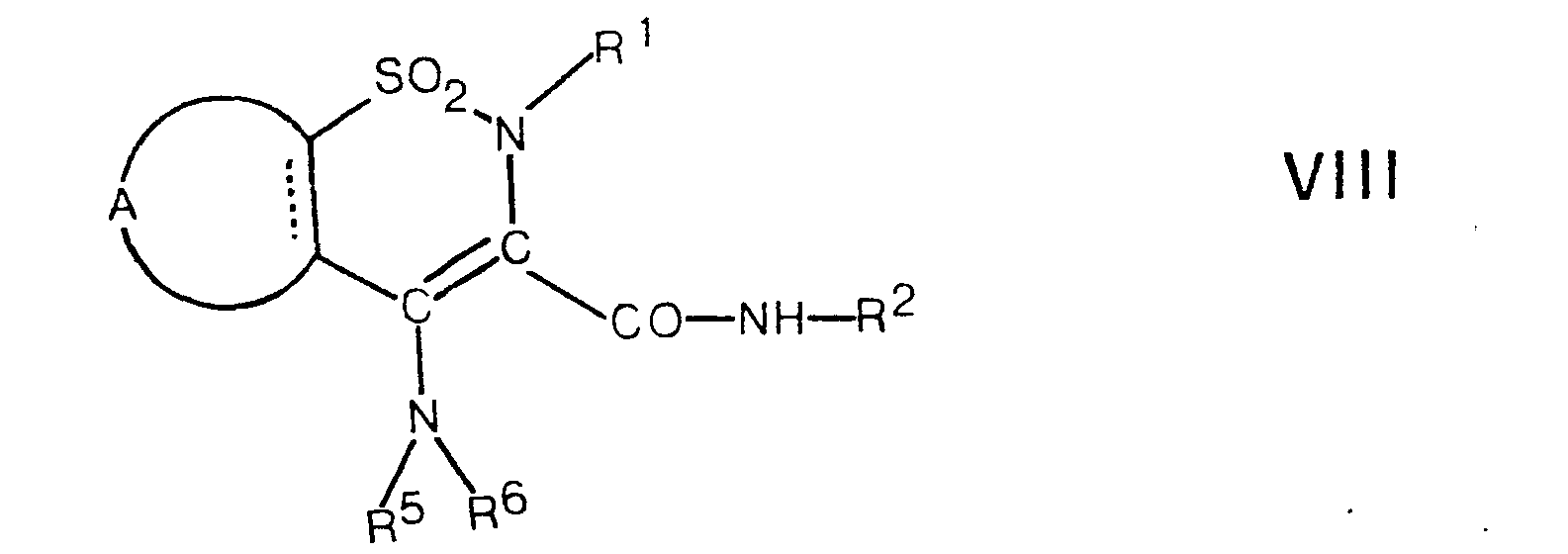
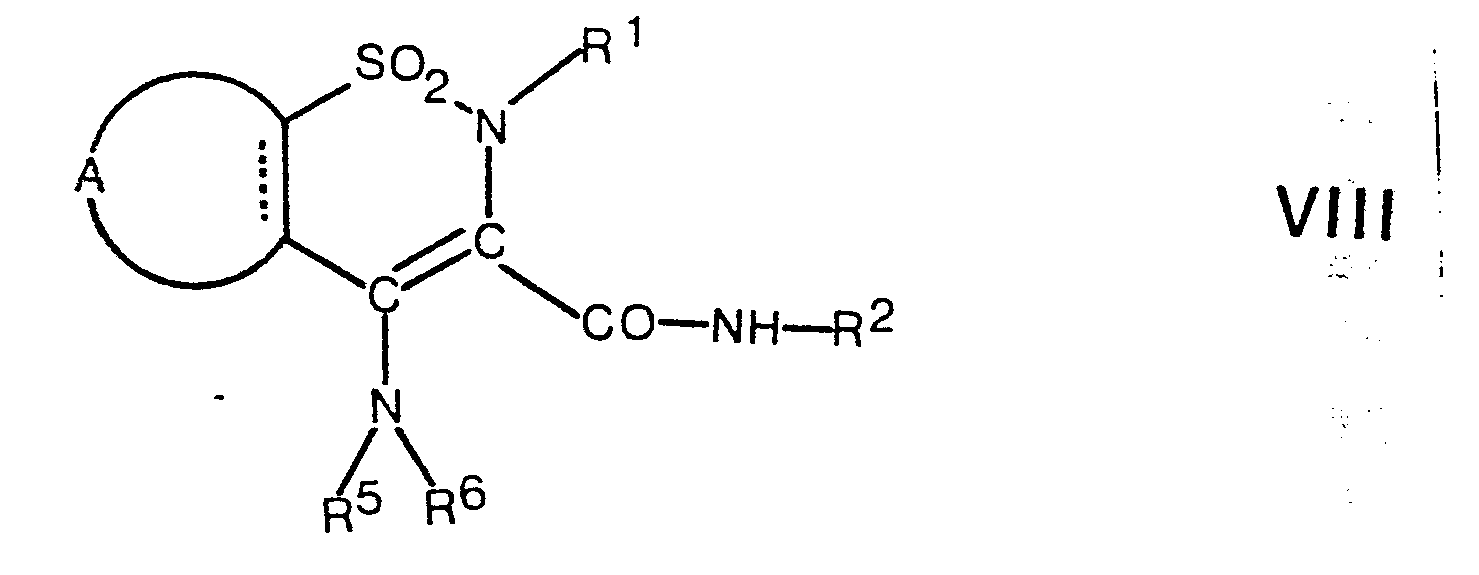
- e) ein Enamin der allgemeinen Formel
- f) erwünschtenfalls eine erhaltene Verbindung der Formel I in ein Salz überführt.
- Die Umsetzung nach Verfahrensaspekt a) kann in An-oder Abwesenheit eines inerten Lösungsmittels erfolgen. Als Lösungsmittel eignen sich Alkohole, wie Aethanol etc., Kohlenwasserstoffe, wie Benzol, Toluol, Xylol, etc., halogenierte Kohlenwasserstoffe, wie ChlQroform, Chlorbenzol, Methylenchlorid, Tetrachlorkohlenstoff, etc., oder Dimethylformamid oder Dioxan. Die Umsetzung erfolgt vorzugsweise durch Erwärmen, wobei Schmelz- bzw. Rückflusstemperatur des Reaktionsgemisches besonders bevorzugt ist.
- Nach dem Verfahrensaspekt b) gemäss vorliegender Erfindung wird ein reaktionsfähiges funktionelles Derivat einer Verbindung der Formel IV cyclisiert. Diese Cyclisation erfolgt in Gegenwart einer Base und vorzugsweise in Gegenwart eines Lösungsmittels bei einer Temperatur zwischen 0°C und Rückflusstemperatur des Reaktionsgemisches, vorzugsweise zwischen Raumtemperatur und 60°C. Als Basen kommen insbesondere Hydride, Amide oder Alkoholate von Alkalimetallen in Betracht. Als Lösungsmittel eignen sich aprotische und protische, wie Alkohole, z.B. Methanol, Aethanol, Aether, z.B. Dioxan und Säureamide, z.B. Dimethylformamid. Zweckmässigerweise wird die Cyclisation so durchgeführt, dass man die Ausgangsverbindung der Formel IV im Lösungsmittel löst, mit der Base versetzt und das Reaktionsgemisch während 1 bis 4 Stunden entweder bei Raumtemperatur stehen lässt oder auf eine Temperatur bis zu 60°C erwärmt. Als reaktionsfähige funktionelle Derivate der Verbindungen der Formel IV eignen sich insbesondere deren niedere Alkylester, z.B. deren Methylester.
- Nach dem Verfahrensaspekt c) wird eine Verbindung der Formel V alkyliert. Diese Alkylierung wird zweckmässigerweise so durchgeführt, dass man die Ausgangsverbindung der Formel V in einem aprotischen Lösungsmittel, wie Acetonitril, Dioxan oder Dimethylformamid, löst, mit einem Alkalimetallamid oder -hydrid in das Alkalimetallsalz überführt und dann durch Behandeln mit einem Alkylierungsmittel, insbesondere einem Alkylhalogenid oder -sulfat, in die entsprechende Verbindung der Formel I überführt. Temperatur und Druck sind für dieses Verfahren nicht kritisch, so dass die Reaktion der Einfachheit halber vorzugsweise bei Raumtemperatur und Atmosphärendruck durchgeführt wird.
- Nach dem Verfahrensaspekt d) wird eine Verbindung der allgemeinen Formel VI in Gegenwart einer starken Base mit einem Isocyanat der allgemeinen Formel VII umgesetzt. Als starke Basen eignen sich Alkaliamide, Alkali- oder Erdalkalihydride sowie metallisches Alkali oder Erdalkali. Die Umsetzung erfolgt vorzugsweise unter einem Inertgas, z.B. Stickstoff, bei einer Temperatur zwischen O°C-50°C, vorzugsweise bei Raumtemperatur, und in Gegenwart eines inerten, polaren Lösungsmittels, wie Toluol, Dioxan, Dimethylformamid, Dimethylsulfoxyd oder Hexamethylphosphorsäuretriamid (HMTP). Die als Ausgangsstoffe benötigte Isocyanate der Formel VII sind entweder bekannt oder können in Analogie zur Herstellung der bekannten Vertreter synthetisiert werden.
- Nach dem Verfahrensaspekt e) wird ein Enamin der allgemeinen Formel VIII hydrolysiert. Die Hydrolyse erfolgt vorzugsweise mit einer wässrigen Mineralsäure, wie Chlorwasserstoffsäure, Bromwasserstoffsäure, Iodwasserstoffsäure, Schwefelsäure, oder mit Trifluoressigsäure, wobei bei einer Temperatur zwischen 50°C und dem Siedepunkt des Reaktionsgemisches, vorzugsweise dem Siedepunkt des Reaktionsgemisches gearbeitet wird. Bei dieser Hydrolyse dient die Säure gleichzeitig als Lösungsmittel.
- Die Ausgangsverbindungen für das Verfahren gemäss Variante a) können ausgehend von bekannten Produkten in an sich bekannter Weise hergestellt werden. Insbesondere können sie gemäss den folgenden Reaktionsschematas und gemäss den spezifischen Angaben in den Beispielen synthetisiert werden. Reaktionsschema I bezieht sich auf Verbindungen, worin A


- Für Verfahrensaspekt b) als Ausgangsverbindungen verwendbare niedere Alkylester von Säuren der Formel IV können z.B. erhalten werden, indem man ein Amin der Formel III mit Chloracetylchlorid umsetzt und das erhaltene Produkt der Formel

- Für Verfahren c) verwendbare Ausgangsstoffe der Formel V können z.B. durch Umsetzen einer Verbindung der Formel XXI, XXVIII oder XXXII mit einem Amin der Formel III erhalten werden.
- Die für Verfahren d) benötigten Ausgangsstoffe der Formel VI können nach an sich bekannten Methoden hergestellt werden.
- Die Herstellung der Ausgangsstoffe für Verfahren e) kann nach dem folgenden Reaktionsschema IV erfolgen.

- Die Verbindungen der Formel I sind sauer und können mit entsprechenden Basen pharmazeutisch annehmbare Salze bilden. Als Basen eignen sich z.B. Alkalimetalle, wie Lithium, Natrium, Kalium; Erdalkalien, wie Magnesium und Calcium sowie Amine, wie Triäthanolamin, Diäthylaminoäthanol, Triäthylamin, Trimethylamin oder Diäthylamin und dgl. Verbindungen der Formel I mit einem basischen Heterocyclus R2 können mit starken Säuren auch pharmazeutisch annehmbare Säureadditionssalze bilden, wozu insbesondere Mineralsäuren, wie Salzsäure in Frage kommen.
- Die Verbindungen der allgemeinen Formel 1 sowie deren Salze haben eine antiinflanmatorische, analgetische und antirheumatische Wirkung. Diese wertvollen pharmakologischen Eigenschaften können unter Verwendung von Standardmethoden bestimmt werden, beispielsweise im bekannten Kaolin-Pfotenoedemtest (an der Ratte). In diesem Test wird in der rechten Hinterpfote der Ratte durch intradermale Injektion von O,1 ml einer 10%igen Kaolinsuspension (bolus alba) eine akute lokale Entzündung erzeugt. Die zu untersuchende Substanz wird auf oralem Wege verabreicht, und die folgenden'Parameter werden gemessen:
- 1. Durchmesser der Pfote in mm (als Ausdruck der Heftigkeit der Entzündung);
- 2. Druck (in g) auf die Pfote (zur Ermittlung der Schmerzschwelle).
- 1/2 Stunde vor und 3 1/2 Stunden nach der Kaolin-injektion wird die zu untersuchende Substanz verabreicht, und 4 Stunden nach der Kaolin-Injektion werden die oben erwähnten Parameter gemessen. Der oedemhemmende Effekt wird in Prozenten angegeben, basierend auf der Differenz der Oedemintensität zwischen unbehandelten und mit der zu untersuchenden Substanz behandelten Tieren, die antinoziceptive Aktivität durch die prozentuale Erhöhung der Schmerzschwelle.
- In diesem Test zeigt das 6-Chlor-4-hydroxy-2-methyl-3-(2-pyridyl-carbamoyl)-2H-thieno[2,3-e]-1,2-thiazin-1,1-dioxid bei einer Dosierung von 0,3 mg/kg p.o. eine 20%ige Oedemhemmung und eine 97%ige Erhöhung der Schmerzschwelle und bei einer Dosierung von 1 mg/kg p.o. eine 33%ige Oedemhemmung und eine 129%ige Erhöhung der Schmerzschwelle.
- Die Verbindungen der Formel I besitzen qualitativ eine ähnliche Wirkung wie Phenylbutazon, welches für seine therapeutische Verwendung und Eigenschaften bekannt ist. Ausserdem hemmen sie - wie dies in einem entsprechenden Standard-Test gezeigt werden kann - die Blutplättchenaggregation und haben demnach auch antithrombotische Eigenschaften
- Die Verbindungen der Formel I sowie deren Salze können als Heilmittel, z.B. in Form pharmazeutischer Präparate Verwendung finden, welche sie in Mischung mit einem für die enterale oder parenterale Applikation geeigneten, pharmazeutischen, organischen oder anorganischen inerten Trägermaterial, wie z.B. Wasser, Gelatine, Gummi arabicum, Milchzucker, Stärke, Magnesiumstearat, Talk, pflanzliche Oele, Polyalkylenglykole, Vaseline usw. enthalten. Die pharmazeutischen Präparate können in fester Form, z.B. als Tabletten, Dragees, Suppositorien, Kapseln, in halbfester Form, z.B. als Salben, oder in flüssiger Forme, z.B. als Lösungsen, Suspensionen oder Emulsionen, vorliegen. Gegebenenfalls sind sie sterilisiert und/oder enthalten Hilfsstoffe, wie Konservierungs-, Stabilisierungs- oder Emulgiermittel, Salze zur Veränderung des osmotischen Druckes oder Puffer. Sie können auch noch andere therapeutisch wertvolle Stoffe enthalten.
- Die Verbindungen der Formel I können beim Menschen oral in einer täglichen Dosis von 1-100 mg, vorzugsweise 2-10 mg, verabreicht werden.
- Die nachfolgenden Beispiele, in welchen alle Temperaturen in Celsiusgraden angegeben sind, erläutern die Erfindung.
- 4,2 g (0,0153 Mol) 4-Hydroxy-2-methyl-3-methoxycarbonyl-2H-thieno[3,2-e]1,2-thiazin-1,1-dioxid werden mit 2,15 g (0,0229 Mol) 2-Aminopyridin in 220 ml absolutem Xylol unter Ueberleiten eines Stickstoffstromes 18 Stunden am Rückfluss erhitzt, wonach auf Raumtemperatur abgekühlt wird. Das Produkt wird durch Anreiben zum Auskristallisieren gebracht. Nach Aufbewahren über Nacht in der Kälte wird das ausgefallene Produkt abgesaugt, mit wenig Dioxan digeriert und aus Aethanol umkristallisiert. Man erhält 4-Hydroxy-2-methyl-3-(2-pyridylcarbamoyl)-2H-thieno[3,2-e]1,2-thiazin-1,1-dioxid vom Schmelzpunkt 223-2250 (Zers.).
- Das in diesem Beispiel verwendete Ausgangsprodukt erhält man wie folgt:
- 59 g (1,48 Mol) Natriumhydroxid werden in 637 ml Wasser gelöst. Die Lösung wird auf 90° erwärmt, worauf 290,7 g (1,48 Mol) 2,5-Dichlorthiophen-3-carbonsäure zugegeben und unter Rühren gelöst werden. Zu der Lösung werden 156 g (1,50 Mol) Natriumhydrogensulfit, gelöst in 430 ml Wasser zugegeben, und es wird mit ca. 167 ml 30%iger Natronlauge auf pH 7,5-7,7 eingestellt. Zu der klaren Lösung werden 12 g (0,12 Mol) fein zerriebenes Kupfer(I)chlörid.zugegeben, worauf 24 Stunden rückflussgekocht wird. Es wird heiss vom.Kupferoxid abgesaugt und das Filtrat wird mit 400 ml konz. HCl angesäuert und auf 5° abgekühlt. Der ausgefallene Niederschlag wird ohne Nachwaschen abgesaugt und im Vakuum bei 110° bis zur Gewichtskonstanz getrocknet. Danach wird mit 3 x 500 ml Methylenchlorid ausgekocht. Der Rückstand wird bei 70° im Vakuum getrocknet. Man erhält das Natriumsalz von 5-Chlor-2-sulfothiophen-3-carbonsäure.
- 129 g (0,488 Mol) des Natriumsalzes von 5-Chlor-2-sulfothiophen-3-carbonsäure werden in einer Lösung von 84,7 g (1,523 Mol) Kalilauge in 430 ml Wasser heiss gelöst, mit 130 ml konz. HCl auf pH 1 angesäuert und langsam auf 5° abgekühlt. Der ausgefallene Niederschlag wird ohne Nachwaschen abgesaugt. Das Filtrat wird auf 220 ml eingeengt und abermals auf 5° abgekühlt. Der ausgefallene Niederschlag wird abgesaugt, mit dem vorher gewonnenen Produkt vereint und im Vakuum bei 110° getrocknet. Man erhält das Kaliumsalz von 5-Chlor-2-sulfothiophen-3-carbonsäure.
- 40 g (0,143 Mol) des Kaliumsalzes von 5-Chlor-2-sulfo- thiophen-3-carbonsäure werden in 24 g (0,428 Mol) Kalilauge, gelöst in 400 ml Wasser, gelöst, mit 4 g Aktivkohle gerührt und filtriert. Danach werden 2 g Palladium/Aktivkohle (10% Pd) zugegeben und bis zur Beendigung der Wasserstoffaufnahme bei Raumtemperatur und einem Anfangsdruck von ca. l atm. hydriert. Der Katalysator wird abgesaugt, das Filtrat auf 35 ml eingeengt und mit konz. HC1 auf pH 1 angesäuert. Der ausgefallene Niederschlag wird durch Erwärmen wieder in Lösung gebracht, die Lösung auf 5° abgekühlt und das ausgefallene Produkt ohne Nachwaschen abgesaugt und im Vakuum bis zur Gewichtskonstanz getrocknet. Man erhält das Kaliumsalz von 2-Sulfothiophen-3-carbonsäure.
- 64 g (0,26 Mol) des Kaliumsalzes von 2-Sulfothiophen-3-carbonsäure werden in 260 ml Phosphoroxychlorid suspendiert. Zur Suspension werden 114 g (0,546 Mol) Phosphorpentachlorid gegeben, worauf 3 Stunden auf 95° erwärmt wird. Danach wird auf 10° abgekühlt. Die ausgefallenen anorganischen Salze werden abgesaugt. Das Filtrat wird im Vakuum soweit als möglich eingedampft, worauf der Rückstand zur Entfernung von noch vorhandenen anorganischen Salzen in 500 ml absolutem Chloroform aufgenommen und filtriert wird. Nach dem Abdampfen des Lösungsmittels hinterbleibt ein öliger Rückstand, der nicht kristallisiert, aber für die weitere Umsetzung rein genug ist. Man erhält 2-Chlorsulfonylthiophen-3-carbonsäurechlorid.
- 51 g (0,208 Mol) 2-Chlorsulfonylthiophen-3-carbonsäurechlorid werden in 510 ml absolutem Chloroform gelöst, mit 10 g (0,312 Mol) absolutem Methanol versetzt und bis zum Ende der HCl-Entwicklung rückflussgekocht (ca. 4 Stunden). Das nach dem Abdestillieren des Lösungsmittels hinterbleibende Oel kristallisiert beim Erkalten aus und wird ohne Reinigun in die nächste Stufe eingesetzt. Man erhält 2-Chlorsul- fonylthiophen-3-carbonsäuremethylester vom Schmelzpunkt 51 - 54°.
- 47,5 g (0,198 Mol) 2-Chlorsulfonylthiophen-3-carbonsäuremethylester und 49,7 g (0,396 Mol) Glycinmethylesterhydrochlorid werden in 475 ml abs. Pyridin 6 Stunden bei Raumtemperatur gerührt. Danach wird das Lösungsmittel im Vakuum abdestilliert. Der Rückstand wird zwischen 300 ml 2 n HC1 und 1 Liter Aether verteilt. Die organische Phase wird abgetrennt und die wässrige Phase mit 4 x 250 ml Aether ausgeschüttelt. Die vereinigten organischen Phasen werden mit Natriumsulfat getrocknet, mit Aktivkohle gerührt, filtriert und eingedampft. Der ölige Rückstand kristallisiert beim Erkalten aus. Man erhält 2-(N-Methoxycarbonylmethyl)-sulfamoylthiophen-3-carbonsäuremethylester vom Schmelzpunkt 120-124°.
- 5,7 g (0,227 g At) Natrium werden in 150 ml abs. Methanol gelöst, im Vakuum zur Trockene eingedampft und anschliessend im Vakuum 1 Stunde auf 100° erhitzt. 30,2 g (0,103 Mol) 2-(N-Methoxycarbonylmethyl)-sulfamoylthiophen-3-carbonsäuremethylester werden in 250 ml abs. Benzol unter Erwärmen gelöst und zu der Lösung des oben bereiteten Natriummethylats, aufgeschlämmt in 52 ml abs. Benzol, zugegeben und unter Stickstoff bei 60° 4 Stunden gerührt. Danach wird unter Rühren auf 350 ml 2 n HC1 und 200 g Eis gegossen und mit 3 x 300 ml Methylenchlorid extrahiert. Die vereinigten organischen Phasen werden mit 3 x 250 ml 10%iger Natriumacetatlösung ausgeschüttelt, wobei die wässrige Phasen jeweils mit wenig Methylenchlorid rückgeschüttelt werden. Die vereinigten organischen Phasen werden mit 5 x 200 ml 10%iger Natriumcarbonatlösung extrahiert, wobei die wässrige Phase jeweils mit wenig Methylenchlorid rückgeschüttelt wird. Die vereinigten wässrigen Phasen werden mit konz. HCl auf pH 1 angesäuert. Das ausgefallene Produkt wird mit 3 x 500 ml Methylenchlorid extrahiert. Die vereinigten organischen Phasen werden mit Natriumsulfat getrocknet, mit Aktivkohle gerührt, filtriert und eingedampft, wobei das Produkt auskristallisiert. Man erhält 4-Hydroxy-3-methoxycarbonyl-2H-thieno]3,2-e]1,2-thiazin-1,1-dioxid vom Schmelzpunkt 210-212° (Zers.).
- 8,0 g (0,031 Mol) 4-Hydroxy-3-methoxycarbonyl-2H-thieno[3,2-e]1,2-thiazin-1,1-dioxid werden in 80 ml absolutem Dimethylformamid gelöst und auf O° gekühlt. Danach werden 2,7 g (0,064 Mol) 58%ige Natriumhydrid-Suspension in Weissöl, die durch Waschen mit 2 x 20 ml absolutem Benzol vom Oel befreit wurden, zugegeben und 2 Stunden bei O° gerührt. Anschliessend werden 4,8 g (0,034 Mol) Methyljodid so zugegeben, dass die Temperatur nicht über 10° steigt. Nach beendeter Zugabe wird 2 Stunden bei Raumtemperatur gerührt. Das Lösungsmittel wird im Wasserstrahlvakuum abdestilliert und der Rückstand zwischen 100 ml 2 n HCl und 400 ml Methylenchlorid verteilt. Die organische Phase wird abgetrennt und nochmals mit 2 x 100 ml Methylenchlorid ausgeschüttelt. Die vereinigten organischen Phasen werden mit Natriumsulfat getrocknet, mit Aktivkohle gerührt, filtriert und das Lösungsmittel abdestilliert. Der ölige Rückstand wird mit Methanol zur Kristallisation gebracht, das kristalline Produkt abgesaugt und mit wenig eiskaltem Methanol digeriert. Man erhält 4-Hydroxy-2-methyl-3-methoxycarbonyl-2H-thieno[3,2-e]1,2-thiazin-1,1-dioxid vom Schmelzpunkt 178-1800.
- 0,25 g (0,91 mMol) 4-Hydroxy-2-methyl-3-methoxycarbonyl-2H-thieno[3,2-e]1,2-thiazin-l,1-dioxid werden mit 0,14 g (1,36 mMol) 2-Aminothiazol in 28 ml absolutem Xylol 17 Stunden unter Ueberleiten eines Stickstoffstromes am Rückfluss erhitzt. Es wird auf Raumtemperatur abgekühlt, worauf das Produkt durch Anreiben zum Auskristallisieren gebracht wird. Das Produkt wird über Nacht in der Kälte aufbewahrt. Die ausgefallenen Kristalle werden abgesaugt und aus Aethanol umkristallisiert. Man erhält 4-Hydroxy-2methyl-3-(2-thiazolylcarbamoyl)-2H-thieno]3,2-e]1,2-thiazin-1,1-dioxid vom Schmelzpunkt 226-227° (Zers.).
- 0,25 g (0,91 mMol) 4-Hydroxy-2-methyl-2-methoxycarbonyl-2H-thieno[3,2-e]1,2-thiazin-1,1-dioxid werden mit 0,13 g (1,36 mMol) Aminopyrazin in 28 ml abs. Xylol 22 Stunden unter Ueberleiten eines Stickstoffstromes am Rückfluss erhitzt. Man bewahrt das Reaktionsgemisch über Nacht in der Kälte auf und saugt das ausgefallene Produkt ab und digeriert mit wenig Dioxan. Danach wird aus Aethanol umkristallisiert. Man erhält 4-Hydroxy-2-methyl-3-pyrazinylcarbamoyl-2H-thieno[3,2-e]1,2-thiazin-1,1-dioxid vom Schmelzpunkt 246-247° (Zers.).
- 0,25 g (0,91 mMol) 4-Hydroxy-2-methyl-3-methoxycarbonyl-2H-thieno[3,2-e]1,2-thiazin-1,1-dioxid werden mit 0,13 g (1,36 mMol) 3-Amino-5-methyl-isoxazol in 28 ml abs. Xylol unter Ueberleiten eines Stickstoffstromes 14 Stunden am Rückfluss erhitzt. Man lässt auf Raumtemperatur erkalten und bringt das Produkt durch Anreiben zur Kristallisation. Es wird über Nacht in der Kälte aufbewahrt. Das ausgefallene Produkt wird abgesaugt und aus Aethanol umkristallisiert. Man erhält 4-Hydroxy-2-methyl-3-[3-(5-methylisoxazolyl)-carbamoyl]-2H-thieno[3,2-e]1,2-thiazin-1,1-dioxid vom Schmelzpunkt 243-244° (Zers.).
- 0,4 g (1,29 mMol) 6-Chlor-4-hydroxy-2-methyl-3-methoxycarbonyl-2H-thieno[3,2-e]l,2-thiazin-l,l-dioxid und 0,18 g (1,94 mMol) 2-Aminopyridin werden in 45 ml absolutem Xylol unter Ueberleiten eines Stickstoffstromes 16 Stunden am Rückfluss erhitzt. Man lässt auf Raumtemperatur abkühlen und bringt das Produkt durch Anreiben zum Auskristallisieren. Es wird über Nacht in der Kälte aufbewahrt. Die ausgefallenen Kristalle werden abgesaugt und aus Dioxan umkristallisiert. Man erhält 6-Chlor-4-hydroxy-2-methyl-3-(2-pyridylcarba- moyl)-2H-thieno[3,2-e]1,2-thiazin-1,1-dioxid vom Schmelzpunkt 239-2410 (Zers.).
- Das in diesem Beispiel verwendete Ausgangsmaterial erhält man wie folgt:
- 25 g (0,089 Mol) des Kaliumsalzes von 5-Chlor-2-sulfo- thiophen-3-carbonsäure werden in 100 ml Phosphoroxychlorid unter Rühren suspendiert. Zur Suspension werden 39 g (0,187 Mol) Phosphorpentachlorid gegeben, worauf 3 Stunden bei 950 gerührt wird. Anschliessend wird auf 10° abgekühlt und von ausgefallenen anorganischen Salzen abgesaugt. Das Filtrat wird im Vakuum soweit als möglich eingedampft und zur Entfernung noch vorhandener anorganischer Salze in 200 ml abs. Chloroform aufgenommen und filtriert. Das Lösungsmittel wird abdestilliert, wobei nicht kristallisierendes Oel hinterbleibt. Man erhält 5-Chlor-2-chlorsulfonylthiophen-3-carbonsäurechlorid.
- 21 g (0,075 Mol) 5-Chlor-2-chlorsulfonylthiophen-3-carbonsäurechlorid werden in 210 ml absolutem Chloroform gelöst, worauf 3,6 g (0,113 Mol) absolutes Methanol zugegeben werden und bis zum Ende der HCl-Entwicklung rückflussgekocht (ca. 4 Stunden) wird. Nach dem Abdestillieren des Lösungsmittels hinterbleibt ein beim Abkühlen auskristallisierendes Oel, das ohne weitere Reinigung verarbeitet werden kann. Man erhält 5-Chlor-2-chlorsulfonylthiophen-3-carbonsäuremethylester.
- 18,6 g (0,068 Mol) 5-Chlor-2-chlorsulfonylthiophen-3-carbonsäuremethylester und 17 g (0,135 Mol) Glycinmethylester-Hydrochlorid werden in 190 ml absolutem Pyridin 6 Stunden bei Raumtemperatur gerührt. Das Lösungsmittel wird anschliessend im Vakuum abdestilliert. Der Rückstand wird zwischen 150 ml 2 n HCl und 400 ml Aether verteilt, die organische Phase abgetrennt und die wässrige Phase mit 3 x 100 ml Aether ausgeschüttelt. Die vereinigten organischen Phasen werden mit Natriumsulfat getrocknet, mit Aktivkohle gerührt, filtriert und eingedampft. Der ölige Rückstand wird mit Aether zur Kristallisation gebracht, abgesaugt und mit wenig eiskaltem Aether digeriert. Man erhält 5-Chlor-2-(N-methoxycarbonylmethyl)-sulfamoylthiophen-3-carbonsäuremethylester vom Schmelzpunkt 95-970.
- 10,6 g (0,0693 g At) Natrium werden in 100 ml absolutem Methanol gelöst. Die Lösung im Vakuum eingedampft und anschliessend im Vakuum 1 Stunde auf 100° erhitzt. 10,6 g (0,033 Mol) 5-Chlor-2-(N-methoxycarbonylmethyl)-sulfamoyl- thiophen-3-carbonsäuremethylester werden in 75 ml absolutem Benzol gelöst, und zu der Lösung wird das oben bereitete Natriummethylat, aufgeschlämmt in 33 ml absolutem Benzol, zugegeben und 6 Stunden bei 60° gerührt. Danach wird auf 150 ml 2 n HC1 und 100 g Eis gegossen und mit 3 x 200 ml Methylenchlorid ausgeschüttelt. Die vereinigten organischer Phasen werden mit 3 x 100 ml 10%iger Natriumacetatlösung ausgeschüttelt, wobei die wässrigen Phasen jeweils mit wenig Methylenchlorid rückgeschüttelt werden. Danach werden die organischen Phasen mit 5 x 150 ml 10%iger Natriumcarbonatlösung extrahiert, wobei die wässrigen Phasen jeweils mit wenig Methylenchlorid rückgeschüttelt werden. Die vereinigten wässrigen Phasen werden mit konz. HC1 auf pH 1 angesäuert, worauf das ausfallende Produkt mit 3 x 200 ml Methylenchlorid extrahiert wird. Die vereinigten organischen Phasen werden mit Natriumsulfat getrocknet, mit Aktivkohle gerührt, filtriert und eingedampft, wobei das Produkt auskristallisiert. Man erhält 6-Chlor-4-hydroxy-3-methoxycarbonyl-2H-thieno[3,2-e]1,2-thiazin-1,1-dioxid vom Schmelzpunkt 178-179°.
- 1,9 g (6,43 mMol) 6-Chlor-4-hydroxy-3-methoxycarbonyl-2H-thieno[3,2-e]1,2-thiazin-1,1-dioxid werden in 19 ml absolutem Dimethylformamid gelöst und auf 0° abgekühlt. Danach werden 0,56 g (13,5 mMol) Natriumhydridsuspension in Weissöl 58%, die durch Waschen mit 2 x 10 ml absolutem Benzol vom Oel befreit wurden, zugegeben und bei O° 2 Stunden gerührt. Anschliessend werden 1,0 g (7,07 mMol) Methyljodid sovzugegeben, dass die Temperatur 10° nicht übersteigt, worauf 2 Stunden bei Raumtemperatur gerührt wird. Das Lösungsmittel wird im Vakuum abdestilliert, und der Rückstand wird zwischen 100 ml 2 n HC1 und 200 ml Methylenchlorid verteilt. Die Phasen werden getrennt und die wässrige Phase mit 50 ml Methylenchlorid ausgeschüttelt. Die vereinigten organischen Phasen werden mit Natriumsulfat getrocknet, mit Aktivkohle gerührt, filtriert und eingedampft. Das zurückbleibende Oel wird mit Methanol zum Kristallisieren gebracht. Das Produkt wird abgesaugt und mit wenig Methanol digeriert. Man erhält 6-Chlor-4-hydroxy-2-methyl-3-methoxycarbonyl-2H-thieno[3,2-e]1,2-thiazin-1,1-dioxid vom Schmelzpunkt 173-174°.
- 0,4 g (1,29 mMol) 6-Chlor-4-hydroxy-2-methyl-3-methoxycarbonyl-2H-thieno[3,2-e]1,2-thiazin-1,1-dioxid werden mit 0,19 g (1,94 mMol) 2-Aminothiazol in 45 ml absolutem Xylol unter Ueberleiten eines Stickstoffstromes 16 Stunden am Rückfluss erhitzt. Man lässt auf Raumtemperatur abkühlen, bringt das Produkt durch Anreiben zum Auskristallisieren und bewahrt über Nacht in der Kälte auf. Die ausgefallenen Kristalle werden abgesaugt und aus Aethanol umkristallisiert. Man erhält 6-Chlor-4-hydroxy-2-methyl-3-(2-thiazol- carbamoyl)-2H-thieno[3,2-e]1,2-thiazin-1,1-dioxid vom Schmelzpunkt 136-138° (Zers.).
- 2,59 g 6-Chlor-3,4-dihydro-2-methyl-4-oxo-2H-thienc-[3,2-e]-1,2-thiazin-1,1-dioxid und 1,8 ml Pyrrolidin werden in 20 ml Benzol gelöst. Nach Zugabe von 3 mg p-Toluolsulfonsäure-monohydrat wird am Wasserabscheider bis zur Ansammlung von 0,2 ml Wasser unter Rückfluss erhitzt. Man engt zur Trockne ein, trocknet am Hochvakuum, nimmt den Rückstand mit wenig Benzol auf und verdünnt mit Diäthyläther und Hexan. Bei -25° kristallisieren kubische, rotbraune Kristalle von 6-Chlor-2-methyl-4-(1-pyrrolidino)-2H-thieno[3,2-e]-1,2-thiazin-1,1-dioxid vom Smp. 150-151,5°
- Eine Lösung von 1,34 g 6-Chlor-2-methyl-4-(1-pyrroli- dino)-2H-thieno[3,2-e]-1,2-thiazin-1,1-dioxid und 0,8 ml Triäthylamin in 25 ml einer 4:l-Mischung von Tetrahydrofuran und Benzol wird während 1 Stunde zu einer gerührten und auf -10° gekühlten Mischung von 0,5 g Phosgen, 6 ml Benzol und 3 ml Tetrahydrofuran zugetropft. Man lässt 15 Stunden bei -25° stehen, erwärmt auf 20° und gibt unter Rühren eine LÖsung von 0,64 g 2-Aminopyridin und 0,8 ml Triäthylamin in 5 ml Tetrahydrofuran tropfenweise während 30 Minuten zu. Man erhitzt weitere 2 Stunden unter Rückfluss, trägt auf Eiswasser auf, extrahiert mit Methylenchlorid, dampft die organische Phase'zur Trockne ein und chromatographiert den Rückstand an Kieselgel. Mit Methylenchlorid-Aethylacetat 9:1 eluiert, kristallisiert nach dem Eindampfen das 6-Chlor-2-methyl-3-(2-pyridyl-carbamoyl)-4-(1-pyrrolidino)-2H-thieno[3,2-e]-1,2-thiazin-1,1-dioxid aus Diäthyläther als gelbe hexagonale Kristalle vom Smp. 167,5-168°.
- 0,5 g 6-Chlor-2-methyl-3-(2-pyridyl-carbamoyl)-4-(1-pyrrolidino)-2H-thieno[3,2-e]-1,2-thiazin-1,1-dioxid werden in 15 ml 2 n Salzsäure während 15 Minuten unter Rückfluss erhitzt. Man entfernt den Hauptteil der Salzsäure am Vakuum, trägt den Rückstand auf Phosphatpufferlösung von pH 6 aus und extrahiert mehrmals mit Methylenchlorid. Das Lösungsmittel wird am Vakuum entfernt, und der feste gelbe Rückstand aus Dioxan umkristallisiert. Man erhält 6-Chlor-4-hydroxy-2-methyl-3-(2-pyridyl-carbamoyl)-2H-thieno[3,2-e]-1,2-thiazin-1,1-dioxid als gelbes Kristallpulver vom Smp. 238-239°.
- In einem 4 1-Kolben wird ein Gemisch aus 1230 g (10,6 Mol) Chlorsulfonsäure und 1000 g (8,45 Mol) Thionylchlorid vorgelegt und mittels Eisbad auf 5° abgekühlt. Dann werden vorsichtig 647 g (4,23 Mol) 2,5-Dichlorthiophen so langsam zugetropft, dass die Temperatur des Reaktionsgemisches 7° nicht überschreitet. Dabei tritt heftige Gasentwicklung ein. Nach Beendigung der Zugabe wird die Reaktionslösung 1,5 Stunden bei 15° weiter gerührt. Anschliessend wird die erhaltene leicht rötliche Lösung vorsichtig auf Eis gegossen. Die so erhaltene Mischung wird noch einige Minuten durchgerührt, gröbere Brocken des kristallin anfallenden Sulfochlorids werden zerrieben. Nach Entfernen des überschüssigen Eises wird der Niederschlag abgesaugt, mit dest. Wasser gewaschen und ausgepresst. Das so erhaltene rohe, rötliche Sulfochlorid wird in 4000 ml Methylenchlorid aufgenommen und die Lösung mit wasserfreiem Magnesiumsulfat getrocknet. Fällt nach dem Zersetzen mit Eis das Sulfochlorid als Oel an, so extrahiert man die wässrige Phase mit Methylenchlorid und verfährt wie beschrieben. Nach dem Eindampfen der klaren Methylenchloridphase wird ein rötliches Oel erhalten, das an der Wasserstrahlpumpe von restlichem Lösungsmittel befreit und anschliessend in den Eiskasten (-20°) gestellt wird. Man erhält 2,5-Dichlorthiophen-3-sulfonsäurechlorid in Form derber Kristalle, welches ohne weitere Reinigung in die nächste Stufe eingesetzt werden kann. Nach Umkristallisation aus Petroläther zeigt das Produkt den Smp. 25-270.
- 3500 ml absolutes Chloroform werden in einem 4 1-Kolben vorgelegt und 533 g (2,12 Mol) 2,5-Dichlorthiophen-3-sulfonsäurechlorid werden darain gelöst. Unter Rühren wird bei 20° solange trockenes Methylamin eingeleitet, bis die Lösung mit angefeuchtetem Indikatorpapier basisch reagiert. Die Lösung wird noch 1-1,5 Stunden bei Raumtemperatur gerührt, dann im Scheidetrichter mit 0,5 n HCl mehrmals extrahiert, mit wasserfreiem Natriumsulfat getrocknet und im Vakuum eingedampft. Das so erhaltene Oel wird ins Tiefkühlfach gestellt, wo es kristallisiert. Zur Reinigung wird das so erhaltene Produkt aus 1500 ml Tetrachlorköhlenstoff umkristallisiert und im Vakuumtrockenschrank bei 40° getrocknet. Man erhält 2,5-Dichlor-thiophen-3-sulfonsäure- methylamid vom Smp. 59-61°.
- 250 g (1,016 Mol) 2,5-Dichlor-thiophen-3-sulfonsäure- methylamid werden in einem 4 1-Kolben in 1500 ml absolutem Aether gelöst, die Apparatur mit trockenem Stickstoff gespült und langsam eine Lösung von 2,54 Mol n-Butyllithium in 2200 ml Aether unter Rühren und Beibehaltung der Stickstoffspülung innerhalb 1 Stunde zugetropft. Die Lösung erwärmt sich dabei zum Sieden und ein weisser Niederschlag fällt aus, der allmählich einen grauen Farbton anzunehmen beginnt. Die Lösung wird nach beendeter Butyllithium-Zugabe 5 Stunden rückflussgekocht, nach dem Abkühlen auf etwa 25° wird unter Beibehaltung des Rührens trockenes Kohlendioxyd 1/2 Stunde in die Suspension eingeleitet. Danach wird die Suspension auf 2000 ml Wasser gegossen und solange konz. Salzsäure zugesetzt, bis die wässrige Phase stark sauer reagiert. Nun wird die ätherische Phase, in der sich Ausgangs- und Endprodukt befinden, im Scheidetrichter abgetrennt und die wässrige Phase zusätzlich mit Aether extrahiert. Die vereinigten Aetherphasen werden 3 x mit je 300 ml 5% Natriumhydrogencarbonat-Lösung extrahiert. Die vereinigten Natriumhydrogencarbonat-Phasen werden mit konz. Salzsäure angesäuert (pH 1-2) und mit 4000 ml Aether extrahiert. Die Aetherphase wird mit wasserfreiem Magnesiumsulfat getrocknet und eingedampft. Die rohe, leicht gelblich gefärbte Carbonsäure kristallisiert dabei sofort. Zur Reinigung wird das erhaltene Produkt aus Eisessig umkristallisiert. Man erhält 5-Chlor-3-methylsulfamoylthio- phen-2-carbonsäure.
- In einem 4 1-Kolben werden 1500 ml absolutes Chloroform vorgelegt und unter Rühren darin 90 g (0,352 Mol) feinpulverisierte 5-Chlor-3-methylsulfamoylthiophen-2-carbonsäure suspendiert. Dann werden 85,17 g (0,41 Mol) Phosphorpentachlorid zugegeben und die Lösung auf 35° erwärmt. Nach etwa 15 Minuten entsteht eine klare Lösung. Höhere Temperaturen müssen unbedingt vermieden werden, da sonst das Ausgangsprodukt ringschliesst. Nach insgesamt 20-30 Minuten Rühren wird die Heizung ausgeschaltet, der Tropftrichter aufgesetzt und 250 ml absolutes Methanol in die Lösung eingetropft. Nach beendeter Methanolzugabe wird die Lösung 10 Minuten rückflussgekocht und dann erkalten gelassen. Im Scheidetrichter wird die Chloroform-Phase mehrmals mit wenig Natriumhydrogencarbonat-Lösung (5%) extrahiert, mit Wasser gewaschen, mit wasserfreiem Natriumsulfat getrocknet und dann im Vakuum eingedampft. Beim Anreiben des erhaltenen Oeles kristallisiert das erhaltene Oel. Zur Reinigung wird das so erhaltene Rohprodukt aus Methanol umkristallisiert. Man erhält 5-Chlor-3-methylsulfamoylthio- phen-2-carbonsäuremethylester vom Smp. 103-1040.
- 9,7 g (0,2224 Mol) einer 55% Natriumhydridsuspension in Weissöl werden in einer Glassinternutsche mit abs. Benzol gewaschen und in einem 1 Liter-Kolben unter Stickstoffatmosphäre in 70 ml abs. Dimethylformamid suspendiert. Dann werden unter Rührung 60 g (0,2224 Mol) 5-Chlor-3-methylsulfamoylthiophen-2-carbonsäuremethylester in 525 ml absolutem Dimethylformamid gelöst bei 0° innerhalb 1 Stunde zugetropft. Anschliessend wird 20 Minuten gerührt und dann eine Lösung von 44,5 g (0,2224 Mol) Jodessigsäuremethylester in 65 ml abs. Dimethylformamid bei O-5° unter Kühlung innerhalb von 2 Stunden zugetropft. Die Lösung wird nun noch so lange bei Raumtemperatur gerührt, bis ein angefeuchtetes Indikatorpapier neutrale Reaktion zeigt. Anschliessend wird im Vakuum (ca. 1 mm) das Dimethylformamit abdestilliert und der Rückstand zwischen 400 ml O,5 n Salzsäure und 400 ml Methylenchlorid verteilt. Die Methylenchloridphase wird im Scheidetrichter abgetrennt, die Wasserphase mit wenig Methylenchlorid extrahiert und die vereinigten organischen Phasen zweimal mit 150 ml 5% Natriumhydrogencarbonat-Lösung ausgeschüttelt. Anschliessend wird die Methylenchloridphase mit wasserfreiem Natriumsulfat g8- trocknet und im Vakuum eingedampft. Dabei wird ein kristalliner Rückstand erhalten, der durch Umkristallisation aus Methanol gereinigt wird. Man erhält 5-Chlor-3-(N-methoxycarbonyl-N-methyl)-sulfamoylthiophen-2-carbonsäuremethylester vom Smp. 103-1040.
- 170 ml absolutes Methanol werden in einen 0,5 1-Kolben vorgelegt und dieser mit getrocknetem Stickstoff gespült. Dann werden unter Rühren portionsweise 3,53 g Natrium (o,146 Mol) eingetragen. Es wird die totale Auflösung des Natriums abgewartet, worauf man auf ca. 30° abkühlen lässt und anschliessend unter Rühren 50 g 5-Chlor-3-(N-methoxycarbonyl-N-methyl)-sulfamoylthiophen-2-carbonsäuremethylester (0,146 Mol) einträgt. Die Suspension wird 15 Minuten bei 30° gerührt und dann vorsichtig zum Sieden erwärmt. Dabei entsteht eine klare, orange gefärbte Lösung. Das Sieden wird solange beibehalten bis gemäss.Dünnschichtchromatogramm alles Ausgangsmaterial umgesetzt ist (Dauer etwa 25-35 Minuten). Nach dem Abkühlen auf ca. 45° wird auf 200 g Eis/300 ml 2 n Salzsäure gegossen, wobei das Produkt ausfällt. Im Scheidetrichter wird die entstandene wässrige Suspension mit 2 x 400 ml Methylenchlorid mehrmals ausgeschüttelt. Die vereinigten Methylenchloridphasen werden mit 2 x 150 ml 10% Natriumacetatlösung extrahiert und anschliessend mit 3 x 100 ml 10% Natriumcarbonatlösung ausgeschüttelt. Die vereinigten Natriumcärbonatphasen werden mit wenig Methylenchlorid gewaschen und mit konz. Salzsäure unter gutem Rühren auf pH 1-2.angesäuert. Die wässrige Phase, die das ausgefallene Endprodukt enthält, wird mit 2 x 500 ml Methylenchlorid extrahiert. Die vereinigten Methylenchloridphasen werden mit Natriumsulfat getrocknet und im Vakuum eingedampft. Man erhält 6-Chlor-4-hydroxy-2-methyl-3-methoxycarbonyl-2H-thieno[2,3-e]-1,2-thiazin-1,1-dioxid als gelbe, körnige Kristalle, die nach Digerieren in wenig kaltem Methanol, Absaugen und Trocknen im Vakuumtrockenschrank bei 70° rein genug für die weitere Umsetzung sind. Für die Elementaranalyse wird eine kleine Menge aus Benzol umkristallisiert, die einen Smp. von 200-203° (Zers.) zeigt.
- In einem 2 1-Kolben werden 1200 ml absolutes Xylol vorgelegt und unter Rühren 11 g 6-Chlor-4-hydroxy-2-methyl-3-methoxycarbonyl-2H-thieno[2,3-e]-1,2-thiazin-1,1-dioxid (0.0355 Mol) zugegeben. Anschliessend werden 4,42 g 2-Aminopyridin (0,0469 Mol) eingetragen und die Lösung anschliessend rückflussgekocht, bis gemäss Dünnschichtchromatogramm alles Ausgangsprodukt umgesetzt ist (Dauer 4 Stunden). Während des Rückflusskochens wird ein schwacher Stickstoffstrom durchgeleitet, um so das entstehende Methanol auszutragen. Nach vollendeter Umsetzung lässt man auf ca. 120° abkühlen, setzt Aktivkohle zu und kocht noch einmal kurz auf. Ein Heisswassertrichter wird mit Glycerin gefüllt und auf 120° vorgeheizt, die 120° heisse Reaktionslösung dann über diesen Trichter filtriert. Wenn die Temperatur der Lösung auf 70° gesunken ist, wird angerieben, worauf sich kleine orange Kristalle abzuscheiden: . beginnen. Nach dem Erkalten wird die Lösung noch 12 Stunden im Eiskasten (-5°) aufbewahrt und der ausgefallene Niederschlag abgesaugt und mit Xylol gewaschen. Die Trocknung erfolgt im Vakuum (1 mm, 120°, 2 Stunden). Die so erhaltenen orange bis gelben Kristalle liefern 6-Chlor-4-hydrdxy-2-methyl-3-(2-pyridyl-carbamoyl)-2H-thieno[2,3-e]-1,2-thiazin-1,1-dioxid vom Smp. 225-230° (Zers.).
- 268,5 g fein gepulvertes Natriumsalz der 2,5-Dibrom- thiophen-3-sulfonsäure (0,78 Mol) werden in 400 ml Phosphoroxychlorid aufgeschlämmt, 171 g Phosphorpentachlorid (0,82 Mol) zugegeben und 2 1/2 Stunden auf 90° erhitzt. Dann wird im Vakuum scharf eingedampft, der Rückstand auf 600 g Eis gegossen, mit 3 x 250 ml Chloroform extrahiert, die organische Phase mit 2 x 100 ml Wasser gewaschen, getrocknet und eingedampft. Das zurückbleibende dunkle Oel bestehend aus 2,5-Dibromthiophen-3-sulfonsäurechlorid ist für die weitere Umsetzung rein genug.
- 150 g (0,44 Mol) 2,5-Dibromthiophen-3-sulfonsäurechlorid werden in 500 ml absolutem Chloroform gelöst. In die Lösung wird bei 20-25° so lange trockenes Methylamin eingeleitet, bis ein angefeuchtetes pH-Papier mit der Lösung basisch reagiert. Nach einer weiteren Stunde Rühren wird das Reaktionsgemisch mehrmals mit 0,5 n Salzsäure extrahiert, mit Wasser gewaschen und die organische Phase über Natriumsulfat getrocknet. Nach Eindampfen der organischen Phase im Vakuum verbleibt ein kristalliner Rückstand, der mit wenig Diisopropyläther digeriert wird. Man erhält N-Methyl-2,5-dibrom-thiophen-3-sulfonamid vom Smp. 100-104°.
- Zu einer Lösung von 33,5 g N-Methyl-2,5-dibrom-thiophen-3-sulfonamid (0,1 Mol) in 520 ml absolutem Aether wird bei Raumtemperatur eine Lösung von N-Butyllithium, hergestellt aus 223 ml Aether, 24,3 g N-Butylbromid und 4,4 g Lithium, zugetropft. Die Lösung wird noch 2 Stunden bei Raumtemperatur gerührt und dann trockenes Kohlendioxyd eingeleitet. Das Reaktionsgemisch wird auf Wasser gegossen, die Aetherphase abgetrennt, die wässrige Phase mit Salzsäure angesäuert und das Produkt mit Aether extrahiert. Nach Eindampfen der getrockneten Aetherphase bleibt ein kristallines Produkt zurück, das mit Benzol digeriert wird. Man erhält 5-Brom-3-N-methylsulfamoylthiophen-2-carbonsäure vom Smp. 165-185°.
- 30,0 g (0,1 Mol) 5-Brom-3-N-methylsulfamoylthiophen-2-carbonsäure werden in 400 ml absolutem Chloroform aufgeschlämmt und unter Kühlen werden bei 5-10° 24,2 g Phosphorpentachlorid (0,11 Mol) zugesetzt. Sobald eine klare Lösung entstanden ist, wird noch 20 Minuten bei 10° weitergerührt und dann 100 ml abs. Methanol zugetropft. Es wird 10 Minuten rückflussgekocht, dann die Lösung mit Natriumhydrogencarbonat-Lösung extrahiert, getrocknet und eingedampft. Das zurückbleibende Oel wird mit Methanol angerieben. Man erhält 5-Brom-3-N-methylsulfamoyl-thiophen-2-carbonsäuremethylester vom Smp. 114-117°.
- Zu einer Suspension von 2,52 g Natriumhydrid (0,105 Mol) in 12 ml abs. Dimethylformamid wird bei 0° die Lösung von 31,4 g (0,1 Mol) 5-Brom-3-N-methylsulfamoyl-thiophen-2-carbonsäuremethylester in 160 ml absolutem Dimethylformamid zugetropft. Es wird noch 1 Stunde bei 0-2° gerührt und dann bei O-5° eine Lösung von 16,1 g (0,105 Mol) Bromessigsäuremethylester in 20 ml absolutem Dimethylformamid zugetropft und noch 3 Stunden bei Raumtemperatur gerührt. Die Reaktionslösung wird im Vakuum eingedampft, der Rückstand zwischen Methylenchlorid und 2 n Salzsäure verteilt, die organische Phase abgetrennt, mit Bicarbonatlösung und Wasser gewaschen, getrocknet und eingedampft. Der kristalline Rückstand wird mit wenig Tetrachlorkohlenstoff digeriert. Man erhält 5-Brom-3-(N-methoxycarbonylmethyl-N-methyl)-sulfamoylthiophen-2-carbonsäuremethylester vom Smp. 98-1010.
- In 15 ml einer methanolischen Lösung von einem Hundertstel Mol Natriummethylat werden unter Rühren portionsweise 3,86 g (0,01 Mol) 5-Brom-3-(N-methoxycarbonylmethyl-N-methyl)-sulfamoylthiophen-2-carbonsäuremethylester zugegeben, 15 Minuten bei Raumtemperatur gerührt und dann 20 Minuten rückflusserhitzt. Die Lösung wird auf Eis und 2 n Salzsäure gegossen und das Produkt mit Methylenchlorid extrahiert. Die organische Phase wird mit 10%iger Natriumacetatlösung gewaschen und dann mit 10%iger Natriumcarbonatlösung extrahiert. Die Natriumcarbonatlösung wird mit Salzsäure angesäuert und das ausfallende Produkt mit Methylen chlorid ausgeschüttelt. Nach Eindampfen der getrockner organischen Phase erhält man ein kristallines Produkt, der mit wenig Methanol digeriert wird. Man erhält 6-Brom-4-hydroxy-2-methyl-3-methoxycarbonyl-2H-thieno[2,3-e]-1,2-thiazin-1,1-dioxid vom Smp. 196-201°.
- 3,54 g (0,01 Mol) 6-Brom-4-hydroxy-2-methyl-3-methoxycarbonyl-2H-thieno[2,3-e]-1,2-thiazin-1,1-dioxid werden zusammen mit 1,42 g (0,015 Mol) 2-Aminopyridin in 150 ml absolutem Xylol 6 Stunden rückflussgekocht. Man lässt auf Raumtemperatur abkühlen und kristallisiert das ausfallende Rohprodukt aus Dioxan um. Man erhält 6-Brom-4-hydroxy-2-methyl-3-(2-pyridyl-carbamoyl)-2H-thieno[2,3-ej-1,2-thiazin-1,1-dioxid vom Smp. 232-235°.
- 40 g (0,2 Mol) 4-Acetylamino-3-thiophencarbonsäure- methylester werden in 1 Liter absoluten Chloroform gelöst, worauf bei 20-25° eine Lösung von 27 g (0,2 Mol) Sulfurylchlorid in 100 ml abs. Chloroform innert 20 Minuten zugetropft wird. Hierauf wird 1 Stunde am Rückfluss gekocht. Die erhaltene bräunliche Lösung wird abgekühlt und bei 10° mit 1 Liter Eiswasser versetzt. Die organische Lösung wird dann mit 200 ml 5%iger Natriumbicarbonatlösung gewaschen, über Natriumsulfat getrocknet und im Vakuum zur Trockne eingeengt. Der ölige Rückstand wird mit 100 ml Aether angerieben, wobei Kristallisation eintritt. Das Produkt wird abgenutscht und aus Essigester umkristallisiert; man erhält 4-Acetylamino-5-chlor-3-thiophencarbonsäuremethylester vom Smp. 119-1210. Das ätherische Filtrat und die Mutterlauge der Umkristallisation aus Essigester werden vereinigt, zur Trockene eingedampft und das zurückbleibende Oel an 300 g Kieselgel mit Methylenchlorid/Essigester 4:1 als Eluiermittel chromatographiert. Man erhält eine zusätzliche Portion von 4-Acetylamino-5-chlor-3-thiophencarbonsäure- methylester vom Smp. 119-121°.
- 35 g 4-Acetylamino-5-chlor-3-thiophencarbonsäure- methylester werden mit 350 ml einer 5 n Lösung von Chlorwasserstoff in abs. Methanol 30 Minuten am Rückfluss gekocht. Die dunkel gefärbte Lösung wird dann nach üblicher Weise mit Aktivkohle behandelt, abfiltriert und im Vakuum zur Trockene eingedampft. Der kristalline Rückstand wird nun in 180 ml absolutem Methanol bei Raumtemperatur gelöst und die erhaltene Lösung unter ständigem Rühren portionenweise mit 1400 ml absolutem Aether versetzt. Nach 30- minütigem Abkühlen im Eisbad wird das auskristallisierte, fast farblose Produkt abgenutscht, mit Aether gewaschen und 1 Stunde an der Luft getrocknet. Man erhält 4-Amino-5-chlor-3-thiophencarbonsäuremethylester-hydrochlorid, welches sich zwischen 120° und 140° zersetzt. Dieses Hydrochlorid kann ohne weitere Reinigung für die nächste Stufe eingesetzt werden.
- t 22,8 g (0,1 Mol) 4-Amino-5-chlor-3-thiophencarbonsäure- methylester-hydrochlorid werden in 100 ml 36%iger Salzsäure suspendiert. Bei -10 wird eine Lösung von 7,25 g (0,105 Mol) Natriumnitrit in 20 ml Wasser unter die Oberfläche des Reaktionsgemisches innert 10 Minuten zugetropft. Man lässt 30 Minuten bei -10° nachreagieren und versetzt mit einem Gemisch, das aus 150 ml einer 30%igen Lösung von Schwefeldioxid in Eisessig und einer Lösung von 7,5 g Kupfer(II)-chlorid in 10 ml Wasser unmittelbar vorher zubereitet wurde. Das Gemisch wird 1 Stunde bei O-5° und 3 Stunden bei Raumtemperatur weitergerührt und dann in 2 1 Eiswasser gegossen. Das auskristallisierte Produkt wird abgenutscht und in 800 ml Toluol gelöst. Die toluolische Lösung wird mit Wasser, mit einer Natriumbicarbonatlösung und schliesslich wiederum mit Wasser gewaschen. Nach dem Trocknen über Natriumsulfat und dem Einengen unter vermindertem Druck wird das zurückbleibende Oel mit wenig Hexan angerieben und über Nacht im Eiskasten stehen gelassen. Man erhält 3-Carbomethoxy-5-chlor-thiophen-4-sulfochlorid in Form von fast farblosen Kristallen, Smp. 65-67°. Umkristallisation aus Hexan erhöht den Smp. auf 67-68°.
- Zu einer Lösung von 16,5 g (0,06 Mol) 3-Carbomethoxy-5-chlor-thiophen-4-sulfochlorid in 300 ml absolutem Pyridin werden bei 10-15° 7,5 g (0,06 Mol) Glycinmethylester-hydrochlorid portionenweise innert 5 Minuten zugegeben. Das Reaktionsgemisch wird hierauf 4 Stunden bei 25° nachgerührt und dann im Vakuum zur Trockne eingeengt. Der Rückstand wird in Methylenchlorid gelöst und die Lösung mit eiskalter 2 n Salzsäure ausgeschüttelt. Die organische Phase wird über Natriumsulfat getrocknet, im Vakuum eingedampft und das zurückbleibende Oel an 350 g Kieselgel mit Methylenchlorid/Essigester 4:1 als Eluiermittel chromatographiert. Die homogenen Fraktionen werden vereinigt, eingeengt und der Rückstand aus Methylenchlorid/Hexan umkristallisiert. Man erhält N-(3-Carbomethoxy-5-chlor- thiophen-4-sulfonyl)-glycinmethylester vom Smp. 68-70°.
- Eine Lösung von 1,15 g (0,05 Mol) Natrium in 24 ml Methanol wird im Vakuum und anschliessend im Hochvakuum zur Trockne eingedampft und der Rückstand mit 240 ml abs. Toluol übergossen. Danach werden 8,2 g (0,025 Mol) N-(3-Carbomethoxy-5-chlor-thiophen-4-sulfonyl)-glycin- methylester zugegeben und das Reaktionsgemisch während 4 Stunden bei 60° gerührt. Es wird dann auf O° abgekühlt und unter Rühren auf 240 ml eiskalte 2 n Salzsäure gegossen. Der dabei ausgefallene Niederschlag wird abgenutscht, mit Wasser neutral gewaschen und bei 60° im Vakuum getrocknet. Das erhaltene Produkt wird mit 30 ml Methanol digeriert, erneut genutscht und getrocknet. Man erhält 3-Carbomethoxy-7-chlor-4-hydroxy-2H-thieno[3,4-e]-1,2-thiazin-1,1-dioxid, welches zwischen 230° und 235° unter Zersetzung schmilzt.
- Eine Lösung von 2,93 g (0,01 Mol) 3-Carbomethoxy-7-chlor-4-hydroxy-2H-thieno[3,4-e]-1,2-thiazin-1,1-dioxid in 75 ml Dimethylformamid wird unter Argon bei 10° mit 0,022 Mol Natriumhydrid (1,0 g einer 55%igen Dispersion in Mineralöl) versetzt und hierauf 4 Stunden bei 25° weitergerührt. Danach werden bei 10-15° 2,5 ml (0,04 Mol) Methyljodid zugetropft. Man rührt anschliessend 16 Stunden bei Raumtemperatur, giesst dann das Reaktionsgemisch auf 750 ml Eiswasser und stellt mit konzentrieter Salzsäure sauer. Der dabei ausgefallene Niederschlag wird abgenutscht, in Chloroform gelöst und die Lösung über Natriumsulfat getrocknet. Nach dem Einengen im Vakuum wird der Rückstand an 150 g Kieselgel mit Chloroform als Eluiermittel chromatographiert. Nach Kristallisation aus Acetonitril erhält man 3-Carbomethoxy-7-chlor-4-hydroxy-2-methyl-2H-thieno[3,4-e]-1,2-thiazin-1,1-dioxid vom Smp. 188-191°.
- Ein Gemisch aus 2,2 g (0,07 Mol) 3-Carbomethoxy-7-chlor-4-hydroxy-2-methyl-2H-thieno[3,4-e]-l,2-thiazin-l,l-dioxid, 0,9 g (0,09 Mol) 2-Aminopyridin und 240 ml abs. o-Xylol wird unter Rühren 7 Stunden am Rückfluss erhitzt, wobei ca. 80 ml o-Xylol während der 2 ersten Stunden langsam abdestilliert werden. Nach dem Abkühlen auf Raumtemperatur wird das Reaktionsgemisch im Vakuum auf ca. 60 ml eingeengt und im Eisbad abgekühlt. Das auskristallisierte Produkt wird abgenutscht, mit Aether gewaschen, getrocknet und aus Acetonitril umkristallisiert. Man erhält 7-Chlor-4-hydroxy-2-methyl-3-(2-pyridyl-carbamoyl)-2H-thieno-[3,4-e]-1,2-thiazin-1,1-dioxid vom Smp. 218-220° (Zers.).
- Es werden in üblicher Weise Suppositorien folgender Zusammensetzung hergestellt:

- Es werden in üblicher Weise Tabletten folgender Zusammensetzung hergestellt:

- Es werden in üblicher Weise Kapseln folgender Zusammensetzung hergestellt:

Claims (36)

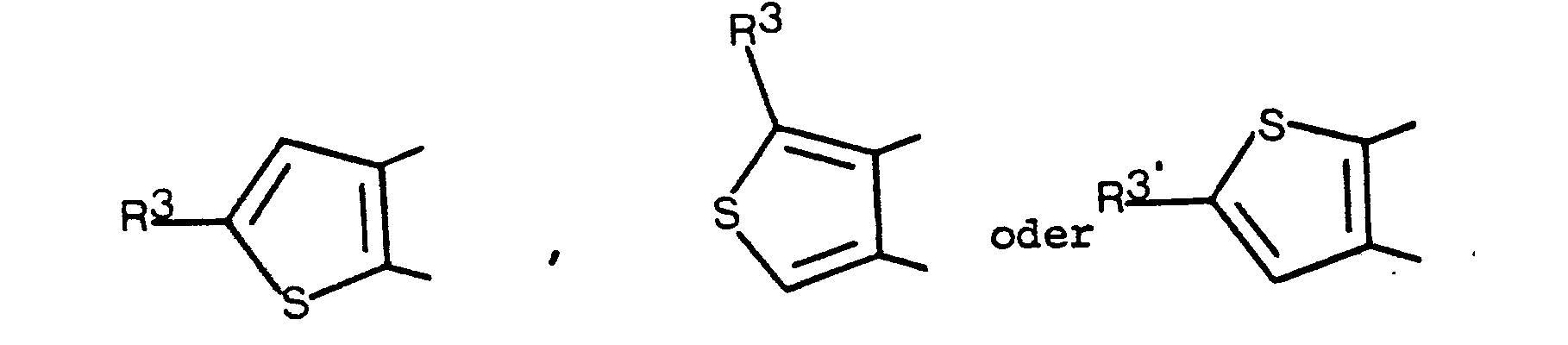
dadurch gekennzeichnet, dass man

R1, R3 und R 3' die genannte Bedeutung haben,
mit einem Amin der allgemeinen Formel

umsetzt, oder

cyclisiert, oder dass man

nieder alkyliert, oder

in Gegenwart einer starken Base mit einem Isocyanat der allgemeinen Formel



Applications Claiming Priority (4)
| Application Number | Priority Date | Filing Date | Title |
|---|---|---|---|
| LU78083 | 1977-09-06 | ||
| LU78083 | 1977-09-06 | ||
| CH790878 | 1978-07-21 | ||
| CH7908/78 | 1978-07-21 |
Publications (2)
| Publication Number | Publication Date |
|---|---|
| EP0001113A1 true EP0001113A1 (de) | 1979-03-21 |
| EP0001113B1 EP0001113B1 (de) | 1981-11-11 |
Family
ID=25702440
Family Applications (1)
| Application Number | Title | Priority Date | Filing Date |
|---|---|---|---|
| EP78100832A Expired EP0001113B1 (de) | 1977-09-06 | 1978-09-06 | Thienothiazinderivate, deren Herstellung, sowie diese enthaltende Präparate |
Country Status (28)
| Country | Link |
|---|---|
| US (1) | US4180662A (de) |
| EP (1) | EP0001113B1 (de) |
| JP (1) | JPS5448792A (de) |
| AR (1) | AR222472A1 (de) |
| AT (1) | AT364851B (de) |
| AU (1) | AU518216B2 (de) |
| BR (1) | BR7805845A (de) |
| CA (1) | CA1103246A (de) |
| CS (1) | CS202019B2 (de) |
| DE (2) | DE2861316D1 (de) |
| DK (1) | DK148280C (de) |
| ES (1) | ES473074A1 (de) |
| FI (1) | FI63587C (de) |
| GB (1) | GB2003877B (de) |
| GR (1) | GR73066B (de) |
| HK (1) | HK1085A (de) |
| HU (1) | HU176979B (de) |
| IE (1) | IE47261B1 (de) |
| IL (1) | IL55465A (de) |
| IT (1) | IT1099046B (de) |
| LU (1) | LU90207I2 (de) |
| MC (1) | MC1212A1 (de) |
| NL (1) | NL7809015A (de) |
| NO (1) | NO149174C (de) |
| NZ (1) | NZ188320A (de) |
| PH (1) | PH13949A (de) |
| PT (1) | PT68515A (de) |
| SE (1) | SE7809348L (de) |
Cited By (12)
| Publication number | Priority date | Publication date | Assignee | Title |
|---|---|---|---|---|
| EP0009142A1 (de) * | 1978-09-02 | 1980-04-02 | Dr. Karl Thomae GmbH | Neue 4-Hydroxy-2H(1)benzothieno(2,3-e)-1,2-thiazin-3-carboxamid-1,1-dioxide sowie deren Salze, deren Verwendung und Verfahren zu ihrer Herstellung |
| EP0021058A3 (de) * | 1979-06-13 | 1981-01-28 | F. HOFFMANN-LA ROCHE & CO. Aktiengesellschaft | Benzothienothiazinderivate, deren Verwendung, Verfahren und Zwischenprodukte zu deren Herstellung und diese enthaltende Arzneimittel |
| EP0103142A1 (de) * | 1982-09-09 | 1984-03-21 | F. HOFFMANN-LA ROCHE & CO. Aktiengesellschaft | Thieno(2,3-e)-1,2-thiazin-Derivate |
| EP0147177A3 (en) * | 1983-12-21 | 1985-08-14 | Pfizer Inc. | Ether prodrugs of anti-inflammatory oxicams |
| EP0138223A3 (de) * | 1983-10-17 | 1986-12-30 | Fujisawa Pharmaceutical Co., Ltd. | Thiazin-Derivate, Verfahren zu ihrer Herstellung und sie enthaltende pharmazeutische Zubereitung |
| EP0340472A1 (de) * | 1988-05-02 | 1989-11-08 | Hafslund Nycomed Pharma Aktiengesellschaft | Verfahren zur Herstellung von 5-Chlor-3-chlorsulfonyl-2-thiophencarbonsäureestern |
| EP0313935A3 (en) * | 1987-10-29 | 1990-10-31 | Cl Pharma Aktiengesellschaft | Enolethers of 6-chloro-4-hydroxy-2-methyl-n-(2-pyridyl)-2h-thieno(2,3-e)-1,2-thiazin-3-carboxylic acid amide-1,1-dioxide, a process for their preparation and their use |
| WO1993012119A1 (de) * | 1991-12-13 | 1993-06-24 | Luitpold Pharma Gmbh | Thiadiazincarbonsäureamidderivate, verfahren zu ihrer herstellung und arzneimittel |
| EP0576906A1 (de) * | 1992-07-03 | 1994-01-05 | Chemisch Pharmazeutische Forschungsgesellschaft m.b.H. | Neue Thienothiazinderivate, Verfahren zu ihrer Herstellung und ihre Verwendung als Antiinflammatorium und Analgeticum |
| EP0294994B1 (de) * | 1987-06-10 | 1994-05-11 | Pfizer Inc. | 3,4-Dihydro-2-alkyl-3-oxo-N-aryl-2H-[1]benzothieno[3,2-e]-1,2-thiazine-4-carboxamid-1,1-dioxide |
| EP0657459A1 (de) * | 1993-12-06 | 1995-06-14 | Chemisch Pharmazeutische Forschungsgesellschaft m.b.H. | Neue Thienothiazinderivate, ein Verfahren zu ihrer Herstellung und ihre Verwendung als Antiinflammatorikum und Analgeticum |
| EP0658559A1 (de) * | 1993-12-14 | 1995-06-21 | Chemisch Pharmazeutische Forschungsgesellschaft m.b.H. | Thienothiazinderivate, Verfahren zu ihrer Herstellung und ihre Verwendung als 5-dipoxygenase und Cyclooxygenaseinhibitoren |
Families Citing this family (40)
| Publication number | Priority date | Publication date | Assignee | Title |
|---|---|---|---|---|
| JPS58109492A (ja) * | 1981-12-22 | 1983-06-29 | Mitsui Toatsu Chem Inc | チエノチアジン誘導体およびそれを含有する医薬組成物 |
| DE3346526C2 (de) * | 1983-12-22 | 1986-12-11 | A. Nattermann & Cie GmbH, 5000 Köln | Pharmazeutisches Präparat zur therapeutischen Behandlung von rheumatischen Erkrankungen |
| JPS60184077A (ja) * | 1984-02-23 | 1985-09-19 | フアイザー・インコーポレーテツド | 抗炎症性オキシム前駆薬 |
| US4656265A (en) * | 1984-06-21 | 1987-04-07 | Pfizer Inc. | Cyclic prodrugs of antiinflammatory oxicams |
| US4623486A (en) | 1985-05-29 | 1986-11-18 | Pfizer Inc. | [4-substituted benzoyloxy]-N-substituted-2H-1,2-benzothiazine-3-carboxamide 1,1-dioxides having anti-arthritic activity |
| US4610982A (en) * | 1985-06-03 | 1986-09-09 | Pfizer Inc. | Anti-inflammatory benzo- and thieno-1,2-thiazine-3-carboxamide 1,1-dioxide derivatives, compositions, and method of use therefor |
| ATA39088A (de) | 1988-02-18 | 1990-06-15 | Binder Dieter Dr | Basisch substituierte thienoisothiazol-3(2h)-on-1,1-dioxide und ihre pharmazeutisch vertraeglichen salze, verfahren zu ihrer herstellung und ihre verwendung |
| JPH01316314A (ja) * | 1988-06-16 | 1989-12-21 | Taisho Pharmaceut Co Ltd | 湿布剤 |
| JPH01316315A (ja) * | 1988-06-16 | 1989-12-21 | Taisho Pharmaceut Co Ltd | 硬膏剤 |
| AT400568B (de) * | 1994-05-18 | 1996-01-25 | Chem Pharm Forsch Gmbh | Neue n-heterocyclische thienothiazincarboxamide, verfahren zu ihrer herstellung und ihre verwendung |
| AT400437B (de) * | 1993-12-14 | 1995-12-27 | Chem Pharm Forsch Gmbh | Neue n-heterocyclische thienothiazincarboxamide, verfahren zu ihrer herstellung und ihre verwendung |
| DE19747625A1 (de) * | 1997-10-29 | 1999-05-06 | Bayer Ag | Verfahren zur Herstellung von 3,5-Dimethylisoxazol-4-sulfochlorid |
| IT1308633B1 (it) | 1999-03-02 | 2002-01-09 | Nicox Sa | Nitrossiderivati. |
| DE19933260A1 (de) | 1999-07-15 | 2001-01-18 | Bayer Ag | Substituierte Thien-3-yl-sulfonylamino(thio)carbonyl-triazolin(thi)one |
| AU2002344854B2 (en) * | 2001-06-11 | 2008-11-06 | Vertex Pharmaceuticals (Canada) Incorporated | Thiophene derivatives as antiviral agents for flavivirus infection |
| US8329924B2 (en) * | 2001-06-11 | 2012-12-11 | Vertex Pharmaceuticals (Canada) Incorporated | Compounds and methods for the treatment or prevention of Flavivirus infections |
| CN1171892C (zh) * | 2001-06-25 | 2004-10-20 | 李晶 | 具有抗炎镇痛活性的噻吩并噻嗪化合物及其制备方法和用途 |
| CN100413861C (zh) * | 2002-12-10 | 2008-08-27 | 维勒凯姆制药股份有限公司 | 用于治疗或预防黄病毒感染的化合物 |
| AT413944B (de) * | 2003-05-27 | 2006-07-15 | Binder Eva Dkfm | Verwendung von oxicam-verbindungen |
| CN1266155C (zh) * | 2003-08-01 | 2006-07-26 | 浙江震元制药有限公司 | 6-氯-4-羟基-2-甲基-2H-噻吩并(2,3-e)-1,2-噻嗪-1,1-二氧化物-3-羧酸酯的合成方法 |
| DE102004010812A1 (de) * | 2004-03-05 | 2005-09-22 | Bayer Cropscience Ag | Unkrautbekämpfungsverfahren |
| AU2005247943A1 (en) | 2004-05-23 | 2005-12-08 | Gerard M. Housey | Theramutein modulators |
| CN101218224B (zh) * | 2005-05-13 | 2013-05-08 | Viro化学制药公司 | 治疗或预防黄病毒感染的组合物和方法 |
| US8431110B2 (en) | 2005-05-23 | 2013-04-30 | Hmi Medical Innovations, Llc. | Compounds and method of identifying, synthesizing, optimizing and profiling protein modulators |
| CA2631182C (en) * | 2005-11-23 | 2019-08-06 | Hmi, Inc. | Compounds and methods of identifying, synthesizing, optimizing and profiling protein modulators |
| US20090221703A1 (en) | 2006-07-09 | 2009-09-03 | Chongxi Yu | High penetration composition and uses thereof |
| US20090238763A1 (en) | 2006-07-09 | 2009-09-24 | Chongxi Yu | High penetration compositions and uses thereof |
| CN101522692A (zh) | 2006-10-11 | 2009-09-02 | 于崇曦 | 具有快速皮肤穿透速度的带正电荷的水溶性的昔康及其相关化合物的前药 |
| PT2104674E (pt) | 2006-11-15 | 2013-07-26 | Virochem Pharma Inc | Análogos de tiofeno para o tratamento ou prevenção de infeções por flavivírus |
| WO2008149181A1 (en) | 2007-06-04 | 2008-12-11 | Techfields Inc | Pro-drugs of nsaias with very high skin and membranes penetration rates and their new medicinal uses |
| CN101314598B (zh) * | 2008-07-14 | 2012-03-21 | 浙江工业大学 | 5-氯-2-羧酸甲酯-3-甲胺基磺酰噻吩的合成新工艺 |
| RU2630577C2 (ru) | 2008-12-04 | 2017-09-11 | Чунси ЮЙ | Композиции интенсивного проникновения и их применение |
| ES2969344T3 (es) | 2012-01-18 | 2024-05-17 | Techfields Pharma Co Ltd | Composiciones de profármaco de alta penetración y composición farmacéutica del mismo para el tratamiento de afecciones pulmonares |
| ITUB20152229A1 (it) * | 2015-07-16 | 2017-01-16 | Edmond Pharma Srl | Processo per la preparazione di farmaci antiinfiammatori non steroidei della classe oxicam |
| CN108218895B (zh) * | 2018-04-13 | 2019-06-18 | 北京金城泰尔制药有限公司沧州分公司 | 一锅法合成氯诺昔康中间体的方法 |
| CN112125792B (zh) * | 2020-09-24 | 2022-07-12 | 万华化学集团股份有限公司 | 一种联产羟基香茅醛和羟基香茅醇的方法 |
| CN112661742A (zh) * | 2020-12-25 | 2021-04-16 | 北京金城泰尔制药有限公司 | 氯诺昔康金属化活性中间体的合成方法 |
| CN112645925A (zh) * | 2020-12-25 | 2021-04-13 | 北京金城泰尔制药有限公司 | 氯诺昔康中间体5-氯-3-甲基磺酰胺噻吩-2-羧酸甲酯的合成方法 |
| CN114213434A (zh) * | 2021-12-29 | 2022-03-22 | 北京金城泰尔制药有限公司 | 氯诺昔康晶型及其制备方法 |
| CN115894525B (zh) * | 2023-01-04 | 2024-09-20 | 河北国龙制药有限公司 | 一种氯诺昔康中间体的合成方法 |
Citations (1)
| Publication number | Priority date | Publication date | Assignee | Title |
|---|---|---|---|---|
| FR2282893A1 (fr) * | 1974-08-26 | 1976-03-26 | Hoffmann La Roche | Derives de thienothiazine utiles en tant que medicaments et leur procede de preparation |
Family Cites Families (6)
| Publication number | Priority date | Publication date | Assignee | Title |
|---|---|---|---|---|
| GB1308533A (en) | 1969-06-02 | 1973-02-21 | Pfizer | Benzothiazine dioxides as anti-thombotic agents |
| US3787324A (en) | 1971-03-01 | 1974-01-22 | Warner Lambert Co | 4-hydroxy-3-(3-isoxazolocarbamyl)-2h-1,2-benzothiazine 1,dioxides and process for their production |
| US3821211A (en) * | 1972-03-10 | 1974-06-28 | Warner Lambert Co | Process for the preparation of 4-hydroxy-3-(5-methyl-3-isoxazolycarbamoyl)-2-methyl-2h-1,2-benzothiazine 1,1-dioxide |
| CA1010990A (en) | 1973-06-06 | 1977-05-24 | Leopold H. O'donnell | Video tape recording animation system |
| CA1066711A (en) * | 1974-08-26 | 1979-11-20 | Hoffmann-La Roche Limited | Thiophene derivatives |
| MC1135A1 (fr) * | 1976-02-23 | 1977-11-18 | Hoffmann La Roche | Derives de thiazine |
-
1978
- 1978-08-30 AU AU39389/78A patent/AU518216B2/en not_active Expired
- 1978-08-31 IL IL55465A patent/IL55465A/xx active IP Right Grant
- 1978-08-31 MC MC781322A patent/MC1212A1/fr unknown
- 1978-08-31 US US05/938,274 patent/US4180662A/en not_active Expired - Lifetime
- 1978-09-01 NL NL7809015A patent/NL7809015A/xx not_active Application Discontinuation
- 1978-09-01 NZ NZ188320A patent/NZ188320A/xx unknown
- 1978-09-04 GR GR57146A patent/GR73066B/el unknown
- 1978-09-04 HU HU78HO2099A patent/HU176979B/hu unknown
- 1978-09-04 PH PH21565A patent/PH13949A/en unknown
- 1978-09-05 DK DK392778A patent/DK148280C/da active
- 1978-09-05 CA CA310,603A patent/CA1103246A/en not_active Expired
- 1978-09-05 SE SE7809348A patent/SE7809348L/xx unknown
- 1978-09-05 ES ES473074A patent/ES473074A1/es not_active Expired
- 1978-09-05 AT AT0642178A patent/AT364851B/de not_active IP Right Cessation
- 1978-09-05 IE IE1788/78A patent/IE47261B1/en not_active IP Right Cessation
- 1978-09-05 CS CS785744A patent/CS202019B2/cs unknown
- 1978-09-05 GB GB7835571A patent/GB2003877B/en not_active Expired
- 1978-09-05 JP JP10820378A patent/JPS5448792A/ja active Granted
- 1978-09-05 PT PT68515A patent/PT68515A/pt unknown
- 1978-09-05 NO NO783032A patent/NO149174C/no unknown
- 1978-09-06 EP EP78100832A patent/EP0001113B1/de not_active Expired
- 1978-09-06 DE DE7878100832T patent/DE2861316D1/de not_active Expired
- 1978-09-06 AR AR273600A patent/AR222472A1/es active
- 1978-09-06 FI FI782737A patent/FI63587C/fi not_active IP Right Cessation
- 1978-09-06 BR BR7805845A patent/BR7805845A/pt unknown
- 1978-09-06 DE DE19782838851 patent/DE2838851A1/de not_active Withdrawn
- 1978-09-06 IT IT27396/78A patent/IT1099046B/it active Protection Beyond IP Right Term
-
1985
- 1985-01-03 HK HK10/85A patent/HK1085A/xx not_active IP Right Cessation
-
1998
- 1998-01-30 LU LU90207C patent/LU90207I2/fr unknown
Patent Citations (1)
| Publication number | Priority date | Publication date | Assignee | Title |
|---|---|---|---|---|
| FR2282893A1 (fr) * | 1974-08-26 | 1976-03-26 | Hoffmann La Roche | Derives de thienothiazine utiles en tant que medicaments et leur procede de preparation |
Cited By (14)
| Publication number | Priority date | Publication date | Assignee | Title |
|---|---|---|---|---|
| EP0009142A1 (de) * | 1978-09-02 | 1980-04-02 | Dr. Karl Thomae GmbH | Neue 4-Hydroxy-2H(1)benzothieno(2,3-e)-1,2-thiazin-3-carboxamid-1,1-dioxide sowie deren Salze, deren Verwendung und Verfahren zu ihrer Herstellung |
| EP0021058A3 (de) * | 1979-06-13 | 1981-01-28 | F. HOFFMANN-LA ROCHE & CO. Aktiengesellschaft | Benzothienothiazinderivate, deren Verwendung, Verfahren und Zwischenprodukte zu deren Herstellung und diese enthaltende Arzneimittel |
| EP0103142A1 (de) * | 1982-09-09 | 1984-03-21 | F. HOFFMANN-LA ROCHE & CO. Aktiengesellschaft | Thieno(2,3-e)-1,2-thiazin-Derivate |
| EP0138223A3 (de) * | 1983-10-17 | 1986-12-30 | Fujisawa Pharmaceutical Co., Ltd. | Thiazin-Derivate, Verfahren zu ihrer Herstellung und sie enthaltende pharmazeutische Zubereitung |
| EP0147177A3 (en) * | 1983-12-21 | 1985-08-14 | Pfizer Inc. | Ether prodrugs of anti-inflammatory oxicams |
| EP0294994B1 (de) * | 1987-06-10 | 1994-05-11 | Pfizer Inc. | 3,4-Dihydro-2-alkyl-3-oxo-N-aryl-2H-[1]benzothieno[3,2-e]-1,2-thiazine-4-carboxamid-1,1-dioxide |
| EP0313935A3 (en) * | 1987-10-29 | 1990-10-31 | Cl Pharma Aktiengesellschaft | Enolethers of 6-chloro-4-hydroxy-2-methyl-n-(2-pyridyl)-2h-thieno(2,3-e)-1,2-thiazin-3-carboxylic acid amide-1,1-dioxide, a process for their preparation and their use |
| EP0340472A1 (de) * | 1988-05-02 | 1989-11-08 | Hafslund Nycomed Pharma Aktiengesellschaft | Verfahren zur Herstellung von 5-Chlor-3-chlorsulfonyl-2-thiophencarbonsäureestern |
| WO1993012119A1 (de) * | 1991-12-13 | 1993-06-24 | Luitpold Pharma Gmbh | Thiadiazincarbonsäureamidderivate, verfahren zu ihrer herstellung und arzneimittel |
| EP0552462A1 (de) * | 1991-12-13 | 1993-07-28 | LUITPOLD PHARMA GmbH | Thiadiazincarbonsäureamidderivate, Verfahren zu ihrer Herstellung und Arzneimittel |
| US5411955A (en) * | 1991-12-13 | 1995-05-02 | Luitpold Pharma Gmbh | Thiadiazinecarboxamide derivatives, processes for their preparation and pharmaceuticals |
| EP0576906A1 (de) * | 1992-07-03 | 1994-01-05 | Chemisch Pharmazeutische Forschungsgesellschaft m.b.H. | Neue Thienothiazinderivate, Verfahren zu ihrer Herstellung und ihre Verwendung als Antiinflammatorium und Analgeticum |
| EP0657459A1 (de) * | 1993-12-06 | 1995-06-14 | Chemisch Pharmazeutische Forschungsgesellschaft m.b.H. | Neue Thienothiazinderivate, ein Verfahren zu ihrer Herstellung und ihre Verwendung als Antiinflammatorikum und Analgeticum |
| EP0658559A1 (de) * | 1993-12-14 | 1995-06-21 | Chemisch Pharmazeutische Forschungsgesellschaft m.b.H. | Thienothiazinderivate, Verfahren zu ihrer Herstellung und ihre Verwendung als 5-dipoxygenase und Cyclooxygenaseinhibitoren |
Also Published As
Similar Documents
| Publication | Publication Date | Title |
|---|---|---|
| EP0001113B1 (de) | Thienothiazinderivate, deren Herstellung, sowie diese enthaltende Präparate | |
| DE69434380T2 (de) | Pyridazino-Chinolin Verbindungen | |
| DE2756113A1 (de) | Neue 4-hydroxy-2h-1,2-benzothiazin- 3-carboxamid-1,1-dioxide, verfahren zu ihrer herstellung und diese enthaltende arzneimittel | |
| DE69801400T2 (de) | Chromenderivate, Verfahren zu ihrer Herstellung und diese enthaltende pharmazeutische Zubereitungen | |
| DE2537070A1 (de) | Thiazinderivate | |
| DE2552403C2 (de) | Thieno[1,5]-benzodiazepine, Verfahren zu ihrer Herstellung und sie enthaltende pharmazeutische Mittel | |
| DE4443892A1 (de) | 4-(Chinolin-2-yl-methoxy)-phenyl-essigsäurederivate | |
| CH626871A5 (de) | ||
| EP0103142B1 (de) | Thieno(2,3-e)-1,2-thiazin-Derivate | |
| DE3407505A1 (de) | Neue benzothiazin-carbonsaeureamide mit antiarthritischer wirksamkeit | |
| US4082757A (en) | Amides of 4-hydroxy-6H-thieno[2,3-b]thiopyran-5-carboxylic acid-7,7-dioxide | |
| DE2706859A1 (de) | Thiazinderivate | |
| DE19536378A1 (de) | Heterocyclische Aryl-, Alkyl- und Cycloalkylessigsäureamide | |
| CH640540A5 (de) | Thieno-thiazinderivate. | |
| EP0021058A2 (de) | Benzothienothiazinderivate, deren Verwendung, Verfahren und Zwischenprodukte zu deren Herstellung und diese enthaltende Arzneimittel | |
| DE2812586A1 (de) | Chinazolin-derivate | |
| CH619236A5 (en) | Process for the preparation of thienothiazine derivatives | |
| AT365199B (de) | Verfahren zur herstellung von neuen thienothiazin-derivaten und von deren salzen | |
| AT352745B (de) | Verfahren zur herstellung von neuen thienothiazinderivaten | |
| DE1670097A1 (de) | Indolyltetrazolderivate und Verfahren zu ihrer Herstellung | |
| AT352746B (de) | Verfahren zur herstellung von neuen thienothiazinderivaten | |
| AT352747B (de) | Verfahren zur herstellung von neuen thieno- thiazinderivaten | |
| Martinez-Merino et al. | NEW 5-SUBSTITUTED DERIVATIVES OF ETHYL 2, 3-DIHYDRO | |
| CH621791A5 (en) | Process for the preparation of thienothiazine derivatives | |
| CH608500A5 (en) | Process for the preparation of thiazine derivatives |
Legal Events
| Date | Code | Title | Description |
|---|---|---|---|
| PUAI | Public reference made under article 153(3) epc to a published international application that has entered the european phase |
Free format text: ORIGINAL CODE: 0009012 |
|
| AK | Designated contracting states |
Designated state(s): BE CH DE FR LU NL SE |
|
| 17P | Request for examination filed | ||
| GRAA | (expected) grant |
Free format text: ORIGINAL CODE: 0009210 |
|
| AK | Designated contracting states |
Designated state(s): BE CH DE FR LU NL SE |
|
| REF | Corresponds to: |
Ref document number: 2861316 Country of ref document: DE Date of ref document: 19820114 |
|
| REG | Reference to a national code |
Ref country code: CH Ref legal event code: PUE Owner name: CHEMIE LINZ AKTIENGESELLSCHAFT |
|
| REG | Reference to a national code |
Ref country code: FR Ref legal event code: TP |
|
| NLS | Nl: assignments of ep-patents |
Owner name: CHEMIE LINZ AKTIENGESELLSCHAFT TE LINZ, OOSTENRIJK |
|
| REG | Reference to a national code |
Ref country code: CH Ref legal event code: PUE Owner name: HAFSLUND NYCOMED PHARMA AKTIENGESELLSCHAFT Ref country code: CH Ref legal event code: PFA Free format text: CHEMIE HOLDING AKTIENGESELLSCHAFT |
|
| REG | Reference to a national code |
Ref country code: FR Ref legal event code: TP |
|
| BECH | Be: change of holder |
Free format text: 910605 *HAFSLUND NYCOMED PHARMA A.G. |
|
| NLT1 | Nl: modifications of names registered in virtue of documents presented to the patent office pursuant to art. 16 a, paragraph 1 |
Owner name: CHEMIE HOLDING AKTIENGESELLSCHAFT TE LINZ, OOSTENR |
|
| NLS | Nl: assignments of ep-patents |
Owner name: HAFSLUND NYCOMED PHARMA AKTIENGESELLSCHAFT TE LINZ |
|
| EPTA | Lu: last paid annual fee | ||
| EAL | Se: european patent in force in sweden |
Ref document number: 78100832.1 |
|
| REG | Reference to a national code |
Ref country code: SE Ref legal event code: SPCF Free format text: 9690023, 960412 |
|
| PGFP | Annual fee paid to national office [announced via postgrant information from national office to epo] |
Ref country code: SE Payment date: 19970820 Year of fee payment: 20 Ref country code: FR Payment date: 19970820 Year of fee payment: 20 |
|
| PGFP | Annual fee paid to national office [announced via postgrant information from national office to epo] |
Ref country code: NL Payment date: 19970821 Year of fee payment: 20 Ref country code: DE Payment date: 19970821 Year of fee payment: 20 |
|
| PGFP | Annual fee paid to national office [announced via postgrant information from national office to epo] |
Ref country code: CH Payment date: 19970828 Year of fee payment: 20 Ref country code: BE Payment date: 19970828 Year of fee payment: 20 |
|
| PGFP | Annual fee paid to national office [announced via postgrant information from national office to epo] |
Ref country code: LU Payment date: 19970904 Year of fee payment: 20 |
|
| REG | Reference to a national code |
Ref country code: SE Ref legal event code: SPCG Free format text: 9690023, 960412, EXPIRES: 20030906 |
|
| BE20 | Be: patent expired |
Free format text: 980906 *NYCOMED AUSTRIA G.M.B.H. |
|
| REG | Reference to a national code |
Ref country code: CH Ref legal event code: SPCF Free format text: CHSPCFIKS 53163/19970807, 19971218 |
|
| REG | Reference to a national code |
Ref country code: LU Ref legal event code: CCP Free format text: LUCCP 90207, EXPIRES: 20030906 |
|
| REG | Reference to a national code |
Ref country code: CH Ref legal event code: SPCP Free format text: HAFSLUND NYCOMED PHARMA AG ST. PETER-STRASSE 25 LINZ (AT) TRANSFER- NYCOMED AUSTRIA GMBH ST. PETER-STRASSE 25 LINZ (AT) Ref country code: CH Ref legal event code: PFA Free format text: HAFSLUND NYCOMED PHARMA AKTIENGESELLSCHAFT TRANSFER- NYCOMED AUSTRIA GMBH |
|
| REG | Reference to a national code |
Ref country code: CH Ref legal event code: SPCG Free format text: IKS-NR. 53163/19970807, 19971218, EXPIRES: 20030905 |
|
| PG25 | Lapsed in a contracting state [announced via postgrant information from national office to epo] |
Ref country code: CH Free format text: LAPSE BECAUSE OF EXPIRATION OF PROTECTION Effective date: 19980905 |
|
| PG25 | Lapsed in a contracting state [announced via postgrant information from national office to epo] |
Ref country code: NL Free format text: LAPSE BECAUSE OF EXPIRATION OF PROTECTION Effective date: 19980906 Ref country code: LU Free format text: LAPSE BECAUSE OF EXPIRATION OF PROTECTION Effective date: 19980906 |
|
| PG25 | Lapsed in a contracting state [announced via postgrant information from national office to epo] |
Ref country code: SE Free format text: LAPSE BECAUSE OF NON-PAYMENT OF DUE FEES Effective date: 19980907 |
|
| REG | Reference to a national code |
Ref country code: CH Ref legal event code: PL |
|
| CCPV | Be: grant of a complementary protection certificate |
Free format text: 098C0011, EXPIRES: 20030906 |
|
| NLV7 | Nl: ceased due to reaching the maximum lifetime of a patent |
Effective date: 19980906 |
|
| EUG | Se: european patent has lapsed |
Ref document number: 78100832.1 |
|
| REG | Reference to a national code |
Ref country code: BE Ref legal event code: CCRE Free format text: SPC NO.: 098C0011; PRODUCT NAME: LORNOXICAM Expiry date: 19980905 Extension date: 20030906 |
|
| PLBE | No opposition filed within time limit |
Free format text: ORIGINAL CODE: 0009261 |
|
| STAA | Information on the status of an ep patent application or granted ep patent |
Free format text: STATUS: NO OPPOSITION FILED WITHIN TIME LIMIT |